Trắc nghiệm Tiếng Anh 11 Global Success Unit 2 Writing (có đáp án)
20 câu hỏi
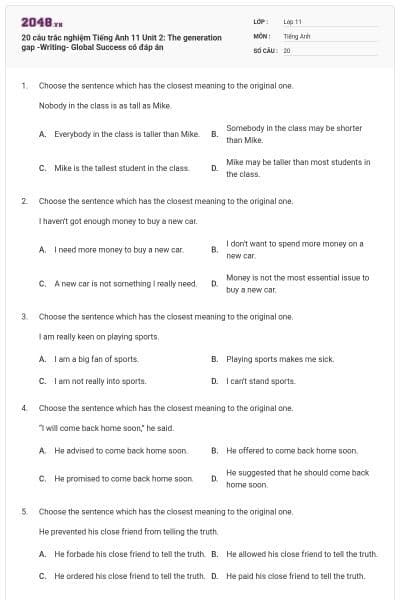
Choose the sentence which has the closest meaning to the original one.
Nobody in the class is as tall as Mike.
Everybody in the class is taller than Mike.
Somebody in the class may be shorter than Mike.
Mike is the tallest student in the class.
Mike may be taller than most students in the class.
Đáp án đúng: C
Giải thích: “Nobody in the class is as tall as Mike” có nghĩa là không ai cao bằng Mike → Mike cao nhất lớp.
Dịch nghĩa: Mike là học sinh cao nhất trong lớp.
Choose the sentence which has the closest meaning to the original one.
I haven't got enough money to buy a new car.
I need more money to buy a new car.
I don't want to spend more money on a new car.
A new car is not something I really need.
Money is not the most essential issue to buy a new car.
Đáp án đúng: A
Giải thích: “haven’t got enough money” = không có đủ tiền → cần nhiều tiền hơn.
Dịch nghĩa: Tôi cần nhiều tiền hơn để mua một chiếc xe hơi mới.
Choose the sentence which has the closest meaning to the original one.
I am really keen on playing sports.
I am a big fan of sports.
Playing sports makes me sick.
I am not really into sports.
I can't stand sports.
Đáp án đúng: A
Giải thích: “keen on” = rất thích, đam mê → đồng nghĩa với “a big fan of”.
Dịch nghĩa: Tôi là một người rất thích thể thao.
Choose the sentence which has the closest meaning to the original one.
“I will come back home soon,” he said.
He advised to come back home soon.
He offered to come back home soon.
He promised to come back home soon.
He suggested that he should come back home soon.
Đáp án đúng: C
Giải thích: Khi tường thuật, “I will…” + động từ = lời hứa sẽ làm gì → “promised”.
Dịch nghĩa: Anh ấy hứa sẽ sớm về nhà.
Choose the sentence which has the closest meaning to the original one.
He prevented his close friend from telling the truth.
He forbade his close friend to tell the truth.
He allowed his close friend to tell the truth.
He ordered his close friend to tell the truth.
He paid his close friend to tell the truth.
Đáp án đúng: A
Giải thích: “prevent … from doing sth” = ngăn cản → đồng nghĩa với “forbid sb to do sth”.
Dịch nghĩa: Anh ấy đã ngăn cấm người bạn thân nói ra sự thật.
Choose the sentence which has the closest meaning to the original one.
It is not necessary for Alice to do all the housework.
Alice must not do all the housework.
Alice should not do all the housework.
Alice doesn't have to do all the housework.
Alice doesn't have to do the unnecessary housework.
Đáp án đúng: C
Giải thích: “It is not necessary” = không cần thiết → “doesn’t have to” (không phải làm).
Dịch nghĩa: Alice không cần phải làm tất cả việc nhà.
Choose the sentence which has the closest meaning to the original one.
It was wrong of you to scare your brother like that.
You must not scare your brother like that.
You ought not to have scared your brother like that.
You should have scared your brother like that.
You should not scare your brother like that.
Đáp án đúng: B
Giải thích: “It was wrong of you to…” → diễn đạt quá khứ, dùng “ought not to have + V3” (đã không nên làm gì).
Dịch nghĩa: Lẽ ra bạn không nên làm anh trai mình sợ như vậy.
Choose the sentence which has the closest meaning to the original one.
It is against the school rules to cheat in the test.
You don't have to cheat in the test.
You must cheat in the test.
You must not cheat in the test.
You have to cheat in the test.
Đáp án đúng: C
Giải thích: “against the rules” = trái nội quy → cấm → dùng “must not”.
Dịch nghĩa: Bạn không được gian lận trong kỳ thi vì đó là trái nội quy trường.
Choose the sentence which has the closest meaning to the original one.
It is necessary for young people to consult their parents about future career.
Young people don't have to consult their parents about future career.
Young people ought not to consult their parents about future career.
Young people should have consulted their parents about future career.
Young people must consult their parents about future career.
Đáp án đúng: D
Giải thích: “It is necessary” = cần thiết → phải → dùng “must”.
Dịch nghĩa: Người trẻ phải tham khảo ý kiến cha mẹ về nghề nghiệp tương lai.
Choose the sentence which has the closest meaning to the original one.
Youngsters should confide their problems to their parents for sound solutions.
It is advisable for youngsters to confide their problems to their parents for sound solutions.
It is obligatory for youngsters to confide their problems to their parents for sound solutions.
It is illegal for youngsters to confide their problems to their parents for sound solutions.
It is optional for youngsters to confide their problems to their parents for sound solutions.
Đáp án đúng: A
Giải thích: “should” = nên, mang nghĩa khuyên nhủ → “It is advisable” (Hữu ích khi làm gì).
Dịch nghĩa: Thanh thiếu niên nên tâm sự vấn đề của mình với cha mẹ để có được giải pháp đúng đắn.
Choose the sentence that best combines each pair of sentences given.
You shouldn't be worried. You have prepared carefully for the test.
You shouldn't be worried, and you have prepared carefully for the test.
You shouldn't be worried, or you have prepared carefully for the test.
You shouldn't be worried, for you have prepared carefully for the test.
You shouldn't be worried, but you have prepared carefully for the test.
Đáp án đúng: C
Giải thích: “for” = bởi vì → diễn đạt nguyên nhân.
Dịch nghĩa: Bạn không nên lo lắng vì bạn đã chuẩn bị kỹ cho bài kiểm tra.
Choose the sentence that best combines each pair of sentences given.
The kids like Sundays. They don't have to get up early then.
The kids like Sundays if they don't have to get up early then.
The kids like Sundays although they don't have to get up early then.
The kids like Sundays so that they don't have to get up early then.
The kids like Sundays since they don't have to get up early then.
Đáp án đúng: D
Giải thích: “since” = bởi vì → diễn đạt nguyên nhân.
Dịch nghĩa: Bọn trẻ thích Chủ nhật vì khi đó chúng không phải dậy sớm.
Choose the sentence that best combines each pair of sentences given.
Some parents and children have different tastes in music. They have different taste in fashion, too.
Some parents and children have different tastes in both music and fashion.
Some parents and children have different tastes in either music or fashion.
Some parents and children have different tastes in neither music nor fashion.
Some parents and children have different tastes in music but not fashion.
Đáp án đúng: A
Giải thích: Câu gốc: khác nhau ở âm nhạc và thời trang → dùng “both” (cả hai).
Dịch nghĩa: Một số cha mẹ và con cái có gu khác nhau cả về âm nhạc lẫn thời trang.
Choose the sentence that best combines each pair of sentences given.
His parents don't like some of his friends. His friends wear too flashy clothes.
His parents don't like some of his friends despite their too flashy clothes.
His parents don't like some of his friends because of their too flashy clothes.
His parents don't like some of his friends but for their flashy clothes.
His parents don't like some of his friends without their too flashy clothes.
Đáp án đúng: B
Giải thích: “because of” + N diễn đạt nguyên nhân.
Dịch nghĩa: Bố mẹ anh ấy không thích một số người bạn của anh ấy vì họ mặc quần áo quá lòe loẹt.
Choose the sentence that best combines each pair of sentences given.
Sue does not help her parents with the housework. She is so irresponsible.
Sue is so irresponsible that she cannot help her parents with the housework.
Sue is not responsible enough to help her parents with the housework.
Sue is so responsible a girl that she cannot help her parents with the housework.
It is irresponsible of Sue not to help her parents with the housework.
Đáp án đúng: D
Giải thích: Cấu trúc “It is + adj + of sb to do sth” → đánh giá hành động của người nào đó.
Dịch nghĩa: Thật vô trách nhiệm khi Sue không giúp bố mẹ làm việc nhà.
Choose the sentence that best combines each pair of sentences given.
My brother speaks too loud. It is really annoying.
My brother is speaking too loud.
My brother likes to speak too loud.
My brother feels annoyed when he can't speak too loud.
My brother is always speaking too loud.
Đáp án đúng: D
Giải thích: Dùng “always + V-ing” để chỉ hành vi lặp lại gây khó chịu.
Dịch nghĩa: Anh trai tôi lúc nào cũng nói quá to, thật là phiền.
Choose the sentence that best combines each pair of sentences given.
She is an honest person. She is also a very friendly one.
She is an honest but friendly person.
She is not only an honest but also a very friendly person.
Though she is a honest person, she is friendly.
Being honest is necessary to become friendly.
Đáp án đúng: B
Giải thích: Dùng cấu trúc “not only … but also …” (không những … mà còn …) để kết hợp hai đặc điểm.
Dịch nghĩa: Cô ấy không chỉ là một người trung thực mà còn rất thân thiện.
Choose the sentence that best combines each pair of sentences given.
Your parents will help you with the problem. You should tell them the story.
Because your parents will help you with the problem, you should tell them the story.
Your parents will help you with the problem since you should tell them the story.
If your parents will help you with the problem, you should tell them the story.
Your parents will help you with the problem because you should tell them the story.
Đáp án đúng: A
Giải thích: “because” = bởi vì → diễn đạt nguyên nhân.
Dịch nghĩa: Bố mẹ bạn sẽ giúp bạn giải quyết vấn đề, vì vậy bạn nên kể câu chuyện cho họ.
Choose the sentence that best combines each pair of sentences given.
Unemployment rate is high. This makes many children move back to their parents' house.
Many children move back to their parents' house, which makes high unemployment rate.
High unemployment rate forces many children to move back to their parents' house.
Moving back to their parents' house suggests that the unemployment rate is high.
It is necessary to move back to your parents' house if unemployment rate is high.
Đáp án đúng: B
Giải thích: Câu sau nêu nguyên nhân – kết quả.
Dịch nghĩa: Tỷ lệ thất nghiệp cao buộc nhiều thanh niên phải quay lại sống với bố mẹ.
Choose the sentence that best combines each pair of sentences given.
There is always conflict between parents and children. However, they still should talk and share things with each other.
Although there is always conflict between parents and children, they still should talk and share things with each other.
There is always conflict between parents and children, so they still should talk and share things with each other.
Unless there is always conflict between parents and children, they still should talk and share things with each other.
Not only there is always conflict between parents and children, but they still should talk and share things with each other.
Đáp án đúng: A
Giải thích: “Although” = mặc dù, phù hợp với quan hệ tương phản giữa 2 vế.
Dịch nghĩa: Mặc dù luôn có xung đột giữa cha mẹ và con cái, họ vẫn nên trò chuyện và chia sẻ với nhau.