Topic 7: Life stories (Phần 2)
15 câu hỏi
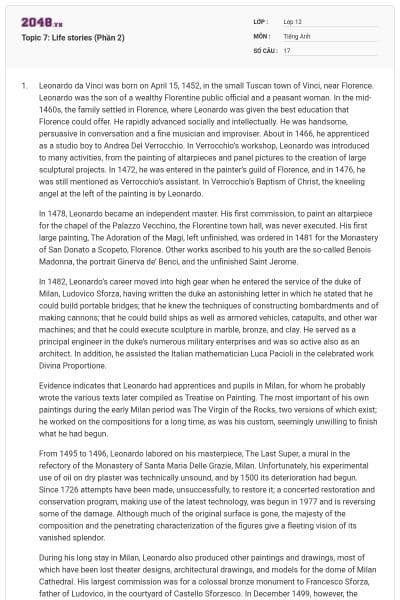
Leonardo da Vinci was born on April 15, 1452, in the small Tuscan town of Vinci, near Florence. Leonardo was the son of a wealthy Florentine public official and a peasant woman. In the mid- 1460s, the family settled in Florence, where Leonardo was given the best education that Florence could offer. He rapidly advanced socially and intellectually. He was handsome, persuasive in conversation and a fine musician and improviser. About in 1466, he apprenticed as a studio boy to Andrea Del Verrocchio. In Verrocchio’s workshop, Leonardo was introduced to many activities, from the painting of altarpieces and panel pictures to the creation of large sculptural projects. In 1472, he was entered in the painter’s guild of Florence, and in 1476, he was still mentioned as Verrocchio’s assistant. In Verrocchio’s Baptism of Christ, the kneeling angel at the left of the painting is by Leonardo.
In 1478, Leonardo became an independent master. His first commission, to paint an altarpiece for the chapel of the Palazzo Vecchino, the Florentine town hall, was never executed. His first large painting, The Adoration of the Magi, left unfinished, was ordered in 1481 for the Monastery of San Donato a Scopeto, Florence. Other works ascribed to his youth are the so-called Benois Madonna, the portrait Ginerva de’ Benci, and the unfinished Saint Jerome.
In 1482, Leonardo’s career moved into high gear when he entered the service of the duke of Milan, Ludovico Sforza, having written the duke an astonishing letter in which he stated that he could build portable bridges; that he knew the techniques of constructing bombardments and of making cannons; that he could build ships as well as armored vehicles, catapults, and other war machines; and that he could execute sculpture in marble, bronze, and clay. He served as a principal engineer in the duke’s numerous military enterprises and was so active also as an architect. In addition, he assisted the Italian mathematician Luca Pacioli in the celebrated work Divina Proportione.
Evidence indicates that Leonardo had apprentices and pupils in Milan, for whom he probably wrote the various texts later compiled as Treatise on Painting. The most important of his own paintings during the early Milan period was The Virgin of the Rocks, two versions of which exist; he worked on the compositions for a long time, as was his custom, seemingly unwilling to finish what he had begun.
From 1495 to 1496, Leonardo labored on his masterpiece, The Last Super, a mural in the refectory of the Monastery of Santa Maria Delle Grazie, Milan. Unfortunately, his experimental use of oil on dry plaster was technically unsound, and by 1500 its deterioration had begun. Since 1726 attempts have been made, unsuccessfully, to restore it; a concerted restoration and conservation program, making use of the latest technology, was begun in 1977 and is reversing some of the damage. Although much of the original surface is gone, the majesty of the composition and the penetrating characterization of the figures give a fleeting vision of its vanished splendor.
During his long stay in Milan, Leonardo also produced other paintings and drawings, most of which have been lost theater designs, architectural drawings, and models for the dome of Milan Cathedral. His largest commission was for a colossal bronze monument to Francesco Sforza, father of Ludovico, in the courtyard of Castello Sforzesco. In December 1499, however, the Sforza family was driven from Milan by French forces; Leonardo left the statue unfinished and he returned to Florence in 1500.
The pronoun “he” in paragraph 3 refers to __________ .
Leonardo da Vinci
The duke
Sforza
Milan
Đáp án A
Giải thích:
Đại từ chỉ “he” trong đoạn 3 đề cập đến .
A. Leonardo da Vinci
B. Công tước
C. Sforza
D. Milan
Thông tin: In 1482, Leonardo’s career moved into high gear when he entered the service of the duke of milan, ludovico sforza, having written the duke an astoonishing letter in which he stated that he could build portable bridges…
Tạm dịch: Vào năm 1482, sự nghiệp của leonardos lên rất nhanh khi ông bước vào phục vụ cho công tước xứ Milan, Ludovico Sforza, đã viết một là thư đáng kinh ngạc cho vị công tước trong đó ông ấy đã phát biểu rằng ông ta có thể xây dựng những cái cầu nối di động
How old was Leonardo da Vinci when he became an independent master?
23
26
25
28
Đáp án B
Giải thích:
Leonardo da Vinci bao nhiêu tuổi khi ông ấy trở thành bậc thầy độc lập?
A. 23
B. 26
C. 25
D. 28
Thông tin: Leonardo da Vinci was born on April 15,1452. … In 1478, Leonardo became an independent master.
Tạm dịch: Leonardo da Vinci sinh ngày 15 tháng 4 năm 1452. … Năm 1478, Leonardo trở thành một bậc thầy độc lập.
The word “catapults” in paragraph 3 is probably __________ .
an arm
an animal
a method of transportation
a food
Đáp án C
Giải thích:
Từ “catapults” (phóng lên) ở đoạn 3 có thể có nghĩa là _______
A. một cánh tay
B. một con vật
C. một phương thức vận chuyển
D. một loại thực phẩm
Thông tin: … that he could build ships as well as armored vehicles, catapults, and other war machines
Tạm dịch: … rằng anh ta có thể chế tạo tàu cũng như xe bọc thép, máy phóng và các cỗ máy chiến tranh khác
The word “apprenticed” in paragraph 1 is closest in meaning to __________ .
cleaned
studied
mastered
painted
Đáp án B
Giải thích:Từ “apprentice” (theo học nghề) ở đoạn 1 có nghĩa gần nhất với ________ .
A. clean (v): làm sạch
B. study (v): học
C. master (v): làm chủ, sử dụng thành thạo
D. paint (v): sơn, vẽ
Thông tin: About in 1466, he apprenticed as a studio boy to Andrea Del Verrocchio.
Tạm dịch: Vào khoảng năm 1466, ông học việc với tư cách là một cậu bé trong studio cho Andrea Del Verrocchio.
What is NOT mentioned about the young Leonardo da Vinci?
He was gifted in many fields of art.
He was a talented speaker.
He was physically attractive.
He was well-connected.
Đáp án D
Điều gì không được đề cập về Leonardo de Vinci?
A. Ông ấy có năng khiếu trong nhiều lĩnh vực nghệ thuật.
C. Ông ấy hấp dẫn về mặt thân thể.
B. Ông ấy đã là một người diễn thuyết tài năng.
D. Ông ấy có người thân giàu có và có quyền thế.
Thông tin: He was handsome, persuasive in conversation and a fine musician and improviser
Tạm dịch: Ông ấy đẹp trai, lời nói có sức thuyết phục và là một nhạc sĩ và người ứng khẩu giỏi.
What is NOT mentioned as a creation of Leonardo da Vinci’s while he was in Milan?
theatre designs
architectural drawings\
models of bronze horses
models for church domes
Đáp án C
Giải thích:
Điều gì KHÔNG được đề cập đến như một sáng tạo của Leonardo da Vinci, khi anh ở Milan?
A. thiết kế nhà hát
B. bản vẽ kiến trúc
C. mô hình ngựa đồng
D. mô hình cho mái vòm nhà thờ
Thông tin: During his long stay in Milan, Leonardo also produced other paintings and drawings, most of which have been lost theater designs, architectural drawings, and models for the dome of Milan Cathedral.
Tạm dịch: Trong thời gian dài ở Milan, Leonardo cũng sản xuất các bức tranh và bản vẽ khác, hầu hết trong số đó đã bị mất các thiết kế nhà hát, bản vẽ kiến trúc và mô hình cho mái vòm của Nhà thờ Milan.
The word “concerted” in paragraph 5 is closest in meaning to __________ .
painful
musical
organized
artistic
Đáp án C
Giải thích:
Từ “concerted” (phối hợp) ở đoạn 5 có nghĩa gần nhất với ______ .
A. đau đớn
B. âm nhạc
C. có tổ chức
D. nghệ thuật
Thông tin: Since 1726 attempts have been made, unsuccessfully, to restore it; a concerted restoration and conservation program, making use of the latest technology, was begun in 1977 and is reversing some of the damage.
Tạm dịch: Từ năm 1726 các lần thử đã được thực hiện, và nó không thành công, để khôi phục nó; một chương trình phục hồi và bảo tồn phối hợp, sử dụng công nghệ mới nhất, đã được bắt đầu vào năm 1977 và đang đảo ngược một số thiệt hại.
My mom is a pretty talented pianist. She reads music very well and loves to play Chopin and various other classical artists. One of my earliest memories involves sitting under her piano bench while she played. It gave her a lot of joy and a lot of personal pride, I think. I trust that she naturally wanted those things for me when she enrolled me in piano lessons when I was about seven years old.
I hated them. I was scared of my teacher. I hated practicing. I hated the songs I was being forced to learn. I hated reading music. I was a young kid, and there were other things I wanted to do instead. It just didn’t interest me, and no amount of begging and pleading on my mother’s part could get me to enjoy practicing. One thing in particular that she used to say as she was begging me to practice was, “One day, when you’re older, you will cherish the ability to sit down and play.” Nevertheless, after a couple years of once-a-week torture, she finally allowed me to quit.
Years went by. I switched schools when I was 11 years old, got a new best friend, and got interested in music. This was a critical turning point. My best friend loved the band Bush and lots of other alternative bands of the ‘90s, and listening to them unlocked a whole new sonic world for me. I fell in love, fell completely and totally in love, with rock music.
My friend taught me the form for a power chord on her acoustic guitar. If you know how to play a power chord, you can play or at least convincingly fake pretty much every single rock song in the world. It was like someone had given me my first hit of a powerful opiate.
I spent hours practicing in my room. Hours sounding out my favourite songs. More hours playing along with those songs in front of my mirror, pretending I was Scott Weiland, Dolores O’Riordan, Chris Cornell, or my personal favourite Louise Post (of Veruca Salt). I unlocked a talent within myself that had gone obscenely undiscovered and undeveloped when I was a young child banging my head against a piano keyboard, trying and failing to read a piece of music - I could play the guitar by ear. I just hadn’t had the time to figure that out because my mom was trying so hard to get me to do something that did not come naturally to me and that I had no desire to do.
What grade did the writer probably in when she started learning to play the piano?
2
5
7
11
Đáp án A
Nhà văn học lớp mấy khi cô bắt đầu học chơi piano?
A. 2
B. 5
C. 7
D. 11
Căn cứ vào thông tin:
"I trust that she naturally wanted those things for me when she enrolled me in piano lessons when I was about seven years old."
(Tôi tin rằng mẹ tôi tự nhiên muốn tôi học những thứ đó khi mẹ cho tôi học các lớp học piano khi tôi khoảng bảy tuổi.)
=> Khi nhà văn bắt đầu học chơi piano, cô ấy khoảng 7 tuổi nên có lẽ cô ấy đang học lớp 2.
The writer wrote she disliked all of the following EXCEPT ____.
reading music
practising
the songs she had to learn
her teacher
Đáp án D
Nhà văn đã viết cô ấy không thích tất cả NGOẠI TRỪ ____.
A. đọc nhạc
B. thực hành
C. những bài hát cô phải học
D. cô giáo
Căn cứ vào thông tin:
"I hated them. I was scared of my teacher. I hated practicing. I hated the songs I was being forced to learn. I hated reading music. I was a young kid, and there were other things I wanted to do instead."
(Tôi ghét chúng. Tôi sợ giáo viên của tôi. Tôi ghét thực hành. Tôi ghét những bài hát tôi bị buộc phải học. Tôi ghét đọc nhạc. Tôi là một đứa trẻ, và còn rất nhiều thứ khác tôi muốn làm.)
=> Tác giả viết cô ấy sợ giáo viên chứ không phải là ghét giáo viên của mình.
How many piano lessons per week did the writer have?
1
2
3
4
Đáp án A
Nhà văn có bao nhiêu buổi học piano mỗi tuần?
A. 1
B. 2
C. 3
D. 4
Căn cứ vào thông tin:
"Nevertheless, after a couple years of once-a-week torture, she finally allowed me to quit."
(Tuy nhiên, sau vài năm bị bắt ép học một lần một tuần, cuối cùng mẹ cũng cho phép tôi bỏ học.)
Whose music did the write probably prefer listening to?
Mozart
Beethoven
Bush
Chopin
Đáp án C
Người viết có lẽ thích nghe nhạc của ai hơn?
A. Mozart
B. Beethoven
C. Bush
D. Chopin
Căn cứ vào thông tin:
“My best friend loved the band Bush and lots of other alternative bands of the ‘90s, and listening to them unlocked a whole new sonic world for me. I fell in love, fell completely and totally in love, with rock music.”
(Người bạn thân nhất của tôi yêu thích ban nhạc Bush và rất nhiều ban nhạc tương tự khác của những năm 90, và nghe những ban nhạc đó đã mở ra một thế giới âm nhạc hoàn toàn mới cho tôi. Tôi đã yêu, đã hoàn toàn và tràn ngập trong tình yêu, với nhạc rock.)
What does the word "opiate” in Paragraph 4 closest in meaning to?
energy
music
instrument
drug
Đáp án D
Từ “opiate” trong đoạn 4 có nghĩa gần nhất với cái gì?
A. năng lượng
B. âm nhạc
C. nhạc cụ
D. thuốc
Căn cứ vào thông tin:
"If you know how to play a power chord, you can play or at least convincingly fake pretty much every single rock song in the world. It was like someone had given me my first hit of a powerful opiate."
(Nếu bạn biết cách chơi một hợp âm mạnh, bạn có thể chơi hoặc ít nhất là nhái theo các bài hát rock trên thế giới khá thuyết phục. Giống như có ai đó đã cho tôi lần đầu tiên một loại thuốc nghiện vậy.)
=> opiate /ˈəʊpiət/ (n): thuốc nghiện => chọn đáp án D.
Thanks to hard practice, the writer succeed in ____.
reading music
writing songs
playing the piano
playing the guitar
Đáp án D
Nhờ luyện tập chăm chỉ, người viết đã thành công trong ____.
A. đọc nhạc
B. viết bài hát
C. chơi piano
D. chơi guitar
Căn cứ vào thông tin:
“I spent hours practicing in my room. Hours sounding out my favourite songs. More hours playing along with those songs in front of my mirror. I unlocked a talent within myself that had gone obscenely undiscovered and undeveloped ……- I could play the guitar by ear.”
(Tôi đã dành hàng giờ luyện tập trong phòng của tôi. Hàng giờ phát những bài hát yêu thích của tôi. Thêm nhiều giờ chơi những bài hát trước gương. Tôi đã khám phá ra một tài năng chưa được khám phá và chưa phát triển trong bản thân mình một cách khó hiểu …- Tôi có thể chơi guitar bằng tai.)
Who made the writer love music?
Her mother
Her teacher
Her friend
Her boss
Đáp án C
Ai làm cho nhà văn yêu âm nhạc?
A. Mẹ cô ấy
B. Giáo viên của cô ấy
C. Bạn của cô ấy
D. Sếp của cô ấy
Căn cứ vào thông tin:
"My best friend loved the band Bush and lots of other alternative bands of the ‘90s, and listening to them unlocked a whole new sonic world for me. I fell in love, fell completely and totally in love, with rock music."
(Người bạn thân nhất của tôi yêu thích ban nhạc Bush và rất nhiều ban nhạc tương tự khác của những năm 90, và nghe những ban nhạc đó đã mở ra một thế giới âm thanh hoàn toàn mới cho tôi. Tôi đã yêu, đã hoàn toàn và tràn ngập trong tình yêu, với nhạc rock.)
Which of the following statements does the writer most agree with?
You cannot be forced to learn music.
Children should learn music at school.
Parents are the best teachers of music.
Playing the piano is easier than the guitar.
Đáp án A
Những phát biểu nào sau đây mà người viết đồng ý với?
A. Bạn không thể bị ép buộc học nhạc.
B. Trẻ em nên học nhạc ở trường.
C. Cha mẹ là giáo viên tốt nhất của âm nhạc.
D. Chơi đàn piano dễ hơn chơi đàn guitar.
Căn cứ vào thông tin:
“I just hadn’t had the time to figure that out because my mom was trying so hard to get me to do something that did not come naturally to me and that I had no desire to do.”
(Tôi chỉ không có thời gian để nhận ra điều đó bởi vì mẹ tôi đã cố gắng rất nhiều để bắt tôi làm điều gì đó mà không tự nhiên với tôi và tôi không muốn làm.)
=> Tác giả thấy rằng dù được mẹ cho học chơi đàn piano rất sớm nhưng tác giả không có đam mê và sự thích thú nên không thể trở nên giỏi được. Về sau, tác giả tự thấy yêu thích nhạc rock và đã khám phá ra được tài năng chơi đàn guitar của mình
=> Tác giả muốn nói rằng không thể bắt ép trẻ học nhạc, mà hãy để nhạc đến với chúng một cách tự nhiên.
Bạn có thích hoạt động này không?