Topic 36: Inventions
56 câu hỏi
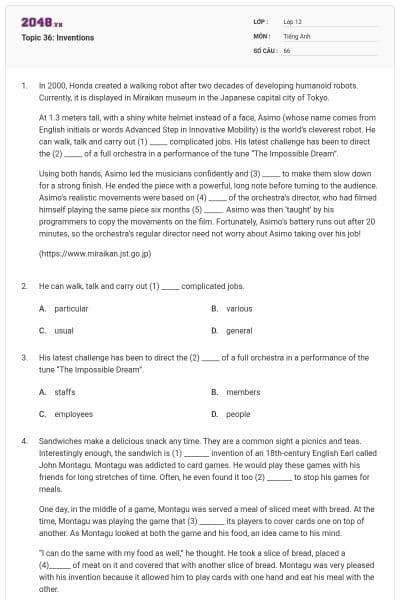
In 2000, Honda created a walking robot after two decades of developing humanoid robots. Currently, it is displayed in Miraikan museum in the Japanese capital city of Tokyo.
At 1.3 meters tall, with a shiny white helmet instead of a face, Asimo (whose name comes from English initials or words Advanced Step in Innovative Mobility) is the world’s cleverest robot. He can walk, talk and carry out (1) _____ complicated jobs. His latest challenge has been to direct the (2) _____ of a full orchestra in a performance of the tune “The Impossible Dream”.
Using both hands, Asimo led the musicians confidently and (3) _____ to make them slow down for a strong finish. He ended the piece with a powerful, long note before turning to the audience. Asimo’s realistic movements were based on (4) _____ of the orchestra’s director, who had filmed himself playing the same piece six months (5) _____. Asimo was then ‘taught’ by his programmers to copy the movements on the film. Fortunately, Asimo’s battery runs out after 20 minutes, so the orchestra’s regular director need not worry about Asimo taking over his job!
(https://www.miraikan.jst.go.jp)
particular
various
usual
general
Năm 2000, Honda đã tạo ra một robot có thể đi lại sau hai thập kỷ phát triển robot hình người. Hiện tại, nó được trưng bày trong bảo tàng Miraikan ở thủ đô Tokyo của Nhật Bản.
Với chiều cao 1,3 mét, với chiếc mũ màu trắng sáng bóng thay cho khuôn mặt, Asimo (tên xuất phát từ tên viết tắt tiếng Anh “Những bước tiến trong công nghệ di động sáng tạo”) là robot thông minh nhất thế giới. Anh ta có thể đi bộ, nói chuyện và thực hiện các công việc phức tạp khác nhau. Thử thách mới nhất của anh là chỉ đạo tất cả các thành viên của một dàn nhạc trong một buổi biểu diễn giai điệu của bài “The Impossible Dream.”
Sử dụng cả hai tay, Asimo dẫn dắt các nhạc sĩ tự tin và làm cho họ chậm lại để có một kết thúc cao trào mãnh liệt. Anh ấy kết thúc tác phẩm bằng một nốt nhạc mạnh, dài trước khi quay sang phía khán giả. Chuyển động thực tế của Asimo dựa trên những người làm đạo diễn dàn nhạc, người đã tự quay phim mình trong lúc chơi đang một bản nhạc sáu tháng trước đó. Asimo sau đó được các lập trình viên của mình ‘dạy’ cách sao chép các chuyển động trên phim. May mắn thay, pin của Asimo hết sau 20 phút, vì vậy chỉ huy thường xuyên của dàn nhạc không cần phải lo lắng về việc Asimo sẽ chiếm lấy công việc của mình!
Đáp án B
Kiến thức về từ vựng
Xét các đáp án:
A. Particular /pəˈtɪk.jə.lər/ (a): cụ thể, riêng
B. Various /ˈveə.ri.əs/ (a): nhiều, đa dạng, khác nhau
C. Usual /ˈjuː.ʒu.əl/ (a): thông thường, thường lệ
D. General /ˈdʒen.ər.əl/ (a): chung, nhìn chung
Tạm dịch: “He can walk, talk and carry out (1) _____ complicated jobs.”
His latest challenge has been to direct the (2) _____ of a full orchestra in a performance of the tune “The Impossible Dream”.
staffs
members
employees
people
Đáp án B
Kiến thức về từ vựng
Xét các đáp án:
A. Staff /stɑːf/ (n): cán bộ, nhân viên
B. Member /ˈmem.bər/ (n): thành viên
C. Employee /ɪmˈplɔɪ.iː/ (n): công nhân, người làm thuê
D. People /ˈpiː.pəl/ (n): con người, người
Tạm dịch: “His latest challenge has been to direct the (2) _____ of a full orchestra in a performance of the tune “The Impossible Dream”.
(Thử thách mới nhất của anh ấy là là chỉ đạo các thành viên trong một dàn nhạc giao hưởng đầy đủ trình diễn giai điệu “Giấc mơ không tưởng”)
achieved
succeeded
managed
produced
Đáp án C
Kiến thức về từ vựng
Xét các đáp án:
A. Achieve /əˈtʃiːv/ (v): đạt được, có được
B. Succeed /səkˈsiːd/ (v): thành công, có được thành công
C. Manage /ˈmæn.ɪdʒ/ (v): xoay sở
D. Produce /prəˈdʒuːs/ (v): sản xuất
Tạm dịch: “Using both hands, Asimo led the musicians confidently and (3) _____ to make them slow down for a strong finish.”
(Sử dụng hai tay, Asimo hướng dẫn các nhạc sĩ một cách thật tự tin và xoay sở để làm họ đánh chậm lại ở một đoạn kết mạnh.)
these
them
those
this
Đáp án C
Kiến thức về đại từ chỉ định
Ta có:
* These được dùng để chỉ người hoặc vật ở gần người nói, người viết. These + danh từ số nhiều
* Those được dùng để chỉ người hoặc vật ở xa người nói, người viết. Those + danh từ số nhiều
* This được dùng để chỉ người hoặc vật ở gần người nói, người viết. This + danh từ số ít
Tạm dịch: “Asimo’s realistic movements were based on (4) _____ of the orchestra’s director,”
(Các chuyển động thực của Asimo được mô phỏng dựa trên những chuyển động của người nhạc trưởng.)
previously
formerly
lately
recently
Đáp án A
Kiến thức về từ vựng
Xét các đáp án:
A. Previously /ˈpriː.vi.əs.li/ (adv): trước đây, trước đó
B. Formerly /ˈfɔː.mə.li/ (adv): trong quá khứ
C. Lately /ˈleɪt.li/ (adv): mới đây, cách đây không lâu
D. Recently /ˈriː.sənt.li/ (adv): gần đây
Tạm dịch: “Asimo’s realistic movements were based on these of the orchestra’s director, who had filmed himself playing the same piece six months (5) ________.”
(Các chuyển động thực thụ của Asimo được mô phỏng dựa trên những chuyển động của người nhạc trưởng, người mà đã tự ghi hình bản thân trong lúc trình diễn giai điệu đó vào sáu tháng trước.)
Sandwiches make a delicious snack any time. They are a common sight a picnics and teas. Interestingly enough, the sandwich is (1) _______ invention of an 18th-century English Earl called John Montagu. Montagu was addicted to card games. He would play these games with his friends for long stretches of time. Often, he even found it too (2) _______ to stop his games for meals.
One day, in the middle of a game, Montagu was served a meal of sliced meat with bread. At the time, Montagu was playing the game that (3) _______ its players to cover cards one on top of another. As Montagu looked at both the game and his food, an idea came to his mind.
“I can do the same with my food as well,” he thought. He took a slice of bread, placed a (4)______ of meat on it and covered that with another slice of bread. Montagu was very pleased with his invention because it allowed him to play cards with one hand and eat his meal with the other.
Montagu’s friends quickly (5) _______ to his idea and they named the new invention after him. As Montagu’s full title was “the Earl of Sandwich”, the new invention became known as a “sandwich”.
a
an
the
Ø
Sandwiches là một bữa ăn nhẹ ngon cho bất cứ thời gian nào. Chúng thường xem như là một món ăn phổ biến cho một buổi dã ngoại và tiệc trà. Thật thú vị, bánh sandwich là phát minh của một bá tước người Anh thế kỷ 18 tên là John Montagu. Montagu nghiện chơi bài. Ông ấy sẽ chơi trò chơi này với bạn bè trong một thời gian dài. Thông thường, ông ta thậm chí còn cảm thấy khó chịu khi phải dừng chơi để ăn.
Một ngày nọ, khi đang chơi, Montagu được phục vụ một bữa ăn với thịt thái lát với bánh mì. Vào thời điểm đó, Montagu đang chơi trò chơi mà nó yêu cầu người chơi của mình phải để thẻ này chồng lên thẻ khác. Khi Montagu nhìn vào trò chơi và phần thức ăn của mình, một ý tưởng đã nảy ra trong đầu ông ấy.
“Tôi cũng có thể làm như vậy với thức ăn của mình” ông ấy nghĩ. Ông ta lấy một lát bánh mì, đặt một miếng thịt lên đó và phủ nó bằng một lát bánh mì khác. Montagu rất hài lòng với phát minh của mình vì nó cho phép anh ta chơi bài bằng một tay và ăn bữa ăn của mình bằng tay kia.
Những người bạn của Montagu đã nhanh chóng học theo ý tưởng của ông ấy và họ đặt tên cho phát minh mới đó theo tên của ông ấy. Vì tên đầy đủ của Montagu là “the Earl of Sandwich”, phát minh mới này được biết đến như là một chiếc bánh kẹp - “sandwich”.
Đáp án C
Kiến thức về mạo từ
Tạm dịch: “Sandwiches make a delicious snack any time. They are a common sight a picnics and teas. Interestingly enough, the sandwich is (1) _______ invention of an 18th-century English Earl called John Montagu.”
(Sandwiches làm một bữa ăn nhẹ bất cứ lúc nào mà lại rất ngon. Chúng là một dạng trưng bày phổ biến trong một buổi dã ngoại và trà. Thật thú vị, bánh sandwich là phát minh của một bá tước người Anh thế kỷ 18 tên là John Montagu.)
=> Vị trí này ta cần điền mạo từ “the” vì danh từ “invention” đã xác định, bởi theo cấu trúc: “The of the/a/an + N”
Often, he even found it too (2) _______ to stop his games for meals.
bothersome
unhappy
boring
disgusting
Đáp án A
Kiến thức về từ vựng
A. bothersome /ˈbɑːðərsəm/ (a): gây ra khó khăn, khó chịu; phiền muộn, rắc rối (là chủ thể, tác nhân chính của việc gây ra sự khó chịu, rắc rối đó)
B. unhappy /ʌnˈhæpi/ (a): cảm thấy không vui vẻ, hạnh phúc; buồn bã (ai đó bị tác động bởi một cái khác)
C. boring /ˈbɔːrɪŋ/ (a): có tính chất không thú vị, gây nhàm chán
D. disgusting /dɪsˈɡʌstɪŋ/ (a): gây kinh tởm, khủng khiếp
Tạm dịch: “Montagu was addicted to card games. He would play these games with his friends for long stretches of time. Often, he even found it too (2) _______ to stop his games for meals.”
(Montagu nghiện chơi bài. Anh ấy sẽ chơi những trò chơi này với bạn bè trong suốt một thời gian dài. Thông thường, anh ta thậm chí còn thấy nó quá là gây khó chịu để dừng chơi game cho bữa ăn.)
=> Ở đây, ta dùng một động từ mang bản chất “gây ra sự khó chịu, phiền hà, rắc rối” cho anh ta, nên chỉ đáp án A thỏa mãn.
requested
forced
ordered
required
Đáp án D
Kiến thức về từ vựng
A. request /rɪˈkwest/ (v): yêu cầu, đòi hỏi
=> Cấu trúc: Request sb to do sth: yêu cầu ai làm gì (một cách lịch sự, trang trọng)
B. force /fɔːrs/ (v): bắt buộc, ép buộc
=> Cấu trúc: Force sb to do sth: bắt buộc ai đó phải làm gì
C. order /ˈɔːrdər/ (v): ra lệnh, mệnh lệnh
=> Cấu trúc: Order sb to do sth: ra lệnh, buộc ai đó phải làm gì theo luật lệ, quy tắc
D. require /rɪˈkwaɪər/ (v): cần thiết, yêu cầu
=> Cấu trúc: Require sb/sth to do sth: yêu cầu, cần ai/cái gì phải làm gì (vì cần thiết và đang phụ thuộc vào họ)
=> Theo nghĩa và ngữ cảnh của câu, chỉ đáp án D phù hợp.
Tạm dịch: “One day, in the middle of a game, Montagu was served a meal of sliced meat with bread. At the time, Montagu was playing the game that (3) _______ its players to cover cards one on top of another.”
(Một ngày nọ, giữa một trò chơi, Montagu được phục vụ một bữa ăn với thịt thái lát với bánh mì. Vào thời điểm đó, Montagu đang chơi trò chơi yêu cầu người chơi của mình phải che thẻ này chồng lên nhau.)
bar
piece
chunk
handful
Đáp án B
Kiến thức về cụm từ cố định
A. bar /bɑːr/ (n): một mẩu, lát của một cái gì đó với các cạnh thẳng (chocolate, soap, candy,…)
B. piece /piːs/ (n): miếng, mánh, một lượng thứ gì được cắt ra và tách xé ra (cake, cheese, meat, bread,…)
C. chunk /tʃʌŋk/ (n): một mẩu thứ gì dày và rắn được cắt hoặc vỡ ra từ cái gì (cheese, masonry,...)
D. handful /ˈhændfʊl/ (n): một nhúm, một nắm (trong tay)
=> Ta dùng cụm từ: A piece of meat: một miếng thịt
Tạm dịch: “I can do the same with my food as well,” he thought. He took a slice of bread, placed a (4) ______ of meat on it and covered that with another slice of bread.
(“Tôi cũng có thể làm như vậy với món ăn của mình”, anh ấy nghĩ. Anh ta lấy một lát bánh mì, đặt một miếng thịt lên đó và phủ nó bằng một lát bánh mì khác.)
caught on
came up
thought of
took over
Đáp án A
Kiến thức về cụm động từ
A. catch on (to sth) (phr.v): hiểu được, nắm bắt được cái gì
B. come up (to…) (phr.v): bắt đầu đi học đại học ở trường nào đó
C. think of sth (phr.v): tưởng tượng một tình huống nào đó; nghĩ về điều gì
D. take over sth (phr.v): đảm nhận, kiểm soát một công ty, doanh nghiệp,…
=> Xét riêng cấu trúc, đi với “to sth” thì cũng chỉ A thỏa mãn. Về nghĩa, chỗ trống cần cụm mang nghĩa là “hiểu được” nên A hoàn toàn phù hợp.
Tạm dịch: Montagu’s friends quickly (5) _______ to his idea and they named the new invention after him. As Montagu’s full title was “the Earl of Sandwich”, the new invention became known as a “sandwich”.
(Những người bạn của Montagu đã nhanh chóng hiểu được ý tưởng của anh ấy và họ đặt tên cho phát minh mới theo anh ấy. Như tiêu đề đầy đủ của Montagu, là “The Earl of Sandwich”, phát minh mới này được biết đến như là một chiếc bánh “sandwich”.)
Technology has become a fantastic and useful tool in the classroom. Teachers are expected to make (1) _________________ if it to enhance the learning experience and information dissemination. However, knowledge of the different tools available, what they can do, and their impact allows teachers to use them (2) _____________. With numerous technology users actively involved in developing gadgets of the future, we can only specular what new advances will be making their way (3) _______________ classrooms in the coming days.
Following the evolution of technology, educational capabilities are changing and growing daily. The internet is a vast library of data that is useful in (4) _________________ the landscape of education as we know it. All in all, technology alone will not change education. Good grades and practical knowledge are as important as ever. Technology in education is therefore simply a catalyst, a tool for conveying lessons (5) _______________ effectiveness cannot be overlooked.
(Adapted from http://www.usetechnology.com)
use
benefit
value
advantage
Công nghệ đã trở thành một công cụ tuyệt vời và hữu ích trong lớp học. Giáo viên được mong sẽ tận dụng chúng để tăng cường khả năng trao đổi kinh nghiệm học tập và phổ biến thông tin. Tuy nhiên, kiến thức về các công cụ khác nhau là có sẵn, chúng có thể làm được những gì và tác động của chúng cho phép giáo viên sử dụng chúng một cách tối ưu. Với nhiều người dùng công nghệ một cách tích cực đã tham gia vào việc phát triển các tiện ích trong tương lai, chúng ta chỉ có thể suy đoán những tiến bộ mới sẽ được đưa vào lớp học trong thời gian sắp tới.
Theo chân sự phát triển của công nghệ, khả năng giáo dục đang thay đổi và phát triển hàng ngày. Internet là một thư viện dữ liệu khổng lồ hữu ích trong việc định hình và phát triển môi trường giáo dục như chúng ta biết. Nói chung, chỉ một mình công nghệ sẽ không thay đổi giáo dục được. Những con điểm tốt và kiến thức thực tế là quan trọng hơn bao giờ hết. Do đó, công nghệ trong giáo dục chỉ đơn giản là một chất xúc tác, một công cụ để truyền đạt những bài học mà hiệu quả chúng không thể bị phớt lờ.
Đáp án A
Kiến thức về cụm từ
Giải thích: ta có cụm từ make use of: tận dụng
Technology has become a fantastic and useful tool in the classroom. Teachers are expected to make use of it to enhance the learning experience and information dissemination.
(Công nghệ đã trở thành một công cụ tuyệt vời và hữu ích trong lớp học. Giáo viên mong muốn sẽ tận dụng nó để tăng cường kinh nghiệm học tập và phổ biến thông tin.)
freely
optimally
absolutely
exclusively
Đáp án B
Kiến thức về từ vựng
A. freely /’fri:li/ (adv): [một cách] tự do
B. optimally /ˈɒp.tɪ.mə.li/ (adv): [một cách] tối ưu
C. absolutely /’æbsəlu:tli/ (adv): [một cách] chắc chắn
D. exclusively /ik’sklu:sivli/ (adv): [một cách] riêng cho
Giải thích: Technology in education is therefore simply a catalyst, a tool for conveying lessons optimally effectiveness cannot be overlooked.
(Công nghệ trong giáo dục vì thế chỉ đơn giản là một chất xúc tác, một công cụ truyền đạt bài học hiệu quả tối ưu không thể bỏ qua.)
With numerous technology users actively involved in developing gadgets of the future, we can only specular what new advances will be making their way (3) _______________ classrooms in the coming days.
in
at
for
into
Đáp án D
Kiến thức về cụm động từ
make sth into sth: làm thành, đưa vào
Giải thích: With numerous technology users actively involved in developing gadgets of the future, we can only specular what new advances will be making their way into classrooms in the coming days.
(Với nhiều người dùng công nghệ tích cực tham gia vào việc phát triển các tiện ích trong tương lai, chúng ta chỉ có thể suy đoán những tiến bộ mới sẽ được đưa vào lớp học trong những ngày tới.)
rolling in
shaping up
showing up
passing on
Đáp án B
Kiến thức về cụm động từ
A. rolling in: đến đâu đó
B. shaping up: phát triển tích cực/ định hình
C. showing up: hiển thị
D. passing on: gửi tin nhắn, thông điệp
Giải thích: The internet is a vast library of data that is useful in shaping up the landscape of education as we know it.
(Internet là một thư viện dữ liệu khổng lồ hữu ích trong việc định hình cảnh quan giáo dục như chúng ta biết.)
Technology in education is therefore simply a catalyst, a tool for conveying lessons (5) _______________ effectiveness cannot be overlooked.
which
that
whose
why
Đáp án C
Kiến thức về đại từ quan hệ
Giải thích: trước đại từ quan hệ là danh từ (không phải người) => chọn whose
Technology in education is therefore simply a catalyst, a tool for conveying lessons whose effectiveness cannot be overlooked.
(Do đó, công nghệ trong giáo dục chỉ đơn giản là một chất xúc tác, một công cụ để truyền đạt những bài học mà hiệu quả của bài học không thể bỏ qua.)
Modern technology, in all its various forms, has changed the way we live our lives, but unfortunately, (1) _______ has not always been for the better. A number of things we used to value highly are gradually disappearing or have disappeared altogether. Take punctuality, for example; before mobile phones, people had to keep their appointments and get to meetings (2) _______ time. Now, it seems, it is perfectly acceptable to send a text five minutes before you are due to meet, telling your friend or colleague not to expect you for another half an hour or so.
The Internet, too, has had a negative effect on our (3) _________. Rudeness seems to be the language of debate on any site which (4) ________ users to give their opinions. Anonymity makes it easier for people to insult anyone that has views which are different from their own. They lose all sense of politeness and restraint, safe in the knowledge that they (5) _______ never be identified.
(Source: Macmillan Exams. Roy Norris, Ready for First, 3rd Edition)
which
there
it
this
Công nghệ hiện đại, trong tất cả các hình thức khác nhau của nó, đã thay đổi cái cách mà chúng ta sống, nhưng thật chẳng may, điều này không phải lúc nào cũng theo hướng tốt hơn. Rất nhiều điều mà chúng ta từng đánh giá cao giá trị của nó thì đang dần dần biến mất hoặc đã biến mất hoàn toàn. Chẳng hạn, xem xét về mặt giờ giấc; trước khi có điện thoại di động, mọi người phải theo dõi các cuộc hẹn và đến các cuộc gặp mặt đúng giờ. Bây giờ, dường như, nó là có thể hoàn toàn chấp nhận được để gửi một tin nhắn vào năm phút trước lịch hẹn, nói với bạn của bạn hoặc đồng nghiệp của bạn không cần đợi bạn trong khoảng nửa tiếng nữa hoặc hơn.
Mạng Internet cũng vậy, có những ảnh hưởng tiêu cực đến cách cư xử của chúng ta. Sự thô lỗ dường như đã trở thành ngôn ngữ của cuộc tranh luận ở mọi nơi khi mà có người được mời lên đưa ra quan điểm của họ. Tình trạng nặc danh khiến mọi người dễ dàng hơn để xúc phạm bất cứ ai có quan điểm khác với quan điểm của họ. Họ đánh mất tất cả ý thức về phép lịch sự và tính kiềm chế, an toàn trong cách mà hiểu rằng họ sẽ không bao giờ bị nhận ra.
Đáp án D
Kiến thức về đại từ
A. which: đại từ quan hệ thay thế cho danh từ chỉ vật hoặc cho cả mệnh đề (chỉ dùng trong cùng một câu, tức là được tách bởi vế trước bằng dấu phẩy)
B. there: trạng từ chỉ nơi chốn của sự vật, hiện tượng, con người,…
C. it: đại từ thay thế cho danh từ số ít đứng trước nó
D. this: đại từ có thể thay thế cho cả mệnh đề đứng trước nó khi không muốn nhắc lại lần hai (dùng cho hai câu liên tiếp nhau, tách nhau bởi dấu chấm)
Tạm dịch: “Modern technology, in all its various forms, has changed the way we live our lives, but unfortunately, (1) _______ has not always been for the better.”
(Công nghệ hiện đại, dưới mọi hình thức khác nhau, đã thay đổi cách chúng ta sống cuộc sống của mình, nhưng thật không may, điều này không phải lúc nào cũng tốt hơn.)
=> Ta dùng “this” vì nó thay thế cho cả mệnh đề “Modern technology … our lives” phía trước và hai vế là hai câu tách biệt nhau bởi dấu chấm.
at
in
on
over
Đáp án C
Kiến thức về giới từ
*Ta có hai cụm từ sau:
- In time: kịp giờ (sớm hơn một chút so với các giờ đã lên kế hoạch)
- On time: đúng giờ (xảy ra đúng thời gian như đã được dự tính)
Tạm dịch: “Take punctuality, for example; before mobile phones, people had to keep their appointments and get to meetings (2) _______ time. Now, it seems, it is perfectly acceptable to send a text five minutes before you are due to meet, telling your friend or colleague not to expect you for another half an hour or so.”
(Hãy đúng giờ, chẳng hạn, trước khi có điện thoại di động, mọi người phải theo dõi lịch trình các cuộc hẹn và đến các cuộc họp đúng giờ. Ngày nay, có vẻ như hoàn toàn chấp nhận được để gửi một văn bản năm phút trước khi bạn đến giờ phải có mặt, hãy nói với bạn bè hoặc đồng nghiệp của bạn rằng đừng chờ bạn trong nửa giờ nữa hoặc lâu hơn.)
=> Theo ngữ cảnh câu, ta cần điền giới từ để tạo thành cụm từ mang nghĩa “đúng giờ”, do đó ta dùng “on”.
emotions
manners
personalities
characteristics
Đáp án B
Kiến thức về từ vựng
A. emotion /ɪˈməʊʃn/ (n): cảm xúc, sự xúc động
B. manner /ˈmænər/ (n): cách cư xử, hành vi, thái độ
C. personality /ˌpɜːrsəˈnæləti/ (n): nhân cách, nhân phẩm
D. characteristic /ˌkærəktəˈrɪstɪk/ (n): nét đặc trưng, đặc điểm tiêu biểu hoặc phẩm chất của một ai/cái gì
Tạm dịch: “The Internet, too, has had a negative effect on our (3) _________.”
(Internet cũng có tác động tiêu cực đến cách cư xử của chúng ta.)
calls
makes
lets
invites
Đáp án D
Kiến thức về từ vựng
*Xét cấu trúc các đáp án:
A. call (sb) to do sth: gọi điện thoại (cho ai) để làm gì Hoặc call sb to do sth: gọi khẩn ai đến đâu để làm gì
B. make sb do sth: khiến cho ai làm gì
C. let sb do sth: cho phép ai làm gì
D. invite sb to do sth: mời ai làm gì; yêu cầu ai đến một sự kiện nào đó
=> Theo cấu trúc câu thì chỉ A, D thỏa mãn.
Xét nghĩa, ta chọn D.
Tạm dịch: “Rudeness seems to be the language of debate on any site which (4) ___________ users to give their opinions.”
(Sự thô lỗ dường như là ngôn ngữ tranh luận trên bất kỳ trang web nào mà mời người dùng đưa ra ý kiến của họ.)
They lose all sense of politeness and restraint, safe in the knowledge that they (5) _______ never be identified.
will
would
are
were
Đáp án A
Kiến thức về thì động từ
Tạm dịch: “Anonymity makes it easier for people to insult anyone that has views which are different from their own. They lose all sense of politeness and restraint, safe in the knowledge that they (5) _____ never be identified.”
(Tình trạng nặc danh giúp mọi người dễ dàng xúc phạm bất cứ ai có quan điểm khác với quan điểm của họ. Họ mất hết ý thức lịch sự và sự kiềm chế, an nhiên rằng chúng sẽ không bao giờ được xác định.)
=> Ta dùng thì tương lai đơn để diễn tả một sự việc sẽ xảy ra vào một thời điểm nào đó trong tương lai. Có dạng thức là: “will Vo” => Bị động sẽ có dạng: “will be Vp2”.
Prosthetic body parts have been around in many shapes and forms for thousands of years. But up until just a few decades ago, they were often uncomfortable, provided little to no control for the user and didn’t look all that great either. Fast-forward to the present day and thanks to advances in medicine, robotics and neuroscience, a number of bionic body parts have been developed that have the power to be truly life-changing for those who need them the most, from a bionic eye to an artificial kidney to a thought-controlled robotic leg.
Many of these bionic body parts are still in the early stages of production and are far from being rolled out to those that need them. That’s because there are all kinds of challenges to consider – not only the materials the body part is made from, but also integrating it into our bodies so it isn’t rejected, as well as developing ways for it to become part of our nervous system, so it behaves like any other limb or organ. Add to that the huge raft of financial, ethical, moral and political implications of enhancing our bodies with the help of technology. But it’s easy to overlook all of these concerns when the tech sounds so exciting, promising and like the robotic hands, arms and whole bodies of our sci-fi dreams.
“The public perception of bionics is vastly different from the reality of prosthetics,” Kia Nazarpour, director of expertise in bio and environmental engineering, at Newcastle University, told us. "That’s thanks to science writers and researchers who showcase their work in a sci-fi oriented way to increase publicity."
(Source: https://www.wareable.com/)
Which best serves as the title for the passage?
Separating bionic fact from bionic fiction.
How close are we to a fully bionic body?
Transhumanism is a dangerous project.
Getting to grips with bionic costs.
Đáp án A
Câu nào sau đây thích hợp nhất làm tiêu đề cho đoạn văn?
A. Tách thực tế kỹ thuật sinh học khỏi giả thuyết hư cấu kỹ thuật sinh học
B. Một cơ thể đầy kỹ thuật sinh học gần gũi với chúng ta như thế nào?
C. Siêu nhân học là một dự án nguy hiểm
D. Bắt đầu nắm bắt với chi phí kỹ thuật sinh học
=> Dựa vào các tiêu đề chính của mỗi đoạn như sau:
+ Đoạn 1: đặt ra vấn đề cần bàn đến đó là sự can thiệp của công nghệ sinh học đến cơ thể con người, cụ thể là các bộ phận làm giả trên cơ thể
+ Đoạn 2: thực tế kỹ thuật sinh học và triển vọng của nó trong thực tiễn
+ Đoạn 3: lý thuyết và thực tế mà cộng đồng nhìn thấy về kỹ thuật sinh học cũng như vai trò của công nghệ sinh học và những người đã tạo ra nó.
=> Nhìn chung, có thể thấy được hai khía cạnh chính mà tác giả bàn đến đó là thực tế và lý thuyết về kỹ thuật sinh học. Hai khía cạnh này hoàn toàn khác biệt nhau. Và trên thực tế thì nhờ vào vai trò của công nghệ sinh học và các chuyên gia nghiên cứu trong lĩnh vực này đã và đang dần làm rõ và tách biệt được kỹ thuật sinh học khỏi giả thuyết hư cấu kỹ thuật sinh học.
According to paragraph 1, what is the difference between artificial body parts before and today?
Present-day high-tech body parts offer many options in shapes and colors.
The modern bionic body parts boast greater practicality and convenience.
There is no significant change in the production of synthetic body parts.
The materials for old prosthetic limbs are mostly metal and not plastic.
Đáp án B
Theo đoạn 1, sự khác biệt giữa các bộ phận cơ thể nhân tạo trước đây và ngày nay là gì?
A. Các bộ phận cơ thể công nghệ cao ngày nay cung cấp nhiều tùy chọn về hình dạng và màu sắc
B. Các bộ phận cơ thể sinh học hiện đại tự hào về tính thực tế và tiện lợi hơn
C. Không có thay đổi đáng kể trong việc sản xuất các bộ phận cơ thể tổng hợp
D. Các vật liệu cho chân tay giả cũ chủ yếu là kim loại và không phải là nhựa
Căn cứ vào thông tin đoạn một:
But up until just a few decades ago, they were often uncomfortable, provided little to no control for the user and didn’t look all that great either. Fast-forward to the present day and thanks to advances in medicine, robotics and neuroscience, a number of bionic body parts have been developed that have the power to be truly life-changing for those who need them the most,
(Nhưng cho đến vài thập kỷ trước, chúng thường không thoải mái, cung cấp rất ít hoặc không có sự kiểm soát cho người dùng và trông cũng không đẹp lắm. Đến ngày nay và nhờ những tiến bộ trong y học, robot và khoa học thần kinh, một số bộ phận cơ thể sinh học đã được phát triển, cái mà có sức mạnh để thực sự thay đổi cuộc sống cho những người cần chúng nhất,)
The word “it” in paragraph 2 refers to _______.
production
body part
material
medicine
Đáp án B
Từ “it” trong đoạn 2 đề cập đến __________ .
A. nhà sản xuất
B. phần cơ thể
C. vật liệu
D. thuốc
=> Từ “it” ở đây dùng để thay thế cho danh từ phần cơ thể được nhắc tới trước đó:
That’s because there are all kinds of challenges to consider – not only the materials the body part is made from, but also integrating it into our bodies so it isn’t rejected, as well as developing ways for it to become part of our nervous system, so it behaves like any other limb or organ.
(Điều đó bởi vì có tất cả các loại thử thách để xem xét - không phải chỉ các vật liệu dùng để tạo ra bộ phận cơ thể, mà còn cấy nó vào cơ thể chúng ta để nó không bị từ chối, cũng như cách phát triển để nó trở thành một phần của hệ thống thần kinh của chúng ta, để nó hoạt động như bất kỳ chi hoặc cơ quan khác.)
According to paragraph 2, what is NOT one of the problems encountered by bionic technology?
The public perception and financial obstacles against implementing a alien things into the body.
There are still many concerns about the best materials for bionic part manufacturing.
The potential of another technology that may replace the bionic research has been looming.
The chances of parts or organs transplant being rejected by the hosts’ immune system.
Đáp án C
Theo đoạn 2, điều nào sau đây không phải là một trong những vấn đề mà công nghệ sinh học gặp phải?
A. Nhận thức cộng đồng và trở ngại tài chính chống lại việc cấy ghép một thứ xa lạ vào cơ thể
B. Vẫn còn nhiều lo ngại về các vật liệu tốt nhất cho sản xuất phần bionic
C. Tiềm năng của một công nghệ khác có thể thay thế cho nghiên cứu sinh học đã xuất hiện
D. Cơ hội ghép các bộ phận hoặc nội tạng bị hệ thống miễn dịch của vật chủ từ chối
Căn cứ vào thông tin đoạn hai:
That’s because there are all kinds of challenges to consider – not only the materials the body part is made from, but also integrating it into our bodies so it isn’t rejected, as well as developing ways for it to become part of our nervous system, so it behaves like any other limb or organ.
(Điều đó bởi vì có tất cả các thử thách để xem xét - không phải chỉ các vật liệu dùng để tạo ra bộ phận cơ thể, mà còn cách cấy nó vào cơ thể chúng ta để nó không bị từ chối, cũng như cách phát triển để nó trở thành một phần của hệ thống thần kinh của chúng ta, để nó hoạt động như bất kỳ chi hoặc cơ quan khác.)
Add to that the huge raft of financial, ethical, moral and political implications of enhancing our bodies with the help of technology.
(Thêm vào đó là một lượng lớn những trở ngại về tài chính, đạo đức, luân lý và chính trị của việc tăng cường cơ thể của chúng ta với sự giúp đỡ của công nghệ.)
The word “showcase” in paragraph 3 is closest in meaning to ______.
betray
hang
conceal
present
Đáp án D
Từ “showcase” trong đoạn 3 có nghĩa gần nhất với __________ .
A. phản bội
B. treo
C. che giấu
D. trình bày
Từ đồng nghĩa showcase (giới thiệu) = present
“That’s thanks to science writers and researchers who showcase their work in a sci-fi oriented way to increase publicity.”
(“Đó là nhờ các nhà văn và nhà nghiên cứu khoa học, người đã giới thiệu công việc của họ theo cách khoa học viễn tưởng để tăng tính công khai.”)
In the past, technology and progress was very slow. People “invented” farming 12,000 years ago but it took 8,000 years for the idea to go around the world. Then, about 3,500 years ago, people called “potters” used round wheels to turn and make plates. But it took hundreds of years before some clever person thought, if we join two wheels together and make them bigger, we can use them to move things.
In the last few centuries, things have begun to move faster. Take a 20th-century invention like the aeroplane, for example. The first aeroplane flight on 17 December 1903 only lasted 12 seconds, and the plane only went 37 metres. It can’t have been very exciting to watch, but that flight changed the world. Sixteen years later, the first plane flew across the Atlantic, and only fifty years after that, men walked on the moon. Technology is now changing our world faster and faster. So what will the future bring?
One of the first changes will be the materials we use. Scientists have just invented an amazing new material called grapheme, and soon we will use it to do lots of things. With grapheme batteries in your mobile, it will take a few seconds to charge your phone or download a thousand gigabytes of information! Today, we make most products in factories, but in the future, scientists will invent living materials.
Then we won’t make things like cars and furniture in factories - we will grow them!
Thirty years ago, people couldn’t have imagined social media like Twitter and Facebook. Now we can’t live without them. But this is only the start. Right now, scientists are putting microchips in some disabled people’s brains, to help them see, hear and communicate better. In the future, we may all use these technologies. We won’t need smartphones to use social media or search the internet because the internet will be in our heads!
More people will go into space in the future, too. Space tourism has already begun, and a hundred years from now, there may be many hotels in space. One day, we may get most of our energy from space too. In 1941, the writer Isaac Asimov wrote about a solar power station in space. People laughed at his idea then, but we should have listened to him. Today, many people are trying to develop a space solar power station. After all, the sun always shines above the clouds!
(https://tuhoc365.vn/qa)
The writer says that in the past ___________.
people didn’t invent many things
people didn’t want to use wheels
most inventions were to do with farming
it took time for new ideas to change things
Đáp án D
Kiến thức: Đọc hiểu
Giải thích:
Nhà văn nói rằng trong quá khứ _____________.
A. con người đã không phát minh ra nhiều thứ
B. con người không muốn sử dụng bánh xe
C. hầu hết các phát minh là để làm nông nghiệp
D. phải mất thời gian để những ý tưởng mới thay đổi mọi thứ
Thông tin: In the past, technology and progress was very slow. People “invented” farming 12,000 years ago but it took 8,000 years for the idea to go around the world.
Tạm dịch: Trong quá khứ, công nghệ và tiến bộ rất chậm. Người dân “đã phát minh” ra canh tác cách đây 12.000 năm nhưng phải mất 8.000 năm để ý tưởng đi khắp thế giới.
*Note: Đáp án A không chính xác. Vì nếu nói rằng “people didn’t invent many things” nghĩa là con người đã không phát minh ra nhiều thứ là vì họ không muốn làm, hay vì một lý do nào đó mà đã không làm. Còn trên thực tế là do họ không thể làm, không có đủ khả năng làm vì sự tiến bộ chậm chạp của công nghệ tiên tiến.
Why does the writer use the example of the aeroplane?
To explain why transport changed in the 20th century.
Because he thinks it’s the most important invention in history.
To explain how space travel started.
To show how an invention developed quickly.
Đáp án D
Kiến thức: Đọc hiểu
Giải thích:
Tại sao nhà văn sử dụng ví dụ về máy bay?
A. Để giải thích tại sao giao thông thay đổi trong thế kỷ 20.
B. Bởi vì ông nghĩ rằng đó là phát minh quan trọng nhất trong lịch sử.
C. Để giải thích cách du lịch vũ trụ bắt đầu.
D. Để cho thấy một phát minh đã phát triển nhanh chóng như thế nào.
Thông tin: In the last few centuries, things have begun to move faster. Take a 20th-century invention like the aeroplane, for example.
Tạm dịch: Trong vài thế kỷ qua, mọi thứ đã bắt đầu tiến bước nhanh hơn. Lấy một phát minh của thế kỷ 20 như máy bay chẳng hạn.
What does the writer say about the future of communication?
We can’t know what the most popular social media will be.
Microchips will become faster.
We won’t use the internet as much.
We won’t need devices like smartphones.
Đáp án D
Kiến thức: Đọc hiểu
Giải thích:
Nhà văn nói gì về tương lai của truyền thông?
A. Chúng ta không thể biết phương tiện truyền thông xã hội phổ biến nhất sẽ là gì.
B. Vi mạch sẽ trở nên nhanh hơn.
C. Chúng ta sẽ không sử dụng internet nhiều.
D. Chúng ta sẽ không cần các thiết bị như điện thoại thông minh.
Thông tin: We won’t need smartphones to use social media or search the internet because the internet will be in our heads!
Tạm dịch: Chúng ta sẽ không cần điện thoại thông minh để sử dụng phương tiện truyền thông xã hội hoặc tìm kiếm internet vì internet sẽ ở trong đầu chúng ta!
What does the writer say about space solar power?
It’s an old idea, but people are only starting to develop it now.
It’s a science fiction idea, and nobody really thinks it will work.
It’s much easier to build a solar power station in space than on Earth.
People tried it in 1941, but they didn’t succeed.
Đáp án A
Kiến thức: Đọc hiểuGiải thích:
Nhà văn nói gì về năng lượng mặt trời trong không gian?
A. Đó là một ý tưởng cũ, nhưng mọi người chỉ bắt đầu phát triển nó lúc này.
B. Đó là một ý tưởng khoa học viễn tưởng và không ai thực sự nghĩ rằng nó sẽ hoạt động.
C. Việc xây dựng một trạm năng lượng mặt trời trong không gian dễ dàng hơn nhiều so với trên Trái đất.
D. Mọi người đã thử nó vào năm 1941, nhưng họ đã không thành công.
Thông tin: In 1941, the writer Isaac Asimov wrote about a solar power station in space. People laughed at his idea then, but we should have listened to him. Today, many people are trying to develop a space solar power station.
Tạm dịch: Năm 1941, nhà văn Isaac Asimov đã viết về một trạm năng lượng mặt trời trong không gian. Mọi người cười nhạo ý tưởng của ông, nhưng chúng ta lẽ ra nên lắng nghe ông. Ngày nay, nhiều người đang cố gắng phát triển một trạm năng lượng mặt trời trong không gian.
The best title for the article would be ___________.
Man in space
Will computers rule the world?
More and more inventions
Progress now and then
Đáp án D
Kiến thức: Đọc hiểu
Giải thích:
Tiêu đề tốt nhất cho bài viết sẽ là
A. Con người trong không gian
B. Máy tính sẽ thống trị thế giới?
C. Ngày càng nhiều phát minh
D. Tiến bộ bây giờ và sau đó
Bài viết nói về các tiến bộ ở quá khứ, hiện tại đồng thời dự đoán về tương lai.
How fit are your teeth? Are you lazy about brushing them? Never fear: An inventor is on the case. An electric toothbrush senses how long and how well you brush, and it lets you track your performance on your phone.
The Kolibree toothbrush was exhibited at the International Consumer Electronics Show in Las Vegas this week. It senses how it is moved and can send the information to an Android phone or iPhone via a Bluetooth wireless connection.
The toothbrush will be able to teach you to brush right (don’t forget the insides of the teeth!) and make sure you’re brushing long enough. “It’s kind of … like having a dentist actually watch your brushing on a day-to-day basis,” says Thomas Serval, the French inventor.
The toothbrush will also be able to talk to other applications on your phone, so developers could, for instance, create a game controlled by your toothbrush. You could score points for beating monsters among your teeth. “We try to make it smart but also fun.” Serval says he was inspired by his experience as a father. He would come home from work and ask his kids if they had brushed their teeth. They said “yes,” but Serval would find their toothbrush heads dry. He decided he needed a brush that really told him how well his children brushed.
The company says the Kolibree will go on sale this summer, for $99 to $199, developing on features. The U.S. is the first target market.
Serval says that one day, it’ll be possible to replace the brush on the handle with a brushing unit that also has a camera. The camera can even examine holes in your teeth while you brush.
Which is one of the features of the Kolibree toothbrush?
It can sense how users brush their teeth.
It can track users’ school performance.
It never has fear about anything.
It can help users find their phones.
Đáp án A
Đặc điểm nào sau đây là của bàn chải đánh răng Kolibree?
A. Nó có thể cảm nhận được người dùng đánh răng của họ như thế nào.
B. Nó có thể theo dõi thành tích học tập của người dùng.
C. Nó không bao giờ sợ về bất cứ thứ gì.
D. Nó có thể giúp cho người dùng tìm thấy chiếc điện thoại của họ.
Căn cứ vào thông tin ở đoạn 1:
“An electric toothbrush senses how long and how well you brush, and it lets you track your performance on your phone.”
(Một cái bàn chải đánh răng bằng điện có thể nhận thấy được bạn đánh răng bao lâu và tốt như thế nào, và nó cho phép bạn có thể theo dõi việc đánh răng của bạn trên điện thoại.)
Which of the following might make the Kolibree toothbrush fun?
It can be used to update mobile phones.
It can be used to play mobile phone games.
It can send messages to other users.
It can talk to its developers.
Đáp án B
Điều nào sau đây khiến cho bàn chải đánh răng Kolibree thú vị?
A. Nó có thể được sử dụng để nâng cấp chiếc điện thoại của bạn.
B. Nó có thể được sử dụng để chơi game trên di động.
C. Nó có thể gửi tin nhắn cho bất kỳ người dùng nào khác.
D. Nó có thể nói chuyện với lập trình viên của nó.
Căn cứ vào thông tin đoạn 4:
- “The toothbrush will also be able to talk to other applications on your phone, so developers could, for instance, create a game controlled by your toothbrush. You could score points for beating monsters among your teeth.”
The underlined word "They” in the passage refers to ____.
monsters
teeth
Serval’s kids
toothbrush heads
Đáp án C
Từ “they” được gạch dưới trong đoạn văn đề cập đến _______ .
A. Quái vật
B. Hàm răng
C. Những đứa con của Serval
D. Các đầu bàn chải
Căn cứ vào thông tin đoạn 4:
- “He would come home from work and ask his kids if they had brushed their teeth. They said “yes,” but Serval would find their toothbrush heads dry.”
(Anh ấy làm việc xong sau đó về nhà và hỏi những đứa con của anh ấy là chúng đã đánh răng chưa. Chúng bảo “dạ rồi”, nhưng Serval nhận thấy đầu bàn chải của chúng vẫn còn rất khô ráo.)
What can we infer about Serval’s children?
They were unwilling to brush their teeth.
They often failed to clean their toothbrushes.
They preferred to use a toothbrush with a dry head.
They liked brushing their teeth after Serval came home.
Đáp án A
Chúng ta có thể rút ra được điều gì từ những đứa con của Serval?
A. Chúng không mặn mà với việc đánh răng.
B. Chúng thường cảm thấy khó khăn trong việc vệ sinh bàn chải đánh răng của mình.
C. Chúng thích sử dụng một cái bàn chải đánh răng cùng với phần đầu khô ráo.
D. Chúng thích đánh răng sau khi Serval đã về nhà.
Căn cứ vào thông tin đoạn 4:
- “He would come home from work and ask his kids if they had brushed their teeth. They said ”yes,” but Serval would find their toothbrush heads dry. He decided he needed a brush that really told him how well his children brushed.”
(Anh ấy làm việc xong sau đó về nhà và hỏi những đứa con của anh ấy là chúng đã đánh răng chưa. Chúng bảo “dạ rồi”, nhưng Serval nhận thấy đầu bàn chải của chúng vẫn còn rất khô ráo. Anh ấy quyết định rằng mình cần phải có một cái bàn chải có thể nói cho anh ấy biết được rằng những đứa con của mình đánh răng như thế nào.)
What can we learn about the future development of the Kolibree?
The brush handle will be removed.
A mobile phone will be built into it.
It will be used to fill holes in teeth.
It will be able to check users’ teeth.
Đáp án D
Chúng ta có thể rút ra được gì từ sự phát triển trong tương lai của Kolibree?
A. Cái tay cầm bàn chải sẽ được loại bỏ.
B. Chiếc điện thoại di động sẽ được gắn phía bên trong nó.
C. Nó sẽ được sử dụng để lấp các lỗ hổng ở răng.
D. Nó có thể kiểm tra răng của người dùng.
Căn cứ vào thông tin đoạn cuối:
- “Serval says that one day, it’ll be possible to replace the brush on the handle with a brushing unit that also has a camera. The camera can even examine holes in your teeth while you brush.”
(Serval nói rằng một ngày nào đó, có thể sẽ thay thế cán bàn chải đánh răng thông thường bằng một cái có lắp máy camera. Chiếc camera đó có thể kiểm tra những cái lỗ trong răng của bạn trong lúc bạn đánh răng.)
During droughts water is scarce but is it possible to make it rain to provide water. Experiments in cloud seeding suggest that it may be possible to artificially create rainfall.
Rainfall occurs when supercooled droplets of water – those that are still liquid but are at a temperature below the usual freezing point of zero centigrade – form ice crystals. Now too heavy to remain suspended in the air, these then fall, often melting on their way down to form rain.
Even in dry areas the air usually contains some water. This can be made to come together and form ice crystals by seeding the atmosphere with chemicals such as silver iodide or dry ice. They work to promote rainfall by inducing nucleation – what little water is in the air condenses around the newly introduced particles and crystallises to form ice. The ‘seeds’ can be delivered by plane or simply by spraying from the ground.
But does it work? It’s hard to tell for sure. As is often the case with weather and climate, it’s impossible to carry out a controlled experiment – so, in areas of increased precipitation, we can’t know whether it would still have rained even if the clouds hadn’t been seeded.
Success has been claimed for trials in Australia, France, Spain and the US. In the United Arab Emirates, the technique is credited with the creation of 52 storms in the Abu Dhabi desert, while China boasts of having used the technology in reverse to keep the Beijing Olympic Games of 2008 dry. Recent research, however, suggests that it’s not as effective as was previously believed.
(Source: http://www.physics.org/)
Which best serves as the title for the passage?
How does cloud seeding work?
Cloud seeding does not deserve all the attention.
Technology interferes with nature.
Climate modification is a thing now.
Đáp án A
Câu nào sau đây thích hợp nhất làm tiêu đề cho đoạn văn?
A. Công nghệ tạo mưa nhân tạo hoạt động như thế nào?
B. Công nghệ tạo mưa nhân tạo không đáng được chú ý rộng rãi.
C. Công nghệ can thiệp vào tự nhiên.
D. Biến đổi khí hậu là một điều đang diễn ra bây giờ.
Căn cứ vào thông tin đoạn đầu:
During droughts water is scarce but is it possible to make it rain to provide water. Experiments in cloud seeding suggest that it may be possible to artificially create rainfall.
(Trong thời gian hạn hán, nước rất khan hiếm nhưng có thể làm cho trời mưa để cung cấp nước. Các thí nghiệm tạo mưa nhân tạo cho thấy có thể tạo ra lượng mưa một cách nhân tạo.)
Như vậy, đoạn văn đang nói về cách hoạt động công nghệ tạo mưa nhân tạo.
According to paragraph 2, what is the condition for crystallisation?
Introducing unnatural chemicals into the air.
Normal drops of water colliding with each other.
Subzero droplets of water freezing into ice.
Water at zero Celsius degree combining together.
Đáp án C
Theo đoạn 2, điều kiện để ngưng tụ là gì?
A. Đưa hóa chất không tự nhiên vào không khí.
B. Những giọt nước bình thường va chạm vào nhau.
C. Những giọt nước có nhiệt độ âm đông thành băng.
D. Nước ở mức 0 độ C kết hợp với nhau.
Căn cứ vào thông tin đoạn hai:
Rainfall occurs when supercoiled droplets of water - those that are still liquid but are at a temperature below the usual freezing point of zero centigrade - form ice crystals.
(Mưa xảy ra khi những giọt nước siêu lạnh - những giọt vẫn còn lỏng nhưng ở nhiệt độ dưới điểm đóng băng thông thường là 0 độ - tạo thành tinh thể băng.)
The word “this” in paragraph 3 refers to _______.
storm
ice
water
cloud
Đáp án C
Từ “this” trong đoạn 3 đề cập đến __________ .
A. bão
B. băng
C. nước
D. mây
Từ “this” ở đây dùng để thay thế cho danh từ nước được nhắc tới trước đó.
Even in dry areas the air usually contains some water. This can be made to come together and form ice crystals by seeding the atmosphere with chemicals such as silver iodide or dry ice.
(Ngay cả trong khu vực khô, không khí vẫn thường chứa một ít nước. Chúng có thể được cho kết hợp với nhau và tạo thành tinh thể băng bằng cách kết hạt trong không khí bằng hóa chất như bạc iốt hoặc đá khô.)
According to paragraph 4, why can’t we justify the feasibility of cloud-seeding practice?
We cannot entirely attribute the coming rain to the technology.
It’s hard to arrange a completely closed environment.
Some areas are impractical to perform cloud-seeding.
The weather hinders the accurate prediction of temperature.
Đáp án A
Theo đoạn 4, tại sao chúng ta không thể chứng minh cho tính khả thi của việc thực hiện công nghệ tạo mưa nhân tạo?
A. Chúng ta hoàn toàn không thể quy những cơn mưa sắp tới là do công nghệ.
B. Thật khó để sắp xếp một môi trường hoàn toàn khép kín.
C. Một số khu vực không thực tế để thực hiện công nghệ tạo mưa nhân tạo.
D. Thời tiết cản trở dự đoán chính xác về nhiệt độ.
Căn cứ vào thông tin đoạn bốn:
As is often the case with weather and climate, it’s impossible to carry out a controlled experiment - so, in areas of increased precipitation, we can’t know whether it would still have rained even if the clouds hadn’t been seeded.
(Như thường lệ với thời tiết và khí hậu, không thể thực hiện một thí nghiệm có kiểm soát - vì vậy, trong các khu vực gia tăng lượng mưa, chúng ta không thể biết được liệu trời có mưa hay không, ngay cả khi mây không được kết thành hạt.)
The word “credited” in paragraph 5 is closest in meaning to ______.
attached
believed
nominated
ascribed
Đáp án D
Từ “credited” /ˈkred.ɪtid/ trong đoạn 5 có nghĩa gần nhất với __________ .
A. đính kèm
B. tin
C. đề cử
D. quy cho, cho là
Từ đồng nghĩa credit (ghi nhận) = ascribe
In the United Arab Emirates, the technique is credited with the creation of 52 storms in the Abu Dhabi desert, while China boasts of having used the technology in reverse to keep the Beijing Olympic Games of 2008 dry.
(Ở Các tiểu vương quốc Ả Rập Thống Nhất, kỹ thuật này được cho là tạo ra 52 cơn bão ở Sa mạc Abu Dhabi, trong khi Trung Quốc tự hào đã sử dụng công nghệ ngược lại để giúp thời tiếp trong thế vận hội Olympic Bắc Kinh 2008 khô ráo.)
Light-emitting diodes (LEDs) are now considered the future of lighting due to a lower energy requirement to run, a lower monthly price tag, and a longer life than traditional incandescent light bulbs.
Nick Holonyak, an American scientist at General Electric, accidently invented the red LED light while trying to create a laser in the early 1960s. As with other inventors, the principle that some semiconductors glowed when an electric current was applied had been known since the early 1900s, but Holonyak was the first to patent it for use as a light fixture.
Within a few years, yellow and green LEDs were added to the mix and used in several applications including indicator lights, calculator displays, and traffic lights, according to the DOE. The blue LED was created in the early 1990s by Isamu Akasaki, Hiroshi Amano, and Shuji Nakamura, a group of Japanese and American scientists, and for which they won the 2014 Nobel Prize in Physics. The blue LED allowed scientists to create white LED light bulbs by coating the diodes with phosphor.
Today, lighting choices have expanded and people can choose different types of light bulbs, including compact fluorescent (CFL) bulbs work by heating a gas that produces ultraviolet light and LED bulbs.
Several lighting companies are pushing the boundaries of what light bulbs can do, including Phillips and Stack. Phillips is one of several companies that have created wireless light bulbs that can be controlled via smartphone app. The Phillips Hue uses LED technology that can quickly be turned on or off or dimmed by a flick on a smart phone screen and can also be programmed. The higher-end Hue light bulbs can even be set to a large range of colors (only about sixteen million) and synced with music, movies, and video games.
Stack, begun by engineers from Tesla and NASA, developed a smart light bulb using LED technology with a wide range of functions. It can automatically sense the ambient lighting and adjust as needed, it turns off and on via motion sensor when someone enters the room, can be used as a wake up alert, and even adjusts color throughout the day to fit with human’s natural circadian cycles and patterns of natural light. The light bulbs also have a built-in learning program that adapts to inputs given by residents over time. And all of these functions can be programmed or monitored from any smart phone or tablet. It is estimated that Stack smart light bulbs can use about sixty percent less energy than a typical LED light bulb and lasts between twenty and thirty thousand hours depending on the model.
These light bulbs are compatible (or soon will be) with many of the options for turning an entire home into a smart home including usage with Amazon Alexa, Google Home, and Apple HomeKit.
(Source: https://www.livescience.com)
What is the main idea of the passage?
LED light in America
Application of many types of LED light
How to make LED light
Lifespan of LED light
Đáp án B
Ý chính của đoạn văn là gì?
A. Đèn LED ở Mỹ
B. Ứng dụng nhiều loại đèn LED
C. Làm sao để làm đèn LED
D. Tuổi thọ của đèn LED
Căn cứ nội dung toàn bài phần nào được mở đầu ở đoạn 1:
Light-emitting diodes (LEDs) are now considered the future of lighting due to a lower energy requirement to run, a lower monthly price tag, and a longer life than traditional incandescent light bulbs.
(Điốt phát sáng (đèn LED) hiện được coi là tương lai của ánh sáng do yêu cầu năng lượng thấp hơn để hoạt động, chi phí hàng tháng thấp hơn và tuổi thọ dài hơn bóng đèn sợi đốt truyền thống.)
What does the word “principle” in paragraph 2 mostly mean?
A formal set of ideas that is intended to explain why something happens or exists
A general direction in which a situation is changing or developing
A substance that things can be made from
A law, a rule or a theory that something is based on
Đáp án D
Từ “principle” trong đoạn 2 nghĩa là gì?
A. Một tập hợp các ý tưởng chính thức nhằm giải thích tại sao một điều gì đó xảy ra hoặc tồn tại
B. Một hướng chung trong đó một tình huống đang thay đổi hoặc phát triển
C. Một chất mà mọi thứ có thể được làm từ nó
D. Một quy luật, một quy tắc hoặc một lý thuyết rằng một cái gì đó được dựa trên nó
Kiến thức từ vựng: principle (n) = nguyên lý => đáp án D phù hợp nhất:
As with other inventors, the principle that some semiconductors glowed when an electric current was applied had been known since the early 1900s, but Holonyak was the first to patent it for use as a light fixture.
(Cũng như các nhà phát minh khác, nguyên tắc mà một số chất bán dẫn phát sáng khi một dòng điện chạy qua đã được biết từ đầu những năm 1900, nhưng Holonyak là người đầu tiên sáng chế nó để sử dụng như một thiết bị chiếu sáng.)
According to paragraph 3, white LED light bulbs _____.
was created from the blue LED
was used as indicator lights
was awarded 2014 Nobel Prize in Physics
was created in 1990
Đáp án A
Theo đoạn 3, bóng đèn LED màu trắng _____.
A. được tạo ra từ đèn LED màu xanh
B. đã được sử dụng như đèn báo
C. được trao giải Nobel Vật lý năm 2014
D. được tạo ra vào năm 1990
Căn cứ thông tin đoạn 3:
The blue LED allowed scientists to create white LED light bulbs by coating the diodes with phosphor.
(Đèn LED màu xanh cho phép các nhà khoa học tạo ra các bóng đèn LED màu trắng bằng cách phủ các điốt với phốt-pho.)
The word “which” in paragraph 3 refers to _____.
calculator displays
traffic lights
the blue LED
a group of Japanese and American scientists
Đáp án C
Từ “which” trong đoạn 3 đề cập đến _____.
A. sự hiển thị của máy tính
B. đèn giao thông
C. đèn LED màu xanh
D. một nhóm các nhà khoa học Nhật Bản và Mỹ
Kiến thức ngữ pháp và cấu trúc câu:
The blue LED was created in the early 1990s by Isamu Akasaki, Hiroshi Amano, and Shuji Nakamura, a group of Japanese and American scientists, and for which they won the 2014 Nobel Prize in Physics.
(Đèn LED màu xanh được tạo ra vào đầu những năm 1990 bởi Isamu Akasaki, Hiroshi Amano và Shuji Nakamura, một nhóm các nhà khoa học Nhật Bản và Mỹ, và họ đã đoạt giải Nobel Vật lý năm 2014.)
According to paragraph 5, what can be done with the higher-end Hue light bulbs?
They can be synced with music, movies, and video games.
They can be controlled via smartphone app.
They can be turned on or off quickly.
They can be programmed in advance.
Đáp án A
Theo đoạn 5, có thể làm gì với bóng đèn cao cấp Hue?
A. Chúng có thể được đồng bộ hóa với âm nhạc, phim ảnh và trò chơi điện tử.
B. Chúng có thể được điều khiển thông qua ứng dụng điện thoại thông minh.
C. Chúng có thể được bật hoặc tắt một cách nhanh chóng.
D. Chúng có thể được lập trình trước.
Căn cứ thông tin đoạn 5:
The higher-end Hue light bulbs can even be set to a large range of colors (only about sixteen million) and synced with music, movies, and video games.
(Bóng đèn cao cấp Hue thậm chí có thể được đặt ở một dải màu lớn (chỉ khoảng 16 triệu) và được đồng bộ hóa với âm nhạc, phim ảnh và trò chơi điện tử.)
The word “dimmed” in paragraph 5 can best be replace by ____.
shaped
dulled
lighted
brightened
Đáp án B
Từ “dimmed” trong đoạn 5 có thể được thay thế bằng ____.
A. định hình
B. tối tăm
C. thắp sáng
D. tươi sáng
Kiến thức từ đồng nghĩa: dimmed (mờ đi, tối đi) = dulled
The Phillips Hue uses LED technology that can quickly be turned on or off or dimmed by a flick on a smart phone screen and can also be programmed.
(Phillips Hue sử dụng công nghệ LED có thể nhanh chóng bật, tắt hoặc mờ đi bằng một lần bấm trên màn hình điện thoại thông minh và cũng có thể được lập trình.)
Which of the following is TRUE according to the passage?
LED lights, except for green ones, were used in several applications including indicator lights, calculator displays, and traffic lights.
Phillips is the only company that has created wireless light bulbs that can be controlled via smartphone app.
Stack developed a smart light bulb with a wide range of functions without using LED technology.
Functions of a LED light can be programmed or monitored from any smart phone or tablet.
Điều nào sau đây là ĐÚNG theo đoạn văn?
A. Đèn LED, ngoại trừ đèn xanh, được sử dụng trong một số ứng dụng bao gồm đèn báo, màn hình máy tính và đèn giao thông.
B. Phillips là công ty duy nhất đã tạo ra bóng đèn không dây có thể được điều khiển thông qua ứng dụng điện thoại thông minh.
C. Stack phát triển một bóng đèn thông minh với một loạt các chức năng mà không cần sử dụng công nghệ LED.
D. Chức năng của đèn LED có thể được lập trình hoặc giám sát từ bất kỳ điện thoại thông minh hoặc máy tính bảng nào.
Căn cứ thông tin toàn bài:
Đoạn 3: Within a few years, yellow and green LEDs were added to the mix and used in several applications including indicator lights, calculator displays, and traffic lights, according to the DOE.
(Trong vòng một vài năm, đèn LED màu vàng và màu xanh lá cây đã được thêm vào danh sách và được sử dụng trong một số ứng dụng bao gồm đèn báo, màn hình máy tính và đèn giao thông, theo DOE.)
Đoạn 5: Phillips is one of several companies that have created wireless light bulbs that can be controlled via smartphone app.
(Phillips là một trong nhiều công ty đã tạo ra bóng đèn không dây có thể được điều khiển thông qua ứng dụng điện thoại thông minh.)
Đoạn 6: Stack, begun by engineers from Tesla and NASA, developed a smart light bulb using LED technology with a wide range of functions.
(Bắt đầu bởi các kỹ sư từ Tesla và NASA, Stack đã phát triển một bóng đèn thông minh sử dụng công nghệ LED với một loạt các chức năng.)
Đoạn 6: The light bulbs also have a built-in learning program that adapts to inputs given by residents over time. And all of these functions can be programmed or monitored from any smart phone or tablet.
(Các bóng đèn cũng có một chương trình nhận biết tích hợp phù hợp với các yếu tố đầu vào do cư dân đưa ra theo thời gian. Và tất cả các chức năng này có thể được lập trình hoặc giám sát từ bất kỳ điện thoại thông minh hoặc máy tính bảng nào.)
Which of the following best serves as the title of the passage?
Blue LED light
White LED light
LED lights
LED lights application
Đáp án D
Lựa chọn nào sau đây là tiêu đề phù hợp nhất cho đoạn văn?
A. Đèn LED xanh
B. Đèn LED trắng
C. Đèn LED
D. Ứng dụng của Đèn LED
Căn cứ ý chính toàn bài, khái quát để chọn tiêu đề cho cả bài:
Đoạn cuối: These light bulbs are compatible (or soon will be) with many of the options for turning an entire home into a smart home including usage with Amazon Alexa, Google Home, and Apple HomeKit.
(Những bóng đèn này tương thích (hoặc sẽ sớm có) với nhiều tùy chọn để biến toàn bộ ngôi nhà thành một ngôi nhà thông minh bao gồm việc sử dụng cho Amazon Alexa, Google Home và Apple HomeKit.)
It was at this time, 1876–1877, that a new invention called the telephone emerged. It is not easy to determine who the inventor was. Both Alexander Graham Bell and Elisha Gray submitted independent patent applications concerning telephones to the patent office in Washington on February 14, 1876. Bell, in Boston at the time, was represented by his lawyers and had no idea that the application had been submitted. Gray’s application arrived at the patent office a few hours before Bell’s, but Bell’s lawyers insisted on paying the application fee immediately; as a result, the heavily burdened office registered Bell’s application first.
Bell’s patent was approved and officially registered on March 7, and three days later the famous call is said to have been made when Bell’s summons to his assistant confirmed that the invention worked. Alexander Graham Bell, one year younger than Lars Magnus Ericsson, had been born in Edinburgh. Bell’s interest in telephony came through his mother, who was deaf, and his father, Alexander Melville Bell, who was a teacher of elocution, famous for the phonetic transcription system he had developed to help the deaf learn to speak. The Bell family migrated to Canada in 1870; two years later Alexander Melville Bell was offered a teaching post at a school for the deaf in Boston in the United States, but he successfully recommended his son for the post instead. Father and son were at this time working together to try to discover whether sound could be made visible for the deaf with the help of telegraphy.
But many others had already been pursuing the idea of telephony for years. A resolution of the US House of Representatives in June 2002 claimed that Bell had nefariously acquired and exploited an apparatus, the “teletrophono”, invented by Antonio Meucci long before Bell and Gray. One damaging piece of evidence for Bell was that Meucci’s material had disappeared without trace from the very laboratory at which Bell was carrying out his experiments. In the 1880s, proceedings initiated by the American government charged Bell with “fraudulent and dishonest conduct” and claimed that his patent should be revoked. These proceeding were discontinued after Meucci’s death in 1889 and the expiry of Bell’s patent in 1893.
A later investigation, published by A. Edward Evenson in 2000, claims that Bell’s attorneys acquired technical details from Gray’s attorneys that are said to have been added to Bell’s patent after it had been submitted. The whole saga has elements reminiscent of a thriller. One salient fact was that Bell saw no need to take out patents for the telephone in the Nordic countries. This meant that anyone anywhere there was free to manufacture and sell telephones.
Bell presented the telephone before a large audience for the first time at the World Exhibition in Philadelphia in June 1876. In the audience was the physicist William Thomson, who in August that year presented Bell’s telephone to the British Association in Glasgow. In Sweden, on September 30 that year, Dagens Nyheter became the first newspaper to refer to “the speaking telegraph”, an apparatus that “plainly and clearly conveyed the words uttered at one end of the telegraph line to the other”.
The first version of Bell’s telephone, as it was described in the patent application, was not suitable for practical purposes. Only after “a relatively thorough reconstruction”, to quote Hemming Johansson, could a telephone be designed for large-scale production. The Bell Telephone Company began operating on July 11, 1877. In the same month, the first useable Bell telephone arrived in Europe to be presented in Plymouth to the British Association by the chief engineer of the General Post Office, William H. Preece, in the presence of Bell himself.
(Source: https://www.ericsson.com)
Which of the following best serves as the title for the passage?
The invention of the telephone
Alexander Graham Bell and Elisha Gray
Bell’s patent of telephone
Investigation related to Bell’s patent
Đáp án A
Lựa chọn nào sau đây là tiêu đề hay nhất cho đoạn văn?
A. Sự phát minh ra điện thoại
B. Alexander Graham Bell và Elisha Gray
C. Bằng sáng chế điện thoại của Bell
D. Điều tra liên quan đến bằng sáng chế của Bell
Căn cứ thông tin toàn bài:
Đoạn 1: It was at this time, 1876 –1877, that a new invention called the telephone emerged. It is not easy to determine who the inventor was. Both Alexander Graham Bell and Elisha Gray submitted independent patent applications concerning telephones to the patent office in Washington on February 14, 1876.
(Một phát minh mới được gọi là điện thoại nổi lên vào thời điểm1876-1877. Việc xác định ai là nhà phát minh không phải dễ dàng. Cả hai Alexander Graham Bell và Elisha Grey gửi các ứng dụng bằng sáng chế độc lập liên quan đến điện thoại đến văn phòng bằng sáng chế tại Washington ngày 14 tháng 2 năm 1876.)
Đoạn 2: Bell’s patent was approved and officially registered on March 7, and three days later the famous call is said to have been made when Bell’s summons to his assistant confirmed that the invention worked.
(Bằng sáng chế của Bell đã được phê chuẩn và chính thức được đăng ký vào ngày 7 tháng 3 và ba ngày sau, cuộc gọi nổi tiếng được cho là đã được thực hiện khi việc gọi trợ lý của Bell đã xác nhận cuộc gọi thành công.)
Đoạn 3: In the 1880s, proceedings initiated by the American government charged Bell with “fraudulent and dishonest conduct” and claimed that his patent should be revoked. These proceeding were discontinued after Meucci’s death in 1889 and the expiry of Bell’s patent in 1893.
(Vào những năm 1880, các thủ tục tố tụng do chính phủ Mỹ khởi xướng buộc tội Bell với “hành vi gian lận và không trung thực” và tuyên bố rằng bằng sáng chế của ông ta cần bị thu hồi. Những thủ tục tố tụng này đã bị ngưng sau cái chết của Meucci vào năm 1889 và hết hạn bằng sáng chế của Bell vào năm 1893.)
Đoạn 5: Bell presented the telephone before a large audience for the first time at the World Exhibition in Philadelphia in June 1876.
(Bell đã giới thiệu điện thoại trước một lượng lớn khán giả lần đầu tiên tại Triển lãm Thế giới tại Philadelphia vào tháng 6 năm 1876.)
According to paragraph 1, Bell’s application was registered first because _____.
His application arrived at the patent office a few hours before Gray’s
Gray failed to submit his patent applications
Gray’s lawyers had no idea when to submit the patent applications
His lawyers paid the application fee immediately
Đáp án D
Theo đoạn 1, đơn đăng ký của Bell đã được đăng ký trước tiên vì _____.
A. Đơn của anh ấy đã đến văn phòng bằng sáng chế một vài giờ sớm hơn đơn của Gray
B. Gray không nộp đơn xin cấp bằng sáng chế của mình
C. Luật sư của Gray không biết khi nào nộp đơn xin bằng sáng chế
D. Luật sư của anh ta đã trả phí đăng ký ngay lập tức
Căn cứ thông tin đoạn 1:
Gray’s application arrived at the patent office a few hours before Bell’s, but Bell’s lawyers insisted on paying the application fee immediately; as a result, the heavily burdened office registered Bell’s application first.
(Đơn của Gray đến văn phòng bằng sáng chế một vài giờ trước khi Bell gửi, nhưng luật sư của Bell khăng khăng đòi trả tiền lệ phí nộp đơn ngay lập tức; kết quả là văn phòng đã đăng ký ứng dụng của Bell trước tiên.)
The word “summon to” in paragraph 2 is closest in meaning to ______.
call off
send for
put off
look for
Đáp án B
Từ “summon to” trong đoạn 2 gần nghĩa nhất với từ ______.
A. hủy bỏ
B. gọi đến
C. trì hoãn
D. tìm kiếm
Kiến thức từ đồng nghĩa và cụm động từ: to summon to (triệu tập, gọi ai đến) = to send for
Bell’s patent was approved and officially registered on March 7, and three days later the famous call is said to have been made when Bell’s summons to his assistant confirmed that the invention worked.
(Bằng sáng chế của Bell đã được phê chuẩn và chính thức được đăng ký vào ngày 7 tháng 3 và ba ngày sau, cuộc gọi nổi tiếng được cho là đã được thực hiện khi Bell triệu hồi trợ lý của ông đã làm việc.)
It can be inferred from paragraph 2 that _____.
Bell’s patent was approved with the help of his assistant.
Lars Magnus Ericsson was younger than Alexander Graham Bell.
Bell’s parents had strong influence on his interest in telephony.
Both Bell and his father was working at the same school.
Đáp án C
Có thể được suy ra từ đoạn 2 rằng _____.
A. bằng sáng chế của Bell đã được chấp thuận với sự giúp đỡ của trợ lý.
B. Lars Magnus Ericsson trẻ hơn Alexander Graham Bell.
C. cha mẹ của Bell có ảnh hưởng mạnh mẽ đến mối quan tâm của ông đối với điện thoại.
D. cả Bell và cha của ông đã làm việc tại cùng một trường.
Căn cứ thông tin đoạn 2:
Bell’s interest in telephony came through his mother, who was deaf, and his father, Alexander Melville Bell, who was a teacher of elocution, famous for the phonetic transcription system he had developed to help the deaf learn to speak.
(Mối quan tâm của Bell đối với điện thoại đến từ mẹ ông, người bị điếc, và cha ông, Alexander Melville Bell, một giáo viên nổi tiếng với hệ thống phiên âm mà ông đã phát triển để giúp người điếc học nói.)
The word “nefariously” in paragraph 3 can be best replaced by _____.
fatally
immorally
immortally
furiously
Đáp án B
Từ “nefariously” trong đoạn 3 có thể được thay thế tốt nhất bởi từ _____.
A. chí tử
B. xấu xa
C. bất tử
D. giận dữ
Kiến thức từ đồng nghĩa: nefariously (xấu xa) = immorally
A resolution of the US House of Representatives in June 2002 claimed that Bell had nefariously acquired and exploited an apparatus, the “teletrophono”, invented by Antonio Meucci long before Bell and Gray.
(Nghị quyết của Hạ viện Mỹ vào tháng 6 năm 2002 cho rằng Bell đã mua và khai thác một bộ máy, “teletrophono”, được phát minh bởi Antonio Meucci từ lâu trước Bell và Gray.)
Which of the following is mentioned in paragraph 4 as the reason why anyone anywhere there was free to manufacture and sell telephones?
Bell didn’t take out the patents for telephone.
An investigation was completed and published by A. Edward Evenson in 2000.
Bell’s attorneys added some technical details to his patents.
Bell’s application for the patents was like a thriller.
Đáp án A
Thông tin nào sau đây được đề cập trong đoạn 4 là lý do vì sao bất cứ ai ở bất cứ nơi nào được tự do sản xuất và bán điện thoại?
A. Bell đã không đưa ra các bằng sáng chế điện thoại.
B. Một cuộc điều tra đã được hoàn thành và xuất bản bởi A. Edward Evenson vào năm 2000.
C. Luật sư của Bell đã thêm một số chi tiết kỹ thuật vào bằng sáng chế của ông.
D. Việc nộp đăng ký cho các bằng sáng chế của Bell giống như một bộ phim kinh dị.
Căn cứ thông tin đoạn 4:
One salient fact was that Bell saw no need to take out patents for the telephone in the Nordic countries. This meant that anyone anywhere there was free to manufacture and sell telephones.
(Một thực tế nổi bật là Bell thấy không cần phải đưa ra bằng sáng chế cho điện thoại ở các nước Bắc Âu. Điều này có nghĩa là bất cứ ai ở bất cứ nơi nào đều có thể tự do sản xuất và bán điện thoại.)
Which of the following is NOT true according to paragraph 5?
Bell presented the telephone for the first time in Philadelphia in June 1876.
William Thomson presented Bell’s telephone to the British Association in Glasgow.
“The speaking telegraph” plainly and clearly conveyed the words uttered at one end of the telegraph line to the other.
The first newspaper writing about “the speaking telegraph” was Dagens Nyheter in Swiss.
Đáp án D
Thông tin nào sau đây KHÔNG đúng theo đoạn 5?
A. Bell đã giới thiệu điện thoại lần đầu tiên tại Philadelphia vào tháng 6 năm 1876.
B. William Thomson đã giới thiệu điện thoại của Bell cho Hiệp hội Anh ở Glasgow.
C. “Điện báo nói” truyền đạt nguyên vẹn và rõ ràng những lời thốt ra ở một đầu của đường dây điện báo cho người kia.
D. Tờ báo đầu tiên viết về “điện báo nói” là Dagens Nyheter ở Thụy Sĩ.
Căn cứ thông tin đoạn 5:
In Sweden, on September 30 that year, Dagens Nyheter became the first newspaper to refer to “the speaking telegraph”, an apparatus that “plainly and clearly conveyed the words uttered at one end of the telegraph line to the other”.
(Tại Thụy Điển ngày 30 tháng 9 năm đó, Dagens Nyheter trở thành tờ báo đầu tiên đề cập đến “điện báo nói”, một bộ máy “truyền đạt nguyên vẹn và rõ ràng những từ được thốt ra ở một đầu của đường dây điện báo cho người kia”.)
Which of the following is implied in the last paragraph?
The first telephone was not suitable for practical purposes.
Telephone couldn’t be designed for large-scale production.
The first telephone was used in Europe in July, 1877.
The first telephone began operating on July 11, 1877.
Đáp án C
Thông tin nào sau đây ám chỉ trong đoạn cuối?
A. Điện thoại đầu tiên không phù hợp với mục đích thực tế.
B. Điện thoại không thể được thiết kế để sản xuất quy mô lớn.
C. Điện thoại đầu tiên được sử dụng ở châu Âu vào tháng 7 năm 1877.
D. Điện thoại đầu tiên bắt đầu hoạt động vào ngày 11 tháng 7 năm 1877.
Căn cứ thông tin đoạn cuối:
The Bell Telephone Company began operating on July 11, 1877. In the same month, the first useable Bell telephone arrived in Europe to be presented in Plymouth to the British Association by the chief engineer of the General Post Office, William H. Preece, in the presence of Bell himself.
(Công ty điện thoại Bell bắt đầu hoạt động vào ngày 11 tháng 7 năm 1877. Trong cùng tháng đó, chiếc điện thoại Bell đầu tiên được sử dụng tại châu Âu sẽ được Hiệp hội Anh của Tổng cục Bưu điện William H. Preece trình bày tại Plymouth với sự hiện diện của Bell.)
Bạn có thích hoạt động này không?