Topic 23: Energy
47 câu hỏi
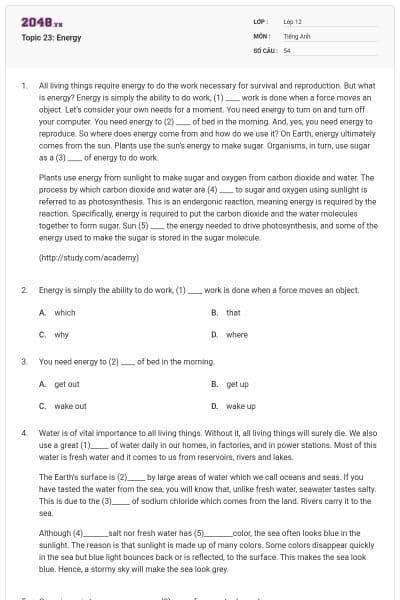
All living things require energy to do the work necessary for survival and reproduction. But what is energy? Energy is simply the ability to do work, (1) ____ work is done when a force moves an object. Let’s consider your own needs for a moment. You need energy to turn on and turn off your computer. You need energy to (2) ____ of bed in the morning. And, yes, you need energy to reproduce. So where does energy come from and how do we use it? On Earth, energy ultimately comes from the sun. Plants use the sun’s energy to make sugar. Organisms, in turn, use sugar as a (3) ____ of energy to do work.
Plants use energy from sunlight to make sugar and oxygen from carbon dioxide and water. The process by which carbon dioxide and water are (4) ____ to sugar and oxygen using sunlight is referred to as photosynthesis. This is an endergonic reaction, meaning energy is required by the reaction. Specifically, energy is required to put the carbon dioxide and the water molecules together to form sugar. Sun (5) ____ the energy needed to drive photosynthesis, and some of the energy used to make the sugar is stored in the sugar molecule.
(http://study.com/academy)
which
that
why
where
Tất cả các sinh vật sống đều cần năng lượng để thực hiện những hoạt động cần thiết cho sự sống và sinh sản. Nhưng năng lượng là gì? Năng lượng đơn giản là khả năng làm việc, nơi làm việc thực hiện một lực di chuyển một vật. Hãy xem xét nhu cầu của riêng bạn trong giây lát. Bạn cần năng lượng để bật và tắt máy tính của bạn. Bạn cần năng lượng để ra khỏi giường vào buổi sáng. Và, đúng vậy, bạn cần năng lượng để sinh sản. Vậy năng lượng đến từ đâu và chúng ta đang sử dụng nó như thế nào? Trên trái đất, năng lượng cơ bản phần lớn đến từ mặt trời. Thực vật sử dụng năng lượng của mặt trời để tạo ra đường. Các sinh vật, lần lượt sử dụng đường như một nguồn năng lượng để làm việc.
Thực vật sử dụng năng lượng từ ánh sáng mặt trời để tạo ra đường và O2 từ CO2 và nước. Quá trình mà CO2 và nước được chuyển đổi thành đường và oxy sử dụng ánh sáng mặt trời được gọi là quang hợp. Đây là một phản ứng nội sinh, có nghĩa là năng lượng được yêu cầu bởi phản ứng. Cụ thể, năng lượng là cần thiết để kết hợp CO2 và các phân tử nước với nhau tạo thành đường. Mặt trời cung cấp năng lượng cần thiết để quang hợp và một số năng lượng được sử dụng để làm cho đường được lưu trữ trong phân tử đường.
Đáp án D
A. which: cái mà.
B. that: điều mà.
C. why: tại sao.
D. where: nơi mà.
Căn cứ vào nghĩa của câu:
All living things require energy to do the work necessary for survival and reproduction. But what is energy? Energy is simply the ability to do work, (1) ____ work is done when a force moves an object.
(Tất cả các sinh vật sống đòi hỏi năng lượng để làm công việc cần thiết cho sự sống còn và sinh sản. Nhưng năng lượng là gì? Năng lượng đơn giản là khả năng thực hiện công việc, là nơi công việc được thực hiện khi một lực di chuyển một vật thể.)
=> Vị trí này ta dùng trạng từ “where” trong mệnh đề danh từ - ý chỉ rằng “công việc được làm bằng cách sử dụng năng lượng đó”, nói cách khác, “năng lượng là nơi mà công việc được thực hiện”.
+ Ở đây không thể dùng “which” như một đại từ quan hệ, vì như vậy sẽ đồng nghĩa “which” thay cho “the work” trước nó - công việc cái mà công việc được thực hiện => vô lý
get out
get up
wake out
wake up
Đáp án A
A. get out of st: ra khỏi cái gì.
B. get up: thức dậy.
D. wake up: thức dậy.
Căn cứ vào nghĩa của câu:
You need energy to (2) ____ of bed in the morning. And, yes, you need energy to reproduce.
(Bạn cần năng lượng để ra khỏi giường vào buổi sáng.)
Organisms, in turn, use sugar as a (3) ____ of energy to do work.
degree
scale
source
format
Đáp án C
A. degree /dɪˈɡriː/ (n): cấp, mức độ, trình độ.
B. scale /skeɪl/ (n): cán cân,
C. source /sɔːs/ (n): nguồn.
D. format /ˈfɔː.mæt/ (n): dạng, hình thức.
Căn cứ vào nghĩa của câu:
Organisms, in turn, use sugar as a (3) ____ of energy to do work.
(Các sinh vật, lần lượt, sử dụng đường như một nguồn năng lượng để làm việc.)
- sourse of energy: nguồn năng lượng.
purchased
converted
exchanged
removed
Đáp án B
A. purchase /ˈpɜː.tʃəs/ (v): mua.
B. convert /kənˈvɜːt/ (v): chuyển hóa, chuyển đổi.
C. exchange /ɪksˈtʃeɪndʒ/ (v): trao đổi.
D. remove /rɪˈmuːv/ (v): di chuyển.
Căn cứ vào nghĩa của câu:
The process by which carbon dioxide and water are (4) ____ to sugar and oxygen using sunlight is referred to as photosynthesis.
(Quá trình mà carbon dioxide và nước được chuyển đổi thành đường và oxy bằng ánh sáng mặt trời được gọi là quang hợp)
Sun (5) ____ the energy needed to drive photosynthesis, and some of the energy used to make the sugar is stored in the sugar molecule.
absorbs
transfers
consumes
provides
Đáp án D
A. absorb /əbˈzɔːb/ (v): hấp thụ.
B. transfer /trænsˈfɜːr/ (v): di chuyển.
C. consume /kənˈsjuːm/ (v): tiêu thụ.
D. provide /prəˈvaɪd/ (v): cung cấp.
Căn cứ vào nghĩa của câu:
Sun (5) ____ the energy needed to drive photosynthesis, and some of the energy used to make the sugar is stored in the sugar molecule.
(Mặt trời cung cấp năng lượng cần thiết để thúc đẩy quá trình quang hợp và một số năng lượng được sử dụng để tạo ra đường được lưu trữ trong phân tử đường.)
Water is of vital importance to all living things. Without it, all living things will surely die. We also use a great (1)_____ of water daily in our homes, in factories, and in power stations. Most of this water is fresh water and it comes to us from reservoirs, rivers and lakes.
The Earth’s surface is (2)_____ by large areas of water which we call oceans and seas. If you have tasted the water from the sea, you will know that, unlike fresh water, seawater tastes salty. This is due to the (3)_____ of sodium chloride which comes from the land. Rivers carry it to the sea.
Although (4)_______salt nor fresh water has (5)________color, the sea often looks blue in the sunlight. The reason is that sunlight is made up of many colors. Some colors disappear quickly in the sea but blue light bounces back or is reflected, to the surface. This makes the sea look blue. Hence, a stormy sky will make the sea look grey.
quality
measure
amount
number
Nước có tầm quan trọng sống còn đối với mọi loài sinh vật. Không có nó, tất cả các sinh vật sống chắc chắn sẽ chết. Chúng ta cũng sử dụng một lượng nước lớn hàng ngày trong gia đình, trong các công ty xí nghiệp và trong các nhà máy điện. Hầu hết loại nước này là nước ngọt và nó đến tay chúng ta từ các hồ chứa, sông hồ.
Bề mặt Trái Đất được bao phủ bởi những vùng nước rộng lớn mà chúng ta gọi là đại dương và biển. Nếu bạn đã nếm thử nước từ biển, bạn sẽ biết rằng, chúng không giống như nước ngọt, nước biển có vị mặn. Điều này là do sự xuất hiện của NaCl đến từ đất. Sông mang nó ra biển.
Mặc dù cả nước mặn và nước ngọt đều không biến sắc, biển thường có màu xanh từ ánh sáng mặt trời. Lý do là ánh sáng mặt trời được tạo thành từ nhiều màu sắc. Một số màu biến mất nhanh chóng trong biển nhưng ánh sáng xanh dội ngược trở lại hoặc bị phản xạ lên bề mặt. Điều này làm cho biển có màu xanh. Do đó, một bầu trời giông bão sẽ làm cho biển trông xám xịt.
Đáp án C
Chủ đề về WATER
Kiến thức về lượng từ
A. quality /ˈkwɒləti/ (n): chất lượng, phẩm chất
B. measure /ˈmeʒə(r)/ (n): sự đo lường, phạm vi
C. amount + of + N (không đếm được) /əˈmaʊnt/ (n): lượng, số lượng
D. number + of + N (đếm được) /ˈnʌmbə(r)/ (n): số, số lượng
Ta thấy danh từ đằng sau lượng từ là “water” là danh từ không đếm được => chọn “amount”.
Tạm dịch: Water is of vital importance to all living things. Without it, all living things will surely die. We also use a great (1)_____ of water daily in our homes, in factories, and in power stations. Most of this water is fresh water and it comes to us from reservoirs, rivers and lakes.
(Nước có tầm quan trọng sống còn đối với mọi sinh vật. Không có nó, tất cả các sinh vật sống chắc chắn sẽ chết. Chúng ta cũng sử dụng một lượng nước lớn hàng ngày ở nhà, trong các nhà máy và trong các nhà máy điện. Hầu hết nước này là nước ngọt và nó đến từ các hồ chứa, sông hồ.)
covered
included
constructed
reserved
Đáp án A
Kiến thức về từ vựng
A. covered /ˈkʌvəd/ (v): bao phủ, che đậy
B. included /ɪnˈkluːdid/ (v): bao gồm, gồm có
C. constructed /kənˈstrʌktid/ (v): xây dựng
D. reserved /rɪˈzɜːvd/ (v): để dành; dự trữ
Tạm dịch: The Earth’s surface is (2)_____ by large areas of water which we call oceans and seas. If you have tasted the water from the sea, you will know that, unlike fresh water, seawater tastes salty.
(Bề mặt Trái Đất được bao phủ bởi những vùng nước rộng lớn mà chúng ta gọi là đại dương và biển. Nếu bạn đã từng nếm nước từ biển, bạn sẽ biết rằng, không giống với nước ngọt, nước biển có vị mặn.)
influence
advantage
attraction
presence
Đáp án D
Kiến thức về từ vựng
A. influence /ˈɪnfluəns/ (n): ảnh hưởng, tác động
B. advantage /ədˈvɑːntɪdʒ/ (n): thuận lợi, ưu thế
C. attraction /əˈtrækʃn/ (n): sự thu hút, sự hấp dẫn
D. presence /ˈprezns/ (n): sự hiện diện, sự có mặt
Tạm dịch: If you have tasted the water from the sea, you will know that, unlike fresh water, seawater tastes salty. This is due to the (3)_____ of sodium chloride which comes from the land. Rivers carry it to the sea.
(Nếu như bạn đã nếm vị nước biển, bạn sẽ biết rằng, không giống như nước ngọt, nước biển có vi mặn. Điều này là do sự có mặt của natri clorua có nguồn gốc từ đất liền. Các con sông mang nó ra biển.)
both
neither
none
either
Đáp án B
Kiến thức về liên từ
A. both sb/sth and sb/sth: cả ai/ cái gì và ai/ cái gì
B. neither sb (sth) nor sb (sth): ai (cái gì) hay ai (cái gì) đều không
C. none of N: không ai/ cái gì (trong một nhóm)
D. either…. or….: hoặc là cái này hoặc là cái kia
Xét vào trong câu ta thấy dấu hiệu ở trong câu này chính là “nor” -. Chọn đáp án B. neither
Tạm dịch: Although (4)_____ salt nor fresh water has (5)___color, the sea often looks blue in the sunlight.
(Mặc dù nước biển hay nước ngọt đều không _____ màu sắc, biển vẫn thường có màu xanh khi ở dưới ánh sáng mặt trời.)
disappear
combine
renovate
develop
Đáp án A
Kiến thức về từ vựng
A. disappear /ˌdɪsəˈpɪə(r)/ (v): biến đi; biến mất
B. combine /kəmˈbaɪn/ (v): kết hợp; phối hợp
C. renovate /ˈrenəveɪt/ (v): nâng cấp, cải tiến, đổi mới
D. develop /dɪˈveləp/ (v): phát triển, mở mang
Tạm dịch: Although neither salt nor fresh water has (5)____color, the sea often looks blue in the sunlight. The reason is that sunlight is made up of many colors. Some colors disappear quickly in the sea but blue light bounces back or is reflected, to the surface. This makes the sea look blue.
(Mặc dù nước biển hay nước ngọt đều không có màu sắc, biển vẫn thường có màu xanh dưới ánh sáng mặt trời. Lý do là ánh sáng mặt trời được tạo thành từ nhiều màu sắc. Một số màu biến mất nhanh chóng trên biển nhưng ánh sáng xanh bị dội ngược lại hoặc bị phản xạ, lên bề mặt nước. Điều này làm cho biển trông giống như có màu xanh.)
After years of hype and false starts, the shift to clean power has begun to accelerate at a pace that has taken the most experienced experts by surprise. Even leaders in the oil and gas sector have been forced to confront an existential question: will the 21st century be the last one for fossil fuels?
It is early, but the evidence is mounting. Wind and solar parks are being built at unprecedented rates, threatening the business models of established power companies. Electric cars that were hard to even buy eight years ago are selling at an exponential rate, in the process driving down the price of batteries that hold the key to unleashing new levels of green growth.
“This clean energy disruption has just started and what is striking is how much of a financial impact it is already having on some companies,” says Per Lekander, a portfolio manager at London’s Lansdowne Partners hedge fund, who has tracked global energy markets for more than 25 years.
“It hit the electricity sector first, in Europe in 2013 and then the US two years later. Now it has spread to the auto sector and I think the oil industry is next.”
The shift has come as increased government efforts to curb climate change and smog have driven down costs and spurred technical advances, creating a green energy industry that looks nothing like it did a decade ago: expensive and sluggish.
Today, China and India have picked up the baton and are driving a sector that has spread to every continent. The result was a banner year for green energy in 2016.
It is stated in the passage that in the past, green energy ____
used internationally with great efficacy
received huge investment from government
was disfavored at the beginning
was the main sources of energy using by humans
Đáp án C
Được nêu trong đoạn văn rằng trong quá khứ, năng lượng xanh ____.
A. được sử dụng quốc tế với hiệu quả tuyệt vời
B. nhận được đầu tư lớn từ chính phủ
C. đã bị ghét bỏ ngay từ đầu
D. là nguồn năng lượng chính được sử dụng bởi con người
Căn cứ vào thông tin sau trong đoạn văn:
After years of hype and false starts, the shift to clean power has begun to accelerate at a pace that has taken the most experienced experts by surprise.
(Sau nhiều năm quảng cáo thổi phồng và bắt đầu sai lầm, sự chuyển đổi quyền lực sang năng lượng sạch đã bắt đầu tăng tốc với tốc độ khiến các chuyên gia giàu kinh nghiệm nhất ngạc nhiên.)
=> Ngày xưa năng lượng xanh không được nhiều người coi trọng nhưng ngày nay nó đang phát triển mạnh đến mức các chuyên gia giàu kinh nghiệm nhất cũng phải kinh ngạc.
The fear of leaders from oil and gas sector company comes from ____.
the likelihood of fossil fuel to exhaust by the end of the 21st century
the sufficiency of energy produced by green power
the changes in manufacturing oil and gas
green power companies enjoying huge investment from the government
Đáp án B
Nỗi sợ hãi của các nhà lãnh đạo công ty dầu khí đến từ ____.
A. khả năng nhiên liệu hóa thạch cạn kiệt vào cuối thế kỷ 21
B. sự đầy đủ của năng lượng được tạo ra bởi năng lượng xanh
C. những thay đổi trong sản xuất dầu khí
D. các công ty năng lượng xanh được hưởng sự đầu tư lớn từ chính phủ
Căn cứ vào thông tin sau trong đoạn văn:
“After years of hype and false starts, the shift to clean power has begun to accelerate at a pace that has taken the most experienced experts by surprise. Even leaders in the oil and gas sector have been forced to confront an existential question: will the 21st century be the last one for fossil fuels?”
(Sau nhiều năm quảng cáo rùm beng và khởi đầu sai lầm, sự chuyển đổi sang năng lượng sạch đã bắt đầu tăng tốc ở một tốc độ đã làm các chuyên gia giàu kinh nghiệm nhất phải ngạc nhiên. Ngay cả các nhà lãnh đạo trong ngành dầu và ngành khí đã buộc phải đối mặt với một câu hỏi hiện sinh: thế kỷ 21 sẽ là thế kỉ cuối cùng cho nhiên liệu hóa thạch?)
=> Do đó, nỗi sợ hãi của các nhà lãnh đạo công ty dầu khí đến từ việc có sự thay thế năng lượng xanh thay thế nhiên liệu hóa thạch, nói cách khác, đó là việc có sự đầy đủ của năng lượng được tạo ra bởi năng lượng xanh.
The price of electric cars has been ____.
rising rapidly
increasing steadily
falling exponentially
fluctuating wildly
Đáp án C
Giá xe điện đã ____.
A. tăng nhanh
B. tăng đều đặn
C. giảm theo cấp số nhân
D. dao động dữ dội
Căn cứ vào thông tin sau trong đoạn văn:
Electric cars that were hard to even buy eight years ago are selling at an exponential rate, in the process driving down the price of batteries that hold the key to unleashing new levels of green growth.
(Những chiếc xe điện thậm chí khó mua 8 năm trước đang bán với tốc độ theo cấp số nhân, trong quá trình giảm giá pin nắm giữ toàn bộ để giải phóng mức tăng trưởng xanh mới.)
In which year was the electricity sector in US hit by the use of green energy?
2013
2014
2015
2016
Đáp án C
Năm nào ngành điện ở Mỹ bị ảnh hưởng bởi việc sử dụng năng lượng xanh?
A. 2013
B. 2014
C. 2015
D. 2016
Căn cứ vào thông tin sau trong đoạn văn:
“It hit the electricity sector first, in Europe in 2013 and then the US two years later. Now it has spread to the auto sector and I think the oil industry is next.”
“Một lần nữa, nó tấn công vào ngành điện, ở châu Âu vào năm 2013 và sau đó là Mỹ hai năm sau đó. Bây giờ nó đã lan sang lĩnh vực ô tô và tôi nghĩ ngành dầu khí là tiếp theo.”
The word "sluggish" is closest in meaning to ____.
inactive
developed
promising
ineffective
Đáp án A
Từ “sluggish”có nghĩa gần nhất với ____.
A. inactive /in’æktiv/ (a): không hoạt động, thiếu hoạt động; không năng nổ, uể oải
B. developed /di’veləpt/ (a): phát triển
C. promising /’prɔmisiη/ (a): đầy hứa hẹn
D. ineffective /ini’fektiv/ (a): không có hiệu quả
Căn cứ vào ngữ cảnh của đoạn văn:
The shift has come as increased government efforts to curb climate change and smog have driven down costs and spurred technical advances, creating a green energy industry that looks nothing like it did a decade ago: expensive and sluggish.
(Sự thay đổi đã đến khi các nỗ lực của chính phủ gia tăng nhằm hạn chế biến đổi khí hậu và khói bụi đã làm giảm chi phí và thúc đẩy tiến bộ kỹ thuật, tạo ra một ngành công nghiệp năng lượng xanh trông không giống như cách đây một thập kỷ: đắt đỏ và chậm chạp.)
=> Sluggish /’slʌgiʃ/ (a): chậm chạp; uể oải
Geothermal energy is the heat from the Earth. It’s clean and sustainable. Resources of geothermal energy range from the shallow ground to hot water and hot rock found a few miles beneath the Earth’s surface, and down even deeper to the extremely high temperatures of molten rock called mác-ma.
Almost everywhere, the shallow ground or upper 10 feet of the Earth’s surface maintains a nearly constant temperature between 50° and 60°F (10° and 16°C). Geothermal heat pumps can tap into this resource to heat and cool buildings. A geothermal heat pump system consists of a heat pump, an air delivery system (ductwork), and a heat exchanger-a system of pipes buried in the shallow ground near the building. In the winter, the heat pump removes heat from the heat exchanger and pumps it into the indoor air delivery system. In the summer, the process is reversed, and the heat pump moves heat from the indoor air into the heat exchanger. The heat removed from the indoor air during the summer can also be used to provide a free source of hot water.
In the United States, most geothermal reservoirs of hot water are located in the western states, Alaska, and Hawaii. Wells can be drilled into underground reservoirs for the generation of electricity. Some geothermal power plants use the steam from a reservoir to power a turbine/generator, while others use the hot water to boil a working fluid that vaporizes and then turns a turbine. Hot water near the surface of Earth can be used directly for heat. Direct-use applications include heating buildings, growing plants in greenhouses, drying crops, heating water at fish farms, and several industrial processes such as pasteurizing milk.
Hot dry rock resources occur at depths of 3 to 5 miles everywhere beneath the Earth’s surface and at lesser depths in certain areas. Access to these resources involves injecting cold water down one well, circulating it through hot fractured rock, and drawing off the heated water from another well. Currently, there are no commercial applications of this technology. Existing technology also does not yet allow recovery of heat directly from mác-ma, the very deep and most powerful resource of geothermal energy.
(Source: https://www.renewableenergyworld.com)
What does the passage mainly discuss?
Where geothermal energy is found
Geothermal energy and how to exploit it
Geothermal energy in America
How to apply geothermal energy into everyday life
Đáp án B
Đoạn văn chủ yếu bàn về vấn đề gì?
A. Năng lượng địa nhiệt được tìm thấy ở đâu
B. Năng lượng địa nhiệt và cách khai thác nó
C. Năng lượng địa nhiệt ở Mỹ
D. Làm thế nào để sử dụng năng lượng địa nhiệt trong cuộc sống hàng ngày
Căn cứ thông tin toàn bài, phần nào được khái quát trong đoạn đầu:
Geothermal energy is the heat from the Earth. It’s clean and sustainable. Resources of geothermal energy range from the shallow ground to hot water and hot rock found a few miles beneath the Earth’s surface, and down even deeper to the extremely high temperatures of molten rock called mác-ma.
(Năng lượng địa nhiệt là nhiệt lượng Trái Đất. Năng lượng này sạch và bền vững. Nguồn tài nguyên năng lượng địa nhiệt bao gồm từ mặt đất cạn đến nước và đá nóng có thể được tìm thấy một vài dặm bên dưới bề mặt trái đất, và xuống thậm chí sâu hơn cho đến nơi có nhiệt độ rất cao của đá nóng chảy gọi là mác-ma.)
Which of the following statements is NOT true according to paragraph 2?
The temperature 10 feet underground is constant between 50° and 60°F.
Geothermal heat can be used both for heating and cooling a building.
Heat pump provides heat to the indoor air delivery system.
Geothermal heat can be tapped into in winter only.
Đáp án D
Thông tin nào sau đây KHÔNG đúng theo thông tin có trong đoạn 2?
A. Nhiệt độ 10 feet dưới lòng đất không thay đổi giữa khoảng 50 đến 60 độ F.
B. Nhiệt từ địa nhiệt có thể sử dụng để làm ấm và làm mát tòa nhà.
C. Bơm nhiệt cung cấp nhiệt cho hệ thống phân phối không khí trong nhà.
D. Nhiệt từ địa nhiệt chỉ có thể lấy được trong mùa đông.
Căn cứ thông tin đoạn 2: năng lượng địa nhiệt có thể khai thác quanh năm và có thể sử dụng cả mùa đông và mùa hè:
Almost everywhere, the shallow ground or upper 10 feet of the Earth’s surface maintains a nearly constant temperature between 50° and 60°F (10° and 16°C). Geothermal heat pumps can tap into this resource to heat and cool buildings. A geothermal heat pump system consists of a heat pump, an air delivery system (ductwork), and a heat exchanger-a system of pipes buried in the shallow ground near the building. In the winter, the heat pump removes heat from the heat exchanger and pumps it into the indoor air delivery system. In the summer, the process is reversed, and the heat pump moves heat from the indoor air into the heat exchanger. The heat removed from the indoor air during the summer can also be used to provide a free source of hot water.
(Hầu như ở khắp mọi nơi, mặt đất nông hoặc trên 10 feet của bề mặt Trái Đất duy trì nhiệt độ gần như không đổi từ 50 đến 60°F (10 đến 16°C). Máy bơm nhiệt địa nhiệt có thể lấy nguồn nhiệt này để sưởi ấm và làm mát các tòa nhà. Một hệ thống bơm nhiệt địa nhiệt bao gồm một máy bơm nhiệt, một hệ thống phân phối không khí (ống dẫn), và một bộ trao đổi nhiệt - một hệ thống đường ống được chôn trong đất nông gần tòa nhà. Vào mùa đông, bơm nhiệt loại bỏ nhiệt từ bộ trao đổi nhiệt và bơm nó vào hệ thống phân phối không khí trong nhà. Vào mùa hè, quá trình này được đảo ngược, và bơm nhiệt di chuyển nhiệt từ không khí trong nhà vào bộ trao đổi nhiệt. Nhiệt độ được lấy ra từ không khí trong nhà trong mùa hè cũng có thể được sử dụng để cung cấp nguồn nước nóng miễn phí.)
The phrasal verb “consists of” in paragraph 2 can be best replaced by ______.
comprises
compares
compromises
compels
Đáp án A
Cụm động từ “consist of” trong đoạn 2 có thể được thay thế tốt nhất bởi ______.
A. bao gồm
B. so sánh
C. thỏa hiệp
D. bắt buộc
Kiến thức từ đồng nghĩa: to consist of (bao gồm) = to comprise
A geothermal heat pump system consists of a heat pump, an air delivery system (ductwork), and a heat exchanger-a system of pipes buried in the shallow ground near the building.
(Một hệ thống bơm nhiệt địa nhiệt bao gồm một máy bơm nhiệt, một hệ thống phân phối không khí (ống dẫn), và một bộ trao đổi nhiệt - một hệ thống đường ống được chôn trong đất nông gần tòa nhà.)
What is NOT mentioned in paragraph 3 as an application of geothermal energy?
Steam from some reservoirs is used directly to turn turbines.
Geothermal energy has been used to pump water at fish farms.
Steam from reservoirs heated by geothermal energy can be used to generate electricity.
People can get heat from hot water near the surface of Earth.
Đáp án B
Thông tin nào sau đây KHÔNG được đề cập đến trong đoạn 3 như một ứng dụng của năng lượng địa nhiệt?
A. Hơi nước từ các hồ chứa được sử dụng trực tiếp để làm quay tuabin.
B. Năng lượng địa nhiệt được dùng để bơm nước ở các trang trại nuôi cá
C. Hơi nước từ các hồ chứa làm nóng bởi năng lượng địa nhiệt có thể được dùng để phát điện.
D. Con người có thể thu được nhiệt từ nước nóng gần bề mặt trái đất.
Căn cứ thông tin đoạn 3, cần đọc kỹ để xác định thông tin chính xác:
In the United States, most geothermal reservoirs of hot water are located in the western states, Alaska, and Hawaii. Wells can be drilled into underground reservoirs for the generation of electricity. Some geothermal power plants use the steam from a reservoir to power a turbine/generator, while others use the hot water to boil a working fluid that vaporizes and then turns a turbine. Hot water near the surface of Earth can be used directly for heat. Direct-use applications include heating buildings, growing plants in greenhouses, drying crops, heating water at fish farms, and several industrial processes such as pasteurizing milk.
(Tại Hoa Kỳ, hầu hết các hồ chứa nước nóng địa nhiệt đều nằm ở các bang phía tây, Alaska và Hawaii. Giếng có thể được khoan vào các hồ chứa ngầm để tạo ra điện. Một số nhà máy điện địa nhiệt sử dụng hơi nước từ hồ chứa để cấp điện cho một tuabin / máy phát điện, trong khi một số khác sử dụng nước nóng để đun sôi một lưu chất hoạt động bốc hơi và sau đó làm quay tuabin. Nước nóng gần bề mặt Trái đất có thể được sử dụng trực tiếp để có nguồn nhiệt. Các ứng dụng sử dụng trực tiếp bao gồm các công trình sưởi ấm, trồng cây trong nhà kính, trồng cây khô, nước nóng tại các trang trại nuôi cá và một số quy trình công nghiệp như tiệt trùng sữa.)The word “vaporize” in paragraph 3 mostly means _____.
evaluate
illustrate
evaporate
illuminate
Đáp án C
Từ “vaporize” trong đoạn 3 có nghĩa là ______.
A. đánh giá
B. minh họa
C. bốc hơi
D. chiếu sáng
Kiến thức từ đồng nghĩa: to vaporize (bốc hơi) = to evaporate
Some geothermal power plants use the steam from a reservoir to power a turbine/generator, while others use the hot water to boil a working fluid that vaporizes and then turns a turbine.
(Một số nhà máy điện địa nhiệt sử dụng hơi nước từ hồ chứa để cấp điện cho một tuabin/ máy phát điện, trong khi một số khác sử dụng nước nóng để đun sôi một chất lỏng làm việc bốc hơi và sau đó làm quay tuabin.)
What is the main information of the last paragraph?
Hot dry rock can be found at depths of 3 to 5 miles beneath the Earth’s surface.
Injecting cold water down one well containing hot rock is the way to get hot water.
Heat directly from mác-ma has not been used.
Hot fractured rock at depths of 3 to 5 miles can be used to heat water.
Đáp án D
Thông tin chính của đoạn cuối là gì?
A. Đá khô nóng có thể được tìm thấy ở độ sâu từ 3 đến 5 dặm bên dưới bề mặt trái đất.
B. Bơm nước lạnh xuống giếng chứa đá nóng là cách để có nước nóng.
C. Nguồn nhiệt trực tiếp từ mác-ma chưa được sử dụng.
D. Đá nứt nóng ở độ sâu từ 3 đến 5 dặm có thể được sử dụng để làm nóng nước.
Căn cứ thông tin đoạn cuối, đọc kỹ và khái quát thông tin chính:
Hot dry rock resources occur at depths of 3 to 5 miles everywhere beneath the Earth’s surface and at lesser depths in certain areas. Access to these resources involves injecting cold water down one well, circulating it through hot fractured rock, and drawing off the heated water from another well. Currently, there are no commercial applications of this technology. Existing technology also does not yet allow recovery of heat directly from mác-ma, the very deep and most powerful resource of geothermal energy.
(Nguồn tài nguyên đá khô nóng xuất hiện ở độ sâu từ 3 đến 5 dặm ở khắp mọi nơi bên dưới bề mặt trái đất và ở độ sâu nhỏ hơn trong khu vực nhất định. Việc tiếp cận các nguồn tài nguyên này liên quan đến việc bơm nước lạnh xuống một cái giếng, cho nó chảy qua đá nứt nóng, và rút nước nóng ra từ một cái giếng khác. Hiện tại, không có ứng dụng thương mại nào cho công nghệ này. Công nghệ hiện tại cũng chưa cho phép thu hồi nhiệt trực tiếp từ mác-ma, nguồn năng lượng địa nhiệt rất sâu và mạnh nhất.)
What does the word “it” in the last paragraph refer to?
rock
surface
cold water
well
Đáp án C
Từ “it” trong đoạn cuối ám chỉ điều gì?
A. đá
B. bề mặt
C. nước lạnh
D. giếng
Đọc kỹ các câu trước để hiểu ỹ nghĩa của câu, nghiên cứu câu sau để xác định từ “it” thay cho danh từ số ít nào được nhắc đến trước đó:
Hot dry rock resources occur at depths of 3 to 5 miles everywhere beneath the Earth’s surface and at lesser depths in certain areas. Access to these resources involves injecting cold water down one well, circulating it through hot fractured rock, and drawing off the heated water from another well.
(Nguồn tài nguyên đá khô nóng xuất hiện ở độ sâu từ 3 đến 5 dặm ở khắp mọi nơi bên dưới bề mặt trái đất và ở độ sâu nhỏ hơn trong khu vực nhất định. Việc tiếp cận các nguồn tài nguyên này liên quan đến việc bơm nước lạnh xuống một cái giếng, cho nó chảy qua đá nứt nóng, và rút nước nóng ra từ một cái giếng khác.)
What is the best title for the passage?
Geothermal energy
A clean and sustainable energy
Ways to get heat in winter
Exploitation of geothermal energy in America
Đáp án A
Tiêu đề hay nhất cho đoạn văn là gì?
A. Năng lượng địa nhiệt
B. Một nguồn năng lượng sạch và bền vững
C. Các cách làm nóng nước trong mùa đông
D. Khai thác năng lượng địa nhiệt ở Mỹ
Căn cứ thông tin toàn bài, khái quát ý từng đoạn và tìm ra nội dung chủ yếu cả đoạn văn từ đó chọn tiêu đề đúng nhất. Ý khái quát đã được đưa ra rõ nhất trong đoạn đầu:
Geothermal energy is the heat from the Earth. It’s clean and sustainable. Resources of geothermal energy range from the shallow ground to hot water and hot rock found a few miles beneath the Earth’s surface, and down even deeper to the extremely high temperatures of molten rock called mác-ma.
(Năng lượng địa nhiệt là nhiệt từ Trái Đất. Năng lượng này sạch và bền vững. Nguồn tài nguyên năng lượng địa nhiệt bao gồm từ mặt đất cạn đến nước và đá nóng có thể được tìm thấy một vài dặm bên dưới bề mặt trái đất, và xuống thậm chí sâu hơn cho đến nơi có nhiệt độ rất cao của đá nóng chảy gọi là mác-ma.)
A Tidal Stream Generation system reduces some of the environmental effects of tidal barrages by using turbine generators beneath the surface of the water. Major tidal flows and ocean currents, like the Gulf Stream, can be exploited to extract its tidal energy using underwater rotors and turbines.
Tidal stream generation is very similar in principle to wind power generation. Water currents flow across a turbines rotor blades which rotates the turbine, much like how wind currents turn the blades for wind power turbines. In fact, tidal stream generation areas on the sea bed can look just like underwater wind farms.
Unlike off-shore wind power which can suffer from storms or heavy sea damage, tidal stream turbines operate just below the sea surface or are fixed to the sea bed. Tidal streams are formed by the horizontal fast flowing volumes of water caused by the ebb and flow of the tide as the profile of the sea bed causes the water to speed up as it approaches the shoreline.
As water is much more denser than air and has a much slower flow rate, tidal stream turbines have much smaller diameters and higher tip speed rates compared to an equivalent wind turbine. Tidal stream turbines generate tidal power on both the ebb and flow of the tide. One of the disadvantages of Tidal Stream Generation is that as the turbines are submerged under the surface of the water they can create hazards to navigation and shipping.
Other forms of tidal energy include tidal fences which use individual vertical-axis turbines that are mounted within a fence structure, known as the caisson, which completely blocks a channel and force water through them. Another alternative way of harnessing tidal power is by using an “oscillating tidal turbine”. This is basically a fixed wing called a Hydroplane positioned on the sea bed. The hydroplane uses the energy of the tidal stream flowing past it to oscillate its giant wing, similar to a whales flipper, up and down with the movement of the tidal currents. This motion is then used to generate electricity. The angle of the hydroplane to the flow of the tide can be varied to increase efficiency.
Tidal energy is another form of low-head hydro power that is completely carbon neutral like wind and hydro energy. Tidal power has many advantages compared to other forms of renewable energy with its main advantage being that it is predictable. However, like many other forms of renewable energy, tidal energy also has its disadvantages such as its inflexible generation times dependant upon the tides and the fact that it operates in the hostile conditions of the oceans and seas.
(Source: http://www.alternative-energy-tutorials.com/)
Which of the following does the passage mainly discuss?
Tidal energy system and its working principle
Currents and flow of ocean and seas
Tidal turbine and its environmental effects
Tidal energy in comparison with hydro energy
Đáp án A
Đoạn văn chủ yếu bàn đến vấn đề nào sau đây?
A. Hệ thống năng lượng thủy triều và nguyên lý làm việc của nó
B. Dòng chảy của đại dương và biển
C. Tua bin thủy triều và các hiệu ứng môi trường
D. Năng lượng thủy triều so sánh với thủy điện
Căn cứ thông tin đoạn 1, đoạn này đã khái quát nội dung toàn bài:
A Tidal Stream Generation system reduces some of the environmental effects of tidal barrages by using turbine generators beneath the surface of the water. Major tidal flows and ocean currents, like the Gulf Stream, can be exploited to extract its tidal energy using underwater rotors and turbines.
(Hệ thống phát điện bằng dòng thủy triều làm giảm một số tác động môi trường của các rào chắn thủy triều bằng cách sử dụng các máy phát điện dùng tua-bin bên dưới mặt nước. Các dòng thủy triều lớn và dòng chảy đại dương, như dòng Gulf Stream, có thể được khai thác để giải phóng năng lượng thủy triều của nó bằng cách sử dụng rô-to và tua-bin dưới nước.)
According to paragraph 2, wind power turbines rotate thanks to ______.
Tidal stream
Water currents flow
Wind currents
Wind farms
Đáp án C
Theo đoạn 2, tua-bin điện gió quay được nhờ có ______.
A. Dòng thủy triều
B. Dòng chảy của nước
C. Luồng gió
D. Trang trại gió
Căn cứ thông tin đoạn 2:
Water currents flow across a turbines rotor blades which rotates the turbine, much like how wind currents turn the blades for wind power turbines.
(Dòng nước này chảy qua cánh tua-bin gắn với rô-to tua-bin làm quay tua-bin, giống như gió làm quay cánh tua-bin trong điện gió.)
What does the word “profile” in paragraph 3 refer to?
An outline of an object
A biographical account
A summary or analysis of data
A vertical section of soil and rock
Đáp án D
Từ “profile” trong đoạn 3 ám chỉ đến điều gì?
A. Một phác thảo của một đối tượng
B. Thông tin tiểu sử
C. Tóm tắt hoặc phân tích dữ liệu
D. Mặt cắt phần đất và đá thẳng đứng
Căn cứ thông tin đoạn 3 và kiến thức về từ vựng, cần hiểu nhiều nghĩa của từ và chọn nghĩa phù hợp với ngữ cảnh mà từ được dùng. Từ “profile” ở đây nói đến đặc điểm cấu tạo nền đất đá dưới đáy biển, từ đó ảnh hưởng đến tốc độ di chuyển của dòng nước khi gần bờ:
Tidal streams are formed by the horizontal fast flowing volumes of water caused by the ebb and flow of the tide as the profile of the sea bed causes the water to speed up as it approaches the shoreline.
(Các dòng thủy triều được hình thành bởi lượng nước chảy ngang nhanh do dòng nước triều và dòng chảy của thủy triều gây ra do đặc điểm của đáy biển làm cho nước tăng tốc khi nó tiếp cận bờ biển.)
What is mentioned in the passage as a disadvantage of Tidal Stream Generation?
It can suffer from storms or heavy sea damage.
There are some hazards in navigating and shipping turbines.
It uses individual vertical-axis turbines.
It is another form of low-head hydro power.
Đáp án B
Điều gì được đề cập trong đoạn văn như một bất lợi của việc phát điện bằng dòng thủy triều?
A. Nó có thể bị bão tấn công hoặc hư hỏng nặng do nước biển.
B. Có một số mối nguy hiểm trong việc điều hướng và vận chuyển tuabin.
C. Nó sử dụng các tuabin trục dọc riêng lẻ.
D. Nó là một dạng thủy điện thấp khác.
Căn cứ thông tin toàn bài, khi đọc cần khái quát và ghi nhớ ý chính từng đoạn văn. Điều bất lợi của việc phát điện bằng dòng thủy triều được nói đến ở cuối đoạn 4:
One of the disadvantages of Tidal Stream Generation is that as the turbines are submerged under the surface of the water they can create hazards to navigation and shipping.
(Một trong những nhược điểm của việc phát điện bằng dòng Thủy triều là khi các tua-bin bị ngập dưới bề mặt nước, chúng có thể gây ra mối nguy hiểm cho việc định vị và vận chuyển.)
The word “that” in paragraph 5 refers to ______.
tidal energy
tidal fences
individual vertical-axis turbines
fence structure
Đáp án C
Từ “that” trong đoạn 5 ám chỉ ______.
A. thủy triều năng lượng
B. thủy triều hàng rào
C. tua bin trục dọc đơn lẻ
D. cấu trúc hàng rào
Căn cứ thông tin đoạn 5 và kiến thức ngữ pháp về đại từ quan hệ:
Other forms of tidal energy include tidal fences which use individual vertical-axis turbines that are mounted within a fence structure, known as the caisson, which completely blocks a channel and force water through them.
(Các dạng năng lượng thủy triều khác bao gồm các hàng rào thủy triều sử dụng các tua-bin trục dọc đơn lẻ được gắn trong một cấu trúc hàng rào, được gọi là vật chắn, hoàn toàn chặn lòng sông và buộc nước phải chảy qua chúng.)
What can be inferred from paragraph 5?
Individual vertical-axis turbines are the best choice for Tidal Stream Generation.
Fence structure is the only way to harness tidal power.
Hydroplane uses less energy of the tidal stream.
There are some alternative ways to exploit tidal power.
Đáp án D
Điều gì có thể được suy ra từ đoạn 5?
A. Các tuabin trục dọc đơn lẻ là lựa chọn tốt nhất cho việc phát điện bằng năng lượng thủy triều.
B. Cấu trúc hàng rào là cách duy nhất để khai thác năng lượng thủy triều.
C. Thủy phi cơ sử dụng ít năng lượng của dòng thủy triều hơn.
D. Có một số cách khác để khai thác năng lượng thủy triều.
Căn cứ thông tin đoạn 5:
Other forms of tidal energy include tidal fences which use individual vertical-axis turbines that are mounted within a fence structure, known as the caisson, which completely blocks a channel and force water through them. Another alternative way of harnessing tidal power is by using an “oscillating tidal turbine”. This is basically a fixed wing called a Hydroplane positioned on the sea bed. The hydroplane uses the energy of the tidal stream flowing past it to oscillate its giant wing, similar to a whales flipper, up and down with the movement of the tidal currents. This motion is then used to generate electricity. The angle of the hydroplane to the flow of the tide can be varied to increase efficiency.
(Các dạng năng lượng thủy triều khác bao gồm các hàng rào thủy triều sử dụng các tua-bin trục dọc đơn lẻ được gắn trong một cấu trúc hàng rào, được gọi là vật chắn, hoàn toàn chặn lòng sông và buộc nước phải chảy qua chúng. Một cách khác để khai thác năng lượng thủy triều là sử dụng “tua-bin thủy triều dao động”. Đây cơ bản là một cánh cố định được gọi là “Thủy phi cơ” đặt trên đáy biển. “Thủy phi cơ” này sử dụng năng lượng của dòng thủy triều chảy qua nó để làm dao động chiếc cánh khổng lồ của nó lên xuống tương tự như chân chèo của cá voi với sự di chuyển của các dòng thủy triều. Chuyển động này sau đó được sử dụng để tạo ra điện. Góc của thủy phi cơ với dòng chảy của thủy triều có thể thay đổi để tăng hiệu quả.)
The word “renewable” in the last paragraph mostly means ______.
inexhaustible or replaceable
capable of being recycled
accessible to all
able to be treated
Đáp án A
Từ “renewable” trong đoạn cuối cùng chủ yếu có nghĩa là ______.
A. vô tận hoặc có thể thay thế
B. có thể tái sử dụng
C. có thể truy cập cho tất cả
D. có thể được điều trị
Căn cứ thông tin đoạn cuối và kiến thức về từ vựng:
Tidal energy is another form of low-head hydro power that is completely carbon neutral like wind and hydro energy. Tidal power has many advantages compared to other forms of renewable energy with its main advantage being that it is predictable.
(Năng lượng thủy triều là một dạng khác của năng lượng thủy điện thấp, hoàn toàn trung hòa cacbon như năng lượng gió và thủy điện. Năng lượng thủy triều có nhiều ưu điểm so với các dạng năng lượng tái tạo khác với lợi thế chính là khả năng dự đoán được.)
According to the passage, which of the following statements about Tidal Stream Generation is TRUE?
Tidal stream generation is very dissimilar in principle from wind power generation.
Tidal stream turbines generate tidal power on both the ebb and flow of the tide.
The angle of the hydroplane to the flow of the tide can’t be varied to increase efficiency.
Tidal energy has no disadvantages.
Đáp án B
Theo đoạn văn, câu nào sau đây về phát điện bằng dòng thủy triều là ĐÚNG?
A. Phát điện bằng dòng thủy triều rất khác biệt về nguyên lý so với việc tạo ra điện từ năng lượng gió.
B. Các tuabin dòng thủy triều tạo ra năng lượng thủy triều cả khi thủy triều xuống và thủy triều lên.
C. Góc của thủy phi cơ với dòng chảy của thủy triều không thể thay đổi để tăng hiệu quả.
D. Năng lượng thủy triều không có mặt bất lợi.
Căn cứ thông tin toàn bài, cần chú ý và tập trung khi làm bài vì sự sai khác giữa các phương án sai (A, C, D) và thông tin trong bài là rất nhỏ. Phương án đúng ở đây là B căn cứ thông tin đoạn 4:
As water is much more denser than air and has a much slower flow rate, tidal stream turbines have much smaller diameters and higher tip speed rates compared to an equivalent wind turbine. Tidal stream turbines generate tidal power on both the ebb and flow of the tide.
(Vì nước dày đặc hơn nhiều so với không khí và có tốc độ dòng chảy chậm hơn nhiều, các tua-bin dòng thủy triều có đường kính nhỏ hơn nhiều và tốc độ đỉnh cao hơn so với tua-bin gió tương đương. Các tua-bin dòng thủy triều tạo ra năng lượng thủy triều cả khi thủy triều xuống và thủy triều lên.)
Coal, oil and gas get more than $370bn a year in support, compared with $100bn for renewables, the International Institute for Sustainable Development (IISD) report found. Just 10-30% of the fossil fuel subsidies would pay for a global transition to clean energy, the IISD said.
Ending fossil fuel subsidies has long been seen as vital to tackling the climate emergency, with the G20 nations pledging in 2009 to phase them out, but progress has been limited. The new analysis shows how redirecting some of the fossil fuel subsidies could decisively tip the balance in favour of green energy, making it the cheapest electricity available and instigating a rapid global rollout.
The transition from polluting fossil fuels to clean energy is already under way. Annual investment in renewables has been greater than that in fossil fuel electricity generation since 2008 and new renewable capacity has exceeded fossil fuel power each year since 2014. But progress is slow compared with the urgency required, said Bridle. “There is no question that renewables can power the energy system,” he said. “The question now is can we transit quickly enough away from fuels like coal, and subsidy reform is a very obvious step towards that.”
Reform of fossil fuel subsidies could have a significant impact on global heating. An earlier IISD study of 20 countries with large fossil fuel subsidies found that a 30% swap to renewables would lead to emissions reductions of between 11% and 18%. Most experts define fossil fuel subsidies as financial or tax support for those buying fuel or the companies producing it. The IMF also includes the cost of the damage fossil fuel burning causes to climate and health, leading to an estimate of $5.2tn of fossil fuel subsidies in 2017, or $10m a minute. Ending the subsidies would cut global emissions by about a quarter, the IMF estimates, and halve the number of early deaths from fossil fuel air pollution.
Bridle said funding fossil fuel subsidies was “madness”, but said ending them could cause short-term price rises and political difficulties, as the benefits of lower costs in the future and reduced air pollution are less obvious. “There are political problems but it is worth persevering because the prize is so big,” he said. “You have to bring people along with you.” Gençsü said governments must ensure that the most vulnerable people were not adversely affected by changes.
(Source: https://www.theguardian.com/)
Which best serves as the title for the passage?
Large disruption caused by energy development.
Just 10% of fossil fuel subsidy cash could pay for green transition.
You can’t talk energy without addressing the climate.
Encourage the use of carbon-free energy.
Đáp án D
Câu nào sau đây là thích hợp nhất làm tiêu đề cho đoạn văn?
A. Sự gián đoạn lớn do sự phát triển năng lượng.
B. Chỉ 10% tiền trợ cấp nhiên liệu hóa thạch có thể trả cho sự chuyển đổi xanh.
C. Bạn không thể nói về năng lượng mà không giải quyết được vấn đề khí hậu.
D. Khuyến khích sử dụng năng lượng không có carbon.
Căn cứ vào thông tin đoạn đầu:
Coal oil and gas get more than $370bn a year in support, compared with $100bn for renewables, the International Institute for Sustainable Development (USD) report found. Just 10- 30% of the fossil fuel subsidies would pay for a global transition to clean energy, the USD said.
(Theo báo cáo của Viện quốc tế về phát triển bền vững (IISD), Dầu mỏ và khí đốt nhận được hỗ trợ hơn 370 tỷ đô la một năm, so với 100 tỷ đô la cho năng lượng tái tạo, Chỉ có 10- 30% trợ cấp nhiên liệu hóa thạch sẽ trả cho việc chuyển đổi toàn cầu sang năng lượng sạch, IISD cho biết.)
What does the word “pledging” in paragraph 2 most likely mean?
expressing
lamenting
signing
assuring
Đáp án D
Từ " pledging" trong đoạn 2 có thể có nghĩa là gì?
A. bày tỏ
B. than thở
C. ký
D. đảm bảo
Từ đồng nghĩa pledg (cam kết) = assure
Ending fossil fuel subsidies has long been seen as vital to tackling the climate emergency, with the G20 nations pledging in 2009 to phase them out, but progress has been limited.
(Chấm dứt việc trợ cấp cho nhiên liệu hóa thạch từ lâu đã được coi là rất quan trọng để giải quyết tình trạng khí hậu khẩn cấp, với việc các quốc gia trong tổ chức G20 cam kết trong năm 2009 sẽ xóa bỏ hoàn toàn trợ cấp, nhưng tiến độ đã bị hạn chế)
According to paragraph 3, what is the only problem left in the progress of green transition?
Very few ways of cutting emissions actually save governments money.
The storage of green resources is inadequate to function the whole electricity system.
The speed of energy switch is not satisfactory in the context of current demand.
The world leaders are shifting responsibilities and postponing the transition.
Đáp án C
Theo đoạn 3, vấn đề duy nhất còn lại trong tiến trình của sự chuyển đổi xanh là gì?
A. Rất ít cách cắt giảm khí thải thực sự tiết kiệm tiền của chính phủ.
B. Việc lưu trữ tài nguyên xanh không đủ để vận hành toàn bộ hệ thống điện,
C. Tốc độ của chuyển đổi năng lượng là không thỏa đáng trong bối cảnh nhu cầu hiện tại.
D. Các nhà lãnh đạo thế giới đang đùn đẩy trách nhiệm và hoãn quá trình chuyển đổi.
Căn cứ vào thông tin đoạn ba:
But progress is slow compared with the urgency required, said Bridle. “There is no question that renewables can power the energy system,” he said.
(Nhưng tiến độ chậm so với yêu cầu cấp bách, Bridle nói. Không có câu hỏi nào rằng năng lượng tái tạo có thể cung cấp năng lượng cho hệ thống năng lượng, ông nói.)
What does the word “reform” in paragraph 3 most likely mean?
amendment
correction
customization
maintaining
Đáp án A
Từ “reform” trong đoạn 3 rất có thể có nghĩa là gì?
A. sửa đổi
B. sửa chữa
C. tùy biến
D. duy trì
Từ đồng nghĩa reform (cải cách) = amendment
"The question now is can we transition quickly enough away from fuels like coal, and subsidy reform is a very obvious step towards that.”
(Câu hỏi bây giờ là chúng ta có thể chuyển đổi đủ nhanh để tránh xa các nhiên liệu như than đá, và cải cách trợ cấp là một bước rất rõ ràng đối với điều đó.)
According to paragraph 4, what conclusion does all the statistics point at?
Public health sector is neglected due to a shift in concentration to the environment.
The carbon footprint of large multi-national corporations is soaring over recent years.
Cutting support for nonrenewable energy would yield both social and health benefits.
Additional amount of money is pooled into the climate change countermeasure funds.
Đáp án C
Theo đoạn 4, kết luận nào được tất cả các số liệu hướng đến?
A. Ngành y tế công cộng bị lãng quên do sự thay đổi tập trung vào môi trường
B. Phác thải carbon của các tập đoàn đa quốc gia lớn đang tăng vọt trong những năm gần đây,
C. Cắt giảm hỗ trợ cho năng lượng không thể tái tạo sẽ mang lại lợi ích xã hội và sức khỏe.
D. Số tiền bổ sung được gộp vào quỹ đối phó với biến đổi khí hậu.
Căn cứ vào thông tin đoạn bốn:
Ending the subsidies would cut global emissions by about a quarter, the IMF estimates, and halve the number of early deaths from fossil fuel air pollution.
(Kết thúc việc trợ cấp sẽ cắt giảm phát thải toàn cầu khoảng một phần tư, theo IMF ước tính và giảm một nửa số ca tử vong sớm do ô nhiễm không khí nhiên liệu hóa thạch.)
The word “it” in paragraph 4 refers to _____.
emergency
fuel
tax
electricity
Đáp án B
Từ “it” trong đoạn 4 đề cập đến .
A. khẩn cấp
B. nhiên liệu
C. thuế
D. điện
Từ “it” ở đây dùng để thay thế danh từ nhiên liệu ở trước đó.
Most experts define fossil fuel subsidies as financial or tax support for those buying fuel or the companies producing it.
(Hầu hết các chuyên gia định nghĩa trợ cấp nhiên liệu hóa thạch là dưới dạng hỗ trợ tài chính hoặc thuế cho những người mua nhiên liệu hoặc các công ty sản xuất ra nó.)
Which of the following statements is TRUE, according to the passage?
Allocation to fossil fuels is at least three times larger than that of green energy.
Some coal-using countries have capped the cost of the fuel.
Offshore wind farms proven effective in reduce emissions.
Even when the price of renewable energy hit rock bottom, only few people will choose it.
Đáp án A
Phát biểu nào sau đây là đúng, theo đoạn văn?
A. Phân bổ cho nhiên liệu hóa thạch lớn hơn ít nhất ba lần so với năng lượng xanh.
B. Một số quốc gia sử dụng than đã giới hạn chi phí nhiên liệu.
C. Các trang trại gió ngoài khơi đã chứng minh hiệu quả trong việc giảm khí thải.
D. Ngay cả khi giá năng lượng tái tạo chạm đáy, cũng sẽ chỉ có vài người sẽ chọn nó.
Căn cứ vào thông tin đoạn đầu:
Coal oil and gas get more than $370bn a year in support, compared with $100bn for renewables, the International Institute for Sustainable Development (USD) report found.
Dầu mỏ và khí đốt nhận được hỗ trợ hơn 370 tỷ đô la một năm, so với 100 tỷ đô la cho năng lượng tái tạo, theo báo cáo của Viện quốc tế về phát triển bền vững (USD) đã tìm thấy.
It can be inferred from the passage that _______.
Energy poverty is the greatest force behind subsidy reformation.
Many companies and governments finance and invest in green transition.
It is urgent to ease the current ecological transition craze.
Redirecting small portion of subsidies would unleash clean energy revolution.
Đáp án D
Nó có thể được suy ra từ đoạn văn là __________ .
A. Nghèo năng lượng là áp lực lớn nhất sau cải cách trợ cấp.
B. Nhiều công ty và chính phủ tài trợ và đầu tư vào quá trình chuyển đổi xanh.
C. Nó là khẩn cấp để giảm bớt cơn sốt chuyển đổi sinh thái hiện tại.
D. Chuyển hướng một phần nhỏ các khoản trợ cấp sẽ tạo ra cuộc cách mạng năng lượng sạch.
Căn cứ vào thông tin đoạn cuối:
The new analysis shows how redirecting some of the fossil fuel subsidies could decisively tip the balance in favour of green energy, making it the cheapest electricity available and instigating a rapid global rollout
(Sự phân tích mới cho thấy chuyển hướng một số trợ cấp nhiên liệu hóa thạch có thể thúc đẩy một cách quyết định sự cân bằng trong việc ủng hộ năng lượng xanh như thế nào, làm cho nó trở thành nguồn điện rẻ nhất hiện có và thúc đẩy nhanh chóng sự triển khai toàn cầu)
Once restricted to space stations and satellites, photovoltaics are now gaining popularity and becoming an increasingly viable option. Every day, the sun releases an enormous amount of energy, far more than the entire population consumes. Being that the sun is a sustainable, renewable, and inexhaustible source for generating electricity, not using it seems almost counter-intuitive, especially considering the social and environmental impacts of other forms of energy generation. But the technology to create electricity from the sun is by no means simple and still has some limitations, the most significant being price.
The process of turning the sun’s rays into electrical energy all starts in the so-called photovoltaic cell. These cells are produced with two chemically altered silicon layers of which one is missing elections and the other is electron-overloaded. When the photons from the sunlight reach the surface, these electrons gain the ability to move, generating a flow that creates an electric current. Each cell generates a small amount of energy and a panel is usually made of between 36 and 72 photovoltaic cells. By connecting several panels together, a photovoltaic system is created. Eight to ten panels is enough to power a small house. Evidently, however, this statistic is influenced by some factors, such as the efficiency of the panels, the amount of sunshine in the region, and the energy demand of the residence itself.
Importantly, photovoltaic solar panels produce electricity in the form of direct current, meaning the electricity must pass through an inverter to transform it into alternating current - which is what is normally used in buildings, appliances, sockets, and light bulbs.
Photovoltaic systems can facilitate energy generation in remote locations where infrastructural networks do not reach. In these cases, the system uses batteries to store electricity when less energy is used than is consumed, such as at night or on very cloudy days. However, it is also possible to use photovoltaics in systems connected to the power grid. In these cases, the excess energy goes to the electricity grid, creating energy “credits” for the building in question. In some countries, it is even possible to sell surplus energy, making the building a power plant for neighbors and method of paying off the investment more quickly.
(Source: https://www.archdaily.com/)
Which best serves as the title for the passage?
How does photovoltaic energy work?
Can solar power shake up the energy market?
What are some solar panel types?
Advantages and disadvantages of solar energy.
Đáp án A
Câu nào sau đây thích hợp nhất làm tiêu đề cho đoạn văn?
A. Năng lượng quang điện hoạt động như thế nào?
B. Năng lượng mặt trời có thể làm rung chuyển thị trường năng lượng?
C. Một số loại pin năng lượng mặt trời là gì?
D. Ưu điểm và nhược điểm của năng lượng mặt trời
Căn cứ vào thông tin đoạn đầu:
Every day, the sun releases an enormous amount of energy, far more than the entire population consumes. Being that the sun is a sustainable, renewable, and inexhaustible source for generating electricity, not using it seems almost counter-intuitive, especially considering the social and environmental impacts of other forms of energy generation.
(Mỗi ngày, mặt trời giải phóng một lượng khổng lồ năng lượng, nhiều hơn nhiều so với toàn bộ dân số tiêu thụ. Mặt trời là nguồn năng lượng bền vững, có thể tái tạo và không cạn kiệt để tạo ra điện, không sử dụng nó dường như gần như phản trực giác, đặc biệt là xem xét các tác động xã hội và môi trường của các hình thức sản xuất năng lượng khác.)
Như vậy, đoạn văn đang nói về tiềm năng của năng lượng mặt trời nên có thể suy ra tiêu đề thích hợp nhất cho đoạn văn là “Năng lượng quang điện hoạt động như thế nào?”
The word “viable” in paragraph 1 is closest in meaning to _______.
logical
thinkable
feasible
believable
Đáp án C
Từ “viable” trong đoạn 1 có nghĩa gần nhất với .
A. hợp lý
B. có thể nghĩ
C. khả thi
D. đáng tin
Từ đồng nghĩa viable (khả thi) = feasible
Once restricted to space stations and satellites, photovoltaics are now gaining popularity and becoming an increasingly viable option.
(Sau khi bị giới hạn ở các trạm vũ trụ và vệ tinh, hiện tượng quang điện hiện đang trở nên phổ biến và trở thành một lựa chọn ngày càng khả thi.)
According to paragraph 1, why is overlooking solar energy considered such a mistake?
The sunlight that reaches the ground consists of nearly 50 percent visible light in total.
Fossil fuels coal, petroleum, and natural gas are becoming more and more expensive.
Concurrent with an increase in solar panel efficiency, the cost of solar energy has fallen substantially.
The Sun bathes the Earth hourly with enough light to fulfill global needs for a whole year.
Đáp án D
Theo đoạn 1, tại sao không chú ý đến năng lượng mặt trời được coi là một sai lầm?
A. Ánh sáng mặt trời chiếu xuống mặt đất bao gồm gần 50% ánh sáng khả kiến
B. Nhiên liệu hóa thạch, than, dầu mỏ và khí đốt tự nhiên ngày càng trở nên đắt đỏ
C. Đồng thời với sự gia tăng hiệu quả của pin năng lượng mặt trời, chi phí năng lượng mặt trời đã giảm đáng kể
D. Mặt trời chiếu sáng cho Trái đất hàng giờ với đủ ánh sáng để đáp ứng nhu cầu toàn cầu trong cả năm
Căn cứ vào thông tin đoạn đầu:
Every day, the sun releases an enormous amount of energy, far more than the entire population consumes.
The word “surplus” in paragraph 4 is closest in meaning to _______.
extra
backup
waste
unneeded
Đáp án A
Từ “surplus” trong đoạn 4 có nghĩa gần nhất với .
A. dư
B. dự phòng
C. chất thải
D. không cần thiết
Từ đồng nghĩa surplus (dư thừa) = extra
In some countries, it is even possible to sell surplus energy, making the building a power plant for neighbors and method of paying off the investment more quickly.
(Trong một số quốc gia, thậm chí có thể bán năng lượng dư thừa, biến tòa nhà thành một nhà máy điện cho quốc gia hàng xóm và phương thức thanh toán đầu tư nhanh hơn.)
The word “it” in paragraph 3 refers to _____.
panel
electricity
inverter
surface
Đáp án B
Từ “it” trong đoạn 3 nói đến .
A. Tấm pin
B. điện
C. biến tần
D. bề mặt
Từ “it” ở đây dùng để thay thế cho danh từ điện được nhắc tới trước đó.
Importantly, photovoltaic solar panels produce electricity in the form of direct current, meaning the electricity must pass through an inverter to transform it into alternating current - which is what is normally used in buildings, appliances, sockets, and light bulbs.
(Điều quan trọng, các tấm pin mặt trời quang điện sản xuất điện dưới dạng dòng điện trực tiếp, có nghĩa là dòng điện phải đi qua một biến tần để biến nó thành dòng điện xoay chiều - đó là những gì thường được sử dụng trong các tòa nhà, thiết bị, ổ cắm và bóng đèn.)
According to paragraph 2, what is incorrect about the photovoltaic system?
When photons hit a solar cell, they knock electrons loose from their atoms.
Multiple cells make up a solar system, and multiple systems can be wired together to form a panel.
When electrons flow through such a circuit, they generate electric current.
Solar cells are made of silicon and are constructed with a positive layer and a negative layer.
Đáp án B
Theo đoạn 2, điều gì không đúng về hệ thống quang điện?
A. Khi các photon chạm vào pin mặt trời, chúng đánh bật các electron rời khỏi nguyên tử của chúng
B. Nhiều tế bào tạo thành một hệ thống năng lượng mặt trời và nhiều hệ thống có thể được nối với nhau để tạo thành một bảng điều khiển
C. Khi các electron chạy qua một mạch như vậy, chúng tạo ra dòng điện
D. Pin mặt trời được làm từ silicon và được chế tạo với lớp dương và lớp âm
=> Căn cứ vào các thông tin trong đoạn hai:
+ Đáp án A, C: “When the photons from the sunlight reach the surface, these electrons gain the ability to move, generating a flow that creates an electric current.”
(Khi các hạt photon từ ánh sáng mặt trời chiếu tới bề mặt, những electron này có khả năng di chuyển, tạo ra một dòng cái mà sẽ tạo thành một dòng điện.)
+ Đáp án D: The process of turning the sun’s rays into electrical energy all starts in the so-called photovoltaic cell. These cells are produced with two chemically altered silicon layers of which one is missing elections and the other is electron-overloaded.
(Quá trình biến đổi các tia nắng mặt trời thành năng lượng điện đều bắt đầu trong cái gọi là tế bào quang điện. Những tế bào này được sản xuất với hai lớp silicon biến đổi hóa học một cái bị thiếu electron và cái kia bị dư electron.)
+ Đáp án B: "Each cell generates a small amount of energy and a panel is usually made of between 36 and 72 photovoltaic cells. By connecting several panels together, a photovoltaic system is created."
(Mỗi tế bào tạo ra một lượng năng lượng nhỏ và một bảng điều khiển là thường được làm từ 36 đến 72 tế bào quang điện. Bằng cách kết nối nhiều bảng với nhau, một hệ thống quang điện được tạo ra.)
=> Do đó, đáp án B không đúng thông tin so với trong bài.
Which of the following statements is TRUE, according to the passage?
Solar energy has one limitation is that it cannot overcome geographical barriers.
A single photovoltaic panel is designed to be made of between 16 and 20 cells.
A solar inverter uses AC electricity from the solar system to create DC electricity.
Solar energy is a renewable, non-polluting and available planet-wide source.
Đáp án D
Phát biểu nào sau đây là đúng, theo đoạn văn?
A. Năng lượng mặt trời có một hạn chế là nó không thể vượt qua các rào cản địa lý.
B. Một bảng quang điện duy nhất được thiết kế để được tạo bởi từ 16 đến 20 ô
C. Một máy đổi điện năng lượng mặt trời sử dụng dòng điện xoay chiều từ hệ thống năng lượng mặt trời để tạo ra dòng điện một chiều
D. Năng lượng mặt trời là nguồn năng lượng tái tạo, không gây ô nhiễm và có sẵn trên toàn hành tinh
Căn cứ vào thông tin đoạn đầu:
Being that the sun is a sustainable, renewable, and inexhaustible source for generating electricity, not using it seems almost counter-intuitive, especially considering the social and environmental impacts of other forms of energy generation.
(Mặt trời là nguồn năng lượng bền vững, có thể tái tạo và không cạn kiệt để tạo ra điện, không sử dụng nó dường như gần như phản trực giác, đặc biệt là khi xem xét các tác động xã hội và môi trường của các hình thức sản xuất năng lượng khác.)
Which of the following can be inferred from the passage?
Over the next decade, solar panels will be installed almost ubiquitously across urban areas.
The rapid proliferation of solar power globally has led to growth in several related areas.
Solar energy offers many benefits that make it one of the most promising energy forms.
Solar energy is an emerging principle that has recently been developed by scientists.
Đáp án C
Điều nào sau đây có thể được suy ra từ đoạn văn?
A. Trong thập kỷ tới, các tấm pin mặt trời sẽ được lắp đặt gần như khắp nơi trong các khu vực đô thị
B. Sự phát triển nhanh chóng của năng lượng mặt trời trên toàn cầu đã dẫn đến sự tăng trưởng trong một số lĩnh vực liên quan
C. Năng lượng mặt trời mang lại nhiều lợi ích khiến nó trở thành một trong những dạng năng lượng hứa hẹn nhất
D. Năng lượng mặt trời là một nguyên lý mới nổi gần đây đã được các nhà khoa học phát triển
Căn cứ vào thông tin đoạn đầu:
Once restricted to space stations and satellites, photovoltaics are now gaining popularity and becoming an increasingly viable option.
(Sau khi bị giới hạn ở các trạm vũ trụ và vệ tinh, hiện tượng quang điện hiện đang trở nên phổ biến và trở thành một lựa chọn ngày càng khả thi.)
Being that the sun is a sustainable, renewable, and inexhaustible source for generating electricity, not using it seems almost counter-intuitive, especially considering the social and environmental impacts of other forms of energy generation.
(Mặt trời là nguồn năng lượng bền vững, có thể tái tạo và không cạn kiệt để tạo ra điện, không sử dụng nó dường như gần như phản trực giác, đặc biệt là khi xem xét các tác động xã hội và môi trường của các hình thức sản xuất năng lượng khác.)
Bạn có thích hoạt động này không?