Topic 18: Education (Phần 2)
58 câu hỏi
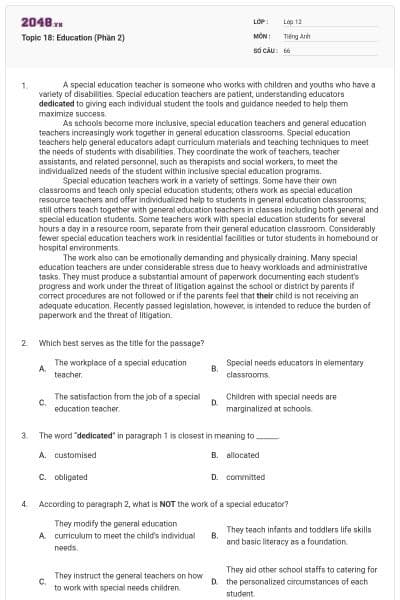
A special education teacher is someone who works with children and youths who have a variety of disabilities. Special education teachers are patient, understanding educators dedicated to giving each individual student the tools and guidance needed to help them maximize success.
As schools become more inclusive, special education teachers and general education teachers increasingly work together in general education classrooms. Special education teachers help general educators adapt curriculum materials and teaching techniques to meet the needs of students with disabilities. They coordinate the work of teachers, teacher assistants, and related personnel, such as therapists and social workers, to meet the individualized needs of the student within inclusive special education programs.
Special education teachers work in a variety of settings. Some have their own classrooms and teach only special education students; others work as special education resource teachers and offer individualized help to students in general education classrooms; still others teach together with general education teachers in classes including both general and special education students. Some teachers work with special education students for several hours a day in a resource room, separate from their general education classroom. Considerably fewer special education teachers work in residential facilities or tutor students in homebound or hospital environments.
The work also can be emotionally demanding and physically draining. Many special education teachers are under considerable stress due to heavy workloads and administrative tasks. They must produce a substantial amount of paperwork documenting each student’s progress and work under the threat of litigation against the school or district by parents if correct procedures are not followed or if the parents feel that their child is not receiving an adequate education. Recently passed legislation, however, is intended to reduce the burden of paperwork and the threat of litigation.
Which best serves as the title for the passage?
The workplace of a special education teacher.
Special needs educators in elementary classrooms.
The satisfaction from the job of a special education teacher.
Children with special needs are marginalized at schools.
Đáp án A
Tiêu đề phù hợp nhất cho bài đọc này có thể là __________ .
A. Nơi làm việc của một giáo viên giáo dục đặc biệt (giáo viên dạy những trẻ em khuyết tật)
B. Nhu cầu về các giáo viên đặc biệt ở lớp sơ cấp
C. Sự hài lòng từ công việc của một người giáo viên giáo dục đặc biệt
D. Trẻ em với những nhu cầu đặc biệt (những trẻ em khuyết tật) thì không được quan tâm nhiều ở trường học
Đây là câu hỏi đòi hỏi chúng ta phải nắm được ý chính của toàn bài. Vì vậy khi gặp câu này nên để làm cuối.
→ Suy ra từ toàn bài: Đoạn văn tập trung nói về nơi làm việc của các giáo viên giáo dục đặc biệt, một số giáo viên làm việc trong những căn phòng dành riêng cho các học sinh khuyết tật, công việc ở đây thì khá là áp lực do khối lượng công việc nhiều cũng như các công việc hành chính,… → câu A đúng.
The word “dedicated” in paragraph 1 is closest in meaning to ______.
customised
allocated
obligated
committed
Đáp án D
Từ “ dedicated” trong đoạn 1 gần nghĩa nhất với từ __________ .
A. Customized /ˈkʌstəmaɪzd/ (adj) : Thay đổi dựa trên yêu cầu của khách hàng
B. Allocated /ˈæləkeɪt/ (v) : Phân phối, cấp cho (ai cái gì)
C. Obligated /ˈɑːblɪɡeɪtɪd / (adj) : Bắt buộc, ép buộc
D. Dedicated /ˈdedɪkeɪtɪd/ (adj) : Tận tâm, tận tụy
Từ đồng nghĩa: dedicate (tận tâm, tận tụy) = commit
Special education teachers are patient, understanding educators dedicated to giving each individual student students the tools and guidance needed to maximize success.
(Những giáo viên giáo dục đặc biệt rất là nhẫn nại, những người giáo viên đầy sự cảm thông rất tận tâm trong việc cung cấp cho từng cá nhân học sinh những công cụ và sự chỉ dẫn cần thiết để giúp họ tối đa hóa sự thành công của mình).
According to paragraph 2, what is NOT the work of a special educator?
They modify the general education curriculum to meet the child’s individual needs.
They teach infants and toddlers life skills and basic literacy as a foundation.
They instruct the general teachers on how to work with special needs children.
They aid other school staffs to catering for the personalized circumstances of each student.
Đáp án B
Dựa trên đoạn 2, đâu không phải là công việc của một người giáo viên giáo dục đặc biệt?
A. Họ thay đổi chương trình giảng dạy chung để đáp ứng với nhu cầu của từng cá nhân.
B. Họ dạy trẻ em còn rất nhỏ và trẻ em mới tập đi kĩ năng sống và khả năng đọc viết cơ bản như là một nền tảng.
C. Họ hướng dẫn những người giáo viên thông thường cách để làm việc với những học sinh đặc biệt (những học sinh khuyết tật)
D. Họ hỗ trợ các cán bộ nơi trường học để chăm lo cho từng trường hợp cá nhân.
Căn cứ vào đoạn văn:
Special education teachers help general educators adapt curriculum materials and teaching techniques to meet the needs of the students with disabilities.
(Những giáo viên giáo dục đặc biệt giúp những giáo viên thông thường thay đổi tài liệu giảng dạy và phương pháp dạy học để đáp ứng với nhu cầu của những học sinh khuyết tật) => câu A và C đúng thông tin trong bài.
They coordinate the work of teachers, teacher assistants, and related personnel, such as therapists and social workers to meet the individualized needs of the students within inclusive special education programs.
(Họ kết hợp công việc của các giáo viên, trợ giảng và những nhân sự có liên quan như là những nhà trị liệu và những người làm công tác xã hội để đáp ứng nhu cầu của từng cá nhân học sinh trong khuôn khổ chương trình giáo dục đặc biệt).
=> Câu D đúng thông tin trong bài.
=> Không tìm thấy bất kì thông tin nào của câu B trong bài đọc => câu B là đáp án đúng.
According to paragraph 3, what types of environment can the special teachers work in?
They arrange special hours as a form of private tutoring in student homes.
They utilize the online teaching system for the emotionally unstable children.
They can be assigned a personal working office accepting only special students
They only work on call when other general teachers cannot handle the students.
Đáp án C
Dựa vào đoạn 3, môi trường nào là nơi để những giáo viên giáo dục đặc biệt làm việc:
A. Họ tổ chức những giờ học đặc biệt như hình thức của một gia sư riêng dạy tại nhà của học sinh.
B. Họ tận dung hệ thống dạy học trực tuyến cho những học sinh bất ổn về mặt tâm lí.
C. Họ có thể được giao công việc ngồi trong văn phòng và chỉ dạy các học sinh đặc biệt.
D. Họ chỉ sẵn sàng làm việc khi những giáo viên thông thường không thể đảm nhận được những học sinh đó.
Căn cứ vào thông tin trong bài: Some teachers work with special education students for several hours a day in a resource room, separate from general education classroom.
(Một số giáo viên làm việc với những học sinh có nhu cầu đặc biệt vài giờ đồng hồ một ngày trong một căn phòng dành riêng cho các học sinh khuyết tật, tách biệt với những lớp học thông thường). => câu C đúng.
The word “their” in paragraph 4 refers to _______.
assistants’
students’
teachers’
parents’
Đáp án D
Từ “their” trong đoạn 4 dùng để chỉ ai:
A. Những người giúp đỡ
B. Những học sinh
C. Những giáo viên
D. Những bậc cha mẹ
Căn cứ vào thông tin trong bài: They must produce a substantial amount of paperwork documenting each student’s progress and work under the threat of litigation against the school or district by parents if correct procedures are not followed or if their parents feel that their child is not recceiving an adequate education.
(Họ cần phải tạo ra một số lượng lớn các tư liệu lưu lại sự tiến bộ của từng học sinh và làm việc dưới nguy cơ có thể xảy ra tranh chấp với trường học hoặc khu vực bởi những bậc cha mẹ khi những thủ tục đúng đắn không được tuân thủ hoặc khi họ cảm thấy con cái mình không được dạy đầy đủ.) => câu D đúng.
Normally a student must attend a certain number of courses in order to graduate, and each course which he attends gives him a credit which he may count towards a degree. In many American universities the total work for a degree consists of thirty-six courses each lasting for one semester. A typical course consists of three classes per week for fifteen weeks; while attending a university a student will probably attend four or five courses during each semester. Normally a student would expect to take four years attending two semesters each year. It is possible to spread the period of work for the degree over a longer period. It is also possible for a student to move between one university and another during his degree course, though this is not in fact done as a regular practice.
For every course that he follows a student is given a grade, which is recorded, and the record is available for the student to show to prospective employers. All this imposes a constant pressure and strain of work, but in spite of this some students still find time for great activity in student affairs. Elections to positions in student organizations arouse much enthusiasm. The effective work of maintaining discipline is usually performed by students who advise the academic authorities. Any student who is thought to have broken the rules, for example, by cheating has to appear before a student court. With the enormous numbers of students, the operation of the system does involve a certain amount of activity. A student who has held one of these positions of authority is much respected and it will be of benefit to him later in his career.
Normally a student would at least attend ____ classes each week.
36
20
12
15
Đáp án C
Thông thường một sinh viên ít nhất sẽ tham gia____ lớp mỗi tuần.
A. 36
B. 20
C. 12
D. 15
=> Căn cứ vào nghĩa của câu:
In many American universities the total work for a degree consists of thirty-six courses each lasting for one semester. A typical course consists of three classes per week for fifteen weeks; while attending a university a student will probably attend four or five courses during each semester.
(Trong nhiều trường đại học Mỹ, tổng số công việc cho một mức độ bao gồm ba mươi sáu khóa học mỗi khóa kéo dài trong một học kỳ. Một khóa học điển hình bao gồm ba lớp mỗi tuần trong mười lăm tuần; trong khi đó mỗi sinh viên học đại học sẽ phải tham dự 4-5 khóa học trong suốt mỗi kỳ.)
=> Ta hiểu rằng:
+ 1 khóa học điển hình có 3 lớp/tuần
+ có 4 - 5 khóa học/kỳ mà 1 sinh viên phải tham dự
=> 1 sinh viên phải tham dự từ: 3 x (4 - 5) = 12 -15 lớp.
=> Ít nhất 1 sinh viên phải tham dự 12 lớp học.
According to the first paragraph an American student is allowed ____.
to live in a different university
to take a particular course in a different university
to live at home and drive to classes
to get two degrees from two different universities
Đáp án B
Theo đoạn đầu tiên, một sinh viên Mỹ được phép ____.
A. sống ở một trường đại học khác.
B. để tham gia một khóa học cụ thể ở một trường đại học khác.
C. sống ở nhà và lái xe đến lớp.
D. để có được hai văn bằng từ hai trường đại học khác nhau.
Căn cứ vào nghĩa của câu:
It is also possible for a student to move between one university and another during his degree course, though this is not in fact done as a regular practice.
(Cũng có thể một sinh viên di chuyển giữa một trường đại học và một trường khác trong khóa học văn bằng của mình, mặc dù điều này thực tế không được thực hiện như một thực tế thông thường.)
American university students are usually under pressure of work because ____.
their academic performance will affect their future careers
they are heavily involved in student affairs
they have to observe university discipline
they want to run for positions of authority
Đáp án A
Sinh viên đại học Mỹ thường chịu áp lực công việc vì __________ .
A. kết quả học tập của họ sẽ ảnh hưởng đến sự nghiệp tương lai của họ.
B. họ tham gia rất nhiều vào công việc sinh viên.
C. họ phải tuân theo các quy tắc của trường đại học.
D. họ muốn chạy đua vào các vị trí của chính quyền.
Căn cứ vào nghĩa của câu:
For every course that he follows a student is given a grade, which is recorded, and the record is available for the student to show to prospective employers. All this imposes a constant pressure and strain of work, but in spite of this some students still find time for great activity in student affairs.
(Đối với mỗi khóa học mà anh ta theo học sinh được cấp một lớp, được ghi lại. Và hồ sơ có sẵn để học sinh trình bày cho các nhà tuyển dụng tiềm năng. Tất cả điều này áp đặt (tăng) một áp lực và căng thẳng liên tục của công việc, nhưng mặc dù vậy Một số sinh viên vẫn dành thời gian cho các hoạt động tuyệt vời trong các công việc của sinh viên.)
Some students are enthusiastic for positions in student organizations probably because ____.
they hate the constant pressure strain of their study
they will then be able to stay longer in the university
such positions help them get better jobs
such positions are usually well paid
Đáp án C
Một số sinh viên nhiệt tình cho các vị trí trong các tổ chức sinh viên có thể vì ____.
A. họ ghét sự căng thẳng liên tục của nghiên cứu của họ.
B. sau đó họ sẽ có thể ở lại trường đại học lâu hơn.
C. vị trí như vậy giúp họ có được công việc tốt hơn.
D. những vị trí như vậy thường được trả lương cao.
Căn cứ vào nghĩa của câu:
A student who has held one of these positions of authority is much respected and it will be of benefit to him later in his career.
(Một sinh viên từng giữ một trong những vị trí quyền lực này được tôn trọng và nó sẽ được tôn trọng có ích cho anh ta sau này trong sự nghiệp của mình.)
The student organizations seem to be effective in ____.
dealing with the academic affairs of the university
ensuring that the students observe university regulations
evaluating students’ performance by bringing them before a court
keeping up the students’ enthusiasm for social activities
Đáp án B
Các tổ chức sinh viên dường như có hiệu quả trong ____.
A. đối phó với các vấn đề học tập của trường đại học.
B. đảm bảo rằng các sinh viên tuân thủ các quy định của trường đại học.
C. đánh giá hiệu suất của học sinh bằng cách đưa họ ra trước tòa án.
D. giữ sự nhiệt tình của sinh viên cho các hoạt động xã hội.
Căn cứ vào nghĩa của câu:
The effective work of maintaining discipline is usually performed by students who advise the academic authorities.
(Công việc hiệu quả của việc duy trì kỷ luật thường được thực hiện bởi các sinh viên tư vấn cho các cơ quan học thuật.)
Australia has a well-organized and well-structured education system. The education starts at the age of five or six, but it may differ by a narrow margin between states. It starts with the preschool education which is not compulsory and can be offered within a school or separately. The primary and secondary school encompasses the compulsory education for Australians. There are a large number of primary and high school across the country with most of them being public schools. It is estimated that public schools amount to 60% of scholars as opposed to 40% in private settings. All these education providers must be licensed by the government and must fulfill certain requirements including infrastructure and teaching. Universities, on the other hand, are mainly public institutions.
The Australian education system has established a standard curriculum so all scholars will be given the same quality of education. Despite there may be some states at which this curriculum is modified a bit, but the change is not that significant. The actual curriculum set out in Australia education system is based on important abilities one must have in his life: Literacy, Numeracy, Information and communication technology, Critical and creative thinking, personal and social capability, ethical understanding, intercultural understanding.
Vocational and Technical schools prepare students that want to skip the university and want to move directly to the job market. Actually, here it stands the difference between universities and colleges: the Vocational and Technical Schools are more oriented in teaching practical skills while university courses are mainly theory-based to lead students to different academic careers. There are hundreds of other schools out there that provide technical and further education (TAFE) and vocational education and training (VET). These schools offer short courses, certificates I through IV, diplomas, and advanced diplomas. They focus on training their students in a particular vocation or just to help their students get out into the workplace. These schools offer a wide variety of courses and qualifications attained by these courses can lead to different career pathways to follow afterward.
Australian higher education modernity and reputation relies on a huge number of educational providers including universities and different training organizations. Currently, there are 43 universities across the country. The vast majority of universities are public except two private universities. The world-class teaching offered is surely undisputed. Seven Australian universities are traditionally found at the top 100 best universities in the world which is a sufficient indicator to highlight their quality.
Besides universities, more than 5,000 training organizations are registered and accredited. Actual figures show that the number of enrolled students is around 3.8 million with international students sharing more than half a million. There are also 3 self-accrediting higher education institutions. Furthermore, dozens of smaller schools do not grant any degrees or have an accreditation – these are private schools that focus on theology, business, information technology, natural therapies, hospitality, health, law, and accounting.
Which of the following could be the main topic of the passage?
The levels of education in Australia.
The Australian education system.
The curriculum of schools in Australia.
The position of Australian schools in the world.
Đáp án B
Câu nào trong các câu sau có thể là chủ đề chính của đoạn văn?
A. Các cấp giáo dục ở Úc.
B. Hệ thống giáo dục của Úc.
C. Chương trình giáo dục của các trường học ở Úc.
D. Vị trí của các trường học ở Úc trên thế giới.
Căn cứ vào thông tin đoạn 1:
Australia has a well-organized and well-structured education system.
(Úc có một hệ thống giáo dục được tổ chức tốt và có cấu trúc chặt chẽ.)
According to paragraph 1, which of the following is TRUE about the education in Australia?
Children must start schools when they are five years old.
Pre-school education is not optional for Australian children.
There are more students attending public schools than private schools.
Every education provider can start up their school without any requirements
Đáp án C
Theo đoạn 1, câu nào là đúng về nền giáo dục ở Úc?
A. Trẻ em phải đến trường khi chúng được 5 tuổi.
B. Giáo dục mầm non là bắt buộc cho trẻ em Úc.
C. Có nhiều học sinh học các trường công lập nhiều hơn các trường tư.
D. Mọi nhà cung cấp giáo dục đều có thể mở trường mà không có bất kì yêu cầu gì.
Căn cứ thông tin đoạn 1:
The education starts at the age of five or six, but it may differ by a narrow margin between states. It starts with the preschool education which is not compulsory and can be offered within a school or separately. The primary and secondary school encompasses the compulsory education for Australians. There are a large number of primary and high school across the country with most of them being public schools. It is estimated that public schools amount to 60% of scholars as opposed to 40% in private settings. All these education providers must be licensed by the government and must fulfill certain requirements including infrastructure and teaching.
(Giáo dục bắt đầu ở độ tuổi năm hoặc sáu, nhưng nó có thể khác nhau bởi ranh giới hẹp giữa các tiểu bang. Nó bắt đầu với giáo dục mầm non không bắt buộc và có thể được dạy trong cùng một trường học hoặc riêng biệt. Trường tiểu học và trung học bao gồm chương trình giáo dục bắt buộc cho người Úc. Có một số lượng lớn các trường tiểu học và trung học trên toàn quốc với hầu hết trong số đó là trường công lập. Người ta ước tính rằng các trường công lập chiếm tới 60% học sinh so với con số 40% ở các cơ sở tư nhân. Tất cả các nhà cung cấp giáo dục này phải được chính phủ cấp phép và phải đáp ứng các yêu cầu nhất định bao gồm cơ sở hạ tầng và giảng dạy.)
What is the curriculum of the Australian education system based on?
It focuses on necessary skills that students must be prepared for their life.
It is based on essential abilities like reading, writing and numbers
It concentrates on knowledge and technology for students.
It depends on the quality of education that the schools provide.
Đáp án A
Chương trình học của hệ thống giáo dục Úc dựa vào điều gì?
A. Nó tập trung vào các kĩ năng cần thiết mà học sinh cần được trang bị cho cuộc sống của họ.
B. Nó dựa vào các khả năng cần thiết như đọc, viết và con số.
C. Nó tập trung vào kiến thức và công nghệ cho học sinh.
D. Nó dựa vào chất lượng giáo dục mà các trường học cung cấp.
Căn cứ vào thông tin đoạn 2:
The actual curriculum set out in Australia education system is based on important abilities one must have in his life: Literacy, Numeracy, Information and communication technology, Critical and creative thinking, personal and social capability, ethical understanding, intercultural understanding.
(Chương trình giảng dạy thực tế được đặt ra trong hệ thống giáo dục Úc dựa trên những khả năng quan trọng mà người ta phải có trong cuộc sống của mình: Biết chữ, giỏi Toán, Công nghệ thông tin và truyền thông, Tư duy phê phán và sáng tạo, năng lực cá nhân và xã hội, hiểu biết đạo đức, hiểu biết liên văn hóa.)
According to paragraph 3, the main difference between universities and Vocational and Technical schools is that _______________.
the Vocational and Technical schools pay more attention to academic careers than the ot
the Vocational and Technical schools provide more courses for students to choose than the other.
universities provide practical skills for students to take part in the workforce while Vocational and Technical schools only help them with theory.
universities emphasize theoretical courses whereas the Vocational and Technical schools tend to develop practical skills.
Đáp án D
Theo đoạn 3, sự khác biệt chính giữa các trường đại học và các trường dạy nghề và kĩ thuật là ______________.
A. các trường dạy nghề và kĩ thuật chú ý nhiều đến các nghề nghiệp cao cấp hơn trường đại học.
B. các trường dạy nghề và kĩ thuật cung cấp nhiều khoá học cho học sinh lựa chọn hơn là trường đại học.
C. các trường đại học cung cấp các kĩ năng thực hành cho học sinh tham gia vào lực lượng lao động trong khi các trường dạy nghề và kĩ thuật chỉ giúp học sinh về mặt lý thuyết.
D. các trường đại học nhấn mạnh vào các khoá học lý thuyết trong khi các trường dạy nghề và kĩ thuật có khuynh hướng phát triển kĩ năng thực hành.
Căn cứ thông tin đoạn 3:
Actually, here it stands the difference between universities and colleges: the Vocational and Technical Schools are more oriented in teaching practical skills while university courses are mainly theory-based to lead students to different academic careers.
(Trên thực tế, ở đây nó là sự khác biệt giữa các trường đại học và cao đẳng: các trường dạy nghề và kỹ thuật thiên về việc dạy các kỹ năng thực hành hơn, trong khi các khóa học đại học chủ yếu dựa trên lý thuyết để hướng dẫn sinh viên đến các ngành nghề khác nhau.)
The word “They” in paragraph 3 refer to _________.
these schools
short courses
diplomas
advanced diplomas
Đáp án A
Từ “they” trong đoạn 3 đề cập đến _______.
A. những trường này
B. các khoá học ngắn hạn
C. văn bằng
D. bằng cấp cao cấp
Căn cứ thông tin đoạn 3:
Từ “they” thay thế cho danh từ “these schools”.
These schools offer short courses, certificates I through IV, diplomas, and advanced diplomas. They focus on training their students in a particular vocation or just to help their students get out into the workplace.
(Các trường này cung cấp các khóa học ngắn hạn, chứng chỉ từ I đến IV, văn bằng và bằng cấp cao cấp. Họ tập trung vào việc đào tạo sinh viên của họ trong một nghề nghiệp cụ thể hoặc chỉ để giúp sinh viên của họ được nhận vào làm việc.)
The word “reputation” in paragraph 4 is closest in meaning to _______.
obscurity
renown
difference
stability
Đáp án B
Từ “reputation” trong đoạn 4 gần nghĩa nhất với từ ________.
A. sự tối tăm
B. sự nổi tiếng
C. sự khác biệt
D. sự ổn định
Từ đồng nghĩa: reputation (sự nổi tiếng) = renown
Australian higher education modernity and reputation relies on a huge number of educational providers including universities and different training organizations.
(Tính hiện đại và danh tiếng của giáo dục đại học Úc dựa trên sự đông đảo các nhà cung cấp giáo dục bao gồm các trường đại học và các tổ chức đào tạo khác nhau.)
The word “undisputed” in paragraph 4 could be best replaced by ________.
questionable
doubtful
undeniable
unacknowledged
Đáp án C
Từ “undisputed” trong đoạn 4 có thể được thay thế tốt nhất bởi từ __________.
A. đáng ngờ
B. đáng nghi
C. không thể phủ nhận
D. không được thừa nhận
Từ đồng nghĩa: undisputed (không thể tranh cãi, phủ nhận) = undeniable
The world-class teaching offered is surely undisputed. Seven Australian universities are traditionally found at the top 100 best universities in the world which is a sufficient indicator to highlight their quality.
(Những lớp học đẳng cấp thế giới được giảng dạy chắc chắn là không thể tranh cãi. Bảy trường đại học của Úc được xếp hạng trong top 100 trường đại học hàng đầu trên thế giới, đây là một chỉ số để làm nổi bật chất lượng của các trường đại học này.)
What can be inferred from the passage?
Australia is an ideal place for not only Australian students but also international ones to study.
There are more and more international students choosing Australian universities to attend.
Because of the fame in the world, more universities and training organizations are established each year.
Students in Australia prefer Vocational and Technical schools than others.
Đáp án A
Có thể suy ra điều gì từ đoạn văn?
A. Úc là một nơi lý tưởng cho cả sinh viên người Úc và sinh viên quốc tế theo học.
B. Ngày càng nhiều sinh viên quốc tế lựa chon các trường đại học của Úc để tham dự.
C. Bởi vì sự nổi tiếng trên thế giới, ngày càng nhiều trường đại học và tổ chức đào tạo được thành lập mỗi năm.
D. Sinh viên ở Úc thích các trường dạy nghề và kĩ thuật hơn các trường khác.
Căn cứ vào các thông tin sau:
Australian higher education modernity and reputation relies on a huge number of educational providers including universities and different training organizations. Currently, there are 43 universities across the country. The vast majority of universities are public except two private universities. The world-class teaching offered is surely undisputed. Seven Australian universities are traditionally found at the top 100 best universities in the world which is a sufficient indicator to highlight their quality.
Besides universities, more than 5,000 training organizations are registered and accredited. Actual figures show that the number of enrolled students is around 3.8 million with international students sharing more than half a million.
(Tính hiện đại và danh tiếng của giáo dục đại học Úc dựa trên sự đông đảo các nhà cung cấp giáo dục bao gồm các trường đại học và các tổ chức đào tạo khác nhau. Hiện nay, có 43 trường đại học trên toàn quốc. Đại đa số các trường đại học đều là trường công lập trừ hai trường đại học tư. Hai người Úc là các chi nhánh của các trường đại học ở nước ngoài. Những lớp học đẳng cấp thế giới được giảng dạy chắc chắn là không thể tranh cãi. Bảy trường đại học của Úc được xếp hạng trong top 100 trường đại học hàng đầu trên thế giới, đây là một chỉ số để làm nổi bật chất lượng của các trường đại học này.
Bên cạnh các trường đại học, hơn 5.000 tổ chức đào tạo được đăng ký và được công nhận. Số liệu thực tế cho thấy số lượng sinh viên ghi danh là khoảng 3,8 triệu, trong đó sinh viên quốc tế chiếm hơn nửa triệu.)
Continuing education is required for workers to stay current with the latest developments, skills, and new technologies required for their fields. Certain professions also require continuing education to comply with laws, remain licensed or certified, or maintain membership in an association or licensing body. Many careers require continuing education. For example, teachers, real estate agents, and engineers are required to have a base of education and then receive updated education as they continue to work in their fields. Nursing, pharmacy, accounting, and criminal justice are additional fields in which professionals must continue to develop the skills necessary for ever-changing environments.
For nurses, there are typically two types of continuing education. The first is required for them to remain licensed in their states. The second type of continuing education allows them to get more advanced degrees and qualify for higher-level nursing positions. In the fast-paced pharmacy field, continuing education is important for career growth and licensure. Pharmacists need continuing education to renew their state licenses. Continuing education focuses on subject areas in health care, including pharmacology, patient counseling, regulatory issues, and other topics that contribute to professional pharmacy practice.
Certified public accountants (CPAs) must meet continuing education requirements established by the State Board of Accountancy of the states where their CPA licenses are held. The requirements vary from state to state. The American Institute of CPAs (AICPA) also requires certain continuing education for CPAs to maintain membership. Meanwhile, criminal justice professionals need to stay up-to-date on the new laws, procedures, and technologies to reinforce the knowledge they have already gained. Criminal justice and legal fields include a variety of jobs, such as probation and parole officers, summary court officials, emergency management personnel, and crime scene technicians. Many of these careers require an undergraduate degree for entry, and then professionals must complete continuing education courses as they progress in their careers. Crime scene investigators and evidence technicians must maintain certifications specific to the collection, processing, and maintenance of evidence. Traffic crash reconstructionists must maintain accredited certifications. Emergency management professionals must complete and maintain certifications for their respective states and the Federal Emergency Management Agency (FEMA).
Howard concluded “Today’s professionals must, therefore, commit to a ‘life-long learning’ philosophy that enhances effectiveness, diagnose and more quickly solves problems, while moving away from the traditional autocratic management styles.” Whether it is required or not, continuing education can be important for career satisfaction.
Which best serves as the title for the passage?
Colleges offering further education classes.
The importance of continuing education.
Adoption of international standards.
Different further education formats.
Đáp án B
Câu nào thích hợp nhất để làm tiêu đề cho đoạn văn?
A. Các trường cao đẳng cung cấp các lớp học cao hơn
B. Tầm quan trọng của giáo dục thường xuyên
C. Thông qua các tiêu chuẩn quốc tế
D. Các định dạng giáo dục khác
Căn cứ vào thông tin đoạn đầu:
Continuing education is required for workers to stay current with the latest developments, skills, and new technologies required for their fields. Certain professions also require continuing education to comply with laws, remain licensed or certified, or maintain membership in an association or licensing body. Many careers require continuing education.
(Giáo dục thường xuyên là cần thiết cho người lao động để luôn cập nhật với những sự phát triển, kỹ năng, và các công nghệ mới nhất cần thiết cho lĩnh vực của họ. Một số ngành nghề cũng yêu cầu giáo dục thường xuyên để tuân thủ luật pháp, vẫn được cấp giấy phép hoặc chứng nhận hoặc duy trì tư cách thành viên trong một hiệp hội hoặc cơ quan cấp phép. Nhiều nghề nghiệp đòi hỏi giáo dục thường xuyên.)
Như vậy, từ thông tin trên ta có thể suy ra đoạn văn đang nói về tầm quan trọng của việc giáo dục thường xuyên.
According to paragraph 1, why is continuing education important for the working forces?
Because continuing education is considered a way for employers to test their employees
Because the more qualifications a person hold the higher the chances are for them to get promoted.
Because continuing education justifies a worker’s marketable characteristic that is willingness to learn.
Because continuing education helps professionals keep abreast of their constantly changing fields.
Đáp án D
Theo đoạn 1, tại sao giáo dục thường xuyên lại quan trọng đối với lực lượng lao động?
A. Bởi vì giáo dục thường xuyên được coi là một cách để người sử dụng lao động kiểm tra nhân viên của họ
B. Bởi vì một người có càng nhiều bằng cấp thì cơ hội để họ được thăng tiến càng nhiều
C. Bởi vì giáo dục thường xuyên đánh giá cho một đặc tính thị trường của người lao động là sẵn sàng học hỏi
D. Bởi vì giáo dục thường xuyên giúp các chuyên gia bám sát các lĩnh vực liên tục thay đổi của họ
Căn cứ vào thông tin đoạn một:
For example, teachers, real estate agents, and engineers are required to have a base of education and then receive updated education as they continue to work in their fields. Nursing, pharmacy, accounting, and criminal justice are additional fields in which professionals must continue to develop the skills necessary for ever-changing environments.
(Ví dụ: giáo viên, bất động sản, và các kỹ sư được yêu cầu phải có một cơ sở giáo dục và sau đó nhận được giáo dục cập nhật khi họ tiếp tục làm việc trong lĩnh vực của họ. Điều dưỡng, dược sĩ, kế toán, và tư pháp hình sự là các lĩnh vực bổ sung trong đó các chuyên gia phải tiếp tục phát triển các kỹ năng cần thiết cho môi trường luôn thay đổi.)
The word “regulatory” in paragraph 2 is closest in meaning to _______.
normative
organising
legal
prescriptive
Đáp án C
Từ “regulatory” trong đoạn 2 có nghĩa gần nhất với_____.
A. quy phạm
B. tổ chức
C. hợp pháp
D. kê đơn
Từ đồng nghĩa regulatory (pháp lý) = legal
Continuing education focuses on subject areas in health care, including pharmacology, patient counseling, regulatory issues, and other topics that contribute to professional pharmacy practice.
(Giáo dục thường xuyên tập trung vào các lĩnh vực trong việc chăm sóc sức khỏe, bao gồm dược lý, tư vấn bệnh nhân, các vấn đề pháp lý và các chủ đề khác cái mà góp phần vào thực hành dược chuyên nghiệp.)
According to paragraph 3, which domain does NOT require continuing education?
Evidence technicians.
Data entry clerks.
Traffic crash reconstructionists.
Certified public accountants.
Đáp án B
Theo đoạn 3, ngành nào không yêu cầu giáo dục thường xuyên?
A. Kỹ thuật viên chứng cứ
B. Thư ký nhập dữ liệu
C. Tái thiết vụ tai nạn giao thông
D. Kế toán viên công chứng
Căn cứ vào thông tin đoạn ba:
Certified public accountants (CPAs) must meet continuing education requirements established by the State Board of Accountancy of the states where their CPA licenses are held.
(Kế toán viên công chứng (CPAs) phải đáp ứng các yêu cầu giáo dục thường xuyên được thiết lập bởi hội đồng kế toán nhà nước của các tiểu bang nơi giấy phép CPA của họ được tổ chức.)
Crime scene investigators and evidence technicians must maintain certifications specific to the collection, processing, and maintenance of evidence. Traffic crash reconstructionists must maintain accredited certifications.
(Điều tra viên hiện trường vụ án và kỹ thuật viên chứng cứ phải duy trì các chứng nhận cụ thể cho việc thu thập, xử lý và bảo vệ bằng chứng. Người tái thiết vụ tai nạn giao thông phải duy trì các chứng chỉ đã được công nhận.)
The word “they” in paragraph 3 refers to _____.
laws
professionals
procedures
technologies
Đáp án B
Từ “they” trong đoạn 3 đề cập đến_______.
A. luật
B. chuyên gia
C. thủ tục
D. công nghệ
Từ “they” ở đây dùng để thay thế cho danh từ các chuyên gia được nhắc tới trước đó.
Meanwhile, criminal justice professionals need to stay up-to-date on the new laws, procedures, and technologies to reinforce the knowledge they have already gained.
(Trong khi đó, các chuyên gia tư pháp hình sự cần phải luôn cập nhật các luật, thủ tục và công nghệ mới để củng cố kiến thức họ đã có.)
Which of the following statements is TRUE, according to the passage?
Unlike legal professions, accounting field does not require continuing educat
Continuing education is originally devised to encourage career transition.
Only those unsatisfied with their current lifestyles will choose continuing education.
Continuing education can lead to opportunities for career advancement
Đáp án D
Phát biểu nào sau đây là đúng, theo đoạn văn?
A. Không giống như các ngành nghề hợp pháp, lĩnh vực kế toán không yêu cầu giáo dục thường xuyên
B. Giáo dục thường xuyên ban đầu được nghĩ ra để khuyến khích chuyển đổi nghề nghiệp
C. Chỉ những người không hài lòng với lối sống hiện tại của họ sẽ chọn giáo dục thường xuyên
D. Giáo dục thường xuyên có thể dẫn đến cơ hội thăng tiến trong nghề nghiệp
Căn cứ vào thông tin đoạn hai:
The second type of continuing education allows them to get more advanced degrees and qualify for higher-level nursing positions.
(Loại giáo dục thường xuyên thứ hai cho phép họ có được bằng cấp cao hơn và đủ điều kiện cho các vị trí điều dưỡng cấp cao hơn.)
The word “autocratic” in paragraph 4 is closest in meaning to _______.
arbitrary
immutable
imperious
dystopian
Đáp án A
Từ “autocratic” trong đoạn 4 có nghĩa gần nhất với_______.
A. chuyên quyền, độc đoán
B. bất biến
C. khẩn cấp
D. dễ sợ, kinh khủng
Từ đồng nghĩa autocratic (chuyên quyền, độc đoán) = arbitrary
Howard concluded “Today’s professionals must, therefore, commit to a ‘life-long learning’ philosophy that enhances effectiveness, diagnose and more quickly solves problems, while moving away from the traditional autocratic management styles.”
(Do đó, Howard kết luận rằng "Do đó, các chuyên gia ngày nay phải cam kết học tập suốt đời cái mà giúp tăng cường hiệu quả, chẩn đoán và nhanh chóng giải quyết vấn đề hơn, trong khi tách ra khỏi các phong cách quản lý độc đoán truyền thống.)
What is the tone of the whole passage?
Introspective
Commiserating
Informative
Idealistic
Đáp án C
Giọng điệu của toàn bộ đoạn văn là gì?
A. Nội tâm
B. Thương xót
C. Có tính giáo dục, cung cấp thông tin
D. Duy tâm
Căn cứ vào thông tin toàn bài đọc, ta thấy đoạn văn đang nói về tầm quan trọng của việc giáo dục thường xuyên, và sau đó là dẫn chứng ở những ngành nghề cụ thể nên có thể suy ra đoạn văn đang cung cấp thông tin cho chúng ta.
Every summer, when the results of university entrance exam come out, many newspaper stories are published about students who are top-scorers across the country. Most portray students as hard-working, studious, smart and, generally, from low-income families. They are often considered heroes or heroines by their families, communes, villages and communities. And they symbolise the efforts made to lift them, and their relatives, out of poverty. The students are often too poor to attend any extra-classes, which make their achievements more illustrious and more newsworthy. While everyone should applaud the students for their admirable efforts, putting too much emphasis on success generates some difficult questions.
If other students look up to them as models, of course it’s great. However, in a way, it contributes to society’s attitude that getting into university is the only way to succeed. For those who fail, their lives are over. It should be noted that about 1.3 million high school students take part in the annual university entrance exams and only about 300,000 of them pass. What’s about the hundreds of thousands who fail? Should we demand more stories about those who fail the exam but succeed in life or about those who quit university education at some level and do something else unconventional?
“I personally think that it’s not about you scoring top in an entrance exam or get even into Harvard. It’s about what you do for the rest of your life,” said Tran Nguyen Le Van, 29. He is the founder of a website, vexere.com, that passengers can use to book bus tickets online and receive tickets via SMS. His business also arranges online tickets via mobile phones and email. Van dropped out of his MBA at the Thunderbird School of Global Management in Arizona in the United States. His story has caught the attention of many newspapers and he believes more coverage should be given to the youngsters who can be role-models in the start-up community. Getting into university, even with honours, is just the beginning. "We applaud them and their efforts and obviously that can give them motivation to do better in life. However, success requires more than just scores," Van said. Van once told a newspaper that his inspiration also came from among the world’s most famous drop-outs, such as Mark Zuckerberg of Facebook or Bill Gates who also dropped out of Harvard University.
Alarming statistics about unemployment continues to plague us. As many as 162,000 people with some kind of degree cannot find work, according to Labour Ministry’s statistics this month. An emphasis on getting into university does not inspire students who want to try alternative options. At the same time, the Ministry of Education and Training is still pondering on how to reform our exam system, which emphasises theories, but offers little to develop critical thinking or practice. Vu Thi Phuong Anh, former head of the Centre for Education Testing and Quality Assessment at Viet Nam National University in HCM City said the media should also monitor student successes after graduation. She agreed there were many success stories about young people, but added that it was imbalanced if students taking unconventional paths were not also encouraged.
Viet Nam is, more than ever, in desperate need of those who think outside the box. Time for us to recognise talent, no matter where it comes from or how.
Which of the following best describes the main idea of this passage?
Many students consider universities as their only way after school.
A good model of being successful in the real life out of school.
Not many students are successful after graduating from universities.
University is not the only way to success.
Đáp án D
Câu nào trong các câu sau mô tả chính xác nhất ý chính của đoạn văn?
A. Nhiều học sinh coi đại học là con đường duy nhất sau khi học xong cấp 3.
B. Một tấm gương sáng về thành công trong cuộc sống thực sau khi tốt nghiệp cấp 3.
C. Không nhiều sinh viên thành công sau khi tốt nghiệp đại học.
D. Đại học không phải là con đường duy nhất tới thành công.
Căn cứ vào nội dung bài đọc:
Tác giả đã chỉ ra rằng có những người không hoàn thành chương trình đại học nhưng vẫn thành công, trong khi hàng ngàn sinh viên ra trường không tìm được việc làm. Vì vậy, đại học không phải là con đường duy nhất đến thành công.
What is NOT stated in the passage about the top-scorers in the entrance exam?
The majority of them are poor but intelligent and eager to learn.
They are hoped to find the way to better their families’ lives.
Their success is more glorious because they attend more classes than others.
The students are admired for the great efforts.
Đáp án C
Thông tin nào về những thủ khoa kì thi tuyển sinh đại học KHÔNG được đề cập đến trong bài?
A. Đa số những người này là con nhà nghèo nhưng thông minh và hiếu học.
B. Họ được hi vọng là sẽ tìm ra cách để cải thiện cuộc sống của gia đình mình.
C. Thành công của họ huy hoàng hơn vì họ tham dự nhiều lớp học hơn những người khác.
D. Những học sinh này được khâm phục bởi nghị lực phi phường.
Căn cứ vào thông tin đoạn 1:
Every summer, when the results of university entrance exam come out, many newspaper stories are published about students who are top-scorers across the country. Most portray students as hard-working, studious, smart and, generally, from low-income families. They are often considered heroes or heroines by their families, communes, villages and communities. And they symbolise the efforts made to lift them and their relatives, out of poverty. The students are often too poor to attend any extra-classes, which make their achievements more illustrious and more newsworthy.
The word “unconventional” in paragraph 2 could best be replaced by ____________.
common
unusual
well-known
infamous
Đáp án B
Từ “unconventional” trong đoạn 2 có thể được thay thế bởi ____________.
A. phổ biến
B. bất thường
C. nổi tiếng
D. nổi tiếng xấu
Từ đồng nghĩa: unconventional (bất thường, khác thường) = unusual
Should we demand more stories about those who fail the exam but succeed in life or about those who quit university education at some level and do something else unconventional?
(Chúng ta có nên yêu cầu nhiều câu chuyện hơn về những người thất bại trong kỳ thi nhưng thành công trong cuộc sống hay về những người bỏ học đại học ở một mức độ nào đó và làm điều gì đó khác thường không?)
The author described Tran Nguyen Le Van in the third passage as ________________.
a good example to achieve success although he didn’t finish his education.
a businessman who gains money by selling mobile phones online.
a founder whose website was inspired from social networks like Facebook.
a top-scorer who books online tickets and confirm through messages.
Đáp án A
Tác giả miêu tả Trần Nguyễn Lê Vân trong đoạn 3 như là ____________.
A. một tấm gương sáng đạt được thành công mặc dù anh ấy không hoàn thành chương trình giáo dục của mình.
B. một doanh nhân kiếm tiền bằng cách bán điện thoại trực tuyến.
C. một người sáng lập mà website của anh ta có cảm hứng từ mạng xã hội như Facebook.
D. một thủ khoa đặt vé trực tuyến và xác nhận qua tin nhắn.
Căn cứ thông tin đoạn 3:
He is the founder of a website, vexere.com, that passengers can use to book bus tickets online and receive tickets via SMS. His business also arranges online tickets via mobile phones and email. Van dropped out of his MBA at the Thunderbird School of Global Management in Arizona in the United States.
(Anh là người sáng lập ra trang web, vexere.com, mà hành khách có thể sử dụng để đặt vé xe buýt trực tuyến và nhận vé qua tin nhắn điện thoại. Doanh nghiệp của anh cũng hỗ trợ đặt vé trực tuyến qua điện thoại di động và email. Vân bỏ học cử nhân quản trị kinh doanh (MBA) tại Trường Quản lý Toàn cầu Thunderbird ở Arizona, Hoa Kỳ).
The word “them” in paragraph 3 refers to _________________.
honours
role-models
the youngsters
newspapers
Đáp án C
Từ “them” trong đoạn 3 đề cập đến _________________.
A. sự vinh dự
B. tấm gương
C. những người thanh niên
D. báo chí
Từ “them” thay thế cho những thanh niên trẻ tuổi trong câu trước.
His story has caught the attention of many newspapers and he believes more coverage should be given to the youngsters who can be role-models in the start-up community. Getting into university, even with honours, is just the beginning. "We applaud them and their efforts and obviously that can give them motivation to do better in life.
(Câu chuyện của ông đã thu hút được sự chú ý của nhiều tờ báo và ông tin rằng cần phải có nhiều sự dũng cảm hơn cho các bạn trẻ, những người có thể là tấm gương trong cộng đồng khởi nghiệp. Vào được đại học, ngay cả với niềm vinh dự, chỉ là khởi đầu. "Chúng ta hoan nghênh họ và những nỗ lực của họ và rõ ràng là điều này có thể tiếp thêm cho họ động lực để làm tốt hơn trong cuộc sống).
The word “plague” in paragraph 4 is closest in meaning to ____________.
conflict
afflict
remind
bother
Đáp án B
Từ “plague” trong đoạn 4 gần nghĩa nhất với từ _____________.
A. mâu thuẫn
B. làm ưu phiền
C. nhắc nhở
D. làm phiền
Từ đồng nghĩa: plague (làm buồn lòng, gây rối không yên) = afflict
Alarming statistics about unemployment continues to plague us. As many as 162,000 people with some kind of degree cannot find work, according to Labour Ministry’s statistics this month.
(Số liệu thống kê báo động về tình trạng thất nghiệp tiếp tục làm cho chúng ta lo lắng. Theo thống kê của Bộ Lao động trong tháng này, có tới 162.000 người có bằng đại học không thể tìm được việc làm).
According to the fourth paragraph, what is TRUE about the modern exam system?
It puts too much pressure on students who must get a place in a university.
Students are not encouraged to do something different.
The government is trying to change the theories of exam.
Many stories about successful students cannot inspire those who attend universities.
Đáp án B
Theo đoạn 4, câu nào là ĐÚNG về hệ thống thi cử hiện nay?
A. Nó đặt quá nhiều áp lực lên những học sinh phải thi đậu đại học.
B. Học sinh không được khuyến khích làm những điều khác biệt.
C. Chính phủ đang nỗ lực thay đổi lý thuyết của kì thi.
D. Nhiều câu chuyện về những học sinh thành công không truyền cảm hứng cho những sinh viên đại học.
Căn cứ vào thông tin đoạn 4:
She agreed there were many success stories about young people, but added that it was imbalanced if students taking unconventional paths were not also encouraged.
(Cô đồng ý rằng có rất nhiều câu chuyện thành công về những người trẻ tuổi, nhưng nói thêm rằng thật là không cân bằng nếu các sinh viên những người mà đi theo con đường khác biệt cũng không được khuyến khích).
What can be inferred from the passage?
It’s high time for the young to change their ways of thinking about success.
High scores are the first step to attain achievements in the future.
Failing the entrance exam will not determine that these students are doing unconventional things.
The most concerned thing for each student is unemployment.
Đáp án A
Điều gì có thể suy ra từ đoạn văn?
A. Đã đến lúc giới trẻ nên thay đổi cách suy nghĩ về thành công.
B. Điểm cao là bước đầu tiên để đạt được thành công trong tương lai.
C. Thi rớt đại học sẽ không xác định được là những học sinh này đang làm những việc khác thường.
D. Điều đáng quan tâm nhất cho mỗi sinh viên là tình trạng thất nghiệp.
Căn cứ vào thông tin cả bài và đoạn cuối:
Viet Nam is, more than ever, in desperate need of those who think outside the box. Time for us to recognise talent, no matter where it comes from or how.
(Việt Nam, hơn bao giờ hết, đang rất cần những người suy nghĩ vượt ra khỏi khuôn khổ. Đã đến lúc để chúng ta công nhận tài năng, bất kể nó đến từ đâu hay đến như thế nào).
While good grades are important and should be something every student strives for, they do not necessarily correlate with a student’s intelligence. Students should worry less about their grades and instead care more about retaining the content they are learning and gaining actual knowledge.
David Thomas, a principal lecturer at ASU, said there are varying theories about intelligence. One of them is the entity theory of intelligence, which describes intelligence as being stable throughout someone’s life. Thomas said there are also people who think just the opposite, and that a person can become more intelligent throughout their life. While there are varying theories on what intelligence is and whether it can improve, you can gain knowledge throughout the course of your life. This principle should be the focus of education, not a person’s grades.
Every student at ASU is preparing for a career and learning the necessary skills to do well in their desired industry. Getting an “A” on a test will not mean anything if you cannot apply the material you learned to real-life situations. Just because someone gets an “A” in a class or is in Barrett, the Honors College, it doesn’t define intelligence. Similarly, someone who gets a “D” in a class is not necessarily unintelligent, as there are other factors that play into grades. Take Bill Gates for example, a very wealthy and successful man who dropped out of Harvard University two years into his degree and later became the co-founder of Microsoft. He is intelligent, and yet he did not have a college degree when he started his company.
Additionally, Thomas said motivation plays a big part in a person’s grades. A student with mastery-oriented motivation approaches a class with curiosity and an interest in the subject, whereas a student with performance-orientated motivation does so solely from a grade standpoint. If people spent the same amount of time working to ensure they retain important information as they did pulling all-nighters to cram for finals, they could become be more intelligent. Students should focus on developing their critical thinking and problem-solving skills rather than simply memorizing information for a test.
A transcript only shows a student’s motivation, dedication and work ethic — not their personality, humor, work or life experiences. While grades still matter, we need to stop weighing our intelligence through grades and instead recognize that intelligence comes in all forms.
Which best serves as the title for the passage?
An attempt to test high grader’s intelligence.
The close relationship between marks and IQ.
Standardised tests are superficial and unnecessary.
Grades don’t correlate with a student’s intelligence
Đáp án D
Câu nào thích hợp làm đầu đề của đoạn văn nhất?
A. Nỗ lực để thử trí thông minh của những người được điểm cao
B. Mối quan hệ gần gũi giữa điểm số và IQ
C. Những bài kiểm tra được tiêu chuẩn hoá nông cạn và không quan trọng
D. Điểm số không liên quan đến trí thông minh
Căn cứ vào thông tin đoạn 1
While good grades are important and should be something every student strives for, they do not necessarily correlate with a student’s intelligence.
(Trong khi điểm số cao là quan trọng và nên là thứ mà mọi học sinh cố gắng phấn đấu, chúng không thật sự liên quan đến trí thông minh của học sinh).
The word “strives” in paragraph 1 can be replaced by________.
grows
fights
cares
dreams
Đáp án B
Từ “strives” trong đoạn 1 có thể được thay thế bằng __________ .
A. phát triển, lớn lên
B. chiến đấu, đấu tranh
C. quan tâm
D. ước mơ
Từ đồng nghĩa: strive (cố gắng, phấn đấu, đấu tranh) = fight
According to paragraph 2, what is NOT stated about the various theories on intelligence?
Many theories suggest that human intellect is a dynamic and changing variable.
One theory concludes that intelligence is a constant throughout one’s life.
Students’ present state can override their intellect as emotions have tendency to take over reasoning.
There are many distinctive views concerning the nature of intelligence.
Đáp án C
Theo đoạn 2, cái gì không được đề cập về các lý thuyết khác nhau về trí thông minh?
A. Nhiều học thuyết cho rằng trí thông minh của con người luôn không ngừng thay đổi
B. Một giả thuyết kết luận rằng trí thông minh giữ nguyên suốt một cuộc đời của con người
C. Trạng thái hiện tại của học sinh có thể quan trọng hơn trí thông minh bởi vì trạng thái có xu hướng vượt lên trên luận điểm
D. Có rất nhiều quan điểm khác biệt liên quan đến bản chất của trí thông minh
… there are varying theories about intelligence. One of them is the entity theory of intelligence, which describes intelligence as being stable throughout someone’s life. Thomas said that there are also people who think just the opposite, and that a person can become more intelligent throughout their life.
(… có rất nhiều lý thuyết khác nhau về trí thông minh. Một trong số chúng là một lý thuyết riêng biệt về trí thông minh, cái mà miêu tả trí thông minh như là sẽ giữ nguyên trong suốt cuộc đời con người. Thomas nói rằng cũng có một số người nghĩ điều ngược lại, đó là một con người có thể trở nên thông minh hơn trong suốt cuộc đời).
The word “them” in paragraph 2 refers to _____.
situations
grades
theories
skills
Đáp án C
Từ “them” trong đoạn 2 ám chỉ cái gì?
A. vị trí, trạng thái
B. điểm số
C. lý thuyết
D. kĩ năng
… there are varying theories about intelligence. One of them is the entity theory of intelligence, which describes intelligence as being stable throughout someone’s life.
(… có rất nhiều lý thuyết khác nhau về trí thông minh. Một trong số chúng là một lý thuyết riêng biệt về trí thông minh, cái mà miêu tả trí thông minh như là sẽ giữ nguyên trong suốt cuộc đời con người).
According to paragraph 3, why does the author tell the story of Bill Gates dropping out of college?
To imply that a Harvard’s drop-out is not the same as a normal or local university’s drop-out.
To testify the brilliance and innovation of Microsoft’s co-founder against the hardship.
To encourage graduates to work and experience life first before going to college.
To illustrate that grades and certificates does not always translate into a person’s future potential.
Đáp án D
Theo đoạn 3, tại sao tác giả đề cập đến câu chuyện Bill Gates bỏ học đại học?
A. Để chỉ ra rằng những người bỏ học Harvard thì không giống với những người bỏ học ở các ngôi trường bình thường
B. Để chứng tỏ rằng trí thông minh và sự cải tiến của người đồng sáng lập Microsoft chống lại những khó khăn
C. Để khuyến khích những người tốt nghiệp làm việc và trải nghiệm cuộc sống trước khi vào đại học
D. Để giải thích rằng điểm số và chứng nhận sẽ không luôn luôn biến đổi thành tiềm năng trong tương lai của một con người
Take Bill Gates for example, a very wealthy and successful man who dropped out of Harvard University two years into his degree and later became the co-founder of Microsoft. He is intelligent, and yet he did not have a college degree when he started his company.
(Lấy Bill Gates làm ví dụ, một người đàn ông giàu có và thành đạt đã bỏ học đại học Harvard sau hai năm học tập và sau đó trở thành người đồng sáng lập Microsoft. Ông ấy rất thông minh, nhưng ông ấy không hề có bằng đại học khi ông ấy bắt đầu công ty của mình).
Which of the following statements is TRUE, according to the passage?
David Thomas believed that enthusiasm claims a marginal position in performance.
What we obtain and retain holds more value than the final results.
Courses at different levels of rigor and depth can challenge every student individually.
Proficiency-inclined students display less curiosity in the subjects than grade-inclined ones.
Đáp án B
Theo đoạn văn, câu nào sau đây đúng?
A. David Thomas tin rằng sự nhiệt tình khẳng định một vị trí nhỏ trong hiệu suất làm việc B. Cái chúng ta đạt được và giữ lại mang nhiều giá trị hơn kết quả cuối cùng
C. Những khoá học ở những trình độ khắc nghiệt và chiều sâu khác nhau có thể thách thức từng cá nhân học sinh
D. Những học sinh có khuynh hướng thiên về sự thành thạo thể hiện sự ít tò mò trong môn học hơn là những học sinh thiên về điểm số
Căn cứ vào thông tin đoạn 1
Students should worry less about their grades and instead care more about retaining the content they are learning and gaining actual knowledge.
(Học sinh nên ít lo lắng về điểm số và thay vào đó quan tâm hơn về việc giữ lại những nội dung họ đang học và đạt được kiến thức thật sự).
The word “ethic” in paragraph 5 can be replaced by ________.
conduct
honor
law
criteria
Đáp án A
Từ “ethic” trong đoạn 5 có thể thay thế bằng __________ .
A. tư cách đạo đức
B. vinh dự, danh dự
C. luật
D. tiêu chuẩn
Từ đồng nghĩa: ethic (đạo đức, luân thường đạo lý) = conduct
Which of the following can be inferred from the passage?
The biggest misconception about marks and intelligence is that they are equivalent to each other
Falling grades can be a result of laziness rather than academic capability.
The relevance of intelligence for school grades has changed over time.
Intelligence is considered as the strongest predictor of scholastic achievement.
Đáp án A
Điều nào sau đây có thể suy ra từ đoạn văn?
A. Sự hiểu lầm lớn nhất về điểm số và trí thông minh là chúng tương đương với nhau
B. Điểm thấp có thể là kết quả của sự lười biếng thay vì khả năng học tập
C. Sự liên quan của trí thông minh đối với điểm số ở trường đã thay đổi qua thời gian
D. Trí thông minh được xem sự dự đoán mạnh mẽ nhất của những thành tựu về học tập
With exams approaching, you should be thinking about how to get better at time management and organize your days so you can strike the right balance between home, work and university life. You should also try and eat some brain food - and no, we don’t mean crisps and energy drinks!
By taking the time to arrange your priorities, you can give yourself the best chance of staying on track and being organized during the exam period, which in turn can help reduce stress levels, something that can be the difference between success and failure at university. Take a look at our top time management tips, so that you can do your best at university and also find moments to relax and even earn some money on the side.
First and foremost, allow time for planning to avoid repetition. Taking the time to research, plan and think about your work is crucial for good time management. Allow yourself the time to process new information and plan how you are going to use it, as this can help you to avoid having to re-read and repeat any research. One way of effectively planning before researching is to make a list of everything you want to find out, so that you can make notes below each subheading as you go.
Secondly, avoid procrastination and distraction. One way to avoid procrastination is to think about the different places you have been when studying - where were you the most focused? Where were you most distracted? Is there anything you can do to make studying actually somewhat enjoyable? Remember, what works for one person might not necessarily work for you. For some, studying with friends can limit their productivity. But for others, studying in groups can help to increase motivation and avoid procrastination.
Next, exercise to clear your head in between study sessions. Believe it or not, exercise works in the same way sleep does. It can focus your state of mind, helping you to clear your head and boost your brain power in between study sessions. If you’re new to exercise, aim to fit in a 10-minute run here and there, steadily increasing the amount you do as you go on.
Finally, ask yourself the question, “Has your organization been effective?” Constantly reviewing and reassessing your schedule can help you to recognize whether you need to make any changes in order to help you complete any university tasks and also have time to relax and spend time with friends and family.
According to the passage, what is NOT regarded as brain food?
Fruit
Meat
Vegetables
Crisps
Đáp án D
Theo như đoạn văn cái nào sau đây không được coi là thực phẩm bổ não?
A. Trái cây
B. Thịt
C. Rau củ
D. Đồ ăn chiên giòn
Căn cứ vào thông tin đoạn một:
“You should also try and eat some brain food - and no, we don’t mean crisps and energy drinks!”
(Bạn cũng nên ăn thử một số thực phẩm bổ não - và không chúng tôi không chỉ định đồ ăn chiên giòn và nước tăng lực.)
Who is most likely the target reader of this passage?
An English teacher
A primary-school pupil
A university student
A college manager
Đáp án C
Ai là người có khả năng là đối tượng độc giả của bài viết này?
A. Giáo viên tiếng anh
B. Học sinh tiểu học
C. Sinh viên đại học
D. Quản lý đại học
Căn cứ vào thông tin đoạn đầu tiên:
“With exams approaching, you should be thinking about how to get better at time management and organize your days so you can strike the right balance between home, work and university life.”
(Khi kì thi đang đến gần, bạn nên nghĩ cách làm thế nào để quản lí thời gian và sắp xếp ngày của bạn để có thể đạt sự cân bằng giữa cuộc sống gia đình, công việc và trường đại học.)
=>Từ thông tin trên ta có thể thấy chỉ có sinh viên đại học (trong đoạn trên đề cập đến “university life”) và sinh viên thì mới có kì thi. Loại đáp án A, B, D vì không được nhắc đến.
What is NOT mentioned as a benefit of following these tips?
Getting high scores
Learning effectively
Saving money
Having leisure time
Đáp án A
Điều nào sau đây không được đề cập như 1 lợi ích của việc làm theo những lời khuyên này?
A. Điểm cao
B. Học hiểu quả
C. Tiết kiệm tiền
D. Có thời gian giải trí
Căn cứ vào thông tin của bài:
*Secondly, avoid procrastination and distraction. One way to avoid procrastination is to think about the different places you have been when studying - where were you the most focused?
(Thứ hai, tránh sự chần chừ và mất tập trung. Một cách để tránh sự trì hoãn là suy nghĩ về những nơi khác nhau bạn đến học – nơi nào mà bạn tập trung nhất?) => Loại đáp án B vì đã được đề cập.
*Take a look at our top time management tips, so that you can do your best at university and also find moments to relax and even earn some money on the side.
(Hãy xem bảy lời khuyên quản lí thời gian hàng đầu, để bạn có thể cố gắng hết sức ở trường đại học và cũng như tìm được thời gian thư giãn và kiếm được một ít tiền.) => Loại đáp án C vì đã được đề cập.
*Finally, ask yourself the question, “Has your organization been effective?” Constantly reviewing and reassessing your schedule can help you to recognize whether you need to make any changes in order to help you complete any university tasks and also have time to relax and spend time with friends and family.
(Cuối cùng, tự hỏi chính mình câu hỏi sau “tổ chức của bạn liệu có hiệu quả?” liên tục xem xét và đánh giá lịch trình của bạn có thể giúp bạn nhận ra liệu bạn có cần bất kì thay đổi nào để giúp bạn hoàn thành bất kì nhiệm vụ đại học nào và cũng có thể có thời gian thư giãn và dành thời gian cho gia đình và bạn bè.) => Loại đáp án D vì đã được đề cập.
=>Từ các dẫn chứng trên ta chọn đáp án A vì không được đề cập.
According to the passage, part of time management process is ____.
planning
reading
writing
speaking
Đáp án A
Theo như đoạn văn, một phần quá trình của kiểm soát thời gian là…
A. Lên kế hoạch
B. Đọc
C. Viết
D. Nói
=> Xuyên suốt bài đọc đều nói về việc lên kế hoạch => Chọn A
One important aspect of planning for studying is ____.
a study place
pair-work
group-work
study equipment
Đáp án A
Một phần quan trọng của việc lên kế hoạch cho việc học tập là ______.
A. địa điểm học tập
B. làm việc theo cặp
C. làm việc nhóm
D. trang thiết bị phục vụ học tập
=> Căn cứ vào thông tin đoạn 4:
"Secondly, avoid procrastination and distraction. One way to avoid procrastination is to think about the different places you have been when studying - where were you the most focused? Where were you most distracted? Is there anything you can do to make studying actually somewhat enjoyable? Remember, what works for one person might not necessarily work for you. For some, studying with friends can limit their productivity. But for others, studying in groups can help to increase motivation and avoid procrastination."
(Thứ hai, tránh trì hoãn và mất tập trung. Một cách để tránh sự trì hoãn là nghĩ về những nơi khác nhau mà bạn đã từng học từ trước tới nay - nơi nào bạn có thể tập trung nhất? Nơi nào khiến bạn sao nhãng nhất? Có điều gì bạn có thể làm để việc học tập thực sự thú vị không? Hãy nhớ rằng, những gì hiệu quả với một người có thể không nhất thiết phải hiệu quả với bạn. Đối với một số người, học với bạn bè có thể hạn chế năng suất của họ. Nhưng đối với những người khác, học nhóm có thể giúp tăng động lực và tránh sự trì hoãn.)
=> Do đó, một phần quan trọng của việc lên kế hoạch cho việc học tập là tìm địa điểm học tập nơi mà bạn có thể tập trung nhất.
+ Học nhóm cũng có thể là một phần quan trọng trong kế hoạch học tập nhưng nó không phải thực thi đối với tất cả mọi người nên đáp án C không chính xác.
It should be remembered that everyone is ____.
active
similar
different
friendly
Đáp án C
Nên được nhớ rằng mọi người là…
A. Năng động
B. Giống nhau
C. Khác nhau
D. Thân thiện
Căn cứ vào thông tin đoạn cuối:
Finally, ask yourself the question, “Has your organization been effective?”
(Cuối cùng hỏi chính bản thân mình: “tổ chức của bạn có hiệu quả không?”)
=>Từ thông tin trên cho ta thấy không phải kế hoạch của tất cả mọi người đều hiệu quả, có người thành công, có người thất bại => mọi người đều khác nhau.
What benefit of exercise is NOT mentioned?
Refreshing the mind
Getting sound asleep
Focusing on study
Thinking clearly
Đáp án B
Lợi ích của tập thể dục không được đề cập đến là gì?
A. Thư giãn đầu óc
B. Buồn ngủ
C. Tập trung vào việc học
D. Nghĩ kĩ
Căn cứ vào thông tin đoạn 6:
“Next, exercise to clear your head in between study sessions. Believe it or not, exercise works in the same way sleep does. It can focus your state of mind, helping you to clear your head and boost your brain power in between study sessions.”
(Tiếp theo, tập thể dục để giải tỏa đầu óc giữa các buổi học. Dù bạn có tin hay không thì tập thể dục có tác dụng như giấc ngủ. Nó có thể tập trung trạng thái tâm trí của bạn, giúp bạn giải tỏa đầu óc và tăng năng lượng cho bộ não giữa các buổi học.)
=> Từ dẫn chứng trên cho ta thấy tập thể dục có tác dụng như giấc ngủ chứ không phải tập thể dục là buồn ngủ => Chọn đáp án B.
It’s important to keep ____ your timetable.
repeating
repairing
replacing
reviewing
Đáp án D
Nó thật quan trọng khi liên tục __________ thời khóa biểu của bạn
A. Lặp lại
B. Sửa chữa
C. Thay thế
D. Xem lại
Căn cứ vào thông tin đoạn cuối cùng:
“Constantly reviewing and reassessing your schedule can help you to recognize whether you need to make any changes in order to help you complete any university tasks and also have time to relax and spend time with friends and family.”
(Liên tục xem lại và đánh giá lịch trình của bạn có thể giúp bạn nhận ra liệu bạn có cần bất kì thay đổi nào để giúp bạn hoàn thành bất kì nhiệm vụ đại học nào và cũng có thể có thời gian thư giãn và dành thời gian cho gia đình và bạn bè.)
English teenagers are to receive compulsory cooking lessons in schools. The idea is to encourage healthy eating to fight the country’s increasing obesity rate. It’s feared that basic cooking and food preparation skills are being lost as parents turn to pre-prepared convenience foods.
Cooking was once regarded as an important part of education in England – even if it was mainly aimed at girls. In recent decades cooking has progressively become a minor activity in schools. In many cases the schools themselves have given up cooking meals in kitchens in the schools. But the rising level of obesity has led to a rethink about the food that children are given and the skills they should be taught.
“What I want is to teach young people how to do basic, simple recipes like a tomato sauce, a bolognaise, a simple curry, a stir-fry – which they can use now at home and then in their later life”, said Ed Balls, the minister responsible for schools.
The new lessons are due to start in September, but some school without kitchens will be given longer to adapt. There is also likely to be a shortage of teachers with the right skills, since the trend has been to teach food technology rather than practical cooking. Also the compulsory lessons for hands on cooking will only be one hour a week for one term. But the well-known cookery writer, Pru Leith, believes it will be worth it.
“If we’d done this thirty years ago we might not have the crisis we have got now about obesity and lack of knowledge about food and so on. Every child should know how to cook, not just so that they’ll be healthy, but because it’s a life skill which a real pleasure”.
The renewed interest in cooking is primarily a response to the level obesity in Britain which is among the highest in Europe, and according to government figures half of all Britons will be obese in 25 years if current trends are not stopped.
The passage mainly talks about ________________.
the reason for obesity
the lost cooking skills
the healthy eating
the compulsory cooking classes
Đáp án D
Đoạn văn chủ yếu nói về ______________.
A. lý do béo phì
B. kỹ năng nấu ăn bị mất
C. ăn uống lành mạnh
D. các lớp học nấu ăn bắt buộc
Which of the following is NOT the purpose for English teenagers to receive cooking lessons?
To encourage teenagers to eat healthy food.
To reduce the country’s increasing obesity rate.
To stop parents from turning to pre-prepared convenience foods.
To prevent basic cooking and food preparation skills from being lost.
Đáp án C
Điều nào sau đây KHÔNG phải là mục đích mà thanh thiếu niên Anh nhận được từ các bài học nấu ăn?
A. Để khuyến khích thanh thiếu niên ăn thực phẩm lành mạnh.
B. Để giảm tỷ lệ béo phì của quốc gia.
C. Để ngăn chặn cha mẹ chuyển sang thực phẩm tiện lợi được chuẩn bị trước.
D. Để ngăn chặn các kỹ năng nấu ăn và chuẩn bị thực phẩm cơ bản bị mất.
Căn cứ vào thông tin sau trong đoạn văn:
-The idea is to encourage healthy eating to fight the country’s increasing obesity rate.
(Ý tưởng là để khuyến khích ăn uống lành mạnh để chống lại đất nước đang có tỷ lệ béo phì tăng.) => phương án A và B sai
-It’s feared that basic cooking and food preparation skills are being lost as parents turn to pre-prepared convenience foods.
(Họ sợ rằng kỹ năng nấu ăn cơ bản và kĩ năng chuẩn bị thức ăn đang bị mất khi cha mẹ chuyển sang thực phẩm tiện lợi được chuẩn bị trước.) => phương án D sai
The underlined word “progressively” in the second paragraph is closet in meaning to ____.
all of a sudden
little by little
more than ever
in contrast
Đáp án B
Từ được gạch chân “progressively” /prəˈɡres.ɪv.li/ trong đoạn thứ hai có nghĩa là_________.
A. bất thình lình
B. dần dần
C. hơn bao giờ hết
D. ngược lại
Căn cứ vào thông tin sau trong đoạn văn:
In recent decades cooking has progressively become a minor activity in schools.
(Trong những thập kỷ gần đây, nấu ăn đã dần dần trở thành một hoạt động nhỏ trong trường học.)
The underlined phrase “a bolognaise” in the passage probably means ____________.
a dish
a cooker
a cooking class
a skill
Đáp án A
Cụm từ được gạch chân “a bolognaise” /boʊ.ləˈniːz/ trong đoạn văn có lẽ có nghĩa là ___________.
A. một món ăn
B. một đầu bếp
C. một lớp học nấu ăn
D. một kỹ năng
Căn cứ vào thông tin sau trong đoạn văn:
“What I want is to teach young people how to do basic, simple recipes like a tomato sauce, a bolognaise, a simple curry, a stir-fry – which they can use now at home and then in their later life”
( Những gì tôi muốn là dạy cho các bạn trẻ cách nấu những món đơn giản, như sốt cà chua, Bolognaise một món cà ri đơn giản, một món xào - thứ mà bây giờ họ có thể sử dụng ở nhà và sau đó trong cuộc sống sau này của họ)
In what way will cooking lessons benefit the students?
They will be healthy and enjoy the pleasure of such a life skill as well.
They will be able to do some basic, simple recipes like a tomato sauce.
They will be able to make food experiments with the knowledge and skills.
They will be able to control the level of obesity in the whole country.
Đáp án A
Những bài học nấu ăn sẽ mang lại lợi ích gì cho học sinh?
A. Họ sẽ khỏe mạnh và tận hưởng niềm vui của một kỹ năng sống như vậy.
B. Họ sẽ có thể nấu một số món đơn giản, cơ bản như sốt cà chua.
C. Họ sẽ có thể thực hiện các thí nghiệm thực phẩm với kiến thức và kỹ năng.
D. Họ sẽ có thể kiểm soát mức độ béo phì trong cả nước.
Căn cứ vào thông tin sau trong đoạn văn:
Every child should know how to cook, not just so that they’ll be healthy, but because it’s a life skill which a real pleasure”.
(Mỗi đứa trẻ nên biết nấu ăn, không chỉ để chúng khỏe mạnh mà còn vì đó là một kỹ năng sống có niềm vui thực sự.)
The well-known cookery writer, Pru Leith, thinks it ______________ to offer compulsory cooking lessons in schools.
difficult
necessary
funny
timely
Đáp án B
Nhà văn nấu ăn ngon nổi tiếng, Pru Leith, nghĩ rằng đó là ____________ để cung cấp các bài học nấu ăn bắt buộc trong trường học.
A. khó khăn
B. cần thiết
C. hài hước
D. kịp thời
Căn cứ vào thông tin sau trong đoạn văn:
Also the compulsory lessons for hands on cooking will only be one hour a week for one term. But the well-known cookery writer, Pru Leith, believes it will be worth it.
“If we’d done this thirty years ago we might not have the crisis we have got now about obesity and lack of knowledge about food and so on. Every child should know how to cook, not just so that they’ll be healthy, but because it’s a life skill which a real pleasure”.
(Ngoài ra, các bài học bắt buộc về tự tay nấu ăn sẽ chỉ là một giờ một tuần cho một học kỳ. Nhưng nhà văn nấu ăn ngon nổi tiếng, Pru Leith, tin rằng nó sẽ có giá trị.
Nếu chúng ta làm điều này ba mươi năm trước, chúng ta có thể không gặp khủng hoảng mà chúng ta có bây giờ về béo phì và thiếu kiến thức về thực phẩm và vân vân. Mỗi đứa trẻ nên biết nấu ăn, không chỉ để chúng khỏe mạnh mà còn vì nó là một kỹ năng sống đem lại niềm vui thực sự.)
The underlined word “which” in the last paragraph refers to ___________.
the renewed interest
response
the level of obesity in Britain
Britain
Đáp án C
Từ được gạch chân “which”trong đoạn cuối đề cập đến _______.
A. sự quan tâm được làm mới
B. phản ứng
C. mức độ béo phì ở Anh
D. Anh
Căn cứ vào thông tin sau trong đoạn văn:
The renewed interest in cooking is primarily a response to the level obesity in Britain which is among the highest in Europe, and according to government figures half of all Britons will be obese in 25 years if current trends are not stopped.
(Quan tâm đổi mới trong nấu ăn chủ yếu là phản ứng với tình trạng béo phì ở Anh, có tỉ lệ béo phì cao nhất ở châu Âu, và theo số liệu của chính phủ, một nửa số người Anh sẽ bị béo phì sau 25 năm nếu các xu hướng hiện tại không dừng lại.)
It can be inferred from the passage that _______________.
cooking has always been an important part of school education in England
the obesity rate in Britain has been rapidly growing in recent decades
English teenagers will have their cooking lessons twice a week for one year
the students will pay a lot of money to the school for the cooking lessons
Đáp án B
Có thể được suy ra từ đoạn văn rằng__________.
A. Nấu ăn luôn là một phần quan trọng trong giáo dục học đường ở Anh.
B. Tỷ lệ béo phì ở Anh đã tăng nhanh trong những thập kỷ gần đây.
C. Thanh thiếu niên Anh sẽ có các bài học nấu ăn hai lần một tuần trong một năm.
D. Các sinh viên sẽ trả rất nhiều tiền cho trường cho các bài học nấu ăn
Phương án C và D không được đề cập đến trong đoạn văn => loại
Căn cứ vào thông tin sau trong đoạn văn:
The renewed interest in cooking is primarily a response to the level obesity in Britain which is among the highest in Europe, and according to government figures half of all Britons will be obese in 25 years if current trends are not stopped.
(Quan tâm đổi mới trong nấu ăn chủ yếu là phản ứng với tình trạng béo phì ở Anh, có tỉ lệ béo phì cao nhất ở châu Âu, và theo số liệu của chính phủ, một nửa số người Anh sẽ bị béo phì sau 25 năm nếu các xu hướng hiện tại không dừng lại.)
Bạn có thích hoạt động này không?