Topic 15: Tourism
48 câu hỏi
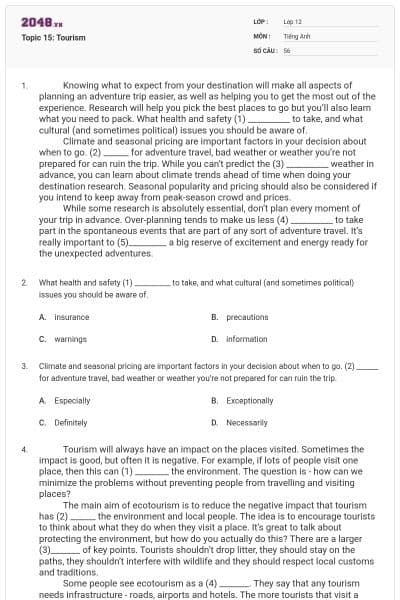
Knowing what to expect from your destination will make all aspects of planning an adventure trip easier, as well as helping you to get the most out of the experience. Research will help you pick the best places to go but you’ll also learn what you need to pack. What health and safety (1) __________ to take, and what cultural (and sometimes political) issues you should be aware of.
Climate and seasonal pricing are important factors in your decision about when to go. (2) ______ for adventure travel, bad weather or weather you’re not prepared for can ruin the trip. While you can’t predict the (3) __________ weather in advance, you can learn about climate trends ahead of time when doing your destination research. Seasonal popularity and pricing should also be considered if you intend to keep away from peak-season crowd and prices.
While some research is absolutely essential, don’t plan every moment of your trip in advance. Over-planning tends to make us less (4) __________ to take part in the spontaneous events that are part of any sort of adventure travel. It’s really important to (5)_________ a big reserve of excitement and energy ready for the unexpected adventures.
What health and safety (1) __________ to take, and what cultural (and sometimes political) issues you should be aware of.
insurance
precautions
warnings
information
Đáp án B
Kiến thức về từ vựng
A. insurance /ɪnˈʃuərəns/ (n): tiền đóng bảo hiểm; tiền bảo hiểm được hưởng, hợp đồng bảo hiểm
B. precaution /prɪˈkɔːʃən/ (n) : sự đề phòng, sự lo trước, phòng xa; sự giữ gìn, sự thận trọng
C. warning /ˈwɔː.nɪŋ/ (n): cảnh báo
D. information /ˌɪnfəˈmeɪʃən/ (n): thông tin
Ta có cụm từ: take precautions (phòng ngừa)
Especially
Exceptionally
Definitely
Necessarily
Đáp án A
Kiến thức về từ vựng
A. Especially /ɪˈspeʃəli/ (adv): đặc biệt là, nhất là
B. Exceptionally /ɪkˈsepʃənəli/ (adv): khác thường, hiếm có
C. Definitely /ˈdefɪnətli/ (adv): rạch ròi, dứt khoát
D. Necessarily /ˈnesəserɪli/ (adv): tất yếu, nhất thiết
Căn cứ vào nghĩa của câu sau: “Climate and seasonal pricing are important factors in your decision about when to go. (2) ______________ for adventure travel, bad weather or weather you’re not prepared for can ruin the trip.”
(Khí hậu và giá cả theo mùa là những yếu tố quan trọng trong quyết định của bạn về thời điểm đi. Đặc biệt là cho du lịch mạo hiểm, thời tiết xấu hoặc thời tiết mà bạn không chuẩn bị cho có thể làm hỏng chuyến đi.)
While you can’t predict the (3) __________ weather in advance, you can learn about climate trends ahead of time when doing your destination research. Seasonal popularity and pricing should also be considered if you intend to keep away from peak-season crowd and prices.
accurate
correct
true
exact
Đáp án D
Kiến thức về từ vựng
A. accurate /’ækjurit/ (a): đúng đắn, chính xác, xác đáng
B. correct /kə´rekt/ (a): đúng, chính xác
C. true /truː /(a): thật, thực, đúng, xác thực
D. exact /ig´zækt/ (a): chính xác, đúng, đúng đắn
Căn cứ vào nghĩa của câu sau: “While you can’t predict the (3)____weather in advance, you can learn about climate trends ahead of time when doing your destination research.”
(Trong khi bạn không thể dự đoán trước thời tiết chính xác, bạn có thể tìm hiểu về xu hướng khí hậu trước thời gian bạn thực hiện nghiên cứu.)
=> Ta có cụm từ: Predict the exact weather (forecast): dự đoán thời tiết chính xác.
curious
interested
willing
appreciative
Đáp án C
Kiến thức về từ vựng
A. curious /’kjuəriəs/ (a): tò mò
B. interested /ˈɪntrəstɪd/ (a): có quan tâm, thích thú, có chú ý
C. willing /´wiliη/ (a): sẵn lòng, bằng lòng
D. appreciative /ə’pri:∫jətiv/ (a): biết đánh giá, biết thưởng thức, khen ngợi, đánh giá cao, tán thưởng
Ta có cấu trúc:
To be curious about st: tò mò về cái gì
To be interested in st: quan tâm tới cái gì
To be willing to do st: sẵn lòng làm gì
Căn cứ vào cụm từ “to take part in” ta chọn phương án C.
It’s really important to (5)_________ a big reserve of excitement and energy ready for the unexpected adventures.
keep
hold
take
have
Đáp án A
Kiến thức về từ vựng
A. keep /ki:p/ (v): giữ
B. hold /həʊld/ (v): cầm, nắm, giữ, nắm giữ, giữ vững
C. take /teik/ (v): cầm, nắm, giữ, lấy
D. have /hæv, həv/ (v): có
Ta có cụm từ: keep st in reserve = keep a reserve of st: để dành cái gì
Tourism will always have an impact on the places visited. Sometimes the impact is good, but often it is negative. For example, if lots of people visit one place, then this can (1) ________ the environment. The question is - how can we minimize the problems without preventing people from travelling and visiting places?
The main aim of ecotourism is to reduce the negative impact that tourism has (2) ______ the environment and local people. The idea is to encourage tourists to think about what they do when they visit a place. It’s great to talk about protecting the environment, but how do you actually do this? There are a larger (3)_______ of key points. Tourists shouldn’t drop litter, they should stay on the paths, they shouldn’t interfere with wildlife and they should respect local customs and traditions.
Some people see ecotourism as a (4) _______. They say that any tourism needs infrastructure - roads, airports and hotels. The more tourists that visit a place, the more of these are needed and, by building more of these, you can’t avoid damaging the environment. But, of course, things aren’t so (5) _______. Living in a place of natural beauty doesn’t mean that you shouldn’t benefit from things like better roads. As long as the improvements benefit the local people and not just the tourists, and the local communities are consulted on plans and changes, then is there really a problem?
destroy
damage
ruin
spoil
Đáp án B
Kiến thức về từ vựng
A. destroy /dɪˈstrɔɪ/ (v): phá hủy, phá hoại cái gì hoàn toàn đến nỗi nó không thể dùng, tồn tại được nữa (mức độ rất tàn khốc)
B. damage /ˈdæmɪdʒ/ (v): gây hại, làm hại (đơn thuần là ám chỉ đến tính tiêu cực, có thể làm ảnh hưởng xấu đến cái gì đó ở mức độ nhẹ nhàng hơn nhiều, vì nó chỉ làm giảm đi giá trị, tính hữu ích hay hấp dẫn đi)
C. ruin /ˈruːɪn/ (v): làm hỏng, làm tan nát (phá hủy hoàn toàn, mức độ nặng nề)
D. spoil /spɔɪl/ (v): phá hoại, làm hư hỏng hay giảm sút (một cuộc vui, cảnh vật, sắc đẹp, hay một đứa trẻ,…)
- Căn cứ vào nghĩa của câu:
“For example, if lots of people visit one place, then this can (1)_____ the environment.”
(Ví dụ: nếu nhiều người ghé thăm một địa điểm thì điều này có thể gây hại đến môi trường.)
=> Đối tượng cần hướng đến trong câu này là “environment”. Theo ngữ cảnh, việc con người đi du lịch có thể gây hại đến môi trường thì B là phương án phù hợp nhất. Vì nó đơn thuần chỉ là gây hại, hay làm giảm đi giá trị, tính hấp dẫn (thẩm mỹ) của nơi đó. Chứ không thể gây tàn khốc như các đáp án A, C.
+ Đáp án D cũng không dùng cho ngữ cảnh này. Vì “spoil” trong nghĩa làm mất cảnh quan, giảm giá trị của một cảnh vật nào đó thì nó chỉ giới hạn trong tầm nhìn (view) cụ thể của ai đó, còn ở đây muốn nói đến tổng thể của một phạm vi lớn hơn rất nhiều là “environment” của một địa điểm du lịch.
in
at
on
about
Đáp án C
Kiến thức về giới từ
- Ta có cụm giới từ: “impact on”: ảnh hưởng/tác động đến ai/điều gì
- Căn cứ váo nghĩa của câu: “The main aim of ecotourism is to reduce the negative impact that tourism has (2)__________ the environment and local people.”
(Mục tiêu chính của du lịch sinh thái là giảm thiểu những tác động tiêu cực mà du lịch có đối với môi trường và người dân địa phương.)
- Phương án đúng là: C
There are a larger (3)_______ of key points. Tourists shouldn’t drop litter, they should stay on the paths, they shouldn’t interfere with wildlife and they should respect local customs and traditions.
amount
range
number
deal
Đáp án C
Kiến thức về lượng từ
- Cụm từ “A large number of”: Nhiều, số lượng lớn: Sau “A large number of” là danh từ đếm được số nhiều, và động từ theo sau nó cũng chia theo chủ ngữ số nhiều
- Phương án đúng là: C
contradicts
contradictor
contradicted
contradiction
Đáp án D
Kiến thức về từ loại
A. contradicts /ˌkɒntrəˈdɪkt/ (v): mâu thuẫn với, trái với, phủ nhận
B. contradictor /ˌkɒntrəˈdɪktər/ (n): người mâu thuẫn, người cãi lại
C. contradicted /ˌkɑn·trəˈdɪktɪd/ (a): có mâu thuẫn
D. contradiction /ˌkɒntrəˈdɪkʃən/ (n): sự mâu thuẫn, sự trái ngược
- Trong câu: “Some people see ecotourism as a (4)______.” cần một danh từ
- Phương án đúng là: D
black and white
peace and quiet
ups and downs
now and then
Đáp án A
Kiến thức về thành ngữ
A. black and white: rõ ràng, phân rõ trắng đen
B. peace and quiet: yên bình, êm đềm, thanh bình
C. ups and downs: thăng trầm, lên voi xuống chó
D. now and then: thỉnh thoảng
Căn cứ vào nghĩa của câu: “But, of course, things aren’t so (5)_________.”
(Nhưng, tất nhiên, mọi thứ đều không thể phân rõ trắng đen.)
- Phương án đúng là: A
Botswana, officially the Republic of Botswana, is a country in southern Africa that shares borders with South Africa, Namibia and Zimbabwe. The capital, Gaborone, (1) _______ on the Notwane River in the South east of Botswana. The Kalahari Desert covers more than 70% of Botswana. The Kalahari isn’t a true desert because it rains more each year there than in most (2) _______ deserts. Despite this, Botswana is a dry country. When it does rain, the rain is often heavy and there are floods.
Botswana is a popular tourist destination, with people from all over the world coming to see its amazing animals. During the seasonal floods, the land becomes a lush animal habitat. The wide variety of wildlife (3) __________ elephants and lions. Many visit Chobe National Park to see its 70,000 elephants, (4) __________ are the largest of all living elephants. The grassland and river valleys are home to giraffes, cheetahs, hyenas and wild dogs. The baobab tree, an icon of the African savannah, plays an important role in Botswana culture and nearly every part of it is useful. For example, it (5) __________ used to make rope and people pick the leaves to make soup.
gets
lies
puts
sets
Đáp án B
Kiến thức về từ vựng
Thông tin:
Botswana /bɒtˈswɑː.nə/, officially the Republic of Botswana, is a country in southern Africa that shares borders with South Africa, Namibia /nəˈmɪb.i.ə/ and Zimbabwe /zɪmˈbɑːb.weɪ/. The capital, Gaborone, (1) lies on the Notwane River in the South east of Botswana
Tạm dịch:
Botswana, chính thức là Cộng hòa Botswana, là một quốc gia ở miền nam châu Phi có chung biên giới với Nam Phi, Namibia và Zimbabwe. Thủ đô Gaborone, (1) nằm trên sông Notwane ở phía đông nam Botswana.
another
any
other
every
Đáp án C
Kiến thức về từ hạn định
A. another : một cái khác (không nằm trong số lượng nào cả)
B. any: bất cứ cái nào
C. other: những cái khác (+ danh từ đếm được số nhiều, danh từ không đếm được)
D. every: mọi
Thông tin:
The Kalahari isn’t a true desert because it rains more each year there than in most (2)_____ deserts.
Tạm dịch: Kahalari không phải là một sa mạc vì mỗi năm nó mưa nhiều hơn hơn hầu hết các sa mạc khác.
consists
involves
contains
includes
Đáp án D
Kiến thức về từ vựng
A. consists: dạng V-s,es của consist (v): (+ of) bao gồm (sau consist of các thành phần đã cấu tạo nên nó)
B. involves: dạng V-s,es của involve (v): bao hàm, đòi hỏi phải
C. contains: dạng V-s,es của contain (v): bao gồm, bao hàm, chứa đựng (những thành phần được liệt kê sau đó là tất cả các thành phần của tổng thể.)
D. includes: dạng V-s,es của include (v): bao gồm (sau include, chúng ta không cần liệt kê đầy đủ các thành phần của cái toàn thể)
Thông tin:
The wide variety of wildlife (3) ______ elephants and lions.
Tạm dịch: Sự đa dạng của động vật hoang dã bao gồm voi và sư tử.
what
which
who
where
Đáp án B
Kiến thức về đại từ quan hệ
Thông tin:
Many visit Chobe National Park to see its 70,000 elephants, (4) ___ are the largest of all living elephants.
Tạm dịch: Nhiều người tham quan Vườn Quốc gia Chobe để ngắm 70000 con voi to nhất trong các con voi đang tồn tại.
For example, it (5) __________ used to make rope and people pick the leaves to make soup.
hasB. beenC. hadD. is
been
had
is
Đáp án D
Kiến thức về câu bị động
The baobab tree, an icon of the African savannah, plays an important role in Botswana culture and nearly every part of it is useful. For example, it (5)___ used to make rope and people pick the leaves to make soup.
Tạm dịch: Cây baobab, một biểu tượng của thảo nguyên châu Phi, đóng một vai trò quan trọng trong văn hóa Botswana và gần như mọi phần của nó đều hữu ích. Ví dụ, nó (5) ___ dùng để làm dây thừng và mọi người nhặt lá để nấu súp.
The Greenbox emerged as Ireland’s first and most successful integrated ecotourism destination with a set of standards based on sound environmental practices highlighting all (1) ____ the region and its people had to offer.
The Greenbox aimed to deliver environmentally sustainable tourism products, accommodation and attractions. Such tourism activity would have minimal impact (2) ____ the ecology of the area, be of maximum benefit to the local communities and (3) ____ the needs of the environmentally conscious visitor. The Greenbox encompassed an area covering all of Leitrim and Fermanagh and parts of Donegal, Sligo and Cavan.
The Greenbox promoted travel which is small scale, low impact, culturally sensitive and community orientated, and provided a marketing tool for businesses that were grounded in sustainable principles and (4) ____ within the Greenbox area. The concept was broader than (5) ____ established definition of tourism, embracing activities such as organic food production, rural transport, energy and waste management.
what
that
how
whose
Đáp án B
Chủ đề GREENBOX
Kiến thức về mệnh đề quan hệ
A. What /wɒt/: cái gì
B. That /ðæt/: đại từ quan hệ That
C. How /haʊ/: làm sao, làm cách nào
D. Whose /huːz/: của ai, của người nào
Tạm dịch: “The Greenbox emerged as Ireland’s first and most successful integrated ecotourism destination with a set of standards based on sound environmental practices highlighting all (1) ____ the region and its people had to offer.”
(Greenbox bắt đầu xuất hiện như là điểm đến du lịch sinh thái tích hợp đầu tiên và thành công nhất cùng với một loạt các tiêu chuẩn dựa trên các thông lệ có cơ sở về môi trường làm nổi bật những gì mà vùng đất và con người nơi ấy cung cấp.)
on
at
in
to
Đáp án A
Kiến thức về giới từ
Ta có: Impact on sth: ảnh hưởng đến điều gì
Tạm dịch: “Such tourism activity would have minimal impact (2) ____ the ecology of the area, be of maximum benefit to the local communities…”
(Những hoạt động du lịch như vậy sẽ làm giảm tối đa những ảnh hưởng đến sinh thái học trong khu vực, tối đa hóa lợi ích đối với cộng đồng địa phương…)
provide
feel
support
meet
Đáp án D
Kiến thức về cụm từ cố định
Ta có: Meet the needs: đáp ứng nhu cầu
Tạm dịch: “….be of maximum benefit to the local communities and (3) ____ the needs of the environmentally conscious visitor.”
(…tối đa hóa lợi ích đối với cộng đồng địa phương và đáp ứng nhu cầu của những du khách có đầy đủ nhận thức về môi trường sống của chúng ta.)
practice
practices
practical
practically
Đáp án B
Kiến thức về từ loại
A. Practice /ˈpræk.tɪs/ (n): thông lệ, thông tục
B. Practices: là dạng số nhiều của danh từ Practice
C. Practical /ˈpræk.tɪ.kəl/ (a): thực tiễn, thực tế
D. Practically /ˈpræk.tɪ.kəl.i/ (adv): một cách thực tiễn
Tạm dịch: “The Greenbox promoted travel which is small scale, low impact, culturally sensitive and community orientated, and provided a marketing tool for businesses that were grounded in sustainable principles and (4) ____ within the Greenbox area.”
(Greenbox thúc đẩy du lịch theo quy mô nhỏ, ít gây hại, có ảnh hưởng bởi văn hóa và định hướng cộng đồng, và cung cấp các công cụ quảng cáo cho doanh nghiệp có cơ sở vững chắc các nguyên tắc bền vững và các thông lệ trong khu vực Greenbox.)
The concept was broader than (5) ____ established definition of tourism, embracing activities such as organic food production, rural transport, energy and waste management.
a
an
the
that
Đáp án C
Kiến thức về mạo từ
Ta dùng mạo từ “The” khi nó được xác định bằng một cụm từ hoặc là một mệnh đề quan hệ
Tạm dịch: “The concept was broader than (5) ____ established definition of tourism, embracing activities such as organic food production, rural transport, energy and waste management.”
(Khái niệm này rộng hơn so với khái niệm đã được đưa ra về du lịch, bao quát cả những hoạt động như là việc sản xuất thức ăn hữu cơ, phương tiện đi lại ở vùng quê, sự quản lý về năng lượng và hao phí.)
The biggest difference between an eco-lodge and a green hotel is the setting in which you’ll find them. Eco lodges tend to be more remote, located in relatively pristine natural environments such as beaches, jungles and mountains. Green hotels, on the other hand, are more often associated with cities and towns.
Eco lodges and green hotels both emphasize elements such as environmental responsibility and minimizing negative impact. The best ones offer renewable energy sources, recycling services, eco-friendly toiletries, energy efficient lighting, locally sourced food, organic linens and towels, non-toxic cleaning supplies, non-disposable dishes, water conservation methods and various other sustainability-focused initiatives.
But eco lodges tend to be more dependent on the natural environment than green hotels. They are also generally more active in nature and wildlife conservation, more focused on educating visitors about the flora and fauna of local ecosystems, and more deeply connected with the area’s indigenous culture (whose influence is often incorporated into the lodge’s decor and restaurant menu).
The best eco lodges also work to ensure positive relationships with the local people. They train and employ them at fair wages, take part in community development initiatives, offer activities that help visitors conserve and appreciate local customs, and contribute to the local economy. In this way, they reinforce the notion of ecotourism as a more sustainable long-term business model than altering or destroying habitats for quick financial gains.
The passage mainly discusses ____.
what eco lodges do to the environment
what eco lodges are and how they work
how eco lodges are similar to green hotels
how eco lodge are better than green hotels
Đáp án D
Từ “ones” trong đoạn văn đề cập tới ________ .
A. Các khách sạn sinh thái
B. Các khách sạn xanh
C. Các yếu tố
D. Các khách sạn sinh thái và các khách sạn xanh
Căn cứ vào thông tin trong đoạn thứ 2:
“Eco lodges and green hotels both emphasize elements such as environmental responsibility and minimizing negative impact. The best ones offer renewable energy sources, recycling services, eco-friendly toiletries, energy efficient lighting, locally sourced food, organic linens and towels, non-toxic cleaning supplies, non-disposable dishes, water conservation methods and various other sustainability-focused initiatives.”
(Khách sạn sinh thái và các khách sạn xanh cả hai đều nhấn mạnh vào các yếu tố như là trách nhiệm với môi trường và làm giảm hết mức có thể các tác hại tiêu cực. Những khách sạn sinh thái và khách sạn xanh tốt nhất thì đều cung cấp các nguồn năng lượng tái tạo, các dịch vụ tái chế, các dịch vụ chăm sóc cá nhân thân thiện với môi trường, các bóng đèn tiết kiệm năng lượng, các thức ăn có nguồn gốc từ địa phương, ga giường và khăn tắm được làm từ chất hữu cơ, các nguồn cung cấp cho việc dọn dẹp không độc hại, các chén dĩa dùng lại, các phương pháp tiết kiệm nước và các sáng kiến khác tập trung vào sự bền vững.)
The word "initiatives" in the passage is closest in meaning to ____.
acts
plans
actions
operations
Đáp án B
Từ “initiatives” trong đoạn văn gần nghĩa với _______ .
A. Các đạo luật
B. Các kế hoạch
C. Các hành động
D. Sự vận hành
Căn cứ vào thông tin trong đoạn 2:
“The best ones offer renewable energy sources, recycling services, eco-friendly toiletries, energy efficient lighting, locally sourced food, organic linens and towels, non-toxic cleaning supplies, non-disposable dishes, water conservation methods and various other sustainability-focused initiatives.”
(Những khách sạn sinh thái và khách sạn xanh tốt nhất thì đều cung cấp các nguồn năng lượng tái tạo, các dịch vụ tái chế, các dịch vụ chăm sóc cá nhân thân thiện với môi trường, các bóng đèn tiết kiệm năng lượng, các thức ăn có nguồn gốc từ địa phương, ga giường và khăn tắm được làm từ chất hữu cơ, các nguồn cung cấp cho việc dọn dẹp không độc hại, các chén dĩa dùng lại, các phương pháp tiết kiệm nước và các sáng kiến khác tập trung vào sự bền vững.)
According to the passage, all of the following are true about eco lodges EXCEPT that ____.
they are situated in small towns and cities
they create job opportunities for local people
they are closely connected with the local culture
they educate tourists about the local ecosystem
Đáp án A
Theo như đoạn văn tất cả điều sau đây là đúng về các khách sạn sinh thái NGOẠI TRỪ _________ .
A. Chúng tọa lạc tại những thị trấn và thành phố nhỏ
B. Chúng tạo ra việc làm cho những người dân địa phương
C. Chúng gần như có sự liên kết với văn hóa địa phương
D. Chúng giáo dục du khách về hệ sinh thái địa phương
Căn cứ vào thông tin trong đoạn 1:
“The biggest difference between an eco-lodge and a green hotel is the setting in which you’ll find them. Eco lodges tend to be more remote, located in relatively pristine natural environments such as beaches, jungles and mountains. Green hotels, on the other hand, are more often associated with cities and towns.”
(Sự khác biệt lớn nhất giữa khách sạn sinh thái và khách sạn xanh đó là sự sắp đặt mà bạn sẽ nhận thấy chúng. Các khách sạn sinh thái có xu hướng ở xa trung tâm hơn, tọa lạc ở những môi trường gần như nguyên sơ như là bãi biển, rừng nhiệt đới và núi. Các khách sạn xanh, trái lại, thường xuyên có liên kết với các thành phố và thị trấn.)
=> Như vậy ta thấy chỉ những khách sạn xanh mới tọa lạc gần những thành phố và thị trấn, còn các khách sạn sinh thái thì lại tọa lạc tại những nơi hẻo lánh hơn.
The word "they" in the passage refers to ____.
local customs
visitors
activities
eco lodges
Đáp án D
Từ “they” trong đoạn văn đề cập tới ______ .
A. Phong tục địa phương
B. Các du khách
C. Các hoạt động
D. Các khách sạn sinh thái
Căn cứ vào thông tin trong đoạn cuối:
“The best eco lodges also work to ensure positive relationships with the local people. They train and employ them at fair wages, take part in community development initiatives, offer activities that help visitors conserve and appreciate local customs, and contribute to the local economy. In this way, they reinforce the notion of ecotourism as a more sustainable long-term business model than altering or destroying habitats for quick financial gains.”
(Các khách sạn sinh thái tốt nhất cũng nỗ lực để thêm thắt chặt mối quan hệ với người dân địa phương. Họ cũng đào tạo và thuê mướn người dân địa phương với mức lương hợp lý, tham gia vào các sáng kiến để phát triển cộng đồng, cung cấp các hoạt động mà có thể giúp cho những du khách bảo tồn và nâng cao giá trị của văn hóa địa phương, và góp phần vào nền kinh tế địa phương. Theo cách đó, các khách sạn sinh thái củng cố khái niệm du lịch sinh thái như là một việc làm ăn lâu dài và bền vững hơn là thay thế và phá hủy môi trường sống chỉ để đổi lấy những lợi ích kinh tế nhất thời.)
Environmentalists often fear that tourists will trample all over sensitive natural resource areas, but tourism may bring the needed and only economic incentives to help drive conservation, said Bynum Boley. Ecotourism and natural resource conservation already have a mutually beneficial relationship that is ideal for creating a sustainable partnership.
“Ecotourism destinations benefit in the form of enhanced tourism competitiveness from the protection of quality natural resources,” he said. "Meanwhile, the conservation of these natural resources is increasingly valued since these pristine natural resources are the foundation of the ecotourism industry and the driver of all economic benefits associated with ecotourism."
Tourism is a $7.6 trillion global industry, provides 277 million jobs and is a primary income source for 20 of the world’s 48 least-developed countries. It also subsidizes environmental protection and helps protect, conserve and value cultural resources that might otherwise be undervalued by the host community, Boley said. In the newpaper, Boley and co-author Gary Green said that despite past tension between the tourism industry and environmentalists, the two should team up as allies to fight off increasing conversion of land away from its natural state. Ecotourists not only provide a boost to the economy in such places, they can also motivate landowners into keeping the environment in its natural state instead of converting it into something unsustainable. They could also influence the public perception of conservation, Boley explained, which does not often favor environmental protection.
“The public has become increasing less prone to respond to environmental messages,” he said. “Economic messages are needed in order to attract the public’s interest.” Too often, Boley and Green said, unique natural resource areas are converted into urban, suburban and agricultural developments without considering their ecotourism potential. In addition to the lost ecotourism revenue, there are a host of negative environmental consequences such as biodiversity loss, water and food shortages and the land being unable to mitigate the effects of climate change. These areas are not valued for their unique attributes or the valuable natural resources they provide, Green said, “so we lose them.” Tourists have historically been seen as having a negative impact on the environment. Critics complain that they violate fragile and threatened natural environments while contributing to greenhouse gases from the increased number of flights to these exotic and often remote locales. While these criticisms are justified, Boley and Green said responsible programs promote education of ecological conservation and environmental sustainability, fostering a greater understanding and appreciation of these exotic areas.
What is the best title for the passage?
How to save the environmental resources
Ecotourism – benefits and drawbacks
The consequences of ecotourism
The development of ecotourism
Đáp án B
Chủ đề về Ecotourism
Tiêu đề chính của đoạn văn là gì?
A. Làm thế nào để bảo vệ tài nguyên môi trường
B. Du lịch sinh thái - những lợi ích và những hạn chế
C. Hậu quả của du lịch sinh thái
D. Sự phát triển của du lịch sinh thái
=> Có thể thấy đáp án B là phù hợp nhất vì bao quát ý chung toàn bài trong khi các ý còn lại chỉ nói đến nội dung của 1-2 đoạn chứ không phải cả bài.
=> Do đó, đáp án là B
The word “pristine” is closest in meaning to __________ .
unspoiled
touched
destroyed
spoiled
Đáp án A
Từ “pristine” có nghĩa gần nhất với từ ___________
A. nguyên vẹn
B. không nguyên vẹn
C. bị phá hủy
D. bị hư hỏng
Pristine (adj) = unspoiled: nguyên sơ, chưa bị phá hủy.
Căn cứ vào thông tin đoạn 2:
Tạm dịch: “Meanwhile, the conservation of these natural resources is increasingly valued since these pristine natural resources are the foundation of the ecotourism industry and the driver of all economic benefits associated with ecotourism.”
(Trong khi đó, việc bảo tồn các tài nguyên thiên nhiên này ngày càng được coi trọng vì các tài nguyên thiên nhiên nguyên sơ này là nền tảng của ngành du lịch sinh thái và là động lực của tất cả các lợi ích kinh tế liên quan đến du lịch sinh thái)
=> Do đó, đáp án là A
Which of the following statements is NOT TRUE about Tourism?
subsidizes environmental protection.
is a primary income source for 20 of the world’s 48 least-developed countries.
only develops in industrialized nations.
provides 277 million jobs.
Đáp án C
Phát biểu nào sau đây KHÔNG ĐÚNG về Du lịch?
A. là nguồn trợ cấp bảo vệ môi trường
B. là nguồn thu nhập chính của 20 trong số 48 quốc gia kém phát triển nhất thế giới
C. chỉ phát triển ở các nước công nghiệp
D. cung cấp 277 triệu việc làm
Căn cứ vào thông tin đoạn 3:
Tạm dịch: “Tourism is a $7.6 trillion global industry, provides 277 million jobs and is a primary income source for 20 of the world’s 48 least-developed countries, according to the World Travel and Tourism Council. It also subsidizes environmental protection”
(Theo Hội đồng Du lịch và Du lịch Thế giới, du lịch là ngành công nghiệp toàn cầu trị giá 7,6 nghìn tỷ USD, cung cấp 277 triệu việc làm và là nguồn thu nhập chính của 20 trong số 48 quốc gia kém phát triển nhất thế giới. Nó cũng trợ cấp bảo vệ môi trường)
Trong bài cũng không nói Tourism chỉ phát triển ở các nước công nghiệp.
=> Do đó, đáp án là C
The word “perception” can be replaced by _______
concept
overview
insight
awareness
Đáp án D
Từ “perception” có thể được thay thế bằng từ nào dưới đây?
A. concept : khái niệm
B. overview: tổng quan
C. insight: sự nhìn thấu
D. awareness: sự nhận thức
Perception = awareness.
Căn cứ vào thông tin đoạn 3:
Tạm dịch: “They could also influence the public perception of conservation, Boley explained, which does not often favor environmental protection.”
(Boley giải thích rằng họ cũng có thể ảnh hưởng đến nhận thức của cộng đồng về bảo tồn, những quan điểm vốn không thường xuyên ủng hộ bảo vệ môi trường)
=> Do đó, đáp án là D
It can be inferred from the phrase “Economic messages are needed in order to attract the public’s interest.” is _______
People get more interested in issues related to environment.
People get less interested in issues related to environment.
People get more interested in issues related to economy.
People get less interested in issues related to economy.
Đáp án C
Nó có thể được suy ra từ cụm từ “Thông điệp kinh tế là cần thiết để thu hút sự quan tâm của công chúng.”
A. Mọi người quan tâm nhiều hơn đến các vấn đề liên quan đến môi trường.
B. Mọi người ít quan tâm đến các vấn đề liên quan đến môi trường.
C. Mọi người quan tâm nhiều hơn đến các vấn đề liên quan đến kinh tế.
D. Mọi người ít quan tâm đến các vấn đề liên quan đến kinh tế.
Căn cứ vào thông tin đoạn 3:
Tạm dịch: “The public has become increasing less prone to respond to environmental messages,” he said. “Economic messages are needed in order to attract the public’s interest.”
(“Công chúng đã trở nên ngày càng ít có xu hướng phản ứng với các thông điệp môi trường,” ông nói. “Thông điệp kinh tế là cần thiết để thu hút sự quan tâm của công chúng.”)
=> Do đó, đáp án là C
According to the passage, negative environmental outcomes _______________?
have bad influence on the biodiversity.
boost local economy.
reduce the effects of climate change.
provide more water and food.
Đáp án A
Từ thông tin trong đoạn văn, các hậu quả tiêu cực từ môi trường sẽ ______________
A. có hảnh hưởng xấu tới đa dạng sinh học.
B. thúc đẩy nền kinh tế tại địa phương.
C. làm giảm tác động của biến đổi khí hậu.
D. cung cấp thêm nhiều nước và thức ăn hơn.
Căn cứ vào thông tin đoạn 4:
Tạm dịch: “In addition to the lost ecotourism revenue, there are a host of negative environmental consequences such as biodiversity loss, water and food shortages and the land being unable to mitigate the effects of climate change.”
(Ngoài doanh thu bị mất từ du lịch sinh thái, còn có một loạt các hậu quả tiêu cực về môi trường như mất đa dạng sinh học, thiếu nước và thực phẩm, đất đai mất khả năng dung hòa các hiệu ứng của thay đổi khí hậu)
=> Do đó, đáp án là A
The word “they” in the last paragraph refers to __________.
critics
tourists
these areas
flights
Đáp án B
Từ “they” trong đoạn cuối đề cập đến ___________
A. các nhà phê bình.
B. khách du lịch.
C. những khu vực này.
D. các chuyến bay.
Căn cứ vào thông tin đoạn 4:
Tạm dịch: “Tourists have historically been seen as having a negative impact on the environment. Critics complain that they violate fragile and threatened natural environments while contributing to greenhouse gases from the increased number of flights to these exotic and often remote locales.”
(Các du khách từ lâu đã được coi là có ảnh hưởng tiêu cực lên môi trường. Nhiều nhà phê bình đã phàn nàn về việc những người này gây hại lên môi trường tự nhiên, đồng thời làm tăng hiệu ứng nhà kính bằng khí gas từ các chuyến bay đến các vùng xa xôi hẻo lánh.)
Có thể thấy từ “they” trong trường hợp này là tourists.
=> Do đó, đáp án là B
As mentioned in paragraph 4, responsible programs promote education of ecological conservation and environmental sustainability, ________
reducing the perception and comprehension of exotic places.
worsening the perception and comprehension of exotic places.
enhancing the perception and comprehension of exotic places.
maintaining the perception and comprehension of exotic places.
Đáp án C
Như đã đề cập trong đoạn 4, các chương trình có trách nhiệm thúc đẩy giáo dục bảo tồn sinh thái và bền vững môi trường, ________
A. làm giảm nhận thức và sự hiểu biết về những địa danh sinh thái này.
B. làm xấu đi nhận thức và sự hiểu biết về những địa danh sinh thái này.
C. tăng cường nhận thức và sự hiểu biết về những địa danh sinh thái này.
D. duy trì nhận thức và sự hiểu biết về những địa danh sinh thái này.
Căn cứ vào thông tin đoạn 4:
Tạm dịch: “Boley and Green said responsible programs promote education of ecological conservation and environmental sustainability, fostering a greater understanding and appreciation of these exotic areas.” (Boley và Green cho biết các chương trình có trách nhiệm thúc đẩy giáo dục bảo tồn sinh thái và bền vững môi trường, thúc đẩy sự hiểu biết và đánh giá cao hơn về những địa danh sinh thái này.)
=> Do đó, đáp án là C
The International Ecotourism Society (TIES), a non-profit organization committed to promoting sustainable tourism, states that ecotourism unites conservation and communities with sustainable travel. With that being said, they offer six core principles of ecotourism that vacationers should follow: minimize impact, build environmental and cultural awareness and respect, provide positive experiences for both visitors and hosts, provide direct financial benefits for conservation, provide financial benefits and empowerment for local people, and raise sensitivity to host countries’ political, environmental, and social climate.
Ecotourism offers the opportunity to help protect and maintain our planet. Beginning with responsible travel, sustainable tourism promotes green practices such as recycling and using organic products. There are also many environmental programs and initiatives made available so that people can get involved with sustainability. For example, in Kenya, tourists can get involved with the Basecamp Foundation, which has a monitoring program for big cats and elephants. These kinds of experiences try to demonstrate the positive impact of tourism and teach tourists about the significance of maintaining the environment. However, the simple act of being a tourist in a fragile, natural area helps a great deal, as the money spent there assists in raising funds to protect those areas for generations.
Sustainable tourism supports local communities by allowing their economy to grow. Tourism alone employs a large number of local staff. This in turn empowers communities to fight against poverty and encourages the support of local events, festivals, and organizations. As a result the community and its local businesses thrive.
Not only is ecotourism an environmentally fun experience, but it’s also educational. By embarking on an ecotourism vacation, people gain an awareness and understanding of the social and economic conditions of the place they visit. In addition, vacationers learn to appreciate the area’s environment through conservation and also to respect the culture of the local people. While tourists are normally unaware of a country’s poverty or ill conditions, ecotourism strives to expose tourists to the realities of these areas. Ecotourism is a new holiday experience that mixes together vacation fun with conservation and education. Sustainable tourism creates environmentally aware individuals and helps develop their appreciation of nature and local culture. Not only do vacationers go home with new knowledge, but also a worthwhile experience.
The passage mainly discusses ________.
The ethics behind ecotourism
Moral development and organizational cultures.
Green-washing taking over ecotourism.
Tourist behaviour toward nature-based tourism.
Đáp án A
Đoạn văn chủ yếu thảo luận .
A. Quy tắc ứng xử trong khu vực du lịch sinh thái
B. Phát triển đạo đức và văn hóa tổ chức
C. Quảng cáo xanh tiếp quản du lịch sinh thái
D. Cách cư xử của du khách đối với du lịch dựa vào tự nhiên
Căn cứ vào thông tin đoạn đầu:
The International Ecotourism Society (TIES), a non-profit organization committed to promoting sustainable tourism, states that ecotourism unites conservation and communities with sustainable travel. (Hiệp hội du lịch sinh thái quốc tế (TIES), một tổ chức phi lợi nhuận cam kết thúc đẩy du lịch bền vững, tuyên bố rằng du lịch sinh thái kết hợp bảo tồn và cộng đồng với du lịch bền vững.)
=> Như vậy đoạn văn đang đề cập đến vấn đề đạo đức hay quy tắc ứng xử ở khu du lịch sinh thái.
*Note: Green - washing (n): quảng cáo xanh (hành vi, hoạt động của một công ty nào đó thực hiện nhằm mục đích đánh lừa người tiêu dùng rằng sản phẩm của họ là giúp bảo vệ môi trường nhưng thực tế là không, hoặc nhiều hơn như nó thực sự)
The word “sensitivity” in paragraph 1 is closest in meaning to _______.
intuition
reactivity
consideration
vulnerability
Đáp án C
Từ “sensitivity /ˌsen.sɪˈtɪv.ə.ti/ ” trong đoạn 1 có nghĩa gần nhất với .
A. trực giác
B. phản ứng
C. Sự xem xét kỹ lưỡng đến hoàn cảnh bên ngoài, tính biết cảm thông để không làm ảnh hưởng đến nó
D. dễ bị tổn thương
=> Từ đồng nghĩa: sensitivity (tính thấu hiểu, biết cảm thông và suy xét kỹ lưỡng, cẩn thận để không làm ảnh hưởng đến ai/cái gì khác) = consideration
Provide financial benefits and empowerment for local people, and raise sensitivity to host countries’ political, environmental, and social climate.
(Cung cấp lợi ích tài chính và trao quyền cho người dân địa phương, và nâng cao khả năng thấu hiểu, xem xét kỹ lưỡng với hoàn cảnh chính trị, môi trường và xã hội của các nước chủ nhà.)
According to paragraph 2, how can ecotourism supports conservation of the earth?
Green tourism displays a contrast and enhances dissatisfaction with mass tourism.
Sustainable tourism fosters environmental understanding, appreciation and financial sustenance
The arrival of foreign visitors and wealth can shift political and economic conditions.
Ecotourism gives us a completely different view of the world and challenges us open our minds.
Đáp án B
Theo đoạn 2, làm thế nào du lịch sinh thái có thể hỗ trợ bảo tồn trái đất?
A. Du lịch xanh thể hiện sự tương phản và tăng cường sự không hài lòng với du lịch đại chúng
B. Du lịch bền vững thúc đẩy sự hiểu biết về môi trường, đánh giá cao và duy trì tài chính
C. Sự xuất hiện của du khách nước ngoài và sự giàu có có thể thay đổi các điều kiện chính trị và kinh tế
D. Du lịch sinh thái mang lại cho chúng ta một cái nhìn hoàn toàn khác về thế giới và thách thức chúng ta mở rộng tâm trí của chúng ta
Căn cứ vào thông tin đoạn hai:
Ecotourism offers the opportunity to help protect and maintain our planet. Beginning with responsible travel, sustainable tourism promotes green practices such as recycling and using organic products. There are also many environmental programs and initiatives made available so that people can get involved with sustainability.
(Du lịch sinh thái cung cấp cơ hội để giúp bảo vệ và duy trì hành tinh của chúng ta. Bắt đầu bằng du lịch có trách nhiệm, du lịch bền vững thúc đẩy các hoạt động xanh như tái chế và sử dụng các sản phẩm hữu cơ. Ngoài ra còn có nhiều chương trình và sáng kiến về môi trường được cung cấp để mọi người có thể tham gia với sự bền vững.)
The word “empowers” in paragraph 3 is closest in meaning to _______.
unchains
forbids
certifies
enables
Đáp án D
Từ “empower” trong đoạn 3 có nghĩa gần nhất với .
B. cấm
C. chứng nhận
D. cho phép
Từ đồng nghĩa empower (trao quyền) = enable
This in turn empowers communities to fight against poverty and encourages the support of local events, festivals, and organizations.
(Điều này lần lượt trao quyền cho các cộng đồng để chống lại nghèo đói và khuyến khích sự hỗ trợ của các sự kiện, lễ hội và tổ chức tại địa phương.)
The word “it” in paragraph 4 refers to _____.
program
tourism
ecotourism
economy
Đáp án C
Từ “it” trong đoạn 4 đề cập đến .
A. Một chương trình
B. du lịch
C. du lịch sinh thái
D. kinh tế
Từ “it” ở đây dùng để thay thế cho danh từ du lịch sinh thái được nhắc trước đó.
Not only is ecotourism an environmentally fun experience, but it’s also educational.
(Du lịch sinh thái không chỉ là một trải nghiệm thú vị với môi trường, mà nó còn mang tính giáo dục.)
According to paragraph 4, what is the benefit of green travel being presented?
Responsible tourism provides a valuable learning experience for everyone engaged.
Ecotourism reduces our carbon footprint through commuting on foot and by shared transportation.
Eco-friendly travel conserves and contributes to remote communities and delicate ecosystems.
Green tourism supports social and cultural awareness while also offers a rewarding experience.
Đáp án D
Theo đoạn 4, lợi ích của du lịch xanh được trình bày là gì?
A. Du lịch có trách nhiệm cung cấp trải nghiệm học tập có giá trị cho mọi người tham gia
B. Du lịch sinh thái làm giảm lượng khí thải carbon của chúng tôi thông qua việc đi bộ và chia sẻ phương tiện giao thông
C. Du lịch thân thiện với môi trường bảo tồn và đóng góp cho các cộng đồng xa xôi và hệ sinh thái dễ bị tổn thương
D. Du lịch xanh hỗ trợ nhận thức văn hóa xã hội đồng thời mang lại trải nghiệm bổ ích.
Căn cứ vào thông tin đoạn bốn:
Not only is ecotourism an environmentally fun experience, but it’s also educational. By embarking on an ecotourism vacation, people gain an awareness and understanding of the social and economic conditions of the place they visit. In addition, vacationers learn to appreciate the area’s environment through conservation and also to respect the culture of the local people.
(Du lịch sinh thái không chỉ là một trải nghiệm thú vị với môi trường, mà nó còn mang tính giáo dục. Bằng cách tham gia vào một kỳ nghỉ du lịch sinh thái, mọi người có được nhận thức và hiểu biết về điều kiện xã hội và kinh tế của nơi mà họ đến thăm. Ngoài ra, khách du lịch còn học cách coi trọng môi trường của khu vực thông qua hoạt động bảo tồn và cũng để tôn trọng văn hóa của người dân địa phương.)
*Note: Đáp án A chưa chính xác vì đoạn 4 chỉ tập trung kết luận về “green tourism” hay “ecotourism”; trong khi “responsible tourism” là một trong những bước thực hiện của “green tourism” hay “ecotourism” và nó được đề cập trong đoạn 2, 3 chứ không phải đoạn 4.
Which of the following statements is TRUE, according to the passage?
The ecotourism benefits includes delivering memorable experiences and facilitating thoughtfulness.
Participants in green tourism should adopt the six ecotourism principles published by the UNESCO
Tourism robs the local communities off their original financial sources through external businesses.
Service industry can easily hamper the development of the local budding industries
Đáp án A
Phát biểu nào sau đây là đúng, theo đoạn văn?
A. Các lợi ích du lịch sinh thái bao gồm mang lại trải nghiệm đáng nhớ và sự suy nghĩ sâu sắc.
B. Những người tham gia du lịch xanh nên áp dụng sáu nguyên tắc du lịch sinh thái được công bố bởi UNESCO.
C. Du lịch cướp những cộng đồng địa phương khỏi nguồn tài chính ban đầu của họ thông qua các doanh nghiệp bên ngoài
D. Công nghiệp dịch vụ có thể dễ dàng cản trở sự phát triển của các ngành công nghiệp vừa chớm nở.
Căn cứ vào thông tin đoạn cuối:
Sustainable tourism creates environmentally aware individuals and helps develop their appreciation of nature and local culture. Not only do vacationers go home with new knowledge, but also a worthwhile experience.
(Du lịch bền vững tạo ra các cá nhân nhận thức về môi trường và giúp phát triển ý thức của họ với thiên nhiên và văn hóa địa phương. Người tham gia không chỉ về nhà với kiến thức mới, mà còn với một kinh nghiệm đáng giá.)
Which of the following can be inferred from the passage?
Ecotourism which comes at a prohibitive cost attracts the most customers.
Responsible travel creates a win-win situation for all involved parties.
Sustainable tourism offers a new marketing opportunity for travel agencies.
Eco-conscious trips are increasing in popularity only in the West.
Đáp án B
Điều nào sau đây có thể được suy ra từ đoạn văn?
A. Du lịch sinh thái với chi phí đắt đủ thu hút nhiều khách hàng nhất.
B. Du lịch có trách nhiệm tạo ra một tình huống có lợi cho tất cả các bên liên quan.
C. Du lịch bền vững cung cấp một cơ hội tiếp thị mới cho các cơ quan du lịch.
D. Các chuyến đi có ý thức sinh thái đang ngày càng phổ biến ở phương Tây.
Căn cứ vào thông tin các đoạn:
Ecotourism offers the opportunity to help protect and maintain our planet. Beginning with responsible travel, sustainable tourism promotes green practices such as recycling and using organic products.
(Du lịch sinh thái cung cấp cơ hội để giúp bảo vệ và duy trì hành tinh của chúng ta. Bắt đầu bằng việc du lịch có trách nhiệm, du lịch bền vững thúc đẩy các hoạt động xanh như tái chế và sử dụng các sản phẩm hữu cơ.)
Sustainable tourism creates environmentally aware individuals and helps develop their appreciation of nature and local culture. Not only do vacationers go home with new knowledge, but also a worthwhile experience.
With 13,000 floral species and over 15,000 faunal species, three newly discovered big animal species, and a ratio of country/world species of 6.3%. Vietnam has enormous tourism-particularly ecotourism-potential. In fact, since 1986, when Renovation Reforms began the shift from a centrally planned to a socialist-oriented market, or multi-sectoral, economy, tourism has been an sector of primary concern to the government. In May 1995, the prime minister of Vietnam approved a master plan of tourism development for the period 1995-2010. In February 1999, the state decree on tourism was part of the socio-economic development strategy for the period 2001-2010 approved at the IX National Congress of the Party: “Tourism development has become a spearhead economic industry indeed. It is necessary to improve the quality and effectiveness of tourism activities, bringing into full play the natural conditions, and cultural and historical tradition to meet the domestic and international demand for tourism and to catch up with tourism development in the region” (Document of the IX National Congress 2001).
Tourism has so far brought great benefits to the economy, but it has also contributed to environmental degradation, especially biodiversity deterioration. Thus, the concept of “sustainable development”-development which meets the needs of the present without compromising the ability of future generations to meet their own needs - must be factored into tourism development. This consideration is reflected in the term “ecotourism,” which is referred to variously as ecological or environmental tourism, nature or green tourism, sustainable or responsible tourism.
Ecotourism involves travel to relatively undisturbed natural areas with the specific object of studying, admiring, and enjoying scenery, plants, and animals, as well as any cultural features found in these areas. It is distinguished from mass or resort tourism by its lower impact on the environment, lower infrastructure requirements, and its role in educating tourists about natural environments and cultural values.
Fully aware of its significance, the government of Vietnam has prioritized ecotourism in its strategy for tourism development to ensure both sustainability and economic benefits. Though ecotourism in Vietnam is at a beginning stage of development, it is expected to grow strongly through support from government and international organizations.
How many types of plants does Vietnam have?
Thirteen thousand
Fifteen thousand
Sixty three
Three
Đáp án A
Việt Nam có bao nhiêu loại cây?
A. Mười ba ngàn
B. Mười lăm ngàn
B. Sáu mươi ba
D. Ba
=> Căn cứ vào thông tin:
"With 13,000 floral species and over 15,000 faunal species, three newly discovered big animal species, and a ratio of country/world species of 6.3%, Vietnam has enormous tourism-particularly ecotourism-potential."
(Với 13.000 loài hoa và hơn 15.000 loài động vật, ba loài động vật lớn mới được phát hiện và tỷ lệ các quốc gia trên thế giới là 6,3%, Việt Nam có tiềm năng du lịch rất lớn - đặc biệt là du lịch sinh thái.)
When has tourism officially contributed to socio-economic development?
Since 2010
Since 1995
Since 1999
Since 2001
Đáp án C
Khi nào du lịch chính thức đóng góp cho phát triển kinh tế xã hội?
A. Từ năm 2010
B. Từ năm 1995
C. Từ năm 1999
D. Từ năm 2001
Căn cứ vào thông tin:
"In February 1999, the state decree on tourism was part of the socio-economic development strategy for the period 2001-2010 approved at the IX National Congress of the Party: "Tourism development has become a spearhead economic industry indeed. It is necessary to improve the quality and effectiveness of tourism activities, bringing into full play the natural conditions, and cultural and historical tradition to meet the domestic and international demand for tourism and to catch up with tourism development in the region”.
(Vào tháng 2 năm 1999, nghị định của nhà nước về du lịch là một phần của chiến lược phát triển kinh tế xã hội cho giai đoạn 2001-2010 được thông qua tại Đại hội Đảng toàn quốc lần thứ IX: "Phát triển du lịch đã trở thành một ngành kinh tế mũi nhọn. Cần phải nâng cao chất lượng và hiệu quả của các hoạt động du lịch, phát huy đầy đủ các điều kiện tự nhiên, và văn hóa và lịch sử truyền thống để đáp ứng nhu cầu trong nước và quốc tế về du lịch và để bắt kịp sự phát triển du lịch trong khu vực.)
It can be inferred that in the late 20th century Vietnam’s tourism ____.
has never been a spearhead economic industry
was not as developed as that in other Asian countries
has always been effective and necessary for economy
did not need natural conditions or cultural traditions
Đáp án B
Có thể suy ra rằng vào cuối thế kỷ 20, du lịch Việt Nam ____.
A. chưa bao giờ là một ngành kinh tế mũi nhọn
B. không được phát triển như ở các nước châu Á khác
C. luôn có hiệu quả và cần thiết cho nền kinh tế
D. không cần điều kiện tự nhiên hoặc truyền thống văn hóa
Căn cứ vào các thông tin:
- “Tourism development has become a spearhead economic industry indeed.”
(Phát triển du lịch đã trở thành một ngành kinh tế mũi nhọn.)
=> Loại đáp án A.
- "It is necessary to improve the quality and effectiveness of tourism activities, …… and cultural and historical tradition to meet the domestic and international demand for tourism and to catch up with tourism development in the region”.
(Cần phải nâng cao chất lượng và hiệu quả của các hoạt động du lịch, và …..văn hóa và lịch sử truyền thống để đáp ứng nhu cầu trong nước và quốc tế về du lịch để bắt kịp sự phát triển du lịch trong khu vực.)
=> Đáp án C và D sai. Đáp án B đúng vì du lịch Việt Nam cần phải bắt kịp sự phát triển du lịch của các nước trong khu vực
=> Du lịch Việt Nam chưa phát triển như các nước Châu Á khác.
Which of the following is NOT mentioned as “ecotourism”?
Environmental tourism
Green tourism
Responsible tourism
Resort tourism
Đáp án D
Điều nào sau đây KHÔNG được đề cập là “du lịch sinh thái”?
A. Du lịch môi trường
B. Du lịch xanh
C. Du lịch có trách nhiệm
D. Du lịch nghỉ dưỡng
Căn cứ vào thông tin:
“The concept of ”sustainable development”-development which meets the needs of the present without compromising the ability of future generations to meet their own needs - must be factored into tourism development. This consideration is reflected in the term “ecotourism,” which is referred to variously as ecological or environmental tourism, nature or green tourism, sustainable or responsible tourism."
(Khái niệm “phát triển bền vững” -phát triển đáp ứng nhu cầu của hiện tại mà không ảnh hưởng đến khả năng của các thế hệ tương lai đáp ứng nhu cầu của riêng họ - phải là yếu tố phát triển du lịch. Việc xem xét này được phản ánh trong thuật ngữ “Du lịch sinh thái”, mà được gọi theo nhiều cách khác nhau là du lịch sinh thái hoặc môi trường, thiên nhiên hoặc du lịch xanh, du lịch bền vững hoặc có trách nhiệm.)
Ecotourism is mainly for ____ purposes.
entertaining
educational
relaxing
advertising
Đáp án B
Du lịch sinh thái chủ yếu cho mục đích ____.
A. giải trí
B. giáo dục
C. thư giãn
D. quảng cáo
Căn cứ vào thông tin:
" Ecotourism involves travel to relatively undisturbed natural areas with the specific object of studying, admiring, and enjoying scenery, plants, and animals, as well as any cultural features found in these areas. It is distinguished from mass or resort tourism by its lower impact on the environment, lower infrastructure requirements, and its role in educating tourists about natural environments and cultural values."
(Du lịch sinh thái bao gồm đi đến các khu vực tự nhiên tương đối yên tĩnh với mục đích cụ thể là nghiên cứu, chiêm ngưỡng và thưởng thức phong cảnh, thực vật và động vật, cũng như bất kỳ đặc điểm văn hóa nào được tìm thấy trong các khu vực này. Nó được phân biệt với du lịch đại chúng hoặc nghỉ dưỡng bởi ít tác động đến môi trường, yêu cầu cơ sở hạ tầng thấp hơn và vai trò của nó trong việc giáo dục khách du lịch về môi trường tự nhiên và các giá trị văn hóa.)
What is the word "degradation" closest in meaning to?
Creation
Pollution
Protection
Decline
Đáp án D
Từ “Degradation” (xuống cấp) có nghĩa gần nhất với?
A. Sáng tạo
B. Ô nhiễm
C. Bảo vệ
D. Sự suy giảm
Căn cứ vào thông tin:
"Tourism has so far brought great benefits to the economy, but it has also contributed to environmental degradation, especially biodiversity deterioration."
(Du lịch cho đến nay đã mang lại lợi ích lớn cho nền kinh tế, nhưng nó cũng góp phần làm cho môi trường bị suy thoái, đặc biệt là suy thoái đa dạng sinh học.)
=> degradation /ˌdeɡrəˈdeɪʃn/ (n): sự suy thoái = decline.
What does the word "It" in Paragraph 3 refer to?
Tourism
Ecotourism
Environment
Requirement
Đáp án B
Từ “It” trong đoạn 3 nói về điều gì?
A. Du lịch
B. Du lịch sinh thái
C. Môi trường
D. Yêu cầu
Căn cứ vào thông tin:
"Ecotourism involves travel to relatively undisturbed natural areas with the specific object of studying, admiring, and enjoying scenery, plants, and animals, as well as any cultural features found in these areas. It is distinguished from mass or resort tourism………."
(Du lịch sinh thái bao gồm đi đến các khu vực tự nhiên tương đối yên tĩnh với mục đích cụ thể là nghiên cứu, chiêm ngưỡng và thưởng thức phong cảnh, thực vật và động vật, cũng như bất kỳ đặc điểm văn hóa nào được tìm thấy trong các khu vực này. Nó được phân biệt với du lịch đại chúng hoặc nghỉ dưỡng……)
According to the passage, who help ecotourism to develop in Vietnam?
Vietnam’s government and international organisations
Business people and environmental conservationists
Foreign tourists and local Vietnamese people
Business corporations and non-government organisations
Đáp án A
Theo đoạn văn, ai giúp du lịch sinh thái phát triển ở Việt Nam?
A. Chính phủ Việt Nam và các tổ chức quốc tế
B. Người kinh doanh và người bảo vệ môi trường
C. Khách du lịch nước ngoài và người Việt Nam địa phương
D. Các tập đoàn kinh doanh và các tổ chức phi chính phủ
Căn cứ vào thông tin:
" Fully aware of its significance, the government of Vietnam has prioritized ecotourism in its strategy for tourism development to ensure both sustainability and economic benefits. Though ecotourism in Vietnam is at a beginning stage of development, it is expected to grow strongly through support from government and international organizations."
( Nhận thức đầy đủ về tầm quan trọng của nó, chính phủ Việt Nam đã ưu tiên du lịch sinh thái trong chiến lược phát triển du lịch để đảm bảo cả tính bền vững và lợi ích kinh tế. Mặc dù du lịch sinh thái ở Việt Nam đang ở giai đoạn bắt đầu phát triển nhưng hi vọng sẽ phát triển mạnh mẽ thông qua sự hỗ trợ từ chính phủ và tổ chức quốc tế.)
Bạn có thích hoạt động này không?