ki-nang-doc-unit-6
Đề thi

ki-nang-doc-unit-6

A
Admin
Tiếng AnhLớp 687 lượt thi
15 câu hỏi
1. Trắc nghiệm
1 điểm

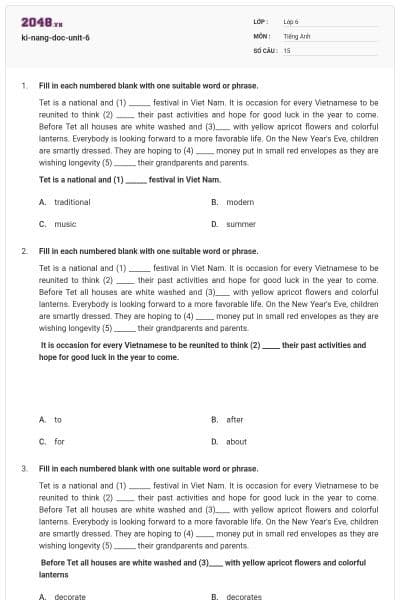
Fill in each numbered blank with one suitable word or phrase.

Tet is a national and (1) ______ festival in Viet Nam. It is occasion for every Vietnamese to be reunited to think (2) _____ their past activities and hope for good luck in the year to come. Before Tet all houses are white washed and (3)____ with yellow apricot flowers and colorful lanterns. Everybody is looking forward to a more favorable life. On the New Year's Eve, children are smartly dressed. They are hoping to (4) _____ money put in small red envelopes as they are wishing longevity (5) ______ their grandparents and parents.

Tet is a national and (1) ______ festival in Viet Nam. 

traditional

modern

music

summer

Xem đáp án

Tạm dịch các đáp án:

Traditional: truyền thống (adj)              

Modern: hiện đại (adj)                                 

Music: âm nhạc (n)                    

Summer: mùa hè (n)

=> Tet is a national and traditional festival in Viet Nam.

Tạm dịch: Tết là một lễ hội quốc gia và truyền thống của Việt Nam.

Đáp án cần chọn là: A

2. Trắc nghiệm
1 điểm

Fill in each numbered blank with one suitable word or phrase.

Tet is a national and (1) ______ festival in Viet Nam. It is occasion for every Vietnamese to be reunited to think (2) _____ their past activities and hope for good luck in the year to come. Before Tet all houses are white washed and (3)____ with yellow apricot flowers and colorful lanterns. Everybody is looking forward to a more favorable life. On the New Year's Eve, children are smartly dressed. They are hoping to (4) _____ money put in small red envelopes as they are wishing longevity (5) ______ their grandparents and parents.

 It is occasion for every Vietnamese to be reunited to think (2) _____ their past activities and hope for good luck in the year to come.


to

after

for

about

Xem đáp án

Tạm dịch các đáp án:

To: đến, tới

After: sau

For: cho 

Aboutvề

Cụm từ: think about (nghĩ về điều gì)

=> It is occasion for every Vietnamese to be reunited to think about their past activities and hope for good luck in the year to come.

Tạm dịch: Đây là dịp để mọi người Việt Nam được đoàn tụ để suy nghĩ về các hoạt động trong quá khứ của họ và hy vọng may mắn trong năm tới.

Đáp án cần chọn là: D

3. Trắc nghiệm
1 điểm

Fill in each numbered blank with one suitable word or phrase.

Tet is a national and (1) ______ festival in Viet Nam. It is occasion for every Vietnamese to be reunited to think (2) _____ their past activities and hope for good luck in the year to come. Before Tet all houses are white washed and (3)____ with yellow apricot flowers and colorful lanterns. Everybody is looking forward to a more favorable life. On the New Year's Eve, children are smartly dressed. They are hoping to (4) _____ money put in small red envelopes as they are wishing longevity (5) ______ their grandparents and parents.

 Before Tet all houses are white washed and (3)____ with yellow apricot flowers and colorful lanterns

decorate

decorates

decorating

decorated

Xem đáp án

Tạm dịch các đáp án: 

Decorate: trang trí (V)

Decorated: đã được trang trí (V_PII)

Liên từ “and” (và) nối giữa 2 từ có cùng loại từ và cấu trúc, ta thấy đây là cấu trúc câu bị động: be+V_PII

=> chỗ cần điền là động từ dạng quá khứ phân từ (decorated)

=> Before Tet all houses are white washed and decorated with yellow apricot flowers and colorful lanterns.

Tạm dịch: Trước Tết tất cả các ngôi nhà đều được quét vôi trắng và được trang trí bằng hoa mai vàng và đèn lồng nhiều màu sắc.

Đáp án cần chọn là: D

4. Trắc nghiệm
1 điểm

Fill in each numbered blank with one suitable word or phrase.

Tet is a national and (1) ______ festival in Viet Nam. It is occasion for every Vietnamese to be reunited to think (2) _____ their past activities and hope for good luck in the year to come. Before Tet all houses are white washed and (3)____ with yellow apricot flowers and colorful lanterns. Everybody is looking forward to a more favorable life. On the New Year's Eve, children are smartly dressed. They are hoping to (4) _____ money put in small red envelopes as they are wishing longevity (5) ______ their grandparents and parents.

They are hoping to (4) _____ money put in small red envelopes


buy

receive

sell

make

Xem đáp án

Tạm dịch các đáp án:  

Buy: mua

Receive: nhận 

Sell: bán

Make: làm 

Cụm từ: receive money (nhận tiền)

=> They are hoping to receive money put in small red envelopes.

Tạm dịch: Họ đang hy vọng nhận được tiền bỏ vào những phong bì nhỏ màu đỏ.

Đáp án cần chọn là: B

5. Trắc nghiệm
1 điểm

Fill in each numbered blank with one suitable word or phrase.

Tet is a national and (1) ______ festival in Viet Nam. It is occasion for every Vietnamese to be reunited to think (2) _____ their past activities and hope for good luck in the year to come. Before Tet all houses are white washed and (3)____ with yellow apricot flowers and colorful lanterns. Everybody is looking forward to a more favorable life. On the New Year's Eve, children are smartly dressed. They are hoping to (4) _____ money put in small red envelopes as they are wishing longevity (5) ______ their grandparents and parents.

 as they are wishing longevity (5) ______ their grandparents and parents.


for

to

with

from

Xem đáp án

Tạm dịch các đáp án: 

For: cho

To: đến, tới

With: với

From: từ

=> as they are wishing longevity for their grandparents and parents. 

Tạm dịch: vì chúng đang mong ước ông bà và bố mẹ sống lâu cùng ông bà và bố mẹ.

Đáp án: A

6. Trắc nghiệm
1 điểm

Read the passage carefully and choose the correct answer.

Every country has its own tradition when New Year comes. In Japan, at midnight on December 31, all temples in the country ring their bell 108 times. They believe that the ringing bells can remove their bad actions from the previous year.

In Thai Lan, the New Year is in April. It’s the hottest time of the year. People often throw water over the people. They believe that this activity will bring a lot of rain and wash away the bad things.

In Viet Nam, people clean and decorate their houses before Tet. They would like their houses to look more beautiful. The first footer is very important. They believe that the first footer on the first New Year Day decides the family’s luck for the whole year.

Một số từ vựng:

- tradition (n): truyền thống

- ring the bell: rung chuông

- wash away: rửa sạch, cuốn trôi

- luck (n): điều may mắn

People in Japan believe that 108 times of ringing bell can remove their _______ from the previous year.

good actions

rude actions

bad actions

x

Xem đáp án

Tạm dịch các đáp án:

Người Nhật tin rằng 108 lần chuông rung có thể xua đuổi được .... từ những năm trước

A.hành động tốt

B.hành động thô lỗ

C.hành động xấu

 Thông tin:

They believe that the ringing bells can remove their bad actions from the previous year.

Tạm dịch: Họ tin rằng tiếng chuông có thể loại bỏ những hành động xấu của họ từ năm trước.

Đáp án cần chọn là: C

7. Trắc nghiệm
1 điểm

Read the passage carefully and choose the correct answer.

Every country has its own tradition when New Year comes. In Japan, at midnight on December 31, all temples in the country ring their bell 108 times. They believe that the ringing bells can remove their bad actions from the previous year.

In Thai Lan, the New Year is in April. It’s the hottest time of the year. People often throw water over the people. They believe that this activity will bring a lot of rain and wash away the bad things.

In Viet Nam, people clean and decorate their houses before Tet. They would like their houses to look more beautiful. The first footer is very important. They believe that the first footer on the first New Year Day decides the family’s luck for the whole year.

Một số từ vựng:

- tradition (n): truyền thống

- ring the bell: rung chuông

- wash away: rửa sạch, cuốn trôi

- luck (n): điều may mắn

 April is _______ time of the year in Thai Lan.  


hot

the hottest

hottest

x

Xem đáp án

Tạm dịch các đáp án: 

Tháng tư là khoảng thời gian ____ trong năm ở Thái Lan.

A. nóng

B. nóng nhất

C. sai (thiếu 'the')

Thông tin:

In Thai Lan, the New Year is in April. It’s the hottest time of the year.

(Ở Thái Lan, năm mới đến vào tháng tư. Đó là thời điểm nóng nhất trong năm.)

Đáp án cần chọn là: B

8. Trắc nghiệm
1 điểm

Read the passage carefully and choose the correct answer.

Every country has its own tradition when New Year comes. In Japan, at midnight on December 31, all temples in the country ring their bell 108 times. They believe that the ringing bells can remove their bad actions from the previous year.

In Thai Lan, the New Year is in April. It’s the hottest time of the year. People often throw water over the people. They believe that this activity will bring a lot of rain and wash away the bad things.

In Viet Nam, people clean and decorate their houses before Tet. They would like their houses to look more beautiful. The first footer is very important. They believe that the first footer on the first New Year Day decides the family’s luck for the whole year.

Một số từ vựng:

- tradition (n): truyền thống

- ring the bell: rung chuông

- wash away: rửa sạch, cuốn trôi

- luck (n): điều may mắn

 People in Thai Lan believe that throwing water over other people will _____ and  wash away the bad things.


not bring a lot of rain

brings a lot of rain

bring a lot of rain

x

Xem đáp án

Tạm dịch các đáp án: 

Người Thái Lan tin rằng ném nước vào người khác sẽ _____ và rửa sạch được những điều xấu.

A.không mang đến nhiều mưa

B.mang lại nhiều mưa ( sai vì sau 'will' + V-infi)

C.mang lại nhiều mưa

Thông tin:

They believe that this activity will bring a lot of rain and wash away the bad things.

(Họ tin rằng hoạt động này sẽ mang lại nhiều mưa và cuốn trôi những điều xấu.)

Đáp án cần chọn là: C

9. Trắc nghiệm
1 điểm

Read the passage carefully and choose the correct answer.

Every country has its own tradition when New Year comes. In Japan, at midnight on December 31, all temples in the country ring their bell 108 times. They believe that the ringing bells can remove their bad actions from the previous year.

In Thai Lan, the New Year is in April. It’s the hottest time of the year. People often throw water over the people. They believe that this activity will bring a lot of rain and wash away the bad things.

In Viet Nam, people clean and decorate their houses before Tet. They would like their houses to look more beautiful. The first footer is very important. They believe that the first footer on the first New Year Day decides the family’s luck for the whole year.

Một số từ vựng:

- tradition (n): truyền thống

- ring the bell: rung chuông

- wash away: rửa sạch, cuốn trôi

- luck (n): điều may mắn

 What do Vietnamese people often do before Tet?  

visit relatives

clean and decorate their house

throw water over the people

x

Xem đáp án

Tạm dịch các đáp án: 

Người Việt làm gì trước ngày Tết?

A.thăm họ hàng

B.dọn dẹp và trang trí nhà của họ

C.hất nước vào mọi người

Thông tin:

In Viet Nam, people clean and decorate their houses before Tet.

(Ở Việt Nam, người ta dọn dẹp và trang trí nhà cửa trước Tết.)

Đáp án cần chọn là: B

10. Trắc nghiệm
1 điểm

Read the passage carefully and choose the correct answer.

Every country has its own tradition when New Year comes. In Japan, at midnight on December 31, all temples in the country ring their bell 108 times. They believe that the ringing bells can remove their bad actions from the previous year.

In Thai Lan, the New Year is in April. It’s the hottest time of the year. People often throw water over the people. They believe that this activity will bring a lot of rain and wash away the bad things.

In Viet Nam, people clean and decorate their houses before Tet. They would like their houses to look more beautiful. The first footer is very important. They believe that the first footer on the first New Year Day decides the family’s luck for the whole year.

Một số từ vựng:

- tradition (n): truyền thống

- ring the bell: rung chuông

- wash away: rửa sạch, cuốn trôi

- luck (n): điều may mắn

 The first people who comes to someones house on the first day are called _______.


first comer

the first

the first footer

x

Xem đáp án

Đáp án C : Tạm dịch câu hỏi: Người đầu tiên bước vào nhà người khác trong ngày đầu tiên được gọi là người xông nhà (the first footer)

Thông tin: They believe that the first footer on the first New Year Day decides the family’s luck for the whole year.

Tạm dịch: Họ tin rằng người xông nhà rất quan trọng trong ngày đầu tiên của năm mới vì người xông nhà sẽ quyết định vận may trong cả năm.)

11. Trắc nghiệm
1 điểm

Read the passage carefully and choose the correct answer.

Every country has its own tradition when New Year comes. In Japan, at midnight on December 31, all temples in the country ring their bell 108 times. They believe that the ringing bells can remove their bad actions from the previous year.

In Thai Lan, the New Year is in April. It’s the hottest time of the year. People often throw water over the people. They believe that this activity will bring a lot of rain and wash away the bad things.

In Viet Nam, people clean and decorate their houses before Tet. They would like their houses to look more beautiful. The first footer is very important. They believe that the first footer on the first New Year Day decides the family’s luck for the whole year.

Một số từ vựng:

- tradition (n): truyền thống

- ring the bell: rung chuông

- wash away: rửa sạch, cuốn trôi

- luck (n): điều may mắn

What is another name of Tet? 

Vietnamese holiday

Lunar New Year

Traditional holiday

Vietnam's main holida

Xem đáp án

Tạm dịch câu hỏi:

Một tên khác của Tết là gì?

A.ngày lễ việt nam

B.Tết Nguyên đán

C.Ngày lễ truyền thống

D.ngày lễ chính của Việt Nam

Thông tin:

Lunar New Year, or Tet, is Vietnam's main holiday.

Tạm dịch: Tết Nguyên đán, hay Tết, là ngày lễ chính của người Việt.

Đáp án cần chọn là: B

12. Trắc nghiệm
1 điểm

Read the passage carefully and choose the correct answer.

Every country has its own tradition when New Year comes. In Japan, at midnight on December 31, all temples in the country ring their bell 108 times. They believe that the ringing bells can remove their bad actions from the previous year.

In Thai Lan, the New Year is in April. It’s the hottest time of the year. People often throw water over the people. They believe that this activity will bring a lot of rain and wash away the bad things.

In Viet Nam, people clean and decorate their houses before Tet. They would like their houses to look more beautiful. The first footer is very important. They believe that the first footer on the first New Year Day decides the family’s luck for the whole year.

Một số từ vựng:

- tradition (n): truyền thống

- ring the bell: rung chuông

- wash away: rửa sạch, cuốn trôi

- luck (n): điều may mắn

 When does Tet sometimes take place on Western calendar?  


from 19th January to 20th January

from 19th January to 19th February

from 19th January to 20th February

from 19th February to 20th February

Xem đáp án

Tạm dịch câu hỏi: 

Khi nào Tết diễn ra theo lịch Tây? (TH)

A.từ ngày 19 tháng 1 đến ngày 20 tháng 1

B.từ 19 tháng 1 đến 19 tháng 2

C.từ ngày 19 tháng 1 đến ngày 20 tháng 2

D.từ ngày 19 tháng 2 đến ngày 20 tháng 2

 Thông tin:  It is the most important occasion in the year which falls sometimes between 19th january and 20th February on the Western calendar.

(Đây là dịp quan trọng nhất trong năm đôi khi rơi vào giữa ngày 19 tháng 1 đến ngày 20 tháng 2 theo lịch phương Tây.)

Đáp án cần chọn là: C

13. Trắc nghiệm
1 điểm

Read the passage carefully and choose the correct answer.

Every country has its own tradition when New Year comes. In Japan, at midnight on December 31, all temples in the country ring their bell 108 times. They believe that the ringing bells can remove their bad actions from the previous year.

In Thai Lan, the New Year is in April. It’s the hottest time of the year. People often throw water over the people. They believe that this activity will bring a lot of rain and wash away the bad things.

In Viet Nam, people clean and decorate their houses before Tet. They would like their houses to look more beautiful. The first footer is very important. They believe that the first footer on the first New Year Day decides the family’s luck for the whole year.

Một số từ vựng:

- tradition (n): truyền thống

- ring the bell: rung chuông

- wash away: rửa sạch, cuốn trôi

- luck (n): điều may mắn

 What does Tet mark?

the end of the year

the start of a new month

the beginning of a new year

the beginning of spring and the start of a new year

Xem đáp án

Tết đánh dấu điều gì?

A.kết thúc một năm.

B.khởi đầu tháng mới.

C.khởi đầu của một năm mới.

D.khởi đầu của mùa xuân và bắt đầu một năm mới.

Thông tin:

Tet marks the beginning of spring and the start of a new year.

(Tết đánh dấu sự khởi đầu của mùa xuân và bắt đầu một năm mới.)

Đáp án cần chọn là: D

14. Trắc nghiệm
1 điểm

Read the passage carefully and choose the correct answer.

Every country has its own tradition when New Year comes. In Japan, at midnight on December 31, all temples in the country ring their bell 108 times. They believe that the ringing bells can remove their bad actions from the previous year.

In Thai Lan, the New Year is in April. It’s the hottest time of the year. People often throw water over the people. They believe that this activity will bring a lot of rain and wash away the bad things.

In Viet Nam, people clean and decorate their houses before Tet. They would like their houses to look more beautiful. The first footer is very important. They believe that the first footer on the first New Year Day decides the family’s luck for the whole year.

Một số từ vựng:

- tradition (n): truyền thống

- ring the bell: rung chuông

- wash away: rửa sạch, cuốn trôi

- luck (n): điều may mắn


What do people decorate streets with?

plants and flowers

coloured lights and red banners

peach blossom and apricot blossom

traditional foods

Xem đáp án

Người ta trang trí đường phố bằng gì?

A.cây cối và hoa

B.đèn màu và biểu ngữ màu đỏ

C.hoa đào và hoa mai

D.món ăn truyền thống

Thông tin:

Streets are decorated with coloured lights and red banners.

(Đường phố được trang trí với đèn màu và biểu ngữ màu đỏ)

Đáp án cần chọn là: B

15. Trắc nghiệm
1 điểm

Read the passage carefully and choose the correct answer.

Every country has its own tradition when New Year comes. In Japan, at midnight on December 31, all temples in the country ring their bell 108 times. They believe that the ringing bells can remove their bad actions from the previous year.

In Thai Lan, the New Year is in April. It’s the hottest time of the year. People often throw water over the people. They believe that this activity will bring a lot of rain and wash away the bad things.

In Viet Nam, people clean and decorate their houses before Tet. They would like their houses to look more beautiful. The first footer is very important. They believe that the first footer on the first New Year Day decides the family’s luck for the whole year.

Một số từ vựng:

- tradition (n): truyền thống

- ring the bell: rung chuông

- wash away: rửa sạch, cuốn trôi

- luck (n): điều may mắn

 What do people do in Tet?


People buy gifts, clean and decorate their houses and cook traditional foods

People enjoy traditional food

People clean their house and wait for the first footer

People plant trees around their house

Xem đáp án

Đáp án A : Người ta làm gì vào dịp tết?

A.Mọi người mua quà tặng, dọn dẹp và trang trí nhà cửa và nấu các món ăn truyền thống.

B.Mọi người thưởng thức các món ăn truyền thống.

C.Mọi người dọn dẹp nhà cửa của họ và chờ đợi bước chân đầu tiên.

D.Người ta trồng cây quanh nhà.

Thông tin:

People are busy buying gifts, cleaning and decorating their houses and cooking traditional foods.

(Mọi người bận rộn mua quà tặng, dọn dẹp và trang trí nhà cửa và nấu các món ăn truyền thống.)