ĐGNL ĐHQG Hà Nội - Tư duy định lượng - Phương trình logarit và một số phương pháp giải
35 câu hỏi
\[x = 3 + \sqrt 2 \]
\[x = \frac{{ - 11}}{4}\]
\[x = 3 - \sqrt 2 \]
\[x = \frac{{11}}{4}\]
Phương trình tương đương với:
\[3 - x = {\left( {\frac{1}{2}} \right)^2} \Leftrightarrow x = \frac{{11}}{4}\]
Vậy\[x = \frac{{11}}{4}\]
Đáp án cần chọn là: D
\[\left\{ {\frac{{1 + \sqrt 2 }}{2}} \right\}\]
\[\left\{ {2;41} \right\}\]
\[\left\{ {1 - \sqrt 2 ;1 + \sqrt 2 } \right\}\]
\[\left\{ {1 + \sqrt 2 } \right\}\]
Điều kiện:\(\left\{ {\begin{array}{*{20}{c}}{{x^2} - 1 > 0}\\{2x > 0}\end{array}} \right. \Leftrightarrow x > 1\)
Với điều kiện này thì phương trình đã cho tương đương với
\[{x^2} - 1 = 2x \Leftrightarrow {x^2} - 2x - 1 = 0 \Leftrightarrow \left[ {\begin{array}{*{20}{c}}{x = 1 + \sqrt 2 \left( {TM} \right)}\\{x = 1 - \sqrt 2 \left( L \right)}\end{array}} \right.\]
Vậy tập nghiệm của phương trình đã cho là \[S = \left\{ {1 + \sqrt 2 } \right\}\]
Đáp án cần chọn là: D
\[{\log _3}(x + 2) + {\log _9}{(x + 2)^2} = \frac{5}{4}\](*)
Đkxđ: \[x > - 2\]
\[( * ) \Leftrightarrow {\log _3}(x + 2) + {\log _3}(x + 2) = \frac{5}{4} \Leftrightarrow {\log _3}(x + 2) = \frac{5}{8}\]
\[ \Leftrightarrow x + 2 = {3^{\frac{5}{8}}} \Leftrightarrow x = \sqrt[8]{{{3^5}}} - 2(tm)\]
Đáp án cần chọn là: B
\[{\log _3}\left( {2x - 1} \right) = 2 \Leftrightarrow 2x - 1 = {3^2} \Leftrightarrow 2x = 10 \Leftrightarrow x = 5\]
Đáp án cần chọn là: D
\[S = \left\{ { - 3;3} \right\}\]
\[S = \left\{ {\sqrt {10} } \right\}\]
\[S = \left\{ 3 \right\}\]
\[S = \left\{ { - \sqrt {10} ;\sqrt {10} } \right\}\]
Điều kiện : x>1.
\[{\log _2}\left( {x - 1} \right) + {\log _2}\left( {x + 1} \right) = 3 \Leftrightarrow {\log _2}\left( {\left( {x - 1} \right).\left( {x + 1} \right)} \right) = 3\]
\[ \Leftrightarrow {x^2} - 1 = {2^3} \Leftrightarrow x = \pm 3\]
So sánh với điều kiện suy ra x=3.
Đáp án cần chọn là: C
\[S = \left\{ {1\,\,;\,7} \right\}.\]
\[S = \left\{ {\,7\,} \right\}.\]
\[S = \left\{ {\,1\,} \right\}.\]
\[S = \left\{ {\,3\,;\,7} \right\}.\]
Điều kiện:\(\left\{ {\begin{array}{*{20}{c}}{{x^2} - 4x + 3 > 0}\\{4x - 4 > 0}\end{array}} \right. \Leftrightarrow x > 3.\)
\[lo{g_2}({x^2} - 4x + 3) = lo{g_2}(4x - 4) \Leftrightarrow {x^2} - 4x + 3 = 4x - 4\]
\(\left[ {\begin{array}{*{20}{c}}{x = 1(l)}\\{x = 7}\end{array}} \right.\)
Vậy\[S = \left\{ 7 \right\}\]
Đáp án cần chọn là: B
Điều kiện \(\left\{ {\begin{array}{*{20}{c}}{x + 1 > 0}\\{x - 3 > 0}\end{array}} \right. \Leftrightarrow x > 3\)
Ta có
\[\begin{array}{*{20}{l}}{{{\log }_4}\left( {x + 1} \right) + {{\log }_4}\left( {x - 3} \right) = 3 \Leftrightarrow {{\log }_4}\left( {x + 1} \right)\left( {x - 3} \right) = 3}\\{ \Leftrightarrow \left( {x + 1} \right)\left( {x - 3} \right) = {4^3} \Leftrightarrow {x^2} - 2{\rm{x}} - 67 = 0 \Leftrightarrow x = 1 \pm 2\sqrt {17} }\end{array}\]
So sánh với điều kiện nghiệm của pt là\[x = 1 + 2\sqrt {17} \]
Đáp án cần chọn là: B
\[\left\{ {0;1} \right\}\]
\[\left\{ {0;{{2.3}^{50}}} \right\}\]
\[\left\{ 0 \right\}\]
R
Điều kiện:\[x > - \frac{{{3^{50}}}}{2}\]
Phương trình đã cho tương đương với:
\[lo{g_3}({9^{50}} + 6{x^2}) = lo{g_3}({9^{50}} + 4x{.3^{50}} + 4{x^2})\]
\[ \Leftrightarrow 6{x^2} = 4x{.3^{50}} + 4{x^2} \Leftrightarrow {x^2} = 2x{.3^{50}} \Leftrightarrow \left[ {\begin{array}{*{20}{c}}{x = 0}\\{x = {{2.3}^{50}}}\end{array}} \right.\]
Đáp án cần chọn là: B
2017
4014
2018
4015
ĐK: \[x > - 1;mx > 0\]
\[\begin{array}{*{20}{l}}{\log (m{\rm{x}}) = 2\log (x + 1) \Leftrightarrow m{\rm{x}} = {{(x + 1)}^2} \Leftrightarrow {x^2} + (2 - m)x + 1 = 0}\\{{\rm{\Delta }} = {m^2} - 4m + 4 - 4 = {m^2} - 4m}\end{array}\]
Để phương trình đã cho có nghiệm duy nhất thì có 2 TH:
TH1: Phương trình trên có nghiệm duy nhất: \[{m^2} = 4m \Leftrightarrow \left[ {\begin{array}{*{20}{c}}{m = 0}\\{m = 4}\end{array}} \right.\]Tuy nhiên giá trị m=0 loại do khi đó nghiệm là x=−1.
TH2: Phương trình trên có 2 nghiệm thỏa: \[{x_1} \le - 1 < {x_2}\]
Nếu có \[{x_1} = - 1 \to 1 - (2 - m) + 1 = 0 \to m = 0\] thay lại vô lý
\[{x_1} < - 1 < {x_2} \to ({x_1} + 1)({x_2} + 1) < 0 \Leftrightarrow {x_1}{x_2} + {x_1} + {x_2} + 1 < 0 \to 1 + m - 2 + 1 < 0 \Leftrightarrow m < 0.\]
Như vậy sẽ có các giá trị \[ - 2017; - 2016; \ldots \ldots - 1\] và 4.
Có 2018 giá trị.
Đáp án cần chọn là: C

Học thông minh hơn mỗi ngày
Xem toàn bộ 35 câu hỏi và nhiều hơn nữa với tài khoản miễn phí
\[{3^{\sqrt 3 + 1}}\]
\[{3^{ - \sqrt 3 }}\]
3
\[{3^{\sqrt 3 }}\]
\[{\left( {{{\log }_{\frac{1}{3}}}x} \right)^2} - \left( {\sqrt 3 + 1} \right){\log _3}x + \sqrt 3 = 0\]điều kiện của phương trình là x>0
\[ \Leftrightarrow {\left( {{{\log }_3}x} \right)^2} - \left( {\sqrt 3 + 1} \right){\log _3}x + \sqrt 3 = 0\]
Đặt \[t = {\log _3}x\] phương trình trở thành:
\[{t^2} - (\sqrt 3 + 1)t + \sqrt 3 = 0 \Rightarrow \left[ {\begin{array}{*{20}{c}}{t = 1}\\{t = \sqrt 3 }\end{array}} \right.\]
\( \Rightarrow \left[ {\begin{array}{*{20}{c}}{lo{g_3}x = 1}\\{lo{g_3}x = \sqrt 3 }\end{array}} \right. \Leftrightarrow \left[ {\begin{array}{*{20}{c}}{x = 3}\\{x = {3^{\sqrt 3 }}}\end{array}} \right. \Rightarrow {x_1}.{x_2} = {3.3^{\sqrt 3 }} = {3^{\sqrt 3 + 1}}\)
Đáp án cần chọn là: A
\[m \in \left( {3;4} \right)\]
\[m \in \left( {4;6} \right)\]
\[m \in \left( { - 1;1} \right)\]
\[m \in \left( {1;3} \right)\]
Đặt \[t = {\log _3}x\] suy ra phương trình trở thành\[{t^2} - (m + 2)t + 3m - 2 = 0\left( * \right)\]
Để phương trình có hai nghiệm \[{x_1};{x_2}\] thì (*) cũng có hai nghiệm \[{t_1};{t_2}\] .
Phương trình (*) có 2 nghiệm phân biệt \[{t_1};{t_2}\]
\[ \Leftrightarrow \Delta > 0 \Leftrightarrow {(m + 2)^2} - 4(3m - 2) > 0 \Leftrightarrow \left[ {\begin{array}{*{20}{c}}{m > 6}\\{m < 2}\end{array}} \right.\]
Ta có:\(\left\{ {\begin{array}{*{20}{c}}{{x_1} = {3^{{t_1}}}}\\{{x_2} = {3^{{t_2}}}}\end{array}} \right. \Rightarrow {x_1}.{x_2} = {3^{{t_1} + {t_2}}} = 9 \Leftrightarrow {t_1} + {t_2} = 2.\)
Theo hệ thức Vi-ét ta có: \[{t_1} + {t_2} = m + 2\]
\[ \Rightarrow m + 2 = 2 \Leftrightarrow m = 0\]Suy ra \[m \in \left( { - 1;1} \right)\]
Đáp án cần chọn là: C
\[x = {\log _2}3\] và \[x = {\log _2}5\]
x=1 và x=−2
\[x = {\log _2}3\] và \[x = {\log _2}\frac{5}{4}\]
x=1 và x=2
Phương trình đã cho tương đương với:
\[\begin{array}{l}lo{g_2}({2^x} - 1)[lo{g_4}2 + lo{g_4}({2^x} - 1)] = 1\\ \Leftrightarrow lo{g_2}({2^x} - 1)\left[ {\frac{1}{2} + \frac{1}{2}lo{g_2}({2^x} - 1)} \right] = 1\\ \Leftrightarrow lo{g_2}({2^x} - 1)\left[ {1 + lo{g_2}({2^x} - 1)} \right] = 2\\ \Leftrightarrow \log _2^2({2^x} - 1) + lo{g_2}({2^x} - 1) - 2 = 0\\ \Leftrightarrow \left[ {\begin{array}{*{20}{c}}{lo{g_2}({2^x} - 1) = 1}\\{lo{g_2}({2^x} - 1) = - 2}\end{array}} \right. \Leftrightarrow \left[ {\begin{array}{*{20}{c}}{{2^x} - 1 = 1}\\{{2^x} - 1 = \frac{1}{4}}\end{array}} \right. \Leftrightarrow \left[ {\begin{array}{*{20}{c}}{{2^x} = 3}\\{{2^x} = \frac{5}{4}}\end{array}} \right. \Leftrightarrow \left[ {\begin{array}{*{20}{c}}{x = lo{g_2}3}\\{x = lo{g_2}\frac{5}{4}}\end{array}} \right.\end{array}\]
Đáp án cần chọn là: C
\[\frac{{ - 1 + \sqrt 5 }}{2}.\]
\[\frac{{ - 1 - \sqrt 5 }}{2}.\]
\[\frac{{1 + \sqrt 5 }}{2}.\]
\(\frac{1}{2}\)
Đặt
\[lo{g_4}a = lo{g_6}b = lo{g_9}(a + b) = x \Leftrightarrow \left\{ {\begin{array}{*{20}{c}}{a = {4^x}}\\{b = {6^x}}\\{a + b = {9^x}}\end{array}} \right.\]
\( \Rightarrow \left\{ {\begin{array}{*{20}{c}}{\frac{a}{b} = {{\left( {\frac{4}{6}} \right)}^x} = {{\left( {\frac{2}{3}} \right)}^x} > 0}\\{{4^x} + {6^x} = {9^x}\,\,\left( 1 \right)}\end{array}} \right.\)
\[\begin{array}{l}{4^x} + {6^x} = {9^x} \Leftrightarrow {\left( {\frac{2}{3}} \right)^{2x}} + {\left( {\frac{2}{3}} \right)^x} - 1 = 0\\ \Leftrightarrow \left[ {\begin{array}{*{20}{c}}{{{\left( {\frac{2}{3}} \right)}^{2x}} = \frac{{ - 1 + \sqrt 5 }}{2}}\\{{{\left( {\frac{2}{3}} \right)}^{2x}} = \frac{{ - 1 - \sqrt 5 }}{2} < 0\left( {loai} \right)}\end{array}} \right. \Rightarrow \frac{a}{b} = \frac{{ - 1 + \sqrt 5 }}{2}\end{array}\]
Đáp án cần chọn là: A
\[{\log _2}\left( {6 - 4\sqrt 2 } \right)\]
4
2
\[6 + 4\sqrt 2 \]
\[{\log _4}\left( {{{3.2}^x} - 1} \right) = x - 1 \Leftrightarrow {3.2^x} - 1 = {4^{x - 1}} \Leftrightarrow {4^x} - {12.2^x} + 4 = 0\]
Đặt \[t = {2^x}\] khi đó phương trình trở thành \[{t^2} - 12t + 4 = 0\] phương trình có hai nghiệm\[{t_1},{t_2}\] thỏa mãn\[{t_1}{t_2} = 4 \Leftrightarrow {2^{{x_1}}}{.2^{{x_2}}} = 4 \Leftrightarrow {2^{{x_1} + {x_2}}} = {2^2} \Leftrightarrow {x_1} + {x_2} = 2\]
Đáp án cần chọn là: C
Phương trình có một nghiệm hữu tỉ và một nghiệm vô tỉ
Phương trình có một nghiệm duy nhất
Phương trình vô nghiệm
Tổng các nghiệm của phương trình là một số chính phương
Điều kiện x>0
Ta đặt\[{\log _3}x = u;{\log _5}x = v \Rightarrow u.v = u + v\]
Khi đó\[x = {3^u} = {5^v}\] suy ra\[{\log _3}{3^u} = {\log _3}{5^v} \Leftrightarrow u = v{\log _3}5\]
\[ \Rightarrow uv = u + v \Leftrightarrow {v^2}{\log _3}5 = v{\log _3}5 + v \Leftrightarrow {v^2}{\log _3}5 - v\left( {{{\log }_3}5 + 1} \right) = 0\]
\[ \Leftrightarrow v\left( {v{{\log }_3}5 - {{\log }_3}5 - 1} \right) = 0\]
\( \Leftrightarrow \left[ {\begin{array}{*{20}{c}}{v = 0}\\{vlo{g_3}5 - lo{g_3}5 - 1 = 0}\end{array}} \right. \Leftrightarrow \left[ {\begin{array}{*{20}{c}}{v = 0}\\{v = \frac{{lo{g_3}5 + 1}}{{lo{g_3}5}}}\end{array}} \right. = 1 + \frac{1}{{lo{g_3}5}}\)
\( \Rightarrow \left[ {\begin{array}{*{20}{c}}{u = 0}\\{u = 1 + lo{g_3}5}\end{array}} \right. \Rightarrow \left[ {\begin{array}{*{20}{c}}{x = 1(TM)}\\{x = {3^{1 + lo{g_3}5}} = 15(TM)}\end{array}} \right.\)
Do đó phương trình có hai nghiệm \[{x_1} = 1,{x_2} = 15\] và tổng hai nghiệm bằng 16 là một số chính phương.
Đáp án cần chọn là: D
\[m \in \left( {0;2} \right)\]
\[m \in \left\{ {0;2} \right\}\]
\[m \in \left( { - \infty ;2} \right)\]
\[m \in \left\{ 2 \right\}\]
TXĐ : D=R.
\[2{\log _2}\left| x \right| + {\log _2}\left| {x + 3} \right| = m \Leftrightarrow {\log _2}{\left| x \right|^2} + {\log _2}\left| {x + 3} \right| = m\]
\[ \Leftrightarrow {\log _2}\left( {{{\left| x \right|}^2}.\left| {x + 3} \right|} \right) = m \Leftrightarrow {\left| x \right|^2}.\left| {x + 3} \right| = {2^m}\]
\[ \Leftrightarrow {x^2}.\left| {x + 3} \right| = {2^m}\]
Xét hàm\[f(x) = {x^2}.\left| {x + 3} \right|\]Ta có : \[f(x) = {x^2}.\left| {x + 3} \right| = \left| {{x^3} + 3{x^2}} \right|\]
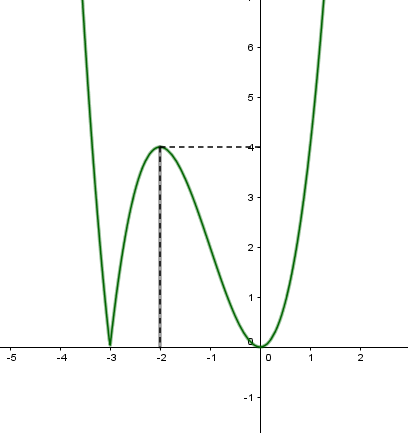
Để phương trình có 3 nghiệm phân biệt thì \[{2^m} = 4 \Leftrightarrow m = 2\]
Đáp án cần chọn là: D
\[a = {b^2}\]
\[a = {b^2}\]hoặc\[{a^3} = {b^2}\]
\[{a^3} = {b^2}\]
\[x = ab\]
\[4\log _a^2x - 8{\log _b}x.{\log _a}x + 3\log _b^2x = 0\]
Ta có:
\[\;\Delta \prime = {(4lo{g_b}x)^2} - 3.4.lo{g_b}x = 4log_b^2x > 0\]
\( \Rightarrow \left[ {\begin{array}{*{20}{c}}{lo{g_a}x = \frac{3}{2}lo{g_b}x}\\{lo{g_a}x = \frac{1}{2}lo{g_b}x}\end{array}} \right.\)
Suy ra
\[{\log _a}x = \frac{3}{2}{\log _b}x \Rightarrow {\log _a}x = {\log _{\sqrt[3]{{{b^2}}}}}x \Rightarrow a = \sqrt[3]{{{b^2}}} \Rightarrow {a^3} = {b^2}\]
\[{\log _a}x = \frac{1}{2}{\log _b}x \Rightarrow {\log _a}x = {\log _{{b^2}}}x \Rightarrow a = {b^2}\]
Đáp án cần chọn là: B
\[x = \sqrt[M]{{2017!}} - 1\]
\[x = \sqrt[M]{{2018!}}\]
\[x = \sqrt[M]{{2016!}}\]
\[x = \sqrt[M]{{2017!}}\]
\[\begin{array}{*{20}{l}}{VT = {{\log }_x}2 + {{\log }_x}3 + {{\log }_x}4 + ... + {{\log }_x}2017 = {{\log }_x}(2.3.4...2017)}\\{ \Rightarrow {x^M} = 2017! \Rightarrow x = \sqrt[M]{{2017!}}}\end{array}\]
Đáp án cần chọn là: D
\[\left\{ {1;2} \right\}\]
\[\left\{ {\frac{1}{3};9} \right\}\]
\[\left\{ {\frac{1}{3};3} \right\}\]
\[\left\{ {3;9} \right\}\]
Điều kiện:\[x > 0;x \ne 1\]
\[{\log _3}x + \frac{1}{{{{\log }_9}x}} = 3 \Leftrightarrow {\log _3}x + \frac{2}{{{{\log }_3}x}} = 3 \Leftrightarrow {\left( {{{\log }_3}x} \right)^2} - 3{\log _3}x + 2 = 0\]
\( \Leftrightarrow \left[ {\begin{array}{*{20}{c}}{lo{g_3}x = 1}\\{lo{g_3}x = 2}\end{array}} \right. \Leftrightarrow \left[ {\begin{array}{*{20}{c}}{x = 3}\\{x = {3^2} = 9}\end{array}} \right.\)
Đáp án cần chọn là: D
\[1 \le m < + \infty \]
\[1 < m < + \infty \]
\[0 \le m < + \infty \]
\[0 < m < + \infty \]
Phương trình đã cho tương đương với\(\left\{ {\begin{array}{*{20}{c}}{lo{g_2}\left( {\frac{x}{{x - 2}}} \right) = m}\\{x > 2}\end{array}} \right.\)
Để phương trình đã cho có nghiệm thì đường thẳng y=m cắt đồ thị hàm số\[y = {\log _2}f\left( x \right)\] với \[f\left( x \right) = \frac{x}{{x - 2}}\] trên khoảng\[\left( {2; + \infty } \right)\]
Có\[f'\left( x \right) = - \frac{2}{{{{\left( {x - 2} \right)}^2}}} < 0,\forall x > 2\] và\[\mathop {\lim }\limits_{x \to {2^ + }} f\left( x \right) = + \infty ;\mathop {\lim }\limits_{x \to + \infty } f\left( x \right) = 1\] nên ta có các tập giá trị của các hàm số là \[f\left( x \right) \in \left( {1; + \infty } \right) \Rightarrow {\log _2}f\left( x \right) \in \left( {0; + \infty } \right)\]</>
Vậy\[0 < m < + \infty \]Đáp án cần chọn là: D
3
2
1
4
Đặt \[{x^2} - \sqrt 2 x = t\] khi đó\[{\log _3}|t| = {\log _5}(t + 2)(t > - 2;t \ne 0)\]
Đặt\[\;lo{g_3}|t| = lo{g_5}(t + 2) = a \Rightarrow \left\{ {\begin{array}{*{20}{c}}{|t| = {3^a}}\\{t + 2 = {5^a}}\end{array}} \right.\]
\[ \Rightarrow |{5^a} - 2| = {3^a} \Leftrightarrow \left[ {\begin{array}{*{20}{c}}{{5^a} - 2 = - {3^a}}\\{{5^a} - 2 = {3^a}}\end{array}} \right. \Rightarrow \left[ {\begin{array}{*{20}{c}}{{5^a} + {3^a} = 2\left( 1 \right)}\\{{5^a} = {3^a} + 2\left( 2 \right)}\end{array}} \right.\]
Xét (1):\[f(a) = {5^a} + {3^a} \Rightarrow f'(a) = {5^a}\ln 5 + {3^a}\ln 3 > 0(\forall a \in R)\] nên hàm số đồng biến trên R
Mặt khác\[f(0) = 2\] do đó phương trình\[f(a) = f(0)\] có 1 nghiệm duy nhất\[a = 0 \Rightarrow t = - 1\]
Suy ra: \[{x^2} - \sqrt 2 x + 1 = 0\] (vô nghiệm)
Xét (2) \[ \Leftrightarrow {\left( {\frac{3}{5}} \right)^a} + 2.{\left( {\frac{1}{5}} \right)^a} = 1\]
Đặt
\[g(a) = {\left( {\frac{3}{5}} \right)^a} + 2.{\left( {\frac{1}{5}} \right)^a} \Rightarrow g'(a) = {\left( {\frac{3}{5}} \right)^a}\ln \frac{3}{5} + 2.{\left( {\frac{1}{5}} \right)^a}\ln \frac{1}{5} < 0(\forall a \in R)\]
Nên hàm số g(a) nghịch biến trên R do đó phương trình g(a)=1 có tối đa 1 nghiệm.
Mà g(a)=g(1) nên a=1
Suy ra \[t = 3 \Rightarrow {x^2} - \sqrt 2 x - 3 = 0\] có 2 nghiệm phân biệt thỏa mãn điều kiện
Vậy phương trình đã cho có 2 nghiệm.
Đáp án cần chọn là: B
Ta có:\[\;\int\limits_0^2 {(t - lo{g_2}x)dt} = \left( {\frac{{{t^2}}}{2} - lo{g_2}x.t} \right)\left| {_0^2} \right. = 2 - 2lo{g_2}x\]
Phương trình:\[2 - 2{\log _2}x = 2{\log _2}\frac{2}{x}\] có điều kiện là x>0
\[ \Leftrightarrow {\log _2}\frac{2}{x} + {\log _2}x = 1 \Leftrightarrow {\log _2}\left( {\frac{2}{x}.x} \right) = 1\] (luôn đúng)
Vậy tập nghiệm của phương trình là\[(0; + \infty )\]
Đáp án cần chọn là: A
1009 nghiệm
1008 nghiệm.
2017 nghiệm
2018 nghiệm.
Điều kiện : \(\left\{ {\begin{array}{*{20}{c}}{cotx > 0}\\{cosx > 0}\end{array}} \right.\left( 1 \right)\)
Ta có :\[2{\log _3}\left( {\cot x} \right) = {\log _2}\left( {\cos x} \right) \Leftrightarrow {\log _3}{\left( {\cot x} \right)^2} = {\log _2}\left( {\cos x} \right) = t\]
\( \Rightarrow \left\{ {\begin{array}{*{20}{c}}{{{(cotx)}^2} = {3^t}}\\{co{s^2}x = {4^t}}\end{array}} \right. \Rightarrow \left\{ {\begin{array}{*{20}{c}}{\frac{{co{s^2}x}}{{si{n^2}x}} = {3^t}}\\{co{s^2}x = {4^t}}\end{array}} \right.\)
\[ \Rightarrow \frac{{{4^t}}}{{1 - {4^t}}} = {3^t} \Leftrightarrow {4^t} - {3^t} + {12^t} = 0 \Leftrightarrow {\left( {\frac{4}{3}} \right)^t} + {4^t} = 1\]
Đặt \[f(t) = {\left( {\frac{4}{3}} \right)^t} + {\left( 4 \right)^t} \Rightarrow f'(t) = {\left( {\frac{4}{3}} \right)^t}\ln \frac{4}{3} + {\left( 4 \right)^t}\ln 4 > 0\]suy ra\[f(t) = 1\]có tối đa 1 nghiệm.
Nhận thấy t=−1 là nghiệm của phương trình
\[ \Rightarrow {\log _2}\left( {\cos x} \right) = - 1 \Rightarrow \cos x = \frac{1}{2} \Rightarrow x = \pm \frac{\pi }{3} + k2\pi \Rightarrow x = \frac{\pi }{3} + k2\pi \]( do đk (1)).
Ta có : \[0 < \frac{\pi }{3} + k2\pi < 2017\pi \Leftrightarrow - \frac{1}{6} < k < \frac{{3025}}{3}\]Do k nguyên nên\[k = 0,1, \ldots ,1008\]
Vậy phương trình có 1009 nghiệm.
Đáp án cần chọn là: A
1
2
3
4
\[({x^2} - 4)({\log _2}x + {\log _3}x + {\log _4}x + ... + {\log _{19}}x - \log _{20}^2x) = 0( * )\]
Đkxđ: x>0
\(\left( * \right) \Leftrightarrow \left[ {\begin{array}{*{20}{c}}{x = 2(tm)}\\{x = - 2(ktm)}\\{{{\log }_2}x + {{\log }_3}x + {{\log }_4}x + ... + {{\log }_{19}}x - \log _{20}^2x = 0\left( {**} \right)}\end{array}} \right.\)
\[( * * ) \Leftrightarrow \frac{{logx}}{{log2}} + \frac{{logx}}{{log3}} + \frac{{logx}}{{log4}} + ... + \frac{{logx}}{{log19}} - {\left( {\frac{{logx}}{{log20}}} \right)^2}\]
\[( * * ) \Leftrightarrow \frac{{logx}}{{log2}} + \frac{{logx}}{{log3}} + \frac{{logx}}{{log4}} + ... + \frac{{logx}}{{log19}} - {\left( {\frac{{logx}}{{log20}}} \right)^2}\]
\[ \Leftrightarrow logx\left( {\frac{1}{{log2}} + \frac{1}{{log3}} + \frac{1}{{log4}} + ... + \frac{1}{{log19}} - \frac{{logx}}{{lo{g^2}20}}} \right)\]
\[ \Leftrightarrow \left[ {\begin{array}{*{20}{c}}{logx = 0}\\{\frac{1}{{log2}} + \frac{1}{{log3}} + \frac{1}{{log4}} + ... + \frac{1}{{log19}} - \frac{{logx}}{{lo{g^2}20}} = 0}\end{array}} \right.\]
\[ \Leftrightarrow \left[ {\begin{array}{*{20}{c}}{x = 1}\\{\frac{1}{{log2}} + \frac{1}{{log3}} + \frac{1}{{log4}} + ... + \frac{1}{{log19}} = \frac{{logx}}{{lo{g^2}20}}}\end{array}} \right.\]
\[\begin{array}{l} \Leftrightarrow \left[ {\begin{array}{*{20}{c}}{x = 0}\\{\left( {\frac{1}{{log2}} + \frac{1}{{log3}} + \frac{1}{{log4}} + ... + \frac{1}{{log19}}} \right)lo{g^2}20 = \log x}\end{array}} \right.\\ \Leftrightarrow \left[ {\begin{array}{*{20}{c}}{x = 1\left( {tm} \right)}\\{x = {{10}^{\left( {\frac{1}{{log2}} + \frac{1}{{log3}} + \frac{1}{{log4}} + ... + \frac{1}{{log19}}} \right)lo{g^2}20}}\left( {tm} \right)}\end{array}} \right.\end{array}\]
Phương trình (*) có 3 nghiệm.
Đáp án cần chọn là: C
\[m \in (0; + \infty )\]
\[m \in (1;e)\]
\[m \in ( - \infty ;0)\]
\[m\, \in ( - \infty ; - 1)\]
+ Cô lập\[m:m(\ln (1 - x) - 1) = \ln x \Rightarrow m = \frac{{\ln x}}{{\ln (1 - x) - 1}}\] với 1>x>0 .
+ Nhận xét đáp án: ta thấy \[\frac{{\ln x}}{{\ln (1 - x) - 1}} > 0,\forall 0 < x < 1\] Loại C và D
+ Tính giới hạn của\[y = \frac{{\ln x}}{{\ln (1 - x) - 1}}\] khi x tiến dần tới 1 thì thấy y dần tiến tới 0 . Loại B.
Đáp án cần chọn là: A
2
1
7
3
\[{\log _3}\left( {7 - {3^x}} \right) = 2 - x\]
Điều kiện:\[7 - {3^x} > 0\]
\[pt \Leftrightarrow 7 - {3^x} = {3^{2 - x}} \Leftrightarrow 7 - {3^x} = \frac{9}{{{3^x}}} \Leftrightarrow {7.3^x} - {\left( {{3^x}} \right)^2} = 9\, \Leftrightarrow {3^{2x}} - {7.3^x} + 9 = 0\,\,\left( * \right)\]
Đặt \[t = {3^x}\;\;\left( {t > 0} \right) \Rightarrow x = {\log _3}t\] Thay vào phương trình (*) ta có:\[ \Leftrightarrow {t^2} - 7t + 9 = 0\,\,\,\,\left( { * * } \right)\]
Nhận thấy (**) có: \[{\rm{\Delta }} = 13 > 0,\;\;S = 7 > 0,\;\;P = 9 > 0 \Rightarrow \] phương trình (**) có 2 nghiệm dương phân biệt giả sử là: \[{t_1};{t_2}\]
Áp dụng hệ thức Vi-et cho phương trình (**) ta được:\(\left\{ {\begin{array}{*{20}{c}}{{t_1} + {t_2} = 7}\\{{t_1}{t_2} = 9}\end{array}} \right.\)
Khi đó ta có: \[{x_1} + {x_2} = {\log _3}{t_1} + {\log _3}{t_2} = {\log _3}\left( {{t_1}{t_2}} \right) = {\log _3}9 = 2\]
Đáp án cần chọn là: A
2019.
2018
1
4
Ta có:
\[{\log _2}\left( {2x + 2} \right) + x - 3y = {8^y} \Leftrightarrow {\log _2}\left( {x + 1} \right) + x + 1 = {2^{3y}} + 3y\left( * \right)\]
Xét hàm số \[y = f\left( x \right) = {2^x} + x\] có\[f'\left( x \right) = {2^x}\ln 2 + 1 > 0\,\,\forall x \in \mathbb{R}\]=> Hàm số đồng biến trên \(\mathbb{R}\)
⇒ Phương trình (*)\[ \Leftrightarrow f\left( {{{\log }_2}\left( {x + 1} \right)} \right) = f\left( {3y} \right) \Leftrightarrow {\log _2}\left( {x + 1} \right) = 3y\]
Do \[0 \le x \le 2020\] nên \[0 \le {\log _2}\left( {x + 1} \right) \le {\log _2}2021 \Rightarrow 0 \le 3y \le {\log _2}2021\]
\[ \Leftrightarrow 0 \le y \le \frac{{{{\log }_2}2021}}{3} \Rightarrow y \in \left\{ {0;1;2;3} \right\}\]Với mỗi giá trị y vừa tìm được đều tìm được đúng 1 giá trị x nguyên thỏa mãn
⇒Có 4 cặp số (x;y) nguyên thỏa mãn các điều kiện trên.
Đáp án cần chọn là: D
0
2022
2014
2015
\[\frac{1}{{\ln \left( {x + 5} \right)}} + \frac{1}{{{3^x} - 1}} = x + a \Leftrightarrow f\left( x \right) = \frac{1}{{\ln \left( {x + 5} \right)}} + \frac{1}{{{3^x} - 1}} - x = a\,\,\left( * \right)\]
Xét hàm số\[f\left( x \right) = \frac{1}{{\ln \left( {x + 5} \right)}} + \frac{1}{{{3^x} - 1}} - x\]
ĐKXĐ:\(\left\{ {\begin{array}{*{20}{c}}{x + 5 > 0}\\{\begin{array}{*{20}{c}}{ln(x + 5) \ne 0}\\{{3^x} - 1 \ne 0}\end{array}}\end{array}} \right. \Leftrightarrow \left\{ {\begin{array}{*{20}{c}}{x > - 5}\\{x + 5 \ne 1}\\{{3^x} \ne 1}\end{array}} \right. \Leftrightarrow \left\{ {\begin{array}{*{20}{c}}{x > - 5}\\{x \ne - 4}\\{x \ne 0}\end{array}} \right.\)
\[ \Rightarrow D = \left( { - 5; - 4} \right) \cup \left( { - 4;0} \right) \cup \left( {0; + \infty } \right)\]
Ta có:
\[f'\left( x \right) = - \frac{1}{{\left( {x + 5} \right){{\ln }^2}\left( {x + 5} \right)}} - \frac{{{3^x}\ln 3}}{{{{\left( {{3^x} - 1} \right)}^2}}} - 1 < 0,\forall x \in D\]
BBT:
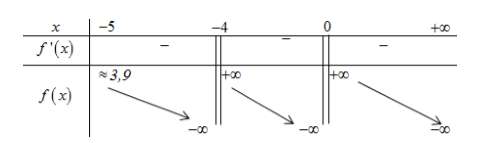
Từ BBT suy ra phương trình (*) có 2 nghiệm \[ \Leftrightarrow a \ge 4\]
Kết hợp ĐK \[ \Rightarrow a \in \left\{ {4;...;2018} \right\}\]Vậy có 2015 giá trị của a thỏa mãn.
Đáp án cần chọn là: D
3
1
2
4
\[lo{g_2}\frac{{3x + 3y + 4}}{{{x^2} + {y^2}}} = (x + y - 1)(2x + 2y - 1) - 4\left( {xy + 1} \right)\]
\[ \Leftrightarrow lo{g_2}(3x + 3y + 4) - lo{g_2}({x^2} + {y^2}) = (x + y - 1)[2(x + y) - 1] - 4(xy + 1)\]
\[ \Leftrightarrow lo{g_2}(3x + 3y + 4) - lo{g_2}({x^2} + {y^2}) = 2{(x + y)^2} - 3(x + y) + 1 - 4(xy + 1)\]
\[ \Leftrightarrow lo{g_2}(3x + 3y + 4) - lo{g_2}({x^2} + {y^2}) = 2({x^2} + {y^2}) + 4xy - (3x + 3y) + 1 - 4xy - 4\]
\[ \Leftrightarrow lo{g_2}(3x + 3y + 4) - lo{g_2}({x^2} + {y^2}) = 2({x^2} + {y^2}) - (3x + 3y + 4) + 1\]
\[ \Leftrightarrow lo{g_2}(3x + 3y + 4) + (3x + 3y + 4) = lo{g_2}({x^2} + {y^2}) + 2({x^2} + {y^2}) + lo{g_2}2\]
\[ \Leftrightarrow lo{g_2}(3x + 3y + 4) + (3x + 3y + 4) = lo{g_2}(2{x^2} + 2{y^2}) + (2{x^2} + 2{y^2})( * )\]
Xét hàm số đặc trưng \[f\left( t \right) = {\log _2}t + t\,\,\left( {t > 0} \right)\] ta có
\[f'\left( t \right) = \frac{1}{{t\ln 2}} + 1 > 0\,\,\forall t > 0\]
⇒ Hàm số y=f(t) luôn đồng biến trên\[\left( {0; + \infty } \right)\]
Do đó \[\left( * \right) \Leftrightarrow 3x + 3y + 4 = 2{x^2} + 2{y^2}\]Ta có:\[{\left( {x + y} \right)^2} \le 2\left( {{x^2} + {y^2}} \right) = 3x + 3y + 4\]
\[ \Leftrightarrow {\left( {x + y} \right)^2} - 3\left( {x + y} \right) - 4 \le 0 \Leftrightarrow - 1 \le x + y \le 4\]
Kết hợp điều kiện đề bài ta có\[0 < x + y \le 4\]
Xét biểu thức
\[P = \frac{{5x + 3y - 2}}{{2x + y + 1}} = \frac{{2\left( {2x + y + 1} \right) + x + y - 4}}{{2x + y + 1}} = 2 + \frac{{x + y - 4}}{{2x + y + 1}}\]
Do \[x + y \le 4 \Leftrightarrow x + y - 4 \le 0 \Leftrightarrow \frac{{x + y - 4}}{{2x + y + 1}} \le 0 \Rightarrow P \le 2\]
Vậy\[{P_{max}} = 2 \Leftrightarrow \left\{ {\begin{array}{*{20}{c}}{x + y = 4}\\{x = y}\end{array}} \right. \Leftrightarrow x = y = 2\]
Đáp án cần chọn là: C
2020.
1009.
1010.
2019.
ĐKXĐ: \[\cos x > 0\]
Ta có: \[f\left( x \right) = {\log _2}\left( {\cos x} \right) \Rightarrow f'\left( x \right) = \frac{{ - \sin x}}{{\cos x.\ln 2}}\]
\[f'\left( x \right) = 0 \Leftrightarrow \frac{{ - \sin x}}{{\cos x.\ln 2}} = 0 \Leftrightarrow \tan x = 0 \Leftrightarrow x = k\pi ,\,k \in \mathbb{Z}\]
Với k chẵn, đặt\[k = 2m\,\,\left( {m \in \mathbb{Z}} \right)\]khi đó ta có\[x = m2\pi \,\,\left( {m \in \mathbb{Z}} \right)\]
Với k lẻ, đặt\[k = 2n + 1\,\,\left( {n \in \mathbb{Z}} \right)\]khi đó ta có\[x = \left( {2n + 1} \right)\pi = \pi + n2\pi \,\,\left( {n \in \mathbb{Z}} \right)\]
Kiểm tra ĐKXĐ:
\[x = m2\pi \Rightarrow \cos x = 1 > 0\]thỏa mãn.
\[x = \pi + k2\pi \Rightarrow \cos x = - 1 < 0\] loại.
Suy ra nghiệm của phương trình là\[x = m2\pi ,\,\,m \in \mathbb{Z}\]
Theo bài ra ta có: \[x \in \left( {0;2020\pi } \right) \Rightarrow 0 < m2\pi < 2020\pi \Leftrightarrow 0 < m < 1010 \Rightarrow \]Có 1009 giá trị nguyên của m thỏa mãn.
Vậy phương trình \[f'\left( x \right) = 0\]có 1009 nghiệm trong khoảng\[\left( {0;2020\pi } \right)\]
Đáp án cần chọn là: B
S=−16.
S=4.
S=−6.
S=6.
Ta có:
\[\begin{array}{*{20}{l}}{\,\,\,\,\,\,\,\log _a^2b + \log _b^2c = {{\log }_a}\frac{c}{b} - 2{{\log }_b}\frac{c}{b} - 3}\\{ \Leftrightarrow \log _a^2b + \log _b^2c = {{\log }_a}c - {{\log }_a}b - 2{{\log }_b}c - 1}\\{ \Leftrightarrow \log _a^2b + \log _b^2c = {{\log }_b}c.{{\log }_a}b - {{\log }_a}b - 2{{\log }_b}c - 1\,\,\left( * \right)}\end{array}\]
Đặt\[{\log _a}b = x \Rightarrow {\log _b}c = x - P\]
Phương trình \[\left( * \right) \Leftrightarrow {x^2} + {\left( {x - P} \right)^2} = \left( {x - P} \right)x - x - 2\left( {x - P} \right) - 1\]
\[\begin{array}{*{20}{l}}{ \Leftrightarrow 2{x^2} - 2Px + {P^2} = {x^2} - Px - 3x + 2P - 1}\\{ \Leftrightarrow {x^2} - \left( {P - 3} \right)x + {P^2} - 2P + 1 = 0\,\,\,\left( { * * } \right)}\end{array}\]
Ta có:\[{\rm{\Delta }} = {\left( {P - 3} \right)^2} - 4\left( {{P^2} - 2P + 1} \right) = - 3{P^2} + 2P + 5\]
Phương trình (**) có nghiệm
\[ \Leftrightarrow \Delta \ge 0 \Leftrightarrow - 3{P^2} + 2P + 5 \ge 0 \Leftrightarrow - 1 \le P \le \frac{5}{3}\]
\( \Rightarrow \left\{ {\begin{array}{*{20}{c}}{m = - 1}\\{M = \frac{5}{3}}\end{array}} \right.\)
Vậy\[S = m - 3M = - 1 - 3.\frac{5}{3} = - 6\]
Đáp án cần chọn là: C
1
\(\frac{1}{2}\)
2
3
Ta có:
\[\begin{array}{*{20}{l}}{\,\,\,\,\,\,\log _{\sqrt a }^2b + {{\log }_b}c.{{\log }_b}\left( {\frac{{{c^2}}}{b}} \right) + 9{{\log }_a}c = 4{{\log }_a}b}\\{ \Leftrightarrow 4\log _a^2b + {{\log }_b}c.\left( {2{{\log }_b}c - 1} \right) + 9{{\log }_a}c = 4{{\log }_a}b}\\{ \Leftrightarrow 4\log _a^2b + 2\log _b^2c - {{\log }_b}c + 9{{\log }_a}b.{{\log }_b}c = 4{{\log }_a}b\,\,\left( * \right)}\end{array}\]
Đặt \[x = {\log _a}b,\,\,y = {\log _b}c\] ta có:\(\left\{ {\begin{array}{*{20}{c}}{x = lo{g_a}b > lo{g_a}1 = 0}\\{y = lo{g_b}c > lo{g_b}1 = 0}\end{array}} \right.(do\,\,\,a,b,c > 1)\)
Khi đó phương trình (*) trở thành:
\[4{x^2} + 2{y^2} - y + 9xy = 4x\]
\[ \Leftrightarrow 4{x^2} + xy + 8xy + 2{y^2} - y - 4x = 0\]
\[ \Leftrightarrow x(4x + y) + 2y(4x + y) - (4x + y) = 0\]
\[ \Leftrightarrow (4x + y)(x + 2y - 1) = 0\]
\( \Leftrightarrow \left[ {\begin{array}{*{20}{c}}{4x + y = 0}\\{x + 2y - 1 = 0}\end{array}} \right.\)
TH1:\[y = - 4x\] loại do x,y>0.
TH2: \[x + 2y - 1 = 0 \Leftrightarrow x + 2y = 1\] khi đó ta có:\[{\log _a}b + {\log _b}{c^2} = x + 2y = 1\]Đáp án cần chọn là: A
4
1
2
3
Ta có:
\[{4^{ - \left| {x - m} \right|}}.{\log _{\sqrt 2 }}\left( {{x^2} - 2x + 3} \right) + {2^{2x - {x^2}}}.{\log _{\frac{1}{2}}}\left( {2\left| {x - m} \right| + 2} \right) = 0\]
\[ \Leftrightarrow {2^{ - 2|x - m|}}.2.lo{g_2}({x^2} - 2x + 3) - {2^{2x - {x^2}}}.lo{g_2}(2|x - m| + 2) = 0\]
\[ \Leftrightarrow {2^{ - 2|x - m| + 1}}.lo{g_2}({x^2} - 2x + 3) = {2^{2x - {x^2}}}.lo{g_2}(2|x - m| + 2)\]
\[ \Leftrightarrow {2^{{x^2} - 2x}}.lo{g_2}({x^2} - 2x + 3) = {2^{2|x - m| - 1}}.lo{g_2}(2|x - m| + 2)\]
\[ \Leftrightarrow {2^{{x^2} - 2x}} + 2.lo{g_2}({x^2} - 2x + 3) = {2^{2|x - m| + 2}}.lo{g_2}(2|x - m| + 2)\]
Xét hàm đặc trưng\[f\left( t \right) = {2^t}.{\log _2}t\,\,\left( {t \ge 2} \right)\] ta có
\[f'\left( t \right) = {2^t}.\ln 2.{\log _2}t + {2^t}.\frac{1}{{t\ln 2}} > 0\,\,\forall t \ge 2\] do đó hàm số đồng biến trên\[\left[ {2; + \infty } \right)\]
Lại có\[f\left( {{x^2} - 2x + 3} \right) = f\left( {2\left| {x - m} \right| + 2} \right)\]
\[\begin{array}{*{20}{l}}{ \Leftrightarrow {x^2} - 2x + 3 = 2\left| {x - m} \right| + 2}\\{ \Leftrightarrow {x^2} - 2x + 1 = 2\left| {x - m} \right|}\\{ \Leftrightarrow {{\left( {x - 1} \right)}^2} = 2\left| {x - m} \right|\,\,\left( * \right)}\end{array}\]
Để phương trình ban đầu có 3 nghiệm phân biệt thì phương trình (*) phải có 3 nghiệm phân biệt.
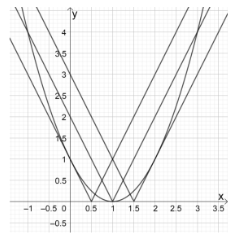
Dựa vào đồ thị hàm số ta có \[m = \frac{1}{2},\,\,m = 1,\,\,m = \frac{3}{2}\] thỏa mãn yêu cầu bài toán.
Đáp án cần chọn là: D
S=28
S=25
S=26
S=27
Ta có:
\[\begin{array}{l}\log _a^2b + \log _b^2c + 2{\log _b}\frac{c}{b} = {\log _a}\frac{c}{{{a^3}b}}\\ \Leftrightarrow \log _a^2b + \log _b^2c + 2{\log _b}c - 2 = {\log _a}c - {\log _a}\left( {{a^3}b} \right)\\ \Leftrightarrow \log _a^2b + \log _b^2c + 2{\log _b}c - 2 = {\log _a}c - 3 - {\log _a}b\\ \Leftrightarrow \log _a^2b + \log _b^2c = {\log _a}b.{\log _b}c - 2{\log _b}c - {\log _a}b - 1\left( 1 \right)\end{array}\]
Đặt \[x = {\log _a}b,\,\,y = {\log _b}c\] khi đó ta có:
\[\begin{array}{*{20}{l}}{P = {{\log }_a}ab - {{\log }_b}bc}\\{P = 1 + {{\log }_a}b - 1 - {{\log }_b}c}\\{P = x - y \Rightarrow y = x - P}\end{array}\]Thay x,y vào (1) ta có:
\[\begin{array}{*{20}{l}}{{x^2} + {y^2} = xy - 2y - x - 1}\\{ \Leftrightarrow {x^2} + {{\left( {x - P} \right)}^2} = x\left( {x - P} \right) - 2\left( {x - P} \right) - x - 1}\\{ \Leftrightarrow {x^2} + {x^2} - 2Px + {P^2} = {x^2} - Px - 2x + 2P - x - 1}\\{ \Leftrightarrow {x^2} - \left( {P - 3} \right)x + {P^2} - 2P + 1 = 0\,\,\left( 2 \right)}\end{array}\]
Để tồn tại các số a,b,c thỏa mãn yêu cầu bài toán thì phương trình (2) phải có nghiệm.
\[\begin{array}{*{20}{l}}{ \Rightarrow {\rm{\Delta }} \ge 0}\\{ \Leftrightarrow {{\left( {P - 3} \right)}^2} - 4\left( {{P^2} - 2P + 1} \right) \ge 0}\\{ \Leftrightarrow {P^2} - 6P + 9 - 4{P^2} + 8P - 4 \ge 0}\\{ \Leftrightarrow - 3{P^2} + 2P + 5 \ge 0}\\{ \Leftrightarrow - 1 \le P \le \frac{5}{3}}\end{array}\]
Vậy\[m = - 1,\,\,M = \frac{5}{3} \Rightarrow S = 2{m^2} + 9{M^2} = 2.{\left( { - 1} \right)^2} + 9.{\left( {\frac{5}{3}} \right)^2} = 27\]
Đáp án cần chọn là: D
Bước 1: Sử dụng hàm đặc trưng.
Ta có
\[\begin{array}{*{20}{l}}{\,\,\,\,\,\,\,{{11}^x} + m = {{\log }_{11}}\left( {x - m} \right)}\\{ \Leftrightarrow {{11}^x} + x = x - m + {{\log }_{11}}\left( {x - m} \right)}\\{ \Leftrightarrow {{11}^x} + x = {{11}^{{{\log }_{11}}\left( {x - m} \right)}} + {{\log }_{11}}\left( {x - m} \right)\,\,\left( * \right)}\end{array}\]
Xét hàm số\[f\left( t \right) = {11^t} + t \Rightarrow y' = {11^t}.\ln 11 + 1 > 0\,\,\,\forall t\] Khi đó hàm số\[y = f\left( t \right)\] đồng biến trên\(\mathbb{R}\)
Do đó\[\left( * \right) \Leftrightarrow x = {\log _{11}}\left( {x - m} \right) \Leftrightarrow {11^x} = x - m \Leftrightarrow m = x - {11^x}\]
Bước 2: Khảo sát hàm số\[g(x) = x - {11^x}\]
Xét hàm số \[g\left( x \right) = x - {11^x}\] ta có
\[g'\left( x \right) = 1 - {11^x}.\ln 11 = 0 \Rightarrow x = {\log _{11}}\frac{1}{{\ln 11}} = {x_0}\]
Bảng biến thiên:
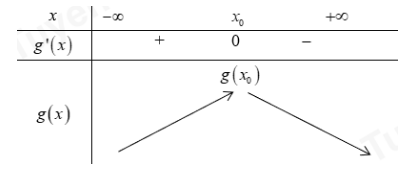
Bước 3: Biện luận nghiệm theo m.
Để phương trình đã cho có nghiệm thì\[m < g\left( {{x_0}} \right) \approx - 0,78\]
Kết hợp điều kiện đề bài ta có\(\left\{ {\begin{array}{*{20}{c}}{ - 205 < m \le - 1}\\{m \in \mathbb{Z}}\end{array}} \right.\)
Vậy có 204 giá trị của nguyên của m thỏa mãn yêu cầu bài toán.
Bạn có thích hoạt động này không?
Hãy lưu hoặc chia sẻ nội dung này đến mọi người.
Gợi ý cho bạn

Ý tưởng của bạn, bài học của bạn
Tự thiết kế đề thi, bài giảng hoặc flashcard theo cách riêng.



Học liệu phổ biến Đánh giá năng lực
Đánh giá năng lực
Bài tập vừa sức, đúng lớp
Chọn nội dung phù hợp và tạo hoạt động cho lớp của bạn.






Học liệu phổ biến ĐHQG Hà Nội
ĐHQG Hà Nội
Thêm cảm hứng cho môn học
Biến kiến thức quen thuộc thành hoạt động học tập thú vị.