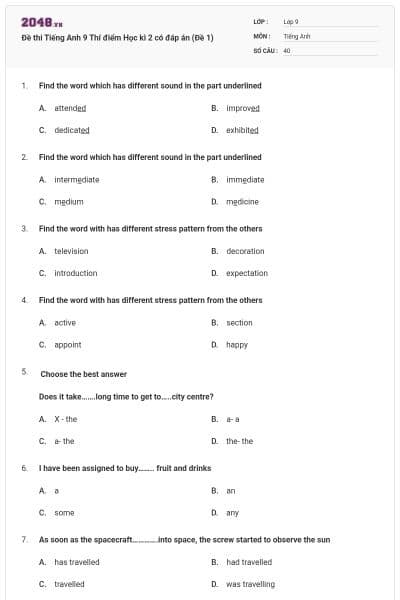
Đề thi Tiếng Anh 9 Thí điểm Học kì 2 có đáp án (Đề 1)
40 câu hỏi
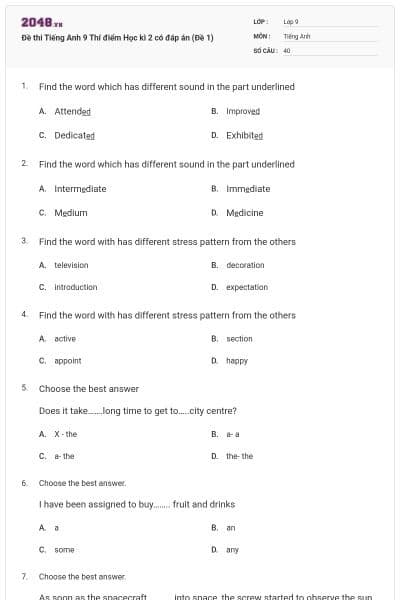
Find the word which has different sound in the part underlined
attended
improved
dedicated
exhibited
Đáp án: B
Đáp án A. C,D phát âm là /id/, đáp án B phát âm là /d/
Find the word which has different sound in the part underlined
intermediate
immediate
medium
medicine
Đáp án: D
Find the word with has different stress pattern from the others
television
decoration
introduction
expectation
Đáp án: C
Đáp án A trọng âm thứ nhất, các đáp án còn lại trọng âm thứ 3
Find the word with has different stress pattern from the others
active
section
appoint
happy
Đáp án: C
Choose the best answer
Does it take…….long time to get to…..city centre?
X - the
a- a
a- the
the- the
Đáp án: C
I have been assigned to buy…….. fruit and drinks
a
an
some
any
Đáp án: C
As soon as the spacecraft………….into space, the screw started to observe the sun
has travelled
had travelled
travelled
was travelling
Đáp án: C
A bad accident ……………. On Highway 95 last night
happened
happen
was happened
was happening
Đáp án: A
If I ……… taller, I…… better at basketball
be- will be
were – might be
am- will be
were – would have been
Đáp án: B
The children…………..attend that English school receive good education
which
whose
who
whom
Đáp án: C
Mike comes from a city…… is located in the southern part of England
when
that
where
who
Đáp án: B
Giải thích:
Kiến thức: Đại từ quan hệ
A. when: khi mà (trạng từ quan hệ, thay cho trạng từ chỉ thời gian)
B. that: cái/người mà (đại từ quan hệ thay cho được cả người và vật đứng làm tân ngữ/chủ ngữ trong mệnh đề quan hệ xác định)
C. where: nơi mà (trạng từ quan hệ, thay cho trạng từ chỉ nơi chốn)
D. who: người mà (đại từ quan hệ thay cho danh từ chỉ người đứng làm chủ ngữ)
Vị trí cần điền là một đại từ quan hệ đứng làm chủ ngữ trong mệnh đề quan hệ, loại A và C.
“a city” (một thành phố) là danh từ chỉ vật, dùng B.
Dịch: Mike đến từ một thành phố nằm ở phía Nam nước Anh.
If parents don’t cook at home, their children...............most fast
would have
had had
have
may have
Đáp án: D
On January 17th, people in Mexico bring their animals ………… church
on
in
to
up
Đáp án: C
Mary: “I think we should save energy at home as well as at school”
Peter: “……………………………….”
That’s a good idea
Yes, we do
No, we don’t
Yes, we think
Đáp án: A
Ha: “You’ve passed your exam. Congratulations!”
Lan: “…………………………………”
That’s very nice of you
Yes, I do
No, let’s not
I’d love to
Đáp án: A
Giải thích:
Dịch: Ha: “Bạn đã đỗ kỳ thi rồi. Chúc mừng nhé!”
Lan: “…………………………………”
A. Bạn thật tốt bụng
B. Vâng, tôi biết
C. Không, đừng
D. Tôi rất muốn
Đáp án A thường được dùng để đáp lại lời chúc mừng, lời khen.
Choose the word or phrase that is CLOSEST in meaning to the underlined part in each of the following sentences.
Roget's Thesaurus, a collection of English words and phrases, was originally arranged by the ideas they express rather than by alphabetical order.
restricted
as well as
unless
instead of
Đáp án: D
Let's wait here for her; I'm sure she'll turn up before long.
arrive
return
enter
visit
Đáp án: A
Choose the word or phrase that is OPPOSITE in meaning to the underlined part in each of the following sentences.
I clearly remember talking to him in a chance meeting last summer.
unplanned
deliberate
accidental
unintentional
Đáp án: B
Choose the word or phrase that is OPPOSITE in meaning to the underlined part in each of the following sentences.
The new school year starts on September 5th
begin
finishes
finish
comes
Đáp án: B
Find the mistake in each sentence below.
I tried master some essential skills before applying for that job.
tried
master
skills
for
Đáp án: B
Find the mistake in each sentence below.
He said that he remembered to work with her in a handicraft village but she said she was mistaken
he
to work
a
but
Đáp án: B
Remember +Ving: Nhớ đã làm gì
Find the mistake in each sentence below.
The most people woull agree that travelling broadens the mind as you get to see so many different ways of life.
The most people
that
as
to see
Đáp án: A
Choose the correct option A, B, C, or D for each gap in the passage.
It is a custom for all of a Chinese family to be present at home (1)……… the Eve Chinese New Year for the reunion dinner. This custom is meant to symbolize the unity of the family for the (2)… new year. After the reunion dinner, the younger members of the family (3)…….. serve tea to their elders as a show of respect. For the first five days of the Chinese New Year, no one in the family is allowed to (4)………. the floor. The Chinese believe that the act of sweeping will drive away all the good luck (5)……… the New Year could bring.
Question 1:
on
at
from
in
Đáp án: A
Choose the correct option A, B, C, or D for each gap in the passage.
It is a custom for all of a Chinese family to be present at home (1)……… the Eve Chinese New Year for the reunion dinner. This custom is meant to symbolize the unity of the family for the (2)… new year. After the reunion dinner, the younger members of the family (3)…….. serve tea to their elders as a show of respect. For the first five days of the Chinese New Year, no one in the family is allowed to (4)………. the floor. The Chinese believe that the act of sweeping will drive away all the good luck (5)……… the New Year could bring.
Question 2:
to come
come
comes
coming
Đáp án: D
Choose the correct option A, B, C, or D for each gap in the passage.
It is a custom for all of a Chinese family to be present at home (1)……… the Eve Chinese New Year for the reunion dinner. This custom is meant to symbolize the unity of the family for the (2)… new year. After the reunion dinner, the younger members of the family (3)…….. serve tea to their elders as a show of respect. For the first five days of the Chinese New Year, no one in the family is allowed to (4)………. the floor. The Chinese believe that the act of sweeping will drive away all the good luck (5)……… the New Year could bring.
Question 3:
should
ought
must
have
Đáp án: C
Choose the correct option A, B, C, or D for each gap in the passage.
It is a custom for all of a Chinese family to be present at home (1)……… the Eve Chinese New Year for the reunion dinner. This custom is meant to symbolize the unity of the family for the (2)… new year. After the reunion dinner, the younger members of the family (3)…….. serve tea to their elders as a show of respect. For the first five days of the Chinese New Year, no one in the family is allowed to (4)………. the floor. The Chinese believe that the act of sweeping will drive away all the good luck (5)……… the New Year could bring.
Question 4:
clear
clean
sweep
tidy
Đáp án: C
Choose the correct option A, B, C, or D for each gap in the passage.
It is a custom for all of a Chinese family to be present at home (1)……… the Eve Chinese New Year for the reunion dinner. This custom is meant to symbolize the unity of the family for the (2)… new year. After the reunion dinner, the younger members of the family (3)…….. serve tea to their elders as a show of respect. For the first five days of the Chinese New Year, no one in the family is allowed to (4)………. the floor. The Chinese believe that the act of sweeping will drive away all the good luck (5)……… the New Year could bring.
Question 5:
where
which
what
who
Đáp án: B
Read the text and choose the answer A, B, C or D according to the text.
Over the past 600 years, English has grown from a language of few speakers to become the dominant language of international communication. English as we know it today emerged around 1350, after having incorporated many elements of French that were introduced following the Norman invasion of 1030. Until the 1600s, English was, for the most part, spoken only in England and had not attended even as far as Wales, Scotland, or Ireland. However, during the course of the next two centuries, English began to spread around the globe as a result of exploration, trade (including slave trade), colonization, and missionary work. Thus, small enclaves of English speakers became established and grew in various parts of the world. As these communities proliferated, English gradually became the primary language of international business, banking, and diplomacy. Currently, about 80 percent of the information stored on computer systems Worldwide is in English. Two-thirds of the world’s science writing is in English, and English is the main language of technology, advertising, media, international airports, and air traffic controllers. Today there are more than 700 million English Users in the world, and over half of these are non-native speakers, constituting the largest number of non-native users than any other language in the world.
What is the main topic of this passage?
The number of non-native users of English
The French influence on the English language
The expansion of English as an international language
The use of English for science and technology
Đáp án: C
Read the text and choose the answer A, B, C or D according to the text.
Over the past 600 years, English has grown from a language of few speakers to become the dominant language of international communication. English as we know it today emerged around 1350, after having incorporated many elements of French that were introduced following the Norman invasion of 1030. Until the 1600s, English was, for the most part, spoken only in England and had not attended even as far as Wales, Scotland, or Ireland. However, during the course of the next two centuries, English began to spread around the globe as a result of exploration, trade (including slave trade), colonization, and missionary work. Thus, small enclaves of English speakers became established and grew in various parts of the world. As these communities proliferated, English gradually became the primary language of international business, banking, and diplomacy. Currently, about 80 percent of the information stored on computer systems Worldwide is in English. Two-thirds of the world’s science writing is in English, and English is the main language of technology, advertising, media, international airports, and air traffic controllers. Today there are more than 700 million English Users in the world, and over half of these are non-native speakers, constituting the largest number of non-native users than any other language in the world.
Approximately when did English begin to be used beyond England?
In 1066
Around 1350
Before 1600
After the 1603
Đáp án: D
Read the text and choose the answer A, B, C or D according to the text.
Over the past 600 years, English has grown from a language of few speakers to become the dominant language of international communication. English as we know it today emerged around 1350, after having incorporated many elements of French that were introduced following the Norman invasion of 1030. Until the 1600s, English was, for the most part, spoken only in England and had not attended even as far as Wales, Scotland, or Ireland. However, during the course of the next two centuries, English began to spread around the globe as a result of exploration, trade (including slave trade), colonization, and missionary work. Thus, small enclaves of English speakers became established and grew in various parts of the world. As these communities proliferated, English gradually became the primary language of international business, banking, and diplomacy. Currently, about 80 percent of the information stored on computer systems Worldwide is in English. Two-thirds of the world’s science writing is in English, and English is the main language of technology, advertising, media, international airports, and air traffic controllers. Today there are more than 700 million English Users in the world, and over half of these are non-native speakers, constituting the largest number of non-native users than any other language in the world.
According to the passage, all of the following contributed to the spread of English around the world EXCEPT
the slave trade
the Norman invasion
missionaries
colonization
Đáp án: B
Read the text and choose the answer A, B, C or D according to the text.
Over the past 600 years, English has grown from a language of few speakers to become the dominant language of international communication. English as we know it today emerged around 1350, after having incorporated many elements of French that were introduced following the Norman invasion of 1030. Until the 1600s, English was, for the most part, spoken only in England and had not attended even as far as Wales, Scotland, or Ireland. However, during the course of the next two centuries, English began to spread around the globe as a result of exploration, trade (including slave trade), colonization, and missionary work. Thus, small enclaves of English speakers became established and grew in various parts of the world. As these communities proliferated, English gradually became the primary language of international business, banking, and diplomacy. Currently, about 80 percent of the information stored on computer systems Worldwide is in English. Two-thirds of the world’s science writing is in English, and English is the main language of technology, advertising, media, international airports, and air traffic controllers. Today there are more than 700 million English Users in the world, and over half of these are non-native speakers, constituting the largest number of non-native users than any other language in the world.
The word “enclaves” in the passage could best be replaced by which of the following?
communities
organizations
regions
countries
Đáp án: A
Read the text and choose the answer A, B, C or D according to the text.
Over the past 600 years, English has grown from a language of few speakers to become the dominant language of international communication. English as we know it today emerged around 1350, after having incorporated many elements of French that were introduced following the Norman invasion of 1030. Until the 1600s, English was, for the most part, spoken only in England and had not attended even as far as Wales, Scotland, or Ireland. However, during the course of the next two centuries, English began to spread around the globe as a result of exploration, trade (including slave trade), colonization, and missionary work. Thus, small enclaves of English speakers became established and grew in various parts of the world. As these communities proliferated, English gradually became the primary language of international business, banking, and diplomacy. Currently, about 80 percent of the information stored on computer systems Worldwide is in English. Two-thirds of the world’s science writing is in English, and English is the main language of technology, advertising, media, international airports, and air traffic controllers. Today there are more than 700 million English Users in the world, and over half of these are non-native speakers, constituting the largest number of non-native users than any other language in the world.
The word “proliferated” in the passage is closest in meaning to which of the following?
prospered
organized
disbanded
expanded
Đáp án: D
Rewrite these sentences so that it has the same meaning as the root ones.
They went home after they had eaten a big roasted chicken. (before)
→………………………………………………………………………………..
Đáp án: Before they went home, they had eaten a big roasted chicken.
Although he has a very important job, he isn’t particularly well-paid ( In spite of)
→………………………………………………………………………………..
Đáp án: In spite of having a very important job, he isn’t particularly well-paid (In spite of his important job, he isn’t particularly well-paid)
Listen to the teacher attentively or you won’t understand the lesson (If)
→………………………………………………………………………………..
Đáp án: If you don’t listen to the teacher attentively, you won’t understand the lesson y well-paid)
John will meet me at the airport tomorrow
→………………………………………………………………………………..
Đáp án: I will be met at the airport by John tomorrow
Combine these pairs of sentences.
He is performing well at school. He does not know what he will choose as his future career (despite)
→ ………………………………………………………………………………………
Đáp án: Despite his good performance, he does not know what he will choose as his future career.
I used credit card to buy a computer game. The game is called “Mars Mystique Mission” (which)
→ ………………………………………………………………………………………
Đáp án: I used credit card to buy a computer game which is called “Mars Mystique Mission”.
I don’t have a car. I have to work by bus (If)
→ ……………………………………………………………………………………….
Đáp án: If I had a car, I wouldn’t have to work by bus.
She came home late yesterday evening. Her parents were worried (adj + that clause)
→ ………………………………………………………………………………………..
Đáp án: Her parents were worried that she came home late yesterday evening.
Bạn có thích hoạt động này không?