Đề thi giữa kì 2 Tiếng Anh 7 THCS Hải Bối - Đông Anh năm học 2023-2024 có đáp án
40 câu hỏi
PART I: LISTENING (2,0 pts)
Listen to Mark talking about how his family celebrate then choose the correct answer A, B, C or D. (1.25pts)
Mark is talking about ................., or Turkey Day.
Easter
Christmas
Mid- Autumn
Thanksgiving
Đáp án đúng là D
Kiến thức: Nghe hiểu
Giải thích: Dựa vào gợi ý về Turkey Day cũng có thể liên hệ ngay đến Thanksgiving: Lễ tạ ơn
Dịch nghĩa: Mark đang nói về Lễ tạ ơn, hay Ngày Thổ Nhĩ Kỳ.
China
USA
England
Japan
Đáp án đúng là B
Kiến thức: Nghe hiểu
Giải thích: Thông tin “In the USA, we celebrate it on the fourth Thursday of November’’
Dịch nghĩa: Ở Hoa Kỳ, người ta kỷ niệm ngày này vào ngày Thứ Năm của tuần thứ tư trong tháng 11.
meat
flowers
biscuits
feast
Kiến thức: Nghe hiểu
Giải thích: a feast (danh từ): bữa tiệc => dùng cho các dịp lễ
Dịch nghĩa: Chúng tôi thường chuẩn bị một bữa tiệc cho gia đình và bạn bè.
sweet potatoes
tomatoes
fried potatoes
street food
Đáp án đúng là A
Kiến thức: Nghe hiểu
Giải thích: Thông tin “Some of the traditional foods are turkey, sweet potatoes and cornbread’’
Dịch nghĩa: Một số món ăn truyền thống là gà tây, khoai lang và bánh ngô.
grandparents
teenager
children
old people
Kiến thức: Nghe hiểu
Giải thích: Thông tin “We also help our parents prepare the food’’
Dịch nghĩa: Cả người lớn và trẻ em đều tham gia chuẩn bị thức ăn.
Listen to the passage then answer the questions by choosing A, B, C or D. (0.75pt)
What do they do after the meal?
decorate
go to the church
clean and paint
play board game
Kiến thức: Nghe hiểu
Giải thích: Thông tin “We usually play a board game together after the meal’’
Dịch nghĩa: Chúng tôi thường chơi board game cùng nhau sau bữa ăn
clean the house
sing a song
buy food
read books
Kiến thức: Nghe hiểu
Giải thích: Thông tin “We often read books to old people in a nursing home’’
Dịch nghĩa: Chúng tôi thường đọc sách cho người già trong viện dưỡng lão
Yes, there is
Yes, they are
No, it isn’t
Yes, it does
Kiến thức: Nghe hiểu
Giải thích: Thông tin “We often read books to old people in a nursing home. It’s convenient to get to the nursing home because it is near my house’’
Dịch nghĩa: Gần nhà Mark có một viện dưỡng lão
PART II: PHONETICS, VOCABULARY AND GRAMMAR (4,5 pt)
Mark the letter A, B, C or D on your answer sheet to indicate the word that differs from the other three in the position of primary stress in each of the following questions. (0.5pt)
famous
attend
agree
enjoy
Kiến thức: trọng âm
Giải thích: Từ “famous” có trọng âm chính ở âm tiết thứ nhất, các từ còn lại ở âm tiết thứ hai.
Dịch nghĩa: A. nổi tiếng B. tham dự C. đồng ý D. tận hưởng
Mark the letter A, B, C or D on your answer sheet to indicate the word that differs from the other three in the position of primary stress in each of the following questions. (0.5pt)
traffic
noisy
student
prefer
Kiến thức: trọng âm
Giải thích: Từ “prefer” có trọng âm chính ở âm tiết thứ hai, các từ còn lại ở âm tiết thứ nhất.
Dịch nghĩa: A. giao thông B. ồn ào C. sinh viên D. thích
The air conditioner Mary has just bought is very hard to use.
difficult
easy
boring
happy
Đáp án đúng là A
Giải thích: hard và difficult đều có nghĩa là khó, khó khăn
Dịch nghĩa: Chiếc điều hòa Mary vừa mua rất khó sử dụng.
The film was so dull that we almost fell asleep.
boring
hilarious
exciting
violent
Đáp án đúng là A
Giải thích: dull và boring đều có nghĩa là buồn tẻ, tẻ nhạt
Dịch nghĩa: Bộ phim buồn tẻ đến nỗi chúng tôi gần như ngủ quên.
Mark the letter A, B, C or D on your answer sheet to indicate the word whose underlined part differs from the other three in pronunciation in each of the following questions. (0.5pt)
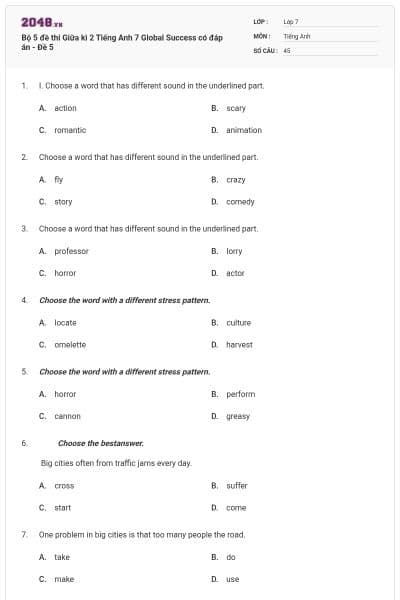
station
lane
traffic
safety
Đáp án đúng là C
Kiến thức: ngữ âm
Giải thích: Âm a ở từ “traffic” phát âm là /æ/, trong khi ở các từ còn lại là /ei/
Dịch nghĩa: A. trạm B. làn đường C. giao thông D. an toàn
Mark the letter A, B, C or D on your answer sheet to indicate the word whose underlined part differs from the other three in pronunciation in each of the following questions. (0.5pt)
chair
share
square
hear
Đáp án đúng là D
Kiến thức: ngữ âm
Giải thích: Trong khi các từ đều được phát âm là /eər/ thì từ “hear” được phát âm là /ɪər/
Dịch nghĩa: A. ghế B. chia sẻ C. vuông D. nghe
Mark the letter A, B, C or D on your answer sheet to indicate the correct answer to each of the following questions. (1.5pts)
I enjoyed the film on TV yesterday evening ………….. nobody in my family liked it.
However
although
so
in spite of
Đáp án đúng là B
Kiến thức: liên từ
Giải thích: Liên từ đúng để thể hiện sự tương phản bất chấp ý kiến của người khác là “though”
Dịch nghĩa: Tôi rất thích bộ phim trên TV tối hôm qua dù không ai trong gia đình tôi thích nó.
on
from
by
in
Đáp án đúng là C
Kiến thức: giới từ
Giải thích: Giới từ dùng cho phương thức vận tải là “by”
Dịch nghĩa: Tôi đi học bằng xe đạp.
Does
Can
Do
Did
Kiến thức: Động từ khuyết thiếu
Giải thích: Câu trả lời là “Yes, he can.” nên câu hỏi sẽ bắt đầu với trợ động từ “Can”
Dịch nghĩa: Nam có thể vẽ trứng được không? Được, anh ấy có thể.
will
must
would
might
Kiến thức: Động từ khuyết thiếu
Giải thích: Động từ khuyết thiếu đúng để dự đoán tương lai là “will”
Dịch nghĩa: Tôi nghĩ chúng ta sẽ sớm có taxi điện.
No, I didn’t
Yes, I do
Yes, I didn’t
No, I do
Giải thích: Câu trả lời phủ định ở thì quá khứ đúng là “No, I didn’t”
Dịch nghĩa: Tối qua bạn có đi xem phim không? - Không, tôi không
That
It
There
This
Giải thích: Chủ ngữ giả “It”
Dịch nghĩa: Từ đây đến rạp chiếu phim không xa lắm.
Mark the letter A, B, C or D on your answer sheet to indicate the underlined part that needs correction in each of the following questions. (0.5pt)
school
months
teaches
at
Kiến thức: Thì quá khứ đơn
Giải thích: “Two months ago” nên động từ chia ở dạng quá khứ, quá khứ của teach là taught
Dịch nghĩa: Hai tháng trước, cô dạy ở một trường làng.
cinema
about
What
to go
Giải thích: What about + Ving…? - Câu gợi ý
Dịch nghĩa: Đi xem phim thì sao?
Mark the letter A, B, C or D on your answer sheet to indicate the most suitable response to complete each of the following exchanges. (0.5pt)
- "What’s on the television tonight?" -“ _____________”
I will go to the cinema
A football match after the news
The film is good
At half past nine
Giải thích: Đáp án phù hợp cho câu hỏi về chương trình truyền hình là về nội dung.
Dịch nghĩa: “Tối nay trên tivi có gì thế?”- “Một trận bóng đá sau bản tin”
Lan: "Why don't we go camping this weekend?" - Nga: "____”
You're welcome.
That's a good idea.
Here you are.
That's a fine day.
Giải thích: Cách đồng ý một lời đề nghị - That's a good idea.
Dịch nghĩa: Lan: “Sao cuối tuần này chúng ta không đi cắm trại nhỉ?” - Nga: “Hay đấy.”
Go along the street and then turn right.
correct
true
wrong
left
Đáp án đúng là D
Giải thích: Ngược với “right” (bên phải) là “left” (bên trái)
Dịch nghĩa: Đi dọc theo con phố rồi rẽ phải.
We must obey traffic rules, we will be safe.
generous
dangerous
easy
difficult
Đáp án đúng là B
Giải thích: Ngược với “safe” (an toàn) là “dangerous” (nguy hiểm)
Dịch nghĩa: Chúng ta phải tuân thủ luật lệ giao thông thì mới an toàn.
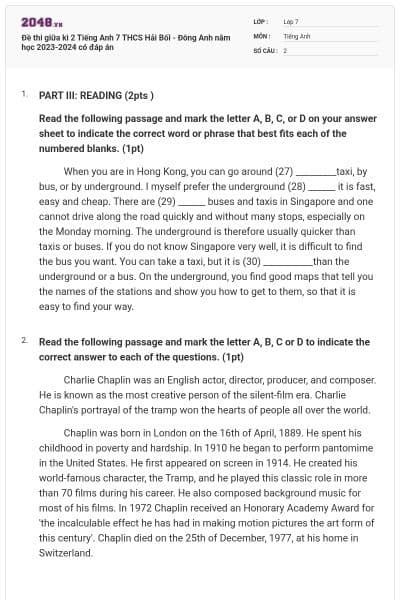
PART III: READING (2pts )
Read the following passage and mark the letter A, B, C, or D on your answer sheet to indicate the correct word or phrase that best fits each of the numbered blanks. (1pt)
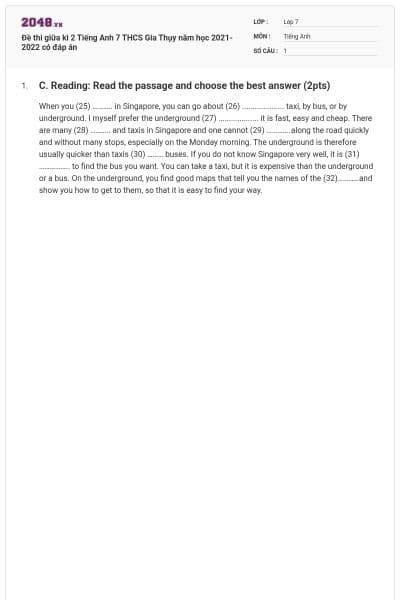
When you are in Hong Kong, you can go around (27) _________taxi, by bus, or by underground. I myself prefer the underground (28) ______ it is fast, easy and cheap. There are (29) ______ buses and taxis in Singapore and one cannot drive along the road quickly and without many stops, especially on the Monday morning. The underground is therefore usually quicker than taxis or buses. If you do not know Singapore very well, it is difficult to find the bus you want. You can take a taxi, but it is (30) ___________than the underground or a bus. On the underground, you find good maps that tell you the names of the stations and show you how to get to them, so that it is easy to find your way.
on
in
by
at
Đáp án đúng là C
Giải thích: Giới từ đúng cho phương thức vận tải là “by”
Dịch nghĩa: Khi bạn ở Hồng Kông, bạn có thể đi lại bằng taxi, xe buýt hoặc tàu điện ngầm.
and
because
when
but
Đáp án đúng là B
Giải thích: Liên từ đúng để giải thích một lý do là “because”
Dịch nghĩa: Bản thân tôi thích đi tàu điện ngầm hơn vì nhanh, dễ và rẻ.
few
a little
a lot
many
Giải thích: Từ định lượng chính xác cho danh từ đếm được để biểu thị số lượng lớn là “many”
Dịch nghĩa: Có rất nhiều xe buýt và taxi ở Singapore và người ta không thể lái xe dọc đường một cách nhanh chóng và không có nhiều điểm dừng, đặc biệt là vào sáng thứ Hai.
expensive
expensiver
more expensive
most expensive
Kiến thức: so sánh hơn
Giải thích: Dạng so sánh đúng của “expensive” là “more expensive”
Dịch nghĩa: Bạn có thể đi taxi, nhưng nó đắt hơn tàu điện ngầm hoặc xe buýt.
Read the following passage and mark the letter A, B, C or D to indicate the correct answer to each of the questions. (1pt)
Charlie Chaplin was an English actor, director, producer, and composer. He is known as the most creative person of the silent-film era. Charlie Chaplin's portrayal of the tramp won the hearts of people all over the world.
Chaplin was born in London on the 16th of April, 1889. He spent his childhood in poverty and hardship. In 1910 he began to perform pantomime in the United States. He first appeared on screen in 1914. He created his world-famous character, the Tramp, and he played this classic role in more than 70 films during his career. He also composed background music for most of his films. In 1972 Chaplin received an Honorary Academy Award for 'the incalculable effect he has had in making motion pictures the art form of this century'. Chaplin died on the 25th of December, 1977, at his home in Switzerland.
When did he start appearing in films?
In 1972
In 1941
In 1910
In 1914
Đáp án đúng là D
Giải thích: Thông tin “He first appeared on screen in 1914.”
Dịch nghĩa: Ông xuất hiện lần đầu trên màn ảnh vào năm 1914.
In about how many films did he play the Tramp?
less Seventy
Seventeen
Twenty-five
over seventy
Đáp án đúng là D
Giải thích: Thông tin “He created his world-famous character, the Tramp, and he played this classic role in more than 70 films during his career.”
Dịch nghĩa: Ông ấy đã tạo ra nhân vật nổi tiếng thế giới của mình, Kẻ lang thang và ông đã đóng vai kinh điển này trong hơn 70 bộ phim trong sự nghiệp của mình.
What is Charlie Chaplin’s job?
director
actor
producer and compose
All are correct
Giải thích: Thông tin “Charlie Chaplin was an English actor, director, producer, and composer.”
Dịch nghĩa: Charlie Chaplin là một diễn viên, đạo diễn, nhà sản xuất và nhà soạn nhạc.
Charlie Chaplin was an English artist.
He received an award in 1972.
He played classical music.
Chaplin died on the 25th of December, 1977.
Giải thích: Thông tin “He also composed background music for most of his films.”
Dịch nghĩa: Ông ấy cũng sáng tác nhạc nền cho hầu hết các bộ phim của mình.
PART IV: WRITING (1.5pts)
Rearrange the words or phrases below to complete the sentences. (0.75pt)
your/ from/ It’s/ 8/ to/ km/ school/ about/ house/.
It’s about 8 km your house to from school.
It’s about 8 km to your house from school.
It’s about 8 km from your house to school.
It’s 8km from to school about your house.
Giải thích: Sắp xếp đúng các từ để tạo thành câu có nghĩa
Dịch nghĩa: Từ nhà đến trường khoảng 8km.
in/ attend /Let’s/ festival / Hai Phong/ buffalo.
Let’s buffalo festival attend in Hai Phong.
Let’s attend festival buffalo in Hai Phong.
Let’s attend in festival buffalo Hai Phong
Let’s attend buffalo festival in Hai Phong.
Giải thích: Sắp xếp đúng các từ để tạo thành câu có nghĩa
Dịch nghĩa: Hãy tham dự lễ hội trâu ở Hải Phòng.
Before / every meal / should wash / our hands / carefully /we/.
Before every meal, we should washing our hands carefully.
Before every meal, we should to wash our hands carefully.
Before every meal, we should wash our hands carefully.
Before every meal, we should washed our hands carefully.
Giải thích: Sắp xếp đúng các từ để tạo thành câu có nghĩa
Dịch nghĩa: Trước mỗi bữa ăn, chúng ta nên rửa tay thật kỹ.
Mark letter A, B, C or D on your answer sheet to indicate the sentence that is closest in meaning to the original sentence in each of the following questions. (0.75pt)
Although he is intelligent, he doesn’t do well at school.
Although his intelligence, he doesn’t do well at school.
In spite his intelligence, he doesn’t do well at school.
In spite of he is intelligence, he doesn’t do well at school.
In spite of his intelligence, he doesn’t do well at school.
Giải thích: Câu gần nghĩa nhất với câu gốc, although = in spite of
Dịch nghĩa: Mặc dù thông minh nhưng cậu ấy học không giỏi ở trường.
We didn’t go out because it didn’t rain heavily.
We didn’t go out because it rained heavily.
We didn’t go out because it rained heavy.
We didn’t go out because of it rained heavily.
Giải thích: Câu gần nghĩa nhất với câu gốc, because of N = because + mệnh đề
Dịch nghĩa: Chúng tôi không đi chơi vì trời mưa to.
I have tried hard. However, I can’t earn enough money.
Despite I have tried hard, I can’t earn enough money.
In spite of I have tried hard, I can’t earn enough money.
Although I have tried hard, I can’t earn enough money.
Although I have tried hard, but I can’t earn enough money.
Giải thích: Câu gần nghĩa nhất với câu gốc, clause 1 + however + clause 2 = although clause 1, clause 2 (Dù … nhưng …)
Dịch nghĩa: Dù đã cố gắng rất nhiều nhưng tôi vẫn không kiếm đủ tiền.