40 câu hỏi
in
on
at
by
DỊCH
THAM GIA CÙNG CHÚNG TÔI ĐỂ TẠO RA SỰ KHÁC BIỆT
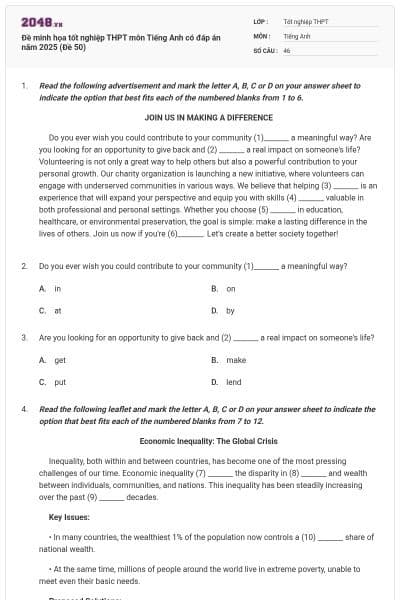
Bạn có bao giờ mong muốn mình có thể đóng góp cho cộng đồng một cách ý nghĩa chưa? Bạn có đang tìm kiếm một cơ hội để đóng góp và tạo ra tác động thực sự đến cuộc sống của ai đó? Hoạt động tình nguyện không chỉ là một cách tuyệt vời để giúp đỡ người khác mà còn là một sự đóng góp mạnh mẽ vào sự phát triển bản thân của bạn. Tổ chức từ thiện của chúng tôi đang triển khai một sáng kiến mới, nơi các tình nguyện viên có thể tham gia hỗ trợ các cộng đồng còn khó khăn theo nhiều cách khác nhau. Chúng tôi tin rằng việc giúp đỡ những người đang cần sự hỗ trợ là một trải nghiệm sẽ mở rộng góc nhìn của bạn và trang bị cho bạn những kỹ năng có giá trị trong cả công việc lẫn cuộc sống cá nhân. Dù bạn chọn làm việc trong lĩnh vực giáo dục, chăm sóc sức khỏe hay bảo vệ môi trường, mục tiêu rất đơn giản: tạo nên sự khác biệt lâu dài trong cuộc sống của người khác. Tham gia cùng chúng tôi ngay nếu bạn quan tâm. Hãy cùng nhau tạo ra một xã hội tốt đẹp hơn!
Kiến thức về giới từ
* Ta có cụm từ cố định: in a/an + (adj) + way: một cách như thế nào đó
Tạm dịch: Do you ever wish you could contribute to your community (1) ______ a meaningful way? (Bạn có bao giờ mong muốn mình có thể đóng góp cho cộng đồng một cách ý nghĩa chưa?)
Do đó, A là đáp án phù hợp.
get
make
put
lend
Kiến thức về cụm từ cố định
* Xét các đáp án:
A. get /get/ (v): có được; đạt được; mắc phải (bệnh)
B. make /meɪk/ (v): làm, chế tạo; thực hiện, thi hành
C. put /pʊt/ (v): đặt, để; đặt ai/cái gì vào tình thế nào
D. lend /lend/ (v): cho mượn; cho vay
* Ta có cụm từ cố định: make an impact on somebody/something: tạo ra tác động, ảnh hưởng đến ai/ cái gì đó
Tạm dịch: Are you looking for an opportunity to give back and (2) ______ a real impact on someone's life? (Bạn có đang tìm kiếm một cơ hội để đóng góp và tạo ra tác động thực sự đến cuộc sống của ai đó?)
Do đó, B là đáp án phù hợp.
need in those
those in need
need those in
in need those
Kiến thức về trật tự từ
* Ta có cụm giới từ: in need: đang cần, trong tình trạng thiếu thốn → Loại đáp án A và C (do sai thứ tự).
- Do "in need" thường đứng sau danh từ/đại từ để bổ nghĩa → Loại đáp án D
Tạm dịch: We believe that helping (3) ______ is an experience that will expand your perspective... (Chúng tôi tin rằng việc giúp đỡ những người đang cần sự hỗ trợ là một trải nghiệm sẽ mở rộng góc nhìn của bạn...)
Do đó, B là đáp án phù hợp.
to being
be
that are
are
Kiến thức về mệnh đề quan hệ
* Ta xét vế câu trên, đã có động từ chính là "equip" nên chỗ trống cần một động từ ở dạng rút gọn, hoặc một mệnh đề quan hệ → Đáp án C phù hợp.
- Ta có: that là đại từ quan hệ chỉ cả người lẫn vật, có thể được dùng thay cho Who, Whom, Which trong mệnh đề quan hệ thuộc loại mệnh đề xác định. Trong trường hợp này, "that" được dùng để thay thế cho danh từ "skills".
Tạm dịch: ...and equip you with skills (4) ______ valuable in both professional and personal settings. (...và trang bị cho bạn những kỹ năng có giá trị trong các công việc lẫn cuộc sống cá nhân.)
Do đó, C là đáp án phù hợp.
to work
working
work
to working
Kiến thức về động từ nguyên mẫu
* Ta có cụm từ: choose to do something: lựa chọn làm gì; quyết định làm điều gì sau khi cân nhắc các lựa chọn
Tạm dịch: Whether you choose (5) ______ in education, healthcare, or environmental preservation, the goal is simple: make a lasting difference in the lives of others. (Dù bạn chọn làm việc trong lĩnh vực giáo dục, chăm sóc sức khỏe hay bảo vệ môi trường, mục tiêu rất đơn giản: tạo nên sự khác biệt lâu dài trong cuộc sống của người khác.)
Do đó, A là đáp án phù hợp.
interest
interested
interesting
interestingly
Kiến thức về từ loại:
* Xét các đáp án:
A. interest /'ɪntrəst/ (n/v): mối quan tâm; niềm yêu thích/ làm ai chú ý; làm ai quan tâm đến
B. interested /'ɪntrestɪd/ (adj): có hứng thú, quan tâm (mô tả cảm xúc của con người)
C. interesting /'ɪntrəstɪη/ (adj): hấp dẫn; đầy thú vị (mô tả đặc điểm hoặc tính chất của một sự vật, sự việc)
D. interestingly /'ɪntrəstɪηli/ (adv): (một cách) đầy thú vị
- Ta có quy tắc: To be + adj → đáp án B hoặc C phù hợp.
Tạm dịch: Join us now if you're (6) ______ . (Tham gia cùng chúng tôi ngay nếu bạn quan tâm.)
Căn cứ vào dịch nghĩa, B là đáp án phù hợp.
refers to
adheres to
puts aside
runs against
DỊCH
SỰ BẤT BÌNH ĐẲNG KINH TẾ: CUỘC KHỦNG HOẢNG TOÀN CẦU
Sự bất bình đẳng, cả trong nội bộ và giữa các quốc gia, đã trở thành một trong những thách thức cấp bách nhất của thời đại chúng ta. Sự bất bình đẳng kinh tế ám chỉ sự chênh lệch về thu nhập và tài sản giữa các cá nhân, cộng đồng và quốc gia. Sự bất bình đẳng này đã gia tăng đều đặn trong vài thập kỷ qua.
Các vấn đề chính:
- Ở nhiều quốc gia, 1% dân số giàu nhất hiện nay kiểm soát một phần không cân xứng của tài sản quốc gia.
- Trong khi đó, hàng triệu người trên thế giới đang sống trong cảnh nghèo đói cùng cực, không thể đáp ứng ngay cả những nhu cầu cơ bản.
Giải pháp đề xuất:
- Các chính phủ phải thực hiện hệ thống thuế tiến bộ để phân phối lại tài sản một cách công bằng hơn.
- Chúng ta cần thúc đẩy quyền tiếp cận bình đảng đến giáo dục, chăm sóc sức khỏe và cơ hội việc làm, đặc biệt cho các nhóm yếu thế.
Đã đến lúc chúng ta đối mặt với tình trạng hiện tại. Mọi người đều xứng đáng có cơ hội công bằng để thành công, bất kể xuất thân hay tình trạng kinh tế-xã hội của họ.
Kiến thức về cụm động từ
* Xét các đáp án:
A. refers to - refer to (ph.v): đề cập đến, nói đến, nhắc đến, ám chỉ
B. adheres to - adhere to (ph.v): tuân thủ (luật lệ, nguyên tắc)
C. puts aside - put aside (ph.v): tiết kiệm, để dành; gác lại, gạt sang một bên
D. runs against - run against (ph.v): phản đối; đối đầu, cạnh tranh với ai (trong cuộc bầu cử hoặc thi đấu...)
Tạm dịch: Economic inequality (7) ______ the disparity in income and wealth between individuals, communities, and nations. (Bất bình đẳng kinh tế ám chỉ sự chênh lệch về thu nhập và tài sản giữa các cá nhân, cộng đồng và quốc gia. Sự bất bình đẳng này đã gia tăng đều đặn trong vài thập kỷ qua.)
Căn cứ vào dịch nghĩa, A là đáp án phù hợp.

Học thông minh hơn mỗi ngày
Xem toàn bộ 40 câu hỏi và nhiều hơn nữa với tài khoản miễn phí
earnings
salary
income
wage
Kiến thức về từ cùng trường nghĩa
* Xét các đáp án:
A. earnings /'ɜ:nɪηz/ (n): số tiền mà một người được trả cho công việc họ làm
B. salary /'sæləri/ (n): tiền lương (được trả hằng tháng, hằng năm, không phụ thuộc vào thời gian làm việc, mang tính cố định, lâu đài)
C. income /'ɪηkʌm/ (n): thu nhập (tất cả các khoản tiền mà một người/gia đình/ công ty/ quốc gia kiếm được từ nhiều nguồn khác nhau bao gồm tiền lương; tiền kiếm được từ việc đầu tư, lãi ngân hàng...)
D. wage /weɪdӡ/ (n): tiền công (thường trả theo tuần, ngày, giờ, thỏa thuận dựa trên giờ làm việc hoặc lượng công việc hoàn thành, không mang tính cố định, lâu dài)
Tạm dịch: Economic inequality refers to the disparity in (8) ______ and wealth between individuals, communities, and nations. (Sự bất bình đẳng kinh tế ám chỉ sự chênh lệch về thu nhập và tài sản giữa các cá nhân, cộng đồng và quốc gia.)
Căn cứ vào dịch nghĩa, C là đáp án phù hợp.
few
a few
little
a little
Kiến thức về lượng từ
* Xét các đáp án:
A. few +N (đếm được số nhiều): rất ít, hầu như không
B. a few +N (đếm được số nhiều): một vài, một ít
C. little +N (không đếm được): rất ít, hầu như không
D. a little +N (không đếm được): một chút, một ít
- Ta thấy, sau chỗ trống là danh từ đếm được số nhiều "decades" → Loại đáp án C và D.
- Ta có: over the past few months/ years/ decades...: trong vài tháng/ năm/ thập kỷ... qua
Tạm dịch: This inequality has been steadily increasing over the past (9) ______ decades. (Sự bất bình đẳng này đã gia tăng đều đặn trong vài thập kỷ qua.)
Do đó, A là đáp án phù hợp.
disillusioned
hysterical
disproportionate
confrontational
Kiến thức về từ vựng - nghĩa của từ
* Xét các đáp án:
A. disillusioned /,dɪsɪ'lu:ӡnd/ (adj): thất vọng, vỡ mộng
B. hysterical /hɪ'sterɪkl/ (adj): quá kích động, cuồng loạn; cực kỳ vui nhộn
C. disproportionate /,dɪsprə'pͻ:ʃənət/ (adj): không cân đối, không cân xứng
D. confrontational /,kɒnfrʌn'teɪʃənl/ (adj): Có xu hướng giải quyết các tình huống một cách hung hăng; thù địch hoặc hay tranh cãi
Tạm dịch: In many countries, the wealthiest 1% of the population now controls a (10) ______ share of national wealth. (Ở nhiều quốc gia, 1% dân số giàu nhất hiện nay kiểm soát một phần không cân xứng của tài sản quốc gia.)
Căn cứ vào dịch nghĩa, C là đáp án phù hợp.
reinforce
reconcile
reevaluate
redistribute
Kiến thức về từ vựng - nghĩa của từ
* Xét các đáp án:
A. reinforce /ri:ɪn'fͻ:s/ (v): củng cố; tăng cường; gia cố
B. reconcile /'rekənsaɪl/ (v): giải hoà, hoà giải, làm cho hoà thuận
C. reevaluate /ri: ɪ'væljueɪt/ (v): đánh giá lại
D. redistribute /ri:dɪ'strɪbju:t/ (v): phân phối lại
Tạm dịch: Governments must implement progressive tax systems to (11) ______ wealth more fairly. (Các chính phủ phải thực hiện hệ thống thuế tiến bộ đế phân phối lại tài sản một cách công bằng hơn.)
Căn cứ vào dịch nghĩa, D là đáp án phù hợp.
contrary to
regardless of
provided that
even if
Kiến thức về liên từ
* Xét các đáp án:
A. contrary to + danh từ/cụm danh từ: trái ngược với
B. regardless of + danh từ/cụm danh từ: bất kể, cho dù, không kể đến
C. provided that + clause (S+V): với điều kiện là, miễn là
D. even if + clause (S+V): thậm chí nếu, ngay cả khi
- Ta thấy, sau chỗ trống là cụm danh từ "their background or socio-economic status" → Loại đáp án C và D
Tạm dịch: Everyone deserves a fair chance to succeed, (12) ______ their background or socio-economic status. (Mọi người đều xứng đáng có cơ hội công bằng để thành công, bất kể xuất thân hay tình trạng kinh tế-xã hội của họ.)
Căn cứ vào dịch nghĩa, B là đáp án phù hợp.
c-a-b
b-c-a
c-b-a
a-c-b
Kiến thức về sắp xếp câu tạo thành đoạn hội thoại
* Ta có: Để tạo nên một đoạn văn/lời kể/ đoạn hội thoại hoàn chỉnh, ta sắp xếp chúng sao cho phù hợp về mặt ngữ nghĩa, ngữ pháp, câu sau là sự tiếp nối về nội dung với câu trước.
→ Ta có cách sắp xếp hoàn chỉnh:
a. David: Hi, Emily! I haven't seen you in so long! How's everything? (Chào Emily! Lâu lắm rồi không gặp bạn! Mọi thứ thế nào rồi?)
c. Emily: Hi, David! Everything's great. I've been volunteering at an animal shelter on weekends. (Chào David! Mọi thứ đều ổn. Mình đang làm tinh nguyện tại một trung tâm cứu trợ động vật vào cuối tuần.)
b. David: That's fantastic! I've been wanting to help out with animals too. How can I get involved? (David: Tuyệt quá! Mình cũng muốn giúp đỡ động vật. Làm thế nào để tham gia được?)
→ Vì vậy, ta có thứ tự sắp xếp đúng là: a-c-b
Do đó, D là đáp án phù hợp.
c-b-a-e-d
c-e-d-b-a
d-b-a-e-c
d-e-a-b-c
Kiến thức về sắp xếp câu tạo thành đoạn hội thoại
* Ta có: Để tạo nên một đoạn văn/lời kể/ đoạn hội thoại hoàn chỉnh, ta sắp xếp chúng sao cho phù hợp về mặt ngữ nghĩa, ngữ pháp, câu sau là sự tiếp nối về nội dung với câu trước.
→ Ta có cách sắp xếp hoàn chỉnh:
c. Lena: Hey, Tom! Why do you look so tired today? (Chào Tom! Sao hôm nay trông bạn mệt mỏi thế?)
b. Tom: Oh, I've been dealing with a big problem at work. My computer crashed, and I lost all my files. (Tom: Ôi, minh đang gặp một vấn đề lớn ở nơi làm việc. Máy tính của minh bị hỏng và minh đã mất tất cả các tệp.)
a. Lena: That sounds terrible! Have you tried recovering the files? (Lena: Nghe thật tồi tệ! Bạn đã thử khôi phục các tệp chưa?)
e. Tom: I've tried, but nothing seems to work. I think I might have to contact IT for help. (Tom: Minh đã thử rồi, nhưng có vé không hiệu quả. Minh nghĩ mình phải liên hệ với bộ phận IT để nhờ giúp đỡ.)
d. Lena: Good idea. Hopefully, they can restore everything for you. (Lena: Ý kiến hay đấy. Hy vọng họ có thể khôi phục mọi thứ cho bạn.)
→ Vì vậy, ta có thứ tự sắp xếp đúng là: c-b-a-e-d
Do đó, A là đáp án phù hợp.
d-b-a-c-e
b-e-a-d-c
a-d-b-c-e
c-a-d-e-b
Kiến thức về sắp xếp trật tự câu tạo thành lá thư
* Ta có: Để tạo nên một lá thư hoàn chỉnh, mở đầu phải là lời chào cũng như giới thiệu chủ đề sắp nói đến bằng cách dùng Dear/ Hi/ To + tên người nhận. ở phần thân lá thư, ta sắp xếp sao cho chúng phù hợp về ngữ nghĩa. Kết thúc lá thư sẽ là lời nhắn nhủ, gửi lời chúc đến người nhận bằng cụm Best wishes/Best regards/ Best/ Sincerely/ Write back soon/ With warm regards/ Yours faithfully...
→ Ta có cách sắp xếp hoàn chỉnh:
Hi Alex, (Chào Alex,
a. I've been reading some fascinating articles about the cities of the future, and I can't wait to share my thoughts! (Mình đã đọc một số bài báo thú vị về các thành phố của tương lai và không thể chờ đợi để chia sẻ suy nghĩ của mình với bạn!)
d. They discuss how technology will transform urban living, making cities more sustainable and efficient. (Chúng tháo luận về cách công nghệ sẽ biến đổi cuộc sống đô thị, làm cho các thành phố trở nên bền vững và hiệu quả hơn.)
b. For instance, the idea of vertical gardens and smart buildings really excites me. (Ví dụ, ý tưởng về các khu vườn thẳng đứng và các tòa nhà thông minh thực sự làm mình phấn khích.)
c. I'm also intrigued by the concept of autonomous public transport systems that could reduce traffic congestion. (Mình cũng bị thu hút bởi khái niệm về hệ thống giao thông công cộng tự động có thể giảm ùn tắc giao thông.)
e. We should definitely talk more about this soon. i'd love to hear your opinions! (Chúng ta nên nói chuyện nhiều hơn về điều này sớm. Mình rất muốn nghe ý kiến của bạn!)
Write back soon. (Hãy trả lời lại sớm nhé.)
Jess
→ Vì vậy, ta có thứ tự sắp xếp đúng là: a-d-b-c-e
Do đó, C là đáp án phù hợp.
d-c-b-a-e
a-b-c-d-e
b-c-d-e-a
c-a-d-b-e
Kiến thức về sắp xếp câu tạo thành đoạn văn
* Ta có: Để tạo nên một đoạn văn/lời kể hoàn chỉnh, ta sắp xếp chúng sao cho phù hợp về mặt ngữ nghĩa, ngữ pháp, câu sau là sự tiếp nối về nội dung với câu trước.
→ Ta có cách sắp xếp hoàn chỉnh:
c. I've recently returned from an incredible trip to Italy, and I can't stop thinking about how amazing it was! (Tôi vừa trở về từ một chuyến đi tuyệt vời tới Ý và tôi không thể ngừng nghĩ về chuyến đi tuyệt vời này!)
a. The cities were full of history, from the ancient ruins in Rome to the stunning art galleries in Florence. (Các thành phố ngập tràn lịch sử, từ những di tích cổ ở Rome đến các phòng trưng bày nghệ thuật tuyệt đẹp ở Florence.)
d. I also had the chance to explore the beautiful countryside of Tuscany, with its rolling hills and charming vineyards. (Tôi cũng có cơ hội khám phá vùng nông thôn tuyệt đẹp của Tuscany, với những ngọn đồi nhấp nhô và các vườn nho quyến rũ.)
b. My love for travel and exploring new cultures has grown even more after this trip, and I'm already planning my next adventure! (Niềm đam mê của tôi đối với du lịch và khám phá các nền văn hóa mới đã tăng lên nhiều hơn sau chuyến đi này, và tôi đã lên kế hoạch cho cuộc phiêu lưu tiếp theo!)
e. I highly recommend Italy to anyone looking for a blend of culture, history, and natural beauty. (Tôi rất khuyến khích đến Ý cho bất kỳ ai đang tìm kiếm sự kết hợp giữa văn hóa, lịch sử và vẻ đẹp thiên nhiên.)
→ Vì vậy, ta có thứ tự sắp xếp đúng là: c-a-d-b-e
Do đó, D là đáp án phù hợp.
d-b-e-a-c
a-e-b-d-c
b-a-e-d-c
c-b-d-e-a
Kiến thức về sắp xếp câu tạo thành đoạn văn
* Ta có: Để tạo nên một đoạn văn/lời kể hoàn chỉnh, ta sắp xếp chúng sao cho phù hợp về mặt ngữ nghĩa, ngữ pháp, câu sau là sự tiếp nối về nội dung với câu trước.
→ Ta có cách sắp xếp hoàn chỉnh:
a. Over the past decade, GreenTech Solutions has expanded its reach across multiple continents. Initially a small startup in Silicon Valley, the company is now a major player in the renewable energy sector. (Trong suốt thập kỷ qua, GreenTech Solutions đã mở rộng phạm vi hoạt động trên nhiều châu lục. Ban đầu chỉ là một công ty khởi nghiệp nhỏ ở Silicon Valley, nhưng giờ đây đã trở thành một tên tuổi lớn trong ngành năng lượng tái tạo.)
e. The company's mission to create sustainable energy solutions has attracted numerous investors, helping GreenTech grow at a rapid pace. (Sứ mệnh của công ty là tạo ra các giải pháp năng lượng bền vững đã thu hút nhiều nhà đầu tư, giúp GreenTech phát triển nhanh chóng.)
b. As a result, it has opened new offices in Asia, Europe, and South America, employing thousands of workers worldwide. (Do đó, công ty đã mở thêm các văn phòng tại châu Á, châu Âu và Nam Mỹ, tuyển dụng hàng nghìn lao động trên toàn thế giới.)
d. However, despite its success, GreenTech faces a significant challenge in meeting global demand, leading to delays in product shipments. (Tuy nhiên, mặc dù thành công, GreenTech phải đối mặt với thách thức lớn trong việc đáp ứng nhu cầu toàn cầu, dẫn đến sự chậm trễ trong giao hàng.)
c. Additionally, the company has been criticized for its lack of diversity in its leadership team, with most top executives being from the same region. (Ngoài ra, công ty đã bị chỉ trích vì thiếu sự đa dạng trong đội ngũ lãnh đạo, khi phần lớn các giám đốc điều hành đến từ cùng một khu vực.)
→ Vì vậy, ta có thứ tự sắp xếp đúng là: a-e-b-d-c
Do đó, B là đáp án phù hợp.
is rapidly reshaping the world
rapidly reshaping the world
that is rapidly reshaping the world
whose world is reshaping rapidly
DỊCH
Tương lai của Cuộc sống Đô thị
Đô thị hóa, với các thành phố trở thành trung tâm của sự đổi mới, văn hóa và hoạt động kinh tế, đang thay đổi thế giới một cách nhanh chóng. Khi các thành phố phát triển, chúng phải đối mặt với các thách thức như quá tải dân cư, ô nhiễm và khan hiếm tài nguyên. Tuy nhiên, những tiến bộ công nghệ và các nguyên tắc thiết kế bền vững đã mang đến những giải pháp đầy hứa hẹn cho tương lai của cuộc sống đô thị.
Được trang bị công nghệ tiên tiến, các thành phố thông minh nhằm tối ưu hóa cơ sở hạ tầng và dịch vụ đô thị. Bằng cách sử dụng cảm biến, phân tích dữ liệu và trí tuệ nhân tạo, các thành phố có thể cải thiện luồng giao thông, hiệu quả năng lượng và an toàn công cộng. Ví dụ, các mạng lưới điện thông minh có thể quản lý tiêu thụ năng lượng hiệu quả hơn, trong khi các hệ thống giao thông thông minh có thể giảm tắc nghẽn và khí thải. Những công nghệ này làm cho các thành phố trở nên hiệu quả hơn và thân thiện với môi trường.
Hơn nữa, các nguyên tắc quy hoạch đô thị bền vững, cái mà thúc đẩy không gian xanh và giao thông công cộng, là rất cần thiết để tạo ra các thành phố đáng sống. Mái nhà xanh, vườn thẳng đứng và các trang trại đô thị có thể giúp giảm hiệu ứng đảo nhiệt đô thị và cải thiện chất lượng không khí. Ngoài ra, đầu tư vào các nguồn năng lượng tái tạo và vật liệu xây dựng bền vững có thể giảm tác động môi trường của sự phát triển đô thị.
Khi các thành phố tiếp tục phát triển, phúc lợi của cư dân được ưu tiên. Bằng cách áp dụng công nghệ, thiết kế bền vững và cách tiếp cận lấy cộng đồng làm trung tâm, các thành phố có thể trở thành những nơi đáng sống, kiên cường và công bằng hơn cho các thế hệ tương lai.
Kiến thức về cấu trúc câu
* Ta có cấu trúc của một mệnh đề độc lập: S+V+...
- Ta thấy, câu trên chưa có động từ chính (phần bổ nghĩa "with cities becoming hubs of innovation, culture, and economic activity" là một mệnh đề phụ giải thích thêm, không chứa động từ chính) → chỗ trống cần một động từ chia phù hợp theo chủ ngữ "Urbanization". Từ đó ta loại C và D (không dùng mệnh đề quan hệ ở đây vì nếu dùng mệnh đề quan hệ thì phải có hai động từ chính). Tiếp theo ta loại B vì chồ trống cần động từ chính nên không thể là cụm phân từ "rapidly reshaping".
* Xét đáp án còn lại:
A. is rapidly reshaping the world (đang nhanh chóng định hình lại thế giới)
Tạm dịch: Urbanization, with cities becoming hubs of innovation, culture, and economic activity, (18) ______ (Đô thị hóa, với các thành phố trở thành trung tâm của sự đổi mới, văn hóa và hoạt động kinh tế, đang thay đổi thế giới một cách nhanh chóng.)
Căn cứ vào dịch nghĩa, A là đáp án phù hợp.
urban infrastructure and services aim to optimize smart cities
optimizing urban infrastructure and services are aimed by smart cities
the aim of smart cities is to optimize urban infrastructure and services
smart cities aim to optimize urban infrastructure and services
Kiến thức về quá khứ phân từ
Ta có:
- Nhận thấy, phía trước có "Equipped with advanced technologies" (được trang bị công nghệ tiên tiến) → ở đây đang dùng rút gọn mệnh đề bằng Vpp → chủ ngữ của mệnh đề phụ và chủ ngữ của mệnh đề chính phải giống nhau → Căn cứ vào dịch nghĩa, cái "được trang bị công nghệ tiên tiến" ở đây là "smart cities" (các thành phố thông minh), nên "smart cities" chính là chủ ngữ của mệnh đề ở vị trí chỗ trống.
* Xét các đáp án:
A. urban infrastructure and services aim to optimize smart citie (cơ sở hạ tầng và dịch vụ đô thị nhằm tối ưu hóa các thành phố thông minh)
B. optimizing urban infrastructure and services are aimed by smart cities (việc tối ưu hóa cơ sở hạ tầng và dịch vụ đô thị được nhắm đến bởi các thành phố thông minh)
C. the aim of smart cities is to optimize urban infrastructure and services (mục tiêu của các thành phố thông minh là tối uru hóa cơ sở hạ tầng và dịch vụ đô thị)
D. smart cities aim to optimize urban infrastructure and services (các thành phố thông minh nhằm tối ưu hóa cơ sở hạ tầng và dịch vụ đô thị)
Tạm dịch: Equipped with advanced technologies, (19) ______ . (Được trang bị công nghệ tiên tiến, các thành phố thông minh nhằm tối ưu hóa cơ sở hạ tầng và dịch vụ đô thị.)
Do đó, D là đáp án phù hợp.
Smart cities can improve quality of life without reducing pollution and traffic congestion
Making cities more efficient and environmentally friendly, technologies were developed
Traditional transportation systems are more effective than modern ones
These technologies make cities more efficient and environmentally friendly
Kiến thức về mệnh đề độc lập - nghĩa của câu
* Ta có cấu trúc của một mệnh đề độc lập: S+V+...
* Xét các đáp án:
A. Smart cities can improve quality of life without reducing pollution and traffic congestion (Các thành phố thông minh có thể cải thiện chất lượng cuộc sống mà không giảm ô nhiễm và tắc nghẽn giao thông) → Không phù hợp với ngữ cảnh của câu trước.
B. Making cities more efficient and environmentally friendly, technologies were developed (Làm cho các thành phố trở nên hiệu quả hơn và thân thiện với môi trường, các công nghệ đã được phát triển) → Không phù hợp vì động từ "were developed" không đúng với cấu trúc rút gọn bằng phân từ hiện tại (making cities...) trong câu. Câu này không phải là một mệnh đề độc lập và không có động từ chính chính xác.
C. Traditional transportation systems are more effective than modern ones (Hệ thống giao thông truyền thống hiệu quả hơn so với các hệ thống hiện đại) → Không phù hợp với ngữ cảnh của câu trước.
D. These technologies make cities more efficient and environmentally friendly (Những công nghệ này làm cho các thành phố trở nên hiệu quả hơn và thân thiện với môi trường) → Phù hợp
Tạm dịch: For instance, smart grids can manage energy consumption more effectively, while intelligent transportation systems can reduce congestion and emissions. (20) ______ . (Ví dụ, các mạng lưới điện thông minh có thể quản lý tiêu thụ năng lượng hiệu quả hơn, trong khi các hệ thống giao thông thông minh có thể giảm tắc nghẽn và khí thải. Những công nghệ này làm cho các thành phố trở nên hiệu quả hơn và thân thiện với môi trường.)
Căn cứ vào dịch nghĩa, D là đáp án phù hợp.
succeeded in reducing green spaces while expanding urban areas.
which promote green spaces and public transportation
for whose discourage the use of public transportation and green spaces
aimed to eliminate public transportation in favor of private vehicles.
Kiến thức về mệnh đề quan hệ
- Nhận thấy trong câu đã có động từ chính là "are" nên chỗ trống không thể bắt đầu bằng động từ chính vì trong một câu chỉ có một động từ chính chia theo thì của câu. Từ đó, ta loại A và D .
- Sau đại từ quan hệ "whose" phải là một danh từ/ cụm danh từ; trong khi ở đây lại là động từ "discourage" → Loại đáp án C
Tạm dịch: Furthermore, the sustainable urban planning principles, (21) ______ , are essential for creating livable cities. (Hơn nữa, các nguyên tắc quy hoạch đô thị bền vững, cái mà thúc đẩy không gian xanh và giao thông công cộng, là rất cần thiết để tạo ra các thành phố đáng sống.)
Do đó, B là đáp án phù hợp.
The well-being of residents is prioritized though cities continue to evolve.
As cities continue to evolve, the well-being of residents is prioritized
Prioritizing the well-being of residents, cities continue to evolve
Cities continue to evolve, prioritizing the well-being of residents
Kiến thức về mệnh đề độc lập - nghĩa của câu
* Xét các đáp án:
A. The well-being of residents is prioritized though cities continue to evolve. (Phúc lợi của cư dân được ưu tiên mặc dù các thành phố tiếp tục phát triển) → Không phù hợp vì dùng "though" (mặc dù) tạo cảm giác sự ưu tiên sức khỏe cộng đồng và sự phát triển của thành phố là hai điều đối lập
B. As cities continue to evolve, the well-being of residents is prioritized (Khi các thành phố tiếp tục phát triển, phúc lợi của cur dân được ưu tiên) → Phù hợp
C. Prioritizing the well-being of residents, cities continue to evolve (Ưu tiên phúc lợi của cư dân, các thành phố tiếp tục phát triển) → Không phù hợp vì khi thành phố tiếp tục phát triển thì việc ưu tiên phúc lợi của cư dân cũng được thực hiện đồng thời chứ không phải ưu tiên phúc lợi của cư dân thì các thành phố mới tiếp tục phát triển.
D. Cities continue to evolve, prioritizing the well-being of residents (Các thành phố tiếp tục phát triển, ưu tiên phúc lợi của cur dân) → Không phù hợp vì không làm rõ mối quan hệ giữa sự phát triển của thành phố và ưu tiên sức khỏe cộng đồng.
Tạm dịch: (22) ______. By embracing technology, sustainable design, and community-oriented approaches, cities can become more livable, resilient, and equitable places for future generations. (Khi các thành phố tiếp tục phát triển, phúc lợi của cư dân được ưu tiên. Bằng cách áp dụng công nghệ, thiết kế bền vững và cách tiếp cận lấy cộng đồng làm trung tâm, các thành phố có thể trở thành những nơi đáng sống, kiên cường và công bằng hơn cho các thế hệ tương lai.)
Căn cứ vào dịch nghĩa, B là đáp án phù hợp.
Deforestation
Coral reef damage
Soil erosion
Air pollution
DỊCH
1. Du lịch đã trở thành một trong những ngành công nghiệp phát triển nhanh nhất trên thế giới, với hàng triệu người đi du lịch hàng năm để khám phá những điểm đến và nền văn hóa mới. Tuy nhiên, sự mở rộng nhanh chóng của du lịch đại chúng ngày càng bị đặt dưới sự xem xét kỹ lưỡng do tác động của nó đến các cộng đồng địa phương và môi trường. Khi du lịch phát triển, nó làm dấy lên những mối lo ngại về tính bền vững và các tác động lâu dài đối với các địa điểm và con người được ghé thăm. Du lịch được coi là một nguyên nhân chính gây ra suy thoái môi trường, xói mòn văn hóa và bất bình đẳng xã hội ở một số khu vực.
2. Một trong những mối lo ngại chính liên quan đến du lịch là tác động của nó đối với môi trường. Khi ngày càng nhiều du khách đến thăm các điểm đến nổi tiếng, các hệ sinh thái địa phương bị quá tải. Nạn phá rừng, ô nhiễm và sự gián đoạn đối với động vật hoang dã là một số hậu quả của du lịch không được quản lý. Ví dụ, tại quần đảo Galápagos và Bali, du lịch đã dẫn đến sự phá hủy các hệ sinh thái mong manh, đánh bắt cá quá mức và hư hại rạn san hô. Đặc biệt, du lịch hàng không góp phần vào lượng khí thải carbon, làm trầm trọng thêm sự nóng lên toàn cầu và ảnh hưởng nghiêm trọng đến các khu vực dễ bị tổn thương.
3. Bên cạnh các vấn đề môi trường, du lịch thường dẫn đến những thay đổi văn hóa trong các cộng đồng địa phương. Mặc dù du lịch có thể mang lại lợi ích kinh tế, nhưng nó cũng có thể dẫn đến sự thương mại hóa của văn hóa địa phương. Các truyền thống bản địa có thể bị bóp méo hoặc bị bỏ quên để đáp ứng nhu cầu của du khách. Tại một số cộng đồng, các nghi lễ thiêng liêng được thực hiện như những màn trình diễn giải trí, làm giảm tính chân thực của chúng và hạ thấp giá trị di sản văn hóa trong mắt người dân địa phương.
4. Kết luận, những tác động tiêu cực của du lịch đối với môi trường và văn hóa địa phương có thể được giảm thiểu nếu các chính phủ, doanh nghiệp và du khách áp dụng các phương thức du lịch bền vững hơn. Du lịch sinh thái khuyến khích du lịch có trách nhiệm với môi trường, trong khi "du lịch chậm" khuyến khích sự gắn kết sâu sắc hơn với các điểm đến và tập trung vào chất lượng hơn số lượng. Bằng cách áp dụng những cách tiếp cận này, du lịch có thể trở thành một lực lượng tích cực, thúc đẩy cả bảo tồn môi trường và sự trân trọng văn hóa cho các thế hệ tương lai.
Hậu quả nào sau đây KHÔNG được đề cập đến như là một hệ quả của du lịch không được quản lý?
A. Nạn phá rừng
B. Hư hại rạn san hô
C. Sự xói mòn đất
D. Sự ô nhiễm không khí
Căn cứ vào thông tin: "Deforestation, pollution, and wildlife disruption are some of the consequences of unmanaged tourism. For example, in the Galápagos Islands and Bali, tourism has led to the destruction of fragile ecosystems, overfishing, and coral reef damage." (Nạn phá rừng, ô nhiễm và sự gián đoạn đối với động vật hoang dã là một số hậu quả của du lịch không được quản lý. Ví dụ, tại quần đảo Galápagos và Bali, du lịch đã dẫn đến sự phá hủy các hệ sinh thái mong manh, đánh bắt cá quá mức và hư hại rạn san hô.)
Căn cứ vào dịch nghĩa, C là đáp án phù hợp.
alleviating
intensifying
worsening
aggravating
Từ "exacerbating" trong đoạn 2 TRÁI NGHĨA với ______ .
A. alleviating - alleviate /ə'li:vieɪt/ (v): làm nhẹ bớt, làm đỡ, làm dịu
B. intensifying - intensify /ɪn'tensɪfaɪ/ (v): làm tăng cường; làm mãnh liệt, dữ dội hơn
C. worsening - worsen /'wɜ:sn/ (v): (làm cho) tệ hơn
D. aggravating - aggravate /'ægrəveɪt/ ( v ): làm trầm trọng thêm (tình hình, bệnh tật)
Căn cứ vào thông tin: "Air travel, in particular, contributes to carbon emissions, exacerbating global warming and disproportionately affecting vulnerable regions." (Đặc biệt, du lịch hàng không góp phần vào lượng khí thải carbon, làm trầm trọng thêm sự nóng lên toàn cầu và ảnh hưởng nghiêm trọng đến các khu vực dể bị tổn thương.)
→ exacerbating - exacerbate /ɪg'zæsəbert/ (v): làm cho tệ hại hơn, làm trầm trọng thêm >< alleviating - alleviate /e'li:vieɪt/ (v)
Do đó, A là đáp áp phù hợp.
communities
commodification
benefits
tourism
Từ "it" trong đoạn 3 đề cập đến ______
A. communities - community /kə'mju:nəti/(n): các cộng đồng
B. commodification /kə,mɒdɪfɪ'keɪʃn/ (n): sự thương mại hóa
C. benefits - benefit /'benɪfɪt/(n): những lợi ích
D. tourism /'tʊərɪzəm/ (n): du lịch, ngành nghề du lịch
Căn cứ vào thông tin: "While tourism can bring economic benefits, it can also result in the commodification of local cultures." (Mặc dù du lịch có thể mang lại lợi ích kinh tế, nhưng nó cũng có thể dẫn đến sự thương mại hóa của văn hóa địa phương.)
→ Từ "it" ở đây đề cập đến "tourism" (du lịch).
Do đó, D là đáp áp phù hợp.
disregard
opposition
examination
negligence
Từ "scrutiny" trong đoạn 1 có thể được thay thế tốt nhất bằng ______
A. disregard /,dɪsrɪ'gɑ:d/ (n): sự coi thường, không quan tâm đến
B. opposition /,ɒpə'zɪʃn/(n): sự chống đối; sự phản đối
C. examination /ɪg,zæmɪ'neɪʃn/(n): sự kiểm tra kỹ lưỡng
D. negligence /'neglɪdӡəs/ (n): sự cẩu thả; sự chểnh mảng
Căn cứ vào thông tin: "However, the rapid expansion of mass tourism is increasingly under scrutiny due to its impact on local communities and the environment." (Tuy nhiên, sự mở rộng nhanh chóng của du lịch đại chúng ngày càng bị đặt dưới sự xem xét kỹ lưỡng do tác động của nó đến các cộng đồng địa phương và môi trường.)
→ scrutiny /'skru:təni/ (n): sự kiểm tra, xem xét cẩn thận và kỹ lưỡng ~ examination
Do đó, C là đáp áp phù hợp.
Tourists' appreciation for sacred rituals increases their authenticity and cultural significance.
Sacred rituals are preserved and respected when performed for tourists.
Turning sacred rituals into entertainment shows reduces their true meaning and cultural importance to locals.
Rituals in some communities are done as entertainment, which harms their cultural value.
Câu gạch chân trong đoạn 3 có thể được diễn đạt lại tốt nhất bằng cách nào?
* Xét câu được gạch chân trong đoạn 3: In some communities, sacred rituals are performed as spectacles for entertainment, undermining their authenticity and diminishing the cultural heritage in the eyes of locals. (Tại một số cộng đồng, các nghi lễ thiêng liêng được thực hiện như những màn trình diễn giải trí, làm giảm tính chân thực của chúng và hạ thấp giá trị di sản văn hóa trong mắt người dân địa phương.)
A. Tourists' appreciation for sacred rituals increases their authenticity and cultural significance: Sự trân trọng của du khách dành cho các nghi lễ thiêng liêng làm tăng tính chân thực và ý nghĩa văn hóa của chúng. → Không phù hợp
B. Sacred rituals are preserved and respected when performed for tourists: Các nghi lễ thiêng liêng được bảo tồn và tôn trọng khi được thực hiện cho du khách. → Không phù hợp
C. Turning sacred rituals into entertainment shows reduces their true meaning and cultural importance to locals: Việc biến các nghi lể thiêng liêng thành các buổi trình diễn giải trí làm giảm ý nghĩa thật sự và giá trị văn hóa đối với người dân địa phương. → Phù hợp
D. Rituals in some communities are done as entertainment, which harms their cultural value: Các nghi lễ ở một số cộng đồng được thực hiện như các màn trình diễn giải trí, điều này gây tổn hại đến giá trị văn hóa của chúng. → Không phù hợp vì chỉ đúng 1 phần do thiếu sự nhấn mạnh về tính chân thực của nghi lễ và không đề cập đến tác động cụ thể lên cái nhìn của người dân địa phương.
Căn cứ vào dịch nghĩa, C là đáp án phù hợp.
Eco-tourism focuses on maximizing the number of tourists visiting a destination.
Global warming is made worse by the substantial carbon emissions caused by air travel.
Cultural shifts due to tourism always result in economic benefits for local communities.
Slow tourism encourages travelers to visit as many places as possible in a short time.
Điều nào sau đây là ĐÚNG theo đoạn văn?
A. Eco-tourism focuses on maximizing the number of tourists visiting a destination. (Du lịch sinh thái tập trung vào việc tối đa hóa số lượng du khách đến một điểm đến.)
B. Global warming is made worse by the substantial carbon emissions caused by air travel. (Sự nóng lên toàn cầu trở nên tồi tệ hơn bởi lượng khí thải carbon đáng kể do du lịch hàng không gây ra.)
C. Cultural shifts due to tourism always result in economic benefits for local communities. (Sự thay đổi văn hóa do du lịch luôn mang lại lợi ích kinh tế cho các cộng đồng địa phương.)
D. Slow tourism encourages travelers to visit as many places as possible in a short time. (Du lịch chậm khuyến khích du khách đến thăm càng nhiều nơi càng tốt trong một thời gian ngắn.)
Căn cứ vào thông tin:
- "Eco-tourism promotes environmentally responsible travel, while "slow tourism" encourages deeper engagement with destinations and focuses on quality over quantity." (Du lịch sinh thái khuyến khích việc đi lại có trách nhiệm với môi trường....) → du lịch sinh thái không hề tập trung vào việc tối đa hóa số lượng du khách đến một điểm đến mà nhấn mạnh đến việc du lịch có trách nhiệm → Đáp án A sai.
- "Air travel, in particular, contributes to carbon emissions, exacerbating global warming and disproportionately affecting vulnerable regions." (Đặc biệt, du lịch hàng không góp phần vào lượng khí thải carbon, làm trầm trọng thêm sự nóng lên toàn cầu và ảnh hưởng nghiêm trọng đến các khu vực dễ bị tổn thương.) → Đáp án B đúng.
- "While tourism can bring economic benefits, it can also result in the commodification of local cultures." (Mặc dù du lịch có thể mang lại lợi ích kinh tế, nhưng nó cũng có thể dẫn đến sự thương mại hóa của văn hóa địa phương.) → tác giả chỉ nói rằng du lịch "có thể" mang lại lợi ích kinh tế, không hề khẳng định rằng "luôn luôn" → Đáp án C sai.
- "while "slow tourism" encourages deeper engagement with destinations and focuses on quality over quantity." (trong khi "du lịch chậm" khuyến khích sự gắn kết sâu sắc hơn với các điểm đến và tập trung vào chất lượng hơn số lượng.) → Đáp án D sai.
Do đó, B là đáp án phù hợp.
Paragraph 1
Paragraph 2
Paragraph 3
Paragraph 4
Trong đoạn nào, tác giả đề cập đến một mối quan hệ điều kiện?
A. Đoạn 1
B. Đoạn 2
C. Đoạn 3
D. Đoạn 4
Căn cứ vào thông tin trong đoạn 4: "In conclusion, the negative impacts of tourism on the environment and local cultures could be minimized if governments, businesses, and travelers adopt more sustainable practices." (Kết luận, những tác động tiêu cực của du lịch đối với môi trường và văn hóa địa phương có thể được giảm thiểu nếu các chính phủ, doanh nghiệp và du khách áp dụng các phương pháp bền vững hơn.)
Do đó, D là đáp án phù hợp.
Paragraph 1
Paragraph 2
Paragraph 3
Paragraph 4
Trong đoạn nào, tác giả thảo luận về các cách để giải quyết những tác động tiêu cực của du lịch?
A. Đoạn 1
B. Đoan 2
C. Đoan 3
D. Đoan 4
Căn cứ vào thông tin trong đoạn 4: "Eco-tourism promotes environmentally responsible travel, while "slow tourism" encourages deeper engagement with destinations and focuses on quality over quantity. By embracing these approaches, tourism can become a force for good, fostering both environmental preservation and cultural appreciation for future generations." (Du lịch sinh thái khuyến khích việc du lịch có trách nhiệm với môi trường, trong khi "du lịch chậm" khuyến khích sự gắn kết sâu sắc hơn với các điểm đến và tập trung vào chất lượng hơn số lượng. Bằng cách áp dụng những cách tiếp cận này, du lịch có thể trở thành một lực lượng tích cực, thúc đẩy cả bảo tồn môi trường và sự trân trọng văn hóa cho các thế hệ tương lai.)
→ Đoạn này liệt kê các giải pháp như du lịch sinh thái (eco-tourism) và du lịch chậm (slow tourism).
Do đó, D là đáp án phù hợp.
[I]
[II]
[III]
[IV]
DỊCH
Thay đổi trong các tổ chức kinh doanh
1. Các lực lượng thúc đẩy thay đổi trong các tổ chức có thể được so sánh với các cơn gió - từ làn gió nhẹ đến những cơn gió mạnh. [I] Trong thời kỳ̀ này, của cải được tạo ra trong một xã hội dựa vào nông nghiệp, chịu ảnh hưởng của các thị trường địa phương và các yếu tố như thời tiết. Con người có thể dự đoán được chu kỳ của cuộc sống, dù thường ở mức sống cơ bản, nhưng vẫn có thể quản lý được và ổn định. [II]
2. Những cơn gió của sự thay đổi mạnh mẽ hơn đã đến cùng với Cách mạng Công nghiệp, đánh dấu sự chuyển đổi sang thời đại công nghiệp. Giai đoạn này kéo dài đến khoảng năm 1945, được đặc trưng bởi những đổi mới công nghệ giúp giảm nhu cầu lao động nông nghiệp và cho phép sản xuất hàng loạt. [III] Các tổ chức được cấu trúc theo hướng cơ học - với các hệ thống phân cấp cứng nhắc và sự kiểm soát chặt chẽ - để quản lý nhu cầu và nguồn cung có thể dự đoán. Mục tiêu là sản xuất nhiều hơn và đáp ứng nhu cầu gia tăng đối với các sản phẩm công nghiệp.
3. Theo thời gian, các tổ chức phải đối mặt với những thách thức mới. [IV] Trong thời đại tân công nghiệp, thị hiếu của người tiêu dùng trở nên đa dạng hơn, và nguồn cung bắt đầu vượt quá nhu cầu. Các công ty tìm kiếm thị trường mới ở nước ngoài, và sự cạnh tranh ngày càng gay gắt. Ở phương Tây, đã diễn ra một sự chuyển đổi từ nền kinh tế dựa vào sản xuất sang một nền kinh tế định hướng dịch vụ, nơi các tổ chức ưu tiên nâng cao giá trị sản phẩm thay vì chỉ tăng mức sản lượng. Thời kỳ này đánh dấu sự khởi đầu của giai đoạn mà Goodman (1995) gọi là "thời đại định hướng giá trị."
4. Ngày nay, trong thời kỳ hậu công nghiệp, tốc độ thay đổi đang tăng nhanh. Nhịp độ đổi mới và toàn cầu hóa đang tăng lên, khiến tương lai trở nên khó dự đoán hơn. Theo Nadler và Tushman (1999), chúng ta đang chứng kiến một sự chuyển đổi sâu sắc trong các chiến lược, cấu trúc và phạm vi của tổ chức. Đến năm 2020, dự đoán cho thấy 25-30 % lực lượng lao động sẽ là tạm thời, và nhiều nhân viên sẽ làm việc tại nhà.
5. Mặc dù dự đoán tương lai là không chắc chắn, nhưng một điều rõ ràng rằng: sự thay đổi tổ chức là điều không thể tránh khỏi và diễn ra nhanh chóng. Chẳng hạn, Mannermann (1998) coi các nghiên cứu tương lai vừa là nghệ thuật vừa là khoa học, và nhận xét: "Tương lai đầy rẫy bất ngờ, sự không chắc chắn, các xu hướng và sự phá vỡ xu hướng, tính phi lý và hợp lý, và nó đang thay đổi, thoát khỏi tầm tay chúng ta theo thời gian. Nó cũng là kết quả của các hành động được thực hiện bởi vô số lực lượng mạnh yếu khác nhau." Điều chắc chắn là thế giới tổ chức đang thay đổi với tốc độ nhanh - ngay cả khi hướng đi của sự thay đổi không phải lúc nào cũng có thể dự đoán được. Do đó, điều quan trọng là các nhà quản lý tổ chức và người ra quyết định cần có hiểu biết sâu sắc và khả năng phân tích các yếu tố gây ra sự thay đổi trong tổ chức.
Câu sau đây nên được đặt ở vị trí nào trong đoạn văn này?
"Historically, the agricultural age, which lasted until the early 1700s, was a period of relative stability." (Lịch sử cho thấy rằng thời kỳ nông nghiệp, kéo dài đến đầu những năm 1700, là một thời kỳ tương đối ổn định.)
A. [I]
B. [II]
C. [III]
D. [IV]
→ Ta thấy, câu trên nói về bối cảnh lịch sử và tính ổn định của thời kỳ nông nghiệp; vậy thì trước hoặc sau câu văn này cũng phải đề cập đến thời kỳ nông nghiệp.
* Xét vị trí [I]: The forces driving change in organisations can be compared to winds - ranging from mild breezes to powerful gales. [I] During this time, wealth was created within an agriculturally based society influenced by local markets and factors like weather. (Các lực lượng thúc đẩy thay đổi trong các tổ chức có thể được so sánh với các cơn gió - từ làn gió nhẹ đến những cơn gió mạnh. [I] Trong thời kỳ này, của cải được tạo ra trong một xã hội dựa vào nông nghiệp, chịu ảnh hưởng của các thị trường địa phương và các yếu tố như thời tiết.) → Câu trên ở vị trí [I] là hợp lý nhất.
Do đó, A là đáp án phù hợp.
struggle with
understand thoroughly
are unconscious of
become familiar with
Cụm "have a good grasp of" trong đoạn 5 có thể được thay thế tốt nhất bởi ______
A. struggle with: khó khăn, vật lộn với; đấu tranh
B. understand thoroughly: hiểu thấu đáo
C. are unconscious of: không nhận thức được, không biết
D. become familiar with: trở nên quen thuộc với
Căn cứ vào thông tin: "Consequently, it is crucial that organisational managers and decision makers have a good grasp of, and are able to analyse the factors which trigger organisational change." (Do đó, điều quan trọng là các nhà quản lý tố chức và người ra quyết định cần có hiểu biết sâu sắc và khả năng phân tích các yếu tố gây ra sự thay đổi trong tổ chức.)
→ have a good grasp of: có hiểu biết sâu sắc, hiểu rõ ~ understand thoroughly
Do đó, B là đáp án phù hợp.
The future
rationality
the result
time
Từ "It" trong đoạn 5 đề cập đến ______ .
A. The future: Tương lai
B. rationality /,ræʃə'næləti/ (n): sự hợp lý
C. the result: kết quả
D. time /taɪm/ (n): thời gian
Căn cứ vào thông tin: "The future is full of surprises, uncertainty, trends and trend breaks, irrationality and rationality, and it is changing and escaping from our hands as time goes by. It is also the result of actions made by innumerable more or less powerful forces." ("Tương lai đầy rẫy bất ngờ, sự không chắc chắn, các xu hướng và sự phá vỡ xu hướng, tính phi lý và hợp lý, và nó đang thay đổi, thoát khỏi tầm tay chúng ta khi thời gian trôi qua. Nó cũng là kết quả của các hành động được thực hiện bởi vô số lực lượng mạnh yếu khác nhau.")
→ "It" ở đây đề cập đến "The future" (Tương lai).
Do đó, A là đáp án phù hợp.
The increasing competition
The growth of consumer preferences
The shift from manufacturing to services
The collapse of supply chains
Theo đoạn 3, điều nào sau đây KHÔNG được đề cập như một thách thức mà các tổ chức đối mặt trong thời kỳ̀ tân công nghiệp?
A. Sự cạnh tranh gia tăng
B. Sự chuyển đổi từ sản xuất sang dịch vụ
C. Sự phát triển của thị hiếu người tiêu dùng
D. Sự sụp đổ của chuỗi cung ứng
Căn cứ vào thông tin:
- "Companies sought new markets abroad, and competition intensified." (Các công ty tìm kiếm thị trường mới ở nước ngoài, và sự cạnh tranh ngày càng gay gắt.) → Đáp án A được đề cập.
- "In the West, a transition occurred from a manufacturing-based economy to a service-oriented one..." (Ở phương Tây, đã diễn ra một sự chuyển đổi từ nền kinh tế dựa vào sản xuất sang một nền kinh tế định hướng dịch vụ...) → Đáp án B được đề cập.
- "In the neo-industrial age, consumer preferences became more diverse, and supply began to outstrip demand." (Trong thời đại tân công nghiệp, thị hiếu của người tiêu dưng trở nên đa dạng hơn, và nguồn cung bắt đầu vượt quá nhu cầu.) → Đáp án C được đề cập.
- Đáp án D KHÔNG được đề cập trong đoạn văn.
Do đó, D là đáp án phù hợp.
The industrial age saw a decline in demand for manufactured goods, impacting economic stability and production strategies.
Organisational changes during the industrial age were largely driven by consumer preferences.
Organisations during this period relied solely on manual labor for production, limiting efficiency and growth potential.
Technological innovations during the industrial age led to mass production and new organisational structures.
Câu nào sau đây tóm tắt tốt nhất đoạn 2?
A. Thời đại công nghiệp chứng kiến sự suy giảm nhu cầu hàng hóa sản xuất, ảnh hưởng đến sự ổn định kinh tế và chiến lược sản xuất.
B. Các thay đổi trong tổ chức trong thời đại công nghiệp chủ yếu được thúc đẩy bởi thị hiếu người tiêu dùng.
C. Các tổ chức trong giai đoạn này chỉ dựa vào lao động thủ công để sản xuất, hạn chế hiệu quả và tiềm năng phát triển.
D. Các đổi mới công nghệ trong thời đại công nghiệp dẫn đến sản xuất hàng loạt và cấu trúc tổ chức mới.
Căn cứ vào thông tin: "This period, which lasted until around 1945, was characterised by technological innovations that reduced the need for agricultural labor and enabled the mass production of goods. Organisations were structured along mechanistic lines - rigid hierarchies and strong controls - to manage predictable demand and supply." (Giai đoạn này, kéo dài đến khoảng năm 1945, được đặc trưng bởi những đổi mới công nghệ giúp giảm nhu cầu lao động nông nghiệp và cho phép sản xuất hàng loạt. Các tổ chức được cấu trúc theo hướng cơ học - với các hệ thống phân cấp cứng nhắc và sự kiểm soát chặt chẽ - để quản lý nhu cầu và nguồn cung có thể dự đoán.)
→ Đoạn văn nhấn mạnh rằng các đổi mới công nghệ đã dẫn đến sản xuất hàng loạt và các cấu trúc tổ chức mới để quản lý sản xuất.
Do đó, D là đáp án phù hợp.
consequential
superficial
mysterious
intellectual
Từ "profound" trong đoạn 4 có nghĩa TRÁI NGHĨA với ______
A. consequential /,kɒnsɪ'kwenʃl/ (adj): quan trọng, có hậu quả lớn; tự phụ, tự mãn, tự đắc
B. superficial /,su:pə'fɪʃl/ (adj): hời hợt, nông cạn, thiển cận, không kỹ lưỡng, không sâu sắc
C. mysterious /mɪ'stɪəries/ (adj): khó hiểu, khó giải thích, bí ẩn
D. intellectual /,ɪntə'lektʃuəl/ (adj): (thuộc) trí óc; có tri thức, hiểu biết rộng
Căn cứ vào thông tin: "According to Nadler and Tushman (1999), we are witnessing a profound transformation in organisational strategies, structures, and scope." (Theo Nadler và Tushman (1999), chúng ta đang chứng kiến một sự chuyển đổi sâu sắc trong các chiến lược, cấu trúc và phạm vi của tổ chức.)
→ profound /pre'faʊnd/ (adj): sâu sắc, uyên thâm, thâm thuý, thấm thía >< superficial
Do đó, B là đáp án phù hợp.
The industrial age ended around 1945 due to a lack of technological innovations.
The workforce is expected to become increasingly temporary.
The neo-industrial age focused solely on increasing production.
Technological innovations in the industrial age decreased consumer demand.
Điều nào sau đây ĐÚNG theo đoạn văn?
A. Thời đại công nghiệp kết thúc vào khoảng năm 1945 do thiếu đổi mới công nghệ.
B. Lực lượng lao động dự kiến sẽ ngày càng trở nên tạm thời hơn.
C. Thời kỳ tân công nghiệp chỉ tập trung vào việc tăng sản lượng.
D. Các đổi mới công nghệ trong thời đại công nghiệp làm giảm nhu cầu của người tiêu dùng.
Căn cứ vào thông tin:
- "Stronger winds of change arrived with the Industrial Revolution, marking the shift to the industrial age. This period, which lasted until around 1945, was characterised by technological innovations..." (Những cơn gió của sự thay đổi mạnh mẽ hơn đã đến cùng với Cách mạng Công nghiệp, đánh dấu sự chuyển đổi sang thời đại công nghiệp. Giai đoạn này, kéo dài đến khoảng năm 1945, được đặc trưng bởi những đổi mới công nghệ...) → đoạn văn không nói rằng thời đại công nghiệp kết thúc do thiếu các đổi mới công nghệ. → Đáp án A sai.
- "By 2020, predictions suggested that 25-30% of the workforce would be temporary, and many employees would work from home." (Đến năm 2020, dự đoán cho thấy 25-30 % lực lượng lao động sẽ là tạm thời, và nhiều nhân viên sẽ làm việc tại nhà.) → Đáp án B đúng.
- "In the West, a transition occurred from a manufacturing-based economy to a service-oriented one, where organisations prioritized enhancing product value instead of merely boosting output levels." (ở phương Tây, đã diễn ra một sự chuyển đối từ nền kinh tế dựa vào sản xuất sang một nền kinh tế định hướng dịch vụ, nơi các tổ chức ưu tiên nâng cao giá trị sản phẩm thay vì chỉ tăng mức sản lượng.) → đoạn văn chỉ ra rằng trong thời đại tân công nghiệp, các tổ chức ưu tiên nâng cao giá trị sản phẩm thay vì chỉ tăng mức sản lương → Đáp án C sai.
- "This period, which lasted until around 1945, was characterised by technological innovations that reduced the need for agricultural labor and enabled the mass production of goods... The goal was to produce more and meet the growing demand for manufactured goods." (Giai đoạn này, kéo dài đến khoảng năm 1945, được đặc trưng bởi những đổi mới công nghệ giúp giảm nhu cầu lao động nông nghiệp và cho phép sản xuất hàng loạt... Mục tiêu là sản xuất nhiều hơn và đáp ứng nhu cầu gia tăng đối với các sản phẩm công nghiệp.) → đoan văn đề cập rằng những đổi mới công nghệ đã cho phép sản xuất hàng loạt để đáp ứng nhu cầu ngày càng tăng đối với các sản phẩm công nghiệp → Đáp án D sai.
Do đó, B là đáp án phù hợp.
In the West, while the focus continued to be on manufacturing, companies also started to significantly increase their production levels in order to meet growing demand and enhance their competitiveness in the market.
Western economies completely abandoned manufacturing and focused solely on service industries to add more value to their products.
In Western countries, there was a shift from a focus on manufacturing to an emphasis on services, with organisations aiming to increase the value of products rather than just increasing production.
The transition in the West saw organisations maintaining their focus on manufacturing while also trying to enhance the value of their products.
Câu nào sau đây diễn đạt lại tốt nhất câu được gạch chân trong đoạn 3 ?
* Xét câu được gạch chân trong đoạn 3: In the West, a transition occurred from a manufacturing-based economy to a service-oriented one, where organisations prioritized enhancing product value instead of merely boosting output levels. (Ở phương Tây, đã diễn ra một sự chuyển đổi từ nền kinh tế dựa vào sản xuất sang một nền kinh tế định hướng dịch vụ, nơi các tổ chức ưu tiên nâng cao giá trị sản phẩm thay vì chỉ tăng mức sản lượng.)
A. In the West, while the focus continued to be on manufacturing, companies also started to significantly increase their production levels in order to meet growing demand and enhance their competitiveness in the market: ở phương Tây, trong khi tiếp tục tập trung vào sản xuất, các công ty cũng bắt đầu tăng đáng kể sản lượng để đáp ứng nhu cầu gia tăng và nâng cao khả năng cạnh tranh trên thị trường. → Sai do câu này nói rằng các công ty vẫn tập trung vào sản xuất, trong khi câu gốc lại nêu rỗ rằng trọng tâm đã chuyển đổi từ sản xuất sang dịch vụ.
B. Western economies completely abandoned manufacturing and focused solely on service industries to add more value to their products: Các nền kinh tế phương Tây hoàn toàn từ bỏ sản xuất và chỉ tập trung vào ngành dịch vụ để gia tăng giá trị sản phẩm. → Sai do câu gốc không nói hoàn toàn từ bó sản xuất, mà chỉ nói về sự chuyển đối từ sản xuất sang dịch vụ.
C. In Western countries, there was a shift from a focus on manufacturing to an emphasis on services, with organisations aiming to increase the value of products rather than just increasing production: ở các nước phương Tây, đã có sự chuyển đổi từ tập trung vào sản xuất sang tập trung vào dịch vụ, với các tổ chức nhằm tăng giá trị sản phẩm thay vì chỉ tăng sản lượng. → Đúng.
D. The transition in the West saw organisations maintaining their focus on manufacturing while also trying to enhance the value of their products: Sự chuyển đổi ở phương Tây cho thấy các tổ chức duy trì sự tập trung vào sản xuất đồng thời cố gắng nâng cao giá trị sản phẩm. → Sai đo câu gốc nói rằng trọng tâm đã chuyển đổi từ sản xuất sang dịch vụ, không phải là duy trì sự tập trung vào sản xuất.
Căn cứ vào dịch nghĩa, C là đáp án phù hợp.
The post-industrial age has slowed down the pace of organisational change.
The shift to the industrial age resulted in complete stability for organisations.
Technological advancements will eliminate the need for organisational change.
Future organisational structures will likely continue to evolve unpredictably.
Điều nào sau đây có thể suy ra từ đoạn văn?
A. Thời kỳ̀ hậu công nghiệp đã làm chậm lại tốc độ thay đổi tổ chức.
B. Sự chuyển đổi sang thời đại công nghiệp mang lại sự ổn định hoàn toàn cho các tổ chức.
C. Các tiến bộ công nghệ sẽ loại bỏ nhu cầu thay đổi tổ chức.
D. Cấu trúc tổ chức trong tương lai có thể sẽ tiếp tục phát triển một cách khó đoán trước.
Căn cứ vào thông tin:
- "Today, in the post-industrial age, change is accelerating. The pace of innovation and globalisation is increasing, making the future harder to predict." (Ngày nay, trong thời kỳ hậu công nghiệp, tốc độ thay đổi đang tăng nhanh. Nhịp độ đối mới và toàn cầu hóa đang tăng lên, khiến tương lai trở nên khó dự đoán hơn.) → đoạn văn nói rằng tốc độ thay đổi của tổ chức đang tăng nhanh trong thời kỳ hậu công nghiệp → Đáp án A sai.
- Đáp án B không được đề cập vì đoạn văn không nói rằng sự chuyển đổi sang thời kỳ̀ công nghiệp mang lại sự ổn định hoàn toàn cho các tổ chức.
- "Though forecasting the future is uncertain, one thing is clear: organisational change is inevitable and rapid." (Mặc dù dự đoán tương lai là không chắc chắn, nhưng một điều rõ ràng rằng: sự thay đổi tổ chức là điều không thể tránh khỏi và diễn ra nhanh chóng.) → đoạn văn nói rằng sự thay đổi tổ chức là không thể tránh khỏi và đang tăng tốc → Đáp án C sai.
- "The pace of innovation and globalisation is increasing, making the future harder to predict." (Nhịp độ đổi mới và toàn cầu hóa đang tăng lên, khiến tương lai trở nên khó dự đoán hơn.); "What seems certain is that the organisational world is changing at a fast rate - even if the direction of change is not always predictable." (Điều chắc chắn là thế giới tổ chức đang thay đổi với tốc độ nhanh - ngay cả khi hướng đi của sự thay đổi không phải lúc nào cũng có thể dự đoán được.) → Đáp án D đúng.
Do đó, D là đáp án phù hợp.
The agricultural, industrial, and post-industrial ages share similar challenges for organisations in terms of consumer demand and production.
Organisational change is driven by technology and globalisation, increasing in speed and unpredictability, requiring leaders to adapt quickly.
Understanding the forces behind organisational change is unnecessary for effective management in today's business environment.
The evolution of organisations from the agricultural age to the post-industrial age is marked by consistent patterns of growth and stability.
Câu nào sau đây tóm tắt tốt nhất đoạn văn?
A. Thời đại nông nghiệp, công nghiệp, và hậu công nghiệp đều đối mặt với những thách thức tương tự về nhu cầu người tiêu dùng và sản xuất.
B. Thay đổi tổ chức được thúc đẩy bởi công nghệ và toàn cầu hóa, tăng tốc độ và khó dự đoán, đòi hỏi các nhà lãnh đạo phải thích nghi nhanh chóng.
C. Hiểu rõ các lực lượng đằng sau thay đổi tổ chức là không cần thiết để quản lý hiệu quả trong môi trường kinh doanh ngày nay.
D. Sự phát triển của các tổ chức từ thời kỳ nông nghiệp đến hậu công nghiệp được đánh dấu bằng các mô hình tăng trưởng và ổn định nhất quán.
Căn cứ vào thông tin:
- Trong đoạn 1: "The forces driving change in organisations can be compared to winds - ranging from mild breezes to powerful gales." (Các lực lượng thúc đẩy thay đổi trong các tổ chức có thể được so sánh với các cơn gió - từ làn gió nhẹ đến những cơn gió mạnh.) → Nhấn mạnh rằng có nhiều lực lượng khác nhau thúc đẩy thay đổi trong tổ chức.
- Trong đoạn 2: "This period, which lasted until around 1945, was characterised by technological innovations that reduced the need for agricultural labor and enabled the mass production of goods. Organisations were structured along mechanistic lines..." (Giai đoạn này, kéo dài đến khoảng năm 1945, được đặc trưng bởi những đối mới công nghệ giúp giảm nhu cầu lao động nông nghiệp và cho phép sản xuất hàng loạt. Các tổ chức được cấu trúc theo hướng cơ học...) → Đề cập đến việc công nghệ đã thúc đẩy thay đổi trong tổ chức.
- Trong đoạn 3: "In the neo-industrial age, consumer preferences became more diverse, and supply began to outstrip demand. Companies sought new markets abroad, and competition intensified." (Trong thời đại tân công nghiệp, thị hiếu của người tiêu dùng trở nên đa dạng hơn, và nguồn cung bắt đầu vượt quá nhu cầu. Các công ty tìm kiếm thị trường mới ở nước ngoài, và sự cạnh tranh ngày càng gay gắt.) → Đề cập đến việc toàn cầu hóa đã thúc đẩy thay đổi trong tổ chức.
- Trong đoạn 4: "Today, in the post-industrial age, change is accelerating. The pace of innovation and globalisation is increasing, making the future harder to predict." (Ngày nay, trong thời kỳ hậu công nghiệp, tốc độ thay đổi đang tăng nhanh. Nhịp độ đổi mới và toàn cầu hóa đang tăng lên, khiến tương lai trở nên khó dự đoán hơn.) → Nhấn mạnh rằng công nghệ và toàn cầu hóa đang thúc đẩy thay đổi với tốc độ nhanh và khó đoán.
- Trong đoạn 5: "Consequently, it is crucial that organisational managers and decision makers have a good grasp of, and are able to analyse the factors which trigger organisational change." (Do đó, điều quan trọng là các nhà quản lý tổ chức và người ra quyết định cần có hiểu biết sâu sắc và khả năng phân tích các yếu tố gây ra sự thay đổi trong tổ chức.) → Kết luận rằng các nhà lãnh đạo cần phải thích nghi nhanh chóng với những thay đổi này. Căn cứ vào dịch nghĩa, B là đáp án phù hợp.
Bạn có thích hoạt động này không?
Ý kiến của bạn sẽ giúp chúng tôi đề xuất nội dung phù hợp hơn.
![[Năm 2022] Đề thi thử môn Vật lí THPT Quốc gia có lời giải - Đề số 21](/_next/image?url=https%3A%2F%2Fvideo.vietjack.com%2Fupload%2Fimages%2Fvj-image%2Fimage-3izficdefgfoel0s9j8s-1786772791.jpg&w=3840&q=75)
![[Năm 2022] Đề thi thử môn Vật lí THPT Quốc gia có lời giải - Đề số 20](/_next/image?url=https%3A%2F%2Fvideo.vietjack.com%2Fupload%2Fimages%2Fvj-image%2Fimage-emy0gtcksawvorajezvv-1786772460.jpg&w=3840&q=75)