Đề kiểm tra cuối học kì 2 Tiếng anh 12 có đáp án (Mới nhất) (Đề 17)
50 câu hỏi
Mark the letter A, B, C, or D on your answer sheet to indicate the sentence that best combines each pair of sentences in the following questions.
It is raining cats and dogs outside. I want to climb the mountain today but I can’t.
I can’t carry out my mountain climbing because there are many cats and dogs falling out the sky.
It is the heavy rain that prevents me from climbing the mountain today.
I find it rather hard to climb the mountain despite a heavy downpour outside.
The heavy rain makes it possible for me to continue going climbing today.
Đáp án đúng: B
Giải thích: Cấu trúc: (to) prevent sbd from V-ing: ngăn cản ai làm gì.
Thành ngữ: rain cats and dogs = rain heavily: mưa to.
Dịch: Chính việc trời mưa to ngăn cản tôi đi leo núi vào hôm nay.
The most successful candidates are not always the best educated. They are the best trained in the technique.
The most successful candidates are the best at training in the technique, if not they will need education.
The most successful candidates are the people who are trained well in the technique, although well educated.
The most successful candidates are not always the best educated, but the best trained in the technique.
The most successful candidates are not only the best educated but also the best trained in the technique.
Đáp án đúng: C
Giải thích: Phương án đúng nghĩa nhất
Dịch: Những ứng cử viên thành công nhất không phải luôn luôn là những người được giáo dục tốt nhất, nhưng họ được đào tạo tốt nhất trong ngành kĩ thuật này.
Mark the letter A, B, C, or D on your answer sheet to indicate the correct answer to each of the following questions.
If he studied more
Had he studied more
If he were studying to a greater degree
Studying more
Đáp án đúng: B
Giải thích: Câu điều kiện loại 3.
Cấu trúc: If S had PII, S would have PII => Dạng đảo ngữ: Had S PII, S would have PII.
Dịch: Nếu anh ấy đã học hành chăm chỉ hơn thì anh ấy đã có thể vượt qua kì thi.
You are old enough to take ______ for what you have done.
responsibility
responsible
responsibly
irresponsible
Đáp án đúng: A
Giải thích: (to) take responsibility: chịu trách nhiệm.
Dịch: Bạn đã đủ tuổi để chịu trách nhiệm với những gì mình đã làm.
A new study group has been set ______ by the government.
out
up
away
down
Đáp án đúng: B
Giải thích: (to) set up = establish: thành lập.
Dịch: Một nhóm nghiên cứu mới đã được chính phủ thành lập.
sent
send
had sent
have sent
Đáp án: C
Giải thích:
Kiến thức: Thức giả định
Dựa vào câu sau: “Chúng tôi lẽ ra nên được nhận thông tin một cách đầy đủ”, tức là câu trước là giả định một điều trái ngược với quá khứ.
would rather + mệnh đề quá khứ hoàn thành: diễn tả giả thiết trái ngược với quá khứ
Dịch: Chúng tôi muốn Helen gửi cho chúng tôi tất cả thông tin chúng tôi cần. Chúng tôi lẽ ra nên được nhận thông tin một cách đầy đủ.
Only because she had to support her family ______ to leave school.
that Alice decided
so Alice decided
Alice decided
did Alice decide
Đáp án đúng: D
Giải thích: Đảo ngữ với “Only because”: Only because S V O + aux (Chỉ vì…)
Dịch: Chỉ vì phải trang trải cho gia đình mà Alice mới buộc phải đi đến quyết định thôi học.
The majority of primary school teachers ______ women.
is
are
includes
including
Đáp án đúng: B
Giải thích: The majority of the + plural noun + plural verb.
Dịch: Phần lớn giáo viên Tiểu học là phụ nữ.
After a ______ hesitation, she began to speak with such a convincing voice.
rude
impolite
small
slight
Đáp án đúng: D
Giải thích: Collocation: slight hesitation: Một chút do dự.
Dịch: Sau một chút do dự, cô ấy đã bắt đầu lên tiếng với giọng điệu thuyết phục.
has already visited
already visited
visited
is visiting
Đáp án đúng: A
Giải thích: Thì Hiện tại hoàn thành diễn tả hành động vừa mới xảy ra gần đây, thường đi với trạng từ “already”, “just”, “yet”.
Dịch: Đây là ngày thứ 5 trong chuyến du lịch của anh ấy. Anh ấy đã tới thăm được 4 nước.
______ objective primary education is to provide students with basic
knowledge of the country’s history, ______ geography and traditions.
0/a
The/the
The/0
An/the
Đáp án đúng: C
Giải thích: + “The objective primary education” mang tính cụ thể và được xác định bằng 1 cụm từ phía sau.
+ “the country’s history, geography and traditions” đầy đủ là “the country’s history, the country’s geography and the country’s traditions” nhưng được viết gọn lại để tránh lặp từ.
Dịch: Mục tiêu giáo dục tiểu học là cung cấp cho học sinh những nền tảng kiến thức về lịch sử đất nước, địa lí và truyền thống.
Not all men are connected with ______ physical attractiveness of their
girlfriends and wives.
a
the
an
0
Đáp án đúng: D
Giải thích: Cụm danh từ: physical attractiveness: ngoại hình thu hút.
Dịch: Không phải tất cả đàn ông đều bị hấp dẫn bởi ngoại hình của vợ hay người yêu.
They always kept on good ______ with their next-door neighbors for the children’s sake.
terms
will
friendship
relations
Đáp án đúng: A
Giải thích: Cấu trúc: Tobe on good terms with: có mối quan hệ tốt với ai.
Dịch: Họ luôn luôn giữ mối quan hệ hòa hảo với những người hàng xóm vì lợi ích của bọn trẻ.
They stayed for hours, ______ my mother was very annoyed about.
that
which
this
whom
Đáp án đúng: B
Giải thích: Đại từ quan hệ “which” đứng sau dấu phẩy dùng để thay thế cho cả mệnh đề đứng trước dấu phẩy.
Dịch: Họ ở lại hàng giờ đồng hồ, điều này khiến mẹ tôi rất tức giận.
he had
has he
he has
did he
Giải thích: Cấu trúc Đảo ngữ với “Not until”: Not until + (clause) + aux (Không cho tới khi….).
Dịch: Cho tới khi 25 tuổi thì anh ấy mới theo đuổi sự nghiệp khoa học.
couldn’t have rained
must rain
must have rained
should rain
Đáp án đúng: C
Giải thích:
A. couldn’t have PII: có thể đã (hành động mang tính tiên đoán trong quá khứ, không có cơ sở rõ ràng).
B. must V-inf: chắc chắn (trong hiện tại)
C. Must have PII: chắc chắn đã (hành động chắc chắn đã xảy ra trong Quá khứ do có dấu hiệu và bằng chứng rõ ràng ở hiện tại).
D. should + V-inf: nên (mang hàm ý khuyên nhủ).
Dịch: Nhìn kìa! Cái sân đang ướt. Chắc chắn tối qua trời đã mưa.
In paragraph 2, cities like London, Copenhagen, and Amsterdam are mentioned _______.
to prove that they have got more tourism than they handle.
to tell us how wealthy their people are.
to suggest that these cities lack places of historic interest and scenic beauty.
to show that they are not good cities in terms of geography and climate.
Đáp án đúng: D
Giải thích: Dẫn chứng: Residents of cities like London, Copenhagen, and Amsterdam spend a tot of their winter in the dark because the days are so short, and much of the rest of the year in the rain
Dịch: Người dân ở London, Copenhagen, và Amsterdam gần như là tận hưởng mùa đông trong tiết trời âm u bởi ban ngày rất ngắn và trời thì mưa quanh năm.
According to the passage, which of the following factors might spoil the tourists’ fun at Mediterranean resorts and beaches?
Polluted water
Traffic jams
Rainy weather
Crowded buses
Đáp án đúng: C
Giải thích: Dẫn chứng: The Mediterranean gets more popular every year with tourists. Obviously, they don’t go there for clean water and solitude. They tolerate traffic jams and seem to like crowded beaches. They don’t even mind the pollution. No matter how dirty the water is, the coastline still looks beautiful. And as long as the sun shines, it’s still better than sitting in the cold rain in Berlin, London, or Oslo.
Dịch: Biển Địa Trung Hải đang ngày càng hút khách qua mỗi năm. Rõ ràng rằng du khách tới đó không phải do nước sạch hay sự yên tĩnh. Họ chịu đựng tắc đường và còn có vẻ thích các bãi biển đông đúc. Họ thậm chí không bận tâm tới ô nhiễm. Dù nước có bẩn đục tới đâu thì trông các bờ biển vẫn rất tuyệt. Và miễn sao mặt trời có chiếu nắng xuống, vẫn tốt hơn là sống dưới những cơn mưa lạnh ở Berlin, London, hay Oslo.
The writer seems to imply that Europeans travel mostly for the reason that ______.
they want to see historic remains or religious spots.
they would like to take pictures in front of famous sites.
they wish to escape from the cold, dark and rainy days back at home.
they are interested in different cultural traditions and social customs.
Đáp án đúng: C
Giải thích: Dẫn chứng: But most European tourists are looking for a sunny beach to lie on. Northern Europeans are willing to pay a lot of money and put up with a lot of inconveniences for the sun because they have so little of it. Residents of cities like London, Copenhagen, and Amsterdam spend a lot of their winter in the dark because the days are so short, and much of the rest of the year in the rain. This is the reason why the Mediterranean has always attracted them.
Dịch: Hầu hết du khách Châu Âu mong mỏi được nghỉ dưỡng trên những bãi biển tràn ngập ánh nắng. Những người Bắc Âu thậm chí sẵn sàng chi mạnh tay và chịu đựng được những bất tiện do ánh nắng mang lại bởi họ đang rất thiếu thứ đó. Người dân ở London, Copenhagen, và Amsterdam gần như là tận hưởng mùa đông trong tiết trời âm u bởi ban ngày rất ngắn và trời thì mưa quanh năm. Đó là lý do mà biển Địa Trung Hải rất thu hút họ.
The latter half of the last sentence in paragraph 3, “or one tourist for every person living in Spain” means _____.
every Spanish is visited by a tourist every year.
every person living in Spain has to take care of a tourist annually.
every year almost as many tourists visit Spain as there are people living in that country.
all the 37 million people living in Spain are tourists.
Đáp án đúng: C
Giải thích: Dẫn chứng: nghĩa: Spain’s long sandy coastline attracts more people than anywhere else. 37 million tourists visit yearly, or one tourist for every person living in Spain.
Dịch: Những bờ cát dài ở Tây Ban Nha thu hút nhiều khách du lịch hơn bất cứ nơi nào khác. Có 37 triệu du khách tới thăm hằng năm, hoặc có thể nói rằng mỗi du khách đều tương đương với mỗi người dân sống ở đây.
=> Hằng năm Tây Ban Nha tiếp đón 37 triệu du khách, số lượng này bằng với số dân cư ở Tây Ban Nha.
The word “tolerate” in paragraph 5 is closest in meaning to ______.
reject
endure
exclude
neglect
Đáp án đúng: B
Giải thích:
tolerate (v): chịu dựng, khoa dung = endure (v): cam chịu.
A. reject (v): từ chối, loại bỏ.
B. exclude (v): tống cổ, ngăn chặn, đuổi học.
D. neglect (v): sao lãng, thờ ơ.
The word “solid” in paragraph 3 means most nearly the same as ______.
having no spaces inside.
seeming to be hard to book.
having less people than normal.
being uncomfortable to live in.
Đáp án đúng: A
Giải thích:
solid (adj): đặc = A. having no spaces inside: không rỗng bên trong
B. trông có vẻ khó để đặt chỗ.
C. có ít người hơn thông thường.
D. không thoải mái để ở.
According to the passage, which of the following countries attracts more tourists than the others?
Greece
France
Spain
Italy
Đáp án đúng: C
Giải thích: Dẫn chứng: Spain’s long sandy coastline attracts more people than
anywhere else
Dịch: Những bờ cát dài ở Tây Ban Nha thu hút nhiều khách du lịch hơn bất cứ
nơi nào khác
Mark the letter A, B, C, or D on your answer sheet to indicate the word that differs from the other three in the position of primary stress in each of the following questions.
achievement
calculate
attitude
voluntary
Đáp án đúng: A
Giải thích: Đáp án A có trọng âm rơi vào âm tiết thứ hai, còn lại trọng âm rơi vào âm tiết thứ nhất.
Mark the letter A, B, C, or D on your answer sheet to indicate the word that differs from the other three in the position of primary stress in each of the following questions.
dictation
B communicate
occasion
reservation
Đáp án đúng: D
Giải thích: Đáp án D có trọng âm rơi vào âm tiết thứ ba, còn lại trọng âm rơi vào âm tiết thứ hai.
Mark the letter A, B, C, or D on your answer sheet to indicate the word whose underlined part differs from the other three in pronunciation in each of the following questions.
theme
ethnic
thunder
honey-mouthed
Đáp án đúng: D
Giải thích: Đáp án D có phần gạch chân phát âm /ð/; còn lại phát âm /θ/.
Mark the letter A, B, C, or D on your answer sheet to indicate the word whose underlined part differs from the other three in pronunciation in each of the following questions.
levels
requirements
subject
secondary
Đáp án đúng: A
Giải thích: Đáp án A có phần gạch chân phát âm /z/; còn lại phát âm /s/.
Mark the letter A, B, C, or D on your answer sheet to indicate the option that best completes each of the following exchanges.
The teacher asked students to discuss the situation “ Which is better,
supermarkets and traditional markets”.
-Jennifer: “ I believe that supermarkets are much better than traditional markets”.
-Katherine: “______. Each has its own features”.
I can’t help thinking the same.
I couldn’t agree with you more.
I disagree with you.
That’s completely true.
Đáp án đúng: C
Giải thích: Phương án thích hợp nhất
Dịch: Giáo viên yêu cầu các học sinh thảo luận về tình huống: “Cái nào tốt hơn, siêu thị hay chợ truyền thống?”.
-Jennifer: “Tớ tin rằng siêu thị ưu việt hơn chợ truyền thống”.
-Katherine: “Tớ không đồng ý. Mỗi cái đều có điểm mạnh riêng của nó”.
Ann and Matthew are talking about the effects of global warming.
-Ann: “Does global warming worry you?”
-Matthew: “___________”
I can’t bear to think about it.
What a shame!
I don’t like hot weather.
Oh, it’s hotter and hotter.
Đáp án đúng: A
Giải thích: Phương án thích hợp nhất
Dịch: Ann và Matthew đang nói chuyện về tác động của sự nóng lên toàn cầu.
-Ann: “ Cậu có lo lắng về vấn đề nóng lên toàn cầu không?”.
-Matthew: “Tớ không thể ngừng việc nghĩ về nó.”
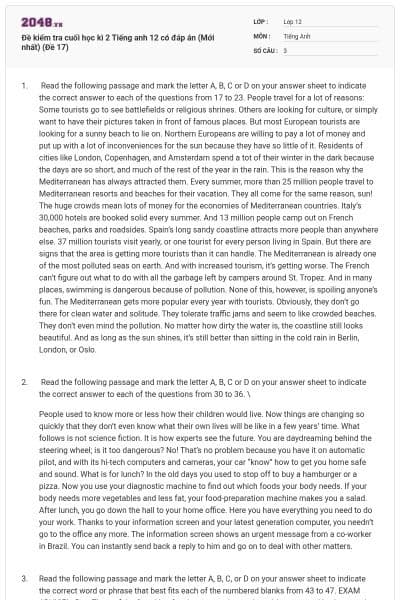
Read the following passage and mark the letter A, B, C or D on your answer sheet to indicate the correct answer to each of the questions from 30 to 36. \
People used to know more or less how their children would live. Now things are changing so quickly that they don’t even know what their own lives will be like in a few years’ time. What follows is not science fiction. It is how experts see the future. You are daydreaming behind the steering wheel; is it too dangerous? No! That’s no problem because you have it on automatic pilot, and with its hi-tech computers and cameras, your car “know” how to get you home safe and sound. What is for lunch? In the old days you used to stop off to buy a hamburger or a pizza. Now you use your diagnostic machine to find out which foods your body needs. If your body needs more vegetables and less fat, your food-preparation machine makes you a salad. After lunch, you go down the hall to your home office. Here you have everything you need to do your work. Thanks to your information screen and your latest generation computer, you needn’t go to the office any more. The information screen shows an urgent message from a co-worker in Brazil. You can instantly send back a reply to him and go on to deal with other matters.
What does “its” in line 5 refer to?
the future
your home
your car
the steering wheel
Đáp án đúng: C
Giải thích: Dẫn chứng: That’s no problem because you have it on automatic pilot, and with its hi-tech computers and cameras, your car “know” how to get you home safe and sound
Dịch: Đó không còn là vấn đề nữa bởi bạn đã có bộ điều khiển tự động, và với thiết bị máy tính và camera công nghệ cao, xe bạn sẽ biết đâu là cách để đưa bạn về nhà an toàn
People will go to work as they do today.
Hi-tech equipment will be out of the question.
It will be dangerous to drive cars because they are too fast.
People can have balanced diets for their meal.
Đáp án đúng: D
Giải thích: Dẫn chứng: Now you use your diagnostic machine to find out which foods your body needs. If your body needs more vegetables and less fat, your food-preparation machine makes you a salad.
Dịch: Bạn có thể sử dụng máy chuẩn đoán để nhận biết loại thực phẩm nào
là cơ thể đang cần. Nếu cơ thể bạn đang cần nhiều rau xanh và ít chất béo, máy chuẩn bị thức ăn sẽ làm cho bạn món sa-lát.
Which of the following is NOT true about life in the future?
Eating is a problem because food contains too much fat
There’s no need to concentrate much when driving.
Contacts between people are almost instant.
Getting information is a matter of just a few seconds.
Đáp án đúng: A
Giải thích: Dẫn chứng: Now you use your diagnostic machine to find out which foods your body needs. If your body needs more vegetables and less fat, your food-preparation machine makes you a salad.
Dịch: Bạn có thể sử dụng máy chuẩn đoán để nhận biết loại thực phẩm nào
là cơ thể đang cần. Nếu cơ thể bạn đang cần nhiều rau xanh và ít chất béo, máy chuẩn bị thức ăn sẽ làm cho bạn món sa-lát.
=> Trong tương lai, với sự xuất hiện của máy chuẩn đoán có thể giúp ta phát hiện loại thực phẩm mà cơ thể đang cần và máy chuẩn bị thức ăn sẽ làm ra những món có hàm lượng dinh dưỡng phù hợp với yêu cầu đó => Việc thực phẩm chứa quá nhiều chất béo sẽ không còn là vấn đề.
According to the passage, what do people use a diagnostic machine for?
To make food for them.
To find out which foods their body needs
To provide them with food.
To sell food for humans.
Đáp án đúng: B
Giải thích: Dẫn chứng: Now you use your diagnostic machine to find out which foods your body needs
Dịch: Bạn có thể sử dụng máy chuẩn đoán để nhận biết loại thực phẩm nào là cơ thể đang cần
Which “reply” CLOSET in meaning to?
replay
request.
answer
question
Đáp án đúng: C
Giải thích:
reply (v): đáp lại, hồi âm = answer (v+n): trả lời.
Các đáp án còn lại:
A. replay (v): chơi lại (thể thao), phát lại,…
B. request (v): thỉnh cầu, yêu cầu.
D. question (n+v): hỏi, câu hỏi.
The word “urgent” in the last paragraph probably means _____.
expected
pressing
unnecessary
hurry
Đáp án đúng: D
Giải thích:
urgent (adj): khẩn cấp = pressing (adj): cấp bách, cấp thiết.
Các đáp án còn lại.
A. expected (Ved+adj): mong chờ, đáng mong đợi.
C. unnecessary (adj): không cần thiết.
D. hurry (adj): hối hả, gấp rút.
What life is like in the future.
The role of the computer in future life.
What foods people will eat in the future.
Life in the future will be the same as life at present.
Đáp án đúng: A
Giải thích: Thông tin từ toàn bài
Dịch: A. Cuộc sống sẽ như thế nào trong tương lai.
Mark the letter A, B, C or D on your answer sheet to indicate the word(s) CLOSEST in meaning to the underlined word(s) in each of the following questions.
very proud
very exhausted
extremely pleased
extremely dazed
Đáp án đúng: C
Giải thích:
Thành ngữ: like a dog with two tails: vô cùng hạnh phúc = extremely pleased.
Các đáp án còn lại:
A. very proud: vô cùng tự hào.
B. very exhausted: vô cùng mệt mỏi.
D. extremely dazed: vô cùng sửng sốt.
Dịch: Lucky sẽ rất vui nếu cô ấy được vào đội.
Some workers were inhibited from speaking by the presence of their managers.
deferred
discharged
triggered
prevented
Đáp án đúng: D
Giải thích:
inhibit (v) = prevent (v): ngăn cản, ngăn cấm.
Các đáp án còn lại:
A. defer (v): hoãn lại.
B. discharge (v): bốc dỡ, sa thải, …
C. trigger (v): bóp cò, gây ra.
Dịch: Một số công nhân bị ngăn không được lên tiếng bởi sự có mặt của các nhà quản lý.
But what the most prevents women from reaching the boardroom, say bosses and headhunters, is lack of hands-on experience of a firm’s core business.
unavailable
untested
impractical
insignificant
Đáp án đúng: C
Giải thích:
hands-on (adj): thực tế >< impractical (adj): thiếu thực tế.
Các đáp án còn lại:
A. unavailable (adj): không có sẵn.
B. untested (adj): chưa được kiểm chứng.
D. insignificant (adj): tầm thường.
Dịch: Những ông chủ và các nhà tuyển dụng cho rằng điều ngăn cản phụ nữ tiến tới các vị trí cao là thiếu kinh nghiệm thực tế trong cốt lõi của vấn đề kinh doanh.have little effect on something.
make bad things happen.
prevent something from coming into use
produce the results that aren’t intended
Đáp án đúng: A
Giải thích:
Thành ngữ: (to) pack a punch: có hiệu quả, các tác động mạnh mẽ >< A. có ít tác động.
Các đáp án còn lại:
B. make bad things happen: làm cho điều xấu xảy ra.
C. prevent something from coming into use: ngăn cản cái gì đó được đưa vào sử dụng.
D. produce the results that aren’t intended: sinh ra hậu quả không tính trước.
Dịch: Ngày nay, để mua được 1 chiếc tivi hiện đại là rất dễ dàng, và nó tác động mạnh tới cuộc sống trong việc có được những trải nghiệm thị giác tuyệt vời.
Mark the letter A, B, C or D on your answer sheet to indicate the sentence that is closest in meaning to each of the following questions.
Maria says she’d like to have been put in a higher class.
Maria wishes she is put in a higher class.
Maria wishes she were put in a higher class.
Maria wishes she had been put in a higher class.
Maria wishes she will be put in a higher class.
Đáp án đúng: C
Giải thích:
Ngữ pháp liên quan tới câu giả định:
Ước một điều có thể xảy ra: S wish S(s/es).
Ước một điều không có thật ở hiện tại: S wish S V-ed/ were.
Ước một điều không có thật trong quá khứ: S wish S had PII.
Dịch: Maria nói rằng cô ấy muốn được đưa vào một lớp học nâng cao hơn.
His parents made him study for his exams.
He was obliged to study for the exam by his parents.
He was made to study for the exam by his parents.
He is made to study for the exam by his parents.
He was made study for the exam by his parents.
Đáp án đúng: B
Giải thích: Chuyển từ câu chủ động sang câu bị động.
Chủ động: S make O V => Bị động: S(O) tobe made to V by O(S)
Dịch: Anh ấy bị bố mẹ ép học cho kỳ thi.
You have to do a (43)______ task which usually lasts about 3 minutes.
lonely
single
unique
once
Đáp án đúng: B
Giải thích: (to) do a single task: làm 1 nhiệm vụ.
Dịch: Bạn phải thực hiện một nhiệm vụ thường kéo dài khoảng 3 phút.
optical
visual
noticeable
obvious
Đáp án đúng: B
Giải thích:
visual information: thông tin trực quan.
Các đáp án còn lại:
A. optical (adj): thuộc về mắt.
C. noticeable (adj): đáng chú ý.
D. obvious (adj): rõ ràng.
Dịch: Một nhiệm vụ có thể thực hiện là “giải quyết vấn đề”, nghĩa là bạn phải xem một số thông tin trực quan và sau đó thảo luận vấn đề với bạn cặp của mình.
essential
needed
helpful
successful
Đáp án đúng: A
Giải thích:
Động từ phía sau không chia => Câu giả định: It tobe + essential + that + S V-inf.
Các đáp án còn lại:
B. needed (V-ed): cần.
C. helpful (adj): hữu ích.
D. successful (adj): thành công.
Dịch: điều cần thiết là bạn phải nghiên cứu chúng cẩn thận
While you are doing the task, the examiner will probably say very little and you
should ask your partner questions and make (46) ______ if he or she is not saying much.speeches
statements
ideas
suggestions
Đáp án đúng: D
Giải thích:
(to) make suggestions: đề xuất, đưa ra lời đề nghị.
Các đáp án còn lại:
A. speech (n): bài phát biểu.
B. idea (n): ý tưởng.
C. statement (n): câu văn, bài phát biểu.
Dịch: Trong khi bạn đang thực hiện nhiệm vụ, giám khảo có thể sẽ nói rất ít và bạn nên đặt câu hỏi cho bạn cặp của mình và đưa ra các gợi ý nếu họ không nói nhiều.
This mark depends on your success in doing the task by competing with your partner, which includes taking (47) ______ in giving opinions and replying appropriately, although in the end it may be possible to “agree to disagree”.
changes
sides
turns
sentences
Đáp án đúng: C
Giải thích:
(to) take turns in V-ing: làm gì đó theo thứ tự.
Các đáp án còn lại:
A. change (n): sự thay đổi.
B. side (n): bên, góc, mạn sườn,…
D. sentence (n): câu văn, lời tuyên án,…
Dịch: Điểm này sẽ phụ thuộc vào sự thành công của bạn trong việc thực hiện nhiệm vụ bằng cách cạnh tranh với bạn cặp của bạn, bao gồm thay phiên nhau đưa ra ý kiến và trả lời một cách thích hợp.
Mark the letter A, B, C, or D on your answer sheet to indicate the underlined part that needs correction in each of the following questions.
(A) What we know about certain diseases (B) are still not sufficient to prevent them (C) from spreading easily (D) among the population.
What we know about
are
from spreading
among
Đáp án đúng: B
Giải thích: Chủ ngữ là Mệnh đề danh từ (What + clause) nên động từ chia theo nó luôn ở dạng số ít.
Sửa: are -> is
Dịch: Những gì chúng ta biết về một số căn bệnh nhất định vẫn chưa đủ để ngăn chặn chúng lây lan nhanh chóng trong cộng đồng.
Meal time (A) also gives children a chance (B) to learn (C) how some of their favorite dishes (D) making.
also gives
to learn
how
making
Đáp án đúng: D
Giải thích: Mệnh đề danh từ: How + S V O.
Sửa: making -> are made
Dịch: Bữa ăn cũng mang lại cho trẻ cơ hội để hiểu được cách mà những món ăn chúng yêu thích được nấu như thế nào.
(A) The food that Mark (B) is cooking in the kitchen (C) is smelling (D) delicious.
The food
is cooking
is smelling
delicious
Đáp án đúng: C
Giải thích: Động từ tri giác “smell” không chia ở dạng V-ing.
Sửa: smelling -> smells
Dịch: Món ăn mà Mark đang nấu trong bếp có mùi rất thơm ngon.
Bạn có thích hoạt động này không?