Bộ câu hỏi: Câu gián tiếp (Có đáp án)
50 câu hỏi
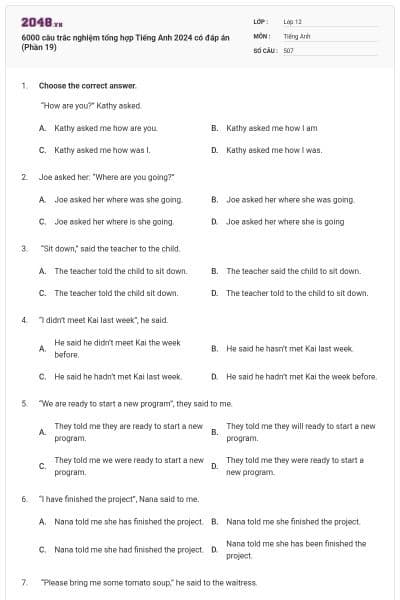
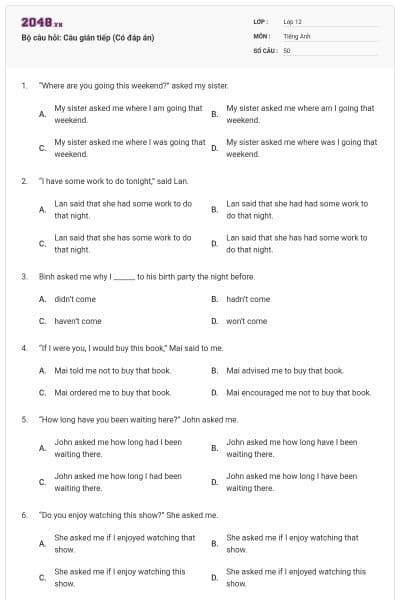
My sister asked me where I am going that weekend.
My sister asked me where am I going that weekend.
My sister asked me where I was going that weekend.
My sister asked me where was I going that weekend.
Lan said that she had some work to do that night.
Lan said that she had had some work to do that night.
Lan said that she has some work to do that night.
Lan said that she has had some work to do that night.
didn’t come
hadn’t come
haven’t come
won’t come
Mai told me not to buy that book.
Mai advised me to buy that book.
Mai ordered me to buy that book.
Mai encouraged me not to buy that book.
John asked me how long had I been waiting there.
John asked me how long have I been waiting there.
John asked me how long I had been waiting there.
John asked me how long I have been waiting there.
She asked me if I enjoyed watching that show.
She asked me if I enjoy watching that show.
She asked me if I enjoy watching this show.
She asked me if I enjoyed watching this show.
have gone
had gone
go
would go
Phuong said that she did some voluntary work last year.
Phuong said that she had done some voluntary work last year.
Phuong said that she did some voluntary work the year before.
Phuong said that she had done some voluntary work the year before.
Hoang admitted breaking his mother’s antique vase.
Hoang refused to break his mother’s antique vase.
Hoang threatened to break his mother’s antique vase.
Hoang denied breaking his mother’s antique vase.
Nam asked me whether your brother attended that college.
Nam asked me whether my brother attended that college.
Nam asked me if my brother attends that college.
Nam asked me if your brother attended this college.
My mother told me not to take an umbrella with me.
My mother asked me not to take an umbrella with me.
My mother invited me to take an umbrella with me.
My mother reminded me to take an umbrella with me.
Đáp án: D
Giải thích:
Kiến thức: Câu tường thuật
remind somebody to do something: nhắc nhở ai làm gì
Xét các đáp án khác:
A. My mother told me not to take an umbrella with me. → Sai vì câu gốc khuyên nhớ mang ô, không phải bảo không mang ô.
B. My mother asked me not to take an umbrella with me. → Sai vì ask thường dùng để yêu cầu chứ không phải nhắc nhở.
C. My mother invited me to take an umbrella with me. → Sai vì invite mang nghĩa mời, không phù hợp.
Dựa vào nghĩa, chọn D. My mother reminded me to take an umbrella with me.
Dịch: “Đừng quên mang theo ô nhé,” mẹ tôi nói.
→ Mẹ tôi nhắc tôi mang theo một chiếc ô.
Trang asked me how often did I play badminton.
Trang asked me how often I played badminton.
Trang asked me how long do I play badminton.
Trang asked me how often I play badminton.
The teacher wanted to know why I had come late that morning.
The teacher wanted to know why did I come late that morning.
The teacher wanted to know why had I come late that morning.
The teacher wanted to know why I came late that morning.
My sister said that she will go shopping after work.
My sister said that she had gone shopping after work.
My sister said that she would go shopping after work.
My sister said that she went shopping after work.
My brother asked me not to see a doctor.
My brother advised me not to see a doctor.
My brother apologised to me for seeing a doctor.
My brother suggested that I see a doctor.
had paid
pays
paid
would pay
Nam refused to read my diary.
Nam admitted reading my diary.
Nam threatened to read my diary.
Nam denied reading my diary.
My father asked me when did I get home the day before.
My father asked me when I had got home the day before.
My father asked me when had I got home the day before.
My father asked me when I got home the day before.
My mother said that she is going to meet her old friends the next day.
My mother said that she was going to meet her old friends tomorrow.
My mother said that I was going to meet my old friends the next day.
My mother said that she was going to meet her old friends the next day.
Linh told me to use that shark knife.
Lin asked me to use that sharp knife.
Linh suggested that I use that sharp knife.
Linh warned me against using that sharp knife.
They asked me how did I spend my summer holiday the year before.
They asked me how I spent my summer holiday the year before.
They asked me how I had spent my summer holiday the year before.
They asked me how had I spent my summer holiday the year before.
Tony wanted to know what I was reading then.
Tony wanted to know what I were reading then.
Tony wanted to know what I am reading now.
Tony wanted to know what am I reading now.
Duong said that he had to finish my project that night.
Duong said that he has to finish his project tonight.
Duong said that he had to finish his project that night.
Duong said that he has to finish his project that night.
He asked me whether have I considered changing my job.
He asked me if I had considered changing my job.
He asked me if I have considered changing my job.
He asked me whether I had considered changing your job.
She asked me what I were planning to do the next week.
She asked me what I had planned to do the following week.
She asked me what I was planning to do the next week.
She asked me what I have planned to do the following week.
Ha said I had a lot of homework to do.
Ha said she had a lot of homework to do.
Ha said I have a lot of homework to do.
Ha said she has had a lot of homework to do.
Giải thích:
Kiến thức câu tường thuật:
- Động từ ‘have’ ở thì hiện tại đơn, trong câu tường thuật cần lùi thì về thì quá khứ đơn ‘had’.- Chủ ngữ “Ha” → câu tường thuật chuyển thành ‘she’
Tạm dịch: Hà nói rằng cô ấy có nhiều bài tập về nhà phải làm.
→ Chọn đáp án B
will intend
intend
have intended
Intended
Giải thích:
Kiến thức câu tường thuật cho câu hỏi:
Ta thấy wanted chia ở quá khứ, nên ta sẽ lùi thì ở vế sau. Chỉ có D là lùi về thì QKD.
Tạm dịch: Tim muốn biết tôi định đi đâu vào cuối tuần đó.
→ Chọn đáp án D
Linda said he can speak Chinese fluently.
Linda said he couldn’t speak Chinese fluently.
Linda said he could speak Chinese fluently.
Linda said he can’t speak Chinese fluently.
Giải thích:
Kiến thức câu tường thuật khuyết thiếu:
- Động từ khiếm khuyết ‘can’ trong câu tường thuật lùi về dạng quá khứ là ‘could’.
Tạm dịch: Linda nói rằng cô ấy có thể nói tiếng Trung lưu loát.
→ Chọn đáp án C
painted
is painted
was painted
has been painted
Giải thích:
Kiến thức câu tường thuật:
Ta thấy ‘said’ chia quá khứ, nên vế sau ta sẽ lùi 1 thì. Vế sau mang nghĩa bị động, nên ta dùng was painted.
Tạm dịch: Peter nói rằng bức tranh được vẽ bởi một họa sĩ nổi tiếng.
→ Chọn đáp án C
might miss
misses
has missed
will miss
Giải thích:
Kiến thức câu tường thuật với động từ khiếm khuyết:
- Động từ khiếm khuyết ‘may” sẽ lùi thì về ‘might’ trong câu tường thuật.
Tạm dịch: Laura nói rằng cô ấy có thể lỡ chuyến xe buýt.
→ Chọn đáp án A
Luke encouraged me to book tickets at that time.
Luke told me not to book tickets at this time.
Luke asked me to book tickets at this time.
Luke advised me not to book tickets at that time.
Giải thích:
Tạm dịch: “Nếu tôi là bạn, tôi sẽ không đặt vé vào thời điểm này.” Luca nói với tôi.
A. Luke khuyến khích tôi đặt vé vào thời điểm đó.
B. Sai vì chưa thay đổi ‘this’ thành ‘that’.
C. Luke yêu cầu tôi đặt vé vào thời điểm này.
D. Luke khuyên tôi không nên đặt vé vào thời điểm đó.
→ Chọn đáp án D
Nam admitted saying swear words.
Nam denied having said swear words.
Nam offered not to say swear words.
Nam threatened to say swear words.
Giải thích:
Tạm dịch: “Tôi không nói tục chửi thề,” Nam nói.
A. Nam thừa nhận có nói tục chửi thề.
B. Nam phủ nhận việc có nói tục chửi thề.
C. Nam đề nghị không nói tục chửi thề.
D. Nam đe dọa nói tục chửi thề.
→ Chọn đáp án B
Linda asked me how long had I volunteered at that hospital.
Linda asked me how long I have volunteered at this hospital.
Linda asked me how long I had volunteered at that hospital.
Linda asked me how long have I volunteered at that hospital.
Giải thích:
Tạm dịch: “Bạn làm tình nguyện ở bệnh viện này bao lâu rồi?” Linda hỏi tôi.
A. Sai ngữ pháp vì phải đổi vị trí chủ ngữ và động từ sau từ để hỏi (had I → I had)
B. Sai ngữ pháp vì mệnh đề sau từ để hỏi phải lùi thì (I have → I had)
C. Linda hỏi tôi đã làm tình nguyện ở bệnh viện đó bao lâu rồi.
D. Sai ngữ pháp vì phải đổi vị trí chủ ngữ và động từ sau từ để hỏi + lùi thì (have I → I had)
→ Chọn đáp án C
Susan invited me to tell him her secrets.
Susan asked me not to tell him her secrets.
Susan advised me not to tell him my secrets.
Susan apologised to me for telling him my secrets.
Giải thích:
Tạm dịch: “Đừng nói với anh ấy những bí mật của tôi,” Susan nói với tôi.
A. Susan mời tôi kể cho anh ấy nghe những bí mật của cô ấy.
B. Susan yêu cầu tôi không nói cho anh ấy bí mật của cô ấy.
C. Susan khuyên tôi không nên nói với anh ấy những bí mật của mình.
D. Susan xin lỗi tôi vì đã nói với anh ấy những bí mật của tôi.
→ Chọn đáp án B
come
will come
had come
have come
Giải thích:
Kiến thức câu tường thuật cho câu hỏi:
Ta thấy wanted chia quá khứ và phía sau có ‘the night before’. Vậy vế sau sẽ lùi từ thì QKD về QKHT.
Tạm dịch: Mẹ tôi muốn biết lý do tại sao tôi về nhà muộn vào đêm hôm trước.
→ Chọn đáp án C
wasn’t
isn’t
won’t be
hasn’t been
Giải thích: Kiến thức câu tường thuật:
Ta thấy ‘said’ chia quá khứ, nên vế sau ta phải lùi thì. Chỉ có ‘wasn’t’ là lùi về thì QKD.
Tạm dịch: Bob cho biết kết nối Internet không đủ ổn định để anh ấy học trực tuyến.
→ Chọn đáp án A
has been
may be
will be
Was
Giải thích:
Kiến thức câu tường thuật:
Ta thấy ‘said’ chia quá khứ, nên vế sau ta phải lùi thì. Chỉ có ‘was’ là lùi về thì QKD.
Tạm dịch: Nhiều sinh viên nói rằng cuốn sách rất nhiều thông tin.
→ Chọn đáp án D
had
will have
am having
may have
Giải thích:
Kiến thức câu tường thuật với động từ thường:
Ta thấy ‘asked’ chia ở quá khứ, nên vế sau ta phải lùi thì. Chỉ có ‘had’ là lùi về thì QKD.
Tạm dịch: Người phỏng vấn hỏi tôi có kinh nghiệm liên quan nào không.
→ Chọn đáp án A
have read
am reading
will read
had read
Giải thích:
Kiến thức câu tường thuật với động từ thường:
Ta thấy ‘wanted’ chia ở quá khứ, nên vế sau ta phải lùi thì. Chỉ có ‘had read’ là lùi về thì QKHT.
Tạm dịch: Martin muốn biết liệu tôi có đọc nhật ký của anh ấy hay không.
→ Chọn đáp án D
Max told me not to return the book to the library.
Max reminded me to return the book to the library.
Max apologised to me for returning the book to the library.
Max regretted having returned the book to the library.
Giải thích:
Tạm dịch: “Đừng quên trả lại cuốn sách cho thư viện,” Max nói.
A. Max nói với tôi rằng đừng trả lại cuốn sách cho thư viện.
B. Max nhắc tôi trả sách cho thư viện.
C. Max xin lỗi tôi vì đã trả lại cuốn sách cho thư viện.
D. Max hối hận vì đã trả lại cuốn sách cho thư viện.
→ Chọn đáp án B
My mother said that she had met her doctor that day.
My mother said that she will meet her doctor today.
My mother said that she is going to meet her doctor today.
My mother said that she was going to meet her doctor that day.
Giải thích:
Tạm dịch: “Mẹ sẽ gặp bác sĩ của mẹ hôm nay,” mẹ tôi nói.
A. Sai ngữ pháp vì (had met → was going to meet)
B. Sai ngữ pháp (will meet → was going to meet; today → that day)
C. Sai ngữ pháp (is going to → was going to; today → that day)
D. Mẹ tôi nói rằng bà sẽ gặp bác sĩ vào ngày hôm đó.
→ Chọn đáp án D
Hung asked me if I had seen that movie.
Hung asked me if had I seen that movie.
Hung asked me if I have seen that movie.
Hung asked me if have I seen that movie.
Giải thích:
Tạm dịch: "Bạn đã xem bộ phim đó chưa?" Hùng hỏi tôi.
A. Hùng hỏi tôi đã xem bộ phim đó chưa.
B. Sai ngữ pháp vì phải đưa trợ động từ về sau chủ ngữ.
C. Sai ngữ pháp vì phải lùi thì về quá khứ hoàn thành (have seen → had seen)
D. Sai ngữ pháp vì chưa lùi thì và chưa đưa trợ động từ về sau chủ ngữ.
→ Chọn đáp án A
The manager threatened to look into the matter that night.
The manager apologised for not looking into the matter that night.
The manager denied looking into that matter that night.
The manager promised to look into the matter that night.
Giải thích:
Tạm dịch: “Tôi sẽ xem xét vấn đề tối nay,” người quản lý nói.
A. Người quản lý đe dọa sẽ xem xét vấn đề vào đêm hôm đó.
B. Người quản lý xin lỗi vì đã không xem xét vấn đề tối hôm đó.
C. Người quản lý phủ nhận đã xem xét vấn đề đó vào đêm hôm đó.
D. Người quản lý hứa sẽ xem xét vấn đề vào tối hôm đó.
→ Chọn đáp án D
Her mother asked her to touch the knife.
Her mother advised her to touch the knife.
Her mother warned her against touching the knife.
Her mother reminded her not to forget to touch the knife.
Giải thích:
Tạm dịch: “Đừng đụng vào con dao đó,” mẹ cô ấy nói.
A. Mẹ cô ấy yêu cầu cô ấy đụng vào con dao.
B. Mẹ cô khuyên cô ấy nên đụng vào con dao.
C. Mẹ cô ấy đã cảnh báo cô ấy không được đụng vào con dao.
D. Mẹ cô ấy nhắc cô ấy đừng quên đụng vào con dao.
→ Chọn đáp án CShe apologised to her manager for not completing the weekly report.
She denied completing the weekly report.
She admitted completing the weekly report.
She warned her manager not to complete the weekly report.
Giải thích:
Tạm dịch: "Tôi xin lỗi. Tôi chưa hoàn thành báo cáo hàng tuần.” cô ấy nói với người quản lý của mình.
A. Cô ấy đã xin lỗi người quản lý của mình vì đã không hoàn thành báo cáo hàng tuần.
B. Cô ấy phủ nhận đã hoàn thành báo cáo hàng tuần.
C. Cô ấy thừa nhận đã hoàn thành báo cáo hàng tuần.
D. Cô ấy đã cảnh báo người quản lý của mình không được hoàn thành báo cáo hàng tuần.
→ Chọn đáp án A
would pay
has paid
is paying
had paid
Giải thích:
Kiến thức câu tường thuật với động từ thường:
- Từ chỉ thời gian ‘the week before’ chính là ‘last week’ chuyển sang, nên động từ phải lùi từ thì quá khứ đơn về thì quá khứ hoàn thành. (paid → had paid)
Tạm dịch: Edward nói rằng anh ấy đã đến thăm ông bà của mình vào tuần trước.
→ Chọn đáp án D
The prime minister promised to stay indoors to avoid catching the virus.
The prime minister told the citizens to stay indoors to avoid catching the virus.
The prime minister threatened to stay indoors to avoid catching the virus.
The prime minister apologised to the citizens for not staying indoors to avoid catching the virus.
Giải thích:
Tạm dịch: “Hãy ở trong nhà để tránh nhiễm virus,” thủ tướng nói với người dân.
A. Thủ tướng hứa sẽ ở trong nhà để tránh nhiễm vi-rút.
B. Thủ tướng bảo người dân nên ở trong nhà để tránh nhiễm vi-rút.
C. Thủ tướng đe dọa ở trong nhà để tránh bị nhiễm vi-rút.
D. Thủ tướng xin lỗi người dân vì đã không ở trong nhà để tránh nhiễm virus.
→ Chọn đáp án B
Max asked me how often did I go jogging.
Max asked me how often I had gone jogging.
Max asked me how often have I gone jogging.
Max asked me how often I went jogging.
Giải thích:
Tạm dịch: "Bạn có thường đi chạy bộ không?" Max hỏi tôi.
A. Sai ngữ pháp vvì chưa lùi thì.
B. Sai ngữ pháp vì chỉ cần lùi thì về QKD.
C. Sai ngữ pháp vì chưa lùi thì và dùng sai thì.
D. Max hỏi tôi có thường xuyên chạy bộ không.
→ Chọn đáp án D
will start
starts
started
can start
Giải thích:
Kiến thức câu tường thuật cho câu hỏi:
- Ta thấy ‘wanted’ chia quá khứ, nên vế sau phải lùi 1 thì. Xét chỉ thấy có started là lùi về thì QKD.
Tạm dịch: James muốn biết khi trận đấu bóng đá bắt đầu.
→ Chọn đáp án C
Nam asked me not to rehearse my speech.
Nam offered to rehearse my speech.
Nam suggested that I rehearse my speech.
Nam encouraged me not to rehearse my speech.
Giải thích:
Tạm dịch: “Tại sao bạn không luyện tập bài phát biểu của mình?” Nam nói với tôi.
A. Nam yêu cầu tôi không được diễn tập bài phát biểu của mình.
B. Nam đề nghị diễn tập bài phát biểu của tôi.
C. Nam đề xuất rằng tôi nên diễn tập bài phát biểu của mình.
D. Nam khuyến khích tôi không nên diễn tập bài phát biểu của tôi.
→ Chọn đáp án C
Bạn có thích hoạt động này không?