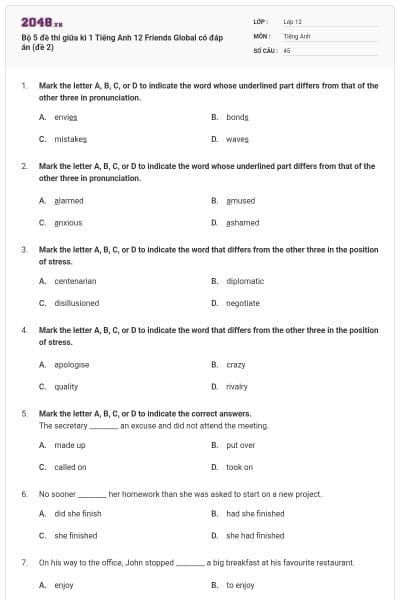
Bộ 5 đề thi giữa kì 1 Tiếng Anh 12 Friends Global có đáp án (đề 2)
40 câu hỏi
Mark the letter A, B, C, or D to indicate the word whose underlined part differs from that of the other three in pronunciation.
envies
bonds
mistakes
waves
alarmed
amused
anxious
ashamed
Mark the letter A, B, C, or D to indicate the word that differs from the other three in the position of stress.
centenarian
diplomatic
disillusioned
negotiate
apologise
crazy
quality
rivalry
Mark the letter A, B, C, or D to indicate the correct answers.
The secretary ________ an excuse and did not attend the meeting.
made up
put over
called on
took on
Chọn A: Kiến thức về cụm động từ:
- make up sth: bịa ra một câu chuyện, lý do nào đó
- put sth over (to sb): truyền tải ý tưởng, cảm xúc,...
- call on sb: yêu cầu ai đó làm gì
- take sb/sth on: nhận thêm công việc
? Dịch: Cô thư ký viện ra một cái cớ và không tham dự buổi họpNo sooner ________ her homework than she was asked to start on a new project.
did she finish
had she finished
she finished
she had finished
Chon B: Kiến thức về câu đảo ngữ:
- Cấu trúc: No sooner + had + S + V3 + than + S + V-ed.
- Cách dùng: diễn tả một sự việc (V-ed) xảy ra ngay sau khi một sự việc (V3) vừa diễn ra.
? Dịch: Cô ấy vừa làm xong bài tập về nhà thì đã được yêu cầu bắt đầu ngay một dự án mới.
enjoy
to enjoy
enjoying
enjoyed
Chọn B: Kiến thức về bổ ngữ của động từ:
- stop to do something: dừng (tạm thời) việc đang làm để làm việc khác.
- stop doing something: dừng làm việc gì, ý nói sau này sẽ không làm nữa.
? Dịch: Trên đường đi đến chỗ làm, John dừng lại để tận hưởng một bữa sáng lớn ở nhà hàng yêu thích của anh ấy.
belief
interest
doubt
Chọn A: Kiến thức về cụm giới từ:
- under the impression that...: tin là, tưởng là điều gì đó đúng (thường là không đúng)
- in the belief that...: với niềm tin rằng, e.g. She acted in the belief that she was doing good.
- of interest: có giá trị, gây hứng thú, e.g. These documents are of great historical interest.
- in doubt: nghi ngờ, không chắc chắn, e.g. By 14 he was in no doubt about his career aims.
? Dịch: Tất cả chúng tôi đều có tưởng rằng mẹ đang chuẩn bị cho chuyến du lịch châu Âu. Vì vậy tất cả đều ngạc nhiên khi mẹ nói điểm đến sẽ là Úc.
Lottie! You’re going to get on your sister’s _____ if you keep behaving that way.
edge
hair
nerves
top
Chọn C: Kiến thức về các thành ngữ chỉ cảm xúc:
- get on sb’s nerves: làm ai khó chịu, bực mình
- be on edge: lo lắng, đứng ngồi không yên
- tear one’s hair out: bất an, vò đầu bứt tóc
- blow one’s top: trở nên tức giận
? Dịch: Lottie! Con sẽ làm chị con bực mình nếu cứ tiếp tục hành xử như vây.Read the following advertisements and mark the letter A, B, C, or D to indicate the correct optionthat best fits each of the blanks.
⛳Golf It! is Scotland’s most exciting family entertainment and golf destination.
?️On the banks of Hogganfield Loch, Golf It! offers a world of great value activities for all ages and abilities.
????Golf It! has been designed with families (10) ________. It’s not just a place to perfect your swing, it’s a place for the whole family to play together, stay active, and (11) ________ memories. ?️♂️ ?♀️ ?
(12) ________ you’ve never picked up a golf club before, you can come down, smash some balls and have an amazing family day out! ?
in mind
in plan
in time
in thought
Chọn A: Kiến thức về cụm từ cố định:
- do sth with sth in mind: làm việc gì đó với một mục đích cụ thể
- in time (for sth/ to do sth): kịp giờ, đủ thời gian làm gì
? Dịch: Cùng Golf Nào! được thiết kế hướng đến các gia đình.
hold
keep
make
set
Chon C: Kiến thức về kết hợp từ:
- to make memories: tạo những kỷ niệm đẹp
? Dịch: Đây không chỉ là nơi để bạn hoàn thiện cú swing mà còn là nơi cả gia đình có thể cùng vui chơi, vận động và tạo nên những kỷ niệm đẹp.As soon as
Because
In the event that
Even if
Chọn D: Kiến thức về liên từ:
- As soon as...: Ngay khi...
- Because...: Bởi vì...
- In the event that...: Trong trường hợp...
- Even if...: Ngay cả khi...
? Dịch: Kể cả khi bạn chưa từng chơi golf, bạn vẫn có thể đến đây, đánh vài đường và tận hưởng một ngày vui chơi vui vẻ cùng gia đình!
?Introducing the GuardianPro CCTV 2024 - Your Ultimate Security Solution!?
Are you looking for state-of-the-art security? Look (13) ________! The GuardianPro CCTV 2024 offers cutting-edge features:
- Ultra HD 4K Resolution: Crystal-clear footage, day and night!
- 360-degree Panoramic View: No blind spots, see everything around!
- Smart Motion Detection: Get alerts on your smartphone (14) ________ once!
- Easy Installation: Set up in minutes, secure for a lifetime!
(15) ________ for both home and business, the GuardianPro CCTV 2024 is your watchful eye, ensuring peace of mind 24/7. Act now and step into a safer future!
?Special Offer: Order today and get a 10% discount on your first purchase!
? Visit guardianpro.com or call us at 0291357246 to secure your space!
GuardianPro CCTV 2024 - Watching Over What Matters Most!
much farther
no further
nowhere near
the furthest
Chọn B: Kiến thức về thành ngữ:
- Look no further: Đừng nhìn đâu cho xa; Khỏi cần tìm nữa; Ngay đây nè (một cách nói hay gặp trong quảng cáo)
? Dịch: Bạn đang tìm kiếm một giải pháp an ninh tiên tiến? Khỏi cần tìm đâu xa nữa!
Smart Motion Detection: Get alerts on your smartphone (14) ________ once!
at
by
for
in
Chọn A: Kiến thức về cụm giới từ:
- at once (adv) = immediately: ngay lập tức
- (just) for once: một lần thôi, e.g. Can’t you be nice to each other just for once?
? Dịch: Nhận thông báo về điện thoại của bạn ngay tức khắc!(15) ________ for both home and business, the GuardianPro CCTV 2024 is your watchful eye, ensuring peace of mind 24/7. Act now and step into a safer future!
?Special Offer: Order today and get a 10% discount on your first purchase!Perfect
Imperfect
Perfectl
Imperfection
Chọn A: Kiến thức về từ loại:
- Bổ nghĩa cho chủ ngữ cần dùng một cụm tính từ, xét ngữ cảnh của quảng cáo chọn ‘perfect’.
? Dịch: Một lựa chọn hoàn hảo cho cả gia đình và doanh nghiệp, GuardianPro CCTV 2024 sẽ là đôi mắt thứ hai của bạn, đảm bảo cho bạn an tâm suốt ngày dài.Mark the letter A, B, C, or D to indicate the correct arrangement of the sentences to make a meaningful paragraph / letter in each of the following questions.
Question 16:
a. Above all, I trust him implicitly, knowing he’s always there for me as I am for him.
b. Additionally, I respect his opinions on various matters, even when we do not see eye to eye on everything.
c. I admire my twin brother for his incredible talent in music; it’s something that always amazes me.
d. Also, it’s great that we are on the same wavelength when it comes to our sense of humour – we can laugh for hours at the same jokes.
e. We are very close and have a lot in common, especially our love for adventure and books.
c-e-d-b-a
d-e-a-b-c
c-b-e-d-a
c-e-a-b-d
A
Đoạn văn hoàn chỉnh | Dịch |
I admire my twin brother for his incredible talent in music; it’s something that always amazes me. We are very close and have a lot in common, especially our love for adventure and books. Also, it’s great that we are on the same wavelength when it comes to our sense of humour – we can laugh for hours at the same jokes. Additionally, I respect his opinions on various matters, even when we do not see eye to eye on everything. Above all, I trust him implicitly, knowing he’s always there for me as I am for him. | Tôi ngưỡng mộ anh trai sinh đôi của mình vì tài năng âm nhạc đáng kinh ngạc của anh ấy; đó là điều luôn làm tôi ngạc nhiên. Chúng tôi rất thân thiết và có nhiều điểm chung, đặc biệt là tình yêu dành cho phiêu lưu và sách. Ngoài ra, thật tuyệt khi hiểu được khiếu hài hước của nhau – chúng tôi có thể vì một câu chuyện cười mà cười với nhau hàng giờ. Ngoài ra, tôi tôn trọng ý kiến của anh ấy về nhiều vấn đề, ngay cả khi chúng tôi không phải lúc nào cũng cùng quan điểm. Trên hết, tôi hoàn toàn tin tưởng anh ấy vì biết rằng anh sẽ luôn bên tôi khi tôi cần như tôi sẽ luôn bên anh vậy. |
Subject: Need Advice on Handling an Annoying Deskmate
Hi everyone,
a. I’ve tried politely asking him to stop, but it hasn’t made much of a difference.
b. I’m reaching out because I’m struggling with a situation at school and could use some advice.
c. Does anyone have any tips on how to handle this situation effectively without causing conflict?
d. Thanks in advance for your help!
e. I really want to maintain a good relationship, but I also need to focus on my studies.
f. My deskmate constantly distracts me during class by talking and fidgeting, and it really affects my ability to concentrate.
Best,
Mary
d-a-c-b-f-e
e-b-c-a-d-f
b-f-a-c-e-d
c-a-e-f-d-b
C
Đoạn văn hoàn chỉnh | Dịch |
Subject: Need Advice on Handling an Annoying Deskmate Hi everyone, I’m reaching out because I’m struggling with a situation at school and could use some advice. My deskmate constantly distracts me during class by talking and fidgeting, and it really affects my ability to concentrate. I’ve tried asking him politely to stop, but it hasn’t made much of a difference. Does anyone have any tips on how to handle this situation effectively without causing conflict? I really want to maintain a good relationship, but I also need to focus on my studies. Thanks in advance for your help! Best, Mary. | Chủ đề: Cần lời khuyên về cách xử lý một người bạn cùng bàn khó chịu Chào mọi người, Tôi đăng bài vì đang không biết làm sao với một tình huống ở trường vì vậy cần một vài lời khuyên. Bạn cùng bàn liên tục nói chuyện riêng và nghịch linh tinh trong giờ học, thực sự rất ảnh hưởng đến khả năng tập trung của tôi. Tôi đã cố gắng lịch sự yêu cầu bạn ấy dừng lại, nhưng không khác gì mấy. Có ai có mẹo gì để xử lý tình huống này hiệu quả mà không làm xung đột không? Tôi thực sự muốn duy trì một mối quan hệ tốt nhưng cũng cần tập trung vào việc học của mình. Cảm ơn trước vì sự giúp đỡ của các bạn! Thân ái, Mary. |
Mark the letter A, B, or D to indicate the correct option that best fits each of the blanks.
A teen adopts moral and ethical values from their parents and other family members. (18) ________ family plays a vital role in shaping a teen’s behavior and grooming their personality. However, teens become violent or show signs of juvenile delinquency (19) ________ disturbance at home. (20) ________ with bad relations can cause teens to go astray and become violent. Single parents are often busy working; therefore, they’re not able to spend quality time with their children. This causes teens to seek attention from others, especially their peers.
(21) ________ in the family can lead children to find solace other than homes. When they do not have any communication with their parents or family members at home, they may lose unity, trust, and understanding, which can eventually lower their self-esteem or self-confidence. (22) ________ they’re losing their individuality, they tend to do things they shouldn’t do to boost their self-confidence. They blindly follow their peers and adopt their unhealthy lifestyles. They shoplift and consume drugs (23) ________ in the eyes of their peers.
Going without saying that
It goes without saying that
Without saying that
It comes without saying that
B: Kiến thức về thành ngữ:
- It goes without saying that...: Khỏi phải nói...
- Cách dùng: khi muốn đưa ra thông tin về những điều quá hiển nhiên, những điều có thể không cần nói nhưng vẫn nói ra để nhấn mạnh lại.
only when are they facing
which they are facing
only when they are facing
to face
C: Kiến thức về liên từ:
- only when: chỉ khi (theo sau là một mệnh đề bình thường, không đảo ngữ).
Breaking and disturbing families
Broken or disturbing families
Broken or family disturbing
Broken or disturbed families
D: Kiến thức về dạng động từ:
- Động từ ở dạng phân từ II/ V-ed được sử dụng như tính từ, trong văn bản có chức năng bổ nghĩa cho danh từ theo sau.
Single parents are often busy working; therefore, they’re not able to spend quality time with their children. This causes teens to seek attention from others, especially their peers.
(21) ________ in the family can lead children to find solace other than homes.
Frequent lack of conversations
A lack of conversations frequent
Lacking frequently in conversations
Conversation lack frequently
A: Kiến thức về trật tự từ loại:
- Cần điền một cụm danh từ làm chủ ngữ cho câu, trật tự đúng là ‘adj + N’ như đáp án A.
- B sai vì trong điều kiện bình thường tính từ đứng trước danh từ để bổ nghĩa cho danh từ.
- C là cấu trúc danh động từ có thể hoạt động như danh từ nhưng cú pháp không diễn đạt rõ ràng ý cần điền.
Once they feel
Whether they feel
They feel
That they feel
A: Kiến thức về liên từ, cấu trúc câu:
- Once + mệnh đề: Một khi... ? tạo mệnh đề phụ cho câu ghép, liên kết với mệnh đề chính sau dấu phẩy.
- ‘Whether + mệnh đề’ và ‘That + mệnh đề’ đều là cấu trúc mệnh đề danh ngữ hoạt động như một danh từ, không thể đứng đầu câu làm mệnh đề phụ hay trạng ngữ được ? loại B, D.
- ‘They feel’ là một cụm chủ - vị hoàn chỉnh, ghép vào chỗ trống sẽ được một mệnh đề hoàn chỉnh tạo câu ghép có hai mệnh đề bình đẳng, nhưng lại không có tính liên kết giữa hai mệnh đề ? loại C.
They blindly follow their peers and adopt their unhealthy lifestyles. They shoplift and consume drugs (23) ________ in the eyes of their peers.
D: Kiến thức về bổ ngữ:
- to + V: để làm gì, để được mục đích gì
- A và B là các bổ ngữ ở dạng V-ing và mệnh đề với ‘that’ tuy nhiên các động từ chính không có cấu trúc đi với các dạng bổ ngữ này.
- C. so that + mệnh đề: để làm gì, để được mục đích gì. Tuy nhiên động từ theo sau chia ở thì quá khứ trong khi cả bài chia ở thì hiện tại.
Bài hoàn chỉnh | Dịch |
A teen adopts moral and ethical values from their parents and other family members. It goes without saying that family plays a vital role in shaping a teen’s behavior and grooming their personality. However, teens become violent or show signs of juvenile delinquency only when are they facing disturbance at home. Broken or disturbed families with bad relations can cause teens to go astray and become violent. Single parents are often busy working; therefore, they’re not able to spend quality time with their children. This causes teens to seek attention from others, especially their peers. Frequent lack of conversations in the family can lead children to find solace other than homes. When they do not have any communication with their parents or family members at home, they may lose unity, trust, and understanding, which can eventually lower their self-esteem or self-confidence. Once they feel they’re losing their individuality, they tend to do things they shouldn’t do to boost their self-confidence. They blindly follow their peers and adopt their unhealthy lifestyles. They shoplift and consume drugs to look cool in the eyes of their peers. | Thanh thiếu niên tiếp thu các giá trị đạo đức và lý tưởng từ bố mẹ và các thành viên khác trong gia đình. Không cần phải nói, gia đình đóng vai trò quan trọng trong việc hình thành hành vi và nuôi dưỡng tính cách của thanh thiếu niên. Tuy nhiên, các em sẽ trở nên hung bạo hoặc có dấu hiệu phạm tội vị thành niên khi phải đối mặt với những xáo trộn trong gia đình. Gia đình tan vỡ hoặc có vấn đề và những mối quan hệ tồi tệ có thể khiến thanh thiếu niên chệch hướng và trở nên bạo lực. Bố mẹ đơn thân thường bận rộn với công việc và không có nhiều thời gian chất lượng cùng con cái. Điều này khiến các em tìm kiếm sự chú ý từ những người khác, đặc biệt là bạn bè cùng trang lứa. Thiếu giao tiếp thường xuyên trong gia đình có thể khiến thanh thiếu niên tìm kiếm sự an ủi bên ngoài. Khi không có bất kỳ sự giao tiếp nào với bố mẹ hoặc các thành viên khác, các em có thể mất đi cảm giác đoàn kết, lòng tin và sự thấu hiểu, cuối cùng dẫn đến giảm lòng tự trọng hoặc tự tin của các em. Một khi cảm thấy mình đang mất đi cá tính riêng, thanh thiếu niên có xu hướng làm những điều không nên làm để tăng sự tự tin của mình. Các em mù quáng chạy theo bạn bè cùng trang lứa và bắt chước lối sống không lành mạnh của bạn xấu. Các em có thể ăn cắp vặt và dùng ma túy để trông ‘cool’ ngầu trong mắt bạn bè. |
Fill in the blanks with the correct form of the words in brackets.
Most company directors are __________ men, but this 28-year-old woman is an exception that proves the rule. (AGE)
middle-aged (adj): trung niên
- Trước danh từ cần một tính từ bổ nghĩa.
? Dịch: Hầu hết các giám đốc công ty đều là đàn ông trung niên, nhưng người phụ nữ 28 tuổi này là minh chứng cho ngoại lệ của quy luật này.reasonable (adj): hợp lý, có lý
- Sau động từ to-be cần một tính từ.
? Dịch: Hợp lý tí đi! Chúng ta không thể lúc nào cũng làm việc đến đêm khuya được.co-operate (v): hợp tác
- Cấu trúc ‘refuse to V(nguyên thể)’ có nghĩa từ chối làm gì.
? Dịch: Một đứa trẻ hai tuổi có thể sẽ từ chối hợp tác (không chịu vâng lời) khi bạn bảo bé mặc quần áo.
disappointed (adj): thất vọng
- Sau động từ to-be cần một tính từ bổ nghĩa cho chủ ngữ.
? Dịch: Những fan hâm mộ của bộ phim gốc sẽ vô cùng thất vọng với bản làm lại khác xa nguyên tác này.
hysterical (adj): hoảng loạn
- Sau động từ nối ‘become’ cần một tính từ.
? Dịch: Janet trở nên hoảng loạn và bắt đầu la hét.Read the following passage and mark the letter A, B, C, or D to indicate the correct answer to each of the questions.
Emotional expression is a fundamental aspect of human development, allowing individuals to communicate feelings and establish social connections. The ability to express emotions develops early in life and evolves as children grow, influenced by their environment, genetics, and interactions with caregivers.
From birth, infants communicate through instinctual responses, such as crying and fussing, to convey basic needs like hunger, pain, or discomfort. These initial expressions are reflexive, not deliberate emotional communications. However, as infants grow, they begin to develop a more nuanced palette of emotions. By the age of 2 to 3 months, infants can display primary emotions such as joy, surprise, and distress through facial expressions, vocalizations, and body language.
This early stage sets the foundation for more complex emotional expressions. Between 6 to 12 months, babies start to exhibit social smiles, laugh, and show fear in certain situations, signaling a deeper engagement with their surroundings and people. The development of attachment to their caregivers also marks a crucial phase in emotional expression, as infants begin to seek comfort and reassurance through more deliberate actions.
As children enter the toddler years, their emotional range expands significantly. They start to express feelings such as pride, shame, guilt, and envy, which are considered more complex because they involve self-awareness and reflection. This period is also characterized by the emergence of emotional self-regulation skills. Toddlers begin to learn how to manage and express their emotions appropriately, a process heavily guided by parental modeling and responses.
Preschool age introduces greater sophistication in emotional expressions. Children at this stage are not only better at recognizing and naming their own emotions but also at interpreting others' emotional states. This empathetic development is crucial for forming social relationships and navigating social contexts. Educators and caregivers play a pivotal role in this stage by providing emotional education through structured activities and supportive interactions.
Throughout childhood, the ability to express emotions evolves dramatically, reflecting the growing complexity of children's internal experiences and their increasing sophistication in understanding the social world. Each stage of emotional development builds upon earlier skills, shaped by both biological predispositions and environmental inputs. Thus, fostering an emotionally supportive environment is vital for helping children mature into emotionally intelligent and resilient individuals.
What should be the best title of the passage?
An Observation of Emotional Changes in Children
The Main Stage in Emotional Expression during Childhood
The Factors in Emotional Development during Childhood
The Development of Emotional Expression in Children
Đâu là tiêu đề phù hợp nhất cho văn bản?
- D. The Development of Emotional Expression in Children (Sự phát triển về mặt biểu hiện cảm xúc ở trẻ em)
- Thông tin: Xuyên suốt văn bản sự phát triển của khía cạnh này được làm rõ qua từng giai đoạn ‘From birth’, ‘toddler years’, ‘Preschool age’,...
A 3-month-old baby can show his joy through all of the following EXCEPT?
facial expressions
sounds
gestures
smells
Trẻ ba tháng tuổi có thể biểu hiện niềm vui thông qua tất cả những phương thức sau NGOẠI TRỪ? D. smells (mùi vị)
- Thông tin: ‘By the age of 2 to 3 months, infants can display primary emotions such as joy, surprise, and distress through facial expressions, vocalizations, and body language.’ (đoạn 2) Trong đó, ‘sounds’ = ‘vocalizations’, ‘gestures’ = ‘body language’.The word instinctual is closest in meaning to __________.
acquired
innate
common
evolutionary
Từ instinctual gần nghĩa nhất với từ nào?
- instinctual /ɪnˈstɪŋktʃuəl/ (adj) = based on instinct (= a natural quality that makes somebody/ something behave in a particular way); not learned: thuộc về bản năng
- acquired /əˈkwaɪəd/ (adj): học được, tiếp thu được
- innate /ɪˈneɪt/ (adj): bẩm sinh, có từ khi chào đời
- common /ˈkɒmən/, /ˈkɑːmən/ (adj): phổ biến
- evolutionary /ˌiːvəˈluːʃənri/, /ˌevəˈluːʃənri/, /ˌevəˈluːʃəneri/ (adj): thuộc về sự tiến hóa
? Chọn B. innate
A baby first displays a social smile when he is __________ old.
2 months
3 months
6 months
18 months
Trẻ lần đầu tiên nở nụ cười xã giao khi lên mấy tuổi?
- C. 6 months (6 tháng tuổi). Thông tin: ‘Between 6 to 12 months, babies start to exhibit social smiles...’ (đoạn 3)
Children learn to manage their own emotions in their __________.
infancy
toddlerhood
preschool age
teens
Trẻ học cách quản lý cảm lý cảm xúc khi ở độ tuổi nào?
- B. toddlerhood (tuổi bắt đầu tập đi). Thông tin: ‘As children enter the toddler years, their emotional range expands significantly. [...] This period is also characterized by the emergence of emotional self-regulation skills.’ (đoạn 4)
What does this empathetic development refer to?
recognizing one’s feelings
naming one’s feelings
understanding others’ feelings
expressing one’s feelings
Cụm this empathetic development ám chỉ điều gì?
- C. understanding others’ feelings (hiểu được cảm xúc của người khác).
- Thông tin: ‘Children at this stage are not only better at recognizing and naming their own emotions but also at interpreting others’ emotional states.’Which of the following is the writer most likely to agree with?
Through step-by-step activities and interactions, teachers and parents can teach children to develop emotionally.
Throughout childhood, students learn to express their emotions step by step with the aid of their peers.
Each emotional development stage is built independently at different ages throughout childhood.
A child’s ability to express emotions reflects his intellectual intelligence and resilience gained through various experiences.
Ý kiến nào dưới đây tác giả bài viết có khả năng đồng tình nhất?
Chọn A
- A. Through step-by-step activities and interactions, teachers and parents can teach children to develop emotionally. (Thông qua từng bước hoạt động và tương tác, giáo viên và phụ huynh có thể dạy trẻ phát triển về mặt cảm xúc.)
- Thông tin: ‘Educators and caregivers play a pivotal role in this stage by providing emotional education through structured activities and supportive interactions.’ (đoạn 5) Trong đó, ‘educators and caregivers’ chính là cách nói khác của ‘teachers and parents’.
- B. Throughout childhood, students learn to express their emotions step by step with the aid of their peers. (Trong suốt thời thơ ấu, trẻ từng bước học cách thể hiện cảm xúc bản thân nhờ sự trợ giúp của bạn bè.) sai vì văn bản không hề đề cập đến sự ảnh hưởng của bạn bè mà chú trọng nhấn mạnh ảnh hưởng từ người lớn.
- C. Each emotional development stage is built independently at different ages throughout childhood. (Mỗi giai đoạn phát triển cảm xúc được hình thành độc lập ở các độ tuổi khác nhau trong suốt thời thơ ấu.) sai vì ‘Each stage of emotional development builds upon earlier skills...’ (đoạn cuối) ngụ ý có sự tiếp nối, phát triển từ giai đoạn này sang giai đoạn khác chứ không tách biệt từng giai đoạn.
- D. A child’s ability to express emotions reflects his intellectual intelligence and resilience gained through various experiences. (Khả năng biểu lộ cảm xúc của trẻ phản ánh trí thông minh và sự kiên cường trẻ luyện được từ nhiều trải nghiệm cuộc đời.) sai vì ‘The ability to express emotions develops early in life and evolves as children grow...’ (đoạn 1) ngụ ý khả năng này của con người phát triển tự nhiên từ rất sớm, không phải là kinh qua nhiều trải nghiệm mới có được.Văn bản | Dịch |
Emotional expression is a fundamental aspect of human development, allowing individuals to communicate feelings and establish social connections. The ability to express emotions develops early in life and evolves as children grow, influenced by their environment, genetics, and interactions with caregivers. From birth, infants communicate through instinctual responses, such as crying and fussing, to convey basic needs like hunger, pain, or discomfort. These initial expres-sions are reflexive, not deliberate emotional communications. However, as infants grow, they begin to develop a more nuanced palette of emotions. By the age of 2 to 3 months, infants can display primary emotions such as joy, surprise, and distress through facial expressions, vocalizations, and body language. This early stage sets the foundation for more complex emotional expressions. Between 6 to 12 months, babies start to exhibit social smiles, laugh, and show fear in certain situations, signaling a deeper engagement with their surroundings and people. The development of attachment to their caregivers also marks a crucial phase in emotional expression, as infants begin to seek comfort and reassurance through more deliberate actions. As children enter the toddler years, their emotional range expands significantly. They start to express feelings such as pride, shame, guilt, and envy, which are considered more complex because they involve self-awareness and reflection. This period is also characterized by the emergence of emotional self-regulation skills. Toddlers begin to learn how to manage and express their emotions appropriately, a process heavily guided by parental modeling and responses. Preschool age introduces greater sophistica-tion in emotional expressions. Children at this stage are not only better at recognizing and naming their own emotions but also at interpreting others’ emotional states. This empathetic development is crucial for forming social relationships and navigating social contexts. Educators and caregivers play a pivotal role in this stage by providing emotional education through structured activities and supportive interactions. Throughout childhood, the ability to express emotions evolves dramatically, reflecting the growing complexity of children’s internal experiences and their increasing sophistication in understanding the social world. Each stage of emotional development builds upon earlier skills, shaped by both biological predispositions and environmen-tal inputs. Thus, fostering an emotionally supportive environment is vital for helping children mature into emotionally intelligent and resilient individuals. | Biểu lộ cảm xúc là một khía cạnh cơ bản trong sự phát triển của con người, cho phép các cá nhân truyền tải cảm xúc và thiết lập các mối quan hệ xã hội. Khả năng thể hiện cảm xúc xuất hiện từ sớm và phát triển khi trẻ lớn lên, chịu ảnh hưởng từ môi trường, di truyền và những tương tác với người nuôi dạy. Ngay từ khi mới sinh, trẻ sơ sinh đã giao tiếp qua các phản ứng bản năng, chẳng hạn như khóc, quấy để truyền đạt các nhu cầu cơ bản như đói, đau hoặc khó chịu. Những biểu hiện ban đầu này là phản xạ tự nhiên, không phải là giao tiếp cảm xúc có chủ đích. Tuy nhiên khi lớn lên, trẻ bắt đầu phát triển nhiều sắc thái cảm xúc hơn. Đến 2, 3 tháng tuổi, trẻ sơ sinh đã có thể thể hiện những cảm xúc cơ bản như vui vẻ, ngạc nhiên, và đau khổ thông qua biểu cảm khuôn mặt, giọng nói và ngôn ngữ cơ thể. Giai đoạn đầu này đặt nền tảng cho các biểu hiện cảm xúc phức tạp hơn sau này. Từ 6 đến 12 tháng tuổi, trẻ bắt đầu biết cười xã giao, cười to hay tỏ ra sợ hãi trong một số tình huống nhất định, cho thấy sự gắn bó sâu sắc hơn với môi trường xung quanh và với con người. Sự phát triển của tình cảm gắn bó với người nuôi dạy cũng đánh dấu một giai đoạn quan trọng trong việc thể hiện cảm xúc, khi trẻ bắt đầu tìm kiếm sự thoải mái và an tâm thông qua các hành động có chủ đích hơn. Khi trẻ bước vào tuổi chập chững biết đi, phạm vi cảm xúc của chúng mở rộng ra đáng kể. Trẻ bắt đầu bộc lộ những cảm xúc như tự hào, xấu hổ, tội lỗi và ghen tị, được coi là phức tạp hơn vì những cảm xúc này liên hệ với nhận thức và sự phản ánh bản thân. Giai đoạn này cũng có đặc trưng là sự xuất hiện của các kỹ năng tự điều chỉnh cảm xúc. Trẻ bắt đầu học cách quản lý và thể hiện cảm xúc một cách phù hợp, một quá trình được điều hướng bởi mô phỏng phản ứng của bố mẹ. Đến độ tuổi mẫu giáo, trẻ cho thấy sự tinh tế hơn trong việc thể hiện cảm xúc. Trẻ ở giai đoạn này không chỉ giỏi hơn trong việc nhận biết và gọi tên cảm xúc của chính mình mà còn biết diễn giải trạng thái cảm xúc của người khác. Sự phát triển đồng cảm này rất quan trọng trong việc hình thành các mối quan hệ và tìm cách hành xử đúng trong các bối cảnh xã hội. Những người giáo dục và chăm sóc trẻ đóng vai trò quan trọng trong giai đoạn này khi bày cho trẻ cách thể hiện cảm xúc thông qua các hoạt động hỗ trợ. Trong suốt thời thơ ấu, khả năng thể hiện cảm xúc phát triển đáng kể, phản ánh sự phức tạp ngày càng tăng của những trải nghiệm nội tâm của trẻ và cho thấy trẻ ngày càng hiểu hơn về xã hội. Mỗi giai đoạn phát triển cảm xúc đều hình thành dựa trên các kỹ năng trước đó, trên khuynh hướng sinh học và các yếu tố ảnh hưởng của môi trường. Do đó, việc tạo ra một môi trường có thể hỗ trợ trẻ về mặt cảm xúc là rất quan trọng để giúp trẻ trưởng thành thành những cá nhân thông minh và kiên cường về mặt cảm xúc. |
Donna thinks her daughter spent too much money on clothes.________
Donna nghĩ con gái cô dành quá nhiều tiền vào quần áo.
- True: ‘She has bought so many new clothes, but I think she should’ve saved her money.’
Donna’s daughter likes to listen to classical music. ________
- False: ‘When I suggested she should play classical music to help her focus better, she refused. She said it’s boring.’
Donna often argues with her daughter about her friends. ________
- Doesn’t say: ‘She never talks to me about her school or friends...’ Chỉ biết con gái không hề kể cho Donna về trường học hay bạn bè, không biết liệu có vì chuyện này mà Donna và con gái hay cãi nhau không.
Donna didn’t give her daughter permission to go home late. ________
- Doesn’t say: ‘...she wants to change her curfew to 10 p.m.’ Chỉ biết giờ giới nghiêm hiện tại Donna đặt cho con gái là trước 10 giờ, không rõ là mấy giờ và cũng không có nhận xét như thế nào là muộn.
- True: ‘...I found her diary. I started to read it and then put it down. I know I shouldn’t have done it...’