34 câu Trắc nghiệm Tiếng Anh 12 Cánh diều Chuyên đề 20: Đọc hiểu trả lời câu hỏi (Reading Comprehension)
34 câu hỏi
Đọc và trả lời các câu hỏi:
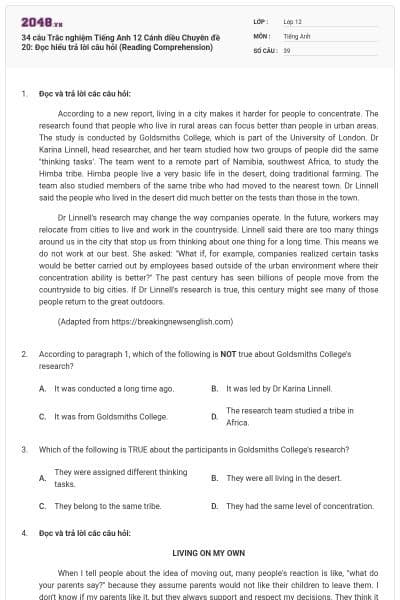
According to a new report, living in a city makes it harder for people to concentrate. The research found that people who live in rural areas can focus better than people in urban areas. The study is conducted by Goldsmiths College, which is part of the University of London. Dr Karina Linnell, head researcher, and her team studied how two groups of people did the same "thinking tasks'. The team went to a remote part of Namibia, southwest Africa, to study the Himba tribe. Himba people live a very basic life in the desert, doing traditional farming. The team also studied members of the same tribe who had moved to the nearest town. Dr Linnell said the people who lived in the desert did much better on the tests than those in the town.
Dr Linnell's research may change the way companies operate. In the future, workers may relocate from cities to live and work in the countryside. Linnell said there are too many things around us in the city that stop us from thinking about one thing for a long time. This means we do not work at our best. She asked: "What if, for example, companies realized certain tasks would be better carried out by employees based outside of the urban environment where their concentration ability is better?" The past century has seen billions of people move from the countryside to big cities. If Dr Linnell's research is true, this century might see many of those people return to the great outdoors.
(Adapted from https://breakingnewsenglish.com)
According to paragraph 1, which of the following is NOT true about Goldsmiths College's research?
It was conducted a long time ago.
It was led by Dr Karina Linnell.
It was from Goldsmiths College.
The research team studied a tribe in Africa.
Which of the following is TRUE about the participants in Goldsmiths College's research?
They were assigned different thinking tasks.
They were all living in the desert.
They belong to the same tribe.
They had the same level of concentration.
Where did Dr Linnell's team do their research?
In London
In a faraway part of Namibia, southwest Africa
In rural areas only
In a mix of city and countryside
What is the main finding of the research by Goldsmiths College?
People in the countryside can concentrate better.
People in cities have better concentration skills.
There's no big difference in concentration between city and countryside dwellers.
Both city and countryside people struggle the same with concentration.
Why does Dr. Linnell think it could be good for workers to move to the countryside in the future?
Because there are more people in the countryside.
Because the countryside is more exciting.
Because workers can't find jobs in cities.
Because it's hard to concentrate and work well in cities.
All of the following are mentioned in the second paragraph EXCEPT
the research might change how companies work in the future
people in cities do not enjoy working
billions have relocated to urban areas in the past 100 years
many people originally from the countryside might return
Đọc và trả lời các câu hỏi:
LIVING ON MY OWN
When I tell people about the idea of moving out, many people's reaction is like, "what do your parents say?" because they assume parents would not like their children to leave them. I don't know if my parents like it, but they always support and respect my decisions. They think it is good for me to try and live on my own and then I would know it is best to stay with my family. The most important reason for independent living is to save the travelling time to work. It used to take me one hour fifteen minutes to travel to work from my previous living place.
From my new apartment, it just takes me thirty minutes, so I saved forty-five minutes" travelling time. I don't have to get up early, and I save two thirds of my traveling cost. In addition, I gain my personal space and freedom by independent living. I make my own decisions; I don't have to say whether I would go home for dinner; I can invite my friends to come and stay late.
Money is the main issue in living on your own. You must be responsible for all the expenses. Therefore, you've got to be well prepared and save up for your bills. Although I find my transportation time much shorter, the saved time is spent on other things, such as cooking and other household chores. Preparing and cooking the food do occupy a significant portion of my time, therefore I always try to make simple meals. Moreover, I have to regularly tidy up my apartment and wash my clothes, so it doesn't really save much of my time after all.
Now I'm getting used to my new life, and I'm enjoying it. I feel that moving out makes it easier for me to strike a balance between my work, my social life, my study and my family. It may be troublesome, but it may be worth it.
(Adapted from https://learnenglish.britishcouncil.org/general-english)
Why does the writer want to move out?
Because many people assume that he should live independently.
Because his parents would like him to live far from them.
Because his parents do not support and respect his decision.
Because it makes his travelling to work more convenient.
According to paragraph 3, which of the following is the most time consuming to the writer?
Saving up for household bills
Transportation time
Tidying up the apartment
Cooking and doing the housework
The word "strike" in paragraph 4 is closest in meaning to_______
destroy
consider
reach
upset
The word "It" in paragraph 4 refers to_______
my work
my social life
enjoying life
moving out
What conclusion does the writer make about moving out?
It is too troublesome to live on his own.
It enables him to gain balance in life.
It is easier for others, not for him.
He is enjoying the trouble that it brings.
Đọc và trả lời các câu hỏi:
A WORKING VACATION
Have you ever wondered what it would be like to get your dream job? It can take years to get the education and develop the skills you need for the perfect job. However, there is a way to experience your dream job without having to get the required training or degree. Since 2004, Brian Kurth's company, Vocation Vacations, has been connecting people with mentors who have the jobs of their dreams.
Kurth had been working for a phone company before starting his own company. He didn't like his job, and he had a long time to think about it on his drive to and from work. He also thought about his dream job while driving. He was interested in becoming a dog trainer, but he didn't want to take any chances and switch to a field he didn't have experience in. He really wanted to know what the job was like and if it was realistic for him to work towards his goal. So, he found a mentor-a dog trainer that could tell him about the job and everything it involved. After that, he helped his friends find mentors to explore jobs they were interested in. They thought it was helpful to talk to people who had their dream jobs before spending lots of time and money getting the training they needed for those jobs.
Kurth saw how much this helped his friends, so he decided to turn it into a business. He started Vocation Vacations in 2004, and by 2005, the company was offering experiences with over 200 dream jobs. Today, about 300 mentors work with the company to share their knowledge about their jobs. Customers pay to experience the job of their dreams and work with these mentors to see what a job is really like. A "job vacation" costs between $350 and $3,000 and can be for one to three days. Many people use Vocation Vacations to see if their dream job is a career path they want to continue. Others do it just to experience the job of their dreams one time.
Vocation Vacations jobs are in the fields of fashion, food, entertainment, sports, and animals. Many people want to try glamorous jobs. For example, they want to try working as actors, music producers, photographers, and fashion designers. According to Kurth, some other popular dream jobs are working as bakers, hotel managers, and wedding planners.
(Adapted from Summit 2 by Pearson Education, 2017)
What is the passage mainly about?
Brian Kurth's dream job as a dog trainer
Brian Kurth's company as a dream job market
A company where people can experience their dream jobs
A company where people get the training for their dream jobs
The word switch in paragraph 2 is closest in meaning to________
change
turn on
travel
take on
The word their in paragraph 3 refers to___________
experiences
jobs
mentor s
customers
What do mentors at Vocation Vacations do?
explore jobs that people are interested in
show people what their jobs are like
train people for their dream jobs
give people advice on how to choose a job
The word glamorous in paragraph 4 is closest in meaning to________
regular
vacation
attractive
unskilled
According to paragraph 3, a job experience at Vocation Vacations_________
costs money
is people's dream
is a career path
lasts for about a week
All of the following are true about Vocation Vacations EXCEPT_________
The company was started in 2004.
It provides jobs in one field.
It belongs to Brian Kurth.
The company hires about 300 mentors.
Đọc và trả lời các câu hỏi:
When you're abroad, trying to find out who to tip is never straightforward and neither is trying to work out the exact amount. To make things even more complicated, the rules for tipping vary greatly from country to country. Even people from the same country can't agree on how much to tip. However, here are some general guidelines which might help the traveller.
You face your first dilemma as soon as you land at the airport - the taxi ride. Taxi drivers generally do expect tips, but rather than there being a precise amount, people round up the fare, or just tell the driver to keep the change.
Your next encounter is with the hotel porter and you know he's expecting a tip, but the problem is trying to figure out how much. It seems that in many European countries €3-€5 would be an appropriate amount.
Then, of course, you have to eat. In some countries such as Ireland, Chile, Poland and Portugal, the customary tip in restaurants is 10-15% unless a service charge is included, so the first rule of thumb is always check the bill. In other countries such as France, Italy, Germany, Australia and Spain, where a 10-15% service charge is either very common or compulsory, you may want to leave an additional tip if you think the service was particularly good, but it certainly isn't obligatory. However, in some countries it may seem strange if you do leave a tip. In Iceland, for example, the waitress might be insulted if you tipped her. In Japan, if you left a tip, the restaurant staff wouldn't be offended, but you would probably be pursued down the street by someone trying to return your money. And in New Zealand, although it's unlikely anyone would chase after you, you'd definitely get some odd looks if you left a tip.
And your problem with tipping isn't over when you leave the restaurant. Next you discover the tour guide, the hairdresser and the toilet attendant are all expecting a tip, but again, how much? Perhaps the best option in these cases is to ask the local people what is acceptable or observe what others do. Of course, you could simply play safe and tip everyone you meet!
(Adapted from Face-to-face Upper-intermediate)
What can be the best title for the passage?
The Culture of Tipping in Europe
International Tipping Etiquette
Unusual Tipping Habits
Rules for Tipping in Restaurants
The word dilemma in paragraph 2 is closest in meaning to________
problem
fortune
advantage
risk
Which of the following is mentioned as a problem with tipping for travellers?
The amount is included in the bill.
Tipping is obligatory in many countries.
They need to tip everyone they meet.
They don't know how much is appropriate.
The word it in paragraph 4 refers to_______
service
tip
charge
bill
The word insulted in paragraph 4 is closest in meaning to________
alienated
amused
delighted
offended
According to paragraph 4, people in which country would return the money if given a tip?
Iceland
Japan
New Zealand
France
When they have problems with tipping, travellers are advised to_______
observe other people
tip local people
ask their tour guide
check the bill
It can be inferred from the passage that
tipping customs round the world are quite different.
it's customary to leave a tip in restaurants in Iceland.
most hotel porters in Europe don't receive a tip.
people in many countries have similar tipping habits.
Đọc và trả lời các câu hỏi:
Scientists have identified two ways in which species disappear. The first is through ordinary or "background" extinctions, where species that fail to adapt are slowly replaced by more adaptable life forms. The second is when large numbers of species go to the wall in relatively short periods of biological time. There have been five such extinctions, each provoked by cataclysmic evolutionary events caused by some geological eruption, climate shift, or space junk slamming into the earth. Scientists now believe that another mass extinction of species is currently under way - and this time human fingerprints are on the trigger.
How are we doing it? Simply by demanding more and more space for ourselves. In our assault on the ecosystems around us we have used a number of tools, from spear and gun to bulldozer and chainsaw. Certain especially rich ecosystems have proved the most vulnerable. In Hawaii more than half of the native birds are now gone - some 50 species. Such carnage has taken place all across the island communities of the Pacific and Indian oceans. While many species were hunted to extinction, others simply succumbed to the "introduced predators" that humans brought with them: the cat, the dog, the pig, and the rat.
Today the tempo of extinction is picking up speed. Hunting is no longer the major culprit, although rare birds and animals continue to be butchered for their skin, feathers, tusks, and internal organs, or taken as cage pets. Today the main threat comes from the destruction of the habitat that wild plants, animals, and insects need to survive. The draining and damming of wetland and river courses threatens the aquatic food chain and our own seafood industry. Overfishing and the destruction of fragile coral reefs destroy ocean biodiversity. Deforestation is taking a staggering toll, particularly in the tropics where the most global biodiversity is at risk. The shrinking rainforest cover of the Congo and Amazon river basins and such place as Borneo and Madagascar have a wealth of species per hectare existing nowhere else. As those precious hectares are drowned or turned into arid pasture and cropland, such species disappear forever.
(Adapted from Final Countdown Practice Tests by D.F. Piniaris, Heinle Cengage Learning, 2010)
What does the passage mainly discuss?
The two ways in which species disappear
Human activity and its impact on a mass extinction of species
Deforestation as a major cause of mass extinctions of species
The tempo of extinction of species today
The word assault in paragraph 2 is closest in meaning to_________
development
effort
influence
attack
All of the following are mentioned as a form of habitat destruction EXCEPT_________
cutting down forests
damming wetlands and rivers
destroying coral reefs
hunting of rare birds and animals
What was the main threat to biodiversity in Hawaii and other islands in the Pacific and Indian oceans until recently?
vulnerable rich ecosystems
hunters and introduced predators
tools used by human beings
human assault on ecosystems
The word them in paragraph 2 refers to_________
predators
humans
species
oceans
Which is no longer considered a major cause of the mass extinction currently under way?
The killing of animals for their body parts
The destruction of habitats of species
The shrinking of rainforests in the tropics
The building of dams across rivers
The word butchered in paragraph 3 is closest in meaning to_______
raised
cooked
killed
traded
It can be inferred from the passage that________
Hunting is the major contributing factor that speeds up the extinction of species.
It's impossible for scientists to identify the causes of mass extinctions of species.
Habitat destruction makes a minor contribution to the current mass extinction of species.
The current mass extinction is different from the five others in that it is caused by humans.
Ngân hàng đề thi