21 câu hỏi
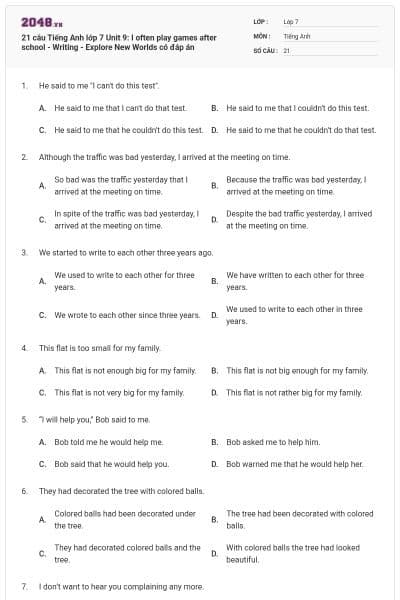
He said to me that I can't do that test.
He said to me that I couldn't do this test.
He said to me that he couldn't do this test.
He said to me that he couldn't do that test.
Đáp án đúng: D
Dịch: Anh ấy nói với tôi rằng anh ấy không thể làm bài kiểm tra
So bad was the traffic yesterday that I arrived at the meeting on time.
Because the traffic was bad yesterday, I arrived at the meeting on time.
In spite of the traffic was bad yesterday, I arrived at the meeting on time.
Despite the bad traffic yesterday, I arrived at the meeting on time.
Đáp án đúng: D
Dịch: Mặc dù hôm qua tắc đường, tôi vẫn đến cuộc họp đúng giờ.
We used to write to each other for three years.
We have written to each other for three years.
We wrote to each other since three years.
We used to write to each other in three years.
Đáp án đúng: B
For+ khoảng thời gian
Since+ mốc thời gian
Dịch: Chúng tớ đã viết thư cho nhau được 3 năm rồi
This flat is not enough big for my family.
This flat is not big enough for my family.
This flat is not very big for my family.
This flat is not rather big for my family.
Đáp án đúng: B
Adj+ enough (adj): …đủ như thế nào
Enough+ N: Đủ cái gì
Dịch: Căn hộ này không đủ lớn cho gia đình của tớ.
Bob told me he would help me.
Bob asked me to help him.
Bob said that he would help you.
Bob warned me that he would help her.
Đáp án đúng: A
Dịch: Bob nói với tớ rằng anh ấy sẽ giúp mình
Colored balls had been decorated under the tree.
The tree had been decorated with colored balls.
They had decorated colored balls and the tree.
With colored balls the tree had looked beautiful.
Đáp án đúng: B
Cấu trúc câu bị động thì quá khứ hoàn thành
S+ had been+ P2
Dịch: Cái cây được trang trí với rất nhiều quả bóng nhiều màu sắc
I’ve had enough of your complaining.
I wish to hear you complaining more and more.
Why don’t you complain more?
I’m too busy to listen to your complaining.
Đáp án đúng: A
Dịch: Tớ nghe đủ cậu phàn nàn rồi.

Học thông minh hơn mỗi ngày
Xem toàn bộ 21 câu hỏi và nhiều hơn nữa với tài khoản miễn phí
I was early enough but I didn't see her.
She was late so I couldn’t see her.
I wasn't early enough to see her.
I am so late that I can't see her.
Đáp án đúng: C
Dịch: Tớ đến không đủ sớm để gặp cô ấy
Unless you are careful, you might not fall.
If you are careless, you cannot be easy to fall.
Be careful or else you will have a fall.
You are not careless and you could not fall.
Đáp án: C
Giải thích:
Dịch: Bạn có thể ngã nếu bạn không cẩn thận.
A. Nếu bạn không cẩn thận, bạn có thể không ngã.
B. Nếu bạn bất cẩn, bạn không dễ ngã.
C. Hãy cẩn thận nếu không bạn sẽ ngã.
D. Bạn không bất cẩn và bạn không thể ngã.
Đáp án C phù hợp về nghĩa, các đáp án còn lại không phù hợp.
I spoke slowly and clearly so that the foreigner could understand me.
I spoke so slowly and clearly that I wanted the foreigner to understand me.
I spoke not only slowly but also clearly and the foreigner understood me.
The foreigner could understand me easily as I spoke slowly and clearly.
Đáp án đúng: A
Dịch: Tớ nói chậm và rõ để người nước ngoài có thể hiểu tớ.
Jane told Tom to tell everyone her new address.
Jane asked Tom not to tell anyone her new address.
Jane said to Tom and anyone else her new address.
Tom wanted Jane to know his new address.
Đáp án: A
Giải thích:
Kiến thức: Câu gián tiếp
Câu gốc là một câu mệnh lệnh với từ "please", nên khi chuyển sang câu gián tiếp, ta dùng cấu trúc:
asked + (someone) + not to + V để diễn đạt lời yêu cầu không làm gì.
Xét các đáp án khác:
A. Sai – Vì "told Tom to tell everyone" có nghĩa trái ngược với câu gốc.
C. Sai – Vì câu này không có nghĩa rõ ràng và không chuyển đổi đúng theo quy tắc câu gián tiếp.
D. Sai – Vì nội dung không liên quan đến câu gốc.
Dịch: "Làm ơn đừng nói cho ai biết địa chỉ mới của tôi nhé, Tom," Jane nói.
→ Jane yêu cầu Tom không nói với ai địa chỉ mới của cô ấy.
I think you'll find the house easily if the directions are clear.
I think the directions are not clear, but you'll find the house easily.
The house is quite clear on the map, so you don't have to find it.
The directions are quite clear, so you will find the house easily.
Đáp án đúng: D
Dịch: Hướng dẫn thì rất rõ ràng, vì vậy bạn sẽ tìm được nhà dễ dàng thôi
People usually find it easy to cross the road in the rush hour.
People can cross the road in the rush hour because of the traffic.
In the rush hour people are not allowed to cross the road because of the traffic.
The traffic makes it impossible for people to cross the road in the rush hour.
Đáp án đúng: D
Cấu trúc: make it adj to do st: … như thế nào để làm việc gì
Dịch: Tắc đường khiến mọi người không thể qua đường trong giờ cao điểm
I will never let him borrow my book again.
He never returned the book he borrowed me.
I lent him my book, but he didn't remember to return it.
I asked him for my book which he forgot to return.
Đáp án đúng: C
Dịch: Tớ cho anh ấy mượn sách, nhưng anh ấy không nhớ trả.
A computer is not as complex as a human brain.
A computer is as complex as the human brain.
Compared to a human brain, a computer is too complex.
A computer is much more complex than a human brain.
Đáp án đúng: A
Cấu trúc phủ định của câu so sánh ngang bằng: S1+ tobe+ so/as+ adj+as+ S2
Dịch: Máy tính thì không phức tạp bằng não của con người
The gardener said that we didn't walk on the grass.
The gardener told us not to walk on the grass.
The gardener suggested not walking on the grass.
We did not walk on the grass, as the gardener told us.
Đáp án đúng: B
Dịch: Người làm vườn bảo chúng tớ không đi trên cỏ.
He reminded me to arrive early the following day.
He would like to make sure to arrive early that day.
He asked me if I could arrive early the next day.
I had to make sure you would come the next day.
Đáp án đúng: A
Dịch: Anh ấy nhắc tớ đến sớm vào ngày mai
We'll have to move upstairs soon if the flood rises any higher.
Unless the flood rises any higher, we won't have to move upstairs.
If we don't move upstairs, the flood may rise higher.
We have to move upstairs in case the flood rises any higher.
Đáp án: D
Giải thích:
Dịch: Lũ có thể dâng cao hơn. Chúng ta phải di chuyển lên tầng trên.
A. Chúng ta sẽ phải di chuyển lên tầng trên sớm thôi nếu lũ dâng cao hơn nữa.
B. Trừ khi lũ dâng cao hơn nữa, chúng ta sẽ không phải di chuyển lên tầng trên.
C. Nếu chúng ta không di chuyển lên tầng trên, lũ có thể dâng cao hơn nữa.
D. Chúng ta phải di chuyển lên tầng trên trong trường hợp lũ dâng cao hơn nữa.
Đáp án D phù hợp nhất về nghĩa.
The sun is as much hotter as the moon.
The sun is much hotter than the moon.
The sun is much hotter and the moon is too.
The sun is much hotter but the moon is not.
Đáp án đúng: B
Cấu trúc câu so sánh hơn với tính từ ngắn: S1+ tobe+ adj-er than S2
Dịch: Mặt trời thì nóng hơn nhiều so với mặt trăng
What did you use to do in your free time as a child?
What did you use doing in your free time as a child?
What do you used to do in your free time when a child?
What were you used to do in your free time as a child?
Đáp án đúng: A
Cấu trúc used to Vnt: diễn tả thói quen trong quá khứ
Dịch: Bạn thường làm gì vào thời gian rảnh khi còn là một đứa trẻ?
I wish I can go camping with you tomorrow.
I wish I can go to the camp with you tomorrow.
I wish I could go camping with you tomorrow.
I wish I could going to camp with you tomorrow.
Đáp án đúng: C
Cấu trúc: S+ wish + S+ could + Vnt
Dịch: Tớ ước tớ có thể đi cắm trại cùng với cậu vào ngày mai.
Bạn có thích hoạt động này không?
Ý kiến của bạn sẽ giúp chúng tôi đề xuất nội dung phù hợp hơn.
![[Năm 2022] Đề thi thử môn Vật lí THPT Quốc gia có lời giải - Đề số 21](/_next/image?url=https%3A%2F%2Fvideo.vietjack.com%2Fupload%2Fimages%2Fvj-image%2Fimage-3izficdefgfoel0s9j8s-1786772791.jpg&w=3840&q=75)
![[Năm 2022] Đề thi thử môn Vật lí THPT Quốc gia có lời giải - Đề số 20](/_next/image?url=https%3A%2F%2Fvideo.vietjack.com%2Fupload%2Fimages%2Fvj-image%2Fimage-emy0gtcksawvorajezvv-1786772460.jpg&w=3840&q=75)