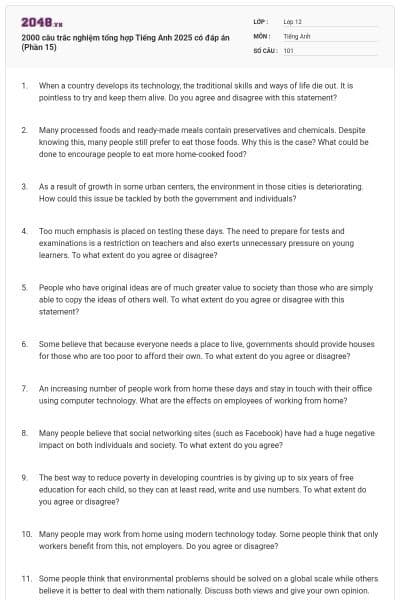
2000 câu trắc nghiệm tổng hợp Tiếng Anh 2025 có đáp án (Phần 15)
101 câu hỏi
Sample 1:
Technology is an integral part of everybody’s lives, and it clearly assists us in adapting to consistent developments. I disagree with the perception that traditional skills should disappear with the technological development in a nation. There are two major reasons that I shall discuss in the forthcoming paragraphs.
On the one hand, traditional skills are considered the heritage that we have taken over from our ancestors. Thus, it is our responsibility to preserve them and pass them on to the next generation. The technological development is an enormous benefit for traditional skills. With the help of technology, we can enhance our skills and introduce innovations by combining technology and traditional skills. For example, handmade painting is a traditional skill. With the help of technology-induced Photoshop, people can give it a unique, more appropriate touch. The combination between photoshop and handmade painting could be a considerable innovation. People cannot just create wonders but earn massively as well.
On the other hand, though the technology is developing at a sharp rate, the traditional skill used products still have a high position in the market. For instance, Indian traditional products, including handcrafted decor items, are still being sold at a global level. There are thousands of artisans earning their bread and butter by selling these handmade items to foreign tourists and established companies. It proves that traditional products still have higher demands in the market.
While the traditions that are not being used by a lot of people won’t make a difference if extinct, on a larger scale, improvements in these traditions can always be beneficial.
To sum it up, traditional skills are alive, even though the technology is increasing dramatically. It has a special place in everyone’s lives. Also, the popularity of traditional skills can enhance if the combination with technology is tried and tested at a larger scale.
Sample 2:
Old traditional skills and lifestyles are dying due to technological advances. It is a contentious issue. Many individuals believe that it is pointless to put too much effort into saving it. In my opinion, I don’t agree that it’s pointless saving the traditional skills and techniques. In the following paragraphs, I shall explain my point of view and provide supporting reasons.
Many traditions and talents throughout the world are being abandoned and replaced by machines in this new technological era. One of the most prominent instances of this phenomenon is the worldwide decline in hand-made fabrics. Today, factories create millions of machine-printed fabrics, which have replaced hand-knitted fabrics. The production costs are reduced, and designs appeal to the majority of buyers throughout the world, due to which many artists have lost their jobs. Local marketplaces are dwindling in popularity and people are suffering.
Besides that, life is becoming computerized, forcing ancient practices to become obsolete. Conventional skills provide innovative ideas for the development of modern technologies. Our predecessors’ invisible thread of old traditional skills and practices connect us with them. It helps us learn how things are created better to understand our culture, community, and nationality. These talents and skills help define and communicate a group’s beliefs and abilities, as well as how they interact with their environment.
However, technology has indeed made the life of people simpler. Almost everything nowadays is done with contemporary technology, which makes physical labour easier. Yet, one cannot overlook the wealth of knowledge that individuals gain from traditional skills and techniques.
Overall, traditional skills and practices are undeniably dwindling. One must acknowledge that traditional skills and techniques are a means of tying people together and educating them about their culture, society, country, and many other topics.
Sample 3:
Digital advancements are the hallmark of the 21st century. Today, nearly every nation across the globe has felt the impact of this wave of technological innovation and has adapted to this phenomenon in some way or the other. However, this occurrence poses an imminent threat to a modest and conventional way of life. It is widely believed that avoiding this change and safeguarding the old ways is impractical. I am a strong supporter of this notion. In the forthcoming paragraphs, I will elaborate on the topic and justify my views with relevant instances.
It is indeed important to acknowledge the various indigenous trades that are present in every nation. The traditional skills prevalent in a region are an intrinsic part of the local culture. Such abilities and ensuing products, although unique, are expensive and require more time and financial investment. Also, the quality standards of such commodities are inconsistent due to the absence of sophisticated machine-based manufacturing techniques.
Furthermore, the chief benefit enjoyed with the employment of technological facilities is the degree of convenience. The reduction of human effort is the prime goal of digital modernization. Today, an individual can access and fulfil all of their necessities and demands at the tip of their fingertips, owing to the advent of the Internet and its subsequent services. The availability of nearly all kinds of domestic and luxurious commodities online has led to such a measure of comfort that was previously unimaginable. Thus, avoiding such resources and following an archaic lifestyle is illogical in this day and age.
Nevertheless, we must also address the fact that a basic manner of living is less stressful and mentally undemanding. However, the level of inefficiency faced, as a consequence, is detrimental to the survivability of an individual regularly.
Finally, progress is a natural occurrence in human civilization, and we have to adapt to the reforms as and when they happen. Therefore, it is prudent to accept such technological transformations rather than going against the majority.
Sample 4:
The significant predicament with the development of technology influencing the traditional skills and conventional lifestyle is quite a controversial topic and requires a profound argument. At a glance, I disagree with the opinion expressed on the topic as technology doesn’t have enough power to completely eradicate the traditional skills from a community, culture or a country. I shall highlight my perception in the following paragraphs.
In a lot of ways, the history of civilisation is interlinked with the history of technology, keeping in mind the discovery of fire, the invention of the wheel and the latest evolution of the internet. We are constantly moving forward, bringing efficient and better ways of living to the world. Definitely, most of the people would want to preserve such traditions. Technology will always be following its footsteps, regardless of what people think. The advancements in technology are the sheer requirements of people. Thus, preventing or abolishing the technological advancement would not be a possibility. Rather, people should embrace the trends positively. Intriguingly, technology can contribute positively to keeping the traditional skills alive. For instance, the population of certain islands is quite restricted to have a regular schooling system. Instead of compelling families to send children to the mainland, authorities have commenced online education for school children.
When it comes to preserving the traditions and customs, the generation of a country is liable for it. If people are willing to save a tradition, technological advancements, in no way, can destroy it. For instance, people found more benefits in machinery and the latest equipment as they could save tons of time and effort. Hence, they let a few traditions die out to bring technology, such as handmade fabric, ploughing of fields in some areas, and more.
Sure, there are certain technologies that have overtaken traditional skills, such as machinery being used to manufacture some fabric that was earlier handmade. However, it also has to be noted that technology is not backed up enough to eliminate every traditional skill altogether.
Concluding the essay, it can be stated that the evolution of technology is not pointless in any way and we, as people, should keep our traditions alive to support our standard of living.
Sample 5:
The issue ‘with the development of the technology traditional skills and the conventional lifestyle die’ is a controversial one and needs deeper argument before supporting or opposing the issue. Overall, I disagree with the opinion expressed; I would like to begin by pointing out that ‘traditional skills and ways of life’ are not totally vanished from one country, culture or community because of the introduction of technology.
In many ways, the history of civilisation is the history of technology: from the discovery of fire to the invention of the wheel to the development of the Internet we have been moving on from previous ways of doing things. Some technologies, such as weapons of mass destruction, are of negative impact. Others, such as medical advances, positively help people to live better or longer, and so very much help traditional ways of life. Surely, few people would seek to preserve such traditions as living in caves. Technology will always follow its own footsteps no matter what we, some people think about it. Technology advances because we need it. So, there is no way to prevent the advancement of the technology, but we should embrace it positively. The generation of a country is responsible for preserving their own custom and tradition and if people feel eager to save a tradition, then there is no way technological advancement will destroy it. There are many cases where technology replaces human labour to create certain things, for example, handmade sari, which is still popular in many countries. Technology, in this case, has not destroyed the old tradition but has introduced a faster and less expensive ways to create the same thing.
Interestingly, technology can positively contribute to the keeping alive of traditional skills and ways of life. For example, the populations of some islands are too small to have normal schools. Rather than breaking up families by sending children to the mainland, education authorities have been able to use the Internet to deliver schooling online. In addition, the Internet, and modern refrigeration techniques are being used to keep alive the traditional skills of producing salmon; it can now be ordered from, and delivered to, anywhere in the world.
In conclusion, without suggesting that all technology is necessarily good, I think it is by no means ‘pointless’, in any way, to try to keep traditions alive with technology. We should not ignore technology because it can be our friend and support our way of life.
Sample 6:
The technological revolution affects all countries around the world in many ways significantly. It seems that the traditional skills and the ways life used to be present have disappeared. This essay will discuss how the technology has led to this case and whether it is worth attempting to save people's traditional life or not.
To begin with, there are various reasons why traditional skills no longer exist as it was many years ago. One major reason is the development of technology. For illustrations, modern technology has been used for many tasks such as agriculture, industries, and the machines have replaced people’s manual tasks in most cases. Moreover, the internet alters the way of communication dramatically; instead of visiting family these days, for example, people speak with each other over the phone or chat using social media like Facebook or Twitter. Perhaps, that is why the traditional skills are expiring with the demand if time and modernization.
Let's move to another point in the statement: some people argue that the traditional experience shouldn't be saved. The principal reason for their opinion is that global advertising encourages everyone to buy the same products. For instance, people wear similar clothes, rather than traditional costumes, and eat from the same types of restaurants such as KFC and Mac Donald and their branches are present all over the world. This shows that it does not make sense to keep the traditional skills alive.
To conclude, this essay has looked at the possible reasons of die out of traditional life, such as the revolution in technology and popularity of the internet, and also the reason why it is aimless to keep them alive.
Sample 7:
Whether the technology and its influences kill the traditional way of life and whether should we try to preserve the tradition is a controversial issue and required an in-depth argument before deciding. In my opinion, the technology definitely traditional skills, expertise and way of life change and the change might be slow for many societies, but it is a sure thing. About the later part of the argument: ‘whether it is pointless to try to preserve those’ is something I opine that that should not be imposed on people. Who want to maintain the traditional way of living rather than embracing the technology should be given the option.
The history suggests us that the new invention and technology have greatly changed the way people live and mostly these changes help them to choose for better alternatives. People who used to cultivate lands with the plough and cow in many years before and that was a kind of skill that became obsolete with the invention of the motorized irrigation system. People might have lost the skill they had but the technology helped them to produce more crops than ever before. With the invention of the cell phone, the internet, television, refrigerator people have definitely adopted a different lifestyle than they had many years ago and those changes, in my opinion, are important to ensure a better life. We would not blame the medical science for killing the traditional unscientific treatment and would widely accept it. In most of the cases, people used to do things manually and with the widespread of technology they have started relying on technology than their own skill and that has caused the loss of traditional skill. But we have to bear in mind that many technologies have been replaced by newer ones and people always try to take the easy and better alternatives.
About the importance of conserving the traditional skill and way of life, I would say when technology offers us a better alternative, we should cordially accept that, but we should also respect the people who among us maintain the old way of life. Technology would knowingly and unknowingly influence our life, but we should not make it a must for everybody.
Sample 8:
Technology is an important thing in people’s life, and it clearly helps us to adapt with the period of development. I disagree with an opinion that, when technology develops in a country, the traditional skills disappear. There are two reasons that I will describe related to this case, which is traditional skills can combine with technology and traditional skills still have a great position in order to technological development.
On the one hand, traditional skill is the heritage from our ancestor. So, we have responsibilities to take care for it. The development of technology is huge advantages for ‘traditional skills’. Using the technology, we can improve these skills and while trying to introduce new innovations to combine technology and traditional skills. For instance, ‘hand art painting’ is one of the traditional skills, people can make a new creation by using technology touching use ‘Photoshop’. The combination between hand art painting and Photoshop software will be a great innovation. People can create great works and earn a lot by doing this.
On another hand, although the technology is developing sharply, the traditional skill used products are still having a high position in the marketing field. For example, Indonesian traditional stuff namely ‘Songket’ is still creating great improvement in the sale. In my hometown, an industrial Songket factory, in the end of 2014, received order 2000 to 3000 pieces ‘songket’ stuff from some country including USA, Italy, Japan and Vietnam. It proofs that traditional products still stand up till now.
To sum up, traditional skills are still alive though the technology is increased dramatically. It still has a special place in people’s life. Also, traditional skills’ popularity will increase if people try to combine both traditional skills and technology.
Sample 9:
Increasingly technological developments are aggressively pushing traditional lifestyle and skills out of the picture. Some believe that this diminishing process is too extraordinary to stop or reverse. However, I believe that valuable traditions will be preserved in particular ways by providing alternative ways of living and being inspirations for modern technology developments.
First of all, traditional lifestyle and skills are gradually becoming popular recently, particularly among young people who live in a busy urban area, by offering alternative ways of life. For instance, a cosy country style Thai restaurant where traditional cooking herbs and vegetables are freshly harvested from its own backyard garden, and spices are 100% homemade with traditional spicy preserving skills, has drawn much attention and popularity from people who are bored of mass-produced food and the highly industrialised environment. Such traditional skills and way of life would continue to have their place in this modern era.
Furthermore, conventional skills can be a great source of inspirations for modern technologies development. Evidence have shown that engineers and designers of modern times are still constantly inspired by the traditional skills. For example, sparked by a traditional bamboo braiding skills from a rural Asian area, a world widely famous furniture designer, working with equally talented engineers, invented production lines to manufacture designed modern furniture that however has that particular traditional braid style touch. Such inspiration has boosted the business, therefore, in turn, would result in more money allocated for preserving those valuable skills for further development.
To conclude, although it is hard to stop most of our traditional skills and ways of life vanishing from this modern world, some traditional skills and lifestyle would not just survive, but also thrive by proving alternative ways of living and being innovative for modern technology.
Sample 10:
Nowadays, technological advancement and their rapid and wide applications are having a significant impact on a nation's traditional skills and ways of life. Some argue that such impact is so extraordinary that it would make conventional skills and lifestyles obsolete. However, I believe they would continue to thrive by providing alternatives to modern ways of life, and innovative ideas for modern technologies.
First of all, traditional skills and ways of life are becoming an alternative solution to the problems caused by "mainstreamed" ways of life which are greatly influenced by modern technologies. For instance, a cozy restaurant where traditional, home-brewed beer is served, offers another experience to people who are bored with branded beers that have the same flavour and come out of mass production with new technologies. It is in such a venue where traditional skills are preserved, people become relaxed and educated. Providing diversity and thus enriching modern ways of life, such traditional skills and ways of life would continue to have their place.
Furthermore, conventional skills provide innovative ideas to the development of modern technologies. For example, sparkled by how the word "Love" is traditionally knitted into a sweater by some ethnic minority women in some parts of Asia, some business managers from textile industry have developed some production lines by applying the traditional skills to Computer-Aided Designs (CAD). The products have boosted the companies' sales which in turn have increased their investment in preserving traditional skills for further developing their technologies.
To conclude, traditional skills and lifestyles are increasingly becoming a useful alternative to the homogeneity brought by global applications of modern technologies. However, the evolution of technologies is a selection process, whereby some would become obsolete, but there is no doubt that some would thrive when their roles are appreciated.
Sample 11:
During the last century, science and technology have expanded to a great extent. As a nation focuses more on technology, it is true that the conventional skills and previous lifestyle vanishes. I strongly agree that there is no point in retaining them. This can be proven by analysing how technology can save a lot of time as well as be accurate enough.
It is apparent that the latest machines can do a lot of work with minimal time. For instance, in a construction industry, a crane can lift a block of heavy materials within a fraction of a minute. By using the traditional skills, it will take at least a day to uplift bulky items to the top of a building. Thus, it is obvious that it makes no sense on focusing on previous skills and ways. Similarly, when automated machines can sew more than thousands of clothes, there is no point to involve manual labour to produce only hundred per day!
It is a fact that almost all industries prefer computers for account related tasks as they are very much accurate and faster. For example, consider a bank which has to calculate the turnover for its past decade. By using a software, it would be possible to get the exact value. Even though there are a lot of algorithms used by old generation, it is not guaranteed that the calculation will be so precise and faster. Hence it is clear that there is not much benefit in focusing on traditional expertise.
By analysing how science has helped in getting the work done faster with precise results, it is very clear that there is not much advantage in retaining old skills and lifestyle. It is considered that the community will create this awareness among the masses.
Sample 12:
Many people think that traditional cultures will vanish due to the rapid development of new technology. Therefore, it is useless to spend some time for preserving the traditional ways of life. To a certain point, I would agree that modern technology has brought some benefits to our life. But I disagree if we should abandon all the old-fashioned cultures, as I believe that some traditional ways are still beneficial for us.
It is a fact that many traditional ways have disappeared due to the existence of new technology. Many people have abandoned their traditional ways and equipment, as they become more productive with the modern tools. For example, instead of using carts and manpower, many farmers in develop countries are using tractors and bulldozers to cultivate their plants these days. By using these machines, it saves a lot of times, money and energy. Therefore, many people prefer to use modern technology than to maintain the traditional ways.
Despite the benefits of modern technology, some traditional ways of life are still important and valid for our lives nowadays. One of the examples is that people in the past are concerned about honesty and integrity. In the olden days, people did business based on trust and respect, as they had no contracts and due to the lack of paper resources. In the modern world, legalised agreement become an essential part of a business deal due to some parties might do any illegal and inappropriate act. These kinds of traditional cultures should be preserved and carry forward to the future generation.
In conclusion, to a certain extent, I would agree that some traditional cultures should be abandoned and replace with technology and modern ways. But some of the traditional ways are still valid and applicable to the modern world, and it is necessary to maintain and preserve them.
Sample 13:
In recent times, technology has played a pivotal role in the transformation of present processes. Some individuals believe that as a nation's technology progresses, its traditional skills and ways of life fade. Therefore, there is no justification for their continued existence. I strongly disagree with this assertion, and my preference will be explained further.
To embark with, in our technological environment, ancient skills and practices nevertheless maintain a special place. Moreover, despite the fact that technology has replaced many things, traditional abilities cannot be replaced. Using Patan city as an example, a study revealed that the city is renowned for its traditional textiles, which, despite attempts at mechanical production, cannot replace the skill of human hands. Therefore, not everything can be replaced by technology.
Furthermore, old methods and rituals constantly retain their origins. In addition, it presents significance to the next generation for the benefit of their lives. If the present generation obtains an understanding of historic practices, they will be able to adopt them to improve living and also learn to respect our traditions. Therefore, to preserve our traditions, it is vital to share these abilities with the world.
However, I would not disregard that technology is always advancing and every approach and employment sector is evolving. Since technology is at its pinnacle, it has made all labour far simpler than in the past. Additionally, individuals are spending less on conventional skills and more on technology. Thus, over a period of time, no one may be able to block old practices and abilities.
To conclude, despite the advancement of technology, it is more vital to retain our traditional abilities, since this preserves the roots connected to their origin.
Sample 14:
Nowadays, traditional skills and ways are almost getting lost. Some people think that if a country develops its technology, then traditional abilities and methods will be lost, and there is no point in keeping those alive. However, I partially agree with this opinion, and my preference will be addressed further.
To begin with, technology perpetually distances us from culture and tradition. As technology advances, individuals devote less attention to cultural pursuits and remain perpetually preoccupied with contemporary life. For instance, according to a report, the majority of youngsters are unaware of their traditional attire since they wore only western clothing. Therefore, we must safeguard the traditions against technology in order to preserve them.
Additionally, traditional skills and practices are crucial to our nations because they reflect them and carry unique significance. If a country promotes its culture, it will entice individuals from other nations to learn more about it; as a consequence, it will aid in connecting and socialising with those of diverse cultures. Thus, traditional skills and practises not only serve to symbolise the nation, but also to unite its people.
However, technology is also highly useful since it provides immediate response and alleviation in the battle against any sickness, while older methods need time to produce results. As medical technology has advanced, individuals have begun to favour it above traditional practices. Therefore, technology is necessary for quick outcomes.
To conclude, although technology benefits us by giving instant results, traditional skills and methods are more essential to know our culture better, and also to socialise more.
Sample 15:
Nowadays, technology and cultural traditions are perennially controversial issues of conversation. Some individuals believe that old methods and abilities are vanishing owing to technological innovation. Moreover, protecting them is futile. I mostly agree with the viewpoint, and my preferences will be explained further.
To begin with, technology is at its pinnacle in every industry today. As a result of the advancement of technology, individuals choose to use it over conventional talents. Moreover, technology greatly simplifies all jobs. For instance, there are lots of sewing machines that have been developed; while, in earlier times, people were using hands to sew, which was time consuming and tough work. Thus, technology makes each task simpler and quicker.
In addition, technology has improved to the point that individuals may now post their professional profiles on internet platforms and get better employment. Additionally, it might enable them to share their work and network with other experts. Individuals may obtain pleasure and tranquilly as well as prosperity if they share their strengths and skills. Therefore, technology offers several advantages over conventional methods.
However, I would not avoid the fact that traditional talents are very distinctive and useful, since they aid in identifying communities and history, therefore connecting the origins of civilizations. In addition, if individuals lose the identity of their communities, they will lose their own. Therefore, it is essential to preserve old practices and abilities.
In conclusion, despite the fact that traditional skills and traditions assist to define a community, technology is more vital since it makes labour simpler and more useful.
Sample 16:
When a nation advances technologically, it inevitably takes a toll on the conventional skill set and lifestyle. In my opinion, traditional competencies and values of life are not important to be maintained as technology changes society in a transient manner and solves problems for the people who live in it.
To commence with, there is no rationale for preserving traditional skills that have no practical need for a better lifestyle. Powerful technology makes these skills useless as the proliferation of cutting-edge technologies supersedes the old ones each day as time goes by. In fact, technological changes determine the conditions under which we live. Let’s clarify this with an example. DVDs players are obsolete VHS players, and the skills required to mend VHS players are no longer useful. When the technology has offered even more powerful storage solutions, keeping the backdated ones is just pointless.
Likewise, maintaining a rigorously conventional lifestyle can limit the progress of human civilization. That is to say that the traditional way of life promotes one to remain the same, retaining the same custom, which in turn may dissuade men from inventing new ways of life to make it easier and superior. It keeps people trying to live in the past; thereby they distance themselves from the blessings stemmed from technological development. On top of that, the traditional lifestyle confines people in their comfort zone. To put it another way, they cannot push themselves to think outside the box with traditional views.
It would be reasonable enough to draw a conclusion that traditional skills and lifestyle often make no sense at all when there are better alternatives. Therefore, we should be looking forward to embracing the new manners of life and new skill set.
Sample 17:
Conventional skill sets and lifestyles in society are fading away with the advancement of technology. Many believe that the need to maintain a traditional set of skills and ideas is worthless. Such a view, is, however, seriously mistaken. This is because traditional skill sets and lifestyles can bring considerable benefits to the environment and the community as well.
Traditional competencies have been forged over hundreds of years of human experience and they are crucial to the environment. These skills were devised with empirical observations about its inhabitants and the ecosystem as a whole. The convention on biological diversity, for example, finds that many indigenous communities have been using biodiversity and cultivating it in a sustainable manner for hundreds of years. Thus, in times like this environmental chaos, traditional skills are of profound importance more than ever.
Similarly, the traditional lifestyle is just as noteworthy as common skills. By maintaining it, people can build a healthy community. In a traditional value system, collectivism takes the centre stage at every level of life. Individuals determine themselves as members of groups and place the priorities of their collective priorities ahead of their personal preferences. In short, individuals aim to satisfy others’ requirements rather than their own demands. On the contrary, today’s individualistic society pays attention to the needs of the individuals over the needs of the group as a whole, which in turn very often provokes bitter conflicts and widens the gaps between the poor and rich.
In fine, traditional skills and ways of life are not only good for the environment but equally are important for the welfare of our society. We should keep alive traditional skills and lifestyles because these can resurrect a healthy environment and a harmonious society for all.
Sample 18:
There is no doubt that with the advancement of technology, many traditional skills and ways of life are becoming obsolete. However, I strongly disagree with the opinion that it is pointless to try and keep them alive. In my view, it is essential to preserve traditional skills and ways of life because they are an integral part of a country’s culture and heritage.
Firstly, traditional skills and ways of life provide a connection to a country’s past and identity. They give us an insight into how our ancestors lived and worked, and how they contributed to the country’s growth and development. By preserving these skills and ways of life, we can maintain a link to our history and heritage and pass it on to future generations.
Secondly, traditional skills and ways of life can be a valuable source of knowledge and inspiration for modern technology. Many of these skills have been refined over centuries and can offer unique perspectives and solutions to contemporary problems. For instance, traditional methods of agriculture or handicrafts can provide insights into sustainable and eco-friendly practices that can benefit modern industries.
Moreover, preserving traditional skills and ways of life can help to promote cultural diversity and maintain a sense of community identity. These practices often reflect the customs, values, and beliefs of a particular community, and their preservation can help to promote social cohesion and understanding.
In conclusion, it is crucial to recognize the value of traditional skills and ways of life and work towards their preservation. They provide a connection to our past, offer valuable insights into modern-day problems, and promote cultural diversity and social cohesion. It is not purposeless to try and keep them alive, and we should do our best to ensure that they are not lost in the march of technological progress.
Sample 19:
Technology flourishes with leaps and bounds, and this development inevitably takes a toll on traditional values. This essay thinks traditional ideals are bound to vanish in this technological world.
To begin with, there are many reasons why there is no existence in this modern world of these conventional values. First of all, everyone is helped with the mobile phone to stay connected to their family and friends in this fast-paced world. In ancient times, however, people used to send letters and stand for the maturity of one call in the long queues on S.T.D and I.S.D. This development in communication modes has shown that traditional skills are useless for nothing.
Second, the fashion world has been changed by technology. Earlier people used to knit, stitch, and design manually, but now computers have made each task more accessible and more comfortable. To substantiate my opinion, many of the students in fashion design were seen portraying model pictures themselves to test the compatibility of colors, but this work is currently being performed in seconds on much-advanced software. Besides that, owing to the advent of refrigerators, hardly anyone is seen buying pitchers for cold water.
In conclusion, the evolution of new technology is an iterative process, so with these latest trends, the time-consuming traditional methods will not be able to keep pace. Therefore, the time to preserve them is useless and wasteful.
Sample 20:
The swift technological advancement within a nation can inevitably result in the demise of traditional skills and lifestyles, rendering efforts to preserve them futile. I completely disaccord with the notion as safeguarding them is essential to uphold cultural diversity, preserving historical heritage, and pass on invaluable wisdom to future generations.
Firstly, traditional skills, crafts, and indigenous practices epitomize the singular cultural legacy of a society. Preserving these skills is crucial as they embody a community's knowledge, values, and identity, reflecting their exceptional history and customs; allowing them to vanish diminishes cultural diversity and erodes societal vibrancy. Additionally, conventional ways of life play a crucial role in fostering a sense of belonging, maintaining continuity, and cultivating collective identity, effectively connecting individuals to their roots and promoting cultural appreciation while facilitating meaningful intergenerational exchange and robust social cohesion. Passed- down festivals, rituals, and craftsmanship, for instance, preserve cultural traditions and ensure their continuity.
Furthermore, these skills embody deep knowledge about local ecosystems, natural resources, and sustainable practices. For example, traditional farming methods promote organic agriculture, respecting ecological balance, and minimizing harm to the environment. Safeguarding these skills enable communities to maintain sustainable livelihoods, protect natural resources, and promote long-term environmental stewardship. Moreover, they can provide opportunities for cultural tourism, artisanal craftsmanship, and niche markets. Reviving and promoting these skills can enrich local economic development, create employment opportunities, and empower sustainable livelihoods rooted in cultural heritage.
In conclusion, protecting traditional skills and ways of life is far from fatuous, as it enriches cultural diversity, community well- being, and sustainable practices, while also fostering the development of the country's local economy.
Sample 21:
There is much discussion surrounding the claim that traditional skills and ways of life will eventually go extinct as a result of technological innovation. While it is true that certain practises may become obsolete due to technological improvements, I think it is crucial to preserve traditional skills and ways of life for the sake of cultural preservation and societal well-being.
Innovative techniques are frequently introduced by technological advancement and replace conventional practises, making them less useful or efficient. For instance, labour-intensive craftsmanship can be replaced by sophisticated machinery and automation, which would lead to a loss of traditional artisanal abilities. Additionally, technological advancements such as worldwide networking and information transmission have hastened cultural homogenization and undermined unique cultural practises and customs.
However, maintaining old ways of life and skills is of enormous cultural and social importance. A community's history, morals, and identity are typically deeply established in its customs. They serve as a bridge across generations, fostering a sense of continuity and belonging. Traditional skills also represent the variety of cultural expressions and artistic styles that add to the wealth and diversity of the human legacy.
Preserving ancient ways of life can also be advantageous economically. Cultural tourism and a desire for traditional handicrafts create opportunities for economic expansion and job creation. The transmission of specific knowledge and competence is ensured by maintaining traditional skills and protecting traditional industries and their cultural and economic value.
Instead of viewing technology and tradition as mutually exclusive, a balanced approach is needed. Harmonious coexistence can be achieved by embracing modern advancements while appreciating and preserving traditional skills and ways of life. This can be done by integrating technology into conventional methods, increasing their effectiveness and sustainability while retaining the essential elements of cultural heritage.
In conclusion, despite the fact that technological improvements may endanger traditional skills and ways of living, it is crucial to acknowledge the cultural and sociological worth of these practises. Traditionalism fosters cultural identity, variety, and economic development. The continuity of cultural heritage and the well-being of society are guaranteed by the adoption of a balanced strategy that combines technological development with the preservation of traditional skills.
Many processed foods and ready-made meals contain preservatives and chemicals. Despite knowing this, many people still prefer to eat those foods. Why this is the case? What could be done to encourage people to eat more home-cooked food?
Sample 1:
It is an undeniable fact that despite the prevalent use of preservatives and chemicals in processed foods, a significant number of individuals still gravitate towards these convenient options. The crux of this preference lies in the ease and time-efficiency provided by ready-made meals. However, this trend raises concerns about long-term health impacts. This essay will explore the underlying reasons for the preference for processed foods and propose strategies to encourage the consumption of home-cooked meals.
Firstly, the primary appeal of processed foods can be attributed to their convenience. In today’s fast-paced world, many people find themselves pressed for time, making the quick and effortless nature of ready-made meals highly attractive. For instance, a working parent might opt for frozen dinners to manage time more effectively, prioritizing job demands and family care. Moreover, processed foods often come with an enhanced taste profile, achieved through various additives, making them more palatable to those accustomed to intense flavors.
However, the ease of access to and the palatability of processed foods come at a cost, often compromising nutritional value and leading to health issues such as obesity and heart disease. Encouraging a shift towards home-cooked meals requires addressing these root causes. One effective approach is education. By increasing awareness about the health benefits of home-cooked meals and the potential dangers of preservatives and additives, individuals may be more inclined to invest time in cooking at home. Additionally, culinary education programs could demystify the process of cooking, showing that healthy meals can also be prepared quickly and easily. For example, quick cooking classes and online tutorials can provide busy individuals with fast, healthy recipes that can be integrated into their hectic schedules.
In conclusion, while the convenience and taste of processed foods are appealing, the health benefits of home-cooked meals are undeniable. By enhancing public knowledge about nutrition and simplifying the cooking process through educational initiatives, society can foster a healthier lifestyle.
Sample 2:
Despite awareness of the preservatives and chemicals prevalent in processed foods and ready-made meals, many individuals persistently opt for such convenience. This phenomenon can be attributed to factors like time constraints and the appeal of fast food, while strategies to promote home-cooked meals include enhancing culinary education and incentivizing healthier options.
Firstly, the primary allure of processed foods lies in their convenience, crucial for those with hectic schedules. Modern lifestyles often leave minimal time for cooking, compelling many to choose quick, readily available meals despite potential health drawbacks. Additionally, the consistent taste and extensive marketing of processed foods create a comforting familiarity and desirability that home cooking sometimes lacks. For instance, global chains such as McDonald's offer a uniform taste and experience that many find reassuring and enjoyable compared to the unpredictability of homemade dishes. Moreover, processed foods are often perceived as more affordable and accessible than fresh ingredients, further drawing consumers who may have limited budget or access to supermarkets with fresh produce.
Conversely, promoting home-cooked meals requires multifaceted approaches. Education plays a pivotal role; by integrating cooking classes and nutritional education into school curriculums, individuals can learn from an early age the benefits of preparing meals at home, which are often healthier and more economical. Moreover, government incentives could also prove beneficial. For example, subsidies for organic produce or tax reductions for small local farmers can lower the prices of healthier options, making them more accessible and enticing to the general public. Additionally, public campaigns celebrating the cultural and familial aspects of cooking might shift perceptions and valorize the personal touch in home-prepared meals.
In conclusion, while the convenience and familiarity of processed foods hold significant appeal, promoting home-cooked meals through educational initiatives and economic incentives could cultivate a shift towards healthier eating habits. By addressing both the practical and emotional facets of food choices, society can encourage more nutritious and rewarding dietary habits.
Sample 3:
The consumption of processed foods and ready-made meals containing preservatives and chemicals is a prevalent practice, even though people are aware of the potential health risks associated with such foods. This essay will explore the reasons behind this preference and suggest measures to encourage individuals to opt for more home-cooked meals.
One reason why people gravitate towards processed foods is convenience. In today's fast-paced lifestyle, individuals often face time constraints and demanding schedules, leaving little time for meal preparation. Ready-made meals provide a quick and effortless solution, requiring minimal time and effort in the kitchen. For instance, individuals with busy work schedules or caregivers balancing multiple responsibilities may find it easier to rely on processed foods for convenience.
Furthermore, the extensive marketing and advertising campaigns by the food industry heavily influence consumer choices. These companies invest significant resources in promoting processed foods, employing persuasive techniques to create a desire for their products. Clever packaging, enticing visuals, and misleading health claims can sway consumer preferences towards those food items.
To encourage people to choose more home-cooked meals, raising awareness about the health consequences of consuming processed foods is crucial. Educating individuals about the potential adverse effects of preservatives and chemicals in these foods can help them make informed decisions about their dietary choices. Public health campaigns, informative articles, and educational programs can play a significant role in disseminating this knowledge and promoting healthier alternatives. Moreover, providing support and resources for home cooking can make it more accessible and appealing. Cooking classes, workshops, and online tutorials can equip individuals with the necessary skills and knowledge to prepare nutritious meals at home.
In conlcusion, while the convenience and marketing strategies surrounding processed foods contribute to their popularity, promoting awareness, education, and support for home cooking can help shift dietary preferences towards healthier options. By raising awareness about the health risks associated with processed foods and providing resources for home cooking, individuals can make more informed choices that prioritize their long-term well-being.
Sample 1:
As urban centers experience growth and expansion, the environment within these cities is facing significant deterioration. The increased pollution, depletion of natural resources, and loss of green spaces are pressing concerns that need to be addressed. Tackling this issue requires joint efforts from both the government and individuals to ensure a sustainable and healthy urban environment.
The government plays a vital role in mitigating environmental deterioration. By implementing stricter regulations and policies, they can control emissions and pollution. Enforcing emissions standards and pollution control measures for industries and vehicles can significantly reduce air and water pollution. Additionally, promoting sustainable urban planning and development practices can minimize the impact on the environment. This includes incorporating green spaces, preserving natural habitats, and encouraging the use of renewable energy sources.
Investing in public transportation and infrastructure is another crucial step for the government. Enhancing public transportation networks and providing efficient alternatives to private vehicles can reduce congestion and carbon emissions. Building green infrastructure, such as eco-friendly buildings and renewable energy systems, can help mitigate the environmental impact of urban growth.
However, individuals also have a responsibility to address the issue. Adopting sustainable practices in daily life is key. Conserving energy and water resources, practicing waste reduction and recycling, and choosing eco-friendly products can significantly contribute to environmental preservation. Furthermore, individuals can engage in community initiatives and raise awareness about the importance of environmental conservation. Participating in community clean-up programs, educating others, and advocating for sustainable practices can create a positive ripple effect within the community.
Collaboration between the government and individuals is crucial for effective solutions. Developing partnerships and offering incentives can encourage businesses and organizations to implement sustainable practices. Tax incentives or subsidies for eco- friendly initiatives can motivate individuals and businesses to make environmentally conscious choices. Fostering community engagement and participation in decision-making processes ensures that the concerns and ideas of citizens are taken into account.
In conclusion, the deterioration of the environment in growing urban centers requires a combined effort from both the government and individuals. The government should implement stricter regulations, invest in sustainable infrastructure, and provide incentives for eco-friendly practices. Individuals should adopt sustainable habits, participate in community initiatives, and promote awareness. Through collaboration, we can create healthier and more sustainable urban environments for present and future generations.
Sample 1:
While “burning the midnight oil” for your final exam, you may find yourself nervously shaking and on the verge of exploding. On this fatal date, many of your future hopes can be crushed. Too much strain is put on a single, taking approximately an hour, assessment. This practice has been taken for granted for many years, and only recently, some voices are calling it old – fashioned.
The testing system has one distinctive feature that enhances the process of education. It is universal and standardized while at the same time, it does not take into account the individual. Therefore, teachers are relieved from the burden of designing a personal exam paper. However, some scientists argue that each student possesses unique qualities (creativity, imagination, logical thinking) and unified, strict methods of assessment cannot bring them on the surface.
Nowadays, ambitious parents push their kids to be more obsessed with marks. There are many cases of people encouraging their children to calculate perplexing equations or studying French. All this at the expense of playing outside, socializing and just being a kid. The reason is obvious – the better the under-aged perform, the higher prospects for “hot” schools.
Another aspect of the stressful practice in modern examinations is that it shows only the momentary situation. Even though you may have problems with one part of the textbook, the outcome depends on pure chance. A good step in reversing the process is the ¾ test throughout the semester, implemented nu universities.
On balance, the outdated approach to assessment should be reached and adapted to fit in the modern situation. More constructiveness and reducing anxiety are vital if society wants to keep people willing to learn and not just to achieve high marks.
Sample 2:
The education is the key of future; it is the only way to encourage people to improve their life and environment. Actually, in nowadays testing people, especially students, is the common way to evaluate learning process and teachers tend to pay a lot of attention on students score as it was the only measure to check the knowledge. It is developing high level of pressure on young learners.
The school has a lot of objectives, but the mean one is to prepare people for the life. In fact, life is sometime very stressful and hard, and it is necessary to have the ability to control difficulties and having success in hard time as well. Then it is possible that the high pressure exerts on children and students about testing is a way to help them to be strong and to learn face future stressful situation.
On the other hand, to force students to learn some specific things in specific time could discourage the creative and become students in knowledge’s consumers conversely to look for develop skills or discover personal abilities. In my opinion, pressing students having good score, you are achieving that them memorize a lot of information, but no necessary to learn or understanding it.
Furthermore, experts have found around the world that open learning process make more intelligent and creative students, because to be relaxed and feeling comfortable is easy to learn and discover new things; so this way to teach is better to develop skills and improve difficulties.
In the final analysis, in my view, even to learn to control stress and pressure is important and necessary, if the goal is developing skills and encourage the intelligence, it is necessary to decrease of pressure about testing and promote creative process.
Sample 3:
Exams and tests have always been discussable things. Is it better to do they or not? As always, it depends. I believe that examinations are necessary, but frequency of doing them should be rethink carefully.
First of all, too many exams in primary schools exert high pressure on kids. It can cause problems which can be seen later, like a depression or low self-esteem. Being compared all the time with peers is not a pleasure. Feeling of constant rivalry is really horrible.
But are all children equal? I do not think so. Alter each year (or at least once after primary school) children should be assessed. And here tests or another form of examinations should take place. I remember my tests at the end of primary school, and they were not pleasant. But thanks to them, we knew where we should go: to technical or vocational secondary schools, somewhere else or nowhere.
I have heard that nowadays teachers have to prepare minimum one test per month in primary and secondary schools. This trend to test children and students every month causes that teachers concentrate rather on preparing and making tests and not teaching students how to think or gain knowledge useful for their future work.
On the other hand, if students know there is an ongoing exam, they study harder. No gain, no pain.
For these reasons I strongly believe that examining learners is integral part of teaching process. Tests are important, but it would be great to let children and students live and not only learn.
Sample 4:
With a common view to judging the students’ quality, nations have different ways to approach the issues. However, in some countries, examinations deem to be emphasized heavily, leading to limitation for teachers and exceeding pressure on young pupils.
With regards to teachers, this method plays a considerable role in their work. People can hardly find out a better assessment than through testing and examining students which gives a frank and objective results. Not only do grades indicate how much the students’ effort is but they also help teachers with categorize them in comparison with other students. Nonetheless, examinations bring the teachers high pressure including building the tests and marking them. For instance, in most Vietnamese schools, each class has lots of students, meaning that teachers have the equal number of tests to rank. That is the problem of heavier workload along with higher pressure. Nevertheless, teachers are not the only patient of too much emphasis on testing.
Students, particularly the the young ones, are worse affected by enormous quantity of test during school time. No sooner do children start attending primary schools than they have to struggle against the enemy named tests. Crammed with many a subject and different types of examination, it is not overstated that studying turns out to be a burden for kids to bear that may result in kids’ depress and health deterioration. Despite the counter – productive effect, evaluation apparently still contributes to the students’ life and career. The grades expose their great endeavor at school and shall be a recognition of a hard – working process.
All in all, important role of tests and examinations is undeniable in education systems. However, governments and schools should take advantage of the method of an appropriate level to balance its pros and cons.
Sample 5:
For many people interested in studying abroad, one of the first problems they face is obtaining a visa to enter the country and, in many situations, the procedure is time-consuming and frustrating. As a result, there is a clear case for making visa applications less stringent. However, there is also a potential for abuse if the system was made more lenient, and both of these opinions need to be considered.
In support of simplifying the visa-application procedure, it must be remembered that obtaining a visa is one of the first steps towards studying in a foreign country. If this process is difficult then it reflects poorly on the country the student is intending to go to. Moreover, once in the country, students often find it less problematic to use the services of an immigration agent, to whom they surrender their passports and pay sometimes phenomenal sums of money. In the same way, this again reflects poorly on the host country.
Yet there is a point of view that suggests visa regulations should remain as they are, or even become stricter. It is inevitable that once a developed country opens its door to students, there will be some who exploit the opportunity without any intention of fulfilling the study requirements of their visa.
To conclude, perhaps the best solution would be to allow the schools, colleges and universities that attract international students to have greater control over those students that do arrive in a country. This would allow the institutions themselves to police the students while being overseen by the Immigration Service itself.
Sample 6:
Nowadays testing has an extremely prominent place in education. The preparation required for examinations places limits on teachers as well as considerable amounts of stress on students. While some testing may be necessary to gain a better understanding of what a child has learned, I completely agree that excessive testing is too restricting for teachers. Furthermore, it can actually inhibit students’ learning and potentially be damaging over the long term.
Firstly, with the heavy emphasis placed on exams, teachers must teach only to the test. The result of this is that teachers cannot take the time to answer students’ questions about the content. This is because there is only time to teach what is going to be in the exam. This squashes children’s natural interest in subjects.
Another point to consider is that studies have shown that any student, regardless of age or subject, needs time to consolidate learning before being tested. A student who is tested too soon may get a low mark which is actually not representative of this student’s learning. Continual testing, therefore, does not take in account students’ natural developmental stages.
Finally, the amount of stress placed on students to pass all these exams is not healthy. The continual cycle of preparing for a test and taking a test can exhaust and burn out even the most motivated student. This is particularly dangerous when pupils are still young. It also removes the natural joy that comes from learning for both teachers and students when exams are constantly looming over their heads.
In conclusion, although a certain amount of testing will always be required at schools, I firmly believe that the current emphasis placed on tests is unnecessary and could have longterm negative effects on students.
Sample 7:
Nowadays, the education system is more focused on preparing and conducting tests regularly. But education is learning the factual life reality on the ground level. By putting more emphasis on tests, the student won’t try to understand the subject concept but on the contrary, he/she will just try to remember the text and pass the test. By doing this the student has not gained any knowledge. I completely agree that too much emphasis is placed on testing these days and I will share some of the valid reasons and a better solution to overcome this default system error.
Firstly, teachers are the most important factor in the entire educational system. But the institutions want their teachers to complete the prescribed curriculum and conduct tests regularly. So eventually, the teacher will be more focused on finishing the syllabus and preparing for tests. Now the student will never get to clear their subject-related doubts and will not get any individual attention from the teacher. This will result in students failing in the exam due to syllabus overload and not being able to clear all the queries.
Furthermore, this practice by the educational institution demotivates the students who are willing to learn the subject concepts. Then the student will start to live in a depressed state and convince themselves that education is all about remembering the text and passing the tests. Sometimes, students who couldn’t bear this syllabus burden tend to take extended decisions.
To conclude, the best possible way is to regulate the curriculum structure by limiting the syllabus so that students can understand and prepare for the tests. Even teachers will get time to interact with the student regarding the subject concept and provide them a better education. Stress and depression will never ripe fruitful results. So, the government authorities must realize the seriousness of the issue and take appropriate educational guideline solutions.
Sample 8:
Nowadays, due to the present lopsided educational system, it has become more important to pass the tests than learning the actual subject concepts. Eventually, this results in stress and depression among the students and even the teaching faculties. I agree that too much emphasis is placed on testing which has limited the educator teaching boundaries and also puts more stress and subject burden on students.
Firstly, the educational institutions have made up a predefined curriculum format by which the teacher and student must abide by. Now the teachers are overloaded with tasks to complete the syllabus and prepare the tests by conducting them frequently. So, the mentors will not have time to pay individual attention to the students and resolve their doubts related to subject concepts. Secondly, on the other hand, the students who are given an overload of the syllabus to study and pass the test tend to face stress and depression.
Furthermore, real education is lost as the student tends to believe that education is all about remembering the text and passing the exam. Even though project-based learning methods can be followed but due to overpopulation, assigning a teacher-student ratio will be a challenging task. The education system must not be subject to exams and tests alone. This methodology will not produce experts in any field. I believe that tests and exams are merely filtration processes without identifying the best quality.
To conclude, with the student’s population size and the teacher’s availability. Exams and tests are possible methods of evaluation. But too much emphasis placed on tests is unacceptable because it leads to stress and depression among the students and even the teachers. The best possible solution would be to formulate the syllabus burden and the frequency of conducting tests. The governing educational body must implement guidelines for both the private and govt sectors regarding the curriculum structure and number of tests to be conducted per year.
Sample 9:
Nowadays, the school system is overly focused on exams. As a result, students are stressed, and teachers are unable to adapt courses to meet the needs of individuals. This essay will argue not only that this limitation on teachers is unnecessary, but also explain that there are superior methods of assessment which avoid causing undue stress to learners.
First of all, just because sitting exams is the oldest known method of assessing students, it does not necessarily follow that it is the best. More and more educational institutions are experimenting with project based learning and continuous assessment. Take Finland, where these methods have been the norm in primary school for the past decade. So far, the results are looking promising – pupils report much lower anxiety levels, and parents and teachers are confident children are assimilating the knowledge and skills necessary to prepare them for their future.
A further advantage of this system is its ability to allow educators to adapt their programs for children with varying needs. Gifted young minds no longer have to go at the same pace as the average student, instead they are given personal projects and goals and continual feedback, allowing them to flourish. By the same token, children with learning difficulties are given the special attention they need and are no longer put under pressure to keep up with the rest of the class.
In conclusion, there are far superior options to the current practice of inflicting regular tests on students. These alternatives not only reduce stress-levels in schools, but also allow teachers to better adapt their courses to fit the wide range of needs of individual students.
Sample 10:
With excessive focusing about test in recent day, it causes teachers and students a unessential burden. I agree with this view and the reasons including self-esteem and relative deprivation will be further elaborated in this essay.
There are two main reasons why I agree with the above suggestion, first being the self-esteem. It is believed that people might feel depressed when they are received low grade in the test. To be more specific, a way of assesment to separate class and position bring about people the depression and loss of the confidence because they would compare with their peers and friends their score. People who have low grade in the test feel frustration. Accordingly, their confidence would be fallen down, and they would not adapt education system. This, as a result, would leads decline of self-esteem.
Relative deprivation is also a key reason to affect students and teachers. This is because most people incline to stand hight position in society, school and group which they belong in. To elaborate, most people, in fact, might consider that the high grade represent the high position in the group. Thus, people who have a lower score than others would feel severe stress and underperform their potential because of fear about evaluation. Also, some people could do the deviation since they experience the indifference and comparison with students who are in upper class and position. Such tendency triggers the society adverse effects like a increase in the rate of crime.
In conclusion, all that said, I agree that a excessive concern about the exam brings about the detrimental impact to individual and society in terms of self-esteem and relative deviation.
Sample 11:
Considerable importance is attached to examinations today. In many schools and academic institutions throughout the world there has been a shift from formal examinations and tests to assessment based on home assignments and tutorial or class presentations. This change has been welcomed by many educationalists who view formal exams and testing as an unreliable and inadequate means of evaluating a student's achievements. On the other hand, supporters of regular formal testing claim that important life skills such as discipline, the ability to stay focused under pressure and time management can be exercised only under exam conditions.
In my opinion, their role needs to be re-examined if they are to continue to play a part in the educational system. One valid argument against regular and excessive testing is that it distracts teachers from his or her primary task: teaching. Nowadays, teachers are being held more and more accountable for the academic fortunes of their students and this often results in a preoccupation with strategies for passing exams rather than with learning itself. Furthermore, examinations measure relatively superficial knowledge or learning which totally defeats the purpose of examinations. A person with low grades may turn out to be a successful person while a good grader may end up unsuccessful in life. In addition, some students do not score well even if they know the material, poor reading skills can handicap a student, questions on examination might not test progress as well as they could. Lastly, they have a poor predictive quality because they only judge a student's ability under set conditions and limited time. Many times, a student who is otherwise good may get anxious or confused under strict exam conditions and may not perform up to the mark.
Contrary to what some people think, proponents of regular, formal testing maintain that the need for regular monitoring of a student's progress justifies frequent testing since this enables teachers to provide continual feedback to their students who acknowledge their shortcomings and work on them. Moreover, there are those who argue that a heavy emphasis on testing places unnecessary pressure on young students. They claim that rather than abolish or scale down testing teachers can assist students how to minimise stress and encourage them to take formal assessment in their stride. Another advantage is that exams promote competition among students. They work harder to improve their knowledge and skills. In this way they learn more and improve their learning strategies to achieve better results.
I cannot fully agree with the ideas. Firstly, the issue of tracking student growth is important, but teachers can measure progress using alternative ways such as presentations, group work and projects. It is also true that testing has the additional benefit of generating a spirit of healthy competition since most young people relish the opportunity to measure their achievements against those of their peers and the prospect of a formal exam can often spur students on to greater effort and commitment. However, the necessity to marshal ideas under pressure, to write fluently within time restrictions, to recall information and to think about your counterparts who can excel you in the exam will only intensify pressure and students may experience even higher levels of anxiety. Unfortunately, it is not always possible to help students overcome fears because different people experience different levels of anxiety and cannot control how their bodies respond to a perceived threat.
In conclusion, while examinations and tests should never become an end in themselves or a substitute for genuine teaching and learning, they do demand mental skills which play an important part in a student's intellectual development and provide teachers with valuable data on the progress of their students. Nevertheless, I tend to believe that the number of exams and tests should be decreased and limited to reduce pressure and stress on both teachers and students.
Sample 12:
The training is the important thing of destiny; it's miles the handiest manner to inspire human beings to enhance their lifestyles and environment. Actually, in in recent times checking out human beings, eparticularly college students is the not unusualplace manner to assess getting to know technique and instructors have a tendency to pay loads of interest on college students rating because it turned into the handiest degree to test the knowledge. It is growing excessive degree of stress on younger learners.
The faculty has loads of objectives, however the imply one is to put together human beings for the lifestyles. In fact, lifestyles are someday very disturbing and tough, and it's miles vital to have the capacity to govern problems and having achievement in tough time as well. Then it's miles viable that the excessive stress exerts on youngsters and college students approximately checking out is a manner to assist them to be sturdy and to examine face destiny disturbing situation.
On the alternative hand, to pressure college students to examine a few unique matters in unique time may want to discourage the innovative and come to be college students in knowledge’s clients conversely to search for increase capabilities or find out non-public abilities. In my opinion, urgent college students having accurate rating, you're reaching that them memorize loads of information, however no vital to examine or knowledge it.
Furthermore, specialists have located round the sector that open getting to know technique make greater clever and innovative college students, due to the fact to be comfortable and feeling cushty is straightforward to examine and find out new matters; so this manner to train is higher to increase capabilities and enhance problems.
In the very last analysis, in my view, even to discover ways to manage pressure and stress is essential and vital, if the intention is growing capabilities and inspire the intelligence, it's miles vital to lower of stress approximately checking out and sell innovative technique.
Sample 1:
The debate on whether people who have original ideas are of much greater value to society encompasses diverse viewpoints, revealing its advantages and drawbacks. This essay critically assesses these perspectives.
There are myriad arguments in favour of my stance. Recent research not only outlines the significance of studies as well as people, but also points out the importance of education and coping with vicissitudes. Besides, it provides a brief overview of expanding cultural understanding, followed by enhancing global perspectives. Examples of this can be seen all over the world, especially in affluent nations. Further, the implications of technological advancements on these views are significant, justifying widespread support for the idea that people who have original ideas are of much greater value to society.
However, there are some arguments against the aforementioned view. Besides, its impact is far-reaching indeed as its influence extends to various facets of society, shaping not only individual experiences but also impacting the academic research landscape. Therefore, it is apparent why many are against the notion that people who have original ideas are of much greater value to society.
In conclusion, while the viewpoint that people who have original ideas are of much greater value to society presents a complex array of advantages and disadvantages, my analysis leads me to firmly support the notion that its benefits substantially outweigh the drawbacks.
Sample 2:
I certainly agree that people who come up with new ideas; in other words, those who 'invent' or 'discover' things are terribly important to society as a whole. However, I also think there is a role in society for good imitators.
No one would deny that key individuals must be thanked for providing us with certain facilities that we use every day. Where, would we be, for example, without basic items such as the washing machine, the television and, more recently, the computer? These items are now used so regularly that we tend to take them for granted.
In fact, the society we live in today has become increasingly consumer-oriented, and while it may be possible to constantly update and improve consumer goods, not everyone where I live can afford the prices of these innovations. Furthermore, not everyone lives in an area that has accessibility to the latest models on the market. For this reason, there is a value to be placed on being able to provide good copies of expensive items.
Having said that, certain innovations have a more serious impact on our lives than consumer goods and cannot easily be replicated. Vital medicines like penicillin and vaccines against dangerous diseases also exist because people made continual efforts to develop them. Scientific ideas such as these enable us to live longer and escape illness.
Sample 3:
Nowadays, there are various types of people in every civilisation. As a result, some of them are intelligent enough to come up with a groundbreaking idea, while others work very hard to make these ideas a reality. In general, this article will explain this problem utilising instances and supporting evidence.
First of all, the foundation of any potential creation is a concept. Additionally, this idea is crucial because not everyone is endowed with the creativity and aptitude to think of it. For instance, Da Vinci created a beautiful plane layout. However, it took countless centuries for this plan to become a reality.
Dreamers with innovative and distinctive ideas are also the force behind progress. They develop a notion, and others can use it in their daily lives because they created it. Because of this, civilisation will gain from it. For instance, the first design of a submarine was created in the 17th century by a self-taught designer from a Russian town, and now scientists utilise it to research deep oceanic zones.
However, it has been argued that without adequate implementation, an idea is only a wish. In other words, individuals were only able to make these goals come true after making a great deal of attempts and exerting a great deal of work. As a result, even when people duplicated a theory, they fixed many issues by enhancing its weaknesses. As a result, these individuals are far more valuable to society and an important force in progress.
In conclusion, our society needs both types of individuals; some develop an idea, while others make it a reality. Overall, I concur that it is more helpful for society if people duplicate someone else’s idea but better realize it.
Sample 4:
In today’s rapidly changing world, the ability to generate original ideas has become increasingly important. While it is true that there is value in the dissemination of existing knowledge, I firmly believe that individuals who come up with original ideas contribute far more to the progress and development of society.
First and foremost, original ideas have the potential to revolutionize the way we live and work. Innovations such as the internet, smartphones, and renewable energy sources have all stemmed from original ideas. These groundbreaking inventions have not only improved our quality of life but have also created new industries and job opportunities. In contrast, individuals who simply copy existing ideas do not contribute to the advancement of society in the same way.
Furthermore, original ideas often spark further creativity and innovation. When a new concept or invention is introduced, it can inspire others to build upon it, leading to a ripple effect of progress. This collaborative and iterative process is essential for driving society forward and addressing complex challenges.
Additionally, individuals who generate original ideas are often at the forefront of change. They challenge the status quo and push boundaries, leading to paradigm shifts and breakthroughs in various fields. In contrast, those who merely copy others are unlikely to drive significant change or make substantial contributions to society.
In conclusion, while there is value in the dissemination of existing knowledge, I strongly believe that individuals who have original ideas provide much greater value to society. Their ability to innovate, inspire creativity, and drive change is crucial for the progress and development of our world.
Sample 5:
People are born with different abilities and talents. Some being unique and some are common to all. Sometimes those with unique talents come up with ideas that are completely new, creative and astonishing. However, there lingers this question “Are they greater than us?”.
In my honest opinion, every single human being should be treated and valued the same. No single person is greater than another. From the start of the human race to the present, no society was made by one man. It has always been a combined and a collective effort of everyone.
Sir Isaac Newton, the great physicist was someone who revolutionised the field of physics. Every single individual respects and acknowledges him for his achievements and contribution to the human race. But does that mean only people of his stature are needed in the society? I say NO. Ideas of Newton have been taken by other individuals to come up with wonders that even Newton could not have imagined of. The Space Shuttles, Aircraft, Architectures, Construction, Sports are all based on ideas of another person. The computer was a machine that was created by an individual. However, this idea was copied by others to build things which are even greater. From simple electronics like calculators to marvels such as supercomputers, Artificial Intelligence, Robots.
As a conclusion, like Ying and Yang, a society co-exists with the talents and ideas of all people combined. No individual is of much greater value than another. The day society starts considering that people with original ideas are of much greater value, will be the downfall of that society.
Sample 6:
It is believed that people who have genuine ideas bring more benefits to the communities rather than those who duplicate the thought of other people. To a certain extent, I would agree that having pure and original ideas have a higher value than to copy the works of other people. But from the copying activities, other people have developed the work to become more effective and useful.
On the one hand, it is true that the public should respect those who have genuine and original ideas. These people have sacrificed and spent a lot of their time for thinking, studying and doing some research, in order to get new ideas or inventions. And many of the results bring a lot of benefits for the humankind. One of the examples would be Thomas Alva Edison, who had spent most of his time in experimenting so many things. He had tried for almost 1000 times before he invented the bulb light. Therefore, it is believed that people should appreciate their hard work, the eagerness and the sacrifice these people had been through, in order to get the innovative ideas.
On the other hand, there are groups of people who copy ideas from other people. Although some people might disrespect this kind of act, but certain people have developed the ideas into something greater than the original ones. For example, it is undeniable that during the 1950's, Japanese car producers were copying the designs of the American and Europeans car manufacturers. But instead of copying the ideas, the Japanese conducted some extensive development programs. As a result, the Japanese could make a more efficient car than the European and American, such as the Toyota Prius which used the hybrid technology.
In conclusion, I would agree that some innovative and creative thinkers and inverters should be fully appreciated for their original concepts, as they bring so many positive aspects to the society. But sometimes the copying activities could not be judged as a negative thing since there are other people who could copy the ideas and then developed it well.
Sample 7:
In the history of humankind, people have been attempting to facilitate numerous leaps and bounds in their life by sharing their idea to each other. In this regard, societies highly appreciate those who provide their original opinions while those who emulate others idea considered less valuable. From my point of view, this is open to debate.
The first justification that supports those copying other instructions is that they realised any pros and cons of the dilemma that might occur, and the outcome is almost obvious for all. In addition, it is noteworthy that people prefer to put forward those opinions which have tested several times. Taking teachers as an example, they have an inclination to mimic the skills that precedence ones applied in the educational system to transfer knowledge to students, so it is unfair if we underestimate their efforts.
Despite those points mentioned above in favour of emulators, an overt advantage of having creative people in a society is novel solutions for some problems which will appear. An innovative person is admirable in each country due to the fact that he/she has a power of thinking quickly and making an appropriate decision. Furthermore, these people are considered as intelligent and bear dynamism either in the work ambience and their family. Therefore, on the ground of these positive elements, they are much more admirable.
To summarise, although emulating others idea is considered boring and under value, we should not overlook the side of the fact that it has several valuable experiences behind itself. However, I believe that innovative people are much more worthwhile.
Sample 8:
Society respects both types of people because inventing itself does not add value to the mankind but implementing and improvising on original ideas are equally important. At the same time, innovators should be credited as they are the ones that triggered minds of others.
It is good to copy ideas of others if someone adding value to original thought. For example, Right brothers invented flying machines couple of generations ago. Several engineers, scientists and researchers improved this idea and made flying safer and accessible to wide range of people. Had this not happened, today we had to travel for months to reach from one corner of the globe to other. If we consider examples of healthcare, lots of improvements have been done over the past ages to original ideas to save lives of people effectively and efficiently. We can find this pattern not only in these industries but in almost all luxuries and comforts we have today. Original ideas laid the foundation for modern innovations of today. So, society respects both categories of people.
On the contrary, original ideas should be credited because without their ideas, things would not have been how they are today. For instance, telecommunications industry developed rapidly in last decade. Without the invention of smartphones today, communications would have been dulled and difficult. In this ever-improving world, new ideas will be developed by organisations and individuals and well recognised by the society. There have been awards and prizes like Nobel Prize that are globally recognised and helped to reach ideas masses and impact day-to-day lives of people throughout our world.
To summarise, societies have been recognising both original innovators and the ones who improved original ideas. Without continued efforts of both, lifestyle stagnates.
Sample 9:
"An idea can change your life", this famous advertisement tagline points towards a debatable topic, whether an original idea is more important to the society or a copy of the idea.
In the world, if the product has a monopoly, then it might be difficult for mass to enjoy the advantages of it. In such cases, a competition could help to keep the prices grounded. For example, Apple had launched an iPad to enjoy music which was very expensive due to its unique features. However, when the other companies launched similar products and that could be one of the reasons for the reduction of the pad prices.
The original is always considered as a masterpiece and the copied versions are called extensions of it. That is why ‘Taj Mahal’ is one of the Seven Wonders of the World and ‘Bibi Ka Makbara’ which is a copy of it is known by local people only. Nevertheless, few ideas have to be original only and should not be experimented extensively for the safety of the planet. For instance, when scientists found nuclear power, they might have thought about its positive sides like cheaper energy. However, during the copy of this idea, some destructive mindset people might have changed it completely and developed nuclear weapons. Another example could be a sword. Our ancestors invented it to kill animals and feed the families. Unfortunately, over a period of time, its real use was forgotten and humans started using it to kill other humans in the wars.
I believe the original idea whose intention is to make human life better should not be copied by those people whose intention is just to make money even if it is in the price of human life.
Sample 10:
The world is shaped by the ideas of few people who played the role of pioneer in the society. Their ideas contributed greatly to the enhancement of social, economic and political conditions across the globe. It is agreed that such people who contribute to the world with their thoughts are valuable legends of the society. This apparent when we see how such ideas help in social reforms and technological innovations.
The society is continuously improving and aligning to the needs of new generations. Sometimes, this requires a social reformation idea of some great people who have an extraordinary vision for the future of the society and nations. Leaders like Margret Thatcher, Nelson Mandela and Abraham Lincoln had such an extraordinary vision to change the society. For example, the idea of non-violence agitation of a single person helped India to achieve independence in 1947. Even though the real power of such ideas is manifested when the mass follow it, it is the original thoughts that bring in the change in society.
Technological innovations often changed the way we live in this world by bringing in more efficiency and comfort. Such innovations are great ideas of fewer people and later copied by the rest of the world. For instance, Wright brothers, who invented the first airplane; Thomas Edison, who invented the electricity, have moved the world to the next level. The whole humanity is benefited from such people's idea and their contributions to the society are exponential compared to those who use these ideas.
In conclusion, it is a known fact that an idea can change the world, and the people who innovate such an idea are invaluable to the society. Nevertheless, the people who copy their ideas and concepts indeed help the society to realise their benefits and thus contribute to the society as well.
Sample 1:
When thinking about solutions to homelessness, many turn to providing houses for those who are too poor to afford one. I agree that this is a good solution, but the government should consider other problems arising as well.
Providing homes for the homeless has many benefits to both those poor individuals and society. One of which is a reduction of crimes and an increase in social stability. Poor people usually resort to committing crimes, such as thefts, robberies, sexual assault, or minor social indecencies like being fake beggars or flashing oneself. Providing housing will help them stay more stable and find themselves a job, which lessens actions like the aforementioned. Moreover, homeless people are also vulnerable to harsh weather conditions. For example, recently, among hundreds of deaths in Canada due to heatwaves, the majority of them are homeless people.
However, because charity is often a double-edged sword, the government should consider the following potential problems before investing in homes for the poor. Firstly, this solution does not guarantee to be successful in helping the homeless. Many have become accustomed to the begging life for so long that they are now incapable of feeling inclined to work, especially when they know they can beg for money and food. For example, many still act like they are disabled to ask for charity when they can work. Another problem is that this investment in charity housing will take a toll on taxpayers. Building houses is expensive and takes a great deal of time to finish, which means the government will delay other social development, like providing better healthcare, improving infrastructure, or investing in education.
In conclusion, I agree that providing housing for people who cannot afford one due to poverty is a good solution. However, the government should take into account potential problems from this solution.
Sample 2:
Many reformers are of the opinion that it is the responsibility of governments to provide public housing for members of the public too poor to afford their own homes. In my opinion, although there are some situations when this might be necessary, it is better to allow people the opportunity to pull themselves out of poverty.
Those who support government assistance in housing programs point out the institutional shackles that keep people in poverty. In the United States, there is a long, painful history concerning African Americans that began with slavery, discrimination and still shows its impact in various more muted forms of racism. These people have few chances to escape poverty and own their own homes because they have difficulty getting a good education and then a job. If governments provide them with housing, that frees up their money to go to the education of their children and can break the long chain of poverty that has blighted their path in America.
Although the above-mentioned argument has its merits, in my opinion people who help themselves are more likely to be able to maintain their success. Charity is a notoriously double-edged sword because it fosters dependence. Someone who is in poverty who works hard and finds and escape and manages to own a home will develop reserves of willpower and determination that will serve them their entire life. Their self-respect will also help them in their work and encourage them to hold onto their house, regardless of obstacles. If the government simply gifts this person a house, they will be much less inclined to take care of it and will not develop any of the qualities that will spell out their success in life more generally.
In conclusion, people who are more self-reliant are more likely to be successful and hold onto their homes. The role of government ought to be more subtle and include educational reforms aimed at opening up opportunities that individuals can themselves seize.
Sample 3:
It is true that having a safe and stable home is a reasonable and real need for all individuals. I completely agree with the proposal that the government is responsible for ensuring a place to live for poor residents.
Individuals and families without stable accommodation can find it a struggle to access essential public services such as education and healthcare. For example, in certain cities, having no permanent homes can mean children may not be allowed to attend affordable public schools and adults may face difficulties in registering with state-funded hospitals. In addition, a stable and comfortable living environment is closely linked to mental and emotional well-being. It is obvious that having a place to call home provides a sense of security, peace and belonging, generally enhancing our happiness and fulfilment. Therefore, having a safe place to live is a fundamental need.
However, not all people are fortunate enough to afford their own house. Some suffer from abusive home environments, unemployment, a significant rise in costs of living which are beyond their means, driving them onto the streets. Since the government bears responsibility for ensuring the well-being of each individual, it is legitimate for them to provide safe and stable accommodation to the disadvantaged. Governmental departments should work closely with local authorities to develop unused land, renovate run-down, abandoned buildings or inner-city slums, and provide housing benefits to people without homes. Despite the initial enormous investment, these schemes are likely to be beneficial as they lay the foundation for a sustainable growth of a every individual.
In conclusion, stable accommodation is an essential need for the well-being of every individual. In spite of significant financial resources required at first, I reckon that governments must make every effort to satisfy this need, especially for the impoverished population.
Sample 4:
Many reformers argue that governments have a huge responsibility to provide public housing to citizens who are too poor to be able to afford to buy their own. In my opinion, although there are some situations where it may be necessary, it is better to give everyone a chance to get out of poverty.
Advocates of government support in housing programs point to institutional inadequacies that keep people in constant poverty. In the United States, there is a long and traumatic history involving African Americans, beginning with slavery, discrimination and still showing its impact in many other forms of racism. together. These people have little chance of escaping poverty and owning their own home because it is difficult for them to get a good education and then a job. If the government provides them with housing, it will give them better conditions to work and send their children to school. That could break the long chain of poverty that has ravaged their way in America.
While the argument above has its merits, in my opinion people who help themselves are more likely to remain successful. Charity is a notorious double-edged sword because it promotes dependence. People from poor backgrounds who work hard to own a home develop the will and determination to serve them throughout their lives. Their self-esteem will also help them in their work and encourage them to hold on to their home, despite obstacles. If the government just gave this person a home, they would be less inclined to take care of it and would not develop any of the qualities that would mark success in their life in general.
In conclusion, people with more self-control were more likely to succeed and keep their homes. The role of government should be more subtle and include educational reforms that open up opportunities that individuals themselves can seize.
Sample 5:
A house is a basic need for every person, and everyone deserves to own one regardless of economic status. Some people believe that the government must provide houses to less privileged individuals for free and I agree with that but with conditions.
To begin with, having a shelter to live in is a basic need and a right of every person in a country despite their social status. People who belong below the poverty line should be given assistance by the government in acquiring at least a small house to live in yet a decent one. As it is the government's responsibility to improve the morale of its people, giving those underprivileged citizens a place to live for free is the right thing to do. By doing this, homelessness can be avoided and the common crimes brought by homeless people cannot take place, as well.
However, the government must clearly lay down conditions for the beneficiaries of free houses before providing them so that they will not take advantage of the system. First, the government must create a regulation that beneficiaries of free housing are not allowed to sell the house given to them in any way. Second, they cannot request another house from the government in case the house granted to them becomes unlivable due to negligence. In this way, they will give value to what is given to them and take good care of it. Besides, this is one good way to maintain orderliness in different places in a country which some other countries with a considerable number of homeless people fail to achieve.
In conclusion, underprivileged people deserve a comfortable house to live in and it is the government's responsibility to help them and setting conditions is necessary to avoid exploitation of the government's free housing program.
Sample 6:
Certainly, the question of whether the state should offer complimentary housing to its financially strained citizens is a subject of continual debate. Given the fundamental nature of shelter, the perspectives on this issue are manifold and merit nuanced consideration.
On one hand, the argument for universal free housing rests on the idea of social welfare. If the government were to allocate resources for this purpose, the homelessness rates in cities like Hanoi and Ho Chi Minh City would undoubtedly plummet. These actions would not only fulfill the social contract between the citizens and the state but also indirectly boost public health and safety. However, the counterpoint here is the economic strain such a policy would place on the national budget. Sufficient quality housing requires significant capital, something that could jeopardize other critical sectors such as healthcare or education.
However, I believe that free housing, although noble in its intention, is not the most efficient approach to solving the housing crisis in Vietnam. Investment in affordable housing schemes and subsidies offers a more sustainable model. By implementing a sliding scale based on income, more people could secure adequate housing without draining public coffers. This would also encourage personal responsibility, ensuring that citizens do not become overly dependent on state-sponsored programs. It should be noted that this viewpoint is not devoid of empathy, but rather it encompasses a more realistic long-term vision for The Vietnamese society.
In conclusion, while the provision of free housing holds emotional and ethical appeal, it may not be the most judicious course of action from a governance standpoint. It seems more practical for the authorities to foster affordable housing, allowing citizens to acquire homes within their financial means. This strikes a balanced compromise between social welfare and economic viability, preserving the nation’s resources for the multitude of other challenges it must confront.
Sample 7:
Government-funded housing for low-income groups is a debated topic. Some experts claim that it falls within the scope of the welfare state. However, I disagree with this approach for several reasons.
Firstly, governments have limited resources, and providing free housing for all who cannot afford it is not sustainable. Other pressing issues, such as education, healthcare, and infrastructure, need to be addressed. Instead of providing free housing, authorities should focus on creating more job opportunities and increasing the minimum wage, enabling people to purchase their own homes.
Furthermore, waiving accommodation fees can reduce occupants' motivation and increase laziness. With no rent to pay, there is no incentive to work hard and improve their economic situation. This can lead to a decline in productivity and economic growth. In addition, it may also result in an increase in demand for public services, such as healthcare and education, which in turn puts a strain on the government's resources.
In addition, this policy can create a sense of entitlement that may lead to a negative impact on the community. With free housing, people may start to believe that they have a right to it and become dependent on their city council for support. This dependency can lead to reduced motivation to work and contribute to the community, further increasing the number of people relying on government support.
In conclusion, while housing is a basic need, I believe that it should not be provided for free to everyone who cannot afford it. Instead, the government should focus on creating more job opportunities and increasing the minimum wage to enable lower-income groups to purchase their own homes.
Sample 8:
The rise in property prices in recent years has led to a significant increase in homelessness, prompting discussions around providing free accommodation to disadvantaged groups. As this approach may seem like an impractical solution to housing insecurity, I am firmly opposed to this idea.
One of my main reasons for disbelief is related to the impracticality of the policy itself in terms of management and execution. Providing free housing would require a significant budget, including costs associated with land acquisition, construction, maintenance, and ongoing operational expenses. This would pose a substantial financial burden for the government and eventually lead to a national budget deficit. In this case, the government may resort to unsustainable funding programs, such as imposing heavy taxes on people, triggering frustration and anger among the public. Moreover, creating a system of free housing would present many complex administrative challenges for the government, including the development of complex eligibility criteria and the establishment of fair allocation mechanisms, which also requires a large financial resource.
The second idea that supports my argument is that this counterproductive proposal might have negative impacts on a country’s economy and society. It is important that everyone takes responsibility for affording his or her own housing by working hard and saving up. Providing free accommodation for people might not encourage recipients to take necessary steps towards becoming financially independent, instead, it may foster a sense of entitlement, leading to a reliance on others for basic needs. More seriously, on a large scale, this could potentially lead to a societal trend where individuals become overly reliant on government-provided housing, ultimately resulting in enormous financial pressure on the government and even budget dificit problems. If this proposal were implemented, it could discourage private investment in housing, impede initiatives, and hinder market competition, which might eventually disrupt the housing market – a vital sector of any country’s economy.
In conclusion, I disagree strongly with the idea that the government should provide free housing to disadvantaged groups who cannot afford it, due to the infeasibility and negative effects on the economy and society. Instead, the government should concentrate on providing job opportunities for people and developing sustainable and affordable housing initiatives for citizens.
Sample 9:
In my opinion, governments should play a significant role in providing housing for those who cannot afford it, though I believe this support should be carefully implemented and not necessarily entirely free.
Firstly, housing is a basic human need, essential for physical and mental well-being. When individuals lack stable housing, it can lead to a cascade of other social problems, including poor health, difficulty maintaining employment, and challenges in education. By ensuring that all citizens have access to adequate housing, governments can prevent these issues and create a more stable society overall.
Moreover, government intervention in housing can help to reduce inequality and promote social mobility. In many cities, rising property prices have made it increasingly difficult for low-income individuals to find affordable housing, exacerbating social divides. Government-provided housing can help to bridge this gap, giving disadvantaged individuals a foundation from which to improve their circumstances.
However, it’s crucial to implement such programs thoughtfully. Rather than providing entirely free housing, which could potentially discourage self-reliance, governments could offer subsidized housing or rent assistance programs. This approach would still make housing accessible while encouraging individuals to contribute what they can.
Additionally, government housing initiatives should be part of a broader strategy to address poverty and homelessness. This could include job training programs, mental health support, and addiction treatment services. By tackling the root causes of housing insecurity, governments can create more sustainable solutions.
In conclusion, while I strongly support government intervention in providing affordable housing, I believe this should be done in a way that balances assistance with personal responsibility. By implementing well-designed housing programs as part of a comprehensive approach to social welfare, governments can significantly improve the lives of their most vulnerable citizens and strengthen society as a whole.
Sample 10:
Housing, undeniably, stands as a fundamental need for all human beings. The notion of governments providing free accommodations for those financially incapable sparks significant debates. While I partially agree with the proposition due to its potential socio-economic benefits, concerns about its feasibility and unintended repercussions are equally valid.
Firstly, offering free housing can serve as a potent tool in alleviating poverty. By securing shelter for the less privileged, governments can ensure a basic standard of living, fostering societal harmony and security. A person with a roof over their head can focus better on other aspects of life, such as education or employment.
Additionally, by meeting the housing needs, governments can motivate individuals to actively participate in the workforce. When the burden of housing expenses is lifted, people may pursue career opportunities more aggressively, leading to economic progress and decreased reliance on other social services.
However, the counter-arguments hold their merit. For starters, budgetary constraints play a pivotal role. Governments often grapple with allocating funds across various sectors, from healthcare and education to infrastructure and defense. Dedicating vast resources to provide free housing might sideline other pressing matters.
Furthermore, free housing might inadvertently create a culture of dependency or entitlement. When individuals receive substantial benefits without any counter-responsibility, it might dampen the incentive for personal growth and economic contribution.
In conclusion, while the concept of free housing paints a compassionate picture and boasts potential socio-economic advantages, the challenges associated with its implementation cannot be ignored. It is crucial for policymakers to find a balanced approach that upholds societal welfare without compromising on other aspects of national development.
Sample 11:
Housing is a fundamental human need, and the question of whether governments should provide it for those who cannot afford it is a complex and contentious issue. While I acknowledge the arguments against such a policy, I strongly believe that governments should indeed provide housing assistance to those in need, albeit with certain conditions and limitations.
Firstly, providing housing for the less fortunate is a moral imperative for any compassionate society. Homelessness not only causes immense suffering for individuals but also leads to a host of societal problems, including increased crime rates, public health issues, and economic inefficiency. By ensuring that all citizens have access to basic shelter, governments can significantly improve overall social welfare and stability.
Moreover, government-provided housing can serve as a steppingstone for people to improve their situations. With a stable living environment, individuals are better positioned to seek employment, pursue education, and contribute positively to society. This, in turn, can lead to reduced dependency on government assistance in the long run, making it a sound investment for the future.
However, it is crucial to implement such programs carefully to avoid potential pitfalls. For instance, the quality and location of government-provided housing should be carefully considered to prevent the creation of isolated, low-income ghettos. Additionally, these programs should include incentives for recipients to work towards financial independence, such as time limits on assistance or requirements for job training and education.
Critics may argue that providing free housing is an unsustainable burden on taxpayers and may discourage personal responsibility. While these concerns are valid, I believe they can be addressed through thoughtful policy design. For example, housing assistance could be structured as a temporary measure with clear pathways to independence, rather than an indefinite entitlement.
In conclusion, while the implementation of government-provided housing requires careful consideration and planning, I firmly believe that the benefits to both individuals and society as a whole outweigh the potential drawbacks. By providing this basic necessity, governments can create a more equitable, stable, and prosperous society for all citizens.
Sample 12:
It has been argued whether the municipality should introduce a public housing scheme in order to assist deprived families. In this essay, I will outline my arguments that disadvantaged households should be supplied with government accommodations.
Those opposing the provision of complimentary residences believe that this would exert financial constraints on the public funds. By offering free dwellings to poor families, colossal sums of government money would be largely invested in the construction and operational costs. Consequently, such heavy reliance on public money would increase the likelihood of placing more financial burdens on the community in the form of taxes, and thus this may cause social unrest.
Nevertheless, there are several compelling arguments that the officials need to supply subsidised housing to those unable to afford, with the enhancement of public health being the driving force. This is because some life-threatening diseases, such as tuberculosis, malaria or diarrhea are commonly found in substandard living conditions with water leaks, poor ventilation, or pest infestation. Therefore, with granted state-owned accommodations that are adequately constructed, underprivileged dwellers are likely to reduce the chances of catching these adverse health risks. Another reason for the authorities to offer dwellings to low-income earners is that poverty can be mitigated. Since the deprived population are housed without payment, their relentless worries about daily necessities could be partially relieved, allowing them to save considerable household expenditures.
In conclusion, although the introduction of complimentary housing can place pressure on state funds and result in the remaining community adhering to higher tax rates, I feel that the government should make residences available to disadvantaged families as this is a viable solution to public healthcare and poverty.
Sample 13:
While many people have abundant luxuries, others suffer from unimaginable poverty and lack the basic human needs like food and shelter. Home is one of the five most fundamental needs for every human and government of a country should try in every way possible to make sure that there is no homeless in the country.
From the very ancient time till today, people’s need for a safe place to live in is considered to be a very fundamental need. This is how the concept of home has emerged, and only homeless people can understand the sufferings of not having a shelter. Poor people who cannot manage a decent meal every day often live under the open sky. This is inhuman and the government of a country has a natural obligation to ensure the living places for people. When a government has the responsibility to ensure economic development, infrastructure development, education, roads and highway, protecting people from criminals why providing such a basic need like home for homeless people is in a debate? A huge amount of money spent on researches every year and what good those research could bring to the citizens of a country when there are large numbers of people who are living without any shelter?
Natural calamities like flood, tsunami and earthquake make many people homeless and the national and international supports then should always keep the shelter in priority for such victims. War is still a curse in the world we live in and because of that a great number of people are forced to leave their houses and become homeless. Should not rich nations, the government of the country and capable individuals raise their helping hands to ensure the shelter of homeless people? The answer is always yes. That’s what makes us human. When we live in a luxurious building, many others are sleeping beside the pavement. Should not a government be considered a failure when they would spend millions of dollars for space research while there would be thousands of people homeless in the country?
Homeless people would unsurprisingly get involved in crimes and the society would face more trouble controlling them. So from this perspective, a government should focus on ensuring homes for every family. In fact, the loan, mortgage and subsidiary system we notice in many developed countries like the UK and the USA are aimed to help people to have their own home.
To conclude, a living place is one of the most basic needs of every human being and the government of a country should always take initiatives to make sure that there are no homeless people in the country.
Sample 14:
It's the fact that people need to eat, live in a house, and wear clothes to survive. Since everyone cannot afford to buy a home, some people believe that the government should provide housing for those in need. However, I believe that unless a proper location system is prepared, such plans would cause economic inflation. I will explain the reason and provide justification in this essay.
People have more money to spend on other things if everyone owns a house. They will, for example, arrange for international trips and buy new clothes to increase their disposable income. Even though people will put money into something, they will spend a lot more on expensive things. In fact, people will switch products more frequently than they normally do. Evidently, increased spending would result in economic inflation. However, housing costs will have a significant impact. A lot of money is put into building homes and renting them out to others. Many of these investors will be impacted by the strategy to provide free housing because home prices will reach their lowest point. Since everyone has a home, no one will spend money on building a new one unless they absolutely have to. For instance, a recent program implemented by the Indian government to provide homes at a subsidized rate has resulted in a significant drop in home prices. Because of these government actions, people won't put their hard-earned money into the housing sector.
I also believe that people will start taking advantage of this scheme. They will find loopholes to loot the government. This will result in the needy or homeless people not getting home. They will have to stay on the streets.
In conclusion, the plan to provide free housing to everyone who cannot afford it is having a significant impact on the economy and its structure. It shouldn't be done unless the market has a lot of income inequality.
Sample 15:
The price of a home is rising at an alarming rate right now. Because apartments are a basic need for people, the government should provide free housing to everyone who can't pay for it. In this essay, I will state reasons that the authorities should provide homeless people with free lodging.
First and foremost, the country's citizens pay taxes to the government. Officials are tasked with taking care of the nation's citizens and ensuring that no one is left homeless. They ought to construct brand-new buildings to accommodate those who are unable to purchase such pricey properties. For instance, according to a survey report that was submitted to the India Times, the new government in Hyderabad has built several high-rise buildings in various locations for people whose annual income is below 50,000 rupees. The regime has the potential to be a valuable resource for the general public in need of such housing in this way.
On the other hand, regardless of caste or religion, men and women vote for the nation's leaders in the hope that they will improve their lives and provide them with better employment opportunities and living conditions. A lot of people who live in poverty hope that the ruling judiciary will help them and their children. For example, they hope that the ministry of the republic will provide them with a spacious apartment and free education. For instance, a report that was submitted by a Chinese newspaper, states that as part of a family scheme, the Chinese ruling party has given 80 3 bhk flats to the poor. To make the world a better place for all underprivileged communities, other kingdoms should follow China's lead and implement this law.
In conclusion, this essay argued that low-income tribes who are unable to afford these contemporary, opulent residences should be provided with personal housing. Underpaid individuals who require a suitable residence ought to receive housing boards from land executives, in my opinion.
Sample 16:
Every human being has three basic needs: food, shelter and clothes. Although all must be fulfilled, predominant is providing accommodation to needy people that catches more attention. So, I completely agree that the regime should provide free housing for destitute people as they are a citizen of a country and incapable of purchasing a home and another point is to solve the problem of homelessness.
First off, it is a very pity for a country to develop or develop if its people live on footpaths and roads. So, here it is the government’s responsibility to provide homes to helpless people who are downtrodden because they have no jobs, and they earn their bread and butter by begging and doing labour work on daily wages. How can they purchase a home? Besides, sometimes if they sleep hungry and having their own home remains a dream for them, so in that case, it is the first responsibility of the government to provide residential places to these people. For example, it has been telecast many times in Asian countries that poverty can be seen in slum areas, and the situation becomes worse when motorists kill them due to living in an unsafe place.
Moreover, as people of any nation contribute to escalating a nation’s economy, the masses pay tax on time, so I think there is no extra burden on the government to provide free housing to needy people. Government can help them by creating jobs according to the abilities and provide them with loan facility. So that needy people can pay the amount smoothly. With taxpayers’ help and providing a loan scheme, this underprivileged section can be helped, and they can live with pride at the own home. For instance, there many schemes such as Apna Ghar, and miserable people can also avail themselves the opportunity with the Government’s help.
Furthermore, countries are known by their people. If people’s living standard is healthy, then the country makes advances and its reputation all over the world is also enhanced. So, the government of any country must have some privileges to these people.
To conclude, in my perspective, the government should provide free houses to people who live below the poverty line. To reduce the government’s financial burden, help can be provided in loans that the masses can repay at low instalments. This will curb the problem of homelessness, and people can live with a sense of pride in their homes.
Sample 1:
It is a fact that many employees insist their employees to work from home these days and this is due to the fact that advancement in technology has made is possible for many employees, especially related to IT and communication sectors, to work from anyplace. The work culture has been drastically changed from last decades. People can work from any avenue and at any time. Let’s discuss the effects on this trend in detail.
Firstly, the advancement of technology has made it possible for most of the people to work from different parts of the globe. An unavoidable fact is that the percentage of people working from home has been drastically increased in recent days. These factors affect positively for collaborating the resources all the time. Moreover, the efforts of work will not be diversified due to lack of resource availability. The most important feature of advancement in technology is collaboration, this is seen as one way of collaboration the resources.
In addition to the above fact, the people can easily attend meetings and respond to the calls or assist team members, if any major issue is encountered in the system. Most likely, people tend to work more productively without the intervention of human or environmental barriers. In fact, the workload can be planned properly and can report to the respective teams for the deliverable. Nowadays people cannot relax as the fact they work from home, it can trace easily by many advanced tools which track the status of people's availability. The most observed fact is that many women can utilise their talent and skill in workplaces as the work from home allows them to work in a company.
Perhaps the negative aspects of the above work culture should also be considered. There is a famous saying "for every action there will be an equal and opposite reaction". All the above facts are only applicable if the employee works and utilises the timely effort in a reasonable way. People working from home could easily divert their concentration on other things. Most often individual can involve in implementing own or personal stuff than official work. The deliverable can affect if an individual is non-responsive. Some technical issues can encounter like networking, connectivity to the workstation and the slow responsiveness.
In conclusion, the work culture has been scaled to the flexibility of each individual, if the facility is utilised in a correct way, the outcome will be more effective to individual and to the organisation. Perhaps if there is any deviation then the productivity will be lowered. It depends on the fact of each individual's ethics and the responsibility. This culture is useful in various ways, the percentage of working people has increased, and many women genders are able to contribute to the society.
Sample 2:
As the development of technology, working from home is not uncommon phenomenon nowadays. It is a trend of future working mode with both positive and negative effects.
From the positive perspective, it does benefit to the work-life balance. For example, employees do not have to spend their time on shuttling between their office and home. The saved time can be spent on their work or taking care of their families. Therefore, the pressure of their work and personal life can be alleviated to a certain extent. Another advantage is the flexible working hour which is conducive to staff's efficiency. It is more reasonable to arrange different kinds of work on different time section. Furthermore, conducting meetings with the customer from different time zone has become more realistic by this practice.
Form the negative perspective, the staff management is a big challenge to many companies. As staff remote to work from home, their managers cannot monitor what they are doing during the working hours. It would cause the lack of effective control and management to their staff. It would greatly impact on the normal run of a company, and it is a great waste of human resource which is the last result employers would like to see. However, this concern can be address by utilising some technology or measures. For instance, the company can install the monitoring software in their staff's laptop to oversee working situations, such as, what software they use and which websites they are browsing during working hours. Furthermore, the strict management measure is a key too. Managers should conduct an effective communication with their staff and estimate the appropriate volume of work for the staff so as to ensure they are reasonably occupied by their work.
To sum up, working from home is good for work-life balance and the work efficiency. Nevertheless, it is necessary for employers to take effective measures to ensure employees to be under a good management, such as, installing monitoring software and assigning the reasonable volume of work to their staff.
Sample 3:
In today’s modern world, the computer technology is being developed at a fast pace which opens up an avenue for people to work at their own homes and communicate with employers and other employees via video conferences. Thus, it is important for us to establish the possible impacts on the employees who work at home.
There are several advantages of working at home instead of working in an office. To begin, the employees will have more flexible times to decide when to start working. For example, they can choose their working time which starts from 9.30am to 6pm, or they can also choose to extend their working time with some breaks in between. In fact, it should be made more common by providing people around the globe for working at home as the employees do not need to commute to work every day which normally takes a long time to reach their workplace from their home. The time they spend on commuting is more valuable if the employees can use it on working. Undoubtedly, it will not cause any harm to the company but help to increase the work efficiency.
The next benefit of it is that housewives can get an opportunity to work even though they have to stay at home all day long. Most women tend to sacrifice to quit their current job after they get married as they believe that they need to stay at home to manage all the households well in order to be a responsible housewife. Thus, it is apparent that if most of the company provide jobs to work at home, the housewives will be able to continue to contribute to the society and earn more money to support their family financially. According to the statistic of a recent research conducted in Malaysia, it has shown that more than half of the married women wish to work at home owing to the fact that they can take care of their children and work simultaneously. Therefore, it has clearly shown that working at home provide the housewives with an opportunity to contribute to the society.
Nevertheless, there is always another side of a coin. It is believed that working at home rather than in the workplace will eventually weaken the ability of an employee to socialise. If the employees were to work at home, they will probably have not much time to interact with others as they focus solely on their works. Even though some people might say that they utilise the convenience of the internet to socialise with others through the social media like Facebook and Twitter, it is proven, however, proven that the way people socialise online is totally different from interacting face-to-face. As a result, it may cause the people these days who work at home without interacting with others face-to-face to develop relationship crisis as they are not equipped with the crucial interpersonal skills.
In conclusion, there are both positive and negative impacts of working at home on the employees it is, however, believed that every employee can contribute endlessly to our nation regardless of where they work and our nation will continue to prosper and flourish in the years to come.
Sample 4:
Nowadays, thanks to development in the cyber-space, some people are able to do their job from home. This method can be useful in some aspects. I think they can save not only their money, but they can raise their safety and improve their family relationships too.
Obviously, these types of careers are far economical than working in the office. Paying for public transportation tickets or private vehicle gas, people have to spend several hundreds of dollars each month to commute between their home and workplace; however, those working from home do not spend this money and can save it. For example, my brother, who works for a mobile company in Australia, has to pay almost $300 per month to travel from his apartment to his workplace located in downtown, while he would not pay it when his employer permitted him to work from home, and he would save over $3500 annually.
Another reason is that this method is far safer than the working in the office. Had not many electronic engineers had to travel between their home and the company they are working, they would not have been injured or even died because of road accidents. Many of them have to use their private car to reach their destination, and unfortunately, because of sudden car accidents, their lives have been jeopardised.
Lastly, this method can improve family relationships. Clearly, this group of employees usually stay longer hours a day in their house and are definitely a longer time in contact with their spouse or children than the ones working in the outside home. In this way, a friend of mine who his office is a room inside of his house can have closer communication with his children because he can monitor his children's activities, including their study or playing, and he is more familiar with his wife's personality than a similar personnel who have to work more than eight hours a day in his workplace.
In conclusion, those working from home can gain more advantages than the ones working from the office. I believe that the former usually spend less money for their transportation, are harmed less by car accidents and have more mutual relations with their family members. It is a perfect plan if governments popularise this type of jobs fundamentally.
Sample 5:
Technology is an inevitable part in our life, expecially, in the current scenario. One cannot think of a situation where technology is absent. As a matter of fact, technology is that ‘moral fabric’ which binds the humans together.
Due to the technological advancement/development, there have been instances where the human race has benefitted and also has been at the receiving end. One of the technologies which have cut across all the ages of mankind is the Computer Technology. The concept of ‘work from home’, ‘flexible timing’ is nothing but the by-products of this ever changing, revolutionary but useful technology. ‘Work from home’ and ‘Flexible timings’ situations provide the people (read employees) to balance their office as well as personal work. Furthermore, with the help of computer technology, the employees are also able to be in constant touch with their office, from the comfort of their homes.
This not only increases the productivity of the employees but also enhances their belongingness and commitment towards their organisation. However, due to computer technology, the employees are approachable throughout the day and sometimes even during odd hours. This may, though not quite often, lead to the breach of privacy, which ultimately results in low productivity by the employee. However, much depends on the environment and mental attitude of the employee. As the same boiling water which hardens the egg also softens the potato, similarly, there are different effects of this computer technology on different employees. A recent case, which was published in the last week edition of a well-known newspaper, had been an eye-opener for working professionals who, though, work from home but stay in touch with their employer due to this computer technology.
Due to the work pressure of year closing an employee, who used to work from home over his laptop, of XUA Company didn’t have ample rest for a week. As a result of this, the employee had to pay for his life due to the accident which occurred while driving his family for a late-night movie.
Sample 6:
Nowadays, there are more people who work from home and get connected to their workplace using the internet technology. The trend brings benefits for both employees and employers, and the following essay will discuss it in detail.
It is a fact that with the existence of internet technology and portable computer, employees could get connected to their office's server and can do their tasks. As they have connected to their company's network, they could read and reply some emails or enter the office's working program. Besides that, they could communicate with their colleagues using chatting facilities such as Skype or instant messenger; therefore, they are updated with the latest information in the office.
It is obvious that this advance technology brings mutual benefits for both workers and companies. The advantage for employees is that, when they could not go to the workplace due to some unexpected events, they could still be productive by working from their home. From the employer's point of view, the existence of this technology has been positively affected to their cost. Many companies hire employees to work from their home, as it reduces the space rental fee and saves the electricity cost as well. Besides that, these companies do not have to provide transportation allowance as well for their employees.
In conclusion, it is true the trend of people working from home using online technology is increasing these days. They could connect to their office's network and do their tasks from home. This development brings advantages for both the worker and the company as it reduces the idle time of the worker and save the company's expenses.
Sample 7:
As the use of the internet is becoming relevant and faster these days, many companies have sorted to let their employees work at home and stay in communication with their office. This set-up has huge positive effects on the employers and employees as it saves a lot of time and money in the long run. This practice is becoming popular in many modern companies which are using computers to run their projects.
Working at home can save time as the employees do not need to travel long hours just to get to the office. This is a big advantage, especially if the company is far from home or if the company is based overseas. For example, people working in construction, medical transcriptionists, language tutorials and call centres can just submit their works through different internet-based sites such as Dropbox, Hightail, Yousendit and etc. As a result, a great amount of time is saved in the process.
On the other hand, working offshores can also save money since companies do not have to rent big offices and they can minimise the use of electricity, water and other important resources in running a business. They just need to invest in high-tech servers which in the end will be a great asset. These servers can also be accessed remotely by IT managers anytime that they want.
As a conclusion, computer technology has a great importance and has big effects to save time and money if companies know how to take advantage of it. By offering offshore works, companies and employees can now work hand in hand for having a productive environment while having close communications, and at the same time will add to company’s growth and success to this computer era.
Sample 8:
Thanks for technological advancements - Information Technology and modern electronic gadgets facilitate to perform several jobs at home settings. These advancements immensely help to the employees in various ways. The life changing concept 'work at home' gives various economic and personal allowances to workers and assist them to makes their life a festival.
Firstly, work from home tremendously reduces the transportation cost of employees to and from the office settings. To be more precise, travelling expenses, that is a big burden for many employees, can be significantly reduced by online work. Besides, this money can be mobilised to some other purposes which make the life a cake walk. Recent statistical department's survey reveals that the people work from home settings can be saved extra 35% from their salary by avoiding transportation expenses.
Secondly, employed parents get ample times to look after their children at home. In another word, the upbringing of the children, which is always considered as a tough nut to crack, is easing by this new work culture. In addition, employees get plenty of times to spend with their children which is necessary for children's overall development. Recent WHO report indicates that the parents work from home are more successful to fulfil their children's needs than parents work at office settings.
To sum-up, work from home concept and trend positively affect all class of workers in many ways. They get not only financial benefits but also get a good amount of time with their family. These new work-cultures is really a boon for many people especially for employed parents in several ways.
Sample 9:
Modern technology has greatly facilitated human life. Many professionals and students prefer working or studying from home these days using affordable and user-friendly modern electronic devices. This tendency, in my opinion, offers more benefits than disadvantages, thus it is a development that is good.
There are numerous justifications for my position. The most significant one is that it is more practical to use for both categories, whether they are employees or students. Not only can they avoid wasting time getting to work or school and use it more productively for their work or studies, but they can also focus more intently on their work because they are not worn out by the commute. People who study or work from home, for instance, typically produce more fruitful outcomes than those who commute daily to work or school. Additionally, working from home gives students or employees more flexibility, which is another factor that contributes to the beneficial development of this genre. People who work or study from home have the chance to spend time with their families while either earning money or discovering something new, which is a necessity in today’s workaholic culture.
Despite the aforementioned arguments, working or studying from home has drawbacks. People lose the chance to engage with others in society and become less social as a result of spending most of their time at home. As a result, they are poor communicators and find it challenging to express their opinions in an open manner in front of others. For instance, those who prefer to live at home for job and school purposes are reported to have less speaking confidence than those who attend college or work in a company.
In conclusion, working or studying from home offers people a number of advantages like convenience and flexibility with only a few drawbacks. As a result, the benefits of the current trend outweigh its negatives.
Many people believe that social networking sites (such as Facebook) have had a huge negative impact on both individuals and society. To what extent do you agree?
Sample 1:
Social networking sites, for instance Facebook, are thought by some to have had a detrimental effect on individual people as well as society and local communities. However, while I believe that such sites are mainly beneficial to the individual, I agree that they have had a damaging effect on local communities.
With regards to individuals, the impact that online social media has had on each individual person has clear advantages. Firstly, people from different countries are brought together through such sites as Facebook whereas before the development of technology and social networking sites, people rarely had the chance to meet or communicate with anyone outside of their immediate circle or community. Secondly, Facebook also has social groups which offer individuals a chance to meet and participate in discussions with people who share common interests.
On the other hand, the effect that Facebook and other social networking sites have had on societies and local communities can only be seen as negative. Rather than individual people taking part in their local community, they are instead choosing to take more interest in people online. Consequently, the people within local communities are no longer forming close or supportive relationships. Furthermore, society as a whole is becoming increasingly disjointed and fragmented as people spend more time online with people they have never met face to face and who they are unlikely to ever meet in the future.
To conclude, although social networking sites have brought individuals closer together, they have not had the same effect on society or local communities. Local communities should do more to try and involve local people in local activities in order to promote the future of community life.
Sample 2:
The usage of social networking websites and applications like Facebook, Twitter, Instagram, TikTok etc. has dramatically increased recently with the advancement of technology. Although it has some detrimental effects on society, its positive side has transformed the world. I believe this technology has a significant contribution in bringing people closer around the globe and also acts as a source of cheap and efficient means for communication and staying connected.
It is true that with the increasing use of social networking websites, some people have become disjointed and fragmented. Youngsters are more receptive to this change as they like to spend most of their time on these sites. This has led to many negative consequences on their physical and psychological health. Moreover, families are greatly affected by this, and their social bonding is no more present in contemporary days.
Nevertheless, social networking sites play a pivotal role in mitigating the communication gap not only in the immediate social circle but also with friends and families in remote areas. Furthermore, many social groups exist on such sites which help people find persons of the same interests and attitudes without confiding them to only geographical boundaries. It has recently been seen that many injustices and social issues were shared on social networking sites, and that made an overall huge impact. That has brought justice to the victims in several instances. Moreover, social networking sites are a common ground for mass people to share their updates, views and other details. Thus, this has created a world without any boundaries.
To conclude, I would like to say that people have become more social and interactive through the use of social networking sites. It gives people a sense of freedom to talk around the world without worrying about the huge cost. It is expected that we would try to mitigate its negative sides and reap the maximum benefits of staying connected.
Sample 3:
The increasing popularity of social networking sites such as Facebook and Twitter has sparked a heated debate on whether these platforms have had a positive or negative impact on individuals and society. While these sites have made communication cheaper and more accessible, I firmly believe that their negative effects on society and the community are enormous.
On the one hand, social networking websites have enabled people to communicate and stay connected with others online. These platforms offer an efficient way for individuals to share information, ideas, and experiences with a wide audience. For example, social media platforms have played a vital role in some countries to fight government corruption, as protesters used Twitter and Facebook to coordinate their activities and share their messages with the world.
On the other hand, social networking sites have a huge negative impact on society and the community. First, they promote a culture of superficiality and narcissism, where people are more concerned about their online image and popularity than their real-life relationships and experiences. As a result, many individuals become addicted to social media, spending countless hours scrolling through their feeds and neglecting their responsibilities and duties. Second, social media platforms have become a breeding ground for fake news, hate speech, and cyberbullying, which have a devastating impact on society and democracy. For instance, the spread of fake news and misinformation on Facebook has been blamed for influencing the outcome of the 2016 US Presidential Election.
In conclusion, while social networking sites have made communication cheaper and more accessible, their negative effects on society and the community are enormous. It is essential that we recognize and address these issues to create a more healthy, productive, and democratic society.
Sample 4:
A large group of people believe that social networking websites and apps like Facebook, Twitter and Instagram have largely a detrimental impact on individuals, society, and local communities. While I believe that these sites have some benefits for individuals, I agree that they have mostly negative impacts on local communities or societies as a whole. This essay explains my position.
Social media has brought people from different countries together and enabled them to connect and communicate in an unprecedented way. Facebook's social groups offer individuals the opportunity to interact with like-minded people and participate in discussions on topics of interest while other apps allow them to chat or talk with others without spending extra money. These are clear advantages that online social media has brought to individuals.
However, the effect of Facebook, Twitter and other social networking sites on societies and local communities is highly negative. Due to their influence, people are choosing to engage more online instead of participating in their local communities. As a result, local communities are no longer forming the strong, corroborating relationships that we used to have in the past. Society, as a whole, is becoming increasingly fragmented and disconnected as people spend more time online with people they have never met and are unlikely to meet in the future.
To conclude, while social networking sites have brought individuals closer together, they have not had the same effect on society or local communities. Local communities should take steps to involve their members in local activities to promote the future of community life. Social media can continue to bring individuals together, but it is important to recognize its limitations when it comes to strengthening local communities.
Sample 5:
With the development of new technologies, the popularity of social media platforms like Facebook, Twitter, LinkedIn, Google+, etc., has skyrocketed. Despite its many negative effects on society, its potential benefits should not be overlooked. I firmly bolster with the former viewpoint my preference and other side is justified further.
To begin with, social networking sites play a crucial role in bridging the gap in communication between people, both locally and with far-flung loved ones. In addition, these platforms typically host numerous social groups that enable users to locate others who share their interests and worldview regardless of physical proximity. In recent years, we've witnessed how sharing stories of injustice and social issues on social media has had a significant impact on authority and resulted in victims receiving justice. Internet social networks have become a widespread medium for people to disseminate and discuss news, ideas, and other information.
However, as social networking sites have become more commonplace, it has been observed that people have become disjointed and fragmented. The younger generation is more open to this shift, and they prefer to devote the majority of their time to these platforms. Their mental and physical health have suffered as a direct result of this. Furthermore, this has a significant impact on families, whose once-robust social bonds have all but vanished in the modern era. Individuals are becoming reliant on these platforms, leading to a decline in their interpersonal skills.
In a nutshell, the use of social networking sites has made people more sociable and interactive. The huge cost previously incurred for international calls is eliminated, giving people the confidence to talk to anyone, anywhere in the world. However, as a result of their hectic schedules, most people prefer electronic communication to face-to-face encounters, which increases the distance between them.
Sample 6:
There are those who believe that social media is bad for people and society as a whole. Since people are vulnerable to developing an unhealthy addiction and social media can lead to schisms in society, I wholeheartedly agree with this viewpoint.
The most noticeable impact of social media is on users' psychological well-being. The small doses of dopamine that come from scrolling through one's feed, feeling outraged at posts, receiving likes, and making positive or negative comments have become addictive for the vast majority of social media users. While there are many ways to find fulfilment, none of them are as healthy as actually accomplishing something worthwhile in the real world. Some people would rather hide away in a virtual world where the risks are much lower, and the interactions are always one-sided.
On top of that, the negative effects of social media are widely recognised. Facebook is full of isolated communities that foster antisocial behaviour. Conspiracy theories, for instance, are a common subject of online discussion and speculation. Isolation from the rest of society is a gradual process that can manifest itself in real-world events like the January 6 insurrection and the Occupy Wall Street movement. These events have the appearance of protests, but the ideas being advocated are usually too radical to result in reform that can be defended or implemented pragmatically.
To recapitulate, for the average person and for society as a whole, social media has far more negative effects than positive ones. Governments' aversion to regulation means that users should stop bothering with these services.
Sample 7:
There are countless ways in which humankind benefits from the progress of technology. Some people believe it leads to a surge in anarchy in society. However, a few others are of the viewpoint that it gives people a global stage on which to be seen. In this respect, I concur with the claim that technological advances in social media provide numerous advantages for young people.
It's undeniable that the advancements in technology provide us with a wide stage on which to perform. A person can expand their business and network by connecting with people all over the world. For instance, people today use these platforms to set up shop online, where they can describe their wares, receive orders for them, and collect payment, all without ever having to physically interact with a single customer.in addition to this, in the modern era, people can always find the most recent news on these sites. During the recent covid-19 pandemic, for example, people were able to access information from a variety of sources, including those on the other side of the world, in a matter of seconds.
However, there are those who worry about the potential downsides to people's personal and social lives brought on by this progress. To cite just one example, people become "mouse potatoes," causing children to lose focus on their schoolwork and causing adults to waste a lot of time. Furthermore, as people spend more time on these sites, they become more introverted and, paradoxically, more mature in their thinking, as obscene content is readily available even to those with immature minds.
To sum up, there are those who believe that these sites are harmful to individuals and communities. However, I'm inclined to argue that many advantages exist. We need to regulate these platforms more strictly.
Sample 8:
Experts are of the viewpoint that Facebook and other social media websites have far-reaching, negative effects on both individuals and communities. I completely bolster such a viewpoint. My preference and the other side are justified in the ensuing paragraphs.
The first and foremost reason for my inclination is that the primary reason I feel this way is that many young people today would rather spend their time on Facebook or another international social networking site than out in their neighbourhoods making friends and acquaintances. In addition to this, people are spending more time online with people they have never met in person and are unlikely to meet in the future, further fracturing and destabilising society as a whole.
On the other hand, there is no denying the positive effects that online media has had on people personally. First, thanks to the rise of social networking sites like Facebook, people from all over the world can connect with one another in a way that was previously impossible. Facebook's social groups also provide users with an opportunity to connect with and learn from others who share similar interests.for instance, if parents send their children to study abroad can see their children through whatsapp video calls, facetime and google meets. As a result of such social networking sites one can connect to their closed ones anywhere in the entire world.
To conclude, while social networking sites have undoubtedly brought people closer together, they have not had the same effect on larger institutions or neighbourhoods. Communities can do more to foster future community life by encouraging residents to participate in local activities.
Sample 9:
The advent of social networking sites, mainly Facebook and Instagram, in the early decades of the 21st century have transformed the ways that people interact with their friends and community. I am in complete agreement that they have had a negative overall impact on both individuals and society.
Social networking sites hurt individuals by replacing more active forms of enjoyment with transitory, unhealthy self-esteem boosts. In the past, people were more likely to take up an active hobby such as painting, playing a sport or learning a musical instrument. Over time those hobbies increase self-esteem, provide hours of enjoyment, and can be seen as active and healthy to varying degrees. Facebook and Instagram replace not only the time spent on worthwhile hobbies, but users also get stuck in a feedback loop which gives them temporary bursts of dopamine in place of longer lasting feelings of accomplishment.
Just as social media has undoubtedly hurt individuals, it has also taken its toll on society. It is a common refrain to hear older people complaining about how generations today narcissists are, glued to their phones. There is an element of truth in this. Social networking sites, coupled with smartphones, allow people to withdraw and be anonymous in public places. Over time people will come to feel they have less in common with their fellow man and society will become fragmented and more insular with deeply complex political, individual and social consequences.
In conclusion, the rise of social networking platforms has hurt individuals and society greatly. In order to combat this, governments and parents should at least better regulate their availability to children and young teens.
Sample 10:
Facebook, Linkedin, Twitter, and Instagram have become an indispensable part of our lives. Technology has made great strides, and social networking sites are a critical factor in bringing people together. However, some people are of the opinion that it has an inimical effect on society. But I firmly believe that these are apprehensive arguments from people who resist change. We need to learn to adapt ourselves to technological evolution. In the following paragraphs, I shall put forth the ideas on how social networking sites help society.
The world stays connected through Facebook. For example, person A living in a remote corner of the world will still be able to remain in touch with his friends and family via Facebook. It eliminates feelings of isolation. Apart from family and friends, it helps a person find people who suit his/her interests and widen their circle. Once a news is posted, it spreads like wildfire, and millions of people read it. Many crimes and injustice meted out to people had been brought to the forefront and debated. In most cases, these discussions had enabled the affected to win.
Linkedin is the one-stop solution to the unemployed lot. There are millions of job postings in almost every department, which enables a person to find a suitable job. Also, it has helped people who have lost jobs midway through their career path to recover. It has helped many people find jobs during recession times. It not only builds professional contacts but also increases employability by enabling features like recommendations. By staying connected with the industry, a person gets to know about vacancies immediately.
Considering the interaction level that people have gained, social networking sites are definitely a boon, albeit the argument that they have robbed the quality time people spend with their families.
In summary, social networking sites help people win contacts and stay connected, which are very important for today’s world. Every individual must consciously avoid misusing it, which will help the community to utilise the potential of these social networking sites to the fullest extent.
Sample 11:
Some people argue that facebook, a platform of social networking sites possesses a significantly negative effect to individuals and society. I strongly agree with this statement because it affects social cohesion and wasting time.
The major drawback of using facebook leads people to ignore their surroundings. This phenomenon makes people being individualist because users tend to only focus on their activity such chatting making them indifferently to individuals and society around. It brings also people to be lazy in which they will not be easy to leave this activity, this automatically reduces their revenue. Poverty forces them to do unwanted things that disturb the convenience of neighbor. In stark contrast, this device of social media brings also a tremendous benefit. It opens the opportunity for people to communicate with others in separated distances. In a result, although the facebook can connect each other separate distance throughout its its facility such video call. This does not bring positive impact to individuals and society because people will be no care together and lazy.
Furthermore, spending much time to utilize facebook has negative impact to individuals and society. As such, people should be able to maximise their time to study or to work. Irwandi Yusuf, a governor in Aceh, uses facebook a lot of time, for example. Administration will deteriorate if he wastes long hours to use facebook. Albeit it can make user feeling happy, but it will impact negatively to individual and society because people can not work maximum and the trust level of society to governments will worsen.
In conclusion, using facebook or social media gives a large negative effet on individual and society. In my opinion, it is true that impact of using facebook regards with social problem and also waste time.
Sample 12:
Due to recent technological advancements, the usage of social networking sites like Facebook, LinkedIn, Twitter, Google, etc., has rapidly expanded. Though it has several negative repercussions on society, one cannot ignore its advantages.
By sharing their information and updates, social networking sites play a crucial role in bridging the communication gap between the immediate social circle and distant relatives and friends. Social networking services offer a quick and effective way for people to engage with one another. Additionally, many social groups on these websites enable users to find individuals who share their interests and outlooks without being restricted by geographical bounds. Recently, for instance, it has been observed that numerous social concerns and injustices were reported on social media platforms. This significantly impacted power and resulted in the victims’ receiving justice. The majority of people frequently exchange their updates, opinions, and other details on social networking sites. As a result, a world without borders has been created.
On the other hand, since social networking websites have proliferated in communities and cultures, people have frequently become divided and detached. Children more open to this transition would adore spending most of their time on these websites. Their bodily and mental health have suffered severe repercussions as a result. People are becoming increasingly dependent on these websites, making them less social. Deception and propaganda in dating have brought many societal and personal problems.
In conclusion, social networking websites have made people more participatory and social. People feel freer to communicate internationally without worrying about the significant costs required earlier. Due to their busy schedules, most people opt to communicate with others via technology rather than in person, which furthers the gap in their relationships.
Sample 13:
Today, in a fast-paced, modern world, human contact seems more immediate and real due to significant advancements in technology. Numerous social sites are becoming popular among youngsters. However, these sites such as Facebook and Instagram have significant adverse effects on both societies and people. I agree with assertion because these sites are not only responsible for spreading false information of people but also developing an isolated community.
To begin with, unlike in the past time, these days society isolation seems a popular site because now individuals spend most of their time on social sites. People, especially youngsters, are more likely to spend leisure time on Facebook, twitter than spending it with neighbors and friends. This tendency indeed leads to social isolation, which is not helpful to develop trust and cooperation. For example, a survey reveals that large proportion of people in the UK are utilizing more time on social sites by chatting other people than spending time with local people and this is affecting their relationship among society remarkably. Therefore, social sites have a negative impact on society.
Furthermore, teenagers are too immature to use social sites, and they can be easily targeted by anti-social ailments. These offenders use children as a tool to steal the secret information of their parents, which results in the financial loss of individuals. Moreover, these sites are supposed to spread misguided details, which is sometimes responsible for conflicts. It is generally said that the information which is being forwarded enormously on networking sites is not precise. So, this can affect the personal choice to a large extent because sometimes this bias information is related to a celebrity or famous person.
To sum up, although social sites have numerous benefits such as making new friends from other places and instant connectivity, the adverse effects on society and individuals cannot be denied. I personally believe that social sites are not only becoming a platform for spreading false information but also sometimes responsible for confiding individual’s secret financial information. Therefore, these networking sites seem to have more negative effects than positive.
Sample 14:
In this modern era, social media has a vital role in our day-to-day life, and it is argued that these sites have adverse effects on individuals and society. I strongly agree with the above thought that social websites have detrimental consequences among locals and individuals.
First and foremost, social websites have hurt relationships a lot, those who are spending huge time in front of computers and mobiles for chatting, they lost their relationships and the contact with the people around them. Hence, they dont have enough time to meet their friends and relatives. As a result, bonding relationships will dropdown. For instance, in the earlier. People get time to meet their relatives and friends weekly to share their joy and sorrow. Eat together and enjoy/nowadays most of the people do not know their relatives and friends. Consequently, there are no close relationships with each other.
In addition, depression, loss of sleep are another reason for overusing social websites. These can notice among youngsters. They spend most of their valuable time in front of computer and mobile. Similarly, they lose their education, and this will lead them into failure, based on students, they can’t score good results on their examination. As a result, the social network leads to negative effects on individuals and society.
To sum up, although Facebook and other social networks have beneficial to some extent. But I strongly agree with the argument that these sites have more negative impacts on people and the community. I hope they will realize and use these sites wisely.
Sample 15:
In the modern era, the world has encountered numerous growths of social networking sites users. One part of the society believes that it will have a positive impact, whereas others believe that it might be turned into detrimental effects on society. In my perception, I think that, although there are many disadvantages associated with it, yet its advantages cannot be neglected, which I shall discuss in the forthcoming paragraph.
Firstly, on the brighter side, with the advent of Facebook, it is possible for people to have remained in contact with each other. Moreover, it is possible to find any old friends via this application through its search option. For example, after Facebook account, now I have searched many of my old school friend who had an account on Facebook, and today we are in touch at every moment. Furthermore, one another imperial benefit is that any information can be quickly disseminated through facebook to every corner of the world within the fraction of seconds. As per the recent survey, many families whose kids were missing, have again received them via facebook application.
On the contrary, facebook encourages to the virtual world. Today’s youngsters not only spending tons of hours on Facebook but also, they are becoming the victim of addiction. Another potential danger drawback is it renders the age-old tradition redundant. To illustrate people, nowadays wish friend or peers on through facebook instead of personal face to face wish.
In recapitulation, in my view, while there is an abundance of benefits connected with the use of facebooks socially, there is a dark side of it. It absolutely depends upon the user; in what way one utilizes this application.
Sample 16:
Nowadays, social networking websites like Facebook, Pinterest, Twitter, and Instagram have become an essential part of our life because of this; many people are getting closer to these websites. I strongly agree with this statement.
First and foremost, today’s social networking sites have started hurting relationships, in present time, people spend a lot of time on online, and they do not have any time to visit their friends and relatives so today, the relationship has not perfect. For instance, in these days, most of the people do not even know many of their relatives, and they are waste of the more time in the front of the computer and mobile phone for chatting with their friends and sometimes they any type of things posting on Facebook. So, they do not any work of house and it can be clearly seen that many children of the today’s spent a lot of time on this websites, but they do not know, if they spent more time on this websites then they can face many problems like the effect on the brain and eyes side becomes overwhelming.
In conclusion, although, many websites are beneficial for everyone according to me people should use these websites in limited time then which they can avoid the loss of these websites.
Sample 17:
Social networking platforms take up a considerable part of our lives, and we depend solely on these sites to connect with family and friends nearby. On the other hand, the negative impact of it on both individuals and society is increasingly worrying. This essay will discuss why these platforms lead to negative and catastrophic situations.
To begin with, social stigma is inevitable. Many young people, the majority of whom are encountering problems such as mental illness, racism, and physical deformities, turn to these platforms to post their problems, seeking solace and advice from both friends and strangers, leading to the wrong, harmful direction and ridiculing, which pushes them to have low self-esteem that may lead to suicide or unnecessary mass shootings. For instance, in the year 2020, a Colorado University student who had for six months been ridiculed by friends and strangers on Facebook for posts about not finding a purpose of living after his father rejected him and left their mother suffering resulted in suicide a few days before his graduation from elementary school.
Secondly, negative individual characteristics can be observed. A lot of peer pressure is ever-present on social media platforms, especially with teenagers seeking attention while using it to expose themselves to and understand the outside world. This leads them to drug cartel traps and sex trafficking rings. For example, in a study done in Malaysia, 60% of young people aged between 9-16 years disappear to sex trafficking rings every year, and the majority are BEA members. This group recruits young individuals primarily through a WhatsApp group called MEET YOU.
On the other hand, social networking as a business is rewarding. Many people use such platforms to post content such as videos and live streams to advertise their businesses, educate the masses or entertain viewers. In addition, jobless individuals can earn from such sites as youtube due to the majority of subscribed viewers. A good example is Chef Raphael’s youtube channel, which has over 4.5 million viewers and earns him a minimum of Ksh.2,000 daily, making him one of the most renowned and successful chefs in Kenya.
All in all, governments need to educate people on the negative impact of these social sites while at the same time putting barriers that mitigate the usage of these sites as much as they are essential to us. It is also the responsibility of family members/parents to keep contact and a watchfully eye on their kin/children to identify any possible behaviours that may lead their children/relatives to seek solace from the wrong people.
The best way to reduce poverty in developing countries is by giving up to six years of free education for each child, so they can at least read, write and use numbers. To what extent do you agree or disagree?
Sample 1:
Given the ongoing poverty in underdeveloped countries, a multitude of individuals maintain that the most optimal solution is to provide children a 6-year education free of charge to eradicate illiteracy and improve numeracy. I find myself largely in agreement with this proposition as free education can equip them with foundational skills and liberate their mindset; however, it is essential to incorporate other solutions to form a comprehensive plan.
The foremost rationale for my endorsement of free-of-charge early education as the best solution is that it provides all children in developing countries, regardless of their family background, fundamental academic skills which include the ability to read, write and perform basic maths. These foundational skills would form a concrete basis for these children to thrive in the pursuit of knowledge, acquiring desirable degrees which vastly increase the chances of paid employment and a stable income in the future.
The second argument for why I support prioritising sponsoring tuition fees being the key to addressing poverty is the fact that school lessons allow children to escape from orthodox traditions. In the mountainous regions of Vietnam, these outdated traditions encompass early marriage, child labour and heavy drinking which are the underlying causes of underdevelopment. If all children were sent to free schools, they would be taught a more modern mindset, which celebrates liberation and personal growth, becoming independent individuals who can find their own way out of impoverishment.
Nevertheless, I acknowledge the importance of other approaches in an effort to support impoverished people. For instance, financial organisations should provide funding for upgrading infrastructure with better connected roads and bridges. These would not only foster economic growth but also cultural exchanges that enable sustainable development.
In conclusion, I mostly agree with the idea of offering 6 years of schooling free of charge with a view to ending poverty in developing nations as it makes it possible for young people to acquire basic knowledge and have a more liberal mindset even though additional initiatives such as infrastructure improvement should also be in place. That is why governments should develop a comprehensive plan to address the issue of poverty systematically.
Sample 2:
As poverty is taking a heavy toll on the socio-economic growth of several underdeveloped countries, some individuals propose free formal schooling for up to six years as the primary solution to this problem. Personally, I concur with this viewpoint and will offer my opinion in the following essay.
Admittedly, there are various drawbacks of providing free foundational schooling to cope with poverty, chief among which are limited resources and neglect of underlying structural issues. Regarding the former, many developing countries are confronted with different financial challenges due to economic stagnation. As a result, allocating resources for up to six years of free education might place a heavier burden on government budgets and divert funds from other critical sectors such as healthcare, infrastructure and services. As for the latter, although education is indeed crucial to overall social development, poverty reduction should require a comprehensive approach which addresses numerous major causes of poverty such as unemployment, crime, or unequal wealth distribution.
However, given the potentially positive impacts of free formal education, I strongly believe that it could help break the vicious cycle of poverty in some underdeveloped nations. Firstly, by receiving free education for up to six years, individuals from impoverished backgrounds can acquire essential skills and knowledge that enable them to pursue higher education or vocational training. This, in turn, can lead to better job prospects and higher incomes for workers, contributing to national economic growth. Secondly, the provision of free schooling could benefit households in marginalized communities by saving their budget for other necessities such as food or medical care. Such economic aid would improve their living conditions and consequently help reduce poverty.
In conclusion, despite the financial constraints and lack of a holistic approach that may come with giving six years of free education, I still hold that this initiative should be widely implemented for its positive influences on the economic growth of developing countries.
Sample 3:
Offering free education for six years is a secure way to lower the percentage of illiteracy and poverty in the country. So, I completely agree with this assertion, the reasons will be discussed in this essay.
To begin with, the only definite method for most children from impoverished homes to leave poverty and compete with others is to acquire quality education. If the government of the developing nations give underprivileged children free basic education, a basic level of education may be developed, and the seeds of knowledge acquisition can be planted in them at a very early age. Because poverty and illiteracy are the greatest obstacles for any developing economy, leading to a vicious cycle of unemployment and deprivation of education. Therefore, giving free education for six years will help them instil a fundamental sense of awareness and the knowledge required for building themselves a secure and bright career.
On the contrary, there are certain benefits of this, firstly acquiring basic skills such as speaking foreign languages like English, reading, writing and working with numbers help the poor population by bringing them a plethora of employment opportunities. Secondly, people can learn the importance of nutrition, a healthy diet, and environmental preservation, which helps to protect themselves from viral diseases and enhance their standard of living.
To conclude, the physical, intellectual, and emotional development of children is the essence of a good education. So, in my opinion, the government should consider such positive effects which free education can have on the needy population.
Sample 4:
It is often argued that making primary schooling free can be fundamental to guarantee that everyone has access to education. To reduce poverty in the country, some people still believe that free education can be a great solution. However, I completely disagree with this view, the reasons for it will be discussed further in the essay.
To begin with, the first and foremost reason is that only free schooling is not effective enough to cap the financial difficulties or poverty. Nevertheless, many citizens are deprived of basic necessities like food, shelter and clothes, therefore, free education is their second priority for them. Indeed, the government, for instance, should focus on the development of infrastructure like building hospitals, constructing roads and establishing industries where the people can work to earn their basic livelihood and could feel a sense of pride as employment makes them independent. Thus, creating job vacancies would be a stronger approach to lesser poverty as compared to giving out free schooling to the youth.
Adding to it, one could say that there would be a considerable increase in taxation to provide free education to all the young and deprived kids, which may add to poverty rather than solve it. Additionally, schools might be overcrowded, which would affect the quality of education, thus further impacting the children’s future prospects. Finally, the provision of free education with only limited jobs may only increase competition and job insecurity, adding to the lack of employment opportunities.
To conclude, no doubt, education has its own importance to raise the country's economy, but a nation's GDP is connected to the employment rate. Therefore, the modernisation of existing professions and creating more job opportunities would be more impressive in battling the problem of poverty.
Sample 5:
Education plays a crucial part in eliminating poverty. Consider the developed nations of the world. It is not difficult to recognise that the most valuable asset of these nations is their educated workforce. Therefore, I agree with the belief that providing free education to their children is the best approach to eliminating poverty in developing countries.
First, numerous students cannot continue their education due to financial difficulties. So, requesting the government to fund basic education will aid in reducing the dropout rate overall in the country. Additionally, it will give a remedy for child labour and crime. Moreover, data indicate that developing nations have seriously alarming unemployment rates. Therefore, providing free basic education not only helps kids obtain better jobs but also creates more employment prospects in the education industry, thereby lowering the unemployment rate in the developing country.
Second, attending school will enable folks to acquire skills and expertise they would not obtain otherwise. This will aid them in obtaining better professions and becoming productive, fulfilled citizens in the long run for their future. It will also motivate them to combat social problems such as poverty. Access to education also provides the promise of a successful future, hence reducing deprivation. Free education will help individuals have a more optimistic outlook on the future and develop a constructive attitude toward society and themselves.
To conclude, even elementary education has the potential to the growth of a developing country overall and help to eliminate poverty and illiteracy. To put it briefly, I agree wholeheartedly with the claim that education should be free for all children.
Sample 6:
Poverty remains a pressing issue in most developing countries, and one proposed solution is a provision of up to six years of free education, aiming to equip individuals with essential literacy and numeracy skills. In my opinion, I agree with this approach.
While free education is a crucial step towards poverty reduction, it is not a standalone solution. Equally essential are adequate infrastructure, trained teachers, and quality educational resources. Merely providing free education without ensuring its quality may result in a system that fails to deliver the desired outcomes. Therefore, governments could focus on holistic educational reforms, including teacher training programs, school infrastructure development, and curriculum enhancements, to maximize the impact of free education initiatives. For example, in China, alongside the introduction of free education policies, the government invested in teacher training programs and improved school infrastructure, leading to enhanced learning outcomes and noticeably higher student retention rates.
However, free education itself can significantly increase access to schooling, particularly for marginalized communities and children from low-income backgrounds. Financial barriers often prevent children from attending school, perpetuating the cycle of poverty. By eliminating tuition fees at young ages, developing countries can remove one of the major obstacles to education and ensure that all children have the opportunity to learn. For instance, in India, the implementation of free education policies has led to a rise in school enrollment rates among girls from disadvantaged communities, encouraging them to escape unfair conditions and pursue better futures through improved employability. This inclusivity in education can help bridge social and economic gaps, fostering a more equitable society.
In conclusion, I strongly agree that offering up to six years of free education can be a powerful tool for overcoming poverty in developing countries. By prioritizing education and implementing necessary reforms, developing nations can better empower their citizens and reduce poverty levels in the long-term.
Sample 7:
It is thought that in order for poverty in developing countries to be alleviated, a free provision of 6-year education to equip citizens with basic literacy and numeracy skills is the most effective method. While this approach can work to a certain extent, it is by no means the best solution there is to deal with the alarming issue of poverty.
On the one hand, there are sound reasons to argue that education can contribute to the mitigation of impoverishment. This firstly stems from the fact that educational initiatives, especially those in the form of vocational training, can equip individuals with necessary skills and knowledge to get access to better employment opportunities. A well-educated workforce would, in turn, contribute to the economic sustainability of a country, and is likely to break the poverty cycle as a result.
Another explanation is that education has an important role to play in empowering individuals, especially women and groups being marginalized by discriminatory practices, who cannot escape from poverty due to lack of access to education. With education, they can enhance not only their ability to read and write, but also sharpen their critical thinking, leadership and decision-making skills, all of which potentially allow the underprivileged the power to take up space in society, the ability to voice their opinions, and eventually would be able to improve their country’s state of well-being.
On the other hand, I am of the opinion that offering education alone cannot tackle the problem of poverty holistically, and there are several more important factors to be taken into account. To begin with, basic human necessities, including shelter, food and healthcare must be guaranteed first before any considerations can be given to educational opportunities. Without having access to these immediate needs, individuals cannot fully engage in education and the benefits of the proposal can be limited.
Additionally, besides widespread accessibility, the quality of education cannot pale into insignificance. Education should stay away from rote memorization, like what has long been observed in the education system in many developing countries. Instead, such a system should ensure the teaching of relevant job-related skills, crucial soft skills and promote the empowerment of an individual. Finally, free education is a massive undertaking that cannot be carried out just by the domestic government. In other words, cooperation from developed countries and international aid are essential for comprehensively addressing the issue of poverty.
In conclusion, while it is understandable why offering free education is an essential first step, it might not be the only way to combat poverty in developing nations. Tackling poverty is a complex issue which requires the offer of basic human needs, the quality of education offered and the collaboration of advanced countries.
Sample 8:
As impoverishment persists as a global issue, especially in in the Third World countries, it is argued whether a six-year compulsory primary education would be the ultimate solution to this problem. From my perspective, although this measure promises to bring long-term success, it is important to consider other approaches to immediate ramifications of poverty.
There is no denying that implementing compulsory education at the elementary level could be an effective strategy for reducing poverty in developing nations, as it equips young children with essential literacy and numeracy skills. With decent ability to read, write and work with numbers, future citizens could secure better- paid jobs and improve their life. Moreover, this strategy can strengthen the economy in poverty-stricken nations by fostering a more intellectual labor force and promoting engagement in global economic activity.
Nevertheless, considering that a six-year compulsory education scheme will take a relatively long time to yield results and primarily benefits the young generation, it is crucial to explore alternatives that can immediately address the repercussions of impoverishment, such as starvation and homelessness. One viable solution is charitable trusts and foundations operated by private-public sectors. An illustration of this could be seen in food-sharing programmes run by affluent community members or religious groups, providing sustenance to the homeless.
Similarly, state-funded subsidies should be allocated for disadvantaged households trapped in poverty. Furthermore, international aid facilitated by global organisations, such as Oxfam or the United Nations, can distribute medical supplies and staples to needy residents in deprived countries, thus offering immediate relief from famine, illnesses, and other pressing issues resulting from indigence.
In conclusion, while initiating a six-year educational program could potentially minimise poverty in the future by improving the employability of citizens in low- income nations, immediate interventions, encompassing support from both domestic private and public sectors, as well as international aid are also essential to combat immediate consequences of deprivation. Therefore, I feel that a combination of both long-term educational initiatives and short-term relief measures is the optimal approach to reducing impoverishment.
Sample 9:
It is frequently assumed that maintaining the free status of primary education would increase access to schooling. This has been suggested as a particularly effective way to combat poverty. I wholeheartedly concur with this recommendation, and I’ll explain why free primary education will reduce poverty.
First, several students are discouraged from continuing their studies due to financial issues. Making the government pay for basic education will therefore help to lower the rate of school dropouts. Additionally, it would address issues like child labour and criminality. Additionally, data demonstrates that unemployment rates in developing nations are alarmingly high. Therefore, offering free elementary education could not only enable kids to obtain better employment but also provide a number of employment prospects in the education sector, thereby lowering unemployment.
Second, providing education would help people gain knowledge and experience they might not otherwise have. Later on, this would assist them in landing better employment and developing into useful, all-around inhabitants of the nation. Giving them access to free education would improve their outlook on the future and foster a good attitude toward society. This would also motivate people to work to address societal issues like poverty. In addition to guaranteeing an economically secure future, access to education also helps to end poverty.
In conclusion, I opine that free primary education can provide emerging economies with a long-term answer since it may help prevent students from giving up their chance at a better future while also assisting them in gaining a variety of new skills and abilities.
Sample 8:
It is said that poverty and illiteracy are inter-related. This is why providing free primary education till the age of 6 for example seems to be a viable solution to solve these problems. This essay shall further explain the advantages of this suggestion.
For most children from poor families, the only sure way to exit poverty and compete with others is by acquiring quality education. If the governments of these countries provide basic education to poor kids for free, then a fundamental level of learning can be established and the seed for further encouragement to gain knowledge can be sown. This will inculcate a basic civic sense, along with knowledge required for day-to-day living. On a slightly different but relevant note, poverty and illiteracy are the biggest challenges a developing country faces, which give rise to unemployment, and the vicious circle continues.
For most developing countries, education takes the largest share of the national budget. But it has been observed that the education may be free but there is very little value that is added in many of those schools. As a result, an attitude of taking free facilities for granted has prevailed making this plan not as successful. Faculty recruitment, infrastructural maintenance and pro-learning programs should be effectively monitored by the authorities so that the government’s spending doesn’t prove futile.
Therefore, to conclude, I agree that primary education needs to be made free, and more importantly, compulsory for the underprivileged at least till 6 years of age, even more if possible. If the flaws in the free-education model can be corrected, I think children will be encouraged on their own to continue their studies further.
Sample 9:
The proposition of offering up to six years of free education as a solution to alleviate poverty in developing countries is a matter of paramount importance. Despite the pivotal role that basic education can play, I firmly believe that the effectiveness of such a strategy is limited and must be complemented by more comprehensive measures.
Advocates of this view may emphasize that six years of free education can establish a strong foundation and alleviate financial strain. Regarding the former, this initiative can equip individuals with fundamental skills and knowledge, which can in turn contribute to personal success and community development. Enabling individuals to read, write, and use numbers empowers them to make informed decisions and engage in productive activities, meaning that they can make meaningful contributions to their societies. Moreover, providing free education for at least six years would alleviate the financial burden on families, especially those who cannot afford their children’s school fees. This aid can make education more accessible to marginalized communities, thereby potentially breaking the cycle of poverty.
However, I disagree with the notion that six years of free education alone can holistically address the intricate challenge of poverty. Primary education may lack the advanced knowledge and skills that individuals need amid rapid globalization and technological advancement. This means that subsidized education should extend to secondary and higher levels, enhancing employability and equipping individuals for complex economic landscapes. Additionally, it is imperative to acknowledge that poverty, being a multifaceted and deeply rooted issue, necessitates a multifaceted solution. A sole focus on education, even if extended to six years, overlooks critical factors such as healthcare, infrastructure development, job creation, and the establishment of robust social safety nets.
In conclusion, while providing up to six years of free education is a commendable step towards poverty reduction, it should be viewed as part of a larger framework. A more comprehensive approach, involving extended education opportunities and a multifaceted strategy, is essential to effectively combat the complex problem of poverty in developing countries.
Sample 10:
It is commonly implied that guaranteeing primary school education remains free would augment access to education. Some have proposed that this would be a particularly effectual solution to poverty. I completely agree with this suggestion and in the subsequent paragraphs, I will delineate why the assured provision of free primary education will alleviate poverty.
Firstly, financial constraints deter several students from continuing their education. Therefore, making the government sponsor elementary schooling would assist in curtailing the school drop-out rates. It would also provide a solution to child labour and delinquency. Furthermore, research shows that developing countries suffer from alarming rates of unemployment. So, providing free primary education could not only empower the students to get better jobs but also open up several job opportunities in the education sector, thereby reducing joblessness.
Secondly, providing schooling would enable individuals to acquire skills and training they would not otherwise receive. This would later help them gain better jobs and become efficacious, well-rounded citizens of the country. Providing free education would help individuals have a more promising outlook on their future and promote a positive attitude towards society. This would also encourage them to work towards reducing social problems such as poverty. Access to education also provides the assurance of an economically secure future, which would also eliminate poverty.
However, one could disagree with the aforementioned points stating that there would be a considerable increase in taxation to provide free education to all, which may add to poverty rather than solve it. Additionally, schools might be overcrowded, which would affect the quality of education, thus further impacting the students’ job prospects. Finally, the provision of free education with only limited jobs may only increase competition and job insecurity, adding to deprivation.
In conclusion, I believe that providing free elementary education free of charge can offer a long-term solution to developing economies because it may abate the problem of relinquishing their chance at a better future while also aiding children to hone and acquire a range of new skills and abilities.
Sample 11:
Universal education for a minimum period of six years for every student to eradicate illiteracy is the optimal resolution for economic deprivation in emergent nations. I partly agree with this opinion because this is only one of many effective solutions to alleviate this issue.
Firstly, complimentary access for schooling for a predetermined period can alleviate economic suffering by decreasing the unemployment rate. This is because youths can understand the principles of calculation and literacy skills to secure more profitable job offers in the future. As a result, they may have more disposable income to spend on their basic necessities as well as enjoy an improved quality of life, thus increasing the gross domestic product.
Moreover, a more educated populace can be an attractive catalyst for foreign investors. In fact, multinationals are often more willing to invest in a knowledgeable and skilful society because these people can invent and apply certain innovations to increase productivity. Consequently, foreign investment can give host countries more available monetary resources to solve pressing social issues, acting as an uplifting trajectory for economic progress.
However, if developed governments should prioritise creating fair trade policies so emergent nations can proactively and fairly engage in international trade, poverty could also be mitigated. In this way, less-wealthy regions can earn more revenue from exporting their products as well as acquire essential imported commodities such as medicines or raw materials for their development. Therefore, they can become more financially self-reliant and reduce disparities between nations.
In conclusion, I partly contend that encouraging all students to pursue a six-year minimum of formal schooling by waiving tuition fees can help underdeveloped nations combat poverty by generating more employment opportunities and attracting more foreign investment. However, I admit that the formulation of free-trade agreements is also important. Where possible, commitment from governments, and support from international organisations are highly recommended in this case.
Sample 12:
One of the most pressing concerns that the world face today is poverty. It is widely perceived that an efficient way to eradicate poverty is by giving free access to elementary education for six years. In this essay, I strongly contend this to be true because of its short term and long-term implications.
Most less-affluent parents in developing nations allow their children to go to schools if they could afford their educational expenses than they would otherwise. Primary education would improve the student’s proficiency in reading, writing as well as basic calculations. After their studies, they would be more likely to get employed and support their family. This is particularly true in India which passed the right to compulsory education by law to ensure maximum enrolment in schools, thereby actively countering poverty in the state.
On a wider perspective, this measure has a future potential to take many families out of abject poverty in the years to come. With better jobs and a secure income, educated people of the poorer sections would realise the significance of education. They will, therefore, support their children to pursue higher educations and to have better careers. This would improve the employment rates in the country and prove beneficial in mitigating poverty in many families over a time.
In conclusion, there is a popular opinion that the best way to alleviate poverty is by providing free education to children to learn basic linguistic and mathematical subjects. I strongly argue this perception to be right emphasising on its immediate and futuristic merits.
Sample 13:
The most appropriate course of action to bring down the level of destitution in developing nations is to provide education for the first six years without charging for it in order for people to have basic literacy. I completely disagree with the given notion as many literate people are finding it hard to earn a decent living for themselves at present.
Firstly, it is crucial to understand that just by enabling individuals to read, write, and use numbers, the level of poverty cannot be alleviated. This is because basic literacy is good enough to provide only low-level jobs. Instead, people need secure and decent-paying jobs, which can be facilitated by improving the infrastructure of rural areas. By doing so, the rural population will not migrate to urban cities, reducing competition. Besides, this process of advancing the infrastructure will create many positions, such as architects, urban designers, and so on. For instance, when a new hospital is established, many roles are created, starting from front desk executives to doctors.
Secondly, governments need to bring in some reforms in the taxation systems. Poverty can be easily controlled if a nation has a socialist economy. The aim of such an economy is to ensure that the national income is distributed among its citizens in such a way that it reduces the gap between the rich and the poor. For example, the Netherlands has a socialist economy, and therefore, the gap between different sections of society there is not as wide as it is usually in other countries, which have capitalist economies.
To conclude, only basic literacy cannot remedy the problem of impoverishment. Instead, some advancements need to be introduced in rural areas along with making alterations in the taxation systems.
Many people may work from home using modern technology today. Some people think that only workers benefit from this, not employers. Do you agree or disagree?
Sample 1:
Recent technical advancements have made it possible for more people to work remotely. However, it is commonly argued that this trend solely benefits employees, not companies. I largely disagree with this assertion given the positive impacts of remote working on cost saving and job satisfaction even though company productivity might suffer to an extent.
The foremost rationale for why I believe remote working supports companies is that it allows them to curtail enormous spending. Corporations from various industries such as Google and BMW have reported a significant reduction in expenses encompassing office rentals, equipment and utility bills since the adoption of work-from-home schemes using virtual office spaces such as Google Meet and Zoom. This, in turn, has allowed for more investments in product research and development to outperform their competitors and generate greater profits for stakeholders.
Another justification for my belief that working from home is advantageous to employers is increased job fulfilment among workers. It is because as well as being free from commuting hassle and office regulations, those working remotely generally have more time for family for a harmonious balance between their personal and professional lives. These positive aspects can contribute to a boost in job satisfaction which allows companies to reinforce a committed and motivated workforce that can fuel their success.
Nevertheless, I concede that companies might struggle to ensure efficiency. When working remotely, employees may contend not only with distractions stemming from household responsibilities, such as attending to children and cooking, but also with technical challenges like internet connection disruptions or software failures. These issues can disrupt their workflow, causing them to be less productive than working in a professional office setting.
In conclusion, I am mostly in disagreement with the idea that remote working only offers advantages to workers as it can significantly reduce companies’ spending while increasing employees’ level of contentment allowing for a more dedicated workforce despite a possible decline in productivity. That is why more organisations should adopt this policy and provide people with guidelines and tips on how to work effectively from home.
Sample 2:
In this day and age, there is a swift expansion of technology and It is being used for the benefit of humanity. The most important benefit of developing technology has allowed individuals to work from home. However, some are of the notion that this benefit is advantageous only to the workers and not to the employers. My preference is discussed below.
To begin with, the first and foremost reason is that it reduces expenses associated with the hired workplace. Furthermore, this reduces other workspace expenses while accommodating a more significant number of employees at the same time. In addition to this, employers have the option of lowering workplace expenses such as building maintenance and construction, borrowing land for the workplace, and other relevant initiatives. As the costs of building and owning land are at their peak these days, this could save organizations an ample amount of money. Regarding the expansion of virtual work, these charges can be overlooked in addition to other miscellaneous charges such as electricity bills, water bills, and others. For instance, prior to the pandemic hitting the global nations, extremely low rates in companies were observed in India. After the pandemic, several multinational companies and organizations have understood the importance of working from home and its advantages. As a result of this, these working sectors have started encouraging remote work and have saved a huge amount of capital.
Furthermore, the benefit of remote work is that people do not have to travel distances for work. This has increased their productivity at work and saved them time that they could have spent on more productive activities.
To sum up and offer my position, it is impossible to deny that developing technologies have provided numerous benefits to society by allowing individuals to better manage their time.
Sample 3:
Advancement in technologies has brought various affirmative changes. Where one of the aspects is working from home. However, some believe it is beneficial to the employees and not to employers. In my preference, I firmly agree with such a viewpoint. Both parts are discussed in the ensuing paragraphs.
To begin with, working from home as an employer or an employee has advantages. The first and foremost reason is, that they have a favorable situation because they work in the comfort of their own home. Meanwhile, in their break time, they can also spend significantly more time with their family, thereby improving their relationships with their relatives. As a result, they enjoy working in-house, which results in an increase in their work output and less stress.
However, there are also disadvantages for both the employees and the employer. The major drawback is that employers will not be able to see how the employees work. This causes employers to incur financial losses due to decreased employee performance. Moreover, insufficient interaction time prevents employees and employers from engaging in effective social interactions. In addition, the transfer of skills that require direct instruction does not occur because employers provide only a few instructions without a concrete stance.
In the nutshell, from my viewpoint, it is not true that only workers benefit, and recruiters don’t as they can join hands to form productive partnerships in order to enhance the quality of their business. Most importantly, this aspect of technology helps such organizations and companies to maximize their incomes, and this will indirectly have a great impact on life.
Sample 4:
Due to the advancement in science and technology, working from home rather than commuting to the office has grown in popularity in recent years. Although some argue that it only benefits employees, I do not bolster such a viewpoint. There are compelling arguments to support this position as businesses are also expanding exponentially for the reasons that will be discussed in the following paragraphs.
To begin with, in recent times, companies are utilizing the time of their employees more efficiently. This is primarily due to the development of telecommunications. Supervisors may assign tasks to subordinates during holidays or after they return from vacation. Additionally, they can monitor them using Skype or other video calling apps on their smartphones. Monitoring employees and boosting productivity is thus a tremendous advantage for businesses.
In addition, by reducing their rent and utility costs, employers save a substantial amount of money. Because they work from home, they are also exempt from providing transportation for their employees. In addition to employing specialists from all over the world, businesses are also paying them fewer thanks to technological advancements. Probably due to differences in currency exchange rates. For example, offices pay in small dollar amounts, whereas freelancers are paid in Indian rupees.
To recapitulate, although some argue that the implementation of new technology only benefits labor, I believe that both parties get an advantage. And I firmly believe that if both parties join hands, it will surely result in a great production of that particular working sector.
Sample 5:
The notion of working from home was an obscure practice and has only been a viable choice with the help of technological advancements in the recent past. Amidst the catastrophe of the COVID-19 pandemic in 2020, most organizations entitled their employees to the privilege of being able to work remotely, and this system has been prevalent ever since. Nevertheless, it has been debatable whether this approach is beneficial only to the employees or both the employers and employees. I believe that this approach has advantages for both parties concerned. In the following paragraphs, I will elaborate on my views on the topic and justify them with relevant examples.
Firstly, employers enjoy the salient benefit when workers are operating from their residence is the exemption of expenses like power, work equipment, maintenance, etc. These are mandatory facilities that need to be provided in an office. Since workers utilize their resources when working from home, this leads to tremendous costs-reduction on the management’s part, which can be termed as an indirect source of profit.
Secondly, an individual can come across various interruptions and distractions in an office from colleagues, supervisors, and other elements in a work environment, which can be detrimental to productivity. Furthermore, daily commutes from a person’s residence to their workplace can be exhausting, which can also lead to a decline in the work rate. However, such hindrances are less commonplace when the ‘work from home’ system is followed, and a person can work at full efficiency leading to better results.
On the other hand, this practice presents the workforce with a considerable amount of liberty that can be misused easily, and there has been an increase in workload as there are no specific working hours. Nonetheless, with proper communication, the benefits that can be reaped from this work method are immense for the entire firm.
Finally, I would like to conclude that improvements in technology have opened up more convenient avenues for productivity. Therefore, as long as the management and employees are putting efforts to work together, the profits will be enjoyed by both.
Sample 6:
The advent of modern technology has facilitated a shift in work dynamics, allowing many employees to perform their duties from the comfort of their homes. I firmly believe that this change is mutually beneficial for both employees and employers.
For employees, the primary benefit is the flexibility and work-life balance that remote work offers. The elimination of daily commutes not only saves time but also reduces stress, allowing employees to start their workday in a more relaxed state. This flexibility often results in higher productivity and job satisfaction. For instance, a study by Stanford University found that remote workers were 13% more efficient than their in-office counterparts. Furthermore, working from home can lead to a healthier lifestyle, as individuals have more time to prepare nutritious meals and engage in physical activities.
Employers, on the other hand, also reap substantial benefits from this arrangement. One significant advantage is the reduction in overhead costs. With fewer employees in the office, there is a decreased need for large office spaces, which translates to lower rent and utility expenses. Moreover, by embracing remote work, companies can access a wider talent pool, no longer limited by geographical constraints. This can lead to the recruitment of more skilled and diverse employees, enhancing the overall quality of the workforce. Additionally, employers often notice an uptick in employee retention, as the flexibility of remote work is a highly valued perk that encourages staff to stay with the company.
In conclusion, the shift towards remote working facilitated by modern technology is a win-win situation, benefitting both employees and employers. Employees enjoy greater flexibility and a better work-life balance, leading to enhanced productivity and well-being, while employers benefit from reduced costs, access to a broader talent pool, and improved employee retention.
Sample 7:
With the advent of modern technologies, the traditional working style has been revolutionized, with remote working gaining in increasing popularity in recent years. This shift has sparked debates about its impact, with some asserting that only employees reap the rewards, leaving employers at a disadvantage. Personally, I believe that the prevalence of online working is beneficial for employers and employees alike.
Those who argue that remote working primarily benefits employees cite the lower amount of stress they have to suffer from. The first explanation for this is that daily commute from and to the workplace may be a major source of frustration for many individuals, especially those living in urban areas who usually get stuck in traffic during rush hour while on the way to work. Distance working, on the other hand, not only eliminates the feeling of road rage by allowing them to start their working day in the comfort of their home, but also translates into fewer commuting-related expenses, which have caused concern among many families on low incomes, considering the escalating cost of fuel in recent years. Another point worth mentioning is that teleworking is conducive to better work-life balance. Given how flexible employees can be when it comes to setting their own schedules, they can strike a balance between family commitments and work responsibilities, which would boost their overall well-being, job satisfaction and hence productivity.
On the other hand, employers can also derive significant benefits from adopting this new approach to work. The first positive aspect of teleworking is that there are significant cost savings, stemming from the fact that maintaining an online workspace eliminates the costs for renting offices, paying utility expenses and other overhead costs. As a result, such financial savings could be allocated to other areas which are likely to make a great contribution to the development of an organization. Moreover, without geographical constraints, employers can reach a wider pool of talented employees. This access to a greater number of skilled and diverse individuals from different regions of the country or even foreign nations can contribute to an organizational workforce which is characterized by dynamism, diversity, innovation and novel perspectives. Ultimately, this would result in enhanced problem-solving abilities and increased competitiveness in the market for the organization.
In conclusion, the impacts of working from home extend beyond the benefits reaped by employees alone. While workers benefit from lower levels of stress brought about by daily commuting to work and improved work-life balance, considerable cost savings and access to a diverse talent pool are the two major plus. points for employers.
Sample 8:
Working remotely has become a common practice for many employees in the modern world as a result of technological advances. However, some people argue that this change may only be advantageous for the workers, not the employers. I agree with this view to a large extent, as convenience and freedom for employees may not adequately compensate for the challenges facing employers.
There are several reasons why working from home may be beneficial to workers. One of the main benefits is that it can conserve the time and money that they would otherwise expend on commuting, dressing up, and eating out. This is especially true for those who normally take over an hour to commute to work. By working at home, they can avoid the traffic, the fuel, and the parking fees, and utilize the extra time for other purposes. Another benefit is that remote working offers employees more flexibility and autonomy to manage their own schedule and work environment. This can help facilitate a healthy work-life balance, in turn reducing stress while increasing job satisfaction.
On the other hand, allowing staff to telecommute may negatively affect employers in several ways. One of the main drawbacks is that they may have to forfeit control and oversight of their employees, as they cannot supervise their work progress and performance as effortlessly as in the office. For example, supervisors and managers may not be able to detect or rectify any staff-related problems that may occur, which can affect the company’s outcomes. Another challenge for employers is that they may encounter communication and collaboration difficulties due to the absence of face-to-face interaction with employees. Indeed, an employer who has a complex or creative project may have to coordinate with their telecommuting employees through emails, calls, or chats, the process of which can be slow and convoluted, thus impeding the innovation and the productivity of the work.
In conclusion, working from home may be beneficial for workers, but not necessarily for employers. While workers may relish more convenience, flexibility, and balance, it is possible that employers would suffer from less control and communication issues without proper precautions.
Sample 9:
It is clear that the rising trend of working from home, facilitated by advancements in technology. has sparked a debate regarding its impact on the workplace dynamics. While some argue that this shift primarily benefits employees, I believe that both employees and employers gain significantly from this modern working arrangement.
Regarding employees, the benefits offered from the shift to working from home are multifaceted. Firstly, operating business tasks remotely provides an unrivaled level of flexibility, allowing for more efficient management of both professional duties and personal tasks. This flexibility often translates into a greater sense of job satisfaction. Secondly, the elimination of daily commuting saves employees significant time and reduces stress. Such stress-relieving effect can lead to improved mental well-being and overall job performance.
For business owners, digitally mediated work may offer unique advantages. A primary benefit is cost reduction, as companies save on expenses related to maintaining traditional office-based setups. This financial saving can be substantial, improving the company's overall budget. Additionally, remote working enables access to a broader global talent repository. By harnessing such unrestricted access, regardless of geographical limitations, corporations can facilitate international collaboration across skilled individuals, improving the quality of their workforce.
In conclusion, the work-from-home model, propelled by modern technology, presents substantial benefits for both employees and employers, challenging the notion that its advantages over physical office spaces are one-sided.
Sample 10:
Working from home with the help of telephone lines, or, in other words, telecommuting has become very popular especially where internet connections are fast and reliable. I disagree with the statement that it can benefit only the employees and not the employers. Telecommuting is a win-win situation for both employers and employees.
There are many advantages of telecommuting to employees. To begin with, it saves time as no time is wasted commuting to and from the office. It also saves money as no spending on private or public transport has to be done. Furthermore, the worker can look after family commitments like dropping the child at school etc. Although most of the work done by teleworkers is monitored, still a few minutes can be snatched at times. Finally, the teleworker can do some side business side by side.
On the other hand, there are many advantages to employers. Firstly, less office space is needed as the workers are Working from home. It is a fact that land prices are exorbitant, and it is very expensive to build large offices. Not only building but maintaining offices is also very costly. Then, it has been seen that employees take less sick leave and other leaves. This is also beneficial for employers.
It would be worthwhile to consider why some people opine that telecommuting is not beneficial for employers. They argue that supervising teleworkers is difficult. Statistics have proved that telecommuters take pains to work well from home as they realize the benefits it has for them.
To put it in a nutshell, I pen down saying that telecommuting benefits both workers as well as employers.
Sample 11:
In today’s modern era, technology is expanding rapidly, and it is being used by mankind for their benefit. The major benefit that developing technology has provided is allowing individuals to work from home. There are argument statements that quote that employees are more on the beneficial side and employers are facing challenges due to this. However, according to me, this statement is vague because organizations can save a huge amount of capital by making employees work from home. Moreover, this reduces other expenses associated with the workspace and accommodates an increased number of employees at the same time. Elaborating on the statements stated above, employers have the davnate of reducing the expenses associated with the workplace such as maintenance and construction of buildings, borrowing land for the workplace, and other relevant initiatives. Since, nowadays, expenses of buildings and owning lands are very high, this could save the organizations a lump sum amount of money. Considerations with respect to the expansion of virtual work, these charges can be neglected in addition to other miscellaneous charges such as electricity bills, water bills, etc. To quote an example, India observes an extremely low rate in the companies that used to provide remote work prior to the pandemic hitting the global nations. Post the pandemic, several companies understood the importance of working from home and the associated benefits of working remotely. Thus, most of organizations have started promoting remote work due to which they have saved a huge amount of money and increased their turnover and productivity approaches. The second major reason that can be addressed as the major benefit associated with remote work is the lack of the necessity to travel. Traveling reduces the chances of being stuck in traffic thus leading to increased productivity. This has ensured increased efficiency at work and saved a potential amount of time for them that they could invest in other productive activities. To summarize, it cannot be denied that developing technologies have a number of benefits to society as it has allowed individuals to manage their time effectively. Moreover, it also helps with social life balance.
Sample 12:
Working from home has been an uncommon activity for years, however, it has become a trend and has been adapted as a viable option. This adaptation of working from home culture can be accredited to the developing modern technologies. In the era of COVID-19, the work-from-home culture has been increasingly adopted and most companies have allowed their employees to work from home and this method has become common globally. However, this approach has been a debatable aspect from the past generations. The point of the debate has been whether it is beneficial for the work culture, employees, and employer. However, I believe that this approach has potential advantages for all the parties involved in it. The preceding essay will discuss the topic in a broad manner. First and foremost, there are a number of benefits that are enjoyed by employers due to individuals working from home. Employees working from their respective residences save the companies from investments associated with electricity bills, workplace management, work equipment-related expenses, and many other relevant approaches. These facilities are a necessity for provision within the office premises. Workers utilize their potential resources and are responsible for their expenses, which saves the company a huge amount of capital. This will ensure increased turnover for organizations and ensure increased productivity. Moreover, an individual has to deal with a number of challenges such as interruptions, distractions, and unscheduled breaks from colleagues, supervisors, and other individuals present within the workplace. Thus, such hindrances lead to a major amount of loss in productivity and outcomes. Working from home ensures that employees are free from such hindrances and portray an increased productivity approach. To conclude, appropriate advancements and improvements in technologies have led to several avenues of productivity improvement.
Sample 13:
The advancements in technologies have led to ease in the process of working in all sectors. Technological advancements have led to commence office activities right from our comfort zones. This is a major consideration as few of individuals consider this a setback and others consider it a benefit for the employees and employers. This remote work culture has been increasingly adopted after the world witnessed the COVID-19 pandemic that led to huge numbers of losses of lives on a global scale. Thus, this has become a debatable topic globally. There are a number of benefits that are enjoyed by employers when their employees work from home. Apart from the employers enjoying benefits, it helps the employees with a balanced social life. Employees can stay connected with their families even when they are working. This has helped with respecting the emotional boundaries of the employees and their families. This has also led to an immense increase in the productivity rates of the employees. There are several reasons why there might be productivity loss when an employee is reporting on the floor for work. These hindrances can be due to the presence of colleagues, any accidents, or anything relevant to it. Apart from the increased productivity, employees are able to work extra to the accomplishment of targets when they are working from home. Moreover, as a result, employees and employers can communicate with one another on a daily basis. Most countries were put under lockdown recently owing to the outbreak of the COVID19 virus. It is mandatory for everyone to work from home. Working from home was very much possible thanks to technological advancements. To summarize, technology is everywhere around us. As a result, it is helpful not only to employees, but also to management, and it will increase the company's profit.
Sample 1:
Environmental problems are a growing concern worldwide, and there is a need to address them effectively to ensure a sustainable future. Some people argue that these issues should be dealt with on a global level, while others believe that individual countries should take responsibility for their own environmental problems. In my opinion, both approaches are necessary to tackle environmental issues effectively.
On the one hand, addressing environmental problems globally can produce better results. Cooperation between countries can lead to the sharing of knowledge, resources, and technology. For example, the Montreal Protocol is a global agreement signed by countries to reduce the use of substances that deplete the ozone layer. This agreement has been successful in protecting the ozone layer and reducing the impact of climate change. Furthermore, global cooperation can lead to the establishment of international standards and regulations for environmental protection, which can ensure that all countries are working towards the same goals.
On the other hand, individual countries have a responsibility to address their own environmental problems. Each country has unique environmental challenges, and local solutions may be more effective. For instance, Costa Rica has implemented a successful reforestation program that has helped to protect its natural resources and reduce carbon emissions. The program was tailored to the country's specific needs and took into account its unique environmental conditions. Similarly, China has taken steps to reduce air pollution by implementing strict regulations on industries and promoting the use of clean energy. In addition, individual countries can act as leaders in addressing environmental problems, inspiring others to follow suit. For example, Sweden has set ambitious goals for reducing greenhouse gas emissions and has made significant progress in achieving them. Its success in environmental protection has inspired other countries to take similar measures.
In conclusion, both global and individual approaches are necessary to address environmental problems effectively. Global cooperation can lead to the sharing of knowledge and resources, while individual countries can implement solutions tailored to their specific needs. By working together, we can ensure a sustainable future for ourselves and future generations.
Sample 2:
Environmental problems have become a pressing global issue, prompting discussions on whether solutions should be implemented on a global or national scale. While some advocate for a localized approach to address environmental concerns, others argue for coordinated global efforts. In this essay, I will explore both perspectives and assert why I believe a global strategy is paramount for effective environmental conservation.
On the one hand, proponents of dealing with environmental problems at a national level argue that local conditions and priorities vary significantly. They contend that tailoring solutions to specific national contexts allows for more efficient and targeted interventions. For example, a nation facing water scarcity may prioritize initiatives related to water conservation, while a country grappling with deforestation may focus on reforestation efforts. This approach is seen as more adaptable to the diverse ecological challenges each nation encounters.
Conversely, those advocating for a global approach emphasize the interconnected nature of environmental issues that transcend national boundaries. Climate change, pollution, and biodiversity loss are global phenomena that require unified efforts to address effectively. A pertinent example is the reduction of greenhouse gas emissions, where collaboration on an international scale is imperative to combat the shared threat of climate change. Global initiatives such as the Paris Agreement underscore the necessity of collective action to mitigate environmental degradation.
Personally, I firmly support the idea that environmental problems demand a global response. Nature operates without regard for political borders, and the scale of many ecological challenges necessitates coordinated efforts on a worldwide scale.
In conclusion, while arguments exist for addressing environmental problems at both national and global levels, the complexity and global nature of these issues make a coordinated global approach essential. Only through shared responsibility and collaboration can humanity effectively tackle the root causes of environmental degradation and work towards sustainable solutions.
Sample 3:
In addressing environmental challenges, the question of whether solutions should be pursued on a global or national scale has sparked considerable debate. Both perspectives have their merits, and this essay will delve into both perspectives. Personally, I believe that a nuanced approach that integrates elements from both levels is likely the most effective way forward.
On a global scale, environmental problems often transcend national borders. Issues like climate change, deforestation, and pollution are interconnected and affect the entire planet. Consequently, global collaboration is essential to develop comprehensive strategies and enforce regulations that can mitigate these problems effectively. Cooperation on an international level enables the sharing of resources, technology, and expertise, fostering a collective response to challenges that impact all nations. For instance, climate change, a pressing global issue, requires coordinated efforts among nations to reduce greenhouse gas emissions and transition to sustainable energy sources.
On the other hand, addressing environmental problems at the national level allows countries to tailor solutions to their specific contexts. National governments can create policies that align with their unique environmental challenges, taking into account local ecosystems, economic structures, and societal needs. This approach may be more flexible and responsive to the immediate concerns of individual nations. For example, a country facing challenges of water scarcity can implement targeted policies for efficient water management, conservation, and infrastructure development that directly address its specific environmental needs.
In my opinion, a balanced and integrated approach is necessary. Countries should collaborate globally to set overarching frameworks and standards while maintaining the flexibility to address their specific environmental concerns at the national level. This approach acknowledges the interconnected nature of environmental problems and harnesses the strengths of both global cooperation and local adaptability.
To conclude, a combination of international collaboration and national initiatives is crucial for achieving meaningful and sustainable solutions to environmental challenges. It is expected that countries would work nationally and globally to address this pressing issue.
Sample 4:
Environmental degradation is taking place at an alarming rate all over the world. While some say that the problems associated with the environment should be dealt on a global scale, others are of the belief that it can efficiently be handled nation wise. Considering its severity, I believe that this matter should be tackled on a global scale.
On the one hand, the environmental concerns differ from country to country. When one country suffers from high rates of air pollution, another may be suffering from high rate of deforestation. A feasible solution can be taken by a country only after considering the various factors contributing to this problem. For example, the air pollution level will be more in an industrialized country when compared to country with minimal industrial development. Thus, it is always better for the countries to pass environmental laws and implement it efficiently to tackle the problem nationally rather than dealing with it globally as the causes and nature of the problem vary from country to country depending on numerous factors. When each country adapts such a measure, the environmental problems can be dealt comprehensively.
On the other hand, sometimes even when a problem is identified, it may be difficult for countries to tackle the same due to poor knowledge of handling the concern. Here comes the role of international bodies like the United Nations which can serve as a regulating body by identifying the various environmental concerns such as global warming which can be tackled in a more effective way globally than nationally. Such bodies provide various alternatives and environmental policies which all the nations should abide to. Another point which is to be taken into consideration is that a developing country lacking certain resources like finance or technology may often seek the help of a developed nation which may have tackled the same problem in its earlier times with advanced technology and equipment ultimately emphasizing the need for global cooperation.
In my opinion, since environmental problem affects the world as a whole and not just some specific countries, I believe all nations should work collectively in solving this as individual action alone cannot help to bring a great difference. With active collaboration from nations worldwide in terms of finance, technology, expertise and other preventive measures, the extent of damage to earth can be reduced considerably.
To sum up, though environmental problems can be tackled nationally, I firmly believe that this concern can be addressed more effectively on a global scale.
Sample 5:
The issue of addressing environmental problems has become increasingly significant in today’s world. While some argue that global cooperation is essential to tackle these challenges effectively, others contend that focusing on national-level efforts is the key. This essay will explore both perspectives before presenting the necessity of a collaborative approach to tackle environmental issues.
Supporters of addressing environmental problems on a global scale emphasize the interconnected nature of these issues. They argue that environmental challenges, such as climate change and biodiversity loss, transcend national boundaries and require collective action. Global cooperation allows for the sharing of scientific knowledge, best practices, and resources, enabling countries to pool their efforts towards finding comprehensive solutions. For instance, international agreements like the Paris Agreement have united nations in setting targets and implementing measures to reduce greenhouse gas emissions and mitigate the effects of climate change.
On the other hand, proponents of a national-level approach believe that each country should prioritize its own environmental concerns according to its unique circumstances. They argue that countries have different ecological contexts, economic capacities, and social priorities that influence their environmental agendas. By focusing on national-level solutions, governments can tailor their policies to address specific challenges and ensure that their actions align with their domestic needs. For example, a country with significant deforestation issues may implement strict regulations and initiatives to protect its forests and wildlife, directly targeting its specific environmental concerns.
However, it is crucial to recognize that global and national approaches are not mutually exclusive but can complement each other. While global cooperation is necessary for addressing shared challenges, national-level actions play a vital role in implementing global commitments at the local level. Moreover, effective national-level efforts can serve as models and inspire other countries to take similar actions, thereby fostering a ripple effect of positive change on a global scale. This is why collaborative national and international efforts are required to efficiently address environmental problems.
In conclusion, while global cooperation enables collaboration and coordination among nations, national-level approaches allow for tailored solutions and prioritize specific environmental concerns. My own opinion is that a combination of global cooperation and national-level actions is crucial for effectively addressing environmental problems.
Sample 1:
Monuments are not just physical structures, but they are a representation of our history, culture, and heritage. Therefore, it is crucial to put more effort into their maintenance and preservation. While some may argue that maintaining these monuments hinders progress, it is important to recognize the significance of these structures in shaping our identity and understanding of the past.
First and foremost, monuments serve as a link to our history and heritage. They are a reflection of the values, beliefs, and achievements of our ancestors. By preserving these structures, we are ensuring that future generations have the opportunity to learn from and appreciate the rich cultural diversity that has shaped our society. Destroying these monuments in favor of something new would mean erasing a part of our history, which is detrimental to our collective identity.
Furthermore, maintaining monuments can also have economic benefits. Many historical sites and monuments attract tourists from all over the world, contributing to the local economy. By preserving these structures, we are not only preserving our history but also supporting the tourism industry and creating opportunities for economic growth.
While it is important to acknowledge the need for progress and development, it should not come at the cost of neglecting our cultural heritage. Instead of viewing monument maintenance as a hindrance to progress, it should be seen as an investment in our cultural legacy and a means of promoting sustainable development.
In conclusion, the maintenance of monuments is of utmost importance in preserving our cultural diversity and heritage. It is not a question of history coming in the way of progress, but rather a question of finding a balance between preserving our past and embracing the future.
Sample 1:
Man, through the ages, has undergone many changes from the time when he depicted a herd of mammoths on the walls of the cave to these days when he can chat with someone on the other side of the globe. Modern technology is rapidly changing the world's living standards that result in creating a single world culture. New technologies including Internet, television, electronic media, means of transportation, etc has a great impact on creating a similar culture all around the globe. Bellow I will list my reasons to support my opinion.
First of all, Internet and e-mail have changed the way people communicate with each other. The Internet brought many benefits. It is a new means of communication, a fast access to information and news. People communicate with each other, share their ideas, happiness and difficulties. We have a great opportunity to find out more about countries and their history.
Second, the modern means of transportation allows people to move from one place to another very quickly. A few centuries ago, it was impossible to imagine waking up in one country and falling asleep in another.
Finally, as a result of all mentioned above the boundaries between countries, their traditions and customs are erased. Many people migrate during their lives. Some of them are looking for a better place to live, others want to get new experience and knowledge or just pleasure. So, many families are created between people from different countries. Traditions fuse and evolve into other ones or just vanish.
To sum up, modern technology has a great impact on the way people live now. It is creating a new single world culture where traditions and distances are no longer of that importance.
Sample 2:
In today's world, the use of technology is ever increasing. People in all over the world share the same information. I totally agree that contemporary technology is creating a single world culture. It is now much easier to communicate with people who are far away. Modern transportation, TV and also the internet are bringing to people closer together.
Firstly, almost every family has their private TV. It is connected with satellite. TV programs can be received anywhere in the world. Now people in every part of the world can watch all the same TV programs. When people see the same news and entertainment programs, they contribute to the development of a single world culture.
Secondly, if we look at the internet, people have access to information and news from all over the world. They can communicate easily with people who are far away and exchange information each other. When people share the information on the internet, they become under the same cultural influence. They move toward the creation of a single world culture.
Thirdly, as regards modern transportation, a trip to a foreign country becomes easily. Now people from all different places are more together than before. They can see how people in other countries dress, eat and spend their free time. Moreover, they can adopt some of the customs. This also causes for the developing of a single world culture.
In conclusion, these types of communication technology have brought people from all over the world closer together. People these days have more opportunities to share ideas and information. In this way, they are coming under the same cultural influence. So, a single world culture is being created.
Sample 3:
At the present time, modern technology has created a mono-cultural world. Due to the internet, rapid communication facility, improved transportation facility, TV, satellite channels etc. people are sharing similar information, and the modern technology has made it possible to access data very easily. People all over the world are using similar technology, accessing same websites, watching same movies and following same fashion styles. As a consequence, the tradition, lifestyle and way of life all over the world are getting similar. Therefore, people are widely accepting cultures, fashions and trends of other countries and sometimes forgetting their own cultures. I partially disagree with the rubric above and it'll be shown in the following essay.
Currently, almost in every home has their own TV and the same data are shown on it. Channels all over the world are broadcasting programs and people are accessing more international channels than their national channels. For instance, when I was younger, I used to watch one TV show and amazingly, my friend from another country also watched it every day. Another example can be, when there is any international sports event, people all over the world are watching it at the same time. It's obvious from my example that it doesn't matter where you are living; the mass media is the same in every country. Thus, the influence of TV and the internet is quite enormous in creating a single culture. Yet, this is partial as many people around the world are still struggling to earn their daily bread and the technological facilities are inaccessible to them.
However, the opinion of human beings shouldn't rely on only the mass media. People should limit themselves from the technology that we have nowadays. Because the consequences aren't just going to come in a psychological way but in a physical way as well, we should be very wary of this. For example, while an individual is working in front of the computer his body is adjusting itself because in a chair the whole mass of person lays on his back and in the near future it can cause fatal diseases such as numbness or even paralysis. This example clearly shows that the mass media is impacting on people only partially but not entirely. The modern technology has made our life easier and more convenient and yet there exist many demerits that we can’t deny.
After analysing both benefits and drawbacks of modern technology, I've concluded that the modern technology has indeed reduced the distance and gap among nations, but the difference still persists.
Sample 4:
The claim that modern technology is creating a single world culture is a topic of debate. While it is true that technology has significantly increased cultural exchange and interconnectedness, leading to the spread of ideas, values, and practices across borders, it does not necessarily mean that a single world culture is being created due to this. This is why I disagree with this opinion.
Firstly, cultures are deeply rooted in historical, social, and geographical contexts, and they possess a remarkable capacity for resilience. Despite the influence of modern technology, many societies continue to cherish and uphold their cultural traditions, rituals, and languages, ensuring the preservation of their distinct identities. Cultural diversity is still celebrated and valued by individuals and communities around the world.
Secondly, modern technology has also facilitated cultural hybridization, where different cultural elements blend and coexist. This phenomenon allows for the creation of new cultural expressions and the emergence of unique identities that incorporate diverse influences. The rise of global music genres, fashion trends, and artistic movements, for instance, demonstrates how cultures are evolving and adapting rather than assimilating into a single homogenous culture.
Finally, individuals play an active role in shaping cultural expressions through their use of technology. The Internet and social media platforms, for instance, provide platforms for individuals to showcase and celebrate their cultural heritage, resulting in the proliferation of diverse cultural content and expressions.
In conclusion, while modern technology has undeniably impacted cultural exchange and interconnectedness, it does not conclusively indicate the creation of a single world culture. Cultural diversity, resilience, and the ability to adapt and hybridize remain significant factors in shaping the global cultural landscape. It is essential to recognize and celebrate the multiplicity of cultural expressions and the value of cultural diversity in our increasingly interconnected world.
Sample 5:
The impact of modern technology on global culture is a topic of much debate. While some argue that technology is leading to the creation of a single-world culture, others believe that it is actually preserving and promoting cultural diversity. In this essay, I will discuss both sides of the argument and provide my own perspective on the issue.
On the one hand, it is undeniable that modern technology has facilitated the exchange of ideas, information, and cultural practices on a global scale. Through social media, online platforms, and digital communication, people from different parts of the world can connect and interact with each other in ways that were previously unimaginable. This has led to the spread of popular culture, trends, and values across borders, leading some to argue that a single-world culture is indeed emerging.
On the other hand, it is important to recognize that modern technology has also played a significant role in preserving and promoting cultural diversity. Through the internet, people can access and share information about their own cultural heritage, traditions, and customs. This has empowered marginalized communities to showcase their unique identities and has allowed for the preservation of languages, art forms, and traditional knowledge that might otherwise have been lost. Furthermore, technology has enabled the creation of virtual spaces and communities where people can express and celebrate their cultural differences.
In my opinion, while modern technology has undoubtedly facilitated the exchange of cultural influences, it has not led to the creation of a single-world culture. Instead, it has allowed for the coexistence and interaction of diverse cultural expressions. It is important for individuals and societies to actively engage with technology in ways that promote cultural understanding, respect, and appreciation. By doing so, we can harness the potential of technology to create a more interconnected yet diverse global culture.
Sample 6:
From the time when he painted a herd of mammoths on the cave walls to the present, when he can communicate with people on the other side of the world, man has undergone many changes throughout history. The world's living standards are fast shifting, leading to the emergence of a unified global culture.
New technologies, such as the Internet, television, electronic media, and modes of transportation, have a significant impact on the emergence of a shared culture on a global scale. I'll state my arguments in favour of my position below.
First of all, email and the Internet have transformed interpersonal communication. There were numerous advantages to the Internet. It is a new method of communication that allows for quick access to news and information. People converse with one another, sharing thoughts, joys, and challenges. We have a fantastic opportunity to learn more about the histories of many nations.
Second, fast travel between locations is made possible by modern modes of transportation. It was unthinkable a few centuries ago to picture waking up in one place and going to sleep in another.
Finally, due to everything discussed above, the distinctions between nations and their customs and practices are blurred. People move around a lot throughout their lives.
Some of them are seeking a better location to call home, while others are seeking pleasure, unique
experiences, and knowledge. As a result, many families are formed between residents of many nations. Traditions merge, change into new ones, or just disappear.
In conclusion, the way people live nowadays is greatly influenced by modern technology. Traditions and distances will no longer be as significant in the emerging single-world civilization.
Sample 7:
Human life changes along with technological advancements. As a result, the modern man equipped with modern technological equipment is far too different from the ancient man who depicted a herd of mammoths on the walls of the cave. Modern technology is rapidly changing the world’s living standards, thus creating a single world culture. New technologies including internet, television, computer, and various means of transportation have a great role in creating a common culture all around the globe.
First of all, the internet and e-mail have changed the way people communicate. The Internet brought many benefits. It is a new means of communication, a faster and more effective way to access information and news from anywhere in the world. People communicate with each other, share their ideas, happiness, and difficulties. It offers a great opportunity to find out more about countries and their history.
Secondly, the modern means of transportation allow people to move from one place to another very quickly. A few centuries ago, it was impossible to imagine waking up in one country, taking lunch in another, and falling asleep in a third one.
Finally, as a result of this sharing of information, communication, and increased interaction, traditions and customs are no more regional. Many people migrate during their lives. Some of them are looking for a better place to live; others want to get new experience, knowledge or just pleasure. Cultures mix even within families when people from different cultures marry each other. Thus, traditions fuse and develop into new ones, or just vanish.
To sum up, modern technology has a great impact on the way people live now. It is creating a new single world culture where traditions and distance are no longer prominent.
Sample 1:
Due to the all-round development in our society, different human activities like clearing forests for settlement and farming, killing animals and birds for trade has become a part of our existence. What we forget in the process is that, due to these activities, many animals and birds are becoming extinct. Our environment is undergoing alarming changes and so protecting them is the need of the hour. Therefore, in this essay, different ways to safeguard the animals from extinction will be discussed.
Animals and birds are a significant representation of the culture of a country. For example, the national bird and animal of India are peacock and tiger, respectively. Both of them depict the vibrant and powerful heritage of the country. Unfortunately, for improvement of lifestyle, large forest areas are being cleared to increase the space for cultivation and construction of houses and offices. As a result, animals lose their home and food, which ultimately leads to disruption of the ecosystem and loss of biodiversity. So, it is of utmost importance, in my opinion, to follow various steps to protect these animal species.
The first step that should be taken is to replace the forest cover. Deforestation should be avoided in certain places. Even if trees are being cut rampantly in one place, more plants should be planted in other places to maintain the balance. The second step is to make people aware of the effects of ecosystem disruption and animal extinction. The more people know and care about it, the healthier our planet will become. Thirdly, government should play a meaningful role to prevent unnecessary killing of animals which leads to the annihilation of the species. It should impose fines, strict punishment and rules that will forbid illegal poaching of animals. For animals that are already on the verge of extinction, like Royal Bengal tigers, Giant pandas, River dolphins, bumblebees and many more, the government should build protected areas like national parks, sanctuaries and biosphere reserves. These areas will guard these species against different kinds of exploitation. Apart from all these, everyone should make a common effort to invest in sustainable development. The focus should be on protecting the natural resources and coming up with alternatives that are healthy for us and eco-friendly.
In conclusion, I would like to mention that the government of different countries has set up many protected areas like North York Moors National Park, Sundarbans National Park, Ranthambore National Park and similar reserves to look after the species that are in danger. Organizations like The World Wildlife Fund (WWF), People for the Ethical Treatment of Animals (PETA), Wildlife Trust of India (WTI) and others support this genuine concern and work to mitigate the various dangers on wildlife. There are even laws and rules to watch over the wildlife. So, it is the duty of society as a whole to take care of our resources and maintain a balance with the elements of nature for the betterment of our future generations.
Sample 2:
As the tapestry of life unravels under the pressures of deforestation, urban sprawl, and poaching, numerous animal species descend towards extinction, teetering on the brink of disappearing forever. To dismiss their plight as merely a concern for conservationists or animal lovers is to surrender to a dangerous fallacy. In this essay, I will assert that protecting those animals is essential, and a noble pursuit that is woven into the very fabric of our own existence.
The arguments for safeguarding our fellow creatures are manifold and multifaceted. Firstly, we share this planet with an intricate web of life, each strand playing a vital role in the functioning of our interconnected ecosystems. The disappearance of even a single species can have disastrous consequences, disrupting food chains, triggering population imbalances, and ultimately jeopardizing the delicate equilibrium of our natural world. For instance, the decline of pollinators like bees threatens agricultural productivity and food security, highlighting the intricate relationships that bind us to all living things. Furthermore, beyond their ecological significance, animals hold intrinsic value. Their diversity, intelligence, and capacity for sentience deserve our respect and protection.
Addressing this dire situation necessitates a multi-pronged approach. Conservation efforts must be bolstered, with protected areas effectively managed and expanded to provide safe havens for vulnerable species. Stricter regulations and enforcement against illegal hunting and wildlife trafficking are crucial to stem the tide of exploitation. Additionally, investing in sustainable practices and resource management can mitigate the impacts of deforestation and habitat loss, ensuring harmonious coexistence between human needs and environmental protection. Beyond policy and enforcement, fostering a culture of appreciation and respect for animals is vital. Public education campaigns can highlight the vital roles they play in our ecosystem and the ethical imperative of protecting them.
In conclusion, the decline of animal species is not solely an ecological crisis; it is a symptom of our disconnect from the natural world and the inherent value of all life. Embracing our role as stewards of this planet and adopting a holistic approach to conservation, driven by respect, awareness, and decisive action, is not simply a noble pursuit; it is the key to securing a future where both humans and animals thrive in a healthy and resilient biosphere.
Sample 3:
The detrimental effects of deforestation, urbanization, and illegal hunting have exacerbated the decline of numerous animal populations, endangering their survival. I believe that safeguarding these species not only upholds ethical responsibilities but also ensures the sustenance of ecosystems upon which human well-being relies. Various measures can be implemented to address this critical issue.
The protection of animals is undeniably crucial for maintaining the balance of ecosystems, preserving biodiversity, and safeguarding the planet's well-being. Animals play integral roles within their respective ecosystems, contributing to ecological stability and sustaining natural processes. Furthermore, many species hold intrinsic value and embody unique genetic diversity essential for scientific research and potential medical discoveries. Beyond ecological significance, ethical considerations underscore the responsibility to prevent the extinction of various species caused by human activities.
To protect those animals, stringent legislation and enforcement against illegal hunting, poaching, and trafficking of endangered species are imperative. Governments and international bodies should collaborate to enact and reinforce laws that combat these illegal activities, imposing severe penalties to deter offenders. Secondly, habitat conservation and restoration efforts play a crucial role. Preserving natural habitats through the creation of protected areas, national parks, and wildlife reserves is essential to provide safe havens for endangered species to thrive.
Furthermore, community engagement and education are vital components of animal conservation. Educating local communities about the significance of wildlife preservation and involving them in conservation efforts can foster a sense of stewardship towards wildlife and encourage sustainable coexistence between humans and animals. For instance, empowering local communities through education and collaboration can turn them from spectators to protectors of their unique wildlife heritage.
In conclusion, protecting endangered animals is a crucial responsibility that demands concerted efforts. Adopting stringent laws, preserving habitats, and educating communities are pivotal steps toward ensuring the survival and thriving of endangered animal species.
Sample 4:
Over the past decades, the alarming rates of deforestation, urban development, and illegal hunting have posed significant threats to animal species worldwide. As their habitats are destroyed and they face the risk of extinction, the question arises: is it important to protect animals? I firmly believe that it is not only crucial but also our ethical responsibility to safeguard these vulnerable creatures and ensure their survival.
Preserving animal species is vital for maintaining biodiversity and ecological balance. Animals play critical roles in various ecosystems, such as pollination, seed dispersal, and predator-prey relationships. Their presence contributes to the overall health and stability of the natural environment. Additionally, biodiversity offers immense benefits to human well-being, including ecosystem services like clean air, water purification, and climate regulation. By protecting animals, we are also safeguarding our own future.
Beyond the ecological perspective, there are ethical considerations that emphasize the importance of animal protection. Animals have inherent rights and deserve to live free from harm and exploitation. It is our moral obligation to treat them with respect and ensure their well-being. Every creature, no matter how small or seemingly insignificant, has its place in the intricate web of life. By protecting animals, we are upholding their rights and acknowledging their intrinsic value.
To address the threats faced by animal species, various measures can be taken. Conservation efforts play a significant role in protecting vulnerable species. Establishing protected areas and wildlife reserves allows animals to thrive in their natural habitats without disturbance. Additionally, implementing strict laws and regulations against illegal hunting and trade can help curb the destructive practices that endanger many species.
Habitat preservation and restoration are equally important in animal protection. Adopting sustainable land use practices, such as responsible forestry and agriculture, can help minimize habitat destruction. Reforestation and afforestation initiatives aim to restore degraded areas, providing essential habitats for animals to survive and thrive.
Awareness and education are crucial components of animal protection. Promoting environmental education programs can raise public awareness about the importance of animal conservation and the consequences of their decline. Encouraging sustainable practices and responsible tourism can also help reduce the negative impact on animal habitats and ecosystems.
Furthermore, collaboration and international cooperation are essential in addressing the global nature of this issue. Multilateral agreements and conventions, such as the Convention on International Trade in Endangered Species (CITES), facilitate cooperation among countries in protecting endangered species and regulating international trade. Partnerships between governments, NGOs, and local communities foster collective action and create opportunities for effective conservation projects.
In conclusion, the protection of animal species is of paramount importance. Preserving biodiversity, upholding ethical responsibilities, and ensuring the well-being of animals are compelling reasons to prioritize their conservation. Through conservation efforts, habitat preservation, awareness and education, and collaboration, we can work together to safeguard these remarkable creatures and secure a sustainable future for both animals and humans alike.
The government should reduce the amount of money spent on local environmental problems and instead increase funding into urgent and more threatening issues such as global warming. To what extent do you agree?
Sample 1:
The current generation suffers an ever-increasing number of environmental problems. Some feel that the number of financial resources spent on local environmental issues should be minimized and rather invested in the prevention of acute widespread hazards like global warming. In my view, governments should allocate sufficient funds for both global and local environmental concerns.
Primarily, a variety of ecological problems should be addressed on an international level. First, global warming, which has resulted from the emissions of greenhouse gases, is contributing to rising sea levels, flash floods, and desertification, leading to severe consequences for those who live nearby water bodies. This phenomenon is to be dealt with through the use of renewable resources and technological advancements like electrical cars. Global air contamination is also a serious consideration causing ozone layer depletion and acid rain. It also needs to be handled through the governments cooperating and funding sufficiently. The longer these huge problems exist, the more difficult it will be for humanity to survive.
Similarly, an equal proportion of budgets should be distributed to the prevention of local problems concerning the environment. In recent times, the production of hazardous waste, which contains carcinogenic and teratogenic compounds, has increased and led to poorer air quality, thereby reducing public health. To deal with this, local authorities should definitely allot great funds to build more recycling machines and incentivize hazardous-waste disposal experts to find new solutions. Furthermore, the development of tourism has exacerbated the issues of water pollution and deforestation in many societies, as a result of which local inhabitants are harboring various health problems, such as cardiovascular and diarrheal diseases. Therefore, governments are to invest in reforestation projects and the preservation of aquatic organisms. The more money is spent on these local problems, the healthier individuals and local ecosystems will get.
In summary, I believe that governments ought to provide equally sufficient funds to combat both global and local problems relating to the environment. Not only do global threats like global warming and air pollution have great importance, but local problems such as waste disposal, water pollution, and deforestation also deserve significant spendings.
Sample 2:
As the global community grapples with numerous environmental challenges, the allocation of government funding for environmental issues becomes a critical topic of discussion. Some argue that the government should reduce spending on local environmental problems and instead prioritize urgent and threatening issues like global warming. While both local and global environmental problems require attention, I believe that allocating more funding to address global warming is crucial due to its far- reaching and long-term consequences.
Global warming, as a pressing environmental issue, demands immediate action. The rise in greenhouse gas emissions and subsequent climate change pose significant risks to our planet. The impacts of global warming extend beyond temperature increases; they include more frequent and intense natural disasters, rising sea levels, and the disruption of ecosystems. For instance, melting polar ice caps threaten coastal regions, jeopardizing the livelihoods and homes of millions. Moreover, the depletion of biodiversity and the loss of vital ecosystems can have devastating effects on our planet's delicate balance.
While local environmental problems cannot be ignored, their scope and scale are often limited in comparison to global warming. Local issues such as water pollution, air pollution, and habitat degradation undoubtedly impact local communities and ecosystems. However, they tend to have more localized consequences and can be addressed through targeted measures. On the other hand, global warming requires concerted efforts on a global scale, as its effects are not confined to specific regions but affect the entire planet.
Prioritizing funding for global warming initiatives also promotes international cooperation. Since climate change knows no borders, addressing this issue necessitates collaboration between nations. By investing in initiatives aimed at mitigating global warming, governments can foster partnerships and facilitate knowledge sharing to combat this global threat effectively.
While some may argue that diverting funds from local issues could neglect immediate concerns, it is important to recognize that the consequences of global warming are pervasive and affect all aspects of life. By allocating more resources to combat global warming, governments can make significant progress towards securing a sustainable future for all.
In conclusion, while local environmental problems should not be overlooked, the urgency and long-term impact of global warming necessitate prioritizing funding for this pressing issue. The consequences of global warming are far-reaching and demand global collaboration and immediate action. By directing resources towards initiatives that address global warming, governments can contribute to a sustainable and resilient future for our planet.
Sample 3:
In today's world, many individuals have different opinions on whether the government should spend less on local environmental issues and put more emphasis on bigger problems, namely global warming. From my point of view, this idea is inappropriate because it could be hazardous to residents' health and make environmental pollution worse.
To begin with, cutting the government's money for local environmental problems is not a favorable idea as these issues also contribute considerably to global warming. For example, cities with numerous private vehicles and industrial zones, like Hanoi, are releasing a significant amount of greenhouse gases that add to global pollution. Therefore, instead of reducing funds, I suggest that the government should optimize the financial resources to upgrade public transportation to mitigate the number of private means of transport and regulate the exhaust fumes from those industrial areas. By adopting this measure, the level of pollution in major cities can be decreased, which is a beneficial strategy to combat against global warming.
In addition, I strongly believe that the government needs to allocate funds for addressing national environmental issues to offer residents a more advanced living standard. This is because a degraded environment may rapidly have detrimental consequences for humans’ well-being. As a matter of fact, metropolitan residents are exposed to rising levels of carbon dioxide and other harmful chemicals in the air, deteriorating their immune systems and potentially leading to serious diseases such as asthma or even lung cancer. As a result, cutting the budget for local environmental issues could endanger public health, creating a significant burden on the national healthcare systems.
In conclusion, I firmly believe that the government should not reduce spending on local environmental issues because tackling these problems also helps prevent the disadvantageous effects of global warming.
Sample 4:
In this day and age, more and more contemporary attention has been placed on whether or not the government should decrease cost for local environment problems and instead rise funding into urgent and threatening issues like global warming. From my perspective, I totally disagree with that opinion for the following reasons.
Firstly, it is clear that local environment problems directly affect resident's life while global issues are just observed in a long period. In fact, many environment troubles such as air pollution or water pollution still exist in almost country, which damage human health day by day. That is main reason for the rising of diseases and a decline in people's lifespan. For instance, air pollution which is caused by the emissions of transporting vehicles and industrial activities is a vital part that leads to a lot of lung diseases, especially lung cancer. On the other hand, global issues like global warming even need a couple of centuries to truly create a negative effect on human. Therefore, funding into regional environment is definitely necessary and pressing to protect residents who has paid a variety of environment taxes for a better life.
Secondly, local environment trouble is the source of global problem such as global warming or climate change, so improving local environment is also a solution for global issues. To be more specific, local activities like deforestation certainly is the main cause leading to greenhouse gas which will finally contribute to the rising of global warming. In these cases, investing the amounts of money to afforestation is not only improves the quality of regional environment but also protects the ultimate consequence which is global warming.
In conclusion, by the reasons mentioned above, the government should remain funding for local environment problems, instead of increasing cost into other global issues such as global warming.
Sample 1:
Some consider plants and animals extinction to be the modern era’s main environmental problem, while others argue that “survival of the fittest” is the primary reason many weaker species have become extinct and climate change is the more pressing matter. This essay will explore why stopping pollution should take priority to saving dying species.
There have been many attempts to preserve endangered species in zoos as well as laboratories. It is estimated that there are currently more than a thousand active revitalization and protection programs for plants and animals throughout the world, such as the Chinese panda breeding initiative, the white rhino security personnels in Africa or the genetic modification to revive dead plants in America. But regardless of the effort, biodiversity still dwindles due to negative changes in the worldwide biosphere.
Therefore, it is clear that pollution is the more important problem that needs to be addressed. Industrial exhaust, oil spills and deforestation are major factors that contribute to the extinction of various animals. If these effects are halted or reversed, nature will recover, affording plant and animal species greater survivability. One example of this was during the Coronavirus outbreak in 2020: a large number of factories worldwide were closed for quarantine which significantly reduced pollution, resulting in improved environment in the oceans as well as forests.
In conclusion, stopping pollution should take precedence over the effort to protect dying wildlife. When pollutants are removed, plants and animals will be able to thrive in habitable areas thus preventing extinction.
Sample 2:
As the industrialization over the world has been intensified, it has caused a variety of environmental problems. Some people deem that among these problems, the extinction of some creatures is the most serious issue, however others contend that people have to handle other problems first more than the extinction problem. This essay will articulate both arguments and suggest my own opinion.
First of all, as for people who consider that the disappearance of animals and plants is the most serious problem, they think that humans are responsible for the loss of creatures in the wild. The plants and animals have been extinct because of humans’ greed for development. They tend to regard the diversity of plants and animals as high priority of environmental policies. Without people’s intervention, the wild animals or plants could have more diverse species than now.
However, others think that there are more serious environmental problems which are directly connected to humans’ life. For example, due to global warming the sea level is rising rapidly every year. Because of this phenomenon a country like Maldives is facing the loss of its nation. The width of the land in the country is getting reduced. People in the Maldives had no choice but to leave their hometown and they have to adapt to new environments. Therefore, they insist that the government should care about the humans’ lives first, not those of other plants or animals.
In my opinion, I support the idea that people should preserve the diversity of animals and plants. However, the problem related to humans’ life should be solved at first. It seems that people are able to deal with these issues at the same time. While people try to make an effort to prevent wild animals and plants from being extinct, others could focus on solving problems which are associated with people’s life.
Sample 3:
Ecosystem is balanced based on the interdependency of all the living organisms on the earth. In early man time period, humans were not at the top of the food chain and that is when there used to be a balance in the ecosystem. But from the time when humans invented new ways or tools for their survival that is when the human started hunting enormously disturbing the ecosystem. This led to extinction of few species of both plants and animals rapidly. Extinction of such species is definitely a bane.
There are certain other important environmental issues like air pollution, plastic disposals, water pollution as well which should be considered and taken care too. But one should realize that controlling pollution will have a positive impact on minimizing the loss of particular species as well. For example, if we prevent the water pollution, there will be no marine animals that are affected due to waste that we dispose into water.
Greediness of humans is the root cause for all of these problems and the human activities are inter linked with both pollution and extinction of species. For example, birds help farmers by eating the insects that destroy the farm and increased internet signals bandwidth is affecting the life span of birds. Due to this, there is an increase in the usage of pesticides there by degrading the soil fertility. This example clearly states the cause for extinction of bird species and also the indirect cause of soil pollution.
Not only designing but also implementing certain rules or restrictions around each and every human activity should help in minimizing this kind of impact on the environmental issues.
Sample 4:
While many believe that the extinction of certain species is the greatest threat to our environment, others feel that there are more pressing environmental issues. This essay discusses both perspectives and why I believe that there are more critical issues than the loss of species.
There are two main reasons why people might believe that the extinction of certain plants and animals is the most serious issue. The first of these concerns the way that plants and species are interrelated and how the loss of one species can lead to the loss of other species. For instance, if coral dies many of the fish and marine life that feed off it also die. Moreover, many people note the importance of the biodiversity of the planet and point out that when a species dies this is reduced. This biodiversity is important because we are constantly finding that certain species have important applications such as in the field of medicine.
However, others consider that there are more serious environmental issues. One of the reasons is that the extinction of a species can be considered a part of nature. For instance, we know that the dinosaurs died out due to naturally changing weather patterns, and life of our planet still continues. In addition, man-made problems are emerging such as Global warming that are so serious they have the potential to wipe out all life on our planet. If the earth continues to experience rising temperatures it will start to become uninhabitable even for humans.
In conclusion, in my opinion both sides of this argument have their merits. However, it seems that man-made global warming is the most serious problem because it ultimately threatens to not only destroy certain species but also destroy all life on our planet including humans. Moreover, it seems that we are not taking enough steps to mitigate this catastrophic problem.
Sample 5:
Some contend that the greatest environmental issue facing humanity today is the extinction of specific plant and animal species, while others assert that other environmental issues are of greater significance. I concur with the earlier point of view because certain animal and plant species are essential to maintaining the equilibrium of the ecosystem.
On the one hand, we are already experiencing the effects of climate change. Natural disasters like wildfires and storms are growing more common and dangerous as a result of rising global temperatures. They even steal a lot of lives in addition to destroying our infrastructure and houses. But since there isn’t enough scientific evidence to support a causal link between global warming and natural disasters, I don’t believe it to be the most pressing environmental issue of our time.
Conversely, an unbalanced environment will arise from the extinction of specific animal and plant species. For instance, if the lion - the main predator - went extinct, the animals it preyed on - deer and giraffes, for example - would procreate profusely. This could seriously upset the ecosystems’ delicate balance on Earth because they have the potential to spread disease and destroy forests. I believe that saving some plant and animal species from going extinct should be our top priority because we depend on a healthy ecosystem to give us essential resources like freshwater, clean air, and medicine.
Finally, I believe that protecting some plant and animal species is more important than others because the loss of these species will upset the ecosystem’s delicate balance, even though climate change may have already begun to affect our lives.
Sample 6:
Both views have merit. The loss of biodiversity is a serious environmental problem because it can disrupt ecosystems and reduce the ability of the Earth to sustain human life. For example, the loss of pollinators such as bees could have a significant impact on global food production.
Besides, there are other pressing environmental problems, such as climate change, air and water pollution, and deforestation. These issues also have the potential to severely impact human well-being and the health of the planet. Climate change, for example, is one of the biggest threats to biodiversity and ecosystems. Warmer temperatures and changing precipitation patterns can cause the extinction of species, degrade habitats and alter the timing of seasonal events such as flowering and migration. To add to the mix, air and water pollution can harm both human health and biodiversity, while deforestation can lead to the loss of biodiversity, as well as contribute to climate change.
Addressing the loss of biodiversity and the other environmental problems should be a priority. This is essential to achieving sustainable development and to maintaining the ecological systems that support human well-being. This means that conservation and sustainable use of biodiversity must be integrated into all sectors. It is also important to recognize that all these issues are all interdependent. By protecting biodiversity, we can also help to mitigate the effects of climate change, improve air and water quality, and preserve the planet's natural resources.
In summary, addressing the loss of biodiversity is crucial in order to maintain the ecological systems that support human well-being. A holistic approach is needed to solve these issues.
Sample 7:
The loss of natural habitats, in part due to intensive agriculture and industrial-scale mining in some parts of the world, as well as urbanisation, has put the survival of many species of plants and animals under threat. While this is certainly a major concern, is this the most pressing environmental problem that we should deal with?
I certainly feel that humanity has a moral obligation to safeguard the survival of different species of fauna and flora. The loss of any species is permanent and means that future generations will not be able to appreciate the wonders of a diverse natural world. For example, the tragic extinction of the dodo is something which we still lament even today.
Moreover, it can affect us detrimentally too. Many herbal remedies are derived from plants, and so the destruction of rainforests could easily have a negative effect on the production of medicinal drugs. In addition, we are part of a natural food chain, so the loss of animals, such as fish, means we will have less food in the future.
Ultimately though, there is a far wider problem that needs to be addressed: global warming. As a result of emissions of greenhouse gases, such as CO2 and methane, global temperatures are rising, and we risk seeing runaway heating. This will lead to a number of problems, including flooding, extreme weather and drought, but also the extinction of species. Indeed, polar bears are already struggling to survive because of the loss of polar ice caps due to rising temperatures.
In other words, working to safeguard the survival of the natural world without tackling global warming would be entirely ineffective, so it’s not really a case of which one is more important: all environmental issues are ultimately interconnected, and so we need to take a holistic approach to the issue.
Sample 8:
The contemporary debate on environmental crises often oscillates between the loss of biodiversity and broader ecological challenges. While some advocate for the prioritization of endangered species, arguing their extinction could unravel ecosystems, others believe issues like climate change and pollution warrant more immediate attention. This essay contends that while the preservation of flora and fauna is vital, addressing broader environmental threats is paramount for our survival.
The argument for prioritizing species preservation is compelling, given the intricate interdependencies within ecosystems. The extinction of a single species can trigger a domino effect, leading to further loss and destabilizing ecosystems that humans rely on for services such as pollination, water purification, and carbon sequestration. For instance, the decline of bee populations has sounded alarms globally, underscoring their role in the pollination of crops essential for human consumption. This perspective underscores a holistic view of conservation, emphasizing the interconnectedness of life and the unintended consequences of species loss.
Conversely, the argument for addressing broader environmental threats is underpinned by the urgency of issues like global warming and pollution, which pose immediate and catastrophic risks to all life forms. Climate change, driven by human activities such as deforestation and fossil fuel combustion, exacerbates natural disasters, threatens food security, and induces habitat loss at an unprecedented scale. Pollution, be it air, water, or soil, has far-reaching impacts on human health and the environment. The rapid industrialization and plastic waste accumulation offer stark evidence of how these broader issues can exacerbate the biodiversity crisis, suggesting a need for an integrated approach to environmental conservation.
In conclusion, safeguarding endangered species is vital, yet the immediate threats of climate change and pollution require urgent global action. An integrated approach is crucial, blending species preservation with broader environmental sustainability efforts. Tackling the root causes of environmental degradation will protect biodiversity and secure a sustainable future for all.
Sample 9:
The contemporary environmental discourse oscillates between the conservation of species and addressing broader ecological issues. While the former emphasizes the critical role of specific flora and fauna in ecosystem stability, the latter advocates for a wider lens, focusing on climate change and pollution as paramount concerns. This essay argues that, although species conservation is essential, the overarching environmental challenges of our era, particularly climate change, necessitate immediate and comprehensive action.
The protection of specific species is undeniably significant, serving as the keystone for biodiversity and ecosystem health. The disappearance of a single species, such as the polar bear, often symbolizes larger environmental shifts, particularly those induced by climate change. These species act not only as indicators of ecosystem health but also as catalysts for conservation efforts, drawing public and scientific attention to the broader implications of their decline. For example, the conservation of sea turtles through protected nesting beaches has broader ecological benefits, preserving coastal ecosystems that protect against storms and support diverse marine life.
However, the urgency of climate change and its capacity to alter global ecosystems arguably overshadows the issue of species loss. The rapid increase in global temperatures, accelerated by human activities like deforestation and carbon emissions, threatens not just individual species but the very fabric of life. The recent wildfires in Australia and the Amazon rainforest offer a grim reminder of climate change's devastating impact, highlighting the need for a global strategy that transcends individual species conservation. Addressing climate change encompasses a myriad of environmental protections, from reducing emissions to fostering sustainable land use, which, in turn, benefits countless species.
In conclusion, while the fight to save individual species is noble and necessary, it is the broader challenge of climate change that poses the greatest threat to our planet's future. An integrated approach that addresses the root causes of environmental degradation while also considering species conservation is crucial. By focusing on the bigger picture, we can ensure a habitable planet not only for specific species but for all forms of life.
Sample 10:
It is argued by many that extinction of any particular plant or animal is the major environmental concern, while other groups, including myself, believe that there are some more serious environmental issues, such as global warming and water pollution, that we should address first.
Losing particular kinds of flora and fauna is an obvious environmental problem because it can distort the ecological balance, which is all about the natural coexistence between living organisms such as human being, plants, and animals as well as their environment. When the natural balance breaks down due to the ecological destruction, some plants can grow excessively fast, reducing the available space for the others. Similarly, some animal species can overpower the minor ones and turn to be predators, which eventually leads to further extinction of the endangered ones. For instance, illegal ivory traders have killed six thousand elephants in African National Safari Park over the last 20 years, reducing the size of the elephant groups significantly smaller and weaker in team strength, which is making it easier for the predators like lions to attack and kill the remainder elephants.
On the other hand, there are more important environmental problems, such air and water pollution, which can permanently harm both our planet and our health. In fact, the significant quantity of carbon dioxide emitted into the atmosphere as a result of burning fossil fuels for energy creates the greenhouse effect, which in turn triggers global warming, the melting of glaciers, and ultimately an increase in sea levels. Furthermore, the small particles expelled in the air by motor vehicles which use oil derivatives as fuel, can seriously damage our lungs when they are inhaled. Also, drastic water pollution is another major concern; contaminants from illegally dumped chemicals in landfills can pollute aquifers, rivers, and lakes. As a result, certain fish can consume tiny plastic pieces from plastic bags or bottles, which might then be eaten by humans, posing a serious health risk.
To sum up, although human has to encounter a myriad of environmental issues, loss of any specific group of plant or animal should not be considered as the worst one, while comparing to the global temperature spike and the severe air-water pollution.
Sample 11:
It is obvious that the planet is in great danger, but people disagree over whether the main problem is the loss of certain species or other issues such as climate change. This essay will discuss both views and conclude that they are both interrelated, and that there is no one problem that is the worst.
Around the world, species of animals and plants are dying at a shocking rate. Forests are being cut down to make way for giant cattle farms, while endangered animals are being poached so that their body parts can be sent to China to make fake medicines. This is a devastating trend not just because these animals don’t deserve to die, but because biodiversity is tremendously important to the planet. When sharks are killed, for example, it is not just the sharks that die. The whole underwater ecosystem faces collapse, which can be catastrophic for the world.
Other problems exist aside from just the loss of species. Major environmental issues today include climate change. This is caused by many factors such as air pollution and the loss of forests and coral reefs, and it has massive potential ramifications, such as sea level rises and desertification. Ultimately, this could lead to the extinction of humanity and the destruction of our world. However, to say that it is worse than the extinction of certain species overlooks the fact that they are related. When we kill certain plants and animals, we are contributing to climate change indirectly, and all of these environmental tragedies bring the world closer to complete destruction.
In conclusion, there are many ways in which humans are wreaking havoc on the planet, but it is hard to say that one is worse than another because they all add up to the same result.
Sample 12:
Many opine that critically endangered species of flora and fauna is the most pressing environmental problem of today, yet others believe that issues like waste disposal, air pollution, temperature rise, and plastic pollution are more crucial. In the case, I think that climate change is the most disastrous environmental hurdle to overcome.
Many plants and animals have become nearly extinct because they have lost their habitat considerably. For instance, a rise in temperatures of the Arctic causes the sea ice to melt, which in turn destroys the habitat of polar bears. Besides, human activities like deforestation, hunting and poaching, also cause the extinction of many already endangered species. Therefore, we should protect wildlife habitats by decreasing greenhouse gas emission and creating natural reserves. But that’s not the worst form of environmental degradation in recent years.
In my opinion, global warming has the most drastic effect on the environment because of its terrible effects. Bit by bit, the temperature of our globe increases, which results in a severe change in the climate. A good chunk of research involving global warming shows that the incremental rise in temperature, particularly pertaining to ocean, has increased the frequency and intensity of earthquake, volcanic eruption, typhoon, tornado, hurricane, tsunami, blizzard, to mention but a few. There are myriad examples of these natural calamities from the last two decades, but the earthquake unleashed a savage tsunami affecting Japan in 2011 is a particularly remarkable example. If the climate keeps changing at this rate, a large portion of the world will become unhabitable both for human and other species.
To recapitulate, while many people claim that imperilled species have taken the centre stage in the environmental problems, all things considered, it seems reasonable to assume that global warming or climate change is the thorniest problem due to its frequency and destructive power.
Sample 13:
Many are of the opinion that the risks for endangered plants and wildlife are the most severe consequences of our worsening environment while others would argue that other problems are more pressing. While I consider the impact of recurring natural disasters to be important, in my opinion the loss of wildlife is the most serious threat to the environment.
The rise in recent catastrophic natural disasters has been strongly linked to climate change. Many scientists have made the case that incremental rises in temperature, specifically involving the oceans, has increased the frequency and potency of hurricanes, tsunamis, and blizzards. There are countless instances of these from the last two decades but the tsunami affecting mainly Indonesia, Malaysia and Thailand in 2004 is a particularly striking example. This was the largest natural disaster this century and resulted in thousands of deaths, injuries and billions of dollars in damages, the effects of which set these developing nations back economically for years. People lost their lives, homes, and livelihood in many cases.
The main reason that many people including myself are so focused on plant and animal life is because of the rising number of endangered animals in recent decades. One of the most well-known examples of this is the often-cited case of polar bears. Polar bears live mainly in the Arctic and recent melting of the polar ice caps has resulted in reduced ice for polar bears to hunt on. Polar bears have become an endangered species, and it is often forecast that by 2100 they will be entirely extinct in the wild. Their extinction will likely have a domino effect on the fragile ecosystems of the arctic and other endangered animals like seals and narwhales. This is just one example of the impact of global warming on animals and plants of our planet. Extinction is irreversible and there is no more lasting impression we can leave than to deplete the world entirely of a species.
In my opinion, the loss of ecological diversity trumps any other environmental concerns. In order to remedy this problem governments and individuals need to take serious steps to not only invest more in conservation efforts for endangered animals but also work towards long term reforms related to fossil fuels, carbon emissions and the other apparent catalysts for climate change.
Sample 14:
There is no doubt that environmental issues are becoming more pressing and that we need to take action to address them. Some people believe that the loss of particular species of plants and animals is the most important environmental problem of our time. Others argue that there are more pressing concerns. In my opinion, the loss of species is indeed a critical issue, and one that we must prioritize if we are to preserve our planet's biodiversity.
On the one hand, those who argue that the loss of species is not the most important environmental problem might point to issues such as climate change or pollution. They might argue that these are more pressing concerns because they have a more immediate impact on human beings. For example, pollution can lead to health problems, and climate change can result in natural disasters that threaten human lives. However, while these issues are undoubtedly important, they are also interconnected with the loss of species. For instance, climate changes can lead to habitat loss, which can in turn lead to the extinction of particular species.
On the contrary, those who opine that the loss of species is the most important environmental issue express that it has far-reaching consequences that are not always immediately apparent. Biodiversity plays an important role in maintaining healthy ecosystems, and the loss of a single species can have a ripple effect throughout an entire ecosystem. For example, the extinction of bees can have serious consequences for agriculture, as bees play a vital role in pollinating crops. The loss of particular species can also have implications for human health, as many drugs and treatments are derived from natural sources.
In conclusion, while there are certainly other pressing environmental concerns, I believe that the loss of specific species is a critical issue that we must prioritize if we are to preserve our planet's biodiversity. The loss of species has far-reaching implications for human well-being and the health of ecosystems, and we must take action to address it before it is too late.
Sample 15:
The issue of environmental problems has become a pressing concern in modern times. While some argue that the loss of some particular species of plants and animals is the main environmental problem, others contend that there are more critical issues that demand immediate attention and action. This essay will discuss both perspectives and present arguments for why the loss of biodiversity might not be the central environmental problem of our time.
Those who think that loss of certain animals and plants are the main environmental crisis in modern times argue that the process can disrupt the ecological balance, leading to negative cascading effects on the entire ecosystem. Coral reefs, often referred to as the "rainforests of the sea," are home to an incredible diversity of marine life. The decline of certain coral species due to factors like ocean warming and acidification not only affects the corals themselves but also endangers the countless species that rely on these ecosystems for food and shelter. Thus, it starts a chain reaction that puts the whole world in danger.
On the contrary, others who are against this notion say that the primary environmental problem lies in the presence of other pressing issues, such as climate change and pollution. The consequences of global warming, including extreme weather events, rising sea levels, and disruptions to ecosystems, affect all living beings, not just specific plant or animal species. For example, the emission of greenhouse gases from industrial activities and deforestation has led to a rise in global temperatures, resulting in the melting of polar ice caps and threatening the survival of numerous species. Additionally, air and water pollution from various sources have detrimental effects on entire ecosystems, endangering the health and well-being of both humans and wildlife.
In conclusion, although the loss of particular species of plants and animals is an important environmental concern, it is crucial to recognise that there are other pressing issues, such as climate change and pollution, that demand urgent attention. By addressing environmental challenges effectively, we can ensure a sustainable and healthy planet for all living creatures.
Sample 16:
Many people think that the loss of particular plants and animal species is the main environmental problem that humans are facing nowadays, while others believe that some other environmental issues are more alarming. I agree with the latter view and will analyse both views in the following essay.
On the one hand, the loss of animal and plant species is considered the main environmental problem because of its impact on our planet's biodiversity. Around the world, trees are being cut down for industrial and agriculture purposes. As a result, there will not be enough trees to produce oxygen for humans and prevent soil erosion. Meanwhile, endangered animals are being poached to serve people's needs, hence negatively affecting the whole ecosystem. For example, when sharks are killed for their fins, many types of aquatic species no longer have their natural predators to control their population. Consequently, the disappearance of predators disrupts the natural food chain and then leads to unbalanced underwater ecosystems.
On the other hand, there are more urgent environmental issues than the loss of plant and animal species. Those problems, which include pollution and climate change, are the main factors that cause the loss of biodiversity and put the natural habitat on the brink of destruction. Water and soil pollution caused by industrial and agricultural activities are poisoning a large number of species of marine and land animals, which means that human health is also negatively affected as those animals are humans' important food source. Moreover, changing weather patterns caused by climate change leads to more frequent occurrences of natural disasters such as droughts, floods and wildfires.
In conclusion, it is true that the loss of particular plants and animals should be paid great attention to, but other environmental issues should also be taken into consideration. I think we should put a great deal of effort into tackling all of those problems rather than only focusing on the animals and plants’ extinction.
Sample 17:
Some people argue that the extinction of certain plant and animal species is the biggest environmental issue that we confront today, while others claim that there are other environmental problems that are more important. I agree with the former viewpoint because some plant and animal species play a key role in keeping the ecosystem in balance.
On the one hand, climate change has already started affecting our lives. With rising global temperatures, natural disasters, such as wildfires and storms, are becoming more frequent and dangerous. They tear down our homes and infrastructure and even take many lives. However, I think global warming is not the most serious environmental challenge we face today since its causal relationship with natural disasters is not fully backed up by science.
On the other hand, the loss of particular animal and plant species will result in an imbalanced ecosystem. For example, if the primary predator, the lion, ceased to exist, the species it used to prey on, such as deer and giraffes, would reproduce in large numbers. This could really alter the balance of Earth's ecosystems because they could destroy forests and also carry disease. Since we depend on a well-balanced ecosystem to provide us with crucial resources such as clean air, freshwater, and medicine, I think protecting certain species of plants and animals from becoming extinct should take the highest priority.
In conclusion, even though climate change might have started impacting our lives already, I think protecting certain plant and animal species is more urgent because their extinction will upset the balance of the ecosystem.
Sample 18:
Environmental issues used to be a quiet backwater a few decades ago. However, these days it has become a widely discussed topic. While many consider depletion of flora and fauna the major affair that humanity is confronting, it is also suggested that other environmentally-related problems are precedent. This essay would elucidate both sentiments and put forward my point of view.
On the one hand, it is justifiable why the disappearance of certain species is emphasized. The key rationale is that there is a correlation between the situation with biodiversity loss. The existence of a species determines others' survival, with its roles as nutrients or population controlling factors. Accordingly, when it comes to biological imbalance, it could have a range of implications for our livelihood, food and health. To give just one example, the number of whales is declining, and scientists have suggested that this could lead to the collapse of fish stocks in oceans around the world. If this is indeed the case, it would be a disaster for hundreds of millions of people who rely upon seafood for sustenance, medicines and income.
On the other hand, some people opine that many other problems are at a more alarming level. Resulting from the impacts of human activities, environmental pollution is now the worldwide focus of concern. Poor air quality, heavily contaminated water and further aspects have been reported globally, which are the culprits of a wide range of medical problems such as poisoning and respiratory diseases. This is compounded by the fact that global warming caused by unrestrained emissions is fuelling the strikes of extreme natural disasters like floods or droughts. Those would then translate into pressure on humans, with the destruction of infrastructure and the disruption of production activities.
In conclusion, public opinions have been of late divided over whether the downswing in specific living forms or other environmental phenomena are of greater importance. From my perspective, two mentalities are both sensible and no parties should be given precedence.
Sample 19:
Environmental issues have ubiquitously taken place in human life which have become an urgent concern of national leaders and the whole community. Many people assume that the recent extinction of various fauna and flora is the most threatening problem to our ecosystem. Personally speaking, there are more important issues in the industrial civilization that need to be solved such as air pollution, disaster devastation, the most catastrophic is climate change. This essay will discuss both opinions precisely with a variety of compelling evidence.
To begin with, there are two reasons put forward to explain why people agree with the first statement. Particularly, fauna and flora are interrelated to their environment. For instance, the living of most wild animals acts on the food chain. It leads to a repercussion that the loss of one spice can affect the other spices. Furthermore, biodiversity also is taken advantage of the majority of human activities such as medication, chemical industry, ecology, which is vulnerable when the main resources decline or even in case of extinction. The second reason is that plants and animals play a pivotal role in food resources and agriculture productivity as well, especially in developing countries. Hence, the loss of spices will expand the high risk of food insecurity and negatively impact people who live under poverty.
However, nobody can deny the fact that there are more severe environmental issues besides. I highly support the idea that climate change is the most serious problem which has been at an alarming rate now. The adverse circumstance is man-made and has the potential to wipe out all life on the Earth with a great deal with indications such as the sea level increase, natural disasters, ozone depletion. They are determined to be the most compelling evidence that no longer do people continually ignore. The Earth will be uninhabitable for humans if we do not suggest a scientific solution to this emergency.
In conclusion, I must say that both statements have their right toward the total which carries out different aspects of the argument. But I believe that climate change is more serious because eventually, its catastrophic consequences not only devastate faunas and floras but also destroy the whole life on the Earth.
Sample 20:
In today's world, environmental problems are of paramount importance. There are those who say extinction is the most pressing environmental issue of our day, while others point to other problems. In this post, I'll discuss both sides of the debate, contrasting the impact of extinction with that of other environmental issues.
On one side of the argument, proponents claim that extinction is the most pressing environmental issue since it threatens the survival of entire species. They show the complex biological relationships found in nature and underline the value of biodiversity for its own sake. The extinction of even a single species can have far-reaching effects due to the crucial role that species play in maintaining ecosystems. Furthermore, they claim that the loss of biodiversity endangers future scientific and medical discoveries because many resources and solutions lie within the genetic variety of different species.
There are, however, many who argue for a broader lens, pointing out that other, more pressing environmental issues also need our immediate attention. Climate change, pollution, deforestation, and the exhaustion of natural resources, they say, have far-reaching and immediate effects on the environment and human well-being. Many species may not make it because of these issues, which threaten entire ecosystems. In addition, they argue that solving these broader issues will indirectly reduce species loss by protecting habitats and improving environmental conditions.
Overall, people have different views on whether extinction or other environmental issues are the most important problems we face today. Climate change, pollution, and resource depletion are all interconnected, and while the extinction of species brings attention to the importance of biodiversity and its intrinsic value, they also threaten the planet's ability to recover. It is crucial that we strike a balance between these issues if we are to successfully address the environmental disaster we now face. We can work towards a future that is sustainable and protects the complex web of life on Earth if we tackle both the localised extinction of species and the global environmental concerns that threaten them.
Sample 21:
There are different opinions on which of today's environmental problems is the most pressing. One school of thought believes that the most serious concern is severely endangered species of flora and animals. In contrast, others believe that concerns such as rubbish disposal, air pollution, global warming, and plastic pollution are much more severe. I, like many others, believe that the most perilous environmental hurdle we face is a rising climate.
On the one hand, deforestation, animal abuse, and poaching have put all the natural creatures living in the jungles in danger of extinction. Additionally, plastic that is tossed into the ocean hurts marine life. Living species on the seafloor are not the only ones impacted. If all this continues a little longer, many species of flora and fauna may cease to exist. There is no denying the fact that the disappearance of individual species will lead to an unstable environment. For instance, if the lion stopped existing, the animals it used to feed on, such as deer and buffaloes, would proliferate. This might seriously affect Earth's ecosystem since they may destroy forests.
On the other hand, many believe that other environmental issues must be taken into greater consideration. One of the difficulties that humans have faced in recent years is global warming. Apart from animal extinction, the causes of global warming are often linked to climate change, the rising of sea levels, and the melting of ice from the poles. There is a significant amount of evidence indicating that global warming increases the frequency of many natural disasters, such as earthquakes, volcanic eruptions, typhoons, tornadoes, hurricanes, tsunamis, blizzards, etc.
To summarize, if the issue of environmental degradation is not addressed urgently, humans, like other animals, will become endangered species in the not-too-distant future.
Sample 22:
Our planet is perilously close to collapsing as a result of a litany of environmental problems. Opinions differ on which of the many issues should be the primary focus of attention. Some feel that our first concern should be the extinction of certain species of flora and animals, while others believe that other environmental concerns should take precedence. Nonetheless, I believe that no one issue can be deemed primary.
There are an endless number of environmental conflicts happening all over the world, and although the extinction of plants and animals is one of them, it is by no means the only one that exists. Global warming, ozone depletion, pollution, ocean acidification, and deforestation are among the most serious issues facing the world today. Due to the fact that they are at the root of many species' extinction, these issues are of special importance. Instead of concentrating on the immediate result, we should concentrate on the fundamental source of the issue. This would allow us to save the planet far more swiftly and efficiently.
The extinction of plant life on the earth's surface is closely linked to the severe climatic changes induced by global warming, which are occurring at an alarming rate. In a similar vein, the extinction of some animal species is a consequence of the loss of their natural habitats caused by deforestation.
To conclude, although the extinction of certain plant and animal species is an environmental concern that contributes to biodiversity loss, I am convinced that this is mainly a result of other significant environmental problems. We should attempt to address the underlying cause and prioritise other problems that have contributed to our current predicament.
Sample 1:
The major problems due to which developed countries have become the major contributors to global warming can be attributed to their high levels of industrialization, reliance on fossil fuels, and consumerist lifestyles. Developed countries have historically been the largest emitters of greenhouse gases, primarily due to their heavy reliance on coal, oil, and natural gas for energy production and transportation. Additionally, the consumption patterns in these countries have led to high levels of waste generation and emissions from manufacturing processes.
One of the main problems leading to global warming is the excessive use of fossil fuels for energy production and transportation. Developed countries have built their economies on the back of fossil fuels, leading to high levels of carbon dioxide and other greenhouse gas emissions. The transportation sector, in particular, is a major contributor to global warming, with cars, trucks, and airplanes emitting significant amounts of greenhouse gases.
Another key issue is the consumerist lifestyles prevalent in developed countries, which have led to high levels of waste generation and emissions from manufacturing processes. The demand for consumer goods has driven up production levels, leading to increased emissions from industrial processes and transportation. Moreover, the disposal of waste, particularly non-biodegradable materials, has led to the release of methane and other greenhouse gases into the atmosphere.
In conclusion, the major problems contributing to global warming in developed countries stem from their high levels of industrialization, reliance on fossil fuels, and consumerist lifestyles. Addressing these issues will require significant changes in energy production, transportation, and consumption patterns. Developed countries must prioritize the transition to renewable energy sources, promote sustainable transportation options, and encourage responsible consumption and waste management practices.
Global warming is one of the biggest threats to our environment. What causes global warming? What solutions are there to solve this problem?
Sample 1:
Global warming is a universal concern which has gained worldwide attention. A number of causes have led to this life-threatening phenomenon, the most conspicuous among it being the human activities. This problem can be controlled to a certain extent with the implementation of certain environment friendly practices.
One of the significant causes of global warming is increased consumption of fossil fuels in industries and vehicles. Combustion of fossil fuel releases greenhouse gases like carbon dioxide into the atmosphere which increases surface temperature substantially. Since these activities cannot come to a standstill, the possible solution to this problem is to replace the fossil fuels with non-conventional energy sources to operate the machines and to minimize the usage of private vehicles which can considerably reduce the harm to the environment in terms of pollution. Electric buses, which are eco-friendly with low emission rate, have been introduced in Germany as an initiative to confront temperature change problems.
Deforestation is another major cause of global warming. Forest lands are cleared by humans for farmland, infrastructural development, wood, pulp and so on. When vegetation is removed or burned, a significant amount of carbon dioxide is released back into the atmosphere contributing to global warming. Cutting down the rate of deforestation can help to lower global warming to a great extent and an awareness should be created among the public to promote afforestation.
To conclude, excessive usage of fossil fuels, land clearing and other human activities have had a significant impact on earth's surface temperature. If immediate solutions are not taken to solve this problem, it would have devastated effect on wildlife and vegetation.
Sample 2:
Global warming is a major challenge that inhabitants of Earth are facing. It is climate change that occurs due to human activities which primarily involves fossil fuel burning. The need of the hour is to control this issue which can be done by following environment-friendly practices. This essay will discuss the causes and measures that can be implemented to solve the problem.
The major reasons for global warming are man-made. We use different modes of transportation to ease our travel and all of them emit harmful pollutants in the air. One such pollutant is carbon dioxide which gets released when fuels like petrol are burnt. A total of approximately 30% of CO2 release is due to heavy use of transport. Carbon dioxide is a greenhouse gas that heats the temperature of Earth by trapping infrared radiation. Secondly, when coal is burnt to produce energy, it also releases a large amount of CO2. Power plants make use of coal which consequently leads to global warming.
There are certain steps that can be followed to reverse the condition. Firstly, instead of using a personal vehicle, people can use public transport as that would reduce the amount of CO2 released into the air. People can also opt for electric vehicles instead of the ones that run on petrol. Secondly, the government should implement stringent laws that don’t allow big organizations to use power plants that run on fossil fuels. Instead, they can use eco-friendly energy resources like renewable energy. Thirdly, awareness about saving the environment must be spread among people of all age groups.
To conclude, global warming is a phenomenon that has been created by us either by using lots of vehicles or by setting up power plants and it is upon us to undo the mistake we have committed. Which can be achieved by spreading awareness and opting for environment-friendly ways of living.
Sample 3:
Global warming refers to the gradual rise in the temperature of the Earth. The melting of glaciers, animals and birds are changing their migration pattern. And trees blooming before their natural time are just some of the effects of global warming. This essay will look at the causes and the solution which can prevent global warming to become the biggest threat to our environment. The major contributor to global warming is human activities. This includes industrial farming and ranching as it releases a huge amount of carbon dioxide and methane into the atmosphere.
These gasses trap infrared radiation thereby increasing the Earth’s temperature. Farming is responsible for emitting 40 percent of methane and 20 percent of carbon dioxide into the air. Another reason for global warming is deforestation. We cut trees to use its wood for several purposes. In the process, carbon dioxide is released and there is a reduction in the trapping of carbon dioxide which trees do. To combat the release of greenhouse gasses, we must ensure that farming practices must be eco-friendly. Deforestation must be practiced instead of cutting down trees as they keep the carbon dioxide trapped thereby preventing its emission into the air. Electricity consumption must be monitored as the more we consume it, the more we will contribute to global warming. Government must ban the industries that freely release pollutants in the air that are a major source of global warming.
To conclude, various reasons that cause global warming must be replaced with the solutions suggested. So that we can not only save our planet but also ourselves. Humans cannot exist in isolation. We are dependent on the environment, and it is our responsibility to take care of it by acting sensibly. We have inherited it from our forefathers. We have to preserve the environment from our future generations.
Sample 4:
Global warming has become a major cause of concern as it is affecting flora and fauna. Its impact can even be seen on human life. It is not happening due to a single reason. Rather multiple reasons have united that is degrading the quality of life. Natural causes like volcanic eruptions contribute to global warming but man-made causes are huge in number. This essay will discuss the causes and solutions to prevent global warming from becoming a major threat.
There are several reasons that have contributed to global warming. The use of nitrogen-rich fertilizers on farms traps the heat. Nitrous oxide can trap heat 300 times more than carbon dioxide. The agricultural byproducts account for 62 percent of nitrous oxide. We often see landfills are just a collection of waste products. However, these are among the major contributors to the release of methane and nitrous oxide in the air. Both gasses are greenhouse gasses that trap heat thereby increasing the temperature on the Earth. Permafrost, which is a thick subsurface layer of soil in polar regions releases tons of greenhouse gasses in the air as it was recently observed in Siberia.
The solution to controlling global warming is not unachievable. Using natural fertilizers can contribute towards soil fertility and enhance the quality of air too. The practice of recycling can reduce garbage collection in landfills. Consuming less electricity, as its production releases carbon dioxide in the air, can prove to be another step in the direction of sustainability.
To conclude, global warming is a result of common effort, and it can be fixed by joint effort only. The present generation must act sensibly by using the resources judiciously so that the future generation can be prevented from suffering. We must remember that the Earth is the only plant that we have, and it thus becomes our responsibility to prevent it from dying.
Sample 5:
Global warming is a universal concern that has gained worldwide attention. A number of causes have led to this life-threatening phenomenon, the most conspicuous among them being human activities. This problem can be controlled to a certain extent by implementing certain environment-friendly practices.
The main causes of global warming are man-made. First, it is due to greenhouse gases often produced by power plants. When coal is burnt to make electricity, it releases a large amount of CO2 into the atmosphere. The second greatest source of carbon dioxide emissions comes from the petrol burning in motor vehicles which have led to increased toxicity and pollution of the atmosphere. Another reason is deforestation for farmland, wood and paper that contributes to higher temperatures which lead to the melting of polar ice caps and the rising of sea levels.
Fortunately, there are several measures that could be implemented to mitigate the problems arising from global warming. Firstly, the government should encourage power stations and plants to use more environmentally-friendly sources of energy such as renewable energy instead of fossil fuels. Secondly, raising social awareness of environmental protection should be high on the agenda. For instance, television programmes could be used to incentivize people to participate in environmental protection campaigns. Further, the governments of each country should implement stringent laws and rules to control the exploitation of resources and pollution of the environment by various organizations or common people.
In a nutshell, it is clear that there are various reasons for global warming, and steps need to be taken to tackle this problem.
Sample 6:
Environmental issues are increasingly burgeoning worldwide, and one of the most pressing problems is global warming which has become humanity’s greatest threat. This phenomenon has several causes, and human actions are the most obvious cause. However, these problems can be tackled by following specific measures. Therefore, the following essay will discuss the causes and possible solutions.
Without a doubt, global warming has a number of negative implications, and the primary causes of this phenomenon are man-made due to their inadequate knowledge and reckless exploitation of natural resources. Firstly, the excessive consumption of fossil fuels that are burnt to produce electricity and run cars results in the release of CO₂ into the atmosphere. Secondly, increased emissions of green house gases have occurred from deforestation and the release of industrial pollutants into the atmosphere. Thirdly, the significant cause behind global warming is the increase in the population resulting in air pollution. As a result, global warming has a higher impact on human health than it does on the environment, water resources, regional sea-level rise, agriculture, natural vegetation, etc.
Global warming can not be blamed on humanity. But it can be addressed and prevented from worsening through human efforts. The state government and world leaders should design and execute concrete plans and programmes to ensure that the environment is not harmed further. The government should implement severe orders requiring industries, power plants, and power stations to use ecologically beneficial practices instead of fossil fuels. Similarly, instead of running gasoline-powered vehicles, consumers can switch to electric and hybrid vehicles, which will reduce pollution and congestion. Since students are future citizens, they should be taught about afforestation, planting saplings, using public transport, and minimising plastics. Even the elders can watch environmental TV shows to engage themselves in environmental conservation campaigns.
To sum up, there are a number of factors that contribute to global warming, some of them are under human control. Although taking efforts to mitigate global warming may appear challenging at first, it is not impossible. Global warming can be controlled with concerted efforts, in which individuals and governments can team up and take appropriate efforts to attain it. Every small step counts and makes a difference in the fight against global warming.
Foreign visitors should pay more than local visitors for cultural and historical attractions. To what extent do you agree or disagree with this opinion?
Sample 1:
It is sometimes seen that tourist attractions, including museums, important historical sites and prominent monuments, impose a higher fee for the overseas travellers than the local people. I do not agree with this idea and believe that the charges should be exactly the same.
From a perspective, it might seem logical to charge foreign tourists more to enter a traditional and historical place as most of those monuments and establishments are state-owned and the government fund those from the tax they collect from the local residences. From this regard, many feel that local residences are already paying a portion of the ticket money through the tax they pay to the government. However, this is a very narrow view, and this arrangement dissatisfies the visiting tourists as many of them find it discriminatory. From a broader view, if more foreign travellers are encouraged to visit nationally important tourist attractions and important historical and cultural place, this would bring more foreign tourists and this would ensure more earning from the tourism sector. Furthermore, it would help spread the national and cultural importance around the world. From this perspective, collecting some extra money from the entrance ticket is a shortsighted step.
Furthermore, happy tourists encourage their immediate friends and family members to visit a country and some tourist attractions. If those tourists get the impression that they are being changed more money than the local people, they would psychologically feel unhappy and would share their dissatisfaction with others which would mean less foreign tourists. Many shrines and monuments are maintained by the ticket money it collects and if the number of visiting travelers get decreased, it would be tough for the authority to maintain those important places. From this perspective, having an equal entrance fee has a better impact.
To conclude, from a broader perspective having the same ticket fee, both for the residence and foreign tourists, to allow the entrance to any nationally and historically important place including museums, art exhibitions, parks and historical places is more beneficial, and I completely agree that the fee should not be different.
Sample 2:
Maybe everybody has experienced that they have to pay more in comparison to local people to enter a museum or zoo. For some people, it can be acceptable while others may dislike it very much. Some people advocate it while others may object it. In this essay, I will try to put myself in the position of both groups and discuss the cons and pros of each option.
Firstly, when the foreign visitors pay more for a cultural and historical attraction, it will bring more income and economic benefits for the owners of that attraction. Further, the more money is gathered through the attraction, the more service the provider can give to the tourists. They can use the money to improve the facilities offered to the tourists like translations in several languages, brochures, headphones. Moreover, they can educate local people about the attraction and hire them as tourist guides to assist visitors to offer a better understanding of that attraction.
On the other side, those who disagree with this opinion may say that this discrimination may lead to a misunderstanding, and they may think that the system is abusing them. This feeling of abusing may result in dissatisfaction and reduction in the number of tourists. Moreover, the less amount of tourist, the less income will be brought to the attraction.
For instance, The British National Museum is free for everybody to enter while the Louvre Museum in Paris costs a lot of money for visitors to enter, and both have a lot of visitors each year. I believe that the staff of each attraction must calculate the benefits and drawbacks of each measure and evaluate the consequences. To conclude, it is difficult to suggest "the golden solution" which will work out for every attraction.
Sample 3:
Some people think that tourists should pay more money to visit cultural and historical places than local residents. I do not agree with this motion. In my opinion, local people and tourists should pay the same fee to visit museums and historical places.
Firstly, if the government increases ticket price for tourists, the number of tourists who visit the country can decrease. As a result, this situation affects the country's economy badly. Moreover, cultural and historical places symbolise a country's characteristics. Therefore, they are advertised for countries. If the figure of tourists declines the opportunities for adverts local restaurants and places will also get reduced. It is also bad for countries' economy. If more money is taken from the international tourists than the local visitors, the foreigners would feel discriminated, and this might lead to dissatisfaction among them.
Secondly, ticket price can be equal both for the local people and tourists because both of them have a right to visit cultural and historical places equally. To separate visitors in terms of their nationality is not a good sense and, in my opinion, unfair. Some countries are notorious for unfair ticket fees such as Turkey and Greece. For example, Topkapı palace is a very popular historical place in Turkey. It is visited by hundreds of thousands of people every year. It is very famous all over the world. However, according to the news, which I have read it recently, the number of foreign visitors is decreasing due to high ticket fees in Turkey. The price for tourists is four times higher than for local visitors in some museums in Turkey. Hence, many tourism agents criticise governments because of this.
In conclusion, in my view, tourists and local visitors should pay the same money to visit cultural and historical places. To increase ticket price for tourists in cultural and historical places does not enhance tourism income. By contrast, it can decrease it. Furthermore, I would argue that both local visitors and tourists have an equal right to visit cultural and historical places.
Sample 4:
It has been a long time that countries all over the world are improving their tourism industry to boost their economy. So, they are attracting foreign travellers to come and see their cultural and historical attractions. However, the implementation of additional payment to them more than the local tourists is unacceptable. This argument will be proven by looking at how improper this is because local government has subsidisation already and excursionists from other countries have made contributions already.
For one, imposing more charge to foreign visitors is objectionable because the local state has already subsidised its cultural tourism improvement. For instance, one of the new 7 wonders of nature in the world, the Puerto Princesa Underground River which is situated in Palawan, Philippines has been improved a lot through the help of not only the local administration of the province but also our national government. So, all they have to do is to encourage more foreign tourists to come and see the place. Therefore, there is no need for them to pay extra fees to see the beautiful cultural heritage of our country.
In addition to this, travellers from other countries have contributed too much money already when they visit a certain country. For example, the Philippine Ninoy Aquino International Airport (NAIA) is collecting 1500 pesos as a travel tax for every foreign excursionist, an equivalent of 50 USD. This is actually a lot of contributions collected by the Philippine government from them. Thus, it is very undesirable to charge them more for improving the countries historical attractions.
In conclusion, it is disagreeable for the state of the Philippines to collect more fees from visitors of other nations due to the fact that it has subsidised its cultural and historical attractions and collecting airport tax already from them. So, collecting more fees from these people is highly not recommended.
Sample 5:
In the contemporary epoch, tourism is the most prominent industry as people all around the globe are striving to take vacations either regularly or intermittently. It is irrefutable that whether tourists from other nations should be charged extra compared to the local people frequently generates a remarkable deal of heated debate. In my perspective, I vehemently accord with the mentioned assertion, and this discourse will elucidate the significance of collecting extra charges from foreigners with credible illustrations.
To start with, individuals take trips to a plethora of regions according to their convenience. These can be either within the country or in other nations. When people from foreign lands visit, they are charged more than the local communities. The government establishes these norms and regulations in order to enhance the economy by collecting massive monetary incentives. Furthermore, it has minimal impact on foreigners as they are wealthy and affluent to afford the extra costs charged. To exemplify, the Taj Mahal is one of the historical mascots of India and is renowned for its rich cultural heritage. Make a visit, and the entrance fee is charged a hundred bucks extra for foreigners. This eventually leads to substantial growth in the overall tourism industry.
Similarly, the livelihood of common people that are reliant on tourism has enormous benefits by charging more from international visitors. When they visit numerous cultural, religious and historical sites, many shopkeepers make a living by selling handmade handicrafts that are well known in their respective regions and have a vintage cultural background. In such scenarios, foreigners are deeply interested in getting acquainted with the traditional materials and are overwhelmed to pay more and help poor citizens. This gradually increases the lifestyle of the underprivileged communities employed in this industry.
Considering everything, the tourism industry is evolving tremendously with a small surcharge of rates for international visitors and is fruitful not only to local authorities but also to residents.
Sample 6:
It is sometimes argued that tourists from overseas should be charged more than local residents to visit important sites and monuments. I completely disagree with this idea.
The argument in favour of higher prices for foreign tourists would be that cultural or historical attractions often depend on state subsidies to keep them going, which means that the resident population already pays money to these sites through the tax system. However, I believe this to be a very shortsighted view. Foreign tourists contribute to the economy of the host country with the money they spend on a wide range of goods and services, including food, souvenirs, accommodation and travel. The governments and inhabitants of every country should be happy to subsidise important tourist sites and encourage people from the rest of the world to visit them.
If travellers realised that they would have to pay more to visit historical and cultural attractions in a particular nation, they would perhaps decide not to go to that country on holiday. To take the UK as an example, the tourism industry and many related jobs rely on visitors coming to the country to see places like Windsor Castle or Saint Paul’s Cathedral. These two sites charge the same price regardless of nationality, and this helps to promote the nation’s cultural heritage. If overseas tourists stopped coming due to higher prices, there would be a risk of insufficient funding for the maintenance of these important buildings.
In conclusion, I believe that every effort should be made to attract tourists from overseas, and it would be counterproductive to make them pay more than local residents.
Sample 7:
It is believed by some people that higher entry fees for established places should be set for foreign tourists compared to residents. In my opinion, this is a necessary measure as it would greatly encourage local people to pay more attention to their culture and history heritage. Firstly, this essay will discuss the expected increase in visits by locals, and secondly, it will analyze the financial support getting from higher prices for international visitors.
The primary reason why tourists should pay more is that it may urge local people to become acquainted with famous attractions of their region. In other words, having such a financial advantage they would be more interested in visiting cultural or historical places for a lower entrance fee. For example, it has been revealed that in cities with such payment system residents started to show their attention to local attractions three times more frequently.
Another point to consider charging higher fees from foreign visitors is significant financial benefits which facilitate keeping local attractions in proper condition. On no account should the importance of additional revenues for local attractions be ignored since it would greatly increase the opportunity for stable prosperity. To illustrate, recent research has shown that more than a half of historical museums in East Europe are funded only with entry fees, which are much higher for foreign visitors.
In conclusion, I am strongly convinced that charging foreign visitors with the higher price might help to keep historical and cultural heritage in sustainable condition as well as encourage local people to visit these places because of financial benefit.
Sample 8:
It is irrefutable that every nation has a different culture and mysterious history. People are more willing to interact with this heritage and are curious to travel to various destinations with incredible specific backgrounds. International commuters should reimburse for historical monuments as compared with natives. However, I believe that despite facing the serious challenge of imposing a massive amount, foreign visitors still hold their position firmly. Several arguments can be presented to defend my opinion.
The first argument favouring international visitors is that it does not require additional charges to visit any country. This offers the visitors a high level of flexibility to easily move anywhere without facing any difficulties. For instance, international people easily interact with the history or culture they are seeking without extra charge. Furthermore, foreign commuters have immensely boosted the economy of the nations; this leads authorities easily manage the infrastructure or fulfil the basic need of the country with contributions best assessed through the visitors. To add, the staff gives tremendous benefits to increase the sales of local products worldwide. Other passengers also put their intentions towards the local locations once they would be treated the same as local people even without discrimination. So that no other medium is better than travellers in spreading the popularity of historical events in the countries. Finally, in many parts of the world, people still do not have sufficient funding to spend additional charges to explore various places; if government impose the fees same as local people thus leads thousands of visitors to come forward and show their interest in the specific locations which has a deep history of the nation.
It is implied that the appetite for international travellers should pay more money to visit historical attractions to preserve these precious buildings conveniently because the maintenance of old structures is quite expensive, and a government is unable to invest massive funds to keep the building alive for a long time. Through the foreign passengers, there is the possibility of regular updates and rapid access to many people to know the history of about country. For example, India is a land of monuments, so the Indian government took the initiative to surge the prices of old buildings for international visitors. These practices help to protect these monuments with the funding of immigrants. Therefore, I believe that the government needs to consider this case related to overseas commuters and hike the charges with a nominal margin that has no impact on their financials.
To put it in a nutshell, I pen down saying that, inclined, the charges of international visitors have not to lead to any decline in the circulation of visitors. It is still going great, Guns. The situation might get change in future. However, when would hope and imagine that oversees visitors gradually surge and would be no space for local people in the days to come and enhance the condition of every country and remove the deprivation from the nation.
Sample 9:
It is often proposed that overseas tourists should bear a higher cost than residents when visiting places of cultural and historical significance. While I acknowledge the economic benefits of this viewpoint, I predominantly disagree with this stance for reasons of fairness and hospitality, which I will elaborate on below.
On one hand, the argument to charge foreigners more could be viewed as economically justifiable. Tourist attractions, particularly those of cultural and historical importance, often require substantial funds for maintenance and preservation. These expenses could be offset by charging international tourists a higher fee. This additional revenue could then be utilized to enhance the experience of visitors, making these sites even more appealing and potentially attracting more tourists. For example, the revenue could be used to improve facilities, enhance displays, or provide more informative tours.
However, on the other hand, imposing such a policy might create a perception of inequity and could tarnish a nation's reputation for hospitality. Visitors, as temporary members of a host community, should be treated with equal respect and dignity, not regarded merely as a source of income. This egalitarian approach fosters a spirit of unity and openness, crucial for promoting cultural exchange and mutual understanding. Furthermore, a policy of increased pricing for foreigners may dissuade budget-conscious travelers from visiting these attractions, thereby counterproductively reducing overall revenue and international exposure.
In conclusion, while charging foreign visitors more for historical and cultural sites might offer some financial benefits, I strongly believe that the potential harm to a country's image and the potential deterrent to visitors outweigh these advantages.
Sample 10:
Nowadays tourism is playing a vital part for the development of many countries’ economy. However, it has detrimental effects, causing serious damages to those attractive places. Some people argue that there should be additional taxes, in order to cover up those loses. Although, it is pivotal to apply some extra charges to protect such places, there should be some release on those taxes, as will now be discussed.
There is no debate about the fact that there should be a way to find sufficient financial support to protect the damaged property. The maintenance charges are becoming very expensive, and some people try to do harmful activities to those attractive places to increase those damages. In addition to that, protection of the actual value of tourism places is important for future generations. If there is not much repairing done on damages as a result of financial difficulties, then there are no such places for young generation to visit in the future.
On the other hand, it seems that there should be some flexibility on those higher charges from tourists. Economically, foreign income of any region is making considerable contribution to its development. If the foreigners feel that they are being charged heavily, they might not try to visit those places and it may lead to a reduction of foreign income, which means there are some negative effects on employees as well. The second relevant idea is the popularity of the place. As a result of affordable fees, a lot of people have a chance to explore the tourism places. Therefore, there is an opportunity to become famous in those places around the world.
In conclusion, extra taxes are needed to be applied in order to run those places properly, meeting expenses to maintain, while setting reasonable fees on tourists to receive higher income to develop the economy.
Sample 11:
For many countries, tourism is an important industry that supports and runs the economy of a country. Moreover, there is a heated argument between the two sides regarding whether the foreign tourist should be charged higher than the local tourist for visiting the historical and cultural places. This topic has two different sides which offer valid arguments to support their idea. Let’s have a glimpse of these ideas before reaching any conclusion.
To begin with, foreign tourists visit any heritage or any foreign historical places once in their lifetime. They don’t often visit these places. So in a form of generosity, they should be charged in the same way as the local people are charged for visiting such places. Additionally, allowing the foreign tourist to visit these places at a reasonable and same charge will enhance the cultural value and would help to spread our culture to different nations and different people, thus enhancing our historical and cultural importance among international tourists. Moreover, by allowing international tourists we are not only promoting our culture but also our markets which attract the foreign tourists a lot. India is a diverse country in many facets and this diversity attracts huge tourists which is very beneficial for a country.
On the other hand, many still believe that the international tourist should be charged higher than the local tourist to generate additional income from the international tourist. As we all are aware that India has a diverse culture which attracts huge tourists from overseas. Thus, charging a high amount can be very beneficial for a country. These high charges are used for the maintenance of the country. It is the responsibility of the nation to take care of their cultural and historical monuments and places so that they can promote their cultural and historical pride.
In conclusion, it might not seem appropriate to charge high prices for foreign tourists to visit many historical and cultural places of any nation.
Sample 12:
The historical monuments and symbolic places of a country are pride in themselves. Exploring these places can be the main aim or the main purpose for a tourist. But currently, there is a discussion regarding the distribution of the fees between the local visitors and the foreign tourist. The discussion states that the international tourist should be charged higher as compared to the local visitors.
Firstly, tourism is the major sector for the financial stability of a nation. Promoting tourism would not only promote our cultural and historical knowledge but would also stimulate the economy of a nation. Visiting and exploring these cultural sites would increase the pride of a nation through international tourists. By allowing the foreign tourist to visit these places at a very reasonable and similar price would not create a rift in the mind of the tourist and would help to promote more tourism among different international tourists. Charging a difference may not seem to be generous and would appear to be narrow to the international tourist. This can even affect the image of a country and would directly affect the tourism sector of a nation.
Secondly, if we see from a broader perspective, we can find that charging the same money would be more beneficial for running after few additional charges. Keeping a low reasonable charge will flourish the tourism sector of a nation and simultaneously, would add value to the culture and heritage of a nation.
To conclude, from a wider perspective it is wiser and more prudent to charge international tourism in the same way as we charge local tourists.
Sample 13:
For many, charging high fees from international tourists may seem to be appropriate but to many, it is not a generous act of running the economy. Both sides have their own opinion to support their arguments. Let’s take a glance at both the arguments before concluding up.
To begin with, many believe that charging high income from foreign tourists can help to increase the economy of a country by prospering the tourism sector. Moreover, by charging additional charges extra services can be given to the visitors so that they are tempted to visit these places. This extra income can be used to add extra facilities step by step to make the tourism sector appealing.
On the other hand, many believe that displaying such discriminatory behavior among international tourists and local tourists can ruin the image of that country. It can create a sense of misunderstanding and can create a difference of opinion. Additional such sought of behavior can even affect the tourism sector and the cultural values. Thus, there would be a sense of dissatisfaction among the tourists resulting in the reduction of international tourists visiting a particular country.
To conclude, every money charged should be equal for every tourist so that more visitors can visit the historical and cultural places of a particular country.
Sample 14:
For the past few decades most countries have witnessed a rapid increase in tourists into their borders, and there is an argument that foreign visitors to heritage sites should be charged more than locals. I completely disagree with this idea.
At first glance, higher prices for visitors from overseas seem reasonable, as most cultural and historic monuments are restored and maintained using government funding, meaning that local people already pay to these sites through the tax system. However, upon further reflection one would find that such an approach is at best short-sighted, at worst counterproductive.
Foreign tourists contribute to the economy of the host country not only by paying entrance fees to cultural and historical sites, but also by spending on a wide range of goods and services, including transportation, food and accommodation. The money they spend could be a boon to local businesses, the prosperity of which helps to create jobs for local residents. When foreign visitors have to pay more to visit holiday destinations in a particular country, they may feel that they are treated unfairly and decide not to visit that country in the first place. Over time, this will result in a decline in the overall number of tourists and the attendant fall in tourism revenue and employment opportunities, to the detriment of everyone. It is therefore wiser for important sites and monuments to charge the same price regardless of nationality, an approach that is adopted by many world-famous tourist attractions such as the Forbidden City and Buckingham Palace.
To sum up, considering the contributions foreign tourists make to the economy of the host community, it is important that these tourists be able to pay the same as locals.
Sample 15:
The idea that foreign tourists should pay more than locals to visit important sites and monuments is sometimes put forward. However, I completely disagree with this viewpoint.
Some argue that residents already contribute through taxes to the maintenance and preservation of cultural and historical sites. But I think this is short-sighted. Tourists from overseas contribute significantly to the economy of the host country through their spending on a wide range of goods and services, such as food, souvenirs, accommodation, and travel. Therefore, governments and locals should be glad to support tourist sites and encourage foreign visitors to explore them.
If overseas visitors were charged higher prices to visit cultural and historical sites, it could discourage them from traveling to that country altogether. For example, in the UK, places like Windsor Castle and St. Paul’s Cathedral charge the same admission fee for all visitors, regardless of their nationality. This helps promote the country’s cultural heritage, and it is crucial for the tourism industry, which provides many jobs. If foreign visitors stopped coming, it would pose a risk to the maintenance and preservation of these important sites.
In summary, I believe that it is important to make an effort to attract foreign tourists, and it would be counterproductive to charge them more than locals to visit historical and cultural sites.
Sample 16:
Nowadays, tourism is the number one source of income of most towns especially in my country- Philippines. Visitors from foreign land and even the locals are being charged with entrance fees by merely visiting the beaches, zoos, amusements parks and even the historical places in a certain town in exchange for the preservation cost and profit in favor of the town being visited. Apart from this, some say that visitors from the place should pay less than those foreign ones, I strongly agree on this idea.
Tourist attractions in a town or city are being maintained and taken cared of by locals so they should primarily benefit from it. The favors should be given back to its people through the discounted prices they can enjoy every time they visit tourist attraction in the local area.
Secondly, the inhabitants of the area are the ones who have paid taxes to support the development of their hometown. Needless to say, residents are already contributing to the cost of tickets through the monthly taxes they pay.
Lastly, by lowering the cost of visitation fees of the locals, they will be encouraged to invite friends, workmates and other potential visitors in their own place. It provides a sense of confidence and pride to invite others and be proud with the support that the local government gives to its people.
In the end, it is logical to say that the locals must enjoy a lesser charge than foreign visitors in visiting historically important places including museums, art exhibitions and parks. The ideas do return the favor of patriotism. Besides, government business us nothing if its people are not happy to support it.
Sample 17:
Opinions are divided when it comes down to whether international holidaymakers should be charged more than the natives for their visits to cultural and historical places. In this case, I am completely inclined to the notion that visitors from overseas should pay more money as the admission fee for entry to the tourist attractions.
For a start, a powerful argument in favour of overseas holidaymakers shouldering a substantial share of admission revenue is that local inhabitants are already contributing to the maintenance and upkeep of their historic and cultural sites through taxes. In fact, visitors from foreign countries are not being swindled; they are paying the usual market rate while nationals receive a discount on account of being a taxpayer. A case in point is overseas university admission. If one gains admission to a foreign university, he or she is expected to be charged considerably more than his or her counterparts, as they or their parents pay taxes in that country.
Similarly, another stronger argument is that the costs of running and upkeeping historic and cultural attractions are huge, and the higher fees for international holidaymakers help to fund this, while allowing locals to enjoy the best of their own cultural and historic attractions at a rate that is not prohibitive. Besides, many countries employ this slanted entrance fees model. Take the Pyramids of Egypt for example. Foreign tourists pay 420 Egyptian pounds (US$ 23) for a ticket that allows the entrance to the chambers of the Great Pyramid, whereas Egyptians are able to enter for 20 Egyptian pounds.
All things considered; it seems reasonable enough to assume that the dual pricing proves completely justified. As a taxpayer, citizens are permitted to enter their country’s historic and cultural sites at a price that should not be prohibited.
Sample 1:
Many people think that printed newspapers and books are outdated these days, as they believe that online news and electronic books are more relevant and updated to the current condition. The two types have their own benefits, and it will depend on the preference of each individual, and the following essay will discuss them in detail.
On the one hand, it is true that hardcopy versions of newspapers and books are outdated compared to online versions. The online newspaper or book can be immediately updated or revised by their editors from their servers, therefore readers will always get the latest news. And then, it is easier to purchase online literature as people would just open their gadgets, log in and insert their credit card numbers, and they could get new articles.
On the other hand, although several people think that printed media are old fashioned, but certain people prefer to buy these outdated versions. Firstly, they believe that reading print out versions is better that online ones because they have fewer side effects to the eyes. They think that reading books using gadgets will have negative effects on their visual, as these devices are producing some radiations which could irritate the eyesight. Secondly, a lot of people prefer to buy the hardcopy version, because they like to collect them. Many people are collecting print out versions of comics because it is their hobby, and they have certain kind of satisfactions when they could keep them for collections.
In conclusion, it is a fact that more and more people are reading online newspapers and books these days, but some people still choose to read the printout version. These two versions have their own advantages, so in my opinion people should choose in accordance with their passion. But the most important thing is that no matter what the type is, people should not stop reading, as reading give a lot of benefits for their readers.
Sample 2:
As we move into the twenty- first century an increasing number of people are relying on new forms of technology. A possible consequence of this is that traditional media such as books and newspapers are not just less popular are considered by some to be outdated.
The principal reason why some people take this view is fairly clear in the case of newspapers. It is generally much easier and quicker to discover what is happening in the world from the internet or the television than from a newspaper. If you use Google or another search engine or simply switch on the television, you can instantly get the latest news bulletin. A newspaper, by contrast, is out of date the moment it is published because it contains yesterday's news.
It is perhaps less obvious why books are said to be out of fashion. One possibility is that fewer people choose to read for pleasure nowadays because they prefer the instant gratification and thrills of modern technology. There is less effort involved in enjoying a 3D movie or playing a computer game than in turning the pages of a book.
My own view and conclusion are that books and newspapers will never go completely out of fashion or become redundant. The reason for this is that they serve basic human needs. I believe that people will always want to read about the news and escape into the imaginary worlds of great novels. However, books and newspapers may need to change to meet the new demands of twenty-first century consumers. We can already see this happening with the arrival of the audiobook and the various free newspaper internet sites.
Sample 1:
It is true that some minority languages may disappear in the near future. Although it can be argued that governments could save money by allowing this to happen, I believe that these languages should be protected and preserved.
There are several reasons why saving minority languages could be seen as a waste of money. Firstly, if a language is only spoken by a small number of people, expensive education programmes will be needed to make sure that more people learn it, and the state will have to pay for facilities, teachers and marketing. This money might be better spent on other public services. Secondly, it would be much cheaper and more efficient for countries to have just one language. Governments could cut all kinds of costs related to communicating with each minority group.
Despite the above arguments, I believe that governments should try to preserve languages that are less widely spoken. A language is much more than simply a means of communication; it has a vital connection with the cultural identity of the people who speak it. If a language disappears, a whole way of life will disappear with it, and we will lose the rich cultural diversity that makes societies more interesting. By spending money to protect minority languages, governments can also preserve traditions, customs and behaviours that are part of a country’s history.
In conclusion, it may save money in the short term if we allow minority languages to disappear, but in the long term this would have an extremely negative impact on our cultural heritage.
Sample 2:
People remain divided over whether minority languages should be preserved or not. While a school of thought holds that governments should fund the preservation of these languages, others believe that saving them would be a waste of money. Personally, I agree with the former view because if these languages died out, so would the history and the culture they represent.
On the one hand, it is understandable why some people advocate letting these endangered languages vanish. The rationale might be because extinction is an integral part of the natural process of evolution in which strong languages will thrive while the weak ones diminish. As a result, spending public money protecting something that would eventually disappear is therefore pointless, given that many states are under a constraint budget these days. Furthermore, there are other more important domains such as education and healthcare that need investment, and the improvements in these sectors could benefit the public as a whole.
On the other hand, I would concur with those who believe that states should foot the bill to save endangered languages as they are a major component of the living culture and history of our society. In other words, protecting those on the brink of extinction also means preserving our culture and history. For example, many tribes pass on their customs and traditions to the next generations via story-telling and verbal communication instead of documentation. Therefore, those who spoke minority languages are the representatives of their civilization. As governments have already invested an enormous sum of money in the preservation of history and culture, I believe that there's no reason why they should not do the same with languages.
In conclusion, while there are reasons to support allowing less widely spoken languages to disappear, I believe that these languages represent a part of humans' history and cultural heritage, and therefore should be protected.
Sample 3:
Some languages are in the phase of extinction due to the low population of the speakers. A group of people believe that governments should allocate some budget to preserve these languages, but others think that it would not be effective and efficient. The following essay will discuss both opinions, but I believe that maintaining the diversity of languages is an important thing.
On the one hand, some people believe that spending public money for protecting minority languages is a waste of money and time. The cost of maintaining the languages would be expensive since, there are only a small number of people who speak the languages, and many young people would refuse in learning and speaking in these languages as well. They believe that the money could be allocated for other important matters such as education, public transport and health.
On the other hand, many people believe that it is necessary for governments to preserve the existence of minority languages. Every nation has its own traditional languages which are spoken by their ancestor and descendants, and they have been passing through for many generations. There are a lot of myths, legends, traditional and cultural activities which are passing over to the next generation using these languages, as many tribes have no written literature. And if these languages do extinct, then it means that many nations will lose their precious historical cultures. Therefore, it is important for governments to take some efforts in maintaining minority languages, though the cost of preserving them might be considered as expensive.
In conclusion, it is a fact that several languages in the world are in the phase of extinction. Some people suggest that governments should provide some fund for preserving these languages since they are inherited from the ancestors. Others think that the act is a waste of money as it has not economic benefits. Though both views have their own positive sides, I personally believe that people should protect the diversity of languages.
Sample 4:
Our civilizations rely mainly on language as it is the most efficient way of communication. Some languages will eventually go extinct since very few people actively speak them. There are several debates on whether governments should spend money to maintain them or whether doing so could waste our public funds. However, I believe it's essential to keep local languages alive.
There are increased attempts from various states, primarily the more affluent ones, to preserve these languages, which could become extinct soon. For instance, languages from many cultures on our planet are shared through campaigns, language tournaments, and language scholarships for students of diverse backgrounds. As people learn more languages, they will use them to communicate in the future and preserve the languages. As we practice more, sustaining those languages for the succeeding years becomes easier.
However, many argue that governments would have wasted resources if they had to invest heavily in retaining those languages. In addition, the significant and necessary developments that will take place in our communities will require these funds. For example, various public systems, such as health care, transportation, and education, require these resources. Moreover, some languages will perish if they are no longer useful to our society because they are no longer required. Then why would they spend that money on them?
I think these languages should not be forgotten. Language is what represents our culture, place, people, and so on. If a particular place’s language is omitted, the place is replaced and barren, as there will be no one representing it. Hence, we should make efforts and spend money to preserve the languages.
In conclusion, there seem to be two reasons for spending more money to preserve languages. It may cost a lot, but preserving our cultural history is worth it.
Sample 5:
Some languages are in danger of extinction due to the small number of people left who can speak them. Some say that public money should be used to preserve minority languages, but others think it's a waste because health care and education are more important. It's important to keep some of our heritage alive, so a small part of the national budget could go toward that.
The people in favor of investing in the preservation of languages claim that they are essential to our culture and should be kept for future generations. For example, transferring the language into the print format and translating the literature would be incredibly beneficial and not expensive. This historical treasure would be preserved for the future and may serve as a source of information for future generations if this were accomplished. Therefore, it needs to be done correctly and precisely, and the government must contribute to the process.
On the other hand, some people disagree with the previous perspective and say that there are other sectors, like health and education, that are more essential to invest in. Therefore, it cannot be justified to spend public funds on projects that have no beneficial impacts on society. For instance, development funding must go towards providing for the poor, educating children, and researching treatments for serious diseases. Thus, the remaining aspects are secondary, and funding them would be a waste.
To sum up, it is clear that some native languages are in danger of disappearing since very few people speak them. While some strongly believe that the government should use budget funds to save them, others disagree. I think that some resources could be put toward it because it is part of our heritage.
Sample 6:
Rare languages with a limited number of speakers are on the verge of extinction. Conflicting opinions exist on whether or not governments should preserve such languages with public funds. I tend to agree that the authorities should do them a favor.
Governments are obligated to conserve culture, including all tangible and intangible cultures. As a form of intangible culture, languages appear to be tools through which people can share and communicate their ideas, beliefs, arts, and histories. Many languages are fading away, which implies that the cultures of the people who once spoke them are disappearing. Apart from that, learning a variety of languages might help historians to have a better understanding of the evolution of the civilization composed of speakers of rare languages. So, it is logical for the government to use public money to save rare languages.
On the contrary, there is an alternative perspective that considers it a waste of money. These groups are reluctant to use public funds to save languages from extinction since governments in some countries with poverty or epidemics frequently lack the resources necessary to meet the necessities of their citizens. Instead of using the money to protect minority languages, they would much rather use it to raise the standard of living for the population. However, it is feasible to request the preservation of several languages from the United Nations or international charitable foundations. It should not simply be dropped due to poverty or diseases.
In conclusion, I believe that governments must work to prevent the extinction of local languages and that the United Nations has a role in supporting those countries that are struggling financially to finish their tasks.
Sample 7:
Language is a gateway to knowing about any culture, tradition or country. It is observed that many languages are on the verge of extinction due to being less spoken by people. So, the government’s effort by pouring money to save these languages is sought, while others consider it a waste of money. In my perspective, apart from spending money, making them compulsory in school subjects as well as in offices can help to save them.
Two commence with, and firstly, if governmental bodies utilize funds to save minority languages by making them compulsory to read as a subject from early years, then these can be saved. Extensive research is needed to allure the pupils to read them because these are often neglected due to their less usage either at work or school. For instance, now people are more modern, and they display less enthusiasm for underrated languages due to their less usability. But the government can do a great deal by publishing books and journals with the great academicians to publish the rare facts that the other languages do not have. Only then these can be read enthusiastically. If any government grows the plant of language at the beginning of a child’s career, it will flourish in the coming days.
On the other hand, consider that it is a waste of money. They say because any state of a country has other responsibilities such as providing food, shelter and education to the masses. If some governmental share is distributed to save endangered languages, then there are higher chances of neglecting other areas. Do they have a strong argument that what is the use of pouring money? If people are dying of starvation, and if people do not survive, then who will be there to speak. Thus, providing things to the masses is more important. Only then individuals will appreciate the government’s efforts. Moreover, if people are healthy and mentally fit, then they will express their interest in saving these dying languages.
In conclusion, thus, it is clear that if the government spends money to save these less spoken languages, then in the future, people will remain in touch with their culture and traditions, but in its absence, human identity is also in danger. On the other hand, serving people by providing them with essential things is the utmost responsibility of the government because they are those people who will show their interest in speaking to them.
Sample 1:
Lawlessness is spreading throughout the nation, and it affects people in both urban and rural areas. According to some people, violence in the nation could be directly motivated by media images of hate or cruelty. From my perspective, the media is not responsible for local citizens' unchecked partiality.
As a start, studies show that children who are subjected to both parental and peer pressure are more likely to act immorally and cause damage to others. Mental health concerns, such as depression, may potentially cause individuals to engage in unethical behavior, as well. Mental illness, familial pressure, and ties to unethical organizations have all been linked to a rise in transgressions in undeveloped nations.
Facebook and Instagram, on the other hand, encourage this idea in terms of media exploitation. People are more likely than ever before to use excessively defamatory language and cursing. So, someone who uploads an intimate picture on social media will be deluged with sexually explicit remarks. The effect will be that a person could act blindly. All countries have seen a decline in their tolerance levels over time. The terrorist organization "DAESH" has also been using numerous media venues to disseminate its brutal message. They've gained the support of a big number of teenagers as a consequence.
Because of this, it is difficult to demonstrate that the media is to blame for the rising rate of violence in our society. Medicines, regulations, and laws are often included while discussing the factors that contribute to an increased chance of a violation.
Sample 2:
Violence is often shown on TV, either on new channels or on regular shows. Some people say that this makes people more violent, while others say that people are already violent. I agree with the idea that people are violent by nature, and this essay will show why I think that way.
First and foremost, the news has to tell the truth about what's going on in the world. In this truth, different parts of society attack each other over things like religion, different beliefs, political instigation, and many other things. For instance, the conflict between Palestine and Israel has been going on since 1948, and it doesn't look like it will end any time soon. This fight didn't start because of an episode of a TV show or because of bad reporting on TV. On the other hand, it began when one country took over another.
Children are the most influential generation because they are easily persuaded to commit crimes, to look brave in front of their peers after seeing violent scenes in movies and thriller shows. To give an example, some children's rags and bully the week are read by students at the school, which is likely to be a crime because of how much media affects people. Because of this, they turn to crime, which can hurt their education and careers.
In conclusion, I think that even though the younger generation is more used to seeing violence on TV, that is not the only reason why there is violence in society.
Sample 3:
It is true that a lot of violence is shown in the media in the present period, which might influence how individuals behave. Some individuals think that exposure to violent media might lead to more assaults in society. In my opinion, I completely disagree with this viewpoint.
First of all, research demonstrates that children are greatly impacted by violent video games and films. Children who play video games, for example, lack empathy for others' pain throughout their lives. Additionally, because the only goal of these games is to praise violent behavior, children are often encouraged to believe that engaging in violent behavior would provide them with a feeling of accomplishment. As a result, young children are exposed to the idea of violence via media like video games.
Second, because of the proliferation of media outlets, the public is instantly exposed to violent messages and information. These messages are widely available through text messages and videos, and they often encourage the use of violence. For instance, large scale riots are often started by violent videos that are circulated on numerous social media sites. Another issue that contributes to general societal dissatisfaction is the lack of trustworthiness of such films. Therefore, violence is promoted by a variety of media outlets.
In a nutshell, the media affects every aspect of our lives and is crucial in fostering a culture of violence. This is evident when examining the negative consequences of violent video games and other media. In order to lessen its impact on society, it is crucial that such violent material be reviewed and removed from different platforms.
Sample 4:
The impact of media violence on societal aggression has long been debated. Some argue that exposure to violence in the media encourages violent behaviour, while others believe that media content has little to no effect on real-world actions. I believe that although media violence can influence some individuals, it is not the sole factor in promoting societal violence.
The primary reason for the argument that media violence promotes societal violence is based on social learning theory. This theory suggests that individuals, especially children, learn and imitate behaviours they observe in the media. When they repeatedly see violent actions in movies, or shows, they may come to view such behaviour as acceptable or normal. This can lead to an increase in aggressive behaviour, as individuals may mimic the actions they have seen portrayed.
However, it is also important to consider other factors contributing to societal violence. Many studies indicate that personal circumstances, such as family environment and education, play a significant role in shaping behaviour. For instance, individuals raised in violent households are more likely to exhibit aggressive behaviour, regardless of their media consumption.
I believe, on the other hand, that while media violence can have an impact, it is not the primary cause of societal violence. People have the ability to distinguish between fiction and reality, and many viewers of violent media do not become violent themselves.
In conclusion, while media violence can influence certain individuals, it is not the main driver of societal violence. Other factors, such as family environment and socio-economic conditions, play a more substantial role. Therefore, it is essential to consider these elements when addressing the issue of violence in society rather than placing sole blame on the media.
Sample 5:
The debate on whether violence in the media promotes violence in society remains contentious. While some believe that exposure to violent content directly influences individuals to act aggressively, others argue that media alone cannot be blamed for societal violence. In my opinion, media violence does contribute to societal aggression to some extent, but it is not the predominant factor.
One reason supporting the view that media violence promotes societal violence is the desensitisation effect. Repeated exposure to violent scenes in films, television shows, and video games can make individuals less sensitive to real-life violence. This desensitisation can reduce empathy for victims of violence and lower inhibitions against aggressive behaviour.
However, it is essential to recognise that media is not the sole contributor to societal violence. Factors such as upbringing, mental health, and socio-economic conditions play significant roles in shaping behaviour. For instance, a person with a stable family environment and good mental health is less likely to be influenced by violent media content compared to someone with a troubled background.
On the other hand, it is crucial to consider that many people consume violent media without becoming violent themselves. This suggests that personal responsibility and societal influences are critical in moderating the impact of media violence.
In conclusion, while media violence can contribute to societal aggression, it is not the primary cause. Factors such as upbringing, mental health, and socio-economic conditions significantly influence behaviour. Addressing societal violence requires a comprehensive approach that considers these various elements rather than focusing solely on media content.
Sample 6:
The issue of whether violence in the media promotes violence in society is widely debated. Some contend that exposure to violent content directly leads to aggressive behaviour, while others believe that media violence has a minimal impact. I believe that media violence can influence societal behaviour to some degree, but it is not the sole or most significant factor.
The first reason for believing that media violence affects society is the influence of imitation. According to social learning theory, individuals, especially children, tend to mimic behaviours they observe. When they frequently see violent actions in movies, TV shows, or video games, they might imitate these behaviours, thinking they are acceptable ways to resolve conflicts.
However, attributing societal violence solely to media exposure ignores other crucial factors. Individual behaviour is influenced by a combination of elements, including family environment, education, and peer influence. For instance, a person raised in a supportive and non-violent family is less likely to resort to violence, regardless of their media consumption.
On the other hand, it is essential to recognise that not everyone who consumes violent media becomes violent. Many people can distinguish between fictional violence and real-life actions, suggesting that personal responsibility and context play significant roles. Additionally, parental guidance and societal norms can help mitigate the potential negative effects of media violence by promoting critical thinking and empathy.
In conclusion, while media violence can influence societal aggression to some extent, it is not the primary cause. Factors such as family environment, education, and personal responsibility play more substantial roles in shaping behaviour. A comprehensive approach addressing these various elements is necessary to tackle the issue of societal violence effectively.
Sample 7:
One of the most potent instruments in the modern world is the media, which has many advantages but also many disadvantages. Positive or negative media information frequently has an impact on people. I agree that violent media might encourage violent behavior in society but fail to ignore its benefits which is why I want to talk about its advantages and disadvantages in this essay.
Before discussing the disadvantages of the media, we must acknowledge its current level of influence over society. In addition to providing entertainment, the media and its contents inform people about current events, emerging trends, risks, and possible difficulties. One strategy to lessen violent crimes is to show violent instances in the media so that everyone is informed. For instance, news of a robbery in a specific region encourages others in that area to exercise greater caution and build defenses against criminal activity.
Despite that, there is also a significant drawback. Television shows like this encourage the younger generation to emulate them, which eventually brings out the worst traits in them and utterly destroys their moral sense. Children, for example, often act violently after being influenced by action scenes in movies or sports like kickboxing. Something like that can destroy a child's entire future.
Furthermore, it manipulates a number of adults, who then turn to violence and devastation in their daily lives. For example, the perpetrators of a number of real-life crimes have acknowledged that they were influenced by crime television. In addition, violent television shows and films, such as those involving vehicle chases, bike races, and physical torture, can cause adults to behave dangerously in real life, which can have disastrous results.
In conclusion, my opinion is, that if violence of any kind is replicated in real life, it could be dangerous and even life threatening. People ought to screen media content appropriately and get inspired by its advantages and discouraged by its disadvantages not the other way around.
Sample 8:
The media, with a plethora of benefits and drawbacks, is one of the most powerful tools in the contemporary world. Broadcast content, whether favorable or unfavorable, frequently affects individuals. Since I agree with the aforementioned topic, but cannot completely refute its advantages, I'm inclined to offer my perspective on its benefits and drawbacks in this essay.
First, before illustrating the media's drawbacks, let's admit how much of an influence it currently has on society. Digital contents not only entertain people but also educate them about current affairs, new trends, dangers, and potential challenges. Publicizing violent incidents to educate the public is one way to reduce violent crime. For example, hearing of a robbery in a particular neighborhood can prompt people there to increase their vigilance and fortify themselves against criminal activity.
Still, there's a big negative. These kinds of television programs breed envy in the younger generation, bringing out the worst in them and completely undermining their moral compass. In particular, action sequences in movies or combat sports can influence children to engage in brutality. That kind of behavior has the potential to ruin a child's entire future.
Moreover, it manipulates several adults, who subsequently live lives filled with violence and destruction. For instance, crime television has been acknowledged as a source of influence by the perpetrators of some real-life crimes. Moreover, adult behavior can be disastrously affected by violent television series and movies, that feature scenes of physical altercations, bike races, or heinous murders.
In summary, it could be risky and even fatal if barbarity of any kind is recreated in real life. Thus, I believe, multimedia broadcasting content should be evaluated properly so that people are inspired by its positive aspects and deterred by its negatives.
Sample 9:
In contemporary discourse, there exists a contention that the portrayal of violence in the media contributes to an increase in violent behaviour within society. I am inclined to agree with this viewpoint as the depiction of violence in various forms of media tends to desensitise individuals and can potentially influence their actions.
Firstly, the omnipresence of violent content in media platforms such as movies, video games, and television programmes desensitises individuals to violent behaviour. Repeated exposure to graphic imagery and explicit content numbs the sensitivity towards violence, making it seem commonplace. For instance, studies have shown a correlation between prolonged exposure to violent video games and an increase in aggressive behaviour among adolescents, indicating the potential influence of media content on behaviour.
Moreover, media representations often glamorise and normalise violent actions, shaping societal perceptions about the acceptability of such behaviour. Characters portrayed as heroes in movies or television series sometimes resort to violent means to solve conflicts, inadvertently sending a message that violence can be a justifiable means to an end. This normalization of aggression can lead to a skewed understanding of conflict resolution among impressionable audiences.
In conclusion, the media's pervasive portrayal of violence can indeed have a detrimental impact on society by desensitising individuals and normalising aggressive behaviour. While acknowledging the importance of artistic freedom and the complexities of societal influences, it is imperative to recognise the responsibility of media in shaping perceptions and behaviour. Thus, measures to regulate and monitor violent content in media platforms should be considered to mitigate its potential negative effects on societal behaviour.
Sample 10:
Many argue that the depiction of violence in the mass media encourages violence in society. I entirely agree with this opinion and believe that violent media content contributes to the prevalence of violence in society because it desensitizes human beings and influences individuals to show aggressive behaviour.
Regular exposure to violence in the media can desensitize people to real-life acts of violence. When the portrayal of violence in media becomes frequent, it may reduce emotional response and the feeling of shock associated with violent behaviour. Over time, people tend to lose their inhibitions about violence, thereby adopting a tolerant attitude towards aggressive behaviour. A recent study, for instance, has revealed that people who consume a substantial amount of violent media content, such as violent films or video games, may become desensitized to violence. This desensitization can make individuals less empathetic towards victims of violence and tend to engage in violent behaviour.
Likewise, media violence also promotes violence through glamorization. That is to say that the media often depicts violence in a way that glamorizes perpetrators as heroic, powerful and victorious. This, in turn, can create an overwhelming impression that violence is a necessary means of solving problems, achieving goals, or gaining dominance. Such depictions tend to encourage people, especially those who are vulnerable to aggressive tendencies, to view violence as a heroic act. For example, research carried out by psychologist L. Rowell Huesmann found that teenagers who watched extensive hours of violent TV shows associated with heroism when they were in primary school were more likely to exhibit higher levels of aggressive behaviour when they became adults.
To conclude, I think that media violence breeds violence in the community because it can desensitize individuals to violence and also encourage them to perform violent acts.
Sample 11:
It is often pointed out by many that the portrayal of violence in the media encourages violence in the community. I totally concur with this opinion because children and certain people may behave violently by watching it, and individuals also become numb to violence.
The prevalence of violence in mass media can make children aggressive. To commence with, children, nowadays, spend a considerable amount of time watching videos, like cartoons or films. Most of these programmes depict a sympathetic, strong and aggressive hero who can overcome every adverse situation by exercising miraculous power and thus solve his issues by brute force. Since children and many people are unable to discriminate between exact right and wrong, they can take the aggressive behaviours of the fictional characters as a model. A case in point is recent research, which reveals that young children tend to imitate the aggressive behaviours they watch on television.
Likewise, the gruesome portrayals of violence in media breed violence in the community through desensitising people. This is because repeated exposure to violence normalizes violence over time and this, in turn, causes violent incidents in society. Put simply, desensitised individuals tend to downplay egregious harm done to others, thereby behaving violently. Desensitized people, in fact, consider that violence is a normal way of life, and they resort to violence so as to solve conflicts. This is illustrated by the fact that people who are exposed to violent content may become desensitised to violence, emulate the violence, and show more aggressive behaviours.
To reiterate, the extensive viewing of media violence may cause behavioural issues because children, as well as many people, become aggressive by mimicking protagonists it may instil violence among desensitised people.
Sample 12:
From the last few decades, media has become part and parcel of our life, irrespective of age, gender or profession of a person. Different genres of programs, like comedy, romance, fantasy, animation have attracted audiences worldwide. But the genre that has enticed the maximum number of people is action which stimulates them to undertake certain wild activities. So, I think media does promote violence, and in this essay, I will further discuss my viewpoint.
Most of us like superhero movies like Avengers, Batman, Justice League, to name a few. Young children and sometimes, adults love to copy the frenzy shown in the action scenes of such movies. As a result, without supervision, they get hurt or incapacitate others in the process. For example, when a person riding a bike at a high speed hits another person walking on the pavement, he may get hurt. But the person he hits may die or become a cripple for life. Secondly, the image of a ‘manly’ personality is created by the ability to fight others and defeat enemies, not paying heed to the injuries they may suffer. Young minds take up these images and make it their passion and they are diverted from the correct path.
Crime shows or popular movies based on robbery, bank loots, murders, like Money Heist, Dhoom, Catch me if you can, etc, inspire people to initiate such actions. They either imitate those crimes in the same manner or take clues of how to grab the attention of the public and rise to instant fame. Sometimes, people are led astray by the violent, partial news shared on social media. They shape the young minds in such a way that they become passionate for a wrong cause and give in to terrorism. Moreover, fake news may lead to communal riots, which disturb the balance of society.
However, the history of human civilization shows that violence has been an integral part of our society way before the advent of media. The havoc caused by wars, both internal and global, raids by invaders, and atrocities like the Holocaust by Adolf Hitler during the Second World War are few examples of how violent humans can be, even without the aid of media.
Thus, to conclude, I would like to point out the fact that although humans might be violent by nature, the projection of violence in the media in various forms definitely has aggravated the rate of violent crimes in society. So, we should be aware of the type of programs to watch and keep ourselves in a positive mindset so that we are not affected by the violent scenes on media.
Sample 13:
In the last few decades, due to the evolution of media, the popularity of aggressive content on television and online games has increased drastically. While some argue that this trend makes people more violent, others insist that it has no impact on their conduct. In my opinion, despite the constant exposure to terrorising content in the media plays a significant role in encouraging violent behaviour, it is not the only element in promoting violence in humans.
Firstly, many individuals, especially youngsters are attracted towards online games, which include substantial violence and aggression. This creates a lasting impression on their mind and motivates them to imitate the same actions. For instance, a controversial, highly addictive online game called “PUBG” has played a key role in exposing children to a world of criminality.
Secondly, the portrayal of violent content in movies is unrealistically stylised and glamorous. Several action movies or crime series include gruesome acts of brutality. For example, several crime thrillers have a lot of elements of physical conflict, frauds, sadism and injustice, which in turn influence the public, especially the youngsters, to model these hazardous acts.
However, it is also known that humans are violent in nature by evolution as well. The history of human civilisation shows that violence has been an integral part of our society long before the advent of media. The merciless havoc caused by wars, both national and international, raids by invaders, and heinous atrocities such as the Holocaust by Adolf Hitler during the Second World War are few examples of how violent humans can be, even without the aid or influence of media.
To conclude, it is undoubtedly true that we are influenced by what we see, hear and experience. In my opinion, although the projection of violence in the media in various forms definitely has aggravated the rate of crimes by normalising violence and aggression, it is not the sole source and cause of violent behaviour in our society.
Sample 14:
A few individuals accept that savage media straightforwardly comes about in savage behaviour. The reference to violence reflected in news, social media and films contributes to behavioural implications in both children and adults. I agree with this idea that violent images and incitements have a negative impact on behaviour.
In fact, human behaviour learns from any act by adaptations and imitations. Psychology has clearly implied the impression that visual simulation can have on the mind of children and adults. When media broadcasts horrifying crimes, news or when any violent content is projected on screen or in newspapers, psychologists suggest these as the real factor instigating a crime in reality. Subsequently, violent or neo-noir films develop a passivity towards life, feeding an aggressive mood within the society. For example, a film on war and agony contributes to both patriotism and passive aggression.
Moreover, simulation games and VFX universes are becoming addictive among adolescents. A large portion of time spent by a teenager on such video games aiming at ‘headshots’ instigates their social behaviour in the real world. Peer aggression and violent behaviour has been seen to be a major contribution of these games. Since people kill each other as mercenaries in these games, their social life seems to be falling apart. Films such as "squid game", became popular in Japan and in Korea reflecting the desperation among human beings in actual life. It was reported how a number of people started killing each other due to this game, resulting in banning of such shows.
To conclude, I therefore agree that any visual impetus has a longer impact for better or for worse. As a result, seeing violence bring out aggression and violent change in behaviour among youngsters and adults.
Sample 1:
In today's society, a large portion of the news being reported revolves around negative aspects such as wars, famines, accidents, and crime. While some argue that news should strive for a balance of both positive and negative news, others contend that it is crucial to highlight the negative aspects of society. This essay will examine this current phenomenon and provide my personal perspective on the matter.
On one hand, it is undeniable that there is a multitude of accidents and incidents occurring worldwide. Despite the rarity of broadcasters highlighting positive news like donations and charity activities, people are inherently drawn to negative news. News writers deliberately include negative articles to capture the public's attention and gain rewards, fame, and financial gains.
On the other hand, there are compelling reasons why the majority of reporters emphasize detrimental issues. Firstly, they have a responsibility to uncover unjust accidents and bring them to the attention of the public and the government. Moreover, highlighting destructive news brings awareness to societal issues and prompts people to take action. This may explain why news outlets focus less on the brighter side of society. While some individuals may prefer to consume content from uplifting channels or read optimistic articles, there is simply not enough time to cover both sides of the news.
In conclusion, although some proponents advocate for a balanced representation of news, I strongly believe that news should increasingly shed light on the negative aspects of society in order to protect the overall well-being of the community. Awareness of the weaknesses in our society allows individuals to reflect on areas that need improvement and confront societal challenges.
Sample 2:
Television news often inundates us with stories of conflict, disaster, and upheaval. Wars, famines, accidents, and crimes dominate the airwaves, prompting a debate about whether television news should strike a balance between good and bad news. I believe that television news should encompass both good and bad news for the following compelling reasons.
First of all, an incessant stream of negative news can significantly impact our emotional well-being. Being constantly bombarded with reports on conflicts, natural disasters and tragedies can instil anxiety and despair among viewers. So, it is vital to offset this with uplifting stories that offer hope and kindle positive emotions. Such stories, like successful rescue missions, scientific breakthroughs and people’s success stories, provide a much-needed respite from the constant deluge of grim news.
Additionally, presenting a mix of good and bad news offers a more accurate representation of our world. While it is essential to acknowledge the challenges and adversities in society, it is equally crucial to recognize the positive developments and acts of kindness that occur daily. Neglecting these uplifting stories distorts our perception of reality. For example, news reports about communities rallying during crises or individuals making significant contributions to society serve as powerful motivators for others to. These narratives inspire action and drive individuals to become actively engaged in efforts to improve their communities and the world at large.
In conclusion, the inclusion of both good and bad news in television broadcasts is essential for our emotional well-being, and for accurately representing our reality and motivating people to contribute positively to society. Striking this balance results in a more informed, hopeful, and empowered viewership, ultimately contributing to a better and more compassionate world.
Sample 1:
The relationship between equality and personal accomplishments has gained significant attention in the last few years. Some claim that a fair society can encourage their people to succeed as they treat everyone in the same manner, while others oppose that personal achievement as a result of success and failure is based on their merits. I firmly believe that a combination of both equal and individualistic approaches is the key to success.
To begin with, gender equality is not only a fundamental right but also a necessary foundation for a peaceful and prosperous life. It is quite essential to utilize the full human potential for sustainable development. For example, in western countries, women are equally respected and given opportunities as men. However, in middle east countries or Eurasia, they do not have the same mindset, and women are still referred to be inferior to men. We observe an understandable difference in both western and eastern countries’ prosperity which gives us an understanding of the egalitarian society’s role in giving equal opportunities to men and women, to rich and poor, to upper class and lower class.
On the other hand, an individualistic approach is the second step after getting equal opportunities from an egalitarian society as it only creates favourable conditions, but an individual is responsible for taking the opportunity and making an effort to achieve the goal for its positive outcome. If we take an example of the ranking scoreboard, it can help evaluate the individuals’ performances on their merits.
To conclude, both equality and personal success are interdependent. Giving equal opportunities to all individuals is the first step to fair inclusion, and individual performance is the second step to thriving.
Sample 2:
There is a strong interest in equality and personal achievement in today’s world. In my opinion, these terms are different from each other. There must be equality in human beings’ rights, but equality in achievement can not be considered fair.
There must be quality in education for each person irrespective of their religion or family status. Everyone has the right to get a good education, and the government should provide facilities so that education will be free for all. If it is not free, then it should be less cheap so that no one hesitates to get an education. For example, to get admission to a well-known school/college, sometimes we need to pay some extra money, and it is not a good sign in our society, and due to this, some students cannot afford their expenses and miss the chance to join their preferred institute.
On the other hand, equality in job achievement is not a good sign, and one should get a prize as per their merits. For example, IT sector jobs have different roles, and everyone employed has to work as per their task assignments. If we give equal importance to each one, then the one who is giving extra effort to the work will feel demotivated, affecting their performance. Also, if we give equal salary to each one, it may help maintain a good work environment, but it will be a disgrace for the one who has the highest knowledge compared to the others.
In conclusion, it is good to have equality in some areas, but we should also pay attention to people’s knowledge.
Sample 3:
According to the Ecological Systems Theory, the environment that a person lives in has the most significant influence on his/her personal development. Some argue that certain personal traits are closely associated with a person’s achievement. However, I will argue in this essay that social equality is the key to an individual’s success in general from two aspects: gender equality and education equality.
The roles that women play in societies often vary significantly among different regions of the world. Societies, that offer women more freedom in terms of educational and vocational choices, could possess more desirable opportunities to facilitate women in pursuing their dreams and achieving their potentials. Women in Australia, for example, where the equality between males and females is considerably advance, could be more likely to achieve higher personal successes than women in Pakistan where females often remain inferior to males in society.
Education equality is another effect that could largely influence on one’s accomplishment. As human society develops, the ability of literacy and the access to modern technologies become increasingly important in individuals’ personal development. Residents of regions where free fundamental education and better access to technologies, such as the internet and computers, are provided, could have increasing numbers of opportunities to exercise their personal traits, thus, to succeed in the fields of their choices.
To conclude, an egalitarian society can facilitate more achievements among individuals. The gender and education equalities are two fundamental ones that could ensure everyone in the society, both males and females, to have the relatively equal opportunity to succeed.
Sample 4:
The concern and ongoing debate in the relationship between equality and personal success have developed recently. Some are convinced that individuals have marvellous opportunities to gain their success in egalitarian societies where everyone is treated in the same manner no matter what their educational, economical and intellectual levels are. While the opponents conceive that the high level of attainment will happen only if the individuals are free to achieve both the success and failure based on their own capabilities. I entirely believe that there is a strong connection between equality and personal success and this essay aims to elaborate that the egalitarian society is the best option for people.
As the era is developing, some aspects among the general public are changing and equality is one of those aspects. The concept of equality has been spread in the whole world and it results in many successes in egalitarian communities. Egalitarian gives fantastic chance to people to gain their achievement since there is no restriction for people in order to reach their success. In this situation, skill and knowledge are the main factors to achieve it. In Indonesia, for example, it was hard for women to have positions in certain sectors such as politics and military because most people were convinced that it was not appropriate for women to become either politician or a defence personnel. Yet, as the people is more open-minded now, it is no longer an issue and women can achieve their success in any sectors based on their ability. Thus, the egalitarian trend has influenced the society’s achievement.
Besides, equal rights and opportunities trigger people to become more competitive in a positive way and have more spirit to achieve something. Furthermore, people can get motivation from their surrounding that has similar objectives. In a classroom, for instance, every pupil has the same rights to be the champ without be differentiated by the teacher. While the students are surrounded by spirited fellows, they will learn better. In this case, having equal opportunities and rights urge people to gain the best achievement. Therefore, egalitarian concepts provide more chance to every people to become successful.
In conclusion, equality motivates people to work together and help each other. In a society where discrimination is present, even based on people’s capability, greater good can never be achieved.
Sample 5:
Some people believe that an egalitarian society engenders greater personal achievements for its people. However, others reject this notion as they believe such achievements can only be obtained based on internal factors such as individual strengths. While there is a directly proportional relationship between equality and personal achievements, I only partly agree with this notion as equality can only contribute so much to an individual’s success.
Admittedly, a fair society does provide a good foundation for personal achievement. With every person being given the same opportunities and rights, everyone would have the appropriate foundation to try and excel at what they do. As such, people would likely be given the same career opportunities and privileges, which can facilitate an equal chance for success among them. The practicality of such a society can be seen in the case of Sweden and Norway, where tertiary education is provided equally and free of charge to citizens. With everyone being given the chance to pursue higher learning and by extension better job opportunities, the workforce of these two countries display a higher level of education and far better earnings compared to the average nation.
However, it is also my firm conviction that there are other individual factors contributing to personal accomplishments besides equality. This is because equality can only go so far as to offer an initial head start for people on the long road to greater accomplishment, which is not sufficient to guarantee their success. By contrast, individual qualities have a much more extensive and long-term impact on any individual’s career. Only with qualities such as perseverance and determination can a person be willing to try and fail over and over in order to gain experience and achieve what they want. This is precisely why among millions of people that are given an equal chance to succeed, only those who are truly determined and resilient can find success.
In conclusion, despite my acknowledgement of the positive relationship between an egalitarian society and the achievement of its people, I also contend that this correlation is limited due to the greater importance of individual merits. Since the prospect of an all-equal society is somewhat negligible, it is advisable that people strive to improve their personal qualities to stand a better chance of success.
Sample 6:
The connection between equality and personal success is a complex topic that has been extensively discussed. Some argue that individuals can accomplish more in societies that prioritize equal treatment, while others believe that personal achievement is only possible when individuals have the freedom to succeed or fail based on their abilities.
Some individuals argue that in egalitarian societies, people can achieve greater success. This is because when individuals are in a fair society, they can accomplish more with the assistance of others. Additionally, there are more opportunities available when society is fair in all aspects. An egalitarian society refers to a society where everyone is treated equally, regardless of their race, gender, religion, or age. For example, India is often seen as a representation of an egalitarian society due to its constitution and various practices that promote equality.
However, there are others who argue that individuals can only achieve significant personal success if they have the freedom to either succeed or fail based on their own abilities. I personally share this viewpoint because in a society that is highly competitive, success can only be attained when individuals have the liberty to make their own choices. By being able to choose their own path and pursue their own aspirations rather than conforming to others' expectations, individuals can truly achieve self-fulfillment. This can only be accomplished through the utilization of one's full potential and dedication to hard work.
In conclusion, both viewpoints had equal advantages and disadvantages. However, I agree with the viewpoint that high levels of personal achievement are possible only if individuals are free to succeed or fail.
Sample 7:
An egalitarian society is one where all people are considered equal in everything such as rights and opportunities. For instance, education plays a crucial role in everyone’s life and their success. Everyone in society has the right to get free schooling, which is offered by the government of a nation. Personally, I believe that people living in such a society have the potential to accomplish more.
Furthermore, attaining personal accomplishments will serve as a guide for enhancing ourselves and enable us to reach our utmost capabilities. Moreover, we can enhance different facets of our lives, including self-assurance, communication abilities, productivity, and more.
However, there are some individuals who hold the belief that individuals can only achieve high levels of personal success if they have the freedom to either succeed or fail based on their own abilities. I believe that equality does not hinder people's freedom to succeed or fail. In fact, I argue that individuals would be motivated and perform well in a society that promoted equality. Moreover, the inequality in a society will lead to social cohesion, negative impact on health and well being, economic growth, etc.
To sum up, I think it is important to strike a balance between both perspectives as they have their own advantages and disadvantages. Also promoting equality in society can also positively impact an individual's personal accomplishments.
Sample 8:
In today's world, the environment has a significant impact on people's growth in various ways. While some argue that personal success can only be attained when individuals have the freedom to succeed or fail based on their own abilities, I firmly believe that a fair society that highly values equality allows individuals to achieve even greater success.
Equality means that every individual should be considered of equal worth and should be treated fairly, regardless of their personal characteristics, skills, or way of life. This implies that everyone should have equal rights, opportunities, and be treated with the same level of respect. By promoting equality in society, individuals can benefit in various ways, including fair treatment, respect, access to opportunities, economic efficiency, and enhanced education. For instance, countries like Pakistan, Syria, Mauritania are considered as an unfair country because of various reasons, such as gender-based violence, discrimination. And in these countries still personal success is out of reach for women.
Furthermore, education significantly contributes to individual achievement. Despite the presence of social inequality, numerous countries continue to struggle with high levels of illiteracy. For example, nations such as Norway, North Korea, and Lithuania boast a 100% literacy rate, while countries like Niger, Armenia, and Azerbaijan have alarmingly high rates of illiteracy, with citizens unable to read, write, or comprehend. The disparity between possessing education and lacking it is immense, and it greatly impacts personal success.
To sum up, I firmly believe that people can accomplish greater things in a society that promotes equality. This is because when individuals have equal opportunities and fair treatment, they are able to achieve more.
Sample 9:
Many research studies have highlighted a causal connection between utopian societies and personal growth, which has prompted the contention that individuals can accomplish more in more egalitarian societies. In my opinion, one can only grow when given the liberty to commit to personal causes.
A utopian society provides its constituents with sustenance but not necessarily individual growth. This can be evidenced both economically and socially. In developed countries, there is typically a social safety net in the form of food banks, soup kitchens, or free healthcare to support less privileged citizens. Though the unemployed or people living below the poverty line can rely on these benefits for sustenance, this arguably deprives individuals of personal incentives to exert themselves, find decent employment, and in part, escape from poverty. An egalitarian society can also stifle growth in the workforce. If companies around the world embraced a hypothetical system of equal pay for all employees, such a policy would likely cause economic stagnation, stifle innovation, damage companies’ reputations, and hamper personal motivation generally.
As far as I am concerned, success is not linear, and one can only see high levels of achievement when granted the freedom to make mistakes. A relevant example would be Rishi Sunak, the current Prime Minister of the United Kingdom. He was born into humble beginnings with both parents originally immigrants from India who sought asylum in the UK for the promise of a better life. Though the UK welcomed the family as asylum seekers and provided Rishi with education opportunities, he still applied himself, studying earnestly at school, securing quality employment at investment banks, and later entering the political world. Despite an early defeat in his bid to become prime minister against Liz Truss, Rishi continued to persevere with his campaigns and political beliefs, and finally managed to ascend to the position of Prime Minister after several debates. Similar instances of success can be seen in all industries, but the overlapping commonality is the liberty to pursue one’s purposes and the freedom to fail.
In conclusion, high achievers tend to be those who are free to pursue their personal causes despite the safety net provided by an egalitarian society. One should try to capitalise on all opportunities being presented.
Sample 10:
In the present era, emphasis is increasing towards equality in society and achieving success. Some argue that chances of success are higher in a society where everyone has equal rights and opportunities. In contrast, others think that it would be more beneficial if people had the freedom to achieve or fail according to their results. I believe that an egalitarian society is better as every person has a chance to succeed, regardless of gender or background.
A fair society that supports talent has a chance to achieve growth much better than a biased society. If society is biased towards some cast or wealthy people, then the only people who can achieve success are the ones who belong to affluent families. However, children from wealthy families don’t need to have more talent. It depends on the dedication and hard work of individuals. Suppose each individual has given a chance, then people will put more effort into achieving something. For instance, if admission to the university depends upon how individuals perform in exams instead of their background, people would work hard to succeed.
Furthermore, if society is biased and does not allow everyone to grow, there would be no harmony among the individuals in society. Such a society will always face struggles, and nobody will feel happy in such an environment. When people in the community feel they are not given equal rights, they start protesting, which affects the peace. To cite an example, a few years ago Patel community gathered and demanded their cast to be included in the minority because they felt that their community was not getting the same opportunity as compared to other communities, which led to massive destruction in some states of Gujarat. Moreover, if people do not have equal rights, they prefer to migrate to a place where they have equal opportunities.
To conclude, having equal opportunity to succeed is a fundamental human right, and if society wants to achieve something, then it must be unbiased and preference given to deserving people, regardless of their gender or religion.
Sample 11:
It is an irrefutable fact that equality plays an essential role in societies. Some populace thinks that individuals can achieve more success in an egalitarian society. In contrast, others think that a high level of success depends on an individual’s merits, hard work and dedication. However, I firmly believe both equality and personal merits play paramount roles among people. This essay will analyze both views using examples to demonstrate points and prove arguments.
On the one hand, equality is essential in many aspects, such as men and women. In the past, only men tend to go to school or do work at the office, while nowadays, the majority of women work. Anyone has the right to have an education and work, whether poor or rich. In other words, people have to judge them on their talent, not on their social status or family status. For instance, many higher-level schools take donations in order to get admission to that school. Therefore, poor people cannot get admission because of the financial crisis. At this moment, the government should provide free or low-budget education so that everyone can get an education. Thus, equality plays a significant role in order to become successful.
On the other hand, individual achievement is equally important because, without failure, they cannot learn and achieve new things. To be more precise, failure is the key to success. If the person does not go through failure, they do not know the value of success. We learn lesions as well as mistakes through failures. Not only failure but hard work and dedication are also equally important. Everyone should get merits for their hard work. To exemplify, the IT sector’s job has different roles, and every employee has to work on the task assigned to them. If we give equal importance to each one, then the one who is giving extra will feel demotivated, affecting their performance. Another thing is that if we give equal salary to each one, it may help to maintain a good workplace environment but, it will be a dishonour for the one who has the highest knowledge compared to others. Hence, only equality in job achievement is not a good sign, and also one should get a prize as per their merits.
To sum up, promoting an egalitarian society motivates individuals to strive for personal excellence, but we should also pay attention to people’s knowledge. Hence, both are equally important to achieving achievements in their life.
Sample 12:
In recent decades, there has been considerable debate about whether or not individual achievement is greater in egalitarian or more hierarchical societies. In my opinion, despite the benefits of egalitarianism as a political principle, it should not be pursued as a social ideal.
Those who argue egalitarian societies are better for achievement point out the benefits of opportunity. The most well-known examples of this are in socialist nations in Europe like France where income disparity is less pronounced than in more capitalist countries. In such liberal countries, a person can receive a good education, secure stable employment, receive unemployment benefits in the case of an economic downturn, and support the rest of society by paying high taxes. Being part of such a community is itself a motivation for individuals to perform well at work and pursue life goals. This is especially the case as a person will not have to feel anxious about the possibility of being left behind by society at large.
I would contend that when conditions are generally equal individuals should then be permitted to compete without considerable governmental regulation. The standout example for this situation would be in the United States. Although there are more problems related to income inequality, there is also greater innovation across a variety of sectors. One cause of this is that individuals are motivated by the desire to excel and earn the financial rewards that accompany success. A person is therefore encouraged to attain their own definition of success, or they might be forced to live on the fringes of society.
In conclusion, though there is a cruel element to competition, it is the best way to encourage innovation and growth in an individual and society as a whole. Naturally, such an approach is only possible when systemic problems related to discrimination have first been eliminated.
Sample 13:
In my opinion, an egalitarian society is one in which everyone has the same rights and the same opportunities. I completely agree that people can achieve more in this kind of society.
Education is an important factor with regard to personal success in life. I believe that all children should have access to free schooling, and higher education should be either free or affordable for all those who chose to pursue a university degree. In a society without free schooling or affordable higher education, only children and young adults from wealthier families would have access to the best learning opportunities, and they would therefore be better prepared for the job market. This kind of inequality would ensure the success of some but harm the prospects of others.
I would argue that equal rights and opportunities are not in conflict with people's freedom to succeed or fail. In other words, equality does not mean that people lose their motivation to succeed, or that they are not allowed to fail. On the contrary, I believe that most people would feel more motivated to work hard and reach their potential if they thought that they lived in a fair society. Those who did not make the same effort would know that they had wasted their opportunity. Inequality, on the other hand, would be more likely to demotivate people because they would know that the odds of success were stacked in favour of those from privileged backgrounds.
In conclusion, it seems to me that there is a positive relationship between equality and personal success.
Sample 1:
Excellent performance by employees in an organisation is usually rewarded in different ways and giving money to the best employee is a common trend in most of the organisations. Though this is a good way to motivate employees to work harder and better and engage in a positive competition, some people opine that this is not the best way to encourage employee. They think that there are better alternatives for this type of rewards. In my opinion money as a reward in combination with other motivations can be the best way for encouraging people to work harder.
First of all, one of the main reasons people work in an office is money. No matter how cordially we deny the fact that we work for money, the reality is we need money to support our family, our personal needs and to live in this world. There are definitely other factors like job satisfaction, passion for work, working environment, career prospect, relationship with co-workers and bosses that determine whether an employee is motivated to work in an organisation or not but the money the employee gets at the end of each week or month is the main determining factor. From this regard, additional money as a reward for exceptional contribution by a staff is the best way to motivate him.
Some people would argue that there are definitely better ways to motivate an employee for an exceptional performance like allowing extended holidays, giving crest, congratulating and praising. They also think that giving money to the employee of the month has a detrimental impact on others. I quite disagree with this opinion from my personal experience. I worked in a multinational company where more than 200 people worked. The best employee of the month used to get more than $600 and a certificate. This worked quite well as most of the employees in different teams wanted to be the employee of the month for the prestige and the money. I am pretty positive that other forms of rewards would have motivated employees for a short period but would not ignite the performance completion among employees in a long run.
Again, I think that giving additional money to an employee for his work performance would not create any negative impact on others. Any form of rewards like a plane ticket, crest, certificate, holidays is quite restricted in terms of their utilisation while money would give the employee complete freedom on how to spend it. For instance, what if an employee wants to buy his mother a gift with the additional money he might earns - only money as a reward would ensure that. Finally, the motivations and encouragements are not universal and hence do not apply for all. This varies from person to person. While money can motivate the majority of the employees some of them might already have it in plenty and could find motivation from the praising and positive feedback from bosses. From this regard, congratulations from higher authority, certificate along with the money would be most effective to inspire workers to work even better in my opinion.
I would like to conclude my essay saying that money with proper recognition for the best performing employee could be the best way to motive and inspire employees in an organisation to work smarter and harder.
Sample 2:
The debate on whether rewarding exceptional contribution with extra money is an effective management style encompasses diverse viewpoints, revealing its advantages and drawbacks. This essay critically assesses these perspectives.
There are myriad arguments in favour of my stance. Recent research not only outlines the significance of studies as well as people, but also points out the importance of education and coping with vicissitudes. Besides, it provides a brief overview of expanding cultural understanding, followed by enhancing global perspectives. Examples of this can be seen all over the world, especially in affluent nations. Further, the implications of technological advancements on these views are significant, justifying widespread support for the idea that rewarding exceptional contribution with extra money is an effective management style.
However, there are some arguments against the aforementioned view. Besides, its impact is far-reaching indeed as its influence extends to various facets of society, shaping not only individual experiences but also impacting the academic research landscape. Therefore, it is apparent why many are against the notion that rewarding exceptional contribution with extra money is an effective management style.
In conclusion, while the viewpoint that rewarding exceptional contribution with extra money is an effective management style presents a complex array of advantages and disadvantages, my analysis leads me to firmly support the notion that its benefits substantially outweigh the drawbacks.
Sample 3:
In times of high unemployment, employers need to do very little to encourage their staff to work hard, but when job vacancies are scares, they have to find effective ways of rewarding their staff to stop them from going elsewhere.
One obvious way of doing this is to offer extra money to employees who are seen to be working exceptionally hard, and this is done in companies with a product to sell. For example, real estate agents or department stores can offer a simple commission on all sales.
This style of management favors people who can demonstrate their contribution through sales figures but does not take into account the work done by people behind the scenes who little contact with the public. A better approach is for management to offer a bonus to all the staff at the end of year if the profits are healthy. This, however, does not allow management to target individuals who have genuinely worked harder than others.
Another possibility is to identify excellent staff through incentive schemes such as ‘Employee of the Month’ or ‘Worker of the Week’ to make people feel recognized. Such people are usually singled out with the help of clients. Hotels, restaurants and tour operators may also allow staff to accept tips offered by clients who are pleased with the service. However, tipping is a highly unreliable source of money and does not favor everyone.
Basically, employees want to be recognized for their contribution – whether through receiving more money or simply some encouraging words. They also need to feel that their contribution to the whole organization is worthwhile. Good management recognizes this need and responds appropriately.
Sample 4:
Companies give incentives to their personnel for their outstanding contribution to its advancement. This practice boosts the confidence of staff, and they feel more committed to their work, but for others, it cultivates a feeling of jealousy, and they will become diffident and avoid working hard. This can be beneficial for some but not for all. Giving appreciation letters, assigning them duties to lead the others so that they can also get achievable targets.
First off, giving incentives to the staff members for their immense contribution will boost their confidence, and they will do more hard work to get again. At the same time, others will feel diffident and neglected. So additional money apart from regular income can create trouble, and it can weaken the efficiency of the workers. For instance, to make a company prosperous, every member does his best; however, a few, who are creative as well as have a long-term vision, are able to succeed. Others’ contribution becomes negligible. Therefore, this style of management will work for some but not for all.
Moving further, there are other alternatives that can stimulate the workers to do hard toil. One of them is giving appreciation letters. For example, organizing functions on a company’s premises or in a hotel to honour the employees can motivate others to achieve the same. Besides, assigning them some duties to uplift the spirit of other workers so that they can also contribute instead of reacting passively. Such personnel can lead them to obtain the set target. Thus, the contribution of each and every worker will be valued, and all the staff will feel themselves productive members of any company.
To conclude, thus, giving incentives is not completely bad in itself, but it will not inspire others to do their best for the progress of a company. Rather it will develop feelings of envy and bitterness. So, admiration and assigning duties to act as a leader can affect the other workers, and they will value themselves and do good for the company.
Sample 5:
How to encourage employees to work harder remains controversial. Some people think that the idea that companies should give extra money to members who contribute exceptionally is absolutely efficient, while others claim that behind it are potential and immediate risks. In this essay, I shall examine this decision and present some alternative ways simultaneously.
First, it is believed that financial support is the biggest motivation for almost all workers who bury themselves in the competitive environment in order to earn a living. This amount of money can remind them of their adding sacrifices and inspire other workers to greater efforts so that the latter also receive more money. In addition, workers who are rewarded might spend this money studying to perfect their skills so that they are able to create more high-quality products for societies. However, it is undeniable that this style of management may make employees endeavor to be the best at any price. For instance, a mechanic may reduce some parts of a machine because they want to sell most products and be rewarded. As a result, customers lose their money just as workers are stuck on a competition.
There are numerous ways to encourage workers to make more sacrifices with fewer negative impacts. Companies should allocate more money to meet workers’ demand of entertainment after tiring working hours. Google is a telling example where employees are supported by hundreds of recreation programmes; thus, everyone wants to work for it. On the other hand, if managers pay more attention to each worker’s circumstance and help them, then people will feel safe and willing to contribute more to the development of groups.
To conclude, as regards encouraging workers, extra money is beneficial, although it may cause some unwanted consequences. I strongly believe that staff should apply more appropriate policies in hope that every member of companies is satisfied.
Sample 6:
I am in agreement with this statement that it is a good idea for employers to give rewards to their employees as their exceptional contributions. Nevertheless, this style of management may have a negative impact on workers. And there are still other ways to motivate employees to work productively and efficiently.
First of all, this rewarding policy is effective. I totally approve of that the employees devoting their health and enthusiasm to the firms deserve an extra money. On account of the bonus money able to make great differences in their life, they will feel so grateful to the bosses and that their contributions they have made are meaningful. Hence, they will try their best in working responsibly and effectively. In other words, just a small amount of money given is a great motivation for the employees. And because the workers received bonus money will make greater efforts, the bosses taking advantage of this style of management is understandable.
Secondly, in spite the fact that the rewarding policy motivating the employees is effective, this practice is sometimes counter-effective. On the one hand, some staffs who are just interested in bonus money more than having a connection with work are willing to leave the company when it gets financial problems. On the other, some workers not given extra money because of failing to finish their work as scheduled as a result of illness or not sufficient for attempt may feel discouraged from work. Besides, giving bonus money to only several employees can lead to the jealousy among colleagues.
Instead of, there are other ways to make employees feel motivated in work. In addition to the rewarding policy, I recommend that the employers should give public recognition to their employees by means of having a party with the view to praising them for their contributions or giving them some awards such as "The best employee", etc. Because of their contributions winning the bosses' recognition, they feel respected and make greater efforts.
In conclusion, the rewarding policy has many pros and cons. However, if the bosses take advantage of this policy properly, it will stimulate the workers to work more successfully.
Sample 7:
This approach of proposing extra incentives and money has been used by several enterprises. Some contend that applauding excellence may be satisfying for the person, it may not be so for others. The main benefit of this sort of administrative technique, in my opinion, is inspiring individuals to work harder.
People become fatigued and tattered out in today's competitive environment, especially at work. Because there aren't enough of these motivating aspects, people get down and eventually lose their drive for their specialization. The two most rudimentary feelings of happiness that one can experience are actualization and joy. If that is dipped, there is no possibility of conducting an easy-diving, uncomplicated procedure. Monetary compensation or an increase of income may therefore be a potent motivation for increased-performing attendants. Their encouragement and morale may be lifted, and their work pleasure and results may also rise as a result.
However, provoking words and deeds to those who, for one reason or another, are incapable to deliver as adequate yields as those who are excelling is a better approach than citing the achievers. Rewarding the entertainers by praising their achievements and giving out little gifts and certificates will undoubtedly encourage everyone to work harder and deliver better work than on the previous day. But for certain people, it could lead to emotions of uneasiness and self-doubt. As a result, it is critical to have an interim counseling session for individuals who aren't performing well because it will help the process go in a better direction.
To conclude, it can be stated that rewarding staff is a positive method. Regardless, keeping the hind side in mind, as previously said, will make the procedure spectacular.
Sample 8:
New organizational procedures are evolving nowadays due to the shifting dynamics of the world. Some individuals believe rewarding and motivating staff is important, while others believe it might have a destructive influence. I'll discuss the results of this exercise and some conceivable modifications to provoke them to perform at their best in the paragraphs that follow.
To begin with, earning more satisfactory pay is not just one of the most critical variables in job satisfaction; it also helps employees have more hopeful career possibilities since it creates a long-term association with their businesses. In terms of the company's benefits, this approach has the potential to be a huge success in terms of raising sales statistics. Furthermore, this activity fosters a competitive work atmosphere among employees, which might rouse them to transcend themselves and become a new version.
Extra money, on the other hand, is a double-edged dagger in terms of assuring the safety of colleague relationships. In reality, money may pit employees against one another, resulting in office strife. When it comes to nailing the justice of awarding, it is difficult to define what is the standard or foundation for donating. Nonetheless, these medicines are not the best alternatives because they might have both harmful and beneficial consequences.
In conclusion, I agree that this method of management that provides additional money has more advantages than disadvantages. The practice of recognizing great employees might provide more benefits than drawbacks. This is why this type of approach is widely used in a range of businesses.
Sample 9:
Employer enthusiasm is a critical aspect of corporate operations that every employee must be familiar with. That's why offering bonuses in the form of money to noteworthy patrons has become a widely accepted procedure to secure a positive working attitude. Meanwhile, others are neglecting this concept. Justifications will be provided on both sides in order to find a substitute for it.
To begin with, extra money is an immense source of inspiration for both workers and companies. For starters, earning an adequate wage is not just one of the most basic variables in job happiness. In terms of the company's benefits, this approach has the potential to be a huge success in terms of raising sales statistics. Furthermore, this activity fosters a competitive work atmosphere among employees, which might inspire them to surpass themselves and become a new version.
Moreover, monetary awards do not have a destructive impact on employees in a company; rather, they motivate them to be the best performers next time. It has worked wonderfully at the firm since every member of the crew wants to be an achiever in order to get status and compensation, resulting in beneficial feuds in the workplace. Other types of encouragement, such as thankfulness notes, longer vacations, and concert tickets, can provide short-term results, but monetary rewards will have long-term effects on workers.
To summarize, the aforementioned factors clearly insinuate that "appreciation" is an all-time motivating force. Proactive employment from all parties involved will create great circumstances in the organization.
Sample 10:
These days various organizational practices are emerging owing to the changing dynamics of the world. Some people consider rewarding and incentivizing employees to be essential, while some think it could sketch a negative impact too. In the paragraphs to follow, I shall be talking about the effects of this practice and what could be the better alternatives to motivate them to perform optimally.
Every individual works on incentives that either could be materialistic or verbal. The competitive environment today makes people hackneyed and fatigued, especially in their workplaces. Therefore, the paucity of such driving forces would make them sombre, and they ultimately lose the spark to work that keeps them going. Fulfilment and complacency are the two most quintessential rewards that one is gifted with. However, if that is stricken off, there is no possibility of keeping the process untrammelled and easy-diving. In such a scenario, when the employers and the seniors in any organization reward and acknowledge the substantial contribution made by the employees, it boosts their prestige and, therefore, their willingness to work and perform and has a positive effect on the ambience of the organization as it makes people more constructively competitive and fills them with ebullience to perform ceaselessly, adding to the assets of the organization.
However, talking about the better ways than rewarding the performers is to keep on uplifting the people who, due to some reason or the other, are not able to yield as efficacious results as the ones who are outperforming by motivating words and activities. As many a time, some employees, due to various personal reasons, may not be able to diligently put their best foot forward. Hence, they could, at times, mar their zeal when they are not attended to or dealt with proper guidance and compassion. This might not just excruciate their professional acumen but could also doom their personal growth. Remunerating the performers by means of highlighting their efforts and offering little gifts and certificates would assuredly coax everyone to work and perform better than the last day. However, it could instill feelings of insecurity and self-doubt in some. Hence, it is very important to have an interval counselling session for those who aren’t executing well, and it would shoot the process to better horizons.
Conclusively, it could thus be said that rewarding the employees is a constructive approach. Nevertheless, keeping in mind the hind side, as is aforementioned, shall make the process stellar.
Sample 11:
In today’s materialistic world, it’s undeniably crucial to give fair credit to deserving employees. Moreover, several businesses have been partaking in this practice of providing additional incentives and cash. While recognizing the excellence might be rewarding for the employee, some argue that it may have unfavorable effects for others. Such a managerial strategy, in my opinion, is most beneficial in inspiring employees to work harder. As a result, in the following essay, I’ll illustrate the consequence of this management practice and explain some other effective ways to encourage them to work efficiently.
Employee rewards and recognition have become a critical component of every successful business in today’s date. To begin with, financial gain is one of the most prominent motivations for working. As a result, a monetary bonus or increased remuneration can be a potent motivator for high-performing employees. It can enhance their morale and motivation while also increasing their job satisfaction and productivity. Incentivizing money for the extraordinary effort by an employee is the most exemplary technique used by organizations to stimulate the employees to work and achieve more than their potential.
However, some other ways can be employed by the organizations to incentivize employees for their exceptional performance, such as granting extended vacations, awarding a crest, allowing extra break hours, taking them out to lunch, offering health benefits, and congratulating and commending them in front of their coworkers to give everyone a competitive edge. While more money can inspire most employees to work harder, some may already have a lot of it, and they can be driven by praise and positive comments from their bosses. Hence, in this regard, I believe that praise from higher authorities would be a significant motivator for employees to work better.
To sum up, the practice of incentivizing exceptional employees brings more good than harm. Money coupled with fair recognition for the company’s top performers is an excellent way to empower and inspire employees to work smarter and harder.
Sample 1:
Advertising is an essential part of the media industry, and it plays a significant role in shaping public opinion and consumer behavior. However, the use of false means of advertising by media agencies is a concerning issue that needs to be addressed.
In my opinion, false advertising is unethical and deceptive. Media agencies have a responsibility to provide accurate and truthful information to the public, and when they resort to false means of advertising, they betray the trust of their audience. This can have serious consequences, not only for consumers who may be misled into making purchasing decisions based on false information, but also for the credibility of the media industry as a whole.
One of the most common false means of advertising used by media agencies is the use of misleading or exaggerated claims about the benefits or effectiveness of a product or service. This can create unrealistic expectations among consumers and lead to disappointment and dissatisfaction when the product or service fails to deliver on its promises. In some cases, false advertising can also pose health and safety risks, especially when it comes to products related to personal care, health, and wellness.
Furthermore, false means of advertising can also contribute to the spread of misinformation and fake news, which can have far-reaching implications for society. In an era where the public is already inundated with a constant stream of information from various sources, the spread of false advertising only serves to further erode trust in the media and make it increasingly difficult for individuals to discern fact from fiction.
In conclusion, the use of false means of advertising by media agencies is a serious issue that undermines the integrity of the media industry and has negative implications for consumers and society as a whole. It is essential for media agencies to uphold ethical standards and ensure that their advertising practices are honest, transparent, and in the best interest of the public.
Sample 1:
The world that we live in today is dominated by advertising. Adverts are on television, on the World Wide Web, in the street and even on our mobile phones. However, many of the strategies used to sell a product or service can be considered immoral or unacceptable.
To begin with, the fact that we cannot escape from advertising is a significant cause for complaint. Constant images and signs wherever we look can be very intrusive and irritating at times. Take for example advertising on the mobile phone. With the latest technology mobile companies are now able to send advertising messages via SMS to consumers' phones whenever they choose. Although we expect adverts in numerous situations, it now seems that there are very few places we can actually avoid them.
A further aspect of advertising that I would consider unethical is the way that it encourages people to buy products they may not need or cannot afford. Children and young people in particular are influenced by adverts showing the latest toys, clothing or music and this can put enormous pressure on the parents to buy these products.
In addition, the advertising of tobacco products and alcohol has long been a controversial issue, but cigarette adverts have only recently been banned in many countries. It is quite possible that alcohol adverts encourage excessive consumption and underage drinking, yet restrictions have not been placed on this type of advertising in the same way as smoking.
It is certainly true to say that advertising is an everyday feature of our lives. Therefore, people are constantly being encouraged to buy products or services that might be too expensive, unnecessary or even unhealthy. In conclusion, many aspects of advertising do appear to be morally wrong and are not acceptable in today's society.
Sample 2:
In this digital age, we are barraged with an endless number of advertisements on a daily basis, ranging from adverts on our cell phones to personal soliciting. Nonetheless, many of the methods used to advertise can be considered unacceptable and immoral.
To begin, a common agenda of many advertisers is to first make their audience feel deprived and then to instil a belief in their viewers that only through buying the advertised product or service, they can attain satisfaction. Most people would agree that this strategy is at the very least unacceptable and at worst sinister. Another unacceptable tactic used by advertisers is the deliberate misrepresentation of their products as being scarce and only available for a limited amount of time, by doing this they exploit the human psychology, which places a higher value on things that are apparently not abundant.
In addition, the fact that we can’t escape from advertising is in my opinion, an invasion of personal privacy. In this era of democracy, human beings should have the free will to decide what information they wish to receive but through internet and telemarketing, advertisers have the choice to shove their products down our throats. To illustrate, when browsing the internet, ads can pop up anytime, one after another and after a certain number of times, these intrusive ads can become excruciatingly frustrating.
In brief, I agree with the notion that many of the tactics used for adverting in today’s world are both unacceptable and unethical because they are manipulative and violate a person’s privacy.
Sample 3:
Today's significant development of information technology facilitates industries to advertise their products and services widely and in a more variety of platforms which leads advertising activity to be uncontrollable. Furthermore, this brings the companies to make advertisements intensively by eliminating code of conduct causing the existence of unethical and unacceptable advertisements in today's society.
A large number of uneducated commercials nowadays force parents to be more aware of their children because it can affect their children's development. For instance, cigarette ads in TV channels purposed for over-17-year-old citizens can be consumed by underage people (children and teenagers). We do not realise that this circumstance can stimulate children's curiosity to smoke, consequently, we often find underage smokers. Apart from targeting teenagers, advertisers often give fabricated information and mislead adults. This has a huge negative impact on our society - while the product manufacturers amass a large fortune, which costs huge hard-earned money of public.
On the other hand, it has been common in today's advertising when enterprises advertise their product, they make an advert containing pornographic content. For example, the “Segar dingin susu soda” advertisement, a drinking advertisement gives an unethical impression by showing a sensual style of the artist played by Julia Perez wearing super-sexy clothes. This condition is not acceptable and unreasonable because it can trigger the watcher’s desire and is not in line with the product advertised.
Advertisements are meant to describe the advantages and outstanding features of a product or service while most of the advertisements shown on TV and the internet are highly deceptive and contain sexually explicit materials. These should be controlled by any means, or the society would get affected the slow poisoning of negative and unsuitable advertisement virus.
To sum up, it is obvious that most of today's advertisements are not acceptable for the society referring to a large number of unethical adverts which are often found these days. Hence, it should be government's responsibility to prevent this condition by giving a strict rule of this kind of activities.
Sample 4:
Different methods of advertisement are used in common media and among them few are considered morally controversial and misleading. I agree with the criticism because the promotions made by companies, like tobacco and fashion industries, try to disguise social aspects, give partial information and try to trigger emotions of people to misguide their judgments.
First, misusing the freedom of the media and advertisement industry, many companies and brands have started using inappropriate ways to convince the society in buying products. For instance, tobacco companies invest millions of dollars in promotion campaigns, which often include famous celebrities, to increase the number of smokers in our community in order to maintain the flow of their sale. Thus, add-making houses are paid heavily to make the catchy scenario for the people. Therefore, most of the advertisement makers try to introduce a concept that smoking is essential to be manly and someone special. Furthermore, to make the presentation even more realistic they might end up hiring a film or sports stars. As a result, people, especially youths, get distracted.
Another feature of immorality could be seen in advertisements made by fashion and cosmetic industries. Fashion industries try to induce a specific pale zero size model image as criteria of an ideal body, which is why, in order to attain that many women, especially girls, end up in a psychological condition like anorexia nervosa or body dysmorphic syndrome. Nevertheless, academic excellence is also markedly affected by those deceptive advertisements. Though there is no scientific evidence that a cream can make our complexion fair, this is a common scenario in an advertisement made by a beauty cream producer.
Finally, hiding real ingredients used in a product and side effects of using it is a common practice in advertisement industries. How ambiguous and confusing it is when every brand claim to be the best! Creativity and unique concept in advertisements should be used positively- in fact, to let the consumers make informed judgments, not to deceive them.
In conclusion, I strongly agree that many advertisements we see or hear break the ethics and morality of our society. Also, the government ought to restrict certain features of freedom given to media, in particular to tobacco and fashion industries. Viewers should be presented with advertisements that are not unethical or inappropriate.
Sample 5:
There is an opinion that advertising is failing to maintain ethical standards, and this is an unacceptable practice in our contemporary society. Personally, I agree with this view.
To begin with, it is undeniable that certain advertising strategies cross ethical boundaries. One of the most common unethical advertising practices is using false claims to exaggerate the benefits of their products or services. This can be easily seen in the way a weight loss supplement advertisement might claim that it can help you lose 20 pounds in a month without diet or exercise, which is unrealistic and misleading. In addition to this, the proliferation of digitally altered images in beauty advertisements perpetuates unrealistic beauty standards, leading to body dysmorphic disorder and diminished self-worth among individuals, particularly young women. Finally, advertisers often target vulnerable demographics, such as children, through deceptive marketing tactics. They frequently use colorful packaging and cartoon characters to lure young consumers into purchasing unhealthy products, contributing to childhood obesity and other health issues.
In my opinion, there are several reasons why these advertising methods are unacceptable in today's society. The primary reason is that false representation and overstating benefits while omitting possible drawbacks in advertisements infringe on consumers’ rights to accurate and truthful information about the products and services they purchase. With this situation continuing, consumers can feel deceived, which can lead to a loss of trust not only in the specific brand but in the advertising industry as a whole. Consequently, this can undermine the entire market system, thus inefficiencies and reduced welfare for all participants. Furthermore, unethical marketing can promote products or behaviors that are harmful to individuals or society as a whole. For instance, unethical marketing can promote unhealthy products like cigarettes or sugary drinks, contributing to health problems such as cancer and obesity.
In conclusion, I maintain that manipulative tactics used in ads such as false claims, photoshopping, and the exploitation of vulnerable demographics are unacceptable because they are against the customers’ rights and bring numerous negative consequences for society as a whole.
Sample 6:
If a company wants to increase awareness about its products, it must engage in some form of advertising. For this reason, adverts are everywhere that we look, including TV, the internet, posters, and billboards. Some adverts are very innovative and informative, but others incorporate unethical and unacceptable methods to gain people’s attention.
To start with, the competitive nature of the advertising world is such that many businesses resort to inappropriate means to make their products known. These include deception, which refers to misleading consumers with faulty information about a product. We can see this everywhere from inaccurate pictures of food to false promises on health supplements. There is also a tendency to use stereotypes to attract people or make people laugh. However, these stereotypes may be racist or sexist and contribute to a decline in social harmony. Additionally, they may also damage the company’s reputation.
Some people argue that it’s not all bad because they think some adverts are funny. However, they wouldn’t think it was funny if the advert made fun of them. People also argue that a little exaggeration is not a bad thing because a discerning customer should know better. However, many consumers are tricked, and some of these people are children or the elderly. It is unfair to take advantage of these groups.
To conclude, I believe the unethical and unacceptable advertising practices are common these days, and that we should oppose them vociferously. A variety of means should be taken into consideration to ensure a set of reasonable advertising guidelines, with suitable punishments for transgressions.
Sample 7:
Nowadays, in countries around the world, we are constantly exposed to advertisements on TV shows, in magazines, or on huge LED boards at intersections. Regardless of how they are produced or how much the creators consider ethical standards, I believe their main intention is to attract more viewers to earn more money, without concern for the consequences.
In first point of view, some families my does not need something that is displaying on tv, but as home wife see the advertisement will feel that is a good idea to have it and decide to buy it immediately. In another case, there is families who have young offspring who mentally is not wise enough to perceive everything in family situation. Therefore, they will have high demand while they are watching a new toy advertisement. Begging his parent to purchase it and crying all time. As a result, his poor father will be finally obliged to buy the toy.
In second point, they may use psychological weaknesses; for example, by displaying a young lady with fitness body who is using some stuff on show to attract people for the good. It may apparently not so bad, but if we go deep in down will understand that how it may have an effect of youth brain and corrupt it.
Or by using a charming sentence on cigarette box "the ideal of a manhood" as a person see this advertisement on the box, will feel himself on his dreams and will buy it.
In conclusion, the advertisement makers, regardless to the bad effects the advertise may cause on people, will made them due to make their customers satisfying. But it may have bad consequences on society which due to avoiding this trend i suggest authorities make some plans for the circumstance to check and control advertisements before showing up.
Sample 8:
Advertising methods nowadays make use of immoral and inappropriate content. Although commercials play an important role in product marketing, I completely agree with the argument that some of the advertisements use inappropriate ways of promotion.
To begin with, some of the adverts spread / show false information about the product resulting in customer dissatisfaction. Some commercials such as fairness and skin creams try to lure the customers by making false claims but when they use these products, they do not get satisfactory results. In addition to this, some of the ads use stunts and other pernicious activities to influence people. Although these kinds of commercials target customers of all ages, their influence / impact on youngsters is the highest. Consequently, the children want to purchase these products and try to imitate the stunts shown in the commercial at home. For example, by showing dangerous car and bike stunts in the Thumps Up commercial, this company is casting the negative impression on the minds of youngsters that by consuming this drink, anyone would be capable of performing dangerous stunts.
Furthermore, some of the advertisements contain vulgar and obscene content that can badly influence the young minds and force them to go astray. In addition to this, by using child actors in fast food, cold-drinks and chocolate commercials, these companies try to attract the children. As a result, youngsters nowadays consume more fast food, cold-drinks and chocolates instead of home cooked meal. Moreover, due to the all-pervasive commercials, there is an increase in the financial burden on parent's shoulders because they have to put up with the demands of their children. To exemplify this, by getting influenced by the Sony Play station advert, my cousin forced my uncle to purchase it for him. After a lot of arguments, my uncle gave up and he had to buy that play station to his son.
In conclusion, I reiterate that some companies use inappropriate and unethical ways to advertise their products, and this practice results in consumer dissatisfaction and detrimental impacts on children and individuals.
Sample 9:
Though advertisements are creative and well presented, some exceptional cases convey inappropriate messages and somehow harm their audience. These commercials usually exploit the involvement of children and the distortion of the truth to polish the commercialized products.
On the one hand, advertisements targeted at children often use the element of illusion to attract them to the unreal world. Indeed, the false satisfaction of children in advertisements about becoming a tall or strong superhero or a valedictorian shortly after drinking milk or eating a snack is not rare in TV commercials. Also, toy companies make TV commercials showing the transformation of the player into the character in a toy set, which is simply an exaggeration of the real feeling and experience of children when having their hands on those plastic figures. The trick works most of the time, and it leads to children pestering their parents for those advertised toys just to play with them for a short while before putting them into complete oblivion. That explains why some children now have big boxes of toys, some of which they never play with twice.
On the other hand, incorrect information about the product or service is pervasive in the advertising world. A compelling example is seen on the deceptive wordings on posters or flyers about a free service or a heavily discount product. They are actually only baits to draw attention of potential customers, and sometimes give them a slap on the face when it turns out that the discounted product is always out of stock, and the free service is only a prelude to draining dry customers' pocket. A free facial massage at a spa followed by an offer of a heavily overcharged skin care is a typical illustration of the issue. In addition, some school advertisements even exaggerate the effectiveness of the service with messages like ensured effective learning while being lazy and busy. Such tactics are likely to result in dissatisfaction and disillusionment in customers soon after they are cheated to buy the advertised items.
In conclusion, advertisements are the mouthpiece of companies, but some of them unethically employ illusion to attract children or display deceptive messages as traps to win customers' impression.
Sample 10:
The advertising industry was born for the purpose of proliferating the names and images of companies through the carefully crafted advertisements. However, some asserts that occasionally advertisements violate the morality to disperse inappropriate content. I have strong reasons to believe that claim is ungrounded.
On the one hand, legislations definitely have well-developed systems to strictly control advertisements. Anything appearing on the mass media to reach millions of people needs to go through a procedure of application, evaluation and permit granting before being broadcast or printed. For example, in Vietnam, the layout and content of street posters and calendars need to have the license for publication from the department of culture, sports and tourism before they are printed. Also, laws to protect intellectual properties, fair competition, and appropriateness of advertisements are seriously enforced in this world of exponentially increasing competition. The stringent censorship advertisements need to undergo definitely eliminate any elements that may
offend the public.
On the other hand, it is the company that is toiling to ensure the perfection of their commercials for a lucrative advertising campaign. Before launching an advertisement, usually some market research will be conducted to pinpoint the target customers, or demographic brackets before visual presentation, the plot, or movie effects for the masterpiece are decided upon. It undoubtedly involves dozens of experts into the lengthy process of realizing imaginative ideas to create the concrete advertisement, and thus it is expected to be checked and double checked before its release. Moreover, to remain competitive in this world, organizations need to uphold their ethics and work towards expressing their devotion to giving back to society for sustainable development. Therefore, it sounds preposterous for businesses to spend a huge budget on spreading their advertisement - their brainchild in an unethical and unacceptable way.
In conclusion, thanks to the governmental and organizational meticulous screening as well as the dedication of the company to perfect their advertisements, I believe the inappropriateness of any kinds can be eliminated.
Sample 11:
The methods used to advertise a product or service are considered unethical and unacceptable in contemporary society. I agree that some of the advertisements diverge from the values and ethics to sell their intended products.
Disclosing real information about the product is an essential ethic in advertising. People rely on the advertiser's information to decide whether to buy the product or not. If the advertisements express false information or false claims, then they will mislead the consumers. If they come to know what they bought is not what they expected, it will even produce psychological irritations. Poor decision-making produces poor self-esteem. The self-esteem of the buyer could be reduced. For example: Imagine that you are buying a dress since advertisements said it is long-lasting. But the dress tore down within a short period of time. You will be stressed out as you expected it to endure but it didn’t. And your expenditure proved to be a waste.
Portraying women as sex objects is another problem with advertising. Their idea is to kindle the instinctual forces in men to make them buy their product. Conceiving the woman as sex objects itself is stripping away their dignity. It constructs the image of women poorly in society. It destroys the respect for women and puts them as bare objects to be consumed. The coming generation could perceive women as just a means to satisfy their pleasure. If this prospect comes true, it will lead to disastrous consequences.
I dealt with two ideas which reflect my agreement with the statement that advertisers use unethical and unacceptable methods to sell their products. Both falsifying information and objectifying women is not proper way to advertise any product. It affects the individual and society in a bad way.
Sample 12:
Nowadays, people believe that a few methods used in advertisements are unethical and unacceptable. I agree with this statement, and this essay will discuss it.
False marketing practices present the unethical practices popular in advertising. They not only hurt public trust but also highlighted the lack of truthfulness in advertising. Also, taking advantage of innocent groups of people, particularly children, is another disturbing aspect. Advertisements for chocolates and health drinks, decorated with vibrant colors and cartoon characters, display the tricking of young minds, contributing to concerns about childhood obesity. For example, the Cocoa Puffs cereal advertising campaign featuring the character Sonny the Cuckoo Bird has been criticized for selling sugary cereals to children.
Then, companies often claim environment-friendly practices in their advertising, which can mislead consumers about a brand’s dedication to protecting the environment. Sometimes, healthcare ads play on viewers’ emotions by showing extreme health improvements without giving a balanced view of possible side effects, possibly cheating individuals. For example, certain advertisements for food supplements often focus on before-and-after plans, showing individuals who claim to have experienced health improvements. These ads may emphasize the benefits of the supplements while ignoring information about side effects.
In the end, false claims and exploitation of certain groups are real concerns that show the true nature of advertisements today. So, we need to protect ourselves from these unethical practices.
Sample 13:
Advertising is a powerful tool that builds societal opinions and influences consumer behavior. While many advertisements stick to ethical standards, most people believe that these ads use methods that can be considered unethical and unacceptable in today’s society. I support the popular view and will discuss it in the following paragraphs with popular examples.
To begin with, many advertisements use misleading information to influence consumers. These false claims about a product’s effectiveness or exaggerated benefits can misguide consumers, ultimately destroying trust. For example, Red Bull faced a class-action lawsuit in 2013 over its slogan, “Red Bull Gives You Wings.” The case claimed that the energy drink company had misled consumers by suggesting that the product had unique and superior qualities, leading to improved physical and mental performance.
In addition, the exploitation of defenceless groups, such as children, is another wrong aspect of advertising. Some companies target children with advertisements for unhealthy food or products, taking advantage of their limited understanding and openness to convincing techniques. For instance, cereal brands have been blamed for selling high-sugar products, often using colourful and attractive packaging showing cartoon characters to attract children. It contributes to concerns about childhood obesity and the overall health impact of sugary foods. As a result, many consumer rights groups have called for stricter regulations.
In conclusion, while advertising is an important element of the business world, I believe there are instances where unethical methods are applied. Unreliable practices and exploitation of children are clear examples of unacceptable advertising in today’s society.
Sample 14:
It is a common belief that methods used in advertisements to promote products or services are unfair and offensive. While some mislead consumers with false claims and exploit fear, others target vulnerable groups or body image and invade privacy. I am in favor of this notion and will expand on this idea in the following paragraphs with examples.
First and foremost, whenever we see billboards or watch a programme on screen, there are multiple ads that claim to boost immunity and provide health benefits. However, most are untrue, like Kellogg’s Rice Krispies, which claimed that the product could “naturally boost your child’s immunity.” Unfortunately, the claim was found to be groundless, leading to changes in the product’s marketing. Moreover, advertisements of security systems distort crime statistics to create fear, potentially pressuring individuals to purchase unnecessary products out of anxiety.
Most importantly, the most popular commercials are related to beauty products, like fairness creams or weight loss supplements. They promote unrealistic body standards, contributing to body image issues, as seen in cases where photos are extensively edited to create unreasonable ideals. Similarly, unhealthy food advertisements targeting children, such as McDonald’s Happy Meal, often use colourful characters and toys and contribute to unhealthy eating habits among children, leading to concerns about childhood obesity and related health issues. Furthermore, smart TVs and voice-activated assistants like Amazon’s Alexa have faced scrutiny for potential privacy invasion as they listen to home conversations for targeted advertising based on users’ discussions and preferences.
To sum up, the popularity of dishonest, exploitative, and privacy-invading advertising practices confirms my point of view that specific methods are unethical and unacceptable used in the commercials today. Therefore, stricter ethical standards are essential to secure consumer trust and encourage societal values in the ever-evolving field of advertising.
Sample 15:
Nowadays we saw lot of advertisement on internet, television and newspaper. We all are surrounded with advertisement. So, advertisements have some pros and cons effects in our life.
Today's world companies are using many strategies to sell their products. Using new technologies companies create many methods to attract customers. Therefore, some time they are using immoral and intolerant things in advertisements. Some advertisements have sexy and violent scenes which can encourage people to bad behaviour. The result of those is to increase crime such as family violent, abused crime. Advertisement companies more attract to younger generation because they are easily influence. As a result, they pressurize their parents to buy expensive things. Now children forget our culture and they are using western culture more.
There is also lot of benefits of advertisement. Firstly, people knowing much information from advertisement, and they have more options to buy things. Secondly people have choice to buy things online, advertiser provide home delivery such as flipcard.com.
In my opinion government should take some steps. There should be some limit on publishing advertisement so they our young generation don't forget our traditions. Government should make one committee to check advertisement before publishing in country.
Sample 1:
Advertising is everywhere; from the television, we watch to the internet we browse, and from the billboards on the streets to the magazines we read. Some people argue that advertising has a significant impact on our decision-making process, while others claim that it has no real effect. In this essay, we will examine both views. However, my opinion on this is that adverts have significant impacts on our purchasing and decision-making process.
On the one hand, some people argue that advertising has little or no real impact on our decision-making process. They claim that we are not easily influenced by advertisements and that we make rational decisions based on our needs and budget. For example, a person who needs to buy a new refrigerator will look for the features, price, and quality of the product before making a purchase, regardless of how much it is advertised. Moreover, they argue that the impact of advertising is short-lived, and that people quickly forget about the products they see in advertisements.
On the other hand, many people believe that advertising plays a crucial role in our decision-making process. They argue that advertisements influence our choices by creating a desire for products we often need and sometimes do not need. For instance, the advertisement of an expensive sports car can create a desire to own it, even though the person may not require it. Advertisements can also create a sense of urgency to buy a product by offering time-limited deals or by making it seem as though the product is in high demand. Consequently, advertising can have a strong effect on our decision-making process by manipulating our emotions and desires.
In my opinion, advertising can influence our decisions by creating a desire for products or services we may or may not need. And the impact of advertising may often be long-lasting, and we may remember what we see in advertisements because they create a desire in our subconscious mind.
In conclusion, advertising can have a strong impact on our decision-making process and allure us to buy more and more products. So, it is essential to be aware of the power of advertising and to make informed decisions based on our needs and budget.
Sample 2:
Advertising is ubiquitous in modern society, but there are differing opinions on whether it has a significant impact on our decision-making process or not. While some people believe that advertising strongly influences our purchasing decisions, others tend to disagree. Personally, I think that advertising has little or no impact on our choices.
One argument in favour of advertising's influence is that it can create a desire for products or services that we may or may not necessarily need. Adverts often use persuasive language, imagery and beautiful models to create a sense of urgency or need for the product, even when it is not essential or real. For example, an advertisement for a facial cream can create a desire for the product, even if it fails to keep the promise of making our skin as beautiful as the model who was used in it.
On the contrary, another group of people argue that these effects are often short-lived. People may forget about the products they saw in advertisements soon after seeing them, or they may not be as interested in them once they have had more time to consider their needs and priorities. In the case of a luxury car, the person may realize that they do not have the money or the need for such a vehicle once they have had time to consider their options. These days, people tend to make rational decisions based on their needs and budget. For instance, a person who needs to buy a new air-conditioner will look for the features, price, and technology of the product before making a purchase, regardless of how much it is advertised. People tend to prioritize their needs over their wants, and advertising cannot change that.
In my opinion, modern people have become more sceptical of advertising and are often aware of the tactics used to persuade them to buy a product. This is why advertisements, these days, can not influence their purchasing decisions.
In conclusion, advertising may have some impact on our decision-making process, but it is often short-lived, and people tend to make rational decisions based on their requirements and budget. We should let advertising inform us, and not force us to buy something.
Sample 3:
In today’s consumer-driven society, the influence of advertising on individuals’ decision-making processes is a topic of much debate. While some argue that advertising has a significant impact on consumer choices, others believe it has minimal to no effect. In this essay, I will examine both perspectives and provide my own opinion on the matter.
Those who believe that advertising has a strong effect on decision-making argue that it plays a crucial role in shaping consumer preferences and behaviors. They argue that through persuasive marketing techniques, advertisements can create a desire for products and influence individuals to make purchases they may not have otherwise considered. Additionally, the widespread use of social media and targeted advertising has made it easier for companies to reach specific demographics and tailor their messages to appeal to potential consumers.
On the other hand, proponents of the view that advertising has little to no real impact argue that individuals are not easily swayed by marketing tactics. They contend that consumers make decisions based on their own needs, preferences, and personal experiences, rather than being solely influenced by advertisements. Additionally, some believe that the abundance of advertising in today’s society has led to a desensitization effect, where individuals are less responsive to marketing messages.
In my opinion, while advertising does have some influence on consumer decision-making, its impact may be overstated. While it can create awareness and influence preferences to some extent, individuals ultimately make choices based on a variety of factors, including personal values, budget constraints, and product quality.
Overall, the debate surrounding the impact of advertising on decision-making is complex and multifaceted. While it is undeniable that advertising plays a role in shaping consumer behavior, its influence may not be as significant as some believe.
Sample 1:
It is true that people's hobbies and interests change in accordance with the latest trends and fashions. They are following these hobbies and interest for the sake of popularity, not for personal pleasure. To a certain extent, I would agree with the statements, but there are some new hobbies which people follow due they like the activity.
On the one hand, many people change their hobbies for popularity purpose. People follow and do popular activities to show that they exist and up to date with the latest trends. But in the reality, they do not have the passion in doing it. For example, mountain biking has become a popular activity in Indonesia lately, and many people are following it. While some of them do mountain biking because they like the sport, others are doing it to show that they are following the current trend and to show that they have the latest model of the bicycle.
On the other hand, there are few other people who change their interests and hobbies due to the fact that they like these new activities. These new hobbies might be the latest trend, but these people change their interest because they have such huge passion in these activities. Besides that, these hobbies might be newly invented, therefore no one was doing these hobbies in the past.
In conclusion, it is a fact that people's hobbies and interests sometimes change. To a certain point, I agree that some people change their hobbies due to following the trend, but there are others who change their interest because they like the new activity. I personally believe that hobby is a personal matter, and we should not follow what is popular in public and should do things that we really like.
Sample 2:
In this modern era, the advancement of technology affects each and every individual’s life. A group of persons tends to believe that interests, as well as hobbies, are changed over time because human beings want to enjoy their lives according to their own method of living and trends. I quite agree with the statement because there are several reasons for it. I will elaborate causes in the following paragraphs of this essay.
The first and foremost reason is modern technology because nowadays miracles, as well as more advanced, is happening in the technology which attracts more and more people towards it. As a result of it, in the present time, manpower has fully indulged in using electronic commodities and playing games online. For instance, in the past time, children loved to play indoor and outdoor games such as board games, collecting coins or stamps, hide and seek, tire racing and so on. In these games, physical strengths have been using and their body became strong. Due to this, they lived in the pink of their health.
The second cause for it is globalization. Because in this present world, globalization has been increasing day by day. So, a plethora of persons migrates from one country to another country for work or study. By this, they adopt the culture, interest, trend, and hobbies of their peers. As a result of it, their interests and hobbies could be changed.
However, there are some other human beings who have enjoyed the same hobbies and interests as they did in their past time such as reading, jogging, cycling, swimming and so on. They keep their interests remain until now. So, there is no effect on such persons.
To conclude, it is rightly said that when in Rome, do as the Romans do. So that the globalization, as well as modern technology, are responsible for the changed hobbies and interests of human beings. People go to foreign countries and acquire the traditions and cultures of alien countries.
Sample 3:
From dawn of the civilization, people have been choosing and changing their leisure time activities which have effect on combination of socio-economic development tendency and styles rather than individual contribution. Although it is evident that modern society convinces the people providing popular ideas which have great interest, personal choice in selecting pastime activities should be given priority.
It is true that over the decade, in modern technology computers as a first priority are conquering the people’s mind to be leisure activity that is being azure in the society. The internet shopping, for example, is gaining popularity in Bangladesh day after day. To expedite the overall cultural development, such type of habits makes people more influenced than ever before. Additionally, watching satellite TV helps individuals adopt leisure activities that align with current fashionable styles in society. People also tend to embrace popular outfits, which reflect their aspirations in life. It is undeniable that popular culture heavily influences how people spend their leisure time, often leading them to follow mainstream activities rather than prioritizing personal preferences.
On the other hand, if the modern science engulfs our personal taste, then our individual liking will be abolished. In this case, identity of a person might not be exposed, and creativity is not supposed to be expected as per demand of society. Of course, to thrive the society, we should heed to blossom the innovation of individual works. Basically, different people have different types of choices that depend on their view. If it is given an opportunity to select the hobby, he/she will be able to provide the new discovery through individual liking.
In recapitulation, I am agreed that with the advancement of society, we have some influence of spare time activities rather than a person’s will. So, we cannot avoid the ongoing world.
Sample 4:
Without a shadow of a doubt, a large number of residents are rapidly switching their hobbies and interests to the latest trends, and they want to adapt their activities during their leisure hours. I vehemently accord with the assertion, and I will elucidate my statement with credible illustrations in the forthcoming paragraphs.
To begin with, there are many pastime activities which people are inculcating with the advances in modern technology and lifestyles. Firstly, with the tremendous upgrade of technology in the modern aeon, individuals are widely purchasing electronic gadgets and are automatically developing interests in spending huge hours on mobile applications. To cite an example, with the boom of social media, users prefer to have regular interactions with their peers. However, in ancient days, people were unaware of these devices and deprived of a proper means of communication. Furthermore, children are also diverting their interests to similar kinds of devices. The download gaming software to spend time after school playing these games rather than going to playgrounds.
On a similar note, with the rapid changes in lifestyle, citizens who are residing in metropolitan cities are making numerous changes in their daily practices. They are cultivating the habits of workouts post their tiring hours at the office. They are taking a membership in a nearby gymnasium. Eventually, the trainers provide them with a proper diet intake which differs for each and every participant, to ensure they maintain good well-being. Additionally, people are getting motivated by watching the tournaments and recognition which has been received by numerous sportspersons. For instance, in the recent Olympics, many players have achieved medals in multiple athletics. Hence, parents are encouraging their wards to enrol in various sports clubs, and educational management is taking measures to make sports mandatory.
In a nutshell, most of the public is deeply engraved in making changes to their everyday routine by adapting modern improvements. They are showing their interest in multiple cutting-edge technologies, making variations for the benefit of their own health and participating in various extra-curricular activities.
Sample 5:
Recreational activities are essential to human life. Although how we choose to spend our spare time is a matter of personal preference, there have been heated debates about whether popular pursuits are trendy or pursued for personal reasons. I totally agree with the assertion that our pastimes are more reflective of our shifting fashions than of our real interests.
Advocates of the notion that the most current trend or fashion signifies a popular activity may argue that it is more open to influence in this day of globalization. Children and teenagers, in particular, are vulnerable to whatever hobbies are popular among their peers. Another aspect is that the majority of individuals pursue hobbies to make friends rather than out of true desire. If you cannot even find a local community for your specific passion, loneliness and half-measures are likely to result. In order to establish new contacts, we can thus pretend to love a popular hobby.
Moreover, a number of popular activities might foster a sense of achievement. Despite the fact that some people may not partake in these activities, posting on social media may provide them with a feeling of success. As opposed to choosing activities in their area of expertise, the majority of people run marathons and post their exploits on social media because it gives them a feeling of accomplishment.
In conclusion, I contend that these popular rituals are more of a reflection of that period than a true desire on our part, as they provide emotional satisfaction.
Sample 6:
It is true that people's hobbies and interests fluctuate with the current fads and trends. They pursue these pastimes and interests for the sake of popularity, not their own enjoyment. I agree with the assertions to a certain extent, yet there are certain new hobbies that individuals pick up because they enjoy the activity.
On the one hand, many individuals use their pastimes for reasons of popularity. People engage in popular activities to demonstrate that they exist and are aware of the most recent trends. But in fact, they lack the motivation to do so. For instance, mountain biking has recently become a popular hobby in Indonesia, with many individuals participating. Some of them engage in mountain biking because they enjoy the activity, while others do it to demonstrate that they are on-trend and have the most recent model of bicycle.
On the other hand, there are certain individuals who change their interests and hobbies because they enjoy these new activities. These new pastimes may be the newest craze, but these individuals are always changing their interests since they have such a strong enthusiasm for these pursuits. Aside from that, it is possible that these pastimes are new inventions, hence no one engaged in them in the past.
In conclusion, it is a truth that individuals' hobbies and interests can fluctuate. To a certain extent, I feel that hobbies are a question of personal preference and that we should not follow what is fashionable but instead pursue activities that we enjoy.
Sample 7:
The development of technology has had an impact on everyone's lifestyle in the modern day. Many individuals think that people change their interests and hobbies throughout time because they wish to live their lives in accordance with their perceptions. I wholeheartedly concur with this statement, and this article will support my position.
First and foremost, the majority of people are drawn to technology because it is advancing. As a result, people are using electronic goods more frequently. Children used to enjoy playing board games, collecting coins or stamps, hide-and-seek, tyre racing, and other indoor and outdoor games in the past. Through the employment of their physical prowess in these activities, their bodies grew stronger. As a result, they were in excellent health. Second, a large number of citizens are moving abroad for employment or school as a result of the increased globalization in today's globe. As a result, kids began to imitate their peers' culture, interests, and fashions.
On the other hand, there are other individuals who are maintaining the hobbies that they have always enjoyed, such as cycling, jogging, swimming, and a variety of other activities. They still make time these days to enjoy their favorite pastimes. Therefore, those in this category are not affected.
To sum up, it is wise to follow Roman customs when visiting Rome. Therefore, both globalization and contemporary technology are to blame for the shift in human interests and hobbies. When people travel, they pick up the customs and cultures of other places.
Sample 1:
Evaluation methods of a student’s performance have always been an area of contention around the world. Many believe that this can be done by continual assessment of their assignments and project work. On the other hand, people are also in favour of formal examination. I believe the latter is a more appropriate option. This can be proved by analysing the fact that the homework and projects done at home can be copied and also the memory of a student can be tested in a formal test only.
Firstly, the workbook assignments submitted by the students are not always done by them. A study by the education department of India proved that many parents help their children in the completion of assignments. Not only this, but the projects are also copied in order to submit the same on time. Thus, we can say that it is not a reliable method to judge student capabilities.
Secondly, the examination that is taken in education institutes makes students learn the concept and also memorise the same that they have studied in their class. Moreover, these are conducted in the presence of Invigilator. Hence, restricting students to take any external help. This shows how much grasping power does an individual have. Therefore, this can be considered as a more reliable method of testing one’s ability.
To conclude, looking at the discussion it is clear that advantages of formal testing outweigh the advantages of testing by assignments and projects. I believe the method should be implied across the globe and it can be predicted that many countries will adopt this way of assessment because of its effectiveness.
Sample 2:
Formal examinations have been used as means of assessing students on their understanding of various subjects since time immemorial. Considering it in isolation or in combination with other continual assessment such as course work or projects, it remains a subject of controversy as to the best method of assessment. In my opinion, a combination of the two may be a better way of assessing students.
First and foremost, the aim of the assessment is to quantify how much the student understands the taught subject in its totality. An examination is usually administered on a single sitting. The outcome depends on various factors such as whether the examination is conducted in a conducive atmosphere, whether the student is healthy during the time of the examination and also the student’s mood. These are all non-academic factors that may affect the result of the examination.
Secondly, a single examination may not cover the scope of the subject completely especially in broad subjects such as medicine and law. Continual assessments may then come in handy.
In addition, formal examinations are not flexible enough to assess other qualities possessed by a student such as confidence and the ability of a student to present a topic to the public. These can only be done through other assessments such as presentations and other course works and projects.
In conclusion, formal examinations are a good means of assessment but should not be used in isolation due to some of its shortcomings such as its inability to cover wide topics, being affected by other nonacademic factors such as a student’s mood or health. Therefore, continual assessments such as course work and projects should also be considered.
Sample 3:
Assessment is a tool to measure one's learning and knowledge. Assessment is important to help students learn from their mistakes. But there are many views on the method of assessment. According to many people, formal examinations are more effective as compared to practical assessments. According to my view, I strongly disagree with the statement. Continuous coursework and projects are satisfactory. They provide more knowledge about the learning of students. Also, they provide a basic idea about the creativity level and skills. In the below statements I will try to prove my viewpoint.
Assessing regularly and keeping a check provides better performance. Many students are unable to perform in yearly exams due to lack of confidence or nervousness. Regular projects and coursework give them confidence and they work in a flow. Also, a student might face health issues or family issues during exams. It will act as a distraction and hurdle in better performance. This might also affect his/her annual performance. Learning and skills grow regularly. To judge a student's skill based on fromanal examination is not a good idea.
On the contrary, many are of the opinion that format examinations are the best mode of assessment. It provides overall learning. Also, exam conducting bodies play their responsibility effectively while organizing papers. This might be true to a certain point, but judging cannot be done in one day. Students work throughout the year and do hard work. Assessing them on a one-time basis is not a pay back to their hard work and skills.
Regular projects not only assess a child's academic Ability but also his/her emotional, physical, psychological and social abilities. Intelligence is not academic. It is a multi dimensional approach as provided by my psychologist.
Due to continuous projects and coursework, it becomes easy for the teacher to keep a check on students.
To conclude, it is not true that format examinations are the only effective way to assess a student's performance. Continual assessment is more effective.
Sample 4:
The quality of education can be checked through assessment. It provides the basic idea of learning for a student. There are many views on the statement that formal examination is the best mode of assessment. Also, the regular coursework and projects are not an effective way to assess. I strongly disagree with the statement. Through the following arguments I will try to prove my viewpoint.
Students work hard the whole year. They try to perform their best. It is also important to check their learning. It will provide them time to learn from their mistakes. Continuous projects and coursework increase the confidence of the students. During formal examination, there might arise many health issues or family issues. Also, due to yearly examinations, students are unable to perform well due to nervousness. Judging students on the basis of scores they obtain in a particular subject does not define their knowledge about that subject. Because students are taught a particular syllabus and things about a particular subject.
On the other hand, theoretical knowledge is important to be successful. Practical knowledge is more important in this world as compared to theoretical knowledge. There are certain fields in which practical knowledge plays a more superior role. Projects and courseworks help students develop their creativity and skills. It provides them the opportunity to think creatively. But in formal examinations many students adopt level 1 learning. According to psychology of intelligence, level 1 learning is in which input is the same as output. Whatever students learn they just write that. There is no extra effort put. While extra thinking and creative thinking is needed in projects.
To conclude, formal examinations are important, but they are not only effective ways to assess students. Projects and coursework are also a great and effective medium for assessment. It also helps students to apply theoretical knowledge into the practical world.
Sample 5:
Formal examinations are a traditional method to assess the students. It turned out to be effective in every field. But due to the influence of practical knowledge projects and regular coursework also plays an important role in overall assessment of students. There are mixed viewpoints regarding the effectiveness of forms examination. Many say that it is the only effective way for assessment. While on the other hand, many people are of the opinion that only coursework and projects are effective. According to my view, there should be a mix of both mediums. It will help to assess effectively and efficiently.
Assessment is important to test the learning and knowledge of the children. It also helps the teacher to teach more effectively and to help students learn attentively. Students are the coming future of our country. They must be given adequate knowledge which will help in overall development of the country. Formal examinations are conducted in one sitting. But the performance of formal examinations can be influenced by many factors. Such factors include the health of the student at the time of examination. The difficulty of questions asked, the mood of the students or some family issues affecting the mental health of students.
One sitting examination can not assess students. They provide a narrow idea of the knowledge. Also, the whole year's studies can't be counted within a few hours or through a few questions. Formal examinations are not effective in broad fields like law and medicine. In such cases regular coursework and projects are more effective. They also provide practical knowledge. But theoretical knowledge can be measured through formal examination.
While the skills and talents can only be measured by projects and creative activities. Creativity is important to excel in a particular field. But not everything can be measured through projects or coursework.
In conclusion, both formal examination and regular coursework projects are important in assessment. They provide the overall performance of the student. Projects must be included in the assessment. It is also a fun activity of assessment. Many psychological tests also can be sure to ensure aptitude.
Sample 6:
Education has become integrated part of modern society. Whlile in most institution traditional pen and paper exam has remained main source of evaluating the educational progress of students, innovative methods such as projects and assignments are also used in certain areas to assess the students. It is argued by some that these new methods are ineffective, but I think they too have their advantages and combination of various examing procedures is the best way to assess students.
On the one hand, it is undeniable that practical methods have some limitations. One of the main loopholes of such methods is piracy. This is because unlike strict classroom exams in these exams students can get chance to research on their own and prepare from home. In this process it is possible that some of the aspirants may indulge in wrong practices and copy from other students or reference material. In UK, for instance, during a research around 50% of students admitted to copy literature from web sources without proper acknowledgment. Moreover, often the deadline of these projects and practical work are unrealistic for majority of pupils, which, in turn, force them to adapt alternative means such as plagiarism. Hence some people consider these methods inappropriate.
On the other hand, these methods have their merits too. Firstly, such assessment procedures encourage students to actively participate in their course work and provide them the essential practical knowledge about the theory or lesson. This is because, students are required to complete their work in a framework which has potential to provoke student's curiosity and engagement. Secondly, some of the group activities like, preparation of an assignment and present it to the class, also enables students to develope traits such as teamwork, time management, taking an initiative, and finally public speaking. Lastly, most of these methods involves modern technology such as computers, softwares extensive online research and so on. This can help them to stay connected to technology, current findings and work environment. This type of assessment is not possible by formal exams. Thus, condemning alternative meathods as a whole is not a wise decision.
In conclusion, in the light of above discussion, it is clear that formal exams are still favourable in most situations, although, corporating other methods along with them could produce marvelous outcome for students and educational institutions. Therefore, I completely disagree with the formal notion considering alternative method ineffective.
Sample 7:
There is a lot of debate over how to conduct student assessments in various educational facilities. The traditional method is with examinations, but these days there is a lot of resistance to this, and many teachers prefer less stressful and more representative modes of assessment. This essay will argue in favour of continual assessment.
The advantages of exams are few and mainly focused on the institutions rather than the students. Exams can be organised quite easily and conducted in a short period of time, as hundreds of students can sit together in a room to do the test. These exams can then be marked conveniently, sometimes even by a computer, without the hassle of many months of continual observation by teachers.
However, traditional examinations are not the best means of assessing students in the majority of subjects. They require a student’s total knowledge of a subject to be assessed over a single event, which is itself an artificial construct, and requires enormous amounts of stress. The student needs to study for a long time to go into an exam hall and demonstrate a year’s worth of knowledge. This is unlikely to give a true representation of their expertise. Factors like anxiety can reduce their performance, as well as bad luck, sickness, and so on. It is far better to test a student’s knowledge over a longer period of time, in various ways, to get a more representative idea of their actual ability in that subject. This form of continuous assessment could give a far more reliable impression of what the student actually knows, rather than relying upon one single exam.
In conclusion, traditional examinations are not the best way of assessing students, and they should be replaced by continuous assessment as this is more effective and reliable.
Sample 8:
Some proponents of exams argue that formal tests show more efficacy when it comes to assessing scholars' aptitude instead of regular observation or projects. From my perspective, I am opposed to this opinion for some following reasons.
The benefits of regular assessment are plentiful. Engaging students in projects facilitates them in developing different skills which can reinforce their future career. Supposing that soft skills are nowadays highly entailed by many companies, schools should place more premium on creating opportunities for undergraduates to brush up on skills such as team-working skills, problem-solving and social skills. Those who brim with various skill assets and proficiency are certainly beneficiaries when it comes to the rigorous recruitment competition. Besides, from teachers' perspective, they are provided a comprehensive evaluation on their pupils owing to this method, thereby scheming appropriate learning strategies to employ each students' ability effectively.
Furthermore, regular assessments render transparency compared to formal examination. Tests only offer transient results at the moment the examinees proceed. The results are strenuously guaranteed whether their competence lives up to the grades. Additionally, the act of falsifying test scores is prone to jeopardise the clarity of exams as well as motivation of learners. There is a likelihood that other students regard the case of cheaters as prime examples to imitate, getting distracted from pursuing knowledge for themselves. Whereas projects criticise learners based on their aptitude to emerge the thing they learn with reality, forging the strong bond between theoretical knowledge and practical activities.
In conclusion, I concede that exams play a pivotal role in judging performance of students; however, they should be combined with continuous assessment to acknowledge their genuine adeptness.
Sample 9:
These days, most of schools are using formal examinations to assess a student's performance while continual assessment such as course work and projects are also becoming a commonplace. Both such systems have their strengths and weaknesses.
Formal examinations are probably the most widely used method to evaluate students' performances. They are a fair system in which students are all provided the same test materials at the same time and space. Those who advocate this system expect students working hard will be rewarded with high grades which are believed to reflect their academic knowledge. However, while some students excel in exams, others find it difficult to work under such pressure. Therefore, formal examinations may not always reflect a student's true ability.
On the other hand, continual assessment allows those students who work at a slower pace more time to work on their course work and projects. It also encourages teamwork which is an important skill for future employment, so children are able to develop comprehensively. However, since students don't necessarily work on their projects at school, teachers may not observe the working process and thus not be able to give a satisfactory assessment.
In conclusion, it is evident that both continual assessment and formal examinations are effective in different ways, but they also have weaknesses. I think in order to optimize the quality of education, both should be used to assess students' academic performances.
Sample 10:
Many educational establishments such as schools and universities are choosing to assess their students through course work and projects undertaken during term time rather than the traditional examinations. Continual assessment can be an effective way to evaluate student’s abilities, but formal examinations should also be maintained.
There are two principal benefits of formal examinations. Firstly, they are a fair system as every student has an equal opportunity since they all sit the same exam at the same time, meaning that those students who work hard should be rewarded with a high grade. In addition to this, it is also difficult to cheat if the exam is properly invigilated. However, some students naturally excel in exams, whereas others find it difficult to work under these stressful and time-constrained conditions. Formal exams, may not, therefore, always reflect a student’s true ability.
Continual assessment, on the other hand, allows those students who work at a slower pace more time to work on their course work and projects. The teacher can also observe and assist students who may be weaker, thus providing them with the opportunity to improve during the term. Not only this, projects encourage teamwork, an important skill that is necessary for future employment. Focusing only on formal exams may mean that this important component of children’s development is not seen as important by teachers or students.
To conclude, it is evident that both continual assessment and formal examinations are effective in different ways, but they also have weaknesses. I would therefore argue that in order to have robust evaluation procedures in the future, both should be used to assess students during their education.
Sample 1:
Nowadays, schools in various parts of the world report that students tend to have behavioural problems. Unfortunately, this will make it harder for schools to educate students as problematic behaviours are likely to interfere with the education process.
There are some reasons as to why students behave inappropriately. Firstly, the way society works these days affect students’ behavioural patterns. For instance, parents might spend more time at work than at home and as a result, children lack parental guidance, not knowing how they are supposed to behave. This, in turn, is likely to cause them to have behavioural problems. Secondly, such behaviours might be caused by external influences, such as internet and television. Students, for example, might watch TV shows that use a lot of violence. Therefore, they are likely to imitate in real life by being more aggressive and using more violence. After all, students, especially teenagers, are easily affected by external parties.
In order to counter such problem, teachers should be friendly while still maintaining their professionalism. By being friendly, teachers might be able to understand students’ point of views and thus devise the right strategies to connect with them. This is because students are more likely to listen to teachers if they feel they can relate to the teachers and that the teachers understand them. Furthermore, it is also important to handle students patiently. This is really crucial since rough treatments might worsen their behaviours or encourage them to play truant. It is, therefore, wiser to be patient and guide students gradually to be well-behaved rather than using force to do so.
In conclusion, behavioural problems result from the way society works these days (e.g. lack of parental guidance) and external parties, such as bad influences from TV shows. Nevertheless, by understanding students’ views and guiding them patiently, students can gradually change and behave in a more appropriate manner.
Sample 2:
Aggressive student behaviour is a major cause of concern in many countries. This article addresses the reasons behind such behaviour and the measures that can be taken to prevent it.
Violent student behaviour can be attributed to a bad family atmosphere, a competitive school environment and lifestyle/dietary habits. A student’s behaviour in society depends upon the atmosphere at his/her home. If the parents of student do not devote enough time for him/her, the adolescent mind goes wayward. Research and study have shown that major acts of violence were committed by people who have had abusive mother or father in their childhood. Another factor that influences student behaviour is the environment at school. A competitive and comparison-based education structure adds fuel to fire. The last but less acknowledged factor in violent behaviour is their lifestyle/dietary habits. Excess meat consumption and lack of adequate physical exercise results in an unhealthy body and mind which leads to violent acts.
The behaviour of a student reflects the society we live in. Although violent student behaviour is a matter of grave concern, there are adequate and simple measures to prevent it. Parents and teachers must devote enough time for the student and understand his/her strengths and weaknesses. They must never compare one student with another. A great deal of emphasis must be placed by schools in physical activities like swimming, running and other sports. These help to channelize the great energy of the students in a better manner. Students should also be encouraged to take up activities like gardening and caring for domestic animals. These help in providing opportunities for them to appreciate nature and the other living creatures on this planet.
Violent student behaviour, although on the rise, can be purged at the grass-root level if proper preventive measures are taken. The youth are the future of our society, and it is our solemn duty to guide and make them compassionate human beings.
Sample 3:
Schooling is a platform that develops a student's personality. Unfortunately, problems created by aggressive student behaviour are on a rise in several countries. This essay analyses the various causes and remedial actions that can be taken to prevent it.
Primary cause of violent behaviour of students can be attributed to their social background. An individual constantly exposed to violence at home will tend to act the same manner at school. Secondly, school environment plays a vital role in shaping a student's character. Modern education is based on competition and comparison. For example, schools conduct monthly examinations to assess the student's progress and due to this they are subjected to undue stress that leads to acts of violence being committed at school.
Although the issue of student behaviour is a serious one, appropriate measures should be taken to eliminate the problems at the grass-root level. Parents should create a harmonious environment at home where a student has independence to express his views that can result in a drastic improvement in their behaviour outside the home. Schools must revamp their education system to create a non-competitive way of learning which will result in a healthy ecosystem where individual talent is respected. There should be several ways of grading based on individual’s talent and not have a one scale fits all grading system.
In conclusion, social and education system, which are the major contributors to extreme behaviour of students can be kerbed by placing right measures at home and school. Students are the jewel of our society, and it is our responsibility to guide them in the right direction.
Sample 4:
In some countries, education institutions are facing problems with the student's attitude and behavior. The following essay will discuss about some of the reasons that have caused the situation, and some of the steps that can be taken to address the issue.
It is a fact that a lot of schools have severe problems with their students' personality and attitude. Many of the children have become overreacted or showing negative behavior during the class hours. Some education experts believe that the negative attitude of the children is mainly due to the lack of attention of the parents. It is a common thing that both parents are working these days, and they would only have such a limited time for their children. As a result, some of the children have acted negatively at home and school to get the attention of their parents, teachers or friends. Furthermore, it is undeniable that video games have affected the mindset of the children nowadays. A lot of children are behaving aggressively due to the games that they often play, which shows a lot of violence and sadistic scenes. Consequently, several children think that fighting or teasing their friends is a normal activity.
There are several things that people can do to resolve the problems. Firstly, the school should have a periodical coordination or a routine meeting with parents to discuss about their children attitude. The school should always remind parents about spending some quality and giving more attention to the children. Secondly, teacher should also recommend parents to monitor the children's activities, especially in the types of digital games they played or the types of movies they watched. Since, many video games or films are showing inappropriate acts or scenes which might distract the children's mind.
In conclusion, it is true that the negative behavior of some students become one of the main problems of many schools nowadays. Many people believe that it is due the lack attention of the working parents these days, and the impact of video games. Therefore, it is important for the school and parents to cooperate in guiding the children.
Sample 5:
Over the last ten years, pupil’s behavior is a serious problem for a lot of schools around the world. Indeed, according to the statistic, the level of school workers compliances on the pupil’s behavior have increased significantly. This essay will examine the reasons why this has occurred and suggest some possible solutions.
One of the reasons for this is that teachers now lack the freedom to discipline children. In the past, teachers could use any methods they felt appropriate to control pupils in their class, even if this meant physical punishment. However, the balance has now changed, with children aware that there are limits to what a teacher can do and without this respect children’s behaviour could be inappropriate. There have, for instance, been cases where pupils have sued teachers for disciplining them too harshly. Children should of course not be abused, but teachers must be given more power to use the methods that they think appropriate to control the class without fear of recrimination.
Another factor may be the diet of children. Research has widely reported that the additives on a lot of the snacks and carbonated drinks that children drink regularly can cause behavioural changes such as hyperactivity. This may lead to significant problem with child’s behaviour at school. To prevent this, schools must make sure that these snacks are not available at the school. Parents have a part to play as well, and they must ensure that their children are not given too much of these types of snacks at home.
To conclude, children may have serious problems with their behaviour at school because of a lack of discipline in schools and additives from snacks. However, the solutions are to give more power back to teachers and to limit the availability of certain food.
Sample 6:
Students spend majority of their times in schools, and it has proved that school has an undeniable effect on making and developing student’s character. As schools are considered as the second home of students, they are struggling with lots of issues related to students’ behaviors. So, this essay has tried to cover some of sources related to students’ behaviors and also will suggest some impressive approaches to schools to control and eradicate bad behaviors of students.
Firstly, it is very important to find all of the aspects which have deep effects on a student mind. As a student is at a young age, home environment, friends and TV programs can affect his character and encourage him to some particular behaviors. In fact, the way that parents interact with each other, directly defines moral and unethical matters for students. For example, a student learns from parents how to behave in a society including how to respect laws or how to be rebellious. In the other hand, students always are interested in intimating their friends as they spend majority of their times with them. Also, TV programs have a strong effect on students’ character and in most of cases students make their appearances and develop their behaviors as similar as some popular actors. Therefore, schools are always the first place which face to mention problems and try to tackle with those bad behaviors which have come to existence in students.
Secondly, schools should implement some ways together to investigate students’ behaviors. For example, they should develop several meetings with students’ parents to recognize the reason for conflicts. Or as most of students find their friends in the school environment, teachers should monitor the way of interactions between students or encourage them to find good friends by making some small suitable communities in the schools. Ultimately, teachers should spend time to find that which TV programs are in student’s favorite lists and try to show them ethical aspects of those programs and by this way open a clear horizon for them to separate good thing from bad ones.
I think, therefore, schools have a critical role to teach moral things to students and they should arrange some more courses related to behavior matters beside the education. However, schools are so alone on this way in most of countries and they should be helped by societies and families as one hand can’t carry a watermelon without helping another hand.
Sample 7:
In several countries, educational institutions are facing tough problems with the behaviour of their pupils, and the issue is getting increasingly problematic over time. In this essay, I will suggest that poor parenting is the root cause of this phenomenon and recommend that a public awareness campaign is the most viable solution to this problem.
The primary reason for inferior discipline in schools is poor discipline at home. Many parents do not have the time and skills required to teach their youngsters the value of manners and respect authority. This results in many young people not listening to their teachers, being rude, and actively rebelling against rules and regulations. For example, a recent study by Cambridge University found that 1 in 4 teenagers would refuse to comply with a rule if they did not agree with it, compared to just 1 in 10 in a similar study in 1990. Busy working parents, in modern times, and their lack of awareness or time have intensified this problem to a great extent during the last couple of decades.
I believe the most effective solution to this issue is a government-sponsored awareness campaign in the whole country especially aiming at new parents. An effective advertising campaign could warn of the dangers of misbehaviour and hopefully, raise awareness amongst the public. For example, the United Kingdom recently lobbied their citizens to teach their children about the importance of respecting teachers and this resulted in a dramatic improvement.
In conclusion, widespread negative behaviour in schools has primarily been caused by parents not instilling the values of deference and civility in their offspring, and this can be tackled through a public education programme that promotes these values.
Sample 8:
It is true that the behaviour of school pupils in some parts of the world has been getting worse in recent years. There are a variety of possible reasons for this, but steps can definitely be taken to tackle the problem.
In my opinion, three main factors are to blame for the way young people behave at school nowadays. Firstly, modern parents tend to be too lenient or permissive. Many children become accustomed to getting whatever they want, and they find it difficult to accept the demands of teachers or the limits imposed on them by school rules. Secondly, if teachers cannot control their students, there must be an issue with the quality of classroom management training or support within schools. Finally, children are influenced by the behaviour of celebrities, many of whom set the example that success can be achieved without finishing school.
Student behaviour can certainly be improved. I believe that the change must start with parents, who need to be persuaded that it is important to set firm rules for their children. When children misbehave or break the rules, parents should use reasonable punishments to demonstrate that actions have consequences. Also, schools could play an important role in training both teachers and parents to use effective disciplinary techniques, and in improving the communication between both groups. At the same time, famous people, such as musicians and football players, need to understand the responsibility that they have to act as role models to children.
In conclusion, schools will continue to face discipline problems unless parents, teachers and public figures set clear rules and demonstrate the right behaviour themselves.
Sample 9:
In educational institutions worldwide, student behavior has become a pressing issue, disrupting the learning environment and hindering academic achievement. It is imperative to delve into the underlying causes of these behavioral challenges to devise effective solutions. This essay aims to investigate the key reasons contributing to severe student behavior in schools and offer pragmatic approaches to tackle these issues. Understanding these root causes is pivotal in fostering a supportive and conducive environment that promotes learning and student well-being.
One significant cause of disruptive behaviour is the lack of parental involvement and guidance. Busy schedules and societal pressures often prevent parents from actively participating in their children’s upbringing, leading to a lack of discipline and support at home. Consequently, students may seek attention through disruptive behaviour in school. Moreover, peer pressure and social media exacerbate these issues, as students may mimic negative behaviours they observe among peers or on various online platforms.
To tackle these challenges, collaborative efforts between schools and parents are crucial. Schools can initiate educational programs for parents to emphasise the importance of their role in fostering positive behaviour and academic success. Additionally, implementing comprehensive anti-bullying policies and conflict resolution programs can help mitigate disruptive behaviour stemming from peer influence. Promoting a supportive school culture that values diversity and encourages empathy can also positively influence student behaviour.
In conclusion, severe student behaviour problems in schools arise from inadequate parental guidance and negative peer influences. By strengthening partnerships between schools and parents, implementing proactive disciplinary measures, and fostering a supportive school environment, educators can create a conducive atmosphere where students feel safe, respected, and motivated to learn. These proactive steps are essential for addressing behavioural challenges and promoting students' overall well-being in educational settings.
Sample 10:
Schools worldwide are increasingly confronted with managing student behaviour, which disrupts educational settings and undermines academic progress. Understanding the underlying causes of these behavioural issues is crucial for devising effective solutions. This essay explores the primary factors contributing to severe student behaviour in schools and proposes practical measures to address these challenges. By identifying these root causes, educators and policymakers can implement strategies to foster a more supportive and conducive learning environment.
One significant cause of school disruptive behaviour is the lack of positive role models and student guidance. Many children may not have consistent support and supervision at home for reasons such as single-parent households, economic pressures, or parental absence. This lack of parental involvement can lead to students seeking attention through negative behaviours in school environments.
Additionally, peer influence plays a pivotal role in shaping student behaviour. Adolescents, in particular, are highly susceptible to peer pressure, which can lead to behaviours like bullying, defiance of authority, and academic disengagement. Social media and online interactions further amplify these influences, exposing students to a wide range of behaviours and attitudes that may not align with positive conduct in school.
Furthermore, institutional factors within schools can contribute to behavioural challenges. Inadequate resources, including limited access to mental health services or support for students with special needs, can exacerbate behavioural issues. Similarly, inconsistent disciplinary practices or a lack of teacher training in behaviour management techniques can result in ineffective responses to student misconduct.
Collaborative efforts between schools, families, and communities are essential to address these issues. Schools can promote parental involvement through workshops and programs that educate parents on their role in shaping positive behaviour. Implementing comprehensive bullying prevention strategies and social-emotional learning programs can equip students with the skills to navigate peer pressures and manage their emotions effectively.
In conclusion, severe student behaviour in schools is influenced by factors, including parental involvement, peer influence, and institutional dynamics. By understanding these root causes and implementing collaborative solutions, schools can create a more nurturing environment where students feel supported and valued. Addressing behavioural challenges requires a holistic approach that involves fostering positive relationships between educators, parents, and students and ensuring access to resources that promote positive behaviour and academic success.
Sample 11:
The issue of student behaviour in schools has become increasingly significant worldwide, posing challenges that disrupt learning environments and impact academic outcomes. Addressing the root causes of these behavioural issues is essential for developing effective solutions. This essay explores the primary reasons behind severe student behaviour in schools and proposes practical strategies to mitigate these challenges. Understanding these underlying factors is crucial in fostering a conducive environment where students can thrive academically and socially.
A major contributing factor to disruptive behaviour among students is the lack of effective parental involvement. Busy lifestyles and other commitments often leave parents with limited time to engage actively in their children's education and behaviour management. This absence of consistent parental guidance can lead to behavioural issues such as aggression, defiance, and lack of respect for authority figures in the school environment.
Moreover, peer influence plays a significant role in shaping student behaviour. Their peers may influence students to engage in negative behaviours such as bullying, skipping classes, or disrespecting teachers. The pressure to conform to peer expectations and social norms can create a challenging school climate where disruptive behaviours are normalised.
Additionally, inadequate support systems within schools can exacerbate behavioural problems. Schools with limited resources for counselling, mental health services, or specialised interventions may struggle to address the diverse needs of students exhibiting challenging behaviours. Furthermore, inconsistent disciplinary practices or policies that do not effectively deter misconduct can perpetuate a cycle of disruptive behaviour.
Collaborative efforts involving schools, families, and communities are essential to address these challenges. Schools can enhance parental engagement through workshops and educational programs that emphasise the importance of parental involvement in shaping positive behaviour. Implementing proactive strategies such as peer mentoring programs, conflict resolution training, and social-emotional learning initiatives can equip students with the skills to effectively manage their emotions and behaviours.
In conclusion, severe student behaviour in schools stems from parental involvement, peer influence, and institutional dynamics. By addressing these root causes and implementing collaborative solutions, schools can create a supportive and nurturing environment where students feel valued and motivated to succeed. Educators, parents, and policymakers must work together to implement strategies that promote positive behaviour and ensure a safe and conducive learning environment for all students.
Sample 12:
In many parts of the world, student discipline is becoming a major issue that teachers, parents, and school administrators have to deal with. This essay will first look at the reasons why this is happening, and then explore solutions for it.
The primary reason for this increase in bad behaviour is the lack of respect for teachers in western society since the late twentieth century, which is partly due to the emphasis placed upon personal freedoms and individual rights. With massive cultural upheaval, the role of a teacher has diminished, and school pupils can run amok. Nowadays, teachers are powerless to stop their students from misbehaving in the classroom, and what is worse is that they are afraid of the consequences of being firm in their disciplinary procedures. When teachers are deemed to be too strict, parents will complain, and it is possible that the teacher could lose their job.
In order to solve this, great changes will need to be made. For a start, a teacher’s authority needs to be established, and this means making changes that reduce the likelihood of their position being questioned. From misbehaving pupils to unreasonable parents, there needs to be support for the teacher from above. This sort of institutional help has been missing for decades as education becomes more of a service industry wherein “the customer” is always right. Schools need to implement firm but fair rules that all pupils must abide by and there should be equally firm but fair punishments meted out accordingly.
In conclusion, discipline problems are now common in many schools, and that is because teachers are no longer given the respect that they are due. Schools and government authorities need to work to reinforce the importance of respecting teachers.
Sample 13:
Undoubtedly, in most nations, schools have critical difficulties with learners’ behaviour in the contemporary world for uncountable reasons. This essay will discuss the issue caused by the different causes and provide appropriate solutions in the forthcoming paragraphs.
To begin, why do schoolchildren misbehave in class because tutors are given corporal punishment for their mistakes, and when they do not achieve good academic results, which affects their behaviour? To elaborate, the majority of the students punish themselves physically and mentally in front of other classmates because they become aggressive in nature, not only because they do not cooperate with peers and teachers, which has numerous negative impacts on behaviour, such as being isolated. For instance, a survey conducted by experts in recent years found that six out of ten students were engaged in bad activities like abuses induced by harsh punishment that also affect the education domain. To tackle this, mentors should teach them effectively and practically. This can assist them in good manners as much as possible, as it might reduce misbehaviour.
To support the different views, there are numerous reasons why students do not respect their teachers, including a lack of parental guidance and excessive use of technological devices. Both partners have a hectic schedule as they are doing alternative types of jobs to fulfil their basic needs. Because of this, they do not have sufficient time for their children. Furthermore, after the absence of their parents, children see different sorts of advertising, which leads to negative aspects. To cite an example, a headline was published by the BBC (British Broadcast Corporation) states that 67.5% of students engaged in awful activities due to a lack of parent meetings. They do not have a vast knowledge of how to speak with others in the class. To mitigate it, teachers should have parents’ meetings every month, by which parents can get experience related to the weaknesses and behaviour of students, then they can teach them.
To conclude, a higher ratio of learners leads to misbehaviour in schools because of corporal punishment and less parental attention. Yet it can be solved by individuals and mentors if they amicably teach them.
Sample 14:
Bulls and aggressiveness are becoming real problems at school. All second-class lessons are interrupted because of the negative attitude of some subjects towards their schoolmates. To properly address this problem, it is crucial to understand that the subjects who perpetrate such actions are not fully responsible for the way they behave. This essay will outline some motivations and solutions to this problem.
Genetic predisposition is the first cause of such rude behaviour. Scientists declared that if parents behave in an inappropriate manner in front of a baby, the chances that he/she will act accordingly will increase by 70%. The proof of this research was found in a little town in Alabama, where a lot of guardians were used to argue heavily in front of their newly-born sons. After ten years, they went to known by the teachers that their beloved boy or girl had beaten their schoolmate and could not stay calm in the classroom. However, the genetic theory was counterbalanced by education. In fact, the more the caretakers are prone to educate their offspring adequately, the less aggressive they will be.
Thus, what can be done to curb this turbulent situation? According to many scientific lecturers, the logic of compromise would be a good solution. In other terms, parents should reward their children if they act positively and punish them, always without beating them, when they behave wrongly. Such a method was adopted in New York City during a university experiment. Consequently, the scientists noted that the level of brutality literally plummeted in less than five months. Additionally, if this proposal is insufficient, it would be advisable to involve a social worker. With an appropriate intervention project, they would be really useful to solve all the matters.
In conclusion, there are many causes affecting the level of aggressiveness. Thanks to different solutions, it will be possible to solve them jointly without considering these individuals a problem for society.
Sample 15:
All children misbehave from time to time. This is a normal part of childhood. In some schools, however, student conduct creates serious problems. Some children violently beat other students and substance abuse is also a concern. In order to solve behavioural problems such as these, first of all, it is necessary to understand the causes.
Students’ home life and the atmosphere of the school they attend may contribute to their extreme behaviour. Some students come from unsettled families. Their parents may be divorced or there may be domestic violence or some other issues in the home. These students may have trouble coping with their situations and may resort to drugs or violence as a release. Alternatively, some schools do not control children effectively. Some children will play up when given this chance, and others will copy them.
Mothers and fathers are chiefly responsible for teaching their children right from wrong. They need to be aware of what their children are doing and to treat their children firmly but fairly. Most parents do a good job in this regard. However, some families have problems that can impact on children. In such cases, the parents should inform the school of any problems so that they can give these children the extra support they need.
Teachers have a duty to ensure students conduct themselves properly while at school. They need to make students aware of what is acceptable and what is not, and deal with any inappropriate behaviour immediately. First of all, they could warn a pupil who was doing the wrong thing. If the misbehaviour continued, the teacher should implement some type of punishment. For example, they could give the student a detention or ban him/her from participating in school sports.
To sum up, family problems and a poor school atmosphere can lead to problems with student behaviour. However, these problems can be overcome if parents and teachers work together.
Sample 16:
Across the globe, educational institutions are grappling with escalating issues related to student behaviour. This trend not only undermines the sanctity of the learning environment but also poses significant challenges for educators. The root causes of such behavioural problems stem from a complex interplay of societal changes and individual circumstances, necessitating multifaceted solutions to restore discipline and foster a conducive learning atmosphere.
Primarily, the surge in behavioural issues can be attributed to external influences and a lack of proper engagement within the school premises. The digital age, characterized by the pervasive presence of social media and video games, has significantly impacted young minds, often diverting their attention from academic pursuits and towards virtual realms that may promote aggression and restlessness. Furthermore, the diminishing emphasis on moral and ethical education in curricula across the world has left a void in students' understanding of respect, discipline, and empathy. To counteract these challenges, schools must integrate digital literacy programs that educate students on the responsible use of technology and its potential impacts on behaviour. Additionally, reviving a curriculum that prioritizes character education and moral values is imperative. This could involve interactive sessions where students engage in discussions and activities that reinforce the importance of respect, integrity, and empathy.
Moreover, the role of the family unit in shaping behaviour cannot be overstated. In many instances, parental neglect or the lack of a supportive home environment contributes to students acting out. Schools can bridge this gap by fostering strong partnerships with parents, offering workshops and resources that encourage active involvement in their child’s education and well-being. Establishing a mentorship program within schools can also provide students with role models who guide them towards positive behavioural patterns.
In conclusion, addressing student behavioural issues is a complex challenge that requires a holistic approach. By acknowledging the multifaceted nature of these problems and implementing strategies that encompass technological literacy, moral education, and enhanced parental involvement, schools can create an environment where discipline and respect flourish. Restoring such a learning atmosphere is essential not only for academic success but also for nurturing responsible and empathetic future citizens.
Sample 17:
The escalation of student behavioural issues in schools worldwide signals a deep-seated crisis within our educational and social frameworks. This phenomenon, indicative of broader societal shifts and the erosion of traditional disciplinary mechanisms, requires a nuanced understanding and strategic interventions aimed at cultivating a harmonious educational environment.
Central to the malaise afflicting student behaviour is the profound impact of environmental and psychological factors. The omnipresence of digital media, offering unregulated access to potentially harmful content, has been instrumental in shaping impressionable minds towards aggression and impulsivity. Coupled with this, the gradual disintegration of family structures and parental engagement has left many youths devoid of necessary guidance and support. Addressing these concerns necessitates a dual approach: the introduction of comprehensive digital literacy programs that equip students with the skills to navigate online spaces responsibly and the reinforcement of parental involvement in educational processes through structured engagement programs and communication channels.
Furthermore, the curriculum itself must evolve to incorporate emotional and social learning, fostering empathy, resilience, and self-regulation among students. This involves a pedagogical shift towards interactive learning experiences that prioritize personal growth and community engagement over rote memorization. Implementing restorative justice practices in lieu of punitive measures can also play a pivotal role in transforming school culture, encouraging students to reflect on their actions and understand the impact on their peers.
In synthesizing these strategies, the conclusion is clear: the path to ameliorating student behaviour lies in a holistic educational approach that integrates technological acumen, parental collaboration, and emotional intelligence. By fostering an environment of mutual respect, empathy, and personal accountability, schools can lay the groundwork for a generation of well-rounded, socially responsible individuals. Such a transformation, while challenging, is imperative for the advancement of our educational institutions and society at large.
Sample 18:
Despite the fact every country relies on their own teaching system, relentless student conduct could be specified as a global issue. Teen rebellion is one of the root causes of this phenomenon, however, a well-studied support to the children by the trained people can minimise the impact.
Young people in their adolescence undergo a difficult phase, described by some as the teenage rebellion which is linked to a hormonal imbalance. This rebellion can cause some serious conflicts and troubles at school. These children experience mood swings which lead them to refuse to study or take part in class activities. In other words, they proceed to noncompliance and disobedience, which eventually lead up the outright disregard for rules of law. It can even turn out to be self-destructive attitude that could damage the children’s grades and harm themselves or others physically.
However, the most effective strategy to address this issue is to educate teachers how to respond to the rebellion adolescents. This notion lies in recognition of the reasons of misbehaviour and finding the remedy promptly. In this sense, a teacher should play the role of a guide and extinguish the negative influence. It might include protecting the teens from peer pressures, influence of familial conflicts, violent graphics, and overall negative influences of technology. Schools can also resort to teen guidance counsellors and social workers for expert assistance on this issue.
To conclude, adolescent rebellion is a major cause behind students’ unusual behaviours at schools, as it can lead to a deliberately opposing rules of norms. However, proper training for the teachers along with the involvement of experts and social workers can address this issue efficiently.
Sample 19:
The problem of students behaving inappropriately in educational institutions is growing more frequent in a number of countries. The two key causes responsible for this situation are parental negligence in promoting appropriate behavior patterns and the rising usage of mobile phones. To address this issue, numerous solutions must be applied for reducing the problem and providing an environment favorable to student success.
Currently, the majority of families are nuclear families, in which both parents work and rarely stay at home to raise their children. As a result, children can do whatever they want without anyone supervising them. Their children tend to get stubborn at the fewest provocations and get involved with bad company. Likewise, every child has mobile phones these days and frequently have no control over the frequency of their mobile phone use and the media they access. With the increasing number of videos available on the Internet, it's getting easier for children to develop bad habits. Dramatizations featuring violent or vituperative language, for case, may be dangerous to teenagers.
It is acceptable that both parents must work due to the high expense of living, but this does not diminish the significance of spending time with children. When a child is grown enough to be left alone, there should be a system in place to keep an eye on them while their parents are gone, either by enlisting the services of a family member such as a grandparent or hiring a maid. Furthermore, it is recommended to use the parental control option on mobile devices to limit the content that a child has access to.
To summarize, most countries' schools have severe issues with student behavior. As previously said, this is a direct effect of home neglect and mobile phone access, and correcting it necessitates making sure someone is home and monitoring cell phone usage.
Sample 20:
In recent times, schools in numerous regions of the world claim that pupils have behavioral issues. Regrettably, this will make it more difficult for schools to educate pupils because disruptive behaviors are likely to cause problems with the learning process.
The primary cause of such an issue is a lack of parental attention to their children. Because many people have stressful schedules, they spend less time with their children. As a result of poor parental direction, children may freely use the web and social media apps, where they may encounter explicit content without comprehending the harmful impact on their behavior. Fathers and mothers can for the most part help their children by devoting adequate time to them, which is fairly significant. These could literally involve scheduling family meetings, polite chats, and reading literature together in a sort of major way.
To address such a challenge, teachers should be approachable while remaining professional. Teachers who are friendly may be able to consider students' perspectives and hence design the best tactics for connecting with them. Students are more inclined to listen to teachers if they believe they can relate to them and that the teachers understand them. It is also critical to treat students with patience. This is critical since harsh treatment may worsen their behavior or kind of encourage them to basically skip school. It mostly is therefore preferable to generally be patient and gradually guide students into good behavior rather than employing force, or so they specifically thought
In Conclusion, abnormal student behavior basically is the result of insufficient attention from both parents and teachers, or so they really thought. Yet, particularly such situations can particularly be prevented via for all intents and purposes specific supervision and counseling of students in a fairly big way.
Sample 21:
Abnormal treatments for kids and adolescents are becoming increasingly common, and parents and school systems are struggling with this issue. The majority of schools around the world struggle with some pupils' behavior. This essay will discuss the primary causes of this situation. It will then explore the best ways to fix them.
The main reason for pupils' violent behavior may be traced back to their social environment. A person who experiences violence frequently at home is likely to behave similarly when they are at school. Second, the educational setting is crucial in forming a student's character. Competition and comparison are the foundations of modern education. For instance, schools often test students to gauge their development; as a result, they experience excessive stress, which contributes to their violent behavior at school.
Schools must collaborate with parents to improve the child’s behaviour in order to address this issue in a particularly good way. For instance, schools may host regular parent-teacher conferences where they could for the most part inform parents about the sort of the best courses of action and how to for all intents and purposes instruct their kids, or so they mostly thought. Schools should also actually think about taking steps to for all intents and purposes encourage kids to essentially behave appropriately in a subtle way.
Finally, the kind of social and educational systems, which literally are fairly key factors to extreme behavior of students, can really be improved by implementing reasonable steps at home and school. Students really are the crown jewels of our civilization, and it specifically is our duty to steer them in the kind of correct direction in a generally major way.
Sample 22:
With the changing lifestyle and perceptions, some really unwarranted phenomenon is being generated. Most commonly observed factor is unruly behavior of pupils in many nations. People are really concerned about this new development and are rigorously looking for appropriate answers that can help them to control and monitor attitude of younger people.
Before we hunt for answers, we need to look into factors that are generating such a behavior pattern among pupils. Most commonly observed sourced of these issues is lack of parent participation in family. As times are becoming complex and people are spending more time at their work, they have lesser time at their disposal to be with family. This creates vacuum in upbringing of children, and they are allowed to live and behave as per their convenience. This definitely effects monitoring of kids, which often has drastic and serious consequences.
Besides lack of monitoring by parents, schools have an equal share in creation of this social issue. Nowadays various educational institutions are merely focusing on academic perfection and have completely ignored extra-curriculum activities that fuel personality grooming. This overstress creates grounds for rebellious attitudes thus resulting in subversive attitudes
Best answer to this puzzle can only be sourced from parents and schools jointly. Pupils need some time for activities that are connected to development of their personal profile for e.g. activities like sports and hobby classes can help to utilize energy in constructive ways. Parents must also involve themselves with children for e.g. they can take kids out on occasional excursions to develop mutual confidence and understanding, which would help kids to pick up clues about good behavior.
In conclusion, I would insist that behavior of pupil is controllable and always mendable, what we need is the right attitude and approach.
Sample 23:
In numerous nations educational institutions are facing serious difficulties with the conduct of their pupils. This essay will suggest that poor parenting is the root cause of this phenomenon and submit that a public awareness campaign is the most viable solution, followed by a reasoned conclusion.
The principal cause of poor discipline in schools is poor discipline at home. Many mothers and fathers either do not have the time or the skills required to teach their youngsters the value of manners and respecting authority. This results in many young people not listening to their teachers, being rude and actively rebelling against rules and regulations. For example, a recent study by Cambridge University found that 1 in 3 teenagers would refuse to comply with a rule if they didn’t agree with it, compared to just 1 in 8 in a similar study in 1990.
The most practical solution to this problem is a government sponsored awareness campaign. An effective advertising campaign could warn of the dangers of misbehaviour and hopefully raise awareness amongst the public. For example, the United Kingdom recently lobbied their citizens to teach their children about the importance of respecting teachers and this resulted in a dramatic improvement.
In summary, widespread negative behaviour in the classroom has been caused by caregivers not instilling the values of deference and civility in their offspring; however, this can be tackled through a public education programme that promotes these values. It is also recommended that people should attend parenting classes before their child starts kindergarten.
Sample 24:
Student behaviour is a major issue that many schools face nowadays. Some students are disruptive, disrespectful, or violent towards their teachers and classmates. This essay will discuss some possible causes and solutions for this problem.
One of the main causes of student behaviour problems is the lack of parental guidance and discipline. Many parents are busy with their work or other commitments, and do not have enough time or energy to monitor and correct their children's behaviour. As a result, some children may lack moral values, social skills, and self-control, and may act out in school to seek attention or express their frustration.
Another cause of student behaviour problems is the influence of media and technology. Many students are exposed to violent or inappropriate content on TV, video games, or the internet, which may desensitize them to the consequences of their actions. Moreover, some students may become addicted to their devices and lose interest in their studies or other activities. This may affect their academic performance, motivation, and self-esteem, and make them more prone to misbehaviour.
To solve these problems, both parents and schools need to play an active role. Parents should spend more quality time with their children, and teach them good manners, values, and habits. They should also limit their children's exposure to harmful media and technology and encourage them to participate in positive and productive activities. Schools should provide a safe and supportive environment for students and implement clear and consistent rules and consequences for behaviour. They should also offer counselling and guidance services for students who need extra help or support.
In conclusion, student behaviour problems are caused by various factors, such as parental neglect, media influence, and lack of interest in learning. These problems can be solved by improving the communication and cooperation between parents and schools and providing more education and assistance for students.
Sample 25:
In recent years, many schools around the world have faced serious challenges in managing student behaviour. This essay will discuss some of the possible causes of this problem and suggest some potential solutions.
One of the main causes of student misbehaviour is the lack of parental guidance and supervision. Many parents are busy with their work and have little time to spend with their children. As a result, some children may feel neglected and seek attention by acting out in school. Moreover, some parents may not set clear rules and boundaries for their children or discipline them appropriately. This may lead to children developing a sense of entitlement and disrespect for authority.
Another cause of student misbehaviour is the influence of media and technology. Nowadays, children are exposed to various forms of media, such as television, video games, social media, and the internet. Some of these media may contain violent, aggressive, or inappropriate content that may affect children’s behaviour and values. Furthermore, some children may become addicted to technology and lose interest in their studies. They may also use their devices to distract themselves or others during class, which may disrupt the learning environment.
To solve this problem, parents and schools need to work together to create a positive and supportive atmosphere for children. Parents should spend more quality time with their children and show them love and care. They should also monitor their children’s media consumption and limit their screen time. Moreover, parents should teach their children good manners and morals and enforce consistent and reasonable consequences for their misbehaviour. Schools should also provide guidance and counselling services for students who have behavioural issues. They should also implement effective classroom management strategies and reward good behaviour.
In conclusion, student misbehaviour is a serious problem that has various causes, such as parental neglect, media influence, and technology addiction. However, this problem can be solved by improving the communication and cooperation between parents and schools and by providing children with a conducive and stimulating learning environment.
Sample 26:
Student behaviour is a major concern for many schools in different countries. This essay will examine some of the reasons why this problem occurs and propose some possible solutions.
One of the reasons why students behave badly in school is the lack of motivation and interest in learning. Some students may find the curriculum boring or irrelevant to their needs and goals. They may also feel that the teachers are not engaging or supportive enough. As a result, some students may lose their enthusiasm and curiosity for learning and become disengaged or disruptive in class. They may also skip classes, cheat on exams, or drop out of school.
Another reason why students behave badly in school is the peer pressure and social norms. Some students may want to fit in with their friends or impress others by breaking the rules or challenging the authority. They may also be influenced by the negative behaviours of their peers, such as bullying, smoking, or drinking. Furthermore, some students may face social problems, such as family conflicts, poverty, or discrimination. These problems may affect their self-esteem and emotional well-being and cause them to act out in school.
To address this problem, schools and teachers need to make learning more meaningful and enjoyable for students. Schools should offer a variety of courses and activities that cater to the different interests and abilities of students. They should also use innovative and interactive teaching methods that can stimulate students’ creativity and critical thinking. Teachers should also build rapport and trust with their students and show them respect and appreciation. They should also encourage students to participate and collaborate in class and provide them with constructive feedback and guidance.
In conclusion, student behaviour is a complex problem that has multiple causes, such as lack of motivation, peer pressure, and social problems. However, this problem can be tackled by making learning more relevant and fun for students and by creating a positive and respectful relationship between teachers and students.
Sample 27:
Certainly, the last 50 years have witnessed a significant shift in student behavior, particularly the rise of aggressive tendencies among today's youth. This behavior, characterized by a lack of respect for both educators and parents, has emerged as a primary contributor to family conflicts. However, addressing this issue requires a multifaceted approach that goes beyond just enforcing strict discipline.
A key factor contributing to the arrogance of today's youth is the pervasive influence of technology. The widespread use of video games, particularly those with violent content, has been identified as a significant influencer on the mindset of students. The line between virtual and real-world behavior blurs as these games shape their actions. Another contributing factor to the rise in aggression is poor dietary habits among the youth. The prevalence of snacking and fast-food consumption has adverse effects on physical, mental, and psychological well-being, contributing to behavioral changes.
Proposing remedies for this complex issue involves addressing both digital and dietary aspects. Implementing strict parental involvement in regulating digital use is a crucial step, possibly through the establishment of an online time schedule. Parents should also play an active role in educating their children about the negative consequences of excessive digital engagement. Additionally, government initiatives, such as public awareness campaigns, can further contribute to educating citizens on responsible technology use.
In conclusion, while the prohibition of violent games and increased taxes on fast food raw materials may be part of the solution, a more comprehensive strategy involving parental guidance, education, and public awareness campaigns is essential for fostering a positive and respectful environment among the youth. This holistic approach can contribute to the overall growth and well-being of the nation.
Sample 28:
In many countries, severe student behaviour issues in schools are a pressing concern. Understanding the root causes of this problem is essential for developing effective solutions. This essay will investigate the primary causes of disruptive behaviour and suggest potential solutions.
Multiple factors contribute to disruptive student conduct. Inadequate school discipline and a lack of clearly articulated expectations can lead to disruptive behaviour. When students are not held accountable for their actions, they may develop a sense of impunity and engage in disruptive behaviour. Second, external factors, such as family dynamics, socioeconomic factors, and exposure to violence or negative role models, can have a significant impact on the behaviour of students. In schools, academic pressure, bullying, and social conflicts can also contribute to frustration and disruptive behaviour.
To address these concerns, proactive measures are required. First, it is essential to implement a comprehensive disciplinary policy that explicitly defines expectations, rules, and consequences. Students must comprehend the boundaries and consequences of their actions. Secondly, nurturing positive teacher-student relationships can produce a supportive and inclusive environment. Promoting open communication and empathy can assist students in feeling valued and understood. In addition, schools should offer counselling services, family engagement programmes, and community partnerships to address external factors that influence student behaviour.
SEL programmes can also equip students with important life skills such as emotional regulation, empathy, and conflict resolution. These programmes assist students in cultivating self-awareness and positive relationships. Integrating SEL into the curriculum can promote a positive school environment and reduce behavioural problems.
In conclusion, the causes of serious student behaviour issues in schools are multifaceted and include insufficient discipline, external influences, and social conflicts. Establishing explicit expectations, fostering positive relationships, addressing external factors, and implementing social-emotional learning programmes should be the focus of solutions. Schools can create a conducive learning environment that promotes positive behaviour and student well-being by adopting a proactive stance.
Sample 29:
Certainly, the significant shift in student behavior over the past 50 years calls for a deeper examination of the root causes and comprehensive strategies to address the challenges. The surge in technology use, particularly the immersion in violent video games, has become a defining factor in the aggressive behavior displayed by today's youth. This phenomenon is emblematic of the blurred lines between virtual and real-world actions, influencing how students interact and express themselves.
The impact of technology goes hand in hand with the nutritional habits prevalent among young individuals. The widespread reliance on snacking and fast food contributes to physical and mental health issues, creating a generation that faces challenges not only in terms of behavior but also in overall well-being. Moreover, the demanding nature of contemporary office jobs has led to a lack of meaningful parental engagement. The limited time spent between parents and children fosters an environment where the influence of technology and external factors becomes more pronounced.
To tackle these issues effectively, a multifaceted approach is essential. Parental involvement should extend beyond merely regulating digital activities; it should encompass fostering open communication, understanding the impact of technology, and providing alternatives for recreational activities. Simultaneously, a government-led public awareness campaign is critical. This campaign should focus on highlighting the potential dangers of excessive technology use, promoting healthier lifestyle choices, and emphasizing the importance of balanced nutrition.
In conclusion, while specific measures like banning violent video games and raising taxes on fast food can be part of the solution, a comprehensive strategy that addresses the underlying factors and involves parents, educational institutions, and government initiatives is crucial for nurturing a generation that is not only academically proficient but also emotionally and physically well-rounded.
Sample 30:
It is true that student behavior is a significant concern for schools globally, and addressing this issue requires understanding the root causes and implementing timely interventions.
The competitive nature of today's education system, marked by high expectations and intense academic competition, contributes significantly to the rise in aggressive behavior among students. The pursuit of academic excellence often leads to stress, anxiety, and, in extreme cases, severe mental health issues. Therefore, it becomes imperative for educational institutions to not only focus on academic achievement but also prioritize students' mental well-being.
The societal shift towards a dual-income family structure has altered the dynamics of familial relationships. With both parents working, there is a potential lack of emotional and moral support for students. This absence of a strong support system can leave students vulnerable to negative influences and criminal activities. Thus, fostering a balance between academic pursuits and emotional support is crucial for a student's overall development.
Introducing psychologist-led sessions in schools can be an effective strategy to address mental health challenges. These sessions can provide students with coping mechanisms, stress management techniques, and a safe space to express their concerns. Additionally, incorporating mindfulness practices like yoga into the school curriculum can instill healthy habits early on, promoting emotional resilience and stress reduction.
In conclusion, the challenges faced by students in the contemporary education landscape require a holistic approach. By acknowledging the interconnectedness of academic pressures, mental health, and family dynamics, schools and parents can work collaboratively to create an environment that nurtures both academic success and emotional well-being, fostering a generation of resilient and balanced individuals.
Many people say that the only way to guarantee a good job is to complete a course of university education. Others claim that it is better to start work after school and gain experience in the world of work. How far do you agree or disagree with the above views?
Sample 1:
At recent years, there is an ongoing debate whether by completing further study in university or by joining the workload directly will lead someone to be employed in a good job. I personally believe that continuing higher study in a course at a university will alleviate the opportunity to get involved in the labour market.
The light competitiveness in work field, in some ways, increases the need for qualified workers. Moved by this trigger, universities develop the quality of the students by improving the specialisations and by extending the variety of courses. Taken as an example, business courses have been expanding the field of study in a wide range of majors such as public health business which provides the participants to focus on hospital management, pharmacy business, etc. or social based entrepreneur which develops the candidates to build their social-based businesses by a small amount of money.
On the other hand, undeniably, students in university seem to be the lack of practical experiences in working environment. Being an employee means more of responsibilities, job deadlines, etc. and there are several consequences if they show bad performances. To solve this case, internship programmes and core soft skill training can be effective ways out. University faces challenges to keep improving the curricula in order to prepare the students with work experiences by entering the utmost graduate students with 3 months working programmes in thrived companies as well as with several working skills training such as leadership training.
To sum up, in spite of the growth of demand for universities' graduates in good offer jobs, it is inevitable that they have more positive sides to fit them in such enormous opportunities.
Sample 2:
Nowadays, many people believe that education in university level is the only way to get a good job. In contrast, some people think that working after high school is better since they can obtain experience in work environment. I will outline both issues with reasons and examples.
Talking about a good job, it is not easy to achieve. We have to prepare ourselves both in terms of education and skill because they need to cooperate to make a good capability in ourselves, which we know as a prior thing that employers seek in the employees. For example, in the case of a job interview, employer commonly ask about our last education whether it is appropriate for the job position or not. They believe that higher education provides people not only in knowledge term but also their maturity.
Furthermore, through university education, we are not only given subsequences of theories but also practices. So, before we go to the work field, we already know how to adapt to our expected job based on our background education.
It is true that we need experiences to do better in our job, but it cannot be denied that education is more important than it. Take a teacher’s career as an example. By teaching earlier, you may have more experience than the new one who just graduated from university. But graduated university students can teach their students with better theories or concept from each material with good methods.
To sum up, I must say that we need higher education to gain more information from the experts about our special field, therefore we can do our best to show our capability in front of employers to emphasise them that we deserve that job. So, I tend to disagree that work after school is better than to continue our study at university.
Sample 3:
In recent days, there are some people prefer to work directly after graduating from the secondary school instead of pursuing higher level education. They assert that they will obtain some experiences in the workplace, and it develops them to be an independent person. However, I personally disagree about this point because people need the university education to gain a bright future career. This essay will look into the reasons.
To survive in the globalisation era, people need to have higher education. People who enter university education will be more ready to face the world competition. The university education tries to provide skills which are needed for some occupations. It is also supported by a wide knowledge that is obtained by students. They will more understand their study theoretically and practically. For instance, university tends to provide a variety of study fields which pose a great help for people to master their study. Moreover, they will be taught and guided by professional lecturer even some professors who expert in that study. Therefore, it will be full of useful for students.
In addition, university education is the main requirement to gain a better job. It is proved by some companies which prefer to recruit those people who have an academic certificate of bachelor’s degree instead of secondary level. It is caused by the employers believe that university education already provides professional people. It is supported by the longer time of study thus the people are ready to involve in the workplace.
It is true that it enables people to earn money and learn from their experiences for those who prefer to work directly. However, they lack the theoretical knowledge and cannot gain a good job as same as the higher-level students. There will have more opportunities for those graduating from a university rather than that from the secondary level.
To sum up, people should consider that university level education is able to develop the students as an expert person in the study and it can reduce the problems will be faced in the workplace.
Sample 4:
The ultimate aim for some people continuing their study to university is to get an appropriate job after being a scholar. However, other people believe that it is better to start working after they graduate from senior high school in order to gain experience in the field of work. These views have become an inevitable issue in recent years. Through this essay, I want to argue that we are going to be more acceptable in a job market after completing the study in university.
In general, there are two main reasons why I believe that a scholar can get a job easily. The first reason is that the university provides various kinds of lectures as well as use practical teaching in order to create skilled graduates. Moreover, the students in university are trained to be talented graduates that will make them easier to enter the job market.
The second reason is that university tends to cooperate with company, state and private companies, to absorb the workers from the fresh graduates. In fact, some universities conduct annual job exhibition program in their campus as the opportunity for graduates entering the job market. In addition, some companies are invited to present their profiles in university freely. It also opens a wider opportunity for graduates.
It is true that having more experience since senior high school is good, however, in recent years most of the companies tend to recruit at least a university graduate or scholar as their employers. In addition, even though there is an opportunity for senior high school graduates in a job market, they are probably put as the office boy or do not get a strategic position as the university graduates do.
To sum up, the cooperation between university and company to conduct research or provide employment is such a valuable benefit for students in university to get a job easily and the lectures in university provide several skills for them.
Sample 5:
The education is the backbone of a country’s future, while a good job is the key factor for a better life. This topic is of particular importance because it affects everyone’s life. This essay will discuss whether the pupils should complete their higher education or to start work after school.
On the one hand, university education is mandatory to get some type of jobs. By this I mean that, people who choose to become a doctor, pharmacist, engineer, pilot etc. are required to complete their degrees before they can be able to get a job, because this type of jobs need specialized knowledge before starting the career. For illustrations, General Medical Counsel in the UK accepts only doctors who completed their degree and passed some predefined exams to start career as a doctor. In this instance, obviously, it would be better to complete the required university level degree first. On the other hand, there are some benefits if students start working early. For example, a fashion designer could start working as soon as s/he finishes school because those types of jobs require more experience than study. Moreover, working at early ages might help students to be more independent and responsible in their life, through learning how to control their spending, how to enhance their knowledge and skill.
To conclude, there are some types of jobs that require a university degree. Nevertheless, starting work after school has a good side as well. It depends on the type of jobs which students prefer and are likely to have in the future. Perhaps, university degree and work experience are both important and they each other complete the criteria to get a respectable job.
Sample 6:
It is probably true to say that most people believe that a university degree is the only way to get a good job. I think this is true in certain areas, while in other areas, a degree is not as useful.
To begin with, many people have ambitions to become a qualified professional, and there is no doubt that becoming a doctor o lawyer, for example, is only possible with a degree. Another advantage of graduating from university is that it gives you more choices when it comes to choosing a job. Most employers will be more impressed by a candidate who has a degree than they would be by one who only has high school qualification because it shows a certain level of intelligence and education, as well as the commitment and self-discipline that is needed in order to study a degree course for three or four years.
On the other hand, there might be some benefit to starting your career early, especially if your chosen field is one which does not typically require a university education. This would apply to somebody who wants to be a car mechanic, or a fashion designer, for instance, who would not necessary gain anything from going to university. The hands-on experience you gain in your job while others are studying for a degree can give you a distinct advantage. I once read about a man who left school at sixteen and went on to become a wealthy and successful investment broker. He claimed that he had learned all he needed to know by working in his chosen field and he could not have done any better by getting a degree.
So, to conclude, it is possible to get a good job without to university. Having said that, some professions, such as the law, require you to have a degree and as stated above a university degree could potentially open more doors when looking for a job.
Sample 7:
In today's world there is no guarantee of a good job but certainly completing a university course helps, as does working hard and gaining experience. However, if an employer had to choose between two equally suitable candidates for a job, they may favour the university graduate. The university graduate has a proven record of self discipline, dedication and thirst for knowledge which could be considered desired qualities for a future employee.
Some employers are more impressed by experience, they want a new recruit to "hit the ground running" and would opt for someone who understands the problems and demands of their business from experience. A potential recruit who has worked their way up from the bottom is more likely to have a thorough knowledge of what makes a successful business from the minute details to the negotiating skills of management. They also have the advantage of having proved themselves hard workers and will have references to reinforce their application.
The university graduate is unlikely to have references from former employers or rounded experience in related fields. However, university graduates may have made good use of their spare time and engaged in activities which have broadened their horizons and given them a variety of experiences, which they can draw on as evidence of their life skills. High importance is given to teamwork, meeting deadlines and working under pressure, and someone who can demonstrate experience of these skills is more likely to be a desirable candidate.
In conclusion, I would agree that having a university degree is an asset which is highly valued by potential employers and although it does not guarantee a good job it could be the deciding point when choosing between candidates.
Sample 8:
More and more people decide to graduate from university, because they believe that the skills and knowledge they gain will help them get a good job. However, there are still people who do not agree with this view, mainly because universities do not offer enough experience in the world of work. I personally agree that going to university is a proper choice for a young.
One argument in favor of attending university courses would be the certificate that one gets after graduation. The most important part of a CV is the education that one followed and the proof of it - the certificate. For instance, there is no question that a young who shows his Harvard graduation certificate would find a good job. An employer is aware of the fact that universities prepare a young for their academic and professional life. As a result, youngsters with no qualification and no proof of their capabilities are not taken into consideration when talking about well-paid and good jobs.
Another strong argument is the experience that a student gains during his university life. Many people claim that students are just taught complicated theories and memorize long essays. This way, they do not have the ability to put into practice what they have been taught. It is not the case, because many students have the opportunity to attend workshops, find a part-time job or even sign a short-term contract with a top company. A quick survey published in the Times newspaper proves that more than 70% of the current students have worked part-time or have done significant researches in their field.
To conclude, there is no doubt that graduating from university is the backbone of a successful career. I agree with this opinion, because universities are responsible for both the education of a young and the work experience that he gains.
Sample 1:
The educational divide between affluent and poorer nations is indeed a pressing issue that requires immediate attention. There are several options that can be considered to address this situation.
First and foremost, investing in education infrastructure and resources in poorer nations is crucial. This can be achieved through foreign aid, partnerships with international organizations, and government initiatives. By providing access to quality education, these nations can begin to bridge the gap and improve the overall educational standards.
Moreover, promoting global collaboration and knowledge sharing can also be beneficial. Affluent nations can offer mentorship programs, scholarships, and exchange opportunities to students from poorer nations. This not only provides them with valuable learning experiences but also fosters a sense of unity and understanding among different cultures.
In addition, leveraging technology for educational purposes can play a significant role in narrowing the educational divide. Online learning platforms, digital resources, and e-libraries can be utilized to reach students in remote areas and provide them with access to educational materials. This can be a cost-effective and efficient way to ensure that all students, regardless of their economic background, have the opportunity to learn and grow.
Furthermore, advocating for policy changes and reforms at the international level is essential. This includes addressing issues such as unequal distribution of resources, teacher training, and curriculum development. By working together to create a more equitable educational system, nations can strive towards closing the gap between the affluent and poorer nations.
In conclusion, the educational divide between affluent and poorer nations is a complex issue that requires a multi-faceted approach. By investing in education, promoting collaboration, leveraging technology, and advocating for policy changes, we can work towards creating a more equitable and inclusive educational landscape for all nations.
Sample 2:
The educational divide between affluent and poorer nations is a pressing issue that needs to be addressed urgently. The inequality in access to quality education is widening the gap between the developed and developing countries, which could have serious consequences in the long run. In order to tackle this situation, several options can be considered.
Firstly, wealthy nations can provide financial aid and resources to support education initiatives in poorer countries. This could involve funding the construction of schools, providing scholarships for students, and training teachers to improve the quality of education. By investing in education in developing nations, affluent countries can help bridge the educational gap and promote global equality.
Another option is to promote collaboration and knowledge-sharing between different countries. This could involve establishing exchange programs for students and educators, as well as sharing best practices in education. By learning from each other, countries can work together to improve educational standards and address the disparities that exist between them.
Moreover, leveraging technology can also be a powerful tool in narrowing the educational divide. Online learning platforms and digital resources can be made accessible to students in poorer nations, providing them with educational opportunities that they may not have had otherwise. Additionally, technology can facilitate communication and collaboration between educators and students across borders, fostering a global community of learners.
In conclusion, the educational divide between affluent and poorer nations is a complex issue that requires a multi-faceted approach. By providing financial support, promoting collaboration, and leveraging technology, it is possible to address this situation and work towards a more equitable global education system.
Sample 1:
Education, often heralded as a cornerstone of society, should transcend the barriers of wealth, affirming its status as a fundamental right rather than a privilege. This essay posits that access to education should be universal and free, emphasizing the imperative roles of inclusivity and equality in fostering societal advancement and individual empowerment.
Firstly, the principle of education as a universal right is anchored in its ability to level socio-economic disparities. In nations where education is free, a marked improvement in literacy rates and employment opportunities is evident, showcasing a direct correlation between accessible education and societal progress. For instance, Scandinavian countries, renowned for their egalitarian education systems, consistently outperform in global happiness and innovation indices. These nations underscore the viability and benefits of a universally accessible education system, demonstrating how it can act as a catalyst for societal transformation and economic upliftment.
Moreover, the argument for free education extends beyond economic considerations to the realm of social justice and equity. Charging for education perpetuates a cycle of inequality, where only the affluent can afford quality learning, thus widening the gap between societal strata. A compelling example is the initiative by some developing countries to abolish school fees, which has resulted in a significant increase in school enrollment rates. This demonstrates that removing financial barriers can make education accessible to all, fostering a more inclusive society where every individual has the opportunity to contribute meaningfully.
In conclusion, education as a free, universal right is both a moral duty and a societal need. Removing financial barriers enables every person to reach their potential, promote societal contribution, and bridge socioeconomic divides. Evidence suggests that free education is key to equality, innovation, and social unity, proving vital for a fair and thriving society.
Sample 2:
It is argued that access to free education is a fundamental right of every child regardless of their status of income. I completely disagree with this statement because governments can charge respective fees from wealthy people as they have sufficient money to spend on educating their offspring, and this money can be utilized to enhance the quality of education offered to the poor.
One of the primary reasons why students from rich families should not be provided with education free-of-charge is because they can afford the school fees. Wealthy people have a lot of money, and they just have to allocate a small portion of their monthly income to educate their children. Since their monthly income is high, this cost will not be a burden on them, and they can easily bear it. In fact, rich people are increasingly swarming to expensive private schools everywhere, regardless of the cost they incur. For instance, a considerable proportion of the high-income earning parents in Colombo, Sri Lanka opt to send their young children to private schools over government funded schools.
At the same time, when the state does not allocate money for the educational expenses of pupils coming from affluent families, this money can be used to further improving the facilities to students who are in need. There are so many schools in the rural areas where there are no adequate resources, such as teachers and classroom’s availability. The money saved from this sort of an initiative can be contributed to provide these resources and cater the learning needs of the desired children much better. To illustrate, in Singapore, the state provides free education only for less than half of the student population of the country, and this has allowed the country to provide first-class learning facilities for the pupils from low-income earning families.
To conclude, those who can afford to pay for education should be charged because they have the luxury to pay for it, and this money can be concentrated on uplifting the educational needs of the children who need it the most.
Sample 3:
The assertion that education transcends luxury to embody a fundamental human right necessitates its provision free of charge, irrespective of an individual's financial standing. This essay upholds the conviction that cost-free education is instrumental in cultivating an equitable society, underpinned by the pillars of accessibility and empowerment.
Foremost, the accessibility of education without financial obstacles is pivotal in democratizing knowledge and skill acquisition, serving as a cornerstone for equitable growth. Countries like Finland exemplify the transformative impact of free education, achieving not only high literacy rates but also fostering a culture of continuous learning and innovation. This inclusive approach promotes social mobility, enabling individuals from diverse socioeconomic backgrounds to contribute to and thrive within a knowledge-based economy. The success of such educational paradigms, which integrate critical thinking and problem-solving skills across curricula, illustrates the direct link between unrestricted educational access and national advancement, highlighting the vital role of education in leveling the playing field for all citizens.
Furthermore, the empowerment derived from free education extends beyond individual gain, contributing significantly to societal well-being and global competitiveness. Educated citizens are better equipped to make informed decisions, partake in democratic processes, and innovate solutions to complex challenges. This collective intellectual capital is invaluable, fostering a resilient society capable of addressing global issues, from climate change to economic instability, and promoting sustainable development. The ripple effects of this empowerment are profound, enhancing the quality of life and ensuring the longevity of democratic values. Thus, investing in education transcends mere academic achievement, embodying a shared societal investment in the future's health and prosperity, and underscoring the importance of education as a pivotal foundation for a robust, dynamic global community.
In conclusion, the principle of free education is not merely an idealistic pursuit but a pragmatic pathway to societal progress and equality. By ensuring that education is a right afforded to all, society paves the way for a future marked by inclusivity, innovation, and shared prosperity. The evidence overwhelmingly supports the necessity of free education in realising these goals, making it a cornerstone of any forward-thinking society's agenda.
Sample 1:
These days, more and more people are making the choice to go to university. While some people are of the opinion that the only purpose of a university education is to improve job prospects, others think that society and the individual benefit in much broader ways.
It is certainly true that one of the main aims of university is to secure a better job. The majority of people want to improve their future career prospects and attending university is one of the best ways to do this as it increases a person's marketable skills and attractiveness to potential employers. In addition, further education is very expensive for many people, so most would not consider it if it would not provide them with a more secure future and a higher standard of living. Thus, job prospects are very important.
However, there are other benefits for individuals and society. Firstly, the independence of living away from home is a benefit because it helps the students develop better social skills and improve as a person. A case in point is that many students will have to leave their families, live in halls of residence and meet new friends. As a result, their maturity and confidence will grow enabling them to live more fulfilling lives. Secondly, society will gain from the contribution that the graduates can make to the economy. We are living in a very competitive world, so countries need educated people in order to compete and prosper.
Therefore, I believe that although a main aim of university education is to get the best job, there are clearly further benefits. If we continue to promote and encourage university attendance, it will lead to a better future for individuals and society.
Sample 2:
Higher education plays a pivotal role in an individual's professional life. Many people are of the opinion that the role of university education is to merely facilitate a graduate's job hunting endeavours. Others, however, believe that the beneficial ramifications a university can provide for its students are many. This essay analyses both points of view. I believe that besides helping graduates find better jobs, a university can do much more.
On the one hand, the primal objective of any university is to award a successful candidate with a professional degree. Although a degree may not guarantee a job, it is nevertheless necessary, as employers will not hire an individual without the right kind of academic qualifications. So, a university degree increases the job prospects of individuals, and this is why people are inclined to believe that this is the only objective a university is supposed to fulfil. For instance, more than 80% of parents in South Asian countries believe that their children should have university degrees for the sake of getting a better job.
On the other hand, many believe that a degree is just one of the many benefits a university can offer. A university does improve many soft skills of its learners, such as confidence, empathy, delegation, observation, imagination, responsibility, planning, analysis, problem-solving skills and many more - the importance of which for personal, professional and social success are undeniable. These days, many employers seek not only applicants' academic qualifications but also important soft skills. These soft skills help people thrive in their personal life, contribute better to society and the nation. Thus, university education goes beyond preparing young minds for their careers.
I believe that universities shape young students to become personally, socially and professionally ready to take challenges and contribute more for the betterment of all. Students learn many soft skills that help them not only do better in their jobs but also become better members of society and develop and grow as individuals.
To conclude, it is clear from the above discussion that universities emphasise developing their learners' overall skills - including academic, professional and personal skills, that are required for success in life while also becoming better citizens.
Sample 3:
Tertiary education, even though is directed towards lucrative employment opportunities for the learners, have a diverse facet. It aims at more than just preparing participants for jobs. This essay discusses how university education helps build a better career and also offers many extensive applications towards personal growth and social benefits.
To commence with how university education helps learners get better jobs after graduating from university, it is undeniable that most lucrative job applications demand at least a university degree. For example, most prestigious jobs that come with better job security and pay scale have higher job requirements, and without university educations, it is difficult to apply for such jobs, let alone secure one. As universities teach pupils the subject matter knowledge extensively and help them learn some important soft skills, they get ready to take the professional challenges more adeptly than their counterparts. Moreover, both in developed and developing countries, postgraduates are able to command a considerable higher salary at their workplace when compared to employees with just a high school diploma. Finally, some highly respected and demanding professions, like those of doctors, pilots, engineers, architects and scientists can only be pursued, after graduating from the respective university courses. Considering all these aspects, it is undeniable that university education is perceived as a means of better employability.
However, apart from preparing learners to secure lucrative and prestigious jobs after graduating, tertiary education also benefits the nation by creating educated societies, containing an immense pool of forward-thinking and enlightened individuals, who can contribute towards social development by their respective expertise. They become the leaders of tomorrow and their decisions and actions shape the community, society and the whole country. As universities have taught them skills that are useful to lead those positions, tertiary education, directly and indirectly, is immensely benefitting the country. For example, most leaders and entrepreneurs in my country are graduates of different universities and they are contributing to the development of nations from the skills they have learned from their university education. Finally, numerous long-lasting friendships, business partnerships and courtships also bloom from the university campus life that economically supports the nation.
To conclude, apart from generating healthy employment, university education serves individuals, communities and society to a great extent. So, it has great social and individual significance as well.
Sample 4:
Many people have argued about the function of university study. A group of people believe that studying in the university help graduate students in obtaining prestigious jobs, while others think that university study offers much wider positive experiences beside getting better jobs. The following paragraphs will explain in detail about both opinions, but I do believe that undergraduate or post graduate studies have many advantages.
On the one hand, it is a fact that one of the aims of university study is to assist the graduates in obtaining better jobs. Institutions are hoping that the curriculum, program and tutorial sessions that are prepared and set by them would be useful for their graduate students in the workplace. Besides that, certain kinds of highly paid jobs require the candidate to be highly educated or have a university degree. For example, to become an external auditor in one of the big four international accounting firms such as Price Water House Coopers, the candidate should have a bachelor’s degree in accounting and obtained certified public accountant certificate. Since it is a mandatory requirement, many of the young people have enrolled in the university in order to get that elite and prestigious job. Therefore, a lot of people believe that the main purpose of studying in university level is to get better jobs.
On the other hand, another group of people believe that university study offers other kinds of positive experiences for students themselves and communities as well. Firstly, by studying in the university, students would have more friends, since many universities are accepting students from various local areas and some even from overseas. Therefore, students would have the chance in expanding their networks and learning new languages and cultures as well. Secondly, studying in the university also bring benefits for the community and society. University offers various kinds of positive activities for their students which are also useful for the neighbourhood. For example, many medicine schools offer free medication consultation for the poor people who live in the surrounding area which is conducted by their students.
In conclusion, some people believe that university study brings much wider benefits for the students besides getting better-paid jobs, but others disagree with it. In my point of view, I do agree that the aim of studying in the university should not be only for getting jobs, but also for networking and socialising as well.
Sample 5:
Today, education has become the vital part of our life. People are opting for higher and higher qualifications these days so that they can get better jobs in future. Along with better job prospectives, there are also other benefits of acquiring university education. In this essay, I will discuss some of them.
Knowledge & learning help individual shape his future and makes him the respected person in the society. Gaining university degree not only provides the individual with the opportunity to earn more, but also increases his/her value in the society. The person becomes both socially and economically an ideal citizen which today the society demands. S/he gains self-confidence, a better personality which is acceptable in the society.
Education in formal institutes like colleges and universities offers a student to expand his/her horizon of knowledge and experience. S/he can learn about diverse cultures, manner and other important aspects of life.
Furthermore, enrollment in the university programs increases the person's understanding and knowledge; thereby, making him/her more efficient in his work and building a good career. For example, a university graduate has better ideas to run a company effectively and this quality can impress his employer and lead to his promotion in future. Higher education also leads to a healthy lifestyle. Educated people are more conscious about their health than the uneducated one. Last but not the least, obtaining a university degree raises the individual's status a step higher.
To conclude, my opinion undoubtedly is in the favour of acquiring higher studies to build up a good career as well as to shape the individual's personality which is also beneficial for the betterment of the society.
Sample 6:
The role that university education plays in a person’s life and in society is often a debated topic. Some argue that the main purpose of university education is to enable graduates to land better jobs, while others contend that university education has a wider array of benefits for both individuals and society. Both sides of this debate will be analysed in this essay before a reasoned conclusion is drawn.
On the one hand, some believe that tertiary education has paramount importance in helping graduates finding rewarding jobs. For example, to practice audit in the UK, a person has got to have a certification awarded by one of the recognised professional bodies such as the ACCA. Without a degree from such an institute, it would be impossible to be employed in the profession of auditing. Thus, it is obvious why this point of view has garnered support.
On the other hand, many opine that university education has a much wider role to play in both the person’s life and in society. For instance, many British universities have included ethics as a compulsory subject in all of their courses. As a result, university graduates are likely to be savvy of their moral responsibilities and thus can discharge them in a better way. Hence, it is clear why many people support this stance.
Although both sides of this argument have indisputable virtues, however, it is felt that higher education plays a much more significant role than merely assisting the graduates in finding better employment. It is hoped that education will continue to refine the characters of both the individuals and the nations in coming decades.
Sample 7:
A group of people think that the main purpose of university studies is to help their students in getting a better career. Others disagree with the opinion, as they believe that undergraduate studies give more benefits for their graduates besides better jobs. The following essay will discuss both views in detail.
On the one hand, many people believe that the main goal of college studies to get a better job. This thought has been generally accepted by the public, as many companies are only hiring people who have obtained certain degrees. For example, it is common that multinational oil companies such as Shell, Chevron or Caltex will only recruit new staffs who have obtained their bachelor’s degree, while those who have no degrees will only be hired as general labours in small factories. As a consequence, many university students only focus on their academic studies and do not participate in any extracurricular activities, as they believe that those programs are not important.
On the other hand, another group of people think that university studies give wider benefits to their students besides the career purpose. Firstly, university studies give the students a chance to enhance their talents in other fields, beside their academy studies. For instances, it is common that universities are arranging sports activities such as basketball or football. Many students have experienced the advantage of this program, which has helped them in becoming professional athletes such as Michael Jordan or Grant Hill. Secondly, universities also provide social clubs such as a speech or a leadership club which are useful for the students. Students who join these clubs will experience a lot of benefits as they learn how to interact with other people, deliver attractive presentations and how to lead an organisation. Therefore, many campuses are organising and arranging these extracurricular activities and persuading their students to get involve with one of the clubs.
In my opinion, although it is undeniable that the main aim of studying in university is to get a better career, I do believe that other activities that provided by the campus are also beneficial for the students. And I think that students should have a proportionate time between academic study, extracurricular activities and social life.
Sample 8:
University education even though is definitely directed towards generating lucrative employment opportunities for the advanced students; there are additional arrays of associated benefits of tertiary education that are worth mentioning.
Firstly, market researches in the United States and other developed countries have shown that post graduates are able to command a considerable higher salary at workplace when compared to graduates or simple high school diploma holders. Moreover, the professional world of certain white collared highly respected professions, like those of physicians, engineers, scientists can only be pursued, after graduating from the respective university courses. Furthermore, in certain fields like management, the credibility of various universities is judged by their ability to generate glittering well-paid employment offers for their fresh graduates, during their campus placements. Hence university education is definitely perceived as a means of better employability.
In this context it is worth mentioning that, apart from generating lucrative jobs for students, universities also benefit the nation by creating educated societies, containing an immense pool of forward-thinking individuals, who can contribute towards social development by their respective expertise. Individuals graduating from universities also additionally benefit from the multicultural environments that promote intercultural tolerance and brotherhood. The process of tertiary education also promotes teamwork and collective development amongst individuals. Over and above, numerous long-lasting friendships, business partnerships and courtships also bloom from the university campus life.
Finally, to sum up, it can be confidently stated that apart from generating respectable employment, there are numerous associated positive aspects of university education, which are of great social and individual significance.
Sample 9:
There are many reasons why people attend university. It is an expensive financial investment with a number of benefits. While some individuals view higher education as a steppingstone to a good job, others believe it is beneficial for me the students themselves and their wider community. I agree with both views; I do not consider them to be mutually exclusive.
Firstly, there are a number of well remunerated professions that require a degree for entry. Examples are medicine, law and pharmacy. To become a doctor a student must cover the specific content and practical aspects required. This cannot be done without obtaining a degree in medicine. Additionally, there are a number of jobs that allow graduates to enter into the company at a higher level than non graduates. An example is the KPMG firm. A degree is one of the pre-requisites to becoming a senior partner at the firm. As a result, non graduates will have a glass ceiling they cannot break.
Aside from jobs there are many skills and attributes that university students acquire during their undergraduate years. Firstly, the university environment pulls together a cross-section of society. This can include international students and people from different faiths and cultures. Often this will foster an appreciation for other communities and in the long run create a more tolerant society.
Further, the university experience requires individuals to be independents and self-motivated. This is because work is often self directed. The result of this is the development of a number of independent and useful members of society.
After considering a number of factors I feel university education has a wide range of advantage for both individuals and society as a whole.
Sample 10:
Academic institutions are always renowned for offering the best education to their pupils, which probably helps them acquire jobs. Nevertheless, there is another essential role which these universities play by bestowing the graduates with a knowledge of practical social life. This essay will argue on both the views and conclude with the opinion.
Universities across the world work for a somewhat similar goal: to prepare their students for most of the aspects of life once they are graduated, and securing a job is one of the most prominent prospects out of many. To achieve this, these high-level educational institutions equip their students with the majority of the state-of-the-art tools and technologies, undoubtedly giving them an impetus to their learnings and making them a tough competitor for other job seekers. For instance, if a graduate has well-informed knowledge of most of the latest softwares consumed by different companies worldwide, there would hardly be any obstruction to getting a well-paid job.
However, in colleges, students acquire an understanding of social etiquettes and manners, along with studying academic curriculum, which is the bedrock of living successfully in any society. This experience, they get it by indulging themselves in different team activities. For example, universities often organize several cultural programmes where students usually partake in groups and learn to work in a team and understand their behaviour. In addition, these undergraduates also learn to manage difficult situations on their own while staying in the college premises and without much parental support, which is again quite significant for an individual to lead a prosperous life.
In conclusion, it seems like the goal of university education is to provide their learners with the best of everything, that is, assisting students to procure high-paid professions and enriching themselves with other forms of knowledge like comprehending social behaviour.
Sample 11:
It is often believed that higher education at the university level primarily prepares a person for a better, high-paying job. However, I firmly believe that this is a very narrow-minded perspective of looking at the benefits of university education because the advantages are not only confined to the concerned individual; but the society, at large, also benefits in several ways.
On the one hand, it cannot be refuted that in today's materialistic world, the issue of financial security and a high-paying job is the major determinant which goods most students to pursue higher studies in acclaimed universities. There are many reasons for this. Firstly, all professional white-collar jobs of doctors, lawyers, and professors need university education after high school to pursue their respective streams. Secondly, higher qualifications ensure a better pay package. For example, the annual enumeration of a university graduate will definitely be more than that of a high school pass out. Similarly, even professionals pursue management degree from prestigious universities to climb up the corporate ladder.
On the other hand, from a wider perspective, the merits of university education are not restricted to the individual's income. Firstly, it allows the student to meet different people from diverse ethnicities cultures and socio-economic backgrounds. This, in turn, helps to develop a more tolerant approach towards other fellow human beings and decreases the incidents of cultural intolerances which often knock out the peace of the world. Secondly, university education teaches a student to become self-reliant and independent. More often than not, most people have to live in hostels at the university and hostel life helps to develop money management skills and prepares the individuals to face the world. Last but not the least, this widens the horizons of a student's knowledge, and such a responsible human being helps in contributing to a society in a positive way. To illustrate, in today's world, where hate crimes are becoming more and more common, university education will help in the overall development of a student's outlook towards his fellow human beings.
In conclusion, I firmly believe that higher studies in university clearly benefit the individual and society. These advantages go beyond just monetary gains from higher-paying jobs which university education ensures.
Sample 1:
Today, education has become a priority for many parents seeking to secure a good future for their children in this rapidly changing world. They believe that if their children apply themselves and work hard at school, then they will increase their opportunities for going to higher education and eventually getting a good job. Of course, they are right, and as access to the best education and best jobs is becoming more competitive, then it is true that children have to make the best of their study time when they are young.
However, the parents who do not allow their children sufficient free time for leisure activities outside school hours are misguided. Such activities are far from being a waste of time for the children simply because they are not academic. It is important to remember that children need to develop skills other than intellectual ones, and the best way to do this is through activities such as sports, games and playing with other kids. If they cannot play make-believe games, how can they develop their imagination? How can they learn physical coordination or learn important social lessons about winning and losing if they do not practise any sports? Many children form strong, personal relationships with the friends they play with, and without the opportunity to do this, they could grow up emotionally immature or unformed.
Finally, I think it is also important to remember that children need to relax as well as work. If everything they do must have some educational or academic relevance, then they will soon get tired of studying altogether, which is the last thing parents would want.
Sample 2:
The manner in which children spent their free time varies greatly from one to another. It is argued that pupils should be involved in tasks which are related to education in this period. However, I believe that utilising spare interval performing physical activities and watching television will help recuperate their health and concentration.
To begin with, young people are required to perform body movements for improving their physical abilities. A good illustration for this is the activity planned in the school timetable which always include some periods dedicated to sports. As a result, they are forced to get involved in the activities which require motion resulting in maintaining their fitness level. Thus, it is apparent that doing such exercises will contribute towards the physical development of a child.
In addition, continuous focus towards studies can result in the problems related to the concentration. For instance, if a student is asked to perform an educational task in his extra time also, there are chances that he might start feeling frustrated with studies. Instead, if he utilises this span for watching television, he can feel relaxed and thereby, he will be more attentive when he starts learning again. Therefore, it is obvious that such breaks will help them to enhance the attention level.
In conclusion, getting engrossed in activities other than education not only helps to improve the health but also fosters the mental fitness. Thus, this clearly debunks the idea that pupils should only perform tasks which aim towards the acquisition of knowledge in order to avoid wasting time. It is expected that parents will be made aware of the advantages of spending free moments doing other tasks for the children in the foreseeable future.
Sample 3:
In the past, children had more leisure time to do various types of activities such as playing games, walking in the parks and gossiping with others. But now they have no free time due to the fact that this world is becoming more competitive in terms of educational activities. While I cogitate that this policy has some benefits, I believe that children should allow using their free time, and it has more advantages.
On the one hand, there are some effective conveniences to the student life when they will occupy with study instead of wasting time by playing, walking, and gossiping. Firstly, by spending time with educational activities is one of the significant trends because students can increase their knowledge with this habit. This could result immense advantages to the students whenever they will confront their future life. Secondly, in some countries, it is not easy to get admitted in colleges or universities without sound academic results. So, students who want to be a part of tertiary education in these countries need to learn whenever they get any time. For instance, many countries like Sudan have few universities although they have a vast number of students. From the above explanation, it is apparent that children should utilise their time properly.
On the other hand, it can be argued why kids require free time to spend their own ways. One important point is that the children, who expend their leisure time with play and other extracurricular activities, they can improve their mental as well as physical growth. As an example, if the students play cricket and football, they can learn leadership, responsibility, and so on. Another important point is that the practical knowledge of the students will increase if they involve with some extracurricular activities. As an example, many famous scientists like Einstein were always engaging with extracurricular activities rather than studying. This example makes it explicit that children should permit to use free time in order to increase their intelligence.
In conclusion, it is consequential that children need to play besides the study in order to increase their basic knowledge. I deem that students should bestow some free time to use their own way that would be augmented to their bright future.
Sample 4:
Children should spend quality time in extra curricular activities apart from the study. Some people think that leisure activities must include educational programs while some others including me, think that we do not require mixing up education with leisure activities.
According to some people, if children have to learn faster and efficiently, they should include some educational programs as part of their extra activities. They think that by keeping them busy in such kind of activities we can help improving their skills and students become more active in their studies.
As per my opinion, we should draw a line between the student's education and his extra activities. Both of them should not be mixed up. Students nowadays have lengthy course work to study entire year. They hardly manage time for their extra activities and so if we include educational activities as part of their leisure activities then they may feel bored. They also require changes in their routined-life and by providing some new creative tasks in their free time it is possible to make them refreshed and relaxed. I think that it also helps to improve their skills that actually require for their educational programs.
Moreover, engaging children in activities like singing, dancing, painting etc. improves their thinking power and creativity. By participating in these types of activities, students can know their inner ability and strength. Also, some of the physical activities like sports and exercise keep them fit and healthy and help them to maintain their physical strength. One of the good examples I want to mention is the summer camp. In summer camps, mostly children explore different sports and creative activities that actually increase their self-confidence and keep them relaxed and cool.
To draw the conclusion, we should not force children to engage in the leisure activities which we want them to do. Let them decide on their own which activities suit them most.
Sample 5:
In today’s society, there is a common belief that children’s leisure activities must have an educational component; otherwise, they are considered a complete waste of time. I completely agree with this perspective and believe that leisure activities should provide children with opportunities to develop their knowledge and skills in a fun and engaging way.
Firstly, educational leisure activities allow children to acquire new skills and knowledge while having fun. For example, a child who enjoys playing video games can learn programming and design skills by creating their own game. Additionally, playing educational games can help children improve their critical thinking and problem-solving skills, which are essential for their academic and professional success.
Secondly, educational leisure activities can help children discover their passions and interests. For instance, a child who enjoys drawing can explore different art forms and techniques through various educational programs, leading to a potential career in art or design. Through these activities, children can gain a sense of purpose and direction, which can positively impact their overall development.
Lastly, educational leisure activities can foster a sense of social responsibility in children. For example, participating in community service or volunteering can teach children about the importance of helping others and contributing to society. These activities can also provide children with opportunities to develop empathy and compassion, which are essential for building healthy relationships and creating a more equitable society.
In conclusion, I strongly agree that children’s leisure activities must have an educational component. By engaging in these activities, children can develop new skills, discover their passions, and become more socially responsible individuals. Thus, parents and caregivers should encourage children to engage in educational leisure activities to maximize their potential for growth and development.
Sample 6:
These days, children’s education takes priority over everything else to their parents. This is why educational leisure activity is the rallying cry of many parents. However, in my view, leisure hours should be authentically recreational. This is because genuine recreation facilitates children’s overall development.
First and foremost, children can learn through play. In particular, they can develop motor and cognitive skills through games and sports they play. According to the American Academy of Pediatrics, children can be taught by playing, particularly when they are very young and are still improving important cognitive and motor skills. So, if parents think that their children will learn only if they study or do serious activities during their free time, it is a misguided idea.
Secondly, authentic recreation like sports can enhance all-round fitness and helps relieve stress. A good chunk of study discovers that the lack of sports time affects children’s emotional development, resulting in the rise of depression, anxiety and problems of attention. Apart from that, sports improve physical fitness, which in turn decreases the risk of many diseases. Furthermore, sports are good for the body in aiding to enhancing children’s immune systems. Last but not least, authentic recreational activities boost the learning attitude. By this, I mean that these activities are meant to be fun, which in turn stimulates the children’s interest and joy in learning. Many child psychologists suggest that children ought to be allowed to spend quality time in authentic recreational activities.
All things considered, it seems reasonable to draw the conclusion that authentic leisure activities are far more important, and not a waste of time. Therefore, parents should indulge children with pleasurable activities that are crucial for their all-round development.
Sample 7:
There are big differences in the ways that kids spend their leisure time. There is an argument made for students to participate in educational tasks during this time. To regain their health and focus, I think they should use their downtime to watch television and engage in physical activity.
First and foremost, in order to enhance their physical capabilities, youth must move their bodies. Sports-related activities are always scheduled during certain times in the school schedule, which serves as a good example of this. Their forced participation in motion-intensive activities helps them to maintain their level of fitness. It follows that engaging in these kinds of exercises will benefit a child’s physical growth.
Furthermore, an ongoing concentration on studies may lead to difficulties with focus. If a student is required to complete educational tasks during their free time, for example, there’s a good chance he’ll become dissatisfied with his studies. He can feel more at ease and, as a result, be more focused when he resumes his studies if he uses this time to watch television. It follows that taking these breaks will undoubtedly help them pay more attention.
In conclusion, engaging in pursuits other than academics promotes mental fitness in addition to physical health. Consequently, this disproves the notion that students should limit their work to knowledge-based assignments in order to save time. In the near future, parents should be educated about the benefits of using their free time to do other things for their kids.
Sample 8:
To derive a double benefit from anything is considered a bonus, and this is especially the case when discussing leisure activities for children. The idea to fuse both education and entertainment into one activity is a goal of many educators; some would even believe that failure to do this makes the activity pointless. Drawing from examples in Sweden and reviewing games, such as Pokemon, I firmly believe that all activities should have an educational value.
Leisure activities are a perfect time to take advantage of the receptiveness in a child’s mind, and some countries are adamant about this. Take Sweden, for example. For many years they have legally stipulated that all children’s toys sold in the country should have some educational value. In addition, for such a rule to be passed it must be upheld by scientific research. Therefore, the advantage of incorporating an education element into toys is scientifically proven.
On the other hand, across the UK, children were wasting their time collecting and learning the statistics of each creature on each Pokemon card. If, however, these cards had been intertwined with more educational data the child could have simultaneously gained a more practical education. Due to the child learning large swathes of irrelevant and useless information it can be argued that the time would have been better spent with real facts and figures on the cards.
To conclude, scientific evidence from Sweden and fantasy games such as Pokemon with little educational value are two clear reasons why children’s leisure activities should have an element of learning involved.
Sample 9:
While many consider that children should have more time to spend on their favourite leisure activities, others think that these activities should have an educational component. I believe that leisure activities don’t always have to be educational in nature and this will further develop my viewpoint in the essay.
First and foremost, leisure activities are meant to relieve the monotony of daily life. Children acquire a tremendous amount of information at school, so it makes sense to allow them some downtime. Some examples of such pastimes are watching cartoons, playing video games on a computer, and playing sports with friends outside. Moreover, activities that are done for fun are not meant to advance kids’ understanding in any way. Therefore, the idea that leisure activities should be instructive is pointless.
Another issue is that there is no such thing as a time-wasting pastime. In all endeavours, there is a lesson to be learned. Children can improve their communication abilities by engaging with their peer group, for instance. Additionally, children’s proper psychological and physical growth depends on playing outside.
To conclude, it is evident that practically all children’s leisure activities are advantageous in some way. As a result, pushing them to engage in a limited number of activities will undermine the fundamental purpose of leisure time.
Sample 10:
It is a well-known fact that levels of depression and antisocial behavior in kids have increased dramatically in modern societies. This issue is more evident than ever, contradicting the belief held by some that children’s spare activities, particularly educational ones, are a waste of time. This essay fully agrees with the importance of these activities and will outline the reasons for this standpoint.
Several factors support my view. Primarily, we live in a competitive era where education is obligatory; without it, individuals cannot survive in the world. Participating in free activities that are educational, such as quiz games, can increase a child’s interest in studying and enhance their general knowledge. For instance, during holidays, engaging in educational competitions, dance, and other activities can be beneficial. It allows them to learn about their hidden skills and talents.
Furthermore, the context of children’s activities has evolved significantly compared to the past. Nowadays, children who spend their leisure time in various activities, like participating in speech activities, not only improve their general knowledge but also reduce their hesitation and build confidence. Conversely, children who solely focus on educational activities during their free time may feel depressed and experience stress.
In conclusion, while there are many advantages to participating in educational activities during free time, its demerits cannot be underestimated. Such activities are beneficial for kids, shaping them into nation builders upon whom every nation depends. Engaging in a balanced mix of educational and leisure activities can develop a child’s mind, making them sharp, aware, and well-rounded individuals.
Sample 11:
Some argue that the leisure pursuits of young individuals must have an academic influence; otherwise, they are deemed completely unproductive. I completely oppose this perspective as recreational activities serve diverse purposes, such as fostering personal growth, nurturing creativity, and enhancing emotional well-being.
Firstly, engaging in activities purely for enjoyment allows children to explore their interests, passions, and talents. To brief, involving oneself in hobbies like painting, playing an instrument, or participating in sports can develop skills, enhance talents, and cultivate a sense of accomplishment. Additionally, in an ever-accelerating and demanding world, it is imperative for children to allocate time for unstructured play and leisure, as engaging in such activities purely for recreation provides opportunities for rejuvenation, the cultivation of social aptitude, and the enhancement of mental well-being. Participating in team sports or spending time with friends in informal setting, for instance, promotes social interaction, empathy, and emotional well-being.
Furthermore, non-educational endeavors can foster independence, decision-making, and problem-solving skills. Elaborating on this, through participating in unstructured activities devoid of rigid rules or predetermined results, children acquire decision-making skills, surmount obstacles, and cultivate resilience. For example, participating in board games that require strategic thinking or immersing oneself in imaginative play encourages critical thought and improves cognitive capacities. Moreover, these pastime events foster physical fitness and inspire an active way of life, as outdoor pursuits such as cycling or leisurely walks improve physical health, motor abilities, and general well-being.
In conclusion, I firmly concur that non-educational leisure pursuits of young individuals perceived as time wasters can be opposed as these pursuits can contribute to personal growth and exploration of individual interests and talents. Also, it offers opportunities for revitalization and growth of motor skills as well as physical fitness.
Sample 12:
What should children do in free time is a widely debated topic nowadays. Some people believe that it must be educational as other activities is a waste of time. I disagree with this theory because every child has different nature, thought, hobbies, and intellect, therefore any restriction prove to be failure and can harm their health.
To begin with, every human being has distinct nature and qualities. Some children want to study, some prefer sports over studies, some want to study but due to stunting and other impairment cannot excel in this field. Similarly, somebody interest can be in business. There are examples where children became successful after dropout. Such as, Bill gates and Newton. Both the personalities are well renowned but did not follow the school procedure. Therefore, it is not recommended to force children in deciding what should be their past time.
Secondly, no leisure activity can be waste of time. For example, if a child is doing sports or involved in any other physical activity like gym, it will ultimately boost his skills in learning and analyzing problems. Many scientific researchers, recommend healthy activities for children. If children are only advised to spend their free time in educational activities, which require sitting mostly, obesity and other diseases like blood pressure and high cholesterol can attack them.
To sum it up, I must recommend healthy activities instead of educational, as it can benefit them more and help in building personality.
Sample 13:
In the past, children could involve in various types of activities and play games outside. However, now, due to over-urbanization and the age of the internet, almost all children stay at home and play video games. Therefore, some people claim that children's free time activities must be educational. Others are opposed to this idea. It has been a controversial issue for a long time.
Some people believe that children should occupy with educational activities instead of playing games. Firstly, by spending time with educational activities, children can increase their knowledge. They can benefit from this in their future life. No one can deny the fact that children, particularly under 12, tend to learn new things quickly. Moreover, it is beneficial for their mental development. For instance, playing puzzles can enhance children's mental abilities. Being Involved in educational activities can prevent them from gaining bad habits which can deteriorate their mental development
On the other hand, some parents believe that leisure activities outside school hours are waste of time for children, so they do not allow their children to play games. It is important that children also need to develop physical skills and the best way to do this is through activities such as sports and playing games with other children. No one can deny the fact that physical development is essential for children in every aspect of their lives. In addition, playing games with other children teach them important social lessons. Many children form strong relationships with the friends with whom they play.
To sum up, I believe that children need both to have fun and learn something new. Children should not be forced to engage in activities which they do not want. However, there should be a balance between both kinds of activities.
Sample 14:
Childhood is the most important stage in any child life, they not only learn things, but they also should form their personality and acquire life’s experiences. Some parents think that their children should not have any free time except for educational activities. However, I don’t agree with them.
Building a child’s personality also is an important thing to care about. Kids must learn how to socialize with people and interact with the surrounded society. This means they should spend more time far from schools and educational activities such as playing video games, going to a cinema, hanging out with their close friend, or even do nothing just for relax and rest. By this way, you teach the child how to depend on himself when he faces a hard situation in his/her life without waiting a help or support from the parents.
On the other hand, if we involve the children in the educational activities only, this will have a negative effect on their educational process itself. On other words, any successful educational system should have the equilibrium between the physical activities and academic learning. While the academic learning builds the child knowledge the latter build the child body and make him stronger and healthier. Otherwise, the child is not interested in education and even not like to go to school because of the high pressure on him to learn and learn all the time.
In conclusion, to raise a child we must have an equilibrium between his mind and his body as well. This means a stronger personality and a healthy body are prepared to deal very well with others and with different situations in his future life.
Sample 1:
Without a shadow of a doubt, in the developed regions, people are enormously affluent, and they tend to provide donations to other countries that are underprivileged and generate excess attention; it is ambivalent. However, citizens from these countries believe that contributors from foreign lands are more advantageous than them and restricted from clearing these loans. In my perspective, I vehemently accord with the assertion and will elucidate my certitude in the forthcoming paragraphs.
On the one side, individuals who reside in developed cities have a lavish and elite lifestyle. They prefer to donate a tiny sum of their savings to other nations and render support for a better well being in the countries that are still progressing toward primary survival. Moreover, they not only support assistance but also claim that it benefits them to have a rapid deviation when they file their taxes. To cite an example, a wide range of multinational organizations provide aid to the poor people in other lands, and this accounts for crucial tax exemption rather than paying the same income tax to the government. Similarly, famous personalities such as movie actors supply free education to the poor children residing in Africa, and their sole purpose is to neglect paying taxes. Hence, individuals who are amazed to make such contributions have more merits.
On the flip side, residents who live in regions with a low economy are forbidden to pay back these loans. They claim that citizens who live in nations with a high economy have an affluent lifestyle, and it will not have any impact on their survival. However, the receivers struggle hugely on an everyday basis to make their ends meet. For instance, they are already in trepidation for their preliminary needs such as food, shelter and clothing, and added pressure to give back, and their loans might lead to further depletion of their state of living. Thus, they restrict themselves from repaying their money as it has minimal impact on their daily living.
In a nutshell, people who make donations have multiple factors, which eventually is an immensely lucrative, and it does not outweigh their primary living. Hence, individuals who receive these amounts must be forbidden to pay back these sums.
Sample 2:
Repayment of loans taken by borrowers, be they individuals or nations is obligatory and mandatory. Rich nations have been lending money to poor ones for several decades from loan transactions. However, this essay does not support the argument that poor nations must refuse to repay the money that they have borrowed from rich nations.
On the other hand, loans benefit the donor nations more than the receiving ones is inherent in the process of lending. For example, loans advanced by the International Monetary Fund and World Bank, are under the control of developed countries. Poor nations receive huge loans for projects proposed by these financial agencies, many of which cater to the needs of the donors themselves. Moreover, developing nations spend huge amounts of this borrowed money to import machinery and arms ammunition from developed nations.
On the other hand, all these reasons are not enough to argue ethically that loans taken should not e paid back. A loan is a loan, and irrespective of how it was spent, it should be paid back. To maintain good relations between the donor and the receiving nations, conditions of agreement must be followed religiously. To abide by laws is vital for the very existence of mankind and, as such, a debt should not turn out to be a bed debt.
Having looked at both the sides of the issue, it can be safely argued that since coexistence is the buzzword today, refusing to repay borrowed money is morally indefensible. It will also cause difficulties in getting help in times of need.
Sample 1:
Today, “learning by doing” has taken the place of “learning by reading.” Few people believe that pragmatic teaching approaches must be used in schools, while others believe that the traditional approach is the most effective way to teach kids. In my opinion, a pragmatic method of teaching must be used in order to prepare pupils for a promising future.
A more current, practical approach to education may lessen the difficulty for students who frequently struggle while choosing the course of study that will best prepare them for a sustainable and promising profession, by allowing them to experience the practical aspect of a subject and help them make wise career choices. Additionally, the experiential learning approach is more effective because it will enable students to develop their knowledge and abilities. For instance, these approaches assist students in identifying their relative strengths and weaknesses in a variety of courses and also aid professors in accurately assessing students’ progress.
Some institutions continue to use traditional teaching techniques despite all the advantages of using experiential learning as a teaching approach which has a few unintended consequences. In my opinion, because traditional instruction does not place pupils in real-life situations, it will turn them into bookworms and intellectually inferior people. Secondly, teachers are prohibited from imparting knowledge beyond what is included in the textbooks. The conventional approach may prove problematic for learners because they are not familiar with life after school and are unaware of the professional alternatives that are available to them.
In conclusion, using the conventional method will undoubtedly have a negative impact on pupils’ post-school lives. Therefore, the school administration must implement a pragmatic approach to learning because doing so will aid pupils in developing their cognitive and learning abilities and promote a healthy lifestyle.
Sample 2:
In today's rapidly evolving educational landscape, the debate between traditional teaching methods and experiential learning approaches continues to be a topic of contention. While some individuals argue that the traditional approach is superior in the modern classroom, I firmly believe that a teaching methodology based on experiential learning is more effective in preparing students for the challenges of the 21st century.
The traditional approach to teaching typically involves a teacher-centered model, where the instructor imparts knowledge to students through lectures, textbooks, and rote memorization. While this method may have been effective in the past, it does not adequately equip students with the critical thinking, problem-solving, and collaboration skills that are essential for success in today's globalized and rapidly changing world. On the other hand, experiential learning encourages students to actively engage in the learning process through hands-on experiences, real-world applications, and reflective practices. This approach not only fosters a deeper understanding of the subject matter but also cultivates essential skills that are vital for success in the modern workplace.
Furthermore, experiential learning promotes a student-centered approach, allowing individuals to take ownership of their learning and develop a sense of autonomy and self-efficacy. This is in stark contrast to the traditional approach, which often leads to passive learning and a lack of motivation among students. By actively participating in their education, students are better able to retain information, apply concepts in practical settings, and develop a lifelong love for learning.
In conclusion, while the traditional approach may have its merits, I am a firm advocate for the integration of experiential learning methodologies in the modern classroom. This approach not only prepares students for the demands of the 21st century but also fosters a deeper understanding of the subject matter and cultivates essential skills for success. As educators, it is imperative that we embrace innovative teaching methodologies that prioritize experiential learning to ensure that our students are well-equipped for the challenges of the future.
Sample 1:
The proportion of university students has been rising in almost every country. Many people insist that the educational expense should be borne by students themselves, since they are studying for their own sake not for the community. However, I firmly believe that tertiary education benefits individuals as well as the society as a whole, and a certain proportion of state-sponsored fees should be offered to students.
Evidently, the society reaps benefits from higher education, although the students seem to be the direct beneficiary. University study nurtures the skills of students who would eventually enter the job market, trying to make personal achievement and serving the community at the same time. For example, a medical student would work in health sector, saving thousands of people’s lives; a normal university student would possibly become a teacher, cultivating future generations. In short, higher education fosters talented professionals who can bring prosperity to the nation.
If the cost of higher education is to be paid solely by the students, then there would be many young adults losing out on essential education. Students from financially disadvantaged families would be unable to pay full tuition fees as it is usually expensive, which means they are deprived of the opportunities to go to a university. In the long run, the disparities in the society would become widened, meaning that social stability would suffer from this.
It is also evident that societies that have state sponsored education are more successful than those that do not. Countries that have government allowance or free education for their students have outperformed those that compel students to pay exorbitant fees. Germany, Norway, Sweden, Denmark and Finland are a few examples of successful and happy societies where students get state sponsored education.
To conclude, the benefits of higher education are enjoyed by the society as well as individuals as all students ultimately contribute to the society. Therefore, the costs of their education should not be borne by themselves only, and government subsidies would be necessary in this respect.
Sample 2:
I disagree with the notion that university students should be solely responsible for paying the full cost of their education since the benefits of higher education are not only enjoyed by the student. Although investing in an education may be beneficial to the individual, society as a whole also stands to benefit from a well-educated population. Therefore, it is important to acknowledge the collective responsibility to ensure access to higher education.
The first argument in favor of shared responsibility for paying the cost of education is that a well-educated population is beneficial to society. Highly educated individuals are more likely to contribute to the economy through their knowledge, creativity, and innovation, which can lead to economic growth, higher wages, and improved standards of living. Furthermore, an educated population is better prepared to tackle complex social issues such as poverty, health care, and environmental sustainability. Consequently, investing in higher education should not be viewed as a private expense, but rather a collective investment in society.
Another argument in favour of shared responsibility for the cost of education is that access to higher education should be a right, not a privilege. Higher education should not be limited to those who can afford it. Rather, it should be available to everyone, regardless of their financial situation. As such, it is important to ensure that individuals are not deterred from pursuing a university education due to financial concerns. This can be accomplished through various measures such as scholarships, grants, and government subsidies.
Although it is true that the benefits of higher education accrue mainly to the individual, it is also important to recognize the collective benefits and acknowledge the shared responsibility to ensure access to higher education. By investing in higher education, society stands to benefit from a well-educated population, and access to a university education should be a right, not a privilege. Therefore, university students should not be solely responsible for paying the full cost of their education.
Sample 3:
I do not agree that university students should be responsible for paying the full cost of their education. It is true that higher education benefits the student directly, but there are many indirect benefits that accrue to society as well. Therefore, university students should not be solely responsible for the cost of their education.
Higher education is an important investment in the future of an individual and of society as a whole. It gives the individual the opportunity to acquire knowledge and skills that will give them a competitive advantage in the job market, allowing them to earn higher wages. This, in turn, contributes to the overall economic health of society. Higher education also gives individuals the opportunity to develop their leadership skills and contribute to the betterment of their communities.
Furthermore, higher education is important for society in terms of innovation and research. Universities are often the source of ground-breaking research that can lead to advances in technology and medicine. This research is often funded by the public, and therefore, the public deserves to reap the benefits of this investment.
In order to ensure access to higher education and to ensure that the public benefits from this investment, university fees should not be the sole responsibility of the student. Governments should provide financial aid to students who cannot afford the cost of higher education, and universities should consider creative ways to reduce tuition fees. For example, universities can seek out private donors or look for additional sources of funding. Additionally, universities can provide more scholarships and grants to students from low-income backgrounds.
In conclusion, it is not fair to expect university students to shoulder the full cost of their education. Higher education is an important investment in the future of both the individual and society as a whole, and as such, governments and universities should seek out ways to reduce the cost of higher education.
Sample 4:
The question of whether university students should be responsible for the full cost of their education is one that has been debated for many years. While it is true that the benefits of higher education accrue primarily to the student and not to society, there are other factors to consider when addressing this issue.
First, the cost of higher education has risen dramatically in recent decades, putting it out of reach for many students. This has resulted in a widening gap between the haves and have-nots in our society and has created an unequal playing field for those who lack the financial means to pursue higher education. Therefore, it is important to consider the social implications of making university students solely responsible for the full cost of their education.
Second, it is often the case that university students are not in a position to fully absorb the costs of their education. This is especially true for lower-income students who may not have access to the same financial resources as their more affluent peers. Therefore, it is important for society to provide assistance to these students in order to ensure that they have an equal chance to pursue higher education.
Third, it is important to recognize that the benefits of higher education extend beyond the individual student. Higher education can lead to improved economic outcomes for society as a whole, as graduates often contribute to the economy through their work and research. Therefore, it is important for society to invest in higher education in order to reap the benefits of a more educated population.
In conclusion, while it is true that the benefits of higher education accrue primarily to the student and not to society, there are other factors to consider when addressing this issue. In particular, it is important to consider the social implications of making university students solely responsible for the full cost of their education, the financial limits of many students, and the potential economic benefits of investing in higher education. Therefore, while university students should take responsibility for their education, society should also provide assistance and support in order to ensure equal access to higher education.
Sample 5:
The debate on whether university students should be responsible for paying the full cost of their education is one that has been long-standing and contentious. Some argue that as the benefits of higher education only accrue to the student and not society, then they should pay the full cost. However, I disagree with this statement and argue that higher education should be accessible to all, regardless of their financial means, as the benefits of higher education do not only accrue to the individual, but to society as well.
Firstly, there are many benefits to society beyond the individual when investing in higher education. It has been found that higher education is correlated with increased economic growth, with university graduates having higher wages and being more productive members of society. Additionally, higher education can lead to increased innovation and investment in research and development, as well as improved social capital and civic engagement. Therefore, it is clear that higher education is not only beneficial to the individual, but to society as a whole.
Furthermore, it is important to recognize the importance of access to higher education for those from disadvantaged backgrounds. University fees can be a significant barrier to entry for those from lower socio-economic backgrounds and can prevent them from accessing higher education, despite the potential benefits to their own life and to society. It is therefore important to ensure that university education is accessible to all, regardless of their financial means.
In conclusion, while there are benefits to higher education that accrue to the individual, there are also significant benefits to society as a whole. Therefore, I disagree with the statement that university students should be responsible for paying the full cost of their education, as this could lead to a lack of access to university education for those from disadvantaged backgrounds, and society as a whole would suffer as a result.
Sample 6:
The debate around whether university students should be responsible for paying the full cost of their education has been ongoing for many years. There are those who argue that since the benefits of higher education only accrue to the student and not society, they should bear the entire cost. On the other hand, there are those who believe that society has a responsibility to support its citizens in their pursuit of higher education since it can bring significant economic, social, and cultural benefits. After weighing the arguments on both sides, I believe that university students should not be solely responsible for covering the full cost of their education.
Firstly, it is important to recognize that the economic benefits of higher education often extend beyond the student to society. For instance, it has been established that higher education can lead to higher wages for graduates, leading to greater economic output for the nation. Moreover, research has also shown that people who hold a degree are more likely to be employed, pay taxes, and contribute to the economy. As such, it is not fair to expect university students to bear the brunt of the financial burden for something that will benefit society in the long run.
Additionally, the cost of higher education has been steadily rising, making it increasingly difficult for students from low-income families to pursue a university degree. If university students are expected to pay the full cost of their education, it may lead to a situation where only those from privileged backgrounds can afford to attend college. This would mean that opportunities for social and economic mobility would be greatly limited, since only a select few would be able to access higher education.
Finally, it is also important to consider the fact that universities are often funded by the government, either directly or indirectly. This means that the taxpayers’ money is already contributing to the cost of higher education, and it would be unfair to expect the students to bear the entire burden. Furthermore, many universities also offer scholarships, grants, and other forms of financial aid to students from low-income families, so it can be argued that the government is already doing its part to make higher education more accessible.
In conclusion, it is clear that university students should not be solely responsible for paying the full cost of their education. It is important to recognize that higher education has numerous benefits for society, and that the cost of university has been steadily rising. Moreover, taxpayers’ money is already contributing to the cost of higher education, and universities offer financial aid to those from lower-income families. For all of these reasons, it is only fair to expect the government and universities to do their part in helping university students with the cost of their education.
Sample 7:
The debate over whether university students should be responsible for the full cost of their education is a complex one. On the one hand, it is argued that the benefits of higher education are enjoyed only by the individual student and not society; thus, these costs should be fully borne by the student. On the other hand, some argue that higher education is a public good that should be supported and funded by society in order to ensure its availability to all, regardless of their financial means.
It is true that the individual student is the primary beneficiary of higher education. Upon completion of a university degree, the student is likely to have a higher earning potential, expanded career opportunities, and the ability to make more informed decisions about their future. Furthermore, it can be argued that the cost of higher education should be seen as an investment rather than an expense, as the benefits of a university degree can last a lifetime. Given this, it could be argued that university students should be responsible for paying the full cost of their education.
However, it is also important to consider the wider societal benefits that result from higher education. By investing in higher education, society can stimulate economic growth, increase social mobility, and develop a more educated and productive workforce. Furthermore, universities are important institutions for research and development, which have the potential to benefit society in countless ways. For these reasons, it could be argued that higher education should not be seen as solely a personal investment, but rather as a public good that should be supported and funded by society.
In conclusion, it is evident that both sides of the argument have merit. While it is true that the individual student is the primary beneficiary of higher education, it is also important to consider the wider societal benefits that result from investment in higher education. For these reasons, it can be argued that university students should not be responsible for the full cost of their education, but rather that society should also contribute to its funding.
Sample 8:
The debate over who should pay for university education is a contentious one, with many people arguing that students should be responsible for the full cost of their education due to the benefits of higher education only accruing to the student and not society. While there is some merit to this argument, I do not agree that students should bear the full cost of their education.
One of the main arguments in favor of students being responsible for the full cost of their education is that the benefits of higher education only accrue to the student and not society. It is true that university education can provide students with the skills and knowledge necessary to secure higher paying jobs and thus improve their own financial circumstances. However, it is also true that society as a whole benefits from a more educated population, as it can lead to a more productive workforce, new innovations, and increased tax revenue. Therefore, it would be unfair to place the full burden of university education on students when society also benefits from it.
Another argument in favor of students paying the full cost of their education is that university education can be expensive and can put a strain on the resources of government and taxpayers. While this is true, it is important to consider the alternatives to having students pay the full cost of their education. For example, governments could provide higher education subsidies or grants to students, or universities could offer merit-based scholarships to help students pay for their tuition. This could help alleviate the burden on taxpayers, while still allowing students to pursue higher education.
In conclusion, while there is some merit to the argument that students should pay for the full cost of their education due to the benefits of higher education only accruing to the student and not society, I do not agree with this assessment. Having students bear the full burden of university education is unfair when society also benefits from it. Furthermore, there are alternative solutions that could help reduce the financial burden on students, such as government subsidies and merit-based scholarships.
Sample 9:
It is believed by some individuals that students acquire degrees for their own profit, therefore they should be solely responsible for paying their education fees, not the whole society. Although I agree that students’ academic expenses should be borne by students themselves, there are some situations when they must be supported by communities or governments.
To begin, there are several arguments why higher education fees should be paid fully by students themselves. The first and foremost argument is that after getting higher education, only candidate gets a better career in that particular field and earn salary. Therefore, education is acquired for personal betterment, and earning is not shared with other people. Hence, society should not be responsible for paying tuition fees of university learners. Another logic behind this notion is that all have their own responsibilities in their life, and it will be extra burden for individuals to pay tuition fees of all students. Last but not least, there are many individuals who are rich enough to afford their education expenses, therefore there is no need to put this additional pressure on other people of society.
On the other hand, there are some reasons why students really need financial help from community during their higher education. Firstly, there are many students who have keen interest in learning and want to pursue their university studies. But unfortunately, their financial situation does not allow them to do so. In this case, for humanity, tuition fees of such students should be shared by society. Secondly, there are some jobs which serve the people around them for their whole life, such as doctors, teachers, and soldiers. Therefore, for candidates who choose these fields, and they are not able to pay their fees, it would be worthwhile if society shares their academic expenses.
In abridgement, I agree that some students should pay their university fees by their own, because they get higher education for own profit, also many are capable for this, and it would be extra burden on society to contribute to others’ fees. Nevertheless, some who are deprived of education due to poor financial conditions, and who join service jobs, such as army, education, and medical field, they must be helped by society.
Sample 10:
Many people claim that college graduates should be responsible for covering their own educational costs. They contend that an individual gains more from attending university than does the community or the country. However, I truly feel that it benefits both people and society, so universities should keep awarding scholarships to deserving applicants rather than to everyone.
First, some narrow-minded people claim that this tendency exclusively benefits students. In actuality, it benefits both society and people individually. Assume, for instance, that a medical school offers a scholarship to a deserving applicant. After graduating, he or she will be a highly qualified doctor or health professional with the ability to save the lives of thousands of people and contribute to society. The same is true for any other occupation, including those of an engineer, educator, or researcher. Universities should develop the capabilities of deserving students who are eager to work hard and succeed, developing skilled professionals who can execute their jobs well and benefit the country.
Additionally, education must never be turned into a business. A significant amount of the budgetary allocations of many governments around the world have been set aside for education. Regardless of their economic status, a candidate should be given the chance to pursue higher education if they are motivated and deserving. That will enable people to land their dream jobs while having poor financial circumstances. On the other hand, if colleges charge a price for each entry, many intelligent individuals from disadvantaged families will be denied opportunities. Additionally, university graduate programmes can only produce talented professionals if the applicants are enthusiastic and driven. If they just apportion seats based on fees, the course will have a mixture of worthy and unworthy students, limiting the opportunity for other possible candidates.
In closing, I once again stress the need for institutions to continue to offer deserving students free education. This will produce highly competent professionals who can help others and enhance our quality of life.
Sample 11:
It is believed that students have to cover all expenses for their education as university courses bring about advantages to the students rather than benefiting society as a whole. I disagree with this view for the following reasons.
Firstly, when student financial aid is provided, more people will have access to tertiary education. As a result, they will have a better chance of securing a job, leading to a lower unemployment rate. This will undoubtedly go some way towards reducing crime as the root cause of crime is a lack of employment and job opportunities. Statistics show that in most cities, the higher the college enrollment rate is, the lower the crime rates are, which is a testament to the positive impact of tuition fee subsidies on making society safer.
Secondly. if the financial burden that undergraduates have to shoulder is eased, they can divert more effort and time to social and community projects that universities are frequently associated with. Such projects have been contributing greatly to helping the underprivileged. For instance, most universities in Vietnam have voluntary clubs to help impoverished families in disaster-prone areas repair and renovate their houses. If grants, bursaries and scholarships were to be dispensed with, students would most likely spend their free time working part-time to cover college costs, rather than partaking in such activities to give back to the society.
To conclude, providing public subsidies for tertiary education studies does not only do students themselves a service but also the public thanks to the decline in criminal activities and increase in students' participation in voluntary work.
Sample 12:
The debate over whether students should bear the full cost of their university education hinges on who benefits more - individuals or society. Although individuals gain substantial personal advantages such as increased earning potential and better career opportunities, it is crucial to acknowledge the extensive societal benefits of an educated populace.
Those who argue that students should finance their education contend that since the primary beneficiaries are the students, it is fair for them to cover the costs. This perspective is rooted in the belief that personal financial investment in education leads to greater responsibility and commitment. For instance, students who fund their education may be more motivated to excel, understanding the financial stakes involved. Furthermore, this approach can relieve the financial burden on governments, allowing public funds to be redirected to other essential services such as healthcare and infrastructure. However, this viewpoint fails to consider the long-term societal benefits of a well-educated workforce, which drives innovation, economic growth, and social stability.
Conversely, I believe that society as a whole significantly benefits from an educated populace, justifying state subsidies for higher education. Government investment in education can develop a skilled workforce capable of addressing complex challenges and fostering progress in various sectors. In Vietnam, for example, government-supported education has led to advancements in technology and medicine, benefiting not only the individuals involved but also the broader community. Additionally, an educated population is better equipped to engage in democratic processes, contributing to a more informed and active citizenry. If students were required to pay the full cost of their education, many talented individuals from lower-income backgrounds might be deterred from pursuing higher education, resulting in a loss of potential and perpetuating social inequality.
In conclusion, while individuals undoubtedly gain personal benefits from a university education, the broader societal advantages are substantial. Education promotes innovation, economic development, and social cohesion, making it a worthy investment for governments. Therefore, it is reasonable for the state to bear part of the financial responsibility to ensure that higher education remains accessible to all, regardless of economic background.
Sample 13:
Somebody asserts that pupils are supposed to spend money on tuition themselves as higher education brings more advantages for individuals personally rather than socially. However, it is my belief that government should be in charge of education fees for students for the postive impacts on both pupils and community.
That students pay the full cost of their university education is supposed to reduce the learning opportunities of students, especially ones have a great capacity but financial burden. If these students are sponsored by the government in terms of financial aids, they will be equipped with knowledge and skills which are obviously essential and pragmatic to the community. For instance, with the aim of meeting the demand of society, students being involved in fields like science, medicine and education need to be trained intensively and extensively so that the funding from the government will be spent effectively for the longterm purposes.
Another reason for government spending on education is financial situation that students may deal with when graduate. It is undeniable that some poor pupils have to do part-time jobs after school and at the weekend in order to save money for the tuition loans. Consequently, these financial pressures tend to lessen their time and efforts on class performance which is undoubtedly worse during the time.
To conclude, I am against the opinion that students should pay for the education fees themselves. The government spending on tuition will not only benefit students individually but also socially for the long-term period.
Sample 1:
Computer education is seen as a necessary education nowadays. Young or old, everyone is benefitted from knowing about computers and how to use them. Though some feel spending government resources and finances on increasing computer literacy in people above 65 years is a good option, others think this a wastage of precious funds.
I believe aged people need computer education as much as younger people, so it is fair to direct some funds towards imparting basic technical knowledge to these people.
First, computer and the internet help people connect. Aged people need support, for which they need better connectivity with others. The internet and computer can help them stay in contact with their friends and family members with a click of a button. Computer-aided technologies can help track senior citizens, which can help in enhancing their security. It is difficult for old ones to go out to carry on day-to-day activities like purchasing groceries, paying electricity and water bills, or going to banks to make transactions. Fundamental knowledge of computers helps do these activities from the comfort of one’s home.
In addition to the above-mentioned benefits, the computer can help senior citizens earn some funds for themselves sitting at their homes. Some ways to obtain money are trading, selling items online, etc. Moreover, the computer can keep old people positively busy and also help them explore some hobbies or interests like cooking or painting. These factors enable our senior citizens to move neck on neck with young people.
Given the above arguments, our senior citizens must have at least basic computer operating skills. So, governments must run programs to teach aged people. However, any amount of advanced computer education should be availed at one’s own expense.
Sample 2:
Nowadays, a lot of people think that teaching elders how to use computers are one of the best strategies that the government should think about using its resources. I firmly believe that this strategy will impact seniors in a variety of ways.
Learning about computers helps elders become more comfortable with contemporary technology and more competent in society. Older adults can pick up some fundamental computer skills, like word processing and web browsing. As a result, individuals will get more comfortable using technology and be capable of operating these tools and programs without help. As a result, individuals use their skills to participate in various online activities like social media or online forums. According to numerous studies by experts, older adults who engage in online communities report feeling less lonely than their younger counterparts.
Additionally, technology can reduce the distances between elders and their offspring. Needless to say, the younger generations spend a lot of time online - either on their cell phones or their PCs. If their grandparents can use PCs too, they can contact them more frequently. This results in bridging the gap between generations too. Hence, it is a fantastic method for grandparents to remain in touch with their grandkids and even to make new online friends who can inspire them to lead fulfilling lives and experience better mental health.
To sum up, it is evident that older folks benefit in numerous ways from computer literacy, and the state should think about allocating greater funding to their education.
Many people prefer to watch foreign films rather than locally produced films. Why could this be? Should governments give more financial support to local film industries?
Sample 1:
It is commonly acknowledged that a large figure of people would rather watch foreign movies than enjoy locally made ones. In general, the principal reason is the quality of movies. From my perspective, I hold the view that governments should back up local movie industries with capital. In this essay, the concern will be discussed in detail.
The main reason for which people have preference for foreign movies is the quality of movies. To begin with, it is clearly noticed that locally produced films usually have illogical and taming plots. Except for those movies whose stories are borrowed from foreign ones, the others often lead the audience to the feelings of disappointment. In addition, the characters are also unable to touch the hearts of audience due to incomprehensible plots. Moreover, it also comes to the fact that foreign movies have a considerable number of greater variations on grounds of larger budgets. To be specific, a huge amount of investment is supposed to have the potential to attract not only more talented producers and directors but also actors with better quality of acting. In contrast, poor performance of local actors partially discourages people to watch locally made movies.
In order to solve the problem, it is essential that governments should financially support local movie makers. By helping film industries develop and encouraging people to enjoy domestically produced films, governments will give domestic/ local film makers a chance to produce high quality movies as well as offer themselves a good way to pass on messages in relation to cultures, national issues, environmental problems and so forth to the target audiences. Thanks to having enough resources to make good pictures, local movie makers may have opportunities to compete in international stages and bring fame for the country.
On balance, it seems to me that people prefer foreign movies to domestically - produced ones mainly on account of quality. I am also convinced that governments should commercially aid local movie industries as it enables each country to boost its image and educate its people in certain ways.
Sample 2:
It is true that foreign films are more popular in many countries than domestically produced films. There could be several reasons why this is the case, and I believe that governments should promote local film-making by subsidising the industry.
There are various reasons why many people find foreign films more enjoyable than the films produced in their own countries. Firstly, the established film industries in certain countries have huge budgets for action, special effects and to shoot scenes in spectacular locations. Hollywood blockbusters like “Avatar” or the James Bond films are examples of such productions, and their global appeal is undeniable. Another reason why these big-budget films are so successful is that they often star the most famous actors and actresses, and they are made by the most accomplished producers and directors. The poor quality, low-budget filmmaking in many countries suffers in comparison.
In my view, governments should support local film industries financially. In every country, there may be talented amateur film-makers who just need to be given the opportunity to prove themselves. To compete with big-budget productions from overseas, these people need money to pay for film crews, actors and a host of other costs related to producing high-quality films. If governments did help with these costs, they would see an increase in employment in the film industry, income from film sales, and perhaps even a rise in tourist numbers. New Zealand, for example, has seen an increase in tourism related to the 'Lord of the Rings' films, which were partly funded by government subsidies.
In conclusion, I believe that increased financial support could help to raise the quality of locally made films and allow them to compete with the foreign productions that currently dominate the market.
Sample 3:
The movie industry is one of the most interesting and alluring industries in the world. A vast majority of people tend to watch foreign movies instead of local ones because of different reasons. Some people believe that governments should dedicate a great deal of money to local movies and spare no effort in supporting such producers. Therefore, in this essay I would like to observe these issues closely.
There are various reasons why people are more interested in foreign films. First and foremost, they have the ability of using professional actors and actresses and wide cast and crew. Also, having a full financial support, producers can use different technologies, visual effects and perfect sound quality in their movies, hence their high sales. For example, the movie The Great Gatsby is a textbook example in this regard. On the other hand, famous producers such as those who are known as a Hollywood film makers have the power of advertisement. Such a trend creates a situation that everyone tends to watch a specific movie which has become limelight in the news.
Secondly, the local movies in comparison with foreign movies have less financial support and therefore, facilities and equipment would not have the same quality. Another problem that local film makers deal with is the governmental limitations. For instance, if you make a movie which is against your county’s rules, your movie cannot be up on the screen for public visits, so the percent of visitors will be reduced. In addition, some people blame governments for not supporting local films and they opine that it is incumbent on the governments to give more financial supports.
In conclusion, there are different elements which are a testament to preference of watching foreign movies and the role that governments play is not deniable.
Sample 4:
It is an irrefutable fact that most of the public all over the globe are fascinated by watching international movies, and its market value is tremendously growing. However, the demand and interest for regional cinema plummeted gradually. In the forthcoming paragraphs, I will elucidate the copious reasons behind this transition and the significance of governmental aid to flourish local movies with credible illustrations.
Analyzing the given assertion and elaborating further, filmmaking is conventional as well as modern art, and numerous people throughout the world are employed in this field. Nowadays, foreign cinema is gaining immense popularity due to its versatility in incorporating a myriad of genres. To exemplify, Johnny Deep, who is a prominent Hollywood actor, is known for playing different roles such as pirate, comedian, protagonist, and antagonist. Furthermore, overseas cinema tries to grab the attention of teenagers by creating many superhero films such as Spider-Man, Iron Man, Thor, and Hulk. On the other hand, indigenous films endeavor to focus only on family-oriented scripts. They prefer to direct and produce some type of genre such as comedy and drama. After a few movies, individuals lose interest as they showcase similar stories with minor modifications with the same gest. Therefore, spectators are more captivated by such unique variations in foreign plays rather than the similar narration in native cinema.
Probing ahead, the local authorities must provide financial assistance in order to uplift the revenue and making of local films. They must gradually foster youngsters to come up with appealing ideas in making films. Since they might not have the required budget to take care of the entire project, the government must ensure that they are willing to provide monetary aid. They should also motivate them by taking part in pursuing courses in acting or making short films which are in substantial demand in the current era. There are many citizens who are unable to survive in the film fraternity due to a lack of remuneration and are compelled to choose other professions. Thus, it is obligatory for the regional authorities to bear the costs incurred for boosting interest in people in the field of cinema.
Taking everything into consideration, the majority of the audience is showing colossal interest in viewing international movies due to its adaption of a diverse range of stories by the film chamber. Hence, it is crucial for the respective governments to provide the monetary budget to uplift and showcase the value of respective native cinema industries.
Sample 5:
In many countries, especially in developing countries, foreign movies are more popular than the locally made films. There are several reasons for this trend and the government can and should greatly contribute to promoting domestic movies for the overall progress of the industry.
The main reason people prefer movies from other countries is the quality of the movie. It is often noticed that locally made films in many countries lack better plots and the characters do not have the necessary depth to touch the hearts of the audiences. Moreover, foreign films have a great variation, and they are more enjoyable than the domestic films. This happens because large film industries like the Hollywood can allocate a huge budget and have talented producers and directors while films made in developing countries have a small amount to spend on a movie and do not have many talented movie makers. For instance, the type of animated movies and special effects developing countries produce these days are unimaginable in most of the developing countries and this is why movie lovers from these countries prefer to watch movies made in other countries. The poor quality of acting and low-budget filmmaking in most of the developing countries discourage the audiences to enjoy local films.
In my opinion, the government should support the film industry in order to support this industry, encourage people to enjoy more domestically produced films and gain international acclimation for quality movies. Each country has some talented producers, actors and filmmakers who for the lack of financial and political support cannot bring out the best. They should be given a chance to prove themselves. No doubt big budget is required to make better quality films, and the government should provide subsidiary to help local film industry progress. Government’s help for the movie industry would bring more audiences to the theatre to enjoy those films and earn more ticket money. Moreover, quality films would compete in international stages and bring fame for the country.
In conclusion, the film industry in each country should be supported by the government as it would make local films popular and earn money and fame for the country.
Sample 6:
It is a fact that in many countries, people prefer to watch foreign films rather than the local ones. There are various reasons that have caused the situation, and the following essay will discuss them and how governments should react in detail.
For a number of reasons, a lot of people prefer to watch foreign movies than the locally produced ones. Firstly, they believe that overseas films have higher quality in terms of visual effects and audio. For instances, films such as Batman or Spiderman had been watched by people all over the world, due to their sophisticated digital effects. Secondly, many people choose to watch foreign films due to the poor quality of the local actors and actresses. They think that these local artists could not play their role in the maximum capacity which negatively impacts on the films' quality.
There are some things that governments should do in order to improve the quality of the local film. Governments could give some scholarships for their best actors and actresses to study further about acting in foreign countries. And then, governments could play their role as a mediator between the local and overseas producers. They could cooperate in producing films, therefore local producers could learn how to generate high-quality films. It is believed that these things would give positive effects to the local film industry.
In conclusion, instead of watching local films, many people choose to watch overseas ones. They believe that overseas films are better than local ones in all aspects. Governments should respond to the condition by sending their best actors and actresses to study acting overseas and by cooperating with foreign film producers. By doing these kinds of things it is hoped there will be improvements for local film industries.
Sample 7:
In many countries, foreign films such as Hollywood or Bollywood films are more popular than the locally produced ones. And to cope with the problem, governments should provide financial support for domestic film producers. The following essay will discuss in detail about the issue and how governments should resolve it.
For a number of reasons, a lot of people choose to watch imported films than the domestic ones these days. Firstly, these people believe that quality of overseas actors is better than the locals. These people think that foreign actors could maximise their acting abilities and play their character well, therefore it would positively affect the quality of the film. Secondly, audio visual technologies that are used by the local producers are left behind than the overseas ones. It is undeniable that foreign films have used modern and high technology techniques, which have created unique and astonishing visual effects.
To solve the issue, governments should have some strategies and action plans. One of the things that governments could do is to provide subsidies for the local film producers. The subsidy could be used by these movie makers for upgrading their tools and equipment, therefore they could improve the graphic and sound quality of the films. And then governments could provide scholarships for local actors to study acting overseas. By studying overseas, it is hoped these actors could learn from world class actors and improve their acting quality.
In conclusion, many people choose to watch foreign movies than the domestic ones due to the overseas ones are better in term of acting and visual effect quality. However, there are several things that governments could do to solve the problem, and one of them is to provide financial support for local film producers and actors.
Sample 8:
Film industry flourished dramatically over the last few years. Technological advancements have made a big contribution to the success of this industry. Countries such as India, USA etc. are highly dependent on this industry. Their governments are financially supporting to achieve better and long-lasting result. They are in the process of sticking people to watch their own locally produced movies. However, with the easy access to foreign movies and because of low-quality local movies people nowadays prefer watching foreign movies more often. This has become a global phenomenon and both movie viewers and the government should patronise the growth of local movies according to many.
There are several reasons for the shift in term of watching movies. Nowadays, people are smarter; they do not want to waste their time and money for an ordinary movie. They want quality movies, which have big casts, good camera works, emotions and suspense. In addition to this, they want something new and unique. This is why they are pursuing towards foreign films.
Lack of funds is one of the vital reasons in competing with other movie industries. People are reluctant to work in local films because they have been paid very less. These people try to find their career in other countries because of high income and appreciation. The government should support their local film industry in order to equip with the latest technology such as cameras, software and training. The good work of celebrities should be acknowledged and awarded by the government, this will encourage good people to join and serve for this industry. The government should also restrict the piracy of movies and promote the local movies to help flourish the local movies.
In conclusion, I would say that with mutual support of government and people will definitely help local film industry to grow immensely. This will later turn into a fruitful tree for our economy.
Sample 9:
Foreign films are more popular in many nations, particularly in developing countries than locally produced ones. There are various causes for this tendency, and the government should play a significant role in encouraging local films for the industry's overall growth.
Firstly, the primary reason people prefer movies from other nations is the film's quality. It is frequently observed that locally produced films in many nations lack excellent stories and lack the necessary depth to touch the emotions of the people. Furthermore, international films have a greater variety and are more entertaining than local ones. This is because big film industries, such as Hollywood, can assign a high budget and have great producers and directors, but films created in underdeveloped nations have a limited budget and few professional filmmakers. For example, the sort of animated films and spectacular effects produced by developing nations these days are unimaginable in most developing countries, which is why audiences in these countries prefer to watch films created in other countries. Most underdeveloped nations discourage viewers from seeing local films due to poor acting quality and low-budget production.
In my opinion, the government should promote the film sector to strengthen it, by encouraging people to watch more domestically made films, and obtaining international recognition for great films. Each country has some outstanding producers, actors, and filmmakers who, due to a lack of financial and political assistance, are unable to create their best work. They should be allowed to demonstrate their worth. Without a doubt, more budgets are necessary to produce higher-quality films, and the government should offer subsidies to assist the local film industry flourish. The government's assistance to the film business would bring more people to the cinemas to enjoy the films and generate more money. Furthermore, high-quality films would compete on worldwide platforms, bringing recognition to the country.
In conclusion, many people choose to watch international films over domestic ones since the quality of acting and visual effects is higher in foreign films. However, governments may do a lot of things to help fix the situation, one of which is to offer financial assistance to local filmmakers and performers.
Sample 10:
Nowadays, a large number of people choose to watch international films rather than those created in their own country. This might be due to a variety of factors, including technological advancements and improving communication skills. I believe that the government should encourage local film industries in order to stimulate economic growth.
For a number of reasons, foreign-produced films are more popular than domestic ones. One of the most obvious reasons is that foreign films have a wide range of fascinating visual effects and stunning animations, which undoubtedly boost the film’s quality and attract the audience. For example, many Hollywood films, like Jurassic Park, employ astonishing visual effects to create simulations that seem realistic to the viewers but would be impractical or just impossible to capture in reality. Besides this, some people like watching foreign films because it allows them to improve their language abilities and expand their vocabulary, since subtitles enable people to acquire new words, and listening to the dialogue allows them to understand the pronunciation of the other language.
In my opinion, the government should offer extra help to the local film sector for many reasons. The film industry contributes to the country’s economic growth by providing employment to numerous people. For example, a film production company hires many artists and general workers to complete their movie projects, which means more jobs for people in the area. Additionally, the government should support them to upgrade film-making equipment so that high-quality films with improved visuals and sound can be produced that could compete on worldwide platforms and help the country gain international recognition in film-making.
In conclusion, although international films continue to dominate the domestic market, government support for the national film industry would benefit the national economy and serve as an important source of national pride.
Sample 11:
A large number of people choose to see foreign movies than domestically produced movies. This essay will outline the reasons why this happens. I think that governments ought to provide generous financial support to local films to develop the national economy.
There are several cogent reasons why some people opt to see foreign films. One of the strongest reasons to watch foreign movies is that these movies allow spectators to experience different genres and cinematic styles. Films are the reflection of culture, so international films are likely unique to their place of origin. In fact, the plots tend to be faintly familiar and thus more interesting. A case in point is “The War Is Over”, which is a historical fiction movie based on stories about the children of the Holocaust. Another good reason for watching movies made in other countries is to get a new perspective on filmmaking. Indian movies usually have a feel-good ending. Although this is a popular approach to Indian filmmaking, this is not always happening in the international film market. Life is depicted differently, presented in thought-provoking ways that leave people hanging. This is actually an uncharted narrative area and visual poetry.
Nevertheless, I believe that governments should provide more financial assistance to local film producers. This is because the film industry could be an engine for the national economy. The industry could support a dynamic creative economy, employing a substantial number of people in every state, and a wide range of skills and trades. Consequently, this sector can create plenty of employment opportunities, thereby stimulating the economy. For example, the American film industry pays out $55 billion every year to more than 450,000 businesses in different cities across the country. This essay, therefore, argues that government should financially support the local film industry.
To conclude, many people tend to watch international films because of experiencing different genres and perspectives. However, the government should give local film industries financial help because it can boost the national economy.
Sample 12:
Many people enjoy watching foreign films rather than films made in their home countries because these films can serve as a window into other cultures. I strongly believe that governments should fund regional film industries as this will encourage filmmakers and potential content creators to create more creative films.
Many people decide to watch films in different languages to learn how other people live and where they come from. This is because films can provide insight into the sights and habits of people in other countries. In other words, people can feel as if they have visited another country. Moreover, each country is famous for its genre. For example, in India, Bollywood is known for producing comedy and action films; England is known for its theatrical and historical releases. As a result, this makes some people interested in watching international film festivals as they can experience different tastes.
Governments, in my opinion, should provide more funding to the local film business. Providing scholarships to fine arts schools will encourage interested people to pursue their hobby. This financial support will also encourage young filmmakers and directors to be more creative and provide them with the opportunity to participate in international film festivals such as the Oscars so that they can show their work to the world. For example, Japanese animation studios were able to become famous thanks to the Oscars.
To conclude, many people watch foreign films because it opens them up to learning more about other countries and enjoying different storylines. I believe that regional show business needs to be supported and funded by the state, as this will encourage young directors and producers to reveal their creative potential.
Sample 13:
An audience has always existed for foreign films. This is due to a number of factors. The influx of foreign films shouldn't, however, cause the local film industry to suffer. Governments, in my opinion, can be a major factor in the success of regional films. In this essay, I'll examine the factors that contribute to the success of foreign films. In addition, give recommendations for what the governments might do to support local filmmakers.
The presence of internationally renowned directors and actors is the main factor contributing to the appeal of foreign films. The media covers international award ceremonies like the Oscars and film festivals like Cannes extensively. Additionally, this has boosted the appeal of international films.
Another factor contributing to foreign films' widespread appeal is technological development. The degree of entertainment has completely increased thanks to technology. Now that audio-visual technology has advanced, we can watch animated children's movies, action movies, and science fiction movies. Additionally, there are historical dramas centred on war and its effects on many nations. This may be shown in films like Schindler's List. The entire globe is keeping an eye on them. On the other hand, regional movies appeal to a distinct type of viewer. Japan, China, and Scandinavian film industries primarily create movies based on their respective cultures. In their home nations, these movies are extremely well-liked.
Governments, in my opinion, may be a key component in ensuring the survival of the regional film industry. For instance, governments may offer tax breaks for films that reflect the local culture. Additionally, they ought to offer interest-free loans to local filmmakers. Awards should also be established to recognise these movies. The area film industry won't be able to exist if the local government doesn't provide support. I'm positive that governments that value preserving their history and culture will prevent that from happening.
Sample 14:
It is true that foreign movies tend to be more well-liked than domestic movies in many nations. There could be a number of causes for this, and I think governments should encourage local filmmaking by subsidising the sector. It is true that foreign movies tend to be more well-liked than domestic movies in many nations. There could be a number of causes for this, and I think governments should encourage local filmmaking by subsidising the sector.
Numerous factors contribute to the fact that many people prefer international films to domestic ones. To start, established film industries in certain nations have enormous resources for action, special effects, and filming sequences in breathtaking settings. Such creations and their universal appeal may be seen in Hollywood blockbusters like "Avatar" or the James Bond movies. The fact that these big-budget movies frequently include the most well-known stars and actresses. These are produced and directed by the most skilled individuals is another factor contributing to their popularity. Compared to other nations, many of them produce low-quality, low-budget movies.
Governments ought to provide financial aid to regional film industries, in my opinion. Every nation may have brilliant aspiring filmmakers who only need the chance to show what they can do. These people require funding to cover the costs of hiring film crews, performers, and a myriad of other expenses. These are associated with making high-quality movies in order to compete with big-budget productions from outside. Governments would benefit from more employment in the film business. In addition, there will be increased revenue from the selling of films, and potentially even increased tourism if they did help with these expenditures. For instance, the Lord of the Rings movies, which benefited from government subsidies, have increased tourism in New Zealand.
To summarise, I think that more financial backing might assist to improve locally produced movies' quality. And enable them to compete with the international films that now rule the market.
Sample 15:
Foreign films are more well-liked in society than domestic ones. This might be brought on by a more established film industry in other nations. The effectiveness of international producers, and compelling local material in movies. States should, in my opinion, financially assist local film industries to raise the calibre and quantity of films produced.
As a starting point, individuals like to watch foreign films to get more qualified content, both visually and technically. This may be attained by greater career options. For instance, movies like The Matrix or Titanic employed state-of-the-art tools and technology for the era. They have been using accomplished actors and actresses to portray the competent storyline. The large quantity of films made by many nations is another issue. There are many films in numerous categories since it is simpler to release a movie, particularly in businesses like Hollywood and Bollywood. Examining the factors that contribute to local audiences' preference for foreign films, the government should financially support the film industry. First and foremost, national industries require economic development to upgrade their technical infrastructure and produce higher-quality work. Second, it encourages actors and actresses to remain in the regional industry rather than immigrate to other nations in search of job prospects. Lastly, with economic backing, more people would be drawn to local theatres since the quantity of films of various genres would increase.
In conclusion, people enjoy viewing foreign films because of their sophisticated and productive film industries. The way that they capture viewers' interest with diverse cultures and thought-provoking content. Governments can help local film companies meet these requirements by providing technical assistance. In turn, this will provide local industries a chance to grow.
In most developed countries, shopping is not only about buying the goods you need; it is also perceived as entertainment. Is it a positive or negative development?
Sample 1:
In many developed nations, consumerism is not only about buying the everyday things we need to survive but is also seen as a form of entertainment. This essay will argue that this is a very negative development because of the detrimental effect marketing and advertising has on people and the fact that it is a very unproductive hobby.
The main reason people buy luxury items is because of the influence multinationals’ marketing campaigns have on them. We are constantly bombarded with messages telling us that if we buy a certain product, we will be happier, more beautiful or more complete. In many ways, these companies trick us into buying their products, when all we need to be happy are much simpler items. For example, fashion chains like Chanel and Prada tell people that they are only good enough if they wear nice clothes and use glamorous models to make people feel unsatisfied with their appearance.
Shopping for goods you don’t really need is also not the most productive thing you can do with your time. Not only is it a huge waste of money; it does nothing to develop a person either physically or intellectually. If we compare this activity with other popular pastimes like sport, reading or even watching movies, we can see how unfulfilling shopping really is. For instance, most of my friends who spend their weekends shopping have nothing else to talk about, other than their purchases, whereas my friends who use their time more wisely are often much more interesting to talk to.
In conclusion, people should only shop for the necessities and not for pleasure because they are being manipulated by transnational companies and there are also much more constructive ways for people to spend their free time.
Sample 2:
For inhabitants of the developed economies, shopping is becoming more of a past time - rather than spending money on buying required commodities - with they often entertain themselves. This trend fetches some accolades and brickbats.
Developed countries have influential economies which rely on the spending by consumers. The trend of using shopping as a way to entertain is fueling the consumerist society, which in turn is generating economic activity; assisting in consuming the products being manufactured by the factories; and the services being offered by services establishments. This in turn is generating employment - the workers being employed by the factories and service establishments - at the local and global level.
On top of that, it is firmly believed that the inclination of inhabitants to go on shopping trips to keep themselves entertained is also preventing many evils and stressful situations. Most of the population of affluent countries spends very less time at work – generally around 35 to 40 hours per week - which leaves them with an abundance of free time which if not consumed in some productive work, is used in activities that often lead to self-harm – sedentary lifestyle, suicides, addiction to drugs and alcohol - or certain crimes which can jeopardize public safety – like murder and burglary.
Quite contrary to the popular beliefs and theories, entertaining oneself with shopping has many drawbacks. Fostering habit of wasteful expenditure and extravagancy can has a long-lasting adverse impact on the people as involving oneself in wasteful expenditure would surely jeopardize finances in future.
Sample 3:
Shopping has now become a means of recreation, rather than being a source of acquiring the necessary commodities, in most of the advanced nations of the globe. I consider this a negative development and assert that it is imperative to discourage such non-essential shopping norms.
It goes without saying that in today’s material world, rarely do we buy only what we need. We no longer shop for the basics and go on buying unnecessary items for the sake of flaunting them to the consumerist society. The popularity of luxury convenience foods and sales at designer clothing outlets, for example, testifies to them. Hence, it is clear that shopping is now mostly done out of greed rather than for need.
In addition, traditional shops have been transformed into enormous shopping malls. Not only do they provide the essentials, but also have play areas for children and movie theatres for adults, therefore fulfilling the purpose of leisure. To illustrate, these malls are densely populated on Sundays in particular, showing how ingrained the association between shopping and leisure has become in today’s consumerist society. Thus, it is evident that we no longer shop because we have to, we do it because we want to.
In conclusion, it would not be wrong to say that in the recent times, shopping has merely become a source of entertainment. In my belief, this trend should be immensely deterred. It is crucial to reiterate that there is a thin line between need and greed, and the sole purpose of shopping should only be to satisfy the fundamental needs rather than being means of amusement.
Sample 4:
Shopping, by its definition, is an activity through which people visit shops and markets and purchase things and commodities they need. However, this is not always the truth and the terms like ‘hobby shopping’ and ‘shopaholic’ refer the excessive passions and inclination people have towards shopping and purchasing things that they rarely need. In my opinion, shopping habit that allure people to purchase things which they do not need is a bad habit and has more negative aspects.
To begin with, we live in a materialistic world and people take pride on the earthly possessions they have. Our moral should be in helping people who are in need, not amassing our own fortune. The excessive shopping habit thus diminishes the true humanity and nurture a hypocrite mentality among people. It is a well-known fact that if someone starts purchasing things that he does not need at all, someday he will not be able to purchase things that he really needs.
Second, shopping is an activity that without any doubt gives a shopper a sense of satisfaction and pleasure. However, if someone starts shopping too much, he is bound to be restricted to this activity only while his time for socialising and outdoor activities would be consumed by the time he will spend for shopping. Purchasing things that we do not need is a habit that makes us greedy and imprudent. If we allow ourselves to practice this, we will surely deviate from other morality and quality of life.
Finally, pleasure shopping supporters are contented about the fact that they are doing something that makes them happy, and they think it is a good way to purchase for the future and who knows when we need what! However, they do not realise that they are spending money and time on something that has no real value. Shopping should be for fulfilling our necessity, not for our personal pleasure.
In conclusion, shopping as an entertainment is not a good trend in our personal and social life. We should invest our time and money on more productive activities to make the world even better.
Sample 1:
Nowadays, with busy lifestyles, there is little time for people to entertain themselves. Therefore, selecting what to do in one’s spare time is fairly important. Some suggest that it is better to do activities that boost the mind like reading and solving word puzzles, whereas, in contrast, others want to relax their brain completely in their leisure time. I will discuss both points of view.
First of all, doing mental activities is beneficial. When we read or play puzzles, our brain still works at a lower capacity in comparison with its normal status. It means that the mind in leisure and working time is not significantly different. Hence, we can retain our ability to work under pressure despite the fact that we are free for quite a while.
Nevertheless, a great number of people long for and need their brain to relax thoroughly. In weekdays, they spend eight hours per day working and the pressure of their job makes them exhausted. They are bored with mental activities as their brains are stimulated continuously in their job, so they need to do something which is very different.
In conclusion, I think that one way is not better than the other way. Each one is appropriate for various circumstances. For instance, if I have an enormous workload in office hours, I will likely choose the second way to spend my leisure time. On the other hand, providing that I am not too uptight in my job, I may challenge my friends to play a puzzle or find a peaceful place to read some books.
Sample 2:
It is generally accepted that we all need leisure time to recover from the stresses of work and everyday life.
Personally, I prefer to be active during this time, as I think this suits me better. However, what we do with our leisure time is up to us and no one can say that any particular activity is the best.
Some people relax by watching movies, reading or surfing the internet. People who have physically demanding jobs may choose these types of activities. If you are a nurse or builder, you may feel that you don't want to do a five-kilometre run after work, because you are already physically tired.
Other people do very sedentary jobs. Computer analysts, for example, may spend all day sitting in front of a computer screen. At the end of the working day, they may be keen to stretch their limbs and improve their health by swimming or going to the gym.
Another factor that influences our choice of leisure pursuit is where we work. People who work indoors often prefer outdoor hobbies, whereas for people who work outdoors, the reverse may be true. I am a student myself and this involves a lot of sitting in lectures, so I need to get out into the fresh air afterwards.
In any situation, the important thing is that people need to stay healthy by choosing what is best for them. The only wrong way to spend free time, in my view, is to have a sedentary job and then go home and watch television.
Sample 3:
Leisure time is necessary for people after working and studying hard, and there are various recreation activities to do based on oneself purpose. Many people support the methods helping the mind getting better, while others endorse the thinking to rest in free time, but it is more effective if we take part in outside activities.
It is true that people can improve their personal ability by practicing pursuits improving the mind. By doing the word puzzles, this activity helps us raise the logical thinking and solve problems at work more effectively. On the other hand, we can wider our knowledge and absorb more information from many kinds of books, the mental health will be better.
Standing at the other view, putting the mind at rest by enjoying media entertainment, people reduce the stress. After long day at work or school, we usually feel tired and need to relax. There are many channels such as watching films, listening to music and playing games, our mind will balance again.
However, the pursuits of two sorts above have some disadvantages, such as we feel more stressful when practicing the mind or to be not conscious if using electronic entertaining methods, we should take outdoor actions. When enjoying outside events, for instance, doing exercise or playing sports bring about our physical health will be better, the mind will be refreshed and having energies for new works.
In summary, doing activities, improving our mind in leisure time will enhance our thinking but perhaps, also lead to feeling more stressful. Meanwhile, laying the mind to rest helping us reduce work’s pressure, however, we can feel graver. Personally, participating in outside pursuits is good for both metal and physical health.
Sample 4:
In the realm of leisure time activities, there exists a divergence of opinion regarding how best to utilise this valuable resource. While some advocate for engaging in mind-stimulating pursuits such as reading and word puzzles, others contend that rest and relaxation are paramount. This essay aims to explore both viewpoints. Personally, I believe that a balance between these two types of activities is important to reap the maximum benefit.
Proponents of utilising leisure time for activities that improve the mind argue that such engagements foster intellectual growth and enhance cognitive abilities. Reading, for instance, allows individuals to expand their knowledge, cultivate critical thinking skills, and explore diverse perspectives. Similarly, engaging in word puzzles and brain teasers stimulates mental agility and problem-solving abilities, providing a sense of accomplishment.
On the other hand, proponents of resting the mind during leisure time emphasize the importance of relaxation and rejuvenation. They argue that the modern lifestyle, characterised by constant stimulation and information overload, necessitates periods of mental reprieve. Engaging in leisure activities devoid of intellectual exertion, such as leisurely walks, listening to music, or simply daydreaming, allows the mind to unwind, reduce stress, and recharge.
Personally, I align with the belief that a balance between both perspectives is crucial. While I acknowledge the value of activities that improve the mind, it is equally important to allocate time for mental relaxation. Striking a balance between stimulating the mind and allowing it to unwind can lead to enhanced overall well-being. Engaging in intellectually stimulating pursuits can promote personal growth and intellectual enrichment while allocating time for rest can foster creativity, reduce burnout, and restore mental energy.
In conclusion, a harmonious blend of both perspectives – using free time for brain-stimulating activities and relaxing the mind – is optimal. By engaging in activities that promote intellectual growth and allocating time for mental relaxation, individuals can foster personal development, creativity, and overall well-being.
Sample 5:
Many people believe that it is significant using spare time for things that enhance the mind, for instance, reading and doing word puzzles. The others think that it is vital to relax the mind during spare time. In my opinion, I agree that people should use leisure time for activities which improve the mind.
In one hand, some people have very exhausting jobs. Therefore, they would like to relax during leisure time, so they do not want to do anything within this time. They think they need to rest. Moreover, many people are lazy, for this reason, they do not keen to do activities to improve the mind. For instance, reading a book and doing sudoku puzzles.
On the other hand, many people have stressful jobs too, but they like to enhance the mind. Therefore, they do many things within leisure time such as reading a novel, solving puzzles, doing exercises which are useful for improving the mind. I think that people who utilise spare time doing activities that boost the mind are more successful than others who love to use spare time for relaxing.
Finally, in my opinion, people should use their leisure time to improve the mind. For this reason, people should do anything which is useful for enhancing the mind. Moreover, I would argue that people should be hard working not to be idle. So, they always do something to be more successful. Furthermore, I think some activities are so relaxing while they improve the mind. Such as doing sudoku puzzles.
In conclusion, ı agree that people should do activities that improve the mind during leisure time. because, while that they are performing activities for improving the mind, the activities can contribute to job achievement. Moreover, I think, leisure time should be used effectively since it is so precious.
Sample 6:
Nowadays people are divided on the issue how to utilise leisure time effectively. One line of thought believes there should be mind-twisting activities to develop mind but on the other hand, there are those who affirm with this notion that it is better to rest. I am partial accord with this ideology. In following paragraphs, I will shed light on arguments to supporting my views.
To launch into the topic, as according to some people rest is necessary to keep our mind fresh and healthy and up to some extent it is right. Giving rest to mind revitalise it, helps to think better. Moreover, as our body is not a machine, so respite is mandatory. 24 hours use of mind can cause stress and many types of health maladies. So up to some extent, it is mandatory to take a respite for some time.
On the flip side, in the modern era, cutthroat competition is going on in every domain, so developed minds can attain success. So, these types of activities play a pivotal role in life. Activates like reading books can also play a role in broadening our knowledge, which will be helpful in later life. It can open new vistas of employment and opportunity. By solving puzzles and playing brain games, it escalates creative power of our mind, a level of thinking also develop in an effective manner.
At the end of the discussion, after analysing of arguments, both sides have their reasons for their arguments. Rests, as well as the development activities, are both are equally important. At last, I am in favour of both of these. I would suggest a good balance of taking rest and engaging in mind enhancing activities in leisure time for any individual.
Sample 7:
Currently, what we should do in leisure time for the well-being has been a matter of public attention in this contemporary life. It is believed that doing some leisure activities will enhance people’s frame of mind. Diametrically, opposed to this, some people put forward the idea that the rest will be good for our mind. As far as I am convinced that the former opinion should receive more support.
Central to this idea is the argument that for most people, the benefit of spending spare time for doing some recreational activities, such as reading and doing word puzzle is to promote brain’s ability, which will enable them to become more intellectual and brilliant. The key explanation to this could be that evidence in favour of playing puzzles and answering IQ quizzes is found in much research which reveals that these activities will boost human mindset effectively and logically.
Another noticeable justification is that leisure pursuits such as reading books and writing diary or novel will drive people further toward enriching their horizon and knowledge as well as cultivating their critical thinking. For example, in some developed countries, the governments have encouraged their citizens in creating the reading habit by establishing public libraries and e-libraries with a mixed variety of books.
It is also true that refreshing mind by rest is particularly important for people’s living, which can make it possible for human to relax and unwind after long working time. If we do not pay enough attention to rest and sleep, it will be likely to make us feel exhausted and irritable. However, leisure activities are more important for most people.
To recapitulate, the main advantage of spending spare time for doing leisure pursuits is to improve our frame of mind and thus make us develop IQ ability well. Meanwhile unwinding after hard work and study is not crushed aside.
Sample 8:
It is generally accepted that we all require leisure time to recover from the hassle of works and everyday life. There are many ways individuals can spend their spare time. Few people believe the playing scrabble or reading a novel in free time is the best approach as it progresses mind, however, others believe that we should give rest to the brain. This essay will analyse both views before drawing a conclusion.
On the one hand, people relax by playing sports, watching movies, playing scrabble and so on. They say that these physical and mental activities serve as a tonic and refresh them to face new challenges. For instance, people who are largely involved in indoor work like Computer Operator or Radar Operator spent most of their time in front of a computer screen and for them to go outside in fresh air, stretching their muscles, playing sports in spare time could ease the workloads and reduces mental pressures.
On the other hand, few people believe that it is good to give rest to mind then involving in mind games and other physical activities. They say that taking a power nap, relaxing on a rocking chair or spending sometimes at the beach as a silent observer would help them to energise their brain and to remain healthy. For instance, people who are involved in outdoor work like cargo loader, courier delivery and so on prefer to spend their leisure time relaxing on a sofa or bed.
Although the above look is solid evidence for both sides of the argument, I personally believe that it should be up to people to decide what is best for them in leisure time that can help them to relax and remain healthy.
Sample 9:
There is a great shift in people's lifestyle over the last few years. These days they involve themselves in hectic work routine and have very less time for leisure activities. However, leisure time is essential to ease tension and to get refreshed and energetic. Some people argue that leisure time can be utilised efficiently by doing mind booster type activities. Others state that after busier schedule, one should relax their mind. I believe that leisure time provides us opportunities to further enhance our knowledge and mind.
Activities like reading, playing puzzle games etc. are the best use of spending leisure time. One cannot deny about the numerous benefits of reading. All the scientists and scholars used to read books in their leisure time. It not only increased our knowledge bur also enable us to draw our own observation under the light of reading materials. Furthermore, puzzle games contribute a lot in making mind sharp and efficient.
Nowadays, the lifestyle of people has dramatically changed because of the economic crisis and recession. People get involve in multiple jobs in order to earn their living. So, it is mandatory to have peace and rest of mind by doing activities such as listening music, watching television and doing physical activities. It will help them in easing tension and make them energetic for their future work.
In conclusion, I would like to say that constructive activities in leisure time could contribute immense benefits to us. By doing these activities one can gain plenty of knowledge which would definitely help them in their coming life.
Sample 10:
Some individuals assert that spare time should be spent on some healthy indoor activities such as reading and doing scrabble. In contrast, others believe it is essential to rest to recharge the mind without consciously having any thoughts. This essay will discuss both sides of this contentious argument, and then I will give my perspectives.
To start with, leafing through a storybook and playing crossword games are effective ways of reducing stress. No matter how much anxiety we face in daily life, the pressure may slip away when we lose ourselves in a great story of a fiction book or focus on solving the crossword puzzles. Reading helps to distract one from the tension one faces and keeps it in the present moment. Additionally, these activities foster cognitive stimulation. Studies have shown that being mentally active through activities such as reading and doing puzzles preclude one from losing brain power and reduce the progress of dementia. Like any other muscle in our body, brain muscle needs to be exercised to stay active.
On the flipper side, it is claimed that resting the mind helps obtain peacefulness and relaxation. Therefore, people who soothe their brains during leisure time are less likely to fatigue during worktime. To illustrate this, a recent survey by Harvard University found that individuals who take a nap or rest on a balcony enjoying the landscape are happier at work and less stressed. However, developing high levels of relaxation could create laziness among workers and, to prevent this, it is paramount to practice mental flexibility.
In conclusion, I would like to say that constructive activities in our leisure time could immensely benefit us. Moreover, by doing these activities, one can gain plenty of knowledge to assist them in their coming life.
Sample 11:
Leisure time can be utilized in two contrasting ways: some argue it should be spent on activities that enhance the mind, such as reading and solving puzzles, while others believe it should be a period of mental relaxation. This essay will discuss both viewpoints before presenting a reasoned conclusion.
On one hand, proponents of mind-improving leisure activities argue that engaging in reading, puzzles, or intellectually stimulating games can enhance cognitive abilities. For instance, regular reading has been shown to improve vocabulary, comprehension, and critical thinking skills. Likewise, solving puzzles like Sudoku or crosswords can sharpen logic and problem-solving capabilities. By investing leisure time in such activities, individuals can reap long-term cognitive benefits.
On the other hand, advocates of mental rest during leisure time contend that relaxation is vital for overall well-being. Taking breaks from mentally taxing tasks can prevent burnout and mental fatigue, leading to increased productivity when engaged in studies or work. Restful activities, such as meditation or spending time in nature, allow the mind to unwind and recharge, promoting better focus and creativity when returning to intellectual pursuits.
In my view, a balanced approach is essential. Allocating some leisure time to activities that stimulate the mind can be valuable, as it fosters continuous learning and mental growth. However, relaxation and mental downtime are equally important to maintain overall mental and emotional well-being. Striking a harmony between both approaches ensures a healthy and productive lifestyle.
In conclusion, the debate between using leisure time for mind-improving activities and mental rest is multifaceted. While engaging in intellectually stimulating pursuits can foster cognitive development, relaxation is vital to prevent burnout and maintain mental wellness. A balanced mix of both approaches is the key to optimizing leisure time and achieving overall personal growth and fulfillment.
Sample 1:
The debate over whether university students should have the freedom to study subjects of their choice or be confined to those deemed more utilitarian has long been a contentious issue. In this essay, I will examine both viewpoints and argue that granting students the liberty to pursue their passions and interests is vital for fostering creativity, and a love for learning that ultimately helps build individuals who do better in their careers and contribute more to society.
On the one hand, proponents of teaching useful science subjects at the tertiary level argue that it promotes individual interests in education and skill development. Numerous research and data show that a practical approach to education is important in an ever-changing job market driven by technology and scientific advancements. In this modern era when the job market is highly competitive, it is essential to equip students with skills that align with future career opportunities. A recent study conducted by the University of Illinois shows that encouraging subjects related to science, technology, engineering, and mathematics (STEM) can better prepare students for the demands of the job market, where expertise in these fields is highly sought after.
On the other hand, advocates of allowing students to study whatever they like believe that this approach promotes intrinsic motivation, as students are more likely to be enthusiastic and engaged when studying subjects that align with their interests. This passion can drive them to excel and explore the subject matter in greater depth. Additionally, allowing students to follow their passions nurtures a love for learning, making education a fulfilling and lifelong pursuit. When students are free to choose their academic path, they become active participants in their own education, leading to a more meaningful and empowering learning experience. As a result, the university builds leaders not just workers. Those well-rounded individuals are more adept in their professional life and help society flourish.
In conclusion, granting university students the freedom to study subjects of their choice is essential for nurturing individual growth, creativity, and lifelong learning. Allowing students to follow their passions empowers them to take ownership of their education, leading to more meaningful and fulfilling academic experiences. It is expected that universities would consider the benefit of this approach in education and help build a prosperous and thriving nation.
Sample 2:
Whether university students should study subjects of their own choice or should they be obliged to study career-oriented subjects like technology and science is a widely debated issue. Both of these views have arguments for and against them. This essay delves into both views and expresses an opinion that tertiary education should grant freedom to its students when it comes to the subject they want to study.
On the one hand, many contend that the university authority must consider the consequences of letting students choose their subjects and offering a wide range of subjects that has little employability benefits. A recent study shows that a predefined syllabus at a university bound a student to study regularly and prepare for the exam while the freedom to take any subject or major they like dramatically increases the number of dropout students. This is an alarming outcome, and this is why the university authority needs to think twice before implementing the policy. Furthermore, the development of a nation, these days, highly depends on a technologically sound workforce and universities should yield such a workforce for the country. From this perspective, it seems quite logical for universities to teach technology and science-related subjects to most of their pupils.
On the other hand, some opine that a university is the highest citadel for education and helps build the next generation who would lead the country. In this regard, the education and teaching policy of the university affects the whole nation. When students at the university are given certain freedom while picking their majors, it helps create all-rounded individuals who are ready to lead the nation. Forcing them to study some selected subjects for future employment would make them become workers for offices, not leaders for the country. They also express that letting them study a wide range of subjects, including history, arts, commerce and so on, would make them far more knowledgeable and prepared to take on future challenges. Society needs artists, filmmakers, writers, journalists, politicians and so on, and not only scientists, doctors and engineers.
To conclude, universities have to consider the pros and cons of any policy adopted including whether the students are free to pick their subjects or not. Personally, I believe that letting university students prefer their subjects has far more benefits and seems more logical in a broader sense.
Sample 3:
University students will be leading different important sectors in a country in the near future, and hence their education is one of the most important aspects. It is often debated how much freedom they should be given while choosing the subjects they study. Personally, I believe that they should have the freedom to pick subjects within a prescribed syllabus, not whatever they like. This would ensure a balance in maintaining a well-rounded education and their future employability.
From one perspective, the freedom of selecting subjects at the university would make education more effective and passion oriented for learners. They would not be forced to study subjects that they have no interest at all. Though technology-related subjects are quite important, students would not learn that much if they are forced to do so. For instance, if we force a learner to learn to code on a computer while her interest is in literature, it would not bring favourable results. Thus, a student should be given the freedom to pick the subjects she likes, especially for university students.
From another angle, offering absolute freedom to pick subjects is not a good idea for university students. This will often lead to situations when students will not have sufficient knowledge of important aspects that are crucial for their careers. Some students would misuse this facility and pick only easy subjects in different semesters. It will also lead to a haphazard situation as most of the students would like to study the same subjects and the university authority would not be able to offer these courses to all.
To conclude, certain freedom while picking subjects at the university level is helpful for the overall development and knowledge enhancement of students. However, absolute freedom would make the outcome worse. Therefore, universities should develop a well-rounded syllabus and give some freedom to learners to pick subjects from this prescribed syllabus.
Sample 4:
While some citizens believe that university students should enjoy the freedom to study subjects that they are interested in, others disagree with it and opine that they have to study subjects that will be useful for their future and career. In this essay, I will explore both perspectives and opine that universities should teach learners subjects that have practical values and employability.
Some believe that allowing tertiary students to choose subjects fosters their passion and helps them thrive academically. To illustrate, my brother, Luce, who always had an interest in analysing data and numbers, was offered a seat in political science at a university. He got admitted to that major but did very poorly. After two semesters, when he got admitted to a private university and took statistics as a major, he was one of the best scorers in his class. Thus, it is evident that allowing learners to choose their majors and subjects has a significantly positive impact on their performance.
From the opposite point of view, many people feel that college and university students should learn subjects that would help them get prepared for future careers. Thus, they advocate for subjects that are related to technology and science considering the present job markets. Based on research carried out by the Statistics Center in Semarang, it is evident that technology, engineering, mathematics, physics and science dominate the job sectors and students from those majors have far better career prospects than majors from art faculties. Therefore, they advise that universities should teach those subjects to their students so that they can adapt to future circumstances and make themselves ready for professional life
After analysing both views, it can be concluded that although people should enjoy some freedom to choose their major in university and college, it is a wise decision to study subjects that can be utilised in their future and that can prepare them better for their future career.
Sample 5:
Some people feel that all college students should study subjects they are interested in, while others claim that only the ones that will benefit their future should be allowed. I agree with the former viewpoint because students can increase the likelihood of having a successful career if they study subjects they like.
On the one hand, it is a good investment for students to study courses that will be useful in the future. Many people take on huge student loans to go to college. By earning a technology-related degree, for example, they can increase their chances of getting high-paying jobs, since tech giants such as Google and Facebook have high demand for this type of talent. In this way, they can pay off their debts and even go on to live a comfortable material life. However, I think not everyone is talented in technology. If they are forced to study related disciplines, they may fail to graduate, which would be a great waste of their college loans.
On the other hand, those pursuing subjects they have a passion for are more likely to succeed in their careers. When a student is truly passionate about what they study, they will put in more effort than their peers, and be more likely to become expert (Here, "expert" is an adjective.) in those subject areas. Therefore, I think all university students should have the freedom to pursue their passion in college so that every one of them can have the opportunity to become successful in the career they love.
In conclusion, although studying disciplines that will be useful in the future may be a good investment, I believe all students should follow their passion when choosing a major because this can improve their chances of career success.
Sample 6:
Modern technology requires graduation. Some argue that institute students should study their favourite disciplines or ones that will assist them in the future, including science and technology. However, both viewpoints along with my preference will be explained further.
On the one hand, some individuals believe that colleges should enable students to study whatever interests them, since this would allow for more investigation of many topic areas. Moreover, if they study what they like, they will pursue a job in their field of passion. Babaria University, for instance, allowed students to choose their own courses; consequently, many began pursuing their passions as vocations. Therefore, institutions should let students choose their own courses since it will be advantageous to their careers.
On the other hand, however, institutions should teach technical subjects that are advantageous for the students' futures. For a brighter future, it is necessary to educate oneself on the latest technologies, given that their prevalence is growing daily. For example, according to a survey, a multinational corporation recruited those students with a technical background; as a consequence, the students had greater employment. Therefore, to ensure the future, technological disciplines must be excellent.
My opinion is that allowing students to choose their own subjects to study not only enables them to pursue their passions, but also encourages them to explore the entire field in order to learn more about their areas of interest, which is advantageous because it will provide them numerous experiences. Therefore, students should select their own area for a better job and a more fulfilling life.
In conclusion, despite the fact that technical courses are beneficial, students should choose topics depending on their career aspirations for happiness and stay motivated to work.
Sample 7:
Graduation is the most important requirement to compete in the modern technological environment. Some people continue to debate whether all institute students should study their favourite courses or simply those topics that would benefit them in the future, such as science and technology-related subjects. Nonetheless, both opinions and my own will be examined further.
Firstly, according to some people, colleges should permit their students to choose their favourite subjects. Since students are pursuing their passion, pupils are granted independence and live without tension. For instance, a survey illustrates that students who pursued their passions had less stress than other classmates. Hence, universities’ permission gives students health benefits as well.
Secondly, others believe that universities should only let students study technical topics since they are advantageous for the future. Despite the fact that it should rely on the individual's preference, technical disciplines offer greater advantages since they are in high demand due to technological advancements. According to their history, for instance, a reputable corporation chose students with a desire to get more knowledge of technology. Therefore, technological disciplines are vital for the advancement of the future.
In my viewpoint, learners should follow their passion as it is very important for their mental health. In addition, if they learn subjects according to their interest, then they will never get tired of their work and always work happily. Therefore, students should always select subjects wisely for their future.
To conclude, although both have different aspects, learning an interesting course is always advantageous for learners' future and happy life.
Sample 8:
In recent times, education has become more essential to compete in this modern world. Some individuals believe that students should be allowed to choose their own subjects; while others opine that colleges should solely teach technical subjects. My opinion along with both perspectives will be explained further.
On the one hand, students should choose their courses since it increases their motivation and autonomy. In addition, it motivates students to study more and explore new topics. If students research an area of interest, then they may be more certain of their decision and create a cheerful and motivated atmosphere. Hence, a learner's decision creates an atmosphere conducive to their desire to learn.
On the other hand, individuals believe that children would benefit more from learning science and technology related topics. Moreover, technology is advancing day by day, resulting in a high need for technological sectors. An article proved, for instance, that people in technical occupations earn more than those in other sectors and advance their careers. Thus, for a better lifestyle and to be competitive, technical topic knowledge is important.
In my opinion, Universities should educate students in technological courses since it is not only important for their careers, but also enriches their lives. Aside from this, when students choose their own subjects, they may make incorrect selections. Therefore, technological knowledge is vital for competition and a higher quality of life.
To conclude, despite the fact that interest may simplify their lives, technical knowledge is necessary to understand the technological world and earn more money.
Sample 9:
People have different views about how much choice students should have with regard to what they can study at university. While some argue that it would be better for students to be forced into certain key subject areas, I believe that everyone should be able to study the course of their choice.
There are various reasons why people believe that universities should only offer subjects that will be useful in the future. They may assert that university courses like medicine, engineering and information technology are more likely to be beneficial than certain art degrees. From a personal perspective, it can be argued that these courses provide more job opportunities, career progression, better salaries, and therefore an improved quality of life for students who take them. On the societal level, by forcing people to choose particular university subjects, governments can ensure that any knowledge and skill gaps in the economy are covered. Finally, a focus on technology in higher education could lead to new inventions, economic growth, and greater future prosperity.
In spite of these arguments, I believe that university students should be free to choose their preferred areas of study. In my opinion, society will benefit more if our students are passionate about what they are learning. Besides, nobody can really predict which areas of knowledge will be most useful to society in the future, and it may be that employers begin to value creative thinking skills above practical or technical skills. If this were the case, perhaps we would need more students of art, history and philosophy than of science or technology.
In conclusion, although it might seem sensible for universities to focus only on the most useful subjects, I personally prefer the current system in which people have the right to study whatever they like.
Sample 10:
Some people have proposed that university students should be put to practicing what they love in their areas of specalization. However, there are those who argue that students should be limited with what they pursue of options such as science and technology which will be useful in the future. In this essay both arguments would be discussed. However, I believe in the first view.
Proponents of the idea that students should be allowed to pursue interests of their choice argue that enabling students to do this improves performance since the child will approaches a subject with zeal. For example, a history-inclined student be allowed to study it and not be forced to undertakes engineering because his or her performance depends on the interest he or she has. Also, this perspective creates job satisfaction in the long run. As a career spans a rather large part of one’s life, it becomes important to have an acute interest or passion for or in what one is doing.
However, some people have argued that students should be guided towards sectors such as science and technology as they are considered to hold a better future outlook. This viewpoint is based on the observation of the high level of demand for workers in the given sphers at the moment. For instance, it is quite promising to seek employment in these professions as, as a rule, it guarantees one’s employment and good earnings in the future.
Some people think that the faculties in universities are the only relevant subjects related to science and technology, while others think students should be allowed to pursue their interests and I believe in the latter view.
Sample 11:
Certain people believe that university students should engage in studies driven by their area of interest. On the other hand, some people argue that education should be limited to areas that are functional for a given society such as science and technology since they are expected to result in future gains. Both of these opinions will be explained in this essay. However, I am in favor of the first opinion.
Supporters of the freedom to choose one’s ultimate interests in academics argue that this freedom improves academic delivery because students embrace their studies with passion and dedication. For example, a learner who likes history should be allowed to explore this area instead of making him or her do engineering since preference is the key to success. Also, it emphasizes career inertia representing that the desire for satisfaction should focus on the steady job. Since a given career takes a significant part of a person’s life, it becomes even more crucial to attain a long-lasting intrinsic motivation towards work and productivity.
On the other hand, it is said that students should be steered to fields like science and technology being considered as having a brighter future than arts. This assumption is based on today’s emphasis on employment in these industries, which is perceived to be high. For instance, the search for employment in these areas is considered reasonable because it ensures a secure job and good pay.
In conclusion, there are some who believe that university curricula should be pursued in such a way that they focus on subject areas that would guarantee students an economic return. While some people stand for students choosing their areas of interest and I favor the latter.
Sample 12:
Which subjects should be included in the curriculum at tertiary education seems to be a topic of controversy. While some argue that it would be better for students to be forced into certain key subject areas related to their future career, I believe that they should be at liberty to study whatever they like.
Some arguments can explain the view of studying subjects such as science and technology, which will be useful in the future. Firstly, these courses will provide more employment opportunities for graduates with better salaries, and therefore, students after graduation can have a higher quality of life. Secondly, society can benefit from a youthful labor source in key subject areas. They are well-educated, creative, and physically strong, which fuels new inventions, economic growth, and greater future prosperity.
However, I believe that choosing which subjects to learn at university should be the freedom of students. If students are passionate about what they are learning, they will pay more attention to lessons and grasp more knowledge and skills. Besides, the freedom to pursue the subjects we like creates a diversity of employees, not only in science and technology but also in art, business, tourism, and other sectors. A healthy economy needs such variety. Finally, nobody can predict which areas of knowledge will be most useful to society in the future, and it may be that employers begin to value creative thinking skills above practical or technical skills. If this were the case, perhaps we would need more students of art, history, and philosophy than of science or technology.
In conclusion, despite some arguments for the university to force students to study some particular subjects they think useful in years ahead, I advocate the autonomy to choose whichever we like to learn.
Sample 13:
According to some people, students at universities should pursue what they are most passionate about. Others, however, believe that only those subjects should be allowed, which are relevant to the future, particularly those dealing with science and technology. I will elaborate on both views in the following paragraphs.
It is thought that allowing students to select subjects at the university level would enhance student performance in the classroom and prevent students from studying subjects that they do not enjoy. Students need to be exposed to multiple technology-related courses, but if they are forced to study programming while their interests lie in literature, they probably won’t learn much. The learning process is more interesting for students if they have the opportunity to pick their subjects. Additionally, some students possess talents across a wide variety of fields. If we integrate some cultural and arts subjects into science courses, young people can explore diverse fields. Consequently, this proposed change will provide them with the opportunity to learn more about a variety of subjects and develop new skills.
On the other hand, medical, engineering, and IT courses tend to dominate careers in the arts. People argue for allowing students to study technology-related subjects because they have high employment opportunities after graduation. Innovations are abounding. With the advent of new research areas and subject topics, technologies have become better. By specializing in a specific skill set, graduates may have greater job prospects and get higher-paying jobs, which may lead to a higher standard of living. Therefore, for the sake of students’ better future, they concentrate more on the popular subjects since the employment opportunities will be based on this technical knowledge.
In conclusion, some do not believe in studying only core subjects; however, it is always beneficial to get a strong foundation in them to ensure a successful future.
Sample 14:
In today's fast-paced and ever-changing world, the debate over what university students should study has become a hot topic. Some people argue that students should have the freedom to study whatever they like, while others believe that they should only be allowed to study subjects that will be useful in the future, such as those related to science and technology.
Those who advocate for students to study whatever they like argue that education should be about personal growth and pursuing one's passions. They believe that students will be more motivated to learn and excel in their studies if they are studying something that genuinely interests them. Additionally, they argue that forcing students to study only practical subjects may lead to a lack of creativity and innovation in society. Furthermore, not everyone is cut out for a career in science and technology, and it is important to have a well-rounded and diverse workforce.
On the other hand, proponents of studying only practical subjects argue that the world is rapidly advancing in the fields of science and technology, and it is crucial for the future workforce to have the necessary skills and knowledge to keep up with these advancements. They believe that studying practical subjects will better prepare students for the job market and help them secure well-paying and in-demand jobs. In a highly competitive job market, having a degree in a practical field can make a significant difference in a student's career prospects.
In my opinion, I believe that there should be a balance between allowing students to study what they like and emphasizing the importance of practical subjects. It is essential for students to have the freedom to pursue their passions and interests, as this will lead to a more fulfilling and enjoyable educational experience. However, it is also important to acknowledge the needs of the job market and ensure that students are equipped with the necessary skills to thrive in a rapidly evolving world.
For example, a student who is passionate about history should have the opportunity to study and pursue a career in that field. However, they should also be encouraged to develop skills in critical thinking, problem-solving, and digital literacy, which are valuable in any profession. By striking a balance between passion and practicality, students can cultivate a well-rounded skill set that will benefit them in the future.
In conclusion, while there are valid arguments for both allowing students to study whatever they like and emphasizing practical subjects, I believe that a middle ground is the best approach. This will allow students to pursue their passions while also ensuring that they are well-prepared for the demands of the job market and the future. Ultimately, it is essential to recognize the value of both personal growth and practical skills in a well-rounded education.
Sample 15:
A section of society believes that students pursuing tertiary education should choose a field of study that they are passionate about. While others opine that students should choose subjects that are fruitful in future. I strongly believe that university education should be driven by passion and over the course of this essay will discuss both viewpoints.
There are various reasons why people believe that in case of tertiary education, mind over heart is important. Primary reason is future employability. It is statistically proven that subjects pertaining to science and technology are in high demand and companies pay top dollars to tap students equipped with these skills. For example, in U.S.A it is estimated that by the year 2020, there will be a shortage of manpower to fill in more than 2 million high tech jobs. Therefore, it is important for students to choose subjects that are of economic value. After all, money makes the world spin.
On the other hand, passion is important to succeed in life. Therefore, it is important to choose subjects that invigorate interest. For instance, in U.S.A students who are passionate about sports, pursue it as a discipline in university. Consequently, universities across USA produce world class athletes and sportsmen. It is not a mere coincidence that USA is always at the top of medals tally in Olympics, and all the athletes are from universities. Therefore, it is important to pursue education with enthusiasm; success will eventually follow.
Having considered a range of arguments, I have concluded that, tertiary education should be driven by interest and not economic value. After all, Knowledge is wealth and is always golden in nature.
Sample 16:
Whether university pupils must study areas of their own choices or are unwilling to study career-oriented science and technology, important subjects are widely debated. Both of these perspectives have arguments for and against them, and this essay delves into these views and expresses my opinion before drawing a fair decision.
On the one hand, a university is a maximum citadel for education in a country, and it has considered that it builds the upcoming skillful generation who would lead the country. From this regard, the education and teaching policy of this university affects the entire nation. Some experts have believed that students at the college level should be given individual freedom while choosing majors they research in, and there should not be any predefined syllabus. They opine that forcing them to examine a few most recent subjects for the upcoming employment would make them become employees for offices, not leaders for the nation. They also state that permitting them to study a vast selection of subjects would make them a lot more knowledgeable and willing to take struggles, and this coverage would inspire tertiary degree pupils to follow their dream instead of just blindly running for their career. What is more, society needs as many artists as it does scientists. Forcing university students to research just science and teach related subjects would create an imbalance in our society.
On the contrary, the university authority must think about the consequences of letting students choose their subjects. This is an alarming issue, and this is why the university authority needs to think twice before executing the policy. Additional growth of a nation, these days, highly depends on the technologically sound workforce, and universities should yield such a workforce for the nation. From this perspective, it appears very logical for universities to educate science-related topics to most students.
To complete, universities have to take into account the advantages and disadvantages of any policy adopted, including whether the pupils are free to pick their subjects or not. I believe that allowing university pupils prefer their topics have far more benefits and seem more logical in a wider sense.
Sample 17:
University students will lead to different important sectors in a few years, and consequently, their education is one of the essential facets of a country. It is frequently debated how much liberty they should be given while deciding upon the subjects, and I believe that they ought to have the freedom to pick subjects within a prescribed syllabus, not everything they enjoy.
To start with, the liberty of choosing subjects in college degree would make the education more successful and would not induce students to study subjects they do not have any interest in any way. Though technology-related topics are rather important, students would not learn that much if he is forced to understand programming while their interest is in literature. Hence a student should be given the liberty to pick the topics he likes, particularly for college students. For instance, many arts faculties in western universities provide students to select technology-related subjects, while the reverse is also true.
Nevertheless, absolute liberty to pick subjects for college students is not a good idea too. This will often result in situations when students will not know some crucial aspects of the career. Some pupils would misuse this facility and decide on the very same subjects in various semesters. It will also cause an unexpected situation as most of the pupils would love to study the same subjects, and the university jurisdiction would not be able to offer these courses to all.
In conclusion, certain liberty while choosing subjects at the college level is very helpful for students’ total development and comprehension enhancement. However, absolute liberty could make the results worse.
Sample 18:
Academicians are split on the issue that how much freedom pupils should be given in choosing university courses. While many opine that students ought to study science and technology-related subjects, which pave the way for their future careers, I subscribe to the view that learners should be given complete liberty to select the subject they love and feel interested in.
On the one hand, there is a myriad of reasons why tertiary students ought to only study subjects that will prove useful in the future. The most compelling reason is that this will provide students with countless windows of opportunity to seek a prestigious job after completing graduation. For instance, in the USA, graduates can earn a handsome salary if they work as a scientist or programmers. Apart from it, emphasizing science and technology studies in universities will accelerate the pace of technological innovations, thereby stimulating economic growth in the long run.
On the other hand, I would readily concur with the notion of letting adult students select whatever subjects they like as it will help students attain brilliant academic performance when they have a passion for learning. Take my friend Robin as an example; instead of selecting science and technology, he just took a business administration course and has managed to carve a niche for himself as a specialist in the Human Resource Management arena. Besides, offering a broad range of courses at the tertiary level is crucial for any society. A case in point is Social Science which is of utmost importance in areas like social care, business, and the justice system, to mention but a few.
To conclude, it seems reasonable to assume that while science and technology are no doubt important, the importance of other subjects should not be ignored as these subjects also play a vital role in individual life and society as a whole. So tertiary students should be given the freedom to learn subjects they feel passionate about.
Sample 19:
Education plays a crucial role in shaping individuals’ knowledge, skills, and future prospects. The question of whether university students should have the freedom to study subjects of their choice or be restricted to practical and job-oriented disciplines is a topic of hot debate. This essay will discuss both viewpoints and present arguments in favour of allowing students to study whatever they like.
Proponents of allowing university students to study subjects of their choice argue that it fosters passion, motivation, and personal growth. When students have the freedom to pursue their interests, they are more likely to be engaged and enthusiastic about their studies. This intrinsic motivation can lead to deeper learning and the development of critical thinking and problem-solving skills. For instance, a student with a passion for history may excel in their chosen field, contributing to research and scholarship that expands our understanding of the past. If we force her to study chemistry, for example, she may end up dropping out of her major.
Moreover, studying diverse subjects cultivates well-rounded individuals with a broad range of knowledge and perspectives. A balanced education that includes humanities, arts, and social sciences alongside science and technology provides students with a comprehensive understanding of the world. This interdisciplinary approach encourages creativity, empathy, and the ability to think beyond conventional boundaries. It also equips students with transferable skills, such as effective communication, teamwork, and adaptability, which are highly valued in today’s rapidly changing job market. Furthermore, the notion that students should only focus on science and technology-related subjects neglects the importance of other disciplines in society. Fields such as literature, philosophy, and the arts contribute to cultural enrichment, social cohesion, and personal well-being. Restricting students to practical subjects may limit their intellectual development and neglect the holistic education necessary for a thriving society.
In conclusion, while arguments can be made for the practicality of studying subjects related to science and technology, it is crucial to recognize the benefits of allowing university students to study whatever they like. By providing students with the freedom to explore a diverse range of subjects, we empower them to become lifelong learners, critical thinkers, and contributors to society.
Sample 20:
It is a common belief that the university should be a place where students learn subjects related to helpful skills like science and technology. However, there is a more persuasive opinion that students have to learn what they really like from universities because it will assist the overall development of society.
On the one hand, there is an argument that universities should teach only futuristic subjects such as science and technology, which can immensely provide industrial leap to each country. This is because those fields are highly regarded with the technological power of each country. Then the investment of universities will lead each country to become competitive countries in the future. For example, it is a well-known fact that Korea has grown really fast for the last half-century due to the development of information technology, which allowed Korea to get out of the ‘underdeveloped country’ from OECD in this year. As a result, it seems plausible that focusing on these fields by universities will contribute to strengthening the power of each country.
Nevertheless, it seems more persuasive that universities should dispense students diverse kinds of subjects hoped to study by them. This education system would offer opportunities for each society to be developed overall due to the improvement of different sectors of work. Individually selected subjects by students in universities would bear talented people in various workplaces. For instance, France has kept its college system for a long time, which has organized each university or college own prestigious to have own name value for different scholarly fields. This policy is appraised as a boosting method to breed outstanding people in a variety of fields in society.
To sum up, although countries can enhance their industrial field through allowing universities to teach students about subjects related to technological fields, it is undeniable that it is more important for each university to offer what students really want. This is because it makes balanced industrial improvement for each country.
Sample 21:
The debate over whether college students should be allowed to major in whatever they want or forced to focus on practical fields of study has emerged. This essay will examine both perspectives and offer my own judgement on the subject.
According to proponents of unrestricted choice, allowing students to study subjects of their choosing fosters individuality, creativity, and enthusiasm for education. According to them, students perform best when they are authentically interested in the subject matter. In addition, unrestricted choice permits students to explore diverse disciplines, acquire a well-rounded education, and discover their true talents and passions.
On the other hand, proponents of a focus on practical and future-oriented subjects argue that scarce resources should be allocated to fields that have a direct impact on society and the job market. They contend that encouraging students to pursue science, technology, engineering, and mathematics (STEM) fields can address skill gaps, improve employability, and contribute to national development. They stress the significance of aligning education with labour market requirements.
A balanced approach is essential, in my opinion. In addition to allowing students to choose their courses based on their interests and aspirations, universities should provide guidance and resources to ensure a well-rounded education. Students can make informed decisions about their academic pursuits if they are encouraged to engage in interdisciplinary learning and provided with career guidance.
In addition, universities can implement flexible curricula that enable students to select a combination of courses that correspond to their interests and future objectives. This approach would establish a balance between individual choice and the acquisition of necessary skills and knowledge.
In conclusion, despite the fact that the freedom to choose university subjects fosters individuality and a passion for learning, practical considerations should not be neglected. Students can receive a well-rounded education and improve their future prospects through a balanced approach that combines personal interests with the development of marketable skills.
Sample 1:
It is argued that there is no necessity for paper books, magazines and newspapers to exist because an increasing number of people now can gain information through different modern devices. Personally, I totally concur with this idea in terms of convenience and timeliness.
The main reason why I believe hardcopy information is redundant is that it is inconvenient compared to information presented via modern communication devices. For students who are completing research papers, for example, they have to sit in the library, reading journals one by one to find references that can be included in their works. In contrast, if they use their electronic equipment, they can reach a much larger online database where millions of results can appear within just seconds.
Moreover, readers cannot be provided with the latest information if they choose to search for hardcopies of information. Many books and magazines were printed years or decades ago, and so what people read is already out-dated, which may not be useful to them. Meanwhile, newspapers report something from at least the previous day due to the process of printing and delivering newspapers to news kiosks. However, information regarding various themes and topics online is updated frequently; thus, individuals can have access to the newest information.
In conclusion, I am strongly in favor of the viewpoint that people do not need to use printed books, magazines and newspapers any more with the availability of information on the internet. After all, it is not easy for them to find what they want via the publications mentioned above and exposure to up-to-the-minute information is not likely to occur.
Sample 2:
In the past, only limited ways were available to access information such as newspaper, magazine and so on. In modern scenario, with the passage of time and advancement in technology use of electronic gadgets is increasing rapidly in order to access information. Despite this, it is agreed that in the foreseeable future print media will disappear and computer, mobile phones will be used by masses because computer provides fast, convenient service as well as accurate information.
Firstly, accessing information online provides us comfort as masses can use it at anyplace and anytime within few seconds. For instance, today with the help of search engine like Google, Bing and so on accessing information has become more convenient than the past. Individuals just need to enter a keyword in search box about one particular object and whole the information will be in the front of their eyes within seconds like if anybody enters Apple iPhon Google search box then whole the detail of establishing apple company and products will be on their smartphone screen. Thus, this makes it clear that print media is not going to be operational anytime in the near future.
Secondly, on print media getting latest information is slow rather than electronic devices. For example, a few months ago when Malaysian airplane was crashed then information about it was available on the same day on the internet as well as television but on print media, it was available after one day. Moreover, on Wikipedia individual can get information about past centuries and about every celebrity, which is tough to find in print media and showing information by Wikipedia is accurate and really tough to deny.
In summary, electronic gadget helps masses to keep updated with the latest invention. Thus, it is a clear use of print media in order to access information is an idea that will not be realised anytime soon. It is predicted that print media will be replaced by these devices.
Sample 3:
Digital media has surely taken over the print media these days. Reaching millions of people with a single click of a button is indeed a power of influence, and it is the greatest as well. Individuals today are willing to use social media through their electronic devices and are neglecting the use of print media such as newspapers. The further essay will dig deep into the matter stated and will publish individual opinion as well.
Firstly, print media has its own charm and significance in society. Some households still like to wake up in the morning, collect their morning newspaper from their gates and wait for their hot and refreshing morning tea to read the newspaper. It is a routine activity for them, and they feel empty without doing it. Further, reading news in the newspapers or magazines is the next level of excitement, and when an individual reads news on him/herself, the happiness level is indeed on cloud nine. Print media publishes tons of stuff in a single day, and it also covers all the areas of concern.
Probing ahead, Digital media can reach people at any given point in time. It also saves tons of energy used in printing newspapers and magazines, and many more. It promotes the idea of making the best use of the things around us. Digital media has its own set of topics to cover and different working styles. Again, it also needs a lot of patience and perfection to handle it as once something gets published, it can not be taken away from the public. This is easily accessible any time of the day; even previous important news can be saved and re-read.
I’ll finally pen down by saying that digital and print media has their own way of presenting things, and both has their importance in peoples lives. I personally believe the print media should make further production on the usage percentage in order to avoid overloads and save paper and resources as much as we can. Both the media departments should continue to enlighten people’s world each hour.
Sample 4:
Today, computers and electronic devices are being used by numerous individuals to gaininformation which leads to the unnecessaryness of printed books, magazines, andnewspapers. From my perspective, I agree with this standpoint.
Undeniably, some people might agrue that physical books offer a superior readingexperience. To explain, printed literature does not strain the eyes which provides acomfortable reading experience. Therefore, a large number of people still favor printedbooks. Moreover, the lack of access to digital devices is a notable point. To illustrate, peoplein countryside and less developed areas still don’t have the chance to access to electronicgadgets such as: computer, smartphone, tablet which are means to help them accessknowledge online. Thus, printing remains the primary method of information dissemination.
Despite the aforementioned arguments, I lean towards the idea that computers andelectronic devices play a vital role in their life. Chief among them is the prevalent of digitaltechnology. To demonstrate, it helps people to rapidly access to information which leads toeasily gain insight into recently events. As a result, there is a decrease in the need forprinted books, magazines, and newspapers. Furthermore, using electronic devices helps tosave resources which makes the Earth become greener by reducing the use of paper, ink, and deforestation. This ensures that the environment is protected and minimizes harmfuleffects.
In conclusion, while some people may argue that the printed books, magazines, andnewspapers are still crucial, such as offering a superior reading experience and the lack ofaccess to digital devices, I believe that individuals should use computers and electronicdevices to access information, particularly because the prevalent of digital technology andusing electronic devices helps to save resources.
Sample 5:
Hard copies of books, magazines, or newspapers have become redundant nowadays as the content found in them is being accessed on various gadgets by an increasing number of individuals. I completely agree with the given notion because it is far more convenient to use soft copies.
Firstly, soft copies are extremely easy and affordable to use. This is because thousands of articles and books can be accessed on one single device; however, in the case of hard copies, one needs to buy and maintain many of them, which consumes a lot of space and money. For instance, if one downloads the Kindle application on one’s mobile, one can access numerous novels at a very low cost whereas in the case of printed books, this cost is much higher.
Secondly, the electronic media has global reach. Hence, with just a few clicks, a range of reading material can be made available to a vast number of readers by means of the Internet. The print media, on the other hand, has limited access. For instance, if an Indian, while being in India, wants to read the hard copy of a foreign newspaper like ‘The Guardian’ regularly, it will be an impossibility to do so. Finally, electronic content has many features which cannot be enjoyed while reading paper books. To exemplify, while reading an ebook, one can access the inbuilt dictionary and click on any word to understand its meaning. However, if one reads paper books, one has to look for the definitions of difficult words separately in a dictionary.
To conclude, I believe that with the widespread availability and affordability of soft copies, the need for printed media is none whatsoever.
Sample 6:
It is irrefutable that technology has become a part of many aspects of life, including the information It is irrefutable that technology has become a part of many aspects of life, including the information available through e-books, e-magazines and online newspapers. I disagree with the view that there is no need to print books, magazines and newspapers because of these e-reading materials. There are many arguments that surround my opinion, which I shall discuss in the forthcoming paragraphs. The first and foremost reason for continuing to print magazines and books is that there are still many people all over the world, who either do not have access to such technology or who are not comfortable with the use of computers and other such electronic devices. This populace depends on printed information, rather than on the electronic form of that information. For example, newspapers are still the most popular and the most affordable source of information among the masses in India. There are many parts of India where there is no access to technology. In such remote areas, books are still the best source of information. In addition, all the information available on the Internet may not be reliable, as there are a lot of fake news and articles posted online. Everyone who has access to this resource can post anything online and sometimes the information posted is discrepant. So, at times it becomes impossible to rely solely on the Internet and we need to turn to the printed material. The printed material is always authenticated and published after careful consideration of facts and is reviewed several times. So, information that is printed is always more reliable and authentic than the information available online. The opponents of this view say that there are more benefits of the electronic medium, as it leads to an ease of storage, it is more portable and is cheaper and more environmentally friendly than the printed form. There is no denying the fact that in this progressive era of technology, the popularity of printed material has been affected, however, it can never be completely done away with. The charm of holding a newspaper and the aroma of the printed books can never be replaced by reading something on the screen of a computer of a smart phone.
To summarize, it can be re-iterated that the electronic information can never completely eradicate the need and the use of printed material, like books and periodicals. They will still remain an integral part of our education system and for the news.
Sample 7:
Nowadays the whole world is dependent on electronic devices such as computers, laptops and mobile phone. These electronic devices have now become our necessity. Traditional newspapers, magazines and books are getting outdated gradually. I agree with the previously mentioned statement to some extent, which will be discussed in this essay.
Internet and electronic devices are blessing in today’s era. Due to advancement in technology, a huge number of people have electronic gadgets like mobile phones and computers which makes it convenient for them to gather information anytime and anywhere, for this reason, people have switched from traditional newspapers. There is plethora of information available on the internet which is just a click away. Whether it is about what is happening around the world or anything happening locally. Now we do not have to do a detailed reading of books and magazines for any information as the internet has made it faster and easier for us.
Furthermore, electronic media are eco-friendly and economical as it saves a lot of paper and cost of production of books and magazines. In addition to that, the digital information is more engaging and interesting for people as there are audio-visual presentations and target specific content which makes the experience more personalised. All these features can not be found in print media, there we can only find plain text with some pictures and graphs. Print media provides us limited information while the internet is a vast ocean of information, but this extensive information, on the other hand, makes it difficult to detect the correct knowledge.
On the whole, print media might not be as convenient as digital media but it is still required because they are credible and authentic source of information. Before reaching us, books and newspapers go through several processes such as proofreading and editing which makes them more reliable. Hence, they must not be neglected.
Sample 8:
The widespread use of computers and electronic devices has undoubtedly transformed the way people access and consume information. While it is true that digital formats have become increasingly popular, this essay disagrees with this stance, and it will argue that there is still a need for printed books, magazines, and newspapers on paper.
One reason for the continued relevance of print media is that it provides a different reading experience compared to digital formats. Reading physical books, magazines, and newspapers can be more comfortable and enjoyable for many individuals. The tactile experience of turning pages, the smell of ink and paper, and the lack of eye strain associated with screen-based reading all contribute to the appeal of print media.
Another argument in favor of printed materials is that they can promote better retention and comprehension of information. Several studies have shown that readers tend to retain information better when reading from physical books compared to digital devices. This can be attributed to the fact that printed text provides a spatial and visual context that aids memory recall. In addition, the absence of distractions from notifications, advertisements, and hyperlinks in printed materials enables readers to focus more effectively on the content, resulting in better comprehension.
Lastly, the continued need for printed materials can be attributed to the diverse preferences and needs of audiences. Some individuals may not have access to electronic devices or may lack the digital literacy required to navigate digital platforms effectively. For example, consider a rural community in a developing country where access to electricity and internet connectivity may be limited or unavailable, so many residents would rely heavily on printed materials, such as books, newspapers, and magazines, to stay informed and educated.
In conclusion, while the proliferation of computers and electronic devices has undeniably transformed the way people access information, I disagree wholeheartedly that they should eclipse printed materials as these still hold a vital place in today's society.
Sample 1:
The correct curriculum for universities has come to be a topic of top concern since it directly affects the quality of schooling. Some people today opine that academies should concentrate on job-oriented topics that prepare students at a fantastic livelihood. In contrast, others believe students ought to be conscious of the historical path, heritage and tradition through studying history and arts aside from their career training. This essay argues the reason it is critical to emphasise on conventional themes, which can be equally as crucial as employment-oriented abilities.
Many colleges mostly concentrate on topics that help pupils enhance their abilities and prepare for occupations. This is principally on account of the current competitive world where every person is unable to be higher than another. So, people presume that acquiring technical abilities at a younger age can help pupils perform well in life. For example, some colleges in India have embraced certain subjects that concentrate primarily on attaining a health level and consequently come to be a better doctor later on.
However, students must understand arts, history and similar topics together with the skill-oriented substances. Understanding of history and culture enables the student to become leaders compared to getting robots. As an example, the participation of an explorer, the pioneer and social worker is not as that of a physician or an engineer.
In summary, the principal goal of schooling is to prepare the young generation to construct a better world by using their varied gifts, not merely become lucrative machines. That is the reason why history and arts are as crucial as skill-related topics are from the federal education program.
Sample 2:
It is often argued that too much time is being spent in school to teach subjects like History. It would be beneficial if more time is spent in imparting vocational training to students which, in the long run, will help them to earn a living. I partially agree with this view because in my opinion, though teaching practical skills is important, other core subjects like History, Geography, and Literature have their advantages too. In this essay, I will shed some light on this point of view.
It cannot be refuted that in today's times of globalisation, vocational training is very important for securing jobs. Firstly, in today's job market, more skilled and technically sound workers are needed. Since vocational training gives hands-on experience and is practical oriented, it helps a student to survive the pressures of a particular job in the real world. Secondly, vocational training is specifically beneficial to students who, due to financial or intellectual constraints, are unable to pursue tertiary level education. Last but not the least, vocational training is practical and its inclusion in the school curriculum may help a student to understand where his aptitude lies. In future, the student may pursue that stream for further studies. To illustrate, a student who has discovered her passion and skill for stitching and embroidery may take it to the next level after school by enrolling in a full-fledged fashion designing school.
On the other hand, it is true that teaching traditional core subject is equally important because the aim of any form of education is to impart knowledge while removing ignorance. Firstly, basic knowledge of these subjects at school level helps in widening the overall outlook of a student towards the world. It helps in the all-round development of a student. For example, the study of history is actually the study of mankind which familiarizes us to our roots, customs, and values. A person without basic knowledge of history is like a fallen leaf who doesn't know to which tree it belonged. Secondly, while studying these traditional subjects, a student may realise his liking for the subject and may be inclined to pursue higher studies in that field. It would be too naive to say that higher studies in subjects like History and Geography do not have job prospects. Finally, a well-equipped and knowledgeable person is an asset to the society.
In conclusion, I believe that although teaching job oriented practical skills at school level is very beneficial, it is also true that a basic knowledge about other subjects like History is essential for overall growth and development in school life and beyond.
Sample 3:
School curriculums may vary from school to school, but their primary objective is the same everywhere which is to educate and enlighten students. However, some people claim that schools should focus more on job-oriented subjects rather than teaching traditional ones like arts and history. I personally disagree with this view and believe that traditional subjects are just as important as skill-oriented subjects.
To begin with, ‘job-oriented subject’ is itself an inexplicit term. Some would say that subjects that enhance practical skills like computing or gardening are job-oriented subjects, but no one can assure that all students in a class will become computer engineers and specialists in planting and gardening. That is why forcing pupils to study subjects that they do not feel interested in would bring negative results.
Moreover, schools are meant to nurture young students’ creativity and foster their talent to let them explore their true potential. From this perspective, imposing job-related subjects is like suppressing the potential of the future generation. If schools can bring diversity among students and inform them about different perspectives of life, the students will themselves choose their careers and transcend in future.
Finally, Arts and History are as much important as any science and technical subjects are. The study of history empowers us to be prepared for the future and learn from mistakes made by our ancestors. Similarly, arts and other traditional subjects allow us to learn to appreciate life. We revere Van Gauge and Leonardo da Vinci as much as we admire Sir Isaac Newton and Einstein. The world needs great artists and historians no less than it needs talented scientists and engineers.
To conclude, schools should equally focus on traditional subjects and skill-oriented subjects and nurture students’ hidden potential to prepare the future generation to become leaders, not corporate slaves.
Sample 4:
Some people opine that in today's competitive job market, schools must provide their students with skills that will help them find employment. While traditional subjects such as history and literature have their value, there is a growing need for students to be taught practical skills that will make them more employable. I firmly believe that schools should focus on teaching job-related skills, in addition to traditional subjects.
One advantage of teaching job-related skills in schools is that it prepares students for the workforce. For instance, in many countries, the demand for jobs in technology-related fields is increasing rapidly. By teaching students coding and other computer-related skills, schools can help them be better prepared for a technology-driven job market. Similarly, teaching students entrepreneurial skills such as financial planning, marketing, and business management can enable them to start their own businesses, which can be an excellent source of employment.
Moreover, teaching job-related skills can help reduce unemployment rates in many countries. By equipping students with practical skills, they become more employable and can find jobs more easily. This can reduce the number of unemployed individuals in society, which has many social and economic benefits. For instance, lower unemployment rates can lead to less poverty and crime, which is beneficial for the whole society. Lastly, teaching job-related skills can help students realize their potential and make a meaningful contribution to society. By providing students with the tools that they need to succeed in the workforce, they can be confident in their abilities and feel more engaged in society.
In conclusion, while traditional subjects such as history and literature have their importance, teaching job-related skills is even more important in modern times. By equipping students with practical skills, they become more employable and can find jobs more easily, leading to a more productive and prosperous community. Therefore, schools should devote more time to teaching job-related skills.
Sample 5:
In today's rapidly changing world, many people believe that schools should focus more on teaching practical skills that can help students secure a job. However, I strongly believe that traditional subjects such as history and literature are equally important and should continue to be taught in schools.
Firstly, studying traditional subjects provides students with a well-rounded education. Subjects such as history, literature, and philosophy are essential for developing critical thinking, analytical and communication skills. These subjects can help students to understand the complexities of the world and develop a broader perspective on different cultures and societies. For instance, studying history can teach students about the mistakes made by past civilizations, and how these mistakes can be avoided in the future. Similarly, studying literature can help students to appreciate different writing styles and the underlying themes of different literary works.
Secondly, traditional subjects are often prerequisites for many careers. Fields such as law, journalism, and international relations require a strong foundation in history, literature, and social sciences. By studying these subjects in school, students are well-prepared for college and eventually for their chosen career paths. For example, studying history can prepare students for careers in journalism, where they must understand current events and their historical context. Similarly, students who study literature are better prepared for careers in fields such as writing, publishing, and academia.
Lastly, focusing solely on job-specific skills can limit students' potential for growth and self-improvement. While teaching practical skills is important, it should not come at the expense of broader education. Students need to learn more than just how to get a job; they need to develop skills that will help them succeed in all aspects of their lives. A well-rounded education can help students to become informed, engaged citizens who are capable of contributing to their communities in meaningful ways.
In conclusion, while schools need to teach practical skills, traditional subjects should not be overlooked. These subjects provide a foundation for critical thinking, analytical skills, and communication that are essential for success in both academic and professional life.
Sample 6:
The curriculum that schools follow has become a matter of great concern as it directly influences the quality of education and learners' future career prospects. Some people opine that academies should focus on job-oriented subjects that prepare pupils for a good career. In this essay, however, I will disagree with this notion and argue why it is necessary to emphasise traditional subjects, which are just as important as employment-oriented skills.
Schools should continue to prioritize traditional subjects as they offer a well-rounded education that fosters critical thinking, cultural awareness, and foundational knowledge. For instance, subjects like literature, history, and philosophy provide students with a deep understanding of human experiences, ethical considerations, and the evolution of societies. These traditional subjects contribute to the development of analytical skills and help students contextualize contemporary issues. For example, studying historical events allows learners to draw parallels between past and present situations, enabling them to make informed decisions and engage in meaningful discussions about the world around them. A comprehensive education that includes traditional subjects prepares students not only for specific job roles but also equips them with the versatility and adaptability needed in a rapidly changing global landscape.
Moreover, it is essential for students to learn history, arts and similar subjects along with skill-oriented materials. Knowledge of culture and history allows students to become leaders rather than becoming corporate robots. For instance, the contribution of an explorer, leader and social worker is no less than that of a doctor or an engineer.
In conclusion, the primary objective of education is to prepare the young generation to build a better world through their diverse contributions, not just to become money-making machines. This is why arts and history are just as important as skill-related subjects in the national education curriculum.
Sample 7:
Schools are considered to be the place where a child learns how to complete a syllabus and grasp the theory about practicals he or she will be doing as part of job. Some people are of the opinion that instead of making children cram the theory they must be given industrial training in school. In my opinion, I disagree on giving more importance to job specific training than theoritical knowledge.
Firstly, school is a place where a child develops his or her overall personality. Subjects like history, English help in understanding the world better. For example, a person who has learnt about the World War II will surely be better able to understand the present world scenario. Even more, often the work that we do is an amalgamation of lot of jobs put together. For instance, in IT it is not just about computer coding but also about communication skills.
Secondly, every industry is always changing and evolving. Getting a hold of how the industry works can limit the person in a box or a way of doing things. It is only when one knows the theory right and does faces the real-life problems, he or she develops a new way of dealing with things. In addition, there always comes a time when an individual becomes the master. Not having slightest of knowledge of other domains can make one’s career stagnant.
Overall, in my opinion, schools are where the students learn not just the subjects but importance of things like hard work, patience, relationships, time management. These are things one can learn when they have a broader knowledge base to get a grasp. Limiting one to a certain industry can make an individual stagnant in later phases of life.
People living in large cities today face many problems in their everyday life. What are these problems? Should governments encourage people to move to smaller regional towns?
Sample 1:
In recent years, there have been a number of everyday problems that people in big cities have to cope with. This essay will discuss two major problems, pollution and information overload, which I believe should lead governments to encourage people to move to regional areas.
These days, increased levels of pollution have been a great cause for concern among residents of big cities. Due to high volumes of traffic, large quantities of pollutants are being released into the atmosphere, causing the degradation of air quality, which is said to be a significant contributor to various types of respiratory disease, such as lung cancer. Additionally, people in big cities are being bombarded with too much information from the media, including TV, social media, and advertising, with a large proportion of this information being fake or exaggerated. This can lead to confusion or, in some cases, social anarchy.
In my opinion, governments should do what they can to encourage city residents to move to regional areas. Firstly, it will reduce the number of vehicles in cities, which will definitely reduce the levels of air pollution, which is hazardous to the health of citizens. Furthermore, fewer people living in big cities will relieve the pressure on the housing supply, where many people are forced to live in small, uncomfortable spaces. Studies have shown that people’s living spaces have a direct impact on their mental health and how they perform at work.
In conclusion, severe air pollution and a bombardment of information are among the most serious problems facing city residents nowadays, and personally, I feel that authorities should encourage people to relocate to other areas to live.
Sample 2:
It is true that nowadays city residents have to encounter a large number of problems, especially those concerning environmental and social factors. However, encouraging people to migrate to smaller provincial towns, in my opinion, is not a viable solution to these problems.
As living in a metropolis, people are confronted with high level of air pollution, which is caused mainly by the exhaust fumes released into the atmosphere from petrol-driven vehicles. The more populated the city is, the higher the demand for traveling becomes, and as a result, the higher the level of air pollution will be. Living in this environment for a long time is supposed to be detrimental to human’s health as polluted air is the main contributor to respiratory diseases. Another problem involves social aspects such as the issue of unemployment. As many people moving to big cities do not have any skills or qualifications, they are unlikely to find a job. This higher unemployment rate can give rise to the increased criminal activities threatening inhabitants’ life.
Since dwelling in urban centers can have negative impacts, some governments tend to encourage the citizens to relocate to smaller regional towns, but I do not think this will be effective. The first reason for my belief is that this policy cannot guarantee a reduction in air pollution because people still have to commute to their workplace, which is usually located in city center. Indeed, living far away from cities means that people even have to travel a much longer distance to work, which, in fact, can increase the amount of exhaust emissions. The second reason is that finding jobs in the countryside is certainly not easier than in urban areas. Job opportunities in these places are much lower and people usually have to do low-paid jobs if they work in smaller and less developed towns.
In conclusion, it is obvious that living in big cities can create a number of problems, but encouraging people to migrate to suburban areas is, in my opinion, totally not a viable measure at least when it comes to addressing the problems concerning pollution and unemployment.
Sample 3:
It is true that people in major cities are confronting a number of problems in their routine life. This essay will discuss some of these problems and explain the writer’s view that citizens should be encouraged to relocate to the countryside or regional towns.
The urban population is grappling against two main problems out of many. The first issue is the lower quality of life due to the increasingly heavier burden on the existing urban infrastructure. This is because rural immigrants in pursuit of employment opportunities keep inundating the downtown areas of most major cities. For example, most schools and hospitals located in XYZ city are frequently overloaded, making these services inaccessible to the majority of people of lower classes. The second issue is the traffic jam due to the burgeoning car ownership. Arguably, cars take up more space than a motorbike while its capacity to accommodate passengers is far inferior to that of a bus. This weakness results in bumper-to-bumper traffic, particularly in downtown areas where many drivers have to inch along to get away from the terrible traffic.
I think government should encourage citizens to move away from major cities. This is due to the fact that this would relieve the current pressure on the infrastructure. Fewer people would need public services such as hospitals or schools and the roads would be more spacious, ensuring a smooth traffic flow with its resultant fewer accidents for city dwellers. In addition, the resources in the countryside or other less developed regions would be better exploited as there might be available workforce there. For instance, there would be more laborers during harvesting time in the countryside, or skilled or knowledgeable people would help with the construction work in smaller regions, spurring the growth of the local area as well as the nation as a whole.
In conclusion, there are many problems that people in cities are facing, and it is advisable that government encourage the residents to consider relocation to smaller regional areas with a view to solving these issues.
Sample 4:
It is true that nowadays people are shifting to larger cities. There are several negative consequences of this moot issue, and to cope with the current problems, the authorities should encourage individuals to move to smaller cities or even to the countryside.
To begin with, an enormous number of people create problems. One negative consequence is that the urban population would go on increasing and cause housing problems. This leads to the creation of underdeveloped slum areas, where underprivileged individuals must live in poor living conditions like lacking medical care or even drinking water. Another issue is the traffic jam due to the burgeoning car ownership. Arguably, cars take up more space than a motorbike while its capacity to accommodate passengers is far inferior to that of a bus. This weakness results in bumper-to-bumper traffic particularly in downtown areas where many drivers have to inch along to get away from the terrible traffic.
Governments should take steps to move a certain number of city dwellers to less populated areas. The main reason is that shifting people to towns or even the countryside helps to decrease the unemployment rate. This is because as more and more people apply for the same position within a company, it may intensify the competition among employees, making it significantly more difficult to be chosen. Towns, however, due to industrialization, are now able to provide different jobs for engineers or officers in new factories. Therefore, by encouraging job seekers to move to these newly developed areas, the government can lower the number of unemployed individuals in cities.
In conclusion, an increasing number of people living in cities certainly creates housing problems and traffic congestion, and governments should encourage its citizens to migrate to towns.
Sample 5:
More and more people live in cities today than at any point in the past and this trend will likely continue in the future. This has resulted in many problems including extreme overcrowding and governments should take measures to make living outside cities more attractive.
There are a wide range of drawbacks associated with the rise of modern cities but one of the most obvious issues is related to population density. The large number of people crammed into a relatively small area has caused expensive housing, increased traffic and severe pollution. For example, apartment prices in mega-cities like Tokyo and New York have soared to the point where only the wealthiest inhabitants can afford decent living standards. Regardless of financial status, all city dwellers have to deal with more and more traffic jams as the population increases while the area of cities remains fixed. Finally, all these people living and travelling in one place puts a tremendous strain on the environment and some cities, like Beijing in China, have become dangerously polluted.
In my opinion, governments have a duty to encourage citizens to move to more rural areas. If cities continue to expand unabated then the above problems will only get worse. We might one day find ourselves living in densely packed, heavily polluted cities that resemble scenes from a dystopian science fiction film. In order to prevent this from happening, the government can give tax breaks to companies that choose to locate offices and production facilities outside the city. This will provide more jobs for people who are willing to live in the countryside.
In conclusion, the concerns related to overcrowding in cities can and should be somewhat countered by governments incentivising living in rural areas. If this is done then we may still face problems related to cities in the future, but at least they will not be as serious.
Sample 6:
Residing in metropolitan cities has been stimulating some crucial issues in daily activities. Congestion and air pollution are problems related to living in big cities. Thus, these issues have to be tackled by governments through plausible actions such as enhancing numerous public transportations and controlling the price of basic needs instead of encouraging societies to relocate to smaller regional towns.
Societies face many issues in metropolitan cities as traffic jams and quality of air pollution. In big cities, some roads are dominated by private cars, then the number of people using these private cars is higher than in other cities. As a result, there is a phenomenon like congestion in the road that can occur with long duration. Mostly, people who are workers have to go to office and back home regularly using private cars. This situation has a bad impact on utilizing time because they spend more time just on the road and have a chance of becoming late to go to office. Another problem that has influenced widely on people is reducing air quality. When individuals live in larger cities is a risk to the respiratory system, an individual usually takes breath frequently which contains more emissions produced by private cars. Thus, individuals are able to get some diseases such as asthma.
What authorities should do is to deliver better public transportation. These facilities have to consider integration on reaching some ways, an efficiency of time and cost of transportation. If the government ponders this solution, individuals will use this type of transportation. For instance, after the government applied an integration of public transportation in Bandung, societies directly used public transportation. Therefore, the number of private cars has dropped.
To sum up, congestion and quality of air quality are common issues in metropolitan cities. Considering encouraging relocation to smaller cities is not the best solution, but governments can tackle some problems regarding living in metropolitan cities through improving of public transportation.
Sample 1:
I certainly support the view. One should most definitely keep the future in mind and not fritter away everything to enjoy the present. One should always remember that the present would one day transform into the future, and when it eventually does, it should be safe and secure. The same holds true for societies. Let us consider why it is so important to be prepared for the coming time.
The mortality rate has come down and the span of life is generally longer, but the period of earning is comparatively limited. Nobody knows how long he would live, but the age of retirement is generally fixed. One cannot work indefinitely. Therefore, during his earning span, he has to make sure that he puts aside enough money that will hold him in good stead in his later years when he will be able to work no more. Further, the requirements in old age are sometimes more than a person’s needs during the period of his youth. Deteriorating health translates into higher medical bills and hospital charges. Being weak and infirm, one needs to spend more on commuting. He will need to hire assistants to help in the house.
Next comes the needs of the family. One has to provide for the education and marriage expenses of the dependent members of the family, like children and even grandchildren. One has to pay one’s insurance premiums, and even for the day-to-day needs of the younger members of the family, till such time as they are employed and earning. Moreover, one may incur extra expenditure on leisure activities. People generally travel more after retirement to meet their relatives and friends who may be settled and staying far away from them. There would also be the usual expenses on house maintenance and repair, and the payment of personal and property taxes.
The societies should also think about tomorrow. Neighborhoods should be planned nicely. Everyone should participate in community projects. Good educational institutes and health centers should be there in all areas. If only today is looked into and no planning is done for tomorrow, then crime and violence would increase in society and everyone would suffer.
Therefore, it is imperative that people and societies plan wisely for the future. If one has saved enough, one can sit back and enjoy peace and comfort in one’s later years and even witness the smile of joy on the faces of one’s children. If he has saved not, then the journey ahead would be dreary and dismal indeed.
Sample 2:
This statement is always being an arguing one, some individuals think that we should focus on the future. Whereas others believe that we should focus on the present. However, I strongly believe that the future is the reflection of who we are today. Here I would like to give the reason for my belief.
Many individuals believe that it is essential to make plans for our future and leave the present life. However, I disagree with this notion because, as mentioned earlier, our future is a direct result of our actions today. And we should be aware that every opportunity that we have tomorrow is determined by the intention, purpose, and skill we had today. For example, if an individual aspires to become a doctor, then they must work diligently in the present to attain their goal, rather than merely fantasizing about it.
On the other hand, the future is always unpredictable. Worrying continuously about the future doesn’t help you. If you are running tirelessly for the future, you might lose precious moments today. You need to be alive and enjoying the present to become as you think in the future. Hence live the moment, improve yourself, and embrace your today to have a better tomorrow.
In conclusion, I believe that we should concentrate on the present to succeed in our future, as constantly worrying about what lies ahead only adds to our anxiety.
Sample 3:
It is important for individuals to understand that tomorrow is seen as a chance to begin anew, and it holds significant value. However, there are those who argue that focusing on the present is more crucial. In this response, I will express my perspective on this statement.
In my opinion, the future holds greater significance and value as it enables us to establish objectives and take necessary measures to achieve them within a specific timeframe while minimizing potential risks. It serves as a constant source of motivation, driving us to work diligently towards our goals. Without plans no one would be working, everyone has a plan for their future. For instance, parents work to earn money so that they can provide a brighter future for their children through various means such as education and improved healthcare.
On the other hand, people should always know about the present. Failing to do so can hinder their ability to make wise decisions and thrive in the future. A prime example of this is the act of saving money. By setting aside funds, individuals can safeguard themselves against unforeseen financial emergencies and unexpected expenses that may arise in the future.
To sum up, I strongly agree with the idea that “Some people think individuals and society should pay more attention to the future than to the present”. This is because it is necessary to consider our future in order to effectively work in the present.
Sample 4:
There is always a different opinion among people about thinking. While some individuals prioritize the present, others argue that contemplating the future holds greater significance. Here I am going to share my opinion about the statement tomorrow that is important and precious.
Personally, I strongly agree with the notion that tomorrow carries the utmost importance in life. Because, when people think about their future it will aid them to be productive and positive in the present. The future has a significant impact on our present. While the present is crucial, we must consider its relevance in the long run. We are the ones who can shape our future into the one we want rather than solely focusing on the present moment, we should think about the future and actively strive towards it.
Let's take the government administration as a sample for how effectively they plan for the future. It is important for leaders to have a long-term perspective in order to anticipate future risks. For instance, during the rainy season, governments of different nations always take proactive measures in advance to handle potential risks.
To sum up, prioritizing future considerations holds greater significance than focusing on the present. This principle is applicable to both individuals and governments as a means to avoid potential crises down the line.
Sample 1:
Money plays an imperative role in one’s life. However, some among the mass believe that it is the most significant than other important factors and aspects of life. A moot question pertaining to the use of money would be the meticulous ways to spend it and other factors attributing to one's quality of life? Let us discourse on this topic below.
As far as the right use of money is concerned, the golden rule would be to spend it wisely focusing on righteousness and virtues. Firstly, money should be spent on one's necessities compared to luxuries. It is ubiquitous nowadays for a mediocre family to own cars. This exemplifies the innate quest within the public to be extravagant. Secondly, money being spent on charity would classify the right use of it. From time immemorial, man has perceived himself as a social being, hence money spend on helping others would serve its ideal purpose. Thirdly, the monitoring efforts have been made to combat the threats to human existence on earth like terrorism, global warming etc. would be the next in line. Worldwide fundraisers to counter this menace exemplifies the right use of money.
Apart from money, factors are many that contribute to one's quality of life. A good life would mean social, emotional and physical well-being of an individual. An individual devoid of mental peace would be a backlog contender towards achieving the quality of life. Maintaining one's social and familial relationships in an enchanting manner would be ideal for quality life. Another indispensable factor in this context would be the success in life that one earned, both success and good life being directly proportional to each other. Last but not to the least, one's innate qualities like kindheartedness, love towards their counterparts, the way one thing all constitutes to achieving a better quality.
To conclude, I would like to reiterate that though money is eminent, when it comes to livelihood and quality of life, it would be dogmatic to assert that wealth is the most important than other factors involved in a healthy living. Along with the other determiners and rightly spend money, life is beautiful!
Sample 2:
Money plays an essential role in your life. However, some believe it is by far the most important than other vital factors and facets of life. Is a moot question relevant to cash usage are the meticulous techniques to spend it along with other things attributing to someone’s well-being? Let us discourse on this issue below.
So far as the ideal use of cash is concerned, the golden rule is to invest it wisely, focusing on righteousness and virtues. Primarily, money ought to be spent on one’s requirements in comparison to luxuries. It is ubiquitous now to get a fair family to get cars. This illustrates the inherent quest inside the public to become extravagant. Second, cash being spent on charity could classify the ideal usage of it. Paradoxically, the tracking efforts are made to fight the dangers to human presence, like terrorism, global warming, etcetera, are the next in line. Worldwide fundraisers to offset those menace illustrates the ideal use of cash.
Aside from cash, variables are many that bring about well-being. A wonderful life would imply the social, psychological, and bodily well-being of a person. A person devoid of psychological calmness is a backlog competition towards achieving the standard of life. Maintaining one’s societal and familial connections in an enchanting fashion would be excellent for a quality life. Another crucial element in this circumstance is the achievement in life that one got, both achievement and decent lifestyle directly proportional to one another.
In conclusion, I want to emphasise although cash is distinguished in regard to livelihood and quality of life, it could be prudent to argue that prosperity has become the most significant than other variables included in wholesome living.
Sample 3:
Money has an important impact on most people's lives, whether by being plentiful or in short supply. While it cannot buy happiness, it can provide much that is of value.
In my view the right use of money is to improve people's lives, starting with one's own family. First, it helps to provide the means for people to develop themselves - by supporting children's growth, education and interests, through enabling adults to study and train or re-train and to develop skill to high level. A third way in which money contribute is to provide pleasure, so that family members can pursue hobbies and enjoy holidays. Money is also necessary for many cultural interests: attending concerts and theatre, for example, or buying a musical instrument. A further use of money is to provide security against emergencies and in retirement. Last and not least, one of the right uses of money is to give to others, perhaps in the form of charity, so they can enjoy the same things that we can.
All the elements of life mentioned above are important, but ultimately people find satisfaction - a good life, that is in relation to other humans. We need to be part of a community, to give and receive, to have relationships with others in family, community and work environment. We need to be useful and to help others. The contributions we can make (or receive) in these endeavours may or may not be financial.
In other words, money is not the only, or even the most important, factor in developing a good life, but it can certainly make an important contribution.
Sample 1:
Education plays a pivotal role in a child’s life as it allows them to think critically and creatively, increasing their creativity and logical thinking. Similarly, it is thought that universities should embrace the idea of equal seat distribution between girls and boys. In my perspective, I completely agree with this statement, as all individuals deserve an equal right to education. In the following paragraphs, I shall explain my point of view in detail.
Universities should support educational equality since it is founded on the notion of justice in the distribution of resources, opportunity, treatment, and achievement for all students, regardless of gender. If all students do not receive equal education, then human talent that could contribute to society is not nurtured properly. For example, suppose only male children receive education and participate in everyday activities that contribute to the growth of society and families. In that case, we deny female students the opportunity to follow their skills and passions.
Additionally, each student’s skill is distinct from that of another. Gender-equitable education systems empower both girls and boys by encouraging the development of life skills such as self-control, communication, and critical thinking. Boys gain directly from an education devoid of harmful gender stereotypes. Masculine standards can drive disengagement from education, child labour, gang violence, and recruitment into armed organisations in many nations. Also, many boys walk out of secondary school due to a necessity or desire to earn money, as many of them think the curriculum is unrelated to job prospects.
However, student numbers are indeed determined by the number of applications received by the institution, and if the university decides on equal education, the university will not receive enough applicants. But, failing to provide sufficient opportunity for both genders would raise the likelihood of prejudice in society.
In conclusion, education is necessary for the overall development of children regardless of their gender. Education equality amongst students won’t just avoid prejudice but will also foster the notion of justice.
Sample 2:
Education is crucial in everyone’s life as it sets the route to achieve their full potential. Similarly, it is claimed that educational institutions such as universities should accommodate men and women equally rather than making a visible distinction between them. However, I do not agree with this notion from my perspective.
The university enrolls students based on their application and merit; therefore, it is unfeasible to intake the same number of students for all degree programs. There would be insufficient applications if educational institutions admitted students depending on their gender. Furthermore, many courses are more popular with one gender than the other, making equal proportions unachievable. For instance, most female students pursue teaching and nursing courses in large numbers than engineering courses, which are more appealing to male students. As a result, filling these above-mentioned courses based on gender equality would be onerous.
In addition, it would be prejudiced to base admissions to the degree courses on gender equality. The universities should follow the age-old method of admitting students for each course based on their qualifications and merit. This would ensure that both male and female students had equal opportunity in the university and their careers.
Although gender-equitable education empowers both male and female students, it would be erroneous to reject a male student with high grades in favour of accepting a female student because of the university’s gender equality.
To sum up, the sophisticated, developed, and industrialized world runs on the wheels of education; as a result, both genders need to obtain education to be able to survive in the competitive world. Thus, the university’s selection procedure should be based on merit, and changing the age-old selection method based on gender equality would be inappropriate.
Sample 3:
Needless to say, gender equality is a crucial topic in today’s society. Some are of the notion that there should be equal genders in each and every subject taught at the university. I firmly agree with such a viewpoint. My opinion is discussed in the following paragraphs.
To begin with, by accepting the equivalent ratio of both male and female the universities promote gender egalitarianism which will help people to break all the odds and fear to study together without any hesitation. For instance, in nations like Hungary many universities enrol an equal number of male and females in order to surge the economic conditions; for instance, nowadays females are becoming as active as males in the business and industrial sector and these genders work simultaneously with each other’s new ideal versions. Thus, this makes the nation a better place not only in terms of work but also to become a developed from developing nation.
In addition to this, if a woman is at home and a man dominates the fields of education, research, art and history, nothing constructive can be achieved. But we cannot ignore the contributions of Mother Teresa and Madame Mary Curry, who have devoted their lives to making the world a better place. It is true that more male students will dominate over female students if the competition is gender independent. Universities should continue to accept the same number of applicants.
To put it in a nutshell, If universities enrol an equal number of male and females than their will be a better exchange of an ideas will occur between both the genders which will not only result in a greater contribution to the nation by a surge in employment rates but it will also have a great impact on the country’s economy.
Sample 4:
Since the last few decades, the educational system has been changed gradually and it has become possible for girls to study in university along with boys. Moreover, in many universities female students exceed the male students in various subjects. I strongly disagree with the idea of granting the same number of boys and girls in every subject offered at the university. My justification is explained below.
The first and foremost reason for my inclination is that the university’s mission is to educate and equip students to lead the country in the future. If the admission process prioritises and attempts to enrol the same number of male and female students in each subject, it is not beneficial to the country. Instead, the students should focus on abilities, and the areas they are particularly interested in. If they follow their desired course, they will surely form an expertise in that particular subject.
Furthermore, merit and academic performance are the most important qualifications. In this scenario, gender does not matter. It would be absurd to request the same number of boys and girls in all the subjects by robbing many of the bright male students. As there is no limit to the female students who can enrol in any subject, so one can compete fairly without resentment at the rules. Moreover, not both the genders have the same interest in studying every subject as each has its own taste.
All in all, it can be eventually commented that the universities should not accept men and women equally. The method proposed above is far more beneficial to all students.
Sample 5:
When the topic of studying equal numbers of male and female in a subject arises there are divided opinions. Some are of the viewpoint that it is the best way to receive an equal number of both the genders in particular subjects. However, I do not agree with such an occurance. My opinion and justifications are elaborated in the paragraphs below.
To begin with, certain different professions require different genders. For example, a recent study in Dusk newspaper of Bangalore has stated that nearly 60% of the female students do not practise nursing after completing Bsc. nursing as they were not able to complete further studies after graduation due to looking after children and other household works. As a result of this, such losses kept an additional burden on the healthcare system. This makes it clear that universities should not accept the same number of male and female students in all subjects.
Most importantly, in my opinion, more capable people should be prioritised. The goal of all universities is to accept the best candidates, male or female. As a result, the proportion of male and female students is expected to vary by region. Men were unable to compete with women in some areas and vice versa.
To recapitulate, I believe different professions require different genders. Therefore, one should choose a subject accordingly and it is the responsibility of the university to give priority to the individuals with better performance. Of course, it is true that there are certain fields in which males are better than females and vice versa. Thus, universities should be wise enough to give admissions accordingly rather than equallying the genders for a particular study.
Sample 6:
It has been proposed that tertiary institutions should accept the same proportion of students to each course. I totally agree with this notion as it is in accordance with the principles of gender equality, and it will also serve to create a more harmonious society and reduce gender discrimination.
I believe that universities must accept equal numbers of students from each gender for a particular course that they wish to apply to. The reason for this is because favouring one sex over the other is a form of discrimination, which should not be accepted in any civilised society. This is because it influences the ability for people to pursue careers and have equal rights in society. For example, in Cambodia, where women are not allowed to study at university, they are severely disadvantaged in the workforce and very few are able to establish satisfactory careers.
Another benefit of accepting a similar number of students from each gender is that it will lead to a society with less gender discrimination. The basic logic here is that if tertiary students have a chance to study with members of the opposite sex, they will be more likely to be able to interact and communicate with the opposite gender outside of school. For instance, my cousin studied engineering in an almost exclusively male class and as a result, he is very shy of the opposite sex and gets nervous every time he has to talk to a girl.
In conclusion, I absolutely believe that tertiary institutions should accept equal numbers of male and female students in order to avoid sexual discrimination and assure a harmonious society. Therefore, a policy of equal acceptance should be instituted in every country of the world, and any kind of gender-based quotas should be abolished.
Sample 7:
According to unlversities should accept equal numbers of male and female students in every subject. Therefore, this essay will show some reasons of argument for and argument against.
Firstly, I will discuss about two reasons of argument for to begin with universities should accept equal numbers of male and female students in every subject because it will be balance of idea while studying. In general, there usually are different ideas between man and woman. These lead to, new ideas from different vision will happen. Another reason is it display that have equal of society not eccept in each side. In addition, nowadays, the most societies become to accept ability of both in any way.
Secondly, I will discuss about one reason of argument against that s some subjects not suitable for each other. For example, some subject of sports such as weight putting. It is not suitable for female because there are different of body between male and female.
In conclusion, I agree with universities should accept equal numbers of male and female students in every subject. Moreover, it depen on what the subjects that the students want to study, they can choose by themselve because I believe that if the students like to study their subjects, they will do it well so that I strongly agree with this topic.
Sample 8:
Universities should admit the same number of men and women in every subject. I completely disagree with this statement. My main reasons for this are that there might be natural differences in the interests and strengths of male and female students and forcing universities to pursue gender equality could lead to issues with merit-based admissions.
First and foremost, it is important to recognize that males and females have different strengths and interests, and it would be unfair to force a certain gender ratio in certain subjects. For example, it may be more common for men to be interested in engineering or computer science, while women may be more drawn to fields such as nursing or education. By requiring equal gender ratios in all subjects, universities would be limiting the choices and opportunities available to students based on their gender rather than their individual strengths and interests.
Additionally, it is important to consider the fact that there may not always be an equal number of qualified male and female applicants for certain subjects. Colleges should not lower the admission standards or accept unqualified applicants simply to meet a gender quota. The primary goal of universities should be to accept the most qualified and capable students, regardless of gender.
In conclusion, I totally disagree with the notion that universities should be held accountable to accept an equal number of males and females in every subject. It is essential to consider the unique strengths, interests, and qualifications of each student and base admissions decisions on merit rather than imposing quotas based on gender.
Sample 9:
In my opinion, men and women should have the same educational opportunities. However, I do not agree with the idea of accepting equal proportions of each gender in every university subject.
Having the same number of men and women on all degree courses is simply unrealistic. Student numbers on any course depend on the applications that the institution receives. If a university decided to fill courses with equal numbers of males and females, it would need enough applicants of each gender. In reality, many courses are more popular with one gender than the other, and it would not be practical to aim for equal proportions. For example, nursing courses tend to attract more female applicants, and it would be difficult to fill these courses if fifty per cent of the places needed to go to males.
Apart from the practical concerns expressed above, I also believe that it would be unfair to base admission to university courses on gender. Universities should continue to select the best candidates for each course according to their qualifications. In this way, both men and women have the same opportunities, and applicants know that they will be successful if they work hard to achieve good grades at school. If a female student is the best candidate for a place on a course, it is surely wrong to reject her in favour of a male student with lower grades or fewer qualifications.
In conclusion, the selection of university students should be based on merit, and it would be both impractical and unfair to change to a selection procedure based on gender.
Sample 10:
Higher colleges should not have gender disparity in offering seats to students for any subject, which is a bone of contention for some.
I strongly agree with this notion that male and female pupils should have freedom of choice. To prove my argument, I would like to elaborate further in the following passage.
To initiate, postgraduate studies have a vast number of subjects that one can opt for, but considering the study materials and length of education, pupils make their choices. To illustrate, women have a strong inclination and lengthy concentration span when it comes to studying. Therefore, they go for subjects like science and research. Which suits them, and mostly, the studies are indoors in laboratories where they don’t have to commute to remote places. If any institute has limitations on this seat sharing, they should expand their horizon, and no matter what, all interested female candidate should be getting their preferred subjects.
On the other hand, men have short attention and are impatient. They have responsibilities, and that’s the reason they want to get into the income group at the earliest. Therefore, they choose a banking, accounting, arts, teaching, etc., which leverages them into payroll immediately. These streams are not meticulous and require less work compared to science. The duration of studies is also less. Considering the above factors, the organizations should not discourage males from taking the subjects stating there is a reservation for another gender.
To conclude, universities should allot equal seats for both genders and allow them to have freedom of their choice.
Sample 11:
Nowadays, education is the first priority for parents to provide for their children. And they work hard in their lives for their children, so their children go to schools and universities. Every parent’s children are the same, even if they are girls or boys. So in every university, authorities need to share an equal number of seats for males and females. I think seats should go to a capable person who is knowledgeable in their field.
To begin with, in this present era, there is no gender difference in human society. Not only are men successful in every industry, but women are also wealthier than men. Moreover, giving the same seats to girls as boys in university provides an opportunity to girls whose parents are underprivileged and cannot afford the fees of their peers. For example, in India, the government provides many facilities for women, such as free transportation, some discounts on flats when the apartment’s owner is a woman, for women.
In addition, there are fewer girls in school today as compared to boys, so if the university provides the same number of seats as boys, how is it possible? For instance, if the state government allows both girls and boys, some boys who are much more capable will not get any seats at the university.
In conclusion, it is good to allow the same number of seats at universities for girls. However, girls are now not participating as much as boys, so it’s not possible to provide equal seats to girls. And in my view, I think talented people need to get a seat at the university.
Sample 12:
In today’s society, the issue of gender equality has become increasingly important, and this extends to the education sector as well. The idea of universities accepting equal numbers of male and female students in every subject is a topic that has sparked much debate. While some argue that this approach is necessary to achieve gender balance, others believe that it may not be the most effective solution. In my opinion, I agree that universities should strive to achieve gender equality, but I also recognize that there may be practical limitations to implementing this in every subject.
On one hand, there are clear benefits to having equal numbers of male and female students in every subject. This approach can help break down traditional gender stereotypes and promote inclusivity. It can also create a more diverse and enriching learning environment, as students from different backgrounds bring unique perspectives to the table. Furthermore, achieving gender balance in all subjects can help address the underrepresentation of women in fields such as science, technology, engineering, and mathematics (STEM), where they have historically been marginalized.
On the other hand, it is important to consider the practical implications of implementing such a policy. In some subjects, there may be a natural imbalance in the number of male and female students who are interested or qualified to study a particular field. For example, STEM subjects have traditionally attracted more male students, while fields such as education and social sciences may have a higher proportion of female students. Therefore, enforcing an equal gender ratio in every subject may not be feasible or realistic.
In conclusion, while I support the idea of promoting gender equality in education, I believe that a more nuanced approach is necessary. Instead of focusing solely on achieving equal numbers of male and female students in every subject, universities should strive to create an inclusive and supportive environment for all students, regardless of their gender. This can be achieved through targeted outreach programs, mentorship initiatives, and efforts to challenge gender stereotypes. Ultimately, the goal should be to create equal opportunities for all students to pursue their interests and talents, regardless of traditional gender norms.
Sample 13:
There is an old saying - 'Give me an educated mother and I will give you an educated nation'. This prover emphasises the women education. Throughout the history men and women both worked together to build a better world and whatever stage the current world is in, that has been contributed both by male and female - surely not by one gender. As university education is so important for the full bloom of one person's merit, skill and knowledge, equal opportunity for both male and female students should be ensured.
To begin with, if only men go ahead in education, research, arts, history and women stay home, then no good can be done. The history suggests that men are dominant in numbers in science, arts, engineering, creativity and business sectors. But we cannot deny the contribution of Mother Teresa and Madam Merry Currie who have devoted their whole life to the betterment of the world. It is true that if the competition is arranged regardless of gender, more male students will be ahead of women. But still, universities should accept an equal number of students. If fewer females hold the important sectors of a country, naturally women will feel deprived, and this will lead them to compete with men.
It is a mother who is much more emotionally attached to their children and friendlier to children than fathers. So they help the children in their study. So the importance of female education in the higher level should get a priority considering this single issue.
In conclusion, universities should accept the same number of students from both sexes and give an equal opportunity at every level.
Sample 14:
The society and educational system have changed significantly from the old era when it was almost impossible for a girl to study in a university while only boys were allowed to do so. Now a girl can enrol to a university at her wish and merit. In many universities, female students exceed the male students in many subjects. I oppose the idea of granting the same number of male and female students in every subject offered in a university bypassing the merit list.
First of all, a university aims to educate people and prepare them for the future and those students would lead the country in the future. If the admission process prioritises sentiments and tries to accept the same number of students from both genders in each subject, it would not be a good idea for the country. Rather they should focus on talent and there is no harm if more female students can get admitted to the university based on talent.
Second, the important qualifications are the academic performance and merit. Here gender issue should not be considered. The equal number of male and female students in every subject is a whimsical idea that would deprive many talented male students. Third, since there is no restriction on the number of female students allowed for a subject, they can naturally compete in a fair fight and show they competence rather than being pitied by a policy. Again, not all male and female are equally interested in studying in every subject, they have their own choices. Implementing the equal number of male and female students in each subject would take away the freedom from students to study in their favourite subject.
In conclusion, the idea of admitting the same number of male and female students in university level in each subject is not a good idea and the admission should strictly be based on choice and merit rather than emotion.
Sample 15:
Universities are the places for higher education that straightly directs one’s future career. Since today’s belief is to obtain the equality between male and female, some may say that women are able to do whatever men can do and thus, a university should maintain the same number for both genders in every course. This is a very controversial issue, and I shall hold the opposite opinion.
Although male and female students can share the same ability to obtain and convey knowledge of one specific expertise to the practical work, some majors just prefer one gender to the other. For example, the job of civil engineering seems to fit better for men than women since it requires strong physical ability. Or though not impossible, it is hard for a woman to work as a firefighter or policeman. On the other hand, a fewer male would apply to work as nurses or baby sisters since these jobs require some delicate touches or “a woman’s hand”.
Moreover, universities provide necessary education to train limited number of qualified candidates and thus, there should be a fair competition for all who wish to receive this education. Balancing between genders may strip away the opportunity of some male or female candidates. It should be let for the natural selection as the survival of the fittest that encourages both men and women to fight for their right to pursue their dream jobs.
In conclusion, it is not necessary to hold a balance between male and female students in every university course since different majors attract different genders and one has his or her free will to join in any part of life with a fair fight.
Sample 16:
Many argue that to avoid any gender discriminations, an equal number of male and female students should be accepted in every subject. This is a very controversial issue; however, I hold the opposite opinion.
First of all, I strongly believe that occupations are gender related. There are some tasks that women do better than men. It may not be easy to admit that men, for example, make better civil or electrical engineers. Although not impossible for a woman to be the police or a firefighter, but due to the high physical demand for these jobs very few women would opt to be one. Hence it seems useless to accept male and female students in such fields.
More importantly, I believe that the priority should go to the more capable individual. The aim of all universities should be to accept the best candidate whether it is a male or a female. As a result of this, we would expect to see varying proportions of male and female students in different fields. Men would not be able to compete with women in some fields and vice versa hence overall, this would be a fair approach.
Furthermore, this would encourage all male and female students to try hard to achieve a place. A form of natural selection will take place: survival of the fittest and the end result would benefit us all. The individual with the highest level of capability would be allowed to pursue the career, and hence is more likely to be successful in the future.
To conclude, I hold the opinion that universities should not accept male and female students equally. Using the above-mentioned techniques would be far more advantageous for all of us.
Sample 17:
Universities are the pillars of a society and build a sophisticated civilisation in this modern era. Therefore, the standard of education should be maintained at an optimum level in order to ensure that the education. Many believe that university admission should be based on the ratio males and females for each major to maintain the equilibrium among women and men. I strongly believe that the taking up of students for each major should be based on the academic grades as well as the talent.
I understand that the whole point of higher education is nothing but the opportunity which is given to each and every one of us, to choose from a variety of fields, a suitable subject, which serves the purpose of interest which in turn will help us to enjoy our future. Pupils often show some sort of talent from childhood towards learning a specific subject which ultimately attributes to their career. In this case, I presume the selection criteria should be the skills or grades which they possess in that specific major, should be the most important thing to consider. For instance, a doctor who has passed out of a university ought to have good hard-working skills and the interest in that profession, as his responsibility towards people is higher than any other profession. Hence, such a person should be graduated only due to his excellence in that field, not mere the gender reservation.
When thinking about equal reservations to men and women, it is significant to note that, there are many varieties of education branches which are particularly suitable for a certain gender. Though subjects like medicine, business and arts are equally attractive and productive for both male and female students; we cannot deny that the jobs or field of studies which require more of physical strength are best suitable for men. Needless to mention, such jobs are most commonly chosen by boys, nowadays. Being said that I do think that the equality in the number of admission of males and females is a very bright idea in some parts of the world, in order to promote women empowerment. Having said that, I certainly do not think that this practice is of any benefit globally as a standard.
At the end of the day, though both opinions are valid enough, I shall not agree to the point that the admission should be strictly based on the same number of men and women, rather than grades or interests, when it comes to the global university education pertaining to each major, I insist on implementing such practice to selected areas across the globe.
Sample 18:
Many people argue about the number of university students from both genders are accepted in each program. Some people debate that it is the best to receive an equal number of both sexes in each subject. However, personally, I incline to believe that it should not be an equivalent proportion of men and women students in every discipline. This essay will take a look at this issue from the preference we have in society and a different number of students enrolled in a university.
Preference may be a considerable aspect in determining the subject of the student. Some subjects are generally suitable for the different sex. Midwife, for instance, is only appropriate and has been selected by women only. However, engineering is mostly preferred by men students. Thus, it is hard to make a balanced number of students accepted in subjects especially for those which are mostly preferred by one sex.
Furthermore, the different number of registered students in a university regarding sex might be quite important. Since the number of male and female is also may not be equal, it does not necessarily worthy to put both men and women students in an equal number for every subject. For example, in engineering faculty, mostly there will be a higher number of men students than women. Hence, it might be complicated to receive an equal number of students when the proportion of registered student is also significantly dissimilar.
All in all, there should be no similar number of male and female scholars in each subject at university. Women may enrol to the same subject as men and reversely, however, it is difficult to ensure the number or accepted students will be equal in both sexes. It might be essentially important to not stress the same quantity of different sex scholars in every single subject in university.
Sample 19:
Arguments over the proportion of male and female students in different universities have been going on since the practice of teaching began. Despite this, it has disagreed that allocation of seats in universities should be equal between male and female students. This will be proven by looking at how different professions are gender-based and how females in certain professions cannot proceed further in their career due to other responsibilities.
Firstly, different kind of professions demands one gender more than the other to cater its specific requirements. For instance, a friend of mine worked as an intern in gynaecology department, which he joined immediately after his graduation and end up with frustration because of the non-cooperative behaviour of female patients. As most would agree, expecting young female patients to interact with male doctors regarding their gynaecology problems would be unrealistic in many parts of the world; the argument that universities should accept equal numbers of male and female students can be debunked.
Secondly, it is easy to see the progressive rate at which females after graduation fail to proceed further in their career due to the responsibilities of looking after children and other household works. For example, a recent study published in Dawn newspaper in Pakistan has stated that nearly 70% of the female students do not practice medicine after completing M.B.B.S. As such a loss would impose an additional burden on the healthcare system if universities continue to accept an equal number of female students. Thus, this makes it clear that universities should not accept equal numbers of male and female students in every subject.
The above look illustrates that certain jobs and certain profession may be more fitted for the different genders. It is thus recommended that regulating bodies of universities should weigh the pros and cons before allocating equal numbers of male and female students in every subject.
Sample 20:
Around the world, university studies are highly popular and every year millions of students enrol for various short-term and long-term courses. Although most experts emphasise on the requirements to improve the quality of university education, many believe the idea of equal sex ratio is also important. The base of this ideology is in the theory of egalitarianism and is especially backed for women organisations, working for the uplift of women.
First of all, equal sex ratio ensures the burgeoning of respect for each other among both genders. Moreover, this also fuels security, especially, in the minds of women students. To bolster the statement, worldwide university crime-related data show low crime against women in universities which have equal or approaching equal sex ratios across all subjects. Some governments have even ratified reservation rules for maintaining a minimum percentage of seat allocation in universities to women.
Secondly, some experts believe that this idea helps to create an environment of diversity where healthy ideas and activities prevail. As a proof, we know that many organisations, especially service industry companies, always maintain a ratio of gender diversity as it has been proved by research that such workplaces produce high standard results.
In my opinion, it is paramount to maintain diversity in university studies to a certain extent as I strongly support the idea of admission based on merit more. While universities should declare a minimum percentage of women students in every course, there should not be any obligation to enrol exactly 50% of each gender. Of course, I understand some courses like mechanical engineering demand strenuous physical activities, and women students generally do not prefer such courses at all. Hence, there should be enough provisions for exceptions too.
Sample 21:
The debate surrounding gender parity in university admissions across all disciplines is a poignant one. Advocating for equal representation of male and female students in every subject, I posit, overlooks the intricacies of individual choice and aptitude, yet simultaneously underscores the critical need for gender equality in education. This essay will explore both the impracticality of strict gender quotas in admissions and the importance of nurturing a more inclusive educational environment.
Firstly, the imposition of equal gender quotas in university subjects fails to consider personal preferences and talents. Fields such as engineering and nursing have historically seen a gender imbalance, attributed not solely to societal biases but also to personal interests. For instance, efforts to enforce equality in STEM fields have not always resulted in increased female participation, suggesting that factors beyond mere availability of positions influence career choices. Such policies might inadvertently limit the potential of individuals who are genuinely passionate and skilled in their chosen fields, thereby detracting from the principle of meritocracy that underpins academic excellence.
Conversely, the argument for gender equality in academia is not without merit. The underrepresentation of women in certain disciplines, particularly in STEM, is a testament to the barriers they face, ranging from societal stereotypes to the lack of role models. Therefore, universities play a pivotal role in dismantling these barriers, not through rigid quotas, but by creating an empowering environment. This includes offering scholarships, mentorship programs, and targeted outreach initiatives that encourage underrepresented groups to pursue their interests freely and confidently.
In conclusion, enforcing equal gender quotas in university subjects, though well-meaning, overlooks the complexities of individual choice and societal factors. The priority should be on providing equal opportunities for all genders to follow their academic interests. By valuing diversity and supporting underrepresented groups, universities can play a crucial role in achieving true gender equality in education and beyond.
Sample 22:
The proposition that universities should mandate equal male and female enrolment across all subjects is a contentious one. This essay argues that while equality is paramount, such a policy may not address the root causes of gender imbalance in education. Instead, a more nuanced approach is required, focusing on removing barriers to entry and encouraging equal participation based on interest and aptitude.
Firstly, the practicality of enforcing gender parity in every academic field is questionable. For instance, subjects like mechanical engineering or early childhood education, traditionally dominated by one gender, reflect deeper societal norms and interests rather than outright discrimination. Mandating equal numbers could lead to a scenario where qualified candidates are turned away simply to fulfill a quota, potentially compromising the quality of education and expertise in these fields. Moreover, such policies might not respect individual choice, forcing students into subjects they have little interest in, purely for the sake of statistical equality.
However, the absence of women in STEM fields or men in humanities does highlight an underlying issue of accessibility and societal expectation. To counter this, universities should invest in targeted initiatives that challenge stereotypes, such as mentorship programs, scholarships, and awareness campaigns, which encourage all genders to explore their interests freely. This approach acknowledges the complexity of the issue, addressing not just the symptoms but the societal attitudes that contribute to gender disparities in higher education.
In conclusion, while achieving gender balance in every university subject is an admirable goal, it should not come at the expense of individual choice and educational integrity. A more effective strategy is to create an environment that supports and inspires all students to pursue their passions, irrespective of gender. Such a focus not only fosters genuine equality but also enriches the academic community and society at large.
Sample 23:
There is an argument that higher educational institutions should enrol the same number of students in each subject. This essay strongly disagrees with this statement, because it believes that delivering a quality education is the prime objective of a school, and the equal presence of both sex students does not necessarily mean an efficient outcome, rather the same opportunity for both genders is the key to avail a quality outcome.
It is a natural phenomenon that human preferences and choices are driven by their genders. Some disciplines like engineering are evidently a male-dominated one while teaching considerably prevails among female students, and medical science is accommodated with almost equally by both genders. This discipline wise domination (which subject areas are efficiently attached with which sex group) is well established, because it is tested and proven effective by the long course of time. This is why some courses have inevitably unequal sex ratios among the students.
However, though it is true that equality is a vital virtue, but in my point of view, universities should not interfere in the structure of course in relation to the students’ genders. That means, instead of focusing strongly on acceptance of the equal number of male or female students, universities ought to create equal opportunities to both genders so that they can enjoy an absolute freedom of choice in case of selecting their interest study areas. Well, there might have some courses where one sex domination is discouraged, hence the institutes can run motivational campaigns among the minor sex groups.
In conclusion, it is important for universities to ensure equal opportunities for the students regardless of their sextual orientation, they should not aim for making equal presence of all the genders in each subject. The reason is mere gender equality might not necessarily bring an efficient educational outcome, rather this institutional interference could hamper proper education to the proper sex group.
Sample 24:
Education is important and should be equal for all, regardless of gender. Everyone has a right to education. I partially agree with the statement that Universities should accept an equal number of students for each subject. This essay will delve into both aspects in the upcoming paragraphs.
To begin with, if universities start enrolling students on the basis of their gender for different subjects, then there would be partiality as everyone can have similar interests. To illustrate, earlier boys opted for engineering subjects as it was said that these subjects were made for male students. But with the pace of time, female students broke this stereotype and are successfully enrolling in those fields. Similarly, in a fast-paced life nowadays, everyone works equally. If we have equality in working, then it is necessary to have the same in education as well. Researchers have shown that gender-based quality in subjects brings more effective global results than others that do not do this. The labor market would also be affected in a good way by this.
On the contrary, it is important to recognize that the strengths of males and females usually vary, and it would be unfair to force some gender into those uncertain subjects. Also, the admission process cannot be based solely on ‘Gender Quota’; rather, it should be based on the qualifications and capabilities of the students. This will lead to efficient and effective education. Colleges cannot focus mainly on gender ratios as it will limit the number of seats in each subject, and the students will suffer this loss. Universities should not impose subjects on their pupil to fulfill equal proportions. However, this will increase the competition amongst students who want to reserve their seats in the course they are interested in.
To conclude, studying both genders is necessary. Accepting an equal number of applications for both genders can help minimize the gap between them, but this, too, should not be done to an extent as it might create chaos amongst students.
Sample 25:
In society, education is one of the most significant factors. A child's life is shaped by it. They can develop their creative and logical thinking skills thanks to education. It is crucial that every child in the nation has an equal education and a fair chance to go to school. I wholeheartedly concur that every person, boy or girl, should have equal access to education. In every topic, colleges and universities should accept an equal number of male and female students. Schools, colleges, and universities should support educational equality. All students ought to be able to access equal possibilities in their academics and professional lives, regardless of their gender. There are numerous justifications for why this should be done.
Every single person has special abilities. In any subject or field, students will have the opportunity to learn more and develop their talents. They won't be able to develop their skills if they aren't given equal opportunity. This could result in previously unknown abilities that the nation could have employed to advance. Both boys and females are capable of manipulating others. Boys are good at physical traits like strength. The academic disciplines they studied in high school and college are useless in the workplace. Teaching all subjects will therefore enable students to learn about the outside world. This will aid in their adjustment to their new lifestyle. In the same vein, girls shouldn't be denied access to any subject. Girls are skilled at interacting with others and having conversations. Strength and intelligence together can work miracles. I think that granting all genders equal access to opportunity and education will contribute to the development of the country. There are numerous women in higher positions today in the political, legal, and educational spheres, among others. If girls had not been given equal opportunity, this would not have been possible. They would not have become national leaders if universities had not admitted girls to study politics. I think that everyone should fight using their knowledge and skills, not their gender.
Sample 26:
Education is important for everyone regardless of gender. With education, children can soar to new heights and efficiency. Schools, colleges and universities can help the children reach their potential by providing equal opportunities for boys and girls. I believe that children should have the opportunity to study subjects as per their preference. Every child should be treated equally. They should not feel that they are forced into something. This can have severe consequences. They might get mentally distracted and affect the future. Children might feel that the management is being partial towards one gender. I feel that providing equal education for all genders is necessary. Every child has their unique way of learning things. The management should allow everyone to participate in the subject of their choice. There should be no discrimination among students. There are multiple scenarios where students have the responsibility of the family. This forces them to walk out of the secondary school to earn money. The government should ensure that the students can continue their further studies. The subjects they were taught in schools and universities do not come in handy in their work life. Hence, teaching every subject will help them gain knowledge of the outside world. This will help them to adjust to the new life. Similarly, girls also should not be deprived of any subject. They should be allowed to learn the subjects which they want to pursue in future and make a career out of it. It is, hence, equally important for all genders to learn the subjects of their choice. This will not only help them but also produce excellent results in their exam. The country will get brilliant people who can run the economy, politics, authority and excel in every genre.
Sample 27:
Many people believe that universities and colleges shape the future of children. There are institutions which allow everyone a chance to build their future. Hence, they should also have gender equality in subject selection. Universities also should teach every subject to students so that the knowledge can help them in future. In my perspective, I believe that each and every student must get the opportunity to learn the subjects. Universities should allow equal opportunities to male and female students for every subject. If equal opportunities are not given to the students, we will not be able to nurture the talent which might contribute to society. In most cases, male members of the family receive higher education which helps them grow as a person. They also contribute largely towards society. In doing so, the female members are deprived of education, though they have the talent. Each and every university should promote and support equal education. Students differ in their skills, mental ability and performance. If the universities do not nurture these skills, we will not be able to discover new talents. Not only the students will be benefited, but the universities will also have more exposure. If the university allows equal opportunities, they will receive more applications from students. This will help the university to grow. However, failing to do so might bring prejudice to society. I believe that education is necessary for the overall development of children regardless of their gender. Education equality amongst students won’t just avoid prejudice but will also foster the notion of justice. This will also bring development to the country’s success.
Sample 28:
Human right has provided the equality of right for males and females living in this planet. Based on this right, many people think that male and female students should be recruited equally in every university subject while another group of think differently.
To begin with, male and female students should be selected in the same number because they are humans, and they have their own passions and goals. Many people believe that people who desire to do something, they always try their best to do it, and normally they get better result than people who work without any purposes. Furthermore, by giving the same chance to every student without discriminate genders, the societies will give more value on women, and women can work as men. They can earn their own money to support their own family without depend on their husbands.
In contrast, males and females have their own capacities, so they cannot be the same and they cannot be chosen equally in every university subject. In order word, males like to involve with technical studies and risky jobs rather than females do. Most engineers, astronomers and policemen are men, and these jobs are not fit well with female, and there are not many females interested in these majors. Another point to consider is that females are more patient than male. Therefore, they are recommended to be tailors, designers and other soft works.
In conclusion, even though human right tries to balance males and females, but they cannot be the same because they born with different talents and interests. As a result, universities should consider on making proportion for males and females with their majors and try to give chance to them equally.
Sample 29:
It is believed and women should have the same educational opportunities. However, I do not agree with the idea accepting equal proportions of each gender in every university subject. This essay will explain the reasons why admitting numbers of male and female students in every major is impractical.
First, having the same of men and women on all degree courses is simply unrealistic. Student numbers on course depend on the applications that the institution receives. If a university decided to fill courses with equal numbers of males and females, it would need enough applicants of each gender. In many courses are more popular with one gender than the other, and it would not be practical to aim for equal proportions. For example, nursing courses to attract more female applicants, and it would be difficult to fill these courses if fifty percent of the places needed to go to males.
Apart from the practical concerns expressed, I also believe that it would be unfair to base admission to university courses on gender. Universities should continue select the best candidates for each course according to their qualifications. In both men and women have the same opportunities, and applicants that they will be successful if they work hard to achieve good grades at school. If a student is the best candidate for a place on a course, it would be wrong to reject her in favor of a male student with lower grades or fewer qualifications.
In conclusion, the selection university students should be based on merit, and it would be both impractical and unfair to change to a selection procedure based on gender.
Sample 30:
The debate on whether universities accepting equal numbers of male and female students in every subject encompasses diverse viewpoints, revealing its advantages and drawbacks. This essay critically assesses these perspectives.
There are myriad arguments in favour of my stance. Recent research not only outlines the significance of studies as well as people, but also points out the importance of education and coping with vicissitudes. Besides, it provides a brief overview of expanding cultural understanding, followed by enhancing global perspectives. Examples of this can be seen all over the world, especially in affluent nations. Further, the implications of technological advancements on these views are significant, justifying widespread support for the idea that universities accepting equal numbers of male and female students in every subject.
However, there are some arguments aainst the aforementioned view. Besides, its impact is far-reaching indeed as its influence extends to various facets of society, shaping not only individual experiences but also impacting the academic research landscape. Therefore, it is apparent why many are against the notion that universities accepting equal numbers of male and female students in every subject.
In conclusion, while the viewpoint that universities accepting equal numbers of male and female students in every subject presents a complex array of advantages and disadvantages, my analysis leads me to firmly support the notion that its benefits substantially outweigh the drawbacks.
Sample 31:
Napolean Bonapart once said that “give me a good mother, and I will give you a good nation”. In fact, whatever has been accomplished in this world so far for the benefit of humanity, half the credit goes to males while the other half belongs to females. However, having said that, I don’t think that I can actually agree with the suggestion that universities should accept equal numbers of male and female students in every subject because of some realities on the ground.
Firstly, there just might not be enough male or female students to study a particular subject to fill either the quota of half males or half females simply because they might just not be interested to study that particular subject. Secondly, if we indeed have enough male and female students to fill the quota, then there is a very good possibility that the other deserving students, be them, males or females, with more talents and better qualifications, will get left out to accommodate the “not-so” deserving students unless, of course, the university has a system in place to choose students other than gender.
Moreover, if a university has a system of taking admission tests before admitting students at that particular university, then I just don’t see how it is possible to guarantee that an exactly equal number of male or female students will pass the admission tests without compromising the test standards. The fourth and final reason is that there are some subjects, like mechanical engineering or engineering core course at a military college, which can be really physically demanding, and female students just might not be interested enough to study the courses even though they may be equally talented like their fellow male students.
In conclusion, accepting an equal number of male and female students at university based on gender is not just impractical but also depriving for the society and nation.
Sample 32:
In today’s world, gender equality is one of the most pressing issues, and universities play a crucial role in shaping the future of our society. Therefore, I wholeheartedly agree that universities should accept equal numbers of male and female students in every subject. In this essay, I will discuss the reasons why I believe in this idea.
Firstly, gender equality is a fundamental human right. By giving equal opportunities to both men and women, we can create a fair and just society where everyone has the chance to fulfill their potential. Universities are a place where individuals acquire knowledge, skills, and attitudes that are vital for their future careers. It is crucial to ensure that these opportunities are equally available to everyone, regardless of their gender.
Secondly, having an equal number of male and female students in every subject can foster a diverse and inclusive learning environment. Diversity is crucial in today’s globalized world, and universities must prepare students to work in diverse workplaces. By having a mix of male and female students, universities can promote cross-gender communication and understanding, leading to a more collaborative and productive learning environment.
Thirdly, an equal representation of male and female students in every subject can help break gender stereotypes and promote gender equality in the workplace. Historically, certain subjects have been considered “male” or “female,” leading to a gender imbalance in certain professions. By ensuring an equal representation of male and female students in every subject, universities can create a level playing field and break down these stereotypes, leading to a more diverse and inclusive workplace in the future.
In conclusion, I strongly believe that universities should accept equal numbers of male and female students in every subject. This is not only a matter of gender equality but also creates a diverse and inclusive learning environment that can benefit both male and female students.
Sample 33:
“Equal rights” and “women empowerment” are two movements that have influenced millions of people in the world, and it is no secret that if we want to make the world a better place to live in, we must empower our women as they consist half of the total world population. In this regard, accepting an equal number of male and female students at the university, which is considered the citadel of a nation, is the right decision.
To begin with, universities prepare today’s young minds so that they can lead the country in the future and if we only have male leaders in every sector of our country, “true progress” would still be unattainable. I strongly believe that we cannot go far ahead if we let half of our workforce be confined within the boundaries of our houses. We need to work together for a prosperous world and for that, we need to give our women an opportunity in education, and what better opportunity can be than letting them get an equal chance at university education?
No doubt, some would argue that admissions to universities should be based on merit and not based on sex. From a shallow perspective, this seems right and justified but if we want to progress as a nation, we need to educate our women who devote more of their time to teaching the children in a family. So, if we want an educated and enlighted future generation, we need to educate our women and ensuring their admissions in universities can be a great step to secure that. Moreover, women have been deprived of their rights for centuries and the time has come for us to build a platform for them, and allowing the same number of students in every department in a university should be a pillar of this platform, I believe.
To conclude, females are as good as males in everything, and they should be allowed to prove their worth for the overall progress of the world. Ensuring university education for them by accepting an equal number of male and female students could only make the world a better place.
Sample 34:
Gender issues have been increasing in importance through the centuries. In almost every sphere of human activity, there has been a movement towards greater equality between men and women. Although I agree that universities should open their doors to all students alike, in my view, they need not set a fixed limit on the number of men and women they accept in each subject. The bases for my views are psychological and personal.
Psychologically-speaking, men and women are simply different, though they have the same potential for greatness. For example, women tend to be more intuitive, sensitive to others and caring. This means they may feel drawn, on the basis of their personalities, to certain kinds of professions such as teaching, nursing, or psychology, even if all fields are open to them. In such a context, it is best for universities to choose the best applicants, regardless of gender.
Personally, students need to discover their true calling. This is an individual matter and is not influenced by the universities reserving seats for men or women. For example, if the majority of women shy away from math or engineering, perhaps it has to do with their upbringing, which has influenced their interests. The universities will not be able to reverse this trend, though they should always look out for the most qualified candidates.
In conclusion, equality cannot be forced upon people – not in the area of education, employment or family life. Equality is about having choices and those who prove themselves capable will qualify for university, regardless of gender. It is only right that universities reflect and respect these free and natural choices being exercised by their students.
Sample 35:
The demand for gender equality in all aspects has become a contentious topic, reflecting the ongoing discourse and arguments surrounding this issue. In a modern community, both men and women can perform similar tasks, and maintaining an equal representation of each gender in all institution courses is crucial. I strongly agree with this stance, and I will delve into the details in the following paragraph.
Firstly, educational institutions should prioritize a platform where students can enroll without facing discrimination, ensuring equal opportunities for both male and female members. For instance, Australia has implemented a policy requiring universities to enroll an equal number of students regardless of gender, driven by the nation’s need for a substantial labor force to boost its economic standing. Consequently, higher education institutions should actively admit an equal number of students in each subject, fostering gender equality.
Secondly, single-sex education has various drawbacks. When boys and girls are unable to interact with the opposite sex, it can lead to a lack of confidence when handling tasks simultaneously in shared spaces. For example, Canadian universities offer all students the same courses, resulting in better outcomes compared to institutions in other countries that limit specific subjects based on gender. Historically, women faced limited study options, impacting their lives significantly. Therefore, universities should actively cultivate diverse student bodies, challenging restrictive educational regulations, such as instances where Afghani women are not allowed to enroll in medical courses until marriage.
In summary, it is imperative that educational institutions actively break down barriers. Enrollment in all courses at higher education institutions must occur without gender considerations, providing both genders the freedom to choose how they pursue their education.
Sample 36:
The issue of whether universities should accommodate an equal number of male and female students in every field is the subject of ongoing debate. While I recognise the importance of gender equality, I believe admissions should be based on merit rather than quotas.
Proponents of equal gender representation argue, on the one hand, that it fosters a just and inclusive society. By guaranteeing equal opportunities for both genders, universities can promote diversity and dismantle traditional gender stereotypes, according to the authors. In addition, proportionate representation can improve collaboration and foster innovative thought because it brings together a variety of perspectives and experiences.
However, I believe that merit-based admission is a more effective strategy. Academic excellence and aptitude, not a student's gender, should be the deciding factors in their acceptance into a university. The implementation of quotas could compromise the quality of education and generate a sense of injustice among deserving candidates who are overlooked due to gender-based criteria.
In the education system, it is essential to aspire for equal opportunities and eliminate all forms of discrimination. Universities should actively encourage and support the pursuit of academic objectives by female students. Nonetheless, maintaining academic standards and ensuring that admissions decisions are based on the qualifications and merits of individual applicants are of equal importance.
In conclusion, while I support the objective of gender equality, I believe universities should prioritise merit-based admissions over mandating equal gender representation in every subject. Universities can create an equitable and inclusive environment that encourages excellence and equal opportunities by taking individual skills and qualifications into account.
Sample 1:
The assertion that reducing the need for commutes for work, education, or shopping is the sole solution to urban traffic congestion is overly simplistic. This essay will argue that, although minimizing travel demands can indeed alleviate congestion, it is essential to also consider enhancing public transportation and developing pedestrian-friendly infrastructure as part of a comprehensive strategy.
Reducing the demand for daily commutes by promoting remote work, online education, and e-commerce initiatives can have a profound and transformative impact on urban traffic volumes. The global shift towards telecommuting, particularly highlighted during recent pandemics, has vividly demonstrated the potential for remote work arrangements to significantly lessen rush-hour congestion. Similarly, the burgeoning sector of online education offers a pragmatic solution to alleviate the need for students to traverse city streets daily, while e-commerce effectively reduces the frequency of shopping-related excursions. By substantially curbing the number of vehicles on the roads, these measures can lead to a more manageable traffic flow and, consequently, a notable reduction in vehicular emissions and related pollutants, contributing to a cleaner urban environment.
However, to regard these innovative solutions as panaceas would be an oversight. The complexity and multifaceted nature of urban traffic congestion demand a comprehensive approach that goes beyond simply reducing travel necessity. Investments in robust public transportation systems can provide a more sustainable, efficient alternative to private vehicle use, effectively reducing congestion while offering a reliable service. Moreover, the development of pedestrian and bicycle-friendly infrastructure not only encourages healthier, eco-friendly modes of transport but also enhances urban livability by promoting active lifestyles. Coupled with initiatives to promote remote activities, these strategies can collectively forge a more resilient and adaptable solution to the enduring challenge of traffic congestion, fostering a sustainable urban future that accommodates the growing demands of city dwellers.
In conclusion, while remote work, online education, and e-commerce significantly reduce urban traffic, a holistic approach including enhanced public transport and pedestrian-friendly infrastructure is vital. This comprehensive strategy can alleviate congestion and improve urban life, propelling cities towards greater sustainability and resilience.
Sample 2:
The prevailing notion that curbing the imperative for people to venture out for work, education, or shopping is the singular strategy to diminish urban traffic congestion calls for a comprehensive reevaluation. This essay posits that while minimizing travel necessity plays a crucial role, an integrated approach involving technological innovations and infrastructural enhancements is paramount.
The advent of telecommuting, digital learning platforms, and online shopping has undeniably lessened the vehicular load on city streets, significantly contributing to smoother traffic flow and a marked decrease in air pollution. Companies such as TeleTech have vividly illustrated how remote employment can drastically reduce the number of daily commuters, thus highlighting the potential for a significant environmental benefit. Moreover, educational platforms like Coursera and Udemy have not only revolutionized the education sector by enabling millions to learn from the comfort of their homes but also effectively mitigated the traditional morning academic rush. This transition towards virtual engagement has shown a sustainable path forward, demonstrating a notable decrease in the need for transportation and its associated emissions.
Nonetheless, solely depending on these modern conveniences to solve traffic congestion overlooks the issue's complexity. Integrating smart city technologies, such as real-time traffic management systems and AI-driven predictive analytics, can significantly streamline vehicular flow, thus alleviating congestion. Additionally, enhancing public transportation infrastructure to make it more reliable, efficient, and widespread, coupled with the creation of greener, pedestrian-friendly urban spaces, can promote a shift away from private vehicle dependency. These initiatives, aimed at improving urban mobility, underscore the necessity of adopting a broader perspective that includes not just remote work and digital platforms but also tangible improvements in city planning and infrastructure.
In summary, while leveraging telecommuting, online education, and e-commerce plays a crucial role in reducing urban traffic, a holistic approach incorporating smart technologies and the enhancement of public and non-motorized transport infrastructure is essential. This comprehensive strategy is not only more effective in tackling traffic congestion but also promotes a sustainable, livable urban environment, marking a progressive step towards a resilient and environmentally conscious future.
Sample 3:
There is a contentious issue whether the only solution to ease traffic congestion is to reduce the necessity for people to get to work, educational institutions and shopping malls. I strongly disagree with this statement, and I believe that the combined effort of advanced online communication that minimizes the need for physical transportation and other urban infrastructural development can reduce the amount of city traffic in a sustainable way.
Indeed, the crucial step to improve traffic conditions in megalopolises is to cut down the need for the population to travel to any place. This measure can be implemented by enabling them to work from home, providing online education, creating the opportunity to do the shopping on the Internet and order desired things straight to the doorstep. These initiatives might bring about improvements in road issues by easing pressure on public transport, making the environment in cities less polluted and relieving road congestion. Moreover, it will not only make a difference on the roads but will influence the overall lifestyle, because citizens will be able to devote more free time to personal needs, which was previously spent reaching their destinations.
However, there are more effective solutions which will enhance traffic and cut the quantity of cars. These can be the increase of prices for petrol, reconstruction of roads and installation of signposts or road signs. The higher charge for petrol is likely to discourage people from traveling, make them stay at home or, at least, budge on the decision to use public transport. Modernization of roads will expand road capacity and improve road junctions, and updated signposts and signs will assist drivers in passing problematic intersections faster.
In conclusion, I completely disagree that only cutting the need for communication would reduce the amount of city traffic, rather I believe that, along with establishing alternative online communication, a combination of governmental resolutions such as raising taxes for petrol, redesigning roads and putting up new signs will contribute effectively on reducing the load of urban traffic.
Sample 4:
It has been suggested that restricting the movement of individuals from home to work, shopping, and education is the only way to decrease traffic in urban areas. I completely disagree with the statement because there are other alternatives like building ring roads and encouraging public transport. These two methods will be stumbling blocks, but these ways will help reduce traffic.
To begin with, ring roads can be built to stop increasing traffic. To elaborate, individuals need to go to their workplace or to shop and attend schools or colleges. Limiting their frequency to move from one place to another will create only havoc. Therefore, constructing a ring road can work well. If ring roads are built, there will be no traffic in one place. People can easily reach their destination on time. It would be best to have this construction on the outskirts of urban areas. Thus, a city would be less noisy and serene. For example, in metropolitan areas, ring roads have reduced traffic, and individuals have taken a sign of relief as they do not hear loud horns and face long hours of traffic jams. This thing also has reduced the number of accidents on the road due to traffic congestion.
Moreover, encouraging public transport is another effective solution to curb traffic. To explain it, everyone now possesses a vehicle. So, they find it more convenient to go anywhere. But if public transport is modified with modern facilities, people would love to travel by it. As a result, the number of vehicles on the road will decline. This will not only be effective in reducing traffic but also make people socialize with others when they travel on a bus or a train. For instance, half the ticket price for regular commuters and comfortable seats with air conditioners in a bus can compel them to use it more frequently. If people are welcomed in a warm way, especially children, women, and oldsters, the bus or a train will be the first choice for everyone, and people will avoid using their vehicles. Consequently, traffic jams on roads will shrink.
To conclude, it is clear that making ring roads and promoting public transport are a few effective solutions to reduce traffic in cities. The reduction in traffic will not only be beneficial for our environment, but it also makes people socialize.
Sample 5:
In this dynamic era, the population is increasing dramatically, and with that, the needs of individuals have also increased. Many people use their private cars for comfort, like they don’t have to line up on public transportation, and many travel for work, study, or to buy something. If we want to reduce the traffic congestion in metropolitan areas. We need to spread awareness among individuals to use fewer private cars. I partially agree with this statement, and in the next few paragraphs, I explain this view.
On the one hand, it is a good option to ask people to use more public transportation because nowadays these modes of transport are available at a low cost and are easy to find. Moreover, not only does it benefit financially, but it also helps people interact with new individuals. In addition, for health purposes, we need to disseminate the use of bicycles. And it helps to control traffic and pollution. For instance, in Japan, their government provides bicycle facilities to every person in the state to travel a short distance. And this idea works to control the traffic in the country.
On the side of disagreement, for some reason, people with disabled abilities and senior citizens can’t use public transportation or bicycles, and they are tied up to use their private cars. Furthermore, in some emergencies, a personal vehicle is the best option. For example, when there is a conflict between the government and transportation workers, we are forced to use our vehicles.
In conclusion, to control the traffic, it is a good option to let individuals know to use government transport facilities. However, in some cases, elderly and disabled people, can’t use public transportation, so they need to use their private four-wheelers.
Sample 6:
In today’s world, traffic congestion in cities has become a major issue, causing frustration and wasted time for many people. Some argue that the only way to reduce this problem is by decreasing the need for people to travel for work, education, or shopping. I partially agree with this statement, but I believe there are other effective measures that can be taken to alleviate traffic congestion in cities.
Firstly, reducing the need for people to travel from home for work, education, or shopping can certainly have a positive impact on traffic congestion. With the advancements in technology, many companies and educational institutions have already implemented remote work and learning options, which have significantly reduced the number of commuters. Additionally, the rise of e-commerce has made it possible for people to shop from the comfort of their homes, further reducing the need for physical travel.
However, it is important to consider that not all professions or industries can fully adopt remote work. For example, essential workers such as healthcare professionals, emergency responders, and service industry employees must physically be present at their workplaces. Furthermore, face-to-face interaction and hands-on experience are crucial in certain educational fields, making remote learning less feasible.
In addition to reducing the need for physical travel, improving public transportation and infrastructure, implementing congestion pricing, and promoting alternative modes of transportation such as cycling and walking can also contribute to reducing traffic congestion in cities. By providing efficient and accessible public transportation options, cities can encourage people to leave their cars at home and opt for more sustainable modes of travel.
In conclusion, while reducing the need for people to travel from home for work, education, or shopping can help alleviate traffic congestion to some extent, it is not the only solution. Implementing a combination of measures, including improving public transportation and infrastructure, promoting alternative modes of travel, and embracing remote work and learning, can effectively reduce traffic congestion in cities.
Sample 7:
Some people arguably describe that cumulating traffic in our day-to-day life is the major problem in metros. The feasible solution for decreasing the ratio of traffic in urban areas is for individuals not to have to go out for their daily activities like jobs, studies, and markets. Is this always the case? I vehemently disagree with this notion because, in spite of completing activities at home, there are few feasible solutions for this scenario. In the forthcoming paragraphs, I will try to elaborate on my agreement and disagreement points with examples.
On the one hand, it is undoubtedly true that if individuals are ready to work, study at home and also follow online shopping strategies, the number of vehicles inroads is comparatively decreased. For example, during the Covid pandemic time, employees were restricted from travelling, pupils began online learning systems, and housemakers were part of the online purchase culture. This has helped both urban and sub-urban areas to reduce traffic conjunction, accidents and ailments. Apart from this, this culture will help organizations to reduce their cost in attainable ways.
On the other hand, as part of job nature and business matters, employees have to travel to all parts of the world, students want to go to their school for learning, and individuals have entered the market for their household chores. Nobody can jeopardize these activities in the name of traffic. These are our imperative daily activities. To reduce traffic in city areas, society should have classical infrastructure and roads, the same as in European or Gulf countries. This will help reduce the ratio of huge traffic sporadically.
Furthermore, classical road laws always help to curb the density of traffic in metros. As a developing country, these types of updated laws are part of the betterment of the development of society. Lastly, stringent actions should be taken against violators in urban areas. This will help to be a warm awareness to the public and also help to deterioration of traffic. For example, in GCC countries, traffic signal violators should get 48 hours of imprisonment without fail. The governments in GCC countries agree that these strict rules help them to hamper the violators, and they also help to reduce traffic accidents.
In conclusion, it is undoubtedly true that rather than restricting the public in their daily activities, it is advisable to serve them in effective ways. It will curb all the road catastrophes.
Sample 8:
The most workable way to solve the evergrowing traffic issue in metropolitan regions, according to a would be to decrease the taxpayer’s demand for traveling to offices, shopping malls, and colleges.
To begin with, all tasks can’t be performed from your home. Doctors, nurses, engineers, sales executives, and lots of other professionals need to see their offices and meet folks to perform their duties. In the same way, when we store online, shipping employees will still be on the path to deliver goods. Along with this, many specialist courses require field research and lab functions, and an internet class can’t offer such amenities. Online courses can’t be contrasted with classroom instruction, and the standard of the merchandise can’t be judged only by the images on a notebook or a telephone. Thus, people will need to find out to perform their everyday functions.
Additionally, if someone is restricted to a location to get quite a while to prevent being outdoors for their everyday requirements and professional responsibilities, he might create health issues – diabetes, hypertension, obesity, and feeble vision are just a few to mention.
To genuinely handle traffic congestion, we all want more realistic options than limiting people to remain inside. One such choice can be advancing public transport. The ease of people conveyance would dissuade many to utilize their automobiles, that’s the principal reason behind awful traffic in several cities. What’s more, the authorities can encourage folks to use an eco-friendly manner of transportation, such as the bike, by devoting another lane for them. Many Asian and European cities, as an instance, have different cycle lanes, and that was powerful in promoting environment-friendly automobiles and decreasing traffic congestion.
In summary, to minimize traffic jams, the authority must improve mass transport facilities and invite folks to use eco-friendly transports instead of intending to limit people’s moves.
Sample 9:
Traffic congestion is possibly a curse in several cities; also, it kills precious time on the one hand and also degrades people’s general productivity and financial advancement on the opposite side. Considering that the most crucial reason behind traffic gridlocks about the streets is that the overwhelming amount of folks who commute every day, restricting it into a sensible scope is the very best solution to suppress the lousy traffic.
Ironically, the city and government management cannot request taxpayers to remain inside and organize’work from home’ center for each and every professional as which makes it a law that would cause confusion and discontent. Moreover, individuals will need to acquire outdoors not just for their specialist, educational, and shopping requirements but to socialize and to get entertainments. Thus, limiting people’s obligation to sail daily seems to be an unrealistic notion for many.
But there are approaches to execute it without causing any ignorance and confusion among taxpayers and controlling the traffic issues at precisely the same moment. Because we must decrease the number of commuters and vehicles in the street, that’s the only viable alternative to traffic issues, and we could sort the professionals that will work at home and then disperse the facilities such as shopping centers, banks, and parks into all residential areas to ensure people may access them in walking distance. For example, IT professionals, attorneys, bookkeepers, client support agents, teachers, and other professionals don’t have to go to their workplace every day since they may execute the majority of their duties from the house with the assistance of technologies.
Additionally, improving a few centers and digitalizing lots of services may dissuade individuals from unnecessary daily commuting. For example, many parents traveling for their kids’ school every day to lose them and pick up them, and should colleges offer you convenient and safe transport centers, parents could rely upon this facility instead of traveling every day. In the same way, banking, utility charge, and help desk ought to be digitalized so that we can finish our jobs from home instead of seeing those offices.
In conclusion, traffic congestion from most cities is massive a problem the jurisdiction is fighting to maintain control. A high number of commuters, along with the vehicles that they use, would be the principal reason behind that, and it’s anticipated that the authorities would ease people so they should breathe less often.
Sample 10:
The most viable solution to the ever-growing traffic problem in urban areas, according to some, is to minimize the citizen's need for travel to workplaces, shopping malls and schools. However, I disagree with this viewpoint and in this essay, I will explain why I possess this view.
First, all professionals can not work from home. Doctors, engineers, bankers, nurses, sales executives and many other professionals have to visit their workplaces and meet people to execute their responsibilities. Similarly, if we shop online, dispatch staff will still be on the road to deliver products. In addition to this, many professional courses require field studies and laboratory work, and an online course cannot provide such facilities. Online courses cannot be compared with classroom teaching and the quality of the products cannot be judged just by the pictures on a laptop or a phone. Thus, people need to get outside to do their daily work.
To truly tackle traffic congestion, we need more realistic solutions than restricting people's movement. One such solution can be improving public transportation. The convenience of public conveyance would discourage many to use their private cars, which is the primary reason for bad traffic in many cities. Furthermore, the government can encourage people to use an eco-friendly mode of transport, like the bicycle, by dedicating a separate lane for them. Many European and Asian cities, for example, already have separate cycle lanes and this has been truly effective in promoting environment-friendly vehicles and reducing traffic congestion. We need to have effective ways to tackle traffic congestion rather than asking people to stay home.
In conclusion, in order to minimize traffic jams, the authority should enhance mass transportation facilities and encourage people to use eco-friendly transport rather than planning to restrict people's movements.
Sample 11:
Urbanization has brought the term traffic congestion into existence. A school of thought believes that traffic can only be controlled by limiting daily commuters' need for travel. However, I am not convinced that this is the only or the best way. Though it has some impact, other measures are required.
Apparently, reasons that substantiate the claim that "the less frequently people travel in a city, the fewer traffic jam they create" - require thorough analysis. Firstly, city dwellers commute daily primarily for their study, business, job, shopping and social needs. Some of these could be done from home as the advancement of technology has made it possible to learn, work and shop online. This will reduce traffic to a certain extent. To illustrate, a survey conducted by the Australian Traffic Authority outlines that 75% of commuters in private cars travel for shopping, job and education, and it is clear that if people can work from home, do online shopping and enrol in online courses, traffic congestion would be reduced, if not solved.
However, working from home is not permissible for a great number of professionals such as nurses, builders, doctors, police and so on. Therefore, they must travel to and from their workplaces daily. Moreover, online learning cannot replace the classroom-based education system, and online shopping is yet to substitute the traditional shopping method. Thus, it is evident that controlling the necessity of travel for the day-to-day activities of citizens is not the only way to manage traffic problems. Improving public transportation, carpooling and encouraging pedestrians and cyclists could be some great solutions.
To conclude, limiting city dwellers' needs for their daily commute may help control traffic problems to some extent, but other measures should be in place. The government should encourage people to use eco-friendly transportation like cycles to tackle bad traffic.
Sample 12:
The idea that the only way to reduce traffic in cities is to reduce the need for people to travel is a simplistic and unrealistic one. While it is true that reducing the number of trips people make each day would certainly help alleviate traffic congestion to some extent, it is not the only or even a practical solution to the growing traffic problem. In fact, there are several other effective strategies that can be employed to reduce traffic in cities, without necessarily reducing the need for travel.
A better way to reduce traffic is by improving public transportation. Many people prefer to drive their own vehicles because public transportation systems in many cities are unreliable, uncomfortable, and inconvenient. By investing in better public transportation systems, cities can encourage more people to use buses, trains, and other forms of mass transit, thereby reducing the number of cars on the road. Cities like Tokyo and New York have improved their traffic condition after investing heavily in their public transportation. So restricting people's movement is not required to reduce traffic jams.
Another effective strategy for reducing traffic than asking people to stay home is to encourage people to carpool. Carpooling reduces the number of cars on the road, thereby easing congestion and reducing air pollution. Cities can encourage carpooling by providing incentives such as priority parking spaces or reduced tolls for carpoolers. Finally, cities can also work to make walking and biking more feasible options for commuting. By creating safe and convenient bike lanes and pedestrian walkways, more people may be encouraged to walk or bike to work, thereby reducing the number of cars on the road. Additionally, cities can encourage the use of e-bikes and electric scooters to further reduce the need for cars.
In conclusion, reducing the need for people to travel is one of several strategies to reduce road traffic, but it is not even practical to implement. On the contrary, by improving public transportation, encouraging carpooling, and making walking and biking more feasible, cities can work towards a more sustainable and less congested future.
Sample 13:
In modern cities, traffic congestion is a substantial problem that causes delays, frustration, and pollution while also killing valuable manhours. Some people argue that the only solution to reducing traffic in cities is by reducing the need for people to travel from home to work, shopping, and education. I strongly agree with this viewpoint, and in this essay, I will explain why.
One of the main reasons why we need to reduce the need for people to travel is that the current transportation infrastructure cannot cope with the ever-increasing demand for travel. Building more roads and expanding public transportation systems are not feasible solutions in densely populated cities, and these measures often create new problems, such as increased air pollution and more congestion. Therefore, the best approach is to reduce the demand for travel by creating more opportunities for remote work, online shopping, and e-learning. We have already witnessed that this approach could be highly effective during the COVID-19 lockdown when people used to work, attend classes and shop online and stayed at home.
Moreover, reducing the need for people to travel can have numerous economic, social, and environmental benefits. For example, remote work can save commuters a significant amount of time and money spent on transportation, resulting in improved work-life balance and productivity. Online shopping and e-learning can provide more convenience and accessibility to people with limited mobility or living in remote areas. Additionally, reducing traffic can help to lower air pollution levels, improve public health, and enhance the overall quality of life in cities.
In conclusion, I strongly agree that the only and the best way to reduce traffic in cities is by reducing the need for people to travel from home to work, shopping, and education. By creating more opportunities for remote work, online shopping, and e-learning, we can enjoy numerous economic, social, and environmental benefits while alleviating traffic congestion and improving the overall quality of life in cities.
Sample 14:
Traffic congestion is perhaps a curse in many cities, and it kills valuable time on the one hand and degrades people's overall productivity and economic progress on the other hand. Since the main reason for traffic gridlocks on the roads is the overwhelming number of people who commute daily, limiting it to a reasonable extent is conceivably the best solution to curb the bad traffic.
Though the government and city administration can not ask citizens to stay indoors and arrange the "work from home" facility for every professional, there are ways to implement it without creating confusion and dissatisfaction among citizens and curbing traffic problems at the same time. Since we need to reduce the number of commuters and vehicles on the road, which is the only viable solution to traffic problems, we can sort out the professionals who can work from home and then distribute the facilities like shopping centres, parks and banks to all residential areas so that people can get them within walking distance. For instance, IT professionals, lawyers, bookkeepers, customer service representatives, instructors and similar other professionals do not need to travel to their office daily as they can execute most of their responsibilities from home with the help of technology. This way the road traffic could be reduced to a great extent.
Moreover, improving some facilities and digitalising many services can deter people from unnecessary daily commuting. For instance, many parents travel to their children's schools daily to drop them off and pick them up. If schools offer safe and convenient transportation facilities, parents would rely on such facilities rather than travelling daily. Similarly, banking, utility bill payment and help desk should be digitalised so that we can complete our tasks from home rather than visiting those offices. Thus, the movement of people would be restricted and the traffic problem would be reduced.
To conclude, traffic congestion in many cities is so big a problem that the authority is struggling to keep it under control. A large number of commuters and the vehicles they use are the primary reason for that, and it is expected that the government would facilitate people so that they need to commute less frequently.
Sample 15:
It is certainly true that today traffic in cities throughout the world has become a major problem. this is obvious from the number of vehicles on our roads and the amount of pollution they cause. probably the traffic problem is due to individuals traveling for work, study or shopping purposes, and this is evident in the rush hours we experience every evening and morning.
It is also true that today such daily commuting is not always necessary because people can do these things from home. we can see this in the options information technology gives us today. for instance, online work, distance learning, and shopping facilities are all available via the internet.
However, even if everyone had access to the technology and the opportunity to work from home, it is unrealistic to think that everyone would want to. even though the technology for working, studying or shopping online makes this option a possibility, nevertheless, it would mean people had less freedom of choice and less social contact in their lives. this would have a large impact on society as a whole.
In conclusion, while this practice could reduce the traffic problem in our cities, it is most unlikely to be an acceptable solution. in terms of other solutions, perhaps we need to think more carefully about facilitating public transport and limiting private cars in our city centers. the development of public transport that is not road based, such as sky trains or subways, would probably be a more acceptable alternative measure to reduce jams on our roads.
Sample 1:
Some hobbies are relatively easy, while others present more of a challenge. Personally, I believe that both types of hobby can be fun, and I, therefore, disagree with the statement that hobbies need to be difficult in order to be enjoyable.
On the one hand, many people enjoy easy hobbies. One example of an activity that is easy for most people is swimming. This hobby requires very little equipment, it is simple to learn, and it is inexpensive. I remember learning to swim at my local swimming pool when I was a child, and it never felt like a demanding or challenging experience. Another hobby that I find easy and fun is photography. In my opinion, anyone can take interesting pictures without knowing too much about the technicalities of operating a camera. Despite being straightforward, taking photos is a satisfying activity.
On the other hand, difficult hobbies can sometimes be more exciting. If an activity is more challenging, we might feel a greater sense of satisfaction when we manage to do it successfully. For example, film editing is a hobby that requires a high level of knowledge and expertise. In my case, it took me around two years before I became competent at this activity, but now I enjoy it much more than I did when I started. I believe that many hobbies give us more pleasure when we reach a higher level of performance because the results are better and the feeling of achievement is greater.
In conclusion, simple hobbies can be fun and relaxing, but difficult hobbies can be equally pleasurable for different reasons.
Sample 2:
A group of people think that enjoyable hobbies are activities that are considered as difficult and challenging. Although some people agree with the statement, but I personally disagree with it, since everyone has his own interest.
On the one hand, several people believe that enjoyable hobbies need to be difficult and complicated. Sophisticated and challenging hobbies such as mountain climbing, bungee jumping or water rafting are considered as high risk and trigger the adrenalin. To conquer those hobbies, people need to be in a healthy condition and require them to master some sophisticated techniques. And when people could conquer these activities, they would be satisfied with the accomplishment and achievement. As for simple hobbies such as walking or reading, they believe that these activities are less challenging and boring, since everybody could do those activities, and they do not require any kind of expertise or breathtaking.
On the other hand, it is undeniable that people have different interest, passion and hobby. For certain people, easy hobbies such as stamp collecting or jogging might be considered as boring, but others feel that these activities are fun and satisfying. Some people are satisfied and proud of their unique and diverse stamp collection, while others enjoy walking as it helps them in maintaining their health. Therefore, people could not rank different hobbies based on the difficulty level of the activity.
In conclusion, it is true that some hobbies are difficult, but others are easy, and everyone has different hobbies. I personally feel that hobbies do not need to be difficult to be enjoyable, but they should be in accordance with a person's interest.
Sample 3:
Once in a while, we have to have enjoyment through things we always like to do to escape from our stressful work, so we do have a certain hobby. However, these habitual things should not be extreme for us to enjoy, because as long as we love what we do and we can afford it, then we will get the pleasure we want to.
For one, as long as we have a fondness of what we like to do regularly, we can achieve enjoyment. For instance, my hobby is reading fiction and nonfiction books such as the series novel Harry Potter by J.K. Rowling and the Pretty Little Liars series by Sara Shepard. I really love to read since I was in my preschool age, and I do this every weekend or I am not busy at work in the hospital. This is not a very difficult thing to do because I am just sitting on a couch or in my bed while doing this, but I always get the pleasure I wanted.
In addition to this, these books are affordable, so it more added to our indulgence. For example, there are preloaded books in Burnham Bookwormers bookstore that is located in Baguio City, Philippines, in which we can purchase a second-hand book for only 10 to 20 pesos, an equivalent of half a US dollar. So, it is very cheap. Whereas when we engage to extremely hard hobbies such skydiving, cycling down a cliff or feeding a shark by our hands like others wanted to do, then we need to have a lot of money to be able to do such things, and we cannot enjoy these if we always think how much money we spent for these dangerous hobbies.
In conclusion, it is always pleasurable to do activities of our great interest and at the same time economical. It does not need to be hard and risky like some would want it to have fun. So, I highly recommend enjoying what you like doing as long as you can manage it economically.
Sample 4:
Hobbies are something people enjoy doing as their leisure pursuit. Some hobbies are comparatively easy, while others prove to be more challenging. That is why, I think both kinds of hobbies can be interesting depending on people’s personal traits and preference, and I, therefore, tend to disagree that hobbies need to be essentially tough to be enjoyable.
To commence with, many people find it more interesting when they spend their spare time engaging in relatively simple activity, like reading, meditating, cooking, and painting for example. The reason why they tend to involve in activities that are not complicated is that they give them an avenue to take their mind off the stresses of a hectic lifestyle. A very good example is the hobbies I enjoy. I spend my free time devoting in painting as it is a way to calm my soul and feel energized for my work the next day. Thus, a hobby can help reduce stress by keeping one engaged in merely simple activities that are not associated with daunting challenges.
Conversely, there are people who enjoy difficult hobbies. This is because they want to push their limit, get off their comfort zone and achieve mastery in taming the mind, emotions, and the challenges of everyday life. Demanding hobby, according to them, is a demonstrative tool for breaking boundaries on a personal and professional front. A case in point is hiking. It is one of the quintessential weekend hobbies for individuals with a passion for long treks and exploring the beauty of nature. A recent study has revealed that hiking has a positive effect on productivity, as it helps people to focus on the present clearing their mind of all worries and increase physical fitness and stamina as well. But these kinds of challenging hobbies come with danger, and they are not easy to pursue.
In pithy, simple hobbies can be pleasurable, but difficult hobbies can also be enjoyable. It, in fact, varies from man to man.
Sample 5:
Hobbies are an essential part of our lives as they help us relax, unwind, and develop new skills. However, there is a common misconception that hobbies need to be challenging to be enjoyable. While some people enjoy hobbies that are difficult, others find more pleasure in simple and easy-to-do activities. In this essay, I will explore the extent to which I agree or disagree with the statement that hobbies need to be difficult to be enjoyable.
On the one hand, there are several benefits to challenging hobbies. These types of hobbies provide an opportunity to learn new skills, which can be both rewarding and satisfying. They require effort and dedication, which can lead to a sense of accomplishment and personal growth. For example, learning to play a musical instrument or practising a new sport can be difficult at first, but the progress made over time can be highly enjoyable. Furthermore, challenging hobbies often provide a sense of purpose and direction, which can be beneficial for mental health and well-being.
On the other hand, there are many simple hobbies that can be just as enjoyable as challenging ones. Activities such as reading, gardening, or taking a walk in nature can be incredibly relaxing and fulfilling. These types of hobbies require little effort or special skills, making them accessible to anyone regardless of age, ability, or background. Simple hobbies can also provide a much-needed break from the stresses of daily life, allowing individuals to recharge and refocus.
In conclusion, while there are advantages to challenging hobbies, I believe that hobbies do not need to be difficult to be enjoyable. The pleasure derived from hobbies is subjective and personal, and what works for one person may not work for another. Ultimately, the most important factor in choosing a hobby is whether it brings joy and fulfilment to the individual. Whether it is a simple or challenging hobby, the key is to find something that resonates with our interests and personality and to enjoy the journey along the way.
Sample 6:
Sometimes population argue that hobbies are required to be difficult to enjoy. Totally somewhere I disagree with this statement that enjoyed to art/ Hobby is difficult. A hobby is an interest which gives enormous happiness to a person and an enjoyable time. Some harder hobbies are difficult to perform, but these types of hobbies give the mind stress and calm the mood. Nothing is impossible in this world.
On the one hand, many people find it more interesting when they spend their free time engaging in simple activities like listening to music, exercising, and painting. For example, they involve in these activities to relieve their stress and have a better lifestyle. A very good example is the hobby I enjoy. I spend my free time listening to music and doing exercise. Through these hobbies, I mind off stress and enjoy and feel energized.
On the other hand, there are people who enjoy difficult hobbies. This is because they want to push their limit, get off their comfort zone and enjoy the moment. A case in point is hiking. It is a difficult hobby. However, on the weekend, the individual with a Passion for long tracks and exploring the beauty of Nature. A recent study has shown that hiking positively affects the mind and productivity, as it helps people calm down and focus on the present. Cleaning all worries from their mind and increasing physical fitness. But these kinds of hobbies are dangerous, and they are not easy to pursue.
In conclusion, simple hobbies can be pleasurable, but difficult hobbies can also be enjoyable. It, in fact, varies from person to person.
Sample 7:
In today’s world, pastimes are crucial for any person in order to relax and rejuvenate from hectic schedules. Some of them claim that these activities must be tedious and only then it is feasible to have fun. However, in my perspective, I vehemently disaccord with the given assertion, which says that hobbies must be rigorous, and I will explicate my stance in the forthcoming paragraphs with credible illustrations.
To start with, some individuals foster that leisure activities are fun filled provided they are challenging. Nevertheless, I anticipate that it should be relaxing rather than creating additive pressure and making it cumbersome. There is a plethora of hobbies such as swimming, music, dance, athletics and reading novels. The youngsters inculcate these pastimes in their daily life to forego numerous psychological hurdles. To cite an example, when a person is suffering from depression and anxiety, therapists advise them to include hobbies which would be a noteworthy deviation. Additionally, middle-aged people who are swamped with massive workloads at their workplaces feel that it is crucial to adopt a hobby to relieve themselves from work pressure and have an amazing time when taking part in these activities. Hence, with excess difficulties, the public is liable to added disturbances rather than enjoying their leisure hours.
On a similar note, the government is taking measures and establishing norms to introduce many leisure hours during school. This makes pupils distracted from their studies and are not liable to mental pressure. The educational department is considering making a minimum of two co-curricular activities mandatory for students and can select as per their desire. Furthermore, parents are motivating their children to have a hobby after their return from school. They are encouraging their wards to take ample breaks during study hours which eventually makes them concentrate in an optimal manner.
Taking everything into consideration, in my view, pastimes should be filled with optimism, enjoyment and happiness rather than invoking hurdles and making our lives more challenging.
Sample 8:
Hobbies are the activities that people do in their free time without expecting any monetary benefits. Each person will have their own perceptions. Some people may think that if the hobbies are challenging, they are fun, while other people think vice versa and some people may think that both easy and challenging hobbies may be enjoyable. So, I disagree with the statement that having difficult hobbies is fun.
Firstly, people take up different hobbies to spend their free time and come out of their work stress and they take up the activities which they enjoy doing, it may either be challenging activities or any activities that are easy to take up. One of the examples may be writing poetry, where you may have just put your thoughts into writing, it may not be that challenging for people who love writing and they enjoy the task as well. Along with that it also changes their mood instantly.
On the other hand, there might also be some difficult hobbies which people enjoy doing. To quote an example, film editing or song editing, this might actually need some experience with sound engineering, yet some people make this as a hobby. This may be very challenging for them, but they take time and learn this activity and then make it as a hobby and enjoy it.
To sum up everything, I think hobbies should be based on the individual likings and not based on how difficult or easy the hobby is. When a person takes up a hobby, it should satisfy oneself and the person taking it should enjoy what he does.
Sample 9:
A hobby is an activity which allures an individual to take out special time to get oneself indulged in it. Few people opine that, for a hobby to be enjoyable, it has to challenging and demanding. As per the recent research, it has been identified that nowadays people have unique hobbies instead of conventional book reading or gardening. I would like to take a partial approach regarding this viewpoint. The upcoming paragraphs will elucidate my viewpoint with relevant examples.
A hobby is a pastime which helps the individuals to take a break from their monotonous and hectic lives. To commence with, people often indulge in those kinds of activities which are less tiresome and refurbishing. For example, pupil feel reenergized while listening to music, during this time they tend to feel relaxed and less stressed. Hence, most of the people prefer to choose less difficult activity as their leisure pastime.
On the contrary, masses prefer to choose hobbies which are often hard to do and learn to enjoy the outcomes. For example, learning to play chess or billiards involve great efforts, but once an individual becomes an expert in it, the feeling of achievement he or she gets after winning the games, is tremendous. Therefore, instead of a very easy and achievable task, people like to opt for difficult and challenging activities as their hobbies.
To put it concisely, I would reckon that, choosing a hobby is wholly an individual decision, some prefer relaxing activities and others choose to challenge themselves with unachievable tasks in their leisure time. It is wise to leave this decision on the individuals only.
Sample 10:
Regarding pursuing personal passions, some believe hobbies should pose specific challenges to be enjoyable. I disagree entirely with this view.
To a certain extent, it is understandable why some complex leisure activities are preferred. Boxing requires tremendous mental and physical stamina to ensure alertness and pain endurance, for instance. Dangerous and harsh as this sport appear, most, if not all, boxers gain great satisfaction after winning every round in the ring. However, when difficulty levels exceed fighters’ expectations, they tend to quit more easily. In some cases, following hobbies out of one’s depth is likely to cause material losses. Collecting antiques has long been a lifetime pursuit of many, especially wealthy individuals. Without a thorough understanding of antique appraisal, collectors will lose considerable amounts to fake and valueless objects.
Actually, people can derive genuine pleasure from any form of recreation. Old-age pastimes, which may be considered mundane, like strolling and jogging, have been chosen by different ages because they are easy and therapeutic. Chasing a hectic daily whirlwind, some avoid experiencing more stress in their spare time, so they prefer simple leisure pursuits that can fill their timetable anytime and anywhere. More importantly, hobbies that do not require much effort to follow can still be a vast source of enjoyment. Listening to music provides a salient example of this. With a pair of earphones and a subscribed music streaming service, one can unwind by drowning themselves in the favourite melodies and lyrics.
In summary, though some challenging pastimes may appeal to their followers, the difficulty is not crucial to selecting what to spend free time on. As long as an activity suits one’s schedule and offers the benefits they seek, it can be more pleasurable.
Sample 1:
A key aspect of the modern consumer society is that people tend to buy things more frequently. This can be attributed to various factors and lead to a number of undesirable effects.
There are two main reasons for the ignition and acceleration of this throwaway lifestyle. For one thing, we are living in a consumer society in which newly released products bombard the market on a daily basis. This, in its turn, allows people to make regular purchases in order to keep up with the cutting- edge technology. Another major point to consider is the deliberate production of short-lived goods. The massive manufacturing industry of every country is expanding, resulting in increasing demand of people’ consumption. This leads to the fact that consumer durables are being replaced gradually by other less durable goods. As a result, users are left with no chance but to throw away the broken products and opt for new ones.
This can cause problems, the most obvious being the detrimental effects on the environment. Goods require not only raw materials such as wood, plastic and metals, but also energy in the form of oil and electricity, for example. Therefore, we are consuming these resources in far greater quantities since there are more people with the money to buy them, they are buying them at shorter intervals and the goods generally require more resources to manufacture. An example of this is the use of rare earth metals in the production of electronic goods. Another issue that economists have noted is that a throw-away society encourages people to spend rather than to save money. It is certainly economically advantageous to have people spending as this creates jobs. However, if people do not save enough to provide security in their old age or when they are ill, this becomes a problem.
In conclusion, a throwaway culture which wreaks devastation on our environment and depletes our natural resources is formed largely by modern consumerism.
Sample 2:
One of the observable phenomena at present is that the throw-away trend is becoming mainstream in more and more countries. A number of underlying causes and negative consequences are worth taking into account.
When it comes to the reasons for this tendency, two of them are outstanding. First off, many people are influenced by the advertising of modern-day products, leading to their quick decisions to buy. The more items they purchase from shops or supermarkets, the faster they get rid of what they are using, even though what is thrown away is still usable or in good condition. Women's clothes, for instance, are a typical example of today's consumerism as a result of advertising. Second of all, the rapid development of technology plays a role in the current consumer's behavior of throwing possessions away. Each and every thing we own is supposed to be smart; therefore, many people are willing to dispose of their conventional TV's and buy a smart TV instead.
As for the adverse effects associated with our current throw-away society, there are many problems, but the most serious one is the waste of resources. A waste of individual money sounds obvious enough, but, as a matter of fact, this tendency also results in a wide variety of other types of waste, such as failing to make good use of human resources, simply because the making of a single product involves so many factors. Simply put, the more products are thrown away, the more societal resources are wasted.
Summarizing, when the trend of quickly consuming and discarding products is taken into consideration, light has been shed on advertising and technology as the two main causes and resource waste as the chief negative effect.
Sample 3:
The topic of “throwaway society” has been discussed in recent years. In this society, people tend to throw away their old items regardless of whether or not they still work and purchase the latest version of things. This essay will look at some primary reasons for this phenomenon and the adverse impacts that it could have on individuals and the environment.
There are several causes of the throwaway society and I think advertising could be the first culprit. Advertisements encourage people to purchase goods and services that they do not really need by delivering a message that possessing the latest version of an item could improve a person’s self-image, confidence and even social status. For example, many of today’s teenagers spend nearly $1,500 buying iPhone X to show that they are wealthy and fashionable even though their old phones are still in good condition and perfectly functional. Another cause is mass production of non-durable goods which are often used once and thrown away. These products are much cheaper and more convenient than durable ones, hence, attract a large number of customers.
Individuals living in the throwaway society could suffer a great deal. They could easily get into serious debt if they get into the habit of buying the latest, novelty items. Many teens are being burdened with thousands of dollars in credit card debt for their unnecessary purchases, which could lead to depression and anxiety. Environmental degradation is another problem facing the throwaway society. Due to excessive production of disposable goods, huge amounts of hazardous waste are being discharged into the environment, which directly contaminates soil and water.
In conclusion, there are various factors leading to the advent of our throwaway society and increasing consumer debt and environmental damage are the two major problems which result from this society.
Sample 4:
The proliferation of single use products is a major concern for all countries. In my opinion, the main cause of this is increased disposable income coupled with advances in technology and the main result of this trend is environmental degradation.
The rise of single or limited use products comes from new technologies and people’s ability to afford these items. A hundred years ago, it would not have been possible to cheaply produce plastic products on a mass scale. The technological advances of the last hundred years have made these products profitable for large companies like Walmart. Of course, the advances in technology have only met demand from a burgeoning global middle class. People today do not have to use the same plates, dishes, and bags that previous generations would have been more protective of; nowadays people can afford to buy and throw out various household items.
The main result of the overdependence on single use products is burning more fossil fuels which in turn escalates climate change. Cheap plastic is made through a chemical process involving raw oil and is then transported on ships or planes running on petrol before being carted on trucks to supermarkets. The total accumulation of fossil fuel consumption is therefore massive. In the last half century this has precipitated climate change leading to increases in the severity of natural disasters, further endangerment of plant and animal species and dire warnings by climate scientists for the standard of living of future generations.
In conclusion, the so-called ‘throwaway society’ is a result of economic and technological factors and is taking a massive toll on the environment. More governments should seek to curb this problem by instituting wide-reaching bans on single-use plastics like straws and bags.
Sample 5:
Currently, the prevailing trend is the widespread adoption of disposable items in numerous countries. Several underlying reasons and adverse outcomes merit consideration.
Regarding the rationales behind this trend, two stand out prominently. Firstly, many individuals succumb to modern product advertising, prompting swift purchasing decisions. The more they buy from stores or supermarkets, the quicker they discard usable or good-condition items.
Take women's clothing, for example, a quintessential manifestation of contemporary consumerism fueled by advertising. Secondly, the rapid technological advancements influence people to discard conventional possessions in favor of 'smart' ones. Consequently, many opt to replace traditional TVs with smart TVs.
Concerning the negative impacts linked to our throwaway culture, numerous issues arise, with the most severe being resource wastage.
The squandering of personal finances may seem evident, yet, in reality, this inclination also leads to various other forms of wastage, like underutilizing human resources, primarily due to the complexity involved in producing a single item. In essence, the more products are discarded, the greater the squandering of societal resources.
In summary, when examining the rapid consumption and disposal of goods, attention is drawn to advertising and technology as the primary causes and the squandering of resources as the main negative consequence.
Sample 1:
Many people, and children in particular, enjoy playing computer games. While I accept that these games can sometimes have a positive effect on the user, I believe that they are more likely to have a harmful impact.
On the one hand, video games can be both entertaining and educational. Users, or gamers, are transported into virtual worlds which are often more exciting and engaging than real-life pastimes. From an educational perspective, these games encourage imagination and creativity, as well as concentration, logical thinking and problem solving, all of which are useful skills outside the gaming context. Furthermore, it has been shown that computer simulation games can improve users' motor skills and help to prepare them for real-world tasks, such as flying a plane.
However, I would argue that these benefits are outweighed by the drawbacks. Gaming can be highly addictive because users are constantly given scores, new targets and frequent rewards to keep them playing. Many children now spend hours each day trying to progress through the levels of a game or to get a higher score than their friends. This type of addiction can have effects ranging from lack of sleep to problems at school, when homework is sacrificed for a few more hours on the computer or console. The rise in obesity in recent years has also been linked in part to the sedentary lifestyle and lack of exercise that often accompany gaming addiction.
In conclusion, it seems to me that the potential dangers of video games are more significant than the possible benefits.
Sample 2:
People have argued about the function of video games. A group of people believe that these digital games are beneficial for mankind, but others think that they would be a distraction to human's mind. Although video games have some positive sides, I personally believe that they have more negative effects on our minds, and the following essay will discuss them in detail.
For a number of reasons, a lot of people believe that video games are entertaining and educative. It is believed that video games could help people in releasing their stress. Players could feel the excitement of being a heroic character or a professional athlete, without having the risk of being injured or hurt. And then, there are some video games which are considered as educative as well, as they are created to trigger people's imaginative thinking, such as Tetris or chess.
Despite the positive side, people do not realise that the games have become a serious problem for individuals and societies. Firstly, many people got addicted to video games, and it has affected to their work or study performance. Many workers are losing their focus and productivities, and some students have poor performance on their studies due to spending a number of hours in playing video games. Secondly, some games have shown violence and sadistic scenes and affected to the gamers' mind. There have been several cases in America, whereas students have done violence acts to their classmates because they were influenced by the game. And lastly, video games have affected to residents' health condition as well. People who play video games have the tendency to consume light snacks and do less exercise. Consequently, they have a risk of getting obesity and diabetic problems.
In conclusion, video games have its own positive and negative sides, but I do believe that video games have more drawbacks than its benefits.
Sample 3:
Playing video games has become a popular pastime activity for many people. While it is claimed by some that such games do not have any harmful effects on players and are in fact educationally beneficial, I believe that playing them is more harmful than useful.
On the one hand, some video games might help players develop sharper cognitive skills. For instance, people who play strategic video games have to analyze the enemy movements, familiarize themselves with the virtual environment, think of a strategy, and react fast enough to fight the foes. All these require using critical thinking, spatial memory, and fast mental processing speed. Developing such skills will help students with subjects like mathematics. Moreover, playing such games has been reported to trigger the secretion of Serotonin, which is also called the pleasure-inducing hormone. Therefore, gaming might not only help people perform better at their tasks but also make them happier.
On the other hand, I would argue that there are two main drawbacks to such activities, which make the disadvantages outweigh the advantages. For one thing, playing such games can be highly addictive because they keep rewarding players for any little achievements in the game. As a result, gamers may choose to sit at their computers and spend a great deal of time playing. This becomes a problem when students opt to play games instead of doing their homework, or other people decide to replace social interactions in real life with virtual ones. For another, gamers spend a considerable portion of their day sitting and being physically inactive. This sedentary lifestyle leads to many health issues such as obesity and high cholesterol levels, resulting in more serious illnesses like diabetes and blocked arteries later in life. Hence, I believe that video games are not as beneficial as some may believe and playing them should be limited in order to avoid poor health.
In conclusion, playing video games seems to help players with their mental skills, but it comes with dire costs to their education and health.
Sample 4:
Playing video games is popular among many people, especially kids. Although it can be acknowledged that these games occasionally have a beneficial impact on the user, the negative ones are more than this.
Video games are a fantastic tool that allow players to unwind and forget about the difficulties of the outside world. Players are transformed into the main character in a fantasy world by playing video games, which transport them to a virtual world with thrilling missions or interesting targets. Video games not only foster the imagination and creativity of the player, but also provide a realistic, life-like experience. In addition to learning how to use a tool like a gun or archery, players who play simulation games may also improve their fighting or motor skills.
But some video games can be so compulsive that players end up drowning in the virtual world. The temptation of the missions or the rewards after reaching the goals draws them in. They gave up hours of their day to play video games and play consoles, which had a negative impact on their performance at work or school. Sometimes, playing video games could ruin their relationships in real life or make it difficult for them to interact with others. Particularly, playing too much has a negative impact on both their physical and mental health, which can result in mental disorders, obesity, or even death. As an example, a young man in Vietnam was discovered dead at home after three days of nonstop video game use.
In conclusion, if people use video games responsibly, they can be both an entertaining and useful tool. Otherwise, it might negatively impact the users with their quality of life.
Sample 5:
Video games have unquestionably become the most well-known form of entertainment in recent years thanks to the most recent advancements made by a variety of innovative technologies. It is still up for debate whether playing video games is lucrative or detrimental. This essay will discuss the benefits and drawbacks of playing these games on electronic devices, as well as provide conviction that the disadvantages outweigh the advantages with solid examples.
Some people assert that playing video games is solely for entertainment and that it is a form of relaxation that revitalizes us after our busy workdays. By concentrating on these games, we often find that our concentration and problem-solving abilities improve. Additionally, these games are programmed in a variety of foreign languages, and players can choose dialects based on their preferences. This eventually improves their understanding of a wide range of languages used all over the world. As a result, these applications enhance our abilities in a variety of areas, including focus and foreign languages.
On the other hand, there are a lot of factors that make these applications disadvantageous. People don't engage in enough physical activity because they spend so much time stationary and glancing at their gadgets.
As a result of spending so much time sitting, this gradually causes serious health issues like obesity. In addition, there are numerous issues that have an impact on our physical wellbeing. For instance, the harmful light emitted by computers and mobile devices has a significant negative impact on our eyesight, and the majority of people in this generation are required to wear spectacles as a result. Additionally, kids are used to playing dangerous games that teach shooting and killing people. Children are affected negatively by this, and there is a good chance that they will carry this out in their own lives.
As a result, if a person or a child continues to play these games, they must overcome numerous obstacles.
Sample 6:
Video games are a source of entertainment and recreation for numerous adults and children across the world. The purpose served by video games is often the source of much debate, sparking conversations about which are more significant – their benefits or their disadvantages. I agree that the shortcomings of video games overshadow their perks and shall explain my perspective in the forthcoming paragraphs.
To start with, video games have become a cause of significant apprehension for individuals, particularly children and youth, and for society as a whole. Many people display signs of addiction to video games and suffer emotional distress when they are not gaming. As a result of gaming obsession, their performance at school and work gets negatively impacted. People’s social skills deteriorate, and they tend to become more socially detached from others due to excessive gaming. Other effects of being hooked to video games include augmented aggression, languished moods and increased anxiety, as found in research
Video games also have a number of detrimental physical effects on people. Since they are primarily a sedentary activity, they have been associated with rising obesity in youngsters. Individuals playing video games also tend to skip meals or snack on junk food which also contributes to obesity. Increased screen time due to gaming can also result in worsened eyesight and frequent headaches. Lastly, research has also found that repeated stress injuries are common in gamers due to overuse of their thumbs, fingers, and wrist. Conditions such as carpal tunnel syndrome are becoming increasingly prevalent as well.
However, research has also found that video games may have some benefits for people. It can serve as a way of connecting with others, providing a sense of community to people and also be a source of enjoyment. It has also been found to increase focus when played in moderation and has applications in medical science.
In conclusion, it must be said that while there is a fruitful side to video games, they have far more significant adverse impacts on human life, which overshadow the benefits.
Sample 7:
It is an irrefutable fact that computer games have been the most renowned form of entertainment over the past few years due to the latest innovations by a wide range of cutting-edge technologies. Whether playing video games is considered lucrative or prejudicial remains a concept of contretemps. In this exposition, I will talk through the merits and disadvantages of playing these games on electronic devices along with my certitude that cons prevail over pros with credible illustrations.
On the one hand, some people claim that the sole purpose of playing video games is for entertainment and it is a form of relaxation which rejuvenates us from the hectic work schedules. It tends to improve our concentration by focusing on these games and increases problem-solving skills. Furthermore, these games are programmed with various foreign languages, and players have the option to select dialects according to their desire. This eventually enhances their knowledge of a plethora of languages spoken all around the world. Therefore, these applications improve our skills in various aspects, such as concentration and foreign languages.
On the flip side, there are numerous reasons for the downside of these applications. Individuals lack physical activities as they remain in one place and keep peeking into their gadgets for long durations of time. This gradually leads to severe health complications such as becoming obese due to prolonged hours of sitting. Furthermore, there is a myriad of problems which impacts our physical well-being. For instance, our eyesight is deeply affected, and most of the citizens in this generation are forced to wear spectacles due to the emission of detrimental light from computers and mobiles. Furthermore, children are accustomed to playing perilous games, which inculcates the shooting and killing of humans. This creates adverse effects on kids, and there are high chances that they might implement the same in their lives. Thus, there are multiple challenges which a person or a child has to tackle if they persist in playing such games.
Taking everything into consideration, this discourse has elucidated optimistic and pessimistic perspectives of playing video games. Although there are some positive aspects, in my viewpoint, there are many demerits when compared to the advantages.
Sample 8:
Playing games are considered an instrument of sound mental and physical health. The trend of indoor games such as video games is proliferating and gaining fame among all age groups – from adolescents to adults. However, the impact of this trend has come under scrutiny and has been a concern for many. The protagonists of such games cite that video games are effective educational tools, whereas dissenters void that claim by counting numerous demerits of such games. I too believe that video games are lethal trends and have negative repercussions. Some of the disadvantages will be outlined in following paragraphs.
Firstly, while playing video games, players develop the sedentary position which is harmful to them ergonomically. Additionally, incessant exposure to game monitors could be detrimental to their vision. Other than physical impact, video games also impact emotional and social behaviour negatively, especially to children and adolescents. It can be noticed that the themes of a majority of the video games are prominently based on violent battle, massacre or destroying animal and mankind. Overindulgence to such games makes the young minds of children susceptible to emotional indifference. They could like to emulate the destroyers and warriors regarding them as role models.
In contrast, enthusiasts enumerate some credits to the account of video games. They believe that playing such games helps to improve your command on the technical gadgets. It is observed that good players are cognizant of the know-hows of computers and can monitor the game efficiently. Being good at the video game is a demand for the new generation. Many children complain that are marginalised in the school if they are not up-to-date with the video games, which leads to embarrassment for them.
To conclude, I would like to reiterate that video games have far more disastrous impacts that outweigh its positive sides. In order to control this destructive trend, parents, teachers, lawmakers and each individual will have to contribute to instigate awareness that video games should be controlled or terminated.
Sample 9:
In the modern world, computers and electronics entertainment devices have become totally pervasive in our society. Video game, one aspect of electronics entertainment, has triggered many debates about its positive and negative impact on health and psychology. Several studies have been done and researchers have divided opinion on the effects of video games on player's health and mentality. In my opinion, benefits of video games outshine the drawbacks if few cautions are taken by players in selecting the type of games.
Among the bad effects of video games, its impact on health is most debated. Studies suggest that youngsters are spending more time at home than playing outside, which clearly has effects on their growth and development. But with the development of newer technologies, newer forms of games are available in the market, which encourages people to participate actively and physically in different sports. Sony Corporation, for example, has a virtual tennis game where a user needs to play with a computer holding a sensor in his hand which works as a tennis racket. This gives the user a virtual experience of a real game. And also helps to improve mind and body coordination by letting the user flex his responses. Therefore, choice of video game and the device make a lot of difference.
Another important positive effect of the video game is on brain development and problem-solving skills. Online puzzles and number games are increasingly being used by schools to improve thinking capacity of the pupil. Similarly, corporates have training programs designed in form of computer games. This helps to make sure that trainees’ focus and interest are maintained and maximum knowledge is passed in a fun filled way.
Therefore, video games have a higher degree of positive effects on human than their negative effect and can be used as a tool for learning and development. But, like any other tool caution needs to be taken in selection and usage.
Sample 10:
In the era of modernization, video games have been an obsession regardless the gender and age. With the aid of latest technology, the young learns to play games as early as one to two years old following their parents’ steps. Research shows that exposing gadgets to toddlers can cause negative effects towards their growth. Thus, we should realise how harmful video games can be if we fail to use it in a proper manner.
Video games cause addiction and this can lead to many problems such as responsibility issues. Teenagers, usually have a hard time in delivering their everyday chores once they are stuck in front of the screen. It creates disciplinary problems as they fail to restrain themselves from spending too much time in front of the computer. They began to neglect their homework and assignments which not only put themselves in jeopardy but also their teammates if the task required teamwork.
Furthermore, the vulgarity of certain video games has been proven to be the reason of aggressiveness inside a person. They easily get influenced by the video games as they are cut out from the outer world. The vulnerable group - the young adults, is the riskiest group as they are still in their development phase. There has the tendency to imitate the improper actions depicted in the video games in their daily life.
Besides, health problems are increasing since video games are being introduced. Disease associated with bones and body posture seem to have the most drastic changes as people are healthier in the last 10 years. Not to mention, most people need to wear spectacles nowadays to help in their vision. I believe that these have got to do with the ridiculous amount of time spent looking at those interactive images.
Coming for self-defence: the self-claimed gamer once said that they manage to improve their English by playing more and more video games. Well, this is partly true as they may learn new vocabulary in a fun way compared to stuck-up their nose in a dictionary. Nevertheless, it only restricts in vocabulary wise, not in grammar as most of the games use simple everyday English rather than Queen’s English.
Sample 11:
In information technology age, people are engaged with computer programs; one of the most popular computer programs is video games. Although having some negative effect, video games can teach some useful skills. This essay outlines both positive and negative effect of video games.
Video games are made in different genres including horror, sport, adventure etc. Some of these games are useful and educational. Players of these games need basic information and skills to complete them. For instance, a plane simulation game requires a player to know primary pilot skills; so the player has to gather some information about pilot skills such as taking off, landing, navigation, and etc. Gradually, the player feels some skills in him. Furthermore, the puzzle games make player challenging with secret points of the game's story. Recent mentioned games type increases players’ creativity. In a nutshell, video games can be useful and educational.
On the other hand, some games are not beneficial. The horror game is a good example. They make a bad effect on players’ morality. In addition, playing video games usually is addictive. Video game players play more and more heedless of time. This may cause overweight. Latterly, the main factors of most of the video games are sex and violence. These factors navigate the society to dark way. Thus, video games have undesirable aspects.
To conclude, video games have both good and bad impacts. Choosing the right game is the first step to use them rightly. How to play and how much to play are the latter steps. It depends on the player how to act wisely.
Sample 12:
Nowadays, it is an important question whether we should let our young children play computer games or the games should be banned. While some people think it is fine for their children to play, others believe it is unacceptable. As far as I am concerned, the disadvantages of video games outweigh the advantages.
First of all, the possible benefits of computer games should be mentioned. There is a wide range of games created for educational purposes, especially for the very young children. This allows kids to learn how to use modern computers as well as some new information from the educational game. Additionally, for youngsters, games can keep them from bad companies. They can simply sit home communicating with their friends and having fun instead.
However, the number of drawbacks also takes place. Modern games are expensive and usually involve further purchases while the game is being played. Another aspect is the time children spend on computer games. Instead of education and learning, kids waste hours online even without breaks, thereby influencing the condition of their health. The most considerable disadvantage in video games is cruelty. Although there are age limits, parents still buy such games for their infants. As we know, there have been a few cases when children took guns and shoot innocent people on the street. The computer games have the negative effects on health and psychology as well. Young students who are addicted to games often perform poorly on academic studies.
To sum up, although there are fun and educational games, the most of the modern video games are violent and cruel, and this may have dreadful consequences. Therefore, I believe there are more drawbacks than benefits.
Sample 13:
Nowadays, most people of all age groups, especially young adults, are drawn to video games with the high technology developing year after year. Video game devices such as Play Station Four and Nintendo Wii are popular examples of high-tech devices. Although playing video games can be quite fun, it can also affect the player negatively. I believe that video games withhold cons more than pros.
One of its adverse effects is that it is a waste of time. Playing video games is not much of a problem when limits are present, but most individuals exceed this limit. Some people put down a two-hour time limit for play but sadly end up playing for more hours and are not aware of time. Rather than spending one's time on such games, it is more beneficial to the individual to take the time to read books or even spend time on a favourite hobby, for instance, that will most probably lead it to evolve over the years.
Another reason to support my opinion is that it lessens the human-to-human contact. Due to the hours taken on video games, the person will not have a normal social life where people speak face to face. A young adult playing, choosing to turn down going to the mall with friends where they will socialise, can be taken as an example. Modern games have many violent and devastating plots and game actions that can psychologically affect the players. The gamers suffer from various health problems and often are less social.
To draw the conclusion, the positive sides of the video games are fewer when compared to the negative sides. Video gaming should be limited to certain hours and the rest of the time wasted should be replaced by socialising and activities that will benefit one’s future.
Sample 14:
Many people will be hard pressed to name one invention that has made a greater impact on young people's lives than video games. At this day and age, almost all children grow up being exposed to video games, and consequently spent a large amount of time playing them. Thus, it is important to ask whether video games have any detrimental effect on children and our society as a whole.
Firstly, video games provide a lot of happiness to a great portion of the population. Because there exists a great variety of games of different genres for kids and even adults of every age, most people will surely be able to find a game that interests them. As a result, they will derive pleasure from playing their game of choice and lead happier lives. Even more, playing video games can at times also be a social activity, where gamers meet up with their friends to play their favourite video game together.
However, this at first innocent pleasure can quickly turn into an addiction. Seeing that many people suffer from depression and are dissatisfied with their life, it is easy to see how these people can become engrossed in video games. Often, they provide the player with a fake sense of achievement, making them forget about their responsibilities in the so-called "real life". The game "Word of Warcraft" is especially known for this, exploiting vulnerabilities in people in order to make a quick buck.
Unfortunately, the disadvantages do not stop there: A great number of video games rely on violence in their storytelling, which desensitises the gamer towards violent acts such as physical force or even murder. While many people argue that adults are able to differentiate between the fantasy in video games and reality, nobody denies that children lack this ability. Although many countries have implemented policies to prevent young people from playing violent video games, these measures are very often not effective enough, and young children end up consuming and playing violent games.
In conclusion, video games certainly do have positive effects. However, it is my opinion that the drawbacks outweigh the advantages by far. This is why we as a society need to control the influence of video games, particularly when children are concerned. We often forget that a young mind is very susceptible to its environment, and that is why we should do our utmost to protect it.
Sample 15:
In the present era, advancement in technology has made a significant change to the lifestyle of each and every person in the world. New innovation like video games which are used to have fun and useful tools in education learning for children, but some people argue that video games have some negative development on children. I am going to discuss this topic.
Firstly, newly released and innovative video games are much helpful for children, to spend their free time at home without disturbing others. Some video games are played in a group which creates a challenging environment for children, and they learn how to win the game and be successful. From an educational perspective, these games encourage imagination and creativity, as well as concentration, logical thinking and problem solving, all of which are useful skills outside the gaming context. Furthermore, it has been shown that computer simulation games can improve users’ motor skills and help to prepare them for real-world tasks, such as flying a plane.
On the other hand, there are some drawbacks of games. Children becoming less active in terms of physical activity and more addictive of video games because users are constantly given scores, new targets and frequent rewards to keep them engaged. They are spending most of their times in playing games so it may affect their education as well their eyes and on health also. In the past, when video games were not present, at that time most of the children used to play outdoor games with their friends which seem disappearing nowadays. Children are becoming more and more technology addictive than the past which is a concerning question for many guardians.
In conclusion, I can say that there are more drawbacks of video games on children then its positive benefit.
Sample 16:
The issue whether the video games are in its usefulness or in harmfulness for the people is very controversial one. On the one hand, most of the gamers I know, are very clever persons. On the other hand, there are those who think that person who is sitting in front of a computer all day long cannot be an educated person. However, in my point of view, I think that any kind of game can be useful. In the following paragraphs, I will try to bring up some advantages and disadvantages of the issue.
There are few main arguments that can be advanced to support the issue about computer games as a fun or educational tool. First of all, the computer games help to cure some mental problems and educate at the same time. For example, some problems with eyes, nerves etc. In that kind of games, a person has to count and follow the birds and at the same time to listen to music. The second reason, games help people to think logically. At the early age they develop a child’s thinking, concentration, motivation, why not help with reading etc. For example, in some video games, you have to pick up keys and remember some words for opening doors or codes.
On the other side, it is not a secret that nowadays with developing of computer and different kinds of games, people spend much time in front of a computer, which brings to our isolation from the world. Furthermore, people spend so much time for playing games that forget about other more important things, as a face-to-face contact, walking, playing real games not virtual.
In conclusion, in my opinion, every person has to have a measure of the time and not to spend all the time doing the same thing.
Sample 17:
Video games are widely played throughout the world. Many consider this video game as a form of having fun and not only harmless but also educationally beneficial. Others believe that the disturbing content of such games can influence one’s mind negatively. However, the demerits of video games, if any, that the critics put forth seem trivial when compared to its beneficial ramifications. To prove this, both the views will be critiqued.
First, it is a well-known fact that video games can be educational. For instance, based on a few research works published in the Journal of American Behavioral Psychology, it is proven through various experiments that young people can hone their intelligence and knowledge by playing strategy games. This proves that video games do have the potential to flourish young minds when regularly engaged in such activities.
As far as the other view is concerned, there is little evidence to prove that video games can instigate violence among people. A research work recently published in the same journal mentioned above illustrates this in action. According to this work, ‘violent’ people who play video games are naturally inclined towards games that contain violent content and imagery etc., however, their behavioural issues could not be linked to the content of those video games they were exposed to; rather, it was found to be just a matter of preference.
Having analysed both these arguments, it has been proved that video games can be beneficial as they can increase general knowledge and intelligence, and the fact that the absurd themes of such games are very unlikely to instil violence. It is expected that video games’ popularity will continue to rise among young people in particular and will continue to benefit them in although not so obvious ways.
Sample 18:
Nowadays, people are spending most of their time on computers, mobile phones and the internet. They mostly play video games and watch movies on their devices. So, the increasing usages of the mobile phones and computers for playing video games is a common trend nowadays. Some people believe that playing video games have harmful effects on people, and others believe that it is a useful tool for them. In this essay, I would like to give my reasons for both the aspects and at last in the conclusion, I will give my opinion.
Firstly, people spend their time on computers and mobile phone for playing video games as a form of entertainment to out from stress and daily busy life. There are many kinds of video games available on the internet. For example, some video games require a good level of knowledge to solve problems and puzzles, and this is helpful to develop logical reasoning. In some video games, we need to apply our intelligence and do brainstorm so that we can sharpen our capability to solve many difficult problems. This logic can be applied to our study, in order to solve mathematical problems. So, for this reason, I would like to consider that playing video games, which are carefully chosen, is a useful and harmless tool for people.
On the other hand, there are also some disadvantages in playing video games. Some video games require fighting and violent activities to win the game. So, continuous playing of these kinds of games can take individuals to lead the criminal activity. It may a cause serious problem to society. Even, there are some kinds of video games available on the internet which may not require additional knowledge and logic to solve them, and they are simply designed to kill time. These kinds of games consume the time of people and make them more tired and lazy about their works and study.
So, putting in a nutshell I would like to say it depends on individuals whether video games are used to learn or to kill time. As of knowing advantages and disadvantages of video games, it is an individual’s own responsibilities to control themselves before wasting their valuable time.
Sample 19:
One of the most controversial issues today relates to the fact that many people, and children in particular, enjoy playing computer games. While I accept that these games can sometimes have a positive effect on the user, I believe that they are more likely to have a harmful impact.
On one side of the argument there are people who argue that the benefits of considerably outweigh its disadvantages. The main reason for believing this is that video games can be both entertaining and educational. Users, or gamers, are transported into virtual worlds which are often more exciting and engaging than real-lifepastimes. From an educational perspective, these games encourage imagination andcreativity, as well as concentration, logical thinking and problem solving, all of which areuseful skills outside the gaming context. Furthermore, it has been shown that computer simulation games can improve users’ motor skills and help to prepare them for real world tasks, such as flying a plane.
On the other hand, it is also possible to make the opposing case. It is often argued that in fact gaming can be highly addictive because users are constantly given scores, new targets and frequent rewards to keep them playing. Many children now spend hours each day trying to progress through the levels of a game or to get a higher score than their friends. This type of addiction can have effects ranging from lack of sleep to problems at school, when homework is sacrificed for a few more hours on the computer or console. The rise in obesity in recent years has also been linked in part to the sedentary lifestyle and lack of exercise that often accompany gaming addiction.
As we have seen, there are no easy answers to this question. On balance, however, I tend to believe that the potential dangers of video games are more significant than the possible benefits.
Sample 1:
It is true that medicines and other products are routinely tested on animals before they are cleared for human use. While I tend towards the viewpoint that animal testing is morally wrong, I would have to support a limited amount of animal experimentation for the development of medicines.
On the one hand, there are clear ethical arguments against animal experimentation. To use a common example of this practice, laboratory mice may be given an illness so that the effectiveness of a new drug can be measured. Opponents of such research argue that humans have no right to subject animals to this kind of trauma, and that the lives of all creatures should be respected. They believe that the benefits to humans do not justify the suffering caused, and that scientists should use alternative methods of research.
On the other hand, reliable alternatives to animal experimentation may not always be available. Supporters of the use of animals in medical research believe that a certain amount of suffering on the part of mice or rats can be justified if human lives are saved. They argue that opponents of such research might feel differently if a member of their own families needed a medical treatment that had been developed through the use of animal experimentation. Personally, I agree with the banning of animal testing for non-medical products, but I feel that it may be a necessary evil where new drugs and medical procedures are concerned.
In conclusion, it seems to me that it would be wrong to ban testing on animals for vital medical research until equally effective alternatives have been developed.
Sample 2:
It is true that animals are used for research in a variety of sitting, including tests to determine the safety of drugs, cosmetics and other substances. Although reasons can be given to justify this view, I personally believe that these experiments should be banned because it is ethically unacceptable.
There are several reasons why some people support using the animal in the medical research and other products testing. Firstly, the human is the important being on the planet so everything should be done to ensure human safety and survival. Animal testing enables scientific and researchers to test the safety of medication and other substance with which humans have regular contacts. Drugs, for instance, may pose significant harm to humans, so testing them on animals first give researchers good chance to determine drug safety before human trials are performed.
Secondly, researchers aim to minimise the suffering that animals experience in experiments by giving painkiller and anesthetic drugs. However, I would strongly agree with those who believe that animal experiments should be banned. Animal right activists (who defend animal right) argue that the lives of animals should be respected. The benefits of research using animals do not justify the suffering caused and the ethical debate against animals testing. Also, there are alternative non-animal methods of testing. For instance, computerised human - patient simulators and in vitro testing which is defined as a research using human cells and tissue can be used instead of using animals.
In conclusion, there are some convincing arguments for and against animal testing, but I strongly believe that we as humans have no moral right to do experiments on animals and we should do everything we can to protect them.
Sample 3:
Animal testing is one of the most controversial issues in the world. Some people believe that it is necessary to carry out experiments on animals for scientific purposes, whereas an increasing number of people think that such acts are cruel and morally wrong. In this essay, these opposite views will be taken into consideration before reaching a definite opinion.
A majority of people believe that testing on animals for scientific purposes is important to the development of human beings. They argue that before launching any new products, scientists have to make sure that they are safe enough for people to use. For instance, before a new medicine is ready to be sold, it must be tested if there are any side effects that may harm people’s health. In addition, scientists cannot risk experimenting on humans; therefore, animals are one of the best options.
On the contrary, there is a growing number of people who go against animal testing. They believe that animals have emotions like us; thus, if we, as humans, suffer from the pains, so do animals. Moreover, thanks to the advancement of modern science, scientists have found other alternative methods to test new products, which supports the point of view that animal testing is not compulsory nowadays. Some countries, consequently, have started prohibiting testing animals for cosmetic products. Although they have just enacted laws for cosmetic fields, this is a good start since governments can consider banning using animals for experiments in other scientific fields in the future.
In conclusion, even though some people support the view that we should carry out experiments on animals, I think it is against human moral to perform such experiments on animals. Modern science has advanced and invented new substitutions to this kind of testing, so I believe that we should stop causing animals to suffer from the pains of unnecessary experiments.
Sample 4:
Because of scientific research for drugs and pharmaceutical products, millions of animals suffer and die every year. Animal testing is a controversial topic that causes disagreement among the public, with some praising its need and others criticizing it. In this essay, both these views will be considered and elaborated upon.
Animal rights activists and organizations across the globe, like PETA, are pressurizing the government to prohibit experiments on animals. Indeed, animals suffer greatly in many cases during research. It is a pity that they are usually caged in small compartments in enclosed environments. These animals are dissected and injected with all sorts of chemicals to see what results are produced. There is no rationale for this type of suffering, and it violates ethical principles. Although strict regulations are meant to minimize animals’ suffering in research, this has still become the norm.
The use of animals for medical research and other product testing is also justified for many reasons. Nowadays, a growing number of people are in need of high-quality medicines, and these people desire quality medicine to cure and protect them from illness. Using animals, scientists and researchers can test the safety of medications and other substances that humans regularly come into contact with. For example, drugs can have drastic negative effects on humans, so assessing their safety on animals first gives researchers a good chance to determine whether the drugs are safe for humans.
In conclusion, the irrefutable benefits that can be gained from conducting medical experiments on animals for safety and life-saving reasons should justify their use, despite the fact that it is immoral to do so.
Sample 5:
It is irrefutable that there are various scientific procedures carried out throughout the globe on innocent creatures, and this frequently generates a distinguishable deal of heated debate. Some individuals foster that these must be forbidden since it is against the moral ethics to harm animals. In contrast, the opposite school of thought believe it is appropriate to conduct experiments on them. In the forthcoming paragraphs, this exposition will elucidate both the perspectives from a different viewpoint with credible illustrations and my certainty in the former stance.
To start with, with the substantial improvements in contemporary research programs, animals are used enormously to develop vaccines, medicines and other essential products for mankind. Some people claim that it is dangerous to them and can have adverse effects on the ecosystem and food chain, eventually resulting in the extinction of species. There are numerous alternate factors which can be adapted to perform these experiments. To exemplify, criminals accused of fatal crimes and on the verge of receiving capital punishment can be used for researching as their survival has minimal impact on society. Therefore, animals can be set free rather than using them to benefit human beings.
On the other side, the rest of the population argues that it is more reliable and effective to research species as they are massive chance of having the same characteristics similar to humans. It is also believed that early man had evolved from apes many centuries earlier and led a life similar to animals in dense forests. Hence, scientists prefer to examine creatures such as monkeys, chimpanzees and gorillas to perform experiments. For instance, during the development of coronavirus vaccination, the preliminary trials were injected into monkeys, and when there were no detrimental side effects, it was given to the public. Hence, it is of remarkable significance to perform basic trials on flora.
Taking everything into consideration, although animals play a crucial role while performing research, it is inhuman to make them suffer for our own merits and should be ceased with immediate effect and supplanted with criminals.
Sample 6:
The practice of using animals in medical experiments is a controversial issue. While some people believe that such use of animals is justified, I disagree.
Firstly, it is a morally questionable practice as it involves inflicting emotional and physical pain on non-consenting animals. Many laboratory animals are injected with diseases in order to test the efficacy of drugs against them, causing unnecessary pain to the animals. Similarly, the animals tend to be kept in confined artificial spaces, often alone, which is a significant cause of emotional distress.
Secondly, animal testing of drugs is an unreliable practice. A vast majority of the medicines that work on animals fail to have the same effects on humans. For instance, in the last decade alone, there have been multiple cancer treatments that have been performed on mice but not a single of them has made it to the market. Considering how costly animal testing can be, this lack of reliability is unacceptable.
Supporters of animal testing may claim that it is the only way we have to safely test drugs before we can administer them to humans However, this is not true as there are cheaper and more reliable alternatives available. One alternative, for example, is to use sophisticated computer models that mimic human biological systems. Not only is this method cheaper than testing on animals but is also more reliable as it is based on human and not animal models.
In conclusion, using animals for testing medical treatments is a crude practice that is justified neither on moral nor practical grounds.
Sample 1:
Homesickness is one of the most significant challenges that people confront after moving abroad. This issue arises as a result of being away from home or after entering into a new environment, which may be mitigated by joining some leisure activities or interacting with people at local clubs.
For a number of reasons, individuals who relocate to another country may suffer from homesickness. The most common cause is the separation from people and places that they know very well. For example, immigrants who migrate without their families and friends are more likely to suffer from homesickness because of their physical absence. They might have an emotional breakdown due to loneliness and may become anxious, depressed, or experience a loss of appetite. Moreover, a sudden change in the culturally different environment also causes homesickness as it may lead to a temporary loss of home comfort with an interruption in daily routine and lifestyle.
This problem can be mitigated with a few solutions. First of all, people can involve themselves in some activity that could grab their interest and help them lessen the impact of homesickness. People, for example, might participate in sports or pursue a hobby to keep themselves busy and redirect their focus away from being lonely. Additionally, individuals might join a community club where they can meet and connect with local people. As a result, immigrants will have the opportunity to learn about their foreign culture, which will make it easier for them to adjust to a new environment.
In conclusion, many individuals go through homesickness when they are away from home and in a new or unfamiliar environment. This impact could possibly be reduced by getting busy with some activities and engaging with locals who can help in learning about their culture and adapting to the new environment.
Sample 2:
It is undoubtedly true that the ratio of migrants to foreign countries for studying and residential purposes is cumulate each and every year. However, the appalling delinquency they are facing is nostalgia for their homeland. Is this always the case? There are feasible solutions to deteriorate this dramatic issue. This forthcoming essay will elaborate on the causes and ideas for solving particular issues.
On the one hand, there are a couple of notable reasons for this staggering situation. Primarily, migrants do not have any previous experience withdrawing from their family members, friends, and loved ones. Furthermore, these hampered circumstances had created a dire situation in their life. For example, in their homeland, they are more dependent on their parents for their household chores and day-to-day activities. The paramount significance of this is that after migrating, they can cope with their activities individually. Secondly, another prominent cause is cultural shock between the two counties. It is clear that there is a huge difference between cultural, economic, social, historical, and eating habits. It will take ample time to transform one culture into another. Due to these rigorous reasons, individuals have to jeopardize their life and career overseas.
On the other hand, the possible solutions for these issues are not easily resolvable. Nevertheless, a few solutions can help them to reduce these abdominal circumstances. Initially, trying to migrate with family members will help them to diminish the distance between the individuals. Apart from this, try to visit family members at infrequent intervals. In addition, another practical solution is, being part of leading cultural-social activity clubs or programs. These activities help individuals to reduce the depth of homesickness. Moreover, these activities can help them to hang out with inland people. These are two immediate solutions for particular problems.
In conclusion, the prevailing circumstances are not unpopular in migrant’s life. Definitely, there are classical and attainable solutions for these dire conditions. However, it is advisable for the immigrants that try to curb homesickness and concentrate on other activities.
Sample 3:
For overseas students and expatriates, homesickness has always been common. I believe that most people who travel away from home for any length of time will feel homesick at the beginning because missing their own home and country is a natural reaction.
However, I think it becomes less of a problem as people adapt to the new environment and start to enjoy new relationships and experiences. Today many young people study abroad and for them it is probably their first time away from family, friends and everything that is familiar.
The country they have moved to may have completely different culture and language, so they need to adjust to this and learn how to communicate in the ways. This can be very tiring, but until they can do so, they will feel out of place and unable to form new relationships.
Professionals who have moved abroad for work may have left older parents behind, or even young children. For them the separation can be worse because they feel so far from the people they feel responsible for.
I personally think that people should try and prepare themselves for study or work abroad. They need to learn the new language and try to be as adaptable and independent as they can. At the same time, however, they need to set up ways of communication quickly and easily with people back home, by using emails for instance, so that they know what is happening there and do not need to worry. If people are aware of the problems, they can do a lot to reduce their homesickness and make their stay abroad a positive, exciting experience.
To conclude, the initial problem of getting oneself to fit in the new environment is what cause homesickness among people who live far away from their home country. The best solution is to be aware of the upcoming changes and prepared to embrace differences.
Sample 4:
I think most people who travel away from home for any length of time will feel homesick at the beginning because missing one’s home and country is a natural reaction. However, I think it becomes less of a problem if people make an effort to adapt to the new environment and to enjoy new relationships and experiences.
There are several reasons why people suffer from homesickness. First of all, many young people leave home to study abroad and for them it is probably their first time away from family, friends and everything that is familiar. The country they have moved to may have a completely different culture and language, so they need to adjust to this and learn how to communicate in new ways. This can be very tiring but until they can do so they will feel out of place and unable to form new relationships.
Secondly, professionals who have moved abroad for work may have left older parents behind, or even young children. For them, the separation can be worse because they feel so far from the people they feel responsible for. In addition, they may be older and more set in their ways and therefore feel less inclined to socialise and adopt new habits.
As for the solutions, I personally think that people should try and prepare themselves for study or work abroad. They need to learn the new language before they go and to try to be as adaptable and independent as they can. At the same time, however, they need to set up ways of communicating quickly and easily with people back home, so that they know what is happening there and do not need to worry.
To conclude, if people are aware of the problems and are willing to make changes, they can do a lot to reduce their homesickness and ensure that their stay abroad is a positive, exciting experience.
Sample 1:
Technological improvements affect our lives in tremendous ways. Each designed car model increases safety standard and reduce fuel requirement per mile. But unfortunately, each created device affects nature atrociously because of fossil fuel usage. This essay is about possible opportunities of alternative energy and why it needs to be taken care of.
First of all, the main reason why the alternative energy is needed to be prioritised is global warming. It has become a serious concern in the world and the underlying reason for this happening is carbon dioxide emission. Reduction of this perilous emission of carbon dioxide could put us one step ahead and the easiest way to reach this goal is the use of alternative energy in our daily life for different reasons such as driving cars, flying planes and to run heaters.
Secondly, fossil fuel plants collect limited source which will be depleted eventually. Due to this fact, it is the most expensive energy source for today and will be in the future until its extinction. Also, anyone who wants to collect fuel should build expensive plants and as a result of this sector is controlled by big companies that are known as main subsidises and profiteers of wars. Furthermore, economic effects of fuel make world peace nearly impossible. Many wars erupt because of this material most people concern that "World War III" will strike because of it.
On the other hand, safe alternative energy receives its power from nature. Such as, hydropower plants, solar power farms and wind power tribunes. Because of these, possibilities of this limitless power are way too higher than fossil fuel. Also, anyone who wants to collect one of these powers only needs to build the corresponding facility on his area and if produced power is higher than his requirement, he could even sell it to the government regarding the newly approved bill.
In conclusion, usage of this limitless power will definitely take a great part of our future and because of its possibilities, governments should pay more attention.
Sample 2:
It is undeniable that the humankind is proliferating uncontrollably, by depleting natural resources and damaging our sole home, like bacteria do in the petri dish. Fossil fuels are, without any doubt, one of our biggest problems since they are the main reason for the air pollution and the hole in ozone layer. It has been suggested that safe alternatives should be explored and developed and totally agree with this view.
With the advances in technology and globalisation, the need for mobility and fossil fuels in increased. Cars, buses, planes, ships; every link that connects us with the rest of the world consumes fossil fuels. As a result of this, air pollution has reached to unprecedented levels and lung cancer cases have risen so much that one day they will surpass flu cases. And even worse, we are polluting the world's air and water resources and soon it is predicted the wars will be made for water. We have even made a hole in the ozone layer, and we are now less defenceless to ultraviolet rays of the sun and possible asteroid crashes. We are bringing our ends with our own hands.
These problems, however, can be overcome by opting alternative sources. We can attain the same amount of energy by using natural sources solely. We can use solar panels, for instance, for brought heating and vehicles that work with electricity. There is no waste, no pollutant; there is only pure energy. Another alternative would be that to recycle our wastes to produce energy. For example, Switzerland is one successful pioneer that produces nearly forty percent of its energy need from home wastes by processing them in sophisticated recycling centres. In another category, some experiments have shown that waste olive oils can be used in cars efficiently. With further exploration, new safe alternative energy models can be developed for every aspect of life.
My personal view is that governments should subsidise for alternative energy sources before it is too late for the world, rather that finding new homes in the space.
Sample 3:
From the last few decades, people have been using fossil fuels such as charcoal, petrol, gas, and diesel as their main source of energy. With increasing global warming due to the greenhouse effect of these fossil fuels, people are getting more noticed about unsafe use of them. Some of them believe that a safe alternative source of energy should be searched urgently to save our planet.
People use fossil fuel for various purposes such as using gas for cooking and in air conditioning, driving engines with petroleum and diesel in vehicles and factories. So, we have enjoyed uncountable profits by the use of fossil fuels. But it not only gives us benefits but also brings many adverse effects. The most terrible negative impact is its contribution to global warming. Carbon dioxide emission from burning of the fossil fuels makes air pollution and also damage of ozone layer of our atmosphere which usually protects us from dangerous UV rays from the sun. Without the ozone layer, more UV rays will fall on our planet making the world very hot and increasing the risk of skin cancer among the people.
To prevent further damage of ozone layer, scientists and researchers are looking into other alternative sources of energy which are clean and safe. For example, Italy is famous for a widespread use of wind energy since several years ago. Japanese are using nuclear power which is very cheap and clean. But the amount of global use of clean energy is very much less compared to the use of fossil fuels. So, governments are mainly responsible for exploring more sources of clean energy and enforcing the people to use it by imposing regulations as well as by increasing the people awareness of negative impacts of fossil fuels.
To conclude, as the global warming effects of fossil fuels is a highly challenging problem of our planet, increasing use of alternative clean and safe energy is urgently demanding to save our beautiful planet in healthy condition.
Sample 4:
Many people believe that the research for green and safe energy as a replacement for oil should be the main global priority these days. To a certain point, I would agree with that, but some considerations should be cautiously measured as well.
It is true that as for the sake of the environment, people should seek for a safer and cleaner source of energy. It is undeniable that the world has become overdependence on fossil fuels such as coal and oil as their source of energy. Consequently, air pollution has become a serious issue in certain cities such as Beijing and Mexico City. Therefore, some countries have been spending a large amount of money for the development of the renewable energy. Some of the examples would be the solar panel system, windmill, nuclear plant and hydro. In fact, the time has come for the world to work together in harmony to introduce an effective solution towards the invention and use of an alternative fossil fuel.
Despite all the positive sides of alternative energy, people should also be aware of several things. Firstly, many people do not realise that some of these energy generators are also dangerous for the environment. For example, many scientists believe that nuclear power plants are friendly to the environment, but these plants must be carefully maintained. A small leakage in the generator could become a fatal issue for the society, as in such cases it became a national disaster. Secondly, the expenditure for research and development of green energy worldwide is higher than the exploration cost of fossil fuels. Consequently, the government must also provide an extra budget for that around the world. It is also difficult for all nations to work together towards the introduction of an alternative energy source. For instance, the USA might adopt a policy not to use the fossil fuel and invest in a more environment-friendly energy source, however, adopting this same policy for countries like India and Pakistan would be quite impossible.
In conclusion, to a certain point, I would agree that we should seek for safer and greener sources of energy as an alternative to fossil fuels globally. But I also believe that numerous research should also be conducted with proper feasibility studies and cautious measurements as it could also have catastrophic effects on the environment as well. And then the government in each country should also provide a higher budget for research as they are more expensive than the fossil fuel exploration.
Sample 5:
The research, investigation and usage of an alternative of crude oil and its by-products is considered to be given the most important world attention nowadays. In my opinion, I agree that exploration and research on alternatives to fossil fuels should be a targeted goal for the world because it will solve many problems and reduce quite a good number of environmental issues.
It is obvious that efforts made by the human being to explore and advance their surrounding have also caused major problems such as water, air and environmental pollution. An excessive amount of carbon dioxide released into the atmosphere has dramatically affected the ozone layer, which is supposed to protect human habitat. The fossil fuel is damaging the environment in an unbelievable pace and many world leaders have already agreed that the use of fossil fuels should be controlled to save the environment. Now the question arises how much importance it should get? As it is related to the very existence of the mother planet – Earth, and a global problem, without any doubt it should be given a global priority. If not, after few decades it would be too late to control the catastrophic consequences.
To urgently tackle this problem, world leaders from different countries should sit together and agree to policies that all countries in the world would follow. This meeting should be done as soon as possible. It is also important that some major safe alternatives like solar power, biogas, green energy etc. should be widely used and the government should encourage people to use it. In addition, the climate issue involves all nations of the world, and the fatal effects will affect the every single of them. That is why it is imperative that global attention and sponsorship are given by the governments of different countries and international bodies to conduct the research, to invent a safe alternative to the fossil fuel immediately.
In conclusion, it is very important that governments of numerous countries set aside a robust financial plan and policy paralleled to the exploration of green energy in order to combat anticipated problem that may arise.
Sample 6:
With the recent statistics highlighted by scholars around the world, it has been suggested to us that there will be a shortage of fossil fuels in a few years. I completely bolster the opinion that finding the best alternative source must be the global priority.
The usage of energy in this ever-developing world is not likely to reduce, but the source from which this energy is drawn can be changed. At the Glasgow global summit, almost all world leaders mentioned that fossil fuels will end by the year 2050, if we do not start finding an alternative aggressively from now, we will have to face a huge problem in the coming years as the regeneration of fossil fuels on an average takes more than thousands of years.
Moreover, the amount of pollution has skyrocketed. Cities like Delhi have an air quality index of 400, this is due to the current usage of fossil fuels. Humans are increasing their carbon footprints daily as well. If such activities are not brought to a halt our earth would not be a livable place in a few years. The exponential increase in pollution will have a detrimental effect on our health as well.
However, we know that there are a lot of issues that we need to address before we pour all our attention into finding alternatives. The current Ukraine-Russia war has brought the global peace issue into the limelight. If we find alternatives to fossil fuels without tackling such a problem, we will only put more fuel on the fire.
To sum up, it is evident that fossil fuel is a critical issue that needs to be immediately addressed by the whole world due to the shortage of fossil fuels.
Sample 7:
Global warming is a major issue, for which the increased use of fossil fuels is to be blamed. Many perceive that rather than just feeling sad about this issue, the world should prioritize developing other ways to produce energy. I have a similar opinion; my preference is elaborated further.
According to recent reports in the Washington Post, the temperature of our planet is increasing by 4 degrees each year. With these numbers, the volume of the ocean will immensely increase, thus, reducing the mass of land. This problem should be the priority of the world as no one can do it single-handedly. Moreover, there are many nations that are not capable of inventing alternatives. In this case, other countries should put in efforts to tackle this situation cumulatively.
Furthermore, we need to comprehend the fact that fossil fuels are non-renewable sources. I would like to put forth the fact that usage of fossil fuels has caused a shift in tectonic plates. The mass extraction of fuels has emptied the reservoirs. This space can sooner or later cause some calamities like earthquake and tsunamis, ultimately causing loss to human civilization.
On the flip side, there are tons of other problems like famine and drought which need to be addressed quickly before handling any other problem. There are millions of people living in such situations in which they are not even able to provide themselves with clean water and thus, they are all mostly suffering from malnutrition. Indeed, fossil fuel is a global issue but we cannot skip this issue.
In conclusion, I firmly believe that new discoveries and exploration should be done immediately. If we do not find alternatives, we will soon have to face a global crisis.
Sample 8:
Over a period of time, it has been observed that the utilization of fossil fuels has skyrocketed. A group of people suggests that the whole world should take this notice seriously, thus, everyone should prioritize finding new alternatives. My stance is explained in the ensuing write-ups.
In recent years, the population around the world has increased dramatically, and it is anticipated to shoot up more in the coming years. With the statistics that are available to us, we currently do not have enough resources to cater to the needs of all in the future. We need to save for future generations and provide an alternative to them as well. It can be expected that the duration required for the invention will take a few years, if we do not start focusing on this subject right now there will undoubtedly be a global crisis in a few decades.
To add to this, it is evident that fossil fuels are an integral part of our life. An increase in the demand for fossil fuel will directly affect the daily lives of all the common man with meager wages. The rocketed cost of crude oil will unquestionably hike the price of basic necessities.
On the contrary, it cannot be disregarded that greedy humans are not capable of handling alternative methods. The recent event of the Beirut explosion has proved that under the influence of some authorities, people might misuse alternative methods for their interests. The populace either abuses or rejects the advanced technology.
In a nutshell, I stand by my opinion and suggest that even though there might be some consequences for an alternative method, we must find them and restrict their usage to control problems that might arise in the future.
Sample 9:
Fossil fuels like coal, oil and natural gas are the primary source of energy in the world. These fuels have fuelled almost all major industries and economies across the globe. Many experts propose that finding other forms of energy that are safer than these non-renewable ones should be the topmost priority of all the nations. I strongly agree with this view.
To begin with, the world has overused fossil fuels without paying attention to their detrimental effects on our natural environment. Global warming and soaring air pollution levels have become a threat to our planet and our existence. All nations are experiencing a change in their climate. Their citizens are suffering from diseases caused by hazardous air pollutants. Unquestionably, these are international problems and resolving them is beyond the capacity of any one nation.
Furthermore, the reservoirs of coal, crude oil and natural gas are depleting at a rate faster than ever before. The day when these sources will not be able to support us is not very far. Definitely, the way forward is global co-operation which will focus on the research and development of sustainable means of energy. Many wealthy countries like UK, Japan and USA are trying to reduce their dependence on non-renewable fuels. They are developing technology for other eco-friendly forms of energy such as solar, water, wind and geothermal etc. But developing and poorer nations are not on par with them. I believe that co-ordinated efforts will be fruitful in bridging this gap as well.
Of course, there are several other serious global problems such as illiteracy, poverty, shortage of food and water, unemployment and terrorism etc. They are as important as exploring alternative sources of energy. Nonetheless, the efforts to repair the damaged environment should be prioritized before it is too late.
To conclude, the unquenched thirst for development and the rise in the global population have exacerbated immense pressure on fossil fuels. Personally, I believe that sincere efforts at a global level are required not only to meet the increasing demands of energy but also to mitigate the problems that excessive exploitation of non-renewable fuels has caused.
Sample 10:
Environmentalists in the current world have been arguing for the use of safe alternatives to fossil fuels which need to be explored and developed as the most important global priority. I certainly agree with the statement considering the need to use alternatives as part of environment conservation. I would be presenting my ideas in the following essay stating effective reasons for the same.
Fossil fuels are non-renewable resources of the environment and have been used for many years. Considering that they cannot be renewed it is important to understand that their rigorous use would eventually result in depletion of the resource. Moreover, fossil fuels being used immensely put a lot of pressure on these resources which would result in a potential situation where the future generation would not be able to use them.
Effectively, as the environmentalists argue that alternatives to fossil fuels need to be considered by different industries to carry out their operations, renewable sources of energy could be used as significant alternatives. Moreover, the effect of using fossil fuels on the environment is harmful with the release of poisonous gases resulting in air pollution. It is also important to consider the fact that if the recent world developments do not consider using alternative forms of energy to fossil fuels, the natural resources of the earth could not be repaired.
Hence, I sternly believe that resources alternatives to fossil fuels need to be used in the current world and should be a global priority as a way to protect the environment and the needs of future generations.
Sample 11:
The world is growing increasingly concerned about the reckless use of fossil fuels and environmentalists have argued for the use of alternatives to them. Considering the impact of fossil fuels on the environment and their non-renewable nature, I agree with the view that alternatives need to be considered to fossil fuels, supporting which I would present my reasons.
Fossil fuels are non-renewable resources in the environment and with immense use of them for ages, the possibility of the natural resource getting depleted from the environment is high.
Moreover, fossil fuels are being constantly used and burnt in the environment which has resulted in the release of gases like carbon monoxide leading to air pollution. This has increased the number of health issues for humans as well as an unstable environment for animals to survive affecting their lives tremendously.
With an increasing concern for climate change which has been affecting the world on a large scale, the burning of fossil fuels has been considered by scientists to be immensely harmful and contributing towards climate change further. From hazardous health issues increasing on a global scale due to climate change and an impact on the environment as well, renewable energy resources need to be utilised as an alternative which ensures a reduction in these resources.
Considering these aspects of climate change, environmental impact and the effect on living beings that fossil fuels have, alternatives to fossil fuels is what I consider should be a global priority.
Sample 12:
The global concern for climate change has made environmentalists and scientists evaluate that alternatives to fossil fuels should become a global priority. Considering the impact of fossil fuels on the environment and living beings, I agree with the view that alternatives to fossil fuels should be considered a priority by all which I would elucidate in the essay with supporting reasons.
The environment has been going through changes in terms of being affected by increasing climate change issues for which burning of fossil fuels is a huge reason. The harmful gases released by fossil fuels have a negative impact on ecological conditions including human and animal lives. Moreover, the rigorous use of fossil fuels has resulted in the depletion of resources considering that fossil fuels are non-renewable. The effect has been increasingly felt in terms of rising carbon footprint which needs to be reduced effectively.
Focusing on alternatives to fossil fuels includes the use of renewable energy sources such as solar panels and wind turbines as resources for the generation of electricity and production of energy. Industries would be able to reduce their carbon footprint with the reduction in the use of fossil fuels and thereby preventing harm to the environment.
In my opinion, I would consider that incorporating alternatives to fossil fuels should become a global priority in the wake of protecting the environment and maintaining ecological balance. Effectively, carbon footprint would reduce and the negative impact on the environment could be curbed.
Sample 13:
Fossil fuels are sources of energy that have developed within earth's crust over millions of years and our dependence on them is a big issue. It is generally believed Discovery and development of alternative eco-friendly forms of energy should be the topic of global concern. In my opinion, I completely agree that searching for substitutes of non-renewable must be a priority.
Formation of fossil fuels takes a long period of time and are on the verge of depletion due to continual exploitation. for example, as per the recent data revealed by the department of energy, USA, it is clear abundant supplies of fossil fuels will end, bringing down the economic order with it.
At current rates of production, oil and gas will run out in about 55 years and coal in 110. majority of oil fields (situated in the Middle East) in the world are associated with problems both political and economic. Determining a new method or solution with respect to finding different countries to create new fuels would reduce the unrest and conflict resulting from the world's dependence on fuel supply from the Middle East.
Another reason that emphasizes the need for clean renewable sources of energy is the threat to the environment caused by the use of fossil fuels. During the combustion process, a variety of emissions and particulates, including ash, are released into the atmosphere. Primary releases are sulfur, nitrogen, and carbon, which can be harmful to the environment. Burning fossil fuels releases carbon dioxide, a greenhouse gas that is believed to be a key factor in global climate change. There are also environmental risks associated with extracting, transporting, and utilizing fossil fuels.
In conclusion, to deal with the reducing reserves of fossil fuels and the impact of fossil fuels on the environment, eco-friendly replacements of non-renewable energy resource need to be a prime concern.
Sample 14:
It is true to say that fossil fuels are still our main source of energy today, and as more countries develop their industries and their economies, the scale of their use continues to grow.
However, we are now well aware of the consequences of relying on this energy source for our natural environment. Global warming and the damage to the protective ozone layer are caused by carbon dioxide and other by-products of fossil fuels. So, I certainly agree that these problems are global rather than national ones. They threaten our whole planet and no action by a single country could solve them. Furthermore, these problems are urgent as nobody knows when our natural world will be so damaged that it will no longer be able to support us.
While some countries already use safer alternative energy sources, such as wind, water or solar power, it seems that there has not been sufficient investment in developing the technology to make such alternative viable for all. So, it should definitely be a global priority to invest in such research and development.
Obviously, there are other global priorities that we also need to address, such as poverty and diseases. But while it may be the case that these problems are just as important as the energy problem, there is a sense that time is ticking away for our planet and any solutions to the energy issue will take some time to achieve.
In conclusion, I agree that finding alternatives to fossil fuels is certainly the most pressing global priority, if not the most important one for our world today.
Sample 15:
The world is getting affected by the extensive consumption of conventional fuels. The abundance of traditional energy sources is making some nations wealthy but at the cost of putting their environment at risk. So, I believe inspecting alternative sources of energy must be the first preference of whole nations in the world.
First off, in the absence of clean energy sources, the whole world would be at risk. In other words, when traditional fuels are used, these create toxic gases; resultantly, the environment gets polluted, and the life of its inhabitants is also in danger. To exemplify it, if anyone nation is experiencing environmental hazards, it does not have the meaning that it will not affect its neighbouring countries. Therefore, if all countries work together to combat this problem, only then the world can escape from swallowing pollution.
What’s more, cleaner energy sources such as biofuels, solar energy, wind energy as well as nuclear energy do not cause such energy destruction as has been done by using fossil fuels. There is negligible human loss, and these sources keep the environment non-toxic in comparison with petrol or diesel. Moving further, when the cost of these conventional fuels rises, the whole countries suffer because they are directly or indirectly linked with each other in terms of trade and commerce, foreign aid, and to name but a few. Thus, one motto for whole the world can lead them on the way to progress.
To conclude, thus, it is apparent that for the survival of the human species on this planet, needs first priority of the world is to find out non-renewable sources other than conventional fuels. Only then the world will be the safest place for all organisms on the earth.
Sample 16:
Fossil fuels are something we get from nature. Coal, crude oil and natural gas are some of them. This helps to propel our cars, power our business and so on, but on the other hand, it causes harm by causing respiratory diseases and climate changes. Alternatives should be found in generating fossil fuels. I firmly agree with this perception as human beings must take responsibility for their actions and have a vision of how the future would look. In the forthcoming paragraph, I will be presenting my views.
As they say “the environment is where we all meet, where we have a mutual interest, one of all we share. The use of fossil fuels causes environmental damage. The main problem arises when the gases are produced by burning the fuel. The burning of fossil fuels produces carbon dioxide gas, and the increase of atmospheric carbon dioxide is a serious injury to our mother earth. This increases radiation and contributes to global warming. Owning cars is indeed a symbol of an improved lifestyle. But we should become aware that we are emitting greenhouse gases into the firmament, which causes annihilation to our planet.
Fossil fuels are the ones that are non-renewable. This is one of the important consequences of using fossil fuels. A lot of surrogates are found, but all of them have little contradictions too. For example, if we use solar, it has its own limitation because it’s not available all the time. Another alternative is electricity, and it also has its own curb. So, this is a field where still research is going on to find the best alternative for fossil fuels, because the fact that fossil fuels are non-renewable resources and can be depleted within a short period of time means that alternative energy is one of the foremost issues of our time.
Though some may argue that funds towards this research is a road to nowhere, there is no denying the fact that there is a depletion of fossil fuels and that we should start searching for alternatives.
Thus, the ultimate point regarding this fossil fuel is that it’s running out of supply with each day passing by. If the higher demands and lack of supply comes, our entire system will cut short operating efficiently and puts our lives at risk. The fact that we are running out of fossil fuels is a harbinger to greater risks. Therefore, find other possible courses of action which are greener for our life as well as the living world.
Sample 17:
The dependency on fossil fuels like coal, natural gas, and oil has surged in recent years. Many environmentalists argue that alternate techniques are needed since many businesses and economies rely on fossil fuels. In my opinion, I agree that fossil fuels affect individuals in the most treacherous ways. In the forthcoming paragraphs, I shall explain my point of view and give supporting reasons.
Fossil fuel resources are finite and using them at such a high rate will eventually have pressure on them and ultimately lead to depletion. Coal-burning must be halted, as it contributes to poor air quality. In addition, hazardous gas emissions wreak havoc on the ecosystem. As a result, it would have a catastrophic effect on all species on the planet, including humans, raising the chance of death from stroke, heart disease, lung cancer, and respiratory sickness in individuals who are exposed. Moreover, the continued use of fossil fuels such as coal, oil, and gases is causing dangerous levels of global warming.
Scientists claim that individuals cannot continue burning fossil fuels, as it has dangerous impacts on climate change. Immediate efforts, such as switching to renewable energy, is extremely necessary, else the earth will reach its tipping points fast where it would be in a state beyond repair. Extreme heat waves, droughts, sea-level rise, arctic melting, and other hazardous health concerns will eventually be reduced if humans can decrease their use of fossil fuels.
Admittedly fossil fuels are very important economically and used to produce energy. Yet, fossil fuels emit pollutants into the atmosphere, including carbon dioxide, which is a major contributor to climate change.
To sum up, continued fossil fuel consumption would have pernicious effects on humans. Hence,
developing innovative ways to create energy that does not rely on fossil fuels is critical today, as burning them has a detrimental impact on human health.
Sample 18:
It is obvious that the extraction and usage of oil, coal and gas poses a threat to the environment we live in. This means that more energy has to be generated from renewable sources. However, such type of energy is very expensive to produce and requires heavy investment.
Undoubtedly, effort should be made to preserve the surrounding we live in in its pristine form. When fossil fuels are burnt to generate energy, dozens of poisonous substances are expelled into the air. The carbon dioxide particles are inhaled when we breathe, making irreversible damage to our bodies. Consequently, life expectancy decreases because pollution is the main cause of deadly diseases among the population. In Cairo, for instance, pollution has already taken its toll on the people and the hospitals are packed with patients with lung problems. Furthermore, environment contamination by the use of traditional energy sources has led to a problem which seems to be insurmountable – the global warming.
However, critics of renewable energy have made claims which are justified. Firstly, green energy is very expensive to harness. Secondly, it requires new technology to be developed which entails years of costly research. Thirdly, it is hard to implement any environmentally friendly technology and predict the output. For example, the idea of producing energy from seaweed in Scotland failed. Although having undergone all the necessary testing in a lab, it did not reach the intended capacity on site and needed further subsidies.
To sum up, although green energy should be the top priority for the future generations, mankind has to understand that the change is not going to happen overnight. Moreover, the cost to the taxpayer should be considered.
In recent years some countries have experienced very rapid economic development. This has resulted in much higher standards of living in urban areas but not in the countryside. This situation may bring some problems for the country as a whole. What are these problems? How might they be reduced?
Sample 1:
Regarding certain evidence from developing countries all over the world, it seems inevitable that the high level of economic growth is generated in business and industrial centers of major cities. Urban people, therefore, have a closer access to better job opportunities and facilities which helps improve their living standards considerably. Nonetheless, it is also a plain truth that these benefits are not equally enjoyed by rural people, and this situation acts as a trigger for some important social problems in these countries as a whole.
To begin with, people living in countryside usually try to migrate to big cities to get more employment opportunities and enjoy high quality facilities. This rapid increase in urban population puts great pressure on accommodation. Consequently, the over-crowed population leads to massive slum areas where living conditions are even lower than those in rural villages. Furthermore, this may have negative impact on social productivity as regards food production, which then has severe effects on the development of both rural and urban areas.
Another alarming issue is that people may suffer from an increasing sense of inequality. From a social point of view, the gap between the rich and the poor in fast-developing countries is usually widened considerably as a consequence of a rapid growth of certain economies. It is enterprises that enhance the fast development, and those businesses themselves benefit the most from the development. In the meantime, the poor or people of lower social classes have to work hard in exchange for food and inefficient quantities of social premiums. The unfair distribution of benefits or social premiums, therefore, gives rise to riots, civil unrests, or even more crimes.
The key to solve these problems lies in improving living standards and facilities available in countries. Perhaps, incentives should be offered to factories and companies so that they can relocate their businesses in rural areas. In addition, transport systems, i.e. road and railway systems, should be built to make the relocation possible. Moreover, experts, doctors and teachers should be required to send a part of their professional lives in rural areas so as to redress the balance.
In conclusion, improving rural living standards requires a proper rate of investment, a strong political will and a proper policy.
Sample 2:
The countries which have advanced technology, as well as other resources, have gained a quick boost in their economy. Consequently, it has enhanced the living standard of the masses in cities, but the rural areas have been deprived of it. This one-sided benefit can cause some problems like mass migration to megalopolis areas in some nations as well as this problem can be solved by creating amenities like that of urban areas in villages.
First off, mass migration to cities will occur. To elaborate, with the advent of financial stability in many nations, the living standard of city dwellers will increase. It will stimulate the remote areas individuals to settle in cities. Resultantly, the cities will become crowded due to the movement of individuals. Therefore, the problem of creating accommodation for the masses will be felt, and the government will have no option but to cut down trees. This impractical step will create environmental hazards that will make the survival of people impossible. For instance, earlier, before developing any urban areas, there were more green spaces; but, as soon as the areas got developed, they allured other people to enjoy city life. Now, the great hustle and bustle can be seen in metropolitan areas.
On the other hand, economic growth has raised the lifestyle of urban areas and created problems for cities in some nations; however, this development has many solutions to this problem. Firstly, small scale industries can be set up in remote areas so that folk can earn and raise their living standard. Only then a halt in the movement of people to cities can be felt. To exemplify it, local people will be able to get employment there and creating residential places will not be a problem. When people are not able to earn, they can run their businesses and countryside areas will soon develop and they will be enjoying modern facilities. Secondly, grants must be given to undeveloped areas so that these areas can have leisure parks, gyms as well as departmental stores. Then, the multitude will not move to cities, and they will be leading a comfortable life.
To conclude, thus, it is apparent that an instant boost in an economy has made the living standard of people higher; but it has not made any improvement in rural areas and created a lot of troubles such as the movement of villagers to metropolitan areas for a good lifestyle and environmental hazards. This problem has given many solutions, namely the establishment of mini industries grants for providing recreational facilities and to name but a few.
Sample 3:
Since the inception of mankind, people form societies to reap greater benefits as a group which they will not be able to get as individuals. From last few years, urbanizations have ameliorated living standards in cities. However, there is no significant impact in the level of well-being of rural natives. These circumstances can have deleterious effect on a country which will be discussed in the subsequent paragraphs along with the remedies to alleviate this issue.
Commencing with the multifarious concerns that can arise. First and foremost, technological advancements in the urban areas will lead to mortals living lavishly over there. However, in the countryside, human beings do not have access to latest advancements. As a result, technological barrier will develop in the country. Moreover, the determination to earn more money will lure humans from small places to the big cities. Consequently, cities will be overpopulated and the demand for homes will arise. Other than that, younger generation will not be motivated to do farming which will have adverse effects on a territory’s local cultivation.
Considering this, there are some solutions to mitigate the problem. Primarily, government can plan for systematic development. All the basic amenities should be provided to everyone. It will result in employment in the towns and less persons migrating to big cities. Apart from this, native dwellers can collaborate with different brands and acquire franchises. It will induce more revenue as these new ventures are not available in the vicinity. Hence, it will contribute to keeping inhabitant’s interest in their locality as well as promote expansion in their region.
To conclude, it is crucial to diversify the society with numerous resources with the booming technology. However, during this process, higher authorities should try to preserve the ecological balance to nurture a healthy living for the mankind.
Sample 4:
From the evidence of developing countries all over the world, it seems inevitable that economic growth is generated in the business and industrial centers of the major cities. as a result, urban citizens have access to jobs and facilities that improve their living standards considerably. however, it is usually the case that these are not equally enjoyed by the people in the countryside, and this generates several problems for the countries concerned.
First of all, people from the countryside will try to move to the cities to get more employment opportunities and better access to the facilities available there. but this increase in urban population puts great pressure on housing and services and leads to the creation of massive slum areas where the condition may be lower than in the rural villages. these are often left under-populated, and this can impact on food production and can have severe effects for people in both urban and rural areas.
Finally, as a country’s economy develops, they may be an increasing sense of inequality as the towns get richer and villages get poorer, and this may lead to more crime and even civil unrest.
The key to reducing these problems seems to lie in improving the standards of living and the facilities available in the countryside. perhaps, incentives can be offered to factories and companies to relocate; road and rail networks can be built to make such relocation possible; doctors and teachers could be required to spend part of their professional lives in rural areas.
In conclusion, however, improving rural living standards requires investment and political will that is sometimes not easy to generate.
Sample 5:
Over the past few years, a number of countries have enormously raised their economic status. Consequently, this has made the living standards of urban areas higher than the rural areas, which could bring some serious problems in the future for such countries.
First of all, it is a deniable fact that due to higher opportunities in studies as well as in employments, a large number of people from rural areas move to big cities. This phenomenon results in overpopulation and automatically makes the accommodations expensive. Another noticeable problem is the social gap between the urban areas and the rural areas. The rich are becoming richer, and the poor are becoming poorer. This could lead to growing number of crimes as villagers want an equal level of living standards as that of urban citizens.
Again, putting emphasis on developing urban areas is not a prudent idea by the government. In many developing countries, rural areas are still the base and root for the overall economy of the country while cities are getting the benefits of the modern development. This is an uneven distribution and would bring many negative effects. In the long run, the economic development would hamper since the rural people are deprived of the advancement.
Numerous methods can be taken by governments of these countries to overcome these problems. At first, all the basic needs such as hospitals, schools, universities, factories, banks and companies should be built in rural areas as well and their standards should be equal to as that of urban areas. Due to this, the people will have fewer reasons to leave their hometowns and migrate to cities. At second, there will be less competition in every field, so higher opportunities of employments and studies will be available.
Hence, in conclusion, although there are several problematic issues related to the economic development in cities, but in my view, the government can and must solve these problems as early as possible before they become unsolvable.
Sample 6:
A number of countries have experienced quick economic progress recently and that in return has improved the living standards of citizens. According to some, this development has improved the city life but did almost nothing for the rural area. So the gap, in terms of economic growth, between the urban and rural areas actually hampered the overall improvement of a country. Many issues have emerged because of this discrimination that we will discuss shortly. On the other hand, different strategies and solutions can be implemented to overcome the problems which have caused by the inequality of development between cities and villages.
Many cities of the world are enjoying an ever increasing economic and trade facilities. Besides, there are plenty of activities to create new infrastructure such as roads, hospitals, schools, and parks in city areas which improve the lifestyle of city dwellers. Similarly, more businesses and more job opportunities are being created in the cities. But studies show that progress in country sides are very slow, and many such rural areas do not even have basic infrastructure and job facilities. This results in the migration of people from rural areas to cities for better living. As a result, cities are also facing issues like overpopulation and pollution. Overpopulation in a city adds pressures on existing facilities like transport, education, health, and recreational places. For the same reason, there is an increase in the air, water, and noise pollution of cities that receive an influx of migrants from rural areas. The overall development of a country depends on a balanced development both in cities and rural areas and that is why developments of rural areas are also required.
In order to tackle issues mentioned above, both the government and private sectors need to work together. First, they need to start constructing a strong network of road and transportation that will connect rural areas to urban areas. Thus, goods and other materials can be transported efficiently, and the economy and trade would flourish more. Second, the government should give subsidy to businesspeople to establish factories and industries in the rural areas. This will create more job opportunities at the footstep of villagers, and thus improve their living standards. Thirdly, banks should give easy loans to farmers to invest in the crops and get better yield at the time of harvest. Above all, more facilities such as colleges, hospitals and playgrounds should be created in rural areas so people living there do not need to migrate to a city for a better living.
To conclude, it is evident that world’s cities have gone through a rapid progression in terms of trade and development but that was not shared at same ratio with country sides. This contributed to many major metropolitan problems. But these problems can be reduced to a greater extent, when both the government and private sectors make effort to divide funds and facilities between cities and villages.
Sample 1:
It is an incontestable fact that music plays a crucial role in our day-to-day life, and the impact it has created frequently generates heated debate. The supporters of music believe that it states its significance in an appropriate way, whereas other schools of thought claim that it has drawbacks due to some scourges experienced by people. In the forthcoming paragraphs, this discourse elucidates the merits and demerits of playing songs along with my certitude in the formal stance.
To begin with, there are numerous benefits of listening to albums which are composed by multiple artists all over the world. Individuals anticipate that listening to these songs is an optimal way to rejuvenate themselves. For instance, employees who return from the workplace prefer hearing music on the commute. They make the best use of cutting-edge technologies by connecting their electronic gadgets and headsets or earbuds via Bluetooth, which is flexible and reliable, and claim that it is an extraordinary way to forget all the challenges faced at work and prevents them from trepidation. Additionally, people who are depressed and seeking professional aid are being advised by their therapists to listen to motivational songs. This eventually helps them to have a speedy recuperation. Hence, listening to songs is advantageous in several ways.
On the flip side, others believe that it is a demerit to some humans and has pessimistic effects on the public. Firstly, artists are fond of penning lyrics that comprise bad language and tend to be vulgar. It is perilous to children, and they are prone to use this kind of worst dialect when unknowingly at their educational institutes. Secondly, artists are paid less remuneration when they sing or compose songs despite the huge profits attained by the music industry. To cite an example, singers, lyricists and instrument players receive low wages and are depressed with a lack of appreciation despite their good work. Thus, there are some hindrances associated with music.
To recapitulate, this essay has explained that music is essential for our everyday activities, and it acts as fuel for a healthy lifestyle and is prejudicial in a few aspects. Although there are some disadvantages, in my perspective, it is critical and has optimistic effects on the public and society.
Sample 2:
Generally, music is considered to be one of the most popular and ancient modes of human expression. It features largely in all histories and cultures and indeed has been one of the main ways of passing on cultural traditions to new generations. Because of this, many people view music as a positive influence for societies. They also believe that the influence on individuals is wholly beneficial as it is a long-established way of communicating and helping us to understand the whole range of human and experience in a more spiritual language than words can represent.
However, there are different kinds of music, and the qualities of classical music traditions are not necessarily part of the music many people experience today. In the modern world, there is a huge music industry that sells piped music to supermarkets and advertisers. We are also constantly exposed to loud, modern music from people’s CD players, iPods or car radios. So, the view of music today as a kind of noise pollution produced by selfish people is also a common and negative one.
But it is difficult to think of a world without music. Certainly, there is bad music that may have negative influences, particularly on the young. But people’s taste in music tends to change as they get older, and it would be difficult to find someone who had no positive musical associations at all.
In conclusion, music can have both positive and negative influences on people and society, but it is an integral part of the human expression that we cannot really separate from our lives.
Sample 3:
Music is considered as the foods for our souls and its relationship with human race is so intense that we cannot think of a single country or society that does not have its own music. Music is related to our relaxation, our festival, our national pride, prayer, daily activities, joys, celebration and many important aspects of our personal and social life. I believe that pure music is always pleasing and brings benefits to both society and culture. The negative effect of music is so unheard of, and I believe that we need music for our personal motivation, festivals, celebration, different occasions and expressing our inner joys and respect for things we love.
First of all, music is a form of joy which is tied with our existence. It is a form of expression which can be understood and expressed so easily. Possibly music is the only form of art that we can feel so deeply and need in every part of our personal and social life. Music is the composition of lyrics, melody, instruments, feelings and experience that articulate our life, and we have our favourite music based on our understanding and preference. Other forms of arts are restricted within a perimeter, but music has no boundaries - it lives beyond ages and borders.
Positive influences of music are enormous – it heals our wound, it motivates us, it refreshes our mind, it reminds us of our past and the list goes on and on. The music a society or country adopts reflects its traditions, cultures, history and unique features. The national anthem- which is also a music- is revered by all the countrymen and inspires people. Music is a part of prayer in many religions and cultures.
Now if we judge how music can bring negative effects, which I do not agree with, we will have to consider the people who are basically claiming it. When people say that foreign music is harmful to a particular tradition, they are not actually complaining about the music, rather people’s choice of music. The generation gap is another reason that can bring up the opinions that modern music is harmful to young people. That’s something I also disagree. This generation gap exists in all centuries, and it is pretty common that older generation would complain about the choice made by the new generation, especially in music.
Finally, it is really hard to find an individual who does not like music. His music choice might be different but his overall need and feelings for music are positive. The music is an important part of a society, and every society has its relationship with music. The music reflects a society and the unique way of life in that society.
In conclusion, I think music plays an important role in our life and its relationship with a society or country is unparalleled. The negative effects of music on an individual or society is a rare issue which we can easily control with our love to our own tradition. The positive aspects of music and its need in our life are endless.
Sample 1:
In this contemporary era, youngsters are dominating their respective families and societies as they are unknowingly provided with extreme power and authority. There are various reasons for this change which ultimately impact their bonding with adults and senior citizens. The main objective of this exposition is to put forth some of the genesis along with its effect on individuals and societies with credible illustrations.
To begin with, teenagers are misbehaving and disobeying elders and are on the verge of involving in criminal offences. This is due to a lack of communication and proper guidance by parents. They are swamped with huge workloads at their jobs and are bustling in building up their careers to receive a proper salary which eventually ensures them to provide world-class education to their kids. This leads to minimal interaction and communication within families, which eventually impacts the upbringing of children. On a similar note, youngsters take advantage of such circumstances and are prone to spend more time on social media and electronic gadgets. It is an incontestable fact that the internet influences not only adults but also juveniles. When they are exposed to these platforms, they tend to make new friendships with unknown people, which is dissentious to their well-being. Thus, these minors do not reverence their elders due to their exposure to the internet and lack of family time with their parents.
Furthermore, there is massive damage to the future of these teenagers and gradually affects the relationship between their parents and grandparents. They are being disrespected by their own wards and disobey in all scenarios. Since grandparents are illtreated as they spend most of their time with their grandkids. For instance, if they are not provided with any wish which they make, then they tend to abuse them and use bad dialect. Additionally, they also threaten to commit suicide or blackmail them till they receive whatever they require. Hence, there are multiple reasons which impact their relationship with family members.
In a nutshell, teenagers are becoming dominant due to a lack of coordination by their parents, and their bonding is becoming perilous due to the excess attention to other sources.
Sample 2:
I would agree that young people today play a bigger role in society than their parents' or grandparents' generation did. This is mainly due to the larger social and technological changes that have increased the experience gap between the generations.
Young people today are generally better educated, and because they have been trained from a young age to use computer technology, they have internet access to information in a way that was unimaginable for earlier generations. This means that they are probably better informed than their parents' grandparents were at their age, and their hi-tech skills give them confidence in dealing with the very rapid changes in technology that are so uncomfortable for older people.
In addition, younger people are often the most affected by globalization. They follow fashions in clothes, music and social habits that are common among young people throughout the world. So, they have become powerful consumers who influence big global markets today.
As a result of these developments, relationships with older people are often difficult. Teachers and parents are no longer treated with respect, and experience is undervalued because young people think they know everything, or at least can learn about everything from the internet. In many cultures, this has led to a lack of discipline in schools, family breakdowns and even serious social problems.
However, the current generation gap is the responsibility of both younger and older generations. Both have to make efforts to understand each other and a good starting point would be for families to spend more time together than they normally do today.
Sample 3:
Irrespective of nationality, location or religion, back in time, the old ones were considered the base of the society. No doubt, nowadays, the roles have exchanged, with the young people becoming more and more powerful and influential.
To begin with, one of the reasons this phenomenon took place is the increasing competitiveness of the modern world. The recent criteria are tougher and tougher, which means that more allotted time by humans is required. While young people tend to invest a lot of their time in things such as academics or work, older people have usually a family and more affairs to deal with. Thus, the productivity of young people is higher, resulting in a more implicated and influent generation.
Secondly, the modern environment is in continuous change, which means that people nowadays must adapt quicker and better. As an example, take the accent which is put on multi-disciplinary, lifelong training, or the fact that students are prepared for jobs that do not merely exist yet. All these are supported better by younger people, and the invaluable proof is, for example, the shrewdness with which a child learns how to work on a computer, an action almost impossible for some adults. Considering these abilities of adoption, it becomes obvious why young people tend to occupy more and more important places in society.
Conversely, the young generation may become disrespectful to adults, on the basis of their achievements. The youngster especially may consider that they do not have anything to learn from older people, resulting in a continuous intellectual falling.
Overall, the adaptation capacities alongside with the fact that young people have more time to spend are the main reasons for youngers' power. The consequence may be, unfortunately, quite bad.
Sample 4:
Nowadays, modernisation defines how technology can be a powerful tool, and this has changed the way young people used to perceive their position in a society. The young group are far more motivated by the technological transformation, thus giving them the power over the past young generations. This essay will discuss some reasons why this is happening in today's world and how this development impacts their relationship with the elder people.
To begin with, youngsters are fit for the jobs that require technological soundness. They tend to be curious about the modern changes, therefore they are more likely to adapt to it. Due to this adjustment process, they invest their time learning and applying to institutions that can provide opportunities for them. Furthermore, present young generations are enthusiastic, thus they are more observant with the changes on how this transformation help the society.
Second, they are physically fit for the job, since this change results in tons of stressors. Numerous studies show that today's individuals can still be productive with only four to six hours of sleep. Since they invest more of their time with research and discovering new ideas, then they are more capable of handling bigger responsibilities compared to the previous young generations and present older generation. Moreover, past youngsters were more focus on their families and the commitment, but this is not the case today. Youngsters are becoming entrepreneurs and using their knowledge to become successful.
On the contrary, this transformation may create a negative impact on the relationship between the old and young group. For example, young people may create distant relationships with the old generation, since they know that they are ahead in terms of learning and adapting to change.
To conclude, young people are now dominating the technological world and as a result, the old generation is now experiencing less importance. However, youngsters should always respect the elder people and maintain a steady relationship with them for a better society.
Sample 5:
I would agree that young people today play a bigger role in society than their parent’s or grandparent’s generation did. This is mainly due to the large social and technological changes that have increased the experience gap between the generations. For instance, young people today are generally better educative and because they have been trained from a young age to use computer technology, they have internet access to information in a way that was unimaginable for earlier generations.
This means that they are probably better informed than their parents or grandparents were at their age and their high-tech skills give them confidence in dealing with the very rapid changes in technology that are so uncomfortable for older people.
In addition, younger people are often the most affected by globalization. they follow fashions in clothes, music and social habits that are common among young people throughout the world. So, they have become powerful consumers who influence big global markets today.
As a result of all these developments, relationships with older people are often difficult. Teachers and parents are no longer treated with respect, and experience is undervalued because young people think they know everything, or at least can learn about everything from the internet. In many cultures, this has led to a lack of discipline in schools, family breakdowns, and even serious social problems.
In conclusion, the current generation gap is the responsibility of both younger and older generations.
Sample 1:
In every country, there are fashions among students about which subjects are the best to the study at university. Sometimes the popularity of a subject is determined by how much money a graduate could subsequently earn in that field. Or subjects that are perceived as relatively ‘easy’ may also become popular, in spite of later difficulties of finding appropriate employment. It is up to governments to give incentives to students to choose subjects that match the needs of their society.
Obviously one way to do this would be for the government to pay the fees of those choosing such subjects. The advantage would certainly be that higher number of students would enroll and would later fill the employment gaps.
However, the disadvantages of such a policy would be considerable. For example, the students attracted by the funding may not have any real interest in or aptitude for that subject. Such students may drop out before graduation or after working only a short time in a related job. Furthermore, funding one group of students but not other would penalize those with a genuine interest and ability for another field. Such discrimination would certainly affect the whole of higher education of the country, and students would develop very negative attitudes towards going to university altogether. This would be very counter-productive for any country.
In conclusion, I think there are many other incentives for students that could be considered, such as making courses more interesting to take, or the job rewards greater after graduation. The education policy proposed above, however, would certainly have more long-term disadvantages than benefits for society.
Sample 2:
Controversy on special education funding for different courses for young adults is frequently debatable in this contemporary aeon. Whether government provide scholarships for students who enrol in courses that are beneficial to the public is considered lucrative or prejudicial often creates a concept of discrepancy. In the forthcoming paragraphs, I will talk through the merits and demerits of government allocating budget to various subjects along with my perspective that pros prevail over cons with credible illustrations.
On one side, there are some educational programs which are crucial for the well-being of residents. For instance, medical sciences have immense significance as doctors and nurses play a vital role in our day-to-day lives. Unfortunately, these institutes lack fundamental teaching resources. Thus, it is the responsibility of the local authorities to provide extra funding to these courses by establishing laboratories which eventually makes people more inquisitive about enrolling in these courses. Once they are graduated, they can set up clinics or provide medical amenities to the public free of cost. Hence, it is of great importance that government allocates the budget appropriately for such educational resources.
On the flip side, many professional and management subjects such as engineering and business studies are not fruitful to common people since they only improve the living standards of people. Students who enrol in these technical classes are already affluent as they pay massive amounts of money in the form of donations. With such massive costs which they receive from pupils, it is sufficient to provide world-class education and establish all amenities on the premises. Similarly, the study of engineering only enhances our level of comfort and leads to a convenient lifestyle rather than causing any impact on our health. Hence, local authorities can offer minimal funding to engineering graduates.
In a nutshell, this treatise has elucidated the importance of providing funds to courses which has a colossal and minute influence on the society based on the education. Thus, it is fruitful for everyone if government segregates their budget based on the subjects, which has a massive effect on the well-being of the public.
Sample 3:
It is a fact that some society needs experts to handle the situation, and designs should provide funds only to the scholars, which subjects are important for the community, but in case of those children opt for the courses of their choice, they should not receive any composition by the government. However, many see it as a post phenomenon. It is not a trend without drawbacks. Both merits and demerits will be explicated at their length before forming an opinion.
The first advantage is that the proposal brings tremendous benefits to improve the structure of the community or country. To be clear, this initiative may attract a bunch of well-educated students who Pursue a degree without financial worries so that they would be contributed with their knowledge and helps to enhance the civilization among the individuals. The first advantage is that the proposal brings tremendous benefits to improve the structure of the community or country. For instance, India faced a drastic problem due to a lack of health doctors during the COVID-19 pandemic. The nation suffered from medicines and health providers because lack of arrangements and specialists to give possible help in that crisis. After that Indian government realized the importance of the health sector was vital for the country. In addition to these practices, regimes provide funds for the selected course, which eventually provide helps to enhance the condition of the nation.
Despite these merits, with this policy will cause some problems for the nation. It will be increased the unemployment rates in the nation furthermore, if students get to focus on a particular course so they will face some difficulties getting enrolled in another subject.
Put in other words, this initiative creates a disturbance in the community and degrades the whole education system of the nation, which eventually leads to the majority of scholars being deprived of various courses and unable to choose the specific field which they are seeking for. For example, every community requires experts in every field, such as teachers, engineers, artists, and other important workers, without these specialists. Ultimately, the situation will reverse because these experts become less required and other fields become more prominent. So, this situation creates disbalance in the associations. Therefore, the country should focus on all fields to sort out any difficult situations with the help of knowledge.
To put it in a nutshell, after analysis of both the aspects, I am of the view that government should pay funding for all courses to balance the situation of their nation.
Sample 4:
In our modern world, people’s educational background is considered one of the greatest priorities to many administrations. Some may say that some more important study must be supported more by state authorities; however, others, included myself agree that the drawbacks of this method outweigh the positive influences.
On the one hand, those who believe that focusing more on some specific essential curriculum by governments is more beneficial to humans have their reasons. One reason behind it is that they will face fewer healthcare problems. Admitting of more medical or nursing students will lead the general public to gain a better quality of healthcare system. For example, had the government of India backed up medical students more, Indian people would have had a better level of well-being; but unfortunately, every year hundreds of medical graduates have to move their country into Western countries for finding better study opportunities. Another advantage is that more starved nations will be nourished. Farming should be supported more by governments. Investing more in agricultural education, countries will have more advanced and mechanised agriculture, and more developed techniques will be used in this sector.
On the other hand, I personally believe that all study subjects must be valued equally, and all humans have similar rights to receive identical funds to continue their study. The first obvious factor is that the rate of unemployment will increase if university principals follow this policy. Clearly, by supporting more specific study subjects, the number jobless professionals will increase far considerably. For instance, in Iran, two decades ago, the capacity of medical universities was enhanced by the government, and more loans were given to medical students. This caused the number of medical graduates grew fast, and gradually their employment opportunity dropped. Furthermore, it can be against the civil rights. Obviously, all citizens pay tax and must have a wide selection to choose their favourite study material. If they do not receive equal financial support, they may become unsatisfied citizens.
To sum up, although some education fields are more phenomenal to societies, from my point of view, all study courses must be validated similarly by administrations because all applicants have equal rights, and this method may increase the number of unemployed professionals being more backed up.
Scientists and the news media are presenting ever more evidence of climate change. Governments cannot be expected to solve this problem. It is the responsibility of individuals to change their lifestyles to prevent further damage. What are your views?
Sample 1:
Recently scientists worried about climate change have urged governments to introduce measures to reduce the greenhouse gas emissions that are seen as its main cause. Simultaneously, politicians and environmentalists have urged individuals to make changes to their lifestyle. I shall argue that governments and individuals should take join responsibility for this problem.
Firstly, industry accounts for a large proportion of the greenhouse gas emissions, and this can only be controlled by government action. Measures could be taken to discourage pollution, such as limiting or taxing the use of fossil fuels. Alternatively, subsidies could be offered to industries to clean up their production processes. If these ideas were adopted, I believe that businesses would regard pollution as a financial issue.
Secondly, only discussion between governments can ensure that solutions are successful. The Kyoto agreement, for example, tried to reach global agreement on how to address the problem. Without such co-operating, it seems to me that efforts to reduce fuel consumption are unlikely to be effective.
However, national and international policies will only succeed if individuals also change their lifestyle. For example, people could think more carefully about how they use energy in their homes. By using less electricity, installing energy-efficient light bulbs and electrical appliances, or investing in solar panels, individuals can make a real difference.
In addition, I think individual attitudes to transport need to change. Instead of making short tips by car, people could choose to walk, cycle, or take a bus. Since cars are a major source of the problem, changing our behaviour in this area would have a major impact.
In conclusion, I would maintain that only a combination of international agreement, national policies, and changes in individual behaviour will succeed in preventing further damage to the environment.
Sample 2:
Nowadays, climate change and global warming issues have become very popular and widely discussed issues. Many people discuss the evidence of climate change and propose solutions on how to solve a lot of problems from the climate change effect. Some people argue that government cannot be expected to tackle the problem because the cause of the problem is human mistakes. I agree with that, however, I believe that both government and individuals should take roles and solve the problem together.
The roles of government are needed to solve the problem since they have the power to control societies. Firstly, the government should make and enforce regulations about vehicle use strictly. They have to reduce private motor vehicles by increasing the number of public transportations. Secondly, the rapid growth of forest destruction must be concerned by the government. They have to give severe punishment for illegal logging perpetrators to prevent further damage to the environment. Because of human activities as the primary cause of the climate change, people have to be responsible by taking positive actions. They should change their lifestyle and behaviour to reduce the impact of the problem. Doing simple things like throwing rubbish in the recycle bin, using electricity wisely, buying environment-friendly products, or planting trees will be really helpful.
In conclusion, I believe that the climate change is the problem for all of people in this world – with no exception. The government and individuals should take roles and solve the problem together to minimize the impact of climate change.
Sample 3:
Nowadays, climate change becomes one of the most important environmental problems that almost every country has to struggle with many severe natural disasters that are the effects of climate change, for example, EI-Ninyo effect, the tornados that took place in the areas that they hadn’t occurred before; and so forth. It is generally believed that each person is responsible for such problem. Yet some people argued that this burden should be put on a government of each country. In my viewpoint, the cooperation of individuals and governments is the best solution to tackle climate change.
To begin with, each person’s strong intention to solve climate change issue is essential. The reason is that climate change results from various activities in our daily lives, such as the carbonmonoxide, which is the major cause of climate change, released from private cars to the atmosphere, the toxic gases from heavy industrial areas, and so on. As a result, every people should consider more about reducing or avoiding the activities that lead to the problem; for instance, public transportations, such as buses, subways, and others, should be used as the main channel for travelling, instead of driving private cars.
Also, a government of each country should prioritize the climate change issue on the top of its environmental problem list. Each government should concentrate in solving this issue because the power of a government can significantly help solving climate change problem. A government should set policies or regulations that prohibit people in its country to perform the activities that bring about climate change.
In conclusion, people and governments of every country should work together to address climate change issue. Trying to avoid or lessen activities that cause such problem is the important things that every people should keep in their minds. In addition, policies and regulations related to controlling and solving climate change should be regulated by a government of each country.
Popular events like the football World Cup and other international sporting occasions are essential in easing international tensions and releasing patriotic emotions in a safe way. To what extent do you agree or disagree with this opinion?
Sample 1:
It is argued that popular international sporting events like the football World Cup can potentially ease international tensions and provide a safe outlet for patriotic emotions. However, I would like to express a more cautious stance on the extent of their impact.
While sporting events have the potential to bring people together and create a sense of unity, it is important to recognize that their influence in easing deep-rooted international tensions may be limited. Political conflicts and complex issues cannot be resolved solely through sports competitions. These events may provide temporary distractions or moments of friendship, but they often do not address the underlying causes of conflicts or contribute to sustainable solutions.
Moreover, while sporting events can stir patriotic emotions, they can also reinforce nationalism and solidify divisions between nations. Extreme forms of patriotism can lead to unhealthy attitudes, rivalries, and even aggression both within and outside the sporting arena. It is crucial to strike a balance between healthy competition and fostering a sense of global cooperation and understanding.
Additionally, the social impact of these events should be critically examined. While they can generate economic benefits and promote tourism, the massive resources invested in hosting such events often divert attention and funds from pressing social issues like poverty, education, and healthcare. It is important to weigh the potential benefits of these events against the long-term needs of the host communities and countries.
In conclusion, while popular international sporting events can create moments of unity and evoke patriotic emotions, their ability to ease international tensions in a substantial and sustainable way is limited. It is essential to approach these events with a balanced perspective and recognize that addressing complex political issues requires comprehensive and dedicated efforts beyond the realm of sports.
Sample 2:
It is considered that events like the International Olympic games, Commonwealth games have a positive influence on the totality of international tensions and implies a safe reveal of patriotic emotions. I partially agree with the statement.
On the one hand, participants from different countries respect each other before competing and while playing against each other, they perceive each other with a spirited attitude. Organizing such events itself is considered an attempt towards peace, and the participation of several nations justifies it very well. Achievement of any country amongst all is entertained and celebrated equally, which highlights a public expression of joy and pride. Even after winning a competition, positive and encouraging comments are received from significant personalities like dominant political leaders and famous charity group founders across the globe and published by the media.
On the other hand, popular events like the football world cup may heat up a discrete competition within the audience belonging to different nations. Elaborating it, challenging or offensive comments towards other groups might be intended in the name of cheering up the players. The unpredictable human nature and emotions are another cause of justifying how athletes get aggrieved by each other, and the situation adds up to the tensions.
To conclude, it cannot be denied that organizing famous international competitions contributes towards global peace as its positive outcomes can be seen clearly by the public. However, public disputes and controversies among the players are probable to occur anytime due to the competition and tension.
Sample 3:
There is no doubt that famous events like the World Cup are necessary for reducing diplomatic tensions as well as expressing one's emotions regarding the nation healthily. Yet, nowadays, in a fast-growing political world, it has not been purely the case.
When an event happens, all citizens engage in watching it. This mass involvement implies a deduction in the rate of crime and accidents all over the countries. All the teams and audiences live under a similar atmosphere and initially same emotions together. Moreover, people consider their nation’s participants as their representatives and soldiers, so they express patriotic emotions by cheering the team enthusiastically.
However, it is often noticed that sometimes casualties in the heat of the moment are formed during sports. It can be misunderstood as an intended action by a player because of his temper or ego. Seeing this can lead to a large public fight too, in case they have also been offended. Furthermore, some claim that the world play involves politics that automatically spreads rumors, even before the event begins. Rumors invite differences in opinions initially, which might lead to offense to some communities of a nation. Large discussions among political leaders can take place, and in an active economy, the markets get affected by such events.
In conclusion, conducting international sports and games is a fine way to convey nationalistic emotions, but it does not diminish the probability of miss-happeneings. Among the large audience, misunderstanding is common to occur, hence, leading to ill-motivated actions.
Sample 4:
Events like the World Football Cup are favored in almost every nation. Citizens from different parts of the world have always been eager to find ways in which they can express their emotions regarding their nation. Dominant events like the FIFA World Cup are seen as the best way to do so. But there are few incidents that have occurred on the negative implication side of the purpose.
On the one hand, sports events like the World Football Cup aids people in becoming aware of the achievements and norms of their rival countries. It also serves as the best tool to effectively show dedication and commitment towards the nation as people put their efforts into cheering the team up. People take pride in small achievements made in the game by their nation’s team.
On the other hand, political quarrels can take place if any action or decision is misunderstood as an outcome of political involvement, which has been very common these days. National leaders have left no stone unturned in utilizing the role of sports in the name of ministerial interests. For instance, in the United States, in 1980, the summer Olympics was canceled in response to the Soviet Union’s invasion of Afghanistan sports scandal.
To conclude, people pursue popular events like international sports as an efficient way to express their interest and patriotic feelings but invasion of politics, which is a very active group of the society, might end up to big changes and other negative outcomes over the economies. Uncertain incidents are rare but not unnoticeable.
Sample 5:
Throughout human history, conflicts have occurred between different races, sections, and more recently, countries. The disjointed world of the olden times could perhaps afford the repercussions of war. But today, with globalization and intricate dependency on each other for trade and relations, countries have put more effort into maintaining peace and steady relations to avoid conflicts and mend ties with each other. One such way to thaw hostile tensions is through sporting occasions which are seen as a peaceful interaction between international rivals. Indeed, this is necessary.
Many people believe that when someone cheers for his team, he expresses his love for his country without feeling superior to the other team. Moreover, such events are a testament to international inclusivity and togetherness, for athletes try to remain within the boundaries of sportsmanship. It shows that the world really is one place for everyone regardless of his origins. As a result, harmony and peace are often a result of such sporting events.
Sports events are occasions that one cherishes. On top of that, sports events are a wonderful way of generating money, which can eradicate problems in one country. Lastly, the people who believe in the positive influence of international sporting events conclude that such events indeed allow people to ease tension and express patriotism.
On the flip side, many people believe the fact that the race to victory among different nations could spark arguments and one-upmanship. It can result in fights and leave a bitter memory, going against the values of sports itself. But, as we saw earlier, the positives of such global events cannot be ignored as they indeed bring the world together.
In conclusion, the positives outshine the negatives of hosting international sporting events. These events are the epitome of togetherness, promote cross-cultural awareness, develop mutual understanding, respect the opposition, and are a safe place to showcase patriotic emotions.
Sample 6:
Many renowned sports events, such as the Football World Cup, Cricket World Cup, and other international sports competitions, are imperative to ease the border pressure. It will also be a way to express patriotic feelings in a safe mode. I agree with the statement because it paves the way to deliver everyone’s devotion towards the nation.
To begin with, every individual has patriotism towards their own country. However, they cannot portray it in public every time, and, moreover, everyone cannot join the army to show it. The one way to explore their flag-waving is through the games. A real-time scenario held in 1983 was a wonderful ceremony where India won the International Cricket World Cup by defeating Pakistan in the finals. That was the first cup for an Indian country, and the whole nation celebrated like a festival by burning crackers, sharing sweets, and so on. In addition to this, on the day of the finals, most of the public did face painting, tattoos, karaoke, and many more. Each person got indulged in the game and exposed their emotions in the stadium, giving a supportive voice to the Indian players.
Furthermore, in many other sports events, such as the Olympics, hockey, tennis, and football, everywhere people support their home country as much as possible. Likewise, they treat athletes as their family members. So, conducting all the international sports events on a decided schedule is necessary. That will be helpful to the audience to give moral support and express their patriotic feelings as this is one secure way of showing their nationalism.
To conclude, patriotism is an in-built function in each and every human blood. The feelings mentioned above are automatically attached to their hearts when they are born. Evidently, games are the only way to deliver patriotic emotions without harming others.
Sample 7:
In this contemporary era, due to globalization, it is very common to play various sports with other nations’ athletes. One school of thought believes this is pivotal to reducing stress between two nations and giving the players a patriotic feeling, whilst another perspective encounters this. Hence, I partially concur with the laid statement, and the reasons for my inclination are articulated in trail paragraphs.
On the one hand, organizing such an event requires a hefty amount of money as well as human resources. For instance, if a country wants to celebrate worldсuр, they have to take care of other players’ living arrangements, sports facilities and their families. Thus, they have to put a high effort into the success of that event, and it not only requires government money but also the valuable time of citizens. Eventually, this is a bad idea because of time and money.
Nevertheless, the organization of such an event is an important part of establishing relations between two governments. To cite an example, after organizing such events, two or more nations come together and exchange their culture, history, and lifestyle, which is fruitful to know each other very well. Along with that, ruling parties also talk with each other and try to solve the country’s problems; resultant, they make good friends with each other, which is beneficial in the future and mitigates the stresses between each other.
In addition, while playing in such an event, sportspeople feel that they are just not only themselves but also the whole country. So, they feel proud on their selves and give their best in their game. Consequently, it inculcated a patriotic emotion in them.
On close scrutiny, I conclude that organizing the world cup helps to lessen the issues between the two nations and also gives a proud moment for players towards their nations. However, the country has to look out for their budget.
Sample 8:
The World Cup football match and the Olympics are held worldwide with great national support and expectations. As a fan of those competitions, I am totally convinced that sporting events can be necessary for international relations and national unity.
First of all, the World Cup, Olympics, and other international games work for easing tensions among different nations. For example, South and North Korea have football games regularly, which gives the two countries a chance to understand each other deeply. In the mid-1990s, hundreds of North Korean supporters came to South Korea with the footballers, and they were very excited during the sporting events. Even if it sounds ridiculous, many South Koreans were quite surprised at that moment when North Koreans shouted and cried during the match. We all realized that they were very ordinary sports fans even though they were occasionally very secretive. Through sports, two divided nations could reduce their political and ideological tensions and could feel patriotic unity.
On the other hand, some sports matches can make international relations worse. For instance, football or baseball games between Korea and Japan are always big matches in the two countries where full tensions overflow. Sometimes, after the matches, the two rivals blame each other, and their patriotic emotions explode in an aggressive way. Even a much worse scenario is that the troubles caused by losing games affect the players directly. As far as I know, a couple of Korean players in Japan are suffered from invisible discrimination after the match between the two countries.
In conclusion, I think that international sporting occasions can be one of the good ways to ease tensions or to release patriotism safely. However, I believe that games can not be the fundamental way for sound patriotism or peaceful international relations.
Sample 9:
It is believed that international events such as the Olympic Games or football World Cup play a vital role in maintaining world peace and to show nationalism in a proper way. To a certain point, I would agree with the statement but some fights among the supporters have been reported in past venues.
On the one hand, it is true that events such as the World Football Cup or the Commonwealth Games can be used as a tool to maintain the world peace and to show patriotism in a secure way. It can be seen that during international tournaments, athletes from various nations are competing against each other in a sportive way. Although their countries of origin might be at war or conflict, they shake hands and greet each other. And during these moments, the sports people can show their nationalism by giving their best effort in the games, since they are the representative of their own countries.
On the other hand, although the tournaments positively affect world peace, sometimes the athletes and the supporters get carried away with their emotions. In certain cases, several athletes had fought against each other because they could not manage their temperament, and the situation had triggered the supporters to fight against each other as well. As a result, it caused some tensions between countries as well. Therefore, many experts have suggested that athletes should be given a proper explanation about controlling their emotions during the games because it could give negative effects to the supporters and the relationship among nations.
In conclusion, it is undeniable that international sport & games such as the European Football Cup or SEA Games are an effective tool in easing the tensions among nations, and to show the patriotism in the right way. I personally agree with the statement, but I think it is also important for the athletes to be trained about controlling their emotions.
Sample 10:
History has proved that people from each country had always been looking for some ways to response to their patriotic emotions. So over different eras, various ways have been taken to show these feelings. But these days, international sporting matches are considered as the best occasions for mentioned purpose besides their deep effects on improving international tensions.
Obviously, no one can ignore that has no emotion about his country and traditions. Perhaps there is something in human nature which has encouraged him to show the interest of his culture to other nations. This tendency was one of the main reasons for many wars in the past when two nations fought each other to show their abilities and powers. But over the last several decades, sporting matches has replaced those wars and people consider their nation sports team’s members as their country soldiers. In other words, people protect and encourage their national sports teams to win the match, and, in this way, they respond to their patriotic emotions.
However some international sporting festivals such as football world cup have become very popular occasions to satisfy mentioned instinct, they have had undeniable effects on international tensions. For example, during a football match between two nations, people from other countries obtain suitable information about those cultures, traditional and religious. Hence, it helps governments to have a proper background from each other. So, it directly affects international relations and in most of the cases makes a potential for countries to be more closed.
I think, therefore, people not only do pursue international sporting matches just as an entertainment, but they are interested in them because of other aspects of a sports match which relates to patriotic emotion and politics.
Sample 11:
International sporting events are always a source of attraction for everyone, and a large number of people used to attend these events to express their love and support for their country. Many people argue that such occasions are mandatory for exhausting their hate and tension for their rival country. Others state that these events could boost up tension between countries and deteriorate their relation. I agree to some extent that such opportunities could be a menace to the people of nations.
It is often seen that people start fighting over supporting their country. Sometimes the situation goes out of control and causes lots of casualties. Many unbiased people are also hurt in these riots. This will end by leaving bad impressions of their country to the world.
However, events like football or cricket world cup provide an opportunity for people to understand and explore the cultures and norms of their rival country. They closely observed and spend time with each other. This will surely help in removing their conflicts and disputes to some extent.
In some cases, such as in football world cup 2014, after elimination of North Korea, the supporters of both South and North Korea supported South Korea by sidelining their personal differences. This is the perfect example to demonstrate the worth of these events.
In conclusion, I believe that international events are not proved to be fruitful in lessening high temperature between nations. They seem to be more destructive and violent while supporting their teams. However, people could become normal by increasing the frequency of these events.
Sample 12:
No doubt, different types of international world cup games like the football, cricket, hockey, volleyball etc. are becoming very popular in many countries due to the fact that they think to win these international games are a prestigious matter.
However, it is considered that these international occasions can reduce international pressure, and it can be relieved the emotional patriotism in a safe way. While I accept this policy sometimes will not work properly, I believe it is one of the greatest ways to increase the good relationship with several countries.
One the one hand, there are some good reasons why the international game cannot minimise the universal problems of the different countries. Firstly, although the international games are very pleasant among several countries, only a few countries can participate in these games. Finally, conflicts are happening with various countries when discrete cultured people watch the play in the same field. Therefore, it is fairly easy to comprehend that sometimes controversy has arisen.
On the other hand, these international games open new avenues in the world that bestow an enormous number of boons for different enemy countries in many ways. One important point is when international play has occurred, the president of many countries goes to the spot for watching the games. This could result in an opportunity to discuss any issue between the foe countries. For instance, although Pakistan and India have several types of problem, in the World Cup Cricket they forget their internal trouble and they have only one target to win the world cup.
Another benefit is whenever the international sporting games are commenced, the whole people of the world look at the games; as a result, the crimes are reduced dramatically in many countries. Thus, from these explanations, it is clear that universal sporting games reduce pressure and relieve the patriotism in a safe way.
In conclusion, it is clear that both sides of view have some logical points after the debate is explored. However, in my opinion, the tremendous advantages of international gaming occasions fortify my argument that it is auspicious for different countries.
Sample 13:
The claim that popular events such as the World Cup and other international sporting events are essential for reducing international tensions and unleashing patriotic feelings is debatable. Some argue that these events have a unifying effect, but I believe their influence on international tensions is limited and should be viewed in a broader context.
Popular sporting events, according to their proponents, provide a forum for countries to engage in amicable competition. Such events foster a sense of camaraderie and cultural interchange, thereby potentially fostering greater mutual understanding and reducing hostility between nations. Additionally, the demonstration of national pride and support for athletes can foster a positive sense of patriotism and national unity.
Nevertheless, it is essential to recognise the limitations of these events in terms of alleviating entrenched international tensions. Despite the fact that they may provide transient relief and moments of unity, the root causes of conflicts and divisions between nations are frequently complex and multifaceted. International relations are shaped by political, economic, and historical factors that cannot be readily resolved by sporting competitions alone.
In addition, the patriotic emotions elicited by these events can sometimes result in jingoistic or exclusive behaviour. When competitions become contentious or controversial decisions are made, overzealous nationalism and excessive rivalry can exacerbate tensions and divisions. It is essential to cultivate a sense of sportsmanship and pride that transcends limited nationalistic sentiments.
In conclusion, while popular events such as the World Cup can foster unity, cultural exchange, and a sense of national pride, their impact on reducing international tensions is limited. To address the root causes of conflicts, comprehensive efforts in diplomacy, dialogue, and understanding are required. Sporting events can play a role in fostering temporary unity and goodwill, but they should be regarded as part of a broader approach to international relations.
Sample 14:
There is little question that sports are critical to preserving international peace and demonstrating nationalism.
In recent years, the number of sporting events has risen. As a result, they are rapidly gaining popularity among children. It has been observed that these events contribute significantly to the de-escalation of hostilities among nations. I wholeheartedly concur with this assessment. However, I believe that these occurrences occasionally result in confrontations between the athletes and supporters of contesting countries.
Indeed, there are several reasons why attending sporting events is one of the most secure ways to cultivate patriotism. To begin with, athletes of different nationalities participate on the same stage. Second, they demonstrate mutual respect and sportsmanship. As a result, these sorts of gestures are critical in relieving tensions between the participants. According to a poll done by "The Sports Organisation of India," India and China began trading on a significant scale, following the 2010 Commonwealth Games.
However, it is not always effective. The most concerning occurrence from the past is a cricket match that generated considerable amount of tension between the two nations. It is a known fact that India and Pakistan have been bitter rivals for decades. Additionally, if a national player behaves inappropriately on the pitch with an opponent, this may spark controversy and conflict between them. As a result, many experts argue that athletes should be adequately reprimanded for failing to manage their emotions on the field, as this might have a detrimental effect on their respective nations' reputations.
To conclude, while these sports appear to be a simple way to demonstrate patriotism, athletes need to be educated to regulate their emotions both on and off the field.
Sample 15:
International Sporting events are always a source of attraction for everyone, and a large number of people used to attend these are events to express their love and backing for their motherland. Majority of plebeians that such occasions are mandatory to de-escalate the hype among Nations and satisfy the feeling of superiority over others. The upcoming paragraph sheds light upon various ideas and examples which help to understand why this is an optimistic statement.
At the outset, a large number of fans of eminent skill holders come along to rejuvenate themselves by focusing areas on the flexibility and application of scales. Moreover, they interact with the followers of other performers and also shout with them as they easily become counterparts of each other. Consequently, it banishes the difference between them and makes them feel proud of each other releasing their will of patriotism inner harmless way. To site for example, after the world war, regular Olympics are conducted so that the aggression among the natives of a particular area can be excreted by hard work, and winning a match against other area-specific residents does reduce the violence.
In addition to this, on multifarious events due to politics, a country can support another but at the same time, this backing may cause problems between the first nation and the third one. Eventually, balancing becomes paramount, and sports events are the best to rescue another such circumstance as this allows a series of official meetings. These conversations not only alleviate the issue but also generate opportunities to escalate trade and perform many other operations so that losses can be compensated which occurred because of the support of other nations done by the first one to the third one. To elaborate, Tennis games are conducted in different provinces so that benefits can be enjoyed all around the world keeping are hesitant to view by everyone towards conflicts.
To recapitulate, it is observed that after the Olympics many other events like Commonwealth Games and Asian Games are started on the basis of the same methodology to enjoy benefits at their best. Does a consider citizen word reiterated that Sporting events are crucial to ease out international stresses and reduce the chances of conflict among dwellers of this globe.
Sample 16:
Every four years, the whole world stops to watch international sporting events such as the Olympics and the Football World Cup in which athletes show their best performance to make their country proud. These sporting occasions have proved to be helpful in easing international tension in difficult times when powerful leaders were trying to control the world’s economy and other governments were fighting over the land.
The Olympic Games are one of the best examples which prove how sporting events can bring nations together, at least temporarily. From the ancient history, when Greeks and Romans would interrupt battles to participate in the games, to the more recent international disputes, when athletes from Palestine and Israel would forget their differences, compete peacefully and even embrace each other after an event. Moreover, these popular events have called the world’s attention to the terrible consequences of wars; thus, some leaders have tried to reach agreements to end their disputes and live peacefully.
Similarly, international sporting events show benefits in some developing countries which live in a daily internal civil war. For example, Brazil has a high rate of unemployment, lack of education, hunger, crime, poverty, and corruption which leads to an immense embarrassment of being Brazilian and a low self-esteem. However, when the Football World Cup starts, the Brazilian squad, which is considered the best team in the world, provokes an amazing feeling of pride in their country. Most people seem to forget all their problems and even the criminal activity decreases. They paint roads with the national colors, wear the Brazilian team shirts and buy national flags. Moreover, the competition brings families and neighbors together and even rival gangs watch the games and celebrate peacefully.
In conclusion, popular sporting events play an important role in decreasing international tensions and liberating patriotic feelings as history has shown.
Sample 17:
Games and sports connect people and serve a patriotic feeling among individuals. Any big sporting event evoke question of one’s country prestige and reputation. Numerous live sports events connect people as one. It has been attributed that popular events like football world cup and other international sporting occasions are essential in easing international tensions and releasing patriotic emotions in a safe way. I fully agree with the statement.
Every country competes with each other in one way or another to prove their dominance over other country and instead of rampant wars, sports are the best way to enjoy and prove themselves over the world. Sports play a pivotal role, the live sporting event like cricket and football world cup has been played and celebrated as a festival for example in India, cricket is considered as religion and has got substantial fan following same goes with football, the most famous game over globe and in addition to this tennis also got a significant role in society. In 21st century every country runs a rat race after money, in increasing defensive power etcetera and at that point of time sporting events are essential in easing international tension.
Moving further, an individual can be seen with their national flag solely in live tournament this defines the patriotic feeling at that moment and todays youth do not believe in wars and violence, they try to find a midway to solve the crucial aspect and competing in sports is one of them for example the old world known rivals India and Pakistan had world cup final, in that much crowd gone mad, they cried, they shout, they haul this clearly shows the importance of that game and the patriotic feeling among people.
To recapitulate, I would like to say that sports is the ultimate and most astonishing method to ease international tensions, evoke a sense of patriotism, and unite people within a country, transcending religious differences. Let us enjoy sports and witness the creation of wonders.
Sample 18:
International sporting tournaments bring nations together, reduce cultural barriers and foster patriotism among people and thus have immense importance in maintaining global peace. Major football or cricket competitions and the Olympics events and people’s spontaneous participation in these performances definitely outline the need for such events. I believe that it has an unfathomable impact on maintaining global harmony while giving us reasons to show our love for our country.
To commence with, close-door summits like the UN conference and EU summits are often political and people have no way to participate or enjoy them. The decisions made at such meetings are often controversial. Thus, global sporting events open ways for nations to come closer and show their devotion to their countries. Such events are highly entertaining on the one hand and are the only platform where competitors perform in a friendly manner, on the other hand. The whole nation relies on its best sportsmen and athletes to bring fame and glory. Moreover, the world knows about countries that they have never heard of. For instance, most of the small South Asian countries are known by the British or Australians for their performance in cricket competitions, not for other achievements.
Moreover, when people around the globe travel to a country to enjoy a sporting event, they learn more about the host country and many misconceptions and cultural barriers get eliminated. This is undeniably a great way to banish hatred, racism and class division. On top of that, when a country participates in a big sporting event, the whole country forgets its political, religious, economic and social divisions, and cheers at a common platform. Perhaps no other event in the world can bring the whole nation together in the way sporting events can.
To conclude, the world is already in turmoil with discrimination, wars, and political instabilities and sporting events can act as a remedy by offering peace, joy and a universal platform for all.
Sample 19:
Ultra-nationalism is a risky prescription and according to many, international tension and conflicts are stemmed from it. In many circles, it is argued that popular events, such as the Football World Cup and other international sporting occasions, are of crucial importance in pacifying global stress and evoking mild patriotic sentiment. To my way of thinking, it does not seem it promotes international harmony.
Popular sporting events fuel the flames of ultra-nationalism. That is to say that these occasions evoke intense national spirits and people, many a time, are maddened by crude jingoism. In consequence, the playground may translate into a battleground. Flush with national pride, two nations may wage a war against each other. El Salvador and Honduras, for instance, went to war arose from the qualifying matches for the 1970 FIFA World Cup. The war took hundreds of lives, thousands of people were maimed and wounded, and hundreds of thousands of people were rendered homeless. The popular football event, thus, started a war.
Likewise, solidarity with a team leads spectators to consider opposing teams as the enemy and it boosts hostility toward opposing supporters. As a result, the supporters of the opposing team are turned out to be the antagonist. The burning fuel of hostility ends up in conflicts.
To conclude, popular sporting occasions usually exhilarate intense nationalism, which in turn lights the fire of hostility. Besides, many media deteriorate the situation igniting warmongering. All things considered, it seems reasonable to conclude that international sports competitions are unable to curb global tensions and conflicts, let alone nurture peace.
Sample 20:
International sporting events, such as the football World Cup, Olympic Games, Cricket Works Cup and so on, have become significant platforms for fostering international harmony and channelling patriotic emotions in a safe and constructive manner. I wholeheartedly agree with the opinion that these events play a crucial role in easing international tensions and providing a platform for individuals to express their patriotic sentiments.
One compelling reason why I support the idea is that international sporting events bring people from diverse backgrounds together, promoting unity and understanding. These events provide an opportunity for individuals to set aside their differences and come together to support their favourite teams or athletes. For example, during the Olympics, nations put aside political conflicts and compete on the basis of merit and skill, fostering a sense of camaraderie among participants and spectators alike.
Furthermore, international sporting events offer a safe and controlled environment for people to express their patriotic emotions. Rather than resorting to aggressive or confrontational means, individuals can rally behind their national teams, waving flags, singing national anthems, and showing their pride in a peaceful and non-threatening manner. This outlet for patriotic expression helps to release tensions and build a sense of collective identity. For instance, the FIFA World Cup has a long history of fans from various countries coming together, celebrating their shared love for the sport, and appreciating the cultural diversity on display.
In conclusion, international sporting events serve as crucial catalysts in easing international tensions and providing a platform for the safe expression of patriotic emotions. Through promoting unity and understanding among diverse populations and providing a peaceful outlet for national pride, these events contribute to a more harmonious global community.
Sample 21:
In recent years, popular events such as the Football World Cup, Cricket World Cup, the Olympic Games, and other international sporting occasions have been considered by some as a means of reducing international tension and fostering patriotic emotions safely to bring people together. I completely agree with this statement and believe that such events can have a positive impact on international relations.
It is sometimes important to acknowledge that international sporting events cannot completely eliminate tensions between nations. Despite the friendly and competitive nature of these events, they do not address underlying political, economic or social issues between countries. For example, the 1936 Olympics in Berlin did not prevent the outbreak of World War II.
Having said that, international sporting events can still play an important role in promoting peace and goodwill among nations. For instance, the 2018 Winter Olympics in Pyeongchang led to the easing of tensions between North and South Korea. The two countries marched together during the opening ceremony and even formed a joint women’s hockey team.
Moreover, international sporting events can also promote patriotism and national unity. For example, when the English national team won the Football World Cup in 1966, it brought the entire nation together, creating a shared sense of pride and unity. Similarly, when Iceland qualified for the European Championships for the first time in 2016, it ignited a sense of national pride and joy in the country.
In conclusion, while international sporting events may not be the only and complete solution to erasing international tensions, they do have the potential to bring nations together and promote unity and peace. As such, it is important that such events are continued to be organized in a safe and secure manner.
Sample 22:
International sporting events, like the Olympics, Para Olympics, FIFA World Cup, international leagues and matches are running globally every year. Most of them are between national teams from all over the world. Many people hold the opinion that these events may contribute to reducing international tensions and also releasing nationalistic feelings. But some of them do not support this opinion. However, I completely believe this is true.
Generally, international games such as football World Cup and the Olympics are held worldwide regardless of government relations. These competitions are happening even if two countries have political problems with each other. Fortunately, this is the nature of sport games and will lead to preparing a positive atmosphere, even if it is temporary. For instance, there is a non-friendly relationship between the USA and Iran’s government, and when the Olympics come through, national teams of these two countries play games face to face.
In addition, there is another important fact about positive effects of sporting events on social affairs. When the national team of a country participates in an international tournament, an extraordinary national support will happen. No matter if that nation has spread out of the homeland, they will join together and will strongly support their national team. For example, when the national football team of Iran has a match in the FIFA World Cup, the stadium will crowd by Iranians from all around the world and they united to support their national team. This is what we called patriotic feelings and it shows itself when a national matter happening.
In conclusion, the idea that international sporting competitions have positive effects on decreasing political tensionsis an undeniable truth. These events, also strengthen the national unity and refreshthe nationalistic emotions.
Sample 1:
In recent times, university education has become a mandatory qualification for everyone. There are several holistic reasons for studying, like career progress and exposure. However, this essay states the reasons for this as financial stability and knowledge gaining.
On the one hand, the main reason for attaining a university degree is financial freedom. Most of the parents from the current generation had a variable career path, where they had to do different professions for running their families. They are unhappy with this unstableness and wishes their offsprings to have a steady and rewarding career. Consequently, students from high school wish to get into top colleges as they assure jobs through campus interviews. For example, the IITs in India have had a distinguished privilege of getting hundred-per cent placements for the past two decades. Therefore, financial strength is a major factor for students to opt for university education.
On the other hand, there are few students who are passionate to acquire knowledge. They dream of achieving in the field of research and development, which requires substantial knowledge in respective fields. Hence, they search for the best place to study around the globe and opt for one that is tailor-made for their aspirations. This would enable them to work as scientists in various fields such as military applications, nautical science, advanced neuroplasticity and self-driving cars. Moreover, these are the professions for the development of humanity and getting educated for this will help mankind.
In conclusion, most of them are valued based on their education nowadays, and they are usually for financial strength and the knowledge they acquire. In my opinion, the country grows if a student pursues a college education for gaining knowledge as it paves the way for indispensable growth of the country.
Sample 2:
College education is a highly revered benchmark around the world. In many countries, without a college level degree, a citizen is not considered eligible for state jobs. People attend colleges for many reasons, but career preparation is the most important goal among them.
Most students enroll in colleges for bright career prospects, and they study professional and job-oriented courses. If achieved successfully with threshold scores, these courses increase industrial employability of learners by training them with the skills industries need. For example, many companies organize direct campus selection programs in colleges, offering professional courses, to hire ready to utilize resources with rewarding salary packages. To add to this, in many cases, based on education, employees get different remuneration for the exact same job, and college education degrees play pivotal roles in accelerating promotion processes too.
On the other hand, in addition to scintillating future career opportunities, university education also offers many new experiences. These experiences include migration to new countries, befriending new people, working while studying, and, most importantly, learning to adjust with people. If we take a look at foreign students’ data across Europe, it is eminent that around 20% students in universities are from Asian countries. These experiences burgeon adaptability skills to pursuers and help in turning future paradigm citizens.
Some people also attend higher university courses to enhance knowledge. Students under this section mostly pursue challenging master and doctorate degrees in their fields. Most of these learners turn researchers and help the progress of the world. Some governments offer enticing whooping packages to the best minds to convince latter to select this study stream.
Finally, considering all reasons to attend colleges or universities, it is clear that the paramount reason is career growth. However, ‘gaining new experiences’ and ‘enhancing knowledge’ are also prodigious reasons.
Sample 3:
People primarily enrol in a college or university to achieve the necessary education and degree they require to build a career. Apart from the career, people seek higher studies to gain knowledge, to enhance social status and learn more about diverse cultures.
The current society and its educational structures are far different than they had been a century back when a self-educated person could gain a good career and parents could arrange private tutors to ensure their children’s education. But in today’s world, universities are the authority to declare a person to have the necessary education to be ready for the job. People are going to universities because this is the most common way of getting the education. The sole purpose of a college or university is to ensure the proper theoretical and moral education to build the ideal citizens the country needs and this is the system which is unquestionably accepted by the society. People who do not have the plan to use their certificate to get a job either because they have other career plans or may be blessed with inherited fortune.
Many go to these educational institutes to learn values, gather ideas and education they require to be good humans. In fact, education is a borderline between a savage person and a good man and this is another reason the society has adopted the idea of education for all.
Some people go to universities to get further education to enhance their horizon or to improve their job position and salary. Others go to the colleges and universities to let the world know that they are educated. Funny this may seem but many people simply consider the higher education as the status they require to get a higher position in the society.
In conclusion, education, experiencing diverse cultures and customs, getting prepared for the future career, improving job position, subject matter interests and social status are the main reasons for people to attend colleges and universities.
Sample 4:
Education plays an important role in modern society and an ever-increasing number of pupils opt to get a university education primarily for career preparation and knowledge enhancement. Also, some of them embrace college education to enhance their experience, meet new people and improve their social status.
To achieve a degree in order to have a good career is perhaps the principal reason so many young students enrol on a college or university. They know that a college degree is a must to apply for a reasonable job and companies and businesses prefer graduates with good grades. University education is synonymous with a good career to many of them. For instance, if someone dreams to be a doctor or perhaps a lawyer, the first thing he or she needs is a relevant college degree to be permitted to practice. Then comes the expectation and desire to learn more, and enhance knowledge for which many students start attending classes in a college. Without the mentorship and guidance of teachers in colleges, it is almost impossible to be on the right track to gain more knowledge.
Furthermore, university life is exciting and offer plenty of opportunities to explore life and have friends and teachers from diverse background. Every day is an opportunity to learn something new and discuss important aspects of life including career, history, arts, science, politics and social changes with friends and teachers. Parents send their kids to colleges so that they can gain those experiences and have a positive and meaningful future life. The final, and perhaps the least important reason, in my opinion, to attend a college or university is to gain social status and prestige. Since educated people are given some attention in society, some want to exploit it and go to pursue higher education just for this.
To conclude, education enlightens us and our society, and career-building, learning, social status and broadening our horizon are the main reasons we want to continue college or university education.
Sample 5:
Attending college or university is a crucial step for many individuals as it offers numerous benefits. In this essay, I will discuss some of the primary reasons why people choose to pursue higher education.
Firstly, one of the most common reasons for attending college or university is career preparation. Many students see higher education as a means to acquire the knowledge and skills necessary to achieve their career goals. The practical training and theoretical knowledge offered by colleges and universities equip students with the tools to succeed in their chosen fields. For example, a student may attend medical school to become a doctor. The rigorous coursework, clinical rotations, and hands-on experience gained during medical school will prepare the student for their future career as a physician.
Secondly, people attend college or university to expand their knowledge and gain a deeper understanding of various subjects. Higher education institutions provide students with the opportunity to learn from experts in their fields and explore new areas of interest. The diverse academic programmes and courses offered by colleges and universities allow students to broaden their horizons and develop a deeper appreciation for the world around them.
Furthermore, attending college or university offers individuals a chance to gain new experiences and grow as individuals. It provides a platform for students to network, build relationships and learn from people with diverse backgrounds and experiences. It also exposes students to new cultures, perspectives and ways of thinking, which can help them become well-rounded individuals. For example, a student from a small town in the United States attending college in a big city like New York might have the opportunity to meet and interact with people from all over the world, learn about different customs and cultures, and try new foods and experiences. This exposure to diversity and new experiences can broaden the student’s horizons and help them develop a deeper appreciation for different ways of life.
In conclusion, people attend college or university for various reasons, including career preparation, increased knowledge and personal growth. Each individual has their own unique goals and aspirations, and higher education can provide the tools necessary to achieve them.
Sample 6:
The decision to attend college or university is a significant one that can shape an individual’s life trajectory. People attend colleges and universities for a myriad of reasons, ranging from personal development to career advancement. This essay aims to explore some of the most common motivations behind pursuing higher education.
One of the primary reasons individuals choose to attend college or university is to gain knowledge and develop critical thinking skills. Universities offer a wide range of courses and programs that expose students to different fields of study, helping them develop a broad range of knowledge and perspectives. This exposure to diverse ideas and perspectives is essential for developing critical thinking skills, which are valuable in many aspects of life.
Another reason people attend college or university is to prepare for a career or enhance their employment prospects. Many fields require a college or university degree as a minimum qualification, and obtaining a degree can improve an individual’s job prospects and earning potential. Additionally, universities often offer internships, work-study programs, and other opportunities that allow students to gain hands-on experience in their chosen field and make professional connections.
In addition to personal and career development, many individuals attend college or university for the social and cultural experiences. University life often involves opportunities for socializing, networking, and making lifelong connections with peers from diverse backgrounds. This exposure to different cultures and ideas can be enriching and broaden an individual’s worldview.
In conclusion, people attend colleges and universities for a variety of reasons, including personal development, career preparation, increased knowledge, and social and cultural experiences. While the motivations for pursuing higher education may vary, the benefits are numerous and can have a positive impact on an individual’s life and career trajectory.
Sample 7:
People attend college for a lot of different reasons. I believe that the three most common reasons are to prepare for a career, to have new experiences, and to increase their knowledge of themselves and of the world around them.
Career preparation is probably the primary reason that people attend college. These days, the job market is very competitive. Careers such as information technology will need many new workers in the near future. At college, students can learn new skills for these careers and increase their opportunities for the future.
Students also go to college to have new experiences. For many, it is their first time away from home. At college, they can meet new people from many different places. They can see what life is like in a different city. They can learn to live on their own and take care of themselves without having their family always nearby.
At college, students have the opportunity to increase their knowledge. As they decide what they want to study, pursue their studies, and interact with their classmates, they learn a lot about themselves. They also, of course, have the opportunity to learn about many subjects in their classes. In addition to the skills and knowledge related to their career, college students also have the chance to take classes in other areas. For many, this will be their last chance to study different subjects.
Colleges offer much more than career preparation. They offer the opportunity to have new experiences and to learn many kinds of things. I think all of these are reasons why people attend college.
Sample 8:
People mainly get enrolled in a college or university to achieve the necessary education and degree they require to get a job or to build a career. Having a good career is one of the main reasons people spend their time in colleges or universities but there are other reasons as well. The current society and educational structure is far different than it had been a century back when a self-educated person could gain a good career and parents could arrange private tutors to ensure their children's education. But in today's world colleges and universities are the authority to declare a person to have necessary education to be ready for the job sector and without the certification from colleges and universities it is almost impossible for someone to claim a good job.
People are going to colleges and universities because this is the most common way of getting education and they have no alternatives like the people of past century had. Most people are learning in colleges and universities and getting themselves ready for the future. The sole purpose of a college or university is to ensure the proper theoretical and moral education to build the ideal citizens the country needs and this is system which is unquestionably accepted by the society and people. People who do not have plan to use their certificate to get a job either because they have other career plans or may be blessed with inherited fortune. They go to these educational institutes to learn the values, ideas, knowledge and education they require to be good human. In fact education is a border line between a savage and a good man and this is another reason the society has adopted the idea of education for all and the colleges and universities are the places to get this education in the current age.
Some people go to universities to get further education to enhance their horizon or to improve their job position & salary. Others go to the colleges and universities to let the world know that they are educated. Funny this may seems, but many people simply consider the higher education as the status they require to get higher position in the society. Colleges and universities nowadays offer specialized courses like technical courses or creative courses and many people attend those courses simply because of their pure interests on these subjects or to gain the knowledge they need.
In my opinion, getting education, learning new things, experiencing diverse cultures and customs, getting prepared for the future career, improving job position, subject matter interests and social status are the main reasons for people to attend colleges and universities.
Sample 9:
Colleges and universities are often referred to educational, as well as skill-enhancement, hub. Students enrol in colleges in order to acquire knowledge, which enhances their future career prospects. However, there are other reasons why many attend colleges.
The majority of people attend universities to pursue their higher education, which gears up their opportunities in the job market. Likewise, many have a far greater goal in their lives and in order to reach their heights, they choose colleges. A college or university acts as the main basement for the enlightened people. A great revolution has already occurred in the field of technology and that is correlated with the job market. Students seemed to join colleges in order to attain knowledge, which creates avenues for their dream jobs.
Moreover, exposure to the social world is the main constraint for a student and the best place to develop such skills is none other than colleges. Colleges inculcate a social behaviour to the students and provide a wide range of facilities that allow an individual to enhance skills. Some students join a college or university for social status and some who join from family pressure may also get a good career guidance under the roof of colleges by the experienced faculty who guides them how to develop their profile to match the desired target.
In my opinion, college environment acts as a precursor to a student’s successful career and that is the reason many pupils join in colleges or universities to make their future dream come true.
Sample 10:
The university is a citadel for learning. It is a place where pupils of diverse cultures, ethnicities, backgrounds and religions come together with the major purpose of knowledge acquisition. However, some students enrol to better equip them for their future ambition, while others still attend to feel social status. My personal reason for attending colleges was to increase knowledge.
Let us consider someone who comes to the college for the experience. I believe the intention, in this case, is not just to meet new friends because this can be done anywhere else. He wants to understand different behaviours and interact with persons from different areas, and various levels of intelligence. By so doing, he gradually imbibes knowledge at different levels and at different points. For instance, I know of a very good friend who always wanted to attend a higher institution. When I enquired as to the particular school he wanted, her reply was simple; “I do not have any school in mind, all I want is to go get new experience and change my environment”. However, after four years in the university, I observed that her attitude, intelligence, abilities and sagacity has increased greatly. This shows me that the ultimate end of going to the university is to acquire knowledge.
Also, for those who think that their reason for going to school is for career preparation. The statistics suggest that over 70% people who studied a particular course or discipline in Nigeria, do not end up practising the same course, and are never found along the career line throughout their lifetime. Evidence of various microbiologists who are now chief editors in newspaper agencies across the nation is the proof that university does not prepare students for a particular job. One of my idols studied petroleum engineering but he is currently working with the First Bank of Nigeria.
In conclusion, a university for me is like a crucible, a furnace where minds are moulded with the fire of knowledge in other to adapt to the outside world. We may have different reasons why we enter the colleges and universities, but one thing and only but one thing is for sure, the core reason why people attend the university and college is to increase knowledge.
Sample 11:
A university offers the highest level of education as well as valuable degree required for the students to build their careers. University degrees are essential for the job market, to be versed in a specialised field or to be prepared for the further educations. People attend colleges or universities for lots of different reasons. In my opinion, three most common reasons for people to join a college or a university are to prepare for a prospective career, to have new experiences, and to increase their knowledge. But there are some other reasons like improving the current job position, to be specialised in a specific subject, to earn a degree to join a job or run a business etc.
Career preparation is probably the primary and most important reason for people to attend colleges and universities. A college or university degree gives more opportunity to have a full-time and stable job. In comparison, a university degree holder is offered a better job that pays better than others. The job market is very competitive now a day compared to any other time in past. Careers such as telecommunication, information technologies etc. need many new employees. At colleges and universities, students can learn new skills for these careers and increase their opportunities for the future. In the whole academic years, the students learn not only the theory but also practical aspects of their future job needs. The universities prepare a structured and coherent syllabus for the students and without these experience and knowledge, it is almost impossible for anyone to make himself prepared for the job and the knowledge he/she required for the specified job position.
Students also go to colleges or universities to have new experiences. For many, it is their first time away from home and they have to live among strangers. At colleges, they meet new people from many different places, races and cultures. They can see what life is from a different perspective. They can learn to live on their own and take care of them without having their family always nearby. The students have lots of opportunities to face the real-life situations while staying at a college or university. They learn to face the harsh situation, learn to treat the superiors, learn how to work to gain a desire aspiration, learn to work as a team member and so on. In short, colleges and universities offer so many different experiences that a student cannot get from anywhere else.
At colleges and universities, students have the opportunity to increase their knowledge about technology, art, history, about themselves and outer world which are impossible to achieve staying outside the campus. As they decide what they want to study, pursue their studies, and interact with their classmates, they learn a lot about themselves. They also, of course, have the opportunity to learn about many subjects in their classes. In addition to the skills and knowledge related to their career, college students also have the chance to take classes in other areas. For many, this will be their last chance to study different subjects. Colleges offer much more than career preparation. They offer the opportunity to have new experiences and to learn many kinds of things.
Many job holders, housewives even businessmen get themselves admitted into universities or colleges for a diploma course. These courses are essential in many different perspectives, like to learn a new technology (for example, computer-related diplomas), to train up for a new career (for example, photography courses), or to make them ready for more challenging jobs (for example, MBA in Agriculture). I think all these are major reasons why people attend colleges and universities.
Sample 12:
Every human being with an ambition of getting higher knowledge requires attending colleges or universities. The main reason for attending universities or colleges may differ man to man. Someone may aspire to achieve greater knowledge; someone may just want to earn a certificate or someone might attribute it as a step towards career development.
Whatever the reason people refer to attend universities - I would like to elaborate it as a step which is necessary for career development to grasp a required level of knowledge. I believe more or less; people attend universities or colleges to gain knowledge. In university level, people scatter in different groups for different subject areas of studies. Someone selects science someone selects arts. Every human being has their own selection base to get their assumed knowledge which is mandatory to accomplish their ultimate goal in career development. University or college provides a new level of experience which develops self-actualization and confidence in the human being as we know the proverb, “knowledge is power”. Knowledge gives us strength and endows with skills that mould our future for betterment. People usually select their career path before entering university or college courses, for example, an aspirant doctor selects medical subject as the university course and therefore they join a medical college.
Similarly, a future entrepreneur joins a business school to study business at the university level. I would like to elaborate before enrolling in universities or colleges we decide our future goal. Once our future goal is set, we thrive to achieve it. I would like to illustrate whatever the reason people may attribute with university selection, it always refers to achieving new experience, knowledge or a process to start a career. Well, it is sometimes different for few people who has different ambitions but studying different subject matter unrelated to their goals. People attend universities and colleges for further education to ensure their job promotions. There are no alternatives to the colleges and universities to get higher degrees and thus people attend there to get the education they need to secure jobs. Interest is a subject is another reason people go to the higher educational institutes.
Sometimes a few people attend universities as a tradition which has been referred as mandatory by society or family. A mere certificate is enough for them rather a means of gaining greater knowledge. Though it is a rare case which represents a niche segment but as a whole, we human being usually attend university or college as a hope of achieving greater understanding, new skills so that we can construct a good career in future. At the end, it is essential to pronounce that whatever the reason we believe behind attending universities or college’s maximum people take it as a step towards a better future to educate ourselves with knowledge.
Sample 13:
As today’s work environment has already become highly specialized, graduating from university is a prerequisite to even be able to compete in the job market. Still, the outlook for better career opportunities is certainly not the only reason why people strive for a higher education. Judging from my personal experience, there are several reasons to go to university, such as the desire to contribute to humanity’s knowledge base as well as the wish to tackle unanswered questions about oneself.
First of all, numerous conversations with fellow students uncovered the deeply felt desire to add to a specific field of research and by doing so, advance humanity’s development. This motivation might be directed to a clearly set goal, such as working on a new kind of propulsion engine that might enable interplanetary space travel – or it might be more of a general kind, such as understanding the appropriate application of ethical principles in the light of artificial intelligence.
Secondly, the drive to find out more about oneself can lead people to join the academic realm, so they become enabled to shed light on what still remains in the dark of their own being. For me personally, this was a contributing factor why I initially applied for a university program at the psychology department as I wanted to unravel the mysteries surrounding my own consciousness.
Considering my personal experience and the insights that I gained from my peers, among a variety of reasons, the wish to be part of cutting-edge research and the curiosity about one’s own existence can motivate people to seek a university education.
Sample 14:
All the human beings are of different nature and similarly their interests are not the same. A few love to sing while others like listening to the music. In the same way, people attend the colleges and universities have different respective prospective or purposes. Mainly people go to such places for their better career which dramatically affect their future life, to gain the knowledge and to be a good human being, while some attend colleges for enjoyment and to get rid of their homes. But I feel that Colleges and universities should be regarded as a place of worship which give us the sense of good living, spread knowledge and enlighten our life from darkness.
First of all, if we discuss rich parent's youngsters, most of them come to colleges for their time passing and making ruckuses in college. All day they make havoc everywhere. Studying is just a trivial matter for them. They have no worries about money wastage or future scope. Hence such students get enrolled in colleges for their own willingness to fulfil their ambitions of entertainment etc., but it never means that all are alike. If we look on the other side of the coin, there are some students who are even not able to fill their college fee due to lack of sources, but they are dedicated to learn and work hard. They want to study hard to become a successful person. Such students attend the colleges and universities for studying mainly because they just focus on their motto of life. Enjoyment and other activities are meagre to them.
Secondly, other types of students are there who we can say in middle-class family students which can be of mixed behavioural response regarding admission in colleges as either for making friends, fun and study also. By participating in different college events, they can fill their life with enthusiasm and charm because they are totally not focused for only study or totally for enjoyment. Hence, they are involved in overall college or university atmosphere.
On the behalf of above, it did not mean that these particular types of students are liable strictly to respective activities in colleges but the majority of them are in such manner. In the end, we can conclude that colleges and universities are for the social and individual wellbeing of all. They help to build our character. Every student can get the characters of bonhomie, candid behaviour, bright future and spreading life by proper studying sincerely and overall body growth by participating in extra co-curricular activities of the college.
Sample 15:
A complete consideration of people's views about whether to attend colleges or universities is difficult to present because they are so varied. Some would believe that continuing their education is a brilliant way of obtaining the best of both worlds gaining new acquaintances and securing a higher level of education, which might in the future, pave the way to a better job. I have developed my own perspectives as well. There are 3 reasons why I'm convinced that people decide to attend colleges.
One absolutely cardinal reason is the fact that universities offer an opportunity to intensify knowledge in a particular field of your interest. On the contrast, high school educations tend to focus more on a board but a relatively shallow understanding of various subjects. Thus, the option of gaining expertise universities offer is certain to catch the eyes of students.
The second reason is rooted in the fact that humans are social animals. Therefore, when surrounded by a group of friends all applying for admission to colleges, one might feel the impulsive urge to join. It is considerably hard to be persistence in one's own beliefs and perspectives.
Equally essential to the previous two reasons concerning why people choose to continue their education is that a college degree is no longer considered to be "higher education", but rather "basic education". In this day and age, numerous companies regard bachelor’s degrees as the most basic and foremost requirement. When education level determines the chances of acquiring a job, it leaves you little choice but to keep on studying.
By way of conclusion, whatever your choice may be, it is essential to think through all aspects before making a final decision.
Sample 16:
People attend colleges and universities for various reasons such as gaining more knowledge and enhancing their skills. In a university, people learn many new ways to learn things and improve their talent. Students after completing their schooling or undergraduate courses opt for higher education in universities because of various circumstances around them.
Firstly, they prefer education in reputed universities in order to achieve their goals and dreams in life. People try to do their higher education for their career enhancement such as for promotions in the company they work. Usually, persons with the high level of knowledge in any field will be paid more than the other people with limited skills. This is also a major reason for a person to prefer higher education. For instance, in the case of an Information Technology professional a person with higher level of knowledge and skill in designing a software will be paid more than a person who tests the developed product.
In addition to that people pursue their education in universities in various other countries for the sake of exposing to the new environment, culture, customs and learn how to mingle with people. This scenario is generally seen in students trying to do their business degree. Students come know about the new trends across the world and learn how to deal with various kinds of businesses and improve the economy of their country. Moreover, learning the ways of interacting with the people is a good sign of a healthy society. On the other hand, people not only attend the universities for gaining knowledge and improving their job position but also out of their immense interest in a particular field and curiosity to invent new things in that specific field.
In my point of view, I think people attend universities and colleges for the purpose of gaining more knowledge, experiencing various cultures and customs, improving their job position and their intense desire and passion towards a particular field.
Sample 17:
Certain people think they attend colleges/universities to gain knowledge whereas some other people think to prepare for their career. Another set of people prefers to attend college to get new experiences.
Universities dictate the society with the values present in education. Some people prefer to attend a college to gain knowledge and apply their knowledge in their day-to-day life. These people choose a university to increase their knowledge only which is useful to the society, and they are least bothered about the jobs or job market. Universities should produce knowledge-based professional but not job seekers. People who got sufficient knowledge can overcome any issue in their daily life as well as career. My friend, sham came out of Hindu university with sufficient knowledge never worried about his career. He can easily transoms from one field to another with his vast knowledge what he gained from university.
There is always an opposite side of a coin. Some people prefer to attend universities to increase their career chances as they are so much interested in a profitable career. And companies also prefer certain universities only to recruit for their openings. I selected Nehru University to do my postgraduate in computers to attract top IT giants and it really worked for me. Some other sets of people choose universities to get new experiences and enhance their knowledge or to get suitable jobs for them. Ram, one of my state ministers, chose a university to get experience in student politics and got successes in main politics also.
In conclusion, I prefer to attend college to gain knowledge and not only career or experience only. People who gained knowledge in their core area always get successes in any other area.
Sample 18:
Universities and colleges always play an important role in the wellbeing of individual as well as the wellbeing of family and the whole nation. However, there are different type and status of people who are attending colleges and universities for different purposes.
A university or a college has an ultimate goal - to convey knowledge and experiences from past generation to present generation and preparing a good citizen for the society. A well-educated individual and nation can face any challenges of the world.
People going universities and colleges are getting different experiences for life in a good way and socially accepted ways. They meet students from different cultural, religious, race, colour and languages; in addition, they can get information from all people they have met in their student life. And they are getting new knowledge and information from teachers and books.
And in practical life, they implement this knowledge and experience for the betterment of the nation. Besides, these people attend colleges and universities to get necessary degrees and certificates which enable them to spend prosperous, future and save their future getting ruined. Without college or university degree it is impossible to get a good job in any reputable organisation.
My opinion is also the same the main purpose people attending colleges or university is gaining knowledge and experience which enable them to lead a successful life, make them sound and mature who can take a right decision for themselves.
Sample 19:
It’s true to say that people take admission in college and universities for higher education with different intentions. Overall, it depends on the economic and social status of countries. According to my point of view, in today’s world, most of the people get higher education to earn money, especially the residents of underdeveloped or third world countries like Pakistan. In this essay, I will elaborate my view with reasons and examples.
First, if we see in low-income countries like Pakistan, where life is striving for the basic needs like foods and shelters, most of the youths of Pakistan take admission in subjects like M.B.A, Information Technology and other science subjects for a better scope of having better careers and earning good money. Their basic needs for survival outweigh other ethnic values of education. Very few students take interest in arts and other non-technical education.
While somehow in the west or developed countries where government ensures basic needs of the people, have a different reason for people to attend colleges and universities. Most of the students in the west still follow the true meanings and reason of education. They take admission in universities to increase their skills, knowledge and characters. That is the reason for progress in research and development. On the balance, I must say that humans of all over the globe have lost the true meanings of education except in very countries in the west. The man has increased the needs and demands for more comfort or for other reasons, but it is the economical situation of nations which defines the trend of education move towards money or moreover towards aesthetics.
On the balance, I must say that people of all over the globe attend the schools and universities to increase their scope to earn the better income. We have lost the true meanings of education. Lust for money has taken over the thrust and great values of knowledge. It is one of the proofs that now the world rarely produces the great characters like Rumi and Newton.
Sample 20:
"From here, light and sacred draughts." – The motto of Cambridge University tells people that a university is a place where enlightenment and precious knowledge is awarded. Since the establishment of the first university, it has been a great honour to be accepted. Today, universities and colleges are much more accessible and therefore, more people prefer to receive a higher education. Several reasons are presented in this essay.
First of all, a large number of people study there for the purpose of a degree, which is beneficial, or even necessary for job application. With a higher degree, applicants are more likely to find a better position. However, with increasing number of students pouring in, the quality of education may be reduced, particularly for students with little eagerness for study.
Acquiring knowledge appears to be the main reason for most students. A university or college is believed to be an ideal place to learn meaningful or useful knowledge. Through libraries, knowledge and ideas of people all around the world can be shared. On the other hand, teaching standard is much superior to high schools. Thanks to these abundant resources, a student can dive into the ocean of knowledge freely.
Nonetheless, the real essence of a university is not knowledge itself, but the methodology of learning. When we scrutinise the synopsis of any programmes, those structures seem to be similar, which without any exceptions, direct to the ability to learn. Perhaps this is the reason why companies have a preference for a higher degree. Good ability of learning accompanies one with his whole life. Hence, studying in a university is undoubtedly a precious experience.
After the analysis above, it turns out that the reasons for receiving higher education are tightly bound to each other. An opportunity of secondary or tertiary education is advantageous in every aspect. Consequently, numerous people are attending universities and colleges.
Sample 21:
In schools, we complete our primary and secondary educations. Colleges or universities are there to provide the third stage of our education level. Only a few people are getting the opportunity to attend their tertiary level education. The reason why people attend to colleges or universities may differ from person to person.
Some people attend to colleges after leaving from school is to improve their skills such as vocational qualifications. This is a kind of career preparation for their life. They will learn new skills and new knowledge on vocational training such as dress makings, carpentry, welding, aluminium fittings, automobile, phone repairing, electrical and electronics are some technical trainings provided in some colleges.
Some are attending to universities to follow degree or diploma in education, agriculture, medicine, engineering, biochemistry and etc. These are to shape their future career by increased knowledge on a particular field. Many of these courses are teach as full time in government organisations and part time in many private organisations. Nowadays education became a competition since many are attending to universities and colleges. Each person needs to obtain a degree, or diploma has become an essential element to find a good job. The educational qualification is the base to provide many good jobs in reputed firms and in higher positions. Therefore, many people attend to these places to improve their educational qualifications to get a good job. Other than this, educated people earn a higher salary than uneducated people. Nowadays money became as a life. To live a comfortable life, people try to improve their educational qualifications in order to find well-paid positions.
Educated people become prestigious position in the society. Others follow educated people’s value, rules and standards. People wanted to respect by others. Therefore, they need to get graduation, post-graduation, Masters’ degree, Honor, Doctorate and etc. Mentioning their educational qualifications behind their name is a prestige for many people. Therefore, some people attend to universities or colleges, to improve their prestige. Some want to spend the time productively. If a bachelor needs to spend the weekend, could be spent with their friends. Some of them though attend weekend classes to complete a degree before they engage in important responsibilities in life.
Therefore, why people attend to colleges or universities may give many answers as per the need of the people. There may be one reason or many reasons behind the fact why they do this.
Sample 22:
To face the period of development, as people, we have to make competition with others for getting what we want and what we need. One thing that people can do is try to get high education. Nowadays people try to develop their abilities in colleges or universities. In reality, attending a university will help us to become great people in the future. There are two reasons why people have to attend a college or university, such as to reach the desired level and to satisfy their life.
Firstly, becoming a success person is a dream to all the people in this world. To reach our destination we definitely need to do something. We should make a sacrifice so that it happens. “Better education, better life”, is a motivation quote and will help us to build our spirit. People will have a huge opportunity if they have a good education. In my experience, there are some of my uncles who have prestigious jobs because they have higher education and degree. In reality, all companies need people who have higher qualifications related to their education to join their company.
Secondly, in life people need something that will make them satisfied. Satisfying in life is an important thing in people’s life, which can make them happy. Having the higher qualification in education and having a good job will make people useful for others. For instance, a child in a family when becomes a success person, s/he can make the parents proud and can give them happiness. They can also go to some tourism destinations for vacation or buy a house or invest for future, and so on.
In conclusion, attending a college or university is important because it will help us to face the period of development, to face how beautiful the world is, and most significantly: we can make people proud of us.
Sample 23:
In recent times it has become a widespread trend that colleges or universities are not just about education and teaching, but it has become a much broader concept in comparison to older times. People nowadays consider attending colleges or universities for many different reasons and it is quite common that people consider attending colleges or universities as a general trend, though there are many other reasons behind this.
Over the years education has changed and evolved itself to the changing trends and viewpoints of people and so has the concept of students of education and places where education is offered namely colleges and universities. Student's these days not only look for the quality of education offered but their view varies from facilities offered, the extra-curricular activities offered and the type of student culture that exist within the college. A student joining a college these days not only plan on just graduating out but also assess his options or scope to improve his other talents, thus he plans on nurturing them and improving it further. For example, one of my friends recently joined the MBA course in a college but the final deciding factor over other colleges was the sports facilities offered to him at his present college. Earlier times it was just about the quality of education offered and nothing else.
By this, I conclude by saying, by changing times the system in place gets modified or adaptive to the viewpoints of the students which lie not just on educational perspective but for other reasons too.
Sample 24:
A college is a place where learning processes take place and go beyond the stereotypic academic learning experience. People attend colleges or universities for a lot of reasons which range from academic, social and other personal reasons. In my opinion, one should not limit his/ her college days to just learning academics and should take the opportunity to learn whatever good knowledge comes his/ her way.
First and foremost, a college or university is meant to increase a person in academic knowledge. For example, a student who gets admitted to a university to study medicine should first of all learn about the different diseases and know how to treat them appropriately. As such, a person learns how to be a good doctor.
Secondly, a college or university prepares one for the career an individual is going to face in the near future. It teaches what to expect in a person’s line of study. For instance, while I was a medical student and, in the university, we were educated on the career prospects of a medical doctor, the various places we could work and what would be expected of us when we eventually get there. In addition, an individual mingles with the different people from different social strata, ethnicities, localities and race while in the university.
Therefore, you get to learn about different cultures and values. For instance, my roommate in the university was a Sudanese. I learnt about different Sudanese dishes and also picked up a few Arabic words from him.
In conclusion, the university is not only a place for academics. You get prepared for the career ahead and also learn some social values and cultures. One should be able to utilise the few years in the university to pick up as much relevant knowledge as possible.
Sample 25:
College and university play an integral part in student's life for various personal and professional reasons. Whether it can the continuation of higher studies to get the desired job or for creating a network with friends at social level through college life, it is important to get admitted in these institutions.
College life offers great experiences where people continue their career prospects upon a particular field where there is a diverse list of options to choose from. Nowadays, compared to the past, we have more options because of which there has been a surge in competition level as well. For instance, for a commerce background student, there were limited options like being chartered accountant or company secretary etc. Whereas today we have lot more options including these to sustain at fast-paced world.
As students, we make ourselves much more matured through this phase of life. Students at their college level want to experience a fun part as well like making new friends, bunking classes, pulling each other’s leg and etc. It is a kind of life which people want to experience before they get into the adult phase of their life. For example, most students tend to make their girlfriends at the college. Whether it can be a vogue or a kind of peer pressure to have one as they cannot resist themselves when they see others are having one.
Not only this, people even get jealous of their pals when they find a beautiful woman with someone else and wish they could also have one. Thirdly, college life brings us a plethora of new experiences during this phase of life. It is during this period we learn how to balance our life both on professional and personal front as well. We also learn how to accept our failures and work on it. In addition to this, we try to find a hidden talent in terms of career perspective as well.
To sum up, college life plays a significant role towards the building up of next phase of life. As it focuses on career prospects, increased knowledge and various factors to look on, it is important for each individual to spend time in a college or university.
Sample 26:
Education is an inevitable part of human being in this modern era, the main reason for this is to gain a better job. The focus of this essay is to scrutinise some reasons of attending college or universities in the following paragraphs.
First and foremost, the primary reason is that to get a better career. In order to be employed one should be academically qualified, as the unemployment is increasing the demand for the job is also increasing hence the more qualified and experienced you are, the higher chance you get to be settled with a better job. The second reason is that to gain more knowledge vocationally. Attaining knowledge is vital for a better productive and quality work. For example, an engineer has to attend a college or a university in order to study the basics and logic behind the subject scientific theories.
On the other side, a drawback of attending college or university is that education is considered as a status in the society from the old days. Thus, people who are not skilled will go to universities in order to get higher positions. For example, a pupil who is not skilled select to learn medicine to become doctors by paying millions of donations to get respect in the society. One of the other reasons is that education in universities changed as a routine step taken by the younger generation as a part of life. Thus, the need for education is often forgotten by students during their studies and they pay a little attention to their university studies.
To conclude, the main aim of attending a college for many is to gain knowledge and to get into a safe career but this is not the only reason for an increasing number of college or university students these days.
Sample 27:
The importance of education and educational institutions in our modern life is undeniable. Some people consider education and university degree as an integral part for catalysing job opportunities whereas others consider education as an asset for validating their existing knowledge. Thus, this essay aims to explain both the views for attending a formal educational institution like a college or a university and therefore, leads to a logical conclusion.
At the outset, there are innumerable reasons for pursuing further studies in higher institutions but the most conspicuous is that people prefer to obtain higher qualifications such as advanced diplomas or degrees to embody themselves in the job market. For an instance, nowadays employers prefer tertiary qualified employees to be employed for their workforce, thus attaining higher education act as a catalyst for career growth opportunities. It is quite impossible for an individual to get a good job without a college degree and that is why so many students are attending schools these days to ensure a future career.
Furthermore, some mature students get admissions to universities to fortify and update their skills and knowledge to utilise their ample quality time. For example, in the healthcare sector, nurses choose post graduation qualifications to validate their existing knowledge for recency of practice and also make productive use of their time. Similarly, many engineers, doctors and other professionals get enrolled in further education to enhance their knowledge, credibility and to research. For instance, one of my uncles who is 65 years old is a senior professor and he is involved in different research projects in the university he works in. Many of his students are over 35 years old.
Based on the above discussion, it can be concluded that most people study for career preparation while few attend universities for their interest or as an asset to keep them up-to-date.
Sample 28:
Getting admission in universities and colleges is the common way to fulfil the requirement of education in a professional manner. In this modern life, most of us have different reasons to join the tertiary education. In my opinion, the career preparation is the only reason, which forces young generation to get admission in higher education, but we can not ignore the other reasons such as getting new experiences and new knowledge.
In this modern era, the opportunity to get a good job is impossible without professional studies. Nowadays, the big companies only accept your application for a job if you have a related professional qualification. In contrast, twenty years ago the companies respected skills workers without their professional degrees. In 2007, British Home Office offered those professionals who had four years university degree and more than five years work experience in their field, in result government offered British citizenship. It is not the only reason, most of the young students have different thinking.
On the other hand, getting new knowledge is another reason to enter a university for many. After completing secondary education, not all the students get admission for further education. But some of the graduates want advanced studies in the specific field to fulfil the requirement of their career. For instance, medical student after completion of their bachelor’s degree, they search for advanced knowledge such as cardiology and pathology. Finally, some skilled professional studies require more experience such as technical education which needs more experience so college only places to polish this type of skills.
In short, we can not ignore any of the reason for getting involve in higher education but in current period career preparation is the most popular reason.
Sample 29:
Many people attend to university or collage after their high school years for several reason which they choose by them self. I believe that the most common reason why people attend to university or collage to have new experiences on life, to prepare for a career, and to increase their knowledge of their personality.
Firstly, many people attend to university or collage to have new experience in life. Many students leave their home and move to live by them self when they go to university. This is the first time that they had to make a resolution on their own, without their parents' help. Making their own decisions will increase their knowledge of themselves. Moreover, students on the university can meet different students from different nationalities and religions so students can learn about different culture around the world.
Secondly, many people go to university or collage to prepare for a career. Career training is becoming more important nowadays to young people compared to old people. At college, students learn many skills for their career, and they intern to internship with a lot of chances. All of these things prepare them for their career.
Also, students attend university or college to increase their self-knowledge of their personality on life. They attend for that to increase their knowledge in subjects which they find interesting. For example, many students study science because they are iinterest in science, but they work on the business area.
To sum up, I think people should not only focus on a career when they go to university or college. They have to follow to have new experience and knowledge about their personality and the great world around them which they live in.
Sample 1:
Habits learned during childhood will stay with them for the rest of their lives. So, if parents can teach children how important it is for them to use their money wisely, they will become responsible spenders as they grow up.
Money may or may not be the root cause of all evil, but the truth is that we can’t live without money. Little children ask for just about everything they see. They don’t understand the financial difficulties involved in obtaining the objects of their fancy. They don’t understand the hard work their parents put in to earn the money necessary to provide them a comfortable living. By teaching children about the importance of money, parents can foster a sense of appreciation in them.
Parents can teach the importance of money in several ways. They can take the children along when they go shopping. This simple act teaches them that if they need something, they have to pay for it. Parents can cultivate saving habits in their children by gifting them a piggy bank where they can deposit their pocket money. Giving children monetary rewards for doing simple tasks around the house is another way of making them money wise. For example, if the children help dad in the garage or mom in the garden, parents can reward their time and effort by giving them a few pennies. This helps children learn many valuable lessons. They learn that to earn they have to work hard. This also helps them appreciate the value of labor.
I wasn’t raised by rich parents, but they were responsible people who knew how to live within their means. When we were kids, we didn’t have many luxuries. My parents, nonetheless, worked hard and made sure that we led a comfortable life and received the best education. It was the wise spending habits that I learned from my parents during my childhood that stood by me when I started living on my own.
To conclude, parents should teach children about money. This helps them acquire many life skills which will stand them in good stead when they start living on their own. Children who are involved in the financial matters of the family from an early age learn to appreciate their parents’ hard work. They also recognize the importance of spending money wisely.
Sample 1:
Habits learned during childhood will stay with them for the rest of their lives. So, if parents can teach children how important it is for them to use their money wisely, they will become responsible spenders as they grow up.
Money may or may not be the root cause of all evil, but the truth is that we can’t live without money. Little children ask for just about everything they see. They don’t understand the financial difficulties involved in obtaining the objects of their fancy. They don’t understand the hard work their parents put in to earn the money necessary to provide them a comfortable living. By teaching children about the importance of money, parents can foster a sense of appreciation in them.
Parents can teach the importance of money in several ways. They can take the children along when they go shopping. This simple act teaches them that if they need something, they have to pay for it. Parents can cultivate saving habits in their children by gifting them a piggy bank where they can deposit their pocket money. Giving children monetary rewards for doing simple tasks around the house is another way of making them money wise. For example, if the children help dad in the garage or mom in the garden, parents can reward their time and effort by giving them a few pennies. This helps children learn many valuable lessons. They learn that to earn they have to work hard. This also helps them appreciate the value of labor.
I wasn’t raised by rich parents, but they were responsible people who knew how to live within their means. When we were kids, we didn’t have many luxuries. My parents, nonetheless, worked hard and made sure that we led a comfortable life and received the best education. It was the wise spending habits that I learned from my parents during my childhood that stood by me when I started living on my own.
To conclude, parents should teach children about money. This helps them acquire many life skills which will stand them in good stead when they start living on their own. Children who are involved in the financial matters of the family from an early age learn to appreciate their parents’ hard work. They also recognize the importance of spending money wisely.
Sample 1:
I think it is a great idea to build a new university in my community. However, I think it is a controversial question whether the building of a new university will bring only benefits to our community. In this essay I will analyze advantages and disadvantages of this issue and present my view in favor of establishing a new university in my community.
From the one side, establishing a new university in my community brings many benefits. First of all, a new construction means more job opportunities. I think it would be good for my community because many people have to spend much time driving to their workday in and day out because they could not find a job in our neighborhood. Second of all, a new university is a good chance to meet new people, and I like this opportunity. Many students will live in our community. Finally, if a new university is built in my community there is a big chance that I will be willing to enroll in it. I think it is great because it is not far from my place, and I do not have to move to another part of the city. Another important aspect of this is that people from my community will have a chance to use new libraries and facilities of a new university. For example, some people can take courses and classes there.
From the other side, building a new university can bring some disadvantages. A new construction means noise, traffic jams and different kinds of pollution. In addition to these disadvantages, many young people in our community can cause more noise especially in the evenings.
To sum up, I think that I would support the decision of the government of establishing a new university in my community despite a few disadvantages that could follow this construction. I believe that a new university will increase a chance of many young people to get a higher education, gain more knowledge and experience, which will help them to succeed in today’s world.
Sample 1:
Some countries are developing their nuclear weapons these days, and it becomes a serious threat to the world peace. But it is undeniable that nuclear technology is clean for the environment and offers low-cost energy source. Therefore, a lot of people believe that nuclear technology has more positive sides than its negatives. I personally disagree with the statement and the following essay will discuss in detail about it.
To begin with, even though nuclear power could be used as an alternative source of energy, but some parties could misuse the technology. Nuclear power plants can be used as propaganda by some countries, whereas they will tell the public that they only use the technology for power generation purposes. But the public would never know what lies behind their plants, as they might be developing an advanced and sophisticated nuclear weapon.
And then, although nuclear power plants are safe to the environment and cheaper in cost, many people still believe that they are a serious threat to the surrounding areas. Some countries have tried to manage their nuclear power plants cautiously, but sometimes unexpected events happen and cause a serious effect on the surrounding areas. For example, it is undeniable that Japan is well known for its advanced, effective and modern nuclear technology. But in the year 2010, a tsunami had struck one of the country’s power plants, and as a consequence, it caused a leakage in the plants and many casualties were found.
I believe that that weapon of much destruction is always a threat to the world, and it is hard to believe that a weapon can maintain world peace. The history tells us how the weapons have destroyed millions of lives and have caused severe damage to our environment.
In conclusion, although nuclear technology could be used as a clean and cheap source of energy, I strongly disagree with it. Even though strict monitoring is made sure for those nuclear plant and research centres, some countries might secretly use it as a weapon. And then, no matter how well the power plants are built, they could still be a threat for our civilisations, as we could never predict that any natural disaster could hit these power plants anytime.
Sample 2:
Nuclear power is an innovation of the modern science. It is the key source of nuclear weapons. Nuclear technology can be used for our benefits as the natural resources are limited and being exhausted every second. It can be the most efficient alternative to fuel, electricity, and other types of energy. But yet nuclear weapons are a threat to our existence and single misuse of this giant power can destroy our civilisation.
Many of the first world countries have achieved the nuclear power and have become a superpower. It can initially seem that mono-polarization of nuclear power preserves world peace, but the idea is not agreeable always. The present world is not in a position where powerful countries will shout at weaker, and the peace will prevail. The reality is we notice lots of suicide bombing attack and the hatred; the wrath of the people is so acute that they won't even think about the existence of our civilisation. To maintain peace there must be a peaceful way. Anger, Power threat and domination can't keep the peace in the worlds. So, I disagree with the statement that nuclear weapon can maintain the world peace and far-weight the disadvantages, but I do agree with the idea that nuclear power can be a great source of cheap energy.
It is very much true that nuclear power is an alternative and perhaps the most efficient source of energy during these days of the energy crisis. Unlike other natural resources such as petroleum or gas, it is highly effective for industrial, transportation and other purposes and it is pollution free. As it is limitless, there is no question of its being used up like other natural resources like natural gas. Moreover, to control the over-increasing environmental pollution we have to use this technology in every applicable field. One day we all will be bound to use nuclear power to continue our life when there won't be any natural gas, fuels at all.
However, this power is not available to all walks of life. Even it is absent in many countries who are searching for an alternative energy source. Only a few countries can produce it and unfortunately, they are very strict to conceal their technology. Without having easy access, a source of energy can not be a good one. Besides nuclear power needs the utmost and very careful handling, in the case of any indulgence, or any misuse can cause a huge loss of life and property. For instance, Chernobyl Nuclear Plant hazard affected a huge loss of lives. The balance of ecosystem was completely disturbed and even now, after this long time, people are affected by the nuclear side-effects. This is one but not the only incidence of radioactivity and we must be cautious about what might happen in future.
In addition, nuclear power tends superpower to dominate others. It has become general that a superpower can easily attack a weak nation with any lame cause but negotiate with superpowers. But this is not going to be the common scenario always.
In conclusion, the nuclear power can be used for our benefit or even for destruction. This totally depends on the ideology, humanity and our well-thinking. So, we must use it for our betterment, not for our destruction.
Sample 3:
Nuclear energy is a two-sided sword. On the one hand, it provides sustainable clean energy, while on the other hand, it provides weapons of mass destruction. However, I believe the benefits of using nuclear energy far outweigh its disadvantages, and it is essential to the world peace.
Throughout human history, man has derived energy by burning fossil fuels such as coal, oil and natural gas. Excavation and burning of fossil fuels on a large scale for factories and automobiles have disturbed the ecological balance of nature and is leading to pollution and global warming. In contrast, nuclear power provides a clean source of energy as it does not release any harmful gases into the atmosphere. Energy generated using nuclear power is even cheaper than that generated by burning fossil fuels. The radioactive waste products of nuclear energy can be kept in specially created containers so that they do not disturb the environment.
Opponents of nuclear energy always cite the risks of a nuclear war by the development of nuclear weapons. However, it is interesting to note that till today there has not been a single major war between states possessing nuclear weapons. The United States and Russia were rivals during the cold war. However, they never went to a war as doing so would mean destruction on a large scale on both sides. India and Pakistan fought three major wars since their independence. However, after possessing nuclear weapons, there has not been a single major war between them. Possession of nuclear weapons acts as a deterrent to war, as a war between two nuclear weapons state would lead to catastrophe on both sides. The only use of nuclear weapons the world has seen is on Hiroshima and Nagasaki by the United States during World War 2. Both the cities were levelled with tens of thousands of people killed instantly and more than thousands later by the radiation poisoning. Mankind cannot afford such devastation.
In light of the above arguments, I believe the benefits of using nuclear energy far outweigh its disadvantages, and it is essential to the world peace.
Sample 4:
The use of nuclear power has been one of the most controversial issues over many years. Although there seem to be clear benefits of this power, its drawbacks can never be underestimated. I, however, strongly agree that the pros of this technology are much more than its cons which will be discussed in this essay.
Those who are against nuclear weapons present their arguments on the base of the threat it presents to the world. These powerful weapons, if goes into destructive hands, would be devastating enough to wipe off an entire city in minutes. The two cities of Japan namely Hiroshima and Nagasaki, destroyed during the Second World War can be taken as examples. Furthermore, natural disasters like earthquakes and Tsunamis might, at any time, collapse the nuclear power plants. This will not only kill thousands of people by their radio hazards but also might leave negative impacts on the future generations.
Nevertheless, the merits that nuclear weapons bring are crucial to the world. Firstly, it is the cheapest source of energy, a tremendous amount of energy can be produced to meet the demand of the growing population with very little resources. So, the use of organic fuels can be cut down. In addition to this, it is pollution free so the global warming and greenhouse effects might be reduced to some extent by replacing fossil fuels with it. The natural resources like fuels and oils would not last forever and then the nuclear power can be the best solution as a source of energy. It would be a cheaper form of energy as a single nuclear power plant can provide the energy required to run a whole city.
Therefore, I would like to conclude that in spite of some drawbacks of nuclear weapons and power, their advantages are enumerable. They should, however, be used with safety and precautions.
Sample 5:
Energy sources and technology have advanced around the planet. People are working to end their reliance on fuels like gasoline and diesel. To keep the equilibrium in such circumstances, nuclear energy has been produced. To preserve international harmony and prevent global wars, nuclear energy was principally developed. Nuclear energy, however, has emerged as a dependable energy source and a solution to numerous issues, including the shortage of natural gas and petroleum. Due to these advantages, nuclear energy serves as a vital source of energy as well as a lethal weapon to keep the peace. Nuclear power has been recognised as a war deterrent since Hiroshima and Nagasaki. Scientists and researchers came up with concepts for utilising its energy for things like supplying electricity to our houses, factories, and, eventually, our lives. Considering how successful this technology has been, nuclear power facilities are being built all over the world. Nuclear energy also provides us with a stable option as the globe transitions to an all-electric era. With enough fuel and energy, this could prevent the destruction of the planet. A nation-wide supply of energy is what nuclear companies and plants are attempting to produce. In order to meet the demands in industries like automotive, electronics, science, and growing demands as technology advances, we must have energy sources. The nuclear power industry already supplies these energy sources. Nuclear energy is unquestionably a significant and dependable source of energy, but if used improperly, it can have negative effects. Despite its potentially negative effects, nuclear energy has several benefits that are beneficial. The development of nuclear-powered radioisotope power systems has contributed significantly to our understanding of deep space. Numerous industries, including agriculture, industry, medicine, etc. employ nuclear energy. The ability to work with nuclear energy and utilise it in numerous industries has been greatly enhanced as a result. Workers in agriculture use radiation in various regions of the world to stop hazardous insects from procreating.
Sample 1:
It is thought by some people that English, which is now the most widely spoken language in the world, may one day predominate over all other languages and result in their eventual disappearance. Having one language would certainly aid understanding and economic growth but there will also be some drawbacks.
One evident benefit to having one global language is that it would enable greater understanding between countries. In other words, if everyone spoke one language, there would be complete understanding between not only countries but all people throughout the world which would promote learning, the flow of information and ideas. Another reason that one language would be advantageous is that it would help economic growth. With all people speaking the same language, there would be fewer barriers and therefore trade would flourish between countries, resulting in a healthier world economy.
On the other hand, there are obvious downsides to having only one global language. Firstly, it would mean that all other languages would eventually disappear and, along with them, their cultures. The diversity of cultures is one of the joys this world has to offer. Each culture is unique with its own way of life and own perspectives of the world which would all be lost if there were only one language. Secondly, it would result in the collapse of tourism because there would be no reason to travel for pleasure and interest if all countries had the same language and similar cultures. This would devastate many countries economically that rely on tourism as a source of income.
In conclusion, while there are plus points to having one global language, too much would be lost as a result. Maintaining local languages and cultures should be prioritised to ensure a rich world heritage for future generations.
Sample 2:
The rise of tourism throughout the world has contributed to the language of English gaining more prominence as a result of the revolution it has caused. Some people have the opinion that this will result in English being the only language that can be used in legal matters. The primary benefits and drawbacks of having a single universal language are going to be discussed throughout this essay.
Ease of communication and better international relations are two major benefits of using a common language rather than the languages of individual countries. There would be much less difficulty in gaining access to the resources of other countries and communicating with their citizens if a universal language were in use. For instance, if a Canadian resident were able to communicate freely with a Japanese person, it would boost tourism revenue for Japan. In addition, Japanese people are known for their dedication and hard work, which means they may have useful suggestions for the Canadian economy. A second benefit is better communication between nations. For instance, having a common language would make it less difficult to fill the talent gap by exchanging foreign workers.
On the other hand, losing localism is the biggest drawback. It's possible to make English a country's primary language, but it's hard for everyone to speak it like a native because country accents vary. For instance, Canadians, Australians, and Americans speak English but their accents differ. Making English the primary language also destroys the local language and culture that the ancestors have preserved.
In conclusion, while a single universal language is undoubtedly beneficial to each country and improves relations among them, it is unquestionably detrimental to the local language and harms local culture in the long run.
Sample 3:
Due to the fact that the tourism industry has been making its way around the world over the course of the past few years, the popularity of the English language has increased significantly. As a result, there are those who believe that the language that is spoken the most frequently, English, will eventually come to dominate all of the other languages. Having only one language spoken throughout the world does, however, have a few drawbacks.
On the one hand, having a universal language would remove barriers to communication and promote mutual understanding between nations and there would be widespread economic growth and increased international trade as a result. For instance, when all parties are fluent in each other's language, there are no language barriers, and everyone is on the same page; this simplifies interactions and eliminates misunderstandings between nations. Moreover, if everyone just used the same language, it would be super easy to interact with people from all over the world.
The widespread adoption of a common language would undoubtedly simplify international interactions, but it would come at the expense of local languages and cultures as well as the tourism industry. In other words, if there were only one language spoken everywhere, linguistic diversity and progress would eventually come to a halt. Without these types of celebrations, the tourism industry will also suffer greatly. Therefore, a global monolingual English language may pose a grave danger to localized traditions all over the world.
In conclusion, the argument for making English a universal language will have long-term negative effects on native tongues and cultures all over the globe. Many advantages would result from standardizing on English, but the drawbacks would be overpowering.
Sample 4:
As international travel has increased in popularity, English has replaced other languages as the routine for everyday interaction. Some people think that this pattern will ultimately lead to English's dominance as the global language, but this has some disadvantages too.
With a universal language, people can more easily communicate with one another. As a result, tourism, trade, and business will all improve. As the economy improves, more people will desire to visit other countries. Travelers will raise the standard of living for locals in many parts of the world. When people from different countries speak the same language, misunderstandings are eliminated, which is a huge boon to foreign ties. To sum up, it will enhance the world as a place where people are able to communicate with one another.
In terms of disadvantages, because of the emphasis on only one language, regional languages may die. If every child in school is taught only English, there will be nobody left to pass on regional languages to coming generations. This is illustrated by the disappearance of native American languages on the North and South American continents as a result of the English language's influence. Furthermore, many great works and epics have been written in ancient languages such as Sanskrit and Greek. Even if we translated these works into English, the complexity and elegance of the language would be lost. Also, for many people, language is not just a way of communicating but also a source of identity and access to their cultures.
In conclusion, while a common language would undoubtedly bring people closer together, the potential harm it could cause to the world's everyday speech and classical languages must be taken into account.
Sample 5:
Tourism industry has popularised English over the other languages. It is thought by a few that this may pave way to English becoming the sole language of communication in the world. Though this development has some advantages associated with it, this may tamper the cultural uniqueness and the soul of tourism industry.
The prime benefit of using a common language is that it will resolve geographical imbalance. When people use one language, it would help to bridge geographical barriers in communication thereby facilitating exchange of ideas and information effectively consequently leading to better understanding and relationship between nations. Another advantage of being monolingual is the improvement of trade and commerce. The major reason why businesses have failed to flourish in many countries is due to the barriers existing in communication. However, if a single language is used throughout the world, this problem can be overcome with ease.
The disadvantages of multiple languages shrinking to one language cannot be ignored. One reason is that language is always associated with a culture. Thus, having only one language may lead to the death of many cultures and languages, as language and culture are the two faces of the same coin. Moreover, it affects tourism as people prefer to travel only because of cultural diversity. In the absence of such diversity, the number of tourists travelling around the world to explore other cultures would definitely decline which can be a threat to the worldwide economy especially to the nations that depend on tourism as their main source of income.
In conclusion, the world will remain in its charm only with the presence of multiple languages and cultures. Although it seems easy to live with only one language, the drawbacks associated with using a single language cannot be neglected.
Sample 6:
It is thought by some people that with English becoming the predominant language, may one day become the dominant language of the world and outcast all other languages spoken in the world. Having one language will certainly aid global understanding and improve economic scenario but it also brings along with it some drawbacks.
One evident benefit to having one global language is that it would allow for better understanding among different countries. Even more, people travelling from one place to other won't find difficulties in searching for better places. The third advantage that it provides is that it will reduce the crimes because of lack of communication, that often take place in tourists. For instance, if a person understands the language of the country, it becomes easier for them to understand the signs on road or other public places.
Turning to the negative side of the argument, it would mean that all other languages will disappear and along with them the cultures they bring along with. Having different cultures allows for joy to the universe. Each culture is unique with its own way of life and its own perspective of the world which will be all lost if we had only one language. Secondly, the entire concept of tourism will break down because all country will have the same culture and same language, allowing nothing new for the tourism. This will have an adverse effect on countries which rely entirely on tourism.
In conclusion, where there are plus points of having a global language, too much will be lost as a result. Maintaining local language and culture will allow to preserve the global heritage, which is of higher priority.
Sample 7:
The rise of global tourism has significantly propelled English to the forefront as the world's most dominant language. This trend has sparked considerable discussions and debates about the likelihood of English becoming the sole global language. In light of this, the following essay aims to comprehensively analyse both the advantages and disadvantages of having a single universal language in the world.
On one hand, the adoption of a single global language offers substantial benefits. Firstly, it facilitates seamless communication across borders, fostering greater international understanding and cooperation. This linguistic unity could enhance efficiency in various sectors, from business and education to diplomacy. Moreover, a universal language such as English could streamline global trade and tourism, reducing language barriers that hinder economic interactions.
Conversely, the prospect of a single global language raises valid concerns. Cultural diversity, for instance, may suffer as minority languages face marginalisation in favour of the dominant language. This loss could erode cultural identities and traditions worldwide. Additionally, linguistic hegemony might perpetuate social inequalities, disadvantaging non-native speakers who struggle to access resources and opportunities available primarily in the global language.
In conclusion, while the proliferation of English through tourism offers undeniable advantages in terms of global communication and economic integration, it also poses significant challenges to linguistic diversity and social equity. Striking a balance between these benefits and drawbacks is crucial for fostering a global environment that values both unity and cultural richness. As the world continues to evolve linguistically, nurturing multilingualism alongside a common global language remains essential for promoting inclusive global development.
Sample 8:
The growth of global tourism has played a pivotal role in elevating English as the predominant global language. This trend has sparked debates on whether English will ultimately become the sole universal language worldwide. This essay examines the advantages and disadvantages associated with the prospect of having one language universally adopted.
On one hand, the widespread adoption of a single global language offers significant advantages. Firstly, it facilitates seamless cross-cultural communication, fostering enhanced global understanding and collaboration in various sectors. Economic benefits are also notable, as a universal language like English can streamline international trade, tourism, and educational opportunities globally. Moreover, standardised language usage could potentially reduce misunderstandings and increase efficiency in global interactions.
However, the move towards a single global language is not without its drawbacks. Concerns arise over the preservation of linguistic diversity and cultural heritage, as minority languages risk marginalisation in favour of the dominant language. This could lead to the erosion of unique cultural identities and traditions globally. Furthermore, linguistic dominance may perpetuate social inequalities, disadvantaging non-native speakers who may face barriers in accessing opportunities and resources primarily available in the global language.
In conclusion, while the proliferation of English due to tourism brings undeniable benefits, such as improved global communication and economic integration, it also poses significant challenges to linguistic diversity and equitable access. Balancing these advantages and disadvantages is crucial for fostering a global environment that values both unity and cultural richness. Moving forward, promoting multilingualism alongside a common global language remains essential for promoting inclusive global development and preserving the diversity that enriches our global society.
Sample 9:
The influence of tourism on the dynamics of global languages is significant, particularly in propelling the English language to unparalleled prominence on a worldwide scale. This trend prompts ongoing debates about whether English will eventually monopolise as the sole global language. This essay will undertake a thorough critical assessment of the various advantages and disadvantages associated with the drive towards linguistic uniformity.
The advantages of adopting a single global language are multifaceted. Primarily, it facilitates seamless cross-border communication, thereby enhancing international cooperation and understanding across diverse sectors. Economically, a universal language like English simplifies global trade, tourism, and educational exchanges, potentially bolstering economic growth and cultural exchange on a global scale. Furthermore, standardised language usage helps mitigate linguistic barriers, fostering smoother global interactions and reducing potential misunderstandings.
Conversely, concerns arise regarding the potential drawbacks of linguistic homogeneity. The dominance of one language risks marginalising minority languages, posing a threat to global cultural diversity and heritage preservation. Moreover, linguistic hegemony could exacerbate social disparities, disadvantaging non-native speakers who may encounter obstacles in accessing opportunities and resources primarily available in the dominant global language.
In conclusion, while the ascendancy of English through tourism brings substantial benefits, such as enhanced global communication and economic integration, it also poses significant challenges to linguistic diversity and equitable access. Achieving a balance between these advantages and disadvantages is crucial for nurturing a globally inclusive environment that respects both unity and cultural richness. Promoting multilingualism alongside a common global language emerges as imperative for fostering sustainable global development and safeguarding the rich cultural mosaic that enriches our global society.
Sample 10:
In today's world it is generally asserted that knowing English opens up massive opportunities in every sector. Over the past few years, the enormous development of the tourism sector has contributed to the English language. Becoming the most leading language in the world. Having one global language would certainly help in growth and development across the world. As everyone speaks in one language on the globe it would permit great understanding between the borders. Which would definitely promote flow of learning, exchange of ideas and thoughts among the people across the globe. The trend of dwell towards English language is chiefly because to get better jobs and life opportunities. Additionally, it would also assist in economic growth. As maximum people across the world exchange their words in one language, business and trade. It would definitely prosper which leads to progressive world economy and promotes globalization. On the contrary, there are some disadvantages also to having one language across the world. The first and foremost thing is that the ultimate disappearance of other languages due to the larger effect of one global language. People would forget their own mother tongue, their ethnicity which would certainly put their own identity in endangerment. The diversification of culture and language is one of the charms our planet possesses. Each culture is unique and original in its own way which would be lost if there is only one global language. It is to be noted that if there would be no more languages or no more cultures across the sphere people would definitely lose pleasure. And Interest in traveling which would result in the fall down of the tourism sector which is regarded as the source of income in many countries. To conclude we can say that there are many advantages and disadvantages of having one language across the world. We should take English as the spoken language globally, which would definitely ensure easy communication and cherish economic growth of a nation. But side by side maintaining local languages and cultures should also be prioritized. To promote rich world heritage as well as to flourish the authenticity of each culture for upcoming generations.
Sample 11:
At present the rapid increase of Tourism sector gives a large impression to people. To use English more constantly and in a more familiar way over the other languages in our cosmos. As we all know that English is the only language which people use nowadays to communicate the-world- over. Through this language we can easily connect all over the world. And can exchange our ideas, thoughts and transmit our knowledge. In the tourism industry, English has a great impact on the understanding between tourists and their facilities. Most of the tourist sectors require staff members to speak English fluently. Sometimes it has to deal with foreigners directly, so in that case, communicating in English language would be necessary. For example, countries like Canada, USA, and the UK. They have made the knowledge as well as practicing of English language compulsory for people who want to settle there. As they believe that immigrants would not face any inconveniences during their stay in foreign land as they can communicate well in common tongue. So, for socio economic development in the world, English language skill is necessary. It actually aids in communication and strengthens relationships and creates a family ambience between tourists and the people related to tourism. On the other hand, in spite of the advantages of easy communication, this only global language has some disadvantages also. Sometimes too much dwelling in the English language resulted in the obsolescence of other languages. Fading of cultural heritage and loss of ethnicity of various communities. Moreover, a single language rule all over the world leads to the fall down of the growth of other languages. And it becomes a cultural threat to native people. A recent study confirms that every year 10 less spoken languages are being lost from our world. Because most of the nations widely and commonly used English as their communication medium. Hence, English as a global language would certainly create a large impression worldwide and side by side prove a risk to other cultures universally. Thus, we can say there are various advantages of having English as the only global language worldwide. But as a consequence, there would be so many disadvantages too. To conclude, English, the only global language, provides an edge in business growth, socio economic development, globalization and employment generation. But it comes at a dreadful cost of loss of our ancient heritage and history.
Sample 12:
Due to the rapid development of the tourism sector, English has become the most striking language across the world. English has now become the one and only global instrument. To communicate with people from different geographical areas or from different linguistic backgrounds. Means, people from different parts do not feel uncomfortable about the language barrier as everyone speaks the same language. In addition, they can easily understand each other's point of view. It is acclaimed as the most prestigious language as through this language people speak with the international people around the sphere. The economic growth of the small and medium scale trading sector will benefit from adapting to learn and practice this skill. As they would be able to communicate better with tourists and describe their products more spontaneously and attract more international customers. Additionally, tourists from different regions will have to suffer less while traveling overseas and it will be convenient to inquire regarding routes, hotels, shops easily in a new area. Moreover, it will be easier in arranging import-export matters in the business sector. Despite its advantages, it has some limitations too. The local dialects and cultures are getting dissolved because of the massive global dominance of English. The local dialects and the cultural heritage which have been nourished by the ancestors of that place for a long time would have been endangered. Due to the rapid expansion of practicing English. The beauty of any place depends on its diversity and our world is rightly characterized as the unity in diversity. So, the damage is perpetual, and it can not be changed. For example, Aryan and Dravidian cultures of India which expanded for thousands of years. Became archaic as it had no longer been needed or something better had been discovered. Most of our new generations can not read sanskrit which was the traditional language in India once upon a time. In conclusion, we can say that there are many benefits to having one global language. But we should give Importance to the maintenance of local languages as well. The cultural traditions to ensure a prosperous world heritage for future descendants.
Sample 13:
Over the last few years, the tourism industry has made its way to reform the world, due to which the English language has risen to an increased fame. Thus, some people claim that the most widely conversed language, English, would one day predominate over other languages. However, there are a few drawbacks to having a single global language.
On the one hand, there are several advantages of having one language globally; it would enable greater understanding between countries and remove the communication barriers. Consequently, this will lead to economic development across the world, and trade would flourish between countries. For instance, when everyone speaks the same language, there will be no barriers to communication, and everyone will be on the same page, which will make life easy and remove misunderstandings between the countries. Moreover, if everyone spoke one language, it would be extremely easy to communicate with other countries across the globe.
Despite the benefit of easy communication, the single-global language system has some disadvantages, such as the disappearance of culture, loss of heritage of various communities and the extinction of tourism as an industry. In other words, a single language throughout the world would mean that innovation and growth of other languages would stop. Moreover, the tourism industry will collapse considerably with no cultural festivals. Thus, English as a single language would certainly prove a threat to small cultures worldwide.
To conclude, the rationale behind making English a single global language will definitely be unfavourable for the local languages and culture in the future. There are several positive aspects of having English as a single language, but consequently, there would be too many negative aspects as well.
Sample 14:
Tourism has revolutionized the world and has led to an increased prominence for the English language. Some people believe that this will lead to English becoming the single language spoken legally. This essay will examine the main advantages and drawbacks of having a single universal language.
The main advantages of having a single language rather than multiple local languages are ease of communication among several countries and an improved inter-country relationship. Due to a universal language, it would be really easy to communicate with other countries and access their resources. For instance, a US citizen can freely communicate with a Japanese and this would improve the revenue for Japan in terms of tourism. Moreover, Japanese are very hardworking, and they can contribute some ideas for the US economy. The second advantage is an improved inter-country relationship. For instance, due to a single language, it would be relatively easy to exchange foreign workers and thereby fill the skill gap among the countries.
The main disadvantage is the extinction of localism. Although it is possible to make English the primary language of a country, it is really difficult for every country to attain the level of fluency as a native speaker. Moreover, the accent differs from one country to another. For instance, Canada, Australia, and the US have English as their primary language. However, they differ in their accent. Furthermore, this leads to an extinction of local language and local culture that have been preserved by the ancestors for a long time.
In conclusion, a single universal language is definitely beneficial for every country and improves the relationship among them, but it is certainly detrimental for the local language and damages the local culture in future.
Sample 15:
The growth of the travel industry resulted in English becoming the most popular language in the world. This phenomenon has caused a concern that English may become the sole language spoken internationally. There are various pros and cons associated with using a single language globally.
On the one hand, there are certain drawbacks of using the same language. Firstly, one problem with using a single language worldwide is the erosion of other languages and their associated cultures. Language and culture are inextricably linked, with unique words in every language to identify cultural artefacts and ideas of a culture. When one language dominates the world, it means that the culture associated with that language prevails at the expense of other cultures. For instance, the Wutuha language of Taiwan’s indigenous people contains clues about their ancient ways of life but little is known about it today due to the colonisation of their language and culture by Japanese and Chinese settlers.
On the other hand, there are certain benefits of using the same language across the world. First off, using a single language worldwide promotes understanding and economic cooperation amongst nations. Sharing the same language facilitates communication of ideas, values and beliefs, which results in less misunderstandings and allows countries to see eye to eye on most of the issues. At the same time, it becomes easier to discuss terms of trade and trade negotiations when a single language is used worldwide, as there is no need for translators to become the middlemen between countries. Thus, using a global language improves communication and results in smoother trade discussions and increases mutual understanding.
Clearly, there are benefits and issues arising from using a global language. However, I believe that the disadvantages outweigh advantages simply because the threat of losing unique languages and their associated culture is greater than the benefits of having smoother communication and trade between nations.
Sample 1:
Some schools have begun supplying students with computers or tablets that they can use instead of texts and other printed resources. This shift towards technology offers several environmental and educational benefits, while the drawbacks relate to the sharp increase in "screen time" for students and the possibility that the devices will cause distractions in school.
One major benefit of providing computers and tablets to students is the opportunity to save paper resources. Even though paper is easily recycled, it still requires a lot of energy to produce. Adopting these technologies will make schools much more environmentally friendly. Computers and tablets also possess unique educational value. On a very basic level, students must learn how to use computers to thrive in the modern world. Just like learning math or reading, computer proficiency has become an essential and basic life skill.
Replacing paper-based learning resources with technology does have some disadvantages. One area of growing concern is the amount of time young people spend in front of screens. With cell phones, computers, and television, many children already spend hours outside of school staring at devices. Some medical professionals suggest that all of this screen time may have negative effects on a child's physical and psychological health. Therefore, adding screen time in school may exacerbate an already serious problem. A second drawback is that tablets and computers can cause distractions. There is a lot of unsuitable material for school on the web. Putting devices in students’ hands opens the possibility that students will use these devices in ways that are not educationally sound.
In conclusion, replacing traditional paper learning materials with devices like computers and tablets has some very clear environmental and educational advantages. However, schools must take care to monitor student screen time and ensure that students are using their devices for educational purposes.
Sample 2:
Digital learning has become very popular these days. With numerous applications and software, schools and learning institutes are shifting to these modes for effective teaching-learning process. Schools are providing students with tablets and laptops right at the time of enrollment. While it seems to be an attractive proposition for students, colleges and schools are using this strategy to proclaim their high standards!
In times of adversity such as these, where offices have closed down and social distancing is must to prevent further spread of pandemic, imparting education through this method has pulled over immense support from parents and students. Without coming to school, students are able continue their studies at home. It has made lessons interesting, entertaining and also easy. Instead of a monotonous lecture on the working of a car engine, a video would say a lot about the function and process involved. Besides, certainly anybody would prefer this!
While there are many advantages of online lessons, long hours on screen is still a perturbation for parents. With so much of unrest and stress at home, during lockdown, pupils already supplied with devices by their institutes have been able to continue the learning which otherwise would have been impossible but what is even more ironic is that the learning output is still low. Number of distractions and obsession with social media is stimulated even more with handling of devices and internet to the children. No doubt, that technology has been an aid, but youth today seem more disoriented even after rapid advancement in pedagogical resources. For example, there are endless videos explaining concepts and phenomena on YouTube but on the other hand how much is the child grasping or is it taken seriously? or even if the application is accessed for learning or to watch pornography, is a big question!
It is no surprise, holding a book is a different experience altogether. Possessing a book would develop respect and patience in the reader. As online materials are often neglected for having saved in the laptop to be referred later on, nonetheless availability and access to resources through online portals has extended their use beyond classroom.
Even evaluation and result compilation has been simplified by the latest education software available in the market. There is no denying that it is fast and consumes less time as the grades are available immediately!
Sample 1:
Modern science has proven a strong connection between exercise and learning. The brain is a biological machine which needs to be healthy in order to perform optimally and this is essential for students’ success throughout their school years. Regular physical exercise is vital for school performance as it not only aids concentration but also stamina, and a regular work-out routine can be maintained by scheduling and prioritizing it.
Regular physical activity enables the mind to stay calm and focused on intensive learning for prolonged periods of time without significant fatigue. When students engage in one hour of daily cardiovascular exercise, such as running and swimming, they can gain the ability to study for eight to ten hours a day without being distracted by friends and entertainment. A recent research study of 1000 students in Australia revealed that learners who engage in a minimum of four hours of weekly exercise not only spend at least 10 hours more on their studies but also have an average of one-point higher GPA. Certainly, many studies such as this have proven the positive impact of exercise on learning performance.
In order for pupils to achieve a regular exercise routine over the course of months and years, it is necessary to both have a timetable set for working out, as well as making it of the utmost importance regardless of other commitments. Using tools, such as Google calendar or a wall calendar, a college student can indicate a block of time, such as 8 am to 9 am, Monday to Friday, for jogging and weight training. Importantly, even if they have distractions, such as friends asking to go for coffee or breakfast, they must choose to stick to their exercise routine instead. Thousands of university students in Australia have gym memberships paid six months in advance and attend an hour of exercise regularily because they have made it an essential part of their morning routine. It is these same students who achieve higher scores on their GPA.
In conclusion, frequent exercise improves overall brain function which leads to better and longer attention to study; and in order to maintain this, learners must allocate time and importance to such physical activities. It is clear that the return on invested time and effort is well worth it for students’ academic careers.
Sample 1:
In today's digital age, the prevalence of online shopping has soared, with more and more individuals opting for the convenience and accessibility it offers. This essay will explore the advantages and disadvantages of online shopping for both consumers and businesses.
Online shopping provides numerous advantages for buyers. For individuals, the convenience of shopping from the comfort of their homes, at any time, and from any location is a major draw. This accessibility allows busy professionals and individuals with mobility constraints to easily access a wide array of products and services. Furthermore, online platforms often provide comprehensive product information and customer reviews, enabling consumers to make well-informed purchasing decisions. For instance, a working parent with a hectic schedule can conveniently shop for groceries, clothing, or electronic gadgets online, saving valuable time that would otherwise be spent navigating through physical stores.
Businesses also benefit significantly from the online marketplace. Setting up an e-commerce platform requires lower initial investments compared to establishing physical stores. This cost-effectiveness allows small and medium-sized enterprises to compete with larger corporations on a global scale. Moreover, online platforms enable companies to reach a broader customer base, transcending geographical boundaries and creating new opportunities for growth and expansion.
While online shopping offers numerous advantages, it also presents certain challenges for both consumers and businesses. One prominent concern is cybersecurity. With the rising incidence of online fraud and data breaches, consumers may feel apprehensive about sharing personal and financial information online, which can hamper their willingness to engage in e-commerce.
Moreover, the surge in online shopping has raised concerns about the viability of traditional brick-and-mortar stores. The shift towards online retail has led to decreased foot traffic in physical stores, resulting in reduced revenue and job losses in the retail sector. Additionally, e-commerce giants may dominate the online marketplace, making it challenging for smaller businesses to compete and survive.
The increasing popularity of online shopping signifies its benefits for individuals and businesses alike, offering convenience and broader market reach. However, cybersecurity concerns and the impact on traditional retail should not be overlooked. It is important to ensure a secure and sustainable future for both e-commerce consumers and businesses.
Sample 2:
Online shopping has become increasingly popular in recent years, with more and more people choosing to purchase their needs and wants through digital platforms. This shift in consumer behavior has brought about numerous advantages for both individuals and companies, but it also presents certain disadvantages that need to be considered.
One of the primary advantages of online shopping is the convenience it offers. Individuals can browse and buy products anytime and anywhere, without the need to travel to physical stores. This not only saves time but also eliminates travel expenses. Moreover, online shopping provides access to a wide range of products. Consumers can explore a vast variety and selection that may not be available in their local stores. Additionally, online shopping allows individuals to explore international markets and purchase products from around the world.
For companies, online shopping opens up new possibilities for business growth. It provides a global reach and allows companies to expand their customer base beyond geographical boundaries. Furthermore, operating an online store can significantly reduce operational costs compared to maintaining physical stores. Companies can save on expenses such as rent, utilities, and staff. Additionally, online platforms enable businesses to collect and analyze valuable customer data, which can help them make informed decisions and tailor their marketing strategies.
However, there are certain disadvantages associated with online shopping. One of the main drawbacks is the inability to physically examine products before purchasing. This could lead to potential dissatisfaction if the actual item received does not match the expectations based on online descriptions and images. Additionally, assessing the quality and authenticity of products can be challenging without a physical inspection.
Another concern is the security risks and privacy issues associated with online shopping. Online scams and fraudulent activities are prevalent, and individuals need to be cautious while providing their personal and financial information. Data breaches and identity theft pose significant risks in the digital landscape.
For companies, online shopping comes with intense competition and difficulty in building brand loyalty. With numerous options available to consumers, businesses need to stand out and continuously engage with their customer base. Furthermore, logistics and customer service can be challenging to manage efficiently in the online space.
In conclusion, online shopping offers significant advantages in terms of convenience, access to a wide range of products, and cost savings. Companies benefit from global reach and reduced operational costs. However, the inability to physically examine products and security risks are notable disadvantages. To make the most of online shopping, individuals should exercise caution and research before making purchases, while companies need to focus on building customer trust and providing excellent online experiences. Ultimately, informed decision-making and careful consideration of the advantages and disadvantages are essential in the realm of online shopping.
Sample 3:
Online shopping has revolutionized the way we shop. Consequently, more and more people these days prefer purchasing products online over the traditional method of going to stores. This trend, however, exerts both positive and negative impacts on individuals and businesses as well.
The burgeoning popularity of online shopping can be attributed to several decisive advantages. First of all, the most distinctive benefit is convenience. To illustrate, people can buy products from the comfort of their workplace, own home or virtually anywhere without the pressure of a salesperson. Besides being able to purchase from the comfort of their homes or workstation, customers can also save money. With ever-growing fuel prices, shopping online saves them the cost of driving to and from the shop. They can also save time by avoiding getting stuck in gridlocked traffic. As for online business owners, the startup cost is lower compared to physical retail stores. And let’s not forget, the shop owners do not have to hire staff to work and run the shop, thus saving a substantial amount of expenditure. Apart from this, online business owners can easily sell their products to customers worldwide.
Despite some distinctive benefits, shopping online suffers from some obvious drawbacks. Fraud is the biggest downside of online trading. Put simply, there is a constant risk of fraud: debit or credit card scams, identity theft, hacking, phishing, and counterfeit goods to mention but a few. Likewise, cut-throat competition is making life tougher for business owners. Online trading is global and any customer from any part of the globe can purchase from any seller of their preference. That is to say, the competition with online business is not merely engaging customers, rather staying ahead of other sellers.
In conclusion, while e-commerce reaps distinct advantages, it also confers some obvious disadvantages. As a consumer or business owner, people should know about the downsides of it before switching to e-commerce.
Sample 4:
In recent years, the rate of in-store shopping has plunged due to vast opportunities for buying different products including daily necessaries from hundreds of online stores. This essay will try to demonstrate chances such as convenience and product availability as the reasons behind the popularity of e-shopping whereas it will focus on swindling and isolation as the pitfalls of this issue.
Initially, the prime reason behind the popularity of e-shopping is convenience which can be easily understood from the thousands of virtual shops all over the world. To illustrate, people nowadays are busier than ever because of the fast pace of the world, and they want to save as much time as they can for relaxation. Virtual shopping gives this magnificent prospect of time-saving and so people enjoy taking it. Besides, superstores sometimes run out of products in the precise moment when people need them which online shops rarely have this crisis. For instance, I needed a flat screen monitor a few months ago but my local store had it out of stock. When I peeped into some online stores I found it easily on eBay.
Meanwhile, though shopping on the internet looks very promising, it is not without its setbacks. Many people, mostly the newcomers, regularly complain of getting tricked on virtual shopping and the rate of complaints is increasing at a faster rate. To explain, one of my friends has recently got swindled when he paid in advance for a smartwatch. Additionally, people often become isolated in their rooms through e-shopping which can affect their feelings and behaviour. As an example, a friend of mine started shopping online a couple of years ago even though the nearest superstore was only 500 metres away. His neighbours, nowadays, describe him as an ill-mannered and antisocial person which, needless to say, is the result of being home and becoming isolated from the outer world.
In brief, virtual shoppers obtain greater benefits if compared to in-store shoppers. Converting such shopping to a stress-free experience, it is turning out to be progressively more convenient. However, as clients may sometimes get deceived and become cut off from the social world, concerned authorities should look into the matter cautiously.
Sample 5:
More and more people are purchasing products online instead of visiting brick and mortar stores nowadays. Doing online shopping brings numerous benefits to both individuals and companies. I believe the advantages of using e-commerce platforms outweigh the disadvantages.
Shopping online has the following two advantages. Firstly, people can save time and money by buying goods online. It can take a substantial amount of time for some people to get to a store. Not everyone lives or works near the city center where the high street is located. Also, the price of the cost is usually cheaper on e-commerce platforms than in stores. Secondly, people with disabilities, the elderly, and parents with young children can benefit from online shopping as it allows them to receive the products at home. Such people might find it difficult to shop at stores because some have limitations in their mobility due to their circumstances.
However, doing online shopping has the following two disadvantages. Firstly, the packaging required for online shopping creates quite a lot of waste that cannot be reused or recycled. Therefore, it can create detrimental effects to our precious environment. Secondly, you need to predict what you will need in advance, since it still takes some time to receive the product from when you order it online, even though delivery times are constantly decreasing.
In conclusion, the merits of online shopping far outweigh its disadvantages, and thus, it is expected to continue booming and grow in popularity, as more and more people are turning from shopping in-stores to online shopping due to its convenience and price competitiveness.
Sample 6:
Online shopping is becoming increasingly popular nowadays, and more and more people prefer to buy online instead of going to stores. However, this trend has both pros and cons for individuals and companies.
The burgeoning popularity of shopping online can be attributed to numerous decisive benefits. Firstly, the most distinctive advantage is convenience. For example, people can buy products from the comfort of their workplace, own home, or virtually anywhere without the pressure of a salesperson. Besides purchasing from the comfort of their homes or workstation, customers can also save money. With ever-growing fuel prices, shopping online saves them the cost of driving to and from the shop. They can also save time by eluding getting stuck in gridlocked traffic than physical retail stores for online business owners. Furthermore, the shop owners don’t have to hire staff to work and run the shop, therefore, saving a substantial expenditure. Apart from this, online business owners can sell their products to customers without being curbed by geographical distances.
On the flip side, there are security concerns associated with online shopping. To begin with, individuals may suffer from financial loss because computer viruses and hackers constantly tap into online companies and steal customer identities and financial information. Likewise, the lack of support can complicate the exchange or refund process. For example, if a customer finds that the purchased goods are faulty, it may take several days to rectify the issue. In addition, online shoppers have to deal with complaints from customers due to defective goods. And this can affect the credibility of the online stores and eventually influence their business.
In conclusion, although shopping online has made one’s life easy and helped vendors eliminate global boundaries, it has equal cons that cannot be overlooked in this digital era.
Sample 7:
In today’s digital age, the trend of purchasing goods and services online has become increasingly popular. This shift towards online shopping has both advantages and disadvantages for both individuals and companies.
For individuals, the primary advantage of shopping online is convenience. With just a few clicks, they can browse through a wide range of products, compare prices, and make purchases without leaving the comfort of their homes. This not only saves time and effort but also provides access to a variety of products that may not be available locally. Additionally, online shopping often offers better deals and discounts, allowing individuals to save money on their purchases.
On the other hand, there are also disadvantages for individuals when it comes to online shopping. One of the main concerns is the risk of fraud and identity theft. Providing personal and financial information online can make individuals vulnerable to cybercrime. Furthermore, the inability to physically inspect products before purchase can lead to dissatisfaction with the quality or fit of the item.
For companies, the advantages of online shopping include the ability to reach a wider audience and reduce overhead costs. By having an online presence, companies can target customers beyond their local market and expand their customer base. Additionally, operating an online store eliminates the need for physical storefronts, reducing expenses related to rent, utilities, and staffing.
However, companies also face challenges when it comes to online shopping. One of the main disadvantages is the intense competition in the online marketplace. With countless businesses vying for attention, companies must invest in marketing and advertising to stand out. Additionally, the logistics of shipping and handling returns can be complex and costly for companies.
In conclusion, while online shopping offers convenience and cost-saving opportunities for both individuals and companies, it also presents risks and challenges. It is essential for both parties to weigh the pros and cons before engaging in online transactions.
Sample 1:
It is found that the number of tertiary students studying overseas is growing nowadays. Although they may have to pay more than in their own country, they get a chance to interact with students of different cultures. In my opinion, studying abroad is really advantageous for students even though they have to face some challenges.
The foremost benefit of that is it gives them exposure to different cultures of the world. Being in another country, students get to meet and study with people from various countries around the world, and every nation has its own distinct culture, which provides students an opportunity to learn about new cultures. To illustrate, I have a friend who has come from Nepal to study in India. We have known each other for about two years. Consequently, he has gotten a good understanding of Indian culture. He knows our traditions, festivals, and much more, as we have interacted for almost two years. Thus, students get a good grasp of various cultures during their overseas education.
The biggest problem that students face to study abroad is the high cost. The fee students are required to pay to study in a foreign country is much higher than their homeland. For instance, the fee for doing graduation in an Indian (my homeland) college is about 4000CAD per annum, whereas to study in a Canadian college, students have to pay around 15000CAD annually. In this way, students have to pay a lot more in foreign as compared to in their birthplace.
To conclude, the number of students going abroad for studies has been increasing. Though students get exposed to multiple cultures, they have to pay a high-priced fee. I deem challenges that students have to face are worth it, considering the advantages they get.
Sample 2:
Many university students routinely study in other institutes worldwide as part of their degrees. Although students will often struggle with cultural and linguistic challenges while abroad, they will also gain significant life experiences that will reward them later in their careers. In my opinion, students are better off having studied in a different country despite the challenges that they will inevitably face.
The great benefit of studying abroad is that students will have life experiences that will improve themselves as people which would have been otherwise impossible if they had only studied in their own countries. Being in another country requires people to push themselves beyond the norm into unusually difficult experiences. For example, when I studied in Indonesia and India as a twenty-year-old. I was continually pushed out of my comfort zone in psychological states that were unique and novel and that I had to adapt no matter what. These ultra-challenging experiences are paradoxically the main advantage of studying overseas because they make you grow as a person.
The main challenges that students will face while overseas will usually stem from cultural and linguistic differences. These differences can pose massive obstacles for people because they require one to move beyond the familiar and into the unknown which can often be awkward and quite scary. For instance, while studying in Indonesia I had to frequently make a fool of myself in order to communicate with the local people in their language. Oftentimes, I felt embarrassed, and I longed to speak English and be in the familiarity of my own culture.
Studying overseas has become incredibly common. While students will no doubt experience social and language barriers, it is in fact these barriers that lead to the main advantage of studying abroad which is personal growth. As a contradiction of sorts, it is the hardship that ultimately makes the experience of studying abroad more advantageous than disadvantageous.
Sample 1:
In many countries, people still prefer to own their homes. However, many people prefer to rent rather than possess in the more developed countries because of affordability, property taxes, and maintenance expenses. Many people are migrating for jobs. Accordingly, it does not make much sense for them to stay anchored to a particular location by securing property there.
To start with, purchasing a property requires a great deal of money and the skyrocketing price in big cities makes it impossible for many to own a home for many people. As a result, these people naturally rent an apartment or condo, or studios. There are certain advantages to living in a rented apartment. First of all, the person does not have to pay a considerable sum of money at a time and does not need to deliver housing taxes and bear maintenance costs. Moreover, such people can change their living place based on the location of their workplace and children’s school. The renovation of the place is the landlord’s responsibility, and the tenants do not require to worry about it.
Alternatively, the real beneficiary is the house owner. There is no solidity as the person has to move from one place to another after the expiration of the lease contract. Consequently, it increases the expenditure of packing and moving to other sites. Moreover, the person who leases the area has to bear restrictions, such as not modifying the place according to their requirements and prohibition on keeping a pet.
There are both advantages and drawbacks of rental accommodation in equivalent proportion to recapitulate. Though it lessens the expense of maintenance, in some cases, it leads to a reduced sense of home security.
Sample 2:
As shelter is an essential factor in a person’s life, every person dreams of owning one. However, in a few countries people are more likely to rent a home rather than buying one. While renting a home can be beneficial in some cases, it is not free from drawbacks.
The foremost advantage of renting a home instead of owning one is that it requires less investment. Unlike buying a home which requires huge investment, renting is comparatively cheaper and also it provides a chance for the individual to reside in a house in premium area which would otherwise cost a lump sum if bought. Another advantage of a rented accommodation is high mobility. It is easy to shift out of a rented accommodation as it requires only a prior notice of around a month and a person can change his home or locality easily without much difficulty and this type of residence is particularly suitable for people requiring frequent change of residence due to transfers in employment.
However, tenancy is not free from limitations. Even though a person advances money in the form of rent, it does not transfer the legal ownership of the property to the tenant and therefore such payments would only account to an expense rather than an investment. Moreover, as such properties are lent on a contract of temporary nature, the tenant may be compelled to abide by some rules, and it also restricts a person from making any renovation or alteration to the property based on his needs and interest. He may also become liable in some situation if the property gets damaged. This can impose limits on the freedom of a person.
In conclusion, residential preference of people has changed a lot these days. Most of the people today choose to rent a home rather than owning one in some countries. Though such type of residency has a lot of privileges, it also has a few downsides.
Sample 3:
Renting a home has become increasingly popular in many countries, with people opting for the flexibility and financial benefits it offers. However, there are also drawbacks to renting that should be considered before making a decision.
One of the main advantages of renting a home is the flexibility it provides. Renters have the freedom to move to different locations without the hassle of selling a property. This is particularly beneficial for individuals who need to relocate frequently for work or personal reasons. Additionally, renting a home often requires less upfront costs compared to buying, as there is no need for a large down payment or ongoing maintenance expenses.
On the other hand, there are several disadvantages to renting a home. One of the most significant drawbacks is the lack of long-term financial security. Renters are subject to potential rent increases and the risk of eviction if the landlord decides to sell the property. Furthermore, renters do not have the opportunity to build equity in a property, which is a key benefit of homeownership.
Another disadvantage of renting is the limited control over the living space. Renters may be restricted in making changes or improvements to the property, and they are often at the mercy of the landlord for maintenance and repairs. This lack of control can be frustrating for individuals who want to personalize their living environment.
In conclusion, renting a home offers flexibility and lower initial costs, but it comes with the risk of financial insecurity and limited control over the living space. Ultimately, the decision to rent or buy a home depends on individual circumstances and priorities.
Sample 4:
A safety and security that a house provides is one of the biggest priorities among people these days. But for some, there is another aspect of a house because investing in one is the biggest financial decision, so they are contended by staying a place on lease. I will discuss the merits and demerits of renting a property in the forthcoming paragraphs.
There could be several factors why majority of people prefer living as a tenant. Primarily, people who are not certain about investing high monetary resources on property find it suitable to rent. Renting a property is advantageous mainly because it provides easy mobility and relocation especially when one is not sure about their stay in a particular city. Additionally, the responsibility and accountability like maintenance and repair are shared between the tenant and the landlord.
Alternatively, the real beneficiary is the owner of the house as the tenant does not get any return on the property. There is no stability as the person has to move from one place to another after the expiration of lease agreement. Furthermore, it increases the expenditure of packing and moving to the other place Moreover, the person who leases the place has to bear restrictions, such as not being able to modify the property according to their requirements and prohibition on keeping a pet.
To recapitulate, there are both benefits and drawbacks of rental accommodation in equivalent proportion. Though it reduces the expense of maintenance, in some cases, it leads to reduced sense of home security.
Sample 5:
Instead of purchasing a home for themselves, people in some countries are choosing to be lifelong tenants. While this trend can bring some certain drawbacks, I still believe that the benefits are more significant.
There are several disadvantages of living in rented homes, and the first obvious one is associated with financial problems. To be more specific, when people opt for renting a home, they must cover a massive amount of monthly expenses namely electricity and water bills, which are in fact, extremely expensive in Southeast Asian countries like Vietnam. Doing this might discourage them from saving money, which makes them struggle to earn their living and support their families. Besides, when agreeing to rent a home, people need to follow certain rules set out by the landlord. For this reason, they always have to ask for permission if they want to have guests coming over or put up decorations in their room. This not only can cause numerous troubles for tenants, but also take away their own freedom to do anything they like.
Nevertheless, I still think that the benefits brought outweighed such drawbacks. To begin with, it is undeniable that the price of real estate nowadays has become outrageously high, exceeding the financial ability of average people in some countries. Therefore, by choosing to rent an apartment rather than buying a house, people with low income do not need to spend almost 30 years trying to pay their bank loan. This helps to reduce financial pressure, which allows them to enjoy their life as much as they can. Another advantage of renting apartment is that tenants can be free from restriction, which means they are allowed to move from one place to another, especially those near their workplace. This is especially true of situations where people get stuck in troublesome neighborhood or suffer from financial crisis.
In short, although renting a place to live can be disadvantageous at some points, I would argue that the benefits are more obvious.
Sample 6:
Very often people choose to rent a house rather than buy it. The main reasonfor this decision is the uncontrollable property price. I will discuss someadvantages and disadvantages in the following paragraph.
Firstly, speaking about the advantages of renting a house, we should mentionthat you will be much more mobile. Depending on which part of the city you needan apartment, you choose a place to rent. If you have changed your place of work, then you are just looking for a new place and move. Secondly, rented housing ismuch more affordable and much cheaper. Especially when it comes to those caseswhen apartments are rented together with friends.
But there are also disadvantages of renting a house. You will have to dealwith rent increases on a regular basis. Also, you will not be able to arrange theapartment on your own. No repairs, purchase of new furniture, or re-wallpaperingcan be done without the permission. In addition, at any moment you may be askedto vacate the apartment. Perhaps the owner will decide to sell the house or willcome to the conclusion that you are not good enough for his apartment, or maybesomeone will simply offer him more money for rent.
In conclusion, those who are in the decision-making process should carefullyweigh the pros and cons before making a decision. In my opinion, the onlysignificant disadvantage of buying a house is its cost. Therefore, we have to admitthe undoubted advantage of renting a house.
Sample 7:
Choosing a place to live in, and whether to rent or own it is a major decision. Many people prefer to own a house rather than to live in a rented apartment while others choose to do exactly the opposite. Both have their own benefits and demerits. However, I believe that owning a house has far more advantages than renting an apartment.
To commence with, people often rent a house because purchasing a property requires a huge sum of money and the skyrocketing property prices in big cities make it impossible for many to own a house. These people naturally rent an apartment. There are certain advantages to living in a rented apartment. First of all, the person does not have to pay a large amount of money or pay housing taxes and bear the costs of maintenance. Moreover, such people can change their living places based on the location of their workplace and children’s school. The renovation of the apartment is the landlord’s responsibility, and the tenants do not need to worry about it.
On the contrary, owning a house gives a sense of personal achievement that tenants cannot enjoy. A house is a permanent asset, and over time, its price increases giving the owner a substantial return on the investment. The landlord can rent out the house to others and this can be a steady source of earnings for him or her. Furthermore, being the owner of a house means there is no one over the shoulder to watch what someone is doing and no sudden notice of evacuation. For instance, we had to vacate our apartment all of a sudden at least thrice until we purchased our own house a decade earlier. This is some sort of freedom that only houseowners enjoy.
To conclude, renting a flat has some benefits but the overall freedom and monetary compensations house owners enjoy are far more significant, and this is why every tenant dreams of owning a house someday.
Sample 8:
The decision to rent or buy a house is a major consideration for many individuals and families. While some prefer the flexibility of renting, others see the long-term financial benefits of buying a home. In this essay, I will discuss the advantages and disadvantages of renting a house over owning one. Personally, however, I believe that renting a house is a far better choice, especially in cities.
One advantage of renting a house is the flexibility it provides. Renters can easily move from one place to another without worrying about selling their property. Additionally, renting can be more affordable than buying, as tenants do not have to worry about the large upfront costs associated with purchasing a home, such as a down payment and closing costs. Besides, homeowners are responsible for all the maintenance and repairs on the property, which can be costly and time-consuming while renters do not have to worry about it at all.
However, there are also several disadvantages to renting a property. Tenants do not build equity in the property they are living in, and the rent can often increase each year, making it harder to budget and plan for the future. They also do not have the same level of control over the property as homeowners, as they must follow the rules set by the landlord. Additionally, owning a home provides a sense of stability and security that renting cannot offer.
In conclusion, renting and buying a house have their advantages and disadvantages. However, renting a property involves less upfront and maintenance costs, and the freedom to move to another location when required. This is why I prefer renting a property to buying one.
Sample 9:
Choosing a place to reside in and whether to lease it or possess it is a significant choice to make. Many folks would rather get home instead of residing in a rented flat while many others opt to perform the contrary. I feel that owning a home has much more benefits than leasing a flat.
To start with, we frequently rent a home because buying a property needs a whole lot of cash and the skyrocketing cost in large towns which makes it impossible for most to dream of getting a home. These folks lease a flat. There are particular benefits of residing in a rented flat. To start with, the individual does not need to pay a massive amount of money at one time and does not have to cover taxes and keep the expenses of upkeep. Additionally, such individuals can alter the living area dependent on the area of the office and children’s faculty. The renovation of this flat is your landlord’s duty, and the renters do not have to be anxious about doing it.
To the contrary, having a home gives a feeling of personal accomplishment that renters cannot appreciate. A home is a permanent strength and also time its cost rises. The landlord could rent the house, which may be a continuous source of earning. Additionally, being the owner of a home means there is not anyone within the shoulder to observe what somebody is doing without a surprising note for evacuation. For example, we needed to empty our flat all the sudden at thrice till we bought our own home a decade before. This is superb liberty which just house owners possess. However, the proprietor can assemble the home how he enjoys and appreciates open area, garden, along with other amenities at home.
In conclusion, leasing a flat has a few advantages, but the general liberty and financial compensations homeowners like are far important, and that is the reason why every tenant wishes to have a home someday.
Sample 1:
The role of money in shaping our lives has been a subject of ongoing debate. While some people assert that wealth brings ease and comfort, others contend that an abundance of riches can lead to unforeseen troubles. In my view, the advantages of having a substantial amount of money far outweigh the disadvantages, as it enables individuals to access opportunities, alleviate financial stress, and contribute to society.
One major advantage of possessing significant wealth is the access it grants to a myriad of opportunities and experiences. With financial resources at their disposal, individuals can pursue higher education, invest in new ventures, and explore different corners of the world. For example, renowned entrepreneur Elon Musk, due to his vast wealth, was able to establish SpaceX, a pioneering aerospace manufacturer, contributing to the advancement of space exploration. This demonstrates how financial resources can empower individuals to create lasting impacts on society and the world.
However, it is essential to acknowledge that excessive wealth can bring challenges and temptations. It may attract unwanted attention and create an environment of distrust and envy. Celebrities and high-net-worth individuals often find themselves dealing with invasive media scrutiny and security concerns. Moreover, a preoccupation with accumulating wealth can lead to a lack of work-life balance and cause strain on personal relationships. An example of this can be observed in the lives of some celebrities who have struggled with the pressures of wealth and fame, resulting in mental health issues and public scrutiny.
Despite these drawbacks, the advantages of having a large amount of money are undeniable. Financial abundance enables individuals to secure their future, support charitable causes, and invest in innovative projects that drive progress and improve lives. Moreover, with considerable resources, individuals can create philanthropic initiatives and contribute positively to society, addressing pressing issues like poverty, education, and healthcare.
In conclusion, while possessing a significant amount of money may bring some challenges, the advantages far outweigh the disadvantages.
Sample 2:
Wealth is often seen as a gateway to comfort, yet it also presents its own set of challenges. This essay argues that although financial abundance enhances life by providing material comforts and eliminating economic stress, it equally introduces complexities such as relational strains and personal security concerns. The ensuing sections will delve into how wealth improves life's quality and examine the potential adversities associated with increased financial assets.
Firstly, monetary abundance can significantly enhance quality of life by affording individuals the freedom to pursue their interests and secure their needs without financial strain. For instance, with sufficient funds, one can access superior healthcare, educational opportunities, and leisure activities, all of which contribute to a well-rounded and fulfilling life. Moreover, financial security allows for planning and stability, reducing stress and anxiety related to economic uncertainty. A study by Cambridge University in 2019 demonstrated that individuals with higher income levels report greater satisfaction with life, underscoring the direct benefits of financial wealth. This freedom also facilitates personal growth and innovation, as financial resources can be directed towards entrepreneurial ventures or personal development initiatives, further enhancing life satisfaction.
However, the influx of substantial wealth can also introduce complexities and challenges. The adage that "more money, more problems" reflects the reality faced by many affluent individuals. With wealth comes the burden of managing it, which can include security concerns, maintaining privacy, and the responsibility of choosing wise investments. Additionally, social relationships can become strained as disparities in wealth may lead to jealousy or misunderstanding among peers. A notable example is the personal experiences of lottery winners, many of whom have reported increased isolation and anxiety following their windfalls, suggesting that the social implications of sudden wealth can detract from its benefits. Moreover, the visibility that comes with increased wealth can attract undue attention and expectations, placing a psychological burden on the wealthy to live up to societal standards and perpetually defend their fortune.
In conclusion, while wealth undeniably enhances one's lifestyle by providing material comforts and reducing financial worries, it also brings about a set of unique challenges. These challenges can impact personal relationships and mental health, suggesting that the advantages of having a lot of money do not necessarily outweigh the disadvantages.
Sample 3:
Debate surrounds the notion of wealth's impact on life, questioning if it simplifies or complicates existence. This essay contends that while wealth certainly simplifies life by enhancing living standards and societal contributions, it also introduces substantial personal and social challenges. The discussion will examine both the benefits of wealth in terms of lifestyle enhancement and societal impact, and the complexities it brings, including psychological stress and social isolation.
Access to considerable financial resources undeniably elevates the standard of living, enabling not just personal but societal advancements. Individuals with ample funds experience fewer worries about basic needs and are more likely to invest in education and health, which are critical foundations for long-term prosperity. These investments enhance individual capabilities and societal productivity. On a broader scale, affluent individuals often contribute to the arts, public facilities, and philanthropic efforts, bolstering community welfare and cultural richness. This philanthropy extends beyond mere financial aid, fostering innovation and providing opportunities for numerous societal segments. For example, philanthropic billionaires have dramatically transformed sectors like healthcare and education through their contributions, illustrating how wealth can positively impact society and create sustainable benefits across generations.
Conversely, wealth can also be a source of increased pressure and isolation. The responsibility of managing large sums can lead to constant stress over investment decisions and asset protection. This stress is often compounded by the need to maintain wealth across generations, adding to the mental burden. Socially, wealthy individuals may face distrust and envy from others, complicating personal relationships and leading to a sense of isolation. Additionally, the visibility and status associated with wealth can attract false friends and opportunists, further straining genuine social connections. The psychological impact is profound; studies indicate that high net worth individuals often experience anxiety and depression at rates comparable to the general population, challenging the notion that wealth is a straightforward path to happiness. This suggests that despite the material comforts wealth provides, it does not shield one from the universal challenges of human emotional experience.
In conclusion, while wealth can enhance one’s lifestyle by providing financial security and the means to support communal projects, it equally brings with it a suite of personal and social challenges. These include managing the complexities of wealth and navigating the intricate dynamics of social relationships affected by financial disparities. Thus, the benefitsSample 1:
Nowadays it is common to be asked for your email address, name or phone number in order to download software programmes. Most internet users seem willing to accept these terms. In my view, however, there are more drawbacks than benefits to this arrangement.
There are two main advantages of providing personal information to technology companies. First of all, on my own computer, all of my personal information, such as my full name and email address are already saved. This allows me to enter my personal details and receive the software I want quickly and with almost minimal interference, giving me a hassle-free experience. In addition, providing my email address enables the technology companies to inform me of special offers, discounts or new products, which can be useful. A further advantage is that there are a lot of high-quality programmes online that are totally free in exchange for some short personal information. For example, mobile games, recording software and many others only ask for your email address and then give you access to the software without any charges. Therefore, users who choose to provide their details can enjoy promotional offers and many free apps.
Despite those advantages, there are many concerning drawbacks to consider when sharing your information online. Although it is convenient and easy to provide personal information online, there is always a risk that your personal info will be shared without your permission or knowledge. Once in possession of your information, companies have been known to share or sell your details to other organisations. As a result, users could receive unwanted spam, advertisements or even viruses in their inboxes, as I have experienced on several occasions. Furthermore, while the quality of some free apps might be impressive, users can only access most leading software programs after they enter their bank account details. Again, this can put very important data at risk because hackers can access the company website to steal customers' information or even empty their bank accounts completely. Therefore, the threat of bank fraud or theft from hackers as well as unsolicited spam are not worth the risk.
In conclusion, there are some benefits that are provided to users, including special offers and the ability to enjoy free high-quality software programmes. However, the risk of receiving viruses and bank fraud is too high to make these offers worthwhile.
Nowadays, parents are allowing their children to use tablets and smartphones to enhance learning. Do the advantages of this development outweigh the disadvantages?
Sample 1:
In the past few years, modern technology has become accessible to society at large. More and more parents are relying on computers and laptops to make their children learn new things. In this essay, I will discuss both merits and demerits of using technology for learning.
Let’s begin by looking at the advantages of using tablets and smartphones. The main positive is that it supports social interaction and enhances communication skills. In other words, children can easily connect with their family and friends. Moreover, due to their advanced features, compact devices like mobile phones have become more than just a calling device. They can be used for entertainment and learning as well. Children get the chance to learn through various educational applications. Furthermore, playing games on smartphones, increases their mental stimulation and concentration.
Turning to the other side of the argument, excessive use of electronic devices makes children devoid of physical activity. It not only hampers their personal growth but also physical development. Another issue is that children prefer isolation and become addicted to these devices. As a result, it adversely affects their interpersonal as well as social skills.
Considering both the sides, we can conclude that balance is the key. Although, smartphones and tablets have multiple benefits, reading and other physical exercises are also necessary for children’s overall development. I believe, the educational benefits of using electronic devices outweigh any drawbacks.
Sample 1:
At present, no matter how innovative the vehicles are, the number of road accidents is still in increase. This is because apart from new technology, there are other factors involved in the safety on the street. This essay will outline some of the reasons causing mishaps on the road and some feasible solutions to this problem.
There are some main factors causing tragic events on the roadway. First of all, accidents tend to occur when people are imprudent. Most high experience drivers are predisposed to think that they are ‘an expert’ in driving. As a result, those experts drive their cars fast and try to overtake other lower speed cars. Moreover, most of the drivers are unaware of their safety by not fastening safety belt while they’re driving. Consequently, their wrong behaviors lead to several severe car crashes. In addition, young drivers are one of the important factors pertaining to street accidents. It’s true that most of the youngsters are naturally impetuous. These kids drive their cars fast and tend to increase the speed when are accompanied by friends. However, due to a lack of experience and maturity, these youths lose consciousness and can’t control their cars when something wrong, such as a tire blowout, happens suddenly, contributing to loss in life and possession.
In order to reduce car accidents, some practical measures should be implemented. Intense punishments should be considered first. The traffic penalties of every country should be strong and clear enough to deter commuters from offending them. For example, a driver who texts and drives must be fined and be ticketed; moreover, his or her driving license must be confiscated for one year so that he or she has no chance to drive a car over that period. Another possible solution is that when severe accidents stem from juveniles, parents should be the one taking responsibility for their children’s action. For instance, if the traffic collision were occurred by a 15-year-old boy and the incident also caused death to other people, lad’s parents would be put in jail instead. This will make both parents and their children more aware of the consequences from letting their kids run the carthemselves.
To sum up, the increasing number of road accidents results from several factors. However, it’s the duty of all commuters and also police officers to make the street the safe place not the risky one.
It is said that travel broadens the mind. What can we learn by travelling to other countries? Should we first explore our own countries? Discuss.
Sample 1:
Translation applications on the Internet are in widespread use these days. While there are some downsides to this trend, I believe its upsides are more significant.
Admittedly, online translation apps are not without their shortcomings. The most significant one is inaccuracies in interpretation. Because human languages are complex in nature, both from cultural and technical aspects, online translation tools often fail to account for cultural and linguistic nuances such as slang terms, jargon, and other similar culture-specific expressions. As a result, users many experience misunderstandings and possibly cause offence. Another negative implication is overdependence among language learners. Instant access to online translation applications such as Google Translate tempts the language learner to over-rely on them for learning purposes. This, in turn, creates a sense of complacency, creating a generation of incompetent language learners.
Despite the possible issues with frequent use of online translation apps, I share the view that these tools are beneficial. Convenience is the most immediate benefit of translation apps seeing as they save the user time and money. Google Translate, for instance, allows people to translate into over hundred languages instantly and at no cost. Thanks to this interpretation tool, people from all walks of life are more productive in their day-to-day business. From a cultural standpoint, translation apps on the web help overcome language barriers. Gone are the days when people avoided interaction with foreigners when travelling or at conferences for fear and embarrassment of poor language skills. Eliminating language barriers, translation apps enabled greater mutual understanding among people of different language backgrounds. Finally, translation apps can serve as a useful educational tool when used wisely. They can provide instant aid to foreign language learners, allowing them to develop better language skills.
In conclusion, the demerits of using online translation apps pale in comparison to their advantages such as convenience, a heightened sense of mutual understanding among people, and an educational help to the language learner.
Sample 2:
Online language translation apps are used by many people these days. I consider these apps to have several beneficial use cases, which overshadow their possible downsides.
Some potential drawbacks of the growing use of online translation tools can be overdependence and loss of interest in language learning. Educators fear that students become over-reliant on translation apps while doing quizzes and translating text and make less effort to learn their target language. In effect, they develop poor language skills, disappointing both the teacher and the student. It is also presumed that widespread use of these apps drives general loss of interest in language learning. As long as these apps work, people will have no incentive to learn another language, be it for academic, professional or travelling purposes, which would add to global cultural gap. Additionally, these apps can sometimes be inaccurate: they fail to account for linguistic nuances such cultural references, tone, and context, which can cause misunderstanding between speakers.
The benefits of online translation apps are, to my mind, more significant. To educators’ relief, these apps, in fact, aid students in language learning as they make use of them to examine their interpretation skills and supplement their studies with foreign materials such as books and documentaries. This not only liberates the teacher from some of their responsibilities such as proofing students’ work, but it also maximizes learning outcomes. Academicians can also access foreign literature and engage in extensive research, knowledge exchange, and extend their reader reach. Furthermore, these apps help make travel experience less stressful. Availability of these tools means language barriers are no longer an obstacle. For instance, travellers can use Google Translate to read and understand labels and engage in live conversations with locals, ensuring easy navigation and rich travel experience. Finally, employees too benefit from these apps as they can build a direct line of communication with their foreign associates, which is essential to ensuring confidentiality, fostering stronger professional bonds, and making businesses thrive.
In conclusion, despite some possible negatives of online translation apps, I believe their positives in academic, travelling, and professional situations are more consequential.
Sample 3:
The importance and popularity of web-based language translation applications has grown over the past few years due to globalization. People from vastly different geographical zones, educational backgrounds and cultural beliefs are more inclined to use such mobile applications to learn and understand a foreign language.
I strongly agree that its positives of this development outweigh the negatives, and, in this essay, I will discuss this using example of current apps and The Times newspaper.
On the one hand, there is ample evidence that constant access to mobile phones has been immeasurably beneficial to both our social life and business careers. Nowadays, citizens are migrating to different countries in order to build a new future and dealing with overseas companies for business purposes, so learning a second language has become their necessity. Such mobile applications are facilitating them by providing a handy solution to their language barriers.
For example, Play store and Apple app store advertise multiple paid and free to use apps such as Duolingo, Dictionary, Grammarly and Ginger which instantly translate one language into another allowing crucial communication, be it social or commercial to happen seamlessly. Therefore, it is apparent that many key aspects of people’s lives are being made easy through these handy and ready to use solutions.
On the other hand, whether language conversion apps benefit the public or cause potential losses to a key section of the education establishment is also a controversial topic for discussion. A recent study published in The Times newspaper has shown that there has been a significant reduction in demand for bilingual teachers or native language tutors as more people have started using such apps instead of spending money on the specialist tuition required to learn a new tongue.
For an instance, free apps simply require basic registration details and email verification to register then begin, compared to the many hours or even years needed to master an additional language to a proficient level of fluency. As a result, despite the indisputable benefits of learning face to face, talented and experienced professors, translators and interpreters are having to fight to justify their relevance in this new world.
To conclude, I believe that if the situation favours the relatively accurate, easily accessible use of online translation applications, which offer instant and quick solutions they can be hugely beneficial for the community at large and in the future their flexibility and sophistication will continue to be improved.
Sample 1:
Natural beauty spots are increasingly threatened by the relentless expansion of urban centers and rising population numbers. In this essay, we will explore the myriad benefits of protecting these precious havens of nature and propose viable solutions to counter the encroachment of urbanization. Preserving natural beauty spots is not just an environmental concern; it is a matter of global significance, impacting biodiversity, tourism, and the overall well-being of society.
The conservation of natural beauty spots is paramount for the preservation of biodiversity. These areas often serve as sanctuaries for diverse ecosystems and rare species of flora and fauna. When we protect these habitats, we safeguard genetic diversity and create refuges for endangered species. For example, national parks and reserves around the world have played a crucial role in preventing the extinction of iconic animals like the Bengal tiger and the giant panda. By preserving these natural habitats, we ensure the survival of countless species and maintain the delicate balance of our planet’s ecosystems.
Furthermore, protecting natural beauty spots can stimulate eco-tourism, bringing substantial economic benefits. Pristine natural areas attract tourists seeking immersive experiences in the great outdoors. The revenue generated from ecotourism can be reinvested in conservation efforts and the development of local communities. Take Costa Rica, for instance, a country renowned for its commitment to preserving its natural beauty. By promoting eco-tourism, Costa Rica has not only preserved its unique ecosystems but also bolstered its economy through sustainable tourism practices.
In conclusion, safeguarding places of natural beauty is not a choice but a necessity. The benefits of preservation are far-reaching, encompassing the protection of biodiversity, the promotion of ecotourism, and the enhancement of the well-being of individuals and communities. To tackle the encroachment of urbanization, strict conservation laws, sustainable urban planning, and robust public awareness campaigns must be employed. As stewards of this planet, it is our responsibility to ensure that these natural wonders endure for future generations to cherish and enjoy.
Sample 1:
In some nations, it is contended that the governing authorities prioritise economic growth compared to the other concerns. While the main benefit of this approach is better living standards, I believe that it can affect the health and education of the general public.
There are three key reasons why countries see economic growth as a rudimentary goal. To start with, a healthy economy results in job creation, a high level of employment, and better wages for all citizens. Secondly, economic progress secures that more money is accessible for governments to spend on infrastructure and public services. To illustrate, a government with higher revenues can invest in its transport network, education system, and hospitals. Assuredly, a strong economy can help a country’s standing on the global stage regarding its political influence and trading power.
However, economic growth alone will not suffice. Health and education are equally important. The major drawback of prioritising economic growth is harming the environment. China, for example, is expanding, but at the expense of the domain. The air quality in China is perhaps the lowest in the world. Fast-growing Indian cities are no different. While economic growth is good, resulting pollution can affect people’s health. It can also destroy wildlife. Another issue is that culture and morality may hit when nations try too hard to grow financially.
In conclusion, the economy is a crucial marker of a country’s success, but social, environmental, and health criteria are equally significant.
Sample 1:
Over the years, the advancement in technology has offered several essential things which are incredibly advantageous for humans. One of the greatest inventions is the computer, which has created a significant impact on society. It has changed the perspective of our life. There is a myriad of computer software available which can easily translate languages. However, it does not mean that we should stop learning foreign languages. According to my opinion, learning other languages is highly important for a person’s development as it empowers them and opens a range of career opportunities. In the following paragraphs I will explain why learning a foreign language is important.
Despite having a plethora of translation softwares and applications, it is beneficial to learn a foreign language because, in today’s interconnected world, foreign language proficiency is considered an important skill that allows an individual to connect and communicate with the people around the world in a relevant manner. Further, learning a foreign language boosts people’s confidence during communication. It provides incredible benefits and uplifts a person’s career to new heights. It enhances listening skills and memory. Moreover, an individual who is bilingual can take part in any competitive multi-cultural activities across the world. In addition, if a person is proficient in any foreign language, it provides him/her with an edge in engaging with the world in a more meaningful way. Someone who knows many foreign languages can travel freely to other countries, familiarize themselves with people across the globe.
Meanwhile, with the use of advanced software, a person has the liberty to convert/ translate a language into another. However, if an individual visits a remote area with no internet availability, it becomes difficult to translate the language as these software translators require seamless internet. For instance, during a face-to-face conversation with a foreigner, it may be difficult for an individual to translate or even understand the respective language without the use of a translation software.
Though translation softwares are quicker, many of them are erroneous.
To sum up, I believe that computers can cater to almost all aspects of our life in several fields. Still, when considering translation skills, I agree that being bilingual can help individuals stand out from the crowd and advance their careers effectively.
Sample 2:
In an era marked by technological advancements, the proficiency of computers in swiftly and accurately translating languages has led to the belief that learning foreign languages is an obsolete pursuit. However, I vehemently disagree with this perspective as I believe that acquiring foreign language skills offers numerous benefits beyond what technology can provide.
To begin with, the acquisition of a foreign language enhances cognitive abilities and critical thinking skills. Learning a new language involves not only memorizing vocabulary and grammar but also understanding different cultural contexts and nuances. This process stimulates the brain, improving memory, multitasking abilities, and problem-solving skills. For instance, studies have shown that bilingual individuals exhibit enhanced cognitive flexibility, which is beneficial in various professional and academic endeavours. If we stop learning foreign languages because computers can translate, we will stop acquiring those benefits that go beyond mere communication.
Furthermore, learning a foreign language fosters effective communication and cultural understanding. It enables individuals to connect with people from diverse backgrounds, promoting cross-cultural empathy and cooperation. Proficiency in multiple languages enables smoother interactions in various social and professional settings, facilitating deeper connections and broader opportunities. For example, multilingual individuals often excel in international business negotiations and collaborations due to their linguistic and cultural adaptability.
In conclusion, while technological advancements in computer translation are undeniably impressive, they cannot replace the multifaceted advantages of learning foreign languages. The mental stimulation, cognitive advantages, and cultural understanding derived from language acquisition far outweigh the convenience of automated translation. Therefore, investing time in learning foreign languages remains an invaluable asset in today's interconnected world, offering a myriad of personal, professional, and cognitive benefits.
Sample 3:
Many opine that foreign language acquisition is a waste of time with the advent of advanced technology that enables computers to translate promptly and accurately. I completely disagree with this view because language learning remains valuable, enhancing cultural understanding and communication.
Learning a foreign language deepens one’s understanding of foreign culture. There is an inextricable connection between language and culture. By learning a foreign language, people obtain insight into the culture and norms of a specific social group. It, in fact, enables them to comprehend different perspectives, allow diversity, and understand the cultural nuances of the target community. Learning Spanish, for example, one can gain a deeper understanding of Hispanic culture, tradition and social norms. Language acquisition thus is not only learning the alphabet, word order, and grammar rules, but it is also learning about the particular society’s behaviour and cultural customs.
Likewise, foreign language learning also facilitates effective communication beyond mere translation. It enables individuals to communicate with people from different cultural backgrounds. Foreign language acquisition, in simple words, enriches understanding, allows meaningful interactions, and establishes cross-cultural connections. By way of illustration, being fluent in English one can develop an effective collaboration with international partners, colleagues, and customers in a global business setting. In addition, learning a foreign language enables individuals to embrace different paradigms of thought, broadening horizons, expanding worldviews and promoting empathy. This means that they can see the world through different cultural and linguistic lenses. For instance, learning Mandarin can offer a different perspective on norms, etiquette and respect.
To conclude, I believe that foreign language acquisition is not a futile effort, rather it is a valuable investment that can enhance cultural understanding, promote effective communication, and facilitate personal growth and perspective.
Sample 4:
With the advancement of technology, many people postulate that since computers are so good at translating languages, people should not learn foreign languages anymore. However, I strongly disagree with this statement due to various reasons.
The first reason is that computers cannot help people entirely, especially when they are communicating verbally. In a fast-paced conversation involving multiple technical jargon, computers can have difficulties translating that in time for speakers. That is why in international conferences, such as the United Nations summit, there are interpreters for every single representative. These interpreters are there instead of computers because they have background knowledge of the topics discussed and generally have a higher accuracy when the conversation is fast-paced and delivered in a heavy accent.
The second reason is that, even with future advances in technology, computers will never be able to deliver emotions and humor to users. For example, puns are unique to the language that they are spoken and cannot be translated without having to explain extensively. Another point to consider is words with connotations. For example, the slight difference between “thrifty” and “stingy” can sometimes be ignored by machines as they often go for the nearest synonyms.
In conclusion, although technology has aided in translation by much, it can never replace multilingual speakers. I strongly disagree that learning foreign languages is a waste of time because certain things cannot be translated.
Sample 5:
In recent times, due to the development of technology, individuals may now comprehend foreign languages by using a translation website. Thus, some individuals argue that learning other languages is superfluous. I partially agree with the approach, and my preference will be explained in upcoming paragraphs.
To embark with, studying a foreign language is advantageous since it is essential to comprehend diverse cultures. Furthermore, languages are integral to every society. According to the survey, there are a large number of similar terms that are used to refer to anything. Thus, language is more important than a translator in order to swiftly reply or comprehend any given statement.
Furthermore, it should be emphasised that despite the fact that machine translation allows us to connect with individuals across the globe who do not share a common language, learning a new language has several advantages that cannot be replicated by any other means. If individuals rely only on computer translation, they will become reliant on it. Therefore, to be constantly engaged, people should learn a language rather than rely on a translator.
However, I would not exclude the notion that machine translators are as effective as elderly individuals who cannot learn a language. Additionally, even if they do not comprehend the foreign language, seniors may interact with everyone because of the translator. Consequently, translators are also important; yet this problem may be resolved if they went outdoors with someone.
To conclude, despite the fact that translators are required for elders to talk, learning foreign languages is more important to communicate and to learn about new cultures.
Sample 6:
In recent times, technology is increasing day by day. Some people argue that studying a foreign language is a waste of time since machines can translate more quickly and precisely. I disagree with this approach to a major extent, and my preference will be discussed further.
To begin with, the advantages of studying a foreign language cannot be replaced by anything else. Even if computers make all tasks simpler, they cannot replace the effect of direct communication via language. Using a translator at school, for instance, makes it very difficult for pupils to even pose questions to the instructor. Therefore, in order to communicate directly and without problems, language study is essential.
Furthermore, everything is now converting towards an international language. If individuals want to work with any international company, then it would be essential for them to learn the language, because they cannot use translators every time to talk to someone; as a result, learning a foreign language makes all work easy compared to translators. Thus, language has its own benefits.
However, I would take into account the fact that translators capture the right meaning of the original text and give linguistic precision, while people may make errors when learning or translating meaning. Because error-free transmission is always advantageous, regardless of the circumstance. Thus, computer translators are essential for avoiding errors.
To conclude, although translators translate effectively, learning a language is more useful since it enables individuals to articulate their opinions with the proper tone and respect, as well as to research their respective disciplines.
Sample 7:
Some people believe that learning a new language is a waste of time since, as technology advances, people are increasingly employing online translators rather than studying a foreign language. I partially disagree with this statement, and my preference will be addressed in upcoming paragraphs.
To embark with, translators are useful and accessible to a certain degree. Since these programmes can translate complicated statements into simple ones in a matter of seconds, an increasing number of individuals are depending on this feature to manage languages. According to the survey, the majority of persons employ interpreters when communicating with or explaining anything to overseas folks. Thus, translators are advantageous since they facilitate communication.
In addition, since translators provide accurate translation, it gives the ability for two groups to communicate and exchange ideas from different nations. Moreover, tools use a mechanism that breaks down words to translate, allowing both parties to comprehend the communication format. For instance, this form of translator is used by the government during international meetings.
However, I would consider the fact that language affords several opportunities to learn about other cultures. If a person travels abroad for business or vacation, knowing foreign language is necessary in order to converse effectively with the locals. In addition, via the use of emotion and tone, they are able to form unique ties with individuals of all cultures. Hence, education is essential.
To conclude, even though learning a language is important, using computer translators is more advantageous as it helps to understand other languages more effectively, make easy to communicate.
Sample 8:
Technology has influenced almost every area of life. One such advancement is the deployment of technology to translate a language. It is felt that as computers can convert any language easily and perfectly, studying a foreign language is a vain attempt. Although computers make life easy, I feel it is not a wasted effort to explore a foreign language
The main reason for me to disagree with the thought that learning an international language is of less use is due to the role it plays in active communication. Language is an ornament of thoughts, and so it has an important role in passing a message. While computers can achieve task quickly and perfectly, they may only aim to translate a word in literal meaning and thus may interfere with the complete understanding of a message.
Another reason for me to feel that foreign language learning is necessary is because of the richness it upholds. By learning a language, we also learn the culture associated with it, which can help us to enrich ourselves. Moreover, one can develop his social interaction only by mastering the language. In active communication, it is also necessary to understand the culture of a particular community for the comprehensive understanding.
However, in this fast-paced era, mastering a new language can be a time-consuming process and thus remains a concern. Thus, computers can become an easy alternative for many owing to the necessity.
In conclusion, although computers can perform efficient translation, the benefits and the objective of learning a foreign language can never be disregarded. Moreover, the confidence and aesthetics in delivering a message by studying the language cannot be replaced by computers.
Sample 9:
It is undoubtedly true that advanced technology has given several essential things that revolutionized every aspect of humankind’s life. Nowadays, many computer software and online applications are available, which can easily translate any language into another language. However, it does not mean that learning a foreign language is not useful. I cannot entirely agree with the above view. I think that linguistic skills such as learning different languages are Important for an individual’s development/ person’s development. I would discuss some points which strengthen my viewpoints in the upcoming paragraphs.
There are many advantages of learning foreign languages. First, studying other countries’ languages empowers and boosts people’s confidence while communicating with foreigners and opens various career opportunities worldwide. The disadvantage of the converter is in the business field and academic field. We need a converter that quickly converts one language to another to work very well at that time. But during face-to-face conversation computer does not help.
In addition to this, all most all software that converts the language work online means they require the internet all the time. So, it is tough to use them in remote areas.
Furthermore, the other benefit of learning a foreign language is understanding other cultures and society, which increase a person’s knowledge and increase the curiosity to learn different things. Learning other languages proves very beneficial for those who want to pursue a career in the tourism industry where multiple languages are spoken. Another fact is that a computer is a machine which only can convert words from one language to another but without emotions. On the other hand, if a person knows different languages. Then he/she can easily make other people understand what he is trying to say? Full of emotions and feelings.
In conclusion. the however computer is beneficial in several fields such as medical, engineering, calculations, But in the case of language translation. I think a person should learn a foreign language because it is very beneficial for his/her career.
Sample 10:
All languages can now be translated in a much easier and quicker way thanks to machine translation programs; therefore, some people believe that it is no longer necessary to learn a second language. I completely disagree with this idea.
It is true that thanks to technological advances, these days we can easily translate any foreign language into our mother tongue and vice versa. It only takes a few seconds or so to translate a language into another one using Google Translate or other translation apps. Also, machine translation is often more accurate due to the fact that translation software is designed so that it is able to translate a word or a phrase based on its own context. Therefore, some people think that such programs are a substitute for learning a language, which takes years to study and practise.
Despite the benefits mentioned above, I personally believe that using translation apps or websites does not mean that we no longer need to spend time learning a foreign language. In the case of an emergency when we are not allowed to use any technological devices, for example, the inability to understand and speak English could cause us great trouble. Another example is that those who decide to work or study overseas might encounter various problems if they rely entirely on their translation apps for their daily communication. We can hardly ever build a close relationship with our neighbours in a new country if we are unable to speak or understand their language.
In conclusion, although technology has made it much quicker and easier to translate any language, I believe that learning a foreign language is still necessary.
Sample 1:
Most foods that are purchased these days in small stores and supermarkets have chemicals in them as these are used to improve production and ensure the food lasts for longer. However, there are concerns that these have harmful effects. In my opinion, the potential dangers from this are greater than the benefits we receive.
There are several reasons why chemicals are placed in food. Firstly, it is to improve the product to the eye, and this is achieved via the use of colourings which encourage people to purchase food that may otherwise not look tempting to eat. Another reason is to preserve the food. Much of the food we eat would not actually last that long if it were not for chemicals they contain, so again this is an advantage to the companies that sell food as their products have a longer shelf life.
From this evidence, it is clear to me that the main benefits are, therefore, to the companies and not to the customer. Although companies claim these food additives are safe and they have research to support this, the research is quite possibly biased as it comes from their own companies or people with connections to these companies. It is common to read reports these days in the press about possible links to various health issues such as cancer. Food additives have also been linked to problems such as hyperactivity in children.
To conclude, despite the fact that there are benefits to placing chemicals in food, I believe that these principally help the companies but could be a danger to the public. It is unlikely that this practice can be stopped, so food must be clearly labeled, and it is my hope that organic products will become more readily available at reasonable prices to all.
Sample 2:
There is no doubt that nowadays more chemicals are used in in food production. Main motives of these substances to keep food for long time but these affects human’s health. Before reaching to any conclusion some main points are to be considered.
Firstly, population is increasing day by day, so demand of food also rise. To satisfy the demand of people, farmer use chemicals to produce more food. As a result of it, these harmful substances detrimental to health of persons. Furthermore, chemicals which are used for the food production reduce the quality of food. For instance, low quality food diminished the nutritions as well as vitamins.
Moreover, nowadays everyone is busy in their work schedules, so they do not have enough time to cook food. Due to this, they always ready to eat packed food. Food producers use preservative to preserve the food for longer time, but it declines the natural value of food. Apart from it, preserve food create some health problem due to use of harmful chemicals in it. It affects metabolism system of person.
Every coin has two sides. There are some advantages also. It is easily available and easy to cook. So, it helps people to get everywhere. Last but not the least, producer gain more profit with the help of these chemicals because it produces more food so that it increases the productivity.
To conclude, Excess of everything is bad so that manufacture should use chemicals in limit and individual should also prefer homemade food rather than packed food.
Sample 3:
Preservatives and food chemicals are increasingly used in the food industry these days. However, their use is not safe and poses serious risks to human health. There are, however, strong opponents of this view, claiming certain advantages of food preservatives and chemicals that overshadow these risks. As far as I am concerned, the underlying risks and benefits must be pondered upon before coming to a firm conclusion.
Use of food chemicals is on the rise despite strong health concerns from the medical authorities. One such health concern is the association of these chemicals with the rise in incidence of various diseases. I would like to mention about the recent rise in cancer cases, affecting thousands of people across the globe. The Cancer Foundation has strongly rejected the use of food additives, claiming that various types of cancer including breast cancer, lung cancer, and stomach cancer have been linked to the use of such chemicals. Hence, by limiting the use of food additives, people can be saved from deadly diseases.
Others, on the contrary, still favour the use of chemicals for food preservation and production due to certain benefits. Firstly, these ingredients add taste to food and make it more palatable and scrumptious. For example, ice cream and cold drinks are routinely added with these chemicals for taste enhancement. Furthermore, this practice boosts commercial activity, as more people purchase their flavoured food products out of their cravings for them. Companies such as Pepsi and Walls are a proof of this as they have demonstrated huge growth in their recent yearly sales.
In conclusion, some people are still in favour of using food chemicals for preservation and production of food mainly because of reasons related to taste and financial gains for food companies. However, I am a strong opponent of this view, believing that the use of such practices should be banned as they cause harm to human health, causing various cancers.
Sample 4:
The food industry is increasing its usage of artificial fertilizers and preservatives. Some chemicals shouldn't be consumed as they could cause cancer. Although this technology has certain advantages, such as large-scale manufacturing and a delicious flavor, I believe that the negative repercussions of adding chemicals outweigh the advantages.
High chemical additives in food are hazardous and can cause serious illness if consumed. To make the land fertile and improve the yield of fruits and vegetables, farmers today use excessive amounts of fertilizers and pesticides, which have a detrimental impact on society as the number of people diagnosed with diseases increases every day. It even harms the soil, as the chemicals in the fertilizers and soil diminish the minerals present in them. As a result, the deterioration of the soil gradually leads to the land becoming barren, and farmers ultimately suffer.
But sometimes using artificial chemicals and preservatives turned out to be beneficial. Firstly, to improve sales and keep the product's aroma for a longer period, most food producers add additional artificial flavors and colors to their goods. For instance, research has shown that more children are becoming sick, and this is because all global businesses have added artificial flavors and colors to appeal to kids and boost their sales. Children who ate these foods had a variety of stomach issues.
To sum up, although using these chemicals is beneficial to some extent, the health repercussions are a concern since they induce life-threatening illnesses like cancer, which cannot be disregarded. As a result, the authorities must take the necessary measures to reduce the number of chemicals added to food.
Sample 5:
These days, the food industry uses more preservatives and food additives than ever before. But its usage is hazardous and jeopardizes people's health significantly. I believe that it brings more risks than benefits to society. The benefits, such as a boost in commercial activities and so on, are enjoyed because of it, but at the same time, severe diseases are also gradually detected, which are claimed to arise because of these chemicals.
Certain benefits come with the use of chemicals in food production and preservation. One of them is that they make food more flavorful and delicious. Taste-enhancing additives are usually added to products such as ice cream. Another benefit that it brings is a boost in commercial activities. Due to their taste enhancement and visual appeal, the products are highly in demand; they are advertised especially for the niche population that tends to be influenced by them. For example, companies like Lay's, Doritos, and such have shown immense sales growth in recent years.
While this has been beneficial, it has only been for the companies and not for the consumers. Several medical officials have raised concerns regarding the use of chemicals. They have claimed that it has contributed to the recent rise in cancer cases, typically breast and stomach cancer. Furthermore, as an indirect result of these, health issues such as obesity, high cholesterol, and so on have increased. Obesity has become a common health condition in children in America due to their incline toward junk food.
In conclusion, chemicals used to make food are useful and make money, but they are less important than the problems that come from them. The manufacturers are the only ones who benefit, while the rest of society suffers due to the effects.
Sample 6:
Nowadays, more chemicals are being used in food production. This is happening because of the monetary benefits that the companies are enjoying more and more. The advantages of using chemicals in the production and preservation of food are far less than the dangers and risks they bring.
Producers are using chemicals more and more in food production for various reasons. Colour is added to the products to make them pleasing to the eye. People tend to purchase food products that are visually appealing because they are not tempted to eat food that repels them. Many food items are perishable; they do not last long. Additives are added to such goods to preserve them longer. Using chemicals enables a longer shelf life for perishables, meaning fewer products spoil and go unused. This encourages small vendors and shop owners to keep the products on sale in their shops.
However, these advantages are only enjoyed by companies. They have the opposite effect on the customers. The chemicals gradually deteriorate people’s health over time. It starts with small issues and slowly transforms into bigger problems, such as heart and kidney issues, and so on. Furthermore, the chemicals used in products during the manufacturing process degrade food quality. These additives diminish the nutrients as well as the vitamins present in the food. The preservatives are added to preserve them, but they also contribute to lowering the standard of the food.
To summarise, I believe that the disadvantages outweigh the benefits of using chemicals in food production and preservation. Although there are favorable outcomes from using them, they are only for the producers. While the disadvantages that it brings contribute to all aspects of society.
Sample 1:
Most people would agree that preserving connections with our past is an admirable objective, especially as the world evolves so rapidly. I feel that traditional costumes are one part of doing this, but they are by no means the most important, as we shall see.
Admittedly, historic dress plays a key role in social events such as religious rituals or military parades, and these events are helpful in transmitting social memes such as public duty and self-sacrifice. Traditional costumes also remind us of the origins of cultural traditions and mythologies, for instance, the historic Swiss national dress which evokes their medieval independence.
However, it must be said that costumes are an accessory in these situations, and do not appear to constitute the central message. It is the ceremonies themselves which convey the cultural norms that help to maintain the fabric of society. In this sense, the costumes are of secondary importance. Furthermore, it seems that there are in fact much more powerful ways in which culture is conserved and handed down between the generations. Most countries have a rich heritage of legends and folklore about the birth and development of their nation, some of which are mythological, and some being grounded in truth (as we see in the English stories about Robin Hood or George and the Dragon, for example.) These stories are a cultural inheritance which embodies important symbols and concepts far more effectively than dress. Similarly, we must remember the significance of art and music in passing on our traditions, in forms ranging from fine art to handicrafts, and from opera to traditional shanties and dirges. The presence of visual or linguistic messages in these media make them more effective than costumes, which convey no language.
Overall, we must recognise and welcome the use of traditional dress in helping to maintain our cultures. However, the forms of story, art and music would appear to be the driving forces in this invaluable process.
Sample 2:
Traditional dress and costumes are an important way for people in many countries to connect with their past. From elaborate Highland dress in Scotland to the vibrant and intricately designed costumes worn by the Maasai people of Kenya, traditional dress serves both to highlight and preserve the rich cultural heritage of a country.
In addition to connecting us with our past, traditional costumes can also be vehicles for promoting and showcasing important cultural traditions. The elaborate dresses worn by performers in traditional dances like the Flamenco often incorporate materials, motifs, and designs that reflect the country’s folklore and history. They are made from locally sourced materials thus helping support and promote the traditions of a country.
There are, of course, other ways that people can connect with their past. For example, many people choose to visit historical sites or museums, or to read books or watch films that tell stories about their country’s past.
One of the most famous traditional celebrations in the world is the annual Running of the Bulls in Pamplona, Spain. The event draws thousands of people from around the world each year to watch and participate in the festival. Dating back to the 13th century, the festival has grown significantly over the years, and today involves several days of parades, bullfights, bull-running, music, and dancing.
While it’s hard to imagine that such a dangerous tradition could be a fun experience, thousands of people still continue to take part in it in an attempt to be close to the roots.
Ultimately, it is up to each individual to decide how to most meaningfully connect to their country’s rich history.
Sample 1:
With the development of new technology, the payment methods available to people have changed, they are increasingly using their mobile devices to make payments. Though this development involves some threats of information theft, because of its user-friendly convenient nature, advantages of this revolutionary advancement obviously outweigh the drawbacks it can cause.
The main advantage of paying for items by cell phones is that the individuals neither need to carry any cash nor other payment devices like credit and debit cards, their mobile phone is all they need with them to pay for anything. A recent Cambridge study revealed that, in the last 5 years, 92% of the respondents always carried their mobile phones and paid for their items on the go, results in their uninterrupted purchases even though they frequently left cash or cards at home. It illustrates the incredible convenience of paying with a mobile app. In fact, a very easy-to-setup method has given a competitive edge to this technology. All it takes entering the credit / debit card information in the phone with the assistance of the associated financial institution. Once installed, users do not need to input the information every time they purchase. That means, individuals do not have to remember the password to make payment through the cell phone. Just a tap on the app or placing the device in front of the scanner can smoothly process the payment. Therefore, this ground-breaking innovation is a massive blessing for people’s quick and easy pay.
However, potential security breach is the major downside of a mobile app-based payment system. Once the information in stored in a device, it can bring a massive lose if the device is stolen. In this case, if the thief manages to crack the phone’s password, not only can he get access to the phone’s contact list and other confidential data but also to the bank details of the owner. Fortunately, there are some extra security options available to people like voice code, fingerprint and face recognition features that can weather this potential disaster.
To conclude, instead of some security challenges, because of the unprecedented convenience and incredibly easy-access to the credit, a mobile app-base payment system’s benefits obviously outweigh its associated drawbacks.
Sample 2:
The ascendancy of mobile payment applications is reshaping financial transactions worldwide, heralding a blend of modernity and efficiency. This essay argues that the advantages of this shift, specifically in terms of economic inclusivity and consumer behavior insights, profoundly outweigh its disadvantages.
Central to the discourse on mobile payments is their role in enhancing economic inclusivity. By circumventing traditional banking barriers, mobile apps extend financial services to underserved populations. For example, in regions where banking infrastructure is sparse, mobile payments act as a bridge, enabling individuals to engage in the digital economy. This democratization of financial services not only fosters economic empowerment but also stimulates local economies by broadening the consumer and merchant base.
Additionally, mobile payment systems offer invaluable insights into consumer behavior, benefitting businesses and consumers alike. Through data analytics, businesses can tailor their services to meet consumer needs more accurately, thereby improving customer satisfaction and loyalty. Concurrently, consumers enjoy personalized experiences and rewards, enhancing the value proposition of mobile payments. An illustrative case is the targeted discounts offered to users based on their spending habits, which not only fosters consumer engagement but also drives sales.
Acknowledging potential concerns, such as data privacy and digital literacy gaps, is crucial. However, these issues are being progressively mitigated through stringent data protection laws and widespread digital literacy initiatives, underscoring a commitment to safeguarding user interests.
In conclusion, the proliferation of mobile payment applications is a pivotal development in the financial sector, offering unmatched advantages in terms of economic inclusivity and consumer insights. This trend signifies a transformative step towards a more inclusive and data-driven economy, where the benefits far eclipse the challenges. Thus, the emergence of mobile payments is an unequivocally positive evolution in the financial landscape.
Sample 3:
In the contemporary era, the ubiquity of mobile payment apps has revolutionized the way transactions are conducted across the globe. This essay posits that the benefits of this development significantly outweigh its drawbacks, particularly in terms of convenience and security.
The primary advantage of mobile payments lies in their unparalleled convenience. Unlike traditional methods, these apps enable users to complete transactions swiftly, without the necessity of physical currency or cards. For instance, a customer can effortlessly pay for their coffee, transfer money, or even settle utility bills with just a few taps on their smartphone. This ease of use not only saves time but also enhances the efficiency of daily financial activities, fostering a more streamlined lifestyle.
Moreover, mobile payment platforms often incorporate advanced security features that surpass those of conventional banking systems. Technologies like encryption and biometrics ensure that users' financial data is protected against unauthorized access. An illustrative example is the use of fingerprint and facial recognition for transaction authentication, significantly reducing the risk of fraud. Such robust security measures provide users with peace of mind, knowing their financial transactions are safeguarded.
However, it is imperative to acknowledge potential drawbacks, such as the digital divide and privacy concerns. Notwithstanding, these challenges are not insurmountable and are progressively being addressed through advancements in technology and regulatory frameworks.
In conclusion, the advent of mobile payment apps heralds a significant leap forward in the realm of financial transactions. The benefits of convenience and enhanced security not only outweigh potential disadvantages but also mark a pivotal shift towards a more efficient and secure financial ecosystem. As such, this development is a positive stride towards accommodating the dynamic needs of modern society.
Sample 4:
Since the scientific revolution, technology has invaded almost every sphere of life where mobile phones are no exception. Nowadays, in most of the nations, multitudes prefer to pay for things using cellphone applications. In my opinion, the merits of this trend have an edge over its demerits which will be discussed in the subsequent paragraphs.
Commencing with the multifarious benefits of online transactions using mobile apps. First and foremost, one does not have to carry paper money. They can commute freely anywhere and buy anything on the go using their smart phones. Thus, this approach has brought more freedom in human life. In addition to it, the chances of money getting robbed has reduced to a great extent. Moreover, digital transactions are effortless. The funds are transferred instantly, and one can use them at any time of the day. Unlike the conventional approach, when a person has to go to the bank and do the remittance in a designated time period.
Furthermore, the worth mentioning positive of cellular settlements is, they are secure. The payments are done using cards or UPI mode. During the cash outflow proceedings, human being has to enter OTP or PIN after which amount get deducted from their bank account. Other than that, only last four digits of the card are shared with the vendor. Therefore, these software applications are reliable. However, there is one drawback that is, smart gadgets contain abundant personal and financial information. In case of wireless telephone theft, robber will have access to all the information related to a living being. Hence, it can have serious repercussions.
To recapitulate, digitized gizmos play a paramount role in human being’s life and are going to stay in existence in distant future. Thus, one should try to make the best use of it and find measures to keep their phone safe from various scams to have a peaceful living.
Sample 5:
Technology has brought many pleasant and unpleasant changes in our lives. In a number of nations, making payments for things or services using cell phone applications is gaining grounds. This essay will discuss both pros and cons of this development and will also highlight how the advantages of it are more in number.
To initiate with, paying for services and goods was never easier than by using mobile applications such as Google App, Net banking, Paytm, Paypal and many more. People no longer have to carry cash or cards along with and mostly use their phones to pay for what they buy. This has reduced the risk of loss or theft of cards as well as liquid money. Moreover, paying via phone is faster and more convenient than swiping cards or counting and giving cash as payment. These apps are secure as they use certain secure codes or encryption to reduce the threat to one’s personal data as the system masks the real card number by allocating a random number for each purchase. Thus, even if a criminal gains access to store data or to one’s device, they only get useless information.
On the flipside, there are a number of people in the world who do not have smartphones or internet access. There are many folks who are illiterate and even many elderly in third world countries do not even know how to make use of phone applications to make payments. Moreover, there are many stores or businesses who do not accept phone payments. For instance, Apple Pay is the most widely accepted form of digital payment in North America, and even so, merely one-third of retailers there support it. In addition, transactions via mobiles leave a digital record, which makes some masses worried about privacy. While these lucidly aren’t disclosed publicly, there’s still a fear of hackers. Last but not the least, poor internet connectivity or the bank’s weak server response may hamper the process of such transactions.
To sum up, although phone payments sometimes cause frustration, they are undoubtedly a quick and convenient mode to pay for anything. People no longer have to dig through their wallets, swipe cards or sign cheques to pay for almost anything and making payments was never this easier.
Sample 6:
Paying for things using mobile phone apps is becoming increasingly popular in many countries, and it’s easy to see the appeal. After all, it allows us to make purchases quickly and easily without carrying around cash or credit cards. While some disadvantages are associated with this development, I believe the advantages outweigh them.
On the one hand, mobile phone apps for payments are convenient. It is easier and faster than traditional methods such as cash or debit cards and can be done from almost anywhere. Additionally, mobile payment apps offer discounts and other incentives that make them even more attractive. Furthermore, this payment method is secure and can protect users from fraud and identity theft.
On the other hand, there are some potential drawbacks to this trend. For example, mobile payments are not widely accepted, so users may only be able to pay for certain items if they have the app. Additionally, some apps may require users to sign up for a monthly subscription, adding to the overall cost. Finally, some apps may have hidden fees or unexpected costs that can add up over time.
Overall, the advantages of using a mobile payment app outweigh the disadvantages. However, it’s important to remember that some risks are involved, and you should always take the time to read the terms and conditions before signing up. That way, you can ensure you’re getting the best deal possible.
Sample 7:
Mobile payment applications are rapidly transforming financial transactions globally. This article delves into the advantages and drawbacks of this trend, exploring its impact on users and the broader financial landscape.
On the positive side, mobile payment apps offer unparalleled convenience. Swift and secure transactions, sans physical currency or credit cards, cater to the demands of our fast-paced world. With features like budget tracking and instant notifications, these apps enhance financial awareness, aiding efficient management.
However, this convenience is not without its downsides. Cyber threats and unauthorized access pose significant concerns as financial transactions shift to the digital realm. Instances of data breaches and financial fraud underscore the need for stringent security measures to protect user information.
Despite these risks, the advantages of mobile payment apps, particularly in developing countries with limited banking infrastructure, cannot be overlooked. These apps empower individuals by providing access to financial services, fostering financial inclusion for the unbanked or underbanked population.
In conclusion, the surge in mobile payment app usage brings undeniable benefits in terms of convenience and financial inclusion. Nevertheless, the potential risks of cybersecurity threats and data breaches should not be underestimated. Striking a balance between technological innovation and robust security measures is crucial to fully harness the potential of this development while safeguarding users from potential pitfalls. Stay informed and embrace mobile payment apps responsibly.
Sample 8:
Payment apps are getting more and more common in many nations across the world. This essay explains why people’s occasional technical troubles are not as detrimental as they may be given the benefits of this occurrence, which include convenience and safety.
To begin with, people find it more convenient to use bank applications rather than actual cash. For instance, a lot of people no longer carry cash because they might require more than they have on hand. Therefore, they have more freedom to spend the money they need or want when they choose to use paid apps. Additionally, using phone apps is safer. This is because cash or cards can be lost or stolen, but these applications have security built in case they fall into the wrong hands. For example, Apple Pay uses biometric authentication, adding an extra layer of security to transactions, thereby reducing the risk of fraud.
Nevertheless, there is a drawback to making mobile applications your primary mode of payment, which is the lack of internet access. Officers typically advise travelers to bring some cash in case their phones’ batteries die, or their mobile data runs out. On such occasions, people would find themselves in a foreign nation without any financial means, which could lead to significant problems and a waste of time.
In conclusion, the benefits of utilising bank applications for payments, such as their practicality and security, far exceed the drawbacks of occasionally experiencing technical issues with internet connections or running out of battery life. These problems can also be resolved by searching for locations with free wifi and portable chargers.
Sample 9:
The practice of using mobile phone banking to make payments has gained popularity. This strategy has its pros and cons, but in my opinion, the advantages exceed the disadvantages. I’ll go into greater depth about the reasons in the following paragraphs.
First and foremost, convenience is undoubtedly a major benefit of making payments online. As long as there is an Internet connection, it is indisputable that this payment method can be used anytime, anyplace, and with only a few easy taps on the issuers’ smartphones. Put it in another way, it simplifies the payment process, allowing customers and businesses to save time and make purchases more quickly. In addition, the security aspect is responsible for the widespread use of e-transactions. Many mobile apps use advanced security measures, such biometric authentication, and encryption to safeguard users’ financial data and lower the possibility of financial fraud. As a result, a lot of customers think that using an online payment method offers them more security and comfort than using credit or cash.
However, accessibility is a major drawback of cashless payment methods. Recognising that not everyone has access to smartphones or dependable Internet connectivity is crucial, especially in remote or underdeveloped areas. Because of this, relying only on online payment may exclude people who cannot afford to use these technologies, hence widening the socioeconomic divide.
In summary, although using smartphone apps to make payments offers several advantages in terms of security and convenience, there are significant accessibility-related disadvantages associated with this trend. How users, companies, regulators, and technology providers handle the drawbacks and optimize the benefits will determine how effective this strategy is overall.
Sample 10:
In recent years, paying for goods and services through mobile phone apps has become a widespread phenomenon in many countries. While there are some disadvantages associated with this development, I believe that the advantages outweigh them.
One possible disadvantage of paying using mobile phones is the potential risk of fraud and cybercrime. Hackers and cybercriminals can steal personal information and access people's accounts, leading to financial losses and other serious consequences. This risk can discourage some people from using mobile payment apps, especially those who are less familiar with technology or have concerns about security.
On the contrary, the first benefit of using mobile phone apps for payment is convenience. With this method, customers no longer have to carry cash or cards with them, which eliminates the risk of losing them. Also, the process of paying using a mobile phone is very fast and can be done from anywhere. This can save people a lot of time and hassle, especially in busy cities where carrying a lot of cash or credit cards can be inconvenient or risky.
Another advantage of mobile phone payments is that they are more secure than traditional methods if used properly. With mobile phone apps, there is an added layer of security because users can set up authentication measures such as PIN codes or biometric scanning. This reduces the risk of fraudulent transactions, and gives customers more peace of mind when making purchases
In conclusion, the advantages of using mobile phone apps for payments far outweigh the disadvantages. This method of payment is convenient, secure, and provides benefits for people. As technology continues to advance, it is likely that mobile phone payments will become even more popular in the future.
Sample 11:
In many countries, paying for things using mobile phone apps is becoming increasingly common. While there are certainly some advantages to this development, I believe that the disadvantages outweigh them.
One advantage of paying with mobile phone apps is convenience. It eliminates the need to carry cash or cards, which can be lost or stolen. Also, mobile payment apps can offer a faster and easier checkout experience. For example, by scanning a QR code or tapping an NFC-enabled terminal, the payment can be made quickly.
However, the disadvantages are more significant. Firstly, security is a major concern. While mobile payment apps have security features in place, such as encryption and two-factor authentication, they are not foolproof. Hackers can still find ways to exploit vulnerabilities and steal personal and financial information. Secondly, not everyone has access to mobile payment technology, particularly in developing countries or among older generations. This creates an inequitable situation where those without mobile payment capabilities are unable to participate fully in the economy. Lastly, there is the issue of potential system failure. In the event of a technological malfunction or network outage, mobile payments could be disrupted. This could lead to frustration and inconvenience for customers, and lost sales for businesses.
In conclusion, while there are some advantages to paying with mobile phone apps, such as convenience and ease of use, the disadvantages, such as security concerns, lack of accessibility for some populations, and the possibility of system failures, are too significant to ignore. Therefore, I believe that this development has more disadvantages than advantages.
Sample 12:
Using cellphone apps to pay for goods and services is quickly becoming more popular in many countries. I believe that this has more benefits than drawbacks because it is convenient and ensures accurate payment handling.
Firstly, using mobile payments can save people a lot of time because it allows them to be able to pay ahead of time for things that they need. For example, the Starbucks coffee smartphone app allows customers to place and pay for their coffee order before arriving at the store. This can sometimes mean that, upon arriving at the location, the customer's coffee will be ready and that they do not have to wait at all.
Additionally, using a smartphone app to pay also ensures that the correct amount of money is paid for products and returned to customers after the purchase. Smartphone app payments are automatic: instead of relying on the worker to calculate the total cost and the customer to supply the correct amount of money by hand, they do it automatically.
Although there are benefits to paying with a smartphone, one negative aspect of the practice is that it makes it easy for people to buy things impulsively. When a person gets an idea that they want to buy something they might not need, it's as easy as pressing a button on their smartphone screen and forgetting about it. This can lead to them running out of money and being unable to afford important bills.
In conclusion, paying for things using a smartphone is largely advantageous: it saves people time waiting in line and guarantees that they pay only what is due and nothing more. However, it also makes it easy to spend money unnecessarily, resulting in impulse buying and poor financial health.
Sample 13:
In the twenty-first century, people have been provided with a vast array of payment options that have revolutionised the global economy. In many places, mobile phone apps can now be used to make payments quickly and securely. This essay will argue that these provide far more advantages than disadvantages.
The ability to pay for goods and services with a mobile app has made life far more convenient in many parts of the world, where this sort of technology has been adopted. In China, for example, people can use Alipay or WeChat in most shops, as well as for online purchases, transport, and even when paying street vendors. It is more convenient than using cash because people do not have to search for the correct change, nor do they need to wait and receive coins or small notes. Having this phone app allows them to give the exact fee without fumbling about for money in their wallet or purse. In fact, many people no longer take money out with them and instead rely upon their phone for all payments. This makes life more convenient and also allows them to track and limit their expenditures easily.
Of course, there are some drawbacks. For one thing, people are rightfully worried about government intrusion of their privacy. Particularly in authoritarian surveillance states like China, governments closely watch people to monitor their activity, using algorithms to detect unusual spending patterns. Whilst the seriousness of this cannot be downplayed, it is one of the only major disadvantages of this technological breakthrough, and in future it is possible that a more private system may emerge. At present, there are cryptocurrency wallets that could offer the same basic functions but with more privacy; however, they are not yet as convenient because they are not widely accepted, fluctuate wildly in terms of value, and are comparatively slow in transaction speed.
In conclusion, despite there being some valid concerns about privacy, the advent of digital payment methods has been a huge boost for consumers around the world due to the vastly improved level of convenience provided.
Sample 14:
As more merchants offer customers the option to pay through cell phone applications at the point of sale, mobile payment via digital wallets is becoming increasingly prevalent. This essay argues that despite the main disadvantage of this trend is the lack of a universal software application, mobile wallets reap more benefits as they offer unprecedented convenience of making payments to purchase things.
To commence with, paying for things has never been more convenient than using a mobile payment system. In simple words, people can carry out cash transactions to merchants without carrying hard cash or cards. For instance, payment apps like Apple Pay, Android Pay, and Google Pay are particularly popular apps, which consumers use on a daily basis to make their payments whenever they purchase something. Moreover, cell phone payment applications offer an extra layer of biometric authentication like a fingerprint scan or facial recognition, helping businesses in ensuring payments are not fraudulent. Finally, most mobile payment applications are tokenized during transactions, which means that sensitive account information is replaced by tokens so that fraudsters cannot use it if hacked during payment sessions, enhancing security for both customers and businesses.
However, some believe that the drawback of mobile payment apps is that not all businesses accept this payment method. Moreover, even if they accept it, they do not support all kinds of mobile payment applications. As a result, people still need to carry cash or cards and cannot use mobile payment in all shops or online stores. Put simply, an outlet may accept digital payments, but it does not accept all of them. A case in point is Walmart Pay. Walmart accepts digital payments, but only from its own Walmart Pay application. Besides, mobile networks and internet connectivity are other major impediments to digital payments. To put it another way, you must have a good internet connection and updated mobile network infrastructure so as to process mobile payments. Furthermore, digital payments make some people worried about their privacy. This is because each transaction leaves a digital record. Although the records are not posted publicly, there is a constant fear of hackers.
To conclude, the abovementioned arguments make it clear that although cell phone payment apps have some limitations, the overall benefits of mobile wallets clearly outweigh the drawbacks.
Sample 15:
Mobile payment using apps is a rapidly growing trend worldwide. While some see it as a highly convenient method of payment, others question its safety and reliability. This essay will explore the advantages and disadvantages of paying for things using mobile phone apps and conclude that this development has more advantages than potential disadvantages.
Undeniably, the rise of mobile payment apps has many advantages. Firstly, it is highly convenient as users can make payments at any time, anywhere. This eliminates the need to carry cash or credit cards, making the process of payment faster and simpler. Secondly, mobile payment apps provide a higher level of security than traditional payment methods, as they often use advanced encryption technology to protect users’ personal and financial information. Finally, mobile payment apps can also help users to keep track of their expenses by providing digital receipts and transaction history.
It is also true that there are also several disadvantages to mobile payment apps. One major concern is the potential for security breaches, including the risk of hackers gaining access to users’ personal and financial information. Furthermore, mobile payment apps may not be accessible to everyone, particularly those who do not have access to a smartphone or reliable internet connection. Lastly, some people may prefer to use traditional payment methods due to concerns about the reliability and stability of mobile payment apps. However, it is undeniable that paying using mobile phone apps will become a common trend in the future. So rather than being scared, we should develop ways to reduce its demerits and embrace this technological development.
In conclusion, while there are both advantages and disadvantages to paying for things using mobile phone apps, the benefits outweigh the drawbacks. As technology continues to evolve, it is likely that mobile payment apps will become even more secure and accessible, making them an increasingly popular method of payment in the future. We should adapt to this change and find ways to mitigate its disadvantages.
Sample 16:
In many parts of the world, using mobile phone applications to make payments is becoming more prevalent. While this trend may have some benefits, I firmly believe that it has more disadvantages than advantages.
There are certain benefits of mobile phone payment methods. First, it eliminates the need for carrying a large amount of cash. Moreover, paying using mobile phone apps is convenient and the transactions are done in seconds. For instance, a customer can pay using the mobile phone app while in a cue in a super shop and it takes just a few seconds, thus reducing the waiting time.
However, this development has many disadvantages. Firstly, the use of mobile apps for payments can be problematic due to security concerns. Cybercriminals have developed sophisticated methods of stealing users’ personal information, including bank account details and passwords. If a person’s mobile device is hacked, their personal and financial information could be compromised, resulting in a significant loss of money. Furthermore, mobile apps are vulnerable to fraud, and hackers may find it easy to tamper with transactional data.
Secondly, mobile app payments are not always reliable, as there is a risk of technical glitches that may cause problems during transactions. If a transaction fails, it can be challenging to track and recover the money. Additionally, mobile app payments may not be accepted by all merchants, and this can be frustrating for users who rely on this method of payment. Finally, the use of mobile payments can lead to excessive spending, as it is easier to lose track of one’s expenses when payments are made electronically. Consumers may also be tempted to spend more than they can afford, as mobile app payments are quick and convenient.
In conclusion, while mobile payments have some benefits, I believe that the disadvantages outweigh the benefits. The potential security risks, technical issues, and the temptation to overspend make mobile app payments a less desirable option for consumers. It is essential to exercise caution while making payments through mobile apps and to be aware of the risks involved.
Sample 1:
Machines have pretty much revolutionized the world and greatly affected peoples’ lives. Machines are now doing many things that used to be done by hands in homes. Many people believe that there are disadvantages to it, however, if asked, I would say that to a large extent the benefits of household machines surpass its drawbacks.
Discussing the merits, the foremost one is that household equipment has been largely successful in helping in minimizing the efforts taken for tasks that used to take hours in olden times. The best example of such a household machine, which has greatly affected our life, is the washing machine, which has tremendously reduced efforts and time taken to wash piles of soiled clothes.
Secondly, and the most important benefit of household machines is that the multi-tasking of doing various chores at the same time. Using an electronic food processor, for example, we can grind or mill seeds, extract the juices from fruits and mix the batter as well. This all is possible is by just one equipment, in contrast to this, people used to spend hours collecting different manual equipment and perform tasks separately.
On the other hand, if we talk about demerits, the most important one is that due to the extreme use of home appliances, some people have encountered lazy and lethargic life. Using manual equipment used to provide a chance to exercise indirectly, since it used to involve exertion. Now with just one touch of button and ease of doing massive home chores, people have missed that opportunity, especially when they are not balancing out with extra efforts to workout in any part of the day.
Thus to conclude, it can be finally commented that by using home appliances, household chores have become easy, less time taking and efficient, nevertheless, these equipment have provided a chance to balance our lives by utilizing the time saved into other healthy activities.
Sample 2:
Humans invented machines to accomplish any work quickly; as a result, the tasks at home which were done manually earlier are now being done by machines. In this essay, I am going to shed some light on the pros and cons of using machines at home.
It is evident that humans are benefited in many ways by using machines. Time-saving can be seen as the major benefit. To exemplify, by using electronic devices, like washing machine, vacuum cleaner, dish washer at home, individuals can save their precious time; thus, they can spend quality time with their children. It is also possible to say that machine can help in doing the work precisely. For example, because machines work more accurately than humans, more work can be accomplished using home equipments like the mixer grinder and juice maker.
However, every coin has two sides and despite all the advantages of using a machine at home, there are some disadvantages too. Firstly, people have become dependent on the machines. For example, once my vacuum cleaner had stopped working due to some fault; however, instead of cleaning the house by hand, I preferred to wait for the appliance to be repaired. Secondly, nowadays, people are in bad shape and face health issues owing to the utmost use of these automatic machines. For instance, earlier people were fit as a fiddle as they used to do all work at home manually, but, at present reduction in those routine exercises has led to an increase in obesity problem around the globe.
To sum up, even though people are more reliable on machines now and are having health related problems, people have gained more from machines in terms of saving time and doing work sharply.
Sample 3:
The relentless march of technology has transfused nearly every facet of our lives, with the domestic sphere experiencing a dramatic shift. Household chores, once performed by hand, are increasingly being delegated to machines, prompting a debate about the relative merits and drawbacks of this automation. This shift has both benefits and drawbacks. However, in my opinion, this trend has more disadvantages than benefits.
One of the most compelling advantages of automation is the liberation from mundane and time-consuming tasks. Machines can handle chores like laundry, cleaning, and cooking with remarkable efficiency, freeing up valuable time for individuals to pursue personal interests, spend time with loved ones, or simply relax and recharge. This improved quality of life is particularly beneficial for working professionals and families with busy schedules, allowing them to achieve a better balance between work and personal life. For instance, robotic vacuum cleaners efficiently manage cleaning tasks, enabling homeowners to invest their time in leisure activities or focus on work-related commitments without the hassle of manual cleaning.
However, the increasing reliance on technology also raises concerns about potential downsides. One major issue is the potential for job displacement, as tasks previously performed by humans become automated. This can lead to unemployment and economic hardship, particularly for individuals with limited skills or those who are unable to adapt to the changing job market.
Moreover, the over-reliance on technology can lead to a decline in essential skills and a reduction in physical activity. Individuals who delegate all household chores to machines may miss out on opportunities to develop practical skills, solve problems creatively, and engage in physical activity. This can lead to a decrease in self-sufficiency and a lack of appreciation for the effort and skill required to perform basic tasks.
In conclusion, the automation of household chores presents a double-edged sword. While it undeniably offers advantages in terms of convenience, efficiency, and comfort, it also raises concerns about job displacement, reduced physical activity, and the potential for a decline in essential skills. In my opinion, the loss of essential skills and health issues far outweigh the advantages.
Sample 4:
The integration of machines into household chores has significantly altered the way domestic tasks are accomplished. While some may argue that this transition poses disadvantages, the advantages of leveraging machines for household activities undoubtedly outweigh the drawbacks.
The proliferation of machines in home tasks brings certain disadvantages. One significant concern is the potential loss of certain practical skills and the disconnect from the tactile experience of performing chores manually. For instance, the reliance on automated cooking appliances might hinder individuals, especially younger generations, from learning traditional culinary skills passed down through generations. The art of kneading the dough by hand or mastering the precise seasoning of a dish may diminish with the prevalent use of automated kitchen gadgets, impacting the appreciation and mastery of culinary arts.
On the other hand, one of the most compelling advantages of automation is the liberation from mundane and time-consuming tasks. Machines can handle chores like laundry, cleaning, and cooking with remarkable efficiency, freeing up valuable time for individuals to pursue personal interests, spend time with loved ones, or simply relax and recharge. This improved quality of life is particularly beneficial for working professionals and families with busy schedules. Furthermore, automation enhances task precision and consistency. Machines are capable of performing repetitive tasks with accuracy, reducing errors that may occur with manual execution. For instance, dishwashers ensure thorough and hygienic cleaning consistently, which might not always be achieved through handwashing.
In conclusion, the incorporation of machines into household tasks has ushered in a myriad of advantages, ranging from time-saving benefits and improved precision to resource efficiency and enhanced quality of life. Embracing automation in the home is pivotal for fostering convenience, productivity, and sustainability in modern living.
Some parents buy their children a large number of toys to play with. What are the advantages and disadvantages for the child of having a large number of toys?
Sample 1:
Every child loves toys in one way or another. Most children are blessed with parents who bring them numerous toys and games. In this essay, I will ponder the advantages and disadvantages of having the opportunity to play and interact with many toys in one’s childhood.
Playing with toys has several benefits. Firstly, they can act as a stimulant for the child’s cognitive development. For instance, children polish their lateral thinking while interacting with LEGO sets. Secondly, spatial awareness is also seen in children that ride baby dump truck toys. Thirdly, toys or games like Scrabbles can help children learn new words, thereby enriching their vocabulary. Furthermore, having many toys means having several routines to play with, showing how imaginative a child is. Hence, an expansive playtime routine ensures the child’s holistic cognitive development.
However, playing with too many toys does have detrimental consequences. It is seen that children who move on from a toy very quickly may indicate signs of hyperactivity. Such children also have a low attention span, thus negatively affecting their workability and poor performance at school. Moreover, being obsessed with playing with toys at home may lead to a recluse nature. Later, these kids may not be able to socialize with other people. Another drawback is that children may never understand the value of the toys they have, hence will never be content with what they have. Thus, it could flourish into a negative, consumption-oriented habit, which can have further unending consequences.
In conclusion, notwithstanding the advantageous nature of the luxury of too many toys, one must stress the accompanying negative connotations and take a conscious decision based on deliberation and what is best suited for the child.
Sample 2:
Having a large number of toys can bring both advantages and disadvantages for a child. Improving imagination and brain development are just two of the benefits, but they can also have negative effects, resulting in a lack of attention and appreciation for value. While it might seem like a generous and lenient approach, it's essential to consider the potential impacts on the child's development and well-being.
One advantage of having many toys is the potential for enhanced cognitive development. Toys can serve as tools for learning, fostering creativity, imagination, and problem-solving skills. Toys that encourage imaginative play, like dolls or action figures, can contribute to language development as children create scenarios and narratives. Additionally, a variety of toys can expose children to different shapes, colors, and textures, promoting sensory exploration. For example, building blocks can encourage spatial awareness and motor skills, while educational games can support the development of logical thinking.
However, there are disadvantages to having too many toys. One notable drawback is the potential for overstimulation and a reduced attention span. When children have an abundance of toys, they may struggle to focus on one activity for an extended period, hindering the development of sustained attention and concentration-crucial skills for academic success. Moreover, having too many toys can lead to a lack of appreciation and value for possessions. For instance, if a child is constantly surrounded by an excess of toys, they may become indifferent to the significance of each item, resulting in a sense of entitlement and an inability to cherish and take care of their belongings.
In conclusion, while a variety of toys can offer valuable learning opportunities for children, it's essential to strike a balance. Providing a reasonable number of toys that cater to different developmental aspects allows for a more focused and meaningful play experience. Parents should encourage activities that stimulate the child's creativity and learning while avoiding an overwhelming environment that may contribute to overstimulation and a diminished sense of appreciation.
Sample 3:
In today’s world, it is not uncommon for parents to buy their children a large number of toys. While this may provide children with entertainment and joy, it can also have both advantages and disadvantages. In this essay, we will discuss both.
On the one hand, having a large number of toys can have some advantages. Firstly, toys can play an important role in a child’s cognitive development. Different types of toys can stimulate a child’s senses and enhance their learning experiences. Secondly, toys can provide children with a sense of comfort and security, especially when they are young. Having familiar toys around can help children feel safe and reduce anxiety. Finally, having a variety of toys can encourage children to be creative and imaginative, as they explore different ways to play and interact with their toys.
On the other hand, having too many toys can also have some disadvantages. Firstly, having an excess of toys can lead to a cluttered and disorganized living space, which can be overwhelming for both children and parents. Secondly, having too many toys can actually limit a child’s creativity and imagination. When presented with an overwhelming number of toys, children may become overwhelmed and not know where to start. Finally, excessive toy consumption can contribute to a culture of consumerism and materialism, which may not align with the values that parents wish to instil in their children.
In conclusion, while having a large number of toys can have some advantages, it is important for parents to carefully consider the potential disadvantages. Parents should strive to strike a balance between providing their children with stimulating and engaging toys, while also encouraging creativity, imagination, and a sense of moderation. Ultimately, the key is to focus on providing children with quality, rather than quantity, when it comes to toys.
Sample 4:
Children are fond of toys. As a result, many parents buy lots of toys for their children. On one hand, toys can be a great tool for the child’s learning; but on the other, excessive fondness for toys can lessen a child’s social interaction and consequently under develop the child’s social skills. Over the course of this essay, I will discuss both the pros and cons of using large number of toys on children.
There are several positive effects of abundant toys on the mental growth of a child. With advancement in medical science and technology, toys nowadays have become a medium of education as well as entertainment. Consequently, parents buy a plethora of toys to aid the mental development of their children. In fact, in an experiment conducted by a group of American scientists, children were divided into two groups. One group were given a single toy for 2 weeks while the other was given one hundred toys for the same period. At the end of the experiment, it was found that children with more toys outperformed their counterparts in analytical tasks. Therefore, it is clear that more toys help in child’s mental growth.
However, every coin has two sides. It is important for a child to socialise during their formative years. This helps the child to be expressive and develop good communication skills. Large number of toys can make children addicted to them. This can lead to serious problems for children such as less interaction with other kids. As a result, children can become socially awkward. Therefore, it is abundantly clear that although toys are great for a child’s development, excessive use can sometimes do more harm than good.
Through a wide range of arguments, I have clearly depicted the pros and cons of the effect of toys on children. On one hand it aids a child’s growth, while on the other excessive use can be harmful.
Sample 5:
Toys are not just playthings. They are the building blocks of our child’s future. They teach our children about the world and about themselves. That is precisely why parents always want to provide their children with toys. The issue of concern here is regarding the number of toys children are given. While some parents fill their children’s rooms to the ceiling with toys, others limit the number of toys that children have to play with.
On the one hand there are a few advantages of children having a plethora of toys. They have more variety to play with and they can pick out their personal favourites from those toys according to their taste. Moreover, parents can be satisfied that their children have enough to play with when they are themselves busy.
On the other hand, too many toys prevent kids from fully developing their gift of imagination. Kids learn to be more creative with fewer toys. To cite an example, an experiment was conducted in Germany in which all toys of a kindergarten classroom were removed for three months. It was observed that children soon began to use their basic surroundings to invent games and use imagination in their playing.
Furthermore, children with fewer toys establish better social skills. They learn how to share with other children. Also, they develop a greater love for reading, writing, and art. Fewer toys also make children to become resourceful by solving problems with only the materials at hand. And resourcefulness is a gift with unlimited potential.
Children with fewer toys become less selfish. Those who get everything they want believe that they can have everything they want. This attitude is definitely detrimental to a child’s psychology. They do not even value the toys they have. Another advantage of not having a basement full of toys is that children are more likely to play outside and have the much-needed physical exercise which results in healthier and happier bodies. Finally, fewer toys result in a less-cluttered, cleaner and healthier home.
To put it in a nutshell, I pen down saying that toys are very much needed for the development of children, but there should be a limit on the number of toys a child should have. Excess of everything is bad.
Sample 6:
In today's consumer-driven society, some parents are inclined to buy a plethora of toys for their children to play with. This trend has both benefits and drawbacks. This essay will examine the major advantages and shortcomings of providing children with many toys.
One major advantage of having many different toys is that they can stimulate a child's creativity and imagination. With a diverse selection of toys, children engage in various role-playing scenarios and explore different worlds. For instance, a child with a wide array of building blocks, action figures, and dress-up costumes can create imaginative stories and scenarios, honing their cognitive and emotional skills.
Another major advantage is that a plethora of toys can facilitate social interactions and cooperation among children. When children have access to a variety of toys, they are more likely to share and exchange playthings with their peers. This fosters a sense of cooperation and teamwork, allowing children to learn valuable social skills from a young age. For instance, in a preschool setting where children have an assortment of toys to choose from, researchers observed that the children were more willing to collaborate on building projects and imaginative play scenarios, promoting positive social interactions.
Despite the advantages, having an excessive number of toys can lead to a major disadvantage, as it may overwhelm the child. When surrounded by an abundance of toys, children may struggle to focus on a particular play activity, and this constant stimulation can lead to a lack of appreciation for the value of each toy. Research shows that a surplus of toys indicated that children often flitted between different toys without fully engaging in any one activity, resulting in shorter attention spans and a diminished sense of fulfilment.
Furthermore, an overabundance of toys can foster materialistic tendencies in children, leading them to place greater value on possessions rather than experiences or relationships. Research has shown that children with access to an abundance of toys tend to show a stronger preference for material possessions, which can affect their long-term attitudes towards consumerism.
In conclusion, providing children with a huge number of toys can offer advantages in terms of fostering creativity, imagination, and social skills. However, it is essential to be mindful of potential drawbacks, including overwhelming the child, diminishing appreciation, and fostering materialistic tendencies.
Sample 7:
These days, a growing number of parents spend money on purchasing a lot of toys for their children. Some do so because they want to make their children happy, while others believe that it helps their child's intellectual development. Despite good intentions, this trend can have both advantages and drawbacks. The following paragraphs are going to discuss the benefits and drawbacks of children having a large number of toys.
One of the major advantages of giving young children a wider range of toys is the intellectual benefits it offers. Good toys engage a child's senses, spark their imaginations and encourage them to interact with others. For example, lego blocks can help preschoolers learn letters, numbers and language skills, while also developing their intellectual abilities. Many toys are made for children's educational and development purposes. For example, blocks, educational computer games, puzzles etc. and they ignite the creativity of children and let them find out their interests. Moreover, it can improve their communication skill by encouraging them to use those playthings and play with other children. Communication plays an essential role in our life and the toys can help them have playmates with whom they communicate a lot.
On the contrary, children having too many playthings may be affected by some detrimental effects. First, it can make them greedy. For instance, many parents spoil their children by purchasing every toy the children want. This can give them the impression that they can have anything they wish and their desire to own more toys grow over time. When children get every toy they want, they will not value most of the toys and lose interest easily. This will not offer them any benefits of playing with good toys. Furthermore, too many toys may grow a conformist mentality in a child as their immature minds blindly follow other children's playing styles, activities and characters. It does not let a child develop his or her personality and character.
In conclusion, toys play an important role in helping a child's growth, but too many toys may affect children's psychological development negatively. Therefore, parents should choose useful toys and purchase a reasonable number of toys that they feel are right for their children.
Sample 8:
Researchers have found that since primary ages parents supplied their kids with a variety of toys which was made basically from wood and stone and this tradition has reached until now however, toys also have modified completely by improving of human society like other things. This essay will discuss the positive sides of gifting toys to children as well as negative aspects of playing with them.
On the one hand, toys have a great and undeniable impact on the bringing up of the children since they develop their mental capacity and educate them to be more polite and friendly. This means that, children learn that how should they behave to other people by the help of toys. For example, Kids make a scenario in their brain which their lovely toys are the stars of this story. Then, they separate them into two parts-bad and good characters and in order for this separation they eliminate bad behaviors from goods which will help them to make friendships throughout their childhood. Moreover, playing with toys is a good activity to spend their leisure time efficiently and contributes their imagination. Consequently, toys are one of the most effective ways to adapt them for the future and make them feel so happy.
On the other hand, playing with toys for long hours could interrupt the connection of child from the real world especially nowadays there are many interesting and smart toys that attract the attention of kids rather than their friends. More importantly, it can be too dangerous to deepen relationship with them for the children and considering it as a real friend. For instance, losing of his most favorite toy unexpectedly, may lead a number of psychological problems on the child. It can make them so depressed and nervous for a long time and it is really hard to make him to forget this accident. Furthermore, some sorts of toys can cause a depression over the children and may give wrong messages them because there are many bad character toys on the markets which are criminals in the animations or movies. As a result, choosing wrong toys for our kids and let them to make close relationships with these toys can badly affect to their well-being.
In conclusion, although toys improve the activity of children's brains and are good entertainment for them, sometimes they could affect to their health directly or indirectly.
Sample 9:
It is a common phenomenon in today's materialistic society for parents to provide their offspring with an abundance of toys. This essay aims to highlight the potential benefits of children having many toys as well as the drawbacks of the same.
On one hand, one of the significant advantages of having an ample collection of toys is the enhancement of cognitive skills. To brief, a variety of toys exposes children to diverse shapes, colors, and textures, stimulating their sensory perception. Also, different toys challenge them to think flexibly and adapt problem-solving strategies accordingly, fostering cognitive development. Puzzles, board games, and educational toys, for instance, can facilitate the growth of logical thinking and enhance memory retention. Additionally, exploring a wide array of toys fosters creativity as children invent stories, create characters, and construct imaginative worlds.
On the other hand, having an excessive number of toys can unintentionally promote materialism and consumerism. When children are overwhelmed by an excess of toys, they develop an entitlement mindset and expect instant gratification, which hinders their appreciation for non-material aspects of life, such as relationships, experiences, and intangible values. For example, a child rewarded with many toys for good behavior may solely link happiness and fulfillment to material possessions, neglecting the importance of emotional connections and personal growth. Moreover, this tendency can lead to overstimulation, making it difficult for children to focus their attention on one item and hindering the development of concentration and sustained attention skills.
In conclusion, a diverse range of toys cater to enhancing cognitive development and foster creativity; whereas it can be detrimental as it inadvertently promote materialism and hinder the appreciation of non-material aspects of life.
Sample 10:
It is true that many parents purchase a multitude of playthings for their offspring. Whether or not this is a good thing for the child, is a moot point. On the face of it the advantages seem most apparent, but could there be a downside to this phenomenon of devoted parenting as well?
Most people would consider children who have many toys to be the fortunate ones. Interesting things to play with stimulate many positives in the young boy or girl, such as optimum brain development, hand-eye coordination and colour recognition, apart from the simple joy of playing. Modern toys are designed to be educational as well as fun, and concerned parents carefully select products which might speed their child’s acquisition of numbers or the alphabet.
Is it possible that owning multiple toys could be in any way detrimental to a child? This is an unusual question, but there are some hidden pitfalls. For one, wealthy parents might spoil their son or daughter by showering him/her with toys, resulting in a negative effect on the child’s character. For another, a growing child’s concentration span may suffer if they are constantly surrounded by too many tempting objects, so that they become unable to focus on any one game for a decent length of time before being distracted. On the social side, older children may become targets of envy from classmates, if they are perceived as having far more possessions than their peers. Finally, the majority of toys today are made of plastic which commonly contains the chemical BPA, proven to be dangerous for infants to suck on or ingest.
It is clear then that this situation is not as straightforward as it first appears. It would seem that one of the many duties of parents is to make an informed choice about how many toys they buy for their young ones.
Sample 11:
To foster children’s intellectual growth, an increasing number of parents invest in buying different toys for their kids. According to a formal poll, children’s educational toys may allow their cognitive growth to work quicker. These paragraphs will go over the advantages and disadvantages of children using plenty of playthings or toys.
Supplying a more extensive array of toys for kids to play with can reap their emotional development. What is more, it can enhance their communication ability also when they play with other children. As everybody understands, communication plays a vital role in our own lives, and the toys might assist them to have playmates with whom they convey a lot. For example, cubes, educational video games, puzzles, etcetera, and Spark kids’ imagination allow them to find their interests.
Nevertheless, other men and women suggest the debate above is only a one-sided narrative as kids having many playthings become covetous. For example, many parents spoil their kids by buying every toy that the kids desire. Later, those kids will have a powerful desire to obtain more toys. Additionally, those toys require much cash, and squandering is a wicked action. What is more, many toys can develop a conformist mentality at a kid since they are immature to differentiate the good from the poor, and they follow other children’s playing style, characters, and activity. Finally, when a kid gets every toy that he wants, he will not appreciate most of the toys and shed his pursuits on a toy and will love to get a new toy. Thus, the genuine significance of toys is misused by buying plenty of toys for the kids.
In summary, toys play a significant part in assisting a child’s development but also many toys influence children’s psychological growth adversely. Thus, parents must properly direct them and buy a sensible number of toys they would feel appropriate for their kids.
Sample 12:
There is an incredible array of toys available to the modern parent, and the fact that most of them are made from plastic means that they are reasonably cheap. Because of this, parents are often tempted to treat their children to new toys on a regular basis rather than on special occasions such as birthdays. This essay will argue that far too many of these plastic toys end up in landfill, and that parents should restrict the number of playthings that they buy.
There is no doubt that toys have an important educational value, stimulating the imagination and preparing the younger generation to survive and prosper in the adult world. Old-fashioned toys such as dolls and teddy bears provide comfort to younger children and help them to become well-balanced and caring adults. Wooden toys such as skittles and spinning tops can be used to develop motor skills such as hand-eye coordination, while computerised toys can build literacy and numeracy skills in an enjoyable and an engaging way.
Having said that, there are a number of drawbacks to having too many toys. First of all, children are easily bored and may not appreciate the value of the toy, throwing it away after a few days in the expectation of getting something better. This has negative consequences for the environment. Secondly, their concentration span may suffer if they are constantly surrounded by too many tempting objects, and they become unable to focus on any one game without becoming distracted. Finally, older children can become spoilt and may also become targets of envy from classmates if they are perceived as having far more possessions than their peers.
To conclude, I strongly believe that parents should resist the urge to shower their offspring with a never-ending supply of toys. It is far better to spend quality time together as a family, playing with simple toys as they did in the past.
Sample 13:
Children growing up deserve to have toys and some parents purchase innumerable ones to entertain their children. While some people believe that there are some benefits, drawbacks of having a myriad of toys may affect children as well.
On the one hand, there is nothing wrong with showing children how much they are loved by giving them new toys to play with. Children love immediate gratitude, and it is a great way to make them happy and keep them occupied. These sorts of kind gestures can make a family feel closer, make a child learn how to be more imaginative, and encourage them to interact with other children while developing the skill of socialization. Also, many parents could use toys as a way to motivate their children to do well in school and help them around the house with chores.
However, it could also be seen as a double edge sword. Some parents need to remember that using this method to keep their children happy could lead to them being spoiled, or even feeling entitled to get new things whenever they want. Parents need to keep this in mind, and children should only ever get toys if they are behaving well, or if it is for a special occasion. A spoiled child could likely result in an argument between a parent and child, which could ruin the family dynamic. It could also lead to them not knowing the value of money.
All in all, parents should give children toys, just as long as they do not do it to the point where it could spoil the children and give it to them when they deserve it.
Sample 14:
In this essay, I will look at the role of toys in a child’s development and whether there can be such a thing as “too many toys”.
When I was growing up, I didn’t have many toys, but those few toys I had, I cherished with all my heart. I remember that I was rather jealous of other children who got to play with a wide variety of toys, but thinking about it now, I believe I was the lucky one. When a child has few toys, it teaches him the value of caring for items. When one of my toys broke my father would try his best to fix it, always making sure I understood just how much effort went into the production of the item – this is an attitude that has stayed with me. I remember, on the other hand, that some of my friends with lots of toys would not really care when one of their toys broke – they would simply throw it away and get their parents to buy them a new one. I think this attitude has carried over into their adult life – they are generally selfish now and fairly bad with money.
On the other hand, it can’t be denied that having a wide range of toys will entertain the child, thus cutting down on the amount of work parents have to do with their offspring, but I would argue that this is actually a negative thing. Having few toys forces the children to use their imagination when they are playing. A simple cardboard box can become a spaceship, or a television, or a racecar, but if the child already has each of those things, he won’t need to visualise it, thus letting the imagination and sense of wonder atrophy like an unused muscle.
Finally, we must consider what we mean by “too many”. To a poor child, a single doll may be the only toy he has, but he may consider it enough. On the other hand, a rich child may have so many toys that he loses count, but still be bored with them all. Ultimately, the “right” number of toys is something best left to developmental psychologists, but at least some are necessary to help a child feel comfortable.
In conclusion, therefore, children should have some toys, but not so many as to ruin their understanding of the world.
Sample 15:
In today's world, children are given the luxury to enjoy their childhood with a huge number of toys provided to them. I personally feel that such actions are detrimental to kids in the long run. In this essay I will shed some light on the benefits and drawbacks of this trend.
A common belief some people have is that young ones who are oversupplied with toys will automatically be engrossed in their play time. As a result, naughty children will be preoccupied with play and not disturb their parents. However, if we look from a different angle, such actions suggest that children will always have an upper-hand in the deal demanding new exclusive toys to be given to them. As a result, parents will be forced to spend a hefty amount just to fulfil the needs of their offspring. Thus, in the long run, catering to such unnecessary wants will leave a hole in the parents' pockets as having too many toys is merely a waste of money.
Another disadvantage is that an enormous number of toys adds to a child’s ego. Children, by nature are very competitive in all aspects. In Malaysia, for example, having a premium doll collection, is said to display a child's social standards. This leads to a damaging effect when such affluent youngsters mingle in school just to boast about their materialistic belongings. This luxury showcase will definitely offend other young ones and make them feel belittled.
In conclusion, although parents may think that buying more toys actually benefits both their children and themselves, in fact toys deplete family budgets and act as a means of promoting negative competition among children.
Sample 16:
Some parents purchase many toys for their children to play with. One particular advantage of this is that these toys help to develop a child's cognitive abilities and motor skills, however, the disadvantage is that children may take too many toys for granted and lose focus and concentration.
One benefit of giving children many toys is that they can develop their cognitive functions and coordination faster. This means that if a young child has access to building blocks they learn about balance and coordination. Additionally, when a child plays with educational games, such as alphabet soup or toy cash registers, they will develop their thought processes and overall brain function. For instance, there is evidence to suggest that children under the age of seven, who play with various kinds of handheld puzzle toys, play doctor kits, and coding kits, had better hand-eye movement and improved their basic math and phonics skills rapidly.
However, the downside to having too many toys is that it is easy for children to become bored and restless with so many choices. This is because they lose interest quickly and their focus tends to become scattered as they flit from one toy to another. For example, compared to when I was a child, youngsters nowadays tend to have a huge collection of toys. After they get a new present for Christmas, they become bored with it, and within a few days, they ignore it. As a result, many youngsters become impatient, and their attention span becomes much shorter. This can lead to a lack of focus particularly with studying and homework.
In conclusion, although a child's cognitive processes improve with having a wide choice of toys, the downside is that this can lead to boredom, poor concentration, and impatience.
Sample 17:
Toys play a crucial role in a child's development, serving as tools for learning, creativity, and entertainment. While some parents believe that providing their children with an extensive collection of toys is beneficial, others argue that it may have both advantages and disadvantages. This essay will discuss the potential benefits and drawbacks of having a large number of toys for a child's overall growth and well-being.
One advantage of having a wide variety of toys is that it stimulates a child's imagination and creativity. With numerous options at their disposal, children can explore various scenarios, create imaginary worlds, and engage in pretend play. This imaginative play fosters cognitive development, problem-solving skills, and the ability to think outside the box. For instance, building blocks can encourage spatial awareness and logical thinking, while art supplies can enhance artistic expression and fine motor skills.
On the other hand, an overabundance of toys may lead to certain disadvantages. Firstly, having too many toys can overwhelm children, making it difficult for them to focus or make decisions. With an excess of choices, children may become indecisive or lose interest quickly, hindering their ability to engage in sustained play. Additionally, excessive toy consumption can foster a sense of entitlement and materialism, as children may develop an expectation for constant acquisition without fully appreciating or utilizing their existing toys.
While there are advantages and disadvantages to having a large number of toys, the key lies in striking a balance. Parents should focus on providing quality toys that promote specific developmental skills rather than accumulating a vast quantity. By carefully selecting toys that align with their child's interests and abilities, parents can ensure that their children receive the maximum educational and entertainment value. Additionally, periodically rotating toys can help maintain a child's interest and prevent overload, allowing them to fully explore and engage with each toy.
In conclusion, the advantages and disadvantages of having a large number of toys for children should be carefully considered, while an abundance of toys can enhance a child's creativity and cognitive development, it may also lead to indecisiveness and materialistic tendencies. Striking a balance between quality and quantity is essential to ensure that children can benefit from their toys without becoming overwhelmed. Ultimately, parents should prioritize thoughtful selection and engagement to optimize their child's growth and well-being.
Sample 1:
It is universally accepted that as a realm of motivation and increasing productivity, several workers get different proposals from the organization’s end. These officials may not take initiation to how rigorously influence in employee’s life. This situation has both merits as well as demerits, but definitely, the benefits outweigh the drawbacks.
Initially, it is a tactical approach from the end of supreme companies because as a part of various perks and other increment patterns, they deliver such types of affiliations with famous recreational clubs. They believe that employees may be part of these physical bodies; it will enrich employee’s physical conditions and keep them healthy. As an example, the US dominant companies provide yearly membership in Gold Gym for their employees. As everyone knows, they are the best in the market with ultra-modern types of equipment. Furthermore, they can easily reduce exotic medical claims, and they do not take any additional leaves as personal. So, these will help the employers for continuous service of particular employees without any turmoil.
However, it is a squandering way of spending money. Employees are entirely different from each other with their classical behaviours. If some of them may not be interested in certain types of frivolous activities, these perks may not incite them. Moreover, it is appalling wastage of money. Although one can appreciate the reasons why some people would support such measures, they felt hampered after few days, and they quit. In my opinion, as business giants, they can inflame their employees in prolonged roots. Similarly, it is adequate and essential that they have to treat their employees as per their desire.
In conclusion, it is easy to enhance employees in realistic ways. But it is mandatory to bring the requirements for indispensable time.
Sample 2:
Sound health plays an indispensable role in our life and work performance. That is why many employers seek ways to offer perks, such as gyms or sports clubs’ sponsorship, with a belief that healthier and happier employees will become more productive at work while many other employers simply do not invest in it. The essay will examine both sides, but I personally believe that various other motivations and rewards, in combination with this initiative, will bring effective results.
The proponent of gyms or sports club subsidies offered by employers believes that physical and mental wellness is a prerequisite for optimal work performance. It is evident that sportive people are less likely to get sick, take fewer sick leaves and hence bring the least disruptions to daily operations in their workplace. Furthermore, sport is a good way to build team spirit and promote interpersonal skills. Thus, the harmonious professional relationship that results from workers hitting the gyms or playing sports will certainly facilitate work efficacy. Moreover, sports club sponsorship by companies will implicitly convey the message that employers care about the wellness of their employees. Perhaps, employees will pay extra effort at work if they are valued. For instance, some of my friends speak highly of their employers because they feel their office authority takes care of their well-being by offering the facility to hit the gym.
Conversely, the opponent of gyms or sports facility funding says that companies should focus on incentives that really matter to employees instead, namely job prospects, pay increments, job satisfaction, training opportunities, reasonable workloads and holidays. If employees’ performances are directly linked to their pay increments or career progression, they should have enough tangible rewards to work effectively. Likewise, if workers are able to identify meaningful goals or get job satisfaction, they should have intrinsic motivation to excel at work. To give an example, studies show that employees work more dedicatedly when they are motivated and are awarded rather than having facilities like gyms.
In conclusion, I believe that gyms or sports clubs membership offered by the office is one of many effective motivations for some employees to work efficiently at work. But for many others, monetary or other tangible or intangible rewards are more useful. It is expected that employers will provide a range of extrinsic and intrinsic motivators that will promote productivity at work.
Sample 3:
These days, some employers offer their employees the facilities to do exercise as they think that a healthier crew of staff means more productivity and more revenue for their business while others think that it brings no benefit to them. In this essay, I will discuss both views, but personally, I am in favour of the former view.
On an average, workers may spend up to three-quarters of their day sitting down on their desks to get their job done as best and fast as they can except, of course, they do not know that such “marathon attachment to their desks and chairs” can contribute to a range of preventable health conditions, like back injuries and stress, depression or anxiety. Now, this information alone should be enough of a reason for the employers to motivate their employees to get involved with some sort of physical or gym activities. But, in case, if it does not, then they should consider that according to a UK government report on May 8, 2018, published by its “Department for digital, culture, media & sports, in the year 2017, just over 1.3 million workers suffered from work-related ill-health, which equated to 25.7 million working days lost.
Of course, those, who do not care much about the health of their employees, suggest that health and fitness can not be spoon-fed. They are correct to some extent because our lifestyle is often a choice that we make. They also argue that if someone does not take any initiative on his or her own to improve his or her health, then the chances are that the initiatives on the part of a company would not also really make much of a difference.
In conclusion, the opponents of promoting better health for employees may have a point or two, but that does not necessarily mean that employers should not try to take some sort of initiative to make their employees healthier. And the sooner, the employers take such initiatives, the better will it fare for their businesses.
Sample 4:
Different employers hold varying views regarding whether providing their employees with subsidized memberships to gymnasiums or sports centres will have a favourable effect on the health and general work performance of their staff. In this essay, I will discuss both views. Personally, I think that such initiatives have great results when it comes to workers' health and performance.
Some business owners believe that offering subsidized memberships to gyms or sports clubs is not effective as it may not result in workers being healthier or more productive. For instance, some employees may already have their own fitness routine or may not be interested in joining a gymnasium. Additionally, some workers may lack the motivation to exercise even with subsidized membership. Therefore, such an initiative may end up being a waste of resources for the employer.
On the other hand, many believe that offering subsidized memberships to gyms or sports clubs is an excellent way to improve employees' health and work performance. Firstly, exercise has been shown to have numerous health benefits, such as reducing stress, improving mental clarity, and increasing overall well-being. This, in turn, can lead to increased productivity and a better work-life balance. Secondly, offering these benefits to employees demonstrates the employer's commitment to the well-being of their staff. This can foster a positive working relationship between employees and employers, resulting in increased loyalty and staff retention.
In conclusion, I support the view that offering subsidized memberships to gyms or sports clubs is an effective way to improve employees' health and work performance. Although some employers may argue against this approach, I believe that the benefits to the employees and the employer are profound.
Sample 5:
Subsidized gym or sports club membership is often offered by employers as a way to improve the health of their staff, and as a result, their productivity. While some employers think it will transform their employees to be healthier and more productive, others tend to disagree. This essay explores both perspectives. However, in my opinion, the benefits of such gym membership are often overstated and bring no long-term benefits despite being costly.
On the one hand, many employees believe that offering subsidised membership to gyms and sports centres to their employees will encourage many of them to take part in physical activity and get inspired to lead a more active and healthy life. It is indeed true as data suggests that employees with such facilities use a gym more often than their counterparts and as a result perform better at work. This has a direct correlation with the productivity of employees and business growth.
On the other hand, others believe that while some employees may appreciate the opportunity to join a gym or sports club at a reduced cost, this approach may not work for everyone. For example, some staff members may feel uncomfortable exercising in front of their colleagues or may not have the time or inclination to participate in these activities. Additionally, some workers may have existing health conditions that make certain forms of exercise unsafe or difficult. Furthermore, while exercise is important for maintaining good health, it is not the only factor that affects productivity. The office could also consider other factors that may impact their staff's health, such as providing healthy food options in the workplace or encouraging good sleep habits.
In my opinion, employers should be cautious about offering funded fitness centre memberships. While some employees may benefit from these programs, they may not be suitable for everyone, and the costs associated with providing these programs may not always be justified. Employers should instead consider a holistic approach to promoting employee health and well-being that takes into account a range of factors, including physical activity, nutrition, sleep, and mental health.
In conclusion, while assisted sports centres and gymnasium membership may seem like a good way to improve employee health and productivity, the benefits of this approach may be overstated. Employers should consider other factors that may impact their staff's health and well-being and take a holistic approach to promoting employee health in the workplace.
Sample 6:
Employers are always seeking ways to enhance their employees’ productivity, andsubsidizing healthy pursuits may be one way of achieving this. There are argumentson both sides, however, which we will discuss here.
On the one hand, it might be said that if workers are fitter and less stressed, theirworking time will be more efficient, leading to higher levels of output and service. Furthermore, the work/life balance of the staff will hopefully be improved, becausetheir leisure time will be more fulfilling. This may even be more motivating than payincrements, perks, or financial rewards such as bonuses or incentives which may behard to attain. Finally, feeling healthier may lead to better job satisfaction which is initself a motivating factor.
Conversely, the problem with such leisure-based subsidies is that their efficacy isvirtually impossible to quantify. For example, with target-related payments, employers can at least see whether the objectives are reached or not. It might alsobe said that, if this budget was spent on (for instance) on the job training or dayrelease programmes, the employees would achieve better career progression andhave better job prospects. These matters are all easier to measure, especially inperformance reviews and appraisals, and may even help to reduce the risk ofredundancy if the company restructures, downsizes or outsources its workforce.
Overall, it seems that, while health-related subsidies are superficially attractive, thelack of measurability is a substantial drawback. Spending funds on ongoing trainingwould appear to be a better use of company or human resources budgets.
Sample 1:
In this fast-paced society, many senior citizens are sent to old-age homes because their families are unable or unwilling to take care of them. This essay will discuss the benefits and drawbacks the phenomenon brings.
Sending elderly people to the care home or nursing home is advantageous in some certain aspects. At the advanced age, people are likely to lose motor functions, and therefore carrying out day to day activities becomes an arduous task. In a care home, professional caregivers help them with daily activities. In addition to this, doctors and emergency services are always available in these care homes for elderly people. It is therefore better to send them to an elderly care home as compared to leaving elderly people home alone. On top of this, companionship is a decided advantage. They can spend their time happily with people their own age. So, they never feel alone, thus relieving stress and depression.
On the flip side, the phenomenon also confers a considerable disadvantage. Lack of emotional attachment is an obvious disadvantage. In simple words, when people are not able to see or spend time with persons who are emotionally close to them, there is a good chance that it can negatively impact on their physical and psychological health. Parents have an intensely emotional bonding with their children. So, when in the elderly care house, they are unable to see their children, granddaughter or grandson, they will endure distress, which, in turn, will affect them detrimentally. Besides, the cost of taking care of old adults in nursing homes can be expensive due to professional services and fees.
To conclude, this trend brings both advantages and disadvantages. It, however, seems reasonable to assume that old people want to remain close to their family members, and thus family should decide what is best for them.
Sample 2:
Change is the only thing that is constant and same is observed in the case of behavioral pattern of the current genration. One such change is the emergence of care homes or nursing homes. Many of the seniors are admitted there, as their family no longer takes good care of them. The essay dicusses the merits and demerits of this emerging concern.
The main advantage of old people being admitted to old-age homes is that they get the proper care. This is because, they will have proper medical support always available on call as it is mandatory for such institutions to have them. This was a relieving factor for many of the new generation, who were not able to take care of their elders due to their busy job schedules. Another bright side for this trend is that elderly people will get an oppurtunity to mingle more with their own age group.
On contrary, this trend also comes with many cons; and mental isolation is one of them. Although, they have all facilities available at request, most of the parents complain they feel safer at home, due to the emotional attachment they share with it. Another setback for this system is the lack of value addition to the society as the emerging generation will no longer be able to experience their grandparents.
In this modern world, most of them are busy with their own life. This new trend of leaving elders at care home has it own fare share of advantages and disadvantages linked to it. Though, they get the proper medical and physical support, most fail to give them an emotional support which is even more important. I believe there should be a proper governing body to make sure that only the needy are admitted and proper emotional support should be ensured from their family.
Sample 3:
In contemporary society, the traditional practice of caring for elderly family members within their own homes has gradually shifted towards placing them in care or nursing facilities. This trend can be attributed to several reasons, encompassing societal, economic, and individual factors. This essay will also outline a few benefits and disadvantages of this trend.
Firstly, the increase in nuclear families and the rise of dual-career households result in decreased availability of family members to offer full-time care to their elderly relatives. For instance, in contemporary urban settings, both parents in a family often work full-time jobs, leaving little opportunity for them to provide constant care for elderly family members. Moreover, as communities become more globalized, adult children may relocate for career opportunities, making it geographically challenging to provide consistent care to elderly parents or grandparents.
The transition of elderly individuals to care homes presents both advantages and disadvantages. One notable advantage is the provision of specialized care and medical attention by trained professionals, ensuring the elders' health needs are adequately met. Moreover, these facilities often offer structured social activities and companionship, reducing isolation and enhancing mental well-being.
Conversely, among the disadvantages, the change in environment and routine may cause emotional distress, leading to feelings of abandonment or loneliness among the elderly. Furthermore, the institutional setting might lack the warmth and personalized attention found in familial care, potentially leading to a decline in emotional connection and support.
In conclusion, the shift towards care homes for the elderly stems from a combination of societal changes and practical considerations. While these facilities offer professional care and structured support systems, they can also lead to emotional challenges and a sense of disconnection for the elderly.
Sample 4:
There is a new trend of sending older adults to nursing homes or residents’ care homes because families do not look after them. The most significant advantage is that older adults can have much better care in nursing homes. Older adults want to spend their last time with their families, significantly grandchildren, but staying away from them increases their stress rate and affects their mental health is the primary disadvantage.
To begin with, the main benefit of sending older adults to nursing homes and care centres is to take better care of seniors. In nursing, the staff is available for seniors 24/7 to assess their needs. They also track their medical conditions every day and give them proper treatment. Canada is a prime example where so many nursing homes and resident care centres are opened by the government in every city to take care of older adults regardless of if they have families or not.
On the contrary, the most significant disadvantage of doing this is that it leads to severe mental health issues among seniors. Older adults need so much care and attention from their family members. So, sending them away from their family increases stress, and they have long-lasting mental health issues such as temporary memory loss, stress and depression. For example, research showed that older adults living with their families have fewer mental health diseases than seniors in nursing homes.
To conclude, putting seniors in care homes or nursing homes has both pros and cons. The primary advantage is they assist with better facilities and care. On the other side, it also severely affects their mental health.
Sample 5:
An increasing number of senior citizens in today’s society are not being taken care of by their immediate family; instead, they are residing in care establishments. This essay will analyze the positive and negative aspects of this trend.
On a positive note, elderly peoples’ physical and mental well-being are carefully monitored and evaluated by trained professionals in residential homes. Scientific research clearly identifies that most people over the age of 60 suffer from potentially serious health issues such as cardiovascular diseases. Care facilities, however, have suitably qualified medical personnel and equipment to meet these challenges. Additionally, from a psychological perspective, residents’ mental health is stimulated through living in a community where there is potential for positive camaraderie with like-minded individuals.
On the other hand, there are several drawbacks to elderly people living in nursing homes that affect both themselves and their family members. For instance, being apart from their immediate family, on a daily basis, can result in unpleasant emotions such as feelings of isolation and being undervalued as a family member. The expense of care homes, in addition, can impose a serious financial burden on the family. In my country, for example, a one-month’s stay usually costs 3000 dollars with other charges excluded. Consequently, the majority of people on low incomes usually have no choice but to take care of elderly family members by themselves.
In conclusion, homes for the aged provide geriatric patients with professional medical services that potentially prolong their lives. The challenges, however, include feelings of abandonment amongst residents along with the unmanageable financial costs to their families.
Sample 6:
The trend of elderly individuals transitioning from family care to residing in care or nursing homes is increasingly prevalent, driven by multifaceted societal changes. This essay will scrutinize the reasons behind this shift and deliberate both its benefits and detriments, with a focus on the impact on the elderly’s quality of life and the evolving structure of family support.
The catalysts for this trend are manifold, primarily rooted in the intensifying demands of modern life and the geographic dispersal of families. The surge in both parents working, coupled with the global trend of seeking employment or education away from one’s hometown, leaves a void in family-based elderly care. Furthermore, the professional care offered in institutions, which encompasses medical support, round-the-clock supervision, and social activities, presents a solution that many find comforting. These homes not only cater to the physical health of the elderly but also to their social needs, offering a community of peers which mitigates the risk of isolation.
However, this shift is not devoid of its disadvantages. The emotional toll on the elderly, who may perceive themselves as abandoned by their families, is significant and cannot be underestimated. This sense of abandonment can deeply exacerbate feelings of loneliness, potentially leading to mental health issues such as depression. Furthermore, the somewhat impersonal nature of institutional care may fall short of addressing the nuanced and emotional needs met by family care, where personal history and emotional bonds play a critical role in the caregiving process, making it a complex dynamic that institutional settings struggle to replicate.
In summary, the shift to institutional care for the elderly, while practical, complicates their emotional and social health. Achieving a balance between professional and emotional support is crucial, highlighting the need for a caring approach that honors the elderly's dignity. This change calls for a societal reevaluation, emphasizing the blend of family engagement with professional care.
Sample 7:
The migration of elderly individuals from family care to specialized institutions marks a notable societal shift, reflecting deeper changes within family structures and modern life demands. This essay will dissect the catalysts of this movement and assess its implications, focusing on its impact on the psychological well-being of the elderly and the alteration of traditional family roles.
The primary reason for this trend lies in the changing structure of modern families and the dynamics of contemporary life. As the workforce demands escalate, especially in urban settings, younger family members find themselves ensnared in the pursuit of career advancement, often at the expense of personal time that could be dedicated to caregiving. Additionally, the geographical dispersion of families for professional or educational opportunities further complicates the possibility of home-based elderly care. This scenario necessitates the reliance on professional establishments that promise round-the-clock care, leveraging medical and social care expertise that family members might not possess.
The advantages of such a move are manifold. Firstly, care homes provide professional healthcare and daily living assistance, tailored to meet individual needs, which can significantly enhance the quality of life for the elderly. Social interaction within these homes can mitigate feelings of loneliness and isolation. However, this trend is not devoid of drawbacks. The emotional strain of feeling 'abandoned' can be profound for some elderly individuals, potentially exacerbating feelings of isolation and depression. Additionally, the impersonal nature of institutional care can sometimes fail to meet the emotional and psychological needs of the elderly, aspects that familial care inherently addresses.
In summary, the transition of elderly care to institutions, driven by societal and family dynamics, encompasses both benefits and challenges. It underscores the necessity for a balanced approach that combines professional support with emotional care, highlighting the critical roles both families and care homes play in promoting the dignity and well-being of the elderly.
Sample 1:
An increasing number of schools are forcing students to do unpaid internships with companies as a graduation requirement. In my opinion, this measure generally benefits students more than companies.
On the one hand, companies receive free labour. Every company, whether it is an international conglomerate or a small local business, must balance expenses against revenue in hopes of turning a profit. One of the largest operating expenses is labour and having unpaid volunteers from a nearby school helps companies carve out a larger profit margin. For example, a local supermarket could use high school students to help with bagging groceries, collecting carts, stocking shelves and potentially even manning the cash registers. The savings from this labour can make a sizeable difference for companies as long as they have simple, manual positions that require little training, and schools are willing to offer up students for these monotonous jobs.
On the other hand, students will generally not want to do simple, manual labour but work in a more interesting field, where they might be more of a hindrance than a help. A hypothetical example of this would be a student who has a keen interest in a given field, such as film-making, landing an internship with a local television station. In this high-pressured, skilled environment, an experienced employee will have to be charged with training and supervising a student who is unlikely to remain long with the company. This unpaid trainee will probably struggle to make much of a positive difference since the learning curve on skilled work is steep and the consequences for making mistakes can be serious. The student will learn a lot of useful skills, but the company should see this as a form of charity, rather than a boon for their bottom line.
In conclusion, compulsory unpaid work for companies usually benefits students as they have a lot to learn, and companies must invest in training. These positions are chances for students to become acclimated to the working world and not simply free manual labour.
Sample 1:
This is true that nowadays, cell phones and the Internet become the most important part of our daily lifestyle. In This essay, I will discuss the various reasons why the benefits are more than the drawbacks.
On the one hand, Mobile phones and the Internet help us to connect with people. With the development of these technologies, it helps us to connect with long-distance people, which was not possible before the development of these technology techniques. Moreover, it’s also helping individuals to get any type of information from the web. For instance, social networking sites are helping everyone to connect with each other and learn about other religions and cultures. Apart from it, if anyone wants to gain additional information, then by using these technologies, they can learn and enhance their knowledge.
On the other hand, wasting time and less awareness about this development are the two main disadvantages. More and more people are utilizing their free time by using mobile phones and the Internet. Instead of learning new skills and doing physical activities. Which is the main cause of illness and shortage of knowledge. For example, before the development, everyone did outdoor activities to keep their self-fit and read books to sharpen their skills. However, nowadays, approximately 70% of these technologies are used for entertainment and online gaming purpose only.
To conclude, the development of the Internet and mobile phone helps people to connect with each other and know about our religion. I believe that through awareness programs, their disadvantages can be reduced and turned into advantages.
Sample 2:
The use of mobile phones and the Internet has had a very great impact on social interaction among individuals. This essay will consider the merits and demerits of the advent of the Internet on interpersonal relationships among people.
Firstly, the use of smartphones with the Internet has helped to ease communication among individuals who are separated by geographical location. One can easily connect with friends and family using social media applications and can talk with them in real-time through video calls. For example, live streaming of family events has helped people overseas attend such occasions virtually, which in a way, brings them closer to their families. Also, interviews are done on the Internet now using smartphones. Job applicants do not have to go through the hassle of transportation to an unknown location for an interview.
Furthermore, the use of smartphones and the Internet has reduced physical interaction among co-workers with the advent of remote jobs. Remote jobs involve working from whatever location you are through the Internet and not going to a dedicated location called an office which is prevalent. Working remotely affects social interaction negatively, as there is no physical interaction between colleagues. For instance, there will be no opportunity to have coffee breaks with colleagues since everyone is in a different location. Also, the only time colleagues get to interact physically is at corporate events, some of which are virtual now.
In conclusion, I believe the advantages of mobile phones and the Internet on social interaction among people outweigh the disadvantages. People are able to communicate effortlessly and in quick succession. However, the disadvantages are worthy of note and should be looked into.
Sample 3:
Nowadays, cell phones and the internet have become part and parcel of everyone’s life. In fact, these are being considered as the effective means of communication within the country, as well as overseas. This essay discusses that the advantages of this development outweigh its disadvantages.
Undoubtedly, communication in the modern world is primarily done through voice calls on mobile phones and social media applications such as Facebook Messenger, WhatsApp, Zoom and so on. Even the distances of thousands of miles do not let people feel that they are miles apart from their loved ones due to the availability of mobiles and plethora of video calling options. Another great advantage of this development is that in the case of any mishappening, all the emergency services are just a call-away.
Moreover, work and study from home, these days, have only become possible due to online interactions. To epitomize, during the Covid-19 pandemic, internet services in the form of virtual meetings has proved to be a boon for the students and working community. Additionally, a better-connected world has made the information exchange easier in every sector known to man. Similarly, social media has proved to be a great platform for the corporate world to advertise its services and products in a better way to the right kind of consumers, which ultimately boosts their bottom lines.
Major disadvantage associated with social interactions through mobile phones and the internet is that the essence of ‘in-person’ meetings in relationships is ignored by people these days. Furthermore, they remain hooked to digitals for hours which has a negative impact on the physical and mental well-being. Visionary problems, headache and risks of accidents when people call and drive at the same time are some of the common problems faced by folks only due to over-engagement in mobile phones and e-communication.
In conclusion, the advantages of this development outweigh its disadvantages since it is purely the user’s choice how much time s/he spends on phone and other digital gadgets for social interactions. Otherwise, the innumerable benefits of mobiles and e-communication are paramount.
Sample 4:
Social interactions via smartphones and internet have taken the present generation into an altogether different virtual world. This transformation in communication process has been advantageous as more business opportunities have begun to surface and people have been able to foster long forgone bonds, however, their self-identity sometimes becomes confusing in the process.
Businesses across the world have been able to benefit a lot and prosper financially via Internet. The companies which were mere startups about a decade ago have ended up being the multibillion-dollar empires. Facebook, for example, began in a university dorm, and it has been able to not only connect the whole world on social media but also became one of the richest platforms too. Same goes for Amazon, which is the largest and wealthiest organization in the world.
Various applications on the internet have made it possible for people to connect from far off distances even. Old friends, long lost loved ones or even siblings separated during the war have been reunited via these apps. Moreover, fundraising and helping people have become an online rage and various posts all over the world continue to flourish. The world is virtually closer. A slight backdrop, however, exists in the form of fake impressing and self-identity crisis. In order to garner more and more likes on the posts and videos, people have somehow compromised with their original self. However, not much harm has been done though.
In the end, it can be concluded that apart from being a bit vulnerable to gather attention on social media, the advent of Internet has not only benefitted the corporations tremendously, but also has managed to bring people closer.
Sample 5:
Nowadays, the introduction of advanced ways of communication through the internet and cell phones has become vital in making people stay connected virtually. In my opinion, I think there are more merits to having this technology than demerits.
First of all, due to technology, it can be seen that in the developing or the developed areas, there is a vast number of masses using cell phones from the basic to the advanced device with internet connection which supports many social apps like WhatsApp, Instagram, Snapchat and so on. With the help of these apps, people easily interact with each other, and it has proven beneficial in making friends and socializing among the friend circles.
Apart from the social culture, we also witnessed that when the Covid pandemic hit the globe, meeting people in person had to be avoided in public due to fear of contraction of coronavirus. Apps such as Microsoft Skype, Microsoft Teams, and Zoom meetings were entirely reliant sources in Education & professional communication, so all the essential public spaces like offices had been replaced with remote style working, i.e. work from home, walk-in interviews venues were switched to the virtual interview rooms through Microsoft Team meetings, school teaching had to be shifted to the zoom meetings, etc. During this phase, we understood that having a cell phone and an internet connection was essential to help us move forward with our daily life.
In contrast to the above, we see that the increased screen time has proven to be physically unfit, such as eyesight problems which can also cause headaches, Obesity, insomnia, chronic neck or back problem, and mental health deprivations such as depression, and anxiety to name few. In addition to these, sometimes making friends online could also be dangerous due to fake and impersonated profiles sending invites which can lead to hacking of the profile and misusing the personal information. All these can also be shunned if we carefully use social media apps and also keep track of our screen-time usage.
In conclusion, cell phones and the internet paved the way for strengthening a person’s bond with his loved ones and friends staying distant. Thus, I find this as the most significant advantage to society.
Sample 6:
In the modern era, cell phones and the internet are paramount factors which are more helpful in competing with other people socially. There are many advantages. I will discuss their benefits in the given paragraphs. Moreover, there are some disadvantages also.
Firstly, cell phones and the internet play vital roles in every person’s life. Because today everybody likes to use these things, these things are more helpful in different kinds of streams like in education, hospitals, shops, and in many other places. Now life is incomplete without the internet and cell phones. On the other hand, many apps are available on the cell phone that makes people more confident and famous. They used Facebook, Instagram and other apps that provide a better platform to show their talent. Many individuals in my country like to make videos and upload them on Facebook and Instagram. By doing this, their fan followings increase, and people of all regions also like these reels and give various comments. This is an excellent way to show their hidden talent. Some people are making their YouTube channels upload some videos that give a good message to our children. Today, it is a source of income they earn more money by making vlogs. Children learn various things from these videos and try to perform.
Moreover, there are some disadvantages. Children spend a lot of time on mobile phones and the internet rather than studying. They move on the wrong path. Sometimes they search for harmful material on phones and follow them. It has dangerous effects on health. It is badly affected our eyes. Children use mobile for playing games by using money. Furthermore, they also moved to crime by using these technologies.
In conclusion, mobile and the internet have many cons as well as pros. It has many harmful effects on our health as well as our children. We can reduce this by less usage of these things. We have to need to guide our children to their disadvantages.
Sample 7:
It is rare these days to find someone who does not communicate and interact with others through a cell phone or the internet as they are widespread throughout society. I believe that the benefits of this development outweigh the drawbacks.
One main negative consequence of this development is that people may have become disconnected in relation to conversing with each other face-to-face. People now tend to use their cell phones or the internet to communicate, but rather than actually speaking, they send a message. Some of the most popular applications are WhatsApp, Facebook Messenger, and Line, all of which encourage messaging. The result of this is that people may lack the benefits of engaging with others in conversation and the closeness this brings.
Despite this, there are several important advantages as well. Firstly, the internet and cell phones mean that people can stay connected however far away they are from each other. For instance, these days, many people live in different countries or go travelling in different countries. Cell phones and the internet mean that parents can easily keep in touch with their children who are on holiday and people who immigrate to live abroad can easily communicate with their loved ones when needed. In addition to this, the internet means that people also interact with strangers and increase their knowledge of other cultures because through such things as Facebook, people connect to all sorts of people around the world, becoming friends and also discussing and exchanging knowledge.
In conclusion, although a disadvantage of the internet and cell phones is the lack of face-to-face conversation, they have improved the way we can stay in contact with loved ones and exchange ideas with new people. Overall then, this is a positive development for society.
Sample 1:
Competition amongst classmates is nothing new, but in recent years, students' refusal to help their less-skilled peers has turned into a detrimental issue in the modern world. However, these repercussions' aftereffects would probably lead to less humanity as well as humanity. Although competition is good for study time, the declining helpful mentality will soon lead to a serious disagreement.
On the one hand, students need to develop the virtue of manliness from the time they are in primary school. Encouragement to excel above other pupils is good for their education. However, teachers continuously remind them to help less-privileged pupils as well. Similar to how raising student levels while also emphasizing their studies will probably produce a good generation in the approaching years. Teach the top student, for instance, how to be a leader in the classroom as well as how to come up with study ideas for other pupils. Relationships between students would be fostered by such encouragement, and rank bearers would be able to succeed at a greater level as well.
Teaching children about human-hood early on can help them develop a more positive outlook on society as they get older. Every student lending a hand to one another and working together in the classroom would be the primary qualitative outcome of education. In other words, teaching students not to help their less-skilled friends would frequently lead to negative attitudes and selfish thinking. These kids would be a pain in society in some form not just during study sessions but also in the future. On the other hand, encouraging students to help one another from the start of school has many long-term benefits.
In conclusion, everybody should encourage their compassion to others as a reward for their education, not limit students' ability to aid others. On the contrary, such a virtue would be harmful to society as a whole and the school.
Sample 2:
In today's environment, students' sense of competition has increased. This may be a beneficial element, but it isn't because they are discouraged from assisting pupils who aren't doing well in school. In my opinion, the disadvantages of this tendency exceed the benefits. Children learn more when they collaborate with one another since it allows them to imbibe other attributes that less skilled students may have.
In today's world of cutthroat competition, youngsters are instilled with the desire to win at any costs. This could have a negative impact on a student's motivation in school. This breeds unhealthy competition, which is harmful to children. For example, an American Academy of Pediatrics survey found that over 80% of children in a school preferred to outperform their friends rather than improve their own past grades. As a result, if these students did not outperform their classmates, it could lead to animosity and harm their self-esteem.
Furthermore, young people prefer to remain in their own shells and are unwilling to assist their weaker colleagues. This is mostly due to their becoming selfish and self-centered. Earlier pupils, for example, used to study in groups, and both average and clever students benefited from it. This learning style fostered a sense of camaraderie. This trait of cooperation was instilled in the students' personalities and encouraged them to become better persons, which in turn led to their becoming excellent citizens of the country. However, the current tendency may have a negative influence on society as a whole, as well as on the families of students in particular.
To summarise, being outwardly competitive has more disadvantages than advantages. I believe that parents and teachers should work together to reduce harmful rivalry in young brains for the sake of their development. It is projected that such ill will toward one another will make a person more insecure and less confident in the future.
Sample 3:
It is true that competition among children at school is increasing, and weaker children appear to receive little help from their peers. It does, however, have certain advantages. The first and most important is that they are becoming capable of overcoming this practical-oriented period in which everyone is in a rat race to acquire more than the next person. Second, the level of life is rising, and this can only be achieved if students focus more on themselves; in other words, being self-centered is the simplest solution left.
Apart from its benefits, competition is causing divisions among students and jeopardising their carefree moment. This can quickly escalate into a dangerous situation in which pupils may endanger their classmates. According to recent statistics from India's educational authority, three out of every twenty kids attempt to tear down intellectual children by physically hurting them. This, in turn, is fueling criminality among the younger generation.
Although this trend has some advantages, I believe the disadvantages outweigh the advantages. On the one hand, there are some advantages to encouraging rivalry among students at school. The first advantage is that youngsters will devote all of their time and effort to their studies in order to catch up with their peers. For example, instead of watching games or going out, kids will sit at the table and try to accomplish all of the duties assigned to them by their teachers. As a result, parents and teachers can observe these students' quick improvement, which exceeds their expectations. Competition seeks to practise children's self-confidence in addition to improving their academic efforts. They are less likely to rely on the help of others and will find a solution to overcome the difficulties they face.
However, I believe that the disadvantages of this trend outweigh the benefits. To begin with, encouraging people to compete with others from an early age can have far-reaching consequences for children. Children are prone to becoming quickly envious when their peers achieve greater accomplishments, as well as a lack of cooperation with others. Furthermore, academic competitiveness leads to a strong emphasis on study, which conflicts with children's extracurricular activities. As a result, youngsters are ill-equipped with information about society and developing relationships, which will play an important role in their future job path.
In conclusion, while this movement can benefit young kids in a variety of ways, I believe that its drawbacks outweigh the benefits.
Sample 4:
The spirit of competition has been seen in every stage of life these days. Subsequently, to cope with the challenging need of future, students are trained to compete with their fellow classmates instead being helpful to each other in their studies. This trend, in several ways, has more disadvantages.
Apparently, a student in his learning period, getting trained mainly to compete with classmates, is highly likely to face many setbacks in his personal and social life. Even though a competitive environment would assure a professional success, the areas such as social interaction, co-operation, mutual understanding, being sensitive to other feelings are rarely found. Besides achieving success professionally, these elements are the fundamentals that help one to get established finally as a successful employee or employer, friend and a husband. Therefore, emphasising solely on competition leaves drastic effects on an individual.
Moving further, excess spirit of competition makes a person selfish and antagonist in nature, thus forcing him to welcome all the possible ways to achieve his objective. For example, cheating on exams is a direct outcome of parental pressure to excel so as to prove that “I can beat anyone”. More seriously, getting encouraged to foster such an attitude would finally enable a person to commit silly or even heinous crimes without any remorse. Having a society of talented, successful youth but with sinful heads is no more ideal to live.
Having said all these, it can be concluded that bringing up students and children in a highly competitive society, where co-operation is deliberately neglected, bring more deleterious effects though it would assist to gain success. A more suggestible approach, in my view, is to teach them to help each other and to take competitions only in its true spirit.
Sample 1:
Bicycles are widely cited to be one of the most sustainable means of transport. However, some people have pointed out that bicycles have several shortcomings, while others have lauded them as a boon. This essay will examine both these divergent viewpoints.
Firstly, the chief advantage of a bicycle is its nominal costs as compared to other means of transport. Secondly, it is also beneficial for health, providing an excellent opportunity for cardiovascular exercise. In addition, cycling helps people reduce weight and keeps muscles supple. Research has stated that cycling can help depreciate the symptoms of disorders such as osteoarthritis. Lastly, it is environmentaly friendly as it has no harmful fume emissions, unlike other vehicles, which will decrease pollution as well as offer a sagacious solution for global warming.
However, there are certain problems associated with cycling as well. It is not conducive for long-distance travel and is time-consuming. Further, it has hardly any capacity for storage rendering it futile for transporting goods. Further, cycling also imperils people to road accidents, as cars and other vehicles often fail to take notice of cyclists on busy roads. Moreover, it involves the additional problem of leaving one to the caprices of weather, unlike other means of transport.
Thus, in conclusion, it can be stated that while cycling is not without its share of problems, it is a largely an economical means of transport which has numerous benefits for people, such as providing them with the opportunity to engage in physical exertion and remain healthy while also proving beneficial for the ecosystem.
Sample 1:
Living in a rural area is thought of as considered the best option for children by a group of people, while others believe that cities offer more opportunities. In my opinion, if the city provides security and green areas, I agree it is a better place to raise the next generation while enjoying some advantages from both sides.
Firstly, the countryside lets children be allowed children to be in touch with nature, take care of animals, and help with gardening. Because of that, they learn how to protect the environment and live without technological equipment. Besides that, they have more freedom to play outside the house without any security worries, whereas in the city they are kept at home using and driven towards using smartphones and computers for this reason. On the other hand, schools usually have lower quality, and it is hard to find extracurricular classes. Therefore, children face difficulties trying to develop their abilities besides the school curriculum.
However, schools in metropolitan areas tend to have better quality and offer all kinds of activities. Even if there is a sport or an art course that the institution does not offer, it is possible to look for it in another place around the city. As a result, all children’s talents and passions can be easier to develop. On the other hand, security, pollution, and a low lack of contact with nature are issues that we have to worry about. The better option would be a city with an excellent quality of life where children could play in parks and gardens.
To sum up, growing up in the countryside can be very positive for someone’s childhood, but the city will usually offer better opportunities for their talents’ development.
Sample 2:
The question of whether it is better for children to grow up in the city or countryside is a subject of debate. While both have their advantages and disadvantages, I believe that each environment offers unique benefits for children.
On the one hand, growing up in the city has many advantages. Cities offer a wealth of opportunities for children to explore their interests, including museums, galleries, and other cultural attractions. Urban areas also tend to have more diverse populations, providing children with exposure to different cultures and perspectives. Additionally, cities generally offer better access to healthcare and education than rural areas.
On the other hand, life in the countryside can also be beneficial for children. Rural areas offer a quieter and more peaceful environment, which can be beneficial for children’s mental health and development. The countryside is also often associated with a closer connection to nature, providing children with opportunities to play and explore in natural environments. Additionally, living in the countryside can teach children important life skills, such as self-sufficiency and resourcefulness.
However, both environments also have their drawbacks. Growing up in the city can be stressful and overwhelming, with noise, pollution, and crowds. Children living in the countryside may face challenges accessing healthcare and education, as well as social isolation and a lack of diversity.
In conclusion, while each environment offers unique benefits for children, there are also potential drawbacks to consider. Ultimately, the best environment for a child to grow up in depends on a variety of factors, including their individual needs and interests, as well as the resources available to them. Parents should carefully consider these factors when deciding where to raise their children.
Sample 3:
The debate over whether it is more beneficial for children to grow up in urban or rural environments has persisted for years. It is undeniable that each setting offers distinct advantages and disadvantages that can significantly shape a child's upbringing. In this essay, I will discuss the merits and drawbacks of both city and countryside living for children.
Living in a city provides children with a plethora of educational opportunities. Urban areas often boast a variety of schools, museums, libraries, and cultural institutions. This exposure to diverse educational resources can foster a child's curiosity and passion for learning. For instance, a child growing up in a city may have access to specialized extracurricular activities, such as art classes, robotics clubs, or language schools, which can greatly enrich their educational experience.
On the downside, city life can be fast-paced and stressful, potentially leading to heightened pressure on children to excel academically and socially. The competitive nature of urban environments can sometimes hinder the development of essential life skills, such as patience and resilience, as children may face constant comparisons and high expectations.
In contrast, the countryside offers a serene and close-to-nature upbringing, which can be highly beneficial for a child's physical and mental well-being. Rural areas provide ample opportunities for outdoor activities, exploration, and a deep connection with the natural world. For example, children raised in the countryside may engage in farming, hiking, or wildlife observation, fostering a sense of environmental stewardship and a strong bond with nature.
However, rural areas may lack the educational and extracurricular opportunities available in cities. Limited access to quality schools, cultural institutions, and diverse social interactions can potentially hinder a child's intellectual and social development. Children in the countryside may also face challenges related to social isolation, as they may have fewer peers and playmates in remote areas.
In conclusion, both city and countryside environments offer unique advantages and disadvantages for children's upbringing. Ultimately, the most important factor is providing a safe, nurturing, and stimulating environment that supports a child's growth and development.
Sample 1:
With approximately eight billion people on the planet, several cities have small spaces to accommodate the expanding amount of people and their home. A huge number of people are moving into the urban areas daily for better jobs, contemporary facilities, schooling and healthcare providers to grow the anxieties the towns have. To fix the home and other pressing problems as a result of the flourishing of the populace, lots of individuals opine that structures of new towns around rural regions are the very best solution while some have a different perspective on this. The next group supports regeneration of towns as opposed to building new cities near countrysides. Placing new towns in the neighbourhood of the countrysides has its benefits and drawbacks.
To start with, building new towns close to the countrysides would demand a massive budget. Since most underdeveloped and developed countries have a lack of funds to support the fundamental needs of taxpayers, carrying such initiatives will uplift their debts. Further, these towns are far from the principal cities, and whether the government fails to supply each facility the already recognized cities have, individuals would not remain there and that have an opportunity of their depreciation of cash in the long term. Ultimately, many cities have acute congestion issue, and construction such new towns around rural regions will make the situation worse as people’s requirement for commuting to those new cities would grow.
On the other hand, accurate preparation and proper implementation of establishing new towns around rural areas instead of regenerating present cities have lots of merits. To start with, this could be a superb approach to address the housing problems many towns possess. If the authorities can guarantee appropriate facilities in the recently constructed towns, the strain on present cities would fall tremendously. Recently constructed cities would start many new occupation centres which would help the adjoining rural areas to grow also. No doubt that the structures would demand a massive budget, but the authorities are going to have a superb chance to control many small business sectors there to make steady earnings. Ultimately, these new towns could have contemporary buildings and new structures which would fight better from the natural calamities such as the earthquake.
In summary, building new towns around rural regions has been a plan that may bring many conveniences both to the taxpayers and the authorities in a nation. It may be a superb means for solving home and contamination problems in present cities, although some negative effects of the plan need to be taken under account.
Sample 2:
With around eight billion population in the world, many cities have little spaces to accommodate the growing number of population and their housing. Thousands of people are moving to the urban areas each day for better jobs, modern facilities, education and healthcare services only to increase the woes the cities already have. To solve the housing and other pressing issues due to the booming of the population, many people opine that constructions of new cities near rural areas is the best solution while others have a different view on this. The second group supports regeneration of cities rather than building new towns close to country sides. Establishing new cities in the vicinity of the countrysides has its advantages and drawbacks.
First of all, building new cities near the countrysides would require a huge budget. Since many underdeveloped and developed countries already have a scarcity of budgets even to support the basic needs of citizens, taking such initiatives would uplift their debts only. Besides, constructing new cities close to country sides would require destroying farming lands and natural geography which will have severe consequences including deforestation and degradation of lands. Further, such cities would be far away from the main cities and if the government fails to provide every facility that the already established cities have, people would not stay there and this possess a chance of the wastage of money in the long run. Finally, many cities already have severe congestion problem and building such new cities near rural areas would make the situation worse as people’s necessity for commuting to these new cities would increase.
On the other hand, accurate planning and proper execution of establishing new cities near rural areas rather than regenerating existing cities have many merits. First of all, this would be an excellent way to solve the housing problems many cities have. If the government can ensure proper facilities in the newly constructed cities, the pressure on current cities would decrease tremendously. This would result in less traffic congestion, decentralisation, less pollution and better life standard in both types of cities. Newly built cities would open many new job facilities and that would help the adjacent rural areas to develop as well. No doubt the constructions would require a huge budget, but the government will have an excellent opportunity to control many business sectors there to earn a steady revenue. Finally, these new cities would have modern buildings and new constructions which would fight better against the natural calamities like the earthquake.
In conclusion, building new cities near rural areas is a plan that can bring many amenities both for the citizens and the government in a country. It can be an excellent way for solving housing and pollution problems in existing cities though some negative consequences of this plan should be taken into consideration.
Sample 1:
It has been a while since the eco-friendly transportation “bicycle” was first introduced, and its popularity seems to have declined in many countries over time. However, some effective measures could help encourage people in society to use it more widely.
On a positive note, there are many benefits of riding a bicycle. The increased usage of private cars is a significant cause of air pollution and global warming. A cycle does not have any exhausts. As such, the adoption of this mode of transportation by more people results in less emission of greenhouse gasses and a reduction in air contamination. The lower pollution index in Amsterdam, a city where the majority of the residents use bikes for commuting, is a good indicator of how the usage of bicycles instead of personal vehicles abate pollution. In addition, it is advantageous for people who lead a sedentary lifestyle. Many professionals these days develop numerous diseases from a tender age because of the lack of sufficient exercise. A daily ride to the office on a cycle gives them the requisite workout needed daily without even going to a gym or jogging. Furthermore, they are easier to drive on the congested roads in cities.
A few decades ago, the bicycle was one of the main transportations around the globe. But, with the popularity of motorized vehicles, the use of cycles has decreased drastically. The prime disadvantage of pedal cycles is that they cannot be used as a faster mode of transport. It is time-consuming for one who stays at a place that is some miles away from their work in daily life. Ultimately, we cannot rely on bicycles to reach our daily office work. If one uses a cycle, there is a more probability that they may miss their deadlines. As a result, people prefer a faster mode of transport like public buses, trains or their own bike, car. Moreover, the safety of cyclists is a grave issue when dedicated roads are not built for them. Finally, bicycles lost their appeal in many countries where people prioritized comfort over an active lifestyle.
In conclusion, I firmly believe that the demerits of using bicycles are easily outclassed by its gains. The government should encourage people to use them more by creating dedicated lanes and bike storage units throughout the cities.
Sample 1:
Many well-known sports people promote sports products. I believe the upside of this phenomenon far outweighs its downside because these people can help brands boost sales.
On the one hand, product endorsements from sports personalities can lead to compulsive buying behavior among sports fans. Sports fans want to be like their favorite athletes, using the same products as they do. Thus, if a sports star promotes certain sports gear by posting pictures of themselves on social media using it in their everyday training, their fans may very likely want and buy some even if they already have something similar. However, I do not think this is a great disadvantage for sports fans because, unlike luxury items, most sports products are not very expensive. That is to say, it is unlikely that a fan will get into debt as a result of buying too many of them.
On the other hand, sports companies can boost sales by hiring sports celebrities as their spokespeople. These celebrities are those at the top of their game. If they say that a certain product plays a role in their success, many of their raving fans will use that product to improve their athletic ability as well. For example, many swimming enthusiasts wear TYR suits at practice because they are what world record holders such as Katie Ledecky wear to compete at the Olympic Games. I think this brings great benefits to society because when a brand sells well, it can offer many job opportunities for people nationwide or even worldwide.
In conclusion, even though sports lovers may purchase a product compulsively after seeing a sports star promoting it, I believe this disadvantage is greatly outweighed by the advantage that famous sports figures can help brands increase sales.
Sample 1:
These days, several renowned sports persons have started advertising many products at national and international level. The advantages of this trend include publicity for the goods which are new in the market and extra income for athletes. However, there are a plethora of disadvantages that include loss of focus in the game and promotion of wrong items in the market. This essay will discuss the pros and cons of this trend / development in detail along with relevant examples.
To begin with, many companies nowadays hire popular sports persons to endorse their newly launched products so that they can boost their revenue. Moreover, people get to know more about them through ads on TV and other social platforms. For example, sales of Nike products have increased by 30% since Virat Kohli became the brand ambassador of the company. Therefore, the growth of any particular brand is indirectly dependent on promotion of their items by a well-known sports player.
On the other hand, the involvement of players in marketing gimmicks not only make them lose their concentration in the game but also have serious repercussions for their careers if they promote poor quality products. This can affect their reputation and could even invite lawsuits. They can sometimes face heavy criticism for their deeds outside the field for promoting the wrong items. Recently, a 6-month ban was imposed on Shakib Al Hasan, a well-known Bangladeshi cricketer, for promoting a cigarette brand on the field.
To recapitulate, there is no doubt that popular players are advertising several products, and this has numerous advantages like publicity for brand new products and extra revenue for players yet we cannot ignore its negative impact on players' performance.
Sample 1:
Businesses have been adopting various techniques in order to flourish in the competitive market. It is thought by a few that businesses can be run much efficiently with the help of family members. Though the management of business with the help of family members helps to reduce its operating cost, it is not free from drawbacks.
The foremost advantage of conducting the business with the help of family members is that it helps in minimising the operating cost. Only if the operating costs are minimised, a business will be able to earn adequate profits. With the employment of family members, the expense on salaries can be minimised to a great extent which is a major head in the operating cost. Furthermore, the simple organisation structure and flexible work environment contribute towards increasing the efficiency consequently making the personnel more determined towards the achievement of organisational goals.
With the progressive growth in business the limitations of a family run business becomes more evident. The noticeable downside of a family run business is lack of expertise. Access to expertise is inevitable to the business especially in the growth stage. The placement of family members in different positions without possessing the adequate skills required for the job would impose an additional burden on the entrepreneur because of the necessity to employ expertise. Besides, the business may confront problems like misappropriation of funds and sometimes there is an increased chance for disputes between the family members which would hinder the smooth functioning of an organisation.
To conclude, access to the best resources has become a necessity for the businesses to ensure their survival. Running a business with the help of family members is only suitable for a small-scale business, but as the organisation grows, the requirement to employ expert professionals is undeniable.
Sample 2:
Many countries have a culture of running a family business for generations. While it cannot be denied that family businesses are popular due to their obvious benefits of stability and long-standing reputation, the drawbacks of this system, like clashes between family members and poor performance by future generations, can result in the downfall of such businesses.
Primarily, in a family business, the position of the family members determines who would lead the enterprise, and it stays so for many years until retirement or death. As a result, there is longevity in the working system thereby resulting in longevity and stability for the company. Further, with these attributes, the business can gain goodwill in the market in terms of reliability and responsibility, forging stronger, long-term customer or client relationships. Consider Reliance Industries in India, for instance; the business has run for decades by the Ambani family, and it has continued to grow and become more and more successful.
However, the setting of family businesses can have certain drawbacks. The first can be conflict among members that may become deep-rooted with time, resulting in splitting up. Often, these splits are ugly with disputes over financial distributions and relationships destroyed beyond repair. Second, by virtue of the family position, when the new leader ascends the throne, it isn’t necessary that he has the same skills and abilities to run a successful business as his predecessor did. There may be another family member more skilful than him, but he may not get the chance to lead. This rigidity may result in the business and the family reputation losing their credibility, damaging the enterprise economically.
To conclude, the major benefits of running a family business are its long life and the resultant reputation that the business owners can enjoy, while the main drawbacks are the chances of family conflicts that may wreck relationships and having a poor successor that may ruin the business.
Sample 3:
Family-run businesses have long been a subject of debate regarding their effectiveness as a model for running successful enterprises. While this method has some advantages, there are also some disadvantages.
On the positive side, this business model offers several merits. One notable benefit of family-run businesses is the inherent mutual understanding among family members. Close relationships within the family foster a sense of unity and shared goals, reducing the likelihood of conflicts and enhancing collaboration towards a common objective. For example, the Nguyen family who run ABC Corporation, one of the most influential and famous companies in Vietnam, in one interview, has revealed that their success is based on the fact that every member in a family pursues the same goal and supports each other during the process. Moreover, unlike employees of non-family businesses who may be primarily motivated by salary, individuals employed in family-run enterprises often exhibit a strong sense of duty, enthusiasm, and commitment. This intrinsic motivation drives them to make significant contributions to the business's success, thereby facilitating business expansion and growth.
However, family-run businesses also face several challenges. Family-run businesses, characterized by like-minded individuals, may be reluctant to step out of their comfort zones and embrace innovation. This resistance to change can hinder their ability to adapt to constantly evolving market demands, potentially resulting in the business being left behind its competitors. Moreover, positions within family-run businesses are frequently secured based on familial ties rather than merit, leading to a laid-back attitude among family members. This complacency may result in reluctance to hone skills or pursue new knowledge, ultimately leading to poor intellectual property management and a loss of competitive advantage compared to other businesses.
In conclusion, while family-run businesses benefit from the unity, general objective, and intrinsic motivation fostered by family relationships, they must also address challenges such as innovation stagnation and a lack of competitiveness. Striking a balance between leveraging the strengths of familial bonds and embracing integrating perspectives and advancements is essential for the sustained success of such business.
Sample 4:
In many parts of the world, businesses are owned and run by families. Its usual contributors include close relatives who handle the resources and finances of an organization. There are some benefits associated with a family business, but there are also some drawbacks associated with undertaking a business venture with the family.
With the persistent commitment and involvement of the family members, firms run by families have a greater level of stability and loyalty attached to it. Even during bad times family ties can keep the firm running. The commitment of the family members results in more dedication and flexibility. In other words, members would work together to achieve a common goal irrespective of their qualifications. In fact, most successful business ventures like Walton’s and Ambani’s are also run within the families.
On the contrary, one of the most compelling shortcomings of a family business can be conflicts among the partners than can have an unfavorable effect on the business. For instance, the rivalry between husband and wife or siblings can result into the partition of the venture. In addition, the lack of interests among people to join family entrepreneurship leads to apathetic employees. And sometimes the successors of the business are not capable enough to run it due to which the organization suffers.
To conclude, there are both supporting and opposing arguments for a family business. Many experts believe that building an organization with family helps keep the family together. With communication and understanding, a dispute in family entrepreneurship can be avoided.
Sample 1:
Family-owned businesses are quite common in some countries. While some people believe that they have higher chances of success others opine that they are more likely to run into trouble. In my opinion, family businesses have some inherent advantages. However, disagreements between family members can lead to the disintegration of such entities.
The biggest advantage that family businesses have over other businesses is that in a family-owned business, people are working for themselves. This itself is a great factor that contributes to the success of a business. People tend to work harder when they work for themselves. Also, when someone works for a family-owned business, they have the support and encouragement of their family members. In addition, children born in business families learn the tricks of the trade from their childhood itself from their parents and grandparents. This exposure gives them a head start when they start their career and enables them to run the business more efficiently. Also working with family members for the common benefit of the whole family can be both fun and rewarding. In short, a family-owned business has many advantages that a regular establishment lacks.
On the flip side, some of the advantages of a family run business can turn out to be disadvantages if the members of the family are not careful. For example, younger family members are more likely to be irresponsible and immature. If they regularly turn up late for work or take too many holidays, it can lead to disagreements. Also, when someone works under their father or sibling, they are more likely to show a lack of seriousness. Unfortunately, this will hurt the prospect of the entire business. In addition, disputes between family members and ego clashes will run a family-owned business into trouble.
To conclude, after analysing both sides of the argument it is not hard to see that family-owned businesses have several advantages over other types of establishments. However, families that run their own business must ensure that disagreements between family members are resolved before they turn into a business crisis.
Sample 2:
Running a family-owned business is a common practice in many countries around the world. While some believe that this is the most effective way to run a business, others argue that it can lead to potential problems. In my opinion, there are both advantages and disadvantages to this approach.
On the one hand, family-owned businesses often have a strong sense of tradition and values. This can create a unique company culture and a strong sense of loyalty among employees. Additionally, family members are often deeply committed to the success of the business, which can lead to a high level of dedication and hard work. Moreover, decision-making processes may be more streamlined in a family-owned business, as there are fewer layers of bureaucracy to navigate.
On the other hand, conflicts of interest and power struggles can arise within a family-owned business. Personal relationships and emotions may interfere with business decisions, leading to biased choices and potential resentment among family members. Furthermore, succession planning can be a major challenge, as disagreements over leadership and ownership can create rifts within the family. Additionally, if the business fails, it can have a significant impact on the family’s financial stability and relationships.
In conclusion, while there are clear benefits to running a family-owned business, there are also potential pitfalls that must be carefully managed. Ultimately, the success of a family-owned business depends on effective communication, clear boundaries, and a strong commitment to the business’s long-term success.
Sample 3:
The ownership and operation of family businesses are prevalent in many countries. While some individuals view this as an ideal approach to running a business, others perceive it as a potential source of challenges. In this essay, we will examine both perspectives and argue that while family ownership has its benefits, it may lead to inherent problems that can hinder sustainable business growth.
Supporters of family-run businesses often highlight the strong sense of unity and loyalty within these enterprises. Family members working together tend to share a deep bond and commitment to the success of the business. This cohesion can create a conducive environment for effective communication, efficient decision-making, and a shared vision for the future. For instance, "ABC Electronics," a family-run company in the UK, has maintained its reputation for decades due to the family's unwavering dedication to quality and customer satisfaction. Their strong ethical values and personalized customer service have earned them a loyal clientele, contributing to their continued success.
On the other hand, critics of family ownership cite several challenges that can arise in such enterprises. One significant issue is the potential for conflicts and disputes among family members regarding business decisions and roles. Personal dynamics and emotions may influence important choices, leading to suboptimal outcomes and inefficiencies. Moreover, nepotism and favouritism could be detrimental to the company's overall performance. In family-run businesses, qualified non-family members may be overlooked for key positions, undermining meritocracy and hindering innovation.
In my opinion, while family-run businesses can offer advantages like strong cohesion and long-term vision, I believe that they may face more significant challenges in the long run.
In conclusion, family-run businesses have their merits, including unity and commitment. However, the potential problems they face, such as conflicts and nepotism, should not be overlooked. While the family business model may work well in some cases, it may not be the best approach for achieving sustainable success in a rapidly changing business landscape.
Sample 1:
It is no doubt that education has positive benefits for the society; therefore, some governments subsidize college tuitions. In my opinion, free university education brings both advantages and disadvantages, and the decision of whether tertiary education should be free should be based on the country’s resources.
On the one hand, college education subsidies promote equality of opportunity, which means less privileged young citizens would have the same access to higher education as ones from better-endowed families. This would lead to a more educated and productive workforce since countries with high rates of education generally have higher levels of innovation and productivity growth. This would also provide more skilled graduates for the current increasingly high-tech industries whose positions require employees of specialized knowledge and skill sets. Besides, graduates can also gain skills and awareness of civic institutions which offer intangible benefits to society.
On the other hand, there has been a rapid rise in the number of graduates, and many of those take jobs that do not require a degree; therefore, it would be a waste to continue to fund public university education when there are shortages in resources for core generic skills training, such as literacy and numeracy, and more basic vocational training so people could become social care givers, builders or electricians. Moreover, when people have to pay to go to university, they tend to value their education more and take their studying more serious, and schools should have more resources to maintain standards and quality of teaching and researching.
In conclusion, both charging and subsidizing college tuitions bring benefits, and governments should consider their resources and labor demands when making decisions of such matter.
Sample 2:
In some nations, students have to allocate money for the tuition fee of college or university, while some governments spend money for their students' study careers. In my view, the government should make careful decisions when offering financial aid to students as this phenomenon's drawbacks outweigh its benefits.
It is undeniable that providing students with need-based scholarships creates a bunch of opportunities for students who cannot afford the exorbitant tuition cost. For instance, many states in the USA give financial support to poor citizens who are willing to pursue their careers in public universities. As a result, all students have their own chances to access with formal education in college or universities. However, it seems that the more money supply, the more laziness and dependence occurs on some students as they are fully ensured about their academic career by the governments. Those will become oblivious in their study or may spend the financial aid on other purposes. As a result, the authority may have wasted their budget investing in the wrong individuals.
Furthermore, governments' aids are not quite flexible, hence, they might not meet the students' requirements. For instance, Vietnam's national scholarship is stable at a thousand dollars per year which cannot fulfill the needs of every individual due to the inconstant cost of tuition fee as well as the basic studying materials of different majors.
In conclusion, some governments budget for the tuition fee of their students while in other countries, students have to pay it themselves. In my view, governments ought not to give financial aid to their students as the disadvantages overwhelm the opposite aspect.
Sample 3:
In some countries, rather than students, governments shoulder the responsibility of paying tuition fees to colleges and universities. This essay will compare the strengths and weaknesses of this action taken by the government and argue that it is more beneficial.
I believe that governments affording education fees could benefit both individuals and nations. First of all, such action is beneficial to individual development. Without the need to worry about the tuition, students are able to put more focus on their study, which will help them develop into their full capability in the future. Moreover, social stability can be enhanced as every student can acquire the same opportunity to study, whether rich or poor, therefore narrowing the gap between social classes. Furthermore, through allocating public funds to the education sector, the country’s national quality will be improved greatly.
Nevertheless, the negative impact that came from bearing the student's tuition on local authorities also cannot be underestimated. First of all, it might impose a threat to economic growth if there are not enough funds to be allocated to areas that directly stimulate the economy such as the manufacturing sector. The entire nation's economic development might be impaired. Additionally, compared with affording the cost by themselves, students who are waived from this duty may not cherish the study opportunities, which lead to waste of educational resources.
In conclusion, although some disadvantages are associated with this phenomenon. I still support the government paying students education fees. In my opinion, this action’s benefits far outweigh the possible downsides.
Sample 4:
In many countries, whether students or the government should pay for college or university fees has triggered a heated debate among the public. In my opinion, both views have their arguments.
Obviously, there are many advantages if the government can shoulder this responsibility. One such major advantage is that it would encourage young people to receive higher education. Provided that the government can pay for the university fees, students from low-income families would be encouraged to continue their study instead of working after their high school, which would benefit their career prospect. Another benefit is to create more talents for a country. With the free education provided by the government, more students can go to colleges and universities to broaden their knowledge and specialise their skills. As a result, in the future the country will have sufficient professionals and skilled labour to develop economy and public services.
However, there are some disadvantages. To start with, it lays a huge financial burden on the government. In order to pay the tuition fee for each student, the government has to allocate a large portion of budget to education, thereby causing a significant deficit to a country. Moreover, it would be a waste of resource if students are simply encouraged to go to university only because it is free rather than pursuing their own interests. This waste could also impede the development of other important areas such as infrastructure and medical services to a country because of the limited resources the government have.
In conclusion, although it may cost a large sum of money, I still think the government should pay college and university fee for their citizens. This is because this investment in education can benefit both individuals and the whole country.
Sample 5:
In some countries, the issue of who pays for college or university fees has been a subject of debate for many years. In some nations, students are expected to pay for their own education, while in others, the government covers the costs. This raises the question of whether the advantages of government-funded education outweigh the potential drawbacks involved.
Firstly, one of the most significant advantages of government-funded education is that it provides equal opportunities for all students, regardless of their financial background. By covering the costs of education, the government ensures that every student has access to high-quality education, irrespective of their financial circumstances. This fosters a more equitable society and helps to address the issue of social inequality.
Moreover, government-funded education can also help to alleviate the burden of student debt. In countries where students are expected to pay for their own education, many young people end up accumulating large amounts of debt in order to pursue higher education. This can have long-term negative impacts on their financial stability and can limit their opportunities in the future. With government-funded education, students are able to graduate without the burden of debt, allowing them to start their careers on a more solid financial footing.
Additionally, government-funded education can also be seen as an investment in the future of the country. By ensuring that more individuals have access to higher education, the government can contribute to the development of a more skilled and knowledgeable workforce. This can have positive implications for the overall economy, as a more educated population is better equipped to drive innovation and economic growth.
On the other hand, there are also potential disadvantages to government-funded education. One of the main concerns is the potential strain on government finances. Covering the costs of higher education for a large portion of the population can be a significant financial burden for the government, especially in countries with limited resources. This can lead to budget constraints and may limit the amount of funding available for other essential public services.
Furthermore, government-funded education can also be perceived as lacking in individual responsibility. When students are not required to contribute financially to their education, there may be less motivation to take their studies seriously and make the most of their educational opportunities. This could potentially lead to a decrease in overall academic performance and engagement among students.
In conclusion, while there are both advantages and disadvantages to government-funded education, it can be argued that the benefits outweigh the potential drawbacks. By providing equal opportunities, alleviating the burden of student debt, and investing in the future of the country, government-funded education can have a positive impact on society as a whole. Nonetheless, careful consideration must be given to the potential financial strain on the government and the need to encourage individual responsibility among students in order to ensure the effectiveness and sustainability of such a system.
Sample 6:
It is true that the government bears the cost of tertiary education in some countries. Although this is advantageous for some underprivileged students, I believe the drawbacks certainly outweigh the benefits.
The main advantage of the government paying for college and university is that this creates equal opportunity for everyone and reduces the disparity between the poor and the rich. The poor are unable to afford college education because of lack of family support and concerns about debts in the future. With government paid university education, everyone can go to college and acquire a college degree without crushing debt on their shoulder. The career opportunities that come with a university education can get them out of the endless cycle of poverty.
However, the drawbacks of public funded university education are far too many. One of the main drawbacks is that the quality of education goes down. When more people go to college, the campuses get overcrowded, making the classes larger and reducing teacher attention to students. Also, the value of education comes down. Universities become full of non-serious students, just whiling away their time and the number of dropouts also increases. If students know that their parent's hard-earned money is going into their higher education or if they have monstrous student debts, they would not relax and study seriously.
Another drawback of government paying the fee is the lost opportunity cost. In other words, tertiary education is very expensive and if the government pays college fees for everyone, it's going to be left with little resources to spend on other important sectors like healthcare and infrastructure. The government can offer loans or scholarships for poor students, but completely funding higher education would come at cost of development in other areas.
In conclusion, I would like to reiterate that though government paid college education benefits the poor, the disadvantages are far too many to be ignored.