15000 bài tập tách từ đề thi thử môn Tiếng Anh có đáp án (Phần 81)
75 câu hỏi
Mark the letter a, B, C, or D on your answer sheet to indicate the sentence that is closest meaning to each of the following questions or indicate the correct answer to each of them
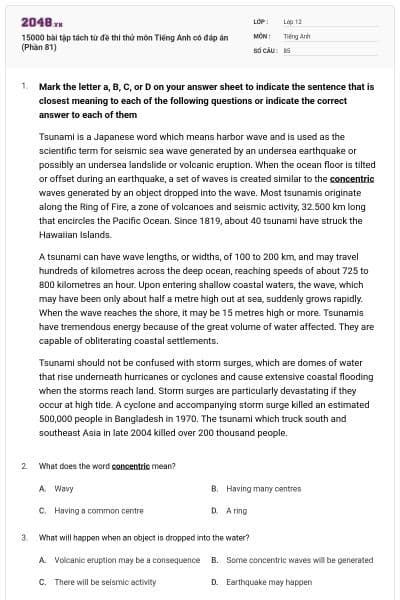
Tsunami is a Japanese word which means harbor wave and is used as the scientific term for seismic sea wave generated by an undersea earthquake or possibly an undersea landslide or volcanic eruption. When the ocean floor is tilted or offset during an earthquake, a set of waves is created similar to the concentric waves generated by an object dropped into the wave. Most tsunamis originate along the Ring of Fire, a zone of volcanoes and seismic activity, 32.500 km long that encircles the Pacific Ocean. Since 1819, about 40 tsunami have struck the Hawaiian Islands.
A tsunami can have wave lengths, or widths, of 100 to 200 km, and may travel hundreds of kilometres across the deep ocean, reaching speeds of about 725 to 800 kilometres an hour. Upon entering shallow coastal waters, the wave, which may have been only about half a metre high out at sea, suddenly grows rapidly. When the wave reaches the shore, it may be 15 metres high or more. Tsunamis have tremendous energy because of the great volume of water affected. They are capable of obliterating coastal settlements.
Tsunami should not be confused with storm surges, which are domes of water that rise underneath hurricanes or cyclones and cause extensive coastal flooding when the storms reach land. Storm surges are particularly devastating if they occur at high tide. A cyclone and accompanying storm surge killed an estimated 500,000 people in Bangladesh in 1970. The tsunami which truck south and southeast Asia in late 2004 killed over 200 thousand people.
What does the word concentric mean?
Wavy
Having many centres
Having a common centre
A ring
Đáp án C
Từ “ concentric” có nghĩa là:
A. gợn sóng
B. có nhiều trung tâm
C. có 1 tâm chung
D. cái đai.
Concentric (adj): đồng tâm = Having a common centre
Dịch bài đọc
Sóng thần là một từ tiếng Nhật có nghĩa là sóng cảng và được sử dụng như thuật ngữ khoa học cho sóng biển địa chấn do động đất dưới biển hoặc có thể là lở đất dưới biển hoặc phun trào núi lửa tạo ra. Khi đáy đại dương bị nghiêng hoặc lệch trong một trận động đất, một loạt sóng được tạo ra tương tự như sóng đồng tâm tạo ra bởi một vật thể rơi xuống nước. Hầu hết các cơn sóng thần bắt nguồn từ Vành đai lửa, một vùng núi lửa và hoạt động địa chấn, dài 32.500 km bao quanh Thái Bình Dương. Kể từ năm 1819, khoảng 40 cơn sóng thần đã tấn công Quần đảo Hawaii.
Sóng thần có thể có bước sóng hoặc chiều rộng từ 100 đến 200 km và có thể di chuyển hàng trăm km qua đại dương sâu, đạt tốc độ khoảng 725 đến 800 km một giờ. Khi đi vào vùng nước ven biển nông, con sóng chỉ cao khoảng nửa mét ngoài biển đột nhiên lớn lên nhanh chóng. Khi sóng đến bờ, nó có thể cao tới 15 m hoặc hơn. Sóng thần có năng lượng cực lớn do khối lượng nước lớn bị ảnh hưởng. Chúng có khả năng xóa sổ các khu định cư ven biển.
Sóng thần không nên bị nhầm lẫn với bão dâng, là những mái vòm nước dâng lên bên dưới các cơn bão hoặc lốc xoáy và gây ra lũ lụt ven biển trên diện rộng khi bão đổ bộ vào đất liền. Bão dâng đặc biệt tàn phá nếu chúng xảy ra khi thủy triều lên cao. Một cơn lốc xoáy và bão dâng kèm theo đã giết chết khoảng 500.000 người ở Bangladesh vào năm 1970. Trận sóng thần tấn công Nam Á và Đông Nam Á vào cuối năm 2004 đã giết chết hơn 200 nghìn người.
What will happen when an object is dropped into the water?
Volcanic eruption may be a consequence
Some concentric waves will be generated
There will be seismic activity
Earthquake may happen
Đáp án B
Điều gì sẽ xảy ra nếu có 1 vật thể rơi vào trong nước:
A. Hậu quả có thể là 1 vụ phụ trào núi lửa.
B. Một số vòng sóng đồng tâm sẽ được tạo ra.
C. Hoạt động địa chấn sẽ xảy ra.
D. Động đất có thể xảy ra
Dẫn chứng ở câu thứ 2 đoạn 1: “a set of waves is created similar to the concentric waves generated by an object dropped into the wave” – ( một loạt các con sóng được tạo ra tương tự như các vòng sóng đồng tâm được hình thành khi ta thả 1 vật thể xuống nước ).
What is the zone of volcanoes and seismic activity in the world called?
The concentric wave
the tsunami
The Pacific Ocean
The Ring of Fire
Đáp án D
Khu vực có núi nửa và địa chấn hoạt động được gọi là gì?
A. Con sóng đồng tâm.
B. Sóng thần.
C. Thái Bình Dương.
D. Vành đai Lửa.
Dẫn chứng ở câu thứ 3 đoạn 1: “Most tsunamis originate along the Ring of Fire, a zone of volcanoes and seismic activity” – ( Phần lớn sóng thần bắt nguồn dọc theo Vành đai Lửa - khu vực hoạt động của núi lủa và địa chấn).
What is the greatest speed of tsunami traveling across the deep ocean?
200 kilometres an hour
700 kilometres an hour
800 kilometres an hour
150,000 kilometres an hour
Đáp án C
Tốc độ lớn nhất của sóng thần chạy trong lòng đại dương là bao nhiêu?
A. 200 km/h
B. 700 km/h
C. 800 km/h
D. 150.000 km/h
Dẫn chứng ở câu đầu đoạn 2: “…and may travel hundreds of kilometres across the deep ocean, reaching speeds of about 725 to 800 kilometres an hour” – ( Sóng thần có thể chạy hàng trăm km dưới lòng đại dương, tốc độ đạt tới từ 725-800 km/h)
How high is the wave of the tsunami when it reaches the shore?
100 metres
200 metres
half a metre
fifteen metres
Đáp án D
Độ cao của sóng thần khi chúng tới bờ?
A. 100 mét
B. 200 mét
C 0,5 mét
D. 15 mét
Dẫn chứng ở câu thứ 3 đoạn 2: “When the wave reaches the shore, it may be 15 metres high or more” – ( Khi tới bờ, con sóng có thể cao tới 15 mét hoặc hơn ).
How are tsunami capable of obliterating coastal settlements?
They have tremendous energy due to the great volume of water affected.
They are a metre high or more.
They travel hundreds of kilometers.
They can strike the shore fifteen metres high.
Đáp án A
Sóng thần có khả năng hủy diệt các khu dân cư ven bờ như thế nào?
A. Chúng có năng lượng khủng khiếp do khối lượng nước khủng lồ bị tác động mạnh.
B. Chúng cao 1 mét hoặc hơn.
C. Chúng đi hàng trăm cây số.
D. Chúng có thể đánh mạnh vào bờ với độ cao 15 mét.
Dẫn chứng ở 2 câu cuối đoạn 2: “Tsunamis have tremendous energy because of the great volume of water affected. They are capable of obliterating coastal settlements.” – (Sóng thần có năng lượng khủng khiếp do khối lượng nước khủng lồ bị tác động mạnh. Chúng có khả năng xóa sổ hoàn toàn các khu dân cư ven bờ).
What killed an estimated 500,000 people in Bangladesh?
a tsunami.
A cyclone and accompanying storm surge.
A high tide.
flooding.
Đáp án B
Cái gì làm 500.000 người Bangladesh thiệt mạng?
A. sóng thần.
B. Một cơn lốc xoáy và cơn bão đi kèm.
C. thủy triều cao.
D. ngập lụt.
Dẫn chứng ở câu gần cuối: “A cyclone and accompanying storm surge killed an estimated 500,000 people in Bangladesh in 1970” – (Một cơn lốc xoáy và cơn bão đi kèm đã làm thiệt mạng khoảng 500.000 người dân Bangladesh vào năm 1970).
Which of the following is NOT true?
Tsunami only occurs in Asia.
A cyclone along with storm surge happened in Asia in 1970.
Storm surges are domes of water rising underneath hurricanes or cyclones.
Storm surges causes extensive coastal flooding.
Đáp án A
Câu nào sau đây không đúng:
A. Sóng thần chỉ xảy ra ở Châu Á.
B. Một cơn lốc xoáy cùng với cơn bão đã xảy ra ở châu Á vào năm 1970.
C. Bão dâng là những vòm nước dâng cao bên dưới các cơn bão hoặc lốc xoáy.
D. Sóng dâng gây ra ngập lụt ven biển trên diện rộng.
Dẫn chứng: “Most tsunamis originate along the Ring of Fire, a zone of volcanoes and seismic activity, 32.500 km long that encircles the Pacific Ocean” – ( Phần lớn sóng thần bắt nguồn dọc theo Vành đai Lửa - khu vực hoạt động của núi lủa và địa chấn, trải dài 32.500 km bao quanh Thái Bình Dương ) => sóng thần xảy ra quanh khu vực Thái Bình Dương chứ không chỉ 1 mình Châu Á. Các thông tin còn lại có thể được tìm thấy trong bài.
Mark the letter a, B, C, or D on your answer sheet to indicate the sentence that is closest meaning to each of the following questions or indicate the correct answer to each of them
It is estimated that over 99 percent of all species that ever existed have become extinct. What causes extinction? When a species is no longer adapted to a changed environment, it may perish. The exact causes of a species’ death vary from situation to situation. Rapid ecological change may render an environment hostile to a species. For example, temperatures may change and a species may not be able to adapt. Food resources may be affected by environmental changes, which will then cause problems for a species requiring these resources. Other species may become better adapted to an environment, resulting in competition and, ultimately, in the death of a species.
The fossil record reveals that extinction has occurred throughout the history of Earth. Recent analyses have also revealed that on some occasions many species become extinct at the same time- a mass extinction. One of the best- known examples of mass extinction occurred 65 million years ago with the demise of dinosaurs and many other forms of life. Perhaps the largest mass extinction was the one that occurred 225 million years ago, when appropriately 95 percent of all species died. Mass extinction can be caused by a relatively rapid change in the environment and can be worsened by the close interrelationship of many species. If, for example, something were to happen to destroy much of the plankton in the oceans, then the oxygen content of Earth would drop, affection even organisms not living in the ocean. Such a change would probably lead to a mass extinction.
One interesting, and controversial, finding is that extinctions during the past 250 million years have tended to be more intense every 26 million years. This periodic extinction might be due to intersection of the Earth’s orbit with a cloud of comets, but this theory is purely speculative. Some researchers have also speculated that extinction may often be random. That is, certain species may be eliminated and others may survive for no particular reason. A species’ survival may have nothing to do with its ability to adapt. If so, some of evolutionary history may reflect a sequence of essentially random events.
The underlined word “ultimately” is closest in meaning to
eventually
unfortunately
dramatically
exceptionally
Đáp án A
Đáp án A. ultimately = eventually: cuối cùng, rốt cục thì.
Các đáp án còn lại:
B. không may mắn.
C. đột ngột.
D. cá biệt, khác thường.
What does the author say in paragraph 1 regarding most species in Earth’s history?
They are no longer in existence.
They have caused rapid change in the environment.
They have remained basically unchanged from their original forms.
They have been able to adapt to ecological changes.
Đáp án A
Tác giả nói gì trong đoạn 1 liên quan tới phần lớn các loài trong lịch sử Trái Đất?
A. Chúng không còn tồn tại.
B. Chúng gây ra ra sự thay đổi nhanh chóng trong môi trường.
C. Chúng tồn tại không thay đổi nhiều so với ban đầu.
D. Chúng đã có thể thích nghi với sự thay đổi sinh thái.
Dẫn chứng ở câu đầu tiên: “It is estimated that over 99 percent of all species that ever existed have become extinct” – ( Xấp xỉ hơn 99% tất cả các loài từng tồn tại là đã tuyệt chủng ).
Which of the following is NOT mentioned in paragraph 1 as resulting from repid ecological change?
Introduction of new species
Competition among species
Availability of food resources
Temperature changes
Đáp án A
Câu nào dưới đây không được đề cập trong đoạn 1 như là hệ quả từ sự biến đổi nhanh chóng của hệ sinh thái?
A. Loài mới xuất hiện.
B. Cạnh tranh giữa các loài.
C. Nguồn thức ăn có sẵn bị ảnh hưởng.
D. Thay đổi nhiệt độ.
Dẫn chứng ở câu 4+5 đoạn 1: “Rapid ecological change may render an environment hostile to a species. For example, temperatures may change and a species may not be able to adapt. Food resources may be affected by environmental changes” – ( Hệ sinh thái biến đổi làm cho môi trường trở thành thù địch đối với các loài. Ví dụ như nhiệt độ thay đổi làm nhiều loài không thể thích ứng kịp. Nguồn thức ăn cũng bị ảnh hưởng bởi sự biến đổi môi trường) => Từ đó ta loại ra đáp án A không được đề cập tới.
The underlined word “demise” is closest in meaning to
help
change
death
recovery
Đáp án C
Đáp án C. demise (n) = death: cái chết.
Các đáp án còn lại:
A. help (n+v): giúp đỡ.
B. change (n+v): thay đổi.
D. recovery (n): sự khôi phục, sự phục hồi.
According to paragraph 2, evidence from fossil suggests that
extinction of species has occurred from time to time throughout Earth’s history.
dinosaurs became extinct much earlier than scientists originally believed.
extinctions on Earth have generally been massive.
there has been only one mass extinction in Earth’s history.
Đáp án A
Theo đoạn 2, bằng chứng từ hóa thạch chỉ ra rằng:
A. Sự tuyệt chủng của các loài đã xảy ra liên tục trong suốt tiến trình lịch sử Trái Đất.
B. Khủng long đã tuyệt chủng sớm hơn nhiều so với các nhà khoa học tin rằng.
C. Sự tuyệt chủng trên trái đất nhìn chung là mang tính hàng loạt.
D. Chỉ có duy nhất 1 lần sự tuyệt chủng hàng loạt diễn ra trong lịch sử Trái Đất.
Dẫn chứng ở câu đầu tiên đoạn 2: “The fossil record reveals that extinction has occurred throughout the history of Earth”- ( Ghi nhận về hóa thạch tiết lộ rằng sự tuyệt chủng đã xảy ra trong suốt tiến trình lịch sử Trái Đất)
According to the passage, it is believed that the largest extinction of a species occurred
250 million years ago
225 million years ago
65 million years ago
26 million years ago
Đáp án D
Theo đoạn văn, người ta tin rằng sự tuyệt chủng lớn nhất của một loài xảy ra vào:
A. 250 triệu năm trước
B. 225 triệu năm trước
C. 65 triệu năm trước
D. 26 triệu năm trước.
Dẫn chứng ở câu thứ 4 đoạn 2: “Perhaps the largest mass extinction was the one that occurred 225 million years ago” – ( Sự tuyệt chủng lớn nhất của 1 loài có lẽ đã xảy ra vào 225 triệu năm trước).
Why is “plankton” mentioned in the second paragraph?
To demonstrate the interdependence of different species.
To illustrate a comparison between organisms that live on the land and those that live in the ocean.
To emphasize the importance of food resources in preventing mass extinction.
To point out that certain species could never become extinct.
Đáp án A
Tại sao sinh vật phù du được đề cập tới ở đoạn 2?
A. Để chứng minh sự phụ thuộc giữa các loài khác nhau.
B. Để minh họa cho sự so sánh giữa các sinh vật sống trên mặt đất và những sinh vật sống trong đại dương.
C. Để nhấn mạnh tầm quan trọng của nguồn thức ăn trong việc ngăn chặn sự tuyệt chủng hàng loạt.
D. Để chỉ ra rằng một số loài nhất định sẽ không bao giờ bị tuyệt chủng.
Dẫn chứng ở câu thứ 5+6 ở đoạn 2: “ Mass extinction can be caused by a relatively rapid change in the environment and can be worsened by the close interrelationship of many species. If, for example, something were to happen to destroy much of the plankton in the oceans, then the oxygen content of Earth would drop, affection even organisms not living in the ocean” – ( Sự tuyệt chủng hàng loạt bị gây ra bởi sự biến đổi môi trường nhanh chóng và có thể tồi tệ hơn là do mối tương quan mật thiết giữa các loài. Ví dụ như có điều gì đó xảy ra làm hủy diệt số lượng lớn các loài sinh vật phù dù trong đại dương, thì lượng ô-xi trên trái đất cũng từ đó mà giảm theo làm ảnh hưởng không chỉ tới các loài sinh vật đại dương).
Read the following passage and mark the letter A, B, C, or D on your answer sheet to indicate the correct answer to each of the questions.
Successful students often do the followings while studying. First they have an overview before reading. Next, they look for important information and pay greater attention to it (which often needs jumping forward or backward to process information). They also relate important points to one another. Also, they activate and use their prior knowledge. When they realize that their understanding is not good, they do not wait to change strategies. Last, they can monitor understanding and take action to correct or “ fix-up” mistakes in comprehension.
Conversely, students with low academic achievement often demonstrate ineffective study skills. They tend to assume a passive role in learning and rely on others(e.g, teachers, parents) to monitor their studying. For example, low-achieving students often do not monitor their understanding of content, they may not be aware of the purpose of studying, and their show little evidence of looking back, or employing “fix-up” strategies to fix understanding problems. Students who struggle with learning new information seem to be unaware that they must extent beyond simply reading the content to understand and remember it. Children with learning disabilities do not plan and judge the quality off their studying. Their studying may be disorganized. Students with learning problems face challenges with personal organization as well. They often have difficulty keeping track of materials and assignments, following directions, and completing work on time. Unlike good student who employ a variety of study skills in a flexible yet purposeful manner, low-achieving students use a restricted range of skills. They can not explain why good study strategies are important for learning, and they tend to use the same, often ineffective, study approach for all learning tasks, ignoring task content, structure of difficulty.
What is the topic of the passage?
Successful learners and their learning strategies.
Successful and low-academic achieving students.
Effective and ineffective ways of learning.
Study skills for high school students.
Đáp án C
Đâu là chủ đề của đoạn văn?
A. Những học sinh thành công và chiến thuật của học tập của họ.
B. Những học sinh thành công và những học sinh có kết quả học tập thấp.
C. Những phương pháp học tập hiệu quả và không hiệu quả.
D. Những kĩ năng học tập dành cho học sinh trung học.
Dạng câu hỏi tìm ý chính luôn ưu tiên làm cuối cùng.
Đoạn văn mượn 2 đối tượng “good students” (những học sinh giỏi) và “low-achieving students” (những học sinh kém) để chỉ ra những phương pháp học tập hiệu quả và không hiệu quả.
Một số dẫn chứng như:
+ “Successful students often do the followings while studying. First they have an overview before reading. Next, they look for important information and pay greater attention to it (which often needs jumping forward or backward to process information)”- (Những học sinh thành công thường làm theo những điều dưới đây khi học. Đầu tiên, họ có một cái nhìn tổng quát trước khi đọc. Tiếp theo, họ tìm kiếm những thông tin quang trọng và dành nhiều sự chú ý hơn cho nó (cái thường cần được xem qua xem lại để xử lí thông tin)).
+ “Conversely, students with low academic achievement often demonstrate ineffective study skills. They tend to assume a passive role in learning and rely on others(e.g, teachers, parents) to monitor their studying. For example, low-achieving students often do not monitor their understanding of content, they may not be aware of the purpose of studying, and their show little evidence of looking back, or employing “fix-up” strategies to fix understanding problems” – (Ngược lại, những học sinh có kết quả học tập thấp thường xuyên cho thấy được những kĩ năng học tập kém hiệu quả. Họ có khuynh hướng đóng vai trò thụ động trong việc học và dựa dẫm vào người khác (ví dụ như bố mẹ, giáo viên) để giám sát việc học của mình. Ví dụ, những học sinh kém thường không chú tâm tới sự tiếp thu của mình trong nội dung, họ có lẽ không nhận thức được mục đích của việc học, và họ không thể hiện dấu hiệu của việc xem lại bài, hoặc dùng chiến lược “sửa chữa” để khắc phục các vấn đề về mặt tiếp thu).
The word “prior” is CLOSET meaning to________.
forward
earlier
important
good
Đáp án B
Câu hỏi từ vựng.
Từ “prior” gần nghĩa với ________.
A. forward (adj+adv): phía trước.
B. earlier (adj): sớm hơn.
C. important (adj): quan trọng.
D. good (adj): tốt.
Prior (adj+adv): sớm hơn, trước đó = B. earlier (adj): sớm hơn.
Tạm dịch: “They also relate important points to one another. Also, they activate and use their prior knowledge” – (Họ cũng đồng thời liên hệ các phần quan trọng với nhau. Ngoài ra, họ còn vận dụng tới cả các phần kiến trước đó).
The word “Conversely” is OPPOSITE meaning to________.
Actually
Alternatively
Consequently
Similarity
Đáp án D
Câu hỏi từ vựng.
Từ “Conversely” TRÁI NGHĨA với ________.
A. Actually (adv): Thực sự.
B. Alternatively (adv): Ngoài ra.
C. Consequently (adv): Do đó.
D. Similarity (n): Sự giống nhau, nét tương đồng.
Conversely (adv): Ngược lại, Mặt trái >< D. Similarity (n): Sự giống nhau, nét tương đồng.
Tạm dịch: “Conversely, students with low academic achievement often demonstrate ineffective study skills” – (Ngược lại, những học sinh có kết quả học tập thấp thường xuyên cho thấy được những kĩ năng học kém hiệu quả).
According to the passage, what can be learnt about passive students?
They are slow in their studying.
They depend on other people to organize their learning.
They monitor their understanding.
The know the purpose of studying.
Đáp án B
Theo như đoạn văn, có thể biết được điều gì về những học sinh thụ động?
A. Họ chậm trong việc học.
B. Họ phụ thuộc vào người khác trong chuyện sắp xếp việc học.
C. Họ theo sát sự hiểu biết của bản thân.
D. Họ biết mục đích của việc học.
Dẫn chứng ở đầu đoạn 2: “Conversely, students with low academic achievement often demonstrate ineffective study skills. They tend to assume a passive role in learning and rely on others(e.g, teachers, parents) to monitor their studying” – (Ngược lại, những học sinh có kết quả học tập thấp thường xuyên cho thấy được những kĩ năng học kém hiệu quả. Họ có khuynh hướng đóng vai trò thụ động trong việc học và dựa dẫm vào người khác (ví dụ như bố mẹ, giáo viên) để giám sát việc học của mình).
Which of the followings is NOT an evidence of monitoring studying?
Looking at their backs.
Monitoring their understanding of content.
Being aware of the purpose of studying.
Fixing up mistakes in the understanding.
Đáp án A
Điều nào sau đây là KHÔNG PHẢI là dấu hiệu của việc theo sát chuyện học hành?
A. Nhìn ra sau lưng.
B. Theo sát sự nhận biết nội dung.
C. Nhận thức được mục đích của việc học.
D. Khắc phục sai lầm trong hiểu biết.
Dẫn chứng ở câu thứ 3- đoạn 2: “For example, low-achieving students often do not monitor their understanding of content (B), they may not be aware of the purpose of studying (C), and their show little evidence of looking back, or employing “fix-up” strategies to fix understanding problems (D)” – (Ví dụ, những học sinh kém thường không theo sát sự nhận biết của mình trong nội dung, họ có lẽ không nhận thức được mục đích của việc học, và họ không thể hiện dấu hiệu của việc nhìn lại, hoặc dùng chiến lược “sửa chữa” để khắc phục các vấn đề về mặt hiểu biết).
According to the passage, to learn new information, low-achieving students do NOT________.
read it.
just understand it.
simply remember it.
relate it to what they have known.
Đáp án D
Theo đoạn văn, để tiếp thu được thông tin mới, những học sinh có thành tích học tập thấp KHÔNG________.
A. đọc nó
B. chỉ hiểu nó
C. nhớ đơn thuần
D. liên hệ nó với những gì họ đã biết.
Dẫn chứng ở câu 4- đoạn 2: “Students who struggle with learning new information seem to be unaware that they must extent beyond simply reading the content (A) to understand (B) and remember it (C)”- (Những học sinh đang gặp khó khăn trong việc tiếp thu thông tin mới có vẻ như không nhận thức được rằng họ phải mở rộng xa hơn việc chỉ đơn thuần đọc nội dung để hiểu và nhớ được nó).
In compared with low-achieving students, successful students use________.
inflexible study ways.
various study skills.
restricted strategies.
aimless studying techniques.
Đáp án B
So với những học sinh kém, những học sinh thành công sử dụng________.
A. những phương pháp học tập linh hoạt.
B. những kĩ năng học tập đa dạng.
C. những chiến thuật nghiêm khắc.
D. những kĩ thuật học học tập vô nghĩa.
Dẫn chứng ở đoạn cuối đoạn 2: “Unlike good student who employ a variety of study skills in a flexible yet purposeful manner […]”- (Không như những học sinh giỏi- người mà vận dụng đa dạng các kĩ năng khác nhau một cách linh hoạt nhưng có chủ đích […]).
The underlined pronoun “they”refers to________.
study strategies.
low-achieving students.
study skills.
good students.
Đáp án B
Đại từ được gạch chân “they” ám chỉ tới ________.
A. những chiến thuật học tập.
B. những học sinh kém.
C. những kĩ năng học tập.
D. những học sinh giỏi.
Do “They”đứng đầu làm chủ ngữ nên ta đọc lên câu phía trước.
Tạm dịch: “Unlike good student who employ a variety of study skills in a flexible yet purposeful manner, low-achieving students use a restricted range of skills. They can not explain why good study strategies are important for learning, and they tend to use the same, often ineffective, study approach for all learning tasks, ignoring task content, structure of difficulty” – (Không như những học sinh giỏi- người mà vận dụng đa dạng các kĩ năng khác nhau một cách linh hoạt nhưng có chủ đích, những học sinh kém thì lại sử dụng các kĩ năng có giới hạn. Họ không thể lí giải được tại sao những chiến thuật học tốt lại quan trọng đối với việc học, và họ có khuynh hướng làm theo, thường là không hiệu quả, các chiến thuật đó cho tất cả phần bài tập mà bỏ qua phần nội dung, bản chất của những khó khăn).
Read the following passage and mark the letter A, B, C, or D on your answer sheet to indicate the correct answer to each of the questions.
People commonly complain that they never have enough time to accomplish tasks. The hours and minutes seem to slip away before many planned chores get done. According to time management experts, the main reason for this is that most people fail to set priorities about what to do first. They get tied down by trivial, time consuming matters and never complete the important ones.
One simple solution often used by those at the top is to keep lists of tasks to be accomplished daily. These lists order jobs from most essential to least essential and are checked regularly through the day to assess progress. Not only is this an effective way to manage time, but also it serves to give individuals a much deserved sense of satisfaction over their achievements. People who do not keep lists often face the end of the word day with uncertainly over the significance of their accomplishments, which over time can contribute to serious problem in mental and physical health.
Which of the following is the best title for the passage?
Accomplishing trivial matters
Common complaints about work
Learning to manage time
Achieving job satisfaction
Đáp án C
Đâu là tiêu đề thích hợp cho đoạn văn?
A. Hoàn thành các công việc nhỏ.
B. Những phàn nàn phổ biến về công việc.
C. Học cách quản lí thời gian.
D. Đạt được sự hài lòng trong công việc.
Dạng câu hỏi tìm ý chính luôn ưu tiên làm cuối cùng.
Một số dẫn chứng trong bài:
+ “People commonly complain that they never have enough time to accomplish tasks. The hours and minutes seem to slip away before many planned chores get done. According to time management experts, the main reason for this is that most people fail to set priorities about what to do first” – (Mọi người thường phàn nàn rằng họ không bao giờ có để thời gian để hoàn thành các công việc. Thời gian cứ trôi đi trước khi nhiều kế hoạch được hoành thành. Theo như những chuyên gia về quản lí thời gian, lí do chính cho điều đó chính là hầu hết họ không ưu tiên các việc nào nên làm trước).
+ “One simple solution often used by those at the top is to keep lists of tasks to be accomplished daily. These lists order jobs from most essential to least essential and are checked regularly through the day to assess progress.” – (Một giải pháp đơn giản thường được họ sử dụng nhiều nhất đó là lên danh sách các công việc cần được hoàn thành vào mỗi ngày. Những danh sách đó sắp xếp các công việc theo thứ tự từ cần thiết nhất đến ít cần thiết và được kiểm tra thường xuyên trong ngày để đáng giá tiến độ).
According to the passage, what does “slip away” mean?
pick up
break down
fall behind
pass quickly
Đáp án D
Câu hỏi từ vựng.
Theo như đoạn văn, từ “slip away” có nghĩa là?
A. pick up: học lỏm, nhặt nhiệm, đưa đón.
B. break down: hỏng hóc (máy móc),…
C. fall behind: tụt hậu, chậm tiến độ.
D. pass quickly: di chuyển qua nhanh, trôi qua.
(to) slip away: trượt, trôi, tuột qua = D. pass quickly: di chuyển qua nhanh, trôi qua.
Tạm dịch: “The hours and minutes seem to slip away before many planned chores get done” – (Thời gian cứ thế trôi đi trước khi những kế hoạch cần được hoành thành).
According to the passage, why do many people never seem to have enough time to accomplish things?
They fail to deal with trivial matters.
They get tied down by one difficult problem.
They do not prioritize tasks.
They do not seek the advice of time management experts.
Đáp án C
Theo như đoạn văn, tại sao nhiều người không bao giờ có vẻ như có đủ thời gian để hoàn thành mọi việc?
A. Họ không giải quyết được các vấn đề nhỏ.
B. Họ bị rằng buộc bởi một vấn đề khó khăn.
C. Họ không ưu tiên các công việc nào cả.
D. Họ không tìm kiếm lời khuyên từ các chuyên gia quản lí thời gian.
Dẫn chứng ở đoạn 1: “People commonly complain that they never have enough time to accomplish tasks. The hours and minutes seem to slip away before many planned chores get done. According to time management experts, the main reason for this is that most people fail to set priorities about what to do first” – (Mọi người thường phàn nàn rằng họ không bao giờ có để thời gian để hoàn thành các công việc. Thời gian cứ trôi đi trước khi nhiều kế hoạch được hoành thành. Theo như những chuyên gia về quản lí thời gian, lí do chính cho điều đó chính là hầu hết họ không ưu tiên các việc nào nên làm trước).
In paragraph 2, the word “those” refers to ______.
priorities
trivial matters
daily lists
people
Đáp án D
Từ “those” ở đoạn 2 ám chỉ tới ______.
A. những sự ưu tiên.
B. những vấn đề nhỏ.
C. danh sách các công việc thường ngày.
D. mọi người.
Tạm dịch: “They get tied down by trivial, time consuming matters and never complete the important ones. One simple solution often used by those at the top is to keep lists of tasks to be accomplished daily” – (Họ bị rằng buộc bởi những vấn đề nhỏ và mất thời gian, và không bao giờ hoàn thành được những công việc quan trọng. Một giải pháp đơn giản thường được họ sử dụng nhiều nhất đó là lên danh sách các công việc cần được hoàn thành vào mỗi ngày).
The passage states that one solution to time management problem is to _____.
accomplish time – consuming matters first.
consult a time management.
spend only a short time on each task.
keep daily lists of priorities and check them regularly.
Đáp án D
Đoạn văn chỉ ra một biện pháp để quản lí thời gian đó là ______.
A. hoàn thành những vấn đề tốn thời gian trước.
B. đi tham khảo ý kiến chuyên gia quản lí thời gian.
C. chỉ sử dụng một thời gian ngắn cho mỗi nhiệm vụ.
D. lên danh sách các công việc ưu tiên hằng ngày và kiểm tra thường xuyên.
Dẫn chứng ở 2 câu đầu đoạn 2: “One simple solution often used by those at the top is to keep lists of tasks to be accomplished daily. These lists order jobs from most essential to least essential and are checked regularly through the day to assess progress” – (Một giải pháp đơn giản thường được họ sử dụng nhiều nhất đó là lên danh sách các công việc cần được hoàn thành vào mỗi ngày. Những danh sách đó sắp xếp các công việc theo thứ tự từ cần thiết nhất đến ít cần thiết và được kiểm tra thường xuyên trong ngày để đáng giá được tiến trình).
In the paragraph 2, the word “accomplishments” can be best replaced by ____.
decisions
priorities
assessments
achievements
Đáp án D
Câu hỏi từ vựng.
Tù “accomplishments” ở đoạn 2 có thể được thay thế bởi ______.
A. decisions (n): những quyến định.
B. priorities (n): những sự ưu tiên.
C. assessments (n): những sự đánh giá.
D. achievements (n): những sự đạt được, những thành tích, thành tựu.
Accomplishments (n): sự hoàn thành = D. achievements (n).
Tạm dịch: “People who do not keep lists often face the end of the word day with uncertainly over the significance of their accomplishments, which over time can contribute to serious problem in mental and physical health”- (Những người không đặt ra những danh sách ưu tiên sẽ thường xuyên phải đối mặt với những ngày cuối cùng không chắc chắn về tầm quan trọng của việc hoàn thành các công việc, điều đó theo thời gian có thể ảnh hưởng nghiêm trọng tới các vấn đề sức khỏe về mặt tinh thần và thể lực).
In the paragraph following the passage most probably discusses ______.
another solution to time management problems.
mental and physical health problems.
different types of lists.
ways to achieve a sense of fulfillment.
Đáp án A
Đoạn văn tiếp theo có thể được bàn luận tới là ______.
A. giải pháp khác về các vấn đề quản lí thời gian.
B. những vấn đề về sức khỏe thể chất và tinh thần.
C. các loại danh sách khác nhau.
D. các cách để hoàn thành công việc.
Cả bài văn là nêu ra thực trạng về vấn đề quản lí thời gian và một biện pháp cơ bản để quản lí thời gian. Đoạn tiếp theo có thể sẽ nói về những cách khác để quản lí được thời gian hiệu quả.
Read the following passage and mark the letter A, B, C, or D on your answer sheet to indicate the correct answer to each ofthe questions
American movies create myths about college life in the United States. These stories are entertaining, but they are not true. You have to look beyond Hollywood movies to understand what college is really like.
Thanks to the movies, many people believe that college students party and socialize more than they study. Movies almost never show students working hard in class or in the library. Instead, movies show them eating, talking, hanging out, or dancing to loud music at wild parties. While it is true that American students have the freedom to participate in activities, they also have academic responsibilities. In order to succeed, they have to attend classes and study hard.
Another movie myth is that athletics is the only important extracurricular activity. In fact, there is a wide variety of nonacademic activities on campus such as special clubs, service organizations, art, and theater programs. This variety allows students to choose what interests them. Even more important, after graduation, students' résumés look better to employers if they list a few extracurricular activities.
Most students in the movies can easily afford higher education. If only this were true! While it is true that some American college students are wealthy, most are from families with moderate incomes. Up to 80% of them get some type of financial aid. Students from middle and lower-income families often work part-time throughout their college years. There is one thing that many college students have in common, but it is not something you will see in the movies. They have parents who think higher education is a priority, a necessary and important part of their children's lives.
Movies about college life usually have characters that are extreme in some way: super athletic, super intelligent, super wealthy, super glamorous, etc. Movies use these stereotypes, along with other myths of romance and adventure because audiences like going to movies that include these elements. Of course, real college students are not like movie characters at all.
So the next time you want a taste of the college experience, do not go to the movies. Look at some college websites or brochures instead. Take a walk around your local college campus. Visit a few classes. True, you may not be able to see the same people or exciting action you will see in the movies, but you can be sure that there are plenty of academic adventures going on all around you.
The story about college life in Amerian movies are not ______.
true
interesting
boring
exciting
Đáp án A
Câu chuyện vể cuộc sống sinh viên trong những bộ phim Mĩ không______.
A. đúng sự thật
B. thú vị
C. nhàm chán
D. hứng thú.
Dẫn chứng ở 2 câu đầu-đoạn 1: “American movies create myths about college life in the United States. These stories are entertaining, but they are not true” – (Phim Mĩ đã tạo ra những câu chuyện hoang đường về cuộc sống đại học ở Mĩ. Những câu chuyện đó có tính giải trí và chúng đều không đúng sự thật).
The phrase “academic responsibilities” in the second paragraph is closest in meaning to ______.
learning duties
training skills
caring professions
teaching methods
Đáp án A
Cụm từ “academic responsibilities” ở đoạn 2 đồng nghĩa với ______.
A. trách nhiệm học tập.
B. kĩ năng đào tạo.
C. nghề nghiệp chăm sóc.
D. kĩ năng giảng dạy.
Cụm danh từ: academic responsibilities: trách nhiệm học tập = A. learning duties.
Which of the following is NOT true?
Learning is only part of students’ college life.
There is a wide choice of extracurricular activities for college students.
Extracurricular activities are of no importance to employers.
Not all extracurricular activities are students' academic responsibilities.
Đáp án C
Câu nào sau đây không đúng?
A. Học tập chỉ là 1 phần của cuộc sống sinh viên đại học.
B. Có nhiều sự lựa chọn về hoạt động ngoại khóa dành cho sinh viên đại học.
C. Hoạt động ngoại khóa không quan trọng đối với những người đi làm.
D. Không phải tất cả hoạt động ngoại khóa đều là trách nhiệm học tập của sinh viên.
Dẫn chứng ở câu cuối đoạn 3: “Even more important, after graduation, students' résumés look better to employers if they list a few extracurricular activities” – (Thậm chí quan trọng hơn, sau khi tốt nghiệp, những bản hồ sơ xin việc trông sẽ có thiện cảm hơn đối với những nhà tuyển dụng nếu chúng liệt kê ra được một vài hoạt động ngoại khóa)
=> C sai.
The word “they” in the third paragraph refers to ______.
employers
activities
colleges
résumés
Đáp án D
Từ “they” ở đoạn 3 ám chỉ tới ______.
A. những nhà tuyển dụng
B. những hoạt động.
C. những trường đại học
D. bản lý lịch xin việc
Tạm dịch: “Even more important, after graduation, students' résumés look better to employers if they list a few extracurricular activities” – (Thậm chí quan trọng hơn, sau khi tốt nghiệp, những bản hồ sơ xin việc trông sẽ có thiện cảm hơn đối với những nhà tuyển dụng nếu chúng liệt kê ra được một và hoạt động ngoại khóa).
The word “moderate” in the fourth paragraph is closest in meaning to ______.
not high
unlimited
not steady
sensible
Đáp án A
Câu hỏi từ vựng:
moderate (adj): vừa phải, trung bình = A. not high: không cao.
Các đáp án còn lại:
B. unlimited (adj): không giới hạn.
C. not steady: không ổn định.
D. sensible (adj): có óc phán đoán.
Tạm dịch: “While it is true that some American college students are wealthy, most are from families with moderate incomes”- (Trong khi đúng rằng có một số sinh viên Mĩ là giàu có, nhưng phần đông là xuất thân từ những gia đình có thu nhập trung bình).
Many American students have to work part-time throughout their college years because ______.
they are not allowed to work full-time.
they want to gain experience.
their parents force them to.
they can earn money for their expenses.
Đáp án D
Nhiều sinh viên Mĩ phải làm việc bán thời gian trong suốt những năm đại học bởi vì ______.
A. Họ không được cho phép đi làm toàn thời gian.
B. Họ muốn có kinh nghiệm.
C. Bố mẹ thúc ép họ.
D. Họ có thể kiếm tiềm cho những kinh phí.
Dẫn chứng ở đoạn 4: “While it is true that some American college students are wealthy, most are from families with moderate incomes. Up to 80% of them get some type of financial aid. Students from middle and lower-income families often work part-time throughout their college years” – (Trong khi đúng rằng có một số sinh viên Mĩ là giàu có, nhưng phần đông là xuất thân từ những gia đình có thu nhập trung bình. Có tới 80% trong số họ nhận trợ cấp tài chính. Những sinh viên xuất thân từ những gia đình có thu nhập thấp hoặc trung bình thường làm việc bán thời gian trong suốt những năm học đại học của họ).
=> Những sinh viên đại học đi làm bán thời gian vì họ muốn có thêm tiền để trang trải những chi phí cuộc sống.
Which of the following could best serve as the title of the passage?
Going to College: The Only Way to Succeed in Life
Hollywood Movies: The Best About College Life.
Extracurricular Activities and Job Opportunities.
American College Life and the Movies.
Đáp án D
Câu nào sau đây có thể là tiêu đề phù hợp nhất cho đoạn văn?
A. Học đại học: Con đường duy nhất để thành công trong cuộc sống.
B. Những bộ phim Hollywood: Những điều chân thật nhất về cuộc sống đại học.
C. Hoạt động ngoại khóa và những cơ hội nghề nghiệp.
D. Cuộc sống đại học ở Mĩ và những bộ phim.
Đoạn văn mở đầu là đoạn khái quát nội dung của bài: “American movies create myths about college life in the United States. These stories are entertaining, but they are not true. You have to look beyond Hollywood movies to understand what college is really like” – (Phim Mĩ đã tạo ra những câu chuyện hoang đường về cuộc sống đại học ở Mĩ. Những câu chuyện đó có tính giải trí và chúng đều không đúng sự thật. Bạn phải nhìn xa hơn ngoài những bộ phim Hollywood để hiểu được đại học thực chất là như thế nào).
Một số ý trong bài bài như:
+ “Thanks to the movies, many people believe that college students party and socialize more than they study. Movies almost never show students working hard in class or in the library. Instead, movies show them eating, talking, hanging out, or dancing to loud music at wild parties” -(Nhờ vào những bộ phim, nhiều người tin rằng sinh viên đại học tiệc tùng và xã giao nhiều hơn là học hành. Những bộ phim hầu như không bao giờ cho thấy những học sinh học tập chăm chỉ trên lớp hoặc trong thư viện. Thay vào đó, chúng cho thấy họ ăn uống, nói chuyện, đi chơi hoặc nhảy nhót dưới âm thanh xập xình trong những bữa tiệu hoang dại).
+ “Another movie myth is that athletics is the only important extracurricular activity. In fact, there is a wide variety of nonacademic activities on campus such as special clubs, service organizations, art, and theater programs” – (Một câu chuyện hoang đường khác trên phim đó là thể thao là một hoạt động ngoại động ngoại khóa quan trọng duy nhất. Trên thực tế, còn có nhiều những hoạt động ngoại khóa khác trên trường như tham gia vào các clb, các tổ chức dịch vụ, các chương trình nghệ thuật và sân khấu).
+ “Most students in the movies can easily afford higher education. If only this were true! While it is true that some American college students are wealthy, most are from families with moderate incomes” (Phần lớn sinh viên trong phim có thể dễ dành chi trả được chương trình giáo dục cao cấp. Giá như điều đó là đúng! Trong khi đúng rằng có một số sinh viên Mĩ là giàu có, nhưng phần đông là xuất thân từ những gia đình có thu nhập trung bình).
=> Bài văn chỉ ra những mâu thuẫn đối lập giữa cuộc sống sinh viên đại học trong phim và ngoài thực tế.
=> Tiêu đề D là phù hợp nhất.
Read the following passage and mark the letter A, B, C, or D on your answer sheet to indicate the correct answer to each of the questions
The need for a surgical operation, especially an emergency operation, almost always comes as a severe shock to the patient and his family. Despite modern advances, most people still have an irrational fear of hospitals and anaesthetics. Patients do riot often believe they really need surgery- cutting into a part of the body as opposed to treatment with drugs.
In the early year of the 20th century, there was little specialization in surgery. A good surgeon was capable of performing almost every operation that had been advised up to that time. Today the situation is different. Operations are now being carried out that were not even dreamed of fifty years ago. The heart can be safely opened and its valves repaired. Cloyed blood vessels can be clean out, and broken ones mended and replaced. A lung, the whole stomach, or even part of the brain can be removed and still permit the patient to live a comfortable and satisfactory life. However, not every surgeon wants to, or is qualified to carry out every type of modern operation.
The scope of surgery has increase remarkable in the past decades. Its safety has increased, too. Deaths from most operations are about 20% of what they were in 1910 and surgery has been extended in many directions, for example, to certain types of birth defects in new born babies, and at the other end of the scale, to life-saving operation for the octogenarian .The hospital stay after surgery has been shortened to as little as a week for most major operations. Most patients are out of bed on the day after an operation and may be back at work in two or three weeks.
One of the most revolutionary areas of modern surgery is that of organ transplants. Until a few decades ago, no person, except an identical twins, was able to accept into his body the tissues of another person without reacting against them and eventually killing them. Recently, however, it has been discovered that with the use of X-rays and special drugs, it is possible to graft tissues from one person to another which will survive for periods of a year or more. Kidneys have been successfully transplanted between non-identical twins. Heart and lung transplants have also been reasonably successful.
“Spare parts” surgery, the simple routine replacement of all worn-out organs by new ones, is still a dream of the future but surgery is ready for such miracles. In the meantime, you can be happy if the doctors say to you: “Yes, l think it is possible to operate on you for this condition”.
Most people are afraid of being operated on______.
in spite of improvements in modem surgery.
because they think modern drugs are dangerous.
because they do not believe they need anesthetics.
unless it is an emergency operation.
Đáp án A
Nhiều người sợ phẫu thuật______.
A. mặc dù có những tiến bộ trong phẫu thuật hiện đại.
B. bởi vì họ nghĩ rằng thuốc hiện đại gây nguy hiểm.
C. bởi vì họ không tin rằng họ cần gây tê.
D. trừ khi đó là phẫu thuật khẩn cấp.
Dẫn chứng ở 2 câu đầu tiên: “The need for a surgical operation, especially an emergency operation, almost always comes as a severe shock to the patient and his family. Despite modern advances, most people still have an irrational fear of hospitals and anaesthetics”- (Cần thiết phải phẫu thuật, đặc biệt là phẫu thuật cấp cứu, hầu như luôn là cú sốc lớn đối với bệnh nhân và gia đình họ. Mặc dù có sự tiến bộ hiện đại, nhiều người vẫn còn một nỗi sợ vô lí đối với bệnh viện và việc gây tê).
Surgeons in the early 20th century compared with modern ones ______.
had less to learn about surgery.
needed more knowledge.
were more trusted by their patients.
could perform every operation known today.
Đáp án A
Bác sĩ phẫu thuật trong đầu thế kỉ 20 khi so với hiện nay______.
A. có ít thứ để học hơn về phẫu thuật.
B. cần thêm kiến thức.
C. được nhiều bệnh nhân của họ tin tưởng hơn.
D. có thể thực hiện được mọi ca phẫu thuật được biết tới trong ngày nay.
Dẫn chứng ở câu đầu đoạn 2: “In the early year of the 20th century, there was little specialization in surgery”- (Vào những năm đầu của thế kỉ 20, có rất ít chuyên ngành về phẫu thuật).
A patient can still live a comfortable life even after the removal of______.
his brain.
a major organ such as the stomach or one lung.
his lungs.
part of the stomach or the whole liver.
Đáp án B
Một bệnh nhân có thể vẫn sống được 1 cuộc sống thoải mái sau khi loại bỏ đi______.
A. bộ não.
B. một cơ quan lớn như dạ dày hoặc một lá phổi.
C. 2 lá phổi.
D. một phần dạ dày hoặc cả lá gan.
Dẫn chứng ở cuối đoạn 2: “A lung, the whole stomach, or even part of the brain can be removed and still permit the patient to live a comfortable and satisfactory life”- (Một lá phổi, toàn bộ dạ dày và thậm chí là một phần của bộ não có thể loại bỏ đi và vẫn cho phép bệnh nhân sống thoải mải).
The word “clogged” is most likely to correspond to______.
clean
blocked
covered
unwashed
Đáp án B
Câu hỏi từ vựng.
Clogged: bị tắc, bị kẹt = B. blocked: bị gây cản trở.
Các đáp án còn lại:
A. clean (adj): sạch sẽ.
C. covered: bị bao phủ.
D. unwashed: không được gội rửa.
Tạm dịch: “Cloyed blood vessels can be clean out, and broken ones mended and replaced”- (Các mạch máu bị tắc nghẽn có thể được loại bỏ, và những mạch máu bị vỡ có thể được sửa chữa và thay thế).
Today, compared with 1910______.
20% fewer of all operation patients die.
20% of all operation patients recover.
operation deaths have increased by 20%
five times fewer patients die after being operated on.
Đáp án A
Ngày nay, khi được so sánh với những năm 1910 thì______.
A. tổng số bệnh nhân phẫu thuật tử vong ít hơn 20%.
B. 20% trong tổng số bệnh nhân phẫu thuật là hồi phục.
C. những ca phẫu thuật tử vong tăng 20%.
D. số bệnh nhân tử vong hậu phẫu ít hơn 5 lần.
Dẫn chứng ở câu 3- đoạn 2: “Deaths from most operations are about 20% of what they were in 1910 […]” – (Những ca tử vong từ phẫu thuật là vào khoảng 20% so với vào năm 1910 […]).
What is the similar meaning to the word “octogenarian”?
eighteen-year-old.
person in his eighties.
person having eighth operation.
eye specialist.
Đáp án B
Câu hỏi từ vựng.
Octogenarian (n): người thọ 80 tuổi = B. person in his eighties.
Các đáp án còn lại:
A. 80 tuổi.
C. người có ca phẫu thuật lần thứ 80.
D. chuyên gia về mắt.
The main difficulty with organ transplants is______.
it is difficult to find organs of the same size.
only identical twins can give permission for their organs to be exchanged.
the body's tendency to reject alien tissues.
the patient is not allowed to use drugs after them.
Đáp án C
Khó khăn chính của cấy ghép nội tạng là______.
A. khó tìm được nội tạng có cùng kích cỡ
B. chỉ những cặp sinh đôi giống hệt nhau mới được cho phép trao đổi nội tạng.
C. cơ thể có xu hướng đào thải các mô lạ.
D. bệnh nhân không được cho phép sử dụng thuốc sau đó.
Dẫn chứng ở câu thứ 2- đoạn 4: “Until a few decades ago, no person, except an identical twins, was able to accept into his body the tissues of another person without reacting against them and eventually killing them” – (Cho tới một vài thập kỉ trước, không một ai, ngoại trừ các cặp song sinh có khả năng chấp nhận vào cơ thể các mô của nhau mà không gây phản ứng ngược và cuối cùng là giết chết chúng) => Khó khăn ở đây chính là khi đưa vào cơ thể các mô của người lạ, chúng có thể gây phản ứng ngược và giết chết người bệnh.
You can be happy if your surgeon can operate because it means______.
he thinks your condition may be curable
he is a good doctor.
he knows you will survive.
you are getting better already.
Đáp án A
Bạn có thể hạnh phục nếu bác sĩ phẫu thuật của mình có thể tiến hành phẫu thuật bởi vì điều đó cõ nghĩa là ______.
A. ông ấy nghĩ rằng tình trạng bệnh của bạn có thể cứu chữa được.
B. ông ấy là 1 bác sĩ tốt.
C. ông ấy biết rằng bạn sẽ sống sót.
D. bạn đang trở nên khỏe lên.
Dẫn chứng ở đoạn cuối cùng: ““Spare parts” surgery, the simple routine replacement of all worn-out organs by new ones, is still a dream of the future but surgery is ready for such miracles. In the meantime, you can be happy if the doctors say to you: “Yes, l think it is possible to operate on you for this condition” – (Phẫu thuật “phụ tùng”, sự thay thế đơn thuần các cơ quan bị suy giảm chức năng bằng một cơ quan mới, vẫn là một giấc mơ của tương lai nhưng phẫu thuật thì đã sẵn sàng cho những phép màu như vậy. Trong thời gian chờ đợi, bạn có thể hạnh phúc nếu bác sĩ nói rằng: “Vâng, tôi nghĩ là có thể phẫu thuật bạn cho tình trạng này”).
Read the following passage and mark the letter A, B, C, or D on your answer sheet to indicate the correct answer to each of the questions
Productivity Hacks for Great Success
No matter who we are or where we are from, we only have 24 hours each day to get things done. Some people seem to make the most of their time, using it to achieve their goals and dreams. Others feel that life is passing them by and they aren’t accomplishing anything. If you are in the latter group, it is not too late to turn things around. By implementing a few simple hacks, you can start getting better results very quickly.
If you want to become more productive, it pays to learn about the Pareto principle (which is also known as the 80-20 rule). It states that for most tasks, 80 percent of the results we get come from 20 percent of the work we do. For example. 80 percent of the company sales usually come from 20 percent of customers. Therefore, the trick is to focus your efforts on the key 20 percent of actions that truly matter to greatly improve your results.
In some cases, people may be busy from morning to night but still seem to get nothing done. In this situation, the problem might be that clear goals haven’t been set. To fix this, set some time aside to list the things you want to achieve in life. Then, select the top three or four that you want to focus on for the next year. Look at your goals every night before bedtime and ask yourself what are the next actions to accomplish each day. Then, promise yourself that you will finish these tasks no matter how busy you get. If possible try completing the tasks first thing in the morning so you are assured of success.
Another common mistake regarding productivity is not considering our energy levels. If we try to work around the clock, we will eventually get tired and quit. Everyone needs time to sleep, eat, socialize with friends, and unwind from the stress of the day. To make sure you don’t burn out, be sure to schedule some time for breaks and fun activities into your schedule every day. Finally, no matter how difficult your goals may seem, remember the old saying that “a journey of a thousand miles begins with a single step”.
What is implied in the last sentence of the passage?
It is best to take a big first step.
Start moving toward your dreams little by little.
Think twice before taking any steps.
People get their best ideas when traveling.
Đáp án B
Điều gì được ám chỉ ở câu cuối của đoạn văn?
A. Tốt nhất là thực hiện một bước đi lớn ngay đầu tiên.
B. Bắt đầu tiến tới ước mơ từng chút một.
C. Nghĩ kĩ trước khi thực hiện bất kì một bước nào.
D. Người ta có những ý tưởng tuyệt nhất khi đi du lịch.
Tạm dịch: “Finally, no matter how difficult your goals may seem, remember the old saying that “a journey of a thousand miles begins with a single step”” - (Cuối cùng, cho dù mục tiêu của bạn có khó khăn tới mức nào, hãy nhớ rằng người xưa có câu “một cuộc hành trình ngàn dặm luôn bắt đầu từ những bước đi đầu tiên”).
=> Ám chỉ rằng: những thành công vĩ đại nhất luôn khởi đầu từ những bước đi nhỏ => chọn B.
In order to achieve our goals, we should______.
select the most important goals for each day and take the priority to achieve them within the day.
eat a lot to burn enough energy for our daily activities.
set the goals just before bedtime in order to remember them better.
set as many goals as possible so that we can achieve some of them or at least 20 percent.
Đáp án A
Để đạt được mục tiêu chúng ta nên ______.
A. chọn ra những mục tiêu quan trọng nhất cho mỗi ngày và ưu tiên đạt được chúng trong ngày.
B. ăn thật nhiều để đốt cháy năng lượng cho những hoạt động thường nhật.
C. đặt mục tiêu ngay trước khi đi ngủ để nhớ chúng tốt hơn.
D. đặt nhiều mục tiêu nhất có thể để chúng ta có thể đạt được ít nhất 20% trong số chúng.
Được suy ra từ đoạn 3: “In some cases, people may be busy from morning to night but still seem to get nothing done. In this situation, the problem might be that clear goals haven’t been set. To fix this, set some time aside to list the things you want to achieve in life. Then, select the top three or four that you want to focus on for the next year. Look at your goals every night before bedtime and ask yourself what are the next actions to accomplish each day. Then, promise yourself that you will finish these tasks no matter how busy you get” – (Trong một số trường hợp, chúng ta bận rộn cả ngày từ sáng tới tối nhưng dường như vẫn chả làm được gì. Trong trường hợp này, vấn đề có thể là do chưa có mục tiêu rõ ràng. Để khắc phục điều đó, hãy dành thời gian để liệt kê ra những thứ bạn muốn đạt được trong cuộc sống. Sau đó, chọn ra top 3 hoặc 4 điều bạn muốn tập trung cho năm sau. Nhìn vào những mục tiêu của bạn mỗi tối trước khi ngủ và tự hỏi bản thân hành động tiếp theo để hoàn thành mỗi ngày là gì. Sau đó, hứa với bản thân rằng bạn sẽ hoàn thành những mục tiêu đó dù có bận cỡ nào đi chăng nữa).
Which of the following statements does the author support most?
How difficult our goals may seem, we should take steps to travel a thousand miles to achieve them.
Reasonable goals and good techniques of time management may help you get great
achievements.
We try to work around the clock and set some time aside to list the things we want to achieve in life.
We need time to sleep, eat, socialize with friends, and achieve our goals for 20 percent of the day’s time.
Đáp án B
Câu nào sau đây được tác giả ủng hộ nhất?
A. Dù mục tiêu của chúng ta có khó khăn tới mức nào, chúng ta nên thực hiện các bước một để đi được ngàn dặm để đạt được chúng.
B. Những mục tiêu hợp lí và những kĩ thuật quản lí thời gian tốt có thể giúp chúng ta đạt được những mục tiêu to lớn.
C. Chúng ta cố gắng làm việc 24/24 và dành một số thời gian để liệt kê ra những thứ ta muốn đạt được trong cuộc sống.
D. Chúng ta cần thời gian để ngủ, ăn, giao lưu với bạn bè, và đặt được mục tiêu của mình trong 20% trong ban ngày.
Suy ra từ đoạn cuối đoạn cuối: “If we try to work around the clock, we will eventually get tired and quit. Everyone needs time to sleep, eat, socialize with friends, and unwind from the stress of the day. To make sure you don’t burn out, be sure to schedule some time for breaks and fun activities into your schedule every day” – (Nếu chúng ta cố gắng làm việc suốt cả ngày, cuối cùng chúng ta sẽ cảm thấy mệt mỏi và muốn bỏ cuộc. Ai cũng cần thời gian để ngủ, ăn và giao lưu với bạn bè, và tránh xa những căng thẳng trong ngày. Để đảm bảo rằng bạn không bị mất hứng làm việc, hãy chắc chắn sắp xếp cả thời gian cho việc nghỉ ngơi và các hoạt động giải trí cho lịch trình mỗi ngày của bản thân).
The word “this” in paragraph 3 refers to______.
a lack of time
setting no aims
clear goals
failing in business
Đáp án B
Từ “this” ở đoạn 3 đề cập tới ______.
A. thiếu thời gian.
B. không có mục tiêu.
C. những mục tiêu rõ ràng.
D. thất bại trong kinh doanh.
Đọc nên cả câu trên: “In this situation, the problem might be that clear goals haven’t been set. To fix this, set some time aside to list the things you want to achieve in life” – (Trong trường hợp này, vấn đề có thể là do chưa có mục tiêu rõ ràng. Để khắc phục điều đó, hãy dành thời gian để liệt kê ra những thứ bạn muốn đạt được trong cuộc sống).
he phrase “hacks for” in the title is closest in meaning to______.
leads to
cut off
secretly achieve
kicks without control
: Đáp án A
Cụm “hacks for” ở tiêu đề đồng nghĩa với ______.
A. dẫn tới
B. cắt giảm
C. bí mật đạt được
D. những cú đá không kiểm soát
Hack for (v) = A. lead to: dẫn tới.
Tiêu đề có nghĩa là: Năng suất dẫn tới thành công lớn.
Which of the following sentences is true?
No one ever achieves all of their goals.
Everyone has the same time in a day.
No one has any spare time these days.
Everyone manages time the same way.
Đáp án B
Câu nào dưới đây là đúng?
A. Không ai đã từng đạt được tất cả những mục tiêu của bản thân.
B. Mọi người có cùng một lượng thời gian mỗi ngày.
C. Ngày nay không ai có thời gian rảnh rỗi.
D. Mọi người quản lí thời gian theo cách giống nhau.
Dẫn chứng ở ngay câu đầu tiên: “No matter who we are or where we are from, we only have 24 hours each day to get things done” – (Dù bạn có là ai và bạn đến từ đâu, chúng ta cũng chỉ có 24 giờ mỗi ngày để làm mọi việc).
What is the Pareto principle?
If you work hard 80 percent of the time, you can relax for 20 percent.
You need to do lots of work to increase sales by 20 percent.
A few important things produce most of the results.
Companies don’t need to hire more than 80 people.
Đáp án C
Định luật Pareto là gì?
A. Nếu bạn làm việc chăm chỉ 80% thời gian, bạn có thể nghỉ ngơi 20%.
B. Bạn cần phải làm nhiều công việc để tăng doanh thu lên 20%.
C. Một số điều quan trọng tạo ra hầu hết các kết quả.
D. Các công ty không cần tuyển dụng hơn 80 người.
Dẫn chứng ở đoạn 2: “ […] Pareto principle (which is also known as the 80-20 rule). It states that for most tasks, 80 percent of the results we get come from 20 percent of the work we do. […].Therefore, the trick is to focus your efforts on the key 20 percent of actions that truly matter to greatly improve your results” – (Nguyên tắc Pareto (còn được gọi là định luật 80-20). Nó chỉ ra rằng đối với hầu hết các công việc, 80% kết quả chúng ta đạt được là đến từ 20% việc chúng ta làm. […]. Do đó, mẹo là hãy tập trung vào 20% các hành động thực sự quan trọng để cải thiện được kết quả).
Read the following passage and mark the letter A, B, C, or D on your answer sheet to indicate the correct answer to each of the questions
Carbon dating can be used to estimate the age of any organic natural material; it has been used successfully in archeology to determine the age of ancient artifacts or fossils as well as in a variety of other fields. The principle underlying the use of carbon dating is that carbon is a part of all living things on Earth. Since a radioactive substance such as carbon-14 has a known half-life, the amount of carbon-14 remaining in an object can be used to date that object.
Carbon-14 has a half-life of 5,570 years, which means that after that number of years, half of the carbon- 14 atoms have decayed into nitrogen-14. It is the ratio of carbon-14 in that substance that indicates the age of the substance. If, for example, in a particular sample the amount of carbon-14 is roughly equivalent to the amount of nitrogen-14, this indicates that around half of the carbon-14 has decayed into nitrogen-14, and the sample is approximately 5,570 years old.
Carbon dating cannot be used effectively in dating objects that are older than 80,000 years. When objects are that old, much of the carbon-14 has already decayed into nitrogen-14, and the molecule amount that is left doesn’t provide a reliable measurement of age. In the case of older objects, other age-dating methods are available, methods which use radioactive atoms with longer half-lives than carbon has.
This passage is mainly about______.
archeology and the study of ancient artifacts.
one method of dating old objects.
various uses for carbon.
the differences between carbon-14 and nitrogen-14.
Đáp án B
Đoạn văn chủ yếu bàn về______.
A. khảo cổ học và sự nghiên cứu các hiện vật cổ.
B. một phương pháp xác định niên đại các cổ vật.
C. các ứng dụng khác nhau cho cacbon.
D. sự khác biệt giữa cacbon-14 và nitơ-14.
Câu đầu tiên chính là câu giới thiệu chủ đề của bài: “Carbon dating can be used to estimate the age of any organic natural material; it has been used successfully in archeology to determine the age of ancient artifacts or fossils as well as in a variety of other fields” – (Phương pháp xác định niên đại bằng carbon có thể được sử dụng để ước lượng tuổi của bất kì chất hữu cơ tự nhiên nào, nó được sử dụng thành công trong lĩnh vực khảo cổ học để xác định tuổi của các cổ vật, hóa thạch cổ cũng như là trong nhiều lĩnh vực khác).
=> Đoạn văn nói về phương pháp xác định niên đại bằng carbon.
Which of the following is NOT true about carbon-14?
It and nitrogen always exist in equal amounts in any substance.
Its half-life is more than 5,000 years.
It can decay into nitrogen-14.
It is radioactive.
Đáp án A
Câu nào dưới đây KHÔNG ĐÚNG về carbon-14?
A. Nó và nitơ luôn tồn tại với số lượng bằng nhau trong bất kỳ chất nào.
B. Thời gian bán hủy của nó là hơn 5.000 năm.
C. Nó có thể phân rã thành nitơ-14.
D. Nó là chất phóng xạ.
Các đáp án B, C, D có thông tin được tìm thấy trong bài.
B + C- Dẫn chứng ở câu đầu đoạn 2: “Carbon-14 has a half-life of 5,570 years, which means that after that number of years, half of the carbon- 14 atoms have decayed into nitrogen-14”- (Carbon-14 có thời gian bán hủy là 5,570 năm, có nghĩa là sau từng ấy năm, một nửa các nguyên tử carbon-14 đã bị phân hủy thành nitơ-14).
D- Dẫn chứng ở câu cuối đoạn 1: “Since a radioactive substance such as carbon-14 has a known half-life, […]” – (Bởi vì một chất phóng xạ thí dụ như carbon-14 có thời gian bán hủy như đã biết, […]) => Carbon-14 là một chất phóng xạ.
=> Còn lại đáp án A không đúng.
The word “it” in paragraph 1 refers to______.
carbon dating
the age
any organic natural material
archeology
Đáp án A
Từ “it” ở đoạn 1 ám chỉ tới ______.
A. phương pháp xác định niên đại bằng carbon.
B. tuổi.
C. bất kỳ chất hữu cơ tự nhiên.
D. khảo cổ học.
“it” đứng đầu câu làm chủ ngữ nên ta đọc lên cả câu phía trên.
Tạm dịch: “Carbon dating can be used to estimate the age of any organic natural material; it has been used successfully in archeology to determine the age of ancient artifacts or fossils as well as in a variety of other fields” – (Phương pháp xác định niên đại bằng carbon có thể được sử dụng để ước lượng tuổi của bất kì chất hữu cơ tự nhiên nào, nó được sử dụng thành công trong lĩnh vực khảo cổ học để xác định tuổi của các cổ vật, hóa thạch cổ cũng như là trong nhiều lĩnh vực khác).
=> Dựa và ngữ cảnh của câu thì “it” chỉ có thể là ám chỉ cho “Carbon dating”.
The word “underlying” could best be replaced by______.
below
requiring
serving as a basis for
being studied through
Đáp án C
Câu hỏi từ vựng.
Underlying (adj): cơ bản, cơ sở = C. serving as a basis for: làm cơ sở cho.
Các đáp án còn lại:
A. bên dưới.
B. yêu cầu.
D. đang được nghiên cứu qua.
Tạm dịch: “The principle underlying the use of carbon dating is that carbon is a part of all living things on Earth”- (Nguyên tắc làm cơ sở tiền đề cho việc sử dụng phương pháp xác định niên đại bằng carbon đó là carbon là một phần của tất cả các sinh vật sống trên trái đất).
The word “roughly” in paragraph 2 is closest in meaning to______.
precisely
Harshly
approximately
coarsely
Đáp án C
Câu hỏi từ vựng.
Roughly (adv) = C. approximately (adv): xấp xỉ, khoảng chừng.
Các đáp án còn lại:
A. precisely (adv): chính xác.
B. harshly (adv): khắc nghiệt.
D. coarsely (adv): thô, không đúng cách.
Tạm dịch: “If, for example, in a particular sample the amount of carbon-14 is roughly equivalent to the amount of nitrogen-14, […]”- (Thí dụ như, nếu trong một mẫu vật cụ thể lượng cacbon-14 tương đương với lượng nitơ-14, […]).
The paragraph following the passage most probably discusses______.
what substances are part of all living things.
how carbon-14 decay intonitrogen.-14
why carbon-14 has such a long half-life.
various other age-dating methods.
Đáp án D
Đoạn văn tiếp theo của đoạn trong bài có thể bàn về______.
A. những chất nào là một phần của tất cả sự sống.
B. làm thế nào cacbon-14 phân hủy thành nitơ-14.
C. tại sao cacbon-14 lại có thời gian bán hủy dài như vậy.
D. các phương pháp xác định niên đại khác.
Đoạn văn nối tiếp theo sau sẽ có nội dụng liên quan và nối tiếp với đoạn cuối cùng của bài.
Tạm dịch đoạn cuối: “Carbon dating cannot be used effectively in dating objects that are older than 80,000 years. When objects are that old, much of the carbon-14 has already decayed into nitrogen-14, and the molecule amount that is left doesn’t provide a reliable measurement of age. In the case of older objects, other age-dating methods are available, methods which use radioactive atoms with longer half-lives than carbon has” – (Phương pháp xác định niên đại bằng carbon không thể được sử dụng có hiệu quả đối với cổ vật trên 80,000 tuổi. Đối với những cổ vật có tuổi đời như vậy, phần lớn carbon-14 đã hoàn toàn phân hủy thành nitơ-14, và lượng phân tử còn lại không đáng tin cậy để đo lường được độ tuổi. Trong trường hợp đối với những cổ vật có niên đại lâu hơn, những phương pháp xác định niên đại khác mới khả dụng, những phương pháp sử dụng các nguyên tử phóng xạ có thời gian bán hủy lâu hơn carbon).
=> Đối với những cổ vật có tuổi đời lâu hơn 80 000 tuổi, phương pháp xác định niên đại bằng carbon không còn khả dụng => cần đến những phương pháp khác.
It is implied in the passage that______.
carbon dating has no known uses outside of archeology.
fossils cannot be age-dated using carbon-14.
carbon dating could not be used on an item containing nitrogen.
carbon-14 does not have the longest known half-life.
Đáp án D
Đoạn văn ngụ ý rằng______.
A. phương pháp xác định niên đại bằng các-bon không được biết đến ngoài nghành khảo cổ học.
B. hóa thạch không thể xác định được niên đại bằng cách sử dụng carbon-14.
C. phương pháp xác định niên đại bằng các-bon không thể sử dụng trên vật có chứa ni-tơ.
D. carbon-14 không có chu kỳ bán rã dài nhất được biết đến.
Từ câu 48 ta suy ra vẫn còn có chất khác có chu kì bán rã dài hơn carbon-14 để xác định được niên đại của những cổ vật trên 80,000 tuổi.
It can be inferred from the passage that if an item contains more carbon-14 than nitrogen-14, then the item is______.
not as much as 5,570 years old
too old to be age-dated with carbon-14
too radioactive to be used by archeologists
more than 5.570 years old
Đáp án A
Có thể suy ra từ đoạn văn rằng nếu một vật có chứa nhiều các-bon 14 hơn ni-tơ 14, thì vật đó ______.
A. không đến 5.570 năm tuổi
B. quá lâu đời để có thể xác định được niên đại với carbon-14.
C. chứa quá nhiều phóng xạ để được sử dụng bởi các nhà khảo cổ.
D. trên 5.570 năm tuổi.
Dựa vào đoạn 2: “Carbon-14 has a half-life of 5,570 years, which means that after that number of years, half of the carbon- 14 atoms have decayed into nitrogen-14. It is the ratio of carbon-14 in that substance that indicates the age of the substance. If, for example, in a particular sample the amount of carbon-14 is roughly equivalent to the amount of nitrogen-14, this indicates that around half of the carbon-14 has decayed into nitrogen-14, and the sample is approximately 5,570 years old.”- (Carbon-14 có thời gian bán hủy là 5,570 năm, có nghĩa là sau từng ấy năm, một nửa các nguyên tử carbon-14 đã bị phân hủy thành nitơ-14. Chính tỷ lệ carbon-14 có trong chất đó cho thấy độ tuổi của nó. Thí dụ như, nếu trong một mẫu vật cụ thể lượng cacbon-14 tương đương với lượng nitơ-14, điều đó chỉ ra rằng khoảng một nửa lượng carbon-14 đã phân hủy thành nitơ-14, và mẫu vật đó có niên đại khoảng 5,570 tuổi.).
=>Nếu nếu một vật có chứa nhiều các-bon 14 hơn ni-tơ 14, thì chứng tỏ nó chưa hoàn tất chu kì bán hủy của mình kéo dài trong 5.570 năm => vật đó chưa tới 5.570 tuổi.
Read the following passage and mark the letter A, B, C, or D on your answer sheet to indicate the correct answer to each of the questions
For more than six million American children, coming home after school means coming back to an empty house. Some deal with the situation by watching TV. Some may hide. But all of them have something in common. They spend part of each day alone. They are called “latchkey children”. They are children who look after themselves while their parents work. And their bad condition has become a subject of concern.
Lynette Long was once the principal of an elementary school. She said, “we had a school rule against wearing jewelry. A lot of kids had chains around their necks with keys attached. I was constantly telling them to put the keys inside shirts. There were so many keys; it never came to my mind what they meant.” Slowly, she learned that they were house keys.
She and her husband began talking to the children who had keys. They learned of the effect working couples and single parents were having on their children. Fear was the biggest problem faced by children at home alone. One in three latchkey children the Longs talked to reported being frightened. Many had nightmares and were worried about their own safety
The most common way latchkey children deal with their fears is by hiding. They may hide in a shower stall, under a bed or in a closet. The second is TV. They often turn the volume up. It’s hard to get statistics on latchkey children, the Longs have learned. Most parents are slow to admit that they leave their children alone.
The phrase “an empty house” in the passage mostly means_______ .
a house with too much space
a house with no furniture
a house with no people inside
a house with nothing inside
Đáp án C
Kiến thức: Đọc hiểu
Giải thích:
Cụm từ " an empty house" trong đoạn văn có nghĩa là ________.
A. một ngôi nhà có quá nhiều không gian B. một căn nhà không có đồ đạc
C. một ngôi nhà không có người D. một ngôi nhà không có gì bên trong
Dẫn chứng:
For more than six million American children, coming home after school means coming back to an empty house. Some deal with the situation by watching TV. Some may hide. But all of them have something in common. They spend part of each day alone. They are called “latchkey children”. They are children who look after themselves while their parents work. And their bad condition has become a subject of concern.
One thing that the children in the passage share is that _______ .
they all wear jewelry
they spend part of each day alone
they all watch TV
they are from single-parent families
Đáp án B
Kiến thức: Đọc hiểu
Giải thích:
Một điều mà những đứa trẻ trong đoạn văn đều làm là _______
A. tất cả đều đeo đồ trang sức
B. họ dành một khoảng thời gian mỗi ngày ở một mình
C. tất cả đều xem TV
D. chúng đến từ các gia đình bô hoặc mẹ đơn thân
Dẫn chứng:
But all of them have something in common. They spend part of each day alone.
The phrase “latchkey children” in the passage means children who ______
look after themselves while their parents are not at home
close doors with keys and watch TV by themselves
like to carry latches and keys with them everywhere
are locked inside houses with latches and keys
Đáp án A
Kiến thức: Đọc hiểu
Giải thích:
Cụm từ "latchkey children" trong đoạn văn có nghĩa là những đứa trẻ_______
A. tự chăm sóc bản thân trong khi bố mẹ chúng không ở nhà
B. đóng cửa bằng chìa khóa và tự xem TV
C. thích mang chốt và chìa khóa với chúng ở khắp mọi nơi
D. bị khóa trong nhà với chốt và chìa khóa
Dẫn chứng:
They are called “latchkey children”. They are children who look after themselves while their parents work.
What is the main idea of the first paragraph?
Why kids hate going home
Children’s activities at home
Bad condition of latchkey children
How kids spend free time
Đáp án C
Kiến thức: Đọc hiểu
Giải thích:
Ý chính của đoạn văn đầu tiên là gì?
A. Tại sao trẻ em ghét đi về nhà
B. Các hoạt động của trẻ ở nhà
C. Tình trạng xấu của trẻ em với những chum chìa khóa nhà
D. Con trẻ dành thời gian rảnh rỗi như thế nào?
What do latchkey children suffer most from when they are at home alone?
Tiredness
Boredom
Loneliness
Fear
Đáp án D
Kiến thức: Đọc hiểu
Giải thích:
Trẻ em với những chum chìa khóa nhà bị ảnh hưởng từ điều gì nhiều nhất khi ở nhà một mình?
A. mệt mỏi B. chán nản C. sự cô đơn D. sợ hãi
Dẫn chứng:
Fear was the biggest problem faced by children at home alone.
Lynette Long learned of latchkey children’s problems by ________.
visiting their homes
talking to them
delivering questionaires
interviewing their parents
Đáp án B
Kiến thức: Đọc hiểu
Giải thích:
Lynette Long đã hiểu được về các vấn đề của những đứa trẻ đó bằng cách_____
A. đi thăm nhà của chứng B. nói chuyện với chúng
C. truyền tải các câu hỏi D. phỏng vấn cha mẹ chúng
Dẫn chứng:
She and her husband began talking to the children who had keys.
It’s difficult to find out the number of latchkey children because .
there are too many of them in the whole country
most parents are reluctant to admit that they leave their children alone
they hide themselves in shower stalls or under beds
they do not give information about themselves for safety reasons
Đáp án B
Kiến thức: Đọc hiểu
Giải thích:
Rất khó để tìm ra các số liệu về những đứa trẻ này vì.
A. số lượng quá nhiều
B. hầu hết các bậc phụ huynh miễn cưỡng thừa nhận rằng họ để lại con mình một mình
C. chúng trốn trong buồng tắm hoặc dưới giường
D. chúng không cung cấp thông tin về bản thân vì lý do an toàn
Dẫn chứng:
It’s hard to get statistics on latchkey children, the Longs have learned. Most parents are slow to admit that they leave their children alone.
Read the following passage and mark the letter A, B, C, or D on your answer sheet to indicate the correct answer for each of the questions
A folk culture is small, isolated, cohesive, conservative, nearly self-sufficient group that is homogeneous in custom and race, with a strong family or clan structure and highly developed rituals.
Order is maintained through sanctions based in the religion or family, and interpersonal relationships are strong. Tradition is paramount, and change comes infrequently and slowly. There is relatively little division of labor into specialized duties. Rather, each person is expected to perform a great variety of tasks, though duties may differ between the sexes. Most goods are handmade, and a subsistence economy prevails. Individualism is weakly developed in folk cultures, as are social classes. Unaltered folk cultures no longer exist in industrialized countries such as the United States and Canada. Perhaps the nearest modern equivalent in Anglo-America is the Amish, a German American farming sect that largely renounces the products and labor saving devices of the industrial age. In Amish areas, horse-drawn buggies till serve as a local transportation device, and the faithful are not permitted to own automobiles.
The Amish’s central religious concept of Demut, “humility”, clearly reflects the weakness of individualism and social class so typical of folk cultures, and there is a corresponding strength of Amish group identity. Rarely do the Amish marry outside their sect. The religion, a variety of the Mennonite faith, provides the principal mechanism for maintaining order.
By contrast, a popular culture is a large heterogeneous group, often highly individualistic and constantly changing. Relationships tend to be impersonal, and a pronounced division of labor exists, leading to the establishment of many specialized professions. Secular institutions, of control such as the police and army take the place of religion and family in maintaining order, and a money-based economy prevails. Because of these contrasts, “popular” may be viewed as clearly different from “folk”.
The popular is replacing the folk in industrialized countries and in many developing nations, Folk-made objects give way to their popular equivalent, usually because the popular item is more quickly or cheaply produced, is easier or time saving to use, or lends more prestige to the owner.
What does the passage mainly discuss?
Two decades in modern society
The influence of industrial technology
The characteristics of “folk” and “popular” societies
The specialization of labor in Canada and the United States
Đáp án C
Kiến thức: Đọc hiểu
Giải thích:
Đoạn văn chủ yếu thảo luận là gì?
A. Hai thập kỷ trong xã hội hiện đại
B. Ảnh hưởng của công nghệ công nghiệ0.
C. Các đặc trưng của xã hội "dân gian" và "phổ biến"
D. Chuyên môn hóa lao động ở Canada và Hoa Kỳ
Which of the following is typical of folk cultures?
There is a money-based economy.
Social change occurs slowly.
Contact with other cultures is encouraged.
Each person develops one specialized skill.
Đáp án B
Kiến thức: Đọc hiểu
Giải thích:
Những điều sau đây là điển hình của nền văn hoá dân gian?
A. Có một nền kinh tế dựa vào tiền.
B. Thay đổi xã hội xảy ra chậm.
C. Liên lạc với các nền văn hoá khác được khuyến khích.
D. Mỗi người phát triển một kỹ năng chuyên biệt.
Dẫn chứng:
Tradition is paramount, and change comes infrequently and slowly.
What does the author imply about the United States and Canada?
They value folk cultures.
They have no social classes.
They have popular cultures.
They do not value individualism.
Đáp án C
Kiến thức: Đọc hiểu
Giải thích:
Tác giả muốn nói điều gì khi nhắc đến Hoa Kỳ và Canada?
A. Họ đề cao văn hoá dân gian. B. Không có tầng lớp xã hội.
C. Họ có văn hóa phổ thông D. Họ không đề cao chủ nghĩa cá nhân.
Dẫn chứng:
Unaltered folk cultures no longer exist in industrialized countries such as the United States and Canada.
The phrase “largely renounces” is closest in meaning to _________.
generally rejects
greatly modifies
loudly declares
often criticizes
Đáp án A
Kiến thức: Đọc hiểu
Giải thích:
Cụm từ “largely renounces” có nghĩa là ______
A. nói chung là từ bỏ B. cải cách tuyệt vời
C. tuyên bố D. thường xuyên chỉ trích
largely renounces: chủ yếu từ bỏ
=> largely renounces = generally rejects
Dẫn chứng:
Perhaps the nearest modern equivalent in Anglo-America is the Amish, a German American farming sect that largely renounces the products and labor saving devices of the industrial age.
What is the main source of order in Amish society?
The government
The economy
The clan structure
The religion
Đáp án D
Kiến thức: Đọc hiểu
Giải thích:
Nguồn gốc chính của trật tự trong xã hội Amish là gì?
A. chính phủ B. nền kinh tế
C. cấu trúc của gia tộc D. tôn giáo
Dẫn chứng:
The religion, a variety of the Mennonite faith, provides the principal mechanism for maintaining order.
Which of the following statements about Amish beliefs does the passage support?
A variety of religious practices is tolerated.
Individualism and competition are important.
Pre-modern technology is preferred.
People are defined according to their class.
Đáp án C
Kiến thức: Đọc hiểu
Giải thích:
Câu nào sau đây đúng về niềm tin của Amish theo đoạn văn?
A. Một loạt các thực hành tôn giáo được dung nạp.
B. Chủ nghĩa cá nhân và cạnh tranh rất quan trọng.
C. Ưu tiên công nghệ tiền hiện đại.
D. Mọi người được xác định theo tầng lớp của mình.
Dẫn chứng:
The Amish’s central religious concept of Demut, “humility”, clearly reflects the weakness of individualism and social class so typical of folk cultures, and there is a corresponding strength of Amish group identity.The word “prevails” is closest in meaning to _________.
dominates
provides
develops
invests
Đáp án A
Kiến thức: Từ vựng
Giải thích:
Từ “prevail” gần nghĩa với_______
dominate (v): chiếm ưu thế provide: cung cấp
develop (v): phát triển invest (v): đầu từ
=> prevail = dominate
Dẫn chứng:
Secular institutions, of control such as the police and army take the place of religion and family in maintaining order, and a money-based economy prevails.
Which of following is NOT given as a reason why folk-made objects are replaced by mass-produced objects?
cost
quality
prestige
convenience
Đáp án B
Kiến thức: Đọc hiểu
Giải thích:
Câu nào dưới đây KHÔNG được phải là lý do tại sao các vật thể dân gian được thay thế bởi các vật thể được sản xuất hàng loạt?
A. giá trị B. chất lượng C. uy tín D. thuận tiện
Dẫn chứng:
The popular is replacing the folk in industrialized countries and in many developing nations, Folk-made objects give way to their popular equivalent, usually because the popular item is more quickly or cheaply produced, is easier or time saving to use, or lends more prestige to the owner.
Bạn có thích hoạt động này không?