15000 bài tập tách từ đề thi thử môn Tiếng Anh có đáp án (Phần 61)
310 câu hỏi
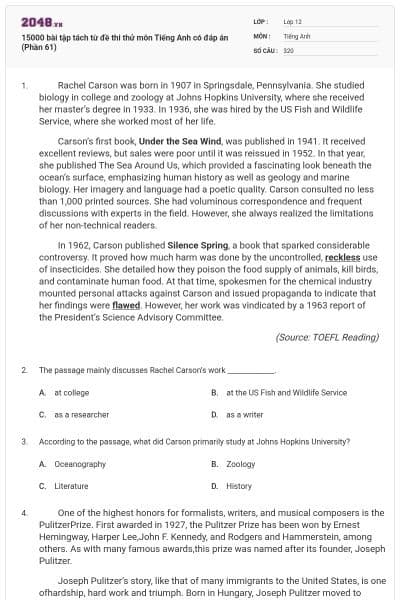
Rachel Carson was born in 1907 in Springsdale, Pennsylvania. She studied biology in college and zoology at Johns Hopkins University, where she received her master’s degree in 1933. In 1936, she was hired by the US Fish and Wildlife Service, where she worked most of her life.
Carson’s first book, Under the Sea Wind, was published in 1941. It received excellent reviews, but sales were poor until it was reissued in 1952. In that year, she published The Sea Around Us, which provided a fascinating look beneath the ocean’s surface, emphasizing human history as well as geology and marine biology. Her imagery and language had a poetic quality. Carson consulted no less than 1,000 printed sources. She had voluminous correspondence and frequent discussions with experts in the field. However, she always realized the limitations of her non-technical readers.
In 1962, Carson published Silence Spring, a book that sparked considerable controversy. It proved how much harm was done by the uncontrolled, reckless use of insecticides. She detailed how they poison the food supply of animals, kill birds, and contaminate human food. At that time, spokesmen for the chemical industry mounted personal attacks against Carson and issued propaganda to indicate that her findings were flawed. However, her work was vindicated by a 1963 report of the President’s Science Advisory Committee.
(Source: TOEFL Reading)
The passage mainly discusses Rachel Carson’s work _____________.
at college
at the US Fish and Wildlife Service
as a researcher
as a writer
Đáp án D
Bài đọc chủ yếu thảo luận về công việc của Rachel Carson ____________.
Dẫn chứng trong bài đọc: “Carson’s first book, Under the Sea Wind, was published in 1941.” (câu đầu, đoạn 2)
“In 1962, Carson published Silent Spring, a book that sparked considerable controversy” (câu đầu, đoạn 3)
ð Đáp án D (với tư cách là một nhà văn)
According to the passage, what did Carson primarily study at Johns Hopkins University?
Oceanography
Zoology
Literature
History
Đáp án B
Theo bài đọc, Carson chủ yếu học gì ở Đại học Johns Hopkins?
Dẫn chứng trong bài đọc: “She studied biology at college and zoology at Johns Hopkins University”
When she published her first book, Carson was closest to the age of ________.
26
29
34
45
Đáp án C
Khi xuất bản cuốn sách đầu tiên thì Carson ở tuổi _______.
Dẫn chứng trong bài đọc: “Rachel Carson was born in 1907” (Rachel Carson sinh vào năm 1907)
“Carson’s first book, Under the Sea Wind, was published in 1941.” (Cuốn sách đầu tiên của Carson “Under the Sea Wind” được xuất bản vào năm 1941) => lúc ấy, bà 34 tuổi
It can be inferred from the passage that in 1952, Carson’s book Under the Sea Wind
was outdated
became more popular than her other books
was praised by critics
sold many copies
Đáp án D
Có thể suy ra từ bài đọc rằng vào năm 1952, cuốn sách của Carson “Under the Sea Wind” __________.
A. lỗi thời
B. trở nên nổi tiếng hơn những cuốn sách khác của bà ấy
C. được các nhà phê bình khen ngợi
D. đã bán được nhiều bản
Dẫn chứng trong bài đọc: “It reiceved excellent reviews, but sales were poor until it was reissued in 1952” (Nó đã nhậ được lời bình rất tốt, nhưng doanh số bán hàng vẫn kém mãi cho đến khi nó được tái bản lại vào năm 1952)
Which of the following was NOT mentioned in the passage as a source of information for The Sea Around Us
Printed matter
Talks with experts
A research expedition
Letters from scientists
Đáp án C
Dẫn chứng trong bài đọc: “ Carson consulted no less than 1,000 printed sources. She had voluminous correspondence and frequent discussions with experts in the field.”
(correspondence ~ letters) => chỉ có phương án C không được đề cập.
The word “reckless” is closest in meaning to ____________.
unnecessary
limited
continuous
irresponsible
Đáp án D
- Reckless ~ Irresponsible (adj): coi thường, vô trách nhiệm
- Unnecessary (adj): không cần thiết
- Limited (adj): hạn chế
- Continuous (adj): liên tục, không ngừng
“ It proved how much harm was done by the uncontrolled, reckless use of insecticides.” (Nó đã vạch ra tác hại được gây ra bởi việc sử dụng vô trách nhiệm và không kiểm soát lượng thuốc trừ sâu.)
The word “flawed” is closest in meaning to ___________.
faulty
deceptive
logical
offensive
Đáp án A
- Flawed ~ Faulty (adj): sai, có lỗi
- Deceptive (adj): dối trá, lừa bịp
- Logical (adj): lô gic, hợp lí
- Offensive (adj): xúc phạm, khó chịu
Why does the author of the passage mention the report of the President’s Science Advisory Committee?
To provide an example of government propaganda.
To support Carson’s ideas.
To indicate a growing government concern with the environment.
To validate the chemical industry’s claims
Đáp án B
Dẫn chứng trong bài đọc: “However, her work was proved by a 1963 report of the President’s Science Advisory Committee. (Tác phẩm của bà đã được chứng minh đúng bởi bài báo cáo vào năm 1963 của chủ tịch Ban Tư vấn Khoa học) => lý do tác giả đề cập đến bài báo cáo này là để ủng hộ ý tưởng của Carson.
VOCABULARY
- Zoology /zu:'ɒlədʒi / /zəʊ'ɒlədʒi/ (n): động vật học - Degree /di'gri:/ (n): bằng cấp - Hire /'haiər/ (v): thuê - Reissue /ri:'i∫u:/ (v): tái bản - Fascinating /'fæsineitiη/ (adj): say mê, thú vị, quyến rũ - Geology /dʒi'ɔlədʒi/ (n): địa chất học - Poetic /pəʊ'etik/ (adj): (thuộc) thơ ca - Consult /kən'sʌlt/ (v): tham khảo, hỏi ý kiến - Voluminous /və'lu:minəs/ (adj): gồm nhiều tập - Correspondence /,kɒri'spɒndəns/ (n): thư từ - Expert /'ekspɜ:t/ (n): chuyên gia | - Limitation /limi'tei∫n/ (n): sự hạn chế, giới hạn - Controversy /'kɒtrəvɜ:si/ /kən'trɒvəsi/ (n): cuộc tranh luận, tranh cãi - Insecticide /in'sektisaid/ (n): thuốc trừ sâu - Contaminate /kən'tæmineit/ (v): làm bẩn, làm ô nhiễm - Mount /maʊnt/ (v): tổ chức, mở (1 cuộc tấn công,…) - Propaganda /prɒpə'gændə/ (n): sự tuyên truyền - Poison /'pɒizn/ (v): bỏ thuốc độc |
One of the highest honors for formalists, writers, and musical composers is the PulitzerPrize. First awarded in 1927, the Pulitzer Prize has been won by Ernest Hemingway, Harper Lee,John F. Kennedy, and Rodgers and Hammerstein, among others. As with many famous awards,this prize was named after its founder, Joseph Pulitzer.
Joseph Pulitzer’s story, like that of many immigrants to the United States, is one ofhardship, hard work and triumph. Born in Hungary, Joseph Pulitzer moved to United States in1864. He wanted to be a reporter, but he started his American life by fighting in the AmericanCivil War. After the war, Pulitzer worked for the German - language newspaper, the WestlichePost. His skills as a reporter were wonderful, and he soon became a partial owner of the paper.
In 1978, Pulitzer was able to start a newspaper of his own. Right from the first edition,the newspaper took a controversial approach to new. Pulitzer wanted to appeal to the averagereader, so he produced exciting stories of scandal and intrigue. Such an approach iscommonplace today, but in Pulitzer’s time it was new and different. The approach led to thediscovery of many instances of corruption by influential people. Pulitzer ‘paper became veryfamous and is still produced today.
The success of Joseph Pulitzer’s newspaper made him a very wealthy man, so he wantedto give something back to his profession. Throughout his later years, he worked to establishuniversity programs for the teaching of journalism, and he funded numerous scholarships toassist journalism students. Finally, he wanted to leave a legacy that would encourage writers toremember the importance of quality. On his death, he gave two million dollars to ColumbiaUniversity so they could award prizes to great writers
The Pulitzer Prize recipients are a very select group. For most, winning a Pulitzer Prize isthe highlight of their career. If an author, journalist, or composer you know has won a PulitzerPrize, you can be sure they are at the top of their profession.
Why does the writer mention “John F. Kennedy” in line 3?
He was one of the inventors of the famous awards.
He was one of the winners of the Pulitzer Prize.
He was one of the people who selected the Pulitzer winners.
He was in one of the scandals reported on by Joseph Pulitzer.
Đáp án B
Tại sao tác giả đề cập đến “ John F. Kennedy” ở dòng 3?
A. Ông ấy là một trong những nhà phát minh ra các giải thưởng nổi tiếng.
B. Ông ấy là một trong những người giành giải thưởng Pulitzer.
C. Ông ấy là một trong những người chọn người chiến thắng giải Pulitzer.
D. Ông ấy liên quan đến một trong các vụ bê bối bị Joseph Pulitzer báo cáo lại.
Dẫn chứng trong bài đọc: “First awarded in 1927, the Pulitzer Prize has been won by Ernest Hemingway, Harper Lee, John F. Kennedy, and Rodgers and Hammerstein, among others.”
According to the reading passage, why did Joseph Pulitzer invent the Pulitzer Prize?
to encourage people to remember his name and success.
encourage writers to remember the importance of quality.
to encourage journalism students to achieve their goals.
to encourage people to appreciate the work of the Pulitzer winners.
Đáp án B
Theo bài đọc, tại sao Joseph Pulitzer lập ra giải thưởng Pulitzer?
A. để khuyến khích mọi người nhớ đến tên tuổi và thành công của ông.
B. để khuyến khích các nhà văn nhớ về tầm quan trọng của chất lượng.
C. để khuyến khích những sinh viên ngành báo chí đạt được mục đích.
D. để khuyến khích mọi người đánh giá cao các tác phẩm của những người giành giải Pulitzer.
Dẫn chứng trong bài đọc: “Finally, he wanted to leave a legacy that would encourage writers to remember the importance of quality.”
The word “partial" in the passage is closest in meaning to......
in part only
brand new
one and only
very important
Đáp án A
A. chỉ một phần B. nhãn hiệu mới C. một và chỉ một D. rất quan trọng
Dẫn chứng: “His skills as a reporter were wonderful, and he soon became a partial owner of the paper.” (Ông có kỹ năng làm nhà báo rất tuyệt vời và ông sớm trở thành người đồng sở hữu của một tờ báo)
=> partial – in part only
According the passage, who receives the Pulitzer Prize?
Columbia University graduates
journalism students
noted writers and composers
most newspaper reporters
Đáp án C
Theo bài đọc, ai nhận được giải Pulitzer?
A. những sinh viên tốt nghiệp trường đại học Columbia
B. những sinh viên ngành báo chí
C. những nhà văn và nhà sáng tác nổi tiếng
D. đa số những nhà báo
Dẫn chứng: “On his death, he gave two million dollars to Columbia University so they could award prizes to great writers.”
According to the reading passage, how did Joseph Pulitzer appeal to the average reader?
He wrote about famous writers of journalism and literature.
He wrote stories about the war.
He produced his own experience.
He produced exciting stories of scandal and inreigue.
Đáp án D
Theo bài đọc, loseph Pulitzer đã thu hút lượng đọc giả bằng cách nào?
A. Ông viết về những nhà báo và nhà văn nổi tiếng.
B. Ông viết những câu chuyện về chiến tranh.
C. Ông tự sản xuất tờ báo riêng của mình.
D. Ông sáng tác ra những câu chuyện thú vị về các vụ bê bối và vận động ngầm.
Dẫn chứng trong bài đọc: “Pulitzer wanted to appeal to the average reader, so he produced
exciting stories ot scandal and intrigue”
Which sentece about Joseoph Pulitzer is true according to the reading passage?
He received a scholarship when he was a university studont.
He was rich even when he was young.
He was a reported during the American Civil War.
He immigated to the United States from Hungary.
Đáp án D
Theo bài đọc, câu nào về Joseph Pulitzer là đúng?
A. Ông đã nhận học bổng khi còn là sinh viên đại học.
B. Ông giàu có ngay khi còn trẻ.
C. Ông là nhà báo trong cuộc nội chiến Mỹ.
D. Ông đã di cư từ Hungary vào Mỹ.
Dẫn chứng trong bài đọc: “.... Born in Hungary, Joseph Pulitzer moved to United States in 1984.”
Which sentence about Joseph Pulitzer is NOT true according to the reading passage?
Joseph Pulitzer was the first time writer to the win the prize in 1917.
The prize is aimed at encouraging a writer’s career.
Joseph Pulitzer left money to award the prizewinners.
Receiving the prize on the highest honors for writers.
Đáp án A
Theo bài đọc, câu nào về Joseph Pulitzer là KHÔNG đúng?
A. Joseph Pulitzer là nhà văn đầu tiên giành giải thưởng vào năm 1917.
B. Giãi thưởng nhằm mục đích khích lệ sự nghiệp của nhà văn,
C. Joseph Pulitzer đã để lại tiền đề trao thưởng cho những người giành được giải thưởng
D. Nhận được giải thưởng là một trong những vinh dự cao quý nhất của các nhà văn.
Dẫn chứng trong bài đọc: “One of the highest honors tor formalists, writers, and musical composers is the Pulitzer Prize. First awarded in 1927, the Pulitzer Prize has been won by Ernest Hemingway, Harper Lee, John F.Kennedy, and Rodgers and Hammerstein, among others.”
VOCABULARY
- Honor /'ɒnər/ (n): vinh dự - Composer /kəm'pəʊzər/ (n): nhạc sĩ - Award /ə'wɔ:d/ (v): trao tặng, tặng thưởng - Immigrant /'imigrənt/ (n): người nhập cư - Hardship /'hɑ:d∫ip/ (n): sự gian khổ - Triumph /'traiəmf/ (n): chiến thắng, thành công lớn - Edition /i'di∫n/ (n): lần xuất bản - Controversial /,kɒntrə'vɜ:∫əl/ (adj): gây nhiều tranh luận - Intrigue /in'tri:g/ (n): sự vận động ngầm, mưu đồ - Discovery /di'skʌvəri/ (n): sự khám phá | - Corruption /kə'rʌp∫n/ (n): sự tham nhũng - Establish /i'stæbli∫/ (v): thành lập - Journalism /'dʒɜ:nəlizəm/ (n): nghề làm báo - Scholarship /'skələ∫ip/ (n): học bổng - Legacy /'legəsi/ (n): tài sản kế thừa - Encourage /in'kʌridʒ/ (v): khuyến khích, động viên - Recipient /ri'sipiənt/ (n): người nhận (quà, giải thưởng…) - Success /sək'ses/ (n): thành công - Journalist /'dʒɜ:nəlist/ (n): nhà báo |
Being aware of one's own emotions - recognizing and acknowledging feelings as they happen - is at the very heart of Emotional Intelligence. And this awareness encompasses not only moods but also thoughts about those moods. People who are able to monitor their feelings as they arise are less likely to be ruled by them and are thus better able to manage their emotions.
Managing emotions does not mean suppressing them; nor does it mean giving free rein to every feeling. Psychologist Daniel Goleman, one of several authors who have popularized the notion of Emotional Intelligence, insisted that the goal is balance and that every feeling has value and significance. As Goleman said, "A life without passion would be a dull wasteland of neutrality, cut off and isolated from the richness of life itself." Thus, we manage our emotions by expressing them in an appropriate manner. Emotions can also be managed by engaging in activities that cheer us up, soothe our hurts, or reassure us when we feel anxious.
Clearly, awareness and management of emotions are not independent. For instance, you might think that individuals who seem to experience their feelings more intensely than others would be less able to manage them. However, a critical component of awareness of emotions is the ability to assign meaning to them - to know why we are experiencing a particular feeling or mood. Psychologists have found that, among individuals who experience intense emotions, individual differences in the ability to assign meaning to those feelings predict differences in the ability to manage them. In other words, if two individuals are intensely angry, the one who is better able to understand why he or she is angry will also be better able to manage the anger.
Self-motivation refers to strong emotional self-control, which enables a person to get moving and pursue worthy goals, persist at tasks even when frustrated, and resist the temptation to act on impulse. Resisting impulsive behavior is, according to Goleman, "the root of all emotional self-control."
Of all the attributes of Emotional Intelligence, the ability to postpone immediate gratification and to persist in working toward some greater future gain is most closely related to success - whether one is trying to build a business, get a college degree, or even stay on a diet. One researcher examined whether this trait can predict a child's success in school. The study showed that 4-year-old children who can delay instant gratification in order to advance toward some future goal will be “far superior as students” when they graduate from high school than will 4-year-olds who are not able to resist the impulse to satisfy their immediate wishes.
According to paragraphs 1 to 3, people should be aware of their emotions so that they can ________.
stop feeling angry
manage their emotions appropriately
experience feelings more intensively
explain their emotions to others
Đáp án B
Theo đoạn 1 đến 3, con người nên nhận thức về cảm xúc của mình để họ có thể _______.
A. ngừng cảm thấy tức giận
B. điều khiển cảm xúc mình thích hợp hơn
C. trải qua cảm xúc mãnh liệt hơn
D. giải thích cảm xúc của mình với người khác
Which of the following can we infer from paragraph 1?
If people pay attention to their feelings, they will not be also able to manage them.
If people pay attention to their feelings, they can control their emotions better.
People who can manage their emotions will be controlled by them.
Some people can understand their feelings better than others.
Đáp án B
Chúng ta có thể suy ra điều nào sau từ đoạn 1?
A. Nếu con người chú ý đến cảm xúc của mình thì họ sẽ không thể điểu khiển được mình.
B. Nếu con người chú ý đến cảm xúc của mình thì họ có thể kiểm soát cảm xúc của mình tốt hơn.
C. Người mà có thể chế ngự cảm xúc của mình sẽ bị cảm xúc điều khiển.
D. Một số người có thể hiểu cảm xúc của mình tốt hơn người khác.
Dẫn chứng: “People who are able to monitor their feelings as they arise are less likely to be ruled by them and are thus better able to manage their emotions.” (Những người có thể chú ý những cảm xúc của mình ngay khi mới phát sinh thì ít có khả năng bị chúng chế ngự và do đó có khả năng điểu khiển cảm xúc của mình tốt hơn.)
All of the following are mentioned in paragraph 2 about our emotions EXCEPT _________.
we can manage our emotions
we should ignore some feelings
every feeling is important
emotions are part of a satisfying life
Đáp án B
Tất cả những điều sau được đề cập trong đoạn thứ 2 về cảm xúc của chúng ta NGOẠI TRỪ…
Chúng ta có thể điều khiển cảm xúc của mình (we manage our emotions by expressing them in an appropriate manner)
Chúng ta nên lờ đi một số cảm xúc
Mỗi cảm xúc đều quan trọng (....every feeling has value and significance.)
Cảm xúc là một phần của một cuộc sống thỏa mãn. (A life without passion would be a dull wasteland of neutrality, cut off and isolated from the richness of life itself: Một cuộc sống không có niềm đam mê sẽ là một khu đất hoang tẻ nhạt của sự trung lập, chia cắt và cô lập từ sự phong phú của chính cuộc sống.)
The word “critical” in paragraph 3 is closest in meaning to _______.
indecisive
inessential
dynamic
important
Đáp án D
- Critical ~ Important (adj): quan trọng
- Indecisive /,indi'saisiv/ (adj): lưỡng lự, không quả quyết
- Inessential (adj): không cần thiết, không thiết yếu
- Dynamic /dai'næmik/ (adj): năng động, năng nổ
The word “them” in paragraph 3 refers to_______.
intense emotions
psychologists
individuals
individual differences
Đáp án A
“Psychologists have found that, among individuals who experience intense emotions, individual differences in the ability to assign meaning to those feelings predict differences in the ability to manage them.” (Những nhà tâm lý học thấy rằng, trong số những cá nhân trải nghiệm những cảm xúc mạnh, những khác biệt cá nhân trong khả năng gán ý nghĩa cho những cảm xúc dự đoán được những sự khác biệt trong khả năng để điều khiển chúng.)
Vậy: “them” = intense emotions (những cảm xúc mạnh)
In paragraph 3, the author explains the concept of awareness and management of emotions by ________.
giving an example of why people get angry
describing how people learn to control their emotions
comparing how two people might respond to an intense emotion
explaining why some people are aware of their emotions
Đáp án C
Trong đoạn 3, tác giả giải thích khái niệm về việc nhận thức và điều khiển cảm xúc bằng cách
A. đưa ra một ví dụ về việc tại sao con người trở nên tức giận
B. mô tả việc mọi người học cách kiểm soát cảm xúc như thế nào
C. so sánh hai người có thể phản ứng với một cảm xúc mạnh như thế nào
D. giải thích tại sao một số người không nhận thức được cảm xúc của mình
Dẫn chứng: “In other words, if two individuals are intensely angry, the one who is better able to understand why he or she is angry will also be better able to manage the anger.”
The word “pursue” in paragraph 4 mostly means __________.
be involved in something
improve or develop something
try to achieve something
find out about something
Đáp án C
- Pursue /pə'sju:/ (v): theo đuổi
A. liên quan vào một cái gì đó
B. cải thiện hoặc phát triển một cái gì
C. cố gắng đạt được cái gì đó
D. tìm ra cái gì đó
“pursue worthy goals” (theo đuổi mục tiêu xứng đáng)
According to paragraph 5, children might be more successful in school if they can resist impulses because they can _________.
have more friends at school
easily understand new information
focus on their work and not get distracted
be more popular with their teachers
Đáp án C
Theo đoạn 5, bọn trẻ có thể thành công hơn ở trường nếu chúng cưỡng lại được sự bốc đồng bởi vì chúng có thể _________.
A. có nhiều bạn hơn ở trường
B. hiểu được thông tin mới dễ dàng hơn
C. tập trung vào công việc của mình và không bị sao nhãng
D. nổi tiếng hơn với giáo viên của mình
Dẫn chúng: “The study showed that 4-year-old children who can delay instant gratification in order to advance toward some future goal will be “far superior as students” when they graduate from high school than will 4-year-olds who are not able to resist the impulse to satisfy them immediate wishes."
VOCABULARY
- Emotion /i'məʊ∫ən/ (n): cảm xúc - Acknowledge /ək'nɒlidʒ/ (v): thừa nhận - Awareness /ə'weənəs/ (n): ý thức - Encompass /in'kʌmpəs/ (v): bao gồm - Suppress /sə'pres/ (v): kìm nén - Monitor /'mɒnitər/ (v): giám sát - Rein /rein/ (n): sự kiểm soát - Popularize /'pɒpjʊləraiz/ (v): phổ biến, đại chúng hóa - Notion /'nəʊ∫ən/ (n): khái niệm - Value /'vælju:/ (n): giá trị - Significance /sig'nifikəns/ (n): ý nghĩa, tầm quan trọng - Passion /'pæ∫n/ (n): niềm đam mê | - Isolated /'aisəleitid/ (adj): cô lập, cách biệt - Soothe /su:ð/ (v): làm dịu, làm đỡ (đau) - Reassure /ri:ə'∫ʊər/ (v): cam đoan - Independent /,indi'pendənt/ (adj): độc lập - Psychologist /sai'kɒlədʒist/ (n): nhà tâm lý học - Frustrated /frʌ'streitid/ (adj): thất vọng - Temptation /temp'tei∫n/ (n): sự cám dỗ, sự xúi giục - Impulse /'impʌls/ (n): sự bốc đồng - Attribute /'ætribju:t/ (n): thuộc tích - Gratification /,grætifi'kei∫ən/ (n): sự hài lòng - Resist /ri'zist/ (v): kháng cự, chống lại |
Most Americans look forward to their vacation. Most American employees receive an annual vacation with pay, and it is traditional to use this time off for travel.
Travelling within the United States is very popular because foreign travel generally takes more time and money. Every year about thirteen million people travel abroad. The most popular periods are during the summer and the two-week school break on Christmas and New Year holidays. These periods are also the most crowded and the most expensive time to travel, so people who can adjust their schedules sometimes choose to travel in the autumn.
American tourists often travel by car. Most families own a car, and those who do not have a car can rent one. Cars are usually the most economical way to travel, especially for families. It is also fairly fast and convenient. Exellent highway with motels and restaurants nearby connect the nation’s major cities. They enable tourists to travel at a speed of 55 to 66 miles an hour. Tourists that want to travel faster often fly to their destination and then rent a car when they get there.
According to the writer __________.
Americans have no vacations
Americans do not like travel
it is imposible to have a day-off in the USA
most Americans are fond of travelling
Đáp án D
Theo tác giả, _______.
A. Người Mỹ không có kì nghỉ
B. Người Mỹ không thích đi du lịch
C. Không thể có ngày nghỉ ở nước Mỹ.
D. Đa số người Mỹ thích đi du lịch.
Dẫn chứng: “Most American employees receive an annual vacation with pay, and it is traditional to use this time off for travel” (Đa số người làm công ở Mỹ đều nhận được kì nghỉ hàng năm được trả lương, và họ thường sẽ dành thời gian này để đi du lịch.) => hầu hết người Mỹ thích đi du lịch
How many people travel abroad every year?
13 million people
66 million people
30 million people
55 million people
Đáp án A
Mỗi năm có bao nhiêu người đi du lịch ở nước ngoài?
Dẫn chứng: “Every year about thirteen million people travel abroad." (Mỗi năm có khoảng 13 triệu người du lịch nước ngoài.)
Which of the following NOT mentioned in the text?
Travelling on Christmas and New Year holidays take much money.
Most American employees use their vacation to travel every year.
Most families use cars as an economical way to travel.
American people always choose to travel in autumn.
Đáp án D
Câu nào KHÔNG được đề cập trong bài đọc?
Dẫn chứng: “These periods are also the most crowded and the most expensive time to travel, so people who can adjust their schedules sometimes choose to travel in the autumn.” => mọi người chỉ thỉnh thoảng đi du lịch vào mùa thu chứ không phải luôn luôn
There are many people travelling ________.
in the winter
on Women’s day
on Christmas and New Year
on Thanksgiving
Đáp án C
Dẫn chứng: The most popular periods are during the summer and the two-week school break on Christmas and New Year holidays. (Thời gian phổ biến nhất là vào mùa hè và kỳ nghỉ 2 tuần ở trường vào dịp Giáng Sinh và Năm mới)
_______ are the most popular means of transport in the USA.
Buses
Cars
Ships
Planes
Đáp án B
Dẫn chứng: “American tourists often travel by car. Most families own a car, and those who do not have a car can rent one. Cars are usually the most economical way to travel, especially for families” (Du khách Mỹ thường đi du lịch bằng xe ô tô. Đa phần các gia đình đều có ô tô, và những người không có thì có thể thuê. Ô tô thường là phương tiện đi du lịch tiết kiệm nhất, đặc biệt là cho các gia đình.)
The word “It” in paragraph 3 refers to _______.
destination
restaurant
vacation
car
Đáp án D
“Cars are usually the most economical way to travel, especially for families. It is also fairly fast and convenient.” (Ô tô thường là phương tiện đi du lịch tiết kiệm nhất, đặc biệt là cho các gia đình. Nó cũng khá nhanh và thuận lợi.)
In the USA, _________.
the highways are not in good condition.
tourists cannot rent a car
there are not any highways
along the highways there are motels and restaurants available for tourists.
Đáp án D
Ở Mỹ, _____________.
A. Đường quốc lộ không đảm bảo
B. Du khách không thể thuê ô tô
C. Không có đường quốc lộ
D. Ở dọc đường quốc lộ thì có nhiều khách sạn và nhà hàng cho khách du lịch
Dẫn chứng: “Exellent highway with motels and restaurants nearby connect the nation’s major cities.”
VOCABULARY
- Vacation /və'kei∫ən/ (n): kỳ nghỉ - Employee /im'plɔi'i:/ (n): người làm công - Pay /pei/ (n): tiền lương - Popular /'pɒpjʊlə/ (adj): phổ biến, nổi tiếng - Break /breik/ (n): kỳ nghỉ, giờ nghỉ giải lao - Adjust /ə'dʒʌst/ (v): điều chỉnh - Tourist /'tʊərist/ (n): du khách - Rent /rent/ (v): thuê | - Convenient /kən'vi:niənt/ (adj): thuận tiện, thuận lợi - Economical /,i:kə'nɒmikl, ,ekə'nɒmikl/ (adj): tiết kiệm - Highway /'haiwei/ (n): đường cái, quốc lộ - Motel /məʊ'tel/ (n): khách sạn (dành cho những người đi du lịch bằng ô tô) - Connect /kə'nekt/ (v): kết nối - Destination /,desti'nei∫ən/ (n): đích đến |
For the last few years, my children have been going to a summer camp in northern Greece called Skouras Camp. They always seem to have a good time, so if you’ re wondering what to do with the kids for three weeks this summer, you could do worse than send them to this beautiful camp on the shores of the Aegean Sea. If your children, like mine, are keen on adventure, sports and good company, the Skouras Camp will keep them busy all day doing the things they most enjoy. Skouras is an international camp with children from all over the world. My children have made friends with children of their own age from Poland, China, Demark and the United States. Naturally, they get lots of opportunities to practise their English as this is the only language spoken. The camp is located in one of the most beautiful parts of Chalkidiki. It is huge (120.000 square meters) and is just a stone’s throw away from clear, blue Aegean Sea. It takes the children just five minutes to walk to the golden sandy beach on foot. The programme is packed with exciting activities such as horse riding and table tennis. Other sports in clude baseball, volleyball and athletics. The Camp ends with a sports contest in the last week which all parents are invited to attend.
All the children come to the Camp have to __________.
be only keen on adventure
be at the same age.
speak English
practise basketball
Đáp án C
Tất cả bọn trẻ đến Camp phải _________.
A. chỉ thích phiêu lưu B. bằng tuổi nhau
C. nói Tiếng Anh D. luyện tập bóng rổ
Dẫn chứng: “Naturally, they get lots of opportunities to practise their English as this is the only language spoken. (Đương nhiên, chúng có được nhiều cơ hội luyện tập tiếng Anh của mình vì đây là ngôn ngữ duy nhất được nói.)
How many kinds of sports can be played in the Camp?
2
3
4
5
Đáp án D
Dẫn chứng: “The programme is packed with exciting activities such as horse riding and table tennis. Other sports include baseball, volleyball and athletics.”
All the statements are true EXCEPT _________.
The parents can attend their children’sports contest.
The children will be busy taking part in the Camp’s programmed activities.
The camp is far from the Aegean Sea.
The children will take more chances of English practise.
Đáp án C
A. đúng (The Camp ends with a sports contest in the last week which all parents are invited to attend.)
B. đúng (If your children, like mine, are keen on adventure, sports and good company, the Skouras Camp will keep them busy all day doing the things they enjoy.)
C. sai (The camp is located in one of the most beautiful parts of Chalkidiki. It is huge (120.000 square meters) and is just a stone’s throw away from clear, blue Aegean Sea. It takes the children just five minutes to walk to the golden sandy beach on foot. )=> Trại rất gần Aegean Sea
D. đúng (they get lots of opportunities to practise their English)
The tone of the passage could best be described as __________.
supportive
negative
disbelieving
humorous
Đáp án A
Giọng văn của tác giả có thể được miêu tả là ____________.
- Supportive (adj): ủug hộ
- Negative (adj): tiêu cực, phản đốỉ
- Disbelieving (adj): hoài nghi, không tin
- Humorous (adj): hài hước
Ta có thể nhận thấy giọng văn của tác giả là ủng hộ, được thể hiện qua một số câu trong bài đọc như:
- They always seem to have a good time, so if you’re wondering what to do with the kids for three weeks this summer.
- If your children, like mine, are keen on adventure, sports and good company, the Skouras Camp will keep them busy all day doing the things they most enjoy.
What should be the best title for the passage?
Chalkidiki’s landscape – The Aegean Sea.
An international summer camp.
Children’s summer activities.
Advice on children caring in summer.
Đáp án B
Tiêu đề phù hợp nhất của bài đọc là gì?
A. Phong cảnh của Chalkidiki – Biển Aegean.
B. Một trại hè quốc tế
C. Hoạt động mùa hè của bọn trẻ
D. Lời khuyên cho bọn trẻ chăm sóc vào mùa hè
Cả bài đọc, ta thấy tác giả đã giới thiệu về Skouras Camp, một trại hè quốc tế cho trẻ con
How long does it take the children to walk to the golden sandy beach on foot?
20 minutes
an hour
5 minutes
a day
Đáp án C
Dẫn chứng: “It takes the children just five minutes to walk to the golden sandy beach on foot.” (Bọn trẻ chi mất 5 phút để đi bộ đến bãi biển cát vàng.)
Where is the camp located?
in Porland
in Greece
in the United States
Denmark
Đáp án B
Dẫn chứng: For the last few years, my children have been going to a summer camp in northern Greece called Skouras Camp.
The word contest in the last sentence could be replaced by ___________.
competition
runner
competitor
athlete
Đáp án A
- Contest ~ Competition (n): cuộc thi
- Runner (n): người chạy đua
- Competitor (n): người cạnh tranh, đấu thủ
- Athlete (n): vận động viên
VOCABULARY
- Camp /kæmp/ (n): trại - Adventure /əd'vent∫ə/ (n): chuyến phiêu lưu - Wonder /'wʌndər/ (v): tự hỏi - Shore /∫ɔ:r/ (n): bờ biển - Keen /ki:n/ (adj) + on: thích - International /,intə'næ∫nəl/ (adj): quốc tế - Opportunity /,ɒpə'tju:nəti/ (n): cơ hội - Locate /ləʊ'keit/ (v): đặt vào một vị trí | - Huge /hju:dʒ/ (adj): to lớn, khổng lớn - Beach /bi:t∫/ (n): bãi biển - Pack /pæk/ (v): chật ních - Exciting /ik'saitiη/ (adj): hào hứng, hứng thú - Athletics /æθ'letiks/ (n): các môn điền kinh - Contest /kən'test/ (n): cuộc thi - Attend /ə'tend/ (v): tham dự, tham gia |
The human criterionfor perfect vision is 20/20 for reading the standard lines on a Snellen eye chart without a hitch. The score is determined by how well you read lines of letters of different sizes from 20 feet away. But being able to read the bottom line on the eye chart does not approximate perfection as far as other species are concerned. Most birds would consider us very visually handicapped. The hawk, for instance, has such sharp eyes that can spot a dime on the sidewalk while perched on top of the Empire State Building. It can make fine visual distinctions because it is blessed with one million cones per square millimetre in its retina. And in water, humans are farsighted, while the kingfisher, swooping down to spear fish, can see well both in the air and water because it is endowed with two foveae – areas of the eyes, consisting mostly of cones that provide visual distinctions. One foveae permits the bird, while in the air, to scan the water below with one eye at a time. This is called monocular vision. Once it hits the water, the other foveae joins in, allowing the kingfisher to focus both eyes, like binoculars, on its prey at the same time. A frog’s vision is distinguished by its ability to perceive things as a constant moving picture. Known as “bug detectors”, a highly developed set of cells in a frog’s eyes responds mainly to moving objects. So, it is said that a frog sitting in a field of dead bugs wouldn’t see them as food and would starve.
The bee has a “compound” eye, which is used for navigation. It has 15,000 facets that divide what it sees into a pattern of dots, or mosaic. With this kind of vision, the bee sees the sun only as a single dot, a constant point of reference. Thus, the eye is a superb navigational instrument that constantly measures the angle of its line of flight in relation to the sun. A bee’s eye also gauges flight speed. And if that is not enough to leave our 20/20 “perfect vision” paling into insignificance, the bee is capable of seeing something we can’t – ultraviolet light. Thus, what humans consider to be “perfect vision” is in fact rather limited when we look at other species. However, there is still much to be said for the human eye. Of all mammals, only humans and some primates can enjoy pleasures of colour vision.
What does the passage mainly discuss?
limits of the human eye
perfect vision
different eyes for different uses
eye variation among different species
Đáp án D
Bài đọc chủ yếu thảo luận về điều gì?
A. Những giới hạn của mắt con người
B. Tầm nhìn hoàn hảo
C. Những con mắt khác nhau cho những cách dùng khác nhau
D. Sự khác nhau về mắt trong những loài khác nhau
Dẫn chứng:
- But being able to read the bottom line on the eye chart does not approximate perfection as
far as other species are concerned.
- The hawk, for instance, has such sharp eyes that it can spot a dime on the sidewalk.
- The bee has a “compound” eye, which is used for navigation.
- Of all the mammals, only humans and some primates can enjoy the pleasures of color vision.
ð Đáp án D (Đoạn văn nói về mắt của những loài khác nhau )
The phrase “without a hitch” is closet in meaning to __________.
unaided
without glasses
with little hesitation
easily
Đáp án D
- without a hitch : mọi việc trôi chảy, không có gì vướng mắc
- unaided: không được giúp đỡ
- without glasses: không có kính
- without little hesitation: không có sự do dự
- easily: dễ dàng
According to the passage, why might birds and animals consider humans very visually handicapped?
humans can’t see very well in either air or water
humans eyes are not as well suited to our needs
the main outstanding feature of human eyes is color vision
human eyes can’t do what their eyes can do
Đáp án D
Theo bài đọc, tại sao loài chim và động vật xem loài người có mắt bị tật?
A. Con người không thể nhìn rõ trong không khí hoặc trong nước
B. Mắt con người không thích hợp với nhu cầu của chúng ta
C. Khía cạnh nổi bật chính của mắt con người là nhìn màu sắc
D. Mắt con người không thể làm những gì mắt của chúng có thể làm
Dẫn chứng: “The hawk, for instance, has such sharp eyes that it can spot a dime on the sidewalk while perched on top of the Empire State Building. It can make fine visual distinctions because it is blessed with one million cones per square millimeter in its retinA. And in water, humans are farsighted, while the kingfisher, swooping down to spear fish, can see well in both the air and water because it is endowed with two foveae…”
The word “that” in line 9 refers to _________.
foveae
areas of the eye
cones
visual distinctions
Đáp án A
“And in water, humans are farsighted, while the kingfisher, swooping down to spear fish, can
see well in both the air and water because it is endowed with two foveae - areas of the eye, consisting mostly of cones, that provide visual distinctions”
=> “that” = foveae
According to the passage, “bug detectors” are useful for _______.
navigation
seeing moving objects
avoiding bugs when getting food
avoiding starvation
Đáp án B
Theo bài đọc, “bug detectors” hữu ích cho
A. nghề hàng hải
B. nhìn vật thể chuyển động
C. tránh những con rệp lấy thức ăn
D. tránh sự chết đói.
Dẫn chứng: “Known as “bug detectors”, a highly developed set of cells in a frog’s eyes responds mainly to moving objects.”
According to the passage, which of the following is NOT true?
kingfishers have monocular vision
bees see patterns of dots
hawks eyes consist mostly of cones that can allow it to scan with one eye at a time
humans are farsighted in water
Đáp án C
Theo bài đọc, cái nào sau dây không ĐÚNG?
A. Chim bói cả nhìn một mắt
B. Ong nhìn thấy những những mô hình chấm
C. Mắt diếu hâu gồm chủ yếu hình nón mà có thể cho phép nó nhìn lướt với một mắt tại một thời điểm
D. Con người thì nhìn xa được trong nước
A.đúng (while the kingfisher... This is called monocular vision.)
B. đúng (The bee has a “compound” eye, which is used for navigation. It has 15,000 facets that divide what it sees into a pattern of dots, or mosaic)
D. đúng (And in water, humans are farsighted)
C. sai (while the kingfisher... consisting mostly of cones, that provide visual distinctions...)
Which of the following can be inferred from the passage?
eyes have developed differently in each species
bees have the most complex eye
humans should not envy what they don’t need
perfect vision is not perfect
Đáp án A
Câu nào sau có thể được suy ra từ bài đọc?
A. Những con mắt đã phát triển khác nhau trong mỗi loài
B. Những con ong có mắt phức tạp nhất
C. Con người không nên thèm muốn những gì họ không cần đến
D. Tầm nhìn hoàn hảo thì không hoàn hảo
VOCABULARY
- Criterion /krai'tiəriən/ (n): tiêu chí - Standard /'stæn.dəd/ (n): tiêu chuẩn - Determine /di'tɜ:.min/ (v): xác định, quyết định - Perfection /pə'fek∫ən/ (n): sự hoàn hảo - Handicapped /'hændikæpt/ (adj): tàn tật - Visual /'viʒʊəl/ (adj): (thuộc) thị giác - Cone /kəʊn/ (n): hình nón - Retina /'retinə/ (n): võng mạc (mắt) - Farsighted /ˈfɑrˌsaɪtid/ (adj): viễn thị - Endow /in'daʊ/ (v): ban tặng, thừa hưởng - Kingfisher /'kiηfi∫ər/ (n): chim bói cá - Hawk /hɔ:k/ (n): diều hâu, chim ưng | - Foveae /'fəʊviə/ (n): hố thị giác - Distinction /di'stiηk∫ən/ (n): sự phân biệt - Vision /'viʒən/ (n): sự nhìn - Prey /prei/ (n): con mồi - Navigation /nævi'gei∫ən/an/ (n): định vị; nghề hàng hải - Superb /su:'pɜ:b/ (adj): tuyệt vời - Gauge /geidʒ/ (v): đo - Instrument /'instrʊmənt/ (n): dụng cụ - Ultraviolet /ʌltrə'vaiələt/ (adj): cực tím, tử ngoại - Mammal /'mæməl/ (n): động vật có vú - Primate /'praimeit/ (n): động vật linh trưởng |
It’s often said that we learn things at the wrong time. University students frequently do the minimum of work because they’re crazy about a good social life instead. Children often scream before their piano practice because it’s so boring. They have to be given gold stars and medals to be persuaded to swim, or have to be bribed to take exams. But the story is different when you’re older.
Over the years, I’ve done my share of adult learning. At 30, I went to a college and did courses in History and English. It was an amazing experience. For starters, I was paying, so there was no reason to be late – I was the one frowning and drumming my fingers if the tutor was late, not the other way round. Indeed, if I could persuade him to linger for an extra five minutes, it was a bonus, not a nuisance. I wasn’t frightened to ask questions, and homework was a pleasure not a pain. When I passed an exam, I had passed it for me and me alone, not for my parents or my teachers. The satisfaction I got was entirely personal.
Some people fear going back to school because they worry that their brains have got rusty. But the joy is that, although some parts have rusted up, your brain has learnt all kinds of other things since you were young. It has learnt to think independently and flexibly and is much better at relating one thing to another. What you lose in the rust department, you gain in the maturity department.
In some ways, age is a positive plus. For instance, when you’re older, you get less frustrated. Experience has told you that, if you’re calm and simply do something carefully again and again, eventually you’ll get the hang of it. The confidence you have in other areas – from being able to drive a car, perhaps – means that if you can’t, say, build a chair instantly, you don’t, like a child, want to destroy your first pathetic attempts. Maturity tells you that you will, with application, eventually get there.
It is implied in paragraph 1 that ______.
young learners often lack a good motivation for learning
young learners are usually lazy in their class
teachers should give young learners less homework
parents should encourage young learners to study more
Đáp án A
Đoạn 1 ngụ ý rằng _________.
A. người trẻ thường thiếu động lực tốt để học tập
B. người trẻ thường lười biếng trên lớp
C. giáo viên nên giao cho học sinh ít bài tập về nhà hơn
D. bố mẹ nên khuyến khích con cái học nhiều hơn
Dẫn chứng: “Children often scream before their piano practice because it’s so boring. They have to be given gold stars and medals to be persuaded to swim, or have to he bribed to take
exams.”
=> Người trẻ thường phải có những phần thưởng thì mới có động lực học
The writer’s main point in paragraph 2 is to show that as people grow up, ______.
they tend to learn less as they are discouraged
they cannot learn as well as younger learners
they get more impatient with their teachers
they have a more positive attitude towards learning
Đáp án D
Ý chính của tác giả trong đoạn 2 là chỉ ra rằng khi con người lớn lên thì ________.
A. Họ có khuynh hướng học ít hơn vì họ thiếu quyết tâm
B. Họ không thể học tốt như khi người trẻ
C. Họ trở nên thiếu kiên nhẫn hơn với giáo viên
D. Họ có thái độ tích cực hơn đối với việc học
Dẫn chứng:
- At 30, I went to a college and did courses in History and English. It was an amazing experience.
- I wasn’t frightened to ask questions, and homework was a pleasure not a pain. When I passed an exam, I had passed it for me and me alone, not for my parents or my teachers. The satisfaction I got was entirely personal.
The phrase “For starters” in paragraph 2 could best be replaced by “______”.
For beginners
At the starting point
At the beginning
First and foremost
Đáp án D
- For starters ~ First and foremost: đầu tiên, trước hết
“For starters, I was paying, so there was no reason to be late” (Đầu tiên, tôi đã trả tiền, vì thế không có lý do gì để đi trễ)
While doing some adult learning courses at a college, the writer was surprised ______.
to have more time to learn
to be able to learn more quickly
to feel learning more enjoyable
to get on better with the tutor
Đáp án C
Dẫn chứng: “Indeed, if I could persuade him to linger for an extra five minutes, it was a bonus, not a nuisance. I wasn’t frightened to ask questions, and homework was a pleasure not a pain. When I passed an exam, I had passed it for me and me alone, not for my parents or my teachers. The satisfaction I got was entirely personal.”
=> trong quá trình học, tác giả đã cảm thấy thích thú việc học
In paragraph 3, the word “rusty” means ______.
not as good as it used to be through lack of practice
impatient because of having nothing to do
staying alive and becoming more active
covered with rust and not as good as it used to be
Đáp án A
“Some people fear going back to school because they worry that their brains have got rusty.” (Mọt số người sợ đi học trở lại vì họ lo lắng rằng bộ não của họ không còn được như trước.)
- Rusty ~ not as good as it used to be through lack of practice: không được tốt như trước bởi vì thiếu sự luyện tập
All of the following are true about adult learning EXCEPT ______.
young people usually feel less patient than adults
experience in doing other things can help one’s learning
adult learners have fewer advantages than young learners
adults think more independently and flexibly than young people
Đáp án C
A, B, D. đúng theo bài đọc:
“Age is a positive plus. For instance, when you’re older, you get less frustrated. Experience has told you that, if you re calm and simply do something carefully again and again, eventually you’ll get the hang of it”
“Although some parts have rusted up, your brain has learnt all kinds of other things since you were young. It has learnt to think independently and flexibly and is much better at relating one thing to another”
It can be inferred from paragraph 4 that maturity is a positive plus in the learning process because adult learners ______.
pay more attention to detail than younger learners
are able to organize themselves better than younger learners
are less worried about learning than younger learners
have become more patient than younger learners
Đáp án D
Có thể suy ra từ đoạn cuối rằng sự trưởng thành là điểm cộng tích cực trong quá trình học vì người lớn________. .
Dẫn chứng: “when you’re older, you get less frustrated. Experience has told you that, if you’re calm and simply do something carefully again and again, eventually you’ll get the hang of it.” (khi bạn lớn tuổi hơn, bạn sẽ thấy ít chán nản hơn. Kinh nghiệm nói với bạn rằng, nếu bạn bình tĩnh và chỉ cần làm điều gì đó một cách cẩn thận lặp đi lặp lại thì cuối cùng bạn sẽ học được cách thực hiện nó.)
=> người lớn sẽ trở nên kiên nhẫn hơn người trẻ
What is the writer’s main purpose in the passage?
To encourage adult learning.
To show how fast adult learning is.
To explain reasons for learning.
To describe adult learning methods.
Đáp án A
Mục đích chính của tác giả trong bài đọc là gì?
A. Để khuyến khích việc học của người lớn
B. Để cho thấy người lớn học nhanh như thế nào
C. Để giải thích lý do cho việc học
D. Để miêu tả phương pháp học của người lớn
VOCABULARY
-Minimum /'miniməm/ (n): tối thiểu -Crazy /'krei.zi/ (adj): điên rồ -Scream /skri:m/ (v): hét lên -Medal /'medəl/ (n): huy chương -Bribe /braib/ (v): đút lót, hối lộ -Amazing /ə'meiziη/ (adj): đáng ngạc nhiên -Frown /fraʊn/ (v): nhăn mặt - Drum /drʌm/ (v): gõ gõ, gõ liên hồi - Linger /'liηgər/ (v): nán lại, nấn ná - Bonus /'bəʊnəs/ (n): tiền thưởng, phần thưởng | -Nuisance /'nju:səns/ (n): sự phiền toái - Satisfaction /sætis'fæk∫n/ (n): sự thỏa mãn - Flexible /'fleksəbəl/ (adj): linh hoạt -Experience /ik'spiəriəns/ (n): kinh nghiệm -Confidence /'kɒnfidəns/ (n): sự tự tin - Calm /ka:m/ (adj): bình tĩnh - Destroy /di'strɔi/ (v): phá hủy - Pathetic /pə'θetik/ (adj): cảm động - Maturity /mə't∫ʊərəti/ (n): sự trưởng thành |
Biological diversity has become widely recognized as a critical conservation issue only in the past two decades. The rapid destruction of the tropical rain forests, which are the ecosystems with the highest known species diversity on Earth, has awakened people to the importance and fragility of biological diversity. The high rate of species extinctions in these environments is jolting, but it is important to recognize the significance of biological diversity in all ecosystems. As the human population continues to expand, it will negatively affect one after another of Earth's ecosystems. In terrestrial ecosystems and in fringe marine ecosystems (such as wetlands), the most common problem is habitat destruction. In most situations, the result is irreversible. Now humans are beginning to destroy marine ecosystems through other types of activities, such as disposal and runoff of poisonous waste; in less than two centuries, by significantly reducing the variety of species on Earth, they have irrevocably redirected the course of evolution.
Certainly, there have been periods in Earth's history when mass extinctions have occurred. The extinction of the dinosaurs was caused by some physical event, either climatic or cosmic. There have also been less dramatic extinctions, as when natural competition between species reached an extreme conclusion. Only 0.01 percent of the species that have lived on Earth have survived to the present, and it was largely chance that determined which species survived and which died out.
However, nothing has ever equaled the magnitude and speed with which the human species is altering the physical and chemical world and demolishing the environment. In fact, there is wide agreement that it is the rate of change humans are inflicting, even more than the changes selves, that will lead to biological devastation. Life on Earth has continually been in flux as slow physical and chemical changes have occurred on Earth, but life needs time to adapt-time for migration and genetic adaptation within existing species and time for the proliferation of new genetic material and new species that may be able to survive in new environments.
What does the passage mainly discuss?
The variety of species found in tropical rain forests
The cause of the extinction of the dinosaurs
The time required for species to adapt to new environments
The impact of human activities on Earth's ecosystems
Đáp án D
Bài đọc chủ yếu thảo luận về điều gì?
A. Sự đa dạng loài được tìm thấy ở những rừng mưa nhiệt đới
B. Nguyên nhân sự tuyệt chủng của loài khủng long.
C. Thời gian cần cho các loài để thích nghi với môi trường mới.
D. Tác động của hoạt động con người vào hệ sinh thái của trái đất.
Dẫn chứng:“As the human population continues to expand, it will negatively affect one after another of Earth’s ecosystems”
The word “critical” is closest in meaning to__________.
essential
negative
complicated
interesting
Đáp án A
- Critical /'kritikəl/ (adj): quan trọng, cần thiết
- Essential/i'senʃəl/ (adj): cần thiết
- Negative /'negətiv/ (adj): tiêu cực
- Complicated /'kɔmplikeitid/ (ad)): phức tạp (~ Complex)
- Interesting /'intristiɳ/ (adj): thú vị
“Biological diversity has become widely recognized as a critical conservation issue only in the past two decades.” (Đa dạng sinh học đã được thừa nhận là vấn đề bảo tồn quan trọng chỉ trong hai thập kỉ qua.)
The author mentions the reduction of the variety of species on Earth in line 7-8 to suggest that ___________.
humans are often made ill by polluted water
new habitats can be created for species
some species have been made extinct by human activity
understanding evolution can prevent certain species from disappearing
Đáp án D
Tác giả đề cập đến việc giảm sự đa dạng loài trên trái đất trong dòng 7-8 để gợi ý rằng
A. con người thường bị bệnh vì nước bị ô nhiễm
B. môi trường sống mới có thể được tạo ra cho các loài
C. một số loài bị tuyệt chủng bởi hoạt động của con người
D. hiểu được sự tiến hóa có thể ngăn chặn được việc các loài nào đó biến mất
Dẫn chứng: “Now humans are beginning to destroy marine ecosystems through other types of activities, such as disposal and runoff of poisonous waste; in less than two centuries, by significantly reducing the variety of species on Earth, they have irrevocably redirected the course of evolution.”
The author mentions all of the following as examples of the effect of humans on the world’s ecosystems EXCEPT_________.
damage to marine ecosystems
habitat destruction in wetlands
the introduction of new varieties of plant species
destruction of the tropical rain forests
Đáp án C
Tác giả đề cập tất cả những điều sau như những ví dụ về tác động của con người vào hệ sinh thái NGOẠI TRỪ_________.
A. phá hủy hệ sinh thái biển (humans are beginning to destroy marine ecosystems)
B. phá hủy môi trường sống ở những nơi ẩm ướt (In terrestrial ecosystems and in fringe marine ecosystems (such as wetlands), the most common problem is habitat destruction)
C. việc giới thiệu nhiều loài thực vật mới.
D. việc tàn phá những khu rừng mưa nhiệt đới (The rapid destruction of the tropical rain forests...)
The author mentions the extinction of the dinosaurs in the 2nd paragraph to emphasize that ____________.
not all mass extinctions have been caused by human activity
actions by humans could not stop the irreversible process of a species’ extinction
Earth’s climate has changed significantly since the dinosaurs’ extinction
the cause of the dinosaurs’ extinction is unknown
Đáp án A
Tác giả đề cập đến sự tuyệt chủng của loài khủng long trong giai đoạn thứ 2 để nhấn mạnh rằng __________.
A. không phải tất cả sự tuyệt chủng lớn do hoạt động con người gây ra.
B. Những hành động của con người không thể ngăn cản được quá trình tuyệt chủng của các loài không thể thay đổi.
C. Khí hậu của trái đất đã thay đổi đáng kể từ sự tuyệt chủng của loài khủng long.
D. nguyên nhân của sự tuyệt chủng khủng long thì không được biết đến
Dẫn chứng: “The extinction of the dinosaurs was caused by some physical event, either climatic or cosmic...”
The word “magnitude” is closest in meaning to_________.
carelessness
extent
determination
concern
Đáp án B
- Magnitude (n): độ lớn, cường độ ~ Extent
- Carelessness (n): sự bất cẩn
- Determination (n): sự xác định, quyết tâm
- Concern (n): mối quan tâm
“However, nothing has ever equaled the magnitude and speed with which the human species is altering the physical and chemical world and demolishing the environment” (Tuy nhiên, không gì sánh được cường độ và tốc độ mà loài người đang làm thay đổi thế giới và phá hủy môi trường).
According to the passage, natural evolutionary change is different from changes caused by humans in that changes caused by humans___________.
affect fewer ecosystems
are occurring at a much faster rate
are reversible
are less devastating to most species
Đáp án B
Theo bài đọc, sự thay đổi về mặt tiến hóa tự nhiên thì khác với những thay đổi mà con người gây ra ở chỗ là những thay đổi mà con người gây ra ________________.
A. Ảnh hưởng tới ít hệ sinh thái hơn.
B. thì xảy ra ở tốc độ nhanh hơn nhiều
C. thì không có mặt trái
D. Thì ít tàn phá tới các loài.
Dẫn chứng: “However, nothing has ever equaled the magnitude and speed with which the human species is altering the physical and chemical world and demolishing the environment”
VOCABULARY
- Diversity / dai'vɜ:sə.ti / (n): sự đa dạng - Conservation / ,kɔn.sə:'vei.∫ən / (n): sự bảo tồn - Destruction / dis'trʌk.∫ən / (n): sự phá hủy - Tropical / 'trɒp.i.kəl / (adj): nhiệt đới - Ecosystem /’i:.kəʊ,sis.təm / (n): hệ sinh thái - Fragility / frə'dʒil. ə.ti / (n): tính dễ vỡ, mỏng manh - Extinction /iks'tiηk.∫ən / (n): sự tuyệt chủng - Terrestrial / tə'res.tri.əl / (adj): ở cạn - Fringe / frindʒ / (n): ven rìa, mép - Marine/ mə'ri:n / (adj): (thuộc) biển - Habitat / 'hæb.i.tæt / (n): môi trường sóng - Irreversible /,iri'vɜ:.sə.bəl / (adj): không thể thay đổi được - Disposal / di'spəʊ.zəl / (n): sự thải, sự vứt bỏ | - Poisonous / 'pɔi.zən.əs /vau)/độc hại - Irrevocably / i'rev.ə.kə.bli / (adv): không thể thay đổi - Evolution /,i:və'lu:.∫ən / (n): sự tiến hóa - Dinosaur/ 'dai.nə.sɔ:r / (n): khủng long - Cosmic / 'kɒz.mik / (adj): (thuộc) vũ trụ - Demolish / di'mɒl.i∫/ (v): phá hủy - Inflict / in'flikt / (v): bắt phải chịu - Devastation / ,dev.ə'stei.∫ən / (n): sự tàn phá, sự phá hủy - Migration / mai'grei.∫ən / (n): sự di trú - Adaptation /,æd.əp'tei.∫ən / (n): sự thích nghi - Proliferation /prə,lifə'rei.∫ən / (n): sự tăng nhanh, sự nảy nở - Genetic / dʒə'net.ik / (adj): (thuộc) di truyền học |
Clara Barton became known as “The Angel of the Battlefield” during the American Civial War. Born in Oxford, Massachusetts in 1821, Clara Barton’s interest in helping soldiers on the battlefield began when she was told army stories from her father. Another event that influenced her decision to help soldiers was an accident her brother had. His injuries were cared for by Barton for 2 years. At the time, she was only 11 years old. Barton began teaching school at the age of 15. She taught for 18 years before she moved to Washington, D.C. in 1854.
The civil war broke out 6 years later. Immediately, Barton started was service by helping the soldiers with their needs. At the battle of Bull Run, Clara Barton received permission from the government to take care of the sick and hurt. Barton did this with great empathy and kindness. She acknowledged each soldier as a person. Her endurance and courage on the battlefield were admired by many. When the war ended in 1865, she used 4 years of her life to assist the government in searching for soldiers who were missing during the war.
The search for missing soldiers and years of hard work made her feeble physically. In 1869, her doctors recommended a trip to Europe for a rest. While she was on vacation, she became involved with the International Red Cross, an organization set up by the Geneva Convention in 1864. Clara Barton realized that the red Cross would be a big help to the United States. After she returned to the United States, she worked very hard to create an American red Cross. She talked to government leaders and let American people know about the Red Cross. In 1881, the Notional Society of the Red Cross was finally established with its headquarters in Washington, D.C. Clara Barton managed its activities for 23 years.
Barton never let her age stop her from helping people. At the age of 79, she helped flood victims in Galveston, Texas. Barton finally resigned from the Red Cross in 1904. She was 92 years old and had truly earned her titled “The Angel of the Battlefield”.
According to paragraph 1, which of the following is true of the young Clara Barton?
She helped her father when he was a soldier.
She suffered from an accident when she was 11.
She helped her brother who hurt in an accident.
She made a decision to live with her brother for 2 years.
Đáp án C
Theo đoạn 1, câu nào sau đây đúng về Clara Barton lúc còn trẻ?
A. Bà ấy giúp bố khi ông là quân nhân.
B. Bà ấy đã bị tai nạn khi 11 tuổi
C. Bà ấy giúp đỡ anh trai đã bị thương trong một tai nạn
C. Cô ấy đã quyết định sống với anh trai khoảng 2 năm.
Dẫn chứng trong bài đọc: “Another event that influenced her decision to help soldiers was an accident her brother had. His injuries were cared for by Barton for 2 years”. (Một sự khác nữa mà ảnh hưởng đến quyết định của bà về việc giúp đỡ các quân nhân là anh trai bà gặp tai nạn. Barton đã chăm sóc anh trai bị thương khoảng 2 năm).
The phrase “broke out” in paragraph 2 is closest in meaning to
extended
broke down
closed
began
Đáp án D
- Extend (v): mở rộng
- Break down (phrasal verb): hư hỏng
- Close (v): đóng
- Begin (v): bắt đầu
“The civil war broke out 6 years later”. (cuộc nội chiến đã bùng bổ 6 năm sau đó).
Vậy: Broke out ~ began : bắt đầu
The word “this” in paragraph 2 refers to
recognized each soldier as a person
cooked for soldiers
took care of the sick and hurt
received permission
Đáp án C
Từ “this” ở đoạn 2 đề cập đến __________
Dẫn chứng: “At the battle of Bull Run, Clara Barton received permission from the government to take care of the sick and hurt. Barton did this with great empathy and kindness”. (Tại chiến trường Bull Run, Clara Barton đã được chính phủ cho phép chăm sóc người ốm và người bị thương. Barton đã làm điều này bằng sự thấu cảm và lòng tốt của mình)
The word “acknowledged” in paragraph 2 could best be replaced by
nursed
recognized
pleaded
believed
Đáp án B
Từ “acknowledge” ở đoạn 2 có thể được thay thế bởi ________
- Nurse (v): săn sóc
- Recognize ~ Acknowledge (v): nhìn nhận, thừa nhận, công nhận
- Plead (v): nài xin
- Believe (v): tin tưởng
What can be inferred about the government?
It did not always agree with Clara Barton.
It did not have the money to hep Clara Barton.
It showed Clara Barton great empathy and kindness.
It had respect for Clara Barton.
Đáp án D
Điều gì có thể suy ra về chính phủ?
A. Không phải luôn đồng tình với Clara Barton
B. Không có tiền đề giúp Clara Barton
C. Dạy cho Clara Barton sự thấu cảm và sự tử tế
D. Tôn trọng Clara Barton
Dẫn chứng: “She talked to government leaders and let American people know about the Red Cross. In 1881, the Notional Society of the Red Cross was finally established with its headquarters in Washington, D.C. Clara Barton managed its activities for 23 years.”
What does the author mention about the American Red Cross?
It was disapproved again and again by the Geneva Convention.
Barton tried to have it set up in America.
The American people were not interested in the Red Cross.
It was first established in the United States.
Đáp án B
Tác giả đề cập vì về Hội chữ thập đỏ Mỹ?
A. Nó bị phản đổi nhiều lần bởi Hiệp định Geneva.
B. Barton đã cố gắng thành lập nó ở Mỹ.
C. Người Mỹ không quan tâm đến Hội chữ thập đỏ
D. Nó được thành lập lần đầu ở Mỹ.
Dẫn chứng trong bài đọc: “While she was on vacation, she became involved with the International Red Cross, an organization set up by the Geneva Convention in 1864. Clara Barton realized that the red Cross would be a big help to the United States. After she returned to the United States, she worked very hard to create an American red Cross.”
What is the main idea of the passage?
Clara Barton helped wounded soldiers and she was the founder of the Red Cross.
Clara Barton was a kind and strong woman who helped people in need.
Clara Barton became a nurse during the American Civil War.
Clara Barton worked for disaster victims until she was old.
Đáp án B
Ý chính của bài đọc là gì ?
A. Clara Barton đã giúp đỡ những quân nhân bị thương và cô ấy là người sáng lập Hội chữ thập đỏ.
B. Clara Barton là một người phụ nữ mạnh mẽ và tốt bụng mà luôn giúp đỡ mọi người khi cần.
C. Clara Barton đã trở thành một y tá trong suốt cuộc nội chiến Mỹ.
D. Clara Barton đã làm việc cho những nạn nhân trong vụ thảm họa cho đến khi già.
What can be the best title of the reading passage?
The angel of the Battlefield
The American Red Cross
The American Civil War
The International Red Cros
Đáp án A
Tiêu đề tốt nhất cho bài đọc là gì?
A. Thiên thần của Chiến trường. B. Hội chữ thập đỏ Mỹ
C. Nội chiến Mỹ D. Hội chữ thập đỏ quốc tế
B, C, D chỉ là một ý nhỏ trong bài đọc.
Dẫn chứng: Clara Barton became know as “The Angel of the Battlefield”.
VOCABULARY
- Angel (n): thiên thần - Battlefield (n): chiến trường - Soldier (n): người lính, quân nhân - Injury (n): chấn thương - Service (n): dịch vụ, sự phục vụ - Permission (n): sự cho phép - Empathy (n): sự thấu cảm - Kindness (n): lòng tốt, sự tử tế - Endurance (n): sự chịu đựng - Courage (n): lòng dũng cảm | - Admire (v): ngưỡng mộ - Assist (v): giúp đỡ - Feeble (adj): yếu - Organization (n): tổ chức - Headquarter (n): trụ sở - Manage (v): quản lí - Victim (n): nạn nhân - Resign (v): từ chức |
Who talks more - men or women? Most people believe that women talk more. However, linguist Deborah Tannen, who has the studied the communication style of men and women, says that this is a stereotype. According to Tannen, women are more verbal - talk more - in private situations, where they use conversation as the “glue’ to hold relationships together. But, she says, men talk more in public situations, where they use conversation to exchange information and gain status. Tannen points out that we can see these difference even in children. Little girls often play with one ‘best friend’ and their play includes a lot of conversation. Little boys often play games in groups, their play usually involves more doing than talking. In school, girls are often better at verbal skills, while boys are often better at mathematics.
A recent study at Emory University helps to shed light on the roots of this difference. Researchers studied conversation between children aged 3-6 and their parents. They found evidence that parents talk very differently to their sons than they do to their daughters. The startling conclusion was that parents use more language with their girls. Specifically, when parents talk with their daughters, they use more descriptive language and more details. There is also far more talk about emotions, especially with daughters than with sons.
Which sentence best expresses the main idea of the first paragraph?
Women talk more than men on the whole
Women’s talking is a stereotype
Women talk more in private, and men talk more in public
Little boys and little girls have different ways of playing
Đáp án C
Câu nào diễn đạt tốt nhất ý chính của đoạn đầu tiên?
A. Nhìn chung thì phụ nữ nói nhiều hơn đàn ông
B. Câu chuyện của phụ nữ thì rập khuôn
C. Phụ nữ nói nhiều ở những nơi riêng tư; và đàn ông nói nhiều ở nơi công cộng
D. Rất ít nam và nữ có cách chơi khác nhau
Dẫn chứng: “women are more verbal - talk more - in private situations .... men talk more in public situations”
Which word is similar in meaning to the word “glue” ?
games
sticky substance
rope
means
Đáp án B
“According to Tannen, women are more verbal - talk more - in private situations, where they use conversation as the "glue" to hold relationships together” (Theo Tannen, phụ nữ nói nhiều hơn trong những tình huống riêng tư, nơi mà họ sử dụng cuộc nói chuyện như chất kết dính để giữ các mối quan hệ lại với nhau)
- Glue ~ sticky substance: chất kết dính, keo hồ
Ta có thể đoán được nghĩa của từ “glue” dựa vào cụm từ “hold relationships together”
Which of the following phrases best explains the meaning of the word “verbal”?
Deriving from verbs
Connected with use of spoken language
Using very loud noise
Being very talkative
Đáp án B
- Verbal ~ connected with use of spoken language: bằng lời nói
A. bắt nguồn từ động từ
C. sử dụng tiếng ồn to
D. nói rất nhiều
The word “they” refers to___________.
Situations
Men
Men and women
Women
Đáp án B
“But, she says, men talk more in public situations, where they use conversation to exchange information” (Nhưng bà ấy nói rằng đàn ông nói nhiều hơn trong những tình huống công cộng, nơi mà họ dùng cuộc trò chuyện để trao đổi thông tin)
Which sentence best expresses the main idea of the second paragraph?
Researchers have studied the conversations of children and their parents.
Parents do not talk much about sadness with their sons.
Study at Emory University can help to explain the differences between communication styles of boys and girls.
An Emory University study found than parents talk more with their daughters than with their sons.
Đáp án D
Câu nào diễn đạt tốt nhất ý chính của đoạn 2?
A. Các nhà nghiên cứu đã nghiên cứu các cuộc nói chuyện của trẻ con và bố mẹ của chúng.
B. Bố mẹ không nói chuyện nhiều về nỗi buồn với con trai
C. Học ở trường đại học Emory có thể giúp giải thích sự khác nhau giữa kiểu giao tiếp của nam và nữ
D. Một nghiên cứu của trường đại học Emory đã khám phá ra rằng bố mẹ nói chuyện với con gái nhiều hơn với con trai
Dẫn chứng: “A recent study at Emory University helps to shed light on the roots of this difference... The startling conclusion was that parents use more language with their girls”
Which can be used as a synonym of the word “feelings” ?
anger
emotions
thinking
worries
Đáp án B
- Feelings ~ Emotions: cảm xúc
- Anger: sự tức giận
- Thinking: suy nghĩ
- Worries: lo lắng
“There is also far more talk about emotions, especially with daughters than with sons.” (Cũng có nhiều cuộc nói chuyện về cảm xúc với con gái hơn với con trai.)
Which of the following statement is TRUE about the passage?
Parents give more love to their daughters than to their sons.
Boys don’t like to be with their parents as much as girls do.
Parents use more language to talk with their daughters.
Boys don’t like showing emotions.
Đáp án C
Phát biểu nào sau đây ĐÚNG về bài đọc?
A. Bố mẹ đã dành nhiều tình yêu cho con gái hơn cho con trai của họ.
B. Con trai không thích ở với bố mẹ nhiều như con gái. ’
C. Bố mẹ dùng nhiều ngôn ngữ nói chuyện với con gái hơn.
D. Con trai không thích thể hiện cảm xúc.
Dẫn chứng: “The startling conclusion was that parents use more language with their girls. Specifically, when parents talk with their daughters, they use more descriptive language and more details.”
VOCABULARY
- Linguist /'liɳ.gwist/ (n): nhà ngôn ngữ học - Communication /kə,mju:ni'keiʃn/ (n): giao tiếp, liên lạc - Private /prai.vət/(adj): riêng tư - Public /'pʌblik/(adj): công cộng - Situation /,sitju'eiʃn/ (n): tình huống, hoàn cảnh - Status /'steitəs/(n): địa vị - Conversation /,kɔnvə'seiʃən/(n): cuộc nói chuyện, đàm thoại | - Shed /ʃed/ (v): tỏa (ánh sáng) - Evidence /'evidəns/ (n): bằng chứng - Startling /'stɑ:tliɳ/(adj): làm giật mình - Conclusion /kən'klu:ʤn/ (n): kết luận - Descriptive /dis'kriptiv/ (adj): miêu tả, mô tả - Emotion /i'məu.ʃən/ (n): cảm xúc
|
If I had attended the party last night, I________ able to go to work today.
won’t be
am not
wouldn’t have been
wouldn’t be
D
Câu điều kiện hỗn hợp: last night => mệnh đề If loại 3, today => mệnh đề chính loại 2
Cấu trúc: If S+ had Ved/ V3, S + would/ could/ might Vo
Câu này dịch như sau: nếu tôi tham gia bữa tiệc tối qua, thì hôm nay tôi không thể đi làm.
The food being cooked in the kitchen was giving________ a wonderful smell.
up
off
round
over
B
Give up: từ bỏ
Give off : tỏa ra ( sức nóng, mùi, ánh sáng)
Give over: chấm dứt ( không làm một việc gây khó chịu)
Câu này dịch như sau: Thức ăn đang được nấu trong bếp tỏa ra mùi thơm phức.
Her parents insisted that she ________ until she ________ her degree.
stayed / finished
would stay / finished
stayed / had finished
stay / finished
D
Cấu trúc: S1 + insist (that) S2 + (should) Vo
Câu này dịch như sau: Bố mẹ khăng khăng bảo cô ấy ở lại cho đến khi kết thúc khóa học.
Computers make it________ for people to store information and perform their work.
easily
much easier
much more easily
at ease
B
Cấu trúc: make sth / it + adj
Câu này dịch như sau: Máy tính làm cho con người dễ dàng hơn khi lưu trữ thông tin và thực hiện công việc.
I'm going to an interview. I hope I’ll get the job. Please________ for me.
keep your fingers
hold your fingers crossed
hold your fingers
keep your fingers crossed
D
Thành ngữ: keep your fingers crossed: cầu chúc may mắn
Câu này dịch như sau: Tôi sắp đi phỏng vấn rồi. Tôi hi vọng sẽ được công việc này. Hãy cầu chúc cho tôi may mắn nhé.
Managers claim we are in desperate_________of greater investment in our industries.
requirement
excess
need
lack
C
requirement(n): sự yêu cầu be in excess of : thừa
be in need of: cần a lack of: thiếu
Câu này dịch như sau: Các ngày quan lý yêu cầu chúng tôi thật sự cần đầu tư lớn hơn vào các ngành công nghiệp của chúng tôi.
=>Chọn C
I’m not lazy but I think we have _________public holidays. We ought to have more.
too little
too few
rather a few
fairly little
B
too little+ danh từ không đếm được: quá ít
too few + danh từ số nhiều: quá ít
rather a few + danh từ số nhiều rất ít ( mang nghĩa tích cực)
fairly little + danh từ không đếm được : khá ít
Câu này dịch như sau:Tôi không lười nhưng tôi nghĩ chúng ta có quá ít kỳ nghỉ lễ. Chúng ta nên có nhiều hơn.
=>Chọn B
Only after I explained it to him _________the problem.
he understood
he did understood
did he understand
did he understood
C
Câu này dịch như sau: Chỉ sau khi tôi giải thích cho anh ấy thì anh ấy mới hiểu vấn đề.
Cấu trúc đảo ngữ: Only after S + V + ĐẢO NGỮ [ TRỢ ĐỘNG TỪ + S + ĐỘNG TỪ CHÍNH]
=>Chọn C
There were one or two _________voices, although the majority were in favor of the proposal.
acclaiming
clamoring
refuting
dissenting
D
acclaim /əˈkleɪm/: hoan hô, hoan nghênh clamor /ˈklæmər/: la hét, phản đối ầm ĩ
refute /rɪˈfjuːt/ : bác bỏ, bẻ lại dissent /dɪˈsent/ : bất đồng
Câu này dịch như sau: Có 2 hoặc 3 tiếng nói bất đồng, mặc dù đa số đều thích đề xuất đó.
=>Chọn D
It is a sad fact that in our country, along with most other countries in the world, the environment is still_________
under attack
under danger
being endangering
facing extinction
A
be under attack = be in danger = be endangerd: bị đe dọa
facing extinction: đối mặt với sự tuyệt chủng [ chỉ dành cho 1 loài động/ thực vật]
Câu này dịch như sau: Một sự thật đáng buồn là ở đất nước chúng ta, cùng với hầu hết những nước khác trên thế giới, môi trường vẫn đang bị đe dọa.
=>Chọn A
The company managed to _________its best workers and kept its rival from stealing them.
promote
employ
retain
consider
C
promote: thăng chức/ khuyến mãi employ: tuyển dụng
retain: giữ lại/ tiếp tục dùng consider: cân nhắc/ xem xét
Câu này dịch như sau: Công ty đã giữ được những nhân viên giỏi nhất và tránh được bị công ty đối thủ mua chuộc họ.
=>Chọn C
It was a _________that the driver survived the crash. His car was completely damaged.
misted
miracle
secret
strange
B
misted/mɪstɪd/: bị che mờ miracle /ˈmɪrəkl/ :phép màu
secret /ˈsiːkrət/: bí mật strange /streɪndʒ/: lạ lùng
Câu này dịch như sau: Thật là nhiệm màu người tài xế vẫn còn sống trong vụ va chạm. Xe của ông hoàn toàn bị phá hủy.
=>Chọn B
I woke up late for my interview because I _________about it all night and didn’t get much sleep.
worried
had been worrying
have been worrying
had worried
B
Càu này dịch như sau: Tớ đã thức dậy muộn cho buổi phỏng vấn bởi vì mình đã quá lo lắng về nó cả đêm và đã không ngủ nhiều.
Việc không ngủ nhiều và thức đậy muộn là kết quả xảy ra ở thì quá khứ đơn => Việc lo lắng cho buổi phỏng vấn là nguyên nhân, xảy ra trước đó => dùng quá khứ hoàn thành tiếp diễn.
=>Chọn B
This is _________less satisfactory than the previous offer.
fairly
far
absolutely
distant
B
fairly: khá là
far: xa/ nhiều ( dùng để bổ trợ cho so sánh hơn)
absolutely: hoàn toàn
distant: xa
far/ much/ little + less/ more/ adj-er than...
Câu này dịch như sau: Lời đề nghị này ít thỏa đáng hơn lời đề nghị trước đó.
=>Chọn B
I’m afraid my youngest son has never been particularly quick on the _________
upshot
upturn
upkeep
uptake
D
upshot /ˈʌpʃɒt/ : kết quả upturn /ˈʌptɜːn/: sự gia tăng
upkeep /ˈʌpkiːp/: sự bảo dưỡng uptake /ˈʌpteɪk/: sự sáng dạ
Cụm từ: be quick on the uptake: sáng dạ
Câu này dịch như sau: Tôi e rằng đứa con trai nhỏ nhất của tôi chưa bao giờ đặc biệt sáng dạ/ thông minh.
=>Chọn D
Many people think that the advantages of living in a city _________the disadvantages
outweigh
outnumber
outgrow
outrun
A
outweigh /ˌaʊtˈweɪ/ outnumber /ˌaʊtˈnʌmbər/
outgrow/ˌaʊtˈɡrəʊ/ outrun/ˌaʊtˈrʌn/
Câu này dịch như sau: Nhiều người nghĩ rằng lợi ích của việc sống ở thành phố có nhiều ảnh hưởng hơn là bất lợi.
=>Chọn A
I will always be _________to my tutor for his help.
invaluable
impoverished
indebted
priceless
. C
invaluable /ɪnˈvæljuəbl/ : vô giá
impoverished /ɪmˈpɒvərɪʃt/: làm cho nghèo nàn hơn
indebted /ɪnˈdetɪd/: mang ơn
priceless /ˈpraɪsləs/: vô giá
Cấu trúc: be indebted to sb for sth: mang ơn ai về ( cái gì)
Câu này dịch như sau: Tôi luôn biết ơn gia sư của tôi về sự giúp đỡ của ông ây.
We ________be going to France this summer, but we’re not sure yet.
can
must
would
might
D
Might/ can/ could + Vo : possibility [ dùng để chỉ khả năng] có thể xảy ra, tuy nhiên với “can” khả năng xảy ra cao hơn might, trong đề bài tình huống còn chưa chắc chắn nên dùng “might”.
Câu này dịch như sau: Chúng tôi có thể đi Pháp vào mùa hè này nhưng chúng tôi vẫn chưa chắc chắn.
=>Chọn D
He packed ________his job and went traveling in Nepal.
off
away
out
in
D
Pack off = send sb sth: gửi cho ai [ cái gi] Pack away = being fold up small: gập nhỏ lại
Pack out = attract sb: thu hút ai đó Pack in = stop doing sth: dừng làm việc gì đó
Câu này dịch như sau: Anh ấy nghỉ làm việc và đi du lịch ở Nepal.
=>Chọn D
The jury________her compliments on her excellent knowledge of the subject.
paid
gave
made
said
A
Câu này dịch như sau: Bồi thẩm đoàn khen ngợi cô ấy kiến thức tuyệt vời về chủ đề này.
Pay compliment /ˈkɒmplɪmənt/ (n) on sth = compliment/ˈkɒmplɪment/ (v) on sth: khen ngợi ai về việc gì
=>Chọn A
Be careful! Don’t ________your drink on the table
spill
spread
flood
flow
. A
Spill: đánh đổ ( chất lỏng) Spread: trải, phát tán
Flood: lũ lụt Flow: chảy
Câu này dịch như sau: Cẩn thận! Đừng đánh đổ nước uống trên bàn.
=>Chọn A
“The baby is crying! Will you ________while 1 prepare his milk?”
look him up
look after him
care about him
make him up
B
Look sb up: đến thăm/ liên lạc với ai đó sau khoảng thời gian dài không gặp
Look after: chăm sóc Care about: quan tâm Make sb up: trang điểm
Câu này dịch như sau: “ Đứa bé đang khóc! Bạn có thể chăm sóc đứa bé trong khi mình pha sữa cho nó được không?”
=>Chọn B
The driver________control of the vehicle and crashed into a bus.
lost
missed
failed
dropped
A
Lose: mất/ thất lạc
Miss: nhớ/ bỏ lỡ
Fail: thất bại
Drop: rơi
Cụm từ: Lose control of sth: mất kiểm soát ( cái gì)
Crash into sth: đâm sầm vào
Câu này dịch như sau: Người tài xế mất kiểm soát phương tiện giao thông và đâm sầm vào một chiếc xe buýt.
=>Chọn A
On the way the bus stopped to pick up a ________
customer
rider
pedestrian
passenger
D
Customer: khách hàng
Rider: người đi xe máy/ xe đạp
Pedestrian: người đi bộ
Passenger: hành khách
Câu này dịch như sau: Trên đường xe buýt dừng lại để đón một hành khách.
=>Chọn D
I am ________tired to think about that problem at the moment.
simply
nearly
far too
much more
C
Simply(adv): một cách đơn giản
Nearly(adv): gần như
Far too: quá
Much more: hơn nhiều
Cấu trúc: S+ be + too + adj + to Vo: quá...để làm gì.
Câu này dịch như sau: Tôi quá mệt mỏi để nghĩ về vấn đề đó vào lúc này.
=>Chọn C
________anything else, please ring the bell for the attendant.
Should you require
You should require
If you are requiring
Were you to require
A
Cấu trúc đảo ngữ câu điều kiện loại 1: Should S+ Vo = If + S + thì hiện tại tại đơn
Câu này dịch như sau: Nếu bạn có yêu cầu thêm gì nữa, hãy rung chuông để gọi người phục vụ.
=>Chọn A
Monica is ________for her ambition and determination by all of her teachers.
praised
approved
congratulated
cheered
A
Praise sb for sth: ca ngợi, tán thưởng
Approve of sth: đồng ý, chấp nhận
Congratulate sb on sth: khen ngợi
Cheer sb up: làm phấn chấn/ cổ vũ
Câu này dịch như sau: Monica được ca ngợi bởi hoài bão và quyết tâm của cô ấy bởi tất cả các giáo viên.
=>Chọn A
They froze in ________when they saw the lion.
shock
horror
panic
fright
B
Cụm từ: freeze in horror: sợ cứng người
Câu này dịch như sau: Họ sợ cứng người khi nhìn thấy con sư tử.
=>Chọn B
I can’t find those new socks I bought. I ________them in the store.
should have left
must have left
have left
ought to have left
B
Must have Ved: chắc có lẽ đã...
Should/ ought to have Ved: đáng lẽ ra đã...
Câu này dịch như sau: Tôi không thể tìm đôi tất mới mà tôi đã mua. Chắc có lẽ tôi đã để quên nó ở cửa hàng.
=>Chọn B
We don’t want my father to know about the trip. Please, don’t give us________
off
in
on
away
D
Give off = to produce something such as a smell, heat, light, etc: tỏa ra mùi
Give in: nhượng bộ/ chịu thua
Give on => không có cụm động từ này
Give sb away: để lộ/ tiết lộ
Câu này dịch như sau: Chúng tôi không muốn bố biết về chuyến đi. Làm ơn, đừng để lộ.
=>Chọn D
You should at least ________an effort to find the boy’s address if you don’t want to lose your last hope.
make
work
put
do
Đáp án: A
Giải thích:
make an effort: nỗ lực làm gì
Dịch: Ít nhất bạn nên nỗ lực hết sức để tìm ra địa chỉ của chàng trai đó nếu bạn không muốn đánh mất cơ hội cuối cùng.
If only I ________my temper at the party last night!
wouldn’t have lost
wouldn’t lose
hadn’t lost
didn’t lose
C
Cấu trúc: If only = wish: ước gì/ giá mà
Ước ở hiện tại: Only if S+ quá khứ đơn
Ước ở quá khứ: Only if S+ quá khứ hoàn thành
Câu này dịch như sau: Giá mà tôi đã không nổi giận ở bữa tiệc tối qua.
=>Chọn C
One of ________days I’m going to give him a piece of my mind.
our
those
these
the
C
Câu này dịch như sau: Một trong những ngày này, tôi dự định nói với anh ấy về những điều tôi không hài lòng.
Give sb a piece of sb‟s mind: bày tỏ với ai sự không hài lòng.
One of these days: dùng cho tương lai
One of those days: một trong những ngày trước
=>Chọn C
Why did you ride your bike today?” “It’s more ________than driving my car”
economical
economic
economy
economically
A
S+ be+ tính từ => loại economy ( danh từ) và economically ( trạng từ)
Economic (adj): thuộc về kinh tế
Economical (adj): tiết kiệm
Câu này dịch như sau: “ Tại sao hôm nay bạn đi xe đạp vậy?” “ Nó tiết kiệm hơn đi ô tô.”
=>Chọn A
- “ I understand you have been reading all the boys’ letters. Since when? “ - “ Since they________to me about their weekend plans.”
laid
have laid
have lied
lied
D
Lay(v) – laid – laid + O: đặt/ để
Lie (v) – lied – lied to sb: nói dối ai đó
Lie – lay – laid: nằm
Câu này dịch như sau: Tôi biết bạn đã đọc tất cả những lá thư của mấy đứa nhóc. Từ khi nào vây?” “ Kể từ khi chúng nói dối tôi về kế hoạch cuối tuần của chúng.”
=>Chọn D
What about ________for us? It might be quite interesting, I suppose.
to have some of them working
making some of them work
having some of them work
to make some of them work
C
How about + Ving => loại A và D
Cấu trúc: S + have sb Vo: nhờ ai đó làm gì
Câu này dịch như sau: Về việc nhờ họ làm việc cho chúng ta thì sao? Tôi nghĩ, nó có vẻ khá thú vị đó.
=>Chọn C
Câu này dịch như sau:
Scientists say that mass ________can cause fast environmental pollution.
production
productive
productively
product
A
Production(n): sự sản xuất
Productive(adj): năng suất cao
Productively(adv): một cách có năng suất
Product(n): sản phẩm
Mass (adj) + danh từ => loại B và C
Câu này dịch như sau: Các nhà khoa học nói rằng việc sản xuất hàng loạt có thể gây ra ô nhiễm môi trường nhanh chóng.
=>Chọn A
We are going to build a fence around the field with (a)n ________to breedingsheep and cattle.
goal
view
reason
outlook
B
Cụm từ with a view to + Vìn/ cụm danh từ: để mà/ với mục đích là để
Câu này dịch như sau: Chúng tôi dự định xây một hàng rào bao quanh cánh đồng để chăn nuôi cừu và gia súc.
=>Chọn B
The ASEAN countries are going to________a resolution to establish a free trade zone.
take
pass
bring
order
B
Cụm từ pass a resolution: thông qua nghị quyết
Câu này dịch như sau: Các nước Đông Nam Á dự kiến thông qua một nghị định để thành lập khu thương mại tự do.
=>Chọn B
Mrs. Finkelstein demanded that the heater ________immediately. Her apartment was freezing.
be repaired
repaired
should be repair
would be repaired
A
Cấu trúc: S1+ demand that + S2 + Vo/ should Vo
Câu này dịch như sau: Cô Finkerstein yêu cầu máy sưởi của cô ấy cần được sửa ngay lập tức. Căn hộ của cô ấy đang rất lạnh.
=>Chọn A
I can’t give you the answer on the ________; I’ll have to think about it for a few days.
place
minute
scene
spot
D
Cụm từ: on the spot [ ngay lập tức]
Câu này dịch như sau: Tôi không thể cho bạn câu trả lời ngay lập tức, tôi sẽ phải suy nghĩ về nó vài ngày.
=>Chọn D
He told his sister that he ________ to run away from home.
intends
is intending
has intended
intended
D
Câu tường thuật: S+ told that S+ động từ lùi thì [ Ved/ had Ved]
Câu này dịch như sau: Anh ấy nói với chị rằng anh ấy có ý định trốn ra khỏi nhà.
=>Chọn D
She applied for training as a pilot, but they turned her ________ because of her poor eyesight.
up
back
over
down
D
turn st up = find st
turn st over = think about st carefully
turn sb back= return the way you have come [ quay trở lại]
turn sb down: từ chối ai đó
Câu này dịch như sau: Cô ấy đã nộp hồ sơ xin tập huấn làm phi công, nhưng họ từ chối cô ấy vì thị lực của cô ấy rất kém.
=>Chọn D
They live in a ________ of Oxford, and come into town by bus every day.
suburb
area
centre
countryside
A
Trước chỗ trống là mạo từ “a” => loại area
The center of / the countryside => loại C và D
Câu này dịch như sau: Họ sống ở vùng ngoại ô của Oxford, và vào thị trấn bằng xe buýt mỗi ngày.
=>Chọn A
George didn’t attend school for six weeks as he had to stay in hospital where he was ________ for pneumonia.
fixed
treated
relieved
mended
B
Fix = mend: sửa chữa [ đồ vật/ máy móc]
Treat : chữa trị [ bệnh ]
Relieve: xoa dịu, làm giảm đi
Câu này dịch như sau: George không đi học khoảng 6 tuền vì anh ấy phải ở lại bệnh viện để chữa bệnh viêm phổi.
=>Chọn B
You look tired. Why don’t we ________ and have a good rest?
call its name
call on
call it a day
call off
C
Call its name: gọi tên nó
Call on = formally invite sb to speak: mới ai đó phát biểu
Call it a day = decide to stop doing st: quyết định dừng làm việc
Call off = cancel: hủy bỏ
Câu này dịch như sau: Bạn trông có vẻ mệt mỏi. Tại sao chúng ta không ngừng làm việc và nghỉ ngơi cho thoải mái nhỉ?
=>Chọn C
________ of the students in our class could solve this math problem.
Not
Neither
Not much
None
D
Not và not much + danh từ không có giới từ of => loại A và C
Neither of + danh từ số nhiều [ mặc định số lượng chỉ có 2]
None of + danh từ số nhiều [ từ 3 trở lên]: không ai cả
Câu này dịch như sau: Không học sinh nào trong lớp chúng ta có thể làm bài toán này.
=>Chọn D
You mustn’t ________ these difficult exercises; do them all.
leave off
leave behind
leave for
leave out
D
Leave off: stop doing st [ dừng làm việc gì đó]
Leave behind = not to take st with you [ không mang theo cái gì ]
Leave for = go somewhere [ đi đâu đó]
Leave out = not include st [ bỏ qua cái gì đó]
Câu này dịch như sau: Đừng bỏ qua những bài tập khó này; làm hết tất cả.
=>Chọn D
Water pollution is often caused by industrial ________ from factories.
fuels
waste
gases
rain
B
Fuels: nhiên liệu
Waste: chất thải
Gases: khí
Rain: mưa
Câu này dịch như sau: Ô nhiễm nước thường được gây ra bởi chất thải công nghiệp từ các nhà máy.
=>Chọn B
________ becoming more and more common in children.
The diabetes
The diabetes are
Diabetes is
Diabetes are
C
Các danh từ chỉ bệnh tật luôn tồn tại ở dạng số nhiều nhưng bản chất là danh từ số ít và không được mạo từ đứng trước. Do đó sau danh từ chỉ bệnh tật phải cộng động từ số ít.
Câu này dịch như sau: Bệnh tiểu đường đang trở nên ngày càng phổ biến ở trẻ em.
=>Chọn C
The marathon was postponed ________ the heavy rain.
due to
because
despite
when
A
Due to = owing to = because of + Ving / danh từ: bởi vì
Because = as = since = for + S + V : bởi vì
Despite = in spite of + Ving/ cụm danh từ : mặc dù
When S+ V: khi
Câu này dịch như sau: Cuộc thi chạy bộ đường dài bị hoãn lại do trời mưa to.
=>Chọn A
She built a high wall round her garden ________
in order that her fruit not be stolen
to enable people not taking her fruit
so that her fruit would be stolen
to prevent her fruit from being stolen
Đáp án: D
Giải thích:
Dịch: Cô ấy xây một bức tường cao quanh khu vườn.
A. sai ngữ pháp vì sau “that” + S + V
sửa thành “ in order that her fruit would not be stolen”
B. sai ngữ pháp vì “enable sb to V” [giúp ai có khả năng làm gì ]
C. so that [để mà]
để mà hoa quả của cô ấy sẽ bị ăn trộm => sai nghĩa
D. prevent sb/ sth from V-ing: ngăn cản ai/ cái gì tránh khỏi việc gì
để ngăn cản hoa quả của cô ấy khỏi bị ăn trộm.
Chọn đáp án D.
I enjoy swimming, but ________ I avoid crowded pools.
on the contrary
on the face of it
as a rule
in a nutshell
C
On the contrary: ngược lại ; không dùng với “but” => loại A
On the face of it = used to say that something seems to be good, true, etc. but that this opinion may need to be changed when you know more about it [ thường được dùng để nói rằng điều gì đó có vẻ tốt đẹp nhưng vẫn cần được thay đổi khi bạn biết nhiều hơn về nó.]
As a rule = habit: thói quen
In a nutshell: rõ ràng là, tóm lại
Câu này dịch như sau: Tôi thích bơi, nhưng theo thói quen tôi tránh những hồ bơi đông người.
=>Chọn C
Nobody took any________of the warning and they went swimming in the contaminated water.
information
attention
sight
notice
D
Cụm động từ: take notice of = notice (v): chú ý đến
Câu này dịch như sau: Không ai chú ý đến lời cảnh báo và họ đi bơi trong vùng nước bị ô nhiễm.
=> Chọn D
Tom was very emharrassed – it was ________mistake !
a so stupid
so stupid
a such stupid
such a stupid
D
Cấu trúc: such a/an + adj + N
Câu này dịch như sau: Tom rất lúng túng – đó thật là một lỗi ngớ ngẩn!
=> Chọn D
She had ________free time after she retired than previously.
much
more
most
many
B
Trong câu có “than” nên dùng so sánh hơn: S + V + MORE + danh từ THAN + S+ V
Câu này dịch như sau: Bà ấy có nhiều thời gian rảnh rỗi hơn so với trước đây sau khi bà ấy về hưu.
=> Chọn B
Thieves broke ________their house while they were on holiday.
down
into
off
up
B
Break into: đột nhập
Break down: hỏng
Break off: làm vỡ/ gãy
Break up: chia tay/ nghỉ lễ
Câu này dịch như sau: Những tên trộm đột nhập vào ngôi nhà trong khi họ đang đi nghỉ lễ.
=> Chọn B
Because Mark needed to pass the exam, he made studying a priority________watching his favorite television show.
with
over
about
above
B
Cụm từ: make sth a priority over sth [ ưu tiên làm cái gì hơn là cái gì ]
Câu này dịch như sau: Bởi vì Mark cần thi đỗ kỳ thi, anh ấy ưu tiên cho việc học hơn là xem chương trình tivi yêu thích.
=> Chọn B
The new building will be________than our present premises.
by far the most spacious
far more spacious
much more spaciously
not so much spacious
B
Trong câu có “than” nên dùng so sánh hơn
S+ be + much/ far + short adj-ER / MORE + long adj + THAN...
=> loại A [ so sánh nhất] , D [ không phải so sánh hơn], C [ spaciously là trạng từ không thể đứng sau “be”]
=> Chọn B
Câu này dịch như sau: Tòa nhà mới sẽ rộng hơn nhiều so với những tòa nhà hiện tại của chúng ta.
Many of the children in the area were clearly________and suffering from various diseases.
undernourished
underprivileged
overrated
overestimated
A
Undernourished = malnourished: suy dinh dưỡng
Underprivileged = disadvantaged: bất hạnh, xấu số
Overrated = overestimated: đánh giá quá cao
Câu này dịch như sau: Nhiều trẻ em trong khu vực này rõ ráng thiếu dinh dưỡng và chịu nhiều bệnh tật khác nhau.
=> Chọn A
Mr. Smith is a ________person; he never spares a penny.
arrogant
vain
mean
impulsive
C
arrogant /ˈærəɡənt/: kiêu ngạo
vain /veɪn/: hão huyền , phù phiếm
mean /miːn/: keo kiệt
impulsive /ɪmˈpʌlsɪv/: bốc đồng , hấp tấp
Câu này dịch như sau: Ông Smith là một người keo kiệt; ông ấy chưa bao giờ tiêu một đồng nào.
=> Chọn C
Success factors include being prepare to________sacrifices and knowing what your strengths are.
do
make
create
have
C
Cụm từ: make sacrifices = sacrifice/ˈsækrɪfaɪs/: hi sinh
Câu này dịch như sau: Những yếu tố thành công bao gồm sẵn sàng hi sinh và biết thế mạnh của bạn là gì.
=> Chọn C
It has never ________my mind that Jane might be a notorious liar.
passed
entered
crossed
reached
C
Cụm từ: cross one’s mind [ chợt nảy ra trong đầu]
Câu này dịch như sau: Nó chưa bao giờ nảy ra trong đầu tôi suy nghĩ rằng Jane có thể là một người nói dối khét tiếng.
=> Chọn C
Theoretical knowledge is no substitution ________experience
for
to
in
with
A
Cụm từ: substitution for sth [ thay thế cho]
Câu này dịch như sau: Kiến thức lý thuyết không thể thay thế cho kinh nghiệm.
=> Chọn A
Most young children people in the Western would have ________to a decent education.
entrance
reach
access
opportunity
C
Cụm từ: have access to sth: tiếp cận với
Câu này dịch như sau: Hầu hết trẻ nhỏ ở phương Tây sẽ được tiếp cận với nền giáo dục tốt.
=> Chọn C
The maid ________the beds every morning.
has
does
takes
makes
D
Cụm từ: make the bed [ dọn giường]
Câu này dịch như sau: Cô hầu gái dọn giường mỗi buổi sáng.
=> Chọn D
Turn on the radio. I want to listen to the news________
report
crash
board
turning
A
Cụm danh từ: news reports [ bản tin thời sự ]
Câu này dịch như sau: Mở radio lên đi. Tôi muốn nghe bản tin thời sự.
=> Chọn A
I have returned ________books I borrowed to the library.
all of
most of
all the
all most
C
Most/ many/ much/ little/ few + of + the+ these/ thoes/ this/ that/ tính từ sỏ hữu + danh từ
=> loại A, B
All [ tất cả] most [ hầu hết] không đi cùng nhau => loại all most
=> Chọn C [ all the / all + danh từ : tất cả....]
Câu này dịch như sau: Tôi đã trả lại thư viện tất cả sách mà tôi đã mượn.
The plumber couldn’t remember where he’d left the box ________he kept his tools.
for whom
in what
in which
of which
C
Câu này dịch như sau: Thợ sửa ống nước không thể nhớ anh ấy đã đặt cái hộp mà trong đó anh ấy để tất cả dụng cụ.
The box [ cái hộp] danh từ chỉ vật => loại A
Giới từ không đi với what => loại B
Chứa trong cái hộp => chọn in which
=> Chọn C
The discovery was a major ________for researchers in the field of space exploration.
breakdown
breakthrough
break-in
outbreak
B
Breakdown (n): sự suy nhược/ hỏng
Breakthrough (n): bước đột phá
Break-in (n): vụ đột nhập
Outbreak (n): sự bùng nổ/ bùng phát [ dịch bệnh/ chiến tranh]
Câu này dịch như sau: Khám phá này là một bước đột phá lớn cho các nhà nghiên cứu trong lĩnh vực khám phá không gian.
=> Chọn B
Jane’s very modest, always ________her success.
pushing back
playing down
keeping down
turning around
B
pushing back : đẩy ngược
playing down: hạ th
keeping down: nén lại
turning around: quay lại/ khởi sắc
Câu này dịch như sau: Jane rất khiêm tốn, cô ấy luôn hạ thấp thành công của mình.
=> Chọn B
The sales assistant talked me ________buying a bottle of perfume for my wife.
to
into
onto
over to
B
Cụm từ: talk into Ving [ thuyết phục ai đó làm gi]
Câu này dịch như sau: Người bán hàng đã thuyết phục tôi mua cho vợ chai nước hoa.
=> Chọn B
We don’t have to pay for the food. Everything is on the ________today.
house
place
home
business
A
Cụm từ: To be on the house [ miễn phí]
Câu này dịch như sau: Chúng tôi không cần trả tiền thực phẩm. Mọi thứ đều miễn phí.
=> Chọn A
________the heavy rain, the ship couldn’t reach its destination on time.
Because of
In spite of
In case of
But for
A
Because of + Ving/ cụm danh từ: bởi vì
In spite of + Ving / cụm danh từ: mặc dù
Incase of + + Ving / cụm danh từ: phòng khi/ trong trường hợp
But for + Ving / cụm danh từ: nếu không phải bởi vì
Câu này dịch như sau: Bởi vì mưa nặng hạt con tàu không thể đến đích đúng giờ.
=> Chọn A
The stones have ________buried in the sand for a thousand years.
lied
lying
laid
lain
D
Have + Ved/ V3 => loại B
Lie – lied – lied : nói dối
Lie – lay – lain: nằm
Lay – laid – laid: đặt / để
Câu này dịch như sau: Những hòn đó đã nằm chôn vùi trong cát khoảng 1000 năm.
=> Chọn D
James should have stayed out of the sun as his skin is so ________.
sensible
insensible
sensitive
senseless
C
sensible : khôn ngoan, thực tế
insensible : vô cảm, bất tỉnh
sensitive : nhạy cảm
senseless: vô nghĩa, điên rồ
Câu này dịch như sau: James đáng lẽ ra nên tránh xa ánh nắng mặt trời vì da của anh ấy nhạy cảm.
=> Chọn C
The students were made ________their essays.
rewriting
to rewriting
rewrite
to rewrite
D
Cấu trúc: S + be + made + to Vo.
Câu này dịch như sau: Học sinh bị bắt viest lại các bài luận.
=> Chọn D
You’d better go to bed early, ________?
hadn’t you
wouldn’t you
didn’t you
don’t you
Đáp án: A
Giải thích:
Kiến thức: Câu hỏi đuôi
Với “had better”, phần đuôi dùng “hadn’t + S”
Chọn A.
Dịch: Bạn nên đi ngủ sớm, nhỉ?
________by his parents at an early age, Paul took to stealing.
Be abandoned
Abandoned
Having abandoned
Abandoning
B
Cấu trúc: Rút gọn hai mệnh đề cùng chủ ngữ.
- Khi câu mang nghĩa chủ động: Ving , S + V
- Khi câu mang nghĩa bị động: Ved, S + V
Câu này dịch như sau: Bị bố mẹ bỏ rơi từ rất bé, Paul bắt đầu trộm cắp.
=> Chọn B
I wonder if I ________some question for our survey
might ask you
would ask you
am able to ask
shall ask you
A
A. Có thể hỏi bạn
B. sẽ hỏi bạn
C. không có tân ngữ “you” => loại
D. sẽ hỏi bạn
Dùng để xin phép một cách lịch sự dùng may/ might.
Câu này dịch như sau: Tôi tự hỏi rằng tôi có thể hỏi bạn một vài câu hỏi cho cuộc khảo sát này được không.
=> Chọn A
“I’ve been working with this puzzle for two hours.” “It must be a hard one _____.”
solve
solved
to solve
solving
C
Câu này dịch như sau: “ Tôi đã giải ô chữ này khoảng 2 tiếng.” “ Chắc nó là ô chữ khó giải lắm.”
Cấu trúc: It be + tính từ / mạo từ + tính từ + danh từ + to Vo
=> Chọn C
Don’t worry –it’s________natural to lose your temper sometimes.
bitterly
downright
perfectly
highly
C
Bitterly: cay đắng
Downright: thẳng thắn
Perfectly: hoàn hảo / hoàn toàn
Highly: tốt/ cao
Câu này dịch như sau: Đừng lo lắng – Nó hoàn toàn bị thường khi thỉnh thoảng bạn mát bĩnh tĩnh.
=> Chọn C
When he came ________all that money, he thought he would lose his mind.
into
up
round
down
A
Come into: thừa hưởng
Come up: mọc
Come round: tỉnh lại
Come down: hạ cánh/ rơi
Câu này dịch như sau: Khi anh ấy thừa hưởng toàn bộ số tiền đó, anh ấy đã nghĩ anh ấy sẽ hóa điên/ mất trí.
=> Chọn A
________you need is a good holiday.
What
Why
Which
How
A
What: cái gì
Why: tại sao
Which: cái nào
How: Như thế nào
Cấu trúc: Wh- question + S + V [ đóng vai trò chủ ngữ ] + động từ số ít
Câu này dịch như sau: Cái điều bạn cần là một kỳ nghỉ thoải mái/ vui vẻ.
=> Chọn A
Burglars tend to________away from buildings which are securely locked.
go
shy
move
walk
B
Go away: đi xa [ đi du lịch/ đi công tác]
shy away : tránh xa
move away = to become separated from something: tách biệt
walk away = to leave a difficult situation or relationship, etc. instead of staying and trying to deal with it: bước ra khỏi một tình huống khó khăn hoặc mối quan hệ rắc rối
Câu này dịch như sau: Những kẻ cướp có xu hướng tránh xa những tòa nhà được khóa an tòa.
=> Chọn B
Contrary to expectations, South Korea________to the semi-finals of the 2002 Word Cup.
protected
provided
proclaimed
progressed
D
Protected: bảo vệ
Provided: cung cấp
Proclaimed: tuyên bố
Progressed: tiến đến
Câu này dịch như sau: Ngược lại với mong đợi, Hàn Quốc đã tiến vào vòng bán kết Worl Cup 2002.
=> Chọn D
Jeff, the security guard at the factory, ________this robbery ________on his shift last night.
was wishing-hasn’t been occurring
had wished-shoudn’t occur
wishes-hadn’t occurred
wished-occurred
C
Trong câu ao ước không dùng thì hiện tại và tương lai => loại A và B ; vế phía sau có trạng từ last night [ sự việc xảy ra trong quá khứ ] => loại D
S1 wish + S2 + had Ved [ ước cho sự việc đã xảy trong quá khứ ]
Câu này dịch như sau: Nhân viên bảo vệ của nhà máy ước rằng vụ cướp đã không xảy ra tối qua.
=> Chọn C
________lectures at your university?
haven’t students got to have attended
needn’t students have attended
mustn’t students attended
don’t students have to attend
D
Have got : có
Needn‟t have Ved: đã lẽ ra không cần [ dùng cho tình huống trong quá khứ ]
Mustn‟t + Vo: không được => loại B vì attended
Don‟t have to Vo: không phải / không cần
Câu này dịch như sau: Học sinh không phải tham gia vào các bài giảng ở trường đại học của bạn nhỉ?
=> Chọn D
We went into town ________some new clothes.
with buying
to have bought
for buying
to buy
D
To Vo: để làm gì [ chỉ mục đích của một hành động]
For + Ving : để [ chỉ mục đích sử dụng của một vật]
Câu này dịch như sau: Chúng tôi đi vào thị trấn để mua quần áo mới.
=> Chọn D
Can you _________ me to your parents when you next see him.
excuse
remind
remember
forget
C
Cấu trúc:
remember sb to sb [ gửi lời chào]
excuse: xin lỗi
remind: nhắc nhở
forget: quên
Câu này dịch như sau: Bạn có thể gửi lời chào của mình đến bố mẹ bạn khi bạn gặp anh ấy lần tới được không?
=> Chọn C
Some people believe that books are _________ species, fighting for survival in competition with TV, film, the Internet and CD.
danger
dangerous
endangered
dangerously
C
Trước danh từ species cần tính từ => loại A và D
Danger (n): sự nguy hiểm
Dangerous (adj): nguy hiểm
Endangered ( adj) : bị đe dọa/ có nguy cơ tuyệt chủng
Dangerously (adv): một cách nguy hiểm
Câu này dịch như sau: Một số người tin rằng sách là những loaik có nguy cơ bị tuyệt chủng/ bị đe dọa, dang đấu tranh với TV, phim, Internet và CD.
=> Chọn C
Take _________ of the chance to do some sightseeing while you are here.
exploit
advantage
benefit
profit
B
Cụm từ: take advantage of sth [ tận dụng ]
Câu này dịch như sau:Hãy tận dụng cơ hội ngắm cảnh trong khi bạn đang ở đây.
=> Chọn B
Mary was surprised when her guests_________ late for the party.
came up
turned up
looked up
put up
B
Come up: xảy ra/ nở ra
Turn up: xuất hiện/ đến nơi
Look up: tra từ/ truy cứu
Put up: dựng (lều) / gợi ý
Câu này dịch như sau: Mary ngạc nhiên khi khách của cô ấy đến bữa tiệc muộn.
=> Chọn B
Liam was born in Ireland, but his brother _________
was
didn’t either
wasn’t
was neither
C
Từ “but” chứng tỏ hai mệnh đề trái ngược nhau => chọn đáp án ở thể phủ định
Mệnh đề phía trước dùng động từ was nên phía sau cũng phải dùng was.
Chỉ dùng wasn‟t either khi mệnh đề trước cũng ở thể phủ định.
Câu này dịch như sau: Liam được sinh ra ở Ireland nhưng anh trai của anh ấy thì không.
=> Chọn C
The body of a fish is quite different from _________ a land animal.
body
one of
that of
those of
C
Dùng “that of “ thay thế cho danh từ “ body of” đã dùng trước đó.
Chỉ dùng those of thay thế cho danh từ số nhiều.
Câu này dịch như sau: Cơ thể của một con cá khác với cơ thể của một con vật trên cạn.
=> Chọn C
A man whom people cannot trust will have _________ friends.
little
few
a few
a lot
B
Little + danh từ không đếm được [ một chút/ một ít]
Few+ danh từ số nhiều [ một vài, mang nghĩa tiêu cực]
A few + danh từ số nhiều [ một vài , mang nghĩa tích cực ]
A lot + danh từ không đếm được/ danh từ số nhiều [ nhiều]
Câu này dịch như sau: Một người mà mọi người không thể tin tưởng sẽ có rất ít bạn bè.
=> Chọn B
She asked for _________ these apples.
some more
any more
any more of
some more of
D
Lượng từ + of + this/ that/ these/ those / tính từ sở hữu + danh từ.
=> loại A và B
Any thường dùng trong câu phủ định và nghi vấn.
=> Chọn D
Câu này dịch như sau: Cô ấy yêu cầu thêm một ít táo như thế này nữa.
They went from one shop to _________ to buy gifts for their mother.
each other
other
the rest
another
. B
Each other: lẫn nhau
Other + danh từ số nhiều: những cái khác
The rest: phần còn lại
From one + danh từ + to another + danh từ: từ cái này đến cái khác
Câu này dịch như sau: Họ đi hết cửa hàng này đến cửa hàng khác để mua quà cho mẹ của họ.
=>Chọn B
A: “How _________ is your house from here?” B: “It’s about two hours by taxi.”
far
long
much
many
A
How far: bao xa
How long: bao lâu
How much: bao nhiêu [ hỏi về giá cả ]
How many + danh từ số nhiều: bao nhiêu [ số lượng}
Câu này dịch như sau: A: Từ đây đến nhà bạn bao xa?
B: Khoảng 2 tiếng đi bằng taxi.
=> Chọn A
_________ rapid population increases and industrial growth, some groups of people have been able to live in harmony with the planet.
although
In spite
Despite
While
C
Although +S + V: mặc dù
In spite of = Despite + Ving / Cụm danh từ: mặc dù
While: trong khi
Câu này dịch như sau: Mặc có sự tăng trưởng nhanh chóng về dân số và phát triển công nghiệp, một số nhóm người vẫn có thể chung sống hòa hợp với hành tình này.
rapid population increases and industrial growth là cụm danh từ
=> Chọn C
Neither Canada nor Mexico requires that citizens of the United States _________ passports.
has
have
having
will have
B
Cấu trúc: S + require (that) + S + Vo
=> Chọn B
Câu này dịch như sau: Không Canada hay Mexico yêu cầu công dân Mỹ có hộ chiếu.
New tax cut is designed to make life easier for _________
all of poor
most the poor
the poor people
the poor
D
Cấu trúc: the + adj => danh từ tập hợp chỉ người số nhiều
Câu này dịch như sau: Việc cắt giảm thuế mới được đưa ra để làm cho cuộc sống dễ dàng hơn đối với những người nghèo.
=> Chọn D
I’m sure you'll have no _________the exam.
difficulty passing
difficulties to pass
difficulty to pass
difficulties of passing
A
Cụm từ: have (no) difficuluty/ problme/ trouble (in) + Ving [ có vấn đề/ khó khăn]
Câu này dịch như sau: Tôi chắc chắn rằng bạn không có vấn đề trong việc vượt qua kỳ thi.
=> Chọn A
The safe _________of nuclear waste is a major international problem
disposal
abandon
display
sale
A
Abandon: từ bỏ/ bỏ rơi
Display: trưng bày
Sale: sự buôn bán
Cụm từ: waste disposal = the disposal of waste [ sự chôn/ xử lý chất thải]
Câu này dịch như sau: Việc xử lý an toàn chất thải hạt nhân là vấn đề lớn toàn cầu.
=> Chọn A
I’m afraid we can only afford to pay you a _________sum for your services.
nominal
titular
complete
calculated
A
nominal = small: nhỏ bé
titular : giữ chức do có tước vị
complete : hoàn toàn
calculated: được tính toán kỹ lưỡng
Câu này dịch như sau: Tôi e rằng chúng tôi chỉ có thể trả bạn một số tiền nhỏ cho dịch vụ của bạn.
=> Chọn A
If you don’t decrease the speed soon, you may not be able to stop_________
shortly
at times
on time
in time
D
Shortly = soon: sớm
At times: thỉnh thoảng [ = sometimes]
On time: đúng giờ
In time: kịp lúc
Câu này dịch như sau: Nếu bạn không giảm tốc độ sớm, bạn không thể dừng kịp lúc.
=> Chọn D
He hasn’t tried it himself . He would like to , _________
although
though
even though
despite
B
though = although = even though + S+ V: mặc dù
Chỉ có though đứng ở cuối câu, trước đó là dấu phẩy.
Câu này dịch như sau: Anh ấy vẫn chưa thật sự cố gắng. Mặc dù anh ấy rất muốn.
=> Chọn B
She said that she _________to have a baby.
was going
is going
has gone
will go
A
She said that => Câu tường thuật => phải lùi thì về quá khứ => loại những đáp án ở hiện tại và tương lai.
=> Chọn A
Câu này dịch như sau: Cô ấy nói rằng cô ấy sắp có em bé.
Safety experts are trying to establish the _________of yesterday’s train crash.
creation
reason
grounds
cause
D
Creation: sự tạo ra
Reason:lý do
Grounds: mặt đất
Cause: nguyên nhân/ nguồn cơ
Câu này dịch như sau: các chuyên gia an toàn đang cố gắng tìm ra nguyên nhân của vụ va chạm tàu hỏa hôm qua.
=> Chọn D
At the moment we’re holding on to our shares but _________in value, we would probably sell them.
if they were rise
for them to rise
unless they rose
were they to rise
D
Cấu trúc đảo ngữ câu điều kiện loại 2: Were + S + to Vo = Were + S + O = If + S + Ved, S + would / could + Vo
Câu này dịch như sau: Hiện tại chúng tôi đang nắm giữ cổ phần nhưng nếu nó tăng giá, chúng tôi sẽ bán chúng
.=> Chọn D
No one should be exempt _________prosecution if they have committed a crime.
of
about
against
from
D
Cụm từ: be exempt form [ miễn truy tố]
Câu này dịch như sau: Không ai được miễn truy tố nếu họ bị buộc là có tội.
=> Chọn D
The ………..of food during that long winter left many families in despair.
scarcity
availability
variety
abundance
A
Scarcity: sự khan hiếm
Availability: sự có sẵn
Variety: sự đa dạng
Abundance: sự phong phú
Câu này dịch như sau: Sự khan hiếm thực phẩm trong suốt mùa đông dài đã làm cho nhiều gia đình khổ sở.
=> Chọn A
Peter: “Did you enjoy roller coaster ride?” Kate: “No! It was_________experience of life.”
The most terrifying
far more terrifying
the most terrified
A most terrified
A
Câu này dịch như sau: Peter: “ Bạn có thích tàu lượn siêu tốc không?”
Kate:” Không! Đó là trải nghiệm kinh khủng nhất trong cuộc đời tôi.”
Dựa vào nghĩa của câu phải dùng so sánh nhất => loại B
loại D vì so sánh nhất phải dùng mạo từ “the”
terrifying [ tính từ chủ động ] dùng để miêu tả tính chất/ bản chất của người/ vật.
terrifird [ tính từ bị động ] dùng để diễn tả cảm xúc của con người do tác động bên ngoài mà có.
=> Chọn A
The press puts ________on the police forces who were unable to cope with the crowd of savage hooligans.
blame
charge
fault
guilt
A
Cụm từ: put blame on sb = blame stn on sb: đổ lỗi cho ai về việc gì
Câu này dịch như sau: Bài báo đổ lỗi cho lực lượng cảnh sát người đã không thể giải quyết đám đông tàn ác.
=> Chọn A
Can you hear the wind? It’s blowing a ________!
drizzle
gale
breeze
gust
B
Drizzle: mưa phùn
Gale: gió mạnh
Breeze: gió nhẹ
Gust: cơn gió mạnh
Blow a gale = blow in gust: gió thổi mạnh
Câu này dịch như sau: Bạn có nghe tiếng gí không? Gió đang thổi rất mạnh!
=> Chọn B
Our team was losing but we managed to ________ the score
get
notice
even
have
C
Cụm từ: even the score [ san bằng tỉ số]
Get/ have the score: có điểm số
Câu này dịch như sau: Đội của chúng tôi đang thua nhưng chúng tôi đã có thể san bằng tỉ số.
=> Chọn C
My mother told me to ________for an electrician when her fan was out of order.
send
write
rent
turn
A
Cụm từ: send for sb [ mời ai đó đến nhà]
Câu này dịch như sau: Mẹ của tôi bảo tôi mời thợ điện đến nhà khi chiếc quạt máy bị hỏng.
=> Chọn A
I ________this letter around for days without looking at it.
carry
must carry
have been carrying
am carrying
C
Trong câu có: for days => nhấn mạnh sự kéo dài và liên tục của hành động => thì hiện tại hoàn thành tiếp diễn [ S + have / has been + Ving]
Câu này dịch như sau: Tôi mang lá thư này bên mình nhiều ngày nay mà không xem qua nó.
=> Chọn C
We bought our father a beautiful set of golf ________for his birthday.
racquets
bats
clubs
shoes
C
Set of golf clubs: bộ gậy đánh golf
Câu này dịch như sau: Chúng tôi đã mua cho bố một bộ gậy đánh golf thật đẹp vào ngày sinh nhật của ông.
=> Chọn C
My son dropped ________college and joined the army.
away from
out of
off
by
B
Drop away: yếu hơn
Drop ou of: bỏ học
Drop off: ngủ gật
Drop by: ghé thăm
Câu này dịch như sau: Con trai tôi đã thôi học đại học và đi nghĩa vụ quân sự.
=> Chọn B
We ________with a swim in the lake.
gave in
took up
got out
cooled off
D
Give in: đầu hàng
Take up: bắt đầu một sở thích
Get out: để lộ/ tiết lộ
Cool off: bính tĩnh/ làm mát
Câu này dịch như sau: Chúng tôi làm mát bằng việc bơi trong hồ.
=> Chọn D
The summer course in English ________conversation, grammar and listening classes.
contains
concludes
consists
comprises
D
Contain:chứa đựng
Conclude: kết luận
Consist of = comprise: bao gồm
Câu này dịch như sau: Khóa học tiếng Anh mùa hè bao gồm hô thoại, ngữ pháp và kỹ năng nghe.
=> Chọn D
According to a recent survey, most people are________their neighbors.
acquaintance with
on good terms with
on good relationships with
in relation to
B
Be accquainted with: quen biết
Be on good terms with = get on with sb: hòa đồng với
On good ralationship with => sai => chỉ dùng have good relationship with
In relation to: liên quan đến
Câu này dịch như sau: Theo một khảo sát gần đây, hầu hết mọi người hòa đồng với hàng xóm của mình.
=> Chọn B
My________was right. The result of the game was exactly what I said it would be.
expectation
prediction
prospect
outlook
. B
Exception: sự mong chờ
Prediction: sự dự đooán
Prospect: viễn cảnh
Outlook: triển vọng
Câu này dịch như sau: Dự đoán của chúng tôi đã đúng. Kết quả của trận đấu chính xác như điều chúng tôi đã nói.
=> Chọn B
Unemployment is on the rise again, which means that good jobs are ______
far and away
far from it
as far as they go
few and far between
D
Far and away: hơn hẳn
Far from it: trái lại
As far as: cho đến khi
Few and far between: thất thường
Câu này dịch như sau: Tỉ lệ thất nghiệp lại tăng nữa, điều này có nghĩa là những công việc tốt rất thất thường.
=> Chọn D
A pet could_________a very special purpose in our life, as a companion.
build
define
serve
form
C
Build (v): xây dựng
Define (v): định nghĩa
Serve (v): phục vụ
Form (v): hính thành
Cụm từ: serve a purpose as sth [ đáp ứng một mục đích là]
Câu này dịch như sau: Một con thú cưng có thể đáp ứng mục đích đặc biệt trong cuộc đời chúng ta, như là một người bạn.
=>Chọn C
What _________at 10 o’clock last night?
have you done
were you doing
have you been doing
had you done
B
Kiến thức: thì quá khứ tiếp diễn
Dấu hiệu nhận biết: at + giờ + trạng từ chỉ quá khứ [at 10 o’clock last night]
Cấu trúc: S+ was/ were Ving
Câu này dịch như sau: Bạn đang làm gì lúc 10 giờ tối qua?
=>Chọn B
Their army invaded the neighbouring country’s _________
territory
region
site
district
A
Territory: lãnh thổ
Region: vùng
Site: địa điểm
District: quận
Câu này dịch như sau: Quân đội của họ đã xâm chiếm lãnh thổ của nước láng giềng.
=>Chọn A
Greg has, to all intents and _________, finished his degree course, with the exception of his final dissertation.
reasons
purposes
aims
proposals
B
Reason: lý do
Purpose: mục đích
Aim: mục tiêu
Proposal: đề xuất
Cụm thành ngữ: to all intents and purposes [ thực tế là]
Câu này dịch như sau: Thực tế là Greg đã hoàn thành khóa học chứng chỉ với luận án cuối kỳ thật xuất sắc.
=>Chọn B
At _________time did I ever promise you a pay rise.
some
all
any
no
D
some+ danh từ số nhiều/ danh từ không đếm được: một số
all + danh từ số nhiều / danh từ không đếm được: tất cả
any+ danh từ số nhiều / danh từ không đếm được: bất cứ/ bất kỳ [ thường dùng trong câu phủ định hoặc nghi vấn]
no + danh từ số nhiều / danh từ không đếm được: không
Cụm từ: at no time = never + đảo ngữ [ trợ động từ + S + động từ chính]
Câu này dịch như sau: Chưa bao giờ tôi hứa tăng lương cho ông.
=>Chọn D
The young man objects _________to do all the work himself.
to being asked
to asking
being asked
on being asked
A
Kiến thức: object to + Ving [ phản đối]
=>loại C và D
Câu này dịch như sau: Người thanh niên trẻ tuổi phản đối việc bị yêu cầu làm tất cả công việc một mình.
=>Câu mang nghĩa bị động nên dùng cấu trúc sau: object to + being Ved/V3
=>Chọn A
A young tourist has been declared _________after he got lost in the mountains last Monday
absent
deserter
vanished
missing
D
Absent: vắng mặt
Deserter: bỏ trốn
Vanished: biến mất
Missing:thất lạc/ mất tích
Câu này dịch như sau: Một du khách trẻ đã bị tuyên bố mất tích sau khi đi lạc trên núi thứ hai tuần trước.
=>Chọn D
She got the highest marks in all the tests, which was not surprising because she was always the most _________student.
industrial
industry
industrialized
industrious
D
Industrial(a): thuộc về công nghiệp
Industry(a): công nghiệp
Industrialized(a): được công nghiệp hóa
Industrious(a): chăm chỉ
Student là danh từ => trước danh từ là tính từ => loại B
Câu này dịch như sau: Cô ấy đạt điểm cao nhất tất cả các bài kiểm tra, điều này không ngạc nhiên chút nào vì cô ấy luôn là học sinh chăm chỉ nhất.
=>Chọn D
Tristan felt _________to help Louise, because he had received so much assistance from her in the past.
necessary
impressed
voluntary
obliged
D
Necessary: cần thiết
Impressed: ấn tượng
Voluntary: tình nguyện
Obliged: bắt buộc
Cụm từ: feel obliged to Vo [ cảm thấy có trách nhiệm phải làm]
Câu này dịch như sau: Tristan cảm thấy có trách nhiệm giúp đỡ Louise bởi vì anh ấy đã nhận nhiều ân huệ từ cô ấy trong quá khứ.
=>Chọn D
Young children need nutritious food if they are to grow up _________.
strong and healthy
strongly and healthily
strongly and health
strong and healthily
A
Grow up: lớn lên [ động từ tình thái] + tính từ
=>Chọn A
Câu này dịch như sau: Trẻ nhỏ cần thực phẩm dinh dưỡng nếu chúng muốn lớn lên khỏe mạnh.
The woman looked _________the photos carefully to identify the pickpocket, but there were so many that it was soon hard to distinguish one_________another.
at-of
in-onto
for-with
over-from
D
Kiến thức cụm động từ:
Look at: nhìn chăm chú
Look in (on sb): đến thăm ai đó [ khi họ ốm]
Look for: tìm kiếm
Look over: xem xét kỹ lưỡng/ kiểm tra
Distinguish st from sth: phân biệt cái này với cái khác
Câu này dịch như sau: Người phụ nữ xem xét những bức ảnh cẩn thận để xác nhận kẻ móc túi, nhưng có quá nhiều đến nỗi mà khó phân biệt cái này với cái khác.
=>Chọn D
Derek was wearing _________at the party.
the most ridiculous wide, yellow, silk tie
very ridiculous wide, yellow, silk tie
a tie, yellow, wide and ridiculous
a yellow, silk ridiculous tie
A
Kiến thức: Trật tự của các tính từ
OSACOMP: opinion [ ý kiến] – size [ kích thước] – age [ tuổi tác] – shape [ hình dáng] – colour [ màu săc] – original [ nguồn gốc] – material [ chất liệu] – purpose [ mục đích]
=>Chọn ridiculous [ buồn cười] - wide [ to lớn]- yellow [ màu vàng]- silk [ lụa]
=>Chọn A
Câu này dịch như sau: Derek mang chiếc cà vạt bằng lụa màu vàng to trông buồn cười nhất trong bữa tiệc.
Almost one hundred people have died as a direct result of food _______ in the capital.
lacking
shortage
desire
famine
B
Lack of: sự thiếu hụt
Shortage: sự thiếu thốn
Desire: khát khao
Famine: nạn đói
Câu này dịch như sau: Khoảng 100 người đã chết do kết quả trực tiếp của sự thiếu thốn thực phẩm ở thủ đô này.
=>Chọn B
By _______ the housework done, my mother has more time to pursue her career.
ordering
taking
having
making
C
Cấu trúc nhờ vả/ bảo ai đó làm gì/ nhờ cái gì đó được làm: Have + tân ngữ chỉ vật + Ved/ V3
Câu này dịch như sau: Nhờ vào công việc nhà đã xong, mẹ tôi có nhiều thời gian hơn để theo đuổi sự nghiệp của bà.
=>Chọn C
Although this is far from certain, the _______ age of the universe is about 4.6 billion years.
approximate
general
near
rough
A
Approximate: xấp xỉ
General: chung chung
Near: gần
Rough: phỏng chừng
Câu này dịch như sau: Mặc dù không chắc chắn cho lắm, nhưng độ tuổi xấp xỉ của vũ trụ là khoảng 4,6 tỉ năm.
=>Chọn A
I got some bread at a _______.
jewelry
boutique
bakery
drugstore
C
Jewelry: đồ trang sức
Boutique: cửa hàng quần áo
Bakery: cửa hàng bánh
Drugstore: hiệu thuốc
Câu này dịch như sau: Tôi đã mua một ít bánh mì ở cửa hàng bánh.
=>Chọn C
The salary they offered me exceeded my wildlest _______!
expecting
expectations
expect
expectant
B
Expect(v): mong đợi
Expectation (n): sự mong đợi
Expectant (a): hi vọng
Sau tính từ sở hữu [ my] + danh từ
Cụm từ: exceed one’s expectations: ngoài sức tưởng tượng
=>Chọn B
Câu này dịch như sau: Mức lương mà họ đề xuất ngoài sức tưởng tượng của tôi.
Michael was a terrible _______ , he was even afraid to stay at home alone.
culprit
boaster
fiance'
coward
D
Culprit (n): thủ phạm
Boaster (n) : kẻ khoe khoang
Fiance’ (n): chồng chưa cưới
Coward (n): kẻ hèn nhát
Câu này dịch như sau: Michael là một kẻ cực kỳ nhút nhát, anh ấy thậm chí sợ ở nhà một mình.
=>Chọn D
Because she is so voluble, she has no trouble meeting new people or talking ________ a crowd
on behalf of
in favour of
in front of
in aid of
C
on behalf of : đại diện/ thay mặt cho
in favour of: quan tâm/ thích thú
in front of: phía trước
in aid of : hỗ trợ/ giúp đỡ
Câu này dịch như sau: Bởi vì cô ấy là một người hoạt bát, cô ấy không có vấn đề gì khi gặp những người mới hay nói chuyện trước đám đông.
=>Chọn C
_______ , it would have been a super weekend.
If it were nice weather
But for the weather
If the weather hadn’t been nice
Had it been the weather
B
Kiến thức: Câu điều kiện
Loại 3: If S + had + Ved/ V3, S + would have Ved = Had + S + Ved/ V3,...
But for = If it hadn’t been for: nếu không phải bởi vì
A. sai, vì câu điều kiện loại 2
B. Nếu không phải bởi vì thời tiết, nó sẽ là một cuối tuần tuyệt vời.
C. Nếu thời tiết không đẹp, đó sẽ là một cuối tuần tuyệt vời. => sai nghĩa
D.Nếu đó là thời tiết, đó sẽ là một cuối tuần tuyệt vời. => chưa đủ nghĩa
=>Chọn B
We have invested _______ sums of money in improving our equipment.
expanding
even more greater
ever- increasing
large amounts of
C
Sums (n): tổng cộng => trước danh từ + tính từ
Expanding (V-ing) => không dùng
even more greater: sai ngữ pháp vì đã dùng “greater” không dùng “more” mà phải dùng “much”
ever- increasing: ngày càng nhiều
large amounts of: đề bài đã có sums of nên mounts of bị thừa => loại
=>Chọn C
Câu này dịch như sau: Chúng tôi đã đầu từ ngày càng nhiều tiền vào việc cải thiện thiết bị của chúng tôi.
It took my sister some time to get used to living on an island, but _______ she began to like it.
initially
instantly
eventually
constantly
C
initially : lúc đầu
instantly : ngay lập tức
eventually: cuối cùng thì
constantly: liên tục
Câu này dịch như sau: Chị gái tôi mất một khoảng thời gian làm quen với việc sống trên đảo, nhưng cuối cùng chị ấy đã bắt đầu thích nó.
=>Chọn C
I _______ the result tomorrow. As soon as I hear, I_______ you.
am going to know/will tell
will know/tell
will know/tell
am going to know/tell
A
Kiến thức: Thì tương lai gần và tương lai đơn
Be going to + Vo/ be + Ving + thời gian xác định trong tương lai để diễn tả sự việc đã dự định trước.
Cấu trúc: As soon as + S + hiện tại đơn, S + will + Vo [ Ngay khi...thì...]
Câu này dịch như sau: Mình sẽ biết kết quả bài kiểm tra vào ngày mai. Ngay khi biết, mình sẽ nói bạn nghe.
=>Chọn A
My parents don’t like politics, and ______
I don’t neither
neither do I
so do I
I don’t, too
B
Kiến thức: so/too/ either/ neither để diễn tả ý cũng vậy
Dạng khẳng định ta dùng: S + trợ động từ, too. hoặc So + trợ động từ + S.
Dạng phủ định ta dùng: S + trợ động từ, either. hoặc Neither + trợ động từ + S.
Câu này dịch như sau: Bố mẹ tôi không thích chính trị, và tôi cũng không.
=>Chọn B
Lan: “I can’t understand how you missed the exit.” Mai: “Well, it was so dark that ___________”
we could see hardly the road signs
we could see the road signs hardly
hardly could we see the road signs
we could hardly see the road signs
Đáp án D
Kiến thức: Cấu trúc so...that... [ quá...đến nỗi mà]
S+ be + so + adj that + S + V
Vị trí của trạng từ “ hardly” phải đứng giữa trợ động từ “could” và động từ chính “see”
Câu này dịch như sau: Lan: “ Mình không hiểu làm sao bạn có thể bỏ lỡ lối ra được.”
Mai: “ À, trời quá tối đến nỗi mà chúng mình không thể nhìn thấy tín hiệu đường.”
As we waited on the pavement, a black Mercedes _________beside us.
pulled up
pulled down
pulled off
pulled through
Đáp án A
Pull up: dừng lại/ đõ lại
Pull down: phá hủy
Pull off: thành công = pull through
Câu này dịch như sau: Khi chúng tôi đợi trên vỉa hè, một chiếc Mercedes màu đen đỗ lại bên cạnh chúng tôi.
Ann had to use my ruler because she had left _________at home
her
she
herself
hers
Đáp án D
Kiến thức: Đại từ nhân xưng
Her [ tính từ sở hữu] + danh từ
She [ đại từ đóng vai trò chủ ngữ ] + V
Herself [ đại từ phản thân]: chính bản thân cô ấy
Hers = her + danh từ; dùng để xác định cái gì của ai nhưng để tránh lặp lại danh từ đã sử dụng trước đó.
Câu này dịch như sau: Ann phải sử dụng cây thước của tôi vì cô ấy đã để quên cây thước kẻ của cô ấy ở nhà.
We took the children to the _________park last weekend. They really enjoyed going on all the rides.
wildlife
amusement
national
entertainment
Đáp án B
Kiến thức: từ vựng
Wildlife (n): động vật hoang dã
Amusement(n): sự giải trí
National (a): thuộc về quốc gia
Entertainment(n): sự giải trí
Cụm danh từ: amusemnet park [ khu vui chơi giải trí]
Câu này dịch như sau: Chúng tôi dẫn lũ trẻ đến khu vui chơi cuối tuần trước. Chúng thật sự thích cả chuyến đi.
_________did Janet accept the job.
Only because it was interested work
The work was interesting
Only because it was interesting work
Because it was interesting work
Đáp án C
Kiến thức: Đảo ngữ + tính từ chủ động/ tình từ bị động
Cấu trúc đảo ngữ: Only because S1 + V + trợ động từ + S2 + động từ chính.
V-ing [ tính từ chủ động]: dùng để mô tả bản chất/ tính chất của con người/ sự vật/ sự việc
V-ed [ tính từ bị động]: dùng để mô tả cảm xúc của con người do bị tác động mà có.
Câu này dịch như sau: Chỉ vì công việc quá thú vị mà Jane đồng ý nhận công việc đó.
As the sea level is getting _________many areas of land will no longer exist.
high
the higher
higher and higher
the highest
Đáp án C
Kiến thức: so sánh kép
Short adj-er and short adj – er hoặc more and more long adj: càng...càng...
Câu này dịch như sau: Vì mực nước biển càng ngày càng cao, nhiều vùng đất sẽ không còn tồn tại nữa.
I’ll lend you some money _________I get paid.
until
as soon as
whenever
while
Đáp án B
Kiến thức: trạng từ chỉ thời gian
Until: cho đến khi; thường dùng trong câu phủ định
As soon as: ngay khi
Whenever: bất cứ khi nào
While: trong khi
Câu này dịch như sau: Mình sẽ cho bạn mượn ít tiền ngay khi mình nhận được lương.
“Did Susan have a chance to _________you?” “Oh, yes, she called me up last night”
call contacts with
keep in touch for
get in touch with
find contacts for
Đáp án C
Cụm động từ: get in touch with [ liên lạc với]
Câu này dịch như sau: “ Susan đã liên lạc được với bạn chưa?”
“ À, có, cô ấy đã gọi cho mình tối qua.”
Not only _________, it also performs an essential function in the reproduction of the plant.
the flower is looking beautiful
does the flower look beautiful
the beautiful flower
the flower looks beautiful
Đáp án B
Kiến thức: Cấu trúc đảo ngữ với not only...but slso...[ không những...mà còn...]
Not only + trợ động từ + S + động từ chính but +S + also + V + O
Câu này dịch như sau: Bông hoa không những xinh đẹp mà nó còn thể hiện chức năng quan trọng trong quá trình tái sản xuất thực vật.
When I rang the bell, her husband ____ the door.
received
responded
replied
answered
Đáp án D
Receive: nhận
Respond: phản hồi
Reply: trả lời
Answer: trả lời
Answer the door = open the door
Câu này dịch như sau: Khi tôi bấm chuông, chồng của cô ấy ra mở cửa/ trả lời cửa.
_________without animals and plants?
What would life on earth be like
How would life on earth be for
What will life on earth be like
How will life on earth be like
Đáp án A
Kiến thức: Câu điều kiện loại 2
Without + noun/ noun phrase, S + would/ could/ might + Vo
What + be + S+ like:...trông như thế nào
Câu này dịch như sau: Sự sống trên Trái Đất sẽ như thế nào nếu không có động vật và thực vật?
He wanted to get to the town centre but he got _________the wrong bus and ended up at the station.
in
out of
off
on
Đáp án D
Kiến thức: cụm động từ
Get in: bước lên >< get out of: bước ra khỏi [ dành cho phương tiện giao thông cá nhân]
Get on: bước lên >< get off: bước xuống [ dành cho phương tiện công cộng]
Câu này dịch như sau: Anh ấy muốn đến trung tâm thị trấn nhưng anh ấy đã lên nhầm xe buýt và dừng ở nhà ga.
The new director of the company seems to be an intelligent and ______ man.
well-educated
well-educate
well-educational
well- education
A
Kiến thức: Cách thành lập tính từ ghép
Adv – Ved/ V3 => compound adj
Câu này dịch như sau: Giám đốc mới của công ty có vẻ như là một người đàn ông thông minh và có học thức.
=>Chọn A
My brother has been getting so ______ with me recently - I've no idea what's the matter with him.
nervous
irritable
envious
unkind
B
Kiến thức: Tính từ + giới từ & từ vựng
Nervous(a): lo lắng
Irritable with: bực mình
Envious of: ghen tị
Unkind to: không tốt
Câu này dịch như sau: Anh tôi dạo này trở nên bực mình với tôi – Tôi không biết chuyện gì xảy ra với anh ấy.
=>Chọn B
If you have a ______ to make about the food, I am willing to listen.
dislike
complaint
trouble
discontent
B
Kiến thức: Cụm động từ
Make a complaint about sth: phàn nàn về cái gì
Dislike: không thích
Complaint: phàn nàn
Trouble: lo lắng
Discontent: không hài lòng
Câu này dịch như sau: Nếu bạn muốn phàn nàn về thức ăn, tôi sẵn sàng lắng nghe.
=>Chọn B
They say that a friend in ______ is a friend indeed.
need
lack
wish
miss
A
Need: cần
Lack: thiếu hụt
Wish: ước
Miss: bỏ lỡ/ nhớ
Kiến thức: Thành ngữ
A fiend in need is a friend indeed: Một người bạn luôn bên cạnh bạn lúc hoạn nạn khó khăn mới là một người bạn thật sự.
Câu này dịch như sau: Mọi người nói rằng một người bạn luôn bên cạnh bạn lúc hoạn nạn khó khăn mới là một người bạn thật sự.
=>Chọn A
Michael was ______ with anger when he saw his car had been scratched.
filled
fixed
loaded
stored
A
Fill: làm đầy
Fix: sửa chữa
Load: chở hàng hóa
Store: lưu trữ
Kiến thức: Cụm động từ
Be filled with: tràn ngập/ đầy
Câu này dịch như sau: Michael đầy tức giận khi nhìn thấy chiếc ô tô bị trầy xướt.
=>Chọn A
Never before ______ in an earnest attempt to resolve their differences.
have the leaders of those two countries met
the leaders of these two countries have met
have the leaders the two countries meet
met the leaders of the two countries
A
Kiến thức: Cấu trúc đảo ngữ
Never before + trợ động từ + S + động từ chính + S + V
=>loại B và C
Thì hiện tại đơn nên dùng đảo ngữ là have + S + Ved/ V3 => loại A
Câu này dịch như sau: Chưa bao giờ lãnh đảo hai nước nỗ lực thật sự để giải quyết sự khác biệt giữa hai nước.
=>Chọn A
I’m sure you’ll find someone to ______ friends with at the summer camp.
create
set
join
make
D
Create: sáng tạo
Set: hình thành
Join: tham gia
Make: làm/ tạo ra
Kiến thức: Cụm động từ make friend with [ kết bạn với ai đó]
Câu này dịch như sau: Mình chắc là bạn sẽ tìm được ai đó để kết bạn trong buổi trại hè này.
=>Chọn D
Looking after a pet can take ______ quite a lot of time.
on
over
in
up
D
Kiến thức: Động từ + giới từ
Take up: chiếm
Take on: thuê
Take in: hiểu
Take over: kiểm soát
Câu này dịch như sau: Chăm sóc thú cưng có thể mất/ chiếm khá nhiều thời gian.
=>Chọn D
One of the men was lying on the ground after ______ down by a piece of rock.
knocking
being knocked
knocking him
was knocked
B
Kiến thức: Giới từ + Ving và bị động của Ving là being Ved
Cụm từ: be knocked by [ bị vấp ngã bởi cái gì đó]
Câu này dịch như sau: Một trong những người đàn ông đang nằm trên mặt đất sau khi bị vấp ngã bởi một hòn đá.
=>Chọn B
Solar energy is considered as one kind of ______ fuels.
various
alternative
replacing
changing
B
Various: đa dạng
Alternative: thay thế
Replacing: thay thế
Changing: thay đổi
Cụm danh từ: alternative fuels [ nhiên liệu thay thế]
Câu này dịch như sau: Năng lượng mặt trời được xem như là một loại nguồn nhiên liệu thay thế.
=>Chọn B
I had no problems on the test, except for question 36, which I found really______
rough
upset
tough
strict
C
Kiến thức: Từ vựng
Rough: gồ ghê
Upset: buồn
Tough: khó, dai
Strict: nghiêm khắc
Câu này dịch như sau: Tôi không có vấn đề gì với bài kiểm tra, ngoại trừ câu 36, cái mà tôi cảm thấy thật sự khó.
=>Chọn C
______ entering the hall, he found everyone waiting for him.
With
In
At
On
D
Kiến thức: Rút gọn 2 mệnh đề cùng chủ ngữ mang nghĩa chủ động
When S + V = On + Ving
Câu này dịch như sau: Khi bước vào hội trường, anh ấy phát hiện ra rằng mọi người đang đợi anh ấy.
=>Chọn D
It seems our application has been refused _______
point blank
bull ‘s eye
carte blanche
about- face
. A
A. thẳng thừng
B. tâm bia
C. toàn quyền hành động
D. trở mặt
Câu này dịch như sau: Có vẻ như là đơn xin việc của chúng tôi bị từ chối một cách thẳng thừng.
=>Chọn A
A product, _______, will be highly desired by many, as customers are misguided to ignore the products’ downsides.
when is promoted well
when promoted well
if it promoted well
if promoting well
B
Cấu trúc: Rút gọn hai mệnh đề cùng chủ ngữ ngữ.
- Ving: khi mệnh đề mang nghĩa chủ động
- Ved: khi mệnh đề mang nghĩa bị động
Câu này dịch như sau: Một sản phẩm, khi được quảng cáo tốt, sẽ thúc đẩy lượng mua cao, vì các khách hàng bị đánh lừa để quên đi những mặt kém của sản phẩm.
=>Chọn B
I don’t think it's fair to _______a comparison between the two sisters.
do
strike
draw
take
C
Cụm từ: make/ draw a comparison [ so sánh]
Câu này dịch như sau: Tôi không rằng công bằng khi so sánh giữa hai chị em.
=>Chọn C
_______I love you, I can’t let you do whatever you like.
Much as
Whatever
Whether
Despite
A
Kiến thức: Mệnh đề chỉ sự nhượng bộ
Much as + S + V = Although S + V + much: mặc dù
Despite + Ving/ noun: mặc dù
Câu này dịch như sau: Cho dù mình thích bạn nhiều thế nào đi nữa, mình không thể để bạn làm điều bạn thích được.
=>Chọn A
I think you need a holiday to_______your batteries.
get back
recharge
take up
change
D
Get back: trở lại
Recharge: nạp lại [ năng lượng]
Take up: chiếm lấy/ bắt đầu [ một sở thích]
Change: thay đổi
Cụm từ: Recharge one‟s batteries [ nghỉ ngơi để hồi sức]
Câu này dịch như sau: Tôi nghĩ bạn cần một kỳ nghỉ để nghỉ ngơi lấy lại sức.
=>Chọn D
When the Titanic started sinking, the passengers were ______.
weather- beaten
horrifying
apprehensive
panic- stricken
D
Weather-beaten: sạm nắng
Apprehensive: sợ hãi
Horrifying: sợ hãi [ tính từ chủ động, dùng cho vật]
Panic- stricken: sợ hãi
Câu này dịch như sau: Khi tàu Titanic bắt đầu chìm, các hành khách rất sợ hãi.
=>Chọn D
Making mistakes is all _______of growing up.
chalk and cheese
from top to bottom
part and parcel
odds and ends
C
Chalk and cheese: khác một trời một vực
Part and parcel: phần thiết yếu
From top to bottom: cạn ly
Odds and ends: đồ vặt vãnh
Câu này dịch như sau: Phạm phải sai lầm là hoàn toàn tất yếu của quá trình phát triern.
=>Chọn C
I've asked Mike_______not to leave his car in front of my gates, but he always forgets.
time and again
at times
in the nick of time
on time
A
time and again: hết lần này đến lần khác
at times: thỉnh thoảng
in the nick of time: đúng lúc
on time: đúng giờ
Câu này dịch như sau: Tôi đã yêu cầu Mile hết lần này đến lần khác không đỗ ô tô của anh ấy trước cổng nhà tôi, nhưng anh ấy lúc nào cũng quên.
=>Chọn A
There was a sudden _______and we ran for cover.
downpour
fallout
outburst
outbreak
A
Downpour: mưa rào
Fallout: bụi phóng xạ
Outburst: sự bộc phát [ cảm xúc]
Outbreak: sự bùng nổ [ dịch bệnh/ chiến tranh]
Câu này dịch như sau: Có một trận mưa rào đột ngột và chúng tôi chạy tìm chỗ trú.
=>Chọn A
What would be the _______qualification in your own country ?
equivalent
same
similar
corresponded
A
Equivalent (a): tương ứng
Same (a): giống nhau
Similar (a): tương tự
Corresponded (a): đối xứng
Câu này dịch như sau: Bằng cấp tương ứng ở đất nước bạn là gì?
=>Chọn A
The children can get to school ten minutes earlier if they take a short_______ through the park.
link
cut
pass
path
B
Cụm từ: take a short cut [ đi tắt]
Câu này dịch như sau: Bọn trẻ có thể đến trường sớm hơn 10 phút nếu chúng đi tắt qua công viên.
=>Chọn B
The offer of a place at university is not to be _______ at.
sneezed
shrugged
winked
coughed
A
Cụm từ: be sneezed at [ đáng bận tâm]
Câu này dịch như sau: Lời đề nghị vào trường đại học không đáng bận tâm.
=>Chọn A
It is imperative _______ towards a solution to global warming before the climate patterns of the world are disrupted irreparably.
that the world worked
that the world work
the world to work
the word would work
B
Kiến thức: Thức giả định
It is imperative (that) + S + (should) Vo: bắt buộc rằng
=>Chọn B
Câu này dịch như sau: Bắt buộc cả thế giới cùng hướng đến một giải pháp đối với sự nóng lên của Trái Đất trước khi các điều kiện khí hậu của thế giới bị gián đoạn không thể cứu chữa được.
I’d rather you _______ to the English-speaking club with me this Sunday.
will come
came
come
to come
. B
Cấu trúc: S1 would rather S2 + Ved/ V2 : muốn ai đó làm gì
Câu này dịch như sau: Tôi muốn bạn đến câu lạc bộ nói tiếng Anh với tôi chủ nhật tuần này.
=>Chọn B
I _______ to have to inform you that your ticket is not valid.
regret
sorry
apologize
resent
A
Regret to Vo: hối tiếc về việc sắp làm
Regret + Ving: hối tiếc về việc đã làm
Be sorry for Ving: xin lỗi về việc đã làm
Appologized ( to sb ) for Ving: xin lỗi về việc đã làm
Resent + Ving: phẫn nộ/ tức giận
Câu này dịch như sau: Tôi rất tiếc để báo với bạn rằng vé của bạn không có giá trị./ hết hạn.
=>Chọn A
_______ few species that live on the ground, most monkeys live in trees.
There are
A
All but
Except for
D
There are + danh từ số nhiều: có
A few + danh từ số nhiều: một vài/ một số
All but: tất cả trừ
Except for: ngoại trừ
Câu này dịch như sau: Ngoại trừ một số loài sống trên mặt đất, hầu hết các loài khỉ đều sống trên cây.
=>Chọn D
The effects of the anesthetic _______ after a couple of hours.
wiped out
finished off
dried up
wore off
D
Wipe out: tiêu diệt
Finish off: kết thúc
Dry up: khô
Wear off: dần biến mất
Câu này dịch như sau: Tác dụng của thuốc gây mê dần biến mất sau một vài giờ.
=>Chọn D
These girls are heading for a _______ They get to work late and spend hours talking on the phone.
drop
fall
trip
decrease
B
Cụm từ: head for a fall [ gặp rắc rối]
Câu này dịch như sau: Các cô gái sẽ sớm gặp rắc rối. Họ đi làm muộn và buôn chuyện qua điện thoại hàng giờ.
=>Chọn B
I think everyone should be _______ with the way office machinery works.
conversant
mindful
answerable
attuned
A
Be conversant with sth: thông thạo về
Be mindful of: lưu tâm
Be awarable of: chịu trách nhiệm
Be attuned to: điều chỉnh sao cho phù hợp
Câu này dịch như sau: Tôi nghĩ mọi người nên thông thạo cách vận hành các máy móc văn phòng.
=>Chọn A
We can’t possibly make any _______ for her, however sweetly she asks.
allowances
license
permissions
liberties
A
Cụm từ: make allowances for sb [ châm chước cho ai]
Câu này dịch như sau: Chúng tôi không thể châm chước cho cô ấy thêm nữa, cho dù cô ấy có yêu cầu ngọt ngào như thế nào đi nữa.
=>Chọn A
It’s time you _______ up your mind about what you are going to do with your life.
have made
made
make
had made
B
Cấu trúc: It‟s (high/ about) time + S + Ved/ V2
Cụm từ: make up sb‟s mind = decide [ quyết định]
Câu này dịch như sau: Đã đến lúc bạn quyết định về việc bạn sẽ làm gì với cuộc sống của chính bạn.
=>Chọn B
He was the greatest _______ of the time.
science
scientist
scientific
scientifically
B
Kiến thức: Từ loại + từ vựng
Science (n): khoa học
Scientist (n): nhà khoa học
Scientific (adj): có tính khoa học
Scientifically (adv): một cách khoa học
So sánh nhất [ the greatest] + danh từ
Câu này dịch như sau: Anh ấy là nhà khoa học tuyệt vời nhất của mọi thời đại.
=>Chọn B
It seems that the world record for this event is almost impossible to _______
take
achieve
break
get
C
Cụm từ: break the record [ phá kỷ lục]
Câu này dịch như sau: Có vẻ như là kỷ lục thế giới trong sự kiện này hầu như không thể phá vỡ.
=>Chọn C
It is difficult to assess grass _______ opinion on the subject of the President ‘s actions.
leaves
cutting
stems
roots
D
Cụm danh từ: grass roots [ tầng lớp dân thường]
Câu này dịch như sau: Khó để đánh giá ý kiến của tầng lớp dân thường về chủ đề các động thái của ngài tổng thống.
=>Chọn D
_________, often of a religious character, were developed from fundamental African forms.
Ancient dancing of Egyptians
Ancient Egyptian dancing
Ancient Egyptian dance
Ancient Egyptian dances
D
Kiến thức: Sự hòa hợp giữa chủ ngữ và động từ
Trong câu đã có động từ “ were” => câu cần chủ ngữ số nhiều
=>Chọn D
Câu này dịch như sau: Các điệu khiêu vũ của người Ai Cập cổ đại, thường thuộc về một nhân vật tôn giáo nào đó, được phát triển từ các dạng cơ bản của người châu Phi.
It suddenly dawned _________ me where I had seen her before.
in
over
to
on
D
Cụm từ: dawn on sb = cross sb’s mind [ chợt nhớ/ thoáng qua trong đầu]
Câu này dịch như sau: Đột nhiên tôi chợt nhớ ra nơi đã gặp cô ấy trước đây.
=>Chọn D
Her excellent _________ in the exams helped her find a job.
notes
reports
marks
degrees
C
Notes: ghi chú
Marks: điểm số
Reports: báo cáo
Degrees: bằng cấp
Câu này dịch như sau: Những điểm số tuyệt vời của cô ấy trong các kỳ thi đã giúp cô ấy tìm được việc làm.
=>Chọn C
_________ stay the night if it’s too difficult to get home.
At all costs
By all means
In all
On the whole
B
At all costs = by any means: bằng bất cứ giá nào
By all means = without fail: nhất định là
On the whole = in general: nhìn chung
Câu này dịch như sau: Bắng mọi cách cô ấy sẽ ở lại qua đêm nếu quá khó để về nhà.
=>Chọn B
She _________ a bad cold just before Christmas.
went down with
got up with
went through with
got down with
Đáp án: A
Giải thích:
go down with something: mắc bệnh gì
Không có get up with something
go through with something: làm một điều gì cần thiết
Không có get down with something
Dựa vào nghĩa, chọn A.
Dịch: Cô ấy bị cảm nặng ngay trước lễ Giáng sinh.
What _________ milk shake do you want strawberry, chocolate or orange”
taste
kind
flavor
sort
C
Taste: khẩu vị
Kind = sort: loại
Flavor: hương vị
Câu này dịch như sau: Cái hương vị sữa lắc nào mà bạn muốn dâu tây, sô-cô-la hay cam?
=>Chọn C
He was wearing a heavy overcoat to_________ himself against the cold.
conceal
cover
protect
shelter
C
Cụm từ: protect sb against/ from sth [ bảo vệ ai khỏi cái gì ]
Câu này dịch như sau: Anh ấy đang mặc chiếc áo khoác ngoài rất to để bảo vệ bản thản khỏi cái lạnh.
=>Chọn C
Tony was clearly nervous; he was sitting right on the_________ of his chair.
outside
edge
tip
border
B
Outside: bên ngoài
Edge: mép
Tip: đầu
Border: biên giới
Câu này dịch như sau: Tony rõ ràng đang lo lắng; anh ấy đang ngồi ngay ở mép ghế.
=>Chọn B
These buses are _________ to run every 15 minutes, but I’ve been waiting here for 25 minutes already.
assumed
promised
presumed
supposed
D
Asume: cho rằng/ giả sử rằng
Promise: hứa hẹn
Presume: coi là/ đoán chừng là
Suppose: cho rằng
Cấu trúc: S + be + supposed + to Vo [ ... được cho rằng ....]
Câu này dịch như sau: Những chiếc xe buýt này được cho rằng chạy mỗi 15 phút, nhưng tôi đã đợi ở đây đã hơn 25 phút.
=>Chọn D
It was ten years ago _________ I last saw her.
when
that
since
when that
B
Cấu trúc: Câu chẻ/ Câu nhấn mạnh
It is/ It was + từ cần nhấn mạnh + THAT + S + V
Câu này dịch như sau: Chính là cách đây 10 năm lần cuối cùng tôi đã gặp cô ấy.
=>Chọn B
British and Australian people share the same language, but in other respects they are as different as_________
cats and dogs
chalk and cheese
salt and pepper
here and there
B
Rain cats and dogs: mưa nặng hạt
Here and there: nhiều nơi
Different as chalk and chese: khác một trời một vực
Salt and pepper: muối tiêu
Câu này dịch như sau: Người Anh và người Úc dùng chung ngôn ngữ, nhưng ở những khía cạnh khác họ khác nhau một trời một vực.
=>Chọn B
I think I’ll_________ a chance and leave my flight booking till the last minute. I may get a cheaper ticket.
take
make
do
bring
A
Cụm từ: take a chance [ đánh liều/ mạo hiểm]
Câu này dịch như sau: Tôi nghĩ tôi sẽ đánh liều và đặt vé máy bay vào những phút cuối. Tôi có thể mua vé rẻ hơn.
=>Chọn A
These shoes won’t __________your trousers.
suit
fit
match
consistent
C
Suit(v): phù hợp (người với vật)
Fit (v): vừa vặn
Match(v): kết hợp phù hợp (vật với vật)
Consistent (adj): thích hợp => loại vì won’t ( = will not) + Vo
Câu này dịch như sau: Những chiếc giày này không phù hợp với chiếc áo phông này đâu.
=>Chọn C
I can’t wear this coat to work because there are two buttons __________
missing
loosing
falling
tearing
A
Missing: bỏ lỡ/ thất lạc
Loosing: mất
Falling: rơi
Tearing: xé
Câu này dịch như sau: Tôi không thể mặc chiếc áo khoác này đi làm bởi vì có hai cái cúc áo thất lạc đâu rồi.
=>Chọn A
The movie is__________Shakespeare’s Hamlet in a number of ways.
like to
alike with
similar to
same as
C
Like: giống
Alike: giống nhau
Be the same as: giống như
Be similar to: tương tự như
Câu này dịch như sau: Bộ phim này giống với Hamlet của Shakespear ở một số khía cạnh.
=>Chọn C
I__________all members by tomorrow night.
will contact
will have contacted with
will contact with
will have contacted
D
Kiến thức: Thì tương lai hoàn thành
Dấu hiệu nhận biết: by + trạng từ tương lai
Cấu trúc: S + will have Ved/ V3
Câu này dịch như sau: Tôi sẽ liên hệ xong với tất cả các thành viên trước tối mai.
=>Chọn D
The Internet has enabled people to __________with each other more quickly.
interact
interlink
intervene
interconnect
A
Interact with: tương tác với
Intervene with: can thiệp vào
Interlink = interconnect: liên kết toàn cầu
Câu này dịch như sau: Mạng Internet đã giúp con người có thể tương tác với nhau nhanh chóng hơn.
=>Chọn A
Houses in big cities are expensive because land is in__________supply.
brief
slight
little
short
D
Cụm từ: be in short supply [ nguồn cung ít ỏi]
Câu này dịch như sau: Những ngôi nhà ở các thành phố lớn rất đắt tiền bởi vì nguồn cung cấp đất ít ỏi.
=>Chọn D
Solar heat penetrates more deeply into water than__________
it is penetration into the soil
it does into soil
does it into soil
that it does into soil
B
So sánh hơn hai mệnh đề song song cùng thì
Câu này dịch như sau: Sức nóng của mặt trời thẩm thấu vào nước sâu hơn là vào trong đất.
=>Chọn B
She’s got 100 percent on the exam and the other students were below 70 percent. She’s__________above the rest.
head and neck
shoulders and arms
head and shoulders
neck and ears
C
Thành ngữ: head and shoulders [ nổi bật]
Câu này dịch như sau: Cô ấy đạt điểm tuyệt đối trong kỳ thi và cc sinh viên khác chỉ đạt dưới 70%. Cô ấy nổi so với số còn lại.
=>Chọn C
__________orangutans live alone.
Near all
Almost all
The all
The most
B
Near là tính từ không đứng trước “all” phải dùng “ nearly”
Không dùng mạo từ “the” trước “all”
The most chỉ dùng trong so sánh nhất, không hợp về nghĩa trong ngữ cảnh này.
Câu này dịch như sau: Hầu hết tất cả loài tinh tinh sống một mình.
=>Chọn B
The forecast has revealed that the world’s reserves of fossil fuel will have__________by 2015.
used over
used off
run out
run out of
C
Use over = reuse: tái sử dụng
Run out: cạn kiệt
Run out of + noun: cạn kiệt
Use off => không tồn tại từ này
Câu này dịch như sau:Cascc dự báo đã cho thấy rằng các nguồn dự trữ nhiên liệu hóa thạch sẽ cạn kiệt trước năm 2015.
=>Chọn C
The poor child was in __________because his bike had been stolen.
floods of crying
floods of tears
mood of weeping
mood of tears
B
Thành ngữ: be in flood of tears [ khóc sướt mướt]
Câu này dịch như sau: Đứa trẻ đáng thương khóc sướt mướt bởi vì chiếc xe đạp đã bị đánh cắp.
=>Chọn B
As soon as she __________home, she took off her shoes and __________her slippers.
had arrived/ put in
arrived/ put over
arrived/ put on
had arrived/ put over
C
Kiến thức: thì trong tiếng Anh
Diễn tả các hành động xảy ra liên tiếp trong quá khứ => dùng thì quá khứ đơn
Câu này dịch như sau: Ngay khi cô ấy về đến nhà, cô ấy cởi giày ra và mang dép tông vào.
=>Chọn C
This story has been passed down by ________of mouth.
word
phrase
memory
speaking
A
Cụm từ: Pass down by word of mouth ( truyền miệng)
=>Chọn A
Tạm dịch: Câu chuyện này được truyền miệng.
This is ________less satisfactory than the previous offer.
fairly
far
absolutely
distant
B
Kiến thức: Trạng từ bổ nghĩa cho so sánh hơn “ far + more/ less + long adjective” than
=>Chọn B
Tạm dịch: Lời đề nghị này không thỏa đáng hơn lời đề nghị trước đó.
It ‘s ________knowledge that the Chancellor has not been entirely discreet in his private life.
universal
general
common
full
C
Cụm từ: It‘s common knowledge that + S + V ( mọi người đều biết rằng)
=>Chọn C
Tạm dịch: Mọi người đều biết rằng Chancellor không hoàn toàn kín miệng về đời tư.
The professor wasn’t ________with the current political affairs in his country after his long stay abroad.
present
familiar
knowledgeable
actual
B
Cụm từ: be familiar with ( quen với)
=>Chọn B
Tạm dịch: Giáo sư này không quen với các vấn đề chính trị hiện nay ở đất nước mình sau một thời gian dài ở nước ngoài.
You will not be successful in business if you don’t ________risks.
put
get
try
take
D
Cụm từ: take risk/ take a risk ( làm liều)
=>Chọn D
Tạm dịch: Bạn sẽ không thành công trong kinh doanh nếu bạn không liều lĩnh.
I personally don’t believe you can ________of his support.
count
depend
rely
be sure
D
Kiến thức: từ vựng
count on: tin tưởng/ chắc chắn
depend on: dựa vào
rely on: tin cậy vào
be sure of : chắc chắn về
=>Chọn D
Tạm dịch: Cá nhân tôi không tin rằng bạn có thể chắc chắn về sự ủng hộ của anh ấy.
You must know how to ________between what is good for you and what is not.
differ
vary
solve
distinguish
D
Kiến thức: Từ vựng
Differ: làm khác đi
Vary: thay đổi
Solve: giải quyết
Distinguish: phân biệt
Tạm dịch: Bạn phải biết phân biệt cái gì tốt và cái gì không tốt cho bạn.
=>Chọn D
Paul asked Maria to ________him to the dentist’s because he didn’t want to go by himself.
unify
join
interfere
accompany
D
Kiến thức: Từ vựng
Unify:
Join: tham gia vào
Interfere: can thiệp
Accompany: đồng hành cùng
Tạm dịch: Paul nhờ Maria cùng đồng hành với anh ấy đến phòng khám nha khoa bởi vì anh ấy không muốn đi một mình.
=>Chọn D
People are becoming ________aware of healthy eating, exercise, and relaxation, and want to incorporate them into their daily lives.
hardly ever
rather than
more and more
much as
C
Kiến thức: từ vựng
Hardly ever: chưa bao giờ
Rather than: thay vì
More and more: ngày càng nhiều hơn
Much as: nhiều như
Tạm dịch: Con người ngày càng trở nên ý thức nhiều hơn về ăn uống lành mạnh, tập thể dục, thư giãn và kết hợp chúng trong đời sống hằng ngày.
=>Chọn C
As a small boy he was used to ________in the house for an hour or two.
being left alone
eaving alone
leave alone
be left alone
A
Cấu trúc “ be used to + Ving”: quen với việc
Tạm dịch: Khi còn bé anh ấy đã quen với việc bị bỏ ở nhà một mình khoảng 1 đến 2 giờ.
Câu mang nghĩa bị động nên dùng: was used to + being + Ved/ V3
=>Chọn A
One of the areas of multimedia that is growing quickly ________is sound.
yet is easily overlooked
is easily overlooked
it is easily overlooked
that is easily overlooked
A
Kiến thức: Mệnh đề quan hệ và liên từ
Tạm dịch: Một trong những lĩnh vực của đa phương tiện cái mà đang phát triển nhanh chóng nhưng dễ dàng bị bỏ qua là âm thanh.
Mệnh đề chính của câu:
Chủ ngữ: One of the areas of multimedia
Động từ: is
Tân ngữ: sound
=>that is growing quickly yet is easily overlooked : là mệnh đề quan hệ
Hai động từ trong mệnh đề phải được liên kết với nhau bằng từ nối “yet”
=>Chọn A
She’s so depressed. All these problem are really ________.
getting her down
getting round her
talking her on
toning her down
A
Kiến thức: Cụm động từ
Get sb down: làm ai đó thất vọng
Get round sb: thuyết phục
Take sb on: tuyển dụng
Tone sth down: làm cho bớt khắc nhiệt/ giảm độ sáng của màu sắc
Tạm dịch: Cô ấy rất chán nản. Tất cả những vấn đề này thật sự làm cô ấy thất vọng.
=>Chọn A
I’d like to see that football match because I________once this year.
haven’t seen
don’t see
weren’t seeing
didn’t see
Đáp án A
Thì hiện tại hoàn thành: Miêu tả hành động đã xảy ra được bao nhiêu lần cho tới thời điểm nói. Trạng từ chỉ thời gian: today, this week, this year,…
They always kept on good________with their next-door neighbors for the children’s sake.
will
friendship
terms
relations
Đáp án C
keep on good terms with sb = keep a good relationship with sb: giữ mối quan hệ tốt với ( ai đó) be on good terms with sb = have a good relationship with sb
Bạn có thích hoạt động này không?