15000 bài tập tách từ đề thi thử môn Tiếng Anh có đáp án (Phần 60)
330 câu hỏi
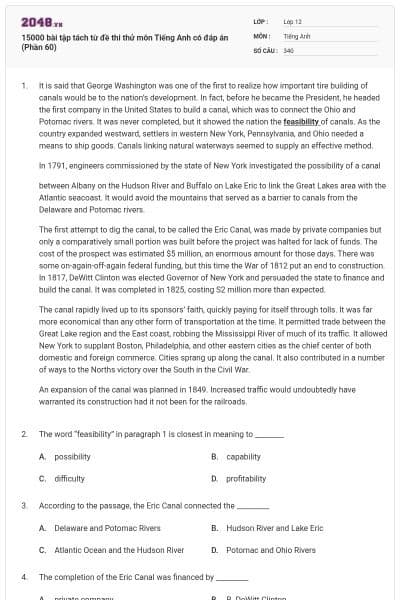
It is said that George Washington was one of the first to realize how important tire building of canals would be to the nation’s development. In fact, before he became the President, he headed the first company in the United States to build a canal, which was to connect the Ohio and Potomac rivers. It was never completed, but it showed the nation the feasibility of canals. As the country expanded westward, settlers in western New York, Pennsylvania, and Ohio needed a means to ship goods. Canals linking natural waterways seemed to supply an effective method.
In 1791, engineers commissioned by the state of New York investigated the possibility of a canal
between Albany on the Hudson River and Buffalo on Lake Eric to link the Great Lakes area with the Atlantic seacoast. It would avoid the mountains that served as a barrier to canals from the Delaware and Potomac rivers.
The first attempt to dig the canal, to be called the Eric Canal, was made by private companies but only a comparatively small portion was built before the project was halted for lack of funds. The cost of the prospect was estimated $5 million, an enormous amount for those days. There was some on-again-off-again federal funding, but this time the War of 1812 put an end to construction. In 1817, DeWitt Clinton was elected Governor of New York and persuaded the state to finance and build the canal. It was completed in 1825, costing S2 million more than expected.
The canal rapidly lived up to its sponsors’ faith, quickly paying for itself through tolls. It was far more economical than any other form of transportation at the time. It permitted trade between the Great Lake region and the East coast, robbing the Mississippi River of much of its traffic. It allowed New York to supplant Boston, Philadelphia, and other eastern cities as the chief center of both domestic and foreign commerce. Cities sprang up along the canal. It also contributed in a number of ways to the Norths victory over the South in the Civil War.
An expansion of the canal was planned in 1849. Increased traffic would undoubtedly have warranted its construction had it not been for the railroads.
The word “feasibility” in paragraph 1 is closest in meaning to ________
possibility
capability
difficulty
profitability
Đáp án A
Feasibility / ,fi:zə'biliti / ~ Possibility (n): tính khả thi, khả năng có thể thực hiện được
- Capability /,keipə'biliti/ (n): năng lực, khả năng
- Difficulty (n): sự khó khăn
- Profitability (n): khả năng kiếm lợi nhuận
According to the passage, the Eric Canal connected the _________
Delaware and Potomac Rivers
Hudson River and Lake Eric
Atlantic Ocean and the Hudson River
Potomac and Ohio Rivers
Đáp án B
Theo đoạn văn, Eric Canal đã kết nối với ……………
A. Sông Delaware và Potomac
B. Sông Hudson và Hố Eric
C. Đại Tây Dương và Sông Hudson
D. Sông Potomac và Ohio
Dẫn chứng: “In 1791, engineers commissioned by the state of New York investigated the possibility of a canal between Albany on the Hudson River and Buffalo on Lake Eric to link the Great Lakes area with the Atlantic seacoast.” (Vào năm 1791, kỹ sư được tiểu bang New York ủy thác điều tra khả năng của một con kênh giữa Albany trên sông Hudson và Buffalo trên hồ Eric để liên kết các khu vực Great Lakes với phần bờ biển Đại Tây Dương.
The completion of the Eric Canal was financed by _________
private company
B. DeWitt Clinton
the federal government
New York
Đáp án D
Việc hoàn thành kênh đào Eric Canal được cấp tiến bởi.
A. Công ty tư
B. Dewitt Clinton
C, Chinh phủ liên bang
D. New York
Dẫn chứng: “In 1817, DeWitt Clinton was elected Governor of New York and persuaded the state to finance and build the canal” (Vào năm 1817, DeWitt Clinton được bầu làm Thống đốc New York và thuyết phục nhà nước tài trợ và xây dựng kênh đào đó.)
The actual cost of building the Eric Canal was __________
$5 million
less than had been expected
$7 million
more than could be repaid
Đáp án C
Chi phi thật sự cùa việc xây dựng Eric Canal là............
A. 5 triệu đô la
B. ít hơn mong đợi
C. 7 triệu đô la
D. nhiều hơn có thể được trà lại
Dẫn chứng:
“The cost of the prospect was estimated $ 5 million, an enormous amount for those days.” (Chi phí cho dự án ước tính 3 triệu đô la, một khoản tiền khổng lồ cho vào thời đó.)
It was completed in 1823, costing $2 million more than expected. (Nó được hoàn thành vào năm 1825, phài trả thêm 2 triệu đê la so với mong đợi)
The word “tolls” in paragraph 4 is closest in meaning to which of the following?
Grants
Fees
Links
Jobs
Đáp án B
Toll ~ Fee (n): phí
- Grant (n): tiền trợ cấp, sự trợ cấp
- Link (n): mối liên lạc, sự liên kết
- Job (n): công việc
Đáp án B (chú ý phía trước có từ “paying” nên có thể đoán được nghĩa của từ “toll”)
Which of the following is NOT given as an effect of the building of the Eric Canal in paragraph 4?
It took water traffic away from the Mississippi River.
It established Boston and Philadelphia as the most important centers of trade.
It helped determine the outcome of the Civil War.
It allowed the East coast to trade with the Great Lake Sea.
Đáp án B
Câu nào sau KHÔNG được đưa ra như một ảnh hưởng của việc xây dựng Eric Canal ở đoạn văn 4?
A. Nó đã lấy đi việc vận chuyển bằng đường thủy từ sông Mississippi.
B. Nó đã thành lập Boston và Philadelphia như là những trung tâm thương mại quan trọng nhất.
C. Nó giúp xác định được kết quả của cuộc Nội Chiến.
D. Nó đã cho phép bờ biển phía Đông buôn bán với khu vực Great Lake Sea.
Dẫn chứng: “It permitted trade between the Great Lake region and the East coast, robbing the Mississippi River of much of its traffic. It allowed New York to supplant Boston, Philadelphia, and other eastern cities as the chief center of both domestic and foreign commerce. It also contributed in a number of ways to the Norths victory over the Smith in the Civil War.”
What can be inferred about railroads in 1849 from the information in the last paragraph?
They were being planned but had not been built.
They were seriously underdeveloped.
They had begun to compete with the Eric Canal for traffic.
They were weakened by the expansion of the canal.
Đáp án C
Điều gì có thể được suy ra về những đường sắt vào năm 1849 từ thông tin ở đoạn văn cuối?
A. Chúng được lên kế hoạch nhưng đã không được xây dựng.
B. Chúng chưa được phát triển một cách nghiêm túc.
C. Chúng bắt đầu cạnh tranh với Eric Canal vì sự vận chuyển
D. Chúng bị sự mở rộng của kênh đào làm cho yếu hơn.
Dẫn chứng : “An expansion of the canal was planned in 1849. Increased traffic would undoubtedly have warranted its construction had it not been for the railroads.” (Sự mở rộng kênh đào đó đã được lên kê hoạch trong năm 1849. Việc vận chuyên tăng chắc chắn đã biện hộ cho việc xây dựng của nó nếu không phải vì các tuyến đường sắt.)
The word “warranted” in paragraph 5 is closest in meaning to
hastened
guaranteed
justified
prevented
Đáp án C
- Warrant (v) ~ Justify (v): biện hộ cho
- Hasten (v): đây nhanh, vội vàng
- Guarantee / ,gærən'ti: / (v): bảo đàm (cho ai, về vấn đề gì)
- Prevent (v): ngăn cản, ngăn chặn
VOCABULARY
- Canal /kə'næl/ (n): kênh đào - Expand /ik'spænd/ (v): mở rộng - Settler/’set.lər/ (n): người đến định cư - Waterway / 'wɔ:təwei / (n): đường sông tàu bè qua lại được - Commission /kə’mi∫.ən/ (v): ủy nhiệm, ủy thác - Investigate /in’ves.ti.geit/ (v): điều tra - Barrier /’bær.j.ər/ (n): rào cản - Dig/dig/ (v): đào - Portion / 'pɔ:∫ən / (n): phán - Fund /fʌnd / (n): quỹ, tiền của | - Halt (v): cho dừng lại, bắt dừng lại - Construction / kən'strʌk∫ən / (n): sự xây dựng - Enormous /i'nɔ:.məs/ (adj): to lớn - Finance /'fai.næns/ (n): tài chính - Sponsor / 'spɒnsər / (n): người tài trợ - Commerce / 'kɒmɜ:s / (n): thương mại - Contribute /kən'trib.ju:t/ /'kn.tri.bju:t/ (v): đóng góp - Railroad /'reil.rəud/ (n): đường sắt |
In early civilization, citizens were educated informally, usually within the family unit. Education meant simply learning to live. As civilization became more complex, however, education became more formal, structured, and comprehensive. Initial efforts of the ancient Chinese and Greek societies concentrated solely on the education of males. The post-Babylonian Jews and Plato were exceptions to this pattern. Plato was apparently the first significant advocate of the equality of the sexes. Women, in his ideal state, would have the same rights and duties and the same educational opportunities as men. This aspect of Platonic philosophy, however, had little or no effect on education for many centuries, and the concept of a liberal education for men only, which had been espoused by Aristotle, prevailed.
In ancient Rome, the availability of an education was gradually extended to women, but they were taught separately from men. The early Christians and medieval Europeans continued this trend, and single-sex schools for the privileged through classes prevailed through the Reformation period. Gradually, however, education for women, in a separate but equal basis to that provided for men, was becoming a clear responsibility of society. Martin Luther appealed for civil support of schools for all children. Al the Council of Trent in the 16th century, the Roman Catholic Church encouraged the establishment of free primary schools for children of all classes. The concept of universal primary education, regardless of sex, had been born, but it was still in the realm of the single-sex school.
In the late 19th and early 20th centuries, co-education became a more widely applied principle of educational philosophy. In Britain, Germany, and the Soviet Union the education of boys and girls in the same classes became an accepted practice. Since World War II, Japan and the Scandinavian countries have also adopted relatively universal co-educational systems. The greatest negative reaction to co-education has been felt in the teaching systems of the Latin countries, where the sexes have usually been separated at both primary and secondary levels, according to local conditions. ’
A number of studies have indicated that girls seem to perform better overall and in science in particular. In single-sex classes, during the adolescent years, pressure to conform to stereotypical female gender roles may disadvantage girls in traditionally male subjects, making them reluctant to volunteer for experimental work while taking part in lessons. In Britain, academic league tables point to high standards achieved in girls’ schools. Some educationalists, therefore, suggest segregation of the sexes as a good thing, particularly in certain areas, and a number of schools are experimenting with the idea.
Ancient education generally focused its efforts on _________.
young people only
on male learners
both sexes
female learners
Đáp án B
Nền giáo dục thời xưa nhìn chung tập trung những nỗ lực vào ________.
Dẫn chứng trong bài đọc: “Initial efforts of the ancient Chinese and Greek societies concentrated solely on the education of males.” (Những nỗ lực ban đầu của xã hội Trung Quốc và Hy Lạp cổ đại chỉ tập trung vào giáo dục cho nam nhi.) => concentrate on ~ focus on
Education in early times was mostly aimed at ___________.
teaching skills
learning new lifestyles
learning to live
imparting survival skills
Đáp án C
Giáo dục trong thời gian đầu nhằm mục đích chủ yếu vào __________.
A. dạy kỹ năng B, học phong cách sống mới
C. học cách sống D. truyền đạt kỹ năng tồn tại
Dẫn chứng trong bài đọc: Education meant simply learning to live.
The first to support the equality of the sexes was _____________.
the Chinese
the Jews
Plato
the Greek
Đáp án C
Người đầu tiên ủng hộ bình đẳng giới là _______.
Dẫn chứng trong bài đọc: Plato was apparently the first significant advocate of the equality of the sexes.
The word “informally” in this context mostly refers to an education occurring ___________.
in a department
in classrooms
ability
outside the school
Đáp án D
Dẫn chứng trong bài đọc: In early civilization, citizens were educated informally, usually within the family unit. (Vào thời văn minh xa xưa, công dân được giáo dục không chính thức, thường trong phạm vi gia đình) => Phía sau từ “informally” có đề cập đến “ within the family unit” => chúng ta có thể hiểu được nền giáo dục xưa xảy ra ở bên ngoài trường học
When education first reached women, they were _________.
separated from men
locked up in a place with men
deprived of opportunities
isolated from a normal life
Đáp án A
Khi lần đầu giáo dục đến với nữ giới thì họ ________.
Dẫn chứng trong bài đọc: “In ancient Rome, the availability of an education was gradually extended to women, but they were taught separately from men.” (Vảo thời La Mã cổ đại thì giáo dục được mở rộng với nữ giới, nhưng họ được dạy tách biệt với nam giới.)
When the concept of universal primary education was introduced, education ___________.
focused on imparting skills
locked up in a place with men
was given free to all
focused on imparting skills
Đáp án A
Khi khái niệm về giáo dục sơ cấp phổ quát đưa vào thì nền giáo dục ________.
Dẫn chứng trong bài đọc: “ The concept of universal primary education, regardless of sex, had been born, but it was still in the realm of the single-sex school.
Điều nay có nghĩa là nền giáo dục lúc ấy đã dành cho mọi giới tính
Co-education was negatively responded to in ___________.
conservative countries
Japan
South American countries
the Scandinavian countries
Đáp án C
Đồng giáo dục bị phản hồi tiêu cực ở _______.
Dẫn chứng trong bài đọc: “The greatest negative reaction to co-education has been felt in the teaching systems of the Latin countries, where the sexes have usually been separated at both primary and secondary levels, according to local conditions”
VOCABULARY
- Educate/ 'eʤu:keit / (v): giáo dục - Complex / 'kɒmpleks / (adj): phức tạp - Comprehensive /,kɒmpri'hensiv / (adj):) bao hàm toàn diện - Solely /'səul.li/ (adv): duy nhất - Exception /ik'sep∫ən/ (n): ngoại lệ, sự trừ ra - Advocate/ 'ædvəkit / (n): người ủng hộ - Equality /i:'kwɒləti / (n): sự bình đẳng - Right /rait/ (n): quyến - Philosophy /fi'lɒsəfi / (n): triết học, triết lí - Liberal /'libərəl / (adj): tự do - Espouse /es'pəuz / (v): tán thành (một phong trào...) | - Prevail /priveil/ (v): chiếm ưu thế - Medieval / medi'i:vəl / (adj): (thuộc) ựiời Trung Cổ - Separate /'sep.ər.ət/ (adj): tách biệt - Appeal/ə'pi:l/ (v): kêu gọi - Principle /'prin.sə.pəl/ (n): nguyên tắc - Pressure / 'pre∫ər / (n): áp lực - Conform /kən'fɔ:m/ (v): làm theo, tuân theo - Reluctant / ri'lʌktənt / (adj): miễn cưỡng - Segregation /,segri'gei∫ən / (n): sự phân biệt |
The three phases of human memory are the sensory memory, the short-term memory, and the long- term memory. This division of the memory into phases is based on the length of time of the memory.
Sensory memory is instantaneous memory. It is an image or memory that enters your mind only for a short period of time; it comes and goes in under a second. The memory will not last longer than that unless the information enters the short-term memory.
Information can be held in the short-term memory for about twenty seconds or as long as you are actively using it. If you repeat a fact to yourself, that fact will stay in your short-term memory as long as you keep repeating it. Once you stop repeating it, either it is forgotten or it moves into long term memory.
Long-term memory is the huge memory tank that can hold ideas and images for years and years. Information can be added to your long-term memory when you actively try to put it there through memorization or when an idea or image enters your mind on its own.
The best title for this passage would be __________.
The difference between sensory and short-term memory
How long it takes to memorize
The stages of human memory
Human phases
Đáp án C
Tiêu đề phù hợp nhất cho bài đọc là ________.
A. Sự khác nhau giữa trí nhớ tạm thời và ngắn hạn
B. Mất bao lâu để ghi nhớ
C. Các giai đoạn của trí nhớ con người
D. Các giai đoạn con người
Câu đầu tiên trong bài đọc đã nêu lên ý chính cùa toàn bài, và các đoạn sau làm rõ vấn đề hơn
Dẫn chứng: “The three phases of human memory are the sensory memory, the short-term memory, and the long-term memory.” (Ba giai đoạn của bộ nhớ con người là trí nhớ tạm thời, ngắn hạn và dài hạn.)
The three phases of memory discussed in the passage are differentiated according to ____________.
The location in the brain
The period of time it takes to remember something
How the senses are involved in the memory.
How long the memory lasts.
Đáp án D
Ba giai đoạn của quá trình ghi nhớ được thảo luận trong bài đọc được phân biệt theo ______.
A. Vị trí trong bộ não
B. Khoảng thời gian để ghi nhớ điều gì
C. Cách thức các giác quan tham gia vào quá trình ghi nhớ
D. Quá trình ghi nhớ kéo dài bao lâu
Dẫn chứng trong đoạn đầu: “This division of the memory into phases is based on the length of time of the memory.” (Sự phân chia bộ nhớ thành các giai đoạn dựa vào độ dài thời gian của quá trình ghi nhớ.)
The expression “is based on” in the first paragraph could be best replaced by __________.
Is on the top of
is at the foot of
depends on
is below
Đáp án C
- “is based on” - “depends on”: phụ thuộc vào, dựa vào
“This division of the memory into phases is based on the length of time of the memory.” (Sự phân chia bộ nhớ thành các giai đoạn dựa vào độ dài thời gian của quá trình ghi nhớ.)
According to the passage, which type of memory is the shortest?
Sensory memory
Active memory
Short-term memory
Long-term memory
Đáp án A
Theo bài đọc, loại trí nhớ nào là ngắn nhất?
Dẫn chứng ở câu đầu trong đoạn 2: Sensory memory is instantaneous memory.
According to the passage, when will information stay in your short-term memory?
For as long as twenty minutes
As long as it is being used.
After you have repeated it many times.
When it has moved into long-term memory.
Đáp án B
Theo bài đọc, lúc nào thì thông tin sẽ lưu lại ở trí nhớ ngắn hạn?
Dẫn chứng ở câu đầu tiên trong đoạn 3: “Information can be held in the short-term memory for about twenty seconds or as long as you are actively using it.” (Thông tin có thể được giữ lại trong bộ nhớ ngắn hạn khoảng hai mươi giây hoặc miễn là bạn đang tích cực sử dụng nó.)
All of the following are TRUE about long - term memory EXCEPT that __________
it has a very large capacity.
it can hold information.
it is possible to put information into it through memorization.
memorization is the only way that information can get there.
Đáp án D
Tất cả những điều sau ĐÚNG về trí nhớ dài hạn NGOẠI TRỪ __________.
A. Đúng (Long-term memory is the huge memory tank)
B. Đúng (Long-term memory is the huge memory tank that can hold ideas and images for years and years)
C. Đúng (Information can be added to your long-term memory when you actively try to put it there through memorization)
D. Sai (Information can be added to your long-term memory when you actively try to put it there through memorization or when an idea or image enters your mind on its own) => Sự ghi nhớ không phải là cách duy nhất
The expression “on its own” in the last sentence can be best replaced by
by itself
in its own time
with its
in only one way
Đáp án A
- “on its own” = “by itself”: tự nó, tự bản thân
Dẫn chứng: “Information can be added to your long-term memory when you actively try to put it there through memorization or when an idea or image enters your mind on its own. (Thông tin có thể được bổ sung vào trí nhớ dài hạn khi bạn tích cực cố gắng lưu giữ nó ở đó thông qua sự ghi nhớ hoặc là khi một ý tưởng hay hình ảnh tự động vào tâm trí của bạn.)
It can be inferred from the passage that if a person remembers a piece of « information for two days, this is probably _________.
three phases of memory
the sensory memory
the short- term memory
the long- term memory
Đáp án D
Ta có thể suy ra từ bài đọc rằng nêu một người ghi nhớ thông tin được khoảng 2 ngày, điều này có thể là ________.
Theo thông tin trong bài đọc thì “the sensory memory” và “the short-term memory” là loại trí nhớ rất ngắn, chỉ tính bằng giây nên một người ghi nhớ thông tin được khoảng thời gian 2 ngày sẽ thuộc vào trí nhớ dài hạn
Over the past 600 years, English has grown from a language of few speakers to become the dominant language of international communication. English as we know it today emerged around 1350, after having incorporated many elements of French that were introduced following the Norman invasion of 1066. Until the 1600s, English was, for the most part, spoken only in England and had not expanded even as far as Wales, Scotland, or Ireland. However, during the course of the next two century, English began to spread around the globe as a result of exploration, trade (including slave trade), colonization, and missionary work. Thus, small enclaves of English, speakers became established and grew in various parts of the world. As these communities proliferated, English gradually became the primary language of international business, banking, and diplomacy.
Currently, about 80 percent of the information stored on computer systems worldwide is in English. Two thirds of the world’s science writing is in English, and English is the main language of technology, advertising, media, international airport, and air traffic controllers. Today there are more than 700 million English users in the world, and over half of these are non-native speakers, constituting the largest number of non-native users than any other language in the world.
What is the main topic of the passage?
The number of non-native users of English.
The French influence on the English language.
The expansion of English as an international language.
The use of English for science and technology.
Đáp án C
Chủ đề chính của bài đọc là gì?
A. Số lượng những người không phải bản xứ sử dụng Tiếng Anh
B. Ảnh hưởng của Tiếng Pháp vào Tiếng Anh
C. Sự phát triển của Tiếng Anh như một ngôn ngữ quốc tế
D. Việc sử dụng Tiếng Anh cho khoa học và công nghệ
Dẫn chứng trong bài dọc:
- Over the past 600 years, English has grown from a language of few speakers to become the
dominant language of international communication, (câu đầu đoạn 1)
- Currently, about 80 percent of the information stored on computer systems worldwide is in
English, (câu đầu đoạn 2)
In the first paragraph, the word “emerged” is closest in meaning to
appeared
hailed
frequented
engaged
Đáp án A
- Emerge ~ Appear (v): xuất hiện, nổi lên
- Hail (v): gọi, reo, hoan nghênh
- Frequent (v); hay lui đến
- Engage (v): hứa hẹn, thu hút,...
“English as we know it today emerged around 1350” (Tiếng Anh như chúng ta biết ngày nay đã xuất hiện vào khoảng năm 1350.)
In the first paragraph, the word “elements” is closest in meaning to
declaration
features
frequented
engaged
Đáp án B
- Elements - Features: những yếu tố, những đặc trưng
- Declaration (n): lời tuyên bố, bản tuyên ngôn
- Curiosities (n): điều kỳ lạ
- Customs In): tập quán, phong tục
“English as we know it today emerged around 1350, after having incorporated many elements of French that ….” (Tiếng Anh như chúng ta biết ngày nay đã xuất hiện vào khoảng năm 1350, sau khi đã kết hợp nhiều yếu tố của Tiếng Pháp )
Approximately when did English begin to be used beyond England? ________.
In 1066
around 1350
before 1600
after 1600
Đáp án D
Khoảng khi nào Tiếng Anh bắt đầu được sử dụng vượt ra khỏi phạm vi nước Anh?
Dẫn chứng: “Until the 1600s, English was, for the most part, spoken only in England and had not expanded even as far as Wales, Scotland, or Ireland.” (Cho đến những năm 1600 thì Tiếng Anh chỉ được nói ở nước Anh ....)
=> Sau năm 1600 Tiếng Anh mới được sử dụng ở những nước khác
According to the passage, all of the following contributed to the spread of English around the world EXCEPT__________.
the slave trade
the Norman invasion
missionaries
colonization
Đáp án B
Dẫn chứng trong bài đọc: “However, during the course of the next two century, English began to spread around the globe as a result of exploration, trade (including slave trade), colonization, and missionary work”
A, C, D đóng góp vào sự lan rộng của Tiếng Anh khắp thế giới
In the second paragraph, the word “stored” is closest in meaning to ________.
bought
saved
spent
valued
Đáp án B
Stored ~ Saved: được lưu
“Currently, about 80 percent of the information stored on computer Systems worldwide is in English” (Hiện nay, khoảng 80% thông tin được lưu trên hệ thống máy tính là bằng Tiếng Anh)
According to the passage, approximately how many non-native users of English are there in the world today? _________.
a quarter million
half a million
350 million
700 million
Đáp án C
Theo bài đọc, trong thế giới ngày nay có khoảng bao nhiêu người không phải bản xứ dùng Tiếng Anh?
Thông tin ở câu cuối của đoạn 2: Today there are more than 700 million English users in the world, and over half of these are non-native speakers (Ngày nay có hơn 700 triệu người dùng Tiếng Anh, và hơn 1 nửa số đó không phải người bản xứ) => có khoảng 350 triệu người không phài là bản xứ nói Tiếng Anh
VOCABULARY
- Dominant / 'dɒminənt / (adj): thống trị, có ưu thế hơn - Incorporate /in'kɔ:pərit/ (v): kết hợp, hợp nhất - Invasion / in'veiʒn / (n): sự xâm lược - Globe /gləub/ (n): quả cầu - Exploration /,eksplə:'rei∫ən / (n): sự thăm dò, thám hiểm - Trade /treid/ (n): thương mại - Slave /sleiv/ (n): nô lệ | - Colonization /,kɒlənai'zei∫ən/ (n): sự chiếm làm thuộc địa - Missionary /'mi∫ən.ri/ (adj): có tính chất truyền giáo - Enclave /'eη.kleiv/ (n): vùng đất lọt ở giữa - Proliferate /prəlitər.eit/ (v): tăng nhanh, nảy nở - Diplomacy / di'pləuməsi / (n): tài ngoại giao - Advertising /'ædvətaiziη / (n): quảng cáo - Constitute /'kɒn.sti.t∫u:t/ (v): cấu thành |
Any list of the greatest thinkers in history contains the name of the brilliant physicist Albert Einstein. His theories of relativity led to entirely new ways of thinking about time, space, matter, energy, and gravity. Einsteins work led to such scientific advances as the control of atomic energy, even television as a practical application of Einsteins work. In 1902 Einstein became an examiner in the Swiss patent office at Bern. In 1905, at age 26, he published the first of five major research papers. The first one provided a theory explaining Brownian movement, the zig-zag motion of microscopic particles in suspension. The second paper laid the foundation for the photon, or quantum, theory of light. In it he proposed that light is composed of separate packets of energy, called quanta or photons, that have some of the properties of particles and some of the properties of waves. A third paper contained the “special theory of relativity” which showed that time and motion are relative to the observer, if the speed of light is constant and the natural laws are the same everywhere in the universe. The fourth paper was a mathematical addition to the special theory of relativity. Here Einstein presented his famous formula, E = mc2 , known as the energy mass equivalence. In 1916, Einstein published his general theory of relativity. In it he proposed that gravity is not a force, but a curve in the space-time continuum, created by the presence of mass. Einstein spoke out frequently against nationalism, the exalting of one nation above all others. He opposed war and violence and supported Zionism, the movement to establish a Jewish homeland in Palestine, When the Nazis came to power in 1933, they denounced his ideas. He then moved to the United States. In 1939 Einstein learned that two German chemists had split the uranium atom. Einstein wrote to President Franklin D. Roosevelt warning him that this scientific knowledge could lead to Germany developing an atomic bomb. He suggested the United States begin its own atomic bomb research.
Einstein’s primary work was in the area of ________.
chemistry
biology
physics
engineering
Đáp án C
Công trình nghiên cứu chính của Einstein thuộc lĩnh vực _________.
A. Hóa học B. Sinh vật học C. Vật lí D. Kĩ thuật
Dẫn chứng trong bài đọc: “Any list of the greatest thinkers in history contains the name of the brilliant physicist Allbert Einsstein”
Which of the following inventions is mentioned in the passage as a practical application of Einsteins discoveries?
Radio
Automobiles
Computers
Television
Đáp án D
Phát minh nào sau đây được đề cập trong đoạn văn như là một ứng dụng thiết thực trong số những phát minh của Einstein?
Dẫn chứng trong bài đọc:
“Einsteins work led to such scientific advances as the control of atomic energy, even television as a practical application of Einstein’s work.” (Công trình của Einstein đã mang lại những tiến bộ khoa học như việc kiểm soát năng lượng nguyên tử, thậm chí ti vi như một ứng dụng thực tế của công trình của Einstein.)
According to the passage, Einstein supported all of the following EXCEPT
the establishment ot a Jewish homeland in Palestine
nationalism
atomic bomb research in the United States.
the defeat of the Nazis.
Đáp án B
Theo bài đọc, Einstein đã ủng hộ tất cả những điều sau NGOẠI TRỪ:
A. Sự thành lập cùa quê hương người Do Thái ở Palestine (and supported Zionism, the movement to establish a Jewish homeland in Palestine)
B Chủ nghĩa dân tộc (Einstein spoke out frequently against nationalism: Einstein đã lên tiếng thường xuyên để chống lại chủ nghĩa dân tộc )
C. Nghiên cứu về bom nguyên tử ở nước Mỹ. (He suggested the United States begin its own atomic bomb research.)
D. Sự thất bại của Đức Quốc Xã (When the Nazis came to power in 1933, they denounced his ideas.)
What is “Brownian movement”?
The zig-zag motion of microscopic particles in suspension
The emission of electrons from solids when struck by light
The motion of photons in light
The basis of the theory of relativity
Đáp án A
Chuyển động Brownian là gì?
A. Chuyển động zig- zag của các phân tử rất nhỏ trong hệ thống (vật thể) ở trạng thái tĩnh
B. Sự phóng ra các electron từ những chất rắn khi được chiếu sáng
C. Chuyển động của photon trong ánh sáng
D. Nền tảng của lý thuyết tương đối
“The first one provided a theory explaining Brownian movement, the zig-zag motion of microscopic particles in suspension.”
Einstein was a citizen of all of the following countries EXCEPT
Belgium
Germany
United State
Switzerland
Đáp án A
Einstein là công dân của tất cả các nước NGOẠI TRỪ
A. Bỉ B. Đức C. Thủy Sĩ D. Mỹ
Dẫn chứng trong bài đọc: “In 1902 Einstein became an examiner in the Swiss patent office at Bern.”
“In 1939 Einstein learned that two German chemists had split the uranium atom. Einstein wrote to President Franklin D. Roosevelt warning him that this scientific knowledge could lead to Germany developing an atomic bomb.”
“He then moved to the United States.”
It is clear from the tone of the passage that the author feels
Einsteins work in physics was somewhat tarnished by his conservative political views.
Albert Einstein was one of the most brilliant thinkers in history.
Einsteins work in physics, though theoretically impressive, led to few practical applications.
Einsteins theories have been consistently proven incorrect.
Đáp án B
Rõ ràng từ giọng điệu của bài đọc thì tác giả cảm thấy:
A Công trình của Einstein trong lĩnh vực vật lí thì hơi lu mờ bởi quan điểm chính trị bảo thủ. B. Albert Einstein là một trong những nhà tư tưởng tài giỏi nhất trong lịch sử.
C. Công trình của Einstein trong lĩnh vực vật lí, mặc dù ấn tượng về lý thuyết, nhưng đã mang lại rất ít ủng dụng thực tiễn.
D Những lý thuyết của Einstein đã được chứng minh một cách kiên định không đúng.
“Any list of the greatest thinkers in history contains the name of the brilliant German physicist Albert Einstein.”
According to Einstein’s special theory of relativity,
all properties of matter and energy can be explained in a single mathematical formula.
light is composed of separate packets of energy.
time and motion are relative to the observer.
some solids emit electrons when struck by light.
Đáp án C
Theo thuyết tương đối đặc biệt của Einstein,
A. Tất cả các tính chất của chất và năng lượng có thể được giải thích trong công thức toán học đơn thuần.
B. Ánh sáng bao gồm các gói năng lượng tách biệt.
C. Thời gian và chuyển động là tương đối với người quan sát.
D. Một số ehất rắn phóng ra electron khi được chiếu sáng.
“A third paper contained the “special theory of relativity” which showed that time and motion are relative to the observer “
The word “exalting” in the passage most nearly means
elevation
criticism
support
elimination
Đáp án A
- Exalting- Elevation (n): sự đê cao, sự nâng cao
- Criticism /'kritisizm/ (n); sự phê bình, chỉ trích
- Support (n): sự ủng hộ
- Elimination /i,limi'nei∫n/ (n): sự loại trừ, sự loại ra
“Einstein spoke out frequently against nationalism, the exalting of one nation above all others.” (Einstein đã lên tiếng thường xuyên để chống lại chủ nghĩa dân tộc, sự đề cao một đất nước lên trên tất cả những nước khác)
VOCABULARY
- Brilliant / 'briljənt / (adj): tài giỏi - Scientific / ,saiən'tifik / (adj): khoa học - Relativity / ,relə'tivəti/ (n): tính tương đối - Gravity / 'græviti / (n): sự hút, trọng lực, sự hấp dẫn - Atomic /ə'tɒmik/ (adj): (thuộc) nguyên tử - Suspension / sə'spen∫ən / (n): sự đình chỉ, sự treo - Microscopic /,maikrə'skɒpik/ (adj): rất nhỏ, bằng kính hiển vi - Quantum /'kwɒntəm / (n): lượng tử | - Theory /'θiəri / (n): thuyết - Equivalence / i'kwivələns / (n): tính tương đương - Denounce /di'nauns/ (v): lên án, phản đối kịch liệt - Nationalism /'næ∫nəlizəm/ (n): chủ nghĩa dân tộc - Oppose / ə'pəuz / (v): đối lập, chống đối - Split /split/ (v): tách - Violence / 'vaiələns / (n): bạo lực - Curve /kɜ:v/ (n): đường cong - Motion / 'məu∫ən / (n): chuyển động |
(Line 1) Horace Pippin, as an African-American soldier during World War I, was wounded in his right arm. He discovered, however, that by keeping his right wrist steady with his left hand, he could paint and draw. Pippin was not trained, but his artistic sensitivity and intuitive feel for two-dimensional design and the arrangement of colour and patterns made him one of the finest Primitive artists America has produced.
(Line 6) Pippin did a series of paintings on the abolitionist John Brown and one on his war experiences, but he shied away from social issues for the most part and achieved his greatest success with scenes of the people and places of his hometown of West Chester, Pennsylvania. His Domino Players, featuring four women gathered around a wooden table in a simple kitchen setting, is an excellent example of his rural domestic scenes.
According to the passage, which of the following is NOT true about primitive
art?
It’s two-dimensional
Colours and patterns are important
Artists do not have to be trained for it
It is used mainly for painting portraits
Đáp án D
Theo bài đọc, điều nào sau đây KHÔNG đúng về mỹ thuật nguyên thủy?
A. Nó tạo hình trên bề mặt hai chiều
B. Màu sắc và pattern thì quan trọng
C. Các họa sĩ không cần phải được đào tạo
D. Nó được sử dụng chủ yếu cho việc vẽ chân dung
Dẫn chứng trong bài đọc: “ Pippin was not trained, but his artistic sensitivity and intuitive
teel for two-dimensional design and the arrangement of colour and patterns made him one of the finest Primitive artists America has produced”
Chỉ có Đáp án D là không được nhắc đến trong bài đọc
Horace Pippin discovered he could paint and draw _________.
during Word War I
when he completed his training
when someone reminded him of his artistic sensitivity
by holding his right wrist steady with his left hand
Đáp án D
Horace Pippin đã phát hiện ra ông áy có thể vẽ __________ .
Dẫn chứng trong bài đọc: “He discovered, however, that by keeping his right wrist steady
with his left hand, he could paint and draw.” (Tuy nhiên, ông phát hiện ra rằng bằng cách giữ cho cổ tay phải cố định với tay trái của mình thì ông có thể vẽ)
Where in the passage is the name of Pippin’s hometown mentioned?
Line 1-2
Line 3-4
Line 6-7
Line 8-9
Đáp án D
Tên quê hương ông được đẽ cập tại dòng 8-9:
“…his hometown of West Chester, Pennsylvania”
It may be inferred from the passage that Pippin
had a simple upbringing
was obsessed with the subject of abolition
was destroyed by his war experiences
wanted nothing to do with his past following?
Đáp án A
Dẫn chứng trong bài đọc: His Domino Players, featuring four women gathered around a wooden table in a simple kitchen setting, is an excellent example of his rural domestic scenes. (Tác phẩm Domino Players của ông, vẽ bốn người phụ nữ vây quanh một chiếc bàn gỗ trong một khung cảnh nhà bếp đơn giản, là một ví dụ tuyệt vời vể cảnh vật gia đình nông thôn cùa ông.) => ông được nuôi dạy rất đơn giản
The word “arrangement” in the passage could best be replaced by _________.
purpose
feature
mixture
production
Đáp án C
- Purpose (n) mục đích
- Feature (n): nét đặc trưng
- Mixture (n): sự kết hợp, hỗn hợp
- Production (n): sự sản xuất, sản phẩm
“Arrangement” trong bài đọc này có thể được thay thế bời từ “mixture’
With which of the following statements would the author agree?
Horace Pippin was a poorly trained ordinary artist.
Primitive art is an excuse for lack of training and talent.
Horace Pippin made an important contribution to American art.
Horace Pippin placed too much emphasis on social issues in his work..
Đáp án C
Tác giả đồng tình với phát biểu nào sau đây?
Dẫn chứng trong bài đọc: “Pippin was not trained, but his artistic sensitivity and intuitive feel for two dimensional design and the arrangement of colour and patterns made him one of the finest Primitive artists America has produced.’’
Đáp án C (Ông đã đóng góp quan trọng cho nghệ thuật nước Mỹ)
The passage would most likely be required reading in which course?
Biology
Drama
Literature
Art History
Đáp án C
Bài đọc này có thể được yêu cầu đọc trong khóa học nào?
A. Sinh vật B. Kịch C. Văn học D. Lịch sử nghệ thuật
VOCABULARY
- Wound /wu:nd/ (v): làm bị thương - Discover /di'skʌv.ər/ (v): khám phá, phát hiện - Wrist /rist/ (n): cổ tay - Steady / sted.i/ (adj): vững chắc, cố định - Sensitivity /,sen.si’tiv.ə.ti/ (n): tính nhạy cảm - Intuitive /in'tʃu:.i.tiv/ (adj): trực giác - Dimension /.dai'men.ʃən/ /.di'men.ən/ (n): chiều | - Artist /'ɑ:.tist/ (n): họa sĩ. nghệ sĩ - Abolitionist /.æB.ə'liʃ.ən.ist/ (n): người theo chủ nghĩa bãi nô - Gather /‘gæð.ər/ (v): tập hợp, tụ họp - Wooden /'wud.ən/ (adj): bằng gỗ - Domestic /də'mes.tik/ (adj): (thuộc) gia đình, nội trợ - Primitive /'pnm.i.tiv/ (adj): nguyên thủy |
A Japanese construction company plans to create a huge independent city-state, akin to the legendary Atlantis, in the middle of the Pacific Ocean. The city, dubbed “Marinnation”, would have about one million inhabitants, two airports, and possibly even a space port. Marinnation, if built, would be a separate country but could serve as a home for international organisations such as the United Nations and the World Bank.
Aside from the many political and social problems that would have to be solved, the engineering task envisaged is monumental. The initial stage requires the building of a circular dam eighteen miles in diameter attached to the sea bed in a relatively shallow place in international waters. Then, several hundred powerful pumps, operating for more than a year, would suck out the sea water trom within the dam. When empty and dry, the area would have a city constructed on it. The actual land would be about 300 feet below the sea level. According to designers, the hardest task trom an engineering point of view would be to ensure that the dam is leak proof and earthquake proof.
It all goes well, it is hoped that Marinnation could be ready for habitation at the end of the second decade of the twenty-first century. Whether anyone would want to live in such an isolated and artificial community, however, will remain an open question until that time.
The word akin’ in paragraph 1 could be best replaced by ________.
likely
close
next
similar
Đáp án C
- Underwater (adj): dưới mặt nước
- Underground (adj): ngầm, dưới đất
- Marine (adj): (thuộc) biển
- Legendary (adj): (thuộc) truyền thuyết
Dẫn chứng trong bài đọc: “A Japanese construction company plans to create a huge independent city-state, akin to the legendary Atlantis, in the middle of the Pacific Ocean”.
Which of the following would NOT be a problem for the construction plan?
social
political
engineering
financial
Đáp án D
- Akin ~ Similar (adj): gấn giống, tương tự
- Likely (adj): có thể
- Next (adj): sát, gần, cạnh
- Close (adj): gắn, thân
Which of the following is NOT true according to the text?
Marinnation would have about one million inhabitants.
Marinnation will be built in a deep place in the Pacific Ocean.
Marinnation will be located in the middle of the Pacific Ocean.
Marinnation could be served as home for international organisations.
Đáp án D
Dẫn chứng: “Aside from the many political and social problems that would have to be solved, the engineering task envisaged is monumental.”
Chỉ có “financial” (tài chính) không phải là vấn đề của dự án xây
What is going to be built first?
a city
a dam
a monument
a sea bed
:Đáp án B
Câu nào sau KHÔNG đúng theo bài đọc?
A. Marinnation sẽ có khoảng 1 triệu dân cư.
B. Marinnation sẽ được xây dựng ở một nơi sâu ở Thái Bình Dương.
C. Marinnation sẽ được đặt ở giữa Thái Bình Dương.
D. Marinnation có thể được dùng làm chỗ ở cho các tổ chức quốc tế.
A. đúng (The city, dubbed “Marinnation”, would have about one million inhabitants)
C. đúng (...in the middle of the Pacific Ocean)
D. đúng (Marinnation, if built, would be a separate country but could serve as a home for
international organisations)
B. sai (The initial stage requires the building of a circular dam eighteen miles in diameter attached to the sea bed in a relatively shallow place in international waters.)
The most difficult task is to protect the dam against ________ and earthquake.
fire
water
sunlight
weather
Đáp án B
Cái gì dự định sẽ được xây dựng trước?
Dẫn chứng trong bài đọc: “The initial stage requires the building of a circular dam eighteen miles in diameter attached to the sea bed in a relatively shallow place in international waters.”
According to the text, people could come to live in the future city in the year __________
2002
2012
2010
2020
Đáp án D
Theo bài đọc, con người có thể đến sống ở thành phổ tương lai vào năm.
Dẫn chứng trong bài đọc: “If all goes well, it is hoped that Marinnation could be ready for
habitation at the end of the second decade of the twenty-first century,”
Vào cuối thập kỷ thứ 2 của thế kỷ 21 => năm 2020
What does the author imply in the last sentence of the passage?
People will ask an open question about living in Marinnation.
The construction of Marinnation could never be completed in time.
People might not want to live in an isolated and artificial community.
People will ask how they can live in such an isolated and artificial city.
Đáp án C
Tác giả ngụ ý điều gì ở câu cuối của bài đọc?
“Whether anyone would want to live in such an isolated and artificial community, however, will remain an open question until that time.” (Tuy nhiên, liệu có ai muốn sống ở một cộng đồng tách biệt và nhân tạo như vậy không, sẽ vẫn là một câu hỏi mở cho đến thời điểm đó)
Vậy ý tác giả muốn nói là: Con người có thể không muốn sống ở một cộng đồng nhân tạo và bị tách biệt.
VOCABULARY
- Dub /dʌb/ (v): đặt cho cái tên, gán cho cái tên - Legendary /'leʤ.ən.dri/ (adj): (thuộc)1 chuyện cổ tích, truyền thuyết - Inhabitant /in'hæb.i.tənt/ (n): dân cư, người cư trú - Dam /dæm/ (n): đập (ngăn nước) - Shallow /'ʃæl.əu/ (adj): nông, cạn | - Designer /di'zai.nər/ (n): nhà thiết kế - Proof /pru:f/ (adj): không ngấm, chống được, chịu được - Habitation /.hæb.i'tei. ʃən/ (n): sự cư trú - Artificial /ɑ:.ti’fiʃ.əl/ (adj): nhân tạo - Community /kə'mju.nə.ti/ (n): cộng đồng |
Scientists do not yet thoroughly understand just how the body of an individual becomes sensitive to a substance that is harmless or even wholesome for the average person. Milk, wheat, and egg, for example, rank among the most healthful and widely used foods. Yet these foods can cause persons sensitive to them to suffer greatly. At first, the body of the individual is not harmed by coming into contact with the substance. After a varying interval of time, usually longer than a few weeks, the body becomes sensitive to it, and an allergy has begun to develop. Sometimes it’s hard to figure out if you have a food allergy, since it can show up so many different ways. Your symptoms could be caused by many other problems. You may have rashes, hives, joint pains mimicking arthritis, headaches, irritability, or depression. The most common food allergies are to milk, eggs, seafood, wheat, nuts, seeds, chocolate, oranges, and tomatoes. Many of these allergies will not develop if these foods are not fed to an infant until her or his intestines mature at around seven months. Breast milk also tends to be protective. Migraines can be set off by foods containing tyramine, phenathylamine, monosodium glutamate, or sodium nitrate. Common foods which contain these are chocolate, aged cheeses, sour cream, red wine, pickled herring, chicken livers, avocados, ripe bananas, cured meats, many Oriental and prepared foods (read the labels!). Some people have been successful in treating their migraines with supplements of B-vitamins, particularly B6 and niacin. Children who are hyperactive may benefit from eliminating food additives, especially colorings, and foods high in salicylates trom their diets.
The topic of this passage is ____________.
reactions to foods
food and nutrition
infants and allergies
a good diet
Đáp án A
Chủ đề của bài đọc là ___________.
A. phản ứng với thức ăn
B. thức ăn và dinh dưỡng
C. trẻ sơ sinh và sự dị ứng
D. một chế độ ăn tốt
Dẫn chứng trong bài đọc:
- “…Yet these foods can cause persons sensitive to them to suffer greatly.”
- “Your symptoms could be caused by many other problems. You may have rashes, hives, joint pains mimicking arthritis, headaches, irritability, or depression.”
- “Migraines can be set off by foods containing tyramine, phenathylamine, monosodium glutamate, or sodium nitrate”
According to the passage, the difficulty in diagnosing allergies to foods is due to ____________
the vast number of different foods we eat
lack of a proper treatment plan
the similarity of symptoms of the allergy to other problems
the use of prepared formula to feed babies
Đáp án C
Theo bài đọc, khó khăn trong việc chẩn đoán sự dị ứng với thực phẩm là do___________.
A. số lượng lớn thức ăn khác nhau chúng ta ăn vào
B. thiếu kế hoạch điều trị thích hợp
C. sự tương đồng giữa các triệu chứng dị ứng với những vấn đề khác
D. việc sử dụng công thức có sẵn cho trẻ ăn
Dẫn chứng trong bài đọc: “Sometimes it’s hard to figure out if you have a food allergy, since it can show up so many different ways. Your symptoms could be caused by many other problems. (Đôi khi thật khó để tìm ra nếu bạn bị dị ứng thực phẩm, vì nó có thể biểu hiện ở rất nhiều cách khác nhau. Triệu chứng của bạn có thể bị gây ra bởi nhiều vấn đề khác.)
The word “symptoms” is closest in meaning to ____________.
indications
diet
diagnosis
prescriptions
Đáp án A
- Symptom ~ Indication (n): dấu hiệu, triệu chứng
- Diet (n): chế độ ăn uống
-Diagnosis (n): sự chẩn đoán
-Prescription (n): đơn thuốc
“Your symptoms could be caused by many other problems...” (Triệu chứng của bạn có thể bị gây ra bởi nhiều vấn đề khác.)
The phrase “set off” is closest in meaning to ____________.
relieved
identified
avoided
triggered
Đáp án D
- Set off - Triggered: được gây ra
- Relieve (v): làm giảm nhẹ
- Avoid (v): tránh
- Identify (v): nhận dạng, nhận diện
“Migraines can be set off by foods containing tyramine, phenathylamine, monosodium glutamate, or sodium nitrate.” (Chứng đau nửa đầu có thể bị gây ra bởi các loại thực phẩm có chứa tyramine, phenathylamine, bột ngọt, hoặc natri nitrat.)
What can be inferred about babies from this passage?
They can eat almost anything.
They should have a carefully restricted diet as infants.
They gain little benefit from being breast fed.
They may become hyperactive if fed solid food too early.
Đáp án B
Điều gì có thể được suy luận từ bài đọc về những đứa bé?
A. Chúng có thể ăn hầu hết bất cứ thứ gì.
B. Chúng nên có một chế độ ăn uống hạn chế một cách cẩn thận như trẻ sơ sinh.
C. Chúng hưởng được rất ít lợi ích từ việc cho bú mẹ.
D. Chúng có thể trở nên hiếu động nếu cho ăn thức ăn thô quá sớm.
Dẫn chứng trong bài đọc: “Children who are hyperactive may benefit from eliminating food additives, especially colorings, and foods high in salicylates from their diets.” (Những đứa trẻ quá hiếu động có thể được lợi từ việc loại bỏ các chất phụ gia thực phẩm, đặc biệt là chất tạo màu, và các thực phầm giàu salicylate từ chế độ ăn uống của chúng.)
The word “hyperactive” is closest in meaning to ____________.
overly active
unusually low activity
excited
inquisitive
Đáp án A
- Hyperactive ~ Overly active: hiếu động thái quá
B. ít hoạt động
C. hào hứng
D. tò mò, tọc mạch
“Children who are hyperactive may benefit from eliminating food additives, especially colorings, and foods high in salicylates from their diets.” (Những đứa trẻ quá hiếu động có thể được lợi từ việc loại bỏ các chất phụ gia thực phẩm, đặc biệt là chất tạo màu, và các thực phầm giàu salicylate từ chế độ ăn uống của chúng.)
The author states that the reason that infants need to avoid certain foods related to allergies has to do with the infant’s ____________.
lack of teeth
poor metabolism
underdeveloped intestinal tract
inability to swallow solid foods.
Đáp án C
Dẫn chứng trong bài đọc: “Many of these allergies will not develop if these foods are not fed to an infant until her or his intestines mature at around seven months. “ (Nhiều loại dị ứng sẽ không phát triển nếu những thực phẩm này không cho trẻ sơ sinh ăn cho đến khi đường ruột của bé trưởng thành vào khoảng bảy tháng.) => lý do mà trẻ sơ sinh nên tránh ăn thực phẩm dễ gây dị ứng là do đường ruột của trẻ chưa phát triển hoàn thiện
VOCABULARY
- Thoroughly /'θʌrəli/ (adv): tỉ mỉ, cẩn thận - Substance /'sʌbstəns/ (n): chất - Healthful /'helθful/ (adj): có lợi cho sức khỏe, lành mạnh - Allergy /'ælədgi/ (n): sự dị ứng - Symptom /'simptəm/ (n): triệu chứng - Mimic /'mimik/ (v): bắt chước - Arthritis /ɑ:'θraitis/ (n): viêm khớp - Irritability /,iritə'biləti/ (n): tính dễ cáu, tính dễ bị kích thích | - Depression /di'pre∫n/ (n): sự chán nản, phiền muộn - Infant /'infənt/ (n): trẻ sơ sinh - Intestine /in'testin/ (n): ruột - Migraine /'mi:grein/ /'maigrein/ (n): chứng đau nửa đầu - Herring /'heriη/ (n): cá trích - Supplement /'sʌplimənt/ (n): chất bổ sung - Additive /'æditiv/ (n): chất phụ gia - Diet /'daiət/ (n): chế độ ăn uống |
It takes a long time to raise a family of owlets, so the great horned owl begins early in the year. In January and February, or as late as March in the North, the male calls to the female with a resonant hoot. The female is larger than the male. She sometimes reaches a body length of twenty-two to twenty-four inches, with a wingspread up to fifty inches. To impress her, the male does a strange courtship dance. He bobs. He bows. He rutiles his feathers and hops around with an important air. He flutters from limb to limb and makes flying sorties into the air. Sometimes he returns with an offering of food. They share the repast, after which she joins the dance, hopping and bobbing about as though keeping time to the beat of an inner drum. Owls are poor home builders. They prefer to nest in a large hollow in a tree or even to occupy the deserted nest of a hawk or crow. These structures are large and rough, built of sticks and bark and lined with leaves and feathers. Sometimes owls nest on a rocky ledge, or even on the bare ground, even to occupy the deserted nest of a hawk or crow. These structures are large and rough, built of sticks and bark and lined with leaves and feathers. Sometimes owls nest on a rocky ledge, or even on the bare ground. The mother lays two or three round, dull white eggs. Then she stoically setdes herself on the nest and spreads her feather skirts about her to protect her precious charges from snow and cold. It is five weeks before the first downy white owlet pecks its way out of the shell. As the young birds feather out, they look like wise old men with their wide eyes and quizzical expressions. They clamor for food and keep the parents busy supplying mice, squirrels, rabbits, crayfish, and beetles. Later in the season baby crows are taken. Migrating songsters, waterfowl, and game bird? all fall prey to the hungry family. It is nearly ten weeks before fledglings leave the nest to search for their own food. The parent birds weary of family life by November and drive the young owls away to establish hunting ranges of their own
What is the topic of this passage?
Mating rituals of great horned owls
Raising a family of great horned owls
Habits of young great horned owls
Nest building of great horned owls
Đáp án B
Chủ đề của bài đọc này là gì?
A. Nghi lễ kết đôi của loài cú sừng
B. Việc xây dựng một gia đình của loài cú sừng
C. Thói quen của cú sừng con
D. Việc ỉàm tổ của loài cú sừng
Câu đầu tiên của bài đọc chính là câu chủ đề “topic sentence”: “It takes a long time to raise a family of owlets, so the great horned owl begins early in the year.”
The phrase “a resonant hoot” is closest in meaning to
a sound
an offering of food
an instrument
a movement
Đáp án A
A. một âm thanh B. một lời mời ăn
C. một nhạc cụ D. một sự chuyển động
- A resonant hoot: một tiếng kêu vang
“In January and February, or as late as March in the North, the male calls to the female with a resonant hoot.” (Vào tháng 1 và tháng 2, hoặc cuối tháng 3 ở phía Bắc, con đực gọi con cái bằng một tiếng kêu vang vọng.)
Note: Nếu ta không biết nghĩa của cụm từ “a resonant hoot” thì ta có thể đoán dựa vào từ “call” ở phía trước => sẽ liên quan đến âm thanh
It can be inferred from the passage that the courtship of great horned owls _________.
happens in the fall
takes place on the ground
involves the male alone
in an active process
Đáp án D
Có thể suy ra từ bài đọc rằng việc tán gái của những con cú sừng ___________.
A.diễn ra vào mùa thu
B.diễn ra trên mặt đất
C. chỉ một mình con đực tham gia
D. là một quá trình tích cực
Dẫn chứng trong bài đọc:“To impress her, the male does a strange courtship dance. He bobs. He bows. He ruffles his feathers and hops around with an important air. He flutters from limb to limb and makes flying sorties into the air. Sometimes he returns with an offering of food. They share the repast, after which she joins the dance, hopping and bobbing about as though keeping time to the beat of an inner drum.”
Vậy: Để gây ấn tượng với con cái thì con đực phải làm rất nhiều hành động như “bob, bow, rufle, hop, etc” => đây là một quá trình hoạt động rất tích cực
According to the passage, great horned owls _____________.
may inhabit a previously used nest
are discriminate nest builders
need big nests for their numerous eggs
build nests on tree limbs
Đáp án A
Theo bài đọc, loài cú sừng ___________.
Dẫn chứng trong bài đọc: “Owls are poor home builders. They prefer to nest in a large hollow in a tree or even to occupy the deserted nest of a hawk or crow.” (Loài cú là loài xây tổ rất tệ. Chúng thích làm tổ ở một cái hố lớn trên cây hoặc thậm chí ở cái tổ bị bỏ lại của loài diều hâu hay quạ) => chúng có thể cư trú ở một cái tổ đã từng qua sử dụng
According to the passage, which of the following is the mother owl’s job?
To build the nest
To initiate the courtship ritual
To sit on the nest
To feed the young
Đáp án C
Theo bài đọc, việc nào sau đây là công việc của cú mẹ?
Dẫn chứng trong bài đọc: “The mother lays two or three round, dull white eggs. Then she stoically settles herself on the nest and spreads her feather skirts about her to protect her precious charges from snow and cold.”
ð Đáp án C (ngồi trên tổ)
The phrase “precious charges” refers to _________
the hawks and crows
other nesting owls
the nest
the eggs
Đáp án D
Dẫn chứng trong bài đọc: “The mother lays two or three round, dull white eggs. Then she stoically settles herself on the nest and spreads her feather skirts about her to protect her precious charges from snow and cold.”
(Cú mẹ đã đẻ 2 hoặc 3 quả trứng tròn trắng xám. Sau đó nó nằm vào tổ… để bảo vệ báu vật của mình khỏi tuyết và mưa lạnh.) => báu vật ở đây chính là những quả trứng
According to the passage, young owlets eat everything EXCEPT _________.
insects
other small birds
small mammals
nuts and seeds
Đáp án D
Theo bài đọc, cú con ăn mọi thứ NGOẠI TRỪ ________.
A. côn trùng
B. các loài chim nhỏ
C. các động vật có vú nhỏ
D. các loại quả hạt
Dẫn chứng trong bài đọc: “They clamor for food and keep the parents busy supplying mice, squirrels, rabbits, crayfish, and beetles.” (Chúng la hét đòi thức ăn và khiến cho bố mẹ chúng phải bận rộn cung cấp chuột, sóc, thỏ…) => chúng ăn các loài động vật mà không ăn thực vật
The word “they” refers to
the adult birds
the wise old men
the prey
the young birds
Đáp án D
“As the young birds feather out, they look like wise old men with their wide eyes and quizzical expressions.”
Vậy: they = the young birds: những chú chim non
VOCABULARY
- Owl /aʊl/ (n): con cú - Ruffle /'rʌfl/ (v): làm xù lên - Impress /im'pres/ (v): gây ấn tượng - Nest /nest/ (n): tổ (chim,…) - Flutter /'flʌtər/ (v): vỗ cánh - Deserted /di'zɜ:tid/ (adj): bị bỏ hoang - Crow /krəʊ/ (n): con quạ - Bark /bɑ:k/ (n): vỏ cây - Feather /'feðər/ (n): lông (chim) - Stoically /'stəʊikli/ (adv): kiên cường | - Downy /'daʊni/ (adj): (thuộc) lông tơ, phủ đầy lông tơ - Shell /∫el/ (n): vỏ, bao - Clamor /ˈklæmər/ (v): la hét, kêu la - Songster /sɒŋstər/ (n): chim hay hót - Waterfowl /'wɔ:təfaul/ (n): chim ở nước - Fledge /fledʒ/ (v): nuôi cho đủ lông đủ cánh để bay - Hunting /'hʌntiη/ (n): sự đi săn |
The election of Andrew Jackson to the presidency in 1928 marked the political ascendancy of the “common man” in American politics. His name became a household word during the war of 1812, when, as a U.S Army major general, he led troops against the Creek Indians in the Mississippi Territory and later defeated the British at New Orleans.
After his presidential inauguration, Jackson rode on horseback to the White House to attend a private party. Crowds of well-wishers suddenly appeared at the reception and nearly destroyed the White House as they tried to glimpse the new president. The common man had made a dramatic entrance onto the national political scene.
Jackson’s two terms moved American society toward truer democracy. Many states abandoned property requirements for voting. Elected officials began to act more truly as representatives of the people than as their leaders. As president of the common man, Jackson waged a war against the Bank of the United States, vetoing the bill that re-chartered the institution, declaring it a dangerous monopoly that profited the wealthy few.
Although he had built his reputation as an Indian tighter during the War ol 1812, Jackson was not an Indian hater. He adopted what was at the time considered an enlightened solution to the Indian problem-removal. Many tribes submitted peacelully to being moved to the West. Others were marched by force to the Indian Territory, under brutal conditions, along what the Cherokees called the Trail of Tears.
One of Andrew Jackson’s most enduring legacies was the Democratic Party, which under him became a highly organized political party. In opposition to the Democrats were the Whigs, a party that attracted supporters of the Bank of the United States and opposed the tyranny of the man called “King Andrew”. A less specific but more basic legacy is the populist philosophy oi politics that still bears the name “Jacksonian Democracy.”
The phrase “became the household word” in paragraph I meansthat _______.
a house style was called Jackson.
Jackson acquired fame.
people criticized Jackson.
Jackson was a popular boy’s name.
Đáp án B
Cụm từ “became the household word” trong đoạn 1 nghĩa là ___________.
A. Một kiểu nhà được gọi là Jackson
B. Jackson có được sự nổi tiếng
C. Mọi người chỉ trích Jackson
D. Jackson đã là tên của 1 cậu bé nổi tiếng
- “become a household name/ word” ~ familiar, famous: trở nên quen thuộc, nổi tiếng
The author suggests that Jackson’s election and inauguration _______.
destroyed the White House.
brought a new style to the presidency.
made a lot of common people angry.
put a military man in the White House for the first time.
Đáp án B
Tác giả gợi ý rằng cuộc bầu cử và lễ nhậm chức của Jackson ____________.
A. đã phá hủy Nhà Trắng.
B. đã mang lại một phong cách mới mẻ cho vị trí tổng thống.
C. đã khiến dân thường giận dữ.
D. đã đưa người quân đội vào nhà Trắng lần đầu tiên.
Dẫn chứng trong bài đọc: “The election of Andrew Jackson to the presidency in 1928 marked the political ascendancy of the “common man” in American politics.”
According to the passage, why did Jackson oppose the Bank of the United States?
He thought it benefited only rich people.
It started a war.
It opposed electing him “King Andrew”.
It opposed giving common people the right to vote.
Đáp án A
Theo bài đọc, tại sao Jackson chống đối Ngân Hàng Hoa Kỳ?
A. Ông ấy nghĩ nó chỉ có lợi cho người giàu.
B. Nó bắt đầu một cuộc chiến
C. Nó chống đối việc bầu cử ông ấy làm “King Andrew”
D. Nó chống đối việc đưa cho dân thường quyền bầu cử.
Dẫn chứng trong bài đọc: “…declaring it a dangerous monopoly that profited the wealthy few…” tuyên bố nó là một tổ chức nguy hiểm vì chỉ mang lợi nhuận cho những kẻ giàu có.
According to the passage, Jackson’s policy toward American Indians was ___________.
developed during the War of 1812.
forceful and cruel
considered his greatest achievement
considered progressive at the time
Đáp án D
Theo bài đọc, chính sách của Jackson hướng đến người Mỹ Da Đỏ…
A. được phát triển suốt cuộc chiến năm 1812
B. thì mạnh mẽ và độc ác
C. được xem là thành quả lớn nhất của ông áy.
D. được xem là tiến bộ vào thời điểm đó.
Dẫn chứng trong bài đọc: “He adopted what was at the time considered an enlightened solution to the Indian problem-removal.”
The word “brutal” in paragraph 4 is closest in meaning to ______.
tearful
abrupt
humane
harsh
Đáp án D
- Brutal /'bru:tl/ (adj): tàn bào, hung ác
- Abrupt /ə'brʌpt/ (adj): bất ngờ, đột ngột, vội vã
- Humane /hju:'mein/ (adj): nhân đạo, nhân đức
- Harsh (adj): thô bạo, ác nghiệt, tàn nhẫn
Which of the following is NOT attributed to Andrew Jackson?
The Whig Party.
Jacksonian Democracy.
The rise of the common man.
The Democratic Party.
Đáp án A
Cái nào sau đây KHÔNG tượng trưng cho Andrew Jackson?
A. Đảng Whig
B. Nền dân chủ Jackson
C. Sự tiến lên của người đàn ông bình thường
D. Đảng dân chủ
Dẫn chứng trong bài đọc: “In opposition to the Democrats were the Whigs, a party that attracted supporters of the Bank of the United States and opposed the tyranny of the man called “King Andrew” (Đối lập với đảng dân chủ là đảng Whig, một đảng mà lôi cuốn những người ủng hộ của tổ chức ngân hàng Hoa Kỳ và chống đối lại chính thể chuyên chế của người được gọi là ông vua Andrew.)
Which of the following could NOT be inferred about Andrew Jackson?
He served his country throughout his life.
He supposed democratic reforms.
He inspired populist politics.
He was the president during a violent war.
Đáp án D
Điều nào sau đây KHÔNG được suy ra về Andrew Jackson?
A. Ông ấy phục vụ đất nước suốt cả cuộc đời của mình
B. Ông ấy ủng hộ cải cách dân chủ
C. Ông ấy truyền cảm hứng về nền chính trị dân kiểm
D. Ông ấy là tổng thống suốt cuộc chiến tranh bạo lực.
Dẫn chứng trong bài đọc: “during the war of 1812…a U.S Army major general” (…suốt cuộc chiến ông ấy là đại tướng quân đội Mĩ)
VOCABULARY
- Election /i'lek∫n/ (n): cuộc bầu cử - Ascendancy /əˈsɛndənsi/ (n): uy lực - Troop /tru:p/ (n.pl): quân, lính - Defeat /di'fi:t/ (v): đánh bại, đánh thắng - Inauguration /,inɔ:gjʊ'reiʃn/ (n): lễ nhậm chức - Glimpse /glimps/ (v): nhìn lướt qua, thoáng thấy - Democracy /di'mɒkrəsi/ (n): nền dân chủ - Abandon /ə'bændən/ (v): từ bỏ - Vote /vəʊt/ (v): bỏ phiếu - Official /ə'fi∫l/ (n): quan chức, viên chức - Wage /weidʒ/ (v): tiến hành (chiến tranh) | - Veto /'vi:təʊ/ (v): phủ quyết, bác bỏ - Monopoly /mə'nɒpəli/ (n): độc quyền, tư bản độc quyền - Profit /'prɒfit/ (v): kiếm lợi - Reputation /repjʊ'tei∫n/ (n): danh tiếng - Enlightened /in'laitnd/ (adj): được khai sáng - Tribe /traib/ (n): bộ lạc - Submit /səb'mit/ (v): cam chịu, quy phục - March /mɑ:t∫/ (v): diễu hành - Supporter /'sə'pɔ:tə[r]/ (n): người ủng hộ - Tyranny /'tirəni/ (n): chính thể chuyên chế |
Some candidates failed the oral examination because they didn’t have enough ________.
confide
confident
confidential
confidence
Đáp án D
enough + noun: đủ ( cái gì đó) Confidence(n): sự tự tin
Một số thí sinh trượt bài thi nói bởi vì họ không có đủ sự tự tin.
Our new coach is popular________the whole team.
for
to
by
with
Đáp án D
be popular with sb = be liked/ enjoyed by a large number of people: được nhiều người yêu thích/ phổ biến
Huấn luyện viên mới của chúng tôi được cả đội yêu mới
Don’t go too fast! I can’t________up with you.
keep
go
walk
run
Đáp án: A
Giải thích:
keep up with sb/ sth: bắt kịp/ đuổi kịp ai đó hay vật gì
Dịch: Đừng đi nhanh quá! Tôi không theo kịp bạn.
I have no idea where________.
has she got that information
she got that information
did she get that information
that information has she got
Đáp án B
Mệnh đề danh ngữ: Từ để hỏi + Mệnh đề [ Chủ ngữ + Động t] Tôi không biết cô ấy lấy thông tin đó từ đâu.
That’s ________ story I have ever heard.
a ridiculous
the ridiculous
the more ridiculous
the most ridiculous
Đáp án D
So sánh nhất với thì hiện tại hoàn thành
This / That is + so sánh nhất + I have ever P2.
Đó là câu chuyện buồn cười nhất mà tôi từng nghe.
We bought some________.
German lovely old glasses
German old lovely glasses
lovely old German glasses
old lovely German glasses
Đáp án C
Thứ tự của tính tự trước danh từ:
Công thức chung: Opsascomp [ Opinion + Facts] Op = Opinion [ beautiful, lovely, ugly,…]
S1 = Size [big, small,…]
A = Age [ modern, old, ancient,…] S2 = Shape [ oval, square, round,…] C = color [ red, blue, green,…]
O = Origin [ American, Italian, Japanese,…] M = Material [ metal, gold, silver,…]
P = purpose [ washing, running, dining,…]
Anh ấy đã mua một vài cái cốc có nguồn gốc ở Đức rất cổ.
________non-verbal language is ________ important aspect of interpersonal communication.
The - a
ø – an
A – the
The - ø
Đáp án B
Mạo từ:
Non-verbal language: danh từ không đếm được [ music, rice, money, water,…] Aspect: danh từ đếm được [ a/an + adj + moun]
Ngôn ngữ phi ngôn là một khía cạnh quan trọng của giao tiếp giữa người với người
Their apartment looks nice. In fact, it’s________.
extremely comfortable
extreme comfortably
extreme comfortable
extremely comfortably
Đáp án A
Chủ điểm ngữ pháp: từ loại + chức năng của trạng từ Adv đứng trước adj và bổ nghĩa cho adj [adv + adj]
Căn hộ này trông thật tuyệt. Thật ra nó cực kỳ thoải mái.
My teacher is one of the people________.
I look up to them
whom look up to
I look up to
to who I look up to
Đáp án C
Chủ điểm ngữ pháp: Mệnh đề quan hệ
Đại từ quan hệ làm tân ngữ => có thể lược bỏ đại từ quan hệ.
My teacher is one of the people [whom/who/that] I look up to.
In my company, the director deputy usually________the responsibility for organizing meetings and conferences.
makes
gets
becomes
takes
Đáp án D
Chủ điểm ngữ pháp: sự kết hợp từ [ collocation]
Take/ assume responsibility for sth/ doing sth: nhận trách nhiệm về ai/ việc gì ở công ty của tôi, phó giám đốc thường chịu trách nhiệm tổ chức các cuộc họp và hội nghị
When she returned home from work, she________a bath
takes
took
has taken
was taking
Đáp án B
Khi cô ấy đi làm về, cô ấy đi tắm.
Dùng thì quá khứ đơn để diễn tả chuỗi hành động xảy ra trong quá khứ.
It is important to have someone you can________in.
talk
speak
know
confide
Đáp án D
Rất cần có một ai đó mà bạn có thể tin tưởng để chia sẻ bí mật.
confide in (v) = tell somebody secrets and personal information because you feel you can trust them: kế cho ai đó nghe bí mật vì bạn cảm thấy có thể tin tưởng họ
He was lucky to escape from the accident with only________injuries.
minor
serious
important
major
Đáp án A
Anh ấy rất may mắn khi thoát khỏi vụ tại nạn với chỉ một vài vết thương nhỏ.
Minor( nhỏ)
Serious( nghiêm trọng)
Important( quan trọng)
Major( lớn)
You________clean the windows. The window-cleaner is coming tomorrow.
don’t have
must
mustn’t
needn’t
Đáp án D
don’t have to + Vo: không cần
must + Vo: phải
mustn’t: không được phép, cấm
needn’t: không cần
Bạn không cần lau chùi của sổ. Nhân viên vệ sinh sẽ đến vào ngày mai.
Need( động từ): need to do sth/ noun
Ví dụ: You need to water this planet twice a week. You don’t need to hurry.
Need( trợ động từ): need do sth
Ví dụ: You need fill in this form. You needn’t wash it.
Would you rather live in________town or in________country?
a – a
a – the
the – a
the – the
Đáp án D
Bạn muốn sống ở thị trấn hay nông thôn? Bắt buộc phải dùng “the”:
cụm từ chỉ môi trường vật chất/ thế giới xung quanh ta, khí hậu…
- the environment
- the town
- the country(side)
- the sea(side)
- the beach
- the ground
- the jungle
- the mountains
- the desert
- the universe
- the world
- the rain
- the wind
- the fog
- the weather
- the sunshine
Our teacher would like________
that we practicing our pronunciation
we to practice our pronunciation
us to practice our pronunciation
us practicing our pronunciation
Đáp án C
Giáo viên của chúng tôi muốn chúng tôi thực hành phát âm.
would like sb + to do sth = want sb + to do sth: muốn ( ai đó) làm ( cái gì)
Jane often remembered________to her mother before she died
to talk
talk
talked
talking
Đáp án D
Jane thường nhớ lại việc đã nói chuyện với mẹ của cô ấy trước khi bà mất.
Remember + to Vo: nhớ việc cần làm nhưng chưa làm
Remember + to Vo: nhớ việc đã xảy ra
They will be able to walk across the river________
if the ice will be thick enough
unless the ice is thick enough
if the ice is thick enough
when the ice will be thick enough
Đáp án C
Họ sẽ có thể băng qua được dòng sông nếu lớp băng đủ dày.
Câu điều kiện loại 1: If S+ hiện tại đơn, S+ will Vo
I don’t care________money. Money can’t buy happiness
about
with
in
at
Đáp án A
Tôi không bận tâm đến tiền. TIền không thể mua được hành phúc.
care about sb/sth: quan tâm đến ai/ điều gì
The Giant Panda has been on thev________of extinction for many years
border
verge
margin
rim
Đáp án B
Gấu trúc khổng lồ đang cơ nguy cơ tuyệt chủng nhiều năm nay.
on the verge of extinction: ở trên bờ vực tuyệt chủng
bring/drive sth to the verge of extinction: đẩy đến bờ vực tuyệt chủng
border (đường biên giới)
verge (ven đường, ven rừng)
margin (lề trang giấy, rìa bờ hồ)
rim (miệng cốc, cạp nong nia)
What I like best of him is his________
dependence
dependable
independence
dependency
Đáp án C
Cái điều tôi thích nhất ở anh ấy là tính tự lập.
- tính từ sở hữu [his/her/my/our/their…] + danh từ
- dependable (adj) = reliable (adj): đáng tin cậy # reliant (adj) = dependent: lệ thuộc
- dependence (n): sự lệ thuộc
- independence (n): sự độc lập
- dependency (n): sự ỷ lại
He leaves work early to________his daughter up from school
pick
put
take
collect
Đáp án A
Anh ấy đi làm về sớm để đón con gái đi học về.
- pick up (v): to go somewhere in your car and collect somebody who is / waiting for you: đi đến nơi nào đó bằng ô tô để đón/ rước người đang chờ bạn
Jack________chess before, so I showed him what to do
didn’t play
hadn’t played
hadn’t been played
wasn’t playing
Đáp án B
Câu này dịch như sau: Trước đây Jack chưa từng chơi cờ vua nên tôi đã hướng dẫn anh ấy. Việc tôi hướng dẫn anh ấy dùng thì quá khứ đơn, nên việc anh ấy chưa chơi xảy ra trước đó
=> dùng quá khứ hoàn thành, hoặc dựa vào before cũng hay đi với thì quá khứ hoàn thành.
When his alarm went off, he shut it off and slept for________15 minutes
another
others
the others
other
Đáp án A
Câu này dịch như sau: Khi đồng hồ báo thức reo, anh ấy tắt nó đi và ngủ thêm 15 phút nữa. Chúng ta có các đơn đơn vị đo lường về thời gian, tiền, khoảng cách được xem là danh từ số ít
=> dùng mạo từ a/an => dùng another.
Please________your cigarette. I am going to get choked
cut down
blow out
put aside
put out
Đáp án D
Cut down: chặt/ cắt giảm Blow out: thổi tắt
Put aside: để sang một bên Put out: dập tắt lửa
Câu này dịch như sau: Làm ơn dập tắt điếu thuốc là đi. Chúng tôi sắp ngạt thở rồi.
Factories are not allowed to pump their industrial________into the sea
garbage
litter
waste
rubbish
Đáp án C
Câu này dịch như sau: Các nhà máy không được xả chất thải công nghiệp ra biển.
Garbage: rác = rubbish
Litter: xả rác
Waste: chất thải/ đồ bỏ đi
I must go to the dentist and________
get my teeth to take care of
take care of my teeth
my teeth be taken care of
get my teeth taken care of
Đáp án D
Câu này dịch như sau: Tôi phải đi nha sĩ và nhờ nha sĩ chăm sóc răng.
Dùng câu trúc nhờ vả bị động: S+ get + tân ngữ chỉ vật + ved/ V3
“What would you do in my place?”
“ Were________treated like that, I would complain to the manager.”
I to had been
I to be
I have been
to I be
Đáp án B
Câu này dịch như sau: Bạn sẽ làm gì nếu bạn ở vị trí như tôi?
- Nếu tôi bị đối xử như thế tôi sẽ phàn nàn lại với quản lý.
Cấu trúc đảo ngữ câu điều kiên loại 2: Were + S+ to Vo, S + would + Vo
Hair colour is________characteristics to use in identifying people
one of the most obvious that art
obviously one of the most
one of the most obvious
most obvious one of
Đáp án: C
Giải thích:
Cấu trúc: one of + the + so sánh nhất + N (đếm được số nhiều): một trong những...nhất
Dạng so sánh nhất của tính từ dài: the + most + adj: obvious → the most obvious
Dịch: Màu tóc là một trong những đặc điểm rõ ràng nhất được sử dụng để nhận dạng con người.
Not until a monkey is several years old________to exhibit signs of independence from his mother
does it begin
beginning
and begin
it begins
Đáp án A
Câu này dịch như sau: Mãi cho đến khi 1 con khi được vài tuổi nó bắt đâug có dấu hiệu thoát ly khỏi mẹ nó.
Cấu trúc mãi cho đến khi đảo ngữ :Not until S+ hiện tại đơn, do/ does + S + Vo
As a child, I had an________friend called Polly
image
imagine
imaginative
imaginary
Đáp án D
Câu này dịch như sau: Khi còn bé tôi từng có một người bạn trong tưởng tượng tên là Polly.
Trước danh từ và sau mạo từ “a” chúng ta cần 1 tính từ
=> loại image( danh từ) và imagine( động từ)
Imaginative( adj): giàu trí tưởng tượng/ trí tưởng tượng phong phú Imaginary(adj): thuộc về tưởng tượng/ trong tưởng tượng
Dick________moustache, but he doesn’t any more. He shaved it off because his wife didn’t like it
got used to have
is used to have
used to have
used to having
Đáp án C
Câu này dịch như sau: Nick đã từng để râu nhưng bây giờ không còn nữa. Anh ấy đã cạo đi vì vợ anh ấy không thích nó.
Cấu trúc thể hiện thói quen đã từng có trong quá khứ hiện tại không còn nữa:
S+ used to Vo: đã từng
S+ got used to + Ving: đã từng quen…
S+ be used to Vo: được dùng để ( làm gì)
Neither the students nor their lecturer________English in the classroom
use
uses
are using
have used
Đáp án B
Câu này dịch như sau: Không sinh viên hay giảng viên sử dụng tiếng Anh trong lớp học.
Cấu trúc : neither S1 nor S2
=> động từ chia theo chủ ngữ 2.
Chủ ngữ their lecturer số ít => động từ thêm “s”
Jenny is an early riser and she doesn’t object________the trip before 7 a.m
to starting
against starting
to have to start
to start
Đáp án A
Câu này dịch như sau: Jenny là người quen dậy sớm, và cô ấy không phản đối việc phải khởi hành chuyến đi trước 7 giờ sáng.
Cấu trúc: Object to + Ving : phản đối ( việc gì)
One of the men was lying on the ground after________ down by a piece of rock
knocking
being knocked
knocking him
was knocked
Đáp án B
Sau giới từ (after) + Ving => loại câu D
Câu này dịch như sau: Một trong những người đàn ông đang nằm trên mặt đất sau khi bị một viên đá rơi phải.
Câu mang nghĩa bị động nên dùng cáu trúc bị động của Ving: being Ved
The number of working women in China ________from 49% in 1980 to nearly65% today
has been increasing
has increased
is increasing
have increased
Đáp án B
Cấu trúc the number of + danh từ được xem là danh từ số ít => Động từ chia số ít => loại D Trạng từ chỉ thời gian from 1980 to today => dùng thì hiện tại hoàn thành.
Câu này dịch như sau: Số lao động nữ ở Trung Quốc đã tăng từ 49% vào năm 1980 lên đến gần 65% ngày nay.
My uncle took________photography when he retired from work
after
over
up
on
Đáp án C
Take up: to learn or start to do something, especially for pleasure: học hay bắt đầu làm việc gì đó đặc biệt là vì niềm vui.
Take after: to look or behave like an older member of your family: trông giống như hoặc cư xử giống như một thành viên nào đó lớn hơn trong gia đình.
Take over: to begin to have control of or responsibility for something : bắt đầu kiểm soát hoặc chịu trách nhiệm việc gì đó.
Take on: to decide to do something; to agree to be responsible for something/somebody : quyết định làm việc gì đó/ đồng ý chịu trách nhiệm về ai hoặc về việc gì.
Câu này dịch như sau: Chú của tôi đã học nhiếp ảnh khi ông về hưu.
Helen is traveling to Germany tomorrow on her first working trip and she is very excited________it
for
against
about
with
Đáp án C
Cụm tính từ excited about: thích thú/ phấn khích vì việc gì đó
Câu này dịch như sau: Ngày mai Helen sẽ đến Đức trong chuyến công tác đầu tiên và cô ấy rất phấn khích về việc này.
These people________for the most successful company in the town
are seeming to work
seem working
seem to be working
are seem to be working
Đáp án C
Động từ seem [ có vẻ như ] là động từ tình thái nên không được chia tiếp diễn => loại A. Không có công thì be + Vo [ are seem ] => loại D Seem + to Vo => loại B
Câu này dịch như sau: Những người này có vẻ như đang làm việc cho công ty thành đạt nhất thị trấn.
This job________working very long hours
includes
consists
involves
contains
Đáp án C
Invole + Ving: liên quan đến việc gì
Be involved in sth = take part in sth: tham gia vào
Include: bao gồm = consist of : bao gồm Involve: liên quan đến
Contain: chứa, đựng
Câu này dịch như sau: Công việc này liên quan đến phải làm việc rất nhiều giờ
When he was 20, he developed ________ for the personal computer
the world first computer’s language
the computer language for the first world
the world’s first computer language
the first world’s computerlanguage
Đáp án C
A.ngôn ngữ của máy tính đầu tiên thế giới
B. ngôn ngữ máy tính cho thế giới đầu tiên
C. ngôn ngữ máy tính đầu tiên cỉa thế giới
D. ngôn ngữ máy tính của thế giới đầu tiên
=> Câu C đúng trật tự sắp xếp của từ
Câu này dịch như sau: Khi ông ấy 20 tuổi, ông đã phát triển ngôn ngữ máy tính đầu tiên của thời giới cho máy tính cá nhân
When I came, the salesperson was ________ to the customers how to use a new kind of washing machines.
demonstrating
proving
exposing
teaching
Đáp án A
Demonstrate: minh họa
Prove: chứng minh
Expose = show something hidden: phơi bày
Teach: giảng dạy
Câu này dịch như sau: Khi tôi đến nơi nhân viên bán hàng đang minh họa cho khách hàng thấy cách sử dụng một loại máy giặt mới.
________ my parents gave me the fish tank
It was on my birthday when
It was my birthday on that
It was my birthday that
It was on my birthday that
Đáp án D
Cấu trúc câu chẻ: It was...that S+ V => loại A
=> giới từ [on] không đi với “that” => loại B
Câu này dịch như sau: Đó chính là vào ngày sinh nhật của tôi bố mẹ đã tặng cho tôi bể cá.
Vào ngày sinh nhật nên phải có giới từ “ on my birthday”
=> loại C
Chọn D
This is________the most difficult job I’ve ever had to do
by heart
by chance
by far
by myself
Đáp án C
Cụm từ learn by heart: học thuộc lòng by
chance : tình cờ, đột ngột by far + so sánh nhất để bổ trợ nghĩa
by myself: chính bản thân tôi trong câu có so sánh nhất [ the most difficult job] nên dùng by far
Câu này dịch như sau: Đây là công việc khó khăn nhất mà tôi từng làm.
It is great to watch sportsmen in their national costumes________into the stadium
marching
marched
having marched
to march
Đáp án A
Sau động từ chỉ giác quan [watch] + Ving nếu chứng kiến hành động đang diễn ra + Vo nếu chứng kiến hành động xảy ra bất chợt/ hoặc đã hoàn tất rồi.
=> Loại B, D. Không chọn câu C vì tình huống ở hiện tại không phải ở quá khứ.
Câu này dịch như sau: Thật tuyệt khi ngắm nhìn những vận động viên trong trang phục quốc gia đang đi diểu hành vào sân vận động
Don’t worry. He’ll do the job as________as possible
economizing
economic
uneconomically
economically
Đáp án D
Trong cấu trúc so sánh bằng as...as sau động từ thường [ do] phải dùng trạng từ
=> loại A [ Ving] và B [ tính từ ]
Uneconomically: không tiết kiệm/ hoang phí
Economically: một cách tiết kiệm / lợi về mặt kinh tế
Câu này dịch như sau: Đừng lo lắng. Anh ấy sẽ thực hiện công việc một cách tiết kiệm kinh tế nhất có thể.
I found the lecture about environment very ________
informing
informative
informational
informant
Đáp án B
informing(v): thông báo
informative(adj): giàu thông tin/ cung cấp nhiều thông tin
informational: thuộc về thông tin
informant(n): người đưa tin
Cấu trúc: S+ find + tân ngữ + tính từ: Ai đó cảm thấy cái gì như thế nào
=>loại D Câu này dịch nhue sau: Tôi cảm thấy bài giảng về môi trường rất giàu thông tin. =>Chọn B
All the boys are good at cooking, but ________is as good as the girls
either
neither
every
none
Đáp án D
Neither : không ai ( trong 2 người/ vật) dùng cho danh từ giới hạn về số lượng là 2.
Either: một trong 2 người / vật dùng cho danh từ giới hạn về số lượng là 2.
Every: mỗi/ mọi
None: không ai/ vật nào( không giới hạn về số lượng)
Câu này dịch như sau: Tất cả con trai đều giỏi nấu ăn, nhưng không ai giỏi bằng con gái.
=> Chọn D
You should concentrate ________what the interviewer is saying and make a real effort to answer all the questions
to
at
on
in
Đáp án C
Cụm động từ: concentrate on: tập trung vào
Câu này dịch như sau: Bạn nên tập trung vào điều mà người phỏng vấn đang nói và thật sự nỗ lực để trả lời tất cả những câu hỏi.
They ________at each other for more than one minute without blinking.
stared
winked
watched
glanced
Đáp án A
- stare: to look at somebody/something for a long time: nhìn chằm chằm
- wink:to close one eye and open it again quickly, especially as a private signal to somebody, or to show something is a joke: nháy mắt
- wactch: xem/ ngắm nhìn - glance at: to look quickly at something/somebody: nhìn thooáng qua/ liếc nhìn
Câu này dịch như sau: Họ nhìn nhau chằm chằm hơn một phút mà không nhấp nháy/ nhúc nhích/ động đậy. =>Chọn A
It is essential that he ________. His illness seems worse
needed operating
need to operate
need an operation
needs an operate
Đáp án C
Cấu trúc: It is essential (that) S + Vo: rất cần thiết/ quan trọng ( cho ai đó) làm gì
Câu này dịch như sau: Anh ấy thật sự cần một ca phẫu thuật. Căn bệnh của anh ấy trở nên xấu hơn.
Không chọn đáp án B vì need to operate: anh ấy cần tự mình giải phẫu => sai nghĩa
=>Chọn C
“Don’t stay up late any longer, ________?”
do you
won’t you
will you
should you
Đáp án C
Cấu trúc câu hỏi đuôi: Vo/ Don’t Vo, will you?
Câu này dịch như sau: bạn sẽ không thức khuya nữa, đúng không?
=>Chọn C
Jane wasn’t in when I arrived. I supposed she ________I was coming
must have forgotten
must forget
may forget
can’t have forgotten
Đáp án A
must have forgetten: chắc có lẽ đã quên
must forget: phải quên
may forget: có thể quên
can’t have forgotten: đáng lẽ không thể quên
Câu này dịch như sau: Jane không có ở nhà khi tôi đến. Tôi đoán chắc có lẽ cô ấy đã quên rằng tôi đến.
=>Chọn A
I ________on this project for many consecutive days without success
had been working
had worked
have been working
have been worked
Đáp án C
Để nhấn mạnh tính chất liên tục của hành động kéo dài từ quá khứ cho đến hiện tại [ for many consecutive days] ta dùng thì hiện tại hoàn thành tiếp diễn.
Câu không có dấu hiệu của quá khứ nên không dùng quá khứ hoàn thành tiếp diễn.
Câu này dịch như sau: Tôi đã làm việc cho dự án này nhiều ngày liên tục nhưng không thành công. =>Chọn C
________appears considerably larger at the horizon than it does overhead is merely an illusion.
The Moon which
The Moon
When the Moon
That the Moon
Đáp án B
came up = appear/ happen: xuất hiện/ xảy ra
came up with :nghĩ ra một cái gì đó/ nảy ra một ý tưởng
got on with: có mối quan hệ tốt với ai đó
put on: đội/ đeo/ mặc cái gì đó lên người
Câu này dịch như sau: Tất cả những ý tưởng đều hay, nhưng Michael nảy ra kế hoạch hay nhất trong tất cả.
=>Chọn B
All the ideas were good, but Michael ________the best plan of all
came up
came up with
got on with
put on
Đáp án B
came up = appear/ happen: xuất hiện/ xảy ra
came up with :nghĩ ra một cái gì đó/ nảy ra một ý tưởng
got on with: có mối quan hệ tốt với ai đó
put on: đội/ đeo/ mặc cái gì đó lên người
Câu này dịch như sau: Tất cả những ý tưởng đều hay, nhưng Michael nảy ra kế hoạch hay nhất trong tất cả.
=>Chọn B
she could not say anything
Therefore upset was she that
However upset was she that
So upset was she that
So upset was that
Đáp án C
Cấu trúc: So + adj + be + S + that + S + V [ quá...đến nỗi mà] Câu này dịch như sau: Anh ấy quá đau buồn đến nói mà không thể nói lời nào.
=>Chọn C
Tony and Toby have a lot in ________with each other
common
competition
regard
similar
Đáp án A
Thành ngữ: have a lot in common with [ có nhiều điểm chung với ai đó] C
âu này dịch như sau: Tony và Toby có nhiều điểm chung với nhau.
The building work is still on schedulea problem in digging the foundation
due to
despite
so as
only if
Đáp án B
B Due to(prep) = because of = owing to: bởi vì
Despite = in spite of + cụm danh từ / Ving: mặc dù
So as to Vo: để mà
Only if + S + V : chỉ khi mà/ giá mà
Câu này dịch như sau: Công tác thi công vẫn đùng tiến độ mặc dù có vấn đề trong việc đào móng. =>Chọn B
It is very difficult to________the exact meaning of an idiom in a foreign language
convert
convey
exchange
transfer
Đáp án B
Convert (v) = transform: biến từ dạng này sang dạng khác
Convey (v): truyền tải [ ý nghĩa/ thông điệp]
Exchange (v): trao đổi
Transfer (v): chuyển đổi [ từ vị trí này sang vị trí khác]
Câu này dịch như sau: Rất khó để truyền tải nghĩa chính xác của một thành ngữ bằng ngôn ngữ nước ngoài. =>Chọn B
By the time I return to my country, I________away from home for more than three years
will have been
will be
have been
was
Đáp án A
Cấu trúc: by the time/ before S+ hiện tại đơn, S+ will have Ved [ tương lai hoàn thành] + for + khoảng thời gian.
By the time / before S + quá khứ đơn, S+ had Ved [ quá khứ hoàn thành]
Câu này dịch như sau: Khi tôi trở về quê nhà, tôi sẽ đã xa nhà hơn 3 năm. =>Chọn A
The water is________. You can’t drink it
pollution
pollutant
polluted
polluting
Đáp án C
Pollution (n): sự ô nhiễm
Pollutant (n): yếu tố gây ô nhiễm/ chất gây ô nhiễm
Polluted (adj): bị ô nhiễm/ bị bẩn
Polluting (adj) : làm cho ô nhiễm
Câu này dịch như sau: Nước bị ô nhiễm. Bạn không thể uống nó. =>Chọn C
My boss is going on vacation next month, ________ she’ll be away from the office for about four weeks
in other words
for instance
on the other hand
such as
Đáp án A
In other words: nói cách khác
For instance = for example: ví dụ On the other hand: ngược lại
Such as: chẳng hạn như
Câu này dịch như sau: Sếp của tôi đự định đi nghỉ mát vào tháng tới, nói cách khác bà ấy sẽ đi xa khỏi văn phòng khoảng 4 tuần. =>Chọn A
Have you got a light? My cigarette’s gone________
by
away
off
out
Đáp án D
Go by = pass: trôi qua
Go away:đi vắng/ đi xa
Go off = explode [ nổ] / = ring [ đổ chuông]
Go out: tắt Câu này dịch như sau: Bạn có diêm không? Điếu thu của tôi tắt rồi. =>Chọn D
When he returned home, I found the door________
unlocking
unlocked
to be unlocked
have unlocked
Đáp án B
S+ find + tân ngữ + tính từ : thấy cái gì/ ai như thế nào đấy
Câu này dịch như sau: Khi anh ấy về nhà, anh ấy phát hiện ra rằng cửa đã bị khóa. =>Chọn B
I had no sooner lit the barbecue________
than it started to rain
as it started to rained
while it started raining
that it started raining
Đáp án A
Cấu trúc: S + had no sooner Ved [ quá khứ hoàn thành] than S + Ved/ V2 [ quá khứ đơn]
Câu này dịch như sau: Tôi vừa bắt bếp lên thì trời đổ mưa. =>Chọn A
Several of my friends are________reporters
newspaper’s
newspapers’
newspapers
newspaper
Đáp án B
Newspaper [ danh từ số ít] phía trước phải có mạo từ / đại từ xác định. =>phải dùng sở hữu cách của danh từ số nhiều newspapers’
Câu này dịch như sau: Một vài người bạn của tôi là phóng viên của các tờ báo. =>Chọn B
Are you satisfied________your record?
at
from
with
for
Đáp án C
Be satisfied with: hài lòng với
Câu này dịch như sau: Bạn có hài lòng với kỷ lục/ đĩa hát của bạn không? =>Chọn C
Do you know________?
what wrong was it with
what’s wrong with it
what wrong is it with
what wrong was with it
Đáp án D
Câu hỏi gián tiếp: Trợ động từ + S+ động từ chính + S + V?
Câu này dịch như sau: Bạn có biết nó bị gì không? =>Chọn D
Zika________poses an international emergency, according to the World Health Organization.
not any longer
any more
no longer
not any more
Đáp án C
S+ NO LONGER + V = S + trợ động từ NOT + động từ chình + ANY LONGER: không còn...nữa.
Câu này dịch như sau: Theo Tổ chức Y tế thế giới, Zika không còn gây ra một tình huống khẩn cấp trên toàn cầu nữa. =>Chọn C
This surface________rough but it________smooth
feels/touches
appears/tastes
sees/smells
looks/feels
Đáp án D
Feel: cảm nhận
Touch: chạm vào
Appear: có vẻ như/ xuất hiện
Taste: nếm
Smell: ngửi
See: nhìn thấy
Câu này dịch như sau: Bề mặt này trông có vẻ thô ráp nhưng sờ vào rất mịn.
=>Chọn D
________with the size of the whole Earth, the highest mountains do not seem high at all
Compare them
If you compare
When compared
A comparison
Đáp án C
Rút gọn hai mệnh đề cùng chủ ngữ khi mệnh đề mang nghĩa bị động dùng Ved
Câu đầy đủ: When the highest mountains are compared with the size of the whole Earth,... =>Rút gọn: When compared with the size of the whole Earth Câu này dịch như sau: Khi được so sánh với kích thước của cả Trái Đất, những ngọn núi cao nhất thế giới không có vẻ cao chút nào.
=>Chọn C
I’m sure that you can recognize her at the station; she________a red raincoat
will be wearing
will have been wearing
is going to wear
will have worn
Đáp án A
Dùng thì tương lai tiếp diễn [ will be Ving] để diễn tả hành động đang diễn ra ở một thời điểm trong tương lai.
Câu này dịch như sau:Tôi chắc chắn bạn có thể nhận ra cô ấy ở nhà ga; cô ấy sẽ đang mặc chiếc áo mưa màu đỏ. =>Chọn A
This________dictionary includes a few animations
electricity
electric
electronic
electrical
Đáp án C
Electricity(n): điện
Electric (adj) : điện tử [ + danh từ: chỉ về vật dụng điện hoặc sản xuất ra điện năng]
Electronic(adj): điện tử
Electrical (adj): thuộc về điện
Cụm danh từ: electonic mail / electronic dictionary
Câu này dịch như sau: Từ điển điện tử bao gồm một vài hình ảnh động. =>Chọn C
When exactly did the war________between two countries?
go off
set in
call off
break out
Đáp án D
Go off: nổ [ dùng cho bom], reo/ đổ chuông [ dùng cho đồng hồ báo thức]
Set in = begin: bắt đầu
Call off = cancel: hủy bỏ
Breal out: bùng nổ/ xảy ra
Câu này dịch như sau: Chính xác là chiến tranh giữa hai nước đã xảy ra khi nào?
=>Chọn D
Maria Sharapova became the first Russian________a Wimbledon single title.
to win
that was winning
who wins
which won
Đáp án A
Rút gọn mệnh đề quan hệ khi cụm danh từ là the first/ second/ last...
=> to Vo
Câu này dịch như sau: Maria Sharapova đã trở thành người Nga đầu tiên đạt danh hiệu vô địch banh nỉ đơn nữ Wimbledon.
=>Chọn A
His________of safety regulations really can’t be ignored any longer
inattention
disregard
carelessness
unfamiliarity
Đáp án B
Inattetion: lơ là/ xao lãng
Disregard of sth / for sth: coi nhẹ/ xem thường [ cái gì ]
Carelessness: sự bất cẩn
Unfamiliarity: sự không quen biết
Câu này dịch như sau: Sự xem thường những quy định an toàn của anh ấy thật sự không thể bỏ qua được nữa
=>Chọn B
________the first time I met Tom was at college
As much as I remember
As far as I remember
As well as I remember
As soon as I remember
Đáp án B
As much as: nhiều như
As far as: theo như
As well as: cũng như
As soon as: ngay khi
Câu này dịch như sau: Theo như tôi nhớ , lần đầu tiên tôi gặp Tom là ở đại học.
=>Chọn B
Very________people went to the show but it still started on time
much
a few
little
few
Đáp án D
Much + danh từ không đếm được [ nhiều]
A few + danh từ số nhiều [ một vài ] => Only a few [ chỉ một vài]
Little + danh từ không đếm được: một ít / một chút
Few+ danh từ số nhiều [ một ít] => very few [ rất ít]
Câu này dịch như sau: Rất ít người đến buổi biểu diễn nhưng nó vẫn bắt đầu đúng giờ.
=>Chọn D
“I would rather you________me the truth right now.”
told
tell
said
say
Đáp án A
Cấu trúc: S + would rather + Vo: muốn [ làm gì ]
S+ would rather + sb + Ved: muốn ai làm gì
Tell + sb: nói [ ai nghe] Say to sb: nói với [ai]
=>Chọn A
Câu này dịch như sau: Tôi muốn bạn kể tôi nghe sự thật ngay bây giờ.
Do you know that wine is made________grapes?
out of
of
from
with
Đáp án C
Be made of : được làm từ [ khi sản phẩm tạo ra không khác về bản chất so với nguyên liệu ban đầu ]
Be made from : được làm từ [ khi sản phẩm tạo ra được biến chất so với chất liệu ban đầu ] Câu này dịch như sau: Bạn có biết rằng rượu vang được làm từ nho không? Rượu khác hẳn về bản chất so với nho. => Chọn be made from
=>Chọn C
Heavy snowfalls made________planes to land or take off
it impossible
impossible for
impossible
it impossible for
Đáp án D
Cấu trúc: make it + tính từ + for sth + to Vo
Make + tính từ + danh từ [ Ví dụ: The Internet makes impossible faster communication.
Câu này dịch như sau: Mưa tuyết nặng hạt làm cho máy bay không thể cất cánh và hạ cánh. =>Chọn D
Tom was accused ____________ some top secret document.
to steal
of having stolen
for stealing
to have stolen
Đáp án B
Cấu trúc: accuse sb of + Ving [ buộc tội ai về việc gì ]
Câu này dịch như sau: Tom bị buộc tội ăn cắp tài liệu tuyệt mật.
Sometimes ___________ wears people out and is worse than the lack of sleep itself
to sleep the desire
the desire to sleep
to desire to sleep is
The desire to sleep wh
Đáp án B
Câu có 2 động từ chính “ wears out” và “is” là động từ chính => Câu thiếu chủ ngữ => chọn cụm danh từ để đóng vai trò chủ ngữ [ the desire to sleep]
Câu này dịch như sau: Thỉnh thoảng thèm ngủ làm con người mệt mỏi và còn tệ hơn nữa khi thiếu ngủ.
We were late because we had some car problems. By the time we ___________ to the station, Susan ____________ for us for more than two hours. A
are getting/had waited
got/waited
had got/had waited
got/ had been waiting
Đáp án D
Tình huống ngữ cảnh ở quá khứ. => loại A
Susan đã đợi từ trước khi chúng tôi đến nhà ga + có trạng từ chỉ thời gian để nhấn mạnh tính chất kéo dài của hành động => quá khứ hoàn thành tiếp diễn ; hành động đến nhà ga xảy ra sau => quá khứ đơn
Câu này dịch như sau: Chúng tôi đến muộn vì xe có vấn đề. Khi chúng tôi đến nhà ga, cô ấy đã đợi chúng tôi hơn 2 giờ đồng hồ.
Preparing for a job interview can be very _______________.
stress
stressful
stressed
stressing
Đáp án B
Preparing for a job interview => đóng vai trò chủ ngữ
S + be + very + tính từ => loại A, D
Stressful (adj): căng thẳng [ dùng đề miêu tả tính chất sự vật/ sự việc ]
Stressed (adj): bị làm cho căng thẳng [ dùng để miêu tả cảm xúc của con người]
Câu này dịch như sau: Việc chuẩn bị cho buổi phỏng vấn việc làm có thể rất căng thẳng.
______________ but for his help yesterday?
What did you do
How would you do
What would you have done
How had you done
Đáp án c
But for = without + cụm danh từ, S + would have Ved => câu điều kiện loại 3
Câu này dịch như sau: Bạn sẽ làm gì nếu không có sự giúp đỡ của anh ấy hôm qua.
Don’t worry, we will have to wait a little longer because I’m sure he will ___________ soon
turn up
turn in
turn into
turn down
Đáp án: A
Giải thích:
A. turn up = arrive: đến nơi/ xuất hiện
B. turn in = go to bed: đi ngủ
C. turn into: hóa ra là
D. turn down = refuse: từ chối
Dịch: Đừng lo, chúng ta sẽ phải chờ lâu thêm một chút nữa bởi vì tôi chắc chắn anh ấy sẽ đến sớm thôi.
I tried every key in turn but not __________ fitted.
none
each
any
one
Đáp án D
Câu đã có “not” => loại none
One thay thế cho danh từ “key”
Câu này dịch như sau: Tôi đã thử mọi chìa khóa nhưng không chiếc nào vừa.
She complains noisily about everything she doesn’t like. She is the type of person who is always _____________.
making a fuss
doing a fuss
creating a fuss
giving a fuss
Đáp án A
Cụm từ: make a fuss [ làm ầm ĩ/ ồn ào mọi chuyện lên]
Câu này dịch như sau: Cô ấy phàn nàn ồn ào về mọi thứ cô ấy không thích. Cô ấy là loại người luôn làm ầm ĩ mọi thứ.
That cannot be a true story. He ____________ it up.
can have made
must have made
would have made
should have made
Đáp án B
Make it up: bịa chuyện Would have Ved: sẽ
Can have Ved: đáng lẽ ra có thể Should have Ved: đáng lẽ ra nên
Must have Ved: chắc có lẽ đã
Câu này dịch như sau: Đó không thể là câu chuyện có thật. Anh ấy chắc hẳn đã bịa ra nó.
They asked me ______ in London then.
is my brother working
was my brother working
if my brother was working
if my brother is working
Đáp án: C
Giải thích:
Kiến thức: Câu tường thuật
Động từ tường thuật “asked” chia ở thì quá khứ đơn, nên các động từ trong câu tường thuật cũng chia ở quá khứ. Loại A, D
Công thức tường thuật câu hỏi nghi vấn:
Asked/questioned/wondered/… + O + if/whether + S + V (lùi 1 thì)
Dịch: Họ đã hỏi tôi liệu anh trai tôi có đang làm việc ở Luân Đôn không.
She blamed ___________ me ___________ not explaining the lesson __________ her carefully.
on – for – to
for – on – for
ø – about – for
ø – for – to
Đáp án D
Cấu trúc: blame sb for sth [ đổ lỗi cho ai về việc gì ]
Explain sth to sb: giải thích cái gì với ai
Câu này dịch như sau: Cô ấy đổ lỗi cho tôi về việc không giải thích bài học cho cô ấy cẩn thận.
It _____________me more than an hour to download your photos you uploaded to your Facebook sites.
took
gave
sent
forwarded
Đáp án A
Cụm từ: It + takes + sb + time + to Vo [ Ai đó mất bao nhiêu thời gian để làm gì ]
Câu này dịch như sau: Nó làm tôi mất hơn 1 tiếng đồng hồ để tải những bức ảnh bạn đã đăng lên facebook xuống.
We cleaned up the room as soon as the guests ____________.
had left
have left
left
were leaving
Đáp án C
Cấu trúc: S + Ved/ V2 AS SOON AS S + Ved/ V2 [ ...ngay khi...] dùng để diễn tả hai hành động xảy ra liên tiếp trong quá khứ.
Câu này dịch như sau: Chúng tôi dọn dẹp căn phòng ngay khi khách vừa rời đi.
How tall is Ralph?”
“He’s __________ than you are.”
slightly taller
slight tall
slightly tall
slight taller
Đáp án A
“ Ralph cao bao nhiêu?”
“ Anh ấy cao hơn bạn.”
Trong câu có “than” => dùng so sánh hơn.
Trạng từ đứng trước tính từ nên chọn slightly taller.
Nowadays, most developed countries have brought malaria ___________ control.
in
below
to
under
Đáp án D
Cụm từ: bring sth under control [ kiểm soát được]
Câu này dịch như sau: Ngày nay, hầu hết những nước phát triển đã kiểm soát được bệnh sốt rét.
Due to _______ fuel prices, the company has decided to add a surcharge to all deliveries.
rise
arisen
rose
rising
Đáp án D
Fuel price [ cụm danh từ ] trước phải là tính từ => loại A, C
Arise – arose – arisen [ nội động từ ] : phát sinh => không đứng trước danh từ
Rising [ tính từ chủ động]: ngày càng tăng/ đang tăng
Câu này dịch như sau: Do giá nhiên liệu ngày càng tăng , công ty này đã quyết định thêm phụ thu vào tất cả dịch vụ vận chuyển.
Let me please _______ my memory before I get down to answering the questions.
resume
ease
awake
refresh
Đáp án D
Get down to + Ving = start + Ving Refresh sb’s memory: nhớ lại
Resume: bắt đầu lại Awake: đánh thức
Ease (v,n) : xóa bỏ/ xoa dịu => at ease = comfortable (adj)
Câu này dịch như sau: Làm ơn hãy để tôi nhớ lại trước khi bắt đầu trả lời những câu hỏi.
Our teacher told us that if we don’t ___________ the environment, our grandchildren may not even be able to carry on living.
look into
look out for
look after
look for
Đáp án C
Carry on = continue Look into = investigate
Look out for sth = watch out for: cẩn thận Look after: trông nom/ chăm sóc
Look for: tìm kiếm
Câu này dịch như sau: Giáo viên của chúng tôi bảo chúng tôi rằng nếu chúng tôi không chăm sóc môi trường, con cháu của chúng tôi thậm chí không thể tiếp tục sống nữa.
Have you seen today’s paper? It _______ they’ve caught those million-pound bank robbers.
writes
says
tells
talks about
Đáp án B
Write : viết Say : nói rằng / cung cấp thông tin
Tell + O: kể ai nghe Talk about: trò chuyện về
Câu này dịch như sau: Bạn xem báo hôm nay chưa? Nó nói rằng họ đã bắt được những tên cướp ngân hàng hàng triệu bảng Anh.
If a person wants to get a tube of toothpaste, he will probably go to _____________.
the greengrocer’s
the barber’s
the dentist’s
the chemist’s
Đáp án D
the greengrocer’s: cửa hàng thực phẩm the barber’s: hiệu cắt tóc nam
the dentist’s: phòng khám nha khoa the chemist’s: hiệu thuốc
Câu này dịch như sau: Nếu một người muốn mua 1 tuýp kem đánh răng, anh ấy nên đến hiệu thuốc.
Mr. Hamilton recently found a sister who was thought ____________ thirty years ago.
to have been killed
to have killing
to have killed
to have been killing
Đáp án A
Cấu trúc bị động kép: S + be thought + to Vo [ khi hai hành động xảy ra cùng thì, cùng lúc.]
S+ be + thought + to have Ved [ khi hành động xảy ra trước – sau]
Mệnh đề quan hệ mang nghĩa bị động nên dùng to have been Ved
Câu này dịch như sau: Ông Hamilton gần đây đã tìm được chị gái người mà được nghĩ rằng đã bị giết cách đây 30 năm.
It was ______ we met Mr. Brown in Tokyo.
before many years ago
since many years ago when
many years ago that
for many years since
Đáp án C
Cấu trúc câu chẻ dùng để nhấn mạnh: It is / It was + noun / time/ place ...that S + V
Câu này dịch như sau: Đó là cách đây nhiều năm tôi đã gặp ông Brown ở Tokyo.
Mary wondered ___________ her father looked like now, after so many years away.
whose
how
that
what
Đáp án D
What...look like: trông như thế nào
Câu này dịch như sau: Mary tự hỏi bây giờ bố cô ấy trông như thế nào sau nhiều năm xa cách.
The town _____________ we are living is noisy and crowd
in where
which
at which
where
Đáp án D
Câu này dịch như sau: Thị trấn nơi mà chúng tôi đang sống thì ồn ào và đông đúc.
The town chỉ về địa điểm [ nơi mà ] => dùng where / in which
How long ago ____________ the Civil War?
was
happened
occurred
took place
Đáp án A
The Civil War là chủ ngữ => cần động từ có thể đảo ngữ mà không cần trợ động từ => chọn was
How long ago was the Civil War? = How long ago did the Civil War happen/ occur/ take place?
Câu này dịch như sau: Cuộc nội chiến diễn ra cách đây bao lâu rồi?
I‟m afraid very few people know about the concert and almost no one will come. If only the posters _____________ on time.
were hanging
were hung
were hanged
had been hung
Đáp án D
Câu này dịch như sau: Tôi e rằng rất ít người biết về buổi hòa nhạc và hầu như không ai đến. Giá mà những tờ quảng cáo được treo kịp lúc.
If only = wish: câu ao ước cho tình huống trong quá khứ.
If only + S + had Ved/V3
Jimmy sent his mother a ___________ of flowers for her birthday.
bar
bunch
pack
packet
Đáp án B
A bar of chocolate: một thanh sô-cô-la/ a bar of soap: một bánh xà phòng
A bunch of flowers: một đóa hoa/ một bó hoa
A pack: một gói [ được làm bằng giấy mềm]
A packet: một gói [ được làm bằng bìa cứng]
Câu này dịch như sau: Jimmy đã tặng mẹ anh ấy một bó hoa trong ngày sinh nhật của bà.
The boy with his two friends _____________ the cherry tree now.
has been splitting
have split
is splitting
are splitting
Đáp án C
Cấu trúc: S1 with / along with/ together with S2 => động từ chia theo S1
=>động từ dựa vào chủ ngữ “the boy” => chủ ngữ số ít => loại B và D
Trong câu có now => thì hiện tại tiếp diễn. [ S+ be + Ving]
Câu này dịch như sau: Cậu bé cùng với hai người bạn của mình đang chẻ cây anh đào.
Susan cannot stand looking at the rat, __________ touching it.
even so
as far as
what it
let alone
Đáp án: D
Giải thích:
A. even so: thậm chí là
B. as far as: theo như
C. what it: cái mà nó
D. let alone: huống chi là
Dịch: Susan không thể chịu được việc nhìn thấy chuột, huống chi là chạm vào nó.
I‟d rather ___________ in the field than ____________ at home.
to work/to stay
working/staying
work/stay
worked/stayed
Đáp án C
Cấu trúc: S+ would rather + Vo than Vo [ thích làm việc này hơn việc khác]
Câu này dịch như sau: Tôi thích làm việc trên đồng ruộng hơn là ở nhà.
My plans to travel around the world have _________ through because I couldn‟t save enough money.
fallen
dropped
given
put
Đáp án A
Fall through = fail: thất bại
Put through = connect sb: nối máy với ai [ nghe điện thoại]
Câu này dịch như sau: Các kế hoạch vòng quanh thế giới của tôi đã thất bạn vì tôi không tiết kiệm đủ tiền.
“I thought you bought a new fountain pen last week?” “Yes, I did but I left it at home. Can I borrow _____________ for a moment?”
the one of you
one of yours
one pen of you
the one of your pen
Đáp án B
One of yours = one of your fountain pens
Câu này dịch như sau: “ Mình nghĩ bạn đã mua cây bút mực mới tuần trước chứ nhỉ?”
“ Đúng thế, mình đã để quên ở nhà rồi. Mình có thể mượn một trong những cây bút của bạn một lúc được không?”
There are only a few minutes left, and the students is writing ________________.
with a pressure
under the pressure
to pressure
under pressure
Đáp án D
Cụm từ: under pressure[ chịu nhiều áp lực]
Câu này dịch như sau: Chỉ còn một vào phút nữa thôi, và học sinh đang làm bài với nhiều áp lực.
A little farther down the street _______________.
is the inn I used to stay at
there is an inn where I used to stay in
the inn is the place where I used to stay
is there an inn in which I used to stay
Đáp án A
Cấu trúc đảo cụm trạng ngữ: Trạng ngữ chỉ thời gian + động từ + chủ ngữ
Câu này dịch như sau: Xa hơn một chút phía dưới con đường là nhà khách tôi đã từng ở.
Remember to appreciate what your friends do for you. You shouldn‟t take them ________.
as a rule
as usual
out of habit
for granted
Đáp án D
As a rule: như một thói quen
As usual: như thường lệ
Out of habit: theo thói quen
Cụm từ: take sb for granted [ xem là đương nhiên/ hiển nhiên]
Câu này dịch như sau: Hãy nhớ trân trọng/ biết ơn những việc mà bạn của bạn đã làm cho bạn. Bạn không nên xem những việc đó là điều hiển nhiên.
No one saw Jim came in. He came in without _____________.
anybody saw him
anybody sees him
being seen
been seen
Đáp án C
Giới từ without + Ving
Câu mang nghĩa bị động => without + being + Ved
Câu này dịch như sau: Không ai nhìn thấy Jim vào trong. Anh ấy vào mà không bị phát hiện/ nhìn thấy.
I feel terrible, I didn’t sleep _______________ last night.
a jot
a wink
an inch
an eye
Đáp án B
Thành ngữ: sleep a wink [ không tài nào chợp mắt được]
Câu này dịch như sau: Tôi cảm thấy mệt kinh khủng, tối qua tôi không tài nào chợp mắt được.
I’m going to market all efforts to win a gold medal in ___________ for your help and concern.
return
mind
allowances
memory
Đáp án A
Cụm từ: in return for [ để đáp lại]
Câu này dịch như sau: Tôi sẽ nỗ lực hết sức để giảnh huy chương vàng để đáp lại sự giúp đỡ và quan tâm của bạn.
The manager charged her ___________ irresponsibility and dishonesty.
for
on
about
with
Đáp án D
Cấu trúc: charge sb with sth = accusse sb of st [ buộc tội cho ai về việc gì ]
Câu này dịch như sau: Người quản lý buộc tội cô ấy về sự vô trách nhiệm và không thành thật.
I _____________ the newspaper now. You can take it.
have been reading
will read
am reading
have read
Đáp án D
Cấu trúc thì hiện tại hoàn thành: S + have/ has + Ved/ V3
Câu này dịch như sau: Bây giờ mình đã đọc xong tờ báo này rồi. Bạn có thể lấy nó. Now ở đây dùng để nhấn mạnh sự thay đổi thời gian.
___________ stay the night if it’s too difficult to get home.
By all means
In all
At all costs
On the whole
Đáp án A
By all means: Cứ tự nhiên đi All in all: tóm lại
At all cost: bằng bất kỳ giá nào On the whole = In general: nói chung
Câu này dịch như sau: Bạn cứ tự nhiên ở lại qua đêm nếu quá khó để về nhà.
The ___________ you gain from taking part in our club is the ease of mind.
profit
improvement
benefit
advantage
Đáp án C
profit: lợi nhuận improvement: sự cải thiện
benefit: lợi ích advantage: lợi thế
Câu này dịch như sau: Lợi ích mà bạn đạt được từ việc tham gia vào câu lạc bộ của chúng tôi là sự thoải mái tinh thần.
The growth of two-income families in the United States _______ of people moving to a new social class.
has resulted in millions
resulting in millions
results of millions
million of results
Đáp án A
Result in = cause: gây ra
The growth of two-income families in the United States => chủ ngữ
=>Câu cần 1 động từ chính được chia theo thì
Câu này dịch như sau: Sự gia tăng số lượng của những gia đình có 2 nguồn thu nhập ở Mỹ đã dẫn đến việc hàng triệu người chuyển sang một tầng lớp xã hội mới.
The woman ___________ when the police told her that her son had died.
got over
fell apart
looked up
broke down
Đáp án D
get over = overcome: vượt qua fell apart: trục trặc/ ngừng hoạt động
look up: tra cứu thông tin break down: suy sụp/ đau buồn
Câu này dịch như sau: Người phụ nữa suy sụp khi cảnh sát thông báo rằng con trai bà đã mất.
He couldn’t move the table. He had to get someone __________ him.
helping
help
to help
helped
Đáp án C
Cấu trúc nhờ vả/ bảo ai đó làm việc gì
Get sb to Vo = have sb Vo = make sb Vo
Câu này dịch như sau: Anh ấy không thể dời cái bàn này được.Anh ấy phải nhờ ai đó giúp đỡ.
On being told about her sack, _______________.
her boss felt sorry for Mary
Mary was shocked
Mary’s face turned pale
All are correct
Đáp án B
Kiến thức: Rút gọn hai mệnh đề trạng ngữ chỉ thời gian cùng chủ ngữ
On being told about her sack = When Mary was told about her sack
Câu này dịch như sau: Khi được thông báo về việc sa thải, Mary bị sốc.
Now, don’t tell anyone else what I have just told you. Remember it is ___________
confidential
confident
confidence
confidant
Đáp án A
confidential(adj): bí mật confident (adj): tự tin
confidence (n): sự tự tin confidant (n): người đáng tin cậy
It is + Adj =>loại C và D
Câu này dịch như sau: Bây giờ, đừng kể cho ai nghe điều tôi đã nói với bạn. hãy nhớ nó là bí mật.
He bought three shirts; one for him and ____________ for his children.
others
the other
another
the others
Đáp án D
Số lượng giới hạn là hai ta dùng: one...the other
Số lượng giới hạn từ 3 trở lên ta dùng: one...the others
Hoặc one...another...the other Others = other + danh từ số nhiều
Câu này dịch như sau: Anh ấy đã mua 3 chiếc ao sơ mi: một chiếc anh ta và những chiếc còn lại cho các con của anh ấy.
Three pounds of butter ____________ in this recipe.
needs
is needed
need
are needed
Đáp án B
Câu này dịch như sau: 3 pounds bơ được cần trong công thức nấu ăn này.
Câu mang nghĩa bị động => dùng Be + Ved
=>loại A và C
Đơn vị đo lường + danh từ số nhiều => chủ ngữ số ít.
The new law threatened to _____________ many people of the most elementary freedom.
deprive
deceive
snatch
depress
Đáp án A
deprive (v): lấy đi, cướp đi deceive (v): lừa đảo
snatch (v): chụp lấy depress (v): làm cho ai buồn chán
Cụm từ: deprive sb of sth [ tước bỏ đi của ai cái gì đó]
Câu nay dịch như sau: Luật mới này đe dọa tước bỏ đi hầu hết quyền tự do cơ bản của nhiều người.
She will be ill _____________________.
If she not take a few days rest
provided she takes a few days rest
unless she takes a few days rest
in case she takes a few days rest
Đáp án C
Cấu trúc câu điều kiện loại 1: Unless = If do/does not + Vo, S + will/ can + Vo
A. sai ngữ pháp vì thiếu “ doesn’t”
B. provided = if [ Nếu cô ấy nghỉ ngơi một vài ngày] => sai nghĩa
C. unless = if...not: nếu không
D. in case = if => câu sai nghĩa
Câu nay dịch như sau: Cô ấy sẽ bị ốm nếu cô ấy không nghỉ ngơi một vài ngày.
It’s _____________ that Mary couldn’t finish it alone.
so difficult a work
such difficult a work
so difficult a job
such difficult a job
Đáp án C
Cấu trúc: so...that/ such...that[ quá...đến nỗi mà...]
● S+ be + so + adj that S + V
● S+ be/ V + such + (a/an) + adj + noun that S+ V
● S+ be + so adj + (a/an) + noun + that S+ V
Câu nay dịch như sau: Đó là một công việc quá khó khăn đến nỗi mà cô ấy không thể hoàn thành 1 mình được.
___________________? Your eyes are red.
Did you cry
Have you been cried
Were you crying
Have you been crying
Đáp án D
Câu này dịch như sau: Bạn vưa mới khóc à? Mắt bạn đỏ hoe kìa.
Kết quả ở hiện tại => thì hiện tại hoàn thành/ thì hiện tại hoàn thành tiếp diễn
Dùng thì hiện tại tiếp diễn để nhấn mạnh tính liên tục và kéo dài của hành động.
S+ have/ has been + Ving
When Tet holiday comes, Vietnamese people often feel inclined to ___________ their houses.
do up
do in
do over
do through
Đáp án: C
Kiến thức: Cụm động từ
A. do up something: sửa chữa và trang trí nhà cửa
B. do in something: làm tổn thương một phần cơ thể
C. do over something: dọn dẹp hoặc trang trí lại cái gì
D. không có “do through something”
Dựa vào nghĩa câu, chọn C.
Dịch: Mỗi khi Tết đến, người Việt thường có xu hướng dọn dẹp lại nhà cửa.
These plants are popular and you can see them _________ anywhere.
hardly
nearly
at most
almost
Đáp án D
Hardly: hiếm khi Nearly + all/ every : gần như
At most: tối đa Almost + all/ any/ avery: hầu như
Câu này dịch như sau: Những cây này tì phổ biến và bạn có thể nhìn thấy chúng hầu như bất cứ nơi nào.
She demanded that she _____________ allowed to meet her son in prison.
was
were
be
would be
Đáp án C
Cấu trúc: Thức giả định
S1+ demand/ insist/require/ request/ suggest/ recommend that + S2 + Vo
It’s imperative/ important/ necessary/ essential that S + Vo
Câu này dịch như sau: Cô ấy yêu cầu rằng cô ấy được phép gặp con trai trong tù.
To protect ____________ hackers, security experts advise longer passwords ____________ combinations of upper and lowercase, as well as numbers.
on – between
against – with
from – to
about – inside
Đáp án B
Cụm động từ: protect sb from/ against [ bảo vệ ai tránh khỏi cái gì ]
With combination of: có sự kết hợp của
Câu này dịch như sau: Để bảo vệ chống lại kẻ hackers, các chuyên gia an ninh khuyên các mật khẩu dài hơn có sự kết hợp giữa chữ in hoa, chữ thường và con số.
She built a high wall around her garden _______________.
to enable people not taking her fruit
so that her fruit would be stolen
to prevent her fruit from being stolen
in order that her fruit not be stolen
Đáp án C
Câu này dịch như sau: Cô ấy xây một bức tương cao quanh khu vườn.
A. sai ngữ pháp vì enable sb to Vo [ giúp ai có khả năng làm gì ]
B. so that [ để mà]
để mà hoa quả của cô ấy sẽ bị ăn trộm => sai nghĩa
C. prvent sb/ sth from Ving : ngăn cản ai/ cái gì tránh khỏi việc gì
để ngăn cản hoa quả của cô ấy khỏi bị ăn trộm.
D. sai ngữ pháp vì sau “that” + S + V
sửa thành “ in order that her fruit would not be stolen”
She was great, wasn’t she?” “Absolutely, I can recall the last time I heard her ______________ such an inspiring speech.
has been delivering
to deliver
to be delivering
deliver
Đáp án D
Kiến thức: Dạng của động từ sau “hear”
Hear + Ving: khi chỉ nghe thấy một phần của hành động
Hear + Vo: khi nghe trọn vẹn cả hành động.
”Cô ấy thật tuyệt phải không?”
“ Hoàn toàn đúng, tôi có thể nhớ lần cuối cùng tôi đã nghe cô ấy truyền tải một bài diễn văn đầy cảm hứng như vậy.”
I promise not to disturb you. I’ll just sit here and I’ll be as quiet as ________________.
sheep
fish
mouse
dog
Đáp án C
Thành ngữ: as quiet as a mouse [ im lặng như hến / câm như hến]
Câu này dịch như sau: Tôi hứa không làm phiên bạn. Tôi sẽ chỉ ngồi đây và sẽ im lặng như hến.
Can you make yourself ____________ in French?
understand
understood
understanding
to understand
Đáp án B
Cấu trúc: make sb Vo [ bắt ai làm gì ]
Make oneself Ved: làm cho ai đó hiểu / được người khác hiểu
Câu này dịch như sau: Bạn có thể làm người khác hiểu bằng tiếng Pháp được không?
Although _____________, he has been to more than 30 countries in the world and gained a lot of experience.
his young age
young
been young
he was young
Đáp án B
Cấu trúc mệnh đề nhượng bộ: Although S + be + adj = Although + adj [ mặc dù]
=>loại A và C
Không chọn D vì hiện tại anh ấy vẫn còn trẻ nên không dùng thì quá khứ đơn mà phải dùng thì hiện tại đơn.
Câu này dịch như sau: Mặc dù anh ấy còn trẻ, anh ấy đã đến hơn 30 quốc gia và có nhiều kinh nghiệm.
Are you sure Britain is a wheat- ___________ country?
produced
product
producing
production
Đáp án C
Cụm dạnh từ: wheat – producing [ sản xuất ra lúa mì]
Câu này dịch như sau: Bạn có chắc chắn rằng nước Anh là đất nước sản xuất ra lúa mì không?
I can’t walk in these high-heeled boots. I keep _____________.
falling off
falling back
falling over
falling out
Đáp án C
fall off: giảm fall back: rút quân
fall over: ngã fall out: rụng [ lá, răng, tóc]
Câu này dịch như sau: Tôi không thể đi giày cao gót được. Tôi cứ bị ngã.
In my family, my sister and I take turn _____________.
doing the washing
to do the washing
doing the washer
both A & B arecorrect
Đáp án B
Cụm từ: take turn in sth/ take turn to Vo [ thay phiên nhau làm việc gì đó]
Câu này dịch như sau: Trong gia đình của tôi, chị tôi và tôi thay phiên nhau rửa bát.
A: “Do you have a copy of The Last Leaf?”
B: “You are ____________ luck. I have just one copy left.”
of
with
in
at
Đáp án C
Cụm giới từ: in luck [ may mắn ] >< out of luck [ kém may mắn]
A: Bạn có quyển Chiếc lá cuối cùng không?
B: Bạn thật may mắn đấy. Mình chỉ còn 1 quyển.
A: “When will we meet: at 7:30 or 8:00?”
B: “I don’t mind. ___ ___ is convenient for me.”
Either time
Neither of them
Both time
Neither time
Đáp án A
A: Chúng ta gặp nhau lúc nào đây 7:30 hay 8:00?
B: Mình không bận tâm lắm. Giờ nào mình cũng rảnh.
A.giờ nào cũng được B. không giờ nào được hết.
C. cả hai giờ đều được. D. cả hai đều không.
Like everyone else, Sue has her _____________ of course but on the whole , she’s quite satisfied with life.
odds and ends
safe and sound
ins and outs
ups and downs
Đáp án D
A. những chuyện vặt vảnh/ linh tinh B. an toàn/ khỏe mạnh
C. tất cả chi tiết/ tất tần tật D. những lúc thăng trầm
Đáp án: D
Giải thích:
A. những chuyện vặt vãnh/ linh tinh
B. an toàn/ khỏe mạnh
C. chi tiết
D. những lúc thăng trầm
Dựa vào nghĩa, chọn đáp án D.
Dịch: Cũng giống như mọi người khác, Sue cũng có những lúc thăng trầm nhưng nhìn chung cô ấy khá là hài lòng với cuộc sống của mình.
In water polo, a player is ejected after committing five personal _____________.
mistakes
faults
fouls
errors
Đáp án C
mistake: sai lầm/ lỗi lầm mault: lỗi/ sai lầm
foul: vi phạm [ trong thể thao] error: lỗi
Câu này dịch như sau: Trong môn bóng nước, một cầu thủ bị loại ra khỏi sân sau khi bị tuyên bố vi phạm 5 lỗi cá nhân.
Recent evidence makes it possible for the investigatiors to conclude that ______.
some paintings by Rembrandt to be faked
some paintings by Rembrandt were faked
some paintings by Rembrandt must be faked
Rembrandt was attributed to some paintings
Đáp án B
Kiến thức: That + S + V => loại A
Câu này dịch như sau: Bằng chứng gần đây đã giúp các nhà điều tra có thể kết lận rằng
B. một số bức tranh của Rembrandt bị làm giả.
C. một số bức tranh của Rembrandt chắc có lẽ bị làm giả.
D. Rembrandt bị đổ lỗi cho một số bức tranh.
You need to walk gently after the doctor removes the cast off because it ______________ for your broken leg to learn how to walk again.
takes time
costs time
time-consuming
saves time
Đáp án A
Cấu trúc: It takes time for sb to Vo [ ai đó mất thời gian bao lâu để làm gì ]
Câu này dịch như sau: Bạn cần đi lại nhẹ nhàng sau khi bác sĩ đã loại bỏ vết thương đi bởi vì mất một khoảng thời gian để chân bạn học cách đi lại bình thường trở lại.
Our project was successful ________________its practicality.
on behalf of
with a view to
regardless of
in terms of
Đáp án D
A.thay mặt/ đại diện cho B. để mà/ nhằm mục đích để
C. bất kế D. xét về mặt nào đó
Câu này dịch như sau: Dự án của chúng tôi thành công xét về mặt tính thực tiễn.
He’d hardly finished doing his homework when you arrived, ____________?
didn’t he
had he
would he
hadn’t he
Đáp án B
Kiến thức: S+ had hardly + Ved/ V3 when S + Ved/ V2
Câu hỏi đuôi vế trước mang nghĩa phủ định ( vì có hardly) nên vế sau mang nghĩaThe time has now come when it will be necessary to ____________ making a plan.
see through
see over
see about
see into
Đáp án C
See sth through: nhìn thấu đáo/ hoàn thành việc gì đó
See over ( the house): xem qua
See about: chuẩn bị làm điều gì đó
See into: điều tra/ nhận ra, biết được bản chất
Câu này dịch như sau: Bây giờ thời khắc đã đến cần thiết để chúng ta lên kế hoạch.
A: “Why don’t we go to the cinema?” B: ―It’s too late. The film ______ by now.
will be started
will be starting
will have started
has started
Đáp án C
Kiến tức: Thì của động từ
By + trạng từ thời gian => dùng thì TLHT hoặc QKHT
Câu này dịch như sau: A: “Tại sao chúng ta không đi xem phim nhỉ?”
B: “Đã quá trễ bây giờ bộ phim đã bắt đầu rồi.”
Don’t put David in charge of arranging the theater trip; he’s too _____________.
organized
disorganized
organizing
well organized
Đáp án B
organized (adj): có óc tổ chức
disorganized (adj): không có óc tổ chức
organizing: Ving
well – organized (adj): được tổ chức tốt ( dành cho sự việc/ sự kiện)
Câu này dịch như sau: Đừng để David chịu trách nhiệm về việc sắp xếp đi đến nhà hát; anh ấy rất là không có óc tổ chức.
The play was not ____________ what we had expected.
just
absolutely
at all
very
Đáp án C
Cụm từ: not at all [ hoàn toàn không/ không chút nào cả]
Just: chỉ/ vừa mới
Absolutely: hoàn toàn là/ rất ;
sau nó phải là tính từ
Very: rất
Câu này dịch như sau: Vở kịch hoàn toàn không phải là cái mà chúng tôi mong đợi.
She listened so attentively that not a word ____________.
she had missed
she missed
she didn’t miss
did she miss
Đáp án D
Cấu trúc đảo ngữ: Not a word + trợ động từ + S + động từ chính
Câu này dịch như sau: Cô ấy lắng nghe rất chăm chú đến nỗi mà cô ấy không bỏ sót 1 từ nào.
A: ―Did you have to do a lot of preparation for the meeting?
B: ―________________ with the board, I reviewed all the proposals again.
Until I was meeting
Prior to meeting
By the time I met
Subsequently meeting
Đáp án B
until: cho đến khi by the time: ngay khi mà
prior to = before : trước khi subsequently= later / afterward: sau đó
Câu này dịch như sau:
A: “Bạn đã chuẩn bị nhiều cho cuộc họp đúng không?”
B: “Trước khi gặp ban chủ cuộc họp, tôi đã xem lại tất cả các bản kiến nghị một lần nữa.”
The matter was so delicate that none of the ministers knew how to __________ it
manipulate
deal
affect
handle
Đáp án D
manipulate: vận dụng affect : làm ảnh hưởng
deal with ( = cope with): giải quyết handle: giải quyết
Câu này dịch như sau: Vấn đề này quá là khó xử đến nỗi mà không ai trong số các bộ trưởng biết cách giải.
_____________ that Emily Dickinson wrote, two were given titles and seven were published during her lifetime.
Of the 1800 poems
There were 1800 poems
Because the 1800 poems
The 1800 poems
Đáp án A
A.Trong số 1800 bài thơ
B. Có 1800 bài thơ => câu không hợp nghĩa
C. sai ngữ pháp vì Because + cụm danh từ
D. sai ngữ pháp , sai nghĩa. Nếu sửa thành the 1800th poem hoặc the poem 1800 [ bài thơ thứ 1800]
Câu này dịch như sau: Trong số 1800 bài thơ mà Emily Dickinson đã viết, 2 bài được trao tặng danh hiệu và 7 bài được xuất bản trong suốt cuộc đời của bà.
Would you be ____________ my letters while I am away?
too good as to forward
so good as to forward
as good as to forward
so good as forwarding
Đáp án B
Cấu trúc: be so + adj+ to Vo [ đủ...để làm gì...]
Câu này dịch như sau: Bạn có đủ tốt bụng để chuyển tiếp thư của tôi khi tôi đi vắng được không?
I must have a word ____________ Jack about timekeeping; this is the third time this week he’s been late.
with
for
from
toward
Đáp án A
Cụm từ: have a word with sb [ nói chuyện/ trao đổi riêng với ai đó]
Câu này dịch như sau: Tôi phải nói chuyện riêng với Jack về việc đến đúng giờ, đây là lần thứ ba trong tuần anh ấy đến muộn.
Don’t worry! Our new product will keep your bathroom clean and ______.
odourless
odour
odourful
odourlessly
Đáp án A
Cấu trúc: Keep + adj; clean (adj) => cần tính từ
odourless(adj): không mùi odourful (n): mùi nồng nặc
odour(n): mùi odourlessly (adv)
Câu này dịch như sau: Đừng lo! Sản phẩm mới của chúng tôi sẽ giữ cho phòng tắm của bạn luôn sạch sẽ và không mùi.
“It’s about time you ______ your homework, Mary.”
must do
do
did
will do
Đáp án C
Kiến thức: Cấu trúc It’s time/ about time/ high time + S + Ved/ V2
Tạm dịch: Đã đến lúc con làm tập về nhà rồi đó Marry à. Question 9. B
In our team, no person ______ John could finish this tough task in such a short time.
outside
other than
including
rather than
Đáp án B
Kiến thức: Liên từ
Outside: bên ngoài
Other than = except: ngoại trừ
Including: bao gồm
Rather than = instead of: thay vì
Tạm dịch: Trong đội chúng tôi, không ai khác ngoài John có thể hoàn thành nhiệm vụ khó khăn này trong thời gian ngắn như vậy.
______ he got top marks at high school, he never went to university.
Although
Despite
Meanwhile
Nevertheless
Đáp án A
Kiến thức: Liên từ
Although + S+ V: mặc dù
Despite + noun/ Ving: mặc dù
Meanwwhile + S + V: đồng thời
Nevertheless S + V = However = Nonetheless: tuy nhiên
Tạm dịch: Mặc dù anh ấy đạt điểm cao hàng đầu ở trường, anh ấy chưa bao giờ học đại học.
Connecticut was the fifth of the original thirteen states ______ the Constitution of the United States.
to ratify
ratify
ratified
have ratified
Đáp án A
Kiến thức: rút gọn mệnh đề quan hệ The + số thứ từ ( first/ second/ third/ only) + noun + to Vo
Tạm dịch: Connectcut là bang thứ 5 trong số 13 bang đầu tiên phê duyệt Hiến pháp của nước Mỹ
His honesty is ______; nobody can doubt it.
in question
beside the question
without question
out of the question
Đáp án C
Kiến thức: giới từ + danh từ [ question]
In question = uncertain: không chắc chắn Without question = sure: chắc chắn
Beside the question = off topic: lạc đề Out of the question = impossible: không thể nào Tạm dịch: Sự chân thành của anh ấy là chắc chắn; không ai có thể nghi ngờ nó.
The Moon is much closer to Earth ______, and thus it had greater influence on the tides.
but the Sun is
where the Sun is
than is the Sun
unlike the Sun
Đáp án C
Kiến thức: Cấu trúc đảo ngữ trong so sánh hơn S + be + adj-er than be + S
Tạm dịch: Mặt trăng gần Trái Đất hơn Mặt trời gần trái đất, và vì vậy nó có ảnh hưởng lớn hơn đến thủy triều.
The government was finally ______ by a minor scandal.
put back
brought down
pulled down
taken down
Đáp án B
Kiến thức: Cụm động từ
Put back = move to a later time: lùi lại
Bring down = lose: sụp đổ/ thất bại
Pull down = destroy/ demoblish ( building): phả vỡ
Take down = write down: ghi chú lại
Tạm dịch: Chính phủ cuối cùng cũng đã sụp đổ bởi một vụ bê bối nhỏ.
Having traveled to different parts of our country, ______.
we have learned a lot about interesting lifestyles and customs
we are seeing a lot of interesting lifestyles and customs
many interesting lifestyles and customs have been learned by us
much has been learned about interesting lifestyles and customs
Đáp án A
Kiến thức: Các thì trong tiếng Anh
Having Ved = After + S + have/ has Ved
Tạm dịch: Sau khi đã đến nhiều nơi khác nhau trên đất nước, chúng tôi đã hiểu biết nhiều về đời sống và phong tục thú vị.
We expressed ______ the missing child would be found alive.
the hope for
the hope which
as we hoped
the hope that
Đáp án D
Kiến thức: Mệnh đề
Express + O: thể hiện cái gì The hope that S + V: hi vọng rằng
The hope for + noun => loại The hope which S + V => loại vì V sau which phải cùng bổ trợ nghĩa cho V trước which.
Tạm dịch: Chúng tôi thể hiện hi vọng rằng đứa trẻ mất tích sẽ sớm được tìm thấy
I ______ with my aunt when I am on holiday in Ho Chi Minh City next month.
will have been staying
will have stayed
stay
will be staying
Đáp án D
Kiến thức: Các thì trong tiếng Anh Tương lai hoàn thành/ tương lai hoàn thành tiếp diễn: diễn tả sự việc xảy ra trước 1 thời điểm trong tương lai
Tương lai tiếp diễn: S + will be + Ving diễn tả sự việc xảy ra đồng thời tại một thời điểm trong tương lai.
Tạm dịch: Tôi sẽ ở cùng với cô tôi khi tôi đi nghỉ lễ ở thành phố Hồ Chí Minh vào tháng tới.
Nowadays, with the help of the computer, teachers have developed a ______ approach to teaching.
multilingual
multilateral
multiple-choice
multimedia
Đáp án D
Kiến thức: từ vựng
Multilingual: đa ngôn ngữ Multiple-choice: nhiều lựa chọn
Multilateral: đa phương Multimedia: đa phương tiện
Tạm dịch: Ngày nay, với sự giúp đỡ của máy vi tính, các giáo viên đã phát triển sự tiếp cận đa phương tiện về giảng dạy.
He died ______ lung cancer last month, leaving his wife in great shock.
for
by
of
in
Đáp án C
Kiến thức: Cụm động từ với “die”
Die of + noun: chết vì bệnh gì Die for: đáng ao ước
Die by + hình thức chết Die in bed: chết trên giường bệnh
Tạm dịch: Anh ấy đã chết vì bệnh ung thư phổi tháng trước, để lại người vợ với cú sốc lớn.
Communities in remote areas are extremely _____ to famine if crops fail.
helpless
disappointed
vulnerable
defenseless
Đáp án C
Helpless: không thể tự chăm sóc được bản thân Vulnerable to: dễ bị tổn thương
Disappointed: thất vọng Defenseless: không có khả năng tự phòng vệ Tạm dịch: Các cộng đồng ở vùng sâu vùng xa cực kỳ dễ bị ảnh hưởng với nạn đói nếu mất mùa.
I could hear voices but I couldn’t ______ what they were saying.
bring about
make out
try out
turn up
Đáp án B
Bring about = cause: gây ra
Make out = understand: hiểu
Try out = test :thử Turn up = arrive: đến nơi
Tạm dịch: Tôi có thể nghe các giọng nói nhưng tôi không thể biết họ đang nói gì.
Do you remember ______ to help us when we were in difficulty?
to offer
once offering
you offer
being offered
Đáp án B
Kiến thức: Remember + to Vo: nhớ việc cần làm nhưng chưa làm
Remember + Ving: nhớ việc đã xảy ra trong quá khứ
Tạm dịch: Bạn có nhớ đã từng đề nghị giúp đỡ chúng tôi khi chúng tôi khó khăn không?
You can use my car ______ you drive carefully.
though
as though
as long as
lest
Đáp án C
Though: mặc dù As long as: nếu như
As though: như thể là Lest: để mà không/ để ngăn chặn
Tạm dịch: Bạn có thể sử dụng ô tô của tôi nếu bạn lái xe cẩn thận.
A large number of workmen ______ because of the economic recession.
have laid down
has laid aside
have been laid off
has been laid out
Đáp án C
Lay down: đề ra ( quy định, nguyên tắc) Lay off = make redundant : sa thải
Lay aside: dành dụm/ tiết kiệm ( tiền) Lay out: bày biện/ = knock out: đánh bất tỉnh Tạm dịch: Một số lượng lớn công nhân đã bị sa thải vì khủng hoảng kinh tế.
“What ______ if the earth stopped moving?”
happened
would happen
happens
will happen
Đáp án B
Kiến thức: Câu điều kiện loại 2 diễn tả sự việc không có thật ở hiện tại
If S + Ved/ V2, S + would + Vo
He wasn't attending the lecture properly and missed most of ______.
things said by the teacher
that the teacher said
which the teacher said
what the teacher said
Đáp án D
Kiến thức: what = the thing that
Most of + danh từ + that + S + V
Tạm dịch: Anh ấy không tham gia lớp học đều đặn và đã bỏ lỡ những điều mà giáo viên đã giảng.
He's sometimes bad-tempered but he's a good fellow ______.
at heart
by heart
with heart
in heart
Đáp án A
Kiến thức: giới từ + heart by heart: thuộc lòng
At heart: sâu thẳm trong trái tim
Tạm dịch: Anh ấy thỉnh thoảng nổi nóng nhưng sâu thăm trong trái tim anh ấy là người tốt bụng.
I'll give this dictionary to ______ wants to have it.
anyone
whatever
everyone
whoever
Đáp án D
Anyone: bất cứ ai Everyone: mọi người
Whatever: bất cứ cái gì Whoever = anyone who : bất cứ ai
Tạm dịch: Tôi sẽ đưa quyển từ điển này đến cho bất cứ ai cần nó.
Due to ever more spreading poaching, there ______ a dramatic decline in the number of elephants over the last decade
has been
is
was
had been
Đáp án A
Kiến thức: Các thì trong tiếng Anh Over + khoảng thời gian => thì hiện tại hoàn thành
Tạm dịch: Bởi vì nạn săn bắn trái phép tràn lan, có sự suy giảm đáng kể về số lượng voi trong thập kỷ qua.
People don’t like the way he shows off, ______?
don’t they
do they
does he
doesn’t he
Đáp án B
Kiến thức: Câu hỏi đuôi S + thể phủ định, trợ động từ thể khẳng định + S?
Tạm dịch: Mọi người không thích cái cách mà anh ấy khoe khoang, đúng không?
The language centre offers courses of various levels, such as elementary, intermediate and ______.
advance
advancement
advanced
advancing
Đáp án C
Kiến thức: từ loại
Các từ elementary (a), intermediate (a) => sau “and” cũng là tính từ
Advance (v, n): ứng trước tiền/ nâng cao/ tiến lên; sự tiến bộ
Advancement (n): sự thăng tiến
Advanced (adj): nâng cao
Tạm dịch: Trung tâm ngôn ngữ cung cấp các khóa học đa dạng về cấp độ chẳng hạn như: sơ cấp, trung cấp và nâng cao.
They live on a busy road. ______ a lot of noise from traffic.
There must have
It must have been
There must be
It must be
Đáp án C
Kiến thức: động từ khiêm khuyết
Must have + Ved/V2: suy đoán trong quá khứ It must be: Nó ắt hản là
Must + Vo: suy đoán ở hiện tại There must be:Ắt hẳn là có
Tạm dịch: Họ sống trên một con đường nhộn nhịp. Có nhiều tiếng ồn xe cộ.
They have demanded that all copies of the book _________.
being destroyed
be destroyed
to be destroyed
would be destroyed
Đáp án B
Cấu trúc: Thức giả định S1 + demand/ request/ suggest/ recommend/ order that + S2 + Vo
Tạm dịch: Họ yêu cầu rằng tất cả những bản sao của quyển sách cần được tiêu hủy.
______ make a good impression on her.
Only by doing so can I
Only so doing can I
Only by so doing I can
Only by doing so I can
Đáp án A
Kiến thức: Cấu trúc đảo ngữ Only by + Ving + trợ động từ + S + động từ chính
Tạm dịch: Chỉ bằng cách làm như vậy tôi mới có thể gây ấn tượng tốt với cô ấy.
No matter how angry he was, he would never ______ to violence.
refuse
resort
resist
resolve
Đáp án B
Refuse: từ chối Resist: kháng cự
Resort to sth: dùng đến cái gì đó như là một Resolve: giải quyết
phương thức cuối cùng.
Tạm dịch: Cho dù anh ấy tức giận thế nào đi nữa, anh ấy sẽ không bao giờ dùng đến vũ lực.
He came ______ a lot of criticism for the remarks he made in a television interview.
in for
over
out of
off
Đáp án A
Kiến thức: Cụm động từ với “come”
Come in for sth: nhận được cái gì đó( tiêu cực)
Come over + adj : bỗng nhiên cảm thấy
Come out of = develop from sth: phát triển từ cái gì Come off = be successful
Tạm dịch: Anh ấy nhận được nhiều chỉ trích về những nhận xét anh ấy đã đưa ra trong một cuộc phỏng vấn trên tivi.
The water supply of our home city has failed to ______ average purity requirements.
see
meet
own
hold
Đáp án B
Kiến thức: Cụm từ
Meet the requirements: đáp ứng yêu cầu
Tạm dịch: Nguồn cung cấp nước cho thành phố không đáp ứng được độ tinh khiết trung bình.
I would join that running competition ______.
when I was 5 years older
if I were 5 years younger
if it would happen 5 years ago
unless I were 5 years younger
Đáp án B
Kiến thức: Câu điều kiện loại 2 If S + Ved/ V2, S + would / could Vo
=> Tôi sẽ tham gia cuộc thi chạy nếu tôi trẻ hơn 5 tuổi.
______ my personal qualities, I have experience of working in a multi-national company for three years.
Beside
In addition
Instead of
Apart from
Đáp án D
Kiến thức: Liên từ
Beside: bên cạnh Apart from: ngoại trừ
In addition to: thêm vào đó Instead of: thay vì
Tạm dịch: Ngoài trừ năng lực cá nhân, tôi còn có kinh nghiệm làm việc cho công ty đa quốc gia khoảng 3 năm.
It is ______ work of art that everyone wants to have a look at it.
such an unusual
such unusual a
a so unusual
so an unusual
Đáp án A
Kiến thức: It is so + adj that S + V
It is such + a/an + adj noun that S +V
Tạm dịch: Đó thật là một tác phẩm nghệ thuật xuất sắc đến nỗi mà mọi người đều muốn ngắm nhìn nó.
During our stay in Venice, we bought a ________ bottle.
glass lovely perfume
lovely glass perfume
lovely perfume glass
glass perfume lovely
Đáp án B
Kiến thức: trật tự của tính từ trong 1 cụm OP( opinion – ý kiến) – S(size – kích cỡ) – A (age - tuổi tác , niên đại) – S (shape – hình dạng) – C ( color – màu sắc) – O ( origin - nguồn gốc) – M ( material - chất liệu) – P (purpose - mục đích)
Tạm dịch: Trong suốt thời gian ở Venice, chúng tôi đã mua một lọ nước hoa bằng thủy tinh xinh xắn.
Don’t worry! He’ll do the job as _________ as possible.
economical
economically
uneconomically
beautifully
Đáp án B
Kiến thức: V + trạng từ
=>loại A Uneconomically: không tiết kiệm
Econimically: tiết kiệm Beautifully: xinh đẹp
Tạm dịch: Đừng lo lắng! Anh ấy sẽ làm công việc đó một cách tiết kiệm nhất có thể.
Books and magazines ______ around made his room very untidy.
that lie
laying
which lied
lying
Đáp án D
Kiến thức: Động từ + rút gọn mệnh đề quan hệ
Lie – lay – lain: nằm Lay – laid – laid: đặt/ để
Lie – lied – lied: nói dối
Chủ ngữ chính: Books and magazines
Động từ chính: made => thì quá khứ đơn => lie cũng phải ở quá khứ đơn
Which lay / which were lying rút gọn thành lying
Tạm dịch: Những quyển sách và tạp chí nằm ở khắp nơi làm cho căn phòng của anh ấy thật bề bộn.
She was ______ angry that she could not say a word.
so
too much
so many
such
Đáp án A
Kiến thức: Cấu trúc quá...đến nỗi mà...
S + be + so adj that
S + V S + be/ V such a/an + adj + noun + that S + V
Tạm dịch: Cô ấy quá tức giận đến nỗi mà cô ấy không thể nói 1 lời nào.
Susan, remember to apply this sun cream ______ two hours.
some
several
every
each
Đáp án C
Kiến thức: every two hours [ mỗi 2 giờ]
Some + danh từ số nhiều: một số/ một vài
Several + danh từ số nhiều: một số Each + danh từ số ít: mỗi một
Tạm dịch: Susan, hãy nhớ bôi kem chống nắng mỗi 2 tiếng đồng hồ.
Neither Tom nor his brothers ______ willing to help their mother with the housework.
are
was
has been
is
Đáp án A
Kiến thức: Sự hòa hợp giữa chủ ngữ và động từ
Neither S1 nor S2 => động từ chia theo S2 ( his brothers)
Tạm dịch: Không Tom hay các em trai anh ấy sẵn sàng giúp mẹ làm việc nhà.
Spain has won the championship, ______ is not surprising.
that
how
which
what
Đáp án C
Kiến thức: Mệnh đề quan hệ
Dùng đại từ quan hệ which thay thế cho cả mệnh đề trước nó, trước which phải có dấu phẩy. Tạm dịch: Tây Ban Nha giành được chức vô địch, điều này không ngạc nhiên chút nào.
I’d rather you ______ to the English-speaking club with me this Sunday.
will come
came
come
to come
Đáp án B
Kiến thức: S1 would rather S2 + Ved/ V2
Tạm dịch: Tôi muốn bạn đến câu lạc bộ nói tiếng Anh với tôi chủ nhật tuần này.
Instead of staying around the house all day, you should be out there looking ______ a job.
for
after
into
at
Đáp án A
Kiến thức: Cụm động từ với look
look for: tìm kiếm look into: nhìn vào/ xem xét
look after: chăm sóc look at: nhìn chằm chằm
Tạm dịch: Thay vì ở nhà cả ngày, bạn nên ra khỏi đây tìm việc làm.
How long ago ______ to learn French?
have you started
were you starting
would you start
did you start
Đáp án D
Kiến thức: Thì quá khứ đơn S + Ved trong câu có dấu hiệu “ago”
Tạm dịch: Bạn bắt đầu học tiếng Pháp cách đây bao lâu?
No sooner ______ my car than the alarm went off.
the thief had touched
had the thief touched
touched the thief
the thief touched
Đáp án B
Kiến thức: Đảo ngữ với No sooner...than...( ngay khi...thì...)
No sooner had + S + Ved/ V3 than S + Ved/ V2
Tạm dịch: Ngay khi tên trộm chạm vào ô tô của tôi thì chuông báo động reo lên.
She passed the National High School Graduation Exam with ______ colours.
bright
flying
red
true
Đáp án B
Kiến thức: Cụm từ with flying colours = high mark ( điểm số cao)
Tạm dịch: Cô ấy đỗ kỳ thi trung học phổ thông quốc gia với điểm số rất cao.
This carpet really needs ______. Can you do it for me, son?
being cleaned
cleaned
clean
cleaning
Đáp án D
Kiến thức: Động từ “need”
Need + to Vo: cần làm gì ( câu chủ động)
Need + Ving: cần được làm gì ( câu bị động)
Tạm dịch: Chiếc thảm này thật sự cần được làm sạch. Con có thể làm việc đó cho mẹ không, con trai?
I hope you will ______ notice of what I am going to tell you.
gain
keep
get
take
Đáp án D
Kiến thức: Cụm động từ
Take notice of = pay attentoin to: chú ý đến
Tạm dịch: Tôi hi vọng bạn sẽ chú ý đến điều mà tôi sắp nói với bạn.
He gave ______ his job in order to go back to university.
up
in
away
out
Đáp án A
Kiến thức: Cụm động từ với “give”
give up = stop: dừng lại/ từ bỏ give away: vứt đi
give in:chấp nhận làm điều không muốn làm give out: phân phát/ đưa ra
Tạm dịch: Anh ấy từ bỏ công việc để quay trở lại học đại học.
My supervisor is angry with me. I didn't do all the work I ______ last week.
should have done
may have done
need to have done
must have done
Đáp án A
Should have Ved/ V3: đáng lẽ ra nên
May have Ved/ V3: chắc có lẽ đã....
Must have Ved/ V3: chắc có lẽ đã
Tạm dịch: Người giám sát nổi giận với tôi. Tôi đã không làm tất cả những công việc mà đáng lẽ ra tôi nên làm tuần trước.
She is very absent-minded: she ______ her cellphone three times!
has lost
loses
was losing
had lost
Đáp án: A
Giải thích:
Kiến thức: Thì của động từ
Dấu hiệu nhận biết: “three times” (ba lần), chỉ số lần làm gì. Ngoài ra, câu đầu dùng “is” – thì hiện tại đơn, vế sau ta dùng thì hiện tại hoàn thành.
Cấu trúc: S + have/has + VpII
Chọn đáp án A.
Dịch: Cô ấy rất đãng trí: cô ấy đã mất điện thoại 3 lần!
Whenever he had an important decision to make, he ______ a cigar to calm his nerves.
would light
would be lighting
would have lit
had lit
Đáp án A
Kiến thức: would + Vo: mô tả thói quen, hành động thường xảy ra trong quá khư.
Tạm dịch: Bất cứ khi nào đưa ra quyết định quan trọng, anh ấy l hút thuốc để tỉnh táo.
He always ______ the crossword in the newspaper before breakfast.
writes
makes
works
does
Đáp án D
Cụm từ: do crossword [ chơi trò chơi ô chữ ]
Tạm dịch: Anh ấy luôn chơi trò chơi ô chữ trong tờ báo trước khi ăn sáng.
Not until the end of the 19th century ______ become a scientific discipline.
plant breeding has
did plant breeding
plant breeding had
has plant breeding
Đáp án B
Kiến thức: Not until + thời gian trong quá khứ + did + S + Vo [ mãi cho đến khi...thì...]
Tạm dịch: Mãi cho đến cuối thế kỷ 19 thì trông cây đã trở thành một quy tắc khoa học.
"How can you live in this messy room? Go and ______ it up at once."
dust
sweep
tidy
do
Đáp án C
Kiến thức: cụm từ tidy up [ dọn dẹp]
do up: trang trí/ sửa chữa
Tạm dịch: “ Làm sao bạn có thể sống trong căn phòng bừa bộn như vậy được? Đi và dọn dẹp ngay đi.”
This factory produced ______ motorbikes in 2008 as in the year 2006.
twice as many
as twice as many
as twice many
as many as twice
Đáp án A
Kiến thức: so sánh gấp bao nhiêu lần
số lần + as + tính từ + as
Tạm dịch: Nhà máy này sản xuất xe máy năm 2008 nhiều gấp hai lần năm 2006.
Preparing for a job interview can be very ______.
stress
stressful
stressed
stressing
Đáp án B
Kiến thức: to be +adj
=>loại stress(n) stressed (a): bị căng thẳng
stressful (a): căng thẳng stressing (Ving): làm cho căng thẳng
Tạm dịch: Việc chuẩn bị phỏng vấn việc làm rất là căng thẳng.
In many big cities, people have to ______ up with noise, overcrowding and bad air.
keep
catch
face
put
Đáp án D
Cụm động từ:
Keep up with: đuổi kịp/ theo kịp = Catch up with: theo kịp
Face up to/ be faced with : đối mặt
Put up with: chịu đựng
Tạm dịch: Ở nhiều thành phố lớn, mọi người phải chịu đựng tiếng ồn, quá đông đúc và không khí ô nhiễm.
Had she worked harder last summer, she ______.
wouldn't have been sacked
wouldn't have sacked
wouldn't sack
wouldn't be sacked
Đáp án A
Kiến thức: Đảo ngữ câu điều kiện loại 3 Had + S + Ved/ V3, S + would/ could have Ved/ V3 =>loại C và D
Tạm dịch: Nếu mùa hè năm ngoái cô ấy làm việc chăm chỉ hơn, cô ấy sẽ không bị sa thải.
Nobody‟s got to stay late this evening, _______?
is it
have they
isn’t it
don’t they
Đáp án B
Kiến thức: Câu hỏi đuôi Thể phủ định ( nobody), trợ động từ + S?
Tạm dịch: Tối nay không ai ở lại muộn, phải không?
With hard work and study, you can ______ the goals you set for yourself.
establish
succeed
achieve
increase
Đáp án C
Cụm từ:
achieve goal [ đạt được mục tiêu] succeed: thành công
establish: thành lập increase: tăng
Tạm dịch: Với sự học tập và làm việc chăm chỉ, bạn có thể đạt được mục tiêu đã đề ra.
I ______ this letter around for days without looking at it.
am carrying
will be carrying
carry
have been carrying
Đáp án D
Kiến thức: thì hiện tại hoàn thành/ hiện tại hoàn thành tiếp diễn, trong câu có “for days” HTHT: S+ have/ has Ved/ V3
HTHTTD: S + have/ has been Ving
Tạm dịch: Tôi mang lá thư này bên mình nhiều ngày mà chưa xem qua nó.
It was not until she had arrived home ______ remembered her appointment with the doctor.
that she
and she
she
when she had
Đáp án A
Kiến thức: It was not until ...that S + Ved/ V2 [ mãi cho đến khi...thì...]
Tạm dịch: Mãi cho đến khi cô ấy về đến nhà thì cô ấy mới nhớ ra có cuộc hẹn với bác sĩ.
I accidentally ______ Mike when I was crossing a street downtown yesterday.
kept an eye on
caught sight of
lost touch with
paid attention to
Đáp án B
Kiến thức: Cụm động từ
keep an eye on: theo dõi
catch sight of: bắt gặp
lose touch with: mất liên lạc
pay attention to: chú ý
Tạm dịch: Tôi tình cờ bắt gặp Mike khi đang băng qua đường ở thị trấn hôm qua.
______ entering the hall, he found everyone waiting for him.
With
On
At
During
Đáp án B
Kiến thức: Rút gọn hai mệnh đề cùng chủ ngữ, khi câu mang nghĩa chủ động
On + Ving = When S + V
Tạm dịch: Khi bước vào hội trường, anh ấy phát hiện ra rằng mọi người đang chờ anh ấy.
I would really ______ your help with this assignment.
respect
take
appreciate
than
Đáp án C
Kiến thức: từ vựng
would + Vo => loại D
respect : tông trọng
take : cầm/ nhận lấy
appreciate : đề cao/ cảm kích
Tạm dịch: Tôi sẽ thật sự cảm kích sự giúp đỡ của bạn vời bài tập này.
The price of fruit has increased recently, ______ the price of vegetables has gone down.
otherwise
whether
whereas
when
Đáp án C
Kiến thức: liên từ
otherwise : ngược lại
whether : liệu rằng/ hoặc là
whereas : trong khi
when: khi
Tạm dịch: Gần đây giá trái cây tăng, trong khi đó giá rau của lại giảm.
I am considering ______ my job. Can you recommend a good company?
to move
changing
to change
moving
Đáp án B
Kiến thức: consider + Ving [ cân nhắc/ xem xét việc gì ]
change: thay đổi
move: di chuyển
Tạm dịch: Mình đang cân nhắc đến việc thay đổi công việc. Bạn có thể đề xuất cho mình công tay nào tốt được không?
Can you keep calm for a moment? You ______ noise in class!
are always made
always make
have always made
are always making
Đáp án D
Kiến thức: Thì hiện tại tiếp diễn đi với trạng từ “always” dùng để diễn tả thói quen xấu của ai đó làm người khác khó chịu.
Tạm dịch: Bạn có thể trật tự một lúc được không? Bạn lúc nào cũng làm ồn trong lớp học!
These measures have been taken with a _______ to increasing the company's profits.
goal
view
reason
reason
Đáp án B
Kiến thức: Cụm từ with a view to + Ving = in order to/ so as to + Vo [ để mà]
Tạm dịch: Những biện phát này đã được thực hiện để tăng lợi nhuận cho công ty.
Anyone _______ scholastic record is above average can apply for the scholarship.
who has
whose
with
has
Đáp án B
Kiến thức: Mệnh đề quan hệ
Đại từ sở hữu “whose” + danh từ
Tạm dịch: Bất cứ ai mà thành tích học tập trên trung bình có thể nộp đơn xin học bổng.
You feel so _______ because there's nothing you can do to make the child better.
unhelpful
helpless
thoughtful
helpful
Đáp án B
Kiến thức: Từ vựng
unhelpful: vô dụng/ không giúp ích được gì
helpless: muốn giúp nhưng không có khả năng
thoughtful: suy nghĩ thấu đạo
helpful: giúp ích/ hay giúp đỡ
Tạm dịch: Bạn cảm thấy bạn thật vô dụng vì bạn không thể làm gì để đứa trẻ trở nên tốt hơn.
The manager had his secretary ______ the report for him.
to have typed
typed
type
to type
Đáp án: C
Giải thích:
have somebody do something = have something done by somebody: có ai làm gì cho (có cái gì được làm bởi ai)
Dựa vào cấu trúc và nghĩa, chọn C.
Dịch: Người quản lý bảo thư ký đánh máy báo cáo giúp mình.
Gold_____________ in California in the 19 century
has been discovered
was discover
they discovered
was discovered
Đáp án D
Bị động của thì quá khứ đơn: S + was/were + PP
Dịch nghĩa: Vàng được khám phá vào thế kỷ 19
She has read ______ interesting book.
a
an
the
no article
Đáp án B
A/an + N không xác định.
The + N xác định.
An + N bắt đầu là nguyên âm (a, e, u, i, o)
Dịch nghĩa: Cô ấy đọc một quyển sách thú vị
Jupiter is _______ planet in the solar system.
the biggest
the big
the bigger
biggest
Đáp án A
So sánh nhất của tình từ ngắn “big” là the biggest
Dịch nghĩa: Sao Mộc là hành tinh lớn nhất trong hệ Mặt trời
Tommy wanted to know ______ .
why his friends laughing
why did his friends laugh
the reason why his friends laughing
why his friends were laughing
Đáp án D
Câu tường thuật dạng câu hỏi: Lùi thì, không đảo ngữ
Dịch nghĩa: Tommny muốn biết tại sao bạn của anh ấy đang cười
He was believed ______ 3 years ago.
to have gone back hometown
to go back hometown
to be go back hometown
to have been gone back hometown
Đáp án B
Câu bị động của động từ tường thuật chia cùng thì:
S + tobe + PP + to Vo
Dịch nghĩa: Anh ấy được tin rằng đã trở về quê 3 năm trước
Education in England puts ______ force for children from 9 to 16 years old.
into
on
off
through (thu xếp)
Đáp án A
Cụm từ put into force: bắt buộc
Dịch nghĩa: Giáo dục thì bắt buộc cho trẻ em từ 9 đến 16 tuổi
I am _______ at paying my bills on time.
hopeful
hopeless
hope
hoping
Đáp án B
Cụm từ tobe hopeless at: vô vọng
Dịch nghĩa: Tôi vô vọng với việc chi trả hóa đơn đúng hạn
Students who study far from home often have problems with _______.
houses
rooms
flats
accommodation
Đáp án D
Dịch nghĩa: Những học sinh mà sống xa nhà thường có vấn đề về chỗ ở
In his latest speech, the Secretary General_______ the importance of wildlife conservation.
stressed
excused
extorted
remained
Đáp án A
Stress: nhấn mạnh
Excuse: xin lỗi
Extort: tống tiền
Remain: duy trì
Dịch nghĩa: Trong bài phát biểu mới nhất của mình, Tổng thư ký nhấn mạnh tầm quan trọng của việc bảo tồn động vật hoang dã.
Some days of rest may help to _______ the pressure of work.
reduce
lower
chop
crease
Đáp án A
Reduce the pressure: giảm áp lực
Dịch nghĩa: Một số ngày nghỉ ngơi có thể giúp giảm bớt áp lực công việc
Murder is a serious crime and one rarely ______________ with it.
get away
go away
turn away
come away
Đáp án A
get away with: trốn phạt, thoát khỏi hình phạt
turn away: quay đi
Dịch nghĩa: Giết người là phạm tội nghiêm trọng, hiếm ai có thể thoát khỏi sự trừng phạt
She used to be very thin but she has __________ a bit now.
filled in
finished off
filled out
fired away
Đáp án C
filled in: điền vào
finished off: hoàn thành
filled out: trở nên
fired away: nổ súng
Dịch nghĩa: Cô ấy đã từng rất gầy, nhưng giờ cô ấy béo lên chút rồi
The clock was _____ by the Chinese in the 11th century.
built
kept
examined
made
Đáp án D
Dịch: Đồng hồ được tạo bởi người Trung Quốc vào thế kỷ 11.
My grandfather spends a lot of time _____ care of the plants in the garden daily.
to take
taking
for taking
taken
Đáp án B
B vì : spend + time/money + (on) Ving : dành thời gian/tiền bạc vào việc gì
Dịch: Ông nội của tôi dành rất nhiều thời gian chăm sóc cây cỏ trong vườn hàng ngày.
Do you know that _____ longest river in _____ world is _____ Nile?
a/the/the
the/the/the
Ǿ/the/a
the/the/ Ǿ
Đáp án D
* The + so sánh nhất.
* Không dùng the trước tên 1 con sông.
Dịch : Bạn có biết rằng con sông dài nhất trên thế giới là sông Nile không?
My math teacher is the one who is the most _____ of the staff in the school.
respectable
respected
respective
respectful
Đáp án A
Respected (a) : được tôn trọng
Respectable (a) : đáng trọng, đáng kinh
Respective (a) : thuộc về, riêng từng, tương ứng
Respectful (a) : tỏ vẻ tôn trọng , tỏ vẻ tôn kính
Dịch: Giáo viên dạy toán của tôi là người đáng kính nhất trong các nhân viên ở trường.
The government has made a serious attempt to raise the _____ of living.
cost
standard
mode
level
Đáp án D
Standard (n) mức, chất lượng, tiêu chuẩn
Mode (n) cách thức, lối, phương thức
Dịch : Chính phủ đã có một nỗ lực nghiêm túc để nâng cao mức sống.
Family is a good _____ from which you can join the society with confidence.
base
basic
basis
basing
Đáp án A
Sau tính từ cần điền 1 danh từ
base (n): cơ sở, nền tảng,căn cứ => Basic (a)
Dịch: Gia đình là một nền tảng tốt mà từ đó bạn có thể tham gia vào xã hội một cách đầy tự tin.
Bạn có thích hoạt động này không?