15000 bài tập tách từ đề thi thử môn Tiếng Anh có đáp án (Phần 54)
50 câu hỏi
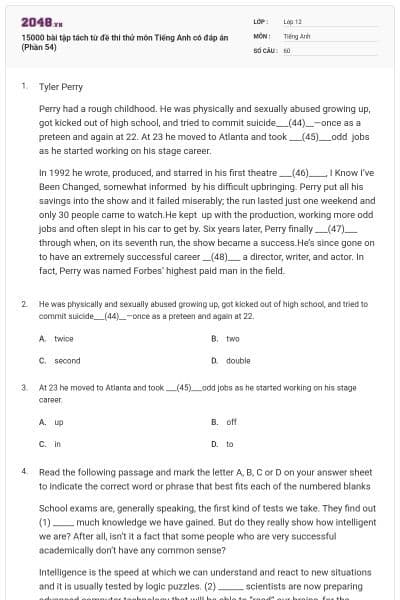
Tyler Perry
Perry had a rough childhood. He was physically and sexually abused growing up, got kicked out of high school, and tried to commit suicide___(44)__—once as a preteen and again at 22. At 23 he moved to Atlanta and took ___(45)___odd jobs as he started working on his stage career.
In 1992 he wrote, produced, and starred in his first theatre ___(46)____, I Know I’ve Been Changed, somewhat informed by his difficult upbringing. Perry put all his savings into the show and it failed miserably; the run lasted just one weekend and only 30 people came to watch.He kept up with the production, working more odd jobs and often slept in his car to get by. Six years later, Perry finally ___(47)___ through when, on its seventh run, the show became a success.He’s since gone on to have an extremely successful career __(48)___ a director, writer, and actor. In fact, Perry was named Forbes’ highest paid man in the field.
twice
two
second
double
A
A. hai lần B. hai C. thứ hai D. gấp đôi
Perry had a rough childhood. He was physically and sexually abused growing up, got kicked out of high school, and tried to commit suicide______once as a preteen and again at 22 .
Perry có thời thơ ấu khó khăn. Ông ấy bị chế giễu về phát triển thể hình và giới tính, bị đuổi học và cố gắng tự tử 2 lần, 1 lần trước tuổi 13 và một lần lúc 22 tuổi
At 23 he moved to Atlanta and took ___(45)___odd jobs as he started working on his stage career.
up
off
in
to
A
Take up: bắt đầu ( công việc/ sở thích)
producer
productivity
production
productive
: C
A. Producer: nhà sản xuất B. Productivity: năng suất
C. Production: việc sản xuất D. Productive: năng suất cao
Dịch: In 1992 he wrote, produced, and starred in his first theatre _______, à Năm 1992 ông ấy viết, sản xuất và nổi tiếng với tác phẩm sản xuất phim đầu tiên
went
broke
got
put
B
A. Go through: đi xuyên qua
B. Break through: đột phá
C. Go through: hiểu rõ
D. Put through: tiếp tục ( hoàn thành công việc)
Dịch: Six years later, Perry finally ______ through when, on its seventh run, the show became a success. à 6 năm sau đó, Perry cuối cùng đã có bước đột phá khi trong lần sản xuất thứ 7, màn trình diễn đã thành công.
same
as
like
as soon as
B
A. Same: giống như B. As: như là
C. Like: giống D. As soon as: ngay khi
Dịch: He’s since gone on to have an extremely successful career _____ a director, writer, and actor. à Kể từ đó sự nghiệp của ông thành công như là 1 đạo diễn, nhà văn và diễn viên.
Read the following passage and mark the letter A, B, C or D on your answer sheet to indicate the correct word or phrase that best fits each of the numbered blanks
School exams are, generally speaking, the first kind of tests we take. They find out (1) _____ much knowledge we have gained. But do they really show how intelligent we are? After all, isn’t it a fact that some people who are very successful academically don’t have any common sense?
Intelligence is the speed at which we can understand and react to new situations and it is usually tested by logic puzzles. (2) ______ scientists are now preparing advanced computer technology that will be able to “read” our brains, for the present tests are still the most popular ways of measuring intelligence.
A person’s IQ is his intelligence (3) ____ it is measured by a special test. The most common IQ tests are run by Mensa, an organization that was founded in England in 1946. By 1976 it had 1,300 members in Britain. Today there are 44,000 in Britain and 100,000 worldwide, (4) ____ in the US.
People taking the tests are judged in relation to an average score of 100, and those (5) _____ score over 148 are entitled to join Mensa. This works out at 2% of the population.
what
how
which
why
Đáp án B
How much: chừng nào, bao nhiêu
(2) ______ scientists are now preparing advanced computer technology that will be able to “read” our brains, for the present tests are still the most popular ways of measuring intelligence.
Although
Until
Despite
Because
Đáp án A
Although: Mặc dù, tuy
Phân tích qua, ta thấy Until không dùng với mệnh đề ở thì hiện tại tiếp diễn, Despite đứng trước danh từ nên loại B, C. Dựa vào nghĩa câu ta thử Although và Because.
- Vì các nhà khoa học đang tiến đến công nghệ tiên tiến đọc được não người, nên hiện tại các bài kiểm tra vẫn rất phổ biến… (không phù hợp)
- Tuy các nhà khoa học đang tiến đến công nghệ tiên tiến đọc được não người, nhưng hiện tại các bài kiếm tra vẫn còn rất phổ biến… (phù hợp)
how
as
that
so
Đáp án B
Thử các đáp án và chọn được đáp án phù hợp theo nghĩa. Ở đây, câu văn có ý: IQ của một người là độ thông minh của người đó khi được đánh giá bởi một bài kiểm tra đặc biệt.
Vậy dùng từ as với nghĩa là: khi, theo phương pháp, bằng cách nào đó.
Today there are 44,000 in Britain and 100,000 worldwide, (4) ____ in the US.
enormously
highly
considerably
mainly
Đáp án C
Considerbaly (adv): đáng kể, phần lớn
Các đáp án còn lại:
A. enormously (adv): to lớn, vô cùng
B. highly (adv): hết sức, ở mức độ cao
D. mainly (adv): chính, chủ yếu
which
whom
why
who
Đáp án D
Kiến thức mệnh đề quan hệ.
Which – thay thế cho danh từ chỉ vật
Whom – thay thế cho danh từ chỉ người, làm tân ngữ trong câu
Why – đại từ quan hệ chỉ lý do
Who – thay thế cho danh từ chỉ người, làm chủ ngữ trong câu
Đại từ quan hệ trong câu chỉ những người đạt IQ 148, là chủ ngữ nên ta dùng who.
The Internet has truly transformed how students do their homework. (1) ____homework today still means spending time in the library, it’s for a different reason. Rather than using books for research, students today are (2) ______to the Internet to download enormous amounts of data available online. In the past, students were limited to their school’s (3) _________ of books. In many cases, they got to the school library and found out that someone had already taken the books they needed. Nowadays, such inconvenience can be avoided since the Internet never runs out of information. Students, however, do have to (4)_____sure that the information they find online is true. Teachers have also benefited from the homework which is done on the Internet. They do not need to carry students’ papers around with them any more. This is because online (5)______allow students to electronically upload their homework for their teachers to read and mark. Of course, this also means that students can no longer use the excuse that the dog ate their homework!
For
But
While
Because
Đáp án A
“ while” thể hiện sự tương phản giữa 2 mệnh đề trong câu.
Các đáp án còn lại:
A. For = D. because: bởi vì
B. But: Nhưng.
Dịch: Interner đã thay đổi thực sự cách thức học sinh làm bài tập về nhà. Trong khi việc làm bài tập ngày nay vẫn có nghĩa là dành thời gian ở thư viện.
connecting
looking
searching
linking
Đáp án
connect to the Internet: kết nối với mạng Internet.
Các đáp án còn lại:
B. looking: trông, nhìn
C. searching (+for): tìm kiếm.
D. linking (between A and B): kết nối ( A với B).
Dịch: Thay vì dùng sách để tìm kiếm thông tin thì những học sinh ngày nay lại lên mạng để tải về những tài liệu trực tuyến đã có sẵn
select
selection
selective
selectively
Đáp án B
a selection of books: sự lựa chọn sách.
Sau sở hữu cách ta cần 1 danh từ.
Dịch: Trong quá khứ, học sinh bị giới hạn trong việc lựa chọn sách trên trường.
do
make
get
come
Đáp án B
make sure: đảm bảo.
Dịch: Mặc dù vậy thì học sinh vẫn phải đảm bảo rằng thông tin họ tìm thấy là đúng sự thật.
systems
materials
sources
structures
Đáp án A
online system: hệ thống trực tuyến.
Các đáp án còn lại:
B. materials: chất liệu.
C. sources: nguồn.
D. structures: cấu trúc.
We can communicate not only through words (31) ______ through body language. Body language includes our posture, facial expressions, and gestures. Because body language is so important, you’ll want (32) ______ what yours is saying and how to interpret other people’s, too. Here are some examples of body language and its meaning. If your posture is slumped and your head is down, this could mean that you are sad or you lack (33) ________. If your posture is straight but relaxed, you are expressing confidence and friendliness. A smile is a sign of friendliness and interest. But people sometimes smile just to be polite. Friendliness and interest are expressed when a person’s eyes meet yours and then look away and meet yours again. A person (34) _______ doesn’t look away is expressing a challenge. Hand gestures can mean a person is (35) _____ in the conversation.
but also
and also
but so
and so
Đáp án: A
Giải thích:
Cấu trúc: not only… but also…: không những… mà còn
Dịch: Chúng ta có thể giao tiếp không chỉ bằng lời nói mà còn bằng ngôn ngữ cơ thể.
know
knowing
to knowing
to know
Đáp án D
(to) want + to V-inf: muốn làm gì
confidence
confide
confiding
confident
Đáp án A
Sau động từ lack ta cần một danh từ. Chỉ có confidence thoả mãn.
whom
who
whose
which
Đáp án B
Kiến thức mệnh đề quan hệ
A. whom – thay thế cho danh từ chỉ người, đóng vai trò là tân ngữ
B. who – thay thế cho danh từ chỉ người, đóng vai trò là chủ ngữ
C. whose – thay thế cho đại từ sở hữu
D. which – thay thế cho danh từ chỉ vật
Ở đây ta cần đại từ quan hệ thay thế cho chủ ngữ A person, chỉ người nên dùng who.
Hand gestures can mean a person is (35) _____ in the conversation.
interest
interested
interestingly
interesting
Đáp án B
(to) be interested in: thích thú với điều gì
BRINGING THE LEARNING OUTDOORS
Kindergarten is a fun place (1)________ young children learn. In some special kindergartens, children learn outside most of the day!
Some kindergartens are (2)________ the forest. In these "forest kindergartens," children play freely. They're outside in all kinds of weather. At forest kindergartens, children learn by climbing trees and picking fruit. They also learn about and (3)________ animals. For example, they collect chicken eggs and feed baby mice.
Little Flower Kindergarten is in Dong Nai, Vietnam. At this school, children learn about farming. They also learn that it is important (4)________ healthy food. They grow vegetables in gardens - on the roof! They eat the vegetables they grow in their lunches.
At Fuji Kindergarten in Tokyo, Japan, trees grow inside the building! The classroom windows and sliding doors (5)________ open to the outside most of the year. The roof is a big, wooden circle. Children love to play and run on it.
(Source: Discoveries magazine April 2016)
Kindergarten is a fun place (1)________ young children learn. In some special kindergartens, children learn outside most of the day!
why
when
where
which
Đáp án C
Where là trạng từ quan hệ chỉ nơi trốn.
Why là trạng từ quan hệ chỉ lí do, đứng sau tiền ngữ the reason.
When là trạng từ quan hệ chỉ thời gian.
Which là đại từ quan hệ thay thế cho danh từ chỉ vật.
Ở đây ta dùng where chứ không dùng which vì trong mệnh đề quan hệ không có giới từ.
Dịch nghĩa: Mẫu giáo là một nơi thú vị mà ở đó trẻ nhỏ học được nhiều điều.
at
in
on
by
Đáp án B
Câu hỏi giới từ.
in the forest: trong rừng
Dịch nghĩa: Một số trường mầm non nằm trong rừng.
They also learn about and (3)________ animals. For example, they collect chicken eggs and feed baby mice.
take care of
take over
take on
take after
Đáp án A
(to) take care of: chăm sóc
Các đáp án còn lại:
B. (to) take over: chiếm quyền
C. (to) take on: chiến đấu với
D. (to) take after: giống
Dịch nghĩa: Chúng cũng được tìm hiểu và chăm sóc các loại động vật.
to eat
eating
eat
eaten
Đáp án A
It + be + important + to V: quan trọng để làm gì
Dịch nghĩa: Tại trường học này, trẻ em học về nông nghiệp. Chúng cũng biết rằng ăn thực phẩm lành mạnh là điều quan trọng.
make
stay
do
be
Đáp án B
Câu hỏi từ vựng.
(to) stay open: luôn mở cửa
Các đáp án còn lại:
A. (to) make: làm cho
C. (to) do: làm
D. (to) be: thì, là, ở => Ở đây không thể dùng be vì ngay sau chủ ngữ ta dùng động từ to be cụ thể như is/are.
Dịch nghĩa: Các cửa sổ lớp học và cửa trượt đều luôn mở ra bên ngoài hầu như cả năm
Everyone needs a home where they feel sheltered and safe. Today we live in modern flats and houses, (1) ___________ have air-conditioning to keep us cool, and heating to keep us warm. There is electricity for lighting and supplies of gas or oil for the heating. Hot and cold water (2) ___________ from the taps and dirty water disappears (3) ___________ the drains. Many of our homes have balconies or gardens. In the past, people made their homes from materials that they found nearby. When we look at different houses we can tell how old they are from the materials used and the way they were built. It was different long (4) ___________ people did not have water in their homes and there were no electric lights. To keep warm, they sometimes made (5) ___________ inside their homes. With a fire started they could cook their food and heat water
where
which
whose
who
Đáp án B
Which- Đại từ quan hệ chỉ vật, đóng chức năng vừa làm chủ ngữ, vừa làm tân ngữ.
“which” ở đây thay thế cho “modern flats and houses”
Các đáp án còn lại.
A. where- ĐTQH chỉ nơi chốn.
C. whose- ĐTQH chỉ sự sở hữu, đi cùng với danh từ.
D. who- ĐTQH chỉ người, đóng chức năng làm chủ ngữ.
Dịch: Ngày nay, hầu hết chúng ta đều đang sống trong những căn nhà hiện đại, có điều hòa để làm mát và máy sưởi để làm ấm khi cần
floats
find
flies
flows
Đáp án D
flow from (v): chảy từ, bắt nguồn từ.
Các đáp án còn lại:
A. floats (v): nổi.
B.find (v): tìm ra.
C. flies (v): bay.
Dịch: Nước nóng và lạnh chảy từ các ống dẫn bẩn thỉu nay đã mãi biến mất
up
toward
down
on
Đáp án C
down the drains (thành ngữ): đổ sông đổ biển, biến mất mãi mãi.
Dịch: Nước nóng và lạnh chảy từ các ống dẫn bẩn thỉu nay đã mãi biến mất.
ago
then
back
time
Đáp án A
long ago: rất lâu về trước, thời xa xưa.
Dịch: Ngày xưa, con người không có sẵn nước trong sinh hoạt, không có cả đèn điện
flames
food
furnaces
fires
Đáp án D
make fire= đốt lửa
Các đáp án còn lại:
A. flames (n+v): ngọn lửa,cháy bùng lên. (Không đi với “make”)
B. food (n): thức ăn.
C. furnaces (n): lò sưởi.
Dịch: Để sưởi ấm, họ đã phải đốt lửa ngay bên trong ngôi nhà.
Parents and teachers are always making (1) ________ between the time when they were children and the present generation . They say everything was better than it is today, especially in education. (2) ________ , they say they used to work much harder in school, and that nowadays, we aren’t very interested. I disagree, because we spend hours every day doing homework after our lessons or (3) ________ for exammination. I wonder (4) ________ our parents really had to study so much after school every day. In my opinion, it is no exaggeration to say we have forgotten how to play. I think one reason why kids (5) ________ in class is because they need to get rid of stress.
comparison
comparative
compare
comparatively
Đáp án A
Ở vị trí này ta cần một danh từ => Chọn đáp án A. comparison (n): sự so sánh
(to) make comparison: so sánh
Các đáp án còn lại:
B. comparative (adj): chỉ sự so sánh
C. compare (v): so sánh
D. comparatively (adv): tương đối
Dịch nghĩa: Cha mẹ và giáo viên luôn so sánh giữa thời họ còn là những đứa trẻ với thế hệ hiện tại.
As a result
Therefore
For example
Nevertheless
Đáp án C
Câu hỏi từ vựng
For example: ví dụ
Các đáp án còn lại:
A. As a result: kết quả là
B. Therefore: vì vậy
D. Nevertheless: Tuy nhiên
Dịch nghĩa: Họ nói rằng mọi thứ đều tốt hơn hiện nay, đặc biệt là trong giáo dục. Ví dụ, họ nói rằng họ thường học hành chăm chỉ hơn ở trường học, và hiện nay, chúng tôi không hề quan tâm đến việc đó.
relearning
revising
resitting
redoing
Đáp án B
Câu hỏi từ vựng
(to) revise: ôn tập
Các đáp án còn lại:
A. (to) relearn: học lại
C. (to) resist: kháng cự
D. (to) redo: làm lại
Dịch nghĩa: Tôi không đồng ý, bởi vì chúng tôi dành hàng giờ mỗi ngày làm bài tập về nhà sau những bài học của chúng tôi hoặc ôn tập cho những bài kiểm tra.
why
if
that
what
Đáp án B
wonder if: băn khoăn liệu
Dịch nghĩa: Tôi băn khoăn biết liệu bố mẹ chúng ta có thực sự phải học nhiều sau giờ học không.
I think one reason why kids (5) ________ in class is because they need to get rid of stress.
misunderstand
misdirect
miscarry
misbehave
Đáp án D
(to) misbehave: hành động không đúng
Câu hỏi từ vựng
A. (to) misunderstand: hiểu lầm
B. (to) misdirect: nhầm lẫn
C. (to) miscarry: sai lầm
Dịch nghĩa: Tôi nghĩ rằng một trong những lý do tại sao trẻ em hành động không đúng trong lớp học là bởi vì chúng cần phải thoát khỏi những căng thẳng.
Vietnamese generally shake hands when greeting and parting. Using both hands shows respect as does a (1) _______ bow of the head. In rural areas, elderly people who do not extend their hand are greeted with a slight bow. Women are more likely to bow the head than to shake hands. Vietnamese names begin with the family name and are (2) _______ by a given name. People address one another by their given names, but add a title that indicates their perceived relationship to the other person. These titles are family related rather than professional. Among colleagues, for example, the younger of the two might combine the given name with the title of “Anh” (Older Brother). A/n (3) _______ greeting combined with the given name and title is “Xin chao” (Hello). Classifiers for gender and familiarity are also combined with the greeting. In formal meetings, business cards are sometimes exchanged on greeting.
Vietnamese have a strong (4) _______ of hospitality and feel embarrassed if they cannot show their guests full respect by preparing for their arrival. Therefore, it is (5) _______ to visit someone without having been invited. Gifts are not required, but are appreciated. Flowers, incense, or tea may be appropriate gifts for the hosts. Hosts also appreciate a small gift for their children or elderly parents
light
slight
lightly
lighted
Đáp án B
Cần tính từ nên loại B, xét nghĩa các từ còn lại:
A. light (adj): nhẹ (về trọng lượng)
B. slight (adj): nhẹ nhàng (chỉ tần suất, mức độ)
D. lighted (adj): cháy
Chỉ có B hợp nghĩa.
continued
chased
followed
forwarded
Đáp án C
(to) be followed by: được theo sau bởi
Các đáp án còn lại không hợp nghĩa:
A. tiếp tục
B. đuổi theo
D. chuyển tiếp
easy
basic
fundamental
elementary
Đáp án B
A basic greeting: câu chào cơ bản
Các đáp án còn lại không hợp nghĩa:
A. dễ dàng
C. thiết yếu
D. sơ cấp
sense
sensitivity
sensation
sensibility
Đáp án A
(to) have a sense of something: khả năng, cảm giác về điều gì đó
inactive
inaccurate
inappropriate
inexact
Đáp án C
A. bị động
B. không đúng hoàn toàn
C. không phù hợp
D. không chính xác
Dựa trên nghĩa lựa chọn, chỉ có C phù hợp.
Any change in one part of an ecosystem can cause changes in other parts. Droughts, storms and fires can change ecosystems. Some changes ____46___ ecosystems. If there is too little rainfall, plants will not have enough water to live. If a kind of plant dies off, the animals____47___feed on it may also die or move away. Some changes are good for ecosystems. Some pine forests need fires for the pine trees to reproduce. The seeds are sealed inside pinecones. Heat from a forest fire melts the seal and lets the seeds ____48___. Polluting the air, soil, and water can harm ecosystems. Building dams on rivers for electric power and irrigation can harm ecosystems ____49___ the rivers. Bulldozing wetlands and cutting down forests destroy ecosystems. Ecologists are working with companies and governments to find better ways of ___50____ fish, cutting down trees, and building dams. They are looking for ways to get food, lumber, and other products for people without causing harm to ecosystems.
A harms
harmful
harmless
harm
Đáp án D
Chỗ cần điền thiếu một động từ làm vị ngữ cho câu, chủ ngữ là “some changes” – số nhiều nên động từ ta để nguyên mẫu.
Harm (v, n) gây hại, mối nguy hại
Harmful (adj) có hại
Harmless (adj) vô hại
A who
where
that
when
Đáp án C
Đại từ quan hệ thay thế cho danh từ “the animals” nên ta dùng that.
Who dùng cho người.
Where dùng cho nơi chốn.
When dùng cho thời gian.
That dùng được cho cả người, động vật, sự việc, nơi chốn và thời gian; tuy nhiên, không dùng trong mệnh đề không xác định (mệnh đề có dấu phẩy
A out
in
go
fly
Đáp án A
Let something out: cho cái gì rơi ra, tung ra.
Câu trước có nói seeds ở trong pinecore, nên khi bị đốt cháy thì seeds sẽ rơi ra ngoài và mọc thành cây.
A on
around
over
under
Đáp án B
Harm something: gây hại đến cái gì
Ở đây ta dùng around để khi khu vực xung quanh dòng sông bị ảnh hưởng, tránh nhầm lẫn với cụm động từ.
A catching
holding
carrying
taking
Đáp án A
Catch fish: đánh bắt cá
Children (37) _____ this and other Finnish public schools are given not only basic subject instruction in math, language and science, but learning-through-play-based preschools and kindergartens, training in second languages, arts, crafts, music, physical education, ethics, and, amazingly, as many as four outdoor free-play breaks per day, each (38) _______ 15 minutes between classes, no matter how cold or wet the weather is. Educators and parents here believe that these breaks are a powerful engine of learning that improves almost all the “metrics” that (39) _______ most for children in school – executive function, concentration and cognitive focus, behavior, well-being, attendance, physical health, and yes, test scores, too.
The homework load for children in Finland varies by teacher, but is lighter overall than most other developed countries. This insight is supported by research, (40) ______ has found little academic benefit in childhood for any (41) _______ than brief sessions of homework until around high school.
for
at
on
in
Đáp án B
At school: ở trường
Trên thực tế, dùng in hay at school đều được.
At school được dùng khi chủ thể đang ở ngay tại trường.
In school mang nghĩa rộng hơn, có nghĩa là đang theo học tại trường, không cần có mặt ở đó ngay tại thời điểm nói.
spending
taking
lasting
continuing
Đáp án C
(to) last (v): kéo dài (khoảng thời gian)
Các đáp án còn lại:
A. (to) spend (v): dành ra (bao nhiêu thời gian)
B. (to) take (v): chiếm, tốn (bao nhiêu thời gian)
D. (to) continue (v): tiếp tục
Giờ nghỉ kéo dài 15 phút.
mean
relate
matter
happen
Đáp án C
(to) matter (v): tác động đến, có ý nghĩa quan trọng
(to) matter for someone: quan trọng với ai
Các đáp án còn lại:
A. (to) mean: có ý nghĩa (đi với giới từ to)
B. (to) relate: liên quan đến
D. (to) happen: xảy ra
what
who
that
which
Đáp án D
Which – thay thế cho vật hoặc đại diện cho cả vế câu, ở đây nó thay thế cho research
Các đáp án còn lại:
A. what – cái gì, nói đến sự vật sự việc chưa được nhắc đến trước đó
B. who – đại diện cho chủ ngữ là người
C. that – đại diện cho chủ ngữ chỉ người, vật, đặc biệt trong mệnh đề quan hệ xác định.
(41) _______ than brief sessions of homework until around high school.
more
sooner
other
rather
Đáp án A
Anymore than: không hơn gì, cũng như
Các đáp án còn lại:
B. sooner than: sớm hơn
C. other than: ngoài
D. rather than: hơn là
Bạn có thích hoạt động này không?