15000 bài tập tách từ đề thi thử môn Tiếng Anh có đáp án (Phần 13)
58 câu hỏi
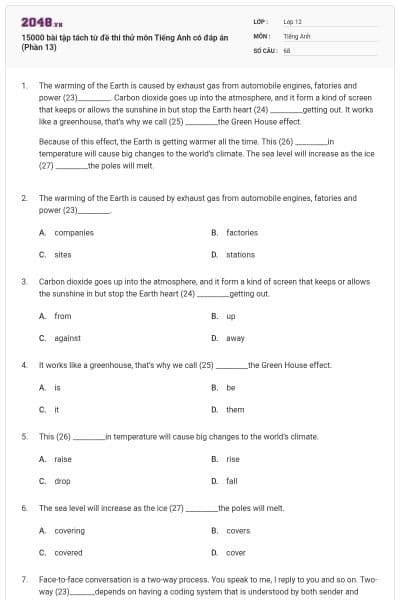
The warming of the Earth is caused by exhaust gas from automobile engines, fatories and power (23)_________. Carbon dioxide goes up into the atmosphere, and it form a kind of screen that keeps or allows the sunshine in but stop the Earth heart (24) _________getting out. It works like a greenhouse, that’s why we call (25) _________the Green House effect.
Because of this effect, the Earth is getting warmer all the time. This (26) _________in temperature will cause big changes to the world’s climate. The sea level will increase as the ice (27) _________the poles will melt.
companies
factories
sites
stations
Đáp án D
Company: công ty
Factory: nhà máy
Site: trang web
Station: trạm
from
up
against
away
Đáp án A
Stop sth from doing sth: ngăn ai làm việc gì
It works like a greenhouse, that’s why we call (25) _________the Green House effect.
is
be
it
them
Đáp án C
Call sth sth: gọi cái gì là cái gì
raise
rise
drop
fall
Đáp án B
Raise: nâng lên
Rise: tăng lên
Drop: rơi
Fall: ngã xuống
The sea level will increase as the ice (27) _________the poles will melt.
covering
covers
covered
cover
Đáp án A
Câu mẹnh đề rút gọn dạng chủ động
Face-to-face conversation is a two-way process. You speak to me, I reply to you and so on. Two-way (23)_______depends on having a coding system that is understood by both sender and (24)_______, and an agreed convention about signaling the beginning and end of the message. In speech, the coding system is the language like English or Spanish; the convention that one person speaks at a time may seem too obvious to mention. In fact, the signals (25)_______ in conversation and meetings are often (26)_______. For example, lowering the pitch of the voice may mean the end of a sentence, a sharp intake of breath may signal the desire to interrupt, catching the chairman’s eye may indicate the desire to speak in a formal setting like a debate, a clenched fist may indicate anger. When (27)_______ visual signals are not possible, more formal signals may be needed.
Exchange
Interchange
Communication
Correspondence
Đáp án C
A. Trao đổi
B. Trao đổi
C. Truyền thông
D. Tương ứng
Announcer
Receiver
Messenger
Transmitter
Đáp án B
A. Phát thanh viên
B. Người nhận
C. Người chuyển thư
D. Người truyền tin
That people use
Are used
Using
Being used
Đáp án A
Informal
non-verbal
verbal
formal
Đáp án B
A. thân thiện
B. không lời
C. bằng miệng
D. trang trọng
When (27)_______ visual signals are not possible, more formal signals may be needed.
their
These
This
That
Đáp án B
LETTER TO THE EDITOR
The Prime Minister's comments yesterday on education spending miss the point, as the secondary education system also needs a major overhaul. Firstly, the system only views the weakest learners as having special needs. The brightest and most conscientious students are not encouraged to develop to their full (23)_____.
Secondly, there's too much testing and not enough learning. My fifteen-year-old daughter, for example, has just spent the last month or so (24)_____ for exams. These aren't even real, important exams, as her GCSEs will be next year. They're just mock exams. Is the work she's been doing really going to make her more knowledgeable about her subjects, or will she forget it all tomorrow? I suspect the (25)_____. Thirdly, the standard (26)_____ doesn't give students any tuition in developing practical work-related, living and social skills, or in skills necessary for higher education. How many students entering university have the first idea what the difference is between plagiarising someone else's work and (27)_____ good use of someone else's ideas? Shouldn't they have been taught this at school? How many of them are really able to go about selfstudy skill that's essential at university because there are no teachers to tell you what to do - in an efficient way? Indeed, hoe many students graduate from university totally unable to spell even simple English words correctly? The system is letting our children down.
The brightest and most conscientious students are not encouraged to develop to their full (23)_____.
plan
fame
potential
achievement
Đáp án C
A. kế hoạch
B. danh tiếng
C. tiềm năng
D. thành tích
reading
lecturing
cheating
cramming
Đáp án D
A. đọc
B. giảng dạy
C. gian lận
D. nhồi nhét
latter
frontier
later
latest
Đáp án A
timetable
curriculum
lecture
seminar
Đáp án B
A. thời khóa biểu
B. chương trình giảng dạy
C. bài giảng
D. hội thảo
having
taking
making
creating
Đáp án C
Back in the 1960s and 1970s, the world was becoming more aware of the destructive effects of industry (23)__________the environment and people were starting to think seriously about ways of protecting the environment. One man who was particularly affected by this subject was Gerard Morgan-Grenville. As Morgan-Grenville travelled round earning his living as a gardener, he noticed signs of the damage that was being done to the countryside around him. It wasn't long before Morgan-Grenville decided that he had to do something about this situation. He felt that if people could be shown a better way of living then maybe they would be interested enough to try to protect their (24)__________environment.
Mr. Morgan-Grenville decided to set up a project (25)__________would prove what was happening to our surroundings and what could be done about it. So, in 1975, Morgan-Grenville created the Centre for Alternative Technology (CAT) in a village in Wales.
The main aim of CAT is to search for an ecologically better way of living by using technology which (26)__________no harm to the environment. One of the most important things CAT did initially was to explore and demonstrate a wide range of techniques and to point out which ones had the least destructive results on the world around us. (27) __________CAT provides information and advice to people all over Britain and all over the world. If more and more individuals are informed about how much damage our modern lifestyle is causing to the planet, maybe more of them would be prepared to look for practical solutions to environmental problems.
for
to
with
on
Đáp án D
He felt that if people could be shown a better way of living then maybe they would be interested enough to try to protect their (24)__________environment.
worthless
valueless
precious
priceless
Đáp án C
A. vô giá trị
B. không có giá trị
C. quý giá
D. vô giá
that
he
it
this
Đáp án A
gets
makes
plays
does
Đáp án D
Therefore
However
Moreover
Although
Đáp án C
A. Do đó
B. Tuy nhiên
C. Hơn nữa
D. Mặc dù
As teenagers approach university level, a decision has to be made on what course to pursue. In this world of diversity, (23) ________ such a choice is not easy for both children and parents. In the old days, it was not much a problem to do the task because there were not so many diverse learning areas to choose from.
Besides, there were only a few distinctive professional careers like doctor, engineer, accountant, nurse, teacher, etc. to think about. Most higher learning usually led to a financially successful life. (24) ________, the cost of education was not so high.
Today’s world is entirely different from the things (25) ________ have just been described. The job market is constantly changing due to innovative technology and new (26) ________. Meanwhile, most teenagers have difficulty in identifying their own interests. There are a variety of well-organized career talks and studentcounseling workshops to guide and help teenagers (27) ________ what course to take. Furthermore, psychological tests are also used. Certain instruments such as surveys, interviews and computer software can help to find out preferences, interests, or learning styles of the students.
making
taking
giving
having
Đáp án A
Make a choice: đưa ra sự lựa chọn
(24) ________, the cost of education was not so high.
In addition
Otherwise
For example
Therefore
Đáp án A
A. Ngoài ra
B. Nếu không
C. Ví dụ
D. Do đó
when
that
what
where
Đáp án B
competition
competitively
competitive
compete
Đáp án A
apply
study
decide
Employ
Đáp án C
A. áp dụng
B. học
C. quyết định
D. thuê
WILLIAM THE HERO!
Brave William Baldock, who is six years old, is a hero after helping his mother when she fell downstairs. William quickly rang for an ambulance when he discovered his mother had broken her leg. In spite of being frightened, he (23) ________ the emergency services what had happened and answered all the questions they asked him. He also telephoned his father at work, and then his grandmother, to explain what he had (24) _________. While waiting for these people to come, William looked after his 18-month-old sister. When ambulance man Steve Lyn went to the house, he was amazed. 'It's great that a young boy of six knew the right number to dial, and was able to give us the correct information. (25) ________ of William's quick thinking, we were able to (26) ________ there immediately." Mrs. Baldock left hospital yesterday, very (27) ________ to both William and the ambulance service.
spoke
told
talk
called
Đáp án B
acted
done
worked
made
Đáp án B
Since
In spite
Because
Instead
Đáp án C
manage
get
reach
find
Đáp án B
Mrs. Baldock left hospital yesterday, very (27) ________ to both William and the ambulance service.
greatful
happy
agreeable
Approving
My first job was a sales assistant at a large department store. I wanted to work part-time, because I was still studying at university and I was only able to work a few nights a week.
I came across the advertisement in the local newspaper. I remember the interview as though it were yesterday. The (23) ______ manager sat behind a large desk. He asked me various questions which surprised me because all I wanted was to work in sales. An hours later, I was told that I had got the job and was given a contract to go over. I was to be trained for ten days before I took my post. Also, as a member of staff, I was (24) ______ to some benefits, including discounts.
When I eventually started, I was responsible (25) ______ the toy section. I really enjoyed it there and I loved demonstrating the different toys. I was surprised at how friendly my colleagues were, too. They made working there fun even when we had to deal with customers (26) ______ got on our nerves. (27) ______, working there was a great experience which I will never forget.
personal
personable
personage
personnel
: Đáp án D
, I was (24) ______ to some benefits, including discounts.
catered
given
entitled
supplied
Đáp án C
for
with
in
to
Đáp án A
which
why
when
who
Đáp án D
(27) ______, working there was a great experience which I will never forget.
In contrast
However
Moreover
On the whole
Đáp án D
Successful students often do the followings while studying. First, they have an overview before reading. Next, they look for important information and pay greater attention to it (which often needs jumping forward or backward to process information). They also relate important points to one another. Also, they activate and use their prior knowledge. When they realize that their understanding is not good, they do not wait to change strategies. Last, they can monitor understanding and take action to correct or “fix up” mistakes in comprehension.
Conversely, students with low academic achievement often demonstrate ineffective study skills. They tend to assume a passive role, in learning and rely on others (e.g., teachers, parents) to monitor their studying, for example, low-achieving students often do not monitor their understanding of content; they may not be aware of the purpose of studying; and they show little evidence of looking back, or employing “fix-up” strategies to fix understanding problems. Students who struggle with learning new information seem to be unaware that they must extent effort beyond simply reading the content to understand and remember it. Children with learning disabilities do not plan and judge the quality of their studying. Their studying may be disorganized. Students with learning problems face challenges with personal organization as well. They often have difficulty keeping track of materials and assignments, following directions, and completing work on time. Unlike good studiers who employ a variety of study skills in a flexible yet purposeful manner, low-achieving students use a restricted range of study skills. They cannot explain why good study strategies are important for learning; and they tend to use the same, often ineffective study approach for all learning tasks, ignoring task content, structure or difficulty.
(Source: Adapted from Study Skills: Managing Your Learning — NUI Galway)
What is the topic of the passage?
Successful and low-academic achieving students
Successful learners and their learning strategies
Study skills for high school students
Effective and ineffective ways of learning
Đáp án D
Chủ đề của đoạn văn là gì?
Học sinh giỏi và học sinh kém
Những người học giỏi và các chiến lược học tập của họ
Kỹ năng học tập dành cho học sinh trung học
Cách học hiệu quả và không hiệu quả
=> đáp án : Effective and ineffective ways of learning
The word “prior” in the first paragraph is closest meaning to ______?
important
earlier
forward
good
Đáp án B
Từ "prior" ở đoạn đầu tiên có ý nghĩa gần nhất với ______?
quan trọng trước đó chuyển tiếp tốt
=> prior = earlier: trước đó
According to the passage, what can be learnt about passive students?
They depend on other people to organize their learning
They are slow in their studying
They monitor their understanding
They know the purpose of studying
Đáp án A
Theo đoạn văn, điều gì có thể rút ra về những học sinh thụ động?
Họ phụ thuộc vào người khác để tổ chức học tập
Họ chậm trong việc học tập
Họ theo dõi hiểu biết của mình
Họ biết mục tiêu học tập
=> đáp án : They depend on other people to organize their learning
Thông tin: They tend to assume a passive role, in learning and rely on others (e.g., teachers, parents) to monitor their studying
Which of the followings is NOT an evidence of monitoring studying?
Being aware of the purpose of studying
Monitoring their understanding of content
Fixing up mistakes in understanding
Looking at their backs
Đáp án D
Điều sau đây KHÔNG phải là bằng chứng của việc theo dõi học tập?
Nhận thức được mục đích học tập
Theo dõi sự hiểu biết của họ về bài học
Xử lý sai lầm trong hiểu biết
Nhìn vào lưng của họ
=> đáp án : Looking at their backs
According to the passage, to learn new information, low-achieving students do NOT______.
just understand it
relate it to what they have known
simply remember it
read it
Đáp án B
Theo đoạn văn, để tìm hiểu thông tin mới, học sinh kém KHÔNG______.
chỉ hiểu nó
liên hệ nó với những gì họ đã biết
chỉ đơn giản là nhớ nó
đọc nó
=> đáp án : relate it to what they have known
Thông tin: Students who struggle with learning new information seem to be unaware that they must extent effort beyond simply reading the content to understand and remember it.
In compared with low-achieving students, successful students use______.
aimless study techniques
various study skills
restricted strategies
inflexible study ways
Đáp án B
So với các học sinh kém, học sinh giỏi sử dụng ____.
các phương pháp học tập vô nghĩa
các kỹ năng học tập khác nhau
các chiến lược hạn chế
cách học tập không linh hoạt
=> đáp án : various study skills
The underlined pronoun “They” in the last sentence refers to______.
study strategies
study skills
low-achieving students
good studiers
Đáp án C
Đại từ được gạch dưới "They" trong câu cuối cùng đề cập đến ____.
các chiến lược học tập
kỹ năng học tập
học sinh kém
người học giỏi
=> đáp án : low-achieving students
“they” được thay cho “low-achieving students”
Pollution emitted in industrial areas represents a threat to human health and the surrounding natural resources. We have a tendency to believe that the production processes are the only source of environmental damage, and often forget about the possible long-term effects of harmful production practices. We may think that the closure of these huge industrial areas would improve the quality of the environment. Unfortunately, this ignores the threat of the remaining waste, which is abandoned and poorly stored. It represents an even bigger danger because it stands neglected as it degrades and leaks into the earth without any control at all.
Changes in the water chemistry due to surface water contamination can affect all levels of an ecosystem. It can affect the health of lower food chain organisms and, consequently, the availability of food up through the food chain. It can damage the health of wetlands and damage their ability to support healthy ecosystems, control flooding, and filter pollutants from storm water runoff. The health of animals and humans are affected when they drink or bathe in contaminated water. In addition water-based organisms, like fish and shellfish, can pile up and concentrate contaminants in their bodies. When other animals or humans eat these organisms, they receive a much higher dose of contaminant than they would have if they had been directly exposed to the original contamination.
Contaminated groundwater can badly affect animals, plants and humans if it is removed from the ground by manmade or natural processes. Depending on the study of rocks of the area, groundwater may rise to the surface through springs or seeps, flow sideways into nearby rivers, streams, or ponds, or sink deeper into the earth. In many parts of fhe world, groundwater is pumped out of the ground to be used for drinking, bathing, other household uses, agriculture, and industry.
Contaminants in the soil can harm plants when they take up the contamination through their roots. Eating, breathing in, or touching contaminated soil, as well as eating plants or animals that have piled up soil contaminants can badly affect the health of humans and animals.
Air pollution can cause breathing-related problems and other bad health effects as contaminants are absorbed from the lungs into other parts of the body. Certain air contaminants can also harm animals and humans when they contact the skin. Plants rely on breathing for their growth and can also be affected by exposure to contaminants moved in the air.
(Source: Adapted from http://www.grid.unep.ch/waste/download/waste1213.pdf)
What is the topic of the passage?
Sources of environmental damage
The pollution from the city
Bad effects of industrial waste
The quality of the environment
Đáp án C
Chủ đề của đoạn văn là gì?
Các nguồn gây tổn hại môi trường
Sự ô nhiễm từ thành phố
Ảnh hưởng xấu của chất thải công nghiệp
Chất lượng môi trường
=> đáp án : Bad effects of industrial waste
According to the passage, the industry is likely to be thought as______.
a danger to the environment
the only source of pollution
the utmost harmful activity
a threat to human health
Đáp án B
Theo đoạn văn, ngành công nghiệp có thể sẽ được nghĩ là ______.
một mối nguy hiểm cho môi trường
nguồn ô nhiễm duy nhất
hoạt động gây hại tối đa
một mối đe dọa đối với sức khoẻ con người
=> đáp án : the only source of pollution
Thông tin: We have a tendency to believe that the production processes are the only source of environmental damage
The word “it” in the first paragraph refers to______.
the remaining waste
a danger
the environment
the threat of the remaining waste
Đáp án A
Từ "nó" trong đoạn đầu đề cập đến ____.
chất thải hiện có nguy hiểm môi trường sự đe dọa của chất thải hiện có
=> đáp án the remaining waste
Which of the followings affect an ecosystem as the whole?
Surface water contamination
Soil contamination
Groundwater contamination
Air contamination
Đáp án A
vấn đề nào sau đây ảnh hưởng đến toàn bộ hệ sinh thái?
Ô nhiễm nước bề mặt
Sự ô nhiễm đất
Ô nhiễm nước ngầm
Ô nhiễm không khí
=> đáp án Surface water contamination
Thông tin: Changes in the water chemistry due to surface water contamination can affect all levels of an ecosystem.
According to the passage, which of the followings supports healthy ecosystems?
Lower food chain organisms
Animals
Water-based organisms
Wetlands
Đáp án D
Theo đoạn văn, cái gì hỗ trợ hệ sinh thái lành mạnh?
Các sinh vật chuỗi dưới thức ăn
Động vật
Sinh vật sống dưới nước
Đất ngập nước
=> đáp án Wetlands
Thông tin: It can damage the health of wetlands and damage their ability to support healthy ecosystems, control flooding, and filter pollutants from storm water runoff.
Which of the followings is NOT badly affected by contaminated groundwater?
Human
Plants
Rocks
Animals
Đáp án C
Cái gì không bị ảnh hưởng xấu bởi nước ngầm bị ô nhiễm?
con người cây cối hòn đá động vật
=> đáp án Rocks
Which of the followings is the flow of water from the ground to the surface?
Streams
Ponds
Rivers
Springs
Đáp án D
Cái nào là dòng chảy của nước từ mặt đất đến bề mặt?
dòng ao sông suối
=> đáp án Springs
Thông tin: Depending on the study of rocks of the area, groundwater may rise to the surface through springs or seeps, flow sideways into nearby rivers, streams, or ponds, or sink deeper into the earth.
Which of the followings has the closest meaning to the word “absorbed” in the last paragraph?
Consumed
Taken in
Swallowed
Piled up
Đáp án B
Câu nào sau đây có ý nghĩa gần nhất với từ "hấp thụ" ở đoạn cuối?
tiêu thụ hấp thu vào nuốt chất đống
=> đáp án Taken in
There are a number of natural disasters that can strike across the globe. Two that are frequently linked to one another are earthquakes and tsunamis. Both of them can cause a great amount of devastation when they hit. However, tsunamis are the direct result of earthquakes and cannot happen without them.
The Earth has three main parts. They are the crust, the mantle, and the core. The crust is the outer layer of the Earth. It is not a single piece of land. Instead, it is comprised of a number of plates. There are a few enormous plates and many smaller ones. These plates essentially rest upon the mantle, which is fluid. As a result, the plates are in constant - yet slow - motion. The plates may move away from or towards other plates. In some cases, they collide violently with the plates adjoining them. The movement of the plates causes tension in the rock. Over a long time, this tension may build up. When it is released, an earthquake happens.
Tens of thousands of earthquakes happen every year. The vast majority are so small that only scientific instruments can perceive them. Others are powerful enough that people can feel them, yet they cause little harm or damage. More powerful earthquakes, however, can cause buildings, bridges, and other structures to collapse. They may additionally injure and skill thousands of people and might even cause the land to change it appearance.
Since most of the Earth's surface is water, numerous earthquakes happen beneath the planet's oceans. Underwater earthquakes cause the seafloor to move. This results in the displacement of water in the ocean. When this occurs, a tsunami may form. This is a wave that forms on the surface and moves in all directions from the place where the earthquake happened. A tsunami moves extremely quickly and can travel thousands of kilometres. As it approaches land, the water near the coast gets sucked out to sea. This causes the tsunamis to increase in height. Minutes later, the tsunami arrives. A large tsunami - one more than ten meters in height - can travel far inland. As it does that, it can flood the land, destroy human settlements, and kill large numbers of people.
Which of the following statements does paragraph 1 support?
Earthquakes cause more destruction than tsunamis.
A tsunami happens in tandem with an earthquake.
The most severe type of natural disaster is an earthquake.
Earthquakes frequently take place after tsunamis do.
Đáp án B
Đoạn văn 1 ủng hộ ý nào sau đây?
A. Động đất gây ra nhiều thiệt hại hơn sóng thần.
B. Sóng thần xảy ra song song với động đất.
C. Loại hình thiên tai tàn khốc nhất là động đất.
D. Động đất thường xảy ra sau sóng thần.
Dẫn chứng: However, tsunamis are the direct result of earthquakes and cannot happen without them.
Dịch bài đọc
Có một số thảm họa thiên nhiên có thể xảy ra trên toàn cầu. Hai thảm họa thường liên quan đến nhau là động đất và sóng thần. Cả hai đều có thể gây ra sự tàn phá lớn khi chúng xảy ra. Tuy nhiên, sóng thần là kết quả trực tiếp của động đất và không thể xảy ra nếu không có chúng.
Trái đất có ba phần chính. Đó là lớp vỏ, lớp manti và lõi. Lớp vỏ là lớp ngoài cùng của Trái đất. Nó không phải là một mảnh đất duy nhất. Thay vào đó, nó bao gồm một số mảng. Có một số mảng rất lớn và nhiều mảng nhỏ hơn. Về cơ bản, các mảng này nằm trên lớp manti, là chất lỏng. Do đó, các mảng liên tục chuyển động chậm. Các mảng có thể di chuyển ra xa hoặc về phía các mảng khác. Trong một số trường hợp, chúng va chạm mạnh với các mảng tiếp giáp với chúng. Chuyển động của các mảng gây ra sức căng trong đá. Theo thời gian, sức căng này có thể tích tụ. Khi nó được giải phóng, một trận động đất sẽ xảy ra.
Hàng chục nghìn trận động đất xảy ra mỗi năm. Phần lớn các trận động đất rất nhỏ đến mức chỉ có các thiết bị khoa học mới có thể cảm nhận được. Những trận động đất khác đủ mạnh để con người có thể cảm nhận được, nhưng chúng gây ra ít tác hại hoặc thiệt hại. Tuy nhiên, những trận động đất mạnh hơn có thể khiến các tòa nhà, cầu và các công trình khác sụp đổ. Chúng cũng có thể làm bị thương và gây thương tích cho hàng nghìn người và thậm chí có thể khiến đất đai thay đổi diện mạo.
Vì hầu hết bề mặt Trái đất là nước nên nhiều trận động đất xảy ra bên dưới các đại dương của hành tinh. Động đất dưới nước khiến đáy biển chuyển động. Điều này dẫn đến sự dịch chuyển của nước trong đại dương. Khi điều này xảy ra, một cơn sóng thần có thể hình thành. Đây là một cơn sóng hình thành trên bề mặt và di chuyển theo mọi hướng từ nơi xảy ra động đất. Một cơn sóng thần di chuyển cực kỳ nhanh và có thể di chuyển hàng nghìn km. Khi nó tiến gần đến đất liền, nước gần bờ biển bị hút ra biển. Điều này khiến sóng thần tăng chiều cao. Vài phút sau, sóng thần ập đến. Một cơn sóng thần lớn - cao hơn mười mét - có thể di chuyển sâu vào đất liền. Khi đó, nó có thể gây ngập lụt đất liền, phá hủy các khu định cư của con người và giết chết rất nhiều người.
The word "it" in bold in paragraph 2 refers to___________
the Earth
the core
the crust
the mantle
Đáp án C
Từ “it” ở đoạn 2 ám chỉ đến......
A. Trái Đất B. hạt nhân C. vỏ Trái Đất D. vỏ ngoài
Dẫn chứng: The crust is the outer layer of the Earth. It is not a single piece of land. Instead, it is comprised of a number of plates.
“it” là “the crust”
What is the passage mainly about?
How earthquakes and tsunamis occur.
What kind of damage natural disasters can cause.
Why tsunamis are deadlier than earthquakes.
When earthquakes are the most likely to happen.
Đáp án A
Bài đọc chủ yếu nói về?
A. Động đất và sóng thần xảy ra như thế nào?
B. Khi nào động đất có kahr năng xảy ra nhất?
C. Các thiên tai có thể gây ra những thiệt hại nào?
D. Tại sao sóng thần gây nguy hiểm chết người hơn động đất?
Dẫn chứng: Two that are frequently linked to one another are earthquakes and tsunamis. Both of them can cause a great amount of devastation when they hit.
The word "adjoining" in bold in paragraph 2 is closest in meaning to___________.
bordering
residing
approaching
appearing
Đáp án A
Từ “adjoining” ( tiếp giáp) được in đậm ở đoạn 2 gần nghĩa nhất với....
A. giáp biên giới B. cư trú C. tiếp cận D. xuất hiện
The word "perceive" in bold in paragraph 3 is closest in meaning to___________.
comprehend
detect
prevent
locate
Đáp án B
Từ “perceive” ( nhận thức) được in đậm ở đoạn 3 gần nghĩa nhất với.....
A. thấu hiểu B. tìm ra/ phát hiện ra C. ngăn cản D. đặt / để/ có vị trí
Which of the following is true regarding the crust?
There many separate pieces that make it up.
It is the smallest of the Earth's three layers.
It is thicker on land than it is under the water.
The mantle beneath it keeps it from moving too much.
Đáp án A
Câu nào sau đây là đúng theo như bài đọc?
A. Có nhiều mảng riêng biệt tạo nên nó.
B. Nó là tầng nhỏ nhất trong 3 tầng của Trái Đất.
C. Vỏ Trái Đất trên đất dày hơn khi ở dưới nước.
D. Lớp vỏ bên dưới nó giữ cho nó không di chuyển quá nhiều.
Dẫn chứng: Instead, it is comprised of a number of plates. There are a few enormous plates and many smaller ones.
Based on the passage, what is probably true about tsunamis?
They kill more people each year than earthquakes.
They are able to move as fast as the speed of sound.
They cannot damage ships sailing on the ocean.
They can be deadly to people standing near shore.
Đáp án D
Theo bài đọc câu nào đúng khi nói về sóng thần?
A. Mỗi năm nó giết chết nhiều người hơn động đất.
B. Nó có thể di chuyển với tốc độ nhanh như âm thanh.
C. Nó có thể phá những con tàu đang lênh đênh trên đại dương.
D. Nó có thể gây chết người khi họ đứng gần bờ biển.
Dẫn chứng: As it does that, it can flood the land, destroy human settlements, and kill large numbers of people.
Which of the following is NOT mentioned in paragraph 3 about earthquakes?
How many people they typically kill
How often powerful ones take place
What kind of damage they can cause
How severe the majority of them are
Đáp án C
Ý nào sau đây không được đề cập ở đoạn 3 khi nói về động đất?
A. Hầu hết chúng tàn khốc như thế nào.
B. Chúng có thể gây ra loại thiệt hại nào.
C. Chúng thường diễn ra mạnh như thế nào.
D. Chúng gây thiệt hại bao nhiêu người.
Dẫn chứng: More powerful earthquakes, however, can cause buildings, bridges, and other structures to collapse. They may additionally injure and skill thousands of people and might even cause the land to change it appearance.
=> Không đề cập đến cách một trận động đất diễn ra.
Bạn có thích hoạt động này không?