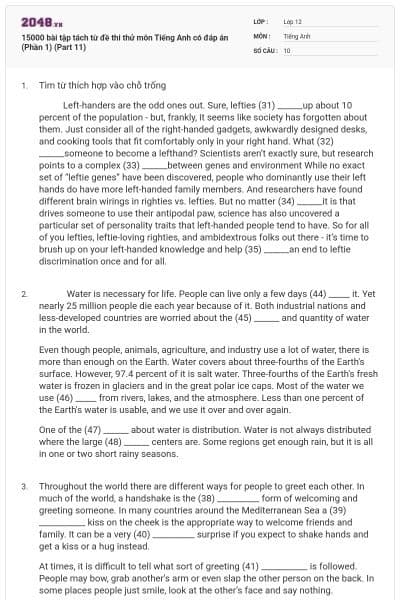
15000 bài tập tách từ đề thi thử môn Tiếng Anh có đáp án (Phần 1) (Part 11)
500 câu hỏi
It was _______ an interesting speech that everyone stayed till the end.
too
very
such
so
Đáp án C
C. such
Cấu trúc: …so … that…., …such…that…
During the flood, army helicopters came and tried to evacuate _______ injured.
an
a
the
Ø
Đáp án C
C. the
The + adj để trở thành danh từ số nhiều
My mother always tells me _______ .
not to leaves your shoes on the carpet
don’t leave my shoes on the carpet
not leave my shoes on the carpet
not to leave my shoes on the carpet
Đáp án D
Cấu trúc: tell sb not to do something: bảo ai không được làm gì
Dịch nghĩa: Mẹ tôi luôn bảo tôi không được để giày ở trên thảm.
The people who _______ the survey said that they had examined over 1,000 accidents.
proceed
gave
set
conducted
Đáp án D
A. proceed: tiếp tục
B. gave: cho
C. set: đặt ra
D. conducted: tiến hành
Dịch nghĩa: Những người mà đã tiến hành cuộc khảo sát nói rằng họ đã khảo sát trên 1000 vụ tai nạn.
If you had taken my advice, you _______ _______ in such difficulties now.
wouldn't be
hadn't been
won't be
wouldn't have been
Đáp án A
Câu điều kiện hỗn hợp: If S + had + P.P, S + would + V : diễn tả giả thiết trái ngược với quá khứ, nhưng kết quả thì trái ngược với hiện tại.
Dịch nghĩa: Nếu bạn nghe theo lời khuyên của tôi thì bây giờ bạn đã không ở trong tình trạng khó khăn
I think your mother should let you _______ your own mind.
to make up
make up
making up
made up
Đáp án B
let + V-inf : để cho làm gì
Dịch nghĩa: Tôi nghĩ mẹ bạn nên để bạn tự quyết định.
She is looking _______ a new place to live because she does not want to depend on her parents anymore.
up
at
for
after
Đáp án C
A. look up: tra từ trong từ điển
B. look at: nhìn vào
C. look for: tìm kiếm
D. look after: chăm sóc
Dịch nghĩa: Cô ấy đang tìm kiếm một nơi mới để ở vì cô ấy không muốn dựa dẫm vào cha mẹ thêm nữa.
Ask her to come and see me as soon as she _______ her work.
finished
finish
has finished
finishing
Đáp án C
as soon as: ngay sau khi
Chúng ta cũng sử dụng as soon as để diễn tả 1 hành động mà sẽ được thực hiện ngay tức thì sau 1 hành động khác trong tương lai.
Dịch nghĩa: Nói cô ấy đến và gặp tôi ngay sau khi cô ấy vừa hoàn thành công việc.
You are old enough to take _______ for what you have done.
irresponsible
responsible
responsibility
responsibly
Đáp án C
take responsibility for : chịu trách nhiệm cho
A. irresponsible (adj): vô trách nhiệm
B. responsible (adj): có trách nhiệm
C. responsibility (n): trách nhiệm
D. responsibly (adv): có trách nhiệm
Dịch nghĩa: bạn đã đủ tuổi để chịu trách nhiệm cho nhưng gì bạn đã làm
He asked his sister _______ .
where she would go the following day
where she will go tomorrow
where would she go the next day
where will she go the next day
Đáp án A
Câu tường thuật dạng Wh-questions : S+ asked + Wh-words + S + V. => Loại C và D
Khi chuyển từ câu trực tiếp sang câu tường thuật phải lùi một thì nên Đáp án B bị loại.
Dịch nghĩa: Anh ấy hỏi chị của mình rằng chị ấy sẽ đi đâu vào ngày kế tiếp.
Families in the Western world _______ very much in the last 100 years.
has changed
have changed
changed
had changed
Đáp án B
Thì hiện tại hoàn thành dùng để diễn tả hành động bắt đầu ở quá khứ và đang tiếp tục ở hiện tại.
Thì quá khứ đơn dùng để diễn tả hành động diễn ra trong quá khứ và đã kết thúc ở quá khứ.
Thì quá khứ hoàn thành dùng để diễn tả một hành động xảy ra trước một hành động khác và cả hai hành động này đều đã xảy ra trong quá khứ.
Dịch nghĩa: Gia đình ở phương Tây đã thay đổi rất nhiều trong 100 năm qua.
By the end of this year, my father _______ in this company for 12 years.
has been working
will have been working
will work
has worked
Đáp án B
Thì tương lại hoàn thành tiếp diễn (Future Perfect Continuous) diễn tả một hành động đã đang xảy ra cho tới 1 thời điểm trong tương lai
By the end of this year (tính đến thời điểm) là dấu hiệu nhận biết của thì tương lai hoàn thành tiếp diến.
Dịch nghĩa: Tính cho đến cuối năm nay, bố tôi đã làm việc trong công ty này 12 năm.
Many young people have objected to _______ marriage, which is decided by the parents of the bride and groom.
sacrificed
contractual
agreed
shared
Đáp án B
A. sacrificed (adj): hi sinh B. contractual (adj): hợp đồng
C. agreed (adj): đồng ý D. shared (adj): chia sẻ
Dịch nghĩa: Nhiều thanh thiếu niên đã phản đối hôn nhân hợp đồng, điều mà được quyết định bởi bố mẹ của cô dâu và chú rể
_______ large number of teachers agree that daily homework is necessary for students.
An
0
The
A
Đáp án D
A large number of + N (plural)
The large number of + N (singular)
Dịch nghĩa: Một số lượng lớn các giáo viên đồng ý rằng bài tập về nhà hàng ngày là cần thiết cho học sinh.
Children who are isolated and lonely seem to have poor language and _______
communicate
communication
communicative
communicato
Đáp án B
Trước "and" là danh từ "language" nên ở đây ta cần điền một danh từ
A. communicate (V): giao tiếp
B. communication (n): sự giao tiếp
C. communicative (adj): dễ lan truyền
D. communicator (n): người truyền tin
Dịch nghĩa: Trẻ em bị cô lập và cô đơn dường như có ngôn ngữ và truyền thông kém
He managed to win the race _______ hurting his foot before the race.
in spite of
despite of
although
because of
Đáp án A
in spite of + V.ing/ N: mặc dù
although + S + V: mặc dù
because of + V.ing/ N: bời vì
Dịch: Ông đã giành chiến thắng trong cuộc đua mặc dù bị thương ở chân trước cuộc đua.
Only when you become a real parent _______ the real responsibility.
will you understand
you will understand
you can understand
you understand
Đáp án A
Cấu trúc đảo ngữ: Only when + S + V, aux + S + V
Dịch: Chỉ khi bạn trở thành người cha người mẹ thực sự, bạn mới hiếu được trách nhiệm thực sự.
Mrs. Pike was so angry that she made a gesture at the driver.
rude
rudeness
rudely
rudest
Đáp án A
Trước danh từ ta điền tính từ
rude (adj): thô lỗ
rudeness (n): sự thô lỗ
rudely (adv): một cách thô lỗ
rudest: thô lỗ nhất
Dịch: Cô Pike đã quá tức giận đến mức cô ấy đã có những cử chỉ thô lỗ với tài xế.
By the end of the 21st century, scientists _______ a cure for the common cold.
will find
will have found
will be finding
will have been finding
Đáp án B
By the end of + mốc thời gian ở tương lai, S + will + have + P2
Dịch: Vào cuối thế kỷ 21, các nhà khoa học sẽ tìm ra phương pháp chữa bệnh cảm thông thường.
Why are you still here? You _______ been helping Dianne in the yard.
must have
would have
Might have
should have
Đáp án D
must have P2: chắc chắn đã làm gì
might have P2: có thể đã làm gì
should have P2: đáng lẽ ra nên làm gì
Dịch: Tại sao bạn vẫn ở đây? Đáng lẽ ra bạn nên đang giúp Dianne ở ngoài sân.
More than ten victims _______ missing in the severe storm last week.
are reported to be
are reported to have been
are reporting to have been
are reporting to be
Đáp án B
Cấu trúc bị động câu trần thuật
S + tobe + P2 + to V.inf/ to have P2
Vì động từ "are reported" được chia ở thì hiện tại, mà ở cuối câu có trạng từ "last night" (mốc thời gian trong quá khứ) nên ta dùng "to have P2"
Dịch: Hơn 10 nạn nhân được báo cáo đã mất tích trong cơn bão dữ dội vào tuần trước.
The greater the demand, _______ the price.
the highest
the high
higher
the higher
Đáp án D
Công thức so sánh kép:
The + tính từ so sánh hơn + S + V, the + tính từ so sánh hơn + S +V
Dịch: Cầu càng nhiều, giá càng cao
A.lot of different conservation efforts have been made to _______ endangered species
save
kills
make
do
Đáp án A
save: bảo vệ
kill: giết
make: tạo ra
do: làm
Dịch: Rất nhiều nỗ lực bảo tồn khác nhau đã được thực hiện để bảo vệ các loài nguy cấp.
This woman has _______ her whole life to helping others.
spent
dedicated
used
contributed
Đáp án B
tobe dedicated to V.ing: cống hiến
spend + time/ money + V.ing: tốn bao nhiều thời gian/ tiền bạc làm gì
use st to do st: dùng cái gì để làm gì
contribute to: đóng góp vào
Dịch: Người phụ nữ này đã cống hiến cả cuộc đời mình để giúp đỡ những người khác.
He asked me _______.
since when I’m waiting
how long I have been waiting
how long I had been waiting
since when I waited
Đáp án C
Khi chuyển từ câu trực tiếp sang câu gián tiếp ta phải lùi thì động từ
A, D sai vì không thể có hai trạng từ "since, when" đứng cạnh nhau
B sai vì không lùi thì động từ
Dịch: Anh ta đã hỏi tôi rằng tôi chờ được bao lâu rồi.
_______ ten minutes earlier, you would have got a better seat.
Had you arrived
If you arrived
Were you arrived
If you hadn’t arrived
Đáp án A
Vì vế sau động từ chia "would have P2" nên ta dùng câu điều kiện loại 3: If + S + had P2, S + would have P2
Đảo ngữ của câu điều kiện loại 3: Had + S + P2, S + would have P2
Dịch: Nếu bạn đến sớm hơn 10 phút, bạn đã có chỗ ngồi tốt hơn.
Tom looks so frightened and upset. He _________ something terrible.
must experience
can have experienced
should have experienced
must have experienced
Đáp án: D
Giải thích:
must have + VpII: chắc hẳn là đã → Chỉ sự suy đoán logic dựa trên những hiện tượng có thật ở quá khứ.
Đáp án A sai vì must để chỉ sự bắt buộc.
Đáp án C sai vì should have + VpII: lẽ ra phải, lẽ ra nên → Chỉ một việc lẽ ra đã phải xảy ra trong quá khứ nhưng vì lý do nào đó lại không xảy ra.
Can have + VpII: Có lẽ đã dùng để diễn đạt một khả năng có thể ở quá khứ song người nói không dám chắc.
Dựa vào nghĩa câu, chọn D.
Dịch: Tom trông rất sợ hãi và buồn bã. Cậu ấy chắc hẳn là đã trải qua việc gì kinh khủng lắm.
The job requires certain _________ . You have to be good at operating computers and dealing with people.
qualificatons
knowledge
techniques
skills
Đáp án D
Câu hỏi từ vựng.
A. qualification (n): năng lực
B. knowledge (n): kiến thức
C. technique (n): kỹ thuật
D. skill (n): kĩ năng
Dịch nghĩa: Công việc đòi hỏi một số kỹ năng nhất định. Bạn phải làm giỏi trong việc làm việc với máy tính và giao tiếp với mọi người.
Hana and Jenifer are talking about a book they have just read.
- Hana: “The book is really interesting and educational.”
- Jenifer: “_________ .
I’d love it
That’s nice of you to say so
I couldn’t agree with you more
Don’t mention it
Đáp án C
Dịch nghĩa: Hana và Jenifer đang nói chuyện về cuốn sách mà họ vừa đọc. - Hana: “Cuốn sách đó thực sự thú vị và có tính giáo dục.”
- Jenifer: “Tôi không thể đồng ý với bạn hơn được nữa.”
I couldn’t agree with you more là cách nói khi bạn hoàn tòan đồng ý với ý kiến, quan điểm nào đó.
Các đáp án còn lại:
A. I’d love it: Tôi rất thích nó => Dùng khi đồng ý với một lời mời nào đó.
B. That’s nice of you to say so: Bạn thật tốt khi nói vậy => Dùng để cảm ơn khi được khen.
D. Don’t mention it: Không có gì => Dùng để đáp lại một lời cảm ơn
Excuse me. Where is the _________ office of UNICEF Vietnam located?”
leading
head
summit
central
Đáp án B
head office: trụ sở chính
Dịch nghĩa: “Xin lỗi. Cho tôi hỏi trụ sở chính của UNICEF Việt Nam nằm ở đâu?”
He really deserved the award because he performed _________ what was expected of him.
much better which
the most that
much more as
much better than
Đáp án D
Cấu trúc so sánh hơn của trạng từ: S1 + adv-er + than + S2
Đáp án A và B sai vì ngay sau vị trí cần điền đã có what nên không thể có which và that nữa.
Đáp án C sai vì more không thể đi cùng với as.
Dịch nghĩa: Anh ấy thực sự xứng đáng với giải thưởng này bởi vì anh ấy thể hiện tốt hơn những gì được mong đợi.
If you _________ less last night, you _________ so bad today.
had drunk - would not have felt
drank - would not felt
had drunk - would not feel
Don’t mention it
Đáp án: C
Giải thích:
Kiến thức: Câu điều kiện
Ta thấy mệnh đề điều kiện có thời gian trong quá khứ (last night), mệnh đề kết quả có thời gian ở hiện tại (today), vậy đây là câu điều kiện hỗn hợp 3-2, diễn tả điều kiện không có thật trong quá khứ, kết quả không có thật ở hiện tại.
Cấu trúc câu điều kiện hỗn hợp 3-2:
If + S + had VpII, S + would V
Dịch: Nếu tối qua bạn uống ít thôi thì bạn không cảm thấy tệ như bây giờ.
After his illness, Robert had to work hard to _________ his classmates
catch sight of
keep pace with
get in touch with
make allowance for
Đáp án B
(to) keep pace with: theo kịp
Các đáp án còn lại:
A. (to) catch sight of: nhìn thấy
C. (to) get in touch with: bắt liên lạc với
D. (to) make allowance for: chiếu cố đến
Dịch nghĩa: Sau trận ốm của mình, Robert phải học hành chăm chỉ để theo kịp các bạn.
Do you know the woman who is wearing the _________ ?
gold watch very old valuable
very valuable old gold watch
old gold watch very valuable
very old gold valuable watch
Đáp án B
Danh từ phải đứng sau tính từ => Đáp án A và C sai.
Trật tự của tính từ: Opinion – Size – Age – Shape – Color – Origin – Material – Purpose
valuable => Opinion
old => Age
gold => Material
Dịch nghĩa: Bạn có biết người phụ nữ mà đang đeo chiếc đồng hồ rất cổ xưa bằng vàng quý giá kia không?
The accident is believed _________ 2 years ago.
to be investigated
to have investigted
to investigate
to have been investigated
Đáp án D
Cấu trúc bị động kép: It is + believed/ thought/ supposed...+ that + clause
- Nếu động từ trong clause ở thì hiện tại, cấu trúc trên bằng: S + am/is/are + thought/ said/supposed... + to + Vinf
- Nếu động từ trong clause ở thì quá khứ, cấu trúc trên bằng: S + am/is/are + thought/ said/ supposed... + to + have + V(P.P)
Vì vụ tai nạn xảy ra trong quá khứ nên ta dùng cấu trúc S + am/is/are + thought/ said/ supposed... + to + have + V(P.P) và câu này phải được chia ở thể bị động. => Chọn đáp án D
Dịch nghĩa: Vụ tai nạn được cho là đã được điều tra cách đây 2 năm.
_________ our children may be, we can not go picnic in this weather
Though excited
Excited as
Because of excitement
Exciting
Đáp án B
Cấu trúc Adj + as/though + S + V, clause: dù.... đến thế nào
Đáp án A sai vì though phải đứng sau excited.
Đáp án C sai vì hai vế này có mối quan hệ tương phản nên không thể dùng Because of.
Đáp án D sai vì không thể dùng exciting trước our children.
Dịch nghĩa: Dù những đứa trẻ hào hứng như thế nào đi chăng nữa, chúng ta vẫn không thể đi dã ngoại trong thời tiết như thế này.
_________ our children may be, we can not go picnic in this weather
had
have
has
to have
Đáp án B
Bàng thái cách thường được dùng để nhấn mạnh tầm quan trọng hay sự khẩn cấp phải làm một việc gì đó. Cấu trúc bằng thái cách khi muốn nhấn mạnh câu với một thành ngữ:
It is important/ necessary that + S + V-inf
Dịch nghĩa: Thật sự cần thiết cho mọi học sinh phải học tiếng Anh ở đại học.
We went away on holiday last week , but it rained _________ .
every other day
every single day
every two days
every second day
Đáp án B
every single day: mỗi ngày
Các đáp án còn lại:
A. every other day: cách ngày một
C. every two days: 2 ngày 1 lần
D. every second day: mỗi ngày thứ hai
Dịch nghĩa: Chúng tôi đã đi nghỉ vào tuần trước, nhưng trời lại mưa mỗi ngày.
I felt over when I was riding and my sister had to _________ a doctor.
call on
bring
take
fetch
Đáp án C
(to) fetch: tìm về
Các đáp án còn lại:
A. (to) call on: ghé thăm
B. (to) bring: mang
C. (to) take: lấy
Dịch nghĩa: Tôi bị ngã khi đang đi xe đạp và chị tôi phải đi tìm một bác sĩ đến cho tôi.
Long lost his job _________ no fault of his own.
through
by
it
over
Đáp án A
through no fault of one's own: không phải lỗi của ai
Dịch nghĩa: Long bị mất việc không phải do lỗi của anh ấy.
_________ that she stormed out of the house.
Such was angry girl
So angry was she
She was angry so
Her anger was so
Đáp án B
Cấu trúc đảo ngữ is So...that và Such...that:
- So + adjective + be + N +that + clause
- Such + be + adj + N + that + clause
Đáp án A sai vì girl là danh từ đếm được số ít nên phải có an trước angry.
Đáp án C sai vì so phải đứng trước angry.
Đáp án D sai vì thiếu tính từ.
Dịch nghĩa: Cô ấy tức giận đến nỗi cô ấy phải lao ra khỏi nhà
_________ over long distances is a fact that everyone knows.
That electricity transmitting
That electricity can be transmitted
That electricity
That can be transmitted
Đáp án B
Cấu trúc mệnh đề danh từ - mệnh đề phụ có chức năng như 1 danh từ làm chủ ngữ trong câu:
Where/ when/ why/ what/ that…+ clause + V
Đáp án A sai vì mệnh đề sau that thiếu to be và transmit phải ở dạng bị động transmitted.
Đáp án C sai vì mệnh đề sau that thiếu vị ngữ.
Đáp án D sai vì mệnh đề sau that thiếu chủ ngữ.
Dịch nghĩa: Điện đó có thể truyền qua những khoảng cách xa là một sự thực mà mọi người đều biết.
Last year, ABBA made a ____ of seberal million crowns.
win
gain
salary
profit
Đáp án D
Kiến thức: Từ vựng
Giải thích:
win (n): sự chiến thắng gain (n): sự đạt được
salary (n): lương profit (n): lợi nhuận
Tạm dịch: Năm ngoái, bang nhạc ABBA đạt lợi nhuận vài triệu
If you like asking, there's a ski ____ under an hour's driving from Madrid.
resort
station
place
port
Đáp án A
Kiến thức: Từ vựng
Giải thích:
resort (n): khu nghỉ dưỡng station (n): trạm, nhà ga
place (n): nơi chốn port (n): cảng
Cụm từ ski resort: khu trượt tuyết
Tạm dịch: Nếu bạn thích trượt tuyết, có một khu trượt tuyết lái xe khoảng 1 giờ đồng hồ đi từ Marid.
He's very ____ about his private life. He's goy no secrets.
trustworthy
direct
open
sincere
Đáp án C
Kiến thức: Từ vựng
Giải thích:
trustworthy (a): đáng tin cậy direct (a): trực tiếp
open (a): cởi mở, thẳng thắn sinsere (a): chân thành
Tạm dịch: Anh ấy rất cởi mở về đời sống riêng tư. Anh ấy không có bí mật.
Even though they don't agree with what's happening, they're too ____ to protest.
apathetic
subdued
quiet
outgoing
Đáp án A
Kiến thức: Từ vựng
Giải thích:
apathetic (a): hờ hửng, lãnh đạm subdued (a): bị chinh phục
quiet (a): yên tĩnh, trầm lặng outgoing (a): dễ gần, thân thiện
Tạm dịch: Mặc dù họ không đồng tình với việc đang xảy ra, nhưng họ quá hờ hửng để phản đối lại.
Though I didn't want my son to leave home since he was twenty-one, there was nothing I could do to ____ it.
hinder
resist
prevent
cease
Đáp án C
Kiến thức: Từ vựng
Giải thích:
hinder (v): cản trở resist (v): kháng cự
prevent (v): ngăn cản cease (v): ngừng
Tạm dịch: Mặc dù tôi không muốn con trai mình rời khỏi nhà năm 21 tuổi, nhưng tôi không thể làm gì để ngăn cản nó.
She noticed ____ away from the house.
him to run
him running
his running
him run
Đáp án B
Kiến thức: Dạng của động từ
Giải thích: Cấu trúc với các động từ chỉ giác quan, nhận thức
S + notice/ see/ hear/ feel/ touch/... + O + Vo: chứng kiến hành động xảy ra từ đầu đến cuối
S + notice/ see/ hear/ feel/ touch/... + O + V-ing: bất chợt bắt gặp hành động đang xảy ra
Tạm dịch: Cô ấy thấy anh ấy đang chạy ra khỏi nhà.
George has ____; he loves cakes, chocolate, ice- cream- anything which is sweet.
a sweet mouth
sweet lips
a sweet tooth
a sweet tongue
Đáp án A
Kiến thức: Thành ngữ
Giải thích: Thành ngữ “a sweet tooth” ( người thích ăn đồ ăn ngọt bánh kẹo)
Tạm dịch: George là người thích ăn ngọt; anh ấy thích bánh, sô-cô-la, kem - bất cứ cái gì ngọt.
She's so ____; you really have to watch you say or she'll walk out of the room.
high and dry
prim and proper
rough and ready
sick and tired
Đáp án B
Kiến thức: Thành ngữ
Giải thích:
high and dry = in a difficult situation, without help or money: trong tình huống khó khăn
prim and proper = always behaving in a careful and formal way, and easily shocked by anything that is rude: kỹ
lưỡng (quá mức), có chút bảo thủ
rough and ready = simple and prepared quickly but good enough for a particular situation: đơn giản và nhanh
chóng nhưng vẫn đảm bảo chất lượng
sick and tired: vô cùng mệt mỏi
Tạm dịch: Cô ấy quá là kỹ tính; bạn thật sự phải cân nhắc điều bạn nói nếu không cô ấy sẽ bước ra khỏi phòng.
You've all ____ the point. The film itself is not racist – it simply tries to make us question our own often racist attitude.
mistaken
misunderstood
missed
lost
Đáp án C
Kiến thức: Sự kết hợp từ “collocations”
Giải thích: Cụm từ “miss the point” = don‟t understand
Tạm dịch: Bạn hoàn toàn hiểu sai rồi. Bộ phim không phải mang tính phân biệt chủng tộc – nó đơn giản cố gắng làm cho chúng ta tự hỏi mình rằng chúng ta có thường có thái độ phân biệt chủng tộc không.
____ one or more units of living substance called protoplasm.
Although all living things that consist of
All living things consisting of
All living things consist of
In all living things consisting of
Đáp án A
Kiến thức: Cấu trúc câu cơ bản
Giải thích: Câu cơ bản có đầy đủ thành phần chủ ngữ (S) và động từ chính (V)
Câu đã có thành phần tân ngữ là “one or more units of living substance” và “called protoplasm” là mệnh đề quan hệ rút gọn bổ trợ nghĩa cho “living substance”
=> Cần chọn đáp án có S và V
Tạm dịch: Tất cả những vật sống bao gồm một hay nhiều đơn vị tế bào sống cái mà được gọi là nguyên sinh vật.
The production of tin ore in the United States is relatively insignificant, ____ less than one hundred tons annually.
amount to
in the amount
amount to it
to the amount of
Đáp án D
Kiến thức: Cụm từ “collocations”
Giải thích: Cụm từ amount of sth ( một số lượng/ một lượng cái gì đó)
Tạm dịch: Sản lượng quặng thiếc ở Mỹ hầu như không nhiều, hằng năm sản lượng ít hơn 100 tấn .
It all happened so quickly, one minute I was making chips and the next the whole kitchen was ____ fire!
at
on
by
in
Đáp án B
Kiến thức: Sự kết hợp từ collocations
Giải thích: Cụm từ “on fire” (đang nướng)
Tạm dịch: Tất cả đều xảy ra quá nhanh, một phút tôi làm món khoai tây chiên và tiếp theo toàn bộ con gà đã được nướng.
The architects have made _______ use of glass and transparent plastic.
imaginative
imagine
imagination
imaginatively
Đáp án A
Kiến thức: từ vựng, từ loại
Giải thích:
imaginative (adj): sáng tạo imagine (v): tưởng tượng
imagination (n): trí tưởng tượng imaginatively (adv): sáng tạo
Ở đây từ cần điền là một tính từ.
Tạm dịch: Các kiến trúc sư đã sử dụng sáng tạo thủy tinh và nhựa trong suốtYour brother hardly talks to anyone, _______?
does he
is he
doesn’t he
isn’t he
Đáp án A
Kiến thức: từ vựng, câu hỏi đuôi
Giải thích:
Cấu trúc câu hỏi đuôi với động từ thường: S + V(s/es)….., don’t/doesn’t + S?
Trong câu có các trạng từ phủ định và bán phủ định như: never, seldom, hardly, scarely, little… thì câu đó được
xem như là câu phủ định – phần hỏi đuôi sẽ ở dạng khẳng định.
Tạm dịch: Có phải anh của cậu rất ít nói chuyện với mọi người không?
Only after she had finished the course did she realize she _____ a wrong choice.
had made
has made
had been making
was making
Đáp án A
Kiến thức: từ vựng, thì trong tiếng Anh
Giải thích:
Diễn tả một sự việc diễn ra trước một sự việc khác trong quá khứ => Dùng thì quá khứ hoàn thành: S + had + V.p.p
Tạm dịch: Chỉ sau khi cô ấy kết thúc khóa học thì cô ấy mới nhận ra rằng mình đã có một quyết định sai lầm.
You looked exhausted. I think you’ve _______ more than you can handle.
turned on
taken up
turned up
taken on
Đáp án B
Kiến thức: từ vựng, cụm động từ
Giải thích:
turn on: bật take up: đảm nhiệm, gánh vác công việc
turn up: xuất hiện take on: thuê
Tạm dịch: Trông cậu thật mệt mỏi. Tớ nghĩ cậu đang gánh vác nhiều hơn những gì cậu có thể xử lý.
You need to make ______ about what course to take at university.
a decision
a fortune
a guess
an impression
Đáp án A
Kiến thức: từ vựng
Giải thích:
make a decision: quyết định make a fortune: trở nên giàu có
make a guess: dự đoán make an impression: gây ấn tượng
Tạm dịch: Bạn cần phải quyết định tham gia khóa học nào ở trường đại học.
They _________ tired now because they _________ in the garden since 8 o’clock.
are / worked
were / were working
are / have been working
were / worked
Đáp án C
Thì hiện tại tiếp diễn diễn đạt một hành động đang xảy ra tại thời điểm nói. Trong câu xuất hiện dấu hiệu nhận biết thì hiện tại tiếp diễn now.
Thì hiện tại hoàn thành tiếp diễn dùng để diễn tả hành động bắt đầu ở quá khứ và còn đang tiếp tục ở hiện tại (nhấn mạnh tính liên tục).
Dịch nghĩa: Bây giờ họ rất mệt bởi vì họ đã làm việc trong vường từ lúc 8 giờ.
We have bought some _________.
German lovely old glasses
German old lovely glasses
lovely old German glasses
old lovely German glasses
Đáp án C
Trật tự của tính từ: Opinion – Size – Age – Shape – Color – Origin – Material – Purpose
lovely => Opinion
old => Age
German => Origin
Dịch nghĩa: Chúng tôi vừa mua vài cặp kính Đức cũ đáng yêu.
I enjoy _________ busy. I don’t like it when there is nothing _________.
being / to do
to be / doing
to be / to do
being / doing
Đáp án A
(to) enjoy doing something: thích làm gì
to V: để làm gì
Dịch nghĩa: Tôi rất thích bận rộn. Tôi không thích khi mà chẳng có gì để làm.
He sent his children to the park so that he could have some _________.
fresh and quiet
quiet and peace
peace and quiet
fresh and peace
Đáp án C
Thành ngữ peace and quiet: bình yên và tĩnh lặng
Dịch nghĩa: Ông ấy gửi những đứa trẻ đến công viên để có thể có một chút bình yên và tĩnh lặng.
He was the last man _________ the ship.
who leave
to leave
leaving
left
Đáp án B
Rút gọn mệnh đề quan hệ bằng to V khi danh từ đứng trước có các từ bổ nghĩa như : only, last, số thứ tự như: first, second…
Dịch nghĩa: Anh ta là người đàn ông cuối cùng rời khỏi con tàu.
The local were not very friendly towards us, in fact there was a distinctly
_________ atmosphere.
hostile
offensive
rude
abrupt
Đáp án A
Câu hỏi từ vựng.
A. hostile (adj): thù địch, không thân thiện
B. offensive (adj): xúc phạm
C. rude (adj): thô lỗ
D. abrupt (adj): cọc cằn
Dịch nghĩa: Những người dân địa phương không thân thiện lắm với chúng tôi, trên thực tế còn có một bầu không khí thù địch rõ rệt.
I _________ to see Chris on my way home.
dropped back
dropped in
dropped out
dropped off
Đáp án B
(to) drop in: ghé qua
Các đáp án còn lại:
A. (to) drop back: rơi lại vào tình trạng nào đó
C. (to) drop out: biến mất
D. (to) drop off: lần lượt bỏ đi
Dịch nghĩa: Tôi sẽ ghé qua để gặp Chris trên đường về nhà.
Mark the letter A, B, C, or D on your answer sheet to indicate the sentence that is closest in meaning to each of the following questions.
No one has seen Linda since the day of the party.
The party is going on without Linda.
No one has seen Linda for ages.
Linda has not been seen since the day of the party.
Linda is nowhere to be seen at the party.
C
Không ai nhìn thấy Linda kể từ ngày diễn ra bữa tiệc.
A. Bữa tiệc vẫn đang diễn ra mà không có mặt Linda.
B. Không ai nhìn thấy Linda trong nhiều năm rồi.
C. Linda đã không được nhìn thấy kể từ ngày diễn ra bữa tiệc.
D. Linda đang ở đây để được thấy ở bữa tiệc.
Kiến thức: chuyển từ câu chủ đông sang câu bị động
Câu chủ động: S1 + V+ S2+... => S2+ to be+ V3/PP+ by S1+....
=> Chọn C
I should have finished my work last night but I was exhausted.
I did finished my work last night thought I was exhausted.
I was exhausted so I didn‟t finish my work yesterday as planned.
Last night I was exhausted but I tried to finish my work.
My work was finished last night but I was exhausted.
B
Lẽ ra tôi đã nên hoàn thành công việc tối qua nhưng tôi đã kiệt sức.
A. Tôi đã hoàn thành công việc tối qua tôi nghĩ rằng tôi đã kiệt sức.
B. Tôi đã kiệt sức vì vậy tôi đã không hoàn thành công việc của tôi ngày hôm qua như kế hoạch.
C. Tối qua tôi đã kiệt sức nhưng tôi đã cố gắng để hoàn thành công việc của tôi.
D. Công việc của tôi đã kết thúc tối qua nhưng tôi đã kiệt sức.
Kiến thức: S + Should have+ V3/PP: lẽ ra nên làm nhưng đã không làm.
Nên câu gốc có nghĩa là: Tôi nên hoàn thành công việc tối qua nhưng tôi đã kiệt sức nên tôi không hoàn thành được.
=> Chọn B
Never have people been so well informed as they are now, thanks to TV news programs.
Thanks to TV news programs, people are now too well informed.
People have been so informative thanks to TV news programs.
TV news programs are very informative than before and people are better informed.
People are better informed than they have been, thanks to TV news programs.
D
Chưa bao giờ mọi người nhận được nhiều thông tin như bây giờ, nhờ có các chương trình tin tức trên truyền hình.
A. Nhờ các chương trình tin tức truyền hình, mọi người giờ đây nhận được rất nhiều thông tin.
B. Mọi người đã đang có được nhiều thông tin như vậy là nhờ các chương trình tin tức truyền hình.
C. Các chương trình tin tức truyền hình có nhiều thông tin hơn trước và mọi người được thông tin tốt hơn.
D. Mọi người nhận được thông tin hơn họ từng có trước đây, nhờ có các chương trình tin tức truyền hình.
Kiến thức: chuyển từ câu so sánh (không) ngang bằng sang so sánh hơn
So sánh ngang bằng: S1+ to be/ V+ not+ so/as+ adj/adv+ as+ S2.
So sánh không ngang bằng: S1+ to be/ V+ not+ so/as+ adj/adv+ as+ S2.
Câu này chỉ thay đổi cấu trúc mệnh đề trước bằng các cấp so sánh, mệnh đề sau giữ nguyên.
=> Chọn D
My friend Albert as decided to buy a motorbike. His car was stolen last week.
My friend Albert, whose car was stolen last week, has decided to buy a motorbike.
My friend Albert whose car was stolen last week has decided to buy a motorbike.
My friend Albert has decided to buy a motorbike which car stolen last week.
My friend Albert has decided to buy a motorbike has his car stolen last week.
A
Bạn tôi Albert đã quyết định mua một chiếc xe máy. Chiếc ô tô của anh đã bị đánh cắp vào tuần trước.
A. Bạn tôi Albert, người đã bị mất cắp xe tuần trước, đã quyết định mua một chiếc xe máy.
B. Bạn của tôi Albert có chiếc xe bị mất cắp tuần trước đã quyết định mua một chiếc xe máy.
C. Người bạn của tôi Albert đã quyết định mua một chiếc xe máy chiếc xe mà đã đánh cắp tuần trước.
D. Người bạn của tôi là Albert đã quyết định mua một chiếc xe máy có chiếc xe ô tô của anh ta bị đánh cắp tuần trước.
Kiến thức: mệnh đề quan hệ
Whose là đại từ quan hệ chỉ sự sở hữu. Whose đứng sau danh từ chỉ người hoặc vật, thường được ngăn cách bởi dấu phẩy; dùng để thay thế cho tính từ sở hữu trước danh từ.
Form: N1, whose N2+ V1, V2: cái N2 của N1 ...
=> Chọn A
The children ran to the field to see the dragon, but it was no longer there.
The dragon went by the time the children ran to the filed.
The dragon had gone by the time the children ran to the filed.
The dragon had gone after the children ran to the filed.
When the children ran to the filed, the dragon went.
B
Những đứa trẻ chạy đến cánh đồng để thấy con rồng, nhưng nó không còn ở đó nữa.
A. Con rồng đã rời đi vào lúc những đứa trẻ chạy đến cánh đồng.
B. Con rồng đã đi mất tru ớc khi những đứa trẻ chạy đến cánh đồng.
C. Con rồng đã đi sau khi những đứa trẻ chạy đến cánh đồng.
D. Khi những đứa trẻ chạy đến cánh đồng, con rồng đã đi rồi.
Kiến thức: sự phối hợp của thì
Kết hợp thì quá khứ đo n và quá khứ hoàn thành (diễn tả mọ t hành đọ ng xảy ra tru ớc mọ t hành đọ ng khác trong quá khứ)
No longer: có trong quá khứ nhưng không còn ở hiện tại.
=> Chọn B
It started to rain at 2 o’clock and it is still raining.
It has been raining at 2 o’clock.
It has been raining since 2 o’clock
It has been raining for 2 o’clock.
It has been raining in 2 o’clock.
B
Ở thì hoàn thành, since + mốc thời gian
=> đáp án B
Tạm dịch: Trời mưa kể từ lúc 2 giờ.
I will pay back the money, Gloria.” Said Ivan.
Ivan apologized to Gloria for borrowing her money.
Ivan offered to pay Gloria the money back.
Ivan promised to pay back Gloria’s money.
Ivan suggested paying back the money to Gloria.
C
"Tôi sẽ trả lại tiền, Gloria." Ivan nói.
A. Ivan đã xin lỗi Gloria vì đã vay tiền của cô. B. Ivan đề nghị trả lại tiền cho Gloria.
C. Ivan hứa trả lại tiền của Gloria. D. Ivan gợi ý trả lại tiền cho Gloria.
=> đáp án C
Had she read the reference books, she would have been able to finish the test.
If she had read the reference books, she could finish the test.
Not having read the reference books, she couldn’t finish the test.
Although she didn’t read the reference books, she was able to finish the test.
Because she read the reference books, she was able to finish the test.
B
Nếu cô đọc cuốn sách tham khảo, cô ấy đã có thể hoàn thành bài kiểm tra. (điều kiện loại 3)
A. Nếu cô ấy đã đọc cuốn sách tham khảo, cô ấy có thể hoàn thành bài kiểm tra. (câu điều kiện hỗn hợp)
B. Không đọc cuốn sách tham khảo, cô ấy không thể hoàn thành bài kiểm tra.
C. Mặc dù không đọc cuốn sách tham khảo, nhưng cô đã có thể hoàn thành bài kiểm tra.
D. Bởi vì cô đọc cuốn sách tham khảo, cô đã có thể hoàn thành bài kiểm tra.
=> đáp án B
He is very intelligent. He can solve all the problems in no time.
So intelligent is he that he can solve all the problems in no time.
He is very intelligent that he can solve all the problems in no time.
An intelligent student is he that he can solve all the problems in no time.
So intelligent a student is he that he can solve all the problems in no time.
A
Tạm dịch: Anh ấy rất thông minh. Anh có thể giải quyết tất cả các vấn đề rất nhanh.
A. Đảo ngữ với so + adj: Anh ấy thông minh đến mức có thể giải quyết tất cả các vấn đề rất nhanh
B. Nên dùng cấu trúc so..that… thay vì “very adj + that”
C. Không đúng về nghĩa
D. Thừa “a student”
=> đáp án A
We cut down many forests. The Earth becomes hot.
The more forests we cut down, the hotter the Earth becomes.
The more we cut down forests, the hotter the Earth becomes.
The more forests we cut down, the Earth becomes hotter.
The more we cut down forests, the Earth becomes hotter.
A
Cấu trúc so sáng càng…càng…: The + so sánh hơn của tính từ/trạng từ+…, the + so sánh hơn của tính từ/trạng từ+…
=> đáp án A
Tạm dịch: Chúng ta càng chặt nhiều rừng, Trái Đất càng nóng lên.
People think the Samba is the most popular dance in Brazil.
The Samba is thought to be the most popular dance in Brazil.
It is thought that the Samba was the most popular dance in Brazil.
It is thought that the Samba is among the most popular dances in Brazil.
In Brazil, the Samba is thought to be one of the most popular dances.
People think the Samba is the most popular dance in Brazil.
A. The Samba is thought to be the most popular dance in Brazil.
Cấu trúc It is sai that/ People say that
Our parents join hands to give us a nice house and a happy home.
Our parents give hands to give us a nice house and a happy home.
Our parents hold hands to give us a nice house and a happy home.
Our parents work together to give us a nice house and a happy home.
Our parents shake hands to give us a nice house and a happy home.
Our parents join hands to give us a nice house and a happy home.
C. Our parents work together to give us a nice house and a happy home.
Join hands = work together
When she received the exam results, she immediately phoned her mom.
She immediately phoned her mom that she would receive the exam results.
No sooner had she received the exam results than she phoned her mom.
No sooner had she phoned her mom than she received the exam results.
She received the exam results immediately after she phoned her mom.
When she received the exam results, she immediately phoned her mom.
B. No sooner had she received the exam results than she phoned her mom.
Cấu trúc No sooner… than…, Hardly/ Scarely …when…
The weather was very hot. The boys continued playing football in the schoolyard.
Because of the weather was hot, the boys continued playing football in the schoolyard.
Because the hot weather, the boys continued playing football in the schoolyard.
In spite of the hot weather, the boys continued playing football in the schoolyard.
Despite the weather was hot, the boys continued playing football in the schoolyard.
The weather was very hot. The boys continued playing football in the schoolyard.
C. In spite of the hot weather, the boys continued playing football in the schoolyard.
In spite of + cụm danh từ, mang nghĩa tương phản
She helped us a lot with our project. We couldn’t continue without her.
Unless we had her contribution, we could continue with the project.
But for her contribution, we could have continued with the project.
If she hadn’t contributed positively, we couldn’t have continued with the project.
Provided her contribution wouldn’t come, we couldn’t continue with the project.
She helped us a lot with our project. We couldn’t continue without her.
C. If she hadn’t contributed positively, we couldn’t have continued with the project.
Cấu trúc câu điều kiện loại 3, trái ngược sự thật ở quá khứ
The USA is a country of high youth unemployment.
We find high youth unemployment a problem in the USA.
It is the USE that has a great number of young people.
High youth unemployment is found in the USA.
The USA is a country of young people.
Chọn đáp án C
Dịch nghĩa: Mỹ là quốc gia có tỷ lệ thất nghiệp ở người trẻ cao.
= C. Tỷ lệ thất nghiệp ở người trẻ là cao ở Mỹ
A. Chúng tôi nhận thấy tỷ lệ thất nghiệp cao ở giới trẻ là một vấn đề ở mỹ
B. Mỹ có 1 lượng lớn người trẻ
C. Mỹ là đất nước của những con người trẻ.
My mother is very busy at work but she takes good care of her children.
In spite of being busy at work, my mother takes good care of her children.
My mother takes good care of her children but she is very busy at work.
Though my mother was very busy at work my mother took good care of her children.
Although my mother was very busy at work she did not take good care of her children.
Chọn đáp án A
Dịch nghĩa: Mẹ tôi rất bận rộn công việc nhưng bà vẫn chăm sóc tốt cho con của mình.
= A. Dù bận rộn công việc, mẹ tôi luôn chăm sóc tốt cho con của mình.
B. Mẹ tôi chăm sóc tốt cho những đứa con của mình nhưng bà rất bận rộn trong công việc.
C. Tuy mẹ tôi đã rất bận rộn trong công việc bà vẫn chăm sóc tốt cho con của mình.
D. Mặc dù mẹ tôi đã rất bận rộn trong công việc nhưng bà vẫn chăm sóc tốt cho con của mình.
Đáp án B ngược nghĩa nên bị loại
Đáp án C và D sử dụng thì quá khứ đơn trong khi câu gốc sử dụng hiện tại đơn nên bị loại.
“You’d better think carefully before applying for that job.” She said to me.
She said me to think carefully before applying for that job.
She says me to think carefully before applying for that job.
She advise me to think carefully before applying for that job.
She advised me to think carefully before applying that job.
Chọn đáp án D
Dịch nghĩa: “Bạn tốt hơn hết là suy nghĩ cẩn thận trước khi nộp đơn xin công việc đó.” Cô ấy nói với tôi.
= D. Cô ấy khuyên tôi nên suy nghĩ cẩn thận trước khi nộp đơn xin công việc đó.
A, B bị loại vì “say + to somebody”
C bị loại vì dùng hiện tạ đơn trong khi câu gốc là quá khứ đơn.
The plants may develop differently. The plants live on that island.
The plants which live on that island may develop differently.
The plants live on that island may develop differently.
The plants which lives on that island may develop differently.
The plants which live that island may develop differently.
Chọn đáp án A
Kiến thức mệnh đề quan hệ
Which: đại từ quan hệ chỉ vật
Dịch nghĩa: Thực vật có thể phát triển một cách khác biệt. Những loài thực vật sống trên hòn đảo đó.
= A. Thực vật, những loại mà sống trên hòn đảo đó, có thể phát triển một cách khác biệt.
Câu B, C loại vì chủ ngữ là “The plants” số nhiều động từ không thể chia “lives”
Câu D loại vì thiếu “on”
Some kinds of fish live in fresh water. Others live in sea water.
Some kinds of fish live in fresh water, for others live in sea water.
Some kinds of fish live in fresh water, and others live in sea water.
Some kinds of fish live in fresh water, or others live in sea water.
Some kinds of fish live in fresh water, so others live in sea water.
Chọn đáp án B
Kiến thức về liên từ
And: liên từ thêm, bổ sung một thứ vào thứ khác.
Dịch nghĩa: Một vài loại cá sống trong môi trường nước ngọt. Những loại khác sống trong môi trường nước mặn.
= B. Một vài loại cá sống trong môi trường nước ngọt, và các loại khác thì sống trong môi trường nước mặn.
A. Một vài loại cá sống trong môi trường nước ngọt, vì các loại khác thì sống trong môi trường nước mặn.
C. Một vài loại cá sống trong môi trường nước ngọt, hoặc các loại khác thì sống trong môi trường nước mặn.
D. Một vài loại cá sống trong môi trường nước ngọt, vì vậy các loại khác thì sống trong môi trường nước mặn.
The noise next door did not stop until after midnight.
It was not until after midnight that the noise next door stopped.
Not until after midnight did the noise next door stopped.
The noise next door stopped at midnight.
It was midnight that the noise next door stopped.
Đáp án: A
Giải thích:
S + did + not + V + until + mốc thời gian: Ai đó không làm gì cho đến khi… (đến lúc đó thì
họ mới làm)
= Not until + từ chỉ thời gian + trợ động từ + S + V: mãi đến khi … thì …
= It was not until + từ chỉ thời gian + that + S + V
Dịch: Bữa tiệc ồn ào bên cạnh đã dừng lại sau nửa đêm.
A. Mãi đến nửa đêm, bữa tiệc ồn ào bên cạnh mới dừng lại. => đúng nghĩa và cấu trúc
B. sai cấu trúc (đã đảo trợ động từ “did” lên trước chủ ngữ, không cần chia quá khứ cho động từ “stop” nữa)
C. Tiếng ồn ào ở nhà bên cạnh đã dừng lại vào lúc nửa đêm. => sai nghĩa
D. Nửa đêm, tiếng ồn ào ở nhà bên cạnh mới dừng lại. => sai nghĩa và sai cấu trúc
This is the first time I have ever gone out for a picnic.
I have gone out for a picnic this time
I have ever gone out for a picnic.
I have never gone out for a picnic before.
I had never gone out for a picnic before.
Chọn đáp án C
This is the first time: đây là lần đầu tiên = ...never...before : chưa bao giờ...trước đó
Đây là lần đầu tiên tôi đi dã ngoại
= A. Tôi chưa bao giờ đi dã ngoại trước đó.
He started working as an engineer 5 years ago.
He has worked as an engineer for 5 years.
He was working as an engineer 5 years ago.
He didn’t work as an engineer any more.
He has started working as an engineer since 5 years ago.
Chọn đáp án A
Anh ấy bắt đầu làm công việc kĩ sư 5 năm về trước.
= A. Anh ấy đã làm công việc kĩ sư được 5 năm.
B. Anh ấy đã từng đang làm công việc kĩ sư 5 năm về trước C. Anh ấy đã không làm công việc kĩ sư nữa.
“Anh ấy bắt đầu làm công việc kĩ sư 5 năm về trước” nghĩa là anh ấy vẫn đang là một kĩ sư nên Đáp án B và C bị loại.
Đáp án D bị loại vì “start” không dùng với thì hiện tại hoàn thành.
Anna jogs every morning. It is very good for her health.
Anna jogs every morning that is very good for her health.
Anna jogs every morning, which is very good for her health
Anna jogs every morning and then it is good for her health.
Anna jogs every morning and is good for her health.
Chọn đáp án B
Đại từ quan hệ which bổ sung ý nghĩa cho cả câu đứng trước nó.
Dịch nghĩa: Anna đi bộ thể dục mỗi sáng. Nó rất tốt cho sức khỏe của cô ấy.
= B. Anna đi bộ thể dục mỗi buổi sáng, việc mà rất tốt cho sức khỏe của cô ấy.
Jack took a taxi. However, he still arrived late for class.
Although Jack took a taxi, but he still arrived late for class.
Taking a taxi, Jack arrived late for class.
Because Jack took a taxi, he arrived late for class.
In spite of taking a taxi, Jack still arrived late for class.
Chọn đáp án D
In spite of + N/V-ing: bất chấp
Dịch nghĩa: Jack đã bắt một chiếc taxi. Tuy nhiên, cậu ấy vẫn đến lớp muộn.
= D. Bất chấp việc đã bắt một chiếc taxi, Jack vẫn đến lớp muộn.
Đáp án A sai vì “although” không đi cùng với “but” trong cùng một câu.
Đáp án B không hợp nghĩa: Bắt một chiếc taxi, Jack đến lớp muộn.
Đáp án C sai về nghĩa: Vì Jack bắt một chiếc taxi nên cậu ấy đến lớp muộn.
If it hadn’t been for his carelessness, we would have finished the work.
He was careless because he hadn’t finished the work.
If her were careful, we would finish the work.
If he had been more careful, we would have completed the work.
Because he wasn’t careless, we didn’t finish the work.
Chọn đáp án C
Câu gốc: Nếu không vì sự thiếu thận trọng của anh ta, chúng tôi đã hoàn thành công việc.
A. Anh ấy đã bất cẩn bởi vì anh ấy đã không hoàn thành công việc.
B. Sai ngữ pháp vì tân ngữ không làm chủ ngữ
C. Nếu anh ta đã cẩn thận hơn, chúng tôi đã hoàn thành công việc.
D. Bởi vì anh ấy không phải là bất cẩn, nên chúng tôi đã không hoàn thành công việc.
Chỉ có đáp án C hợp nghĩa.
Neil always forgets his wife’s birthday.
At no time Neil remembers his wife’s birthday.
Neil never remembers his wife’s birthday.
Neil sometimes remembers his wife’s birthday.
Neil remembers his wife’s birthday all the time.
Chọn đáp án B
I'll drop you from the team if you don't train harder,” said the captain to John.
The captain urged that John should train harder in order not to drop out.
The captain threatened to drop John from the team unless he trained harder.
John was reminded to train harder so as not to dropping from the team.
The captain promised to drop John from the team in case he trains harder.
Chọn đáp án B
"Tôi sẽ đuổi bạn khỏi đội nếu bạn không tập luyện chăm chỉ hơn," thuyền trưởng John nói.
A. Thuyền trưởng thúc giục John nên luyện tập chăm chỉ để không bỏ cuộc.
B. Đội trưởng đe doạ đuổi John khỏi đội trừ khi anh ta tập luyện chăm chỉ hơn.
C. John được nhắc nhở để luyện tập chăm chỉ hơn để không rời khỏi đội.
D. Đội trưởng hứa sẽ đuổi John ra khỏi đội hình trong trường hợp anh luyện tập chăm chỉ hơn.
Chỉ có đáp án B hợp nghĩa
He was exhausted after a long trip. However, he helped me to repair my broken chair.
Although he helped me to repair my broken chair, he was exhausted after a long trip.
Exhausted after a long trip as he was, he helped me to repair my broken chair.
Because he helped me to repair my broken chair after a long trip, he was exhausted.
Exhausted after a long trip though he helped me to repair my broken chair.
Chọn đáp án D
She wasn’t wearing a seat-belt. She was injured.
If she hadn’t been wearing a seat-belt, she wouldn’t have been injured.
If she had been wearing a seat-belt, she would have been injured.
If she had been wearing a seat-belt, she wouldn’t be injured.
If she had been wearing a seat-belt, she wouldn’t have been injured.
Chọn đáp án D
Cô ấy không đeo dây an toàn. Cô bị thương.
Câu gốc đưa ra một thực tế trong quá khứ nên ta dùng câu điều kiện loại 3 đề diễn tả một điều trái ngược với thực tế đó: If + S + had P2, S + would have P2
D. Nếu cô ấy đã đeo dây an toàn, cô ấy đã không bị thương
The college was closed for a month. It was the summer holidays.
The college was closed for a month as a result of the summer holidays.
The college was closed for a month as a result of that it was the summer holidays
The college was closed for a month owing the fact of the summer holidays.
The college was closed for a month because the summer holidays.
Chọn đáp án A
Ngôi trường đã đóng cửa được 1 tháng. Đó là vào kì nghỉ hè
= Ngôi trường đã đóng cửa được 1 tháng do kì nghỉ hè
B. sai cấu trúc: ‘as the result of N/doing’ : bởi vì, là kết quả của việc
C. sai cấu trúc: ‘owing to N/doing’:bởi vì
D. sai cấu trúc: because of N/doing=because+clause
I did not dare to turn on television. I was afraid of waking the baby up
Waking the baby up, I could not continue watching the television.
I decided to turn the television down to avoid waking the baby up.
I decided not to turn the television down in order to wake the baby up.
I did not dare to turn on the television for fear of waking up the baby.
Chọn đáp án D
Tôi không dám bật tivi. Tôi sợ rằng sẽ đánh thức em bé
= D. Tôi không dám bật TV vì sợ làm em bé thức giấc
Các đáp án còn lại không phù hợp:
A. Vì đánh thức em bé, tôi có thể tiếp tục xe TV
B. Tôi quyết định tắt TV để tránh làm em bé thức giấc
C. Tôi quyết định không tắt TV để làm em bé thức giấc
Would you like to come to my birthday party, Sarha?” asked Frederic.
Frederic invited Sarha to his birthday party.
Frederic asked if Sarha was able to come to his birthday party.
Frederic asked Sarha if she likes his birthday party or not.
Frederic reminded Sarha of his coming birthday party.
Chọn đáp án A
‘would you like to V’ là mẫu câu mời mọc lịch sự, tương tự khi chuyển sang câu gián tiếp sẽ tương ứng với mẫu câu ‘invite sbd to do smt’-mời ai làm gì
“Cậu có muốn tới dự bữa tiệc sinh nhật tớ không Sarha?”- Frederic hỏi
=A. Frederic mời Sarha tới dự bữa tiệc sinh nhật
Các đáp án còn lại không hợp nghĩa:
B. Frederic hỏi liệu Sarha có thể tới dự bữa tiệc sinh nhật của anh ấy không
C. Frederic hỏi Sarha liệu cô ấy có thích bữa tiệc sinh nhật hay là không
D. Frederic nhắc nhở Sarha về bữa tiệc sinh nhật sắp tới
The last person who leaves the room must turn off the lights.
The last person to leave the room must turn off the lights.
The last person to turn off the lights must leave the room.
The last person to be left the room must turn off the lights.
The last person leave the room must turn off the lights.
Chọn đáp án D
Đáp án D
MĐQH rút gọn có số thứ tự: The fist/last/second/etc to do + V (chính)
Dịch: Người cuối cùng rời phòng phải tắt điện
B, C sai nghĩa, D sai ngữ pháp MĐQH
If you practise harder you will have better results
The harder you practise, the best results you will have.
The more hardly you practise, the better results you will have.
The hardest you practise, the most results you will have.
The harder you practise, the better results you will have
Chọn đáp án D
Đáp án D.
So sánh càng...càng....: the+so sánh hơn.., the +so sánh hơn
Nếu bạn luyện tập chăm chỉ hơn, bạn sẽ có kết quả tốt hơn
= Càng luyện tập chăm chỉ, kết quả đạt được sẽ càng tốt hơn
Các đáp án còn lại sai cấu trúc so sánh tăng tiến
She raised her hand high. She wanted to attract her teacher’s attention.
Because her teacher attracted her, she raised her hand high.
To attract her teacher’s attention, she raised her hand high.
Though she raised her hand high, she could not attract her teacher’s attention.
She had such a high raising of hand that she failed to attract her teacher’s attention.
Chọn đáp án B
Cô ấy giơ tay cao. Cô ấy muốn thu hút sự chú ý của giáo viên
A.Bởi vì giáo viên chú ý cô ấy, cô ấy giơ cao tay lên
B.Để thu hút sự chú ý của giáo viên, cô ấy giơ cao tay lên
C. .Mặc dù giơ cao tay, cô ấy ko thu hút được sự chú ý của giáo viên
D.Cô ấy giơ cao tay quá đến nỗi mà thất bại thu hút sự chú ý của giáo viên
My brother isn’t good at English. I’m not either.
Neither my brother nor I am not good at English.
Neither my brother nor I am good at English.
Not only my brother but I am good at English as well.
Both my brother and I are good at English
Chọn đáp án B
Đáp án B.Cả tôi và anh trai đều ko tốt tiếng anh
Cấu trúc: Neither…nor…: ko trong 2
Câu B sai vì bản thân Neither…nor… đã thể hiện tính phủ định rồi, ko cần thêm ‘not’
I haven’t met my grandparents for five years.
I last met my grandparents five years ago.
I have met my grandparents for five years.
I often met my grandparents five years ago.
I didn’t meet my grandparents five years ago.
Chọn đáp án A
Tôi chưa gặp ông bà đã được 5 năm rồi
A.lần cuối tôi gặp ông bà là 5 năm trước
B.tôi đã gặp ông bà được 5 năm
C.tôi thỉnh thoảng gặp ông bà vào 5 năm trước
D. Tôi đã ko gặp ông bà 5 năm trước
I could not get the job because I did not speak English well.
I failed to get the job because of my poor English
Despite my poor English, I was successful in the j ob
I wish I had got the job so that I could speak English well
I would have spoken English well if I could get the job
Chọn đáp án A
I failed to ger the job because of my poor English
Chú ý; Because+ clause=Because+ N/doing
“Yes, I stolen your purse” The boy said to the young woman.
The boy denied stealing the young man’s purse.
The young woman thanked the boy for stealing her purse.
The boy admitted stealing the woman’s purse.
The young woman accused the boy of stealing her purse.
Chọn đáp án C
Đáp án C: Cậu bé thừa nhận đã lấy trộm ví của người phụ nữ
YES-thừa nhận
Ngoài ra cầnlưu ý các cấu trúc quan trọng:
• Deny doing st: phủ nhận việc gì
• Thank sb for ding/N: cảm ơn ai đã làm gì
• Admit doing: thú nhận làm gì
• Accuse sb of doing = blame sb for doing: buộc tội ai làm gì
“Could you wait a second while I get dressed, Tom?” Jane said.
Jane said to Tom to wait a second while she got dressed.
Jane asked Tom to get her dressed for a while waiting.
Jane asked Tom to wait a second while she got dressed.
Jane said to Tom he should wait a second while she got dressed.
Đáp án C
“Cậu có thể đợi tôi thay đồ một lát được không, Tom?” Jane nói.
= Jane bảo Tom đợi cô ấy thay đồ một lát.
Đây là câu yêu cầu, đề nghị gián tiếp. Cấu trúc: to ask/tell someone to do something.
Ta không dùng say trong câu đề nghị nên loại trước A và D. Câu B cấu trúc và ngữ pháp đều sai.
How beautiful is the dress you have just bought!” Peter said to Mary.
Peter complimented Mary on her beautiful dress.
Peter said thanks to Mary for her beautiful dress.
Peter promised to say thanks to Mary for her beautiful dress.
Peter asked Mary how she had just bought her beautiful dress.
Đáp án A
“Chiếc váy cậu mới mua đẹp thật đấy!” Peter nói với Mary.
= Peter khen chiếc váy đẹp của Mary.
Câu gốc là một lời khen, và ta thấy động từ compliment được dùng trong câu gián tiếp cho lời khen.
Say được dùng cho câu trần thuật, promise cho lời hứa hẹn và ask cho câu yêu cầu, đề nghị nên ta loại B, C, D
The last time I saw Rose was three years ago.
I haven’t seen Rose since three years.
I haven’t seen Rose three years ago.
I didn’t see Rose for three years.
I haven’t seen Rose for three years.
Đáp án D
Lần cuối tôi gặp Rose là ba năm về trước.
= Tô chưa gặp Rose đã ba năm.
Cấu trúc hiện tại hoàn thành:
S + have(not) + Vpp + for + time period (khoảng thời gian)
= S + have(not) + Vpp + since + specific time (mốc thời gian cụ thể)
Chỉ câu D có cấu trúc đúng.
The doctor told me ________________________
to not stay in bed for a few days.
to stay in bed for a few days.
I stay in bed for a few days.
I have to stay in bed for a few days
Đáp án B
To tell someone (not) to do something: bảo ai làm/ không làm điều gì
Các câu đều có ý nhưng chỉ có câu B đúng cấu trúc ngữ pháp.
Dịch: Bác sĩ khuyên tôi nên nghỉ ngơi trên giường thêm vài ngày
John doesn't play basketball. Jack doesn't play basketball.
Neither John nor Jack plays basketball.
Not either John or Jack plays basketball.
Not only John but also Jack plays basketball.
Both John and Jack doesn't play basketball.
Đáp án A
John không chơi bóng rổ. Jack không chơi bóng rổ.
= John và Jack không ai chơi bóng rổ.
Cấu trúc Neither S1 nor S2 + V(chia theo S2): Không ai trong số S1 và S2 làm gì.
Các đáp án còn lại:
B cấu trúc sai.
C sai về nghĩa: Không chỉ mình John mà cả Jack cũng chơi bóng rổ.
D sai về ngữ pháp, chủ ngữ là both John and Jack thì động từ phải là don’t.
She raised her hand high. She wanted to attract her teacher’s attention.
Because her teacher attracted her, she raised her hand high.
To attract her teacher’s attention, she raised her hand high.
Though she raised her hand high, she could not attract her teacher’s attention.
She had such a high raising of hand that she failed to attract her teacher’s attention.
B
Kiến thức: từ vựng, ngữ pháp
Giải thích: Tạm dịch: Cô giơ tay lên cao. Cô muốn thu hút sự chú ý của giáo viên.
A. Bởi vì giáo viên thu hút cô, cô giơ tay lên cao.
B. Để thu hút được sự chú ý của giáo viên, cô giơ tay lên cao.
C. Mặc dù cô giơ tay lên cao, cô không thể thu hút sự chú ý của giáo viên.
D. Cô giơ tay cao đến nỗi không thể thu hút sự chú ý của giáo viên.
Đáp án: B
My brother isn’t good at English. I’m not either.
Neither my brother nor I am not good at English.
Neither my brother nor I am good at English.
Not only my brother but I am good at English as well.
Both my brother and I are good at English.
B
Kiến thức: từ vựng, ngữ pháp
Giải thích: Tạm dịch: Anh tôi không giỏi tiếng Anh. Tôi cũng vậy.
A. Khi dùng “neither” ta không dùng “not” nữa => sai ngữ pháp
B. Anh trai tôi lẫn tôi đều không giỏi tiếng Anh.
C. Không chỉ anh tôi mà tôi cũng giỏi tiếng Anh => sai về nghĩa
D. Cả anh tôi và tôi đều giỏi tiếng Anh => sai về nghĩa
Đáp án: B
I haven’t met my grandparents for five years.
I last met my grandparents five years ago.
I have met my grandparents for five years.
I often met my grandparents five years ago.
I didn’t meet my grandparents five years ago.
A
Kiến thức: ngữ pháp, viết lại câu
Giải thích: Tạm dịch: Tôi đã không gặp ông bà 5 năm rồi.
A. 5 năm trước tôi lần cuối gặp ông bà.
B. Tôi đã gặp ông bà được 5 năm.
C. 5 năm trước tôi thường gặp ông bà.
D. 5 năm trước tôi không gặp ông bà.
Đáp án: A
I could not get the job because I did not speak English well.
I failed to get the job because of my poor English
Despite my poor English, I was successfull in the job
I wish I had got the job so that I could speak English well
I would have spoken English well if I could get the job
A
Kiến thức: ngữ pháp, viết lại câu
Giải thích: Tạm dịch: Tôi không nhận được việc vì tôi nói tiếng Anh không tốt.
A. Tôi không nhận được việc do tiếng Anh kém
B. Dù tiếng Anh kém, tôi vẫn thành công trong công việc
C. Tôi ước tôi nhận được công việc để tôi nói tiếng Anh tốt
D. Tôi sẽ nói tiếng Anh tốt hơn nếu như đã nhận được công việc
Đáp án: A
Yes, I stole your purse”, the boy said to the young woman.
The boy denied stealing the young man’s purse.
The young woman thanked the boy for stealing her purse.
The boy admitted stealing the woman’s purse.
The young woman accused the boy of stealing her purse.
C
Kiến thức: ngữ pháp, viết lại câu
Giải thích: Tạm dịch: “Đúng vậy, cháu đã lấy cắp ví của cô.” cậu bé nói với người phụ nữ trẻ.
A. Cậu bé phủ nhận việc đã lấy cắp ví của người phụ nữ trẻ.
B. Người phụ nữ cám ơn cậu bé vì đã lấy cắp ví của cô.
C. Cậu bé thừa nhận việc đã lấy cắp ví của người phụ nữ trẻ.
D. Người phụ nữ buộc tội cậu bé đã lấy cắp ví của cô.
Đáp án: C
Mr. Smith first met his partner in 2011.
Mr. Smith has known his partner since 2011.
Mr. Smith hasn’t known his partner before.
Mr. Smith hasn’t met his partner for 6 years.
Mr. Smith has met his partner for 6 years.
Đáp án A
Ông Smith gặp bạn đời của ông ấy lần đầu vào năm 2011
= A. Ông Smith đã biết bạn đời của ông ấy từ năm 2011
B. Ông Smith chưa hề biết bạn đời của ông ấy trước kia.
C. Ông Smith chưa hề gặp bạn đời của mình 6 năm rồi.’
D. Ông Smith đã gặp bạn đời của mình được 6 năm rồi.
“Congratulations, you’ve been offered the job,” Mr. Jones said.
Mr. Jones congratulated me on getting the job offer.
Mr. Jones said his congratulations because he offered me a job.
Mr. Jones wanted me to get the job and congratulated me.
Mr. Jones congratulated me for my job offer.
Đáp án A
“Chúc mừng, cậu đã được nhận làm việc” Ông Jones nói
= A. Ông Jones chúc mừng tôi đã nhận được việc làm.
“congratulate someone on something/doing something”: chúc mừng ai về cái gì
B. Ông Jones nói lời chúc mừng của ông ấy vì ông ấy đã cho tôi một công việc.
C. Ông Jones muốn tôi nhận được công việc và chúc mừng tôi.
Câu D sai vì “congatulate” không đi với “for”
I should have finished the essay last night, but I was exhausted.
I finished the essay last night because I was extremely bored.
I finished the essay last night because there was nothing else to do.
I couldn't finish the essay last night because I was very tired.
I tried to finish it last night, but the essay was too tiring.
Đáp án C
Tôi đáng lẽ ra nên hoàn thành bài luận vào tối quá, nhưng tôi đã quá kiệt sức rồi.
= C. Tôi không thền hoàn thành bài luận và tối qua bởi vì tôi rất mệt.
A. Tôi hoàn thành bài luận vào tối qua vì tôi cực kì chán.
B. Tôi hoàn thành bài luận vào tối qua vì tôi chẳng có gì khác để làm cả.
D. Tôi cố gắng hoàn thành nó tối qua nhưng bài luận quá mệt mỏi.
Her living conditions were not good. However, she studied very well.
She studied very well just because she lived in difficult conditions.
Difficult as her living conditions were, she studied very well.
Living in difficult conditions forced she to study very well.
Living in difficult conditions, she had no choice but to study well.
Đáp án B
Cấu trúc: adj / adv + as / though + S + V: mặc dù, dù
Điều kiện sống của cô ấy không tốt. Tuy nhiên, cô ấy học rất giỏi.
= B. Mặc dù điều kiện sống của cô ấy rất khó khăn, cô ấy vẫn học giỏi.
A. Cô ấy học rất tốt chỉ vì cô ấy sống trong những điều kiện khó khăn
C. Sống trong những điều kiện khó khăn buộc cô phải học tập thật tốt.
D. Sống trong điều kiện khó khăn, cô không còn lựa chọn nào khác ngoài việc học tập tốt.
Most of the people recovered quickly. They were injured in the crash.
The people who were injured in the crash, most of them recovered quickly.
Most of the people who recovered quickly were injured in the crash.
Most of the people recovered quickly after the crash.
Most of the people injured in the crash recovered quickly.
Đáp án D
Hầu hết mọi người hồi phục nhanh chóng. Họ bị thương trong vụ tai nạn.
= D. Hầu hết những người bị thương trong vụ tai nạn đều hồi phục nhanh chóng.
Mệnh đề rút gọn ở thể bị động: khi mệnh đề cần rút gọn ở thể bị động, ta dùng cụm quá khứ phân từ để rút gọn mệnh đề đó.
A. Những người bị thương trong vụ tai nạn, hầu hết trong số họ đã hồi phục nhanh chóng.
B. Hầu hết những người hồi phục nhanh chóng đều bị thương trong vụ tai nạn.
C. Hầu hết mọi người hồi phục nhanh chóng sau vụ tai nạn.
Laser / device / concentrate / light waves / intense beam.
Laser is a device which concentrates light waves into an intense light beam.
The laser is a device which concentrates light waves and an intense light beam.
Laser is a device concentrates light waves into an intense light beam.
The laser is a device to concentrate light waves to an intense light beam.
Đáp án A
Các đáp án còn lại sai ngữ pháp và ‘Laser’ chưa xác định nên không dùng ‘the’
Dịch: Laser là 1 thiết bị tập trung sóng ánh sáng thành 1 chùm sáng cường độ cao.
He / suffer / rare tropical disease / which / contracted / while / Africa
He still suffers from a rare tropical disease which contracted while he was in Africa.
He still suffers from a rare tropical disease which he contracted while he was in Africa.
He suffers from a rare tropical disease which he contracts while in Africa.
He suffers from a rare tropical disease which was contracted while he is in Africa.
Đáp án B
Các đáp án còn lại sai ngữ pháp hoặc không hợp về thời thì
Dịch: Anh ta vẫn phải chịu đựng từ căn bệnh nhiệt đới hiếm gặp, thứ bệnh mà anh ta mắc phải khi ở Châu Phi (contract = become ill).
I didn’t know you were coming, so I didn’t wait for you.
If I had known you were coming, I would wait for you.
Had I know you were coming, I would have waited for you.
I would have waited for you if I knew you were coming.
If I had known you were coming, I would have waited for you.
Đáp án D
Tôi đã không biết bạn tới nên tôi đã không đợi bạn
=D. Nếu tôi biết bạn đã đang tới thì tôi đã đợi bạn
Đây là câu điều kiện loại 3: giả định không có thật trong quá khứ (If S had PII, S would have PII)
A, C sai dạng câu điều kiện
D là đảo ngữ của câu điều kiện (Had S done…) nhưng chia sai động từ ‘know’=>’known’
“ Do you watch television every evening, Jane?”, said Peter.
Peter asked Jane if she watched TV every evening.
Peter asks Jane if does she watch TV every evening.
Peter asked Jane if she’d watched TV every evening.
Peter asked Jane did she watch TV every evening.
Đáp án A
“ Cậu có xem TV vào mỗi tối không Jane?”-Peter hỏi
= Peter hỏi Jane liệu cô ấy có xem TV vào mỗi tối không
Câu trực tiếp khi chuyển sang gián tiếp cần lùi về 1 thì : S asked if/whether + S + V - chia lùi thì
Ở đây là “Do you watch television..” thì sang gián tiếp sẽ là “If you watched television…”
Các đáp án còn lại sai ngữ pháp
I did not answer the door even though I knew it was my friend.
Unless I knew it was my friend, I would not answer the door.
I knew it was my friend, but I did not answer the door.
Only when I answered the door did I knew it was my friend.
I answered the door since I knew it was my friend.
Đáp án B
Tôi không trả lời cửa mặc dù biết đó là bạn mình
= B. Tôi biết đó là bạn mình nhưng tôi vẫn không trả lời cửa
Các đáp án còn lại không đúng nghĩa:
A. Trừ khi tôi biết đó là bạn mình, tôi sẽ không mở cửa
C. Chỉ khi tôi mở của mới biết đó là bạn mình
D. Tôi đã trả lời cửa vì biết đó là bạn mình
They didn’t offer Ann the job.
Ann wasn’t offered them the job.
Ann wasn’t offered the job.
Ann was offered the job by them
The job wasn’t offered Ann by them.
Đáp án B
Ann không được nhận công việc
=Họ không đưa Ann công việc
Chuyển từ câu chủ động thành câu bị động: S V O => S tobe Ved by O
The car was so expensive that I didn’t buy it.
The car was too expensive for me to buy.
The car was not so cheap that I couldn’t buy it.
The car was cheap enough for me to buy.
The car was such expensive that I didn’t buy it.
Đáp án A
Chiếc xe quá đắt đến nỗi mà tôi không thể mua được (cấu trúc ‘so adj that +clause = such N that + clause: quá đến nỗi mà)
=A. Chiếc xe quá đắt đối với tôi để có thể mua (cấu trúc: ‘too adj for sbd/smt to V’: quá đối với ai đến nỗi không làm được)
Các đáp án còn lại không đúng:
B. Chiếu xe không rẻ đến nỗi tôi không thể mua
C. Chiếc xe rẻ so với tôi để có thể mua
D. sai cấu trúc , sửa ‘such’ => ‘so’
She started working as a secretary 5 years ago.
She worked as a secretary for 5 years.
She has been working as a secretary for 5 years.
She has been starting working as a secretary for years.
She is a secretary for 5 years.
Đáp án B
Cô ấy bắt đầu làm công việc thư kí đã 5 năm trước (đây là 1 hành động trong quá khứ và vẫn còn kéo dài tới hiện tại và tương lai nên câu đồng nghĩa cần dùng thì Hiện tại hoàn thành tiếp diễn ‘have/has been doing’ để nhấn mạnh tới quá trình)
Các đáp án còn lại không phù hợp
You have just passed your exam. This makes your parents happy.
Having just passed your exam making your parents happy.
You have just passed your exam makes your parents happy.
That you have just passed your exam makes your parents happy.
You have just passed your exam which it makes your parents happy.
Đáp án C
A sai vì thiếu chủ ngữ
B sai vì một câu không thể có 2 động từ chính
D sai vì đã có đại từ quan hệ "which" thì ko còn chủ ngữ "it"nữa
Dịch: Bạn vừa vượt qua kì thi của mình. Điều này làm bố mẹ bạn rất vui
= C. Việc bạn vượt qua kì thi của mình khiến bố mẹ bạn vui
That + S+ V đóng vai trò là một chủ ngữ trong câu
You cannot completely avoid stress in your life. You need to find ways to cope with it.
After you can completely avoid stress in your life, you need to find ways to cope with it.
As long as you can completely avoid stress in your lives, you need to find ways to cope with it.
As you cannot completely avoid stress in your life, you need to find ways to cope with it.
Because stress can completely be avoided in your life, you need to find ways to cope with it.
Đáp án C
Bạn không thể tránh được xì trét hoàn toàn trong cuộc sống. Bạn cân tìm cách để khắc phục nó.
A. Sau khi bạn có thể hoàn toàn tránh được xì trét, bạn cần tìm cách để khắc phục nó.
B. Miễn là bạn có thể hoàn toàn tránh được xì trét, bạn cần tìm cách để khắc phục nó.
C. Bởi vì bạn không thể hoàn toàn tránh được xì trét, bạn cần tìm cách để khắc phục nó.
D. Bởi vì xì trét có thể hoàn toàn tránh được trong cuộc sống, bạn cần tìm cách để khắc phục nó.
Chỉ có đáp án C hợp nghĩa
"If I were you, I'd ask the teacher for help" he said.
He suggested asking the teacher for help.
He said if he was me, he would ask the teacher for help.
He advised me to ask the teacher for help.
He told me that he'd ask the teacher for help.
Đáp án C
Câu gốc: "Nếu tôi là bạn, tôi sẽ hỏi nhờ thầy giáo giúp đỡ" anh ta nói
A. Anh ta gợi ý nhờ giáo viên giúp đỡ.
B sai vì trong câu điều kiện loại 2 thì động từ tobe chia là "were"
C. Anh ta khuyên tôi nhờ thầy giáo giúp đỡ
D. Anh ta nói tôi rằng anh ta sẽ nhờ thầy giáo giúp đỡ
Chỉ có đáp án C hợp nghĩa
Is it necessary to meet the manager at the airport?
Did the manager have to be met at the airport?.
Does the manager have to be met at the airport?
Is the manager had to be met at the airport?
Does the manager have to meet at the airport?
Đáp án B
Có cần thiết phải gặp quản lý ở sân bay không?
A sai vì câu gốc chia ở thì hiện tại đơn còn thì của câu A là quá khứ đơn
B. Người quản lí có cần phải được gặp ở sân bay không?
Chuyển chủ động sang bị động
C sai vì "have to" đi với trợ động từ "Do" không có "tobe had to"
D. Người quản lí có phải gặp ở sân bay không? Sai vì "meet" là ngoại động từ nên cần có tân ngữ phía sau
He was successful in his career thanks to his parents' support.
But for his parents' support, he wouldn't have been successful in his career.
If his parents hadn't supported him, he would have been successful in his career.
Had it not been for his parents' support, he wouldn't be successful in his career.
Had his parents supported him, he wouldn't be successful in his career.
Đáp án A
Câu gốc: Anh ta đã thành công trong sự nghiệp nhờ có sự ủng hộ của bố mẹ
A. Nếu không có sự ủng hộ của bố mẹ, anh ta đã không thành công trong sự nghiệp của mình.
B. Nếu bố mẹ anh ta không ủng hộ, anh ta đã thành công trong sự nghiệp của mình
C. Nếu không có sự ủng hộ của bố mẹ, anh ta sẽ không thành công trong sự nghiệp của mình.
Sai vì câu gốc đưa ra một thực tế trong quá khứ nên ta dùng câu điều kiện loại 3,không dùng câu điều kiện trộn
D. Nếu bố mẹ anh ta đã ủng hộ anh ta, anh ta sẽ không thành công trong sự nghiệp
Chỉ có đáp án A hợp nghĩa
It isn't just that the level of education of this school is high. It's that it's also been consistent for years.
The standard of education is not high in this school, but at least all the students are at the same level.
Not only are the standards of education good in this school, but it has maintained those standards over the years.
It isn't fair to deny that this school is successful, as it has had the same high standards for many years now.
The level of education in this school, which is usually quite high, shows only slight variations from year to year.
Đáp án B
Dịch nghĩa: Trường này không chỉ có chất lượng giáo dục cao. Nó còn duy trì phong độ trong suốt nhiều năm.
= B. Không chỉ chất lượng đào tạo tốt ở trường này mà nó còn đã duy trì được chất lượng này qua nhiều năm.
Các đáp án còn lại:
A. Chất lương giáo dục trong trường này không cao, nhưng ít nhất tất cả các học sinh đều ở cùng một trình độ.
C. Thật không công bằng khi phủ nhận rằng trường học này rất thành công, vì nó đã có chất lượng cao trong nhiều năm nay.
D. Trình độ giáo dục tại trường này, thường là khá cao, cho thấy chỉ có sự thay đổi nhỏ theo từng năm.
Các đáp án còn lại không đúng với nghĩa của câu gốc.
She tried very hard to pass the driving test. She could hardly pass it.
Despite being able to pass the driving test, she didn’t pass it.
No matter how hard she tried, she could hardly pass the driving test.
She tried very hard, so she passed the driving test satisfactorily.
Although she didn’t try hard to pass the driving test, she could pass it.
Đáp án B
Dịch nghĩa: Cô ấy đã cố gắng rất nhiều để vượt qua kì thi lái xe. Cô ấy khó có thể vượt qua nó.
= B. Dù có cố gắng chăm chỉ thế nào đi chăng nữa thì cô ấy vẫn không qua được kì thi lái xe
Cấu trúc No matter + how + adj + S + V, clause: Dù có … đi chăng nữa thì…
Các đáp án còn lại:
A. Mặc dù có thể vượt qua được bài kì thi lái xe, cô ấy đã không vượt qua được.
C. Cô ấy đã cố gắng rất nhiều, vì vậy cô đã vượt qua bài kiểm tra lái xe một cách thỏa đáng.
D. Mặc dù cô ấy đã không cố gắng vượt qua kì thi lái xe, cô ấy vẫn có thể vượt qua nó.
Các đáp án còn lại đều không đúng với nghĩa của câu gốc
You had better see a doctor if the sore throat does not clear up”, she said to me.
She ordered me to see a doctor if the sore throat did not clear up.
She insisted that I see a doctor unless the sore throat did not clear up.
She suggested that I see a doctor if the sore throat did not clear up.
She reminded me of seeing a doctor if the sore throat did not clear up.
Đáp án C
Dịch nghĩa: “Tốt hơn hết là anh nên đi khám, nếu cổ họng vẫn không đỡ đau”, cô ấy nói với tôi.
= C. Cô ấy đề nghị tôi nên đi khám bác sĩ nếu cổ họng vẫn không đỡ đau.
Cấu trúc have/had better + V-inf: nên, tốt hơn là nên làm gì đó
Vì vậy khi chuyển câu trên sang câu tường thuật ta sử dụng cấu trúc suggest that: khuyên, đề nghị là phù hợp nhất trong các đáp án.
Các đáp án còn lại:
A. Cô ấy ra lệnh cho tôi gặp bác sĩ nếu cổ họng vẫn không đỡ đau.
B. Cô ấy khăng khăng rằng tôi nên đi khám bác sĩ trừ phi cổ họng vẫn không đỡ đau.
C. Cô ấy nhắc nhở tôi đi khám bác sĩ nếu cổ họng vẫn không đỡ đau.
Các đáp án còn lại đều không đúng với nghĩa của câu gốc.
Without her teacher‘s advice, she would never have written such a good essay.
Her teacher didn‘t advise her and she didn‘t write a good essay.
She wrote a good essay as her teacher gave her some advice.
If her teacher didn‘t advise her, she wouldn‘t write such a good essay.
Her teacher advised him and she didn‘t write a good essay.
Đáp án C
Dịch nghĩa: Nếu không có lời khuyên của giáo viên, cô ấy sẽ không bao giờ viết được một bài luận hay đến vậy.
= C. Cô ấy đã viết một bài luận tốt vì giáo viên của cô đã cho cô một số lời khuyên.
Cấu trúc câu điều kiện loại 3 với Without: Without + noun, S would + have + P2 dùng để diễn tả sự việc không có thật trong quá khứ.
Đáp án C sai vì ở đây không thể sử dụng câu điều kiện loại 2 - câu điều kiện diễn tả sự việc không có thật trong hiện tại.
Các đáp án còn lại:
A. Giáo viên của cô ấy đã không khuyên cô ấy và cô đã không viết một bài luận hay.
D. Giáo viên của cô khuyên anh ta và cô ấy không viết một bài luận hay.
Các đáp án trên đều không đúng nghĩa so với câu gốc.
He shouldn't have forgotten that yesterday was his wife’s birthday.
He had a birthday which his wife forgot.
Yesterday, he remembered when his wife's birthday was.
He failed to remember the date of his wife's birthday.
His wife forgot her own birthday.
Đáp án C
Dịch nghĩa: Anh ta đáng lẽ ra không nên quên ngày hôm qua là ngày sinh nhật của vợ mình.
= C. Anh ta đã không nhớ ngày sinh nhật của vợ mình.
Cấu trúc should not have + V(P.P) được dùng để nói về những sự việc có thể đã không xảy ra trong quá khứ và có nghĩa là đáng lẽ ra không nên.
Các đáp án còn lại:
A. Anh ta đã có một ngày sinh nhật mà bị vợ anh ta quên mất.
B. Hôm qua, anh ta nhớ đến ngày sinh nhật của vợ mình.
D. Vợ anh ta quên ngày sinh nhật của chính mình.
Các đáp án còn lại đều không đúng với nghĩa của câu gốc.
We cut down many forests. The Earth becomes hot.
The more we cut down forests, the hotter the Earth becomes.
The more forests we cut down, the hotter the Earth becomes.
The more forests we cut down, the Earth becomes hotter.
Đáp án C
Giải thích:
Cut down: đốn hạ
Cấu trúc so sánh cấp tiến: So sánh hơn với danh từ, tính từ hoặc phó từ + vế câu, so sánh hơn với danh từ, tính từ hoặc phó từ + vế câu: Càng….càng…
Trong phần so sánh hơn, cần lưu ý tân ngữ đi ngay more/less nếu có.
Dịch: Chúng ta càng đốn hạ nhiều cây rừng thì trái đất ngày càng nóng hơn.
I listen to Joe patiently until he started insulting me. At this point, I told him a few home truths.
I told Joe a few home truths, by which time he started insulting me patiently.
I told Joe a few home truths after listening to him insulting me patiently.
I listened to Joe patiently until he started insulting me, in this case I told him a few home truths.
Đáp án A
Giải thích: Trong câu này ta dịch nghĩa để chọn được đáp án đúng. Các phương án B, C, D chuyển bị sai nghĩa so với câu gốc.
Câu gốc: Tôi lắng nghe Joe một cách đầy kiên nhẫn cho đến khi anh ta bắt đầu xúc phạm tôi. Đến lúc này, tôi đã nói cho anh ta biết về những sự thật tiêu cực về anh ta.
A. Tôi đã lắng nghe Joe một cách đầy kiên nhẫn cho đến khi anh ta bắt đầu xúc phạm tôi, cái thời điểm mà tôi đã nói cho anh ta biết về những sự thật tiêu cực về anh ta.
Câu này sử dụng mệnh đề quan hệ để nối hai vế câu.
B. Tôi kể cho Joe những sự thật tiêu cực về anh ta, lúc mà anh ta bắt đầu xúc phạm tôi đầy kiên nhẫn.
C. Tôi kể cho Joe những sự thật tiêu cực về anh ta sau khi lắng nghe anh ta xúc phạm tôi đầy kiên nhẫn.
D. Tôi đã lắng nghe Joe một cách đầy kiên nhẫn cho đến khi anh ta bắt đầu xúc phạm tôi, trong trường hợp này, tôi đã nói cho anh ta biết về những sự thật tiêu cực về anh ta.
Eight years ago, we started writing to each other.
Eight years is a long time for us to write to each other.
We have been writing to each other for eight years.
We wrote to each other eight year ago.
Đáp án C
Dịch:
Câu gốc: Tám năm trước, chúng tôi bắt đầu viết thư cho nhau.
A. Chúng tôi hiếm khi viết cho nhau trong tám năm rồi.
B. Tám năm là một khoảng thời gian dài cho chúng tôi để viết cho nhau.
C. Chúng tôi đã viết cho nhau trong suốt tám năm.
D. Chúng tôi đã viết cho nhau vào tám năm trước.
Dựa vào nghĩa ta chọn được C.
Keeping calm is the secret of passing the driving test.
As long as you keep calm, you will pass the driving test.
Unless you keep calm, you will pass the driving test.
Pass the driving test is without keeping calm.
Đáp án B
Dịch:
Câu gốc: Giữ bình tĩnh là chìa khóa của việc vượt qua bài thi lái xe.
A. Giữ bình tĩnh hoặc bạn sẽ vượt qua bài thi lái xe.
B. Miễn là bạn giữ bình tĩnh, bạn sẽ vượt qua bài thi lái xe.
C. Trừ phi bạn giữ bình tĩnh, bạn sẽ vượt qua bài thi lái xe.
D. Vượt qua bài thi lái xe là không cần giữ bình tĩnh.
Dựa vào nghĩa ta chọn được B.
Why don’t you complain to the company, John?” said Peter.
Peter advised John complaining to the company.
Peter suggested that John should complain to the company.
Peter asked John why he doesn’t complain to the company.
Đáp án C
Dịch:
Câu gốc: “Tại sao bạn không phàn nàn với công ty hả John?”, Peter hỏi.
A. Peter đề nghị John than phiền với công ty.
Thực ra câu này sai cấu trúc: suggest V-ing hoặc suggest (that) somebody V (giữ nguyên thể) mới đúng.
B. Peter khuyên John than phiền với công ty.
C. Peter đề nghị rằng John nên than phiền với công ty.
D. Peter hỏi John tại sao anh ta lại không than phiền với công ty.
Cấu trúc Why don’t you V? dùng để khuyên, gợi ý ai đó nên làm gì, nên thực chất là Peter đang khuyên John phàn nàn với công ty của anh ta.
“Why don’t you participate in the volunteer work in summer?” said Sophie.
Sophie suggested my participating in the volunteer work in summer.
Sophie made me participate in the volunteer work in summer.
Sophie asked me why not participate in the volunteer work in summer.
Sophie suggested me to participate in the volunteer work in summer.
Đáp án A
“Sao cậu không tham gia tình nguyện đợt hè này nhỉ?” Sophie nói.
= Sophie gợi ý tôi nên tham gia tình nguyện đợt hè này.
Cấu trúc Why don’t you… là lời gợi ý, đề nghị.
Các đáp án còn lại:
B. Sophie bắt tôi tham gia tình nguyện đợt hè này.
C. Sophie hỏi tôi tại sao không tham gia tình nguyện đợt hè này.
D. Sophie gợi ý tôi nên tham gia tình nguyện đợt hè này.
Câu D tương đương về mặt nghĩa nhưng sai cấu trúc ngữ pháp.
S + suggest + (that) + someone + (should) + V-inf
If it hadn’t been for his carelessness, we would have finished the work.
He was careless because he hadn’t finished the work.
If he were careful, we would finish the work.
If he had been more careful, we would have completed the work.
Because he wasn’t careless, we didn’t finish the work.
Đáp án C
Nếu không phải do cậu ta bất cẩn, chúng tôi đã hoàn thành công việc.
= Nếu cậu ta cẩn thận hơn, chúng tôi đã hoàn thành công việc.
Các đáp án còn lại:
A. Cậu ta bất cẩn vì chưa làm xong công việc.
B. Nếu cậu ta cẩn thận, chúng tôi sẽ làm xong công việc.
(dùng sai loại câu điều kiện làm sai ý nghĩa câu. Câu gốc dùng điều kiện loại 3 nhằm chỉ giả thiết về sự việc không có thực trong quá khứ, câu B dùng điều kiện loại 2 nói đến giả thiết về sự việc không có thực trong hiện tại.)
D. Vì cậu ta không bất cẩn nên chúng tôi không làm xong việc.
I can’t stand his talking foolishly when everybody talks about something in a serious ways.
Everybody talks seriously when he talks foolishly.
I don’t mind his talking foolishly when everybody talks seriously.
I can’t understand what he talks when people talk foolishly.
I hate him talking foolishly when people talk seriously.
Đáp án D
Tôi không chấp nhận nổi việc anh ta nói chuyện ngu ngốc khi mọi người đều đang nghiêm túc.
= Tôi ghét anh ta nói chuyện ngu ngốc khi mọi người đều đang nghiêm túc.
A. Mọi người nói chuyện nghiêm túc khi anh ta nói dại.
B. Tôi không ngại anh ta nói ngu ngốc khi mọi người nói chuyện nghiêm túc.
C. Tôi không thể hiểu được những gì anh ta nói khi mọi người nói dại.
He showed himself a good student. He proved himself a good athlete.
Not only he showed himself a good student but he also proved himself a good athlete.
He did not show himself a good student but he proved himself a good athlete.
A good student not only showed him but he also proved himself a good athlete.
Not only did he show himself a good student but he also proved himself a good athlete.
Đáp án D
Cậu ấy tỏ ra là một học sinh giỏi. Cậu ấy cũng thể hiện mình là một vận động viên tài năng.
= Không chỉ tỏ ra là một học sinh giỏi, cậu ấy còn thể hiện được mình là một vận động viên tài năng.
Các đáp án còn lại:
B. Cậu ấy không có vẻ là một học sinh giỏi nhưng thể hiện được mình là một vận động viên tài năng.
C. Một học sinh giỏi không chỉ thể hiện ra mà còn cho thấy mình là một vận động viên tài năng.
Đáp án A và D nghĩa tương đương, tuy nhiên A dùng sai cấu trúc.
Cấu trúc đảo ngữ: Not only + trợ ĐT + S + V but…. also…
Corazon Aquino was the first woman in the Philippines. She was elected as the president of the country.
Corazon Aquino was the first woman who is elected as the president of the Philippines.
Corazon Aquino was the first woman to be elected as the president of the Philippines.
Corazon Aquino was the first woman elected as the president of the Philippines.
Corazon Aquino was the first woman being elected as the president of the Philippines.
Đáp án B
Corazon Aquino là người phụ nữ đầu tiên tại Phillipines. Bà trúng cử tổng thống.
= Corazon Aquino là người phụ nữ đầu tiên trúng cử tổng thống tại Phillipines.
Các câu nghĩa tương đương tuy nhiên sai cấu trúc.
Mệnh đề quan hệ dạng rút gọn dùng cụm động từ nguyên mẫu (to + V-inf) khi danh từ đứng trước có các từ sau bổ nghĩa: the first/the second/…/the last/ the only, so sánh nhất, mục đích,…
Eg: English is an important language which we have to master.
=> English is an important language to master.
It started to rain at 2 o’clock and it is still raining.'
It has been raining since 2 o’clock.
It has been raining for 2 o’clock.
It has been raining in 2 o’clock.
Đáp án B
Giải thích:
Thì hiện tại hoàn thành tiếp diễn: has/have been V-ing: dùng để diễn tả hành động đã bắt đầu trong quá khứ và còn tiếp diễn ở hiện tại.
Trong thì hoàn thành:
Since + mốc thời gian
For + khoảng thoài gian
Ngoài ra,
Vì 2 o’clock là mốc thời gian nên dùng since.
Dịch: Trời đã mưa từ lúc hai giờ
“I will pay back the money, Gloria.” Said Ivan.'
Ivan apologized to Gloria for borrowing her money.
Ivan offered to pay Gloria the money back.
Ivan promised to pay back Gloria’s money.
Ivan suggested paying back the money to Gloria.
Đáp án C
Giải thích:
Apologize: xin lỗi
Offer: đưa ra đề nghị
Promise: hứa
Suggest: gợi ý
Dịch nghĩa để chọn được câu gần nghĩa nhất, đó là lời hứa.
Dịch: “Tôi sẽ trả lại tiền cho bạn, Gloria”, Ivan nói.
Had she read the reference books, she would have been able to finish the test.'
Not having read the reference books, she couldn’t finish the test.
Although she didn’t read the reference books, she was able to finish the test.
Because she read the reference books, she was able to finish the test.
Đáp án B
Giải thích:
Đây là cấu trúc câu điều kiện loại III, dùng để đưa ra giả sử hành động trái với sự thật trong quá khứ.
Cấu trúc câu điều kiện loại III: If + quá khứ hoàn thành, would/could/might have been Vpp
Có thể dùng đảo ngữ cho cấu trúc này thành: Had S Vpp, would/could/might have Vpp
Although: mặc dù
Because: bởi vì
Phương án A dùng sai ngữ pháp, phương án C và D làm sai nghĩa câu.
Dịch: Nếu cô ta đọc sách tham khảo, cô ta đã có thể hoàn thành bài thi.
He is very intelligent. He can solve all the problems in no time.'
He is very intelligent that he can solve all the problems in no time.
An intelligent student is he that he can solve all the problems in no time.
So intelligent a student is he that he can solve all the problems in no time.
Đáp án A
Giải thích:
So/such adj/adv that: đến nỗi mà
Khi so/such đứng đầu câu, ta dùng đảo ngữ, đảo tobe hoặc trợ động từ lên trước chủ ngữ.
In no time (adv) nhanh chóng đến kinh ngạc.
Dịch: Anh ta thông minh đến nỗi mà anh ta có thể giải mọi bài toán nhanh một cách đáng kinh ngạc.
We cut down many forests. The Earth becomes hot.'
The more we cut down forests, the hotter the Earth becomes.
The more forests we cut down, the Earth becomes hotter.
The more we cut down forests, the Earth becomes hotter.
Đáp án A
Giải thích:
Cut down: đốn hạ
Cấu trúc so sánh cấp tiến: So sánh hơn với danh từ, tính từ hoặc phó từ + vế câu, so sánh hơn với danh từ, tính từ hoặc phó từ + vế câu: Càng….càng…
Trong phần so sánh hơn, cần lưu ý tân ngữ đi ngay more/less nếu có.
Dịch: Chúng ta càng đốn hạ nhiều cây rừng thì trái đất ngày càng nóng hơn.
It is English pronunciation that puzzles me most.
Pronouncing English is not complicated.
I was not quick at English pronunciation at school.
Puzzling me most is how to pronounce English.
English pronunciation is difficult for me.
Đáp án D
Chính phát âm Tiếng Anh là khó nhằn nhất với tôi.
= Phát âm Tiếng Anh rất khó đối với tôi.
(to) puzzle (v): làm khó, gây phiền, bối rối
(to) be difficult (adj): khó
Các đáp án còn lại:
A. Phát âm Tiếng Anh không phức tạp.
B. Tôi không nhanh nhạy phần phát âm Tiếng Anh ở trường lắm.
C. Khiến tôi khó nhằn nhất là phát âm Tiếng Anh.
Đáp án C có nghĩa tương đương, tuy nhiên ngữ pháp không ổn. Câu này sẽ đúng nếu ta sửa lại: What puzzles me most is English pronunciation.
The woman was too weak to lift the suitcase.
The woman wasn’t able to lift the suitcase, so she was very weak.
The woman, though weak, could lift the suitcase.
So weak was the woman that she couldn’t lift the suitcase.
The woman shouldn’t have lifted the suitcase as she was weak.
Đáp án C
Người phụ nữ quá yếu để có thể xách được hành lí.
= Người phụ nữ yếu đến mức không xách nổi hành lí.
Các đáp án còn lại:
A. Người phụ nữ không thể xách hành lí, nên cô ấy rất yếu.
B. Người phụ nữ, tuy yếu, nhưng vẫn xách được hành lí.
D. Người phị nữ đáng ra không nên xách hành lí vì cô ấy rất yếu.
“Would you like some more beer?” he asked.
He asked me if I liked some more beer.
He wanted to invite me for a glass of beer.
He offered me some more beer.
He asked me would I like some more beer.
Đáp án C
“Cậu muốn uống thêm bia không?” cậu ta hỏi.
= Cậu ta mời tôi uống thêm bia.
Ở đây, Would you like là câu mời mọc, khi viết lại câu tường thuật ta dùng động từ offer.
Các đáp án còn lại:
A. Cậu ta hỏi liệu tôi có muốn uống thêm bia.
B. Cậu ta muốn mời tôi uống một cốc bia.
D. Cậu ta hỏi tôi liệu tôi có muốn uống thêm bia không.
My Tam is a pop star. She has many famous songs.
My Tam, who has many famous songs, is a pop star.
My Tam, that has many famous songs, is a pop star.
My Tam, whose has many famous songs, is a pop star.
My Tam, which has many famous songs, is a pop star.
Đáp án A
Mỹ Tâm là một ngôi sao ca nhạc. Chị ấy có rất nhiều bài nổi tiếng.
= Mỹ Tâm, người có nhiều bài hát nổi tiếng, là một ngôi sao ca nhạc.
Phân biệt who, that, which, whose.
Who – thay thế cho người
That – thay thế cho cả người, vật và không dùng trong mệnh đề quan hệ không xác định.
Whose – thay thế cho đại từ sở hữu
Which – thay thế cho vật
Đây là mệnh đề quan hệ không xác định, và chủ thể ở đây là người nên ta dùng who.
I’m not rich. I can’t help other people.
If I am rich, I can help other people.
If I were rich, I can help other people.
If I am rich, I could help other people
If I were rich, I could help other people.
Đáp án D
Tôi không giàu. Tôi không thể giúp được người ta.
= Nếu tôi giàu, tôi đã giúp được mọi người.
Dùng câu điều kiện loại 2 nói về sự việc không có thật ở hiện tại và kết quả giả định.
Cấu trúc: If + S + V-ed, S + would/could + V
I had to clear the spare room before I could start decorating.
Not until had I cleared the spare room I could start decorating.
Before I cleared the spare room I could start decorating.
Only when I had cleared the spare room could I start decorating.
Only when I had finished clearing the spare room, I could start decorating.
Đáp án C
Dịch nghĩa: Tôi phải dọn phòng trống trước khi tôi có thể bắt đầu trang trí nó.
= C. Chỉ khi nào tôi dọn sạch căn phòng trống, tôi mới có thể bắt đầu trang trí.
Cấu trúc đảo ngữ với Only when: Only when + clause, Auxiliary verb + S + V: Chỉ đến khi. => Đáp án D sai vì không đảo ngữ.
Cấu trúc đảo ngữ với Not until: Not until + clause/ Adv of time + Auxiliary + S + V => Đáp án A sai vì đảo ngữ ở mệnh đề sau Not until Đáp án B. Trước khi tôi dọn phòng trống, tôi có thể bắt đầu trang trí. => Không đúng với nghĩa của câu gốc.
He didn’t pay attention to what I said.
He took no notice of my words.
He didn’t hear me even though I was saying to him.
He had no intention to talk to me.
He took my advice.
Đáp án A
to) take notice of something: chú ý đến cái gì = (to) pay attention to something
Dịch nghĩa: Anh ta không chú ý đến những gì tôi nói.
= A. Anh ta không chú ý đến những lời nói của tôi.
Các đáp án còn lại:
B. Anh ta không nghe thấy tôi mặc dù tôi đã nói với anh ấy.
C. Anh ta không có ý định nói chuyện với tôi.
D. Anh ta nghe theo lời khuyên của tôi.
Các đáp án trên đều không đúng với nghĩa của câu gốc.
You’re always making terrible mistakes”, said the teacher.
The teacher asked his students why they always make terrible mistakes.
The teacher realized that his students always made terrible mistakes.
The teacher complained about his students making terrible mistakes.
The teacher made his students not always make terrible mistakes.
Đáp án C
(to) complain about something: phàn nàn về điều gì
Thầy giáo nói: "Em luôn mắc những sai lầm khủng khiếp.”
= C. Thầy giáo phàn nàn về việc học trò của mình mắc những sai lầm khủng khiếp.
Các đáp án còn lại:
A. Thầy giáo hỏi học trò của mình tại sao chúng luôn mắc những sai lầm khủng khiếp.
B. Thầy giáo nhận ra rằng học trò của mình luôn mắc những sai lầm khủng khiếp.
C. Thầy giáo đã khiến học trò của mình không phải lúc nào cũng phạm phải những sai lầm khủng khiếp.
Các đáp án trên đều không đúng so với nghĩa của câu gốc.
Most students was struggling with exams. He was enjoying the fresh air on the beach.
Most students was struggling with exams while he was enjoying the fresh air on the beach.
While most students was struggling with exams, he was enjoying the fresh air on the beach.
Most students was struggling with exams; meanwhile, he was enjoying the fresh air on the beach.
All are correct.
Đáp án D
Dịch nghĩa: Hầu hết sinh viên đang phải vật lộn với các kỳ thi. Cậu ta đang thưởng thức không khí trong lành trên bãi biển.
= A. Hầu hết các sinh viên đang phải vật lộn với các kỳ thi trong khi cậu ta đang thưởng thức không khí trong lành trên bãi biển.
= B. Trong khi hầu hết các sinh viên đang phải vật lộn với các kỳ thi, cậu ta lại đang thưởng thức không khí trong lành trên bãi biển.
= C. Hầu hết các sinh viên đang phải vật lộn với các kỳ thi; trong khi đó, cậu ta đang thưởng thức không khí trong lành trên bãi biển.
We arrived at the airport. We realized our passports were still at home.
It was until we arrived at the airport that we realized our passports were still at home.
We arrived at the airport and realized that our passports are still at home.
Not until had we arrived at the airport, we realized our passports were still at home.
Not until we arrived at the airport did we realize that our passports were still at home.
Đáp án D
Dịch nghĩa: Chúng tôi đến sân bay. Chúng tôi nhận ra hộ chiếu của mình vẫn đang ở nhà.
= D. Chỉ cho đến khi chúng tôi đến sân bay, chúng tôi nhận ra hộ chiếu của mình vẫn đang ở nhà.
Cấu trúc đảo ngữ với Not until: Not until + clause/ Adv of time + Auxiliary + S + V
Đáp án A sai vì không có cấu trúc It + be + until...that, chỉ có cấu trúc It + be + not until...that
Đáp án B sai vì động từ tobe sau our passports ở dạng hiện tại
In spite of his poorness, he is honest.
Although he is poor, but he is honest.
Despite he is poor, he is honest.
Although he is poor, he is honest.
In spite of he is poor, he is honest.
Đáp án B
Cấu trúc đối lập, tương phản: Although/Though + S V O, S V O. ( Mặc dù, nhưng)
= Despite/In spite of + N/V-ing, S V O.
Đáp án A sai do đã có “Although” thì không cần “but”.
Các đáp án C, D sai cấu trúc ngữ pháp.
Dịch: Mặc dù nghèo nhưng anh ấy rất trung thực.
These people started working for this company in 1986.
These people have been working for this company since 1986
These people haven’t worked for this company in 1986.
These people worked for this company since 1986.
These people have been working for this company in 1986.
Đáp án A
Những người này đã bắt đầu làm việc cho công ty đó vào năm 1986.
= Những người này đã đang làm việc cho công ty đó kể từ năm 1986.
Thì hiện tại hoàn thành tiếp diễn diễn tả hành động xảy ra trong quá khứ, tiếp tục ở hiện tại và có khả năng sẽ vẫn còn tiếp diễn trong tương lai ( Nhấn mạnh tới quá trình).
Since + thời gian trong quá khứ: Kể từ khi.
We got wet yesterday because we didn’t remember to bring our raincoats.
If we had remembered to bring our raincoats, we wouldn’t have got wet yesterday.
We would get wet yesterday if we didn’t remember to bring our raincoats.
If we remembered to bring our raincoats, we wouldn’t get wet yesterday.
If we had remembered to bring our raincoats, we wouldn’t get wet yesterday.
Đáp án A
Chúng tôi đã bị ướt vào hôm qua bởi chúng tôi đã không nhớ mang theo áo mưa.
= Nếu chúng tôi nhớ mang theo áo mưa, chúng tôi đã không bị ướt vào hôm qua.
Câu điều kiện loại 3 diễn tả hành động không có thật trong quá khứ.
Cấu trúc: If S + had PII, S+ would have PII.
don’t really like the car. Mary has just bought it.
I don’t really like the car which Mary has just bought.
I don’t really like the car Mary has just bought which.
I don’t really like which Mary has just bought
I don’t really like the car which Mary has just bought it.
Đáp án A
Tôi không thích cái xe đó. Mari vừa mới mua nó xong.
= Tôi không thích cái xe mà Mari vừa mới mua.
Đại từ quan hệ “which” đóng vai trò làm tân ngữ, thay thế cho “the car”.
Đáp án B sai do “which” sai vị trí, không bao giờ “which” đứng xuống cuối mệnh đề.
Đáp án C sai do thiếu thông tin “the car”
Đáp án D sai do thừa “it” bởi bản chất “which” đã thay thế cho “the car” rồi.
Although he was very tired, he agreed to help me with my homework.
Despite being very tired, but he agreed to help me with my homework.
Tired as he was, he agreed to help me with my homework.
As tired as he was, he agreed to help me with my homework.
Tired though was he, he agreed to help me with my homework.
Đáp án B
Dịch: Mặc dù anh ấy rất mệt, nhưng anh ấy vẫn đồng ý giúp tôi làm bài tập.
Cấu trúc tương phản, đối lập:
Although/Though S V O, S V O = Despite/In spite of N/V-ing, S V O.
=Adj + as/though + S tobe, S V O ( Mặc dù…nhưng…).
Đáp án A sai do thừa “but”.
Đáp án C, D sai cấu trúc ngữ pháp.
People say that he was born in London.
That is said he was born in London.
He was said to be born in London.
He is said to have been born in London.
It was said that he was born in London.
Đáp án C
Dịch nghĩa: Người ta nói rằng anh ta được sinh ra ở London.
= C. Anh ta được nói rằng đã được sinh ra ở London.
Cấu trúc bị động kép: It is + believed/ thought/ supposed...+ that + clause
- Nếu động từ trong clause ở thì hiện tại, cấu trúc trên bằng: S + am/is/are + thought/ said/supposed... + to + Vinf
- Nếu động từ trong clause ở thì quá khứ, cấu trúc trên bằng: S + am/is/are + thought/ said/ supposed... + to + have + V(P.P)
Đáp án A sai vì ta dùng It is chứ không thể dùng That is.
Đáp án B sai vì ở đây phải dùng have been born.
Đáp án D sai vì ở đây dùng thì quá khứ It was trong khi câu gốc ở thì hiện tại.
We started working here three years ago.
We have worked here for three years.
We worked here for three years.
We will work here for three years.
We have no longer worked here for three years.
Đáp án A
Dịch nghĩa: Chúng tôi bắt đầu làm việc ở đây ba năm trước.
= A. Chúng tôi đã làm việc ở đây được ba năm rồi.
Thì hiện tại hoàn thành diễn tả những hành động xảy ra trong quá khứ, vẫn còn tiếp diễn ở hiện tại và có thể còn kéo dài đến tương lai.
Cấu trúc: S + started + V-ing + thời gian
= S + have/has + since/for + mốc thời gian/khoảng thời gian
Các đáp án còn lại:
B. Chúng tôi đã làm việc ở đây trong 3 năm.
C. Chúng tôi sẽ làm việc ở đây trong 3 năm.
D. Chúng tôi không còn làm việc ở đây được 3 năm nữa.
Các đáp án B, C sai vì chia sai thì. Đáp án D sai về nghĩa.
Kevin put a fence so that people didn’t walk on his garden
Kevin put a fence because he wants to remind people to walk on his garden.
Kevin put a fence to prevent people from walking on his garden.
In order to tell people to walk on his garden, Kevin put a fence.
So as to encourage people to walk on his garden, Kevin put a fence.
Đáp án B
Dịch nghĩa: Kevin đặt hàng rào để mọi người không đi bộ trên khu vườn của mình.
= B. Kevin đặt hàng rào để ngăn chặn mọi người đi bộ trên khu vườn của mình.
(to) prevent somebody from doing something: ngăn chặn ai làm gì.
Các đáp án còn lại:
A. Kevin đặt hàng rào vì anh muốn nhắc nhở mọi người đi bộ trên khu vườn của mình.
C. Để cho mọi người đi bộ trên khu vườn của mình, Kevin đặt hàng rào.
D. Để khuyến khích mọi người đi bộ trên khu vườn của mình, Kevin đặt hàng rào.
Các đáp án trên đều sai về nghĩa.
The old man is working in this factory. I borrowed his bicycle yesterday.
The old man whom is working in this factory, I borrowed his bicycle yesterday.
The old man whom I borrowed his bicycle yesterday is working in this factory.
The old man whose bicycle I borrowed yesterday is working in this factory.
The old man is working in this factory which I borrowed his bicycle yesterday.
Đáp án C
Dịch nghĩa: Người đàn ông lớn tuổi đang làm việc trong nhà máy này. Tôi đã mượn chiếc xe đạp của ông ấy hôm qua.
= C. Người đàn ông lớn tuổi mà sở hữu chiếc xe đạp mà tôi mượn hôm qua đang làm việc tại nhà máy này.
Đại từ quan hệ whose chỉ sở hữu cho người và vật.
Đại từ quan hệ whom thay thế cho danh từ chỉ người, đóng vai trò là tân ngữ. Đứng trước whom phải có trạng từ => Đáp án B và C sai.
Đại từ quan hệ which thay thế cho danh từ chỉ vật. => Đáp án D sai vì dùng which để thay thế cho the old man.
The film was not interesting. However, he tried to watch the whole film.
In spite of the film uninteresting, he tried to watch the whole film.
Uninteresting as the film was, he tried to watch the whole film.
Despite of uninteresting film, he tried to watch the whole film.
Uninteresting as was the film, he tried to watch the whole film.
Đáp án B
Dịch nghĩa: Bộ phim không thú vị. Tuy nhiên, cậu ấy đã cố gắng để xem toàn bộ bộ phim.
= B. Dù bộ phim không thú vị như thế nào đi nữa, cậu ấy cũng đã cố gắng để xem toàn bộ bộ phim.
Cấu trúc Adj + as/though + S + V, clause: dù.... đến thế nào => Đáp án D sai cấu trúc.
Đáp án A sai vì tính từ phải đứng trước danh từ nên interesting phải đứng trước film.
Đáp án C sai vì Despite không đi với of.
He started studying physics five years ago.
He has not studied physics for five years.
He has studied physics for five years.
It was five years ago did he start studying physics.
It is five years since he has studied physics.
Đáp án B
Cậu ấy bắt đầu học Vật lí từ 5 năm trước = Cậu ấy đã học Vật lí được 5 năm.
Các đáp án còn lại:
A. Cậu ấy đã nghỉ học Vật lí được 5 năm.
C. 5 năm trước cậu ấy bắt đầu học Vật lí.
(nghĩa đúng nhưng ngữ pháp sai. Cấu trúc đúng câu này phải là: It was five years ago that he started studying physics.)
D. Đã 5 năm kể từ khi cậu ấy học Vật lí.
(sai tương tự C. Cấu trúc đúng: It has been five years since he started studying physics.)
The president was reported to have had a heart attack.
The president was reported to suffer a heart attack.
People say that the president had suffered a heart attack.
It was reported that the president had suffered a heart attack.
People reported the president to suffer a heart attack.
Đáp án C
Tổng thống được cho là đã lên cơn đau tim = Người ta nói rằng tổng thống đã lên cơn đau tim.
Bị động với các động từ: say, report, think, believe, understand, know, expect...
Câu chủ động: S + say(report, think, believe, understand, know, expect...)+ that + S + V
C1: ~>It + be + said (reported, thought, believed, understood, known, expected...) + that + S + V
C2: ~>S + be + said (reported, thought, believed, understood, known, expected...) to-inf/to have + Vpp...
Notice: dùng to have + Vpp để nhấn mạnh hành động đã xảy ra trong quá khứ.
Các đáp án còn lại không đúng cấu trúc.
My sister is often sick because she doesn’t do physical exercise.
If my sister isn’t physical exercise, she does sick.
If my sister wasn’t physical exercise, she would do sick.
If my sister does physical exercise, she won’t often be sick.
If my sister did physical exercise, she wouldn’t often be sick.
Đáp án D
Chị tôi hay ốm vì chị không tập thể dục = Nếu chị tôi tập thể dục, chị sẽ không ốm thường xuyên.
Câu điều kiện loại 2 dùng để chỉ một sự việc không có thật ở hiện tại và kết quả giả định của nó.
Cấu trúc: If + S + Ved, S + would/could (not) + V-inf
Ở đây, việc chị tập thể dục không xảy ra và đương nhiên, kết quả rằng chị không ốm thường xuyên cũng là giả định.
Các đáp án còn lại sai về cả nghĩa và ngữ pháp.
He had just finished eating his breakfast. Then he fell down.
Hardly did he finished eating his breakfast when he fell down.
Hardly he had finished eating his breakfast when he fell down.
Hardly had he finished eating his breakfast when he fell down.
Hardly have he finished eating his breakfast when he fell down.
Đáp án C
Cậu ấy vừa ăn xong bữa sáng. Sau đó cậu ấy ngã.
= Ngay khi vừa ăn xong bữa sáng thì cậu ấy ngã.
Cấu trúc: Hardly + had + S + Vpp + when + S + V-ed (ngay khi… thì…)
Các đáp án còn lại nghĩa tương đương nhưng sai cấu trúc.
He behaved in a very strange way. That surprised me a lot.
What almost surprised me was the strange way he behaved.
His behavior was a very strange thing, that surprised me the most.
I was almost surprised by his strange behavior.
He behaved very strangely, which surprised me very much.
Đáp án D
Cậu ta cư xử một cách kì quái. Điều đó khiến tôi rất ngạc nhiên.
= Cậu ta cư xử rất lạ, điều đó khiến tôi rất ngạc nhiên.
Các đáp án còn lại:
A. Điều gần như khiến tôi ngạc nhiên là cách cư xử lạ lùng của cậu ta.
(việc sử dụng từ almost hoàn toàn không có nghĩa, nó không nói lên được mức độ surprise a lot và còn làm lệch đi ý nghĩa câu.)
B. Cách cư xử của cậu ấy là một thứ gì đó rất lạ, điều đó khiến tôi ngạc nhiên nhất.
(chú ý: that không thể thay thế được cho cả mệnh đề phía trước, và nó không đứng sau dấu phẩy, dùng như trong câu này là sai)
C. Tôi đã gần như bất ngờ bởi cách cư xử kì lạ của cậu ta. (tương tự A, almost làm lệch nghĩa câu)
As soon as she approached the house, the policemen stopped him.
No sooner had he approached the house that the policemen stopped him.
Hardly he had approached the house that the policemen stopped him.
No sooner had he approached the when the policemen stopped him.
Hardly had he approached the house when the policemen stopped him.
Đáp án D
Chủ điểm ngữ pháp liên quan tới Đảo ngữ.
Cấu trúc : No sooner + Inversion (đảo ngữ) than + S V O ( Vừa mới…thì…)
= Hardy + Inversion (đảo ngữ) when + S V O
Các đáp án còn lại sai cấu trúc.
Dịch: Ngay khi anh ta vừa về tới nhà thì cảnh sát cho dừng anh ta lại.
Sarah doesn’t like the new neighbor. Peter doesn’t like the new neighbor, either.
Either Sarah or Peter don’t like the new neighbor.
Both Sarah and Peter don’t like the new neighbor.
Neither Sarah nor Peter likes the new neighbor.
Either Sarah or Peter likes the new neighbor.
Đáp án C
Sarah không thích người hàng xóm mới, Peter cũng không thích người hàng xóm mới.
= D. Cả Sarah và Peter đều không thích người hàng xóm mới
Chú ý: Either…or…: 1 trong 2.
Both..and..: Cả 2 đều có .
Neither…nor…: Cả 2 đều không.
Đáp án A sai ngữ pháp do bản thân “Either…or…” đã mang tính phủ định rồi nên không cần “ don’t”, và dù đúng ngữ pháp thì cũng sai nghĩa.
Đáp án B sai ngữ pháp do “Both..and..” không dùng trong câu phủ định.
Đáp án D sai nghĩa: Sarah hoặc Peter không thích người hàng xóm mới.
“ I will give you the answer by the end of the lesson.”. Tom said to Janet.
Tom offered to give Janet the answer by the end of the lesson.
Tom suggested giving Janet the answer by the end of the lesson.
Tom insisted on giving Janet the answer by the end of the lesson.
Tom primised to give Janet the answer by the end of the lesson.
Đáp án D
Chú ý: offer to V: đề nghị làm gì (mang hàm ý giúp đỡ).
suggest V-ing: gợi ý làm gì (mang hàm ý rủ rê).
insist on V-ing: khăng khăng làm gì.
promise to V: hứa sẽ làm gì.
Dịch: “ Tớ sẽ đưa cậu câu trả lời vào cuối buổi học”- Tom nói với Janet.
= Tom đã hứa sẽ đưa Janet câu trả lời vào cuối buổi học.
Các đáp án còn lại không hợp nghĩa:
A. Tom đã đề nghị đưa cho Janet câu trả lời vào cuối buổi học.
B. Tom đã gợi ý đưa cho Janet câu trả lời vào cuối buổi học.
C. Tom đã khăng khăng đưa cho Janet câu trả lời vào cuối buổi học.
The student next to me kept chewing gum. That bothered me a lot.
The student next to me kept chewing gum, that bothered me a lot.
The student next to me kept chewing gum bothered me a lot.
The student next to me kept chewing gum, which bothered me a lot
The student next to me kept chewing gum bothering me a lot.
Đáp án C
Mệnh đề quan hệ “which” đứng sau dấu phẩy thay thế cho cả mệnh đề đứng trước dấu phẩy.
Các đáp án còn lại sai ngữ pháp.
Dịch: Đứa học sinh ngồi cạnh tôi nhai kẹo cao su, điều đó làm phiền tôi rất nhiều.
My father regrets taking up smoking. He can’t give it up now.
Regretful as my father is, there might be a chance for him to stop smoking.
My father can’t give up smoking now and feels regret about it.
My father regrets having taken up smoking because he’s not able to give it up now
My father wishes he hadn’t taken up smoking since he can’t cut down it now.
Đáp án C
Cấu trúc: regret having PII = regret V-ing: hối hận đã làm gì.
Dịch: Bố tôi hối hận đã tập tành hút thuốc bởi bây giờ ông không thể từ bỏ nó được nữa.
Các đáp án còn lại không đúng nghĩa:
A. Mặc dù hối hận nhưng vẫn có cơ hội cho bố tôi để bỏ hút thuốc.
B. Bố tôi bây giờ không thể bỏ hút thuốc và cảm thấy hối hận về điều đó.
D. Bố tôi ước ông đã không tập tành hút thuốc bởi bây giờ ông không thể cắt giảm việc hút thuốc được nữa.
“Sorry, we’re late. It took us ages to look for a parking place,” said John.
John said that he was late because he had spent a lot of time finding a parking place.
John finally found a parking place after a long time searching even though they were late.
John apologized for being late because it took them too much time to find a parking place.
John say sorry for being late because he had to try his best to look for a parking place.
Đáp án C
“Xin lỗi, chúng tôi đến muộn. Chúng tôi mất rất lâu để tìm chỗ đỗ xe,” John nói.
= John xin lỗi vì đến muộn do họ phải mất quá nhiều thời gian tìm chỗ đỗ xe.
Câu gốc mang ý xin lỗi thì trong câu viết lại ta dùng động từ apologize.
Các đáp án còn lại:
A. John nói rằng anh ấy đến muộn do anh ấy dành quá nhiều thời gian tìm chỗ đỗ xe.
B. John cuối cùng cũng tìm được chỗ đỗ xe sau thời gian dài tìm kiếm dù họ đã bị muộn.
D. John nói xin lỗi vì đến muộn do anh ấy đã cố gắng hết sức để tìm chỗ đỗ xe.
People say that he won a lot of money on the Vietlott.
He was said that he won a lot of money on the Vietlott.
He is said to win a lot of money on the Vietlott.
He won a lot of money on the Vietlott as people said.
He is said to have won a lot of money on the Vietlott.
Đáp án D
Người ta nói anh ta trúng rất nhiều tiền từ xổ số Vietlott.
= Anh ta được đồn rằng đã trúng rất nhiều tiền từ xổ số Vietlott.
Câu gốc dùng thì hiện tại đơn, câu viết lại không thể dùng quá khứ đơn nên loại A và C.
Sự việc anh ta trúng giải đã xảy ra, nên dùng to have won thay vì to win.
I have never played golf before.
This is the first time I have ever played golf.
I used to played golf but I gave it up already.
It is the last time I played golf.
It is the first time I had played golf.
Đáp án A
Tôi chưa từng chơi golf trước đây = Đây là lần đầu tiên tôi chơi golf.
Các đáp án còn lại:
B. Tôi từng chơi golf trước đây nhưng đã bỏ chơi.
C. Đây là lần cuối tôi chơi golf.
D. Đây là lần đầu tôi đã từng chơi golf.
My grandparents’ lake house was built in 1953. It was completely destroyed by the forest fire.
My grandparents’ lake house was built in 1953; however, completely destroying the forest fire.
My grandparents’ lake house, which was built in 1953, was completely destroyed by the forest fire.
My grandparent’s lake house was built in 1953, so it was completely destroyed by the forest fire.
The forest fire destroyed my grandparent’s lake house was built in 1953.
Đáp án B
Ngôi nhà cạnh hồ của ông bà tôi được xây năm 1953. Nó đã bị phá huỷ hoàn toàn bởi trận cháy rừng.
= Ngôi nhà cạnh hồ của ông bà tôi, cái được xây hồi 1953, đã bị phá huỷ hoàn toàn bởi trận cháy rừng.
Các đáp án còn lại:
A. Ngôi nhà cạnh hồ của ông bà tôi được xây năm 1953; tuy nhiên, đã phá huỷ hoàn toàn trận cháy rừng.
C. Ngôi nhà cạnh hồ của ông bà tôi được xây năm 1953, nên nó đã bị phá huỷ hoàn toàn bởi trận cháy rừng.
D. Trận cháy rừng phá huỷ ngôi nhà cạnh hồ của ông bà tôi đã được xây năm 1953.
Her living conditions were difficult. However, she studied very well.
Difficult as her living condition, she studied very well.
She studied very well thanks to the fact that she lived in difficult conditions.
She studied very well in spite of her difficult living conditions.
Although she lived in difficult conditions, but she studied very well.
Đáp án A
Điều kiện sống của cô ấy rất khó khăn. Tuy nhiên, cô ấy học rất tốt.
= Điều kiện sống khó khăn đến thế, cô ấy vẫn học rất tốt.
Cấu trúc chỉ sự tương phản: Adj/Adv + as…, S + V (mặc dù… nhưng)
Dùng cấu trúc này nhằm làm nổi bật tính chất, mang nghĩa nhấn mạnh.
Các đáp án còn lại:
B. Cô ấy học rất tốt nhờ vào việc sống trong điều kiện khó khăn.
C. Cô ấy học rất tốt mặc dù điều kiện sống khó khăn.
D. Tuy cô ấy sống trong điều kiện khó khăn, nhưng cô ấy học rất tốt.
(Although và but không dùng trong cùng một câu)
Mark the letter A, B, C or D on your answer sheet to indicate the sentence that is closest in meaning to each of the following questions.
“We’ll go camping as long as the weather is good.”
If the weather is fine, we will go camping.
The weather is good when we will go camping.
If the weather is better, we will go camping.
We’ll go camping immediately the weather is good.
Đáp án A
“Chúng tôi sẽ đi cắm trại miễn là thời tiết tốt.”
= Nếu thời tiết tốt, chúng tôi sẽ đi cắm trại.
Fine = good (adj): tốt, đẹp
Các đáp án còn lại:
B. Thời tiết tốt khi chúng tôi sẽ đi cắm trại.
C. Nếu thời tiết tốt hơn, chúng tôi sẽ đi cắm trại.
D. Chúng tôi sẽ đi cắm trại ngay khi thời tiết tốt.
They could have taken the car to the garage today.
The car have been taken to the garage today.
The car could have been taken to the garage today.
The car could have been took to the garage today.
The car could be have taken to the garage today.
Đáp án B
Họ hắn đã đem xe đến ga-ra hôm nay rồi.
= Chiếc xe hẳn đã được đem tới ga-ra hôm nay rồi.
Chuyển từ câu chủ động sang câu bị động, câu gốc dùng could have + Vpp thì câu viết lại chuyển thành could have been + Vpp
Các đáp án còn lại dùng sai cấu trúc.
“Where were you last night, Mr. Jenkins?” he said.
He wanted to know where Mr. Jenkins was the night before.
He asked Mr. Jenkins where was he last night.
He wanted to know where Mr. Jenkins had been the following night.
He asked Mr. Jenkins where he had been the previous night.
Đáp án D
“Tối qua ông ở đâu vậy, ông Jenkins?” anh ta hỏi.
= Anh ta hỏi ông Jenkins xem ông ấy đã ở đâu vào tối qua.
Khi chuyển sang câu tường thuật, động từ trong câu gốc thường phải lùi thì, cụ thể ở đây là were -> had been.
Các từ như last, next, now, ... -> the previous, the following, then, ...
Các đáp án còn lại sai vì:
A. Chưa lùi thì
B. Chưa lùi thì, chưa chuyển last night -> the night before/the previous night
C. Dùng the following night là sai.
Jim is my best friend. I borrowed his car yesterday.
Jim, whose car I borrowed yesterday, is my best friend.
Jim, who is my best friend, borrowed my car yesterday.
Jim, whose car I borrowed yesterday is my best friend.
Jim, whose car I lent yesterday, is my best friend.
Đáp án A
Jim là bạn tốt nhất của tôi. Tôi mượn xe cậu ấy hôm qua.
= Jim, chủ chiếc xe tôi mượn hôm qua, là bạn tốt nhất của tôi.
Đây là mệnh đề quan hệ không xác định do không có nó thì câu vẫn có nghĩa. Mệnh đề quan hệ không xác định được tách với mệnh đề chính bằng các dấu phẩy đứng trước và sau nó. Do đó ta chọn A thay vì C.
Các đáp án còn lại:
B. Jim, bạn tốt nhất của tôi, mượn xe tôi hôm qua.
C. Sai cấu trúc.
D. Jim, chủ chiếc xe tôi cho mượn hôm qua, là bạn tốt nhất của tôi.
The room is cold. They leave the door open.
If they didn’t leave the door open, the room would be cold.
If they closed the door, the room will be hot.
If they close the door, the room will be cold.
If they closed the door, the room wouldn’t be cold.
Đáp án D
Căn phòng lạnh. Họ đã để cửa sổ mở. = Nếu họ đóng cửa sổ, căn phòng sẽ không lạnh.
Dùng câu điều kiện loại 2, chỉ sự việc không có thật ở hiện tại và kết quả giả định của nó.
Các đáp án còn lại:
A. Nếu họ không để cửa số mở, căn phòng sẽ lạnh.
B. Nếu họ đóng cửa sổ, căn phòng sẽ nóng.
C. Nếu họ đóng cửa sổ, căn phòng sẽ lạnh.
I haven’t tried this kind of food before.
It’s a long time since I tried this kind of food.
I have tried this kind of food many times.
This is the first time I had tried this kind of food.
This is the first time I have tried this kind of food.
Đáp án D
Tôi chưa từng thử qua món này trước đây.
= D. Đây là lần đầu tiên thử qua món này.
Các đáp án còn lại không phù hợp:
A. Đó là 1 khoảng thời gian dài kể từ khi tôi thử qua món này.
B. Tôi đã thử qua món này rất nhiều lần.
C. Sai thời thì. Khi nói về 1 trải nghiệm ta sử dụng thì Hiện tại hoàn thành (has/have PII).
“You can trust me, I won’t let you down”, Tom said to me.
Tom ordered me to trust him and promise not to let me down.
Tom promised not to let me down.
Tom advised me to trust him and not to let me down.
Tom insisted on not letting me down.
Đáp án B
“ Cậu có thể tin tớ, tớ sẽ không làm cậu thất vọng”-Tom nói với tôi.
= Tom hứa sẽ không làm tôi thất vọng.
Các đáp án còn lại không phù hợp:
A. Tôm ra lệnh cho tôi phải tin vào anh ấy và hứa sẽ không làm tôi thất vọng.
C. Tom khuyên tôi nên tin vào anh ấy và hứa sẽ không làm tôi thất vọng.
D. Tom cứ khăng khăng làm tôi thất vọng.
Somebody broke into our cottage last Saturday.
Our cottage was broken into last Saturday.
Our cottage was being broken into last Saturday.
Our cottage has been broken into last Saturday.
Our cottage had broken into last Saturday.
Đáp án A
Chuyển từ câu chủ động sang câu bị động:
Câu chủ động: S + V + O => Câu chủ động: S (O) + tobe + P2 + by O(S).
Dịch: Ai đó đã đột nhập vào nhà chúng tôi vào thứ 7 vừa rồi.
= Nhà chúng tôi đã bị đột nhập vào thứ 7 vừa rồi.
Các đáp án còn lại sai thời thì.
Binh Thuan province is famous for its scenery and beaches. It is located in the South Central Coast of Vietnam.
Binh Thuan province, which is located in the South Central Coast of Vietnam, is famous for its scenery and beaches.
Binh Thuan province, that is located in the South Central Coast of Vietnam, is famous for its scenery and beaches.
Binh Thuan province which is located in the South Central Coast of Vietnam is famous for its scenery and beaches.
Binh Thuan province, where is located in the South Central Coast of Vietnam, is famous for its scenery and beaches.
Đáp án A
Trong Mệnh đề quan hệ, khi đại từ quan hệ thay thế cho danh từ chỉ tên riêng (Binh Thuan) thì nó được cho là Mệnh đề quan hệ không xác định. Khi này phần thông tin được thêm vào sẽ được ngăn cách bởi 2 dấu phẩy.
Dịch: Tỉnh Bình Thuận, nằm ở vùng duyên hải Nam Trung Bộ, nổi tiếng về những cảnh quan và bãi biển đẹp.
She didn’t know the whole story, so she was angry.
She wouldn’t be angry if she had known the whole story.
If she hadn’t been angry, she would have known the whole story.
If she knew the whole story, she wouldn’t be angry.
If she had known the whole story, she wouldn’t have been angry.
Đáp án D
Cô ấy đã không biết toàn bộ câu chuyện, cho nên cô ấy đã rất tức giận.
= Nếu cô ấy biết toàn bộ câu chuyện thì cô ấy đã không tức giận.
Câu điều kiện loại 3: If S had PII, S would have PII dùng để chỉ điều kiện không có thật trong quá khứ.
heavy/ London/ fog/ cleared/ banning/ cars/ from/ city centre.
Heavy fog in London was cleared banning cars from city centre.
The heavy fog London was cleared by banning cars from city centre.
The heavy fog in London was cleared by banning cars from city centre.
The fog in London was cleared by ban cars from city centre.
Đáp án C
Dịch nghĩa: Sương mù dày đặc ở London đã được dọn sạch bằng cách cấm xe ô tô từ trung tâm thành phố.
Đáp án A sai vì trước banning thiếu giới từ chỉ cách thức by và trước heavy fog thiếu the.
Đáp án B sai vì thiếu giới từ chỉ nơi chốn in trước London.
Đáp án C sai vì thiếu mất heavy.
Exhaust fumes/ motor/ vehicles/ pollute/ air.
Exhaust fumes from motor vehicles pollutes air.
Exhaust fumes motor vehicles pollute air.
Exhaust fumes from motor vehicles pollute air.
Exhaust fumes from motor vehicles pollute the air.
Đáp án D
Dịch nghĩa: Khí thải từ các xe cơ giới làm ô nhiễm không khí.
air là danh từ đã xác định nên trước ải ta phải có the. => Đáp án A, B, C sai
What/ you/ use/ Internet/ for?
What do you use the Internet for
What do you use Internet for?
What do you do the Internet for?
What do you use the Internet?
Đáp án A
Dịch nghĩa: Bạn dùng Internet để làm gì?
Trước Internet phải có mạo từ the => Đáp án B sai
Đáp án C sai vì thiếu use.
Đáp án D sai vì thiếu giới từ for.
Shall we go for a walk?
What about go for a walk?
What about going for walk?
What about going for a walk?
What about going a walk?
Đáp án C
Dịch nghĩa: Chúng ta sẽ đi dạo một lát chứ? = C. Đi dạo một lát thì sao?
Cấu trúc đưa ra lời gợi ý: Shall we/I + V-inf = What about + V-ing
Đáp án A sai vì sau What about là V-ing.
Đáp án B sai vì thiếu a.
Đáp án D sai vì thiếu for.
He thinks learning English is easy.
He thinks it is not easy learning English
He thinks it is easy to learn English.
He thinks it is easy learning English.
He thinks it is easy learn English.
Đáp án B
Dịch nghĩa: Anh ấy nghĩ học tiếng Anh rất dễ. = B. Anh ấy nghĩ nó rất dễ để học tiếng Anh.
Cấu trúc: Danh động từ + be + adj = It + be + adj + to V => Đáp án C và D sai cấu trúc
Đáp án A. Anh ấy nghĩ nó không dễ để học tiếng Anh. => Đáp án A sai về nghĩa.
His parents advised him to study hard for his exam.
He was advised to study hard for his exam.
He was advised study hard for his exam.
He was advised to study hard his exam.
He is advised to study hard for his exam.
Đáp án A
Dịch nghĩa: Bố mẹ anh ấy khuyên anh ấy hạnh hành chăm chỉ cho kì thi.
= A. Anh ấy được khuyên nên học hành chăm chỉ ho kì thi.
Cấu trúc bị động: S + be + V (P.P) (+by O)
(to) advise somebody to do something: khuyên ai nên làm gì => Đáp án B sai
Đáp án C sai vì thiếu for.
Đáp án D sai vì câu gốc đang ở thì quá khứ đơn mà đáp án này ở thì hiện tại đơn.
They have just stolen his car.
His car have just been stolen
His car has just stolen.
His car has just been stole.
His car has just been stolen.
Đáp án D
Dịch nghĩa: Chúng vừa ăn trộm xe của anh ấy. = D. Xe của anh ấy vừa bị ăn trộm.
Cấu trúc bị động: S + be + V (P.P) (+by O) => Đáp án B và C sai.
Đáp án D sai vì chủ ngữ ở đây là his car nên ta phải dùng has.
The car is too expensive for him to buy.
He is not rich enough to buy a car.
He is not rich enough to buy the car.
He is not rich enough to buy car.
He is poor enough to buy the car.
Đáp án B
Dịch nghĩa: Chiếc xe ấy quá đắt để anh ấy có thể mua.
= B. Anh ấy không đủ giàu để mua chiếc xe ô tô ấy.
Cấu trúc too adj for somebody to do something: quá cho ai để làm gì
Cấu trúc be enough to do something: đủ để làm gì.
Đáp án C sai vì trước car không có mạo từ.
Các đáp án còn lại:
A. Anh ấy không đủ giàu để mua một chiếc xe ô tô
B. Anh ấy đủ nghèo để mua chiếc xe ô tô ấy.
Các đáp án trên đều sai về nghĩa.
I’ll let you borrow the book but you must promise to return it next week.
If you promise to return the book, I let you borrow it.
If you promised to return the book, I’ll let you borrow it.
If you promise to return the book next week, I’ll let you borrow it.
If you promise to return the book next week, I won’t let you borrow it.
Đáp án C
Dịch nghĩa: Tôi sẽ cho bạn mượn sách nhưng bạn phải hứa sẽ trả lại sách vào tuần tới.
= C. Nếu bạn hứa sẽ trả lại sách vào tuần tới, tôi sẽ cho bạn mượn nó.
Cấu trúc câu điều kiện loại 1 - câu điều kiện có thể xảy ra ở tương lai: If + S + V(s,es), S + Will/Can/shall…… + V-inf => Đáp án A và B sai.
Đáp án D. Nếu bạn hứa sẽ trả lại sách vào tuần tới, tôi sẽ không cho bạn mượn nó. sai về nghĩa.
It is raining cats and dogs outside. I want to climb the mountain today but I can’t.
I can’t carry out my mountain climbing because there are many cats and dogs falling out the sky.
It is the heavy rain that prevents me from climbing the mountain today.
I find it rather hard to climb the mountain despite a heavy downpour outside.
The heavy rain makes it possible for me to continue going climbing today.
Đáp án B
Thành ngữ: rain cats and dogs = rain heavily: mưa to.
Trời đang mưa rất to. Tôi muốn đi leo núi vào hôm nay nhưng không thể.
= B. Trời mưa to ngăn cản tôi đi leo núi vào hôm nay.
Cấu trúc: (to) prevent sbd from V-ing: ngăn cản ai làm gì.
Các đáp án còn lại không đúng nghĩa:
A. Tôi không thể tiến hành chuyến đi leo núi bởi vì có rất nhiều chó mèo từ trên trời rơi xuống.
C. Tôi cảm thấy khá khó để leo núi mặc dù có một trận mưa lớn ở bên ngoài.
D. Trời mưa to làm tôi có thể tiếp tục chuyến đi leo núi ngày hôm nay.
The most successful candidates are not always the best educated. They are the best trained in the technique.
The most successful candidates are the best at training in the technique, if not they will need education.
The most successful candidates are the people who are trained well in the technique, although well educated.
The most successful candidates are not always the best educated, but the best trained in the technique.
The most successful candidates are not only the best educated but also the best trained in the technique.
Đáp án C
Những ứng cử viên thành công nhất không phải là những người được giáo dục tốt nhất. Họ được đào tạo tốt nhất trong ngành kĩ thuật này.
= C. Những ứng cử viên thành công nhất không phải luôn luôn là những người được giáo dục tốt nhất, nhưng họ được đào tạo tốt nhất trong ngành kĩ thuật này.
Các đáp án còn lại sai nghĩa:
A. Những ứng cử viên thành công nhất là người giỏi nhất trong khoản đào tạo ở ngành kĩ thuật này, nếu không thì họ sẽ cần đến giáo dục.
B. Những ứng cử viên thành công nhất là người được đào tạo tốt nhất ở ngành kĩ thuật này, mặc dù họ đã được giáo dục tốt.
D. Những ứng cử viên thành công nhất không chỉ được giáo dục tốt mà còn được đào tạo tốt nhất trong ngành kĩ thuật này.
Maria says she’d like to have been put in a higher class.
Maria wishes she is put in a higher class.
Maria wishes she were put in a higher class.
Maria wishes she had been put in a higher class.
Maria wishes she will be put in a higher class.
Đáp án C
Chủ điểm ngữ pháp liên quan tới Câu giả định.
Ước một điều có thể xảy ra: S wish S(s/es).
Ước một điều không có thật ở hiện tại: S wish S V-ed/ were.
Ước một điều không có thật trong quá khứ: S wish S had PII.
Dịch: Maria nói rằng cô ấy muốn được đưa vào một lớp học nâng cao hơn.
= Maria mong muốn cô được đưa vào một lớp học nâng cao hơn (mong mước trong Qúa khứ, DH: would like to have PII).
His parents made him study for his exams.
He was obliged to study for the exam by his parents.
He was made to study for the exam by his parents.
He is made to study for the exam by his parents.
He was made study for the exam by his parents.
Đáp án B
Chuyển từ câu chủ động sang câu bị động.
Chủ động:S make O V => Bị động: S(O) tobe made to V by O(S
We cut down many forests. The Earth becomes hot.
The more we cut down forests, the Earth becomes hotter.
The more we cut down forests, the hotter the Earth becomes.
The more forests we cut down, the hotter the Earth becomes.
The more forests we cut down, the Earth becomes hotter.
Đáp án C
Chủ điểm ngữ pháp liên quan tới Cấu trúc so sánh kép:
The + comparative (so sánh hơn) + S1 + V1, the + comparative + S2 + V2. (càng…càng…)
Các đáp án còn lại sai ngữ pháp.
Dịch: Chúng ta chặt nhiều rừng. Trái đất trở nên nóng.
= Càng nhiều rừng chúng ta chặt, Trái đất càng trở nên nóng hơn.
I listen to Joe patiently until he started insulting me. At this point, I told him a few home truths.
I listened to Joe patiently until he started insulting me, at which point I told him a few home truths.
I told Joe a few home truths, by which time he started insulting me patiently.
I told Joe a few home truths after listening to him insulting me patiently.
I listened to Joe patiently until he started insulting me, in this case I told him a few home truths.
Đáp án A
Chủ điểm ngữ pháp liên quan tới Mệnh đề quan hệ
Dùng “ at which point” nhằm tránh lặp lại ý ở vế trước.
Các đáp án còn lại sai ngữ pháp.
Dịch: Tôi lắng nghe Joe 1 cách kiên nhẫn cho tới khi anh ta bắt đầu lăng mạ tôi, vào lúc đó tôi đã kể cho anh ta một vài sự thật về gia đình.
Eight years ago, we started writing to each other.
We have rarely written to each other for eight years
Eight years is a long time for us to write to each other.
We have been writing to each other for eight years.
We wrote to each other eight year ago.
Đáp án C
Dịch: 8 năm trước, chúng ta đã bắt đầu viết thư cho nhau.
= Chúng ta đã viết thư cho nhau được 8 năm.
Các đáp án còn lại không đúng nghĩa:
A. Chúng ta hiếm khi viết thư cho nhau trong 8 năm qua.
B. 8 năm là thời gian dài đối với chúng ta để viết thư cho nhau.
D. Chúng ta đã viết thư cho nhau vào 8 năm trước.
Keeping calm is the secret of passing the driving test.
Keep calm or you will pass the driving test.
As long as you keep calm, you will pass the driving test.
Unless you keep calm, you will pass the driving test.
Passing the driving test is without keeping calm.
Đáp án B
Dịch: Giữ bình tĩnh chính là chìa khóa để vượt qua bài kiểm tra lái xe.
= Miễn là bạn giữ bình tĩnh, bạn sẽ vượt qua bài kiểm tra lái xe.
Các đáp án còn lại không hợp nghĩa:
A. Giữ bình tĩnh hoặc là bạn sẽ vượt qua bài kiểm tra lái xe.
C. Nếu bạn không giữ bình tĩnh, bạn sẽ vượt qua bài kiểm tra lái xe.
D. Vượt qua bài kiểm tra lái xe mà không giữ được bình tĩnh.
“Why don’t you complain to the company, John?” said Peter.
Peter suggested John to complain to the company.
Peter advised John complaining to the company.
Peter suggested that John should complain to the company.
Peter asked John why he doesn’t complain to the company.
Đáp án C
Cấu trúc khuyên bảo, gợi ý trực tiếp: “Why don’t you +V-inf”
Khi chuyển sáng gián tiếp: S1 suggest sbd that S2 (should) + V-inf.
Dịch: “ Sao cậu không phàn nàn lại với công ti, John” – Peter nói.
= Peter gợi ý John nên phàn nàn lại vói công ti.
Các đáp án còn lại sai ngữ pháp.
However old and worn his clothes were, they look clean and of good quality.
His clothes looked clean and of good quality but they were old and worn.
His clothes, though old and worn, looked clean and of good quality.
He was fond of wearing such old and worn clothes because they were of good quality.
No matter what good quality his clothes had, they looked old and worn.
Đáp án B
Mặc dù quần áo anh ấy cũ và sờn nhưng chúng trông rất sạch sẽ và chất lượng tốt.
= B. Quần áo anh ấy, mặc dù cũ và sờn, trông rất sạch sẽ và chất lượng tốt.
Các đáp án còn lại sai nghĩa:
A. Quần áo anh ấy trông sạch sẽ và chất lượng tốt nhưng chúng đã cũ và sờn.
C. Anh ấy thích mặc đồ cũ và sờn bởi chúng có chất lượng tốt.
D. Mặc dù quần áo anh ấy có chất lượng tốt nhưng chúng trông đã cũ và sờn.
I remember doing this assignment before.
I remembered I had already done this assignment.
I try to remember to do this assignment.
I don’t forget to do this assignment.
I remember that I have done this assignment before.
Đáp án D
Tôi nhớ là đã làm bài tập này trước đây
= D. Tôi nhớ rằng tôi đã làm bài tập này trước đây.
Các đáp án còn lại:
A- sai thời thì.
B- sai nghĩa: Tôi cố nhớ để làm bài tập này.
C- sai nghĩa: Tôi không quên làm bài tập này.
Most of the classmates couldn't come. He invited them to the birthday party.
Most of the classmates he invited to the birthday party couldn't come.
Most of the classmates he was invited to the birthday party couldn't come.
Most of the classmates that he invited them to the birthday party couldn't come.
Most of the classmates which he invited to the birthday party couldn't come.
Đáp án A
Phần lớn những bạn cùng lớp đã không thể tới. Anh ấy đã mời họ tới bữa tiệc.
= A. Phần lớn những bạn cùng lớp mà anh ấy mời tới bữa tiệc đã không thể tới.
Các đáp án còn lại:
B- sai nghĩa: Phần lớn những bạn cùng lớp mà anh ấy được mời tới bữa tiệc đã không thể tới.
C- thừa “them”.
D- sai Đại từ quan hệ “which”, “which” là ĐTQH thay thế cho danh từ chỉ vật.
Sue lives in a house. The house is opposite my house.
Sue lives in a house where is opposite my house.
Sue lives in a house which is opposite my house.
Sue lives in a house who is opposite my house.
Sue lives in a house and which is opposite my house.
Đáp án B
Sue đang sống trong 1 ngôi nhà. Ngôi nhà đó đối diện nhà tôi.
= Sue đang sống trong 1 ngôi nhà đối diện nhà tôi.
Đại từ quan hệ “which” thay thế cho “a house”.
Đáp án A, C dùng sai ĐTQH, D thừa “and”.
A. where- ĐTQH chỉ nơi chốn.
C. who- ĐTQH thay thế cho danh từ chỉ người, đóng vai trò làm chủ ngữ.
The meeting was put off because of pressure of time.
There was not enough time to hold the meeting.
The meeting was planned to start late because of time pressure.
The meeting started earlier because people wanted to leave early.
The meeting lasted much longer than usual.
Đáp án A
Buổi họp đã bị hoãn lại do áp lực về mặt thời gian.
= A. Đã không có đủ thời gian để tổ chức buổi họp.
Các đáp án còn lại không phù hợp:
B. Buổi họp đã được dự kiến bắt đầu muộn hơn do áp lực về mặt thời gian.
C. Buổi họp đã bắt đầu sớm hơn bởi mọi người muốn tan sớm.
D. Buổi họp đã kéo dài hơn bình thường.
It was not only cold but it also snowed a few days ago.
Was it not only cold but it also snowed a few days ago.
It was not only cold but did it also snow a few days ago.
Not only it was cold but did it also snow a few days ago.
Not only was it cold but it also snowed a few days ago.
Đáp án D
Cấu trúc đảo ngữ với “Not only…but also” : Not only + aux + S V but S also V.
Hay Not only + tobe + S adj but S also V.
(Không những…mà còn …).
Dịch: Trời không chỉ lạnh mà còn có tuyết rơi vào mấy hôm trước.
Wild dogs are found in different parts of the world. Wild dogs, domestic dogs, wolves, jackals and foxes have the same ancestors.
Wild dogs whose ancestors are the same as domestic dogs, wolves, jackals and foxes are found in different parts of the world.
Wild dogs are found in different parts of the world where they share ancestors with wild dogs, domestic dogs, wolves, jackals and
Wild dogs, domestic dogs that are found in different parts of the world and also wolves, jackals and foxes have the same ancestors.
In different parts of the world, wild dogs and domestic dogs share ancestors with wolves, jackals and foxes.
Đáp án A
Loài chó hoang được tìm thấy ở nhiều nơi khác nhau trên thế giới. Chó hoang, chó nhà, chó sói, chó rừng và cáo có cùng tổ tiên.
= A. Loài chó hoang có tổ tiên giống với những loài chó nhà, chó sói, chó rừng và cáo; chúng được tìm thấy ở những nơi khác nhau trên thế giới.
Các đáp án còn lại sai nghĩa:
B. Loài chó hoang được tìm thấy ở những nơi khác nhau trên thế giới, nơi mà chúng có chung tổ tiên với các loài chó hoang, chó sói, chó rừng và cáo.
C. Loài chó hoang, chó nhà được tìm thấy ở những nơi khác nhau trên thế giới và chó sói, chó rừng và cáo có cùng tổ tiên.
D. Ở những nơi khác nhau trên thế giới, chó hoang và chó nhà có chung tổ tiên với chó sói, chó rừng và cáo.
Vietnamese culture is dynamic and expressed in various ways. This is due to individual life experience and personality.
Vietnamese culture is dynamic and expressed in various ways, according to individual life experience and personality.
Vietnamese culture is dynamic and expressed in various ways, owing to individual life experience and personality.
Vietnamese culture through individual life experience and personality is dynamic and expressed in various ways.
Vietnamese culture is dynamic and expressed in various in individual life experience and personality.
Đáp án B
Văn hoá Việt Nam năng động và được thể hiện dưới nhiều hình thức khác nhau. Điều này là do trải nghiệm cuộc sống cá nhân và tính cách con người.
= B. Văn hoá Việt Nam năng động và được thể hiện bằng nhiều cách khác nhau, nhờ vào kinh nghiệm cuộc sống cá nhân và tính cách con người.
Các đáp án còn lại sai nghĩa:
A. Văn hóa Việt Nam năng động và được thể hiện theo nhiều cách, tùy theo kinh nghiệm cuộc sống cá nhân và tính cách con người.
C. Văn hoá Việt Nam, thông qua kinh nghiệm cuộc sống cá nhân và tính cách con người, năng động và được thể hiện theo nhiều cách khác nhau.
D. Văn hoá Việt Nam năng động và được thể hiện nhiều trong kinh nghiệm cuộc sống cá nhân và cá tính con người.
" If I were you, I wouldn't make a fuss, " he said.
He accused me of making a fuss.
He advised me not to make a fuss.
He refused to make a fuss.
He denied making a fuss.
Đáp án B
Câu điều kiện loại 2: If I were you, I would V mang hàm ý khuyên nhủ, đưa ra lời khuyên.
= advise sbd to V.
Dịch: “ Nếu tớ là cậu, tớ sẽ không làm ầm ĩ lên”, anh ấy nói.
= B. Anh ấy đã khuyên tôi không nên làm ầm ĩ lên.
Các đáp án còn lại:
A. Anh ấy đã buộc tội tôi làm ầm ĩ lên.
C. Anh ấy đã từ chối làm ầm ĩ lên.
D. Anh ấy đã phủ nhận việc làm ầm ĩ lên.
The burglar was caught red- handed by the police when he broke into the flat.
The police caught the burglar to break into the flat .
The police caught the burglar when breaking into the flat,
When the burglar had broken into the flat, the police caught him at once.
The police caught the burglar breaking into the flat.
Đáp án D
Thành ngữ: tobe caught red-handed: bị bắt tận tay, bị bắt ngay tại trận.
Dịch: Tên trộm đã bị bắt ngay tại trận bởi cảnh sát khi hắn đột nhập vào căn hộ.
= D. Cảnh sát bắt được tên trộm đang đột nhập vào căn hộ.
Chú ý: (to) catch sbd V-ing: bắt được ai đang làm gì.
Các đáp án còn lại:
A. Cảnh sát đã bắt tên trộm để đột nhập vào căn hộ.
B. Cảnh sát đã bắt tên trộm khi đang đột nhập vào căn hộ.
C. Khi tên trộm đột nhập vào căn hộ, cảnh sát đã bắt hắn ngay lập tức.
It is reported that the prisoners escaped by means of a helicopter.
The prisoners is reported to have escaped by means of a helicopter.
The prisoners are reported to have escaped by means of a helicopter.
The prisoners are reported to escape by means of a helicopter.
The prisoners are reported to have been escaped by means of a helicopter.
Đáp án B
Dịch: Có báo cáo rằng những tên trộm đã trốn thoát bằng máy bay trực thăng.
= B. Những tên trộm được báo rằng đã trốn thoát bằng máy bay trực thăng.
Câu bị động: It tobe reported that S V-ed O = S tobe reported to have PII.
A sai ở động từ “is” bởi “The prisoners” ở dạng số nhiều, cần sửa lại thành “are”.
C sai ở “to escape” bởi hành động đó đã xảy ra trong quá khứ, trước thời điểm bị báo cáo, cần sửa lại thành “to have escaped”.
D sai ở “have been escaped” do đây không phải là hành động bị động, cần sửa lại thành “to have escaped”.
You don't try to work hard. You will fail in the exam.
Unless you try to work hard, you won't fail in the exam.
Unless do you try to work hard, you will fail in the exam.
Unless you try to work hard, you will fail in the exam.
Unless you don't try to work hard, you will fail in the exam.
Đáp án C
Dịch: Cậu không cố gắng chăm chỉ. Cậu sẽ trượt kì kiểm tra.
C. Nếu cậu không cố gắng chăm chỉ, cậu sẽ trượt kì kiểm tra.
Cấu trúc câu điều kiện loại 1: If S V(s/es), S will V . (Unless = If not: Trừ phi, nếu không).
Diễn tả điều kiện có thể xảy ra ở hiện tại và tương lai.
Các đáp án còn lại:
A sai nghĩa – Nếu cậu không cố gắng chăm chỉ, cậu sẽ không trượt kì kiểm tra.
B sai cấu trúc câu điều kiện.
D sai nghĩa – Trừ khi cậu không cố gắng chăm chỉ, cậu sẽ trượt kì kiểm tra.
My brother can't find a job. He is very well-qualified.
My brother can't find a job in spite of he is very well-qualified.
My brother can't find a job even though he is very well-qualified.
My brother can't find a job despite he is very well-qualified
My brother can't find a job, but he is very well-qualified.
Đáp án B
Dịch: Anh trai tôi không tìm được việc. Anh ấy rất có năng lực.
= B. Anh trai tôi không tìm được việc mặc dù rất có năng lực.
Các đáp án còn lại:
A sai cấu trúc: in spite of + N/V-ing = (even) although + S V O (Mặc dù…).
C sai cấu trúc: despite + N/V-ing = (even) although + S V O (Mặc dù…).
D sai nghĩa- Anh trai tôi không tìm được việc, nhưng anh ấy rất có năng lực.
The waiter said, “Would you mind moving to another table?”
The waiter asked me to move to another table.
The waiter advised me to move to another table.
The waiter insisted me to move to another table.
The waiter told me not to move to another table.
Đáp án A
Nhân viên bồi bàn nói: “Phiền quý khách đổi bàn khác được không ạ?”
= Nhân viên bồi bàn bảo tôi đổi sang bàn khác.
Câu gốc là câu yêu cầu, đề nghị thì khi tường thuật lại ta dùng động từ ask/tell.
Các đáp án còn lại:
B. Nhân viên bồi bàn khuyên tôi nên chuyển bàn khác.
C. Nhân viên bồi bàn khăng khăng bắt tôi đổi bàn khác.
D. Nhân viên bồi bàn bảo tôi đừng đổi bàn khác.
At no time did the two sides look likely to reach an agreement.
The two sides had no time to reach an agreement.
The two sides never looked likely to reach an agreement.
The two sides would never like to reach an agreement.
If the two sides had had more time, they would have reached an agreement.
Đáp án B
Chưa lúc nào hai bên có vẻ đồng ý thoả thuận.
= Hai bên chưa bao giờ có vẻ đồng ý thoả thuận.
Cấu trúc đảo ngữ với At no time:
At no time + trợ động từ + S + V = S + never/hardly + V
Các đáp án còn lại:
A. Hai bên không có thời gian để tiến đến thoả thuận.
C. Hai bên sẽ không bao giờ muốn thoả thuận.
D. Nếu hai bên có nhiều thời gian hơn, họ đã tiến đến thoả thuận.
The movie bears little resemblance to the original novel.
The movie and the original novel resemble in many ways.
The movie is very similar to the original novel.
The movie and the original novel differ in some ways.
The movie is completely different from the original novel.
Đáp án C
Bộ phim có ít điểm giống với tiểu thuyết nguyên tác.
= Bộ phim và tiểu thuyết nguyên tác có chỗ khác nhau.
Các đáp án còn lại:
A. Bộ phim và tiểu thuyết nguyên tác giống nhau nhiều điểm.
B. Bộ phim rất giống tiểu thuyết nguyên tác.
D. Bộ phim hoàn toàn khác với tiểu thuyết nguyên tác.
Jim is my best friend. I borrowed his car yesterday.
Jim, whose car I borrowed yesterday, is my best friend.
Jim, who is my best friend, borrowed my car yesterday.
Jim, whose car I borrowed yesterday is my best friend.
Jim, whose car I lent yesterday, is my best friend.
Đáp án A
Jim là bạn tốt nhất của tôi. Tôi mượn xe cậu ấy hôm qua.
= Jim, chủ chiếc xe tôi mượn hôm qua, là bạn tốt nhất của tôi.
Đây là mệnh đề quan hệ không xác định do không có nó thì câu vẫn có nghĩa. Mệnh đề quan hệ không xác định được tách với mệnh đề chính bằng các dấu phẩy đứng trước và sau nó. Do đó ta chọn A thay vì C.
Các đáp án còn lại:
B. Jim, bạn tốt nhất của tôi, mượn xe tôi hôm qua.
C. Sai cấu trúc.
D. Jim, chủ chiếc xe tôi cho mượn hôm qua, là bạn tốt nhất của tôi.
Joe does a lot of exercise. He’s still very fat.
Joe’s very fat, but he does a lot of exercise.
Despite the fact that doing a lot of exercise, Joe’s still very fat.
Even though Joe does a lot of exercise, he’s very fat.
Joe does a lot of exercise, so he’s very fat.
Đáp án C
Joe tập thể dục rất nhiều. Cậu ấy vẫn rất béo.
= Dù Joe tập thể dục nhiều, cậu ấy vẫn rất béo.
Các đáp án còn lại:
A. Joe rất béo, nhưng cậu ấy tập thể dục nhiều.
B. Mặc dù tập thể dục nhiều, Joe vẫn rất béo. (câu này tuy đúng về nghĩa nhưng sai về mặt ngữ pháp, cấu trúc đúng là: Despite the fact that S + V…)
D. Joe tập thể dục nhiều, nên cậu ấy rất béo.
I would rather you wore something more formal to work.
I’d prefer you wearing something more formal to work.
I’d prefer you to wear something more formal to work.
I’d prefer you should wear something more formal to work.
I’d prefer you wear something more formal to work.
Đáp án B
Dịch nghĩa: Tôi muốn bạn mặc một cái gì đó lịch sự hơn đến nơi làm việc.
would rather somebody did something = would prefer somebody to do something.
Had we left any later, we would have missed the train.
We didn’t miss the train because it left later.
We left too late to catch the train.
Because the train was late, we missed it.
We almost missed the train.
Đáp án D
Dịch nghĩa: Nếu chúng ta rời đi muộn hơn một chút nữa, chúng ta có thể đã lỡ chuyến tàu.
= D. Chúng ta gần như đã bị lỡ chuyến tàu.
Đảo ngữ câu điều kiện loại 3 - điều kiện không có thật trong quá khứ:
Had + S1 + (not) + past participle, S2 + would/might/could… + have + past participle
“Why can’t you do your work more carefully?” said Henry’s boss.
Henry’s boss criticized him for doing his job carelessly.
Henry’s boss asked him not to do his job with care.
Henry’s boss suggested doing the job more carefully.
Henry’s boss warned him to do the job carefully.
Đáp án A
Dịch nghĩa: "Tại sao bạn không làm việc cẩn thận hơn?" Ông chủ của Henry nói.
= A. Ông chủ của ông Henry chỉ trích anh ta vì đã làm việc một cách thiếu thận trọng.
(to) criticize somebody for doing something: chỉ trích ai về việc gì
He felt tired. However, he was determined to continue to climb up the mountain.
Tired as he might feel, he was determined to continue to climb up the mountain.
He felt so tired that he was determined to continue to climb up the mountain.
Feeling very tired, he was determined to continue to climb up the mountain.
As a result of his tiredness, he was determined to continue to climb up the mountain.
Đáp án A
Dịch nghĩa: Anh ta cảm thấy mệt mỏi. Tuy nhiên, anh ta vẫn quyết tâm tiếp tục leo lên đỉnh núi.
= Dù anh ta cảm thấy mệt mỏi đến thế nào, anh ta vẫn quyết tâm tiếp tục leo lên đỉnh núi.
Cấu trúc Adj + as/though + S + V, clause: dù.... đến thế nào
Các đáp án còn lại:
B. Anh ta cảm thấy mệt mỏi đến nỗi mà anh ta quyết tâm tiếp tục leo lên đỉnh núi.
C. Cảm thấy rất mệt mỏi, anh ta quyết tâm tiếp tục leo lên đỉnh núi.
D. Như một kết quả của sự mệt mỏi của mình, anh ta quyết tâm tiếp tục leo lên đỉnh núi.
The agreement ended six-month negotiation. It was signed yesterday.
The agreement which ends six-month negotiation was signed yesterday.
The negotiation which lasted six months was signed yesterday.
The agreement which was signed yesterday lasted six months.
The agreement which was signed yesterday ended six-month negotiation.
Đáp án D
Dịch nghĩa: Thỏa thuận kết thúc cuộc đàm phán 6 tháng. Nó đã được ký ngày hôm qua.
= D. Thỏa thuận được ký ngày hôm qua đã kết thúc đàm phán 6 tháng.
Which là đại từ quan hệ thay thế cho danh từ chỉ vật.
Các đáp án còn lại:
A. Thỏa thuận chấm dứt cuộc đàm phán sáu tháng đã được ký ngày hôm qua. => Đáp án A sai vì câu gốc đang ở thì quá khứ đơn còn câu này ends được chia ở thì hiện tại đơn.
B. Cuộc đàm phán kéo dài 6 tháng đã được kí ngày hôm qua.
C. Thỏa thuận được kí ngày hôm qua kéo dài 6 tháng
The book is very interesting. My brother bought it yesterday.
The book which is very interesting my brother bought yesterday.
The book which my brother bought it yesterday is not interesting.
The book my brother bought it yesterday is very interesting.
The book which my brother bought yesterday is very interesting.
Đáp án D
Dịch nghĩa: Cuốn sách rất thú vị. Anh tôi mua nó ngày hôm qua.
= D. Cuốn sách mà anh tôi mua ngày hôm qua rất thú vị.
Which là đại từ quan hệ thay thế cho danh từ chỉ vật.
Đáp án A sai vì chủ ngữ ở đây là The book vì vậy ta không thể để nguyên mệnh đề my brother bought yesterday mà phải chuyển nó sang dạng bị động.
Đáp án B sai vì which ở đây thay thế cho the book nên ta không cần it sau bought nữa.
Đáp án C sai vì chủ ngữ ở đây đã là the book nên ta không cần it sau bought nữa.
Although she couldn’t speak English, Ngoc decided to settle in Manchester.
Despite of speaking no English, Ngoc decided to settle in Manchester.
In spite of the inability to speak English, Ngoc decided to settle in Manchester.
Ngoc decided to settle in Manchester even she didn’t speak English.
Although no speaking English, Ngoc decided to settle in Manchester.
Đáp án B
Dịch nghĩa: Mặc dù không nói được tiếng Anh, Ngọc vẫn quyết định định cư ở Manchester.
= B. Bất chấp việc không có khả năng nói tiếng Anh, Ngọc vẫn quyết định định cư ở Manchester.
In spite of = Despite + Danh từ/ cụm danh từ/ V-ing: bất chấp, mặc dù
Đáp án A sai vì Despite không đi với of.
Đáp án C. Ngọc quyết định ở Manchester ngay cả khi cô ấy không nói tiếng Anh. sai vì câu gốc nói Ngọc không thể nói được tiếng Anh còn ở đây she didn’t speak English có thể hiểu là Ngọc có thể nói tiếng Anh nhưng cô không nói.
Đáp án D sai vì Although phải đi với mệnh đề.
Due to the fact that the demand for tea was very high in the 19th century, its price increased much.
It was not until the 19th century that the demand for tea started to increase.
In the 19th century the price for tea didn’t increase despite the demand.
The demand for tea was so high in the 19th century that its price increased much.
It was its price that decreased the demand for tea in the 19th century.
Đáp án C
Dịch nghĩa: Do nhu cầu về trà rất cao trong thế kỷ 19, nên giá của nó đã tăng lên rất nhiều.
= C. Nhu cầu về trà trong thế kỉ 19 cao nỗi mà giá của nó đã tăng lên rất nhiều.
Cấu trúc S + be + so + adj + that + clause: ...đến nỗi...mà
Các đáp án khác:
A. Chỉ cho đến thế kỷ 19 nhu cầu về trà mới bắt đầu tăng lên.
B. Trong thế kỷ 19, giá trà không tăng bất chấp lượng nhu cầu của nó.
D. Chính giá trà đã giảm nhu cầu của nó vào thế kỷ 19.
Các đáp án trên đều không đúng nghĩa so với câu gốc.
He started to study at 2 o’clock. He is still studying now.
He has been studying since 2 o’clock.
He has been studying for 2 hours.
He was studying since 2 o’clock.
He usually studies for 2 hours.
Đáp án A
Dịch nghĩa: Anh ấy bắt đầu học vào lúc 2 giờ. Bây giờ anh ấy vẫn đang học.
= A. Anh ấy đã học từ lúc 2 giờ.
Thì hiện tại hoàn thành tiếp diễn dùng để diễn tả hành động bắt đầu ở quá khứ và còn đang tiếp tục ở hiện tại (nhấn mạnh tính liên tục).
Đáp án B sai vì anh ấy học từ lúc 2 giờ chứ không phãi đã học được 2 giờ. Đáp án C và D dùng sai thì.
“It’s a surprising gift. Thank you very much, Mary.” said Mr Pike.
Mr Pike promised to give Mary a surprising gift.
Mr Pike congratulated Mary on a surprising gift.
Mr Pike thanked Mary though he did not really like gift.
Mr Pike thanked Mary for the surprising gift.
Đáp án D
Dịch nghĩa: "Đó là một món quà thật bất ngờ. Cảm ơn cháu rất nhiều, Mary. "Ông Pike nói.
= D. Ông Pike cảm ơn Mary về món quà bất ngờ.
(to) thank someone for something/doing something: cảm ơn ai về cái gì
Các đáp án còn lại:
A. Ông Pike hứa sẽ tặng cho Mary một món quà bất ngờ.
B. Ông Pike chúc mừng Mary về một món quà bất ngờ.
C. Ông Pike cảm ơn Mary mặc dù ông không thực sự thích món quà.
Các đáp án trên đều không đúng nghĩa so với câu gốc.
You stole my best cassette, Bob.” said Willy.
Willy accused Bob on stealing his best cassette.
Willy accused Bob for stealing his best cassette.
Willy accused Bob at stealing his best cassette.
Willy accused Bob of stealing his best cassette.
Đáp án D
Dịch nghĩa: "Cậu đã lấy cắp cuộn băng cát-xét tốt nhất của tôi, Bob." Willy nói.
= D. Willy đã buộc tội Bob đã lấy cắp cuộn băng cát-xét tốt nhất của anh ấy.
(to) accuse someone of doing something: buộc tội ai làm gì
If you don’t have his number, you can’t phone him.
You can phone him unless you have his number.
You can’t phone him unless you have his number.
You can phone him unless you don’t have his number.
You can’t phone him unless you don’t have his number.
Đáp án B
Dịch nghĩa: Nếu bạn không có số của anh ta, bạn không thể gọi cho anh ta.
= B. Bạn không thể gọi cho anh ta trừ khi bạn có số của anh ta.
Các đáp án còn lại:
A.Trừ khi bạn có số điện thoại cua anh ta nếu không thì có thể gọi cho anh ta.
C. Bạn có thể gọi cho anh ta trừ khi bạn không có số điện thoại của anh ta.
D. Bạn không thể gọi cho anh ta trừ khi bạn không có số của anh ta.
Các đáp án trên đều không đúng nghĩa so với câu gốc.
There are many things I want for Christmas. Some are clothes, toys and money.
Clothes, toys and money are all the things I want for Christmas.
If there are clothes, toys and money, I want them for Christmas.
Although I want many things for Christmas, I have clothes, toys and money.
There are many things I want for Christmas, including clothes, toys and money.
Đáp án D
Dịch nghĩa: Có rất nhiều điều tôi muốn cho Giáng sinh. Một số tong đó là quần áo, đồ chơi và tiền.
= D. Có rất nhiều điều tôi muốn cho Giáng sinh, bao gồm quần áo, đồ chơi và tiền bạc.
Các đáp án còn lại:
A. Quần áo, đồ chơi và tiền là tất cả những gì tôi muốn cho Giáng sinh.
B. Nếu có quần áo, đồ chơi và tiền, tôi muốn chúng cho Giáng sinh.
C. Mặc dù tôi muốn có nhiều thứ cho Giáng sinh, tôi có quần áo, đồ chơi và tiền.
Các đáp án trên đều không đúng nghĩa so với câu gốc.
Tom and May never help at home. The reason is because their mother never asks to.
Tom and May never help at home and their mother never asks to.
Tom and May never help at home because their mother never asks to.
Tom and May never help at home so their mother never asks to.
In order not to help at home by Tom and May, their mother never asks.
Đáp án B
Dịch nghĩa: Tom và May không bao giờ giúp đỡ việc nhà. Lý do là vì mẹ của họ không bao giờ yêu cầu. = B. Tom và May không bao giờ giúp đỡ việc nhà vì mẹ của họ không bao giờ yêu cầu.
Các đáp án còn lại:
A. Tom và May không bao giờ giúp đỡ việc nhà và mẹ của họ không bao giờ yêu cầu.
B. Tom và May không bao giờ giúp đỡ việc nhà vì vậy mẹ của họ không bao giờ yêu cầu.
D. Để không được Tom và May giúp đỡ việc nhà, mẹ của chúng không bao giờ yêu cầu.
Các đáp án trên đều không đúng nghĩa so với câu gốc.
Mr Pike is repairing the refrigerator in the kitchen at the moment.
The refrigerator is being repaired in the kitchen at the moment by Mr Pike.
The refrigerator is repaired in the kitchen by Mr Pike at the moment.
The refrigerator is being repaired in the kitchen by Mr Pike at the moment.
The refrigerator is being repaired at the moment by Mr Pike in the kitchen.
Đáp án C
Dịch nghĩa: Ông Pike đang sửa chữa tủ lạnh trong nhà bếp vào lúc này.
= C. Chiếc tủ lạnh đang được sửa chữa trong nhà bếp bởi ông Pike vào lúc này.
Trong câu bị động by + O luôn đứng sau adverbs of place (trạng từ chỉ nơi chốn) và đứng trước adverbs of time (trạng từ chỉ thời gian).
We had no time. Thus, we didn’t visit the museum
If we had time, we would visit the museum.
If we have time, we will visit the museum.
If we had had time, we will visit the museum.
If we had had time, we would have visited the museum.
Đáp án: D
Giải thích:
Kiến thức: Câu điều kiện loại 3
Câu gốc ở thì quá khứ đơn, vậy viết lại với câu điều kiện loại 3 diễn tả giả thiết và kết quả không có thực trong quá khứ.
Cấu trúc câu điều kiện loại 3:
If + S + had + VpII, S + would/could + have + VpII
Chọn D.
Dịch: Chúng tôi không không có thời gian. Do đó, chúng tôi không đến thăm bảo tàng.
→ Nếu chúng tôi có thời gian thì chúng tôi đã đến thăm bảo tàng.
The agreement ended six-month negotiation. It was signed yesterday.
The agreement which was signed yesterday lasted six months.
The agreement which ends six-month negotiation was signed yesterday.
The agreement which was signed yesterday ended six-month negotiation.
The negotiation which lasted six months was signed yesterday.
Đáp án C
Hiệp định đã kết thúc 6 tháng đàm phán. Nó được kí kết hôm qua.
= Hiệp định được kí hôm qua đã kết thúc 6 tháng đàm phán.
Các đáp án còn lại:
A. Hiệp định được kí hôm qua đã kéo dài suốt 6 tháng.
B. Hiệp định kết thúc 6 tháng đàm phán được kí hôm qua.
D. Cuộc đàm phán kéo dài 6 tháng được kí hôm qua.
Ở đây có thể nhiều bạn dễ nhầm lẫn giữa đáp án B và C.
Việc “ended six-month negotiation” mới là ý chính, còn “was signed yesterday” chỉ là ý phụ nhằm xác định thêm thông tin về thời gian do đó không chọn đáp án B.
He found a job nowhere after he had graduated from college.
Nowhere he finds a job after he had graduated from college.
Nowhere did he find a job after he had graduated from college.
Nowhere does he find a job after he had graduated from college.
Nowhere he found a job after he had graduated from college.
Đáp án B
Cậu ấy không tìm đâu được một công việc sau khi tốt nghiệp.
= Chẳng có chỗ nào cậu ấy tìm việc được sau khi tốt nghiệp.
Cấu trúc đảo ngữ với Nowhere: No where + Aux (Trợ động từ) + S + V
Các đáp án còn lại sai cấu trúc.
Mary didn’t wear the raincoat, so she got cold.
If Mary wore the raincoat, she wouldn’t get a cold.
If Mary had worn the raincoat, she didn’t get a cold.
If Mary had worn the raincoat, she wouldn’t have got a cold.
If Mary has worn the raincoat, she wouldn’t have got a cold.
Đáp án C
Mary không mặc áo mưa, nên cô ấy bị cảm lạnh = Nếu Mary mặc áo mưa, cô ấy đã không cảm lạnh
Câu điều kiện loại 3, chỉ giả thiết trong quá khứ và kết quả giả định của nó.
Cấu trúc: If S + had + Vpp, S + would (not) have + Vpp
Các đáp án còn lại sai cấu trúc.
The coffee was very strong. He couldn’t drink it.
The coffee was so strong that he could drink it.
He couldn’t drink the strong coffee before.
The coffee was not weak enough for him to drink.
The coffee was too strong for him to drink.
Đáp án D
Dịch nghĩa: Loại cà phê này rất mạnh. Anh ta không thể uống nó.
D. Loại cà phê này quá mạnh để anh ta uống.
Cấu trúc too adj for someone to do something: quá cho ai để làm gì
Các đáp án còn lại:
A. Loại cà phê này mạnh đến nỗi mà anh ta có thể uống nó.
B. Anh ấy không thể uống cà phê mạnh trước đây.
C. Cà phê không đủ yếu cho anh uống.
Các đáp án trên đều khác nghĩa so với câu gốc.
I met the workers. Reporters interviewed them last week.
I met the workers because reporters interviewed them last week
I met the workers who interviewed reporters last week.
I met the workers who were interviewed by reporters last week.
I met reporters who interviewed workers last week.
Đáp án C
Dịch nghĩa: Tôi đã gặp các công nhân. Các phóng viên phỏng vấn họ vào tuần trước.
C. Tôi đã gặp các công nhân mà đã được phỏng vấn bởi các phóng viên vào tuần trước.
Đại từ quan hệ who thay thế cho danh từ chỉ người, đóng vai trò là chủ ngữ.
Các đáp án còn lại:
A. Tôi đã gặp những người công nhân vì các phóng viên phỏng vấn họ vào tuần trước.
B. Tôi gặp các công nhân mà đã phỏng vấn phóng viên vào tuần trước.
D. Tôi gặp các phóng viên những người mà đã phỏng vấn các công nhân vào tuần trước.
Các đáp án trên đều khác nghĩa so với câu gốc
Thanks to your support, I was able to complete the task successfully.
If you didn’t support me, I would not be able to complete the task successfully.
If you had not supported me, I could have completed the task successfully.
Had it not been for your support, I could not have completed the task successfully.
Were it not for your support. I would not be able to complete the task successfully.
Đáp án C
Dịch nghĩa: Nhờ có sự hỗ trợ của bạn, tôi đã hoàn thành nhiệm vụ một cách thành công.
= B. Nếu không có sự hỗ trợ của bạn, tôi đã không thể hoàn thành nhiệm vụ thành công.
Đảo ngữ câu điều kiện loại 3 - điều kiện không có thật trong quá khứ: Had + S1 + (not) + past participle, S2 + would/might/could… + have + past participle
Đáp án A và D sai vì ở đây ta không dùng câu điều kiện loại 2 - câu điều kiện không có thật ở hiện tại.
Đáp án B. Nếu bạn không hỗ trợ tôi, tôi có thể hoàn thành nhiệm vụ thành công. sai về nghĩa
As soon as he arrived home, it started to rain.
Arriving home, he said that it would start to rain.
Hardly had it started to rain when he arrived home.
It started to rain and then he arrived home.
No sooner had he arrived home than it started to rain.
Đáp án D
Dịch nghĩa: Ngay khi anh ấy về đến nhà, trời bắt đầu mưa.
D. Anh ấy vừa về đến nhà thì trời đã bắt đầu mưa.
Cấu trúc đảo ngữ với No sooner: No sooner + auxiliary + S + V + than + S + V
Các đáp án còn lại:
A. Khi về đến nhà, anh ta nói rằng trời sẽ bắt đầu mưa.
B. Ngay lúc trời bắt đầu mưa thì anh ta về đến nhà.
C. Trời bắt đầu mưa và sau đó anh ta về đến nhà.
Các đáp án trên đều không đúngnghĩa so với câu gốc.
“Would you mind turning down the TV, Tom? I have a headache.” said Jane.
Jane has a headache and she would mind Tom turning down the TV.
Jane asked Tom turn down the TV and she had a headache.
Jane advised Tom to turn down the TV because she had a headache.
Jane asked Tom to turn down the TV as she had a headache.
Đáp án D
“Phiền bạn tắt TV được không, Tom? Tôi đau đầu quá. "Jane nói.
= D. Jane yêu cầu Tom tắt TV vì cô ấy bị đau đầu.
(to) ask somebody to do something : yêu cầu ai làm gì => Đáp án B sai cấu trúc.
Đáp án A sai vì khi chuyển từ trực tiếp sang gián tiếp ta phải lùi thì.
Đáp án C. Jane khuyên Tom nên tắt TV vì cô ấy bị đau đầu không đúng nghĩa so với câu gốc.
My sister and I dressed as quickly as we could, but we missed the school bus and we late for school.
My sister and I could dress quickly but could not be in time for school.
My sister and I missed the school bus, so we were late for school.
My sister and I dressed quickly but we were late for school because we missed the school bus.
My sister and I were late for school because we dressed so quickly
Đáp án C
Em gái và tôi đã cố gắng mặc đồ nhanh nhất có thể nhưng chúng tôi đã trễ xe bus và muộn giờ đến trường.
= C. Em gái và tôi đã cố gắng mặc đồ nhanh nhưng chúng tôi vẫn muộn giờ đến trường bởi bị trễ xe bus.
Các đáp án còn lại không đúng nghĩa:
A. Em gái và tôi đã có thể mặc đồ nhanh nhưng đã không thể kịp giờ tới trường.
B. Em gái và tôi đã bị trễ xe bus nên chúng tôi đã muộn giờ tới trường.
D. Em gái và tôi đã đến trường muộn bởi chúng tôi đã cố mặc đồ thật nhanh.
I last heard this song 10 years ago.
It has been 10 years when I have heard this song.
It was 10 years since I last heard this song.
It is 10 years since I last heard this song.
It is 10 years when I have heard this song.
Đáp án C
Lần cuối tôi nghe bài hát này là 10 năm trước.
= C. Đã 10 năm kể từ lần cuối tôi nghe bài hát này.
Ta có: S + last V-ed + thời gian+ ago = It is +thời gian + since + S V-ed.
He now goes to work on his bicycle instead of by car.
Since he bought the car, he has never used the bicycle to go to work
He has now stopped driving to work and goes by bicycle.
He still goes to work by car but more often on his bicycle.
He has never gone to work in his car but always on his bicycle.
Đáp án B
Anh ấy đi làm bằng xe đạp thay vì đi ô tô.
= Anh ấy bây giờ ngừng lái xe đi làm và đi bằng xe đạp.
Các đáp án còn lại không đúng nghĩa:
A. Kể từ khi mua ô tô, anh ấy không còn đi xe đạp nữa.
C. Anh ấy vẫn đi làm bằng ô tô nhưng ít thường xuyên hơn xe đạp.
D. Anh ấy không bao giờ đi làm bằng ô tô của mình nữa nhưng lại luôn đi bằng xe đạp
Peter had very little money. He managed to make ends meet.
Peter found it hard to live on very little money.
Having a little money, Peter couldn’t make ends meet.
Peter could hardly live on little money.
Peter got by on very little money.
án D
Peter có rất ít tiền. Anh ấy đã cố gắng xoay sở để kiếm sống.
= D. Peter đã cố xoay sở với số tiền ít ỏi. (get by: xoay sở, đối phó).
Các đáp án còn lại sai nghĩa:
A. Pteter nhận ra thật là khó để sống dựa vào 1 ít tiền.
B. Có ít tiền, Peter đã không thể sống no đủ.
C. Pteter đã không thể sống dựa vào 1 chút tiền.
I have never seen such beautiful pictures before.
They are the most beautiful pictures that I have ever seen.
This is the first time I saw beautiful pictures.
This is the first time I have never seen beautiful pictures
These picture are the most beautiful I have never seen.
Đáp án A
Tôi chưa từng được chiêm ngưỡng những bức tranh đẹp đến nhường này trước đây.
= A. Chúng là những bức tranh đẹp nhất mà tôi từng được chiêm ngưỡng.
Đáp án B sai ngữ pháp, nên sửa: This is the first time S have PII.
Đáp án C sai nghĩa, nên sửa: “never” => “ever” hoặc bỏ.
Đáp án D sau nghĩa, nên sửa: “never” => “ever” hoặc bỏ.
The train came suddenly to a stop and some passengers were injured.
Coming suddenly a stop, some passengers were injured.
Coming suddenly a stop, the train made some passengers injured.
Suddenly stopping running, some passengers were injured.
Suddenly stopped, some passengers injured themselves.
Đáp án B
Chủ điểm ngữ pháp liên quan đến Hiện tại phân từ dùng để miêu tả 2 hành động xảy ra nối tiếp nhau và cùng có chung một chủ ngữ.
Eg: She closed all the windows and the door carefully, then she went to bed
=> Closing all the windows and the door carefully, she went to bed (Đóng hết các cửa sổ và cửa chính cẩn thận, cô ấy đi ngủ)
Như vậy ngoài đáp án B, các đáp án còn lại sai ngữ pháp do 2 mệnh đề không thống nhất về chủ ngữ.
Dịch: Đột nhiên dừng lại, đoàn tàu khiến một vài hành khách bị thươngDr Smith is now the fifth wealthiest man in this city.
Dr Smith is the wealthiest one in this city.
Only four people in this city are wealthier than Dr Smith.
Dr Smith is wealthier than five people in this city.
No one in this city has more wealth than Dr Smith.
Đáp án B
Bác sĩ Smith hiện là người giàu đứng thứ 5 ở thành phố này.
=B. Chỉ có 4 người trong thành phố này là giàu hơn bác sĩ Smith
Các đáp án còn lại sai nghĩa:
A. Bác sĩ Smith là người giàu có nhất ở thành phố này.
C. Bác sĩ Smith giàu hơn 5 người ở thành phố này.
D. Không ai trong thành phố này là giàu hơn bác sĩ Smith.
It was only when I left home that I realized how much my father meant to me.
Not until I had left home did I realize how much my father meant to me.
Not until I had left home that I realized how much my father meant to me.
Not until had I left home that I realized how much my father meant to me.
Not until after I left home did I realize how much my father meant to me.
Đáp án A
Chỉ khi xa nhà tôi mới nhận ra rằng cha tôi đã có ý nghĩa đối với tôi như thế nào.
= Cho tới khi xa nhà thì tôi mới nhận ra rằng cha tôi đã có ý nghĩa đối với tôi như thế nào.
Chủ điểm ngữ pháp liên quan tới Đảo ngữ với “ Not only”:
Not until + S V O + Inversion (đảo ngữ): Không….cho tới khi…
Các đáp án còn lại sai ngữ pháp.
It’s possible that he didn’t hear what I said.
She may not hear what I said.
She might not hear what I said.
She might have heard what I said.
She may not have heard what I said.
Đáp án D
Đáp án D. may have PII :chỉ 1 dự đoán ở quá khứ ( không có cơ sở)
Các đáp án khác:
A. may V: dự đoán ở hiện tại hoặc tương lại ( khả năng cao)
B. might V: dự đoán ở hiện tại hoặc tương lai ( khả năng thấp)
C. might have PII: dự đoán ở quá khứ ( không có cơ sở).
Cấu trúc ngữ pháp “may have PII” và “might have PII” có cùng cách sử dụng nhưng đáp án
C sai do thiếu “not” nên câu bị ngược nghĩa hoàn toàn so với câu tiêu đề.
Dịch: Có thể cô ấy đã không nghe những điều mà tôi nói.
= Cô ấy có lẽ đã không nghe những điều mà tôi nói.
I didn’t want to disturb the meeting. I left without saying goodbye.
Rather than disturb the meeting, I left without saying goodbye.
I disturbed the meeting because I said goodbye.
I would rather disturb the meeting than leaving without saying goodbye.
The meeting was disturbed as I left saying goodbye.
Đáp án A
Tôi không muốn cắt ngang cuộc họp. Tôi rời đi mà không nói lời tam biệt.
= A. Thay vì làm cắt ngang cuộc họp, tôi rời đi mà không nói lời tam biệt.
Chú ý: Rather than = Instead of: Thay vì…
Các đáp án còn lại không đúng nghĩa:
B. Tôi đã cắt ngang cuộc họp bởi vì tôi nói lời tạm biệt.
C. Tôi thà rằng cắt ngang cuộc họp còn hơn rời đi mà không nói lời tam biệt.
D. Cuộc họp bị cắt ngang bởi tôi để lại lời tạm biệt
The director guided us through the museum. He gave us a specific explanation.
While the director was guiding us through the museum, he gave us a specific explanation.
The director guided us through the museum and was giving us a specific explanation.
Guiding us through the museum, a specific explanation was given to us by the director.
The director guided us through the museum while a specific explanation was given to us.
Đáp án A
Ngưới hướng dẫn viên chỉ dẫn chúng tôi qua viện bảo tàng. Anh ấy đã đưa cho chúng tôi một lời giải thích cụ thể.
= A. Trong khi người hướng dẫn viên chỉ dẫn chúng tôi qua viện bảo tàng, anh ấy đã đưa cho chúng tôi một lời giải thích cụ thể.
Having spent all his money, Daniel couldn’t afford a new watch.
As Daniel had bought a new watch, he spent all his money.
Danile didn’t buy a new watch although he had a lot of money.
Because he had spent all the money, Daniel couldn’t afford a new watch.
Daniel couldn’t get a new watch because he didn’t have much money.
Đáp án C
Sau khi tiêu hết số tiền của mình, Daniel không có đủ điền kiện để mua 1 chiếc đồng hồ mới.
= Bởi vì anh ấy đã tiêu hết số tiền của mình, Daniel không có đủ điền kiện để mua 1 chiếc đồng hồ mới.
Chú ý: Phân từ hoàn thành có dạng Having PII đứng đầu trong câu có 2 mệnh đề đồng chủ ngữ, diễn tả hành động đã hoàn thành trước 1 hành dộng khác.
Các đáp án còn lại có nghĩa không phù hợp:
A. Bởi vì Daniel đã mua 1 chiếc đồng hồ mới, anh ấy đã sử dụng hết số tiền của mình.
B. Daniel không thể mua 1 chiếc đồng hồ mới mặc dù anh ấy có rất nhiều tiền.
D. Daniel không thể có 1 chiếc đồng hồ mới bởi vì anh ấy không có nhiều tiền.
Loyalty and trust are two importance qualities good friends must have.
Good friends must have the two importance qualities of loyalty and trust.
Good friends must be loyal and trusty because of their qualities.
Good friends are important because they must have qualities of loyalty and trust.
The two good qualities of loyalty and trust make friends important.
Đáp án A
Lòng trung thành và sự tin tưởng là 2 phẩm chất quan trọng mà bạn bè tốt phải có.
= A. Bạn bè tốt phải có 2 phẩm chất quan trọng của lòng trung thành và sự tin tưởng.
Các đáp án còn lại có nghĩa không phù hợp:
B. Bạn bè tốt phải trung thành và đáng tin cậy vì phẩm chất của họ.
C. Bạn bè tốt là quan trọng bởi họ phải có những phẩm chất của lòng trung thành và sự tin tưởng.
D. 2 phẩm chất tốt của lòng trung thành và sự tin tưởng làm cho bạn bè trở nên quan trọng
“Why don’t we wear sunglasses” our granpa would say when we went out on bright sunny days.
Our granpa would warn us against wearing sunglasses on bright sunny days.
Our granpa never reminded us of going out with sunglasses on bright sunny days.
Our granpa asked us why we did not wear sunglasses when going out on bright sunny days.
Our granpa used to suggest wearing sunglasses when we were out on bright sunny days.
Đáp án D
“Tại sao chúng ta không đeo kính râm nhỉ?” –ông chúng tôi sẽ nói mỗi khi chúng tôi ra ngoài vào những ngày đầy nắng.
= D. Ông chúng tôi từng đề xuất đeo kính râm khi chúng tôi ra ngoài vào những ngày đầy nắng.
“Why don’t we V?” mang hàm ý đề xuất, đưa ra lời gợi ý = (to) suggest V-ing.
Các đáp án còn lại có nghĩa không phù hợp:
A. Ông chúng tôi sẽ dặn chúng tôi đề phòng việc đeo kính râm vào những ngày đầy nắng.
Chú ý: (to) warn sbd against/about sbd/smt: dặn ai đề phòng ai/cái gì B. Ông chúng tôi đã không bao giờ khuyên chúng tôi ra ngoài với kính râm vào những ngày đầy nắng.
Chú ý: (to) remind sbd of N/V-ing: nhắc nhở ai nhớ/biết về cái gì.
C. Ông chúng tôi đã hỏi chúng tôi tại sao không đeo kính râm khi ra ngoài vào những ngày đầy nắng.
People say that he gets a high salary.
It is said that he gets a high salary.
It is said for him to get high salary.
He is said that he gets a high salary.
That he gets a high salary is said.
Đáp án A
Câu gián tiếp: People say that S V O = It is said that S V O.
Dịch: Mọi người nói rằng anh ấy nhận lương rất cao.
It’s high time you started revising for the coming exam.
I think you should start revising for the coming exam right now.
Revising for the coming exam takes your time.
It’s time to come to the exam after revising.
The time is high because you started revising for the coming exam.
Đáp án A
Đã đến lúc cậu nên bắt đầu ôn tập lại cho bài kiểm tra sắp tới.
= A.Tớ nghĩ là cậu nên bắt đầu ôn tập lại cho bài kiểm tra sắp tới.
Chú ý: It tobe (high) time + S V-ed: Đã đến lúc ai đó nên làm gì.
Các đáp án còn lại sai nghĩa:
B. Ôn tập lại cho bài kiểm tra sắp tới làm mất thời gian của cậu.
C. Đã đến lúc sắp có bài kiểm tra sau khi ôn tập lại.
D. Thời gian này là cao điểm bởi vì cậu đã bắt đầu ôn tập lại cho bài kiểm tra sắp tới.
This film is interesting but the film we saw last week was more interesting.
The film we saw last week was as interesting as this one.
The film we saw last week was less interesting than this one.
The film we saw last week was more interesting as this one.
The film we saw last week was more interesting than this one.
Đáp án D
Bộ phim này thú vị nhưng bộ phim mà tôi xem tuần trước còn thú vị hơn.
= D. Bộ phim mà tôi xem tuần trước thú vị hơn bộ phim này.
Cấu trúc so sánh: +tính từ ngắn: tobe adj-er than…
+ tính từ dài: more adj than…
Các đáp án còn lại:
A- sai nghĩa: Bộ phim mà tôi xem tuần trước cũng thú vị như bộ phim này.
So sánh bằng: …as adj as…
B-sai nghĩa: Bộ phim mà chúng tôi xem vào tuần trước ít thú vị hơn bộ phim này.
So sánh kém: less adj than…
C- sai ngữ pháp.
The weather was very hot. They continued playing football.
Although the hot weather, they continued playing football.
In spite of the hot weather, they continued playing football.
In spite of the weather was hot, they continued playing football.
Despite the weather was hot, they continued playing football.
Đáp án B
Thời tiết rất nóng. Họ tiếp tục chơi bóng.
= B. Mặc dù thời tiết rất nóng, nhưng họ vẫn tiếp tục chơi bóng.
Cấu trúc câu tương phải, đối lập: Although/Though + S V O, S V O. (Mặc dù…, nhưng…).
In spite of/Despite + N/V-ing, S V O.
Các đáp án còn lại sai cấu trúc ngữ pháp.
She helped us a lot with our project. We couldn't continue without her.
Provided her contribution wouldn't come, we couldn't have continued with the project.
Unless we had her contribution, we couldn't have continued with the project.
If she hadn't contributed positively, we couldn't have continued with the project.
But for her contribution, we could have continued with the project.
Đáp án C
Cô ấy đã giúp đỡ chúng tôi rất nhiều về dự án. Chúng tôi đã không thể tiếp tục nếu không có cô ấy.
= C. Nếu cô ấy không đóng góp tích cực, thì chúng tôi đã không thể tiếp tục cùng với dự án.
Câu điều kiện loại 3: If S had PII, S would have PII.
Chỉ một giả định không có thật trong quá khứ.
Các đáp án còn lại:
A, B- sai cấu trúc câu điều kiện.
D- sai nghĩa: Nếu không có sự đóng góp của cô ấy, thì chúng tôi đã tiếp tục được cùng với dự án.
Apart from being conveniently located near the beach, that hotel has nothing about it to make me recommend it to you.
The only feature of that hotel that I can recommend to you is that it’s close to the beach.
The hotel I’ve recommended to you is very comfortable as it is near the beach.
The beach near that hotel doesn’t have anything special that I can recommend to you.
As regards a hotel, nothing is more important for me than its being close to the beach.
Đáp án A
Ngoài vị trí thuận tiện ở gần biển ra, khách sạn đó chẳng có gì để tôi gợi ý cho bạn cả.
= A. Đặc điểm duy nhất của khách sạn đó mà tôi có thể gợi ý cho bạn đó là nó ở gần biển.
Các đáp án còn lại:
B. Khách sạn mà tôi gợi ý cho bạn rất thoải mái bởi vì nó ở gần biển.
C. Biển ở gần khách sạn đó chẳng có gì đặc sắc để tôi có thể gợi ý cho bạn cả.
D. Đối với một khách sạn, chẳng có gì quan trọng đối với tôi hơn việc nó ở gần biển.
Although she was very old, she looked very grateful.
In spite of very old, she looked very grateful.
Despite she was very old, she looked very grateful.
Despite her old age, she looked very grateful.
In spite her being old, she looked very grateful.
Đáp án C
Cấu trúc câu tương phản, đối lập: Though/Although S V O, S V O (Mặc dù…, …nhưng).
= In spite of/ Despite + N/V-ing, S V O.
Các đáp án còn lại sai cấu trúc ngữ pháp.
Dịch: Mặc dù bà ấy đã già, nhưng bà ấy trông rất niềm nở.
“Why don’t you ask your parents for advice?” said Tom.
Tom advised me asking my parents for advice.
Tom said to me to ask my parents for advice.
Tom wanted to know the reason why I don’t ask my parents for advice.
Tom suggested that I ask my parents for advice.
Đáp án D
“ Sao cậu không hỏi xin lời khuyên từ bố mẹ”- Tom nói.
= D. Tom gợi ý rằng tôi nên hỏi xin lời khuyên từ bố mẹ.
Cấu trúc khuyên bảo, gợi ý: “Why don’t you + V-inf” = S1 suggest/advise that S2 + (should) V-inf.
Các đáp án còn lại:
A- sai cấu trúc: (to) advise sbd to V: khuyên ai làm gì.
B. Tom yêu cầu tôi hỏi xin lời khuyên từ bố mẹ..
C. Tom muốn biết lí do tại sao tôi không hỏi xin lời khuyên từ bố mẹ.
Farmers depend on meteorologists. They need meteorologists’ accurate forecasts for successful agricultural planning.
Due to meteorologists’ accurate forecasts, farmers depend on them for successful agricultural planning.
Farmers depend on meteorologists who need their accurate forecasts for successful agricultural planning.
Farmers need meteorologists’ accurate forecasts for successful agricultural planning and so they depend on you.
Farmers depend on meteorologists, whose accurate forecasts they need for successful agricultural planning.
Đáp án D
Nông dân phụ thuộc vào các nhà khí tượng học. Họ cần dự báo chính xác từ các nhà khí tượng cho kế hoạch nông nghiệp thành công.
= D. Nông dân phụ thuộc vào các nhà khí tượng học, người có dự báo chính xác mà họ cần cho kế hoạch nông nghiệp thành công.
Các đáp án còn lại:
A. Do dự báo chính xác của các nhà khí tượng học, người nông dân dựa vào họ cho kế hoạch nông nghiệp thành công.
B. Nông dân phụ thuộc vào các nhà khí tượng học – người mà cần dự báo chính xác cho kế hoạch nông nghiệp thành công.
C. Nông dân cần dự báo chính xác của các nhà khí tượng học cho kế hoạch nông nghiệp thành công và do đó học dựa vào bạn.
Sports clear my mind. They also help me maintain a healthy lifestyle.
My mind is cleared so is the maintenance of a healthy lifestyle.
Not only do sports clear my mind, but they also help me maintain a healthy lifestyle.
Sports clear my mind so that I can maintain a healthy lifestyle.
All that sports can do is to clear my mind instead of maintaining a healthy lifestyle.
Đáp án B
Thể thao gội sạch tâm trí tôi. Chúng cũng giúp tôi duy trì lối sống lành mạnh.
= B. Thể thao không chỉ gội sạch tâm trí tôi, mà chúng còn giúp tôi duy trì lối sống lành mạnh.
Cấu trúc câu đảo ngữ với Not only…but also: Not only aux S V, but S also V O. (Không những…mà còn…).
You are in this mess right now because you didn’t listen to me in the first place.
If you listened to my advice in the first place, you wouldn’t be in this mess right now.
If you listen to my advice in the first place, you will not be in this mess right now.
If you had listened to my advice in the first place, you wouldn’t be in this mess right now.
If you had listened to my advice in the first place, you wouldn’t have been in this mess right now.
Đáp án D
Kiến thức: Câu đồng nghĩa
Giải thích:
Câu điều kiện kết hợp 3-2 có cấu trúc:
If + S1 + had + PII…, S2 + would + V…
Tạm dịch: Bạn trong tình huống hôn loạn như bây giờ vì bạn lúc đầu không chịu nghe mình.
= Nếu bạn đã nghe theo lời khuyên của mình thì bạn sẽ không phải ở trong tình huống hỗn loạn như bây giờ.
She was so busy that she couldn’t answer the phone.
She was very busy that she couldn’t answer the phone.
She was too busy to answer the phone.
She was too busy not to answer the phone.
She was very busy so that she couldn’t answer the phone
Đáp án C
Kiến thức: Câu đồng nghĩa
Giải thích:
So + tính từ/ trạng từ + that…: quá …đến nỗi mà…
Too + tính từ / trạng từ + to V: quá… để mà …
Tạm dịch: Cô ấy quá bận rộn đến nỗi cô ấy không thể nghe điện thoại
= Cô ấy quá bận rộn để nghe điện thoại.
It’s no use reading that book.
You should read that book.
That book has not been used.
That book is not worth reading.
I have used the book for a long time.
Đáp án C
Kiến thức: Câu đồng nghĩa
Giải thích:
Thật vô ích khi đọc quyển sách đó.
A. Bạn nên đọc quyển sách đó. B. Quyển sách đó chưa được sử dụng.
C. Quyển sách đó không đáng đọc. D. Tôi đã dùng quyển sách đó lâu rồi.
He had just finished eating his breakfast. Then he fell down
Hardly did he finished eating his breakfast when he fell down
Hardly he had finished eating his breakfast when he fell down
Hardly have he finished eating his breakfast when he fell down
Hardly had he finished eating his breakfast when he fell down
Đáp án D
Kiến thức: Nối câu
Giải thích:
Cấu trúc đảo ngữ với “hardly…when…” ( ngay khi…thì…)
Hardly + had + S + PII… when …= No sooner had + S + PII… than…
Tạm dịch: Anh ấy chỉ vừa ăn sáng. Rồi anh ấy bị ngã.
= Ngay khi anh ấy ăn sáng xong thì anh ấy bị ngã.
She was the first woman in the Philippines. She was elected as the president of the country.
She was the first woman being elected as the president of the Philippines.
She was the first woman who is elected as the president of the Philippines.
She was the first woman to be elected as the president of the Philippines.
She was the first woman elected as the president of the Philippines.
Đáp án C
Kiến thức: Nối câu
Giải thích:
The + first/ second/third/… + N + to V: người hoặc vật đầu tiên/ thứ hai/ thứ ba/… làm gì…
Tạm dịch: Bà là người phụ nữ đầu tiên ở Philippines. Bà được bầu làm tổng thống của đất nước.
= Bà là người phụ nữ đầu tiên được bầu làm tổng thống của đất nước.
Jack has won a jackpot prize. 10% of it was donated to flooded areas.
Jack has won a jackpot prize, 10% which half was donated to flooded areas.
Jack has won a jackpot prize, 10% of which was donated to flooded areas.
Jack has won a jackpot prize, 10% of that was donated to flooded areas.
Jack has won a jackpot prize, which was donated to flooded areas.
Đáp án B
Kiến thức: Mệnh đề quan hệ
Giải thích:
Khi mệnh đề thứ hai có sở hữu dùng danh từ chỉ người thì ta dùng từ "whose", còn chỉ vật thì ta dùng "of which”
Tạm dịch: Jack đã giành được một giải thưởng jackpot, 10% trong đó đã được tặng cho các khu vực bị ngập lụt.
Had she read the reference books, she would have been able to finish the test.
If she had read the reference books, she could finish the test.
Because she read the reference books, she was able to finish the test.
Although she didn't read the reference books, she was able to finish the test.
Not having read the reference books, she couldn't finish the test.
Đáp án D
Kiến thức: Viết lại câu
Giải thích:
Tạm dịch: Nếu cô đã đọc cuốn sách tham khảo, cô đã có thể hoàn thành bài kiểm tra. (trong quá khứ đã không thể qua bài kiểm tra)
A. Nếu cô đã đọc cuốn sách tham khảo, cô có thể hoàn thành bài kiểm tra. (hiện tại không thể qua)
B. Bởi vì cô đã đọc cuốn sách tham khảo, cô đã có thể hoàn thành bài kiểm tra.
C. Mặc dù không đọc cuốn sách tham khảo, nhưng cô đã có thể hoàn thành bài kiểm tra.
D. Không đọc cuốn sách tham khảo, cô không thể hoàn thành bài kiểm tra.
My advice is that you get straight to the point in the next report.
If I were you, I would go straight to the bush in the next report.
If I were you, I would have the next report got started.
If I were you, I would not beat around the bush in the next report.
If I were you, I would not point out the next report.
Đáp án C
Kiến thức: Viết lại câu, phrase
Giải thích:
get straight to the point: đi thẳng đến vấn đề
beat about the bush: lòng vòng, lảng tránh, không đi vào vấn đề
Tạm dịch: Nếu tôi là bạn, tôi sẽ không đi lòng vòng ở bản báo cáo tiếp theo.
I whispered as I didn't want anybody to hear our conversation.
Since nobody wanted to hear our conversation, I whispered.
So as not to hear our conversation, I whispered.
Because I whispered, anybody heard our conversation.
I lowered my voice in order that our conversation couldn't be heard.
Đáp án D
Kiến thức: Viết lại câu
Giải thích:
Tạm dịch: Tôi thì thầm vì tôi không muốn ai nghe câu chuyện của chúng tôi.
A. Vì không ai muốn nghe cuộc nói chuyện của chúng tôi, tôi thì thầm.
B. Để không nghe cuộc nói chuyện của chúng tôi, tôi thì thầm.
C. Bởi vì tôi thì thầm, ai cũng nghe thấy cuộc nói chuyện của chúng tôi.
D. Tôi hạ thấp giọng để cuộc trò chuyện của chúng tôi không thể được nghe thấy.
Tim graduated with a good degree. He joined the ranks of the unemployed.
Tim joined the ranks of the unemployed because he graduated with a good degree.
If Tim graduated with a good degree, he would join the ranks of the unemployed.
Though Tim graduated with a good degree, he joined the ranks of the unemployed.
That Tim graduated with a good degree helped him join the ranks of the unemployed.
Đáp án C
Kiến thức: Viết lại câu
Giải thích:
Tạm dịch: Tim tốt nghiệp với tấm bằng giỏi. Anh gia nhập hàng ngũ những người thất nghiệp.
A. Tim gia nhập hàng ngũ những người thất nghiệp vì anh tốt nghiệp với tấm bằng giỏi.
B. Nếu Tim tốt nghiệp với một tấm bằng giỏi, anh sẽ gia nhập hàng ngũ những người thất nghiệp.
C. Mặc dù Tim đã tốt nghiệp với tấm bằng giỏi, anh gia nhập hàng ngũ những người thất nghiệp.
D. Việc Tim tốt nghiệp với tấm bằng giỏi đã gi p anh gia nhập hàng ngũ những người thất nghiệp.
“It’s nice of you to put me up for the night. Thank you,” Jane said to Mrs. Brown.
Jane thanks Mrs. Brown for put her up for the night.
Jane thanked Mrs. Brown for put her up for the night.
Jane thanks Mrs. Brown for putting her up for the night.
Jane thanked Mrs. Brown for putting her up for the night.
Đáp án D
Kiến thức: Reported speech, phrasal verb
Giải thích:
"Cô thật tốt khi cho cháu ở qua buổi tối. Cảm ơn cô, "Jane nói với bà Brown.
Sự việc diễn ra trong quá khứ nên ta dùng thì quá khứ => đáp án A, C loại
Cấu trúc To thank sb for doing sth: cám ơn ai đó đã làm gì => đáp án B loại
Tạm dịch: Jane cám ơn bà Brown đã cho cô ấy ở nhờ qua buổi tối
Somebody will call Mr. Watson tonight.
Mr. Watson will be called tonight.
Mr. Watson will be call tonight.
Mr. Watson tonight will call somebody.
Mr. Watson will call somebody tonight.
Đáp án A
Kiến thức: Câu bị động
Giải thích:
Tạm dịch: Ai đó sẽ gọi ông Watson tối nay.
A. Ông Watson sẽ được gọi vào tối nay. B. Sai cấu trúc.
C. Ông Watson tối nay sẽ gọi ai đó. D. Ông Watson sẽ gọi ai đó tối nay.
David last visited Paris five years ago.
David has been in Paris for five years.
David hasn't visited Paris for five years.
David didn't visit Paris five years ago.
David was in Paris for five years.
Đáp án B
Kiến thức: Thì trong tiếng anh
Giải thích:
Tạm dịch: David lần cuối cùng đến thăm Paris năm năm trước.
A. David đã ở Paris trong năm năm. (thì quá khứ hoàn thành, diễn tả hành động xảy ra trước 1 hành động trong quá khứ.)
B. David đã không đến thăm Paris trong 5 năm.
C. David đã không đến thăm Paris năm năm trước.
D. David đã ở Paris trong 5 năm.
My mother is good at dancing. My father is bad at it.
My mother is good at dancing, but my father is bad at it.
My mother is good at dancing, for my father is bad at it.
My mother is good at dancing, or my father is bad at it.
My mother is good at dancing, so my father is bad at it.
Đáp án A
Kiến thức: Liên kết từ
Giải thích:
Tạm dịch: Mẹ tôi giỏi nhảy múa. Cha tôi thì rất tệ.
A. Mẹ tôi giỏi nhảy múa, nhưng cha tôi thì tệ.
B. Mẹ tôi giỏi nhảy múa, vì cha tôi rất tệ.
C. Mẹ tôi giỏi nhảy múa, hoặc cha tôi thì rất tệ.
D. Mẹ tôi giỏi nhảy múa, vì vậy cha tôi rất tệ.
Joe does a lot of exercise. He’s still very fat.
Despite the fact that doing a lot of exercise, Joe’s still very fat.
Joe does a lot of exercise, so he’s very fat.
Even though Joe does a lot of exercise, he’s very fat.
Joe’s very fat, but he does a lot of exercise.
Đáp án C
Kiến thức: Liên kết từ
Giải thích:
Tạm dịch: Joe tập thể dục rất nhiều. Anh ấy vẫn rất béo.
A. Sai cấu trúc. (Despite the fact that + mệnh đề)
B. Joe tập thể dục rất nhiều, vì vậy anh ấy rất béo.
C. Mặc dù Joe tập thể dục rất nhiều, anh ấy vẫn rất béo.
D. Joe rất béo, nhưng anh tập thể dục rất nhiều.
“It was nice of you to give me the present. Thank you.” Mary said to Helen.
Mary thanked Helen for the present.
Mary asked Helen for the present.
Mary was happy to give Helen the present.
Mary was sorry to receive the present for Helen.
Đáp án A
Kiến thức: Phrasal verb, viết lại câu
Giải thích:
Tạm dịch: "Thật vui khi bạn tặng cho tôi món quà. Cảm ơn bạn. "Mary nói với Helen.
A. Mary cảm ơn Helen vì món quà. C. Mary rất vui vì tặng món quà cho Helen
B. Mary hỏi xin Helen món quà. D. Mary xin lỗi vì đã nhận món quà cho Helen.
Cấu trúc To thank sb for sth/doing sth: cám ơn ai vì cái gì/làm gì
We last went to that cinema 2 months ago.
We have been to the cinema for 2 months.
We haven‟t been to the cinema for 2 months.
We didn‟t want to go to the cinema anymore.
We didn‟t go to the cinema for 2 months.
Đáp án B
Kiến thức: Thì trong tiếng anh, viết lại câu
Giải thích:
Tạm dịch: Chúng tôi đến rạp chiếu phim lần cuối vào 2 tháng trước.
A. Chúng tôi đã đến rạp chiếu phim trong vòng 2 tháng.
B. Chúng tôi đã không đến rạp chiếu phim trong 2 tháng.
C. Chúng tôi không muốn đi xem phim nữa.
D. Chúng tôi đã không đi xem phim trong 2 tháng. (thì quá khứ đơn, diễn tả hành động đã xảy ra và kết thúc.)
In spite of his poverty, he led a devoted life to the revolutionary cause.
He could not devote his life to the revolutionary cause because of his poverty.
Although he was poor, he led a devoted life to the revolutionary cause.
If he had not been so poor, he could have devoted his life to the revolutionary cause.
He led a devoted life to the revolutionary cause, but he was so poor.
Đáp án B
Kiến thức: Viết lại câu
Giải thích:
Tạm dịch: Mặc dù nghèo đói, ông đã cống hiến cuộc đời cho sự nghiệp cách mạng.
A. Ông không thể cống hiến cuộc đời mình cho sự nghiệp cách mạng vì nghèo đói.
B. Mặc dù ông nghèo, ông đã cống hiến cuộc đời cho sự nghiệp cách mạng.
C. Nếu ông không quá nghèo, ông đã có thể cống hiến cuộc đời mình cho sự nghiệp cách mạng.
D. Ông đã cống hiến cuộc đời cho sự nghiệp cách mạng, nhưng ông rất nghèo
Although + mệnh đề = In spite of + danh từ/cụm danh từ: tuy, mặc dù
The song says about the love of two young students. She is studying the song.
The song which she is singing it says about the love of two young students.
The song she is singing says about the love of two young students.
The song says about the love of two young students which she is singing.
The song says about the love of two young students that she is singing.
Đáp án B
Kiến thức: Viết lại câu
Giải thích:
Câu gốc: Bài hát nói về tình yêu của hai sinh viên trẻ. Cô ấy đang học bài hát.
A. Thừa đại từ “it”
B. Trong câu này dù khuyết mệnh đề quan hệ nhưng vẫn đảm bảo được ngữ pháp.
C. Vị trí của mệnh đề quan hệ và phần bổ sung nghĩa không chính xác
D. Vị trí của mệnh đề quan hệ và phần bổ sung nghĩa không chính xác
Tạm dịch: Bài hát mà cô ấy hát nói về tình yêu của hai sinh viên trẻ.
He didn‟t hurry. Therefore, he missed the plane.
If he hurried, he wouldn‟t miss the plane.
Had he hurried, he might catch the plane.
Had he hurried, he could have caught the plane.
He didn‟t miss the plane because he hurried..
Đáp án C
Kiến thức: Câu điều kiện, viết lại câu
Giải thích:
Tạm dịch: Anh ấy không nhanh. Vì thế, anh ấy bị lỡ chuyến bay. (Anh ấy đã bị lỡ chuyến bay vì không kịp)
A. Nếu anh ấy nhanh, anh ấy sẽ không lỡ chuyến bay. (Anh ấy hiện tại bị lỡ chuyến bay)
B. Nếu anh ấy nhanh, anh ấy sẽ có thể bắt được chuyến bay. (Hiện tại anh ấy có thể bắt kịp chuyến bay nếu anh ấy đã nhanh hơn.)
C. Nếu anh ấy nhanh, anh ấy hẳn đã có thể bắt được chuyến bay. (Anh ấy đã bị lỡ chuyến bay)
D. Anh ấy không bị lỡ chuyến bay vì anh ấy nhanh.
This is the first time I have attended such an enjoyable wedding party.
The first wedding party I attended was enjoyable.
My attendance at the first wedding party was enjoyable.
I have never attended such an enjoyable wedding party before.
I had the first enjoyable wedding party.
Đáp án C
Kiến thức: Cách nói về lần đầu tiên làm gì
Giải thích:
This is the first time + S +V: Lần đầu làm gì
=> S +have/ has + never + P2+ before
=> S+ have/ has not+ P2+ before: ai đó chưa từng làm điều gì trước đây
Tạm dịch: Đây là lần đầu tiên tôi tham dự một bữa tiệc cưới thú vị như vậy.
= Tôi chưa bao giờ tham gia buổi tiệc cưới thú vị như vậy trước đây.
Provided your handwriting is legible, the examiner will accept your answer.
Although the examiner cannot read your handwriting, he will accept your answer.
Whatever your handwriting, the examiner will accept your answer.
The examiner will accept your answer if your handwriting is beautiful.
So long as the examiner can read your handwriting, he will accept your answer.
Đáp án D
Kiến thức: Câu điều kiện
Giải thích:
Dạng khác của câu điều kiện:
provided/ providing that + clause: với điều kiện là, miễn là = as/so long as
Câu điều kiện loại 1: If + S + V(s,es), S + Will/Can/shall......+ (not)+ Vo
Động từ của mệnh đề điều kiện chia ở thì hiện tại đơn, còn động từ trong mệnh đề chính chia ở thì tương lai đơn.
Dùng để diễn tả những điều có thể xảy ra ở hiện tại hoặc tương lai.
Tạm dịch: Nếu chữ viết tay của bạn dễ đọc, người kiểm tra sẽ chấp nhận câu trả lời của bạn.
= Miễn là người kiểm tra có thể đọc được chữ viết tay của bạn, anh ta sẽ chấp nhận câu trả lời của bạn.
“Why don’t you get your hair cut, Gavin?” Said Adam .
Adam advised Gavin to cut his hair.
Gavin was suggested to have a haircut.
It was suggestible that Adam get Gavin’s haircut.
Adam suggested that Gavin should have his haircut.
Đáp án D
Kiến thức: Câu gợi ý
Giải thích:
Why don't + S+ do sth:gợi ý làm việc gì
=> Suggest that sb (should) do sth: khuyên ai nên làm gì
Tạm dịch: "Tại sao bạn không cắt tóc nhỉ, Gavin?" Adam nói.
= Adam đề nghị Gavin nên cắt tóc.
He had saved a lot of money. He travelled to Australia.
Travelling to Australia needs a lot of money.
Having saved a lot of money, he travelled to Australia.
To save a lot of money, he travelled to Australia.
Travelling to Australia costs him a lot of money.
Đáp án B
Kiến thức: Các hình thức rút gọn câu
Giải thích:
Anh ấy đã tiết kiệm rất nhiều tiền. Anh ấy đã đi du lịch đến Úc.
Hàng động tiết kiệm tiền dùng thì quá khứ hoàn thành => được rút gọn bằng cách: bỏ chủ ngữ, động từ để sang dạng "V-ing/Having PP" với câu chủ động, "PP/ Being PP"
Tạm dịch: Đã tiết kiệm được rất nhiều tiền, anh ta đã đi du lịch Úc.
The situation was embarrassing. She did not know what to do.
It was such an embarrassing situation; however, she did not know what to do.
So embarrassing the situation was that she did not know what to do.
She did not know what to do, though it was not an embarrassing situation.
So embarrassing was the situation that she did not know what to do.
Đáp án D
Kiến thức: Cấu trúc “So ... that”
Giải thích:
Tình huống thật lúng túng. Cô ấy không biết phải làm gì.
Câu đầu là nguyên nhân dẫn đến câu thứ hai.
S + Be/V + so + adj/ adv + that + S + V+O: Quá... đến nỗi mà...
Đảo ngữ: So + adj/ adv + Be/V+ S+ that + S + V+O
Tạm dịch: Quá lúng túng ở tình huống đó, cô ấy không biết phải làm gì.
Your coffee is not as good as mine.
Mine is better than yours.
My coffee is more good than yours.
My coffee is better than yours.
My coffee is better than your.
Đáp án C
Cà phê của bạn không ngon bằng của tôi.
= C. Cà phê của bạn ngon hơn của tôi.
Cấu trúc so sánh bằng: S tobe as adj as O.
Cấu trúc so sánh hơn: S tobe + adj.er/more adj than O.
Đôi khi ta có thể thay thế câu so sánh hơn bằng câu so sánh bằng, nghe sẽ tế nhị hơn.
Các đáp án còn lại:
A. Của bạn tốt hơn của tôi => Thiếu thông tin.
B. better là dạng so sánh hơn của good, không tồn tại more good => Sai ngữ pháp.
D. Cà phê của tôi ngon hơn bạn => Sai hoàn toàn về nghĩa, phải thay your bằng yours bởi yours = your coffee.
She didn’t stop her car because she didn’t see the signal.
If she saw the signal, she would have stopped her car.
If she had seen the signal, she would have stopped her car.
If she saw the signal, she would stop her car.
If she had seen the signal, she would stop her car.
Đáp án B
Cô ấy đã không dừng xe lại bởi cô ấy không nhìn thấy biển báo.
= Nếu cô ấy nhìn thấy biển báo, thì cô ấy đã dừng xe lại.
Câu điều kiện loại 3: If S had PII, S would have PII.
Diễn tả một giả định không có thật trong quá khứ.
He broke my watch.
My watch were broken.
My watch be broken.
My watch is broken.
My watch was broken.
Đáp án D
Chuyển từ câu chủ động sang câu bị động.
Chủ động: S V O => Bị động: S(O) tobe PII by O(S).
Dịch: Anh ấy làm vỡ đồng hồ của tôi = Đồng hồ của tôi bị vỡ (bởi anh ấy).
Hemingway developed a very concise writing style. His name is well- known
throughout the world.
Hemingway, whose name is well- known throughout the world, developed a very concise writing style.
Hemingway, whose is name well- known throughout the world, developed a very concise writing style.
Hemingway, his name is well- known throughout the world, developed a very concise writing style.
Hemingway, who developed a very concise writing style, his name is well- known throughout the world.
Đáp án A
Hemingway đã phát triển một phong cách viết rất súc tích. Tên ông được biết đến rộng rãi trên toàn thế giới. = A. Hemingway, có tên tuổi được biết đến rộng rãi trên toàn thế giới, đã phát triển một phong cách viết rất súc tích.
Các đáp án còn lại:
B- sai do thừa is ở sau whose, whose là Đại từ quan hệ chỉ sự sở hữu và whose + N.
C và D sai ngữ pháp trong câu Mệnh đề quan hệ.
Although it was raining heavily, we still went to school.
Despite of the heavy rain, we still went to school.
In spite of the heavy rain, we still went to school.
Because of the heavy rain, we still went to school.
In spite the heavy rain, we still went to school.
Đáp án B
Câu tương phản, đối lập: Although/Though + S V O, S V O (Mặc dù…, nhưng…).
= In spite of/ Despite + N/V-ing, S V O.
Dịch: Mặc dù trời mưa lớn, nhưng chúng tôi vẫn đi tới trường.
I didn’t arrive in time. I was not able to see her off.
I arrived very late to say goodbye to her.
She had left because I was not on time.
I was not early enough to see her off.
I didn’t go there , so I could not see her off.
Đáp án C
Tôi đã không tới kịp giờ. Tôi đã không thể chào tạm biệt với cô ấy.
= C. Tôi đã không tới đủ sớm để chào tạm biệt với cô ấy.
Các đáp án còn lại:
A. Tôi đã tới rất muộn để nói lời chào tạm biệt tới cô ấy.
B. Cô ấy đã đi bởi vì tôi tới không đúng giờ.
D. Tôi đã không tới đó, nên tôi đã không thể chào tạm biệt với cô ấy.
We spent about one-third of our lives sleeping. We know relatively little about sleep.
We know relatively little about sleep, as a result, we spend about one-third of our lives sleeping.
We shall know more about sleep if we spend more than one-third of our lives sleeping.
We spend about one-third of our lives sleeping so that we know relatively little about sleep.
Despite spending about one-third of our lives sleeping, we know relatively little about sleep.
Đáp án D
Chúng ta đã dành ra 1/3 cuộc đời để ngủ. Chúng ta biết rất ít về giấc ngủ.
= D. Mặc dù dành ra 1/3 cuộc đời để ngủ, nhưng chúng ta biết rất ít về giấc ngủ.
Cấu trúc câu tương phản, đối lập: Despite N/V-ing, S V O (Mặc dù…, nhưng…).
Các đáp án còn lại:
A. Chúng ta biết rất ít về giấc ngủ, do đó, chúng ta đã dành ra 1/3 cuộc đời để ngủ.
B. Chúng ta sẽ biết nhiều hơn về giấc ngủ nếu chúng ta đã dành ra nhiều hơn 1/3 cuộc đời để ngủ.
C. Chúng ta đã dành ra 1/3 cuộc đời để ngủ để mà chúng ta biết rất ít về giấc ngủ.
I didn’t know you were coming, so I didn’t wait for you.
If I had known you were coming, I wouldn’t have waited for you.
I would have waited for you if I knew you were coming.
If I had know you were coming, I would wait for you.
Had I known you were coming, I would have waited for you.
Đáp án D
Tôi không biết rằng bạn đã tới, cho nên tôi đã không chờ bạn.
= D. Nếu tôi biết bạn tới, thì tôi đã chờ bạn.
Câu điều kiện loại 3: If S had PII, S would have PII => Dạng đảo ngữ: Had S PII, S would have PII.
Chỉ một giả định không có thật trong quá khứ.
No sooner had she put the telephone down than her boss rang back.
Scarcely had she put the telephone down when her boss rang back.
She had hardly put the telephone down without her boss rang back.
Hardly she had hung up, she rang her boss immediately.
As soon as her boss rang back, she put down the telephone.
Đáp án A
Kiến thức đảo ngữ: No sooner had S PII than S V-ed O (Vừa mới….thì….).
= Hardly/Scarcely/Barely had S PII when S V-ed O.
Dịch: Cô ấy vừa mới đặt điện thoại xuống thì ông chủ gọi điện lại.
Unless we protect the environment, our life will be badly affected.
If our life is badly affected, we will protect the environment.
If we protect the environment, our life will be badly affected.
If we don’t protect the environment, our life won’t be badly affected.
If we don’t protect the environment, our life will be badly affected.
Đáp án D
Câu điều kiện loại 1: If S V(s/es), S will V. (Unless = If not: Trừ phi, Nếu không).
Diễn tả 1 giả định có thể xảy ra ở hiện tại và tương lai.
Dịch: Nếu chúng ta không bảo vệ môi trường, cuộc sống chúng ta sẽ bị ảnh hưởng xấu.
He was successful because he was determined to pursue personal goals. He was not talented
In addition to his determination, his talent ensured his success in pursuing his goals.
His determination to pursue personal goals made him successful and talented.
It was his determination to pursue personal goals, not talent, that contributed to his success.
His success lay in his natural ability, not in his determination to pursue personal goals.
C
Kiến thức: Viết lại câu
Giải thích:
Tạm dịch: Anh đã thành công vì anh quyết tâm theo đuổi mục tiêu cá nhân. Anh ấy không tài năng
A. Ngoài quyết tâm của mình, tài năng của anh đã đảm bảo thành công trong việc theo đuổi mục tiêu của mình.
B. Quyết tâm theo đuổi mục tiêu cá nhân làm cho anh thành công và tài năng.
C. Chính quyết tâm theo đuổi mục tiêu cá nhân, không phải tài năng, là điều góp phần vào sự thành công của anh ấy.
D. Thành công của anh nằm trong khả năng tự nhiên của anh, không phải trong quyết tâm theo đuổi mục tiêu cá nhân.
There was a serious flood. All local pupils couldn’t go to school on that day.
The serious flood prevented all local pupils not go to school on that day.
The serious flood hindered all local pupils from going to school on that day.
The serious flood made all pupils from not going to school on that day.
The serious flood caused all local pupils not go to school on that day.
. B
Kiến thức: Viết lại câu
Giải thích:
Tạm dịch: Có một trận lũ lụt nghiêm trọng. Tất cả học sinh địa phương không thể đi học vào ngày hôm đó.
A. prevent sb from doing sth: ngăn ai khỏi việc làm gì
B. Lũ lụt nghiêm trọng cản trở tất cả học sinh địa phương đi học vào ngày đó. (hinder sb from doing sth: ngăn ai làm gì)
C. make sb (not) do sth: khiến ai đó (không) làm gì
D. cause sb (not) to do sth: khiến ai đó (không) làm gì
I would willingly have lent you the money myself if only I’d known you needed it.
I would lend you the money willingly if I were convinced that you really required it.
As I realized just how necessary the loan was to you, I naturally lent you what you needed.
Had I realized that you were in need of such a loan, I would gladly have lent it to you myself.
I was under no obligation to offer you a loan, but nevertheless did so gladly.
C
Kiến thức: Viết lại câu
Giải thích:
Tạm dịch: Tôi hẳn đã sẵn lòng cho bạn mượn tiền nếu tôi biết bạn cần nó.
A. Tôi sẽ sẵn sàng cho bạn mượn tiền nếu tôi bị thuyết phục rằng bạn thực sự cần nó.
B. Khi tôi nhận ra sự cần thiết của khoản vay đối với bạn, tôi tự nhiên sẽ cho bạn mượn những gì bạn cần.
C. Nếu tôi nhận ra rằng bạn đang cần khoản vay như vậy, tôi hẳn đã sẵn sàng cho bạn mượn nó.
D. Tôi không có nghĩa vụ cho bạn một khoản vay, nhưng tôi vẫn làm điều đó rất vui vẻ.
The scene is set in Normandy, but most of the characters in this novel are Londoners.
In the novel, the action moves backwards and forwards between Normandy and London.
The story is about Normandy, but the leading characters are all Londoners.
The main characters in the novel are Londoners on a sightseeing holiday in Normandy.
In this novel, the story takes place in Normandy but the majority of the characters are from London.
D
Kiến thức: Viết lại câu
Giải thích:
Tạm dịch: Khung cảnh được đặt ở Normandy, nhưng hầu hết các nhân vật trong tiểu thuyết này là người London.
A. Trong tiểu thuyết, hành động di chuyển lùi và tiến giữa Normandy và London.
B. Câu chuyện về Normandy, nhưng nhân vật chính tất cả đều là người London.
C. Nhân vật chính trong tiểu thuyết là người London trong một kỳ nghỉ tham quan ở Normandy.
D. Trong tiểu thuyết này, câu chuyện diễn ra ở Normandy nhưng phần lớn các nhân vật đều đến từ London.
We got caught in a traffic jam so we were among the last to arrive.
Most people got there before us as we were held up by the traffic.
The late arrivers all put the blame on the heavy traffic.
The traffic was so heavy that nearly everyone arrived late.
There was such a congestion on the roads that I thought we never would get there.
A
Kiến thức: Viết lại câu
Giải thích:
Tạm dịch: Chúng tôi đã bị tắc đường vì vậy chúng tôi là một trong những người cuối cùng đến.
A. Hầu hết mọi người đến đó trước chúng tôi vì chúng tôi bị tắc đường.
B. Những người đến trễ đều đổ lỗi cho giao thông.
C. Giao thông quá đông đến mức gần như mọi người đều đến trễ.
D. Có một sự tắc nghẽn trên đường đến mức tôi nghĩ chúng tôi sẽ không bao giờ đến được đó
Are there any household chores for …………………. men are better …………….. than women?
whose/suited
which/suit
that/suit
which/suited
Đáp án D
Loại A và C vì có giới từ for đứng trước. Are + suited (not suit)
Too many factories dispose ……………… their waste by pumping it into rivers and the sea.
out
of
away
off
Đáp án B
Dispose of St: vứt bỏ cái gì = throw out/away= give st away
Why did Berth ask you ……………….. a bicycle?
that if you had
do you have
that you had
if you had
Đáp án D
Trong câu gián tiếp dùng if hoặc whether cho câu hỏi dạng yes/no question
She wondered if they ……………………. her jeweler and rather hoped that they had.
find
have found
had found
would find
Đáp án C
từ dẫn wondered ở thì quá khứ nên câu theo sau phải có hiện tượng lùi thì
I cannot bear the noise of my brother’s radio; it ………………. me from my work.
distracts
perturbs
interrupts
disturbs
Đáp án A
distract sb from st: làm ai xao nhãng việc gì
perturb sb: làm cho ai lo sợ
interrupt Sb with st: làm gián đoạn ai đó bằng điều gì (trong khi người đó đang nói)
disturb Sb: làm gián đoạn ai đó bằng điều gì (trong khi người đó đang làm việc gì đó)
-“Is swimming under water very difficult?”
-“No, it’s just a matter …………………… able to control your breathing.”
to be
of being
that you are
being
Đáp án B
a matter of st: vấn đề về
I am going to the dentist’s tomorrow. I hope I don’t need to …………………..
have anything done
have nothing done
be done anything
get him do anything
Đáp án A
câu phủ định dùng anything, không dùng câu B là nothing nữa
have ST done = Get SB to do ST
A young girl came on to the stage with a bouquet …………………… to the conductor.
Presented
and presented
for presenting
to present
Đáp án D
to Verb: chỉ mục đích…………………….. I love you, I can’t let you do whatever you like.
Whatever
Whether
Despite
Much as
Đáp án D
Much as + S + V = Although + S + V: Mặc dù
He ……………………. alone a month ago, and …………………… of since.
set off/hasn’t been heard
setted off/hasn’t heard
set on/hasn’t heard
setted on/hadn’t been heard
Đáp án A
Loại B và D vì set-set-set. Set off: khởi hành
Set on/upon SB: tấn công ai đó đột ngột
His ……………….. of the school regulations really can’t be ignored any longer.
carelessness
inattention
unfamiliarity
disregard
Đáp án D
Dịch nghĩa: việc coi thường đến nội quy trường thật sự không thể để bị phớt lờ được nữa
Disregard of: coi thường việc gì, in attention to; unfarmiliarity with
Beaches were ………………….. as police searched for canisters of toxic waste from the damaged ship.
sealed off
cut off
washed up
kept out
Đáp án A
seal sb/st off: ngăn chặn ai/cái gì đi vào hoặc đi ra đâu đó
Hurry up, or they ……………… serving meals by the time we get to the restaurant.
stop
will have stopped
are stopping
will stop
Đáp án B
tương lai hoàn thành: by the time S+V (hiện tại đơn), S + V (tương lai hoàn thành),miêu tả hành động xảy ra và hoàn thành trước một hành động khác trong tương lai
Whatever we expect from………………future, it is noted that progress has never moved in straight lines.
a
an
the
some
Đáp án C
Mạo từ the luôn đi trước danh từ future: the future: tương lai
The more challenging the exercises are,……………….we feel
the less bored
the least bored
the less boring
the least boring
Đáp án A
Cấu trúc so sánh càng…càng cho tính từ dài: the more + adj + S + V, the more + adj + S +V
Dùng A thay vì C vì chủ ngữ là người we (feel) bored, bị tác động vào nên phải dùng là V_ed, chứ không phải tự bản thân mình là người boring nên không dùng V_ing
3 August 1998, the day on ………… my sister was born, is the first day I remember.
when
which
that
it
Đáp án B
Sử dụng mệnh đề quan hệ (relative clause)
On which <-> when
Không dùng that sau giới từ
If your mobile phone ………………… to get water in it, it’ll stop working.
will happen
should happen
would happen
happen
Đáp án B
Cấu trúc: If + should + V, simple future: gợi ý một điều gì đó nhưng không chắc chắn
Dịch nghĩa: Nếu điện thoại của bạn để nước thấm vào trong, nó sẽ ngừng hoạt động đấy.
Nhận xét: trong câu thoạt nhìn qua ta thấy mệnh đề chính là will + V (bare) -> câu điều kiện loại 1, vậy thì mệnh đề if chia ở thì hiện tại đơn, chủ ngữ your mobile phone số ít chia động từ phải là happens, tuy nhiên không thấy đáp án nào như thế. Thì ta phải nhớ ngay đến 1 trường hợp đặc biệt ở mệnh đề if của điều kiện loại 1 đó là dùng should + V dùng trong trường hợp gợi ý một điều gì đó nhưng không chắc chắn Ví dụ: If you should change your mind, please phone me *** từ câu 13 -19 sẽ là đánh đố về các cụm từ, collocation, word formation và phrasal verb
It was lovely ………………… you to invite me to your birthday meal.
for
of
to
through to
Đáp án B
Cấu trúc It + be + adj (dùng để chỉ người) + of sb (to do sth): Ai đó thật … khi làm gì
Does Mr.Ba bring his farm……………. to the local market every day?
product
productivity
production
produce
Đáp án D
farm produce: nông sản. Product: phải là products thì mới đúng.
Productivity: sản lương,
production: sự sản xuất
It’s a good idea in theory, but it’s going to be hard to put it into ………………….
practice
trial
test
examination
Đáp án A
Collocation: put sth into practice (ứng dụng, áp dụng)
A number of young teachers nowadays………themselves to teaching disadvantaged children.
Offer
stick
give
devote
Đáp án D
Cụm từ: devote oneself to doing something
Dịch nghĩa: Nhiều giáo viên trẻ ngày nay cống hiến cho việc dạy học cho trẻ em khuyết tật
Before you started cooking, you should gather together all the necessary…………
ingredients
substances
elements
factors
Đáp án A
ingredients: nguyên liệu để nấu ăn
Subtances: chất, elements: yếu tố, factor: nhân tố
At first he didn’t agree, but in the end we managed to bring him …… to out point view.
up
over
round
back
Đáp án C
Bring sb round (to sth): làm cho thay đổi ý kiến theo
Bring up:đem lên, mang lên; nuôi nấng, giáo dục, dạy dỗ; ngừng lại, đỗ lại, thả neo; lưu ý về, đề cập đến; làm cho (ai) phải đứng lên phát biểu đưa ra tòa
Bring over: làm cho ai thay đổi lối suy nghĩ, thuyết phục; đưa ai đến chơi Bring back: mang trả lại; gợi lại
His business is growing so fast that he must take ………………… more workers.
up
over
on
out
Đáp án C
Take sb on: thuê mướn ai
Take st on: chấp nhận làm điều gì
Take up st: chiểm một khoảng thời gian hay không gian
Take over: kiểm soát hay chịu trách nhiệm về cái gì
Take sb out: đi ra ngoài với ai
Take st out: lấy bộ phận cơ thể nào ra (nhổ răng, mổ ruột thừa)
Take it out on sb: giận dữ với ai theo kiểu giận cá chém thớt
I'm sure you'll have no _____ the exam.
difficulties of passing
difficulty passing
difficulties to pass
difficulty to pass
Đáp án B
Cấu trúc “to have no difficulty doing something: không gặp khó khăn khi làm việc gì đó
The________ referee the coin to decide which team would kick the ball first.
caught
threw
cast
tossed
Đáp án D
toss the coin: tung đồng xu
Increasing_________ of fruit in the diet may help to reduce the risk of heart disease.
the amount
an amount
the number
a number
Đáp án A
Amount được sử dụng để chỉ số lượng của những danh từ không đếm được còn number được sử dụng để chỉ số lượng những danh từ đếm được. Câu trên đề cập đến một loại trái cây nói chung đã được xác định nên đáp án chính xác là the amount
- "Why wasn't your boyfriend at the party last night?"
- "He___ the lecture at Shaw Hall. I know he very much wanted to hear the speaker."
was to attend
can have attended
may have attended
should have attended
Đáp án C
Cả 3 đáp án B, C, D đều thể hiện dự đoán một sự việc có thể diễn ra trong quá khứ, D nghĩa là “đáng lẽ anh ấy nên”, còn B, C nghiêng vế tính chất dự đoán nhưng độ chắc chắn của B cao hơn. ở vế sau của câu có đề cập “I know he very much wanted to hear the speaker nên đáp án là B
I am considering ___ my job. Can you recommend a good company?
changing
to move
to change
moving
Đáp án A
To consider doing something: cân nhắc vấn đề gì đó
The price of fruit has increased recently, ___ the price of vegetables has gone down.
whereas
whether
when
otherwise
Đáp án A
Dựa vào hai cụm từ chính ở hai vế của câu “has increased” và “has gone down” có ý nghĩa đối lập nhau nên liên từ thích hợp là whereas
I’m afraid I’m not really___ to comment on this matter.
qualitative
quality
qualified
qualifying
Đáp án C
Từ cần điền cần là một tính từ hoặc động từ ở dạng tiếp diễn hoặc bị động
qualitative (định tính), quality (chất lượng), qualifying (làm cho ai đủ tư cách), qualified (đủ tư cách)
I accidentally___ Mike when I was crossing a street downtown yesterday.
kept an eye on
lost touch with
paid attention to
caught sight of
Đáp án D
To lose touch with someone: mất liên lạc với ai đó
to pay attention to: tập trung chú ý
to catch sight of: gặp trong chốc lát
to keep on : theo dõi
Dịch nghĩa: Hôm qua tôi tình cơ gặp Mike khi băng qua đường ở khu trung tâm buôn bán
It is blowing so hard. We___ such a terrible storm.
never know
had never known
have never known
have never been knowing
Đáp án C
Câu trên đề cập một sự kiện mà bạn chưa gặp trước đây bao giờ (never) nên động từ chia ở thì HTHT
My computer is not___ of running this software.
compatible
suitable
capable
able
Đáp án C
Cấu trúc to be capable of doing something: có khả năng làm gì đó
The room needs ___for the wedding.
to decorate
be decorated
decorate
decorating
Đáp án D
Cấu trúc need + doing something: việc gì đó cần làm (ý nghĩa bị động)
When the old school friends met, a lot of happy memories___ back.
were brought
had been brought
had brought
brought
Đáp án: A
Giải thích:
Câu diễn tả sự việc đơn thuần trong quá khứ, dùng thì quá khứ đơn. Dựa vào nghĩa, cần dùng dạng bị động, vậy chọn A.
Dịch: Khi những người bạn cũ gặp lại nhau, rất nhiều kỷ niệm vui vẻ ùa về.
Are there any household chores for …………………. men are better …………….. than women?
whose/suited
which/suit
that/suit
which/suited
Đáp án D
Loại A và C vì có giới từ for đứng trước. Are + suited (not suit)
Too many factories dispose ……………… their waste by pumping it into rivers and the sea.
out
of
away
off
Đáp án B
Dispose of St: vứt bỏ cái gì = throw out/away= give st away
Why did Berth ask you ……………….. a bicycle?
that if you had
do you have
that you had
if you had
Đáp án D
Trong câu gián tiếp dùng if hoặc whether cho câu hỏi dạng yes/no question
She wondered if they ……………………. her jeweler and rather hoped that they had.
find
have found
had found
would find
Đáp án C
từ dẫn wondered ở thì quá khứ nên câu theo sau phải có hiện tượng lùi thì
I cannot bear the noise of my brother’s radio; it ………………. me from my work.
distracts
perturbs
interrupts
disturbs
Đáp án A
distract sb from st: làm ai xao nhãng việc gì
perturb sb: làm cho ai lo sợ
interrupt Sb with st: làm gián đoạn ai đó bằng điều gì (trong khi người đó đang nói)
disturb Sb: làm gián đoạn ai đó bằng điều gì (trong khi người đó đang làm việc gì đó)
-“Is swimming under water very difficult?”
-“No, it’s just a matter …………………… able to control your breathing.”
to be
of being
that you are
being
Đáp án B
a matter of st: vấn đề về
I am going to the dentist’s tomorrow. I hope I don’t need to ………………….
have anything done
have nothing done
be done anything
get him do anything
Đáp án A
câu phủ định dùng anything, không dùng câu B là nothing nữa
have ST done = Get SB to do ST
A young girl came on to the stage with a bouquet ………………… to the conductor.
Presented
and presented
for presenting
to present
Đáp án D
to Verb: chỉ mục đích
…………………….. I love you, I can’t let you do whatever you like.
Whatever
Whether
Despite
Much as
Đáp án D
Much as + S + V = Although + S + V: Mặc dù
He ……………………. alone a month ago, and …………………… of since.
set off/hasn’t been heard
setted off/hasn’t heard
set on/hasn’t heard
setted on/hadn’t been heard
Đáp án A
Loại B và D vì set-set-set. Set off: khởi hành
Set on/upon SB: tấn công ai đó đột ngột
His ……………….. of the school regulations really can’t be ignored any longer.
carelessness
inattention
unfamiliarity
disregard
Đáp án B
Dịch nghĩa: việc không để tâm đến nội quy trường thật sự không thể để bị phớt lờ được nữa
Disregard of: coi thường việc gì, in attention to; unfarmiliarity with
Beaches were ……………….. as police searched for canisters of toxic waste from the damaged ship.
sealed off
cut off
washed up
kept out
Đáp án A
seal sb/st off: ngăn chặn ai/cái gì đi vào hoặc đi ra đâu đó
I had to pay the fine, _____.
didn’t I
hadn’t I
wouldn’t I
don’t I
Đáp án A
Động từ trong mệnh đề chính là “had to pay” được sử dụng như động từ thường nên câu hỏi đuôi mượn trợ động từ did và ở dạng phủ định didn’t
What a dangerous thing to do! You _____ have been killed.
may
can
must
might
Đáp án D
Cấu trúc suy đoán trong quá khứ: might + have + PP dùng để suy đoán một điều gì đó có thể xảy ra với khả năng khoảng 80-90%. Câu này mang nghĩa bị động nên có thêm been sau have
Tạm dịch: Làm điều đó thật là nguy hiểm! Bạn đã có thể bị giết đấy!
Ludwig van Beethoven is considered one of the greatest composers _____.
to live
when living
who ever lived
while he was still living
Đáp án C
Đại từ quan hệ who đứng sau danh từ chỉ người, đóng vai trò là chủ ngữ trong mệnh đề qua hệ sau danh từ đó và bổ sung ý nghĩa cho danh từ đấy
Tạm dịch: Ludwig van Beethoven được xem là một trong những nhà soạn nhạc vĩ đại nhất trong số các nhà soạn nhạc cùng thời
Scarcely _____ when the fight broke out.
he arrived
he had arrived
did he arrive
had he arrived
Đáp án D
Scarcely đứng đầu câu nên mệnh đề ngay sau scarcely sẽ có hiện tượng đảo ngữ là mượn trợ động từ, ta dùng thì quá khứ hoàn thành vì nó được sự dụng để diễn tả hành động xảy ra và hoàn thành trước một hành động khác trong quá khứ
Tạm dịch: Anh ta vừa mới đến thì trận đánh diễn ra
Up _____ and the people cheered.
went the balloon
did the balloon go
had the balloon go
has the balloon gone
Đáp án A
Giới từ đứng đầu câu thì mệnh đề ngay sau giới từ đó sẽ có hiện tượng đảo ngữ đó là đưa động từ chính lên trước chủ ngữ. Chú ý không dùng trợ động từ trong trường hợp đảo ngữ này
Tạm dịch: Bóng bay lên và mọi người ăn mừng
I’d love to try and make that cake. Have you got a(n) _____ for it?
receipt
prescription
ingredient
recipe
Đáp án D
Recipe (n): công thức (nấu ăn)
Receipt (n): hóa đơn
Prescription (n): đơn thuốc
Ingredient (n): thành phần (để nấu ăn)
Tạm dịch: Tôi thích thử và làm chiếc bánh đó. Bạn có công thức làm không?
At first he didn’t agree, but in the end we managed to bring him _____ to our point of view.
up
over
round
back
Đáp án C
Cấu trúc: to bring SB round: thuyết phục ai đó để có cùng quan điểm với bạn
Tạm dịch: Lúc đầu anh ấy không đồng ý nhưng cuối cùng chúng tôi đã xoay sở để thuyết phục anh ấy theo quan điểm của chúng tôi
You’ve got to be _____ certain before you decide.
deadly
deathly
dead
dearly
Đáp án C
Collocation: dead certain: hoàn toàn chắc chắn
Tạm dịch: Bạn cần phải hoàn toàn chắc chắn trước khi bạn quyết định
His business is growing so fast that he must take _____ more workers.
up
over
on
out
Đáp án C
To take on: thuê mướn
To take up: tiếp nhận, đảm nhiệm
To take over: tiếp quản, tiếp thu
To take out: rút ra
Tạm dịch: Việc kinh doanh của anh ấy đang phát triển nhanh chóng đến nỗi anh ấy cần thuê thêm công nhân.
The forecast has revealed that the world’s reserves of fossil fuel will have _____ by 2015
taken over
caught up
used off
run out
Đáp án D
To run out: cạn kiệt
To run up: nâng lên
To run over: chạy thử
To run on: tiếp tục
Tạm dịch: Dự báo rằng dự trữ dầu của thế giới sẽ cạn kiệt vào trước năm 2015
She had to hand in her notice _____ advance when she decided to leave the job
with
from
in
to
Đáp án C
Cụm từ « in advance » : trước
Tạm dịch : cô ấy cần phải nộp thông báo trước khi cô ấy quyết định thôi việc
If you have anything important to do, do it straight away. Don’t put it _____ .
on
off
over
up
Đáp án B
To put off: trì hoãn
To put on: mặc vào
To put over: nói quan điểm của bạn cho người khác
To put up: dựng lên
Tạm dịch: Nếu bạn có điều gì quan trọng phải làm, hãy làm ngay lập tức.
Đừng trì hoãn
If she ______ sick, she would have gone out with me to the party.
hasn’t been
wasn’t
weren’t
hadn’t been
Đáp án D
Giải thích: Động từ trong mệnh đề chính của câu trên được chia ở dạng tương lai hoàn thành trong quá khứ (would have gone) do đó động từ ở mệnh đề If tương ứng phải ở dạng quá khứ hoàn thành (hadn’t been). Câu trên thuộc mẫu câu điều kiện loại III (không có thật trong quá khứ):
If + QKHT (had done), S + would have done.
Prizes are awarded ______ the number of points scored.
according to
because of
adding up
resulting in
Đáp án A
Giải thích: according to sth (theo như cái gì), because of (bởi vì), adding up (tính tổng, cộng tất cả lại), resulting in (dẫn tới kết quả). “The number of points scored” là điều kiện để xét giải thưởng nên ta phải dùng “according to” .
Khi đó câu trên được hiểu là “Các giải thưởng được trao theo số lượng điểm ghi được.”
While southern California is densely populated, _____ live in the northern part of the state.
a number people
many people
few people
a few of people
Đáp án: C
Giải thích:
Câu trên bắt đầu bằng “While” (trong khi mà), do vậy nó diễn đạt 2 vế mang nghĩa trái ngược nhau.
Chúng ta thấy mệnh đề “While southern California is densely populated…(Trong khi ở phía Nam California dân số đông đúc…) mang nghĩa khẳng định
→ Mệnh đề còn lại phải mang nghĩa phủ định.
Xét các đáp án:
A. a number of + danh từ đếm được số nhiều: nhiều, một số
Loại vì thiếu “of” và không phù hợp về nghĩa
B. many + danh từ đếm được số nhiều: nhiều
Loại vì không mang nét nghĩa phủ định
C. few + danh từ đếm được số nhiều: hầu như không, rất ít
Đúng vì mang nét nghĩa phủ định
D. a few + danh từ đếm được số nhiều: một vài
Loại vì không mang nét nghĩa phủ định
Dịch: Trong khi miền Nam California có mật độ dân số đông đúc thì phía bắc của tiểu bang lại có rất ít người sống.
The building has a smoke detector ______ any fires can be detected immediately.
so that
if
such as
as if
Đáp án A
Giải thích: so that (nên), if (nếu), such as (như là), as if (như thể). Mệnh đề đứng trước phục vụ cho mục đích được nêu ở mệnh đề sau nên “so that” là đáp án. Khi này câu được hiểu là “Tòa nhà có một bộ máy dò khói nên bất kỳ ngọn lửa nào cũng bị dập tắt ngay tức khắc.”
It was announced that neither the passengers nor the driver ______ in the crash.
were injured
are injured
was injured
was injured
Đáp án C
Giải thích: động từ trần thuật trong câu được chia ở thì quá khứ đơn giản “was announced” do vậy các đáp án are injured (động từ chia ở thể bị động thời hiện tại đơn giản), và have been injured (động từ chia ở bị động thời hiện tại hoàn thành) không phải là sự lựa chọn chính xác. Chủ ngữ đứng gần động từ cần được chia nhất ở dạng ngôi thứ ba số ít vì thế đáp án đúng là was injured.
The two countries have reached an agreement through dialogues described as ________.
counterproductive
unproductive
productivity
productive
Đáp án D
Giải thích: counterproductive (mang tính hiệu quả trái với mong muốn), unproductive (không mang tính hữu ích), productivity (năng suất), productive (hữu ích). Xét về mặt ý nghĩa thì đáp án productive là phù hợp hơn cả. Khi đó câu được hiểu là “Hai quốc gia này đã tiến tới một hợp hiệp định thông qua các cuộc đàm phán được coi là mang tính hữu ích.”
Anne persisted ______ her search for the truth about what had happened.
at
about
in
on
Đáp án C
Giải thích: ta có cấu trúc to persit in sth/ Ving mang nghĩa khăng khăng làm điều gì.
Ensure there is at least a 3cm space ______ allow adequate ventilation.
so as to
so that
in view of
with a view to
Đáp án: A
Giải thích:
Xét các đáp án:
A. so as to + V: để (dùng để nói về mục đích)
B. so that + mệnh đề: để
C. in view of + N: xét theo, bởi vì, do
D. with a view to + V-ing: với mục đích gì
Phía sau vị trí cần điền là động từ nguyên thể “allow”, chọn A.
Dịch: Đảm bảo có khoảng trống ít nhất 3cm để có đủ thông gió.
Why don’t you ask the man where ______ to stay?
he would rather
he feels like
would he like
he would like
Đáp án D
Giải thích: chúng ta có cấu trúc would like to do sth mang nghĩa thích làm điều gì đó.
My car is getting unreliable; I think I'll trade it ______ for a new one.
off
away
in
up
Đáp án C
Giải thích: cụm từ to trade sth in mang nghĩa đổi cái cũ lấy cái mới (có các thêm tiền).
The old houses were ______ down to make way for a block of flats.
banged
hit
knocked
put
Đáp án C
Giải thích: cụm từ to knock down mang nghĩa phá đổ (nhà), dỡ (nhà).
_______ that she burst into tears.
Her anger was such
So angry she was
She was so anger
Such her anger was
Đáp án A
Giải thích: such that mang nghĩa đến nỗi mà/ đến mức mà là đáp án chính xác. Khi này câu được hiểu là “Nỗi tức giận đến mức làm cô ấy òa khóc.”
We couldn’t fly ______ because all the tickets had been sold out.
economics
economy
economical
economic
Đáp án B
cụm từ “fly economy” ( đi máy bay với vé giá rẻ # fly business )
Buy me a newspaper on your way back, ______?”
will you
can’t you
do you
don’t you
Đáp án D
Đây là dạng đặt biệt của câu hỏi đuôi dạng câu mệnh lệnh ( luôn dùng will you ? )
My mother told me to ______ for an electrician when her fan was out of order.
turn
rent
send
write
Đáp án C
Câu này đói hỏi thí sinh phải nắm về phrasal verb cơ bản, cụm “send for” ( gọi ai đến) Cái “độc” của phrasal verb là hiếm khi suy nghĩ theo nghĩa mà ra, như câu trên các em có thể loại ngay chữ send vì nó mang nghĩa “gởi” trong khi nội dung là cần “kêu/ mời đến” các em cũng có thể “sa đà” vào các chữ write ( viết thư kêu đến) hoặc rent ( cho thuê , thế là sai chắc !)
Lora: “Your new blouse looks gorgeous, Helen!”
Helen: “______.”
It’s up to you
Thanks, I bought it at Macy’s
I’d rather not
You can say that again
Đáp án B
từ blouse ( áo sơ mi nữ), looks ( trông) , tuy nhiên từ gorgeous không phải ai cũng biết nhưng không quan trọng vì các em có thể đoán ra là khen cái áo đó từ đó suy ra đáp án B ( có chữ thanks và bought = mua )
She had to hand in her notice ______ advance when she decided to leave the job.
in
from
with
to
Đáp án A
Câu này in đi với advance ( in advance = trước)
There was nothing they could do ______ leave the car at the roadside where it had broken down.
unless
instead of
than
but
Đáp án D
Ta thấy sau chỗ trống là một động từ nguyên mẫu (leave) nên có thể dựa vào cách chia động từ mà loại bớt các đáp án.
1. unless đi với mệnh đề hoặc Ving/p.p
2. instead of đi với Ving / N
3. than dùng trong so sánh, phía trước phải có so sánh hơn
Như vậy thì cả 3 chọn lựa trên đều bị loại
but: ngoại trừ
Through an ______, your letter was left unanswered.
overcharge
overtime
oversight
overtone
Đáp án C
Câu đề nói về lá thư bị bỏ quên không trả lời, chọn C vì mang nghĩa ” bởi do bỏ sót mà bức thư không được trả lời”
There should be an international law against ______.
reforestation
forestry
afforestation
deforestation
Đáp án D
deforestation: phá rừng
” nên có 1 luật quốc tế về chống lại việc phá rừng”
Susan’s doctor insists ______ for a few days.
her resting
that she rest
her to rest
that she is resting
Đáp án B
“hiện tại giả định” có S + insists + that + clause (động từ chia nguyên mẫu)
This library card will give you free access ______ the Internet eight hours a day.”
to
in
on
from
Đáp án A
access to = truy cập
The United States consists of fifty states, ______ has its own government.
they each
each of which
hence each
each of that
Đáp án B
2 mệnh đề nối với nhau phải có từ nối” là loại được A,C còn D là loại vì lý do that không đứng sau giới từ.
Dịch nghĩa: Nước Mỹ gồm 50 bang mỗi bang có chính phủ riêng của nó
The forecast has revealed that the world’s reserves of fossil fuel will have ______ by 2015.
run out
taken over
caught up
used off
Đáp án A
“run out” là “cạn kiệt”
No one knows exactly _____.
how did speech begin
how speech began
how the beginning of speech
of how beginning speech
Đáp án B
Câu tường thuật của dạng Wh_question có dạng Wh_question+ mệnh đề, sẽ không có hiện tượng đảo ngữ như trong câu hỏi bình thường
Tạm dịch: Không ai biết chính xác bài phát biểu bắt đầu như thế nào
The marathon, first staged in 1896, _____ the legendary feat of a Greek soldier who carried news of victory from the battle at Marathon to Athens.
commemorating
was commemorated
commemorated
commemorates
Đáp án D
commemorate: (v) kỷ niệm, tưởng nhớ
Trong câu thiếu động từ chính nên cần chia động từ theo chủ ngữ là the marathon
Tạm dịch: Cuộc chạy marathon được diễn ra lần đầu tiên vào năm 1896 tưởng nhớ chiến tích thần kỳ của người lính Hy Lạp người đã đem tin chiến thắng từ trận đấu ở Marathon về Athens
Neither my dad nor my mom _____ of the idea.
convinced
have convinced
was convinced
were convinced
Đáp án C
Khi dùng “neither … nor” thì động từ chia theo chủ ngữ gần nó nhất
Tạm dịch: Không phải cha tôi cũng không phải mẹ tôi đã bị thuyết phục bởi ý đó
Jacobson is often referred to _____ at the factory.
be the best engineer
as the best engineer
by the president to be the best engineer
as being the best engineer
Đáp án B
Tobe referred to as the best engineer: được xem, được nhắc đến là người kỹ sư giỏi nhất
He was brave, _____ soldier fought so bravely in that battle.
no others
no another
no other
no the others
Đáp án C
“no other solider”: không có người lính nào khác
Our teacher tends to _____ certain subjects which she finds difficult to talk about.
boil down
string along
skate over
track down
Đáp án C
To skate over: tìm cách nói gián tiếp
Boil down: tóm tắt lại
String someone along: đánh lừa ai
Track down: theo dấu, tìm vị trí
Tạm dịch: cô giáo của chúng tôi có xu hướng nói gián tiếp chủ đề nào đó mà cô cảm thấy khó để nói
I took a course in shorthand and typing with a(n) _____ to applying for a secretarial job.
purpose
intention
view
project
Đáp án C
Cấu trúc: with a view to doing st: với dự kiến, ý định làm gì
Monica was so angry about the noise her neighbors were making that she refused to _____ it anymore.
get away with
run away with
put up with
cut down on
Đáp án C
To put up with st: chịu đựng cái gì, tha thứ cho việc gì
Get away with: trốn tránh hình phạt, thoái thác công việc
Run away with: áp đảo, lấn át
Cut down on: cắt giảm cái gì đó
Tạm dịch: Monica rất bực với tiếng ồn hàng xóm cô ấy gây ra đến nỗi mà cô ấy từ chối chịu đựng thêm nữa
I _____ hope there won’t be a repetition of these unfortunate events.
bitterly
sincerely
unfailingly
completely
Đáp án B
Sincerely: (adv) một cách thân thiện , chân thành
Bitterly (adv): một cách cay đắng, chua chát
Unfailingly (adv): luôn luôn, lúc nào cũng
Completely (adv): hoàn toàn
Tạm dịch: Tôi chân thành mong rằng sẽ không có lần nào nữa cho những điều không may như này nữa
There was _____ evidence to bring charges against the man.
ineffective
inadvisable
interior
insufficient
Đáp án D
Insufficient: (adj) không đủ, thiếu
Ineffective (adj): không hiệu quả
Inadvisable (adj): không thích hợp, không khôn ngoan
Interior (adj): ở trong, nội bộ
Tạm dịch: không đủ chứng cứ để buộc tội người đàn ông đó
If Michael _____ with his piano playing, he could eventually reach concert standard.
perseveres
maintains
survives
sustains
Đáp án A
To persevere with st: kiên nhẫn, kiên gan, bền chí
Maintain: duy trì
Survive: sống sót
Sustain: kéo dài
Tạm dịch: Nếu Michael kiên trì chơi đàn, anh ấy cuối cùng có thể đạt đến độ chuẩn nghệ thuật nào đó
After you have finished the _, restart the computer to get it acquainted to the new program.
installation
install
installment
installing
Đáp án A
Sau mạo từ the ta dùng danh từ
Installation (n): sự cài đặt, thiết lập
Install (v): thiết lập
Installment (n): tiền trả góp
Tạm dịch: Sau khi bạn hoàn thành việc cài đặt (cho máy tính), hãy khởi động lại máy tính để nó quen với chương trình mới
For the last 20 years, we significant changes in the world of science and technology.
witness
have witnessed
witnessed
are witnessing
Đáp án: B
Giải thích:
Kiến thức: Thì của động từ
for + khoảng thời gian: đã được bao lâu → dấu hiệu thì hiện tại hoàn thành
Cấu trúc: S + has/have + VpII
Dịch: Trong 20 năm qua, chúng ta đã chứng kiến những thay đổi đáng kể trong thế giới khoa học và công nghệ.
Housewives find it easier to do domestic chores thanks to _invention of labour-aving devices.
the
a
an
some
Đáp án: A
Giải thích:
Kiến thức: Mạo từ
Khi nói về một phát minh cụ thể đã được biết đến rộng rãi hoặc có tính xác định, ta dùng mạo từ "the".
Ở đây, ta đang nói đến sự phát minh của các thiết bị tiết kiệm sức lao động, một điều đã được biết đến, nên dùng "the invention".
Dịch: Các bà nội trợ cảm thấy dễ dàng hơn trong việc làm việc nhà nhờ vào sự phát minh của các thiết bị tiết kiệm sức lao động.
Air pollution is getting serious in big cities in the world.
more and more
the more and the more
the most and the most
most and most
Đáp án A
Dịch: Ô nhiễm không khí càng ngày càng nghiêm trọng tại các thành phố lớn trên thế giới.
(so sánh tăng tiến: more and more + ADJ = càng ngày càng…)
Ms Brown asked me in my class.
there were how many students
how many students there were
were there how many students
how many students were there
Đáp án B
Dịch: Cô Brown hỏi tôi sĩ số lớp là bao nhiêu.
(Tường thuật câu hỏi WH theo cấu trúc: S+asked+WH+S+V lùi thì)
Her fiancé is said from Harvard University five years ago.
having graduated
to have graduated
being graduated
to be graduated
Đáp án B
Dịch: Mọi người nói rằng chồng sắp cưới của cô ta đã tốt nghiệp đại học Harvard 5 năm trước.
(Câu bị động theo cấu trúc: SB is said to have done ST)
Many rare and precious species are now the verge of extinction.
in
from
on
by
Đáp án C
Dịch: Nhiều loài động vật quý hiếm đang đứng trước bờ vực tuyệt chủng. C
(Idiom: on the verge of extinction: trên bờ vực tuyệt chủng)
They are always of what their children do.
support
supporting
supportive
supportively
Đáp án C
Dịch: Họ luôn ủng hộ điều con cái họ làm. (Collocations: be supportive of: Ủng hộ)
Women in some parts of the world are still struggling for job opportunities to men.
equal
various
suitable
legal
Đáp án A
Dịch: Nữ giới ở một vài nơi trên thế giới vẫn đang đấu tranh giành cơ hội nghề nghiệp bình đẳng với nam giới.
(Theo nghĩa của câu, ta chọn được từ thích hợp)
The manager his temper with the employees and shouted at them.
had
lost
took
kept
Đáp án B
Dịch: Quản lý nổi nóng với nhân viên và la mắng họ.
(Idioms: lose one’s temper : mất bình tĩnh/ nổi nóng)
All nations should hands to work out a plan to solve the problem of global warming.
join
hold
shake
lend
Đáp án A
Dịch: Tất cả các quốc gia nên chung tay lên kế hoạch giải quyết vấn đề nóng lên toàn cầu.
(Idioms: join hands with SB to do ST: chung tay cùng làm…)
Garvin is a new computer application to see whether it works.
looking after
putting on
trying out
turning up
Đáp án C
Dịch: Garvin đang thử một ứng dụng máy tính mới để xem liệu nó có hoạt động được không.
(Phrasal verbs: Look after: chăm sóc; put on: mặc (quần áo); try out: thử nghiệm; turn up: xuất hiện)
Terry is a very imaginative boy. He always comes interesting ideas.
out of
down on
up with
in for
Đáp án C
Dịch: Terry là một cậu bé giàu trí tưởng tượng. Nó luôn nghĩ ra những ý tưởng độc đáo.
(Phrasal verbs: come up with: nghĩ ra/ sang tạo ra…)
_____ Mr. John Smith is old, he still goes jogging everyday.
So that
Although
In spite of
Because
Đáp án B
Cấu trúc: Although + Mệnh đề = despite/in spite of + cụm danh từ: Mặc dù … tuy nhiên
So that + mệnh đề: để…
Because + mệnh đề: bởi vì
Tạm dịch: Mặc dù ông John Smith già rồi nhưng ông vẫn tập thể dục đi bộ mỗi ngày
She didn’t tell me why she _____ to school the day before.
didn’t come
doesn’t come
hadn’t come
hasn’t come
Đáp án C
Sử dụng thì Quá khứ hoàn thành để nói về sự việc đã diễn ra và hoàn tất trước 1 thời điểm khác trong quá khứ.
Tạm dịch: Cô ấy đã không nói tại sao cô ấy đã không đến trường ngày hôm trướcNever _____ such a magnificent firework display.
have I seen before
before have I seen
have before seen I
have before I seen
Đáp án B
Cấu trúc đảo ngữ: Never before + have sb done: trước đây chưa bao giờ làm gì (nhấn mạnh ý nghĩa của câu)
Tạm dịch: Chưa bao giờ tôi từng xem một màn pháo hoa lộng lẫy đến vậy
I have had such important decisions _____ for the last three months.
to make
to do
to give
to put
Đáp án A
Cấu trúc: make decisions: đưa ra quyết định
Tạm dịch: Tôi đã từng đưa ra những quyết định quan trọng cho 3 tháng vừa qua
_____ back to her home town, Julia Robert found everything new and attractive.
On arriving
As she arrives
When arrived
On arrival
Đáp án A
On arriving back to her hometown…: Trong lúc quay trở lại quê hương của cô ấy…
The city centre was crowed _____ tourists.
with
up
in
of
Đáp án A
Cấu trúc: “be crowded with” tourists: đông nghịt khách du lịch
Tạm dịch: trung tâm thành phố đông nghịt Khách du lịch
Jack London wrote several _____ novels on adventure.
interest
interesting
interested
interestingly
Đáp án B
Tính từ đứng trước danh từ để bổ sung ý nghĩa cho danh từ đó.
Interesting novels: những cuốn tiểu thuyết thú vị
Interesting mang tính chủ động tức là bản thân cuốn sách đó thú vị
Khác với interested mang nghĩa bị động tức là có ai đó hoặc vật gì tác động đến cuốn tiểu thuyết làm cho cuốn tiểu thuyết bị thú vị
Tạm dịch: Jack London viết nhiều tiểu thuyết phiêu lưu thú vị
The government has tried to _____ the price of petro, but they failed.
get over
bring on
bring down
put in
Đáp án C
Cấu trúc: “to bring down” the price of petrol: hạ giá xăng dầu
Get over something: vui vẻ trở lại sau khi một sự kiện không hay đã xảy ra, không còn buồn về một chuyện gì đó nữa.
Bring on: gây ra việc gì không hay (thường là về bệnh tật)
Put in: dành thời gian, công sức
Tạm dịch: chính phủ đã cố gắng để hạ giá xăng dầu nhưng họ đã thất bại
The mother is very _____ about the health of her little son.
concerned
careful
nervous
confused
Đáp án A
Concerned about something: lo lắng cho điều gì
Careful: cẩn thận
Nervous: lo lắng
Confused: lúng túng
Tạm dịch: Bà mẹ ấy rất lo lắng cho sức khoẻ của đứa con nhỏ
Mexico is the most popular vacation _____ for people from the United States.
destination
departure
target
connection
Đáp án B
Cụm từ: vacation destination: (n) điểm đến du lịch
Departure: xuất phát
Target: mục tiêu
Connection: kết nối
Tạm dịch: Mexico là điểm đến du lịch phổ biến nhất cho khách du lịch đến từ Mỹ
My uncle took _____ photography when he retired from work.
after
over
up
on
Đáp án C
“take up photography”: chọn nghề chụp ảnh
Take after: đặt theo (tên ai)
Take over: đảm nhiệm
Take on: tuyển dụng
Tạm dịch: Chú của tôi chọn nghề chụp ảnh khi ông ấy về hưu
Although the coach had not thought her a good tennis player at first, she _____ to be a champion.
came out
turned out
turned up
came around
Đáp án B
“turn out”: hóa ra, té ra
Come out: loại bỏ khỏi cái gì
Turn up: xuất hiện
Come around: đi quanh, đến thăm
Tạm dịch: Mặc dù huấn luyện viên lúc đầu không nghĩ rằng cô ấy là một người chơi tennis giỏi nhưng cô ấy hoá ra lại dành chức vô địch
A : Do you mind if we schedule the meeting for 11 o’clock?
B : Well, actually, I _____ earlier.
will prefer it
would prefer it to be
am preferring
should prefer it will be
Đáp án B
prefer it to be
Cấu trúc:
- would prefer to so st = would rather do st: thích cái gì hơn
- would prefer sb/ st to do st: muốn ai/ cái gì đó làm gì
Tạm dịch: A: Bạn có phiền nếu tôi lên lịch họp lúc 11h không?/ B: Umh, thật ra tôi thích lịch họp sớm hơn
This statue is a lifelike _____ of Christ Jesus.
presentation
presenting
representation
representative
Đáp án C
Representation: (n) sự miêu tả, sự biểu tượng
Presentation: (n) sự bày tỏ, sự phô diễn
Presenting: (n) có mặt, hiện diện
Representative: (n) đại diện
Tạm dịch: Bức tượng này là một sự miêu tả giống y như thật của chúa Jesus.
My brother had his camera _____ from his car in the office car-park.
lost
robbed
missed
stolen
Đáp án D
Cấu trúc: have st done: cái gì bị làm gì (cấu trúc nhờ vả)
Phân biệt các động từ:
• Steal – stole – stolen: trộm từ ai đó
• Lose – lost – lost: mất
• Rob – robbed – robbed: cướp tiền từ 1 người nào hay 1 nơi nào, cướp ngay trước mắt
• Miss – missed – missed: bị bỏ lỡ
Tạm dịch: Anh trai bị trộm mất chiếc máy ảnh khỏi xe của anh ấy tại khu vực đỗ xe của công ty
The living conditions in the rural areas of the country _____ during the past five years.
have been improved
had improved
had been improved
were improved
Đáp án A
Dùng thì hiện tại hoàn thành để diễn tả một hành động bắt đầu từ quá khứ, liên quan đến hiện tại và có thể tiếp tục trong tương lai.
Trong câu này có dấu hiệu nhận biết là during the past five years: trong suốt 5 năm qua
Tạm dịch: Điều kiện sống tại các vùng nông thôn đã và đang được cải thiện trong suốt 5 năm qua
ASEAN _____ Association of Southeast Asian Nations, a regional organization which promotes intergovernmental cooperation and facilitates economic integration amongst its members.
takes over
stands for
represents as
replaces with
Đáp án B
stands for: (v) viết tắt (của từ)
take over: giành lấy, tiếp quản
represent as: thể hiện cho
replace with: thay thế bằng
Tạm dịch: ASEAN là chữ viết tắt của Association of Southeast Asian Nations (Hiệp hội các nước Đông Nam Á), một tổ chức mang tính khu vực nhằm thúc đẩy sự hợp tác liên chính phủ và hỗ trợ sự hội nhập kinh tế giữa các thành viên
It is not _____ to be drunk in the street.
respecting
respectably
respectful
respectable
Đáp án D
Cấu trúc: It is + adj + to do st: đáng … khi làm gì
- respectable: (adj) đáng trân trọng, đứng đắn
- respecting: (prep) nói về, có liên quan tới
- respectably: (adv) một cách trân trọng, một cách lễ phép
- respectful: (adj) lễ phép, tôn trọng
Tạm dịch: Say rượu trên phố là không đứng đắn.
All his plans for starting his own business fell _____.
in
through
down
away
Đáp án B
- fall in with sb/ st: (v) đồng ý với cái gì
- fall through: (v) không hoàn thành, không xảy ra
- fall down: (v) được chứng minh là sai hoặc không tốt
- fall away: (v) mờ đi, biến mất dần
Tạm dịch: Tất cả kế hoạch của anh ấy để bắt đầu việc kinh doanh của riêng mình đã không hoàn thành
I had a_____, which I couldn’t explain, that something terrible was going to happen
feeling
view
sense
thought
Đáp án A
- feeling: (n) cảm xúc, cảm giác
- view: (n) quan điểm
- sense of st: (n) cảm giác về cái gì
- thought: (n) suy nghĩ
Tạm dịch: Tôi có một cảm giác, điều mà tôi không thể giải thích rằng điều gì đó tồi tệ sẽ xảy ra.
He will do the work and then send you the _____ for it.
addition
sum
note
bill
Đáp án D
- bill: (n) hóa đơn; giấy bạc => bill for st: hóa đơn cho cái gì
- addition to st: thêm vào cái gì
- sum: (n) một số tiền
- note: (n) tờ tiền, giấy bạc
Tạm dịch: Anh ấy sẽ làm việc và sau đó gửi bạn hóa đơn cho công việc đó.
The man who lives opposite us sometimes comes _____ for a cup of coffee.
over
off
on
to
Đáp án A
- come over: ghé qua đâu
- come off st: ngã (xe, ngựa); tách khỏi cái gì
- come on: tiếp tục theo cách ai đó muốn, thay ai chơi trong 1 trận đấu
- come to: đến đâu
Tạm dịch: Người đàn ông sống đối diện chúng tôi thi thoảng ghé qua để uống 1 cốc cà phê.
Being well-dress and punctual can help you create a good _____ on your interview.
effectiveness
pressure
employment
impression
Đáp án D
Cấu trúc make/create impression on somebody: gây ấn tượng cho ai
Effectiveness: hiệu quả
Pressure: áp lực
Employment: tuyển dụng
Tạm dịch: Ăn mặc gọn gang và đúng giờ có thể giúp bạn tạo ấn tượng tốt trong buổi phỏng vấn
_____ hard he has worked, he hardly supports his family of ten people.
However
Although
Despite
In spite
Đáp án A
Cấu trúc However + adj/adv + clause,…: dù…như thế nào
Although/though/even though + clause = In spite of/Despite + Noun phrase: mặc dù
Tạm dịch: Dù anh ấy có làm việc chăm chỉ như thế nào thì anh ấy khó có thể chu cấp cho gia đình gồm 10 người của anh ấy
- “I’m going out now.”
- “_____ you happen to pass a chemist’s, would you get me more some aspirins?”
Should
Had
Were
Did
Đáp án A
Cấu trúc đảo ngữ trong câu điều kiện:
Loại 1: If + S + V(hiện tại)…, S + will/ may/ can + V = Should + S + V…, main clause
Loại 2: If + S + V(quá khứ)…, S + would/ could + V = Were + S + to V…, S + would/ could + V
Loại 3: If + S + had + Vpp/_ed…, S + would/ could + have + Vpp/_ed
= Had + S + Vpp/_ed…, S + would/ could + have + Vpp/_ed
Tuy nhiên trong câu này: “would you get me more some aspirins?” => nghĩa là nhờ 1 cách lịch sự => không phải câu điều kiện loại 2, nó là câu điều kiện loại 1 dựa vào ngữ cảnh.
Tạm dịch: - “Bây giờ tôi đang đi ra ngoài.”
- “Nếu bạn đi ngang qua tiệm thuốc thì bạn có thể giúp tôi lấy một ít thuốc không?”
By the year 2050, many people currently employed _____ their jobs
have lost
will be losing
will have lost
are losing
Đáp án C
Dùng thì tương lai hoàn thành: khi chỉ hành động hoặc sự kiện có thể đã xảy ra trước thời điểm trong tương lai, và đến 1 thời điểm tương lai, hành động hoặc sự việc đó sẽ đã đang diễn ra được kết quả bao nhiêu/ kết quả như thế nào.
Cấu trúc: S + will/ shall + have + Vpp/_ed
Tạm dịch: Trước năm 2050, nhiều người hiện nay đang được thuê làm việc sẽ mất việc.
Simple sails were make from canvas _____ over a frame
was stretched
a stretch
it was stretched
stretched
Đáp án D
Dạng câu rút gọn mệnh đề: động từ chủ động -> V_ing động từ bị động -> V_ed
Câu đầy đủ: Simple sails were make from canvas which was stretched over a frame.
=> Rút gọn: Simple sails were make from canvas stretched over a frame.
A cooperative program between China and Germany on building Yangshow, a famous ancient city, into a(n) _____ city has proceeded smoothly since it started in September last year
ecological-friendly
friendly ecology
ecology-friendly
friendly-ecological
Đáp án C
Cách tạo tính từ ghép: N + adj -> adj
Tạm dịch: Một chương trình hợp tác giữa Trung Quốc và Đức về việc xây dựng Yangzhow, một thành phố cổ đại nổi tiếng một thành phố thân thiện với môi trường đã tiến hành suôn sẻ từ khi nó bắt đầu vào tháng 9 năm ngoái
I know you didn’t see me yesterday because I was in Hanoi. You _____ me.
may not have seen
mustn’t have seen
shouldn’t have seen
can’t have seen
Đáp án D
Cấu trúc:
- may/ might (not) have Vpp/_ed: diễn đạt 1 sự suy đoán không chắc chắn, không có cơ sở ở quá khứ
- can + have + Vpp/_ed: dùng để diễn tả sự suy đoán có cơ sở ở quá khứ
- should + have + Vpp/_ed: lẽ ra đã nên, không nên làm gì (diễn tả sự chỉ trích, hay hối hận về việc gì đã xảy ra)
Tạm dịch: Tôi biết rằng hôm qua bạn đã không gặp tôi bởi vì tôi đang ở Hà Nội. Chắc hẳn là bạn đã không gặp tôi. -> suy đoán có cơ sở ở quá khứ.
Governments should _____ international laws against terrorism
bring up
bring about
bring in
bring back
Đáp án C
bring in: (v) đưa vào, giới thiệu 1 luật mới
She had just enough time to _____ the report before the meeting
dip into
go into
turn around
get through
Đáp án A
dip into: (v) đọc lướt qua, xem qua
Tạm dịch: Cô ấy chỉ có đủ thời gian để xem qua bài báo cáo trước cuộc họp.
Students can _____ a lot of information just by attending class and taking good notes of the lectures
absorb
provide
read
transmit
Đáp án A
Absorb: (v) hấp thụ, tiếp thu, nắm được = takei in
“Have you _____ this contract yet?” – “Not yet. I’ll try to read it this weekend.”
looked over
looked out
looked up
looked into
Đáp án A
- look over: xem xét, kiểm tra, đọc, nghiên cứu
- look out: coi chừng, cẩn thận, tìm ra
- look up: tra từ (từ điển)
- look into: điều tra, khám xét = investigate
Tạm dịch: “Bạn đã xem hợp đồng này chưa?”
“Chưa, mình sẽ cố gắng đọc nó cuối tuần này.
He left the country _____ arrest if he returned.
in fear of
under threat of
with fear of
with threat of
Đáp án B
- under threat of: đang bị đe dọa
- for fear of st/ for fear that: để đề phòng, vì sợ rằng
He was a natural singer with a voice that was as clear as _____.
a bell
a mirror
a waterfall
a lake
Đáp án A
Tạm dịch: Anh ấy là một ca sĩ bẩm sinh với một chất giọng rất dễ nghe
We never expected that we would come up _____ so many problems at the very start of our business
with
against
for
to
Đáp án B
Mark the letter A, B, C, or D on your answer sheet to indicate the sentence that is CLOSEST in meaning to the sentence given in each of the following question.
Only with careful environmental planning can we protect the world in which we live.
Careful environmental planning protects the world we live in.
Planning the environment carefully, we can protect the world in which we live.
Protecting the world we live in, we plan the environment carefully.
We can protect the world we live in only with careful environmental planning.
D
Tạm dịch: Chỉ với việc hoạch định môi trường cẩn thận chúng ta mới có thể bảo vệ được thế giới mà chúng ta đang sống.
A. Hoạch định môi trường cẩn thận bảo vệ thế giới chúng ta đang sống.
B. Hoạch định môi trường một cách cẩn thận, chúng ta có thể bảo vệ thế giới mà chúng ta đang sống.
C. Bảo vệ thế giới chúng ta đang sống, chúng ta hoạch định môi trường một cách cẩn thận.
D. Chúng ta chỉ có thể bảo vệ thế giới chúng ta đang sống duy nhất bằng việc hoạch định môi trường cẩn thận.
=> đáp án D
You should take regular exercises instead of sitting in front of the television all day.
Taking regular exercises is better than sitting in front of the television all day.
Sitting in front of the television all day helps you take regular exercises.
Sitting in front of the television all day and taking exercises are advisable.
Don’t take regular exercises, just sit in front of the television all day.
A
Tạm dịch: Bạn nên tập thể dục thường xuyên thay vì ngồi trước tivi hàng ngày.
A. Tập thể dục đều đặn tốt hơn ngồi trước tivi hàng ngày.
B. Ngồi trước tivi cả ngày giúp bạn tập thể dục thường xuyên.
C. Ngồi trước tivi hàng ngày và tập thể dục được khuyến khích.
D. Không tập thể dục thường xuyên, chỉ ngồi trước tivi suốt ngày.
=> đáp án A
It was not until after I got home that I realized I had not set the burglar alarm in the office.
On the way home, I suddenly realized that I had forgotten to turn on the burglar alarm in the office.
Fortunately, I realized that I hadn't set the burglar alarm just before I left for home; otherwise, I would have had to travel all the way back to the office.
I didn’t turn the burglar alarm on before I left the office, but I only became aware of this after I'd arrived home.
I wish I had realized before I arrived home that I hadn't turned on the burglar alarm in the office, then it would have been easier to go and set it.
C
Tạm dịch: Mãi đến sau khi tôi về đến nhà tôi mới nhận ra rằng tôi đã không đặt báo động chống trộm trong văn phòng.
A. Trên đường về nhà, tôi đột nhiên nhận ra rằng tôi đã quên bật báo động chống trộm trong văn phòng.
B. May mắn thay, tôi nhận ra rằng tôi chưa đặt báo động chống trộm trước khi tôi về nhà; nếu không, tôi đã phải quay trở lại văn phòng.
C. Tôi đã không bật báo động chống trộm trước khi rời văn phòng, nhưng tôi chỉ nhận ra điều này sau khi tôi về đến nhà.
D. Tôi ước gì tôi đã nhận ra trước khi tôi về đến nhà rằng tôi đã không bật báo động chống trộm trong văn phòng, sau đó nó sẽ dễ dàng hơn để thiết lập nó.
=> đáp án C
He did not remember the meeting. He went out for a coffee with his friends then.
Not remember the meeting, he went out for a coffee with his friends.
Not to remember the meeting, he went out for a coffee with his friends.
Not remembered the meeting, he went out for a coffee with his friends.
Not remembering the meeting, he went out for a coffee with his friends.
D
Khi động từ đứng đầu câu mà không có chủ ngữ, ta dùng dạng danh động từ.
=> đáp án D
Tạm dịch: Không nhớ cuộc họp, anh ta đã đi cà phê với bạn bè.
They left their home early. They didn’t want to miss the first train.
They left their home early so as to not miss the first train.
They left their home early for fear that they wouldn’t miss the first train.
They left their home early so as not to miss the first train.
They left their home early in order that not to miss the first train
C
Cấu trúc so as not to do sth: để không làm việc gì
=> đáp án C
Tạm dịch: Họ rời nhà sớm để không bị lỡ chuyến tàu đầu tiên.
I’m sure Luisa was very disappointed when she failed the exam
Luisa must be very disappointed when she failed the exam.
Luisa must have been very disappointed when she failed the exam.
Luisa may be very disappointed when she failed the exam.
Luisa could have been very disappointed when she failed the exam.
B
Tôi chắc rằng Luisa đã rất thất vọng khi cô ấy trượt kỳ thi.
Ở đây ta dùng must have done sth: chắc hẳn đã làm gì (phỏng đoán chắc chắn về việc đã xảy ra trong quá khứ)
=> đáp án B. Luisa chắc hẳn đã rất thất vọng khi cô trượt kỳ thi.
“You had better see a doctor if the sore throat does not clear up.” she said to me.
She reminded me of seeing a doctor if the sore throat did not clear up.
She ordered me to see a doctor if the sore throat did not clear up.
She insisted that I see a doctor unless the sore throat did not clear up.
She suggested that I see a doctor if the sore throat did not clear up.
D
Tạm dịch: “Bạn nên đi gặp bác sĩ nếu đau họng không hết.” Cô ấy nói với tôi.
A. Cô nhắc tôi nhớ đến gặp bác sĩ nếu đau họng không hết.
B. Cô ra lệnh cho tôi gặp bác sĩ nếu đau họng không hết.
C. Cô khẳng định rằng tôi nên gặp một bác sĩ trừ khi đau họng không hết.
D. Cô đề nghị tôi gặp bác sĩ nếu đau họng không hết.
=> đáp án D
Without her teacher’s advice, she would never have written such a good essay
Her teacher advised him and she didn't write a good essay.
Her teacher didn't advise her and she didn't write a good essay.
She wrote a good essay as her teacher gave her some advice.
If her teacher didn't advise her, she wouldnt write such a good essay.
C
Tạm dịch: Nếu không có lời khuyên của giáo viên, cô ấy sẽ không bao giờ viết được một bài luận hay như vậy.
A. Giáo viên của cô khuyên anh ta và cô ấy đã không viết được một bài luận hay.
B. Giáo viên của cô đã không khuyên cô và cô đã không viết được một bài luận hay.
C. Cô đã viết được một bài luận hay vì giáo viên đã cho cô một số lời khuyên.
D. Nếu giáo viên của cô không khuyên cô, cô ấy sẽ không viết một bài luận hay. (dùng câu điều kiện loại 2 là không đúng)
=> đáp án C
She tried very hard to pass the driving test. She could hardly pass it.
Although she didn't try hard to pass the driving test, she could pass it.
Despite being able to pass the driving test, she didn‟t pass it.
No matter how hard she tried, she could hardly pass the driving test.
She tried very hard, so she passed the driving test satisfactorily.
C
Tạm dịch: Cô đã cố gắng rất nhiều để vượt qua bài kiểm tra lái xe. Cô ấy khó có thể vượt qua nó.
A. Mặc dù cô không cố gắng vượt qua kỳ thi lái xe, cô có thể vượt qua.
B. Mặc dù có thể vượt qua được bài kiểm tra lái xe, nhưng cô ấy đã không vượt qua.
C. Dù cô cố gắng như thế nào, cô ấy khó có thể vượt qua được bài kiểm tra lái xe.
D. Cô rất cố gắng, vì vậy cô đã vượt qua kiểm tra lái xe một cách thỏa đáng.
=> đáp án C
Mary loved her stuffed animal when she was young. She couldn’t sleep without it.
When Mary was young, she loved her stuffed animal so much that she couldn‟t sleep without it.
When Mary was young, she loved her stuffed animal so as not to sleep without it.
When Mary was young, she loved her stuffed animal though she couldn‟t sleep without it.
As Mary couldn‟t sleep without her stuffed animal when Mary was young, she loved it.
A
Tạm dịch: Mary yêu thú nhồi bông của mình khi cô còn nhỏ. Cô không thể ngủ mà không có nó.
A. Khi Mary còn bé, cô yêu thú nhồi bông của cô đến nỗi cô không thể ngủ mà không có nó.
B. Khi Mary còn bé, cô yêu thú nhồi bông của cô để không ngủ mà không có nó.
C. Khi Mary còn bé, cô yêu thú nhồi bông của mình mặc dù cô không thể ngủ mà không có nó.
D. Vì Mary không thể ngủ mà không có thú nhồi bông của mình khi còn bé, cô yêu thích nó.
=> đáp án A
Wouldn't it better to let them know about the alternations to the plan?
Why haven't they have been informed about the new development?
Shouldn't they have been consulted before the scheme was changed?
Don't they think they should be informed about the changes in the plan?
We'd better ask them to change the plan, hadn't we?
C.
Kiến thức: Câu đồng nghĩa
Giải thích:
Câu gốc: Sẽ không tốt khi cho họ biết về sự thay đổi kế hoạch à?
A. Tại sao họ không được thông báo về sự phát triển mới?
B. Họ đáng lẽ ra không nên được cố vấn trước khi kế hoạch thay đổi à?
C. Bạn không nghĩ rằng họ nên được thông báo về sự thay đổi kế hoạch à?
D. Chúng ta nên yêu cầu họ thay đổi kế hoạch, nhỉ?
Đáp án: C
Don't take any notice of all his complaints about his health; there's nothing wrong with him.
You can ignore all his talk of being ill; he's actually perfectly healthy.
Try to avoid the subject of his health as I am tired of hearing all about his complaints.
Don't listen to him talking about his health; it's his favorite subject.
If you let him, he would talk only about his ill- health though actually he is quite healthy.
Đáp án: A
Giải thích:
Đừng chú ý gì đến những lời kêu ca của anh ấy về sức khỏe; anh ấy không bị gì đâu.
A. Bạn có thể phớt lờ việc anh ấy bảo rằng bị bệnh; anh ấy thật ra hoàn toàn khỏe mạnh.
B. Cố gắng tránh nói về sức khỏe của anh ấy vì tôi mệt mỏi khi nghe những lời kêu ca của anh ấy.
C. Đừng nghe anh ấy nói về sức khỏe của anh ấy; đó là đề tài yêu thích của anh ấy đó.
D. Nếu bạn cứ để anh ấy nói, anh ấy sẽ chỉ nói rằng anh ấy bị bệnh mặc dù thật ra là anh ấy khá khỏe mạnh.
We had planned to walk right round the lake, but the heavy rain made this impossible.
In spite of the heavy rain we managed to walk half way round the lake as planned.
The heavy rain nearly prevented us from walking right round the lake.
We would have walked right round the lake even if it had rained heavily.
If it hadn‟t rained so heavily, we would have walked right round the lake
D.
Kiến thức: Câu đồng nghĩa
Giải thích:
Câu gốc: Chúng tôi đã dự định đi dạo quanh hồ, nhưng trời mưa nên không thể đi được.
A. Mặc dù mưa to nhưng chúng tôi vẫn đi dạo quanh nửa hồ như đã dự định.
B. Mưa to gần như ngăn cản chúng tôi đi dạo quanh hồ.
C. Chúng tôi vẫn đi dạo quanh hồ thậm chí mưa to.
D. Nếu trời không mưa quá to, chúng tôi sẽ đi dạo quanh hồ.
Đáp án: D
The traffic is so heavy. It will take us at least an hour to get there.
Unless the traffic is heavy, it will take us at least an hour to get there.
As the traffic is so heavy, it will take us at least an hour to get there,
The traffic was so heavy that it took us an hour to get there.
We will spend more than an hour to get there to avoid heavy traffic.
B
Kiến thức: Câu đồng nghĩa, kết hợp câu
Giải thích:
Câu gốc: Giao thông quá trì trệ. Chúng ta sẽ mất ít nhất 1 giờ để đến đó.
A. Nếu giao thông không trì trệ, chúng ta sẽ mất ít nhất 1 giờ để đến đó.
B. Bởi vì giao thông quá trì trệ, chúng ta sẽ mất ít nhất 1 giờ để đến đó.
C. Câu C loại vì sai thì. Ngữ cảnh đề bài ở thì hiện tại đơn nhưng đáp án C lại ở thì quá khứ đơn.
D. Chúng ta sẽ mất hơn 1 giờ để đến đó để tránh giao thông trì trệ.
Đáp án: B
There were no poor performance. Moreover, that of the Russian dancers was certainly the best.
The best performance was the one of the Russians while some of the others were poor.
The Russian dancers were well- worth watching but the others weren‟t.
All the dancers but the Russian performed poorly.
They all danced well, but the Russian did the best.
D
Kiến thức: Câu đồng nghĩa, kết hợp câu
Giải thích:
Câu gốc: Không có màn trình diễn nào tệ cả. Hơn thế nữa, những vũ công người Nga chắc chắn là giỏi nhất.
A. Màn trình diễn tốt nhất là một trong số những người Nga trong khi một số người khác thì dở tệ.
B. Những vũ công người Nga rất đáng xem nhưng những người khác thì không.
C. Tất cả các vũ công trừ người Nga đều trình diễn tệ.
D. Tất cả họ đều khiêu vũ tốt, nhưng người Nga là tốt nhất.
Đáp án: D
Companies spend millions of dollars on advertising. They want to increase their sale.
Companies spend millions of dollars on advertising so that they want to increase their sale.
Companies spend millions of dollars on advertising, but they want to increase their sale.
Companies spend millions of dollars on advertising with the aim of increasing their sale.
In order that they want to increase their sale, companies spend millions of dollars on advertising.
Đáp án C
Công ty chi ra hàng triệu đô la vào việc quảng cáo. Họ muốn tăng doanh số bán hàng.
= C. Công ty chi ra hàng triệu đô la vào việc quảng cáo với mục đích làm tăng doanh số bán hàng.
Các đáp án còn lại sai nghĩa:
A. Công ty chi ra hàng triệu đô la vào việc quảng cáo để họ muốn tăng doanh số bán hàng.
B. Công ty chi ra hàng triệu đô la vào việc quảng cáo nhưng họ muốn tăng doanh số bán hàng.
D. Để họ muốn tăng doanh số bán hàng, công ty chi ra hàng triệu đô la vào việc quảng cáo.
Joe does a lot of exercise. He’s still very fat.
Even though Joe does a lot of exercise, he’s still very fat.
Joe does a lot of exercise, so he’s still very fat
Joe’s very fat, but he does a lot of exercise.
Despite the fact that doing a lot of exercise, he’s still very fat.
Đáp án A
Joe tập thể dục rất nhiều. Anh ấy vẫn rất béo.
= A. Mặc dù Joe tập thể dục rất nhiều, nhưng anh ấy vẫn rất béo.
Cấu trúc: Although/ Though S V O, S V O (Mặc dù…., nhưng…).
= In spite of/ Despite + N/V-ing/ the fact that S V O, S V O.
Đáp án B, C sai nghĩa:
B. Joe tập thể dục rất nhiều, nên anh ấy vẫn rất béo.
C. Joe rất béo, nhưng anh ấy tập thể dục rất nhiều.
Đáp án D sai ngữ pháp, thiếu chủ ngữ ở mệnh đề “that doing a lot of exercise” (that + S V O).
John told his brother “Report yourself to the police and you’ll get lighter penalty”.
John threatened his brother to report himself to the police.
John promised his brother a report of himself to the police.
John persuaded his brother to report himself to the police.
John asked his brother to give up himself to the police.
Đáp án C
Jonh nói với anh trai: “Hãy đi đầu thú và anh sẽ nhận được sự khoan hồng từ pháp luật”.
= C. John thuyết phục anh trai đi đầu thú với cảnh sát.
Các đáp án còn lại sai nghĩa:
A. John đe dọa anh trai đi đầu thú với cảnh sát.
B. John hứa với anh trai về việc khai báo bản thân với cảnh sát.
D. John yêu cầu anh trai đầu hàng bản thân với cảnh sát.
As soon as they arrived at the beach, it started to rain.
They had no sooner arrived at the beach, it started to rain.
No sooner had they arrived at the beach than it started to rain.
They had hardly arrived at the beach, it started to rain.
It started to rain when arriving at the beach.
Đáp án B
“Ngay khi họ tới bãi biển, trời bắt đầu mưa”
= B. Ngay khi họ vừa tới bãi biển thì trời bắt đầu mưa.
Cấu trúc câu đảo ngữ với “Not only…but also…”: Not only +aux + S V+ but S also V O.
(Vừa mới…, thì…).
You must clean the wall before you painted it.
The wall must be cleaned before you paint.
The wall must clean before you paint it.
The wall must be clean before you paint it.
The wall must be cleaned before being painted.
Đáp án D
Bạn phải làm sạch tường trước khi bạn sơn nó.
= Tường phải được làm sạch trước khi được sơn.
Chuyển từ câu chủ động sang câu bị động:
Câu chủ động: S + V + O => Câu bị động: S (O) + tobe + P2 + by O(S).
Đáp án A thiếu tân ngữ ‘it’ ở cuối câu.
Đáp án B sai nghĩa, ‘bức tường’ là chủ ngữ thì câu phải ở dạng bị động chứ không phải chủ động.
Đáp án C sai ngữ pháp, phải là “must be P2”.
The car was very expensive and he couldn’t afford it.
The car was very expensive so that he couldn’t buy it.
The car was too expensive for him to buy.
He was rich enough to buy the car.
He was so poor but he bought the car.
Đáp án B
Dịch nghĩa: Chiếc xe rất đắt và anh ta không thể mua được nó.
= B. Chiếc xe quá đắt cho anh ta mua.
Các đáp án còn lại :
too adj for somebody to do something : quá để ai làm gì
A. Chiếc xe rất đắt để anh ta không thể mua nó.
C. Anh ấy đủ giàu để mua chiếc xe đó.
D. Anh ấy rất nghèo nhưng anh ấy đã mua chiếc xe.
“Please send me to a warm climate” Tom said.
Tom pleaded with the boss to send him to a warm climate.
Tom begged the boss to send him to a warm climate.
Tom would rather went to a warm climate.
Tom asked his boss to go to a warm climate.
Đáp án B
Dịch nghĩa: “Làm ơn đưa tôi đến nơi có khí hậu ấm áp.” Tom nói
= B. Tom cầu xin ông chủ đưa ông ấy đến nơi có khí hậu ấm áp.
(to) beg someone to do something: cầu xin ai làm gì = (to) plead someone for doing something
Đáp án A sai vì plead phải đi với for doing something.
Đáp án C sai vì would rather + V-inf
Đáp án D. Tom yêu cầu ông chủ đưa ông ấy đến nơi có khí hậu ấm áp. sai vì giọng điệu ở câu này là cầu xin chứ không phải yêu cầu.
He expected us to offer him the job.
We were expected to be offered him the job.
He expected to be offered the job.
He is expected that we should offer him the job.
He was offered the job without expectation.
Đáp án B
Dịch nghĩa: Anh ta mong chúng tôi sẽ mời ông ta làm việc.
= B. Anh ta mong được mời làm việc.
Đáp án A sai vì offer ở đây phải chia ở dạng chủ động.
Đáp án C sai vì câu gốc ở thì quá khứ mà câu này ở thì hiện tại.
Đáp án D. Anh ấy được mời làm việc mà không có sự kì vọng nào. sai về nghĩa so với câu gốc.
He held the rope with one hand. He stretched it out.
The robe is held with one hand then he stretched it out.
Stretching the robe out, he holds it with one hand.
Holding the rope with one hand, he stretched it out.
He stretched the rope with one hand and held it.
Đáp án C
Dịch nghĩa: Anh ta cầm dây thừng bằng một tay. Anh kéo nó ra.
= C. Cầm dây thừng bằng một tay, anh ta kéo nó ra.
Các đáp án còn lại :
A. Dây thừng được giữ bằng một tay sau đó anh ta kéo nó ra. => Đáp án này sai vì sử dụng thì hiện tại đơn trong khi câu gốc dùng thì quá khứ đơn.
B. Kéo dây thừng ra, anh cầm nó bằng một tay. => Đáp án này sai vì sử dụng thì hiện tại đơn trong khi câu gốc dùng thì quá khứ đơn.
D. Anh ta kéo dây bằng một tay và giữ nó. => Đáp án này sai vì hành động held the rope xảy ra trước và stretched it xảy ra sau.
The plan may be ingenious. It will never work in practice.
Ingenious as it may be, the plan will never work in practice.
Ingenious as may the plan, it will never work in practice.
The plan may be too ingenious to work in practice.
The plan is as impractical as it is genius.
Đáp án A
Dịch nghĩa: Kế hoạch có thể rất tài tình. Nó sẽ không bao giờ có tác dụng trong thực tiễn.
= A. Dù có tài tình đến thế nào đi nữa, kế hoạch sẽ không bao giờ có tác dụng trong thực tiễn.
Cấu trúc Adj + as/though + S + V, clause: dù.... đến thế nào => Đáp án B sai vì sai cấu trúc.
Các đáp án còn lại:
C. Kế hoạch có thể quá tài tình để có tác dụng trong thực tiễn.
D. Kế hoạch này không thực tế như nó là thiên tài.
For a cold, doctors often recommend that you rest and drink lot of fluids.
Doctors would rather give advice about cold than about fluids.
Rest and liquids are frequently advised for treatment of colds.
The doctors recommend that you have a cold soft drinks.
You were told to come out of the cold and rest.
Đáp án B
Đối với cảm lạnh, bác sĩ thường khuyên bạn nên nghỉ ngơi và uống nhiều nước.
= B. Nghỉ ngơi và nước uống thường được khuyến cáo để điều trị cảm lạnh.
Các đáp án còn lại :
A. Bác sĩ sẽ đưa ra lời khuyên về cảm lạnh hơn là về nước uống.
C. Bác sĩ khuyên rằng bạn nên uống nước lạnh.
D. Bạn được yêu cầu khỏi cảm lạnh và nghỉ ngơi. (chú ý: (to) come out of : phục hồi).
“Absence makes the heart grow fonder”.
Being apart from someone you love makes you love them more.
Our heart needs absence to grow.
Being apart from someone you love makes you love them less.
Absence makes us grow older.
Đáp án A
Absence makes the heart grow fonder (idiom)
= A. Being apart from someone you love makes you love them more: xa cách ai đó sẽ khiến bạn càng yêu thương họ hơn.
Các đáp án còn lại:
B. Trái tim chúng ta cần sự xa cách để trưởng thành.
C. Xa cách ai đó sẽ khiến bạn ít yêu thương họ hơn.
D. Sự xa cách khiến chúng ta già dặn hơn.
My cousin shows a desire to put aside the status of the school child.
The status of the school child makes my cousin happy.
My cousin doesn’t want to be a school child anymore.
My cousin is determined to put up with the other school children.
My cousin decides to play down the status of the school child.
Đáp án B
Đứa em họ của tôi muốn dẹp đi tình trạng là 1 đứa trẻ học sinh.
= B. Đứa em họ của tôi không muốn là 1 đứa trẻ học sinh nữa.
Chú ý: (to) put aside: đặt sang một bên, dẹp bỏ.
Các đáp án còn lại:
A. Là một đứa trẻ học sinh khiến em họ tôi hạnh phúc.
C. Đứa em họ của tôi quyết tâm chịu đựng những đứa trẻ học sinh khác.
(to) put up with = (to) tolerate: chịu đựng.
D. Đứa em họ của tôi quyết định đánh giá thấp tình trạng đang là 1 đứa trẻ học sinh.
(to) play down = (to) underestimate = (to) trivialize: make smt less important: tầm thường hóa, đánh giá thấp.
I didn’t know that you were at home. I didn’t drop in.
Not knowing that you were at home, but I still dropped in.
I didn’t know you were at home although I didn’t drop in.
Not knowing that you were at home, I didn’t drop in.
If I knew that you were at home, I would drop in.
Đáp án C
Tôi đã không biết bạn có ở nhà. Tôi đã không ghé thăm.
= C. Không biết bạn đã có ở nhà, tôi đã không ghé thăm.
Hiện tại phân từ sử dụng V-ing làm chủ ngữ trong câu có 2 mệnh đề có cùng chủ ngữ, dùng để miêu tả 2 hành động xảy ra đồng thời hoặc để chỉ mối tương quan nguyên nhân- kết quả. Trong câu này là chỉ mối quan hệ nguyên nhân- kết quả.
Các đáp án còn lại:
A. Không biết bạn đã có ở nhà, nhưng tôi vẫn ghé thăm.
B. Tôi không biết bạn đã có ở nhà mặc dù tôi đã không ghé qua.
D. Nếu tôi biết bạn ở nhà thì tôi sẽ ghé thăm.
Câu điều kiện loại 2: If S V-ed, S would V dùng để 1 chỉ giả định không có thật ở hiện tại. Nhưng bản chất hành động trong câu là xảy ra trong qua khứ, nên ta không chọn D.
My sisters used to get on with each other. Now they hardly speak.
My sisters were once close, but they rarely speak to each other now.
My sisters do not speak to each other much, but they’re good friends.
My sisters rarely speak because they have never liked each other.
Because they have never got on, my sisters do not speak to each other.
Đáp án A
Những người chị của tôi đã từng rất thân thiết với nhau. Hiện giờ họ hầu như không nói chuyện với nhau.
= A. Những người chị của tôi từng thân thiết với nhau, nhưng hiện giờ học hiếm khi nói chuyện với nhau.
Chú ý: (to) get on well with: có mối quan hệ tốt, thân thiết.
Các đáp án khác:
B. Những người chị của tôi không nói chuyện với nhau nhiều, nhưng họ là những người bạn tốt.
C. Những người chị của tôi hiếm khi nói chuyện với nhau bởi vì họ đã không ưu nhau.
D Bởi vì họ chưa bao giờ có mối quan hệ thân thiết, những người chị của tôi không nói chuyện với nhau.
The guest on our show who has won the Opera. He is the youngest professional golfer that has won this award so far.
The professional golfer who has won the Opera so far is the youngest guest on our show.
The youngest professional golfer won the Opera so far is the guest on our show.
The youngest guest on our show is the professional golfer winning the Opera so far.
The guest on our show is the youngest professional golfer to win the Opera so far.
Đáp án D
Dịch nghĩa: Vị khách mời trên chương trình của chúng tôi đã thắng giải Opera. Anh ấy là tay golf chuyên nghiệp trẻ tuổi nhất đã giành được giải thưởng này cho đến thời điểm hiện tại.
= D. Khách mời trong chương trình của chúng tôi là người chơi golf chuyên nghiệp trẻ tuổi nhất giành được giải Opera.
Đại từ quan hệ who thay thế cho danh từ chỉ người, đóng vai trò là chủ ngữ.
Đáp án B sai vì nếu rút gọn mệnh đề quan hệ thì động từ ở đây phải là winning.
Các đáp án còn lại:
A. Tay golf chuyên nghiệp đã đoạt giải Opera tính cho đến nay là vị khách nhỏ tuổi nhất trong chương trình của chúng tôi.
C. Khách mời trẻ nhất trong chương trình của chúng tôi là tay golf chuyên nghiệp đoạt giải Opera cho đến nay.
Các đáp án trên đều sai về nghĩa so với câu gốc.
We arrived at the conference. Then we realized that our reports were still at home.
No sooner had we realized that our reports were at home than we arrived at the conference.
Only after we arrived at the conference did we realize that our reports were still at home.
Not until we arrived at the conference that we realized that our reports were still at home.
Hardly had we arrived at the conference that we realized that our reports were still at home.
Đáp án B
Dịch nghĩa: Chúng tôi đến buổi hội nghị. Sau đó, chúng tôi nhận ra rằng các bản báo cáo của chúng tôi vẫn ở nhà.
= B. Chỉ sau khi chúng tôi đến buổi hội nghị chúng tôi mới nhận ra rằng các bản báo cáo của chúng tôi vẫn ở nhà.
Đảo ngữ với Only after + Auxiliary verb + S + V + clause
Đáp án A sai vì cấu trúc đảo ngữ với No sooner phải là: No sooner + auxiliary + S + V + than + S + V
Đáp án C sai vì khi Not until đứng đầu ta phải sử dụng cấu trúc đảo ngữ: : Not until + clause + auxiliary + S +V
Đáp án D sai vì cấu trúc đảo ngữ với Hardly phải là: Hardly + Auxiliary verb + S + V + clause
Mr. Brown said to me "Make good use of your time. You won’t get such an opportunity again."
Mr. Brown let me make use of my time, knowing that I wouldn't get such an opportunity again.
Mr. Brown ordered me to make good use of my time, said that I wouldn't get such an opportunity again.
Mr. Brown offered me such an opportunity so that I could make good use of my time.
Mr Brown advised me to make good use of my time as I wouldn't get such an opportunity again.
Đáp án D
Dịch nghĩa: Ông Brown nói với tôi: “Hãy tận dụng thời gian của bạn. Bạn sẽ không có được cơ hội như vậy lần nữa đâu.”
= D. Ông Brown khuyên tôi nên tận dụng thời gian của mình vì tôi sẽ không có cơ hội như vậy lần nữa.
(to) advise someone to do something: khuyên ai nên làm gì
Các đáp án còn lại:
A. Ông Brown để tôi tận dụng thời gian của mình, biết rằng tôi sẽ không có cơ hội như vậy một lần nữa.
B. Ông Brown yêu cầu tôi tận dụng thời gian của mình, nói rằng tôi sẽ không có cơ hội như vậy một lần nữa.
C. Ông Brown đã cho tôi cơ hội như vậy để tôi có thể tận dụng thời gian của mình.
Tìm từ thích hợp vào chỗ trống
Left-handers are the odd ones out. Sure, lefties (31) ______up about 10 percent of the population - but, frankly, it seems like society has forgotten about them. Just consider all of the right-handed gadgets, awkwardly designed desks, and cooking tools that fit comfortably only in your right hand. What (32) ______someone to become a lefthand? Scientists aren’t exactly sure, but research points to a complex (33) ______between genes and environment While no exact set of “leftie genes” have been discovered, people who dominantly use their left hands do have more left-handed family members. And researchers have found different brain wirings in righties vs. lefties. But no matter (34) ______it is that drives someone to use their antipodal paw, science has also uncovered a particular set of personality traits that left-handed people tend to have. So for all of you lefties, leftie-loving righties, and ambidextrous folks out there - it’s time to brush up on your left-handed knowledge and help (35) ______an end to leftie discrimination once and for all.
Water is necessary for life. People can live only a few days (44) _____ it. Yet nearly 25 million people die each year because of it. Both industrial nations and less-developed countries are worried about the (45) ______ and quantity of water in the world.
Even though people, animals, agriculture, and industry use a lot of water, there is more than enough on the Earth. Water covers about three-fourths of the Earth's surface. However, 97.4 percent of it is salt water. Three-fourths of the Earth's fresh water is frozen in glaciers and in the great polar ice caps. Most of the water we use (46) _____ from rivers, lakes, and the atmosphere. Less than one percent of the Earth's water is usable, and we use it over and over again.
One of the (47) ______ about water is distribution. Water is not always distributed where the large (48) ______ centers are. Some regions get enough rain, but it is all in one or two short rainy seasons.
Throughout the world there are different ways for people to greet each other. In much of the world, a handshake is the (38) __________ form of welcoming and greeting someone. In many countries around the Mediterranean Sea a (39) ___________ kiss on the cheek is the appropriate way to welcome friends and family. It can be a very (40) __________ surprise if you expect to shake hands and get a kiss or a hug instead.
At times, it is difficult to tell what sort of greeting (41) ___________ is followed. People may bow, grab another’s arm or even slap the other person on the back. In some places people just smile, look at the other’s face and say nothing.
Most people in the world are tolerant of visitors and don’t mind what travellers do that seems wrong as long as the visitors are (42)__________. A big part of the delightfulness of world travel is experiencing different customs.
Any change in one part of an ecosystem can cause changes in other parts. Droughts, storms and fires can change ecosystems. Some changes ____(46)___ ecosystems. If there is too little rainfall, plants will not have enough water to live. If a kind of plant dies off, the animals____(47)___feed on it may also die or move away. Some changes are good for ecosystems. Some pine forests need fires for the pine trees to reproduce. The seeds are sealed inside pinecones. Heat from a forest fire melts the seal and lets the seeds ____(48)___. Polluting the air, soil, and water can harm ecosystems. Building dams on rivers for electric power and irrigation can harm ecosystems ____(49)___ the rivers. Bulldozing wetlands and cutting down forests destroy ecosystems. Ecologists are working with companies and governments to find better ways of ___(50)____ fish, cutting down trees, and building dams. They are looking for ways to get food, lumber, and other products for people without causing harm to ecosystems.
Located in central Africa, Lake Victoria is a very unusual lake. __( 44 )__ of the largest lakes in the world; it is also one of the youngest. Estimated to be about 15,000 years old, it is a relative baby compared with Earth’s other very large lakes, __( 45 )__ more than two million years old. Yet judging by the variety of life in it, Lake Victoria __( 46 )__ a much older body of water. Usually, lakes need a much longer time __( 47 )__ by a diverse array of life-forms. It is common for new lakes to contain only a small number of species. Lake Victoria, however, is packed with colorful fish, most notably, cichlids. There are __( 48 )__ 500 different species of just this one type of fish.
Researchers in communication show that more feelings and intentions are (1) _______ and received nonverbally than verbally. Mehrabian and Wienerfollowing have stated that only 7% (2) _______ message is sent through words, with remaining 93% sent nonverbal (3) _______. Humans use nonverbal communication because:
1. Words have limitations: There are (4) _______ areas where nonverbal communication is more (5) v than verbal, especially when we explain the shape, directions, personalities which are expressed nonverbally.
2. Nonverbal signal are powerful: Nonverbal cues primarily express inner (6) _______ while verbal messages deal basically with outside world.
3. Nonverbal message are likely (7) _______ more genuine: because nonverbal behaviors cannot be controlled as easily as spoken words.
4. Nonverbal signals can express feelings inappropriate to state: Social etiquette limits (8) _______ can be said, but nonverbal cues can communicate thoughts.
5. A separate communication channel is necessary to (9) _______ send complex messages: A speaker can add enormously to the complexity of the verbal message through simple nonverbal (10) _______.
We can (29) _______ other people in many different ways. We can talk and write, and we can send messages with our hands and faces. There is also the phone (including the mobile!), the fax, and e-mail. Television, film, painting, and photography can also communicate ideas.
Animals have ways of exchanging information, too. Bees dance and tell other bees where (30) _______ food. Elephants make sounds that humans can’t hear. Whales sing songs. Monkeys use their faces to show anger and love. But this is nothing (31) _______ to what people can do. We have language - about 6,000 languages, in fact. We can write poetry, tell jokes, make promises, explain, persuade, tell the truth, or tell lies. And we have a sense of past and future, not just present.
Radio, film, and television (32) _______ a huge influence on society in the last hundred years. And now we have the Internet, which is infinite. But what is this doing to this? We can give and get a lot of information very quickly. But there is (33) _______ information that it is difficult to know what is important and what isn’t. Modem media is changing our world every minute of every day.
Owning a pet
The joys and tribulations of being a pet owner! During our lifetime most of us have some experience of either owning a pet or being in (7) _______ contact with someone who does. Is there such a things as “the ideal pet”? If so what characterizes the ideal pet? Various (8) _______ influence one’s choice of pet, from your reasons for getting a pet to your lifestyle. For example, although quite a few pets are relatively cheap to buy, the cost of upkeep can be considerable. Everything must be (9) _______ into account, from food and bedding, to vaccinations and veterinary bills. You must be prepared to (10) _______ time on your pet, which involves shopping for it, cleaning and feeling it. Pets can be demanding and a big responsibility. Are you prepared to exercise and housetrain an animal or do you prefer a more independent pet? How much spare room do you have? Is it right to lock an energetic animal into a confined space? Do you live near a busy road which may threaten the life of your pet? Pets such as turtles and goldfish can be cheap and convenient, but if you prefer affectionate pets, a friendly cat or dog would be more (11)
Most Americans eat three meals (10) ______ the day: breakfast, lunch, and dinner. Breakfast begins between 7:00 and 8:00am, lunch between 11:00 am and noon, and dinner between 6:00 and 8:00 pm. On Sundays "brunch" is a (11) ______ of breakfast and lunch, typically beginning at 11:00 am. Students often enjoy a "study break" or evening snack around 10:00 or 11:00 pm. Breakfast and lunch tend to be light meals, with only one course.
Dinner is the main meal.
For breakfast Americans will eat cereal with milk which are often mixed (12) ______ in a bowl, a glass of orange juice, and toasted bread or muffin with jam, butter, or margarine. Another common breakfast meal is scrambled eggs or an omelet with potatoes and breakfast meat (bacon or sausage). People who are on a diet eat just a cup of yogurt.
Lunch and dinner are more (13) ______. When eating at a formal dinner, you may be overwhelmed by the number of utensils. How do you (14) ______ the difference between a salad fork, a butter fork, and a dessert fork? Most Americans do not know the answer. But knowing which fork or spoon to use first is simple: use the outermost utensils first and the utensils closest to the plate last.
About 50 or so kinds modern plastic are made from oil, gas, or coal-non-renewable natural resources. We (15)___ well over three million tons of the stuff in Japan each year and, sooner or later, most of it is thrown away. A high proportion of our animal consumption is in the (16)____ of packaging and this constitutes about seven percent by weight, of our domestic(17) ____ . Almost all of it can be recycled, but very little of it is, though the plastic recycling industry is growing fast. The plastics themselves are extremely energy - rich – they have a higher calorific(18) ____ than coal and one methodn of “recovery” strongly (19)____ by plastic manufacturers if the conversion of waste plastic into a fuel.
Bạn có thích hoạt động này không?