15 câu Trắc nghiệm Unit 5 Reading
15 câu hỏi
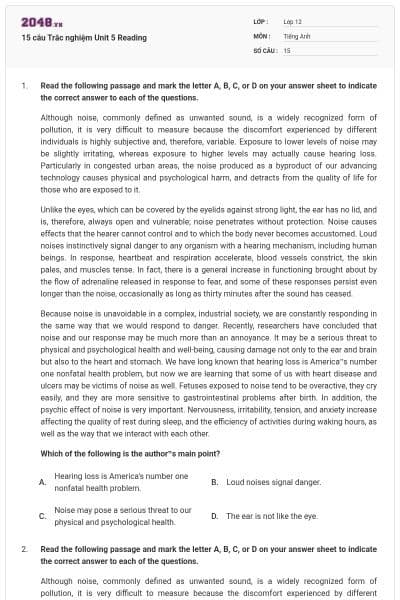
Read the following passage and mark the letter A, B, C, or D on your answer sheet to indicate the correct answer to each of the questions.
Although noise, commonly defined as unwanted sound, is a widely recognized form of pollution, it is very difficult to measure because the discomfort experienced by different individuals is highly subjective and, therefore, variable. Exposure to lower levels of noise may be slightly irritating, whereas exposure to higher levels may actually cause hearing loss. Particularly in congested urban areas, the noise produced as a byproduct of our advancing technology causes physical and psychological harm, and detracts from the quality of life for those who are exposed to it.
Unlike the eyes, which can be covered by the eyelids against strong light, the ear has no lid, and is, therefore, always open and vulnerable; noise penetrates without protection. Noise causes effects that the hearer cannot control and to which the body never becomes accustomed. Loud noises instinctively signal danger to any organism with a hearing mechanism, including human beings. In response, heartbeat and respiration accelerate, blood vessels constrict, the skin pales, and muscles tense. In fact, there is a general increase in functioning brought about by the flow of adrenaline released in response to fear, and some of these responses persist even longer than the noise, occasionally as long as thirty minutes after the sound has ceased.
Because noise is unavoidable in a complex, industrial society, we are constantly responding in the same way that we would respond to danger. Recently, researchers have concluded that noise and our response may be much more than an annoyance. It may be a serious threat to physical and psychological health and well-being, causing damage not only to the ear and brain but also to the heart and stomach. We have long known that hearing loss is America‟s number one nonfatal health problem, but now we are learning that some of us with heart disease and ulcers may be victims of noise as well. Fetuses exposed to noise tend to be overactive, they cry easily, and they are more sensitive to gastrointestinal problems after birth. In addition, the psychic effect of noise is very important. Nervousness, irritability, tension, and anxiety increase affecting the quality of rest during sleep, and the efficiency of activities during waking hours, as well as the way that we interact with each other.
Which of the following is the author‟s main point?
Hearing loss is America's number one nonfatal health problem.
Loud noises signal danger.
Noise may pose a serious threat to our physical and psychological health.
The ear is not like the eye.
Đáp án: C
Giải thích: Câu nào sau đây là ý chính tác giải muốn gửi gắm?
Dịch nghĩa: Tiếng ồn có thể gây ra một mối đe dọa nghiêm trọng đối với sức khoẻ thể chất và tâm lý của chúng ta.
Read the following passage and mark the letter A, B, C, or D on your answer sheet to indicate the correct answer to each of the questions.
Although noise, commonly defined as unwanted sound, is a widely recognized form of pollution, it is very difficult to measure because the discomfort experienced by different individuals is highly subjective and, therefore, variable. Exposure to lower levels of noise may be slightly irritating, whereas exposure to higher levels may actually cause hearing loss. Particularly in congested urban areas, the noise produced as a byproduct of our advancing technology causes physical and psychological harm, and detracts from the quality of life for those who are exposed to it.
Unlike the eyes, which can be covered by the eyelids against strong light, the ear has no lid, and is, therefore, always open and vulnerable; noise penetrates without protection. Noise causes effects that the hearer cannot control and to which the body never becomes accustomed. Loud noises instinctively signal danger to any organism with a hearing mechanism, including human beings. In response, heartbeat and respiration accelerate, blood vessels constrict, the skin pales, and muscles tense. In fact, there is a general increase in functioning brought about by the flow of adrenaline released in response to fear, and some of these responses persist even longer than the noise, occasionally as long as thirty minutes after the sound has ceased.
Because noise is unavoidable in a complex, industrial society, we are constantly responding in the same way that we would respond to danger. Recently, researchers have concluded that noise and our response may be much more than an annoyance. It may be a serious threat to physical and psychological health and well-being, causing damage not only to the ear and brain but also to the heart and stomach. We have long known that hearing loss is America‟s number one nonfatal health problem, but now we are learning that some of us with heart disease and ulcers may be victims of noise as well. Fetuses exposed to noise tend to be overactive, they cry easily, and they are more sensitive to gastrointestinal problems after birth. In addition, the psychic effect of noise is very important. Nervousness, irritability, tension, and anxiety increase affecting the quality of rest during sleep, and the efficiency of activities during waking hours, as well as the way that we interact with each other.
According to the passage, what is noise?
byproduct of technology.
Physical and psychological harm
Congestion.
Unwanted sound.
Đáp án: D
Thông tin: Although noise, commonly defined as unwanted sound, is a widely recognized form of pollution.
Dịch nghĩa: Mặc dù tiếng ồn, thường được định nghĩa là âm thanh không mong muốn, là một dạng ô nhiễm được công nhận rộng rãi.
Read the following passage and mark the letter A, B, C, or D on your answer sheet to indicate the correct answer to each of the questions.
Although noise, commonly defined as unwanted sound, is a widely recognized form of pollution, it is very difficult to measure because the discomfort experienced by different individuals is highly subjective and, therefore, variable. Exposure to lower levels of noise may be slightly irritating, whereas exposure to higher levels may actually cause hearing loss. Particularly in congested urban areas, the noise produced as a byproduct of our advancing technology causes physical and psychological harm, and detracts from the quality of life for those who are exposed to it.
Unlike the eyes, which can be covered by the eyelids against strong light, the ear has no lid, and is, therefore, always open and vulnerable; noise penetrates without protection. Noise causes effects that the hearer cannot control and to which the body never becomes accustomed. Loud noises instinctively signal danger to any organism with a hearing mechanism, including human beings. In response, heartbeat and respiration accelerate, blood vessels constrict, the skin pales, and muscles tense. In fact, there is a general increase in functioning brought about by the flow of adrenaline released in response to fear, and some of these responses persist even longer than the noise, occasionally as long as thirty minutes after the sound has ceased.
Because noise is unavoidable in a complex, industrial society, we are constantly responding in the same way that we would respond to danger. Recently, researchers have concluded that noise and our response may be much more than an annoyance. It may be a serious threat to physical and psychological health and well-being, causing damage not only to the ear and brain but also to the heart and stomach. We have long known that hearing loss is America‟s number one nonfatal health problem, but now we are learning that some of us with heart disease and ulcers may be victims of noise as well. Fetuses exposed to noise tend to be overactive, they cry easily, and they are more sensitive to gastrointestinal problems after birth. In addition, the psychic effect of noise is very important. Nervousness, irritability, tension, and anxiety increase affecting the quality of rest during sleep, and the efficiency of activities during waking hours, as well as the way that we interact with each other.
Why is noise difficult to measure?
All people do not respond to it in the same way
It causes hearing loss.
It is unwanted.
People become accustomed to it.
Đáp án: A
Thông tin: It is very difficult to measure because the discomfort experienced by different individuals is highly subjective and, therefore, variable.
Dịch nghĩa: Rất khó để đo lường vì sự khó chịu của các cá nhân khác nhau rất chủ quan và do đó, rất khác nhau.
Read the following passage and mark the letter A, B, C, or D on your answer sheet to indicate the correct answer to each of the questions.
Although noise, commonly defined as unwanted sound, is a widely recognized form of pollution, it is very difficult to measure because the discomfort experienced by different individuals is highly subjective and, therefore, variable. Exposure to lower levels of noise may be slightly irritating, whereas exposure to higher levels may actually cause hearing loss. Particularly in congested urban areas, the noise produced as a byproduct of our advancing technology causes physical and psychological harm, and detracts from the quality of life for those who are exposed to it.
Unlike the eyes, which can be covered by the eyelids against strong light, the ear has no lid, and is, therefore, always open and vulnerable; noise penetrates without protection. Noise causes effects that the hearer cannot control and to which the body never becomes accustomed. Loud noises instinctively signal danger to any organism with a hearing mechanism, including human beings. In response, heartbeat and respiration accelerate, blood vessels constrict, the skin pales, and muscles tense. In fact, there is a general increase in functioning brought about by the flow of adrenaline released in response to fear, and some of these responses persist even longer than the noise, occasionally as long as thirty minutes after the sound has ceased.
Because noise is unavoidable in a complex, industrial society, we are constantly responding in the same way that we would respond to danger. Recently, researchers have concluded that noise and our response may be much more than an annoyance. It may be a serious threat to physical and psychological health and well-being, causing damage not only to the ear and brain but also to the heart and stomach. We have long known that hearing loss is America‟s number one nonfatal health problem, but now we are learning that some of us with heart disease and ulcers may be victims of noise as well. Fetuses exposed to noise tend to be overactive, they cry easily, and they are more sensitive to gastrointestinal problems after birth. In addition, the psychic effect of noise is very important. Nervousness, irritability, tension, and anxiety increase affecting the quality of rest during sleep, and the efficiency of activities during waking hours, as well as the way that we interact with each other.
The word ‘congested’ in paragraph 1 could best be replaced by ___.
hazardous
crowded
polluted
rushed
Đáp án: B
Giải thích: congested = crowded (a): đông đúc
Read the following passage and mark the letter A, B, C, or D on your answer sheet to indicate the correct answer to each of the questions.
Although noise, commonly defined as unwanted sound, is a widely recognized form of pollution, it is very difficult to measure because the discomfort experienced by different individuals is highly subjective and, therefore, variable. Exposure to lower levels of noise may be slightly irritating, whereas exposure to higher levels may actually cause hearing loss. Particularly in congested urban areas, the noise produced as a byproduct of our advancing technology causes physical and psychological harm, and detracts from the quality of life for those who are exposed to it.
Unlike the eyes, which can be covered by the eyelids against strong light, the ear has no lid, and is, therefore, always open and vulnerable; noise penetrates without protection. Noise causes effects that the hearer cannot control and to which the body never becomes accustomed. Loud noises instinctively signal danger to any organism with a hearing mechanism, including human beings. In response, heartbeat and respiration accelerate, blood vessels constrict, the skin pales, and muscles tense. In fact, there is a general increase in functioning brought about by the flow of adrenaline released in response to fear, and some of these responses persist even longer than the noise, occasionally as long as thirty minutes after the sound has ceased.
Because noise is unavoidable in a complex, industrial society, we are constantly responding in the same way that we would respond to danger. Recently, researchers have concluded that noise and our response may be much more than an annoyance. It may be a serious threat to physical and psychological health and well-being, causing damage not only to the ear and brain but also to the heart and stomach. We have long known that hearing loss is America‟s number one nonfatal health problem, but now we are learning that some of us with heart disease and ulcers may be victims of noise as well. Fetuses exposed to noise tend to be overactive, they cry easily, and they are more sensitive to gastrointestinal problems after birth. In addition, the psychic effect of noise is very important. Nervousness, irritability, tension, and anxiety increase affecting the quality of rest during sleep, and the efficiency of activities during waking hours, as well as the way that we interact with each other.
The word it in the first paragraph refers to ___.
the quality of life
advancing technology
the noise
physical and psychological harm
Đáp án: C
Thông tin: Particularly in congested urban areas, the noise produced as a by-product of our advancing technology causes physical and psychological harm, and detracts from the quality of life for those who are exposed to it.
Dịch nghĩa: Đặc biệt ở các khu vực đô thị tắc nghẽn, tiếng ồn được tạo ra như một sản phẩm phụ của công nghệ tiến bộ của chúng tôi gây ra tác hại về thể chất và tâm lý, và làm giảm chất lượng cuộc sống của những người tiếp xúc với nó
Read the following passage and mark the letter A, B, C, or D on your answer sheet to indicate the correct answer to each of the questions.
Although noise, commonly defined as unwanted sound, is a widely recognized form of pollution, it is very difficult to measure because the discomfort experienced by different individuals is highly subjective and, therefore, variable. Exposure to lower levels of noise may be slightly irritating, whereas exposure to higher levels may actually cause hearing loss. Particularly in congested urban areas, the noise produced as a byproduct of our advancing technology causes physical and psychological harm, and detracts from the quality of life for those who are exposed to it.
Unlike the eyes, which can be covered by the eyelids against strong light, the ear has no lid, and is, therefore, always open and vulnerable; noise penetrates without protection. Noise causes effects that the hearer cannot control and to which the body never becomes accustomed. Loud noises instinctively signal danger to any organism with a hearing mechanism, including human beings. In response, heartbeat and respiration accelerate, blood vessels constrict, the skin pales, and muscles tense. In fact, there is a general increase in functioning brought about by the flow of adrenaline released in response to fear, and some of these responses persist even longer than the noise, occasionally as long as thirty minutes after the sound has ceased.
Because noise is unavoidable in a complex, industrial society, we are constantly responding in the same way that we would respond to danger. Recently, researchers have concluded that noise and our response may be much more than an annoyance. It may be a serious threat to physical and psychological health and well-being, causing damage not only to the ear and brain but also to the heart and stomach. We have long known that hearing loss is America‟s number one nonfatal health problem, but now we are learning that some of us with heart disease and ulcers may be victims of noise as well. Fetuses exposed to noise tend to be overactive, they cry easily, and they are more sensitive to gastrointestinal problems after birth. In addition, the psychic effect of noise is very important. Nervousness, irritability, tension, and anxiety increase affecting the quality of rest during sleep, and the efficiency of activities during waking hours, as well as the way that we interact with each other.
According to the passage, people respond to loud noises in the same way that they respond to ___.
annoyance
danger
damage
disease
Đáp án: B
Thông tin: Because noise is unavoidable in a complex, industrial society, we are constantly responding in the same way that we would respond to danger.
Dịch nghĩa: Bởi vì tiếng ồn là không thể tránh khỏi trong một xã hội công nghiệp phức tạp, chúng tôi liên tục phản ứng theo cùng một cách mà chúng tôi sẽ đối phó với nguy hiểm.
Read the following passage and mark the letter A, B, C, or D on your answer sheet to indicate the correct answer to each of the questions.
Although noise, commonly defined as unwanted sound, is a widely recognized form of pollution, it is very difficult to measure because the discomfort experienced by different individuals is highly subjective and, therefore, variable. Exposure to lower levels of noise may be slightly irritating, whereas exposure to higher levels may actually cause hearing loss. Particularly in congested urban areas, the noise produced as a byproduct of our advancing technology causes physical and psychological harm, and detracts from the quality of life for those who are exposed to it.
Unlike the eyes, which can be covered by the eyelids against strong light, the ear has no lid, and is, therefore, always open and vulnerable; noise penetrates without protection. Noise causes effects that the hearer cannot control and to which the body never becomes accustomed. Loud noises instinctively signal danger to any organism with a hearing mechanism, including human beings. In response, heartbeat and respiration accelerate, blood vessels constrict, the skin pales, and muscles tense. In fact, there is a general increase in functioning brought about by the flow of adrenaline released in response to fear, and some of these responses persist even longer than the noise, occasionally as long as thirty minutes after the sound has ceased.
Because noise is unavoidable in a complex, industrial society, we are constantly responding in the same way that we would respond to danger. Recently, researchers have concluded that noise and our response may be much more than an annoyance. It may be a serious threat to physical and psychological health and well-being, causing damage not only to the ear and brain but also to the heart and stomach. We have long known that hearing loss is America‟s number one nonfatal health problem, but now we are learning that some of us with heart disease and ulcers may be victims of noise as well. Fetuses exposed to noise tend to be overactive, they cry easily, and they are more sensitive to gastrointestinal problems after birth. In addition, the psychic effect of noise is very important. Nervousness, irritability, tension, and anxiety increase affecting the quality of rest during sleep, and the efficiency of activities during waking hours, as well as the way that we interact with each other.
Look at the verb accelerate in paragraph 3. Which of the following is the closest in meaning to _____.
decrease
alter
increase
release
Đáp án: C
Giải thích: accelerate = increase: chỗ sưng lên

Học thông minh hơn mỗi ngày
Xem toàn bộ 15 câu hỏi và nhiều hơn nữa với tài khoản miễn phí
Read the following passage and mark the letter A, B, C, or D on your answer sheet to indicate the correct answer to each of the questions.
Although noise, commonly defined as unwanted sound, is a widely recognized form of pollution, it is very difficult to measure because the discomfort experienced by different individuals is highly subjective and, therefore, variable. Exposure to lower levels of noise may be slightly irritating, whereas exposure to higher levels may actually cause hearing loss. Particularly in congested urban areas, the noise produced as a byproduct of our advancing technology causes physical and psychological harm, and detracts from the quality of life for those who are exposed to it.
Unlike the eyes, which can be covered by the eyelids against strong light, the ear has no lid, and is, therefore, always open and vulnerable; noise penetrates without protection. Noise causes effects that the hearer cannot control and to which the body never becomes accustomed. Loud noises instinctively signal danger to any organism with a hearing mechanism, including human beings. In response, heartbeat and respiration accelerate, blood vessels constrict, the skin pales, and muscles tense. In fact, there is a general increase in functioning brought about by the flow of adrenaline released in response to fear, and some of these responses persist even longer than the noise, occasionally as long as thirty minutes after the sound has ceased.
Because noise is unavoidable in a complex, industrial society, we are constantly responding in the same way that we would respond to danger. Recently, researchers have concluded that noise and our response may be much more than an annoyance. It may be a serious threat to physical and psychological health and well-being, causing damage not only to the ear and brain but also to the heart and stomach. We have long known that hearing loss is America‟s number one nonfatal health problem, but now we are learning that some of us with heart disease and ulcers may be victims of noise as well. Fetuses exposed to noise tend to be overactive, they cry easily, and they are more sensitive to gastrointestinal problems after birth. In addition, the psychic effect of noise is very important. Nervousness, irritability, tension, and anxiety increase affecting the quality of rest during sleep, and the efficiency of activities during waking hours, as well as the way that we interact with each other.
The phrase ‘as well as’ in paragraph 4 is closest in meaning to ___.
after all
instead
also
regardless
Đáp án: C
Giải thích: as well as = also = and (và, cũng như)
Read the following passage and mark the letter A, B, C, or D on your answer sheet to indicate the correct answer to each of the questions.
Although noise, commonly defined as unwanted sound, is a widely recognized form of pollution, it is very difficult to measure because the discomfort experienced by different individuals is highly subjective and, therefore, variable. Exposure to lower levels of noise may be slightly irritating, whereas exposure to higher levels may actually cause hearing loss. Particularly in congested urban areas, the noise produced as a byproduct of our advancing technology causes physical and psychological harm, and detracts from the quality of life for those who are exposed to it.
Unlike the eyes, which can be covered by the eyelids against strong light, the ear has no lid, and is, therefore, always open and vulnerable; noise penetrates without protection. Noise causes effects that the hearer cannot control and to which the body never becomes accustomed. Loud noises instinctively signal danger to any organism with a hearing mechanism, including human beings. In response, heartbeat and respiration accelerate, blood vessels constrict, the skin pales, and muscles tense. In fact, there is a general increase in functioning brought about by the flow of adrenaline released in response to fear, and some of these responses persist even longer than the noise, occasionally as long as thirty minutes after the sound has ceased.
Because noise is unavoidable in a complex, industrial society, we are constantly responding in the same way that we would respond to danger. Recently, researchers have concluded that noise and our response may be much more than an annoyance. It may be a serious threat to physical and psychological health and well-being, causing damage not only to the ear and brain but also to the heart and stomach. We have long known that hearing loss is America‟s number one nonfatal health problem, but now we are learning that some of us with heart disease and ulcers may be victims of noise as well. Fetuses exposed to noise tend to be overactive, they cry easily, and they are more sensitive to gastrointestinal problems after birth. In addition, the psychic effect of noise is very important. Nervousness, irritability, tension, and anxiety increase affecting the quality of rest during sleep, and the efficiency of activities during waking hours, as well as the way that we interact with each other.
It can be inferred from the passage that the eye ___.
responds to fear
enjoys greater protection than the ear
increases functions
is damaged by noise
Đáp án: B
Thông tin: Unlike the eyes, which can be covered by the eyelids against strong light, the ear has no lid, and is, therefore, always open and vulnerable; noise penetrates without protection.
Dịch nghĩa: Không giống như mắt, có thể được che bởi mí mắt trước ánh sáng mạnh, tai không có nắp, và do đó, luôn luôn mở và dễ bị tổn thương; tiếng ồn xâm nhập mà không bảo vệ.
Read the following passage and mark the letter A, B, C or D to indicate the correct answer to each of the questions.
In the Native American Navajo nation which sprawls across four states in the American south-west, the native language is dying. Most of its speakers are middle-age or elderly. Although many students take classes in Navajo, the schools are run in English. Street sign, supermarket goods and even their own newspaper are all in English. Not surprisingly, linguists doubt that any native speakers of Navajo will remain in a hundred years' time.
Navajo is far from alone. Half the world's 6,800 languages are likely to vanish within two generations - that's one language lost every ten days. Never before has the planet's linguistic diversity shrunk at such a pace. Isolation breeds linguistic diversity as a result, the world is peppered with languages spoken by only a few people. Only 250 languages have more than a million speakers, and at least 3,000 have fewer than 2,500. It is not necessarily these small languages that are about to disappear. Navajo is considered endangered despite having 150,000 speakers. What makes a language endangered is not that the number of speakers, but how old they are. If it is spoken by children it is relatively safe. The critically endangered languages are those that are only spoken by the elderly, according to Michael Krauss, director of the Alaska Native Language Center, in Fairbanks.
Why do people reject the language of their parent? It begins with a crisis of confidence, when a small community finds itself alongside a larger, wealthier society, says Nicholas Ostler of Britain's Foundation for Endangered Languages, in Bath. “People lose faith in their culture” he says. "When the next generation reaches their teens, they might not want to be induced into the old tradition.” The change is not always voluntary. Quite often, governments try to kill off a minority language by banning its use in public or discouraging its use in school, all to promote national unity. The former US policy of running Indian reservation in English, for example, effectively put languages such as Navajo on the danger list. But Salikoko Mufwene, who chairs the Linguistics Department at the University of Chicago, argues that the deadliest weapon is not government policy but economic globalisation. "Native Americans have not lost pride in their language, but they have had to adapt to socio-economic pressures" he says. “They cannot refuse to speak English if most commercial activity is in English."
However, a growing interest in cultural identity may prevent the direct predictions from coming true. ‘The key to fostering diversity is for people to learn their ancestral tongue, as well as the dominant language' says Doug Whalen, founder and president of the Endangered Language Fund in New Haven, Connecticut. “Most of these will live without a large degree of bilingualism” he says.
It is stated in the passage that the number of endangered languages is ____.
about 3,200
about 6,800
at least 3,000
fewer than 2,500
Đáp án: A
Thông tin: Half the world's 6,800 languages are likely to vanish within two generations - that's one language lost every ten days.
Dịch nghĩa: Một nửa 6.800 ngôn ngữ trên thế giới có khả năng biến mất trong vòng hai thế hệ - đó là một ngôn ngữ bị mất cứ sau mười ngày
Read the following passage and mark the letter A, B, C or D to indicate the correct answer to each of the questions.
In the Native American Navajo nation which sprawls across four states in the American south-west, the native language is dying. Most of its speakers are middle-age or elderly. Although many students take classes in Navajo, the schools are run in English. Street sign, supermarket goods and even their own newspaper are all in English. Not surprisingly, linguists doubt that any native speakers of Navajo will remain in a hundred years' time.
Navajo is far from alone. Half the world's 6,800 languages are likely to vanish within two generations - that's one language lost every ten days. Never before has the planet's linguistic diversity shrunk at such a pace. Isolation breeds linguistic diversity as a result, the world is peppered with languages spoken by only a few people. Only 250 languages have more than a million speakers, and at least 3,000 have fewer than 2,500. It is not necessarily these small languages that are about to disappear. Navajo is considered endangered despite having 150,000 speakers. What makes a language endangered is not that the number of speakers, but how old they are. If it is spoken by children it is relatively safe. The critically endangered languages are those that are only spoken by the elderly, according to Michael Krauss, director of the Alaska Native Language Center, in Fairbanks.
Why do people reject the language of their parent? It begins with a crisis of confidence, when a small community finds itself alongside a larger, wealthier society, says Nicholas Ostler of Britain's Foundation for Endangered Languages, in Bath. “People lose faith in their culture” he says. "When the next generation reaches their teens, they might not want to be induced into the old tradition.” The change is not always voluntary. Quite often, governments try to kill off a minority language by banning its use in public or discouraging its use in school, all to promote national unity. The former US policy of running Indian reservation in English, for example, effectively put languages such as Navajo on the danger list. But Salikoko Mufwene, who chairs the Linguistics Department at the University of Chicago, argues that the deadliest weapon is not government policy but economic globalisation. "Native Americans have not lost pride in their language, but they have had to adapt to socio-economic pressures" he says. “They cannot refuse to speak English if most commercial activity is in English."
However, a growing interest in cultural identity may prevent the direct predictions from coming true. ‘The key to fostering diversity is for people to learn their ancestral tongue, as well as the dominant language' says Doug Whalen, founder and president of the Endangered Language Fund in New Haven, Connecticut. “Most of these will live without a large degree of bilingualism” he says.
The word peppered in paragraph 2 is closest in meaning to ____.
randomly separated
slowly attacked
sparsely distributed
unintentionally controlled
Đáp án: C
Từ mới: Peppered = sparsely distributed (phân bố thưa thớt)
Read the following passage and mark the letter A, B, C or D to indicate the correct answer to each of the questions.
In the Native American Navajo nation which sprawls across four states in the American south-west, the native language is dying. Most of its speakers are middle-age or elderly. Although many students take classes in Navajo, the schools are run in English. Street sign, supermarket goods and even their own newspaper are all in English. Not surprisingly, linguists doubt that any native speakers of Navajo will remain in a hundred years' time.
Navajo is far from alone. Half the world's 6,800 languages are likely to vanish within two generations - that's one language lost every ten days. Never before has the planet's linguistic diversity shrunk at such a pace. Isolation breeds linguistic diversity as a result, the world is peppered with languages spoken by only a few people. Only 250 languages have more than a million speakers, and at least 3,000 have fewer than 2,500. It is not necessarily these small languages that are about to disappear. Navajo is considered endangered despite having 150,000 speakers. What makes a language endangered is not that the number of speakers, but how old they are. If it is spoken by children it is relatively safe. The critically endangered languages are those that are only spoken by the elderly, according to Michael Krauss, director of the Alaska Native Language Center, in Fairbanks.
Why do people reject the language of their parent? It begins with a crisis of confidence, when a small community finds itself alongside a larger, wealthier society, says Nicholas Ostler of Britain's Foundation for Endangered Languages, in Bath. “People lose faith in their culture” he says. "When the next generation reaches their teens, they might not want to be induced into the old tradition.” The change is not always voluntary. Quite often, governments try to kill off a minority language by banning its use in public or discouraging its use in school, all to promote national unity. The former US policy of running Indian reservation in English, for example, effectively put languages such as Navajo on the danger list. But Salikoko Mufwene, who chairs the Linguistics Department at the University of Chicago, argues that the deadliest weapon is not government policy but economic globalisation. "Native Americans have not lost pride in their language, but they have had to adapt to socio-economic pressures" he says. “They cannot refuse to speak English if most commercial activity is in English."
However, a growing interest in cultural identity may prevent the direct predictions from coming true. ‘The key to fostering diversity is for people to learn their ancestral tongue, as well as the dominant language' says Doug Whalen, founder and president of the Endangered Language Fund in New Haven, Connecticut. “Most of these will live without a large degree of bilingualism” he says.
According to the passage, endangered languages cannot be saved unless people
avoid speaking their dominant language
grow interest in cultural identities
know more than one language
write in their mother tongue
Đáp án: C
Thông tin: ‘The key to fostering diversity is for people to learn their ancestral tongue, as well as the dominant language' says Doug Whalen.
Dịch nghĩa: Chìa khóa để thúc đẩy sự đa dạng là cho mọi người học ngôn ngữ tổ tiên của họ, cũng như ngôn ngữ thống trị ', Doug Whalen nói
Read the following passage and mark the letter A, B, C or D to indicate the correct answer to each of the questions.
In the Native American Navajo nation which sprawls across four states in the American south-west, the native language is dying. Most of its speakers are middle-age or elderly. Although many students take classes in Navajo, the schools are run in English. Street sign, supermarket goods and even their own newspaper are all in English. Not surprisingly, linguists doubt that any native speakers of Navajo will remain in a hundred years' time.
Navajo is far from alone. Half the world's 6,800 languages are likely to vanish within two generations - that's one language lost every ten days. Never before has the planet's linguistic diversity shrunk at such a pace. Isolation breeds linguistic diversity as a result, the world is peppered with languages spoken by only a few people. Only 250 languages have more than a million speakers, and at least 3,000 have fewer than 2,500. It is not necessarily these small languages that are about to disappear. Navajo is considered endangered despite having 150,000 speakers. What makes a language endangered is not that the number of speakers, but how old they are. If it is spoken by children it is relatively safe. The critically endangered languages are those that are only spoken by the elderly, according to Michael Krauss, director of the Alaska Native Language Center, in Fairbanks.
Why do people reject the language of their parent? It begins with a crisis of confidence, when a small community finds itself alongside a larger, wealthier society, says Nicholas Ostler of Britain's Foundation for Endangered Languages, in Bath. “People lose faith in their culture” he says. "When the next generation reaches their teens, they might not want to be induced into the old tradition.” The change is not always voluntary. Quite often, governments try to kill off a minority language by banning its use in public or discouraging its use in school, all to promote national unity. The former US policy of running Indian reservation in English, for example, effectively put languages such as Navajo on the danger list. But Salikoko Mufwene, who chairs the Linguistics Department at the University of Chicago, argues that the deadliest weapon is not government policy but economic globalisation. "Native Americans have not lost pride in their language, but they have had to adapt to socio-economic pressures" he says. “They cannot refuse to speak English if most commercial activity is in English."
However, a growing interest in cultural identity may prevent the direct predictions from coming true. ‘The key to fostering diversity is for people to learn their ancestral tongue, as well as the dominant language' says Doug Whalen, founder and president of the Endangered Language Fund in New Haven, Connecticut. “Most of these will live without a large degree of bilingualism” he says.
Who thinks that a change of language may mean a loss of traditional culture?
Doug Whalen
Michael Krauss
Nicholas Ostler
Salikoko Mufwene
Đáp án: D
Thông tin: "Native Americans have not lost pride in their language, but they have had to adapt to socio-economic pressures" he says. “They cannot refuse to speak English if most commercial activity is in English."
Dịch nghĩa: "Người Mỹ bản địa đã không mất niềm tự hào về ngôn ngữ của họ, nhưng họ phải thích nghi với áp lực kinh tế xã hội", ông nói. Họ không thể từ chối nói tiếng Anh nếu hầu hết các hoạt động thương mại bằng tiếng Anh. "
Read the following passage and mark the letter A, B, C or D to indicate the correct answer to each of the questions.
In the Native American Navajo nation which sprawls across four states in the American south-west, the native language is dying. Most of its speakers are middle-age or elderly. Although many students take classes in Navajo, the schools are run in English. Street sign, supermarket goods and even their own newspaper are all in English. Not surprisingly, linguists doubt that any native speakers of Navajo will remain in a hundred years' time.
Navajo is far from alone. Half the world's 6,800 languages are likely to vanish within two generations - that's one language lost every ten days. Never before has the planet's linguistic diversity shrunk at such a pace. Isolation breeds linguistic diversity as a result, the world is peppered with languages spoken by only a few people. Only 250 languages have more than a million speakers, and at least 3,000 have fewer than 2,500. It is not necessarily these small languages that are about to disappear. Navajo is considered endangered despite having 150,000 speakers. What makes a language endangered is not that the number of speakers, but how old they are. If it is spoken by children it is relatively safe. The critically endangered languages are those that are only spoken by the elderly, according to Michael Krauss, director of the Alaska Native Language Center, in Fairbanks.
Why do people reject the language of their parent? It begins with a crisis of confidence, when a small community finds itself alongside a larger, wealthier society, says Nicholas Ostler of Britain's Foundation for Endangered Languages, in Bath. “People lose faith in their culture” he says. "When the next generation reaches their teens, they might not want to be induced into the old tradition.” The change is not always voluntary. Quite often, governments try to kill off a minority language by banning its use in public or discouraging its use in school, all to promote national unity. The former US policy of running Indian reservation in English, for example, effectively put languages such as Navajo on the danger list. But Salikoko Mufwene, who chairs the Linguistics Department at the University of Chicago, argues that the deadliest weapon is not government policy but economic globalisation. "Native Americans have not lost pride in their language, but they have had to adapt to socio-economic pressures" he says. “They cannot refuse to speak English if most commercial activity is in English."
However, a growing interest in cultural identity may prevent the direct predictions from coming true. ‘The key to fostering diversity is for people to learn their ancestral tongue, as well as the dominant language' says Doug Whalen, founder and president of the Endangered Language Fund in New Haven, Connecticut. “Most of these will live without a large degree of bilingualism” he says.
The word these in paragraph 5 refers to ____.
ancestral tongue
dominant language
growing interest in cultural identity
the key to fostering diversity
Đáp án: A
Thông tin: ‘The key to fostering diversity is for people to learn their ancestral tongue, as well as the dominant language' says Doug Whalen…... “Most of these will live without a large degree of bilingualism” he says.
Dịch nghĩa: Chìa khóa để thúc đẩy sự đa dạng là cho mọi người học ngôn ngữ tổ tiên của họ, cũng như ngôn ngữ thống trị", Doug Whalen nói….. Hầu hết những người này sẽ sống mà không có một mức độ lớn về song ngữ
Read the following passage and mark the letter A, B, C or D to indicate the correct answer to each of the questions.
In the Native American Navajo nation which sprawls across four states in the American south-west, the native language is dying. Most of its speakers are middle-age or elderly. Although many students take classes in Navajo, the schools are run in English. Street sign, supermarket goods and even their own newspaper are all in English. Not surprisingly, linguists doubt that any native speakers of Navajo will remain in a hundred years' time.
Navajo is far from alone. Half the world's 6,800 languages are likely to vanish within two generations - that's one language lost every ten days. Never before has the planet's linguistic diversity shrunk at such a pace. Isolation breeds linguistic diversity as a result, the world is peppered with languages spoken by only a few people. Only 250 languages have more than a million speakers, and at least 3,000 have fewer than 2,500. It is not necessarily these small languages that are about to disappear. Navajo is considered endangered despite having 150,000 speakers. What makes a language endangered is not that the number of speakers, but how old they are. If it is spoken by children it is relatively safe. The critically endangered languages are those that are only spoken by the elderly, according to Michael Krauss, director of the Alaska Native Language Center, in Fairbanks.
Why do people reject the language of their parent? It begins with a crisis of confidence, when a small community finds itself alongside a larger, wealthier society, says Nicholas Ostler of Britain's Foundation for Endangered Languages, in Bath. “People lose faith in their culture” he says. "When the next generation reaches their teens, they might not want to be induced into the old tradition.” The change is not always voluntary. Quite often, governments try to kill off a minority language by banning its use in public or discouraging its use in school, all to promote national unity. The former US policy of running Indian reservation in English, for example, effectively put languages such as Navajo on the danger list. But Salikoko Mufwene, who chairs the Linguistics Department at the University of Chicago, argues that the deadliest weapon is not government policy but economic globalisation. "Native Americans have not lost pride in their language, but they have had to adapt to socio-economic pressures" he says. “They cannot refuse to speak English if most commercial activity is in English."
However, a growing interest in cultural identity may prevent the direct predictions from coming true. ‘The key to fostering diversity is for people to learn their ancestral tongue, as well as the dominant language' says Doug Whalen, founder and president of the Endangered Language Fund in New Haven, Connecticut. “Most of these will live without a large degree of bilingualism” he says.
Navajo language is considered being endangered language because ____.
it currently has too few speakers
it is spoken by too many elderly and middle-aged speakers
it was banned in publicity by the former US policy
many young people refuse to learn to speak it
Đáp án: A
Dịch nghĩa: Ngôn ngữ Navajo được coi là ngôn ngữ có nguy cơ tuyệt chủng vì nó hiện có quá ít người nói.
Bạn có thích hoạt động này không?
Ý kiến của bạn sẽ giúp chúng tôi đề xuất nội dung phù hợp hơn.
Gợi ý cho bạn
![[Năm 2022] Đề thi thử môn Vật lí THPT Quốc gia có lời giải - Đề số 21](/_next/image?url=https%3A%2F%2Fvideo.vietjack.com%2Fupload%2Fimages%2Fvj-image%2Fimage-3izficdefgfoel0s9j8s-1786772791.jpg&w=3840&q=75)



![[Năm 2022] Đề thi thử môn Vật lí THPT Quốc gia có lời giải - Đề số 20](/_next/image?url=https%3A%2F%2Fvideo.vietjack.com%2Fupload%2Fimages%2Fvj-image%2Fimage-emy0gtcksawvorajezvv-1786772460.jpg&w=3840&q=75)


Tài liệu phổ biến Lớp 12







Tài liệu phổ biến Tiếng Anh