10000 câu trắc nghiệm tổng hợp môn Toán 2025 mới nhất (có đáp án) - Phần 48
59 câu hỏi
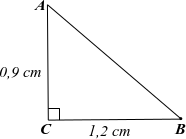
Xét tam giác ABC vuông tại A, theo định lí Pythagore có: AB2 = AC2 + BC2
Suy ra \(AB = \sqrt {0,{9^2} + 1,{2^2}} = 1,5\) (cm).
Ta có \[\sin B = \frac{{AC}}{{AB}} = \frac{{0,9}}{{1,5}} = 0,6;\,\,\,\cos B = \frac{{BC}}{{AB}} = \frac{{1,2}}{{1,5}} = 0,8;\]
\[\tan B = \frac{{\sin B}}{{\cos B}} = \frac{{0,6}}{{0,8}} = 0,75;\,\,\,\tan B = \frac{{\cos B}}{{\sin B}} = \frac{{0,8}}{{0,6}} = \frac{4}{3}.\]
Ta có: sin2α + cos2α = 1 nên \[{\rm{co}}{{\rm{s}}^2}\alpha = 1 - {\sin ^2}\alpha = 1 - {\left( {\frac{1}{5}} \right)^2} = \frac{{24}}{{25}}.\]
Mà 0 < cosα < 1 nên \(cos\alpha = \frac{{2\sqrt 6 }}{5}.\)
Do đó \(\tan \alpha = \frac{{\sin \alpha }}{{\cos \alpha }} = \frac{{\frac{1}{5}}}{{\frac{{2\sqrt 6 }}{5}}} = \frac{{\sqrt 6 }}{{12}}\) và \(\cot \alpha = \frac{1}{{\tan \alpha }} = \frac{1}{{\frac{{\sqrt 6 }}{{12}}}} = 2\sqrt 6 .\)
Hệ phương trình \[\left\{ \begin{array}{l} - 2x - 3y = - 7\\ - 3x + 2y = \frac{3}{2}\end{array} \right.\] có a = – 2; b = – 3; a’ = – 3; b = 2.
Xét \[\frac{a}{{a'}} = \frac{{ - 2}}{{ - 3}} = \frac{2}{3};\,\frac{b}{{b'}} = \frac{{ - 3}}{2} \Rightarrow \frac{a}{{a'}} \ne \frac{b}{{b'}}\]
Vậy hệ phương trình có nghiệm duy nhất.
Hệ phương trình \[\left\{ \begin{array}{l}{\rm{x}} + y = 1\,\,\,\,\,\,\,\,\,\,\,\,\,\\mx + y = 2m\,\end{array} \right.\]
Để hệ phương trình có nghiệm duy nhất ⇔ \[\frac{a}{{a'}} \ne \frac{b}{{b'}}\]
\[\frac{1}{m} \ne \frac{1}{1} \Rightarrow 1.1 \ne m.1 \Rightarrow m \ne 1\].
Vậy \[m \ne 1\] thì hệ phương trình có nghiệm duy nhất.
a) \[\sqrt {32} + \sqrt {50} - 2\sqrt 8 + \sqrt {18} = 4\sqrt 2 + 5\sqrt 2 - 4\sqrt 2 + 3\sqrt 2 = \left( {4 + 5 - 4 + 3} \right)\sqrt 2 = 8\sqrt 2 \]
b) \[\sqrt {{{\left( {1 - 2\sqrt 3 } \right)}^2}} - \sqrt {4 - 2\sqrt 3 } \]
\[ = \sqrt {{{\left( {1 - 2\sqrt 3 } \right)}^2}} - \sqrt {{{\left( {1 + \sqrt 3 } \right)}^2}} = \left| {1 - 2\sqrt 3 } \right| - \left| {1 + \sqrt 3 } \right| = 2\sqrt 3 - 1 - 1 - \sqrt 3 = \sqrt 3 - 2\].
a) Rút gọn biểu thức
\[P = \left( {\sqrt x - \frac{1}{{\sqrt x }}} \right):\left( {\frac{{\sqrt x - 1}}{{\sqrt x }} + \frac{{1 - \sqrt x }}{{x + \sqrt x }}} \right)\] (đk: x > 0)
\[ = \left( {\frac{{x - 1}}{{\sqrt x }}} \right):\left( {\frac{{\left( {\sqrt x - 1} \right)\left( {\sqrt x + 1} \right)}}{{x + \sqrt x }} + \frac{{1 - \sqrt x }}{{x + \sqrt x }}} \right)\]
\[ = \left( {\frac{{x - 1}}{{\sqrt x }}} \right):\left( {\frac{{x - \sqrt x }}{{x + \sqrt x }}} \right)\]
\[\frac{{\left( {\sqrt x - 1} \right)\left( {\sqrt x + 1} \right)}}{{\sqrt x }}.\frac{{\sqrt x \left( {\sqrt x + 1} \right)}}{{\sqrt x \left( {\sqrt x - 1} \right)}} = \frac{{{{\left( {\sqrt x + 1} \right)}^2}}}{{\sqrt x }}\]
b) Ta có: \[x = \frac{2}{{2 + \sqrt 3 }} = \frac{{2\left( {2 - \sqrt 3 } \right)}}{{4 - 3}} = 4 - 2\sqrt 3 \]
Thay \[x = 4 - 2\sqrt 3 \]vào biểu thức P, ta được:
\[P = \frac{{{{\left( {\sqrt {4 - 2\sqrt 3 } + 1} \right)}^2}}}{{\sqrt {4 - 2\sqrt 3 } }} = \frac{{{{\left( {\sqrt {{{\left( {\sqrt 3 - 1} \right)}^2}} + 1} \right)}^2}}}{{\sqrt {{{\left( {\sqrt 3 - 1} \right)}^2}} }} = \frac{{{{\left( {\left| {\sqrt 3 - 1} \right| + 1} \right)}^2}}}{{\left| {\sqrt 3 - 1} \right|}} = \frac{{{{\left( {\sqrt 3 - 1 + 1} \right)}^2}}}{{\sqrt 3 - 1}} = \frac{3}{{\sqrt 3 - 1}}\].
Giá trị của P khi \[x = \frac{2}{{2 + \sqrt 3 }}\] là \[\frac{3}{{\sqrt 3 - 1}}\].
c) Xét \[\frac{{{{\left( {\sqrt x + 1} \right)}^2}}}{{\sqrt x }}\sqrt x = 6\sqrt x - 3 - \sqrt {x - 4} \]
\[ \Leftrightarrow {\left( {\sqrt x + 1} \right)^2} = 6\sqrt x - 3 - \sqrt {x - 4} \]
\[ \Leftrightarrow {\left( {\sqrt x } \right)^2} + 2\sqrt x + 1 - 6\sqrt x + 3 + \sqrt {x - 4} = 0\]
\[ \Leftrightarrow {\left( {\sqrt x - 2} \right)^2} + \sqrt {x - 4} = 0 \Leftrightarrow \left\{ \begin{array}{l}\sqrt x - 2 = 0\\\sqrt {x - 4} = 0\end{array} \right. \Leftrightarrow x = 4\]
Vậy x = 4 để \[P\sqrt x = 6\sqrt x - 3 - \sqrt {x - 4} \].
a) Vì S = 12, P = 7 thỏa mãn \[{S^2} \ge 4P\] nên tồn tại hai số cần tìm.
Hai số đó là nghiệm của phương trình x2 – 12x + 7 = 0
∆ = (– 12)2 – 4.7 = 144 – 28 = 116 > 0.
Suy ra phương trình có hai nghiệm phân biệt
\[{x_1} = \frac{{ - b + \sqrt \Delta }}{{2a}} = \frac{{12 + \sqrt {116} }}{2} = 6 + \sqrt {29} \]; \[{x_2} = \frac{{ - b - \sqrt \Delta }}{{2a}} = \frac{{12 - \sqrt {116} }}{2} = 6 - \sqrt {29} \]
Vậy hai số cần tìm là: \[6 \pm \sqrt {29} \].
b) Vì S = – 9, P = 119 thì S2 = 81 < 4P = 4. 119 = 476 nên không tồn tại hai số cần tìm thỏa mãn yêu cầu của đề bài.
Ta có phương trình bậc hai biết nó nhận các số 7 và – 11 là nghiệm.
Xét S = (x1 + x2) = (7 – 11) = – 4 và P = x1.x2 = 7.(– 11) = – 77.
Ta thấy \[{S^2} \ge 4P\]
Do đó, 7 và – 11 là nghiệm của phương trình: X2 + 4X – 77 = 0.
Tìm các căn bậc hai số học của các số sau:


Học thông minh hơn mỗi ngày
Xem toàn bộ 59 câu hỏi và nhiều hơn nữa với tài khoản miễn phí
a) \[\sqrt {\frac{4}{{25}}} = \sqrt {\frac{{{2^2}}}{{{5^2}}}} = \frac{2}{5}\]
b) \[ - \sqrt {{3^2}} = - \left( {\sqrt {{3^2}} } \right) = - 3\]
c) \[ - \sqrt {{{\left( { - 6} \right)}^2}} = - \sqrt {{6^2}} = - 6\]
d) \[{\left( { - \sqrt 7 } \right)^2} = {\left( { - 1} \right)^2}.{\left( {\sqrt 7 } \right)^2} = 1.7 = 7\]
a) Vì 9 < 11 nên \[\sqrt 9 < \sqrt {11} \]. Vậy 3 < \[\sqrt {11} \].
b) Vì 25 > 5 nên \[\sqrt {25} > \sqrt {15} \]. Vậy 5 > \[\sqrt {15} \].
a) Xét VT = \[193 - 132\sqrt 2 \]
\[ = 121 - 132\sqrt 2 + 72 = {\left( {11} \right)^2} - 2.11.6\sqrt 2 + {\left( {6\sqrt 2 } \right)^2} = {\left( {11 - 6\sqrt 2 } \right)^2}\] = VP
⇒ đpcm.
b) a) Xét VT = \[\sqrt {28 - 10\sqrt 3 } + \sqrt {28 + 10\sqrt 3 } \]
\[ = \sqrt {25 - 2.5\sqrt 3 + 3} + \sqrt {25 + 2.5\sqrt 3 + 3} \]
\[ = \sqrt {{{\left( {5 - \sqrt 3 } \right)}^2}} + \sqrt {{{\left( {5 + \sqrt 3 } \right)}^2}} \]
\[ = \left| {5 - \sqrt 3 } \right| + \left| {5 + \sqrt 3 } \right|\]
\[ = 5 - \sqrt 3 + 5 + \sqrt 3 = 10\] = VP
⇒ đpcm.
a) \[\sqrt { - 5x - 10} \] có nghĩa \[ \Leftrightarrow - 5x - 10 \ge 0 \Leftrightarrow - 5\left( {x + 2} \right) \ge 0 \Leftrightarrow x + 2 \le 0 \Leftrightarrow x \le - 2\].
b) \[\sqrt { - {x^2} + 4x - 4} \] có nghĩa
\[ \Leftrightarrow - {x^2} + \,4x - 4 \ge 0 \Leftrightarrow - {\left( {x - 2} \right)^2} \ge 0 \Leftrightarrow x - 2 = 0 \Leftrightarrow x = 2\].
c) \[\sqrt {\frac{{ - 5}}{{ - x - 7}}} \] có nghĩa \[ \Leftrightarrow \frac{{ - 5}}{{ - x - 7}} \ge 0 \Leftrightarrow \frac{5}{{x + 7}} \le 0 \Leftrightarrow x + 7 < 0 \Leftrightarrow x < - 7\].
d) \[\sqrt {\frac{{3 + x}}{{ - x + 5}}} \] có nghĩa
\[ \Leftrightarrow \frac{{3 + x}}{{ - x + 5}} \ge 0 \Leftrightarrow \left[ \begin{array}{l}\left\{ \begin{array}{l}3 + x \ge 0\\ - x + 5 > 0\end{array} \right.\\\left\{ \begin{array}{l}3 + x \le 0\\ - x + 5 < 0\end{array} \right.\end{array} \right. \Leftrightarrow \left[ \begin{array}{l}\left\{ \begin{array}{l}x \ge - 3\\x < 5\end{array} \right.\\\left\{ \begin{array}{l}x \le - 3\\x > 5\end{array} \right.\left( {ktm} \right)\end{array} \right. \Leftrightarrow - 3 \le x < 5\].
Từ hai hai đường thẳng: d1: 7x + 2y = 8, d2: 2x – 7y = 5.
Ta có hệ phương trình trình \[\left\{ \begin{array}{l}7x + 2y = 8\\2x - 7y = 5\end{array} \right.\] có nghiệm duy nhất.
Vì hệ phương trình có a = 7; b = 2; a’ = 2; b = – 7.
Xét \[\frac{a}{{a'}} = \frac{7}{2};\,\frac{b}{{b'}} = \frac{2}{{ - 7}} \Rightarrow \frac{a}{{a'}} \ne \frac{b}{{b'}}\]
Vậy nên hệ phương trình của hai đường thẳng d1 và d2 có nghiệm duy nhất.
Hệ phương trình \[\left\{ \begin{array}{l} - 2x - y = \frac{1}{2}\\ - 3x + \frac{3}{2}y = \frac{3}{4}\end{array} \right.\] có a = – 2; b = – 1; a’ = – 3; \[b = \frac{3}{2}\]
Xét \[\frac{a}{{a'}} = \frac{{ - 2}}{{ - 3}} = \frac{2}{3};\,\frac{b}{{b'}} = - 1:\frac{3}{2} = \frac{{ - 2}}{3} \Rightarrow \frac{a}{{a'}} \ne \frac{b}{{b'}}\]
Vậy hệ phương trình có nghiệm duy nhất.
Hệ phương trình \[\left\{ \begin{array}{l}2\sqrt 2 x = 4y + 3\\ - \sqrt 2 x + 2y = \frac{3}{2}\end{array} \right.\] hay \[\left\{ \begin{array}{l}2\sqrt 2 x - 4y = 3\\ - \sqrt 2 x + 2y = \frac{3}{2}\end{array} \right.\]
Có \[a = 2\sqrt 2 \]; b = – 4; \[a' = - \sqrt 2 \]; b’ = 2.
Xét \[\frac{a}{{a'}} = \frac{{2\sqrt 2 }}{{ - \sqrt 2 }} = - 2;\,\frac{b}{{b'}} = \frac{{ - 4}}{2} = 2 \Rightarrow \frac{a}{{a'}} = \frac{b}{{b'}}\]
Vậy hệ phương trình không có nghiệm duy nhất.
Phương trình: \[5\sqrt 3 x + 7y = - 11 - 2\sqrt 3 \] có \[a = 5\sqrt 3 \]; b = 7.
Để hệ phương trình có nghiệm duy nhất ⇔ \[\frac{a}{{a'}} \ne \frac{b}{{b'}}\]
Khi đó \[\frac{{5\sqrt 3 }}{{a'}} \ne \frac{7}{{b'}}\] ví dụ a’ = 1 và b’ = 3 nên phương trình cần tìm là x + 3y = 1.
Hệ phương trình \[\left\{ \begin{array}{l}3x + 5y = - 2\\ - \left( {m - 1} \right)x = 6y - 1\end{array} \right.\] hay \[\left\{ \begin{array}{l}3x + 5y = - 2\\ - \left( {m - 1} \right)x - 6y = - 1\end{array} \right.\]
Để hệ phương trình có nghiệm duy nhất ⇔ \[\frac{a}{{a'}} \ne \frac{b}{{b'}}\]
\[\frac{3}{{ - \left( {m - 1} \right)}} \ne \frac{{ - 2}}{{ - 6}} \Rightarrow 3. - 6 \ne - 2. - \left( {m - 1} \right) \Rightarrow 2m - 2 \ne - 18 \Rightarrow m \ne - 8\].
Vậy \[m \ne - 8\] thì hệ phương trình có nghiệm duy nhất.
Hệ phương trình có nghiệm duy nhất ⇔ \[\frac{a}{{a'}} \ne \frac{b}{{b'}}\]
\[\frac{{2\left( {m + 3} \right)}}{{ - 1}} \ne \frac{m}{4} \Rightarrow 4\left( {2m + 6} \right) \ne - 1.m \Rightarrow 8m + 24 \ne - m \Rightarrow m \ne \frac{{ - 8}}{3}\]
A(x0; y0) thuộc trục hoành nên y0 = 0.
Vì hệ phương trình có nghiệm duy nhất (x0; 0) nên ta thay x = x0 và y0 = 0 phương trình – x + 4y = 5 ta được: – x0 + 4 . 0 = 5 ⇔ x0 = 1.
Thay x0 = 1 và y0 = 0 vào phương trình 2(m + 3)x + my = 1 ta được 2m + 6 = 1 \[ \Rightarrow m = \frac{{ - 5}}{2}\]
Vậy \[ \Rightarrow m = \frac{{ - 5}}{2}\] thì hệ có nghiệm duy nhất thuộc trục hoành.
a) \[\sqrt {\frac{1}{2}} + \sqrt {4,5} + \sqrt {12,5} = \frac{{\sqrt 2 }}{2} + \frac{{3\sqrt 2 }}{2} + \frac{{5\sqrt 2 }}{2} = \frac{{9\sqrt 2 }}{2}\];
b) \[\sqrt {96} - 6\sqrt {\frac{2}{3}} + \frac{3}{{3 + \sqrt 6 }} - \sqrt {10 - 4\sqrt 6 } \]
\[ = 4\sqrt 6 - \frac{{6\sqrt 6 }}{3} + \frac{3}{{\sqrt 3 \left( {\sqrt 3 + \sqrt 2 } \right)}} - \sqrt {{{\left( {2 - \sqrt 6 } \right)}^2}} \]
\[ = 4\sqrt 6 - 2\sqrt 6 + \frac{{\sqrt 3 \left( {\sqrt 3 - \sqrt 2 } \right)}}{{{{\left( {\sqrt 3 } \right)}^2} - {{\left( {\sqrt 2 } \right)}^2}}} - \left( {\sqrt 6 - 2} \right)\]
\[ = 4\sqrt 6 - 2\sqrt 6 + 3 - \sqrt 6 - \sqrt 6 + 2 = 5\]
a) \[2\sqrt {\frac{{27}}{4}} - \sqrt {\frac{{48}}{9}} - \frac{2}{5}\sqrt {\frac{{75}}{{16}}} \]
\[ = \frac{{2.\left( {3\sqrt 3 } \right)}}{2} - \frac{{4\sqrt 3 }}{3} - \frac{2}{5}.\frac{{5\sqrt 3 }}{4} = 3\sqrt 3 - \frac{{4\sqrt 3 }}{3} - \frac{{\sqrt 3 }}{2} = \left( {3 - \frac{4}{3} - \frac{1}{2}} \right)\sqrt 3 = \frac{{7\sqrt 3 }}{6}\];
b) \[\left( {\sqrt {99} - \sqrt {18} - \sqrt {11} } \right).\sqrt {11} + 3\sqrt {22} \]
\[\sqrt {99} .\sqrt {11} - \sqrt {18} .\sqrt {11} - \sqrt {11} .\sqrt {11} + 3\sqrt {22} = 33 - 3\sqrt {22} - 11 + 3\sqrt {22} = 22\];
c) \[\left( {\sqrt 5 + \sqrt 3 } \right).\sqrt {8 - 2\sqrt {15} } = \left( {\sqrt 5 + \sqrt 3 } \right)\sqrt {{{\left( {\sqrt 5 - \sqrt 3 } \right)}^2}} = \left( {\sqrt 5 + \sqrt 3 } \right)\left( {\sqrt 5 - \sqrt 3 } \right) = 5 - 3 = 2\];
d) \[\left( {\sqrt {48} - 2\sqrt 3 + 2\sqrt 4 } \right).\sqrt 5 - 2\sqrt {45} :\sqrt 3 \]
\[ = \left( {\sqrt {48} .\sqrt 5 - 2\sqrt 3 .\sqrt 5 + 2\sqrt 4 .\sqrt 5 } \right) - \left( {2\sqrt {45} :\sqrt 3 } \right)\]
\[4\sqrt {15} - 2\sqrt {15} + 4\sqrt 5 - 2\sqrt {15} = 4\sqrt 5 \].
a) Xét VT: \[\left( {\frac{{2\sqrt 3 - \sqrt 6 }}{{\sqrt 8 - 2}} - \frac{{\sqrt {216} }}{3}} \right).\frac{1}{{\sqrt 6 }}\]
\[ = \left( {\frac{{\sqrt 6 \left( {\sqrt 2 - 1} \right)}}{{2\left( {\sqrt 2 - 1} \right)}} - \frac{{6\sqrt 6 }}{3}} \right).\frac{1}{{\sqrt 6 }} = \left( {\frac{{\sqrt 6 }}{2} - 2\sqrt 6 } \right).\frac{1}{{\sqrt 6 }} = \frac{{ - 3\sqrt 6 }}{2}.\frac{1}{{\sqrt 6 }} = \frac{{ - 3}}{2}\] = VP
⇒ đpcm
b) Xét VT: \[\left( {\frac{{1 - a\sqrt a }}{{1 - \sqrt a }} + \sqrt a } \right){\left( {\frac{{1 - \sqrt a }}{{1 - a}}} \right)^2}\]
\[ = \left( {\frac{{\left( {1 - \sqrt a } \right)\left( {1 + \sqrt a + a} \right)}}{{1 - \sqrt a }} + \sqrt a } \right){\left( {\frac{{1 - \sqrt a }}{{\left( {1 + \sqrt a } \right)\left( {1 - \sqrt a } \right)}}} \right)^2}\]
\[ = \left( {1 + \sqrt a + a + \sqrt a } \right){\left( {\frac{1}{{1 + \sqrt a }}} \right)^2}\]
\[ = {\left( {1 + \sqrt a } \right)^2}{\left( {\frac{1}{{1 + \sqrt a }}} \right)^2} = \frac{{{{\left( {1 + \sqrt a } \right)}^2}}}{{{{\left( {1 + \sqrt a } \right)}^2}}} = 1\]= VP
⇒ đpcm
a) \[5\sqrt a + 6\sqrt {\frac{a}{4}} - a\sqrt {\frac{4}{a}} + \sqrt 5 = 5\sqrt a + 3\sqrt a - 2\sqrt a + \sqrt 5 = 6\sqrt a + \sqrt 5 \];
b) \[2\sqrt a - \sqrt {9{a^3}} + {a^2}\sqrt {\frac{4}{a}} + \frac{2}{{{a^2}}}\sqrt {25{a^5}} \]
\[ = 2\sqrt a - 3a\sqrt a + {a^2}\frac{2}{{\sqrt a }} + \frac{2}{{{a^2}}}.5{a^2}\sqrt a \]
\[ = 2\sqrt a - 3a\sqrt a + 2a\sqrt a + 10\sqrt a = 12\sqrt a - a\sqrt a \].
- Rút gọn biểu thức N:
\[N = \frac{{2\sqrt x - 9}}{{x - 5\sqrt x + 6}} - \frac{{\sqrt x + 3}}{{\sqrt x - 2}} - \frac{{2\sqrt x + 1}}{{3 - \sqrt x }}\,\left( {x \ge 0,x \ne 4,x \ne 9} \right)\]
\[ = \frac{{2\sqrt x - 9}}{{\left( {\sqrt x - 2} \right)\left( {\sqrt x - 3} \right)}} - \frac{{\sqrt x + 3}}{{\sqrt x - 2}} + \frac{{2\sqrt x + 1}}{{\sqrt x - 3}}\]
\[ = \frac{{2\sqrt x - 9 - \left( {\sqrt x - 2} \right)\left( {\sqrt x - 3} \right) + \left( {2\sqrt x + 1} \right)\left( {\sqrt x - 2} \right)}}{{\left( {\sqrt x - 2} \right)\left( {\sqrt x - 3} \right)}}\]
\[ = \frac{{2\sqrt x - 9 - x + 9 + 2x - 4\sqrt x + \sqrt x - 2}}{{\left( {\sqrt x - 2} \right)\left( {\sqrt x - 3} \right)}}\]
\[ = \frac{{x - \sqrt x - 2}}{{\left( {\sqrt x - 2} \right)\left( {\sqrt x - 3} \right)}} = \frac{{\left( {\sqrt x - 2} \right)\left( {\sqrt x + 1} \right)}}{{\left( {\sqrt x - 2} \right)\left( {\sqrt x - 3} \right)}} = \frac{{\sqrt x + 1}}{{\sqrt x - 3}}\]
b) Ta có: \[x = 11 - 6\sqrt 2 = {\left( {3 - \sqrt 2 } \right)^2} \Rightarrow \sqrt x = \sqrt {{{\left( {3 - \sqrt 2 } \right)}^2}} = 3 - \sqrt 2 \]
Thay \[\sqrt x = 3 - \sqrt 2 \] vào biểu thức N, ta được:
\[N = \frac{{3 - \sqrt 2 + 1}}{{3 - \sqrt 2 - 3}} = \frac{{4 - \sqrt 2 }}{{ - \sqrt 2 }} = \frac{{ - \sqrt 2 \left( { - 2\sqrt 2 + 1} \right)}}{{ - \sqrt 2 }} = - 2\sqrt 2 + 1\]
Giá trị của N khi \[x = 11 - 6\sqrt 2 \] là \[ - 2\sqrt 2 + 1\].
c) \[N = \frac{{\sqrt x + 1}}{{\sqrt x - 3}} = \frac{{\sqrt x - 3 + 4}}{{\sqrt x - 3}} = \frac{{\sqrt x - 3}}{{\sqrt x - 3}} + \frac{4}{{\sqrt x - 3}} = 1 + \frac{4}{{\sqrt x - 3}}\]
Để N nguyên khi \[1 + \frac{4}{{\sqrt x - 3}} \in \mathbb{Z} \Rightarrow \frac{4}{{\sqrt x - 3}} \in \mathbb{Z}\]
Suy ra \[\sqrt x - 3\] ∈ Ư(4) = {–1; –2; –4; 1; 2; 4}.
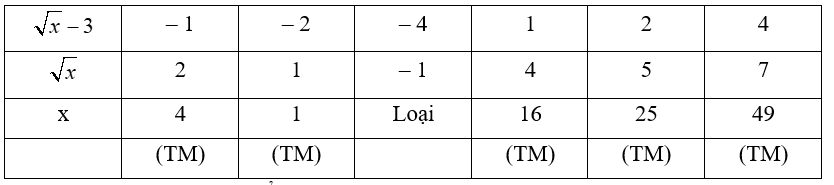
Vậy x ∈ {1; 4; 16; 25; 49} để N nguyên
a) \[K = \frac{1}{{\sqrt {2\sqrt 3 - \sqrt 2 } .\sqrt 2 + \sqrt 3 }}\]
\[K = \frac{1}{{\sqrt {2\sqrt 6 - 2} + 3}}\]
\[K = \frac{{1\left( {\sqrt {2\sqrt 6 - 2} - \sqrt 3 } \right)}}{{\left( {\sqrt {2\sqrt 6 - 2} + \sqrt 3 } \right)\left( {\sqrt {2\sqrt 6 - 2} - \sqrt 3 } \right)}}\]
\[K = \frac{{\sqrt {2\sqrt 6 - 2} - \sqrt 3 }}{{2\sqrt 6 - 2 - 3}} = \frac{{\sqrt {2\sqrt 6 - 2} - \sqrt 3 }}{{2\sqrt 6 - 5}}\]
\[K = \frac{{\left( {\sqrt {2\sqrt 6 - 2} - \sqrt 3 } \right)\left( {2\sqrt 6 + 5} \right)}}{{\left( {2\sqrt 6 - 5} \right)\left( {2\sqrt 6 + 5} \right)}} = \frac{{\left( {\sqrt {2\sqrt 6 - 2} - \sqrt 3 } \right)\left( {2\sqrt 6 + 5} \right)}}{{24 - 25}} = \left( {\sqrt 3 - \sqrt {2\sqrt 6 - 2} } \right)\left( {2\sqrt 6 + 5} \right)\]
b) Ta có: \[\frac{1}{{\sqrt 1 + \sqrt 2 }} = \frac{{1\left( {\sqrt 1 - \sqrt 2 } \right)}}{{\left( {\sqrt 1 + \sqrt 2 } \right)\left( {\sqrt 1 - \sqrt 2 } \right)}} = \frac{{\sqrt 1 - \sqrt 2 }}{{1 - 2}} = \sqrt 2 - 1\]
Tương tự \[\frac{1}{{\sqrt 2 + \sqrt 3 }}\], \[\frac{1}{{\sqrt 3 + \sqrt 4 }}\] …
Và \[\frac{1}{{\sqrt {n - 1} + \sqrt n }} = \frac{{1\left( {\sqrt {n - 1} - \sqrt n } \right)}}{{\left( {\sqrt {n - 1} + \sqrt n } \right)\left( {\sqrt {n - 1} - \sqrt n } \right)}} = \frac{{\sqrt {n - 1} - \sqrt n }}{{n - 1 - n}} = \sqrt n - \sqrt {n - 1} \]
Suy ra \[H = \left( {\sqrt 2 - 1} \right) + \left( {\sqrt 3 - \sqrt 2 } \right) + \left( {2 - \sqrt 3 } \right) + ... + \left( {\sqrt n - \sqrt {n - 1} } \right) = - 1 + \sqrt n = \sqrt n - 1\]
c) Rút gọn biểu thức (P)
\[P = \left( {\sqrt x - \frac{1}{{\sqrt x }}} \right):\left( {\frac{{\sqrt x - 1}}{{\sqrt x }} + \frac{{1 - \sqrt x }}{{x + \sqrt x }}} \right)\] (đk: x > 0)
\[P = \left( {\frac{{x - 1}}{{\sqrt x }}} \right):\left( {\frac{{\left( {\sqrt x - 1} \right)\left( {\sqrt x + 1} \right)}}{{x + \sqrt x }} + \frac{{1 - \sqrt x }}{{x + \sqrt x }}} \right)\]
\[P = \left( {\frac{{x - 1}}{{\sqrt x }}} \right):\left( {\frac{{x - \sqrt x }}{{x + \sqrt x }}} \right)\]
\[P = \frac{{\left( {\sqrt x - 1} \right)\left( {\sqrt x + 1} \right)}}{{\sqrt x }}.\frac{{\sqrt x \left( {\sqrt x + 1} \right)}}{{\sqrt x \left( {\sqrt x - 1} \right)}} = \frac{{{{\left( {\sqrt x + 1} \right)}^2}}}{{\sqrt x }}\]
Với \[x = \frac{2}{{2 + \sqrt 3 }} = \frac{{2\left( {2 - \sqrt 3 } \right)}}{{\left( {2 + \sqrt 3 } \right)\left( {2 - \sqrt 3 } \right)}} = \frac{{4 - 2\sqrt 3 }}{{4 - 3}} = 4 - 2\sqrt 3 \] khi đó P có giá trị là:
\[P = \frac{{{{\left( {\sqrt x + 1} \right)}^2}}}{{\sqrt x }} = \frac{{{{\left( {\sqrt {4 - 2\sqrt 3 } + 1} \right)}^2}}}{{\sqrt {4 - 2\sqrt 3 } }} = \frac{{{{\left( {\sqrt {{{\left( {1 - \sqrt 3 } \right)}^2}} + 1} \right)}^2}}}{{\sqrt {{{\left( {1 - \sqrt 3 } \right)}^2}} }} = \frac{{{{\left( {\left| {1 - \sqrt 3 } \right| + 1} \right)}^2}}}{{\left| {1 - \sqrt 3 } \right|}} = \frac{{{{\left( {\sqrt 3 - 1 + 1} \right)}^2}}}{{\sqrt 3 - 1}} = \frac{3}{{\sqrt 3 - 1}}\]
a) Rút gọn biểu thức N:
\[N = \frac{{2\sqrt x - 9}}{{x - 5\sqrt x + 6}} - \frac{{\sqrt x + 3}}{{\sqrt x - 2}} - \frac{{2\sqrt x + 1}}{{3 - \sqrt x }}\,\left( {x \ge 0,x \ne 4,x \ne 9} \right)\]
\[N = \frac{{2\sqrt x - 9}}{{\left( {\sqrt x - 2} \right)\left( {\sqrt x - 3} \right)}} - \frac{{\sqrt x + 3}}{{\sqrt x - 2}} + \frac{{2\sqrt x + 1}}{{\sqrt x - 3}}\]
\[N = \frac{{2\sqrt x - 9 - \left( {\sqrt x - 2} \right)\left( {\sqrt x - 3} \right) + \left( {2\sqrt x + 1} \right)\left( {\sqrt x - 2} \right)}}{{\left( {\sqrt x - 2} \right)\left( {\sqrt x - 3} \right)}}\]
\[N = \frac{{2\sqrt x - 9 - x + 9 + 2x - 4\sqrt x + \sqrt x - 2}}{{\left( {\sqrt x - 2} \right)\left( {\sqrt x - 3} \right)}}\]
\[N = \frac{{x - \sqrt x - 2}}{{\left( {\sqrt x - 2} \right)\left( {\sqrt x - 3} \right)}} = \frac{{\left( {\sqrt x - 2} \right)\left( {\sqrt x + 1} \right)}}{{\left( {\sqrt x - 2} \right)\left( {\sqrt x - 3} \right)}}\]
\[N = \frac{{\sqrt x + 1}}{{\sqrt x - 3}}\] với \[\left( {x \ge 0,x \ne 4,x \ne 9} \right)\]
Do P = A : (1 – B) nên
\[P = \left( {\frac{1}{{\sqrt x - 1}} - \frac{{x - \sqrt x + 3}}{{x\sqrt x - 1}}} \right):\left( {1 - \frac{{x + 2}}{{x + \sqrt x + 1}}} \right)\] với \[x > 1\]
\[P = \left( {\frac{{1\left( {x + \sqrt x + 1} \right)}}{{\left( {\sqrt x - 1} \right)\left( {x\sqrt x - 1} \right)}} - \frac{{\left( {x - \sqrt x + 3} \right)}}{{\left( {\sqrt x - 1} \right)\left( {x\sqrt x - 1} \right)}}} \right):\left( {\frac{{x + \sqrt x + 1}}{{x + \sqrt x + 1}} - \frac{{x + 2}}{{x + \sqrt x + 1}}} \right)\]
\[P = \left( {\frac{{x + \sqrt x + 1 - x + \sqrt x - 3}}{{\left( {\sqrt x - 1} \right)\left( {x\sqrt x - 1} \right)}}} \right):\frac{{\sqrt x - 1}}{{x + \sqrt x + 1}}\]
\[P = \frac{{2\sqrt x - 2}}{{\left( {\sqrt x - 1} \right)\left( {x\sqrt x - 1} \right)}}:\frac{{\sqrt x - 1}}{{x + \sqrt x + 1}}\]
\[P = \frac{{2\sqrt x - 2}}{{\left( {\sqrt x - 1} \right)\left( {x\sqrt x - 1} \right)}} \cdot \frac{{x + \sqrt x + 1}}{{\sqrt x - 1}}\]
\[P = \frac{2}{{\sqrt x - 1}}\] với \[x > 1\]
Để \[P \le 1\] hay \[\frac{2}{{\sqrt x - 1}} \le 1 \Leftrightarrow \frac{2}{{\sqrt x - 1}} - 1 \le 0 \Leftrightarrow \frac{{ - \sqrt x + 3}}{{\sqrt x - 1}} \le 0\]
Đến đây xảy ra hai trường hợp:
Trường hợp 1: \[\left\{ \begin{array}{l} - \sqrt x + 3 \le 0\\\sqrt x - 1 \ge 0\end{array} \right. \Leftrightarrow \left\{ \begin{array}{l} - \sqrt x \le - 3\\\sqrt x \ge 1\end{array} \right. \Leftrightarrow \left\{ \begin{array}{l}\sqrt x \ge 3\\\sqrt x \ge 1\end{array} \right. \Leftrightarrow x \ge 9\]
Trường hợp 2: \[\left\{ \begin{array}{l} - \sqrt x + 3 \ge 0\\\sqrt x - 1 \le 0\end{array} \right. \Leftrightarrow \left\{ \begin{array}{l} - \sqrt x \ge - 3\\\sqrt x \le 1\end{array} \right. \Leftrightarrow \left\{ \begin{array}{l}\sqrt x \le 3\\\sqrt x \le 1\end{array} \right. \Leftrightarrow x \le 1\]. Kết hợp với điều kiện của x thì \[0 \le x \le 1\]
Vậy \[0 \le x \le 1\] hoặc \[x \ge 9\] để \[P \le 1\]
Ta có:
\[A = \left[ {\frac{1}{2}\sqrt[3]{{20 + 14\sqrt 2 }}.\sqrt {6 - 4\sqrt 2 } + \frac{1}{2}\sqrt[3]{{\left( {a + 3} \right)\sqrt a - 3a - 1}}} \right]:\left[ {\frac{{a - 1}}{{2\left( {\sqrt a + 1} \right)}} + 1} \right]\]
\[A = \left[ {\frac{1}{2}\sqrt[3]{{{{\left( {2 + \sqrt 2 } \right)}^3}}}.\sqrt {{{\left( {2 - \sqrt 2 } \right)}^2}} + \frac{1}{2}\sqrt[3]{{{{\left( {\sqrt a - 1} \right)}^3}}}} \right]:\left[ {\frac{{a + 2\sqrt a + 1}}{{2\left( {\sqrt a + 1} \right)}}} \right]\]
\[A = \left[ {\frac{1}{2}\left( {4 - 2} \right) + \frac{1}{2}\left( {\sqrt a - 1} \right)} \right]:\frac{{\sqrt a + 1}}{2}\]
\[A = \frac{{\sqrt a + 1}}{2}:\frac{{\sqrt a + 1}}{2} = 1\]
Vậy giá trị của biểu thức sau không phụ thuộc vào giá trị của biến.
Ta có: \[B = \frac{1}{{\sqrt[3]{x} + \sqrt[3]{y}}} - \frac{{\sqrt[3]{{{x^2}}} + \sqrt[3]{{{y^2}}}}}{{x + y}}\]
\[B = \frac{1}{{\sqrt[3]{x} + \sqrt[3]{y}}} - \frac{{\sqrt[3]{{{x^2}}} + \sqrt[3]{{{y^2}}}}}{{\left( {\sqrt[3]{x} + \sqrt[3]{y}} \right)\left( {\sqrt[3]{{{x^2}}} - \sqrt[3]{{xy}} + \sqrt[3]{{{y^2}}}} \right)}}\]
\[B = \frac{{1\left( {\sqrt[3]{{{x^2}}} - \sqrt[3]{{xy}} + \sqrt[3]{{{y^2}}}} \right)}}{{\left( {\sqrt[3]{x} + \sqrt[3]{y}} \right)\left( {\sqrt[3]{{{x^2}}} - \sqrt[3]{{xy}} + \sqrt[3]{{{y^2}}}} \right)}} - \frac{{\sqrt[3]{{{x^2}}} + \sqrt[3]{{{y^2}}}}}{{\left( {\sqrt[3]{x} + \sqrt[3]{y}} \right)\left( {\sqrt[3]{{{x^2}}} - \sqrt[3]{{xy}} + \sqrt[3]{{{y^2}}}} \right)}}\]
\[B = \frac{{\sqrt[3]{{{x^2}}} - \sqrt[3]{{xy}} + \sqrt[3]{{{y^2}}} - \sqrt[3]{{{x^2}}} - \sqrt[3]{{{y^2}}}}}{{\left( {\sqrt[3]{x} + \sqrt[3]{y}} \right)\left( {\sqrt[3]{{{x^2}}} - \sqrt[3]{{xy}} + \sqrt[3]{{{y^2}}}} \right)}}\]
\[B = \frac{{ - \sqrt[3]{{xy}}}}{{\left( {\sqrt[3]{x} + \sqrt[3]{y}} \right)\left( {\sqrt[3]{{{x^2}}} - \sqrt[3]{{xy}} + \sqrt[3]{{{y^2}}}} \right)}} = \frac{{ - \sqrt[3]{{xy}}}}{{x + y}}\]
Giá trị của biểu thức B tại x = 3 và \[y = \frac{1}{3}\] là: \[\frac{{ - \sqrt[3]{{3.\frac{1}{3}}}}}{{3 + \frac{1}{3}}} = - \frac{3}{{10}}\] < 1
Vậy biểu thức B < 1.
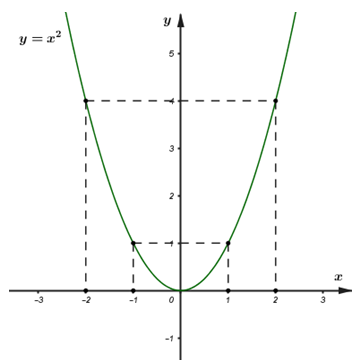
Vẽ Parabol (P): y = x2
- Tập xác định: \[x \in \mathbb{R}\]
- Bảng giá trị giữa x và y:

Trên mặt phẳng tọa độ lấy các điểm A(– 2; 4); B(– 1; 1); O(0; 0); C( 1; 1) và G(2; 4).
Nối các điểm này ta được đường cong là đồ thị hàm số y = x2.
- Vẽ đồ thị:
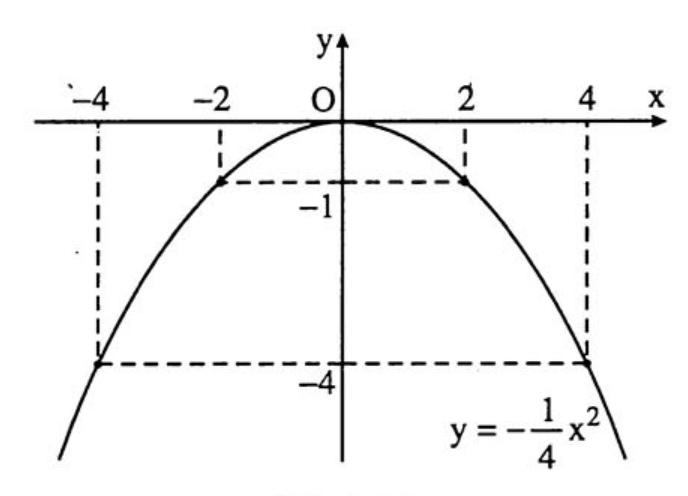
Cho hàm số có \[y = - \frac{1}{4}{x^2}\] đồ thị là (P). Hãy vẽ (P) trên hệ trục tọa độ.
Vẽ Parabol (P): \[y = - \frac{1}{4}{x^2}\]
- Tập xác định: \[x \in \mathbb{R}\]
- Bảng giá trị giữa x và y:
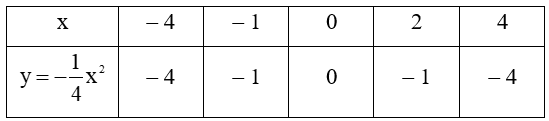
Trên mặt phẳng tọa độ lấy các điểm A(– 4; – 4); B(– 2; – 1); O(0; 0); C(2; – 1) và G(4; – 4).
Nối các điểm này ta được đường cong là đồ thị hàm số \[y = - \frac{1}{4}{x^2}\].
- Vẽ đồ thị:
- Thay \[x = \sqrt 2 \] và y = – 1 vào hàm số y = ax2.
Ta có: \[ - 1 = a.{\left( {\sqrt 2 } \right)^2} \Leftrightarrow a = - \frac{1}{2}\]
Vậy đồ thị hàm số \[y = - \frac{1}{2}{x^2}\].
- Thay \[x = - \sqrt 2 \] và y = 1 vào hàm số y = ax2.
Ta có: \[1 = a.{\left( { - \sqrt 2 } \right)^2} \Leftrightarrow a = \frac{1}{2}\]
Vậy đồ thị hàm số \[y = \frac{1}{2}{x^2}\].
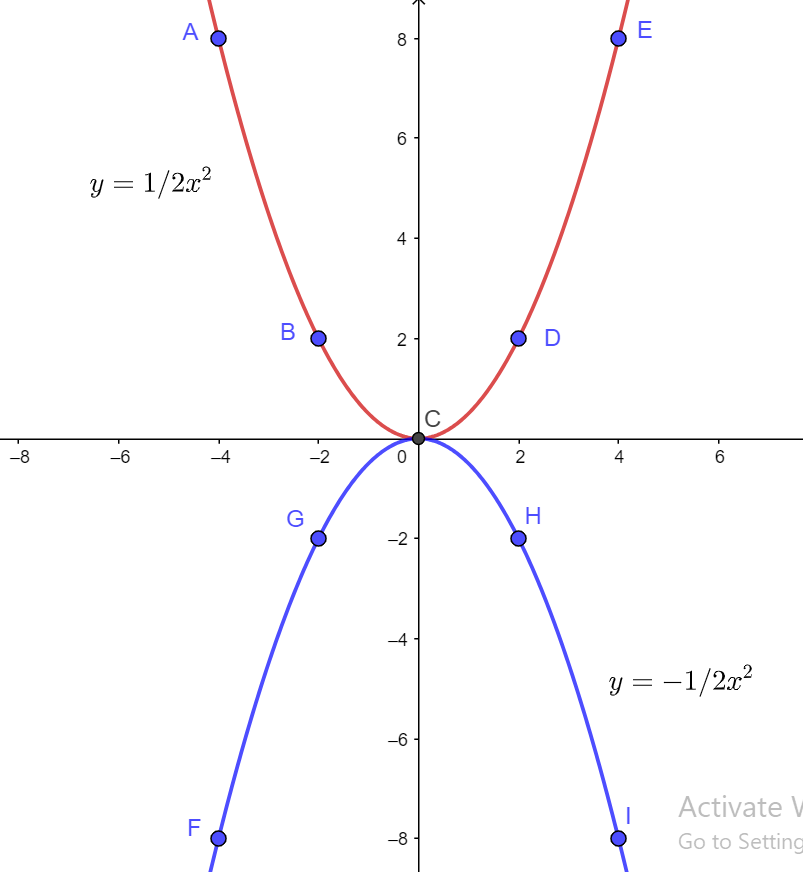
- Vẽ đồ thị hàm số \[y = - \frac{1}{2}{x^2}\]
Tập xác định: \[x \in \mathbb{R}\]
Bảng giá trị giữa x và y:
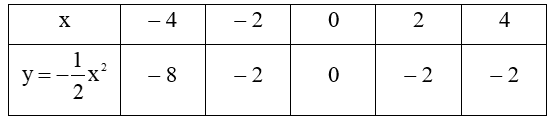
Trên mặt phẳng tọa độ lấy các điểm F(– 4; – 8); G(– 2; – 2); C(0; 0); H(2; – 2) và I(4; – 4).
Nối các điểm này ta được đường cong là đồ thị hàm số \[y = - \frac{1}{2}{x^2}\].
- Vẽ đồ thị hàm số \[y = \frac{1}{2}{x^2}\]
Tập xác định: \[x \in \mathbb{R}\]
Bảng giá trị giữa x và y:
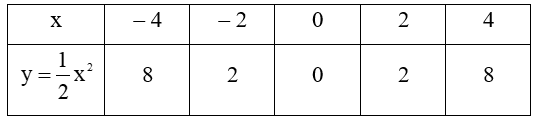
Trên mặt phẳng tọa độ lấy các điểm A(– 4; 8); B(– 2; 2); C(0; 0); D(2; 2), E(4; – 8).
Nối các điểm này ta được đường cong là đồ thị hàm số \[y = - \frac{1}{4}{x^2}\].
a) Thay \[x = - \sqrt 2 \] và y = – 4 vào hàm số y = ax2.
Ta có: \[ - 4 = a.{\left( { - \sqrt 2 } \right)^2} \Leftrightarrow a = - 2\]
Vậy đồ thị hàm số y = – 2x2.
b) Với a = – 2 ta vẽ đồ thị hàm số
- Tập xác định: \[x \in \mathbb{R}\]
- Bảng giá trị giữa x và y:
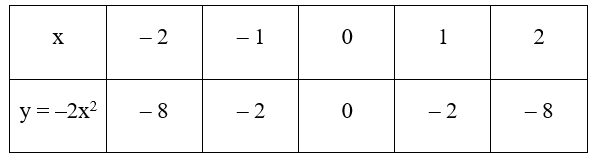
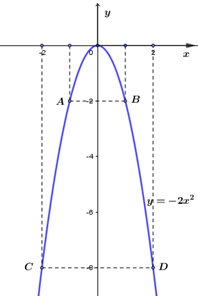
Trên mặt phẳng Oxy lấy các điểm C(– 2; – 8); A(– 1; – 2); O(0; 0); B( 1; – 2); G(2; – 8).
Nối các điểm này ta được đường cong là đồ thị hàm số y = –2x2.
- Vẽ đồ thị:
a) Vẽ Parabol (P): y = 2x2
- Tập xác định: \[x \in \mathbb{R}\]
- Bảng giá trị giữa x và y:

Trên mặt phẳng tọa độ lấy các điểm C(- 2; 8); D(-1; 2) ; E(0; 0); F(1;2) và G(2; 8).
Nối các điểm này ta được đường cong là đồ thị hàm số y = 2x2.
- Vẽ đồ thị:
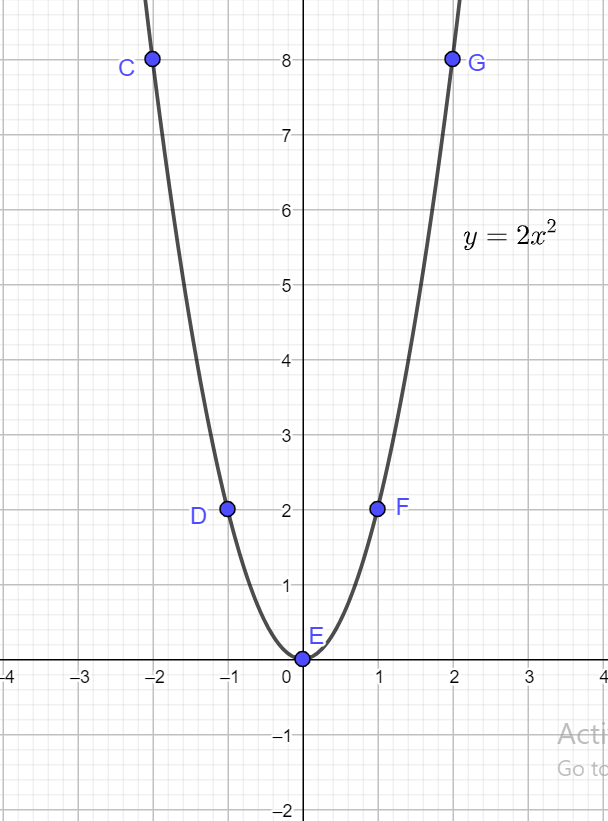
b) Thay y = 6 vào y = 2x2 ta tìm được \[x = \pm \sqrt 3 \].
Vậy (P) có các điểm \[\left( {\sqrt 3 ;6} \right),\left( { - \sqrt 3 ;6} \right)\] khi tung độ bằng 6.
Xét tam giác DEF vuông tại D
Áp dụng hệ thức về cạnh và góc: DE = EF . cosE = 6 . cos30° = \[3\sqrt 3 \] (cm)
Tam giác ABC vuông tại B:
Áp dụng hệ thức lượng: \[\tan A = \frac{{BC}}{{AB}} = \frac{4}{3}\].
Vậy số đo góc \[\widehat {BAC} \approx 53^\circ 7'\]
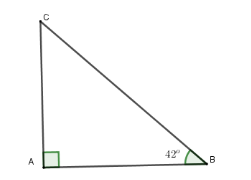
Ta có chiều cao của cột đèn là AC
Bóng của đèn trên mặt đất dài 7,5m nghĩa là AB = 7,5.
Các tia sang mặt trời tạo với mặt đất một góc xấp xỉ 420 nghĩa là \[\widehat {ABC} = 42^\circ \]
Xét tam giác ABC vuông tại A, có
AC = AB. tanB = 7,5 . tan 42° ≈ 6,753 (m)
Tạo đường cao AH, HB là hình chiếu của AB trên BC
Xét tam giác AHB có \[\widehat {AHB} = 90^\circ \], có:
HB = AB.cosB \[ \Rightarrow AB = \frac{{HB}}{{{\rm{cos}}B}} = \frac{4}{{{\rm{cos40}}^\circ }} = 8\left( {cm} \right)\]
AH = AB.sinB = 8. sin60° = \[8.\frac{{\sqrt 3 }}{2} = 4\sqrt 3 \left( {cm} \right)\]
Theo đề bài ta có: AC = 2AB nên AC = 2.8 = 16 (cm)
Xét tam giác AHC có:
AH = AC.sinC \[ \Rightarrow \sin C = \frac{{AH}}{{AC}} = \frac{{4\sqrt 3 }}{{16}} = \frac{{\sqrt 3 }}{4}\left( {cm} \right)\]\[ \Rightarrow \widehat {ACB} \approx 25^\circ 39'\].
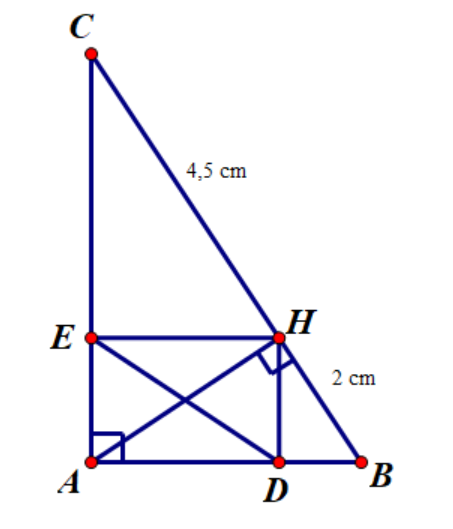
a) Xét tam giác AHC vuông tại H có: AH2 = AE . AC
Xét tam giác AHB vuông tại H có: AH2 = AD . AB
Suy ra AD.AB = AE.AC (=AH2)
- Xét ∆ABC và ∆AED
Có góc A chung
AD.AB = AE.AC
⇒ ∆ABC và ∆AED (c – g – c)
b) - Xét tứ giác ADHE có
Suy ra tứ giác ADHE là hình chữ nhật nên hai đường chéo DE = AH.
Mà AH là đường cao trong tam giác ABC
Áp dụng hệ thức lượng trong tam giác vuông ABC: AH2 = HB . HC = 2 . 4,5 = 9
Vậy AH = 3cm = DE.
- Xét tam giác AHB vuông tại H
Áp dụng hệ thức về cạnh và góc: \[tanB = \frac{{AH}}{{BH}} = \frac{3}{2}\].
Vậy số đo góc \[\widehat {ABC} \approx 56^\circ \]
Áp dụng định lí Py – ta – go vào tam giác ABC vuông tại C:
AB2 = BC2 + AC2 = 1,22 + 0,92 = 2,25 ⇒ AB = 1,5cm.
Sử dụng tỉ số lượng giác của góc B, ta được:
\[\sin B = \frac{{AC}}{{AB}} = \frac{{0,9}}{{1,5}} = 0,6\]
\[co{\mathop{\rm s}\nolimits} B = \frac{{BC}}{{AB}} = \frac{{1,2}}{{1,5}} = 0,8\]
\[\tan B = \frac{{AC}}{{BC}} = \frac{{0,9}}{{1,2}} = 0,75\]
\[\cot B = \frac{{BC}}{{AC}} = \frac{{1,2}}{{0,9}} = \frac{4}{3}\]
Suy ra, tỉ số lượng giác của góc A:
\[\sin A = co{\mathop{\rm s}\nolimits} B = 0,8\]
\[co{\mathop{\rm s}\nolimits} A = \sin B = 0,6\]
\[\tan A = \cot B = \frac{4}{3}\]
\[\cot A = \tan B = 0,75\]
Vì \[\widehat B = \alpha \cot \alpha \,{\rm{ = }}\,\,\frac{5}{{12}}\,\]
\[ \Rightarrow \cot B = \frac{5}{{12}}\] hay \[\frac{{AC}}{{AB}} = \frac{5}{{12}} \Rightarrow AC = \frac{5}{{12}}.AB = \frac{5}{{12}}.30 = 12,5\]
Áp dụng định lí Py – ta – go vào tam giác ABC vuông tại C:
BC2 = AB2 + AC2 = 302 + 12,52 ⇒ BC = 32,5cm.
Tạo đường cao AH, HB là hình chiếu của AB trên BC
Xét tam giác AHB có \[\widehat {AHB} = 90^\circ \], có:
HB = AB.cosB \[ \Rightarrow AB = \frac{{HB}}{{{\rm{cos}}B}} = \frac{4}{{{\rm{cos40}}^\circ }} = 8\left( {cm} \right)\]
AH = AB.sinB = 8. sin60° = \[8.\frac{{\sqrt 3 }}{2} = 4\sqrt 3 \left( {cm} \right)\]
Theo đề bài ta có: AC = 2AB nên AC = 2.8 = 16 (cm)
Xét tam giác AHC có:
AH = AC.sinC \[ \Rightarrow \sin C = \frac{{AH}}{{AC}} = \frac{{4\sqrt 3 }}{{16}} = \frac{{\sqrt 3 }}{4}\left( {cm} \right)\]\[ \Rightarrow \widehat {ACB} \approx 25^\circ 39'\].
Xét tam giác ABC có \[\cot B = \sin C = \frac{3}{5}\]
Suy ra \[{\cos ^2}B = \frac{3}{5}.\frac{3}{5} = 0,36\]
Mà cos2B + sin2B = 1 ⇒ sin2B = 1 - = 0,64 ⇔ sinB = 0,8 (vì sinB > 0)
⇒ sinB = cosC = 0,8
Ta có \[\tan C = \frac{{\sin C}}{{co{\mathop{\rm s}\nolimits} C}} = \frac{{0,6}}{{0,8}} = 0,75\]; \[\cot C = \frac{1}{{\tan C}} = \frac{1}{{0,75}} = \frac{4}{3}\]
Vậy \[\sin C = \frac{3}{5};\,\cos C = 0,8;\,\tan C = 0,75;\,\cot C = \frac{4}{3}\].
a) sin200 < sin700
b) cos600 > cos700
c) tan73020’ > tan450
d) cot230 > cot37040’
Gọi phương trình đường thẳng (d) là y = ax + b.
Do (d) vuông góc với đường thẳng \[y = - \frac{1}{4}x + 3\]
⇔ a . a’ = – 1 ⇔ \[a.\left( { - \frac{1}{4}} \right) = - 1\] ⇔ a = 4
Khi đó, phương trình đường thẳng (d) có dạng y = 4x + b.
Do (d) đi qua điểm \[K\left( {\frac{1}{2};4} \right)\] nên tọa độ điểm K thỏa mãn phương trình (d):
⇒ \[4 = 4.\frac{1}{2} + b\]⇒ b = 2.
Vậy phương trình đường thẳng (d) là y = 4x + 2.
Hệ số của hàm số y = 7 – ax là – a.
Để hàm số y = 7 – ax vuông góc với đường thẳng \[y = - \frac{{16}}{5}x\]
⇔ a . a’ = – 1 ⇔ \[\left( { - a} \right).\left( { - \frac{{16}}{5}} \right) = - 1\] ⇔ \[a = - \frac{5}{{16}}\].
Vậy hệ số \[a = - \frac{5}{{16}}\].
Để hàm số y = (m – 2)x + m + 3 vuông góc với đường thẳng y = 3x – 3 + m.
⇔ a . a’ = – 1 ⇔ 3(m – 1) = – 1 ⇔ 3m = 2 ⇔ \[m = \frac{2}{3}\].
Gọi phương trình đường thẳng d cần tìm là y = ax + b (a ≠ 0)
Vì (d) vuông góc với đường thẳng y = x + 3 nên a . a’ = – 1 ⇔ a. 1 = – 1 ⇔ a = – 1.
Khi đó, phương trình đường thẳng (d) có dạng y = – x + b.
Gọi điểm H(x; 5) là giao điểm của đường thẳng d và đường thẳng 2x + 1.
Khi đó, 2x + 1 = 5 ⇔ 2x = 4 ⇔ x = 2.
Suy ra H(2; 5). Thay tọa độ H vào phương trình đường thẳng (d), ta được:
⇒ (– 1) . 2 + b = 5 ⇒ b = 7.
Vậy phương trình đường thẳng (d) là y = – x + 7.
a) để d1 vuông góc d2 ⇔ a . a’ = – 1 ⇔ 2(m2 – 1) = – 1 ⇔ 2m2 = 1 ⇔ \[m = \pm \frac{{\sqrt 2 }}{2}\]
b) Với \[m = \frac{{\sqrt 2 }}{2}\] thì phương trình đường thẳng d2 có dạng:
d2: \[y = \left( {{{\left( {\frac{{\sqrt 2 }}{2}} \right)}^2} - 1} \right)x + 3 = - \frac{1}{2}x + 3\]
Với \[m = - \frac{{\sqrt 2 }}{2}\] thì phương trình đường thẳng d2 có dạng:
d2: \[y = \left( {{{\left( { - \frac{{\sqrt 2 }}{2}} \right)}^2} - 1} \right)x + 3 = - \frac{1}{2}x + 3\]
Vậy phương trình đường thẳng d2 là \[y = - \frac{1}{2}x + 3\].
a) \[\sqrt {10\left( {x - 3} \right)} = \sqrt {26} \];
Điều kiện: \[x - 3 \ge 0 \Leftrightarrow x \ge 3\]
\[\sqrt {10\left( {x - 3} \right)} = \sqrt {26} \Leftrightarrow 10\left( {x - 3} \right) = 26 \Leftrightarrow 10x = 56 \Leftrightarrow x = \frac{{56}}{{10}}\]
Vậy phương trình có nghiệm \[S = \left\{ {\frac{{56}}{{10}}} \right\}\]
b) \[\sqrt {36x - 72} - 5\sqrt {\frac{{x - 2}}{{25}}} = 4\left( {5 + \sqrt {x - 2} } \right)\]
Điều kiện: \[x - 2 \ge 0 \Leftrightarrow x \ge 2\]
\[\sqrt {36x - 72} - 5\sqrt {\frac{{x - 2}}{{25}}} = 4\left( {5 + \sqrt {x - 2} } \right)\]
\[ \Leftrightarrow \sqrt {36\left( {x - 2} \right)} - 5\frac{{\sqrt {x - 2} }}{{\sqrt {25} }} = 4.5 + 4\sqrt {x - 2} \]
\[ \Leftrightarrow \sqrt {36} .\sqrt {x - 2} - 5\frac{{\sqrt {x - 2} }}{5} = 20 + 4\sqrt {x - 2} \]
\[ \Leftrightarrow 6\sqrt {x - 2} - \sqrt {x - 2} - 4\sqrt {x - 2} = 20\]
\[ \Leftrightarrow \left( {6 - 1 - 4} \right)\sqrt {x - 2} = 20 \Leftrightarrow x - 2 = 400 \Leftrightarrow x = 402\]
Vậy phương trình có nghiệm S = {402}
Điều kiện: \[3x - 6 \ge 0 \Leftrightarrow 3x \ge 6 \Leftrightarrow x \ge 2\]
\[\sqrt {{x^2} + 6x + 9} = 3x - 6\]
\[ \Leftrightarrow \sqrt {{{\left( {x + 3} \right)}^2}} = 3x - 6\]
\[ \Leftrightarrow \left| {x + 3} \right| = 3x - 6\]
\[ \Leftrightarrow \left[ \begin{array}{l}x + 3 = 3x - 6\\x + 3 = - 3x + 6\end{array} \right.\]
\[ \Leftrightarrow \left[ \begin{array}{l} - 2x = - 9\\4x = 3\end{array} \right. \Leftrightarrow \left[ \begin{array}{l}x = \frac{9}{2}\,\left( {tm} \right)\\x = \frac{3}{4}\,\left( {ktm} \right)\end{array} \right.\]
Vậy phương trình có nghiệm \[S = \left\{ {\frac{9}{2}} \right\}\]
\[\sqrt {25{x^2} - 9} = 2\sqrt {5x - 3} \Leftrightarrow \sqrt {25{x^2} - 9} = \sqrt {4\left( {5x - 3} \right)} \Leftrightarrow \sqrt {25{x^2} - 9} = \sqrt {20x - 12} \]
Điều kiện: \[20x - 12 \ge 0 \Leftrightarrow 20x \ge 12 \Leftrightarrow x \ge \frac{3}{5}\]
Ta có: \[\sqrt {25{x^2} - 9} = \sqrt {20x - 12} \]
\[ \Leftrightarrow 25{x^2} - 9 = 20x - 12\]
\[ \Leftrightarrow 25{x^2} - 20x + 3 = 0\]
\[ \Leftrightarrow \left( {5x - 1} \right)\left( {5x - 3} \right) = 0\]
\[ \Leftrightarrow \left[ \begin{array}{l}5x - 1 = 0\\5x - 3 = 0\end{array} \right. \Leftrightarrow \left[ \begin{array}{l}5x = 1\\5x = 3\end{array} \right. \Leftrightarrow \left[ \begin{array}{l}x = \frac{1}{5}\,\left( {ktm} \right)\\x = \frac{3}{5}\,\left( {tm} \right)\end{array} \right.\]
Vậy phương trình có nghiệm \[S = \left\{ {\frac{3}{5}} \right\}\]
Ta thấy \[x = \frac{a}{b} = \frac{3}{5}\]. Vậy tổng a + b = 3 + 5 = 8.
- Điều kiện: \[x \ge 0\]
- Mặt khác, ta thấy: \[\sqrt {x + 4 - 4\sqrt x } - \sqrt {x + 9 - 6\sqrt x } = \sqrt {{{\left( {\sqrt x - 2} \right)}^2}} - \sqrt {{{\left( {\sqrt x - 3} \right)}^2}} \] nên ta có: \[\left( * \right) \Leftrightarrow \left| {\sqrt x - 2} \right| - \left| {\sqrt x - 3} \right| = 1\,\] (**)
- Ta xét các trường hợp để phá dấu trị tuyệt đối:
+ Trường hợp 1: Nếu \[\left\{ \begin{array}{l}\sqrt x - 2 \ge 0\\\sqrt x - 3 \ge 0\end{array} \right. \Leftrightarrow \sqrt x \ge 3 \Leftrightarrow x \ge 9\] ta có:
\[\left( {**} \right) \Leftrightarrow \sqrt x - 2 - \sqrt x + 3 = 1 \Leftrightarrow 0.\sqrt x = 0\]
⇒ Phương trình có vô số nghiệm \[x \ge 9\].
+ Trường hợp 2: Nếu \[\left\{ \begin{array}{l}\sqrt x - 2 \ge 0\\\sqrt x - 3 < 0\end{array} \right. \Leftrightarrow \left\{ \begin{array}{l}x \ge 4\\x < 9\end{array} \right. \Leftrightarrow 4 \le x < 9\] ta có:
\[\left( {**} \right) \Leftrightarrow \left( {\sqrt x - 2} \right) - \left( {3 - \sqrt x } \right) = 1 \Leftrightarrow 2\sqrt x = 6 \Leftrightarrow x = 9\]
⇒ Đối chiếu với điều kiện ta thấy x = 9 không thỏa mãn nên loại.
+ Trường hợp 3: Nếu \[\left\{ \begin{array}{l}\sqrt x - 2 < 0\\\sqrt x - 3 \ge 0\end{array} \right. \Leftrightarrow \left\{ \begin{array}{l}x < 4\\x \ge 9\end{array} \right. \Leftrightarrow x \in \emptyset \].
+ Trường hợp 4: Nếu \[\left\{ \begin{array}{l}\sqrt x - 2 < 0\\\sqrt x - 3 < 0\end{array} \right. \Leftrightarrow \left\{ \begin{array}{l}x < 4\\x < 9\end{array} \right. \Leftrightarrow x < 4\] ta có:
\[\left( {**} \right) \Leftrightarrow \left( {\sqrt x - 2} \right) - \left( {3 - \sqrt x } \right) = 1 \Leftrightarrow 0.\sqrt x = 2\]
⇒ Phương trình có vô nghiệm.
Vậy phương trình có vô số nghiệm khi \[x \ge 9\].
\[\sqrt[3]{{x - 1}} = 2 \Leftrightarrow x - 1 = {2^3} \Leftrightarrow x - 1 = 8 \Leftrightarrow x = 9\].
Gọi phương trình đường thẳng (d) là y = ax + b.
Do (d) song song với đường thẳng y = 3x – 11 nên suy ra a = 3 và b ≠ – 11.
Khi đó, phương trình đường thẳng (d) có dạng y = 3x + b.
Do (d) đi qua điểm A(1; – 5) nên tọa độ điểm A thỏa mãn phương trình (d):
⇒ – 5 = 3.1 + b ⇒ b = – 8.
Vậy phương trình đường thẳng (d) là y = 3x – 8.
Hệ số của hàm số y = 7 – ax là – a.
Để hàm số y = 7 – ax song song với đường thẳng y = – 5x + 3
nên – a = – 5 hay a = 5.
Vậy hệ số a = 5. Suy ra phương trình đường thẳng (d) là y = 5x + 7
a) Để hàm số y = (m – 2)x + m + 3 đồng biến khi m – 2 > 0 hay m > 2.
Để hàm số y = (m – 2)x + m + 3 đồng biến khi m – 2 < 0 hay m < 2.
b) Để hàm số y = (m – 2)x + m + 3 song song với đường thẳng y = 3x – 3 + m
⇔ a = a’ ⇔ (m – 2) = 3 ⇔ m = 5.
c) Với giá trị m = – 1 thì a = m – 2 = – 1 – 2 = – 3 và b = m + 3 = (– 1) + 3 = 2
Vậy phương trình đường thẳng d là y = – 3x + 2.
Gọi phương trình đường thẳng d cần tìm là y = ax + b (a ≠ 0)
Vì (d) song song với đường thẳng y = – 2x + 8 nên a = – 2 và b ≠ 8.
Khi đó, phương trình đường thẳng (d) có dạng y = – 2x + b.
Vì đường thẳng (d) cắt cắt trục hoành tại điểm có hoành độ bằng 5 nên (d) đi qua điểm A(5; 0).
Thay tọa độ A vào phương trình đường thẳng (d), ta được:
⇒ (– 2) . 5 + b = 0 ⇒ b = 10 (tm).
Vậy phương trình đường thẳng (d) là y = – 2x + 10.
a) Để d1 song song d2 ⇔ a = a’ ⇔ m2 – 1 = 2 ⇔ m2 = 3 ⇔ \[m = \pm \sqrt 3 \]
b) Với \[m = \sqrt 3 \] thì phương trình đường thẳng d2 có dạng:
d2: \[y = \left( {{{\left( {\sqrt 3 } \right)}^2} - 1} \right)x + 3 = 2x + 3\]
Với \[m = - \sqrt 3 \] thì phương trình đường thẳng d2 có dạng:
d2: \[y = \left( {{{\left( { - \sqrt 3 } \right)}^2} - 1} \right)x + 3 = 2x + 3\]
Vậy phương trình đường thẳng d2 là y = 2x + 3.
Bạn có thích hoạt động này không?
Hãy lưu hoặc chia sẻ nội dung này đến mọi người.
Gợi ý cho bạn

Ý tưởng của bạn, bài học của bạn
Tự thiết kế đề thi, bài giảng hoặc flashcard theo cách riêng.