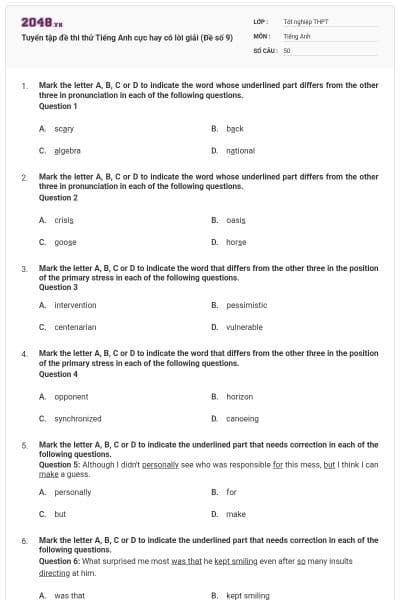
Tuyển tập đề thi thử Tiếng Anh cực hay có lời giải (Đề số 9)
50 câu hỏi
Mark the letter A, B, C or D to indicate the word whose underlined part differs from the other three in pronunciation in each of the following questions.
Question 1
scary
back
algebra
national
Đáp án A. scary, phát âm là /e/, còn lại phát âm là /æ/
A. scary /'skeri/ (adj) đáng sợ
B. back /bæk/ (adj) phía sau
C. algebra /'ældʒɪbrə/ (11) môn đại số
D. national / 'næ∫nəl/ (adj) thuộc về quốc gia
Mark the letter A, B, C or D to indicate the word whose underlined part differs from the other three in pronunciation in each of the following questions.
Question 2
crisis
oasis
goose
horse
Đáp án B. oasis, phát âm là /z/, còn lại phát âm là /s/.
A. crisis /'kraɪsɪs/ (n) khủng hoảng
B. oasis / əʊ'eɪsi:z/ (n) ốc đảo, vùng đất có nước mà cây cối sinh sôi được giữa một sa mạc
C. goose /gu:s/ (n) con ngỗng
D. horse /hɔ:rs/ (n) con ngựa
Mark the letter A, B, C or D to indicate the word that differs from the other three in the position of the primary stress in each of the following questions.
Question 3
intervention
pessimistic
centenarian
vulnerable
Đáp án D. vulnerable, trọng âm chính rơi vào âm tiết thứ nhất, còn lại rơi vào âm tiết thứ ba.
A. intervention /,ɪntər'ven∫n/ (n) sự can thiệp
B. pessỉmistic /,pesɪ'mɪstɪk/ (adj) bi quan
C. centenarian /,sentɪ'neriən/ (n) người từ 100 tuổi trở lên
D. vulnerable /'vʌlnərəbl/ (adj) dễ bị tổn thương
Mark the letter A, B, C or D to indicate the word that differs from the other three in the position of the primary stress in each of the following questions.
Question 4
opponent
horizon
synchronized
canoeing
Đáp án C. synchronized, trọng âm rơi vào âm tiết thứ nhất, còn lại rơi vào âm tiết thứ hai.
A. opponent / ə’poʊnənt/ (n) đối thủ
B. horizon /hə'raɪzn/ (n) đường chân trời
C. synchronized /'sɪŋkrənaɪz/ (v) xảy ra cùng lúc
D. canoeing /kə'nu:ɪŋ/ (n) môn đua thuyền
Mark the letter A, B, C or D to indicate the underlined part that needs correction in each of the following questions.
Question 5: Although I didn't personally see who was responsible for this mess, but I think I can make a guess.
personally
for
but
make
Đáp án C. but => bỏ but
Giải thích: Trong câu có mệnh đề nhượng bộ, đã dùng although/ though/ even though thì vế chính không có but.
Dịch nghĩa: Mặc dù tôi đã không trực tiếp nhìn thấy ai làm ra đống bừa bộn này, nhưng tôi có thể đoán được.
Mark the letter A, B, C or D to indicate the underlined part that needs correction in each of the following questions.
Question 6: What surprised me most was that he kept smiling even after so many insults directing at him.
was that
kept smiling
so
directing
Đáp án D. directing => directed
Giải thích: Ở đây chỉ có dạng phân từ V_ing mà không dùng động từ làm vị ngữ nên ta biết người nói sử dụng mệnh đề rút gọn. Tuy nhiên vì câu gốc ở dạng bị động insults were directed at him nên khi rút gọn ta sẽ dùng dạng directed mà không dùng directing.
Direct/ shout insult (n) at somebody = insult (v) somebody: xúc phạm
Dịch nghĩa: Điều làm tôi ngạc nhiên nhất là anh ta cứ tiếp tục cười, thậm chí sau rất nhiều sự xúc phạm, sỉ nhục hướng đến anh ta.
Mark the letter A, B, C or D to indicate the underlined part that needs correction in each of the following questions.
Question 7: Electric wires carry current for lighting and outlets designing for household appliances.
Electric
carry current
lighting
designing
Đáp án D. designing => are designed
Giải thích: Những ổ điện được thiết kế cho đồ điện gia dụng - dùng bị động, vế này tách riêng với vế trước do không sử dụng chung động từ carry nên thiếu động từ, vì dùng bị động nên ta phải bổ sung to be.
Dịch nghĩa: Dây điện dẫn dòng điện để thắp sáng và ổ điện được thiết kế cho đồ điện gia dụng.

Học thông minh hơn mỗi ngày
Xem toàn bộ 50 câu hỏi và nhiều hơn nữa với tài khoản miễn phí
Markthe letter A, B, C or D to indicate the correct answer to each of the following questions.
Question 8: She ________ the station every day but then she suddenly decided to walk instead.
used to
was used to
had used to
didn't used to
Đáp án: A
Giải thích:
used to V: từng làm gì (giờ không làm nữa)
Phủ định: didn’t use to V
be/get used to V-ing: đang làm quen với việc làm gì
Không có “had used to”
Loại C và D vì sai ngữ pháp.
Dựa vào nghĩa, chọn A.
Dịch: Bà thường lái xe đến ga tàu mỗi ngày nhưng sau đó bà đột nhiên quyết định đi bộ.
Markthe letter A, B, C or D to indicate the correct answer to each of the following questions.
Question 9: Seldom _______ far enough north to disturb South Pacific shipping lanes.
Antarctic icebergs will move
will Antarctic icebergs move
will move Antarctic icebergs
move Antarctic icebergs will
Đáp án B
Giải thích: Do câu bắt đầu bằng từ phủ định Seldom nên ta dùng đảo ngữ có trợ động từ trong trường hợp này. Sử dụng trợ động từ và đảo lên trước chủ ngữ, còn lại giữ nguyên.
Dịch nghĩa: Hiếm khi các núi băng ở Nam Cực di chuyển đủ xa để gây cản trở đến đường thủy trên Nam Thái Bình Dương.
Markthe letter A, B, C or D to indicate the correct answer to each of the following questions.
Question 10: If I _____ following that other car too closely, I would have been able to stop in the time instead of running into it.
wasn't
weren't
hadn't been
would have been
Đáp án C
Giải thích: Hành động “theo sát xe” và “không dừng kịp” đều ở quá khứ, vế kết quả cũng có cấu trúc would have Vpp, nên ta sử dụng câu điều kiện loại III.
If S had Vpp, S would have Vpp: dùng để giả sử hành động xảy ra trái với sự thật trong quá khứ.
Run into: đâm vào
Dịch nghĩa: Nếu tôi không bám theo chiếc ôtô kia quá sát thì tôi đã có thể kịp dừng lại thay vì đâm vào nó.
Markthe letter A, B, C or D to indicate the correct answer to each of the following questions.
Question 11: Fort Niagara was built by the French in 1762 on land ______ the Seneca Indians.
they buy from
bought from
buying from
was bought from
Đáp án B
Giải thích: Chú ngữ Fort Niagara đã có động từ làm vị ngữ là was built nên ta không thể thêm một vị ngữ khác như D vào được, mà sử dụng mệnh đề rút gọn. Vì fort được mua - bị động, nên ta dùng dạng mệnh đề Vpp là B.
Dịch nghĩa: Pháo đài Niagara được người Pháp xây dựng vào năm 1762 trên vùng đất được mua từ Seneca Ấn Độ.
Markthe letter A, B, C or D to indicate the correct answer to each of the following questions.
Question 12: A quick look would reveal that France has twice ________ computers.
more televisions than
many as televisions as
as many televisions as
as many as televisions
Đáp án: C
Giải thích:
Cấu trúc so sánh gấp nhiều lần:
S + V + multiple numbers + as + much/many/adj/adv + (N) + as + N/pronoun.
Dịch: Nhìn qua sẽ thấy Pháp có số vô tuyến gấp đôi số máy tính.
Markthe letter A, B, C or D to indicate the correct answer to each of the following questions.
Question 13: I've never had the slightest disagreement _______ him _______ anything.
with / about
with / in
on / about
on / at
Đáp án A
Giải thích:
Disagree with somebody over/about something: bất đồng với ai về vấn đề gì
Dịch nghĩa: Tôi chưa bao giờ có chút bất động nhỏ nào với anh ta về bất cứ vấn đề gì.
Markthe letter A, B, C or D to indicate the correct answer to each of the following questions.
Question 14: The weather is going to change soon; I feel it in my ___________.
legs
bones
skin
body
Đáp án B
Giải thích: feel it in one’s bone: cảm giác chắc chắn là như thể mặc dù không có bằng chứng cụ thể.
Dịch nghĩa: Thời tiết sắp thay đổi, tôi chắc chắn như thế.
Markthe letter A, B, C or D to indicate the correct answer to each of the following questions.
Question 15: The mass of the sun is about 750 times _______ that of all the planets combined.
the greatest
as great as
greatly
greater
Đáp án B
Giải thích: So sánh gấp bao nhiêu lần ta dùng số lần (twice, three times, 100 times. . .) + as much/ many/great/... as
Dịch nghĩa: Mặt trời lớn gấp 750 lần so với tổng tất cả các hành tinh cộng lại.
Markthe letter A, B, C or D to indicate the correct answer to each of the following questions.
Question 16: I'd like to ______ this old car for a new model but I can't afford it.
convert
exchange
replace
interchange
Đáp án B
Giải thích:
exchange something for something: đổi cái này lấy cái kia
A. convert: chuyển đổi từ định dạng này sang định dạng khác (file)
B. exchange: trao đổi
C. replace a with b: thay thế a bằng b
D. interchange a with b: trao đổi (ý kiến, thông tin)
Dịch nghĩa: Tôi muốn đổi ô tô cũ để lấy cái mới hơn nhưng không đủ tiền.
Markthe letter A, B, C or D to indicate the correct answer to each of the following questions.
Question 17: The information in this article is _____ inaccurate.
historic
historical
history
historically
Đáp án D
Giải thích:
A. historic: (adj) có ý nghĩa quan trọng trong lịch sử
B. historical: (adj) liên quan đến lịch sử, thuộc về lịch sử
C. history: (n) lịch sử, môn lịch sử
D. historically: (adv) về lịch sử
Để bổ sung cho tính từ inaccurate phía sau ta cần dùng phó từ.
Dịch nghĩa: Thông tin trong bài báo này là sai lịch sử.
Markthe letter A, B, C or D to indicate the correct answer to each of the following questions.
Question 18: As you've arrived late, you'll have to ______ the time you've lost.
make up to
do up for
do up to
make up for
Đáp án D
Giải thích:
A. make up to somebody: nịnh bợ ai để lấy lợi từ họ
B. do up: trang trí (không có do up for)
C. không có “do up to”
D. make up for: bù đắp
Dịch nghĩa: Vì bạn đến muộn nên bạn sẽ phải bù lại thời gian mà bạn làm mất.
Markthe letter A, B, C or D to indicate the correct answer to each of the following questions.
Question 19: My father sometimes _______ the washing up after dinner.
takes
does
washes
makes
Đáp án B
Giải thích:
Do the washing up: rửa bát đĩa
Dịch nghĩa: Bố tôi thỉnh thoảng rửa bát đĩa sau bữa tối.
Mark the letter A, B, C or D to indicate the most suitable response to complete each of the following exchanges.
Question 20: A: I don't like meat. B: ____________.
Nor I do
I don't too
Neither don't I
Neither do I
Đáp án D
Giải thích:
Để diễn tả sự giống nhau “cũng”, ta có thể dùng câu trả lời ngắn với so, too, either, neither.
Khẳng định | So , + to be/ trợ động từ + S | S to be/ trợ động từ, too. |
Phủ định | Neither +to be/ trợ động từ + S | S to be/ trợ động từ (có not), either. |
Ở đây, người thứ nhất dùng phủ định don’t like nên đối chiếu ta có neither do I hoặc I don’t, either.
Nor = neither.
Dịch nghĩa: Tôi không thích thịt. - Tôi cũng không.
Mark the letter A, B, C or D to indicate the most suitable response to complete each of the following exchanges.
Question 21: Cindy wanted to drive her best friend to have dinner at an Italian restaurant but her car couldn't start. Therefore, she had to borrow one from Nancy. Choose the most suitable response to fill in the blank in the following exchange.
Cindy: “Would you mind lending me your car?” - Nancy: “_____________.”
Yes. Here it is
Yes, let's
No, not at all
Great
Đáp án C
Giải thích:
Would/ do you mind – Bạn có phiền không - dùng để xin phép. Để đồng ý cho người đó làm, ta sẽ trả lời “không phiền”, chẳng hạn như no, not at all/ go ahead/ I don’t mind.
Còn nếu không đồng ý, nghĩa là bạn có phiền, thì sẽ trả lời bằng cách đưa ra các lí do từ chối, thỉnh
thoảng cũng sử dụng Yes, I would, nhưng không phổ biến vì hơi mất lịch sự.
Dịch nghĩa: Bạn có phiền nếu cho tôi mượn xe không? - Không, không phiền tý nào.
Mark the letter A, B, C or D to indicate the word/phrases SIMILAR in meaning to the underlined word(s) in each of the following questions.
Question 22: According to Freud, dreams can be interpreted as the fulfillment of wishes.
attainment
performance
conclusion
completion
Đáp án D
Giải thích:
A. attainment (n) sự đạt được
B. performance (n) sự biểu diễn
C. conclusion (n) kết luận
D. completion (n) sự hoàn thành
fulfilment (n) sự thực hiện, hoàn thành
Dịch nghĩa: Theo Freud, ước mơ có thể được hiểu như là sự hoàn thành những điều ước.
Mark the letter A, B, C or D to indicate the word/phrases SIMILAR in meaning to the underlined word(s) in each of the following questions.
Question 23: Ponce de Leon searched in vain for a means of rejuvenating the aged.
making young again
making merry again
making wealthy again
making weary again
Đáp án A
Giải thích:
Rejuvenate (v) làm trẻ lại
A. making young again: làm trẻ lại
B. making merry again: làm vui vẻ lại
C. making wealthy again: làm cho giàu có lại
D. making weary again: làm cho mệt mỏi lại
in vain: không thành công
Dịch nghĩa: Ponce de Leon đã nghiên cứu phương thức trẻ hóa mà không thành công.
Mark the letter A, B, C or D to indicate the word or phrase that is OPPOSITE in meaning to the underlined part in each of the following questions.
Question 24: The Red Cross is an international humanitarian agency dedicated to reducing the sufferings, of wounded soldiers, civilians and prisoners of war.
happiness
pain and sorrow
worry and sadness
loss
Đáp án A
Sufferings: tổn thất, sự chịu đựng
A. happiness: niềm vui
B. pain and sorrow: nỗi đau và đau khổ
C. worry and sadness: lo lắng và buồn rầu
D. loss: sự mất mát
Dịch nghĩa: Hội Chữ thập đỏ là một tổ chức nhân đạo quốc tế, tận tâm giảm thiểu tổn thương của những thương binh, dân thường và tù nhân chiến tranh.
Mark the letter A, B, C or D to indicate the word or phrase that is OPPOSITE in meaning to the underlined part in each of the following questions.
Question 25: Unless the two signatures are identical, the bank won't allow you to withdraw your money.
genuine
different
fake
similar
Đáp án B
identical (adj) giống nhau
A. genuine: thật
B. different: khác biệt
C. fake: giả
D. similar: tương tự
Dịch nghĩa: Trừ khi hai chữ kí giống hệt nhau, ngân hàng sẽ không cho bạn rút tiền.
Mark the letter A, B, C or D to indicate the sentence that is closest in meaning to each of the following questions.
Question 26: The last time when I saw her was three years ago.
I have often seen her for the last three years.
About three years ago, I used to meet her.
I have not seen her for three years.
I saw her three years ago and will never meet her again.
Đáp án C
Dịch nghĩa: Lần cuối cùng tôi gặp cô ấy là 3 năm trước.
A. Tôi đã thường xuyên gặp cô ấy trong 3 năm gần đây.
B. Khoảng ba năm trước, tôi thường gặp cô ấy.
C. Tôi đã không gặp cô ấy trong vòng ba năm.
D. Tôi gặp cô ấy ba năm trước và sẽ không bao giờ gặp lại nữa.
Mark the letter A, B, C or D to indicate the sentence that is closest in meaning to each of the following questions.
Question 27: Somebody cleans that room every day.
The room every day is cleaned.
The room is everyday cleaned.
The room is cleaned every day.
The room is cleaned by somebody everyday.
Đáp án: C
Giải thích:
Kiến thức: Câu bị động
Cấu trúc bị động hiện tại đơn: S + am/is/are + V (PII) + (by + O)
A. vị trí trạng từ “every day” chưa đúng
B. vị trí trạng từ “every day” chưa đúng
D. “somebody” là đại từ bất định, không cần cho vào câu bị động sau “by”
Dịch: Ai đó dọn dẹp phòng mỗi ngày.
→ Phòng được dọn dẹp mỗi ngày.
Mark the letter A, B, C or D to indicate the sentence that is closest in meaning to each of the following questions.
Question 28: As we were heading out of the café, we bumped into our plumber, who we still owed money to.
Our plumber, whom we hadn't paid back yet, was the person who we encountered by chance at the moment we were exiting the café.
When we met our plumber in the café as we were about to leave, we realised that we hadn't yet paid him all the money we owed him.
Our plumber, when we ran into him as he was entering the café that we were leaving, didn't bring up our debt to him.
Not wanting to see the plumber to whom we still owed a debt, we quickly headed out of the café when we saw him coming in.
Đáp án A
Dịch nghĩa: Khi chúng tôi ra khỏi quán cà phê, chúng tôi tình cờ gặp người thợ sửa ống nước, người
mà chúng tôi vẫn còn nợ tiền.
A. Người thợ sửa ống nước, người mà chúng tôi chưa trả đủ tiền, là người mà chúng tôi tình cờ bắt gặp khi chúng tôi đang rời quán khỏi cà phê.
B. Khi chúng tôi gặp người thợ sửa ống nước ở quán cà phê khi chúng tôi đang chuẩn bị rời đi, chúng tôi nhận ra rằng chúng tôi chưa trả anh ấy hết tiền mà chúng tôi đã nợ.
C. Người thợ sửa ống nước của chúng tôi, khi mà chúng tôi tình cờ gặp anh ta khi anh ta đang bước vào quán cà phê lúc chúng tôi rời đi, đã không đề cập đến việc nợ.
D. Không muốn thấy người người thợ sửa ống nước mà chúng tôi đang nợ tiền, chúng tôi nhanh chóng rời khỏi quán cà phê khi chúng tôi thấy anh ta đến.
Mark the letter A, B, C or D to indicate the sentence that best combines each pair of sentences in the following questions.
Question 29: I'm sorry I wasn't in the office when you phoned. I know I promised to be.
I should be in the office when you phoned.
I should have been in the office when you phoned.
I must have been in the office when you phoned.
I might be in the office when you phoned.
Đáp án B
Dịch nghĩa: Tôi xin lỗi tôi đã không có mặt ở văn phòng lúc bạn gọi. Tôi biết là tôi đã hứa với bạn như thế rồi.
A. Tôi nên ở văn phòng lúc mà bạn gọi.
B. Lẽ ra tôi nên ở văn phòng lúc mà bạn gọi.
C. Tôi chắc chắn đã ở văn phòng lúc bạn gọi.
D. Tôi có thể đã ở văn phòng lúc bạn gọi.
Mark the letter A, B, C or D to indicate the sentence that best combines each pair of sentences in the following questions.
Question 30: There was a terrible flood. All villagers, who had received a warning of the impending flood, escaped to safety.
All of the villagers had been warned but only some escaped.
All of the villagers had been warned and all escaped.
Only some of the villagers had been warned and only some escaped.
Only some of the villagers had been warned and all escaped.
Dáp án B
Dịch nghĩa: Có một cơn bão rất khủng khiếp. Tất cả dân làng, những người đã nhận được cảnh báo về lũ lụt, đã di dời an toàn.
A. Tất cả những dân làng đã được cảnh báo nhưng chỉ một vài người di dời.
B. Tất cả những dân làng đã được cảnh báo và di dời.
C. Chỉ một số dân làng được cảnh báo và chỉ một số đã di dời.
D. Chỉ một số dân làng được cảnh báo và tất cả đã di dời.
Read the following passage and mark the letter A, B, C or D to indicate the correct word or phrase that best fits each of the numbered blanks from 31 to 35.
THE FIRST WOMAN SCIENTIST
Hypatia was born in Alexandria, in Egypt, in 370 A.D. For many centuries, she was the only woman scientist to have a place in the history books. Hypatia's father was director of Alexandria University, and he (31)________ sure his daughter had the best education available. This was unusual, as most women then had few (32)________ to study. After studying in Athens and Rome, Hypatia returned to Alexandria where she began teaching mathematics. She soon became famous (33) ________her knowledge of new ideas. We have no copies of her book, but we know that she wrote several important mathematical works. Hypatia was also interested in technology and invented several scientific tools to help with her work. At the (34) ________, many rulers were afraid of science, and anyone connected with it was in danger. One day in March 415, Hypatia
(35) ________ attacked in the street and killed.
Question 31
could
put
made
said
Đáp án C
Giải thích:
Make sure: đảm bảo, chắc chắn
Read the following passage and mark the letter A, B, C or D to indicate the correct word or phrase that best fits each of the numbered blanks from 31 to 35.
THE FIRST WOMAN SCIENTIST
Hypatia was born in Alexandria, in Egypt, in 370 A.D. For many centuries, she was the only woman scientist to have a place in the history books. Hypatia's father was director of Alexandria University, and he (31)________ sure his daughter had the best education available. This was unusual, as most women then had few (32)________ to study. After studying in Athens and Rome, Hypatia returned to Alexandria where she began teaching mathematics. She soon became famous (33) ________her knowledge of new ideas. We have no copies of her book, but we know that she wrote several important mathematical works. Hypatia was also interested in technology and invented several scientific tools to help with her work. At the (34) ________, many rulers were afraid of science, and anyone connected with it was in danger. One day in March 415, Hypatia
(35) ________ attacked in the street and killed.
Question 32
teachers
classes
opportunities
customs
Đáp án C
Giải thích:
Opportunity to V: (n) cơ hội làm gì
Custom (n) phong tục
Read the following passage and mark the letter A, B, C or D to indicate the correct word or phrase that best fits each of the numbered blanks from 31 to 35.
THE FIRST WOMAN SCIENTIST
Hypatia was born in Alexandria, in Egypt, in 370 A.D. For many centuries, she was the only woman scientist to have a place in the history books. Hypatia's father was director of Alexandria University, and he (31)________ sure his daughter had the best education available. This was unusual, as most women then had few (32)________ to study. After studying in Athens and Rome, Hypatia returned to Alexandria where she began teaching mathematics. She soon became famous (33) ________her knowledge of new ideas. We have no copies of her book, but we know that she wrote several important mathematical works. Hypatia was also interested in technology and invented several scientific tools to help with her work. At the (34) ________, many rulers were afraid of science, and anyone connected with it was in danger. One day in March 415, Hypatia
(35) ________ attacked in the street and killed.
Question 33
for
in
by
from
Đáp án A
Giải thích: famous for: (adj) nổi tiếng về
Read the following passage and mark the letter A, B, C or D to indicate the correct word or phrase that best fits each of the numbered blanks from 31 to 35.
THE FIRST WOMAN SCIENTIST
Hypatia was born in Alexandria, in Egypt, in 370 A.D. For many centuries, she was the only woman scientist to have a place in the history books. Hypatia's father was director of Alexandria University, and he (31)________ sure his daughter had the best education available. This was unusual, as most women then had few (32)________ to study. After studying in Athens and Rome, Hypatia returned to Alexandria where she began teaching mathematics. She soon became famous (33) ________her knowledge of new ideas. We have no copies of her book, but we know that she wrote several important mathematical works. Hypatia was also interested in technology and invented several scientific tools to help with her work. At the (34) ________, many rulers were afraid of science, and anyone connected with it was in danger. One day in March 415, Hypatia
(35) ________ attacked in the street and killed.
Question 34
time
day
period
year
Đáp án A
Giải thích:
At the time: vào lúc đó
Period: giai đoạn, thời kì (không có cụm at the period)
Read the following passage and mark the letter A, B, C or D to indicate the correct word or phrase that best fits each of the numbered blanks from 31 to 35.
THE FIRST WOMAN SCIENTIST
Hypatia was born in Alexandria, in Egypt, in 370 A.D. For many centuries, she was the only woman scientist to have a place in the history books. Hypatia's father was director of Alexandria University, and he (31)________ sure his daughter had the best education available. This was unusual, as most women then had few (32)________ to study. After studying in Athens and Rome, Hypatia returned to Alexandria where she began teaching mathematics. She soon became famous (33) ________her knowledge of new ideas. We have no copies of her book, but we know that she wrote several important mathematical works. Hypatia was also interested in technology and invented several scientific tools to help with her work. At the (34) ________, many rulers were afraid of science, and anyone connected with it was in danger. One day in March 415, Hypatia
(35) ________ attacked in the street and killed.
Question 35
had
has
was
is
Đáp án C
Giải thích: Hypatia bị tấn công chứ không phải cô ấy tấn công người khác nên ta dùng bị động, thời gian diễn ra ở quá khứ ta chia to be là was.
Read the following passage and mark the letter A, B, C or D to indicate the correct answer to each of the questions from 36 to 42.
Scientists have discovered the bones of what may be the largest meat-eating dinosaur ever to walk the earth. The discovery was made by a team of researchers from Argentina and North America in Patagonia, a desert on the eastern slopes of the Andes in South America. Besides the interesting fact that the dinosaur was huge and horrifying, it is even more astounding that the bones of a number of the dinosaurs were found together. This discovery challenges the prior theory that the biggest meat-eaters lived as loners and instead indicates that they may have lived and hunted in packs. The Tyrannosaurus Rex lived in North America and was believed to hunt and live alone.
The newly discovered meat-eater appears to be related to the Giganotosaurus family, being as closely related to it as a fox would be to a dog. It is actually not of the same family at all as the Tyrannosaurus Rex, being as different from it as a cat is from a dog.
The fossilized remains indicate that the animals lived about 100 million years ago. With needle-shaped noses and razor sharp teeth, they were larger than the Tyrannosaurus Rex, although their legs were slightly shorter, and their jaws were designed to be better able to dissect their prey quickly and precisely.
Question 36: The author states that the newly discovered dinosaur remains are evidence that it was the largest ____________.
carnivorous dinosaur
dinosaur ever
South American dinosaur
herbivorous dinosaur
Đáp án A
Dịch nghĩa: Tác giả nói rằng hóa thạch khủng long mới tìm ra là bằng chứng rằng đó là ______ lớn nhất.
A. khủng long ăn thịt B. khủng long
C. khủng long Nam Mỹ D. khủng long ăn cỏ
Giải thích: Thông tin nằm ở đoạn 1 “Scientists have discovered the bones of what may be the largest meat-eating dinosaur ever to walk the earth”
Read the following passage and mark the letter A, B, C or D to indicate the correct answer to each of the questions from 36 to 42.
Scientists have discovered the bones of what may be the largest meat-eating dinosaur ever to walk the earth. The discovery was made by a team of researchers from Argentina and North America in Patagonia, a desert on the eastern slopes of the Andes in South America. Besides the interesting fact that the dinosaur was huge and horrifying, it is even more astounding that the bones of a number of the dinosaurs were found together. This discovery challenges the prior theory that the biggest meat-eaters lived as loners and instead indicates that they may have lived and hunted in packs. The Tyrannosaurus Rex lived in North America and was believed to hunt and live alone.
The newly discovered meat-eater appears to be related to the Giganotosaurus family, being as closely related to it as a fox would be to a dog. It is actually not of the same family at all as the Tyrannosaurus Rex, being as different from it as a cat is from a dog.
The fossilized remains indicate that the animals lived about 100 million years ago. With needle-shaped noses and razor sharp teeth, they were larger than the Tyrannosaurus Rex, although their legs were slightly shorter, and their jaws were designed to be better able to dissect their prey quickly and precisely.
Question 37: The word horrifying in the first paragraph is closest in meaning to _______.
frightening
fast
large
interesting
Đáp án A
Dịch nghĩa: Từ horrifying - đáng sợ - ở đoạn 1 gần nghĩa nhất với _______.
A. đáng sợ B. nhanh C. rộng lớn D. thú vị
Read the following passage and mark the letter A, B, C or D to indicate the correct answer to each of the questions from 36 to 42.
Scientists have discovered the bones of what may be the largest meat-eating dinosaur ever to walk the earth. The discovery was made by a team of researchers from Argentina and North America in Patagonia, a desert on the eastern slopes of the Andes in South America. Besides the interesting fact that the dinosaur was huge and horrifying, it is even more astounding that the bones of a number of the dinosaurs were found together. This discovery challenges the prior theory that the biggest meat-eaters lived as loners and instead indicates that they may have lived and hunted in packs. The Tyrannosaurus Rex lived in North America and was believed to hunt and live alone.
The newly discovered meat-eater appears to be related to the Giganotosaurus family, being as closely related to it as a fox would be to a dog. It is actually not of the same family at all as the Tyrannosaurus Rex, being as different from it as a cat is from a dog.
The fossilized remains indicate that the animals lived about 100 million years ago. With needle-shaped noses and razor sharp teeth, they were larger than the Tyrannosaurus Rex, although their legs were slightly shorter, and their jaws were designed to be better able to dissect their prey quickly and precisely.
Question 38: The word astounding in the first paragraph is closest in meaning to _________.
pleasing
displeasing
surprising
terrifying
Đáp án C
Dịch nghĩa: Từ astounding - đáng ngạc nhiên ở đoạn 1 gần nghĩa nhất với ________.
A. dễ chịu B. khó chịu C. ngạc nhiên D. kinh sợ
Read the following passage and mark the letter A, B, C or D to indicate the correct answer to each of the questions from 36 to 42.
Scientists have discovered the bones of what may be the largest meat-eating dinosaur ever to walk the earth. The discovery was made by a team of researchers from Argentina and North America in Patagonia, a desert on the eastern slopes of the Andes in South America. Besides the interesting fact that the dinosaur was huge and horrifying, it is even more astounding that the bones of a number of the dinosaurs were found together. This discovery challenges the prior theory that the biggest meat-eaters lived as loners and instead indicates that they may have lived and hunted in packs. The Tyrannosaurus Rex lived in North America and was believed to hunt and live alone.
The newly discovered meat-eater appears to be related to the Giganotosaurus family, being as closely related to it as a fox would be to a dog. It is actually not of the same family at all as the Tyrannosaurus Rex, being as different from it as a cat is from a dog.
The fossilized remains indicate that the animals lived about 100 million years ago. With needle-shaped noses and razor sharp teeth, they were larger than the Tyrannosaurus Rex, although their legs were slightly shorter, and their jaws were designed to be better able to dissect their prey quickly and precisely.
Question 39: The author implies that the most interesting fact about the find is that this dinosaur ___________.
was found in the Andes
had a powerful jaw and sharp teeth
was larger than Tyrannosaurus Rex
lived and hunted with others
Đáp án D
Dịch nghĩa: Tác giả ngụ ý rằng sự thật thú vị nhất về phát hiện này đó là loài khủng long này ________.
A. được tìm thấy ở Andes B. có hàm khỏe và răng sắc
C. to hơn Tyrannosaurus Rex D. sống và săn mồi theo đàn
Giải thích: Thông tin nằm ở đoạn 1 “it is even more astounding that the bones of a number of the dinosaurs were found together”
Read the following passage and mark the letter A, B, C or D to indicate the correct answer to each of the questions from 36 to 42.
Scientists have discovered the bones of what may be the largest meat-eating dinosaur ever to walk the earth. The discovery was made by a team of researchers from Argentina and North America in Patagonia, a desert on the eastern slopes of the Andes in South America. Besides the interesting fact that the dinosaur was huge and horrifying, it is even more astounding that the bones of a number of the dinosaurs were found together. This discovery challenges the prior theory that the biggest meat-eaters lived as loners and instead indicates that they may have lived and hunted in packs. The Tyrannosaurus Rex lived in North America and was believed to hunt and live alone.
The newly discovered meat-eater appears to be related to the Giganotosaurus family, being as closely related to it as a fox would be to a dog. It is actually not of the same family at all as the Tyrannosaurus Rex, being as different from it as a cat is from a dog.
The fossilized remains indicate that the animals lived about 100 million years ago. With needle-shaped noses and razor sharp teeth, they were larger than the Tyrannosaurus Rex, although their legs were slightly shorter, and their jaws were designed to be better able to dissect their prey quickly and precisely.
Question 40: The passage indicates that prior to this discovery scientists believed ________.
there were no meat-eating dinosaurs in the Andes
meat-eating dinosaurs lived alone
Tyrannosaurus Rex lived in the Andes
meat-eating dinosaurs were small in stature
Đáp án B
Dịch nghĩa: Đoạn văn chỉ ra rằng trước phát hiện này, các nhà khoa học đã tin rằng __________.
A. không có khủng long ăn thịt ở Andes
B. khủng long ăn thịt sống đơn lẻ
C. Tyrannosaurus Rex sống ở Andes
D. khủng long ăn thịt có kích thước nhỏ
Giải thích: Thông tin nằm ở đoạn 1 “This discovery challenges the prior theory that the biggest meat-eaters lived as loners”
Read the following passage and mark the letter A, B, C or D to indicate the correct answer to each of the questions from 36 to 42.
Scientists have discovered the bones of what may be the largest meat-eating dinosaur ever to walk the earth. The discovery was made by a team of researchers from Argentina and North America in Patagonia, a desert on the eastern slopes of the Andes in South America. Besides the interesting fact that the dinosaur was huge and horrifying, it is even more astounding that the bones of a number of the dinosaurs were found together. This discovery challenges the prior theory that the biggest meat-eaters lived as loners and instead indicates that they may have lived and hunted in packs. The Tyrannosaurus Rex lived in North America and was believed to hunt and live alone.
The newly discovered meat-eater appears to be related to the Giganotosaurus family, being as closely related to it as a fox would be to a dog. It is actually not of the same family at all as the Tyrannosaurus Rex, being as different from it as a cat is from a dog.
The fossilized remains indicate that the animals lived about 100 million years ago. With needle-shaped noses and razor sharp teeth, they were larger than the Tyrannosaurus Rex, although their legs were slightly shorter, and their jaws were designed to be better able to dissect their prey quickly and precisely.
Question 41: The word it in the second paragraph refers to ________.
Relationship
dog
newly discovered meat-eater
Giganotosaurus
Đáp án D
Dịch nghĩa: Từ it ở đoạn 2 nhắc đến _______________.
A. mối quan hệ B. con chó
C. loài động vật ăn thịt mới được phát hiện D. Giganotosaurus
Giải thích: “The newly discovered meat-eater appears to be related to the Giganotosaurus family, being as closely related to it as a fox would be to a dog.” - Loài khủng long ăn thịt mới dường như có liên hệ với nhà Giganotosaurus, liên hệ gần gũi với nó giống như giữa cáo với chó.
Dịch nghĩa ta có thể biết được it ở đây là Giganotosaurus.
Read the following passage and mark the letter A, B, C or D to indicate the correct answer to each of the questions from 36 to 42.
Scientists have discovered the bones of what may be the largest meat-eating dinosaur ever to walk the earth. The discovery was made by a team of researchers from Argentina and North America in Patagonia, a desert on the eastern slopes of the Andes in South America. Besides the interesting fact that the dinosaur was huge and horrifying, it is even more astounding that the bones of a number of the dinosaurs were found together. This discovery challenges the prior theory that the biggest meat-eaters lived as loners and instead indicates that they may have lived and hunted in packs. The Tyrannosaurus Rex lived in North America and was believed to hunt and live alone.
The newly discovered meat-eater appears to be related to the Giganotosaurus family, being as closely related to it as a fox would be to a dog. It is actually not of the same family at all as the Tyrannosaurus Rex, being as different from it as a cat is from a dog.
The fossilized remains indicate that the animals lived about 100 million years ago. With needle-shaped noses and razor sharp teeth, they were larger than the Tyrannosaurus Rex, although their legs were slightly shorter, and their jaws were designed to be better able to dissect their prey quickly and precisely.
Question 42: The author states that the newly discovered meat-eating dinosaur is ________.
closely related to Tyrannosaurus Rex
not closely related to Tyrannosaurus Rex
not closely related to Giganotosaurus
closely related to the large cat family
Đáp án B
Dịch nghĩa: Tác giả nói rằng loài khủng long ăn thịt mới phát hiện _________.
A. họ hàng gần với Tyrannosaurus Rex.
B. không có quan hệ gần với Tyrannosaurus Rex.
C. không có quan hệ gần với Giganotosaurus
D. họ hàng gần với loài mèo lớn
Giải thích: Thông tin nằm ở đoạn 2 “It is actually not of the same family at all as the Tyran- nosaurus Rex”
Read the following passage and mark the letter A, B, C or D to indicate the correct answer to each of the questions from 43 to 50.
Learning means acquiring knowledge or developing the ability to perform new behaviors. It is common to think of learning as something that takes place in school, but much of human learning occurs outside the classroom, and people continue to learn throughout their lives.
Even before they enter school, young children learn to walk, to talk, and to use their hands to manipulate toys, food, and other objects. They use all of their senses to learn about the sights, sounds, tastes, and smells in their environments. They learn how to interact with their parents, siblings, friends, and other people important to their world. When they enter school, children learn basic academic subjects such as reading, writing, and mathematics. They also continue to learn a great deal outside the classroom. They learn which behaviors are likely to be rewarded and which are likely to be punished. They learn social skills for interacting with other children. After they finish school, people must learn to adapt to the many major changes that affect their lives, such as getting married, raising children, and finding and keeping a job.
Because learning continues throughout our lives and affects almost everything we do, the study of learning is important in many different fields. Teachers need to understand the best ways to educate children. Psychologists, social workers, criminologists, and other human-service workers need to understand how certain experiences change people's behaviors. Employers, politicians, and advertisers make use of the principles of learning to influence the behavior of workers, voters, and consumers.
Learning is closely related to memory, which is the storage of information in the brain. Psychologists who study memory are interested in how the brain stores knowledge, where this storage takes place, and how the brain later retrieves knowledge when we need it. In contrast, psychologists who study learning are more interested in behavior and how behavior changes as a result of a person's experiences.
There are many forms of learning, ranging from simple to complex. Simple forms of learning involve a single stimulus. A stimulus is anything perceptible to the senses, such as a sight, sound, smell, touch, or taste. In a form of learning known as classical conditioning, people learn to associate two stimuli that occur in sequence, such as lightning followed by thunder. In operant conditioning, people learn by forming an association between a behavior and its consequences (reward or punishment). People and animals can also learn by observation - that is, by watching others perform behaviors. More complex forms of learning include learning languages, concepts, and motor skills.
Question 43: According to the passage, which of the following is learning in broad view comprised of?
Knowledge acquisition outside the classroom
Knowledge acquisition and ability development
Acquisition of academic knowledge
Acquisition of social and behavioral skills
Đáp án B
Dịch nghĩa: Theo bài viết, việc học bao gồm những gì theo nghĩa rộng?
A. Tiếp thu kiến thức ở ngoài lớp học
B. Tiếp thu kiến thức và phát triển khả năng
C. Tiếp thu kiến thức học thuật
D. Tiếp thu kĩ năng xã hội và kĩ năng ứng xử
Giải thích: Thông tin nằm ở đoạn 1 “Learning means acquiring knowledge or developing the ability to perform new behaviors”
Read the following passage and mark the letter A, B, C or D to indicate the correct answer to each of the questions from 43 to 50.
Learning means acquiring knowledge or developing the ability to perform new behaviors. It is common to think of learning as something that takes place in school, but much of human learning occurs outside the classroom, and people continue to learn throughout their lives.
Even before they enter school, young children learn to walk, to talk, and to use their hands to manipulate toys, food, and other objects. They use all of their senses to learn about the sights, sounds, tastes, and smells in their environments. They learn how to interact with their parents, siblings, friends, and other people important to their world. When they enter school, children learn basic academic subjects such as reading, writing, and mathematics. They also continue to learn a great deal outside the classroom. They learn which behaviors are likely to be rewarded and which are likely to be punished. They learn social skills for interacting with other children. After they finish school, people must learn to adapt to the many major changes that affect their lives, such as getting married, raising children, and finding and keeping a job.
Because learning continues throughout our lives and affects almost everything we do, the study of learning is important in many different fields. Teachers need to understand the best ways to educate children. Psychologists, social workers, criminologists, and other human-service workers need to understand how certain experiences change people's behaviors. Employers, politicians, and advertisers make use of the principles of learning to influence the behavior of workers, voters, and consumers.
Learning is closely related to memory, which is the storage of information in the brain. Psychologists who study memory are interested in how the brain stores knowledge, where this storage takes place, and how the brain later retrieves knowledge when we need it. In contrast, psychologists who study learning are more interested in behavior and how behavior changes as a result of a person's experiences.
There are many forms of learning, ranging from simple to complex. Simple forms of learning involve a single stimulus. A stimulus is anything perceptible to the senses, such as a sight, sound, smell, touch, or taste. In a form of learning known as classical conditioning, people learn to associate two stimuli that occur in sequence, such as lightning followed by thunder. In operant conditioning, people learn by forming an association between a behavior and its consequences (reward or punishment). People and animals can also learn by observation - that is, by watching others perform behaviors. More complex forms of learning include learning languages, concepts, and motor skills.
Question 44: According to the passage, what are children NOT usually taught outside the classroom?
literacy and calculation
life skills
interpersonal communication
right from wrong
Đáp án A
Dịch nghĩa: Theo bài văn, điều gì trẻ em không được dạy khi ở ngoài lớp học?
A. học chữ và tính toán B. kĩ năng sống
C. giao tiếp với mọi người D. đúng và sai
Giải thích: Trong cả đoạn 2, tác giả nói về những điều mà trẻ học được bên ngoài lớp học. Và có một
câu nói về trong lớp là “When they enter school, children learn basic academic subjects such as reading, writing, and mathematics” - reading/ writing chính là literacy và mathematics chính là calculation.
Read the following passage and mark the letter A, B, C or D to indicate the correct answer to each of the questions from 43 to 50.
Learning means acquiring knowledge or developing the ability to perform new behaviors. It is common to think of learning as something that takes place in school, but much of human learning occurs outside the classroom, and people continue to learn throughout their lives.
Even before they enter school, young children learn to walk, to talk, and to use their hands to manipulate toys, food, and other objects. They use all of their senses to learn about the sights, sounds, tastes, and smells in their environments. They learn how to interact with their parents, siblings, friends, and other people important to their world. When they enter school, children learn basic academic subjects such as reading, writing, and mathematics. They also continue to learn a great deal outside the classroom. They learn which behaviors are likely to be rewarded and which are likely to be punished. They learn social skills for interacting with other children. After they finish school, people must learn to adapt to the many major changes that affect their lives, such as getting married, raising children, and finding and keeping a job.
Because learning continues throughout our lives and affects almost everything we do, the study of learning is important in many different fields. Teachers need to understand the best ways to educate children. Psychologists, social workers, criminologists, and other human-service workers need to understand how certain experiences change people's behaviors. Employers, politicians, and advertisers make use of the principles of learning to influence the behavior of workers, voters, and consumers.
Learning is closely related to memory, which is the storage of information in the brain. Psychologists who study memory are interested in how the brain stores knowledge, where this storage takes place, and how the brain later retrieves knowledge when we need it. In contrast, psychologists who study learning are more interested in behavior and how behavior changes as a result of a person's experiences.
There are many forms of learning, ranging from simple to complex. Simple forms of learning involve a single stimulus. A stimulus is anything perceptible to the senses, such as a sight, sound, smell, touch, or taste. In a form of learning known as classical conditioning, people learn to associate two stimuli that occur in sequence, such as lightning followed by thunder. In operant conditioning, people learn by forming an association between a behavior and its consequences (reward or punishment). People and animals can also learn by observation - that is, by watching others perform behaviors. More complex forms of learning include learning languages, concepts, and motor skills.
Question 45: Getting married, raising children, and finding and keeping a job are mentioned in paragraph 2 as examples of ________.
the changes to which people have to orient themselves
the areas of learning which affect people's lives
the situations in which people cannot teach themselves
the ways people's lives are influenced by education
Đáp án A
Dịch nghĩa: Kết hôn, nuôi con, tìm và làm việc được đề cập trong đoạn 2 làm ví dụ cho __________.
A. những thay đổi mà con người phải có định hướng rõ ràng
B. lĩnh vực học tập mà gây ảnh hưởng đến cuộc sống con người
C. những trường hợp mà con người không thể tự dạy họ được
D. những cách mà cuộc sống của con người bị ảnh hưởng bởi giáo dục
Giải thích: Thông tin nằm ở doan 2 “After they finish school, people must learn to adapt to the many major changes that affect their lives, such as getting married, raising children, and finding and keeping a job” - Sau such as là những ví dụ cụ thể cho nội dung phía trước, ở đây tác giả thêm ví dụ vào để làm rõ cho many major changes that affect their lives.
Read the following passage and mark the letter A, B, C or D to indicate the correct answer to each of the questions from 43 to 50.
Learning means acquiring knowledge or developing the ability to perform new behaviors. It is common to think of learning as something that takes place in school, but much of human learning occurs outside the classroom, and people continue to learn throughout their lives.
Even before they enter school, young children learn to walk, to talk, and to use their hands to manipulate toys, food, and other objects. They use all of their senses to learn about the sights, sounds, tastes, and smells in their environments. They learn how to interact with their parents, siblings, friends, and other people important to their world. When they enter school, children learn basic academic subjects such as reading, writing, and mathematics. They also continue to learn a great deal outside the classroom. They learn which behaviors are likely to be rewarded and which are likely to be punished. They learn social skills for interacting with other children. After they finish school, people must learn to adapt to the many major changes that affect their lives, such as getting married, raising children, and finding and keeping a job.
Because learning continues throughout our lives and affects almost everything we do, the study of learning is important in many different fields. Teachers need to understand the best ways to educate children. Psychologists, social workers, criminologists, and other human-service workers need to understand how certain experiences change people's behaviors. Employers, politicians, and advertisers make use of the principles of learning to influence the behavior of workers, voters, and consumers.
Learning is closely related to memory, which is the storage of information in the brain. Psychologists who study memory are interested in how the brain stores knowledge, where this storage takes place, and how the brain later retrieves knowledge when we need it. In contrast, psychologists who study learning are more interested in behavior and how behavior changes as a result of a person's experiences.
There are many forms of learning, ranging from simple to complex. Simple forms of learning involve a single stimulus. A stimulus is anything perceptible to the senses, such as a sight, sound, smell, touch, or taste. In a form of learning known as classical conditioning, people learn to associate two stimuli that occur in sequence, such as lightning followed by thunder. In operant conditioning, people learn by forming an association between a behavior and its consequences (reward or punishment). People and animals can also learn by observation - that is, by watching others perform behaviors. More complex forms of learning include learning languages, concepts, and motor skills.
Question 46: Which of the following can be inferred about the learning process from the passage?
It becomes less challenging and complicated when people grow older.
It takes place more frequently in real life than in academic institutions.
It is more interesting and effective in school than that in life.
It plays a crucial part in improving the learner's motivation in school.
Đáp án B
Dịch nghĩa: Có thể suy ra điều gì từ bài viết về quá trình học tập?
A. Khi con người già đi thì việc học trở nên đỡ khó khăn và phức tạp hơn.
B. Việc học diễn ra thường xuyên hơn ở cuộc sống bên ngoài hơn là ở trường lớp.
C. Học ở trường hiệu quả hơn học ở ngoài cuộc sống.
D. Việc học nắm vai trò chủ chốt trong việc cải thiện động lực học tập ở trường.
Giải thích: Thông tin nằm ở đoạn 1 “much of human learning occurs outside the classroom, and people continue to learn throughout their lives” và trong đoạn 2, trong khi cả đoạn nói về những hình thức học ngoài xã hội thì việc học ở trường chỉ được nhắc về học chữ, học tính. Như vậy có thể suy ra học chủ yếu diễn ra ngoài đời, không chỉ trong trường lớp.
Read the following passage and mark the letter A, B, C or D to indicate the correct answer to each of the questions from 43 to 50.
Learning means acquiring knowledge or developing the ability to perform new behaviors. It is common to think of learning as something that takes place in school, but much of human learning occurs outside the classroom, and people continue to learn throughout their lives.
Even before they enter school, young children learn to walk, to talk, and to use their hands to manipulate toys, food, and other objects. They use all of their senses to learn about the sights, sounds, tastes, and smells in their environments. They learn how to interact with their parents, siblings, friends, and other people important to their world. When they enter school, children learn basic academic subjects such as reading, writing, and mathematics. They also continue to learn a great deal outside the classroom. They learn which behaviors are likely to be rewarded and which are likely to be punished. They learn social skills for interacting with other children. After they finish school, people must learn to adapt to the many major changes that affect their lives, such as getting married, raising children, and finding and keeping a job.
Because learning continues throughout our lives and affects almost everything we do, the study of learning is important in many different fields. Teachers need to understand the best ways to educate children. Psychologists, social workers, criminologists, and other human-service workers need to understand how certain experiences change people's behaviors. Employers, politicians, and advertisers make use of the principles of learning to influence the behavior of workers, voters, and consumers.
Learning is closely related to memory, which is the storage of information in the brain. Psychologists who study memory are interested in how the brain stores knowledge, where this storage takes place, and how the brain later retrieves knowledge when we need it. In contrast, psychologists who study learning are more interested in behavior and how behavior changes as a result of a person's experiences.
There are many forms of learning, ranging from simple to complex. Simple forms of learning involve a single stimulus. A stimulus is anything perceptible to the senses, such as a sight, sound, smell, touch, or taste. In a form of learning known as classical conditioning, people learn to associate two stimuli that occur in sequence, such as lightning followed by thunder. In operant conditioning, people learn by forming an association between a behavior and its consequences (reward or punishment). People and animals can also learn by observation - that is, by watching others perform behaviors. More complex forms of learning include learning languages, concepts, and motor skills.
Question 47: According to the passage, the study of learning is important in many fields due to________.
the great influence of the on-going learning process
the need for certain experiences in various areas
the influence of various behaviors in the learning process
the exploration of the best teaching methods
Đáp án A
Dịch nghĩa: Theo bài, việc nghiên cứu về học tập đóng vai trò quan trọng trong nhiều lĩnh vực bởi vì ___________.
A. ảnh hưởng lớn của quá trình học liên tục
B. sự cần thiết của một số kinh nghiệm nhất định trong nhiều lĩnh vực
C. ảnh hưởng của đa dạng những hành vi khác nhau trong quá trình học tập
D. sự khám phá ra phương pháp giảng dạy tốt nhất
Giải thích: Thông tin nằm ở đoạn 3 “Because learning continues throughout our lives and affects almost everything we do, the study of learning is important in many diiferent fields”
Read the following passage and mark the letter A, B, C or D to indicate the correct answer to each of the questions from 43 to 50.
Learning means acquiring knowledge or developing the ability to perform new behaviors. It is common to think of learning as something that takes place in school, but much of human learning occurs outside the classroom, and people continue to learn throughout their lives.
Even before they enter school, young children learn to walk, to talk, and to use their hands to manipulate toys, food, and other objects. They use all of their senses to learn about the sights, sounds, tastes, and smells in their environments. They learn how to interact with their parents, siblings, friends, and other people important to their world. When they enter school, children learn basic academic subjects such as reading, writing, and mathematics. They also continue to learn a great deal outside the classroom. They learn which behaviors are likely to be rewarded and which are likely to be punished. They learn social skills for interacting with other children. After they finish school, people must learn to adapt to the many major changes that affect their lives, such as getting married, raising children, and finding and keeping a job.
Because learning continues throughout our lives and affects almost everything we do, the study of learning is important in many different fields. Teachers need to understand the best ways to educate children. Psychologists, social workers, criminologists, and other human-service workers need to understand how certain experiences change people's behaviors. Employers, politicians, and advertisers make use of the principles of learning to influence the behavior of workers, voters, and consumers.
Learning is closely related to memory, which is the storage of information in the brain. Psychologists who study memory are interested in how the brain stores knowledge, where this storage takes place, and how the brain later retrieves knowledge when we need it. In contrast, psychologists who study learning are more interested in behavior and how behavior changes as a result of a person's experiences.
There are many forms of learning, ranging from simple to complex. Simple forms of learning involve a single stimulus. A stimulus is anything perceptible to the senses, such as a sight, sound, smell, touch, or taste. In a form of learning known as classical conditioning, people learn to associate two stimuli that occur in sequence, such as lightning followed by thunder. In operant conditioning, people learn by forming an association between a behavior and its consequences (reward or punishment). People and animals can also learn by observation - that is, by watching others perform behaviors. More complex forms of learning include learning languages, concepts, and motor skills.
Question 48: It can be inferred from the passage that social workers, employers, and politicians concern themselves with the study of learning because they need to ________.
change the behaviors of the objects of their interest towards learning
make the objects of their interest more aware of the importance of learning
thoroughly understand the behaviors of the objects of their interest
understand how a stimulus relates to the senses of the objects of their interest
Đáp án C
Dịch nghĩa: Có thể suy ra từ bài viết là công nhân, chủ lao động và chính trị gia quan tâm đến việc nghiên cứu về học tập bởi vì họ cần ____________.
A. thay đổi hành vi của đối tượng mà họ quan tâm đến việc học
B. khiến cho đối tượng mà họ quan tâm trở nên ý thức hơn về tầm quan trọng của việc học
C. hiểu thấu đáo về hành vi của đối tượng mà họ quan tâm
D. hiểu về cách mà một tác nhân kích thích liên quan đến cảm giác của đối tượng mà họ quan tâm
Giải thích: Thông tin nằm ở đoạn 3 “Psychologists, social workers, criminologists, and other human-service workers need to understand how certain experiences change people’s behaviors. Employers, politicians, and advertisers make use of the principles of learning to influence the behavior of workers, voters, and consumers”
Read the following passage and mark the letter A, B, C or D to indicate the correct answer to each of the questions from 43 to 50.
Learning means acquiring knowledge or developing the ability to perform new behaviors. It is common to think of learning as something that takes place in school, but much of human learning occurs outside the classroom, and people continue to learn throughout their lives.
Even before they enter school, young children learn to walk, to talk, and to use their hands to manipulate toys, food, and other objects. They use all of their senses to learn about the sights, sounds, tastes, and smells in their environments. They learn how to interact with their parents, siblings, friends, and other people important to their world. When they enter school, children learn basic academic subjects such as reading, writing, and mathematics. They also continue to learn a great deal outside the classroom. They learn which behaviors are likely to be rewarded and which are likely to be punished. They learn social skills for interacting with other children. After they finish school, people must learn to adapt to the many major changes that affect their lives, such as getting married, raising children, and finding and keeping a job.
Because learning continues throughout our lives and affects almost everything we do, the study of learning is important in many different fields. Teachers need to understand the best ways to educate children. Psychologists, social workers, criminologists, and other human-service workers need to understand how certain experiences change people's behaviors. Employers, politicians, and advertisers make use of the principles of learning to influence the behavior of workers, voters, and consumers.
Learning is closely related to memory, which is the storage of information in the brain. Psychologists who study memory are interested in how the brain stores knowledge, where this storage takes place, and how the brain later retrieves knowledge when we need it. In contrast, psychologists who study learning are more interested in behavior and how behavior changes as a result of a person's experiences.
There are many forms of learning, ranging from simple to complex. Simple forms of learning involve a single stimulus. A stimulus is anything perceptible to the senses, such as a sight, sound, smell, touch, or taste. In a form of learning known as classical conditioning, people learn to associate two stimuli that occur in sequence, such as lightning followed by thunder. In operant conditioning, people learn by forming an association between a behavior and its consequences (reward or punishment). People and animals can also learn by observation - that is, by watching others perform behaviors. More complex forms of learning include learning languages, concepts, and motor skills.
Question 49: Which of the following statements is NOT true according to the passage?
Psychologists are all interested in memory as much as behaviors.
Psychologists studying memory are concerned with how the stored knowledge is used.
Psychologists studying learning are interested in human behaviors.
Psychologists studying memory are concerned with the brain's storage of knowledge.
Đáp án A
A. Các nhà tâm lí học đều hứng thú với nghiên cứu trí nhớ như nghiên cứu các hành vi
B. Các nhà tâm lí học nghiên cứu về trí nhớ quan tâm đến cách mà thông tin lưu trữ được sử dụng
C. Các nhà tâm lí học nghiên cứu về học tập đều hứng thú với hành vi của con người.
D. Các nhà tâm lí học nghiên cứu về trí nhớ quan tâm đến việc lưu trữ kiến thức của bộ não
Giải thích: Thông tin nằm ở đoạn 4 “In contrast, psychologists who study learning are more interested in behavior and how behavior changes as a result of a person’s experiences” – Thực tế họ quan tâm đến hành vi nhiều hơn, nội dung nói quan tâm đến trí nhớ và hành vi như nhau là sai.
Read the following passage and mark the letter A, B, C or D to indicate the correct answer to each of the questions from 43 to 50.
Learning means acquiring knowledge or developing the ability to perform new behaviors. It is common to think of learning as something that takes place in school, but much of human learning occurs outside the classroom, and people continue to learn throughout their lives.
Even before they enter school, young children learn to walk, to talk, and to use their hands to manipulate toys, food, and other objects. They use all of their senses to learn about the sights, sounds, tastes, and smells in their environments. They learn how to interact with their parents, siblings, friends, and other people important to their world. When they enter school, children learn basic academic subjects such as reading, writing, and mathematics. They also continue to learn a great deal outside the classroom. They learn which behaviors are likely to be rewarded and which are likely to be punished. They learn social skills for interacting with other children. After they finish school, people must learn to adapt to the many major changes that affect their lives, such as getting married, raising children, and finding and keeping a job.
Because learning continues throughout our lives and affects almost everything we do, the study of learning is important in many different fields. Teachers need to understand the best ways to educate children. Psychologists, social workers, criminologists, and other human-service workers need to understand how certain experiences change people's behaviors. Employers, politicians, and advertisers make use of the principles of learning to influence the behavior of workers, voters, and consumers.
Learning is closely related to memory, which is the storage of information in the brain. Psychologists who study memory are interested in how the brain stores knowledge, where this storage takes place, and how the brain later retrieves knowledge when we need it. In contrast, psychologists who study learning are more interested in behavior and how behavior changes as a result of a person's experiences.
There are many forms of learning, ranging from simple to complex. Simple forms of learning involve a single stimulus. A stimulus is anything perceptible to the senses, such as a sight, sound, smell, touch, or taste. In a form of learning known as classical conditioning, people learn to associate two stimuli that occur in sequence, such as lightning followed by thunder. In operant conditioning, people learn by forming an association between a behavior and its consequences (reward or punishment). People and animals can also learn by observation - that is, by watching others perform behaviors. More complex forms of learning include learning languages, concepts, and motor skills.
Question 50: The passage mainly discusses ________.
practical examples of learning inside the classroom
application of learning principles to formal education
general principles of learning
simple forms of learning
Đáp án C
Dịch nghĩa: Bài viết chủ yếu bản luận về ____________.
A. những ví dụ thực tế của việc học trong lớp
B. việc áp dụng các quy tắc học tập vào giáo dục chính quy
C. những quy tắc chung về học tập
D. những hình thức học tập đơn giản
Giải thích: Bài văn đề cập đến nhiều khía cạnh của việc học, lần lượt: định nghĩa về học, các hình thức học trong và ngoài trường lớp, tầm quan trọng của nghiên cứu về học tập và các dạng học khác nhau.
Bạn có thích hoạt động này không?
Ý kiến của bạn sẽ giúp chúng tôi đề xuất nội dung phù hợp hơn.
Gợi ý cho bạn
![[Năm 2022] Đề thi thử môn Vật lí THPT Quốc gia có lời giải - Đề số 21](/_next/image?url=https%3A%2F%2Fvideo.vietjack.com%2Fupload%2Fimages%2Fvj-image%2Fimage-3izficdefgfoel0s9j8s-1786772791.jpg&w=3840&q=75)

![[Năm 2022] Đề thi thử môn Vật lí THPT Quốc gia có lời giải - Đề số 20](/_next/image?url=https%3A%2F%2Fvideo.vietjack.com%2Fupload%2Fimages%2Fvj-image%2Fimage-emy0gtcksawvorajezvv-1786772460.jpg&w=3840&q=75)


Tài liệu phổ biến Tốt nghiệp THPT


Tài liệu phổ biến Tiếng Anh