Tuyển tập đề thi thử Tiếng Anh cực hay có lời giải (Đề số 24)
50 câu hỏi
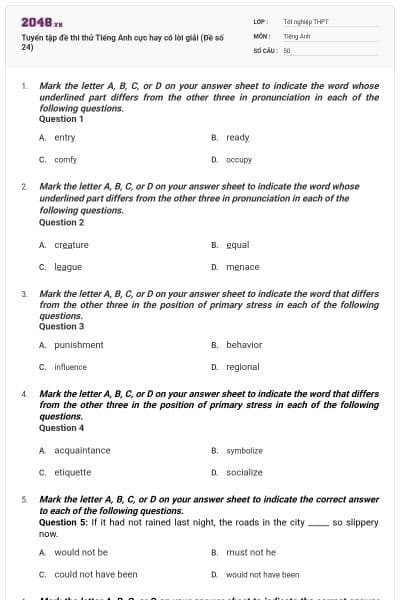
Mark the letter A, B, C, or D on your answer sheet to indicate the word whose underlined part differs from the other three in pronunciation in each of the following questions.
Question 1
entry
ready
comfy
occupy
Đáp án D
Kiến thức về phát âm
A. Entry /'entri/ (n): lối vào; sự đi vào, sự gia nhập
B. Ready /'redi/ (adj): sẵn sàng
C. Comfy /'kʌmfi / (adj): tiện lợi, thoải mái
D. Occupy /'ɒkjəpaɪ/ (v): chiếm (địa điểm; tâm trí); ở
=> Câu D “y” được phát âm là /ai/, các đáp án còn lại được phát âm là /i/.
Mark the letter A, B, C, or D on your answer sheet to indicate the word whose underlined part differs from the other three in pronunciation in each of the following questions.
Question 2
creature
equal
league
menace
Đáp án D
Kiến thức về phát âm
A. Creature /‘kri:t∫ər/ (n): sinh vật sống
B. Equal /'i:kwal/ (adj): bằng nhau
C. League /1i:g/ (n): liên minh, liên đoàn
D. Menace /'menɪs/ (n): mối đe dọa, hiểm hoạ
=> Câu D “e” được phát âm là /e/, các đáp án còn lại phát âm là /i:/.
Mark the letter A, B, C, or D on your answer sheet to indicate the word that differs from the other three in the position of primary stress in each of the following questions.
Question 3
punishment
behavior
influence
regional
Đáp án B
Kiến thức về trọng âm
A. punishment /'pʌni∫mənt/: từ này trọng âm rơi vào âm tiết đầu . Vì theo quy tắc tất cả các âm mà ngắn hết thì trọng âm rơi vào âm tiết đầu.
B. behavior /bɪ’heɪvjə~/: từ này trọng âm rơi vào âm tiết thứ hai. Vì theo quy tắc trọng âm ưu tiên rơi vào nguyên âm đôi.
C. influence /'inflʊəns/: từ này trọng âm rơi vào âm tiết đầu. Vì theo quy tắc đuôi -ce làm trọng âm dịch chuyển ba âm tính từ đuôi lên.
D. regional / 'ri:dʒənl/ : từ này trọng âm rơi vào âm tiết đầu. Vì theo quy tắc đuôi –al không ảnh hưởng đến trọng âm của từ, đuôi -ion làm trọng âm rơi vào trước âm đó.
=> Câu B trọng âm rơi vào âm tiết thứ hai, còn lại là thứ nhất.
Mark the letter A, B, C, or D on your answer sheet to indicate the word that differs from the other three in the position of primary stress in each of the following questions.
Question 4
acquaintance
symbolize
etiquette
socialize
Đáp án A
Kiến thức về trọng âm
A. acquaintance /'kəweintəns/: từ này trọng âm rơi vào âm tiết thứ 2. Vì theo quy tắc trọng âm ưu tiên rơi vào nguyên âm đôi.
B. symbolize /‘simbəlaiz/: từ này trọng âm rơi vào âm tiết đầu. Vì theo quy tắc đuôi -ize làm trọng âm dịch chuyển ba âm tính từ đuôi lên.
C. etiquette /'etiket/ hoặc /'etikət/: từ này trọng âm rơi vào âm tiết đầu . Vì theo quy tắc tất cả các âm mà ngắn hết thì trọng âm rơi vào âm tiết đầu.
D. socialize /’səʊ∫əlaiz/ : từ này trọng âm rơi vào âm tiết đầu. Vì theo quy tắc đuôi - ize làm trọng âm dịch chuyển ba âm tính từ đuôi lên.
=> Câu A trọng âm rơi vào âm tiết thứ hai, còn lại là thứ nhất.
Mark the letter A, B, C, or D on your answer sheet to indicate the correct answer to each of the following questions.
Question 5: If it had not rained last night, the roads in the city _____ so slippery now.
would not be
must not he
could not have been
would not have been
Đáp án A
Kiến thức về câu điều kiện hỗn hợp
Câu điều kiện hỗn hợp (giữa loại 2 và loại 3) diễn tả một hành động trong quá khứ có ảnh hưởng đến một hành động ở hiện tại.
Cấu trúc cầu điều kiện hỗn hợp:
If+ mệnh đề quá khứ hoàn thành, S + would/could... + V +...
Tạm dịch: Nếu tối qua trời không mưa, thì bây giờ đường phố đã không trơn thế này rồi.
Mark the letter A, B, C, or D on your answer sheet to indicate the correct answer to each of the following questions.
Question 6: My dog as well as my cats _____ twice a day.
eat
eats
have eaten
has eaten
Đáp án B
Kiến thức sự phù hợp giữa chủ ngữ và động từ
“twice a day” thể hiện một việc lặp đi lặp lại, ta dùng thì hiện tại đơn
=> đáp án C, D loại
Trong câu nếu có “S1 + as well as + S2” thì động từ được chia theo S1. Trong câu này chủ ngữ S1 là số ít (dog) nên động từ ta chia là “eats”
Tạm dịch: Chú chó cũng như các chú mèo của tôi ăn hai lần một ngày.
Mark the letter A, B, C, or D on your answer sheet to indicate the correct answer to each of the following questions.
Question 7: The doctor advised ____ late.
me not staying up
me not stay up
me not to stay up
not to stay up
Đáp án C
Kiến thức về cấu trúc
Ta có cấu trúc “advise sb not to do sth”: khuyên ai không làm cái gì
Tạm dịch: Bác sĩ khuyên tôi không thức khuya.

Học thông minh hơn mỗi ngày
Xem toàn bộ 50 câu hỏi và nhiều hơn nữa với tài khoản miễn phí
Mark the letter A, B, C, or D on your answer sheet to indicate the correct answer to each of the following questions.
Question 8: Valentine's Day, ____ from Roman, is now celebrated all over the world.
originate
originating
to originate
originated
Đáp án D
Kiến thức rút gọn mệnh đề quan hệ
Ta dùng quá khứ phân từ (VPP) để tạo mệnh đề quan hệ rút gọn đối với câu bị động (dạng chủ động ta dùng hiện tại phân từ). Trong câu này “originated” được hiểu là “which was originated”
Tạm dịch: Ngày Valentine, bắt nguồn từ La Mã, hiện dang được tổ chức trên toàn thế giới.
Mark the letter A, B, C, or D on your answer sheet to indicate the correct answer to each of the following questions.
Question 9: It is not always easy to make a good _______ at the last minute.
decide
decision
decisive
decisively
Đáp án B
Kiến thức về cụm từ cố định
Make decision: quyết định.
Tạm dịch: Không phải lúc nào việc đưa ra quyết định đúng đắn vào phút cuối cùng cũng dễ dàng.
Mark the letter A, B, C, or D on your answer sheet to indicate the correct answer to each of the following questions.
Question 10: Mr Brown has kindly agreed to spare us some of his _____ time to answer our questions.
valuable
worthy
costly
beneficial
Đáp án A
Kiến thức về từ vựng
A. valuable (a): quý giá B. worthy (a): đáng
C. costly (a): đắt đỏ D. beneficial (a): có ích
Tạm dịch: Ông Brown đã rất tốt bụng khi đồng ý dành cho chúng ta một phần trong quỹ thời gian quý giá của mình để trả lời những câu hỏi.
Mark the letter A, B, C, or D on your answer sheet to indicate the correct answer to each of the following questions.
Question 11: Mare and more investors are pouring _____ money into food and beverage start-ups.
an
the
a
Đáp án C
Kiến thức về cấu trúc và mạo từ
Pour money into: rót tiền vào
Tạm dịch: Ngày càng nhiều các nhà đầu tư đang rót tiền vào việc khởi nghiệp trong lĩnh vực đồ ăn và nước giải khát.
Mark the letter A, B, C, or D on your answer sheet to indicate the correct answer to each of the following questions.
Question 12: A survey was ______ to study the effects of smoking on young adults.
commented
filled
conducted
carried
Đáp án C
Kiến thức về cụm từ cố định
Conduct a survey = carry out a survey: tiến hành 1 cuộc khảo sát
Tạm dịch: Một cuộc khảo sát đã được tiến hành để nghiên cứu về những ảnh hưởng của việc hút thuốc tới người vị thành niên.
Mark the letter A, B, C, or D on your answer sheet to indicate the correct answer to each of the following questions.
Question 13: The better the weather is, ______.
the most crowded the beaches get
themost the beaches get crowded
the more crowded the beaches get
the more the beaches get crowded
Đáp án C
Kiến thức về các cấp so sánh
The more + adj + S + V, the more + adj + S +V
Tạm dịch: Thời tiết càng đẹp thì các bãi biển càng đông.
Mark the letter A, B, C, or D on your answer sheet to indicate the correct answer to each of the following questions.
Question 14: The ________ of the Internet has played an important part in the development of communication.
research
occurrence
invention
display
Đáp án C
Kiến thức về từ vựng
A. research (n): nghiên cứu B. occurrence (n): sự xảy ra
C. invention (n): sự phát minh D. display (n): sự hiển thị
Tạm dịch: Sự phát minh ra Internet đóng vai trò quan trọng trong quá trình phát triển của sự giao tiếp.
Mark the letter A, B, C, or D on your answer sheet to indicate the correct answer to each of the following questions.
Question 15: When the manager of our company retires, the deputy manager will ____ that position.
stand for
take over
catch on
hold on
Đáp án B
Kiến thức về cụm từ cố định
Take over a position: lên thế chỗ
Tạm dịch: Khi Tổng Giám đốc của công ty chúng ta nghỉ hưu, thì Phó Giám đốc sẽ lên thay vị trí của ông ấy.
Mark the letter A, B, C, or D on your answer sheet to indicate the correct answer to each of the following questions.
Question 16: I my old school teacher last week.
visited
visit
am visiting
have visited
Đáp án A
Kiến thức về thì
“last week” thì quá khứ đơn
Tạm dịch: Tuần trước tôi đã đến thăm cô giáo cũ của tôi.
Mark the letter A, B, C, or D on your answer sheet to indicate the word(s) CLOSEST in meaning to the underlined word (s) in each of the following questions.
Question 17: Tet marks the beginning of spring and, for agrarian people who depend on the lunar calendar to manage their crops, the start of the year.
farmers
old people
traditional ones
minority people
Đáp án A
Từ đồng nghĩa
Tạm dịch: Tết đánh dấu sự khởi đầu của mùa xuân và đối với những người nông dân phụ thuộc vào lịch âm để quản lí mùa vụ, là bắt đầu một năm mới.
=> agrarian people = A. farmers: những người làm nông, người nông dân.
Các đáp án còn lại:
B. old people: những người lớn tuổi
C. traditional ones: những tuýp người truyền thống
D. minority people: dân tộc thiểu số
Mark the letter A, B, C, or D on your answer sheet to indicate the word(s) CLOSEST in meaning to the underlined word (s) in each of the following questions.
Question 18: American children customarily go trick-or-treating on Halloween.
inevitably
happily
traditionally
readily
Đáp án C
Từ đồng nghĩa
Tạm dịch: Trẻ em Mỹ theo thường lệ thường chơi trò “Cho kẹo hay bị ghẹo" trong Halloween.
=> customarily /'kʌstəm(ə)rɪli/ (adv): theo thường lệ
A. inevitably /ɪ‘nevɪtəbli/ (adv): không thể tránh khỏi, chắc là
B. happily /'hæpili/ (adv): một cách vui vẻ
C. traditionally /tre'd1_|'[e]n[a]li j [adv]: theo truyền thống
D. readily /‘redɪli/ (adv): một cách sẵn sàng, sẵn lòng
=> Đáp án C (customarily = traditionally)
Mark the letter A, B, C, or D on your answer sheet to indicate the word(s) OPPOSITE in meaning to the underlined word(s) in each of the following questions.
Question 19: Nancy concurred, with her boss about the new direction the company was taking.
disagreed
agreed
surrendered
confessed
Đáp án A
Từ trái nghĩa
Giải thích: concur (v) đồng ý, nhất trí >< disagree (v) không đồng ý
Đáp án còn lại:
B. agree (v) đồng ý C. surrender (v) đầu hàng D. confess (v) thú nhận
Tạm dịch: Nancy đồng ý với ông chủ của cô về hướng đi mới của công ty đang áp dụng.
Mark the letter A, B, C, or D on your answer sheet to indicate the word(s) OPPOSITE in meaning to the underlined word(s) in each of the following questions.
Question 20: “We strongly believe that he's innocent of the crime. We do not think that he did it.”
clean
guilty
faultless
crimeless
Đáp án B
Từ trái nghĩa
Giải thích: innocent (adj): vô tôi, ngây thơ >< guilty (adj): có tội
Đáp án còn lại:
A. clean (adj): sạch, trong sạch
C. faultless (adj): không có thiếu sót
D. Không có "crimeless”
Tạm dịch: Chúng tôi tin tưởng anh ta vô tội trong vụ này. Chúng tôi không tin anh ta đã làm nó.
Mark the letter A, B, C, or D on your answer sheet to indicate the sentence that best completes each of the following exchanges.
Question 21: Jane is talking to Billy about the meeting.
- Jane: “Is everybody happy with the decision?”.
- Billy: “______”.
Thatsounds like fun.
Yes, it is certainly.
No, have you?
Not really.
Đáp án D
Tình huống giao tiếp
Jane đang nói chuyện với Billy về cuộc họp.
- Jane: “Mọi người đều hài lòng với quyết định chứ?".
- Billy: “________”.
A. Nghe có vẻ hài hước. B. Ừ, chắc chắn rồi. (B sai về ngữ pháp)
C. Không, bạn có không? D. Không hẳn.
=> Chỉ có đáp án D là hợp lí.
Mark the letter A, B, C, or D on your answer sheet to indicate the sentence that best completes each of the following exchanges.
Question 22: Lucy is asking for permission to play the guitar at Pete's home.
- Lucy: “Is it all right if I play the guitar in here while you're studying?”.
- Pete: “______”.
Oh, I wish you wouldn't.
Well, I'd rather not.
Well, actually, I'd prefer it if you didn't.
Well, if only you didn't.
Đáp án C
Tình huống giao tiếp
Lucy đang xin phép về việc chơi ghi-ta ở nhà Pete.
- Lucy: “Ổn chứ nếu tớ chơi ghi-ta ở đây khi cậu đang học?”.
- Pete: “_______”.
A. Tớ ước là cậu đừng. B. Ờ thì, tớ không muốn.
C. Thực ra thì, tớ sẽ thoải mái nếu cậu đừng chơi. D. Chà, giá như cậu không chơi.
=> Đáp án C là phù hợp nhất, thể hiện sự từ chối một cách tế nhị.
Read the following passage and mark the letter A, B, C, or D on your answer sheet to indicate the correct word or phrase that best fits each of the numbered blanks from 23 to 27.
WILLIAM THE HERO!
Brave William Baldock, who is six years old, is a hero after helping his mother when she fell downstairs. William quickly rang for an ambulance when he discovered his mother had broken her leg. In spite of being frightened, he (23) ______the emergency services what had happened and answered all the questions they asked him. He also telephoned his father at work, and then his grandmother, to explain what he had (24) ______. While waiting for these people to come, William looked after his 18-month-old sister. When ambulance man Steve Lyn went to the house, he was amazed: “It's great that a young boy of six knew the right number to dial, and was able to give us the correct information. (25) ______of William's quick thinking, we were able to (26) ______ there immediately.” Mrs. Baldock left hospital yesterday, very (27) ______ to both William and the ambulance service.
Question 23
called
talked
spoke
told
Đáp án D
CHỦ ĐỀ LIFE STORIES
Kiến thức về từ vựng
A. called: gọi B. talked: nói C. spoke: nói D. told: kể
Giải thích:
Đáp án B và C thiếu giới từ “to". Đằng sau chỗ trống là “what happened” nên ta chọn D để phù hợp về nghĩa.
In spite of being frightened, he (23) ________ the emergency services what had happened and answered all the questions they asked him.
Tạm dịch: Mặc dù hoảng sợ, cậu ấy đã nói cho dịch vụ cấp cứu những gì đã xảy ra và trả lời tất cả những câu hỏi của họ.
Read the following passage and mark the letter A, B, C, or D on your answer sheet to indicate the correct word or phrase that best fits each of the numbered blanks from 23 to 27.
WILLIAM THE HERO!
Brave William Baldock, who is six years old, is a hero after helping his mother when she fell downstairs. William quickly rang for an ambulance when he discovered his mother had broken her leg. In spite of being frightened, he (23) ______the emergency services what had happened and answered all the questions they asked him. He also telephoned his father at work, and then his grandmother, to explain what he had (24) ______. While waiting for these people to come, William looked after his 18-month-old sister. When ambulance man Steve Lyn went to the house, he was amazed: “It's great that a young boy of six knew the right number to dial, and was able to give us the correct information. (25) ______of William's quick thinking, we were able to (26) ______ there immediately.” Mrs. Baldock left hospital yesterday, very (27) ______ to both William and the ambulance service.
Question 24
done
made
acted
worked
Đáp án A
Kiến thức từ vựng
“what he had done”: những gì cậu ấy đã làm
Tạm dịch:
“He also telephoned his father at work, and then his grandmother, to explain what he had (24) ______ . " (Cậu ấy cũng đã gọi cho người bố đang đi làm và sau đó là bà của mình để giải thích những gì cậu ấy đã làm.)
Read the following passage and mark the letter A, B, C, or D on your answer sheet to indicate the correct word or phrase that best fits each of the numbered blanks from 23 to 27.
WILLIAM THE HERO!
Brave William Baldock, who is six years old, is a hero after helping his mother when she fell downstairs. William quickly rang for an ambulance when he discovered his mother had broken her leg. In spite of being frightened, he (23) ______the emergency services what had happened and answered all the questions they asked him. He also telephoned his father at work, and then his grandmother, to explain what he had (24) ______. While waiting for these people to come, William looked after his 18-month-old sister. When ambulance man Steve Lyn went to the house, he was amazed: “It's great that a young boy of six knew the right number to dial, and was able to give us the correct information. (25) ______of William's quick thinking, we were able to (26) ______ there immediately.” Mrs. Baldock left hospital yesterday, very (27) ______ to both William and the ambulance service.
Question 25
Since
Because
In spite
Instead
Đáp án B
Kiến thức về liền từ
A. Since + mệnh đề: bởi vì B. Because of + N: bởi vì
C. In spite of+ N: mặc dù D. lnstead of + N/Ving: thay vì
Tạm dịch:
“(25) ______ of William's quick thinking” (Bởi vì sự suy nghĩ nhanh của William)
Read the following passage and mark the letter A, B, C, or D on your answer sheet to indicate the correct word or phrase that best fits each of the numbered blanks from 23 to 27.
WILLIAM THE HERO!
Brave William Baldock, who is six years old, is a hero after helping his mother when she fell downstairs. William quickly rang for an ambulance when he discovered his mother had broken her leg. In spite of being frightened, he (23) ______the emergency services what had happened and answered all the questions they asked him. He also telephoned his father at work, and then his grandmother, to explain what he had (24) ______. While waiting for these people to come, William looked after his 18-month-old sister. When ambulance man Steve Lyn went to the house, he was amazed: “It's great that a young boy of six knew the right number to dial, and was able to give us the correct information. (25) ______of William's quick thinking, we were able to (26) ______ there immediately.” Mrs. Baldock left hospital yesterday, very (27) ______ to both William and the ambulance service.
Question 26
manage
find
get
reach
Đáp án C
Kiến thức về từ vựng
to get there: đến đó
Tạm dịch:
“Because of William's quick thinkingwe were able to (26) _______ there immediately.” (Bởi vì sự suy nghĩ nhanh của William, chúng tôi đã có thể đến đó ngay lập tức.)
Read the following passage and mark the letter A, B, C, or D on your answer sheet to indicate the correct word or phrase that best fits each of the numbered blanks from 23 to 27.
WILLIAM THE HERO!
Brave William Baldock, who is six years old, is a hero after helping his mother when she fell downstairs. William quickly rang for an ambulance when he discovered his mother had broken her leg. In spite of being frightened, he (23) ______the emergency services what had happened and answered all the questions they asked him. He also telephoned his father at work, and then his grandmother, to explain what he had (24) ______. While waiting for these people to come, William looked after his 18-month-old sister. When ambulance man Steve Lyn went to the house, he was amazed: “It's great that a young boy of six knew the right number to dial, and was able to give us the correct information. (25) ______of William's quick thinking, we were able to (26) ______ there immediately.” Mrs. Baldock left hospital yesterday, very (27) ______ to both William and the ambulance service.
Question 27
agreeable
happy
grateful
approving
Đáp án C
Kiến thức về từ vựng
A. agreeable (adj): có thể đồng ý B. happy (adj): hạnh phúc
C. grateful (adj): biết ơn D. approving (adj): đồng tình
Tạm dịch:
“Mrs. Baldock left hospital yesterday, very (27) ______ to both William and the ambulance service.” (Bà Baldock đã ra viện hôm qua và rất biết ơn William và dịch vụ cấp cứu.]
Read the following passage and mark the letter A, B, C, or D on your answer sheet to indicate the correct answer to each of the questions from 28 to 35.
If you could travel back in time five centuries, you'd encounter a thriving Aztec empire in Central Mexico, a freshly painted "Mona Lisa" in Renaissance Europe and cooler temperatures across the Northern Hemisphere. This was a world in the midst of the Little Ice Age (A.D. 1300 to 1850) and a period of vast European exploration now known as the Age of Discovery. But what if we could look 500 years into the future and glimpse the Earth of the 26th century? Would the world seem as different to us as the 21st century would have seemed to residents of the 16th century? For starters, what will the weather be like?
Depending on whom you ask, the 26th century will either be a little chilly or infernally hot. Some solar output models suggest that by the 2500s, Earth's climate will have cooled back down
to near Little Ice Age conditions. Other studies predict that ongoing climate change and fossil fuel use will render much of the planet too hot for human life by 2300.
Some experts date the beginning of human climate change back to the Industrial Revolution in the 1800s, others to slash-and-burn agricultural practices in prehistoric times. Either way, tool-wielding humans alter their environment -- and our 26th century tools might be quite impressive indeed.
Theoretical physicist and futurist Michio Kaku predicts that in a mere 100 years, humanity will make the leap from a type zero civilization to a type I civilization on the Kardashev Scale. In other words, we'll become a species that can harness the entire sum of a planet's energy. Wielding such power, 26th-century humans will be masters of clean energy technologies such as fusion and solar power. Furthermore, they'll be able to manipulate planetary energy in order to control global climate. Physicist Freeman Dyson, on the other hand, estimates the leap to a type I civilization would occur within roughly 200 years.
Technology has improved exponentially since the 1500s, and this pace will likely continue in the centuries to come. Physicist Stephen Hawking proposes that by the year 2600, this growth would see 10 new theoretical physics papers published every 10 seconds. If Moore's Law holds true and both computer speed and complexity double every 18 months, then some of these studies may be the work of highly intelligent machines.
What other technologies will shape the world of the 26th century? Futurist and author Adrian Berry believes the average human life span will reach 140 years and that the digital storage of human personalities will enable a kind of computerized immortality. Humans will farm the oceans, travel in starships and reside in both lunar and Martian colonies while robots explore the outer cosmos.
Question 28: Which of the following could be the main idea of the passage?
How would the world change in the next 500 years?
What would we do in the next five centuries?
What problems would happen in the 26th century?
How would technology improve the life in the far future?
Đáp án A
CHỦ ĐỀ LIFE IN THE FUTURE
Câu nào trong các câu sau có thể là ý chính của đoạn văn?
A. Thế giới sẽ thay đổi như thể nào trong 500 năm tới?
B.Chúng ta sẽ làm gì trong 5 thế kỉ tới?
C. Những vấn đề nào sẽ xảy ra trong thế kỉ 26?
D. Công nghệ sẽ cải thiện cuộc sống trong tương lai xa như thế nào?
Căn cứ thông tin đoạn 1:
But what if we could look 500 years into the future and glimpse the Earth of the 26th century? Would the world seem as different to us as the let century would have seemed to residents of the 16th century? (Nhưng liệu chúng ta có thể nhìn thấy được những gì trong 500 năm nữa và nhìn thoáng qua Trái đất của thế kỉ 26? Liệu thế giới đó có khác với chúng ta như thế kỉ 21 khác với người dân thế kỉ thứ 16?)
Các đoạn còn lại của đoạn văn cũng nói về cuộc sống trong thế kỉ 26, nên đây sẽ là nội dung chính của đoạn văn.
Read the following passage and mark the letter A, B, C, or D on your answer sheet to indicate the correct answer to each of the questions from 28 to 35.
If you could travel back in time five centuries, you'd encounter a thriving Aztec empire in Central Mexico, a freshly painted "Mona Lisa" in Renaissance Europe and cooler temperatures across the Northern Hemisphere. This was a world in the midst of the Little Ice Age (A.D. 1300 to 1850) and a period of vast European exploration now known as the Age of Discovery. But what if we could look 500 years into the future and glimpse the Earth of the 26th century? Would the world seem as different to us as the 21st century would have seemed to residents of the 16th century? For starters, what will the weather be like?
Depending on whom you ask, the 26th century will either be a little chilly or infernally hot. Some solar output models suggest that by the 2500s, Earth's climate will have cooled back down
to near Little Ice Age conditions. Other studies predict that ongoing climate change and fossil fuel use will render much of the planet too hot for human life by 2300.
Some experts date the beginning of human climate change back to the Industrial Revolution in the 1800s, others to slash-and-burn agricultural practices in prehistoric times. Either way, tool-wielding humans alter their environment -- and our 26th century tools might be quite impressive indeed.
Theoretical physicist and futurist Michio Kaku predicts that in a mere 100 years, humanity will make the leap from a type zero civilization to a type I civilization on the Kardashev Scale. In other words, we'll become a species that can harness the entire sum of a planet's energy. Wielding such power, 26th-century humans will be masters of clean energy technologies such as fusion and solar power. Furthermore, they'll be able to manipulate planetary energy in order to control global climate. Physicist Freeman Dyson, on the other hand, estimates the leap to a type I civilization would occur within roughly 200 years.
Technology has improved exponentially since the 1500s, and this pace will likely continue in the centuries to come. Physicist Stephen Hawking proposes that by the year 2600, this growth would see 10 new theoretical physics papers published every 10 seconds. If Moore's Law holds true and both computer speed and complexity double every 18 months, then some of these studies may be the work of highly intelligent machines.
What other technologies will shape the world of the 26th century? Futurist and author Adrian Berry believes the average human life span will reach 140 years and that the digital storage of human personalities will enable a kind of computerized immortality. Humans will farm the oceans, travel in starships and reside in both lunar and Martian colonies while robots explore the outer cosmos.
Question 29: The word “infernally” in paragraph 2 is closest in meaning to
differently
extremely
permanently
contemporaneously
Đáp án B
Từ “infernatty” trong đoạn 2 gần nghĩa nhất với từ nào?
A. khác B. cực kì C. lâu dài D. cùng thời
Từ đồng nghĩa: infernally (cực kì) = extremely
Depending on whom you ask. the 26th century will either be a little chilly or infernally hot. (Tuỳ thuộc vào người bạn hỏi là ai, thế kỉ 26 hoặc là sẽ một chút băng giá, hoặc là sẽ cực kì nóng.)
Read the following passage and mark the letter A, B, C, or D on your answer sheet to indicate the correct answer to each of the questions from 28 to 35.
If you could travel back in time five centuries, you'd encounter a thriving Aztec empire in Central Mexico, a freshly painted "Mona Lisa" in Renaissance Europe and cooler temperatures across the Northern Hemisphere. This was a world in the midst of the Little Ice Age (A.D. 1300 to 1850) and a period of vast European exploration now known as the Age of Discovery. But what if we could look 500 years into the future and glimpse the Earth of the 26th century? Would the world seem as different to us as the 21st century would have seemed to residents of the 16th century? For starters, what will the weather be like?
Depending on whom you ask, the 26th century will either be a little chilly or infernally hot. Some solar output models suggest that by the 2500s, Earth's climate will have cooled back down
to near Little Ice Age conditions. Other studies predict that ongoing climate change and fossil fuel use will render much of the planet too hot for human life by 2300.
Some experts date the beginning of human climate change back to the Industrial Revolution in the 1800s, others to slash-and-burn agricultural practices in prehistoric times. Either way, tool-wielding humans alter their environment -- and our 26th century tools might be quite impressive indeed.
Theoretical physicist and futurist Michio Kaku predicts that in a mere 100 years, humanity will make the leap from a type zero civilization to a type I civilization on the Kardashev Scale. In other words, we'll become a species that can harness the entire sum of a planet's energy. Wielding such power, 26th-century humans will be masters of clean energy technologies such as fusion and solar power. Furthermore, they'll be able to manipulate planetary energy in order to control global climate. Physicist Freeman Dyson, on the other hand, estimates the leap to a type I civilization would occur within roughly 200 years.
Technology has improved exponentially since the 1500s, and this pace will likely continue in the centuries to come. Physicist Stephen Hawking proposes that by the year 2600, this growth would see 10 new theoretical physics papers published every 10 seconds. If Moore's Law holds true and both computer speed and complexity double every 18 months, then some of these studies may be the work of highly intelligent machines.
What other technologies will shape the world of the 26th century? Futurist and author Adrian Berry believes the average human life span will reach 140 years and that the digital storage of human personalities will enable a kind of computerized immortality. Humans will farm the oceans, travel in starships and reside in both lunar and Martian colonies while robots explore the outer cosmos.
Question 30: According to the passage, what do experts predict about the weather in the future?
The temperature will decline as much as possible because of the excessive fossil fuel use.
The Little Ice Age will return due to the influence of solar energy.
The Earth will have to face with extreme weather like frost or scorching period.
The climate change will happen more quickly because of deforestation.
Đáp án C
Theo đoạn văn, các chuyên gia dự đoán về thời tiết trong tương lai như thế nào?
A. Nhiệt độ sẽ giảm nhiều nhất có thể bởi vì sự sử dụng nhiên liệu hoá thạch quá mức.
B. Thời đại Kỷ Băng Hà nhỏ sẽ quay trở lại vì ảnh hưởng của năng lượng mặt trời.
C. Trái Đất sẽ phải đối mặt với thời tiết cực đoan như băng giá hay giai đoạn nóng như thiêu đốt.
D. Sự biến đổi khí hậu sẽ xảy ra nhanh hơn bởi vì sự chặt phá rừng.
Căn cứ vào thông tin đoạn 2:
Depending on whom you ask, the 26th century will either be a little chilly or infernally hot. Some solar output models suggest that by the 25005, Earth's climate will have cooled back down to near Little Ice Age conditions. Other studies predict that ongoing climate change and fossil fuel use will render much of the planet too hot for human life by 2300. (Tùy thuộc vào người bạn hỏi là ai, thế kỉ 26 hoặc là sẽ một
chút băng giá, hoặc là sẽ cực kì nóng. Một số mô hình đầu ra năng lượng mặt trời cho thấy rằng vào những năm 2500, khi hậu Trái Đất sẽ lạnh dần xuống gần điều kiện Kỷ Băng Hà Nhỏ. Các nghiên cứu khác dự đoán rằng sự biến đổi khí hậu đang diễn ra và việc sử dụng nhiên liệu hóa thạch sẽ khiến cho hành tinh này trở nên quá nóng cho cuộc sống con người vào năm 2300.)
Read the following passage and mark the letter A, B, C, or D on your answer sheet to indicate the correct answer to each of the questions from 28 to 35.
If you could travel back in time five centuries, you'd encounter a thriving Aztec empire in Central Mexico, a freshly painted "Mona Lisa" in Renaissance Europe and cooler temperatures across the Northern Hemisphere. This was a world in the midst of the Little Ice Age (A.D. 1300 to 1850) and a period of vast European exploration now known as the Age of Discovery. But what if we could look 500 years into the future and glimpse the Earth of the 26th century? Would the world seem as different to us as the 21st century would have seemed to residents of the 16th century? For starters, what will the weather be like?
Depending on whom you ask, the 26th century will either be a little chilly or infernally hot. Some solar output models suggest that by the 2500s, Earth's climate will have cooled back down
to near Little Ice Age conditions. Other studies predict that ongoing climate change and fossil fuel use will render much of the planet too hot for human life by 2300.
Some experts date the beginning of human climate change back to the Industrial Revolution in the 1800s, others to slash-and-burn agricultural practices in prehistoric times. Either way, tool-wielding humans alter their environment -- and our 26th century tools might be quite impressive indeed.
Theoretical physicist and futurist Michio Kaku predicts that in a mere 100 years, humanity will make the leap from a type zero civilization to a type I civilization on the Kardashev Scale. In other words, we'll become a species that can harness the entire sum of a planet's energy. Wielding such power, 26th-century humans will be masters of clean energy technologies such as fusion and solar power. Furthermore, they'll be able to manipulate planetary energy in order to control global climate. Physicist Freeman Dyson, on the other hand, estimates the leap to a type I civilization would occur within roughly 200 years.
Technology has improved exponentially since the 1500s, and this pace will likely continue in the centuries to come. Physicist Stephen Hawking proposes that by the year 2600, this growth would see 10 new theoretical physics papers published every 10 seconds. If Moore's Law holds true and both computer speed and complexity double every 18 months, then some of these studies may be the work of highly intelligent machines.
What other technologies will shape the world of the 26th century? Futurist and author Adrian Berry believes the average human life span will reach 140 years and that the digital storage of human personalities will enable a kind of computerized immortality. Humans will farm the oceans, travel in starships and reside in both lunar and Martian colonies while robots explore the outer cosmos.
Question 31: The word "harness" in paragraph 4 could best be replaced by
renew
adjust
exploit
discover
Đáp án C
Từ “horness" ở đoạn 4 có thể được thay thể bởi từ nào?
A. làm mới B. điều chỉnh C. khai thác D. khám phá
Từ đồng nghĩa: harness (khai thác) = exploit
In other words, we'll become a species that can harness the entire sum of a planet's energy. (Nói cách khác, chúng ta sẽ trở thành một loài mà có thể khai thác toàn bộ năng lượng của một hành tinh.)
Read the following passage and mark the letter A, B, C, or D on your answer sheet to indicate the correct answer to each of the questions from 28 to 35.
If you could travel back in time five centuries, you'd encounter a thriving Aztec empire in Central Mexico, a freshly painted "Mona Lisa" in Renaissance Europe and cooler temperatures across the Northern Hemisphere. This was a world in the midst of the Little Ice Age (A.D. 1300 to 1850) and a period of vast European exploration now known as the Age of Discovery. But what if we could look 500 years into the future and glimpse the Earth of the 26th century? Would the world seem as different to us as the 21st century would have seemed to residents of the 16th century? For starters, what will the weather be like?
Depending on whom you ask, the 26th century will either be a little chilly or infernally hot. Some solar output models suggest that by the 2500s, Earth's climate will have cooled back down
to near Little Ice Age conditions. Other studies predict that ongoing climate change and fossil fuel use will render much of the planet too hot for human life by 2300.
Some experts date the beginning of human climate change back to the Industrial Revolution in the 1800s, others to slash-and-burn agricultural practices in prehistoric times. Either way, tool-wielding humans alter their environment -- and our 26th century tools might be quite impressive indeed.
Theoretical physicist and futurist Michio Kaku predicts that in a mere 100 years, humanity will make the leap from a type zero civilization to a type I civilization on the Kardashev Scale. In other words, we'll become a species that can harness the entire sum of a planet's energy. Wielding such power, 26th-century humans will be masters of clean energy technologies such as fusion and solar power. Furthermore, they'll be able to manipulate planetary energy in order to control global climate. Physicist Freeman Dyson, on the other hand, estimates the leap to a type I civilization would occur within roughly 200 years.
Technology has improved exponentially since the 1500s, and this pace will likely continue in the centuries to come. Physicist Stephen Hawking proposes that by the year 2600, this growth would see 10 new theoretical physics papers published every 10 seconds. If Moore's Law holds true and both computer speed and complexity double every 18 months, then some of these studies may be the work of highly intelligent machines.
What other technologies will shape the world of the 26th century? Futurist and author Adrian Berry believes the average human life span will reach 140 years and that the digital storage of human personalities will enable a kind of computerized immortality. Humans will farm the oceans, travel in starships and reside in both lunar and Martian colonies while robots explore the outer cosmos.
Question 32: What does the word "they" in paragraph 4 refer to?
fusion and solar energy
clean energy technologies
masters
26th - century humans
Đáp án D
Từ “they” trong đoạn 4 để cập đến từ nào?
A. phản ứng tổng hợp và năng lượng mặt trời B. công nghệ năng lượng sạch
C. những chuyên gia D. những người ở thể kỉ 26
Từ “they” thay thế cho danh từ những người ở thế kỉ 26.
Wielding such power, 26th-century humans will be masters of clean energy technologies such as fusion and solar power. Furthermore, they‘ll be able to manipulate planetary energy in order to control global climate. (Nắm giữ sức mạnh như vậy, những người thể kỉ 26 sẽ trở thành những chuyên gia về công nghệ năng lượng sạch như phản ứng tổng hợp và năng lượng mặt trời. Hơn nữa, họ sẽ có thể thao túng năng lượng hành tinh để kiểm soát khí hậu toàn cầu.)
Read the following passage and mark the letter A, B, C, or D on your answer sheet to indicate the correct answer to each of the questions from 28 to 35.
If you could travel back in time five centuries, you'd encounter a thriving Aztec empire in Central Mexico, a freshly painted "Mona Lisa" in Renaissance Europe and cooler temperatures across the Northern Hemisphere. This was a world in the midst of the Little Ice Age (A.D. 1300 to 1850) and a period of vast European exploration now known as the Age of Discovery. But what if we could look 500 years into the future and glimpse the Earth of the 26th century? Would the world seem as different to us as the 21st century would have seemed to residents of the 16th century? For starters, what will the weather be like?
Depending on whom you ask, the 26th century will either be a little chilly or infernally hot. Some solar output models suggest that by the 2500s, Earth's climate will have cooled back down
to near Little Ice Age conditions. Other studies predict that ongoing climate change and fossil fuel use will render much of the planet too hot for human life by 2300.
Some experts date the beginning of human climate change back to the Industrial Revolution in the 1800s, others to slash-and-burn agricultural practices in prehistoric times. Either way, tool-wielding humans alter their environment -- and our 26th century tools might be quite impressive indeed.
Theoretical physicist and futurist Michio Kaku predicts that in a mere 100 years, humanity will make the leap from a type zero civilization to a type I civilization on the Kardashev Scale. In other words, we'll become a species that can harness the entire sum of a planet's energy. Wielding such power, 26th-century humans will be masters of clean energy technologies such as fusion and solar power. Furthermore, they'll be able to manipulate planetary energy in order to control global climate. Physicist Freeman Dyson, on the other hand, estimates the leap to a type I civilization would occur within roughly 200 years.
Technology has improved exponentially since the 1500s, and this pace will likely continue in the centuries to come. Physicist Stephen Hawking proposes that by the year 2600, this growth would see 10 new theoretical physics papers published every 10 seconds. If Moore's Law holds true and both computer speed and complexity double every 18 months, then some of these studies may be the work of highly intelligent machines.
What other technologies will shape the world of the 26th century? Futurist and author Adrian Berry believes the average human life span will reach 140 years and that the digital storage of human personalities will enable a kind of computerized immortality. Humans will farm the oceans, travel in starships and reside in both lunar and Martian colonies while robots explore the outer cosmos.
Question 33: Which of the following is TRUE about the future predictions?
Michio Kaku believes that the progress from type 0 to type I civilization will take about two centuries.
People in the 2500s are likely to control the energy of the Earth to limit the global climate.
The speed of technology improvement will remain changeable in the far future.
Solar energy will be the main power for the 26th -century citizens.
Đáp án B
Câu nào trong những câu sau đúng về những dự đoán trong tương lai?
A. Michio Kaku cho rằng sự tiến bộ từ nền văn minh loại 0 lên loại 1 sẽ mất khoảng 2 thế kỉ.
B. Con người trong những năm 2500 có thể kiểm soát nguồn năng lượng của Trái Đất để làm giảm khí hậu toàn cầu.
C. Tốc độ cải thiện công nghệ sẽ tiếp tục để thay đổi trong tương lai xa.
D. Năng lượng mặt trời sẽ là nguồn năng lượng chính cho công dân thế kỷ 26.
Căn cứ thông tin đoạn 4:
Theoretical physicist and futurist Michio Kaku predicts that in a mere 100 years, humanity will make the leap from a type zero civilization to a type I civilization on the Kardashev Scale. In other words, we'll become a species that can harness the entire sum of a planet's energy. Wielding such power, 26th-century humans will be masters of clean energy technologies such as fusion and solar power. Furthermore, they'll be able to manipulate planetary energy in order to control global climate. Physicist Freeman Dyson, on the other hand, estimates the leap to a type I civilization would occur within roughly 200 years.
(Nhà vật lý lý thuyết và tương lai học Michio Kaku dự đoán rằng chỉ trong vòng 100 năm nữa, nhân loại sẽ tạo ra một bước nhảy vọt từ nền văn minh loại 0 lên nền văn minh loại 1 trên thang Kardashev. Nói cách khác, chúng ta sẽ trở thành một loài mà có thể khai thác toàn bộ năng lượng của một hành tinh. Nắm giữ sức mạnh như vậy, những người thế kỉ 26 sẽ trở thành những chuyên gia về công nghệ năng lượng sạch như phản ứng tổng hợp và năng lượng một trời. Hơn nữa, họ sẽ có thể thao túng năng lượng hành tinh để kiểm soát khí hậu toàn cầu. Mặt khác, nhà vật lý Freeman Dyson ước tính bước nhảy vọt lên nền văn minh loại một sẽ xảy ra trong vòng 200 năm)
Read the following passage and mark the letter A, B, C, or D on your answer sheet to indicate the correct answer to each of the questions from 28 to 35.
If you could travel back in time five centuries, you'd encounter a thriving Aztec empire in Central Mexico, a freshly painted "Mona Lisa" in Renaissance Europe and cooler temperatures across the Northern Hemisphere. This was a world in the midst of the Little Ice Age (A.D. 1300 to 1850) and a period of vast European exploration now known as the Age of Discovery. But what if we could look 500 years into the future and glimpse the Earth of the 26th century? Would the world seem as different to us as the 21st century would have seemed to residents of the 16th century? For starters, what will the weather be like?
Depending on whom you ask, the 26th century will either be a little chilly or infernally hot. Some solar output models suggest that by the 2500s, Earth's climate will have cooled back down
to near Little Ice Age conditions. Other studies predict that ongoing climate change and fossil fuel use will render much of the planet too hot for human life by 2300.
Some experts date the beginning of human climate change back to the Industrial Revolution in the 1800s, others to slash-and-burn agricultural practices in prehistoric times. Either way, tool-wielding humans alter their environment -- and our 26th century tools might be quite impressive indeed.
Theoretical physicist and futurist Michio Kaku predicts that in a mere 100 years, humanity will make the leap from a type zero civilization to a type I civilization on the Kardashev Scale. In other words, we'll become a species that can harness the entire sum of a planet's energy. Wielding such power, 26th-century humans will be masters of clean energy technologies such as fusion and solar power. Furthermore, they'll be able to manipulate planetary energy in order to control global climate. Physicist Freeman Dyson, on the other hand, estimates the leap to a type I civilization would occur within roughly 200 years.
Technology has improved exponentially since the 1500s, and this pace will likely continue in the centuries to come. Physicist Stephen Hawking proposes that by the year 2600, this growth would see 10 new theoretical physics papers published every 10 seconds. If Moore's Law holds true and both computer speed and complexity double every 18 months, then some of these studies may be the work of highly intelligent machines.
What other technologies will shape the world of the 26th century? Futurist and author Adrian Berry believes the average human life span will reach 140 years and that the digital storage of human personalities will enable a kind of computerized immortality. Humans will farm the oceans, travel in starships and reside in both lunar and Martian colonies while robots explore the outer cosmos.
Question 34: According to Adrian Berry, the following are what future humans can do, EXCEPT______.
cultivating in the oceans
traveling between the stars
exploring the universe by robots
living as long as they want
Đáp án D
Theo Adrian Berry, những điều sau là việc mà những người trong tương lai có thể làm, ngoại trừ _____.
A. trồng trọt dưới đại dương B. du lịch giữa các vì sao
C. khám phá vũ trụ bằng robot D. sống bao lâu cũng được
Căn cứ thông tin đoạn cuối:
Futurist and author Adrian Berry believes the average human life span will reach 140 years and that the digital storage of human personalities will enable a kind of computerized immortality. Humans will farm the oceans, travel in starships and reside in both lunar and Martian colonies while robots explore the outer cosmos.
(Nhà tương lai học và tác giả Adrian Berry tin rằng tuổi thọ trung hình của con người sẽ đạt đến 140 tuổi và việc lưu trữ kĩ thuật số của tính cách con người sẽ cho phép một loại bất tử trên máy tính. Con người có thể trồng trọt dưới đại dương, du hành giữa các vì sao và cư trú ở cả sao Hoả và mặt trăng trong khi robot khám phá vũ trụ bên ngoài.)
Read the following passage and mark the letter A, B, C, or D on your answer sheet to indicate the correct answer to each of the questions from 28 to 35.
If you could travel back in time five centuries, you'd encounter a thriving Aztec empire in Central Mexico, a freshly painted "Mona Lisa" in Renaissance Europe and cooler temperatures across the Northern Hemisphere. This was a world in the midst of the Little Ice Age (A.D. 1300 to 1850) and a period of vast European exploration now known as the Age of Discovery. But what if we could look 500 years into the future and glimpse the Earth of the 26th century? Would the world seem as different to us as the 21st century would have seemed to residents of the 16th century? For starters, what will the weather be like?
Depending on whom you ask, the 26th century will either be a little chilly or infernally hot. Some solar output models suggest that by the 2500s, Earth's climate will have cooled back down
to near Little Ice Age conditions. Other studies predict that ongoing climate change and fossil fuel use will render much of the planet too hot for human life by 2300.
Some experts date the beginning of human climate change back to the Industrial Revolution in the 1800s, others to slash-and-burn agricultural practices in prehistoric times. Either way, tool-wielding humans alter their environment -- and our 26th century tools might be quite impressive indeed.
Theoretical physicist and futurist Michio Kaku predicts that in a mere 100 years, humanity will make the leap from a type zero civilization to a type I civilization on the Kardashev Scale. In other words, we'll become a species that can harness the entire sum of a planet's energy. Wielding such power, 26th-century humans will be masters of clean energy technologies such as fusion and solar power. Furthermore, they'll be able to manipulate planetary energy in order to control global climate. Physicist Freeman Dyson, on the other hand, estimates the leap to a type I civilization would occur within roughly 200 years.
Technology has improved exponentially since the 1500s, and this pace will likely continue in the centuries to come. Physicist Stephen Hawking proposes that by the year 2600, this growth would see 10 new theoretical physics papers published every 10 seconds. If Moore's Law holds true and both computer speed and complexity double every 18 months, then some of these studies may be the work of highly intelligent machines.
What other technologies will shape the world of the 26th century? Futurist and author Adrian Berry believes the average human life span will reach 140 years and that the digital storage of human personalities will enable a kind of computerized immortality. Humans will farm the oceans, travel in starships and reside in both lunar and Martian colonies while robots explore the outer cosmos.
Question 35: It can be inferred from the passage that _________.
no one could be sure what the life would be like in the 2500s.
what we imagine about the life in the 26th century may be the same what the 16th-ceritury people thought about the current life.
the predictions of different scientists may draw the same world in the next 500 years.
technology will affect most of the fields in the future life.
Đáp án A
Có thể suy ra từ đoạn văn rằng ______.
A. Không ai có thể chắc chắn cuộc sống vào những năm 2500 sẽ trông như thế nào.
B. Những gì chúng ta tưởng tượng về cuộc sống trong thế kỉ 26 cũng giống như những người ở thế kỉ 16 nghĩ về cuộc sống hiện tại.
C. Những dự đoán của các nhà khoa học khác nhau có thể vẽ ra cùng 1 thế giới trong 500 năm tới.
D. Công nghệ sẽ ảnh hưởng hầu hết các lĩnh vực của cuộc sống trong tương lai.
Căn cứ vào thông tin cả bài:
Mỗi nhà khoa học lại dự đoán cuộc sống trong tương lai khác nhau nên không ai có thể chắc chắn về cuộc sống vào những năm 2500 như thế nào.
Read the following passage and mark the letter A, B, C, or D on your answer sheet to indicate the correct answer to each of the questions from 36 to 42.
In Africa, people celebrate with joy the birth of a new baby. The Pygmies would sing a birth-song to the child. In Kenya, the mother takes the baby strapped to her back into the thorn enclosure where the cattle is kept. There, her husband and the village elders wait to give the child his or her name.
In West Africa, after the baby is eight days old, the mother takes the baby for it's first walk in the big, wide world, and friends and family are invited to meet the new baby. In various African nations, they hold initiation ceremonies for groups of children instead of birthdays. When children reach a certain designated age, they learn the laws, beliefs, customs, songs and dances of their tribes, Some African tribes consider that children from nine to twelve are ready to be initiated into the grown up world. They may have to carry out several tests.
Masai boys around thirteen years old to seventeen undergo a two stage initiation. The first stage lasts about three months. The boys leave their parents' homes, paint their bodies white, and are taught how to become young warriors. At the end of this stage, they have their heads shaved and they are also circumcised. The second stage, the young warriors grow their hair long and live in a camp called a manyatta where they practice hunting the wild animals that might attack the Masai herds. This stage may last a few years. When they are ready, they will marry and become owners of large cattle herds like their fathers.
The girls are initiated when they are fourteen or fifteen. They are taught by the older women about the duties of marriage and how to care for babies. Soon after that they are married and lead a life similar to that of their mothers.
Question 36: What does the passage mainly discuss?
Celebrations for a new child in Africa.
Birthday ceremonies for children in Africa.
Traditions of Masai people when having a new baby.
Activities in a birth celebration.
Đáp án A
CHỦ ĐỀ CELEBRATIONS
Đoạn văn này chủ yếu thảo luận về điều gì?
A. Những hoạt động kỉ niệm dành cho một đứa trẻ mới ở Châu Phi.
B. Nghi lễ sinh nhật cho trẻ em ở Châu Phi.
C. Truyền thông của người Masai khi sinh con.
D. Các hoạt động trong lễ kỉ niệm một đứa trẻ chào đời.
Căn cứ vào thông tin toàn bài:
Đoạn văn đang nhắc đến các hoạt động kỉ niệm được tổ chức cho một đứa trẻ ở châu Phi từ khi mới sinh ra cho đến khi sẵn sàng lập gia đình mới.
Read the following passage and mark the letter A, B, C, or D on your answer sheet to indicate the correct answer to each of the questions from 36 to 42.
In Africa, people celebrate with joy the birth of a new baby. The Pygmies would sing a birth-song to the child. In Kenya, the mother takes the baby strapped to her back into the thorn enclosure where the cattle is kept. There, her husband and the village elders wait to give the child his or her name.
In West Africa, after the baby is eight days old, the mother takes the baby for it's first walk in the big, wide world, and friends and family are invited to meet the new baby. In various African nations, they hold initiation ceremonies for groups of children instead of birthdays. When children reach a certain designated age, they learn the laws, beliefs, customs, songs and dances of their tribes, Some African tribes consider that children from nine to twelve are ready to be initiated into the grown up world. They may have to carry out several tests.
Masai boys around thirteen years old to seventeen undergo a two stage initiation. The first stage lasts about three months. The boys leave their parents' homes, paint their bodies white, and are taught how to become young warriors. At the end of this stage, they have their heads shaved and they are also circumcised. The second stage, the young warriors grow their hair long and live in a camp called a manyatta where they practice hunting the wild animals that might attack the Masai herds. This stage may last a few years. When they are ready, they will marry and become owners of large cattle herds like their fathers.
The girls are initiated when they are fourteen or fifteen. They are taught by the older women about the duties of marriage and how to care for babies. Soon after that they are married and lead a life similar to that of their mothers.
Question 37: Where do the father and older villagers in Kenya give the name to the child?
in the village
at the place to keep the cattle
at their house
at the fence of the cattle's cages.
Đáp án B
Người cha và những người lớn tuổi trong làng ở Kenya thường đặt tên cho đứa trẻ ở đâu?
A. ở trong làng B. tại nơi chăn nuôi gia súc
C. ở nhà nọ D. tại hàng ròa của chuồng gia súc
Căn cứ vào thông tin đoạn 1:
In Kenya, the mother takes the baby strapped to her back into the thorn enclosure where the cattle is kept. There, her husband and the village elders wait to give the child his or her name.
(Ở Kenya, người mẹ đưa em bé được địu vào lưng mình vào trong vùng đất có rào gai vây quanh, nơi gia súc được nuôi. Ở đó, chồng bà và những người lớn tuổi trong làng chờ đợi đểđặt tên cho đứa tré.)
Read the following passage and mark the letter A, B, C, or D on your answer sheet to indicate the correct answer to each of the questions from 36 to 42.
In Africa, people celebrate with joy the birth of a new baby. The Pygmies would sing a birth-song to the child. In Kenya, the mother takes the baby strapped to her back into the thorn enclosure where the cattle is kept. There, her husband and the village elders wait to give the child his or her name.
In West Africa, after the baby is eight days old, the mother takes the baby for it's first walk in the big, wide world, and friends and family are invited to meet the new baby. In various African nations, they hold initiation ceremonies for groups of children instead of birthdays. When children reach a certain designated age, they learn the laws, beliefs, customs, songs and dances of their tribes, Some African tribes consider that children from nine to twelve are ready to be initiated into the grown up world. They may have to carry out several tests.
Masai boys around thirteen years old to seventeen undergo a two stage initiation. The first stage lasts about three months. The boys leave their parents' homes, paint their bodies white, and are taught how to become young warriors. At the end of this stage, they have their heads shaved and they are also circumcised. The second stage, the young warriors grow their hair long and live in a camp called a manyatta where they practice hunting the wild animals that might attack the Masai herds. This stage may last a few years. When they are ready, they will marry and become owners of large cattle herds like their fathers.
The girls are initiated when they are fourteen or fifteen. They are taught by the older women about the duties of marriage and how to care for babies. Soon after that they are married and lead a life similar to that of their mothers.
Question 38: Which of the following is NOT mentioned in paragraph 2?
An eight-day-old child will be taken for the first walk by his or her mother.
Children have to learn their tribes' cultures and traditions when they are old enough.
Children are prepared for a mature life when being met by friends and family.
Children are likely to overcome some tests to enter the grown-up world.
Đáp án C
Câu nào không được đề cập đến trong đoạn 2?
A. Một đứa trẻ tám ngày tuổi sẽ được đỡ bước đi bộ đầu tiên bởi mẹ của nó.
B. Trẻ em phải học về văn hoá và truyền thống của bộ tộc mình khi chúng đủ lớn.
C. Trẻ em được chuẩn bị cho cuộc sống trường thành khi được viếng thăm bởi bạn bè và người thân.
D. Trẻ em có thể phải vượt qua các cuộc kiểm tra để bước vào thế giới trưởng thành.
Căn cứ thông tin đoạn 2:
In West Africa, after the baby is eight days old. the mother takes the baby for it's first walk in the big, wide world, and friends and family are invited to meet the new baby. In various African nations, they hold initiation ceremonies for groups of children instead of birthdays. When children reach a certain designated age, they learn the laws, beliefs, customs, songs and dances of their tribes.
Some African tribes consider that children from nine to twelve are ready to be initiated into the grown up world. They may have to carry out several tests.
(Ở Tây Phi, sau khi em bé được tám ngày tuổi, người mẹ đưa em bé đi bộ lần đầu tiên trong một thế giới rộng lớn, và bạn bè và gia đình được mời đến gặp em bé mới. Ở các quốc gia châu Phi khác nhau, họ tổ chức các buổi lễ vỡ lòng cho các nhóm trẻ em thay vì sinh nhật. Khi trẻ em đạt đến một độ tuổi nhất định, chúng học các luật, tín ngưỡng, phong tục, bài hát và điệu múa của các bộ lạc của chúng. Một số bộ lạc châu Phi cho rằng trẻ em từ 9 đến 12 tuổi đã sẵn sàng để được bắt đầu vào thế giới trưởng thành. Họ có thể phải thực hiện một số bài kiểm tra)
Read the following passage and mark the letter A, B, C, or D on your answer sheet to indicate the correct answer to each of the questions from 36 to 42.
In Africa, people celebrate with joy the birth of a new baby. The Pygmies would sing a birth-song to the child. In Kenya, the mother takes the baby strapped to her back into the thorn enclosure where the cattle is kept. There, her husband and the village elders wait to give the child his or her name.
In West Africa, after the baby is eight days old, the mother takes the baby for it's first walk in the big, wide world, and friends and family are invited to meet the new baby. In various African nations, they hold initiation ceremonies for groups of children instead of birthdays. When children reach a certain designated age, they learn the laws, beliefs, customs, songs and dances of their tribes, Some African tribes consider that children from nine to twelve are ready to be initiated into the grown up world. They may have to carry out several tests.
Masai boys around thirteen years old to seventeen undergo a two stage initiation. The first stage lasts about three months. The boys leave their parents' homes, paint their bodies white, and are taught how to become young warriors. At the end of this stage, they have their heads shaved and they are also circumcised. The second stage, the young warriors grow their hair long and live in a camp called a manyatta where they practice hunting the wild animals that might attack the Masai herds. This stage may last a few years. When they are ready, they will marry and become owners of large cattle herds like their fathers.
The girls are initiated when they are fourteen or fifteen. They are taught by the older women about the duties of marriage and how to care for babies. Soon after that they are married and lead a life similar to that of their mothers.
Question 39: The word "undergo" in the third paragraph is closest in meaning to _______.
commence
experience
participate in
explore
Đáp án B
Từ “undergo" trong đoạn 3 gần nghĩa nhất với từ ________.
A. bắt đầu B. trải qua C. tham gia D. khám phá
Từ đồng nghĩa: undergo (trải qua) = experience.
Masai boys around thirteen years old to seventeen undergo a two stage initiation. (Bé trai Masai khoảng mười ba tuổi đến mười bảy trải qua thời kì vỡ lòng gồm hai giai đoạn)
Read the following passage and mark the letter A, B, C, or D on your answer sheet to indicate the correct answer to each of the questions from 36 to 42.
In Africa, people celebrate with joy the birth of a new baby. The Pygmies would sing a birth-song to the child. In Kenya, the mother takes the baby strapped to her back into the thorn enclosure where the cattle is kept. There, her husband and the village elders wait to give the child his or her name.
In West Africa, after the baby is eight days old, the mother takes the baby for it's first walk in the big, wide world, and friends and family are invited to meet the new baby. In various African nations, they hold initiation ceremonies for groups of children instead of birthdays. When children reach a certain designated age, they learn the laws, beliefs, customs, songs and dances of their tribes, Some African tribes consider that children from nine to twelve are ready to be initiated into the grown up world. They may have to carry out several tests.
Masai boys around thirteen years old to seventeen undergo a two stage initiation. The first stage lasts about three months. The boys leave their parents' homes, paint their bodies white, and are taught how to become young warriors. At the end of this stage, they have their heads shaved and they are also circumcised. The second stage, the young warriors grow their hair long and live in a camp called a manyatta where they practice hunting the wild animals that might attack the Masai herds. This stage may last a few years. When they are ready, they will marry and become owners of large cattle herds like their fathers.
The girls are initiated when they are fourteen or fifteen. They are taught by the older women about the duties of marriage and how to care for babies. Soon after that they are married and lead a life similar to that of their mothers.
Question 40: The word "shaved" in paragraph 3 mostly means______
cut the hair off with a razor
tie the hair with a hairpin
dye the hair with another color
cover the hair with a hat
Đáp án A
Từ “shaved” trong đoạn 3 gần có thểcó nghĩa là _________.
A. cắt tóc bằng dao cạo B. buộc tóc với một cái kẹp
C. nhuộm tóc với một màu khác D. che tóc bằng một cái mũ
Định nghĩa: Shaved (cạo đầu) = cut the hair off with a razor
At the end of this stage, they have their heads shaved and they are also circumcised.
(Vào cuối giai đoạn này, họ cạo đầu và họ cũng cắt bao quy đầu.)
Read the following passage and mark the letter A, B, C, or D on your answer sheet to indicate the correct answer to each of the questions from 36 to 42.
In Africa, people celebrate with joy the birth of a new baby. The Pygmies would sing a birth-song to the child. In Kenya, the mother takes the baby strapped to her back into the thorn enclosure where the cattle is kept. There, her husband and the village elders wait to give the child his or her name.
In West Africa, after the baby is eight days old, the mother takes the baby for it's first walk in the big, wide world, and friends and family are invited to meet the new baby. In various African nations, they hold initiation ceremonies for groups of children instead of birthdays. When children reach a certain designated age, they learn the laws, beliefs, customs, songs and dances of their tribes, Some African tribes consider that children from nine to twelve are ready to be initiated into the grown up world. They may have to carry out several tests.
Masai boys around thirteen years old to seventeen undergo a two stage initiation. The first stage lasts about three months. The boys leave their parents' homes, paint their bodies white, and are taught how to become young warriors. At the end of this stage, they have their heads shaved and they are also circumcised. The second stage, the young warriors grow their hair long and live in a camp called a manyatta where they practice hunting the wild animals that might attack the Masai herds. This stage may last a few years. When they are ready, they will marry and become owners of large cattle herds like their fathers.
The girls are initiated when they are fourteen or fifteen. They are taught by the older women about the duties of marriage and how to care for babies. Soon after that they are married and lead a life similar to that of their mothers.
Question 41: What does the word "they" in paragraph 3 refer to?
the Masai herds
the wild animals
the young warriors
their heads
Đáp án C
Từ “they” trong đoạn 3 đề cập đến từ nào?
A. đàn gia súc của Masai B. động vật hoang dã
C. những chiến binh trẻ D. những cái đầu của họ
Căn cứ thông tin đoạn 3:
Từ “they” đề cập đến các chiến binh trẻ.
The second stage, the young warriors grow their hair long and live in a camp called a manyatta where they practice hunting the wild animals that might attack the Masia herds. This stage may last a few years. When they are ready, they will marry and become owners of large cattle herds like their fathers. (Giai đoạn thứ hai, các chiến binh trẻ để tóc dài và sống trong một trại gọi là một cộng đồng người Masai nơi họ thực hành săn bắn những con vật hoang dã có thể tấn công đàn vật nuôi của Masai. Giai đoạn này có thể kéo dài vài năm. Khi họ đã sẵn sàng, họ sẽ kết hôn và trở thành chủ sở hữu của đàn gia súc lớn như cha của họ.)
Read the following passage and mark the letter A, B, C, or D on your answer sheet to indicate the correct answer to each of the questions from 36 to 42.
In Africa, people celebrate with joy the birth of a new baby. The Pygmies would sing a birth-song to the child. In Kenya, the mother takes the baby strapped to her back into the thorn enclosure where the cattle is kept. There, her husband and the village elders wait to give the child his or her name.
In West Africa, after the baby is eight days old, the mother takes the baby for it's first walk in the big, wide world, and friends and family are invited to meet the new baby. In various African nations, they hold initiation ceremonies for groups of children instead of birthdays. When children reach a certain designated age, they learn the laws, beliefs, customs, songs and dances of their tribes, Some African tribes consider that children from nine to twelve are ready to be initiated into the grown up world. They may have to carry out several tests.
Masai boys around thirteen years old to seventeen undergo a two stage initiation. The first stage lasts about three months. The boys leave their parents' homes, paint their bodies white, and are taught how to become young warriors. At the end of this stage, they have their heads shaved and they are also circumcised. The second stage, the young warriors grow their hair long and live in a camp called a manyatta where they practice hunting the wild animals that might attack the Masai herds. This stage may last a few years. When they are ready, they will marry and become owners of large cattle herds like their fathers.
The girls are initiated when they are fourteen or fifteen. They are taught by the older women about the duties of marriage and how to care for babies. Soon after that they are married and lead a life similar to that of their mothers.
Question 42: What do the girls have to learn in their initiation?
How to take care of her husband and family in the future.
The responsibilities of marriage and the way to look after their children.
Homemaking and childbearing.
How to lead a life after marriage and giving birth to a child.
Đáp án B
Các cô gái học điều gì trong sự khởi đầu của họ?
A. Cách chăm sóc chồng và gia đình trong tương lai.
B. Trách nhiệm trong hôn nhân và cách chăm sóc con cái.
C. Chăm soc gia đình và sinh con.
D. Cách sống sau hôn nhân và sinh con.
Căn cứ vào thông tin đoạn cuối:
The girls are initiated when they are fourteen or fifteen. They are taught by the older women about the duties of marriage and how to care for babies. Soon after that they are married and lead a life similar to that of their mothers. (Các cô gái được vỡ lòng khi họ mười bốn hoặc mười lăm tuổi. Họ được dạy bởi những phụ nữ lớn tuổi về nhiệm vụ hôn nhân và cách chăm sóc cho trẻ sơ sinh. Ngay sau đó họ kết hôn và sống một cuộc sống tương tự như của các bà mẹ của họ.)
Mark the letter A, B, C, or D on your answer sheet to indicate the underlined part that needs correction in each of the following questions.
Question 43: are making to (D) the environment.
depressed
About
Damage
Making to
Đáp án D
Kiến thức về cụm từ cố định
Với danh từ "damage" sử dụng động từ “cause".
Cụm từ cố định : cause damage to st = destroy st(v): phá hủy, hủy hoại
Chữa lỗi: making to causing to
Dịch câu: Tôi cảm thấy khá chán nản khi tôi nghĩ về những sự tàn phá chúng ta đang gây ra cho môi trường.
Mark the letter A, B, C, or D on your answer sheet to indicate the underlined part that needs correction in each of the following questions.
Question 44: 2017 Warren Beatty realized (C) that he had read (D) out the wrong film name.
announcing
The
Warren Beatty realized
Read
Đáp án C
Kiến thức về đảo ngữ
Giải thích: Đảo ngữ với only
Only + after/by/when + Ving/ S + V, trợ từ + S + V: chỉ sau khi/bằng cách/khi làm gì, thì ai đó làm gì
Sửa Warren Beatty realized => did Warren Beatty realize
Dịch nghĩa: Chỉ sau khi thông báo bộ phim hay nhất giải Oscar năm 2017, thì Warren Beatty mới nhận ra rằng ông đọc nhầm tên phim.
Mark the letter A, B, C, or D on your answer sheet to indicate the underlined part that needs correction in each of the following questions.
Question 45: The most visible remind (A) of the close relationship between (B) the United States and France is (C) the famous Statue of Liberty, which (D) stands in New York harbour.
Remind
Between
Is
Which
Đáp án A
Kiến thức về từ loại
Cần dạng danh từ của từ "remind” vì sau the most + adj + N of
Remind (v): nhắc nhở reminder (n) vật gợi nhớ
Do đó. remind reminder
Dịch nghĩa: Lời nhắc nhớ rõ ràng nhất về mối quan hệ chặt chẽ giữa Hoa Kỳ và Pháp là Tượng Nữ thần tự do, được đặt ở bến cảng New York.
Mark the letter A, B, C, or D on your answer sheet to indicate the sentence that is closest in meaning to each of the following questions.
Question 46: “I have never been to Russia. I think I shall go there next year.” said Bill.
Bill said that he had never been to Russia and he thought he would go there the next year.
Bill said that he would have never been to Russia and he thinks he would go there the next year.
Bill said that he had never been to Russia and he thinks he will go there the next year.
Bill said that he has never been to Russia and he thinks he would go there the next year.
Đáp án A
Kiến thức câu tường thuật
“Tôi chưa từng tới Nga. Tôi nghĩ là tôi sẽ tới đó vào năm sau” - Bill nói.
= A. Bin nói rằng anh ấy chưa từng ở Nga bao giờ và anh ấy nghĩ anh ấy sẽ tới đó vào năm sau.
=> Chủ điểm ngữ pháp liên quan tới câu trực tiếp - gián tiếp.
Khi chuyển từ câu trực tiếp sang câu gián tiếp ta cần lùi thì của động từ, nhưng các đáp án B, C, D đã vi phạm điều này (động từ “think” chưa được lùi thì)
Mark the letter A, B, C, or D on your answer sheet to indicate the sentence that is closest in meaning to each of the following questions.
Question 47: People believed that Jane retired because of her poor health.
Jane is believed to have retired because of her poor health.
Jane was believed to have retired because of her poor health.
It is believed that Jane retired because of her poor health.
Jane retired because of her poor health was believed.
Đáp án B
Kiến thức câu bị động
People/they +think/say/suppose/believe/considerfreport....+ that clause.
= It + tobe + thought/said fsupposed/believed/considered/ reported... + that clause.
= S + tobe + thought/said/supposed/ believed/ considered/ reported... + to Vth have Vp2
A- sai ở “is" => “was".
C- sai ở “is" => “was".
D- sai cả về ngữ pháp và ngữ nghĩa.
Tạm dịch: Mọi người tin rằng Jane nghỉ hưu là do sức khỏe kérn.
= B. Jane được cho là nghỉ hưu do sức khỏe kém.
Mark the letter A, B, C, or D on your answer sheet to indicate the sentence that is closest in meaning to each of the following questions.
Question 48: Charles would have won the essay contest if he had typed his paper.
Charles won the essay contest in spite of not typing his paper.
Charles did not win the essay contest because he did not type his paper.
Typing his paper made Charles win the essay contest.
Charles did not win the essay contest even though he typed his paper.
Đáp án B
Kiến thức câu điều hiện
Đề bài: Charles đã thắng cuộc thi viết tiểu luận nếu anh ấy đánh máy bài thi.
= Charles đã không thắng cuộc thi viết tiểu luận bởi anh ấy đã không đánh máy bài thi.
Chú ý: Câu điều kiện loại 3:
If+ S + had + VPII, S + would/could + have + VPII
=> Diễn tả một giả định không có thật trong quá khứ.
Các đáp án còn lại sai nghĩa:
A. Charles đã thắng cuộc thi viết tiểu luận mặc dù anh ấy không đánh mấy bài thi.
C. Việc đánh máy bài thì khiến Charles thắng cuộc thi viết tiểu luận.
D. Charles đã không thắng cuộc thi viết tiểu luận mặc dù anh ấy đã đánh máy bài thi.
Mark the letter B, C, or D on your answer sheet to indicate the sentence that best combines each of sentences in the following questions.
Question 49: The substance is very toxic. Protective clothing must be worn at all times.
Since the substance is very toxic, so protective clothing must be worn at all times.
So toxic is thesubstance that protective clothing must be worn at all times.
The substance is such toxic that protective clothing must be worn at all times.
The substance is too toxic to wear protective clothing at all times.
Đáp án B
Kiến thức về liên từ
Chất này rất độc. Đồ bảo hộ là bắt buộc trong mọi trường hợp.
= B. Chất này độc đến nỗi đồ bảo hộ là bắt buộc trong mọi trường hợp.
Các đáp án còn lại:
* A- Sai ngữ pháp.
Since + clause = Because + clause: Bởi vì
Một khi đã có “since” thì không có “so”. Do đó đáp án này sai do thừa “so”.
* C- Sai ngữ pháp.
S + tobe + so + adj + that clause = S + tobe + such + N + that clause: như thế nào đến nỗi mà.
Câu này sai ở “such”, đáng nhẽ ra theo cấu trúc phải là “so”.
* D- Sai nghĩa: Chất này quá độc để mặc được đồ bảo hộ trong mọi trường hợp.
Cấu trúc: S + tobe + too + adj + to V: quá như thế nào đến nỗi không làm được gì.
Mark the letter B, C, or D on your answer sheet to indicate the sentence that best combines each of sentences in the following questions.
Question 50: He was able to finish his book. It was because his wife helped him.
If it weren't for his wife's help, he couldn't have finished his book.
If only he had been able to finish his book.
Without his wife's help, he couldn't have finished his book.
But for his wife's help, he couldn't finish his book.
Đáp án C
Đề bài: Ông đã có thể hoàn thành cuốn sách của mình. Đó là vì vợ ông đã giúp ông.
A. Sai cấu trúc, ta dùng “If it hadn't been for...”
B. Ước gì ông đã có thể hoàn thành cuốn sách của ông.
C. Nếu không có sự giúp đỡ của vợ, ông đã không thể hoàn thành cuốn sách rồi.
=> But for + cụm danh từ , S + would/could + have + Vp2
D. Sai cấu trúc, ở đây ta dùng “have + PP” chứ không dùng Vinf
Bạn có thích hoạt động này không?
Ý kiến của bạn sẽ giúp chúng tôi đề xuất nội dung phù hợp hơn.
Gợi ý cho bạn
![[Năm 2022] Đề thi thử môn Vật lí THPT Quốc gia có lời giải - Đề số 21](/_next/image?url=https%3A%2F%2Fvideo.vietjack.com%2Fupload%2Fimages%2Fvj-image%2Fimage-3izficdefgfoel0s9j8s-1786772791.jpg&w=3840&q=75)
![[Năm 2022] Đề thi thử môn Vật lí THPT Quốc gia có lời giải - Đề số 20](/_next/image?url=https%3A%2F%2Fvideo.vietjack.com%2Fupload%2Fimages%2Fvj-image%2Fimage-emy0gtcksawvorajezvv-1786772460.jpg&w=3840&q=75)
Tài liệu phổ biến Tốt nghiệp THPT
Tài liệu phổ biến Tiếng Anh