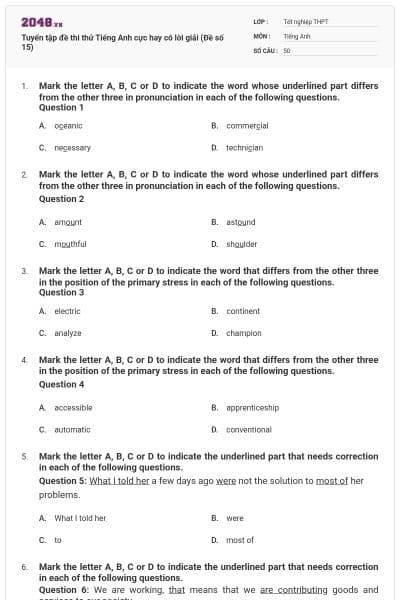
Tuyển tập đề thi thử Tiếng Anh cực hay có lời giải (Đề số 15)
50 câu hỏi
Mark the letter A, B, C or D to indicate the word whose underlined part differs from the other three in pronunciation in each of the following questions.
Question 1
oceanic
commercial
necessary
technician
Đáp án C. necessary, phát âm là /s/, còn lại phát âm là /∫/.
A. oceanic /,əʊ∫i’ænɪk/ (adj): thuộc về biển, đại dương
B. commercial /kə'mɜ:∫l/ (adj): thuộc về thương mại
C. necessary /'nesəsəri/ (adj) cần thiết
D. technician /tek'nɪ∫n/ (n): kỹ thuật viên
Mark the letter A, B, C or D to indicate the word whose underlined part differs from the other three in pronunciation in each of the following questions.
Question 2
amount
astound
mouthful
shoulder
Đáp án D. shoulder, phát âm là /əʊ/ còn lại phát âm là /aʊ/.
A. amount /ə'maʊnt/ lượng
B. astound /ə'staʊnd/ (v) làm người khác ngạc nhiên
C. mouthful /'maʊθfʊl/ (n) đầy miệng
D. shoulder /'∫əʊldə(r)/ (n) vai
Mark the letter A, B, C or D to indicate the word that differs from the other three in the position of the primary stress in each of the following questions.
Question 3
electric
continent
analyze
champion
Đáp án A. electric, trọng âm rơi vào âm tiết thứ hai, còn lại rơi vào âm tiết thứ nhất.
A. electric /ɪ'lektrɪk/ (adj) thuộc về điện
B. continent /'kɒntɪnənt/ (n) châu lục
C. analyze /’ænəlaɪz/ (v) phân tích
D. champion / 't∫æmpiən/ (n) nhà vô địch
Mark the letter A, B, C or D to indicate the word that differs from the other three in the position of the primary stress in each of the following questions.
Question 4
accessible
apprenticeship
automatic
conventional
Đáp án C. automatic, trọng âm rơi vào âm tiết thứ ba, còn lại rơi vào âm tiết thứ hai.
A. accessible /ək'səsəbl/ (adj) có thể tiếp cận
B. apprenticeship /ə'prentɪ∫ɪp/ (n) giai đoạn thực tập sinh
C. automatic /,ɔ:tə'mætɪk/ (adj) tự động
D. conventional /kən'ven∫ənl/ (adj) thông thường
Mark the letter A, B, C or D to indicate the underlined part that needs correction in each of the following questions.
Question 5: What I told her a few days ago were not the solution to most of her problems.
What I told her
were
to
most of
Đáp án B. were => was
Giải thích: Chủ ngữ của từ to be là What I told her - Điều mà tôi nói với cô ấy, đây được coi là danh từ không đếm được nên ta dùng to be là was.
Dịch nghĩa: Điều mà tôi nói với cô ấy vài ngày trước không phải là cách giải quyết cho hầu hết các vấn đề của cô ấy.
Mark the letter A, B, C or D to indicate the underlined part that needs correction in each of the following questions.
Question 6: We are working, that means that we are contributing goods and services to our society.
that
are contributing
services
to
Đáp án A. that => which
Giải thích: that không được sử dụng trong mệnh đề quan hệ không xác định, nói cách khác, that không đứng sau dấu phẩy trong mệnh đề quan hệ.
Dịch nghĩa: Chúng ta đang làm việc, điều này có nghĩa là chúng ta đang đóng góp sản phẩm và dịch vụ cho xã hội.
Mark the letter A, B, C or D to indicate the underlined part that needs correction in each of the following questions.
Question 7: Until the invention of the telephone, skyscrapers were not consider very practical.
invention
skyscrapers
consider
practical
Đáp án C. consider => considered
Giải thích: Ở đây cần dùng bị động.
Dịch nghĩa: Cho đến tận khi có sự phát minh ra điện thoại, những tòa nhà chọc trời không được coi là có tính thực tế.

Học thông minh hơn mỗi ngày
Xem toàn bộ 50 câu hỏi và nhiều hơn nữa với tài khoản miễn phí
Mark the letter A, B, C or D to indicate the correct answer to each of the following questions.
Question 8: The _______ price is always lower than the retail price.
wholesale
bargaining
cut
budget
Đáp án A. wholesale
A. wholesale: bán buôn
B. bargaining: mặc cả
C. cut: giảm
D. budget: ngân quỹ
Cụm từ: wholesale price: giá bán buôn
Retail price: giá bán lẻ
Dịch nghĩa: Giá bán buôn luôn thấp hơn giá bán lẻ.
Mark the letter A, B, C or D to indicate the correct answer to each of the following questions.
Question 9: Charles was wearing _______ at the party.
a tie yellow silk funny
very funny wide yellow silk tie
a yellow silk funny tie
a funny wide yellow silk tie
Đáp án D
Giải thích:
Trật tự tính từ: Ghi nhớ cụm OpSASCOMP: Opinion ý kiến/ đánh giá cá nhân - Size kích cỡ - Age cũ/mới - Shape hình dáng - Color màu sắc - Origin nguồn gốc - Material chất liệu - Purpose mục đích sử dụng.
Đối chiếu các từ đã cho ta sắp xếp được:
Funny (ngộ nghĩnh) - opinion
Wide (rộng) - size
Yellow (vàng) - color
Silk (lụa) - material
Dịch nghĩa: Charles đeo một chiếc cà vạt rất ngộ nghĩnh, to, màu vàng bằng lụa đến bữa tiệc.
Mark the letter A, B, C or D to indicate the correct answer to each of the following questions.
Question 10: It was ______ furniture that I didn't buy it.
so expensive
such expensive
such an expensive
a so expensive
Đáp án B
Giải thích:
So adj/adv that....: quá đến nỗi mà
Such (a/an) adj noun that: là những thứ quá ... đến nỗi mà
Vì trong câu có từ furniture (danh từ không đếm được) nên ta phải sử dụng cấu trúc với such.
Dịch nghĩa: Đây là những đồ nội thất đất đến nỗi mà tôi không thể mua được.
Mark the letter A, B, C or D to indicate the correct answer to each of the following questions.
Question 11: Only when you grow up _______ how to organize things more neatly.
do you know
you will know
you know
will you know
Đáp án D
Giải thích: Khi một câu bắt đầu bằng Only When, Only after, Only by,. . .thì ta sử dụng đảo ngữ cho vế chính. Trong câu này, dịch nghĩa ra, khi mà thế này thì sẽ thế kia, ta dùng thì tương lai cho vế chính và đảo ngữ ta được cấu trúc will S V.
Dịch nghĩa: Chỉ khi bạn lớn, bạn mới biết được cách sắp xếp đồ đạc ngăn nắp.
Mark the letter A, B, C or D to indicate the correct answer to each of the following questions.
Question 12: After the accident, the police informed the victim's next of __________.
relation
blood
kin
generation
Đáp án C
A. relation (n) mối quan hệ
B. blood: (n) máu, dòng máu (nghĩa bóng)
C. kin: (n) gia đình, họ hàng
D. generation: (n) thế hệ
Collocation: next of kin: người thân tín
Dịch nghĩa: Sau vụ tai nạn, cảnh sát đã thông báo cho người thân nhất của nạn nhân.
Mark the letter A, B, C or D to indicate the correct answer to each of the following questions.
Question 13: People living in areas need more help from charity organizations.
flooding
flood-affected
flood-affecting
flood
Đáp án B
Vì đứng trước areas nên ta cần một tính từ. Không chọn C vì tính từ phải có dạng bị động (“bị ảnh hưởng”).
Dịch nghĩa: Những người sống trong vùng bị ảnh hưởng của lũ lụt cần nhiều sự giúp đỡ hơn từ các tổ chức từ thiện.
Các đáp án còn lại:
A. flooding (n): sự làm ngập lụt
D. flood (n): lũ lụt, nạn lụt
Mark the letter A, B, C or D to indicate the correct answer to each of the following questions.
Question 14: Now, don't tell anyone else what I've just told you. Remember, it is ____________.
confidence
confident
confidential
confidentially
Đáp án C
confidential (adj): tuyệt mật
confidence (n): sự tự tin
confident (adj): tự tin
Dịch nghĩa: Lúc này đừng nói cho bất kỳ ai khác về những gì tôi kể với bạn. Hãy nhớ rằng nó là tuyệt mật.
Mark the letter A, B, C or D to indicate the correct answer to each of the following questions.
Question 15: You will have to _________ tired to travel.
call off
cut down
back out
put aside
Đáp án A. call off =cancel: hủy
cut down on: giảm
put aside: tiết kiệm
Dịch nghĩa: Bạn sẽ phải hủy chuyến đi nghỉ mát nếu cảm thấy quá mệt.
Mark the letter A, B, C or D to indicate the correct answer to each of the following questions.
Question 16: I came on Monday at ten o'clock ________ the morning.
at
on
in
under
Đáp án C
Trước các buổi sáng/ chiều/ tối ta dùng giới từ in.
Dịch nghĩa: Tôi đến vào thứ hai, lúc 10h sáng.
Mark the letter A, B, C or D to indicate the correct answer to each of the following questions.
Question 17: It would have been a much more serious accident ________ fast at the time.
he drove
was he driving
had he been driving
he had driven
Đáp án C
Đảo ngữ với câu điều kiện loại III;
Had + S + Vpp, S + would/could have Vpp
Dịch nghĩa: Đó chắc sẽ là một vụ tai nạn thảm khốc hơn nhiều nếu như anh ta lái xe nhanh vào thời điểm đó.
Mark the letter A, B, C or D to indicate the correct answer to each of the following questions.
Question 18: ________ Michelle tried hard, she didn't manage to win the competition.
No matter how
Even though
In spite of
Nevertheless
Đáp án B
Giải thích:
No matter how adj/adv S V: Mặc dù ... như thế nào
Even though = although + mệnh đề: mặc dù
In spite of / Despite of + N/ V_ing: mặc dù
Nonetheless = Nevertheless = However: Tuy nhiên
A sai ngữ pháp, D sai nghĩa.
B và C đúng nghĩa nhưng do phía sau dùng mệnh đề S V nên chỉ chọn được B.
Dịch nghĩa: Dù Michelle đã rất cố gắng nhưng cô ấy không thể thắng trong cuộc thi.
Mark the letter A, B, C or D to indicate the correct answer to each of the following questions.
Question 19: The construction of the new road is _______ winning the support of local residents
thanks to
reliant on
dependent on
responsible to
Đáp án C
(be) dependent on: phụ thuộc vào
(be) reliant on: trông cậy vào
thanks to: nhờ có
(be) responsible to: co trách nhiệm với
Dịch nghĩa: Việc xây dụng con đường mới phụ thuộc vào việc giành được trợ cấp đóng góp của cư dân địa phương.
Mark the letter A, B, C or D to indicate the most suitable response to complete each of the following exchanges.
Question 20: - “What shall we do this weekend?” – “____________.”
No problem
Let's go out to the zoo
Oh, that's good
I'll go out for dinner
Đáp án B
Các đáp án còn lại:
A. No problem: Không có gì (dùng trả lời cho câu xin lỗi)
B. Let’s go out to the zoo: Hãy đi vườn thú.
C. Oh, that’s good: Ồ hay đấy.
D. I’ll go out for dinner: Tôi sẽ đi ăn tối (câu hỏi là “we” nên trả lời “I” là không đúng)
Dịch nghĩa: - “Chúng ta sẽ làm gì vào cuối tuần này?”
- “Hãy đến sở thú chơi đi”
Mark the letter A, B, C or D to indicatelowing excha the most suitable response to complete each of the folnges.
Question 21: - “Congratulations!” – “__________.”
You are a good friend
You are welcome
Thank you
I'm
Đáp án C
A. You are a good friend: Bạn là một người bạn tốt
B. You are welcome: Không có gì đâu (dùng trả lời cho câu cảm ơn)
C. Thank you: Cảm ơn.
D. I’m very happy: Tôi rất vui.
Dịch nghĩa: - “Chúc mừng nhé!”
- “Cảm ơn bạn”
Mark the letter A, B, C or D to indicate the word/phrases SIMILAR in meaning to the underlined word(s) in each of the following questions.
Question 22: The earthquake caused great devastation in California.
confusion
gaps
ruin
movement
Đáp án C
Giải thích:
devastation: sự phá hủy
confusion: sự lộn xộn
gaps: khoảng cách
ruin: sự tàn phá
movement: sự di chuyển
Dịch nghĩa: Trận động đất gây nên sự phá hủy nặng nề ở California.
Mark the letter A, B, C or D to indicate the word/phrases SIMILAR in meaning to the underlined word(s) in each of the following questions.
Question 23: He is from such an unemotional family, he will never learn to unleash his feelings.
describe
conceal
release
extend
Đáp án C
Giải thích:
unleash: tháo gỡ, giải tỏa
describe: miêu tả
conceal: che giấu
release: thả ra
extend: mở rộng
Dịch nghĩa: Anh ta sinh ra trong một gia đình vô cảm, nên anh ta sẽ không bao giờ học được cách để thể hiện cảm xúc.
Mark the letter A, B, C or D to indicate the word or phrase that is OPPOSITE in meaning to the underlined part in each of the following questions.
Question 24: There was a long period without rain in the countryside last year so the harvest was poor.
famine
flood
drought
epidemic
Đáp án B. flood
famine (n): nạn đói
flood (n): lũ lụt
drought (n): hạn hán
epidemic (n): bệnh dịch
Dịch nghĩa: Có một khoảng thời gian dài không có mưa ở đất nước này vào năm ngoái nên mùa màng đói kém.
Mark the letter A, B, C or D to indicate the word or phrase that is OPPOSITE in meaning to the underlined part in each of the following questions.
Question 25: Some animals make identical sounds when they sense danger. Thus, they appear to be communicating with each other.
loud
similar
different
frightening
Đáp án C
identical (adj): giống nhau, đồng nhất
different (adj): khác
loud (adj) = noisy (adj): ồn ào, ầm ĩ
similar (adj) to: giống nhau, tương tự
frightening (adj): kinh khủng, khủng khiếp
Dịch nghĩa: Một vài con vật có những tiếng kêu giống nhau khi chúng cảm nhận được sự nguy hiểm. Vì vậy, chúng dường như đang giao tiếp với nhau.
Mark the letter A, B, C or D to indicate the sentence that is closest in meaning to each of the following questions.
Question 26: “Why don't you ask your boss for a rise?” he asked me.
He advised me to ask my boss for a rise.
He suggested asking my boss for a rise.
He asked me why I didn't ask my boss for a rise.
He wanted to know whether I wished for a rise from my boss.
Đáp án A
Dịch nghĩa: “Tại sao cậu không đề nghị giám đốc tăng lương nhỉ?” anh ấy hỏi tôi.
A. Anh ấy khuyên tôi nên đề nghị giám đốc tăng lương.
B. Anh ta gợi ý bởi giám đốc của tôi về việc tăng lương.
C. Anh ta hỏi tôi tại sao tôi không hỏi giám đốc việc tăng lương.
D. Anh ta muốn biết liệu tôi có muốn giám đốc tăng lương không.
Khi chuyển từ câu trực tiếp sang cấu gián tiếp, câu trực tiếp có Why don’t S... thì câu gián tiếp dùng động từ chính là advise theo cấu trúc: S + advised sb to do st. Còn suggest chỉ dùng khi câu trực tiếp có chủ thể còn lại tham gia vào, ví dụ như Why don’t we...?
Mark the letter A, B, C or D to indicate the sentence that is closest in meaning to each of the following questions.
Question 27: Although he was very tired, he agreed to help me cook dinner.
Tired as he was, he agreed to help me with cook dinner.
He agreed to help me cook dinner, so he got tired.
He was too tired to help me cook dinner.
I wanted him to help me cook dinner as I was tired.
Đáp án A
Dịch nghĩa: Mặc dù anh ấy rất mệt mỏi, anh ấy vẫn đồng ý giúp tôi nấu cơm tối.
A. Mặc dù mệt mỏi, anh ấy vẫn đồng ý giúp tôi nấu cơm tối.
B. Anh ấy đồng ý giúp tôi nấu cơm tối, nên anh ấy cảm thấy mệt.
C. Anh ấy quá mệt để giúp tôi nấu cơm tối.
D. Tôi muốn anh ấy giúp tôi nấu cơm tối vì tôi đang một.
Adj + as + S +V: mặc dù...
Mark the letter A, B, C or D to indicate the sentence that is closest in meaning to each of the following questions.
Question 28: I'm sure it wasn't Mr. Phong you saw because he's in Ha Noi.
It couldn't be Mr. Phong you saw because he's in Ha Noi.
You mustn't have seen Mr. Phong because he's in Ha Noi.
It can't have been Mr. Phong you saw because he's in Ha Noi.
Mr. Phong is in Ha Noi, so you might have seen him.
Đáp án C
Dịch nghĩa: Tôi chắc chắn người bạn thấy không phải là ông Phong vì ông ấy đang không ở Hà Nội.
It can’t have been sb/st sử dụng để phỏng đoán một khả năng chắc chắn không thể xảy ra trong quá khứ.
Mark the letter A, B, C or D to indicate the sentence that best combines each pair of sentences in the following questions.
Question 29: We found the bad weather inconvenient. We chose to stay in a guest house for the night.
In spite of the inconvenient weather, we chose to stay in a guest house for the night.
We found the bad weather inconvenient, yet we chose to stay in a guest house for the night.
Seeing that the bad weather was inconvenient, we chose to stay in a guest house for the night.
We found the bad weather inconvenient so as to choose to stay in a guest house for the night.
Đáp án C
Dịch nghĩa: Chúng tôi thấy rằng thời tiết xấu thật bất tiện. Chúng tôi đã quyết định ở lại nhà khách một đêm.
A. Mặc cho thời tiết bất lợi, chúng tôi vẫn quyết ở lại nhà khách ban đêm.
B. Chúng tôi thấy rằng thời tiết xấu thật bất lợi, tuy nhiên chúng tôi vẫn ở lại nhà khách.
C. Thấy được thời tiết xấu thật bất tiện, chúng tôi đã quyết định ở lại nhà khách một đêm.
D. Chúng tôi thấy rằng thời tiết xấu thật bất lợi để quyết định ở lại nhà khách.
Mark the letter A, B, C or D to indicate the sentence that best combines each pair of sentences in the following questions.
Question 30: She heard the news of the death of her mother. She fainted.
On hearing the news of her dead mother, she fainted.
On hearing the news of her mother's death, she fainted.
She fainted so she heard the news of the death of her mother.
She fainted and then she heard the news of the death of her mother.
Đáp án: B
Giải thích:
Dịch: Cô ấy nghe tin mẹ mất. Cô ấy ngất xỉu.
A. Khi nghe tin về người mẹ đã chết, cô ấy ngất xỉu. (sai nghĩa, ở đây nói về nghe tin tức về cái chết của mẹ)
B. Khi nghe tin mẹ mất, cô ấy ngất xỉu. (đúng nghĩa)
C. Cô ấy ngất xỉu nên nghe tin mẹ mất. (sai nghĩa)
D. Cô ấy ngất xỉu và sau đó nghe tin mẹ mất. (sai nghĩa)
Chọn B.
Read the following passage and mark the letter A, B, C or D to indicate the correct word or phrase that best fits each of the numbered blanks from 31 to 35.
The first question we might ask is: What can you learn in college that will help you in being an employee? The schools teach (31) ______many things of value to the future accountant, doctor or electrician. Do they also teach anything of value to the future employee? Yes, they teach the one thing that it is perhaps most valuable for the future employee to know. But very few students bother to learn it. This basic skill is the ability to organize and express ideas in writing and in speaking. This means that your success as an employee will depend on your ability to communicate with people and to (32) ______ your own thoughts and ideas to them so they will (33) ______understand what you are driving at and be persuaded.
Of course, skill in expression is not enough by itself. You must have something to say in the first place. The effectiveness of your job depends much on your ability to make other people understand your work as they do on the quality of the work itself.
Expressing one's thoughts is one skill that the school can (34) ______ teach. The foundations for skill in expression have to be laidearly: an interest in and an ear (35) ______ language; experience in organizing ideas and data, in brushing aside the irrelevant, and above all the habit of verbal expression. If you do not lay these foundations during your school years, you may never have an opportunity again.
Question 31
a large
large
a great
great
Đáp án C
Giải thích:
A great many (+ danh từ số nhiều): rất nhiều
Read the following passage and mark the letter A, B, C or D to indicate the correct word or phrase that best fits each of the numbered blanks from 31 to 35.
The first question we might ask is: What can you learn in college that will help you in being an employee? The schools teach (31) ______many things of value to the future accountant, doctor or electrician. Do they also teach anything of value to the future employee? Yes, they teach the one thing that it is perhaps most valuable for the future employee to know. But very few students bother to learn it. This basic skill is the ability to organize and express ideas in writing and in speaking. This means that your success as an employee will depend on your ability to communicate with people and to (32) ______ your own thoughts and ideas to them so they will (33) ______understand what you are driving at and be persuaded.
Of course, skill in expression is not enough by itself. You must have something to say in the first place. The effectiveness of your job depends much on your ability to make other people understand your work as they do on the quality of the work itself.
Expressing one's thoughts is one skill that the school can (34) ______ teach. The foundations for skill in expression have to be laidearly: an interest in and an ear (35) ______ language; experience in organizing ideas and data, in brushing aside the irrelevant, and above all the habit of verbal expression. If you do not lay these foundations during your school years, you may never have an opportunity again.
Question 32
represent
transfer
interpret
present
Đáp án D
Giải thích:
A. represent: đại diện
B. transfer: di chuyển đến chỗ mới
C. interpret: dịch
D. present: thể hiện, trình bày
Ta dùng cụm present thoughts and ideas: thể hiện suy nghĩ, ý tưởng
Read the following passage and mark the letter A, B, C or D to indicate the correct word or phrase that best fits each of the numbered blanks from 31 to 35.
The first question we might ask is: What can you learn in college that will help you in being an employee? The schools teach (31) ______many things of value to the future accountant, doctor or electrician. Do they also teach anything of value to the future employee? Yes, they teach the one thing that it is perhaps most valuable for the future employee to know. But very few students bother to learn it. This basic skill is the ability to organize and express ideas in writing and in speaking. This means that your success as an employee will depend on your ability to communicate with people and to (32) ______ your own thoughts and ideas to them so they will (33) ______understand what you are driving at and be persuaded.
Of course, skill in expression is not enough by itself. You must have something to say in the first place. The effectiveness of your job depends much on your ability to make other people understand your work as they do on the quality of the work itself.
Expressing one's thoughts is one skill that the school can (34) ______ teach. The foundations for skill in expression have to be laidearly: an interest in and an ear (35) ______ language; experience in organizing ideas and data, in brushing aside the irrelevant, and above all the habit of verbal expression. If you do not lay these foundations during your school years, you may never have an opportunity again.
Question 33
either
as well
both
not
Đáp án C
Giải thích:
Both A and B: cả A và B
Either A or B: hoặc A hoặc B
A and B as well: cả A và B
Vì phía sau ta thấy and nên chọn both.
Read the following passage and mark the letter A, B, C or D to indicate the correct word or phrase that best fits each of the numbered blanks from 31 to 35.
The first question we might ask is: What can you learn in college that will help you in being an employee? The schools teach (31) ______many things of value to the future accountant, doctor or electrician. Do they also teach anything of value to the future employee? Yes, they teach the one thing that it is perhaps most valuable for the future employee to know. But very few students bother to learn it. This basic skill is the ability to organize and express ideas in writing and in speaking. This means that your success as an employee will depend on your ability to communicate with people and to (32) ______ your own thoughts and ideas to them so they will (33) ______understand what you are driving at and be persuaded.
Of course, skill in expression is not enough by itself. You must have something to say in the first place. The effectiveness of your job depends much on your ability to make other people understand your work as they do on the quality of the work itself.
Expressing one's thoughts is one skill that the school can (34) ______ teach. The foundations for skill in expression have to be laidearly: an interest in and an ear (35) ______ language; experience in organizing ideas and data, in brushing aside the irrelevant, and above all the habit of verbal expression. If you do not lay these foundations during your school years, you may never have an opportunity again.
Question 34
quite
really
truly
hardly
Đáp án B
Giải thích:
A. quite (adv) khá là
B. really (adv) thực sự, dùng để nhấn mạnh
C. truly (adv) thành thật mà nói, dùng trong trường nghĩa thật - giả, không tương đương với really
D. hardly (adv) hiếm khi, gần như không xảy ra
Đọc đoạn sau thì ta thấy thực tế kĩ năng trình bày được dạy ở trường, nên cần điền từ khẳng định, không dùng từ phủ định hardly. Trong các từ còn lại chỉ có really là dùng được vì các từ khác không hợp nghĩa và không đúng trường nghĩa.
Read the following passage and mark the letter A, B, C or D to indicate the correct word or phrase that best fits each of the numbered blanks from 31 to 35.
The first question we might ask is: What can you learn in college that will help you in being an employee? The schools teach (31) ______many things of value to the future accountant, doctor or electrician. Do they also teach anything of value to the future employee? Yes, they teach the one thing that it is perhaps most valuable for the future employee to know. But very few students bother to learn it. This basic skill is the ability to organize and express ideas in writing and in speaking. This means that your success as an employee will depend on your ability to communicate with people and to (32) ______ your own thoughts and ideas to them so they will (33) ______understand what you are driving at and be persuaded.
Of course, skill in expression is not enough by itself. You must have something to say in the first place. The effectiveness of your job depends much on your ability to make other people understand your work as they do on the quality of the work itself.
Expressing one's thoughts is one skill that the school can (34) ______ teach. The foundations for skill in expression have to be laidearly: an interest in and an ear (35) ______ language; experience in organizing ideas and data, in brushing aside the irrelevant, and above all the habit of verbal expression. If you do not lay these foundations during your school years, you may never have an opportunity again.
Question 35
in
for
by
if
Đáp án B
Giải thích:
Have an ear for: có khả năng nhận diện và bắt chước các âm thanh
Read the following passage and mark the letter A, B, C or D to indicate the correct answer to each of the questions from 36 to 42.
Diversity is a hallmark of life, an intrinsic feature of living systems in the natural world. The demonstration and celebration of this diversity is an endless rite. Look at the popularity of museums, zoos, aquariums and botanic gardens. The odder the exhibit, the more different it is from the most common and familiar life forms around us, the more successful it is likely to be. Nature does not tire of providing oddities for people who look for them. Biologists have already formally classified 1.7 million species. As many as 30 to 40 million more may remain to be classified. (1)
Most people seem to take diversity for granted. If they think about it at all they assume it exists in endless supply. Nevertheless, diversity is endangered as never before in its history. Advocates of perpetual economic growth treat living species as expendable. As a result an extinction crisis of unprecedented magnitude is under way. Worse yet, when diversity needs help most, it is neglected and misunderstood by much of the scientific community that once championed it. (2)
Of the two great challenges to the legitimacy of this diversity, the familiar one comes primarily from economists. Their argument, associated with such names as Julian Simon, Malcolm McPherson and the late Herman Kahn, can be paraphrased: "First, if endangered species have a value as resources - which has been greatly exaggerated - then we should be able to quantify that value so that we can make unbiased, objective decisions about which species, if any, we should bother to save, and how much the effort is worth. Secondly, the global threat to the diversity of species, particularly in the tropics, has been overestimated. Thirdly, we have good substitutes for the species and ecosystems that are being lost, and these substitutes will nullify the damage caused by the extinctions". (3)
The structure of the argument seems to me to be identical in form to that of an old joke from the American vaudeville circuit. One elderly lady complained to another about her recent vacation at a resort in the Catskill Mountains in New York State. "The food was terrible", she moaned. "Pure poison, I couldn't eat a bite. And the portions were so tiny!" (4)
Species may be valuable, but not especially so, and the threat to them has been exaggerated. But this does not matter anyway, say the economists, because we can replace any species that vanishes.(5)
It is not clear how much of an impact this argument has on the informed public, but it has certainly provoked an outcry among scientific conservationists. It has set the terms for, and dominated, most of the pro-diversity literature of the past few years, making it a literature of response, thus limiting its scope and creative force.
Question 36: The word "intrinsic" in the passage is closest in meaning to _________.
basic
special
different
changeable
Đáp án A
Dịch nghĩa: Từ “intrinsic” [thực chất, cơ bản] trong bài viết gần nghĩa nhất với _________.
A. cơ bản
B. đặc biệt
C. khác biệt
D. để thay đổi
Read the following passage and mark the letter A, B, C or D to indicate the correct answer to each of the questions from 36 to 42.
Diversity is a hallmark of life, an intrinsic feature of living systems in the natural world. The demonstration and celebration of this diversity is an endless rite. Look at the popularity of museums, zoos, aquariums and botanic gardens. The odder the exhibit, the more different it is from the most common and familiar life forms around us, the more successful it is likely to be. Nature does not tire of providing oddities for people who look for them. Biologists have already formally classified 1.7 million species. As many as 30 to 40 million more may remain to be classified. (1)
Most people seem to take diversity for granted. If they think about it at all they assume it exists in endless supply. Nevertheless, diversity is endangered as never before in its history. Advocates of perpetual economic growth treat living species as expendable. As a result an extinction crisis of unprecedented magnitude is under way. Worse yet, when diversity needs help most, it is neglected and misunderstood by much of the scientific community that once championed it. (2)
Of the two great challenges to the legitimacy of this diversity, the familiar one comes primarily from economists. Their argument, associated with such names as Julian Simon, Malcolm McPherson and the late Herman Kahn, can be paraphrased: "First, if endangered species have a value as resources - which has been greatly exaggerated - then we should be able to quantify that value so that we can make unbiased, objective decisions about which species, if any, we should bother to save, and how much the effort is worth. Secondly, the global threat to the diversity of species, particularly in the tropics, has been overestimated. Thirdly, we have good substitutes for the species and ecosystems that are being lost, and these substitutes will nullify the damage caused by the extinctions". (3)
The structure of the argument seems to me to be identical in form to that of an old joke from the American vaudeville circuit. One elderly lady complained to another about her recent vacation at a resort in the Catskill Mountains in New York State. "The food was terrible", she moaned. "Pure poison, I couldn't eat a bite. And the portions were so tiny!" (4)
Species may be valuable, but not especially so, and the threat to them has been exaggerated. But this does not matter anyway, say the economists, because we can replace any species that vanishes.(5)
It is not clear how much of an impact this argument has on the informed public, but it has certainly provoked an outcry among scientific conservationists. It has set the terms for, and dominated, most of the pro-diversity literature of the past few years, making it a literature of response, thus limiting its scope and creative force.
Question 37: Which feature of the natural world do people find especially fascinating?
its great variety
its ancient forms
its strange ritual
its unclassified species
Đáp án A
Dịch nghĩa: Đâu là đặc điểm của thế giới tự nhiên mà con người thấy hứng thú nhất?
A. sự đa dạng, muôn vẻ
B. hình thức cổ kính
C. lễ nghi kì lạ
D. những loài chưa được phân loại
Giải thích: Thông tin ở đoạn 1 “Nature does not tire of providing oddities for people who look for them” [Thiên nhiên không ngừng mang đến những điều mới lạ cho con người, những người mà luôn tìm kiếm nó]
Read the following passage and mark the letter A, B, C or D to indicate the correct answer to each of the questions from 36 to 42.
Diversity is a hallmark of life, an intrinsic feature of living systems in the natural world. The demonstration and celebration of this diversity is an endless rite. Look at the popularity of museums, zoos, aquariums and botanic gardens. The odder the exhibit, the more different it is from the most common and familiar life forms around us, the more successful it is likely to be. Nature does not tire of providing oddities for people who look for them. Biologists have already formally classified 1.7 million species. As many as 30 to 40 million more may remain to be classified. (1)
Most people seem to take diversity for granted. If they think about it at all they assume it exists in endless supply. Nevertheless, diversity is endangered as never before in its history. Advocates of perpetual economic growth treat living species as expendable. As a result an extinction crisis of unprecedented magnitude is under way. Worse yet, when diversity needs help most, it is neglected and misunderstood by much of the scientific community that once championed it. (2)
Of the two great challenges to the legitimacy of this diversity, the familiar one comes primarily from economists. Their argument, associated with such names as Julian Simon, Malcolm McPherson and the late Herman Kahn, can be paraphrased: "First, if endangered species have a value as resources - which has been greatly exaggerated - then we should be able to quantify that value so that we can make unbiased, objective decisions about which species, if any, we should bother to save, and how much the effort is worth. Secondly, the global threat to the diversity of species, particularly in the tropics, has been overestimated. Thirdly, we have good substitutes for the species and ecosystems that are being lost, and these substitutes will nullify the damage caused by the extinctions". (3)
The structure of the argument seems to me to be identical in form to that of an old joke from the American vaudeville circuit. One elderly lady complained to another about her recent vacation at a resort in the Catskill Mountains in New York State. "The food was terrible", she moaned. "Pure poison, I couldn't eat a bite. And the portions were so tiny!" (4)
Species may be valuable, but not especially so, and the threat to them has been exaggerated. But this does not matter anyway, say the economists, because we can replace any species that vanishes.(5)
It is not clear how much of an impact this argument has on the informed public, but it has certainly provoked an outcry among scientific conservationists. It has set the terms for, and dominated, most of the pro-diversity literature of the past few years, making it a literature of response, thus limiting its scope and creative force.
Question 38: Which does the author mean by saying "Most people seem to take diversity for granted"?
Many people appreciate diversity.
Most people think diversity is special.
Most people assume that diversity shouldn't be put in museum.
Many people do not realize the true value of diversity.
Đáp án D
Dịch nghĩa: Tác giả muốn thể hiện gì khi nói “Most people seem to take diversity for granted” - Hầu hết mọi người không quý trọng sự đa dạng?
A. Nhiều người đánh giá cao sự da dang.
B. Hầu hết mọi người nghĩ đa dạng rất đặc biệt.
C. Hầu hết mọi người cho rằng đa dạng không nên bị đặt trong bảo tàng.
D. Nhiều người không nhận ra giá trị thực của sự đa dạng.
Read the following passage and mark the letter A, B, C or D to indicate the correct answer to each of the questions from 36 to 42.
Diversity is a hallmark of life, an intrinsic feature of living systems in the natural world. The demonstration and celebration of this diversity is an endless rite. Look at the popularity of museums, zoos, aquariums and botanic gardens. The odder the exhibit, the more different it is from the most common and familiar life forms around us, the more successful it is likely to be. Nature does not tire of providing oddities for people who look for them. Biologists have already formally classified 1.7 million species. As many as 30 to 40 million more may remain to be classified. (1)
Most people seem to take diversity for granted. If they think about it at all they assume it exists in endless supply. Nevertheless, diversity is endangered as never before in its history. Advocates of perpetual economic growth treat living species as expendable. As a result an extinction crisis of unprecedented magnitude is under way. Worse yet, when diversity needs help most, it is neglected and misunderstood by much of the scientific community that once championed it. (2)
Of the two great challenges to the legitimacy of this diversity, the familiar one comes primarily from economists. Their argument, associated with such names as Julian Simon, Malcolm McPherson and the late Herman Kahn, can be paraphrased: "First, if endangered species have a value as resources - which has been greatly exaggerated - then we should be able to quantify that value so that we can make unbiased, objective decisions about which species, if any, we should bother to save, and how much the effort is worth. Secondly, the global threat to the diversity of species, particularly in the tropics, has been overestimated. Thirdly, we have good substitutes for the species and ecosystems that are being lost, and these substitutes will nullify the damage caused by the extinctions". (3)
The structure of the argument seems to me to be identical in form to that of an old joke from the American vaudeville circuit. One elderly lady complained to another about her recent vacation at a resort in the Catskill Mountains in New York State. "The food was terrible", she moaned. "Pure poison, I couldn't eat a bite. And the portions were so tiny!" (4)
Species may be valuable, but not especially so, and the threat to them has been exaggerated. But this does not matter anyway, say the economists, because we can replace any species that vanishes.(5)
It is not clear how much of an impact this argument has on the informed public, but it has certainly provoked an outcry among scientific conservationists. It has set the terms for, and dominated, most of the pro-diversity literature of the past few years, making it a literature of response, thus limiting its scope and creative force.
Question 39: Which adjective best describes the writer's attitude towards the community?
respectful
supportive
critical
uncomprehending
Đáp án C
Dịch nghĩa: Đâu là tính từ tốt nhất để miêu tả thái độ của tác giá đối với cộng đồng khoa học?
A. tôn trọng
B. ủng hộ
C. phê bình
D. không hiểu biết rõ
Giải thích: Thông tin ở câu cuối đoạn 2 “Worse yet, when diversity needs help most, it is neglected and misunderstood by much of the scientific community that once championed it”
[Tồi tệ hơn, khi mà đa dạng sinh học cần sự giúp đỡ nhiều nhất thì nó lại bị làm ngơ và hiểu nhầm bởi cộng động khoa học, người mà đã từng một thời đấu tranh vì nó]
Read the following passage and mark the letter A, B, C or D to indicate the correct answer to each of the questions from 36 to 42.
Diversity is a hallmark of life, an intrinsic feature of living systems in the natural world. The demonstration and celebration of this diversity is an endless rite. Look at the popularity of museums, zoos, aquariums and botanic gardens. The odder the exhibit, the more different it is from the most common and familiar life forms around us, the more successful it is likely to be. Nature does not tire of providing oddities for people who look for them. Biologists have already formally classified 1.7 million species. As many as 30 to 40 million more may remain to be classified. (1)
Most people seem to take diversity for granted. If they think about it at all they assume it exists in endless supply. Nevertheless, diversity is endangered as never before in its history. Advocates of perpetual economic growth treat living species as expendable. As a result an extinction crisis of unprecedented magnitude is under way. Worse yet, when diversity needs help most, it is neglected and misunderstood by much of the scientific community that once championed it. (2)
Of the two great challenges to the legitimacy of this diversity, the familiar one comes primarily from economists. Their argument, associated with such names as Julian Simon, Malcolm McPherson and the late Herman Kahn, can be paraphrased: "First, if endangered species have a value as resources - which has been greatly exaggerated - then we should be able to quantify that value so that we can make unbiased, objective decisions about which species, if any, we should bother to save, and how much the effort is worth. Secondly, the global threat to the diversity of species, particularly in the tropics, has been overestimated. Thirdly, we have good substitutes for the species and ecosystems that are being lost, and these substitutes will nullify the damage caused by the extinctions". (3)
The structure of the argument seems to me to be identical in form to that of an old joke from the American vaudeville circuit. One elderly lady complained to another about her recent vacation at a resort in the Catskill Mountains in New York State. "The food was terrible", she moaned. "Pure poison, I couldn't eat a bite. And the portions were so tiny!" (4)
Species may be valuable, but not especially so, and the threat to them has been exaggerated. But this does not matter anyway, say the economists, because we can replace any species that vanishes.(5)
It is not clear how much of an impact this argument has on the informed public, but it has certainly provoked an outcry among scientific conservationists. It has set the terms for, and dominated, most of the pro-diversity literature of the past few years, making it a literature of response, thus limiting its scope and creative force.
Question 40: Which statement represents the views of economists?
It is important to conserve endangered species.
Endangered species have no value in themselves.
Only some parts of the natural world are under threat.
New species could be introduced as necessary.
Đáp án B
Dịch nghĩa: Câu nào trong số các phát biểu sau đây thể hiện quan điểm của các nhà kinh tế học?
A. Bảo vệ các loài vật đang gặp nguy hiểm là chuyện rất quan trọng.
B. Những loài vật đang gặp nguy hiểm không có giá trị nào với họ cả.
C. Chỉ một vài phần của thế giới tự nhiên đang bị đe dọa.
D. Những loài vật mới sẽ rất cần thiết.
Giải thích: Thông tin ở đoạn 3 “if endangered species have a value as resources - which has been greatly exaggerated” [những loài động vật đang gặp nguy hiểm có giá trị như những nguồn tài nguyên - cái mà đang được thổi phồng quá mức]
Read the following passage and mark the letter A, B, C or D to indicate the correct answer to each of the questions from 36 to 42.
Diversity is a hallmark of life, an intrinsic feature of living systems in the natural world. The demonstration and celebration of this diversity is an endless rite. Look at the popularity of museums, zoos, aquariums and botanic gardens. The odder the exhibit, the more different it is from the most common and familiar life forms around us, the more successful it is likely to be. Nature does not tire of providing oddities for people who look for them. Biologists have already formally classified 1.7 million species. As many as 30 to 40 million more may remain to be classified. (1)
Most people seem to take diversity for granted. If they think about it at all they assume it exists in endless supply. Nevertheless, diversity is endangered as never before in its history. Advocates of perpetual economic growth treat living species as expendable. As a result an extinction crisis of unprecedented magnitude is under way. Worse yet, when diversity needs help most, it is neglected and misunderstood by much of the scientific community that once championed it. (2)
Of the two great challenges to the legitimacy of this diversity, the familiar one comes primarily from economists. Their argument, associated with such names as Julian Simon, Malcolm McPherson and the late Herman Kahn, can be paraphrased: "First, if endangered species have a value as resources - which has been greatly exaggerated - then we should be able to quantify that value so that we can make unbiased, objective decisions about which species, if any, we should bother to save, and how much the effort is worth. Secondly, the global threat to the diversity of species, particularly in the tropics, has been overestimated. Thirdly, we have good substitutes for the species and ecosystems that are being lost, and these substitutes will nullify the damage caused by the extinctions". (3)
The structure of the argument seems to me to be identical in form to that of an old joke from the American vaudeville circuit. One elderly lady complained to another about her recent vacation at a resort in the Catskill Mountains in New York State. "The food was terrible", she moaned. "Pure poison, I couldn't eat a bite. And the portions were so tiny!" (4)
Species may be valuable, but not especially so, and the threat to them has been exaggerated. But this does not matter anyway, say the economists, because we can replace any species that vanishes.(5)
It is not clear how much of an impact this argument has on the informed public, but it has certainly provoked an outcry among scientific conservationists. It has set the terms for, and dominated, most of the pro-diversity literature of the past few years, making it a literature of response, thus limiting its scope and creative force.
Question 41: What point is the writer trying to make about the economists' arguments by including the joke in paragraph 4?
Their case is overstated.
Their logic is unsound.
They are unduly pessimistic.
They ignore the views of ordinary people
Đáp án B
Dịch nghĩa: Tác giả muốn nói điều gì về quan điểm của các nhà kinh tế học khi thêm vào đoạn 4 một mẩu truyện cười?
A. Trường hợp của họ đã bị nói quá
B. Lập luận của họ thiếu logic
C. Họ quá bi quan
D. Họ thờ ơ với quan điểm của dân thưởng.
Giải thích: Tác giả nói lập luận của các nhà kinh tế giống với một câu truyện cười: Bà ta kêu thức ăn tệ, bẩn, không ăn được miếng nào, chia phần còn quá nhỏ” - bà ta nói không liên quan đến nhau.
Như vậy, tác giả có ý nói các nhà kinh tế lập luận không logic.
Read the following passage and mark the letter A, B, C or D to indicate the correct answer to each of the questions from 36 to 42.
Diversity is a hallmark of life, an intrinsic feature of living systems in the natural world. The demonstration and celebration of this diversity is an endless rite. Look at the popularity of museums, zoos, aquariums and botanic gardens. The odder the exhibit, the more different it is from the most common and familiar life forms around us, the more successful it is likely to be. Nature does not tire of providing oddities for people who look for them. Biologists have already formally classified 1.7 million species. As many as 30 to 40 million more may remain to be classified. (1)
Most people seem to take diversity for granted. If they think about it at all they assume it exists in endless supply. Nevertheless, diversity is endangered as never before in its history. Advocates of perpetual economic growth treat living species as expendable. As a result an extinction crisis of unprecedented magnitude is under way. Worse yet, when diversity needs help most, it is neglected and misunderstood by much of the scientific community that once championed it. (2)
Of the two great challenges to the legitimacy of this diversity, the familiar one comes primarily from economists. Their argument, associated with such names as Julian Simon, Malcolm McPherson and the late Herman Kahn, can be paraphrased: "First, if endangered species have a value as resources - which has been greatly exaggerated - then we should be able to quantify that value so that we can make unbiased, objective decisions about which species, if any, we should bother to save, and how much the effort is worth. Secondly, the global threat to the diversity of species, particularly in the tropics, has been overestimated. Thirdly, we have good substitutes for the species and ecosystems that are being lost, and these substitutes will nullify the damage caused by the extinctions". (3)
The structure of the argument seems to me to be identical in form to that of an old joke from the American vaudeville circuit. One elderly lady complained to another about her recent vacation at a resort in the Catskill Mountains in New York State. "The food was terrible", she moaned. "Pure poison, I couldn't eat a bite. And the portions were so tiny!" (4)
Species may be valuable, but not especially so, and the threat to them has been exaggerated. But this does not matter anyway, say the economists, because we can replace any species that vanishes.(5)
It is not clear how much of an impact this argument has on the informed public, but it has certainly provoked an outcry among scientific conservationists. It has set the terms for, and dominated, most of the pro-diversity literature of the past few years, making it a literature of response, thus limiting its scope and creative force.
Question 42: The position of the scientific conservationists has been weakened because they have _________.
adopted the economists' arguments.
failed to communicate with public.
lost the initiative in the debate.
protested too loudly.
Đáp án C
Giải thích: Vị trí của những nhà bảo tồn khoa học trở nên yếu thế hơn bởi vì họ đã _______.
A. lấy lý lẽ của những nhà kinh tế học
B. thất bại trong việc đối thoại với cộng đồng
C. mất đi vị thế chủ động trong cuộc tranh luận
D. phản kháng quá kịch liệt
Giải thích: Thông tin ở đoạn cuối cùng “It is not clear how much of an impact this argument has on the informed public, but it has certainly provoked an outcry among scientific conservationists. It has set the terms for, and dominated” [Không rõ là ảnh hưởng của những lý lẽ này đến công chúng ra sao, nhưng chắc chắn rằng nó đã dẫn đến sự phản đối kịch liệt của những nhà bảo tồn khoa học. Nó đã đặt ra giới hạn và áp đảo. . .] Lí luận của nhà kinh tế chiếm thế chủ đạo, nghĩa là vị trí của nhà bảo tồn khoa học sẽ ngược lại là mất đi, yếu hơn.
Read the following passage and mark the letter A, B, C or D to indicate the correct answer to each of the questions from 43 to 50.
A useful definition of an air pollutant is a compound added directly or indirectly by humans to the atmosphere in such quantities as to affect humans, animals, vegetaions, or materials adversely. Air pollution requires a very flexible definition that permits continuous change. When the first air pollution laws were established in England in the fourteenth century, air pollutants were limited to compounds that could be seen or smelled-a far cry from the extensive list of harmful substances known today. As technology has developed and knowledge of the health aspects of various chemicals has increased, the list of air pollutants has lengthened. In the future, even water vapor might be considered an air pollutant under certain conditions.
Many of the more important air' pollutants, such as sulfur oxides, carbon monoxide, and nitrogen oxides, are found in nature. As the Earth developed, the concentrations of these pollutants were altered by various chemical reactions; they became components in biogeochemical cycles. These serve as an air purification scheme by allowing the compounds to move from the air to the water or soil on a global basis, nature's output of these compounds dwarfs that resulting from human
activities. However, human production usually occurs in a localized area, such as a city.
In this localized regions, human output may be dominant and may temporarily overload the natural purification scheme of the cycle. The result is an increased concentration of noxious chemicals in the air. The concentrations at which the adverse effects appear will be greater than the concentrations that the pollutants would have in the absence of human activities. The actual concentration need not be large for a substance to be a pollutant; in fact the numerical value tells us littleuntil we know how much of an increase this represents over the concentration that would occur naturally in the area. For example, sulfurdioxide has detectable health effects at 0.08 parts per million (ppm), which is about 400 times its natural level. Carbon monoxide, however, as a natural level of 0.1 ppm and is not usually a pollutant until its level reaches about 15 ppm.
Question 43: What does the passage mainly discuss?
The economic impact of air pollution.
What constitutes an air pollutant.
How much harm air pollutants can cause.
The effects of compounds added to the atmosphere.
Đáp án B
Dịch nghĩa: Đoạn văn bàn luận về vấn đề gì?
A. Ảnh hưởng về mặt kinh tế của ô nhiễm môi trường.
B. Yếu tố nào cấu thành nên chất gây ô nhiễm không khí.
C. Chất gây ô nhiễm không khí có thể gây hại như thế nào.
D. Ảnh hưởng của các hợp chất đến bầu khí quyển.
Giải thích: Ý A không có trong bài, C và D chỉ là chi tiết rất nhỏ trong bài. Ý B bao quát các đoạn hơn cả.
Read the following passage and mark the letter A, B, C or D to indicate the correct answer to each of the questions from 43 to 50.
A useful definition of an air pollutant is a compound added directly or indirectly by humans to the atmosphere in such quantities as to affect humans, animals, vegetaions, or materials adversely. Air pollution requires a very flexible definition that permits continuous change. When the first air pollution laws were established in England in the fourteenth century, air pollutants were limited to compounds that could be seen or smelled-a far cry from the extensive list of harmful substances known today. As technology has developed and knowledge of the health aspects of various chemicals has increased, the list of air pollutants has lengthened. In the future, even water vapor might be considered an air pollutant under certain conditions.
Many of the more important air' pollutants, such as sulfur oxides, carbon monoxide, and nitrogen oxides, are found in nature. As the Earth developed, the concentrations of these pollutants were altered by various chemical reactions; they became components in biogeochemical cycles. These serve as an air purification scheme by allowing the compounds to move from the air to the water or soil on a global basis, nature's output of these compounds dwarfs that resulting from human
activities. However, human production usually occurs in a localized area, such as a city.
In this localized regions, human output may be dominant and may temporarily overload the natural purification scheme of the cycle. The result is an increased concentration of noxious chemicals in the air. The concentrations at which the adverse effects appear will be greater than the concentrations that the pollutants would have in the absence of human activities. The actual concentration need not be large for a substance to be a pollutant; in fact the numerical value tells us littleuntil we know how much of an increase this represents over the concentration that would occur naturally in the area. For example, sulfurdioxide has detectable health effects at 0.08 parts per million (ppm), which is about 400 times its natural level. Carbon monoxide, however, as a natural level of 0.1 ppm and is not usually a pollutant until its level reaches about 15 ppm.
Question 44: The word "adversely" is closest in meaning to ____________.
negatively
quickly
admittedly
considerably
Đáp án A
Dịch nghĩa: Từ “adversely” - tiêu cực, gần nghĩa nhất với _________.
A. tiêu cực B. nhanh chóng
C. rõ ràng là, phải thừa nhận là D. đáng kể
Read the following passage and mark the letter A, B, C or D to indicate the correct answer to each of the questions from 43 to 50.
A useful definition of an air pollutant is a compound added directly or indirectly by humans to the atmosphere in such quantities as to affect humans, animals, vegetaions, or materials adversely. Air pollution requires a very flexible definition that permits continuous change. When the first air pollution laws were established in England in the fourteenth century, air pollutants were limited to compounds that could be seen or smelled-a far cry from the extensive list of harmful substances known today. As technology has developed and knowledge of the health aspects of various chemicals has increased, the list of air pollutants has lengthened. In the future, even water vapor might be considered an air pollutant under certain conditions.
Many of the more important air' pollutants, such as sulfur oxides, carbon monoxide, and nitrogen oxides, are found in nature. As the Earth developed, the concentrations of these pollutants were altered by various chemical reactions; they became components in biogeochemical cycles. These serve as an air purification scheme by allowing the compounds to move from the air to the water or soil on a global basis, nature's output of these compounds dwarfs that resulting from human
activities. However, human production usually occurs in a localized area, such as a city.
In this localized regions, human output may be dominant and may temporarily overload the natural purification scheme of the cycle. The result is an increased concentration of noxious chemicals in the air. The concentrations at which the adverse effects appear will be greater than the concentrations that the pollutants would have in the absence of human activities. The actual concentration need not be large for a substance to be a pollutant; in fact the numerical value tells us littleuntil we know how much of an increase this represents over the concentration that would occur naturally in the area. For example, sulfurdioxide has detectable health effects at 0.08 parts per million (ppm), which is about 400 times its natural level. Carbon monoxide, however, as a natural level of 0.1 ppm and is not usually a pollutant until its level reaches about 15 ppm.
Question 45: It can be inferred from the first paragraph that _________.
A water vapor is an air pollutant in localized areas
most air pollutants today can be seen or smelled
the definition of air pollution will continue to change
a substance becomes an air pollutant only in cities
Đáp án C
Dịch nghĩa: Có thể suy ra từ đoạn đầu tiên là _________.
A. hơi nước là chất gây ô nhiễm không khí ở một số địa phương.
B. phần lớn các chất gây ô nhiễm không khí hiện nay đều có thể nhìn thấy hoặc ngửi thấy.
C. định nghĩa về chất gây ô nhiễm không khí sẽ tiếp tục thay đổi.
D. một chất trở thành chất gây ô nhiễm chỉ ở thành phố.
Giải thích: Đoạn 1 nói về các chất ô nhiễm không khí đã thay đổi từ quá khứ đến hiện tại, dự đoán thay đổi ở tương lai, như vậy đáp án C là chuẩn nhất.
Read the following passage and mark the letter A, B, C or D to indicate the correct answer to each of the questions from 43 to 50.
A useful definition of an air pollutant is a compound added directly or indirectly by humans to the atmosphere in such quantities as to affect humans, animals, vegetaions, or materials adversely. Air pollution requires a very flexible definition that permits continuous change. When the first air pollution laws were established in England in the fourteenth century, air pollutants were limited to compounds that could be seen or smelled-a far cry from the extensive list of harmful substances known today. As technology has developed and knowledge of the health aspects of various chemicals has increased, the list of air pollutants has lengthened. In the future, even water vapor might be considered an air pollutant under certain conditions.
Many of the more important air' pollutants, such as sulfur oxides, carbon monoxide, and nitrogen oxides, are found in nature. As the Earth developed, the concentrations of these pollutants were altered by various chemical reactions; they became components in biogeochemical cycles. These serve as an air purification scheme by allowing the compounds to move from the air to the water or soil on a global basis, nature's output of these compounds dwarfs that resulting from human
activities. However, human production usually occurs in a localized area, such as a city.
In this localized regions, human output may be dominant and may temporarily overload the natural purification scheme of the cycle. The result is an increased concentration of noxious chemicals in the air. The concentrations at which the adverse effects appear will be greater than the concentrations that the pollutants would have in the absence of human activities. The actual concentration need not be large for a substance to be a pollutant; in fact the numerical value tells us littleuntil we know how much of an increase this represents over the concentration that would occur naturally in the area. For example, sulfurdioxide has detectable health effects at 0.08 parts per million (ppm), which is about 400 times its natural level. Carbon monoxide, however, as a natural level of 0.1 ppm and is not usually a pollutant until its level reaches about 15 ppm.
Question 46: The word "altered" is closest in meaning to _______.
eliminated
caused
slowed
changed
Đáp án D
Dịch nghĩa: Từ “altered” - thay thế, thay đổi, gần nghĩa nhất với _________.
A. loại bỏ B. gây ra
C. chậm lại D. thay đổi
Read the following passage and mark the letter A, B, C or D to indicate the correct answer to each of the questions from 43 to 50.
A useful definition of an air pollutant is a compound added directly or indirectly by humans to the atmosphere in such quantities as to affect humans, animals, vegetaions, or materials adversely. Air pollution requires a very flexible definition that permits continuous change. When the first air pollution laws were established in England in the fourteenth century, air pollutants were limited to compounds that could be seen or smelled-a far cry from the extensive list of harmful substances known today. As technology has developed and knowledge of the health aspects of various chemicals has increased, the list of air pollutants has lengthened. In the future, even water vapor might be considered an air pollutant under certain conditions.
Many of the more important air' pollutants, such as sulfur oxides, carbon monoxide, and nitrogen oxides, are found in nature. As the Earth developed, the concentrations of these pollutants were altered by various chemical reactions; they became components in biogeochemical cycles. These serve as an air purification scheme by allowing the compounds to move from the air to the water or soil on a global basis, nature's output of these compounds dwarfs that resulting from human
activities. However, human production usually occurs in a localized area, such as a city.
In this localized regions, human output may be dominant and may temporarily overload the natural purification scheme of the cycle. The result is an increased concentration of noxious chemicals in the air. The concentrations at which the adverse effects appear will be greater than the concentrations that the pollutants would have in the absence of human activities. The actual concentration need not be large for a substance to be a pollutant; in fact the numerical value tells us littleuntil we know how much of an increase this represents over the concentration that would occur naturally in the area. For example, sulfurdioxide has detectable health effects at 0.08 parts per million (ppm), which is about 400 times its natural level. Carbon monoxide, however, as a natural level of 0.1 ppm and is not usually a pollutant until its level reaches about 15 ppm.
Question 47: Natural pollutants can play an important role in controlling air pollution for which of the following reasons?
They function as part of a purification process.
They occur in greater quantities than other pollutants.
They are less harmful to living beings than are other pollutants.
They have existed since the Earth developed.
Đáp án A
Dịch nghĩa: Những chất ô nhiễm tự nhiên có thể đóng vai trò quan trọng trong việc kiểm soát ô nhiễm không khí vì sao?
A. Chúng hoạt động như một phần của quá trình làm sạch.
B. Chúng xuất hiện với số lượng lớn hơn rất nhiều so với các chất gây ô nhiễm khác.
C. Chúng ít có hại hơn đến những vật thể sống so với các chất ô nhiễm khác.
D. Chúng đã tồn tại từ khi Trái đất phát triển.
Giải thích: Thông tin ở đoạn cuối “In this localized regions, human output may be dominant and may temporarily overload the natural purification scheme of the cycle.”
Read the following passage and mark the letter A, B, C or D to indicate the correct answer to each of the questions from 43 to 50.
A useful definition of an air pollutant is a compound added directly or indirectly by humans to the atmosphere in such quantities as to affect humans, animals, vegetaions, or materials adversely. Air pollution requires a very flexible definition that permits continuous change. When the first air pollution laws were established in England in the fourteenth century, air pollutants were limited to compounds that could be seen or smelled-a far cry from the extensive list of harmful substances known today. As technology has developed and knowledge of the health aspects of various chemicals has increased, the list of air pollutants has lengthened. In the future, even water vapor might be considered an air pollutant under certain conditions.
Many of the more important air' pollutants, such as sulfur oxides, carbon monoxide, and nitrogen oxides, are found in nature. As the Earth developed, the concentrations of these pollutants were altered by various chemical reactions; they became components in biogeochemical cycles. These serve as an air purification scheme by allowing the compounds to move from the air to the water or soil on a global basis, nature's output of these compounds dwarfs that resulting from human
activities. However, human production usually occurs in a localized area, such as a city.
In this localized regions, human output may be dominant and may temporarily overload the natural purification scheme of the cycle. The result is an increased concentration of noxious chemicals in the air. The concentrations at which the adverse effects appear will be greater than the concentrations that the pollutants would have in the absence of human activities. The actual concentration need not be large for a substance to be a pollutant; in fact the numerical value tells us littleuntil we know how much of an increase this represents over the concentration that would occur naturally in the area. For example, sulfurdioxide has detectable health effects at 0.08 parts per million (ppm), which is about 400 times its natural level. Carbon monoxide, however, as a natural level of 0.1 ppm and is not usually a pollutant until its level reaches about 15 ppm.
Question 48: According to the passage, which of the following is true about human-generated air pollution in localized regions?
It can be dwarfed by nature's output of pollutants in the localized region.
It can overwhelm the natural system that removes pollutants.
It will damage areas outside of the localized regions.
It will react harmfully with naturally occurring pollutants.
Đáp án B
Dịch nghĩa: Theo như đoạn văn, trong số những câu sau, đâu là câu đúng khi nói về ô nhiễm không khí do con người tạo ra ở những vùng địa phương?
A. Nó có thể bị hạn chế những chất thải tự nhiên của chất gây ô nhiễm môi trường tại vùng địa phương
B. Nó có thể áp đảo hệ thống tự nhiên mà loại bỏ những chất gây ô nhiễm.
C. Nó sẽ làm hư hại những khu vực phía ngoài vùng địa phương.
D. Nó sẽ phản ứng gây hại cùng với những chất gây ô nhiễm tự nhiên khác.
Giải thích: Thông tin ở “The concentrations at which the adverse efiects appear will be greater than the concentrations that the pollutants would have in the absence of human activities”
Read the following passage and mark the letter A, B, C or D to indicate the correct answer to each of the questions from 43 to 50.
A useful definition of an air pollutant is a compound added directly or indirectly by humans to the atmosphere in such quantities as to affect humans, animals, vegetaions, or materials adversely. Air pollution requires a very flexible definition that permits continuous change. When the first air pollution laws were established in England in the fourteenth century, air pollutants were limited to compounds that could be seen or smelled-a far cry from the extensive list of harmful substances known today. As technology has developed and knowledge of the health aspects of various chemicals has increased, the list of air pollutants has lengthened. In the future, even water vapor might be considered an air pollutant under certain conditions.
Many of the more important air' pollutants, such as sulfur oxides, carbon monoxide, and nitrogen oxides, are found in nature. As the Earth developed, the concentrations of these pollutants were altered by various chemical reactions; they became components in biogeochemical cycles. These serve as an air purification scheme by allowing the compounds to move from the air to the water or soil on a global basis, nature's output of these compounds dwarfs that resulting from human
activities. However, human production usually occurs in a localized area, such as a city.
In this localized regions, human output may be dominant and may temporarily overload the natural purification scheme of the cycle. The result is an increased concentration of noxious chemicals in the air. The concentrations at which the adverse effects appear will be greater than the concentrations that the pollutants would have in the absence of human activities. The actual concentration need not be large for a substance to be a pollutant; in fact the numerical value tells us littleuntil we know how much of an increase this represents over the concentration that would occur naturally in the area. For example, sulfurdioxide has detectable health effects at 0.08 parts per million (ppm), which is about 400 times its natural level. Carbon monoxide, however, as a natural level of 0.1 ppm and is not usually a pollutant until its level reaches about 15 ppm.
Question 49:According to the passage, the numerical value of the concentration level of a substance is only useful if ___________.
the other substances in the area are known
it is in a localized area
the naturally occurring level is also known
it can be calculated quickly
Đáp án C
Dịch nghĩa: Theo như đoạn văn, sự tập trung cao độ của một chất chỉ có lợi khi ________.
A. các chất khác trong khu vực đều được biết đến
B. nó ở một vùng riêng biệt
C. tỉ lệ xuất hiện tự nhiên được biết đến
D. nó có thể được tính toán nhanh chóng
Giải thích: Thông tin ở đoạn cuối “in fact the numerical value tells us little until we know how much of an increase this represents over the concentration that would occur naturally in the area”
Read the following passage and mark the letter A, B, C or D to indicate the correct answer to each of the questions from 43 to 50.
A useful definition of an air pollutant is a compound added directly or indirectly by humans to the atmosphere in such quantities as to affect humans, animals, vegetaions, or materials adversely. Air pollution requires a very flexible definition that permits continuous change. When the first air pollution laws were established in England in the fourteenth century, air pollutants were limited to compounds that could be seen or smelled-a far cry from the extensive list of harmful substances known today. As technology has developed and knowledge of the health aspects of various chemicals has increased, the list of air pollutants has lengthened. In the future, even water vapor might be considered an air pollutant under certain conditions.
Many of the more important air' pollutants, such as sulfur oxides, carbon monoxide, and nitrogen oxides, are found in nature. As the Earth developed, the concentrations of these pollutants were altered by various chemical reactions; they became components in biogeochemical cycles. These serve as an air purification scheme by allowing the compounds to move from the air to the water or soil on a global basis, nature's output of these compounds dwarfs that resulting from human
activities. However, human production usually occurs in a localized area, such as a city.
In this localized regions, human output may be dominant and may temporarily overload the natural purification scheme of the cycle. The result is an increased concentration of noxious chemicals in the air. The concentrations at which the adverse effects appear will be greater than the concentrations that the pollutants would have in the absence of human activities. The actual concentration need not be large for a substance to be a pollutant; in fact the numerical value tells us littleuntil we know how much of an increase this represents over the concentration that would occur naturally in the area. For example, sulfurdioxide has detectable health effects at 0.08 parts per million (ppm), which is about 400 times its natural level. Carbon monoxide, however, as a natural level of 0.1 ppm and is not usually a pollutant until its level reaches about 15 ppm.
Question 50: Which of the following is best supported by the passage?
To effectively control pollution local government should regularly review their air pollution laws.
One of the most important steps in preserving natural lands is to better enforce air pollution laws.
Scientists should be consulted in order to establish uniform limits for all air pollutants.
Human activities have been effective in reducing air pollution.
Đáp án A
Dịch nghĩa: Trong số những câu sau, câu nào đúng nhất, theo đoạn văn?
A. Để có thể kiểm soát hiệu quả ô nhiễm, chính quyền địa phương cần thường xuyên xem xét lại luật về ô nhiễm không khí.
B. Một trong những bước quan trọng nhất để bảo tồn đất đai thiên nhiên là áp dụng tốt hơn luật lệ về ô nhiễm không khí.
C. Nên tham khảo các nhà khoa học để có thể đề ra giới hạn chung về chất gây ô nhiễm không khí.
D. Hoạt động của con người rất có hiệu quả trong việc giảm thiểu ô nhiễm không khí.
Bạn có thích hoạt động này không?
Ý kiến của bạn sẽ giúp chúng tôi đề xuất nội dung phù hợp hơn.
Gợi ý cho bạn
![[Năm 2022] Đề thi thử môn Vật lí THPT Quốc gia có lời giải - Đề số 21](/_next/image?url=https%3A%2F%2Fvideo.vietjack.com%2Fupload%2Fimages%2Fvj-image%2Fimage-3izficdefgfoel0s9j8s-1786772791.jpg&w=3840&q=75)
![[Năm 2022] Đề thi thử môn Vật lí THPT Quốc gia có lời giải - Đề số 20](/_next/image?url=https%3A%2F%2Fvideo.vietjack.com%2Fupload%2Fimages%2Fvj-image%2Fimage-emy0gtcksawvorajezvv-1786772460.jpg&w=3840&q=75)
Tài liệu phổ biến Tốt nghiệp THPT
Tài liệu phổ biến Tiếng Anh