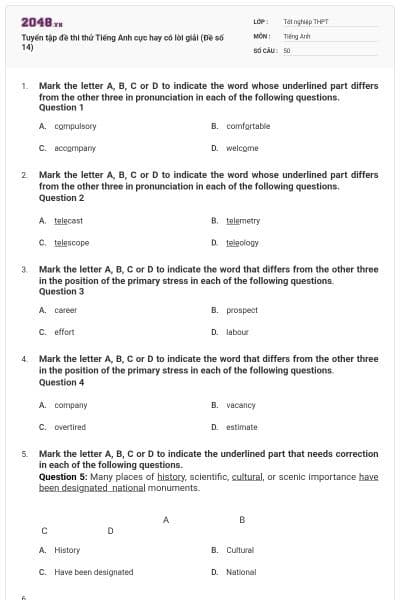
Tuyển tập đề thi thử Tiếng Anh cực hay có lời giải (Đề số 14)
50 câu hỏi
Mark the letter A, B, C or D to indicate the word whose underlined part differs from the other three in pronunciation in each of the following questions.
Question 1
compulsory
comfortable
accompany
welcome
Đáp án C. accompany, phát âm là /ʌ/, còn lại phát âm là /ə/
A. compulsory /kəm'pʌlsəri/ (adj) bắt buộc
B. comfortable / 'kʌmfətəbl/ (adj) thoải mái
C. accompany /ə'kʌmp9ni/ (v) đi cùng
D. welcome /'welkəm/ (v) chào đón
Mark the letter A, B, C or D to indicate the word whose underlined part differs from the other three in pronunciation in each of the following questions.
Question 2
telecast
telemetry
telescope
teleology
Đáp án D. teleology, phát âm là /ti:li/, các phương án còn lại phát âm là /teli/
A. telecast (n) /'telikæst/ chiếu
B. telemetry (n) /te'limətri/ phép đo từ xa
C. telescope (n) / 'telɪskoʊp/ kính thiên văn
D. teleology (n) /,ti:li'ɑ:lədʒi/ thuyết cứu cánh
Mark the letter A, B, C or D to indicate the word that differs from the other three in the position of the primary stress in each of the following questions.
Question 3
career
prospect
effort
labour
Đáp án A, trọng âm của từ career rơi vào âm tiết thứ 2, các đáp án còn lại trọng âm rơi vào âm tiết đầu tiên.
A. career (n) /kə'rɪə(r)/ sự nghiệp
B. prospect (n) /'prɑ:spekt/ triển vọng
C. effort (n) /'efərt/ công sức, nỗ lực
D. labour (n) /'leɪbər/ lao động
Mark the letter A, B, C or D to indicate the word that differs from the other three in the position of the primary stress in each of the following questions.
Question 4
company
vacancy
overtired
estimate
Đáp án C, trọng âm của từ overtired rơi vào âm tiết thứ 3, các đáp án còn lại trọng âm rơi vào âm tiết đầu tiên.
A. company (n) /'kʌmpəni/ công ty
B. vacancy (n) / 'veɪkənsi/ vị trí trống đang tuyển dụng
C. overtired (adj) /,oʊvər'taɪərd/ quá mệt mỏi
D. estimate (v) /'estɪmət/ ước tính
Mark the letter A, B, C or D to indicate the underlined part that needs correction in each of the following questions.
Question 5: Many places of history, scientific, cultural, or scenic importance have been designated national monuments.
A B C D
History
Cultural
Have been designated
National
Đáp án A. history => historical
Giải thích:
Để tạo cấu trúc song song cho các tính từ bổ sung cho danh từ importance, ta cần dùng tính từ của history là historical.
Dịch nghĩa: Nhiều địa danh quan trọng trong lich sử, khoa học, văn hóa và sân khấu điện ảnh đã được chọn làm công trình kỉ niệm quốc gia.
Mark the letter A, B, C or D to indicate the underlined part that needs correction in each of the following questions.
Question 6: Some underground water is enough safe to drink, but all the surface water treated.
A B C D
Some
Enough Safe
But
Treated
Đáp án: B
Giải thích:
Cấu trúc với “enough”:
- enough + N....( to do something ): đủ... (để làm gì)
- adj/adv + enough (to do something): đủ... (để làm gì)
Vì “safe” là tính từ nên phải đứng trước “enough”
Sửa: enough safe → safe enough
Dịch: Một số nước ngầm đủ an toàn để uống, nhưng tất cả nước bề mặt phải được xử lý.
Mark the letter A, B, C or D to indicate the underlined part that needs correction in each of the following questions.
Question 7: When you are writing or speaking English, it is important to use language that both men
A B C
and women equally the same.
D
Or Speaking
It is
That
Equaly the same
Đáp án D. equally the same =>equally
Giải thích: Vì equally và the same nghĩa tương đương nhau nên chỉ cần dùng một trong hai.
Dịch nghĩa: Khi nói hoặc viết tiếng Anh, việc sử dụng ngôn ngữ mà nhắc tới đàn ông và phụ nữ tương đương nhau rất quan trọng.

Học thông minh hơn mỗi ngày
Xem toàn bộ 50 câu hỏi và nhiều hơn nữa với tài khoản miễn phí
Markthe letter A, B,C or D to indicate the correct answer to each of the following questions.
Question 8: I'm sorry I snapped at you like that, but I'm in a bad ________.
mind
mood
mentality
manner
Đáp án B
Dịch nghĩa: Xin lỗi vì đã tát bạn như vậy, chỉ vì tam trạng tôi đang tệ quá.
A. mind (n) ý nghĩ, đầu óc
B. mood: (n) tâm trạng
C. mentality: (n) tinh thần
D. manner: (11) cách thức, thái độ
Collocation: to be in goodfflad mood: tâm trạng tốt/tệ
Markthe letter A, B,C or D to indicate the correct answer to each of the following questions.
Question 9: The accident _______ was the mistake of the driver.
which causes many people to die
causing many people to die
caused great human loss
to cause many people die
Đáp án B
Giải thích:
Vì câu đã có động từ was là vị ngữ nên phía trước chỉ cần một danh từ làm chủ ngữ dưới dạng mệnh đề quan hệ. Vì was chia ở quá khứ, vụ tai nạn cũng ở của quá khứ nên which causes phải sửa thành which caused mới đúng.
Tai nạn gây ra cái chết – dạng chủ động nên khi chuyển sang mệnh đề quan hệ rút gọn ta dùng dạng
V_ing (causing) thay vì Vpp caused.
Dịch nghĩa: Vụ tai nạn gây chết nhiều người là do lỗi của tài xế
Markthe letter A, B,C or D to indicate the correct answer to each of the following questions.
Question 10: All right, Johnny, it’s time you _______ to bed.
are going to go
will be going
would go
went
Đáp án D
Giải thích:
Cấu trúc It’s time somebody did something: Đã đến lúc ai đó làm gì ở hiện tại
It’s time to do something: Đã đến lúc làm gì ở hiện tại
Khi có người, ta phải chia ở quá khứ đã mang nghĩa ở hiện tại.
Dịch nghĩa: Được rồi, Johnny, đã đến lúc đi ngủ rồi.
Markthe letter A, B,C or D to indicate the correct answer to each of the following questions.
Question 11: There was _______ fuel in the car. Therefore, we had to stop midway to fill some.
a few
little
few
a little
Đáp án B
Giải thích:
Little: ít (dùng cho danh từ không đếm được)
Few: ít (dùng cho danh từ đếm được số nhiều)
Khi thêm a vào trước little/ few thì vẫn có nghĩa là ít, nhưng vẫn đủ để dùng. Nếu không có a thì mang nghĩa là ít, không đủ dùng.
Dịch nghĩa: Chỉ còn ít xăng trong xe. Vì thế, chúng ta đã phải dừng giữa đường để đổ thêm.
Markthe letter A, B,C or D to indicate the correct answer to each of the following questions.
Question 12: My uncle wishes his son ________ much time when he grows up.
hasn't wasted
hadn't wasted
wouldn't waste
didn't waste
Đáp án C
Giải thích: Mệnh đề thời gian dùng “when he grows up”, như vậy có thể suy ra cậu bé đó chưa lớn, việc “grow up” đó là ở tương lai. Ước một điều xảy ra trong tương lai, ta dùng cấu trúc wish S would V
Dịch nghĩa: Bác tôi ước rằng con trai của bác sẽ không lãng phí thời gian khi nó lớn.
Markthe letter A, B,C or D to indicate the correct answer to each of the following questions.
Question 13: My relative _______ you met yesterday is an engineer.
whose
whom
that
B and C are correct
Đáp án D
Giải thích: “Người họ hàng của tôi mà bạn gặp” thì người họ hàng chịu tác động bị động, nó là tân ngữ và ta dùng whom / that cho đại từ đóng vai trò tân ngữ trong mệnh đề quan hệ.
Dịch nghĩa: Người họ hàng của tôi mà bạn gặp hôm qua là một kĩ sư.
Markthe letter A, B,C or D to indicate the correct answer to each of the following questions.
Question 14: I ________ you don't make as much profit this year!
assure
challenge
bet
doubt
Đáp án C
A. assure (v) đoán chắc là
Sau assure phải có tân ngữ: assure somebody (that).../ assure something/ assure somebody something
Cụ thề, nếu dùng assure phải viết là I assure you that you don’t...
B. challenge: (n, v) thách thức
C. bet: (v) nghĩ chắc là
Cấu trúc: bet (somebody) (that)
[không cần tân ngữ mà dùng ngay vế câu đằng sau cũng được]
D. doubt: (v) nghi ngờ là, không nghĩ là
Hiếm khi dùng hai phủ định doubt và don’t make trong cùng một câu.
Dịch nghĩa: Tôi nghĩ chắc là năm nay bạn sẽ không kiếm được nhiều lãi đâu.
Markthe letter A, B,C or D to indicate the correct answer to each of the following questions.
Question 15: In future, cars will still be _________ us, but, instead of petrol, they will run ________anything from electricity to methane gas.
for/ by
for/ on
with/ by
with/ on
Đáp án D
Giải thích:
to be with us: ở cùng, có mặt với chúng ta
to be for us: dành cho chúng ta
run on something: chạy bằng nhiên liệu gì
Dịch nghĩa: Trong tương lai, ôtô sẽ vẫn còn được dùng, nhưng thay vì xăng, chúng sẽ chạy bằng điện đến khí metan.
Markthe letter A, B,C or D to indicate the correct answer to each of the following questions.
Question 16: Could you _______ a moment while I see if Peter is in his office?
get on well
get on
hold on
stand on
Đáp án C
Giải thích:
A. get on = get on well: có quan hệ tốt với ai
C. hold on: chờ
D. stand on: đứng lên
Dịch nghĩa: Bạn có thể chờ một lúc trong khi tôi đi xem Peter có ở văn phòng không?
Markthe letter A, B,C or D to indicate the correct answer to each of the following questions.
Question 17: For me, the film didn't ________ all the enthusiastic publicity it received.
come up
live up to
turn up to
live up
Đáp án B
Giải thích:
Live up to: xứng đáng với, đạt đến mong ước
Dịch nghĩa: Với tôi, bộ phim không được hay như những gì mà công chúng mong đợi.
Markthe letter A, B,C or D to indicate the correct answer to each of the following questions.
Question 18: Nowadays, most students use _______ calculators in their studies and examinations.
electrical
electric
electrified
electronic
Đáp án D
Giải thích:
A. electrical (adj) thuộc về điện, chạy bằng điện
B. electric (adj) thuộc về điện, chạy bằng điện
C. electrified (adj) bị điện hóa
D. electronic (adj) thuộc về điện tử
Dịch nghĩa: Ngày nay, hầu hết các học sinh đều dùng máy tính điện tử trong học tập và kiểm tra.
Markthe letter A, B,C or D to indicate the correct answer to each of the following questions.
Question 19: Lan: "She seems ______ for the job". - Hoa: "Yes. Everybody thinks she's perfectly suited for it."
ready-made
home-made
tailor-made
self-made
Đáp án C
Giải thích:
A. ready-made: chuẩn bị sẵn
B. home-made: làm tại nhà
C. tailor-made: rất phù hợp
D. self-made: tự làm nên thành công, giàu có, không phải do được cho mà có.
Dịch nghĩa: Lan: Cô ấy có vẻ phù hợp với công việc này.
Hoa: Đúng Vậy. Ai cũng nghĩa cô ấy hoàn toàn phù hợp.
Mark the letter A, B, C or D to indicate the most suitable response to complete each of the following exchanges.
Question 20:
Daisy: “Would you mind getting me a cup of coffee?”
John: “_____________.”
Cream and sugar, please
It's my pleasure
No, thanks
I never drink coffee
Đáp án B
Giải thích:
A. Cream and sugar, please: Kem và đường nhé.
B. It’s my pleasure: Đó là niềm hân hạnh của tôi.
C. No, thanks: Không, cảm ơn
D. I never drink coffee: tôi không bao giờ uống cà phê.
Would you mind V_ing? Bạn có phiền không ...? (Dùng để đưa ra đề nghị)
Dịch nghĩa:
Bạn có phiền khi pha cho tôi một tách cà phê không? - Đó là hân hạnh của tôi.
Mark the letter A, B, C or D to indicate the most suitable response to complete each of the following exchanges.
Question 21:
Ann: I'm very sorry for letting you wait for so long.
Bill: _____________.
Don't apologize. I've just arrived here.
You're welcome.
It's doesn't matter. Thank you.
My pleasure. Don't worry about it.
Đáp án A
Giải thích:
A. Don’t apologize. I’ve just arrived here. Đừng xin lỗi. Tớ cũng vừa đến.
B. You’re welcome. Không có gì (Dùng để đáp lại lời cảm ơn)
C. It’s doesn’t matter. Thank you. Không sao. Cảm ơn.
D. My pleasure. Don’t worry about it. Niềm hân hạnh của tôi. Đừng lo về điều đó.
Mark the letter A, B, C or D to indicate the word/phrases SIMILAR in meaning to the underlined word(s) in each of the following questions.
Question 22: When you see your teacher approaching you, a slight wave to attract his attention is appropriate.
catching sight of
pointing at
coming nearer to
looking up to
Đáp án C
Giải thích:
Approach (v) đến gần
A. catching sight of: bắt gặp
B. pointing at: chỉ vào
C. coming nearer to: đến gần
D. looking up to: ngưỡng mộ
Dịch nghĩa: Khi bạn thấy giáo viên đến gần bạn, một cái vẫy tay nhẹ để thu hút sự chú ý của cô là điều cần thiết.
Mark the letter A, B, C or D to indicate the word/phrases SIMILAR in meaning to the underlined word(s) in each of the following questions.
Question 23: Before he went on vacation, Peter left explicit instructions for the decoration of his office.
clear
colorful
vague
direct
Đáp án A
Giải thích:
Explicit: (adj) rành mạch, dễ hiểu
A. clear: rõ ràng
B. colorful: sặc sỡ
C. vague: mơ hồ
D. direct: trực tiếp
Dịch nghĩa: Trước khi đi nghỉ, Peter để lại một bản hướng dẫn rất rành mạch về việc trang trí văn phòng.
Mark the letter A, B, C or D to indicate the word or phrase that is OPPOSITE in meaning to the underlined part in each of the following questions.
Question 24: A frightening number of illiterate students are graduating from college.
inflexible
able to read and write
able to enjoy winter sports
unableto pass an examination in reading and writing
Đáp án B
Giải thích:
illiterate (adj) mù chữ
A. inflexible (adj) không linh hoạt
B. able to read and write (adj) có thể đọc viết
C. able to enjoy winter sports (adj) có thể tham gia các môn thể thao mùa đông
D. unable to pass an examination in reading and writing: không thể vượt qua bài thi đọc và viết
Dịch nghĩa: Có một con số đáng sợ chỉ ra rằng những học sinh không biết đọc, biết viết được tốt nghiệp ra trường.
Mark the letter A, B, C or D to indicate the word or phrase that is OPPOSITE in meaning to the underlined part in each of the following questions.
Question 25: In England, schooling is mandatory for all children from the age of 5 to 16.
voluntary
obligatory
advisory
compulsory
Đáp án A
Giải thích:
Mandatory (adj) bắt buộc
A. voluntary: tự nguyện
B. obligatory: bắt buộc
C. advisory: được khuyên là nên làm
D. compulsory: bắt buộc
Dịch nghĩa: Ở Anh, đi học là việc bắt buộc đối với các trẻ từ 5-16 tuổi.
Mark the letter A, B, C or D to indicate the sentence that is closest in meaning to each of the following questions.
Question 26: My children are not old enough to read these novels.
These novels are too old for my children to read.
These novels are not new to my children's reading.
My children are too young to read these novels.
My children are completely new to these novels.
Đáp án C
to be + adj enough to V: đủ...để làm gì
to be + adj too V: quá. . . đến nỗi không thể làm gì
Dịch nghĩa:
Câu gốc: Các con của tôi chưa đủ lớn để đọc những cuốn tiểu thuyết này.
A. Những cuốn tiểu thuyết này quá cũ cho các con tôi đọc.
B. Những cuốn tiểu thuyết này không mới cho các con tôi đọc.
C. Các con của tôi quá nhỏ để đọc những cuốn tiểu thuyết này.
D. Các con của tôi hoàn toàn mới so với những cuốn tiểu thuyết này.
Mark the letter A, B, C or D to indicate the sentence that is closest in meaning to each of the following questions.
Question 27: Bed, breakfast and dinner are included in the price.
The price is inclusive of bed, breakfast and dinner.
The price includes bed and breakfast except dinner.
The price excludes bed, breakfast and dinner.
Breakfast and dinner are included in the price as meals.
Đáp án A
include: bao gồm
exclude: không bao gồm
To be inclusive of = Include (v)
Dịch nghĩa: Tiền giường, bữa sáng và bữa tối đã được bao gồm trong chi phí rồi.
A. Chi phí đã bao gồm tiền giường, bữa sáng và bữa tối.
B. Chi phí bao gồm tiền giường, bữa sáng, không có bữa tối.
C. Chi phí không bao gồm tiền giường, bữa sáng và bữa tối.
D. Bữa sáng và bữa tối đã bao gồm trong chi phí như là tiền ăn.
Mark the letter A, B, C or D to indicate the sentence that is closest in meaning to each of the following questions.
Question 28: "All right, it's true. I was nervous," said the girl.
The girl admitted to have been nervous.
The girl decided that she had been nervous.
The girl denied being nervous.
The girl admitted that she had been nervous.
Đáp án D
Dịch nghĩa: “Được rồi, đó là sự thật. Tôi đã lo lắng”, cô gái nói.
A. Sai ngữ pháp. admit V-ing: thú nhận việc gì
B. Cô gái quyết định rằng cô đã lo lắng.
C. Cô gái phủ nhận việc đã lo lắng.
D. Cô gái thừa nhận rằng cô đã rất lo lắng.
Mark the letter A, B, C or 1) to indicate the sentence that best combines each pair of sentences in the following questions.
Question 29: The winds were very strong. The trees were uprooted.
So strong were the winds that the trees were uprooted.
The winds were strong that the trees were uprooted.
So were the winds strong that the trees were uprooted.
So strong the winds were that the trees were uprooted.
Đáp án A
Dịch nghĩa: Những cơn gió rất mạnh. Những cây bị bật gốc.
A. Gió mạnh đến nỗi cây bị bật gốc.
B. Những cơn gió mạnh rằng những cây bị bật gốc.
D và C sai cấu trúc.
Mark the letter A, B, C or 1) to indicate the sentence that best combines each pair of sentences in the following questions.
Question 30: She doesn't want to go to their party. We don't want to go either.
Neither she nor we don't want to go to their party.
Neither we nor she wants to go to their party.
Either we or she doesn't want to go to their party.
Neither we nor she want to go to their party.
Đáp án B
Dịch nghĩa: Cô ấy không muốn đến bữa tiệc của họ. Chúng tôi cũng không muốn đi.
A. Không phải cô ấy, cũng không phải chúng tôi đều không muốn đến bữa tiệc của họ.
B. Chúng tôi và cô ấy đều không muốn đi đến bữa tiệc của họ.
C. Hoặc chúng tôi hoặc cô ấy không muốn đến bữa tiệc của họ.
D. Không phải chúng tôi, cũng không phải cô ấy, muốn đến bữa tiệc của họ.
Neither…nor…thì động từ chia theo danh từ đứng sau nor.
Read the following passage and mark the letter A, B, C or D to indicate the correct word or phrase that best fits each of the numbered blanks from 31 to 35.
KEEPING FIT
Bodies are made to move! They are not (31) ________ for sitting around in front of the television or reading magazines. Keeping fit doesn't mean have to be a super-athlete, and even (32) ________ exercise can give you a lot of fun. When you are fit and healthy, you will find you look better and feel better. You will develop more energy and self-confidence.
Every time you move, you are exercising. The human body is designed to bend, stretch, run, jump and climb. (33) ________it does, the stronger and fitter it will become. Best of all, exercise is fun. It's what your body likes doing most-keeping on the move.
Physical exercise is not only good for your body. People who take regular exercise are usually happier, more relaxed and more alert than people who sit around all day. Try an experiment-next time you are in a bad mood, go for a walk or play a ball game in the park. See how much better you feel after an hour.
A good (34) ________of achievement is yet another benefit of exercise. People feel good about themselves when they know they have improved their fitness. People who exercise regularly will tell you that they find they have more energy to enjoy life. So have (35) ________you'll soon see and feel the benefits.
Question 31
planned
designed
programmed
caused
Đáp án B
Giải thích:
A. plan: dự định
B. design: thiết kế
C. program: lập trình (dùng cho chương trình, máy móc, robot. . .)
D. cause: gây ra
Read the following passage and mark the letter A, B, C or D to indicate the correct word or phrase that best fits each of the numbered blanks from 31 to 35.
KEEPING FIT
Bodies are made to move! They are not (31) ________ for sitting around in front of the television or reading magazines. Keeping fit doesn't mean have to be a super-athlete, and even (32) ________ exercise can give you a lot of fun. When you are fit and healthy, you will find you look better and feel better. You will develop more energy and self-confidence.
Every time you move, you are exercising. The human body is designed to bend, stretch, run, jump and climb. (33) ________it does, the stronger and fitter it will become. Best of all, exercise is fun. It's what your body likes doing most-keeping on the move.
Physical exercise is not only good for your body. People who take regular exercise are usually happier, more relaxed and more alert than people who sit around all day. Try an experiment-next time you are in a bad mood, go for a walk or play a ball game in the park. See how much better you feel after an hour.
A good (34) ________of achievement is yet another benefit of exercise. People feel good about themselves when they know they have improved their fitness. People who exercise regularly will tell you that they find they have more energy to enjoy life. So have (35) ________you'll soon see and feel the benefits.
Question 32
a little
a few
little
few
Đáp án A
Giải thích:
little: quá ít không đủ làm gì, dùng cho danh từ không đếm được
few: quá ít không đủ làm gì, dùng cho danh từ đếm được
Khi thêm từ a vào phía trước thì chuyển nghĩa thành “ít nhưng vẫn đủ để làm gì”
Ở đây, exercise là danh từ không đếm được, tác giả dùng với nghĩa tích cực, “chỉ một chút tập luyện cũng cho bạn rất nhiều niềm vui” - như vậy, lượng ít đó cũng không được quá ít mà phải đủ đến mức độ nào đó mới làm mình vui được, nên ta dùng a little.
Read the following passage and mark the letter A, B, C or D to indicate the correct word or phrase that best fits each of the numbered blanks from 31 to 35.
KEEPING FIT
Bodies are made to move! They are not (31) ________ for sitting around in front of the television or reading magazines. Keeping fit doesn't mean have to be a super-athlete, and even (32) ________ exercise can give you a lot of fun. When you are fit and healthy, you will find you look better and feel better. You will develop more energy and self-confidence.
Every time you move, you are exercising. The human body is designed to bend, stretch, run, jump and climb. (33) ________it does, the stronger and fitter it will become. Best of all, exercise is fun. It's what your body likes doing most-keeping on the move.
Physical exercise is not only good for your body. People who take regular exercise are usually happier, more relaxed and more alert than people who sit around all day. Try an experiment-next time you are in a bad mood, go for a walk or play a ball game in the park. See how much better you feel after an hour.
A good (34) ________of achievement is yet another benefit of exercise. People feel good about themselves when they know they have improved their fitness. People who exercise regularly will tell you that they find they have more energy to enjoy life. So have (35) ________you'll soon see and feel the benefits.
Question 33
more and more
the more
more
moreover
Đáp án B
Giải thích:
Cấu trúc so sánh tăng cấp: the + so sánh hơn, the + so sánh hơn: càng. . .càng. ..
Ví dụ: The more you eat, the fatter you are: bạn càng ăn nhiều, bạn càng béo. Hai cụm so sánh hơn ở đây là more you eat và fatter you are. Luôn có từ the đứng trước hai vế.
Read the following passage and mark the letter A, B, C or D to indicate the correct word or phrase that best fits each of the numbered blanks from 31 to 35.
KEEPING FIT
Bodies are made to move! They are not (31) ________ for sitting around in front of the television or reading magazines. Keeping fit doesn't mean have to be a super-athlete, and even (32) ________ exercise can give you a lot of fun. When you are fit and healthy, you will find you look better and feel better. You will develop more energy and self-confidence.
Every time you move, you are exercising. The human body is designed to bend, stretch, run, jump and climb. (33) ________it does, the stronger and fitter it will become. Best of all, exercise is fun. It's what your body likes doing most-keeping on the move.
Physical exercise is not only good for your body. People who take regular exercise are usually happier, more relaxed and more alert than people who sit around all day. Try an experiment-next time you are in a bad mood, go for a walk or play a ball game in the park. See how much better you feel after an hour.
A good (34) ________of achievement is yet another benefit of exercise. People feel good about themselves when they know they have improved their fitness. People who exercise regularly will tell you that they find they have more energy to enjoy life. So have (35) ________you'll soon see and feel the benefits.
Question 34
sense
feel
lot
piece
Đáp án A
Giải thích:
A sense of + danh từ: cảm giác gì
a sense of achievement: cảm giác đạt được thành tựu gì đó
Read the following passage and mark the letter A, B, C or D to indicate the correct word or phrase that best fits each of the numbered blanks from 31 to 35.
KEEPING FIT
Bodies are made to move! They are not (31) ________ for sitting around in front of the television or reading magazines. Keeping fit doesn't mean have to be a super-athlete, and even (32) ________ exercise can give you a lot of fun. When you are fit and healthy, you will find you look better and feel better. You will develop more energy and self-confidence.
Every time you move, you are exercising. The human body is designed to bend, stretch, run, jump and climb. (33) ________it does, the stronger and fitter it will become. Best of all, exercise is fun. It's what your body likes doing most-keeping on the move.
Physical exercise is not only good for your body. People who take regular exercise are usually happier, more relaxed and more alert than people who sit around all day. Try an experiment-next time you are in a bad mood, go for a walk or play a ball game in the park. See how much better you feel after an hour.
A good (34) ________of achievement is yet another benefit of exercise. People feel good about themselves when they know they have improved their fitness. People who exercise regularly will tell you that they find they have more energy to enjoy life. So have (35) ________you'll soon see and feel the benefits.
Question 35
a run
a trial
a go
a start
Đáp án C
Giải thích:
A. a run: (n) chạy
B. a trial (n) kiểm tra, nghiên cứu bằng chứng
C. have a go/try: thử
D. a start: sự bắt đầu
Read the following passage and mark the letter A, B, C or D to indicate the correct answer to each of the questions from 36 to 42.
Life originated in the early seas less than a billion years after the Earth was formed. Yet another three billions years were to pass before the first plants and animals appeared on the continents. Life's transition from the sea to the land was perhaps as much of an evolutionary challenge as was the genesis of life.
What forms of life were able to make such a drastic change in lifestyle? The traditional view of the first terrestrial organisms is based on megafossils - relatively large specimens of essential whole plants and animals. Vascular plants, related to modern seed plants and ferns, left the first comprehensive megafossil record. Because of this, it has been commonly assumed that the sequence of terrestrialization reflected the evolution of 10 modern terrestrial ecosystems. In this view, primitive vascular plants first colonized the margins of continental waters, followed by animals that fed on the plants, and lastly by the animals that preyed on the plant-eaters. Moreover, the megafossils suggest that terrestrial life appeared and diversified explosively near the boundary between the Silurian and the Devonian periods, a little more than 400 million years ago.
Recently, however, paleontologists have been taking a closer look at sediments below this Silurian- Devonian geological boundary. It turns out that some fossils can be extracted from these sediments by putting the rock in an acid bath. The technique has uncovered new evidence from sediments that were deposited near the shores of the ancient oceans - plant microfossils and microscopic pieces of small animals. In many instances, the specimens are less than one-tenth of a millimeter in diameter. Although they were entombed in the rocks for hundreds of millions of years, many of the fossils consist of the organic remains of the organism.
These discovered fossils have not only revealed the existence ofpreviously unknown organisms, but have also pushed back these dates for the invasion of land by multicellular organisms. Our view about the nature of the early plants and animal communities are now being revised. And with those revisions come new speculations about the first terrestrial life-forms.
Question 36: The word "drastic" is closest in meaning to ________.
widespread
radical
progressive
risky
Đáp án B
Dịch nghĩa: Từ “drastic” [mạnh mẽ, quyết liệt] gần nghĩa nhất với _________.
A. phổ biến B. hoàn toàn, căn bản, lớn
C. tiến tới D. liều lĩnh
Giải thích: drastic change = radical change: thay đổi lớn, từ căn nguyên, hoàn toàn khác so với ban đầu
Read the following passage and mark the letter A, B, C or D to indicate the correct answer to each of the questions from 36 to 42.
Life originated in the early seas less than a billion years after the Earth was formed. Yet another three billions years were to pass before the first plants and animals appeared on the continents. Life's transition from the sea to the land was perhaps as much of an evolutionary challenge as was the genesis of life.
What forms of life were able to make such a drastic change in lifestyle? The traditional view of the first terrestrial organisms is based on megafossils - relatively large specimens of essential whole plants and animals. Vascular plants, related to modern seed plants and ferns, left the first comprehensive megafossil record. Because of this, it has been commonly assumed that the sequence of terrestrialization reflected the evolution of 10 modern terrestrial ecosystems. In this view, primitive vascular plants first colonized the margins of continental waters, followed by animals that fed on the plants, and lastly by the animals that preyed on the plant-eaters. Moreover, the megafossils suggest that terrestrial life appeared and diversified explosively near the boundary between the Silurian and the Devonian periods, a little more than 400 million years ago.
Recently, however, paleontologists have been taking a closer look at sediments below this Silurian- Devonian geological boundary. It turns out that some fossils can be extracted from these sediments by putting the rock in an acid bath. The technique has uncovered new evidence from sediments that were deposited near the shores of the ancient oceans - plant microfossils and microscopic pieces of small animals. In many instances, the specimens are less than one-tenth of a millimeter in diameter. Although they were entombed in the rocks for hundreds of millions of years, many of the fossils consist of the organic remains of the organism.
These discovered fossils have not only revealed the existence ofpreviously unknown organisms, but have also pushed back these dates for the invasion of land by multicellular organisms. Our view about the nature of the early plants and animal communities are now being revised. And with those revisions come new speculations about the first terrestrial life-forms.
Question 37: According to the theory that the author calls "the traditional view", what was the first form of life to appear on land?
Bacteria
Meat-eating animals
Plant-eating animals
Vascular plants
Đáp án D
Dịch nghĩa: Theo như học thuyết mà tác giả gọi là “quan điểm truyền thống”, đâu là dạng thức của sự sống đầu tiên trên mặt đất?
A. vi khuẩn B. động vật ăn thịt
C. động vật ăn cỏ D. thực vật có mạch
Giải thích: Thông tin nằm ở đoạn 2 “In this View, primitive vascular plants first colonized
the margins of continental waters, followed by animals that fed on the plants, and lastly by the animals that preyed on the plant-eaters”
[Theo quan điểm này thì thực vật có mạch nguyên thủy xâm chiếm các bờ đại lục đầu tiên, theo sau đó là động vật ăn cỏ và cuối cùng la động vật ăn thịt]
Read the following passage and mark the letter A, B, C or D to indicate the correct answer to each of the questions from 36 to 42.
Life originated in the early seas less than a billion years after the Earth was formed. Yet another three billions years were to pass before the first plants and animals appeared on the continents. Life's transition from the sea to the land was perhaps as much of an evolutionary challenge as was the genesis of life.
What forms of life were able to make such a drastic change in lifestyle? The traditional view of the first terrestrial organisms is based on megafossils - relatively large specimens of essential whole plants and animals. Vascular plants, related to modern seed plants and ferns, left the first comprehensive megafossil record. Because of this, it has been commonly assumed that the sequence of terrestrialization reflected the evolution of 10 modern terrestrial ecosystems. In this view, primitive vascular plants first colonized the margins of continental waters, followed by animals that fed on the plants, and lastly by the animals that preyed on the plant-eaters. Moreover, the megafossils suggest that terrestrial life appeared and diversified explosively near the boundary between the Silurian and the Devonian periods, a little more than 400 million years ago.
Recently, however, paleontologists have been taking a closer look at sediments below this Silurian- Devonian geological boundary. It turns out that some fossils can be extracted from these sediments by putting the rock in an acid bath. The technique has uncovered new evidence from sediments that were deposited near the shores of the ancient oceans - plant microfossils and microscopic pieces of small animals. In many instances, the specimens are less than one-tenth of a millimeter in diameter. Although they were entombed in the rocks for hundreds of millions of years, many of the fossils consist of the organic remains of the organism.
These discovered fossils have not only revealed the existence ofpreviously unknown organisms, but have also pushed back these dates for the invasion of land by multicellular organisms. Our view about the nature of the early plants and animal communities are now being revised. And with those revisions come new speculations about the first terrestrial life-forms.
Question 38: According to the passage, what happened about 400 million years ago?
Many terrestrial life-forms died out.
New life-forms on land developed at a rapid rate.
The megafossils were destroyed by floods.
Life began to develop in the ancient seas.
Đáp án B
Dịch nghĩa: Theo bài đọc, chuyện gì đã xảy ra vào khoảng 400 triệu năm về trước?
A. Nhiều sinh vật sống trên cạn đã tuyệt chủng
B. Các thực thể sống mới trên cạn phát triển rất nhanh
C. Những hóa thạch khổng lồ bị phá hủy bởi bão lũ.
D. Sự sống bắt đầu phát triển ở biển cổ đại
Giải thích: Thông tin ở câu cuối đoạn 2 “terrestrial life appeared and diversified explosively near the boundary between the Silurian and the Devonian periods, a little more than 400 million years ago” [Sự sống trên cạn xuất hiện và đa dạng hóa một cách mạnh mẽ. . .]
Read the following passage and mark the letter A, B, C or D to indicate the correct answer to each of the questions from 36 to 42.
Life originated in the early seas less than a billion years after the Earth was formed. Yet another three billions years were to pass before the first plants and animals appeared on the continents. Life's transition from the sea to the land was perhaps as much of an evolutionary challenge as was the genesis of life.
What forms of life were able to make such a drastic change in lifestyle? The traditional view of the first terrestrial organisms is based on megafossils - relatively large specimens of essential whole plants and animals. Vascular plants, related to modern seed plants and ferns, left the first comprehensive megafossil record. Because of this, it has been commonly assumed that the sequence of terrestrialization reflected the evolution of 10 modern terrestrial ecosystems. In this view, primitive vascular plants first colonized the margins of continental waters, followed by animals that fed on the plants, and lastly by the animals that preyed on the plant-eaters. Moreover, the megafossils suggest that terrestrial life appeared and diversified explosively near the boundary between the Silurian and the Devonian periods, a little more than 400 million years ago.
Recently, however, paleontologists have been taking a closer look at sediments below this Silurian- Devonian geological boundary. It turns out that some fossils can be extracted from these sediments by putting the rock in an acid bath. The technique has uncovered new evidence from sediments that were deposited near the shores of the ancient oceans - plant microfossils and microscopic pieces of small animals. In many instances, the specimens are less than one-tenth of a millimeter in diameter. Although they were entombed in the rocks for hundreds of millions of years, many of the fossils consist of the organic remains of the organism.
These discovered fossils have not only revealed the existence ofpreviously unknown organisms, but have also pushed back these dates for the invasion of land by multicellular organisms. Our view about the nature of the early plants and animal communities are now being revised. And with those revisions come new speculations about the first terrestrial life-forms.
Question 39: The word "extracted" is closest in meaning to ___________.
located
preserved
removed
studied
Đáp án C
Dịch nghĩa: Từ “extracted” [tach biệt] gần nghĩa nhất với ___________.
A. được đặt ở B. được bảo tồn C. bị tách biệt, xa D. được nghiên cứu
Read the following passage and mark the letter A, B, C or D to indicate the correct answer to each of the questions from 36 to 42.
Life originated in the early seas less than a billion years after the Earth was formed. Yet another three billions years were to pass before the first plants and animals appeared on the continents. Life's transition from the sea to the land was perhaps as much of an evolutionary challenge as was the genesis of life.
What forms of life were able to make such a drastic change in lifestyle? The traditional view of the first terrestrial organisms is based on megafossils - relatively large specimens of essential whole plants and animals. Vascular plants, related to modern seed plants and ferns, left the first comprehensive megafossil record. Because of this, it has been commonly assumed that the sequence of terrestrialization reflected the evolution of 10 modern terrestrial ecosystems. In this view, primitive vascular plants first colonized the margins of continental waters, followed by animals that fed on the plants, and lastly by the animals that preyed on the plant-eaters. Moreover, the megafossils suggest that terrestrial life appeared and diversified explosively near the boundary between the Silurian and the Devonian periods, a little more than 400 million years ago.
Recently, however, paleontologists have been taking a closer look at sediments below this Silurian- Devonian geological boundary. It turns out that some fossils can be extracted from these sediments by putting the rock in an acid bath. The technique has uncovered new evidence from sediments that were deposited near the shores of the ancient oceans - plant microfossils and microscopic pieces of small animals. In many instances, the specimens are less than one-tenth of a millimeter in diameter. Although they were entombed in the rocks for hundreds of millions of years, many of the fossils consist of the organic remains of the organism.
These discovered fossils have not only revealed the existence ofpreviously unknown organisms, but have also pushed back these dates for the invasion of land by multicellular organisms. Our view about the nature of the early plants and animal communities are now being revised. And with those revisions come new speculations about the first terrestrial life-forms.
Question 40: The word "they" refers to ______.
rocks
shores
oceans
specimens
Đáp án D
Dịch nghĩa: Từ “they” nhắc đến _____________.
A. đá B. bờ
C. đại dương D. loài
Giải thích: “In many instances, the specimens are less than one-tenth of a millimeter in diameter. Although they were entombed in the rocks for hundreds of millions of years, many of the fossils consist of the organic remains of the organism” [Trong nhiều trường hợp, có những loài có đường kính còn nhỏ hơn 1/10 milimet. Mặc dù chúng bị chôn vùi trong đá. . .] Dịch nghĩa, ta có thể thấy được “chúng” ở đây là những loài nhỏ bé đó.
Read the following passage and mark the letter A, B, C or D to indicate the correct answer to each of the questions from 36 to 42.
Life originated in the early seas less than a billion years after the Earth was formed. Yet another three billions years were to pass before the first plants and animals appeared on the continents. Life's transition from the sea to the land was perhaps as much of an evolutionary challenge as was the genesis of life.
What forms of life were able to make such a drastic change in lifestyle? The traditional view of the first terrestrial organisms is based on megafossils - relatively large specimens of essential whole plants and animals. Vascular plants, related to modern seed plants and ferns, left the first comprehensive megafossil record. Because of this, it has been commonly assumed that the sequence of terrestrialization reflected the evolution of 10 modern terrestrial ecosystems. In this view, primitive vascular plants first colonized the margins of continental waters, followed by animals that fed on the plants, and lastly by the animals that preyed on the plant-eaters. Moreover, the megafossils suggest that terrestrial life appeared and diversified explosively near the boundary between the Silurian and the Devonian periods, a little more than 400 million years ago.
Recently, however, paleontologists have been taking a closer look at sediments below this Silurian- Devonian geological boundary. It turns out that some fossils can be extracted from these sediments by putting the rock in an acid bath. The technique has uncovered new evidence from sediments that were deposited near the shores of the ancient oceans - plant microfossils and microscopic pieces of small animals. In many instances, the specimens are less than one-tenth of a millimeter in diameter. Although they were entombed in the rocks for hundreds of millions of years, many of the fossils consist of the organic remains of the organism.
These discovered fossils have not only revealed the existence ofpreviously unknown organisms, but have also pushed back these dates for the invasion of land by multicellular organisms. Our view about the nature of the early plants and animal communities are now being revised. And with those revisions come new speculations about the first terrestrial life-forms.
Question 41: Which of the following resulted from the discovery of microscopic fossils?
The time estimate for the first appearance of the terrestrial life forms was revised.
Old techniques for analyzing fossils were found to have new uses.
The origins of primitive sea life were explained.
Assumptions about the locations of ancient seas were changed.
Đáp án A
Dịch nghĩa: Trong số các câu sau, đâu là kết quả của việc tìm ra siêu vi hóa thạch?
A. Thời gian ước tính cho lần đầu tiên xuất hiện của sinh vật cạn được xem xét lại.
B. Những kĩ thuật cũ để phân tích hóa thạch được tìm ra thêm những tác dụng mới.
C. Nguồn gốc của sinh vật biến cổ đại được giải thích.
D. Những giả định về vị trí các vùng biển cổ đại đã thay đổi.
Giải thích: Thông tin ở câu đầu đoạn cuối “These discovered fossils . . .but have also pushed back these dates for the invasion of land by multicellular organisms” [Những hóa thạch được tìm thấy. . .mà còn đẩy lùi lại thời gian mà những sinh vật đa bào xâm chiếm mặt đất lần đầu xuất hiện trên mặt đất]
Read the following passage and mark the letter A, B, C or D to indicate the correct answer to each of the questions from 36 to 42.
Life originated in the early seas less than a billion years after the Earth was formed. Yet another three billions years were to pass before the first plants and animals appeared on the continents. Life's transition from the sea to the land was perhaps as much of an evolutionary challenge as was the genesis of life.
What forms of life were able to make such a drastic change in lifestyle? The traditional view of the first terrestrial organisms is based on megafossils - relatively large specimens of essential whole plants and animals. Vascular plants, related to modern seed plants and ferns, left the first comprehensive megafossil record. Because of this, it has been commonly assumed that the sequence of terrestrialization reflected the evolution of 10 modern terrestrial ecosystems. In this view, primitive vascular plants first colonized the margins of continental waters, followed by animals that fed on the plants, and lastly by the animals that preyed on the plant-eaters. Moreover, the megafossils suggest that terrestrial life appeared and diversified explosively near the boundary between the Silurian and the Devonian periods, a little more than 400 million years ago.
Recently, however, paleontologists have been taking a closer look at sediments below this Silurian- Devonian geological boundary. It turns out that some fossils can be extracted from these sediments by putting the rock in an acid bath. The technique has uncovered new evidence from sediments that were deposited near the shores of the ancient oceans - plant microfossils and microscopic pieces of small animals. In many instances, the specimens are less than one-tenth of a millimeter in diameter. Although they were entombed in the rocks for hundreds of millions of years, many of the fossils consist of the organic remains of the organism.
These discovered fossils have not only revealed the existence ofpreviously unknown organisms, but have also pushed back these dates for the invasion of land by multicellular organisms. Our view about the nature of the early plants and animal communities are now being revised. And with those revisions come new speculations about the first terrestrial life-forms.
Question 42: With which of the following conclusions would the author probably agree?
The evolution of terrestrial life was as complicated as the origin of life itself.
The discovery of microfossils supports the traditional view of how terrestrial life evolved.
New species have appeared at the same rate over the cause of the last 400 million years.
The technology used by paleontologists is too primitive to make accurate determinations about ages of fossils.
Đáp án A
Dịch nghĩa: Trong số những câu sau, đâu là kết luận mà tác giả dễ đồng ý nhất?
A. Sự tiến hóa của sinh vật trên cạn cũng phức tạp như nguồn gốc của nó vậy.
B. Việc tìm ra hóa thạch siêu vi đã chứng tỏ quan điểm truyền thống về việc sinh vật trên cạn tiến hóa như thế nào.
C. Những loài vật mới xuất hiện cùng tỉ lệ trong suốt quãng thời gian 400 triệu năm vừa qua.
D. Công nghệ sử dụng bởi các nhà cổ sinh vật học quá cũ để có thể đưa ra những xác nhận chính xác về năm tuổi của hóa thạch.
Giải thích: Thông tin ở câu cuối của bài “Our View about the nature of the early plants and animal communities are now being revised. And with those revisions come new speculations about the first terrestrial life-forms.” [Quan điểm của chúng ta về những cộng đồng động thực vật ban đầu bây giờ đang được nghiên cứu lại. Và những nghiên cứu này sẽ dẫn đến những suy xét mới về những sinh vật sống đầu tiên trên cạn]
Các phương án B, C, D không có thông tin trong bài.
Read the following passage and mark the letter A, B, C or D to indicate the correct answer to each of the questions from 43 to 50.
The need for a surgical operation, especially an emergency operation, almost always comes as a severe shock to the patient and his family. Despite modern advances, most people still have an irrational fear of hospitals, and anaesthetics. Patients do not often believe they really need surgery - cutting into a part of the body as opposed to treatment with drugs.
In the early years of the 20th century there was little specialization in surgery. A good surgeon was capable of performing almost every operation that had been advised up to that time. Today the situation is different. Operations are now being carried out that were not even dreamed of fifty years ago. The heart can be safely opened and its valves repaired. Clogged blood vessels can be cleaned out, and broken ones mended or replaced. A lung, the whole stomach, or even part of the brain can be removed and still permit the patient to live comfortable and satisfactory life. However, not every surgeon wants to, or is qualified to carry out every type of modern operation.
The scope of surgery has increased remarkably in the past decades. Its safety has increased too. Deaths from most operations are about 20% of what they were in 1910 and surgery has been extended in many directions, for example to certain types of birth defects in new born babies, and, at the other end of the scale, to life saving operations for the octogenarian. The hospital stay after surgery has been shortened to as little as a week for most major operations. Most patients are out of bed on the day after an operation and may be back at work in two or three weeks.
Many developments in modern surgery are almost incredible. They include replacement of damaged blood vessels with simulated ones made of plastic: the replacement of heart valves with plastic substitutes; the transplanting of tissues such as lens of the eye; the invention of the artificial kidney to clean the blood of poisons at regular intervals and the development of heart and lung machines to keep patients alive during very long operations. All these things open a hopeful vista for the future of surgery.
One of the most revolutionary areas of modem surgery is that of organ transplants. Until a few decades ago, no person, except an identical twin, was able to accept into his body the tissues of another person without reacting against them and eventually killing them. Recently, however, it has been discovered that with the use of X-rays and special drugs, it is possible to graft tissues from one person to another which will survive for periods of a year or more. Kidneys have been successfully transplanted between non-identical twins. Heart and lung transplants have also been reasonably successful.
"Spare parts" surgery, the simple routine replacement of all worn-out organs by new ones, is
still a dream of the future but surgery is ready for such miracles. In the meantime, you can be happy if your doctors say to you, "Yes, I think it is possible to operate on you for this condition."
Question 43: Most people are afraid of being operated on __________.
in spite of improvements in modem surgery
because they think modem drugs are dangerous
because they do not believe they need anaesthetics
unless it is an emergency operation
Đáp án A
Dịch nghĩa. Hầu hết mọi người đều sợ phải phẫu thuật ___________.
A. mặc dù có những tiến bộ trong phẫu thuật hiện đại
B. vì họ nghĩ thuốc hiện đại nguy hiểm
C. vì họ không tin họ cần thuốc gây mê
D. trừ khi đó là một ca phẫu thuật khẩn cấp
Giải thích. Thông tin ở đoạn 1 “Despite modern advances, most people still have an irrational fear of hospitals, and anaesthetics”
Read the following passage and mark the letter A, B, C or D to indicate the correct answer to each of the questions from 43 to 50.
The need for a surgical operation, especially an emergency operation, almost always comes as a severe shock to the patient and his family. Despite modern advances, most people still have an irrational fear of hospitals, and anaesthetics. Patients do not often believe they really need surgery - cutting into a part of the body as opposed to treatment with drugs.
In the early years of the 20th century there was little specialization in surgery. A good surgeon was capable of performing almost every operation that had been advised up to that time. Today the situation is different. Operations are now being carried out that were not even dreamed of fifty years ago. The heart can be safely opened and its valves repaired. Clogged blood vessels can be cleaned out, and broken ones mended or replaced. A lung, the whole stomach, or even part of the brain can be removed and still permit the patient to live comfortable and satisfactory life. However, not every surgeon wants to, or is qualified to carry out every type of modern operation.
The scope of surgery has increased remarkably in the past decades. Its safety has increased too. Deaths from most operations are about 20% of what they were in 1910 and surgery has been extended in many directions, for example to certain types of birth defects in new born babies, and, at the other end of the scale, to life saving operations for the octogenarian. The hospital stay after surgery has been shortened to as little as a week for most major operations. Most patients are out of bed on the day after an operation and may be back at work in two or three weeks.
Many developments in modern surgery are almost incredible. They include replacement of damaged blood vessels with simulated ones made of plastic: the replacement of heart valves with plastic substitutes; the transplanting of tissues such as lens of the eye; the invention of the artificial kidney to clean the blood of poisons at regular intervals and the development of heart and lung machines to keep patients alive during very long operations. All these things open a hopeful vista for the future of surgery.
One of the most revolutionary areas of modem surgery is that of organ transplants. Until a few decades ago, no person, except an identical twin, was able to accept into his body the tissues of another person without reacting against them and eventually killing them. Recently, however, it has been discovered that with the use of X-rays and special drugs, it is possible to graft tissues from one person to another which will survive for periods of a year or more. Kidneys have been successfully transplanted between non-identical twins. Heart and lung transplants have also been reasonably successful.
"Spare parts" surgery, the simple routine replacement of all worn-out organs by new ones, is
still a dream of the future but surgery is ready for such miracles. In the meantime, you can be happy if your doctors say to you, "Yes, I think it is possible to operate on you for this condition."
Question 44: Surgeons in the early 20th century, compared with modem ones _______.
had less to learn about surgery
needed more knowledge
could perform every operation known today
were more trusted by their patients
Đáp án A
Dịch nghĩa. Những bác sĩ phẫu thuật ở đầu thế kỉ 20, so sánh với các bác sĩ thời nay thì ________.
A. không có nhiều thứ để học về phẫu thuật
B. cần nhiều kiến thức hơn
C. có thể tiến hành mọi ca phẫu thuật biết đến ở hiện tại
D. được các bệnh nhân tin tưởng hơn
Giải thích. Thông tin ở đầu đoạn 2 “In the early years of the 20th century there was little specialization in surgery”
Read the following passage and mark the letter A, B, C or D to indicate the correct answer to each of the questions from 43 to 50.
The need for a surgical operation, especially an emergency operation, almost always comes as a severe shock to the patient and his family. Despite modern advances, most people still have an irrational fear of hospitals, and anaesthetics. Patients do not often believe they really need surgery - cutting into a part of the body as opposed to treatment with drugs.
In the early years of the 20th century there was little specialization in surgery. A good surgeon was capable of performing almost every operation that had been advised up to that time. Today the situation is different. Operations are now being carried out that were not even dreamed of fifty years ago. The heart can be safely opened and its valves repaired. Clogged blood vessels can be cleaned out, and broken ones mended or replaced. A lung, the whole stomach, or even part of the brain can be removed and still permit the patient to live comfortable and satisfactory life. However, not every surgeon wants to, or is qualified to carry out every type of modern operation.
The scope of surgery has increased remarkably in the past decades. Its safety has increased too. Deaths from most operations are about 20% of what they were in 1910 and surgery has been extended in many directions, for example to certain types of birth defects in new born babies, and, at the other end of the scale, to life saving operations for the octogenarian. The hospital stay after surgery has been shortened to as little as a week for most major operations. Most patients are out of bed on the day after an operation and may be back at work in two or three weeks.
Many developments in modern surgery are almost incredible. They include replacement of damaged blood vessels with simulated ones made of plastic: the replacement of heart valves with plastic substitutes; the transplanting of tissues such as lens of the eye; the invention of the artificial kidney to clean the blood of poisons at regular intervals and the development of heart and lung machines to keep patients alive during very long operations. All these things open a hopeful vista for the future of surgery.
One of the most revolutionary areas of modem surgery is that of organ transplants. Until a few decades ago, no person, except an identical twin, was able to accept into his body the tissues of another person without reacting against them and eventually killing them. Recently, however, it has been discovered that with the use of X-rays and special drugs, it is possible to graft tissues from one person to another which will survive for periods of a year or more. Kidneys have been successfully transplanted between non-identical twins. Heart and lung transplants have also been reasonably successful.
"Spare parts" surgery, the simple routine replacement of all worn-out organs by new ones, is
still a dream of the future but surgery is ready for such miracles. In the meantime, you can be happy if your doctors say to you, "Yes, I think it is possible to operate on you for this condition."
Question 45: A patient can still live a comfortable life even after the removal of _________.
his brain
his lungs
a major organ such as the stomach or one lung
partof the stomach or the whole liver
Đáp án C
Dịch nghĩa. Một bệnh nhân vẫn có thể sống thoải mái thậm chí sau khi đã cắt bỏ _____.
A. bộ não
B. các lá phổi
C. một nội tạng chính chẳng hạn như dạ dày hay một lá phổi
D. một phần dạ dày hoặc toàn bộ lá gan
Giải thích. Thông tin ở cuối đoạn 2 “A lung, the Whole stomach, or even part of the brain can be removed and still permit the patient to live comfortable and satisfactory life”
Read the following passage and mark the letter A, B, C or D to indicate the correct answer to each of the questions from 43 to 50.
The need for a surgical operation, especially an emergency operation, almost always comes as a severe shock to the patient and his family. Despite modern advances, most people still have an irrational fear of hospitals, and anaesthetics. Patients do not often believe they really need surgery - cutting into a part of the body as opposed to treatment with drugs.
In the early years of the 20th century there was little specialization in surgery. A good surgeon was capable of performing almost every operation that had been advised up to that time. Today the situation is different. Operations are now being carried out that were not even dreamed of fifty years ago. The heart can be safely opened and its valves repaired. Clogged blood vessels can be cleaned out, and broken ones mended or replaced. A lung, the whole stomach, or even part of the brain can be removed and still permit the patient to live comfortable and satisfactory life. However, not every surgeon wants to, or is qualified to carry out every type of modern operation.
The scope of surgery has increased remarkably in the past decades. Its safety has increased too. Deaths from most operations are about 20% of what they were in 1910 and surgery has been extended in many directions, for example to certain types of birth defects in new born babies, and, at the other end of the scale, to life saving operations for the octogenarian. The hospital stay after surgery has been shortened to as little as a week for most major operations. Most patients are out of bed on the day after an operation and may be back at work in two or three weeks.
Many developments in modern surgery are almost incredible. They include replacement of damaged blood vessels with simulated ones made of plastic: the replacement of heart valves with plastic substitutes; the transplanting of tissues such as lens of the eye; the invention of the artificial kidney to clean the blood of poisons at regular intervals and the development of heart and lung machines to keep patients alive during very long operations. All these things open a hopeful vista for the future of surgery.
One of the most revolutionary areas of modem surgery is that of organ transplants. Until a few decades ago, no person, except an identical twin, was able to accept into his body the tissues of another person without reacting against them and eventually killing them. Recently, however, it has been discovered that with the use of X-rays and special drugs, it is possible to graft tissues from one person to another which will survive for periods of a year or more. Kidneys have been successfully transplanted between non-identical twins. Heart and lung transplants have also been reasonably successful.
"Spare parts" surgery, the simple routine replacement of all worn-out organs by new ones, is
still a dream of the future but surgery is ready for such miracles. In the meantime, you can be happy if your doctors say to you, "Yes, I think it is possible to operate on you for this condition."
Question 46: The word "clogged" in the second paragraph is most likely to correspond to __________.
clean
blocked
covered
unwashed
Đáp án B
Dịch nghĩa. Từ “clogged” - tắc, ở đoạn 2 gần nghĩa với ___________.
A. sạch B. tắc C. bị che phủ D. chưa rửa
Read the following passage and mark the letter A, B, C or D to indicate the correct answer to each of the questions from 43 to 50.
The need for a surgical operation, especially an emergency operation, almost always comes as a severe shock to the patient and his family. Despite modern advances, most people still have an irrational fear of hospitals, and anaesthetics. Patients do not often believe they really need surgery - cutting into a part of the body as opposed to treatment with drugs.
In the early years of the 20th century there was little specialization in surgery. A good surgeon was capable of performing almost every operation that had been advised up to that time. Today the situation is different. Operations are now being carried out that were not even dreamed of fifty years ago. The heart can be safely opened and its valves repaired. Clogged blood vessels can be cleaned out, and broken ones mended or replaced. A lung, the whole stomach, or even part of the brain can be removed and still permit the patient to live comfortable and satisfactory life. However, not every surgeon wants to, or is qualified to carry out every type of modern operation.
The scope of surgery has increased remarkably in the past decades. Its safety has increased too. Deaths from most operations are about 20% of what they were in 1910 and surgery has been extended in many directions, for example to certain types of birth defects in new born babies, and, at the other end of the scale, to life saving operations for the octogenarian. The hospital stay after surgery has been shortened to as little as a week for most major operations. Most patients are out of bed on the day after an operation and may be back at work in two or three weeks.
Many developments in modern surgery are almost incredible. They include replacement of damaged blood vessels with simulated ones made of plastic: the replacement of heart valves with plastic substitutes; the transplanting of tissues such as lens of the eye; the invention of the artificial kidney to clean the blood of poisons at regular intervals and the development of heart and lung machines to keep patients alive during very long operations. All these things open a hopeful vista for the future of surgery.
One of the most revolutionary areas of modem surgery is that of organ transplants. Until a few decades ago, no person, except an identical twin, was able to accept into his body the tissues of another person without reacting against them and eventually killing them. Recently, however, it has been discovered that with the use of X-rays and special drugs, it is possible to graft tissues from one person to another which will survive for periods of a year or more. Kidneys have been successfully transplanted between non-identical twins. Heart and lung transplants have also been reasonably successful.
"Spare parts" surgery, the simple routine replacement of all worn-out organs by new ones, is
still a dream of the future but surgery is ready for such miracles. In the meantime, you can be happy if your doctors say to you, "Yes, I think it is possible to operate on you for this condition."
Question 47: Today, compared with 1910 ________.
20% fewer of all operation patients die
20% of all operation patients recover
operation deaths have increased by 20%
five times fewer patients die after being operated on
Đáp án D
Dịch nghĩa. So với năm 1910, ngày nay _____________.
A. người chết trong phẫu thuật giảm 20%
B. 20% bệnh nhân phẫu thuật hồi phục
C. chết do phẫu thuật tăng 20%
D. bệnh nhân chết sau phẫu thuật giảm 5 lần
Giải thích. Thông tin ở đoạn 2 “Deaths from most operations are about 20% of what they were in 1910”. Tỉ lệ chết giảm còn 20% so với 1910, nghĩa là giảm 5 lần, khác với giảm bớt 20%.
Read the following passage and mark the letter A, B, C or D to indicate the correct answer to each of the questions from 43 to 50.
The need for a surgical operation, especially an emergency operation, almost always comes as a severe shock to the patient and his family. Despite modern advances, most people still have an irrational fear of hospitals, and anaesthetics. Patients do not often believe they really need surgery - cutting into a part of the body as opposed to treatment with drugs.
In the early years of the 20th century there was little specialization in surgery. A good surgeon was capable of performing almost every operation that had been advised up to that time. Today the situation is different. Operations are now being carried out that were not even dreamed of fifty years ago. The heart can be safely opened and its valves repaired. Clogged blood vessels can be cleaned out, and broken ones mended or replaced. A lung, the whole stomach, or even part of the brain can be removed and still permit the patient to live comfortable and satisfactory life. However, not every surgeon wants to, or is qualified to carry out every type of modern operation.
The scope of surgery has increased remarkably in the past decades. Its safety has increased too. Deaths from most operations are about 20% of what they were in 1910 and surgery has been extended in many directions, for example to certain types of birth defects in new born babies, and, at the other end of the scale, to life saving operations for the octogenarian. The hospital stay after surgery has been shortened to as little as a week for most major operations. Most patients are out of bed on the day after an operation and may be back at work in two or three weeks.
Many developments in modern surgery are almost incredible. They include replacement of damaged blood vessels with simulated ones made of plastic: the replacement of heart valves with plastic substitutes; the transplanting of tissues such as lens of the eye; the invention of the artificial kidney to clean the blood of poisons at regular intervals and the development of heart and lung machines to keep patients alive during very long operations. All these things open a hopeful vista for the future of surgery.
One of the most revolutionary areas of modem surgery is that of organ transplants. Until a few decades ago, no person, except an identical twin, was able to accept into his body the tissues of another person without reacting against them and eventually killing them. Recently, however, it has been discovered that with the use of X-rays and special drugs, it is possible to graft tissues from one person to another which will survive for periods of a year or more. Kidneys have been successfully transplanted between non-identical twins. Heart and lung transplants have also been reasonably successful.
"Spare parts" surgery, the simple routine replacement of all worn-out organs by new ones, is
still a dream of the future but surgery is ready for such miracles. In the meantime, you can be happy if your doctors say to you, "Yes, I think it is possible to operate on you for this condition."
Question 48: Some of the more astonishing innovations in modern surgery include _________.
ear, nose and throat transplants
valve less plastic hearts
plastic heart valves
leg transplants
Đáp án C
Dịch nghĩa. Một vài cải tiến đáng ngạc nhiên nhất trong phẫu thuật hiện đại bao gồm __________.
A. cấy ghép tai, mũi, họng B. van tim ít nhựa hơn
C. van tim bằng nhựa D. ghép chân
Giải thích. Ở đoạn 4 nhắc đến nhiều cải tiến, trong đó có phương án C, các phương án A, B, D không được nhắc đến.
Read the following passage and mark the letter A, B, C or D to indicate the correct answer to each of the questions from 43 to 50.
The need for a surgical operation, especially an emergency operation, almost always comes as a severe shock to the patient and his family. Despite modern advances, most people still have an irrational fear of hospitals, and anaesthetics. Patients do not often believe they really need surgery - cutting into a part of the body as opposed to treatment with drugs.
In the early years of the 20th century there was little specialization in surgery. A good surgeon was capable of performing almost every operation that had been advised up to that time. Today the situation is different. Operations are now being carried out that were not even dreamed of fifty years ago. The heart can be safely opened and its valves repaired. Clogged blood vessels can be cleaned out, and broken ones mended or replaced. A lung, the whole stomach, or even part of the brain can be removed and still permit the patient to live comfortable and satisfactory life. However, not every surgeon wants to, or is qualified to carry out every type of modern operation.
The scope of surgery has increased remarkably in the past decades. Its safety has increased too. Deaths from most operations are about 20% of what they were in 1910 and surgery has been extended in many directions, for example to certain types of birth defects in new born babies, and, at the other end of the scale, to life saving operations for the octogenarian. The hospital stay after surgery has been shortened to as little as a week for most major operations. Most patients are out of bed on the day after an operation and may be back at work in two or three weeks.
Many developments in modern surgery are almost incredible. They include replacement of damaged blood vessels with simulated ones made of plastic: the replacement of heart valves with plastic substitutes; the transplanting of tissues such as lens of the eye; the invention of the artificial kidney to clean the blood of poisons at regular intervals and the development of heart and lung machines to keep patients alive during very long operations. All these things open a hopeful vista for the future of surgery.
One of the most revolutionary areas of modem surgery is that of organ transplants. Until a few decades ago, no person, except an identical twin, was able to accept into his body the tissues of another person without reacting against them and eventually killing them. Recently, however, it has been discovered that with the use of X-rays and special drugs, it is possible to graft tissues from one person to another which will survive for periods of a year or more. Kidneys have been successfully transplanted between non-identical twins. Heart and lung transplants have also been reasonably successful.
"Spare parts" surgery, the simple routine replacement of all worn-out organs by new ones, is
still a dream of the future but surgery is ready for such miracles. In the meantime, you can be happy if your doctors say to you, "Yes, I think it is possible to operate on you for this condition."
Question 49: Which of the following has the same meaning as "vista" in the fourth paragraph?'
support
prospect
history
visit
Đáp án B
Dịch nghĩa. Trong số các từ sau, đâu là từ đồng nghĩa với “vista” ở đoạn 4?
A. ủng hộ B. khía cạnh, phương diện
C. lịch sử D. viếng thăm
Read the following passage and mark the letter A, B, C or D to indicate the correct answer to each of the questions from 43 to 50.
The need for a surgical operation, especially an emergency operation, almost always comes as a severe shock to the patient and his family. Despite modern advances, most people still have an irrational fear of hospitals, and anaesthetics. Patients do not often believe they really need surgery - cutting into a part of the body as opposed to treatment with drugs.
In the early years of the 20th century there was little specialization in surgery. A good surgeon was capable of performing almost every operation that had been advised up to that time. Today the situation is different. Operations are now being carried out that were not even dreamed of fifty years ago. The heart can be safely opened and its valves repaired. Clogged blood vessels can be cleaned out, and broken ones mended or replaced. A lung, the whole stomach, or even part of the brain can be removed and still permit the patient to live comfortable and satisfactory life. However, not every surgeon wants to, or is qualified to carry out every type of modern operation.
The scope of surgery has increased remarkably in the past decades. Its safety has increased too. Deaths from most operations are about 20% of what they were in 1910 and surgery has been extended in many directions, for example to certain types of birth defects in new born babies, and, at the other end of the scale, to life saving operations for the octogenarian. The hospital stay after surgery has been shortened to as little as a week for most major operations. Most patients are out of bed on the day after an operation and may be back at work in two or three weeks.
Many developments in modern surgery are almost incredible. They include replacement of damaged blood vessels with simulated ones made of plastic: the replacement of heart valves with plastic substitutes; the transplanting of tissues such as lens of the eye; the invention of the artificial kidney to clean the blood of poisons at regular intervals and the development of heart and lung machines to keep patients alive during very long operations. All these things open a hopeful vista for the future of surgery.
One of the most revolutionary areas of modem surgery is that of organ transplants. Until a few decades ago, no person, except an identical twin, was able to accept into his body the tissues of another person without reacting against them and eventually killing them. Recently, however, it has been discovered that with the use of X-rays and special drugs, it is possible to graft tissues from one person to another which will survive for periods of a year or more. Kidneys have been successfully transplanted between non-identical twins. Heart and lung transplants have also been reasonably successful.
"Spare parts" surgery, the simple routine replacement of all worn-out organs by new ones, is
still a dream of the future but surgery is ready for such miracles. In the meantime, you can be happy if your doctors say to you, "Yes, I think it is possible to operate on you for this condition."
Question 50: You can be happy if your surgeon can operate because it means ________.
he thinksyour condition may be incurable
he isa good doctor
he thinks youwill survive
you are getting better already
Đáp án C
Dịch nghĩa. Bạn có thể rất hạnh phúc nếu bác sĩ phẫu thuật của bạn có thể tiến hành bởi vì nó có nghĩa là ____________.
A. ông nghĩ rằng tình huống của bạn không thể chữa khỏi
B. ông ấy là một bác sĩ giỏi
C. ông nghĩ bạn sẽ sống sót
D. bạn đã hồi phục dần
Bạn có thích hoạt động này không?
Ý kiến của bạn sẽ giúp chúng tôi đề xuất nội dung phù hợp hơn.
Gợi ý cho bạn
![[Năm 2022] Đề thi thử môn Vật lí THPT Quốc gia có lời giải - Đề số 21](/_next/image?url=https%3A%2F%2Fvideo.vietjack.com%2Fupload%2Fimages%2Fvj-image%2Fimage-3izficdefgfoel0s9j8s-1786772791.jpg&w=3840&q=75)

![[Năm 2022] Đề thi thử môn Vật lí THPT Quốc gia có lời giải - Đề số 20](/_next/image?url=https%3A%2F%2Fvideo.vietjack.com%2Fupload%2Fimages%2Fvj-image%2Fimage-emy0gtcksawvorajezvv-1786772460.jpg&w=3840&q=75)

Tài liệu phổ biến Tốt nghiệp THPT


Tài liệu phổ biến Tiếng Anh