Tuyển tập đề thi thử Tiếng Anh cực hay có lời giải (Đề số 13)
50 câu hỏi
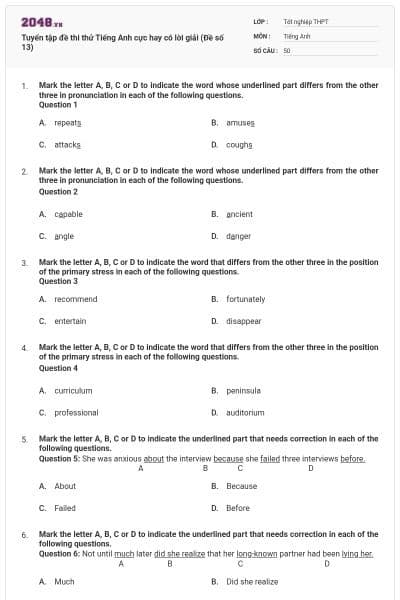
Mark the letter A, B, C or D to indicate the word whose underlined part differs from the other three in pronunciation in each of the following questions.
Question 1
repeats
amuses
attacks
coughs
Đáp án B. amuses, phát âm là /ɪz/, còn lại phát âm là /s/
A. repeats /rɪ'pi:ts/ (v) nói theo
B. amuses /ə'mju:zɪz/ (v) làm ai cười
C. attacks /ə'tæks/ (v) tấn công
D. coughs /kɔ:fs/ (v) ho
Với các từ có phiên âm kết thúc bằng /p, t, k, f, θ/ thì khi thêm ‘s’ ta phát âm là /s/
Với các từ có phiên âm kết thúc bằng /t∫, ∫, ʒ, dʒ, z, s/ thì khi thêm ‘s’ ở dạng số nhiều ta phát âm là /ɪz/.
Các trường hợp còn lại phát âm là /z/
Mark the letter A, B, C or D to indicate the word whose underlined part differs from the other three in pronunciation in each of the following questions.
Question 2
capable
ancient
angle
danger
Đáp án C. angle, phat am là /ae/, còn lại phát âm là /e1/.
A. capable /'keɪpəbl/ (adj) có thể
B. ancient /'eɪn∫ənt/ (adj) cổ xưa
C. angle /'æŋgl/ (n) góc
D. danger /'deɪndʒər/ (n) mối nguy hiểm
Mark the letter A, B, C or D to indicate the word that differs from the other three in the position of the primary stress in each of the following questions.
Question 3
recommend
fortunately
entertain
disappear
Đáp án B. fortunately, trọng âm rơi vào âm tiết thứ nhất, còn lại rơi vào âm tiết ba.
A. recommend /,rekə'mend/ (v) tiến cử, gợi ý
B. fortunately / ' fɔ:rt∫ənətli/ (adv) may mắn thay
C. entertain /,entər'təɪn/ (v) giải trí
D. disappear /,dɪsə'pɪə(r)/ (v) biến mất
Mark the letter A, B, C or D to indicate the word that differs from the other three in the position of the primary stress in each of the following questions.
Question 4
curriculum
peninsula
professional
auditorium
Đáp án D. auditorium, trọng âm rơi vào âm tiết thứ ba, còn lại rơi vào âm tiết thứ hai.
A. curriculum /kə'rɪkjuləm/ (n) chương trình học
B. peninsula /pə'nɪnsələ/ (n) bán đảo
C. professional /prə'fe∫ən1/ (adj) chuyén nghiệp
D. auditorium /,ɔ:dɪ'tɔ:riəm/ (n) khán đài
Mark the letter A, B, C or D to indicate the underlined part that needs correction in each of the following questions.
Question 5: She was anxious about the interview because she failed three interviews before.
A B C D
About
Because
Failed
Before
Đáp án C. failed => had failed
Giải thích: Vế trước, “cô ấy lo lắng” đã chia ở quá khứ. Vế sau, “cô ấy đã trượt ba lần trước đó”.
Vậy là việc trượt đó đã diễn ra trước khi cô ấy lo lắng, để chỉ một hành động xảy ra trước một hành động khác trong quá khứ ta dùng thì quá khứ hoàn thành had Vpp.
Dịch nghĩa: Cô ấy rất lo lắng về buổi phỏng vấn vì cô ấy đã trượt 3 lần trước đó.
Mark the letter A, B, C or D to indicate the underlined part that needs correction in each of the following questions.
Question 6: Not until much later did she realize that her long-known partner had been lying her.
A B C D
Much
Did she realize
Long-known
Lying her
Đáp án D. lying her => lying to her
Giải thích: lie to somebody: nói dối ai
Dịch nghĩa: Mãi lâu về sau cô ấy mới nhận ra là người bạn quen lâu năm đã nói dối cô.
Mark the letter A, B, C or D to indicate the underlined part that needs correction in each of the following questions.
Question 7: It is noisy enough in this room, so I would rather you stop shouting like that.
A B C D
Enough
So
Would rather
Stop
Đáp án D. stop =>stopped
Giải thích:
Would rather somebody did something: dùng để bày tỏ ý muốn ai làm gì ở hiện tại.
Dịch nghĩa: Đã đủ ồn trong phòng rồi, tôi muốn bạn dừng việc hét lên như thế.

Học thông minh hơn mỗi ngày
Xem toàn bộ 50 câu hỏi và nhiều hơn nữa với tài khoản miễn phí
Mark the letter A, B, C or D to indicate the correct answer to each of the following questions.
Question 8: That Marie was able to retire at the age of 50 __________.
so successful her business was
so successful was her business
her business was successful
so was her successful business
Đáp án: B
Giải thích:
Đảo ngữ nhấn mạnh dùng với “so”:
So + Tính từ + be (chia theo thì) + S + that + S + V
So + Trạng từ + Trợ động từ + S + V (không chia) + that + S + V
Đáp án B đúng ngữ pháp.
Dịch: Việc kinh doanh của Marie thành công đến nỗi mà cô ấy có thể về hưu ở tuổi 50.
Mark the letter A, B, C or D to indicate the correct answer to each of the following questions.
Question 9: The suspect confessed __________.
the police his crime
at his crime
his crime the police
his crime to the police
Đáp án D
Giải thích: Để nói “thú nhận việc gì” ta có các cụm sau:
confess that + mệnh đề
confess something to somebody
confess to doing something
Dịch nghĩa: Kẻ bị tình nghi đã thú nhận tội danh của hắn với cảnh sát.
Mark the letter A, B, C or D to indicate the correct answer to each of the following questions.
Question 10: His advice, I would never have got the job ___________.
except
but for
apart from
as for
Đáp án B
Giải thích:
A. except: ngoại trừ
B. but for = If there not: nếu không có
C. apart from: ngoại trừ
D. as for = regarding: về vấn đề (dùng khi bắt đầu nói về việc gì)
But for thường được sử dụng trong câu điều kiện.
Dịch nghĩa: Nếu không có lời khuyên của anh ta thì tôi đã không có được công việc này.
Mark the letter A, B, C or D to indicate the correct answer to each of the following questions.
Question 11: More than a mile of roadway has been blocked with trees, stones and other debris, _____ the explosion.
causing
caused by
which caused by
which caused
Dáp án B
Giải thích: Vụ nổ gây ra việc đường tắc, hay là đường tắc bị gây ra bởi vụ nổ, ta dùng bị động và mệnh đề quan hệ để có which was caused by the explosion. Tuy nhiên, ta có thể chuyển về mệnh đề rút gọn dạng Vpp khi mệnh đề đầy đủ ở bị động, và dạng V_ing khi mệnh đề đầy đủ ở dạng chủ động. Ở câu này đang ở bị động nên ta có caused by the explosion.
Dịch nghĩa: Hơn một dặm đường (đơn vị đo độ dài) đã bị cây cối, đá sỏi và mảnh vỡ vụn từ vụ nổ gây tắc đường.
Mark the letter A, B, C or D to indicate the correct answer to each of the following questions.
Question 12: I__________ the bell three times when he answered the door.
would ring
rang
had rung
was ringing
Đáp án C
Giải thích: Việc tôi bấm chuông 3 lần xảy ra trước khi anh ta ra mở cửa, để nói về một việc xảy ra trước một sự việc cụ thể trong quá khứ, ta dùng quá khứ hoàn thành là had Vpp.
Ring (nguyên thể) => rang (Vqk) => rung (Vpp): rung chuông
Dịch nghĩa: Tôi đã bấm chuông ba lần trước khi anh ta ra mở cửa.
Mark the letter A, B, C or D to indicate the correct answer to each of the following questions.
Question 13: I'm thinking of changing my job because there are few _____ of promotion.
prospects
opportunities
chances
sources
Đáp án C
A. prospects (n) triển vọng (đi kèm với giới từ for)
B. opportunities: (n) cơ hội (đi kèm giới từ of)
C. chances: (n) khả năng, cơ hội
D. sources: (n) nguồn
Cụm từ: chance/chances of promotion: (n) cơ hội thăng tiến.
Ngoài ra có thể dùng promotion opportunities, promotion prospects với nghĩa tương đương.
Dịch nghĩa: Tôi dang nghĩ đến việc đổi nghề vìcó quá ít cơ hội thăng tiến.
Mark the letter A, B, C or D to indicate the correct answer to each of the following questions.
Question 14: Bill has a real ______ for looking after handicapped children.
career
post
inspiration
vocation
Đáp án D
A. career (n) sự nghiệp
B. post: (n) chỗ làm, cột
C. inspiration: (n) nhiệt huyết, cảm hứng
D. vocation: (n) thiên hướng
Cấu trúc: have a vocation for: có thiên hướng cho
Inspiration không dùng với động từ have, thay vào đó, người ta hay dùng gain, take, find + inspiration.
Các đáp án A và B không hợp nghĩa và không đi kèm với từ for phía sau.
Dịch nghĩa: Bill thực sự có thiên hướng chăm sóc trẻ em khuyết tật.
Mark the letter A, B, C or D to indicate the correct answer to each of the following questions.
Question 15: The death of Tran Lap, the leader of a Vietnamese famous rock band called Buc Tuong, is a great ________ to his fans.
losing
loss
lose
lost
Đáp án B
Giải thích:
A. losing: dang V_ing của lose
B. loss (n) sự mất mát
c. lose (v) làm mất
D. lost: dạng quá khứ của lose
Sau a nên ta cần diễn một danh từ, chỉ có B là danh từ trong 4 phương án.
Dịch nghĩa: Sự ra đi của Trần Lập, đội trường của ban nhạc Rock Việt tên Bức Tường, là một sự mất mát lớn với người hâm mộ.
Mark the letter A, B, C or D to indicate the correct answer to each of the following questions.
Question 16: I ________ an old friend of mine in the street this morning. We haven't seen Each other for ages.
ran into
ran out
came over
came round
Đáp án A
Giải thích:
A. run into: tình cờ bắt gặp
B. run out: được sử dụng hết
C. come over: vượt qua
D. come round: tỉnh lại
Dịch nghĩa: Tôi tình cờ bắt gặp một người bạn cũ trên đường, chúng tôi đã không gặp nhau lâu lắm rồi.
Mark the letter A, B, C or D to indicate the correct answer to each of the following questions.
Question 17: Tom is _____ with his teacher because he didn't do any assignments.
in danger
in the dark
in hot water
under control
Đáp án C
Giải thích:
A. to be in danger: đang trong nguy hiểm
B. to be in the dark about: không biết gì về
C. to be in-hot water: gặp rắc rối
D. to be under control: dưới sự kiểm soát, điều khiển
Dịch nghĩa: Tom đang gặp rắc rối với giáo viên vì anh ta không làm bài về nhà.
Mark the letter A, B, C or D to indicate the correct answer to each of the following questions.
Question 18: These facts may be familiar _______ you.
to
with
in
at
Đáp án A
Giải thích: familiar to somebody (adj) quen thuộc với ai
Dịch nghĩa: Những sự thật này có thể quen thuộc với bạn.
Mark the letter A, B, C or D to indicate the correct answer to each of the following questions.
Question 19: The government is building a nuclear power ________ not far from here.
works
factory
station
industry
Đáp án C
Dịch nghĩa: Chính phủ đang xây dựng một nhà máy điện hạt nhân cách đây không xa.
A. works (n) công trình
B. factory (n) nhà máy
C. station: (n) trạm
D. industry: (n) công nghiệp
Có cụm từ Power station: trạm điện, nhà máy điện
Mark the letter A, B, C or D to indicate the most suitable response to complete each of the following exchanges.
Question 20: Mai and Lan are friends. Lan asks Mai about Mai's plan. Select the most suitable response to fill in the blank.
Lan: “Are you going to see the live show by Son Tung today?”
Mai: “__________”.
Yes, I enjoyed it very much
Maybe I'll be out
Yes, I'm going to stay in
I think so
Đáp án D
Giải thích:
A. Yes, I enjoyed it very much: Có chứ, tôi đã thích nó lắm.
B. Maybe I’ll be out: Có thể là tôi sẽ ra ngoài.
C. Yes, I’m going to stay in: Có chứ, tôi định ở nhà.
D. I think so: Tôi nghĩ vậy.
A sai vì hỏi tối nay đi không mà lại nói là “đã thích”, như vậy hiểu là đã đi tham dự, và thấy thích nó.
B sai vì trả lời không đúng trọng tâm, hỏi có tham gia không mà nói tôi sẽ ra ngoài?
C sai vì phía trước thì nói có (đi), phía sau lại bảo ở nhà, mâu thuẫn.
Dịch nghĩa: Mai và Lan là bạn. Lan hỏi Mai về kế hoạch của Mai.
- Cậu định đi xem live-show của Sơn Tùng hôm nay à?
- Tớ nghĩ vậy.
Mark the letter A, B, C or D to indicate the most suitable response to complete each of the following exchanges.
Question 21: Andy: How about coming to my English class tonight?
Bob: ______________________.
Sounds like fun! What time?
English is my favourite subject.
Don't worry. Thanks.
Thanks. But what's the problem?
Đáp án A
Giải thích:
A. Sounds like fun! What time? Nghe vui đó. Mấy giờ?
B. English is my favourite subject. Tiếng Anh là môn học yêu thích của tôi.
C. Don’t worry. Thanks. Đừng lo. Cảm ơn bạn.
D. Thanks. But what’s the problem? Cảm ơn. Nhưng vấn đề là gì?
Dịch nghĩa:
Andy: Hay là đến lớp tiếng Anh của tớ tối nay?
Bob: Nghe vui đó. Mấy giờ?
Mark the letter A, B, C or D to indicate the word/phrases SIMILAR in meaning to the underlined word(s) in each of the following questions.
Question 22: The news should be put in the most noticeable place so that all the students can be well informed.
suspicious
popular
easilyseen
beautiful
Đáp án C
Giải thích:
Noticeable (adj) dễ dàng nhận ra
A. suspicious: (adj) nghi ngờ
B. popular (adj) phổ biến
C. easily seen (adj) dễ dàng nhìn thấy
D. beautiful (adj) đẹp
Dịch nghĩa: Thông báo nên được đặt ở chỗ dễ nhìn ra để tất cả sinh viên đều biết rõ.
Mark the letter A, B, C or D to indicate the word/phrases SIMILAR in meaning to the underlined word(s) in each of the following questions.
Question 23: I told her I understood what she was feeling as we were both after all in the same boat.
in a similar take
in a similar find
in a similar situation
in a similar case
Đáp án C
Giải thích:
in the sameboat: cùng hội cũng thuyền
A. in a similar take: trong cùng một mẻ
B. in a similar find: trong cùng một phát hiện
C. in a similar situation: trong cũng một trường hợp
D. Thường sử dụng in the same case: trong cùng một trường hợp,thay vì similar case
Dịch nghĩa: Tôi đã nói với cô ấy rằng tôi hiểu những gì cô ấy đang trải qua vì chúng tôi đang trong cùng một tình cảnh.
Mark the letter A, B, C or D to indicate the word or phrase that is OPPOSITE in meaning to the underlined part in each of the following questions.
Question 24: He was arrested for his illicit drug trade in the police raid yesterday.
legal
irregular
elicited
secret
Đáp án A
Giải thích:
illicit (adj) bất hợp pháp
A. legal: hợp pháp
B irregular: bất thường
C. elicited: làm lộ ra
D. secret: bí mật
Dịch nghĩa: Ông ta bị bắt vì mua bán ma túy bất hợp pháp trong cuộc truy kích của cảnh sát ngày hôm qua.
Mark the letter A, B, C or D to indicate the word or phrase that is OPPOSITE in meaning to the underlined part in each of the following questions.
Question 25: I eat lunch with a convivial group of my friends.
unsociable
large
old
lively
Đáp án A
Giải thích:
convivial (adj) vui vẻ
A. unsociable: không hòa đồng
B. large: rộng, lớn
C. old: cũ, già
D. lively: sống động
Dịch nghĩa: Tôi ăn trưa với một nhóm bạn rất vui vẻ của mình.
Mark the letter A, B, C or D to indicate the sentence that is closest in meaning to each of the following questions.
Question 26: If their car hadn't broken down, these people would have come to the meeting in time.
These people didn't come to the meeting because their car broke down.
These people came to the meeting late because their car broke down.
These people were late for the meeting because they didn't pick them up.
If they had picked up these people, they wouldn't have been late for the meeting.
Đáp án B
Cấu trúc câu điều kiện loại 3, dùng để diễn đạt tình huống trái với sự thật trong quá khứ: If s had Vpp, S would/could/might have Vpp
Dịch nghĩa: Nếu xe của họ không bị hỏng thì những người này đã đến họp đúng giờ.
A. Những người này không đến họp vì xe bị hỏng
B. Những người này đến họp muộn vì xe họ bị hỏng.
C. Những người này đến họp muộn vì họ không đón họ.
D. Nếu họ đón những người này, thì họ đã không đến họp muộn.
Mark the letter A, B, C or D to indicate the sentence that is closest in meaning to each of the following questions.
Question 27: My friend had no difficulty in passing the driving test.
My friend found it easy to pass the driving test.
My friend found it impossible to pass the driving test.
My friend succeeded in passing the driving test.
Passing the driving test shouldn't be too taxing for my friend.
Đáp án A
have (no) difficulty in V-ing: (không) gặp khó khăn trong việc làm gì
find something adj: thấy cái gì như thế nào
succeed in V-ing: thành công trong việc gì
taxing: gây khó khăn, cần nhiều cố gắng để thành công
Dịch nghĩa: Bạn tôi không hề gặp khó khăn gì trong việc thi đỗ kì thi lái xe.
A. Bạn tôi thấy việc thi đỗ bài thi lái xe rất dễ dàng.
B. Bạn tôi thấy việc thi đỗ bài thi lái xe là không thể.
C. Bạn tôi vượt qua bài thi lái xe thành công.
D. Với bạn tôi thì việc thi đỗ bài thi lái xe không có gì tốn sức cả.
Mark the letter A, B, C or D to indicate the sentence that is closest in meaning to each of the following questions.
Question 28: “I'm very sorry for what happened but you will just have to accept the truth.” Laura said to her friend.
Laura took the responsibility for what had happened.
Laura didn't mean to tell the truth.
Laura apologized to her friend for what had happened.
Laura consoled her friend.
Đáp án D
Dịch nghĩa: “Tôi rất tiếc vì những gì đã xảy ra nhưng bạn sẽ phải chấp nhận sự thật.” Laura nói với bạn của cô.
A. Laura chịu trách nhiệm cho những gì đã xảy ra.
B. Laura không định nói sự thật.
C. Laura xin lỗi bạn mình vì những gì đã xảy ra.
D. Laura an ủi bạn mình.
Mark the letter A, B, C or D to indicate the sentence that best combines each pair of sentences in the following questions.
Question 29: I whispered. I didn't want anybody else to hear our conversation.
I whispered so nobody could hear our conversation.
I whispered so that somebody could not hear our conversation.
I whispered so that nobody could not hear our conversation.
I whispered so that nobody could hear our conversation.
Đáp án D
Dịch nghĩa: Tôi thì thầm. Tôi không muốn bất kỳ ai khác nghe được câu chuyện của chúng tôi.
A. Tôi thì thầm nên không ai có thể nghe thấy cuộc nói chuyện của chúng tôi.
B. Tôi thì thầm để ai đó có thể không nghe được cuộc nói chuyện của chúng tôi.
C. Tôi thì thầm để không ai có thể không nghe được câu chuyện của chúng tôi.
D. Tôi thi thầm để không ai có thể nghe thấy cuộc nói chuyện của chúng tôi.
Mark the letter A, B, C or D to indicate the sentence that best combines each pair of sentences in the following questions.
Question 30: The girl is talking to a man with a ponytail. She is my friend.
The girl who is talking to a man with a ponytail is my friend.
The girl, whom a man with a ponytail is talking to, is my friend.
My friend is the girl, who is talking to a man with a ponytail.
The girl, who is talking to a man with a ponytail, is my friend.
Đáp án A
Dịch nghĩa: Cô gái đang nói chuyện với một người đàn ông có tóc đuôi gà. Cô ấy là bạn tôi.
A. Cô gái đang nói chuyện với một người đàn ông tóc đuôi gà là bạn của tôi.
B. Cô gái, người mà một người đàn ông với tóc đuôi gà đang nói chuyện cùng, là người bạn
của tôi.
C. Bạn tôi là cô gái, người đang nói chuyện với một người đàn ông mái tóc đuôi gà.
D. Cô gái, người đang nói chuyện với một người đàn ông tóc đuôi gà, là bạn của tôi.
Câu B, C và D dùng sai loại mệnh đề quan hệ (lẽ ra cần dùng mệnh đề quan hệ xác định).
Read the following passage and mark the letter A, B, C or D to indicate the correct word or phrase that best fits each of the numbered blanks from 31 to 35.
GETTING TO THE ROOT OF BONSAI CRIME
Bonsai trees have always been a source of great fascination to people. They are perfect miniatures, grown in pots small enough to sit on a windowsill. You have to keep reminding yourself that these frees are actually real and identical to their larger cousins in all (31) ______except their size. Rather like other small and perfectly-formed artifacts, bonsai trees command quite a high price in the marketplace and so it doesn't come as a great surprise to find that they also (32) ______the attention of thieves. It seems that quite a flourishing business has evolved, in which they are stolen from the homes of growers and collectors, then repotted and trimmed by unscrupulous dealers, to be sold on, at good prices, to (33) ______buyers.
One of Britain's top collectors of bonsai trees, Paul Widdington, believes that he has found a solution, however. After losing his life's work, valued at £250,000, when burglars broke into his home one night, Paul decided to (34) ______the possibilities of electronically tagging the trees he bought as a replacement. This involves injecting a microchip the size of a grain of rice into the trunk of each tree. Each chip is a laser-etched with information which is stored in a central register held by the police. Paul is quite aware that this kind of data-tagging doesn't (35) ______thieves from stealing the trees in the first place, although it may increase the chances of getting them back. So he's also installing a security alarm system complete with infra-red detectors, in his home.
Question 31
concerns
respects
regards
matters
Đáp án B
A. concerns (n) mối lo ngại
B. respects (n) khía cạnh
C. regards (n) mối quan tâm, khía cạnh
D. matters (n) vấn đề
Giải thích: A và D không dùng được do lệch nghĩa.
In respect of = With regard to (human rights): về vấn đề (quyền con người)
in this/ that regard: về mặt này (không bỏ this/that được)
in all respects: về tất cả mọi mặt [không dùng in all regards]
Read the following passage and mark the letter A, B, C or D to indicate the correct word or phrase that best fits each of the numbered blanks from 31 to 35.
GETTING TO THE ROOT OF BONSAI CRIME
Bonsai trees have always been a source of great fascination to people. They are perfect miniatures, grown in pots small enough to sit on a windowsill. You have to keep reminding yourself that these frees are actually real and identical to their larger cousins in all (31) ______except their size. Rather like other small and perfectly-formed artifacts, bonsai trees command quite a high price in the marketplace and so it doesn't come as a great surprise to find that they also (32) ______the attention of thieves. It seems that quite a flourishing business has evolved, in which they are stolen from the homes of growers and collectors, then repotted and trimmed by unscrupulous dealers, to be sold on, at good prices, to (33) ______buyers.
One of Britain's top collectors of bonsai trees, Paul Widdington, believes that he has found a solution, however. After losing his life's work, valued at £250,000, when burglars broke into his home one night, Paul decided to (34) ______the possibilities of electronically tagging the trees he bought as a replacement. This involves injecting a microchip the size of a grain of rice into the trunk of each tree. Each chip is a laser-etched with information which is stored in a central register held by the police. Paul is quite aware that this kind of data-tagging doesn't (35) ______thieves from stealing the trees in the first place, although it may increase the chances of getting them back. So he's also installing a security alarm system complete with infra-red detectors, in his home.
Question 32
attract
inquire
appeal
invite
Đáp án A
A. attract (v) thu hút
B. inquire (v) yêu cầu
C. appeal to sb (v) được ai đó yêu thích [Ví dụ: This kind of clothes appeals to me]
D. invite (v) mời
Giải thích: attract attention: thu hút sự chú ý
Read the following passage and mark the letter A, B, C or D to indicate the correct word or phrase that best fits each of the numbered blanks from 31 to 35.
GETTING TO THE ROOT OF BONSAI CRIME
Bonsai trees have always been a source of great fascination to people. They are perfect miniatures, grown in pots small enough to sit on a windowsill. You have to keep reminding yourself that these frees are actually real and identical to their larger cousins in all (31) ______except their size. Rather like other small and perfectly-formed artifacts, bonsai trees command quite a high price in the marketplace and so it doesn't come as a great surprise to find that they also (32) ______the attention of thieves. It seems that quite a flourishing business has evolved, in which they are stolen from the homes of growers and collectors, then repotted and trimmed by unscrupulous dealers, to be sold on, at good prices, to (33) ______buyers.
One of Britain's top collectors of bonsai trees, Paul Widdington, believes that he has found a solution, however. After losing his life's work, valued at £250,000, when burglars broke into his home one night, Paul decided to (34) ______the possibilities of electronically tagging the trees he bought as a replacement. This involves injecting a microchip the size of a grain of rice into the trunk of each tree. Each chip is a laser-etched with information which is stored in a central register held by the police. Paul is quite aware that this kind of data-tagging doesn't (35) ______thieves from stealing the trees in the first place, although it may increase the chances of getting them back. So he's also installing a security alarm system complete with infra-red detectors, in his home.
Question 33
unavoidable
undemanding
unconscious
unsuspecting
Đáp án C
A. unavoidable (adj) không thể tránh được
B. undemanding (adj) không có nhu cầu
C. unconscious (adj) không tỉnh táo
D. unsuspecting (adj) không nghi ngờ gì
Giải thích: Câu này dịch nghĩa: ...bán lại cho những người mua hàng không tỉnh táo.
Read the following passage and mark the letter A, B, C or D to indicate the correct word or phrase that best fits each of the numbered blanks from 31 to 35.
GETTING TO THE ROOT OF BONSAI CRIME
Bonsai trees have always been a source of great fascination to people. They are perfect miniatures, grown in pots small enough to sit on a windowsill. You have to keep reminding yourself that these frees are actually real and identical to their larger cousins in all (31) ______except their size. Rather like other small and perfectly-formed artifacts, bonsai trees command quite a high price in the marketplace and so it doesn't come as a great surprise to find that they also (32) ______the attention of thieves. It seems that quite a flourishing business has evolved, in which they are stolen from the homes of growers and collectors, then repotted and trimmed by unscrupulous dealers, to be sold on, at good prices, to (33) ______buyers.
One of Britain's top collectors of bonsai trees, Paul Widdington, believes that he has found a solution, however. After losing his life's work, valued at £250,000, when burglars broke into his home one night, Paul decided to (34) ______the possibilities of electronically tagging the trees he bought as a replacement. This involves injecting a microchip the size of a grain of rice into the trunk of each tree. Each chip is a laser-etched with information which is stored in a central register held by the police. Paul is quite aware that this kind of data-tagging doesn't (35) ______thieves from stealing the trees in the first place, although it may increase the chances of getting them back. So he's also installing a security alarm system complete with infra-red detectors, in his home.
Question 34
look into
set about
try out
go after
Đáp án C
A. look into (v) tìm hiểu kĩ
B. set about (v) bắt đầu làm gì
C. try out (v) thử
D. go after (v) theo đuổi
Giải thích: try out the possibilities: thử khả năng
Read the following passage and mark the letter A, B, C or D to indicate the correct word or phrase that best fits each of the numbered blanks from 31 to 35.
GETTING TO THE ROOT OF BONSAI CRIME
Bonsai trees have always been a source of great fascination to people. They are perfect miniatures, grown in pots small enough to sit on a windowsill. You have to keep reminding yourself that these frees are actually real and identical to their larger cousins in all (31) ______except their size. Rather like other small and perfectly-formed artifacts, bonsai trees command quite a high price in the marketplace and so it doesn't come as a great surprise to find that they also (32) ______the attention of thieves. It seems that quite a flourishing business has evolved, in which they are stolen from the homes of growers and collectors, then repotted and trimmed by unscrupulous dealers, to be sold on, at good prices, to (33) ______buyers.
One of Britain's top collectors of bonsai trees, Paul Widdington, believes that he has found a solution, however. After losing his life's work, valued at £250,000, when burglars broke into his home one night, Paul decided to (34) ______the possibilities of electronically tagging the trees he bought as a replacement. This involves injecting a microchip the size of a grain of rice into the trunk of each tree. Each chip is a laser-etched with information which is stored in a central register held by the police. Paul is quite aware that this kind of data-tagging doesn't (35) ______thieves from stealing the trees in the first place, although it may increase the chances of getting them back. So he's also installing a security alarm system complete with infra-red detectors, in his home.
Question 35
preserve
prevent
prohibit
protect
Đáp án B
A. preserve (V) bảo tồn
B. prevent (v) ngăn chặn, cản trở
C. prohibit (v) cấm
D. protect (v) bảo vệ
Giải thích: prevent ...from ngăn chặn, cản trở không cho ai làm gì, cho cái gì xảy ra.
Phương án A sai nghĩa. Không thể cấm thằng trộm đi trộm đồ nên không dùng C. Nếu dùng D protect thì phải là “protect the trees from being stolen”.
Read the following passage and mark the letter A. B, C or D to indicate the correct answer to each of the questions from 36 to 42.
In ancient Greece, athletic festivals were very important and had strong religious associations. The Olympic athletic festival, held every four years in honour of Zeus, eventually lost its local character, became first a national event, and then, after the rules against foreign competitors had been abolished, international. No one knows exactly how far back the Olympic Games go, but some official records date from 776 B.C.
The Games took place in August on the plain by Mount Olympus. Many thousands of spectators gathered from all parts of Greece, but no married woman was admitted even as a spectator. Slaves, women and dishonoured people were not allowed to compete. Records show that the evening of the third day was devoted to sacrificial offerings to the heroes of the day, and the fourth day, that of the full moon, was set aside as a holy day. On the sixth and last day all the victors were crowned with holy garlands of wild olive from a sacred wood. So great was the honour that the winner of the foot race gave his name to the year of his victory. How their results compared with modern standards, we unfortunately had no means of telling.
After an uninterrupted history of almost 1,200 years, the Games were abolished in A. D. 394 because of their pagan origin. It was a great many years before there was another such international athletic gathering. The Greek institution was brought back into existence in 1896 and the first small meeting took place in Athens. After the 1908 London Olympics, success was re-established and nations sent their best representatives.
Today, the Games are held in different countries in turn. The host country provides vast facilities, including a stadium, swimming pools and living accommodation, but competing countries pay their own athletes' expenses. Athletic contests are still the main feature, but now many more sports are represented, women compete, the ancient pentathlon, for example, has been modified into a more comprehensive test, and the marathonraces, initiated in 1896, are now a celebrated event.
The Olympics start with the arrival in the stadium of a torch, lighted on Mount Olympus by the sun's rays. It is carried by a succession of runners to the stadium. The torch symbolizes the continuation of the ancient Greek athletic ideals, and it burns throughout the Games until the closing ceremony.
Question 36: The first Olympic Games took place________.
in the 17th century A.D
certainly before 700 B.0
over three thousand years
a thousand years ago
Đáp án B
Dịch nghĩa: Thế vận hội Olympic đầu tiên diễn ra _________.
A. vào thế kỉ 17 sau công nguyên
B. chắc chắn trước năm 700 trước công nguyên
C. trong hơn 3000 năm
D. một nghìn năm trước
Giải thích: Câu cuối đoạn 1 “some official records date from 776 B.C”. Năm 776 trước công nguyên cũng có thể coi là ‘trước năm 700 trước công nguyên’
Read the following passage and mark the letter A. B, C or D to indicate the correct answer to each of the questions from 36 to 42.
In ancient Greece, athletic festivals were very important and had strong religious associations. The Olympic athletic festival, held every four years in honour of Zeus, eventually lost its local character, became first a national event, and then, after the rules against foreign competitors had been abolished, international. No one knows exactly how far back the Olympic Games go, but some official records date from 776 B.C.
The Games took place in August on the plain by Mount Olympus. Many thousands of spectators gathered from all parts of Greece, but no married woman was admitted even as a spectator. Slaves, women and dishonoured people were not allowed to compete. Records show that the evening of the third day was devoted to sacrificial offerings to the heroes of the day, and the fourth day, that of the full moon, was set aside as a holy day. On the sixth and last day all the victors were crowned with holy garlands of wild olive from a sacred wood. So great was the honour that the winner of the foot race gave his name to the year of his victory. How their results compared with modern standards, we unfortunately had no means of telling.
After an uninterrupted history of almost 1,200 years, the Games were abolished in A. D. 394 because of their pagan origin. It was a great many years before there was another such international athletic gathering. The Greek institution was brought back into existence in 1896 and the first small meeting took place in Athens. After the 1908 London Olympics, success was re-established and nations sent their best representatives.
Today, the Games are held in different countries in turn. The host country provides vast facilities, including a stadium, swimming pools and living accommodation, but competing countries pay their own athletes' expenses. Athletic contests are still the main feature, but now many more sports are represented, women compete, the ancient pentathlon, for example, has been modified into a more comprehensive test, and the marathonraces, initiated in 1896, are now a celebrated event.
The Olympics start with the arrival in the stadium of a torch, lighted on Mount Olympus by the sun's rays. It is carried by a succession of runners to the stadium. The torch symbolizes the continuation of the ancient Greek athletic ideals, and it burns throughout the Games until the closing ceremony.
Question 37: At the ancient Olympic Games, any competitor had to be _________.
Greek
male
unmarried
neither a slave nor a foreign
Đáp án B
Dịch nghĩa: Trong thế vận hội Olympic thời cổ đại, bất kể vận động viên nào đều phải __________.
A. là người Hi Lạp
B. là con trai
C. chưa kết hôn
D. không thể là nô lệ hay người nước ngoài
Giải thích: Thông tin ở đoạn 2 “Slaves, women and dishonoured people were not allowed to compete.” Không có thông tin gì về việc người tham gia phải là người Hi Lạp hay người ngoại quốc, người đã kết hôn nên đáp án A, C, D sai.
Read the following passage and mark the letter A. B, C or D to indicate the correct answer to each of the questions from 36 to 42.
In ancient Greece, athletic festivals were very important and had strong religious associations. The Olympic athletic festival, held every four years in honour of Zeus, eventually lost its local character, became first a national event, and then, after the rules against foreign competitors had been abolished, international. No one knows exactly how far back the Olympic Games go, but some official records date from 776 B.C.
The Games took place in August on the plain by Mount Olympus. Many thousands of spectators gathered from all parts of Greece, but no married woman was admitted even as a spectator. Slaves, women and dishonoured people were not allowed to compete. Records show that the evening of the third day was devoted to sacrificial offerings to the heroes of the day, and the fourth day, that of the full moon, was set aside as a holy day. On the sixth and last day all the victors were crowned with holy garlands of wild olive from a sacred wood. So great was the honour that the winner of the foot race gave his name to the year of his victory. How their results compared with modern standards, we unfortunately had no means of telling.
After an uninterrupted history of almost 1,200 years, the Games were abolished in A. D. 394 because of their pagan origin. It was a great many years before there was another such international athletic gathering. The Greek institution was brought back into existence in 1896 and the first small meeting took place in Athens. After the 1908 London Olympics, success was re-established and nations sent their best representatives.
Today, the Games are held in different countries in turn. The host country provides vast facilities, including a stadium, swimming pools and living accommodation, but competing countries pay their own athletes' expenses. Athletic contests are still the main feature, but now many more sports are represented, women compete, the ancient pentathlon, for example, has been modified into a more comprehensive test, and the marathonraces, initiated in 1896, are now a celebrated event.
The Olympics start with the arrival in the stadium of a torch, lighted on Mount Olympus by the sun's rays. It is carried by a succession of runners to the stadium. The torch symbolizes the continuation of the ancient Greek athletic ideals, and it burns throughout the Games until the closing ceremony.
Question 38: During the Games, on the evening before the moon was full, ________.
sheep and cattle were sacrificed to Zeus
all the victors were crowned with garlands
olive branches were gathered from a sacred wood
the heroes were honoured with sacrificed offerings
Đáp án D
Dịch nghĩa: Trong Thế vận hội, đêm trước khi trăng tròn _________.
A. gia súc và cừu được đem đi cúng tế thần Dớt
B. tất cả người chiến thắng sẽ được vinh danh cùng một vòng nguyệt quế
C. những cành ô liu được gom lại từ rừng thiêng
D. những anh hùng được tán dương với những vật dụng linh thiêng
Giải thích: Ngày thứ tư là ngày trăng tròn, như vậy đêm trước ngày trăng tròn là ngày thứ ba. “the evening of the third day was devoted to sacrificial offerings to the heroes of the day”
Read the following passage and mark the letter A. B, C or D to indicate the correct answer to each of the questions from 36 to 42.
In ancient Greece, athletic festivals were very important and had strong religious associations. The Olympic athletic festival, held every four years in honour of Zeus, eventually lost its local character, became first a national event, and then, after the rules against foreign competitors had been abolished, international. No one knows exactly how far back the Olympic Games go, but some official records date from 776 B.C.
The Games took place in August on the plain by Mount Olympus. Many thousands of spectators gathered from all parts of Greece, but no married woman was admitted even as a spectator. Slaves, women and dishonoured people were not allowed to compete. Records show that the evening of the third day was devoted to sacrificial offerings to the heroes of the day, and the fourth day, that of the full moon, was set aside as a holy day. On the sixth and last day all the victors were crowned with holy garlands of wild olive from a sacred wood. So great was the honour that the winner of the foot race gave his name to the year of his victory. How their results compared with modern standards, we unfortunately had no means of telling.
After an uninterrupted history of almost 1,200 years, the Games were abolished in A. D. 394 because of their pagan origin. It was a great many years before there was another such international athletic gathering. The Greek institution was brought back into existence in 1896 and the first small meeting took place in Athens. After the 1908 London Olympics, success was re-established and nations sent their best representatives.
Today, the Games are held in different countries in turn. The host country provides vast facilities, including a stadium, swimming pools and living accommodation, but competing countries pay their own athletes' expenses. Athletic contests are still the main feature, but now many more sports are represented, women compete, the ancient pentathlon, for example, has been modified into a more comprehensive test, and the marathonraces, initiated in 1896, are now a celebrated event.
The Olympics start with the arrival in the stadium of a torch, lighted on Mount Olympus by the sun's rays. It is carried by a succession of runners to the stadium. The torch symbolizes the continuation of the ancient Greek athletic ideals, and it burns throughout the Games until the closing ceremony.
Question 39: The word "pagan" (3rd paragraph) is closest in meaning to _________.
Greek
Olympic
religious
sporty
Đáp án C
Dịch nghĩa: từ ‘pagan’ đoạn 3 gần nghĩa nhất với _______.
A. người Hy Lạp
B. thế vận hội Olympic
C. tôn giáo
D. tinh thần thể thao
Giải thích: pagan: liên quan đến tôn giáo ngoại đạo (tôn giáo không chính thống)
Read the following passage and mark the letter A. B, C or D to indicate the correct answer to each of the questions from 36 to 42.
In ancient Greece, athletic festivals were very important and had strong religious associations. The Olympic athletic festival, held every four years in honour of Zeus, eventually lost its local character, became first a national event, and then, after the rules against foreign competitors had been abolished, international. No one knows exactly how far back the Olympic Games go, but some official records date from 776 B.C.
The Games took place in August on the plain by Mount Olympus. Many thousands of spectators gathered from all parts of Greece, but no married woman was admitted even as a spectator. Slaves, women and dishonoured people were not allowed to compete. Records show that the evening of the third day was devoted to sacrificial offerings to the heroes of the day, and the fourth day, that of the full moon, was set aside as a holy day. On the sixth and last day all the victors were crowned with holy garlands of wild olive from a sacred wood. So great was the honour that the winner of the foot race gave his name to the year of his victory. How their results compared with modern standards, we unfortunately had no means of telling.
After an uninterrupted history of almost 1,200 years, the Games were abolished in A. D. 394 because of their pagan origin. It was a great many years before there was another such international athletic gathering. The Greek institution was brought back into existence in 1896 and the first small meeting took place in Athens. After the 1908 London Olympics, success was re-established and nations sent their best representatives.
Today, the Games are held in different countries in turn. The host country provides vast facilities, including a stadium, swimming pools and living accommodation, but competing countries pay their own athletes' expenses. Athletic contests are still the main feature, but now many more sports are represented, women compete, the ancient pentathlon, for example, has been modified into a more comprehensive test, and the marathonraces, initiated in 1896, are now a celebrated event.
The Olympics start with the arrival in the stadium of a torch, lighted on Mount Olympus by the sun's rays. It is carried by a succession of runners to the stadium. The torch symbolizes the continuation of the ancient Greek athletic ideals, and it burns throughout the Games until the closing ceremony.
Question 40: The continuity of the Olympic Games _______.
was broken in the year A.D 1200
was broken in 1896
was interrupted for over 1,500 years
was interrupted for almost 1,200 years
Đáp án C
Dịch nghĩa: Quá trình tiếp diễn của thế vận hội Olympic ________.
A. bị phá vỡ vào năm 1200 sau công nguyên
B. bi phá vỡ vào năm 1896
C. bị gián đoạn tầm hơn 1500 năm
D. bị gián đoạn gần 1200 năm
Giải thích: Câu đầu đoạn 3 “After an uninterrupted history of almost 1,200 years, the Games were abolished in A. D. 394...The Greek institution was brought back into existence in 1896” [Sau gần 1,200 năm lịch sử không bị gián đoạn, thế vận hội bị tạm ngừng vào năm 394 sau công nguyên...Truyền thống của Hy Lạp được đưa trở lại vào năm 1896] Dừng lại vào năm 394, bắt đầu lại vào 1896, như vậy là bị gián đoạn trong hơn 1500 năm.
Read the following passage and mark the letter A. B, C or D to indicate the correct answer to each of the questions from 36 to 42.
In ancient Greece, athletic festivals were very important and had strong religious associations. The Olympic athletic festival, held every four years in honour of Zeus, eventually lost its local character, became first a national event, and then, after the rules against foreign competitors had been abolished, international. No one knows exactly how far back the Olympic Games go, but some official records date from 776 B.C.
The Games took place in August on the plain by Mount Olympus. Many thousands of spectators gathered from all parts of Greece, but no married woman was admitted even as a spectator. Slaves, women and dishonoured people were not allowed to compete. Records show that the evening of the third day was devoted to sacrificial offerings to the heroes of the day, and the fourth day, that of the full moon, was set aside as a holy day. On the sixth and last day all the victors were crowned with holy garlands of wild olive from a sacred wood. So great was the honour that the winner of the foot race gave his name to the year of his victory. How their results compared with modern standards, we unfortunately had no means of telling.
After an uninterrupted history of almost 1,200 years, the Games were abolished in A. D. 394 because of their pagan origin. It was a great many years before there was another such international athletic gathering. The Greek institution was brought back into existence in 1896 and the first small meeting took place in Athens. After the 1908 London Olympics, success was re-established and nations sent their best representatives.
Today, the Games are held in different countries in turn. The host country provides vast facilities, including a stadium, swimming pools and living accommodation, but competing countries pay their own athletes' expenses. Athletic contests are still the main feature, but now many more sports are represented, women compete, the ancient pentathlon, for example, has been modified into a more comprehensive test, and the marathonraces, initiated in 1896, are now a celebrated event.
The Olympics start with the arrival in the stadium of a torch, lighted on Mount Olympus by the sun's rays. It is carried by a succession of runners to the stadium. The torch symbolizes the continuation of the ancient Greek athletic ideals, and it burns throughout the Games until the closing ceremony.
Question 41: The word "continuation" (the last paragraph) is closest in meaning to ______.
keep going
a progress
process
marching
Đáp án A
Dịch nghĩa: Từ “continuation” -sự liên tục trong đoạn cuối gần nghĩa nhất với ________.
A. tiếp tục
B. một sự tiến bộ
C. quá trình
D. đoàn diễu hành, như kiểu quân đội
Read the following passage and mark the letter A. B, C or D to indicate the correct answer to each of the questions from 36 to 42.
In ancient Greece, athletic festivals were very important and had strong religious associations. The Olympic athletic festival, held every four years in honour of Zeus, eventually lost its local character, became first a national event, and then, after the rules against foreign competitors had been abolished, international. No one knows exactly how far back the Olympic Games go, but some official records date from 776 B.C.
The Games took place in August on the plain by Mount Olympus. Many thousands of spectators gathered from all parts of Greece, but no married woman was admitted even as a spectator. Slaves, women and dishonoured people were not allowed to compete. Records show that the evening of the third day was devoted to sacrificial offerings to the heroes of the day, and the fourth day, that of the full moon, was set aside as a holy day. On the sixth and last day all the victors were crowned with holy garlands of wild olive from a sacred wood. So great was the honour that the winner of the foot race gave his name to the year of his victory. How their results compared with modern standards, we unfortunately had no means of telling.
After an uninterrupted history of almost 1,200 years, the Games were abolished in A. D. 394 because of their pagan origin. It was a great many years before there was another such international athletic gathering. The Greek institution was brought back into existence in 1896 and the first small meeting took place in Athens. After the 1908 London Olympics, success was re-established and nations sent their best representatives.
Today, the Games are held in different countries in turn. The host country provides vast facilities, including a stadium, swimming pools and living accommodation, but competing countries pay their own athletes' expenses. Athletic contests are still the main feature, but now many more sports are represented, women compete, the ancient pentathlon, for example, has been modified into a more comprehensive test, and the marathonraces, initiated in 1896, are now a celebrated event.
The Olympics start with the arrival in the stadium of a torch, lighted on Mount Olympus by the sun's rays. It is carried by a succession of runners to the stadium. The torch symbolizes the continuation of the ancient Greek athletic ideals, and it burns throughout the Games until the closing ceremony.
Question 42: The modern Olympics compared with the ancient ones are ________.
inspired by the same ideas
more restricted in the variety of events
different in every respect
too much concerned with international rivalry
Đáp án A
Dịch nghĩa: Olympics hiện đại khi so với cổ đại thì ___________.
A. được truyền cảm hứng từ cùng ý tưởng
B. hạn chế hơn về sự đa dạng của các sự kiện
C. khác ở mọi khía cạnh
D. quan tâm quá nhiều đến sự tranh đua giữa các nước.
Giải thích: Ở đoạn gần cuối “Athletic contests are still the main feature, but now many more sports are represented, women compete, the ancient pentathlon, for example, has been modified into a more comprehensive test, and the marathon races, initiated in 1896, are now a celebrated event.” Các phương án như ít môn thi hơn, khác ở mọi khía cạnh là sai.
Read the following passage and mark the letter A, B, C or D to indicate the correct answer to each of the questions from 43 to 50.
The technology of the North American colonies did not differ strikingly from that of Europe, but in one respect, the colonists enjoyed a great advantage. Especially by comparison with Britain, Americans had a wonderfully plentiful supply of wood.
The first colonists did not, as many people imagine, find an entire continent covered by a climax forest. Even along the Atlantic seaboard, the forest was broken at many points. Nevertheless, all sorts of fine trees abounded, and through the early colonial period, those who pushed westward encountered new forests. By the end of the colonial era, the price of wood had risen slightly in eastern cities, but wood was still extremely abundant.
The availability of wood brought advantages that have seldom been appreciated. Wood was a foundation of the economy. Houses and all manner of buildings were made of wood to a degree unknown in Britain. Secondly, wood was used as fuel for heating and cooking. Thirdly, it was used as the source of important industrial compounds, such as potash, an industrial alkali; charcoal, a component of gunpowder; and tannic acid, used for tanning leather.
The supply of wood conferred advantages but had some negative aspects as well. Iron at that time was produced by heating iron ore with charcoal. Because Britain was so stripped of trees, she was unable to exploit her rich iron mines. But the American colonies had both iron ore and wood; iron production was encouraged and became successful. However, when Britain developed coke smelting, the Colonies did not follow suit because they had plenty of wood and besides, charcoal iron was stronger than coke iron. Coke smelting led to technologic innovations and was linked to the emergence of the Industrial Revolution. In the early nineteenth century, the former colonies lagged behind Britain in industrial development because their supply of wood led them to cling to charcoal iron.
Question 43: What does the passage mainly discuss?
The advantages of using wood in the colonies.
The effects of an abundance of wood on the colonies.
The roots of the Industrial Revolution.
The difference between charcoal iron and coke iron.
Đáp án B
Dịch nghĩa: Bài văn chủ yếu bàn luận về vấn đề gì?
A. Lợi ích của việc sử dụng gỗ ở các vùng thuộc địa.
B. Ảnh hưỏng của việc thừa thãi gỗ đến các vùng thuộc địa.
C. Gốc rễ của cuộc cách mạng công nghiệp.
D. Sự khác biệt giữa sắt luyện từ than củi và luyện từ than cốc.
Giải thích: Hai đoạn đầu giới thiệu về nguồn tài nguyên gỗ ở các nước thuộc địa, đoạn ba nói về lợi ích, đoạn 4 nói về ảnh hưởng tiêu cực của việc có quá nhiều gỗ. Phương án A chỉ nói về đoạn ba, phương án C chỉ được nói trong đoạn 4, phương án D là một chi tiết rất nhỏ trong đoạn 4. Nếu nói “ảnh hưởng” thì có thể hiểu đó vừa là mặt lợi, vừa là mặt hại, sẽ bao hàm được nội dung cả bài hơn.
Read the following passage and mark the letter A, B, C or D to indicate the correct answer to each of the questions from 43 to 50.
The technology of the North American colonies did not differ strikingly from that of Europe, but in one respect, the colonists enjoyed a great advantage. Especially by comparison with Britain, Americans had a wonderfully plentiful supply of wood.
The first colonists did not, as many people imagine, find an entire continent covered by a climax forest. Even along the Atlantic seaboard, the forest was broken at many points. Nevertheless, all sorts of fine trees abounded, and through the early colonial period, those who pushed westward encountered new forests. By the end of the colonial era, the price of wood had risen slightly in eastern cities, but wood was still extremely abundant.
The availability of wood brought advantages that have seldom been appreciated. Wood was a foundation of the economy. Houses and all manner of buildings were made of wood to a degree unknown in Britain. Secondly, wood was used as fuel for heating and cooking. Thirdly, it was used as the source of important industrial compounds, such as potash, an industrial alkali; charcoal, a component of gunpowder; and tannic acid, used for tanning leather.
The supply of wood conferred advantages but had some negative aspects as well. Iron at that time was produced by heating iron ore with charcoal. Because Britain was so stripped of trees, she was unable to exploit her rich iron mines. But the American colonies had both iron ore and wood; iron production was encouraged and became successful. However, when Britain developed coke smelting, the Colonies did not follow suit because they had plenty of wood and besides, charcoal iron was stronger than coke iron. Coke smelting led to technologic innovations and was linked to the emergence of the Industrial Revolution. In the early nineteenth century, the former colonies lagged behind Britain in industrial development because their supply of wood led them to cling to charcoal iron.
Question 44: The word strikingly in the first paragraph is closest in meaning to _______.
realistically
dramatically
completely
immediately
Đáp án B
Dịch nghĩa: Từ strikingly - nổi bật - ở đoạn 1 gần nghĩa nhất với ________.
A. thực tế B. đáng kể C. hoàn toàn D. ngay lập tức
Read the following passage and mark the letter A, B, C or D to indicate the correct answer to each of the questions from 43 to 50.
The technology of the North American colonies did not differ strikingly from that of Europe, but in one respect, the colonists enjoyed a great advantage. Especially by comparison with Britain, Americans had a wonderfully plentiful supply of wood.
The first colonists did not, as many people imagine, find an entire continent covered by a climax forest. Even along the Atlantic seaboard, the forest was broken at many points. Nevertheless, all sorts of fine trees abounded, and through the early colonial period, those who pushed westward encountered new forests. By the end of the colonial era, the price of wood had risen slightly in eastern cities, but wood was still extremely abundant.
The availability of wood brought advantages that have seldom been appreciated. Wood was a foundation of the economy. Houses and all manner of buildings were made of wood to a degree unknown in Britain. Secondly, wood was used as fuel for heating and cooking. Thirdly, it was used as the source of important industrial compounds, such as potash, an industrial alkali; charcoal, a component of gunpowder; and tannic acid, used for tanning leather.
The supply of wood conferred advantages but had some negative aspects as well. Iron at that time was produced by heating iron ore with charcoal. Because Britain was so stripped of trees, she was unable to exploit her rich iron mines. But the American colonies had both iron ore and wood; iron production was encouraged and became successful. However, when Britain developed coke smelting, the Colonies did not follow suit because they had plenty of wood and besides, charcoal iron was stronger than coke iron. Coke smelting led to technologic innovations and was linked to the emergence of the Industrial Revolution. In the early nineteenth century, the former colonies lagged behind Britain in industrial development because their supply of wood led them to cling to charcoal iron.
Question 45: Which of the following is a common assumption about the forests of North America during the colonial period?
They contained only a few types of trees.
They existed only along the Atlantic seaboard.
They had little or no economic value.
They covered the entire continent.
Đáo án D
Dịch nghĩa: Trong những câu sau, đâu là quan niệm phổ biến về những khu rừng ở Bắc Mĩ trong suốt thời kì thuộc địa?
A. Chúng chỉ bao gồm một số loại cây.
B. Chúng chỉ tồn tại ở vùng ven biển Đại Tây Dương.
C. Chúng có rất ít hoặc không có giá trị kinh tế.
D. Chúng bao phủ toàn lục địa.
Giải thích: Thông tin nằm ở đoạn 2 “The first colonists did not, as many people imagine, find an entire continent covered by a climax forest.” - Khi nói về “không như nhiều người tưởng tượng” thì có thể suy ra điều ngược lại chính là những gì mà mọi người vẫn thường hay tin.
Read the following passage and mark the letter A, B, C or D to indicate the correct answer to each of the questions from 43 to 50.
The technology of the North American colonies did not differ strikingly from that of Europe, but in one respect, the colonists enjoyed a great advantage. Especially by comparison with Britain, Americans had a wonderfully plentiful supply of wood.
The first colonists did not, as many people imagine, find an entire continent covered by a climax forest. Even along the Atlantic seaboard, the forest was broken at many points. Nevertheless, all sorts of fine trees abounded, and through the early colonial period, those who pushed westward encountered new forests. By the end of the colonial era, the price of wood had risen slightly in eastern cities, but wood was still extremely abundant.
The availability of wood brought advantages that have seldom been appreciated. Wood was a foundation of the economy. Houses and all manner of buildings were made of wood to a degree unknown in Britain. Secondly, wood was used as fuel for heating and cooking. Thirdly, it was used as the source of important industrial compounds, such as potash, an industrial alkali; charcoal, a component of gunpowder; and tannic acid, used for tanning leather.
The supply of wood conferred advantages but had some negative aspects as well. Iron at that time was produced by heating iron ore with charcoal. Because Britain was so stripped of trees, she was unable to exploit her rich iron mines. But the American colonies had both iron ore and wood; iron production was encouraged and became successful. However, when Britain developed coke smelting, the Colonies did not follow suit because they had plenty of wood and besides, charcoal iron was stronger than coke iron. Coke smelting led to technologic innovations and was linked to the emergence of the Industrial Revolution. In the early nineteenth century, the former colonies lagged behind Britain in industrial development because their supply of wood led them to cling to charcoal iron.
Question 46: The word "abundant" in paragraph 3 is closest meaning to _________-.
redundant
sufficient
insufficient
plentiful
Đáp án D
Dịch nghĩa: Từ “abundant”- dồi dào, thừa thãi - ở đoạn 3 gần nghĩa với ______.
A. thừa thãi B. đủ C. không đủ D. nhiều
Giải thích: Cả A và D đều là một trong các nghĩa của abundant, tuy nhiên trong bài, tác giả dùng với ý nghĩa gỗ có nhiều, dồi dào, chứ không có ý định nói gỗ thừa thãi, vứt đi.
Read the following passage and mark the letter A, B, C or D to indicate the correct answer to each of the questions from 43 to 50.
The technology of the North American colonies did not differ strikingly from that of Europe, but in one respect, the colonists enjoyed a great advantage. Especially by comparison with Britain, Americans had a wonderfully plentiful supply of wood.
The first colonists did not, as many people imagine, find an entire continent covered by a climax forest. Even along the Atlantic seaboard, the forest was broken at many points. Nevertheless, all sorts of fine trees abounded, and through the early colonial period, those who pushed westward encountered new forests. By the end of the colonial era, the price of wood had risen slightly in eastern cities, but wood was still extremely abundant.
The availability of wood brought advantages that have seldom been appreciated. Wood was a foundation of the economy. Houses and all manner of buildings were made of wood to a degree unknown in Britain. Secondly, wood was used as fuel for heating and cooking. Thirdly, it was used as the source of important industrial compounds, such as potash, an industrial alkali; charcoal, a component of gunpowder; and tannic acid, used for tanning leather.
The supply of wood conferred advantages but had some negative aspects as well. Iron at that time was produced by heating iron ore with charcoal. Because Britain was so stripped of trees, she was unable to exploit her rich iron mines. But the American colonies had both iron ore and wood; iron production was encouraged and became successful. However, when Britain developed coke smelting, the Colonies did not follow suit because they had plenty of wood and besides, charcoal iron was stronger than coke iron. Coke smelting led to technologic innovations and was linked to the emergence of the Industrial Revolution. In the early nineteenth century, the former colonies lagged behind Britain in industrial development because their supply of wood led them to cling to charcoal iron.
Question 47: According to the passage, by the end of the colonial period, the price of wood in Eastern cities ________.
rose quickly because wood was becoming so scarce.
was much higher than it was in Britain.
was slightly higher than in previous years.
decreased rapidly because of lower demand for wood.
Đáp án C
Dịch nghĩa: Theo bài viết, ở cuối thời kì thuộc địa, giá gỗ ở những thành phố phía Đông _______.
A. tăng nhanh vì gỗ trở nên khan hiếm
B. cao hơn nhiều so với giá ở Anh
C. cao hơn một chút so với nhiều năm trước
D. giảm nhanh vì nhu cầu gỗ giảm ,
Giải thích: Thông tin nằm ở đoạn 2 “By the end of the colonial era, the price of wood had risen slightly in eastern cities”
Read the following passage and mark the letter A, B, C or D to indicate the correct answer to each of the questions from 43 to 50.
The technology of the North American colonies did not differ strikingly from that of Europe, but in one respect, the colonists enjoyed a great advantage. Especially by comparison with Britain, Americans had a wonderfully plentiful supply of wood.
The first colonists did not, as many people imagine, find an entire continent covered by a climax forest. Even along the Atlantic seaboard, the forest was broken at many points. Nevertheless, all sorts of fine trees abounded, and through the early colonial period, those who pushed westward encountered new forests. By the end of the colonial era, the price of wood had risen slightly in eastern cities, but wood was still extremely abundant.
The availability of wood brought advantages that have seldom been appreciated. Wood was a foundation of the economy. Houses and all manner of buildings were made of wood to a degree unknown in Britain. Secondly, wood was used as fuel for heating and cooking. Thirdly, it was used as the source of important industrial compounds, such as potash, an industrial alkali; charcoal, a component of gunpowder; and tannic acid, used for tanning leather.
The supply of wood conferred advantages but had some negative aspects as well. Iron at that time was produced by heating iron ore with charcoal. Because Britain was so stripped of trees, she was unable to exploit her rich iron mines. But the American colonies had both iron ore and wood; iron production was encouraged and became successful. However, when Britain developed coke smelting, the Colonies did not follow suit because they had plenty of wood and besides, charcoal iron was stronger than coke iron. Coke smelting led to technologic innovations and was linked to the emergence of the Industrial Revolution. In the early nineteenth century, the former colonies lagged behind Britain in industrial development because their supply of wood led them to cling to charcoal iron.
Question 48:What can be inferred about houses in Britain during the period written about in the passage?
They were more expensive than American houses.
They were generally built with imported materials.
They were typically smaller than homes in North America.
They were usually built from materials other than wood.
Đáp án D
Dịch nghĩa: Điều gì có thể được suy ra về những ngôi nhà ở Anh trong thời kì được nhắc đến trong bài viết?
A. Chúng đắt hơn những ngôi nhà ở Mỹ.
B. Chúng thường được xây bằng nguyên liệu nhập khẩu.
C. Chúng thường nhỏ hơn những ngôi nhà ở Bắc Mỹ.
D. Chúng thường được xây từ các vật liệu khác ngoài gỗ.
Giải thích: Thông tin nằm ở đoạn 4 “Because Britain was so stripped of trees, she was unable to exploit her rich iron mines” Vì thời gian này đã cạn nguồn gỗ nên dù trước đây xây nhà từ gỗ rất nhiều nhưng đến thời gian này không còn đủ gỗ nữa, nên có thể suy ra là nhà xây dựng từ các nguyên liệu khác từ gỗ.
Read the following passage and mark the letter A, B, C or D to indicate the correct answer to each of the questions from 43 to 50.
The technology of the North American colonies did not differ strikingly from that of Europe, but in one respect, the colonists enjoyed a great advantage. Especially by comparison with Britain, Americans had a wonderfully plentiful supply of wood.
The first colonists did not, as many people imagine, find an entire continent covered by a climax forest. Even along the Atlantic seaboard, the forest was broken at many points. Nevertheless, all sorts of fine trees abounded, and through the early colonial period, those who pushed westward encountered new forests. By the end of the colonial era, the price of wood had risen slightly in eastern cities, but wood was still extremely abundant.
The availability of wood brought advantages that have seldom been appreciated. Wood was a foundation of the economy. Houses and all manner of buildings were made of wood to a degree unknown in Britain. Secondly, wood was used as fuel for heating and cooking. Thirdly, it was used as the source of important industrial compounds, such as potash, an industrial alkali; charcoal, a component of gunpowder; and tannic acid, used for tanning leather.
The supply of wood conferred advantages but had some negative aspects as well. Iron at that time was produced by heating iron ore with charcoal. Because Britain was so stripped of trees, she was unable to exploit her rich iron mines. But the American colonies had both iron ore and wood; iron production was encouraged and became successful. However, when Britain developed coke smelting, the Colonies did not follow suit because they had plenty of wood and besides, charcoal iron was stronger than coke iron. Coke smelting led to technologic innovations and was linked to the emergence of the Industrial Revolution. In the early nineteenth century, the former colonies lagged behind Britain in industrial development because their supply of wood led them to cling to charcoal iron.
Question 49: Which of the following is NOT mentioned as a source of industrial compounds?
potash
charcoal
gunpowder
tannic acid
Đáp án C
Dịch nghĩa: Trong số các phương án sau, đâu không phải là một nguồn hợp chất công nghiệp?
A. chất hóa học B. than củi C. thuốc súng D. axit tannic
Giải thích: Thông tin nằm ở đoạn 3 “the source of important industrial compounds, such as potash, an industrial alkali; charcoal, a component of gunpowder; and tannic acid, used for tanning leather” – Để ý thấy các hợp chất công nghiệp được phân cách nhau bởi dấu chấm phẩy, tác giả dùng dấu phẩy khi giới thiệu thêm, cụ thể thêm về hợp chất đó. Ở đây, tác giả giới thiệu thêm charcoal là thành phần tạo nên gunpowder, chứ không phải nói gunpowder là một hợp chất công nghiệp.
Read the following passage and mark the letter A, B, C or D to indicate the correct answer to each of the questions from 43 to 50.
The technology of the North American colonies did not differ strikingly from that of Europe, but in one respect, the colonists enjoyed a great advantage. Especially by comparison with Britain, Americans had a wonderfully plentiful supply of wood.
The first colonists did not, as many people imagine, find an entire continent covered by a climax forest. Even along the Atlantic seaboard, the forest was broken at many points. Nevertheless, all sorts of fine trees abounded, and through the early colonial period, those who pushed westward encountered new forests. By the end of the colonial era, the price of wood had risen slightly in eastern cities, but wood was still extremely abundant.
The availability of wood brought advantages that have seldom been appreciated. Wood was a foundation of the economy. Houses and all manner of buildings were made of wood to a degree unknown in Britain. Secondly, wood was used as fuel for heating and cooking. Thirdly, it was used as the source of important industrial compounds, such as potash, an industrial alkali; charcoal, a component of gunpowder; and tannic acid, used for tanning leather.
The supply of wood conferred advantages but had some negative aspects as well. Iron at that time was produced by heating iron ore with charcoal. Because Britain was so stripped of trees, she was unable to exploit her rich iron mines. But the American colonies had both iron ore and wood; iron production was encouraged and became successful. However, when Britain developed coke smelting, the Colonies did not follow suit because they had plenty of wood and besides, charcoal iron was stronger than coke iron. Coke smelting led to technologic innovations and was linked to the emergence of the Industrial Revolution. In the early nineteenth century, the former colonies lagged behind Britain in industrial development because their supply of wood led them to cling to charcoal iron.
Question 50: According to the passage, why was the use of coke smelting advantageous?
It led to advances in technology.
It was less expensive than wood smelting.
It produced a stronger type of iron than wood smelting.
It stimulated the demand for wood.
Đáp án A
Dịch nghĩa: Theo đoạn văn, vì sao việc sử dụng than đá nóng chảy lại có lợi?
A. Nó dẫn đến những tiến bộ trong công nghệ
B. Rẻ hơn dùng gỗ
C. Nó tạo ra loại sắt cứng hơn so với khi dùng than củi
D. Nó kích thích nhu cầu dùng gỗ.
Giải thích: Thông tin nằm ở đoạn 4 “Coke smelting led to technologic innovations and was linked to the emergence of the Industrial Revolution”.
Bạn có thích hoạt động này không?
Ý kiến của bạn sẽ giúp chúng tôi đề xuất nội dung phù hợp hơn.
Gợi ý cho bạn
![[Năm 2022] Đề thi thử môn Vật lí THPT Quốc gia có lời giải - Đề số 21](/_next/image?url=https%3A%2F%2Fvideo.vietjack.com%2Fupload%2Fimages%2Fvj-image%2Fimage-3izficdefgfoel0s9j8s-1786772791.jpg&w=3840&q=75)



![[Năm 2022] Đề thi thử môn Vật lí THPT Quốc gia có lời giải - Đề số 20](/_next/image?url=https%3A%2F%2Fvideo.vietjack.com%2Fupload%2Fimages%2Fvj-image%2Fimage-emy0gtcksawvorajezvv-1786772460.jpg&w=3840&q=75)


Tài liệu phổ biến Tốt nghiệp THPT
Tài liệu phổ biến Tiếng Anh