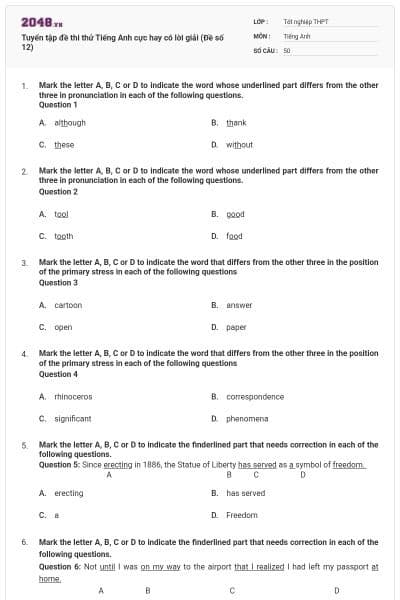
Tuyển tập đề thi thử Tiếng Anh cực hay có lời giải (Đề số 12)
50 câu hỏi
Mark the letter A, B, C or D to indicate the word whose underlined part differs from the other three in pronunciation in each of the following questions.
Question 1
although
thank
these
without
Đáp án B.thank, phát âm 1à/θ/, còn lại phát âm là /ð/.
A. although /ɔ:l'ðəʊ/ mặc dù
B. thank /θæŋk/ cảm ơn
C. these /ði:z/ những cái này
D. without /wɪ'ðaʊt/ không có
Mark the letter A, B, C or D to indicate the word whose underlined part differs from the other three in pronunciation in each of the following questions.
Question 2
tool
good
tooth
food
Đáp án B. good, phát âm là /ʊ/, còn lại phát âm là /u:/.
A. tool /tu:l/ công cụ C. tooth /tu:θ/ răng
B. good /gʊd/ tốt D. food /fu:d/ đồ ăn
Mark the letter A, B, C or D to indicate the word that differs from the other three in the position of the primary stress in each of the following questions
Question 3
cartoon
answer
open
paper
Đáp án A. cartoon, trọng âm rơi vào âm tiết thứ hai, còn lại rơi vào âm tiết thứ nhất.
A. cartoon /kɑ:r'tu:n/ (n) phim hoạt hình
B. answer /'ænsər/ (n) câu trả lời
C. open /'oʊpən/ (adj) mở
D. paper /'peɪpər/ (n) giấy
Mark the letter A, B, C or D to indicate the word that differs from the other three in the position of the primary stress in each of the following questions
Question 4
rhinoceros
correspondence
significant
phenomena
Đáp án B. correspondence, trọng âm rơi vào âm tiết thứ ba, còn lại rơi vào âm tiết thứ hai.
A. rhinoceros /raɪ'nɑ:sərəs/ (n) con tê giác
B. correspondence /,kɑ:rə'spɑ:ndəns/ (n) lá thư
C. significant /sɪg 'nɪfɪkənt/ (adj) quan trọng, đáng kể
D. phenomena /fə’nɑ:mɪnə/ (n) hiện tượng xã hội còn chưa được hiểu rõ
Mark the letter A, B, C or D to indicate the finderlined part that needs correction in each of the following questions.
Question 5: Since erecting in 1886, the Statue of Liberty has served as a symbol of freedom.
A B C D
erecting
has served
a
Freedom
Đáp án A. erecting => being erected
Giải thích:
Tượng đài được xây dựng, chia ở bị động, khi rút gọn ta có being erected. Nếu để erecting thì câu đó dùng ở chủ động là sai.
Dịch nghĩa: Từ khi được xây dựng vào năm 1866, tượng nữ thần tự do được coi là biểu tượng của tự do.
Mark the letter A, B, C or D to indicate the finderlined part that needs correction in each of the following questions.
Question 6: Not until I was on my way to the airport that I realized I had left my passport at home.
A B C D
Until
On my way
That I realized
At home
Đáp án: C
Giải thích:
Kiến thức: Đảo ngữ
Not until + S + V + trợ động từ + S + V…: Mãi cho đến khi… thì mới…
Sửa: that I realized → did I realize that
Dịch: Phải đến khi đang trên đường ra sân bay tôi mới nhận ra mình đã để quên hộ chiếu ở nhà.
Mark the letter A, B, C or D to indicate the finderlined part that needs correction in each of the following questions.
Question 7: She asked why did Mathew look so embarrassed when he saw Carole.
A B C D
Asked
Did Mathew look
Embarrassed
Saw
Đáp án B. did Mathew look => Mathew looked
Giải thích: Trong câu trần thuật với ý nghĩa hỏi, ta không đảo ngữ trợ động từ và vẫn để trật tự từ như câu khẳng định.
Dịch nghĩa: Cô ấy hỏi tại sao Mathew lại ngại ngùng khi anh ta gặp Carole.

Học thông minh hơn mỗi ngày
Xem toàn bộ 50 câu hỏi và nhiều hơn nữa với tài khoản miễn phí
Mark the letter A, B, C or D to indicate the correct answer to each of the following questions.
Question 8: This picture book, _______ the few pages are missing, is my favorite.
for which
of which
of that
to which
Đáp án B
Giải thích: Mở rộng ra ta có cụm từ đầy đủ là the few pages of this picture book (để chỉ sự sở hữu “của cuốn sách ảnh” ta dùng of, không dùng for hay to). Do đó, khi chuyển sang dùng mệnh đề quan hệ, thay this picture book bằng which (that không dùng trong mệnh đề không xác định - nghĩa là không đứng sau dấu phẩy).
Dịch nghĩa: Cuốn sách ảnh này, một vài trang của nó bị thiếu, là cuốn yêu thích của tôi.
Mark the letter A, B, C or D to indicate the correct answer to each of the following questions.
Question 9: For the first time in 70 years, ______ aspirin's potential beyond reducing pain, fever and inflammation.
researchers begin understanding
researchers began understand
researchers' understanding of
researchers began to understand
Đáp án D
Giải thích:
Begin V_ing/ to V: bắt đầu làm gì
A sai do chia sai thì từ begin
B sai cho sai cấu trúc
C sai do câu này thiếu chủ ngữ và động từ làm vị ngữ, nếu điền C thì mới là danh từ, chỉ làm chủ ngữ, thiếu cấu trúc hoàn chỉnh.
Dịch nghĩa: Lần đầu tiên trong 70 năm, các nhà nghiên cứu bắt đầu hiểu về khả năng giảm đau, hạ sốt và chống viêm của thuốc aspirin.
Mark the letter A, B, C or D to indicate the correct answer to each of the following questions.
Question 10: He _______ to the doctor after the accident, but he went on playing instead.
didn't have to go
couldn't go
should have gone
must have gone
Đáp án C
Giải thích:
Have to V: phải làm gì
Can/ could V: có thể làm gì
Should have Vpp: lẽ ra nên làm gì nhưng thực tế trong quá khứ đã không làm
Must have Vpp: dự đoán ai đó đã làm gì trong quá khứ
Dịch nghĩa: Lẽ ra anh ta nên đến khám bác sĩ sau vụ tai nạn, nhưng thay vào đó anh ta lại tiếp tục chơi.
Mark the letter A, B, C or D to indicate the correct answer to each of the following questions.
Question 11: Inexperienced _______ , she can know the way of operating that system.
even though she is
as she might
she may be though
as she may be
Đáp án D
Giải thích:
Adj/ adv as/ though S V: mặc dù ai đó thế nào
Dịch nghĩa: Mặc dù cô ấy còn thiếu kinh nghiệm, cô ấy có thể biết cách hoạt động hệ thống đó.
Mark the letter A, B, C or D to indicate the correct answer to each of the following questions.
Question 12: Marie Curie, ______, was awarded a Nobel Prize for her work.
the scientist discovered radium
whose scientific discovery of radium
was the scientist who discovered radium
the scientist who discovered radium
Đáp án D
Giải thích:
Mệnh đề quan hệ, để thay thế cho danh từ chỉ người, ở đây là the scientist ta dùng đại từ quan hệ who.
A thiếu đại từ quan hệ
B sai do nếu dùng whose thì ngay phía sau phải có một vị ngữ cho scientific discovery of radium.
C sai do đằng sau ở câu gốc đã có động từ làm vị ngữ rồi nên ta chỉ cần điền mệnh đề bổ sung.
Dịch nghĩa: Marie Curie, nhà khoa học mà phát hiện ra radium, được giải thưởng Nobel nhờ công trình của bà.
Mark the letter A, B, C or D to indicate the correct answer to each of the following questions.
Question 13: I succeeded in my job through sheer hard ________.
work
labour
industry
effort
Đáp án A
A. hard work (n) sự lao động chăm chỉ
B. labour: (n) lao động
C. industry: (n) công nghiệp
D. effort: (r1) nỗ lực
sheer (adv, adj) dùng để nhấn mạnh (tương tự như very)
Dịch nghĩa: Tôi thành công trong công việc là nhờ làm việc rất chăm chỉ.
Mark the letter A, B, C or D to indicate the correct answer to each of the following questions.
Question 14: We're very busy this week. Can you work ___________?
extra time
supplementary time
overtime
double time
Đáp án C
A: extra time: thời gian bù giờ, dùng trong thể thao
C: do/ work overtime: làm tăng ca
Không dùng B. supplementary time và D. double time
Dịch nghĩa: Tuần này chúng ta đang rất nhiều việc. Bạn có thế làm tăng ca không?
Mark the letter A, B, C or D to indicate the correct answer to each of the following questions.
Question 15: Catherine works for a/an ________ engineering company.
main
forefront
outgoing
leading
Đáp án D
A. main (adj) chính, chủ đạo
B. forefront: (n) vai trò tiên phong, đứng đầu
C. outgoing: (adj) cởi mở
D. leading: (adj) co vai trò tiên phong, dẫn đầu, đứng hàng đầu
Ở câu này ta cần điền một tính từ bổ sung cho company, đáp án B (danh từ) bị loại. Tuy nhiên, khi dịch nghĩa, chỉ có D phù hợp.
Dịch nghĩa: Catherine làm việc cho một công ty kĩ thuật hàng đầu.
Mark the letter A, B, C or D to indicate the correct answer to each of the following questions.
Question 16: I can't tell Peter and Paul apart; they are _______ twins.
similar
alike
resemblance
identical
Đáp án D
A. similar (adj) tương tự
B. alike: (adj) rất giống nhau (alike không đứng trước danh từ)
C. resemblance: (n) sự giống nhau
D. identical: (adj) giống y hệt nhau
Cần điền tính từ đứng trước danh từ twins nên B và C bị loại. Vì “không thể phân biệt được” nên ta dùng tính từ mang nghĩa mạnh hơn là identical.
Dịch nghĩa: Tôi không thể phân biệt được Peter và Paul, họ là anh em sinh đối giống y hệt nhau.
Mark the letter A, B, C or D to indicate the correct answer to each of the following questions.
Question 17: We are looking ______ to receiving a prompt reply to our letter.
round
through
forward
after
Đáp án C
Giải thích: look forward to V_ing: mong chờ điều gì
Dịch nghĩa: Chúng tôi đang mong chờ nhận được thư trả lời nhanh chóng cho lá thư của chúng tôi.
Mark the letter A, B, C or D to indicate the correct answer to each of the following questions.
Question 18: I shall wait ______ you.
about
by
to
for
Đáp án D
Giải thích: wait for: chờ điều gi
Dịch nghĩa: Tôi sẽ chờ em.
Mark the letter A, B, C or D to indicate the correct answer to each of the following questions.
Question 19: What will happen if John will not _______ in time?
go along
count on
keep away
turn up
Đáp án D
Giải thích:
A. go along: phát triển
B. count on: dựa vào
C. keep away from: tránh xa cái gì
D. turn up: xuất hiện
Dịch nghĩa: Chuyện gì sẽ xảy ra nếu John không đến đúng giờ?
Mark the letter A, B, C or D to indicate the most suitable response to complete each of the following exchanges.
Question 20: A: I got 500 for the TOEFL, Dad. - B: _____________.
Good for you. Thank you.
I'm glad you say so.
Well done, son! I'm very proud of you.
You can do it.
Đáp án C
Giải thích:
A. Good for you. Thank you. Tốt cho con. Cảm ơn con.
B. I’m glad you say so. Bố rất mừng vì con nói vậy.
C. Well done, son! I’m very proud of you. Tốt lắm con trai. Bố tự hào về con.
D. You can do it. Con có thể làm được.
Dịch nghĩa:
A: Con được 500 điểm cho kì thi TOEFL bố ạ.
B: Tốt lắm con trai. Bố tự hào về con.
Mark the letter A, B, C or D to indicate the most suitable response to complete each of the following exchanges.
Question 21: A: Would you like a coke? - B:____________.
I like coke. Thanks.
It's ok. I'm proud of you.
Yes, please. But just a small one.
No, I wouldn't.
Đáp án C
Giải thích:
A. I like coke. Thanks. Tôi thích coca. Cảm ơn rất nhiều.
B. It’s ok. I’m proud of you. Ok. Tôi tự hào vì bạn.
C. Yes, please. But just a small one. Có. Nhưng loại nhỏ thôi.
D. No, I wouldn’t. Không, tôi sẽ không. (Khi được mời, không bao giờ dùng câu này để từ chối)
Dịch nghĩa:
A: Bạn có muốn uống coca không?
B: Có. Nhưng loại nhỏ thôi.
Mark the letter A, B, C or D to indicate the word/phrases SIMILAR in meaning to the underlined word(s) in each of the following questions.
Question 22: Mr. Young, general manager of the emergency response division of AMSA, said that the debris was spotted along a busy shipping route and could be containers that had fallen off cargo vessels.
seen
collected
shot
analyzed
Đáp án A
Giải thích:
Spot: nhìn thấy
A. seen (Vpp của see): nhìn thấy
B. collected: thu thập
C. shot (Vpp của shoot): bắn
D. analyzed: phân tích
Dịch nghĩa: Ông Young, tổng giám đốc của bộ phận phản ứng khẩn cấp của AMSA, nói rằng các mảnh vỡ được phát hiện cùng một tuyến đường vận chuyển đông đúc và có thể vài thùng hàng đã rơi ra khỏi tàu chở hàng.
Mark the letter A, B, C or D to indicate the word/phrases SIMILAR in meaning to the underlined word(s) in each of the following questions.
Question 23: Every time he opens his mouth, he immediately regrets what he said. He is always putting his foot in his mouth.
speaking indirectly
making a mistake
saying embarrassing things
doing things in the wrong order
Đáp án C
Giải thích:
A. speaking indirectly: nói trực tiếp
B. making a mistake: phạm sai lầm
C. saying embarrassing things: nói những điều đáng xấu hổ
D. doing things in the wrong order: làm sai trật tự
putting his foot in his mouth: nói những điều khiến người khác bực tức, xấu hổ.
Dịch nghĩa: Mỗi lần anh ta mở miệng, anh ta đều phải hối hận vì những gì anh ta vừa nói. Anh ta luôn nói những thứ thật đáng xấu hổ.
Mark the letter A, B, C or D to indicate the word or phrase that is OPPOSITE in meaning to the underlined part in each of the following questions.
Question 24: Mr. Smith's new neighbors appear to be very friendly.
amicable
hostile
futile
inapplicable
Đáp án B
Giải thích:
“friendly”: thân thiện (có nghĩa trái với “hostile”: khó tính)
A. amicable (adj): thân thiện
B. hostile (adj): khó tính
C. futile (adj): vô ích
D. inapplicable (adj): không thể dùng được
Dịch nghĩa: Người hàng xóm mới của ông Smith có vẻ như rất thân thiện.
Mark the letter A, B, C or D to indicate the word or phrase that is OPPOSITE in meaning to the underlined part in each of the following questions.
Question 25: Mr. Brown is a very generous old man. He has given most of his wealth to a charity organization.
hospitable
honest
kind
mean
Đáp án D
Giải thích:
generous (adj): hào phóng (có ý nghĩa trái với “mean”: keo kiệt)
A. hospitable: hiếu khách
B. honest: chân thật
C. kind: tốt bụng
D. mean: keo kiệt
Dịch nghĩa: Ông Brown là người đàn ông rất hào phóng. Ông đã dành gần hết tài sản của mình cho tổ chức từ thiện.
Mark the letter A, B, C or D to indicate the sentence that is closest in meaning to each of the following questions.
Question 26: Isn’t there an alternative way of reaching the city centre?
Can the way to reach the city centre be chose?
Is this the only way to reach the city centre?
Is the other way to reach the city centre marked?
Can the way to reach the city centre be changed?
Đáp án B
Alternative (adj): để thay thế
Dịch nghĩa: Không còn cách nào khác để đến trung tâm thành phố à?
A. Liệu đường đi đến trung tâm thành phố có thể được lựa chọn hay không?
B. Có phải đây là cách duy nhất để đến trung tâm thành phố không?
C. Có phải đường đi khác đến trung tâm thành phố được đánh dấu không?
D. Liệu lối đi đến trung tâm thành phố có thể được thay đổi không?
Mark the letter A, B, C or D to indicate the sentence that is closest in meaning to each of the following questions.
Question 27: Although the play received good notices, not many people went to see it.
Not many people went to see the play because they didn't receive its notices.
Although the play was good, not many people went to see it.
Not many people went to see the play in spite of its good quality
Despite the play's good notices, not many people went to see it.
Đáp án D
Although + clause = Despite sth/ V-ing = in spite of sth/ V-ing: Mặc dù. ..
Dịch nghĩa: Mặc dù vở kịch nhận được nhiều chú ý, rất ít người đến xem.
A. Không nhiều người đến xem kịch vì nó không nhận được nhiều chú ý.
B. Mặc dù vở kịch hay, không nhiều người đến xem.
C. Không nhiều người đến xem kịch mặc dù chất lượng của nó tốt.
D. Mặc cho được chú ý nhiều, không nhiều người đến xem kịch.
Mark the letter A, B, C or D to indicate the sentence that is closest in meaning to each of the following questions.
Question 28: “I would like you not to go out with him, Ann” says her mother.
Ann's mother would rather she doesn't go out with him.
Ann's mother would rather her not to go out with him.
Ann's mother would rather she didn't go out with him.
Ann's mother would rather she wouldn't go out with him.
Đáp án C
Would rather someone didn’t do sth: muốn ai không làm gì ở hiện tại
Dịch nghĩa: “Mẹ muốn con không đi chơi với anh ta, Ann” mẹ cô nói.
Giải thích: Bốn đáp án đều có nghĩa là “Mẹ của Ann không muốn cô ấy đi chơi với anh ta. Tuy nhiên, chỉ có đáp án C là đúng cấu trúc ngữ pháp.
Markthe letter A, B, C or D to indicate the sentence that best combines each pair of sentences in the following questions.
Question 29: The agreement ended six-month negotiation. It was signed yesterday.
The agreement which ends six-month negotiation was signed yesterday.
The agreement which was signed yesterday ended six-month negotiation.
The agreement which was signed yesterday lasted six months.
The negotiation which lasted six months was signed yesterday.
Đáp án A
Dịch nghĩa: Thỏa thuận kết thúc đàm phán sáu tháng. Nó đã được ký kết ngày hôm qua.
A. Thỏa thuận kết thúc đàm phán sáu tháng đã được ký kết ngày hôm qua.
B. Thỏa thuận được ký kết ngày hôm qua đã kết thúc đàm phán sáu tháng.
C. Thỏa thuận được ký kết ngày hôm qua kéo dài sáu tháng.
D. Việc đàm phán kéo dài sáu tháng đã được ký kết ngày hôm qua.
Markthe letter A, B, C or D to indicate the sentence that best combines each pair of sentences in the following questions.
Question 30: Companies spend millions of dollars on advertising. They want to increase their sales.
Companies spend millions of dollars on advertising so that they want to increase their sales.
Companies spend millions of dollars on advertising, but they want to increase their sales.
Companies spend millions of dollars on advertising with the aim of increasing their sales.
In order that they want to increase their sales, companies spend millions of dollars on advertising.
Đáp án C
Dịch nghĩa: Các công ty chi hàng triệu đô la cho quảng cáo. Họ muốn tăng doanh số bán hàng của họ.
A. Các công ty chi hàng triệu đô la vào quảng cáo để họ muốn tăng doanh số bán hàng của họ.
B. Các công ty chi hàng triệu đô la vào quảng cáo, nhưng họ muốn tăng doanh số bán hàng của họ.
C. Các công ty chi hàng triệu đô la vào quảng cáo với mục đích tăng doanh số bán hàng của họ.
D. Để mà họ muốn tăng doanh số bản hàng của ho, các công ty chi hang triệu đô la cho quảng cáo.
Read the following passage and mark the letter A, B, C or D to indicate the correct word or phrase that best fits each of the numbered blanks from 31 to 35.
If cartoons are anything to go by, then the attitude of the British towards the family, and of British men towards the (31) ________ sex, has not changed much recently, despite attempts to shame people into admitting their prejudices. The mother-in-law, frequently of horrific (32) _______ and usually either about to visit, or being somehow driven from the house is still a favorite butt of this kind of humor. Marriage itself has been reduced to the skinny male, dominated by a massive female who habitually lies in wait with the rolling pin behind the door for the return of her drunken spouse. Children are rarely shown other than as screaming infants, or else as ill-favoured urchins who (33) _____ all their time being objectionable or asking for money. The old are simply (34) _____ as comic characters. The problem is, how do such cartoons relate to the way people truly see each other? Does a joke always contain some grain of truth, however much we may dislike to admit it? In other words, is life really a series of mother-in-law jokes? Or do jokes have a life of their own, with a (35) _______ of stereotypes we can recognize, like the Englishman with his umbrella and bowler hat, or the Frenchman with his striped jumper and beret?
Question 31
other
problematic
opposite
taboo
Đáp án C
Giải thích:
Opposite sex: người khác giới
Read the following passage and mark the letter A, B, C or D to indicate the correct word or phrase that best fits each of the numbered blanks from 31 to 35.
If cartoons are anything to go by, then the attitude of the British towards the family, and of British men towards the (31) ________ sex, has not changed much recently, despite attempts to shame people into admitting their prejudices. The mother-in-law, frequently of horrific (32) _______ and usually either about to visit, or being somehow driven from the house is still a favorite butt of this kind of humor. Marriage itself has been reduced to the skinny male, dominated by a massive female who habitually lies in wait with the rolling pin behind the door for the return of her drunken spouse. Children are rarely shown other than as screaming infants, or else as ill-favoured urchins who (33) _____ all their time being objectionable or asking for money. The old are simply (34) _____ as comic characters. The problem is, how do such cartoons relate to the way people truly see each other? Does a joke always contain some grain of truth, however much we may dislike to admit it? In other words, is life really a series of mother-in-law jokes? Or do jokes have a life of their own, with a (35) _______ of stereotypes we can recognize, like the Englishman with his umbrella and bowler hat, or the Frenchman with his striped jumper and beret?
Question 32
A sight
view
appearance
dress
Đáp án C
Giải thích:
sight, view: cảnh quan
appearance: diện mạo
dress: trang phục
Read the following passage and mark the letter A, B, C or D to indicate the correct word or phrase that best fits each of the numbered blanks from 31 to 35.
If cartoons are anything to go by, then the attitude of the British towards the family, and of British men towards the (31) ________ sex, has not changed much recently, despite attempts to shame people into admitting their prejudices. The mother-in-law, frequently of horrific (32) _______ and usually either about to visit, or being somehow driven from the house is still a favorite butt of this kind of humor. Marriage itself has been reduced to the skinny male, dominated by a massive female who habitually lies in wait with the rolling pin behind the door for the return of her drunken spouse. Children are rarely shown other than as screaming infants, or else as ill-favoured urchins who (33) _____ all their time being objectionable or asking for money. The old are simply (34) _____ as comic characters. The problem is, how do such cartoons relate to the way people truly see each other? Does a joke always contain some grain of truth, however much we may dislike to admit it? In other words, is life really a series of mother-in-law jokes? Or do jokes have a life of their own, with a (35) _______ of stereotypes we can recognize, like the Englishman with his umbrella and bowler hat, or the Frenchman with his striped jumper and beret?
Question 33
A waste
spend
take
pass
Đáp án B
Giải thích:
waste: (v) lãng phí
Về ngữ pháp thì waste time doing something không sai, nhưng trong trường hợp này, “lũ trẻ lãng phí thời gian” thì không hợp nghĩa bằng spend
spend: (v) dành, tiêu tốn
spend time/ money doing something: dành thời gian/ tiền bạc làm gì
spend time/money on something: dành thời gian/ tiền bạc cho việc gì
take: tốn
take time to do something: tốn thời gian làm gì
Trong câu này, đằng sau V ở dạng V_ing (being và asking) nên ta không dùng take.
pass: (v) trôi qua
time pass: thời gian trôi qua (không hợp nghĩa)
Read the following passage and mark the letter A, B, C or D to indicate the correct word or phrase that best fits each of the numbered blanks from 31 to 35.
If cartoons are anything to go by, then the attitude of the British towards the family, and of British men towards the (31) ________ sex, has not changed much recently, despite attempts to shame people into admitting their prejudices. The mother-in-law, frequently of horrific (32) _______ and usually either about to visit, or being somehow driven from the house is still a favorite butt of this kind of humor. Marriage itself has been reduced to the skinny male, dominated by a massive female who habitually lies in wait with the rolling pin behind the door for the return of her drunken spouse. Children are rarely shown other than as screaming infants, or else as ill-favoured urchins who (33) _____ all their time being objectionable or asking for money. The old are simply (34) _____ as comic characters. The problem is, how do such cartoons relate to the way people truly see each other? Does a joke always contain some grain of truth, however much we may dislike to admit it? In other words, is life really a series of mother-in-law jokes? Or do jokes have a life of their own, with a (35) _______ of stereotypes we can recognize, like the Englishman with his umbrella and bowler hat, or the Frenchman with his striped jumper and beret?
Question 34
A seen
such
enough
notorious.
Đáp án A
Giải thích:
Seen là V(pp) của see (nhìn): Ở dạng bị động như câu này, ta nên dịch là “được coi là, nhìn như là”
such: (adj) như vậy
enough: (adj) đủ
notorious: (adj) khét tiếng
Đằng sau có as, ta có be seen/known/considered as: được coi như là
Read the following passage and mark the letter A, B, C or D to indicate the correct word or phrase that best fits each of the numbered blanks from 31 to 35.
If cartoons are anything to go by, then the attitude of the British towards the family, and of British men towards the (31) ________ sex, has not changed much recently, despite attempts to shame people into admitting their prejudices. The mother-in-law, frequently of horrific (32) _______ and usually either about to visit, or being somehow driven from the house is still a favorite butt of this kind of humor. Marriage itself has been reduced to the skinny male, dominated by a massive female who habitually lies in wait with the rolling pin behind the door for the return of her drunken spouse. Children are rarely shown other than as screaming infants, or else as ill-favoured urchins who (33) _____ all their time being objectionable or asking for money. The old are simply (34) _____ as comic characters. The problem is, how do such cartoons relate to the way people truly see each other? Does a joke always contain some grain of truth, however much we may dislike to admit it? In other words, is life really a series of mother-in-law jokes? Or do jokes have a life of their own, with a (35) _______ of stereotypes we can recognize, like the Englishman with his umbrella and bowler hat, or the Frenchman with his striped jumper and beret?
Question 35
A one
set
life
base
Đáp án B
Giải thích:
set (n) bộ, tập hợp nhiều
life: (n) cuộc sống
base: (n) nền tảng
Cụm từ: a set of stereotypes: một bộ quy tắc, khuôn khổ.
Read the following passage and mark the letter A, B, C or D to indicate the correct answer to each of the questions from 36 to 42.
Life expectancy is the period of time that a person can expect to live. Life expectancy varies greatly between genders and cultures. It used to be that women had a lower life expectancy than men (1 in every 4 women died in childbirth), but now they live an average of four to five years longer than men. Life expectancy has been increasing rapidly over the last centuries. With the advent of such modern miracles as sewers, medicine and a greater understanding of how diseases are spread, our life expectancy has increased by 25-30 years.
In developing countries like Swaziland, where there is a high HIV/ AIDS rate, life expectancy is as low as 32.6 years. In developed countries like Australia, life expectancy rates are as high as 81 years. There are an increasing number of factors which can cancel out the disadvantages you have. The one that we are looking at now is how your career can affect your life expectancy. Choosing the wrong career can result in a shorter life!
If you want your career to positively influence your life expectancy, you have to be made of money. That's right. Rich people in wealthy areas of England and France live 10 years longer than the people in poorer areas. Having a successful career has its drawbacks, too if the result of hard work is stress.
Stress can lead to a number of psychological disorders such as depression, anxiety, fatigue, tension and aggression. These conditions may result in a lack of concentration and an increase in serious injuries at work. They can also lead to high blood pressure and heart attacks which seriously affect life expectancy.
If you are worried that your job might decrease your life expectancy, you probably need to avoid careers on "dangerous jobs" list such as timber cutters, pilots, construction workers, roofer, truck drivers.
So if you don't want to kick the bucket at an early age, choose a career in something other than timber cutting, but above all, remember to relax.
From Pre-Essence Reading by Rachel Lee, Longman
Question 36: According to the passage, which of following is true if you have a successful career?
Your life expectancy increases by a decade.
You can afford to exercise and eat well.
You can buy an expensive car.
You can spend most of your day in an office.
Đáp án A
Dịch bài: Theo bài, điều gì là đúng nếu bạn có một sự nghiệp thành công?
A. Tuổi thọ của bạn tăng theo từng thập kỉ.
B. Bạn có thể tập luyện và ăn ngon.
C. Bạn có thể mua một chiếc ô tô đắt tiền.
D. Bạn có thể dành phần lớn thời gian ở văn phòng.
Giải thích: Thông tin nằm ở đoạn 3 “If you want your career to positively influence your life expectancy, you have to be made of money”
Thực tế thì sự nghiệp thành công đều có thể ăn ngon, mua xe đẹp nhưng điều đó không được đề cập trong bài nên ta không chọn.
Read the following passage and mark the letter A, B, C or D to indicate the correct answer to each of the questions from 36 to 42.
Life expectancy is the period of time that a person can expect to live. Life expectancy varies greatly between genders and cultures. It used to be that women had a lower life expectancy than men (1 in every 4 women died in childbirth), but now they live an average of four to five years longer than men. Life expectancy has been increasing rapidly over the last centuries. With the advent of such modern miracles as sewers, medicine and a greater understanding of how diseases are spread, our life expectancy has increased by 25-30 years.
In developing countries like Swaziland, where there is a high HIV/ AIDS rate, life expectancy is as low as 32.6 years. In developed countries like Australia, life expectancy rates are as high as 81 years. There are an increasing number of factors which can cancel out the disadvantages you have. The one that we are looking at now is how your career can affect your life expectancy. Choosing the wrong career can result in a shorter life!
If you want your career to positively influence your life expectancy, you have to be made of money. That's right. Rich people in wealthy areas of England and France live 10 years longer than the people in poorer areas. Having a successful career has its drawbacks, too if the result of hard work is stress.
Stress can lead to a number of psychological disorders such as depression, anxiety, fatigue, tension and aggression. These conditions may result in a lack of concentration and an increase in serious injuries at work. They can also lead to high blood pressure and heart attacks which seriously affect life expectancy.
If you are worried that your job might decrease your life expectancy, you probably need to avoid careers on "dangerous jobs" list such as timber cutters, pilots, construction workers, roofer, truck drivers.
So if you don't want to kick the bucket at an early age, choose a career in something other than timber cutting, but above all, remember to relax.
From Pre-Essence Reading by Rachel Lee, Longman
Question 37: The passage mainly discusses ___________.
the definition of life expectancy
the comparison of life expectancy between women and men
the importance of a successful career
the effects of a career on one's life expectancy
Đáp án D
Dịch nghĩa: Bài văn chủ yếu bàn luận ___________.
A. định nghĩa về tuổi thọ
B. so sánh tuổi thọ giữa nam và nữ
C. tầm quan trọng của thành công trong sự nghiệp
D. ảnh hưởng của sự nghiệp đến tuổi thọ của một người
Giải thích: Cả A và B đầu nói đến trong đoạn 1, nhưng đó chỉ là phần giới thiệu chứ không phải trọng tâm chính của bài. Nếu nói chủ đề chính là tầm quan trọng của thành công trong sự nghiệp thì quá rộng, lẽ ra phải nói về quan trọng trong đời sống vật chất, tinh thần, tình cảm, còn ở đây chỉ nói tầm quan trọng với một yếu tố rất nhỏ là tuổi thọ.
Read the following passage and mark the letter A, B, C or D to indicate the correct answer to each of the questions from 36 to 42.
Life expectancy is the period of time that a person can expect to live. Life expectancy varies greatly between genders and cultures. It used to be that women had a lower life expectancy than men (1 in every 4 women died in childbirth), but now they live an average of four to five years longer than men. Life expectancy has been increasing rapidly over the last centuries. With the advent of such modern miracles as sewers, medicine and a greater understanding of how diseases are spread, our life expectancy has increased by 25-30 years.
In developing countries like Swaziland, where there is a high HIV/ AIDS rate, life expectancy is as low as 32.6 years. In developed countries like Australia, life expectancy rates are as high as 81 years. There are an increasing number of factors which can cancel out the disadvantages you have. The one that we are looking at now is how your career can affect your life expectancy. Choosing the wrong career can result in a shorter life!
If you want your career to positively influence your life expectancy, you have to be made of money. That's right. Rich people in wealthy areas of England and France live 10 years longer than the people in poorer areas. Having a successful career has its drawbacks, too if the result of hard work is stress.
Stress can lead to a number of psychological disorders such as depression, anxiety, fatigue, tension and aggression. These conditions may result in a lack of concentration and an increase in serious injuries at work. They can also lead to high blood pressure and heart attacks which seriously affect life expectancy.
If you are worried that your job might decrease your life expectancy, you probably need to avoid careers on "dangerous jobs" list such as timber cutters, pilots, construction workers, roofer, truck drivers.
So if you don't want to kick the bucket at an early age, choose a career in something other than timber cutting, but above all, remember to relax.
From Pre-Essence Reading by Rachel Lee, Longman
Question 38: According to the passage, all of the following are true EXCEPT
our life expectancy has increased by 25-30 years because there are fewer wars nowadays.
in the past, women's life expectancy was lower than that of men.
life expectancy varies greatly depending on genders and cultures.
there has been a dramatic increase in average life expectancy over the last centuries.
Đáp án A
Dịch nghĩa: Theo bài, tất cả các thông tin sau đều đúng, trừ ____________.
A. tuổi thọ tăng từ 25-30 năm vì bây giờ có ít chiến tranh hơn.
B. ngày trước tuổi thọ của phụ nữ thấp hơn đàn ông
C. tuổi thọ thay đổi nhiều phụ thuộc vào giới tính và văn hóa
D. có một sự tăng đáng kể tuổi thọ trung bình trong vòng thế kỉ trước.
Giải thích: B đúng vì trong đoạn 1 “It used to be that women had a lower life expectancy than men”
C. đúng vì trong đoạn 1 có nói về khác biệt về tuổi thọ qua giới tính, đoạn 2 nói về văn hóa như Australia và Swaziland.
D. đúng vì trong đoạn 1 “Life expectancy has been increasing rapidly over the last centuries”
Như vậy, chỉ có phương án A không đúng. Thực tế tuổi thọ tăng 25-30 năm, nhưng là do tiến bộ y học, không phải do ít chiến tranh hơn “With the advent of such modern miracles as sewers, medicine and a greater understanding of how diseases are spread, our life expectancy has increased by 25-30 years”
Read the following passage and mark the letter A, B, C or D to indicate the correct answer to each of the questions from 36 to 42.
Life expectancy is the period of time that a person can expect to live. Life expectancy varies greatly between genders and cultures. It used to be that women had a lower life expectancy than men (1 in every 4 women died in childbirth), but now they live an average of four to five years longer than men. Life expectancy has been increasing rapidly over the last centuries. With the advent of such modern miracles as sewers, medicine and a greater understanding of how diseases are spread, our life expectancy has increased by 25-30 years.
In developing countries like Swaziland, where there is a high HIV/ AIDS rate, life expectancy is as low as 32.6 years. In developed countries like Australia, life expectancy rates are as high as 81 years. There are an increasing number of factors which can cancel out the disadvantages you have. The one that we are looking at now is how your career can affect your life expectancy. Choosing the wrong career can result in a shorter life!
If you want your career to positively influence your life expectancy, you have to be made of money. That's right. Rich people in wealthy areas of England and France live 10 years longer than the people in poorer areas. Having a successful career has its drawbacks, too if the result of hard work is stress.
Stress can lead to a number of psychological disorders such as depression, anxiety, fatigue, tension and aggression. These conditions may result in a lack of concentration and an increase in serious injuries at work. They can also lead to high blood pressure and heart attacks which seriously affect life expectancy.
If you are worried that your job might decrease your life expectancy, you probably need to avoid careers on "dangerous jobs" list such as timber cutters, pilots, construction workers, roofer, truck drivers.
So if you don't want to kick the bucket at an early age, choose a career in something other than timber cutting, but above all, remember to relax.
From Pre-Essence Reading by Rachel Lee, Longman
Question 39: Why does an increase in stress lead to an increase in workplace accidents?
workers are too busy to observe safety regulations.
workers don't care as much about their jobs.
it leads to a decrease in concentration and depression.
workers like to take sick leave and stay home.
Đáp án C
Dịch nghĩa: Tại sao áp lực tăng dẫn đến tai nạn lao động tăng?
A. Công nhân quá bận rộn để có thể để ý đến những quy định về an toàn.
B. Công nhân không quan tâm nhiều đến công việc
C. Nó dẫn đến việc tập trung ít hơn và lo lắng nhiều hơn
D. Công nhân muốn bị ốm và nghỉ ở nhà.
Giải thích: Thông tin nằm ở đoạn 4 “Stress can lead to a number of psychological disorders .... These conditions may result in a lack of concentration and an increase in serious injuries at work”
Phương án A cũng không sai nhưng không được đề cập trong bài nên không chọn.
Read the following passage and mark the letter A, B, C or D to indicate the correct answer to each of the questions from 36 to 42.
Life expectancy is the period of time that a person can expect to live. Life expectancy varies greatly between genders and cultures. It used to be that women had a lower life expectancy than men (1 in every 4 women died in childbirth), but now they live an average of four to five years longer than men. Life expectancy has been increasing rapidly over the last centuries. With the advent of such modern miracles as sewers, medicine and a greater understanding of how diseases are spread, our life expectancy has increased by 25-30 years.
In developing countries like Swaziland, where there is a high HIV/ AIDS rate, life expectancy is as low as 32.6 years. In developed countries like Australia, life expectancy rates are as high as 81 years. There are an increasing number of factors which can cancel out the disadvantages you have. The one that we are looking at now is how your career can affect your life expectancy. Choosing the wrong career can result in a shorter life!
If you want your career to positively influence your life expectancy, you have to be made of money. That's right. Rich people in wealthy areas of England and France live 10 years longer than the people in poorer areas. Having a successful career has its drawbacks, too if the result of hard work is stress.
Stress can lead to a number of psychological disorders such as depression, anxiety, fatigue, tension and aggression. These conditions may result in a lack of concentration and an increase in serious injuries at work. They can also lead to high blood pressure and heart attacks which seriously affect life expectancy.
If you are worried that your job might decrease your life expectancy, you probably need to avoid careers on "dangerous jobs" list such as timber cutters, pilots, construction workers, roofer, truck drivers.
So if you don't want to kick the bucket at an early age, choose a career in something other than timber cutting, but above all, remember to relax.
From Pre-Essence Reading by Rachel Lee, Longman
Question 40: The word "They" in bold in paragraph 1 refers to _________.
woman
cultures
women
genders
Đáp án C
Dịch nghĩa: Từ “They” - ở đoạn 1 nhắc tới _____________.
A. 1 người phụ nữ B. văn hóa
C. những phụ nữ D. giới tính
Giải thích: It used to be that women had a lower life expectancy than men (1 in every 4 women
died in childbirth), but now they live an average of four to five years longer than men – Trước đây phụ nữ có tuổi thọ thấp hơn nam giới, nhưng ngày nay, họ sống lâu hơn nam giới từ 4 đến 5 năm. Như vậy, họ ở đây là thay thế cho nữ giới, để ý thêm là danh từ để ở dạng số nhiều - women.
Read the following passage and mark the letter A, B, C or D to indicate the correct answer to each of the questions from 36 to 42.
Life expectancy is the period of time that a person can expect to live. Life expectancy varies greatly between genders and cultures. It used to be that women had a lower life expectancy than men (1 in every 4 women died in childbirth), but now they live an average of four to five years longer than men. Life expectancy has been increasing rapidly over the last centuries. With the advent of such modern miracles as sewers, medicine and a greater understanding of how diseases are spread, our life expectancy has increased by 25-30 years.
In developing countries like Swaziland, where there is a high HIV/ AIDS rate, life expectancy is as low as 32.6 years. In developed countries like Australia, life expectancy rates are as high as 81 years. There are an increasing number of factors which can cancel out the disadvantages you have. The one that we are looking at now is how your career can affect your life expectancy. Choosing the wrong career can result in a shorter life!
If you want your career to positively influence your life expectancy, you have to be made of money. That's right. Rich people in wealthy areas of England and France live 10 years longer than the people in poorer areas. Having a successful career has its drawbacks, too if the result of hard work is stress.
Stress can lead to a number of psychological disorders such as depression, anxiety, fatigue, tension and aggression. These conditions may result in a lack of concentration and an increase in serious injuries at work. They can also lead to high blood pressure and heart attacks which seriously affect life expectancy.
If you are worried that your job might decrease your life expectancy, you probably need to avoid careers on "dangerous jobs" list such as timber cutters, pilots, construction workers, roofer, truck drivers.
So if you don't want to kick the bucket at an early age, choose a career in something other than timber cutting, but above all, remember to relax.
From Pre-Essence Reading by Rachel Lee, Longman
Question 41: The phrase "kick the bucket" in the passage is closest in meaning to “____________”.
live
relax
succeed
die
Đáp án D
Dịch nghĩa: Cụm “kick the bucket” gần nghĩa nhất với “____________”.
A. sống B. nghỉ ngơi
C. thành công D. chết
Read the following passage and mark the letter A, B, C or D to indicate the correct answer to each of the questions from 36 to 42.
Life expectancy is the period of time that a person can expect to live. Life expectancy varies greatly between genders and cultures. It used to be that women had a lower life expectancy than men (1 in every 4 women died in childbirth), but now they live an average of four to five years longer than men. Life expectancy has been increasing rapidly over the last centuries. With the advent of such modern miracles as sewers, medicine and a greater understanding of how diseases are spread, our life expectancy has increased by 25-30 years.
In developing countries like Swaziland, where there is a high HIV/ AIDS rate, life expectancy is as low as 32.6 years. In developed countries like Australia, life expectancy rates are as high as 81 years. There are an increasing number of factors which can cancel out the disadvantages you have. The one that we are looking at now is how your career can affect your life expectancy. Choosing the wrong career can result in a shorter life!
If you want your career to positively influence your life expectancy, you have to be made of money. That's right. Rich people in wealthy areas of England and France live 10 years longer than the people in poorer areas. Having a successful career has its drawbacks, too if the result of hard work is stress.
Stress can lead to a number of psychological disorders such as depression, anxiety, fatigue, tension and aggression. These conditions may result in a lack of concentration and an increase in serious injuries at work. They can also lead to high blood pressure and heart attacks which seriously affect life expectancy.
If you are worried that your job might decrease your life expectancy, you probably need to avoid careers on "dangerous jobs" list such as timber cutters, pilots, construction workers, roofer, truck drivers.
So if you don't want to kick the bucket at an early age, choose a career in something other than timber cutting, but above all, remember to relax.
From Pre-Essence Reading by Rachel Lee, Longman
Question 42: What is the main idea of the 1st paragraph?
Stress negatively affects life expectancy.
Stress results in lower life expectancy.
Making a bad career choice will make your life shorter.
Life expectancy has increased greatly over the last few centuries.
Đáp án D
Dịch nghĩa: Ý chính của đoạn 1 là gì?
A. Áp lực ảnh hưởng tiêu cực đến tuổi thọ.
B. Áp lực dẫn đến tuổi thọ thấp.
C. Chọn công việc sai có thể dẫn đến cuộc đời ngắn hơn.
D. Tuổi thọ đã tăng mạnh trong vòng vài thế kỉ trước
Giải thích: Các phương án A, B, C là thông tin ở các đoạn sau.
Read the following passage and mark the letter A, B, C or D to indicate the correct answer to each of the questions from 43 to 50.
It can be shown in facts and figures that cycling is the cheapest, most convenient, and most environmentally desirable term of transport in towns, but such cold calculations do not mean much on a frosty winter morning. The real appeal of cycling is that it is so enjoyable. It has none of the difficulties and tensions of other ways of traveling so you are more cheerful after a ride, even though the rush hour.
The first thing a non-cyclist says to you is: "But isn't it terribly dangerous?" It would be foolish to deny the danger of sharing the road with motor vehicles and it must be admitted that there are an alarming number of accidents involving cyclists. However, although police records indicate that the car driver is often to blame, the answer lies with the cyclist. It is possible to ride in such a way as to reduce risks to a minimum.
If you decide to join the thousands in Britain who are now returning to cycling as a cheap, satisfying form of transport your first problem will be trying to decide what bike to buy. Here are three simple rules for buying a bike:
1. Always buy the best you can afford. Of course there has to be a meeting point between what you would really like and economic reality, but aim as high as you can and you will get the benefit not only when you ride but also if you want to sell. Well-made bikes keep the value very well. And don't forget to include in your calculations the fact that you'll begin saving money on
fares and petrol the minute you leave the shop.
2. Get the best frame, the main structure of the bicycle, for your money as you can. Cheap brakes, wheels or gears can easily be replaced by more expensive ones, but the frame sets the upper limit on any transformation. You should allow for the possibility our cycling ambitions will grow with practice. When you begin, the four miles to work may the most you ever dream of, but after a few months a Sunday ride into the country begins to look more and more desirable. The best thing is to buy a bike just a little bit better than you think you'll need, and then grow into it. Otherwise, try to get a model that can be improved.
3.The fit is vital. Handlebars and seat height can be adjusted but you must get the right sized frame. On the whole it is best to get the largest size you can manage. Frame sizes are measured in inches and the usual adult range is from 21 inches to 25 inches, though extreme sizes outside those measurements can be found. Some people say if you take four inches off from your inside leg measurement you will end up with the right size of bike. The basic principle though is that you should be able to stand with legs either side of the crossbar (the bar that goes from the handlebars to the seat) with both feet comfortably flat on the ground.
Question 43: Which of the following is NOT mentioned in the passage as the advantages of cycling?
it's not costly
it's convenient and psychologically comfortable
it's good for environment
it's good for exercise
Đáp án D
Dịch nghĩa. Trong các câu sau, câu nào không phải là tác dụng của đạp xe được đề cập trong bài?
A. Nó không đắt đỏ.
B. Nó tiện lợi và khiến đầu óc thoải mái.
C. Nó tốt cho môi trường.
D. Nó tốt cho tập thể dục.
Giải thích. Thông tin nằm ở đầu đoạn 1 “cycling is the cheapest, most convenient, and most environmentally desirable term of transport” (Đạp xe là loại hình giao thông rẻ nhất, thuận tiện nhất và thân thiện với môi trường nhất)
Phương án A, B, C đều được nhắc đến. Nên ta chọn D.
Read the following passage and mark the letter A, B, C or D to indicate the correct answer to each of the questions from 43 to 50.
It can be shown in facts and figures that cycling is the cheapest, most convenient, and most environmentally desirable term of transport in towns, but such cold calculations do not mean much on a frosty winter morning. The real appeal of cycling is that it is so enjoyable. It has none of the difficulties and tensions of other ways of traveling so you are more cheerful after a ride, even though the rush hour.
The first thing a non-cyclist says to you is: "But isn't it terribly dangerous?" It would be foolish to deny the danger of sharing the road with motor vehicles and it must be admitted that there are an alarming number of accidents involving cyclists. However, although police records indicate that the car driver is often to blame, the answer lies with the cyclist. It is possible to ride in such a way as to reduce risks to a minimum.
If you decide to join the thousands in Britain who are now returning to cycling as a cheap, satisfying form of transport your first problem will be trying to decide what bike to buy. Here are three simple rules for buying a bike:
1. Always buy the best you can afford. Of course there has to be a meeting point between what you would really like and economic reality, but aim as high as you can and you will get the benefit not only when you ride but also if you want to sell. Well-made bikes keep the value very well. And don't forget to include in your calculations the fact that you'll begin saving money on
fares and petrol the minute you leave the shop.
2. Get the best frame, the main structure of the bicycle, for your money as you can. Cheap brakes, wheels or gears can easily be replaced by more expensive ones, but the frame sets the upper limit on any transformation. You should allow for the possibility our cycling ambitions will grow with practice. When you begin, the four miles to work may the most you ever dream of, but after a few months a Sunday ride into the country begins to look more and more desirable. The best thing is to buy a bike just a little bit better than you think you'll need, and then grow into it. Otherwise, try to get a model that can be improved.
3.The fit is vital. Handlebars and seat height can be adjusted but you must get the right sized frame. On the whole it is best to get the largest size you can manage. Frame sizes are measured in inches and the usual adult range is from 21 inches to 25 inches, though extreme sizes outside those measurements can be found. Some people say if you take four inches off from your inside leg measurement you will end up with the right size of bike. The basic principle though is that you should be able to stand with legs either side of the crossbar (the bar that goes from the handlebars to the seat) with both feet comfortably flat on the ground.
Question 44: The phrase "coliel callziantions" inparagraph 2 canbest be replacedby ________.
unfriendly remarks
poor judgments
unconvincing explanations
cruel suggestions
Đáp án B
Dịch nghĩa. Cụm từ “cold calculations” trong đoạn 2 có thể thay thế bằng từ nào sau đây?
A. unfriendly remarks - lời phê bình thiếu thiện cảm
B. poor judgments - đánh giá tiêu cực
C. unconvincing explanations - lời giải thích không thuyết phục
D. cruel suggestions - những gợi ý tàn bạo
Read the following passage and mark the letter A, B, C or D to indicate the correct answer to each of the questions from 43 to 50.
It can be shown in facts and figures that cycling is the cheapest, most convenient, and most environmentally desirable term of transport in towns, but such cold calculations do not mean much on a frosty winter morning. The real appeal of cycling is that it is so enjoyable. It has none of the difficulties and tensions of other ways of traveling so you are more cheerful after a ride, even though the rush hour.
The first thing a non-cyclist says to you is: "But isn't it terribly dangerous?" It would be foolish to deny the danger of sharing the road with motor vehicles and it must be admitted that there are an alarming number of accidents involving cyclists. However, although police records indicate that the car driver is often to blame, the answer lies with the cyclist. It is possible to ride in such a way as to reduce risks to a minimum.
If you decide to join the thousands in Britain who are now returning to cycling as a cheap, satisfying form of transport your first problem will be trying to decide what bike to buy. Here are three simple rules for buying a bike:
1. Always buy the best you can afford. Of course there has to be a meeting point between what you would really like and economic reality, but aim as high as you can and you will get the benefit not only when you ride but also if you want to sell. Well-made bikes keep the value very well. And don't forget to include in your calculations the fact that you'll begin saving money on
fares and petrol the minute you leave the shop.
2. Get the best frame, the main structure of the bicycle, for your money as you can. Cheap brakes, wheels or gears can easily be replaced by more expensive ones, but the frame sets the upper limit on any transformation. You should allow for the possibility our cycling ambitions will grow with practice. When you begin, the four miles to work may the most you ever dream of, but after a few months a Sunday ride into the country begins to look more and more desirable. The best thing is to buy a bike just a little bit better than you think you'll need, and then grow into it. Otherwise, try to get a model that can be improved.
3.The fit is vital. Handlebars and seat height can be adjusted but you must get the right sized frame. On the whole it is best to get the largest size you can manage. Frame sizes are measured in inches and the usual adult range is from 21 inches to 25 inches, though extreme sizes outside those measurements can be found. Some people say if you take four inches off from your inside leg measurement you will end up with the right size of bike. The basic principle though is that you should be able to stand with legs either side of the crossbar (the bar that goes from the handlebars to the seat) with both feet comfortably flat on the ground.
Question 45: As regards road safety, the author thinks that ____________.
people who say cycling is dangerous are foolish
driving is as dangerous as cycling
cyclists can often avoid accidents by riding with caution
cyclists are usually responsible for causing accidents
Đáp án D
Dịch nghĩa. Khi nói về an toàn giao thông, tác giả cho rằng _________.
A. Những người nói đạp xe nguy hiểm là những kẻ ngu.
B. Lái xe (máy, ô tô) cũng nguy hiểm như đạp xe.
C. Người đạp xe có thể tránh tai nạn bằng cách đi cẩn thận.
D. Người đạp xe thường chịu trách nhiệm về việc gây tai nạn.
Giải thích. Thông tin nằm ở nửa sau đoạn 1.
A sai vì “It would be foolish to deny the danger of sharing the road with motor vehicles” (Thật là ngu ngốc khi phủ định mối nguy hiểm của việc đi xe đạp chung đường với xe cơ giới)
B sai vì “there are an alarming number of accidents involving cyclists” (một con số đáng báo động những tai nạn liên quan đến người đi xe đạp)
C không có thông tin
D đúng vì “However, although police records indicate that the car driver is often to blame, the answer lies with the cyclist” (Mặc dù hồ sơ cảnh sát ghi lại rằng người lại xe ôtô phải chịu trách nhiệm, nhưng lỗi thực ra nằm ở người đi xe đạp). Vế đầu là tường thuật lại sự thật, vế hai mới là ý kiến riêng của tác giả, là chủ đề của câu hỏi.
Read the following passage and mark the letter A, B, C or D to indicate the correct answer to each of the questions from 43 to 50.
It can be shown in facts and figures that cycling is the cheapest, most convenient, and most environmentally desirable term of transport in towns, but such cold calculations do not mean much on a frosty winter morning. The real appeal of cycling is that it is so enjoyable. It has none of the difficulties and tensions of other ways of traveling so you are more cheerful after a ride, even though the rush hour.
The first thing a non-cyclist says to you is: "But isn't it terribly dangerous?" It would be foolish to deny the danger of sharing the road with motor vehicles and it must be admitted that there are an alarming number of accidents involving cyclists. However, although police records indicate that the car driver is often to blame, the answer lies with the cyclist. It is possible to ride in such a way as to reduce risks to a minimum.
If you decide to join the thousands in Britain who are now returning to cycling as a cheap, satisfying form of transport your first problem will be trying to decide what bike to buy. Here are three simple rules for buying a bike:
1. Always buy the best you can afford. Of course there has to be a meeting point between what you would really like and economic reality, but aim as high as you can and you will get the benefit not only when you ride but also if you want to sell. Well-made bikes keep the value very well. And don't forget to include in your calculations the fact that you'll begin saving money on
fares and petrol the minute you leave the shop.
2. Get the best frame, the main structure of the bicycle, for your money as you can. Cheap brakes, wheels or gears can easily be replaced by more expensive ones, but the frame sets the upper limit on any transformation. You should allow for the possibility our cycling ambitions will grow with practice. When you begin, the four miles to work may the most you ever dream of, but after a few months a Sunday ride into the country begins to look more and more desirable. The best thing is to buy a bike just a little bit better than you think you'll need, and then grow into it. Otherwise, try to get a model that can be improved.
3.The fit is vital. Handlebars and seat height can be adjusted but you must get the right sized frame. On the whole it is best to get the largest size you can manage. Frame sizes are measured in inches and the usual adult range is from 21 inches to 25 inches, though extreme sizes outside those measurements can be found. Some people say if you take four inches off from your inside leg measurement you will end up with the right size of bike. The basic principle though is that you should be able to stand with legs either side of the crossbar (the bar that goes from the handlebars to the seat) with both feet comfortably flat on the ground.
Question 46: The phrase "to be a meeting point" in paragraph 4 is closest in meaning to _____________.
to reach a compromise
to meet somewhere
to be in development
to go and meet at a place
Đáp án A
Dịch nghĩa. Cụm “to be a meeting point” (ở một điểm giao nhau) ở đoạn 4 gần nghĩa nhất với _______.
A. đạt đến thỏa thuận
B. gặp gỡ ở đâu đó
C. trên đà phát triển
D. đi và gặp nhau ở một địa điểm
Read the following passage and mark the letter A, B, C or D to indicate the correct answer to each of the questions from 43 to 50.
It can be shown in facts and figures that cycling is the cheapest, most convenient, and most environmentally desirable term of transport in towns, but such cold calculations do not mean much on a frosty winter morning. The real appeal of cycling is that it is so enjoyable. It has none of the difficulties and tensions of other ways of traveling so you are more cheerful after a ride, even though the rush hour.
The first thing a non-cyclist says to you is: "But isn't it terribly dangerous?" It would be foolish to deny the danger of sharing the road with motor vehicles and it must be admitted that there are an alarming number of accidents involving cyclists. However, although police records indicate that the car driver is often to blame, the answer lies with the cyclist. It is possible to ride in such a way as to reduce risks to a minimum.
If you decide to join the thousands in Britain who are now returning to cycling as a cheap, satisfying form of transport your first problem will be trying to decide what bike to buy. Here are three simple rules for buying a bike:
1. Always buy the best you can afford. Of course there has to be a meeting point between what you would really like and economic reality, but aim as high as you can and you will get the benefit not only when you ride but also if you want to sell. Well-made bikes keep the value very well. And don't forget to include in your calculations the fact that you'll begin saving money on
fares and petrol the minute you leave the shop.
2. Get the best frame, the main structure of the bicycle, for your money as you can. Cheap brakes, wheels or gears can easily be replaced by more expensive ones, but the frame sets the upper limit on any transformation. You should allow for the possibility our cycling ambitions will grow with practice. When you begin, the four miles to work may the most you ever dream of, but after a few months a Sunday ride into the country begins to look more and more desirable. The best thing is to buy a bike just a little bit better than you think you'll need, and then grow into it. Otherwise, try to get a model that can be improved.
3.The fit is vital. Handlebars and seat height can be adjusted but you must get the right sized frame. On the whole it is best to get the largest size you can manage. Frame sizes are measured in inches and the usual adult range is from 21 inches to 25 inches, though extreme sizes outside those measurements can be found. Some people say if you take four inches off from your inside leg measurement you will end up with the right size of bike. The basic principle though is that you should be able to stand with legs either side of the crossbar (the bar that goes from the handlebars to the seat) with both feet comfortably flat on the ground.
Question 47: People who are buying their first bicycle are advised to __________.
buy a cheap model to begin with
get a bicycle which suits their current needs
buy as big a bicycle as they can afford
spend as much money on a bicycle as they can
Đáp án D
Dịch nghĩa. Ngườii mới mua xe đạp lần đầu được khuyên là hãy ___________.
A. mua xe giá rẻ
B. mua xe phù hợp với nhu cầu hiện tại
C. mua cái xe to nhất mà họ có thể chi trả được
D. dành càng nhiều tiền mua xe càng tốt
Giải thích. Thông tin nằm ở đoạn 4.
A sai vì khuyên mua xe giá cao chứ không khuyên mua giá rẻ. “There has to be a meeting point between what you would really like and economic reality, but aim as high as you can” (có điểm giao giữa cái mà bạn thực sự muốn với tài chính thực tế, nhưng hãy đặt mục tiêu cao nhất bạn có thể)
B sai vì “The best thing is to buy a bike just a little bit better than you think you’ll need”, mua xe tốt cao hơn nhu cầu một chút.
C sai vì mua “buy the best you can afford” chứ không nói “the biggest”
D đúng vì “but aim as high as you can”
Read the following passage and mark the letter A, B, C or D to indicate the correct answer to each of the questions from 43 to 50.
It can be shown in facts and figures that cycling is the cheapest, most convenient, and most environmentally desirable term of transport in towns, but such cold calculations do not mean much on a frosty winter morning. The real appeal of cycling is that it is so enjoyable. It has none of the difficulties and tensions of other ways of traveling so you are more cheerful after a ride, even though the rush hour.
The first thing a non-cyclist says to you is: "But isn't it terribly dangerous?" It would be foolish to deny the danger of sharing the road with motor vehicles and it must be admitted that there are an alarming number of accidents involving cyclists. However, although police records indicate that the car driver is often to blame, the answer lies with the cyclist. It is possible to ride in such a way as to reduce risks to a minimum.
If you decide to join the thousands in Britain who are now returning to cycling as a cheap, satisfying form of transport your first problem will be trying to decide what bike to buy. Here are three simple rules for buying a bike:
1. Always buy the best you can afford. Of course there has to be a meeting point between what you would really like and economic reality, but aim as high as you can and you will get the benefit not only when you ride but also if you want to sell. Well-made bikes keep the value very well. And don't forget to include in your calculations the fact that you'll begin saving money on
fares and petrol the minute you leave the shop.
2. Get the best frame, the main structure of the bicycle, for your money as you can. Cheap brakes, wheels or gears can easily be replaced by more expensive ones, but the frame sets the upper limit on any transformation. You should allow for the possibility our cycling ambitions will grow with practice. When you begin, the four miles to work may the most you ever dream of, but after a few months a Sunday ride into the country begins to look more and more desirable. The best thing is to buy a bike just a little bit better than you think you'll need, and then grow into it. Otherwise, try to get a model that can be improved.
3.The fit is vital. Handlebars and seat height can be adjusted but you must get the right sized frame. On the whole it is best to get the largest size you can manage. Frame sizes are measured in inches and the usual adult range is from 21 inches to 25 inches, though extreme sizes outside those measurements can be found. Some people say if you take four inches off from your inside leg measurement you will end up with the right size of bike. The basic principle though is that you should be able to stand with legs either side of the crossbar (the bar that goes from the handlebars to the seat) with both feet comfortably flat on the ground.
Question 48: After you have been cycling for a few months the author suggests that you will _______.
want to ride only at weekends
want to ride further than you first imagined
find riding to work every day boring
find cycling in towns less dangerous
Đáp án B
Dịch nghĩa. Tác giả cho rằng sau khi đã đạp xe vài tháng, bạn sẽ __________.
A. chỉ muốn đạp xe vào cuối tuần
B. muốn đạp đi xa hơn tưởng tượng ban đầu
C. thấy việc đạp xe hàng ngày rất nhàm chán
D. thấy đạp xe trong thị trấn ít nguy hiểm hơn.
Giải thích. Thông tin ở đoạn 5. Đây là ví dụ. “When you begin, the four miles to work may the most you ever dream of, but after, a few months a Sunday ride into the country begins to look more and more desirable”
Read the following passage and mark the letter A, B, C or D to indicate the correct answer to each of the questions from 43 to 50.
It can be shown in facts and figures that cycling is the cheapest, most convenient, and most environmentally desirable term of transport in towns, but such cold calculations do not mean much on a frosty winter morning. The real appeal of cycling is that it is so enjoyable. It has none of the difficulties and tensions of other ways of traveling so you are more cheerful after a ride, even though the rush hour.
The first thing a non-cyclist says to you is: "But isn't it terribly dangerous?" It would be foolish to deny the danger of sharing the road with motor vehicles and it must be admitted that there are an alarming number of accidents involving cyclists. However, although police records indicate that the car driver is often to blame, the answer lies with the cyclist. It is possible to ride in such a way as to reduce risks to a minimum.
If you decide to join the thousands in Britain who are now returning to cycling as a cheap, satisfying form of transport your first problem will be trying to decide what bike to buy. Here are three simple rules for buying a bike:
1. Always buy the best you can afford. Of course there has to be a meeting point between what you would really like and economic reality, but aim as high as you can and you will get the benefit not only when you ride but also if you want to sell. Well-made bikes keep the value very well. And don't forget to include in your calculations the fact that you'll begin saving money on
fares and petrol the minute you leave the shop.
2. Get the best frame, the main structure of the bicycle, for your money as you can. Cheap brakes, wheels or gears can easily be replaced by more expensive ones, but the frame sets the upper limit on any transformation. You should allow for the possibility our cycling ambitions will grow with practice. When you begin, the four miles to work may the most you ever dream of, but after a few months a Sunday ride into the country begins to look more and more desirable. The best thing is to buy a bike just a little bit better than you think you'll need, and then grow into it. Otherwise, try to get a model that can be improved.
3.The fit is vital. Handlebars and seat height can be adjusted but you must get the right sized frame. On the whole it is best to get the largest size you can manage. Frame sizes are measured in inches and the usual adult range is from 21 inches to 25 inches, though extreme sizes outside those measurements can be found. Some people say if you take four inches off from your inside leg measurement you will end up with the right size of bike. The basic principle though is that you should be able to stand with legs either side of the crossbar (the bar that goes from the handlebars to the seat) with both feet comfortably flat on the ground.
Question 49: The word "transformation" in paragraph 5 is closest in meaning to __________.
transition
amendment
change
correction
Đáp án C
Dịch nghĩa. Từ “transformation” (sự biến đổi) trong đoạn 5 gần nghĩa nhất với __________.
A. sự dịch chuyển
B. sự sửa đổi
C. sự thay đổi
D. sự sửa chữa
Read the following passage and mark the letter A, B, C or D to indicate the correct answer to each of the questions from 43 to 50.
It can be shown in facts and figures that cycling is the cheapest, most convenient, and most environmentally desirable term of transport in towns, but such cold calculations do not mean much on a frosty winter morning. The real appeal of cycling is that it is so enjoyable. It has none of the difficulties and tensions of other ways of traveling so you are more cheerful after a ride, even though the rush hour.
The first thing a non-cyclist says to you is: "But isn't it terribly dangerous?" It would be foolish to deny the danger of sharing the road with motor vehicles and it must be admitted that there are an alarming number of accidents involving cyclists. However, although police records indicate that the car driver is often to blame, the answer lies with the cyclist. It is possible to ride in such a way as to reduce risks to a minimum.
If you decide to join the thousands in Britain who are now returning to cycling as a cheap, satisfying form of transport your first problem will be trying to decide what bike to buy. Here are three simple rules for buying a bike:
1. Always buy the best you can afford. Of course there has to be a meeting point between what you would really like and economic reality, but aim as high as you can and you will get the benefit not only when you ride but also if you want to sell. Well-made bikes keep the value very well. And don't forget to include in your calculations the fact that you'll begin saving money on
fares and petrol the minute you leave the shop.
2. Get the best frame, the main structure of the bicycle, for your money as you can. Cheap brakes, wheels or gears can easily be replaced by more expensive ones, but the frame sets the upper limit on any transformation. You should allow for the possibility our cycling ambitions will grow with practice. When you begin, the four miles to work may the most you ever dream of, but after a few months a Sunday ride into the country begins to look more and more desirable. The best thing is to buy a bike just a little bit better than you think you'll need, and then grow into it. Otherwise, try to get a model that can be improved.
3.The fit is vital. Handlebars and seat height can be adjusted but you must get the right sized frame. On the whole it is best to get the largest size you can manage. Frame sizes are measured in inches and the usual adult range is from 21 inches to 25 inches, though extreme sizes outside those measurements can be found. Some people say if you take four inches off from your inside leg measurement you will end up with the right size of bike. The basic principle though is that you should be able to stand with legs either side of the crossbar (the bar that goes from the handlebars to the seat) with both feet comfortably flat on the ground.
Question 50: The author thinks that the main attraction of cycling is ____________.
the pleasure it gives people
the benefits to people's health
its comparative safety
its relative comfort
Đáp án A
Dịch nghĩa. Tác giả nghĩ rằng điểm thu hút chính của đạp xe là ____________.
A. niềm vui mà nó mang lại cho con người
B. lợi ích cho sức khỏe
C. sự an toàn
D. sự thoải mái
Giải thích. Thông tin ở đoạn 1 “The real appeal of cycling is that it is so enjoyable”, những phương án khác đều là attraction nhưng không phải là main attraction.
Bạn có thích hoạt động này không?
Ý kiến của bạn sẽ giúp chúng tôi đề xuất nội dung phù hợp hơn.
Gợi ý cho bạn
![[Năm 2022] Đề thi thử môn Vật lí THPT Quốc gia có lời giải - Đề số 21](/_next/image?url=https%3A%2F%2Fvideo.vietjack.com%2Fupload%2Fimages%2Fvj-image%2Fimage-3izficdefgfoel0s9j8s-1786772791.jpg&w=3840&q=75)
![[Năm 2022] Đề thi thử môn Vật lí THPT Quốc gia có lời giải - Đề số 20](/_next/image?url=https%3A%2F%2Fvideo.vietjack.com%2Fupload%2Fimages%2Fvj-image%2Fimage-emy0gtcksawvorajezvv-1786772460.jpg&w=3840&q=75)
Tài liệu phổ biến Tốt nghiệp THPT

Tài liệu phổ biến Tiếng Anh