Trắc nghiệm Tiếng Anh 7 mới Unit 5 Writing có đáp án
15 câu hỏi
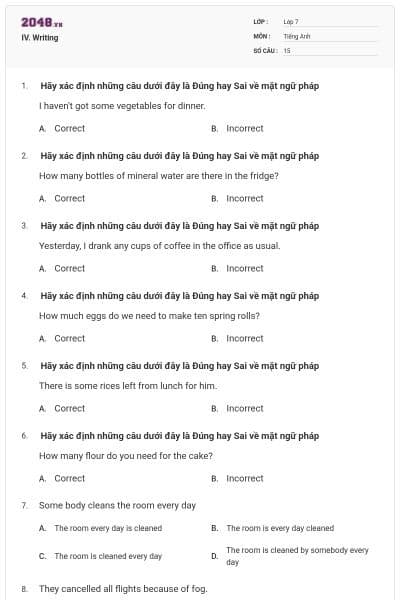
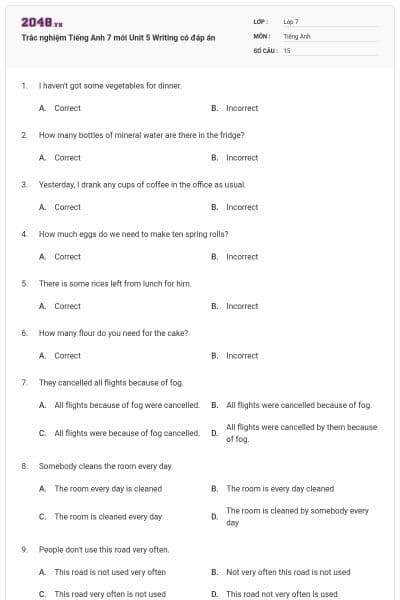
I haven't got some vegetables for dinner.
Correct
Incorrect
Đáp án: incorrect
“Any” chỉ xuất hiện trong câu phủ định và câu hỏi
Not...any = no
Sửa: some → any
Dịch nghĩa: Tôi chưa có rau cho bữa tối.
How many bottles of mineral water are there in the fridge?
Correct
Incorrect
Đáp án: correct
Dịch nghĩa: Có bao nhiêu chai nước khoáng trong tủ lạnh?
Yesterday, I drank any cups of coffee in the office as usual.
Correct
Incorrect
Đáp án: incorrect
Sửa: any → some
“Any” không xuất hiện ở câu khẳng định
Dịch nghĩa: Hôm qua, tôi đã uống vài tách cà phê trong văn phòng như bình thường.
How much eggs do we need to make ten spring rolls?
Correct
Incorrect
Đáp án: incorrect
“Egg” là danh từ đếm được => chọn “many”
Sửa: much → many
Dịch nghĩa: Chúng ta cần bao nhiêu trứng để làm mười cái nem?
There is some rices left from lunch for him.
Correct
Incorrect
Đáp án: incorrect
Sửa: rices -> rice
Vì “rice” là danh từ không đếm được, không được thêm “s” để chia số nhiều
Dịch nghĩa: Còn chút cơm để lại từ bữa trưa cho anh ấy.
How many flour do you need for the cake?
Correct
Incorrect
Đáp án: incorrect
Sửa: many → much
“Flour” là danh từ không đếm được => chọn “much”
Dịch nghĩa: Bạn cần bao nhiêu bột cho bánh?
They cancelled all flights because of fog.
All flights because of fog were cancelled.
All flights were cancelled because of fog.
All flights were because of fog cancelled.
All flights were cancelled by them because of fog.
Đáp án: B
Because of + V-ing/N/cụm N/O: vì cái gì/vì làm gì/vì ai
Dịch nghĩa: Họ đã hủy tất cả các chuyến bay vì bão. – Tất cả các chuyến bay đã bị hủy vì bão.
Somebody cleans the room every day
The room every day is cleaned
The room is every day cleaned
The room is cleaned every day
The room is cleaned by somebody every day
Cấu trúc bị động HTĐ: S mới + am/is/are + V (PII) + (by + S cũ)
“The room” là tân ngữ câu chủ động => chủ ngữ câu bị động
Hiện tại đơn, chủ ngữ “the room” số ít => is
“Clean” chia phân từ II => cleaned
“Somebody” không cần chuyển
Đáp án cần chọn: C
People don't use this road very often.
This road is not used very often
Not very often this road is not used
This road very often is not used
This road not very often is used
Đáp án: A
Câu này áp dụng cấu trúc bị động của thời hiện tại đơn:
S mới + am/is/are (not) + V (phân từ II) + by + S cũ
Dịch nghĩa: Người ta không dùng con đường này thường xuyên. – Con đường này không được sử dụng thường xuyên.
Somebody accused me of stealing money
I was accused by somebody of stealing money.
I was accused of stealing money
I was accused of stealing money by somebody
I was accused stealing money.
Đáp án: B
accuse sb of N/cụm N/V-ing: buộc tội ai vì cái gì/làm gì
=> to be accused of N/cụm N/V-ing: bị buộc tội vì cái gì/làm gì
Dịch nghĩa: Ai đó đã buộc tội tôi lấy cắp tiền. – Tôi đã bị buộc tội lấy cắp tiền.
How do people learn languages?
How are languages learned?
How are languages learned by people?
How languages are learned?
Languages are learned how?
Đáp án: A
Câu bị động không cần “by people/me/you/us/them/him/her/it/đại từ bất định”
Dịch nghĩa: Người ta học các ngôn ngữ thế nào? – Các ngôn ngữ được học thế nào?
People warned us not to go out alone.
We were warned not going out alone
We were warned not to go out alone by people.
We weren't warned to go out alone.
We were warned not to go out alone.
Đáp án: D
Câu bị động không cần “by people/me/you/us/them/him/her/it/đại từ bất định”
Cấu trúc: warn sbd not to do sth (khuyến cáo/cảnh cáo ai không được làm gì)
=> to be warned not to do sth (được khuyến cáo/cảnh cáo không được làm gì)
Dịch nghĩa: Người ta khuyến cáo chúng tôi không ra ngoài 1 mình – Chúng tôi được khuyến cáo không ra ngoài một mình.
Somebody is using the computer at the moment.
The computer is being use at the moment.
The computer at the moment is being used.
The computer is being used by some body at the moment.
The computer is used at the moment.
Đáp án: C
=> The computer is being used at the moment.
Dịch nghĩa: Ai đó đang dùng máy tính ngay lúc này. – Cái máy tính đang được dùng ngay lúc này.
I didn't realize that somebody was recording our conversation.
I didn’t realize that our conversation was recorded.
I didn't realize that our conversation was being recorded.
I didn't realize that our conversation was being recorded by someone.
Our conversation wasn't realized to be recorded.
Đáp án: B
Vế “I didn’t realize” không thể đổi thành bị động
Vế “somebody was recording our conversation” thì áp dụng cấu trúc bị động của quá khứ tiếp diễn
Dịch nghĩa: Tôi đã không nhận ra rằng ai đó đang ghi lại cuộc trò chuyện của chúng tôi. - Tôi đã không nhận ra rằng cuộc trò chuyện của chúng tôi đang được ghi lại.
We found that they had cancelled the game.
We found that the game had been cancelled.
The game had been cancelled.
We found that the game had been cancelled by them.
The game were found to be cancelled.
Đáp án: A
Không chọn D vì câu bị động không cần “by people/me/you/us/them/him/her/it/đại từ bất định”
Dịch nghĩa: Chúng tôi thấy rằng họ đã hủy bỏ trò chơi. - Chúng tôi thấy rằng trò chơi đã bị hủy bỏ.