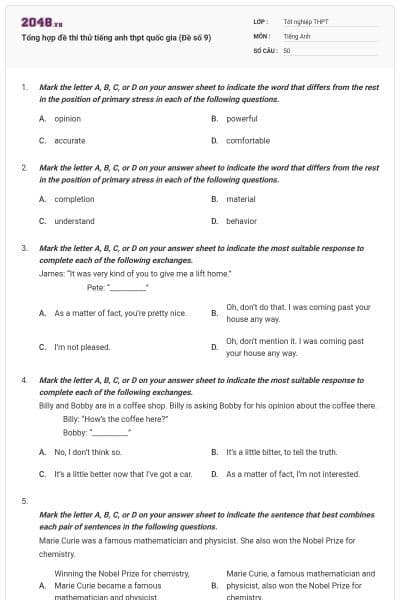
Tổng hợp đề thi thử tiếng anh thpt quốc gia (Đề số 9)
50 câu hỏi
Mark the letter A, B, C, or D on your answer sheet to indicate the word that differs from the rest in the position of primary stress in each of the following questions.
opinion
powerful
accurate
comfortable
Đáp án A
Giải thích: Opinion có trọng âm chính rơi vào âm tiết số 2, các từ còn lại có trọng âm rơi vào âm tiết số 1
Mark the letter A, B, C, or D on your answer sheet to indicate the word that differs from the rest in the position of primary stress in each of the following questions.
completion
material
understand
behavior
Đáp án C
Giải thích: Understand có trọng âm chính rơi vào âm tiết số 3, các từ còn lại có trọng âm rơi vào âm tiết số 2
Mark the letter A, B, C, or D on your answer sheet to indicate the most suitable response to complete each of the following exchanges.
James: “It was very kind of you to give me a lift home.”
Pete: “__________”
As a matter of fact, you’re pretty nice.
Oh, don’t do that. I was coming past your house any way.
I’m not pleased.
Oh, don’t mention it. I was coming past your house any way.
Đáp án D
Giải thích: James: “Bạn thật tử tế khi cho tôi đi nhờ xe về nhà”
Pete: “ôi có gì đâu. Đằng nào tôi cũng đi ngang qua nhà bạn mà”
Mark the letter A, B, C, or D on your answer sheet to indicate the most suitable response to complete each of the following exchanges.
Billy and Bobby are in a coffee shop. Billy is asking Bobby for his opinion about the coffee there.
Billy: “How’s the coffee here?”
Bobby: “__________”
No, I don’t think so.
It’s a little bitter, to tell the truth.
It’s a little better now that I’ve got a car.
As a matter of fact, I’m not interested.
Đáp án D
Giải thích: Billy: “Café ở đây thế nào”.
Bobby: “Nói thực là nó hơi đắng”
Mark the letter A, B, C, or D on your answer sheet to indicate the sentence that best combines each pair of sentences in the following questions.
Marie Curie was a famous mathematician and physicist. She also won the Nobel Prize for
chemistry.
Winning the Nobel Prize for chemistry, Marie Curie became a famous mathematician and physicist.
Marie Curie, a famous mathematician and physicist, also won the Nobel Prize for chemistry.
Marie Curie was a famous mathematician rather than a physicist although she won the Nobel Prize for chemistry.
Marie Curie won the the Nobel Prize for chemistry so she was a famous mathematician and physicist.
Đáp án B
Câu gốc: Marie Curie là nhà toán học và vật lý học nổi tiếng. Bà ấy cũng đã dành giải thưởng Nobel Hoá học
Mệnh đề quan hệ rút gọn được sử dụng để nối 2 câu này với nhau = đáp án B: Marie Curie, nhà toán học và vật lý học nổi tiếng, cũng đã dành giải thưởng Nobel Hoá học
Các phương án khác không sát nghĩa với câu gốc
A. Dành giải thưởng Nobel hoá học, Marie Curie trở thành nhà toán học và vật lý học nổi tiếng
C. Marie Curie là một nhà toán học nổi tiếng thay vì là một nhà vật lý học mặc dù bà ấy đã dành giải Nobel hoá học
D. Marie Curie đã dành giải thưởng Nobel Hoá học vì vậy bà ấy là nhà toán học và vật lý học nổi tiếng
Mark the letter A, B, C, or D on your answer sheet to indicate the sentence that best combines each pair of sentences in the following questions.
Jack was over confident. Therefore, he ruined our plan completely.
It was Jack’s overconfidence ruined our plan completely.
It was because Jack’s overconfidence that ruined our plan completely.
Jack was overconfident, which ruined our plan completely.
That was Jack’s overconfidence ruined our plan completely.
Đáp án C
Câu gốc: Jack đã quá tự tin. Do đó, anh ấy đã phá hỏng kế hoạch một cách hoàn toàn
Mệnh đề quan hệ với which đứng sau dấu “,” và thay thế cho ý nghĩa cả câu phía trước nó
Các phương án còn lại sai cấu trúc ngữ pháp
Tạm dịch: Jack đã quá tự tin, điều đó đã phá hỏng kế hoạch một cách hoàn toàn
Mark the letter A, B, C, or D on your answer sheet to indicate the correct answer to each of the following questions.
Today, many serious childhood diseases _____ by early immunization.
prevent
can prevent
can be prevented
are preventing
Đáp án: C
Giải thích:
Kiến thức: Bị động với động từ khuyết thiếu
A. prevent: ngăn ngừa
B. can prevent: có thể ngăn ngừa
C. can be prevented: có thể được ngăn ngừa
D. are preventing: đang ngăn ngừa
Dấu hiệu bị động: “by”, chọn C.
Dịch: Ngày nay nhiều nguy hiểm ở trẻ nhỏ có thể được ngăn ngừa nhờ tiêm chủng sớm.

Học thông minh hơn mỗi ngày
Xem toàn bộ 50 câu hỏi và nhiều hơn nữa với tài khoản miễn phí
Mark the letter A, B, C, or D on your answer sheet to indicate the correct answer to each of the following questions.
_____ I’ve cleaned it and polished it, it still doesn’t look new.
Because
In spite of
While
Although
Đáp án D
Đáp án D. Although và in spite of dùng để chỉ sự nhượng bộ, theo sau although là một mệnh đề, theo sau in spite of là một cụm từ.
Because: bởi vì
While: trong khi
Dịch nghĩa: Mặc dù tôi đã làm sạch và đánh bóng nó, nó vẫn không thể trông như mới được
Mark the letter A, B, C, or D on your answer sheet to indicate the correct answer to each of the following questions.
The Beauty Contest is _____ start at 8.30 a.m our time tomorrow.
due to
bound to
about to
on the point of
Đáp án A
Giải thích: Cấu trúc:
Tobe due to : sắp sửa xảy ra ( dùng để chỉ 1 việc gì đó sẽ xảy ra trong tương lai và có t/ gian xác định)
Tobe about to do : sắp sửa làm gì
To be on the point of doing sth : sắp sửa làm gì
Tobe bound to do : chắc chắn sẽ xảy ra
Tạm dịch: Cuộc thi sắc đẹp sắp sửa bắt đầu vào lúc 8.30 sáng ngày mai theo giờ của chúng ta (đã được lên lịch rõ ràng và có thời gian xác định
Mark the letter A, B, C, or D on your answer sheet to indicate the correct answer to each of the following questions.
The picture, _____, was beautiful.
she was looking
at it she was looking
at which she was looking
at that she was looking
Đáp án C
Đáp án C. Thay vì nói “which she was looking at” thì giới từ có thể được mang ra đặt trước which. Tuy nhiên không thể áp dụng khi dùng “that” nên đáp án D sai.
A sai vì thiếu giới từ at
Dịch nghĩa: Tấm ảnh mà cô ấy đang nhìn thực sự rất đẹp.
Mark the letter A, B, C, or D on your answer sheet to indicate the correct answer to each of the following questions.
In this job, experience accounts for more than paper _____.
qualifications
certificates
quality
background
Đáp án A
Giải thích: Cụm từ paper qualifications: bằng cấp trên giấy tờ
Tạm dịch: Đối với công việc này, kinh nghiệm đóng vai trò quan trọng hơn bằng cấp trên giấy tờ
Mark the letter A, B, C, or D on your answer sheet to indicate the correct answer to each of the following questions.
Nadine: “I’ve been offered $550 for my stereo. Should I take it or wait for a better one?”
Kitty: “Take the $550. _____”
Actions speak louder than words.
Kill two birds with one stone.
The early bird catches the worm.
A bird in the hand is worth two in the bush.
Đáp án D
Giải thích:
A bird in the hand is worth two in the bush: Câu tục ngữ này khuyên chúng ta nên bằng lòng và trân trọng những gì mình đang có, không nên tham lam hay chấp nhận rủi ro để chạy theo những thứ có vẻ hào nhoáng hơn nhưng cơ hội có được chúng lại không chắc chắn
Actions speak louder than words: nói ít làm nhiều
Kill two birds with one stone: nhất cử lượng tiện
The early bird catches the worm: trâu chậm uống nước đục
Tạm dịch:
Jenny: “Tôi được đề nghị trả cho 550chochiếcmáystereocủatôi.Tôinênnhậnsốtiềnđóhaychờđượctrảgiátốthơn?Kitty:Hãynhận550chochiếcmáystereocủatôi.Tôinênnhậnsốtiềnđóhaychờđượctrảgiátốthơn?Kitty:Hãynhận550 đó đi. Hãy biết bằng lòng và đừng chờ cơ hội khác vì không chắc chắn sẽ có người khác trả hơn đâu.
Mark the letter A, B, C, or D on your answer sheet to indicate the correct answer to each of the following questions.
Jenny: “What did your grammar teacher want to talk to you about?”
Peter: “I did badly on the last test. She _____ studied for it.”
said why I hadn’t
said why hadn’t I
asked why I hadn’t
asked why hadn’t I
Đáp án C
Đáp án C. Đây là câu tường thuật dạng câu hỏi nên động từ tường thuật phải là “asked” và không đảo thành phần trong câu.
Dịch nghĩa: Jenny: “Giáo viên dạy ngữ pháp của bạn đã định nói gì với bạn vậy?”
Peter: “Tôi làm bài kiểm tra lần trước rất tệ. Cô ấy đã hỏi tại sao tôi đã không ôn tập cho lần đó”
Mark the letter A, B, C, or D on your answer sheet to indicate the correct answer to each of the following questions.
_____ summer I spent in _____ UK was one of _____ best in my life.
A/a/the
The/the/a
The/–/the
The/the/the
Đáp án D
Giải thích: The summer là mùa hè đã được xác định, ám chỉ là mùa hè nào, The dùng trước UK vì The UK là bao gồm nhiều nước (England, Ireland) và cấu trúc one of the…
Tạm dịch: Mùa hè tôi trả qua ở nước Anh là một trong số mùa hè tuyệt nhất của cuộc đời tôi
Mark the letter A, B, C, or D on your answer sheet to indicate the correct answer to each of the following questions.
Whenever a problem ____, we try to discuss frankly and find solutions as soon as possible.
comes by
comes off
comes up
comes in
Đáp án C
Giải thích:
Come up: xảy ra, xuất hiện
Come by: đạt được cái gì nhờ sự cố gắng
Come off: bong ra, rời ra
Come in: vào đi
Tạm dịch: Bất cứ khi nào một vấn đề xảy ra, chúng tôi cố gắng thảo luận một cách thẳng thắn và tìm giải pháp ngay khi có thể
Mark the letter A, B, C, or D on your answer sheet to indicate the correct answer to each of the following questions.
I bought this grammar book _____ I could go over all the things we have studied this year.
that
with a view to
so that
in order to
Đáp án C
with a view to + V.ing: để, với mục đích là
so that + clause: để mà
in order to + V.inf: để
Dịch nghĩa: Tôi đã mua quyển sách ngữ pháp này để tôi có thể vượt qua được những môn chúng ta học trong năm nay.
Mark the letter A, B, C, or D on your answer sheet to indicate the correct answer to each of the following questions.
If people paid a little more attention to the environment, the Earth _____ greener.
would be
will be
would have been
had been
Đáp án A
Câu điều kiện loại 2: If + S+ V.ed, S+ would V.inf
Dịch: Nếu mọi người dành nhiều sự chú ý đến môi trường hơn, Trái Đất sẽ xanh hơn.
Mark the letter A, B, C, or D on your answer sheet to indicate the correct answer to each of the following questions.
Lessons from the _____ developed countries are worth learning to save our time.
economically
economic
economize
economical
Đáp án: A
Kiến thức: Cấu tạo từ
Trạng từ đứng trước phân từ hai, tạo thành một cụm tính từ để bổ nghĩa cho danh từ countries đứng sau.
economically (adv): liên quan tới kinh tế, thương mại; một cách tiết kiệm
economic (adj): liên quan/thuộc kinh tế
economical (adj): tiết kiệm
economize (v): kinh tế hóa
Dịch: Bài học từ các nước có kinh tế phát triển rất đáng học hỏi để tiết kiệm thời gian của chúng ta.
Mark the letter A, B, C, or D on your answer sheet to indicate the correct answer to each of the following questions.
The accident _____ while he was driving to the office.
was occurred
occurred
has occurred
was being occurred
Đáp án B
Dùng thì QKĐ để diễn tả 1 hành động chen ngang vào 1 hành động khác đang xảy ra.
‘occur’: là nội động từ (không có tân ngữ theo sau nó) nên không dùng dạng bị động.
Tạm dịch: Vụ tại nạn đã xảy ra khi anh ấy đang lái xe đến văn phòng.
Mark the letter A, B, C, or D on your answer sheet to indicate the correct answer to each of the following questions.
Floods have completely _____ the farmer’s crops.
ruined
damaged
harmed
injured
Đáp án A
- ruin: (v) tàn phá, thường nói về mùa vụ bị ảnh hưởng bởi thiên tai. Các lựa chọn còn lại không phù hợp.
- damage: phá hủy gây thiệt hại (dùng để chỉ sự hỏng hóc, hư hại của đồ vật)
- harm: thiệt hại do người hoặc một sự việc gây nên
- injure: làm cho bị thương bởi tai nạn hoặc các nguyên nhân vật lý
Tạm dịch: Lũ lụt đã phá huỷ hoàn toàn vụ mùa của người nông dân
Mark the letter A, B, C, or D on your answer sheet to indicate the underlined part that needs correction in each of the following questions.
I was very busy lately since the project of designing the new collection started.
was
since
the project
the new collection
Đáp án A
Was -> have been
Giải thích: Cấu trúc: S + V (thì hiện tại hoàn thành)+…+Since + S + V(quá khứ đơn)
Tạm dịch: Gần đây tôi rất bận kể từ khi dự án thiết kế bộ sưu tập mới bắt đầu
Mark the letter A, B, C, or D on your answer sheet to indicate the underlined part that needs correction in each of the following questions.
There are many different ways of comparing the culture of one nation with those of another.
There are
of comparing
those
another
Đáp án C
Those -> that
Giải thích: Sử dụng that thay thế cho the culture (danh từ số ít) thay vì those là thay thế cho danh từ số nhiều được đề cập đến trươc đó
Tạm dịch: Có nhiều cách để so sánh nền văn hoá của một quốc gia với nền văn hoá của một quốc gia khác
Mark the letter A, B, C, or D on your answer sheet to indicate the underlined part that needs correction in each of the following questions.
She only had a twenty–dollars bill with her when she landed at Hearthrow airport.
had
twenty–dollars bill
when
at
Đáp án B
Twenty-dollars bill -> twenty-dollar bill
Giải thích: không sử dụng hình thức số nhiều ở tính từ ghép
Read the following passage and mark the letter A, B, C, or D on your answer sheet to indicate the best option for each of the blanks. Fill in the appropriate word in question 24
The Rocky Mountains run almost the length of North America. They start in the North West, but lie only a (24) _____ hundred miles from the centre in the more southern areas. Although the Rockies are smaller (25) _____ the Alps, they are no less beautiful.
There are many roads across the Rockies, but the best way to see them is to travel by train. You start from Vancouver, the most attractive of Canada’s big cities. Standing with its feet in the water and its (26) ______in the mountains, this city (27) ______ its residents to ski on slopes just 15 minutes by car from the city centre.
Thirty passenger trains a day used to (28) _____ off from Vancouver on the cross–continent railway. Now there are just three a week, but the ride is still a great adventure. You sleep on board, which is fun, but travel through some of the best site at night.
many
few
lot
couple
Đáp án B
A few + noun (plural): một vài
Loại A vì không có hình thức a many + noun (plural), loại C vì phải là a lot of, loại D vì phải là a couple of
Read the following passage and mark the letter A, B, C, or D on your answer sheet to indicate the best option for each of the blanks. Fill in the appropriate word in question 25
The Rocky Mountains run almost the length of North America. They start in the North West, but lie only a (24) _____ hundred miles from the centre in the more southern areas. Although the Rockies are smaller (25) _____ the Alps, they are no less beautiful.
There are many roads across the Rockies, but the best way to see them is to travel by train. You start from Vancouver, the most attractive of Canada’s big cities. Standing with its feet in the water and its (26) ______in the mountains, this city (27) ______ its residents to ski on slopes just 15 minutes by car from the city centre.
Thirty passenger trains a day used to (28) _____ off from Vancouver on the cross–continent railway. Now there are just three a week, but the ride is still a great adventure. You sleep on board, which is fun, but travel through some of the best site at night.
from
to
than
as
Đáp án C
Cấu trúc so sánh hơn của tính từ ngắn: Adj_er + than
Read the following passage and mark the letter A, B, C, or D on your answer sheet to indicate the best option for each of the blanks. Fill in the appropriate word in question 26
The Rocky Mountains run almost the length of North America. They start in the North West, but lie only a (24) _____ hundred miles from the centre in the more southern areas. Although the Rockies are smaller (25) _____ the Alps, they are no less beautiful.
There are many roads across the Rockies, but the best way to see them is to travel by train. You start from Vancouver, the most attractive of Canada’s big cities. Standing with its feet in the water and its (26) ______in the mountains, this city (27) ______ its residents to ski on slopes just 15 minutes by car from the city centre.
Thirty passenger trains a day used to (28) _____ off from Vancouver on the cross–continent railway. Now there are just three a week, but the ride is still a great adventure. You sleep on board, which is fun, but travel through some of the best site at night.
ear
hand
head
nose
Đáp án C
Tương ứng giữa its feet in the water và its head in the mountains
Read the following passage and mark the letter A, B, C, or D on your answer sheet to indicate the best option for each of the blanks. Fill in the appropriate word in question 27
The Rocky Mountains run almost the length of North America. They start in the North West, but lie only a (24) _____ hundred miles from the centre in the more southern areas. Although the Rockies are smaller (25) _____ the Alps, they are no less beautiful.
There are many roads across the Rockies, but the best way to see them is to travel by train. You start from Vancouver, the most attractive of Canada’s big cities. Standing with its feet in the water and its (26) ______in the mountains, this city (27) ______ its residents to ski on slopes just 15 minutes by car from the city centre.
Thirty passenger trains a day used to (28) _____ off from Vancouver on the cross–continent railway. Now there are just three a week, but the ride is still a great adventure. You sleep on board, which is fun, but travel through some of the best site at night.
lets
offers
gives
allows
Đáp án D
Allow somebody to do something
Tạm dịch: thành phố này cho phép cư dân của họ trượt dốc chỉ 15 phút bằng xe từ trung tâm thành phố
Read the following passage and mark the letter A, B, C, or D on your answer sheet to indicate the best option for each of the blanks. Fill in the appropriate word in question 28
The Rocky Mountains run almost the length of North America. They start in the North West, but lie only a (24) _____ hundred miles from the centre in the more southern areas. Although the Rockies are smaller (25) _____ the Alps, they are no less beautiful.
There are many roads across the Rockies, but the best way to see them is to travel by train. You start from Vancouver, the most attractive of Canada’s big cities. Standing with its feet in the water and its (26) ______in the mountains, this city (27) ______ its residents to ski on slopes just 15 minutes by car from the city centre.
Thirty passenger trains a day used to (28) _____ off from Vancouver on the cross–continent railway. Now there are just three a week, but the ride is still a great adventure. You sleep on board, which is fun, but travel through some of the best site at night.
leave
set
get
take
Đáp án B
Set off: khởi hành
Leave off: ngừng làm gì
Get off: xuống tàu
Take off: cất cánh
Tạm dịch: 30 tàu chở hành Khách được sử dụng một ngày để khởi hành từ Vancouver….
Read the following passage and mark the letter A, B, C, or D on your answer sheet to indicate the correct answer to each of the questions.
The New York Times is a daily newspaper published in New York city. For a long time, it has been the newspaper of record in the United States and one of the world’s great newspapers. Its strength is in its editorial excellence; it has never been the largest newspaper in terms of circulation.
The Times was established in 1851 as a penny paper whose editors wanted to report the news in a restrained and objective fashion. It enjoyed early success as its editors set a pattern for the future by appealing to a cultured, intellectual readership instead of a mass audience. However, in the late nineteenth century, it came into competition with more popular, colorful, if not lurid, newspapers in New York City. Despite price increases, the Times was losing $1,000 a week when Adolph Simon Ochs bought it in 1896.
Ochs built the Times into an internationally respected daily. He hired Carr Van Anda as editor. Van Anda placed greater stress than ever on full reporting of the news of the day, and his reporters maintained and emphasized existing good coverage of international news. The management of the paper decided to eliminate fiction from the paper, added a Sunday magazine section, and reduced the paper’s price back to a penny. In April 1912, the paper took many risks to report every aspect of the sinking of the Titanic. This greatly enhanced its prestige, and in its coverage of two world wars, the Times continued to enhance its reputation for excellence in world news.
In 1971, the Times was given a copy of the so–called “Pentagon Papers,” a secret government study of U.S. involvement in the Vietnam War. When it published the report, it became involved in several awsuits. The U.S. Supreme Court found that the publication was protected by the freedom–of–thepress clause in the First Amendment of the U.S. Constitution. Later in the 1970s, the paper, under Adolph Ochs’s grandson, Arthur Ochs Sulzberger, introduced sweeping changes in the organization of the newspaper and its staff and brought out a national edition transmitted by satellite to regional printing plants.
What is the main idea of the passage?
The New York Times publishes the best fiction by American writers.
The New York Times became highly respected throughout the world.
The New York Times broadcasts its news to TV stations via satellite.
The New York Times lost its prestige after the Vietnam War.
Đáp án B
Bài viết nói về quá trình báo The Times hình thành, phát triển và được tôn trọng qua các mốc thời gian cụ thể
Read the following passage and mark the letter A, B, C, or D on your answer sheet to indicate the correct answer to each of the questions.
The New York Times is a daily newspaper published in New York city. For a long time, it has been the newspaper of record in the United States and one of the world’s great newspapers. Its strength is in its editorial excellence; it has never been the largest newspaper in terms of circulation.
The Times was established in 1851 as a penny paper whose editors wanted to report the news in a restrained and objective fashion. It enjoyed early success as its editors set a pattern for the future by appealing to a cultured, intellectual readership instead of a mass audience. However, in the late nineteenth century, it came into competition with more popular, colorful, if not lurid, newspapers in New York City. Despite price increases, the Times was losing $1,000 a week when Adolph Simon Ochs bought it in 1896.
Ochs built the Times into an internationally respected daily. He hired Carr Van Anda as editor. Van Anda placed greater stress than ever on full reporting of the news of the day, and his reporters maintained and emphasized existing good coverage of international news. The management of the paper decided to eliminate fiction from the paper, added a Sunday magazine section, and reduced the paper’s price back to a penny. In April 1912, the paper took many risks to report every aspect of the sinking of the Titanic. This greatly enhanced its prestige, and in its coverage of two world wars, the Times continued to enhance its reputation for excellence in world news.
In 1971, the Times was given a copy of the so–called “Pentagon Papers,” a secret government study of U.S. involvement in the Vietnam War. When it published the report, it became involved in several awsuits. The U.S. Supreme Court found that the publication was protected by the freedom–of–thepress clause in the First Amendment of the U.S. Constitution. Later in the 1970s, the paper, under Adolph Ochs’s grandson, Arthur Ochs Sulzberger, introduced sweeping changes in the organization of the newspaper and its staff and brought out a national edition transmitted by satellite to regional printing plants.
It can be inferred from the passage that the circulation of the New York Times is _____.
not the best in the world
the smallest in the world
the worst in the world
not the largest in the world
Đáp án D
Thông tin nằm ở đoạn: “Its strength is in its editorial excellence; it has never been the largest newspaper in terms of circulation.”
Read the following passage and mark the letter A, B, C, or D on your answer sheet to indicate the correct answer to each of the questions.
The New York Times is a daily newspaper published in New York city. For a long time, it has been the newspaper of record in the United States and one of the world’s great newspapers. Its strength is in its editorial excellence; it has never been the largest newspaper in terms of circulation.
The Times was established in 1851 as a penny paper whose editors wanted to report the news in a restrained and objective fashion. It enjoyed early success as its editors set a pattern for the future by appealing to a cultured, intellectual readership instead of a mass audience. However, in the late nineteenth century, it came into competition with more popular, colorful, if not lurid, newspapers in New York City. Despite price increases, the Times was losing $1,000 a week when Adolph Simon Ochs bought it in 1896.
Ochs built the Times into an internationally respected daily. He hired Carr Van Anda as editor. Van Anda placed greater stress than ever on full reporting of the news of the day, and his reporters maintained and emphasized existing good coverage of international news. The management of the paper decided to eliminate fiction from the paper, added a Sunday magazine section, and reduced the paper’s price back to a penny. In April 1912, the paper took many risks to report every aspect of the sinking of the Titanic. This greatly enhanced its prestige, and in its coverage of two world wars, the Times continued to enhance its reputation for excellence in world news.
In 1971, the Times was given a copy of the so–called “Pentagon Papers,” a secret government study of U.S. involvement in the Vietnam War. When it published the report, it became involved in several awsuits. The U.S. Supreme Court found that the publication was protected by the freedom–of–thepress clause in the First Amendment of the U.S. Constitution. Later in the 1970s, the paper, under Adolph Ochs’s grandson, Arthur Ochs Sulzberger, introduced sweeping changes in the organization of the newspaper and its staff and brought out a national edition transmitted by satellite to regional printing plants.
Which phrase is closest in meaning to the word “restrained” in paragraph 2?
Put in prison
With self–control
Without education
In handcuffs
Đáp án B
Restrained ≈ with self-control: kìm nén, kiềm chế (bản thân)
Read the following passage and mark the letter A, B, C, or D on your answer sheet to indicate the correct answer to each of the questions.
The New York Times is a daily newspaper published in New York city. For a long time, it has been the newspaper of record in the United States and one of the world’s great newspapers. Its strength is in its editorial excellence; it has never been the largest newspaper in terms of circulation.
The Times was established in 1851 as a penny paper whose editors wanted to report the news in a restrained and objective fashion. It enjoyed early success as its editors set a pattern for the future by appealing to a cultured, intellectual readership instead of a mass audience. However, in the late nineteenth century, it came into competition with more popular, colorful, if not lurid, newspapers in New York City. Despite price increases, the Times was losing $1,000 a week when Adolph Simon Ochs bought it in 1896.
Ochs built the Times into an internationally respected daily. He hired Carr Van Anda as editor. Van Anda placed greater stress than ever on full reporting of the news of the day, and his reporters maintained and emphasized existing good coverage of international news. The management of the paper decided to eliminate fiction from the paper, added a Sunday magazine section, and reduced the paper’s price back to a penny. In April 1912, the paper took many risks to report every aspect of the sinking of the Titanic. This greatly enhanced its prestige, and in its coverage of two world wars, the Times continued to enhance its reputation for excellence in world news.
In 1971, the Times was given a copy of the so–called “Pentagon Papers,” a secret government study of U.S. involvement in the Vietnam War. When it published the report, it became involved in several awsuits. The U.S. Supreme Court found that the publication was protected by the freedom–of–thepress clause in the First Amendment of the U.S. Constitution. Later in the 1970s, the paper, under Adolph Ochs’s grandson, Arthur Ochs Sulzberger, introduced sweeping changes in the organization of the newspaper and its staff and brought out a national edition transmitted by satellite to regional printing plants.
What word or phrase does the word “his” as used in paragraph 3 refer to?
Van Anda
Reporters
News of the day
International news
Đáp án A
His được thay thế cho Van Anda ở vế trước: “Van Anda placed greater stress than ever on full reporting of the news of the day”
Read the following passage and mark the letter A, B, C, or D on your answer sheet to indicate the correct answer to each of the questions.
The New York Times is a daily newspaper published in New York city. For a long time, it has been the newspaper of record in the United States and one of the world’s great newspapers. Its strength is in its editorial excellence; it has never been the largest newspaper in terms of circulation.
The Times was established in 1851 as a penny paper whose editors wanted to report the news in a restrained and objective fashion. It enjoyed early success as its editors set a pattern for the future by appealing to a cultured, intellectual readership instead of a mass audience. However, in the late nineteenth century, it came into competition with more popular, colorful, if not lurid, newspapers in New York City. Despite price increases, the Times was losing $1,000 a week when Adolph Simon Ochs bought it in 1896.
Ochs built the Times into an internationally respected daily. He hired Carr Van Anda as editor. Van Anda placed greater stress than ever on full reporting of the news of the day, and his reporters maintained and emphasized existing good coverage of international news. The management of the paper decided to eliminate fiction from the paper, added a Sunday magazine section, and reduced the paper’s price back to a penny. In April 1912, the paper took many risks to report every aspect of the sinking of the Titanic. This greatly enhanced its prestige, and in its coverage of two world wars, the Times continued to enhance its reputation for excellence in world news.
In 1971, the Times was given a copy of the so–called “Pentagon Papers,” a secret government study of U.S. involvement in the Vietnam War. When it published the report, it became involved in several awsuits. The U.S. Supreme Court found that the publication was protected by the freedom–of–thepress clause in the First Amendment of the U.S. Constitution. Later in the 1970s, the paper, under Adolph Ochs’s grandson, Arthur Ochs Sulzberger, introduced sweeping changes in the organization of the newspaper and its staff and brought out a national edition transmitted by satellite to regional printing plants.
To improve its circulation, the management of the Times did all of the following EXCEPT_.
emphasized good coverage of international news
increased the number of lurid stories, even if they were not true
added a Sunday magazine section
eliminated fiction from the paper
Đáp án B
Phương án A ở đoạn 3: “Van Anda placed greater stress than ever on full reporting of the news of the day, and his reporters maintained and emphasized existing good coverage of international news” Phương án B ở đoạn 3: “The management of the paper decided to eliminate fiction from the paper, added a Sunday magazine section” Phương án D ở đoạn 3: “The management of the paper decided to eliminate fiction from the paper, added a Sunday magazine section”
Mark the letter A, B, C, or D on your answer sheet to indicate the word(s) OPPOSITE in meaning to the underlined word(s) in each of the following questions.
When floodwaters recede, affected areas are often blanketed in silt and mud. The water and landscape can be contaminated with hazardous materials, such as sharp debris, pesticides, fuel, and
untreated sewage.
to cover completely with thick layer of something
to expose to the open air comfortably
to provide someone with a protective layer
to dig out something hidden for long
Đáp án B
Giải thích: blanket: phủ bởi ≠ to expose to the open air comfortably: phơi bày ra ngoài
Mark the letter A, B, C, or D on your answer sheet to indicate the word(s) OPPOSITE in meaning to the underlined word(s) in each of the following questions.
When you change a sound file to an MP3, the file is compressed.
transformed
precise
made bigger
made smaller
Đáp án C
Compressed: bị nén, làm nhỏ lại ≠ made bigger: làm to ra
Tạm dịch: Khi bạn chuyển một file âm thanh sang dạng MP3, file đó được nén lại
Mark the letter A, B, C, or D on your answer sheet to indicate the word whose underlined part is
pronounced differently from that pf the rest in each of the following questions.
tea
lead
leather
leave
Đáp án C
/ea/ trong leather được phát âm là /e/, trong các từ còn lại được phát âm là / iː/
Mark the letter A, B, C, or D on your answer sheet to indicate the word whose underlined part is
pronounced differently from that pf the rest in each of the following questions.
followed
jumped
rained
arrived
Đáp án B
/ed/ trong jumped được phát âm là /t/, trong các từ còn lại được phát âm là /d/
Read the following passage and mark the letter A, B, C, or D on your answer sheet to indicate the
correct answer to each of the questions.
The ideas of John Dewey, philosopher and educator, have influenced American thought for over one hundred years. Dewey was born in Vermont in 1859, and throughout his life, he kept the respect for experience, individuality, and fair play that shaped the character of the nineteenth–century Vermonter. He viewed his own life as a continuously reconstructive process–with experience and knowledge building to each other.
By the 1930s, Dewey had simplified his theory of experience to its essence. As the intellectual leader of the progressive schools, he asserted that there was danger in rejecting the old unless the new was rooted in a correct idea of experience. He held that experience is an interaction between what a person already knows and the situation at hand. Previous knowledge interacting with the present environment influences future experience.
Dewey believed that experience could not be equated with education because all experiences are not necessarily educative. Experience is educative only when it contributes to the growth of the individual, but it can be miseducative if it distorts the growth of future experience. It is the quality of experience that matters. Thus, productive experience is both the means and the goal of education. Furthermore, since education is a social process, truly progressive education involves the participation of the learner in directing the learning experience.
During his long life, Dewey lectured and published prolifically. These writings were influential both during his lifetime and after his death at the age of ninety–two. He viewed his whole life as an experiment which would produce knowledge that would lead to the further experimentation. The range and diversity of Dewey’s writings and his influence on society place him among American’s great thinkers.
What does the passage mainly discuss?
John Dewey’s theory of experience.
The educational methods of John Dewey.
John Dewey’s professional growth.
The progressive movement in education.
Đáp án A
Đoạn văn chủ yếu thảo luận về thuyết kinh nghiệm của John Dewey
Read the following passage and mark the letter A, B, C, or D on your answer sheet to indicate the
correct answer to each of the questions.
The ideas of John Dewey, philosopher and educator, have influenced American thought for over one hundred years. Dewey was born in Vermont in 1859, and throughout his life, he kept the respect for experience, individuality, and fair play that shaped the character of the nineteenth–century Vermonter. He viewed his own life as a continuously reconstructive process–with experience and knowledge building to each other.
By the 1930s, Dewey had simplified his theory of experience to its essence. As the intellectual leader of the progressive schools, he asserted that there was danger in rejecting the old unless the new was rooted in a correct idea of experience. He held that experience is an interaction between what a person already knows and the situation at hand. Previous knowledge interacting with the present environment influences future experience.
Dewey believed that experience could not be equated with education because all experiences are not necessarily educative. Experience is educative only when it contributes to the growth of the individual, but it can be miseducative if it distorts the growth of future experience. It is the quality of experience that matters. Thus, productive experience is both the means and the goal of education. Furthermore, since education is a social process, truly progressive education involves the participation of the learner in directing the learning experience.
During his long life, Dewey lectured and published prolifically. These writings were influential both during his lifetime and after his death at the age of ninety–two. He viewed his whole life as an experiment which would produce knowledge that would lead to the further experimentation. The range and diversity of Dewey’s writings and his influence on society place him among American’s great thinkers.
The author implies that Dewey’s Vermont background _____.
provided him with an excellent education
limited the types of experiences he had as a child
inspired him to become a philosopher
contributed to his philosophy of experience
Đáp án D
Tác giả ngụ ý rằng nền tảng của Dewey Vermont đã đóng góp đến triết lý kinh nghiệm của anh ấy
Read the following passage and mark the letter A, B, C, or D on your answer sheet to indicate the
correct answer to each of the questions.
The ideas of John Dewey, philosopher and educator, have influenced American thought for over one hundred years. Dewey was born in Vermont in 1859, and throughout his life, he kept the respect for experience, individuality, and fair play that shaped the character of the nineteenth–century Vermonter. He viewed his own life as a continuously reconstructive process–with experience and knowledge building to each other.
By the 1930s, Dewey had simplified his theory of experience to its essence. As the intellectual leader of the progressive schools, he asserted that there was danger in rejecting the old unless the new was rooted in a correct idea of experience. He held that experience is an interaction between what a person already knows and the situation at hand. Previous knowledge interacting with the present environment influences future experience.
Dewey believed that experience could not be equated with education because all experiences are not necessarily educative. Experience is educative only when it contributes to the growth of the individual, but it can be miseducative if it distorts the growth of future experience. It is the quality of experience that matters. Thus, productive experience is both the means and the goal of education. Furthermore, since education is a social process, truly progressive education involves the participation of the learner in directing the learning experience.
During his long life, Dewey lectured and published prolifically. These writings were influential both during his lifetime and after his death at the age of ninety–two. He viewed his whole life as an experiment which would produce knowledge that would lead to the further experimentation. The range and diversity of Dewey’s writings and his influence on society place him among American’s great thinkers.
The word “it” in paragraph 2 refers to _____.
progressive education
theory of experience
the 1930s
the old
Đáp án B
By the 1930s, Dewey had simplified his theory of experience to its essence.
Its ở đây thay thế cho theory of experience: trước những năm 1930 Dewey đã đơn giản hoá thuyết kinh nghiệm của anh ấy với tầm quan trọng của thuyết đó
Read the following passage and mark the letter A, B, C, or D on your answer sheet to indicate the
correct answer to each of the questions.
The ideas of John Dewey, philosopher and educator, have influenced American thought for over one hundred years. Dewey was born in Vermont in 1859, and throughout his life, he kept the respect for experience, individuality, and fair play that shaped the character of the nineteenth–century Vermonter. He viewed his own life as a continuously reconstructive process–with experience and knowledge building to each other.
By the 1930s, Dewey had simplified his theory of experience to its essence. As the intellectual leader of the progressive schools, he asserted that there was danger in rejecting the old unless the new was rooted in a correct idea of experience. He held that experience is an interaction between what a person already knows and the situation at hand. Previous knowledge interacting with the present environment influences future experience.
Dewey believed that experience could not be equated with education because all experiences are not necessarily educative. Experience is educative only when it contributes to the growth of the individual, but it can be miseducative if it distorts the growth of future experience. It is the quality of experience that matters. Thus, productive experience is both the means and the goal of education. Furthermore, since education is a social process, truly progressive education involves the participation of the learner in directing the learning experience.
During his long life, Dewey lectured and published prolifically. These writings were influential both during his lifetime and after his death at the age of ninety–two. He viewed his whole life as an experiment which would produce knowledge that would lead to the further experimentation. The range and diversity of Dewey’s writings and his influence on society place him among American’s great thinkers.
According to Jon Dewey, the interplay between a person’s previous knowledge and the
present situation is _____.
dangerous
a rejection of the old
education
a correct idea of experience
Đáp án D
Thông tin tìm được ở đoạn 2: “he asserted that there was danger in rejecting the old unless the new was rooted in a correct idea of experience. He held that experience is an interaction between what a person already knows and the situation at hand”
Read the following passage and mark the letter A, B, C, or D on your answer sheet to indicate the
correct answer to each of the questions.
The ideas of John Dewey, philosopher and educator, have influenced American thought for over one hundred years. Dewey was born in Vermont in 1859, and throughout his life, he kept the respect for experience, individuality, and fair play that shaped the character of the nineteenth–century Vermonter. He viewed his own life as a continuously reconstructive process–with experience and knowledge building to each other.
By the 1930s, Dewey had simplified his theory of experience to its essence. As the intellectual leader of the progressive schools, he asserted that there was danger in rejecting the old unless the new was rooted in a correct idea of experience. He held that experience is an interaction between what a person already knows and the situation at hand. Previous knowledge interacting with the present environment influences future experience.
Dewey believed that experience could not be equated with education because all experiences are not necessarily educative. Experience is educative only when it contributes to the growth of the individual, but it can be miseducative if it distorts the growth of future experience. It is the quality of experience that matters. Thus, productive experience is both the means and the goal of education. Furthermore, since education is a social process, truly progressive education involves the participation of the learner in directing the learning experience.
During his long life, Dewey lectured and published prolifically. These writings were influential both during his lifetime and after his death at the age of ninety–two. He viewed his whole life as an experiment which would produce knowledge that would lead to the further experimentation. The range and diversity of Dewey’s writings and his influence on society place him among American’s great thinkers.
The word “distorts” in paragraph 3 is closet in meaning to _____.
balances
deforms
mislays
stimulates
Đáp án A
Distort ≈ deform: làm biến dạng
Read the following passage and mark the letter A, B, C, or D on your answer sheet to indicate the
correct answer to each of the questions.
The ideas of John Dewey, philosopher and educator, have influenced American thought for over one hundred years. Dewey was born in Vermont in 1859, and throughout his life, he kept the respect for experience, individuality, and fair play that shaped the character of the nineteenth–century Vermonter. He viewed his own life as a continuously reconstructive process–with experience and knowledge building to each other.
By the 1930s, Dewey had simplified his theory of experience to its essence. As the intellectual leader of the progressive schools, he asserted that there was danger in rejecting the old unless the new was rooted in a correct idea of experience. He held that experience is an interaction between what a person already knows and the situation at hand. Previous knowledge interacting with the present environment influences future experience.
Dewey believed that experience could not be equated with education because all experiences are not necessarily educative. Experience is educative only when it contributes to the growth of the individual, but it can be miseducative if it distorts the growth of future experience. It is the quality of experience that matters. Thus, productive experience is both the means and the goal of education. Furthermore, since education is a social process, truly progressive education involves the participation of the learner in directing the learning experience.
During his long life, Dewey lectured and published prolifically. These writings were influential both during his lifetime and after his death at the age of ninety–two. He viewed his whole life as an experiment which would produce knowledge that would lead to the further experimentation. The range and diversity of Dewey’s writings and his influence on society place him among American’s great thinkers.
All of the following were part of Dewey’s theory of experience and education EXCEPT __.
present experience affects future experience
knowledge and experience interact
experience is always education
experience should develop the individual
Đáp án C
Read the following passage and mark the letter A, B, C, or D on your answer sheet to indicate the
correct answer to each of the questions.
The ideas of John Dewey, philosopher and educator, have influenced American thought for over one hundred years. Dewey was born in Vermont in 1859, and throughout his life, he kept the respect for experience, individuality, and fair play that shaped the character of the nineteenth–century Vermonter. He viewed his own life as a continuously reconstructive process–with experience and knowledge building to each other.
By the 1930s, Dewey had simplified his theory of experience to its essence. As the intellectual leader of the progressive schools, he asserted that there was danger in rejecting the old unless the new was rooted in a correct idea of experience. He held that experience is an interaction between what a person already knows and the situation at hand. Previous knowledge interacting with the present environment influences future experience.
Dewey believed that experience could not be equated with education because all experiences are not necessarily educative. Experience is educative only when it contributes to the growth of the individual, but it can be miseducative if it distorts the growth of future experience. It is the quality of experience that matters. Thus, productive experience is both the means and the goal of education. Furthermore, since education is a social process, truly progressive education involves the participation of the learner in directing the learning experience.
During his long life, Dewey lectured and published prolifically. These writings were influential both during his lifetime and after his death at the age of ninety–two. He viewed his whole life as an experiment which would produce knowledge that would lead to the further experimentation. The range and diversity of Dewey’s writings and his influence on society place him among American’s great thinkers.
According to Dewey, progressive education should include _____.
the active participation of the student
both positive and negative experiences
complete rejection of traditional methods
directing new social process
Đáp án A
Read the following passage and mark the letter A, B, C, or D on your answer sheet to indicate the
correct answer to each of the questions.
The ideas of John Dewey, philosopher and educator, have influenced American thought for over one hundred years. Dewey was born in Vermont in 1859, and throughout his life, he kept the respect for experience, individuality, and fair play that shaped the character of the nineteenth–century Vermonter. He viewed his own life as a continuously reconstructive process–with experience and knowledge building to each other.
By the 1930s, Dewey had simplified his theory of experience to its essence. As the intellectual leader of the progressive schools, he asserted that there was danger in rejecting the old unless the new was rooted in a correct idea of experience. He held that experience is an interaction between what a person already knows and the situation at hand. Previous knowledge interacting with the present environment influences future experience.
Dewey believed that experience could not be equated with education because all experiences are not necessarily educative. Experience is educative only when it contributes to the growth of the individual, but it can be miseducative if it distorts the growth of future experience. It is the quality of experience that matters. Thus, productive experience is both the means and the goal of education. Furthermore, since education is a social process, truly progressive education involves the participation of the learner in directing the learning experience.
During his long life, Dewey lectured and published prolifically. These writings were influential both during his lifetime and after his death at the age of ninety–two. He viewed his whole life as an experiment which would produce knowledge that would lead to the further experimentation. The range and diversity of Dewey’s writings and his influence on society place him among American’s great thinkers.
The word “prolifically” in paragraph 4 is closet in meaning to _____.
carefully
progressively
abundantly
intellectually
Đáp án C
Prolifically ≈ abundantly: dư thừa, nhiều
Mark the letter A, B, C, or D on your answer sheet to indicate the sentence that is closest in meaning to
each of the following questions.
We had no sooner got to know our neighbors than they moved away.
Sooner after we got to know our new neighbors, we stopped having contact with them.
If our new neighbors had stayed longer, we would have got to know them better.
Once we had got used to our new neighbors, they moved somewhere else.
Hardly had we become acquainted with our new neighbors when they went somewhere else to live.
Đáp án D
Câu gốc: chúng tôi vừa mới quen biết người hàng xóm mới thì họ đã lại chuyển đi
Câu này được viết lại với cấu trúc: no sooner ………..than = hardly….when: vừa mới thì
Mark the letter A, B, C, or D on your answer sheet to indicate the sentence that is closest in meaning to
each of the following questions.
There were so many people on the train that Mary couldn’t get a seat.
The train was too crowded for Mary to get a seat.
The train was so crowded that there were nowhere for Mary to sit.
So crowded the train was that Mary couldn’t get a seat.
The crowded train did not prevent Mary from getting a seat.
Đáp án B
Câu gốc: Có quá nhiều người trên tàu đến nỗi Mary không thể tìm được một chỗ ngồi
= Tàu quá đông đến nỗi không có chỗ nào cho Mary ngồi
Loại A vì sai cấu trúc, đúng phải là it + tobe + too + adj + for SB + to inf
Loại C vì sai cấu trúc, vì không đảo động từ was lên trước chủ ngữ the train
Loại D vì không sát nghĩa với câu gôc: Tàu quá đông không ngăn được Marry khỏi việc tìm được một chỗ ngồi
Mark the letter A, B, C, or D on your answer sheet to indicate the sentence that is closest in meaning to
each of the following questions.
“I’ll speak calmly. I really will!” He said.
He promised to speak calmly.
He reminded me to speak calmly.
He refused to speak calmly.
He offered to speak calmly.
Đáp án A
Giải thích: Câu tường thuật cho câu hứa
Tạm dịch: “Tôi sẽ nói một cách bình tĩnh. Thực sự tôi sẽ làm thế mà!” = Anh ấy đã hứa nói một cách bình tĩnh
Mark the letter A, B, C, or D on your answer sheet to indicate the word(s) CLOSEST in meaning to the
underlined word(s) in each of the following questions.
Oil is one of the principal sources of energy.
most important
most difficult
most popular
most expensive
Đáp án A
Giải thích: principal ≈ most important
Tạm dịch: Dầu thô là một trong những nguồn năng lượng quan trọng
Mark the letter A, B, C, or D on your answer sheet to indicate the word(s) CLOSEST in meaning to the
underlined word(s) in each of the following questions.
The museum was overrun with tourists, so I decided to go back another city.
having no tourists
not having enough tourists
crowded with tourists
having tourists running
Đáp án C
Giải thích: overrun with tourists ≈ crowded with tourists
Tạm dịch: Bảo tàng quá tải vì các Khách du lịch, vì vậy tôi đã quyết định quay trở lại vào một ngày khác
Bạn có thích hoạt động này không?
Ý kiến của bạn sẽ giúp chúng tôi đề xuất nội dung phù hợp hơn.
Gợi ý cho bạn
![[Năm 2022] Đề thi thử môn Vật lí THPT Quốc gia có lời giải - Đề số 21](/_next/image?url=https%3A%2F%2Fvideo.vietjack.com%2Fupload%2Fimages%2Fvj-image%2Fimage-3izficdefgfoel0s9j8s-1786772791.jpg&w=3840&q=75)
![[Năm 2022] Đề thi thử môn Vật lí THPT Quốc gia có lời giải - Đề số 20](/_next/image?url=https%3A%2F%2Fvideo.vietjack.com%2Fupload%2Fimages%2Fvj-image%2Fimage-emy0gtcksawvorajezvv-1786772460.jpg&w=3840&q=75)
Tài liệu phổ biến Tốt nghiệp THPT
Tài liệu phổ biến Tiếng Anh