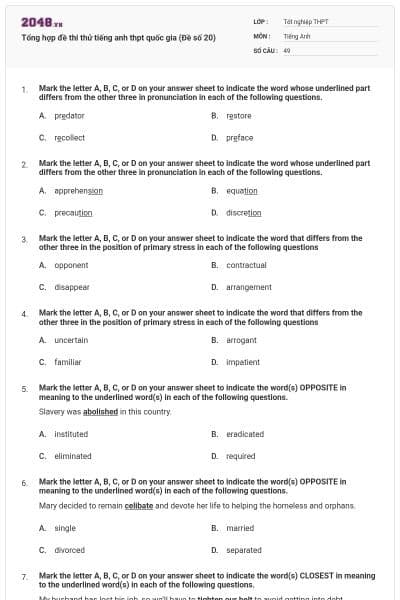
Tổng hợp đề thi thử tiếng anh thpt quốc gia (Đề số 20)
49 câu hỏi
Mark the letter A, B, C, or D on your answer sheet to indicate the word whose underlined part differs from the other three in pronunciation in each of the following questions.
predator
restore
recollect
preface
Chọn B
Mark the letter A, B, C, or D on your answer sheet to indicate the word whose underlined part differs from the other three in pronunciation in each of the following questions.
apprehension
equation
precaution
discretion
Chọn B
Mark the letter A, B, C, or D on your answer sheet to indicate the word that differs from the other three in the position of primary stress in each of the following questions
opponent
contractual
disappear
arrangement
Chọn C
Mark the letter A, B, C, or D on your answer sheet to indicate the word that differs from the other three in the position of primary stress in each of the following questions
uncertain
arrogant
familiar
impatient
Chọn B
Mark the letter A, B, C, or D on your answer sheet to indicate the word(s) OPPOSITE in meaning to the underlined word(s) in each of the following questions.
Slavery was abolished in this country.
instituted
eradicated
eliminated
required
Chọn A
Mark the letter A, B, C, or D on your answer sheet to indicate the word(s) OPPOSITE in meaning to the underlined word(s) in each of the following questions.
Mary decided to remain celibate and devote her life to helping the homeless and orphans.
single
married
divorced
separated
Chọn B
Mark the letter A, B, C, or D on your answer sheet to indicate the word(s) CLOSEST in meaning to the underlined word(s) in each of the following questions.
My husband has lost his job, so we’ll have to tighten our belt to avoid getting into debt.
earn money
spend money
sit still
economize
Chọn D

Học thông minh hơn mỗi ngày
Xem toàn bộ 49 câu hỏi và nhiều hơn nữa với tài khoản miễn phí
Mark the letter A, B, C, or D on your answer sheet to indicate the word(s) CLOSEST in meaning to the underlined word(s) in each of the following questions
When our rent increased from $100 to $200 a month, we protested against such a tremendous increase.
light
huge
tiring
difficult
Chọn B
Mark the letter A, B, C, or D on your answer sheet to indicate the sentence that best completes each of the following exchanges.
Ken and Laura are saying goodbye to each other after going to LOTTE Center. And they are going to have a date with each other later.
Laura: “Well, it’s getting late. Maybe we could get together sometime.” - Ken: “_________”
Nice to see back you.
Take it easy.
Sounds good. I’ll give you a call.
Yes, I’ve enjoyed it.
Chọn C
Mark the letter A, B, C, or D on your answer sheet to indicate the sentence that best completes each of the following exchanges.
Don’t forget to send your parents my regards.” - “_________”
It’s my pleasure
Good idea, thanks
Never mind
Thanks, I will
Đáp án: D
Giải thích:
Kiến thức: Tình huống giao tiếp
Dịch:
“Đừng quên gửi lời hỏi thăm của tôi đến bố mẹ bạn nhé.”
- “__________.”
A. Rất vui được gặp bạn
B. Ý tưởng hay, cảm ơn bạn
C. Không sao đâu
D. Cảm ơn bạn, tôi sẽ gửi lời
Dựa vòa nghĩa, chọn D.
Mark the letter A, B, C, or D on your answer sheet to indicate the correct answer to each of the following questions.
Genetically, the chimpanzee is more similar to humans _________.
are than any other animal
than any other animal
any other animal is
and any other animal is
Đáp án: B
Giải thích:
Kiến thức: Câu so sánh hơn
Câu so sánh cần có cấu trúc "more ... than" để so sánh mức độ giống nhau giữa tinh tinh và con người với các loài động vật khác.
Cụm "than any other animal" đúng về mặt ngữ pháp và logic, có nghĩa là tinh tinh giống con người hơn bất kỳ loài động vật nào khác.
Dịch: Về mặt di truyền, tinh tinh giống con người hơn bất kỳ loài động vật nào khác.
Mark the letter A, B, C, or D on your answer sheet to indicate the correct answer to each of the following questions.
When the weather was very hot in summer, sales of bottles of water went _________the roof.
through
to
above
over
Chọn A
Mark the letter A, B, C, or D on your answer sheet to indicate the correct answer to each of the following questions.
If we leave here now, we can drive half the distance before we stop _________lunch.
for having
having had
having
to have
Chọn đáp án D
Cấu trúc: - Stop to do sth: dừng lại để làm gì
E.g: I stop to read books.
- Stop doing sth: dừng hẳn làm gì đó
E.g: He stopped smoking. (Anh ấy đã ngừng hút thuốc hẳn.)
Dịch: Nếu chúng ta rời khỏi đây bây giờ thì chúng ta có thể lái xe được một nửa quãng đường trước khi dừng lại để ăn trưa.
Note 35 Một số động từ có thể đi cùng với cả động từ nguyên thể và V-ing, nhưng có sự khác nhau về ý nghĩa: Stop V-ing: dừng làm gì (dừng hẳn) Stop to V: dừng lại để làm việc gì - Stop smoking: dừng hút thuốc - Stop to talk: dừng lại đề nói chuyện Remember/forget/regret to V: nhớ/quên/tiếc sẽ phải làm gì (ở hiện tại - tương lai) Remember/forget/regret V-ing: nhớ/quên/hối tiếc đã làm gì (ở quá khứ) E.g: I regret to inform you that the train was cancelled. (Tôi rất tiếc phải báo tin cho anh rằng chuyến tàu đã bị hủy.) - She remembers seeing him. (Cô ấy nhớ đã gặp anh ấy.) Try to V: cố gắng làm gì Try V-ing: thử làm gì E.g: I try to pass the exam. (Tôi cố gắng vượt qua kỳ thi.) - You should try wearing this hat. (Bạn nên thử đội chiếc mũ này.) Prefer V-ing to V-ing Prefer + to V + rather than (V) E.g: I prefer staying at home to going out. - I prefer to stay at home rather than go out. Mean to V: có ý định làm gì. Mean V-ing: Có nghĩa là gì. E.g: He doesn’t mean to prevent you from doing that. (Anh ấy không có ý ngăn cản bạn làm việc đó.) - This sign means not going into. (Biển báo này có ý nghĩa là không được đi vào trong.) Need to V: cần làm gì Need V-ing: cần được làm gì (= need to be done) E.g: I need to clean the house. - Your hair needs cutting. (= Your hair needs to be cut.) Used to V: đã từng/thường làm gì trong quá khứ (bây giờ không làm nữa) Be/Get used to V-ing: quen với việc gì (ở hiện tại) E.g: I used to get up early when I was young. (Tôi đã từng dậy sớm khi còn trẻ.) - I’m used to getting up early. (Tôi quen với việc dậy sớm rồi) Advise/ recommend /allow/permit + O + to V: khuyên/cho phép ai làm gì. Advise/ recommend /allow/permit + V-ing: khuyên/cho phép làm gì. E.g: They don’t allow us to go out. - They don’t allow going out. - We are allowed to go out. (bị động) |
Mark the letter A, B, C, or D on your answer sheet to indicate the correct answer to each of the following questions.
He lifted the phone receiver, _________slightly.
his hands trembling
his hands were trembling
his hands trembled
with his hands trembling
Chọn B
Mark the letter A, B, C, or D on your answer sheet to indicate the correct answer to each of the following questions.
No matter _________, he was an accomplished composer while still a child.
how it seems remarkable
how remarkable it seems
it seems remarkable how
how seems it remarkable
Chọn B
Mark the letter A, B, C, or D on your answer sheet to indicate the correct answer to each of the following questions.
Such a doctor _________retire from his job before the retirement age.
as well as
may as well
so as to
as much as
Chọn B
Mark the letter A, B, C, or D on your answer sheet to indicate the correct answer to each of the following questions.
By 1820, there were over sixty steamboats on the Mississippi river, _________ were quite luxurious.
which many
many of them
many of which
many that
Chọn C
Mark the letter A, B, C, or D on your answer sheet to indicate the correct answer to each of the following questions.
We put his success _________his efforts.
up to
down to
off at
up with
Chọn B
Mark the letter A, B, C, or D on your answer sheet to indicate the correct answer to each of the following questions.
The judge _________the pedestrian for the accident.
accused
charged
sued
blamed
Đáp án: D
Giải thích:
A. accuse somebody of something: buộc tội, kết tội ai về cái gì
B. charge somebody: buộc tội ai
Bị động: be charge with (doing) something: bị buộc tội gì
C. sue somebody for something: kiện ai ra tòa vì việc gì
D. blame somebody for something: blame something on somebody: khiển trách, đổ lỗi
Dựa vào giới từ “for” và nghĩa câu, chọn D.
Dịch: Thẩm phán buộc tội người lái xe đạp gây ra vụ tai nạn.
Mark the letter A, B, C, or D on your answer sheet to indicate the correct answer to each of the following questions.
Linda had a problem with her finances, so we talked _________.
over
it over
over it
over and over
Chọn B
Mark the letter A, B, C, or D on your answer sheet to indicate the correct answer to each of the following questions.
My brother and I will never get along. We’re _________.
cats and dogs
chalk and cheese
salt and pepper
brick and mortar
Đáp án: B
Giải thích:
Kiến thức: Thành ngữ
A. cats and dogs: (mưa) to
B. chalk and cheese: khác nhau hoàn toàn
C. salt and pepper: màu muối tiêu
D. bricks and mortar: cửa hàng bán trực tiếp, công trình xây dựng
Dựa vào nghĩa câu, chọn B.
Dịch: Anh trai tôi và tôi sẽ không bao giờ hòa hợp được. Chúng tôi hoàn toàn khác nhau.
Mark the letter A, B, C, or D on your answer sheet to indicate the correct answer to each of the following questions.
The book says that the revolution was _________off by the assassination of the president.
launched
cropped
triggered
prompted
Chọn C
Read the following passage and mark the letter A, B, C, or D on your answer sheet to indicate the correct word or phrase that best fits each of the numbered blanks from 23 to 27. Fill in the appropriate word in question 23
What is meant by the term economic resources? In general, these are all the natural, man-made, and human resources that go into the production of goods and services. Economic resources can be broken down into (23) _________ general categories: property resource - land and capital, and human resources - labor and entrepreneurial skills.
What do economists mean (24) _________ land? Much more than the non-economist, land refers to all the natural resources (25) _________are usable in the production process: arable land, forests, mineral and oil deposits, and so on. What about capital? Capital goods are all the manmade aids to producing, storing, transporting, and distributing goods and services. Capital goods differ from consumer goods in that (26) _________ satisfy wants directly, while the former do so indirectly by facilitating the production of consumer goods. It should be noted that capital as defined here does not refer to money. Money, as such, produces nothing.
The term labor refers to the physical and mental talents of humans used to produce goods and services (with the exception of a certain set of human talents, entrepreneurial skills, which will be considered separately because of their special significance). Thus the services of a factory worker or an office worker, a ballet dancer or an astronaut all fall (27) _________ the general heading of labor.
many
some
two
six
Chọn C
Read the following passage and mark the letter A, B, C, or D on your answer sheet to indicate the correct word or phrase that best fits each of the numbered blanks from 23 to 27. Fill in the appropriate word in question 24
What is meant by the term economic resources? In general, these are all the natural, man-made, and human resources that go into the production of goods and services. Economic resources can be broken down into (23) _________ general categories: property resource - land and capital, and human resources - labor and entrepreneurial skills.
What do economists mean (24) _________ land? Much more than the non-economist, land refers to all the natural resources (25) _________are usable in the production process: arable land, forests, mineral and oil deposits, and so on. What about capital? Capital goods are all the manmade aids to producing, storing, transporting, and distributing goods and services. Capital goods differ from consumer goods in that (26) _________ satisfy wants directly, while the former do so indirectly by facilitating the production of consumer goods. It should be noted that capital as defined here does not refer to money. Money, as such, produces nothing.
The term labor refers to the physical and mental talents of humans used to produce goods and services (with the exception of a certain set of human talents, entrepreneurial skills, which will be considered separately because of their special significance). Thus the services of a factory worker or an office worker, a ballet dancer or an astronaut all fall (27) _________ the general heading of labor.
calling
with
using
by
Chọn D
Read the following passage and mark the letter A, B, C, or D on your answer sheet to indicate the correct word or phrase that best fits each of the numbered blanks from 23 to 27. Fill in the appropriate word in question 25
What is meant by the term economic resources? In general, these are all the natural, man-made, and human resources that go into the production of goods and services. Economic resources can be broken down into (23) _________ general categories: property resource - land and capital, and human resources - labor and entrepreneurial skills.
What do economists mean (24) _________ land? Much more than the non-economist, land refers to all the natural resources (25) _________are usable in the production process: arable land, forests, mineral and oil deposits, and so on. What about capital? Capital goods are all the manmade aids to producing, storing, transporting, and distributing goods and services. Capital goods differ from consumer goods in that (26) _________ satisfy wants directly, while the former do so indirectly by facilitating the production of consumer goods. It should be noted that capital as defined here does not refer to money. Money, as such, produces nothing.
The term labor refers to the physical and mental talents of humans used to produce goods and services (with the exception of a certain set of human talents, entrepreneurial skills, which will be considered separately because of their special significance). Thus the services of a factory worker or an office worker, a ballet dancer or an astronaut all fall (27) _________ the general heading of labor.
these
what
they
that
Chọn D
Read the following passage and mark the letter A, B, C, or D on your answer sheet to indicate the correct word or phrase that best fits each of the numbered blanks from 23 to 27. Fill in the appropriate word in question 26
What is meant by the term economic resources? In general, these are all the natural, man-made, and human resources that go into the production of goods and services. Economic resources can be broken down into (23) _________ general categories: property resource - land and capital, and human resources - labor and entrepreneurial skills.
What do economists mean (24) _________ land? Much more than the non-economist, land refers to all the natural resources (25) _________are usable in the production process: arable land, forests, mineral and oil deposits, and so on. What about capital? Capital goods are all the manmade aids to producing, storing, transporting, and distributing goods and services. Capital goods differ from consumer goods in that (26) _________ satisfy wants directly, while the former do so indirectly by facilitating the production of consumer goods. It should be noted that capital as defined here does not refer to money. Money, as such, produces nothing.
The term labor refers to the physical and mental talents of humans used to produce goods and services (with the exception of a certain set of human talents, entrepreneurial skills, which will be considered separately because of their special significance). Thus the services of a factory worker or an office worker, a ballet dancer or an astronaut all fall (27) _________ the general heading of labor.
lately
the latter
the latest
later
Chọn B
Read the following passage and mark the letter A, B, C, or D on your answer sheet to indicate the correct word or phrase that best fits each of the numbered blanks from 23 to 27. Fill in the appropriate word in question 27
What is meant by the term economic resources? In general, these are all the natural, man-made, and human resources that go into the production of goods and services. Economic resources can be broken down into (23) _________ general categories: property resource - land and capital, and human resources - labor and entrepreneurial skills.
What do economists mean (24) _________ land? Much more than the non-economist, land refers to all the natural resources (25) _________are usable in the production process: arable land, forests, mineral and oil deposits, and so on. What about capital? Capital goods are all the manmade aids to producing, storing, transporting, and distributing goods and services. Capital goods differ from consumer goods in that (26) _________ satisfy wants directly, while the former do so indirectly by facilitating the production of consumer goods. It should be noted that capital as defined here does not refer to money. Money, as such, produces nothing.
The term labor refers to the physical and mental talents of humans used to produce goods and services (with the exception of a certain set of human talents, entrepreneurial skills, which will be considered separately because of their special significance). Thus the services of a factory worker or an office worker, a ballet dancer or an astronaut all fall (27) _________ the general heading of labor.
into
to
from
under
Chọn D
Read the following passage and mark the letter A, B, C, or D on your answer sheet to indicate the correct answer to each of the questions from 28 to 34.
Esperanto is what is called a planned, or artificial, language. It was created more than a century ago by Polish eye doctor Ludwik Lazar Zamenhof. Zamenhof believed that a common language would help to alleviate some of the misunderstandings among cultures.
In Zamenhof’s first attempt at a universal language, he tried to create a language that was as uncomplicated as possible. This first language included words such as ab, ac, ba, eb, be, and ce. This did not result in a workable language in that these monosyllabic words, though short, were not easy to understand or to retain.
Next, Zamenhof tried a different way of constructing a simplified language. He made the words in his language sound like words that people already knew, but he simplified the grammar tremendously. One example of how he simplified the language can be seen in the suffixes: all nouns in this language end in o, as in the noun amiko, which means “friend”, and all adjectives end in -a, as in the adjective bela, which means “pretty”. Another example of the simplified language can be seen in the prefix mal-, which makes a word opposite in meaning; the word malamiko therefore means “enemy”, and the word malbela therefore means “ugly” in Zamenhof’s language.
In 1887, Zamenhof wrote a description of this language and published it. He used a pen name, Dr. Esperanto, when signing the book. He selected the name Esperanto because this word means “a person who hopes” in his language. Esperanto clubs began popping up throughout Europe, and by 1950, Esperanto had spread from Europe to America and Asia.
In 1905, the First World Congress of Esperanto took place in France, with approximately 700 attendees from 20 different countries. Congresses were held annually for nine years, and 4,000 attendees were registered for the Tenth World Esperanto Congress scheduled for 1914, when World War I erupted and forced its cancellation.
Esperanto has had its ups and downs in the period since World War I. Today, years after it was introduced, it is estimated that perhaps a quarter of a million people are fluent in it. This may seem like a large number, but it is really quite small when compared with the billion English speakers and billion Mandarin Chinese speakers in today’s world. Current advocates would like to see its use grow considerably and are taking steps to try to make this happen.
The topic of this passage is _________.
how language can be improved
a language developed in the last few years
one man’s efforts to create a universal language
using language to communicate internationally
Chọn C
Read the following passage and mark the letter A, B, C, or D on your answer sheet to indicate the correct answer to each of the questions from 28 to 34.
Esperanto is what is called a planned, or artificial, language. It was created more than a century ago by Polish eye doctor Ludwik Lazar Zamenhof. Zamenhof believed that a common language would help to alleviate some of the misunderstandings among cultures.
In Zamenhof’s first attempt at a universal language, he tried to create a language that was as uncomplicated as possible. This first language included words such as ab, ac, ba, eb, be, and ce. This did not result in a workable language in that these monosyllabic words, though short, were not easy to understand or to retain.
Next, Zamenhof tried a different way of constructing a simplified language. He made the words in his language sound like words that people already knew, but he simplified the grammar tremendously. One example of how he simplified the language can be seen in the suffixes: all nouns in this language end in o, as in the noun amiko, which means “friend”, and all adjectives end in -a, as in the adjective bela, which means “pretty”. Another example of the simplified language can be seen in the prefix mal-, which makes a word opposite in meaning; the word malamiko therefore means “enemy”, and the word malbela therefore means “ugly” in Zamenhof’s language.
In 1887, Zamenhof wrote a description of this language and published it. He used a pen name, Dr. Esperanto, when signing the book. He selected the name Esperanto because this word means “a person who hopes” in his language. Esperanto clubs began popping up throughout Europe, and by 1950, Esperanto had spread from Europe to America and Asia.
In 1905, the First World Congress of Esperanto took place in France, with approximately 700 attendees from 20 different countries. Congresses were held annually for nine years, and 4,000 attendees were registered for the Tenth World Esperanto Congress scheduled for 1914, when World War I erupted and forced its cancellation.
Esperanto has had its ups and downs in the period since World War I. Today, years after it was introduced, it is estimated that perhaps a quarter of a million people are fluent in it. This may seem like a large number, but it is really quite small when compared with the billion English speakers and billion Mandarin Chinese speakers in today’s world. Current advocates would like to see its use grow considerably and are taking steps to try to make this happen.
According to the passage, Zamenhof wanted to create a universal language _________.
to create one world culture
to resolve cultural differences
to provide a more complex language
to build a name for himself
Chọn B
Read the following passage and mark the letter A, B, C, or D on your answer sheet to indicate the correct answer to each of the questions from 28 to 34.
Esperanto is what is called a planned, or artificial, language. It was created more than a century ago by Polish eye doctor Ludwik Lazar Zamenhof. Zamenhof believed that a common language would help to alleviate some of the misunderstandings among cultures.
In Zamenhof’s first attempt at a universal language, he tried to create a language that was as uncomplicated as possible. This first language included words such as ab, ac, ba, eb, be, and ce. This did not result in a workable language in that these monosyllabic words, though short, were not easy to understand or to retain.
Next, Zamenhof tried a different way of constructing a simplified language. He made the words in his language sound like words that people already knew, but he simplified the grammar tremendously. One example of how he simplified the language can be seen in the suffixes: all nouns in this language end in o, as in the noun amiko, which means “friend”, and all adjectives end in -a, as in the adjective bela, which means “pretty”. Another example of the simplified language can be seen in the prefix mal-, which makes a word opposite in meaning; the word malamiko therefore means “enemy”, and the word malbela therefore means “ugly” in Zamenhof’s language.
In 1887, Zamenhof wrote a description of this language and published it. He used a pen name, Dr. Esperanto, when signing the book. He selected the name Esperanto because this word means “a person who hopes” in his language. Esperanto clubs began popping up throughout Europe, and by 1950, Esperanto had spread from Europe to America and Asia.
In 1905, the First World Congress of Esperanto took place in France, with approximately 700 attendees from 20 different countries. Congresses were held annually for nine years, and 4,000 attendees were registered for the Tenth World Esperanto Congress scheduled for 1914, when World War I erupted and forced its cancellation.
Esperanto has had its ups and downs in the period since World War I. Today, years after it was introduced, it is estimated that perhaps a quarter of a million people are fluent in it. This may seem like a large number, but it is really quite small when compared with the billion English speakers and billion Mandarin Chinese speakers in today’s world. Current advocates would like to see its use grow considerably and are taking steps to try to make this happen.
It can be inferred from the passage that the Esperanto word malespera means _________.
hopelessness
hope
hopeful
hopeless
Chọn D
Read the following passage and mark the letter A, B, C, or D on your answer sheet to indicate the correct answer to each of the questions from 28 to 34.
Esperanto is what is called a planned, or artificial, language. It was created more than a century ago by Polish eye doctor Ludwik Lazar Zamenhof. Zamenhof believed that a common language would help to alleviate some of the misunderstandings among cultures.
In Zamenhof’s first attempt at a universal language, he tried to create a language that was as uncomplicated as possible. This first language included words such as ab, ac, ba, eb, be, and ce. This did not result in a workable language in that these monosyllabic words, though short, were not easy to understand or to retain.
Next, Zamenhof tried a different way of constructing a simplified language. He made the words in his language sound like words that people already knew, but he simplified the grammar tremendously. One example of how he simplified the language can be seen in the suffixes: all nouns in this language end in o, as in the noun amiko, which means “friend”, and all adjectives end in -a, as in the adjective bela, which means “pretty”. Another example of the simplified language can be seen in the prefix mal-, which makes a word opposite in meaning; the word malamiko therefore means “enemy”, and the word malbela therefore means “ugly” in Zamenhof’s language.
In 1887, Zamenhof wrote a description of this language and published it. He used a pen name, Dr. Esperanto, when signing the book. He selected the name Esperanto because this word means “a person who hopes” in his language. Esperanto clubs began popping up throughout Europe, and by 1950, Esperanto had spread from Europe to America and Asia.
In 1905, the First World Congress of Esperanto took place in France, with approximately 700 attendees from 20 different countries. Congresses were held annually for nine years, and 4,000 attendees were registered for the Tenth World Esperanto Congress scheduled for 1914, when World War I erupted and forced its cancellation.
Esperanto has had its ups and downs in the period since World War I. Today, years after it was introduced, it is estimated that perhaps a quarter of a million people are fluent in it. This may seem like a large number, but it is really quite small when compared with the billion English speakers and billion Mandarin Chinese speakers in today’s world. Current advocates would like to see its use grow considerably and are taking steps to try to make this happen.
The expression “popping up” in paragraph 4 could best be replaced by _________.
leaping
hiding
shouting
opening
Chọn D
Read the following passage and mark the letter A, B, C, or D on your answer sheet to indicate the correct answer to each of the questions from 28 to 34.
Esperanto is what is called a planned, or artificial, language. It was created more than a century ago by Polish eye doctor Ludwik Lazar Zamenhof. Zamenhof believed that a common language would help to alleviate some of the misunderstandings among cultures.
In Zamenhof’s first attempt at a universal language, he tried to create a language that was as uncomplicated as possible. This first language included words such as ab, ac, ba, eb, be, and ce. This did not result in a workable language in that these monosyllabic words, though short, were not easy to understand or to retain.
Next, Zamenhof tried a different way of constructing a simplified language. He made the words in his language sound like words that people already knew, but he simplified the grammar tremendously. One example of how he simplified the language can be seen in the suffixes: all nouns in this language end in o, as in the noun amiko, which means “friend”, and all adjectives end in -a, as in the adjective bela, which means “pretty”. Another example of the simplified language can be seen in the prefix mal-, which makes a word opposite in meaning; the word malamiko therefore means “enemy”, and the word malbela therefore means “ugly” in Zamenhof’s language.
In 1887, Zamenhof wrote a description of this language and published it. He used a pen name, Dr. Esperanto, when signing the book. He selected the name Esperanto because this word means “a person who hopes” in his language. Esperanto clubs began popping up throughout Europe, and by 1950, Esperanto had spread from Europe to America and Asia.
In 1905, the First World Congress of Esperanto took place in France, with approximately 700 attendees from 20 different countries. Congresses were held annually for nine years, and 4,000 attendees were registered for the Tenth World Esperanto Congress scheduled for 1914, when World War I erupted and forced its cancellation.
Esperanto has had its ups and downs in the period since World War I. Today, years after it was introduced, it is estimated that perhaps a quarter of a million people are fluent in it. This may seem like a large number, but it is really quite small when compared with the billion English speakers and billion Mandarin Chinese speakers in today’s world. Current advocates would like to see its use grow considerably and are taking steps to try to make this happen.
According to the passage, what happened to the Tenth World Esperanto Congress?
It had attendees from 20 countries
It never took place
It had 4,000 attendees
It was scheduled for 1915
Chọn B
Read the following passage and mark the letter A, B, C, or D on your answer sheet to indicate the correct answer to each of the questions from 28 to 34.
Esperanto is what is called a planned, or artificial, language. It was created more than a century ago by Polish eye doctor Ludwik Lazar Zamenhof. Zamenhof believed that a common language would help to alleviate some of the misunderstandings among cultures.
In Zamenhof’s first attempt at a universal language, he tried to create a language that was as uncomplicated as possible. This first language included words such as ab, ac, ba, eb, be, and ce. This did not result in a workable language in that these monosyllabic words, though short, were not easy to understand or to retain.
Next, Zamenhof tried a different way of constructing a simplified language. He made the words in his language sound like words that people already knew, but he simplified the grammar tremendously. One example of how he simplified the language can be seen in the suffixes: all nouns in this language end in o, as in the noun amiko, which means “friend”, and all adjectives end in -a, as in the adjective bela, which means “pretty”. Another example of the simplified language can be seen in the prefix mal-, which makes a word opposite in meaning; the word malamiko therefore means “enemy”, and the word malbela therefore means “ugly” in Zamenhof’s language.
In 1887, Zamenhof wrote a description of this language and published it. He used a pen name, Dr. Esperanto, when signing the book. He selected the name Esperanto because this word means “a person who hopes” in his language. Esperanto clubs began popping up throughout Europe, and by 1950, Esperanto had spread from Europe to America and Asia.
In 1905, the First World Congress of Esperanto took place in France, with approximately 700 attendees from 20 different countries. Congresses were held annually for nine years, and 4,000 attendees were registered for the Tenth World Esperanto Congress scheduled for 1914, when World War I erupted and forced its cancellation.
Esperanto has had its ups and downs in the period since World War I. Today, years after it was introduced, it is estimated that perhaps a quarter of a million people are fluent in it. This may seem like a large number, but it is really quite small when compared with the billion English speakers and billion Mandarin Chinese speakers in today’s world. Current advocates would like to see its use grow considerably and are taking steps to try to make this happen.
The expression “ups and downs” in paragraph 5 is closest in meaning to _________.
tops and bottoms
takeoffs and landings
floors and ceilings
highs and lows
Chọn D
Read the following passage and mark the letter A, B, C, or D on your answer sheet to indicate the correct answer to each of the questions from 28 to 34.
Esperanto is what is called a planned, or artificial, language. It was created more than a century ago by Polish eye doctor Ludwik Lazar Zamenhof. Zamenhof believed that a common language would help to alleviate some of the misunderstandings among cultures.
In Zamenhof’s first attempt at a universal language, he tried to create a language that was as uncomplicated as possible. This first language included words such as ab, ac, ba, eb, be, and ce. This did not result in a workable language in that these monosyllabic words, though short, were not easy to understand or to retain.
Next, Zamenhof tried a different way of constructing a simplified language. He made the words in his language sound like words that people already knew, but he simplified the grammar tremendously. One example of how he simplified the language can be seen in the suffixes: all nouns in this language end in o, as in the noun amiko, which means “friend”, and all adjectives end in -a, as in the adjective bela, which means “pretty”. Another example of the simplified language can be seen in the prefix mal-, which makes a word opposite in meaning; the word malamiko therefore means “enemy”, and the word malbela therefore means “ugly” in Zamenhof’s language.
In 1887, Zamenhof wrote a description of this language and published it. He used a pen name, Dr. Esperanto, when signing the book. He selected the name Esperanto because this word means “a person who hopes” in his language. Esperanto clubs began popping up throughout Europe, and by 1950, Esperanto had spread from Europe to America and Asia.
In 1905, the First World Congress of Esperanto took place in France, with approximately 700 attendees from 20 different countries. Congresses were held annually for nine years, and 4,000 attendees were registered for the Tenth World Esperanto Congress scheduled for 1914, when World War I erupted and forced its cancellation.
Esperanto has had its ups and downs in the period since World War I. Today, years after it was introduced, it is estimated that perhaps a quarter of a million people are fluent in it. This may seem like a large number, but it is really quite small when compared with the billion English speakers and billion Mandarin Chinese speakers in today’s world. Current advocates would like to see its use grow considerably and are taking steps to try to make this happen.
Which paragraph describes the predecessor to Esperanto?
The first paragraph
The second paragraph
The third paragraph
The fourth paragraph
Chọn B
Read the following passage and mark the letter A, B, C, or D on your answer sheet to indicate the correct answer to each of the questions from 35 to 42.
Glass is a remarkable substance made from the simplest raw materials. It can be colored or colorless, monochrome or polychrome, transparent, translucent, or opaque. It is lightweight impermeable to liquids, readily cleaned and reused, durable yet fragile, and often very beautiful Glass can be decorated in multiple ways and its optical properties are exceptional. In all its myriad forms - as table ware, containers, in architecture and design - glass represents a major achievement in the history of technological developments.
Since the Bronze Age about 3,000 B.C., glass has been used for making various kinds of objects. It was first made from a mixture of silica, line and an alkali such as soda or potash, and these remained the basic ingredients of glass until the development of lead glass in the seventeenth century. When heated, the mixture becomes soft and malleable and can be formed by various techniques into a vast array of shapes and sizes. The homogeneous mass thus formed by melting then cools to create glass, but in contrast to most materials formed in this way (metals, for instance), glass lacks the crystalline structure normally associated with solids, and instead retains the random molecular structure of a liquid. In effect, as molten glass cools, it progressively stiffens until rigid, but does so without setting up a network of interlocking crystals customarily associated with that process. This is why glass shatters so easily when dealt a blow. Why glass deteriorates over time, especially when exposed to moisture, and why glassware must be slowly reheated and uniformly cooled after manufacture to release internal stresses induced by uneven cooling.
Another unusual feature of glass is the manner in which its viscosity changes as it turns from a cold substance into a hot, ductile liquid. Unlike metals that flow or “freeze” at specific temperatures glass progressively softens as the temperature rises, going through varying stages of malleability until it flows like a thick syrup. Each stage of malleability allows the glass to be manipulated into various forms, by different techniques, and if suddenly cooled the object retains the shape achieved at that point. Glass is thus amenable to a greater number of heat-forming techniques than most other materials.
Why does the author list the characteristics of glass in paragraph 1?
To demonstrate how glass evolved
To show the versatility of glass
To explain glassmaking technology
To explain the purpose of each component of glass
Chọn B
Read the following passage and mark the letter A, B, C, or D on your answer sheet to indicate the correct answer to each of the questions from 35 to 42.
Glass is a remarkable substance made from the simplest raw materials. It can be colored or colorless, monochrome or polychrome, transparent, translucent, or opaque. It is lightweight impermeable to liquids, readily cleaned and reused, durable yet fragile, and often very beautiful Glass can be decorated in multiple ways and its optical properties are exceptional. In all its myriad forms - as table ware, containers, in architecture and design - glass represents a major achievement in the history of technological developments.
Since the Bronze Age about 3,000 B.C., glass has been used for making various kinds of objects. It was first made from a mixture of silica, line and an alkali such as soda or potash, and these remained the basic ingredients of glass until the development of lead glass in the seventeenth century. When heated, the mixture becomes soft and malleable and can be formed by various techniques into a vast array of shapes and sizes. The homogeneous mass thus formed by melting then cools to create glass, but in contrast to most materials formed in this way (metals, for instance), glass lacks the crystalline structure normally associated with solids, and instead retains the random molecular structure of a liquid. In effect, as molten glass cools, it progressively stiffens until rigid, but does so without setting up a network of interlocking crystals customarily associated with that process. This is why glass shatters so easily when dealt a blow. Why glass deteriorates over time, especially when exposed to moisture, and why glassware must be slowly reheated and uniformly cooled after manufacture to release internal stresses induced by uneven cooling.
Another unusual feature of glass is the manner in which its viscosity changes as it turns from a cold substance into a hot, ductile liquid. Unlike metals that flow or “freeze” at specific temperatures glass progressively softens as the temperature rises, going through varying stages of malleability until it flows like a thick syrup. Each stage of malleability allows the glass to be manipulated into various forms, by different techniques, and if suddenly cooled the object retains the shape achieved at that point. Glass is thus amenable to a greater number of heat-forming techniques than most other materials.
The word “durable” in paragraph 1 is closest in meaning to _________.
lasting
delicate
heavy
plain
Chọn A
Read the following passage and mark the letter A, B, C, or D on your answer sheet to indicate the correct answer to each of the questions from 35 to 42.
Glass is a remarkable substance made from the simplest raw materials. It can be colored or colorless, monochrome or polychrome, transparent, translucent, or opaque. It is lightweight impermeable to liquids, readily cleaned and reused, durable yet fragile, and often very beautiful Glass can be decorated in multiple ways and its optical properties are exceptional. In all its myriad forms - as table ware, containers, in architecture and design - glass represents a major achievement in the history of technological developments.
Since the Bronze Age about 3,000 B.C., glass has been used for making various kinds of objects. It was first made from a mixture of silica, line and an alkali such as soda or potash, and these remained the basic ingredients of glass until the development of lead glass in the seventeenth century. When heated, the mixture becomes soft and malleable and can be formed by various techniques into a vast array of shapes and sizes. The homogeneous mass thus formed by melting then cools to create glass, but in contrast to most materials formed in this way (metals, for instance), glass lacks the crystalline structure normally associated with solids, and instead retains the random molecular structure of a liquid. In effect, as molten glass cools, it progressively stiffens until rigid, but does so without setting up a network of interlocking crystals customarily associated with that process. This is why glass shatters so easily when dealt a blow. Why glass deteriorates over time, especially when exposed to moisture, and why glassware must be slowly reheated and uniformly cooled after manufacture to release internal stresses induced by uneven cooling.
Another unusual feature of glass is the manner in which its viscosity changes as it turns from a cold substance into a hot, ductile liquid. Unlike metals that flow or “freeze” at specific temperatures glass progressively softens as the temperature rises, going through varying stages of malleability until it flows like a thick syrup. Each stage of malleability allows the glass to be manipulated into various forms, by different techniques, and if suddenly cooled the object retains the shape achieved at that point. Glass is thus amenable to a greater number of heat-forming techniques than most other materials.
What does the author imply about the raw materials used to make glass?
They were the same for centuries.
They are liquid.
They are transparent.
They are very heavy
Chọn A
Read the following passage and mark the letter A, B, C, or D on your answer sheet to indicate the correct answer to each of the questions from 35 to 42.
Glass is a remarkable substance made from the simplest raw materials. It can be colored or colorless, monochrome or polychrome, transparent, translucent, or opaque. It is lightweight impermeable to liquids, readily cleaned and reused, durable yet fragile, and often very beautiful Glass can be decorated in multiple ways and its optical properties are exceptional. In all its myriad forms - as table ware, containers, in architecture and design - glass represents a major achievement in the history of technological developments.
Since the Bronze Age about 3,000 B.C., glass has been used for making various kinds of objects. It was first made from a mixture of silica, line and an alkali such as soda or potash, and these remained the basic ingredients of glass until the development of lead glass in the seventeenth century. When heated, the mixture becomes soft and malleable and can be formed by various techniques into a vast array of shapes and sizes. The homogeneous mass thus formed by melting then cools to create glass, but in contrast to most materials formed in this way (metals, for instance), glass lacks the crystalline structure normally associated with solids, and instead retains the random molecular structure of a liquid. In effect, as molten glass cools, it progressively stiffens until rigid, but does so without setting up a network of interlocking crystals customarily associated with that process. This is why glass shatters so easily when dealt a blow. Why glass deteriorates over time, especially when exposed to moisture, and why glassware must be slowly reheated and uniformly cooled after manufacture to release internal stresses induced by uneven cooling.
Another unusual feature of glass is the manner in which its viscosity changes as it turns from a cold substance into a hot, ductile liquid. Unlike metals that flow or “freeze” at specific temperatures glass progressively softens as the temperature rises, going through varying stages of malleability until it flows like a thick syrup. Each stage of malleability allows the glass to be manipulated into various forms, by different techniques, and if suddenly cooled the object retains the shape achieved at that point. Glass is thus amenable to a greater number of heat-forming techniques than most other materials.
According to the passage, how is glass that has cooled and become rigid different from most other rigid substances?
It has an interlocking crystal network.
It has an unusually low melting temperature.
It has varying physical properties.
It has a random molecular structure.
Chọn D
Read the following passage and mark the letter A, B, C, or D on your answer sheet to indicate the correct answer to each of the questions from 35 to 42.
Glass is a remarkable substance made from the simplest raw materials. It can be colored or colorless, monochrome or polychrome, transparent, translucent, or opaque. It is lightweight impermeable to liquids, readily cleaned and reused, durable yet fragile, and often very beautiful Glass can be decorated in multiple ways and its optical properties are exceptional. In all its myriad forms - as table ware, containers, in architecture and design - glass represents a major achievement in the history of technological developments.
Since the Bronze Age about 3,000 B.C., glass has been used for making various kinds of objects. It was first made from a mixture of silica, line and an alkali such as soda or potash, and these remained the basic ingredients of glass until the development of lead glass in the seventeenth century. When heated, the mixture becomes soft and malleable and can be formed by various techniques into a vast array of shapes and sizes. The homogeneous mass thus formed by melting then cools to create glass, but in contrast to most materials formed in this way (metals, for instance), glass lacks the crystalline structure normally associated with solids, and instead retains the random molecular structure of a liquid. In effect, as molten glass cools, it progressively stiffens until rigid, but does so without setting up a network of interlocking crystals customarily associated with that process. This is why glass shatters so easily when dealt a blow. Why glass deteriorates over time, especially when exposed to moisture, and why glassware must be slowly reheated and uniformly cooled after manufacture to release internal stresses induced by uneven cooling.
Another unusual feature of glass is the manner in which its viscosity changes as it turns from a cold substance into a hot, ductile liquid. Unlike metals that flow or “freeze” at specific temperatures glass progressively softens as the temperature rises, going through varying stages of malleability until it flows like a thick syrup. Each stage of malleability allows the glass to be manipulated into various forms, by different techniques, and if suddenly cooled the object retains the shape achieved at that point. Glass is thus amenable to a greater number of heat-forming techniques than most other materials.
The words “exposed to” in paragraph 2 most likely mean _________.
hardened by
chilled with
subjected to
deprived of
Chọn C
Read the following passage and mark the letter A, B, C, or D on your answer sheet to indicate the correct answer to each of the questions from 35 to 42.
Glass is a remarkable substance made from the simplest raw materials. It can be colored or colorless, monochrome or polychrome, transparent, translucent, or opaque. It is lightweight impermeable to liquids, readily cleaned and reused, durable yet fragile, and often very beautiful Glass can be decorated in multiple ways and its optical properties are exceptional. In all its myriad forms - as table ware, containers, in architecture and design - glass represents a major achievement in the history of technological developments.
Since the Bronze Age about 3,000 B.C., glass has been used for making various kinds of objects. It was first made from a mixture of silica, line and an alkali such as soda or potash, and these remained the basic ingredients of glass until the development of lead glass in the seventeenth century. When heated, the mixture becomes soft and malleable and can be formed by various techniques into a vast array of shapes and sizes. The homogeneous mass thus formed by melting then cools to create glass, but in contrast to most materials formed in this way (metals, for instance), glass lacks the crystalline structure normally associated with solids, and instead retains the random molecular structure of a liquid. In effect, as molten glass cools, it progressively stiffens until rigid, but does so without setting up a network of interlocking crystals customarily associated with that process. This is why glass shatters so easily when dealt a blow. Why glass deteriorates over time, especially when exposed to moisture, and why glassware must be slowly reheated and uniformly cooled after manufacture to release internal stresses induced by uneven cooling.
Another unusual feature of glass is the manner in which its viscosity changes as it turns from a cold substance into a hot, ductile liquid. Unlike metals that flow or “freeze” at specific temperatures glass progressively softens as the temperature rises, going through varying stages of malleability until it flows like a thick syrup. Each stage of malleability allows the glass to be manipulated into various forms, by different techniques, and if suddenly cooled the object retains the shape achieved at that point. Glass is thus amenable to a greater number of heat-forming techniques than most other materials.
What must be done to release the internal stresses that build up in glass products during manufacture?
The glass must be reheated and evenly cooled.
The glass must be cooled quickly.
The glass must be kept moist until cooled.
The glass must be shaped to its desired form immediately
Chọn A
Read the following passage and mark the letter A, B, C, or D on your answer sheet to indicate the correct answer to each of the questions from 35 to 42.
Glass is a remarkable substance made from the simplest raw materials. It can be colored or colorless, monochrome or polychrome, transparent, translucent, or opaque. It is lightweight impermeable to liquids, readily cleaned and reused, durable yet fragile, and often very beautiful Glass can be decorated in multiple ways and its optical properties are exceptional. In all its myriad forms - as table ware, containers, in architecture and design - glass represents a major achievement in the history of technological developments.
Since the Bronze Age about 3,000 B.C., glass has been used for making various kinds of objects. It was first made from a mixture of silica, line and an alkali such as soda or potash, and these remained the basic ingredients of glass until the development of lead glass in the seventeenth century. When heated, the mixture becomes soft and malleable and can be formed by various techniques into a vast array of shapes and sizes. The homogeneous mass thus formed by melting then cools to create glass, but in contrast to most materials formed in this way (metals, for instance), glass lacks the crystalline structure normally associated with solids, and instead retains the random molecular structure of a liquid. In effect, as molten glass cools, it progressively stiffens until rigid, but does so without setting up a network of interlocking crystals customarily associated with that process. This is why glass shatters so easily when dealt a blow. Why glass deteriorates over time, especially when exposed to moisture, and why glassware must be slowly reheated and uniformly cooled after manufacture to release internal stresses induced by uneven cooling.
Another unusual feature of glass is the manner in which its viscosity changes as it turns from a cold substance into a hot, ductile liquid. Unlike metals that flow or “freeze” at specific temperatures glass progressively softens as the temperature rises, going through varying stages of malleability until it flows like a thick syrup. Each stage of malleability allows the glass to be manipulated into various forms, by different techniques, and if suddenly cooled the object retains the shape achieved at that point. Glass is thus amenable to a greater number of heat-forming techniques than most other materials.
The word “it” in paragraph 3 refers to _________.
feature
glass
manner
viscosity
Chọn B
Read the following passage and mark the letter A, B, C, or D on your answer sheet to indicate the correct answer to each of the questions from 35 to 42.
Glass is a remarkable substance made from the simplest raw materials. It can be colored or colorless, monochrome or polychrome, transparent, translucent, or opaque. It is lightweight impermeable to liquids, readily cleaned and reused, durable yet fragile, and often very beautiful Glass can be decorated in multiple ways and its optical properties are exceptional. In all its myriad forms - as table ware, containers, in architecture and design - glass represents a major achievement in the history of technological developments.
Since the Bronze Age about 3,000 B.C., glass has been used for making various kinds of objects. It was first made from a mixture of silica, line and an alkali such as soda or potash, and these remained the basic ingredients of glass until the development of lead glass in the seventeenth century. When heated, the mixture becomes soft and malleable and can be formed by various techniques into a vast array of shapes and sizes. The homogeneous mass thus formed by melting then cools to create glass, but in contrast to most materials formed in this way (metals, for instance), glass lacks the crystalline structure normally associated with solids, and instead retains the random molecular structure of a liquid. In effect, as molten glass cools, it progressively stiffens until rigid, but does so without setting up a network of interlocking crystals customarily associated with that process. This is why glass shatters so easily when dealt a blow. Why glass deteriorates over time, especially when exposed to moisture, and why glassware must be slowly reheated and uniformly cooled after manufacture to release internal stresses induced by uneven cooling.
Another unusual feature of glass is the manner in which its viscosity changes as it turns from a cold substance into a hot, ductile liquid. Unlike metals that flow or “freeze” at specific temperatures glass progressively softens as the temperature rises, going through varying stages of malleability until it flows like a thick syrup. Each stage of malleability allows the glass to be manipulated into various forms, by different techniques, and if suddenly cooled the object retains the shape achieved at that point. Glass is thus amenable to a greater number of heat-forming techniques than most other materials.
According to the passage, why can glass be more easily shaped into specific forms than can metals
It resists breaking when heated
It has better optical properties.
It retains heat while its viscosity changes.
It gradually becomes softer as its temperature rises.
Chọn D
Mark the letter A, B, C, or D on your answer sheet to indicate the sentence that is closest in meaning to each of the following questions.
You should have persuaded him to change his mind.
You should persuade him to change his mind.
You didn’t persuade him to change because of his mind.
It was essential to persuade him to change his mind but you didn’t.
You persuaded him to change his mind but he didn’t listen.
Chọn C
Mark the letter A, B, C, or D on your answer sheet to indicate the sentence that is closest in meaning to each of the following questions.
Bill’s English is much better than it was.
Bill speaks English better now than he did before.
Bill has started to learn English but doesn’t speak it well
Bill has always spoken good English.
Bill’s English was much better than it is now.
Chọn A
Mark the letter A, B, C, or D on your answer sheet to indicate the underlined part that needs correction in each of the following questions.
The proposal (A) has repealed after a (B) twenty-minutes discussion (C) a number of objections to its failure (D) to include our district.
has repealed
twenty-minutes
a number
to include
Chọn B
Mark the letter A, B, C, or D on your answer sheet to indicate the underlined part that needs correction in each of the following questions.
In the 1920s, Tulsa had a (A) higher number of (B) millionaire than any (C) other U.S. (D) city.
higher
millionaire
other
city
Chọn B
Mark the letter A, B, C, or D on your answer sheet to indicate the underlined part that needs correction in each of the following questions.
There are many (A) frequently (B) mentioned reasons why one out of (C) four arrests (D) involve a juvenile.
frequently
mentioned
four arrests
involve
Chọn D
Mark the letter A, B, C, or D on your answer sheet to indicate the sentence that best combines each pair of sentences in the following questions.
He didn’t take his father’s advice. That’s why he is out of work.
If he had taken his father’s advice, he would not have been out of work.
If he took his father’s advice, he would not be out of work.
If he had taken his father’s advice, he would not be out of work.
If he takes his father’s advice, he will not be out of work.
Chọn C
Mark the letter A, B, C, or D on your answer sheet to indicate the sentence that best combines each pair of sentences in the following questions.
She buys a lot of new dresses every month. She always dresses shabbily.
However a lot of new dresses she buys every month, she always dresses shabbily.
However many new dresses she buys every month, she always dresses shabbily.
Many as new dresses she buys every month, she always dresses shabbily.
She always dresses shabbily because she buys a lot of new dresses every month.
Chọn B
Bạn có thích hoạt động này không?
Ý kiến của bạn sẽ giúp chúng tôi đề xuất nội dung phù hợp hơn.
Gợi ý cho bạn
![[Năm 2022] Đề thi thử môn Vật lí THPT Quốc gia có lời giải - Đề số 21](/_next/image?url=https%3A%2F%2Fvideo.vietjack.com%2Fupload%2Fimages%2Fvj-image%2Fimage-3izficdefgfoel0s9j8s-1786772791.jpg&w=3840&q=75)
![[Năm 2022] Đề thi thử môn Vật lí THPT Quốc gia có lời giải - Đề số 20](/_next/image?url=https%3A%2F%2Fvideo.vietjack.com%2Fupload%2Fimages%2Fvj-image%2Fimage-emy0gtcksawvorajezvv-1786772460.jpg&w=3840&q=75)
Tài liệu phổ biến Tốt nghiệp THPT
Tài liệu phổ biến Tiếng Anh