Tổng hợp đề thi thử tiếng anh thpt quốc gia (Đề số 17)
50 câu hỏi
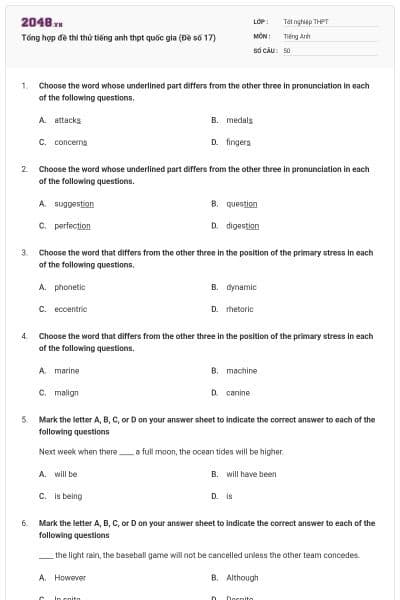
Choose the word whose underlined part differs from the other three in pronunciation in each of the following questions.
attacks
medals
concerns
fingers
Answer A
Kỹ năng: Từ Vựng
Giải thích:
A. attacks/əˈtæks/
B. medals/ˈmed.əlz/
C. concerns/kənˈsɜːnz/
D. fingers/ˈfɪŋ.ɡərz/
Choose the word whose underlined part differs from the other three in pronunciation in each of the following questions.
suggestion
question
perfection
digestion
Answer C
Kỹ năng: Từ Vựng
Giải thích:
A. suggestion/səˈdʒes.tʃən/
B. question/ˈkwes.tʃən/
C. perfection/pəˈfek.ʃən/
D. digestion/daɪˈdʒes.tʃən/
Choose the word that differs from the other three in the position of the primary stress in each of the following questions.
phonetic
dynamic
eccentric
rhetoric
Answer D
Kỹ năng: Trọng âm
Giải thích:
A. phonetic/fəˈnet.ɪk/
B. dynamic/daɪˈnæm.ɪk/
C. eccentric/ɪkˈsen.trɪk/
D. rhetoric/ˈret.ər.ɪk/
Choose the word that differs from the other three in the position of the primary stress in each of the following questions.
marine
machine
malign
canine
Answer D
Kỹ năng: Trọng âm
Giải thích:
A. marine/məˈriːn/
B. machine/məˈʃiːn/
C. malign/məˈlaɪn/
D. canine/ˈkeɪ.naɪn/
Mark the letter A, B, C, or D on your answer sheet to indicate the correct answer to each of the following questions
Next week when there ____ a full moon, the ocean tides will be higher.
will be
will have been
is being
is
Answer D
Kỹ năng: Ngữ pháp
Giải thích:
When + HĐT/ HTHT, TLĐ/ TLHT.
Chú ý: Không dùng thì tương lai trong mệnh đề trạng ngữ chỉ thời gian
Mark the letter A, B, C, or D on your answer sheet to indicate the correct answer to each of the following questions
____ the light rain, the baseball game will not be cancelled unless the other team concedes.
However
Although
In spite
Despite
Answer D
Kỹ năng: Ngữ pháp
Giải thích:
Phía sau chỗ cần điền là danh từ “the light rain”
=> Dùng Despite
Although + mệnh đề: Mặc dù
However khi đứng đầu câu thì sau nó phải có dấu phẩy.
Mark the letter A, B, C, or D on your answer sheet to indicate the correct answer to each of the following questions
The explosion was of such ____ that it was heard five miles away.
intensiveness
intensity
intense
intensification
Answer B
Kỹ năng: Ngữ pháp
Giải thích:
Chỗ trống đang cần một danh từ
intensity (n): cường độ mạnh, dữ dội
intensiveness (n): tính chuyên sâu (ít dùng)
intense (adj): mạnh mẽ, sâu sắc
intensification (n): sự làm cho mãnh liệt

Học thông minh hơn mỗi ngày
Xem toàn bộ 50 câu hỏi và nhiều hơn nữa với tài khoản miễn phí
Mark the letter A, B, C, or D on your answer sheet to indicate the correct answer to each of the following questions
The crew worked so hard; they finished the entire project three days ____ of schedule.
forward
onward
ahead
atop
Answer C
Kỹ năng: Ngữ pháp
Giải thích:
Cụm: ahead of schedule: sớm, trước hạn
Mark the letter A, B, C, or D on your answer sheet to indicate the correct answer to each of the following questions
My director is angry with me. I didn’t do all the work I ____ last week.
should have done
may have done
needn’t have done
must have done
Answer A
Kỹ năng: Ngữ pháp
Giải thích:
should have PII: lẽ ra nên đã làm gì (nhưng không làm)
may have PII: có lẽ đã làm gì
needn’t have PII: lẽ ra không cần thiết phải làm (nhưng đã làm)
must have PII: chắc chắn đã làm gì
Mark the letter A, B, C, or D on your answer sheet to indicate the correct answer to each of the following questions
The steak looked tender, but it was as tough as ____.
a belt
a saddle
old boots
rubber
Answer C
Kỹ năng: Ngữ pháp
Giải thích:
as tough as old boots = as tough as shoe leather: rất cứng, khó ăn
Mark the letter A, B, C, or D on your answer sheet to indicate the correct answer to each of the following questions
On hearing the news she fainted and it was half an hour before she ____ again.
came up
came round
came over
came forward
Đáp án: B
Giải thích:
Kiến thức: Cụm động từ
A. came up: xảy ra
B. came round: tỉnh lại, hồi tỉnh
C. came over: đột nhiên cảm thấy
D. came up with: này ra, nghĩ ra
Dựa vào nghĩa, chọn B.
Dịch: Khi nghe tin, cô ta đã ngất và mãi đến nửa tiếng sau cô ấy mới hồi tỉnh.
Mark the letter A, B, C, or D on your answer sheet to indicate the correct answer to each of the following questions
His lack of qualifications was taken as a sign of a ____ youth.
misused
misbehaved
misspent
mistaken
Answer C
Giải thích:
misused: lạm dụng, dùng sai
misbehaved: cư xử không đứng đắn
misspent: phí hoài, uổng phí
mistaken: hiểu lầm.
Mark the letter A, B, C, or D on your answer sheet to indicate the correct answer to each of the following questions
Michael looked upset and surprised when ____ by his mother today.
scolding
to scold
having scolded
scolded
Answer D
Kỹ năng: Ngữ pháp
Giải thích:
Rút gọn mệnh đề khi 2 mệnh đề đồng chủ ngữ
Mệnh đề phụ mang nghĩa chủ động
=> V – ing
Mệnh đề phụ mang nghĩa bị động
=> PII
Mark the letter A, B, C, or D on your answer sheet to indicate the correct answer to each of the following questions
She came in covered in mud, so I bathed her and ____ her in new clothes.
wearing
put
wore
dressed
Answer D
Kỹ năng: Ngữ pháp
Giải thích:
dress sb in sth: mặc đồ cho ai
Mark the letter A, B, C, or D on your answer sheet to indicate the correct answer to each of the following questions
Our father suggested ______ to Da Nang for this summer holiday.
to going
going
go
to go
Answer B
Kỹ năng: Ngữ pháp
Giải thích:
S + suggest + V – ing: Gợi ý làm gì
Mark the letter A, B, C, or D on your answer sheet to indicate the correct answer to each of the following questions
____ she was under the weather, I wouldn’t have asked her to join us.
If had I known
If I knew
If I hadn’t known
Had I known
Answer D
Kỹ năng: Ngữ pháp
Giải thích:
Đây là dạng câu điều kiện loại 3
=> Loại A và B
C. Không phù hợp về nghĩa
D. Dạng đảo ngữ câu ĐKL3
Had + S + PII, S + would have PII
Mark the letter A, B, C, or D on your answer sheet to indicate the correct answer to each of the following questions
____ of the hundred members of the club was given a souvenir.
All
Each
Either
Neither
Answer B
Kỹ năng: Ngữ pháp
Giải thích:
Động từ chính trong câu là “was given”
= > Loại A
Either / Neither + of + the + N+ V số ít
Each + of + the + N + V số ít
Tuy nhiên, either và neither chỉ dùng cho 2 đối tượng.
Mark the letter A, B, C, or D on your answer sheet to indicate the correct answer to each of the following questions
Marie Curie was the first and only woman ____ two Nobel Prizes.
who win
that wins
to have won
to be won
Đáp án: C
Giải thích:
Cấu trúc the first / the only + to V diễn tả người đầu tiên hoặc duy nhất làm điều gì đó.
Ở đây, Marie Curie was the first and only woman → cần động từ nguyên mẫu hoàn thành (to have won) để diễn tả hành động đã xảy ra trong quá khứ.
A. who win → who win sai ngữ pháp, vì "who" thay cho "woman" số ít, động từ phải chia "wins"
B. that wins → sai thì, vì Marie Curie đã giành giải trong quá khứ
C. to have won → cấu trúc đúng, diễn tả hành động hoàn thành trong quá khứ
D. to be won → to be won là dạng bị động, không phù hợp
Dịch: Marie Curie là người phụ nữ đầu tiên và duy nhất giành hai giải Nobel.
Choose the word(s) CLOSEST in meaning to the underlined word(s) in each of the following questions
In the 1980s TV viewers began to hook up videocassette players to their TVs.
combine
connect
fasten
blend
Answer B
Kỹ năng: Đồng/trái nghĩa
Giải thích:
hook up = connect: kết nối
combine: kết hợp
fasten: buộc chặt, thắt
blend: pha trộn
Choose the word(s) CLOSEST in meaning to the underlined word(s) in each of the following questions
The police have not had time to complete their investigations, but they have concluded tentatively that the explosion was caused by a bomb.
temporally
intentionally
certainly
hesitantly
Đáp án: D
Giải thích:
Kiến thức: Từ vựng – Từ đồng nghĩa
tentatively (adv): không chắc chắn
Xét các đáp án:
A. temporally (adv): tạm thời
B. intentionally (adv): cố ý
C. certainly (adv): chắc chắn
D. hesitantly (adv): ngập ngừng, chưa chắc chắn
=> tentatively = hesitantly
Dịch: Cảnh sát chưa có thời gian để hoàn tất cuộc điều tra nhưng họ kết luận chưa chắc chắn rằng vụ nổ là do bom gây ra.
Choose the word(s) OPPOSITE in meaning to the underlined word(s) in each of the following questions.
Humans can use language deceptivelyby telling lies or half-truths.
in an honest way
in a dishonest way
for a serious purpose
at the wrong time
Answer A
Kỹ năng: Đồng/trái nghĩa
Giải thích:
deceptively: một cách dối trá, dễ nhầm lần>< in an honest way: một cách thật thà
Choose the word(s) OPPOSITE in meaning to the underlined word(s) in each of the following questions.
Tired of being a tiny cog in a vast machine, he handed in his resignation.
an important person
a large piece of equipment
a small group of people
a significant instrument
Đáp án A
Giải thích:
A. an unimportant person: một người quan trọng
B. a large piece of equipment: một thiết bị lớn
C. a small group of people: một nhóm người nhỏ
D. a significant instrument: một công cụ quan trọng
→ a tiny cog in a vast machine: một phần nhỏ, kém quan trọng trong một tổ chức lớn >< an important person
Dịch: Quá mệt mỏi vì chỉ đóng vai trò là một phần rất nhỏ trong công ty, ông ấy đã nộp đơn từ chức.
Choose the option that best completes each of the following exchanges
Ben: “You didn’t go to school yesterday, did you?”
Jasmine: “______. I saw you, but you were talking to someone”
No, I didn’t
Yes, I didn’t
Let me see
I went
Answer D
Kỹ năng: Dịch
Giải thích:
Ben: “Hôm qua, cậu không đi học phải không?”
Jasamine: “Tớ có đi. Tớ đã nhìn thấy cậu, nhưng cậu đang nói chuyệnvới ai đó.”
A. Không, tớ đã không đi
B. Sai cấu trúc
C. Để xem nào
Choose the option that best completes each of the following exchanges
Mother: “How come you didn’t tell me that you would quit your job?”
Lisa: “__________.”
I’d love to tell you now
Because I knew that you would make a fuss about it
I have no idea
Because I’m so bored with it
Answer B
Kỹ năng: Dịch
Giải thích:
Mẹ: “Sao con có thể không nói với mẹ rằng con bỏ việc?”
Lisa: Bởi vì con biết là mẹ sẽ làm ầm lên
A. Con muốn nói với mẹ bây giờ.
C. Con không biết.
D. Bởi vì con chán chuyện đấy rồi
Read the following passage and choose the correct word or phrase that best fits each of the blanks. Fill in the appropriate word in question 25
Education is more important today than ever before. It helps people acquire the skills they need for such everyday (25) _______ as reading a newspaper or managing their money. It also gives them the specialized training they may need to (26) _______ for a job or career. For example, a person must meet certain educational requirements and obtain a license or certificate before he can practice law or medicine. Many fields, like computer operation or police work, (27) _______ satisfactory completion of special training courses.
Education is also important because it helps people get more out of life. It increases their knowledge and understanding of the world. It helps them acquire the skills that make life more interesting and enjoyable, such as the skills needed to participate in a sport, paint a picture, or play a musical (28) _______. Such education becomes increasing important as people gain more and more leisure time. Education also helps people adjust to change. This habit has become necessary because social changes today take place with increasing speed and affect the lives of more and more people. Education can help a person understand these changes and provide him (29) _______ the skills for adjusting to them.
works
jobs
actions
activities
Answer D
Kỹ năng: Đọc
Giải thích:
everyday activity: hoạt động thường nhật
Read the following passage and choose the correct word or phrase that best fits each of the blanks. Fill in the appropriate word in question 26
Education is more important today than ever before. It helps people acquire the skills they need for such everyday (25) _______ as reading a newspaper or managing their money. It also gives them the specialized training they may need to (26) _______ for a job or career. For example, a person must meet certain educational requirements and obtain a license or certificate before he can practice law or medicine. Many fields, like computer operation or police work, (27) _______ satisfactory completion of special training courses.
Education is also important because it helps people get more out of life. It increases their knowledge and understanding of the world. It helps them acquire the skills that make life more interesting and enjoyable, such as the skills needed to participate in a sport, paint a picture, or play a musical (28) _______. Such education becomes increasing important as people gain more and more leisure time. Education also helps people adjust to change. This habit has become necessary because social changes today take place with increasing speed and affect the lives of more and more people. Education can help a person understand these changes and provide him (29) _______ the skills for adjusting to them.
do
prepare
make
work
Answer B
Kỹ năng: Đọc
Giải thích:
to prepare for sth: chuẩn bị ch
Read the following passage and choose the correct word or phrase that best fits each of the blanks. Fill in the appropriate word in question 27
Education is more important today than ever before. It helps people acquire the skills they need for such everyday (25) _______ as reading a newspaper or managing their money. It also gives them the specialized training they may need to (26) _______ for a job or career. For example, a person must meet certain educational requirements and obtain a license or certificate before he can practice law or medicine. Many fields, like computer operation or police work, (27) _______ satisfactory completion of special training courses.
Education is also important because it helps people get more out of life. It increases their knowledge and understanding of the world. It helps them acquire the skills that make life more interesting and enjoyable, such as the skills needed to participate in a sport, paint a picture, or play a musical (28) _______. Such education becomes increasing important as people gain more and more leisure time. Education also helps people adjust to change. This habit has become necessary because social changes today take place with increasing speed and affect the lives of more and more people. Education can help a person understand these changes and provide him (29) _______ the skills for adjusting to them.
requires
requiring
require
to require
Answer C
Kỹ năng: Đọc
Giải thích:
Với chủ ngữ “many fields”, ta dùng động từ ở dạng nguyên thể
Read the following passage and choose the correct word or phrase that best fits each of the blanks. Fill in the appropriate word in question 33
Education is more important today than ever before. It helps people acquire the skills they need for such everyday (25) _______ as reading a newspaper or managing their money. It also gives them the specialized training they may need to (26) _______ for a job or career. For example, a person must meet certain educational requirements and obtain a license or certificate before he can practice law or medicine. Many fields, like computer operation or police work, (27) _______ satisfactory completion of special training courses.
Education is also important because it helps people get more out of life. It increases their knowledge and understanding of the world. It helps them acquire the skills that make life more interesting and enjoyable, such as the skills needed to participate in a sport, paint a picture, or play a musical (28) _______. Such education becomes increasing important as people gain more and more leisure time. Education also helps people adjust to change. This habit has become necessary because social changes today take place with increasing speed and affect the lives of more and more people. Education can help a person understand these changes and provide him (29) _______ the skills for adjusting to them.
appliance
equipment
instrument
device
Answer C
Kỹ năng: Đọc
Giải thích:
musical instrument: dụng cụ âm nhạc
Read the following passage and choose the correct word or phrase that best fits each of the blanks. Fill in the appropriate word in question 33
Education is more important today than ever before. It helps people acquire the skills they need for such everyday (25) _______ as reading a newspaper or managing their money. It also gives them the specialized training they may need to (26) _______ for a job or career. For example, a person must meet certain educational requirements and obtain a license or certificate before he can practice law or medicine. Many fields, like computer operation or police work, (27) _______ satisfactory completion of special training courses.
Education is also important because it helps people get more out of life. It increases their knowledge and understanding of the world. It helps them acquire the skills that make life more interesting and enjoyable, such as the skills needed to participate in a sport, paint a picture, or play a musical (28) _______. Such education becomes increasing important as people gain more and more leisure time. Education also helps people adjust to change. This habit has become necessary because social changes today take place with increasing speed and affect the lives of more and more people. Education can help a person understand these changes and provide him (29) _______ the skills for adjusting to them.
with
for
in
to
Answer A
Kỹ năng: Đọc
Giải thích:
To provide sb with sth: cung cấp cho ai cái gì
Read the following passage choose the correct answer to each of the question.
Around 365 B.C. in ancient Greece, the great teacher Plato told a story about a place called Atlantis. Plato described Atlantis as a continent in the Atlantic Ocean. He said it had been the home of a powerful people who were destroyed when the continent was swallowed by the sea.
Ever since Plato’s time, people have wondered if the story about Atlantis was really true. Was there ever such a place as Atlantis? During the Middle Ages, many people believed in the legend of Atlantis. Some men even made voyages to find the “lost continent”. Later, most people believed Atlantis to be just a myth. Scientists could find no evidence to show that such a place had ever existed.
Ideas change in time, however, for now some scientists think that Atlantis might have been a real place. A Greek professor has offered a new theory. He says that Atlantis was not a continent in the Atlantic Ocean but an island called Thera in the Aegean Sea. The professor says that 3,500 years ago much of Thera collapsed into the sea when a volcano erupted. He thinks that before the explosion Thera had been the home of a people called Minoans. The Minoans were sea traders who ruled the Aegean Sea from 2,000 B.C. to 1,250 B.C.
Scientist who have come to investigate Thera have found an ancient city buried beneath volcanic ash and stone. It appears that the people who lived in the city had an advanced civilization. They were probably Minoans.
Is Thera the “lost continent” of Atlantis? No one may ever know for certain. Atlantis may remain a riddle without an answer.
According to Plato, Atlantis was in the ____.
Atlantic Ocean
Pacific Ocean
Red Ocean
Aegean Sea
Answer A
Kỹ năng: Đọc
Giải thích:
Thông tin ở “Plato described Atlantis as a continent in the Atlantic Ocean.”
Read the following passage choose the correct answer to each of the question.
Around 365 B.C. in ancient Greece, the great teacher Plato told a story about a place called Atlantis. Plato described Atlantis as a continent in the Atlantic Ocean. He said it had been the home of a powerful people who were destroyed when the continent was swallowed by the sea.
Ever since Plato’s time, people have wondered if the story about Atlantis was really true. Was there ever such a place as Atlantis? During the Middle Ages, many people believed in the legend of Atlantis. Some men even made voyages to find the “lost continent”. Later, most people believed Atlantis to be just a myth. Scientists could find no evidence to show that such a place had ever existed.
Ideas change in time, however, for now some scientists think that Atlantis might have been a real place. A Greek professor has offered a new theory. He says that Atlantis was not a continent in the Atlantic Ocean but an island called Thera in the Aegean Sea. The professor says that 3,500 years ago much of Thera collapsed into the sea when a volcano erupted. He thinks that before the explosion Thera had been the home of a people called Minoans. The Minoans were sea traders who ruled the Aegean Sea from 2,000 B.C. to 1,250 B.C.
Scientist who have come to investigate Thera have found an ancient city buried beneath volcanic ash and stone. It appears that the people who lived in the city had an advanced civilization. They were probably Minoans.
Is Thera the “lost continent” of Atlantis? No one may ever know for certain. Atlantis may remain a riddle without an answer.
The word in paragraph 3 that means “fell down” is ____.
collapsed
existed
erupted
rode
Answer A
Kỹ năng: Đọc
Giải thích:
Thông tin ở “The professor says that 3,500 years ago much of Thera collapsed into the sea when a volcano erupted.”
=> collapsed = fell down: sụp đổ, rơi xuống
Read the following passage choose the correct answer to each of the question.
Around 365 B.C. in ancient Greece, the great teacher Plato told a story about a place called Atlantis. Plato described Atlantis as a continent in the Atlantic Ocean. He said it had been the home of a powerful people who were destroyed when the continent was swallowed by the sea.
Ever since Plato’s time, people have wondered if the story about Atlantis was really true. Was there ever such a place as Atlantis? During the Middle Ages, many people believed in the legend of Atlantis. Some men even made voyages to find the “lost continent”. Later, most people believed Atlantis to be just a myth. Scientists could find no evidence to show that such a place had ever existed.
Ideas change in time, however, for now some scientists think that Atlantis might have been a real place. A Greek professor has offered a new theory. He says that Atlantis was not a continent in the Atlantic Ocean but an island called Thera in the Aegean Sea. The professor says that 3,500 years ago much of Thera collapsed into the sea when a volcano erupted. He thinks that before the explosion Thera had been the home of a people called Minoans. The Minoans were sea traders who ruled the Aegean Sea from 2,000 B.C. to 1,250 B.C.
Scientist who have come to investigate Thera have found an ancient city buried beneath volcanic ash and stone. It appears that the people who lived in the city had an advanced civilization. They were probably Minoans.
Is Thera the “lost continent” of Atlantis? No one may ever know for certain. Atlantis may remain a riddle without an answer.
A lot of people in the Middle Ages ____.
thought that Atlantis was only a myth
found some evidence about the “lost continent”
made voyage to visit Atlantis
believed in the existence of Atlantis
Answer D
Kỹ năng: Đọc
Giải thích:
Thông tin ở “During the Middle Ages, many people believed in the legend of Atlantis. Some men even made voyages to find the “lost continent”.”
Read the following passage choose the correct answer to each of the question.
Around 365 B.C. in ancient Greece, the great teacher Plato told a story about a place called Atlantis. Plato described Atlantis as a continent in the Atlantic Ocean. He said it had been the home of a powerful people who were destroyed when the continent was swallowed by the sea.
Ever since Plato’s time, people have wondered if the story about Atlantis was really true. Was there ever such a place as Atlantis? During the Middle Ages, many people believed in the legend of Atlantis. Some men even made voyages to find the “lost continent”. Later, most people believed Atlantis to be just a myth. Scientists could find no evidence to show that such a place had ever existed.
Ideas change in time, however, for now some scientists think that Atlantis might have been a real place. A Greek professor has offered a new theory. He says that Atlantis was not a continent in the Atlantic Ocean but an island called Thera in the Aegean Sea. The professor says that 3,500 years ago much of Thera collapsed into the sea when a volcano erupted. He thinks that before the explosion Thera had been the home of a people called Minoans. The Minoans were sea traders who ruled the Aegean Sea from 2,000 B.C. to 1,250 B.C.
Scientist who have come to investigate Thera have found an ancient city buried beneath volcanic ash and stone. It appears that the people who lived in the city had an advanced civilization. They were probably Minoans.
Is Thera the “lost continent” of Atlantis? No one may ever know for certain. Atlantis may remain a riddle without an answer.
Who were the ancient Minoans?
scientists
sea traders
teachers
Greek professors
Answer B
Kỹ năng: Đọc
Giải thích:
Thông tin ở “The Minoans were sea traders who ruled the Aegean Sea from 2,000 B.C. to 1,250 B.C.”
Read the following passage choose the correct answer to each of the question.
Around 365 B.C. in ancient Greece, the great teacher Plato told a story about a place called Atlantis. Plato described Atlantis as a continent in the Atlantic Ocean. He said it had been the home of a powerful people who were destroyed when the continent was swallowed by the sea.
Ever since Plato’s time, people have wondered if the story about Atlantis was really true. Was there ever such a place as Atlantis? During the Middle Ages, many people believed in the legend of Atlantis. Some men even made voyages to find the “lost continent”. Later, most people believed Atlantis to be just a myth. Scientists could find no evidence to show that such a place had ever existed.
Ideas change in time, however, for now some scientists think that Atlantis might have been a real place. A Greek professor has offered a new theory. He says that Atlantis was not a continent in the Atlantic Ocean but an island called Thera in the Aegean Sea. The professor says that 3,500 years ago much of Thera collapsed into the sea when a volcano erupted. He thinks that before the explosion Thera had been the home of a people called Minoans. The Minoans were sea traders who ruled the Aegean Sea from 2,000 B.C. to 1,250 B.C.
Scientist who have come to investigate Thera have found an ancient city buried beneath volcanic ash and stone. It appears that the people who lived in the city had an advanced civilization. They were probably Minoans.
Is Thera the “lost continent” of Atlantis? No one may ever know for certain. Atlantis may remain a riddle without an answer.
Which statement seems true for the passage?
Plato was a Greek teacher who lived in Atlantis.
There are different theories about Atlantis.
There are no different theories about Atlantis.
Everyone knows where the lost continent is.
Answer C
Kỹ năng: Đọc
Giải thích:
Đoạn văn đề cập tới một số giả thuyết về Atlantis, từ giả thuyết của Plato cho tới giả thuyết của giáo sư người Hy Lạp
Read the following passage and choose the correct answer to each of the questions.
It is hard to get any agreement on the precise meaning of the term “social class”. In everyday life, people tend to have a different approach to those they consider their equals from that which they assume with people they consider higher or lower than themselves in the social scale. The criteria we use to “place” a new acquaintance; however, are a complex mixture of factors. Dress, way of speaking, area of residence in a given city or province, education and manners all play a part.
In Greece, after the sixth-century B.C., there was a growing conflict between the peasants and the landed aristocrats, and a gradual decrease in the power of the aristocracy when a kind of “middle class” of traders and skilled workers grew up. The population of Athens, for example, was divided into three main classes which were politically and legally distinct. About one-third of the total were slaves, who did not count politically at all, a fact often forgotten by those who praise Athens as the nursery of democracy. The next main group consisted of resident foreigners, the “metics”, who were freemen, though they too were allowed no share in political life. The third group was the powerful body of “citizens”, who were themselves divided into sub-classes.
The medieval feudal system, which flourished in Europe from the ninth to the thirteenth century, gave rise to a comparatively simple system based on birth. Under the King, there were two main classes - lords and “vassals”, the latter with many subdivisions.
In the later Middle Ages; however, the development of a money economy and the growth of cities and trade led to the rise of another class, the “burghers” or city merchants and mayors. These were the predecessors of the modern middle class. Gradually high office and occupation assumed importance in determining social position, as it became more and more possible for a person born to one station in life to move to another. This change affected the town more than the country areas, where remnants of feudalism lasted much longer.
According to the passage, people evaluate others’ position by which following factors EXCEPT ____.
the place they live
the job they do
their dress
the way in which they behave towards other people
Answer B
Kỹ năng: Đọc
Giải thích:
Thông tin ở “Dress, way of speaking, area of residence in a given city or province, education and manners all play a part.”
Read the following passage and choose the correct answer to each of the questions.
It is hard to get any agreement on the precise meaning of the term “social class”. In everyday life, people tend to have a different approach to those they consider their equals from that which they assume with people they consider higher or lower than themselves in the social scale. The criteria we use to “place” a new acquaintance; however, are a complex mixture of factors. Dress, way of speaking, area of residence in a given city or province, education and manners all play a part.
In Greece, after the sixth-century B.C., there was a growing conflict between the peasants and the landed aristocrats, and a gradual decrease in the power of the aristocracy when a kind of “middle class” of traders and skilled workers grew up. The population of Athens, for example, was divided into three main classes which were politically and legally distinct. About one-third of the total were slaves, who did not count politically at all, a fact often forgotten by those who praise Athens as the nursery of democracy. The next main group consisted of resident foreigners, the “metics”, who were freemen, though they too were allowed no share in political life. The third group was the powerful body of “citizens”, who were themselves divided into sub-classes.
The medieval feudal system, which flourished in Europe from the ninth to the thirteenth century, gave rise to a comparatively simple system based on birth. Under the King, there were two main classes - lords and “vassals”, the latter with many subdivisions.
In the later Middle Ages; however, the development of a money economy and the growth of cities and trade led to the rise of another class, the “burghers” or city merchants and mayors. These were the predecessors of the modern middle class. Gradually high office and occupation assumed importance in determining social position, as it became more and more possible for a person born to one station in life to move to another. This change affected the town more than the country areas, where remnants of feudalism lasted much longer.
The author implies that slaves in Greece in the sixth century B.C. ____.
were not allowed to count votes at elections
were not politically significant
controlled one-third of the democratic votes
were kept ignorant as a political measure
Answer B
Kỹ năng: Đọc
Giải thích:
Thông tin ở “About one-third of the total were slaves, who did not count politically at all.”
Read the following passage and choose the correct answer to each of the questions.
It is hard to get any agreement on the precise meaning of the term “social class”. In everyday life, people tend to have a different approach to those they consider their equals from that which they assume with people they consider higher or lower than themselves in the social scale. The criteria we use to “place” a new acquaintance; however, are a complex mixture of factors. Dress, way of speaking, area of residence in a given city or province, education and manners all play a part.
In Greece, after the sixth-century B.C., there was a growing conflict between the peasants and the landed aristocrats, and a gradual decrease in the power of the aristocracy when a kind of “middle class” of traders and skilled workers grew up. The population of Athens, for example, was divided into three main classes which were politically and legally distinct. About one-third of the total were slaves, who did not count politically at all, a fact often forgotten by those who praise Athens as the nursery of democracy. The next main group consisted of resident foreigners, the “metics”, who were freemen, though they too were allowed no share in political life. The third group was the powerful body of “citizens”, who were themselves divided into sub-classes.
The medieval feudal system, which flourished in Europe from the ninth to the thirteenth century, gave rise to a comparatively simple system based on birth. Under the King, there were two main classes - lords and “vassals”, the latter with many subdivisions.
In the later Middle Ages; however, the development of a money economy and the growth of cities and trade led to the rise of another class, the “burghers” or city merchants and mayors. These were the predecessors of the modern middle class. Gradually high office and occupation assumed importance in determining social position, as it became more and more possible for a person born to one station in life to move to another. This change affected the town more than the country areas, where remnants of feudalism lasted much longer.
The word “remnants” in the fourth paragraph is closest in meaning to ____.
opponents
remains
torn clothing
garments
Answer B
Kỹ năng: Đọc
Giải thích:
nants = remains: những thứ còn sót lại
opponent: đối thủ
torn clothing: quần áo rách
garment: áo quần
Read the following passage and choose the correct answer to each of the questions.
It is hard to get any agreement on the precise meaning of the term “social class”. In everyday life, people tend to have a different approach to those they consider their equals from that which they assume with people they consider higher or lower than themselves in the social scale. The criteria we use to “place” a new acquaintance; however, are a complex mixture of factors. Dress, way of speaking, area of residence in a given city or province, education and manners all play a part.
In Greece, after the sixth-century B.C., there was a growing conflict between the peasants and the landed aristocrats, and a gradual decrease in the power of the aristocracy when a kind of “middle class” of traders and skilled workers grew up. The population of Athens, for example, was divided into three main classes which were politically and legally distinct. About one-third of the total were slaves, who did not count politically at all, a fact often forgotten by those who praise Athens as the nursery of democracy. The next main group consisted of resident foreigners, the “metics”, who were freemen, though they too were allowed no share in political life. The third group was the powerful body of “citizens”, who were themselves divided into sub-classes.
The medieval feudal system, which flourished in Europe from the ninth to the thirteenth century, gave rise to a comparatively simple system based on birth. Under the King, there were two main classes - lords and “vassals”, the latter with many subdivisions.
In the later Middle Ages; however, the development of a money economy and the growth of cities and trade led to the rise of another class, the “burghers” or city merchants and mayors. These were the predecessors of the modern middle class. Gradually high office and occupation assumed importance in determining social position, as it became more and more possible for a person born to one station in life to move to another. This change affected the town more than the country areas, where remnants of feudalism lasted much longer.
It can be indicated from the passage that the decline of the Greek aristocracy’s power in the sixth century B.C. ____.
caused international conflict in the area
lasted for only a short time
was assisted by a rise in the number of slaves
coincided with the rise of a new “middle class” of traders and peasants
Answer D
Kỹ năng: Đọc
Giải thích:
Thông tin ở “In Greece, after the sixth-century B.C., there was a growing conflict between the peasants and the landed aristocrats, and a gradual decrease in the power of the aristocracy when a kind of “middle class” of traders and skilled workers grew up.”
Read the following passage and choose the correct answer to each of the questions.
It is hard to get any agreement on the precise meaning of the term “social class”. In everyday life, people tend to have a different approach to those they consider their equals from that which they assume with people they consider higher or lower than themselves in the social scale. The criteria we use to “place” a new acquaintance; however, are a complex mixture of factors. Dress, way of speaking, area of residence in a given city or province, education and manners all play a part.
In Greece, after the sixth-century B.C., there was a growing conflict between the peasants and the landed aristocrats, and a gradual decrease in the power of the aristocracy when a kind of “middle class” of traders and skilled workers grew up. The population of Athens, for example, was divided into three main classes which were politically and legally distinct. About one-third of the total were slaves, who did not count politically at all, a fact often forgotten by those who praise Athens as the nursery of democracy. The next main group consisted of resident foreigners, the “metics”, who were freemen, though they too were allowed no share in political life. The third group was the powerful body of “citizens”, who were themselves divided into sub-classes.
The medieval feudal system, which flourished in Europe from the ninth to the thirteenth century, gave rise to a comparatively simple system based on birth. Under the King, there were two main classes - lords and “vassals”, the latter with many subdivisions.
In the later Middle Ages; however, the development of a money economy and the growth of cities and trade led to the rise of another class, the “burghers” or city merchants and mayors. These were the predecessors of the modern middle class. Gradually high office and occupation assumed importance in determining social position, as it became more and more possible for a person born to one station in life to move to another. This change affected the town more than the country areas, where remnants of feudalism lasted much longer.
The word “they” in the second paragraph refers to ____.
freeman
slaves
metics
citizens
Answer C
Kỹ năng: Đọc
Giải thích:
Thông tin ở “The next main group consisted of resident foreigners, the “metics”, who were freemen, though they too were allowed no share in political life.”
=> They = metics
Read the following passage and choose the correct answer to each of the questions.
It is hard to get any agreement on the precise meaning of the term “social class”. In everyday life, people tend to have a different approach to those they consider their equals from that which they assume with people they consider higher or lower than themselves in the social scale. The criteria we use to “place” a new acquaintance; however, are a complex mixture of factors. Dress, way of speaking, area of residence in a given city or province, education and manners all play a part.
In Greece, after the sixth-century B.C., there was a growing conflict between the peasants and the landed aristocrats, and a gradual decrease in the power of the aristocracy when a kind of “middle class” of traders and skilled workers grew up. The population of Athens, for example, was divided into three main classes which were politically and legally distinct. About one-third of the total were slaves, who did not count politically at all, a fact often forgotten by those who praise Athens as the nursery of democracy. The next main group consisted of resident foreigners, the “metics”, who were freemen, though they too were allowed no share in political life. The third group was the powerful body of “citizens”, who were themselves divided into sub-classes.
The medieval feudal system, which flourished in Europe from the ninth to the thirteenth century, gave rise to a comparatively simple system based on birth. Under the King, there were two main classes - lords and “vassals”, the latter with many subdivisions.
In the later Middle Ages; however, the development of a money economy and the growth of cities and trade led to the rise of another class, the “burghers” or city merchants and mayors. These were the predecessors of the modern middle class. Gradually high office and occupation assumed importance in determining social position, as it became more and more possible for a person born to one station in life to move to another. This change affected the town more than the country areas, where remnants of feudalism lasted much longer.
The author implies that Athens is often praised as the nursery of democracy ____.
because even very young children could vote
in spite of its heavy independence on slave labor
even though slaves were allowed to vote
because its three main classes were politically and legally distinct
Answer B
Kỹ năng: Đọc
Giải thích:
Thông tin ở “About one-third of the total population were slaves, who did not count politically at
all, a fact often forgotten by those who praise Athens as the nursery of democracy.”
Read the following passage and choose the correct answer to each of the questions.
It is hard to get any agreement on the precise meaning of the term “social class”. In everyday life, people tend to have a different approach to those they consider their equals from that which they assume with people they consider higher or lower than themselves in the social scale. The criteria we use to “place” a new acquaintance; however, are a complex mixture of factors. Dress, way of speaking, area of residence in a given city or province, education and manners all play a part.
In Greece, after the sixth-century B.C., there was a growing conflict between the peasants and the landed aristocrats, and a gradual decrease in the power of the aristocracy when a kind of “middle class” of traders and skilled workers grew up. The population of Athens, for example, was divided into three main classes which were politically and legally distinct. About one-third of the total were slaves, who did not count politically at all, a fact often forgotten by those who praise Athens as the nursery of democracy. The next main group consisted of resident foreigners, the “metics”, who were freemen, though they too were allowed no share in political life. The third group was the powerful body of “citizens”, who were themselves divided into sub-classes.
The medieval feudal system, which flourished in Europe from the ninth to the thirteenth century, gave rise to a comparatively simple system based on birth. Under the King, there were two main classes - lords and “vassals”, the latter with many subdivisions.
In the later Middle Ages; however, the development of a money economy and the growth of cities and trade led to the rise of another class, the “burghers” or city merchants and mayors. These were the predecessors of the modern middle class. Gradually high office and occupation assumed importance in determining social position, as it became more and more possible for a person born to one station in life to move to another. This change affected the town more than the country areas, where remnants of feudalism lasted much longer.
The word “predecessors” in the last paragraph is closest in meaning to
supporters
ancestors
descendants
authorities
Answer B
Kỹ năng: Đọc
Giải thích:
Thông tin ở “These were the predecessors of the modern middle class.”
=> predecessor = ancestor: tổ tiên
Read the following passage and choose the correct answer to each of the questions.
It is hard to get any agreement on the precise meaning of the term “social class”. In everyday life, people tend to have a different approach to those they consider their equals from that which they assume with people they consider higher or lower than themselves in the social scale. The criteria we use to “place” a new acquaintance; however, are a complex mixture of factors. Dress, way of speaking, area of residence in a given city or province, education and manners all play a part.
In Greece, after the sixth-century B.C., there was a growing conflict between the peasants and the landed aristocrats, and a gradual decrease in the power of the aristocracy when a kind of “middle class” of traders and skilled workers grew up. The population of Athens, for example, was divided into three main classes which were politically and legally distinct. About one-third of the total were slaves, who did not count politically at all, a fact often forgotten by those who praise Athens as the nursery of democracy. The next main group consisted of resident foreigners, the “metics”, who were freemen, though they too were allowed no share in political life. The third group was the powerful body of “citizens”, who were themselves divided into sub-classes.
The medieval feudal system, which flourished in Europe from the ninth to the thirteenth century, gave rise to a comparatively simple system based on birth. Under the King, there were two main classes - lords and “vassals”, the latter with many subdivisions.
In the later Middle Ages; however, the development of a money economy and the growth of cities and trade led to the rise of another class, the “burghers” or city merchants and mayors. These were the predecessors of the modern middle class. Gradually high office and occupation assumed importance in determining social position, as it became more and more possible for a person born to one station in life to move to another. This change affected the town more than the country areas, where remnants of feudalism lasted much longer.
The passage is mainly about
the human history
the modern society
the social life in ancient Greece
the division of social classes in the ancient world
Answer D
Kỹ năng: Đọc
Giải thích:
Toàn bài bàn về sự phân chia tầng lớp xã hội ở thế giới cổ đại
Choose the underlined part that needs correction in each of the following questions.
Developing new technologies are time-consuming and expensive.
Developing
technologies
are
time – consuming
Answer C
Kỹ năng: Dịch
Giải thích:
=> is
Chủ ngữ bắt đầu bằng V – ing hoặc To – V, động từ đều được chia số ít.
Choose the underlined part that needs correction in each of the following questions.
Excepting for the graduate students, everyone will have to take the tests on the same day.
Excepting for
graduate
will have to
the tests
Answer A
Kỹ năng: Dịch
Giải thích:
=> is
Chủ ngữ bắt đầu bằng V – ing hoặc To – V, động từ đều được chia số ít.
Choose the underlined part that needs correction in each of the following questions.
Don’t let that old rascal take you along with his clever talk – none of it is true.
Don’t let
take you along
clever talk
of it
Answer B
Kỹ năng: Dịch
Giải thích:
=> take you in
take sb in (phrV): lừa ai
Choose the sentence that is closest in meaning to each of the following questions.
Friendly though he may seem, he’s not to be trusted.
He’s too friendly to be trusted.
However he seems friendly, he’s not to be trusted.
He may have friends, but he’s not to be trusted.
However friendly he seems, he’s not to be trusted.
Đáp án: D
Giải thích:
Mặc dù có vẻ thân thiện nhưng anh ấy không đáng tin cậy.
Cấu trúc: Adj/adv + as/though + S + V, mệnh đề: mặc dù
A. Anh ấy quá thân thiện để có thể tin cậy được. → sai nghĩa.
Cấu trúc “too…to”: S + be/V + too + adj/adv + (for sb) + to V: quá…(cho ai) để…
B. Tuy anh ấy có vẻ thân thiện nhưng anh ấy không đáng tin cậy. → sai cấu trúc.
Cấu trúc: However + adj/ adv + S + V, mệnh đề: mặc dù
C. Anh ấy có thể có bạn bè, nhưng anh ấy không đáng tin cậy. → sai nghĩa.
D. Dù anh ấy có vẻ thân thiện đến mấy, anh ấy cũng không đáng tin cậy. → đúng.
Cấu trúc: However + adj/ adv + S + V, mệnh đề: mặc dù
= No matter how + adj/adv + S + V, mệnh đề: mặc dù
Dịch: Mặc dù có vẻ thân thiện nhưng anh ấy không đáng tin cậy.
= Dù anh ấy có vẻ thân thiện đến mấy, anh ấy cũng không đáng tin cậy.
Choose the sentence that is closest in meaning to each of the following questions.
“You’re always making terrible mistakes”, said the teacher.
The teacher asked his students why they always made terrible mistakes.
The teacher realized that his students always made terrible mistakes.
The teacher complained about his students making terrible mistakes.
The teacher made his students not always make terrible mistakes.
Answer C
Kỹ năng: Ngữ pháp
Giải thích:
Adj/ adv + as/ though + S + V, mệnh đề
= However + adj/ adv + S + V, mệnh đề
= No matter how + adj/ adv + S + V, mệnh đề
Mặc dù, dù, cho dù
Choose the sentence that is closest in meaning to each of the following questions.
When the unemployment rate is high, the crime rate is usually also high.
The unemployment rate and the crime rate are both higher.
The higher the unemployment rate is, the higher the crime rate is.
The unemployment rate is as high as the crime rate.
The high rate of unemployment depends on the high rate of crime.
Answer B
Kỹ năng: Ngữ pháp
Giải thích:
So sánh càng … càng
The + so sánh hơn, the + so sánh hơn
Choose the sentence that best combines each pair of sentences in the following questions.
All possible means have been used to prevent air pollution. The sky is still not clear.
Every possible means has been used to prevent air pollution, yet the sky is still misty.
The sky is still cloudy due to the fact that all possible means have been used to prevent air pollution.
To prevent air pollution, every possible means has been used, and so the sky is still not clear.
Every possible means has been used to prevent air pollution so that the sky can be clearer.
Answer A
Kỹ năng: Dịch
Giải thích:
Mọi phương án có thể đều được sử dụng để ngăn chặn ô nhiễm không khí. Bầu trời vẫn không sạch.
A. Mọi biện pháp khả thi đã được sử dụng để ngăn chặn ô nhiễm không khí, tuy nhiên bầu trời vẫn đục ngầu.
B. Bầu trời vẫn nhiều mây vì tất cả những biện pháp có thể đều đã được sử dụng để ngăn chặn ô nhiễm không khí.
C. Để chống ô nhiễm không khí, mọi biện pháp có thể đã được sử dụng, và vì thế bầu trời vẫn không sạch.
D. Mọi biện pháp khả thi đã được sử dụng để chống ô nhiễm không khí để bầu trời có thể trong lành hơn.
Choose the sentence that best combines each pair of sentences in the following questions.
She spent all her money. She even borrowed some from her father.
Not only did she spend all her money but she borrowed some from her father as well.
As soon as she borrowed some money from her father, she spent it all.
Not only did she spent all her money but also she borrowed some from her father.
Hardly had she borrowed some money from her father when she spent it all.
Answer A
Kỹ năng: Dịch
Giải thích:
Đảo ngữ với Not only
Not only + trợ từ + S + V, but also ……
=> Không chỉ tiêu sạch tiền, cô ta còn mượn thêm một ít từ cha.
Bạn có thích hoạt động này không?
Ý kiến của bạn sẽ giúp chúng tôi đề xuất nội dung phù hợp hơn.
Gợi ý cho bạn
![[Năm 2022] Đề thi thử môn Vật lí THPT Quốc gia có lời giải - Đề số 21](/_next/image?url=https%3A%2F%2Fvideo.vietjack.com%2Fupload%2Fimages%2Fvj-image%2Fimage-3izficdefgfoel0s9j8s-1786772791.jpg&w=3840&q=75)
![[Năm 2022] Đề thi thử môn Vật lí THPT Quốc gia có lời giải - Đề số 20](/_next/image?url=https%3A%2F%2Fvideo.vietjack.com%2Fupload%2Fimages%2Fvj-image%2Fimage-emy0gtcksawvorajezvv-1786772460.jpg&w=3840&q=75)
Tài liệu phổ biến Tốt nghiệp THPT
Tài liệu phổ biến Tiếng Anh