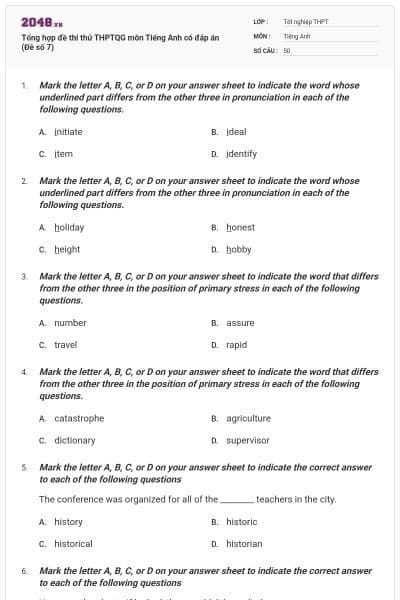
Tổng hợp đề thi thử THPTQG môn Tiếng Anh có đáp án (Đề số 7)
50 câu hỏi
Mark the letter A, B, C, or D on your answer sheet to indicate the word whose underlined part differs from the other three in pronunciation in each of the following questions.
initiate
ideal
item
identify
A. initiate /ɪˈnɪʃieɪt/
B. ideal /aɪˈdiːəl/
C. item /ˈaɪtəm/
D. identify /aɪˈdentɪfaɪ/
[i] trong phương án A được phát âm là /ɪ/, các phương án còn lại [i] phát âm là /aɪ/.
Chọn A
Mark the letter A, B, C, or D on your answer sheet to indicate the word whose underlined part differs from the other three in pronunciation in each of the following questions.
holiday
honest
height
hobby
A. holiday /ˈhɒlədeɪ/
B. honest /ˈɒnɪst/
C. height /haɪt/
D. hobby /ˈhɒbi/
[h] trong phương án B không được phát âm (âm câm), các phương án còn lại [h] được phát âm là /h/.
Chọn B
Mark the letter A, B, C, or D on your answer sheet to indicate the word that differs from the other three in the position of primary stress in each of the following questions.
number
assure
travel
rapid
A. number /ˈnʌmbə(r)/
B. assure /əˈʃʊə(r)/
C. travel /ˈtrævl/
D. rapid /ˈræpɪd/
Quy tắc:
Thông thường, 1 từ có 2 âm tiết vừa là danh từ, vừa là động từ thì trọng âm rơi vào âm tiết thứ 1.
Động từ 2 âm tiết bắt đầu bằng a- thì trọng âm rơi vào âm tiết thứ 2.
Tính từ có 2 âm tiết trọng âm thường rơi vào âm tiết thứ 1.
Phương án B trọng âm rơi vào âm tiết thứ 2, các phương án còn lại trọng âm rơi vào âm tiết thứ 1.
Chọn B
Mark the letter A, B, C, or D on your answer sheet to indicate the word that differs from the other three in the position of primary stress in each of the following questions.
catastrophe
agriculture
dictionary
supervisor
A. catastrophe /kəˈtæstrəfi/
B. agriculture /ˈæɡrɪkʌltʃə(r)/
C. dictionary /ˈdɪkʃənri/
D. supervisor /ˈsuːpəvaɪzə(r)/
Quy tắc:
Từ tận cùng bằng –trophe thì trọng âm rơi vào âm tiết liền trước đuôi này.
Hậu tố -or không làm thay đổi trọng âm của từ gốc.
Phương án A trọng âm rơi vào âm tiết thứ 2, các phương án còn lại trọng âm rơi vào âm tiết thứ 1.
Chọn A
Mark the letter A, B, C, or D on your answer sheet to indicate the correct answer to each of the following questions
The conference was organized for all of the ________ teachers in the city.
history
historic
historical
historian
Kiến thức kiểm tra: Từ loại
history (n): lịch sử, môn lịch sử
=> history teacher (danh tư ghép): giáo viên môn lịch sử
historic (adj): có tầm vóc lịch sử, có tầm quan trọng trong lịch sử (a historic building)
historical (adj): thuộc về lịch sử (historical events)
historian (n): nhà sử học
Tạm dịch: Hội thảo được tổ chức cho giáo viên dạy bộ môn lịch sử trong toàn thành phố.
Chọn A
Mark the letter A, B, C, or D on your answer sheet to indicate the correct answer to each of the following questions
He ______ the plants. If he had, they wouldn’t have died.
needn’t have watered
can’t have watered
shouldn’t water
must have watered
can’t/ couldn’t + have + V_ed/pp: không thể nào đã xảy ra trong quá khứ
>< must + have + V_ed/pp: ắt hẳn đã xảy ra
needn’t have + V_ed/pp: đáng lẽ không phải làm nhưng đã làm
Tạm dịch: Anh ta đã không tưới cây. Nếu anh ta đã tưới thì chúng sẽ không thể nào chết được.
Chọn B
Mark the letter A, B, C, or D on your answer sheet to indicate the correct answer to each of the following questions
Remember to appreciate what your friends do for you. You shouldn’t take them ______.
as a rule
as usual
out of habit
for granted
Kiến thức kiểm tra: Cụm thành ngữ
take sth/sb for granted: coi ai/cái gì đó là một điều hiển nhiên
Tạm dịch: Hãy nhớ trân trọng những điều mà bạn của bạn đã làm cho bạn. Bạn không nên coi những điều đó là đương nhiên.
Chọn D
Các phương án khác:
A. as a rule = always: luôn luôn
B. as usual: như thường lệ
C. out of habit: như một thói quen

Học thông minh hơn mỗi ngày
Xem toàn bộ 50 câu hỏi và nhiều hơn nữa với tài khoản miễn phí
Mark the letter A, B, C, or D on your answer sheet to indicate the correct answer to each of the following questions
________ in the diet is especially important for vegetarians.
Enough protein is obtained
Obtaining enough protein
They obtain enough protein
By obtaining enough protein
Kiến thức kiểm tra: Thành phần câu
in the diet: cụm giới từ (không phải thành phần chính của câu), đã có “is” là động từ
=> Câu còn thiếu chủ ngữ (là danh từ/đại từ, V_ing hoặc mệnh đề danh từ)
=> Loại A, C, D
Tạm dịch: Nạp đủ lượng protein trong một khẩu phần ăn là đặc biệt quan trọng với những người ăn chay.
Chọn B
Mark the letter A, B, C, or D on your answer sheet to indicate the correct answer to each of the following questions
Luggage may be placed here ______ the owner’s risk.
at
by
under
with
Kiến thức kiểm tra: Thành ngữ
at one’s risk: ai đó phải tự chịu rủi ro (cho một vấn đề nào đó)
Tạm dịch: Hành lý có thể được để ở đây nhưng chủ hành lí phải tự chịu rủi ro.
Chọn A
Mark the letter A, B, C, or D on your answer sheet to indicate the correct answer to each of the following questions
Red Ribbon Week, a national campaign to keep young people from using drugs, ________.
Annually in October
annually in October each year
takes place annually in October
taking place annually in October
Kiến thức kiểm tra: Thành phần câu
Red Ribbon Week => tên riêng đứng đầu câu làm chủ ngữ
a national campaign to keep young people from using drugs => mệnh đề quan hệ đã rút gọn (thành phần phụ, bổ nghĩa cho chủ ngữ)
=> câu thiếu động từ
=> loại A, B, D
Tạm dịch: Tuần lễ Red Ribbon, một chiến dịch quốc gia nhằm ngăn giới trẻ sử dụng ma túy, diễn ra vào tháng 10 hàng năm.
Chọn C
Mark the letter A, B, C, or D on your answer sheet to indicate the correct answer to each of the following questions
Hundreds of workers have been ______ due to financial problems at the factory.
sacked
retired
resigned
made redundant
Kiến thức kiểm tra: Từ vựng
A. sacked: sa thải
B. retired: nghỉ hưu (không dùng dạng bị động)
C. resigned: từ chức (không dùng dạng bị động)
D. made redundant: giảm biên chế
Tạm dịch: Hàng trăm công nhân đã bị tinh giảm biên chế do vấn đề tài chính của nhà máy.
Chọn D
Mark the letter A, B, C, or D on your answer sheet to indicate the correct answer to each of the following questions
_____ we expected, the new manager failed to do much to change the firm’s financial situations.
As
That
So
Such
Kiến thức kiểm tra: Liên từ
As + S + V: Như ….
so + adj + that …: quá đến nỗi mà => không phù hợp
= such + a/an + adj + that… => không phù hợp
Tạm dịch: Như chúng tôi đã dự liệu từ trước, người quản lý mới đã không làm được gì nhiều để thay đổi tình hình tài chính của công ty.
Chọn A
Mark the letter A, B, C, or D on your answer sheet to indicate the correct answer to each of the following questions
Old people like the slow ______ of life in the countryside.
step
speed
space
pace
Kiến thức kiểm tra: Sự kết hợp từ
pace of life: nhịp điệu cuộc sống
Tạm dịch: Người già thích nhịp sống chậm ở nông thôn.
Chọn D
Mark the letter A, B, C, or D on your answer sheet to indicate the correct answer to each of the following questions
How ______ sugar do you want? – Not _____, just ______.
many/many/little
many/many/a few
much/ much/ a little
much/ much/ few
Kiến thức kiểm tra: Lượng từ
many + danh từ số nhiều
much + danh từ không đếm được
sugar (n): đường => danh từ không đếm được
=> loại A, B
a little + danh từ không đếm được: một chút
few + danh từ số nhiều: một ít => loại D
Tạm dịch: Bạn cần bao nhiêu đường? – Không nhiều, chỉ một chút thôi.
Chọn C
Mark the letter A, B, C, or D on your answer sheet to indicate the correct answer to each of the following questions
Not until about a century after Julius Caesar landed in Britain _____ actually conquer the island.
the Romans did
did the Romans
the Romans
the Romans had
Kiến thức kiểm tra: Đảo ngữ
Not until + mệnh đề + trợ động từ + S + V.
Tạm dịch: Mãi cho đến một thế kỉ sau khi Julius Caesar đổ bộ vào Anh, đế chế La Mã mới thực sự chinh phục được hòn đảo này.
Chọn B
Mark the letter A, B, C, or D on your answer sheet to indicate the correct answer to each of the following questions
What a pity I was away! If only the fax _______ me an hour earlier.
did reach
would reach
reached
had reached
if only = wish: giá mà
Câu trước tobe chia “was” => Câu sau ước ở quá khứ
Công thức: If only + S + had + V_ed/pp
Tạm dịch: Thật tiếc quá vì mình đã không có mặt ở đó. Giá mà cái fax đó đến sớm hơn 1 tiếng trước khi mình đi.
Chọn D
Mark the letter A, B, C, or D on your answer sheet to indicate the correct answer to each of the following questions
Carbon dioxide may be absorbed by trees or water bodies, or it may stay in the atmosphere when ______, while it is only in the atmosphere that chloroflouro carbons find their home.
by releasing emissions from cars
released from car emissions
cars that release emissions
emissions are released by cars
Kiến thức kiểm tra: Mệnh đề rút gọn
Dạng đầy đủ: when + S + V + O
Dạng rút gọn: when + V_ing (chủ động) hoặc V_ed/pp (bị động)
=> Loại A, C (không đúng cấu trúc)
Tạm dịch: Khí CO2 có thể được hấp thụ bởi cây xanh hoặc mặt nước, hoặc nó có thể ở trong không khí khi mà nó được thải ra từ khí thải xe hơi trong khi chỉ trong bầu khí quyển thì các chloro flouro mới tìm thấy nhà của chúng.
Chọn B
Mark the letter A, B, C, or D on your answer sheet to indicate the correct answer to each of the following questions
I’ll give this dictionary to _____ wants to have it.
anyone
whatever
everyone
whoever
Kiến thức kiểm tra: Đại từ quan hệ
whoever + V = anyone who + V: bất kì ai
Tạm dịch: Tôi sẽ đưa cuốn từ điển này cho bất kì ai muốn có nó.
Chọn D
Mark the letter A, B, C, or D on your answer sheet to indicate the most suitable response to complete each of the following exchanges
A: “It’s very kind of you to help me out, John.”
- B: “___________________”
You can say that again.
I’m glad you like it.
That’s the least I could do.
Thanks a million.
A: “Bạn thật tử tế khi đã giúp đỡ mình, John à.”
=> Bạn A cảm thấy cảm kích, biết ơn bạn B
A. You can say that again = I couldn’t agree more: Mình hoàn toàn đồng ý với bạn.
B. I’m glad you like it: Mình rất vui khi bạn thích nó => Dùng khi mình tặng người khác 1 món quà, người ta thích món quà đó và cảm ơn mình, sau đó mình đáp lại
C. That’s the least I could do: Đó là điều ít nhất mình có thể làm cho bạn.
D. Thanks a million: Cảm ơn hàng triệu lần
Chọn C
Mark the letter A, B, C, or D on your answer sheet to indicate the most suitable response to complete each of the following exchanges
Helen: “Would you rather go to the beach or to the mountains? - Kim: “___________”.
That’s very nice of you
The beach definitely
I’d love to go
Thanks for the mountains
Helen: “Bạn muốn đi ra biển hay lên núi đây?”
=> Kim đưa ra lựa chọn
A. Bạn thật là tốt => không phù hợp
B. Chắc chăn là biển rồi
C. Mình rất muốn đi => đáp lại một lời mời
D. Cảm ơn vì những ngọn núi => không phù hợp
Chọn B
Mark the letter A, B, C, or D on your answer sheet to indicate the word(s) CLOSEST in meaning to the underlined word(s) in each of the following questions.
Although he is recognized as one of the most brilliant scientists in his field, Professor White cannot seem to make his ideas understood in class.
get his ideas down
recall his ideas
summarize his ideas
get his ideas across
Tạm dịch: Mặc dù được công nhận là một trong những nhà khoa học xuất sắc trong lĩnh vực của ông ta, giáo sư White dường như không thể khiến cho ý tưởng của mình được người khác hiểu khi ông ta giảng bài trên lớp.
make his ideas understood = get his ideas across: diễn đạt 1 cách lưu loát khiến người khác có thể hiểu điều mình nói
Chọn D
Các phương án khác:
A. viết lại những ý tưởng (get down = write down)
B. nhớ lại ý tưởng (recall = remember)
C. tóm tắt ý tưởng
Mark the letter A, B, C, or D on your answer sheet to indicate the word(s) CLOSEST in meaning to the underlined word(s) in each of the following questions.
His plan was rejected because it just wasn’t feasible.
unrealistic
inconceivable
attainable
attractive
Tạm dịch: Kế hoạch của anh ta bị bác bỏ bởi vì nó không khả thi.
feasible (adj): khả thi = attainable (adj): có thể đạt được/thực hiện được
Chọn C
Các phương án khác:
A. unrealistic (adj): không thực tế
B. inconceivable (adj): không thể tưởng tượng được
D. attractive (adj): hấp dẫn
Mark the letter A, B, C, or D on your answer sheet to indicate the word(s) OPPOSITE in meaning to the underlined word(s) in each of the following questions.
We have achieved considerable results in the economic field, such as high economic growth, stability and significant poverty alleviation over the past few years.
eradication
aggravation
prevention
reduction
Tạm dịch: Chúng ta đã đạt được kết quả đáng kể trong lĩnh vực kinh tế như sự tăng trưởng kinh tế rất cao, sự ổn định kinh tế và làm giảm sự đói nghèo một cách đáng kể trong những năm qua.
alleviation (n): sự giảm >< aggravation (n): sự tăng lên, làm cho nghiêm trọng và trầm trọng thêm
Chọn B
Các phương án khác:
A. eradication (n): sự xóa bỏ
C. prevention(n): sự ngăn chặn
D. reduction (n): sự giảm
Mark the letter A, B, C, or D on your answer sheet to indicate the word(s) OPPOSITE in meaning to the underlined word(s) in each of the following questions.
I take my hat off to all those people who worked hard to get the contract.
admire
congratulate
treasure
disregard
Tạm dịch: Tôi ngưỡng mộ tất cả những người đã làm việc thật chăm chỉ để giành được dự án này.
take my hat off: ngả mũ >< disregard (v): coi thường, xem thường
Chọn D
Các phương án khác:
A. admire (v): ngưỡng mộ
B. congratulate (v): chúc mừng
C. treasure (v): trân trọng
Read the following passage and mark the letter A, B, C, or D on your answer sheet to indicate the correct word or phrase that best fits each of the numbered blanks from 25 to 29.
It is true that keeping fit will benefit a person’s health in many ways. It has become clear in recent years, that a large number of people are doing less and less exercise and this is now causing many serious illnesses, putting a strain on doctors and hospitals. However, some experts believe that too much exercise can do just as much (25) ________.
Although it is true that moderate exercise such as walking can be very beneficial to a person’s health, it is not the only one factor (26) _______ keeps us healthy. Diet is also extremely important and I would argue that it is probably even more important than exercise, although the ideal is for both of these factors to work together. It seems to me that many people are unwilling to put in the effort required to become fitter.
(27)_______, too much exercise can also cause problems. So people are urged to take moderate exercise and eat moderately healthily rather than embarking on extreme diets and training. In too many instances, ultra-fit people have had heart attacks or dropped down dead.
In all, governments need to find ways of (28) ________ people to take responsibility for their own health. People need to realize that eating healthy food does not have to cost a (29) ________, nor is it difficult to prepare healthy meals themselves. People need to be better educated about their health.
Điền vào ô trống 25
ruin
destruction
damage
hurt
However, some experts believe that too much exercise can do just as much (25) damage.
Tạm dịch: Tuy nhiên, một vài chuyên gia tin rằng tập thể dục quá nhiều có thể gây hại nhiều như không tập.
do damage = do harm: gây hại
Chọn C
Read the following passage and mark the letter A, B, C, or D on your answer sheet to indicate the correct word or phrase that best fits each of the numbered blanks from 25 to 29.
It is true that keeping fit will benefit a person’s health in many ways. It has become clear in recent years, that a large number of people are doing less and less exercise and this is now causing many serious illnesses, putting a strain on doctors and hospitals. However, some experts believe that too much exercise can do just as much (25) ________.
Although it is true that moderate exercise such as walking can be very beneficial to a person’s health, it is not the only one factor (26) _______ keeps us healthy. Diet is also extremely important and I would argue that it is probably even more important than exercise, although the ideal is for both of these factors to work together. It seems to me that many people are unwilling to put in the effort required to become fitter.
(27)_______, too much exercise can also cause problems. So people are urged to take moderate exercise and eat moderately healthily rather than embarking on extreme diets and training. In too many instances, ultra-fit people have had heart attacks or dropped down dead.
In all, governments need to find ways of (28) ________ people to take responsibility for their own health. People need to realize that eating healthy food does not have to cost a (29) ________, nor is it difficult to prepare healthy meals themselves. People need to be better educated about their health.
Điền vào ô trống 26
who
when
which
what
Although it is true that moderate exercise such as walking can be very beneficial to a person’s health, it is not the only one factor (26) which keeps us healthy.
Tạm dịch: Mặc dù sự thật là tập thể dục vừa phải như đi bộ có thể rất có lợi cho sức khỏe, nhưng nó không phải là nhân tố duy nhất có thể giúp chúng ta khỏe mạnh.
factor (n): nhân tố => chỉ vật
which + V: thay thế cho từ chỉ vật
Chọn C
Read the following passage and mark the letter A, B, C, or D on your answer sheet to indicate the correct word or phrase that best fits each of the numbered blanks from 25 to 29.
It is true that keeping fit will benefit a person’s health in many ways. It has become clear in recent years, that a large number of people are doing less and less exercise and this is now causing many serious illnesses, putting a strain on doctors and hospitals. However, some experts believe that too much exercise can do just as much (25) ________.
Although it is true that moderate exercise such as walking can be very beneficial to a person’s health, it is not the only one factor (26) _______ keeps us healthy. Diet is also extremely important and I would argue that it is probably even more important than exercise, although the ideal is for both of these factors to work together. It seems to me that many people are unwilling to put in the effort required to become fitter.
(27)_______, too much exercise can also cause problems. So people are urged to take moderate exercise and eat moderately healthily rather than embarking on extreme diets and training. In too many instances, ultra-fit people have had heart attacks or dropped down dead.
In all, governments need to find ways of (28) ________ people to take responsibility for their own health. People need to realize that eating healthy food does not have to cost a (29) ________, nor is it difficult to prepare healthy meals themselves. People need to be better educated about their health.
Điền vào ô trống 27
For example
However
Therefore
In fact
It seems to me that many people are unwilling to put in the effort required to become fitter.
(27) However, too much exercise can also cause problems.
Tạm dịch: Dường như nhiều người không sẵn lòng nỗ lực tập thể dục để trở nên cân đối hơn. Tuy nhiên, tập thể dục quá nhiều cũng có thể gây ra vấn đề.
Chọn B
Read the following passage and mark the letter A, B, C, or D on your answer sheet to indicate the correct word or phrase that best fits each of the numbered blanks from 25 to 29.
It is true that keeping fit will benefit a person’s health in many ways. It has become clear in recent years, that a large number of people are doing less and less exercise and this is now causing many serious illnesses, putting a strain on doctors and hospitals. However, some experts believe that too much exercise can do just as much (25) ________.
Although it is true that moderate exercise such as walking can be very beneficial to a person’s health, it is not the only one factor (26) _______ keeps us healthy. Diet is also extremely important and I would argue that it is probably even more important than exercise, although the ideal is for both of these factors to work together. It seems to me that many people are unwilling to put in the effort required to become fitter.
(27)_______, too much exercise can also cause problems. So people are urged to take moderate exercise and eat moderately healthily rather than embarking on extreme diets and training. In too many instances, ultra-fit people have had heart attacks or dropped down dead.
In all, governments need to find ways of (28) ________ people to take responsibility for their own health. People need to realize that eating healthy food does not have to cost a (29) ________, nor is it difficult to prepare healthy meals themselves. People need to be better educated about their health.
Điền vào ô trống 28
motivating
motivational
motivate
motivation
In all, governments need to find ways of (28) motivating people to take responsibility for their own health.
Tạm dịch: Tóm lại, chính phủ cần tìm ra cách để tạo ra động lực cho mọi người có trách nhiệm với sức khỏe của họ.
Lý thuyết: giới từ + V_ing + O
Chọn A
Read the following passage and mark the letter A, B, C, or D on your answer sheet to indicate the correct word or phrase that best fits each of the numbered blanks from 25 to 29.
It is true that keeping fit will benefit a person’s health in many ways. It has become clear in recent years, that a large number of people are doing less and less exercise and this is now causing many serious illnesses, putting a strain on doctors and hospitals. However, some experts believe that too much exercise can do just as much (25) ________.
Although it is true that moderate exercise such as walking can be very beneficial to a person’s health, it is not the only one factor (26) _______ keeps us healthy. Diet is also extremely important and I would argue that it is probably even more important than exercise, although the ideal is for both of these factors to work together. It seems to me that many people are unwilling to put in the effort required to become fitter.
(27)_______, too much exercise can also cause problems. So people are urged to take moderate exercise and eat moderately healthily rather than embarking on extreme diets and training. In too many instances, ultra-fit people have had heart attacks or dropped down dead.
In all, governments need to find ways of (28) ________ people to take responsibility for their own health. People need to realize that eating healthy food does not have to cost a (29) ________, nor is it difficult to prepare healthy meals themselves. People need to be better educated about their health.
Điền vào ô trống 29
benefit
wealth
treasure
fortune
People need to realize that eating healthy food does not have to cost a (29) fortune, nor is it difficult to prepare healthy meals themselves.
Tạm dịch: Mọi người cần nhận ra rằng ăn uống lành mạnh không quá tốn kém cũng như không khó để tự chuẩn bị bữa ă lành mạnh.
Thành ngữ: cost a fortune: rất tốn kém
Chọn D
Read the following passage and mark the letter A, B, C, or D on your answer sheet to indicate the correct answer to each of the questions from 30 to 34.
A number of factors related to the voice reveal the personality of the speaker. The first is the broad area of communication, which includes imparting information by use of language, communicating with a group or an individual and specialized communication through performance. A person conveys thoughts and ideas through choice of words, by a tone of voice that is pleasant or unpleasant, gentle or harsh, by the rhythm that is inherent within the language itself, and by speech rhythms that are flowing and regular or uneven and hesitant, and finally, by the pitch and melody of the utterance. When speaking before a group, a person's tone may indicate uncertainty or fright, confidence or calm. At interpersonal levels, the tone may reflect ideas and feelings over and above the words chosen, or may belie them. Here, the participant„s tone can consciously or unconsciously reflect intuitive sympathy or antipathy, lack of concern or interest, fatigue, anxiety, enthusiasm or excitement, all of which are usually discernible by the acute listener. Public performance is a manner of communication that is highly specialized with its own techniques for obtaining effects by voice and /or gesture. The motivation derived from the text, and in the case of singing, the music, in combination with the performer's skills, personality, and ability to create empathy will determine the success of artistic, political, or pedagogic communication.
Second, the voice gives psychological clues to a person's self-image, perception of others, and emotional health. Self-image can be indicated by a tone of voice that is confident, pretentious, shy, aggressive, outgoing, or exuberant, to name only a few personality traits. Also the sound may give a clue to the facade or mask of that person, for example, a shy person hiding behind an overconfident front. How a speaker perceives the listener's receptiveness, interest, or sympathy in any given conversation can drastically alter the tone of presentation, by encouraging or discouraging the speaker. Emotional health is evidenced in the voice by free and melodic sounds of the happy, by constricted and harsh sound of the angry, and by dull and lethargic qualities of the depressed.
What does the passage mainly discuss?
The function of the voice in performance
Communication styles
The connection between voice and personality
The production of speech
Ý chính của toàn bộ bài đọc là gì?
A. Chức năng của giọng nói trong trình diễn
B. Các phong cách giao tiếp
C. Mối liên kết giữa giọng nói và tính cách
D. Sự sản sinh ra lời nói
Chọn C
Read the following passage and mark the letter A, B, C, or D on your answer sheet to indicate the correct answer to each of the questions from 30 to 34.
A number of factors related to the voice reveal the personality of the speaker. The first is the broad area of communication, which includes imparting information by use of language, communicating with a group or an individual and specialized communication through performance. A person conveys thoughts and ideas through choice of words, by a tone of voice that is pleasant or unpleasant, gentle or harsh, by the rhythm that is inherent within the language itself, and by speech rhythms that are flowing and regular or uneven and hesitant, and finally, by the pitch and melody of the utterance. When speaking before a group, a person's tone may indicate uncertainty or fright, confidence or calm. At interpersonal levels, the tone may reflect ideas and feelings over and above the words chosen, or may belie them. Here, the participant„s tone can consciously or unconsciously reflect intuitive sympathy or antipathy, lack of concern or interest, fatigue, anxiety, enthusiasm or excitement, all of which are usually discernible by the acute listener. Public performance is a manner of communication that is highly specialized with its own techniques for obtaining effects by voice and /or gesture. The motivation derived from the text, and in the case of singing, the music, in combination with the performer's skills, personality, and ability to create empathy will determine the success of artistic, political, or pedagogic communication.
Second, the voice gives psychological clues to a person's self-image, perception of others, and emotional health. Self-image can be indicated by a tone of voice that is confident, pretentious, shy, aggressive, outgoing, or exuberant, to name only a few personality traits. Also the sound may give a clue to the facade or mask of that person, for example, a shy person hiding behind an overconfident front. How a speaker perceives the listener's receptiveness, interest, or sympathy in any given conversation can drastically alter the tone of presentation, by encouraging or discouraging the speaker. Emotional health is evidenced in the voice by free and melodic sounds of the happy, by constricted and harsh sound of the angry, and by dull and lethargic qualities of the depressed.
What does the author mean by staring that, "At interpersonal levels, tone may reflect ideas and feelings over and above the words chosen"?
Feelings are expressed with different words than ideas are
The tone of voice can carry information beyond the meaning of words
A high tone of voice reflects an emotional communication
Feelings are more difficult to express than ideas
Hàm ý của câu "At interpersonal levels, tone may reflect ideas and feelings over and above the words chosen" là gì?
A. Cảm xúc có thể được biểu lộ bằng những từ khác nhau hơn là ý tưởng.
B. Giọng điệu có thể truyền tải nhiều thông tin vượt xa cả lời nói.
C. Giọng cao phản ánh sự giao tiếp về mặt cảm xúc.
D. Cảm xúc khó để biểu lộ hơn ý tưởng.
Tạm dịch: Ở mức độ giao tiếp giữa người với người, giọng điệu có thể phản ánh ý tưởng và cảm xúc vượt xa cả lời nói của chúng ta.
Chọn B
Read the following passage and mark the letter A, B, C, or D on your answer sheet to indicate the correct answer to each of the questions from 30 to 34.
A number of factors related to the voice reveal the personality of the speaker. The first is the broad area of communication, which includes imparting information by use of language, communicating with a group or an individual and specialized communication through performance. A person conveys thoughts and ideas through choice of words, by a tone of voice that is pleasant or unpleasant, gentle or harsh, by the rhythm that is inherent within the language itself, and by speech rhythms that are flowing and regular or uneven and hesitant, and finally, by the pitch and melody of the utterance. When speaking before a group, a person's tone may indicate uncertainty or fright, confidence or calm. At interpersonal levels, the tone may reflect ideas and feelings over and above the words chosen, or may belie them. Here, the participant„s tone can consciously or unconsciously reflect intuitive sympathy or antipathy, lack of concern or interest, fatigue, anxiety, enthusiasm or excitement, all of which are usually discernible by the acute listener. Public performance is a manner of communication that is highly specialized with its own techniques for obtaining effects by voice and /or gesture. The motivation derived from the text, and in the case of singing, the music, in combination with the performer's skills, personality, and ability to create empathy will determine the success of artistic, political, or pedagogic communication.
Second, the voice gives psychological clues to a person's self-image, perception of others, and emotional health. Self-image can be indicated by a tone of voice that is confident, pretentious, shy, aggressive, outgoing, or exuberant, to name only a few personality traits. Also the sound may give a clue to the facade or mask of that person, for example, a shy person hiding behind an overconfident front. How a speaker perceives the listener's receptiveness, interest, or sympathy in any given conversation can drastically alter the tone of presentation, by encouraging or discouraging the speaker. Emotional health is evidenced in the voice by free and melodic sounds of the happy, by constricted and harsh sound of the angry, and by dull and lethargic qualities of the depressed.
The word "Here" in the passage refers to ________.
interpersonal interactions
the tone
ideas and feelings
words chosen
Từ “here” trong bài đọc ám chỉ .
A. interpersonal interactions: sự tương tác giữa các cá nhân
B. the tone: giọng điệu
C. ideas and feelings: ý tưởng và cảm xúc
D. words chosen: các từ được lựa chọn
Thông tin: At interpersonal levels, the tone may reflect ideas and feelings over and above the words chosen, or may belie them. Here, the participant„s tone can consciously or unconsciously reflect intuitive sympathy or antipathy, lack of concern or interest, fatigue, anxiety, enthusiasm or excitement, all of which are usually discernible by the acute listener.
Tạm dịch: Ở mức độ giao tiếp giữa người với người, giọng điệu có thể phản ánh ý tưởng và cảm xúc vượt xa cả lời nói của chúng ta, hoặc khiến người khác hiểu nhầm. Ở đây, giọng điệu của người tham gia có thể phản ánh một cách cố ý hoặc không cố ý sự đồng cảm hoặc ác cảm, thiếu quan tâm, thể hiện sự mệt mỏi, lo lắng, nhiệt tình hoặc hào hứng, tất cả những cái này dễ dàng được thấy bởi những người nghe nhạy bén.
Chọn A
Read the following passage and mark the letter A, B, C, or D on your answer sheet to indicate the correct answer to each of the questions from 30 to 34.
A number of factors related to the voice reveal the personality of the speaker. The first is the broad area of communication, which includes imparting information by use of language, communicating with a group or an individual and specialized communication through performance. A person conveys thoughts and ideas through choice of words, by a tone of voice that is pleasant or unpleasant, gentle or harsh, by the rhythm that is inherent within the language itself, and by speech rhythms that are flowing and regular or uneven and hesitant, and finally, by the pitch and melody of the utterance. When speaking before a group, a person's tone may indicate uncertainty or fright, confidence or calm. At interpersonal levels, the tone may reflect ideas and feelings over and above the words chosen, or may belie them. Here, the participant„s tone can consciously or unconsciously reflect intuitive sympathy or antipathy, lack of concern or interest, fatigue, anxiety, enthusiasm or excitement, all of which are usually discernible by the acute listener. Public performance is a manner of communication that is highly specialized with its own techniques for obtaining effects by voice and /or gesture. The motivation derived from the text, and in the case of singing, the music, in combination with the performer's skills, personality, and ability to create empathy will determine the success of artistic, political, or pedagogic communication.
Second, the voice gives psychological clues to a person's self-image, perception of others, and emotional health. Self-image can be indicated by a tone of voice that is confident, pretentious, shy, aggressive, outgoing, or exuberant, to name only a few personality traits. Also the sound may give a clue to the facade or mask of that person, for example, a shy person hiding behind an overconfident front. How a speaker perceives the listener's receptiveness, interest, or sympathy in any given conversation can drastically alter the tone of presentation, by encouraging or discouraging the speaker. Emotional health is evidenced in the voice by free and melodic sounds of the happy, by constricted and harsh sound of the angry, and by dull and lethargic qualities of the depressed.
The word "derived" in line 13 is closest in meaning to ________.
prepared
registered
discussed
obtained
Từ “derived” trong đoạn 1 gần nghĩa nhất với _______.
A. prepared (v): chuẩn bị
B. registered (v): đăng kí
C. discussed (v): thảo luận
D. obtained (v): có được cái gì đó (=get)
Thông tin: The motivation derived from the text, and in the case of singing, the music, in combination with the performer's skills, personality, and ability to create empathy will determine the success of artistic, political, or pedagogic communication.
Tạm dịch: Động lực có được từ một văn bản nào đó, và trong trường hợp ca hát, âm nhạc kết hợp với kĩ năng trình diễn, tính cách và khả năng tạo sự đồng cảm sẽ quyết định sự thành công của giao tiếp nghệ thuật, chính trị hoặc giáo dục.
Chọn D
Read the following passage and mark the letter A, B, C, or D on your answer sheet to indicate the correct answer to each of the questions from 30 to 34.
A number of factors related to the voice reveal the personality of the speaker. The first is the broad area of communication, which includes imparting information by use of language, communicating with a group or an individual and specialized communication through performance. A person conveys thoughts and ideas through choice of words, by a tone of voice that is pleasant or unpleasant, gentle or harsh, by the rhythm that is inherent within the language itself, and by speech rhythms that are flowing and regular or uneven and hesitant, and finally, by the pitch and melody of the utterance. When speaking before a group, a person's tone may indicate uncertainty or fright, confidence or calm. At interpersonal levels, the tone may reflect ideas and feelings over and above the words chosen, or may belie them. Here, the participant„s tone can consciously or unconsciously reflect intuitive sympathy or antipathy, lack of concern or interest, fatigue, anxiety, enthusiasm or excitement, all of which are usually discernible by the acute listener. Public performance is a manner of communication that is highly specialized with its own techniques for obtaining effects by voice and /or gesture. The motivation derived from the text, and in the case of singing, the music, in combination with the performer's skills, personality, and ability to create empathy will determine the success of artistic, political, or pedagogic communication.
Second, the voice gives psychological clues to a person's self-image, perception of others, and emotional health. Self-image can be indicated by a tone of voice that is confident, pretentious, shy, aggressive, outgoing, or exuberant, to name only a few personality traits. Also the sound may give a clue to the facade or mask of that person, for example, a shy person hiding behind an overconfident front. How a speaker perceives the listener's receptiveness, interest, or sympathy in any given conversation can drastically alter the tone of presentation, by encouraging or discouraging the speaker. Emotional health is evidenced in the voice by free and melodic sounds of the happy, by constricted and harsh sound of the angry, and by dull and lethargic qualities of the depressed.
According to the passage, an overconfident front may hide _______.
hostility
shyness
friendliness
strength
Theo như bài đọc, vẻ bề ngoài quá tự tin có thể che giấu _______.
A. hostility (n): sự thù địch
B. shyness (n): sự xấu hổ
C. friendliness (n): sự thân thiện
D. strength (n): sức mạnh
Thông tin: a shy person hiding behind an overconfident front
Tạm dịch: ẩn sâu dưới một vẻ tự tin bên ngoài là một người xấu hổ ở trên trong
Chọn B
Read the following passage and mark the letter A, B, C, or D on your answer sheet to indicate the correct answer to each of the questions from 35 to 42.
By the mid-nineteenth century, the term "icebox" had entered the American language, but ice was still only beginning to affect the diet of ordinary citizens in the United States. The ice trade grew with the growth of cities. Ice was used in hotels, taverns, and hospitals, and by some forward-looking city dealers in fresh meat, fresh fish, and butter. After the Civil War (1861-1865), as ice was used to refrigerate freight cars, it also came into household use. Even before 1880, half the ice sold in New York, Philadelphia, and Baltimore, and one-third of that sold in Boston and Chicago, went to families for their own use. This had become possible because a new household convenience, the icebox, a precursor of the modern refrigerator, had been invented.
Making an efficient ice box was not as easy as we might now suppose. In the early nineteenth century, the knowledge of the physics of heat, which was essential to a science of refrigeration, was rudimentary. The commonsense notion that the best icebox was one that prevented the ice from melting was of course mistaken, for it was the melting of the ice that performed the cooling. Nevertheless, early efforts to economize ice included wrapping the ice in blankets, which kept the ice from doing its job. Not until near the end of the nineteenth century did inventors achieve the delicate balance of insulation and circulation needed for an efficient icebox.
But as early as 1803, an ingenious Maryland farmer, Thomas Moore, had been on the right track. He owned a farm about twenty miles outside the city of Washington, for which the village of Georgetown was the market center. When he used an icebox of his own design to transport his butter to market, he found that customers would pass up the rapidly melting stuff in the tubs of his competitors to pay a premium price for his butter, still fresh and hard in neat, one-pound bricks. One advantage of his icebox, Moore explained, was that farmers would no longer have to travel to market at night in order to keep their produce cool.
What does the passage mainly discuss?
The influence of ice on the diet
The development of refrigeration
The transportation of goods to market
Sources of ice in the nineteenth century
Bài đọc chủ yếu nói về cái gì?
A. Sự ảnh hưởng của đá lên khẩu phần ăn
B. Sự phát triển của quá trình làm đông lạnh
C. Sự vận chuyển hàng hóa ra thị trường
D. Nguồn khai thác đá ở thế kỉ 19
Chọn B
Read the following passage and mark the letter A, B, C, or D on your answer sheet to indicate the correct answer to each of the questions from 35 to 42.
By the mid-nineteenth century, the term "icebox" had entered the American language, but ice was still only beginning to affect the diet of ordinary citizens in the United States. The ice trade grew with the growth of cities. Ice was used in hotels, taverns, and hospitals, and by some forward-looking city dealers in fresh meat, fresh fish, and butter. After the Civil War (1861-1865), as ice was used to refrigerate freight cars, it also came into household use. Even before 1880, half the ice sold in New York, Philadelphia, and Baltimore, and one-third of that sold in Boston and Chicago, went to families for their own use. This had become possible because a new household convenience, the icebox, a precursor of the modern refrigerator, had been invented.
Making an efficient ice box was not as easy as we might now suppose. In the early nineteenth century, the knowledge of the physics of heat, which was essential to a science of refrigeration, was rudimentary. The commonsense notion that the best icebox was one that prevented the ice from melting was of course mistaken, for it was the melting of the ice that performed the cooling. Nevertheless, early efforts to economize ice included wrapping the ice in blankets, which kept the ice from doing its job. Not until near the end of the nineteenth century did inventors achieve the delicate balance of insulation and circulation needed for an efficient icebox.
But as early as 1803, an ingenious Maryland farmer, Thomas Moore, had been on the right track. He owned a farm about twenty miles outside the city of Washington, for which the village of Georgetown was the market center. When he used an icebox of his own design to transport his butter to market, he found that customers would pass up the rapidly melting stuff in the tubs of his competitors to pay a premium price for his butter, still fresh and hard in neat, one-pound bricks. One advantage of his icebox, Moore explained, was that farmers would no longer have to travel to market at night in order to keep their produce cool.
According to the passage, when did the word "icebox" become part of the language of the United States?
In 1803
Sometime before 1850
During the Civil War
Near the end of the nineteenth century
Theo như bài đọc, từ “icebox” trở thành một phần ngôn ngữ của nước Mỹ khi nào?
A. Vào năm 1803
B. Thời điểm nào đó trước năm 1850
C. Trong suốt cuộc nội chiến
D. Gần cuối thế kỉ 19
Thông tin: By the mid-nineteenth century, the term "icebox" had entered the American language
Tạm dịch: Giữa thế kỉ 19, thuật ngữ “icebox” đã du nhập vào ngôn ngữ của người Mỹ
Chọn B
Read the following passage and mark the letter A, B, C, or D on your answer sheet to indicate the correct answer to each of the questions from 35 to 42.
By the mid-nineteenth century, the term "icebox" had entered the American language, but ice was still only beginning to affect the diet of ordinary citizens in the United States. The ice trade grew with the growth of cities. Ice was used in hotels, taverns, and hospitals, and by some forward-looking city dealers in fresh meat, fresh fish, and butter. After the Civil War (1861-1865), as ice was used to refrigerate freight cars, it also came into household use. Even before 1880, half the ice sold in New York, Philadelphia, and Baltimore, and one-third of that sold in Boston and Chicago, went to families for their own use. This had become possible because a new household convenience, the icebox, a precursor of the modern refrigerator, had been invented.
Making an efficient ice box was not as easy as we might now suppose. In the early nineteenth century, the knowledge of the physics of heat, which was essential to a science of refrigeration, was rudimentary. The commonsense notion that the best icebox was one that prevented the ice from melting was of course mistaken, for it was the melting of the ice that performed the cooling. Nevertheless, early efforts to economize ice included wrapping the ice in blankets, which kept the ice from doing its job. Not until near the end of the nineteenth century did inventors achieve the delicate balance of insulation and circulation needed for an efficient icebox.
But as early as 1803, an ingenious Maryland farmer, Thomas Moore, had been on the right track. He owned a farm about twenty miles outside the city of Washington, for which the village of Georgetown was the market center. When he used an icebox of his own design to transport his butter to market, he found that customers would pass up the rapidly melting stuff in the tubs of his competitors to pay a premium price for his butter, still fresh and hard in neat, one-pound bricks. One advantage of his icebox, Moore explained, was that farmers would no longer have to travel to market at night in order to keep their produce cool.
The phrase "forward-looking" in line 4 is closest in meaning to ______.
progressive
popular
thrifty
well-established
Cụm từ “forward-looking” ở dòng 4 gần nghĩa nhất với ______.
A. progressive: cấp tiến
B. popular: phổ biến
C. thrifty: tiết kiệm
D. well-established: lâu đời
Thông tin: Ice was used in hotels, taverns, and hospitals, and by some forward-looking city dealers in fresh meat, fresh fish, and butter.
Tạm dịch: Đá được sử dụng ở các khách sạn, quán trọ, bệnh viện và bởi một vài thương gia thành phố có quan niệm tân tiến khi họ buôn bán thịt tươi, cá tươi và bơ.
Chọn A
Read the following passage and mark the letter A, B, C, or D on your answer sheet to indicate the correct answer to each of the questions from 35 to 42.
By the mid-nineteenth century, the term "icebox" had entered the American language, but ice was still only beginning to affect the diet of ordinary citizens in the United States. The ice trade grew with the growth of cities. Ice was used in hotels, taverns, and hospitals, and by some forward-looking city dealers in fresh meat, fresh fish, and butter. After the Civil War (1861-1865), as ice was used to refrigerate freight cars, it also came into household use. Even before 1880, half the ice sold in New York, Philadelphia, and Baltimore, and one-third of that sold in Boston and Chicago, went to families for their own use. This had become possible because a new household convenience, the icebox, a precursor of the modern refrigerator, had been invented.
Making an efficient ice box was not as easy as we might now suppose. In the early nineteenth century, the knowledge of the physics of heat, which was essential to a science of refrigeration, was rudimentary. The commonsense notion that the best icebox was one that prevented the ice from melting was of course mistaken, for it was the melting of the ice that performed the cooling. Nevertheless, early efforts to economize ice included wrapping the ice in blankets, which kept the ice from doing its job. Not until near the end of the nineteenth century did inventors achieve the delicate balance of insulation and circulation needed for an efficient icebox.
But as early as 1803, an ingenious Maryland farmer, Thomas Moore, had been on the right track. He owned a farm about twenty miles outside the city of Washington, for which the village of Georgetown was the market center. When he used an icebox of his own design to transport his butter to market, he found that customers would pass up the rapidly melting stuff in the tubs of his competitors to pay a premium price for his butter, still fresh and hard in neat, one-pound bricks. One advantage of his icebox, Moore explained, was that farmers would no longer have to travel to market at night in order to keep their produce cool.
The author mentions “fish” because _________.
many fish dealers also sold ice
fish was shipped in refrigerated freight cars
fish dealers were among the early commercial users of ice
fish was not part of the ordinary person's diet before the invention of the icebox
Tác giả đề cập đến “fish” bởi vì ________.
A. rất nhiều người buôn bán cá cũng bán đá
B. cá được vận chuyển ở trong toa vận chuyển hàng hóa đông lạnh
C. những người buôn bán cá là một trong những người sử dụng đá đầu tiên
D. cá không phải là một phần trong chế độ ăn uống bình thường của một người trước khi người ta phát minh ra “icebox”
Thông tin: Ice was used in hotels, taverns, and hospitals, and by some forward-looking city dealers in fresh meat, fresh fish, and butter.
Tạm dịch: Đá được sử dụng ở các khách sạn, quán trọ, bệnh viện và bởi một vài thương gia thành phố có quan niệm tân tiến khi họ buôn bán thịt tươi, cá tươi và bơ.
Chọn C
Read the following passage and mark the letter A, B, C, or D on your answer sheet to indicate the correct answer to each of the questions from 35 to 42.
By the mid-nineteenth century, the term "icebox" had entered the American language, but ice was still only beginning to affect the diet of ordinary citizens in the United States. The ice trade grew with the growth of cities. Ice was used in hotels, taverns, and hospitals, and by some forward-looking city dealers in fresh meat, fresh fish, and butter. After the Civil War (1861-1865), as ice was used to refrigerate freight cars, it also came into household use. Even before 1880, half the ice sold in New York, Philadelphia, and Baltimore, and one-third of that sold in Boston and Chicago, went to families for their own use. This had become possible because a new household convenience, the icebox, a precursor of the modern refrigerator, had been invented.
Making an efficient ice box was not as easy as we might now suppose. In the early nineteenth century, the knowledge of the physics of heat, which was essential to a science of refrigeration, was rudimentary. The commonsense notion that the best icebox was one that prevented the ice from melting was of course mistaken, for it was the melting of the ice that performed the cooling. Nevertheless, early efforts to economize ice included wrapping the ice in blankets, which kept the ice from doing its job. Not until near the end of the nineteenth century did inventors achieve the delicate balance of insulation and circulation needed for an efficient icebox.
But as early as 1803, an ingenious Maryland farmer, Thomas Moore, had been on the right track. He owned a farm about twenty miles outside the city of Washington, for which the village of Georgetown was the market center. When he used an icebox of his own design to transport his butter to market, he found that customers would pass up the rapidly melting stuff in the tubs of his competitors to pay a premium price for his butter, still fresh and hard in neat, one-pound bricks. One advantage of his icebox, Moore explained, was that farmers would no longer have to travel to market at night in order to keep their produce cool.
The word "it" in the first paragraph refers to ________.
fresh meat
the Civil War
ice
a refrigerator
Từ “it” ở đoạn đầu tiên liên quan đến _________.
A. thịt tươi
B. cuộc nội chiến
C. đá
D. tủ lạnh
Thông tin: After the Civil War (1861-1865), as ice was used to refrigerate freight cars, it also came into household use.
Tạm dịch: Sau cuộc nội chiến (1861 – 1865), bởi vì đá được sử dụng để làm đông lạnh những toa chở hàng, nó cũng được sử dụng trong các hộ gia đình.
Chọn C
Read the following passage and mark the letter A, B, C, or D on your answer sheet to indicate the correct answer to each of the questions from 35 to 42.
By the mid-nineteenth century, the term "icebox" had entered the American language, but ice was still only beginning to affect the diet of ordinary citizens in the United States. The ice trade grew with the growth of cities. Ice was used in hotels, taverns, and hospitals, and by some forward-looking city dealers in fresh meat, fresh fish, and butter. After the Civil War (1861-1865), as ice was used to refrigerate freight cars, it also came into household use. Even before 1880, half the ice sold in New York, Philadelphia, and Baltimore, and one-third of that sold in Boston and Chicago, went to families for their own use. This had become possible because a new household convenience, the icebox, a precursor of the modern refrigerator, had been invented.
Making an efficient ice box was not as easy as we might now suppose. In the early nineteenth century, the knowledge of the physics of heat, which was essential to a science of refrigeration, was rudimentary. The commonsense notion that the best icebox was one that prevented the ice from melting was of course mistaken, for it was the melting of the ice that performed the cooling. Nevertheless, early efforts to economize ice included wrapping the ice in blankets, which kept the ice from doing its job. Not until near the end of the nineteenth century did inventors achieve the delicate balance of insulation and circulation needed for an efficient icebox.
But as early as 1803, an ingenious Maryland farmer, Thomas Moore, had been on the right track. He owned a farm about twenty miles outside the city of Washington, for which the village of Georgetown was the market center. When he used an icebox of his own design to transport his butter to market, he found that customers would pass up the rapidly melting stuff in the tubs of his competitors to pay a premium price for his butter, still fresh and hard in neat, one-pound bricks. One advantage of his icebox, Moore explained, was that farmers would no longer have to travel to market at night in order to keep their produce cool.
According to the passage, which of the following was an obstacle to the development of the icebox?
Competition among the owners of refrigerated freight cars
The lack of a network for the distribution of ice
The use of insufficient insulation
Inadequate understanding of physics
Theo như bài đọc, cái nào dưới đây là trở ngại cho sự phát triển thùng đá đông lạnh?
A. Sự cạnh tranh của những người chủ của các toa chở hàng đông lạnh
B. Thiếu mạng lưới phân phối đá
C. Sự cách nhiệt không đủ
D. Thiếu hiểu biết về mặt vật lý
Thông tin: In the early nineteenth century, the knowledge of the physics of heat, which was essential to a science of refrigeration, was rudimentary.
Tạm dịch: Vào đầu thế kỉ 19, kiến thức vật lí về nhiệt cái mà rất cần thiết cho khoa học đông lạnh vẫn còn rất thô sơ.
Chọn D
Read the following passage and mark the letter A, B, C, or D on your answer sheet to indicate the correct answer to each of the questions from 35 to 42.
By the mid-nineteenth century, the term "icebox" had entered the American language, but ice was still only beginning to affect the diet of ordinary citizens in the United States. The ice trade grew with the growth of cities. Ice was used in hotels, taverns, and hospitals, and by some forward-looking city dealers in fresh meat, fresh fish, and butter. After the Civil War (1861-1865), as ice was used to refrigerate freight cars, it also came into household use. Even before 1880, half the ice sold in New York, Philadelphia, and Baltimore, and one-third of that sold in Boston and Chicago, went to families for their own use. This had become possible because a new household convenience, the icebox, a precursor of the modern refrigerator, had been invented.
Making an efficient ice box was not as easy as we might now suppose. In the early nineteenth century, the knowledge of the physics of heat, which was essential to a science of refrigeration, was rudimentary. The commonsense notion that the best icebox was one that prevented the ice from melting was of course mistaken, for it was the melting of the ice that performed the cooling. Nevertheless, early efforts to economize ice included wrapping the ice in blankets, which kept the ice from doing its job. Not until near the end of the nineteenth century did inventors achieve the delicate balance of insulation and circulation needed for an efficient icebox.
But as early as 1803, an ingenious Maryland farmer, Thomas Moore, had been on the right track. He owned a farm about twenty miles outside the city of Washington, for which the village of Georgetown was the market center. When he used an icebox of his own design to transport his butter to market, he found that customers would pass up the rapidly melting stuff in the tubs of his competitors to pay a premium price for his butter, still fresh and hard in neat, one-pound bricks. One advantage of his icebox, Moore explained, was that farmers would no longer have to travel to market at night in order to keep their produce cool.
The word "rudimentary" in the second paragraph is closest in meaning to ________.
growing
undeveloped
necessary
uninteresting
Từ "rudimentary" trong đoạn 2 gần nghĩa nhất với ______.
A. growing (adj): phát triển
B. undeveloped (adj): không phát triển
C. necessary (adj): cần thiết
D. uninteresting (adj): không thú vị
Thông tin: In the early nineteenth century, the knowledge of the physics of heat, which was essential to a science of refrigeration, was rudimentary.
Tạm dịch: Vào đầu thế kỉ 19, kiến thức vật lí về nhiệt cái mà rất cần thiết cho khoa học đông lạnh vẫn còn rất thô sơ.
Chọn B
Read the following passage and mark the letter A, B, C, or D on your answer sheet to indicate the correct answer to each of the questions from 35 to 42.
By the mid-nineteenth century, the term "icebox" had entered the American language, but ice was still only beginning to affect the diet of ordinary citizens in the United States. The ice trade grew with the growth of cities. Ice was used in hotels, taverns, and hospitals, and by some forward-looking city dealers in fresh meat, fresh fish, and butter. After the Civil War (1861-1865), as ice was used to refrigerate freight cars, it also came into household use. Even before 1880, half the ice sold in New York, Philadelphia, and Baltimore, and one-third of that sold in Boston and Chicago, went to families for their own use. This had become possible because a new household convenience, the icebox, a precursor of the modern refrigerator, had been invented.
Making an efficient ice box was not as easy as we might now suppose. In the early nineteenth century, the knowledge of the physics of heat, which was essential to a science of refrigeration, was rudimentary. The commonsense notion that the best icebox was one that prevented the ice from melting was of course mistaken, for it was the melting of the ice that performed the cooling. Nevertheless, early efforts to economize ice included wrapping the ice in blankets, which kept the ice from doing its job. Not until near the end of the nineteenth century did inventors achieve the delicate balance of insulation and circulation needed for an efficient icebox.
But as early as 1803, an ingenious Maryland farmer, Thomas Moore, had been on the right track. He owned a farm about twenty miles outside the city of Washington, for which the village of Georgetown was the market center. When he used an icebox of his own design to transport his butter to market, he found that customers would pass up the rapidly melting stuff in the tubs of his competitors to pay a premium price for his butter, still fresh and hard in neat, one-pound bricks. One advantage of his icebox, Moore explained, was that farmers would no longer have to travel to market at night in order to keep their produce cool.
The author describes Thomas Moore as having been "on the right track" in the third paragraph to indicate that ________.
the road to the market passed close to Moore's farm
Moore was an honest merchant
Moore was a prosperous farmer
Moore's design was fairly successful
Trong đoạn 3, tác giả mô tả ông Thomas Moore đã “đi đúng hướng” để chỉ ra rằng ______.
A. con đường đến siêu thị đi qua trang trại của ông Moore
B. Moore là một thương gia thật thà
C. Moore là người nông dân giàu có
D. Thiết kế của Moore khá là thành công
Thông tin: But as early as 1803, an ingenious Maryland farmer, Thomas Moore, had been on the right track.
Tạm dịch: Nhưng ngay từ năm 1803, một nông dân rất khéo léo ở Maryland, Thomas Moore, đã khá thành công.
Chọn D
Mark the letter A, B, C, or D on your answer sheet to indicate the underlined part that needs correction in each of the following questions.
Chemical engineering is based on (A) the principles (B) of physics, chemists (C), and mathematics (D).
on
principles
chemists
mathematics
Đáp án: C
Giải thích:
Kiến thức: Từ vựng
Câu này muốn nói rằng kỹ thuật hóa học dựa trên các nguyên lý của vật lý, hóa học và toán học. Từ “chemists” (danh từ, nghĩa là nhà hóa học) không đúng trong ngữ cảnh này. Ở đây, cần dùng từ “chemistry” (danh từ không đếm được, nghĩa là ngành hóa học hoặc môn hóa học) để phù hợp với các môn khoa học được liệt kê trong câu.
Sửa: chemists → chemistry
Dịch: Kỹ thuật hóa học dựa trên các nguyên lý của vật lý, hóa học và toán học.
Mark the letter A, B, C, or D on your answer sheet to indicate the underlined part that needs correction in each of the following questions.
Annual (A) Vietnam imports more than (B) $3 billion worth (C) of Chinese clothing (D), jewelry and shoes.
Annual
more than
worth
clothing
Kiến thức kiểm tra: Trạng từ
Trạng từ thường đứng đầu câu, trước một mệnh đề.
Sửa: Annual (adj) => Annually = every year (adv): hàng năm
Chọn A
Mark the letter A, B, C, or D on your answer sheet to indicate the underlined part that needs correction in each of the following questions.
In the early twenty (A) century, there was considerable (B) interest among sociologists in the fact that (C) in the United States, the family was losing its traditional (D) role.
twenty
considerable
that
traditional
Đáp án: A
Giải thích:
Kiến thức: Cấu trúc số thứ tự
Với thế kỉ, ta dùng số thứ tự.
Sửa: twenty → twentieth
Dịch: Vào đầu thế kỷ hai mươi, có một mối quan tâm đáng kể giữa các nhà xã hội học về thực tế rằng ở Hoa Kỳ, gia đình đang mất dần vai trò truyền thống của mình.
TMark the letter A, B, C, or D on your answer sheet to indicate the sentence that is closest in meaning to each of the following questions
igers are under threat of extinction and something must be done quickly.
Nothing is done and tigers are in danger of extinction
Tigers would have become extinct if nothing had been done
Tigers will become extinct unless something is done quickly
Although something must be done quickly, tigers are in danger of extinction
Tạm dịch: Những con hổ đang có nguy cơ bị tuyệt chủng và những điều gì đó cần phải được làm ngay.
= C. Những con hổ sẽ bị tuyệt chủng trừ khi điều gì đó được thực hiện ngay lập tức.
Chọn C
Các phương án khác:
A. Không có cái gì được làm cả và những con hổ đang có nguy cơ bị tuyệt chủng.
B. Những con hổ có lẽ đã bị tuyệt chủng nếu không có cái gì được làm. => không hợp lí về thì
D. Mặc dù điều gì đấy phải làm ngay lập tức, những con hổ đang có nguy cơ bị tuyệt chủng.
Mark the letter A, B, C, or D on your answer sheet to indicate the sentence that is closest in meaning to each of the following questions
In spite of heavy rain, my brother went to work.
In spite it rain heavily, my brother went to work
Despite it rained heavily, my brother went to work
Though rain was heavily, my brother went to work
Although it rained heavily, my brother went to work
Tạm dịch: Mặc dù trời mưa nặng hạt, anh trai của tôi vẫn đi làm.
= D. Mặc dù trời mưa to, anh trai tôi vẫn đi làm.
In spite of + N = Although + S + V (= Despite + N)
=> Loại A, B
Phương án C sai vì danh từ “rain” không đi với trạng từ “heavily”
Chọn D
Mark the letter A, B, C, or D on your answer sheet to indicate the sentence that is closest in meaning to each of the following questions
What has happened? You look as if you have been in the wars.
You look like an old soldier
You are wearing many medalsC. You look as though something unpleasant has happened to you
You look as though something unpleasant has happened to you
You look as though you have been fighting
Tạm dịch: Điều gì đã xảy ra vậy? Nhìn bạn như thể bạn vừa có chiến tranh xong.
= D. Bạn nhìn như vừa đánh nhau xong.
as if + have + V_ed/pp: như thể là …. => nói về điều có thể có thật
in the wars = fighting: đánh nhau
Chọn D
Các phương án khác:
A. Bạn nhìn như một người lính già. => sai nghĩa
B. Bạn đang rất nhiều huy chương. => sai nghĩa
C. Bạn nhìn như thể có điều không thoải mái vừa xảy ra. => không đủ ý
Mark the letter A, B, C, or D on your answer sheet to indicate the sentence that best combines each pair of sentences in the following questions
Tom was encouraged by my success. He decided not to quit his work.
Encouraged by my success, Tom decided not to quit his work
Encouraging by my success, Tom decided not to quit his work
To be encouraged by my success, Tom decided not to quit his work
That he was encouraged by my success, Tom decided not to quit his work
Tạm dịch: Tom được khuyến khích bởi sự thành công của tôi. Anh ấy đã quyết định không bỏ việc.
= A. Được khuyến khích bởi sự thành công của tôi, Tom quyết định không bỏ việc.
Rút gọn mệnh đề chỉ nguyên nhân:
Dạng đầy đủ: Because he was encouraged by my success
Dạng rút gọn (câu bị động): Encouraged by my success
=> Loại B, C
Phương án D: That + mệnh đề => mệnh đề danh từ => câu vẫn thiếu động từ => loại
Chọn A
Mark the letter A, B, C, or D on your answer sheet to indicate the sentence that best combines each pair of sentences in the following questions
Lee gave up her job. She planned to continue her education.
Lee’s education was interrupted since she wanted to find a job
Lee gave up her job with the aim at continuing her education
Lee gave up her job in case she continued her education
Lee gave up her job with a view to continuing her education
Tạm dịch: Lee đã bỏ việc. Cô ấy tiếp tục việc học của mình.
= D. Lee đã bỏ việc với mục đích tiếp tục việc học của cô ấy.
with a view to + V_ing = with the aim of + V_ing: với mục đích làm gì đó
=> Loại B
Chọn D
Các phương án khác:
A. Việc học của Lee đã bị gián đoạn bởi cô ấy muốn tìm việc. => sai nghĩa
C. Lee đã bỏ làm trong phòng khi cô ấy tiếp tục việc học. => sai nghĩa
Bạn có thích hoạt động này không?
Ý kiến của bạn sẽ giúp chúng tôi đề xuất nội dung phù hợp hơn.
Gợi ý cho bạn
![[Năm 2022] Đề thi thử môn Vật lí THPT Quốc gia có lời giải - Đề số 21](/_next/image?url=https%3A%2F%2Fvideo.vietjack.com%2Fupload%2Fimages%2Fvj-image%2Fimage-3izficdefgfoel0s9j8s-1786772791.jpg&w=3840&q=75)
![[Năm 2022] Đề thi thử môn Vật lí THPT Quốc gia có lời giải - Đề số 20](/_next/image?url=https%3A%2F%2Fvideo.vietjack.com%2Fupload%2Fimages%2Fvj-image%2Fimage-emy0gtcksawvorajezvv-1786772460.jpg&w=3840&q=75)
Tài liệu phổ biến Tốt nghiệp THPT
Tài liệu phổ biến Tiếng Anh