Tổng hợp đề thi thử THPTQG môn Tiếng Anh có đáp án (Đề số 22)
50 câu hỏi
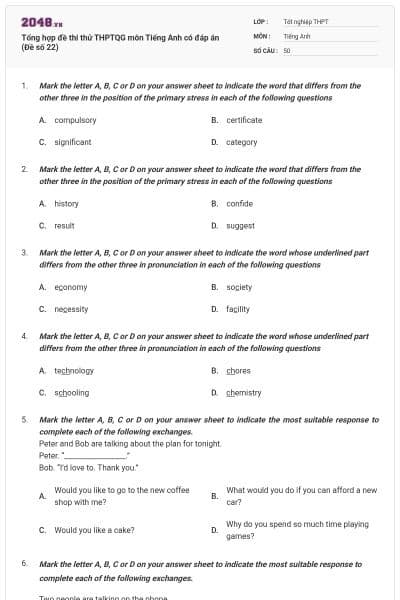
Mark the letter A, B, C or D on your answer sheet to indicate the word that differs from the other three in the position of the primary stress in each of the following questions
compulsory
certificate
significant
category
D
A. compulsory /kəmˈpʌlsəri/
B. certificate /səˈtɪfɪkət/
C. significant /sɪɡˈnɪfɪkənt/
D. category /ˈkætəɡəri/
Câu D trọng âm rơi vào âm tiết thứ 1, còn lại rơi vào âm tiết thứ 2.
Chọn D
Mark the letter A, B, C or D on your answer sheet to indicate the word that differs from the other three in the position of the primary stress in each of the following questions
history
confide
result
suggest
A
A. history /ˈhɪstri/
B. confide /kənˈfaɪd/
C. result /rɪˈzʌlt/
D. suggest /səˈdʒest/
Câu A trọng âm rơi vào âm tiết thứ 1, còn lại là âm tiết thứ 2 .
Chọn A
Mark the letter A, B, C or D on your answer sheet to indicate the word whose underlined part differs from the other three in pronunciation in each of the following questions
economy
society
necessity
facility
A
A. economy /ɪˈkɒnəmi/
B. society /səˈsaɪəti/
C. necessity /nəˈsesəti/
D. facility /fəˈsɪləti/
Từ gạch chân trong câu A phát âm /k/là còn lại đọc là /s/
Chọn A
Mark the letter A, B, C or D on your answer sheet to indicate the word whose underlined part differs from the other three in pronunciation in each of the following questions
technology
chores
schooling
chemistry
B
A. technology /tekˈnɒlədʒi/
B. chores /tʃɔː(r)/
C. schooling /ˈskuːlɪŋ/
D. chemistry /ˈkemɪstri/
Từ gạch chân trong câu B phát âm là /tʃ /còn lại đọc là /k/
Chọn B
Mark the letter A, B, C or D on your answer sheet to indicate the most suitable response to complete each of the following exchanges.
Peter and Bob are talking about the plan for tonight.
Peter. “_________________.”
Bob. “I’d love to. Thank you.”
Would you like to go to the new coffee shop with me?
What would you do if you can afford a new car?
Would you like a cake?
Why do you spend so much time playing games?
A
Tạm dịch:
Peter và Bob đang nói về kế hoạch cho tối nay.
Peter: “____________?”Bob :“Tôi rất thích. Cảm ơn”
A. Bạn có muốn đi đến quán cà phê mới với tôi không?
B. Bạn sẽ làm gì nếu bạn có thể mua một chiếc xe mới?
C. Bạn có muốn một chiếc bánh?
D. Tại sao bạn dành quá nhiều thời gian để chơi game?
=> Đáp án A ( vì câu trả lời chấp nhận một lời mời=> câu hỏi phải là một lời mời làm gì đó cho tối nay)
Mark the letter A, B, C or D on your answer sheet to indicate the most suitable response to complete each of the following exchanges.
Two people are talking on the phone.
A. “Could I speak to Alex, please?”
B. “___________________.”
Can I take the message?
I’m sorry. Alex is not in
Just a moment. I’m coming
This is Joe speaking
B
Tạm dịch:
Hai người đang nói chuyện điện thoại.
A. Tôi có thể nói chuyện với Alex được không? B. ______________
A. Tôi có thể nhận tin nhắn không?
B. Tôi xin lỗi. Alex không ở trong.
C. Chỉ một lát thôi. Tôi đang đến.
D. Đây là Joe nói.
=> Đáp án B
Mark the letter A, B, C or D on your answer sheet to indicate the word(s) OPPOSITE in meaning to the underlined word(s) in each of the following questions.
My younger brothers are obedient most of the time, but they are quite mischievous sometimes.
Naughty
hard–working
well–behaved
disruptive
C
A. Naughty : tinh nghịch
B. hard–working : chăm chỉ
C. well–behaved : cư xử đúng mực
D. disruptive: gây rối
=> mischievous: nghịch ngợm >< well–behaved : cư xử đúng mực
=> Đáp án C
Tạm dịch: Các em trai của tôi hầu hết đều ngoan ngoãn, nhưng đôi khi chúng khá tinh nghịch.

Học thông minh hơn mỗi ngày
Xem toàn bộ 50 câu hỏi và nhiều hơn nữa với tài khoản miễn phí
Mark the letter A, B, C or D on your answer sheet to indicate the word(s) OPPOSITE in meaning to the underlined word(s) in each of the following questions.
You should not wear casual clothes to the interview. The first impression is very important.
New
informal
neat
formal
D
A. New : mới
B. informal : không chính thức
C. neat : ngăn nắp
D. formal: chính thức, trang trọng
=> casual : sơ sài, cẩu thả > < formal: chính thức, trang trọng
ð Đáp án D
Tạm dịch: Bạn không nên mặc quần áo bình thường đến buổi phỏng vấn. Ấn tượng đầu tiên là rất quan trọng.
Mark the letter A, B, C or D on your answer sheet to indicate the word(s) CLOSEST in meaning to the underlined word(s) in each of the following questions.
In daily communication, you should know how to interpret other people’s body language.
Understand
answer
respond
notice
A
A. Understand : hiểu
B. answer : trả lời
C. respond : phản hồi
D. notice: chú ý
=> interpret ~ Understand : hiểu
ð Đáp án A
Tạm dịch: Trong giao tiếp hàng ngày, bạn nên biết cách diễn giải ngôn ngữ cơ thể của người khác.
Mark the letter A, B, C or D on your answer sheet to indicate the word(s) CLOSEST in meaning to the underlined word(s) in each of the following questions.
The purpose of this survey is to determine students’ attitudes toward love and marriage.
Find out
develop
concern
build
A
A. Find out: xác định
B. develop : phát triển
C. concern : quan tâm
D. build: xây dựng
=> determine ~ Find out: xác định
ð Đáp án A
Tạm dịch: Mục đích của cuộc khảo sát này là để xác định thái độ của sinh viên đối với tình yêu và hôn nhân.
Mark the letter A, B, C or D on your answer sheet to indicate the correct answer to each of the following questions.
The state school system is free for all students and _______ by the government.
Is paid for
is paying for
pays for
is being pay for
A
“ by the goverment” => câu bị động
ð Đáp án A
Tạm dịch: Hệ thống trường học công lập miễn phí cho tất cả học sinh và được chính phủ trả tiền.
Mark the letter A, B, C or D on your answer sheet to indicate the correct answer to each of the following questions.
Jane got married_______ Peter two years ago, but now they have split
As
with
for
to
D
“ get married to sb” kết hôn với ai
ð Đáp án: D
Tạm dịch: Jane đã kết hôn với Peter hai năm trước, nhưng giờ họ đã chia tay
Mark the letter A, B, C or D on your answer sheet to indicate the correct answer to each of the following questions.
The H5N1 infected patients have to _______ others to prevent the virus from spreading
Take care of
get away
look after
stay away from
D
A. Take care of: chăm sóc
B. get away : tránh xa
C. look after : chăm sóc
D. stay away from: cách li khỏi
=> Đáp án D
Tạm dịch: Bệnh nhân nhiễm H5N1 phải tránh xa những người khác để ngăn chặn vi-rút lây lan
Mark the letter A, B, C or D on your answer sheet to indicate the correct answer to each of the following questions.
Whenever I have problems, Jane is always very dependable. She never ______.
Turns up
let me down
turns me off
turns out
B
A. Turns up : đến
B. let me down : làm tôi buồn, thất vọng
C. turns me off : làm tôi tụt hứng
D. turns out: hóa ra là
=> Đáp án B
Tạm dịch : Bất cứ khi nào tôi gặp vấn đề, Jane luôn rất đáng tin cậy. Cô ấy không bao giờ làm tôi thất vọng
Mark the letter A, B, C or D on your answer sheet to indicate the correct answer to each of the following questions.
Students are expected to write their homework slowly and _______.
Careless
carefully
carelessly
careful
B
“ slowly and____”=> cần từ loại trạng từ=> loại đáp án A và D ( vì cùng là tính từ)
Dựa vào văn cảnh
ð Đáp án B
Tạm dịch: Học sinh được mong đợi sẽ viết bài tập về nhà chậm và cẩn thận.
Mark the letter A, B, C or D on your answer sheet to indicate the correct answer to each of the following questions.
During the interview, you should try to ____ a good impression on your interview.
Create
have
give
try
A
Cụm từ “ create a good impression on sb” tạo ấn tượng tốt với ai đó
ð Đáp án A
Tạm dịch: Trong cuộc phỏng vấn, bạn nên cố gắng tạo ấn tượng tốt cho cuộc phỏng vấn của bạn
Mark the letter A, B, C or D on your answer sheet to indicate the correct answer to each of the following questions.
An academic year in Vietnam is divided _____ two terms
In
into
within
from
B
Cụm từ “ divide into” phân chia cái gì
=> Đáp án. B
Tạm dịch: Một năm học tại Việt Nam được chia thành hai kì học.
Mark the letter A, B, C or D on your answer sheet to indicate the correct answer to each of the following questions.
Global warming is obviously _______ a worrying influence on the climate worldwide
Having
making
giving
taking
A
Cụm từ “ have an influence on sb” có ảnh hưởng đến ai
=> Đáp án A
Tạm dịch: Sự nóng lên toàn cầu rõ ràng là có ảnh hưởng đáng lo ngại đến khí hậu trên toàn thế giới
Mark the letter A, B, C or D on your answer sheet to indicate the correct answer to each of the following questions.
He wanted to know whose car I borrowed _____.
Yesterday
the last evening
last night
the previous night
D
“he wanted to know”=> câu gián tiếp
=> Đáp án D
Tạm dịch: Anh ấy muốn biết tôi đã mượn chiếc xe nào đêm qua
Mark the letter A, B, C or D on your answer sheet to indicate the correct answer to each of the following questions.
The man to _______ we have just talked is the Director General
Who
that
whom
0
C
Ngay sau giới từ “to” + whom/ which
ð Đáp án C
Tạm dịch: Người đàn ông mà chúng tôi vừa nói chuyện là Tổng giám đốc
Mark the letter A, B, C or D on your answer sheet to indicate the correct answer to each of the following questions.
Though built in 1946, computers were sold ______ for the first time in the 1950s
Commercial
commercialise
commercially
commerce
Đáp án: A
Giải thích:
Kiến thức: Cấu tạo từ
Vị trí cần điền là một trạng từ bổ nghĩa cho động từ thường “sold”.
Xét các đáp án:
A. commercial (adj): thương mại
B. commercialise (v): thương mại hóa
C. commercially (adv): một cách thương mại
D. commerce (n): thương mại
Dịch: Mặc dù được sản xuất vào năm 1946 nhưng máy tính đã được bán thương mại lần đầu tiên vào những năm 1950.
Mark the letter A, B, C or D on your answer sheet to indicate the correct answer to each of the following questions.
______hard, you will get good results in the coming examination.
Should you work
unless you work
if you will work
if work
A
“ you will get “=> câu điều kiện loại 1
=> Đáp án A (đảo ngữ của câu điều kiện loại 1)
Tạm dịch: Nếu bạn làm việc chăm chỉ, bạn sẽ có kết quả tốt trong kỳ thi sắp tới.
Read the following passage and mark the letter A, B, C, D on your answer sheet to indicate the correct answer to each of the questions.
Face–to–face conversation is a two–way process. You speak to me, I reply to you and so on. Two–way (23)_______depends on having a coding system that is understood by both sender and (24)_______, and an agreed convention about signaling the beginning and end of the message. In speech, the coding system is the language like English or Spanish; the convention that one person speaks at a time may seem too obvious to mention. In fact, the signals (25)_______ in conversation and meetings are often (26)_______. For example, lowering the pitch of the voice may mean the end of a sentence, a sharp intake of breath may signal the desire to interrupt, catching the chairman’s eye may indicate the desire to speak in a formal setting like a debate, a clenched fist may indicate anger. When (27)_______ visual signals are not possible, more formal signals may be needed.
Điền vào ô trống 23
Exchange
Interchange
Communication
Correspondence
C
A. sự trao đổi
B. sự trao đổi
C. sự giao tiếp
D. sự phù hợp
two-way communication : giao tiếp hai chiều
Read the following passage and mark the letter A, B, C, D on your answer sheet to indicate the correct answer to each of the questions.
Face–to–face conversation is a two–way process. You speak to me, I reply to you and so on. Two–way (23)_______depends on having a coding system that is understood by both sender and (24)_______, and an agreed convention about signaling the beginning and end of the message. In speech, the coding system is the language like English or Spanish; the convention that one person speaks at a time may seem too obvious to mention. In fact, the signals (25)_______ in conversation and meetings are often (26)_______. For example, lowering the pitch of the voice may mean the end of a sentence, a sharp intake of breath may signal the desire to interrupt, catching the chairman’s eye may indicate the desire to speak in a formal setting like a debate, a clenched fist may indicate anger. When (27)_______ visual signals are not possible, more formal signals may be needed.
Điền vào ô trống 24
Announcer
Receiver
Messenger
Transmitter
B
A. người báo cáo
B. người nhận
C. người đưa tin
D. người truyền
Two-way _______ depends on having a coding system that is understood by both sender and _______, and an agreed convention about signaling the beginning and end of the message: Giao tiếp hai chiều phụ thuộc vào việc có một hệ thống mã hóa được hiểu bởi cả người gửi và người nhận, và một quy ước đã thống nhất về báo hiệu sự bắt đầu và cuối của thông điệp
=>Đáp án B
Read the following passage and mark the letter A, B, C, D on your answer sheet to indicate the correct answer to each of the questions.
Face–to–face conversation is a two–way process. You speak to me, I reply to you and so on. Two–way (23)_______depends on having a coding system that is understood by both sender and (24)_______, and an agreed convention about signaling the beginning and end of the message. In speech, the coding system is the language like English or Spanish; the convention that one person speaks at a time may seem too obvious to mention. In fact, the signals (25)_______ in conversation and meetings are often (26)_______. For example, lowering the pitch of the voice may mean the end of a sentence, a sharp intake of breath may signal the desire to interrupt, catching the chairman’s eye may indicate the desire to speak in a formal setting like a debate, a clenched fist may indicate anger. When (27)_______ visual signals are not possible, more formal signals may be needed.
Điền vào ô trống 25
That people use
Are used
Using
Being used
A
Giải thích: phía sau là một động từ => đằng trước là mệnh đề quan hệ để bổ sung nghĩa.
=> Đáp án A
Read the following passage and mark the letter A, B, C, D on your answer sheet to indicate the correct answer to each of the questions.
Face–to–face conversation is a two–way process. You speak to me, I reply to you and so on. Two–way (23)_______depends on having a coding system that is understood by both sender and (24)_______, and an agreed convention about signaling the beginning and end of the message. In speech, the coding system is the language like English or Spanish; the convention that one person speaks at a time may seem too obvious to mention. In fact, the signals (25)_______ in conversation and meetings are often (26)_______. For example, lowering the pitch of the voice may mean the end of a sentence, a sharp intake of breath may signal the desire to interrupt, catching the chairman’s eye may indicate the desire to speak in a formal setting like a debate, a clenched fist may indicate anger. When (27)_______ visual signals are not possible, more formal signals may be needed.
Điền vào ô trống 26
Informal
non–verbal
verbal
formal
B
A.không trang trọng
B. phi ngôn ngữ
C. bằng lời nói
D. trang trọng
In fact, the signals _______ in conversation and meetings are often _______: Trên thực tế, các tín hiệu mà mọi người dùng trong các cuộc trò chuyện và các cuộc họp thường là phi ngôn ngữ
=>Đáp án B
Read the following passage and mark the letter A, B, C, D on your answer sheet to indicate the correct answer to each of the questions.
Face–to–face conversation is a two–way process. You speak to me, I reply to you and so on. Two–way (23)_______depends on having a coding system that is understood by both sender and (24)_______, and an agreed convention about signaling the beginning and end of the message. In speech, the coding system is the language like English or Spanish; the convention that one person speaks at a time may seem too obvious to mention. In fact, the signals (25)_______ in conversation and meetings are often (26)_______. For example, lowering the pitch of the voice may mean the end of a sentence, a sharp intake of breath may signal the desire to interrupt, catching the chairman’s eye may indicate the desire to speak in a formal setting like a debate, a clenched fist may indicate anger. When (27)_______ visual signals are not possible, more formal signals may be needed.
Điền vào ô trống 27
their
These
This
That
B
these + động từ số nhiều đếm được.
When _______ visual signals are not possible, more formal signals may be needed.: Khi những dấu hiệu có thể thấy được là không thể, tín hiệu chính thức hơn có thể cần
ð Đáp án B
DỊCH BÀI
Cuộc trò chuyện mặt đối mặt là một quá trình hai chiều: Bạn nói chuyện với tôi, tôi trả lời bạn và cứ như vậy. Giao tiếp hai chiều phụ thuộc vào việc có một hệ thống mã hóa được hiểu bởi cả người gửi và người nhận, và một quy ước đã thống nhất về báo hiệu sự bắt đầu và cuối của thông điệp. Trong bài phát biểu, các hệ thống mã hóa là các ngôn ngữ như tiếng Anh hoặc tiếng Tây Ban Nha; quy ước mà một người nói tại một thời điểm có thể có vẻ quá rõ rang để đề cập đến. Trên thực tế, các tín hiệu mà mọi người dùng trong các cuộc trò chuyện và các cuộc họp thường là phi ngôn ngữ. Ví dụ, việc hạ thấp độ cao của giọng nói có thể là sự kết thúc của một câu, hơi thở dốc có thể là tín hiệu mong muốn làm gián đoạn, nhìn thẳng vào mắt chủ tịch có thể chỉ ra những mong muốn để nói chuyện trong một khung cảnh trang trọng như một cuộc tranh luận, một cái nắm tay siết chặt có thể chỉ ra sự tức giận. Khi những dấu hiệu có thể thấy được là không thể, tín hiệu chính thức hơn có thể cần thiết.
Read the following passage and mark the letter A, B, C, D on your answer sheet to indicate the correct answer to each of the questions from 28 to 34.
Stars have been significant features in the design of many United States coins and their number has varied from one to forty–eight stars. Most of the coins issued from about 1799 to the early years of the twentieth century bore thirteen stars representing the thirteen original colonies.
Curiously enough, the first American silver coins, issued in 1794, had fifteen stars because by that time Vermont and Kentucky has joined the Union. At that time it was apparently the intention of mint officials to add a star for each new state. Following the admission of Tennessee in 1796, for example, some varieties of half dimes, dimes, and halfdollars were produced with sixteen stars.
As more states were admitted to the Union, however, it quickly became apparent that this scheme would not prove practical and the coins from A798 on were issued with only thirteen stars–one for each of the original colonies. Due to an error at the mint, one variety of the A828 half cent was issued with only twelve stars. There is also a variety of the large cent with only A2 stars, but this is the result of a die break and is not a true error.
What is the main topic of the passage?
Stars on American coins
The teaching of astronomy in state universities
The star as national symbol of the United States
Colonial stamps and coins
A
Chủ đề chính của đoạn văn là gì?
A. Các ngôi sao trên đồng tiền Mỹ.
B. Giảng dạy thiên văn học trong các trường đại học của bang.
C. Ngôi sao là biểu tượng quốc gia của Hoa Kỳ.
D. tem và tiền xu thuộc địa.
Dẫn chứng: “Stars have been significant features in the design of many United States coins and their number has varied from one to forty-eight stars.”
Tạm dịch: Các ngôi sao có những tính chất quan trọng trong việc thiết kế nhiều đồng tiền Hoa Kỳ và số lượng của chúng đã biến đổi từ một cho đến bốn mươi tám ngôi sao.) => Chủ đề của đoạn văn là các ngôi sao trên đồng tiền Mỹ.
Đáp án A
Read the following passage and mark the letter A, B, C, D on your answer sheet to indicate the correct answer to each of the questions from 28 to 34.
Stars have been significant features in the design of many United States coins and their number has varied from one to forty–eight stars. Most of the coins issued from about 1799 to the early years of the twentieth century bore thirteen stars representing the thirteen original colonies.
Curiously enough, the first American silver coins, issued in 1794, had fifteen stars because by that time Vermont and Kentucky has joined the Union. At that time it was apparently the intention of mint officials to add a star for each new state. Following the admission of Tennessee in 1796, for example, some varieties of half dimes, dimes, and halfdollars were produced with sixteen stars.
As more states were admitted to the Union, however, it quickly became apparent that this scheme would not prove practical and the coins from A798 on were issued with only thirteen stars–one for each of the original colonies. Due to an error at the mint, one variety of the A828 half cent was issued with only twelve stars. There is also a variety of the large cent with only A2 stars, but this is the result of a die break and is not a true error.
The word “their” in line 1 refers to _______
Coins
features
colonies
stars
D
Từ “their” ở dòng 1 đề cập đến _______.
A. những đồng xu
B. những tính chất
C. những thuộc địa
D. những ngôi sao
Dẫn chứng: “Stars have been significant features in the design of many United States coins and their number has varied from one to forty-eight stars.”
Tạm dịch: Các ngôi sao có những tính chất quan trọng trong việc thiết kế nhiều đồng tiền Hoa Kỳ và số lượng của chúng đã biến đổi từ một cho đến bốn mươi tám ngôi sao.
Read the following passage and mark the letter A, B, C, D on your answer sheet to indicate the correct answer to each of the questions from 28 to 34.
Stars have been significant features in the design of many United States coins and their number has varied from one to forty–eight stars. Most of the coins issued from about 1799 to the early years of the twentieth century bore thirteen stars representing the thirteen original colonies.
Curiously enough, the first American silver coins, issued in 1794, had fifteen stars because by that time Vermont and Kentucky has joined the Union. At that time it was apparently the intention of mint officials to add a star for each new state. Following the admission of Tennessee in 1796, for example, some varieties of half dimes, dimes, and halfdollars were produced with sixteen stars.
As more states were admitted to the Union, however, it quickly became apparent that this scheme would not prove practical and the coins from A798 on were issued with only thirteen stars–one for each of the original colonies. Due to an error at the mint, one variety of the A828 half cent was issued with only twelve stars. There is also a variety of the large cent with only A2 stars, but this is the result of a die break and is not a true error.
The word “bore” in line 3 is closest in meaning to ________
Carried
drilled
symbolized
cost
B
Từ “bore” trong đoạn 3 gần nghĩa nhất với _______.
A. carried: mang
B. drilled: khoan
C. symbolized: tượng trưng
D. cost: trị giá
=> bore = drilled: được khoan, khắc
=> Đáp án B
Read the following passage and mark the letter A, B, C, D on your answer sheet to indicate the correct answer to each of the questions from 28 to 34.
Stars have been significant features in the design of many United States coins and their number has varied from one to forty–eight stars. Most of the coins issued from about 1799 to the early years of the twentieth century bore thirteen stars representing the thirteen original colonies.
Curiously enough, the first American silver coins, issued in 1794, had fifteen stars because by that time Vermont and Kentucky has joined the Union. At that time it was apparently the intention of mint officials to add a star for each new state. Following the admission of Tennessee in 1796, for example, some varieties of half dimes, dimes, and halfdollars were produced with sixteen stars.
As more states were admitted to the Union, however, it quickly became apparent that this scheme would not prove practical and the coins from A798 on were issued with only thirteen stars–one for each of the original colonies. Due to an error at the mint, one variety of the A828 half cent was issued with only twelve stars. There is also a variety of the large cent with only A2 stars, but this is the result of a die break and is not a true error.
The expression “Curiously enough” is used because the author finds it strange that _______
Silver coins with fifteen stars appeared before coins with thirteen
Vermont and Kentucky joined the Union in 1794
Tennessee was the first state to use half dimes
No silver coins were issued until 1794
A
Cụm từ "Curiously enough" được sử dụng vì tác giả cảm thấy kỳ lạ là _______.
A. Đồng bạc với 15 ngôi sao xuất hiện trước tiền xu với 13 ngôi.
B. Vermont và Kentucky gia nhập Liên minh năm 1794.
C. Tennessee là tiểu bang đầu tiên sử dụng nửa hào.
D. Không có đồng bạc nào được phát hành cho đến tận năm 1794.
Dẫn chứng: “Most of the coins issued from about 1799 to the early years of the twentieth century bore thirteen stars representing the thirteen original colonies. Curiously enough, the first American silver coins, issued in 1794, had fifteen stars...”
Tạm dịch: Hầu hết các đồng tiền phát hành từ khoảng năm 1799 đến những năm đầu của thế kỷ hai mươi đều được khắc mười ba ngôi sao đại diện cho mười ba thuộc địa ban đầu. Thật sự kỳ lạ khi những đồng bạc đầu tiên của Mỹ, được phát hành năm 1794, có tới mười lăm ngôi sao...
Đáp án A
Read the following passage and mark the letter A, B, C, D on your answer sheet to indicate the correct answer to each of the questions from 28 to 34.
Stars have been significant features in the design of many United States coins and their number has varied from one to forty–eight stars. Most of the coins issued from about 1799 to the early years of the twentieth century bore thirteen stars representing the thirteen original colonies.
Curiously enough, the first American silver coins, issued in 1794, had fifteen stars because by that time Vermont and Kentucky has joined the Union. At that time it was apparently the intention of mint officials to add a star for each new state. Following the admission of Tennessee in 1796, for example, some varieties of half dimes, dimes, and halfdollars were produced with sixteen stars.
As more states were admitted to the Union, however, it quickly became apparent that this scheme would not prove practical and the coins from A798 on were issued with only thirteen stars–one for each of the original colonies. Due to an error at the mint, one variety of the A828 half cent was issued with only twelve stars. There is also a variety of the large cent with only A2 stars, but this is the result of a die break and is not a true error.
Which of the following can be inferred about the order in which Kentucky, Tennessee, and Vermont joined the Union?
Vermont joined after Tennessee and Kentucky
Kentucky joined before Tennessee and Vermont
Tennessee joined Vermont and Kentucky
Vermont and Kentucky joined at the same time
D
Có thể suy ra những câu nào sau đây về thứ tự Kentucky, Tennessee và Vermont tham gia Liên minh?
A. Vermont tham gia sau Tennessee và Kentucky.
B. Kentucky gia nhập trước Tennessee và Vermont.
C. Tennessee gia nhập Vermont và Kentucky.
D. Vermont và Kentucky tham gia cùng một thời điểm.
Dẫn chứng: “Curiously enough, the first American silver coins, issued in 1794, had fifteen stars because by that time Vermont and Kentucky has joined the Union”
Tạm dịch: Thật sự kỳ lạ khi những đồng bạc đầu tiên của Mỹ, được phát hành năm 1794, có tới mười lăm ngôi sao bởi vì trong khoảng thời gian đó Vermont và Kentucky đã gia nhập Liên minh.
Đáp án D
Read the following passage and mark the letter A, B, C, D on your answer sheet to indicate the correct answer to each of the questions from 28 to 34.
Stars have been significant features in the design of many United States coins and their number has varied from one to forty–eight stars. Most of the coins issued from about 1799 to the early years of the twentieth century bore thirteen stars representing the thirteen original colonies.
Curiously enough, the first American silver coins, issued in 1794, had fifteen stars because by that time Vermont and Kentucky has joined the Union. At that time it was apparently the intention of mint officials to add a star for each new state. Following the admission of Tennessee in 1796, for example, some varieties of half dimes, dimes, and halfdollars were produced with sixteen stars.
As more states were admitted to the Union, however, it quickly became apparent that this scheme would not prove practical and the coins from A798 on were issued with only thirteen stars–one for each of the original colonies. Due to an error at the mint, one variety of the A828 half cent was issued with only twelve stars. There is also a variety of the large cent with only A2 stars, but this is the result of a die break and is not a true error.
Which of the following is NOT mentioned as the denomination of an American coin?
Half cent
Half–dollar
Half dime
Half nickel
D
Điều nào sau đây KHÔNG được đề cập là mệnh giá của một đồng tiền Mỹ?
A. Nửa xu B. Nửa đô la
C. Nửa xu D. Nửa niken
Dẫn chứng : some varieties of half dimes, dimes, and halfdollars were produced with sixteen stars.
......one variety of the A828 half cent was issued with only twelve stars.
Tạm dịch: một số loại của một nửa đồng xu, đồng xu và nửa hình tròn được sản xuất với mười sáu ngôi sao....... một loạt của nửa xu A828 được phát hành chỉ với mười hai ngôi sao.
=> Đáp án D
Read the following passage and mark the letter A, B, C, D on your answer sheet to indicate the correct answer to each of the questions from 28 to 34.
Stars have been significant features in the design of many United States coins and their number has varied from one to forty–eight stars. Most of the coins issued from about 1799 to the early years of the twentieth century bore thirteen stars representing the thirteen original colonies.
Curiously enough, the first American silver coins, issued in 1794, had fifteen stars because by that time Vermont and Kentucky has joined the Union. At that time it was apparently the intention of mint officials to add a star for each new state. Following the admission of Tennessee in 1796, for example, some varieties of half dimes, dimes, and halfdollars were produced with sixteen stars.
As more states were admitted to the Union, however, it quickly became apparent that this scheme would not prove practical and the coins from A798 on were issued with only thirteen stars–one for each of the original colonies. Due to an error at the mint, one variety of the A828 half cent was issued with only twelve stars. There is also a variety of the large cent with only A2 stars, but this is the result of a die break and is not a true error.
Why was a coin produced in 1828 with only twelve stars?
There was a change in design policy
There were twelve states at the time
The mint made a mistake
Tennessee had left the Union
C
Tại sao một đồng xu được sản xuất vào năm 1828 lại chỉ có mười hai ngôi sao?
A. Có sự thay đổi trong chính sách thiết kế.
B. Có mười hai tiểu bang vào thời điểm đó.
C. Ủy ban đúc tiền đã mắc lỗi.
D. Tennessee đã rời khỏi Liên minh.
Dẫn chứng: Due to an error at the mint, one variety of the A828 half cent was issued with only twelve stars.”
Tạm dịch: Do sai sót của ủy ban đúc tiền, một trong nhiều loại A828 nửa xu đã được ban hành chỉ với mười hai ngôi sao.
=> Đáp án C
Dịch bài
Các ngôi sao có những tính chất quan trọng trong việc thiết kế nhiều đồng tiền Hoa Kỳ và số lượng của chúng đã biến đổi từ một cho đến bốn mươi tám ngôi sao. Hầu hết các đồng tiền phát hành từ khoảng năm 1799 đến những năm đầu của thế kỷ hai mươi đều được khắc mười ba ngôi sao đại diện cho mười ba thuộc địa ban đầu.
Thật sự kỳ lạ khi những đồng bạc đầu tiên của Mỹ, được phát hành năm 1794, có tới mười lăm ngôi sao bởi vì trong khoảng thời gian đó Vermont và Kentucky đã gia nhập Liên minh.
Vào thời điểm đó rõ ràng là ý định của các quan chức ủy ban đúc tiền là thêm vào một ngôi sao cho mỗi tiểu bang mới. Ví dụ như sau khi Tennessee được sát nhập vào năm 1796, một số loại nửa hào, hào và nửa đô la đã được sản xuất với mười sáu ngôi sao.
Tuy nhiên, khi có thêm nhiều tiểu bang được nhận vào Liên minh, nó nhanh chóng trở nên rõ ràng rằng kế hoạch này sẽ không thực tế và các đồng tiền từ A798 đã được ban hành chỉ với 13 ngôi sao - một một ngôi cho mỗi thuộc địa ban đầu. Do sai sót của ủy ban đúc tiền, một trong nhiều loại A828 nửa xu đã được ban hành chỉ với mười hai ngôi sao. Ngoài ra còn có một loạt các xu lớn chỉ có các ngôi sao A2, nhưng đây là kết quả của một sự tan vỡ và không phải là một lỗi thực sự.
Read the following passage and mark the letter A, B, C, D on your answer sheet to indicate the correct answer to each of the questions.
Who talks more – men or women? Most people believe that women talk more. However, linguist Deborah Tannen, who has the studied the communication style of men and women, says that this is a stereotype. According to Tannen, women are more verbal – talk more – in private situations, where they use conversation as the “glue” to hold relationship together. But, she says, men talk more in public situations, where they use conversation to exchange information and gain status. Tannen points out that we can see these difference even in children. Little girls often play with one ‘best friend’ and their play includes a lot of conversation. Little boys often play games in groups, their play usually involves more doing than talking. In school, girls are often better at verbal skills, while boys are often better at mathematics.
A recent study at Emory University helps to shed light on the roots of this difference. Researchers studied conversation between children aged 3–6 and their parents. They found evidence that parents talk very differently to their sons than they do to their daughters. The startling conclusion was that parents use more language with their girls. Specifically, when parents talk with their daughters, they use more descriptive language and more details. There is also far more talk about emotions, especially with daughters than with sons.
Which sentence best expresses the main idea of the first paragraph?
Women talk more than men on the whole
Women’s talking is a stereotype
Women talk more in private, and men talk more in public
Little boys and little girls have different ways of playing
C
Câu nào thể hiện tốt nhất ý chính của đoạn đầu tiên?
A. Phụ nữ nói nhiều hơn nam giới về toàn bộ
B. Cách nói chuyện của phụ nữ là một ấn tượng
C. Phụ nữ nói nhiều hơn ở nơi riêng tư, và nam giới nói nhiều hơn ở nơi công cộng
D. Bé trai và bé gái có những cách chơi khác nhau
Dẫn chứng: “women are more verbal – talk more – in private situations,…” và “men talk more in public situations,…”.
=>Đáp án C
Read the following passage and mark the letter A, B, C, D on your answer sheet to indicate the correct answer to each of the questions.
Who talks more – men or women? Most people believe that women talk more. However, linguist Deborah Tannen, who has the studied the communication style of men and women, says that this is a stereotype. According to Tannen, women are more verbal – talk more – in private situations, where they use conversation as the “glue” to hold relationship together. But, she says, men talk more in public situations, where they use conversation to exchange information and gain status. Tannen points out that we can see these difference even in children. Little girls often play with one ‘best friend’ and their play includes a lot of conversation. Little boys often play games in groups, their play usually involves more doing than talking. In school, girls are often better at verbal skills, while boys are often better at mathematics.
A recent study at Emory University helps to shed light on the roots of this difference. Researchers studied conversation between children aged 3–6 and their parents. They found evidence that parents talk very differently to their sons than they do to their daughters. The startling conclusion was that parents use more language with their girls. Specifically, when parents talk with their daughters, they use more descriptive language and more details. There is also far more talk about emotions, especially with daughters than with sons.
Which word is similar in meaning to the word “glue”?
Games
sticky substance
rope
means
B
Từ nào tương tự nghĩa với từ “glue” ( keo dán, hồ)
A.trò chơi
B. chất kết dính
C. dây thừng
D. ý nghĩa
=> glue: hồ = sticky substance (chất kết dính)
=> Đáp án: B
Read the following passage and mark the letter A, B, C, D on your answer sheet to indicate the correct answer to each of the questions.
Who talks more – men or women? Most people believe that women talk more. However, linguist Deborah Tannen, who has the studied the communication style of men and women, says that this is a stereotype. According to Tannen, women are more verbal – talk more – in private situations, where they use conversation as the “glue” to hold relationship together. But, she says, men talk more in public situations, where they use conversation to exchange information and gain status. Tannen points out that we can see these difference even in children. Little girls often play with one ‘best friend’ and their play includes a lot of conversation. Little boys often play games in groups, their play usually involves more doing than talking. In school, girls are often better at verbal skills, while boys are often better at mathematics.
A recent study at Emory University helps to shed light on the roots of this difference. Researchers studied conversation between children aged 3–6 and their parents. They found evidence that parents talk very differently to their sons than they do to their daughters. The startling conclusion was that parents use more language with their girls. Specifically, when parents talk with their daughters, they use more descriptive language and more details. There is also far more talk about emotions, especially with daughters than with sons.
Which of the following phrases best explains the meaning of the word “verbal”?
Deriving from verbs
Connected with use of spoken language
Using very loud noise
Being very talkative
B
Cụm từ nào dưới đây giải thích rõ nhất ý nghĩ của từ “verbal”?
A.Bắt nguồn từ động từ
B. Kết nối với việc sử dụng ngôn ngữ nói
C. sử dụng tiếng ồn lớn
D. Nói nhiều
=> Verbal( lời nói) ~ Connected with use of spoken language
=> Đáp án: B
Read the following passage and mark the letter A, B, C, D on your answer sheet to indicate the correct answer to each of the questions.
Who talks more – men or women? Most people believe that women talk more. However, linguist Deborah Tannen, who has the studied the communication style of men and women, says that this is a stereotype. According to Tannen, women are more verbal – talk more – in private situations, where they use conversation as the “glue” to hold relationship together. But, she says, men talk more in public situations, where they use conversation to exchange information and gain status. Tannen points out that we can see these difference even in children. Little girls often play with one ‘best friend’ and their play includes a lot of conversation. Little boys often play games in groups, their play usually involves more doing than talking. In school, girls are often better at verbal skills, while boys are often better at mathematics.
A recent study at Emory University helps to shed light on the roots of this difference. Researchers studied conversation between children aged 3–6 and their parents. They found evidence that parents talk very differently to their sons than they do to their daughters. The startling conclusion was that parents use more language with their girls. Specifically, when parents talk with their daughters, they use more descriptive language and more details. There is also far more talk about emotions, especially with daughters than with sons.
The word “they” refers to ______.
Situations
Men
Men and women
Women
B
Từ “they” ám chỉ đến__________
A.tình huống
B. đàn ông
C. đàn ông và phụ nữ
D. phụ nữ
Từ “they” thay thế cho danh từ “men” ở vế trước
Dẫn chứng: But, she says, men talk more in public situations, where they use conversation to exchange information and gain status.
Tạm dịch: Nhưng, cô ấy nói, đàn ông nói nhiều hơn ở những tình huống công cộng, khi họ dùng đoạn đối thoại để trao đổi thông tin và tạo địa vị
=> Đáp án B
Read the following passage and mark the letter A, B, C, D on your answer sheet to indicate the correct answer to each of the questions.
Who talks more – men or women? Most people believe that women talk more. However, linguist Deborah Tannen, who has the studied the communication style of men and women, says that this is a stereotype. According to Tannen, women are more verbal – talk more – in private situations, where they use conversation as the “glue” to hold relationship together. But, she says, men talk more in public situations, where they use conversation to exchange information and gain status. Tannen points out that we can see these difference even in children. Little girls often play with one ‘best friend’ and their play includes a lot of conversation. Little boys often play games in groups, their play usually involves more doing than talking. In school, girls are often better at verbal skills, while boys are often better at mathematics.
A recent study at Emory University helps to shed light on the roots of this difference. Researchers studied conversation between children aged 3–6 and their parents. They found evidence that parents talk very differently to their sons than they do to their daughters. The startling conclusion was that parents use more language with their girls. Specifically, when parents talk with their daughters, they use more descriptive language and more details. There is also far more talk about emotions, especially with daughters than with sons.
Which of the following can be inferred from the first paragraph?
Men and women have different styles of talking, which may begin in childhood
According to Deborah Tannen, the belief that women talk more is party right but most wrong
Women talk more in some situations while men talk in others
Men are more sociable than women
C
Điều nào dưới đây có thể suy ra từ đoạn 1
A. Đàn ông và phụ nữ có phong cách nói chuyện khác nhau, điều này có thể bắt đầu trong thời thơ ấu
B. Theo Deborah Tannen, sự tin tưởng rằng phụ nữ nói nhiều hơn là đúng một phần nhưng hầu như sai
C.Phụ nữ nói nhiều hơn trong một vài tình huống trong khi đàn ông nói ở những tình huống khác
D. Đàn ông hòa đồng hơn phụ nữ
Dẫn chứng: dòng 3, 4 đoạn 1: “women are more verbal – talk more – in private situations”….” men talk more in public situations”
Tạm dịch: phụ nữ nhiều lời hơn- nói nhiều hơn- ở những tình huống riêng tư…………đàn ông nói nhiều hơn ở những tình huống công cộng
=> Đáp án C
Read the following passage and mark the letter A, B, C, D on your answer sheet to indicate the correct answer to each of the questions.
Who talks more – men or women? Most people believe that women talk more. However, linguist Deborah Tannen, who has the studied the communication style of men and women, says that this is a stereotype. According to Tannen, women are more verbal – talk more – in private situations, where they use conversation as the “glue” to hold relationship together. But, she says, men talk more in public situations, where they use conversation to exchange information and gain status. Tannen points out that we can see these difference even in children. Little girls often play with one ‘best friend’ and their play includes a lot of conversation. Little boys often play games in groups, their play usually involves more doing than talking. In school, girls are often better at verbal skills, while boys are often better at mathematics.
A recent study at Emory University helps to shed light on the roots of this difference. Researchers studied conversation between children aged 3–6 and their parents. They found evidence that parents talk very differently to their sons than they do to their daughters. The startling conclusion was that parents use more language with their girls. Specifically, when parents talk with their daughters, they use more descriptive language and more details. There is also far more talk about emotions, especially with daughters than with sons.
Which sentence best expresses the main idea of the second paragraph?
Researchers have studied the conversations of children and their parents
Parents do not much about sadness with their sons
Study at Emory University can help to explain the differences between communication styles of boy and girls
An Emory University study found than parent talk more with their daughters than with their sons
D
Câu nào diễn tả tốt nhất ý chính của đoạn 2?
A. Các nhà khoa học đã và đang nghiên cứu cuộc trò chuyện giữa trẻ em và cha mẹ của chúng
B. Cha mẹ không có nhiều về nỗi buồn với người con trai của họ.
C. Nghiên cứu ở trường đại học Emory có thể giúp giải thích sự khác nhau giữa phong cách giao tiếp của con trai và con gái
D. Một nghiên cứu ở trường đại học Emory cho thấy bố mẹ nói chuyện với con gái nhiều hơn với con trai
Dẫn chứng: “The startling conclusion was that parents use more language with their girls.”
Tạm dịch: Kết luận đáng ngạc nhiên là cha mẹ sử dụng ngôn ngữ nhiều hơn với con gái
=> Đáp án D
Read the following passage and mark the letter A, B, C, D on your answer sheet to indicate the correct answer to each of the questions.
Who talks more – men or women? Most people believe that women talk more. However, linguist Deborah Tannen, who has the studied the communication style of men and women, says that this is a stereotype. According to Tannen, women are more verbal – talk more – in private situations, where they use conversation as the “glue” to hold relationship together. But, she says, men talk more in public situations, where they use conversation to exchange information and gain status. Tannen points out that we can see these difference even in children. Little girls often play with one ‘best friend’ and their play includes a lot of conversation. Little boys often play games in groups, their play usually involves more doing than talking. In school, girls are often better at verbal skills, while boys are often better at mathematics.
A recent study at Emory University helps to shed light on the roots of this difference. Researchers studied conversation between children aged 3–6 and their parents. They found evidence that parents talk very differently to their sons than they do to their daughters. The startling conclusion was that parents use more language with their girls. Specifically, when parents talk with their daughters, they use more descriptive language and more details. There is also far more talk about emotions, especially with daughters than with sons.
Which word can best replace the word “startling”?
Beginning
annoying
surprising
interesting
D
Từ nào có thể thay thế tốt nhất từ “ startling”(giật mình)?
A. bắt đầu
B. tức giận
C. ngạc nhiên
D. thú vị
=> Startling: đáng ngạc nhiên ~ surprising
=> Đáp án D
Read the following passage and mark the letter A, B, C, D on your answer sheet to indicate the correct answer to each of the questions.
Who talks more – men or women? Most people believe that women talk more. However, linguist Deborah Tannen, who has the studied the communication style of men and women, says that this is a stereotype. According to Tannen, women are more verbal – talk more – in private situations, where they use conversation as the “glue” to hold relationship together. But, she says, men talk more in public situations, where they use conversation to exchange information and gain status. Tannen points out that we can see these difference even in children. Little girls often play with one ‘best friend’ and their play includes a lot of conversation. Little boys often play games in groups, their play usually involves more doing than talking. In school, girls are often better at verbal skills, while boys are often better at mathematics.
A recent study at Emory University helps to shed light on the roots of this difference. Researchers studied conversation between children aged 3–6 and their parents. They found evidence that parents talk very differently to their sons than they do to their daughters. The startling conclusion was that parents use more language with their girls. Specifically, when parents talk with their daughters, they use more descriptive language and more details. There is also far more talk about emotions, especially with daughters than with sons.
Which of the following statement is TRUE about the passage?
Parents give more love to their daughters than to their sons
Boys don’t like to be with their parents as much as girls do
Parents use more language to talk with their daughters
Boys don’t like showing emotions
C
Phát biểu nào sau đây là ĐÚNG về đoạn văn?
A. Cha mẹ dành nhiều tình cảm cho con gái hơn là cho con trai
B. Con trai không thích ở bên cha mẹ nhiều như con gái.
C. Cha mẹ sử dụng nhiều ngôn ngữ hơn để nói chuyện với con gái
D. Con trai không thích thể hiện cảm xúc
Dẫn chứng: The startling conclusion was that parents use more language with their girls.
Tạm dịch: Kết luận đáng ngạc nhiên là cha mẹ sử dụng ngôn ngữ nhiều hơn với con gái
ð Đáp án C
Dịch bài
Ai nói nhiều hơn- đàn ông hay phụ nữ? Hầu hết mọi người tin rằng phụ nữ nói nhiều hơn. Tuy nhiên, nhà ngôn ngữ học Deborah Tannen, người mà nghiên cứu về phong cách giao tiếp của đàn ông và phụ nữ, nói rằng đó là một sự dập khuôn. Theo Tannen, phụ nữ nhiều lời hơn- nói nhiều hơn- trong những tình huống riêng tư, nơi mà họ sử dụng các cuộc trò chuyện như một “chất keo” để gắn chặt các mối quan hệ với nhau. Nhưng, cô ấy nói, đàn ông nói nhiều hơn ở những tình huống công cộng, khi họ dùng đoạn đối thoại để trao đổi thông tin và tạo địa vị. Tannen chỉ ra rằng chúng ta có thể nhìn thấy sự khác biệt này thậm chí ở trẻ em. Những bé gái thường chơi với một “người bạn tốt nhất "và việc chơi của chúng bao gồm rất nhiều chuyện. Bé trai thường xuyên chơi trò chơi theo nhóm,việc chơi của chúng thường liên quan đến làm nhiều hơn nói. Ở trường, con gái thường tốt hơn ở những kĩ năng nói, trong khi con trai lại giỏi hơn ở toán học.
Một nghiên cứu gần đây tại Đại học Emory giúp làm sáng tỏ nguồn gốc của sự khác biệt này. Các nhà nghiên cứu đã nghiên cứu đối thoại giữa trẻ em ở độ tuổi 3-6 và cha mẹ của họ. Họ tìm thấy bằng chứng rằng cha mẹ nói chuyện thờ ơ với con trai hơn là với con gái. Kết luận đáng ngạc nhiên là cha mẹ sử dụng ngôn ngữ nhiều hơn với con gái. Kết luận đáng ngạc nhiên là cha mẹ sử dụng ngôn ngữ nhiều hơn với con gái. Cụ thể, khi cha mẹ nói chuyện với con gái của họ, họ sử dụng ngôn ngữ mô tả nhiều hơn và chi tiết hơn. Ngoài ra còn có nhiều cuộc nói chuyện về cảm xúc, đặc biệt là với con gái so với con trai.
Mark the letter A, B, C or D on your answer sheet to indicate the sentence that is closest in meaning to each of the following questions.
“Leave my house now or I’ll call the police!” shouted the lady to the man
The lady said she would call the police if the man didn’t leave her house
The lady told the man that she would call the police he didn’t leave her house
The lady informed the man that she would call the police if he didn’t leave her house
The lady threatened to call the police if the man didn’t leave her house
D
Rời khỏi nhà tôi ngay bây giờ hoặc tôi sẽ gọi cảnh sát! Hãy hét người phụ nữ với người đàn ông.
A. Người phụ nữ nói rằng cô ấy sẽ gọi cảnh sát nếu người đàn ông không rời khỏi nhà cô ấy.
B. Người phụ nữ nói với người đàn ông rằng cô ta sẽ gọi cảnh sát mà anh ta không rời khỏi nhà.
C. Người phụ nữ thông báo với người đàn ông rằng cô sẽ gọi cảnh sát nếu anh ta không rời khỏi nhà cô.
D. Người phụ nữ đe dọa sẽ gọi cảnh sát nếu người đàn ông không rời khỏi nhà cô.
=> Đáp án D
Mark the letter A, B, C or D on your answer sheet to indicate the sentence that is closest in meaning to each of the following questions.
He last has his eyes tested ten months ago
He had tested his eyes ten months before
He didn’t have any test on his eyes ten months before
He had not tested his eyes for ten months then
He hasn’t had his eyes tested for ten months
D
Anh cuối cùng đã được kiểm tra mắt mười tháng trước.
A. Anh ấy đã kiểm tra mắt mười tháng trước. ( sai nghĩa)
B. Anh ấy đã không có bất kỳ kiểm tra nào về mắt mười tháng trước. (sai ngữ pháp)
C. Anh ấy đã không kiểm tra mắt trong mười tháng rồi. (sai ngữ pháp)
D. Anh ấy đã từng thử mắt trong mười tháng.
=> Đáp án D
Mark the letter A, B, C or D on your answer sheet to indicate the sentence that is closest in meaning to each of the following questions.
He survived the operation thanks to the skillful surgeon
He survived because he was a skillful surgeon
He wouldn’t have survived the operation without the skillful surgeon
There was no skillful surgeon, so he died
Though the surgeon was skillful, he couldn’t survive the operation
B
Anh sống sót sau ca phẫu thuật nhờ bác sĩ phẫu thuật tài giỏi.
A. Anh ấy sống sót vì anh ấy là một bác sĩ phẫu thuật tài giỏi. (sai nghĩa)
B. Anh ấy không thể sống sót sau ca phẫu thuật nếu không có bác sĩ phẫu thuật tài giỏi.
C. Không có bác sĩ phẫu thuật khéo léo, nên đã chết. (sai nghĩa)
D. Mặc dù bác sĩ phẫu thuật rất tài giỏi, anh ta không thể sống sót sau ca phẫu thuật. (sai nghĩa)
=> đáp án B
Mark the letter A, B, C, or D on your answer sheet to indicate the underlined part that needs correction in each of the following questions.
If you take the train, it would be much more convenient
If
the train
would be
much
C
“If you take” => câu điều kiện loại 1
ð Đáp án C. Sửa thành “ will be”
Tạm dịch: Nếu bạn đi tàu, nó sẽ thuận tiện hơn nhiều.
Mark the letter A, B, C, or D on your answer sheet to indicate the underlined part that needs correction in each of the following questions.
Some of his favourite subjects at school are Maths, English and Geographical.
Some
subjects
are
Geographical
D
“ Maths, English” cùng là môn học => “Maths, English and + 1 môn học
ð Đáp án D. Sửa thành “ Geography”
Tạm dịch: Một số môn học yêu thích của anh ở trường là Toán, Tiếng Anh và Địa lý
Mark the letter A, B, C, or D on your answer sheet to indicate the underlined part that needs correction in each of the following questions.
Could you tell me how can I get to the city library, please?
Could
me
how can I get
the city
C
“ could you tell me how + S + V ( câu khẳng định)
ð Đáp án C. Sửa thành “ how I can get”
Tạm dịch: Bạn có thể vui lòng cho tôi biết làm thế nào tôi có thể đến thư viện thành phố?
Đáp án C
Mark the letter A, B, C or D on your answer sheet to indicate the sentence that best combines each pairs of sentences in the following questions.
They were rich; they didn’t have a happy family, though
Although they were rich, but they didn’t have a happy family
Rich though they were, they didn’t have a happy family
They were rich although they didn’t have a happy family
However they were rich, they didn’t have a happy family
B
Họ giàu có; họ đã không có một gia đình hạnh phúc.
A. Mặc dù họ giàu có nhưng họ không có một gia đình hạnh phúc. ( sai ngữ pháp, có “although” thì không có “but” và ngược lại)
B. Dù giàu có nhưng họ không có một gia đình hạnh phúc.
C. Họ giàu có mặc dù họ không có một gia đình hạnh phúc. ( sai nghĩa)
D. Tuy nhiên, họ giàu có, họ không có một gia đình hạnh phúc. ( sai nghĩa)
=> Đáp án: B
Mark the letter A, B, C or D on your answer sheet to indicate the sentence that best combines each pairs of sentences in the following questions.
One student failed because he completely ignored the instruction on the paper. The instructions appeared on the top of every page.
One student failed because he completely ignored the instructions appearing on the top of every page on the paper
Even though one student ignored the instructions printed on the top of every paper, he failed
One student failed to ignore the instructions printed on the top of every page of paper
No matter how completely one student ignored the instructions printed on the top of every page of the paper, he failed
A
Một sinh viên thất bại vì anh ta hoàn toàn bỏ qua hướng dẫn trên giấy. Các hướng dẫn xuất hiện trên đầu mỗi trang.
A. Một sinh viên thất bại vì anh ta hoàn toàn bỏ qua các hướng dẫn xuất hiện trên đầu mỗi trang trên tờ giấy.
B. Mặc dù một học sinh bỏ qua các hướng dẫn được in trên đầu mỗi tờ giấy, anh ta đã thất bại. ( sai nghĩa)
C. Một học sinh không thể bỏ qua các hướng dẫn được in trên đầu mỗi trang giấy. (sai nghĩa)
D. Cho dù một học sinh hoàn toàn bỏ qua các hướng dẫn được in trên đầu mỗi trang giấy như thế nào, anh ta đều thất bại. ( sai nghĩa)
=> Đáp án A
Bạn có thích hoạt động này không?
Ý kiến của bạn sẽ giúp chúng tôi đề xuất nội dung phù hợp hơn.
Gợi ý cho bạn
![[Năm 2022] Đề thi thử môn Vật lí THPT Quốc gia có lời giải - Đề số 21](/_next/image?url=https%3A%2F%2Fvideo.vietjack.com%2Fupload%2Fimages%2Fvj-image%2Fimage-3izficdefgfoel0s9j8s-1786772791.jpg&w=3840&q=75)
![[Năm 2022] Đề thi thử môn Vật lí THPT Quốc gia có lời giải - Đề số 20](/_next/image?url=https%3A%2F%2Fvideo.vietjack.com%2Fupload%2Fimages%2Fvj-image%2Fimage-emy0gtcksawvorajezvv-1786772460.jpg&w=3840&q=75)
Tài liệu phổ biến Tốt nghiệp THPT
Tài liệu phổ biến Tiếng Anh