Tổng hợp đề thi thử THPT quốc gia môn tiếng anh có lời giải chi tiết (Đề số 30)
50 câu hỏi
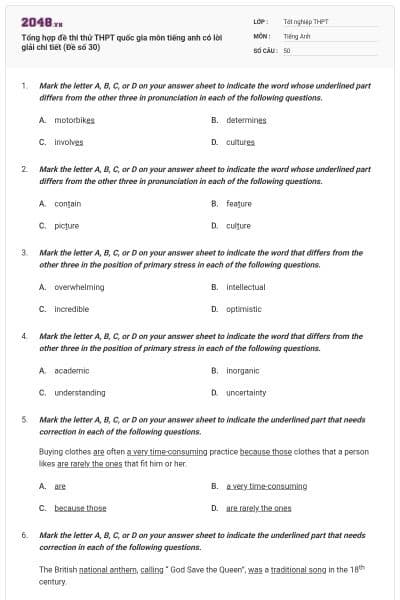
Mark the letter A, B, C, or D on your answer sheet to indicate the word whose underlined part differs from the other three in pronunciation in each of the following questions.
motorbikes
determines
involves
cultures
Đáp án A
A./s/ B./z/
C./z/ D./z/
Mark the letter A, B, C, or D on your answer sheet to indicate the word whose underlined part differs from the other three in pronunciation in each of the following questions.
contain
feature
picture
culture
Đáp án A
A./t/ B./tʃ/
C. /tʃ/ D. /tʃ/
Mark the letter A, B, C, or D on your answer sheet to indicate the word that differs from the other three in the position of primary stress in each of the following questions.
overwhelming
intellectual
incredible
optimistic
Đáp án C
Phần C trọng âm rơi vào âm tiết thứ 2, còn lại là thứ 3
Mark the letter A, B, C, or D on your answer sheet to indicate the word that differs from the other three in the position of primary stress in each of the following questions.
academic
inorganic
understanding
uncertainty
Đáp án D
Phần D trọng âm rơi vào âm tiết thứ 2, còn lại là thứ 3
Mark the letter A, B, C, or D on your answer sheet to indicate the underlined part that needs correction in each of the following questions.
Buying clothes are often a very time-consuming practice because those clothes that a person likes are rarely the ones that fit him or her.
are
a very time-consuming
because those
are rarely the ones
Đáp án: A
Giải thích:
Kiến thức: Sự hòa hợp giữa chủ ngữ và động từ
"Buying clothes" là một cụm danh động từ (gerund phrase), được xem như danh từ số ít.
Động từ theo sau phải chia số ít, vì vậy "are" sai, cần thay bằng "is".
Sửa: are → is
Dịch: Việc mua quần áo thường là một thói quen tốn nhiều thời gian vì những bộ đồ mà một người thích hiếm khi là những bộ vừa với họ.
Mark the letter A, B, C, or D on your answer sheet to indicate the underlined part that needs correction in each of the following questions.
The British national anthem, calling “ God Save the Queen”, was a traditional song in the 18th century.
national anthem
calling
was
traditional song
Đáp án B
“calling” → “called”
Ở đây phải hiểu called là viết tắt của “which is called”
Mark the letter A, B, C, or D on your answer sheet to indicate the underlined part that needs correction in each of the following questions.
Maryland, even though a southern state, remained loyalty to The Union during the Civil War.
even though
remained
loyalty
during
Đáp án C
“loyalty” → “loyal”
Ở đây ta cần một tính từ ở phía sau remain
Mark the letter A, B, C, or D on your answer sheet to indicate the correct answer to each of the following questions.
Since the flood the number of homeless people ________dramatically.
are increasing
had increased
increase
has increased
Đáp án D
Ở đây có trạng từ chỉ thời gian since + một sự kiện => thì được chia ở đây là thì hiện tại hoàn thành
While everybody else in our class prefers working in groups, Mina likes working__________.
on herself
on her own
of her own
in herself
Đáp án B
Cấu trúc “on one’s own” = by oneself: tự mình, tự (làm gì đó)
________, the young mother appeared visibly very happy after the birth of her child.
Tired as she was
She was tired
As tired
Despite tired
Đáp án A
Đảo tính từ lên đầu câu để nhấn mạnh vào tính từ đó
Cấu trúc: adj + as/though + S + be
Could you please tell me________?
where does my uncle's room
where is my uncle’s room
where my uncle’s room is
where my uncle's room
Đáp án: C
Giải thích:
Mệnh đề này không phải câu hỏi riêng đứng lẻ, nên không đảo “to be” lên trước chủ ngữ, loại A và B.
Loại D vì thiếu động từ
Đáp án C đúng ngữ pháp.
Dịch: Bạn có thể vui lòng cho tôi biết phòng của chú tôi ở đâu không?
Gordon wants to look his best at the wedding so he’s ________
make a suit
having a suit made
to get made a suit
having made a suit
Đáp án B
Cấu trúc “have st done”: có cái gì đó được làm/ được thực hiện (bản thân mình không tự làm mà là ai đó làm cho)
This book provides students ________ useful tips that help them to pass the coming exam.
at
about
for
with
Đáp án D
Cấu trúc “provide sb with st”: cung cấp cho ai cái gì
Most ________ understand that disciplinary actions do not always work with students.
educate
educating
education
educators
Đáp án D
Ở đây ta cần một danh từ chỉ người
“educators”: nhà sư phạm
She________me a very charming compliment on my painting
showed
paid
made
took
Đáp án B
Cấu trúc “pay a compliment”: đưa ra lời khen
________the rise in unemployment, people still seem to be spending more.
Despite
Although
Because
Because of
Đáp án A
Despite/In spite of (mặc dù) + danh từ/cụm danh từ
He did not share his secrets with other people but he ________in her.
confessed
concealed
confided
consented
Đáp án C
Cấu trúc “confide in sb”: tin tưởng, tin cậy ai
I can’t ________this noise any longer. I’m going to write a letter of complaint to the local authority about this problem.
put up with
take away from
get back to
make out of
Đáp án A
“put up with”: chịu đựng
The new manager laid down very strict rules as soon as he had ________the position
taken over
come over
taken up
taken off
Đáp án: A
Giải thích:
take over: nắm quyền, tiếp quản
come over: bỗng nhiên cảm thấy
take up: bắt đầu làm gì (như 1 sở thích)
take off: cởi, tháo
Dựa vào nghĩa của câu ta chọn đáp án A.
Dịch nghĩa: Người quản lí mới đã đề ra nhiều quy tắc rất nghiêm khắc ngay khi ông giữ chức vụ đó.
Mark the letter A, B, C, or D on your answer sheet to indicate the most suitable response to complete each of the following exchanges.
- Marie: “ what a lovely house you have !”
- Phil : “
No problem
Thank you. Hope you will drop in.
I think so
Of course not, it’s not costly
Đáp án B
- Bạn có ngôi nhà thật đẹp!
- Cám ơn. Hy vọng bạn sẽ ghé qua.
Mark the letter A, B, C, or D on your answer sheet to indicate the most suitable response to complete each of the following exchanges.
- Duong : “ My first English test was not as good as I expected.”
- Thomas “ __________”
Good Heavens !
That’s brilliant enough !
It’s okay, don’t worry
Never mind, better job next time !
Đáp án D
- Bài kiểm tra tiếng anh đầu tiên không tốt như tớ tưởng
- Đừng lo, lần sau sẽ tốt hơn
Mark the letter A, B, C, or D on your answer sheet to indicate the word(s) CLOSEST in meaning to the underlined word(s) in each of the following questions.
The air is naturally contaminated by foreign matter such as plant pollens and dust
polluted
occupied
filled
concentrated
Đáp án A
“contaminated” = “polluted”: bị ô nhiễm
Mark the letter A, B, C, or D on your answer sheet to indicate the word(s) CLOSEST in meaning to the underlined word(s) in each of the following questions.
Over a long time, customs can erode. They are gradually replaced by newer customs.
grow stronger
grow weaker
develop rapidly
disappear completely
Đáp án D
“erode” trong ngữ cảnh này được hiểu là “disappear completely”: biến mất hoàn toàn
Mark the letter A, B, C, or D on your answer sheet to indicate the word(s) OPPOSITE in meaning to the underlined word(s) in each of the following questions.
“ Please speak up a bit more, Jason. You’re hardly loud enough to be heard from the back”, the teacher said.
visible
edible
eligible
inaudible
Đáp án D
“loud enough to be heard”: đủ to để có thể nghe
Trái nghĩa là inaudible: không thể nghe thấy
Mark the letter A, B, C, or D on your answer sheet to indicate the word(s) OPPOSITE in meaning to the underlined word(s) in each of the following questions.
The funny story told by the man amused all the children.
pleased
entertained
saddened
frightened
Đáp án C
“amused”: làm cho vui vẻ, giải trí
Trái nghĩa là sadden: làm cho buồn, không vui
Mark the letter A, B, C, or D on your answer sheet to indicate the sentence that is closest in meaning to each of the following questions.
The gate was closed to stop the children running into the road.
The gate was closed so the children can’t run into the road
The gate is closed so that the children don’t run into the road
The gate was closed so that the children couldn’t run into the road
The gate is closed so that the children couldn’t to run into the road
Đáp án C
Cấu trúc câu sử dụng so that: để mà, cho nên, do đó
The gate was closed so that the children couldn’t run into the road. (Cổng được đóng chặt để bọn trẻ không thể chạy ra đường được)
Mark the letter A, B, C, or D on your answer sheet to indicate the sentence that is closest in meaning to each of the following questions.
If it hadn’t been for the wind, the fire would never have spread so fast
Even without the wind, the fire would have spread just as fast
It was the wind that caused the fire to spread at such a speed
Had there been a wind, the wind would have spread even faster
The force of the wind affected the way the fire spread
Đáp án B
It was the wind that caused the fire to spread at such a speed. (Cơn gió đã làm cho vụ cháy lan nhanh với tốc độ như thế)
Mark the letter A, B, C, or D on your answer sheet to indicate the sentence that is closest in meaning to each of the following questions.
“ Don’t forget to hand in the report, Pete !” said Kate.
Kate reminded Pete of handing in the report
Kate said that Pete Had forgotten to hand in the report
Kate forgot to hand in the report to Pete
Kate reminded Pete to hand in the report
Đáp án D
“remind sb to do st”: nhắc nhở ai đó làm gì
Mark the letter A, B, C, or D on your answer sheet to indicate the sentence that best combines each pair of sentences in the following questions.
Anne jogs every morning. It is very good for her health.
Anne jogs every morning and is very good for her health
Anne jogs every morning, which is very good for her health
Anne jogs every morning and then it is very good for her health
Anne jogs every morning that it is very good for her health
Đáp án B
“which” ở đây là mệnh đề quan hệ, thay thế cho cả vế phía trước
Mark the letter A, B, C, or D on your answer sheet to indicate the sentence that best combines each pair of sentences in the following questions.
The student was very bright. He could solve all the math problems.
He was such bright student that he could solve all the math problems
The student was very bright that he could solve all the math problems
He was so bright a student that he could solve all the math problems
Such bright was the student that he could solve all the math problems
Đáp án C
Cấu trúc “so…that…”: …đến mức mà…
Ở đây, sử dụng cấu trúc S + be + so + adj + article + N
Read the following passage and mark the letter A, B, C, or D on your answer sheet to indicate the correct word or phrase that best fits each of the numbered blanks from 31 to 35.
The warming of the Pacific Ocean has created weather pattern (31)_______ strongly affect the world. When the water is warm, the amount of rainfall in Indonesia and the surrounding regions decreases. Australia could (32)_______ experience a drought in many parts. On the other hand, Chile (which borders the Pacific Ocean) is preparing for severe rainstorms. In Pakistan and northwestern India, the weather pattern makes the rainy season weaker and makes the area much drier.
This happening is called El Nino and is used (33)_______ weather forecasters to make long-range weather predictions. They also know that El Nino will bring unusually rain to the southwestern part of the United States and make the central part of the country drier at the same time.
According to research, weather forecasters (34)_______ know about the coming weather with certainty. Now everything has become completely different.
El Nino itself used to be predictable. It would occur every two to seven years. But now this weather pattern is becoming more frequent. We cannot say when and how often tornadoes or cyclones occur. Scientists are unsure of the reason for this (35)_______ on the global scale either.
Điền ô số 31
what
when
that
whether
Đáp án C
“that” ở đây là mệnh đề quan hệ, thay thế cho weather pattern ở phía trước
Read the following passage and mark the letter A, B, C, or D on your answer sheet to indicate the correct word or phrase that best fits each of the numbered blanks from 31 to 35.
The warming of the Pacific Ocean has created weather pattern (31)_______ strongly affect the world. When the water is warm, the amount of rainfall in Indonesia and the surrounding regions decreases. Australia could (32)_______ experience a drought in many parts. On the other hand, Chile (which borders the Pacific Ocean) is preparing for severe rainstorms. In Pakistan and northwestern India, the weather pattern makes the rainy season weaker and makes the area much drier.
This happening is called El Nino and is used (33)_______ weather forecasters to make long-range weather predictions. They also know that El Nino will bring unusually rain to the southwestern part of the United States and make the central part of the country drier at the same time.
According to research, weather forecasters (34)_______ know about the coming weather with certainty. Now everything has become completely different.
El Nino itself used to be predictable. It would occur every two to seven years. But now this weather pattern is becoming more frequent. We cannot say when and how often tornadoes or cyclones occur. Scientists are unsure of the reason for this (35)_______ on the global scale either.
Điền ô số 32
even
ever
nevertheless
however
Đáp án A
“even” ở đây được dịch là “thậm chí”
Úc thậm chí có thể trải qua hạn hán ở nhiều khu vực
Read the following passage and mark the letter A, B, C, or D on your answer sheet to indicate the correct word or phrase that best fits each of the numbered blanks from 31 to 35.
The warming of the Pacific Ocean has created weather pattern (31)_______ strongly affect the world. When the water is warm, the amount of rainfall in Indonesia and the surrounding regions decreases. Australia could (32)_______ experience a drought in many parts. On the other hand, Chile (which borders the Pacific Ocean) is preparing for severe rainstorms. In Pakistan and northwestern India, the weather pattern makes the rainy season weaker and makes the area much drier.
This happening is called El Nino and is used (33)_______ weather forecasters to make long-range weather predictions. They also know that El Nino will bring unusually rain to the southwestern part of the United States and make the central part of the country drier at the same time.
According to research, weather forecasters (34)_______ know about the coming weather with certainty. Now everything has become completely different.
El Nino itself used to be predictable. It would occur every two to seven years. But now this weather pattern is becoming more frequent. We cannot say when and how often tornadoes or cyclones occur. Scientists are unsure of the reason for this (35)_______ on the global scale either.
Điền ô số 33
on
by
to
at
Đáp án B
“by”: bởi
…được sử dụng bởi các nhà dự báo thời tiết
Read the following passage and mark the letter A, B, C, or D on your answer sheet to indicate the correct word or phrase that best fits each of the numbered blanks from 31 to 35.
The warming of the Pacific Ocean has created weather pattern (31)_______ strongly affect the world. When the water is warm, the amount of rainfall in Indonesia and the surrounding regions decreases. Australia could (32)_______ experience a drought in many parts. On the other hand, Chile (which borders the Pacific Ocean) is preparing for severe rainstorms. In Pakistan and northwestern India, the weather pattern makes the rainy season weaker and makes the area much drier.
This happening is called El Nino and is used (33)_______ weather forecasters to make long-range weather predictions. They also know that El Nino will bring unusually rain to the southwestern part of the United States and make the central part of the country drier at the same time.
According to research, weather forecasters (34)_______ know about the coming weather with certainty. Now everything has become completely different.
El Nino itself used to be predictable. It would occur every two to seven years. But now this weather pattern is becoming more frequent. We cannot say when and how often tornadoes or cyclones occur. Scientists are unsure of the reason for this (35)_______ on the global scale either.
Điền ô số 34
used to
get used to
are used to
used to be
Đáp án A
“used to”: đã từng (giờ không còn nữa)
Câu phía sau “Now everything has become completely different.” Tức là câu phía trước mang nghĩa đã từng xảy ra trong quá khứ
Read the following passage and mark the letter A, B, C, or D on your answer sheet to indicate the correct word or phrase that best fits each of the numbered blanks from 31 to 35.
The warming of the Pacific Ocean has created weather pattern (31)_______ strongly affect the world. When the water is warm, the amount of rainfall in Indonesia and the surrounding regions decreases. Australia could (32)_______ experience a drought in many parts. On the other hand, Chile (which borders the Pacific Ocean) is preparing for severe rainstorms. In Pakistan and northwestern India, the weather pattern makes the rainy season weaker and makes the area much drier.
This happening is called El Nino and is used (33)_______ weather forecasters to make long-range weather predictions. They also know that El Nino will bring unusually rain to the southwestern part of the United States and make the central part of the country drier at the same time.
According to research, weather forecasters (34)_______ know about the coming weather with certainty. Now everything has become completely different.
El Nino itself used to be predictable. It would occur every two to seven years. But now this weather pattern is becoming more frequent. We cannot say when and how often tornadoes or cyclones occur. Scientists are unsure of the reason for this (35)_______ on the global scale either.
Điền ô số 35
change
transfer
transformation
shift
Đáp án A
“change”: sự thay đổi
Các nhà khoa học cũng không chắc chắn về lý do cho sự thay đổi này trên phạm vi toàn cầu
Read the following passage and mark the letter A, B, C, or D on your answer sheet to indicate the correct answer to each of the questions from 36 to 42.
Horace Pippin, as an African-American soldier during World War I, was wounded in his right arm. He discovered, however, that by keeping his right wrist steady with his left hand, he could paint and draw. Pippin was not trained, but his artistic sensitivity and intuitive feel for two-dimensional design and the arrangement of colour and patterns made him one of the finest Primitive artists America has produced.
Pippin did a series of paintings on the abolitionist John Brown and one on his war experiences, but he shied away from social issues for the most part and achieved his greatest success with scenes of the people and places of his hometown of West Chester, Pennsylvania. His Domino Players, featuring four women gathered around a wooden table in a simple kitchen setting, is an excellent example of his rural domestic scenes.
According to the passage, which of the following is NOT true about primitive art?
It’s two-dimensional
Colours and patterns are important
Artists do not have to be trained for it
It is used mainly for painting portraits
Đáp án D
Câu A, B, C đều có thông tin tại câu 3 của đoạn 1: Pippin was not trained, but his artistic sensitivity and intuitive feel for two-dimensional design and the arrangement of colour and patterns made him one of the finest Primitive artists America has produced.
Chỉ có đáp án D là không được nhắc đến
Read the following passage and mark the letter A, B, C, or D on your answer sheet to indicate the correct answer to each of the questions from 36 to 42.
Horace Pippin, as an African-American soldier during World War I, was wounded in his right arm. He discovered, however, that by keeping his right wrist steady with his left hand, he could paint and draw. Pippin was not trained, but his artistic sensitivity and intuitive feel for two-dimensional design and the arrangement of colour and patterns made him one of the finest Primitive artists America has produced.
Pippin did a series of paintings on the abolitionist John Brown and one on his war experiences, but he shied away from social issues for the most part and achieved his greatest success with scenes of the people and places of his hometown of West Chester, Pennsylvania. His Domino Players, featuring four women gathered around a wooden table in a simple kitchen setting, is an excellent example of his rural domestic scenes.
Horace Pippin discovered he could paint and draw
during Word War I
when he completed his training
when someone reminded him of his artistic sensitivity
by holding his right wrist steady with his left hand
Đáp án D
Thông tin ở câu thứ 2 của đoạn 1: He discovered, however, that by keeping his right wrist steady with his left hand, he could paint and draw. (tuy nhiên, Ông phát hiện ra, bằng cách giữ cho cổ tay phải của ông ổn định với tay trái của mình, ông có thể vẽ)
Read the following passage and mark the letter A, B, C, or D on your answer sheet to indicate the correct answer to each of the questions from 36 to 42.
Horace Pippin, as an African-American soldier during World War I, was wounded in his right arm. He discovered, however, that by keeping his right wrist steady with his left hand, he could paint and draw. Pippin was not trained, but his artistic sensitivity and intuitive feel for two-dimensional design and the arrangement of colour and patterns made him one of the finest Primitive artists America has produced.
Pippin did a series of paintings on the abolitionist John Brown and one on his war experiences, but he shied away from social issues for the most part and achieved his greatest success with scenes of the people and places of his hometown of West Chester, Pennsylvania. His Domino Players, featuring four women gathered around a wooden table in a simple kitchen setting, is an excellent example of his rural domestic scenes.
Where in the passage is the name of Pippin’s hometown mentioned?
Line 6
line 10
Line 4
line 11
Đáp án B
Tên quê ông được đề cập tại dòng 10:…. his hometown of West Chester, Pennsylvania.
Read the following passage and mark the letter A, B, C, or D on your answer sheet to indicate the correct answer to each of the questions from 36 to 42.
Horace Pippin, as an African-American soldier during World War I, was wounded in his right arm. He discovered, however, that by keeping his right wrist steady with his left hand, he could paint and draw. Pippin was not trained, but his artistic sensitivity and intuitive feel for two-dimensional design and the arrangement of colour and patterns made him one of the finest Primitive artists America has produced.
Pippin did a series of paintings on the abolitionist John Brown and one on his war experiences, but he shied away from social issues for the most part and achieved his greatest success with scenes of the people and places of his hometown of West Chester, Pennsylvania. His Domino Players, featuring four women gathered around a wooden table in a simple kitchen setting, is an excellent example of his rural domestic scenes.
It may be inferred from the passage that Pippin
had a simple a simple upbringing
was obsessed with the subject of abolition
was destroyed by his war experiences
wanted nothing to do with his past
Đáp án A
Thông tin ở câu cuối bài: His Domino Players, featuring four women gathered around a wooden table in a simple kitchen setting, is an excellent example of his rural domestic scenes.
(Tác phẩm Domino Players của ông, có bốn phụ nữ vây quanh một chiếc bàn gỗ trong một khung cảnh nhà bếp đơn giản, là một ví dụ tuyệt vời của khung cảnh nông thôn của ông.) => ông được nuôi dạy rất giản đơn
Read the following passage and mark the letter A, B, C, or D on your answer sheet to indicate the correct answer to each of the questions from 36 to 42.
Horace Pippin, as an African-American soldier during World War I, was wounded in his right arm. He discovered, however, that by keeping his right wrist steady with his left hand, he could paint and draw. Pippin was not trained, but his artistic sensitivity and intuitive feel for two-dimensional design and the arrangement of colour and patterns made him one of the finest Primitive artists America has produced.
Pippin did a series of paintings on the abolitionist John Brown and one on his war experiences, but he shied away from social issues for the most part and achieved his greatest success with scenes of the people and places of his hometown of West Chester, Pennsylvania. His Domino Players, featuring four women gathered around a wooden table in a simple kitchen setting, is an excellent example of his rural domestic scenes.
The word “arrangement” in line 5 could best be replaced by which of the following?
purpose
feature
mixture
production
Đáp án C
“arrangement” trong ngữ cảnh này được hiểu là “mixture”: sự kết hợp, sự hỗn hợp
Read the following passage and mark the letter A, B, C, or D on your answer sheet to indicate the correct answer to each of the questions from 36 to 42.
Horace Pippin, as an African-American soldier during World War I, was wounded in his right arm. He discovered, however, that by keeping his right wrist steady with his left hand, he could paint and draw. Pippin was not trained, but his artistic sensitivity and intuitive feel for two-dimensional design and the arrangement of colour and patterns made him one of the finest Primitive artists America has produced.
Pippin did a series of paintings on the abolitionist John Brown and one on his war experiences, but he shied away from social issues for the most part and achieved his greatest success with scenes of the people and places of his hometown of West Chester, Pennsylvania. His Domino Players, featuring four women gathered around a wooden table in a simple kitchen setting, is an excellent example of his rural domestic scenes.
With which of the following statements would the author agree?
Horace Pippin was a poorly trained ordinary artist
Primitive art is an excuse for lack of training and latent
Horace Pippin made an important contribution to American art
Horace Pippin placed too much emphasis on social issues in his work
Đáp án C
Thông tin ở câu cuối cùng của đoạn 1: … made him one of the finest Primitive artists America has produced.
Read the following passage and mark the letter A, B, C, or D on your answer sheet to indicate the correct answer to each of the questions from 36 to 42.
Horace Pippin, as an African-American soldier during World War I, was wounded in his right arm. He discovered, however, that by keeping his right wrist steady with his left hand, he could paint and draw. Pippin was not trained, but his artistic sensitivity and intuitive feel for two-dimensional design and the arrangement of colour and patterns made him one of the finest Primitive artists America has produced.
Pippin did a series of paintings on the abolitionist John Brown and one on his war experiences, but he shied away from social issues for the most part and achieved his greatest success with scenes of the people and places of his hometown of West Chester, Pennsylvania. His Domino Players, featuring four women gathered around a wooden table in a simple kitchen setting, is an excellent example of his rural domestic scenes.
The passage would most likely be required reading in which course?
Biology
Drama
Literature
Art History
Đáp án D
Bài viết này nằm trong lĩnh vực Art History (Lịch sử Nghệ thuật/ Lịch sự Hội hoạ)
Read the following passage and mark the letter A, B, C, or D on your answer sheet to indicate the correct answer to each of the questions
It is hard to think of a world without gas or electricity. Both are commonly used for lighting and heating today. We now can instantly flick a lighter or strike a match to make a flame. But it was not long ago that there were no such things as matches or lighters. To make fire, it was necessary to strike a piece of iron on flint for sparks to ignite some tinder. If the tinder was damp, or the flint old, you had to borrow some fire from a neighbor.
We do not know exactly when or how people first used fire. Perhaps, many ages ago, they found that sticks would burn if they were dropped into some hole where melted lava from a volcano lay boiling. They brought the lighted sticks back to make their fire in a cave. Or, they may have seen trees catch fire through being struck by lightning, and used the trees to start their own fires.
Gradually people learned they could start a fire without traveling far to find flames. They rubbed two pieces of wood together. This method was used for thousands of years.
When people became used to making fires with which to cook food and stay warm at night, they found that certain resins or gums from trees burnt longer and brighter. They melted resins and dipped branches in the liquid to make torches that lit their homes at night. Iron stands in which torches used to be fixed can still be seen in old buildings of Europe.
There was no lighting in city streets until gas lamps, and then electric lamps were installed. Boys ran about London at night carrying torches of burning material. They were called torch boys, or link boys, and earned a living by guiding visitors to friends’ houses at night.
For centuries homes were lit by candles until oil was found. Even then, oil lamps were no more effective than a cluster of candles. We read about the splendors and marvels of ancient palaces and castles, but we forget that they must have been gloomy and murky places at night.
What does “they” refer to?
people
ages
sticks
trees
Đáp án C
“they” được thay thế cho sticks trong vế trước: We do not know exactly when or how people first used fire. Perhaps, many ages ago, they found that sticks would burn
Read the following passage and mark the letter A, B, C, or D on your answer sheet to indicate the correct answer to each of the questions
It is hard to think of a world without gas or electricity. Both are commonly used for lighting and heating today. We now can instantly flick a lighter or strike a match to make a flame. But it was not long ago that there were no such things as matches or lighters. To make fire, it was necessary to strike a piece of iron on flint for sparks to ignite some tinder. If the tinder was damp, or the flint old, you had to borrow some fire from a neighbor.
We do not know exactly when or how people first used fire. Perhaps, many ages ago, they found that sticks would burn if they were dropped into some hole where melted lava from a volcano lay boiling. They brought the lighted sticks back to make their fire in a cave. Or, they may have seen trees catch fire through being struck by lightning, and used the trees to start their own fires.
Gradually people learned they could start a fire without traveling far to find flames. They rubbed two pieces of wood together. This method was used for thousands of years.
When people became used to making fires with which to cook food and stay warm at night, they found that certain resins or gums from trees burnt longer and brighter. They melted resins and dipped branches in the liquid to make torches that lit their homes at night. Iron stands in which torches used to be fixed can still be seen in old buildings of Europe.
There was no lighting in city streets until gas lamps, and then electric lamps were installed. Boys ran about London at night carrying torches of burning material. They were called torch boys, or link boys, and earned a living by guiding visitors to friends’ houses at night.
For centuries homes were lit by candles until oil was found. Even then, oil lamps were no more effective than a cluster of candles. We read about the splendors and marvels of ancient palaces and castles, but we forget that they must have been gloomy and murky places at night.
According to the passage the first fire used by people was probably obtained ______.
from the sun’s heat through glass
by rubbing wood together
from heat or fire caused by nature
by striking iron against flint
Đáp án C
Thông tin ở đoạn 2:
Perhaps, many ages ago, they found that sticks would burn if they were dropped into some hole where melted lava from a volcano lay boiling. They brought the lighted sticks back to make their fire in a cave. Or, they may have seen trees catch fire through being struck by lightning, and used the trees to start their own fires.
Con người thời xa xưa tạo ra nhiệt hoặc lửa nhờ hoàn toàn vào tự nhiên
Read the following passage and mark the letter A, B, C, or D on your answer sheet to indicate the correct answer to each of the questions
It is hard to think of a world without gas or electricity. Both are commonly used for lighting and heating today. We now can instantly flick a lighter or strike a match to make a flame. But it was not long ago that there were no such things as matches or lighters. To make fire, it was necessary to strike a piece of iron on flint for sparks to ignite some tinder. If the tinder was damp, or the flint old, you had to borrow some fire from a neighbor.
We do not know exactly when or how people first used fire. Perhaps, many ages ago, they found that sticks would burn if they were dropped into some hole where melted lava from a volcano lay boiling. They brought the lighted sticks back to make their fire in a cave. Or, they may have seen trees catch fire through being struck by lightning, and used the trees to start their own fires.
Gradually people learned they could start a fire without traveling far to find flames. They rubbed two pieces of wood together. This method was used for thousands of years.
When people became used to making fires with which to cook food and stay warm at night, they found that certain resins or gums from trees burnt longer and brighter. They melted resins and dipped branches in the liquid to make torches that lit their homes at night. Iron stands in which torches used to be fixed can still be seen in old buildings of Europe.
There was no lighting in city streets until gas lamps, and then electric lamps were installed. Boys ran about London at night carrying torches of burning material. They were called torch boys, or link boys, and earned a living by guiding visitors to friends’ houses at night.
For centuries homes were lit by candles until oil was found. Even then, oil lamps were no more effective than a cluster of candles. We read about the splendors and marvels of ancient palaces and castles, but we forget that they must have been gloomy and murky places at night.
It is stated in the passage that torches for lighting were made from ______.
the wood of gum trees
iron bars dipped in melted resins
wooden poles dipped in oil
tree branches dipped in melted resins
Đáp án D
Thông tin ở câu thứ 2 của đoạn thứ 4: They melted resins and dipped branches in the liquid to make torches that lit their homes at night. (Họ làm tan chảy nhựa và nhúng cành cây trong chất lỏng để làm ngọn đuốc thắp sáng nhà vào ban đêm.)
Read the following passage and mark the letter A, B, C, or D on your answer sheet to indicate the correct answer to each of the questions
It is hard to think of a world without gas or electricity. Both are commonly used for lighting and heating today. We now can instantly flick a lighter or strike a match to make a flame. But it was not long ago that there were no such things as matches or lighters. To make fire, it was necessary to strike a piece of iron on flint for sparks to ignite some tinder. If the tinder was damp, or the flint old, you had to borrow some fire from a neighbor.
We do not know exactly when or how people first used fire. Perhaps, many ages ago, they found that sticks would burn if they were dropped into some hole where melted lava from a volcano lay boiling. They brought the lighted sticks back to make their fire in a cave. Or, they may have seen trees catch fire through being struck by lightning, and used the trees to start their own fires.
Gradually people learned they could start a fire without traveling far to find flames. They rubbed two pieces of wood together. This method was used for thousands of years.
When people became used to making fires with which to cook food and stay warm at night, they found that certain resins or gums from trees burnt longer and brighter. They melted resins and dipped branches in the liquid to make torches that lit their homes at night. Iron stands in which torches used to be fixed can still be seen in old buildings of Europe.
There was no lighting in city streets until gas lamps, and then electric lamps were installed. Boys ran about London at night carrying torches of burning material. They were called torch boys, or link boys, and earned a living by guiding visitors to friends’ houses at night.
For centuries homes were lit by candles until oil was found. Even then, oil lamps were no more effective than a cluster of candles. We read about the splendors and marvels of ancient palaces and castles, but we forget that they must have been gloomy and murky places at night.
It is mentioned in the passage that before the electric lamp was invented
oil lamps and then candles were used
candles and oil lamps appeared about the same time
candles and then oil lamps were used
people did not use any form of lighting in their houses
Đáp án C
Thông tin ở 2 câu đầu của đoạn cuối: For centuries homes were lit by candles until oil was found. Even then, oil lamps were no more effective than a cluster of candles.
TRước khi đèn điện được phát minh thì nến, sau đó là đèn dầu được sử dụng
Read the following passage and mark the letter A, B, C, or D on your answer sheet to indicate the correct answer to each of the questions
It is hard to think of a world without gas or electricity. Both are commonly used for lighting and heating today. We now can instantly flick a lighter or strike a match to make a flame. But it was not long ago that there were no such things as matches or lighters. To make fire, it was necessary to strike a piece of iron on flint for sparks to ignite some tinder. If the tinder was damp, or the flint old, you had to borrow some fire from a neighbor.
We do not know exactly when or how people first used fire. Perhaps, many ages ago, they found that sticks would burn if they were dropped into some hole where melted lava from a volcano lay boiling. They brought the lighted sticks back to make their fire in a cave. Or, they may have seen trees catch fire through being struck by lightning, and used the trees to start their own fires.
Gradually people learned they could start a fire without traveling far to find flames. They rubbed two pieces of wood together. This method was used for thousands of years.
When people became used to making fires with which to cook food and stay warm at night, they found that certain resins or gums from trees burnt longer and brighter. They melted resins and dipped branches in the liquid to make torches that lit their homes at night. Iron stands in which torches used to be fixed can still be seen in old buildings of Europe.
There was no lighting in city streets until gas lamps, and then electric lamps were installed. Boys ran about London at night carrying torches of burning material. They were called torch boys, or link boys, and earned a living by guiding visitors to friends’ houses at night.
For centuries homes were lit by candles until oil was found. Even then, oil lamps were no more effective than a cluster of candles. We read about the splendors and marvels of ancient palaces and castles, but we forget that they must have been gloomy and murky places at night.
The word “splendors” in the passage could be best replaced by which of the following?
expensive objects
places of scenic beauty
achievements
the beautiful and impressive features
Đáp án D
“splendors” = the beautiful and impressive features: vật rực rỡ, lộng lẫy
Read the following passage and mark the letter A, B, C, or D on your answer sheet to indicate the correct answer to each of the questions
It is hard to think of a world without gas or electricity. Both are commonly used for lighting and heating today. We now can instantly flick a lighter or strike a match to make a flame. But it was not long ago that there were no such things as matches or lighters. To make fire, it was necessary to strike a piece of iron on flint for sparks to ignite some tinder. If the tinder was damp, or the flint old, you had to borrow some fire from a neighbor.
We do not know exactly when or how people first used fire. Perhaps, many ages ago, they found that sticks would burn if they were dropped into some hole where melted lava from a volcano lay boiling. They brought the lighted sticks back to make their fire in a cave. Or, they may have seen trees catch fire through being struck by lightning, and used the trees to start their own fires.
Gradually people learned they could start a fire without traveling far to find flames. They rubbed two pieces of wood together. This method was used for thousands of years.
When people became used to making fires with which to cook food and stay warm at night, they found that certain resins or gums from trees burnt longer and brighter. They melted resins and dipped branches in the liquid to make torches that lit their homes at night. Iron stands in which torches used to be fixed can still be seen in old buildings of Europe.
There was no lighting in city streets until gas lamps, and then electric lamps were installed. Boys ran about London at night carrying torches of burning material. They were called torch boys, or link boys, and earned a living by guiding visitors to friends’ houses at night.
For centuries homes were lit by candles until oil was found. Even then, oil lamps were no more effective than a cluster of candles. We read about the splendors and marvels of ancient palaces and castles, but we forget that they must have been gloomy and murky places at night.
According to the passage, which of the following sentence is NOT true?
We know exactly when and how people first used fire
Before gas lamps and electric lamps appeared, streets were lit by torches
We can make a fire by striking a piece of iron on flint to ignite some tinder
Matches and lighters were invented not long ago
Đáp án A
Thông tin ở câu đầu của đoạn 2: We do not know exactly when or how people first used fire.
Chúng ta không biết rõ khi nào và bằng cách nào con người lần đầu tiên sử dụng lửa
Read the following passage and mark the letter A, B, C, or D on your answer sheet to indicate the correct answer to each of the questions
It is hard to think of a world without gas or electricity. Both are commonly used for lighting and heating today. We now can instantly flick a lighter or strike a match to make a flame. But it was not long ago that there were no such things as matches or lighters. To make fire, it was necessary to strike a piece of iron on flint for sparks to ignite some tinder. If the tinder was damp, or the flint old, you had to borrow some fire from a neighbor.
We do not know exactly when or how people first used fire. Perhaps, many ages ago, they found that sticks would burn if they were dropped into some hole where melted lava from a volcano lay boiling. They brought the lighted sticks back to make their fire in a cave. Or, they may have seen trees catch fire through being struck by lightning, and used the trees to start their own fires.
Gradually people learned they could start a fire without traveling far to find flames. They rubbed two pieces of wood together. This method was used for thousands of years.
When people became used to making fires with which to cook food and stay warm at night, they found that certain resins or gums from trees burnt longer and brighter. They melted resins and dipped branches in the liquid to make torches that lit their homes at night. Iron stands in which torches used to be fixed can still be seen in old buildings of Europe.
There was no lighting in city streets until gas lamps, and then electric lamps were installed. Boys ran about London at night carrying torches of burning material. They were called torch boys, or link boys, and earned a living by guiding visitors to friends’ houses at night.
For centuries homes were lit by candles until oil was found. Even then, oil lamps were no more effective than a cluster of candles. We read about the splendors and marvels of ancient palaces and castles, but we forget that they must have been gloomy and murky places at night.
The word “gloomy” in the passage is closest in meaning to
nearly dark
badly decorated
containing a lot of white
mysterious
Đáp án A
gloomy = nearly dark: một cách tối tăm
(ngoài ra còn có một nghĩa nữa là: u sầu, làm cho ai đó buồn sầu)
Read the following passage and mark the letter A, B, C, or D on your answer sheet to indicate the correct answer to each of the questions
It is hard to think of a world without gas or electricity. Both are commonly used for lighting and heating today. We now can instantly flick a lighter or strike a match to make a flame. But it was not long ago that there were no such things as matches or lighters. To make fire, it was necessary to strike a piece of iron on flint for sparks to ignite some tinder. If the tinder was damp, or the flint old, you had to borrow some fire from a neighbor.
We do not know exactly when or how people first used fire. Perhaps, many ages ago, they found that sticks would burn if they were dropped into some hole where melted lava from a volcano lay boiling. They brought the lighted sticks back to make their fire in a cave. Or, they may have seen trees catch fire through being struck by lightning, and used the trees to start their own fires.
Gradually people learned they could start a fire without traveling far to find flames. They rubbed two pieces of wood together. This method was used for thousands of years.
When people became used to making fires with which to cook food and stay warm at night, they found that certain resins or gums from trees burnt longer and brighter. They melted resins and dipped branches in the liquid to make torches that lit their homes at night. Iron stands in which torches used to be fixed can still be seen in old buildings of Europe.
There was no lighting in city streets until gas lamps, and then electric lamps were installed. Boys ran about London at night carrying torches of burning material. They were called torch boys, or link boys, and earned a living by guiding visitors to friends’ houses at night.
For centuries homes were lit by candles until oil was found. Even then, oil lamps were no more effective than a cluster of candles. We read about the splendors and marvels of ancient palaces and castles, but we forget that they must have been gloomy and murky places at night.
What form of street lighting was used in London when link boys used to work there?
Gas lighting
No lighting at all
Electric lighting
Oil lighting
Đáp án B
Thông tin ở câu đầu đoạn 5: There was no lighting in city streets (Không có điện trên đường phố London cho đến khi có sự ra đời của gas, của đèn điện) => Link boys không sử dụng đèn mà chỉ sử dụng “torches of burning material” (đuốc từ đốt cháy các vật liệu)