Kỳ thi thử thpt quốc gia lần 1 năm 2019 môn Tiếng Anh cực hay có lời giải(Đề 4)
62 câu hỏi
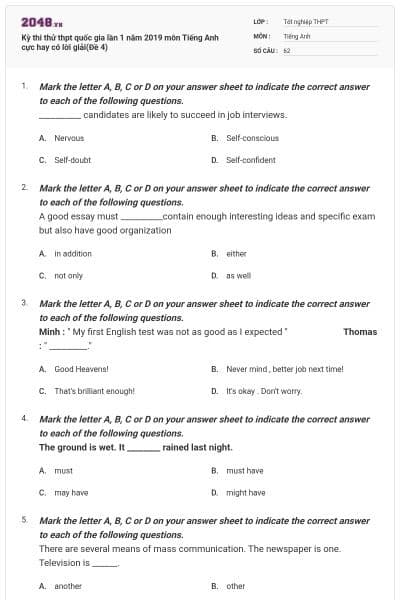
Mark the letter A, B, C or D on your answer sheet to indicate the correct answer to each of the following questions.
__________ candidates are likely to succeed in job interviews.
Nervous
Self-conscious
Self-doubt
Self-confident
Đáp án : D
nervous(a): lo lắng ; self-conscious (a); tự giác, tự ý thức
self- confident(a) tự tin; self- doubt (n): sự ngờ vực, sự thiếu tự tin.
Succeed in st/ving : thành công trong việc gì đó
Không chọn C do C là danh từ, không chọn A và B do nghĩa dịch.
Câu được dịch; Những thí sinh tự tin có khả năng thành công ở những buổi phỏng vấn xin việc.
Mark the letter A, B, C or D on your answer sheet to indicate the correct answer to each of the following questions.
A good essay must __________contain enough interesting ideas and specific exam but also have good organization
in addition
either
not only
as well
Đáp án : C
Chọn C vì ta có cấu trúc…not only… but also… : … không những … mà còn…
In addition: Ngoài ra ( thường đứng đầu câu)
As well : cũng như ( không chọn vì as well = and)
Either …or…: hoặc ( dùng trong câu phủ định)
Mark the letter A, B, C or D on your answer sheet to indicate the correct answer to each of the following questions.
Minh : " My first English test was not as good as I expected " Thomas : " _________."
Good Heavens!
Never mind , better job next time!
That's brilliant enough!
It's okay . Don't worry.
Đáp án : B
Good Heavens: Trời ơi! ( dùng để diễn tả sự ngạc nhiên hoăc khó chịu)
Never mind, better job next time!: kệ nó đi, cố gắng lần sau nhé.
It’s okay. Don’t worry : Ổn rồi . Đừng lo lắng!
That's brilliant enough!; thế là đủ giỏi rồi.
Không nên chọn C vì C không đưa ra lời an ủi động viên. Trong 2 phương án B và D thì B thích hợp hơn
do B đưa ra lời động viên cố gắng lần sau.
Mark the letter A, B, C or D on your answer sheet to indicate the correct answer to each of the following questions.
The ground is wet. It ________ rained last night.
must
must have
may have
might have
Đáp án : B
May/ might have Ved: dùng để diễn tả dự đoán 1 việc gì đó có thể đã xảy ra trong quá khứ
Must have Ved: diễn tả 1 việc gì đó hẳn đã xảy ra( khả năng xảy ra cao do có dấu hiệu, dẫn chứng)
Ở đây chọn B do đưa ra dự đoán hành động trong quá khứ đồng thời có dấu hiệu ở hiện tại là “ the ground is wet”
Không chọn A do ta chỉ dùng ‘ must + V” cho hiện tại và “ must have Ved” cho quá khứ .
Mark the letter A, B, C or D on your answer sheet to indicate the correct answer to each of the following questions.
There are several means of mass communication. The newspaper is one. Television is ______.
another
other
the another
the other
Đáp án : A
another: một cái khác ( được dùng như tính từ đứng trước danh từ số ít hoặc danh từ)
The other: cái còn lại ( dùng như danh từ số ít) ; the others : những cái còn lại
Other : vài(cái) khác,theo sau là danh từ số nhiều; Others :những thứ khác nữa,được sử dụng như đại từ giữ chức năng chủ ngữ trong câu,theo sau là động từ
ở đây chọn “another” do câu dịch nghĩa là: “ có 1 vài phương tiện truyền thông đại chúng. Báo chí là một loai. Tivi là 1 loại khác.”
Không dùng “the other” do theo nghĩa. Không dùng “ other” do nó đóng vai trò như tính từ.
Người ta ít khi nói cụm “ the another”
Mark the letter A, B, C or D on your answer sheet to indicate the correct answer to each of the following questions.
If you _______ less last night, you _______ so bad today.
had drunk- would not have felt
drank- would not feel
had drunk- would not feel
would have drunk- would not feel
Đáp án: C
Giải thích:
Kiến thức: Câu điều kiện
Ta thấy mệnh đề điều kiện có thời gian trong quá khứ (last night), mệnh đề kết quả có thời gian ở hiện tại (today), vậy đây là câu điều kiện hỗn hợp 3-2, diễn tả điều kiện không có thật trong quá khứ, kết quả không có thật ở hiện tại.
Cấu trúc câu điều kiện hỗn hợp 3-2:
If + S + had VpII, S + would V
Dịch: Nếu tối qua bạn uống ít thôi thì bạn không cảm thấy tệ như bây giờ.
Mark the letter A, B, C or D on your answer sheet to indicate the correct answer to each of the following questions.
I can’t sleep ________ the hot weather.
because of
as
because
Since
Đáp án : A
because of N/ Ving = As/ since/ because + mệnh đề: vì…
Mark the letter A, B, C or D on your answer sheet to indicate the correct answer to each of the following questions.
British and Australian people share the same language, but in other respects they are as different as _________.
cats and dogs
chalk and cheese
salt and pepper
here and there
Đáp án : B
as different as chalk and cheese: khác nhau hoàn toàn
It rains cats and dogs : trời mưa như trút
Pepper and salt: màu muối tiêu
Here and there: đấy đó
Dịch câu: người Anh và người Úc đều chung 1 ngôn ngữ, nhưng ở khía cạnh khác họ hoàn toàn khác nhau =)
Mark the letter A, B, C or D on your answer sheet to indicate the correct answer to each of the following questions.
The boy was sent to the police because of several ________ that he had taken part in.
set-to
set-toes
sets-to
set-tos
Đáp án: D
Giải thích:
Vì trước vị trí cần điền là “several” (một vài) nên cần điền danh từ ở dạng số nhiều.
set–to (n): cuộc ẩu đả
Số nhiều của danh từ này là “set-tos”
Chọn D.
Dịch: Cậu bé đã được đưa đến cảnh sát vì một số cuộc ẩu đả mà cậu đã tham gia.
Mark the letter A, B, C or D on your answer sheet to indicate the correct answer to each of the following questions.
I just can't ______ that noise any longer!
put up with
stand in for
sit out
stand up to
Đáp án: A
Giải thích:
Kiến thức: Cụm động từ
A. put up with: chịu đựng điều gì khó chịu
B. stand in for: thay thế ai đó tạm thời
C. sit out: không tham gia vào (một hoạt động)
D. stand up to: đương đầu, chống lại
Dựa vào nghĩa, chọn A.
Dịch: Tôi thực sự không thể chịu đựng tiếng ồn đó thêm nữa!
Mark the letter A, B, C or D on your answer sheet to indicate the correct answer to each of the following questions.
______ should a young child be allowed to play with fireworks without adult supervision
Under no circumstances
No sooner than
Always
Only when
Đáp án : A
Put up with: chịu đựng được
Stand in for: đại diện cho
Stand up to: kháng cự, đối đầu
Sit out: ngồi ngoài trời
Ơ đây chọn “ put up with” theo nghĩa dịch ( tôi không thể chịu đựng được âm thanh đó thêm được nữa)
Mark the letter A, B, C or D on your answer sheet to indicate the correct answer to each of the following questions.
Nobody phoned while I was out, ________?
wasn’t I
was I
did they
didn't they
Đáp án : C
Trong câu hỏi đuôi “nobody” được thay thế bằng đại từ “they”
Hơn nữa “nobody” mang nghĩa phủ định =) Chọn C
Mark the letter A, B, C or D on your answer sheet to indicate the correct answer to each of the following questions.
The next meeting _________ in May.
will hold
will be held
will be holding
will have held
Đáp án : B
Chọn “will be held” do đây là câu bị động. Các đáp án còn lại đều mang hình thức chủ động
Mark the letter A, B, C or D on your answer sheet to indicate the correct answer to each of the following questions.
The librarian told us not _________ reference books out of the library.
taking
to take
take
took
Đáp án : B
Tell sb (not) to V : yêu cầu ai đó (không) làm gì =) chọn “to take”
Mark the letter A, B, C or D on your answer sheet to indicate the correct answer to each of the following questions.
John: "Congratulations! You did great. Mary: - " ___________.”
It’s nice of you to say so
It’s my pleasure
you're welcome
that's okay
Đáp án : A
It’s nice of you to say so: bạn thật tốt khi nói thế ( đáp lại lời khen, chúc mừng) => chọn phương án này.
You’re welcome: không có gì đâu mà ( đáp lại lời cảm ơn)
It’s okay: ổn rồi
It’s my pleasure: đó là vinh dự của tôi ( đáp lại lời cảm ơn vì đã giúp đỡ ai đó ).
pt;font-family:"Times New Roman","serif";mso-ansi-language:NL'>người lớn)
Không chọn “always” do sai về mặt nghĩa câu
Không chọn “no sooner than” do ta có cấu trúc :
no sooner ...than...= hardly... when ...: ngay khi...thì ...
Không chọn “only when” do sau nó cần một mệnh đề.
Mark the letter A, B, C or D on your answer sheet to indicate the correct answer to each of the following questions.
My responsibility is to _________ my little brothers
take care of
join hands
take over
worrk together
Đáp án : A
Take care of =look after : chăm sóc
Join hands; bắt tay, cấu kết
Take over: kế nhiệm
Work together: làm việc cùng nhau
Dịch câu: trách nhiệm của tôi là chăm sóc mấy đứa em nhỏ. => chọn A
giúp đỡ ai đó ).
pt;font-family:"Times New Roman","serif";mso-ansi-language:NL'>người lớn)
Không chọn “always” do sai về mặt nghĩa câu
Không chọn “no sooner than” do ta có cấu trúc :
no sooner ...than...= hardly... when ...: ngay khi...thì ...
Không chọn “only when” do sau nó cần một mệnh đề.
Mark the letter A, B, C or D on your answer sheet to indicate the correct answer to each of the following questions.
In Vietnam, two or more ________ may live in a home.
generations
generous
generation
generators
Đáp án : A
Chọn A do cần một danh từ số nhiều ( geneneration (n): thế hệ )
Generator (n): người khởi xướng => không chọn do không hợp nghĩa
Generous (a) hào phóng
Làm việc cùng nhau
Dịch câu: trách nhiệm của tôi là chăm sóc mấy đứa em nhỏ. => chọn A
giúp đỡ ai đó ).
pt;font-family:"Times New Roman","serif";mso-ansi-language:NL'>người lớn)
Không chọn “always” do sai về mặt nghĩa câu
Không chọn “no sooner than” do ta có cấu trúc :
no sooner ...than...= hardly... when ...: ngay khi...thì ...
Không chọn “only when” do sau nó cần một mệnh đề.
Mark the letter A, B, C or D on your answer sheet to indicate the correct answer to each of the following questions.
_________ migrate long distances is well documented.
that it is birds
that birds
birds that
it is that birds
Đáp án : B
Cần xác định:
_________ migrate long distances : là 1 cụm chủ ngữ
is well documented. : là vị ngữ
Không chọn A do mệnh đề sau “that” sai về cấu trúc ngữ pháp câu
Không chọn C do động từ chính của câu chia số ít “is well documented”
Không chọn D do không đúng cấu trúc câu
Chọn B => câu đúng ngữ pháp và chia thì số ít là hợp lý.
Mark the letter A, B, C, or D on your answer sheet to indicate the word whose underlined part differs from the other three in pronunciation in each of the following questions.
Plan
Sing
Stand
And
Đáp án : B
Plan / plæn/ sing/ siη/ stand/ stænd/ and/ ænd/ => chọn B
Mark the letter A, B, C, or D on your answer sheet to indicate the word whose underlined part differs from the other three in pronunciation in each of the following questions.
Looks
loves
joins
spends
Đáp án : A
Chú ý: cách đọc đuôi /s,es/
/s/ khi từ có tận cùng bằng các phụ âm vô thanh: /ð/, /p/, /k/, /f/, /t/.
/iz/ khi từ có tận cùng là các âm: /s/, /z/, /ʃ/, /tʃ/, /ʒ/, /dʒ/.
/z/ các âm còn lại
Choose the word whose stress position is diferent from that of the others
open
happen
offer
Begin
Đáp án : D
'Open ‘Happen ‘Offer Be’gin => chọn D
Choose the word whose stress position is diferent from that of the others
difficulty
simplicity
discovery
Commodity
Đáp án : A
'Difficulty Sim'plicity Dis'covery Com’modity => chọn A
Mark the letter A, B, C, or D on your answer sheet to indicate the word or phrase that is CLOSEST in meaning to the underlined part in each of the following questions from 25 to 29.
Today’s scientists have overcome many of the challenges of the depth by using more sophisticated tools.
complicated
worldly
experienced
Aware
Đáp án : A
Today’s scientists have overcome many of the challenges of the depth by using more sophisticated tools: các nhà khoa học ngày nay đã vượt qua được những thử thách về độ sâu bằng việc sử dụng những công cụ phức tạp.
complicated (a) phức tạp worldly (a) từng trải
experienced(a) có kinh nghiệm aware(a) nhận thức
Mark the letter A, B, C, or D on your answer sheet to indicate the word or phrase that is CLOSEST in meaning to the underlined part in each of the following questions from 25 to 29.
We went away on holiday last week, but it rained day in day out.
every single day
every other day
every second day
every two days
Đáp án : A
Ta có cụm từ "day in day out" = days follow one another có nghĩa là ngày tiếp nối ngày (liền mạch) Cụm này bằng với “every single day” nghĩa là mỗi ngày
“every two days” nghĩa là cứ hai ngày 1 lần
Mark the letter A, B, C, or D on your answer sheet to indicate the word or phrase that is CLOSEST in meaning to the underlined part in each of the following questions from 25 to 29.
We can use either verbal or non – verbal forms of communication.
using gesture
using speech
using verbs
using facial expressions
Đáp án : B Verbal (a) thuộc về lời nói = using speech
Gesture (n) cử chỉ
Mark the letter A, B, C, or D on your answer sheet to indicate the word or phrase that is CLOSEST in meaning to the underlined part in each of the following questions from 25 to 29.
Each year about fifty hundred species of plants and animals are already being eliminated.
dropped
removed
kicked
Tossed
Đáp án: B
Giải thích:
A. drop (v): rơi, giảm
B. remove (v): loại bỏ
C. kick (v): đá ra
D. toss (v): tung, ném, hất
→ eliminate (v) = remove (v): loại ra, loại bỏ, loại trừ
Dịch: Mỗi năm khoảng năm nghìn loài thực vật và động vật đã bị giết bỏ.
Mark the letter A, B, C, or D on your answer sheet to indicate the word or phrase that is CLOSEST in meaning to the underlined part in each of the following questions from 25 to 29.
The unmanned U.S space probe Mariner 9 sent back over 7,000 photos of Mars.
circulated
transmitted
conveyed
submitted
Đáp án : B
Dịch câu: Con tàu thăm dò vũ trụ Mariner 9 gửi truyền lại 7000 bức ảnh sao Hỏa
Ở đây không chọn A và C do nghĩa dịch ( “circulate” (v): tuần hoàn, lưu thông; “submit” (v):
giao nộp )
Convey(v) truyền đạt ( thông tin)
Ở đây chọn “ transmitted” nghĩa là truyền ( tín hiệu)
Mark the letter A, B, C, or D on your answer sheet to show the underlined part that needs correction.
(A) Several people have (B) apparent tried to change the man’s (C) mind, but he refuses (D) to listen.
Several
apparent
mind
to listen
Đáp án : B
B=> apparently(adv); hình như do cần một trạng từ bổ nghĩa cho động từ” tried”
Mark the letter A, B, C, or D on your answer sheet to show the underlined part that needs correction.
The (A) top of the mountain (B) covered (C) with snow (D) during winter.
top
covered
with
during
Đáp án : B
B=> is covered do câu mang nghĩa bị động( Đỉnh núi bị phủ bởi tuyết suốt mùa đông)
Mark the letter A, B, C, or D on your answer sheet to show the underlined part that needs correction.
(A) What I told her a few days ago (B) were not the solutions (C) to (D) most of her problems
What I told her
were
to
most of
Đáp án : B
B=> is covered do câu mang nghĩa bị động( Đỉnh núi bị phủ bởi tuyết suốt mùa đông)
Mark the letter A, B, C, or D on your answer sheet to show the underlined part that needs correction.
Lake Superior,(A) that (B) lies on the US Canadian border, is the (C) largest lake (D) in North
that
lies on
largest lake
in
Đáp án : A
A=> which: ở đây không dùng “that” sau dấu phẩy
Mark the letter A, B, C, or D on your answer sheet to show the underlined part that needs correction.
It’s(A) not that I don’t like her, but I object (B) to be called (C) that by her. I am not her“buddy”, (D) am I?
not that
to be
that by
am I
Đáp án : B
B=> to being : do có cấu trúc “object to +V-ing”. Câu này mang nghĩa bị động nên có dạng: be + VpI,nên khi đi theo sau object to thì be phải biến đổi thành being.
“buddy”, am I?
Read the following passage and mark the letter A, B, C, or D on your answer sheet to indicate the correct word or phrase that best fits each of the numbered blanks. Fill in the appropriate word in question 35
It is relatively easy for computers to speak. A computer that says ‘please’ and ‘thank you’ in the right places is (35) ___ miracle of science ,but recognizing the words that make up normal , continuous human speech is another (36) ___
Not until now have computer been programmed to (37) ___ to a range of spoken commands.Until recently it was thought that computers would have tobe programmed to the accent and speech hahits of each user,and only then would be able to respond(38) ___to their master’s or mistress’s voice.Now rapid progress is being made (39) ______systems programmed to adapt easily to each new speaker.
The IBM Tangora system,under development at the end of 1980s was claimed to (40) ______a spoken vocabulary of 20,000 words with 95 percent accuracy. The system includes a processor that can make informed guesses as to(41)______is a likely sentence.That system has been programmed not only with grammatical rules,but also with an analyssis of a vast quantity of office correspondence.On the(42) ______
of this information ,the machine can calculate the probability of one particular word following another.
Statistical probability is necessary for computers to interpret not only speech but also
(43) ______data.
Security systems can distinguish between faces they have been taught to recognize,but never has a computer
been able to match a human’s ability to make sense of a three-dimemsional scene
(44) ______identifying all objects in it.
(From ‘Heinle & Heinle TOEFL Test Assistant .Grammar’ by Milada Broukal)
no
not
nothing
None
Đáp án : A
Không chọn C và D do sau đó là danh từ.
Trong 2 đáp án A và B, đáp án A hợp lý hơn vì nếu dùng “not” cần thêm mạo từ vào trước danh từ “miracle”
Read the following passage and mark the letter A, B, C, or D on your answer sheet to indicate the correct word or phrase that best fits each of the numbered blanks. Fill in the appropriate word in question 36
It is relatively easy for computers to speak. A computer that says ‘please’ and ‘thank you’ in the right places is (35) ___ miracle of science ,but recognizing the words that make up normal , continuous human speech is another (36) ___
Not until now have computer been programmed to (37) ___ to a range of spoken commands.Until recently it was thought that computers would have tobe programmed to the accent and speech hahits of each user,and only then would be able to respond(38) ___to their master’s or mistress’s voice.Now rapid progress is being made (39) ______systems programmed to adapt easily to each new speaker.
The IBM Tangora system,under development at the end of 1980s was claimed to (40) ______a spoken vocabulary of 20,000 words with 95 percent accuracy. The system includes a processor that can make informed guesses as to(41)______is a likely sentence.That system has been programmed not only with grammatical rules,but also with an analyssis of a vast quantity of office correspondence.On the(42) ______
of this information ,the machine can calculate the probability of one particular word following another.
Statistical probability is necessary for computers to interpret not only speech but also
(43) ______data.
Security systems can distinguish between faces they have been taught to recognize,but never has a computer
been able to match a human’s ability to make sense of a three-dimemsional scene
(44) ______identifying all objects in it.
(From ‘Heinle & Heinle TOEFL Test Assistant .Grammar’ by Milada Broukal)
problem
topic
matter
Theme
Đáp án : C
Ở đây không dùng “theme” và “topic” nghĩa là chủ đề, không hợp nghĩa
Problem: vấn đề nan giải thật sự cần giải quyết
Matter: vấn đề chung đang được tranh cãi
Read the following passage and mark the letter A, B, C, or D on your answer sheet to indicate the correct word or phrase that best fits each of the numbered blanks. Fill in the appropriate word in question 37
It is relatively easy for computers to speak. A computer that says ‘please’ and ‘thank you’ in the right places is (35) ___ miracle of science ,but recognizing the words that make up normal , continuous human speech is another (36) ___
Not until now have computer been programmed to (37) ___ to a range of spoken commands.Until recently it was thought that computers would have tobe programmed to the accent and speech hahits of each user,and only then would be able to respond(38) ___to their master’s or mistress’s voice.Now rapid progress is being made (39) ______systems programmed to adapt easily to each new speaker.
The IBM Tangora system,under development at the end of 1980s was claimed to (40) ______a spoken vocabulary of 20,000 words with 95 percent accuracy. The system includes a processor that can make informed guesses as to(41)______is a likely sentence.That system has been programmed not only with grammatical rules,but also with an analyssis of a vast quantity of office correspondence.On the(42) ______
of this information ,the machine can calculate the probability of one particular word following another.
Statistical probability is necessary for computers to interpret not only speech but also
(43) ______data.
Security systems can distinguish between faces they have been taught to recognize,but never has a computer
been able to match a human’s ability to make sense of a three-dimemsional scene
(44) ______identifying all objects in it.
(From ‘Heinle & Heinle TOEFL Test Assistant .Grammar’ by Milada Broukal)
talk
answer
communicate
React
Đáp án : D
Không chọn A do không hợp nghĩa dịch
Không chọn B do sau “answer” là tân ngữ
Không chọn C do ta có cấu trúc “communicate with st”: giao tiếp với…
Chọn C ( react to (v) nghĩa là phản ứng lại với)
Read the following passage and mark the letter A, B, C, or D on your answer sheet to indicate the correct word or phrase that best fits each of the numbered blanks. Fill in the appropriate word in question 38
It is relatively easy for computers to speak. A computer that says ‘please’ and ‘thank you’ in the right places is (35) ___ miracle of science ,but recognizing the words that make up normal , continuous human speech is another (36) ___
Not until now have computer been programmed to (37) ___ to a range of spoken commands.Until recently it was thought that computers would have tobe programmed to the accent and speech hahits of each user,and only then would be able to respond(38) ___to their master’s or mistress’s voice.Now rapid progress is being made (39) ______systems programmed to adapt easily to each new speaker.
The IBM Tangora system,under development at the end of 1980s was claimed to (40) ______a spoken vocabulary of 20,000 words with 95 percent accuracy. The system includes a processor that can make informed guesses as to(41)______is a likely sentence.That system has been programmed not only with grammatical rules,but also with an analyssis of a vast quantity of office correspondence.On the(42) ______
of this information ,the machine can calculate the probability of one particular word following another.
Statistical probability is necessary for computers to interpret not only speech but also
(43) ______data.
Security systems can distinguish between faces they have been taught to recognize,but never has a computer
been able to match a human’s ability to make sense of a three-dimemsional scene
(44) ______identifying all objects in it.
(From ‘Heinle & Heinle TOEFL Test Assistant .Grammar’ by Milada Broukal)
truly
completely
accurately
Right
Đáp án : C
Respond accurately to: trả lời 1 cách chính xác tới…
Read the following passage and mark the letter A, B, C, or D on your answer sheet to indicate the correct word or phrase that best fits each of the numbered blanks. Fill in the appropriate word in question 39
It is relatively easy for computers to speak. A computer that says ‘please’ and ‘thank you’ in the right places is (35) ___ miracle of science ,but recognizing the words that make up normal , continuous human speech is another (36) ___
Not until now have computer been programmed to (37) ___ to a range of spoken commands.Until recently it was thought that computers would have tobe programmed to the accent and speech hahits of each user,and only then would be able to respond(38) ___to their master’s or mistress’s voice.Now rapid progress is being made (39) ______systems programmed to adapt easily to each new speaker.
The IBM Tangora system,under development at the end of 1980s was claimed to (40) ______a spoken vocabulary of 20,000 words with 95 percent accuracy. The system includes a processor that can make informed guesses as to(41)______is a likely sentence.That system has been programmed not only with grammatical rules,but also with an analyssis of a vast quantity of office correspondence.On the(42) ______
of this information ,the machine can calculate the probability of one particular word following another.
Statistical probability is necessary for computers to interpret not only speech but also
(43) ______data.
Security systems can distinguish between faces they have been taught to recognize,but never has a computer
been able to match a human’s ability to make sense of a three-dimemsional scene
(44) ______identifying all objects in it.
(From ‘Heinle & Heinle TOEFL Test Assistant .Grammar’ by Milada Broukal)
with
for
within
As
Đáp án : A
With N: với…( chỉ phương tiện)=> Chọn A hợp nghĩa câu
Read the following passage and mark the letter A, B, C, or D on your answer sheet to indicate the correct word or phrase that best fits each of the numbered blanks. Fill in the appropriate word in question 40
It is relatively easy for computers to speak. A computer that says ‘please’ and ‘thank you’ in the right places is (35) ___ miracle of science ,but recognizing the words that make up normal , continuous human speech is another (36) ___
Not until now have computer been programmed to (37) ___ to a range of spoken commands.Until recently it was thought that computers would have tobe programmed to the accent and speech hahits of each user,and only then would be able to respond(38) ___to their master’s or mistress’s voice.Now rapid progress is being made (39) ______systems programmed to adapt easily to each new speaker.
The IBM Tangora system,under development at the end of 1980s was claimed to (40) ______a spoken vocabulary of 20,000 words with 95 percent accuracy. The system includes a processor that can make informed guesses as to(41)______is a likely sentence.That system has been programmed not only with grammatical rules,but also with an analyssis of a vast quantity of office correspondence.On the(42) ______
of this information ,the machine can calculate the probability of one particular word following another.
Statistical probability is necessary for computers to interpret not only speech but also
(43) ______data.
Security systems can distinguish between faces they have been taught to recognize,but never has a computer
been able to match a human’s ability to make sense of a three-dimemsional scene
(44) ______identifying all objects in it.
(From ‘Heinle & Heinle TOEFL Test Assistant .Grammar’ by Milada Broukal)
know
regconize
master
realize
Đáp án : B
Master(v) làm chủ
Không chọn A và C do không hợp nghĩa câu
Không chọn D do “realize” có nghĩa là nhận ra 1 điều gì đó
“ recognize” nhận dạng
Read the following passage and mark the letter A, B, C, or D on your answer sheet to indicate the correct word or phrase that best fits each of the numbered blanks. Fill in the appropriate word in question 41
It is relatively easy for computers to speak. A computer that says ‘please’ and ‘thank you’ in the right places is (35) ___ miracle of science ,but recognizing the words that make up normal , continuous human speech is another (36) ___
Not until now have computer been programmed to (37) ___ to a range of spoken commands.Until recently it was thought that computers would have tobe programmed to the accent and speech hahits of each user,and only then would be able to respond(38) ___to their master’s or mistress’s voice.Now rapid progress is being made (39) ______systems programmed to adapt easily to each new speaker.
The IBM Tangora system,under development at the end of 1980s was claimed to (40) ______a spoken vocabulary of 20,000 words with 95 percent accuracy. The system includes a processor that can make informed guesses as to(41)______is a likely sentence.That system has been programmed not only with grammatical rules,but also with an analyssis of a vast quantity of office correspondence.On the(42) ______
of this information ,the machine can calculate the probability of one particular word following another.
Statistical probability is necessary for computers to interpret not only speech but also
(43) ______data.
Security systems can distinguish between faces they have been taught to recognize,but never has a computer
been able to match a human’s ability to make sense of a three-dimemsional scene
(44) ______identifying all objects in it.
(From ‘Heinle & Heinle TOEFL Test Assistant .Grammar’ by Milada Broukal)
which
what
how
That
Đáp án : B
Dịch câu: hệ thống bao gồm 1 máy xử lý cái mà đưa ra những dự đoán đầy thông tin
xem câu có khả năng là gì
Chọn B( không chọn A do từ để hỏi “which” thường dùng danh từ sau đó)
mes New Roman","serif"'>“ recognize” nhận dạng
Read the following passage and mark the letter A, B, C, or D on your answer sheet to indicate the correct word or phrase that best fits each of the numbered blanks. Fill in the appropriate word in question 42
It is relatively easy for computers to speak. A computer that says ‘please’ and ‘thank you’ in the right places is (35) ___ miracle of science ,but recognizing the words that make up normal , continuous human speech is another (36) ___
Not until now have computer been programmed to (37) ___ to a range of spoken commands.Until recently it was thought that computers would have tobe programmed to the accent and speech hahits of each user,and only then would be able to respond(38) ___to their master’s or mistress’s voice.Now rapid progress is being made (39) ______systems programmed to adapt easily to each new speaker.
The IBM Tangora system,under development at the end of 1980s was claimed to (40) ______a spoken vocabulary of 20,000 words with 95 percent accuracy. The system includes a processor that can make informed guesses as to(41)______is a likely sentence.That system has been programmed not only with grammatical rules,but also with an analyssis of a vast quantity of office correspondence.On the(42) ______
of this information ,the machine can calculate the probability of one particular word following another.
Statistical probability is necessary for computers to interpret not only speech but also
(43) ______data.
Security systems can distinguish between faces they have been taught to recognize,but never has a computer
been able to match a human’s ability to make sense of a three-dimemsional scene
(44) ______identifying all objects in it.
(From ‘Heinle & Heinle TOEFL Test Assistant .Grammar’ by Milada Broukal)
foundation
principle
ground
Basis
Đáp án : D
On the basis of…; dựa trên cơ sở
Foundation(n) sự thành lập
Principle(n) quy tắc
=) D
Read the following passage and mark the letter A, B, C, or D on your answer sheet to indicate the correct word or phrase that best fits each of the numbered blanks. Fill in the appropriate word in question 43
It is relatively easy for computers to speak. A computer that says ‘please’ and ‘thank you’ in the right places is (35) ___ miracle of science ,but recognizing the words that make up normal , continuous human speech is another (36) ___
Not until now have computer been programmed to (37) ___ to a range of spoken commands.Until recently it was thought that computers would have tobe programmed to the accent and speech hahits of each user,and only then would be able to respond(38) ___to their master’s or mistress’s voice.Now rapid progress is being made (39) ______systems programmed to adapt easily to each new speaker.
The IBM Tangora system,under development at the end of 1980s was claimed to (40) ______a spoken vocabulary of 20,000 words with 95 percent accuracy. The system includes a processor that can make informed guesses as to(41)______is a likely sentence.That system has been programmed not only with grammatical rules,but also with an analyssis of a vast quantity of office correspondence.On the(42) ______
of this information ,the machine can calculate the probability of one particular word following another.
Statistical probability is necessary for computers to interpret not only speech but also
(43) ______data.
Security systems can distinguish between faces they have been taught to recognize,but never has a computer
been able to match a human’s ability to make sense of a three-dimemsional scene
(44) ______identifying all objects in it.
(From ‘Heinle & Heinle TOEFL Test Assistant .Grammar’ by Milada Broukal)
visual
noticeable
seen
visible
Đáp án : A
Dùng tính từ “’visual” với “data” => chọn A
Không chọn “noticeable”( đáng chú ý); “visible” (hữu hình)
Read the following passage and mark the letter A, B, C, or D on your answer sheet to indicate the correct word or phrase that best fits each of the numbered blanks. Fill in the appropriate word in question 44
It is relatively easy for computers to speak. A computer that says ‘please’ and ‘thank you’ in the right places is (35) ___ miracle of science ,but recognizing the words that make up normal , continuous human speech is another (36) ___
Not until now have computer been programmed to (37) ___ to a range of spoken commands.Until recently it was thought that computers would have tobe programmed to the accent and speech hahits of each user,and only then would be able to respond(38) ___to their master’s or mistress’s voice.Now rapid progress is being made (39) ______systems programmed to adapt easily to each new speaker.
The IBM Tangora system,under development at the end of 1980s was claimed to (40) ______a spoken vocabulary of 20,000 words with 95 percent accuracy. The system includes a processor that can make informed guesses as to(41)______is a likely sentence.That system has been programmed not only with grammatical rules,but also with an analyssis of a vast quantity of office correspondence.On the(42) ______
of this information ,the machine can calculate the probability of one particular word following another.
Statistical probability is necessary for computers to interpret not only speech but also
(43) ______data.
Security systems can distinguish between faces they have been taught to recognize,but never has a computer
been able to match a human’s ability to make sense of a three-dimemsional scene
(44) ______identifying all objects in it.
(From ‘Heinle & Heinle TOEFL Test Assistant .Grammar’ by Milada Broukal)
from
by
of
without
Đáp án : B
By identifying…: bằng việc xác định …
Các giới từ khác không phù hợp về nghĩa.
Read the following passage and mark the letter A, B, C, or D on your answer sheet to indicate the correct answer to each of the following questions from 55to 64.
An air pollutant is defined as a compound added directly or indirectly by humans to the atmosphere in such quantities as to affect humans, animals, vegetation, or materials adversely. Air pollution requires a very flexible definition that permits continuous change. When the first air pollution laws were established inEngland in the fourteenth century, air pollutants were limited to compounds that could be seen or smelled - a far cry from the extensive list of harmful substances known today. As technology has developed and knowledge of the health aspects of various chemicals has increased, the list of air pollutants has lengthened. In the future, even water vapor might be considered an air pollutant under certain conditions.
Many of the more important air pollutants, such as sulfur oxides, carbon monoxide, and nitrogen oxides, are found in nature. As the Earth developed, the concentration of these pollutants was altered by various chemical reactions; they became components in biogeochemical cycles. These serve as an air purification scheme by allowing the compounds to move from the air to the water or soil. On a global basis, nature's output of these compounds dwarfs that resulting from human activities.
However, human production usually occurs in a localized area, such as a city. In such a region, human output may be dominant and may temporarily overload the natural purification scheme of the cycles. The result is an increased concentration of noxious chemicals in the air. The concentrations at which the adverse effects appear will be greater than the concentrations that the pollutants would have in the absence of human activities. The actual concentration need not be large for a substance to be a pollutant; in fact, the numerical value tells us little until we know how much of an increase this represents over the concentration that would occur naturally in the area. For example, sulfur dioxide has detectable health effects at 0.08 parts per million (ppm), which is about 400 times its natural level. Carbon monoxide, however, has a natural level of 0.1 ppm and is not usually a pollutant until its level reaches about 15 ppm.
What does the passage mainly discuss?
The economic impact of air pollution.
What constitutes an air pollutant
How much harm air pollutants can cause.
The effects of compounds added to the atmosphere
Đáp án : B
Có thể đọc câu đầu và cuối ở mỗi đoạn văn để hiểu thêm( nên làm câu này cuối cùng)
Read the following passage and mark the letter A, B, C, or D on your answer sheet to indicate the correct answer to each of the following questions from 55 to 64.
An air pollutant is defined as a compound added directly or indirectly by humans to the atmosphere in such quantities as to affect humans, animals, vegetation, or materials adversely. Air pollution requires a very flexible definition that permits continuous change. When the first air pollution laws were established inEngland in the fourteenth century, air pollutants were limited to compounds that could be seen or smelled - a far cry from the extensive list of harmful substances known today. As technology has developed and knowledge of the health aspects of various chemicals has increased, the list of air pollutants has lengthened. In the future, even water vapor might be considered an air pollutant under certain conditions.
Many of the more important air pollutants, such as sulfur oxides, carbon monoxide, and nitrogen oxides, are found in nature. As the Earth developed, the concentration of these pollutants was altered by various chemical reactions; they became components in biogeochemical cycles. These serve as an air purification scheme by allowing the compounds to move from the air to the water or soil. On a global basis, nature's output of these compounds dwarfs that resulting from human activities.
However, human production usually occurs in a localized area, such as a city. In such a region, human output may be dominant and may temporarily overload the natural purification scheme of the cycles. The result is an increased concentration of noxious chemicals in the air. The concentrations at which the adverse effects appear will be greater than the concentrations that the pollutants would have in the absence of human activities. The actual concentration need not be large for a substance to be a pollutant; in fact, the numerical value tells us little until we know how much of an increase this represents over the concentration that would occur naturally in the area. For example, sulfur dioxide has detectable health effects at 0.08 parts per million (ppm), which is about 400 times its natural level. Carbon monoxide, however, has a natural level of 0.1 ppm and is not usually a pollutant until its level reaches about 15 ppm.
The word "adversely" in the first paragraph is closest in meaning to _______.
negatively
quickly
admitedly
considerably
Đáp án : A
adversely= negatively (adv) 1 cách tiêu cực
admittedly: thừa nhận, considerably: tương đối, quickly: nhanh chóng
Ở bài đọc này nói về air pollutant, ta có thể đoán được “adversely” mang nghĩa tiêu cực =>A
Read the following passage and mark the letter A, B, C, or D on your answer sheet to indicate the correct answer to each of the following questions from 55 to 64.
An air pollutant is defined as a compound added directly or indirectly by humans to the atmosphere in such quantities as to affect humans, animals, vegetation, or materials adversely. Air pollution requires a very flexible definition that permits continuous change. When the first air pollution laws were established inEngland in the fourteenth century, air pollutants were limited to compounds that could be seen or smelled - a far cry from the extensive list of harmful substances known today. As technology has developed and knowledge of the health aspects of various chemicals has increased, the list of air pollutants has lengthened. In the future, even water vapor might be considered an air pollutant under certain conditions.
Many of the more important air pollutants, such as sulfur oxides, carbon monoxide, and nitrogen oxides, are found in nature. As the Earth developed, the concentration of these pollutants was altered by various chemical reactions; they became components in biogeochemical cycles. These serve as an air purification scheme by allowing the compounds to move from the air to the water or soil. On a global basis, nature's output of these compounds dwarfs that resulting from human activities.
However, human production usually occurs in a localized area, such as a city. In such a region, human output may be dominant and may temporarily overload the natural purification scheme of the cycles. The result is an increased concentration of noxious chemicals in the air. The concentrations at which the adverse effects appear will be greater than the concentrations that the pollutants would have in the absence of human activities. The actual concentration need not be large for a substance to be a pollutant; in fact, the numerical value tells us little until we know how much of an increase this represents over the concentration that would occur naturally in the area. For example, sulfur dioxide has detectable health effects at 0.08 parts per million (ppm), which is about 400 times its natural level. Carbon monoxide, however, has a natural level of 0.1 ppm and is not usually a pollutant until its level reaches about 15 ppm.
It can be inferred from the first paragraph that _______.
water vapor is an air pollutant in localized areas
most air pollutants today can be seen or smelled
the definition of air pollution will continue to change
a substance becomes an air pollutant only in cities
Đáp án : C
“Air pollution requires a very flexible definition that permits continuous change”: ô nhiễm không khí là một định nghĩa hết sức phức tạp cái mà luôn thay đổi liên tục => C
Read the following passage and mark the letter A, B, C, or D on your answer sheet to indicate the correct answer to each of the following questions from 55 to 64.
An air pollutant is defined as a compound added directly or indirectly by humans to the atmosphere in such quantities as to affect humans, animals, vegetation, or materials adversely. Air pollution requires a very flexible definition that permits continuous change. When the first air pollution laws were established inEngland in the fourteenth century, air pollutants were limited to compounds that could be seen or smelled - a far cry from the extensive list of harmful substances known today. As technology has developed and knowledge of the health aspects of various chemicals has increased, the list of air pollutants has lengthened. In the future, even water vapor might be considered an air pollutant under certain conditions.
Many of the more important air pollutants, such as sulfur oxides, carbon monoxide, and nitrogen oxides, are found in nature. As the Earth developed, the concentration of these pollutants was altered by various chemical reactions; they became components in biogeochemical cycles. These serve as an air purification scheme by allowing the compounds to move from the air to the water or soil. On a global basis, nature's output of these compounds dwarfs that resulting from human activities.
However, human production usually occurs in a localized area, such as a city. In such a region, human output may be dominant and may temporarily overload the natural purification scheme of the cycles. The result is an increased concentration of noxious chemicals in the air. The concentrations at which the adverse effects appear will be greater than the concentrations that the pollutants would have in the absence of human activities. The actual concentration need not be large for a substance to be a pollutant; in fact, the numerical value tells us little until we know how much of an increase this represents over the concentration that would occur naturally in the area. For example, sulfur dioxide has detectable health effects at 0.08 parts per million (ppm), which is about 400 times its natural level. Carbon monoxide, however, has a natural level of 0.1 ppm and is not usually a pollutant until its level reaches about 15 ppm.
The word "These" in the second paragraph is closest in meaning to_.
the various chemical reactions
the compounds moved to the water
the pollutants from the developing Earth
the components in biogeochemical cycles
Đáp án : D
Ta thấy câu trước là : “As the Earth developed, the concentration of these pollutants was altered by various chemical reactions; they became components in biogeochemical cycles” => D
Read the following passage and mark the letter A, B, C, or D on your answer sheet to indicate the correct answer to each of the following questions from 55 to 64.
An air pollutant is defined as a compound added directly or indirectly by humans to the atmosphere in such quantities as to affect humans, animals, vegetation, or materials adversely. Air pollution requires a very flexible definition that permits continuous change. When the first air pollution laws were established inEngland in the fourteenth century, air pollutants were limited to compounds that could be seen or smelled - a far cry from the extensive list of harmful substances known today. As technology has developed and knowledge of the health aspects of various chemicals has increased, the list of air pollutants has lengthened. In the future, even water vapor might be considered an air pollutant under certain conditions.
Many of the more important air pollutants, such as sulfur oxides, carbon monoxide, and nitrogen oxides, are found in nature. As the Earth developed, the concentration of these pollutants was altered by various chemical reactions; they became components in biogeochemical cycles. These serve as an air purification scheme by allowing the compounds to move from the air to the water or soil. On a global basis, nature's output of these compounds dwarfs that resulting from human activities.
However, human production usually occurs in a localized area, such as a city. In such a region, human output may be dominant and may temporarily overload the natural purification scheme of the cycles. The result is an increased concentration of noxious chemicals in the air. The concentrations at which the adverse effects appear will be greater than the concentrations that the pollutants would have in the absence of human activities. The actual concentration need not be large for a substance to be a pollutant; in fact, the numerical value tells us little until we know how much of an increase this represents over the concentration that would occur naturally in the area. For example, sulfur dioxide has detectable health effects at 0.08 parts per million (ppm), which is about 400 times its natural level. Carbon monoxide, however, has a natural level of 0.1 ppm and is not usually a pollutant until its level reaches about 15 ppm.
For which of the following reasons can natural pollutants play an important role in controlling air pollution?
They function as part of a purification process.
They occur in greater quantities than other pollutants.
They are less harmful to living beings than other pollutants
They have existed since the Earth developed
Đáp án : A
“Many of the more important air pollutants, such as sulfur oxides, carbon monoxide, and nitrogen oxides, are found in nature”
“These serve as an air purification scheme…” : những cái này đóng vai trò như 1 quy trình làm sạch => A
Read the following passage and mark the letter A, B, C, or D on your answer sheet to indicate the correct answer to each of the following questions from 55 to 64.
An air pollutant is defined as a compound added directly or indirectly by humans to the atmosphere in such quantities as to affect humans, animals, vegetation, or materials adversely. Air pollution requires a very flexible definition that permits continuous change. When the first air pollution laws were established inEngland in the fourteenth century, air pollutants were limited to compounds that could be seen or smelled - a far cry from the extensive list of harmful substances known today. As technology has developed and knowledge of the health aspects of various chemicals has increased, the list of air pollutants has lengthened. In the future, even water vapor might be considered an air pollutant under certain conditions.
Many of the more important air pollutants, such as sulfur oxides, carbon monoxide, and nitrogen oxides, are found in nature. As the Earth developed, the concentration of these pollutants was altered by various chemical reactions; they became components in biogeochemical cycles. These serve as an air purification scheme by allowing the compounds to move from the air to the water or soil. On a global basis, nature's output of these compounds dwarfs that resulting from human activities.
However, human production usually occurs in a localized area, such as a city. In such a region, human output may be dominant and may temporarily overload the natural purification scheme of the cycles. The result is an increased concentration of noxious chemicals in the air. The concentrations at which the adverse effects appear will be greater than the concentrations that the pollutants would have in the absence of human activities. The actual concentration need not be large for a substance to be a pollutant; in fact, the numerical value tells us little until we know how much of an increase this represents over the concentration that would occur naturally in the area. For example, sulfur dioxide has detectable health effects at 0.08 parts per million (ppm), which is about 400 times its natural level. Carbon monoxide, however, has a natural level of 0.1 ppm and is not usually a pollutant until its level reaches about 15 ppm.
According to the passage, human-generated air pollution in localized regions _______.
can be dwarfed by nature's output of pollutants
can overwhelm the natural system that removes pollutants
will damage areas outside of the localized regions
will react harmfully with natural pollutants
Đáp án : B
“However, human production usually occurs in a localized area, such as a city. In such a region, human output may be dominant and may temporarily overload the natural purification scheme of the cycles”: Tuy nhiên, sản xuất thường diễn ra ở những khu vực nhất định như một thành phố chẳng hạn. Ở những khu vực như thế, đầu ra có thể chi phối và tạm thời quá tải quy trình làm sạch” => B
Overwhelm (v) vượt trội.
Read the following passage and mark the letter A, B, C, or D on your answer sheet to indicate the correct answer to each of the following questions from 55 to 64.
An air pollutant is defined as a compound added directly or indirectly by humans to the atmosphere in such quantities as to affect humans, animals, vegetation, or materials adversely. Air pollution requires a very flexible definition that permits continuous change. When the first air pollution laws were established inEngland in the fourteenth century, air pollutants were limited to compounds that could be seen or smelled - a far cry from the extensive list of harmful substances known today. As technology has developed and knowledge of the health aspects of various chemicals has increased, the list of air pollutants has lengthened. In the future, even water vapor might be considered an air pollutant under certain conditions.
Many of the more important air pollutants, such as sulfur oxides, carbon monoxide, and nitrogen oxides, are found in nature. As the Earth developed, the concentration of these pollutants was altered by various chemical reactions; they became components in biogeochemical cycles. These serve as an air purification scheme by allowing the compounds to move from the air to the water or soil. On a global basis, nature's output of these compounds dwarfs that resulting from human activities.
However, human production usually occurs in a localized area, such as a city. In such a region, human output may be dominant and may temporarily overload the natural purification scheme of the cycles. The result is an increased concentration of noxious chemicals in the air. The concentrations at which the adverse effects appear will be greater than the concentrations that the pollutants would have in the absence of human activities. The actual concentration need not be large for a substance to be a pollutant; in fact, the numerical value tells us little until we know how much of an increase this represents over the concentration that would occur naturally in the area. For example, sulfur dioxide has detectable health effects at 0.08 parts per million (ppm), which is about 400 times its natural level. Carbon monoxide, however, has a natural level of 0.1 ppm and is not usually a pollutant until its level reaches about 15 ppm.
The word "localized"in the third paragraph is closest in meaning to _______.
specified
circled
surrounded
Encirrcled
Đáp án : A
localize= specify(v) cụ thể hóa
circled/ surrounded/ encircled(v) bao vây, khoanh vùng => A
Read the following passage and mark the letter A, B, C, or D on your answer sheet to indicate the correct answer to each of the following questions from 55 to 64.
An air pollutant is defined as a compound added directly or indirectly by humans to the atmosphere in such quantities as to affect humans, animals, vegetation, or materials adversely. Air pollution requires a very flexible definition that permits continuous change. When the first air pollution laws were established inEngland in the fourteenth century, air pollutants were limited to compounds that could be seen or smelled - a far cry from the extensive list of harmful substances known today. As technology has developed and knowledge of the health aspects of various chemicals has increased, the list of air pollutants has lengthened. In the future, even water vapor might be considered an air pollutant under certain conditions.
Many of the more important air pollutants, such as sulfur oxides, carbon monoxide, and nitrogen oxides, are found in nature. As the Earth developed, the concentration of these pollutants was altered by various chemical reactions; they became components in biogeochemical cycles. These serve as an air purification scheme by allowing the compounds to move from the air to the water or soil. On a global basis, nature's output of these compounds dwarfs that resulting from human activities.
However, human production usually occurs in a localized area, such as a city. In such a region, human output may be dominant and may temporarily overload the natural purification scheme of the cycles. The result is an increased concentration of noxious chemicals in the air. The concentrations at which the adverse effects appear will be greater than the concentrations that the pollutants would have in the absence of human activities. The actual concentration need not be large for a substance to be a pollutant; in fact, the numerical value tells us little until we know how much of an increase this represents over the concentration that would occur naturally in the area. For example, sulfur dioxide has detectable health effects at 0.08 parts per million (ppm), which is about 400 times its natural level. Carbon monoxide, however, has a natural level of 0.1 ppm and is not usually a pollutant until its level reaches about 15 ppm.
According to the passage, the numerical value of the concentration level of a substance is only useful if _______.
the other substances in the area are known
it is in a localized area
the natural level is also known
it can be calculated quickly
Đáp án : C
Ta có các thông tin sau:
“the numerical value tells us little until we know how much of an increase this represents over the concentration that would occur naturally in the area”
“For example, sulfur dioxide has detectable health effects at 0.08 parts per million (ppm), which is about 400 times its natural level. Carbon monoxide, however, has a natural level of 0.1 ppm and is not usually a pollutant until its level reaches about 15 ppm” => C
Read the following passage and mark the letter A, B, C, or D on your answer sheet to indicate the correct answer to each of the following questions from 55 to 64.
An air pollutant is defined as a compound added directly or indirectly by humans to the atmosphere in such quantities as to affect humans, animals, vegetation, or materials adversely. Air pollution requires a very flexible definition that permits continuous change. When the first air pollution laws were established inEngland in the fourteenth century, air pollutants were limited to compounds that could be seen or smelled - a far cry from the extensive list of harmful substances known today. As technology has developed and knowledge of the health aspects of various chemicals has increased, the list of air pollutants has lengthened. In the future, even water vapor might be considered an air pollutant under certain conditions.
Many of the more important air pollutants, such as sulfur oxides, carbon monoxide, and nitrogen oxides, are found in nature. As the Earth developed, the concentration of these pollutants was altered by various chemical reactions; they became components in biogeochemical cycles. These serve as an air purification scheme by allowing the compounds to move from the air to the water or soil. On a global basis, nature's output of these compounds dwarfs that resulting from human activities.
However, human production usually occurs in a localized area, such as a city. In such a region, human output may be dominant and may temporarily overload the natural purification scheme of the cycles. The result is an increased concentration of noxious chemicals in the air. The concentrations at which the adverse effects appear will be greater than the concentrations that the pollutants would have in the absence of human activities. The actual concentration need not be large for a substance to be a pollutant; in fact, the numerical value tells us little until we know how much of an increase this represents over the concentration that would occur naturally in the area. For example, sulfur dioxide has detectable health effects at 0.08 parts per million (ppm), which is about 400 times its natural level. Carbon monoxide, however, has a natural level of 0.1 ppm and is not usually a pollutant until its level reaches about 15 ppm.
The word "detectable" in the third paragraph is closest in meaning to_________.
beneficial
special
measurable
separable
Đáp án : C
Detectable=measurable (a) có thể phát hiện được, có thể đo được.
Ta có thể dựa vào một loạt số liệu, số đo trích dẫn ở 2 câu cuối bài để đoán từ.
Read the following passage and mark the letter A, B, C, or D on your answer sheet to indicate the correct answer to each of the following questions from 55 to 64.
An air pollutant is defined as a compound added directly or indirectly by humans to the atmosphere in such quantities as to affect humans, animals, vegetation, or materials adversely. Air pollution requires a very flexible definition that permits continuous change. When the first air pollution laws were established inEngland in the fourteenth century, air pollutants were limited to compounds that could be seen or smelled - a far cry from the extensive list of harmful substances known today. As technology has developed and knowledge of the health aspects of various chemicals has increased, the list of air pollutants has lengthened. In the future, even water vapor might be considered an air pollutant under certain conditions.
Many of the more important air pollutants, such as sulfur oxides, carbon monoxide, and nitrogen oxides, are found in nature. As the Earth developed, the concentration of these pollutants was altered by various chemical reactions; they became components in biogeochemical cycles. These serve as an air purification scheme by allowing the compounds to move from the air to the water or soil. On a global basis, nature's output of these compounds dwarfs that resulting from human activities.
However, human production usually occurs in a localized area, such as a city. In such a region, human output may be dominant and may temporarily overload the natural purification scheme of the cycles. The result is an increased concentration of noxious chemicals in the air. The concentrations at which the adverse effects appear will be greater than the concentrations that the pollutants would have in the absence of human activities. The actual concentration need not be large for a substance to be a pollutant; in fact, the numerical value tells us little until we know how much of an increase this represents over the concentration that would occur naturally in the area. For example, sulfur dioxide has detectable health effects at 0.08 parts per million (ppm), which is about 400 times its natural level. Carbon monoxide, however, has a natural level of 0.1 ppm and is not usually a pollutant until its level reaches about 15 ppm.
Which of the following is best supported by the passage?
To effectively control pollution, local government should regularly review their air pollution laws
One of the most important steps in preserving natural lands is to better enforce air pollution laws
Scientists should be consulted in order to establish uniform limits for all air pollutants.
Human activities have been effective in reducing air pollution.
Đáp án : D
Ở đoạn cuối, người viết có nói khá nhiều về việc các hành động của con người ảnh hưởng tới vấn đề ô nhiễm không khí “human production”, “human output’,… =>D
Read the following passage and mark the letter A, B, C, or D on your answer sheet to indicate
the correct answer to each of the questions.
A number of factors related to the voice reveal the personality of the speaker.
The first is the broad area of communication, which includes imparting information by use of language, communicating with a group or an individual and specialized communication through performance. A person conveys thoughts and ideas through choice of words, by a tone of voice that is pleasant or unpleasant, gentle or harsh, by the rhythm that is inherent within the language itself, and by speech rhythms that are flowing and regular or uneven and hesitant, and finally, by the pitch and melody of the utterance. When speaking before a group, a person's tone may indicate uncertainty or fright, confidence or calm. At interpersonal levels, the tone may reflect ideas and feelings over and above the words chosen, or may belie them. Here the participant’s tone can consciously or unconsciously reflect intuitive sympathy or antipathy, lack of concern or interest, fatigue, anxiety, enthusiasm or excitement, all of which are usually discernible by the acute listener. Public performance is a manner of communication that is highly specialized with its own techniques for obtaining effects by voice and /or gesture. The motivation derived from the text, and in the case of singing, the music, in combination with the performer's skills, personality, and ability to create empathy will determine the success of artistic, political, or pedagogic communication.
Second, the voice gives psychological clues to a person's self-image, perception of others, and emotional health. Self-image can be indicated by a tone of voice that is confident, pretentious, shy, aggressive, outgoing, or exuberant, to name only a few personality traits. Also the sound may give a clue to the facade or mask of that person, for example, a shy person hiding behind an overconfident front. How a speaker perceives the listener's receptiveness, interest, or sympathy in any given conversation can drastically alter the tone of presentation, by encouraging or discouraging the speaker. Emotional health is evidenced in the voice by free and melodic sounds of the happy, by constricted and harsh sound of the angry, and by dull and lethargic qualities of the depressed.
What does the passage mainly discuss?
The function of the voice in performance
Communication styles in performance
The connection between voice and personality
The production of speech
Đáp án : C
Dựa vào nội dung câu văn đầu tiên "A number of factors related to the voice reveal the personality of the speaker." (rất nhiều yếu tố liên quan đến giọng nói bộc lộ tính cách của người nói) là chủ đề của đoạn => C ( sự liên hệ giữa giọng nói và tính cách )
Read the following passage and mark the letter A, B, C, or D on your answer sheet to indicate
the correct answer to each of the questions.
A number of factors related to the voice reveal the personality of the speaker.
The first is the broad area of communication, which includes imparting information by use of language, communicating with a group or an individual and specialized communication through performance. A person conveys thoughts and ideas through choice of words, by a tone of voice that is pleasant or unpleasant, gentle or harsh, by the rhythm that is inherent within the language itself, and by speech rhythms that are flowing and regular or uneven and hesitant, and finally, by the pitch and melody of the utterance. When speaking before a group, a person's tone may indicate uncertainty or fright, confidence or calm. At interpersonal levels, the tone may reflect ideas and feelings over and above the words chosen, or may belie them. Here the participant’s tone can consciously or unconsciously reflect intuitive sympathy or antipathy, lack of concern or interest, fatigue, anxiety, enthusiasm or excitement, all of which are usually discernible by the acute listener. Public performance is a manner of communication that is highly specialized with its own techniques for obtaining effects by voice and /or gesture. The motivation derived from the text, and in the case of singing, the music, in combination with the performer's skills, personality, and ability to create empathy will determine the success of artistic, political, or pedagogic communication.
Second, the voice gives psychological clues to a person's self-image, perception of others, and emotional health. Self-image can be indicated by a tone of voice that is confident, pretentious, shy, aggressive, outgoing, or exuberant, to name only a few personality traits. Also the sound may give a clue to the facade or mask of that person, for example, a shy person hiding behind an overconfident front. How a speaker perceives the listener's receptiveness, interest, or sympathy in any given conversation can drastically alter the tone of presentation, by encouraging or discouraging the speaker. Emotional health is evidenced in the voice by free and melodic sounds of the happy, by constricted and harsh sound of the angry, and by dull and lethargic qualities of the depressed.
What does the author mean by staring that, "At interpersonal levels, tone may reflect ideas and feelings over and above the words chosen" in lines 8- 9?
Feelings are expressed with different words than ideas are
The tone of voice can carry information beyond the meaning of words.
A high tone of voice reflects an emotional communication.
Feelings are more difficult to express than ideas.
Đáp án : B
Dịch câu hỏi : Tác giả có ý gì khi nói rằng "Ở mức độ cá nhân,liệu giọng nói có thể phản ánh ý tưởng và cảm xúc qua những từ được chọn"? => đọc đoạn văn sẽ thấy B là đáp án đúng, tức là Giọng nói có thể mang tới thông tin vượt quá ý nghĩa của từ.
Question 54: Which of the following is best supported by the passage?
Read the following passage and mark the letter A, B, C, or D on your answer sheet to indicate
the correct answer to each of the questions.
A number of factors related to the voice reveal the personality of the speaker.
The first is the broad area of communication, which includes imparting information by use of language, communicating with a group or an individual and specialized communication through performance. A person conveys thoughts and ideas through choice of words, by a tone of voice that is pleasant or unpleasant, gentle or harsh, by the rhythm that is inherent within the language itself, and by speech rhythms that are flowing and regular or uneven and hesitant, and finally, by the pitch and melody of the utterance. When speaking before a group, a person's tone may indicate uncertainty or fright, confidence or calm. At interpersonal levels, the tone may reflect ideas and feelings over and above the words chosen, or may belie them. Here the participant’s tone can consciously or unconsciously reflect intuitive sympathy or antipathy, lack of concern or interest, fatigue, anxiety, enthusiasm or excitement, all of which are usually discernible by the acute listener. Public performance is a manner of communication that is highly specialized with its own techniques for obtaining effects by voice and /or gesture. The motivation derived from the text, and in the case of singing, the music, in combination with the performer's skills, personality, and ability to create empathy will determine the success of artistic, political, or pedagogic communication.
Second, the voice gives psychological clues to a person's self-image, perception of others, and emotional health. Self-image can be indicated by a tone of voice that is confident, pretentious, shy, aggressive, outgoing, or exuberant, to name only a few personality traits. Also the sound may give a clue to the facade or mask of that person, for example, a shy person hiding behind an overconfident front. How a speaker perceives the listener's receptiveness, interest, or sympathy in any given conversation can drastically alter the tone of presentation, by encouraging or discouraging the speaker. Emotional health is evidenced in the voice by free and melodic sounds of the happy, by constricted and harsh sound of the angry, and by dull and lethargic qualities of the depressed.
The word "Here" in line 9 refers to _____ .
interpersonal interactions
the tone
ideas and feelings
words chosen
Đáp án : A
Dựa vào câu đứng trc từ "here" thì dễ nhận thấy ở đây ám chỉ đến "interpersonal interactions" (sự tương tác giữa các cá nhân với nhau).
Read the following passage and mark the letter A, B, C, or D on your answer sheet to indicate
the correct answer to each of the questions.
A number of factors related to the voice reveal the personality of the speaker.
The first is the broad area of communication, which includes imparting information by use of language, communicating with a group or an individual and specialized communication through performance. A person conveys thoughts and ideas through choice of words, by a tone of voice that is pleasant or unpleasant, gentle or harsh, by the rhythm that is inherent within the language itself, and by speech rhythms that are flowing and regular or uneven and hesitant, and finally, by the pitch and melody of the utterance. When speaking before a group, a person's tone may indicate uncertainty or fright, confidence or calm. At interpersonal levels, the tone may reflect ideas and feelings over and above the words chosen, or may belie them. Here the participant’s tone can consciously or unconsciously reflect intuitive sympathy or antipathy, lack of concern or interest, fatigue, anxiety, enthusiasm or excitement, all of which are usually discernible by the acute listener. Public performance is a manner of communication that is highly specialized with its own techniques for obtaining effects by voice and /or gesture. The motivation derived from the text, and in the case of singing, the music, in combination with the performer's skills, personality, and ability to create empathy will determine the success of artistic, political, or pedagogic communication.
Second, the voice gives psychological clues to a person's self-image, perception of others, and emotional health. Self-image can be indicated by a tone of voice that is confident, pretentious, shy, aggressive, outgoing, or exuberant, to name only a few personality traits. Also the sound may give a clue to the facade or mask of that person, for example, a shy person hiding behind an overconfident front. How a speaker perceives the listener's receptiveness, interest, or sympathy in any given conversation can drastically alter the tone of presentation, by encouraging or discouraging the speaker. Emotional health is evidenced in the voice by free and melodic sounds of the happy, by constricted and harsh sound of the angry, and by dull and lethargic qualities of the depressed.
The word "derived" in line 13 is closest in meaning to _____ .
discussed
prepared
registered
Obtained
Đáp án : D
đạt được, nhận được.
Read the following passage and mark the letter A, B, C, or D on your answer sheet to indicate
the correct answer to each of the questions.
A number of factors related to the voice reveal the personality of the speaker.
The first is the broad area of communication, which includes imparting information by use of language, communicating with a group or an individual and specialized communication through performance. A person conveys thoughts and ideas through choice of words, by a tone of voice that is pleasant or unpleasant, gentle or harsh, by the rhythm that is inherent within the language itself, and by speech rhythms that are flowing and regular or uneven and hesitant, and finally, by the pitch and melody of the utterance. When speaking before a group, a person's tone may indicate uncertainty or fright, confidence or calm. At interpersonal levels, the tone may reflect ideas and feelings over and above the words chosen, or may belie them. Here the participant’s tone can consciously or unconsciously reflect intuitive sympathy or antipathy, lack of concern or interest, fatigue, anxiety, enthusiasm or excitement, all of which are usually discernible by the acute listener. Public performance is a manner of communication that is highly specialized with its own techniques for obtaining effects by voice and /or gesture. The motivation derived from the text, and in the case of singing, the music, in combination with the performer's skills, personality, and ability to create empathy will determine the success of artistic, political, or pedagogic communication.
Second, the voice gives psychological clues to a person's self-image, perception of others, and emotional health. Self-image can be indicated by a tone of voice that is confident, pretentious, shy, aggressive, outgoing, or exuberant, to name only a few personality traits. Also the sound may give a clue to the facade or mask of that person, for example, a shy person hiding behind an overconfident front. How a speaker perceives the listener's receptiveness, interest, or sympathy in any given conversation can drastically alter the tone of presentation, by encouraging or discouraging the speaker. Emotional health is evidenced in the voice by free and melodic sounds of the happy, by constricted and harsh sound of the angry, and by dull and lethargic qualities of the depressed.
Why does the author mention "artistic, political, or pedagogic communication" in line 14-15?
As examples of public performance
As examples of basic styles of communication
To contrast them to singing
To introduce the idea of self-image
Đáp án : B
Dựa vào nội dung của câu văn có chứa "artistic, political, or pedagogic communication" ta có thể thấy người viết liệt kê những loại hình giao tiếp trên như là ví dụ của những loại hình giao tiếp cơ bản. => B
Read the following passage and mark the letter A, B, C, or D on your answer sheet to indicate
the correct answer to each of the questions.
A number of factors related to the voice reveal the personality of the speaker.
The first is the broad area of communication, which includes imparting information by use of language, communicating with a group or an individual and specialized communication through performance. A person conveys thoughts and ideas through choice of words, by a tone of voice that is pleasant or unpleasant, gentle or harsh, by the rhythm that is inherent within the language itself, and by speech rhythms that are flowing and regular or uneven and hesitant, and finally, by the pitch and melody of the utterance. When speaking before a group, a person's tone may indicate uncertainty or fright, confidence or calm. At interpersonal levels, the tone may reflect ideas and feelings over and above the words chosen, or may belie them. Here the participant’s tone can consciously or unconsciously reflect intuitive sympathy or antipathy, lack of concern or interest, fatigue, anxiety, enthusiasm or excitement, all of which are usually discernible by the acute listener. Public performance is a manner of communication that is highly specialized with its own techniques for obtaining effects by voice and /or gesture. The motivation derived from the text, and in the case of singing, the music, in combination with the performer's skills, personality, and ability to create empathy will determine the success of artistic, political, or pedagogic communication.
Second, the voice gives psychological clues to a person's self-image, perception of others, and emotional health. Self-image can be indicated by a tone of voice that is confident, pretentious, shy, aggressive, outgoing, or exuberant, to name only a few personality traits. Also the sound may give a clue to the facade or mask of that person, for example, a shy person hiding behind an overconfident front. How a speaker perceives the listener's receptiveness, interest, or sympathy in any given conversation can drastically alter the tone of presentation, by encouraging or discouraging the speaker. Emotional health is evidenced in the voice by free and melodic sounds of the happy, by constricted and harsh sound of the angry, and by dull and lethargic qualities of the depressed.
According to the passage, an exuberant tone of voice may be an indication of a person's ____ .
general physical health
personality
ability to communicate
vocal quanlity
Đáp án : B
Câu hỏi của câu này là : Theo đoạn văn thì giọng điệu phong phú có thể là dấu hiệu để chỉ ra ______ của một người => dễ đoán được rồi, đáp án là B, tính cách của con người. Hoặc có thể nhìn rõ hơn ở câu "Self-image can be indicated by a tone of voice that is confident, pretentious, shy, aggressive, outgoing, or exuberant, to name only a few personality traits"
Read the following passage and mark the letter A, B, C, or D on your answer sheet to indicate
the correct answer to each of the questions.
A number of factors related to the voice reveal the personality of the speaker.
The first is the broad area of communication, which includes imparting information by use of language, communicating with a group or an individual and specialized communication through performance. A person conveys thoughts and ideas through choice of words, by a tone of voice that is pleasant or unpleasant, gentle or harsh, by the rhythm that is inherent within the language itself, and by speech rhythms that are flowing and regular or uneven and hesitant, and finally, by the pitch and melody of the utterance. When speaking before a group, a person's tone may indicate uncertainty or fright, confidence or calm. At interpersonal levels, the tone may reflect ideas and feelings over and above the words chosen, or may belie them. Here the participant’s tone can consciously or unconsciously reflect intuitive sympathy or antipathy, lack of concern or interest, fatigue, anxiety, enthusiasm or excitement, all of which are usually discernible by the acute listener. Public performance is a manner of communication that is highly specialized with its own techniques for obtaining effects by voice and /or gesture. The motivation derived from the text, and in the case of singing, the music, in combination with the performer's skills, personality, and ability to create empathy will determine the success of artistic, political, or pedagogic communication.
Second, the voice gives psychological clues to a person's self-image, perception of others, and emotional health. Self-image can be indicated by a tone of voice that is confident, pretentious, shy, aggressive, outgoing, or exuberant, to name only a few personality traits. Also the sound may give a clue to the facade or mask of that person, for example, a shy person hiding behind an overconfident front. How a speaker perceives the listener's receptiveness, interest, or sympathy in any given conversation can drastically alter the tone of presentation, by encouraging or discouraging the speaker. Emotional health is evidenced in the voice by free and melodic sounds of the happy, by constricted and harsh sound of the angry, and by dull and lethargic qualities of the depressed.
According to the passage, an overconfident front may hide _____
hostility
shyness
frienliness
Strength
Đáp án : B
Trong bài có nhắc đến "a shy person hiding behind an overconfident front" => B là đáp án đúng.
Read the following passage and mark the letter A, B, C, or D on your answer sheet to indicate
the correct answer to each of the questions.
A number of factors related to the voice reveal the personality of the speaker.
The first is the broad area of communication, which includes imparting information by use of language, communicating with a group or an individual and specialized communication through performance. A person conveys thoughts and ideas through choice of words, by a tone of voice that is pleasant or unpleasant, gentle or harsh, by the rhythm that is inherent within the language itself, and by speech rhythms that are flowing and regular or uneven and hesitant, and finally, by the pitch and melody of the utterance. When speaking before a group, a person's tone may indicate uncertainty or fright, confidence or calm. At interpersonal levels, the tone may reflect ideas and feelings over and above the words chosen, or may belie them. Here the participant’s tone can consciously or unconsciously reflect intuitive sympathy or antipathy, lack of concern or interest, fatigue, anxiety, enthusiasm or excitement, all of which are usually discernible by the acute listener. Public performance is a manner of communication that is highly specialized with its own techniques for obtaining effects by voice and /or gesture. The motivation derived from the text, and in the case of singing, the music, in combination with the performer's skills, personality, and ability to create empathy will determine the success of artistic, political, or pedagogic communication.
Second, the voice gives psychological clues to a person's self-image, perception of others, and emotional health. Self-image can be indicated by a tone of voice that is confident, pretentious, shy, aggressive, outgoing, or exuberant, to name only a few personality traits. Also the sound may give a clue to the facade or mask of that person, for example, a shy person hiding behind an overconfident front. How a speaker perceives the listener's receptiveness, interest, or sympathy in any given conversation can drastically alter the tone of presentation, by encouraging or discouraging the speaker. Emotional health is evidenced in the voice by free and melodic sounds of the happy, by constricted and harsh sound of the angry, and by dull and lethargic qualities of the depressed.
The word "drastically" in line 21 is closest in meaning to _____
frequently
exactly
severely
easily
Đáp án : C
C : mạnh mẽ, quyết liệt.
Read the following passage and mark the letter A, B, C, or D on your answer sheet to indicate
the correct answer to each of the questions.
A number of factors related to the voice reveal the personality of the speaker.
The first is the broad area of communication, which includes imparting information by use of language, communicating with a group or an individual and specialized communication through performance. A person conveys thoughts and ideas through choice of words, by a tone of voice that is pleasant or unpleasant, gentle or harsh, by the rhythm that is inherent within the language itself, and by speech rhythms that are flowing and regular or uneven and hesitant, and finally, by the pitch and melody of the utterance. When speaking before a group, a person's tone may indicate uncertainty or fright, confidence or calm. At interpersonal levels, the tone may reflect ideas and feelings over and above the words chosen, or may belie them. Here the participant’s tone can consciously or unconsciously reflect intuitive sympathy or antipathy, lack of concern or interest, fatigue, anxiety, enthusiasm or excitement, all of which are usually discernible by the acute listener. Public performance is a manner of communication that is highly specialized with its own techniques for obtaining effects by voice and /or gesture. The motivation derived from the text, and in the case of singing, the music, in combination with the performer's skills, personality, and ability to create empathy will determine the success of artistic, political, or pedagogic communication.
Second, the voice gives psychological clues to a person's self-image, perception of others, and emotional health. Self-image can be indicated by a tone of voice that is confident, pretentious, shy, aggressive, outgoing, or exuberant, to name only a few personality traits. Also the sound may give a clue to the facade or mask of that person, for example, a shy person hiding behind an overconfident front. How a speaker perceives the listener's receptiveness, interest, or sympathy in any given conversation can drastically alter the tone of presentation, by encouraging or discouraging the speaker. Emotional health is evidenced in the voice by free and melodic sounds of the happy, by constricted and harsh sound of the angry, and by dull and lethargic qualities of the depressed.
The word "evidenced" in line 22 is closest in meaning to _____ .
questioned
repeated
indicated
exaggerated
Đáp án : C
C : mạnh mẽ, quyết liệt.
Read the following passage and mark the letter A, B, C, or D on your answer sheet to indicate
the correct answer to each of the questions.
A number of factors related to the voice reveal the personality of the speaker.
The first is the broad area of communication, which includes imparting information by use of language, communicating with a group or an individual and specialized communication through performance. A person conveys thoughts and ideas through choice of words, by a tone of voice that is pleasant or unpleasant, gentle or harsh, by the rhythm that is inherent within the language itself, and by speech rhythms that are flowing and regular or uneven and hesitant, and finally, by the pitch and melody of the utterance. When speaking before a group, a person's tone may indicate uncertainty or fright, confidence or calm. At interpersonal levels, the tone may reflect ideas and feelings over and above the words chosen, or may belie them. Here the participant’s tone can consciously or unconsciously reflect intuitive sympathy or antipathy, lack of concern or interest, fatigue, anxiety, enthusiasm or excitement, all of which are usually discernible by the acute listener. Public performance is a manner of communication that is highly specialized with its own techniques for obtaining effects by voice and /or gesture. The motivation derived from the text, and in the case of singing, the music, in combination with the performer's skills, personality, and ability to create empathy will determine the success of artistic, political, or pedagogic communication.
Second, the voice gives psychological clues to a person's self-image, perception of others, and emotional health. Self-image can be indicated by a tone of voice that is confident, pretentious, shy, aggressive, outgoing, or exuberant, to name only a few personality traits. Also the sound may give a clue to the facade or mask of that person, for example, a shy person hiding behind an overconfident front. How a speaker perceives the listener's receptiveness, interest, or sympathy in any given conversation can drastically alter the tone of presentation, by encouraging or discouraging the speaker. Emotional health is evidenced in the voice by free and melodic sounds of the happy, by constricted and harsh sound of the angry, and by dull and lethargic qualities of the depressed.
According to the passage, what does a constricted and harsh voice indicate?
lethargy
depression
boredom
anger
Đáp án : D
Dựa vào nội dung của ý sau ở câu cuối cùng của bài "by constricted and harsh sound of the angry" =>D : Giọng gay gắt khó chịu chỉ ra người đó đang tức giận.