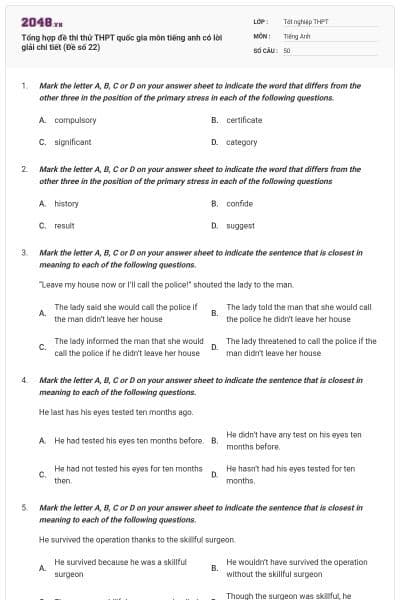
Tổng hợp đề thi thử THPT quốc gia môn tiếng anh có lời giải chi tiết (Đề số 22)
50 câu hỏi
compulsory
certificate
significant
category
Đáp án D
– Trọng âm rơi vào âm tiết thứ nhất, những từ còn lại rơi vào âm tiết thứ hai.
history
confide
result
suggest
Đáp án A
– trọng âm rơi vào âm tiết thứ nhất, những từ còn lại rơi vào âm tiết thứ hai.
The lady said she would call the police if the man didn’t leave her house
The lady told the man that she would call the police he didn’t leave her house
The lady informed the man that she would call the police if he didn’t leave her house
The lady threatened to call the police if the man didn’t leave her house
Đáp án D
– Người phụ nữ đe dọa người đàn ông sẽ gọi cảnh sát nếu ông ta không chịu rời căn nhà.
He had tested his eyes ten months before.
He didn’t have any test on his eyes ten months before.
He had not tested his eyes for ten months then.
He hasn’t had his eyes tested for ten months.
Đáp án D
– Lần cuối cùng anh ấy kiểm tra mắt là 10 tháng trước => Anh ấy chưa hề kiểm tra mắt trong 10 tháng qua.
He survived because he was a skillful surgeon
He wouldn’t have survived the operation without the skillful surgeon
There was no skillful surgeon, so he died
Though the surgeon was skillful, he couldn’t survive the operation
Đáp án: B
Giải thích:
Dịch: Anh sống sót sau ca phẫu thuật nhờ bác sĩ phẫu thuật tài giỏi.
A. Anh ấy sống sót vì anh ấy là một bác sĩ phẫu thuật tài giỏi. (sai nghĩa)
B. Anh ấy không thể sống sót sau ca phẫu thuật nếu không có bác sĩ phẫu thuật tài giỏi. (đúng nghĩa)
C. Không có bác sĩ phẫu thuật khéo léo, nên đã chết. (sai nghĩa)
D. Mặc dù bác sĩ phẫu thuật rất tài giỏi, anh ta không thể sống sót sau ca phẫu thuật. (sai nghĩa)
Naughty
hard-working
well-behaved
disruptive
Đáp án A
– Mischievous >< Well-behaved (ngoan ngoãn)
New
informal
neat
formal
Đáp án A
– casual >< formal (trang trọng)
Understand
answer
respond
notice
Đáp án A
– interpret = understand (hiểu)
Find ou
develop
concern
build
Đáp án: A
Giải thích:
Kiến thức: Từ vựng – Từ đồng nghĩa
determine (v): quyết định, xác định
Xét các đáp án:
A. find out (v): tìm ra
B. develop (v): phát triển
C. concern (v): quan tâm
D. build (v): xây dựng
=> determine = find out
Dịch: Mục đích của cuộc khảo sát này là xác định thái độ của sinh viên đối với tình yêu và hôn nhân.

Học thông minh hơn mỗi ngày
Xem toàn bộ 50 câu hỏi và nhiều hơn nữa với tài khoản miễn phí
Women talk more than men on the whole
Women’s talking is a stereotype
Women talk more in private, and men talk more in public
Little boys and little girls have different ways of playing
Đáp án C
– Đoạn đầu tiên nói về nhà ngôn ngữ Tannen nhận định “women are more verbal – talk more – in private situations,…” và “men talk more in public situations,…”
Games
sticky substance
rope
means
Đáp án B
– glue = sticky substance (chất kết dính)
Deriving from verbs
Connected with use of spoken language
Using very loud noise
Being very talkative
Đáp án B
– verbal = connected with use of spoken language (bằng lời)
Situations
Men
Men and women
Women
Đáp án B
– “Đàn ông nói nhiều hơn ở những tình huống công khai, khi họ dùng đoạn đối thoại để trao đổi thông tin và tạo địa vị.”
Men and women have different styles of talking, which may begin in childhood
According to Deborah Tannen, the belief that women talk more is party right but most wrong
Women talk more in some situations while men talk in others
Men are more sociable than women
Đáp án C
– Phụ nữ nói nhiều trong một số trường hợp trong khi đàn ông nói nhiều trong một số trường hợp khác.
Researchers have studied the conversations of children and their parents
Parents do not much about sadness with their sons
Study at Emory University can help to explain the differences between communication styles of boy and girls
An Emory University study found than parent talk more with their daughters than with their sons
Đáp án D
– An Emory University found that parents talk more with their daughters than with their sons. => thể hiện ý đoạn 2: bố mẹ nói chuyện với con gái nhiều hơn với con trai.
Beginning
annoying
surprising
interesting
Đáp án D
– Startling = Interesting (thú vị)
Parents give more love to their daughters than to their sons
Boys don’t like to be with their parents as much as girls do
Parents use more language to talk with their daughters
Boys don’t like showing emotions
Đáp án C
– Bố mẹ dùng nhiều ngôn ngữ để nói chuyện với con gái hơn.
Exchange
Interchange
Communication
Correspondence
Đáp án D
– two-way communication : giao tiếp hai chiều.
Announcer
Receiver
Messenger
Transmitter
Đáp án B
– receiver : người nhận.
That people use
Are used
Using
Being used
Đáp án A
– that people use – phía sau là một động từ => đằng trước là mệnh đề quan hệ để bổ sung nghĩa.
Informal
non-verbal
verbal
formal
Đáp án C
– non-verbal (phi ngôn ngữ)
their
These
This
That
Đáp án B
– these + động từ số nhiều đếm được.
Is paid for
is paying for
pays for
is being pay for
Đáp án A
– is paid for (được trả)
As
with
for
to
Đáp án D
– be/get married to somebody (lấy ai đó)
Take care of
get away
look after
stay away from
Đáp án D
– stay away from (cách li khỏi)
Turns up
let me down
turns me off
turns out
Đáp án B
– let someone down (để ai thất vọng)
Careless
carefully
carelessly
careful
Đáp án B
– carefully (một cách cẩn thận)
Create
have
give
try
Đáp án A
– create a good impression (tạo một ấn tượng tốt)
In
into
within
from
Đáp án B
– be divided into (được chia thành)
Having
making
giving
taking
Đáp án A
– have an influence on (tạo ảnh hưởng lên cái gì)
Yesterday
evening the last evening
last night
the previous night
Đáp án D
– câu tường thuật “last night” => “the previous night”.
Who
that
whom
0
Đáp án C
– “whom” thay thế cho tân ngữ là người.
Commercial
commercialise
commercially
commerce
Đáp án C
– commercially (một cách thương mại hóa)
Should you work
unless you work
if you will work
if work
Đáp án A
– Should you work hard là dạng đảo ngữ của If you work hard.
Stars on American coins
The teaching of astronomy in state universities
The star as national symbol of the United States
Colonial stamps and coins
Đáp án A
– Những ngôi sao trên đồng tiền Mỹ.
Coins
features
colonies
stars
Đáp án D
– con số những ngôi sao.
Carried
drilled
symbolized
cost
Đáp án B
– bore = drilled (Được khoan, khắc)
Silver coins with fifteen stars appeared before coins with thirteen
Vermont and Kentucky joined the Union in 1794
Tennessee was the first state to use half dimes
No silver coins were issued until 1794
Đáp án A
– Tác giả thấy ngạc nhiên khi tiền xu với 15 ngôi sao ra đời trước tiền xu với 13 ngôi sao.
Vermont joined after Tennessee and Kentucky
Kentucky joined before Tennessee and Vermont
Tennessee joined Vermont and Kentucky
Vermont and Kentucky joined at the same time
Đáp án D
– Vermont và Kentucky sáp nhập vào Mỹ cùng lúc.
Half cent
Half-dollar
Half dime
Half nickel
Đáp án D
– Half nickel = 2,5 cents.
There was a change in design policy
There were twelve states at the time
The mint made a mistak
Tennessee had left the Union
Đáp án C
- Ủy ban đúc tiền mắc lỗi.
If
the train
would be
much
Đáp án C
– câu điều kiện loại 1 diễn tả điều có thể diễn ra ở hiện tại, mệnh đề chính chia ở thì tương lai đơn.
Some
subjects
are
Geographical
Đáp án D
– Geographical (tính từ) => Geography (danh từ - môn Địa lí)
Could
me
how can I get
the
Đáp án C
– How can I get => How I can get – câu khẳng định không sử dụng đảo ngữ.
Although they were rich, but they didn’t have a happy family
Rich though they were, they didn’t have a happy family
They were rich although they didn’t have a happy
However they were rich, they didn’t have a happy family
Đáp án B
– Cấu trúc Adj/Adv + As/Though +S +V chỉ sự nhượng bộ, bất chấp. (Dù họ có giàu, họ vẫn không có được một gia đình hạnh phúc.)
One student failed because he completely ignored the instructions appearing on the top of every page on the paper.
Even though one student ignored the instructions printed on the top of every paper, he failed.
One student failed to ignore the instructions printed on the top of every page of paper.
No matter how completely one student ignored the instructions printed on the top of every page of the paper, he failed.
Đáp án A
– Một học sinh đã trượt vì anh ta hoàn toàn bỏ qua hướng dẫn được viết ở đầu trang giấy.
Would you like to go to the new coffee shop with me?
What would you do if you can afford a new car?
Would you like a cake?
Why do you spend so much time playing games?
Đáp án A
– Câu trả lời chấp nhận 1 lời mời, vậy câu hỏi phải là lời mời đi làm gì đó cho tối nay
=> “Would you like to go to the new coffee shop with me?”
Can I take the message?
I’m sorry. Alex is not in.
Just a moment. I’m coming.
This is Joe speaking.
Đáp án B
– “Tôi xin lỗi. Alex không ở đây.” Là câu trả lời phù hợp nhất.
imports
groups
techniques
computers
Đáp án C
– phát âm là /z/, còn lại phát âm là /s/.
technology
chores
schooling
chemistry
Đáp án B
– phát âm là /t∫/, còn lại phát âm là /k/.
Bạn có thích hoạt động này không?
Hãy lưu hoặc chia sẻ nội dung này đến mọi người.
Gợi ý cho bạn

Ý tưởng của bạn, bài học của bạn
Tự thiết kế đề thi, bài giảng hoặc flashcard theo cách riêng.

Học liệu phổ biến Tốt nghiệp THPT
Tốt nghiệp THPT
Bài tập vừa sức, đúng lớp
Chọn nội dung phù hợp và tạo hoạt động cho lớp của bạn.