Tổng hợp đề thi thử THPT quốc gia môn tiếng anh có lời giải chi tiết (Đề số 16)
50 câu hỏi
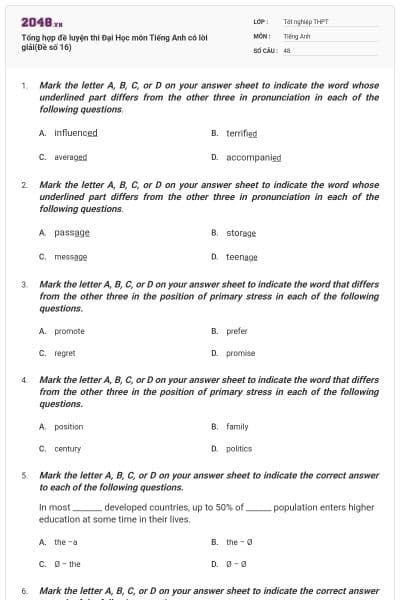
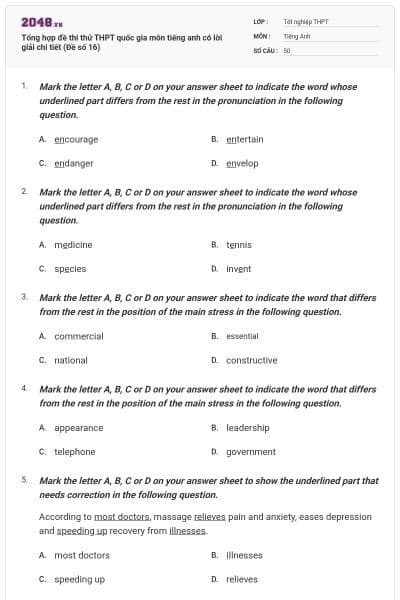
Mark the letter A, B, C or D on your answer sheet to indicate the word whose underlined part differs from the rest in the pronunciation in the following question.
encourage
entertain
endanger
envelop
Đáp án B
Phần gạch chân đáp án B được phát âm là /en/, các đáp án còn lại được phát âm là /in/.
A. encourage /ɪnˈkʌ.rɪdʒ/ (v): khuyến khích, cổ vũ, động viên.
B. entertain /en.təˈteɪn/ (v): giải trí, tiêu khiển.
C. endanger /ɪnˈdeɪn.dʒər/ (v): gây nguy hiểm.
D. envelop /ɪnˈve.ləp/ (v): bọc, bao, phủ.
Mark the letter A, B, C or D on your answer sheet to indicate the word whose underlined part differs from the rest in the pronunciation in the following question.
medicine
tennis
species
invent
Đáp án C
Phần gạch chân đáp án C được phát âm là /i/, các đáp án còn lại được phát âm là /e/.
A. medicine /ˈme.dɪ.sən/ (n): y học, thuốc.
B. tennis /ˈten.ɪs/ (n): quần vợt.
C. species /ˈspiː.ʃiːz/ (n): loài (sinh vật).
D. invent /ɪnˈvent/ (v): phát minh, sáng chế.
Mark the letter A, B, C or D on your answer sheet to indicate the word that differs from the rest in the position of the main stress in the following question.
commercial
essential
national
constructive
Đáp án C
Trọng âm rơi vào âm tiết thứ nhất, các đáp án còn lại rơi vào âm tiết thứ 2.
A. commercial /kəˈmɜː.ʃəl/ (adj): thuộc về thương mại, có lợi nhuận.
B. essential /ɪˈsen.ʃəl/ (adj): cần thiết.
C. national /ˈnæ.ʃən.əl/ (adj): thuộc quốc gia, dân tộc.
D. constructive /kənˈstrʌk.tɪv/ (adj): có tính xây dựng, ngầm hiểu.
Mark the letter A, B, C or D on your answer sheet to indicate the word that differs from the rest in the position of the main stress in the following question.
appearance
leadership
telephone
government
Đáp án A
Trọng âm rơi vào âm tiết thứ 2, các đáp án còn lại rơi vào âm tiết thứ nhất.
A. appearance /əˈpɪə.rəns/ (n): ngoại hình, sự xuất hiện.
B. leadership /ˈliː.də.ʃɪp/ (n): khả năng lãnh đạp, sự lãnh đạo.
C. telephone /ˈte.lɪ.fəʊn/ (n): máy điện thoại.
D. government /ˈɡʌ.vən.mənt/ (n): chính phủ.
Mark the letter A, B, C or D on your answer sheet to show the underlined part that needs correction in the following question.
According to most doctors, massage relieves pain and anxiety, eases depression and speeding up recovery from illnesses.
most doctors
illnesses
speeding up
relieves
Đáp án C
Sửa speeding up => speeds up.
Cấu trúc song hành, các động từ đều chia theo chủ ngữ massage, chúng được ngăn cách với nhau bởi dấu phẩy và liên từ and.
Dịch: Theo như nhiều bác sĩ cho rằng, mát-xa làm giảm cơn đau và lo lắng, làm giảm chứng trầm cảm và đẩy nhanh sự phục hồi sau cơn bệnh.
Mark the letter A, B, C or D on your answer sheet to show the underlined part that needs correction in the following question.
Good scientists always cooperate with each others no matter what theirnationalities are.
with
their
always
others
Đáp án D
Sửa others => other.
Dạng đúng là each other (nhau): dùng cho 2 đối tượng thực hiện hành động có tác động qua lại. Ví dụ: Mary and Tom love each other.
Dịch: Những nhà khoa học tài giỏi luôn luôn hợp tác với nhau cho dù quốc tịch của họ có là gì đi chăng nữa.
Mark the letter A, B, C or D on your answer sheet to show the underlined part that needs correction in the following question.
Diana would rather that her husband doesn’t work so hard.
her husband
doesn’t work
Diana
would rather
Đáp án B
Sửa doesn’t work => not work.
Câu giả định: S1 + would rather that + S2 +(not) V-inf. (Loại câu diễn đạt ý người thứ nhất muốn người thứ 2 làm một việc gì đó, nhưng làm hay không còn tùy vào người thứ 2).
Dịch: Diana muốn rằng chồng mình đừng làm quá sức.
Mark the letter A, B, C or D on your answer sheet to indicate the correct answer to the following question.
They asked me whether I was working ______.
next day afternoon
the afternoon followed
the following afternoon
tomorrow afternoon
Đáp án C
Biến đổi trạng ngữ chỉ thời gian trong câu tường thuật: next afternoon => the following afternoon.
Các đáp án còn lại sai cách chuyển.
Dịch: Họ đã hỏi tôi liệu tôi có làm việc vào chiều hôm sau
If you are not Japanese, so what ______ are you?
nationalized
nationality
nation
national
Đáp án B
Câu hỏi về quốc tịch: what nationality are you? – Bạn là người nước nào?.
Dịch: Bạn không phải là người Nhật, vậy bạn là người nước nào?
She played ______ confidently, but her timing was not good.
a piano
piano
the piano
an piano
Đáp án C
Dùng mạo từ the trước tên nhạc cụ khi đề cập đến các nhạc cụ đó nói chung hoặc khi chơi các nhạc cụ đó.
Ví dụ: The piano is difficult to play.
She teached me how to play the violin.
Dịch: Cô ấy đã chơi piano một cách rất tự tin, nhưng không đúng thời điểm.
In a modern family, the husband is expected to join hands with his wife to______ the household chores.
do
make
run
take
Đáp án A
(to) do the household chores: làm việc nhà.
Dịch: Trong 1 gia đình hiện đại, người chồng được mong chờ sẽ giúp đỡ vợ mình làm các công việc nhà.
The government plans to bring in new laws______ parents to take more responsibility for the education of their children.
forced
forcing
force
forces
Đáp án B
Chủ điểm ngữ pháp liên quan tới Rút gọn mệnh đề quan hệ dạng chủ động, ở đây Đại từ quan hệ bị lược bỏ và động từ chia về V-ing.
Câu đầy đủ là: The government plans to bring in new laws which force parents to take more responsibility for the education of their children.
Dịch: Chính phủ dự định đưa ra những bộ luật mới buộc phụ huynh phải có trách nhiệm hơn nữa trong việc giáo dục con cái.
______ broken several world records in swimming.
She is said to have
People say she had
It is said to have
She is said that she has
Đáp án A
Câu tường thuật ở dạng câu kể: S tobe said to have PII = It tobe said / People said + that S V O.
Dịch: Cô ấy được đồn rằng đã phá vỡ một số kỉ lục thế giới trong môn bơi lội.
While everyone else in this class prefers working in groups, Alice likes working ______.
on her own
of her own
on herself
in herself
Đáp án A
on one’s own = by one’s self: tự thân một mình.
Dịch: Trong khi những người khác trong lớp thích làm việc theo nhóm, Alice lại thích làm việc một mình.
I am sure that everything will be all right ______.
in the end
at the end
by the end
for the end
Đáp án A
Chú ý: in the end = at the end of N/V-ing.
Dịch: Tôi chắc rằng cuối cùng mọi thứ sẽ ổn thôi.
Jake, the boy who sat beside me in class, used to wear______ shirt to school.
an old cotton white
an old white cotton
a white cotton old
a cotton old white
Đáp án B
Trật tự tính từ trong cụm danh từ: an old (Age)+ white (Color)+ cotton (Material) +shirt.
Opinion - tính từ chỉ quan điểm, sự đánh giá. (beautiful, wonderful, terrible…)
Size - tính từ chỉ kích cỡ. (big, small, long, short, tall…
Age - tính từ chỉ độ tuổi. (old, young, old, new…)
Shape - tính từ chỉ hình dạng (circular, square, round, rectangle... )
Color - tính từ chỉ màu sắc. (orange, yellow, light blue…)
Origin – tính từ chỉ nguồn gốc, xuất xứ. (Japanese, American, Vietnamese…)
Material – tính từ chỉ chất liệu (stone, plastic, leather, steel, silk…)
Purpose – tính từ chỉ mục đích, tác dụng
Without your help, I ______ the technical problem with my computer the other day.
can’t solve
couldn’t have solved
wouldn’t solve
could solve
Đáp án B
Câu giả định tương đương với câu điều kiện loại 3 (If S had PII, S would/could have PII)- diễn tả một giả định không có thật trong quá khứ.
Without your help, I couldn’t have solved the technical problem with my computer the other day.
= If it hadn’t been for your help, I couldn’t have solved the technical problem with my computer the other day.
Dịch: Nếu không có sự giúp đỡ từ bạn, thì tôi đã không thể giải quyết được sự cố kĩ thuật này trong máy tính của tôi.
The University administrations are introducing new measures to ______ that the enrolment process runs smoothly.
maintain
ensure
facilitate
improve
Đáp án B
Trong các đáp án chỉ có ensure là đi với that + clause.
Các đáp án còn lại:
A. maintain (v): duy trì.
C. facilitate (v): tạo điều kiện thuận lợi.
D. improve (v): tiến bộ, cải tiến.
Dịch: Bộ phận quản lí trong các trường đại học đang đưa ra những biện pháp mới để quá trình tuyển sinh được diễn ra suôn sẻ.
Only one of our gifted students______to participate in the final competition.
was choosing
chosen
has been chosen
have been chosen
Đáp án C
Động từ chia theo chủ ngữ số ít (only one of…) và ở dạng bị động => chỉ có đáp án C là đúng.
Dịch: Chỉ một trong số những học sinh tài năng của chúng tôi là được chọn để tham gia vào cuộc thi cuối cùng.
Mark the letter A, B, C or D on your answer sheet to indicate the word that is CLOSEST in meaning to the underlined part in the following sentence.
Reaching 35 and obviously aging, Jane has to make up her mind on her future very soon.
give a thought about
Pay attention to
prepare a plan for
make a decision on
Đáp án D
(to) make up one’s mind on smt = D. (to) make a decision on smt: quyết định về cái gì.
Các đáp án còn lại:
A. give a thought about: suy nghĩ về.
B. pay attention to: chú ý tới.
C. prepare a plan for: chuẩn bị cho.
Dịch: Đạt tới 35 tuổi và rõ ràng là đang già đi, Jane sẽ phải quyết định sớm về tương lai của mình.
Mark the letter A, B, C or D on your answer sheet to indicate the word that is CLOSEST in meaning to the underlined part in the following sentence.
How many countries took part in the last Olympic Games?
participated
performed
succeeded
hosted
Đáp án A
(to) take part in = A. (to) participate in: tham gia (cuộc đua, cuộc thi).
Các đáp án còn lại:
B. perform (v): trình diễn.
C. succeed (v): thành công.
D. host (v): dẫn chương trình, đăng cai tổ chức.
Dịch: Có bao nhiêu quốc gia đã tham gia Thế vận hội Olympic cuối cùng?
Mark the letter A,B,C or D on your answer sheet to indicate the word OPPOSITE in meaning to the underlined word in the following sentence.
Why do you join those wires? I think by contrast, you have to split them up
paste
separate
gather
unite
Đáp án B
Join (v): nối, chắp, ghép lại >< B. separate (v): tách rời, làm chia rẽ.
Các đáp án còn lại:
A. paste (v): dán.
C. gather (v): thu thập, tập hợp.
D. unite (v): hợp nhất, đoàn kết.
Dịch: Tại sao cậu lại buộc những cái dây đó lại? Tôi thì nghĩ ngược lại, bạn nên tháo chúng ra.
Mark the letter A,B,C or D on your answer sheet to indicate the word OPPOSITE in meaning to the underlined word in the following sentence.
His career advancement was slow and he did not gain any promotion until he was 40, when he won the position of the company’s Chief Executive.
progress
elevation
decrease
rise
Đáp án C
Advancement (n): sự thăng cấp, thăng chức >< C. decrease (n+v): sự giảm sút, suy giảm.
Các đáp án còn lại:
A. progress (n): sự tiến tới, đi lên, phát triển.
B. elevation (n): sự nâng lên, tính cao cả.
D. rise (n+v): sự tăng lên (về số lượng, cường độ), vực dậy,…
Read the following passage and mark the letter A, B, C, or D on your answer sheet to indicate word that best fits each of the the numbered blanks from 24 to 28.
THE FIRST WOMAN SCIENTIST
Hypatia was born in Alexandria, in Egypt, in 370 A.D. For many centuries she was the only woman scientist to have a place in the history books.
Hypatia’s father was director of Alexadria University, and he (24) ______sure his daughter had the best education available. This was unusual, as most women then had few (25)______to study.
After studying in Athens and Rome, Hypatia returned to Alexandria where she began teaching mathematics. She soon became famous for her knowledge of new ideas.
We have no copies of her books, (26) ______we know that she wrote several important mathematical works. Hypatia was also interested in technology and (27) ______several scientific tools to help with her work.
At the time many rulers were afraid of science, and (28) ______connected with it was in danger.
One day in March 415, Hypatia was attacked in the street and killed.
Điền ô số 24
said
could
put
made
Đáp án D
(to) make sure: đảm bảo, chắc chắn.
Dịch: […], và ông đảm bảo rằng con gái mình sẽ có được nền giáo dục tốt nhất.
Read the following passage and mark the letter A, B, C, or D on your answer sheet to indicate word that best fits each of the the numbered blanks from 24 to 28.
THE FIRST WOMAN SCIENTIST
Hypatia was born in Alexandria, in Egypt, in 370 A.D. For many centuries she was the only woman scientist to have a place in the history books.
Hypatia’s father was director of Alexadria University, and he (24) ______sure his daughter had the best education available. This was unusual, as most women then had few (25)______to study.
After studying in Athens and Rome, Hypatia returned to Alexandria where she began teaching mathematics. She soon became famous for her knowledge of new ideas.
We have no copies of her books, (26) ______we know that she wrote several important mathematical works. Hypatia was also interested in technology and (27) ______several scientific tools to help with her work.
At the time many rulers were afraid of science, and (28) ______connected with it was in danger.
One day in March 415, Hypatia was attacked in the street and killed.
Điền ô số 25
teachers
classes
opportunities
customs
Đáp án C
A. teachers: những giáo viên.
B. classes: những lớp học.
C. opportunities: những cơ hội.
D. customs: hải quan.
Chỉ có đáp án C là hợp nghĩa.
Dịch: Điều này là bất bình thường, bởi hầu hết phụ nữ thời đó có rất ít cơ hội để được đi học.
Read the following passage and mark the letter A, B, C, or D on your answer sheet to indicate word that best fits each of the the numbered blanks from 24 to 28.
THE FIRST WOMAN SCIENTIST
Hypatia was born in Alexandria, in Egypt, in 370 A.D. For many centuries she was the only woman scientist to have a place in the history books.
Hypatia’s father was director of Alexadria University, and he (24) ______sure his daughter had the best education available. This was unusual, as most women then had few (25)______to study.
After studying in Athens and Rome, Hypatia returned to Alexandria where she began teaching mathematics. She soon became famous for her knowledge of new ideas.
We have no copies of her books, (26) ______we know that she wrote several important mathematical works. Hypatia was also interested in technology and (27) ______several scientific tools to help with her work.
At the time many rulers were afraid of science, and (28) ______connected with it was in danger.
One day in March 415, Hypatia was attacked in the street and killed.
Điền ô số 26
because
as
but
or
Đáp án C
A. because + clause: bởi vì – Liên từ chỉ nguyên nhân.
B. as + clause: bởi vì, khi.
C. but+ clause: nhưng- Liên từ chỉ sự đối lập.
D. or: hoặc.
Chỉ có đáp án C là hợp nghĩa.
Dịch: Chúng ta hiện không có bản sao nào của những cuốn sách của bà, nhưng chúng ta biết rằng bà đã viết ra một số cuốn sách quan trọng liên quan tới toán học.
Read the following passage and mark the letter A, B, C, or D on your answer sheet to indicate word that best fits each of the the numbered blanks from 24 to 28.
THE FIRST WOMAN SCIENTIST
Hypatia was born in Alexandria, in Egypt, in 370 A.D. For many centuries she was the only woman scientist to have a place in the history books.
Hypatia’s father was director of Alexadria University, and he (24) ______sure his daughter had the best education available. This was unusual, as most women then had few (25)______to study.
After studying in Athens and Rome, Hypatia returned to Alexandria where she began teaching mathematics. She soon became famous for her knowledge of new ideas.
We have no copies of her books, (26) ______we know that she wrote several important mathematical works. Hypatia was also interested in technology and (27) ______several scientific tools to help with her work.
At the time many rulers were afraid of science, and (28) ______connected with it was in danger.
One day in March 415, Hypatia was attacked in the street and killed.
Điền ô số 27
learnt
invented
experimented
did
Đáp án B
A. learnt: học.
B. invented: sáng chế, phát minh ra.
C. experimented: làm thí nghiệm.
D. did: làm.
Chỉ có đáp án B là hợp nghĩa.
Dịch: Hypatia cũng quan tâm tới công nghệ và đã phát minh ra một số công cụ khoa học để giúp cho công việc của mình.
Read the following passage and mark the letter A, B, C, or D on your answer sheet to indicate word that best fits each of the the numbered blanks from 24 to 28.
THE FIRST WOMAN SCIENTIST
Hypatia was born in Alexandria, in Egypt, in 370 A.D. For many centuries she was the only woman scientist to have a place in the history books.
Hypatia’s father was director of Alexadria University, and he (24) ______sure his daughter had the best education available. This was unusual, as most women then had few (25)______to study.
After studying in Athens and Rome, Hypatia returned to Alexandria where she began teaching mathematics. She soon became famous for her knowledge of new ideas.
We have no copies of her books, (26) ______we know that she wrote several important mathematical works. Hypatia was also interested in technology and (27) ______several scientific tools to help with her work.
At the time many rulers were afraid of science, and (28) ______connected with it was in danger.
One day in March 415, Hypatia was attacked in the street and killed.
Điền ô số 28
all
nobody
anyone
something
Đáp án C
A. all: tất cả.
B. nobody: không một ai.
C. anyone: bất cứ ai.
D. something: một số thứ.
Chỉ có đáp án C là hợp nghĩa.
Dịch: Vào thời điểm đó, nhiều nhà cai trị rất sợ khoa học, và bất cứ ai liên quan tới nó đều gặp nguy hiểm.
Mark the letter A, B, C, or D on your answer sheet to indicate the sentence that best combines each pair of sentences in the following question.
I didn’t arrive in time. I was not able to see her off.
I arrived very late to say goodbye to her
She had left because I was not on time
I was not early enough to see her off
I didn’t go there , so I could not see her off
Đáp án C
Tôi đã không tới kịp giờ. Tôi đã không thể chào tạm biệt với cô ấy.
= C. Tôi đã không tới đủ sớm để chào tạm biệt với cô ấy.
Các đáp án còn lại:
A. Tôi đã tới rất muộn để nói lời chào tạm biệt tới cô ấy.
B. Cô ấy đã đi bởi vì tôi tới không đúng giờ.
D. Tôi đã không tới đó, nên tôi đã không thể chào tạm biệt với cô ấy.
Mark the letter A, B, C, or D on your answer sheet to indicate the sentence that best combines each pair of sentences in the following question.
We spent about one-third of our lives sleeping. We know relatively little about sleep.
We know relatively little about sleep, as a result, we spend about one-third of our lives sleeping.
We shall know more about sleep if we spend more than one-third of our lives sleeping.
We spend about one-third of our lives sleeping so that we know relatively little about sleep.
Despite spending about one-third of our lives sleeping, we know relatively little about sleep.
Đáp án D
Chúng ta đã dành ra 1/3 cuộc đời để ngủ. Chúng ta biết rất ít về giấc ngủ.
= D. Mặc dù dành ra 1/3 cuộc đời để ngủ, nhưng chúng ta biết rất ít về giấc ngủ.
Cấu trúc câu tương phản, đối lập: Despite N/V-ing, S V O (Mặc dù…, nhưng…).
Các đáp án còn lại:
A. Chúng ta biết rất ít về giấc ngủ, do đó, chúng ta đã dành ra 1/3 cuộc đời để ngủ.
B. Chúng ta sẽ biết nhiều hơn về giấc ngủ nếu chúng ta đã dành ra nhiều hơn 1/3 cuộc đời để ngủ.
C. Chúng ta đã dành ra 1/3 cuộc đời để ngủ để mà chúng ta biết rất ít về giấc ngủ.
Mark the letter A, B, C, or D on your answer sheet to indicate the sentence that is closest in meaning to the following question.
I didn’t know you were coming, so I didn’t wait for you.
If I had known you were coming, I wouldn’t have waited for you.
I would have waited for you if I knew you were coming.
If I had know you were coming, I would wait for you.
Had I known you were coming, I would have waited for you.
Đáp án D
Tôi không biết rằng bạn đã tới, cho nên tôi đã không chờ bạn.
= D. Nếu tôi biết bạn tới, thì tôi đã chờ bạn.
Câu điều kiện loại 3: If S had PII, S would have PII => Dạng đảo ngữ: Had S PII, S would have PII.
Chỉ một giả định không có thật trong quá khứ.
Mark the letter A, B, C, or D on your answer sheet to indicate the sentence that is closest in meaning to the following question.
No sooner had she put the telephone down than her boss rang back.
Scarcely had she put the telephone down when her boss rang back
She had hardly put the telephone down without her boss rang back
Hardly she had hung up, she rang her boss immediately
As soon as her boss rang back, she put down the telephone
Đáp án A
Kiến thức đảo ngữ: No sooner had S PII than S V-ed O (Vừa mới….thì….).
= Hardly/Scarcely/Barely had S PII when S V-ed O.
Dịch: Cô ấy vừa mới đặt điện thoại xuống thì ông chủ gọi điện lại.
Mark the letter A, B, C, or D on your answer sheet to indicate the sentence that is closest in meaning to the following question.
Unless we protect the environment, our life will be badly affected.
If our life is badly affected, we will protect the environment.
If we protect the environment, our life will be badly affected.
If we don’t protect the environment, our life won’t be badly affected.
If we don’t protect the environment, our life will be badly affected.
Đáp án D
Câu điều kiện loại 1: If S V(s/es), S will V. (Unless = If not: Trừ phi, Nếu không).
Diễn tả 1 giả định có thể xảy ra ở hiện tại và tương lai.
Dịch: Nếu chúng ta không bảo vệ môi trường, cuộc sống chúng ta sẽ bị ảnh hưởng xấu.
Mark the letter A, B, C or D on your answer sheet to indicate the most suitable response to fill in the following exchange.
A - “Would you mind lending me your bike?”
B - “______”.
Yes, let’s
Not at al
Great
Yes. Here it is
Đáp án B
A - “Bạn có phiền không khi cho tôi mượn xe đạp?”
B - “______”.
A. Ừ, có. B. Không có chi.
C. Tuyệt. D. Ừ, nó đây.
Chỉ có đáp án B là hợp lí.
Đáp án A và D không chọn do mang nghĩa khẳng định, tức là Yes, I would mind– (Có, tôi có phiền), còn C đương nhiên không chọn do hợp ngữ cảnh.
Mark the letter A, B, C or D on your answer sheet to indicate the most suitable response to fill in the following exchange.
-John: “ Would you like to join our volunteer group this summer?”
- Mike: “______”.
I wouldn’t like. Thank you.
Do you think I would?
Yes, you’re a good friend.
Yes, I’d love to. Thanks.
Đáp án D
-John: “Bạn có muốn tham gia nhóm tình nguyện của chúng tôi vào mùa hè này không?”
- Mike: “______”.
A. Tôi không thích. Cảm ơn.
B. Bạn có nghĩ là tôi thích không?
C. Được, cậu đúng là 1 người bạn tốt.
D. Được, tôi thích lắm. Cảm ơn nhé.
Đáp án D là hợp lí nhất, các đáp án còn lại không phù hợp.
Read the following passage and mark the letter A, B, C, or D on your answer sheet to indicate the correct answer to each of the questions from 36 to 42.
No educational medium better serves as a means of spatial communication than the atlas. Atlases deal with such invaluable information as population distribution and density. One of the best, Pennycooke’s World Atlas, has been widely accepted as a standard owing to the quality of its maps and photographs, which not only show various settlements but also portray them in a variety of scales. In fact , the very first map in the atlas is a cleverly designed population cartogram that projects the size of each country if geographical size were proportional to population. Following the proportional layout , a sequence of smaller maps shows the world’s population density, each country’s birth and death rates, population increase and decrease , industrialization, urbanization , gross national product in terms of per capita income, the quality of medical care, literacy, and language. To give readers a perspective on how their own country fits in with the global view, additional projections despite the world’s patterns in nutrition, calorie and protein consumption, health care, number of physicians per unit of population, and life expectancy by region. Population density maps on a subcontinental scale, as well as political maps, convey the diverse demographic phenomena of the world in a broad array of scales.
What is the main topic of this passage ?
The educational benefits of atlases.
Physical maps in an atlas
The ideal in the making of atlases
Partial maps and their uses
Đáp án A
Đâu là chủ đề chính của bài?
A. Những lợi ích giáo dục của atlas.
B. Những bản đồ vật lý trong atlas.
C. Ý tưởng trong việc tạo ra atlas.
D. Một phần bản đồ và cách sử dụng chúng.
Dựa vào một số dẫn chứng tiêu biểu trong bài như:
+ “Atlases deal with such invaluable information as population distribution and density” – (Atlas xử lý các thông tin vô giá như sự phân bố và mật độ dân số).
+ “Following the proportional layout , a sequence of smaller maps shows the world’s population density, each country’s birth and death rates, population increase and decrease , industrialization, urbanization , gross national product in terms of per capita income, the quality of medical care, literacy, and language. To give readers a perspective on how their own country fits in with the global view, additional projections despite the world’s patterns in nutrition, calorie and protein consumption , health care, number of physicians per unit of population, and life expectancy by region.”- (Theo bố cục tỷ lệ, một chuỗi những bản đồ nhỏ hơn cho thấy mật độ dân số thế giới, tỷ lệ sinh và tử của mỗi quốc gia, dân số tăng và giảm, công nghiệp hoá, đô thị hoá, tổng sản lượng quốc dân trên số thu nhập bình quân đầu người, chất lượng chăm sóc y tế, trình độ học vấn và ngôn ngữ. Để cho độc giả có được cái nhìn về đất nước họ hợp với viễn cảnh toàn cầu như thế nào, các mô phỏng được thêm vào bất kể những khía cạnh của thế giới trong dinh dưỡng, mức tiêu thụ ca-lo và protein, chăm sóc sức khỏe, số bác sĩ trên một đơn vị dân số, và tuổi thọ theo vùng).
=> atlas cung cấp những kiến thức có ích cho việc học tập và giáo dục.
Read the following passage and mark the letter A, B, C, or D on your answer sheet to indicate the correct answer to each of the questions from 36 to 42.
No educational medium better serves as a means of spatial communication than the atlas. Atlases deal with such invaluable information as population distribution and density. One of the best, Pennycooke’s World Atlas, has been widely accepted as a standard owing to the quality of its maps and photographs, which not only show various settlements but also portray them in a variety of scales. In fact , the very first map in the atlas is a cleverly designed population cartogram that projects the size of each country if geographical size were proportional to population. Following the proportional layout , a sequence of smaller maps shows the world’s population density, each country’s birth and death rates, population increase and decrease , industrialization, urbanization , gross national product in terms of per capita income, the quality of medical care, literacy, and language. To give readers a perspective on how their own country fits in with the global view, additional projections despite the world’s patterns in nutrition, calorie and protein consumption, health care, number of physicians per unit of population, and life expectancy by region. Population density maps on a subcontinental scale, as well as political maps, convey the diverse demographic phenomena of the world in a broad array of scales.
According to the passage, the first map in Pennycooke’s World Atlas shows______
the population policy in each country.
the hypothetical sizes of countries.
geographical proportions of each country.
national boundaries relative to population.
Đáp án D
Theo như bài văn, bản đồ đầu tiên trong atlas thế giới của Pennycooke chỉ ra rằng______.
A. Chính sách dân số ở mỗi nước.
B. Kích cỡ giả định của các quốc gia.
C. Tỉ lệ địa lý của mỗi nước.
D. Ranh giới quốc gia liên quan đến dân số.
Dẫn chứng ở câu 3+4: “One of the best, Pennycooke’s World Atlas, has been widely accepted as a standard owing to the quality of its maps and photographs, which not only show various settlements but also portray them in a variety of scales. In fact , the very first map in the atlas is a cleverly designed population cartogram that projects the size of each country if geographical size were proportional to population”- (Một trong những atlas thế giới tốt nhất là của Pennycooke, đã được chấp nhận rộng rãi như là một tiêu chuẩn bởi chất lượng các tấm bản đồ và hình ảnh, nó không chỉ cho thấy các khu dân cư mà còn thể hiện được chúng theo nhiều mật độ khác nhau. Trên thực tế, tấm bản đồ đầu tiên trong tập atlas là tấm bản đồ dân số được thiết kế vô cùng khéo léo, phác họa ra kích cỡ của mỗi quốc gia nếu kích cỡ địa lí cân xứng với số dân).
Read the following passage and mark the letter A, B, C, or D on your answer sheet to indicate the correct answer to each of the questions from 36 to 42.
No educational medium better serves as a means of spatial communication than the atlas. Atlases deal with such invaluable information as population distribution and density. One of the best, Pennycooke’s World Atlas, has been widely accepted as a standard owing to the quality of its maps and photographs, which not only show various settlements but also portray them in a variety of scales. In fact , the very first map in the atlas is a cleverly designed population cartogram that projects the size of each country if geographical size were proportional to population. Following the proportional layout , a sequence of smaller maps shows the world’s population density, each country’s birth and death rates, population increase and decrease , industrialization, urbanization , gross national product in terms of per capita income, the quality of medical care, literacy, and language. To give readers a perspective on how their own country fits in with the global view, additional projections despite the world’s patterns in nutrition, calorie and protein consumption, health care, number of physicians per unit of population, and life expectancy by region. Population density maps on a subcontinental scale, as well as political maps, convey the diverse demographic phenomena of the world in a broad array of scales.
In the passage, the word “invaluable” is closest in meaning to______.
invalid
priceless
shapeless
incremental
Đáp án B
Câu hỏi từ vựng.
Trong đoạn văn, từ “invaluable”đồng nghĩa với ______.
A. invalid (adj): tàn phế.
B. priceless (adj): vô giá (quá quý giá đến mức không thể định giá nổi).
C. shapeless (adj): quái gở, kì quái.
D. incremental (adj): thuộc về tiền lãi.
Invaluable (adj) = B. priceless (adj): vô giá (quá quý giá đến mức không thể định giá nổi).
Read the following passage and mark the letter A, B, C, or D on your answer sheet to indicate the correct answer to each of the questions from 36 to 42.
No educational medium better serves as a means of spatial communication than the atlas. Atlases deal with such invaluable information as population distribution and density. One of the best, Pennycooke’s World Atlas, has been widely accepted as a standard owing to the quality of its maps and photographs, which not only show various settlements but also portray them in a variety of scales. In fact , the very first map in the atlas is a cleverly designed population cartogram that projects the size of each country if geographical size were proportional to population. Following the proportional layout , a sequence of smaller maps shows the world’s population density, each country’s birth and death rates, population increase and decrease , industrialization, urbanization , gross national product in terms of per capita income, the quality of medical care, literacy, and language. To give readers a perspective on how their own country fits in with the global view, additional projections despite the world’s patterns in nutrition, calorie and protein consumption, health care, number of physicians per unit of population, and life expectancy by region. Population density maps on a subcontinental scale, as well as political maps, convey the diverse demographic phenomena of the world in a broad array of scales.
Which of the following is NOT mentioned in the passage?
calorie consumption
population decline
a level of education
currency exchange rate
Đáp án D
Điều nào sau đây KHÔNG được đề cập tới trong đoạn văn?
A. sự tiêu thụ calo.
B. sự suy giảm dân số.
C. trình độ học thức.
D. tỉ giá ngoại hối.
Dẫn chứng ở dòng 8-14: “Following the proportional layout , a sequence of smaller maps shows the world’s population density, each country’s birth and death rates, population increase and decrease (B), industrialization, urbanization , gross national product in terms of per capita income, the quality of medical care, literacy(C), and language. To give readers a perspective on how their own country fits in with the global view, additional projections despite the world’s patterns in nutrition, calorie and protein consumption (A), health care, number of physicians per unit of population, and life expectancy by region.”- (Theo bố cục tỷ lệ, một chuỗi những bản đồ nhỏ hơn cho thấy mật độ dân số thế giới, tỷ lệ sinh và tử của mỗi quốc gia, sự tăng-giảm dân số, công nghiệp hoá, đô thị hoá, tổng sản lượng quốc dân trên số thu nhập bình quân đầu người, chất lượng chăm sóc y tế, trình độ học vấn và ngôn ngữ. Để cho độc giả có được cái nhìn về đất nước họ hợp với viễn cảnh toàn cầu như thế nào, các mô phỏng được thêm vào bất kể những khuôn mẫu của thế giới trong những vấn đề như dinh dưỡng, mức tiêu thụ ca-lo và protein, chăm sóc sức khỏe, số bác sĩ trên một đơn vị dân số, và tuổi thọ theo vùng).
Read the following passage and mark the letter A, B, C, or D on your answer sheet to indicate the correct answer to each of the questions from 36 to 42.
No educational medium better serves as a means of spatial communication than the atlas. Atlases deal with such invaluable information as population distribution and density. One of the best, Pennycooke’s World Atlas, has been widely accepted as a standard owing to the quality of its maps and photographs, which not only show various settlements but also portray them in a variety of scales. In fact , the very first map in the atlas is a cleverly designed population cartogram that projects the size of each country if geographical size were proportional to population. Following the proportional layout , a sequence of smaller maps shows the world’s population density, each country’s birth and death rates, population increase and decrease , industrialization, urbanization , gross national product in terms of per capita income, the quality of medical care, literacy, and language. To give readers a perspective on how their own country fits in with the global view, additional projections despite the world’s patterns in nutrition, calorie and protein consumption, health care, number of physicians per unit of population, and life expectancy by region. Population density maps on a subcontinental scale, as well as political maps, convey the diverse demographic phenomena of the world in a broad array of scales.
The word “layout” in the passage refers to______.
the cartogram
the geographical size
population
each country
Đáp án A
Từ “layout” trong đoạn văn ám chỉ tới______.
A. biểu đồ diện tích.
B. kích thước địa lí.
C. dân số.
D. mỗi quốc gia.
Layout (n): bố cục, bố trí. Khi “layout”được đặt trong ngữ cảnh của đoạn văn nói về atlas, nó ám chỉ và mang nghĩa tương đương với cartogram - biểu đồ diện tích, sơ đồ bố trí.
Read the following passage and mark the letter A, B, C, or D on your answer sheet to indicate the correct answer to each of the questions from 36 to 42.
No educational medium better serves as a means of spatial communication than the atlas. Atlases deal with such invaluable information as population distribution and density. One of the best, Pennycooke’s World Atlas, has been widely accepted as a standard owing to the quality of its maps and photographs, which not only show various settlements but also portray them in a variety of scales. In fact , the very first map in the atlas is a cleverly designed population cartogram that projects the size of each country if geographical size were proportional to population. Following the proportional layout , a sequence of smaller maps shows the world’s population density, each country’s birth and death rates, population increase and decrease , industrialization, urbanization , gross national product in terms of per capita income, the quality of medical care, literacy, and language. To give readers a perspective on how their own country fits in with the global view, additional projections despite the world’s patterns in nutrition, calorie and protein consumption, health care, number of physicians per unit of population, and life expectancy by region. Population density maps on a subcontinental scale, as well as political maps, convey the diverse demographic phenomena of the world in a broad array of scales.
It can be inferred from the passage that maps can be used to______.
identify a shortage of qualified labour
pinpoint ethnic strife in each country
show readers photographs in a new form
give readers a new perspective on their own country
Đáp án D
Có thể được suy ra từ đoạn văn rằng bản đồ có thể được sử dụng để______.
A. Xác định tình trạng thiếu lao động có trình độ.
B. Định vị tình trạnh xung đột sắc tộc ở mỗi quốc gia.
C. Cho người đọc thấy được những bức ảnh dưới một hình thức mới.
D. Đưa cho độc giả một quan điểm mới về đất nước của họ.
Từ dẫn chứng ở câu 39 có thể suy ra được đáp án D.
Read the following passage and mark the letter A, B, C, or D on your answer sheet to indicate the correct answer to each of the questions from 36 to 42.
No educational medium better serves as a means of spatial communication than the atlas. Atlases deal with such invaluable information as population distribution and density. One of the best, Pennycooke’s World Atlas, has been widely accepted as a standard owing to the quality of its maps and photographs, which not only show various settlements but also portray them in a variety of scales. In fact , the very first map in the atlas is a cleverly designed population cartogram that projects the size of each country if geographical size were proportional to population. Following the proportional layout , a sequence of smaller maps shows the world’s population density, each country’s birth and death rates, population increase and decrease , industrialization, urbanization , gross national product in terms of per capita income, the quality of medical care, literacy, and language. To give readers a perspective on how their own country fits in with the global view, additional projections despite the world’s patterns in nutrition, calorie and protein consumption, health care, number of physicians per unit of population, and life expectancy by region. Population density maps on a subcontinental scale, as well as political maps, convey the diverse demographic phenomena of the world in a broad array of scales.
The author of the passage implies that ______.
atlases provide a bird’s eye view of country.
atlases can be versatile instruments.
maps use a variety of scales in each projection.
maps of countries differ in size.
Đáp án B
Tác giả của bài văn ám chỉ rằng ______.
A. atlas cung cấp cái nhìn toàn cảnh của đất nước.
B. atlas có thể là dụng cụ linh hoạt.
C. bản đồ sử dụng nhiều tỷ lệ đa dạng cho mỗi phép chiếu.
D. bản đồ ở các quốc gia khác nhau về kích cỡ.
Từ dẫn chứng ở câu 39 có thể suy ra được đáp án B, atlas không chỉ cho ta thấy được sơ đồ vị trí địa lí của mỗi quốc gia mà còn cho thấy được những chỉ số khác trong nhiều lĩnh vực như dân số, y tế, trình độ giáo dục, dinh dưỡng, công nghiệp hóa, … => nó là một công cụ linh hoạt.
Read the following passage and mark the letter A, B, C, or D on your answer sheet to indicate the correct answer to each of the questions from 43 to 50.
MEMORY
"Memorize these words". "Learn this spelling rule". "Don't forget about the quiz tomorrow".
You remember things every day, but how do you do it?
When you want to call a store or an office that you don't call often, you look in the telephone book for the number. You dial the number, and then you forget it! You use your short-term memory to remember the number. Your short-term memory lasts about 30 seconds, or half a minute. However, you don't need to look in the telephone book for your best friend’s number because you already know it. This information is in your long-term memory. Your long-term memory has everything that you remember through the years.
Why do you forget things sometimes? Is there a reason? Yes, there are several. The major reason for forgetting something is that you did not learn it well in the beginning. For example, you meet some new people, and right away, you forget their names. You hear the names but you do not learn them, so you forget them.
You can help yourself remember better. Here are some ideas:
1. Move information from your short-term memory to your long-term memory. You can do this if you practice the new information. Say it to yourself out loud. Think about it.
2. After you learn something, study it again and again. Learn it more than you need to. This process is called overlearning. For example, when you learn new words, practice using them in sentences. Don't try to memorize words from a list only.
3. Make sure that you understand new information. It is very difficult to remember something that you don't understand. Ask questions when you learn something new to be certain that you understand.
4. Do not listen to music or watch TV when you study. You will remember better if you concentrate on one thing at a time.
5. Try to connect new information with something that you already know. For example, when you learn the name of a new kind of food, think of a similar kind of food that you already know.
6. Divide new information into several parts (about five or six). Learn one part at time and stop for few minutes. Don't sit down and try to learn a very large amount of new information all at once.
7. Try to make a picture in your mind. For example, if you hear or see a new word, make a picture of how it looks to you in your mind. This “mental” picture will help you remember that word the next time you see or hear it.
8. Think of word clues to help you remember information. One very helpful kind of word clue is an acronym. An acronym is a word formed from the first letter of a group of words. For example, many American schoolchildren learn the names of the Great Lakes in the North America by remembering the word homes. Homes is an acronym that comes from the names of the Great Lakes: Huron, Ontario, Michigan, Erie, Superior.
9. Relax when you study! Try to enjoy yourself. You are learning new things every minute. You will remember better if you are happy and relaxed.
What is the main idea of the passage?
People have short-term and long-term memories and how they can learn to improve their memory
How acronyms help people remember better
What you should do when you forget a phone number
The main reasons for forgetting things
Đáp án A
Đâu là ý chính của bài văn?
A. Con người có trí nhớ ngắn hạn và trí nhớ dài hạn, và cách họ có thể học để cải thiện trí nhớ.
B. Cách viết tắt giúp người ta nhớ tốt hơn.
C. Bạn nên làm gì khi quên số điện thoại.
D. Những lý do chính cho việc hay quên.
Câu hỏi có dạng tìm ý chính của bài nên ưu tiên làm cuối cùng, do đó ta dễ dàng chọn được đáp án A.
Read the following passage and mark the letter A, B, C, or D on your answer sheet to indicate the correct answer to each of the questions from 43 to 50.
MEMORY
"Memorize these words". "Learn this spelling rule". "Don't forget about the quiz tomorrow".
You remember things every day, but how do you do it?
When you want to call a store or an office that you don't call often, you look in the telephone book for the number. You dial the number, and then you forget it! You use your short-term memory to remember the number. Your short-term memory lasts about 30 seconds, or half a minute. However, you don't need to look in the telephone book for your best friend’s number because you already know it. This information is in your long-term memory. Your long-term memory has everything that you remember through the years.
Why do you forget things sometimes? Is there a reason? Yes, there are several. The major reason for forgetting something is that you did not learn it well in the beginning. For example, you meet some new people, and right away, you forget their names. You hear the names but you do not learn them, so you forget them.
You can help yourself remember better. Here are some ideas:
1. Move information from your short-term memory to your long-term memory. You can do this if you practice the new information. Say it to yourself out loud. Think about it.
2. After you learn something, study it again and again. Learn it more than you need to. This process is called overlearning. For example, when you learn new words, practice using them in sentences. Don't try to memorize words from a list only.
3. Make sure that you understand new information. It is very difficult to remember something that you don't understand. Ask questions when you learn something new to be certain that you understand.
4. Do not listen to music or watch TV when you study. You will remember better if you concentrate on one thing at a time.
5. Try to connect new information with something that you already know. For example, when you learn the name of a new kind of food, think of a similar kind of food that you already know.
6. Divide new information into several parts (about five or six). Learn one part at time and stop for few minutes. Don't sit down and try to learn a very large amount of new information all at once.
7. Try to make a picture in your mind. For example, if you hear or see a new word, make a picture of how it looks to you in your mind. This “mental” picture will help you remember that word the next time you see or hear it.
8. Think of word clues to help you remember information. One very helpful kind of word clue is an acronym. An acronym is a word formed from the first letter of a group of words. For example, many American schoolchildren learn the names of the Great Lakes in the North America by remembering the word homes. Homes is an acronym that comes from the names of the Great Lakes: Huron, Ontario, Michigan, Erie, Superior.
9. Relax when you study! Try to enjoy yourself. You are learning new things every minute. You will remember better if you are happy and relaxed
New information is easier to remember if you______.
keep it on a list
understand it
tell it to your friends
draw a picture to describe it
Đáp án B
Những thông tin mới sẽ dễ ghi nhớ hơn nếu bạn______.
A. lên danh sách.
B. hiểu nó.
C. nói với bạn bè.
D. vẽ tranh để mô tả nó.
Dẫn chứng ở tip thứ 3: “Make sure that you understand new information. It is very difficult to remember something that you don't understand” – (Hãy đảm bảo rằng bạn hiểu được những thông tin mới, bởi rất khó để ghi nhớ được những điều mà bạn không hiểu).
Read the following passage and mark the letter A, B, C, or D on your answer sheet to indicate the correct answer to each of the questions from 43 to 50.
MEMORY
"Memorize these words". "Learn this spelling rule". "Don't forget about the quiz tomorrow".
You remember things every day, but how do you do it?
When you want to call a store or an office that you don't call often, you look in the telephone book for the number. You dial the number, and then you forget it! You use your short-term memory to remember the number. Your short-term memory lasts about 30 seconds, or half a minute. However, you don't need to look in the telephone book for your best friend’s number because you already know it. This information is in your long-term memory. Your long-term memory has everything that you remember through the years.
Why do you forget things sometimes? Is there a reason? Yes, there are several. The major reason for forgetting something is that you did not learn it well in the beginning. For example, you meet some new people, and right away, you forget their names. You hear the names but you do not learn them, so you forget them.
You can help yourself remember better. Here are some ideas:
1. Move information from your short-term memory to your long-term memory. You can do this if you practice the new information. Say it to yourself out loud. Think about it.
2. After you learn something, study it again and again. Learn it more than you need to. This process is called overlearning. For example, when you learn new words, practice using them in sentences. Don't try to memorize words from a list only.
3. Make sure that you understand new information. It is very difficult to remember something that you don't understand. Ask questions when you learn something new to be certain that you understand.
4. Do not listen to music or watch TV when you study. You will remember better if you concentrate on one thing at a time.
5. Try to connect new information with something that you already know. For example, when you learn the name of a new kind of food, think of a similar kind of food that you already know.
6. Divide new information into several parts (about five or six). Learn one part at time and stop for few minutes. Don't sit down and try to learn a very large amount of new information all at once.
7. Try to make a picture in your mind. For example, if you hear or see a new word, make a picture of how it looks to you in your mind. This “mental” picture will help you remember that word the next time you see or hear it.
8. Think of word clues to help you remember information. One very helpful kind of word clue is an acronym. An acronym is a word formed from the first letter of a group of words. For example, many American schoolchildren learn the names of the Great Lakes in the North America by remembering the word homes. Homes is an acronym that comes from the names of the Great Lakes: Huron, Ontario, Michigan, Erie, Superior.
9. Relax when you study! Try to enjoy yourself. You are learning new things every minute. You will remember better if you are happy and relaxed.
The following things should help you remember things better when you study, EXCEPT______.
asking questions when you don’t understand something
connecting new information with something you already know
trying to learn a large amount of new information all at once
overlearning them
Đáp án C
Những điều sau đây sẽ giúp bạn ghi nhớ mọi thứ tốt hơn khi học, NGOẠI TRỪ______.
A. đặt câu hỏi khi bạn không hiểu.
B. kết nối những thông tin mới với những điều bạn đã biết.
C. cố gắng tiếp thu một lượng thông tin lớn cùng một lúc.
D. overlearning chúng.
Dẫn chứng ở tip thứ 6: “6. Divide new information into several parts (about five or six). Learn one part at time and stop for few minutes. Don't sit down and try to learn a very large amount of new information all at once” – (Chia nhỏ thông tin mới ra thành một vài phần (khoảng 5 hoặc 6). Học một phần và dừng lại vài phút. Đừng chỉ ngồi đó và cố gắng ghi nhớ một lượng lớn thông tin mới cùng 1 lúc).
Read the following passage and mark the letter A, B, C, or D on your answer sheet to indicate the correct answer to each of the questions from 43 to 50.
MEMORY
"Memorize these words". "Learn this spelling rule". "Don't forget about the quiz tomorrow".
You remember things every day, but how do you do it?
When you want to call a store or an office that you don't call often, you look in the telephone book for the number. You dial the number, and then you forget it! You use your short-term memory to remember the number. Your short-term memory lasts about 30 seconds, or half a minute. However, you don't need to look in the telephone book for your best friend’s number because you already know it. This information is in your long-term memory. Your long-term memory has everything that you remember through the years.
Why do you forget things sometimes? Is there a reason? Yes, there are several. The major reason for forgetting something is that you did not learn it well in the beginning. For example, you meet some new people, and right away, you forget their names. You hear the names but you do not learn them, so you forget them.
You can help yourself remember better. Here are some ideas:
1. Move information from your short-term memory to your long-term memory. You can do this if you practice the new information. Say it to yourself out loud. Think about it.
2. After you learn something, study it again and again. Learn it more than you need to. This process is called overlearning. For example, when you learn new words, practice using them in sentences. Don't try to memorize words from a list only.
3. Make sure that you understand new information. It is very difficult to remember something that you don't understand. Ask questions when you learn something new to be certain that you understand.
4. Do not listen to music or watch TV when you study. You will remember better if you concentrate on one thing at a time.
5. Try to connect new information with something that you already know. For example, when you learn the name of a new kind of food, think of a similar kind of food that you already know.
6. Divide new information into several parts (about five or six). Learn one part at time and stop for few minutes. Don't sit down and try to learn a very large amount of new information all at once.
7. Try to make a picture in your mind. For example, if you hear or see a new word, make a picture of how it looks to you in your mind. This “mental” picture will help you remember that word the next time you see or hear it.
8. Think of word clues to help you remember information. One very helpful kind of word clue is an acronym. An acronym is a word formed from the first letter of a group of words. For example, many American schoolchildren learn the names of the Great Lakes in the North America by remembering the word homes. Homes is an acronym that comes from the names of the Great Lakes: Huron, Ontario, Michigan, Erie, Superior.
9. Relax when you study! Try to enjoy yourself. You are learning new things every minute. You will remember better if you are happy and relaxed.
Acronyms should help you remember______.
dates
telephone numbers
chemical formulas
names
Đáp án D
Các từ viết tắt sẽ giúp bạn ghi nhớ______.
A. ngày tháng.
B. số điện thoại.
C. công thức hóa học.
D. họ tên.
Dẫn chứng ở tip 8: “8. Think of word clues to help you remember information. One very helpful kind of word clue is an acronym. An acronym is a word formed from the first letter of a group of words. For example, many American schoolchildren learn the names of the Great Lakes in the North America by remembering the word homes. Homes is an acronym that comes from the names of the Great Lakes: Huron, Ontario, Michigan, Erie, Superior” – (Nghĩ tới những từ manh nha sẽ giúp bạn ghi nhớ thông tin tốt hơn. Một trong những kiểu từ manh nha hữu ích đó là từ viết tắt. Từ viết tắt là một từ được cấu tạo nên từ chữ cái đầu tiên của một nhóm từ. Ví dụ như, nhiều học sinh Mĩ học tên Hồ Ngũ Đại ở Bắc Mĩ bằng cách ghi nhớ từ “homes”. “Homes” là từ viết tắt bắt nguồn từ chữ cái đầu của tên 5 hồ: Huron, Ontario, Michigan, Erie, Superior)
=> Từ ví dụ có thể suy ra chữ viết tắt có thể giúp bạn ghi nhớ được những cái tên tốt hơn.
Read the following passage and mark the letter A, B, C, or D on your answer sheet to indicate the correct answer to each of the questions from 43 to 50.
MEMORY
"Memorize these words". "Learn this spelling rule". "Don't forget about the quiz tomorrow".
You remember things every day, but how do you do it?
When you want to call a store or an office that you don't call often, you look in the telephone book for the number. You dial the number, and then you forget it! You use your short-term memory to remember the number. Your short-term memory lasts about 30 seconds, or half a minute. However, you don't need to look in the telephone book for your best friend’s number because you already know it. This information is in your long-term memory. Your long-term memory has everything that you remember through the years.
Why do you forget things sometimes? Is there a reason? Yes, there are several. The major reason for forgetting something is that you did not learn it well in the beginning. For example, you meet some new people, and right away, you forget their names. You hear the names but you do not learn them, so you forget them.
You can help yourself remember better. Here are some ideas:
1. Move information from your short-term memory to your long-term memory. You can do this if you practice the new information. Say it to yourself out loud. Think about it.
2. After you learn something, study it again and again. Learn it more than you need to. This process is called overlearning. For example, when you learn new words, practice using them in sentences. Don't try to memorize words from a list only.
3. Make sure that you understand new information. It is very difficult to remember something that you don't understand. Ask questions when you learn something new to be certain that you understand.
4. Do not listen to music or watch TV when you study. You will remember better if you concentrate on one thing at a time.
5. Try to connect new information with something that you already know. For example, when you learn the name of a new kind of food, think of a similar kind of food that you already know.
6. Divide new information into several parts (about five or six). Learn one part at time and stop for few minutes. Don't sit down and try to learn a very large amount of new information all at once.
7. Try to make a picture in your mind. For example, if you hear or see a new word, make a picture of how it looks to you in your mind. This “mental” picture will help you remember that word the next time you see or hear it.
8. Think of word clues to help you remember information. One very helpful kind of word clue is an acronym. An acronym is a word formed from the first letter of a group of words. For example, many American schoolchildren learn the names of the Great Lakes in the North America by remembering the word homes. Homes is an acronym that comes from the names of the Great Lakes: Huron, Ontario, Michigan, Erie, Superior.
9. Relax when you study! Try to enjoy yourself. You are learning new things every minute. You will remember better if you are happy and relaxed.
You move information from your short-term memory to your long-term memory when you______.
call a friend over and over again
practice it by saying it to yourself out loud
relax in front of the TV set
write it out on a piece of paper
Đáp án B
Bạn di chuyển thông tin khỏi trí nhớ ngắn hạn tới trí nhớ dài hạn khi bạn______.
A. gọi điện cho một người bạn nhiều lần.
B. luyện tập nó bằng cách nói to với bản thân.
C. thư giãn trước tivi.
D. viết nó ra giấy.
Dẫn chứng ở tip 1: “1. Move information from your short-term memory to your long-term memory. You can do this if you practice the new information. Say it to yourself out loud. Think about it” – (Để di chuyển thông tin ra khỏi trí nhớ ngắn hạn để tới trí nhớ dài hạn. Bạn có thể làm được nếu bạn luyện tập với những thông tin mới. Nói to chúng với bản thân. Nghĩ về chúng).
Read the following passage and mark the letter A, B, C, or D on your answer sheet to indicate the correct answer to each of the questions from 43 to 50.
MEMORY
"Memorize these words". "Learn this spelling rule". "Don't forget about the quiz tomorrow".
You remember things every day, but how do you do it?
When you want to call a store or an office that you don't call often, you look in the telephone book for the number. You dial the number, and then you forget it! You use your short-term memory to remember the number. Your short-term memory lasts about 30 seconds, or half a minute. However, you don't need to look in the telephone book for your best friend’s number because you already know it. This information is in your long-term memory. Your long-term memory has everything that you remember through the years.
Why do you forget things sometimes? Is there a reason? Yes, there are several. The major reason for forgetting something is that you did not learn it well in the beginning. For example, you meet some new people, and right away, you forget their names. You hear the names but you do not learn them, so you forget them.
You can help yourself remember better. Here are some ideas:
1. Move information from your short-term memory to your long-term memory. You can do this if you practice the new information. Say it to yourself out loud. Think about it.
2. After you learn something, study it again and again. Learn it more than you need to. This process is called overlearning. For example, when you learn new words, practice using them in sentences. Don't try to memorize words from a list only.
3. Make sure that you understand new information. It is very difficult to remember something that you don't understand. Ask questions when you learn something new to be certain that you understand.
4. Do not listen to music or watch TV when you study. You will remember better if you concentrate on one thing at a time.
5. Try to connect new information with something that you already know. For example, when you learn the name of a new kind of food, think of a similar kind of food that you already know.
6. Divide new information into several parts (about five or six). Learn one part at time and stop for few minutes. Don't sit down and try to learn a very large amount of new information all at once.
7. Try to make a picture in your mind. For example, if you hear or see a new word, make a picture of how it looks to you in your mind. This “mental” picture will help you remember that word the next time you see or hear it.
8. Think of word clues to help you remember information. One very helpful kind of word clue is an acronym. An acronym is a word formed from the first letter of a group of words. For example, many American schoolchildren learn the names of the Great Lakes in the North America by remembering the word homes. Homes is an acronym that comes from the names of the Great Lakes: Huron, Ontario, Michigan, Erie, Superior.
9. Relax when you study! Try to enjoy yourself. You are learning new things every minute. You will remember better if you are happy and relaxed.
Which of the following may not be in your long-term memory?
the telephone number of a person you don’t call very often
your way home
your date of birth
your address
Đáp án A
Điều nào sau đây không ở trong trí nhớ dài hạn của bạn?
A. số điện thoại của một người mà bạn không gọi tới thường xuyên.
B. con đường về nhà.
C. ngày sinh của bạn.
D. địa chỉ của bạn.
Dẫn chứng ở phần đầu: “When you want to call a store or an office that you don't call often, you look in the telephone book for the number. You dial the number, and then you forget it! You use your short-term memory to remember the number” – (Khi bạn muốn gọi điện tới một cửa hàng hoặc một văn phòng mà bạn không gọi tới thường xuyên, bạn tra số điện thoại đó trong danh bạ. Bạn quay số, và sau đó bạn quên nó. Bạn đã sử dụng trí nhớ ngắn hạn để nhớ số đó).
Read the following passage and mark the letter A, B, C, or D on your answer sheet to indicate the correct answer to each of the questions from 43 to 50.
MEMORY
"Memorize these words". "Learn this spelling rule". "Don't forget about the quiz tomorrow".
You remember things every day, but how do you do it?
When you want to call a store or an office that you don't call often, you look in the telephone book for the number. You dial the number, and then you forget it! You use your short-term memory to remember the number. Your short-term memory lasts about 30 seconds, or half a minute. However, you don't need to look in the telephone book for your best friend’s number because you already know it. This information is in your long-term memory. Your long-term memory has everything that you remember through the years.
Why do you forget things sometimes? Is there a reason? Yes, there are several. The major reason for forgetting something is that you did not learn it well in the beginning. For example, you meet some new people, and right away, you forget their names. You hear the names but you do not learn them, so you forget them.
You can help yourself remember better. Here are some ideas:
1. Move information from your short-term memory to your long-term memory. You can do this if you practice the new information. Say it to yourself out loud. Think about it.
2. After you learn something, study it again and again. Learn it more than you need to. This process is called overlearning. For example, when you learn new words, practice using them in sentences. Don't try to memorize words from a list only.
3. Make sure that you understand new information. It is very difficult to remember something that you don't understand. Ask questions when you learn something new to be certain that you understand.
4. Do not listen to music or watch TV when you study. You will remember better if you concentrate on one thing at a time.
5. Try to connect new information with something that you already know. For example, when you learn the name of a new kind of food, think of a similar kind of food that you already know.
6. Divide new information into several parts (about five or six). Learn one part at time and stop for few minutes. Don't sit down and try to learn a very large amount of new information all at once.
7. Try to make a picture in your mind. For example, if you hear or see a new word, make a picture of how it looks to you in your mind. This “mental” picture will help you remember that word the next time you see or hear it.
8. Think of word clues to help you remember information. One very helpful kind of word clue is an acronym. An acronym is a word formed from the first letter of a group of words. For example, many American schoolchildren learn the names of the Great Lakes in the North America by remembering the word homes. Homes is an acronym that comes from the names of the Great Lakes: Huron, Ontario, Michigan, Erie, Superior.
9. Relax when you study! Try to enjoy yourself. You are learning new things every minute. You will remember better if you are happy and relaxed.
All of these things would be useless for remembering new words EXCEPT______.
making a list of them and memorizing them
writing them down in your notebook
putting them in alphabetical order
practicing using them in sentences
Đáp án D
Tất cả những điều sau đây có thể không hiệu quả cho việc ghi nhớ những từ mới, NGOẠI TRỪ______.
A. lên danh sách và ghi nhớ chúng.
B. viết chúng ra sổ nhớ.
C. sắp xếp chúng theo thứ tự bảng chữ cái.
D. thực hành việc sử dụng chúng bằng các câu.
Dẫn chứng ở tip 2: “2. After you learn something, study it again and again. Learn it more than you need to. This process is called overlearning. For example, when you learn new words, practice using them in sentences. Don't try to memorize words from a list only”- (Sau khi bạn tiếp thu một điều gì đó, hãy nghiền ngẫm nó nhiều lần. Tìm hiểu về nó nhiều hơn. Qúa trình đó gọi là overlearning. Thí dụ, khi bạn học từ mới, hãy luyện tập việc sử dụng chúng thành các câu hoàn chỉnh. Đừng chỉ nhớ chúng trên sách vở).
Read the following passage and mark the letter A, B, C, or D on your answer sheet to indicate the correct answer to each of the questions from 43 to 50.
MEMORY
"Memorize these words". "Learn this spelling rule". "Don't forget about the quiz tomorrow".
You remember things every day, but how do you do it?
When you want to call a store or an office that you don't call often, you look in the telephone book for the number. You dial the number, and then you forget it! You use your short-term memory to remember the number. Your short-term memory lasts about 30 seconds, or half a minute. However, you don't need to look in the telephone book for your best friend’s number because you already know it. This information is in your long-term memory. Your long-term memory has everything that you remember through the years.
Why do you forget things sometimes? Is there a reason? Yes, there are several. The major reason for forgetting something is that you did not learn it well in the beginning. For example, you meet some new people, and right away, you forget their names. You hear the names but you do not learn them, so you forget them.
You can help yourself remember better. Here are some ideas:
1. Move information from your short-term memory to your long-term memory. You can do this if you practice the new information. Say it to yourself out loud. Think about it.
2. After you learn something, study it again and again. Learn it more than you need to. This process is called overlearning. For example, when you learn new words, practice using them in sentences. Don't try to memorize words from a list only.
3. Make sure that you understand new information. It is very difficult to remember something that you don't understand. Ask questions when you learn something new to be certain that you understand.
4. Do not listen to music or watch TV when you study. You will remember better if you concentrate on one thing at a time.
5. Try to connect new information with something that you already know. For example, when you learn the name of a new kind of food, think of a similar kind of food that you already know.
6. Divide new information into several parts (about five or six). Learn one part at time and stop for few minutes. Don't sit down and try to learn a very large amount of new information all at once.
7. Try to make a picture in your mind. For example, if you hear or see a new word, make a picture of how it looks to you in your mind. This “mental” picture will help you remember that word the next time you see or hear it.
8. Think of word clues to help you remember information. One very helpful kind of word clue is an acronym. An acronym is a word formed from the first letter of a group of words. For example, many American schoolchildren learn the names of the Great Lakes in the North America by remembering the word homes. Homes is an acronym that comes from the names of the Great Lakes: Huron, Ontario, Michigan, Erie, Superior.
9. Relax when you study! Try to enjoy yourself. You are learning new things every minute. You will remember better if you are happy and relaxed.
The names of the Great Lakes in North America are easier to remember______.
thanks to the useful acronym homes
when they are connected with the mental picture of your home
if they are near your home
because they remind you of your home
Đáp án A
Tên gọi của Ngũ Đại Hồ ở Bắc Mĩ dễ nhớ______.
A. nhờ vào từ viết tắt hữu ích “homes” .
B. khi chúng liên quan tới bức tranh tinh thần gia đình của bạn.
C. nếu chúng ở gần nhà bạn.
D. bởi vì chúng gợi nhớ bạn về gia đình của mình.
Dẫn chứng ở tip 8:“8. […]. For example, many American schoolchildren learn the names of the Great Lakes in the North America by remembering the word homes. Homes is an acronym that comes from the names of the Great Lakes: Huron, Ontario, Michigan, Erie, Superior” – ([…] Ví dụ như, nhiều học sinh Mĩ học tên Hồ Ngũ Đại ở Bắc Mĩ bằng cách ghi nhớ từ “homes”. “Homes” là từ viết tắt bắt nguồn từ chữ cái đầu của tên 5 hồ: Huron, Ontario, Michigan, Erie, Superior