Tổng hợp đề luyện thi Đại Học môn Tiếng Anh có lời giải(Đề số 9)
50 câu hỏi
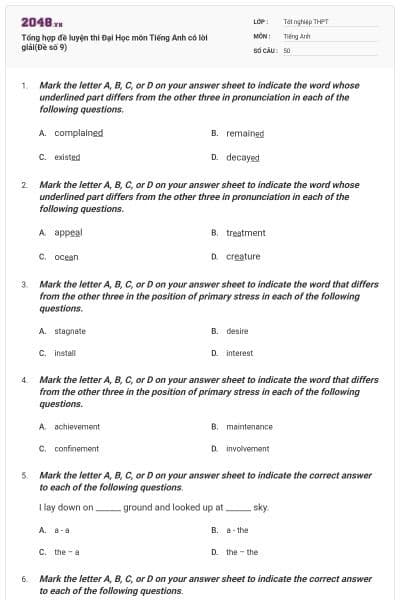
Mark the letter A, B, C, or D on your answer sheet to indicate the word whose underlined part differs from the other three in pronunciation in each of the following questions.
complained
remained
existed
decayed
Chọn C.
Đáp án C.
A. complained /kəmˈpleɪnd/
B. roared /rɔː(r)d/
C. existed /ɪɡˈzɪstɪd/
D. decayed /dɪˈkeɪd/
Đuôi “ed” trong các đáp án A, B, D đều được phát âm là /d/. Đuôi “ed” trong đáp án C được phát âm là /ɪd/.
Mark the letter A, B, C, or D on your answer sheet to indicate the word whose underlined part differs from the other three in pronunciation in each of the following questions.
appeal
treatment
ocean
creature
Chọn C.
Đáp án C.
A. appeal /əˈpiːl/
B. treatment /ˈtriːtmənt/
C. ocean /ˈəʊʃn/
D. creature /ˈkriːtʃə(r)/
Phần gạch chân “ea” trong các đáp án A, B, D đều được phát âm là /iː/. Nhưng đáp án C phát âm là /ə/.
Mark the letter A, B, C, or D on your answer sheet to indicate the word that differs from the other three in the position of primary stress in each of the following questions.
stagnate
desire
install
interest
Chọn D.
Đáp án D.
A. stagnate /stæɡˈneɪt/
B. desire /dɪˈzaɪə(r)/
C. install /ɪnˈstɔːl/
D. interest /ˈɪntrəst/
Các đáp án A, B, C có trọng âm rơi vào âm tiết thứ 2. Riêng đáp án D có trọng âm rơi vào âm tiết thứ nhất.
Mark the letter A, B, C, or D on your answer sheet to indicate the word that differs from the other three in the position of primary stress in each of the following questions.
achievement
maintenance
confinement
involvement
Chọn B.
Đáp án B.
A. achievement /əˈtʃiːvmənt/
B. maintenance /ˈmeɪntənəns/
C. confinement /kənˈfaɪnmənt/
D. involvement /ɪnˈvɒlvmənt/
Các đáp án A, C, D có trọng âm rơi vào âm tiết thứ 2. Riêng đáp án B có trọng âm rơi vào âm tiết thứ nhất.
Mark the letter A, B, C, or D on your answer sheet to indicate the correct answer to each of the following questions.
I lay down on ______ ground and looked up at ______ sky.
a - a
a - the
the – a
the – the
Chọn D.
Đáp án D.
Ta dùng “the” khi nói về thứ mà dùng một danh từ chung, cái chỉ có một.
Dịch: Tôi nằm xuống đất và nhìn lên bầu trời.
Mark the letter A, B, C, or D on your answer sheet to indicate the correct answer to each of the following questions.
_______ ten minutes earlier, you would have got a better seat.
Had you arrived
If you arrived
Were you arrived
If you hadn’t arrived
Chọn A.
Đáp án A.
Câu điều kiện loại 3 diễn tả tình huống không thể xảy ra ở quá khứ.
If + S + had PII, S + would have PII = Had + S + PII, S + would have PII
Dịch: Nếu bạn đến sớm hơn 10 phút, bạn đã có chỗ ngồi tốt hơn.
Mark the letter A, B, C, or D on your answer sheet to indicate the correct answer to each of the following questions.
By the time the boss comes back from England, the work ________.
will have been finishing
will be finishing
will have been finished
will be finished
Chọn C.
Đáp án C.
“by the time” + hiện tại đơn, tương lai hoàn thành.
Chủ ngữ là “the work” nên câu ở dạng bị động. Chỗ trống cần điền thì tương lai hoàn thành dạng bị động
Ta có:
Đáp án A: thì tương lai hoàn thành tiếp diễn dạng chủ động => loại
Đáp án B: thì tương lai tiếp diễn dạng chủ động => loại
Đáp án C: thì tương lai hoàn thành dạng bị động => đúng
Đáp án D: thì tương lai đơn dạng bị động => loại
Dịch: Khi ông chủ trở về từ Anh, công việc sẽ được hoàn thành.

Học thông minh hơn mỗi ngày
Xem toàn bộ 50 câu hỏi và nhiều hơn nữa với tài khoản miễn phí
Mark the letter A, B, C, or D on your answer sheet to indicate the correct answer to each of the following questions.
Bus schedules are updated frequently, ______ check our website for the latest departure and arrival time.
so
if
neither
whereas
Chọn A.
Đáp án A.
Ta có:
A. so: vì vậy
B. if: nếu
C. neither: cũng không (thường đi với “nor”)
D. whereas: trong khi
=> Đáp án A phù hợp về nghĩa
Dịch: Lịch trình xe buýt được cập nhật thường xuyên, vì vậy hãy kiểm tra trang web của chúng tôi để biết giờ khởi hành và giờ đến mới nhấ
Mark the letter A, B, C, or D on your answer sheet to indicate the correct answer to each of the following questions
The government have tried to _____ the price of food, and they finally succeeded.
bring on
put on
get over
bring down
Chọn D.
Đáp án D.
Ta có:
A. bring on: dẫn đến, gây ra
B. put on: tăng thêm
C. get over: vượt qua
D. bring down: hạ xuống => bring down prices: hạ giá.
Dịch: Chính phủ đã cố gắng hạ giá thực phẩm, và cuối cùng họ đã thành công.
Mark the letter A, B, C, or D on your answer sheet to indicate the correct answer to each of the following questions.
My doctor told me _____ice cream.
why I eat
why not eating
why not to eat
why not be eaten
Chọn C.
Đáp án C.
Kiến thức: Rút gọn thành phần câu khi 2 câu cùng chủ ngữ.
Ý của câu: Bác sĩ đã nói với tôi lý do tại sao tôi không nên ăn kem.
Câu viết đầy đủ: My doctor told me why I should not eat ice cream? = My doctor told me why not to eat ice cream
Mark the letter A, B, C, or D on your answer sheet to indicate the correct answer to each of the following questions.
______in the UK, the book has won a number of awards in recent regional book fairs.
Publishing
Published
Being published
To be published
Chọn B.
Đáp án B.
Kiến thức: Rút gọn chủ ngữ câu khi 2 câu cùng chủ ngữ.
Do câu mang nghiã bị động nên là dùng dạng PII để rút gọn
Dịch: Được xuất bản ở Anh, cuốn sách đã giành được một số giải thưởng ở các hội trợ sách trong khu vực gần đây.
Mark the letter A, B, C, or D on your answer sheet to indicate the correct answer to each of the following questions.
They couldn’t help _______ when they heard the little boy singing a love song.
laughing
to laugh
laugh
laughed
Chọn A.
Đáp án A.
Ta có: can’t/couldn’t help V-ing: không nhịn được
Dịch: Họ không thể nhịn cười khi họ nghe thất cậu bé hát bài hát tình yêu.
Mark the letter A, B, C, or D on your answer sheet to indicate the correct answer to each of the following questions.
All students should be ______ and literate when they leave school.
numerate
numeral
numeric
numerous
Chọn A.
Đáp án A.
Ta có:
A. numerate (adj): biết tính toán
B. numeral (adj): thuộc về số
C. numeric (adj): biểu diễn bằng số
D. numerous (adj): nhiều, đông đảo
Dịch: Tất cả học sinh nên biết tính toán và giỏi văn khi chúng tốt nghiệp.
=> Đáp án A phù hợp về nghĩa.
Mark the letter A, B, C, or D on your answer sheet to indicate the correct answer to each of the following questions.
I found it very hard to _____ between the two sounds.
differentiate
pick
discern
tell
Chọn A.
Đáp án A.
A. differentiate (v): phân biệt
B. pick (v): chọn
C. discern (v): nhận thức
D. tell the difference: nhận ra sự khác biệt về chất lượng
Mark the letter A, B, C, or D on your answer sheet to indicate the word that differs from the other three in the position of primary stress in each of the following questions.
Stop _____ about the bush, John! Just tell me exactly what the problem is.
rushing
hiding
beating
moving
Chọn C.
Đáp án C.
Ta có: beat about the bush (idm): nói quanh co, lòng vòng
Dịch: Đừng nói loanh quanh nữa John! Chỉ nói vấn đề chính.
Mark the letter A, B, C, or D on your answer sheet to indicate the correct answer to each of the following questions.
The youths nowadays have many things to do in their ______ time.
leisure
entertainment
fun
amusement
Chọn A.
Đáp án A.
Ta có: leisure time = free time: thời gian rảnh
Dịch: Giới trẻ ngày nay có nhiều việc phải làm trong thời gian rảnh rỗi.
Mark the letter A, B, C, or D on your answer sheet to indicate the correct answer to each of the following questions.
To end or greatly reduce pollution _____, people would have to stop using many things that benefit them.
constantly
suddenly
immediately
directly
Chọn C.
Đáp án C.
A. constanly (adv): liên tục
B. suddenly (adv): đột ngột
C. immediately (adv): ngay lập tức
D. directly (adv): trực tiếp
Đáp án C hợp về nghĩa.
Dịch: Để chấm dứt hoặc giảm đáng kể ô nhiễm ngay lập tức, mọi người sẽ phải ngừng sử dụng nhiều thứ có lợi cho họ.
Mark the letter A, B, C, or D on your answer sheet to indicate the correct answer to each of the following questions.
My English is progressing in _________.
odds and ends
leaps and bounds
bounds and leaps
ends and odds
Chọn B.
Đáp án B.
Ta có:
- in/ by leaps and bounds (idm): rất nhanh
- odds and ends (idm): đồ linh tinh
Dịch: Tiếng Anh của tôi tiến bộ rất nhanh.
Mark the letter A, B, C, or D on your answer sheet to indicate the word(s) CLOSEST in meaning to the underlined word(s) in each of the following questions.
Fallout from a nuclear power station damaged in the tsunami may endanger the vegetation.
stimulate
harm
inhibit
benefit
Chọn B.
Đáp án B.
Dịch: Bụi phóng xạ từ một nhà máy điện hạt nhân bị hư hại vì sóng thần có thể gây nguy hiểm cho thảm thực vật.
=> endanger (v): gây nguy hiểm
Ta có:
A. stimulate (v): thúc đẩy
B. harm (v): gây hại
C. inhibit (v): ức chế
D. benefit (v): có lợi
=> endanger = harm
Mark the letter A, B, C, or D on your answer sheet to indicate the word(s) CLOSEST in meaning to the underlined word(s) in each of the following questions.
The medical community continues to make progress in the fight against cancer.
speed
expect more
do better
treat better
Chọn C.
Đáp án C.
Dịch: Cộng đồng y tế tiếp tục đạt được tiến bộ trong cuộc chiến chống ung thư.
Ta có các đáp án:
A. speed (v): đẩy nhanh
B. expect more (v): mong đợi hơn
C. do better (v): làm tốt hơn
D. treat better (v): chữa trị tốt hơn
=> make progress = do better
Mark the letter A, B, C, or D on your answer sheet to indicate the word(s) OPPOSITE in meaning to the underlined word(s) in each of the following questions.
The consequences of the typhoon were disastrous due to the lack of precautionary measures.
severe
beneficial
physical
damaging
Chọn B.
Đáp án B.
Ta có: disastrous: tai hại, thảm khốc = A. severve: nghiêm trọng >< B. beneficial: có lợi
C. beneficial thuộc về vật chất
D. damaging: thiệt hại
=> đáp án đúng là B.
Dịch: Hậu quả của cơn bão thật thảm khốc do thiếu các biện pháp phòng ngừa.
Mark the letter A, B, C, or D on your answer sheet to indicate the word(s) OPPOSITE in meaning to the underlined word(s) in each of the following questions.
He mentioned in particular electronics, his major at university.
on whole
one and all
in all
in general
Chọn D.
Đáp án D.
Dịch: Ông đặc biệt đề cập đến điện tử, chuyên ngành của anh ấy tại trường đại học.
=> in particular: cụ thể, đặc biệt >< in general: chung chung
Mark the letter A, B, C, or D on your answer sheet to indicate the word(s) OPPOSITE in meaning to the underlined word(s) in each of the following questions.
“Your speech this morning was just beyond my expectation.” “_______________”
It’s OK.
Not at all. It was just OK.
It was my pleasure.
Thanks without your help, I couldn’t have.
Chọn D.
Đáp án D.
Dịch câu hỏi: “Bài phát biểu của bạn sáng nay đã vượt qua mong đợi của tôi.”
“________”
A. Không sao đâu.
B. Không hề. Vẫn ổn.
C. Đó là niềm vui của tôi.
D. Cảm ơn. Nếu không có sự giúp đỡ của bạn thì tôi không thể.
=> Đáp án D phù hợp về nghĩa.
Mark the letter A, B, C, or D on your answer sheet to indicate the option that best completes each of the following exchanges.
“Could you show me how this machine works, please?”
“__________”
Let’s begin by reading its manual together.
Yes. The show is terrific!
Well, it read quite well.
It’s good except that it takes hours to get there.
Chọn A.
Đáp án A.
Dịch câu hỏi: “Bạn có thể chỉ cho tôi cách máy này hoạt động được không?”
A. Hãy bắt đầu bằng cách đọc hướng dẫn sử dụng của nó.
B. Có. Chương trình thật tuyệt vời!
C. Vâng, nó đọc khá tốt.
D. Nó rất tốt, ngoại trừ việc phải mất hàng giờ để đến đó.
=> Đáp án A phù hợp về nghĩa.
Read the following passage and mark the letter A, B, C, or D on your answer sheet to indicate the correct word or phrase that best fits each of the numbered blanks from 25 to 29. Fill in the appropriate word in question 25
Keeping the World in Our Pockets
Faster processors and advances in memory technology have made today’s smartphones much more powerful than a lot of computers from just a decade ago. With wireless technology, people can surf the Internet, play online games, send e-mail, and do (25) _____ all the things they once could only do on a computer. (26) _____, they have the power to do things constantly at their fingertips.
Many people (27) ____ that while smartphones are powerful tools, they are making people reliant on them. Why would a person need to learn to read a map when he can get directions to anywhere by simply asking his phone a question? Who needs to learn maths when you have immense calculating power in your pocket at all times? What (28) _____ is there to memorise facts about history, art, or geography when that information is readily available from a portable Internet interface?
There are just some of the questions being asked and answered as smartphone usage continues to spread. Like any technology, smartphones have their advantages, but they do have disadvantages as well that we must (29) _____ an eye on.
practically
suitably
effectively
most
Chọn A.
Đáp án A.
Ta có:
A. practically (adv): hầu như, gần như
B. suitably (adv): phù hợp
C. effectively (adv): thực tế; có hiệu quả
D. most (adv): nhất, hơn cả
=> Đáp án A hợp về nghĩa.
Dịch: With wireless technology, people can surf the Internet, play online games, send e-mail, and do practically all the things they once could only do on a computer.
(Với công nghệ không dây, con người có thể lướt mạng, chơi game trực tuyến, gửi email và làm hầu hết tất cả những việc mà họ từng chỉ có thể làm trên máy tính.)
Read the following passage and mark the letter A, B, C, or D on your answer sheet to indicate the correct word or phrase that best fits each of the numbered blanks from 25 to 29. Fill in the appropriate word in question 26
Keeping the World in Our Pockets
Faster processors and advances in memory technology have made today’s smartphones much more powerful than a lot of computers from just a decade ago. With wireless technology, people can surf the Internet, play online games, send e-mail, and do (25) _____ all the things they once could only do on a computer. (26) _____, they have the power to do things constantly at their fingertips.
Many people (27) ____ that while smartphones are powerful tools, they are making people reliant on them. Why would a person need to learn to read a map when he can get directions to anywhere by simply asking his phone a question? Who needs to learn maths when you have immense calculating power in your pocket at all times? What (28) _____ is there to memorise facts about history, art, or geography when that information is readily available from a portable Internet interface?
There are just some of the questions being asked and answered as smartphone usage continues to spread. Like any technology, smartphones have their advantages, but they do have disadvantages as well that we must (29) _____ an eye on.
Therefore
Although
However
Rather
Chọn C.
Đáp án C.
Ta có:
A. Therefore: Do đó
B. Although: Mặc dù
C. However: Tuy nhiên, tuy vậy
D. Rather: Thay vào đó
=> Đáp án C phù hợp về nghĩa.
Dịch: However, they have the power to do things constantly at their fingertips. (Tuy vậy, chúng có khả năng làm mọi việc liên tục ngay trong tầm tay.)
Read the following passage and mark the letter A, B, C, or D on your answer sheet to indicate the correct word or phrase that best fits each of the numbered blanks from 25 to 29. Fill in the appropriate word in question 25
Keeping the World in Our Pockets
Faster processors and advances in memory technology have made today’s smartphones much more powerful than a lot of computers from just a decade ago. With wireless technology, people can surf the Internet, play online games, send e-mail, and do (25) _____ all the things they once could only do on a computer. (26) _____, they have the power to do things constantly at their fingertips.
Many people (27) ____ that while smartphones are powerful tools, they are making people reliant on them. Why would a person need to learn to read a map when he can get directions to anywhere by simply asking his phone a question? Who needs to learn maths when you have immense calculating power in your pocket at all times? What (28) _____ is there to memorise facts about history, art, or geography when that information is readily available from a portable Internet interface?
There are just some of the questions being asked and answered as smartphone usage continues to spread. Like any technology, smartphones have their advantages, but they do have disadvantages as well that we must (29) _____ an eye on.
show
agree
speak
argue
Chọn D.
Đáp án D.
Ta có:
A. show (v): thể hiện, chỉ ra
B. agree (v): đồng ý
C. speak (v): nói, phát biểu
D. argue (v): tranh luận
=> Đáp án D phù hợp về nghĩa.
Dịch: Many people argue that while smartphones are powerful tools, they are making people reliant on them. (Nhiều người tranh luận rằng dù điện thoại thông minh là một công cụ mạnh nhưng chúng đang làm cho con người phụ thuộc vào chúng.)
Read the following passage and mark the letter A, B, C, or D on your answer sheet to indicate the correct word or phrase that best fits each of the numbered blanks from 25 to 29. Fill in the appropriate word in question 28
Keeping the World in Our Pockets
Faster processors and advances in memory technology have made today’s smartphones much more powerful than a lot of computers from just a decade ago. With wireless technology, people can surf the Internet, play online games, send e-mail, and do (25) _____ all the things they once could only do on a computer. (26) _____, they have the power to do things constantly at their fingertips.
Many people (27) ____ that while smartphones are powerful tools, they are making people reliant on them. Why would a person need to learn to read a map when he can get directions to anywhere by simply asking his phone a question? Who needs to learn maths when you have immense calculating power in your pocket at all times? What (28) _____ is there to memorise facts about history, art, or geography when that information is readily available from a portable Internet interface?
There are just some of the questions being asked and answered as smartphone usage continues to spread. Like any technology, smartphones have their advantages, but they do have disadvantages as well that we must (29) _____ an eye on.
judgement
reason
ability
advice
Chọn B.
Đáp án B.
Ta có:
A. judgement (n): phán đoán, sự đánh giá
B. reason (n): lý do
C. ability (n): khả năng
D. advice (n): lời khuyên
=> Đáp án B phù hợp về nghĩa.
Dịch: What reason is there to memorise facts about history, art, or geography when that information is readily available from a portable Internet interface? (Lý do gì để ghi nhớ các sự thật về lịch sử, nghệ thuật hay địa lý khi thông tin đó luôn có sẵn trong một giao diện Internet di động?)
Read the following passage and mark the letter A, B, C, or D on your answer sheet to indicate the correct word or phrase that best fits each of the numbered blanks from 25 to 29. Fill in the appropriate word in question 29
Keeping the World in Our Pockets
Faster processors and advances in memory technology have made today’s smartphones much more powerful than a lot of computers from just a decade ago. With wireless technology, people can surf the Internet, play online games, send e-mail, and do (25) _____ all the things they once could only do on a computer. (26) _____, they have the power to do things constantly at their fingertips.
Many people (27) ____ that while smartphones are powerful tools, they are making people reliant on them. Why would a person need to learn to read a map when he can get directions to anywhere by simply asking his phone a question? Who needs to learn maths when you have immense calculating power in your pocket at all times? What (28) _____ is there to memorise facts about history, art, or geography when that information is readily available from a portable Internet interface?
There are just some of the questions being asked and answered as smartphone usage continues to spread. Like any technology, smartphones have their advantages, but they do have disadvantages as well that we must (29) _____ an eye on.
put
remain
keep
hold
Chọn C.
Đáp án C.
Ta có: keep an eye on sth: để ý, coi chừng cái gì
Dịch: Like any technology, smartphones have their advantages, but they do have disadvantages as well that we must keep an eye on. (Giống như bất cứ công nghệ nào, điện thoại thông minh có những ưu điểm, nhưng chúng cũng có những nhược điểm mà chúng ta phải để ý.)
Read the following passage and mark the letter A, B, C, or D on your answer sheet to indicate the correct answer to each of the questions from 30 to 34.
Ever since humans have inhabited the earth, they have made use of various forms of communication. Generally, this expression of thoughts and feelings has been in the form of oral speech. When there is a language barrier, communication is accomplished through sign language in which motions stand for letters, words, and ideas. Tourists, the deaf, and the mute have had to resort to this form of expression. Many of these symbols of whole words are very picturesque and exact and can be used internationally, spelling, however, cannot.
Body language transmits ideas or thoughts by certain actions, either intentionally or unintentionally. A wink can be a way of flirting or indicating that the party is only joking. A nod signifies approval, while shaking the head indicates a negative reaction.
Other forms of nonlinguistic language can be found in Braille (a system of raised dots read with the fingertips), signal flags, Morse code, and smoke signals. Road maps and picture signs also guide, warn, and instruct people. While verbalization is the most common form of language, other systems and techniques also express human thoughts and feelings.
What is the best title for the passage?
The Importance of Sign Language
The Many Forms of Communication
Ways of Expressing Feelings
Picturesque Symbols of Communication
Chọn B.
Đáp án B.
Người viết đã đưa ra rất nhiều các dạng giao tiếp khác nhau trong đoạn văn với các đối tượng khác nhau như “sign language”, “body language”, “Braille”, “signal flags”, “Morse code”, etc., vậy đáp án đúng là B
Read the following passage and mark the letter A, B, C, or D on your answer sheet to indicate the correct answer to each of the questions from 30 to 34.
Ever since humans have inhabited the earth, they have made use of various forms of communication. Generally, this expression of thoughts and feelings has been in the form of oral speech. When there is a language barrier, communication is accomplished through sign language in which motions stand for letters, words, and ideas. Tourists, the deaf, and the mute have had to resort to this form of expression. Many of these symbols of whole words are very picturesque and exact and can be used internationally, spelling, however, cannot.
Body language transmits ideas or thoughts by certain actions, either intentionally or unintentionally. A wink can be a way of flirting or indicating that the party is only joking. A nod signifies approval, while shaking the head indicates a negative reaction.
Other forms of nonlinguistic language can be found in Braille (a system of raised dots read with the fingertips), signal flags, Morse code, and smoke signals. Road maps and picture signs also guide, warn, and instruct people. While verbalization is the most common form of language, other systems and techniques also express human thoughts and feelings.
The word “accomplished” in the first paragraph is closest in meaning to _____.
started
given
achieved
improved
Chọn C.
Đáp án C.
Từ “accomplish” gần nghĩa với “achieve”. Communication is accomplished through sign language: Giao tiếp được thực hiện qua ngôn ngữ ký hiệu…
Thông tin ở đoạn 2: “...they often use mile-long drift nets which trap and kill large numbers of unwanted marine life for no reason at all.” (...họ thường sử dụng những chiếc lưới kéo dài cả dặm để bẫy và giết lượng lớn những sinh vật biển không mong muốn không vì lí do gì cả).
Read the following passage and mark the letter A, B, C, or D on your answer sheet to indicate the correct answer to each of the questions from 30 to 34.
Ever since humans have inhabited the earth, they have made use of various forms of communication. Generally, this expression of thoughts and feelings has been in the form of oral speech. When there is a language barrier, communication is accomplished through sign language in which motions stand for letters, words, and ideas. Tourists, the deaf, and the mute have had to resort to this form of expression. Many of these symbols of whole words are very picturesque and exact and can be used internationally, spelling, however, cannot.
Body language transmits ideas or thoughts by certain actions, either intentionally or unintentionally. A wink can be a way of flirting or indicating that the party is only joking. A nod signifies approval, while shaking the head indicates a negative reaction.
Other forms of nonlinguistic language can be found in Braille (a system of raised dots read with the fingertips), signal flags, Morse code, and smoke signals. Road maps and picture signs also guide, warn, and instruct people. While verbalization is the most common form of language, other systems and techniques also express human thoughts and feelings.
The word “these” in the first paragraph refers to_____.
tourists
the deaf and the mute
thoughts and feelings
sign language motions
Chọn D.
Đáp án D
Dựa vào thông tin “When there is a language barrier, communication is accomplished through sign language in which motions stand for letters, words, and ideas. … Many of these symbols of whole words are very picturesque and exact and can be used internationally, spelling, however, cannot” có thể thấy “These” trong đoạn văn chính là nói về “sign language motions” (hành động ngôn ngữ kí hiệu
Read the following passage and mark the letter A, B, C, or D on your answer sheet to indicate the correct answer to each of the questions from 30 to 34.
Ever since humans have inhabited the earth, they have made use of various forms of communication. Generally, this expression of thoughts and feelings has been in the form of oral speech. When there is a language barrier, communication is accomplished through sign language in which motions stand for letters, words, and ideas. Tourists, the deaf, and the mute have had to resort to this form of expression. Many of these symbols of whole words are very picturesque and exact and can be used internationally, spelling, however, cannot.
Body language transmits ideas or thoughts by certain actions, either intentionally or unintentionally. A wink can be a way of flirting or indicating that the party is only joking. A nod signifies approval, while shaking the head indicates a negative reaction.
Other forms of nonlinguistic language can be found in Braille (a system of raised dots read with the fingertips), signal flags, Morse code, and smoke signals. Road maps and picture signs also guide, warn, and instruct people. While verbalization is the most common form of language, other systems and techniques also express human thoughts and feelings.
According to the passage, which of the following is NOT true?
There are many forms of communication in existence today
Verbalization is the most common form of communication
The deaf and mute can use an oral form of communication
Ideas and thoughts can be transmitted by body language.
Chọn C.
Đáp án C
Các đáp án sau đều được đề cập trong bài:
A: “Ever since humans inhabited the earth, they have made use of various forms of communication.”
B: “verbalization is the most common form of language…”
D: “Body language transmits ideas or thoughts …..”
=> Đáp án sai là C: “the deaf and mute use an oral form of communication” (những người câm và điếc sử dụng hình thức giao tiếp truyền miệng)
Read the following passage and mark the letter A, B, C, or D on your answer sheet to indicate the correct answer to each of the questions from 30 to 34.
Ever since humans have inhabited the earth, they have made use of various forms of communication. Generally, this expression of thoughts and feelings has been in the form of oral speech. When there is a language barrier, communication is accomplished through sign language in which motions stand for letters, words, and ideas. Tourists, the deaf, and the mute have had to resort to this form of expression. Many of these symbols of whole words are very picturesque and exact and can be used internationally, spelling, however, cannot.
Body language transmits ideas or thoughts by certain actions, either intentionally or unintentionally. A wink can be a way of flirting or indicating that the party is only joking. A nod signifies approval, while shaking the head indicates a negative reaction.
Other forms of nonlinguistic language can be found in Braille (a system of raised dots read with the fingertips), signal flags, Morse code, and smoke signals. Road maps and picture signs also guide, warn, and instruct people. While verbalization is the most common form of language, other systems and techniques also express human thoughts and feelings.
People need to communicate in order to_________.
create language barriers
keep from reading with their fingertips
be picturesque and exact
express thoughts and feelings
Chọn D.
Đáp án D
Dựa vào chi tiết trong bài: “… this expression of thoughts and feelings has been in the form of oral speech …. other systems and techniques also express human thoughts and feelings.”
Read the following passage and choose the letter A, B, C or D to indicate the correct answer to each of the questions from 35 to 42.
In the USA, the UK and many other countries, a lot of babies were born in the “baby boom” of the late 1940s and 1950s; after that the birth-rate fell. Baby boomers have now retired, or are approaching retirement, and this is causing headaches for many organizations: there are not enough people to succeed their top managers when they retire.
Does your organization have key staff who can’t easily be replaced? A CEO or financial director, perhaps, or a technical expert with knowledge that nobody else in the organization has. If your answer is “yes”, what will happen when they retire, or leave for another company? Will you wait until the last moment before looking for someone to replace them? Or is your organization thinking about likely future changes now, as it should be, and making plans, so that there is likely to be someone ready to replace the person leaving? If the answer is that you are planning ahead, your organization is carrying out succession planning.
Succession planning means looking inside the organization for “high-fliers” - current staff members with the potential to fill key positions - and planning the training, responsibilities and promotion they need, to make them ready when a senior vacancy occurs - which may not be for several years. The company benefits by being able to make an internal promotion when a key person leaves, and in the meantime it benefits by developing the skills of its high-fliers and encouraging them to stay. And the high-fliers benefit, because they achieve their full potential, a career is planned for them within the organization, and they can look forward to a senior post in time.
The training program planned for the high-fliers will help them to develop the leadership skills they need for more senior roles, skills such as planning long-term strategies. A career path is also planned, so that each high-flier moves into a number of different positions over a few years, to gain the experience and know ledge they need.
Sometimes a staff member is chosen as a potential successor to a particular senior manager, but a better method is for organizations to select a number of high-fliers, and prepare them for a range of senior roles. An organization can’t be certain when a particular senior manager will leave. Having a group of people being prepared fee top positions makes it easier to replace someone who leaves unexpectedly, and also means that there are other people available if a high-flier leaves the company.
What does the passage mainly discuss?
Succession planning is beneficial in many ways.
Encouraging high-flier to stay is a key to success.
There are typical strategies to improve skills for staff.
Making successful plans is extremely hard.
Chọn A.
Đáp án A
Dịch nghĩa câu hỏi và các lựa chọn ta có:
- Ý chính của đoạn văn là gì?
A. Kế hoạch người tiếp nối mang lại những lợi ích về nhiều mặt
B. Khuyến khíc người tham vọng ở lại là chìa khóa hỏng để thành công.
C. Có nhiều chiến lược để cải thiện kĩ năng cho nhân viên.
D. Tạo ra những kế hoạch thành công là cực kì khó.
Từ đoạn văn ta thấy người viết đang nói về việc dùng kế hoạch kế vị như 1 cách để chọn người lãnh đạo hoặc người kế tiếp những người quản lí.
Read the following passage and choose the letter A, B, C or D to indicate the correct answer to each of the questions from 35 to 42.
In the USA, the UK and many other countries, a lot of babies were born in the “baby boom” of the late 1940s and 1950s; after that the birth-rate fell. Baby boomers have now retired, or are approaching retirement, and this is causing headaches for many organizations: there are not enough people to succeed their top managers when they retire.
Does your organization have key staff who can’t easily be replaced? A CEO or financial director, perhaps, or a technical expert with knowledge that nobody else in the organization has. If your answer is “yes”, what will happen when they retire, or leave for another company? Will you wait until the last moment before looking for someone to replace them? Or is your organization thinking about likely future changes now, as it should be, and making plans, so that there is likely to be someone ready to replace the person leaving? If the answer is that you are planning ahead, your organization is carrying out succession planning.
Succession planning means looking inside the organization for “high-fliers” - current staff members with the potential to fill key positions - and planning the training, responsibilities and promotion they need, to make them ready when a senior vacancy occurs - which may not be for several years. The company benefits by being able to make an internal promotion when a key person leaves, and in the meantime it benefits by developing the skills of its high-fliers and encouraging them to stay. And the high-fliers benefit, because they achieve their full potential, a career is planned for them within the organization, and they can look forward to a senior post in time.
The training program planned for the high-fliers will help them to develop the leadership skills they need for more senior roles, skills such as planning long-term strategies. A career path is also planned, so that each high-flier moves into a number of different positions over a few years, to gain the experience and know ledge they need.
Sometimes a staff member is chosen as a potential successor to a particular senior manager, but a better method is for organizations to select a number of high-fliers, and prepare them for a range of senior roles. An organization can’t be certain when a particular senior manager will leave. Having a group of people being prepared fee top positions makes it easier to replace someone who leaves unexpectedly, and also means that there are other people available if a high-flier leaves the company.
The word “succeed” in the passage is closest in meaning to ________.
achieve
question
replace
reply
Chọn C.
Đáp án C
Xét nghĩa các đáp án ta có:
A. achieve (đạt được)
B. question (đặt câu hỏi)
C. replace (thay thế)
D. reply (trả lời)
Trong đoạn văn động từ này nằm trong câu văn “there are not enough people to succeed their top managers when they retire” với ý nghĩa thay thế người quản lí cấp cao.
=> từ đồng nghĩa với nó là replace.
Read the following passage and choose the letter A, B, C or D to indicate the correct answer to each of the questions from 35 to 42.
In the USA, the UK and many other countries, a lot of babies were born in the “baby boom” of the late 1940s and 1950s; after that the birth-rate fell. Baby boomers have now retired, or are approaching retirement, and this is causing headaches for many organizations: there are not enough people to succeed their top managers when they retire.
Does your organization have key staff who can’t easily be replaced? A CEO or financial director, perhaps, or a technical expert with knowledge that nobody else in the organization has. If your answer is “yes”, what will happen when they retire, or leave for another company? Will you wait until the last moment before looking for someone to replace them? Or is your organization thinking about likely future changes now, as it should be, and making plans, so that there is likely to be someone ready to replace the person leaving? If the answer is that you are planning ahead, your organization is carrying out succession planning.
Succession planning means looking inside the organization for “high-fliers” - current staff members with the potential to fill key positions - and planning the training, responsibilities and promotion they need, to make them ready when a senior vacancy occurs - which may not be for several years. The company benefits by being able to make an internal promotion when a key person leaves, and in the meantime it benefits by developing the skills of its high-fliers and encouraging them to stay. And the high-fliers benefit, because they achieve their full potential, a career is planned for them within the organization, and they can look forward to a senior post in time.
The training program planned for the high-fliers will help them to develop the leadership skills they need for more senior roles, skills such as planning long-term strategies. A career path is also planned, so that each high-flier moves into a number of different positions over a few years, to gain the experience and know ledge they need.
Sometimes a staff member is chosen as a potential successor to a particular senior manager, but a better method is for organizations to select a number of high-fliers, and prepare them for a range of senior roles. An organization can’t be certain when a particular senior manager will leave. Having a group of people being prepared fee top positions makes it easier to replace someone who leaves unexpectedly, and also means that there are other people available if a high-flier leaves the company.
According to the 2nd paragraph, which of the following is NOT stated about key staff?
A CEO
a financial director
a technical expert
a baby boomer
Chọn D.
Đáp án D
Dịch câu hỏi: Tất cả những người sau được nhắc đến ở đoạn 2 như là những nhân viên trụ cột ngoại trừ ___
Dựa vào chi tiết ở đoạn 2 ta có: “Does your organization have key staff who can’t easily be replaced? A CEO or financial director, perhaps, or a technical expert with knowledge that nobody else in the organization has.” => đáp án sai là D. baby boomer.
Read the following passage and choose the letter A, B, C or D to indicate the correct answer to each of the questions from 35 to 42.
In the USA, the UK and many other countries, a lot of babies were born in the “baby boom” of the late 1940s and 1950s; after that the birth-rate fell. Baby boomers have now retired, or are approaching retirement, and this is causing headaches for many organizations: there are not enough people to succeed their top managers when they retire.
Does your organization have key staff who can’t easily be replaced? A CEO or financial director, perhaps, or a technical expert with knowledge that nobody else in the organization has. If your answer is “yes”, what will happen when they retire, or leave for another company? Will you wait until the last moment before looking for someone to replace them? Or is your organization thinking about likely future changes now, as it should be, and making plans, so that there is likely to be someone ready to replace the person leaving? If the answer is that you are planning ahead, your organization is carrying out succession planning.
Succession planning means looking inside the organization for “high-fliers” - current staff members with the potential to fill key positions - and planning the training, responsibilities and promotion they need, to make them ready when a senior vacancy occurs - which may not be for several years. The company benefits by being able to make an internal promotion when a key person leaves, and in the meantime it benefits by developing the skills of its high-fliers and encouraging them to stay. And the high-fliers benefit, because they achieve their full potential, a career is planned for them within the organization, and they can look forward to a senior post in time.
The training program planned for the high-fliers will help them to develop the leadership skills they need for more senior roles, skills such as planning long-term strategies. A career path is also planned, so that each high-flier moves into a number of different positions over a few years, to gain the experience and know ledge they need.
Sometimes a staff member is chosen as a potential successor to a particular senior manager, but a better method is for organizations to select a number of high-fliers, and prepare them for a range of senior roles. An organization can’t be certain when a particular senior manager will leave. Having a group of people being prepared fee top positions makes it easier to replace someone who leaves unexpectedly, and also means that there are other people available if a high-flier leaves the company.
According to the passage, succession planning is the planning of______.
what should be prepared for the recruitment of new staff.
who will be ready for a senior post when someone leaves
how to make an organization more successful
what changes should be made to an organization
Chọn B.
Dựa vào câu văn “Succession planning means looking inside the organization for “high-fliers" - current staff members with the potential to fill key positions - and planning the training, responsibilities and promotion they need, to make them ready when a senior vacancy occurs - which may not be for several years.” (Kế hoạch kế vị nghĩa là nhìn sâu vào trong một tổ chức đối với những người “có tham vọng” – những nhân viên hiện tại với tiềm năng để lấp đầy những vị trí chủ chốt và lên kế hoạch đào tạo, trách nhiệm và sự quảng bá họ cần để giúp họ sẵn sàng khi có một vị trí trống xảy ra.)
=> Succession planning là kế hoạch về người sẵn sàng ngồi vào một vị trí cấp trên khi họ rời đi.
Read the following passage and choose the letter A, B, C or D to indicate the correct answer to each of the questions from 35 to 42.
In the USA, the UK and many other countries, a lot of babies were born in the “baby boom” of the late 1940s and 1950s; after that the birth-rate fell. Baby boomers have now retired, or are approaching retirement, and this is causing headaches for many organizations: there are not enough people to succeed their top managers when they retire.
Does your organization have key staff who can’t easily be replaced? A CEO or financial director, perhaps, or a technical expert with knowledge that nobody else in the organization has. If your answer is “yes”, what will happen when they retire, or leave for another company? Will you wait until the last moment before looking for someone to replace them? Or is your organization thinking about likely future changes now, as it should be, and making plans, so that there is likely to be someone ready to replace the person leaving? If the answer is that you are planning ahead, your organization is carrying out succession planning.
Succession planning means looking inside the organization for “high-fliers” - current staff members with the potential to fill key positions - and planning the training, responsibilities and promotion they need, to make them ready when a senior vacancy occurs - which may not be for several years. The company benefits by being able to make an internal promotion when a key person leaves, and in the meantime it benefits by developing the skills of its high-fliers and encouraging them to stay. And the high-fliers benefit, because they achieve their full potential, a career is planned for them within the organization, and they can look forward to a senior post in time.
The training program planned for the high-fliers will help them to develop the leadership skills they need for more senior roles, skills such as planning long-term strategies. A career path is also planned, so that each high-flier moves into a number of different positions over a few years, to gain the experience and know ledge they need.
Sometimes a staff member is chosen as a potential successor to a particular senior manager, but a better method is for organizations to select a number of high-fliers, and prepare them for a range of senior roles. An organization can’t be certain when a particular senior manager will leave. Having a group of people being prepared fee top positions makes it easier to replace someone who leaves unexpectedly, and also means that there are other people available if a high-flier leaves the company.
What does the word “them” in the 3rd paragraph refer to?
high-fliers
key positions
responsibilities
organizations
Chọn A.
Đáp án A
Từ them nằm trong câu văn ““Succession planning means looking inside the organization for “high-fliers" - current staff members with the potential to fill key positions - and planning the training, responsibilities and promotion they need, to make them ready when a senior vacancy occurs - which may not be for several years.” (Kế hoạch kế vị nghĩa là nhìn sâu vào trong một tổ chức đối với những người “có tham vọng” – những nhân viên hiện tại với tiềm năng để lấp đầy những vị trí chủ chốt và lên kế hoạch đào tạo, trách nhiệm và sự quảng bá họ cần để giúp họ sẵn sàng khi có một vị trí trống xảy ra.)
Trong câu văn trên “them” chính là chỉ những người có tham vọng/ khả năng trở thành lãnh đạo trong tương lai “high-fliers”
Read the following passage and choose the letter A, B, C or D to indicate the correct answer to each of the questions from 35 to 42.
In the USA, the UK and many other countries, a lot of babies were born in the “baby boom” of the late 1940s and 1950s; after that the birth-rate fell. Baby boomers have now retired, or are approaching retirement, and this is causing headaches for many organizations: there are not enough people to succeed their top managers when they retire.
Does your organization have key staff who can’t easily be replaced? A CEO or financial director, perhaps, or a technical expert with knowledge that nobody else in the organization has. If your answer is “yes”, what will happen when they retire, or leave for another company? Will you wait until the last moment before looking for someone to replace them? Or is your organization thinking about likely future changes now, as it should be, and making plans, so that there is likely to be someone ready to replace the person leaving? If the answer is that you are planning ahead, your organization is carrying out succession planning.
Succession planning means looking inside the organization for “high-fliers” - current staff members with the potential to fill key positions - and planning the training, responsibilities and promotion they need, to make them ready when a senior vacancy occurs - which may not be for several years. The company benefits by being able to make an internal promotion when a key person leaves, and in the meantime it benefits by developing the skills of its high-fliers and encouraging them to stay. And the high-fliers benefit, because they achieve their full potential, a career is planned for them within the organization, and they can look forward to a senior post in time.
The training program planned for the high-fliers will help them to develop the leadership skills they need for more senior roles, skills such as planning long-term strategies. A career path is also planned, so that each high-flier moves into a number of different positions over a few years, to gain the experience and know ledge they need.
Sometimes a staff member is chosen as a potential successor to a particular senior manager, but a better method is for organizations to select a number of high-fliers, and prepare them for a range of senior roles. An organization can’t be certain when a particular senior manager will leave. Having a group of people being prepared fee top positions makes it easier to replace someone who leaves unexpectedly, and also means that there are other people available if a high-flier leaves the company.
Which of the following can best replace the word “senior” the passage?
junior
top ranking
older
low-paid
Chọn B.
Đáp án B
Dịch nghĩa các đáp án ta có:
A. junior (thấp hơn về cấp bậc)
B. top ranking (xếp hàng đầu)
C. older (già hơn)
D. low-paid (được trả lương thấp)
Trong đoạn văn từ “senior” dùng để nói về những lạnh đạo cấp trên của tổ chức, doanh nghiệp => từ đồng nghĩa với nó là “top ranking”
Read the following passage and choose the letter A, B, C or D to indicate the correct answer to each of the questions from 35 to 42.
In the USA, the UK and many other countries, a lot of babies were born in the “baby boom” of the late 1940s and 1950s; after that the birth-rate fell. Baby boomers have now retired, or are approaching retirement, and this is causing headaches for many organizations: there are not enough people to succeed their top managers when they retire.
Does your organization have key staff who can’t easily be replaced? A CEO or financial director, perhaps, or a technical expert with knowledge that nobody else in the organization has. If your answer is “yes”, what will happen when they retire, or leave for another company? Will you wait until the last moment before looking for someone to replace them? Or is your organization thinking about likely future changes now, as it should be, and making plans, so that there is likely to be someone ready to replace the person leaving? If the answer is that you are planning ahead, your organization is carrying out succession planning.
Succession planning means looking inside the organization for “high-fliers” - current staff members with the potential to fill key positions - and planning the training, responsibilities and promotion they need, to make them ready when a senior vacancy occurs - which may not be for several years. The company benefits by being able to make an internal promotion when a key person leaves, and in the meantime it benefits by developing the skills of its high-fliers and encouraging them to stay. And the high-fliers benefit, because they achieve their full potential, a career is planned for them within the organization, and they can look forward to a senior post in time.
The training program planned for the high-fliers will help them to develop the leadership skills they need for more senior roles, skills such as planning long-term strategies. A career path is also planned, so that each high-flier moves into a number of different positions over a few years, to gain the experience and know ledge they need.
Sometimes a staff member is chosen as a potential successor to a particular senior manager, but a better method is for organizations to select a number of high-fliers, and prepare them for a range of senior roles. An organization can’t be certain when a particular senior manager will leave. Having a group of people being prepared fee top positions makes it easier to replace someone who leaves unexpectedly, and also means that there are other people available if a high-flier leaves the company.
All of the following are mentioned as benefits of succession planning EXCEPT _______.
the promotion of a staff member
the improvement of important skill
the potential for higher salaries
the chance for more experience
Chọn C.
Đáp án C
Dịch câu hỏi ta có: Tất cả những điều sau được đề cập như những lợi ích của kế hoạch kế vị ngoại trừ ___.
Dựa vào chi tiết “The company benefits by being able to make an internal promotion when a key person leaves, and in the meantime it benefits by developing the skills of its high-fliers and encouraging them to stay….” và “… A career path is also planned, so that each high-flier moves into a number of different positions over a few years, to gain the experience and knowledge they need.”
=> Đáp án không đúng là the potential for higher salaries
Read the following passage and choose the letter A, B, C or D to indicate the correct answer to each of the questions from 35 to 42.
In the USA, the UK and many other countries, a lot of babies were born in the “baby boom” of the late 1940s and 1950s; after that the birth-rate fell. Baby boomers have now retired, or are approaching retirement, and this is causing headaches for many organizations: there are not enough people to succeed their top managers when they retire.
Does your organization have key staff who can’t easily be replaced? A CEO or financial director, perhaps, or a technical expert with knowledge that nobody else in the organization has. If your answer is “yes”, what will happen when they retire, or leave for another company? Will you wait until the last moment before looking for someone to replace them? Or is your organization thinking about likely future changes now, as it should be, and making plans, so that there is likely to be someone ready to replace the person leaving? If the answer is that you are planning ahead, your organization is carrying out succession planning.
Succession planning means looking inside the organization for “high-fliers” - current staff members with the potential to fill key positions - and planning the training, responsibilities and promotion they need, to make them ready when a senior vacancy occurs - which may not be for several years. The company benefits by being able to make an internal promotion when a key person leaves, and in the meantime it benefits by developing the skills of its high-fliers and encouraging them to stay. And the high-fliers benefit, because they achieve their full potential, a career is planned for them within the organization, and they can look forward to a senior post in time.
The training program planned for the high-fliers will help them to develop the leadership skills they need for more senior roles, skills such as planning long-term strategies. A career path is also planned, so that each high-flier moves into a number of different positions over a few years, to gain the experience and know ledge they need.
Sometimes a staff member is chosen as a potential successor to a particular senior manager, but a better method is for organizations to select a number of high-fliers, and prepare them for a range of senior roles. An organization can’t be certain when a particular senior manager will leave. Having a group of people being prepared fee top positions makes it easier to replace someone who leaves unexpectedly, and also means that there are other people available if a high-flier leaves the company.
What can be inferred from the passage?
Big companies always have only one staff member for an available top position.
All organizations hold training programs for newly appointed people.
Succession planning helps improve the relationship among staff in a company.
An unusually great number of children were born during a decade of mid - twentieth century.
Chọn D.
Đáp án D
Dịch câu hỏi ta có: Câu nào sao đây có thể suy ra từ đoạn văn?
A. Các công ty lớn luôn có chỉ một nhân viên để sẵn sàng thay cho vị trí lãnh đạo (thông tin sai vì “Succession planning means looking inside the organization for “high-fliers” - current staff members with the potential to fill key positions”
B. Tất cả các tập đoàn tổ chức các chương trình đào tạo cho những người mới được bổ nhiệm (không có thông tin)
C. Kế hoạch kế vị giúp cải thiện mối quan hệ giữa các nhân viên trong công ty. (không có thông tin)
D. Một số lượng lớn bất thường trẻ em được sinh ra trong suốt một thập kỉ giữa thế kỉ 20. (dẫn chứng nằm ở câu “In the USA, the UK and many other countries, a lot of babies were born in the "baby boom” of the late 1940s and 1950s; after that the birth-rate fell.”
Mark the letter A, B, C, or D on your answer sheet to indicate the underlined part that needs correction in each of the following questions.
Some fishes (A) live at enormous depths (B) that they are almost complete (C) blind (D).
Some fishes
enormous depths
complete
blind
Chọn C.
Đáp án C.
Ta có trật tự: (be) adv + adj
Vì vậy: complete => completely.
Dịch: Một số loài cá sống ở độ sâu rất lớn mà chúng gần như hoàn toàn bị mù.
Mark the letter A, B, C, or D on your answer sheet to indicate the underlined part that needs correction in each of the following questions.
A secretary told (A) me an important file had left (B) in the lunch room just (C) the other (D) day.
told
had left
just
the other
Chọn B.
Đáp án B.
Ta phải dùng cấu trúc bị động vì “file: tập tài liệu” không thể tự thực hiện hành động.
Vì vậy: had left => had been left.
Dịch: Thư kí đã nói với tôi rằng một tập tài liệu quan trọng đã bị để lại tại phòng ăn trưa mới gần đây.
Mark the letter A, B, C, or D on your answer sheet to indicate the underlined part that needs correction in each of the following questions.
The root of the tree allows the water to go into (A) the soil, that (B) gradually releases it (C) to flow down (D) rivers. (Câu 66 P 113- trắc nghiệm)
to go into
that
releases
flow down
Chọn B.
Đáp án B.
Khi hai quá trình diễn ra nối tiếp nhau ta phải dùng “then”
Vì vậy: that => then
Dịch: Rễ cây làm cho nước thấm vào đất trồng, sau đó từ từ cho nước chảy xuống sông ngòi.
Mark the letter A, B, C, or D on your answer sheet to indicate the sentence that is closest in meaning to each of the following questions.
It’s a waste of time to try and explain anything to Tony.
Tony should be given explanations.
It’s not worth trying to explain anything to Tony.
To save time, explain it to Tony.
It’s well worth trying to explain things to Tony.
Chọn B.
Đáp án B.
Câu gốc: Thật tốn tời gian khi cố gắng giải thích mọi thứ cho Tony. = B. Thật vô nghĩa khi cố gắng giải thích mọi thứ cho John.
Các đáp án khác sai nghĩa.
A. Tony nên được giải thích.
C. Để tiết kiệm thời gian, Giải thích nó cho John đi.
D. Thật đáng khi cố gắng giải thích mọi thứ cho John.
Mark the letter A, B, C, or D on your answer sheet to indicate the sentence that is closest in meaning to each of the following questions.
“Put the knife in your right hand down.” said the policeman to the man.
The policeman suggested the man to put the knife in his right hand down.
The policeman invited the man to put the knife in his right hand down.
The policeman ordered the man to put the knife in his right hand down.
The policeman requested the man putting the knife in his right hand down.
Chọn C.
Đáp án C.
Câu gốc: "Đặt con dao trong tay phải của anh xuống." Viên cảnh sát nói với người đàn ông. = C. Viên cảnh sát ra lệnh cho người đàn ông đặt con dao trong tay phải xuống.
==> Hàm ý đề nghị, ra lệnh: sang gián tiếp dùng động từ order sb + to V.
Mark the letter A, B, C, or D on your answer sheet to indicate the sentence that is closest in meaning to each of the following questions.
I had only just put the phone down when the boss rang back.
I put the phone down when the boss rang back.
Hardly had I put the phone down when the boss rang back.
No sooner had I put the phone down when the boss rang back.
Scarcely had I put the phone down than the boss rang back.
Chọn B.
Đáp án B.
Câu gốc: Cô ấy chỉ vừa mới gác máy khi ông chủ gọi lại.
= B. Cô ấy vừa gác máy thì ông chủ cô ấy lại gọi lại.
Cấu trúc: Đảo ngữ:
No sooner + had + S1 + PII + than + S2 + Ved/2 nghĩa là "Vừa mới... thì đã."
Hardly + had + S1 + PII + when + S2 + Ved/2 nghĩa là "Vừa mới... thì đã."
Các lựa chọn khác không phù hợp vì:
A chia sai thì. Ở vế trước đang được dùng thì quá khứ đơn nên không phù hợp về thì so với câu gốc.
C chia sai when. no sooner....than... (không phải when)
D sai than. scarcely....when... (không phải than)
Mark the letter A, B, C, or D on your answer sheet to indicate the sentence that best combines each pair of sentences in the following questions.
Anne jogs every morning. It is very good for her health.
Anne jogs every morning and is very good for her health.
Anne jogs every morning, which is very good for her health.
Anne jogs every morning and then it is very good for her health.
Anne jogs every morning that it is very good for her health.
Chọn B.
Đáp án B.
Dịch câu hỏi: Anne chạy bộ mỗi sáng. Nó rất tốt cho sức khỏe của cô ấy.
A. Anne chạy bộ mỗi sáng và rất tốt cho sức khỏe.
B. Anne chạy bộ mỗi sáng, điều này rất tốt cho sức khỏe của cô.
C. Anne chạy bộ mỗi sáng và sau đó rất tốt cho sức khỏe.
D. Anne chạy bộ mỗi sáng rằng nó rất tốt cho sức khỏe.
=> Đáp án B
Mark the letter A, B, C, or D on your answer sheet to indicate the sentence that best combines each pair of sentences in the following questions.
He spent all his money. He even borrowed some money from me.
Not only did he spent all his money but also he borrowed some money from me.
Hardly had he borrowed some money from me when he spent it all.
Not only did he spend all his money but he borrowed some money from me as well.
As soon as he borrowed some money from me, he spent it all.
Chọn C.
Đáp án C.
Dịch câu hỏi: Anh ta đã tiêu hết tiền. Anh ta thậm chí còn mượn tiền tôi.
A. sai ở “spent”
B. Sai nghĩa. Ngay khi anh ta mượn tiền tôi anh ta đã tiêu hết nó.
C. Câu đúng. Không chỉ tiêu hết tiền của mình, anh ta còn mượn tiền của tôi.
D. Ngay khi anh ta mượn tiền của tôi, anh ta đã tiêu hết.
Bạn có thích hoạt động này không?
Ý kiến của bạn sẽ giúp chúng tôi đề xuất nội dung phù hợp hơn.
Gợi ý cho bạn
![[Năm 2022] Đề thi thử môn Vật lí THPT Quốc gia có lời giải - Đề số 21](/_next/image?url=https%3A%2F%2Fvideo.vietjack.com%2Fupload%2Fimages%2Fvj-image%2Fimage-3izficdefgfoel0s9j8s-1786772791.jpg&w=3840&q=75)
![[Năm 2022] Đề thi thử môn Vật lí THPT Quốc gia có lời giải - Đề số 20](/_next/image?url=https%3A%2F%2Fvideo.vietjack.com%2Fupload%2Fimages%2Fvj-image%2Fimage-emy0gtcksawvorajezvv-1786772460.jpg&w=3840&q=75)
Tài liệu phổ biến Tốt nghiệp THPT
Tài liệu phổ biến Tiếng Anh