Tổng hợp đề luyện thi Đại Học môn Tiếng Anh có lời giải(Đề số 16)
48 câu hỏi
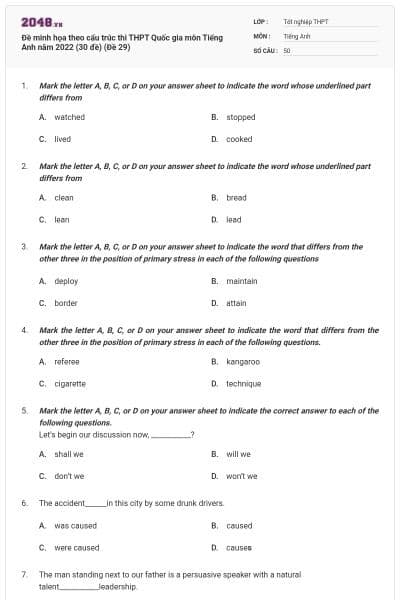
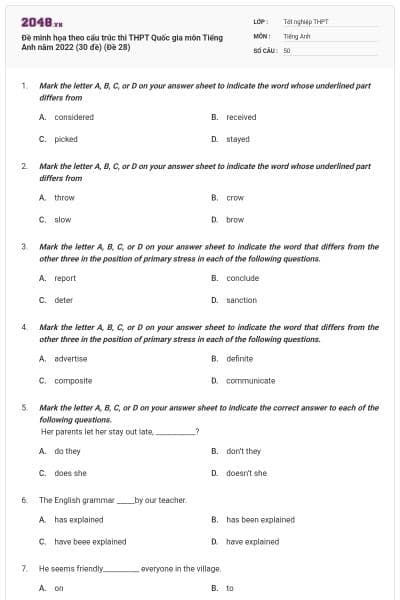
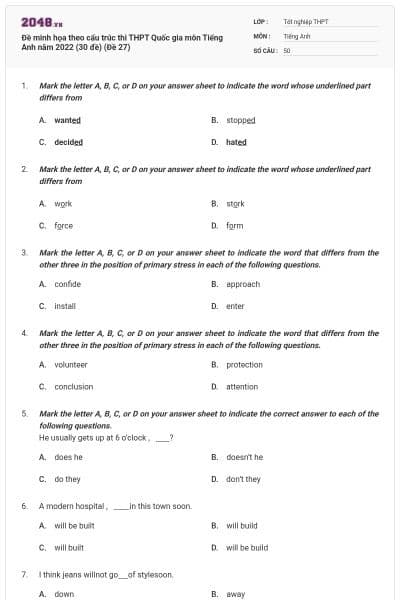
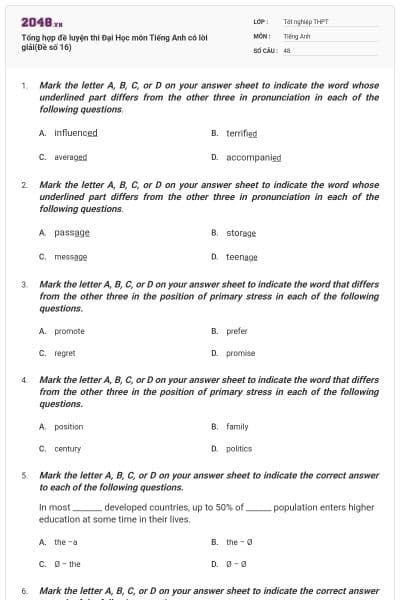
Mark the letter A, B, C, or D on your answer sheet to indicate the word whose underlined part differs from the other three in pronunciation in each of the following questions.
influenced
terrified
averaged
accompanied
Chọn A.
Đáp án A.
A. influenced /ˈɪnflʊənst/
B. terrified /ˈterɪfaɪd/
C. averaged /ˈævərɪdʒd/
D. accompanied /əˈkʌmpənid/
Các đáp án B, C, D đều có đuôi “ed” phát âm là /d/. Đáp án A được phát âm là /t/.
Mark the letter A, B, C, or D on your answer sheet to indicate the word whose underlined part differs from the other three in pronunciation in each of the following questions.
passage
storage
message
teenage
Chọn D.
Đáp án D.
A. passage /ˈpæsɪdʒ/
B. storage /ˈstɔːrɪdʒ/
C. message /ˈmesɪdʒ/
D. teenage /ˈtiːneɪdʒ/
Các đáp án A, B, C đều phần gạch chân “age” phát âm là /ɪdʒ/. Đáp án D được phát âm là /eɪdʒ/.
Mark the letter A, B, C, or D on your answer sheet to indicate the word that differs from the other three in the position of primary stress in each of the following questions.
promote
prefer
regret
promise
Chọn D.
Đáp án D.
A. promote /prəˈməʊt/
B. prefer /prɪˈfɜː(r)/
C. regret /rɪˈɡret/
D. promise /ˈprɒmɪs/
Đáp án A, B, C có trọng âm rơi vào âm tiết thứ hai. Đáp án D có trọng âm rơi vào âm tiết thứ 1.
Mark the letter A, B, C, or D on your answer sheet to indicate the word that differs from the other three in the position of primary stress in each of the following questions.
position
family
century
politics
Chọn A.
Đáp án A.
A. position /pəˈzɪʃ(ə)n/
B. family /ˈfæməli/
C. century /ˈsentʃəri/
D. politics /ˈpɒlətɪks/
Đáp án B, C, D có trọng âm rơi vào âm tiết thứ nhất. Đáp án A có trọng âm rơi vào âm tiết thứ 2.
Mark the letter A, B, C, or D on your answer sheet to indicate the correct answer to each of the following questions.
In most _______ developed countries, up to 50% of ______ population enters higher education at some time in their lives.
the –a
the – Ø
Ø – the
Ø – Ø
Chọn D.
Đáp án D
Không sử dụng mạo từ đứng trước các danh từ mang nghĩa khái quát, chung chung.
Dịch: Ở hầu hết các nước phát triển, lên đến 50% dân số học đại học ở 1 khoảng thời gian nào đó trong cuộc đời họ.
Mark the letter A, B, C, or D on your answer sheet to indicate the correct answer to each of the following questions.
We _____ won the game if we’d had a few more minutes.
have
will
had
could have
Chọn D.
Đáp án D
Do mệnh đề phía sau có dang If + S + had + PII nên đây là câu điều kiện 3, ta có cấu trúc:
S + would/ could have + PII, if + S + had + PII
Dich: Chúng tôi sẽ có thể thắng trận đấu nếu chúng tôi có thêm một vài phút nữa.
Mark the letter A, B, C, or D on your answer sheet to indicate the correct answer to each of the following questions.
They were discussing enthusiastically when their teacher _____ in.
had come
was coming
will come
came
Chọn D.
Đáp án D
Dựa vào nghĩa của câu ta thấy việc giáo viên đến xảy ra khiến hành động đang thảo luận sôi nổi của học sinh bị gián đoạn nên động từ “come” sẽ được chia theo cấu trúc phù hợp về thì là S + was/were + V-ing + when + S + Ved.
Do đó “came” là đáp án thích hợp để điền vào chỗ trống.
Dịch: Họ đang thảo luận sôi nổi khi giáo viên bước vào.
Mark the letter A, B, C, or D on your answer sheet to indicate the correct answer to each of the following questions.
____ my personal qualities, I have experience of working in a multi-national company for three years.
Beside
In addition
Instead of
Apart from
Chọn D.
Đáp án D
A. Beside (giới từ): bên, bên cạnh # besides (liên từ): bên cạnh đó, ngoài ra
B. In addition: thêm vào đó, hơn nữa
C. Instead of: thay vì
D. Apart from: ngoại trừ (mang nghĩa except), ngoài ra (mang nghĩa besides)
Dịch: Ngoài các phẩm chất cá nhân, tôi có kinh nghiệm làm việc ở công ty đa quốc gia trong 3 năm.
Mark the letter A, B, C, or D on your answer sheet to indicate the correct answer to each of the following questions.
The meeting has been put _____ to Saturday as so many people have got the flu.
up
in
out
back
Đáp án: B
Giải thích:
Kiến thức: Cụm động từ
put up something: thể hiện (kĩ năng), tăng cái gì
put back something: hoãn, dời lịch
put out something: đem vứt ra ngoài, dập tắt
put in something: lắp đặt, nói chen vào
Dịch: Cuộc họp đã được dời lại sang thứ Bảy vì có quá nhiều người bị cúm.
Mark the letter A, B, C, or D on your answer sheet to indicate the correct answer to each of the following questions.
In our shop, there are different styles in classical music, _____ on when the music was composed.
depend
depending
being depended
depended
Chọn B.
Đáp án B.
Động từ được chia ở chỗ trống là rút gọn của mệnh đề quan hệ giải thích cho danh từ “different styles in classical music” và dựa vào nghĩa của động từ “depend” (phụ thuộc) cho thấy động từ này được dùng ở dạng chủ động. => rút gọn bằng V-ing
Dịch: Trong của hàng của chúng tôi có rất nhiều phong cách nhạc cổ điển, phụ thuộc vào thời điểm chúng được sáng tác.
Mark the letter A, B, C, or D on your answer sheet to indicate the correct answer to each of the following questions.
The progress _____ in space travel in the early 1960s is remarkable.
which made
be made
made
making
Chọn C.
Đáp án C.
Vì động từ “make” (thực hiện, làm) được chia theo chủ ngữ “the progress” (sự tiến bộ) nên mệnh đề ở dạng bị động. Ta có:
“The progress which was made in space travel in the early 1960s”. Rút gọn mệnh đề quan hệ bị động sẽ thành: “The progress made in space travel in the early 1960s
=> Đáp án đúng là phân từ quá khứ “made”
Dịch: Sự tiến bộ được thực hiện trong ngành du hành vũ trụ vào đầu những năm 1960 khá là đáng kể.
Mark the letter A, B, C, or D on your answer sheet to indicate the correct answer to each of the following questions.
We are not allowed _____ jeans at school.
wear
to wear
wearing
worn
Chọn B.
Đáp án B.
Ta có: allow sb to V: cho phép ai làm việc gì
Trong câu động từ allow đang dùng ở dạng bị động nên tân ngữ sb đã được chuyển lên trước làm chủ ngữ => be allowed to V
Dịch: Chúng tôi không được phép mặc quần jean ở trường.
Mark the letter A, B, C, or D on your answer sheet to indicate the correct answer to each of the following questions.
Facial _____ show one’s feelings when he is communicating.
expressions
expresses
expressive
expressively
Chọn A.
Đáp án A.
Vì chỗ trống đứng sau tính từ facial và trước động từ chính “show” nên chỗ trống cần một danh từ làm chủ ngữ => dùng danh từ “expressions”
Dịch: Những biểu cảm khuôn mặt cho thấy cảm xúc của một người khi anh ta đang giao tiếp.
Mark the letter A, B, C, or D on your answer sheet to indicate the correct answer to each of the following questions.
The unemployment rate of the area ______ every month until August and then started to fall.
raised
rose
dropped
decreased
Chọn B.
Đáp án B.
Ta có:
A. raised (something): nâng cao lên (ngoại động từ-cần 1 tân ngữ sau nó)
B. rose: tăng lên/ dâng lên/ mọc lên (nội động từ-không cần 1 tân ngữ sau nó)
C. dropped: rơi/ giảm xuống
D. decreased: giảm xuống
Dựa vào nghĩa của câu có thể thấy sau đó tỉ lệ thất nghiệp đã bắt đầu giảm xuống, như vậy trước đó tỉ lệ này tăng lên => đáp án C, D không hợp về nghĩa.
Từ cách dừng của hai động từ trong đáp án A & B, “rose” là phù hợp để nói về tỉ lệ thất nghiệp tăng lên.
Dịch: Tỉ lệ thất nghiệp của khu vực này tăng từng tháng tới tận tháng Tám và sau đó bắt đầu giảm xuống.
Mark the letter A, B, C, or D on your answer sheet to indicate the correct answer to each of the following questions.
Before you sign a contract, ________ in mind that you won’t be able to change anything later.
retain
hold
bear
understand
Chọn C.
Đáp án C
Ta có: (to) bear in mind: có nghĩa là, nhớ rằng, hãy ghi nhớ
Dich: Trước khi bạn kí một hợp đồng, hãy nhớ rằng bạn se không thể thay đổi bất cứ điều gì sau đó.
Mark the letter A, B, C, or D on your answer sheet to indicate the correct answer to each of the following questions.
The brochure says that the hotel has a great _________of the sea.
appearance
look
sight
view
Chọn D.
Đáp án D.
Ta có:
A. appearance (n): vẻ ngoài, bề ngoài, ngoại hình
B. look (n): ngoại hình, nhan sắc; (v): nhìn
C. sight (n): tầm nhìn, sự nhìn, thị lực
D. view (n): tầm nhìn, tầm mắt, cảnh, quang cảnh
Dịch: Tờ quảng cáo nói rằng khách sạn có hướng nhìn ra biển.
Mark the letter A, B, C, or D on your answer sheet to indicate the correct answer to each of the following questions.
As John _____ enjoyed doing research, he never could imagine himself pursuing other careers.
thoroughly
totally
extremely
utterly
Chọn A.
Đáp án A
Ta có:
A. thoroughly (adv): rất nhiều, hoàn toàn
B. totally (adv): hoàn toàn
C. extremely (adv): cực kỳ
D. utterly (adv): hoàn toàn
Với động từ “enjoy” dùng trạng từ “thoroughly”.
Dịch: Bởi John hoàn toàn thích nghiên cứu, anh không bao giờ có thể tưởng tượng mình theo đuổi sự nghiệp khác.
Mark the letter A, B, C, or D on your answer sheet to indicate the correct answer to each of the following questions.
I went to a restaurant last night. Lucklily, I was the ten thousandth customer, so my dinner was on the _______.
house
restaurant
shop
home
Chọn A.
Đáp án: A.
Ta có: on the house: không phải trả tiền
Dịch: Tôi đã đến một cửa hang tối qua. May mắn, tôi là vị khách thứ một nghìn nên bữa tối của tôi không phải trả tiền.
Mark the letter A, B, C, or D on your answer sheet to indicate the word(s) CLOSEST in
meaning to the underlined word(s) in each of the following questions.
Efforts by the company to improve its productivity were hampered by lack of funds.
prevented
assisted
encouraged
endangered
Chọn A.
Đáp án A.
Dịch: Những nỗ lực của công ty trong việc nâng cao năng suất đã bị cản trở bởi vấn đề thiếu vốn.
=> hampered: bị cản trở.
Xét nghĩa các đáp án ta có:
A. prevent (v): ngăn chặn
B. assist (v): hỗ trợ
C. encourage (v): khuyến khích
D. endanger (v): gặp nguy hiểm
=> Từ đồng nghĩa thích hợp với “hampered” là “prevented”
Mark the letter A, B, C, or D on your answer sheet to indicate the word(s) CLOSEST in meaning to the underlined word(s) in each of the following questions.
Don’t be chicken-hearted; ask her to the party.
modest
active
cowardly
shy
Chọn C.
Đáp án C.
Dịch: Đừng có nhát như vậy. Hãy mời cô ấy tới bữa tiệc.
=> chicken-hearted: nhát gan
Xét nghĩa các đáp án ta có:
A. modest: khiêm tốn
B. active: chủ động
C. cowardly: nhát gan
D. shy: e thẹn
Mark the letter A, B, C, or D on your answer sheet to indicate the word(s) OPPOSITE in meaning to the underlined word(s) in each of the following questions.
I know it sounds trivial, but I’m worried about it.
necessary
important
satisfactory
essential
Chọn B.
Đáp án B.
Dịch: Tôi biết nó có vẻ tầm thường nhưng tôi đang lo lắng về nó.
=> trivial (adj): tầm thường
Xét nghĩa các đáp án ta có:
A. necessary (adj): cần thiết
B. important (adj): quan trọng
C. satisfactory (adj): hài lòng
D. essential (adj): thiết yếu
=> trivial >< important
Mark the letter A, B, C, or D on your answer sheet to indicate the word(s) OPPOSITE in meaning to the underlined word(s) in each of the following questions.
My brother has become a bit of a couch potato since he stopped playing football.
A lazy person
A nice person
An active person
A kind person
Chọn C.
Đáp án C.
Dịch: Anh trai tôi trở nên dán mắt vào màn hình tivi kể từ khi ngừng chơi bóng.
=> A couch potato: người dán mắt vào màn hình tivi => 1 người thụ động
Xét nghĩa các đáp án ta có:
A. A lazy person: người lười nhác
B. A nice person: người tốt
C. An active person: người năng động
D. A kind person: người tử tế
=> A couch potato >< an active person
Mark the letter A, B, C or D on your answer sheet to indicate the sentence that best completes each of the following exchanges.
Tom is asking Daisy to have dinner with him tonight.
Tom: “Would you like to come to my house for dinner tonight, Daisy?”
Daisy: “______”
Thanks. I’d love to.
You’re welcome.
No, I wouldn’t.
No, I don’t.
Chọn A.
Đáp án A
Cấu trúc “Would you like to V” nên là một câu mời.
Câu đáp lại thích hợp là “Thanks. I’d love to.”
Dịch: Tom: “Daisy, bạn có muốn tới nhà tôi ăn tối tối nay không?”
Daisy: “Cám ơn. Tôi rất thích.”
Mark the letter A, B, C or D on your answer sheet to indicate the sentence that best completes each of the following exchanges.
- “I’m sorry for being late.”
- “______________”
Of course not.
That’s for sure.
Yes, that’s right. You can do it.
You’d better not do it again.
Chọn D.
Đáp án D.
Dịch câu đề bài ta có: “Tôi xin lỗi vì đến muộn.”
=> Để đáp lại lời xin lỗi, câu phù hợp là D. You’d better not do it again. (Bạn tốt hơn không nên lặp lại điều này).
Read the following passage and mark the letter A, B, C, or D on your answer sheet to indicate the correct word or phrase that best fits each of the numbered blanks from 25 to 29. Fill in the appropriate word in question 25
How the Internet Is Changing Our Language
There are words that we say today that 70 years ago weren’t even in (25) ____. If a person were to remark to a 1950s businessman, “Go and check this website out on the Internet and get back to me via Facebook,” the businessman would have no clue as to what had just been said. We know exactly what the words mean, though, so they (26) _____ perfect sense to us.
The problem that people are encountering today is the same as the 1950s businessman would have encountered - he would have come (27)____a word that would mean nothing because he lived in a world where Internet technology is changing and progressing today at an even faster (28)_____, and this is creating changes in the way we communicate. Our words are different, and even our means of (29) _______ those words across are different as well. Forget about a 60-plus year difference; we speak much differently than we did even 10 or 20 years ago.
existence
presence
survival
effect
Chọn A.
Đáp án A.
A. existence: sự tồn tại
B. presence: sự có mặt
C. survival: sự sống sót
D. effect: sự ảnh hưởng
Vì nói về câu hỏi liên quan đến sự thay đổi của thế giới do Internet mang lại và có giới từ “in” nên danh từ thích hợp là: in existence (tồn tại/ xuất hiện)
Read the following passage and mark the letter A, B, C, or D on your answer sheet to indicate the correct word or phrase that best fits each of the numbered blanks from 25 to 29. Fill in the appropriate word in question 26
How the Internet Is Changing Our Language
There are words that we say today that 70 years ago weren’t even in (25) ____. If a person were to remark to a 1950s businessman, “Go and check this website out on the Internet and get back to me via Facebook,” the businessman would have no clue as to what had just been said. We know exactly what the words mean, though, so they (26) _____ perfect sense to us.
The problem that people are encountering today is the same as the 1950s businessman would have encountered - he would have come (27)____a word that would mean nothing because he lived in a world where Internet technology is changing and progressing today at an even faster (28)_____, and this is creating changes in the way we communicate. Our words are different, and even our means of (29) _______ those words across are different as well. Forget about a 60-plus year difference; we speak much differently than we did even 10 or 20 years ago.
have
get
bring
make
Chọn D.
Đáp án D.
Ta có: make sense: có nghĩa, có ý nghĩa.
Read the following passage and mark the letter A, B, C, or D on your answer sheet to indicate the correct word or phrase that best fits each of the numbered blanks from 25 to 29. Fill in the appropriate word in question 28
How the Internet Is Changing Our Language
There are words that we say today that 70 years ago weren’t even in (25) ____. If a person were to remark to a 1950s businessman, “Go and check this website out on the Internet and get back to me via Facebook,” the businessman would have no clue as to what had just been said. We know exactly what the words mean, though, so they (26) _____ perfect sense to us.
The problem that people are encountering today is the same as the 1950s businessman would have encountered - he would have come (27)____a word that would mean nothing because he lived in a world where Internet technology is changing and progressing today at an even faster (28)_____, and this is creating changes in the way we communicate. Our words are different, and even our means of (29) _______ those words across are different as well. Forget about a 60-plus year difference; we speak much differently than we did even 10 or 20 years ago.
step
pace
move
movement
Chọn B.
Đáp án B.
A. step (n): bước chân
B. pace (n): nhịp độ, tiến triển => at a faster pace: với tốc độ/nhịp độ nhanh hơn.
C. move (n): di chuyển
D. movement (n): sự di chuyển
Read the following passage and mark the letter A, B, C, or D on your answer sheet to indicate the correct word or phrase that best fits each of the numbered blanks from 25 to 29. Fill in the appropriate word in question 29
How the Internet Is Changing Our Language
There are words that we say today that 70 years ago weren’t even in (25) ____. If a person were to remark to a 1950s businessman, “Go and check this website out on the Internet and get back to me via Facebook,” the businessman would have no clue as to what had just been said. We know exactly what the words mean, though, so they (26) _____ perfect sense to us.
The problem that people are encountering today is the same as the 1950s businessman would have encountered - he would have come (27)____a word that would mean nothing because he lived in a world where Internet technology is changing and progressing today at an even faster (28)_____, and this is creating changes in the way we communicate. Our words are different, and even our means of (29) _______ those words across are different as well. Forget about a 60-plus year difference; we speak much differently than we did even 10 or 20 years ago.
keeping
putting
getting
making
Chọn C.
Đáp án C.
Vì sau chỗ trống là cụm nên “those words across” nên động từ thích hợp nhất là “get” dựa vào cấu trúc: get sth across: giải thích rõ ràng cái gì/điều gì.
Read the following passage and mark the letter A, B, C, or D on your answer sheet to indicate the correct answer to each of the questions from 28 to 34.
The rules of etiquette of American restaurants depend upon a number of factors: the physical location of the restaurant, e.g. rural or urban, the type of restaurant, e.g. informal or formal, and certain standards that are more universal. In other words, some standards of etiquette vary significantly while other standards apply almost anywhere. Learning the proper etiquette in a particular type of restaurant in a particular area may sometimes require instruction, but more commonly, it simply requires sensitivity and experience. For example, while it is acceptable to read a magazine in a coffee shop, it is inappropriate to do the same in a more luxurious setting.
And, if you are eating in a very simple setting, it may be fine to put your napkin into your shirt, but if you are in a sophisticated urban restaurant this behaviour would demonstrate a lack of manners. It is safe to say, however, that in virtually every restaurant it is unacceptable to indiscriminately throw your food on the floor. The conclusion we can most likely draw from the above is that while the types and locations of restaurants determine etiquette appropriate to them, some rules apply to all restaurants.
What does the passage mainly discuss?
Rules of etiquette
Instruction in proper etiquette
The importance of good manners
Variable and universal standards of etiquette
Chọn D.
Đáp án D.
Dịch câu hỏi:
A. quy tắc nghi thức
B. hướng dẫn phép xã giao phù hợp
C. tầm quan trọng của cách cư xử tốt
D. các tiêu chuẩn đa dạng và phổ biến của nghi thức
Dựa vào chi tiết ngay phần đầu “The rules of etiquette in American restaurants depend upon a number of factors the physical location of the restaurant, e.g., rural or urban; the type of restaurant, e.g., informal or formal; and certain standards that are more universal. In other words, some standards of etiquette vary significantly while other standards apply almost anywhere.”
Read the following passage and mark the letter A, B, C, or D on your answer sheet to indicate the correct answer to each of the questions from 28 to 34.
The rules of etiquette of American restaurants depend upon a number of factors: the physical location of the restaurant, e.g. rural or urban, the type of restaurant, e.g. informal or formal, and certain standards that are more universal. In other words, some standards of etiquette vary significantly while other standards apply almost anywhere. Learning the proper etiquette in a particular type of restaurant in a particular area may sometimes require instruction, but more commonly, it simply requires sensitivity and experience. For example, while it is acceptable to read a magazine in a coffee shop, it is inappropriate to do the same in a more luxurious setting.
And, if you are eating in a very simple setting, it may be fine to put your napkin into your shirt, but if you are in a sophisticated urban restaurant this behaviour would demonstrate a lack of manners. It is safe to say, however, that in virtually every restaurant it is unacceptable to indiscriminately throw your food on the floor. The conclusion we can most likely draw from the above is that while the types and locations of restaurants determine etiquette appropriate to them, some rules apply to all restaurants.
According to paragraph 1, which of the following statement is NOT true?
The rules of etiquette of American restaurants depend on location and type of the restaurant
The rules of etiquette of American restaurants depend upon a number of factors
Standards of etiquette vary significantly
It is acceptable to read a magazine in a coffee shop everywhere.
Chọn D.
Đáp án D.
Các đáp án A, B, C đều xuất hiện trong đoạn 1. Đáp án D cũng có xuất hiện ở cuối đoạn 1 nhưng sai vì không phải “everywhere” mà “it is inappropriate to do the same in a more luxurious setting.”
Read the following passage and mark the letter A, B, C, or D on your answer sheet to indicate the correct answer to each of the questions from 28 to 34.
The rules of etiquette of American restaurants depend upon a number of factors: the physical location of the restaurant, e.g. rural or urban, the type of restaurant, e.g. informal or formal, and certain standards that are more universal. In other words, some standards of etiquette vary significantly while other standards apply almost anywhere. Learning the proper etiquette in a particular type of restaurant in a particular area may sometimes require instruction, but more commonly, it simply requires sensitivity and experience. For example, while it is acceptable to read a magazine in a coffee shop, it is inappropriate to do the same in a more luxurious setting.
And, if you are eating in a very simple setting, it may be fine to put your napkin into your shirt, but if you are in a sophisticated urban restaurant this behaviour would demonstrate a lack of manners. It is safe to say, however, that in virtually every restaurant it is unacceptable to indiscriminately throw your food on the floor. The conclusion we can most likely draw from the above is that while the types and locations of restaurants determine etiquette appropriate to them, some rules apply to all restaurants.
According to the passage, which of the following is a universal rule of etiquette?
Tucking a napkin in your shirt
Not throwing food on the floor
Reading a magazine at a coffee shop
Eating in rustic settings
Chọn B.
Đáp án B.
Dịch câu hỏi: Theo đoạn văn, điều sau đây là một quy tắc phổ quát về nghi thức?
A. tucking một khăn ăn trong áo của bạn
B. không ném đồ ăn trên sàn nhà
C. đọc một tạp chí tại một quán cà phê
D. ăn ở các thiết lập mộc mạc
Dựa vào chi tiết “It is safe to say, however, that in virtually every restaurant it is unacceptable 15 to indiscriminately throw your food on the floor.”
Read the following passage and mark the letter A, B, C, or D on your answer sheet to indicate the correct answer to each of the questions from 28 to 34.
The rules of etiquette of American restaurants depend upon a number of factors: the physical location of the restaurant, e.g. rural or urban, the type of restaurant, e.g. informal or formal, and certain standards that are more universal. In other words, some standards of etiquette vary significantly while other standards apply almost anywhere. Learning the proper etiquette in a particular type of restaurant in a particular area may sometimes require instruction, but more commonly, it simply requires sensitivity and experience. For example, while it is acceptable to read a magazine in a coffee shop, it is inappropriate to do the same in a more luxurious setting.
And, if you are eating in a very simple setting, it may be fine to put your napkin into your shirt, but if you are in a sophisticated urban restaurant this behaviour would demonstrate a lack of manners. It is safe to say, however, that in virtually every restaurant it is unacceptable to indiscriminately throw your food on the floor. The conclusion we can most likely draw from the above is that while the types and locations of restaurants determine etiquette appropriate to them, some rules apply to all restaurants.
What does the word “it” in the first paragraph refer to?
Learning the proper etiquette
Clear instruction
Knowing the type of restaurant
Sensitivity
Chọn A.
Đáp án A.
Trong câu “Learning the proper etiquette in a particular type of restaurant in a particular area may sometimes require instruction, but more commonly it simply requires sensitivity and experience.”
“it” chính là chỉ “Learning the proper etiquette”
Read the following passage and mark the letter A, B, C, or D on your answer sheet to indicate the correct answer to each of the questions from 28 to 34.
The rules of etiquette of American restaurants depend upon a number of factors: the physical location of the restaurant, e.g. rural or urban, the type of restaurant, e.g. informal or formal, and certain standards that are more universal. In other words, some standards of etiquette vary significantly while other standards apply almost anywhere. Learning the proper etiquette in a particular type of restaurant in a particular area may sometimes require instruction, but more commonly, it simply requires sensitivity and experience. For example, while it is acceptable to read a magazine in a coffee shop, it is inappropriate to do the same in a more luxurious setting.
And, if you are eating in a very simple setting, it may be fine to put your napkin into your shirt, but if you are in a sophisticated urban restaurant this behaviour would demonstrate a lack of manners. It is safe to say, however, that in virtually every restaurant it is unacceptable to indiscriminately throw your food on the floor. The conclusion we can most likely draw from the above is that while the types and locations of restaurants determine etiquette appropriate to them, some rules apply to all restaurants.
The word “indiscriminately” in the second paragraph could best be replaced by which of the following?
randomly
angrily
noisily
destructively
Chọn A.
Đáp án A
A. randomly: một cách ngẫu nhiên, bừa
B. angrily: một cách giận dữ
C. noisily: một cách ồn ào
D. destructively: một cách phá hoại
Trạng từ “indiscriminately” (bừa bãi, ẩu) dùng để nói về việc ném thức ăn “it is unacceptable to indiscriminately throw your food on the floor” sẽ gần nghĩa nhất với “randomly”
Read the following passage and mark the letter A, B, C, or D on your answer sheet to indicate
the correct answer to each of the questions from 35 to 42.
In early civilization, citizens were educated informally, usually within the family unit. Education meant simply learning to live. As civilization became more complex, however, education became more formal, structured, and comprehensive. Initial efforts of the ancient Chinese and Greek societies concentrated solely on the education of males. The post-Babylonian Jews and Plato were exceptions to this pattern. Plato was apparently the first significant advocate of the equality of the sexes. Women, in his ideal state, would have the same rights and duties and the same educational opportunities as men. This aspect of Platonic philosophy, however, had little or no effect on education for many centuries, and the concept of a liberal education for men only, which had been espoused by Aristotle, prevailed.
In ancient Rome, the availability of an education was gradually extended to women, but they were taught separately from men. The early Christians and medieval Europeans continued this trend, and single-sex schools for the privileged through classes prevailed through the Reformation period. Gradually, however, education for women, in a separate but equal basis to that provided for men, was becoming a clear responsibility of society. Martin Luther appealed for civil support of schools for all children. At the Council of Trent in the 16th century, the Roman Catholic Church encouraged the establishment of free primary schools for children of all classes. The concept of universal primary education, regardless of sex, had been born, but it was still in the realm of the single-sex school.
In the late 19th and early 20th centuries, co-education became a more widely applied principle of educational philosophy. In Britain, Germany, and the Soviet Union the education of boys and girls in the same classes became an accepted practice. Since World War II, Japan and the Scandinavian countries have also adopted relatively universal co-educational systems. The greatest negative reaction to co-education has been felt in the teaching systems of the Latin countries, where the sexes have usually been separated at both primary and secondary levels, according to local conditions.
A number of studies have indicated that girls seem to perform better overall and in science in particular. In single-sex classes, during the adolescent years, pressure to conform to stereotypical female gender roles may disadvantage girls in traditionally male subjects, making them reluctant to volunteer for experimental work while taking part in lessons. In Britain, academic league tables point to high standards achieved in girls’ schools. Some educationalists, therefore, suggest separation of the sexes as a good thing, particularly in certain areas, and a number of schools are experimenting with the idea.
What does the passage mainly discuss?
Education in early civilization
The equality of sexes in education
The co-education and separation of sexes in education through different periods and societies
The benefits of single-sex classes
Chọn C.
Đáp án C
Các đáp án A, B, D đều là thông tin chi tiết trong bài, không phải là ý tổng quát toàn bài.
Read the following passage and mark the letter A, B, C, or D on your answer sheet to indicate the correct answer to each of the questions from 35 to 42.
In early civilization, citizens were educated informally, usually within the family unit. Education meant simply learning to live. As civilization became more complex, however, education became more formal, structured, and comprehensive. Initial efforts of the ancient Chinese and Greek societies concentrated solely on the education of males. The post-Babylonian Jews and Plato were exceptions to this pattern. Plato was apparently the first significant advocate of the equality of the sexes. Women, in his ideal state, would have the same rights and duties and the same educational opportunities as men. This aspect of Platonic philosophy, however, had little or no effect on education for many centuries, and the concept of a liberal education for men only, which had been espoused by Aristotle, prevailed.
In ancient Rome, the availability of an education was gradually extended to women, but they were taught separately from men. The early Christians and medieval Europeans continued this trend, and single-sex schools for the privileged through classes prevailed through the Reformation period. Gradually, however, education for women, in a separate but equal basis to that provided for men, was becoming a clear responsibility of society. Martin Luther appealed for civil support of schools for all children. At the Council of Trent in the 16th century, the Roman Catholic Church encouraged the establishment of free primary schools for children of all classes. The concept of universal primary education, regardless of sex, had been born, but it was still in the realm of the single-sex school.
In the late 19th and early 20th centuries, co-education became a more widely applied principle of educational philosophy. In Britain, Germany, and the Soviet Union the education of boys and girls in the same classes became an accepted practice. Since World War II, Japan and the Scandinavian countries have also adopted relatively universal co-educational systems. The greatest negative reaction to co-education has been felt in the teaching systems of the Latin countries, where the sexes have usually been separated at both primary and secondary levels, according to local conditions.
A number of studies have indicated that girls seem to perform better overall and in science in particular. In single-sex classes, during the adolescent years, pressure to conform to stereotypical female gender roles may disadvantage girls in traditionally male subjects, making them reluctant to volunteer for experimental work while taking part in lessons. In Britain, academic league tables point to high standards achieved in girls’ schools. Some educationalists, therefore, suggest separation of the sexes as a good thing, particularly in certain areas, and a number of schools are experimenting with the idea.
Ancient education generally focused its efforts on _________.
on male learners
both sexes
female learners
young people only
Chọn A.
Đáp án A
Thông tin câu trả lời nằm trong câu “Initial efforts of the ancient Chinese and Greek societies concentrated solely on the education of males.” Như vậy giáo dục thời xưa thường tập trung vào “Males” (nam giới).
Read the following passage and mark the letter A, B, C, or D on your answer sheet to indicate the correct answer to each of the questions from 35 to 42.
In early civilization, citizens were educated informally, usually within the family unit. Education meant simply learning to live. As civilization became more complex, however, education became more formal, structured, and comprehensive. Initial efforts of the ancient Chinese and Greek societies concentrated solely on the education of males. The post-Babylonian Jews and Plato were exceptions to this pattern. Plato was apparently the first significant advocate of the equality of the sexes. Women, in his ideal state, would have the same rights and duties and the same educational opportunities as men. This aspect of Platonic philosophy, however, had little or no effect on education for many centuries, and the concept of a liberal education for men only, which had been espoused by Aristotle, prevailed.
In ancient Rome, the availability of an education was gradually extended to women, but they were taught separately from men. The early Christians and medieval Europeans continued this trend, and single-sex schools for the privileged through classes prevailed through the Reformation period. Gradually, however, education for women, in a separate but equal basis to that provided for men, was becoming a clear responsibility of society. Martin Luther appealed for civil support of schools for all children. At the Council of Trent in the 16th century, the Roman Catholic Church encouraged the establishment of free primary schools for children of all classes. The concept of universal primary education, regardless of sex, had been born, but it was still in the realm of the single-sex school.
In the late 19th and early 20th centuries, co-education became a more widely applied principle of educational philosophy. In Britain, Germany, and the Soviet Union the education of boys and girls in the same classes became an accepted practice. Since World War II, Japan and the Scandinavian countries have also adopted relatively universal co-educational systems. The greatest negative reaction to co-education has been felt in the teaching systems of the Latin countries, where the sexes have usually been separated at both primary and secondary levels, according to local conditions.
A number of studies have indicated that girls seem to perform better overall and in science in particular. In single-sex classes, during the adolescent years, pressure to conform to stereotypical female gender roles may disadvantage girls in traditionally male subjects, making them reluctant to volunteer for experimental work while taking part in lessons. In Britain, academic league tables point to high standards achieved in girls’ schools. Some educationalists, therefore, suggest separation of the sexes as a good thing, particularly in certain areas, and a number of schools are experimenting with the idea.
The first to support the equality of the sexes was _________.
the Chinese
the Greek
Plato
the Jews
Chọn C.
Đáp án C
Thông tin người đầu tiên ủng hộ sự cân bằng giới nằm ở chi tiết “The post-Babylonian Jews and Plato were exceptions to this pattern. Plato was apparently the first significant advocate of the equality of the sexes.”
Read the following passage and mark the letter A, B, C, or D on your answer sheet to indicate the correct answer to each of the questions from 35 to 42.
In early civilization, citizens were educated informally, usually within the family unit. Education meant simply learning to live. As civilization became more complex, however, education became more formal, structured, and comprehensive. Initial efforts of the ancient Chinese and Greek societies concentrated solely on the education of males. The post-Babylonian Jews and Plato were exceptions to this pattern. Plato was apparently the first significant advocate of the equality of the sexes. Women, in his ideal state, would have the same rights and duties and the same educational opportunities as men. This aspect of Platonic philosophy, however, had little or no effect on education for many centuries, and the concept of a liberal education for men only, which had been espoused by Aristotle, prevailed.
In ancient Rome, the availability of an education was gradually extended to women, but they were taught separately from men. The early Christians and medieval Europeans continued this trend, and single-sex schools for the privileged through classes prevailed through the Reformation period. Gradually, however, education for women, in a separate but equal basis to that provided for men, was becoming a clear responsibility of society. Martin Luther appealed for civil support of schools for all children. At the Council of Trent in the 16th century, the Roman Catholic Church encouraged the establishment of free primary schools for children of all classes. The concept of universal primary education, regardless of sex, had been born, but it was still in the realm of the single-sex school.
In the late 19th and early 20th centuries, co-education became a more widely applied principle of educational philosophy. In Britain, Germany, and the Soviet Union the education of boys and girls in the same classes became an accepted practice. Since World War II, Japan and the Scandinavian countries have also adopted relatively universal co-educational systems. The greatest negative reaction to co-education has been felt in the teaching systems of the Latin countries, where the sexes have usually been separated at both primary and secondary levels, according to local conditions.
A number of studies have indicated that girls seem to perform better overall and in science in particular. In single-sex classes, during the adolescent years, pressure to conform to stereotypical female gender roles may disadvantage girls in traditionally male subjects, making them reluctant to volunteer for experimental work while taking part in lessons. In Britain, academic league tables point to high standards achieved in girls’ schools. Some educationalists, therefore, suggest separation of the sexes as a good thing, particularly in certain areas, and a number of schools are experimenting with the idea.
When the concept of universal primary education was introduced, education __________.
was given free to all
was intended for all the sexes
focused on imparting skills
was intended to leave out female learners
Chọn B.
Đáp án B
Dựa vào chi tiết trong câu cuối đoạn 2: “The concept of universal primary education, regardless of sex, had been born…” (khái niệm giáo dục tiểu học toàn cầu bất kể giới tính được đặt ra)
Read the following passage and mark the letter A, B, C, or D on your answer sheet to indicate the correct answer to each of the questions from 35 to 42.
In early civilization, citizens were educated informally, usually within the family unit. Education meant simply learning to live. As civilization became more complex, however, education became more formal, structured, and comprehensive. Initial efforts of the ancient Chinese and Greek societies concentrated solely on the education of males. The post-Babylonian Jews and Plato were exceptions to this pattern. Plato was apparently the first significant advocate of the equality of the sexes. Women, in his ideal state, would have the same rights and duties and the same educational opportunities as men. This aspect of Platonic philosophy, however, had little or no effect on education for many centuries, and the concept of a liberal education for men only, which had been espoused by Aristotle, prevailed.
In ancient Rome, the availability of an education was gradually extended to women, but they were taught separately from men. The early Christians and medieval Europeans continued this trend, and single-sex schools for the privileged through classes prevailed through the Reformation period. Gradually, however, education for women, in a separate but equal basis to that provided for men, was becoming a clear responsibility of society. Martin Luther appealed for civil support of schools for all children. At the Council of Trent in the 16th century, the Roman Catholic Church encouraged the establishment of free primary schools for children of all classes. The concept of universal primary education, regardless of sex, had been born, but it was still in the realm of the single-sex school.
In the late 19th and early 20th centuries, co-education became a more widely applied principle of educational philosophy. In Britain, Germany, and the Soviet Union the education of boys and girls in the same classes became an accepted practice. Since World War II, Japan and the Scandinavian countries have also adopted relatively universal co-educational systems. The greatest negative reaction to co-education has been felt in the teaching systems of the Latin countries, where the sexes have usually been separated at both primary and secondary levels, according to local conditions.
A number of studies have indicated that girls seem to perform better overall and in science in particular. In single-sex classes, during the adolescent years, pressure to conform to stereotypical female gender roles may disadvantage girls in traditionally male subjects, making them reluctant to volunteer for experimental work while taking part in lessons. In Britain, academic league tables point to high standards achieved in girls’ schools. Some educationalists, therefore, suggest separation of the sexes as a good thing, particularly in certain areas, and a number of schools are experimenting with the idea.
The word “espoused” is contextually closest in meaning to _________.
to introduce
to put off
to give
to induce
Chọn A.
Đáp án A
A. to introduce: giới thiệu
B. to put off: trì hoãn
C. to give: cho
D. to induce: xui khiến
Động từ “espoused” nằm trong mệnh đề “This aspect of Platonic philosophy, however, had little or no effect on education for many centuries, and the concept of a liberal education for men only, which had been espoused by Aristotle, prevailed.” Vì động từ “espouse” được dùng để nói về quan điểm giáo dục chỉ dành cho nam giới được giới thiệu bởi Aristotle. => Nghĩa gần nhất với động từ trên là “introduce”
Read the following passage and mark the letter A, B, C, or D on your answer sheet to indicate the correct answer to each of the questions from 35 to 42.
In early civilization, citizens were educated informally, usually within the family unit. Education meant simply learning to live. As civilization became more complex, however, education became more formal, structured, and comprehensive. Initial efforts of the ancient Chinese and Greek societies concentrated solely on the education of males. The post-Babylonian Jews and Plato were exceptions to this pattern. Plato was apparently the first significant advocate of the equality of the sexes. Women, in his ideal state, would have the same rights and duties and the same educational opportunities as men. This aspect of Platonic philosophy, however, had little or no effect on education for many centuries, and the concept of a liberal education for men only, which had been espoused by Aristotle, prevailed.
In ancient Rome, the availability of an education was gradually extended to women, but they were taught separately from men. The early Christians and medieval Europeans continued this trend, and single-sex schools for the privileged through classes prevailed through the Reformation period. Gradually, however, education for women, in a separate but equal basis to that provided for men, was becoming a clear responsibility of society. Martin Luther appealed for civil support of schools for all children. At the Council of Trent in the 16th century, the Roman Catholic Church encouraged the establishment of free primary schools for children of all classes. The concept of universal primary education, regardless of sex, had been born, but it was still in the realm of the single-sex school.
In the late 19th and early 20th centuries, co-education became a more widely applied principle of educational philosophy. In Britain, Germany, and the Soviet Union the education of boys and girls in the same classes became an accepted practice. Since World War II, Japan and the Scandinavian countries have also adopted relatively universal co-educational systems. The greatest negative reaction to co-education has been felt in the teaching systems of the Latin countries, where the sexes have usually been separated at both primary and secondary levels, according to local conditions.
A number of studies have indicated that girls seem to perform better overall and in science in particular. In single-sex classes, during the adolescent years, pressure to conform to stereotypical female gender roles may disadvantage girls in traditionally male subjects, making them reluctant to volunteer for experimental work while taking part in lessons. In Britain, academic league tables point to high standards achieved in girls’ schools. Some educationalists, therefore, suggest separation of the sexes as a good thing, particularly in certain areas, and a number of schools are experimenting with the idea.
Which of the following is NOT stated in paragraph 3?
In Soviet Union co-education became an accepted practice.
Japan since World War II adopted co-education.
Co-education was negatively responded to in South American countries.
Schoolboys and schoolgirls in the Latin countries was separated at universities.
Chọn D.
Đáp án D
A. Thông tin nằm ở câu thứ 2 của đoạn 3
B. Thông tin nằm ở câu thứ 3 của đoạn 3
C. Thông tin nằm ở câu thứ 4 của đoạn 3.
Việc đồng giáo dục mang lại phản ứng một cách tiêu cực được đề cập đến trong chi tiết “The greatest negative reaction to co-education has been felt in the teaching systems of the Latin countries, where the sexes have usually been separated at both primary and secondary levels, according to local conditions.” => Khu vực có phản ứng tiêu cực đó là South American countries (Các nước Nam Mỹ) (Latin countries gồm toàn bộ South American countries và 1 vài nước khác)
D. không được đề cập trong bài đọc.
which of the following?
Read the following passage and mark the letter A, B, C, or D on your answer sheet to indicate the correct answer to each of the questions from 35 to 42.
In early civilization, citizens were educated informally, usually within the family unit. Education meant simply learning to live. As civilization became more complex, however, education became more formal, structured, and comprehensive. Initial efforts of the ancient Chinese and Greek societies concentrated solely on the education of males. The post-Babylonian Jews and Plato were exceptions to this pattern. Plato was apparently the first significant advocate of the equality of the sexes. Women, in his ideal state, would have the same rights and duties and the same educational opportunities as men. This aspect of Platonic philosophy, however, had little or no effect on education for many centuries, and the concept of a liberal education for men only, which had been espoused by Aristotle, prevailed.
In ancient Rome, the availability of an education was gradually extended to women, but they were taught separately from men. The early Christians and medieval Europeans continued this trend, and single-sex schools for the privileged through classes prevailed through the Reformation period. Gradually, however, education for women, in a separate but equal basis to that provided for men, was becoming a clear responsibility of society. Martin Luther appealed for civil support of schools for all children. At the Council of Trent in the 16th century, the Roman Catholic Church encouraged the establishment of free primary schools for children of all classes. The concept of universal primary education, regardless of sex, had been born, but it was still in the realm of the single-sex school.
In the late 19th and early 20th centuries, co-education became a more widely applied principle of educational philosophy. In Britain, Germany, and the Soviet Union the education of boys and girls in the same classes became an accepted practice. Since World War II, Japan and the Scandinavian countries have also adopted relatively universal co-educational systems. The greatest negative reaction to co-education has been felt in the teaching systems of the Latin countries, where the sexes have usually been separated at both primary and secondary levels, according to local conditions.
A number of studies have indicated that girls seem to perform better overall and in science in particular. In single-sex classes, during the adolescent years, pressure to conform to stereotypical female gender roles may disadvantage girls in traditionally male subjects, making them reluctant to volunteer for experimental work while taking part in lessons. In Britain, academic league tables point to high standards achieved in girls’ schools. Some educationalists, therefore, suggest separation of the sexes as a good thing, particularly in certain areas, and a number of schools are experimenting with the idea.
The word “them” in paragraph 4 refers to __________.
single-sex classes
roles
girls
subjects
Chọn C.
Đáp án C.
Từ “them” xuất hiện trong đoạn 4 đề cập đến ______.
Thông tin: “In single-sex classes, during the adolescent years, pressure to conform to stereotypical female gender roles may disadvantage girls in traditionally male subjects, making them reluctant to volunteer for experimental work while taking part in lessons.” (Trong các lớp học đơn giới, trong những năm tuổi vị thành niên, áp lực để phù hợp với vai trò giới tính nữ giới có thể gây bất lợi cho các cô gái trong các môn nam truyền thống, khiến họ miễn cưỡng tình nguyện làm công việc thử nghiệm trong khi tham gia các bài học.)
Read the following passage and mark the letter A, B, C, or D on your answer sheet to indicate the correct answer to each of the questions from 35 to 42.
In early civilization, citizens were educated informally, usually within the family unit. Education meant simply learning to live. As civilization became more complex, however, education became more formal, structured, and comprehensive. Initial efforts of the ancient Chinese and Greek societies concentrated solely on the education of males. The post-Babylonian Jews and Plato were exceptions to this pattern. Plato was apparently the first significant advocate of the equality of the sexes. Women, in his ideal state, would have the same rights and duties and the same educational opportunities as men. This aspect of Platonic philosophy, however, had little or no effect on education for many centuries, and the concept of a liberal education for men only, which had been espoused by Aristotle, prevailed.
In ancient Rome, the availability of an education was gradually extended to women, but they were taught separately from men. The early Christians and medieval Europeans continued this trend, and single-sex schools for the privileged through classes prevailed through the Reformation period. Gradually, however, education for women, in a separate but equal basis to that provided for men, was becoming a clear responsibility of society. Martin Luther appealed for civil support of schools for all children. At the Council of Trent in the 16th century, the Roman Catholic Church encouraged the establishment of free primary schools for children of all classes. The concept of universal primary education, regardless of sex, had been born, but it was still in the realm of the single-sex school.
In the late 19th and early 20th centuries, co-education became a more widely applied principle of educational philosophy. In Britain, Germany, and the Soviet Union the education of boys and girls in the same classes became an accepted practice. Since World War II, Japan and the Scandinavian countries have also adopted relatively universal co-educational systems. The greatest negative reaction to co-education has been felt in the teaching systems of the Latin countries, where the sexes have usually been separated at both primary and secondary levels, according to local conditions.
A number of studies have indicated that girls seem to perform better overall and in science in particular. In single-sex classes, during the adolescent years, pressure to conform to stereotypical female gender roles may disadvantage girls in traditionally male subjects, making them reluctant to volunteer for experimental work while taking part in lessons. In Britain, academic league tables point to high standards achieved in girls’ schools. Some educationalists, therefore, suggest separation of the sexes as a good thing, particularly in certain areas, and a number of schools are experimenting with the idea.
The word “tables” in paragraph 4 is closest in meaning to _________.
shapes
meeting tables
personalities
figures
Chọn D.
Đáp án D
Danh từ “tables” nằm trong câu “In Britain, academic league tables point to high standards achieved in girls’ schools.”
=> Danh từ này chỉ kết quả học tập đạt được thành tích cao của học sinh nữ. Vậy nó gần nghĩa nhất với "figures" (con số/ số liệu)
Mark the letter A, B, C, or D on your answer sheet to indicate the underlined part that needs correction in each of the following questions.
After travelling (A) for ten hours, I’m not enough strong (B) to do (C) the housework, cook (D) the meal and so on.
Chọn B.
Đáp án B
Ta có “adjective + enough + to V” (đủ để làm gì) => lỗi sai là “enough strong” và cần được sửa thành “strong enough”
Dịch câu: Sau khi di chuyển trong 10 tiếng, tôi không đủ khỏe để làm việc nhà, nấu ăn và nhiều việc khác.
Mark the letter A, B, C, or D on your answer sheet to indicate the underlined part that needs correction in each of the following questions.
Despite (A) the recent industrial revolution, all the forms of traditional (B) craft has been (C) preserved in that (D) museum.
Despite
traditional
has been
in that
Chọn C.
Đáp án C
Vì chủ chính của câu là danh từ “forms” (các dạng) là danh từ số nhiều nên lỗi sai là động từ “has been” (=> have been)
Dịch: Mặc dù cuộc cách mạng công nghiệp gần đây, tất cả các hình thức của nghề thủ công truyền thống đã được lưu trữ lại trong bảo tàng đó.
Mark the letter A, B, C or D on your answer sheet to indicate the sentence that is closest in meaning to each of the following questions.
The novel is too thick for me to finish reading in a night.
It is such thick a novel that I cannot finish reading it in a night.
It is so a thick a novel that I cannot finish reading it in a night.
It is such a thick novel that I cannot finish reading it in a night.
The novel is not enough thin for me to finish reading it in a night.
Chọn C.
Đáp án C
Dịch nghĩa câu đề bài ta có: Quyển tiểu thuyết quá dày để tôi đọc xong nó trong một đêm.
Xét các đáp án ta có:
A. Sai ngữ pháp “such thick a novel that” vì Such + a/an + adj + noun nên đáp án đúng phải là “such a thick novel”
B. Sai ngữ pháp vì dùng “so a thick novel that”, vì “a thick novel” là 1 cụm danh từ nê không thể dùng so phía trước.
C. Dịch nghĩa: Nó là một quyển tiểu thuyết quá dày đến mức tôi không thể đọc xong nó trong 1 đếm.
D. Sai ngữ pháp vì thừa từ It ta có cấu trúc: S + be + adj + enough for someone to do (không có “it”)
Mark the letter A, B, C or D on your answer sheet to indicate the sentence that is closest in meaning to each of the following questions.
“Shall I carry the bag for you, Linda?” said John.
John suggested to carry the bag for Linda.
John recommended to carry the bag for Linda.
John offered to carry the bag for Linda.
John asked to carry the bag for Linda.
Chọn C.
Đáp án C
Dịch câu trực tiếp: John nói “Tôi có thể mang túi cho bạn được không, Linda?”
Như vậy đây là một câu đề nghị nên động từ tương thuật thích hợp là offer (đề nghị)
Mark the letter A, B, C or D on your answer sheet to indicate the sentence that is closest in meaning to each of the following questions.
He found it extremely difficult to learn this subject.
The subject was so easy that he could learn it well.
He did not find it difficult to learn the subject.
He had difficulty finding the subject.
It was extremely difficult for him to learn this subject.
Chọn D.
Đáp án D.
Dịch câu hỏi: Anh ta thấy rất khó để học về chủ đề này.
A. Chủ đề quá dễ đến nỗi anh ta có thể học tốt. => sai nghĩa
B. Anh ta không thấy khó để học về chủ đề này. => sai nghĩa
C. Anh ta gặp khó khăn trong việc tìm kiếm đề tài. => sai nghĩa
D. Rất khó cho để anh ta học về chủ đề này. => đúng
Question 48: He found it extremely difficult to learn this subject.
Mark the letter A, B, C or D on your answer sheet to indicate the sentence that best combines each pair of sentences in the following questions.
It was an interesting novel. I stayed up all night to finish it.
The novel was so interesting that I stayed up all night to finish it.
Though it was an interesting novel, I stayed up all night to finish it.
I stayed up all night to finish the novel so it was interesting.
Unless it were an interesting novel, I would not stay up all night to finish it.
Chọn A.
Đáp án A
Dịch câu đề bài: Nó là một quyển sách hay. Tôi đã thức cả đêm để đọc nó.
Xét các đáp án ta có:
A. Quyển tiểu thuyết quá hay đến nỗi tôi đã thức cả đêm để đọc nó.
B. Mặc dù nó là một quyển tiểu thuyết hay, tôi đã thức cả đêm để đọc nó (không hợp về nghĩa)
C. Tôi đã thức cả đêm để đọc quyển tiểu thuyết, vì vậy nó là một quyển sách hay. (không hợp về nghĩa câu)
D. Câu đề bài là tình huống quá khứ vậy không thể dùng câu ở điều kiện 2 để diễn tả lại.
Mark the letter A, B, C or D on your answer sheet to indicate the sentence that best combines each pair of sentences in the following questions.
They improve the quality of their products. We will order more handbags from them.
Even if they improve the quality of their products, we will order more handbags from them.
Unless they improve the quality of their products, we will order more handbags from them.
Only when they improve the quality of their products will we order more handbags from them.
In case they improve the quality of their products, we will order more handbags from them.
Chọn C.
Đáp án C
Dịch câu đề bài: Họ cải thiện chất lượng của họ. Chúng tôi sẽ đặt nhiều túi cầm tay từ họ.
Xét các đáp án ta có:
A. Thậm chí khi họ cải thiện chất lượng của họ, chúng tôi sẽ đặt nhiều túi cầm tay từ họ.
(không hợp về nghĩa)
B. Nếu họ không cải thiện chất lượng sản phẩm, chúng tôi sẽ đặt thêm túi cầm tay từ họ => Nghe vô lý => Loại