Tổng hợp đề luyện thi Đại Học môn Tiếng Anh có lời giải(Đề số 14)
50 câu hỏi
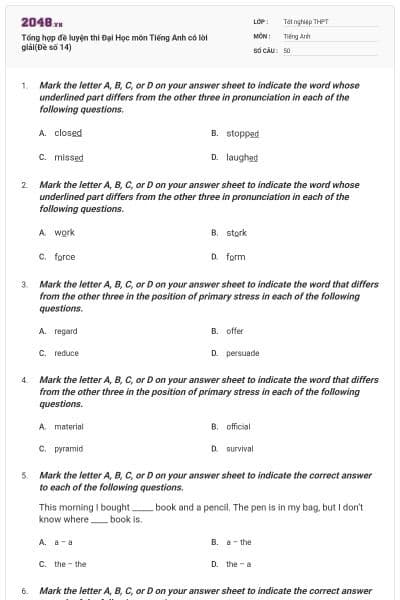
Mark the letter A, B, C, or D on your answer sheet to indicate the word whose underlined part differs from the other three in pronunciation in each of the following questions.
closed
stopped
missed
laughed
Chọn A.
Đáp án A.
Ta có:
A. closed /kləʊzd/
B. stopped /stɒpt/
C. missed /mɪst/
D. laughed /lɑːft/
Đuôi “ed” ở đáp án A đươc phát âm là /d/. Các đáp án B, C, D được phát âm là /t/.
Mark the letter A, B, C, or D on your answer sheet to indicate the word whose underlined part differs from the other three in pronunciation in each of the following questions.
work
stork
force
form
Chọn A.
Đáp án A.
A. work /wɜːk/
B. stork /stɔːk/
C. force /fɔːs
D. form /fɔːm/
Phần gạch chân “or” ở đáp án A đươc phát âm là /ɜː/. Các đáp án B, C, D được phát âm là /ɔː/.
Mark the letter A, B, C, or D on your answer sheet to indicate the word that differs from the other three in the position of primary stress in each of the following questions.
regard
offer
reduce
persuade
Chọn B.
Đáp án B.
A. regard /rɪˈɡɑːd/
B. offer /ˈɒfə(r)/
C. reduce /rɪˈdjuːs/
D. persuade /pəˈsweɪd/
Đáp án B có trọng âm rơi vào âm tiết thứ nhất. Các từ còn lại có trọng âm rơi vào âm tiết thứ 2.
Mark the letter A, B, C, or D on your answer sheet to indicate the word that differs from the other three in the position of primary stress in each of the following questions.
material
official
pyramid
survival
Chọn C.
Đáp án C.
A. /məˈtɪəriəl/
B. /əˈfɪʃl/
C. /ˈpɪrəmɪd/
D. /səˈvaɪvl/
Đáp án C có trọng âm rơi vào âm tiết thứ nhất. Các từ còn lại có trọng âm rơi vào âm tiết thứ 2.
Mark the letter A, B, C, or D on your answer sheet to indicate the correct answer to each of the following questions.
This morning I bought _____ book and a pencil. The pen is in my bag, but I don’t know where ____ book is.
a – a
a – the
the – the
the – a
Chọn B.
Đáp án B.
“book” lần đầu tiên ta nhắc đến thì dùng mạo từ “a”. Lần sau nhắc lại ta dùng mạo từ “the”
Dịch: Sáng nay tôi đã mua một quyển sách và một cái bút. Cái bút đang ở trong cặp tôi, nhưng tôi không biết quyển sách ở đâu.
Mark the letter A, B, C, or D on your answer sheet to indicate the correct answer to each of the following questions.
If you had taken your dad’s advice, you ______ such a silly mistake.
would have avoided
would have avoid
would avoid
have avoided
Chọn A.
Đáp án A.
Câu điều kiện loại 3 diễn ta điều kiện không thể xảy ra ở quá khứ.
S + had + PII, S + would have PII.
Dịch: Nếu bạn nghe lời khuyên của bố, bạn đã tránh được một sai lầm ngớ ngẩn như vậy.
Mark the letter A, B, C, or D on your answer sheet to indicate the correct answer to each of the following questions.
By the end of last March, I ____ English for five years.
have been studying
will have been studying
had been studying
will have studied
Chọn C.
Đáp án C.
Dịch: Vào cuối tháng ba trước, tôi đã được học Tiếng Anh 5 năm.
=> Tháng 3 là một mốc thời gian quá khứ; tại thời đó, người nói đang học tiếng anh => ta dùng thì quá khứ hoàn thành tiếp diễn.

Học thông minh hơn mỗi ngày
Xem toàn bộ 50 câu hỏi và nhiều hơn nữa với tài khoản miễn phí
Mark the letter A, B, C, or D on your answer sheet to indicate the correct answer to each of the following questions.
She made a list of what to do __________ forget anything.
in order to
so as not to
so that
to not
Chọn B.
Đáp án B.
Ta có các cấu trúc chỉ mục đích:
- in order (not) to do sth
- so as ( not ) to do sth
- so that + clause
Dịch: Cô ấy đã lập một danh sách những việc phải làm để không quên bất kỳ việc nào.
Mark the letter A, B, C, or D on your answer sheet to indicate the correct answer to each of the following questions.
The Prime Minister congratulated the team _________ winning the match.
for
in
on
into
Chọn C.
Đáp án C.
Ta có: congratulate sb on V-ing: chúc mừng
Các giới từ con lại không đi cùng “congratulate”
Dịch: Thủ tướng chúc mừng đội bóng đã thắng trận đấu.
Mark the letter A, B, C, or D on your answer sheet to indicate the correct answer to each of the following questions.
A quick look would reveal that France has twice ______ computers.
as many televisions as
more televisions than
as many as televisions
many as televisions as
Chọn A.
Đáp án A.
Công thức so sánh gấp nhiều lần:
S + V + multiple numbers + as + much/many/adj/adv + (N) + as + N/pronoun.
(multiple numbers là những số như half/twice/3,4,5...times; phân số; phần trăm.)
⇒ ...France has twice as many televisions as computers.
Dịch: Xem xét nhanh có thấy Pháp có máy thu hình nhiều hơn máy tính
Mark the letter A, B, C, or D on your answer sheet to indicate the correct answer to each of the following questions.
We ______ today and I got into trouble because I hadn’t done it.
have our homework checking
had checked our homework
were checked our homework
had our homework checked
Chọn D.
Đáp án D.
Ta có:
- to have sb do sth = to get sb to do sth: sai ai, khiến ai, bảo ai làm gì
- to have/to get sth done: làm một việc gì bằng cách thuê người khác
=> Đáp án D đúng
Dịch: Chúng tôi đã nhờ người kiểm tra bài tập về nhà hôm nay và tôi gặp rắc rối vì tôi đã không làm điều đó.
Mark the letter A, B, C, or D on your answer sheet to indicate the correct answer to each of the following questions.
It was a nasty memory. Do you remember both of us wearing sunglasses to avoid ______ by the supervisors?
to recognize
to be recognized
recognizing
being recognized
Chọn D.
Đáp án D.
Ta có: avoid + V-ing: tránh làm gì
Câu mang nghĩa bị động => đáp án D đúng
Dịch: Đó là một ký ức khó chịu. Bạn có nhớ cả hai chúng tôi đã phải đeo kính râm để tránh bị người giám sát nhận ra không?
Mark the letter A, B, C, or D on your answer sheet to indicate the correct answer to each of the following questions.
Employee contracts are eligible for ________ each year.
renew
renewal
renewed
renewing
Chọn B.
Đáp án B.
Ta thấy sau giới từ phải dùng danh từ renewal – sự gia hạn
Dịch: Hợp đồng của nhân viên phải được gia hạn mỗi năm.
Mark the letter A, B, C, or D on your answer sheet to indicate the correct answer to each of the following questions.
I phoned the company, who _______ me that my goods had been delivered.
guaranteed
assured
reassured
confirmed
Chọn B.
Đáp án B.
Ta có:
A. guarantee: bảo hành
B. assure: đảm bảo
C. reassure: cam đoan một lần nữa
D. confirm: xác nhận
Dịch: Tôi gọi điện cho công ty và họ hứa đã giao hàng cho thôi rồi.
Mark the letter A, B, C, or D on your answer sheet to indicate the correct answer to each of the following questions.
Michael was _______ with anger when he saw his car had been scratched.
filled
fixed
loaded
stored
Chọn A.
Đáp án A
Ta có be filled with: chứa đầy
Các phương án khác:
B. fixed: cố định
C. load: chất đầy hàng hóa
D. store: tích trữ
Dịch: Micheal tràn đầy giận dữ khi thấy ô tô của mình bị trầy xước.
Mark the letter A, B, C, or D on your answer sheet to indicate the correct answer to each of the following questions.
This project will create more _____ to local residents.
happiness
employment
transition
determination
Chọn B.
Đáp án B.
Ta có:
A. happiness: niềm vui
B. employment: công ăn việc làm
C. transition: sự chuyển tiếp
D. determination: sự quyết tâm
Dịch: Dự án này sẽ tạo công ăn việc làm cho người dân địa phương.
Mark the letter A, B, C, or D on your answer sheet to indicate the correct answer to each of the following questions.
When a fire broke out in Louvre, at least twenty __________ paintings were destroyed, including two by Picasso.
worthless
priceless
valueless
worthy
Chọn B.
Đáp án B.
Các đáp án:
A. worthless: vô giá trị, vô dụng
B. priceless: vô giá, không định đoạt được bằng giá cả, rất giá trị
C. valueless: không có giá trị, vô dụng
D. worthy: có giá, đáng giá
Dịch: Khi đám cháy bộc phát ở viện bảo tàng Louvre, ít nhất 20 bức tranh vô giá đã bị phá hủy, bao gồm cả 2 bức tranh của danh họa Picasso.
Mark the letter A, B, C, or D on your answer sheet to indicate the correct answer to each of the following questions.
You have to study hard to _______ your classmates
keep pace with
look out for
catch sight of
D get in touch with
Đáp án: A
Giải thích:
A. keep pace with (phr.v): theo kịp, bắt kịp
B. look out for (phr.v): để ý, trông chừng
C. catch sight of (phr.v): bắt gặp
D. get in touch with (phr.v): giữ liên lạc với ai
Dựa vào nghĩa, chọn A.
Dịch: Bạn phải học tập chăm chỉ để theo kịp bạn cùng lớp.
Mark the letter A, B, C, or D on your answer sheet to indicate the word(s) CLOSEST in meaning to the underlined word(s) in each of the following questions.
It takes roughly 4000 pounds of petals to make a single pound of rose oil.
amazingly
as much as
C relatively.
more or less
Chọn D.
Đáp án D.
Dịch: Mất khoảng 4000 cân Anh cánh hoa hồng để làm ra một cân Anh tinh dầu hoa hồng.
Ta có: roughly (khoảng) ~ more or less (khoảng chừng, xấp xỉ)
Các đáp án khác:
A. amazingly: đáng kinh ngạc
B. as much as: gần như
C. relatively: tương đối
Mark the letter A, B, C, or D on your answer sheet to indicate the word(s) CLOSEST in meaning to the underlined word(s) in each of the following questions.
I take my hat off to all those people worked hard to get the contract.
respect
discourage
detest
dislike
Chọn A.
Đáp án A.
Ta có: take my hat off to (ngả mũ trước …) = respect (kính trọng)
Các đáp án khác:
B. discourage: làm nhụt chí
C. detest: ghê tởm, ghét
D. dislike: không thích
Dịch: Tôi hết sức thán phục những người đã nỗ lực để giành được hợp đồng này.
Mark the letter A, B, C, or D on your answer sheet to indicate the word(s) OPPOSITE in meaning to the underlined word(s) in each of the following questions.
The ship went down although strenuous efforts were made to save it.
energetic
forceful
half-hearted
exhausting
Chọn C.
Đáp án C
Ta có: strenuous (a) tích cực, đòi hỏi nhiều cố gắng,
D. exhausting = B. forceful = A. energetic (a) tích cực, hăng hái
C. half- hearted (a): nửa vời, không nhiệt tình
Dịch: Con tàu chìm xuống mặc dù người ta đã nỗ lực vất vả để cứu nó.
Mark the letter A, B, C, or D on your answer sheet to indicate the word(s) OPPOSITE in meaning to the underlined word(s) in each of the following questions.
As a newspaper reporter, she always wanted to get information at first hand.
indirectly
directly
easily
slowly
Chọn A.
Đáp án A.
Dịch câu hỏi: Là một phóng viên, cô ấy luôn muốn trực tiếp lấy thông tin.
=> at first hand (trực tiếp) >< indirectly (gián tiếp)
Mark the letter A, B, C, or D on your answer sheet to indicate the option that best completes each of the following exchanges.
“There’s a baseball game tonight.” “________________”
Great. Let’s go.
I’m not a real fan of hers.
Don’t mention it.
Thanks. I’d love to.
Chọn A.
Đáp án A.
Dịch: “Có một trận bóng chày tối nay.”
“________________”
A. Tuyệt đấy. Đi thôi.
B. Tôi không phải là một fan hâm mộ thực sự của cô ấy.
C. Đừng đề cập đến nó.
D. Cảm ơn. Tôi rất thích.
Đáp án đúng: A. Great. Let’s go.
Mark the letter A, B, C, or D on your answer sheet to indicate the option that best completes each of the following exchanges.
David: “Could you bring me some water?”
Waiter: “________”
I don’t want to.
Yes. I can.
No. I can’t
Certainly, sir.
Đáp án: D
Giải thích:
Dịch: David: “Anh có thể mang cho tôi ít nước không?”
Người phục vụ: “________”
A. Tôi không muốn.
B. Vâng. Tôi có thể.
C. Không. Tôi không thể.
D. Chắc chắn rồi, thưa ngài.
Dựa vào nghĩa, chọn D.
Read the following passage and mark the letter A, B, C, or D on your answer sheet to indicate the correct word or phrase that best fits each of the numbered blanks from 25 to 29. Fill in the appropriate word in question 25
From the seeds themselves to the machinery, fertilizers and pesticides – The Green Revolution regimen depends heavily on technology. One alternative, however, depends much (25) _____on technology - organic farming. Many organic farmers use machinery, but not chemical fertilizers or pesticides. (26) ______ chemical soil enrichers, they use animal manure and plant parts not used as food - natural, organic fertilizers that are clearly a renewable (27) ______. Organic farmers also use alternatives for pesticides; for example they may rely on natural predators of certain insect pests. (28) ______ the need arises, they can buy the eggs and larvae of these natural predators and introduce them into their crop fields. They use other techniques to control pests as well, like planting certain crops together because one crop repels the other’s pests. Organic farmers do not need a lot of land; in fact organic farming is perfectly (29) _______ to small farms and is relatively inexpensive. Finally, many organic farmers’ average yields compare favorably with other farmers’ yields.
more
less
better
worse
Chọn B.
Đáp án B.
Ta thấy có từ “however” ta biết được mối quan hệ giữa 2 câu là mối quan hệ trái ngược nhau về nghĩa => nên câu 1 là “depend heavily on technology” thì câu 2 là “depends much less on technology” => chọn đáp án B
Dịch: Từ hạt giống cho đến máy móc, phân bón và thuốc trừ sâu - Phác đồ Cách mạng Xanh phụ thuộc rất nhiều vào công nghệ. Tuy nhiên, một thay thế phụ thuộc ít hơn vào công nghệ - canh tác hữu cơ. Nhiều nông dân hữu cơ sử dụng máy móc, nhưng không sử dụng phân bón hóa học hoặc thuốc trừ sâu.
Read the following passage and mark the letter A, B, C, or D on your answer sheet to indicate the correct word or phrase that best fits each of the numbered blanks from 25 to 29. Fill in the appropriate word in question 26
From the seeds themselves to the machinery, fertilizers and pesticides – The Green Revolution regimen depends heavily on technology. One alternative, however, depends much (25) _____on technology - organic farming. Many organic farmers use machinery, but not chemical fertilizers or pesticides. (26) ______ chemical soil enrichers, they use animal manure and plant parts not used as food - natural, organic fertilizers that are clearly a renewable (27) ______. Organic farmers also use alternatives for pesticides; for example they may rely on natural predators of certain insect pests. (28) ______ the need arises, they can buy the eggs and larvae of these natural predators and introduce them into their crop fields. They use other techniques to control pests as well, like planting certain crops together because one crop repels the other’s pests. Organic farmers do not need a lot of land; in fact organic farming is perfectly (29) _______ to small farms and is relatively inexpensive. Finally, many organic farmers’ average yields compare favorably with other farmers’ yields.
In spite of
On account of
In favour
Instead of
Chọn D.
Đáp án D.
Các đáp án:
A. In spite of: mặc dù
B. On account of: vì
C. In favour: vì lợi ích của
D. Instead of: thay vì/thay thế
=> chỉ có D là phù hợp nhất để điền vào chỗ trống.
Dịch: Thay vì sử dụng chất hóa học làm màu mỡ cho đất, họ sử dụng phân động vật, các bộ phận của cây không được dùng làm thức ăn - phân bón hữu cơ tự nhiên rõ ràng là một nguồn có thể tái tạo.
Read the following passage and mark the letter A, B, C, or D on your answer sheet to indicate the correct word or phrase that best fits each of the numbered blanks from 25 to 29. Fill in the appropriate word in question 25
From the seeds themselves to the machinery, fertilizers and pesticides – The Green Revolution regimen depends heavily on technology. One alternative, however, depends much (25) _____on technology - organic farming. Many organic farmers use machinery, but not chemical fertilizers or pesticides. (26) ______ chemical soil enrichers, they use animal manure and plant parts not used as food - natural, organic fertilizers that are clearly a renewable (27) ______. Organic farmers also use alternatives for pesticides; for example they may rely on natural predators of certain insect pests. (28) ______ the need arises, they can buy the eggs and larvae of these natural predators and introduce them into their crop fields. They use other techniques to control pests as well, like planting certain crops together because one crop repels the other’s pests. Organic farmers do not need a lot of land; in fact organic farming is perfectly (29) _______ to small farms and is relatively inexpensive. Finally, many organic farmers’ average yields compare favorably with other farmers’ yields.
resource
source
matter
substance
Chọn B.
Đáp án B.
Các đáp án:
A. resource (n): tài nguyên
B. source (n): nguồn
C. matter (n): vấn đề
D. substance (n): chất
Ta có “organic fertilizers” – phân bón hữu cơ là “renewbale source”
Dịch: Thay vì sử dụng chất hóa học làm màu mỡ cho đất, họ sử dụng phân động vật, các bộ phận của cây không được dùng làm thức ăn - phân bón hữu cơ tự nhiên rõ ràng là một nguồn có thể tái tạo.
Read the following passage and mark the letter A, B, C, or D on your answer sheet to indicate the correct word or phrase that best fits each of the numbered blanks from 25 to 29. Fill in the appropriate word in question 28
From the seeds themselves to the machinery, fertilizers and pesticides – The Green Revolution regimen depends heavily on technology. One alternative, however, depends much (25) _____on technology - organic farming. Many organic farmers use machinery, but not chemical fertilizers or pesticides. (26) ______ chemical soil enrichers, they use animal manure and plant parts not used as food - natural, organic fertilizers that are clearly a renewable (27) ______. Organic farmers also use alternatives for pesticides; for example they may rely on natural predators of certain insect pests. (28) ______ the need arises, they can buy the eggs and larvae of these natural predators and introduce them into their crop fields. They use other techniques to control pests as well, like planting certain crops together because one crop repels the other’s pests. Organic farmers do not need a lot of land; in fact organic farming is perfectly (29) _______ to small farms and is relatively inexpensive. Finally, many organic farmers’ average yields compare favorably with other farmers’ yields.
Then
If
Because
Though
Chọn B.
Đáp án B.
Các đáp án:
A. Then: Sau đó
B. If: Nếu
C. Because: Bởi vì
D. Though: Mặc dù
Câu trong bài: Nếu nhu cầu tăng lên, họ có thể mua trứng và ấu trùng của các loài động vật ăn thịt và dùng chúng vào mục đích canh tác.
Read the following passage and mark the letter A, B, C, or D on your answer sheet to indicate the correct word or phrase that best fits each of the numbered blanks from 25 to 29. Fill in the appropriate word in question 29
From the seeds themselves to the machinery, fertilizers and pesticides – The Green Revolution regimen depends heavily on technology. One alternative, however, depends much (25) _____on technology - organic farming. Many organic farmers use machinery, but not chemical fertilizers or pesticides. (26) ______ chemical soil enrichers, they use animal manure and plant parts not used as food - natural, organic fertilizers that are clearly a renewable (27) ______. Organic farmers also use alternatives for pesticides; for example they may rely on natural predators of certain insect pests. (28) ______ the need arises, they can buy the eggs and larvae of these natural predators and introduce them into their crop fields. They use other techniques to control pests as well, like planting certain crops together because one crop repels the other’s pests. Organic farmers do not need a lot of land; in fact organic farming is perfectly (29) _______ to small farms and is relatively inexpensive. Finally, many organic farmers’ average yields compare favorably with other farmers’ yields.
suitable
open
likely
suited
Chọn D.
Đáp án D.
Ta có: to be suited to sth: phù hợp với cái gì
Dịch: Nông dân hữu cơ không cần nhiều đất đai, trên thực tế, việc canh tác hữu cơ phù hợp một cách hoàn hảo với các trang trại nhỏ và khá rẻ. Kết quả cuối cùng thì sản lượng trung bình của nhiều nông dân hữu cơ không thua kém gì so với sản lượng của những nông dân khác.
Read the following passage and mark the letter A, B, C, or D on your answer sheet to indicate the correct answer to each of the questions from 30 to 34.
Foot racing is a popular activity in the United States. It is seen not only as a competitive sport but also as a way to exercise, to enjoy the camaraderie of like-minded people, and to donate money to a good cause. Though serious runners may spend months training to compete, other runners and walkers might not train at all. Those not competing to win might run in an effort to beat their own time or simply to enjoy the fun and exercise. People of all ages, from those of less than one year (who may be pushed in strollers) to those in their eighties, enter into this sport. The races are held on city streets, on college campuses, through parks, and in suburban areas, and they are commonly 5 to 10 kilometers in length.
The largest foot race in the world is the 12-kilometer Bay to Breakers race that is held in San Francisco every spring. This race begins on the east side of the city near San Francisco Bay and ends on the west side at the Pacific Ocean. There may be 80,000 or more people running in this race through the streets and hills of San Francisco. In the front are the serious runners who compete to win and who might finish in as little as 34 minutes. Behind them are the thousands who take several hours to finish. In the back of the race are those who dress in costumes and come just for fun. One year there was a group of men who dressed like Elvis Presley, and another group consisted of firefighters who were tied together in a long line and who were carrying a fire hose. There was even a bridal party, in which the bride was dressed in a long white gown and the groom wore a tuxedo. The bride and groom threw flowers to bystanders, and they were actually married at some point along the route.
The main purpose of this passage is to ________.
give reasons for the popularity of foot races
describe a popular activity
make fun of runners in costume
encourage people to exercise
Chọn B.
Đáp án B.
Dịch câu hỏi: Mục đích chính của đoạn văn này là _____.
A. đưa ra lý do cho sự phổ biến của các cuộc thi chạy bộ
B. mô tả một hoạt động được ưa thích
C. chế nhạo người chạy bộ trong trang phục hoá trang.
D. khuyến khích mọi người tập thể dục
Thông tin ở đầu tiên của đoạn văn: “Foot racing is a popular activity in the United States” (Cuộc thi chạy bộ là một hoạt động được ưa thích ở Hoa Kì.)
Read the following passage and mark the letter A, B, C, or D on your answer sheet to indicate the correct answer to each of the questions from 30 to 34.
Foot racing is a popular activity in the United States. It is seen not only as a competitive sport but also as a way to exercise, to enjoy the camaraderie of like-minded people, and to donate money to a good cause. Though serious runners may spend months training to compete, other runners and walkers might not train at all. Those not competing to win might run in an effort to beat their own time or simply to enjoy the fun and exercise. People of all ages, from those of less than one year (who may be pushed in strollers) to those in their eighties, enter into this sport. The races are held on city streets, on college campuses, through parks, and in suburban areas, and they are commonly 5 to 10 kilometers in length.
The largest foot race in the world is the 12-kilometer Bay to Breakers race that is held in San Francisco every spring. This race begins on the east side of the city near San Francisco Bay and ends on the west side at the Pacific Ocean. There may be 80,000 or more people running in this race through the streets and hills of San Francisco. In the front are the serious runners who compete to win and who might finish in as little as 34 minutes. Behind them are the thousands who take several hours to finish. In the back of the race are those who dress in costumes and come just for fun. One year there was a group of men who dressed like Elvis Presley, and another group consisted of firefighters who were tied together in a long line and who were carrying a fire hose. There was even a bridal party, in which the bride was dressed in a long white gown and the groom wore a tuxedo. The bride and groom threw flowers to bystanders, and they were actually married at some point along the route.
The word “it” in the first paragraph refers to ______.
a walker
foot racing
a popular activity
the US
Chọn B.
Đáp án B.
Dịch câu hỏi: Từ “it” ở đoạn 1 đề cập đến _____.
A. người đi bộ
B. cuộc thi chạy bộ
C. một hoạt động được ưu thích
D. Mỹ
Dịch: Cuộc thi chạy bộ là một hoạt động phổ biến ở Hoa Kỳ. Nó không chỉ được xem là một môn thể thao cạnh tranh mà còn......
=> “it” thay cho “foot racing”
Read the following passage and mark the letter A, B, C, or D on your answer sheet to indicate the correct answer to each of the questions from 30 to 34.
Foot racing is a popular activity in the United States. It is seen not only as a competitive sport but also as a way to exercise, to enjoy the camaraderie of like-minded people, and to donate money to a good cause. Though serious runners may spend months training to compete, other runners and walkers might not train at all. Those not competing to win might run in an effort to beat their own time or simply to enjoy the fun and exercise. People of all ages, from those of less than one year (who may be pushed in strollers) to those in their eighties, enter into this sport. The races are held on city streets, on college campuses, through parks, and in suburban areas, and they are commonly 5 to 10 kilometers in length.
The largest foot race in the world is the 12-kilometer Bay to Breakers race that is held in San Francisco every spring. This race begins on the east side of the city near San Francisco Bay and ends on the west side at the Pacific Ocean. There may be 80,000 or more people running in this race through the streets and hills of San Francisco. In the front are the serious runners who compete to win and who might finish in as little as 34 minutes. Behind them are the thousands who take several hours to finish. In the back of the race are those who dress in costumes and come just for fun. One year there was a group of men who dressed like Elvis Presley, and another group consisted of firefighters who were tied together in a long line and who were carrying a fire hose. There was even a bridal party, in which the bride was dressed in a long white gown and the groom wore a tuxedo. The bride and groom threw flowers to bystanders, and they were actually married at some point along the route
The word “camaraderie” in the first paragraph could be best replaced by which of the following?
games
jokes
views
companionship
Chọn D.
Đáp án D.
Dịch câu hỏi: Từ “camaraderie” ở đoạn một có thể được thay thế bởi ______.
Ta có: camaraderie = companionship (tình bạn, sự thân thiết).
Read the following passage and mark the letter A, B, C, or D on your answer sheet to indicate the correct answer to each of the questions from 30 to 34.
Foot racing is a popular activity in the United States. It is seen not only as a competitive sport but also as a way to exercise, to enjoy the camaraderie of like-minded people, and to donate money to a good cause. Though serious runners may spend months training to compete, other runners and walkers might not train at all. Those not competing to win might run in an effort to beat their own time or simply to enjoy the fun and exercise. People of all ages, from those of less than one year (who may be pushed in strollers) to those in their eighties, enter into this sport. The races are held on city streets, on college campuses, through parks, and in suburban areas, and they are commonly 5 to 10 kilometers in length.
The largest foot race in the world is the 12-kilometer Bay to Breakers race that is held in San Francisco every spring. This race begins on the east side of the city near San Francisco Bay and ends on the west side at the Pacific Ocean. There may be 80,000 or more people running in this race through the streets and hills of San Francisco. In the front are the serious runners who compete to win and who might finish in as little as 34 minutes. Behind them are the thousands who take several hours to finish. In the back of the race are those who dress in costumes and come just for fun. One year there was a group of men who dressed like Elvis Presley, and another group consisted of firefighters who were tied together in a long line and who were carrying a fire hose. There was even a bridal party, in which the bride was dressed in a long white gown and the groom wore a tuxedo. The bride and groom threw flowers to bystanders, and they were actually married at some point along the route.
Which of the following is NOT implied by the author?
Entering a race is a way to give supports to an organization.
Walkers can compete for prizes.
Running is a good way to strengthen the heart.
Foot races appeal to a variety of people.
Chọn C.
Đáp án C.
Dịch câu hỏi: Điều nào sau đây KHÔNG được tác giả ngụ ý?
A. Tham gia một cuộc đua là một cách để hỗ trợ cho một tổ chức.
B. Người đi bộ có thể cạnh tranh để giành giải thưởng.
C. Chạy là một cách tốt để củng cố trái tim,
D. Các cuộc đua chân hấp dẫn nhiều người.
Các phương án A, B, C được tìm thấy ở dòng 1 + 2 đoạn 1: “It is seen not only as a competitive sport (B) but also as a way to exercise, to enjoy the camaraderie of like minded people (A), and to donate money to a good cause (C).” Nó không chỉ là một môn thể thao mang tính cạnh tranh mà còn như là cách tập thể dục, có được tình bạn với những người có chung chí hướng và để quyên góp tiền cho một tổ chức chuyên làm các việc tốt.
Read the following passage and mark the letter A, B, C, or D on your answer sheet to indicate the correct answer to each of the questions from 30 to 34.
Foot racing is a popular activity in the United States. It is seen not only as a competitive sport but also as a way to exercise, to enjoy the camaraderie of like-minded people, and to donate money to a good cause. Though serious runners may spend months training to compete, other runners and walkers might not train at all. Those not competing to win might run in an effort to beat their own time or simply to enjoy the fun and exercise. People of all ages, from those of less than one year (who may be pushed in strollers) to those in their eighties, enter into this sport. The races are held on city streets, on college campuses, through parks, and in suburban areas, and they are commonly 5 to 10 kilometers in length.
The largest foot race in the world is the 12-kilometer Bay to Breakers race that is held in San Francisco every spring. This race begins on the east side of the city near San Francisco Bay and ends on the west side at the Pacific Ocean. There may be 80,000 or more people running in this race through the streets and hills of San Francisco. In the front are the serious runners who compete to win and who might finish in as little as 34 minutes. Behind them are the thousands who take several hours to finish. In the back of the race are those who dress in costumes and come just for fun. One year there was a group of men who dressed like Elvis Presley, and another group consisted of firefighters who were tied together in a long line and who were carrying a fire hose. There was even a bridal party, in which the bride was dressed in a long white gown and the groom wore a tuxedo. The bride and groom threw flowers to bystanders, and they were actually married at some point along the route.
Which of the following best describes the organization of this passage?
statement and example
cause and result
specific to general
chronological order
Chọn A.
Đáp án A.
Dịch câu hỏi: Điều nào sau đây mô tả đúng nhất về cách tổ chức của đoạn văn này?
A. trình bày và ví dụ
B. nguyên nhân và kết quả
C. từ cụ thể đến chung chung
D. trật tự thời gian
Kết cấu của đoạn văn: Tác giả trình bày ý chính và đưa ra các ví dụ support cho các ý đó.
Read the following passage and mark the letter A, B, C, or D on your answer sheet to indicate the correct answer to each of the following questions from 35 to 42.
CUTTING THE APRON STRINGS
There is substantial evidence that students going off to college have changed over the years. For one thing, studies show that they are emotionally closer to their parents and their parents to them. One thing that means is that they depend on each other more for happiness. It puts a burden on children for parents to use their children as vehicles for their own happiness - although today’s young people seem complicit in this arrangement, perhaps because they have known no other way even if it creates anxiety in the children. That’s one reason parents like to be involved in their children’s college experiences, and colleges have had to devise novel ways of getting parents off campus when they transport their kids to school.
There’s also evidence that students today seem to be choosing schools with reference to proximity to home. The closer a student is to home, the easier it is to bring the laundry home and to land in your old bed with tea and sympathy when you have the sniffles. And the easier it is for parents to visit you at university whenever the mood strikes. The amount of visiting parents do is far more than in generations past.
But in a real sense, students don’t really leave their parents behind. Their parents go to college right along with them - in their front pockets. That is, the parents are a speed dial away by cellphone. This, of course, significantly reduces independence. A student doesn’t get the chance to solve minor problems on his own - he just calls Mom or Dad. A student has initial problems getting along with a roommate? A roommate doesn’t do laundry as often as the other roommate wishes? A student gets a C grade on her first paper? Instead of absorbing the negative information and figuring out how to resolve the problem or how to do better, the call gets made to home, where Mom or Dad solves the problem, often by calling the school administration. This kind of behavior is, sadly, commonplace today and is a mark of the lack of coping skills among students because all the lumps and bumps have been taken out of life for them until now.
In addition to being tethered to parents, incoming freshmen are now very heavily connected by cellphone to classmates from high school, who are presumably at other colleges. So there isn’t the great impetus to mix and venture forth to meet new people, to get out of one’s comfort/one, to get drawn into new experiences, that has traditionally marked the beginning of freshman year. The laws of physics still apply, 6 and it is difficult to be meeting new people and seeking novel experiences while you are talking to your old pals.
“Cutting the Apron Strings”, the title of the passage, can be interpreted as ______.
parting with old relationships
being financially independent
standing on your own feet
looking for your own devices
Chọn C.
Đáp án C.
Dịch câu hỏi: “Cutting the Apron Strings”- tiêu đề của đoạn văn, có thể được hiểu là ______.
Ta có: “Cutting the Apron Strings” = standing on your own feel (tự đứng trên đôi chân của mình).
Read the following passage and mark the letter A, B, C, or D on your answer sheet to indicate the correct answer to each of the following questions from 35 to 42.
CUTTING THE APRON STRINGS
There is substantial evidence that students going off to college have changed over the years. For one thing, studies show that they are emotionally closer to their parents and their parents to them. One thing that means is that they depend on each other more for happiness. It puts a burden on children for parents to use their children as vehicles for their own happiness - although today’s young people seem complicit in this arrangement, perhaps because they have known no other way even if it creates anxiety in the children. That’s one reason parents like to be involved in their children’s college experiences, and colleges have had to devise novel ways of getting parents off campus when they transport their kids to school.
There’s also evidence that students today seem to be choosing schools with reference to proximity to home. The closer a student is to home, the easier it is to bring the laundry home and to land in your old bed with tea and sympathy when you have the sniffles. And the easier it is for parents to visit you at university whenever the mood strikes. The amount of visiting parents do is far more than in generations past.
But in a real sense, students don’t really leave their parents behind. Their parents go to college right along with them - in their front pockets. That is, the parents are a speed dial away by cellphone. This, of course, significantly reduces independence. A student doesn’t get the chance to solve minor problems on his own - he just calls Mom or Dad. A student has initial problems getting along with a roommate? A roommate doesn’t do laundry as often as the other roommate wishes? A student gets a C grade on her first paper? Instead of absorbing the negative information and figuring out how to resolve the problem or how to do better, the call gets made to home, where Mom or Dad solves the problem, often by calling the school administration. This kind of behavior is, sadly, commonplace today and is a mark of the lack of coping skills among students because all the lumps and bumps have been taken out of life for them until now.
In addition to being tethered to parents, incoming freshmen are now very heavily connected by cellphone to classmates from high school, who are presumably at other colleges. So there isn’t the great impetus to mix and venture forth to meet new people, to get out of one’s comfort/one, to get drawn into new experiences, that has traditionally marked the beginning of freshman year. The laws of physics still apply, 6 and it is difficult to be meeting new people and seeking novel experiences while you are talking to your old pals.
Paragraph 1 shows that children ________.
are not willing to act as a means to their parents’ happiness
tend to cling to their parents only as a source of finance
are willing to act as an agent to their parents’ happiness
demand a form of payment to go to college
Chọn C.
Đáp án C.
Dịch câu hỏi: Đoạn 1 cho thấy con cái __________.
A. không sẵn lòng làm phương tiện cho niềm vui của cha mẹ
B. có xu hướng bám vào cha mẹ chỉ như một nguồn tài chính
C. sẵn lòng làm phương tiện cho niềm vui của cha mẹ
D. yêu cầu một hình thức thanh toán để đi học đại học
Thông tin: “It puts a burden on children for parents to use their children as vehicles for their own happiness” (Điều đó đặt trọng trách lên con cái vì các bậc cha mẹ dùng chúng làm phương tiện cho niềm vui của mình.)
Read the following passage and mark the letter A, B, C, or D on your answer sheet to indicate the correct answer to each of the following questions from 35 to 42.
CUTTING THE APRON STRINGS
There is substantial evidence that students going off to college have changed over the years. For one thing, studies show that they are emotionally closer to their parents and their parents to them. One thing that means is that they depend on each other more for happiness. It puts a burden on children for parents to use their children as vehicles for their own happiness - although today’s young people seem complicit in this arrangement, perhaps because they have known no other way even if it creates anxiety in the children. That’s one reason parents like to be involved in their children’s college experiences, and colleges have had to devise novel ways of getting parents off campus when they transport their kids to school.
There’s also evidence that students today seem to be choosing schools with reference to proximity to home. The closer a student is to home, the easier it is to bring the laundry home and to land in your old bed with tea and sympathy when you have the sniffles. And the easier it is for parents to visit you at university whenever the mood strikes. The amount of visiting parents do is far more than in generations past.
But in a real sense, students don’t really leave their parents behind. Their parents go to college right along with them - in their front pockets. That is, the parents are a speed dial away by cellphone. This, of course, significantly reduces independence. A student doesn’t get the chance to solve minor problems on his own - he just calls Mom or Dad. A student has initial problems getting along with a roommate? A roommate doesn’t do laundry as often as the other roommate wishes? A student gets a C grade on her first paper? Instead of absorbing the negative information and figuring out how to resolve the problem or how to do better, the call gets made to home, where Mom or Dad solves the problem, often by calling the school administration. This kind of behavior is, sadly, commonplace today and is a mark of the lack of coping skills among students because all the lumps and bumps have been taken out of life for them until now.
In addition to being tethered to parents, incoming freshmen are now very heavily connected by cellphone to classmates from high school, who are presumably at other colleges. So there isn’t the great impetus to mix and venture forth to meet new people, to get out of one’s comfort/one, to get drawn into new experiences, that has traditionally marked the beginning of freshman year. The laws of physics still apply, 6 and it is difficult to be meeting new people and seeking novel experiences while you are talking to your old pals.
It can be inferred from paragraph 1 that children and their parents ______.
emotionally need each other
only temporarily depend on each other
emotionally and physically depend on each other
eternally depend on each other
Chọn A.
Đáp án A.
Dịch câu hỏi: Ta có thể suy từ đoạn 1 là sinh viên và các bậc phụ huynh ______.
A. phụ thuộc lẫn nhau vể mặt cảm xúc
B. chỉ tạm thời phụ thuộc vào nhau
C. tình cảm và thể chất phụ thuộc lẫn nhau
D. vĩnh viễn phụ thuộc vào nhau
Thông tin: “One thing that means is that they depend on each other more for happiness.” (Một điều mà nó có nghĩa là họ phụ thuộc lẫn nhau về mặt niềm vui.)
Read the following passage and mark the letter A, B, C, or D on your answer sheet to indicate the correct answer to each of the following questions from 35 to 42.
CUTTING THE APRON STRINGS
There is substantial evidence that students going off to college have changed over the years. For one thing, studies show that they are emotionally closer to their parents and their parents to them. One thing that means is that they depend on each other more for happiness. It puts a burden on children for parents to use their children as vehicles for their own happiness - although today’s young people seem complicit in this arrangement, perhaps because they have known no other way even if it creates anxiety in the children. That’s one reason parents like to be involved in their children’s college experiences, and colleges have had to devise novel ways of getting parents off campus when they transport their kids to school.
There’s also evidence that students today seem to be choosing schools with reference to proximity to home. The closer a student is to home, the easier it is to bring the laundry home and to land in your old bed with tea and sympathy when you have the sniffles. And the easier it is for parents to visit you at university whenever the mood strikes. The amount of visiting parents do is far more than in generations past.
But in a real sense, students don’t really leave their parents behind. Their parents go to college right along with them - in their front pockets. That is, the parents are a speed dial away by cellphone. This, of course, significantly reduces independence. A student doesn’t get the chance to solve minor problems on his own - he just calls Mom or Dad. A student has initial problems getting along with a roommate? A roommate doesn’t do laundry as often as the other roommate wishes? A student gets a C grade on her first paper? Instead of absorbing the negative information and figuring out how to resolve the problem or how to do better, the call gets made to home, where Mom or Dad solves the problem, often by calling the school administration. This kind of behavior is, sadly, commonplace today and is a mark of the lack of coping skills among students because all the lumps and bumps have been taken out of life for them until now.
In addition to being tethered to parents, incoming freshmen are now very heavily connected by cellphone to classmates from high school, who are presumably at other colleges. So there isn’t the great impetus to mix and venture forth to meet new people, to get out of one’s comfort/one, to get drawn into new experiences, that has traditionally marked the beginning of freshman year. The laws of physics still apply, 6 and it is difficult to be meeting new people and seeking novel experiences while you are talking to your old pals.
The word “vehicles” in the first paragraph may be replaced by ______.
means
methods
ways
instruments
Chọn A.
Đáp án A.
Dịch câu hỏi: Từ “vehicles” ở đoạn 1 có thể được thay thế bởi ______.
A. phương tiện giao thông B. phương pháp C. cách D. công cụ
=> vehicles = means (phương tiện giao thông)
Read the following passage and mark the letter A, B, C, or D on your answer sheet to indicate the correct answer to each of the following questions from 35 to 42.
CUTTING THE APRON STRINGS
There is substantial evidence that students going off to college have changed over the years. For one thing, studies show that they are emotionally closer to their parents and their parents to them. One thing that means is that they depend on each other more for happiness. It puts a burden on children for parents to use their children as vehicles for their own happiness - although today’s young people seem complicit in this arrangement, perhaps because they have known no other way even if it creates anxiety in the children. That’s one reason parents like to be involved in their children’s college experiences, and colleges have had to devise novel ways of getting parents off campus when they transport their kids to school.
There’s also evidence that students today seem to be choosing schools with reference to proximity to home. The closer a student is to home, the easier it is to bring the laundry home and to land in your old bed with tea and sympathy when you have the sniffles. And the easier it is for parents to visit you at university whenever the mood strikes. The amount of visiting parents do is far more than in generations past.
But in a real sense, students don’t really leave their parents behind. Their parents go to college right along with them - in their front pockets. That is, the parents are a speed dial away by cellphone. This, of course, significantly reduces independence. A student doesn’t get the chance to solve minor problems on his own - he just calls Mom or Dad. A student has initial problems getting along with a roommate? A roommate doesn’t do laundry as often as the other roommate wishes? A student gets a C grade on her first paper? Instead of absorbing the negative information and figuring out how to resolve the problem or how to do better, the call gets made to home, where Mom or Dad solves the problem, often by calling the school administration. This kind of behavior is, sadly, commonplace today and is a mark of the lack of coping skills among students because all the lumps and bumps have been taken out of life for them until now.
In addition to being tethered to parents, incoming freshmen are now very heavily connected by cellphone to classmates from high school, who are presumably at other colleges. So there isn’t the great impetus to mix and venture forth to meet new people, to get out of one’s comfort/one, to get drawn into new experiences, that has traditionally marked the beginning of freshman year. The laws of physics still apply, 6 and it is difficult to be meeting new people and seeking novel experiences while you are talking to your old pals.
Parents like to be involved in their children’s college experiences because___________.
they are worried about the school’s carelessness
the school often neglects their children
they are afraid of being deprived of happiness
they find their children a source of happiness
Chọn D.
Đáp án D.
Dịch câu hỏi: Các bậc cha mẹ thích can dự vào trải nghiệm ở trường đại học của con cái vì ______
=> D. họ tìm thấy ở con cái nguồn vui.
Thông tin ở đoạn 1: “to use their children as vehicles for their own happiness ... That’s one reason parents like to be involved in their children’s college experiences”.
Read the following passage and mark the letter A, B, C, or D on your answer sheet to indicate the correct answer to each of the following questions from 35 to 42.
CUTTING THE APRON STRINGS
There is substantial evidence that students going off to college have changed over the years. For one thing, studies show that they are emotionally closer to their parents and their parents to them. One thing that means is that they depend on each other more for happiness. It puts a burden on children for parents to use their children as vehicles for their own happiness - although today’s young people seem complicit in this arrangement, perhaps because they have known no other way even if it creates anxiety in the children. That’s one reason parents like to be involved in their children’s college experiences, and colleges have had to devise novel ways of getting parents off campus when they transport their kids to school.
There’s also evidence that students today seem to be choosing schools with reference to proximity to home. The closer a student is to home, the easier it is to bring the laundry home and to land in your old bed with tea and sympathy when you have the sniffles. And the easier it is for parents to visit you at university whenever the mood strikes. The amount of visiting parents do is far more than in generations past.
But in a real sense, students don’t really leave their parents behind. Their parents go to college right along with them - in their front pockets. That is, the parents are a speed dial away by cellphone. This, of course, significantly reduces independence. A student doesn’t get the chance to solve minor problems on his own - he just calls Mom or Dad. A student has initial problems getting along with a roommate? A roommate doesn’t do laundry as often as the other roommate wishes? A student gets a C grade on her first paper? Instead of absorbing the negative information and figuring out how to resolve the problem or how to do better, the call gets made to home, where Mom or Dad solves the problem, often by calling the school administration. This kind of behavior is, sadly, commonplace today and is a mark of the lack of coping skills among students because all the lumps and bumps have been taken out of life for them until now.
In addition to being tethered to parents, incoming freshmen are now very heavily connected by cellphone to classmates from high school, who are presumably at other colleges. So there isn’t the great impetus to mix and venture forth to meet new people, to get out of one’s comfort/one, to get drawn into new experiences, that has traditionally marked the beginning of freshman year. The laws of physics still apply, 6 and it is difficult to be meeting new people and seeking novel experiences while you are talking to your old pals.
The word “they” in paragraph 1 refers to______.
young parents
children
students
college
Chọn A.
Đáp án A.
Dịch câu hỏi: Từ “they” ở đoạn 1 đề cập đến _______.
Thông tin: It puts a burden on children for parents to use their children as vehicles for their own happiness - although today’s young people seem complicit in this arrangement, perhaps because they have known no other way even if it creates anxiety in the children. => những người bố mẹ trẻ dù biết sẽ tạo áp lực cho con nhưng vẫn không biết làm cách nào khác.
=> they = young parents
Read the following passage and mark the letter A, B, C, or D on your answer sheet to indicate the correct answer to each of the following questions from 35 to 42.
CUTTING THE APRON STRINGS
There is substantial evidence that students going off to college have changed over the years. For one thing, studies show that they are emotionally closer to their parents and their parents to them. One thing that means is that they depend on each other more for happiness. It puts a burden on children for parents to use their children as vehicles for their own happiness - although today’s young people seem complicit in this arrangement, perhaps because they have known no other way even if it creates anxiety in the children. That’s one reason parents like to be involved in their children’s college experiences, and colleges have had to devise novel ways of getting parents off campus when they transport their kids to school.
There’s also evidence that students today seem to be choosing schools with reference to proximity to home. The closer a student is to home, the easier it is to bring the laundry home and to land in your old bed with tea and sympathy when you have the sniffles. And the easier it is for parents to visit you at university whenever the mood strikes. The amount of visiting parents do is far more than in generations past.
But in a real sense, students don’t really leave their parents behind. Their parents go to college right along with them - in their front pockets. That is, the parents are a speed dial away by cellphone. This, of course, significantly reduces independence. A student doesn’t get the chance to solve minor problems on his own - he just calls Mom or Dad. A student has initial problems getting along with a roommate? A roommate doesn’t do laundry as often as the other roommate wishes? A student gets a C grade on her first paper? Instead of absorbing the negative information and figuring out how to resolve the problem or how to do better, the call gets made to home, where Mom or Dad solves the problem, often by calling the school administration. This kind of behavior is, sadly, commonplace today and is a mark of the lack of coping skills among students because all the lumps and bumps have been taken out of life for them until now.
In addition to being tethered to parents, incoming freshmen are now very heavily connected by cellphone to classmates from high school, who are presumably at other colleges. So there isn’t the great impetus to mix and venture forth to meet new people, to get out of one’s comfort/one, to get drawn into new experiences, that has traditionally marked the beginning of freshman year. The laws of physics still apply, 6 and it is difficult to be meeting new people and seeking novel experiences while you are talking to your old pals.
The word “presumably” in paragraph 4 is closest in meaning to _______.
completely true
probably true
not true
false
Chọn B.
Đáp án B.
Ta có: presumably (có lẽ đúng) = probably
Read the following passage and mark the letter A, B, C, or D on your answer sheet to indicate the correct answer to each of the following questions from 35 to 42.
CUTTING THE APRON STRINGS
There is substantial evidence that students going off to college have changed over the years. For one thing, studies show that they are emotionally closer to their parents and their parents to them. One thing that means is that they depend on each other more for happiness. It puts a burden on children for parents to use their children as vehicles for their own happiness - although today’s young people seem complicit in this arrangement, perhaps because they have known no other way even if it creates anxiety in the children. That’s one reason parents like to be involved in their children’s college experiences, and colleges have had to devise novel ways of getting parents off campus when they transport their kids to school.
There’s also evidence that students today seem to be choosing schools with reference to proximity to home. The closer a student is to home, the easier it is to bring the laundry home and to land in your old bed with tea and sympathy when you have the sniffles. And the easier it is for parents to visit you at university whenever the mood strikes. The amount of visiting parents do is far more than in generations past.
But in a real sense, students don’t really leave their parents behind. Their parents go to college right along with them - in their front pockets. That is, the parents are a speed dial away by cellphone. This, of course, significantly reduces independence. A student doesn’t get the chance to solve minor problems on his own - he just calls Mom or Dad. A student has initial problems getting along with a roommate? A roommate doesn’t do laundry as often as the other roommate wishes? A student gets a C grade on her first paper? Instead of absorbing the negative information and figuring out how to resolve the problem or how to do better, the call gets made to home, where Mom or Dad solves the problem, often by calling the school administration. This kind of behavior is, sadly, commonplace today and is a mark of the lack of coping skills among students because all the lumps and bumps have been taken out of life for them until now.
In addition to being tethered to parents, incoming freshmen are now very heavily connected by cellphone to classmates from high school, who are presumably at other colleges. So there isn’t the great impetus to mix and venture forth to meet new people, to get out of one’s comfort/one, to get drawn into new experiences, that has traditionally marked the beginning of freshman year. The laws of physics still apply, 6 and it is difficult to be meeting new people and seeking novel experiences while you are talking to your old pals.
Colleges have had to devise ways of getting parents off campus because ___.
children want complete freedom from their parents’ control
the colleges want to keep parents in the dark about their activities
parents tend to get more involved in their children’s schoolwork
teachers themselves do not want to share information with the parents
Chọn C.
Đáp án C.
Dịch câu hỏi: Các trường đại học đã nghĩ ra những cách để đưa các bậc cha mẹ ra khỏi khuôn viên nhà trường vì _____
=> C. họ có khuynh hướng tham gia vào hoạt động ở trường của con cái họ.
Thông tin ở đoạn 1: “colleges have had to devise novel ways of getting parents off campus.”
Mark the letter A, B, C, or D on your answer sheet to indicate the underlined part that needs correction in each of the following questions.
One of the features (A) of London is the number (B) of big stores, most of them (C) are to be found (D) in or near the West End.
One of the features
number
most of them
are to be found
Chọn C.
Đáp án C.
Ta cần một đại từ quan hệ có thể thay thế cho “big stores”.
Vì vậy: most of them => most of which.
Dịch: Một trong những đặc điểm của London là số lượng các cửa hàng lớn, hầu hết chúng đều được tìm thấy trong hoặc gần West End.
Mark the letter A, B, C, or D on your answer sheet to indicate the underlined part that needs correction in each of the following questions.
To turn on (A) the light, I was (B) surprised at (C) what (D) I saw.
To turn on
was
at
what
Chọn A.
Đáp án A.
Để tránh lặp cùng một chủ ngữ trong cùng một câu có nhiều mệnh đề, ta có thể lược chủ ngữ ở mệnh đề đầu tiên bằng cách đổi động từ sang dạng -ing.
Vì vậy: to turn on => turning on.
Dịch: Khi bật đèn lên, tôi ngạc nhiên trước những gì tôi thấy
Mark the letter A, B, C, or D on your answer sheet to indicate the underlined part that needs correction in each of the following questions.
The most rapid (A) expanding (B) segment of the food industry (C) is the freezing (D) food segment.
rapid
expanding
food industry
freezing
Chọn D.
Đáp án D.
Ở đây cần một phân từ hai làm tính từ để miêu tả ý bị động.
Vì thế chữa freezing thành frozen.
Dịch: Phân khúc mở rộng nhanh nhất của ngành thực phẩm là phân khúc thực phẩm đông lạnh.
Mark the letter A, B, C, or D on your answer sheet to indicate the sentence that is closest in meaning to each of the following questions.
Whatever subject you choose makes no difference to me.
You can choose any subject, there’s no difference.
What subject you choose is important to me.
I don’t care about you.
It doesn’t matter to me what subject you choose.
Chọn D.
Đáp án D.
Dịch câu hỏi: Bất cứ chủ đề nào bạn chọn cũng không có vấn đề gì với tôi.
A. Bạn có thể chọn bất kì chủ đề nào, chẳng có gì khác biệt cả.
B. Bạn chọn chủ đề nào rất quan trọng với tôi.
C. Tôi không quan tâm đến bạn.
D. Việc bạn chọn chủ đề không có vấn đề gì với tôi.
=> Đáp án D gần nghĩa nhất.
Mark the letter A, B, C, or D on your answer sheet to indicate the sentence that is closest in meaning to each of the following questions.
“Would you like some coffee?” Peter said.
Peter asked me for some coffee.
Peter offered giving me some coffee.
Peter wanted to know if I would like to make coffee.
Peter invited me some coffee.
Chọn D.
Đáp án D.
Câu gốc: “Bạn có muốn uống cà phê không?” Peter nói.
=> Đây là một lời mời. Vì thế khi chuyển sang gián tiếp ta sử dụng “invite sb + to V”
Đáp án là D. Peter mời tôi uống cà phê.
Các lựa chọn khác dùng sai đồng từ.
Mark the letter A, B, C, or D on your answer sheet to indicate the sentence that is closest in meaning to each of the following questions.
They couldn’t climb up the mountain because of the storm.
The storm made them impossible to climb up the mountain.
The storm made it not capable of climbing up the mountain.
The storm discouraged them from climbing up the mountain.
Their climbing up the mountain was unable due to the storm.
Chọn C.
Đáp án C.
Dịch câu hỏi: Họ không thể leo núi vì cơn bão.
A. Sai. Cấu trúc đúng: “make it impossible”
B. “capable” là tính từ dùng chỉ khả năng của con người
C. Cơn bão làm họ nản lòng không muốn leo núi. => đúng
D. Sai. “be unable to do sth” (không thể làm gì)
Mark the letter A, B, C, or D on your answer sheet to indicate the sentence that best combines each pair of sentences in the following questions.
She invited me to her birthday party. I wish I hadn’t accepted it.
I insisted on having been invited to her birthday party.
I was very glad to accept the invitation to her birthday party.
I regret accepting the invitation to her birthday party.
If only I had come to her birthday party.
Chọn C.
Đáp án C.
Ta có:
- regret + V-ing: hối tiếc đã làm gì
- wish (that) + S + V(quá khứ hoàn thành)
Dịch: Tôi ước tôi không nhận thiệp mời đến bữa tiệc sinh nhật của cô ấy.
= C. Tôi hối hận đã chấp nhận thiệp mời đến bữa tiệc sinh nhật của cô ấy.
Các đáp án khác sai nghĩa.
Mark the letter A, B, C, or D on your answer sheet to indicate the sentence that best combines each pair of sentences in the following questions.
I ate the soup. After that I remembered that I had forgotten to give mv little sister some of it.
It was not until I ate the soup did I remember that I had forgotten to give my little sister some of it.
As soon as I remembered that I had forgotten to give my little sister some of soup I ate it.
Only after eating the soup did I remember that I had forgotten to give my little sister some of it.
Hardly had I forgotten to give my little sister some of it when I ate the soup.
Chọn C.
Đáp án C.
Dịch câu hỏi: Tôi đã ăn súp. Sau đó tôi nhớ ra rằng tôi đã quên cho em gái mình một ít.
A. Mãi đến tận khi tôi ăn súp, tôi mới nhớ ra rằng tôi đã quên cho em gái mình một ít.
B. Ngay sau khi tôi nhớ ra rằng tôi đã quên cho em gái mình một ít súp, tôi đã ăn nó.
C. Chỉ sau khi ăn súp tôi mới nhớ ra rằng tôi đã quên cho em gái mình 1 ít.
D. Ngay khi tôi quên cho em gái tôi một chút súp thì tôi đã ăn nó.
Không chọn A do cấu trúc: It was not until ... that...: mãi đến khi...thì.....
Bạn có thích hoạt động này không?
Ý kiến của bạn sẽ giúp chúng tôi đề xuất nội dung phù hợp hơn.
Gợi ý cho bạn
![[Năm 2022] Đề thi thử môn Vật lí THPT Quốc gia có lời giải - Đề số 21](/_next/image?url=https%3A%2F%2Fvideo.vietjack.com%2Fupload%2Fimages%2Fvj-image%2Fimage-3izficdefgfoel0s9j8s-1786772791.jpg&w=3840&q=75)
![[Năm 2022] Đề thi thử môn Vật lí THPT Quốc gia có lời giải - Đề số 20](/_next/image?url=https%3A%2F%2Fvideo.vietjack.com%2Fupload%2Fimages%2Fvj-image%2Fimage-emy0gtcksawvorajezvv-1786772460.jpg&w=3840&q=75)
Tài liệu phổ biến Tốt nghiệp THPT
Tài liệu phổ biến Tiếng Anh