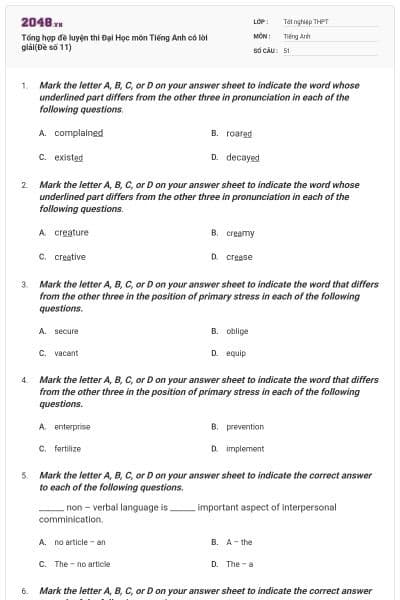
Tổng hợp đề luyện thi Đại Học môn Tiếng Anh có lời giải(Đề số 11)
51 câu hỏi
Mark the letter A, B, C, or D on your answer sheet to indicate the word whose underlined part differs from the other three in pronunciation in each of the following questions.
complained
roared
existed
decayed
Chọn C.
Đáp án C.
A. complained /kəmˈpleɪnd/
B. roared /rɔː(r)d/
C. existed /ɪɡˈzɪstɪd/
D. decayed /dɪˈkeɪd/
Đuôi “ed” ở đáp án C được phát âm là /ɪd/ còn trong đáp án A, B, D được phát âm là /d/.
Mark the letter A, B, C, or D on your answer sheet to indicate the word whose underlined part differs from the other three in pronunciation in each of the following questions.
creature
creamy
creative
crease
Chọn C.
Đáp án C.
A. creature /ˈkriːtʃə(r)/
B. creamy /ˈkriːmi/
C. creative /kriˈeɪtɪv/
D. crease /kriːs/
Phần gach chân ở đáp án C đươc phát âm là /i/ còn trong đáp án A, B, D được phát âm là /i:/.
Mark the letter A, B, C, or D on your answer sheet to indicate the word that differs from the other three in the position of primary stress in each of the following questions.
secure
oblige
vacant
equip
Chọn C.
Đáp án C.
A. secure /sɪˈkjʊə(r)/
B. oblige /əˈblaɪdʒ/
C. vacant /ˈveɪkənt/
D. equip /ɪˈkwɪp/
Đáp án A, B, D có trọng âm rơi vào âm tiết thứ 2. Đáp án C lại có trọng âm rơi vào âm tiết thứ nhất.
Mark the letter A, B, C, or D on your answer sheet to indicate the word that differs from the other three in the position of primary stress in each of the following questions.
enterprise
prevention
fertilize
implement
Chọn B.
Đáp án B.
A. enterprise /ˈentəpraɪz/
B. prevention /prɪˈvenʃn/
C. fertilize /ˈfɜːtəlaɪz/
D. implement /ˈɪmplɪment/
Đáp án A, C, D có trọng âm rơi vào âm tiết thứ nhất. Đáp án B lại có trọng âm rơi vào âm tiết thứ 2.
Mark the letter A, B, C, or D on your answer sheet to indicate the correct answer to each of the following questions.
______ non – verbal language is ______ important aspect of interpersonal comminication.
no article – an
A – the
The – no article
The – a
Chọn A.
Đáp án A.
- Với “non-verbal language” không có mạo từ vì đây là một tập hợp rộng lớn, duy nhất, không dùng mạo từ.
- Với “important aspect” dùng mạo từ không xác định vì đây là một danh từ chung bổ nghĩa cho chủ ngữ.
Dịch: Ngôn ngữ phi ngôn từ là một lĩnh vực quan trọng trong giao tiếp giữa cá nhân.
Mark the letter A, B, C, or D on your answer sheet to indicate the correct answer to each of the following questions.
If it ____ for the heavy storm, the accident would not have happened.
weren’t
hadn’t been
isn’t
were
Chọn B.
Đáp án B.
Câu điều kiện loại 3 diễn đạt một điều kiện không thể xảy ra ở quá khứ.
If + S + had PII, S + would have PII.
Dịch: Nếu không có trận bão khủng khiếp thì tai nạn đã không xảy ra.
Mark the letter A, B, C, or D on your answer sheet to indicate the correct answer to each of the following questions.
David __________ his hands. He just __________ the TV set.
is washing – has just repaired
washes – repairs
have washed – repaired
will wash – repaired
Chọn A.
Đáp án A.
Câu ý nói một hành động đang xảy ra do có một hành động trước tác động.
Dịch: David đang rửa tay. Anh ấy vừa sửa ti vi.

Học thông minh hơn mỗi ngày
Xem toàn bộ 51 câu hỏi và nhiều hơn nữa với tài khoản miễn phí
Mark the letter A, B, C, or D on your answer sheet to indicate the correct answer to each of the following questions.
We were expecting beautiful weather at the beach, but it was so cold and rainy that, __________ getting a suntan, I caught a cold.
compared to
just as
in case of
instead of
Chọn D.
Đáp án D.
Xét 4 đáp án ta có:
A. compared to: được so với
B. just as: đúng ngay lúc
C. in case of: trong trường hợp
D. instead of: thay vì
Xét về nghĩa thì đáp án D là đúng.
Dịch: Chúng tôi đang mong đợi thời tiết đẹp ở bãi biển, nhưng thay vì trời nắng, trời quá lạnh và mưa đến nỗi tôi bị cảm lạnh.
Mark the letter A, B, C, or D on your answer sheet to indicate the correct answer to each of the following questions.
She never says anything good about me. She is forever running me _________
over
down
out
off
Chọn B.
Đáp án B.
Ta có: run sb down: phê bình, chỉ trích ai
Các đáp án còn lại:
A. run over: đâm ai (bằng xe ô tô)
C. run sb out: làm (cầu thủ) dừng chơi
D. run off with sb: ngoại tình với ai
Trong các đáp án chỉ có đáp án đúng là B.
Dịch: Cô ấy chẳng bao giờ nói tốt về tôi cả. Cô ta suốt ngày chỉ trích tôi.
Mark the letter A, B, C, or D on your answer sheet to indicate the correct answer to each of the following questions.
The more you talk about the matter, _____________.
the situation seems the worse
the situation seem worse
the worse seems the situation
the worse the situation seems
Chọn D.
Đáp án D. the worse the situation seems
Cấu trúc so sánh “càng … càng…”: The + comparision + S + V, the + comparision + S + V.
Dịch: Các bạn càng nói nhiều về vấn đề này nó càng trở nên tệ hơn
Mark the letter A, B, C, or D on your answer sheet to indicate the correct answer to each of the following questions.
All commuters __________ the main highway to get to the center of the city will face delays of up to an hour today because of on-going construction.
use
used
using
will use
Chọn C.
Đáp án C.
Ta thấy có: Chủ từ “All commuters” đi với động từ chính “(will) face”
Câu đã đầy đủ thành phần, vị trí cần điền cần một động từ đang ở dạng rút gọn của mệnh đề quan hệ, dựa vào chủ từ “all commuters” để nhận biết đây là dạng rút gọn mệnh đề quan hệ thể chủ động. Do đó, đáp án C là đáp án thích hợp.
Khi chưa được rút gọn, câu sẽ được viết thành “All commuters who use/are using the main highway to get to the center of the city will face delays of up to an hour today because of on-going construction”
Dịch: Tất cả những người đi làm qua đường cao tốc để tới trung tâm thành phố sẽ bị chậm 1 tiếng ngày hôm nay bởi vì công việc xây dựng đang được tiến hành.
Mark the letter A, B, C, or D on your answer sheet to indicate the correct answer to each of the following questions.
I’m considering ____________ home now.
go
to go
going
about going
Chọn C.
Đáp án C.
Ta có: consider + V-ing: cân nhắc làm gì, tính làm gì
Dịch: Tôi đang tính đến chuyện về quê.
Mark the letter A, B, C, or D on your answer sheet to indicate the correct answer to each of the following questions.
Because of the_______ of hospital employees at the hospital, the head of administration began advertising job openings in the newspaper.
short
shorter
shorten
shortage
Chọn D.
Đáp án D.
Giải thích: Ta thấy sau mạo từ “the” là một danh từ.
Trong các đáp án chỉ có shortage. Vậy đáp án đúng là D.
Dịch: Bởi vì thiếu nhân viên y tế tại bệnh viện (này), trưởng khoa đã bắt đầu quảng cáo về việc tuyển người trên báo.
Mark the letter A, B, C, or D on your answer sheet to indicate the correct answer to each of the following questions.
In making remarks, he ____________to understatement.
declined
intended
aligned
inclined
Chọn D.
Đáp án D.
Xét 4 đáp án ta thấy:
A. declined sth: từ chối
B. intended to do sth: dự định
C. aligned: căn chỉnh
D. inclined to/toward sth: có khuynh hướng
Vậy đáp án đúng là D.
Dịch: Khi đưa ra lời nhận xét, anh ấy có khuyên hướng nói giảm đi.
Mark the letter A, B, C, or D on your answer sheet to indicate the correct answer to each of the following questions.
We are going to have a trip to Hanoi. We need to___________ arrangements for the trip carefully.
do
make
get
pay
Chọn B.
Đáp án B.
Ta có: make arrangements (collocation): sắp xếp
Dịch: Chúng ta sẽ có 1 chuyến ra Hà Nội. Chúng ta cần xắp xếp chuyến đi thật cẩn thận
Mark the letter A, B, C, or D on your answer sheet to indicate the correct answer to each of the following questions.
If you want your children to play football well, you need to find a good ____.
supervisor
teacher
coach
captain
Chọn C.
Đáp án C.
Ta có:
A. supervisor: người giám sát, quản đốc
B. teacher: giáo viên (dạy văn hóa)
C. coach: huấn luyện viên (thể thao)
D. captain: đội trưởng (bóng đá)
=> Đáp án C đúng về nghĩa.
Dịch: Nếu anh muốn con anh chơi bóng đã giỏi thì anh cần timg một huấn luyện viên tốt.
Mark the letter A, B, C, or D on your answer sheet to indicate the correct answer to each of the following questions.
The village was ____ visible through the dense fog.
only
barely
mostly
hard
Chọn B.
Đáp án B.
A. only: duy chỉ
B. barely: chỉ đủ, vừa vặn
C. mostly: phần lớn, chủ yếu
D. hard: khó khăn, cần mẫn
=> đáp án B phù hợp
Dịch: Ngôi làng chỉ hiện lờ mờ trong màn sương mù dày đặc
Mark the letter A, B, C, or D on your answer sheet to indicate the correct answer to each of
the following questions.
If the factory closes, that will be a million dollars' worth of investment down the _______.
river
ocean
beach
drain.
Chọn D.
Ta có: down the drain (idm): đổ sông, đổ bể; mất công
Dịch: Nếu nhà máy đóng cửa thì khoản đầu tư trị giá hàng triệu đô la mất trắng (đổ sống đổ bể).
Mark the letter A, B, C, or D on your answer sheet to indicate the word(s) CLOSEST in meaning to the underlined word(s) in each of the following questions.
Though many scientific breakthroughs have resulted from mishaps it has taken brilliant thinkers to recognize their potential.
accidents
misunderstandings
incidentals
misfortunes
Chọn A.
Đáp án A.
Dịch: Mặc dù nhiều đột phá khoa học đã dẫn đến từ những rủi ro, nhưng các nhà tư tưởng lỗi lạc phải nhận ra tiềm năng của họ.
=> mishaps = accidents = rủi ro
Các đáp khác:
B. misunderstandings: hiểu lầm
C. incidentals: không quan trọng, tình cờ
D. misfortunes: bất hạnh
Mark the letter A, B, C, or D on your answer sheet to indicate the word(s) CLOSEST in meaning to the underlined word(s) in each of the following questions.
Let’s wait here for her; I’m sure she’ll turn up before long.
arrive
return
enter
visit
Chọn A.
Đáp án A.
Ta có: turn up = arrive : đến
Các đáp án khác:
B. return: quay về
C. enter: vào
D. visit: thăm
Mark the letter A, B, C, or D on your answer sheet to indicate the word(s) OPPOSITE in meaning to the underlined word(s) in each of the following questions.
Because Jack defaulted on his loan, the bank took him to court.
failed to pay
paid in full
had a bad personality
was paid much money
Chọn B.
Đáp án B.
Dịch: Vì Jack vỡ nợ trong khoản vay của mình, ngân hàng đã đưa anh ra tòa.
=> defaulted (vỡ nợ, phá sản) >< paid in full (thanh toán đầy đủ)
Các đáp án khác:
A. không thể trả nợ
C. tính xấu
D. trả rất nhiều tiền
Mark the letter A, B, C, or D on your answer sheet to indicate the word(s) OPPOSITE in meaning to the underlined word(s) in each of the following questions.
I think we have solved this problem once and for all.
forever
incompletely
temporarily
in the end
Chọn B.
Đáp án B.
Ta có: once and for all (ngay lập tức hoàn thành) >< incompletely (chưa hoàn thành)
Các đáp án khác:
A. forever: vĩnh viễn
C. temporarily: tạm thời
D. in the end: cuối cùng
Mark the letter A, B, C, or D on your answer sheet to indicate the option that best completes each of the following exchanges.
- Mai: “I don’t think I can do this.” – Nhung: “_____”
Oh, come on! Give it a try!
Yeah. It’s not easy.
No, I hope not.
Sure, no way!
Chọn A.
Đáp án A.
Dịch câu hỏi: - “Tôi nghĩ tôi không thể làm được điều này.”
Câu này hàm ý người thứ nhất nói chán nản, bi quan, không tự tin. Vì thế người thứ hai sẽ cần phải động viên người thứ nhất. Vì vậy cần tìm một đáp án thể hiện sự động viên của người thứ hai với người thứ nhất.
Xét 4 đáp án ta có:
A. Ồ, thôi nào. Hãy thử làm đi! -> Lời động viên.
B. Vâng. Điều đó không dễ. -> Lời nhận xét.
C. Không. Tôi hy vọng là không. -> Lời bày tỏ về hy vọng.
D. Chắc thế. Không đời nào. Lời diễn tả sự tin chắc một việc gì chắc chắn không xảy ra. (Không phù hợp để động viên.)
Vậy đáp án A là đúng nhất.
Dịch:
- “Tôi nghĩ tôi không thể làm được điều này.”
- “Ồ, thôi nào. Hãy thử làm đi!”
Mark the letter A, B, C, or D on your answer sheet to indicate the option that best completes each of the following exchanges.
- Jennifer: “I believe that supermarkets are much better than traditional markets.”
- Katherine: “_________. Each has its own features.”
I couldn’t agree with you more.
That’s completely true.
I disagree with you.
I can’t help thinking the same
Chọn C.
Đáp án C
Dịch câu hỏi - “Tôi không đồng ý với bạn. Mỗi cái đều có đặc trưng riêng của nó.”
Câu này hàm ý người thứ nhất đưa ra ý kiến thiên về các siêu thị lớn. Người thứ hai sẽ đưa ra ý kiến của mình tỏ ra không đồng tình với quan điểm người thứ nhất. Vì vậy cần tìm một đáp án thể hiện sự không đồng tình của người thứ hai với người thứ nhất.
Xét 4 đáp án ta có:
A. Tôi không thể đồng ý thêm được nữa -> đồng ý
B. Điều đó hoàn toàn đúng -> Lời nhận xét đồng ý.
C. Tôi không đồng ý. -> Lời bày tỏ về sự không đồng tình.
D. Tôi không thể dừng suy nghĩ về vấn đề này-> đồng ý
Vậy đáp án C là đúng nhất.
Dịch:
- “Tôi nghĩ rằng các siêu thị tốt hơn nhiều so với chợ truyền thống”
- “Tôi không đồng ý với bạn. Mỗi cái đều có đặc trưng riêng của nó.”
Read the following passage and mark the letter A, B, C, or D on your answer sheet to indicate the correct word or phrase that best fits each of the numbered blanks from 25 to 29. Fill in the appropriate word in question 25
Finding Beauty in the City
Cities are known to have lives of their own, and photographers are able to (25) _____ some of it. Whether taking shots of people walking on a crowded street or time-lapse shots of cars driving at night, the (26) ______ photos can be breathtaking. Because many of the shots taken are of man-made objects like architecture, many emotions that come into (27) _____ wouldn’t be found in nature photography. Photos can show the wonder of a child staring at a fountain as water shoots upward in the sunlight. They can also show the sadder side, such as a camp of homeless people living in terrible poverty. (28)_____of what they show, there is always beauty to be found, even if it is beauty in something that is showing an ugly truth.
Depending on the time of the day, photos taken in an urban environment can change drastically. To see the (29) _______ of a building as its shadow is cast on the lawn of a park is always amazing to see.
capture
catch
sieze
see
Chọn A.
Đáp án A.
Ta có: capture photos: chụp được, lưu giữ được những hình ảnh
Dịch: Các nhiếp ảnh gia có thể lưu giữ hình ảnh về đời sống ở các thành phố.
Các đáp án còn lại không phù hợp.
Read the following passage and mark the letter A, B, C, or D on your answer sheet to indicate the correct word or phrase that best fits each of the numbered blanks from 25 to 29. Fill in the appropriate word in question 26
Finding Beauty in the City
Cities are known to have lives of their own, and photographers are able to (25) _____ some of it. Whether taking shots of people walking on a crowded street or time-lapse shots of cars driving at night, the (26) ______ photos can be breathtaking. Because many of the shots taken are of man-made objects like architecture, many emotions that come into (27) _____ wouldn’t be found in nature photography. Photos can show the wonder of a child staring at a fountain as water shoots upward in the sunlight. They can also show the sadder side, such as a camp of homeless people living in terrible poverty. (28)_____of what they show, there is always beauty to be found, even if it is beauty in something that is showing an ugly truth.
Depending on the time of the day, photos taken in an urban environment can change drastically. To see the (29) _______ of a building as its shadow is cast on the lawn of a park is always amazing to see.
causing
mentioning
involving
resulting
Chọn D.
Đáp án D.
Ta có: resulting photos: những bức ảnh chụp được.
Các đáp án còn lại không phù hợp về nghĩa.
Dịch: Cho dù chụp ảnh những người đi bộ trên đường phố đông đúc hay những bức ảnh thời gian trôi qua của những chiếc xe đang lái xe vào ban đêm, những bức ảnh thu được có thể rất ngoạn mục.
Read the following passage and mark the letter A, B, C, or D on your answer sheet to indicate the correct word or phrase that best fits each of the numbered blanks from 25 to 29. Fill in the appropriate word in question 27
Finding Beauty in the City
Cities are known to have lives of their own, and photographers are able to (25) _____ some of it. Whether taking shots of people walking on a crowded street or time-lapse shots of cars driving at night, the (26) ______ photos can be breathtaking. Because many of the shots taken are of man-made objects like architecture, many emotions that come into (27) _____ wouldn’t be found in nature photography. Photos can show the wonder of a child staring at a fountain as water shoots upward in the sunlight. They can also show the sadder side, such as a camp of homeless people living in terrible poverty. (28)_____of what they show, there is always beauty to be found, even if it is beauty in something that is showing an ugly truth.
Depending on the time of the day, photos taken in an urban environment can change drastically. To see the (29) _______ of a building as its shadow is cast on the lawn of a park is always amazing to see.
practice
action
play
work
Chọn C.
Đáp án C.
Ta có: come into play: có hiệu quả, có tác dụng, có ảnh hưởng
Dịch: Bởi vì nhiều bức ảnh được chụp là của các vật thể nhân tạo như kiến trúc, nhiều cảm xúc có ảnh hưởng sẽ không được tìm thấy trong nhiếp ảnh thiên nhiên.
Read the following passage and mark the letter A, B, C, or D on your answer sheet to indicate the correct word or phrase that best fits each of the numbered blanks from 25 to 29. Fill in the appropriate word in question 28
Finding Beauty in the City
Cities are known to have lives of their own, and photographers are able to (25) _____ some of it. Whether taking shots of people walking on a crowded street or time-lapse shots of cars driving at night, the (26) ______ photos can be breathtaking. Because many of the shots taken are of man-made objects like architecture, many emotions that come into (27) _____ wouldn’t be found in nature photography. Photos can show the wonder of a child staring at a fountain as water shoots upward in the sunlight. They can also show the sadder side, such as a camp of homeless people living in terrible poverty. (28)_____of what they show, there is always beauty to be found, even if it is beauty in something that is showing an ugly truth.
Depending on the time of the day, photos taken in an urban environment can change drastically. To see the (29) _______ of a building as its shadow is cast on the lawn of a park is always amazing to see.
Regardless
Due to
Without
Unaware
Chọn A.
Đáp án A.
Ta có: regardless of sth: bất chấp, không kể đến, không quan tâm đến điều gì.
Các đáp án còn lại không đi với “of”:
B. Due to: do
C. Without: không có
D. Unaware: tình cờ
Dịch: Bất kể những gì họ thể hiện, luôn có vẻ đẹp được tìm thấy, ngay cả khi đó là vẻ đẹp trong một thứ gì đó đang cho thấy một sự thật xấu xí.
Read the following passage and mark the letter A, B, C, or D on your answer sheet to indicate the correct word or phrase that best fits each of the numbered blanks from 25 to 29. Fill in the appropriate word in question 29
Finding Beauty in the City
Cities are known to have lives of their own, and photographers are able to (25) _____ some of it. Whether taking shots of people walking on a crowded street or time-lapse shots of cars driving at night, the (26) ______ photos can be breathtaking. Because many of the shots taken are of man-made objects like architecture, many emotions that come into (27) _____ wouldn’t be found in nature photography. Photos can show the wonder of a child staring at a fountain as water shoots upward in the sunlight. They can also show the sadder side, such as a camp of homeless people living in terrible poverty. (28)_____of what they show, there is always beauty to be found, even if it is beauty in something that is showing an ugly truth.
Depending on the time of the day, photos taken in an urban environment can change drastically. To see the (29) _______ of a building as its shadow is cast on the lawn of a park is always amazing to see.
edge
outline
line
description
Chọn B.
Ta có: outline (n): đường nét, hình dáng;
the outline of a building: hình bóng của một tòa nhà.
Các đáp án khác:
A. edge: cạnh, mép, bờ
C. line: đường nét, đường kẻ
D. description: sự mô tả
Read the following passage and mark the letter A, B, C, or D on your answer sheet to indicate the correct answer to each of the questions.
What Do You Think?
We have all had bad experiences with restaurants, stores, or hotels. Maybe you have gone to a restaurant that served terrible food. Perhaps you have gone to a store that had high prices or bad service. Or maybe you have booked a hotel and found out later that the room was nothing like the advertisement.
These days, we have a better chance of preventing these unpleasant surprises. We can do this by using apps. “App” is short for “application”. An app is a computer programme on a smartphone. You can use apps to do almost anything. Apps can help you play games, get directions, talk to friends, and so on.
If f you want to find information about a store or a hotel, you can use a review app. Review apps help us evaluate services and products before we hand over our money. The idea is very simple. After you go to a restaurant or stay in a hotel, you can post a review with one of your apps. You can say anything you want. If you like a hotel you stayed in, you can tell people that it was wonderful. If you think that the food in a certain restaurant was bad, then you tell people not to eat there. Other people can use their apps to read your reviews.
Plenty of people prefer not to use these review apps. Many of these people prefer to go out and decide for themselves whether or not a service is good. However, review apps are getting more and more popular every day. Some apps are for specific services. For example, Tripadvisor focuses on travel, and Goodreads focuses on books. There are also other, larger apps that provide information for just about every service that you can think of. 5
Which of the following would be another good title for the passage?
Wasteful Apps
Complaints from Customers
Customer Services
Conveniences for Customers
Chọn C.
Đáp án C.
Dịch câu hỏi: Điều nào sau đây sẽ là một tiêu đề tốt cho đoạn văn?
A. Ứng dụng lãng phí
B. Khiếu nại của khách hàng
C. Dịch vụ khách hàng
D. Tiện ích cho khách hàng
Có thể thấy bài viết này nói về các dịch vụ dành cho khách hàng, do đó "Customer Services" là tiêu đề thay thế phù hợp nhất. Các đáp án còn lại không phù hợp.
Read the following passage and mark the letter A, B, C, or D on your answer sheet to indicate the correct answer to each of the questions.
What Do You Think?
We have all had bad experiences with restaurants, stores, or hotels. Maybe you have gone to a restaurant that served terrible food. Perhaps you have gone to a store that had high prices or bad service. Or maybe you have booked a hotel and found out later that the room was nothing like the advertisement.
These days, we have a better chance of preventing these unpleasant surprises. We can do this by using apps. “App” is short for “application”. An app is a computer programme on a smartphone. You can use apps to do almost anything. Apps can help you play games, get directions, talk to friends, and so on.
If f you want to find information about a store or a hotel, you can use a review app. Review apps help us evaluate services and products before we hand over our money. The idea is very simple. After you go to a restaurant or stay in a hotel, you can post a review with one of your apps. You can say anything you want. If you like a hotel you stayed in, you can tell people that it was wonderful. If you think that the food in a certain restaurant was bad, then you tell people not to eat there. Other people can use their apps to read your reviews.
Plenty of people prefer not to use these review apps. Many of these people prefer to go out and decide for themselves whether or not a service is good. However, review apps are getting more and more popular every day. Some apps are for specific services. For example, Tripadvisor focuses on travel, and Goodreads focuses on books. There are also other, larger apps that provide information for just about every service that you can think of.
The phrase “is short for” in paragraph 2 can best be replaced by ________.
stands for
supports
takes after
offers
Chọn A.
Đáp án A.
Ta có: to be short for = to stand for: là chữ viết tắt của một từ/cụm từ nào đó.
Các đáp án khác.
B. supports: ủng hộ
C. takes after: trông giống
D. offers: đem lại
Read the following passage and mark the letter A, B, C, or D on your answer sheet to indicate the correct answer to each of the questions.
What Do You Think?
We have all had bad experiences with restaurants, stores, or hotels. Maybe you have gone to a restaurant that served terrible food. Perhaps you have gone to a store that had high prices or bad service. Or maybe you have booked a hotel and found out later that the room was nothing like the advertisement.
These days, we have a better chance of preventing these unpleasant surprises. We can do this by using apps. “App” is short for “application”. An app is a computer programme on a smartphone. You can use apps to do almost anything. Apps can help you play games, get directions, talk to friends, and so on.
If f you want to find information about a store or a hotel, you can use a review app. Review apps help us evaluate services and products before we hand over our money. The idea is very simple. After you go to a restaurant or stay in a hotel, you can post a review with one of your apps. You can say anything you want. If you like a hotel you stayed in, you can tell people that it was wonderful. If you think that the food in a certain restaurant was bad, then you tell people not to eat there. Other people can use their apps to read your reviews.
Plenty of people prefer not to use these review apps. Many of these people prefer to go out and decide for themselves whether or not a service is good. However, review apps are getting more and more popular every day. Some apps are for specific services. For example, Tripadvisor focuses on travel, and Goodreads focuses on books. There are also other, larger apps that provide information for just about every service that you can think of.
If you want to book a hotel, how can a review app help you?
It can tell you about the hotel before you book it.
It can tell you how to use a smartphone.
It can tell you about other people who post reviews.
It can help you write better reviews.
Chọn A.
Thông tin ở đoạn 3: “Review apps help us evaluate services and products before we hand over our money.” (Các đánh giá ứng dụng giúp chúng ta đánh giá các dịch vụ và sản phẩm trước khi trả tiền). Nghĩa là đánh giá ứng dụng sẽ cho chúng ta biết khách sạn đó như thế nào trước khi đặt phòng.
Read the following passage and mark the letter A, B, C, or D on your answer sheet to indicate the correct answer to each of the questions.
What Do You Think?
We have all had bad experiences with restaurants, stores, or hotels. Maybe you have gone to a restaurant that served terrible food. Perhaps you have gone to a store that had high prices or bad service. Or maybe you have booked a hotel and found out later that the room was nothing like the advertisement.
These days, we have a better chance of preventing these unpleasant surprises. We can do this by using apps. “App” is short for “application”. An app is a computer programme on a smartphone. You can use apps to do almost anything. Apps can help you play games, get directions, talk to friends, and so on.
If f you want to find information about a store or a hotel, you can use a review app. Review apps help us evaluate services and products before we hand over our money. The idea is very simple. After you go to a restaurant or stay in a hotel, you can post a review with one of your apps. You can say anything you want. If you like a hotel you stayed in, you can tell people that it was wonderful. If you think that the food in a certain restaurant was bad, then you tell people not to eat there. Other people can use their apps to read your reviews.
Plenty of people prefer not to use these review apps. Many of these people prefer to go out and decide for themselves whether or not a service is good. However, review apps are getting more and more popular every day. Some apps are for specific services. For example, Tripadvisor focuses on travel, and Goodreads focuses on books. There are also other, larger apps that provide information for just about every service that you can think of.
The word “it” in paragraph 3 refers to ________.
A restaurant
A hotel
A review
An idea
Chọn B.
Thông tin: “If you like a hotel you stayed in, you can tell people that it was wonderful.” (Nếu bạn thích một khách sạn mà bạn đã từng ở đó thì bạn có thể nói cho mọi người biết nó tuyệt vời.”
=> It ở đây được dùng thay thế cho “a hotel” đã được nhắc đến ở vế trước của câu.
Read the following passage and mark the letter A, B, C, or D on your answer sheet to indicate the correct answer to each of the questions.
What Do You Think?
We have all had bad experiences with restaurants, stores, or hotels. Maybe you have gone to a restaurant that served terrible food. Perhaps you have gone to a store that had high prices or bad service. Or maybe you have booked a hotel and found out later that the room was nothing like the advertisement.
These days, we have a better chance of preventing these unpleasant surprises. We can do this by using apps. “App” is short for “application”. An app is a computer programme on a smartphone. You can use apps to do almost anything. Apps can help you play games, get directions, talk to friends, and so on.
If f you want to find information about a store or a hotel, you can use a review app. Review apps help us evaluate services and products before we hand over our money. The idea is very simple. After you go to a restaurant or stay in a hotel, you can post a review with one of your apps. You can say anything you want. If you like a hotel you stayed in, you can tell people that it was wonderful. If you think that the food in a certain restaurant was bad, then you tell people not to eat there. Other people can use their apps to read your reviews.
Plenty of people prefer not to use these review apps. Many of these people prefer to go out and decide for themselves whether or not a service is good. However, review apps are getting more and more popular every day. Some apps are for specific services. For example, Tripadvisor focuses on travel, and Goodreads focuses on books. There are also other, larger apps that provide information for just about every service that you can think of.
The word “it” in paragraph 3 refers to ________.
A restaurant
A hotel
A review
An idea
Chọn B.
Thông tin: “If you like a hotel you stayed in, you can tell people that it was wonderful.” (Nếu bạn thích một khách sạn mà bạn đã từng ở đó thì bạn có thể nói cho mọi người biết nó tuyệt vời.”
=> It ở đây được dùng thay thế cho “a hotel” đã được nhắc đến ở vế trước của câu.
Read the following passage and mark the letter A, B, C, or D on your answer sheet to indicate the correct answer to each of the questions.
What Do You Think?
We have all had bad experiences with restaurants, stores, or hotels. Maybe you have gone to a restaurant that served terrible food. Perhaps you have gone to a store that had high prices or bad service. Or maybe you have booked a hotel and found out later that the room was nothing like the advertisement.
These days, we have a better chance of preventing these unpleasant surprises. We can do this by using apps. “App” is short for “application”. An app is a computer programme on a smartphone. You can use apps to do almost anything. Apps can help you play games, get directions, talk to friends, and so on.
If f you want to find information about a store or a hotel, you can use a review app. Review apps help us evaluate services and products before we hand over our money. The idea is very simple. After you go to a restaurant or stay in a hotel, you can post a review with one of your apps. You can say anything you want. If you like a hotel you stayed in, you can tell people that it was wonderful. If you think that the food in a certain restaurant was bad, then you tell people not to eat there. Other people can use their apps to read your reviews.
Plenty of people prefer not to use these review apps. Many of these people prefer to go out and decide for themselves whether or not a service is good. However, review apps are getting more and more popular every day. Some apps are for specific services. For example, Tripadvisor focuses on travel, and Goodreads focuses on books. There are also other, larger apps that provide information for just about every service that you can think of.
According to the passage, why do some people prefer NOT to use review apps?
They don't trust review apps.
They don't know how to use review apps.
They think review app are too hard.
They prefer to make their own decisions.
Chọn D.
Thông tin ở đoạn cuối: “Many of these people prefer to go out and decide for themselves whether or not a service is good.” (Nhiều người trong số họ thích việc ra ngoài và tự mình quyết định xem dịch vụ đó có tốt hay không hơn).
Read the following passage and mark the letter A, B, C, or D on your answer sheet to indicate the correct answer to each of the following questions.
Culture is a word in common use with complex meanings, and is derived, like the term broadcasting, from the treatment and care of the soil and of what grows on it. It is directly related to cultivation and the adjectives cultural and cultured are part of the same verbal complex. A person of culture has identifiable attributes, among them a knowledge of and interest in the arts, literature, and music. Yet the word culture does not refer solely to such knowledge and interest nor, indeed, to education. At least from the 19th century onwards, under the influence of anthropologists and sociologists, the word culture has come to be used generally both in the singular and the plural (cultures) to refer to a whole way of life of people, including their customs, laws, conventions, and values.
Distinctions have consequently been drawn between primitive and advanced culture and cultures, between elite and popular culture, between popular and mass culture, and most recently between national and global cultures. Distinctions have been drawn too between culture and civilization; the latter is a word derived not, like culture or agriculture, from the soil, but from the city. The two words are sometimes treated as synonymous. Yet this is misleading. While civilization and barbarism are pitted against each other in what seems to be a perpetual behavioural pattern, the use of the word culture has been strongly influenced by 6 conceptions of evolution in the 19th century and of development in the 20th century. Cultures evolve or develop. They are not static. They have twists and turns. Styles change. So do fashions. There are cultural processes. What, for example, the word cultured means has changed substantially since the study of classical (that is, Greek and Roman) literature, philosophy, and history ceased in the 20th century to be central to school and university education. No single alternative focus emerged, although with computers has come electronic culture, affecting kinds of study, and most recently digital culture. As cultures express themselves in new forms not everything gets better or more civilized.
The multiplicity of meanings attached to the word made and will make it difficult to define. There is no single, unproblematic definition, although many attempts have been made to establish one. The only nonproblematic definitions go back to agricultural meaning (for example, cereal culture or strawberry culture) and medical meaning (for example, bacterial culture or penicillin culture). Since in anthropology and sociology we also acknowledge culture clashes, culture shock, and counter-culture, the range of reference is extremely wide.
It is stated in paragraph 1 that a cultured person_____.
has a job related to cultivation
does a job relevant to education
takes care of the soil and what grows on it
has knowledge of arts, literature, and music
Chọn D.
Đáp án D.
Dịch câu hỏi: Đoạn 1 nêu rằng một người có văn hóa ___.
A. có một công việc liên quan đến trồng trọt => sai
B. làm một công việc liên quan đến giáo dục => không được đề cập
C. chăm sóc đất và những gì mọc trên đó => sai (đây là định nghĩa của culture)
D. có kiến thức về nghệ thuật, văn học và âm nhạc => đúng
Thông tin ở đoạn 1: “ A person of culture has identifiable attributes, among them a knowledge of and interest in the arts, literature, and music.”
Read the following passage and mark the letter A, B, C, or D on your answer sheet to indicate the correct answer to each of the following questions.
Culture is a word in common use with complex meanings, and is derived, like the term broadcasting, from the treatment and care of the soil and of what grows on it. It is directly related to cultivation and the adjectives cultural and cultured are part of the same verbal complex. A person of culture has identifiable attributes, among them a knowledge of and interest in the arts, literature, and music. Yet the word culture does not refer solely to such knowledge and interest nor, indeed, to education. At least from the 19th century onwards, under the influence of anthropologists and sociologists, the word culture has come to be used generally both in the singular and the plural (cultures) to refer to a whole way of life of people, including their customs, laws, conventions, and values.
Distinctions have consequently been drawn between primitive and advanced culture and cultures, between elite and popular culture, between popular and mass culture, and most recently between national and global cultures. Distinctions have been drawn too between culture and civilization; the latter is a word derived not, like culture or agriculture, from the soil, but from the city. The two words are sometimes treated as synonymous. Yet this is misleading. While civilization and barbarism are pitted against each other in what seems to be a perpetual behavioural pattern, the use of the word culture has been strongly influenced by 6 conceptions of evolution in the 19th century and of development in the 20th century. Cultures evolve or develop. They are not static. They have twists and turns. Styles change. So do fashions. There are cultural processes. What, for example, the word cultured means has changed substantially since the study of classical (that is, Greek and Roman) literature, philosophy, and history ceased in the 20th century to be central to school and university education. No single alternative focus emerged, although with computers has come electronic culture, affecting kinds of study, and most recently digital culture. As cultures express themselves in new forms not everything gets better or more civilized.
The multiplicity of meanings attached to the word made and will make it difficult to define. There is no single, unproblematic definition, although many attempts have been made to establish one. The only nonproblematic definitions go back to agricultural meaning (for example, cereal culture or strawberry culture) and medical meaning (for example, bacterial culture or penicillin culture). Since in anthropology and sociology we also acknowledge culture clashes, culture shock, and counter-culture, the range of reference is extremely wide.
The word “It” in paragraph 1 refers to ______.
culture
the treatment and care
the soil
broadcasing
Chọn A.
Dịch câu hỏi: Từ “It” trong đoạn 1 đề cập đến ____.
Thông tin: “Culture is a word in common use with complex meanings, and is derived, like the term broadcasting, from the treatment and care of the soil and of what grows on it. It is directly related to cultivation and the adjectives cultural andcultured are ...”
(Văn hoá là một từ dùng phổ biến với những ý nghĩa phức tạp, và được bắt nguồn, giống như thuật ngữ broadcasting(phát sóng), từ việc canh tác và chăm sóc đất và những gì trồng trên đất. Nó liên quan trực tiếp đến canh tác và tính từcultural and cultured là ...)
Read the following passage and mark the letter A, B, C, or D on your answer sheet to indicate the correct answer to each of the following questions.
Culture is a word in common use with complex meanings, and is derived, like the term broadcasting, from the treatment and care of the soil and of what grows on it. It is directly related to cultivation and the adjectives cultural and cultured are part of the same verbal complex. A person of culture has identifiable attributes, among them a knowledge of and interest in the arts, literature, and music. Yet the word culture does not refer solely to such knowledge and interest nor, indeed, to education. At least from the 19th century onwards, under the influence of anthropologists and sociologists, the word culture has come to be used generally both in the singular and the plural (cultures) to refer to a whole way of life of people, including their customs, laws, conventions, and values.
Distinctions have consequently been drawn between primitive and advanced culture and cultures, between elite and popular culture, between popular and mass culture, and most recently between national and global cultures. Distinctions have been drawn too between culture and civilization; the latter is a word derived not, like culture or agriculture, from the soil, but from the city. The two words are sometimes treated as synonymous. Yet this is misleading. While civilization and barbarism are pitted against each other in what seems to be a perpetual behavioural pattern, the use of the word culture has been strongly influenced by 6 conceptions of evolution in the 19th century and of development in the 20th century. Cultures evolve or develop. They are not static. They have twists and turns. Styles change. So do fashions. There are cultural processes. What, for example, the word cultured means has changed substantially since the study of classical (that is, Greek and Roman) literature, philosophy, and history ceased in the 20th century to be central to school and university education. No single alternative focus emerged, although with computers has come electronic culture, affecting kinds of study, and most recently digital culture. As cultures express themselves in new forms not everything gets better or more civilized.
The multiplicity of meanings attached to the word made and will make it difficult to define. There is no single, unproblematic definition, although many attempts have been made to establish one. The only nonproblematic definitions go back to agricultural meaning (for example, cereal culture or strawberry culture) and medical meaning (for example, bacterial culture or penicillin culture). Since in anthropology and sociology we also acknowledge culture clashes, culture shock, and counter-culture, the range of reference is extremely wide.
The word “attributes” in paragraph 1 most likely means______.
fields
qualities
skills
aspects
Chọn B.
Đáp án B.
Dịch câu hỏi: Từ “attributes” ở đoạn 1 có nghĩa gần với ______.
A. fields: lĩnh vực
B. qualities: đặc tính
C. skills: kĩ năng (của thực hành)
D. aspects: khía cạnh của 1 sự việc
=> attributes (thuộc tính) ~ qualities
Read the following passage and mark the letter A, B, C, or D on your answer sheet to indicate the correct answer to each of the following questions.
Culture is a word in common use with complex meanings, and is derived, like the term broadcasting, from the treatment and care of the soil and of what grows on it. It is directly related to cultivation and the adjectives cultural and cultured are part of the same verbal complex. A person of culture has identifiable attributes, among them a knowledge of and interest in the arts, literature, and music. Yet the word culture does not refer solely to such knowledge and interest nor, indeed, to education. At least from the 19th century onwards, under the influence of anthropologists and sociologists, the word culture has come to be used generally both in the singular and the plural (cultures) to refer to a whole way of life of people, including their customs, laws, conventions, and values.
Distinctions have consequently been drawn between primitive and advanced culture and cultures, between elite and popular culture, between popular and mass culture, and most recently between national and global cultures. Distinctions have been drawn too between culture and civilization; the latter is a word derived not, like culture or agriculture, from the soil, but from the city. The two words are sometimes treated as synonymous. Yet this is misleading. While civilization and barbarism are pitted against each other in what seems to be a perpetual behavioural pattern, the use of the word culture has been strongly influenced by 6 conceptions of evolution in the 19th century and of development in the 20th century. Cultures evolve or develop. They are not static. They have twists and turns. Styles change. So do fashions. There are cultural processes. What, for example, the word cultured means has changed substantially since the study of classical (that is, Greek and Roman) literature, philosophy, and history ceased in the 20th century to be central to school and university education. No single alternative focus emerged, although with computers has come electronic culture, affecting kinds of study, and most recently digital culture. As cultures express themselves in new forms not everything gets better or more civilized.
The multiplicity of meanings attached to the word made and will make it difficult to define. There is no single, unproblematic definition, although many attempts have been made to establish one. The only nonproblematic definitions go back to agricultural meaning (for example, cereal culture or strawberry culture) and medical meaning (for example, bacterial culture or penicillin culture). Since in anthropology and sociology we also acknowledge culture clashes, culture shock, and counter-culture, the range of reference is extremely wide.
The author remarks that culture and civilization are the two words that_____.
are both related to agriculture and cultivation
share the same word formation pattern
do not develop from the same meaning
have nearly the same meaning
Chọn C.
Đáp án C.
Dịch câu hỏi: Tác giả nhận xét rằng culture và civilization là hai từ ____.
A. đều liên quan đến nông nghiệp và trồng trọt => sai
B. chia sẻ cùng một mô hình hình thành từ => không được đề cập
C. không phát triển từ cùng một nghĩa => đúng
D. có nghĩa gần giống nhau
Thông tin: “Distinctions have been drawn too between cultureand civilization; the latter is a word derived not, like culture or agriculture, from the soil, but from the city.” (Người ta đã rút ra sự phân biệt giữa culture và civilization; từ thứ hai không như từ culture hoặc agriculture bắt nguồn từ đất trồng, mà bắt nguồn từ thành thị.) có ngữ nghĩa gần giống nhau => sai
Read the following passage and mark the letter A, B, C, or D on your answer sheet to indicate the correct answer to each of the following questions.
Culture is a word in common use with complex meanings, and is derived, like the term broadcasting, from the treatment and care of the soil and of what grows on it. It is directly related to cultivation and the adjectives cultural and cultured are part of the same verbal complex. A person of culture has identifiable attributes, among them a knowledge of and interest in the arts, literature, and music. Yet the word culture does not refer solely to such knowledge and interest nor, indeed, to education. At least from the 19th century onwards, under the influence of anthropologists and sociologists, the word culture has come to be used generally both in the singular and the plural (cultures) to refer to a whole way of life of people, including their customs, laws, conventions, and values.
Distinctions have consequently been drawn between primitive and advanced culture and cultures, between elite and popular culture, between popular and mass culture, and most recently between national and global cultures. Distinctions have been drawn too between culture and civilization; the latter is a word derived not, like culture or agriculture, from the soil, but from the city. The two words are sometimes treated as synonymous. Yet this is misleading. While civilization and barbarism are pitted against each other in what seems to be a perpetual behavioural pattern, the use of the word culture has been strongly influenced by 6 conceptions of evolution in the 19th century and of development in the 20th century. Cultures evolve or develop. They are not static. They have twists and turns. Styles change. So do fashions. There are cultural processes. What, for example, the word cultured means has changed substantially since the study of classical (that is, Greek and Roman) literature, philosophy, and history ceased in the 20th century to be central to school and university education. No single alternative focus emerged, although with computers has come electronic culture, affecting kinds of study, and most recently digital culture. As cultures express themselves in new forms not everything gets better or more civilized.
The multiplicity of meanings attached to the word made and will make it difficult to define. There is no single, unproblematic definition, although many attempts have been made to establish one. The only nonproblematic definitions go back to agricultural meaning (for example, cereal culture or strawberry culture) and medical meaning (for example, bacterial culture or penicillin culture). Since in anthropology and sociology we also acknowledge culture clashes, culture shock, and counter-culture, the range of reference is extremely wide.
It can be inferred from the passage that since the 20th century______.
classical literature, philosophy, and history have not been taught as core subjects
classical literature, philosophy, and history have been considered as core subjects
schools and universities have not taught classical literature, philosophy, and history
all schools and universities have taught classical literature, philosophy, and history
Chọn A.
Đáp án A.
Dịch câu hỏi: Điều gì có thể được suy ra từ đoạn văn kể từ thế kỷ 20 ___.
A. văn học cổ điển, triết học và lịch sử không còn là môn học bắt buộc
B. văn học cổ điển, triết học và lịch sử đã được xem là môn chính
C. các trường phổ thông và đại học không dạy văn học cổ điển, triết học và lịch sử
D. tất cả các trường phổ thông và đại học đều dạy văn học cổ điển, triết học và lịch sử
Thông tin ở đoạn 2: “...the study of classical (that is, Greek and Roman) literature, philosophy, and history ceased in the 20th century to be central to school and university education.”
(... việc học tập văn học cổ điển, triết học và lịch sử đã không còn là chính yếu trong trong giáo dục phổ thông và đại học trong thế kỷ 20.)
=> Đáp án A.
Read the following passage and mark the letter A, B, C, or D on your answer sheet to indicate the correct answer to each of the following questions.
Culture is a word in common use with complex meanings, and is derived, like the term broadcasting, from the treatment and care of the soil and of what grows on it. It is directly related to cultivation and the adjectives cultural and cultured are part of the same verbal complex. A person of culture has identifiable attributes, among them a knowledge of and interest in the arts, literature, and music. Yet the word culture does not refer solely to such knowledge and interest nor, indeed, to education. At least from the 19th century onwards, under the influence of anthropologists and sociologists, the word culture has come to be used generally both in the singular and the plural (cultures) to refer to a whole way of life of people, including their customs, laws, conventions, and values.
Distinctions have consequently been drawn between primitive and advanced culture and cultures, between elite and popular culture, between popular and mass culture, and most recently between national and global cultures. Distinctions have been drawn too between culture and civilization; the latter is a word derived not, like culture or agriculture, from the soil, but from the city. The two words are sometimes treated as synonymous. Yet this is misleading. While civilization and barbarism are pitted against each other in what seems to be a perpetual behavioural pattern, the use of the word culture has been strongly influenced by 6 conceptions of evolution in the 19th century and of development in the 20th century. Cultures evolve or develop. They are not static. They have twists and turns. Styles change. So do fashions. There are cultural processes. What, for example, the word cultured means has changed substantially since the study of classical (that is, Greek and Roman) literature, philosophy, and history ceased in the 20th century to be central to school and university education. No single alternative focus emerged, although with computers has come electronic culture, affecting kinds of study, and most recently digital culture. As cultures express themselves in new forms not everything gets better or more civilized.
The multiplicity of meanings attached to the word made and will make it difficult to define. There is no single, unproblematic definition, although many attempts have been made to establish one. The only nonproblematic definitions go back to agricultural meaning (for example, cereal culture or strawberry culture) and medical meaning (for example, bacterial culture or penicillin culture). Since in anthropology and sociology we also acknowledge culture clashes, culture shock, and counter-culture, the range of reference is extremely wide.
The word “static” in paragraph 2 could best be replaced by _____.
regular
unchanged
balanced
dense
Chọn B.
Đáp án B.
Dịch câu hỏi: Từ “static” ở đoạn 2 có thể được thay thế bởi _____.
A. regular: thường xuyên
B. unchanged: không thay đổi, như cũ
C. balanced: cân bằng
D. dense: dày đặc
Ta có: static: không thay đổi = unchanged
Dịch: Các nền văn hóa tiến triển hoặc phát triển. Chúng không như cũ.
Read the following passage and mark the letter A, B, C, or D on your answer sheet to indicate the correct answer to each of the following questions.
Culture is a word in common use with complex meanings, and is derived, like the term broadcasting, from the treatment and care of the soil and of what grows on it. It is directly related to cultivation and the adjectives cultural and cultured are part of the same verbal complex. A person of culture has identifiable attributes, among them a knowledge of and interest in the arts, literature, and music. Yet the word culture does not refer solely to such knowledge and interest nor, indeed, to education. At least from the 19th century onwards, under the influence of anthropologists and sociologists, the word culture has come to be used generally both in the singular and the plural (cultures) to refer to a whole way of life of people, including their customs, laws, conventions, and values.
Distinctions have consequently been drawn between primitive and advanced culture and cultures, between elite and popular culture, between popular and mass culture, and most recently between national and global cultures. Distinctions have been drawn too between culture and civilization; the latter is a word derived not, like culture or agriculture, from the soil, but from the city. The two words are sometimes treated as synonymous. Yet this is misleading. While civilization and barbarism are pitted against each other in what seems to be a perpetual behavioural pattern, the use of the word culture has been strongly influenced by 6 conceptions of evolution in the 19th century and of development in the 20th century. Cultures evolve or develop. They are not static. They have twists and turns. Styles change. So do fashions. There are cultural processes. What, for example, the word cultured means has changed substantially since the study of classical (that is, Greek and Roman) literature, philosophy, and history ceased in the 20th century to be central to school and university education. No single alternative focus emerged, although with computers has come electronic culture, affecting kinds of study, and most recently digital culture. As cultures express themselves in new forms not everything gets better or more civilized.
The multiplicity of meanings attached to the word made and will make it difficult to define. There is no single, unproblematic definition, although many attempts have been made to establish one. The only nonproblematic definitions go back to agricultural meaning (for example, cereal culture or strawberry culture) and medical meaning (for example, bacterial culture or penicillin culture). Since in anthropology and sociology we also acknowledge culture clashes, culture shock, and counter-culture, the range of reference is extremely wide.
Which of the following is NOT true about the word culture?
It is a word that cannot be defined.
Its use has been considerably changed.
It differs from the word civilization.
It evolves from agriculture.
Chọn A.
Giải thích: Câu trên làm rõ, nghĩa của từ “culture” trong lĩnh vực nông nghiệp và y học đã được làm rõ.
Đáp án A.
Dịch câu hỏi: Điều nào sau đây KHÔNG đúng về từ culture?
A. Đó là một từ không thể định nghĩa. => Ý này sai với thông tin trong bài
Thông tin ở đoạn 3: “The multiplicity of meanings attached to the word made and will make it difficult to define.” (Tính đa nghĩa của từ gắn liền với từ được tạo ra và sẽ gây khó khăn cho việc định nghĩa.)
B. Việc sử dụng từ này đã được thay đổi đáng kể. => Ý này đúng
Thông tin ở đoạn 2: “Cultures evolve or develop. They are not static.” (Các nền văn hóa tiến triển hoặc phát triển. Chúng không như cũ.)
C. Nó khác với từ civilization. => Ý này đúng.
Thông tin ở đoạn 2: “Distinctions have been drawn too between culture and civilization; the latter is a word derived not, like culture or agriculture, from the soil, but from the city.” (Người ta đã rút ra sự phân biệt giữa culture vàcivilization; từ thứ hai không như từ culture hoặc agriculturebắt nguồn từ đất trồng, mà bắt nguồn từ thành thị.)
D. Nó phát triển từ nông nghiệp. => Ý này đúng.
Thông tin ở đoạn 3: “The multiplicity of meanings attached to the word made and will make it difficult to define.” (Tính đa nghĩa của từ gắn liền với từ được tạo ra và sẽ gây khó khăn cho việc định nghĩa.)
Read the following passage and mark the letter A, B, C, or D on your answer sheet to indicate the correct answer to each of the following questions.
Culture is a word in common use with complex meanings, and is derived, like the term broadcasting, from the treatment and care of the soil and of what grows on it. It is directly related to cultivation and the adjectives cultural and cultured are part of the same verbal complex. A person of culture has identifiable attributes, among them a knowledge of and interest in the arts, literature, and music. Yet the word culture does not refer solely to such knowledge and interest nor, indeed, to education. At least from the 19th century onwards, under the influence of anthropologists and sociologists, the word culture has come to be used generally both in the singular and the plural (cultures) to refer to a whole way of life of people, including their customs, laws, conventions, and values.
Distinctions have consequently been drawn between primitive and advanced culture and cultures, between elite and popular culture, between popular and mass culture, and most recently between national and global cultures. Distinctions have been drawn too between culture and civilization; the latter is a word derived not, like culture or agriculture, from the soil, but from the city. The two words are sometimes treated as synonymous. Yet this is misleading. While civilization and barbarism are pitted against each other in what seems to be a perpetual behavioural pattern, the use of the word culture has been strongly influenced by 6 conceptions of evolution in the 19th century and of development in the 20th century. Cultures evolve or develop. They are not static. They have twists and turns. Styles change. So do fashions. There are cultural processes. What, for example, the word cultured means has changed substantially since the study of classical (that is, Greek and Roman) literature, philosophy, and history ceased in the 20th century to be central to school and university education. No single alternative focus emerged, although with computers has come electronic culture, affecting kinds of study, and most recently digital culture. As cultures express themselves in new forms not everything gets better or more civilized.
The multiplicity of meanings attached to the word made and will make it difficult to define. There is no single, unproblematic definition, although many attempts have been made to establish one. The only nonproblematic definitions go back to agricultural meaning (for example, cereal culture or strawberry culture) and medical meaning (for example, bacterial culture or penicillin culture). Since in anthropology and sociology we also acknowledge culture clashes, culture shock, and counter-culture, the range of reference is extremely wide.
The passage mainly discusses______.
the distinction between culture and civilization
the figurative meanings of the word culture
the derivatives of the word culture
the multiplicity of meanings of the word culture
Chọn D.
Đáp án D.
Dịch câu hỏi: Đoạn văn chủ yếu bàn luận về ________?
A. sự khác biệt giữa culture và civilization => chỉ được đề cập ở đoạn 2.
B. nghĩa ẩn dụ của từ culture => không phải chủ đề chính của đoạn
C. các từ phái sinh của từ culture => không phải chủ đề chính của đoạn
D. sự đa dạng nghĩa của từ culture => đáp án đúng
Mark the letter A, B, C, or D on your answer sheet to indicate the underlined part that needs correction in each of the following questions.
Susan decided to not do (A) her homework (B) and went (C) to a (D) night-club.
to not do
homework
went
a
Chọn A.
Đáp án A.
Ta có: decide + not + to-V: quyết định không làm gì
Vì vậy: to not do => not to do
Dịch: Susan đã quyết định không làm bài tập nữa mà đi đến một câu lạc bộ đêm
Mark the letter A, B, C, or D on your answer sheet to indicate the underlined part that needs correction in each of the following questions.
Of (A) all seashore plants, seaweeds are best (B) able to tolerate long periods out of water , followed by (C) long periods covering (D) by water.
Of
best
by
covering
Chọn D.
Đáp án D.
Ta thấy câu bị động “bao phủ bởi nước”
Vì vậy: covering-> covered
Dịch: Trong tất cả các loài thực vật bờ biển, rong biển có khả năng chịu đựng tốt nhất trong thời gian dài ra khỏi nước, sau thời gian dài bao phủ bởi nước.
Mark the letter A, B, C, or D on your answer sheet to indicate the underlined part that needs correction in each of the following questions.
Almost (A) of the trees (B) in this plantation have been (C) cut down and (D).
Almost
trees
have been
and
Chọn A.
Đáp án A.
Ta có: Almost +N-> hầu hết
Most of + V-> hầu hết
Do đó: Almost -> Most
Dịch: Hầu hết các cây trong đồn điền này đã bị đốn hạ và đốt cháy
Mark the letter A, B, C, or D on your answer sheet to indicate the sentence that is closest in meaning to each of the following questions.
I’ve never met any more dependable person than George.
George is more dependable person I’ve ever met.
George is as dependable as anyone.
George is the most dependable person I’ve ever met.
Someone is more dependable than George.
Chọn C.
Đáp án C.
Dịch câu: Tôi chưa bao giờ gặp bất cứ ai phụ thuộc hơn George.
= C. George là người phụ thuộc nhất mà tôi từng gặp.
Các đáp án khác:
Đáp án A. sai cấu trúc
Đáp án B, D. sai nghĩa
Mark the letter A, B, C, or D on your answer sheet to indicate the sentence that is closest in meaning to each of the following questions.
“That’s a lovely new dress, Jean,” said her mother.
Jean’s mother said she liked her dress
Jean’s mother complimented her on the new lovely dress
Jean’s mother wanted to buy a lovely new dress
Jean’s mother told her to buy that lovely new dress
Chọn B.
Đáp án đúng: B
Ta thấy đây là câu cảm thán- lời khen của mẹ cô ấy nói với chiếc váy của Jean -> B đúng
Các đáp án còn lại:
A. Mẹ của Jean thích chiếc váy của cô ấy
C. Mẹ của Jean muốn mua một cái váy mới
D. Mẹ của Jean bảo cô ta mua chiếc váy mới đó
Dịch: “Chiếc váy mới đó thật đáng yêu, Jean”. Mẹ cô ấy nói
->Mẹ của Jean đang khen chiếc váy mới của cô ấy
Mark the letter A, B, C, or D on your answer sheet to indicate the sentence that is closest in meaning to each of the following questions.
People believed he won a lot of money on the lottery.
He is believed that he won a lot of money on the lottery.
He won a lot of money on the lottery, it is believed.
He is believed to have won a lot of money on the lottery.
He was believed to win a lot of money on the lottery.
Chọn D.
Đáp án D.
Câu gốc: Mọi người tin rằng anh ta đã trúng rất nhiều tiền trong cuộc xổ số.
Các lựa chọn đều là câu bị động dạng đặc biệt.
A. Anh ta tin rằng anh ta đã trúng rất nhiều tiền trong cuộc xổ số. => sai thì
B. Anh ấy đã trúng rất nhiều tiền trong cuộc xổ số, người ta tin rằng. => sai cấu trúc câu
C. Anh ta được cho là đã trúng được rất nhiều tiền trên xổ số. = > sai thì
D. Anh ta được cho là đã trúng được nhiều tiền trong cuộc xổ số.
Mark the letter A, B, C, or D on your answer sheet to indicate the sentence that best combines each pair of sentences in the following question.
The room was in a mess. I hope you don’t leave your clothes all over the floor.
I wish you wouldn’t leave your clothes all over the floor.
I expect you to clean the floor.
I regret not leaving your clothes all over the floor.
I wish you hadn’t left your clothes all over the floor.
Chọn A.
Đáp án A.
Câu gốc: Căn phòng bừa bộn. Tôi hy vọng bạn không để quần áo trên sàn nhà.
= A. Tôi ước bạn sẽ không để quần áo trên sàn nhà.
Các đáp án khác:
B. Tôi mong bạn dọn sàn nhà. => sai nghĩa
C. Tôi rất tiếc không để quần áo của bạn trên sàn nhà. => sai nghĩa
D. Tôi ước bạn đã bỏ quần áo trên sàn nhà. => sai thì
Mark the letter A, B, C, or D on your answer sheet to indicate the sentence that best combines each pair of sentences in the following question.
It was only when I left home that I realized how much my family meant to me.
As soon as I left home, I found out what a family could do without.
Before I left home, I realized how much my family meant to me.
Not until I left home did I realize how much my family meant to me.
I left home and didn’t realize how meaningful my family was.
Chọn C.
Đáp án C.
Câu gốc: Chỉ khi tôi rời nhà tôi mới nhận ra gia đình tôi có ý nghĩa gì với tôi.
= C. Mãi đến khi đi khỏi nhà tôi mới biết gia đình có ý nghĩa như thế nào.
Ta dùng cấu trúc đảo ngữ với “Not until” để nhấn mạnh.
Các đáp án khác không phù hợp về nghĩa.
Bạn có thích hoạt động này không?
Ý kiến của bạn sẽ giúp chúng tôi đề xuất nội dung phù hợp hơn.
Gợi ý cho bạn
![[Năm 2022] Đề thi thử môn Vật lí THPT Quốc gia có lời giải - Đề số 21](/_next/image?url=https%3A%2F%2Fvideo.vietjack.com%2Fupload%2Fimages%2Fvj-image%2Fimage-3izficdefgfoel0s9j8s-1786772791.jpg&w=3840&q=75)
![[Năm 2022] Đề thi thử môn Vật lí THPT Quốc gia có lời giải - Đề số 20](/_next/image?url=https%3A%2F%2Fvideo.vietjack.com%2Fupload%2Fimages%2Fvj-image%2Fimage-emy0gtcksawvorajezvv-1786772460.jpg&w=3840&q=75)
Tài liệu phổ biến Tốt nghiệp THPT
Tài liệu phổ biến Tiếng Anh