Tổng hợp bộ đề thi thử THPTQG môn Tiếng Anh các năm Đề 23
50 câu hỏi
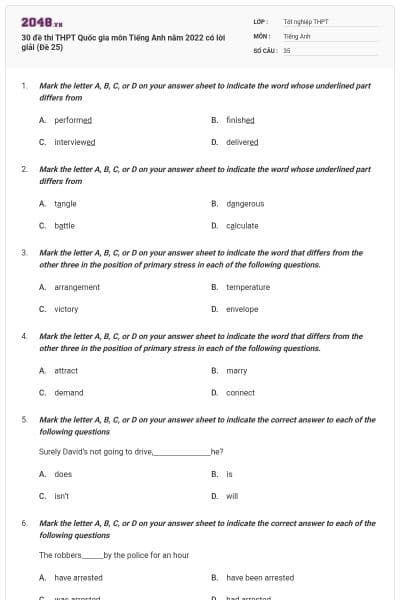
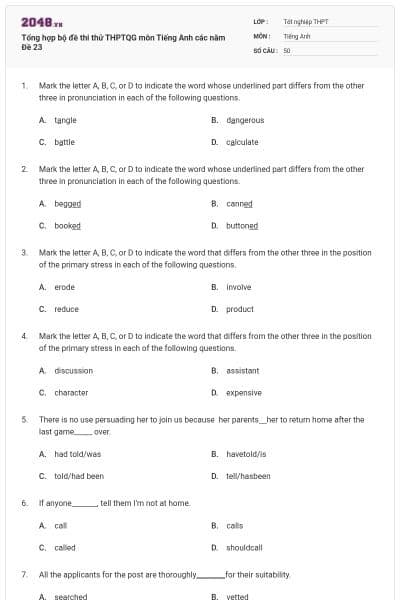
Mark the letter A, B, C, or D to indicate the word whose underlined part differs from the other three in pronunciation in each of the following questions.
tangle
dangerous
battle
calculate
Đáp án B
Kiến thức về phát âm của nguyên âm
tangle /ˈtæŋɡl/
dangerous /ˈdeɪndʒərəs/
battle /ˈbætl/
calculate /ˈkælkjuleɪt/
Mark the letter A, B, C, or D to indicate the word whose underlined part differs from the other three in pronunciation in each of the following questions.
begged
canned
booked
buttoned
Đáp án C
Kiến thức về phát âm của đuôi -ed
Đuôi /ed/ được phát âm là /t/: Khi động từ có phát âm kết thúc là /s/, /f/, /p/, /ʃ/, /tʃ/, /k/
Đuôi /ed/ được phát âm là /id/: Khi động từ có phát âm kết thúc là /t/ hay /d/
Đuôi /ed/ được phát âm là /d/ với những trường hợp còn lại
begged /beɡd/: cầu xin
canned /kænd/: đóng hộp
booked /bʊkt/: đặt vé
buttoned /ˈbʌtnd/: cài khuy
Mark the letter A, B, C, or D to indicate the word that differs from the other three in the position of the primary stress in each of the following questions.
erode
involve
reduce
product
Đáp án D
Kiến thức về trọng âm
erode /ɪˈroʊd/: từ này trọng âm rơi vào âm tiết thứ hai. Vì theo quy tắc các động từ có 2 âm tiết thì trọng âm rơi vào âm tiết thứ hai.
involve /ɪnˈvɒlv/: từ này trọng âm rơi vào âm tiết thứ hai. Vì theo quy tắc các động từ có 2 âm tiết thì trọng âm rơi vào âm tiết thứ hai.
reduce /rɪˈduːs/: từ này trọng âm rơi vào âm tiết thứ hai. Vì theo quy tắc các động từ có 2 âm tiết thì trọng âm rơi vào âm tiết thứ hai.
product /ˈprɒdʌkt/: từ này trọng âm rơi vào âm tiết thứ nhất. Vì theo quy tắc các danh từ có 2 âm tiết thì trọng âm rơi vào âm tiết thứ nhất.
=> Phương án D trọng âm rơi vào âm tiết thứ nhất, các phương án còn lại trọng âm rơi vào âm tiết thứ hai.
Mark the letter A, B, C, or D to indicate the word that differs from the other three in the position of the primary stress in each of the following questions.
discussion
assistant
character
expensive
Đáp án C.
Kiến thức về trọng âm
discussion /dɪˈskʌʃn/: từ này trọng âm rơi vào âm tiết thứ hai. Vì theo quy tắc các từ có hậu tố là -sion thì trọng âm rơi vào âm tiết liền trước.
assistant /əˈsɪstənt/: từ này trọng âm rơi vào âm tiết thứ hai. Vì theo quy tắc trọng âm không rơi vào âm /ə/.
character /ˈkærəktər/: từ này trọng âm rơi vào âm tiết thứ nhất. Vì theo quy tắc trọng âm không rơi vào âm /ə/.
expensive /ɪkˈspensɪv/: từ này trọng âm rơi vào âm tiết thứ hai. Vì theo quy tắc hậu tố -ive làm trọng âm rơi vào trước âm đó.
There is no use persuading her to join us because her parents her to return home after the last game_____ over.
had told/was
havetold/is
told/had been
tell/hasbeen
Đáp án B
Kiến thức về thì động từ
Tạm dịch: Thuyết phục cô ấy tham gia cùng chúng ta là vô ích vì bố mẹ cô ấy đã dặn phải về nhà sau khi trò chơi cuối cùng kết thúc.
=> Căn cứ vào nghĩa của câu:
+ Việc “Bố mẹ cô ấy đã bảo cô ấy” là hành động xảy ra trong quá khứ nhưng không rõ thời gian nên ta chia thì hiện tại hoàn thành.
=> Căn cứ vào mệnh đề trạng ngữ chỉ thời gian “after the last game over”:
+ Vì hành động “trò chơi cuối chưa kết thúc” nên ta chia ở thì hiện tại đơn.
Đáp án B
Cấu trúc khác cần lưu ý:
There is no use + V-ing: vô ích khi làm gì Persuade sb to do st: thuyết phục ai làm gì Tell sb to do st: bảo ai làm gì
If anyone_______, tell them I'm not at home.
call
calls
called
shouldcall
Đáp án B
Kiến thức về câu điều kiện
Tạm dịch: Nếu có ai đó gọi thì bảo là mình không có nhà nhé!
=> Đây là câu điều kiện loại 1 nên mệnh đề điều kiện chia ở thì hiện tại đơn. Căn cứ vào “anyone” nên động từ phải chia ở dạng số ít.
All the applicants for the post are thoroughly________for their suitability.
searched
vetted
investigated
scrutinized
Đáp án B Kiến thức về từ vựng
search /sɜːrtʃ/ (v): tìm kiếm, lục soát
vet /vet/ (v): xem xét kĩ lưỡng (lý lịch, chuyên môn.. của ai)
investigate /ɪnˈvestɪɡeɪt/ (v): điều tra
scrutinize /ˈskruːtənaɪz/ (v): nhìn chăm chú, nghiên cứu cẩn thận
Tạm dịch: Tất cả các ứng viên cho vị trí đó được xem xét sự phù hợp một cách kĩ lưỡng.
They knew that it was just not feasible ________such a small firm to compete with the big boys.
in
at
for
about
Đáp án: C
Giải thích:
be feasible (for somebody/something) to do something: khả thi, có khả năng (cho ai/cái gì) làm gì
Cấu trúc khác cần lưu ý:
to compete with somebody: cạnh tranh với ai
Dịch: Họ biết rằng là bất khả thi để một công ty nhỏ như vậy cạnh tranh với các ông lớn.
If we lose the case we may be____for the costs of the whole trial.
compatible
liable
available
accessible
Đáp án B Kiến thức về từ vựng
compatible /kəmˈpætəbl/ (a): hợp, tương thích
liable /ˈlaɪəbl/ (a): có trách nhiệm về pháp lý
available /əˈveɪləbl/ (a): sẵn có để dùng
accessible /əkˈsesəbl/ (a): có thể tiếp cận được, sử dụng được
Cấu trúc:
be compatible with sb/st: hợp, tương thích với ai/cái gì be liable for st: có trách nhiệm về pháp lý cho cái gì
be accessible to sb: có thể tiếp cận được, sử dụng được bởi ai
Tạm dịch: Nếu chúng ta thua vụ kiện, chúng ta có thể sẽ phải chịu trách nhiệm pháp lý cho chi phí của cả phiên toà.
_____is someone who can reduce spending without hurting morale.
What is needed
What needs
Beingneeded
Thatneeds
Đáp án A
Căn cứ vào nghĩa, cái mà đang cần là what is needed
Tạm dịch: Cái mà thực sự cần là một ai đó có thể cắt giảm chi tiêu mà không làm tổn hại đến tinh thần.
We were so looking forward to stretching out on the beach in the sunshine, but it ___ the whole time we were there.
poured with rain
rained dogs andcats
dropped inthebucket
made hay while the sunshined
Đáp án A
Kiến thức về cụm từ cố định
pour with rain: mưa nặng hạt, đặc biệt là trong một khoảng thời gian dài. rain cats and dogs: mưa như trút nước.
drop in the bucket: chuyện nhỏ, không quan trọng make hay while the sun shines: mượn gió bẻ măng
Tạm dịch: Chúng tôi vô cùng mong chờ được nằm dài trên bãi biển đầy nắng, nhưng trời mưa nặng hạt suốt quãng thời gian chúng tôi ở đó.
Cấu trúc khác cần lưu ý:
look forward to st/doing st: mong chờ cái gì/làm gì
She made as if____but then stopped.
to speak
speaking
spoken
speak
Đáp án A
Kiến thức về cụm từ cố định
make as if to do sth: ra vẻ chuẩn bị làm gì
Tạm dịch: Cô ấy dường như định nói nhưng sau đó thì lại thôi
___the ability to delay normal cognitive decline as we age, there are significant social benefits to lifelong learning.
Aside from
In addition
Moreover
Furthermore
Đáp án A Kiến thức về trạng từ:
aside from st/V-ing = apart from st/V-ing = besides st/V-ing: ngoài ra in addition to st/V-ing: ngoài ra, thêm vào moreover = furthermore = in addition: hơn nữa, ngoài ra
Tạm dịch: Ngoài khả năng trì hoãn các suy giảm nhận thức khi ta già đi, còn có những ích lợi xã hội nổi bật của việc học tập suốt đời.
______massage relieves pain and anxiety, eases depression and speeds up recovery from medical problems
a
the
0
some
Đáp án: C
Giải thích:
Kiến thức: Mạo từ
Ta dùng mạo từ “the” trước danh từ đã xác định cụ thể và “a/an” trước danh từ mang nghĩa là “một” khi nó được nhắc tới lần đầu tiên.
Ở đây massage là danh từ không đếm được nên không thể dùng “a” hay “some” nên ta loại A và D. Massage không xác định cụ thể nên ta loại B.
Dịch: Xoa bóp làm dịu đi đau đớn và lo lắng, giảm căng thẳng và tăng tốc độ hồi phục khỏi các vấn đề sức khoẻ.
Since the situation was so bad, she should___care of much earlier.
have taken
havebeentaken
betaken
take
Đáp án B
Kiến thức về động từ khuyết thiếu
S + should + have + Vp2: Lẽ ra nên làm gì trong quá khứ (thực tế đã không làm)
Căn cứ vào nghĩa, cô ấy lẽ ra nên được chăm sóc sớm hơn nên phải dùng dạng bị động.
Tạm dịch: Vì tình hình thực sự rất tệ, cô ấy lẽ ra nên được chăm sóc sớm hơn.
Cấu trúc khác cần lưu ý:
to take care of sb: chăm sóc ai
The committee is______of well-known mountaineers.
contained
comprised
included
consisted
Đáp án B
Kiến thức về cụm từ cố định
be comprised of = consist of: cấu thành bởi, gồm
Tạm dịch: Hội đồng bao gồm những nhà leo núi nổi tiếng.
Cấu trúc khác cần lưu ý:
Be well-known/famous for: nổi tiếng, được biết đến rộng rãi
It is desirable that the hotel manager remember to call the_______staff every 6 months to clean up the air conditioners.
maintaining
maintain
maintainable
maintenance
Đáp án D Kiến thức về từ loại
maintaining /meɪnˈteɪniŋ/: dạng V-ing của maintain
maintain /meɪnˈteɪn/ (v): duy trì
maintainable /mein'teinəbl/ (a): có thể duy trì được
maintenance /'meintinəns/ (n): sự duy trì, sự bảo dưỡng, bảo quản
Tạm dịch: Mong là quản lí khách sạn nhớ gọi cho nhân viên bảo dưỡng định kì 6 tháng để lau dọn điều hoà.
Cấu trúc giả định cách
It + to be + advisable/desirable/essential/necessary + (that) + S + V (bare)
He made all sorts of beautiful plans for his tour without taking into consideration the possibility____an entry visa.
of refusing
ofbeing refused
ofrefusal of
to berefused
Đáp án B
Kiến thức về cụm từ cố định
possibility of st/doing st: khả năng của cái gì/việc gì
Căn cứ vào nghĩa, anh ta bị từ chối visa nên câu mang nghĩa bị động
Tạm dịch: Anh ta lên đủ các kế hoạch đẹp đẽ cho chuyến du lịch của mình mà không cân nhắc khả năng bị từ chối cấp visa.
Cấu trúc khác cần lưu ý:
take st into consideration/account: cân nhắc cái gì
Mark the letter A, B, C or D to indicate the word(s) CLOSEST in meaning to the underlined word(s) in each of the following questions.
While Tom Spinkler was travelling along Wagon Wheel Road in Big Cypress Swamp in South Florida, he came across a young snake.
run up
run down
run into
runout
Đáp án C
Từ đồng nghĩa – kiến thức về cụm động từ
Tạm dịch: Khi Tom Spinker du lịch vòng quanh con đường Xe kéo ở đầm lầy Big Cypress ở Nam Floria, ông tình cờ bắt gặp một con rắn con.
=> come across: tình cờ bắt gặp
Xét các đáp án:
run up st: tăng nợ vì chi tiêu vào thứ gì
run sb/st down: chỉ trích ai/cái gì
run into sb/st: tình cờ bắt gặp
run out of st: hết, cạn kiệt cái gì
The aboriginal people of Australia are experts at survival in an environment with scanty resources.
ordinary
limited
abundant
natural
Đáp án B
Từ đồng nghĩa – kiến thức về từ vựng
Tạm dịch: Thổ dân Australia là chuyên gia về sống sót trong môi trường với nguồn tài nguyên ít ỏi.
=> scanty /ˈskænti/ (a): ít ỏi
Xét các đáp án:
ordinary /ˈɔːrdneri/ (a): thông thường; bình thường
limited /ˈlɪmɪtɪd/ (a): hạn chế, có giới hạn
abundant /əˈbʌndənt/ (a): dồi dào, nhiều
natural /ˈnætʃrəl/ (a): (thuộc) tự nhiên
Mark the letter A, B, C or D to indicate the word(s) OPPOSITE in meaning to the underlined word(s) in each of the following questions.
I was going to have a go at parachuting but lost my nerve at the last minute.
was determined to go ahead
lost mytemper
was discouragedfromtrying
grew out ofit
Đáp án A
Từ trái nghĩa – kiến thức về thành ngữ
Tạm dịch: Tôi định sẽ thử nhảy dù nhưng tôi mất hết can đảm vào phút chót.
=> lose sb’s nerve: mất can đảm, nhụt chí
Xét các đáp án:
be determined to do st: quyết tâm làm gì
lose sb’s temper: nóng giận
be discouraged from st/doing st: bị can ngăn, làm nhụt chí, chán nản khi làm gì
grow out of st/doing st: không còn thích cái gì
=> lose sb’s nerve >< be determined to do st => Đáp án là A
Indicate the word(s) OPPOSITE in meaning to the underlined word(s)
Overpopulation in big cities has severely affected the air and water quality.
seriously
insignificantly
largely
commonly
Đáp án B
Từ trái nghĩa – kiến thức về từ vựng
Tạm dịch: Bùng nổ dân số ở các thành phố lớn đã ảnh hưởng nghiêm trọng đến chất lượng không khí và nước.
=> severely /sɪˈvɪrli/ (adv): nghiêm trọng, dữ dội
Xét các đáp án:
seriously /ˈsɪriəsli/ (adv): nghiêm trọng, trầm trọng
insignificantly /ˌɪnsɪɡˈnɪfɪkəntli/ (adv): không quan trọng, tầm thường
largely /ˈlɑːrdʒli/ (adv): rộng rãi
commonly /ˈkɒmənli/ (adv): thường thường
=> severely >< insignificant => Đáp án là B
Read the following passage and mark the letter A, B, C, or D on your answer sheet to indicate the correct word or phrase that best fits each of the numbered blanks.
It is natural for young people to be critical of their parents at times and to blame them for most of the (23) between them. They have always complained, more or less justly, that their parents are old- fashioned, possessive and dominant; that they do not trust their children to deal with obstacles; (24) they talk too much about certain problems and that they have no sense of humor, at least in parent-child relationships. I think it is true that parents often (25) their teenage children and also forget how they themselves felt when young.
Young people often irritate their parents with their choices in clothes and hairstyles, in entertainers and music. This is not their motive. They feel cut off from the adult world into which they have not yet been accepted. (26) _they create a culture and society of their own. Then, if it turns out that their music or entertainers or vocabulary or clothes or hairstyles irritate their parents, this gives them additional enjoyment. They feel they are superior, at least in a small way, and that they are leaders in style and taste. If you plan to control your life, co-operation can be part of that plan. You can charm others, especially parents, into doing things the ways you want. You can impress others with your sense of responsibility and (27) , so that they will give you the authority to do what you want to do.
Điền vào ô 23.
misunderstandings
debates
conflict
understanding
Đáp án A Kiến thức về từ vựng
misunderstanding /ˌmɪsʌndərˈstændɪŋ/ (n): sự hiểu lầm
debate /dɪˈbeɪt/ (n): cuộc tranh luận
conflict /ˈkɒnflɪkt/ (n): sự xung đột
understanding /ˌʌndəˈstændɪŋ/ (n): sự hiểu nhau; sự thông cảm
Tạm dịch: It is natural for young people to be critical of their parents at times and to blame them for most of the (1) between them.
(Người trẻ thi thoảng chê bai bố mẹ và đổ lỗi cho bố mẹ vì những hiểu lầm giữa họ là điều bình thường.)
Read the following passage and mark the letter A, B, C, or D on your answer sheet to indicate the correct word or phrase that best fits each of the numbered blanks.
It is natural for young people to be critical of their parents at times and to blame them for most of the (23) between them. They have always complained, more or less justly, that their parents are old- fashioned, possessive and dominant; that they do not trust their children to deal with obstacles; (24) they talk too much about certain problems and that they have no sense of humor, at least in parent-child relationships. I think it is true that parents often (25) their teenage children and also forget how they themselves felt when young.
Young people often irritate their parents with their choices in clothes and hairstyles, in entertainers and music. This is not their motive. They feel cut off from the adult world into which they have not yet been accepted. (26) _they create a culture and society of their own. Then, if it turns out that their music or entertainers or vocabulary or clothes or hairstyles irritate their parents, this gives them additional enjoyment. They feel they are superior, at least in a small way, and that they are leaders in style and taste. If you plan to control your life, co-operation can be part of that plan. You can charm others, especially parents, into doing things the ways you want. You can impress others with your sense of responsibility and (27) , so that they will give you the authority to do what you want to do.
Điền vào ô 24.
that
which
who
why
Đáp án A Kiến thức về liên từ
that: rằng
which: cái nào
who: ai
why: tại sao
Tạm dịch: They have always complained, more or less justly, that their parents are old-fashioned, possessive and dominant; that they do not trust their children to deal with obstacles; (2) they talk too much about certain problems and that they have no sense of humor, at least in parent-child relationships. (Họ thường ít nhiều phàn nàn rằng bố mẹ họ cổ hủ, chiếm hữu và áp đặt; rằng họ không tin tưởng con họ có thể đối đầu với các trở ngại; rằng họ nói quá nhiều về một vài vấn đề cụ thể và họ không có khiếu hài hước, ít nhất là trong quan hệ bố mẹ - con cái.)
Read the following passage and mark the letter A, B, C, or D on your answer sheet to indicate the correct word or phrase that best fits each of the numbered blanks.
It is natural for young people to be critical of their parents at times and to blame them for most of the (23) between them. They have always complained, more or less justly, that their parents are old- fashioned, possessive and dominant; that they do not trust their children to deal with obstacles; (24) they talk too much about certain problems and that they have no sense of humor, at least in parent-child relationships. I think it is true that parents often (25) their teenage children and also forget how they themselves felt when young.
Young people often irritate their parents with their choices in clothes and hairstyles, in entertainers and music. This is not their motive. They feel cut off from the adult world into which they have not yet been accepted. (26) _they create a culture and society of their own. Then, if it turns out that their music or entertainers or vocabulary or clothes or hairstyles irritate their parents, this gives them additional enjoyment. They feel they are superior, at least in a small way, and that they are leaders in style and taste. If you plan to control your life, co-operation can be part of that plan. You can charm others, especially parents, into doing things the ways you want. You can impress others with your sense of responsibility and (27) , so that they will give you the authority to do what you want to do.
Điền vào ô 25.
overestimate
underestimate
impose
dominate
Đáp án B
Kiến thức về từ vựng
overestimate /ˌoʊvərˈestɪmeɪt/ (v): đánh giá quá cao
underestimate /ˌʌndərˈestɪmeɪt/ (v): đánh giá thấp, không đúng mức
impose /ɪmˈpoʊz/ (+ on sb) (v): áp đặt (lên ai)
dominate /ˈdɒmɪneɪt/ (v): thống trị, áp đảo
Tạm dịch: I think it is true that parents often (3) their teenage children and also forget how they themselves felt when young. (Tôi nghĩ rằng đúng là bố mẹ thường đánh giá thấp những đứa con tuổi teen của mình và quên họ cảm thấy như thế nào khi còn trẻ)
Read the following passage and mark the letter A, B, C, or D on your answer sheet to indicate the correct word or phrase that best fits each of the numbered blanks.
It is natural for young people to be critical of their parents at times and to blame them for most of the (23) between them. They have always complained, more or less justly, that their parents are old- fashioned, possessive and dominant; that they do not trust their children to deal with obstacles; (24) they talk too much about certain problems and that they have no sense of humor, at least in parent-child relationships. I think it is true that parents often (25) their teenage children and also forget how they themselves felt when young.
Young people often irritate their parents with their choices in clothes and hairstyles, in entertainers and music. This is not their motive. They feel cut off from the adult world into which they have not yet been accepted. (26) _they create a culture and society of their own. Then, if it turns out that their music or entertainers or vocabulary or clothes or hairstyles irritate their parents, this gives them additional enjoyment. They feel they are superior, at least in a small way, and that they are leaders in style and taste. If you plan to control your life, co-operation can be part of that plan. You can charm others, especially parents, into doing things the ways you want. You can impress others with your sense of responsibility and (27) , so that they will give you the authority to do what you want to do.
Điền vào ô 26.
However
Besides
Despite
Therefore
Đáp án D
Kiến thức về liên từ
However + clause: tuy nhiên
Besides st/doing st: ngoài ra
Despite + cụm danh từ/Ving: mặc dù
Therefore + clause: vì vậy, do đó
Tạm dịch: They feel cut off from the adult world into which they have not yet been accepted. (4) they create a culture and society of their own. (Họ cảm thấy bị tách bỏ khỏi thế giới người lớn mà họ còn chưa được chấp nhận vào. Vì vậy, họ tạo ra cả một nền văn hoá và xã hội riêng.)
Read the following passage and mark the letter A, B, C, or D on your answer sheet to indicate the correct word or phrase that best fits each of the numbered blanks.
It is natural for young people to be critical of their parents at times and to blame them for most of the (23) between them. They have always complained, more or less justly, that their parents are old- fashioned, possessive and dominant; that they do not trust their children to deal with obstacles; (24) they talk too much about certain problems and that they have no sense of humor, at least in parent-child relationships. I think it is true that parents often (25) their teenage children and also forget how they themselves felt when young.
Young people often irritate their parents with their choices in clothes and hairstyles, in entertainers and music. This is not their motive. They feel cut off from the adult world into which they have not yet been accepted. (26) _they create a culture and society of their own. Then, if it turns out that their music or entertainers or vocabulary or clothes or hairstyles irritate their parents, this gives them additional enjoyment. They feel they are superior, at least in a small way, and that they are leaders in style and taste. If you plan to control your life, co-operation can be part of that plan. You can charm others, especially parents, into doing things the ways you want. You can impress others with your sense of responsibility and (27) , so that they will give you the authority to do what you want to do.
Điền vào ô 27.
initiation
initiate
initiative
initial
Đáp án C Kiến thức về từ loại
initiation /ɪˌnɪʃiˈeɪʃn/ (n): sự bắt đầu, sự khởi xướng
initiate /ɪˈnɪʃieɪt/ (v): khởi đầu, đề xướng
initiative /ɪˈnɪʃətɪv/ (n): sáng kiến
initial /ɪˈnɪʃl/ (a): ban đầu, lúc đầu
Mark the letter A, B, C or D to indicate the underlined part that needs correction in each of the following questions.
It was reported that a policeman was badly injured in the explosion.
was reported
a
badly
injured
Đáp án D Kiến thức về từ vựng
Tạm dịch: Có báo cáo rằng một viên cảnh sát đã bị thương nghiêm trọng trong vụ nổ. Tình huống: bị thương trong vụ nổ (do bom đạn).
Injured ám chỉ bị thương trong các tai nạn (như tai nạn giao thông) chứ không phải do vũ khí, bom đạn (dùng wounded).
=> Đáp án là D (injured → wounded)
Mark the letter A, B, C or D to indicate the underlined part that needs correction in each of the following questions.
The Principal demanded that the heaters repair immediately. Winter is coming!
The
demanded
repair
iscoming
Đáp án C (repair → be repaired)
Kiến thức về câu bị động
Cấu trúc:
- Chủ động: S + demand + (that) + S + V (bare) (yêu cầu ai làm gì)
- Bị động: S + demand + (that) + S + be + Vp2 (yêu cầu cái gì cần được làm)
Dịch: Hiệu trưởng yêu cầu cái lò sưởi được sửa ngay. Mùa đông đang đến rồi!
Mark the letter A, B, C or D to indicate the underlined part that needs correction in each of the following questions.
The accident seemed to have destroyed completely his confidence.
The
seemed
to have
destroyedcompletely
Đáp án D Kiến thức về trạng từ
Trạng từ “completely” phải đứng sau have và trước động từ.
=> Đáp án là D (destroyed completely → completely destroyed)
Read the following passage and mark the letter A, B, C, or D on your answer sheet to indicate the correct answer to each of the questions.
There was a man who had four sons. He wanted his sons to learn not to judge things too quickly. So he sent them each on a quest, in turn, to go and look at a pear tree that was a great distance away. The first son went in the winter, the second in the spring, the third in summer, and the youngest son in the fall. When they had all gone and come back, he called them together to describe what they had seen.
The first son said that the tree was ugly, bent, and twisted. The second son said no – it was covered with green buds and full of promise. The third son disagreed, he said it was laden with blossoms that smelled so sweet and looked so beautiful, it was the most graceful thing he had ever seen. The last son disagreed with all of them; he said it was ripe and drooping with fruit, full of life and fulfilment.
The man then explained to his sons that they were all right, because they had each seen but one season in the tree’s life. He told them that you cannot judge a tree, or a person, by only one season, and that the essence of who they are – and the pleasure, joy, and love that come from that life – can only be measured at the end, when all the seasons are up. If you give up when it’s winter, you will miss the promise of your spring, the beauty of your summer, fulfilment of your fall.
Don’t judge a life by one difficult season. Don’t let the pain of one season destroy the joy of all the rest.
Which best serves as the title for the passage?
The Seasons of Life
The Observation of aTree
Father andFourSons
Love all the Seasons in aYear
Đáp án A
Đâu là tiêu đề thích hợp nhất cho bài văn?
Các mùa trong cuộc đời.
Quan sát một cái cây.
Cha và bốn người con.
Hãy yêu quý cả bốn mùa của năm.
Giải thích:
Đáp án A đúng vì nó là ẩn ý sau câu chuyện của người cha, dùng cây để nói về đời người.
Đáp án B sai vì nó không nói được ẩn dụ đằng sau mà chỉ đơn giản tường thuật.
Đáp án C sai vì mẫu “Cha và bốn người con” có thể chỉ một câu chuyện khác với bài học khác.
Đáp án D sai vì bài văn không chỉ đơn giản là nói về cây.
Read the following passage and mark the letter A, B, C, or D on your answer sheet to indicate the correct answer to each of the questions.
There was a man who had four sons. He wanted his sons to learn not to judge things too quickly. So he sent them each on a quest, in turn, to go and look at a pear tree that was a great distance away. The first son went in the winter, the second in the spring, the third in summer, and the youngest son in the fall. When they had all gone and come back, he called them together to describe what they had seen.
The first son said that the tree was ugly, bent, and twisted. The second son said no – it was covered with green buds and full of promise. The third son disagreed, he said it was laden with blossoms that smelled so sweet and looked so beautiful, it was the most graceful thing he had ever seen. The last son disagreed with all of them; he said it was ripe and drooping with fruit, full of life and fulfilment.
The man then explained to his sons that they were all right, because they had each seen but one season in the tree’s life. He told them that you cannot judge a tree, or a person, by only one season, and that the essence of who they are – and the pleasure, joy, and love that come from that life – can only be measured at the end, when all the seasons are up. If you give up when it’s winter, you will miss the promise of your spring, the beauty of your summer, fulfilment of your fall.
Don’t judge a life by one difficult season. Don’t let the pain of one season destroy the joy of all the rest.
According to the paragraph 2, what did the second son see in his turn?
The tree was gloomy, withered and crooked.
The tree was in buds and teeming withvigor.
The tree was blossoming and gave off a sweetscent.
The tree was bountifully fruitful, brimming with lifeforce.
Đáp án B
Theo đoạn 2, người con trai thứ hai đã nhìn thấy gì trong lượt của mình?
Cây ảm đạm, khô héo và cong queo.
Cây đã đâm chồi và tràn đầy sức sống.
Cây đang nở hoa và tỏa ra hương thơm ngào ngạt.
Cây có nhiều hoa quả, tràn đầy sức sống.
Căn cứ vào thông tin đoạn 2:
The first son said that the tree was ugly, bent, and twisted. The second son said no – it was covered with green buds and full of promise. (Người con trai đầu tiên nói rằng cái cây trông xấu xí, cong queo. Người con trai thứ hai nói không - nó chi chít những nụ màu xanh và đầy sức sống.)
Read the following passage and mark the letter A, B, C, or D on your answer sheet to indicate the correct answer to each of the questions.
There was a man who had four sons. He wanted his sons to learn not to judge things too quickly. So he sent them each on a quest, in turn, to go and look at a pear tree that was a great distance away. The first son went in the winter, the second in the spring, the third in summer, and the youngest son in the fall. When they had all gone and come back, he called them together to describe what they had seen.
The first son said that the tree was ugly, bent, and twisted. The second son said no – it was covered with green buds and full of promise. The third son disagreed, he said it was laden with blossoms that smelled so sweet and looked so beautiful, it was the most graceful thing he had ever seen. The last son disagreed with all of them; he said it was ripe and drooping with fruit, full of life and fulfilment.
The man then explained to his sons that they were all right, because they had each seen but one season in the tree’s life. He told them that you cannot judge a tree, or a person, by only one season, and that the essence of who they are – and the pleasure, joy, and love that come from that life – can only be measured at the end, when all the seasons are up. If you give up when it’s winter, you will miss the promise of your spring, the beauty of your summer, fulfilment of your fall.
Don’t judge a life by one difficult season. Don’t let the pain of one season destroy the joy of all the rest.
The word “laden” in paragraph 2 is closest in meaning to.
loade
decorated
enhanced
given
Đáp án A
Từ "laden" trong đoạn 2 có nghĩa gần nhất với .
A. đầy B. trang trí C. tăng cường D. tặng Từ đồng nghĩa lade (chồng chất, đầy) = load
The third son disagreed, he said it was laden with blossoms that smelled so sweet and looked so beautiful, it was the most graceful thing he had ever seen. (Người con trai thứ ba không đồng ý, anh ta nói rằng nó đầy hoa, có mùi thơm ngào ngạt và trông rất đẹp, đó là điều tuyệt vời nhất mà anh ta từng thấy.)
Read the following passage and mark the letter A, B, C, or D on your answer sheet to indicate the correct answer to each of the questions.
There was a man who had four sons. He wanted his sons to learn not to judge things too quickly. So he sent them each on a quest, in turn, to go and look at a pear tree that was a great distance away. The first son went in the winter, the second in the spring, the third in summer, and the youngest son in the fall. When they had all gone and come back, he called them together to describe what they had seen.
The first son said that the tree was ugly, bent, and twisted. The second son said no – it was covered with green buds and full of promise. The third son disagreed, he said it was laden with blossoms that smelled so sweet and looked so beautiful, it was the most graceful thing he had ever seen. The last son disagreed with all of them; he said it was ripe and drooping with fruit, full of life and fulfilment.
The man then explained to his sons that they were all right, because they had each seen but one season in the tree’s life. He told them that you cannot judge a tree, or a person, by only one season, and that the essence of who they are – and the pleasure, joy, and love that come from that life – can only be measured at the end, when all the seasons are up. If you give up when it’s winter, you will miss the promise of your spring, the beauty of your summer, fulfilment of your fall.
Don’t judge a life by one difficult season. Don’t let the pain of one season destroy the joy of all the rest.
The word “they” in paragraph 3 refers to____.
the four sons
greenbuds
trees, people
the pleasure, joy andlove
Đáp án C
Từ “they” trong đoạn 3 đề cập đến .
bốn người con trai
những cái chồi xanh
cây cối và con người
ước mơ, niềm vui và tình yêu
Ta thấy từ “they” thay thế cho danh từ một cái cây và một người ở trước đó. Căn cứ vào thông tin đoạn 3: He told them that you cannot judge a tree, or a person, by only one season, and that the essence of who they are – and the pleasure, joy, and love that come from that life – can only be measured at the end, when all the seasons are up. (Ông ấy đã nói với họ rằng mình không thể phán xét một cái cây, hay một người, chỉ bằng một mùa, và bản chất của chúng là gì - và ước mơ, niềm vui và tình yêu, cái đến từ cuộc sống đó - chỉ có thể được xác định vào lúc cuối, khi tất cả các mùa đều đến.)
Read the following passage and mark the letter A, B, C, or D on your answer sheet to indicate the correct answer to each of the questions.
There was a man who had four sons. He wanted his sons to learn not to judge things too quickly. So he sent them each on a quest, in turn, to go and look at a pear tree that was a great distance away. The first son went in the winter, the second in the spring, the third in summer, and the youngest son in the fall. When they had all gone and come back, he called them together to describe what they had seen.
The first son said that the tree was ugly, bent, and twisted. The second son said no – it was covered with green buds and full of promise. The third son disagreed, he said it was laden with blossoms that smelled so sweet and looked so beautiful, it was the most graceful thing he had ever seen. The last son disagreed with all of them; he said it was ripe and drooping with fruit, full of life and fulfilment.
The man then explained to his sons that they were all right, because they had each seen but one season in the tree’s life. He told them that you cannot judge a tree, or a person, by only one season, and that the essence of who they are – and the pleasure, joy, and love that come from that life – can only be measured at the end, when all the seasons are up. If you give up when it’s winter, you will miss the promise of your spring, the beauty of your summer, fulfilment of your fall.
Don’t judge a life by one difficult season. Don’t let the pain of one season destroy the joy of all the rest.
According to the paragraph 4, what is the lesson the father wanted to impart to his children?
Moral lessons can come from the most unexpected and ordinary things.
No matter what season it is outside, you always have to cherishit.
The old age of humans is similar to the winter ofnature.
Persevere through the difficulties and better times are sure to come sometime sooner orlater.
Đáp án D
Theo đoạn 4, bài học mà người cha muốn truyền đạt cho con là gì?
Bài học đạo đức có thể đến từ những điều bất ngờ và bình thường nhất.
Bất kể mùa nào bên ngoài, bạn luôn phải trân trọng nó.
Tuổi già của con người tương tự như mùa đông của thiên nhiên.
Kiên trì vượt qua những khó khăn và quãng thời gian tốt đẹp hơn chắc chắn sẽ đến một lúc nào đó không sớm thì muộn.
Căn cứ vào thông tin đoạn cuối:
Don’t judge a life by one difficult season. Don’t let the pain of one season destroy the joy of all the rest.(Đừng đánh giá cả một cuộc đời bằng một mùa khó khăn. Đừng để nỗi đau của một mùa phá hủy niềm vui của tất cả những mùa còn lại.)
Read the following passage and mark the letter A, B, C, or D on your answer sheet to indicate the correct answer to each of the questions.
Times are tough. The nightly news is filled with stories of people who have lost their jobs due to the economic crisis, or lost their homes in a fire or natural disaster. Have you ever seen people who have just endured an awful situation? Some focus on what they have lost, and this is easy to understand. But other people focus on what they did not lose, and they start thinking about a better future.
One good piece of advice to remember is that you cannot always control situations or other people. The only thing you can control is your own personal reaction to bad situations. Sometimes a situation may really be overwhelming. However, in many cases, you really can influence our own moods by the way you think about negative situations.
Imagine two families: Both have lost their homes and all their belongings in a devastating storm. One family cannot mask their grief. They feel that everything they hold dear has been destroyed. They cannot imagine how they will ever be able to replace things and start over again. Their normal life seems to have been completely lost. In contrast, a second family is crying with joy. All of the people in their family are unharmed and safe. This family is just happy that everyone has survived. This family is already trying to figure out how they can recover. You can’t really blame the first family for experiencing a very normal reaction to a terrible situation. However, the second family certainly seems to be better off. They are thinking about making progress rather than focusing on the tragic events.
Though this scenario is extreme, everyone experiences setbacks that seem just awful at the time. This could be a job loss, illness, or problems with family members. Nobody gets through life without having some bad things happen. In these situations, try to focus on the steps you can take to remedy the situation, instead of how awful the setback is. By doing this, you will be laying the foundation for a better tomorrow. And you will not suffer as much pain today.
Actually, controlling how you feel and trying to maintain a positive attitude can help you through many tough situations. The bottom line is, no matter what the problem is, you are more likely to fix it if you can stay positive and work out a plan. Also, never be afraid to seek help when you need it. The advice of a friend, family member, or even a professional may be all it takes to get back on track.
It may sound like a cliché. While a positive attitude may not be the answer to every problem, it can certainly give you an advantage in surviving most of life’s minor setbacks.
Which of the following could be the main idea of the passage?
Being optimistic is an effective way to get over bad situations.
Keeping positive or negative thoughts is the own choice of eachperson.
Positive thoughts are necessary conditions to besuccessful.
There seems to have more pessimists thanoptimists.
Đáp án A
Câu nào trong các câu sau đây có thể là ý chính của đoạn văn?
Lạc quan là một cách rất hiệu quả để vượt qua các hoàn cảnh khó khăn.
Giữ suy nghĩ tích cực hay tiêu cực là lựa chọn riêng của mỗi người.
Suy nghĩ tích cực là điều kiện cần thiết để thành công.
Dường như là có nhiều người bi quan hơn lạc quan.
Căn cứ vào thông tin đoạn đầu và đoạn cuối:
Have you ever seen people who have just endured an awful situation? Some focus on what they have lost, and this is easy to understand. But other people focus on what they did not lose, and they start thinking about a better future. (Bạn đã từng thấy những người phải trải qua một tình huống tồi tệ? Vài người chỉ chăm chú vào những gì họ đã mất, và điều này cũng dễ hiểu. Nhưng những người khác chỉ tập trung vào những điều họ chưa mất, và họ bắt đầu nghĩ về 1 tương lai tốt hơn).
It may sound like a cliché. While a positive attitude may not be the answer to every problem, it can certainly give you an advantage in surviving most of life’s minor setbacks. (Nó nghe như 1 câu sáo rỗng. Mặc dù thái độ tích cực không phải là chìa khóa cho mọi vấn đề, nhưng nó chắc chắn sẽ cho bạn cơ hội vượt qua mọi khó khăn nhỏ trong cuộc sống).
Read the following passage and mark the letter A, B, C, or D on your answer sheet to indicate the correct answer to each of the questions.
Times are tough. The nightly news is filled with stories of people who have lost their jobs due to the economic crisis, or lost their homes in a fire or natural disaster. Have you ever seen people who have just endured an awful situation? Some focus on what they have lost, and this is easy to understand. But other people focus on what they did not lose, and they start thinking about a better future.
One good piece of advice to remember is that you cannot always control situations or other people. The only thing you can control is your own personal reaction to bad situations. Sometimes a situation may really be overwhelming. However, in many cases, you really can influence our own moods by the way you think about negative situations.
Imagine two families: Both have lost their homes and all their belongings in a devastating storm. One family cannot mask their grief. They feel that everything they hold dear has been destroyed. They cannot imagine how they will ever be able to replace things and start over again. Their normal life seems to have been completely lost. In contrast, a second family is crying with joy. All of the people in their family are unharmed and safe. This family is just happy that everyone has survived. This family is already trying to figure out how they can recover. You can’t really blame the first family for experiencing a very normal reaction to a terrible situation. However, the second family certainly seems to be better off. They are thinking about making progress rather than focusing on the tragic events.
Though this scenario is extreme, everyone experiences setbacks that seem just awful at the time. This could be a job loss, illness, or problems with family members. Nobody gets through life without having some bad things happen. In these situations, try to focus on the steps you can take to remedy the situation, instead of how awful the setback is. By doing this, you will be laying the foundation for a better tomorrow. And you will not suffer as much pain today.
Actually, controlling how you feel and trying to maintain a positive attitude can help you through many tough situations. The bottom line is, no matter what the problem is, you are more likely to fix it if you can stay positive and work out a plan. Also, never be afraid to seek help when you need it. The advice of a friend, family member, or even a professional may be all it takes to get back on track.
It may sound like a cliché. While a positive attitude may not be the answer to every problem, it can certainly give you an advantage in surviving most of life’s minor setbacks.
The word “grief” in paragraph 3 is closest in meaning to_______.
problem
sorrow
disappointment
damage
Đáp án B
Từ “grief” trong đoạn 3 gần nghĩa nhất với từ .
A. vấn đề B. nỗi buồn C. sự thất vọng D. sự thiệt hại Từ đồng nghĩa: grief (nỗi đau buồn) = sorrow
Both have lost their homes and all their belongings in a devastating storm. One family cannot mask their grief. They feel that everything they hold dear has been destroyed. (Cả 2 gia đình đều mất nhà và toàn bộ của cải trong trận bão kinh hoàng. Một gia đình không thể che giấu nỗi buồn của họ. Họ cảm thấy rằng mọi thứ họ có đã bị phá hủy hoàn toàn).
Read the following passage and mark the letter A, B, C, or D on your answer sheet to indicate the correct answer to each of the questions.
Times are tough. The nightly news is filled with stories of people who have lost their jobs due to the economic crisis, or lost their homes in a fire or natural disaster. Have you ever seen people who have just endured an awful situation? Some focus on what they have lost, and this is easy to understand. But other people focus on what they did not lose, and they start thinking about a better future.
One good piece of advice to remember is that you cannot always control situations or other people. The only thing you can control is your own personal reaction to bad situations. Sometimes a situation may really be overwhelming. However, in many cases, you really can influence our own moods by the way you think about negative situations.
Imagine two families: Both have lost their homes and all their belongings in a devastating storm. One family cannot mask their grief. They feel that everything they hold dear has been destroyed. They cannot imagine how they will ever be able to replace things and start over again. Their normal life seems to have been completely lost. In contrast, a second family is crying with joy. All of the people in their family are unharmed and safe. This family is just happy that everyone has survived. This family is already trying to figure out how they can recover. You can’t really blame the first family for experiencing a very normal reaction to a terrible situation. However, the second family certainly seems to be better off. They are thinking about making progress rather than focusing on the tragic events.
Though this scenario is extreme, everyone experiences setbacks that seem just awful at the time. This could be a job loss, illness, or problems with family members. Nobody gets through life without having some bad things happen. In these situations, try to focus on the steps you can take to remedy the situation, instead of how awful the setback is. By doing this, you will be laying the foundation for a better tomorrow. And you will not suffer as much pain today.
Actually, controlling how you feel and trying to maintain a positive attitude can help you through many tough situations. The bottom line is, no matter what the problem is, you are more likely to fix it if you can stay positive and work out a plan. Also, never be afraid to seek help when you need it. The advice of a friend, family member, or even a professional may be all it takes to get back on track.
It may sound like a cliché. While a positive attitude may not be the answer to every problem, it can certainly give you an advantage in surviving most of life’s minor setbacks.
What does the word “they” in paragraph 3 refer to?
tragic events
all ofthepeople
the first family
the secondfamily
Đáp án D
Từ “they” trong đoạn 3 đề cập đến từ nào?
thảm kịch
tất cả mọi người
gia đình thứ nhất
gia đình thứ hai
Căn cứ vào thông tin đoạn 3:
However, the second family certainly seems to be better off. They are thinking about making progress rather than focusing on the tragic events. (Tuy nhiên, gia đình thứ 2 chắc chắn có vẻ tốt hơn. Họ đang suy nghĩ về việc làm sao để cải thiện tình hình chứ không tập trung vào thảm kịch).
Read the following passage and mark the letter A, B, C, or D on your answer sheet to indicate the correct answer to each of the questions.
Times are tough. The nightly news is filled with stories of people who have lost their jobs due to the economic crisis, or lost their homes in a fire or natural disaster. Have you ever seen people who have just endured an awful situation? Some focus on what they have lost, and this is easy to understand. But other people focus on what they did not lose, and they start thinking about a better future.
One good piece of advice to remember is that you cannot always control situations or other people. The only thing you can control is your own personal reaction to bad situations. Sometimes a situation may really be overwhelming. However, in many cases, you really can influence our own moods by the way you think about negative situations.
Imagine two families: Both have lost their homes and all their belongings in a devastating storm. One family cannot mask their grief. They feel that everything they hold dear has been destroyed. They cannot imagine how they will ever be able to replace things and start over again. Their normal life seems to have been completely lost. In contrast, a second family is crying with joy. All of the people in their family are unharmed and safe. This family is just happy that everyone has survived. This family is already trying to figure out how they can recover. You can’t really blame the first family for experiencing a very normal reaction to a terrible situation. However, the second family certainly seems to be better off. They are thinking about making progress rather than focusing on the tragic events.
Though this scenario is extreme, everyone experiences setbacks that seem just awful at the time. This could be a job loss, illness, or problems with family members. Nobody gets through life without having some bad things happen. In these situations, try to focus on the steps you can take to remedy the situation, instead of how awful the setback is. By doing this, you will be laying the foundation for a better tomorrow. And you will not suffer as much pain today.
Actually, controlling how you feel and trying to maintain a positive attitude can help you through many tough situations. The bottom line is, no matter what the problem is, you are more likely to fix it if you can stay positive and work out a plan. Also, never be afraid to seek help when you need it. The advice of a friend, family member, or even a professional may be all it takes to get back on track.
It may sound like a cliché. While a positive attitude may not be the answer to every problem, it can certainly give you an advantage in surviving most of life’s minor setbacks.
It can be inferred from the third paragraph that_____.
disappointment and sadness are all people’s common emotions in terrible situations.
your attitude in terrible situations is more important than how serious the problemsare.
optimists often suffer less terrible situations thanpessimists.
your attitude will decide the way you react to terriblesituations.
Đáp án D
Có thể suy ra từ đoạn 3 rằng .
Sự thất vọng và nỗi buồn là cảm xúc chung của tất cả mọi người trong hoàn cảnh khó khăn.
Thái độ của bạn trong các hoàn cảnh khó khăn thì quan trọng hơn là việc vấn đề đó nghiêm trọng đến mức nào.
Người lạc quan thường ít gặp phải các hoàn cảnh khó khăn hơn người bi quan.
Thái độ của bạn sẽ quyết định cách bạn phản ứng lại các hoàn cảnh khó khăn.
Căn cứ thông tin đoạn 3:
Imagine two families: Both have lost their homes and all their belongings in a devastating storm. One family cannot mask their grief. They feel that everything they hold dear has been destroyed. They cannot imagine how they will ever be able to replace things and start over again. Their normal life seems to have been completely lost. In contrast, a second family is crying with joy. All of the people in their family are unharmed and safe. This family is just happy that everyone has survived. This family is already trying to figure out how they can recover. You can’t really blame the first family for experiencing a very normal reaction to a terrible situation. However, the second family certainly seems to be better off. They are thinking about making progress rather than focusing on the tragic events.
(Hãy tưởng tượng có 2 gia đình: Cả 2 gia đình đều mất nhà và toàn bộ của cải trong trận bão kinh hoàng. Một gia đình không thể che giấu nỗi buồn của họ. Họ cảm thấy rằng mọi thứ họ có đã bị phá hủy hoàn toàn. Họ không thế tưởng tượng họ có thể thay thế những thứ đã mất đi và làm lại như thế nào. Cuộc sống bình thường của họ dường như đã biến mất hoàn toàn. Ngược lại, gia đình thứ 2 lại reo hò trong niềm sung sướng. Tất cả mọi người trong gia đình của họ không bị thương và rất an toàn. Gia đình này cảm thấy hạnh phúc vì mọi người đều sống sót. Gia đình này đang cố gắng tìm ra cách để vượt qua. Bạn không thể trách gia đình số 1 vì đã phản ứng theo cách rất thông thường trước hoàn cảnh khó khăn. Tuy nhiên, gia đình thứ 2 chắc chắn có vẻ tốt hơn. Họ đang suy nghĩ về việc làm sao để cải thiện tình hình chứ không tập trung vào thảm kịch).
Từ đoạn văn này có thể thấy rằng: Mỗi gia đình có 1 thái độ khác nhau trước hoàn cảnh khó khăn, và thái độ của họ sẽ quyết định cách họ đối mặt với khó khăn như thế nào.
Read the following passage and mark the letter A, B, C, or D on your answer sheet to indicate the correct answer to each of the questions.
Times are tough. The nightly news is filled with stories of people who have lost their jobs due to the economic crisis, or lost their homes in a fire or natural disaster. Have you ever seen people who have just endured an awful situation? Some focus on what they have lost, and this is easy to understand. But other people focus on what they did not lose, and they start thinking about a better future.
One good piece of advice to remember is that you cannot always control situations or other people. The only thing you can control is your own personal reaction to bad situations. Sometimes a situation may really be overwhelming. However, in many cases, you really can influence our own moods by the way you think about negative situations.
Imagine two families: Both have lost their homes and all their belongings in a devastating storm. One family cannot mask their grief. They feel that everything they hold dear has been destroyed. They cannot imagine how they will ever be able to replace things and start over again. Their normal life seems to have been completely lost. In contrast, a second family is crying with joy. All of the people in their family are unharmed and safe. This family is just happy that everyone has survived. This family is already trying to figure out how they can recover. You can’t really blame the first family for experiencing a very normal reaction to a terrible situation. However, the second family certainly seems to be better off. They are thinking about making progress rather than focusing on the tragic events.
Though this scenario is extreme, everyone experiences setbacks that seem just awful at the time. This could be a job loss, illness, or problems with family members. Nobody gets through life without having some bad things happen. In these situations, try to focus on the steps you can take to remedy the situation, instead of how awful the setback is. By doing this, you will be laying the foundation for a better tomorrow. And you will not suffer as much pain today.
Actually, controlling how you feel and trying to maintain a positive attitude can help you through many tough situations. The bottom line is, no matter what the problem is, you are more likely to fix it if you can stay positive and work out a plan. Also, never be afraid to seek help when you need it. The advice of a friend, family member, or even a professional may be all it takes to get back on track.
It may sound like a cliché. While a positive attitude may not be the answer to every problem, it can certainly give you an advantage in surviving most of life’s minor setbacks.
The word “scenario” in paragraph 4 mostly means_____.
trouble
background
circumstance
imagination
Đáp án C
Từ “scenario” trong đoạn 4 có nghĩa là .
A. khó khăn B. bối cảnh
C. tình huống D. sự tưởng tượng
Từ đồng nghĩa: scenario (kịch bản, hoàn cảnh, tình huống) = circumstance
Though this scenario is extreme, everyone experiences setbacks that seem just awful at the time. (Mặc dù tình huống này hơi cực đoan, nhưng dường như ai cũng có lúc trải qua khó khăn trong cuộc đời).
Read the following passage and mark the letter A, B, C, or D on your answer sheet to indicate the correct answer to each of the questions.
Times are tough. The nightly news is filled with stories of people who have lost their jobs due to the economic crisis, or lost their homes in a fire or natural disaster. Have you ever seen people who have just endured an awful situation? Some focus on what they have lost, and this is easy to understand. But other people focus on what they did not lose, and they start thinking about a better future.
One good piece of advice to remember is that you cannot always control situations or other people. The only thing you can control is your own personal reaction to bad situations. Sometimes a situation may really be overwhelming. However, in many cases, you really can influence our own moods by the way you think about negative situations.
Imagine two families: Both have lost their homes and all their belongings in a devastating storm. One family cannot mask their grief. They feel that everything they hold dear has been destroyed. They cannot imagine how they will ever be able to replace things and start over again. Their normal life seems to have been completely lost. In contrast, a second family is crying with joy. All of the people in their family are unharmed and safe. This family is just happy that everyone has survived. This family is already trying to figure out how they can recover. You can’t really blame the first family for experiencing a very normal reaction to a terrible situation. However, the second family certainly seems to be better off. They are thinking about making progress rather than focusing on the tragic events.
Though this scenario is extreme, everyone experiences setbacks that seem just awful at the time. This could be a job loss, illness, or problems with family members. Nobody gets through life without having some bad things happen. In these situations, try to focus on the steps you can take to remedy the situation, instead of how awful the setback is. By doing this, you will be laying the foundation for a better tomorrow. And you will not suffer as much pain today.
Actually, controlling how you feel and trying to maintain a positive attitude can help you through many tough situations. The bottom line is, no matter what the problem is, you are more likely to fix it if you can stay positive and work out a plan. Also, never be afraid to seek help when you need it. The advice of a friend, family member, or even a professional may be all it takes to get back on track.
It may sound like a cliché. While a positive attitude may not be the answer to every problem, it can certainly give you an advantage in surviving most of life’s minor setbacks.
According to the passage, which of the following is NOT true?
The thing people have to remember is managing their own reaction to bad situations.
Everyone will suffer some terrible experiences in theirlife.
Paying attention to the solutions of the setback is better than focusing on the damage itcauses.
To have a good foundation for the future, you should not undergo bad situationstoday.
Đáp án D
Theo đoạn văn, câu nào là KHÔNG đúng?
Điều mà mọi người phải nhớ là kiểm soát phản ứng của mình trong các hoàn cảnh khó khăn.
Mỗi người cũng sẽ trải qua các khó khăn trong cuộc đời của họ.
Tập trung vào các giải pháp giải quyết khó khăn tốt hơn là chăm chú vào các thiệt hại do khó khăn gây ra.
Để có 1 nền tảng tốt trong tương lai, bạn không nên trải qua các hoàn cảnh khó khăn hôm nay.
Căn cứ vào các thông tin sau:
One good piece of advice to remember is that you cannot always control situations or other people. The only thing you can control is your own personal reaction to bad situations.
(Một lời khuyên hữu ích phải nhớ là không phải khi nào bạn cũng kiểm soát được tình huống hay người khác. Điều duy nhất bạn có thể kiểm soát là các phản ứng của chính bạn trong hoàn cảnh khó khăn đó.) (Đoạn 2)
Nobody gets through life without having some bad things happen. In these situations, try to focus on the steps you can take to remedy the situation, instead of how awful the setback is. By doing this, you will be laying the foundation for a better tomorrow. And you will not suffer as much pain today. (Không ai có thể sống mà không phải gặp bất kì 1 hoàn cảnh khó khăn nào. Trong các tình huống này, hãy cố gắng tập trung vào các bước bạn có thể làm để vượt qua khó khăn, thay vì để ý khó khăn đó tồi tệ đến mức nào. Bằng cách này, bạn sẽ thiết lập được nền tảng cho 1 ngày mai tươi sáng hơn. Và bạn sẽ không phải chịu nhiều đau đớn như hôm nay nữa.) (Đoạn 4)
Read the following passage and mark the letter A, B, C, or D on your answer sheet to indicate the correct answer to each of the questions.
Times are tough. The nightly news is filled with stories of people who have lost their jobs due to the economic crisis, or lost their homes in a fire or natural disaster. Have you ever seen people who have just endured an awful situation? Some focus on what they have lost, and this is easy to understand. But other people focus on what they did not lose, and they start thinking about a better future.
One good piece of advice to remember is that you cannot always control situations or other people. The only thing you can control is your own personal reaction to bad situations. Sometimes a situation may really be overwhelming. However, in many cases, you really can influence our own moods by the way you think about negative situations.
Imagine two families: Both have lost their homes and all their belongings in a devastating storm. One family cannot mask their grief. They feel that everything they hold dear has been destroyed. They cannot imagine how they will ever be able to replace things and start over again. Their normal life seems to have been completely lost. In contrast, a second family is crying with joy. All of the people in their family are unharmed and safe. This family is just happy that everyone has survived. This family is already trying to figure out how they can recover. You can’t really blame the first family for experiencing a very normal reaction to a terrible situation. However, the second family certainly seems to be better off. They are thinking about making progress rather than focusing on the tragic events.
Though this scenario is extreme, everyone experiences setbacks that seem just awful at the time. This could be a job loss, illness, or problems with family members. Nobody gets through life without having some bad things happen. In these situations, try to focus on the steps you can take to remedy the situation, instead of how awful the setback is. By doing this, you will be laying the foundation for a better tomorrow. And you will not suffer as much pain today.
Actually, controlling how you feel and trying to maintain a positive attitude can help you through many tough situations. The bottom line is, no matter what the problem is, you are more likely to fix it if you can stay positive and work out a plan. Also, never be afraid to seek help when you need it. The advice of a friend, family member, or even a professional may be all it takes to get back on track.
It may sound like a cliché. While a positive attitude may not be the answer to every problem, it can certainly give you an advantage in surviving most of life’s minor setbacks.
According to paragraph 5, what is the major thing you should do when you have troubles?
Be optimistic and make out a plan.
Ask other people for help whennecessary.
Controlyour emotions.
Determine how serious the problemis.
Đáp án A
Theo đoạn 5, điều cốt yếu bạn nên làm khi gặp khó khăn là gì?
Hãy lạc quan và vạch ra 1 kế hoạch.
Hãy nhờ người khác giúp đỡ khi cần thiết.
Hãy kiểm soát cảm xúc của bạn.
Hãy xác định xem khó khăn của bạn nghiêm trọng tới mức nào.
Căn cứ thông tin đoạn 5:
The bottom line is, no matter what the problem is, you are more likely to fix it if you can stay positive and work out a plan. (Điểm mấu chốt là, cho dù khó khăn của bạn là gì đi nữa, bạn đều có thể vượt qua được nếu bạn luôn lạc quan và vạch ra 1 kế hoạch).
Read the following passage and mark the letter A, B, C, or D on your answer sheet to indicate the correct answer to each of the questions.
Times are tough. The nightly news is filled with stories of people who have lost their jobs due to the economic crisis, or lost their homes in a fire or natural disaster. Have you ever seen people who have just endured an awful situation? Some focus on what they have lost, and this is easy to understand. But other people focus on what they did not lose, and they start thinking about a better future.
One good piece of advice to remember is that you cannot always control situations or other people. The only thing you can control is your own personal reaction to bad situations. Sometimes a situation may really be overwhelming. However, in many cases, you really can influence our own moods by the way you think about negative situations.
Imagine two families: Both have lost their homes and all their belongings in a devastating storm. One family cannot mask their grief. They feel that everything they hold dear has been destroyed. They cannot imagine how they will ever be able to replace things and start over again. Their normal life seems to have been completely lost. In contrast, a second family is crying with joy. All of the people in their family are unharmed and safe. This family is just happy that everyone has survived. This family is already trying to figure out how they can recover. You can’t really blame the first family for experiencing a very normal reaction to a terrible situation. However, the second family certainly seems to be better off. They are thinking about making progress rather than focusing on the tragic events.
Though this scenario is extreme, everyone experiences setbacks that seem just awful at the time. This could be a job loss, illness, or problems with family members. Nobody gets through life without having some bad things happen. In these situations, try to focus on the steps you can take to remedy the situation, instead of how awful the setback is. By doing this, you will be laying the foundation for a better tomorrow. And you will not suffer as much pain today.
Actually, controlling how you feel and trying to maintain a positive attitude can help you through many tough situations. The bottom line is, no matter what the problem is, you are more likely to fix it if you can stay positive and work out a plan. Also, never be afraid to seek help when you need it. The advice of a friend, family member, or even a professional may be all it takes to get back on track.
It may sound like a cliché. While a positive attitude may not be the answer to every problem, it can certainly give you an advantage in surviving most of life’s minor setbacks.
What is the main purpose of the author in the passage?
To prove that optimism is better than pessimism.
To encourage people to maintain a positive attitude in everysetback.
To compare the advantages of positive attitude with those of negativeones.
To explain the emotions people have when they are in badsituations.
Đáp án B
Mục đích chính của tác giả trong đoạn văn là gì?
Để chứng minh lạc quan tốt hơn bi quan.
Để khuyến khích mọi người duy trì thái độ tích cực trong mọi khó khăn.
Để so sánh các thuận lợi của thái độ tích cực và tiêu cực.
Để giải thích cảm xúc của mọi người trong các hoàn cảnh khó khăn.
Căn cứ vào các thông tin sau:
One good piece of advice to remember is that you cannot always control situations or other people. The only thing you can control is your own personal reaction to bad situations. (Một lời khuyên hữu ích phải nhớ là không phải khi nào bạn cũng kiểm soát được tình huống hay người khác. Điều duy nhất bạn có thể kiểm soát là các phản ứng của chính bạn trong hoàn cảnh khó khăn đó.)
In these situations, try to focus on the steps you can take to remedy the situation, instead of how awful the setback is. (Trong các tình huống này, hãy cố gắng tập trung vào các bước bạn có thể làm để vượt qua khó khăn, thay vì để ý khó khăn đó tồi tệ đến mức nào.)
The bottom line is, no matter what the problem is, you are more likely to fix it if you can stay positive and work out a plan. (Điểm mấu chốt là, cho dù khó khăn của bạn là gì đi nữa, bạn đều có thể vượt qua được nếu bạn luôn lạc quan và vạch ra 1 kế hoạch).
While a positive attitude may not be the answer to every problem, it can certainly give you an advantage in surviving most of life’s minor setbacks. (Mặc dù thái độ tích cực không phải là chìa khóa cho mọi vấn đề, nhưng nó chắc chắn sẽ cho bạn cơ hội vượt qua mọi khó khăn nhỏ trong cuộc sống).
Các dẫn chứng điều cho thấy tác giả đang khuyến khích mọi người duy trì thái độ tích cực trong mọi khó khăn.
Read the following passage and mark the letter A, B, C, or D on your answer sheet to indicate the correct answer to each of the questions.
Times are tough. The nightly news is filled with stories of people who have lost their jobs due to the economic crisis, or lost their homes in a fire or natural disaster. Have you ever seen people who have just endured an awful situation? Some focus on what they have lost, and this is easy to understand. But other people focus on what they did not lose, and they start thinking about a better future.
One good piece of advice to remember is that you cannot always control situations or other people. The only thing you can control is your own personal reaction to bad situations. Sometimes a situation may really be overwhelming. However, in many cases, you really can influence our own moods by the way you think about negative situations.
Imagine two families: Both have lost their homes and all their belongings in a devastating storm. One family cannot mask their grief. They feel that everything they hold dear has been destroyed. They cannot imagine how they will ever be able to replace things and start over again. Their normal life seems to have been completely lost. In contrast, a second family is crying with joy. All of the people in their family are unharmed and safe. This family is just happy that everyone has survived. This family is already trying to figure out how they can recover. You can’t really blame the first family for experiencing a very normal reaction to a terrible situation. However, the second family certainly seems to be better off. They are thinking about making progress rather than focusing on the tragic events.
Though this scenario is extreme, everyone experiences setbacks that seem just awful at the time. This could be a job loss, illness, or problems with family members. Nobody gets through life without having some bad things happen. In these situations, try to focus on the steps you can take to remedy the situation, instead of how awful the setback is. By doing this, you will be laying the foundation for a better tomorrow. And you will not suffer as much pain today.
Actually, controlling how you feel and trying to maintain a positive attitude can help you through many tough situations. The bottom line is, no matter what the problem is, you are more likely to fix it if you can stay positive and work out a plan. Also, never be afraid to seek help when you need it. The advice of a friend, family member, or even a professional may be all it takes to get back on track.
It may sound like a cliché. While a positive attitude may not be the answer to every problem, it can certainly give you an advantage in surviving most of life’s minor setbacks.
He should have listened to your advice.
It was essential that he listen to your advice but hedidn't.
It was likely that he could have listened to youradvice.
I was guess he might have taken your advice.
He needn’t have listened to youradvice.
Đáp án A
Kiến thức về động từ khuyết thiếu Công thức
should have + Vp2: lẽ ra nên làm gì trong quá khứ (thực tế đã không làm) might have + Vp2: có thể đã làm gì trong quá khứ (nhưng không chắc) needn’t have + Vp2: lẽ ra không cần làm gì trong quá khứ (thực tế đã làm) Cấu trúc:
It + to be + essential + (that) + S + V (bare): cần thiết cho ai làm gì It + to be + likely + that + S + V (bare): có khả năng làm gì
Đề bài: Anh ấy lẽ ra nên nghe lời khuyên của bạn
= A. Anh ấy nghe lời khuyên của bạn là chuyện cần thiết nhưng anh ấy đã không nghe.
Key: A
Read the following passage and mark the letter A, B, C, or D on your answer sheet to indicate the correct answer to each of the questions.
Times are tough. The nightly news is filled with stories of people who have lost their jobs due to the economic crisis, or lost their homes in a fire or natural disaster. Have you ever seen people who have just endured an awful situation? Some focus on what they have lost, and this is easy to understand. But other people focus on what they did not lose, and they start thinking about a better future.
One good piece of advice to remember is that you cannot always control situations or other people. The only thing you can control is your own personal reaction to bad situations. Sometimes a situation may really be overwhelming. However, in many cases, you really can influence our own moods by the way you think about negative situations.
Imagine two families: Both have lost their homes and all their belongings in a devastating storm. One family cannot mask their grief. They feel that everything they hold dear has been destroyed. They cannot imagine how they will ever be able to replace things and start over again. Their normal life seems to have been completely lost. In contrast, a second family is crying with joy. All of the people in their family are unharmed and safe. This family is just happy that everyone has survived. This family is already trying to figure out how they can recover. You can’t really blame the first family for experiencing a very normal reaction to a terrible situation. However, the second family certainly seems to be better off. They are thinking about making progress rather than focusing on the tragic events.
Though this scenario is extreme, everyone experiences setbacks that seem just awful at the time. This could be a job loss, illness, or problems with family members. Nobody gets through life without having some bad things happen. In these situations, try to focus on the steps you can take to remedy the situation, instead of how awful the setback is. By doing this, you will be laying the foundation for a better tomorrow. And you will not suffer as much pain today.
Actually, controlling how you feel and trying to maintain a positive attitude can help you through many tough situations. The bottom line is, no matter what the problem is, you are more likely to fix it if you can stay positive and work out a plan. Also, never be afraid to seek help when you need it. The advice of a friend, family member, or even a professional may be all it takes to get back on track.
It may sound like a cliché. While a positive attitude may not be the answer to every problem, it can certainly give you an advantage in surviving most of life’s minor setbacks.
Tom said: "I have already had breakfast, so I am not hungry."
Tom said he had already had breakfast, so he is not hungry.
Tom said he has already had breakfast, so he is nothungry.
Tom said he has already had breakfast, so he was nothungry.
Tom said he had already had breakfast, so he was nothungry.
Đáp án D
Kiến thức về câu tường thuật
Đề bài: Tom nói: “Tôi đã ăn sáng rồi, nên tôi không cảm thấy đói” = D. Tom nói rằng anh ấy đã ăn sáng rồi, nên anh ấy không cảm thấy đói.
Read the following passage and mark the letter A, B, C, or D on your answer sheet to indicate the correct answer to each of the questions.
Times are tough. The nightly news is filled with stories of people who have lost their jobs due to the economic crisis, or lost their homes in a fire or natural disaster. Have you ever seen people who have just endured an awful situation? Some focus on what they have lost, and this is easy to understand. But other people focus on what they did not lose, and they start thinking about a better future.
One good piece of advice to remember is that you cannot always control situations or other people. The only thing you can control is your own personal reaction to bad situations. Sometimes a situation may really be overwhelming. However, in many cases, you really can influence our own moods by the way you think about negative situations.
Imagine two families: Both have lost their homes and all their belongings in a devastating storm. One family cannot mask their grief. They feel that everything they hold dear has been destroyed. They cannot imagine how they will ever be able to replace things and start over again. Their normal life seems to have been completely lost. In contrast, a second family is crying with joy. All of the people in their family are unharmed and safe. This family is just happy that everyone has survived. This family is already trying to figure out how they can recover. You can’t really blame the first family for experiencing a very normal reaction to a terrible situation. However, the second family certainly seems to be better off. They are thinking about making progress rather than focusing on the tragic events.
Though this scenario is extreme, everyone experiences setbacks that seem just awful at the time. This could be a job loss, illness, or problems with family members. Nobody gets through life without having some bad things happen. In these situations, try to focus on the steps you can take to remedy the situation, instead of how awful the setback is. By doing this, you will be laying the foundation for a better tomorrow. And you will not suffer as much pain today.
Actually, controlling how you feel and trying to maintain a positive attitude can help you through many tough situations. The bottom line is, no matter what the problem is, you are more likely to fix it if you can stay positive and work out a plan. Also, never be afraid to seek help when you need it. The advice of a friend, family member, or even a professional may be all it takes to get back on track.
It may sound like a cliché. While a positive attitude may not be the answer to every problem, it can certainly give you an advantage in surviving most of life’s minor setbacks.
As John became more successful, he had less time for his family.
The less time John had for his family, the more successful he became.
The more successful John became, the less time he had for his family.
More and more successful John achieved caused him to have less time for his family.
The more successful John achieved, the less time he had for his family.
Đáp án: B
Giải thích:
So sánh kép: The + adj (so sánh hơn) + (N) + S + V, the + adj (so sánh hơn) + (N) + S + V.
- become + adj: trở nên…
- achieve + N: đạt được…
Dịch: Vì Tom trở nên thành công hơn, anh ấy có ít thời gian hơn cho gia đình.
= John càng thành công thì anh ấy càng có ít thời gian cho gia đình.
Mark the letter A, B, C or D to indicate the option that best completes following exchanges. Câu 47. Two classmates are talking to each other.
"How can volunteers benefit from their work?"
– Student 2: “__.”
They earn a lot of money.
They can live better thanothers.
They feelhappythemselves.
They don't have anyworries.
Đáp án C Tình huống giao tiếp
Tạm dịch: Hai người bạn cùng lớp đang trò chuyện với nhau.
Học sinh 1: “Tình nguyện viên đạt được ích lợi qua công việc như thế nào?” Học sinh 2: “ ”
Xét các đáp án:
A.They earn a lot of money: Họ kiếm được nhiều tiền
B.They can live better than others: Họ có thể sống tốt hơn những người khác.
C.They feel happy themselves: Tự họ cảm thấy hạnh phúc.
D.They don’t have any worries: Họ không có bất kì lo lắng nào.
=> Đáp án là C
Các cấu trúc cần lưu ý:
benefit from st: đạt được lợi ích từ cái gì
Mark the letter A, B, C or D to indicate the option that best completes following exchanges.
Ryan finds a new job in New York and is about to move there. He doesn't want his friendship with Adriana to drift apart.
Adriana: “Don't forget to drop me a line when you settle down." - Ryan: “ .”
Oh, that's great! But I'm going to miss you.
I look forward to hearing from yousoon.
Trust me. I won't. I'll keep youposted.
All right! Goodluck!
Đáp án C Tình huống giao tiếp
Ryan tìm thấy một công việc ở New York và chuyển bị chuyển đến đó. Anh ấy không muốn tình bạn của mình với Adriana phai nhạt.
Adriana: “Đừng quên liên lạc với tớ khi cậu ổn định nhé” Ryan: “ ”
Xét các đáp án:
Oh, that’s great! But I’m going to miss you: Thật tuyệt! Tớ sẽ nhớ cậu lắm.
I look forward to hearing from you soon: Tớ mong chờ sớm nghe tin từ cậu.
Trust me. I won’t. I’ll keep you posted: Hãy tin tớ. Tớ sẽ không quên đâu. Tớ sẽ sớm thông báo với cậu.
All right! Good luck! Được rồi! Chúc may mắn!
=> Đáp án C
Các cấu trúc cần lưu ý:
drop sb a line: liên lạc với ai
keep sb posted: báo cho người khác biết tin tức mới nhất về một chuyện gì
Mark the letter A, B, C, or D to indicate the sentence that best combines each pair of sentences in the following questions.
We live in a world. Immediate and easy access to information is a standard expectation there.
Immediate and easy access to information in the world we live in is a standard expectation.
Immediate and easy access to information is expected to be standardized in the world we livein.
People living in this world expect that immediate and easy access to information is astandard.
It is expected that immediate and easy access to information in the world we live in is a standard.
Đáp án A
Kiến thức về lược bỏ đại từ quan hệ
Có thể lược bỏ đại từ quan hệ who, whom, which khi nó làm tân ngữ, phía trước nó không có dấu phẩy và không có giới từ.
=> We live in a world → The world which we live in → The world we live in
Đề bài: Chúng ta sống trong một thế giới. Việc tiếp cận thông tin ngay lập tức và dễ dàng là sự kì vọng tiêu chuẩn = A. Việc tiếp cận thông tin ngay lập tức và dễ dàng trong thế giới ta sống là sự kì vọng tiêu chuẩn
Mark the letter A, B, C, or D to indicate the sentence that best combines each pair of sentences in the following questions.
Urban population grows and the effects of climate change worsen. Therefore, our cities have to adapt.
Our cities have to adapt if urban population grows and the effects of climate change worsen.
As the urban population grows and the effects of climate change worsen, our cities have toadapt.
Our cities are always adaptive to urban population growth and the effects of climatechanges.
Urban population growth and effects of climate changes are worsening, which make our cities more adaptive.
Đáp án: B
Giải thích:
Dịch: Dân số đô thị tăng lên và ảnh hưởng của biến đổi khí hậu trở nên tồi tệ hơn. Vì vậy, các thành phố của chúng ta phải thích nghi.
A. Các thành phố của chúng ta phải thích ứng nếu dân số đô thị tăng lên và tác động của biến đổi khí hậu trở nên tồi tệ hơn.
=> sai nghĩa vì câu gốc là câu ở hiện tại đơn, không viết lại với câu điều kiện loại 1
B. Vì dân số đô thị tăng lên và tác động của biến đổi khí hậu ngày càng trầm trọng, các thành phố của chúng ta phải thích ứng.
=> đúng nghĩa
C. Các thành phố của chúng ta luôn thích ứng với sự gia tăng dân số đô thị và những tác động của biến đổi khí hậu.
=> sai nghĩa
D. Sự gia tăng dân số đô thị và những ảnh hưởng của biến đổi khí hậu đang trở nên tồi tệ hơn, khiến các thành phố của chúng ta phải thích ứng hơn.
=> sai nghĩa