KỲ THI THỬ THPT QUỐC GIA NĂM 2019 MÔN TIẾNG ANH(P7)
64 câu hỏi
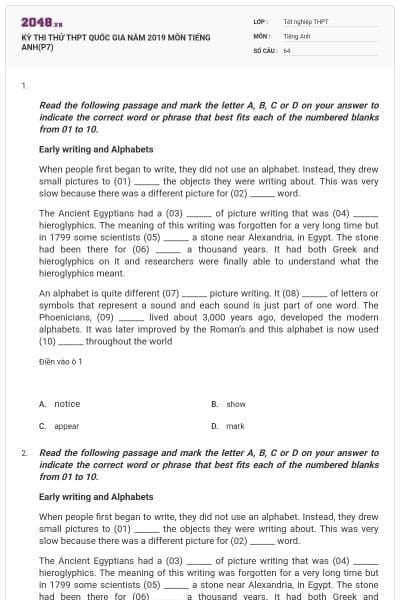
Read the following passage and mark the letter A, B, C or D on your answer to indicate the correct word or phrase that best fits each of the numbered blanks from 01 to 10.
Early writing and Alphabets
When people first began to write, they did not use an alphabet. Instead, they drew small pictures to (01) ______ the objects they were writing about. This was very slow because there was a different picture for (02) ______ word.
The Ancient Egyptians had a (03) ______ of picture writing that was (04) ______ hieroglyphics. The meaning of this writing was forgotten for a very long time but in 1799 some scientists (05) ______ a stone near Alexandria, in Egypt. The stone had been there for (06) ______ a thousand years. It had both Greek and hieroglyphics on it and researchers were finally able to understand what the hieroglyphics meant.
An alphabet is quite different (07) ______ picture writing. It (08) ______ of letters or symbols that represent a sound and each sound is just part of one word. The Phoenicians, (09) ______ lived about 3,000 years ago, developed the modern alphabets. It was later improved by the Roman’s and this alphabet is now used (10) ______ throughout the world
Điền vào ô 1
notice
show
appear
mark
Đáp án : B
Show something = thể hiện cái gì. Notice = chú ý. Appear = xuất hiện, dường như. Mark = đánh dấu, cho điểm
Read the following passage and mark the letter A, B, C or D on your answer to indicate the correct word or phrase that best fits each of the numbered blanks from 01 to 10.
Early writing and Alphabets
When people first began to write, they did not use an alphabet. Instead, they drew small pictures to (01) ______ the objects they were writing about. This was very slow because there was a different picture for (02) ______ word.
The Ancient Egyptians had a (03) ______ of picture writing that was (04) ______ hieroglyphics. The meaning of this writing was forgotten for a very long time but in 1799 some scientists (05) ______ a stone near Alexandria, in Egypt. The stone had been there for (06) ______ a thousand years. It had both Greek and hieroglyphics on it and researchers were finally able to understand what the hieroglyphics meant.
An alphabet is quite different (07) ______ picture writing. It (08) ______ of letters or symbols that represent a sound and each sound is just part of one word. The Phoenicians, (09) ______ lived about 3,000 years ago, developed the modern alphabets. It was later improved by the Roman’s and this alphabet is now used (10) ______ throughout the world
Điền vào ô 2
some
all
every
any
Đáp án : D
Any = bất cứ. Every = mỗi. Some = một vài. All = tất cả
Read the following passage and mark the letter A, B, C or D on your answer to indicate the correct word or phrase that best fits each of the numbered blanks from 01 to 10.
Early writing and Alphabets
When people first began to write, they did not use an alphabet. Instead, they drew small pictures to (01) ______ the objects they were writing about. This was very slow because there was a different picture for (02) ______ word.
The Ancient Egyptians had a (03) ______ of picture writing that was (04) ______ hieroglyphics. The meaning of this writing was forgotten for a very long time but in 1799 some scientists (05) ______ a stone near Alexandria, in Egypt. The stone had been there for (06) ______ a thousand years. It had both Greek and hieroglyphics on it and researchers were finally able to understand what the hieroglyphics meant.
An alphabet is quite different (07) ______ picture writing. It (08) ______ of letters or symbols that represent a sound and each sound is just part of one word. The Phoenicians, (09) ______ lived about 3,000 years ago, developed the modern alphabets. It was later improved by the Roman’s and this alphabet is now used (10) ______ throughout the world
Điền vào ô 3
practice
manner
plan
system
Đáp án : D
System = hệ thống. A system of picture writing = một hệ thống các hình ảnh viết. Practice = thực hành. Manner = cách (cư xử). Plan = kế hoạch
Read the following passage and mark the letter A, B, C or D on your answer to indicate the correct word or phrase that best fits each of the numbered blanks from 01 to 10.
Early writing and Alphabets
When people first began to write, they did not use an alphabet. Instead, they drew small pictures to (01) ______ the objects they were writing about. This was very slow because there was a different picture for (02) ______ word.
The Ancient Egyptians had a (03) ______ of picture writing that was (04) ______ hieroglyphics. The meaning of this writing was forgotten for a very long time but in 1799 some scientists (05) ______ a stone near Alexandria, in Egypt. The stone had been there for (06) ______ a thousand years. It had both Greek and hieroglyphics on it and researchers were finally able to understand what the hieroglyphics meant.
An alphabet is quite different (07) ______ picture writing. It (08) ______ of letters or symbols that represent a sound and each sound is just part of one word. The Phoenicians, (09) ______ lived about 3,000 years ago, developed the modern alphabets. It was later improved by the Roman’s and this alphabet is now used (10) ______ throughout the world
Điền vào ô 4
known
called
described
referred
Đáp án : C
Describe = miêu tả, mô tả. Know = biết tới. Call = gọi. Refer = nhắc tới, đề cập
Read the following passage and mark the letter A, B, C or D on your answer to indicate the correct word or phrase that best fits each of the numbered blanks from 01 to 10.
Early writing and Alphabets
When people first began to write, they did not use an alphabet. Instead, they drew small pictures to (01) ______ the objects they were writing about. This was very slow because there was a different picture for (02) ______ word.
The Ancient Egyptians had a (03) ______ of picture writing that was (04) ______ hieroglyphics. The meaning of this writing was forgotten for a very long time but in 1799 some scientists (05) ______ a stone near Alexandria, in Egypt. The stone had been there for (06) ______ a thousand years. It had both Greek and hieroglyphics on it and researchers were finally able to understand what the hieroglyphics meant.
An alphabet is quite different (07) ______ picture writing. It (08) ______ of letters or symbols that represent a sound and each sound is just part of one word. The Phoenicians, (09) ______ lived about 3,000 years ago, developed the modern alphabets. It was later improved by the Roman’s and this alphabet is now used (10) ______ throughout the world
Điền vào ô 5
discovered
realized
delivered
invented
Đáp án : A
Discover = phát hiện ra. Realize = nhận ra. Deliver = phân phát. Invented = phát minh ra
Read the following passage and mark the letter A, B, C or D on your answer to indicate the correct word or phrase that best fits each of the numbered blanks from 01 to 10.
Early writing and Alphabets
When people first began to write, they did not use an alphabet. Instead, they drew small pictures to (01) ______ the objects they were writing about. This was very slow because there was a different picture for (02) ______ word.
The Ancient Egyptians had a (03) ______ of picture writing that was (04) ______ hieroglyphics. The meaning of this writing was forgotten for a very long time but in 1799 some scientists (05) ______ a stone near Alexandria, in Egypt. The stone had been there for (06) ______ a thousand years. It had both Greek and hieroglyphics on it and researchers were finally able to understand what the hieroglyphics meant.
An alphabet is quite different (07) ______ picture writing. It (08) ______ of letters or symbols that represent a sound and each sound is just part of one word. The Phoenicians, (09) ______ lived about 3,000 years ago, developed the modern alphabets. It was later improved by the Roman’s and this alphabet is now used (10) ______ throughout the world
Điền vào ô 6
quite
more
over
already
Đáp án : C
Over = hơn, quá. Over a thousand years = hơn một ngàn năm. Quite = khá. More = nhiều hơn (so sánh hơn). Already = đã…rồi
Read the following passage and mark the letter A, B, C or D on your answer to indicate the correct word or phrase that best fits each of the numbered blanks from 01 to 10.
Early writing and Alphabets
When people first began to write, they did not use an alphabet. Instead, they drew small pictures to (01) ______ the objects they were writing about. This was very slow because there was a different picture for (02) ______ word.
The Ancient Egyptians had a (03) ______ of picture writing that was (04) ______ hieroglyphics. The meaning of this writing was forgotten for a very long time but in 1799 some scientists (05) ______ a stone near Alexandria, in Egypt. The stone had been there for (06) ______ a thousand years. It had both Greek and hieroglyphics on it and researchers were finally able to understand what the hieroglyphics meant.
An alphabet is quite different (07) ______ picture writing. It (08) ______ of letters or symbols that represent a sound and each sound is just part of one word. The Phoenicians, (09) ______ lived about 3,000 years ago, developed the modern alphabets. It was later improved by the Roman’s and this alphabet is now used (10) ______ throughout the world
Điền vào ô 7
at
from
before
between
Đáp án : B
Be different from N/Ving = khác với cái gì/việc gì
Read the following passage and mark the letter A, B, C or D on your answer to indicate the correct word or phrase that best fits each of the numbered blanks from 01 to 10.
Early writing and Alphabets
When people first began to write, they did not use an alphabet. Instead, they drew small pictures to (01) ______ the objects they were writing about. This was very slow because there was a different picture for (02) ______ word.
The Ancient Egyptians had a (03) ______ of picture writing that was (04) ______ hieroglyphics. The meaning of this writing was forgotten for a very long time but in 1799 some scientists (05) ______ a stone near Alexandria, in Egypt. The stone had been there for (06) ______ a thousand years. It had both Greek and hieroglyphics on it and researchers were finally able to understand what the hieroglyphics meant.
An alphabet is quite different (07) ______ picture writing. It (08) ______ of letters or symbols that represent a sound and each sound is just part of one word. The Phoenicians, (09) ______ lived about 3,000 years ago, developed the modern alphabets. It was later improved by the Roman’s and this alphabet is now used (10) ______ throughout the world
Điền vào ô 8
consists
includes
contains
involves
Đáp án : A
Consist of something = bao gồm cái gì = include something. Contain = chứa đựng. Involve = liên quan tới
Read the following passage and mark the letter A, B, C or D on your answer to indicate the correct word or phrase that best fits each of the numbered blanks from 01 to 10.
Early writing and Alphabets
When people first began to write, they did not use an alphabet. Instead, they drew small pictures to (01) ______ the objects they were writing about. This was very slow because there was a different picture for (02) ______ word.
The Ancient Egyptians had a (03) ______ of picture writing that was (04) ______ hieroglyphics. The meaning of this writing was forgotten for a very long time but in 1799 some scientists (05) ______ a stone near Alexandria, in Egypt. The stone had been there for (06) ______ a thousand years. It had both Greek and hieroglyphics on it and researchers were finally able to understand what the hieroglyphics meant.
An alphabet is quite different (07) ______ picture writing. It (08) ______ of letters or symbols that represent a sound and each sound is just part of one word. The Phoenicians, (09) ______ lived about 3,000 years ago, developed the modern alphabets. It was later improved by the Roman’s and this alphabet is now used (10) ______ throughout the world
Điền vào ô 9
which
whose
what
who
Đáp án : D
The Phonencians = những người Phonecian -> danh từ chỉ người -> đại từ quan hệ bổ nghĩa cho nó cũng phải chỉ người -> who. Còn “whose” là bổ nghĩa cho sự sở hữu của người
Read the following passage and mark the letter A, B, C or D on your answer to indicate the correct word or phrase that best fits each of the numbered blanks from 01 to 10.
Early writing and Alphabets
When people first began to write, they did not use an alphabet. Instead, they drew small pictures to (01) ______ the objects they were writing about. This was very slow because there was a different picture for (02) ______ word.
The Ancient Egyptians had a (03) ______ of picture writing that was (04) ______ hieroglyphics. The meaning of this writing was forgotten for a very long time but in 1799 some scientists (05) ______ a stone near Alexandria, in Egypt. The stone had been there for (06) ______ a thousand years. It had both Greek and hieroglyphics on it and researchers were finally able to understand what the hieroglyphics meant.
An alphabet is quite different (07) ______ picture writing. It (08) ______ of letters or symbols that represent a sound and each sound is just part of one word. The Phoenicians, (09) ______ lived about 3,000 years ago, developed the modern alphabets. It was later improved by the Roman’s and this alphabet is now used (10) ______ throughout the world
Điền vaò ô 10
broadly
widely
deeply
hugely
Đáp án : B
Widely = một cách rộng rãi. Is used widely throughout the world= được sử dụng rộng rãi trên toàn thế giới. Broadly = nhìn chung. Deeply = một cách sâu sắc. Hugely = cực kì, rất mạnh
Mark the letter A, B, C, or D on your answer sheet to indicate the word that differs from the other three in the position of primary stress in each of the following questions.
A. disappearance B. conversation C. contaminate D. government
disappearance
conversation
contaminate
government
Đáp án : C
Trọng âm của từ này rơi vào âm tiết thứ 2, các từ còn lại rơi vào âm tiết thứ 3
Mark the letter A, B, C, or D on your answer sheet to indicate the word that differs from the other three in the position of primary stress in each of the following questions.
eradicate
technology
incredible
pessimist
Đáp án : D
Trọng âm của từ này rơi vào âm tiết thứ 3, các từ còn lại rơi vào âm tiết thứ 2
Mark the letter A, B, C, or D on your answer sheet to indicate the word that differs from the other three in the position of primary stress in each of the following questions.
conical
sacrifice
approval
counterpart
Đáp án : C
Trọng âm của từ này rơi vào âm tiết thứ 2, các từ còn lại rơi vào âm tiết thứ 1
One difference between mathematics and language is that mathematics is precise _________.
language is not
while language is not
but language not
while is not language
Đáp án : B
While + mệnh đề = trong khi điều gì xảy ra. Dịch: một khác biệt giữa toán học và ngôn ngữ là toán học thì chính xác, trong khi ngôn ngữ thì không
Seldom _________ far enough north to disturb South Pacific shipping lanes
Antarctic icebergs will move
will Antarctic icebergs move
will move Antarctic icebergs
move Antarctic icebergs will
Đáp án : B
Cấu trúc đảo ngữ nhấn mạnh: Seldom + will/can/do/does/be + S + V không chia = hiếm khi ai đó làm gì
_________ the United States consists of many different immigrant groups, many sociologists believe there is a distinct national character
. Even though
Despite
Whether
In spite of
Đáp án : A
Even though + mệnh đề = mặc dù. = Despite + N = In spite of + N. Whether + mệnh đề = dù rằng… hay không
The article analyzes the impact of the tax base _______ real estate prices and sales.
in
on
at
with
Đáp án : B
Base on something = dựa vào cái gì
She _______ to the station every day but then she suddenly decided to walk instead.
used to
was used to
had used to
didn't use to
Đáp án: A
Giải thích:
used to V: từng làm gì (giờ không làm nữa)
Phủ định: didn’t use to V
be/get used to V-ing: đang làm quen với việc làm gì
Không có “had used to”
Loại C và D vì sai ngữ pháp.
Dựa vào nghĩa, chọn A.
Dịch: Bà thường lái xe đến ga tàu mỗi ngày nhưng sau đó bà đột nhiên quyết định đi bộ.
If I ______ following that other car too closely, I would have been able to stop in the time instead of running into it
wasn’t
weren’t
hadn’t been
would have been
Đáp án : C
Câu điều kiện loại 3, giả định một điều không xảy ra trong quá khứ: If S + had + past participle, S + would have + past participle
Our village had _______ money available for education that the schools had to close.
so little
such little
so much
such much
Đáp án : A
So + adj + (a/an) + N(s) + that … = quá … đến mức. Làng của chúng ta có sẵn quá ít tiền cho giáo dục đến mức các trường học phải đóng cửa
Fort Niagara was built by the French in 1762 on land ______ the Seneca Indians.
they buy from
bought from
. buying from
was bought from
Đáp án : B
Past participle (phân từ 2) có thể dùng như một hình thức rút gọn của mệnh đề quan hệ nghĩa bị động. Dịch: … trên phần đất được mua bởi những người Ấn Seneca -> việc mua là bị động
Experts ______ feel that they are related to the deep wishes and fears of the dreamer.
study dreams
who dream study
who study dreams
whose dreams study
Đáp án : C
Câu gốc đã đầy đủ chủ vị; để bổ nghĩa cho danh từ “expert” ta dùng mệnh đề quan hệ. Sau đại từ quan hệ “who” thường là động từ. Experts who study dreams = những chuyên gia mà nghiên cứu những giấc mơ
Art critics and historians alike claim that Van Gogh’s art ______ from that of his contemporaries
is a considerable difference
is considerably different
the difference is considerable
is considerably and differently
Đáp án: B
Giải thích:
Trạng từ đứng trước tính từ để bổ nghĩa cho tính từ đó.
Be considerably different from something = khác biệt đáng kể với cái gì
Dịch: Các nhà phê bình nghệ thuật và sử gia đều cho rằng nghệ thuật của Van Gogh rất khác biệt so với nghệ thuật của những họa sĩ cùng thời.
Most countries spend a large portion of their budgets _______ for their citizens
education provided
provide education
to educational provides
providing education
Đáp án : D
Ving là một hình thức rút gọn mệnh đề quan hệ ý chủ động. Budgets providing education for their children = ngân sách mà cung cấp giáo dục cho những đứa trẻ của họ
Renoir is one of the most popular French impressionist painters. His paintings _______ masterpieces all over the world
have considered
are considering
considered
are considered
Đáp án : D
Những bức vẽ của ông ấy được xem như kiệt tác. -> việc xem như là bị động: be past participle. Be considered N = được coi như là cái gì
Sheila Hammond, who was only twenty-three when she was elected as a Member of Parliament, said she owed her success all to the way she had been ________ by her mother, Margaret.
brought up
taken after
looked for
caught for
Đáp án : A
Bring somebody up = nuôi lớn ai. Take after somebody = chăm sóc ai. Look for somebody = trông nom, tìm kiếm
Ken and Tom are high-school students. They meet each other at a gallery but Ken is in a hurry.____________ Ken: “I’ve got to go, Tom. So long” Tom: “So long, Ken. And _______.”
be careful
take care
don’t hurry
don’t take it seriously
Đáp án : B
So long = bye bye = tạm biệt nhé. Take care = bảo trọng. Be careful = cẩn thận đấy. don’t hurry = đừng vội.
We need _______ actions and interventions of the local authorities to prevent national parks from being destroyed by pollution
excitedly
approximately
threateningly
timely
Đáp án : D
Timely (Adv) = kịp thời, đúng lúc. Excitedly (Adv) = một cách háo hức. Approximately (Adv) = một cách xấp xỉ. Threateningly (Adv) = một cách thách thức, đe dọa
Mike and Lane are neighbors. They are talking about Lane’s party.
Mike: “Thank you for a lovely evening” Lane: “________”
It depends on you
Thank you very much indeed.
Yeah. I’m really looking forward to it
You are welcome
Đáp án : D
You are welcome là một cách đáp lại lời cám ơn, nghĩa là: bạn luôn được sẵn lòng giúp đỡ ở đây ≈ không có gì đâu
We all seem to have a different opinion, so let’s Joey decide, ______?
will we
do we
shall we
are we
Đáp án : C
Câu hỏi đuôi của cấu trúc : Let’s là shall we?
No one can decline the _______ of the Alaskan wildness
breath-taking scene
breath-taken view
breath-to-take scene
breath-taking view
Đáp án : D
Breath-taking (Adj) = ấn tượng đến ngộp thở. Scence = cảnh tượng. View = quang cảnh
A quick look would reveal that France has twice ____________ computers
more television than
as many television as
as many as television
many as television as
Đáp án : B
So sánh hơn gấp 2 lần: twice + as + adj + (N) + as. Từ 3 lần trở lên: số lần + times + as + adj + (N) + as
Mark the letter A, B, C, or D on your answer sheet to indicate the word whose underlined part differs from the other three in pronunciation in each of the following questions.
academic
grade
behave
examination
Đáp án : A
“a” trong “academic” phát âm là /ə/, trong các từ còn lại phát âm là /ei/
Mark the letter A, B, C, or D on your answer sheet to indicate the word whose underlined part differs from the other three in pronunciation in each of the following questions.
A. humor B. honest C. hotel D. hurry
humor
honest
hotel
hurry
Đáp án : B
“h” trong “honest” là âm câm, trong các từ còn lại phát âm là /h/
Mark the letter A, B, C, or D on your answer sheet to indicate the word(s) CLOSEST in meaning to the underlined word(s) in each of the following questions.
The United Nations Educational, Scientific and Cultural Organization (UNESCO), was established in 1946
set up
found out
run through
put away
Đáp án : A
Set up = thành lập. Find out = tìm ra cái gì. Run through = chạy qua. Put something away = cất cái gì đi
Mark the letter A, B, C, or D on your answer sheet to indicate the word(s) CLOSEST in meaning to the underlined word(s) in each of the following questions.
Paris is the ideal place to learn French; it’s a beautiful and hospitable city with Institutions for high quality linguistic teaching
friendly
natural
affectionate
noticeable
Đáp án : A
Hospitable = thân thiện ≈ friendly. Natural = tự nhiên
Mark the letter A, B, C, or D on your answer sheet to indicate the word(s) CLOSEST in meaning to the underlined word(s) in each of the following questions.
Species that have already lost habitat because of deforestation are given higher priority in the plan because of their greater risk of extinction
a thing that you do often and almost without thinking
the place where a particular type of animal or plan is normally found
a subject that student don’t understand
a theme that everyone likes to discuss
Đáp án : B
Habitat = môi trường sinh sống
The scholarship that Wilson received to study history at Cambridge presented an unique opportunity
that
history
at Cambridge
an
Đáp án : D
Unique phát âm là /ju’ni:k/ -> âm mở đầu là /ju/ , không phải nguyên âm /u,e,o,a,i/ -> trước nó là “a”, không dùng “an”
to fly
the Atlantic
on
attempting
Đáp án: C
Giải thích:
Để chỉ tháng năm (không có ngày cụ thể) ta dùng giới từ “in”.
Sửa: on → in
Dịch: Amelia Earhart, người phụ nữ đầu tiên bay một mình qua Đại Tây Dương, đã biến mất vào tháng 6 năm 1937 khi đang cố gắng bay vòng quanh thế giới.
The closer it gets to December 21, the first day of winter, the short the days become.
gets to
first day
short
become
Đáp án : C
So sánh kép: the + so sánh hơn +…, the + so sánh hơn + …. = càng…. thì càng…
Alice in Wonderland, first published in 1865, has since being translated into thirty languages.
published
has
being
languages
Đáp án : C
Tiểu thuyết “ Alice ở xứ sở thần tiên” đã được dịch sang 30 thứ tiếng -> việc dịch là bị động: be + past participle -> has been translated
Modern art is on display at the Guggenheim Museum, a building with an unusually design
Modern art
display
a building
unusually
Đáp án: D
Giải thích:
"an unusually design" sai ngữ pháp, vì "design" (danh từ) cần một tính từ để bổ nghĩa, nhưng "unusually" là trạng từ.
Sửa: unusually → unusual
Chọn D.
Dịch: Nghệ thuật hiện đại được trưng bày tại Bảo tàng Guggenheim, một tòa nhà có thiết kế đặc biệt.
Read the following passage and mark the letter A, B, C, or D on your answer sheet to indicate the correct answer to each of the questions from 43 to 52.
A rather surprising geographical feature of Antarctica is that a huge freshwater, one of the world’s largest and deepest, lies hidden there under four kilometers of ice. Now known as Lake Vostok, this huge body of water is located under the ice block that comprises Antarctica. The lake is able to exist in its unfrozen state beneath this block of ice because its waters are warned by geothermal heat from the earth’s core. This thick glacier above Lake Vostok actually insulates it from frigid temperatures (the lowest ever recorded on Earth) on the surface.
The lake was first discovered in the 1970s while a research team was conducting an aerial survey of the area. Radio waves from the survey equipment penetrated the ice and revealed a body of water of indeterminate size. It was not until much more recently that data collected by satellite made scientists aware of the tremendous size of the lake; satellite-borne radar detected an extremely flat region where the ice remains level because it is floating on the water of the lake.
The discovery of such a huge fresh water lake trapped under Antarctica is of interest to the scientific community because of the potential that the lake contains ancient microbes that have survived for thousands upon thousands of years, unaffected by factors such as nuclear fallout and elevated ultraviolet light that have conducting research on the lake in such a harsh climate and in the problems associated with obtaining uncontaminated sampled from the lake without actually exposing the lake to contamination. Scientists are looking for possible ways to accomplish this
The purpose of the passage is to __________.
explain how Lake Vostok was discovered
provide satellite data concerning Antarctica
discuss future plans for Lake Vostok
present an unexpected aspect of Antarctica’s geography
Đáp án : D
Bài văn nói về hồ Vostok – một hồ nước phía sâu dưới lớp băng ở Nam Cực mà ít người biết tới. việc tình cờ phát hiện ra hồ nước này đem lại nhiều mong đợi cũng như nhiều khó khăn cho các nhà khoa học -> đây là một khía cạnh bất ngờ của địa lí Nam Cực
Read the following passage and mark the letter A, B, C, or D on your answer sheet to indicate the correct answer to each of the questions from 43 to 52.
A rather surprising geographical feature of Antarctica is that a huge freshwater, one of the world’s largest and deepest, lies hidden there under four kilometers of ice. Now known as Lake Vostok, this huge body of water is located under the ice block that comprises Antarctica. The lake is able to exist in its unfrozen state beneath this block of ice because its waters are warned by geothermal heat from the earth’s core. This thick glacier above Lake Vostok actually insulates it from frigid temperatures (the lowest ever recorded on Earth) on the surface.
The lake was first discovered in the 1970s while a research team was conducting an aerial survey of the area. Radio waves from the survey equipment penetrated the ice and revealed a body of water of indeterminate size. It was not until much more recently that data collected by satellite made scientists aware of the tremendous size of the lake; satellite-borne radar detected an extremely flat region where the ice remains level because it is floating on the water of the lake.
The discovery of such a huge fresh water lake trapped under Antarctica is of interest to the scientific community because of the potential that the lake contains ancient microbes that have survived for thousands upon thousands of years, unaffected by factors such as nuclear fallout and elevated ultraviolet light that have conducting research on the lake in such a harsh climate and in the problems associated with obtaining uncontaminated sampled from the lake without actually exposing the lake to contamination. Scientists are looking for possible ways to accomplish this
The word “lies” in the first paragraph could be best be replaced by ______.
sleeps
sits
tells falsehoods
inclines
Đáp án : B
Lie = nằm (ở vị trí nào). Sit = ngồi
Read the following passage and mark the letter A, B, C, or D on your answer sheet to indicate the correct answer to each of the questions from 43 to 52.
A rather surprising geographical feature of Antarctica is that a huge freshwater, one of the world’s largest and deepest, lies hidden there under four kilometers of ice. Now known as Lake Vostok, this huge body of water is located under the ice block that comprises Antarctica. The lake is able to exist in its unfrozen state beneath this block of ice because its waters are warned by geothermal heat from the earth’s core. This thick glacier above Lake Vostok actually insulates it from frigid temperatures (the lowest ever recorded on Earth) on the surface.
The lake was first discovered in the 1970s while a research team was conducting an aerial survey of the area. Radio waves from the survey equipment penetrated the ice and revealed a body of water of indeterminate size. It was not until much more recently that data collected by satellite made scientists aware of the tremendous size of the lake; satellite-borne radar detected an extremely flat region where the ice remains level because it is floating on the water of the lake.
The discovery of such a huge fresh water lake trapped under Antarctica is of interest to the scientific community because of the potential that the lake contains ancient microbes that have survived for thousands upon thousands of years, unaffected by factors such as nuclear fallout and elevated ultraviolet light that have conducting research on the lake in such a harsh climate and in the problems associated with obtaining uncontaminated sampled from the lake without actually exposing the lake to contamination. Scientists are looking for possible ways to accomplish this
What is true of Lake Vostok?
It is completely frozen
It is not a saltwater lake
It is beneath a thick slab of ice
It is heated by the sun
Đáp án : C
Từ dòng 2 đoạn 1: Now known as Lake Vostok, this huge body of water is located under the ice block that comprises Antarctica
Read the following passage and mark the letter A, B, C, or D on your answer sheet to indicate the correct answer to each of the questions from 43 to 52.
A rather surprising geographical feature of Antarctica is that a huge freshwater, one of the world’s largest and deepest, lies hidden there under four kilometers of ice. Now known as Lake Vostok, this huge body of water is located under the ice block that comprises Antarctica. The lake is able to exist in its unfrozen state beneath this block of ice because its waters are warned by geothermal heat from the earth’s core. This thick glacier above Lake Vostok actually insulates it from frigid temperatures (the lowest ever recorded on Earth) on the surface.
The lake was first discovered in the 1970s while a research team was conducting an aerial survey of the area. Radio waves from the survey equipment penetrated the ice and revealed a body of water of indeterminate size. It was not until much more recently that data collected by satellite made scientists aware of the tremendous size of the lake; satellite-borne radar detected an extremely flat region where the ice remains level because it is floating on the water of the lake.
The discovery of such a huge fresh water lake trapped under Antarctica is of interest to the scientific community because of the potential that the lake contains ancient microbes that have survived for thousands upon thousands of years, unaffected by factors such as nuclear fallout and elevated ultraviolet light that have conducting research on the lake in such a harsh climate and in the problems associated with obtaining uncontaminated sampled from the lake without actually exposing the lake to contamination. Scientists are looking for possible ways to accomplish this
Which of the following is closest in meaning to “ Frigid” in the first paragraph?
extremely cold
never changing
quite harsh
rarely recorded
Đáp án : A
Frigid = băng giá, lạnh lẽo. Never changing = không bao giờ đổi. Harsh = khắc nghiệt, thô ráp. Rarely recorded = hiếm khi được thấy, ghi lại
Read the following passage and mark the letter A, B, C, or D on your answer sheet to indicate the correct answer to each of the questions from 43 to 52.
A rather surprising geographical feature of Antarctica is that a huge freshwater, one of the world’s largest and deepest, lies hidden there under four kilometers of ice. Now known as Lake Vostok, this huge body of water is located under the ice block that comprises Antarctica. The lake is able to exist in its unfrozen state beneath this block of ice because its waters are warned by geothermal heat from the earth’s core. This thick glacier above Lake Vostok actually insulates it from frigid temperatures (the lowest ever recorded on Earth) on the surface.
The lake was first discovered in the 1970s while a research team was conducting an aerial survey of the area. Radio waves from the survey equipment penetrated the ice and revealed a body of water of indeterminate size. It was not until much more recently that data collected by satellite made scientists aware of the tremendous size of the lake; satellite-borne radar detected an extremely flat region where the ice remains level because it is floating on the water of the lake.
The discovery of such a huge fresh water lake trapped under Antarctica is of interest to the scientific community because of the potential that the lake contains ancient microbes that have survived for thousands upon thousands of years, unaffected by factors such as nuclear fallout and elevated ultraviolet light that have conducting research on the lake in such a harsh climate and in the problems associated with obtaining uncontaminated sampled from the lake without actually exposing the lake to contamination. Scientists are looking for possible ways to accomplish this
All of the following are true about the 1970 survey of Antarctica EXCEPT that it________.
was conducted by air
made use of radio waves
did not measure the exact size of the lake
was controlled by a satellite
Đáp án : D
Những nghiên cứu gần đây mới dùng vệ tinh, không phải nghiên cứu năm 1970: (dòng 3 đoạn 2) it was not until much more recently that data collected by statellite…
Read the following passage and mark the letter A, B, C, or D on your answer sheet to indicate the correct answer to each of the questions from 43 to 52.
A rather surprising geographical feature of Antarctica is that a huge freshwater, one of the world’s largest and deepest, lies hidden there under four kilometers of ice. Now known as Lake Vostok, this huge body of water is located under the ice block that comprises Antarctica. The lake is able to exist in its unfrozen state beneath this block of ice because its waters are warned by geothermal heat from the earth’s core. This thick glacier above Lake Vostok actually insulates it from frigid temperatures (the lowest ever recorded on Earth) on the surface.
The lake was first discovered in the 1970s while a research team was conducting an aerial survey of the area. Radio waves from the survey equipment penetrated the ice and revealed a body of water of indeterminate size. It was not until much more recently that data collected by satellite made scientists aware of the tremendous size of the lake; satellite-borne radar detected an extremely flat region where the ice remains level because it is floating on the water of the lake.
The discovery of such a huge fresh water lake trapped under Antarctica is of interest to the scientific community because of the potential that the lake contains ancient microbes that have survived for thousands upon thousands of years, unaffected by factors such as nuclear fallout and elevated ultraviolet light that have conducting research on the lake in such a harsh climate and in the problems associated with obtaining uncontaminated sampled from the lake without actually exposing the lake to contamination. Scientists are looking for possible ways to accomplish this
It can be interfered from the passage that ice would not be flat if _______.
there were no lake
the lake were not so big
Antarctica were not so cold
radio waves were not used
Đáp án : A
Từ dòng 4 đoạn 2: satellite-borne radar detected an extremely flat region where the ice remains level because it is floating on the water of the lake. -> không có nước thì tảng băng sẽ không thể trôi nổi và bằng phẳng
Read the following passage and mark the letter A, B, C, or D on your answer sheet to indicate the correct answer to each of the questions from 43 to 52.
A rather surprising geographical feature of Antarctica is that a huge freshwater, one of the world’s largest and deepest, lies hidden there under four kilometers of ice. Now known as Lake Vostok, this huge body of water is located under the ice block that comprises Antarctica. The lake is able to exist in its unfrozen state beneath this block of ice because its waters are warned by geothermal heat from the earth’s core. This thick glacier above Lake Vostok actually insulates it from frigid temperatures (the lowest ever recorded on Earth) on the surface.
The lake was first discovered in the 1970s while a research team was conducting an aerial survey of the area. Radio waves from the survey equipment penetrated the ice and revealed a body of water of indeterminate size. It was not until much more recently that data collected by satellite made scientists aware of the tremendous size of the lake; satellite-borne radar detected an extremely flat region where the ice remains level because it is floating on the water of the lake.
The discovery of such a huge fresh water lake trapped under Antarctica is of interest to the scientific community because of the potential that the lake contains ancient microbes that have survived for thousands upon thousands of years, unaffected by factors such as nuclear fallout and elevated ultraviolet light that have conducting research on the lake in such a harsh climate and in the problems associated with obtaining uncontaminated sampled from the lake without actually exposing the lake to contamination. Scientists are looking for possible ways to accomplish this
The word “microbes” in paragraph 3 could best be replaced by which of the following?
pieces of dust
trapped bubbles
tiny organism
rays of light
Đáp án : C
Microbe = vi trùng, vi khuẩn. piece of dust = chút bụi bẩn. trapped buble = bong bóng bị mắc kẹt. rays of light = các tia sáng
Read the following passage and mark the letter A, B, C, or D on your answer sheet to indicate the correct answer to each of the questions from 43 to 52.
A rather surprising geographical feature of Antarctica is that a huge freshwater, one of the world’s largest and deepest, lies hidden there under four kilometers of ice. Now known as Lake Vostok, this huge body of water is located under the ice block that comprises Antarctica. The lake is able to exist in its unfrozen state beneath this block of ice because its waters are warned by geothermal heat from the earth’s core. This thick glacier above Lake Vostok actually insulates it from frigid temperatures (the lowest ever recorded on Earth) on the surface.
The lake was first discovered in the 1970s while a research team was conducting an aerial survey of the area. Radio waves from the survey equipment penetrated the ice and revealed a body of water of indeterminate size. It was not until much more recently that data collected by satellite made scientists aware of the tremendous size of the lake; satellite-borne radar detected an extremely flat region where the ice remains level because it is floating on the water of the lake.
The discovery of such a huge fresh water lake trapped under Antarctica is of interest to the scientific community because of the potential that the lake contains ancient microbes that have survived for thousands upon thousands of years, unaffected by factors such as nuclear fallout and elevated ultraviolet light that have conducting research on the lake in such a harsh climate and in the problems associated with obtaining uncontaminated sampled from the lake without actually exposing the lake to contamination. Scientists are looking for possible ways to accomplish this
The passage mentions which of the following as a reason for the importance of Lake Vostok to scientists?
It can be studied using radio waves
It may contain uncontaminated microbes
It may have elevated levels of ultraviolet light
It has already been contaminated
Đáp án : B
Từ đoạn 3: The discovery of such ….is of interest to the scientific community because of the potential that the lake contains ancient microbes that have survived for thousands… unaffected by factors -> thu hút vì nó có thể chứa các vi khuẩn cổ xưa, không bị ảnh hưởng bởi các yếu tố
Read the following passage and mark the letter A, B, C, or D on your answer sheet to indicate the correct answer to each of the questions from 43 to 52.
A rather surprising geographical feature of Antarctica is that a huge freshwater, one of the world’s largest and deepest, lies hidden there under four kilometers of ice. Now known as Lake Vostok, this huge body of water is located under the ice block that comprises Antarctica. The lake is able to exist in its unfrozen state beneath this block of ice because its waters are warned by geothermal heat from the earth’s core. This thick glacier above Lake Vostok actually insulates it from frigid temperatures (the lowest ever recorded on Earth) on the surface.
The lake was first discovered in the 1970s while a research team was conducting an aerial survey of the area. Radio waves from the survey equipment penetrated the ice and revealed a body of water of indeterminate size. It was not until much more recently that data collected by satellite made scientists aware of the tremendous size of the lake; satellite-borne radar detected an extremely flat region where the ice remains level because it is floating on the water of the lake.
The discovery of such a huge fresh water lake trapped under Antarctica is of interest to the scientific community because of the potential that the lake contains ancient microbes that have survived for thousands upon thousands of years, unaffected by factors such as nuclear fallout and elevated ultraviolet light that have conducting research on the lake in such a harsh climate and in the problems associated with obtaining uncontaminated sampled from the lake without actually exposing the lake to contamination. Scientists are looking for possible ways to accomplish this
The word “downside” in paragraph 3 is closest in meaning to_________.
bottom level
negative aspect
underside
buried section
Đáp án : B
Downside = mặt trái. Negative aspect = mặt tiêu cực
Read the following passage and mark the letter A, B, C, or D on your answer sheet to indicate the correct answer to each of the questions from 43 to 52.
A rather surprising geographical feature of Antarctica is that a huge freshwater, one of the world’s largest and deepest, lies hidden there under four kilometers of ice. Now known as Lake Vostok, this huge body of water is located under the ice block that comprises Antarctica. The lake is able to exist in its unfrozen state beneath this block of ice because its waters are warned by geothermal heat from the earth’s core. This thick glacier above Lake Vostok actually insulates it from frigid temperatures (the lowest ever recorded on Earth) on the surface.
The lake was first discovered in the 1970s while a research team was conducting an aerial survey of the area. Radio waves from the survey equipment penetrated the ice and revealed a body of water of indeterminate size. It was not until much more recently that data collected by satellite made scientists aware of the tremendous size of the lake; satellite-borne radar detected an extremely flat region where the ice remains level because it is floating on the water of the lake.
The discovery of such a huge fresh water lake trapped under Antarctica is of interest to the scientific community because of the potential that the lake contains ancient microbes that have survived for thousands upon thousands of years, unaffected by factors such as nuclear fallout and elevated ultraviolet light that have conducting research on the lake in such a harsh climate and in the problems associated with obtaining uncontaminated sampled from the lake without actually exposing the lake to contamination. Scientists are looking for possible ways to accomplish this
The paragraph following the passage most probably discusses________.
further discoveries on the surface of Antarctica
problems with satellite-borne radar equipment
ways to study Lake Vostok without contaminating it
the harsh climate of Antarctica
Đáp án : C
Cẩu kết thúc bài: … in the problems associated with obtaining uncontaminated samples from the lake without actually exposing the lake to contamination. Scientists are looking for possible ways to accomplish this. -> các nhà khoa học đang tìm cách lấy những mẫu vi khuẩn nguyên vẹn từ hồ mà không làm nhiễm bẩn nó -> gợi ý cho đoạn tiếp theo: cách lấy mẫu
Mark the letter A, B, C, or D on your anser sheet to indicate the word(s) OPPOSITE in meaning to the underlined word(s) in each of t he following questions
There have been significant changes in women’s lives since the women’s liberation movement
unimportant
controlled
political
disagreeable
Đáp án : A
Significant = quan trọng, đáng kể. unimportant = không quan trọng
Mark the letter A, B, C, or D on your anser sheet to indicate the word(s) OPPOSITE in meaning to the underlined word(s) in each of t he following questions
In 1989, a ban was given on all international trade in ivory
a destruction
an allowance
an exploitation
a prohibition
Đáp án : B
Ban = lệnh cấm. allowance = sự cho phép. Prohibition = sự cấm. destruction = sự phá hủy. exploitation = sự khai thác
Read the following passage and mark the letter A, B, C, or D on your anwser sheet to indicate the correct answer to each of the questions from 55 to 64.
Harvard University, today recognized as part of the top echelon of the world’s universities, came from very inauspicious and humble beginning.
This oldest of American universities was founded in 1636, just sixteen years after the Pilgrims landed at Plymouth. Included in the puritan emigrants to the Massachusetts colony during this period were more than 100 graduates of England’s prestigious Oxford and Cambridge universities, and these universities graduates in the New Word were determined that their sons would have the same educational opportunities that they themselves had had, Because of this support in the colony for an institution of higher learning, the General Court of Massachusetts appropriated 400 pounds for a college in October of 1636 and early the following year decided on a parcel of land for the school; this land was in an area called Newetowne, which was later renamed Cambridge after its English cousin and is the site of t he present-day university.
When a young minister named John Harvard, who came from the neighboring town of Charlestowne, died from tuberculosis in 1638, he willed half of his estate of 1,700 pounds to the fledgling college. In spite of the fact that only half of the bequest was actually paid, the General Court named the college after the minister in appreciation for what he had done. The amount of the bequest may not have been large, particularly by today’s standard, but it was more than the General Court had found it necessary to appropriate in order to open the college.
Henry Dunster was appointed the first president of Harvard in 1640, and it should be noted that in addition to serving as president, he was also the entire faculty, with an entering freshmen class of four students. Although the staff did expand somewhat, for the first century of its existence the entire teaching staff consisted of the president and three or four tutors
The main idea of this passage is that_________.
Harvard is one of the world’s most prestigious universities
What is today a great university started out small
John Harvard was key to the development of a great university
Harvard University developed under the auspices of the General Court of Massachusetts
Đáp án : B
Bài văn kể về sự ra đời của trường đại học Harvard với quy mô ban đầu nhỏ bé, vói vỏn vẹn một lớp đầu vào. Và ngay từ đầu, bài văn có nói: Harvard University… came from very inauspicious and humble beginning (xuất phát từ một khởi đầu rất khiêm tốn)
Read the following passage and mark the letter A, B, C, or D on your anwser sheet to indicate the correct answer to each of the questions from 55 to 64.
Harvard University, today recognized as part of the top echelon of the world’s universities, came from very inauspicious and humble beginning.
This oldest of American universities was founded in 1636, just sixteen years after the Pilgrims landed at Plymouth. Included in the puritan emigrants to the Massachusetts colony during this period were more than 100 graduates of England’s prestigious Oxford and Cambridge universities, and these universities graduates in the New Word were determined that their sons would have the same educational opportunities that they themselves had had, Because of this support in the colony for an institution of higher learning, the General Court of Massachusetts appropriated 400 pounds for a college in October of 1636 and early the following year decided on a parcel of land for the school; this land was in an area called Newetowne, which was later renamed Cambridge after its English cousin and is the site of t he present-day university.
When a young minister named John Harvard, who came from the neighboring town of Charlestowne, died from tuberculosis in 1638, he willed half of his estate of 1,700 pounds to the fledgling college. In spite of the fact that only half of the bequest was actually paid, the General Court named the college after the minister in appreciation for what he had done. The amount of the bequest may not have been large, particularly by today’s standard, but it was more than the General Court had found it necessary to appropriate in order to open the college.
Henry Dunster was appointed the first president of Harvard in 1640, and it should be noted that in addition to serving as president, he was also the entire faculty, with an entering freshmen class of four students. Although the staff did expand somewhat, for the first century of its existence the entire teaching staff consisted of the president and three or four tutors
The passage indicates that Harvard is___________.
One of the oldest universities in the world
the oldest university in the world
one of the oldest universities in America
the oldest university in America
Đáp án : D
Đầu đoạn 2: This oldest of American universities -> trường đại học lâu đời nhất trong số các trường ở Mỹ
Read the following passage and mark the letter A, B, C, or D on your anwser sheet to indicate the correct answer to each of the questions from 55 to 64.
Harvard University, today recognized as part of the top echelon of the world’s universities, came from very inauspicious and humble beginning.
This oldest of American universities was founded in 1636, just sixteen years after the Pilgrims landed at Plymouth. Included in the puritan emigrants to the Massachusetts colony during this period were more than 100 graduates of England’s prestigious Oxford and Cambridge universities, and these universities graduates in the New Word were determined that their sons would have the same educational opportunities that they themselves had had, Because of this support in the colony for an institution of higher learning, the General Court of Massachusetts appropriated 400 pounds for a college in October of 1636 and early the following year decided on a parcel of land for the school; this land was in an area called Newetowne, which was later renamed Cambridge after its English cousin and is the site of t he present-day university.
When a young minister named John Harvard, who came from the neighboring town of Charlestowne, died from tuberculosis in 1638, he willed half of his estate of 1,700 pounds to the fledgling college. In spite of the fact that only half of the bequest was actually paid, the General Court named the college after the minister in appreciation for what he had done. The amount of the bequest may not have been large, particularly by today’s standard, but it was more than the General Court had found it necessary to appropriate in order to open the college.
Henry Dunster was appointed the first president of Harvard in 1640, and it should be noted that in addition to serving as president, he was also the entire faculty, with an entering freshmen class of four students. Although the staff did expand somewhat, for the first century of its existence the entire teaching staff consisted of the president and three or four tutors
It can be inferred from the passage that the Puritans who traveled to the Massachusetts colony were__________.
Rather well educated
rather rich
rather supportive of the English government
rather undemocratic
Đáp án : A
Từ dòng 2 đoạn 2: Included the Puritan emigrants to the Massachussets colony during this period were more than 100 graduates of England ‘s prestigious Oxford and Cambridge universities that their sons would have the same educational opportunities they had had -> những người Thanh giáo di cư (sang Mỹ) gồm có hơn 100 cử nhân của trường đại học danh tiếng Oxford và Cambridge -> họ là người được giáo dục tốt
Read the following passage and mark the letter A, B, C, or D on your anwser sheet to indicate the correct answer to each of the questions from 55 to 64.
Harvard University, today recognized as part of the top echelon of the world’s universities, came from very inauspicious and humble beginning.
This oldest of American universities was founded in 1636, just sixteen years after the Pilgrims landed at Plymouth. Included in the puritan emigrants to the Massachusetts colony during this period were more than 100 graduates of England’s prestigious Oxford and Cambridge universities, and these universities graduates in the New Word were determined that their sons would have the same educational opportunities that they themselves had had, Because of this support in the colony for an institution of higher learning, the General Court of Massachusetts appropriated 400 pounds for a college in October of 1636 and early the following year decided on a parcel of land for the school; this land was in an area called Newetowne, which was later renamed Cambridge after its English cousin and is the site of t he present-day university.
When a young minister named John Harvard, who came from the neighboring town of Charlestowne, died from tuberculosis in 1638, he willed half of his estate of 1,700 pounds to the fledgling college. In spite of the fact that only half of the bequest was actually paid, the General Court named the college after the minister in appreciation for what he had done. The amount of the bequest may not have been large, particularly by today’s standard, but it was more than the General Court had found it necessary to appropriate in order to open the college.
Henry Dunster was appointed the first president of Harvard in 1640, and it should be noted that in addition to serving as president, he was also the entire faculty, with an entering freshmen class of four students. Although the staff did expand somewhat, for the first century of its existence the entire teaching staff consisted of the president and three or four tutors
The pronoun “they” in the second paragraph refers to_____.
Oxford and Cambridge universities
university graduates
sons
educational opportunities
Đáp án : B
“they” là từ để bổ nghĩa cho danh từ chỉ số nhiều ở vế trước. trước đó “they” cũng được thoáng nhắc đến qua từ “their” (sons) (they sở hữu những đứa con -> they chỉ người)-> “their” chỉ danh từ số nhiều “universities graduates”
Read the following passage and mark the letter A, B, C, or D on your anwser sheet to indicate the correct answer to each of the questions from 55 to 64.
Harvard University, today recognized as part of the top echelon of the world’s universities, came from very inauspicious and humble beginning.
This oldest of American universities was founded in 1636, just sixteen years after the Pilgrims landed at Plymouth. Included in the puritan emigrants to the Massachusetts colony during this period were more than 100 graduates of England’s prestigious Oxford and Cambridge universities, and these universities graduates in the New Word were determined that their sons would have the same educational opportunities that they themselves had had, Because of this support in the colony for an institution of higher learning, the General Court of Massachusetts appropriated 400 pounds for a college in October of 1636 and early the following year decided on a parcel of land for the school; this land was in an area called Newetowne, which was later renamed Cambridge after its English cousin and is the site of t he present-day university.
When a young minister named John Harvard, who came from the neighboring town of Charlestowne, died from tuberculosis in 1638, he willed half of his estate of 1,700 pounds to the fledgling college. In spite of the fact that only half of the bequest was actually paid, the General Court named the college after the minister in appreciation for what he had done. The amount of the bequest may not have been large, particularly by today’s standard, but it was more than the General Court had found it necessary to appropriate in order to open the college.
Henry Dunster was appointed the first president of Harvard in 1640, and it should be noted that in addition to serving as president, he was also the entire faculty, with an entering freshmen class of four students. Although the staff did expand somewhat, for the first century of its existence the entire teaching staff consisted of the president and three or four tutors
The “pounds” in the second paragraph are probably_______.
Types of books
college students
units of money
school campuses
Đáp án : C
Pound = đồng bảng Anh -> đơn vị tiền tệ
Read the following passage and mark the letter A, B, C, or D on your anwser sheet to indicate the correct answer to each of the questions from 55 to 64.
Harvard University, today recognized as part of the top echelon of the world’s universities, came from very inauspicious and humble beginning.
This oldest of American universities was founded in 1636, just sixteen years after the Pilgrims landed at Plymouth. Included in the puritan emigrants to the Massachusetts colony during this period were more than 100 graduates of England’s prestigious Oxford and Cambridge universities, and these universities graduates in the New Word were determined that their sons would have the same educational opportunities that they themselves had had, Because of this support in the colony for an institution of higher learning, the General Court of Massachusetts appropriated 400 pounds for a college in October of 1636 and early the following year decided on a parcel of land for the school; this land was in an area called Newetowne, which was later renamed Cambridge after its English cousin and is the site of t he present-day university.
When a young minister named John Harvard, who came from the neighboring town of Charlestowne, died from tuberculosis in 1638, he willed half of his estate of 1,700 pounds to the fledgling college. In spite of the fact that only half of the bequest was actually paid, the General Court named the college after the minister in appreciation for what he had done. The amount of the bequest may not have been large, particularly by today’s standard, but it was more than the General Court had found it necessary to appropriate in order to open the college.
Henry Dunster was appointed the first president of Harvard in 1640, and it should be noted that in addition to serving as president, he was also the entire faculty, with an entering freshmen class of four students. Although the staff did expand somewhat, for the first century of its existence the entire teaching staff consisted of the president and three or four tutors
The “ English cousin” in the second paragraph refers to a_______.
City
relative
person
court
Đáp án : A
Từ dòng 7 đoạn 2: this land was in an area called Newetone, which was later renamed Cambridge after its English cousin = mảnh đất này nằm trong khu vực có tên là Neweton, khu vực mà sau đó được đặt tên lại là Cambridge – theo tên của người chị em nước Anh của nó => Cambridge cũng như Newetone là tên một khu vực
Read the following passage and mark the letter A, B, C, or D on your anwser sheet to indicate the correct answer to each of the questions from 55 to 64.
Harvard University, today recognized as part of the top echelon of the world’s universities, came from very inauspicious and humble beginning.
This oldest of American universities was founded in 1636, just sixteen years after the Pilgrims landed at Plymouth. Included in the puritan emigrants to the Massachusetts colony during this period were more than 100 graduates of England’s prestigious Oxford and Cambridge universities, and these universities graduates in the New Word were determined that their sons would have the same educational opportunities that they themselves had had, Because of this support in the colony for an institution of higher learning, the General Court of Massachusetts appropriated 400 pounds for a college in October of 1636 and early the following year decided on a parcel of land for the school; this land was in an area called Newetowne, which was later renamed Cambridge after its English cousin and is the site of t he present-day university.
When a young minister named John Harvard, who came from the neighboring town of Charlestowne, died from tuberculosis in 1638, he willed half of his estate of 1,700 pounds to the fledgling college. In spite of the fact that only half of the bequest was actually paid, the General Court named the college after the minister in appreciation for what he had done. The amount of the bequest may not have been large, particularly by today’s standard, but it was more than the General Court had found it necessary to appropriate in order to open the college.
Henry Dunster was appointed the first president of Harvard in 1640, and it should be noted that in addition to serving as president, he was also the entire faculty, with an entering freshmen class of four students. Although the staff did expand somewhat, for the first century of its existence the entire teaching staff consisted of the president and three or four tutors
Which of the following is NOT mentioned about John Harvard?
What he died of
Where he came from
Where he was buried
How much he bequeathed to Harvard
Đáp án : C
Bài văn nói về ông Harvard trong đoạn 3: came from the neighboring town of Charlestowne (-> Đáp án A); die from tuberculosis (-> Đáp án B); he willed half of his estate of 1,700 pounds to the fledging college (-> Đáp án D) => chỉ có D là không được nhắc tới trong bài
Read the following passage and mark the letter A, B, C, or D on your anwser sheet to indicate the correct answer to each of the questions from 55 to 64.
Harvard University, today recognized as part of the top echelon of the world’s universities, came from very inauspicious and humble beginning.
This oldest of American universities was founded in 1636, just sixteen years after the Pilgrims landed at Plymouth. Included in the puritan emigrants to the Massachusetts colony during this period were more than 100 graduates of England’s prestigious Oxford and Cambridge universities, and these universities graduates in the New Word were determined that their sons would have the same educational opportunities that they themselves had had, Because of this support in the colony for an institution of higher learning, the General Court of Massachusetts appropriated 400 pounds for a college in October of 1636 and early the following year decided on a parcel of land for the school; this land was in an area called Newetowne, which was later renamed Cambridge after its English cousin and is the site of t he present-day university.
When a young minister named John Harvard, who came from the neighboring town of Charlestowne, died from tuberculosis in 1638, he willed half of his estate of 1,700 pounds to the fledgling college. In spite of the fact that only half of the bequest was actually paid, the General Court named the college after the minister in appreciation for what he had done. The amount of the bequest may not have been large, particularly by today’s standard, but it was more than the General Court had found it necessary to appropriate in order to open the college.
Henry Dunster was appointed the first president of Harvard in 1640, and it should be noted that in addition to serving as president, he was also the entire faculty, with an entering freshmen class of four students. Although the staff did expand somewhat, for the first century of its existence the entire teaching staff consisted of the president and three or four tutors
The word “fledgling” in the third paragraph could be best replaced by which of the following?
Newborn
flying
winged
established
Đáp án : A
Fledgling = non nớt, thiếu kinh nghiệm. newborn = vừa mới ra đời,vừa mới thành lập
Read the following passage and mark the letter A, B, C, or D on your anwser sheet to indicate the correct answer to each of the questions from 55 to 64.
Harvard University, today recognized as part of the top echelon of the world’s universities, came from very inauspicious and humble beginning.
This oldest of American universities was founded in 1636, just sixteen years after the Pilgrims landed at Plymouth. Included in the puritan emigrants to the Massachusetts colony during this period were more than 100 graduates of England’s prestigious Oxford and Cambridge universities, and these universities graduates in the New Word were determined that their sons would have the same educational opportunities that they themselves had had, Because of this support in the colony for an institution of higher learning, the General Court of Massachusetts appropriated 400 pounds for a college in October of 1636 and early the following year decided on a parcel of land for the school; this land was in an area called Newetowne, which was later renamed Cambridge after its English cousin and is the site of t he present-day university.
When a young minister named John Harvard, who came from the neighboring town of Charlestowne, died from tuberculosis in 1638, he willed half of his estate of 1,700 pounds to the fledgling college. In spite of the fact that only half of the bequest was actually paid, the General Court named the college after the minister in appreciation for what he had done. The amount of the bequest may not have been large, particularly by today’s standard, but it was more than the General Court had found it necessary to appropriate in order to open the college.
Henry Dunster was appointed the first president of Harvard in 1640, and it should be noted that in addition to serving as president, he was also the entire faculty, with an entering freshmen class of four students. Although the staff did expand somewhat, for the first century of its existence the entire teaching staff consisted of the president and three or four tutors
The passage implies that_______.
Henry Dunster was an ineffective president
Someone else really served as president of Harvard before Henry Dunster
Henry DUnster spent much of his time as president managing the Harvard faculty
The position of president of Harvard was not merely an administrative position in the early ears
Đáp án : D
Dòng đầu đoạn cuối: it should be noted that in addition to serving as president, he was also the entire faculty -> ngoài vai trò hiệu trưởng, ông ấy cũng là toàn bộ đội ngũ nhân viên -> vừa là hiệu trưởng vừa là giáo viên; không chỉ quản lí mà còn giảng
Read the following passage and mark the letter A, B, C, or D on your anwser sheet to indicate the correct answer to each of the questions from 55 to 64.
Harvard University, today recognized as part of the top echelon of the world’s universities, came from very inauspicious and humble beginning.
This oldest of American universities was founded in 1636, just sixteen years after the Pilgrims landed at Plymouth. Included in the puritan emigrants to the Massachusetts colony during this period were more than 100 graduates of England’s prestigious Oxford and Cambridge universities, and these universities graduates in the New Word were determined that their sons would have the same educational opportunities that they themselves had had, Because of this support in the colony for an institution of higher learning, the General Court of Massachusetts appropriated 400 pounds for a college in October of 1636 and early the following year decided on a parcel of land for the school; this land was in an area called Newetowne, which was later renamed Cambridge after its English cousin and is the site of t he present-day university.
When a young minister named John Harvard, who came from the neighboring town of Charlestowne, died from tuberculosis in 1638, he willed half of his estate of 1,700 pounds to the fledgling college. In spite of the fact that only half of the bequest was actually paid, the General Court named the college after the minister in appreciation for what he had done. The amount of the bequest may not have been large, particularly by today’s standard, but it was more than the General Court had found it necessary to appropriate in order to open the college.
Henry Dunster was appointed the first president of Harvard in 1640, and it should be noted that in addition to serving as president, he was also the entire faculty, with an entering freshmen class of four students. Although the staff did expand somewhat, for the first century of its existence the entire teaching staff consisted of the president and three or four tutors
The word “somewhat” in the last paragraph could best be replaced by_______.
Back and forth
to and pro
side by side
more or less
Đáp án : D
Somewhat = hơi, một cách nào đó