KỲ THI THỬ THPT QUỐC GIA NĂM 2019 MÔN TIẾNG ANH(P5)
64 câu hỏi
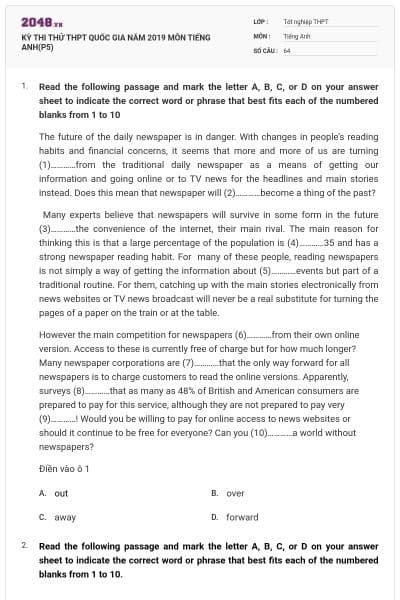
Read the following passage and mark the letter A, B, C, or D on your answer sheet to indicate the correct word or phrase that best fits each of the numbered blanks from 1 to 10
The future of the daily newspaper is in danger. With changes in people’s reading habits and financial concerns, it seems that more and more of us are turning (1)…………from the traditional daily newspaper as a means of getting our information and going online or to TV news for the headlines and main stories instead. Does this mean that newspaper will (2)…………become a thing of the past?
Many experts believe that newspapers will survive in some form in the future (3)…………the convenience of the internet, their main rival. The main reason for thinking this is that a large percentage of the population is (4)…………35 and has a strong newspaper reading habit. For many of these people, reading newspapers is not simply a way of getting the information about (5)…………events but part of a traditional routine. For them, catching up with the main stories electronically from news websites or TV news broadcast will never be a real substitute for turning the pages of a paper on the train or at the table.
However the main competition for newspapers (6)…………from their own online version. Access to these is currently free of charge but for how much longer? Many newspaper corporations are (7)…………that the only way forward for all newspapers is to charge customers to read the online versions. Apparently, surveys (8)…………that as many as 48% of British and American consumers are prepared to pay for this service, although they are not prepared to pay very (9)…………! Would you be willing to pay for online access to news websites or should it continue to be free for everyone? Can you (10)…………a world without newspapers?
Điền vào ô 1
out
over
away
forward
Đáp án : C
C. Turn away: quay lưng,quay đi
Read the following passage and mark the letter A, B, C, or D on your answer sheet to indicate the correct word or phrase that best fits each of the numbered blanks from 1 to 10.
The future of the daily newspaper is in danger. With changes in people’s reading habits and financial concerns, it seems that more and more of us are turning (1)…………from the traditional daily newspaper as a means of getting our information and going online or to TV news for the headlines and main stories instead. Does this mean that newspaper will (2)…………become a thing of the past?
Many experts believe that newspapers will survive in some form in the future (3)…………the convenience of the internet, their main rival. The main reason for thinking this is that a large percentage of the population is (4)…………35 and has a strong newspaper reading habit. For many of these people, reading newspapers is not simply a way of getting the information about (5)…………events but part of a traditional routine. For them, catching up with the main stories electronically from news websites or TV news broadcast will never be a real substitute for turning the pages of a paper on the train or at the table.
However the main competition for newspapers (6)…………from their own online version. Access to these is currently free of charge but for how much longer? Many newspaper corporations are (7)…………that the only way forward for all newspapers is to charge customers to read the online versions. Apparently, surveys (8)…………that as many as 48%of British and American consumers are prepared to pay for this service, although they are not prepared to pay very (9)…………! Would you be willing to pay for online access to news websites or should it continue to be free for everyone? Can you (10)…………a world without newspapers?
Điền vào ô 2
shortly
next
lately
early
Đáp án : A
A.Shortly: a short time, not long
Read the following passage and mark the letter A, B, C, or D on your answer sheet to indicate the correct word or phrase that best fits each of the numbered blanks from 1 to 10.
The future of the daily newspaper is in danger. With changes in people’s reading habits and financial concerns, it seems that more and more of us are turning (1)…………from the traditional daily newspaper as a means of getting our information and going online or to TV news for the headlines and main stories instead. Does this mean that newspaper will (2)…………become a thing of the past?
Many experts believe that newspapers will survive in some form in the future (3)…………the convenience of the internet, their main rival. The main reason for thinking this is that a large percentage of the population is (4)…………35 and has a strong newspaper reading habit. For many of these people, reading newspapers is not simply a way of getting the information about (5)…………events but part of a traditional routine. For them, catching up with the main stories electronically from news websites or TV news broadcast will never be a real substitute for turning the pages of a paper on the train or at the table.
However the main competition for newspapers (6)…………from their own online version. Access to these is currently free of charge but for how much longer? Many newspaper corporations are (7)…………that the only way forward for all newspapers is to charge customers to read the online versions. Apparently, surveys (8)…………that as many as 48%of British and American consumers are prepared to pay for this service, although they are not prepared to pay very (9)…………! Would you be willing to pay for online access to news websites or should it continue to be free for everyone? Can you (10)…………a world without newspapers?
Điền vào ô 3
although
however
despite
but
Đáp án : C
C.Despite + N = inspite of + N: mặc dù…
Read the following passage and mark the letter A, B, C, or D on your answer sheet to indicate the correct word or phrase that best fits each of the numbered blanks from 1 to 10.
The future of the daily newspaper is in danger. With changes in people’s reading habits and financial concerns, it seems that more and more of us are turning (1)…………from the traditional daily newspaper as a means of getting our information and going online or to TV news for the headlines and main stories instead. Does this mean that newspaper will (2)…………become a thing of the past?
Many experts believe that newspapers will survive in some form in the future (3)…………the convenience of the internet, their main rival. The main reason for thinking this is that a large percentage of the population is (4)…………35 and has a strong newspaper reading habit. For many of these people, reading newspapers is not simply a way of getting the information about (5)…………events but part of a traditional routine. For them, catching up with the main stories electronically from news websites or TV news broadcast will never be a real substitute for turning the pages of a paper on the train or at the table.
However the main competition for newspapers (6)…………from their own online version. Access to these is currently free of charge but for how much longer? Many newspaper corporations are (7)…………that the only way forward for all newspapers is to charge customers to read the online versions. Apparently, surveys (8)…………that as many as 48%of British and American consumers are prepared to pay for this service, although they are not prepared to pay very (9)…………! Would you be willing to pay for online access to news websites or should it continue to be free for everyone? Can you (10)…………a world without newspapers?
Điền vào ô 4
over
more
after
further
Đáp án : A
A.Over = above: hơn…
Read the following passage and mark the letter A, B, C, or D on your answer sheet to indicate the correct word or phrase that best fits each of the numbered blanks from 1 to 10.
The future of the daily newspaper is in danger. With changes in people’s reading habits and financial concerns, it seems that more and more of us are turning (1)…………from the traditional daily newspaper as a means of getting our information and going online or to TV news for the headlines and main stories instead. Does this mean that newspaper will (2)…………become a thing of the past?
Many experts believe that newspapers will survive in some form in the future (3)…………the convenience of the internet, their main rival. The main reason for thinking this is that a large percentage of the population is (4)…………35 and has a strong newspaper reading habit. For many of these people, reading newspapers is not simply a way of getting the information about (5)…………events but part of a traditional routine. For them, catching up with the main stories electronically from news websites or TV news broadcast will never be a real substitute for turning the pages of a paper on the train or at the table.
However the main competition for newspapers (6)…………from their own online version. Access to these is currently free of charge but for how much longer? Many newspaper corporations are (7)…………that the only way forward for all newspapers is to charge customers to read the online versions. Apparently, surveys (8)…………that as many as 48%of British and American consumers are prepared to pay for this service, although they are not prepared to pay very (9)…………! Would you be willing to pay for online access to news websites or should it continue to be free for everyone? Can you (10)…………a world without newspapers?
Điền vào ô 5
modern
current
late
ultimate
Đáp án : B
B.Current events: tin thời sự
Read the following passage and mark the letter A, B, C, or D on your answer sheet to indicate the correct word or phrase that best fits each of the numbered blanks from 1 to 10.
The future of the daily newspaper is in danger. With changes in people’s reading habits and financial concerns, it seems that more and more of us are turning (1)…………from the traditional daily newspaper as a means of getting our information and going online or to TV news for the headlines and main stories instead. Does this mean that newspaper will (2)…………become a thing of the past?
Many experts believe that newspapers will survive in some form in the future (3)…………the convenience of the internet, their main rival. The main reason for thinking this is that a large percentage of the population is (4)…………35 and has a strong newspaper reading habit. For many of these people, reading newspapers is not simply a way of getting the information about (5)…………events but part of a traditional routine. For them, catching up with the main stories electronically from news websites or TV news broadcast will never be a real substitute for turning the pages of a paper on the train or at the table.
However the main competition for newspapers (6)…………from their own online version. Access to these is currently free of charge but for how much longer? Many newspaper corporations are (7)…………that the only way forward for all newspapers is to charge customers to read the online versions. Apparently, surveys (8)…………that as many as 48%of British and American consumers are prepared to pay for this service, although they are not prepared to pay very (9)…………! Would you be willing to pay for online access to news websites or should it continue to be free for everyone? Can you (10)…………a world without newspapers?
Điền vào ô 6
gets
goes
gives
comes
Đáp án : D
D.Come from: đến từ
Read the following passage and mark the letter A, B, C, or D on your answer sheet to indicate the correct word or phrase that best fits each of the numbered blanks from 1 to 10.
The future of the daily newspaper is in danger. With changes in people’s reading habits and financial concerns, it seems that more and more of us are turning (1)…………from the traditional daily newspaper as a means of getting our information and going online or to TV news for the headlines and main stories instead. Does this mean that newspaper will (2)…………become a thing of the past?
Many experts believe that newspapers will survive in some form in the future (3)…………the convenience of the internet, their main rival. The main reason for thinking this is that a large percentage of the population is (4)…………35 and has a strong newspaper reading habit. For many of these people, reading newspapers is not simply a way of getting the information about (5)…………events but part of a traditional routine. For them, catching up with the main stories electronically from news websites or TV news broadcast will never be a real substitute for turning the pages of a paper on the train or at the table.
However the main competition for newspapers (6)…………from their own online version. Access to these is currently free of charge but for how much longer? Many newspaper corporations are (7)…………that the only way forward for all newspapers is to charge customers to read the online versions. Apparently, surveys (8)…………that as many as 48%of British and American consumers are prepared to pay for this service, although they are not prepared to pay very (9)…………! Would you be willing to pay for online access to news websites or should it continue to be free for everyone? Can you (10)…………a world without newspapers?
Điền vào ô 7
accepted
insisted
convinced
chosen
Đáp án : C
C.Be convinced that clause: tin rằng
Read the following passage and mark the letter A, B, C, or D on your answer sheet to indicate the correct word or phrase that best fits each of the numbered blanks from 1 to 10.
The future of the daily newspaper is in danger. With changes in people’s reading habits and financial concerns, it seems that more and more of us are turning (1)…………from the traditional daily newspaper as a means of getting our information and going online or to TV news for the headlines and main stories instead. Does this mean that newspaper will (2)…………become a thing of the past?
Many experts believe that newspapers will survive in some form in the future (3)…………the convenience of the internet, their main rival. The main reason for thinking this is that a large percentage of the population is (4)…………35 and has a strong newspaper reading habit. For many of these people, reading newspapers is not simply a way of getting the information about (5)…………events but part of a traditional routine. For them, catching up with the main stories electronically from news websites or TV news broadcast will never be a real substitute for turning the pages of a paper on the train or at the table.
However the main competition for newspapers (6)…………from their own online version. Access to these is currently free of charge but for how much longer? Many newspaper corporations are (7)…………that the only way forward for all newspapers is to charge customers to read the online versions. Apparently, surveys (8)…………that as many as 48%of British and American consumers are prepared to pay for this service, although they are not prepared to pay very (9)…………! Would you be willing to pay for online access to news websites or should it continue to be free for everyone? Can you (10)…………a world without newspapers?
Điền vào ô 8
tell
show
allow
describe
Đáp án : B
B.Show: chỉ ra
Read the following passage and mark the letter A, B, C, or D on your answer sheet to indicate the correct word or phrase that best fits each of the numbered blanks from 1 to 10.
The future of the daily newspaper is in danger. With changes in people’s reading habits and financial concerns, it seems that more and more of us are turning (1)…………from the traditional daily newspaper as a means of getting our information and going online or to TV news for the headlines and main stories instead. Does this mean that newspaper will (2)…………become a thing of the past?
Many experts believe that newspapers will survive in some form in the future (3)…………the convenience of the internet, their main rival. The main reason for thinking this is that a large percentage of the population is (4)…………35 and has a strong newspaper reading habit. For many of these people, reading newspapers is not simply a way of getting the information about (5)…………events but part of a traditional routine. For them, catching up with the main stories electronically from news websites or TV news broadcast will never be a real substitute for turning the pages of a paper on the train or at the table.
However the main competition for newspapers (6)…………from their own online version. Access to these is currently free of charge but for how much longer? Many newspaper corporations are (7)…………that the only way forward for all newspapers is to charge customers to read the online versions. Apparently, surveys (8)…………that as many as 48%of British and American consumers are prepared to pay for this service, although they are not prepared to pay very (9)…………! Would you be willing to pay for online access to news websites or should it continue to be free for everyone? Can you (10)…………a world without newspapers?
Điền vào ô 9
lot
much
largely
enough
Đáp án : B
B.Very much: rất nhiều
Read the following passage and mark the letter A, B, C, or D on your answer sheet to indicate the correct word or phrase that best fits each of the numbered blanks from 1 to 10.
The future of the daily newspaper is in danger. With changes in people’s reading habits and financial concerns, it seems that more and more of us are turning (1)…………from the traditional daily newspaper as a means of getting our information and going online or to TV news for the headlines and main stories instead. Does this mean that newspaper will (2)…………become a thing of the past?
Many experts believe that newspapers will survive in some form in the future (3)…………the convenience of the internet, their main rival. The main reason for thinking this is that a large percentage of the population is (4)…………35 and has a strong newspaper reading habit. For many of these people, reading newspapers is not simply a way of getting the information about (5)…………events but part of a traditional routine. For them, catching up with the main stories electronically from news websites or TV news broadcast will never be a real substitute for turning the pages of a paper on the train or at the table.
However the main competition for newspapers (6)…………from their own online version. Access to these is currently free of charge but for how much longer? Many newspaper corporations are (7)…………that the only way forward for all newspapers is to charge customers to read the online versions. Apparently, surveys (8)…………that as many as 48%of British and American consumers are prepared to pay for this service, although they are not prepared to pay very (9)…………! Would you be willing to pay for online access to news websites or should it continue to be free for everyone? Can you (10)…………a world without newspapers?
Điền vào ô 10
imagine
predict
believe
fancy
Đáp án : A
A.Imagine: form a picture in your mind of what sth might be like
Mark the letter A, B, C, or D on your answer sheet to indicate the word whose underlined part differs from the other three in pronunciation in each of the following questions.
appalled
dedicated
designed
injured
Đáp án : B
B.Động từ tận cùng đọc là /t/, /d/ đọc /id/
Mark the letter A, B, C, or D on your answer sheet to indicate the word whose underlined part differs from the other three in pronunciation in each of the following questions.
competitor
medal
level
development
Đáp án : D
D.development đọc là /i/ còn lại /e/
Mark the letter A, B, C or D on your answer sheet to to indicate the word that differs from the other three in the position of primary stress in each of the following question.
economics
occupation
sentimental
traditional
Đáp án : D
D.Trọng âm rơi vào âm thứ hai còn lại là âm thứ ba
Mark the letter A, B, C or D on your answer sheet to to indicate the word that differs from the other three in the position of primary stress in each of the following question.
discussion
character
expensive
assistant
Đáp án : B
B.Trọng âm rơi vào âm thứ nhất còn lại là âm thứ hai
Mark the letter A, B, C or D on your answer sheet to to indicate the word that differs from the other three in the position of primary stress in each of the following question.
A. secure B. vacant C. oblige D. equip
secure
vacant
oblige
equip
Đáp án : B
B.Trọng âm rơi vào âm thứ nhất còn lại là âm thứ hai
Vietnam’s renowned rocker Tran Lap, …………… died of cancer on 17 March 2016 , will be honored with a posthumous medal for his contribution to the country’s music industry
that
who
whom
whose
Đáp án : B
B.Who: thay thế cho người, làm chủ ngữ ở MĐQH
If you…………….. away, I’ll send for the police at once.
don’t go
not go
didn’t go
hadn’t
Đáp án : A
A.Mệnh đề chính dùng thì tương lại=> câu ĐK loại I: mệnh đề if hiện tại đơn
………… her doctor warned her, Carol has continued to smoke nearly three packs of cigarettes a day.
despite
despite of
in spite
even though
Đáp án : D
D.Even though+ clause
She passed me on the street without speaking. She ……………..me
Mustn’t see
can’t see
mustn’t have seen
can’t have seen
Đáp án : D
D.Can’t have + Ved/PP: chắc chắn một việc nào đó không xảy ra trong quá khứ
The city Parks Department is putting in several miles of new trails because so many people have said that they enjoy……………on them
walking
being walked
to walk
to be walked
Đáp án : A
A.Enjoy+ Ving : thích làm việc gì
My new glasses cost me ………..………..the last pair that I bought last month.
more than three times
more three times than
three times as much as
as much three times as
Đáp án : C
C.S + V + half/twice/three times… + as+ much/many + adj/adv + as + N
This young tree could not have been damaged by accident. I believe it was done .............
in fact
on purpose
by appointment
by plan
Đáp án : B
B.On purpose: có chủ ý
The stage designed was out of this …………..but unfortunately the acting was not so impressive
moon
planet
world
earth
Đáp án : C
C.Be out of this world: tuyệt vời
“Good, thanks. Listen, I am having a birthday party next Friday. Do you want to come?”
Sure, I'd love to!
Yes, why not.
Yes, thank you. What time?
That’s alright.
Đáp án : A
A.Sure, I'd love to!: chắn chắn rồi, tôi rất thích - Đáp lại lời mời
While Charlie Puth ……….the rose bush in the back yard, the phone rang.
had been watering
watering
watered
was watering
Đáp án : D
D.Diễn tả một hành động đang diễn ra trong quá khứ thì có hành động khác xên vào
………………….to the Senate than he began to face some of the realities of being a U.S. senator
No sooner had Obama been elected
No sooner Obama had been elected
No sooner had Obama elected
No sooner Obama had elected
Đáp án : A
A.Đảo ngữ: No sooner...than: vừa xong … thì lại /be elected: được đắc cử
Jane has bought ………. sleeping bag
an ugly small old black plastic
an ugly old small plastic
a small ugly black old plastic
a black ugly plastic
Đáp án : A
A.Trật tự sắp xếp tính từ: opinion/size/shape/age/color/origin/material/purpose
We are in an unbalanced situation when women ………………over 75% of our staff.
contract
cover
consist
comprise
Đáp án : D
D.Comprise = consist of: bao gồm
In “Descendants of the Sun” , soldier Yoo Shi Jin (Song Joong-Ki) falls in love with surgeon Kang Mo Yeon (Song Hye-Kyo) in Uruk, which is an ……………..country at war.
Imaginative
imagining
imaginary
imaginable
Đáp án : C
C.Imaginary: không có thật/ ảo tưởng / Imaginative: giàu trí tưởng tượng/ imaginable: có thể tưởng tượng được
“Thank you for taking the time to come here in person.”“……………………..”
I’d love to come. What time?
It’s my pleasure
Do you have time for some gossip?
I don’t know what time that person comes
Đáp án : B
B.Đáp lại lời cảm ơn: It’s my pleasure – đó là niềm vinh hạnh của tôi
Beware of the people who appear to be enthusiastic ……… your success
of
with
about
on
Đáp án: C
Giải thích:
Kiến thức: Giới từ
enthusiastic about somebody/something: nhiệt tình với ai/cái gì
Dịch: Hãy cẩn thận với những người tỏ ra nhiệt tình với thành công của bạn.
Many elderly people have to live on the money they ……… when they were working
laid up
put back
set up
put aside
Đáp án : D
D.Put aside: để dành
It was with a …………….. heart that she said goodbye to all her classmates
solemn
heavy
dismal
grim
Đáp án : B
B.Heavy heart :lòng nặng trĩu
There are other hobbies that I indulge……… for a while.
in
on
at
of
Đáp án : A
A.Indulge in: ham thích
Read the following passage and mark the letter A, B, C, or D on your answer sheet to indicate the correct answer to each of the questions from 35 to 44.
Bird migration is one of the most interesting yet least understood natural phenomena. Every fall birds from northern latitudes fly in groups to the warmer southern latitudes and then return north in the spring. Scientists agree on the main reasons for migration: to follow the food supply and to avoid harsh climate conditions. For example, insects disappear during the cold months, prompting insect-dependent birds to fly south to warm areas where insects breed. No similar consensus has emerged, however, about how birds are able to navigate. Despite many recent experiments, bird experts still do not know how birds arrive at the same destinations every year and then find their way back home in the spring.
Some have suggested that birds find their way by following landmarks, such as rivers and mountain ranges. Experiments have confirmed that some species do follow such topographic features. But that method cannot explain how some birds travel at night. Other studies show that some nocturnal birds navigate by the stars. But that explanation cannot explain daytime migration or travel when the skies are cloudy.
The most popular explanation currently is that birds are guided by Earth’s magnetic poles. The mechanism by which that works has not yet been proved. One theory points to the fact that some birds’ contain magnetite, a naturally occurring magnetic compound consisting of iron oxide. Magnetite has been found in many animals, including birds. With magnets embedded in their brains, birds would be able to sense the magnetic fields of the North and South Poles.
A recent experiment with homing pigeons provided some evidence that magnetite does play a crucial role in migration. Homing pigeons are known to have the ability to return to their homes after being taken hundreds of miles away. Researchers found that they could train homing pigeons to recognize changes in a magnetic field. When a surrounding magnetic field was normal, the birds would gather at one end of a cage. But when the field’s polarity was altered, they hopped to the other end, suggesting that they were directing and responding to changes in the magnetic field.
Another theory has been offered to explain this sensitivity to magnetic poles, a theory that draws upon quantum mechanics, which is the study of how particles move inside an atom. It relies on the fact that electrons come in pairs that orbits the nucleus of an atom. The two electrons spin in opposite directions, creating two magnets that neutralize each other. But when molecules split and react with other molecules to form compounds, the electrons pairs may no longer spin in opposite directions. Instead, they may repel each other, as when two north ends of magnets are pressed together. The electrons struggle to change direction in order to achieve a stable state in which the two electrons again neutralize each other, giving off no magnetic field.
The word “phenomena” in the passage is closest in meaning to
events
trends
discoveries
theories
Đáp án : A
A.Danh từ số nhiều của phenomenon: hiện tượng
Read the following passage and mark the letter A, B, C, or D on your answer sheet to indicate the correct answer to each of the questions from 35 to 44.
Bird migration is one of the most interesting yet least understood natural phenomena. Every fall birds from northern latitudes fly in groups to the warmer southern latitudes and then return north in the spring. Scientists agree on the main reasons for migration: to follow the food supply and to avoid harsh climate conditions. For example, insects disappear during the cold months, prompting insect-dependent birds to fly south to warm areas where insects breed. No similar consensus has emerged, however, about how birds are able to navigate. Despite many recent experiments, bird experts still do not know how birds arrive at the same destinations every year and then find their way back home in the spring.
Some have suggested that birds find their way by following landmarks, such as rivers and mountain ranges. Experiments have confirmed that some species do follow such topographic features. But that method cannot explain how some birds travel at night. Other studies show that some nocturnal birds navigate by the stars. But that explanation cannot explain daytime migration or travel when the skies are cloudy.
The most popular explanation currently is that birds are guided by Earth’s magnetic poles. The mechanism by which that works has not yet been proved. One theory points to the fact that some birds’ contain magnetite, a naturally occurring magnetic compound consisting of iron oxide. Magnetite has been found in many animals, including birds. With magnets embedded in their brains, birds would be able to sense the magnetic fields of the North and South Poles.
A recent experiment with homing pigeons provided some evidence that magnetite does play a crucial role in migration. Homing pigeons are known to have the ability to return to their homes after being taken hundreds of miles away. Researchers found that they could train homing pigeons to recognize changes in a magnetic field. When a surrounding magnetic field was normal, the birds would gather at one end of a cage. But when the field’s polarity was altered, they hopped to the other end, suggesting that they were directing and responding to changes in the magnetic field.
Another theory has been offered to explain this sensitivity to magnetic poles, a theory that draws upon quantum mechanics, which is the study of how particles move inside an atom. It relies on the fact that electrons come in pairs that orbits the nucleus of an atom. The two electrons spin in opposite directions, creating two magnets that neutralize each other. But when molecules split and react with other molecules to form compounds, the electrons pairs may no longer spin in opposite directions. Instead, they may repel each other, as when two north ends of magnets are pressed together. The electrons struggle to change direction in order to achieve a stable state in which the two electrons again neutralize each other, giving off no magnetic field.
According to paragraph 1, insects influence bird migration in which of the following ways?
insects generate a magnetic field that birds can detect
Insects provide a food supply that exists only in warm climates
Birds follow the paths taken by flying insects
birds know when to migrate by a sudden increase in insect population
Đáp án : B
B.Insects disappear during the cold months, prompting insect-dependent birds to fly south to warm areas where insects breed
Read the following passage and mark the letter A, B, C, or D on your answer sheet to indicate the correct answer to each of the questions from 35 to 44.
Bird migration is one of the most interesting yet least understood natural phenomena. Every fall birds from northern latitudes fly in groups to the warmer southern latitudes and then return north in the spring. Scientists agree on the main reasons for migration: to follow the food supply and to avoid harsh climate conditions. For example, insects disappear during the cold months, prompting insect-dependent birds to fly south to warm areas where insects breed. No similar consensus has emerged, however, about how birds are able to navigate. Despite many recent experiments, bird experts still do not know how birds arrive at the same destinations every year and then find their way back home in the spring.
Some have suggested that birds find their way by following landmarks, such as rivers and mountain ranges. Experiments have confirmed that some species do follow such topographic features. But that method cannot explain how some birds travel at night. Other studies show that some nocturnal birds navigate by the stars. But that explanation cannot explain daytime migration or travel when the skies are cloudy.
The most popular explanation currently is that birds are guided by Earth’s magnetic poles. The mechanism by which that works has not yet been proved. One theory points to the fact that some birds’ contain magnetite, a naturally occurring magnetic compound consisting of iron oxide. Magnetite has been found in many animals, including birds. With magnets embedded in their brains, birds would be able to sense the magnetic fields of the North and South Poles.
A recent experiment with homing pigeons provided some evidence that magnetite does play a crucial role in migration. Homing pigeons are known to have the ability to return to their homes after being taken hundreds of miles away. Researchers found that they could train homing pigeons to recognize changes in a magnetic field. When a surrounding magnetic field was normal, the birds would gather at one end of a cage. But when the field’s polarity was altered, they hopped to the other end, suggesting that they were directing and responding to changes in the magnetic field.
Another theory has been offered to explain this sensitivity to magnetic poles, a theory that draws upon quantum mechanics, which is the study of how particles move inside an atom. It relies on the fact that electrons come in pairs that orbits the nucleus of an atom. The two electrons spin in opposite directions, creating two magnets that neutralize each other. But when molecules split and react with other molecules to form compounds, the electrons pairs may no longer spin in opposite directions. Instead, they may repel each other, as when two north ends of magnets are pressed together. The electrons struggle to change direction in order to achieve a stable state in which the two electrons again neutralize each other, giving off no magnetic field.
The word “some” in the passage refers to
insects
recent experiments
bird experts
birds
Đáp án : C
C.Bird experts still do not know how birds arrive at the same destinations every year and then find their way back home in the spring/Some have suggested that birds find their way by following landmarks
Read the following passage and mark the letter A, B, C, or D on your answer sheet to indicate the correct answer to each of the questions from 35 to 44.
Bird migration is one of the most interesting yet least understood natural phenomena. Every fall birds from northern latitudes fly in groups to the warmer southern latitudes and then return north in the spring. Scientists agree on the main reasons for migration: to follow the food supply and to avoid harsh climate conditions. For example, insects disappear during the cold months, prompting insect-dependent birds to fly south to warm areas where insects breed. No similar consensus has emerged, however, about how birds are able to navigate. Despite many recent experiments, bird experts still do not know how birds arrive at the same destinations every year and then find their way back home in the spring.
Some have suggested that birds find their way by following landmarks, such as rivers and mountain ranges. Experiments have confirmed that some species do follow such topographic features. But that method cannot explain how some birds travel at night. Other studies show that some nocturnal birds navigate by the stars. But that explanation cannot explain daytime migration or travel when the skies are cloudy.
The most popular explanation currently is that birds are guided by Earth’s magnetic poles. The mechanism by which that works has not yet been proved. One theory points to the fact that some birds’ contain magnetite, a naturally occurring magnetic compound consisting of iron oxide. Magnetite has been found in many animals, including birds. With magnets embedded in their brains, birds would be able to sense the magnetic fields of the North and South Poles.
A recent experiment with homing pigeons provided some evidence that magnetite does play a crucial role in migration. Homing pigeons are known to have the ability to return to their homes after being taken hundreds of miles away. Researchers found that they could train homing pigeons to recognize changes in a magnetic field. When a surrounding magnetic field was normal, the birds would gather at one end of a cage. But when the field’s polarity was altered, they hopped to the other end, suggesting that they were directing and responding to changes in the magnetic field.
Another theory has been offered to explain this sensitivity to magnetic poles, a theory that draws upon quantum mechanics, which is the study of how particles move inside an atom. It relies on the fact that electrons come in pairs that orbits the nucleus of an atom. The two electrons spin in opposite directions, creating two magnets that neutralize each other. But when molecules split and react with other molecules to form compounds, the electrons pairs may no longer spin in opposite directions. Instead, they may repel each other, as when two north ends of magnets are pressed together. The electrons struggle to change direction in order to achieve a stable state in which the two electrons again neutralize each other, giving off no magnetic field.
According to paragraph 3, birds can detect the magnetic fields of the North and South poles because
they sense the motion of electron pairs
they can locate the poles by following landmarks
they ingest metal particles that are attracted by the poles
they have magnetite in their brains
Đáp án : D
D.With magnets embeded in their brains, birds would be able to sense the magnetic fields of the North and South Poles
Read the following passage and mark the letter A, B, C, or D on your answer sheet to indicate the correct answer to each of the questions from 35 to 44.
Bird migration is one of the most interesting yet least understood natural phenomena. Every fall birds from northern latitudes fly in groups to the warmer southern latitudes and then return north in the spring. Scientists agree on the main reasons for migration: to follow the food supply and to avoid harsh climate conditions. For example, insects disappear during the cold months, prompting insect-dependent birds to fly south to warm areas where insects breed. No similar consensus has emerged, however, about how birds are able to navigate. Despite many recent experiments, bird experts still do not know how birds arrive at the same destinations every year and then find their way back home in the spring.
Some have suggested that birds find their way by following landmarks, such as rivers and mountain ranges. Experiments have confirmed that some species do follow such topographic features. But that method cannot explain how some birds travel at night. Other studies show that some nocturnal birds navigate by the stars. But that explanation cannot explain daytime migration or travel when the skies are cloudy.
The most popular explanation currently is that birds are guided by Earth’s magnetic poles. The mechanism by which that works has not yet been proved. One theory points to the fact that some birds’ contain magnetite, a naturally occurring magnetic compound consisting of iron oxide. Magnetite has been found in many animals, including birds. With magnets embedded in their brains, birds would be able to sense the magnetic fields of the North and South Poles.
A recent experiment with homing pigeons provided some evidence that magnetite does play a crucial role in migration. Homing pigeons are known to have the ability to return to their homes after being taken hundreds of miles away. Researchers found that they could train homing pigeons to recognize changes in a magnetic field. When a surrounding magnetic field was normal, the birds would gather at one end of a cage. But when the field’s polarity was altered, they hopped to the other end, suggesting that they were directing and responding to changes in the magnetic field.
Another theory has been offered to explain this sensitivity to magnetic poles, a theory that draws upon quantum mechanics, which is the study of how particles move inside an atom. It relies on the fact that electrons come in pairs that orbits the nucleus of an atom. The two electrons spin in opposite directions, creating two magnets that neutralize each other. But when molecules split and react with other molecules to form compounds, the electrons pairs may no longer spin in opposite directions. Instead, they may repel each other, as when two north ends of magnets are pressed together. The electrons struggle to change direction in order to achieve a stable state in which the two electrons again neutralize each other, giving off no magnetic field.
The word “embedded” in the passage is closest in meaning to
implanted
attached
attracted
activated
Đáp án : A
A.Embed = implant: ghi vào/ khắc sâu trong trí nhớ
Read the following passage and mark the letter A, B, C, or D on your answer sheet to indicate the correct answer to each of the questions from 35 to 44.
Bird migration is one of the most interesting yet least understood natural phenomena. Every fall birds from northern latitudes fly in groups to the warmer southern latitudes and then return north in the spring. Scientists agree on the main reasons for migration: to follow the food supply and to avoid harsh climate conditions. For example, insects disappear during the cold months, prompting insect-dependent birds to fly south to warm areas where insects breed. No similar consensus has emerged, however, about how birds are able to navigate. Despite many recent experiments, bird experts still do not know how birds arrive at the same destinations every year and then find their way back home in the spring.
Some have suggested that birds find their way by following landmarks, such as rivers and mountain ranges. Experiments have confirmed that some species do follow such topographic features. But that method cannot explain how some birds travel at night. Other studies show that some nocturnal birds navigate by the stars. But that explanation cannot explain daytime migration or travel when the skies are cloudy.
The most popular explanation currently is that birds are guided by Earth’s magnetic poles. The mechanism by which that works has not yet been proved. One theory points to the fact that some birds’ contain magnetite, a naturally occurring magnetic compound consisting of iron oxide. Magnetite has been found in many animals, including birds. With magnets embedded in their brains, birds would be able to sense the magnetic fields of the North and South Poles.
A recent experiment with homing pigeons provided some evidence that magnetite does play a crucial role in migration. Homing pigeons are known to have the ability to return to their homes after being taken hundreds of miles away. Researchers found that they could train homing pigeons to recognize changes in a magnetic field. When a surrounding magnetic field was normal, the birds would gather at one end of a cage. But when the field’s polarity was altered, they hopped to the other end, suggesting that they were directing and responding to changes in the magnetic field.
Another theory has been offered to explain this sensitivity to magnetic poles, a theory that draws upon quantum mechanics, which is the study of how particles move inside an atom. It relies on the fact that electrons come in pairs that orbits the nucleus of an atom. The two electrons spin in opposite directions, creating two magnets that neutralize each other. But when molecules split and react with other molecules to form compounds, the electrons pairs may no longer spin in opposite directions. Instead, they may repel each other, as when two north ends of magnets are pressed together. The electrons struggle to change direction in order to achieve a stable state in which the two electrons again neutralize each other, giving off no magnetic field.
The author discusses “homing pigeons” in paragraph 4 in order to
provide an example of how humans can train birds
describe an experiment showing the importance of magnetite
show that homing pigeons return home by following landmarks
report homing pigeons’ behavior inside a cage
Đáp án : B
B.A recent experiment with homing pigeons provided some evidence that magnetite does play a crucial role in migration
Read the following passage and mark the letter A, B, C, or D on your answer sheet to indicate the correct answer to each of the questions from 35 to 44.
Bird migration is one of the most interesting yet least understood natural phenomena. Every fall birds from northern latitudes fly in groups to the warmer southern latitudes and then return north in the spring. Scientists agree on the main reasons for migration: to follow the food supply and to avoid harsh climate conditions. For example, insects disappear during the cold months, prompting insect-dependent birds to fly south to warm areas where insects breed. No similar consensus has emerged, however, about how birds are able to navigate. Despite many recent experiments, bird experts still do not know how birds arrive at the same destinations every year and then find their way back home in the spring.
Some have suggested that birds find their way by following landmarks, such as rivers and mountain ranges. Experiments have confirmed that some species do follow such topographic features. But that method cannot explain how some birds travel at night. Other studies show that some nocturnal birds navigate by the stars. But that explanation cannot explain daytime migration or travel when the skies are cloudy.
The most popular explanation currently is that birds are guided by Earth’s magnetic poles. The mechanism by which that works has not yet been proved. One theory points to the fact that some birds’ contain magnetite, a naturally occurring magnetic compound consisting of iron oxide. Magnetite has been found in many animals, including birds. With magnets embedded in their brains, birds would be able to sense the magnetic fields of the North and South Poles.
A recent experiment with homing pigeons provided some evidence that magnetite does play a crucial role in migration. Homing pigeons are known to have the ability to return to their homes after being taken hundreds of miles away. Researchers found that they could train homing pigeons to recognize changes in a magnetic field. When a surrounding magnetic field was normal, the birds would gather at one end of a cage. But when the field’s polarity was altered, they hopped to the other end, suggesting that they were directing and responding to changes in the magnetic field.
Another theory has been offered to explain this sensitivity to magnetic poles, a theory that draws upon quantum mechanics, which is the study of how particles move inside an atom. It relies on the fact that electrons come in pairs that orbits the nucleus of an atom. The two electrons spin in opposite directions, creating two magnets that neutralize each other. But when molecules split and react with other molecules to form compounds, the electrons pairs may no longer spin in opposite directions. Instead, they may repel each other, as when two north ends of magnets are pressed together. The electrons struggle to change direction in order to achieve a stable state in which the two electrons again neutralize each other, giving off no magnetic field.
According to the passage, all of the following are theories about how birds navigate EXCEPT:
They follow landmarks like rivers and mountains
They are guided by their position relative to the stars
They feel vibrations in nerve endings in their brains
They respond to changes in light
Đáp án : C
C.Birds find their way by following landmarks, such as rivers and mountain ranges/some nocturnal birds navigate by the stars/ daytime migration or travel when the skies are cloudy (đoạn 3)
Read the following passage and mark the letter A, B, C, or D on your answer sheet to indicate the correct answer to each of the questions from 35 to 44.
Bird migration is one of the most interesting yet least understood natural phenomena. Every fall birds from northern latitudes fly in groups to the warmer southern latitudes and then return north in the spring. Scientists agree on the main reasons for migration: to follow the food supply and to avoid harsh climate conditions. For example, insects disappear during the cold months, prompting insect-dependent birds to fly south to warm areas where insects breed. No similar consensus has emerged, however, about how birds are able to navigate. Despite many recent experiments, bird experts still do not know how birds arrive at the same destinations every year and then find their way back home in the spring.
Some have suggested that birds find their way by following landmarks, such as rivers and mountain ranges. Experiments have confirmed that some species do follow such topographic features. But that method cannot explain how some birds travel at night. Other studies show that some nocturnal birds navigate by the stars. But that explanation cannot explain daytime migration or travel when the skies are cloudy.
The most popular explanation currently is that birds are guided by Earth’s magnetic poles. The mechanism by which that works has not yet been proved. One theory points to the fact that some birds’ contain magnetite, a naturally occurring magnetic compound consisting of iron oxide. Magnetite has been found in many animals, including birds. With magnets embedded in their brains, birds would be able to sense the magnetic fields of the North and South Poles.
A recent experiment with homing pigeons provided some evidence that magnetite does play a crucial role in migration. Homing pigeons are known to have the ability to return to their homes after being taken hundreds of miles away. Researchers found that they could train homing pigeons to recognize changes in a magnetic field. When a surrounding magnetic field was normal, the birds would gather at one end of a cage. But when the field’s polarity was altered, they hopped to the other end, suggesting that they were directing and responding to changes in the magnetic field.
Another theory has been offered to explain this sensitivity to magnetic poles, a theory that draws upon quantum mechanics, which is the study of how particles move inside an atom. It relies on the fact that electrons come in pairs that orbits the nucleus of an atom. The two electrons spin in opposite directions, creating two magnets that neutralize each other. But when molecules split and react with other molecules to form compounds, the electrons pairs may no longer spin in opposite directions. Instead, they may repel each other, as when two north ends of magnets are pressed together. The electrons struggle to change direction in order to achieve a stable state in which the two electrons again neutralize each other, giving off no magnetic field.
According to paragraph 4, the pigeons moved to the opposite end of a cage because
The magnetic field was normal
The magnetic field was stronger at one end
The magnetic field changed its polarity
The magnetic field was removed
Đáp án : C
C.When the field’s polarity was altered, they hopped to the other end, suggesting that they were directing and responding to changes in the magnetic field
Read the following passage and mark the letter A, B, C, or D on your answer sheet to indicate the correct answer to each of the questions from 35 to 44.
Bird migration is one of the most interesting yet least understood natural phenomena. Every fall birds from northern latitudes fly in groups to the warmer southern latitudes and then return north in the spring. Scientists agree on the main reasons for migration: to follow the food supply and to avoid harsh climate conditions. For example, insects disappear during the cold months, prompting insect-dependent birds to fly south to warm areas where insects breed. No similar consensus has emerged, however, about how birds are able to navigate. Despite many recent experiments, bird experts still do not know how birds arrive at the same destinations every year and then find their way back home in the spring.
Some have suggested that birds find their way by following landmarks, such as rivers and mountain ranges. Experiments have confirmed that some species do follow such topographic features. But that method cannot explain how some birds travel at night. Other studies show that some nocturnal birds navigate by the stars. But that explanation cannot explain daytime migration or travel when the skies are cloudy.
The most popular explanation currently is that birds are guided by Earth’s magnetic poles. The mechanism by which that works has not yet been proved. One theory points to the fact that some birds’ contain magnetite, a naturally occurring magnetic compound consisting of iron oxide. Magnetite has been found in many animals, including birds. With magnets embedded in their brains, birds would be able to sense the magnetic fields of the North and South Poles.
A recent experiment with homing pigeons provided some evidence that magnetite does play a crucial role in migration. Homing pigeons are known to have the ability to return to their homes after being taken hundreds of miles away. Researchers found that they could train homing pigeons to recognize changes in a magnetic field. When a surrounding magnetic field was normal, the birds would gather at one end of a cage. But when the field’s polarity was altered, they hopped to the other end, suggesting that they were directing and responding to changes in the magnetic field.
Another theory has been offered to explain this sensitivity to magnetic poles, a theory that draws upon quantum mechanics, which is the study of how particles move inside an atom. It relies on the fact that electrons come in pairs that orbits the nucleus of an atom. The two electrons spin in opposite directions, creating two magnets that neutralize each other. But when molecules split and react with other molecules to form compounds, the electrons pairs may no longer spin in opposite directions. Instead, they may repel each other, as when two north ends of magnets are pressed together. The electrons struggle to change direction in order to achieve a stable state in which the two electrons again neutralize each other, giving off no magnetic field.
The word “altered” in the passage is closest in meaning to
reversed
cancelled
strengthened
detected
Đáp án : A
A.Alter: thay đổi
Read the following passage and mark the letter A, B, C, or D on your answer sheet to indicate the correct answer to each of the questions from 35 to 44.
Bird migration is one of the most interesting yet least understood natural phenomena. Every fall birds from northern latitudes fly in groups to the warmer southern latitudes and then return north in the spring. Scientists agree on the main reasons for migration: to follow the food supply and to avoid harsh climate conditions. For example, insects disappear during the cold months, prompting insect-dependent birds to fly south to warm areas where insects breed. No similar consensus has emerged, however, about how birds are able to navigate. Despite many recent experiments, bird experts still do not know how birds arrive at the same destinations every year and then find their way back home in the spring.
Some have suggested that birds find their way by following landmarks, such as rivers and mountain ranges. Experiments have confirmed that some species do follow such topographic features. But that method cannot explain how some birds travel at night. Other studies show that some nocturnal birds navigate by the stars. But that explanation cannot explain daytime migration or travel when the skies are cloudy.
The most popular explanation currently is that birds are guided by Earth’s magnetic poles. The mechanism by which that works has not yet been proved. One theory points to the fact that some birds’ contain magnetite, a naturally occurring magnetic compound consisting of iron oxide. Magnetite has been found in many animals, including birds. With magnets embedded in their brains, birds would be able to sense the magnetic fields of the North and South Poles.
A recent experiment with homing pigeons provided some evidence that magnetite does play a crucial role in migration. Homing pigeons are known to have the ability to return to their homes after being taken hundreds of miles away. Researchers found that they could train homing pigeons to recognize changes in a magnetic field. When a surrounding magnetic field was normal, the birds would gather at one end of a cage. But when the field’s polarity was altered, they hopped to the other end, suggesting that they were directing and responding to changes in the magnetic field.
Another theory has been offered to explain this sensitivity to magnetic poles, a theory that draws upon quantum mechanics, which is the study of how particles move inside an atom. It relies on the fact that electrons come in pairs that orbits the nucleus of an atom. The two electrons spin in opposite directions, creating two magnets that neutralize each other. But when molecules split and react with other molecules to form compounds, the electrons pairs may no longer spin in opposite directions. Instead, they may repel each other, as when two north ends of magnets are pressed together. The electrons struggle to change direction in order to achieve a stable state in which the two electrons again neutralize each other, giving off no magnetic field.
Which of the following can be inferred about an electron pair in two north ends of magnets?
The two electrons spin in opposite directions
One electron will move to the south end
One electron will be captured by the nucleus
The two electrons spin in the same direction
Đáp án : D
They may repel each other, as when two north ends of magnets are pressed together
Mark the letter A, B, C, or D on your answer sheet to indicate the underlined part that needs correction in each of the following questions.
(A)The number of people (B)killed in last week's attacks in Paris(C)have risen(D) to 130
The number
killed
have risen
to
Đáp án : A
The number of people: số lượng người: chia số ít
A number of people: một số người – chia số nhiều
have risen=> has risen
Mark the letter A, B, C, or D on your answer sheet to indicate the underlined part that needs correction in each of the following questions.
Drug addiction(A) has resulted(B) of many (C)destroyed careers and (D)expulsions from school or college
has
of
destroyed
expulsions
Đáp án : B
Result in: dẫn đến
Expulsion: sự đuổi, sự tống ra
Mark the letter A, B, C, or D on your answer sheet to indicate the underlined part that needs correction in each of the following questions.
(A)Prediction of earthquakes remains (B)inexactly, but general predictions can (C)be made after (D)monitoring magnetic changes.
Prediction
inexactly
be
monitoring
Đáp án : B
Remain + adj: vẫn, hoàn cảnh như cũ/ còn lại
remain inexactly => remain inexact
Mark the letter A, B, C, or D on your answer sheet to indicate the underlined part that needs correction in each of the following questions.
Families (A)who are (B)enough fortunate to own a historic home (C)may be able (D)to get restoration funds from the government
who
enough fortunate
may be
to get
Đáp án : B
.Cấu trúc: S + V + (not) adj/adv + enough + (for sb) to do st = cái gì đó (không) đủ để (cho ai) làm gì
enough fortunate=> fortunate enough
Mark the letter A, B, C, or D on your answer sheet to indicate the underlined part that needs correction in each of the following questions.
(A)Believed that Jack (B)had got home(C) C, we felt (D)relieved
Believed
had
safely
relieved
Đáp án : A
Believed=>believing
Believing = we believe
Mark the letter A, B, C or D on your answer sheet to indicate the word(s)CLOSEST in meaning to the underlined word(s) in each of the following questions.
Vietnamese authorities on Thursday said tests found a considerable amount of beef sold in Hanoi was actually pork and buffalo meat
significant
indispensable
insubstantial
excessive
Đáp án : A
significant = considerable: đáng kể
indispensable: không thể thiếu được
excessive: quá mức, thừa
insubstantial: ít ỏi
Mark the letter A, B, C or D on your answer sheet to indicate the word(s)CLOSEST in meaning to the underlined word(s) in each of the following questions.
Proximity to the court house makes an office building more valuable
Interest in
Similarity to
Nearness to
Usefulness for
Đáp án : C
proximity to = Nearness to = close to: gần, xấp xỉ
Mark the letter A, B, C or D on your answer sheet to indicate the word(s)CLOSEST in meaning to the underlined word(s) in each of the following questions.
Since the research studies have shown a relationship between cancer and cigarette smoking, many people have cut down
ceased smoking
become frightened
decreased the number of cigarettes
gotten sick
Đáp án : C
Cut down = decrease: giảm
Cease + Ving: ngừng
Mark the letter A, B, C, or D on your answer sheet to indicate the word(s) OPPOSITE in meaning to the underlined word(s) in each of the following questions.
It is very conceited of you to assume that your work is always the best
modest
big-headed
proud
reserved
Đáp án : A
Conceit : kiêu căng >< modest: khiêm tốn
Mark the letter A, B, C, or D on your answer sheet to indicate the word(s) OPPOSITE in meaning to the underlined word(s) in each of the following questions.
Thousands are going starving because of the failure of this year's harvest
hungry
poor
rich
full
Đáp án : D
.Starving: đói >< full: no, đủ
Read the following passage and mark the letter A, B, C, or D on your answer sheet to indicate the correct answer to each of the questions from 35 to 44.
Charles Lindbergh was born in Detroit, Michigan, in 1902 but was raised on a farm in Minnesota, where his father was elected to the U.S. Congress in 1907. From then on, he spent his boyhood alternately in Washington, D.C, and Little Falls, Minnesota. Because Lindbergh exhibited exceptional mechanical talent, in 1921 he was admitted to the university of Wisconsin to study engineering. However the young man was seeking more challenging endeavors, and two years later he became a stunt pilot who performed feats at county fairs and public assemblies. This unusual and dangerous undertaking paid off handsomely in the sense that it allowed him to gain a diverse and well- rounded experience in aeronautics. He particularly delighted in what he called "wing-walking" and parachute jumping.
After a year of training as a military cadet, Lindbergh completed his program at the Brooks and Kelly airfields at the top of his class and earned the rank of captain. Roberton Aircraft Corporation of St. Louis, Missouri, offered him employment as a mail pilot to run the routes between St. Louis and Chicago, and Lindbergh retained his position with the company until 1927. During this period, he set out to win the Raymond B. Orteig prize of $ 25,000 to be awarded to the first pilot to fly nonstop from New York to Paris. This ambition would irreversibly change his life and accord him a prominent place in the history of aviation.
Embarking on the greatest adventure of his time, Lindbergh left Roosevelt Field at 7:52 A.M on May, 20, 1927, and landed at Bourget Field at 5:24 P.M the next day. Fearing that he would be unknown when he arrived, Lindbergh carried letters of introduction to dignitaries in Paris, but when his plane came to a stop, he was overwhelmed by tremendous welcoming crowds. He was decorated in France, Great Britain, and Belgium, and President Coolidge sent a specially designated cruiser, the Memphis, to bring him back. His accomplishments in aeronautics brought him more medals and awards than had ever been received by any other person in private life.
Which of the following is the best title for the passage?
A Benchmark Adventure in Aeronautics
The early life of Charles Lindbergh
Groundbreaking Events in Aviation
Charles Lindbergh' s Explorations
Đáp án : B
Early life: thời niên thiếu
Read the following passage and mark the letter A, B, C, or D on your answer sheet to indicate the correct answer to each of the questions from 35 to 44.
Charles Lindbergh was born in Detroit, Michigan, in 1902 but was raised on a farm in Minnesota, where his father was elected to the U.S. Congress in 1907. From then on, he spent his boyhood alternately in Washington, D.C, and Little Falls, Minnesota. Because Lindbergh exhibited exceptional mechanical talent, in 1921 he was admitted to the university of Wisconsin to study engineering. However the young man was seeking more challenging endeavors, and two years later he became a stunt pilot who performed feats at county fairs and public assemblies. This unusual and dangerous undertaking paid off handsomely in the sense that it allowed him to gain a diverse and well- rounded experience in aeronautics. He particularly delighted in what he called "wing-walking" and parachute jumping.
After a year of training as a military cadet, Lindbergh completed his program at the Brooks and Kelly airfields at the top of his class and earned the rank of captain. Roberton Aircraft Corporation of St. Louis, Missouri, offered him employment as a mail pilot to run the routes between St. Louis and Chicago, and Lindbergh retained his position with the company until 1927. During this period, he set out to win the Raymond B. Orteig prize of $ 25,000 to be awarded to the first pilot to fly nonstop from New York to Paris. This ambition would irreversibly change his life and accord him a prominent place in the history of aviation.
Embarking on the greatest adventure of his time, Lindbergh left Roosevelt Field at 7:52 A.M on May, 20, 1927, and landed at Bourget Field at 5:24 P.M the next day. Fearing that he would be unknown when he arrived, Lindbergh carried letters of introduction to dignitaries in Paris, but when his plane came to a stop, he was overwhelmed by tremendous welcoming crowds. He was decorated in France, Great Britain, and Belgium, and President Coolidge sent a specially designated cruiser, the Memphis, to bring him back. His accomplishments in aeronautics brought him more medals and awards than had ever been received by any other person in private life.
According to the passage, Linbergh did not complete his degree because he
opted for the life of an exhibition pilot.
pursued training in the military.
was seeking for a sedentary life- style
set out to win recognition.
Đáp án : A
Opt for sth: chọn cái gì (the young man was seeking more challenging endeavors, and two years later he became a stunt pilot)
Read the following passage and mark the letter A, B, C, or D on your answer sheet to indicate the correct answer to each of the questions from 35 to 44.
Charles Lindbergh was born in Detroit, Michigan, in 1902 but was raised on a farm in Minnesota, where his father was elected to the U.S. Congress in 1907. From then on, he spent his boyhood alternately in Washington, D.C, and Little Falls, Minnesota. Because Lindbergh exhibited exceptional mechanical talent, in 1921 he was admitted to the university of Wisconsin to study engineering. However the young man was seeking more challenging endeavors, and two years later he became a stunt pilot who performed feats at county fairs and public assemblies. This unusual and dangerous undertaking paid off handsomely in the sense that it allowed him to gain a diverse and well- rounded experience in aeronautics. He particularly delighted in what he called "wing-walking" and parachute jumping.
After a year of training as a military cadet, Lindbergh completed his program at the Brooks and Kelly airfields at the top of his class and earned the rank of captain. Roberton Aircraft Corporation of St. Louis, Missouri, offered him employment as a mail pilot to run the routes between St. Louis and Chicago, and Lindbergh retained his position with the company until 1927. During this period, he set out to win the Raymond B. Orteig prize of $ 25,000 to be awarded to the first pilot to fly nonstop from New York to Paris. This ambition would irreversibly change his life and accord him a prominent place in the history of aviation.
Embarking on the greatest adventure of his time, Lindbergh left Roosevelt Field at 7:52 A.M on May, 20, 1927, and landed at Bourget Field at 5:24 P.M the next day. Fearing that he would be unknown when he arrived, Lindbergh carried letters of introduction to dignitaries in Paris, but when his plane came to a stop, he was overwhelmed by tremendous welcoming crowds. He was decorated in France, Great Britain, and Belgium, and President Coolidge sent a specially designated cruiser, the Memphis, to bring him back. His accomplishments in aeronautics brought him more medals and awards than had ever been received by any other person in private life.
The word “ assemblies” is closet in meaning to
hearings
houses
gatherings
shows
Đáp án : C
Assemblies = gatherings: cuộc tụ họp
Read the following passage and mark the letter A, B, C, or D on your answer sheet to indicate the correct answer to each of the questions from 35 to 44.
Charles Lindbergh was born in Detroit, Michigan, in 1902 but was raised on a farm in Minnesota, where his father was elected to the U.S. Congress in 1907. From then on, he spent his boyhood alternately in Washington, D.C, and Little Falls, Minnesota. Because Lindbergh exhibited exceptional mechanical talent, in 1921 he was admitted to the university of Wisconsin to study engineering. However the young man was seeking more challenging endeavors, and two years later he became a stunt pilot who performed feats at county fairs and public assemblies. This unusual and dangerous undertaking paid off handsomely in the sense that it allowed him to gain a diverse and well- rounded experience in aeronautics. He particularly delighted in what he called "wing-walking" and parachute jumping.
After a year of training as a military cadet, Lindbergh completed his program at the Brooks and Kelly airfields at the top of his class and earned the rank of captain. Roberton Aircraft Corporation of St. Louis, Missouri, offered him employment as a mail pilot to run the routes between St. Louis and Chicago, and Lindbergh retained his position with the company until 1927. During this period, he set out to win the Raymond B. Orteig prize of $ 25,000 to be awarded to the first pilot to fly nonstop from New York to Paris. This ambition would irreversibly change his life and accord him a prominent place in the history of aviation.
Embarking on the greatest adventure of his time, Lindbergh left Roosevelt Field at 7:52 A.M on May, 20, 1927, and landed at Bourget Field at 5:24 P.M the next day. Fearing that he would be unknown when he arrived, Lindbergh carried letters of introduction to dignitaries in Paris, but when his plane came to a stop, he was overwhelmed by tremendous welcoming crowds. He was decorated in France, Great Britain, and Belgium, and President Coolidge sent a specially designated cruiser, the Memphis, to bring him back. His accomplishments in aeronautics brought him more medals and awards than had ever been received by any other person in private life.
The word “handsomely” is closest in meaning to
honorably
handily
well
in time
Đáp án : C
Handsomely = well: hào phóng
Read the following passage and mark the letter A, B, C, or D on your answer sheet to indicate the correct answer to each of the questions from 35 to 44.
Charles Lindbergh was born in Detroit, Michigan, in 1902 but was raised on a farm in Minnesota, where his father was elected to the U.S. Congress in 1907. From then on, he spent his boyhood alternately in Washington, D.C, and Little Falls, Minnesota. Because Lindbergh exhibited exceptional mechanical talent, in 1921 he was admitted to the university of Wisconsin to study engineering. However the young man was seeking more challenging endeavors, and two years later he became a stunt pilot who performed feats at county fairs and public assemblies. This unusual and dangerous undertaking paid off handsomely in the sense that it allowed him to gain a diverse and well- rounded experience in aeronautics. He particularly delighted in what he called "wing-walking" and parachute jumping.
After a year of training as a military cadet, Lindbergh completed his program at the Brooks and Kelly airfields at the top of his class and earned the rank of captain. Roberton Aircraft Corporation of St. Louis, Missouri, offered him employment as a mail pilot to run the routes between St. Louis and Chicago, and Lindbergh retained his position with the company until 1927. During this period, he set out to win the Raymond B. Orteig prize of $ 25,000 to be awarded to the first pilot to fly nonstop from New York to Paris. This ambition would irreversibly change his life and accord him a prominent place in the history of aviation.
Embarking on the greatest adventure of his time, Lindbergh left Roosevelt Field at 7:52 A.M on May, 20, 1927, and landed at Bourget Field at 5:24 P.M the next day. Fearing that he would be unknown when he arrived, Lindbergh carried letters of introduction to dignitaries in Paris, but when his plane came to a stop, he was overwhelmed by tremendous welcoming crowds. He was decorated in France, Great Britain, and Belgium, and President Coolidge sent a specially designated cruiser, the Memphis, to bring him back. His accomplishments in aeronautics brought him more medals and awards than had ever been received by any other person in private life.
The word “undertaking” refers to
studying at the university.
exhibiting mechanical talent.
seeking challenging endeavors
performing feats
Đáp án : B
This undertaking: ngụ ý cho who performed feats ở đằng trước
undertaking: công việc
Read the following passage and mark the letter A, B, C, or D on your answer sheet to indicate the correct answer to each of the questions from 35 to 44.
Charles Lindbergh was born in Detroit, Michigan, in 1902 but was raised on a farm in Minnesota, where his father was elected to the U.S. Congress in 1907. From then on, he spent his boyhood alternately in Washington, D.C, and Little Falls, Minnesota. Because Lindbergh exhibited exceptional mechanical talent, in 1921 he was admitted to the university of Wisconsin to study engineering. However the young man was seeking more challenging endeavors, and two years later he became a stunt pilot who performed feats at county fairs and public assemblies. This unusual and dangerous undertaking paid off handsomely in the sense that it allowed him to gain a diverse and well- rounded experience in aeronautics. He particularly delighted in what he called "wing-walking" and parachute jumping.
After a year of training as a military cadet, Lindbergh completed his program at the Brooks and Kelly airfields at the top of his class and earned the rank of captain. Roberton Aircraft Corporation of St. Louis, Missouri, offered him employment as a mail pilot to run the routes between St. Louis and Chicago, and Lindbergh retained his position with the company until 1927. During this period, he set out to win the Raymond B. Orteig prize of $ 25,000 to be awarded to the first pilot to fly nonstop from New York to Paris. This ambition would irreversibly change his life and accord him a prominent place in the history of aviation.
Embarking on the greatest adventure of his time, Lindbergh left Roosevelt Field at 7:52 A.M on May, 20, 1927, and landed at Bourget Field at 5:24 P.M the next day. Fearing that he would be unknown when he arrived, Lindbergh carried letters of introduction to dignitaries in Paris, but when his plane came to a stop, he was overwhelmed by tremendous welcoming crowds. He was decorated in France, Great Britain, and Belgium, and President Coolidge sent a specially designated cruiser, the Memphis, to bring him back. His accomplishments in aeronautics brought him more medals and awards than had ever been received by any other person in private life.
It can be inferred from the passage that as a military cadet, Lindbergh
was in top form.
earned a good salary.
was the best among the students.
trained with the best students
Đáp án : C
Military cadet: học viên trường sĩ quan quân đội (Lindbergh completed his program at the Brooks and Kelly airfields at the top of his class and earned the rank of captain)
Read the following passage and mark the letter A, B, C, or D on your answer sheet to indicate the correct answer to each of the questions from 35 to 44.
Charles Lindbergh was born in Detroit, Michigan, in 1902 but was raised on a farm in Minnesota, where his father was elected to the U.S. Congress in 1907. From then on, he spent his boyhood alternately in Washington, D.C, and Little Falls, Minnesota. Because Lindbergh exhibited exceptional mechanical talent, in 1921 he was admitted to the university of Wisconsin to study engineering. However the young man was seeking more challenging endeavors, and two years later he became a stunt pilot who performed feats at county fairs and public assemblies. This unusual and dangerous undertaking paid off handsomely in the sense that it allowed him to gain a diverse and well- rounded experience in aeronautics. He particularly delighted in what he called "wing-walking" and parachute jumping.
After a year of training as a military cadet, Lindbergh completed his program at the Brooks and Kelly airfields at the top of his class and earned the rank of captain. Roberton Aircraft Corporation of St. Louis, Missouri, offered him employment as a mail pilot to run the routes between St. Louis and Chicago, and Lindbergh retained his position with the company until 1927. During this period, he set out to win the Raymond B. Orteig prize of $ 25,000 to be awarded to the first pilot to fly nonstop from New York to Paris. This ambition would irreversibly change his life and accord him a prominent place in the history of aviation.
Embarking on the greatest adventure of his time, Lindbergh left Roosevelt Field at 7:52 A.M on May, 20, 1927, and landed at Bourget Field at 5:24 P.M the next day. Fearing that he would be unknown when he arrived, Lindbergh carried letters of introduction to dignitaries in Paris, but when his plane came to a stop, he was overwhelmed by tremendous welcoming crowds. He was decorated in France, Great Britain, and Belgium, and President Coolidge sent a specially designated cruiser, the Memphis, to bring him back. His accomplishments in aeronautics brought him more medals and awards than had ever been received by any other person in private life.
The author of the passage implies that Lindbergh's job with Robertson Aircraft Corporation
required regular intercity flights.
was not intended as long- term employment
required him to perform dangerous flights.
necessitated his running long distances
Đáp án : A
Intercity flight: chuyến bay giữa các tỉnh thành phố (Roberton Aircraft Corporation of St. Louis, Missouri, offered him employment as a mail pilot to run the routes between St. Louis and Chicago)
Read the following passage and mark the letter A, B, C, or D on your answer sheet to indicate the correct answer to each of the questions from 35 to 44.
Charles Lindbergh was born in Detroit, Michigan, in 1902 but was raised on a farm in Minnesota, where his father was elected to the U.S. Congress in 1907. From then on, he spent his boyhood alternately in Washington, D.C, and Little Falls, Minnesota. Because Lindbergh exhibited exceptional mechanical talent, in 1921 he was admitted to the university of Wisconsin to study engineering. However the young man was seeking more challenging endeavors, and two years later he became a stunt pilot who performed feats at county fairs and public assemblies. This unusual and dangerous undertaking paid off handsomely in the sense that it allowed him to gain a diverse and well- rounded experience in aeronautics. He particularly delighted in what he called "wing-walking" and parachute jumping.
After a year of training as a military cadet, Lindbergh completed his program at the Brooks and Kelly airfields at the top of his class and earned the rank of captain. Roberton Aircraft Corporation of St. Louis, Missouri, offered him employment as a mail pilot to run the routes between St. Louis and Chicago, and Lindbergh retained his position with the company until 1927. During this period, he set out to win the Raymond B. Orteig prize of $ 25,000 to be awarded to the first pilot to fly nonstop from New York to Paris. This ambition would irreversibly change his life and accord him a prominent place in the history of aviation.
Embarking on the greatest adventure of his time, Lindbergh left Roosevelt Field at 7:52 A.M on May, 20, 1927, and landed at Bourget Field at 5:24 P.M the next day. Fearing that he would be unknown when he arrived, Lindbergh carried letters of introduction to dignitaries in Paris, but when his plane came to a stop, he was overwhelmed by tremendous welcoming crowds. He was decorated in France, Great Britain, and Belgium, and President Coolidge sent a specially designated cruiser, the Memphis, to bring him back. His accomplishments in aeronautics brought him more medals and awards than had ever been received by any other person in private life.
According to the passage, how old was Lindbergh when he carried out his challenging flight?
twenty-one
twenty-three
twenty-four
twenty-five
Đáp án : D
1902( was born) – 1927(during this period, he set out to win the Raymond)
Read the following passage and mark the letter A, B, C, or D on your answer sheet to indicate the correct answer to each of the questions from 35 to 44.
Charles Lindbergh was born in Detroit, Michigan, in 1902 but was raised on a farm in Minnesota, where his father was elected to the U.S. Congress in 1907. From then on, he spent his boyhood alternately in Washington, D.C, and Little Falls, Minnesota. Because Lindbergh exhibited exceptional mechanical talent, in 1921 he was admitted to the university of Wisconsin to study engineering. However the young man was seeking more challenging endeavors, and two years later he became a stunt pilot who performed feats at county fairs and public assemblies. This unusual and dangerous undertaking paid off handsomely in the sense that it allowed him to gain a diverse and well- rounded experience in aeronautics. He particularly delighted in what he called "wing-walking" and parachute jumping.
After a year of training as a military cadet, Lindbergh completed his program at the Brooks and Kelly airfields at the top of his class and earned the rank of captain. Roberton Aircraft Corporation of St. Louis, Missouri, offered him employment as a mail pilot to run the routes between St. Louis and Chicago, and Lindbergh retained his position with the company until 1927. During this period, he set out to win the Raymond B. Orteig prize of $ 25,000 to be awarded to the first pilot to fly nonstop from New York to Paris. This ambition would irreversibly change his life and accord him a prominent place in the history of aviation.
Embarking on the greatest adventure of his time, Lindbergh left Roosevelt Field at 7:52 A.M on May, 20, 1927, and landed at Bourget Field at 5:24 P.M the next day. Fearing that he would be unknown when he arrived, Lindbergh carried letters of introduction to dignitaries in Paris, but when his plane came to a stop, he was overwhelmed by tremendous welcoming crowds. He was decorated in France, Great Britain, and Belgium, and President Coolidge sent a specially designated cruiser, the Memphis, to bring him back. His accomplishments in aeronautics brought him more medals and awards than had ever been received by any other person in private life.
It can be inferred from the passage that in the early 1920s it was NOT common for young people to
study engineering
train as officers
go on exhibition tours
be elected to an office
Đáp án : C
This unusual and dangerous undertaking paid off handsomely in the sense…
Read the following passage and mark the letter A, B, C, or D on your answer sheet to indicate the correct answer to each of the questions from 35 to 44.
Charles Lindbergh was born in Detroit, Michigan, in 1902 but was raised on a farm in Minnesota, where his father was elected to the U.S. Congress in 1907. From then on, he spent his boyhood alternately in Washington, D.C, and Little Falls, Minnesota. Because Lindbergh exhibited exceptional mechanical talent, in 1921 he was admitted to the university of Wisconsin to study engineering. However the young man was seeking more challenging endeavors, and two years later he became a stunt pilot who performed feats at county fairs and public assemblies. This unusual and dangerous undertaking paid off handsomely in the sense that it allowed him to gain a diverse and well- rounded experience in aeronautics. He particularly delighted in what he called "wing-walking" and parachute jumping.
After a year of training as a military cadet, Lindbergh completed his program at the Brooks and Kelly airfields at the top of his class and earned the rank of captain. Roberton Aircraft Corporation of St. Louis, Missouri, offered him employment as a mail pilot to run the routes between St. Louis and Chicago, and Lindbergh retained his position with the company until 1927. During this period, he set out to win the Raymond B. Orteig prize of $ 25,000 to be awarded to the first pilot to fly nonstop from New York to Paris. This ambition would irreversibly change his life and accord him a prominent place in the history of aviation.
Embarking on the greatest adventure of his time, Lindbergh left Roosevelt Field at 7:52 A.M on May, 20, 1927, and landed at Bourget Field at 5:24 P.M the next day. Fearing that he would be unknown when he arrived, Lindbergh carried letters of introduction to dignitaries in Paris, but when his plane came to a stop, he was overwhelmed by tremendous welcoming crowds. He was decorated in France, Great Britain, and Belgium, and President Coolidge sent a specially designated cruiser, the Memphis, to bring him back. His accomplishments in aeronautics brought him more medals and awards than had ever been received by any other person in private life.
A paragraph following the passage would most probably discuss
the development of commercial and military aviation
the reaction of the government to Lindbergh's flight
the effect of instant celebrity on Lindbergh
Lindbergh 's aircraft and engine modifications
Đáp án : C
Bởi vì đoạn cuối đang nói đến những chiến công,phần thưởng của Lindbergh