KỲ THI THỬ THPT QUỐC GIA NĂM 2019 MÔN TIẾNG ANH(P3)
63 câu hỏi
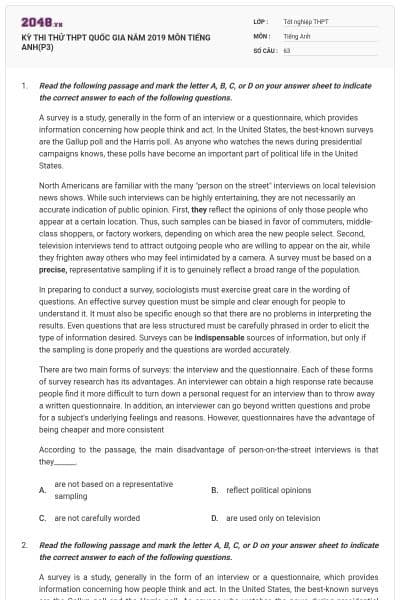
Read the following passage and mark the letter A, B, C, or D on your answer sheet to indicate the correct answer to each of the following questions.
A survey is a study, generally in the form of an interview or a questionnaire, which provides information concerning how people think and act. In the United States, the best-known surveys are the Gallup poll and the Harris poll. As anyone who watches the news during presidential campaigns knows, these polls have become an important part of political life in the United States.
North Americans are familiar with the many "person on the street" interviews on local television news shows. While such interviews can be highly entertaining, they are not necessarily an accurate indication of public opinion. First, they reflect the opinions of only those people who appear at a certain location. Thus, such samples can be biased in favor of commuters, middle-class shoppers, or factory workers, depending on which area the new people select. Second, television interviews tend to attract outgoing people who are willing to appear on the air, while they frighten away others who may feel intimidated by a camera. A survey must be based on a precise, representative sampling if it is to genuinely reflect a broad range of the population.
In preparing to conduct a survey, sociologists must exercise great care in the wording of questions. An effective survey question must be simple and clear enough for people to understand it. It must also be specific enough so that there are no problems in interpreting the results. Even questions that are less structured must be carefully phrased in order to elicit the type of information desired. Surveys can be indispensable sources of information, but only if the sampling is done properly and the questions are worded accurately.
There are two main forms of surveys: the interview and the questionnaire. Each of these forms of survey research has its advantages. An interviewer can obtain a high response rate because people find it more difficult to turn down a personal request for an interview than to throw away a written questionnaire. In addition, an interviewer can go beyond written questions and probe for a subject's underlying feelings and reasons. However, questionnaires have the advantage of being cheaper and more consistent
According to the passage, the main disadvantage of person-on-the-street interviews is that they______.
are not based on a representative sampling
reflect political opinions
are not carefully worded
are used only on television
Đáp án : A
Dòng 2 đoạn 2; While such interviews can be highly entertaining, they are not necessarily an accurate indication of public opinion ~ Các phỏng vấn này không thể hiện chính xác quan điểm của cả cộng đồng ( vì chỉ thu hút được những người sẵn sàng đứng trước ống kính, và những người chỉ xuất hiện ở một vài địa điểm nhất định)
Read the following passage and mark the letter A, B, C, or D on your answer sheet to indicate the correct answer to each of the following questions.
A survey is a study, generally in the form of an interview or a questionnaire, which provides information concerning how people think and act. In the United States, the best-known surveys are the Gallup poll and the Harris poll. As anyone who watches the news during presidential campaigns knows, these polls have become an important part of political life in the United States.
North Americans are familiar with the many "person on the street" interviews on local television news shows. While such interviews can be highly entertaining, they are not necessarily an accurate indication of public opinion. First, they reflect the opinions of only those people who appear at a certain location. Thus, such samples can be biased in favor of commuters, middle-class shoppers, or factory workers, depending on which area the new people select. Second, television interviews tend to attract outgoing people who are willing to appear on the air, while they frighten away others who may feel intimidated by a camera. A survey must be based on a precise, representative sampling if it is to genuinely reflect a broad range of the population.
In preparing to conduct a survey, sociologists must exercise great care in the wording of questions. An effective survey question must be simple and clear enough for people to understand it. It must also be specific enough so that there are no problems in interpreting the results. Even questions that are less structured must be carefully phrased in order to elicit the type of information desired. Surveys can be indispensable sources of information, but only if the sampling is done properly and the questions are worded accurately.
There are two main forms of surveys: the interview and the questionnaire. Each of these forms of survey research has its advantages. An interviewer can obtain a high response rate because people find it more difficult to turn down a personal request for an interview than to throw away a written questionnaire. In addition, an interviewer can go beyond written questions and probe for a subject's underlying feelings and reasons. However, questionnaires have the advantage of being cheaper and more consistent
According to the passage, one advantage of live interviews over questionnaires is that live interviews _____.
minimize the influence of the researcher
are easier to interpret
costless
can produce more information
Đáp án : D
Từ dòng 4 đoạn cuối; In addition, an interviewer can go beyond written questions and probe for a subject's underlying feelings and reasons ~ Cuộc phỏng vấn có thể vượt qua khỏi giới hạn của các câu hỏi định sẵn, khám phá thêm những cảm xúc, nguyên do sâu xa từ đối tượng phỏng vấn ~ nhiều thông tin hơn
Read the following passage and mark the letter A, B, C, or D on your answer sheet to indicate the correct answer to each of the following questions.
A survey is a study, generally in the form of an interview or a questionnaire, which provides information concerning how people think and act. In the United States, the best-known surveys are the Gallup poll and the Harris poll. As anyone who watches the news during presidential campaigns knows, these polls have become an important part of political life in the United States.
North Americans are familiar with the many "person on the street" interviews on local television news shows. While such interviews can be highly entertaining, they are not necessarily an accurate indication of public opinion. First, they reflect the opinions of only those people who appear at a certain location. Thus, such samples can be biased in favor of commuters, middle-class shoppers, or factory workers, depending on which area the new people select. Second, television interviews tend to attract outgoing people who are willing to appear on the air, while they frighten away others who may feel intimidated by a camera. A survey must be based on a precise, representative sampling if it is to genuinely reflect a broad range of the population.
In preparing to conduct a survey, sociologists must exercise great care in the wording of questions. An effective survey question must be simple and clear enough for people to understand it. It must also be specific enough so that there are no problems in interpreting the results. Even questions that are less structured must be carefully phrased in order to elicit the type of information desired. Surveys can be indispensable sources of information, but only if the sampling is done properly and the questions are worded accurately.
There are two main forms of surveys: the interview and the questionnaire. Each of these forms of survey research has its advantages. An interviewer can obtain a high response rate because people find it more difficult to turn down a personal request for an interview than to throw away a written questionnaire. In addition, an interviewer can go beyond written questions and probe for a subject's underlying feelings and reasons. However, questionnaires have the advantage of being cheaper and more consistent
The word "precise" is closest in meaning to______.
accurate
rational
required
planned
Đáp án : A
Precise = chính xác
Read the following passage and mark the letter A, B, C, or D on your answer sheet to indicate the correct answer to each of the following questions.
A survey is a study, generally in the form of an interview or a questionnaire, which provides information concerning how people think and act. In the United States, the best-known surveys are the Gallup poll and the Harris poll. As anyone who watches the news during presidential campaigns knows, these polls have become an important part of political life in the United States.
North Americans are familiar with the many "person on the street" interviews on local television news shows. While such interviews can be highly entertaining, they are not necessarily an accurate indication of public opinion. First, they reflect the opinions of only those people who appear at a certain location. Thus, such samples can be biased in favor of commuters, middle-class shoppers, or factory workers, depending on which area the new people select. Second, television interviews tend to attract outgoing people who are willing to appear on the air, while they frighten away others who may feel intimidated by a camera. A survey must be based on a precise, representative sampling if it is to genuinely reflect a broad range of the population.
In preparing to conduct a survey, sociologists must exercise great care in the wording of questions. An effective survey question must be simple and clear enough for people to understand it. It must also be specific enough so that there are no problems in interpreting the results. Even questions that are less structured must be carefully phrased in order to elicit the type of information desired. Surveys can be indispensable sources of information, but only if the sampling is done properly and the questions are worded accurately.
There are two main forms of surveys: the interview and the questionnaire. Each of these forms of survey research has its advantages. An interviewer can obtain a high response rate because people find it more difficult to turn down a personal request for an interview than to throw away a written questionnaire. In addition, an interviewer can go beyond written questions and probe for a subject's underlying feelings and reasons. However, questionnaires have the advantage of being cheaper and more consistent
According to the reading passage, there are ____ main categories of surveys
four
five
two
three
Đáp án : C
Dòng đầu đoạn cuối: There are two main forms of surveys: the interview and the questionnaire
Read the following passage and mark the letter A, B, C, or D on your answer sheet to indicate the correct answer to each of the following questions.
A survey is a study, generally in the form of an interview or a questionnaire, which provides information concerning how people think and act. In the United States, the best-known surveys are the Gallup poll and the Harris poll. As anyone who watches the news during presidential campaigns knows, these polls have become an important part of political life in the United States.
North Americans are familiar with the many "person on the street" interviews on local television news shows. While such interviews can be highly entertaining, they are not necessarily an accurate indication of public opinion. First, they reflect the opinions of only those people who appear at a certain location. Thus, such samples can be biased in favor of commuters, middle-class shoppers, or factory workers, depending on which area the new people select. Second, television interviews tend to attract outgoing people who are willing to appear on the air, while they frighten away others who may feel intimidated by a camera. A survey must be based on a precise, representative sampling if it is to genuinely reflect a broad range of the population.
In preparing to conduct a survey, sociologists must exercise great care in the wording of questions. An effective survey question must be simple and clear enough for people to understand it. It must also be specific enough so that there are no problems in interpreting the results. Even questions that are less structured must be carefully phrased in order to elicit the type of information desired. Surveys can be indispensable sources of information, but only if the sampling is done properly and the questions are worded accurately.
There are two main forms of surveys: the interview and the questionnaire. Each of these forms of survey research has its advantages. An interviewer can obtain a high response rate because people find it more difficult to turn down a personal request for an interview than to throw away a written questionnaire. In addition, an interviewer can go beyond written questions and probe for a subject's underlying feelings and reasons. However, questionnaires have the advantage of being cheaper and more consistent
Which word is given definition in the text?
sampling
poll
survey
interview
Đáp án : C
Survey được định nghĩa trong dòng đầu tiên: A survey is a study, generally in the form of an interview or a questionnaire, which provides information concerning how people think and act
Read the following passage and mark the letter A, B, C, or D on your answer sheet to indicate the correct answer to each of the following questions.
A survey is a study, generally in the form of an interview or a questionnaire, which provides information concerning how people think and act. In the United States, the best-known surveys are the Gallup poll and the Harris poll. As anyone who watches the news during presidential campaigns knows, these polls have become an important part of political life in the United States.
North Americans are familiar with the many "person on the street" interviews on local television news shows. While such interviews can be highly entertaining, they are not necessarily an accurate indication of public opinion. First, they reflect the opinions of only those people who appear at a certain location. Thus, such samples can be biased in favor of commuters, middle-class shoppers, or factory workers, depending on which area the new people select. Second, television interviews tend to attract outgoing people who are willing to appear on the air, while they frighten away others who may feel intimidated by a camera. A survey must be based on a precise, representative sampling if it is to genuinely reflect a broad range of the population.
In preparing to conduct a survey, sociologists must exercise great care in the wording of questions. An effective survey question must be simple and clear enough for people to understand it. It must also be specific enough so that there are no problems in interpreting the results. Even questions that are less structured must be carefully phrased in order to elicit the type of information desired. Surveys can be indispensable sources of information, but only if the sampling is done properly and the questions are worded accurately.
There are two main forms of surveys: the interview and the questionnaire. Each of these forms of survey research has its advantages. An interviewer can obtain a high response rate because people find it more difficult to turn down a personal request for an interview than to throw away a written questionnaire. In addition, an interviewer can go beyond written questions and probe for a subject's underlying feelings and reasons. However, questionnaires have the advantage of being cheaper and more consistent
The word "they" refers to ______.
interviews
opinions
news shows
North Americans
Đáp án : A
Từ they để thay thế cho danh từ số nhiều đứng trong vế câu trước đó; ở đây danh từ số nhiều trong câu trước là interview
Read the following passage and mark the letter A, B, C, or D on your answer sheet to indicate the correct answer to each of the following questions.
A survey is a study, generally in the form of an interview or a questionnaire, which provides information concerning how people think and act. In the United States, the best-known surveys are the Gallup poll and the Harris poll. As anyone who watches the news during presidential campaigns knows, these polls have become an important part of political life in the United States.
North Americans are familiar with the many "person on the street" interviews on local television news shows. While such interviews can be highly entertaining, they are not necessarily an accurate indication of public opinion. First, they reflect the opinions of only those people who appear at a certain location. Thus, such samples can be biased in favor of commuters, middle-class shoppers, or factory workers, depending on which area the new people select. Second, television interviews tend to attract outgoing people who are willing to appear on the air, while they frighten away others who may feel intimidated by a camera. A survey must be based on a precise, representative sampling if it is to genuinely reflect a broad range of the population.
In preparing to conduct a survey, sociologists must exercise great care in the wording of questions. An effective survey question must be simple and clear enough for people to understand it. It must also be specific enough so that there are no problems in interpreting the results. Even questions that are less structured must be carefully phrased in order to elicit the type of information desired. Surveys can be indispensable sources of information, but only if the sampling is done properly and the questions are worded accurately.
There are two main forms of surveys: the interview and the questionnaire. Each of these forms of survey research has its advantages. An interviewer can obtain a high response rate because people find it more difficult to turn down a personal request for an interview than to throw away a written questionnaire. In addition, an interviewer can go beyond written questions and probe for a subject's underlying feelings and reasons. However, questionnaires have the advantage of being cheaper and more consistent
What does the passage mainly discuss?
The principles of conducting surveys
The importance of polls in American political life
Problems associated with interpreting surveys
The history of surveys in North America
Đáp án : A
Đoạn văn nói về 2 hình thức tiến hành điều tra với các thuận lợi và khó khăn trong cách thực hiện, nhưng quy tắc để hạn chế những khó khăn đó
Read the following passage and mark the letter A, B, C, or D on your answer sheet to indicate the correct answer to each of the following questions.
A survey is a study, generally in the form of an interview or a questionnaire, which provides information concerning how people think and act. In the United States, the best-known surveys are the Gallup poll and the Harris poll. As anyone who watches the news during presidential campaigns knows, these polls have become an important part of political life in the United States.
North Americans are familiar with the many "person on the street" interviews on local television news shows. While such interviews can be highly entertaining, they are not necessarily an accurate indication of public opinion. First, they reflect the opinions of only those people who appear at a certain location. Thus, such samples can be biased in favor of commuters, middle-class shoppers, or factory workers, depending on which area the new people select. Second, television interviews tend to attract outgoing people who are willing to appear on the air, while they frighten away others who may feel intimidated by a camera. A survey must be based on a precise, representative sampling if it is to genuinely reflect a broad range of the population.
In preparing to conduct a survey, sociologists must exercise great care in the wording of questions. An effective survey question must be simple and clear enough for people to understand it. It must also be specific enough so that there are no problems in interpreting the results. Even questions that are less structured must be carefully phrased in order to elicit the type of information desired. Surveys can be indispensable sources of information, but only if the sampling is done properly and the questions are worded accurately.
There are two main forms of surveys: the interview and the questionnaire. Each of these forms of survey research has its advantages. An interviewer can obtain a high response rate because people find it more difficult to turn down a personal request for an interview than to throw away a written questionnaire. In addition, an interviewer can go beyond written questions and probe for a subject's underlying feelings and reasons. However, questionnaires have the advantage of being cheaper and more consistent
According to paragraph 3, which of the following is most important for an effective survey?
A sociologist who is able to interpret the results
Carefully worded questions
An interviewer's ability to measure respondents' feelings
A high number of respondents
Đáp án : B
Từ dòng 1 đoạn 3: sociologists must exercise great care in the wording of questions. An effective survey question must be simple and clear enough for people to understand it ~ phải rất cẩn thận trong cách dùng từ khi đặt câu hỏi để tạo ra bảng câu hỏi hiệu quả
Read the following passage and mark the letter A, B, C, or D on your answer sheet to indicate the correct answer to each of the following questions.
A survey is a study, generally in the form of an interview or a questionnaire, which provides information concerning how people think and act. In the United States, the best-known surveys are the Gallup poll and the Harris poll. As anyone who watches the news during presidential campaigns knows, these polls have become an important part of political life in the United States.
North Americans are familiar with the many "person on the street" interviews on local television news shows. While such interviews can be highly entertaining, they are not necessarily an accurate indication of public opinion. First, they reflect the opinions of only those people who appear at a certain location. Thus, such samples can be biased in favor of commuters, middle-class shoppers, or factory workers, depending on which area the new people select. Second, television interviews tend to attract outgoing people who are willing to appear on the air, while they frighten away others who may feel intimidated by a camera. A survey must be based on a precise, representative sampling if it is to genuinely reflect a broad range of the population.
In preparing to conduct a survey, sociologists must exercise great care in the wording of questions. An effective survey question must be simple and clear enough for people to understand it. It must also be specific enough so that there are no problems in interpreting the results. Even questions that are less structured must be carefully phrased in order to elicit the type of information desired. Surveys can be indispensable sources of information, but only if the sampling is done properly and the questions are worded accurately.
There are two main forms of surveys: the interview and the questionnaire. Each of these forms of survey research has its advantages. An interviewer can obtain a high response rate because people find it more difficult to turn down a personal request for an interview than to throw away a written questionnaire. In addition, an interviewer can go beyond written questions and probe for a subject's underlying feelings and reasons. However, questionnaires have the advantage of being cheaper and more consistent
The word "indispensable" is closest in meaning to______.
. necessary
complicated
expensive
simple
Đáp án : A
Indispensable = không thể bỏ qua được ~ rất quan trọng, thiết yếu
Read the following passage and mark the letter A, B, C, or D on your answer sheet to indicate the correct answer to each of the following questions.
A survey is a study, generally in the form of an interview or a questionnaire, which provides information concerning how people think and act. In the United States, the best-known surveys are the Gallup poll and the Harris poll. As anyone who watches the news during presidential campaigns knows, these polls have become an important part of political life in the United States.
North Americans are familiar with the many "person on the street" interviews on local television news shows. While such interviews can be highly entertaining, they are not necessarily an accurate indication of public opinion. First, they reflect the opinions of only those people who appear at a certain location. Thus, such samples can be biased in favor of commuters, middle-class shoppers, or factory workers, depending on which area the new people select. Second, television interviews tend to attract outgoing people who are willing to appear on the air, while they frighten away others who may feel intimidated by a camera. A survey must be based on a precise, representative sampling if it is to genuinely reflect a broad range of the population.
In preparing to conduct a survey, sociologists must exercise great care in the wording of questions. An effective survey question must be simple and clear enough for people to understand it. It must also be specific enough so that there are no problems in interpreting the results. Even questions that are less structured must be carefully phrased in order to elicit the type of information desired. Surveys can be indispensable sources of information, but only if the sampling is done properly and the questions are worded accurately.
There are two main forms of surveys: the interview and the questionnaire. Each of these forms of survey research has its advantages. An interviewer can obtain a high response rate because people find it more difficult to turn down a personal request for an interview than to throw away a written questionnaire. In addition, an interviewer can go beyond written questions and probe for a subject's underlying feelings and reasons. However, questionnaires have the advantage of being cheaper and more consistent
It can be inferred from the passage that one reason that sociologists may become frustrated with questionnaires is that______.
respondents often do not complete and return questionnaires
questionnaires are expensive and difficult to distribute
respondents are too eager to supplement questions with their own opinions
questionnaires are often difficult to read
Đáp án : A
Từ dòng 2 đoạn cuối : An interviewer can obtain a high response rate because people find it more difficult to turn down a personal request for an interview than to throw away a written questionnaire ~ phỏng vấn sẽ được nhiều người trả lời hơn, đồng nghĩa với việc người ta dễ dàng ném bảng câu hỏi giấy đi hơn và thường không trả lời đầy đủ hơn
Mark the letter A, B, C, or D on your answer sheet to indicate the word whose underlined part differs from the other three in pronunciation in each of the following questions.
transfer
career
variety
afraid
Đáp án : A
a trong transfer phát âm là /æ/, các từ còn lại phát âm là /ə/
Mark the letter A, B, C, or D on your answer sheet to indicate the word whose underlined part differs from the other three in pronunciation in each of the following questions
surfaces
temples
exercises
pages
Đáp án : B
Đuôi s sau các âm /s, z, dʒ/ phát âm là iz, sau âm /l/ phát âm là s
Read the following passage and mark the letter A, B, C, or D on your answer sheet to indicate thecorrect word or phrase that best fits each of the numbered blanks.
Education is more important today than ever before. It helps people acquire the skills they need for such everyday (1)_______ as reading a newspaper or managing their money. It also gives them the specialized training they may need to (2)_______ for a job or career. For example, a person must meet certain educational requirements and obtain a (3)_______ or certificate before he can practice law or medicine. Many fields, like computer operation or police work, (4)_______ satisfactory completion of special training courses.
Education is also important (5)_______ it helps people get more out of life. It increases their knowledge and understanding of the world. It helps them acquire the skills that make life more interesting and enjoyable, (6)_______ the skills needed to participate in a sport, paint a picture, or play a musical (7)_______ . Such education becomes (8)_______ important as people gain more and more leisure time.
Education also helps people adjust to change. This habit has become necessary because social changes today take place with increasing speed and (9)_______ the lives of more and more people. Education can help a person understand these changes and provide him (10)_______ the skills for adjusting to them.
Điền vào ô 1
works
jobs
actions
activities
Đáp án : D
Everyday activities = hoạt động thường ngày, work = công việc (không đếm được), job = nghề nghiệp, action = hành động
Read the following passage and mark the letter A, B, C, or D on your answer sheet to indicate thecorrect word or phrase that best fits each of the numbered blanks.
Education is more important today than ever before. It helps people acquire the skills they need for such everyday (1)_______ as reading a newspaper or managing their money. It also gives them the specialized training they may need to (2)_______ for a job or career. For example, a person must meet certain educational requirements and obtain a (3)_______ or certificate before he can practice law or medicine. Many fields, like computer operation or police work, (4)_______ satisfactory completion of special training courses.
Education is also important (5)_______ it helps people get more out of life. It increases their knowledge and understanding of the world. It helps them acquire the skills that make life more interesting and enjoyable, (6)_______ the skills needed to participate in a sport, paint a picture, or play a musical (7)_______ . Such education becomes (8)_______ important as people gain more and more leisure time.
Education also helps people adjust to change. This habit has become necessary because social changes today take place with increasing speed and (9)_______ the lives of more and more people. Education can help a person understand these changes and provide him (10)_______ the skills for adjusting to them.
Điền vào ô 2
do
prepare
make
work
Đáp án : B
Prepare for smt = chuẩn bị cho cái gì
Read the following passage and mark the letter A, B, C, or D on your answer sheet to indicate thecorrect word or phrase that best fits each of the numbered blanks.
Education is more important today than ever before. It helps people acquire the skills they need for such everyday (1)_______ as reading a newspaper or managing their money. It also gives them the specialized training they may need to (2)_______ for a job or career. For example, a person must meet certain educational requirements and obtain a (3)_______ or certificate before he can practice law or medicine. Many fields, like computer operation or police work, (4)_______ satisfactory completion of special training courses.
Education is also important (5)_______ it helps people get more out of life. It increases their knowledge and understanding of the world. It helps them acquire the skills that make life more interesting and enjoyable, (6)_______ the skills needed to participate in a sport, paint a picture, or play a musical (7)_______ . Such education becomes (8)_______ important as people gain more and more leisure time.
Education also helps people adjust to change. This habit has become necessary because social changes today take place with increasing speed and (9)_______ the lives of more and more people. Education can help a person understand these changes and provide him (10)_______ the skills for adjusting to them.
Điền vào ô 3
license
card
diploma
paper
Đáp án : A
License = bằng, card = thẻ, diploma = chứng chỉ, paper = giấy, kết quả
Read the following passage and mark the letter A, B, C, or D on your answer sheet to indicate thecorrect word or phrase that best fits each of the numbered blanks.
Education is more important today than ever before. It helps people acquire the skills they need for such everyday (1)_______ as reading a newspaper or managing their money. It also gives them the specialized training they may need to (2)_______ for a job or career. For example, a person must meet certain educational requirements and obtain a (3)_______ or certificate before he can practice law or medicine. Many fields, like computer operation or police work, (4)_______ satisfactory completion of special training courses.
Education is also important (5)_______ it helps people get more out of life. It increases their knowledge and understanding of the world. It helps them acquire the skills that make life more interesting and enjoyable, (6)_______ the skills needed to participate in a sport, paint a picture, or play a musical (7)_______ . Such education becomes (8)_______ important as people gain more and more leisure time.
Education also helps people adjust to change. This habit has become necessary because social changes today take place with increasing speed and (9)_______ the lives of more and more people. Education can help a person understand these changes and provide him (10)_______ the skills for adjusting to them.
Điền vào ô 4
requires
requiring
require
to require
Đáp án : C
Chủ ngữ trong câu là many fields ~ danh từ số nhiều ~ động từ chia ở số nhiều, không thêm s
Read the following passage and mark the letter A, B, C, or D on your answer sheet to indicate thecorrect word or phrase that best fits each of the numbered blanks.
Education is more important today than ever before. It helps people acquire the skills they need for such everyday (1)_______ as reading a newspaper or managing their money. It also gives them the specialized training they may need to (2)_______ for a job or career. For example, a person must meet certain educational requirements and obtain a (3)_______ or certificate before he can practice law or medicine. Many fields, like computer operation or police work, (4)_______ satisfactory completion of special training courses.
Education is also important (5)_______ it helps people get more out of life. It increases their knowledge and understanding of the world. It helps them acquire the skills that make life more interesting and enjoyable, (6)_______ the skills needed to participate in a sport, paint a picture, or play a musical (7)_______ . Such education becomes (8)_______ important as people gain more and more leisure time.
Education also helps people adjust to change. This habit has become necessary because social changes today take place with increasing speed and (9)_______ the lives of more and more people. Education can help a person understand these changes and provide him (10)_______ the skills for adjusting to them.
Điền vào ô 5
therefore
despite
although
because
Đáp án : D
Because = bởi vì, therefore = vì thế, despite = mặc dù, although = mặc dù
Read the following passage and mark the letter A, B, C, or D on your answer sheet to indicate thecorrect word or phrase that best fits each of the numbered blanks.
Education is more important today than ever before. It helps people acquire the skills they need for such everyday (1)_______ as reading a newspaper or managing their money. It also gives them the specialized training they may need to (2)_______ for a job or career. For example, a person must meet certain educational requirements and obtain a (3)_______ or certificate before he can practice law or medicine. Many fields, like computer operation or police work, (4)_______ satisfactory completion of special training courses.
Education is also important (5)_______ it helps people get more out of life. It increases their knowledge and understanding of the world. It helps them acquire the skills that make life more interesting and enjoyable, (6)_______ the skills needed to participate in a sport, paint a picture, or play a musical (7)_______ . Such education becomes (8)_______ important as people gain more and more leisure time.
Education also helps people adjust to change. This habit has become necessary because social changes today take place with increasing speed and (9)_______ the lives of more and more people. Education can help a person understand these changes and provide him (10)_______ the skills for adjusting to them.
Điền vào ô 6
such as
for instance
such that
for example
Đáp án : A
Such as = như là (liệt kê); For instance, + mệnh đề = ví dụ như = For example, + mệnh đề
Read the following passage and mark the letter A, B, C, or D on your answer sheet to indicate thecorrect word or phrase that best fits each of the numbered blanks.
Education is more important today than ever before. It helps people acquire the skills they need for such everyday (1)_______ as reading a newspaper or managing their money. It also gives them the specialized training they may need to (2)_______ for a job or career. For example, a person must meet certain educational requirements and obtain a (3)_______ or certificate before he can practice law or medicine. Many fields, like computer operation or police work, (4)_______ satisfactory completion of special training courses.
Education is also important (5)_______ it helps people get more out of life. It increases their knowledge and understanding of the world. It helps them acquire the skills that make life more interesting and enjoyable, (6)_______ the skills needed to participate in a sport, paint a picture, or play a musical (7)_______ . Such education becomes (8)_______ important as people gain more and more leisure time.
Education also helps people adjust to change. This habit has become necessary because social changes today take place with increasing speed and (9)_______ the lives of more and more people. Education can help a person understand these changes and provide him (10)_______ the skills for adjusting to them.
Điền vào ô 7
appliance
equipment
instrument
device
Đáp án : C
Musical instrument = dụng cụ âm nhạc
Read the following passage and mark the letter A, B, C, or D on your answer sheet to indicate thecorrect word or phrase that best fits each of the numbered blanks.
Education is more important today than ever before. It helps people acquire the skills they need for such everyday (1)_______ as reading a newspaper or managing their money. It also gives them the specialized training they may need to (2)_______ for a job or career. For example, a person must meet certain educational requirements and obtain a (3)_______ or certificate before he can practice law or medicine. Many fields, like computer operation or police work, (4)_______ satisfactory completion of special training courses.
Education is also important (5)_______ it helps people get more out of life. It increases their knowledge and understanding of the world. It helps them acquire the skills that make life more interesting and enjoyable, (6)_______ the skills needed to participate in a sport, paint a picture, or play a musical (7)_______ . Such education becomes (8)_______ important as people gain more and more leisure time.
Education also helps people adjust to change. This habit has become necessary because social changes today take place with increasing speed and (9)_______ the lives of more and more people. Education can help a person understand these changes and provide him (10)_______ the skills for adjusting to them.
Điền vào ô 8
increased
increasing
increase
increasingly
Đáp án : D
Trạng từ đứng trước tính từ để bổ nghĩa cho tính từ đó: increasingly important
Read the following passage and mark the letter A, B, C, or D on your answer sheet to indicate thecorrect word or phrase that best fits each of the numbered blanks.
Education is more important today than ever before. It helps people acquire the skills they need for such everyday (1)_______ as reading a newspaper or managing their money. It also gives them the specialized training they may need to (2)_______ for a job or career. For example, a person must meet certain educational requirements and obtain a (3)_______ or certificate before he can practice law or medicine. Many fields, like computer operation or police work, (4)_______ satisfactory completion of special training courses.
Education is also important (5)_______ it helps people get more out of life. It increases their knowledge and understanding of the world. It helps them acquire the skills that make life more interesting and enjoyable, (6)_______ the skills needed to participate in a sport, paint a picture, or play a musical (7)_______ . Such education becomes (8)_______ important as people gain more and more leisure time.
Education also helps people adjust to change. This habit has become necessary because social changes today take place with increasing speed and (9)_______ the lives of more and more people. Education can help a person understand these changes and provide him (10)_______ the skills for adjusting to them.
Điền vào ô 9
effect
affect
affective
effective
Đáp án : B
Affect (V) = gây ảnh hưởng; effect (N) = ảnh hưởng
Read the following passage and mark the letter A, B, C, or D on your answer sheet to indicate thecorrect word or phrase that best fits each of the numbered blanks.
Education is more important today than ever before. It helps people acquire the skills they need for such everyday (1)_______ as reading a newspaper or managing their money. It also gives them the specialized training they may need to (2)_______ for a job or career. For example, a person must meet certain educational requirements and obtain a (3)_______ or certificate before he can practice law or medicine. Many fields, like computer operation or police work, (4)_______ satisfactory completion of special training courses.
Education is also important (5)_______ it helps people get more out of life. It increases their knowledge and understanding of the world. It helps them acquire the skills that make life more interesting and enjoyable, (6)_______ the skills needed to participate in a sport, paint a picture, or play a musical (7)_______ . Such education becomes (8)_______ important as people gain more and more leisure time.
Education also helps people adjust to change. This habit has become necessary because social changes today take place with increasing speed and (9)_______ the lives of more and more people. Education can help a person understand these changes and provide him (10)_______ the skills for adjusting to them.
Điền vào ô 10
with
for
in
to
Đáp án : A
Provide smb with smt = cung cấp cho ai cái gì
Her boss fired her, ____made her angry.
that
this
what
which
Đáp án : D
Đại từ quan hệ đứng sau dấu phẩy để chỉ cả một mệnh đề trước nó chỉ có thể là which; việc ông chủ sa thải làm cô ấy tức giận
You _____ the washing. My sister could have done it for you
needn't have done
couldn't have done
hadn't to do
. mustn't have done
Đáp án: A
Giải thích:
A. needn’t have VpII: lẽ ra không cần làm gì nhưng đã làm
B. couldn’t have VpII: dự đoán không chắc chắn ai đó không làm gì trong quá khứ
C. hadn’t to V: không phải làm gì trong quá khứ
D. mustn’t have VpII: dự đoán khả chắc chắn ai đó không làm gì quá khứ
Dùng cấu trúc needn’t have done là phù hợp nhất về nghĩa.
Dịch: Bạn đã không cần phải giặt, chị của tôi đã có thế làm cho bạn.
These school-leavers are looking forward ____ on campus
living
to live
. live
to living
Đáp án : D
Look forward to Ving = mong đợi việc làm gì
Would you like to take a gap year before ____ a university?
filling in
applying to
applying for
filling out
Đáp án : B
Apply to smt = nộp đơn vào cơ quan, tổ chức gì; apply for smt = nộp đơn để xin vào vị trí gì
In 1837 the University of Michigan became the first state university ______ by a board of regents elected by the voters of the state
being controlled
it was controlled
to be controlled
under the control
Đáp án: C
Giải thích:
Khi có số thứ tự, so sánh nhất, “the only”, ta dùng “to V” để rút gọn.
Dịch: Năm 1837, Đại học Michigan trở thành trường đại học công lập đầu tiên được quản lý bởi hội đồng quản trị do cử tri của tiểu bang bầu ra.
We all believe that a happy marriage should be ___ mutual love
based on
concerned with
confided in
obliged to
Đáp án : A
Be based on +N = dựa vào cái gì
By the end of the 21st century, the first car running on the sea water ____.
will finish
will be finished
. will have been finished
will be finishing
Đáp án : C
ành động sẽ được hoàn thành trước một mốc thời gian trong tương lai (By the end of the 21st century) ~ tương lai hoàn thàn
-"What a lovely house you have!" - "_____"
No problem
Thank you. Hope you will drop in.
Of course not, it's not costly
I think so
Đáp án : B
Trước lời khen (ngôi nhà bạn có thật là đáng yêu), người đáp cám ơn và hi vọng người nói sẽ ghé thăm
_____I get your letter, I will reply to you at once
By the time
As though
As soon as
Now that
Đáp án : C
As soon as = ngay sau khi; by the time = cho tới khi; as though = mặc dù
____ not to come late, the applicant set out for his job interview
He was advised
People advised him
Advised
Advising
Đáp án : C
Quá khứ phân từ có thể đứng đầu câu như một hình thức rút gọn mệnh đề quan hệ dạng bị động
If Lucy's car ____ down, she would be here right now.
wouldn't have been
hadn't broken
doesn't break
didn't break
Đáp án : B
Câu điều kiện loại 1: If + S + V(s/es), S + will + V
According to ___ people, most animal and plant species on earth will soon die out.
optimists
pessimistic
pessimists
optimistic
Đáp án : B
Pessimistic = bi quan; pessimist = người bi quan; optimistic = lạc quan; optimist = người lạc quan
_______the film director, Ben Affleck, was famously left off of the 85th Oscar's Best Director list of nominees surprised everyone
Although
What
Due to
That
Đáp án : D
That + mệnh đề có thể làm chủ ngữ trong câu; chỉ cả một sự việc gây ra điều gì
My mother asked me _____
which tertiary institution did I choose
which tertiary institution I choose
which tertiary institution I would choose
which tertiary institution will I choose
Đáp án : C
Khi tường thuật câu hỏi; sau từ để hỏi là S + V (có chia lùi thời như câu trần thuật); ở đây câu trực tiếp sẽ là: will choose ~ chuyển sang gián tiếp là would choose
It is really an ____.
. undergraduate interesting economics course
economics course interesting undergraduate
. interesting economics undergraduate course
interesting undergraduate economics course
Đáp án : C
Dịch C: khóa học đại học về kinh tế thú vị; tính từ nhận xét tính chất đứng trước tính từ/danh từ tạo nên tên đối tượng
Not until _____ in my paper ____ to write down my name on it.
I handed/ that I remembered
I handed/ did I remember
did I hand/ did I remember
did I hand/ I remembered
Đáp án : B
Cấu trúc đảo ngữ nhấn mạnh thì quá khứ đơn: Not until S + V-ed, did + S + V
- ''Did you enjoy the movie yesterday?" - "_____"
Certainly, I'd be glad to
Yes, it is warmer than today
Not really. I couldn't follow the story
No, I dislike moving
Đáp án : C
Được hỏi có thích bộ phim hôm qua không, người đáp nói: không thích lắm, tôi không thể theo kịp được câu chuyện
Is it necessary that I _____ here tomorrow?
would be
am being
were
be
Đáp án : D
Cấu trúc giả định: It is + tính từ chỉ sự quan trọng, cấp bách (important; necessary; urgent;) + S + (should) + V ( không chia)
We received a call from the teacher_______ charge of our course
on
at
in
to
Đáp án : C
In charge of +N = chịu trách nhiệm về vấn đề gì
Mark the letter A, B, C or D on your answer sheet to indicate the word that differs from the other three in the position of primary stress in each of the following questions.
powerful
remember
obvious
primary
Đáp án : B
Trọng âm của từ này rơi vào âm tiết thứ 2, các từ còn lại rơi vào âm tiết thứ 1
Mark the letter A, B, C or D on your answer sheet to indicate the word that differs from the other three in the position of primary stress in each of the following questions.
sacrifice
impossible
confident
interview
Đáp án : B
Trọng âm của từ này rơi vào âm tiết thứ 2, các từ còn lại rơi vào âm tiết thứ 1
Mark the letter A, B, C or D on your answer sheet to indicate the word that differs from the other three in the position of primary stress in each of the following questions.
vacant
factor
college
device
Đáp án : D
Trọng âm của từ này rơi vào âm tiết thứ 2, các từ còn lại rơi vào âm tiết thứ 1
In the future, we will certainly lead a more healthier life.
In
will
more
certainly
Đáp án : C
Dạng so sánh hơn của tính từ healthy là healthier, không có more
In the end of the story, Cinderella and the prince get married and live happily together
the prince
In the end
get married
happily
Đáp án : B
In the end, + mệnh đề = cuối cùng thì . At the end of + N = vào phần cuối của cái gì
Rattan, a close relative of bamboo, is often used to make tables, chairs, and other furnitures.
furnitures
a close
is often
to make
Đáp án : A
Furniture = đồ đạc ~ danh từ không đếm được, không thêm s vào cuối
Either Mr. Anderson or Ms Wiggins are going to teach our class today.
or
are
Either
today
Đáp án : B
Either + N1 + or + N2 ~ động từ chia theo N2 ~ ở đây là bà Wiggins ~ động từ chia như ngôi số ít
I prefer living in a nuclear family than a joint one
a nuclear family
one
than
living
Đáp án : C
Prefer + N/Ving + to + N/Ving = thích cái gì hơn cái gì
Mark the letter A, B, C or D on your answer sheet to indicate the word(s) CLOSEST in meaning to the underlined word(s) in each of the following questions.
In the 1980s, TV viewers began to hook up videocassette players to their TVs.
combine
stop
fasten
connect
Đáp án : A
By hand = bằng tay, thủ công = manually
Mark the letter A, B, C or D on your answer sheet to indicate the word(s) CLOSEST in meaning to the underlined word(s) in each of the following questions.
Thanks to better health care, there are more and more centenarians nowadays.
children whose parents can't afford their schooling
. children who die at birth
people who live 100 years or more
people who suffer from fatal diseases
Đáp án : C
Centenarian = người sống cả thập kỉ
Mark the letter A, B, C or D on your answer sheet to indicate the word(s) CLOSEST in meaning to the underlined word(s) in each of the following questions.
These machines are older models and have to be operated by hand.
manually
spiritually
automatically
mechanically
Đáp án : B
Discourteous = bất lịch sự = impolite; polite = lịch sự
Mark the letter A, B, C, or D on your answer sheet to indicate the word(s) OPPOSITE in meaning to the underlined word(s) in each of the following questions.
It's discourteous to ask Americans questions about their age, marriage or income.
impolite
polite
unacceptable
rude
Đáp án : B
Critical of smb/smt = chỉ trích ai/ cái gì; supportive = ủng hộ
Mark the letter A, B, C, or D on your answer sheet to indicate the word(s) OPPOSITE in meaning to the underlined word(s) in each of the following questions.
It's discourteous to ask Americans questions about their age, marriage or income.
impolite
polite
unacceptable
rude
Đáp án : C
Từ dòng 9 đoạn 2: In many Asian cultures, for example, children are taught to control emotional responses - especially negative ones
Read the following passage and mark the letter A, B, C, or D on your answer sheet to indicate the correct answer to each of the following questions.
You can usually tell when your friends are happy or angry by the looks on their faces or by their actions. This is useful because reading their emotional expressions helps you to know how to respond to them. Emotions have evolved to help us respond to important situations and to convey our intentions to others. But does raising the eyebrows and rounding the mouth say the same thing in Minneapolis as it does in Madagascar? Much research on emotional expressions has centered on such questions.
According to Paul Ekman, the leading researcher in this area, people speak and understand substantially the same "facial language". Studies by Ekman's group have demonstrated that humans share a set of universal emotional expressions that testify to the common biological heritage of the human species. Smiles, for example, signal happiness and frowns indicate sadness on the faces of people in such far- flung places as Argentina, Japan, Spain, Hungary, Poland , Sumatra ,the United States, Vietnam, the jungles of New Guinea , and the Eskimo villages north of Artic Circle. Ekman and his colleagues claim that people everywhere can recognize at least seven basic emotions: sadness, fear, anger, disgust, contempt, happiness, and surprise. There are, however, huge differences across cultures in both the context and intensity of emotional displays - the so called display rules. In many Asian cultures, for example, children are taught to control emotional responses - especially negative ones- while many American children are encouraged to express their feelings more openly. Regardless of culture, however, emotions usually show themselves, to some degree , in people's behavior. From their first days of life, babies produce facial expressions that communicate their feelings.
The ability to read facial expressions develops early, too. Very young children pay close attention to facial expressions, and by age five, they nearly equal adults in their skill at reading emotions on people's faces. This evidence all points to a biological underpinning for our abilities to express and interpret a basic set of human emotions. Moreover, as Charles Darwin pointed out over a century ago, some emotional expressions seem to appear across species boundaries. Cross - cultural psychologists tell us that certain emotional responses carry different meanings in different cultures. For example, what emotion do you suppose might be conveyed by sticking out your tongue? For Americans, this might indicate disgust, while in China it can signify surprise. Likewise, a grin on an American face may indicate joy, while on a Japanese face it may just as easily mean embarrassment. Clearly, culture influences emotional expressions.
The word " evolved" is closest in meaning to _____.
increased
reduced
developed
simplified
Đáp án : C
Evolve = phát triển; tiến hóa
Read the following passage and mark the letter A, B, C, or D on your answer sheet to indicate the correct answer to each of the following questions.
You can usually tell when your friends are happy or angry by the looks on their faces or by their actions. This is useful because reading their emotional expressions helps you to know how to respond to them. Emotions have evolved to help us respond to important situations and to convey our intentions to others. But does raising the eyebrows and rounding the mouth say the same thing in Minneapolis as it does in Madagascar? Much research on emotional expressions has centered on such questions.
According to Paul Ekman, the leading researcher in this area, people speak and understand substantially the same "facial language". Studies by Ekman's group have demonstrated that humans share a set of universal emotional expressions that testify to the common biological heritage of the human species. Smiles, for example, signal happiness and frowns indicate sadness on the faces of people in such far- flung places as Argentina, Japan, Spain, Hungary, Poland , Sumatra ,the United States, Vietnam, the jungles of New Guinea , and the Eskimo villages north of Artic Circle. Ekman and his colleagues claim that people everywhere can recognize at least seven basic emotions: sadness, fear, anger, disgust, contempt, happiness, and surprise. There are, however, huge differences across cultures in both the context and intensity of emotional displays - the so called display rules. In many Asian cultures, for example, children are taught to control emotional responses - especially negative ones- while many American children are encouraged to express their feelings more openly. Regardless of culture, however, emotions usually show themselves, to some degree , in people's behavior. From their first days of life, babies produce facial expressions that communicate their feelings.
The ability to read facial expressions develops early, too. Very young children pay close attention to facial expressions, and by age five, they nearly equal adults in their skill at reading emotions on people's faces. This evidence all points to a biological underpinning for our abilities to express and interpret a basic set of human emotions. Moreover, as Charles Darwin pointed out over a century ago, some emotional expressions seem to appear across species boundaries. Cross - cultural psychologists tell us that certain emotional responses carry different meanings in different cultures. For example, what emotion do you suppose might be conveyed by sticking out your tongue? For Americans, this might indicate disgust, while in China it can signify surprise. Likewise, a grin on an American face may indicate joy, while on a Japanese face it may just as easily mean embarrassment. Clearly, culture influences emotional expressions.
The phrase " this evidence" refers to ______.
human facial expressions
. the fact that children can control their feelings
a biological underpinning for humans to express emotions
the fact that children are good at recognizing others' emotions
Đáp án : D
This evidence = bằng chứng này; chỉ thực tế được đề cập trong câu phía trước: they nearly equal adults in their skill at reading emotions on people's faces
Read the following passage and mark the letter A, B, C, or D on your answer sheet to indicate the correct answer to each of the following questions.
You can usually tell when your friends are happy or angry by the looks on their faces or by their actions. This is useful because reading their emotional expressions helps you to know how to respond to them. Emotions have evolved to help us respond to important situations and to convey our intentions to others. But does raising the eyebrows and rounding the mouth say the same thing in Minneapolis as it does in Madagascar? Much research on emotional expressions has centered on such questions.
According to Paul Ekman, the leading researcher in this area, people speak and understand substantially the same "facial language". Studies by Ekman's group have demonstrated that humans share a set of universal emotional expressions that testify to the common biological heritage of the human species. Smiles, for example, signal happiness and frowns indicate sadness on the faces of people in such far- flung places as Argentina, Japan, Spain, Hungary, Poland , Sumatra ,the United States, Vietnam, the jungles of New Guinea , and the Eskimo villages north of Artic Circle. Ekman and his colleagues claim that people everywhere can recognize at least seven basic emotions: sadness, fear, anger, disgust, contempt, happiness, and surprise. There are, however, huge differences across cultures in both the context and intensity of emotional displays - the so called display rules. In many Asian cultures, for example, children are taught to control emotional responses - especially negative ones- while many American children are encouraged to express their feelings more openly. Regardless of culture, however, emotions usually show themselves, to some degree , in people's behavior. From their first days of life, babies produce facial expressions that communicate their feelings.
The ability to read facial expressions develops early, too. Very young children pay close attention to facial expressions, and by age five, they nearly equal adults in their skill at reading emotions on people's faces. This evidence all points to a biological underpinning for our abilities to express and interpret a basic set of human emotions. Moreover, as Charles Darwin pointed out over a century ago, some emotional expressions seem to appear across species boundaries. Cross - cultural psychologists tell us that certain emotional responses carry different meanings in different cultures. For example, what emotion do you suppose might be conveyed by sticking out your tongue? For Americans, this might indicate disgust, while in China it can signify surprise. Likewise, a grin on an American face may indicate joy, while on a Japanese face it may just as easily mean embarrassment. Clearly, culture influences emotional expressions.
Young children _______.
make amazing progress in controlling their emotions
. take time to control their facial expressions
are sensitive towards others' emotions
spend a long time learning to read others' emotions
Đáp án : C
Từ nửa dòng đầu đoạn cuối: . Very young children pay close attention to facial expressions and by age five, they nearly equal adults in their skill at reading emotions on people's faces ~ trẻ con nhạy cảm với cảm xúc của người khác
Read the following passage and mark the letter A, B, C, or D on your answer sheet to indicate the correct answer to each of the following questions.
You can usually tell when your friends are happy or angry by the looks on their faces or by their actions. This is useful because reading their emotional expressions helps you to know how to respond to them. Emotions have evolved to help us respond to important situations and to convey our intentions to others. But does raising the eyebrows and rounding the mouth say the same thing in Minneapolis as it does in Madagascar? Much research on emotional expressions has centered on such questions.
According to Paul Ekman, the leading researcher in this area, people speak and understand substantially the same "facial language". Studies by Ekman's group have demonstrated that humans share a set of universal emotional expressions that testify to the common biological heritage of the human species. Smiles, for example, signal happiness and frowns indicate sadness on the faces of people in such far- flung places as Argentina, Japan, Spain, Hungary, Poland , Sumatra ,the United States, Vietnam, the jungles of New Guinea , and the Eskimo villages north of Artic Circle. Ekman and his colleagues claim that people everywhere can recognize at least seven basic emotions: sadness, fear, anger, disgust, contempt, happiness, and surprise. There are, however, huge differences across cultures in both the context and intensity of emotional displays - the so called display rules. In many Asian cultures, for example, children are taught to control emotional responses - especially negative ones- while many American children are encouraged to express their feelings more openly. Regardless of culture, however, emotions usually show themselves, to some degree , in people's behavior. From their first days of life, babies produce facial expressions that communicate their feelings.
The ability to read facial expressions develops early, too. Very young children pay close attention to facial expressions, and by age five, they nearly equal adults in their skill at reading emotions on people's faces. This evidence all points to a biological underpinning for our abilities to express and interpret a basic set of human emotions. Moreover, as Charles Darwin pointed out over a century ago, some emotional expressions seem to appear across species boundaries. Cross - cultural psychologists tell us that certain emotional responses carry different meanings in different cultures. For example, what emotion do you suppose might be conveyed by sticking out your tongue? For Americans, this might indicate disgust, while in China it can signify surprise. Likewise, a grin on an American face may indicate joy, while on a Japanese face it may just as easily mean embarrassment. Clearly, culture influences emotional expressions.
According to the passage, we respond to others by _________.
watching their actions
observing their looks
observing their emotional expressions
looking at their faces
Đáp án : C
Từ dòng 2: This is useful because reading their emotional expressions helps you to know how to respond to them ~ đọc được biểu cảm của người khác giúp ta biết cách trả lời họ
Read the following passage and mark the letter A, B, C, or D on your answer sheet to indicate the correct answer to each of the following questions.
You can usually tell when your friends are happy or angry by the looks on their faces or by their actions. This is useful because reading their emotional expressions helps you to know how to respond to them. Emotions have evolved to help us respond to important situations and to convey our intentions to others. But does raising the eyebrows and rounding the mouth say the same thing in Minneapolis as it does in Madagascar? Much research on emotional expressions has centered on such questions.
According to Paul Ekman, the leading researcher in this area, people speak and understand substantially the same "facial language". Studies by Ekman's group have demonstrated that humans share a set of universal emotional expressions that testify to the common biological heritage of the human species. Smiles, for example, signal happiness and frowns indicate sadness on the faces of people in such far- flung places as Argentina, Japan, Spain, Hungary, Poland , Sumatra ,the United States, Vietnam, the jungles of New Guinea , and the Eskimo villages north of Artic Circle. Ekman and his colleagues claim that people everywhere can recognize at least seven basic emotions: sadness, fear, anger, disgust, contempt, happiness, and surprise. There are, however, huge differences across cultures in both the context and intensity of emotional displays - the so called display rules. In many Asian cultures, for example, children are taught to control emotional responses - especially negative ones- while many American children are encouraged to express their feelings more openly. Regardless of culture, however, emotions usually show themselves, to some degree , in people's behavior. From their first days of life, babies produce facial expressions that communicate their feelings.
The ability to read facial expressions develops early, too. Very young children pay close attention to facial expressions, and by age five, they nearly equal adults in their skill at reading emotions on people's faces. This evidence all points to a biological underpinning for our abilities to express and interpret a basic set of human emotions. Moreover, as Charles Darwin pointed out over a century ago, some emotional expressions seem to appear across species boundaries. Cross - cultural psychologists tell us that certain emotional responses carry different meanings in different cultures. For example, what emotion do you suppose might be conveyed by sticking out your tongue? For Americans, this might indicate disgust, while in China it can signify surprise. Likewise, a grin on an American face may indicate joy, while on a Japanese face it may just as easily mean embarrassment. Clearly, culture influences emotional expressions.
The biggest difference lies in __________.
how often positive emotions are shown
. how emotional responses are controlled
how intensive emotions are expressed
. how long negative emotions are displayed
Đáp án : C
Dòng 8 đoạn 2: There are, however, huge differences across cultures in both the context and intensity of emotional displays - the so called display rules
Read the following passage and mark the letter A, B, C, or D on your answer sheet to indicate the correct answer to each of the following questions.
You can usually tell when your friends are happy or angry by the looks on their faces or by their actions. This is useful because reading their emotional expressions helps you to know how to respond to them. Emotions have evolved to help us respond to important situations and to convey our intentions to others. But does raising the eyebrows and rounding the mouth say the same thing in Minneapolis as it does in Madagascar? Much research on emotional expressions has centered on such questions.
According to Paul Ekman, the leading researcher in this area, people speak and understand substantially the same "facial language". Studies by Ekman's group have demonstrated that humans share a set of universal emotional expressions that testify to the common biological heritage of the human species. Smiles, for example, signal happiness and frowns indicate sadness on the faces of people in such far- flung places as Argentina, Japan, Spain, Hungary, Poland , Sumatra ,the United States, Vietnam, the jungles of New Guinea , and the Eskimo villages north of Artic Circle. Ekman and his colleagues claim that people everywhere can recognize at least seven basic emotions: sadness, fear, anger, disgust, contempt, happiness, and surprise. There are, however, huge differences across cultures in both the context and intensity of emotional displays - the so called display rules. In many Asian cultures, for example, children are taught to control emotional responses - especially negative ones- while many American children are encouraged to express their feelings more openly. Regardless of culture, however, emotions usually show themselves, to some degree , in people's behavior. From their first days of life, babies produce facial expressions that communicate their feelings.
The ability to read facial expressions develops early, too. Very young children pay close attention to facial expressions, and by age five, they nearly equal adults in their skill at reading emotions on people's faces. This evidence all points to a biological underpinning for our abilities to express and interpret a basic set of human emotions. Moreover, as Charles Darwin pointed out over a century ago, some emotional expressions seem to appear across species boundaries. Cross - cultural psychologists tell us that certain emotional responses carry different meanings in different cultures. For example, what emotion do you suppose might be conveyed by sticking out your tongue? For Americans, this might indicate disgust, while in China it can signify surprise. Likewise, a grin on an American face may indicate joy, while on a Japanese face it may just as easily mean embarrassment. Clearly, culture influences emotional expressions.
Smiles and frowns __________.
are universal expressions across cultures
are not popular everywhere
do not convey the same emotions in various cultures
have different meanings in different cultures
Đáp án : A
Từ cuối dòng 2 đoạn 2: humans share a set of universal emotional expressions that testify to the common biological heritage of the human species. Smiles, for example, signal happiness and frowns indicate sadness on the faces of people
Read the following passage and mark the letter A, B, C, or D on your answer sheet to indicate the correct answer to each of the following questions.
You can usually tell when your friends are happy or angry by the looks on their faces or by their actions. This is useful because reading their emotional expressions helps you to know how to respond to them. Emotions have evolved to help us respond to important situations and to convey our intentions to others. But does raising the eyebrows and rounding the mouth say the same thing in Minneapolis as it does in Madagascar? Much research on emotional expressions has centered on such questions.
According to Paul Ekman, the leading researcher in this area, people speak and understand substantially the same "facial language". Studies by Ekman's group have demonstrated that humans share a set of universal emotional expressions that testify to the common biological heritage of the human species. Smiles, for example, signal happiness and frowns indicate sadness on the faces of people in such far- flung places as Argentina, Japan, Spain, Hungary, Poland , Sumatra ,the United States, Vietnam, the jungles of New Guinea , and the Eskimo villages north of Artic Circle. Ekman and his colleagues claim that people everywhere can recognize at least seven basic emotions: sadness, fear, anger, disgust, contempt, happiness, and surprise. There are, however, huge differences across cultures in both the context and intensity of emotional displays - the so called display rules. In many Asian cultures, for example, children are taught to control emotional responses - especially negative ones- while many American children are encouraged to express their feelings more openly. Regardless of culture, however, emotions usually show themselves, to some degree , in people's behavior. From their first days of life, babies produce facial expressions that communicate their feelings.
The ability to read facial expressions develops early, too. Very young children pay close attention to facial expressions, and by age five, they nearly equal adults in their skill at reading emotions on people's faces. This evidence all points to a biological underpinning for our abilities to express and interpret a basic set of human emotions. Moreover, as Charles Darwin pointed out over a century ago, some emotional expressions seem to appear across species boundaries. Cross - cultural psychologists tell us that certain emotional responses carry different meanings in different cultures. For example, what emotion do you suppose might be conveyed by sticking out your tongue? For Americans, this might indicate disgust, while in China it can signify surprise. Likewise, a grin on an American face may indicate joy, while on a Japanese face it may just as easily mean embarrassment. Clearly, culture influences emotional expressions.
Paul Ekman is mentioned in the passage as an example of ____________.
investigators on universal emotional expressions
researchers on universal language
researchers who can speak and understand many languages
lacked many main ingredients
Đáp án : A
Dòng đầu đoạn 2: According to Paul Ekman, the leading researcher in this area
Read the following passage and mark the letter A, B, C, or D on your answer sheet to indicate the correct answer to each of the following questions.
You can usually tell when your friends are happy or angry by the looks on their faces or by their actions. This is useful because reading their emotional expressions helps you to know how to respond to them. Emotions have evolved to help us respond to important situations and to convey our intentions to others. But does raising the eyebrows and rounding the mouth say the same thing in Minneapolis as it does in Madagascar? Much research on emotional expressions has centered on such questions.
According to Paul Ekman, the leading researcher in this area, people speak and understand substantially the same "facial language". Studies by Ekman's group have demonstrated that humans share a set of universal emotional expressions that testify to the common biological heritage of the human species. Smiles, for example, signal happiness and frowns indicate sadness on the faces of people in such far- flung places as Argentina, Japan, Spain, Hungary, Poland , Sumatra ,the United States, Vietnam, the jungles of New Guinea , and the Eskimo villages north of Artic Circle. Ekman and his colleagues claim that people everywhere can recognize at least seven basic emotions: sadness, fear, anger, disgust, contempt, happiness, and surprise. There are, however, huge differences across cultures in both the context and intensity of emotional displays - the so called display rules. In many Asian cultures, for example, children are taught to control emotional responses - especially negative ones- while many American children are encouraged to express their feelings more openly. Regardless of culture, however, emotions usually show themselves, to some degree , in people's behavior. From their first days of life, babies produce facial expressions that communicate their feelings.
The ability to read facial expressions develops early, too. Very young children pay close attention to facial expressions, and by age five, they nearly equal adults in their skill at reading emotions on people's faces. This evidence all points to a biological underpinning for our abilities to express and interpret a basic set of human emotions. Moreover, as Charles Darwin pointed out over a century ago, some emotional expressions seem to appear across species boundaries. Cross - cultural psychologists tell us that certain emotional responses carry different meanings in different cultures. For example, what emotion do you suppose might be conveyed by sticking out your tongue? For Americans, this might indicate disgust, while in China it can signify surprise. Likewise, a grin on an American face may indicate joy, while on a Japanese face it may just as easily mean embarrassment. Clearly, culture influences emotional expressions.
The best title for the passage is ________________.
ways to control emotional expressions
. cultural universals in emotional expressions
Human habit of displaying emotions
review of research on emotional expressions
Đáp án : B
Bài văn nói về việc nhận thức các biểu cảm trên thế giới, cả trong và ngoài các khu vực khác nhau về văn hóa
Read the following passage and mark the letter A, B, C, or D on your answer sheet to indicate the correct answer to each of the following questions.
You can usually tell when your friends are happy or angry by the looks on their faces or by their actions. This is useful because reading their emotional expressions helps you to know how to respond to them. Emotions have evolved to help us respond to important situations and to convey our intentions to others. But does raising the eyebrows and rounding the mouth say the same thing in Minneapolis as it does in Madagascar? Much research on emotional expressions has centered on such questions.
According to Paul Ekman, the leading researcher in this area, people speak and understand substantially the same "facial language". Studies by Ekman's group have demonstrated that humans share a set of universal emotional expressions that testify to the common biological heritage of the human species. Smiles, for example, signal happiness and frowns indicate sadness on the faces of people in such far- flung places as Argentina, Japan, Spain, Hungary, Poland , Sumatra ,the United States, Vietnam, the jungles of New Guinea , and the Eskimo villages north of Artic Circle. Ekman and his colleagues claim that people everywhere can recognize at least seven basic emotions: sadness, fear, anger, disgust, contempt, happiness, and surprise. There are, however, huge differences across cultures in both the context and intensity of emotional displays - the so called display rules. In many Asian cultures, for example, children are taught to control emotional responses - especially negative ones- while many American children are encouraged to express their feelings more openly. Regardless of culture, however, emotions usually show themselves, to some degree , in people's behavior. From their first days of life, babies produce facial expressions that communicate their feelings.
The ability to read facial expressions develops early, too. Very young children pay close attention to facial expressions, and by age five, they nearly equal adults in their skill at reading emotions on people's faces. This evidence all points to a biological underpinning for our abilities to express and interpret a basic set of human emotions. Moreover, as Charles Darwin pointed out over a century ago, some emotional expressions seem to appear across species boundaries. Cross - cultural psychologists tell us that certain emotional responses carry different meanings in different cultures. For example, what emotion do you suppose might be conveyed by sticking out your tongue? For Americans, this might indicate disgust, while in China it can signify surprise. Likewise, a grin on an American face may indicate joy, while on a Japanese face it may just as easily mean embarrassment. Clearly, culture influences emotional expressions.
Many studies on emotional expressions try to answer whether ______
eyebrow raising means the same in Minneapolis and Madagascar
different cultures have similar emotional expressions
rounding the mouth has the same meaning in Minneapolis and Madagascar
raising the eyebrows has similar meaning to rounding the mouth.
Đáp án : B
Dòng 5 đoạn cuối: Cross - cultural psychologists tell us that certain emotional responses carry different meanings in different cultures ~ có nhiều nhà tâm lý học đã nghiên cứu vấn đề này, cũng có nghĩa là nhiêu cuộc nghiên cứu đã diễn ra