KỲ THI THỬ THPT QUỐC GIA NĂM 2019 MÔN TIẾNG ANH(P18)
64 câu hỏi
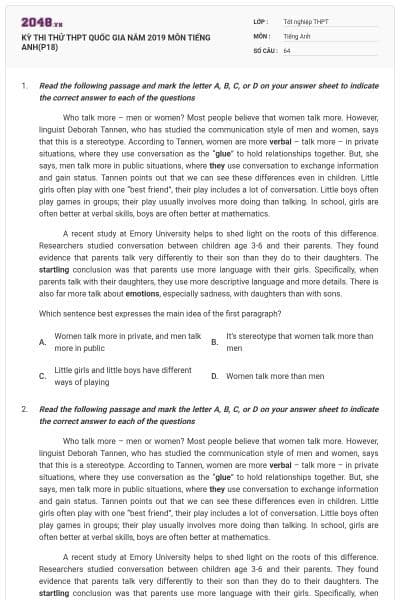
Read the following passage and mark the letter A, B, C, or D on your answer sheet to indicate the correct answer to each of the questions
Who talk more – men or women? Most people believe that women talk more. However, linguist Deborah Tannen, who has studied the communication style of men and women, says that this is a stereotype. According to Tannen, women are more verbal – talk more – in private situations, where they use conversation as the “glue” to hold relationships together. But, she says, men talk more in public situations, where they use conversation to exchange information and gain status. Tannen points out that we can see these differences even in children. Little girls often play with one “best friend”, their play includes a lot of conversation. Little boys often play games in groups; their play usually involves more doing than talking. In school, girls are often better at verbal skills, boys are often better at mathematics.
A recent study at Emory University helps to shed light on the roots of this difference. Researchers studied conversation between children age 3-6 and their parents. They found evidence that parents talk very differently to their son than they do to their daughters. The startling conclusion was that parents use more language with their girls. Specifically, when parents talk with their daughters, they use more descriptive language and more details. There is also far more talk about emotions, especially sadness, with daughters than with sons.
Which sentence best expresses the main idea of the first paragraph?
Women talk more in private, and men talk more in public
It’s stereotype that women talk more than men
Little girls and little boys have different ways of playing
Women talk more than men
A
Từ dòng 3: According to Tannen, women are more verbal – talk more – in private situations, where they use conversation as the “glue” to hold relationships together. But, she says, men talk more in public situations
Read the following passage and mark the letter A, B, C, or D on your answer sheet to indicate the correct answer to each of the questions
Who talk more – men or women? Most people believe that women talk more. However, linguist Deborah Tannen, who has studied the communication style of men and women, says that this is a stereotype. According to Tannen, women are more verbal – talk more – in private situations, where they use conversation as the “glue” to hold relationships together. But, she says, men talk more in public situations, where they use conversation to exchange information and gain status. Tannen points out that we can see these differences even in children. Little girls often play with one “best friend”, their play includes a lot of conversation. Little boys often play games in groups; their play usually involves more doing than talking. In school, girls are often better at verbal skills, boys are often better at mathematics.
A recent study at Emory University helps to shed light on the roots of this difference. Researchers studied conversation between children age 3-6 and their parents. They found evidence that parents talk very differently to their son than they do to their daughters. The startling conclusion was that parents use more language with their girls. Specifically, when parents talk with their daughters, they use more descriptive language and more details. There is also far more talk about emotions, especially sadness, with daughters than with sons.
Which word is similar in meaning to “glue” in line 5 ?
means
sticky substance
game
rope
B
Glue = keo, hồ dán. Sticky substance = chất dính
Read the following passage and mark the letter A, B, C, or D on your answer sheet to indicate the correct answer to each of the questions
Who talk more – men or women? Most people believe that women talk more. However, linguist Deborah Tannen, who has studied the communication style of men and women, says that this is a stereotype. According to Tannen, women are more verbal – talk more – in private situations, where they use conversation as the “glue” to hold relationships together. But, she says, men talk more in public situations, where they use conversation to exchange information and gain status. Tannen points out that we can see these differences even in children. Little girls often play with one “best friend”, their play includes a lot of conversation. Little boys often play games in groups; their play usually involves more doing than talking. In school, girls are often better at verbal skills, boys are often better at mathematics.
A recent study at Emory University helps to shed light on the roots of this difference. Researchers studied conversation between children age 3-6 and their parents. They found evidence that parents talk very differently to their son than they do to their daughters. The startling conclusion was that parents use more language with their girls. Specifically, when parents talk with their daughters, they use more descriptive language and more details. There is also far more talk about emotions, especially sadness, with daughters than with sons.
Which sentence best expresses the main idea of the second paragraph?
Parents do not talk much about sadness with their sons
An Emory University found that parents talk more with their daughters than with their sons
Study at Emory University can help to explain the differences between communication styles of boys and girls
Researchers have studied the conversations of children and their parents
B
Từ cuối dòng 3: The startling conclusion was that parents use more language with their girls. -> bố mẹ nói chuyện với con gái nhiều hơn
Read the following passage and mark the letter A, B, C, or D on your answer sheet to indicate the correct answer to each of the questions
Who talk more – men or women? Most people believe that women talk more. However, linguist Deborah Tannen, who has studied the communication style of men and women, says that this is a stereotype. According to Tannen, women are more verbal – talk more – in private situations, where they use conversation as the “glue” to hold relationships together. But, she says, men talk more in public situations, where they use conversation to exchange information and gain status. Tannen points out that we can see these differences even in children. Little girls often play with one “best friend”, their play includes a lot of conversation. Little boys often play games in groups; their play usually involves more doing than talking. In school, girls are often better at verbal skills, boys are often better at mathematics.
A recent study at Emory University helps to shed light on the roots of this difference. Researchers studied conversation between children age 3-6 and their parents. They found evidence that parents talk very differently to their son than they do to their daughters. The startling conclusion was that parents use more language with their girls. Specifically, when parents talk with their daughters, they use more descriptive language and more details. There is also far more talk about emotions, especially sadness, with daughters than with sons.
Which of the following phrases best explains the meaning of the word “verbal”?
connected with the use of spoken language
deriving from verbs
using very loud noise
being very talkative
A
Dòng 3 có gợi ý: are more verbal – talk more. Verbal (adj) = sử dụng lời nói
Read the following passage and mark the letter A, B, C, or D on your answer sheet to indicate the correct answer to each of the questions
Who talk more – men or women? Most people believe that women talk more. However, linguist Deborah Tannen, who has studied the communication style of men and women, says that this is a stereotype. According to Tannen, women are more verbal – talk more – in private situations, where they use conversation as the “glue” to hold relationships together. But, she says, men talk more in public situations, where they use conversation to exchange information and gain status. Tannen points out that we can see these differences even in children. Little girls often play with one “best friend”, their play includes a lot of conversation. Little boys often play games in groups; their play usually involves more doing than talking. In school, girls are often better at verbal skills, boys are often better at mathematics.
A recent study at Emory University helps to shed light on the roots of this difference. Researchers studied conversation between children age 3-6 and their parents. They found evidence that parents talk very differently to their son than they do to their daughters. The startling conclusion was that parents use more language with their girls. Specifically, when parents talk with their daughters, they use more descriptive language and more details. There is also far more talk about emotions, especially sadness, with daughters than with sons.
The word they in line 4 refers to
men and women
situations
men
women
C
“họ” nằm trong dòng thứ 5: But, she says, men talk more in public situations, where they use conversation to exchange information and gain status = nhưng cô ấy nói, nam giới nói nhiều hơn ở các tình huống công cộng, khi họ sử dụng hội thoại để trao đổi thông tin và đạt được vị thế -> Họ chính là để chỉ nam giới - men
Read the following passage and mark the letter A, B, C, or D on your answer sheet to indicate the correct answer to each of the questions
Who talk more – men or women? Most people believe that women talk more. However, linguist Deborah Tannen, who has studied the communication style of men and women, says that this is a stereotype. According to Tannen, women are more verbal – talk more – in private situations, where they use conversation as the “glue” to hold relationships together. But, she says, men talk more in public situations, where they use conversation to exchange information and gain status. Tannen points out that we can see these differences even in children. Little girls often play with one “best friend”, their play includes a lot of conversation. Little boys often play games in groups; their play usually involves more doing than talking. In school, girls are often better at verbal skills, boys are often better at mathematics.
A recent study at Emory University helps to shed light on the roots of this difference. Researchers studied conversation between children age 3-6 and their parents. They found evidence that parents talk very differently to their son than they do to their daughters. The startling conclusion was that parents use more language with their girls. Specifically, when parents talk with their daughters, they use more descriptive language and more details. There is also far more talk about emotions, especially sadness, with daughters than with sons.
Which can be used as a synonym of the word “emotions” ?
thinking
anger
feelings
worries
C
Emotion = tình cảm, cảm xúc. Feeling = cảm xúc, cảm giác. Thinking = việc nghĩ. Anger = cơn tức giận. worries = sự lo lắng, mối lo
Read the following passage and mark the letter A, B, C, or D on your answer sheet to indicate the correct answer to each of the questions
Who talk more – men or women? Most people believe that women talk more. However, linguist Deborah Tannen, who has studied the communication style of men and women, says that this is a stereotype. According to Tannen, women are more verbal – talk more – in private situations, where they use conversation as the “glue” to hold relationships together. But, she says, men talk more in public situations, where they use conversation to exchange information and gain status. Tannen points out that we can see these differences even in children. Little girls often play with one “best friend”, their play includes a lot of conversation. Little boys often play games in groups; their play usually involves more doing than talking. In school, girls are often better at verbal skills, boys are often better at mathematics.
A recent study at Emory University helps to shed light on the roots of this difference. Researchers studied conversation between children age 3-6 and their parents. They found evidence that parents talk very differently to their son than they do to their daughters. The startling conclusion was that parents use more language with their girls. Specifically, when parents talk with their daughters, they use more descriptive language and more details. There is also far more talk about emotions, especially sadness, with daughters than with sons.
Which of the following statements can be inferred from the first paragraph ?
Men are more sociable than women
According to Deborah Tannen, the belief that women talk more is partly right but most wrong and oversimplified
Men and women have different styles of talking, which may begin in childhood
Women talk more in some situations, men talk more in others
D
Từ đoạn thứ 1: nữ giới nói nhiều hơn trong những tình huống cá nhân, riêng tư (women are more verbal – talk more – in private situations); nam giới nói nhiều hơn trong những tình huống công cộng, xã giao (men talk more in public situations) -> mỗi giới nói nhiều hơn trong những tình huống khác nhau
Read the following passage and mark the letter A, B, C, or D on your answer sheet to indicate the correct answer to each of the questions
Who talk more – men or women? Most people believe that women talk more. However, linguist Deborah Tannen, who has studied the communication style of men and women, says that this is a stereotype. According to Tannen, women are more verbal – talk more – in private situations, where they use conversation as the “glue” to hold relationships together. But, she says, men talk more in public situations, where they use conversation to exchange information and gain status. Tannen points out that we can see these differences even in children. Little girls often play with one “best friend”, their play includes a lot of conversation. Little boys often play games in groups; their play usually involves more doing than talking. In school, girls are often better at verbal skills, boys are often better at mathematics.
A recent study at Emory University helps to shed light on the roots of this difference. Researchers studied conversation between children age 3-6 and their parents. They found evidence that parents talk very differently to their son than they do to their daughters. The startling conclusion was that parents use more language with their girls. Specifically, when parents talk with their daughters, they use more descriptive language and more details. There is also far more talk about emotions, especially sadness, with daughters than with sons.
Which word could best replace “startling” ?
interesting
surprising
annoying
beginning
B
Startling (adj) = gây sửng sốt, ngạc nhiên ≈ surprising
Read the following passage and mark the letter A, B, C, or D on your answer sheet to indicate the correct answer to each of the questions
Who talk more – men or women? Most people believe that women talk more. However, linguist Deborah Tannen, who has studied the communication style of men and women, says that this is a stereotype. According to Tannen, women are more verbal – talk more – in private situations, where they use conversation as the “glue” to hold relationships together. But, she says, men talk more in public situations, where they use conversation to exchange information and gain status. Tannen points out that we can see these differences even in children. Little girls often play with one “best friend”, their play includes a lot of conversation. Little boys often play games in groups; their play usually involves more doing than talking. In school, girls are often better at verbal skills, boys are often better at mathematics.
A recent study at Emory University helps to shed light on the roots of this difference. Researchers studied conversation between children age 3-6 and their parents. They found evidence that parents talk very differently to their son than they do to their daughters. The startling conclusion was that parents use more language with their girls. Specifically, when parents talk with their daughters, they use more descriptive language and more details. There is also far more talk about emotions, especially sadness, with daughters than with sons.
Which of the following statements can be inferred from the second paragraph?
Girls have more practice discussing sadness than boys do.
A recent study found that parents talk differently to their sons and daughters
Boys don’t like to be with their parents as much as girls do
Parents don’t enjoy talking with their sons as much as with their daughters
B
Cuối dòng 3 đoạn 2: parents talk very differently to their son than they do to their daughters
Read the following passage and mark the letter A, B, C, or D on your answer sheet to indicate the correct answer to each of the questions
Who talk more – men or women? Most people believe that women talk more. However, linguist Deborah Tannen, who has studied the communication style of men and women, says that this is a stereotype. According to Tannen, women are more verbal – talk more – in private situations, where they use conversation as the “glue” to hold relationships together. But, she says, men talk more in public situations, where they use conversation to exchange information and gain status. Tannen points out that we can see these differences even in children. Little girls often play with one “best friend”, their play includes a lot of conversation. Little boys often play games in groups; their play usually involves more doing than talking. In school, girls are often better at verbal skills, boys are often better at mathematics.
A recent study at Emory University helps to shed light on the roots of this difference. Researchers studied conversation between children age 3-6 and their parents. They found evidence that parents talk very differently to their son than they do to their daughters. The startling conclusion was that parents use more language with their girls. Specifically, when parents talk with their daughters, they use more descriptive language and more details. There is also far more talk about emotions, especially sadness, with daughters than with sons.
Which of the following statements is TRUE about the passage?
Girls are thought to be more talkative than boys
Parents use more language to talk with their daughters
Parents give more love to their daughters than their sons
Boys don’t like showing their emotions
B
Trong dòng 4 đoạn 2: parents use more language with their girls
Mark the letter A, B, C, or D on your answer sheet to indicate the word that differs from the rest in the position of the main stress in each of the following questions.
obedience
embarrass
attitude
apparent
C
Trọng âm của từ này rơi vào âm tiết thứ 1, các từ còn lại rơi vào âm tiết thứ 2
Mark the letter A, B, C, or D on your answer sheet to indicate the word that differs from the rest in the position of the main stress in each of the following questions.
component
confiding
necessary
important
C
Trọng âm của từ này rơi vào âm tiết thứ 1, các từ còn lại rơi vào âm tiết thứ 2
Mark the letter A, B, C, or D on your answer sheet to indicate the word that differs from the rest in the position of the main stress in each of the following questions.
begin
addict
refer
regret
B
Trọng âm của từ này rơi vào âm tiết thứ 1, các từ còn lại rơi vào âm tiết thứ 2
Read the following passage and mark the letter A, B, C, or D on your answer sheet to indicate the correct word.
HEALTH AND HAPPINESS
Health experts suggest that ……[14]….... healthy and happy, it’s important to keep our lives in balance. Chinese philosophy, which has spanned thousands of years, uses the principles of yin and yang to explain the importance of balance in life. Explained simply, yang represents the active elements of the universe, ……[15]….... the yin represents the passive elements. This expresses the importance of balance in ……[16]….... of living. Today health experts agree that it’s important to have a balanced life. For example, they’ve said it’s necessary to have a balance between work and rest and to have a balanced exercise program. ……[17]…...., I’m sure you’d agree that in our busy world, it’s not always easy to get and keep balance in our lives.
……[18]….... business or study deadlines, many people work to excess, leaving little time at the end of their busy day to spend with family and friends. They eat fast - food and don’t get enough rest or recreation and then suffer badly from the effects of stress. It’s sad that this situation often happens when people believe that access to ……[19]….... is the answer to happiness instead of understanding the importance of balanced living.
While ambition can be a good thing, ……[20]….... too much ambition can cause a person to become ‘out of balance’. Of course it’s also unbalanced to spend too much time on entertainment and pleasure activities, with little or no time ……[21]….... to work or education. Balance means allocating enough time for all the important aspects of life, such as spending time with family and friends, working or studying, as well as resting and relaxing.
Experts now tell us that having balance in our life is the answer, not only to health and happiness, ……[22]….... to success. If you’re balanced, you’ll have more energy and you’ll reach your ambitions in a more relaxed fashion; with less stress. So ……[23]….... is your life? Do you need to allocate your time differently to have better balance in your life?
Điền vào ô 14
looking
to preserve
remain
to stay
D
Stay + adj = duy trì ở trạng thái nào, sống thế nào. To V = để làm gì. To stay healthy and happy = để sống khỏe mạnh và hạnh phúc. Preserve = duy trì, bảo tồn cái gì đó
Read the following passage and mark the letter A, B, C, or D on your answer sheet to indicate the correct word.
HEALTH AND HAPPINESS
Health experts suggest that ……[14]….... healthy and happy, it’s important to keep our lives in balance. Chinese philosophy, which has spanned thousands of years, uses the principles of yin and yang to explain the importance of balance in life. Explained simply, yang represents the active elements of the universe, ……[15]….... the yin represents the passive elements. This expresses the importance of balance in ……[16]….... of living. Today health experts agree that it’s important to have a balanced life. For example, they’ve said it’s necessary to have a balance between work and rest and to have a balanced exercise program. ……[17]…...., I’m sure you’d agree that in our busy world, it’s not always easy to get and keep balance in our lives.
……[18]….... business or study deadlines, many people work to excess, leaving little time at the end of their busy day to spend with family and friends. They eat fast - food and don’t get enough rest or recreation and then suffer badly from the effects of stress. It’s sad that this situation often happens when people believe that access to ……[19]….... is the answer to happiness instead of understanding the importance of balanced living.
While ambition can be a good thing, ……[20]….... too much ambition can cause a person to become ‘out of balance’. Of course it’s also unbalanced to spend too much time on entertainment and pleasure activities, with little or no time ……[21]….... to work or education. Balance means allocating enough time for all the important aspects of life, such as spending time with family and friends, working or studying, as well as resting and relaxing.
Experts now tell us that having balance in our life is the answer, not only to health and happiness, ……[22]….... to success. If you’re balanced, you’ll have more energy and you’ll reach your ambitions in a more relaxed fashion; with less stress. So ……[23]….... is your life? Do you need to allocate your time differently to have better balance in your life?
Điền vào ô 15
whereas
in contrast
although
on the other hand
A
Whereas = trong khi đó. In contrast = trái ngược lại. although = mặc dù. On the other hand = ở mặt khác. (dương biểu trưng cho … trong khi âm biểu trưng cho…)
Read the following passage and mark the letter A, B, C, or D on your answer sheet to indicate the correct word.
HEALTH AND HAPPINESS
Health experts suggest that ……[14]….... healthy and happy, it’s important to keep our lives in balance. Chinese philosophy, which has spanned thousands of years, uses the principles of yin and yang to explain the importance of balance in life. Explained simply, yang represents the active elements of the universe, ……[15]….... the yin represents the passive elements. This expresses the importance of balance in ……[16]….... of living. Today health experts agree that it’s important to have a balanced life. For example, they’ve said it’s necessary to have a balance between work and rest and to have a balanced exercise program. ……[17]…...., I’m sure you’d agree that in our busy world, it’s not always easy to get and keep balance in our lives.
……[18]….... business or study deadlines, many people work to excess, leaving little time at the end of their busy day to spend with family and friends. They eat fast - food and don’t get enough rest or recreation and then suffer badly from the effects of stress. It’s sad that this situation often happens when people believe that access to ……[19]….... is the answer to happiness instead of understanding the importance of balanced living.
While ambition can be a good thing, ……[20]….... too much ambition can cause a person to become ‘out of balance’. Of course it’s also unbalanced to spend too much time on entertainment and pleasure activities, with little or no time ……[21]….... to work or education. Balance means allocating enough time for all the important aspects of life, such as spending time with family and friends, working or studying, as well as resting and relaxing.
Experts now tell us that having balance in our life is the answer, not only to health and happiness, ……[22]….... to success. If you’re balanced, you’ll have more energy and you’ll reach your ambitions in a more relaxed fashion; with less stress. So ……[23]….... is your life? Do you need to allocate your time differently to have better balance in your life?
Điền vào ô 16
all areas
all angles
every field
all aspects
D
All aspects = tất cả các khía cạnh. All areas = tất cả các lĩnh vực. every field = mọi ngành. All angles = tất cả các góc
Read the following passage and mark the letter A, B, C, or D on your answer sheet to indicate the correct word.
HEALTH AND HAPPINESS
Health experts suggest that ……[14]….... healthy and happy, it’s important to keep our lives in balance. Chinese philosophy, which has spanned thousands of years, uses the principles of yin and yang to explain the importance of balance in life. Explained simply, yang represents the active elements of the universe, ……[15]….... the yin represents the passive elements. This expresses the importance of balance in ……[16]….... of living. Today health experts agree that it’s important to have a balanced life. For example, they’ve said it’s necessary to have a balance between work and rest and to have a balanced exercise program. ……[17]…...., I’m sure you’d agree that in our busy world, it’s not always easy to get and keep balance in our lives.
……[18]….... business or study deadlines, many people work to excess, leaving little time at the end of their busy day to spend with family and friends. They eat fast - food and don’t get enough rest or recreation and then suffer badly from the effects of stress. It’s sad that this situation often happens when people believe that access to ……[19]….... is the answer to happiness instead of understanding the importance of balanced living.
While ambition can be a good thing, ……[20]….... too much ambition can cause a person to become ‘out of balance’. Of course it’s also unbalanced to spend too much time on entertainment and pleasure activities, with little or no time ……[21]….... to work or education. Balance means allocating enough time for all the important aspects of life, such as spending time with family and friends, working or studying, as well as resting and relaxing.
Experts now tell us that having balance in our life is the answer, not only to health and happiness, ……[22]….... to success. If you’re balanced, you’ll have more energy and you’ll reach your ambitions in a more relaxed fashion; with less stress. So ……[23]….... is your life? Do you need to allocate your time differently to have better balance in your life?
Điền vào ô 17
Simultaneously
However
Consequently
On the contrary
B
However = tuy nhiên. (tuy nhiên tôi chắc chắn bạn sẽ đồng ý nên rằng trong thế giới bận rộn của chúng ta, không phải luôn dễ dàng để có được và duy trì cân bằng trong cuộc sống của chúng ta). Simultaneously = đồng thời. consequently = hệ quả là. On the contrary = trái lại
Read the following passage and mark the letter A, B, C, or D on your answer sheet to indicate the correct word.
HEALTH AND HAPPINESS
Health experts suggest that ……[14]….... healthy and happy, it’s important to keep our lives in balance. Chinese philosophy, which has spanned thousands of years, uses the principles of yin and yang to explain the importance of balance in life. Explained simply, yang represents the active elements of the universe, ……[15]….... the yin represents the passive elements. This expresses the importance of balance in ……[16]….... of living. Today health experts agree that it’s important to have a balanced life. For example, they’ve said it’s necessary to have a balance between work and rest and to have a balanced exercise program. ……[17]…...., I’m sure you’d agree that in our busy world, it’s not always easy to get and keep balance in our lives.
……[18]….... business or study deadlines, many people work to excess, leaving little time at the end of their busy day to spend with family and friends. They eat fast - food and don’t get enough rest or recreation and then suffer badly from the effects of stress. It’s sad that this situation often happens when people believe that access to ……[19]….... is the answer to happiness instead of understanding the importance of balanced living.
While ambition can be a good thing, ……[20]….... too much ambition can cause a person to become ‘out of balance’. Of course it’s also unbalanced to spend too much time on entertainment and pleasure activities, with little or no time ……[21]….... to work or education. Balance means allocating enough time for all the important aspects of life, such as spending time with family and friends, working or studying, as well as resting and relaxing.
Experts now tell us that having balance in our life is the answer, not only to health and happiness, ……[22]….... to success. If you’re balanced, you’ll have more energy and you’ll reach your ambitions in a more relaxed fashion; with less stress. So ……[23]….... is your life? Do you need to allocate your time differently to have better balance in your life?
Điền vào ô 18
Despite
Although
Because
Due to
D
Due to + N/Ving = bởi vì cái gì/việc gì = Because of + N/Ving ≈ Because + mệnh đề. Despite + N/Ving = mặc dù ≈ Although + mệnh đề
Read the following passage and mark the letter A, B, C, or D on your answer sheet to indicate the correct word.
HEALTH AND HAPPINESS
Health experts suggest that ……[14]….... healthy and happy, it’s important to keep our lives in balance. Chinese philosophy, which has spanned thousands of years, uses the principles of yin and yang to explain the importance of balance in life. Explained simply, yang represents the active elements of the universe, ……[15]….... the yin represents the passive elements. This expresses the importance of balance in ……[16]….... of living. Today health experts agree that it’s important to have a balanced life. For example, they’ve said it’s necessary to have a balance between work and rest and to have a balanced exercise program. ……[17]…...., I’m sure you’d agree that in our busy world, it’s not always easy to get and keep balance in our lives.
……[18]….... business or study deadlines, many people work to excess, leaving little time at the end of their busy day to spend with family and friends. They eat fast - food and don’t get enough rest or recreation and then suffer badly from the effects of stress. It’s sad that this situation often happens when people believe that access to ……[19]….... is the answer to happiness instead of understanding the importance of balanced living.
While ambition can be a good thing, ……[20]….... too much ambition can cause a person to become ‘out of balance’. Of course it’s also unbalanced to spend too much time on entertainment and pleasure activities, with little or no time ……[21]….... to work or education. Balance means allocating enough time for all the important aspects of life, such as spending time with family and friends, working or studying, as well as resting and relaxing.
Experts now tell us that having balance in our life is the answer, not only to health and happiness, ……[22]….... to success. If you’re balanced, you’ll have more energy and you’ll reach your ambitions in a more relaxed fashion; with less stress. So ……[23]….... is your life? Do you need to allocate your time differently to have better balance in your life?
Điền vào ô 19
have money
properties
wealth
rich
C
Access to N = tiếp cận cái gì. Wealth = của cải, sự giàu có. Properties = tài sản, vật sở hữu. rich (adj) = giàu có
Read the following passage and mark the letter A, B, C, or D on your answer sheet to indicate the correct word.
HEALTH AND HAPPINESS
Health experts suggest that ……[14]….... healthy and happy, it’s important to keep our lives in balance. Chinese philosophy, which has spanned thousands of years, uses the principles of yin and yang to explain the importance of balance in life. Explained simply, yang represents the active elements of the universe, ……[15]….... the yin represents the passive elements. This expresses the importance of balance in ……[16]….... of living. Today health experts agree that it’s important to have a balanced life. For example, they’ve said it’s necessary to have a balance between work and rest and to have a balanced exercise program. ……[17]…...., I’m sure you’d agree that in our busy world, it’s not always easy to get and keep balance in our lives.
……[18]….... business or study deadlines, many people work to excess, leaving little time at the end of their busy day to spend with family and friends. They eat fast - food and don’t get enough rest or recreation and then suffer badly from the effects of stress. It’s sad that this situation often happens when people believe that access to ……[19]….... is the answer to happiness instead of understanding the importance of balanced living.
While ambition can be a good thing, ……[20]….... too much ambition can cause a person to become ‘out of balance’. Of course it’s also unbalanced to spend too much time on entertainment and pleasure activities, with little or no time ……[21]….... to work or education. Balance means allocating enough time for all the important aspects of life, such as spending time with family and friends, working or studying, as well as resting and relaxing.
Experts now tell us that having balance in our life is the answer, not only to health and happiness, ……[22]….... to success. If you’re balanced, you’ll have more energy and you’ll reach your ambitions in a more relaxed fashion; with less stress. So ……[23]….... is your life? Do you need to allocate your time differently to have better balance in your life?
Điền vào ô 20
having
with
have
there is
A
Ving – danh động từ có thể đóng vai trò chủ ngữ trong câu. Having too much ambition = việc có quá nhiều hoài bão
Read the following passage and mark the letter A, B, C, or D on your answer sheet to indicate the correct word.
HEALTH AND HAPPINESS
Health experts suggest that ……[14]….... healthy and happy, it’s important to keep our lives in balance. Chinese philosophy, which has spanned thousands of years, uses the principles of yin and yang to explain the importance of balance in life. Explained simply, yang represents the active elements of the universe, ……[15]….... the yin represents the passive elements. This expresses the importance of balance in ……[16]….... of living. Today health experts agree that it’s important to have a balanced life. For example, they’ve said it’s necessary to have a balance between work and rest and to have a balanced exercise program. ……[17]…...., I’m sure you’d agree that in our busy world, it’s not always easy to get and keep balance in our lives.
……[18]….... business or study deadlines, many people work to excess, leaving little time at the end of their busy day to spend with family and friends. They eat fast - food and don’t get enough rest or recreation and then suffer badly from the effects of stress. It’s sad that this situation often happens when people believe that access to ……[19]….... is the answer to happiness instead of understanding the importance of balanced living.
While ambition can be a good thing, ……[20]….... too much ambition can cause a person to become ‘out of balance’. Of course it’s also unbalanced to spend too much time on entertainment and pleasure activities, with little or no time ……[21]….... to work or education. Balance means allocating enough time for all the important aspects of life, such as spending time with family and friends, working or studying, as well as resting and relaxing.
Experts now tell us that having balance in our life is the answer, not only to health and happiness, ……[22]….... to success. If you’re balanced, you’ll have more energy and you’ll reach your ambitions in a more relaxed fashion; with less stress. So ……[23]….... is your life? Do you need to allocate your time differently to have better balance in your life?
Điền vào ô 21
giving
allocated
spent
used
B
Allocate something to something/Ving = phân phối cho, dùng cho việc gì. Allocated là dạng quá khứ phân từ - hình thức rút gọn của mệnh đề quan hệ dạng bị động “that is allocated”. Spend + thời gian/tiền bạc + (on) N/Ving = dùng bao nhiêu thời gian tiền bạc vào việc gì. Use something to V = dùng cái gì để làm gì
Read the following passage and mark the letter A, B, C, or D on your answer sheet to indicate the correct word.
HEALTH AND HAPPINESS
Health experts suggest that ……[14]….... healthy and happy, it’s important to keep our lives in balance. Chinese philosophy, which has spanned thousands of years, uses the principles of yin and yang to explain the importance of balance in life. Explained simply, yang represents the active elements of the universe, ……[15]….... the yin represents the passive elements. This expresses the importance of balance in ……[16]….... of living. Today health experts agree that it’s important to have a balanced life. For example, they’ve said it’s necessary to have a balance between work and rest and to have a balanced exercise program. ……[17]…...., I’m sure you’d agree that in our busy world, it’s not always easy to get and keep balance in our lives.
……[18]….... business or study deadlines, many people work to excess, leaving little time at the end of their busy day to spend with family and friends. They eat fast - food and don’t get enough rest or recreation and then suffer badly from the effects of stress. It’s sad that this situation often happens when people believe that access to ……[19]….... is the answer to happiness instead of understanding the importance of balanced living.
While ambition can be a good thing, ……[20]….... too much ambition can cause a person to become ‘out of balance’. Of course it’s also unbalanced to spend too much time on entertainment and pleasure activities, with little or no time ……[21]….... to work or education. Balance means allocating enough time for all the important aspects of life, such as spending time with family and friends, working or studying, as well as resting and relaxing.
Experts now tell us that having balance in our life is the answer, not only to health and happiness, ……[22]….... to success. If you’re balanced, you’ll have more energy and you’ll reach your ambitions in a more relaxed fashion; with less stress. So ……[23]….... is your life? Do you need to allocate your time differently to have better balance in your life?
Điền vào ô 22
but it is the answer
also
and also
but also
D
Not only … but also … = không những … mà còn… Not only to health and happiness, but also to success = không chỉ cho sức khỏe và hạnh phúc, mà còn cho sự thành công
Read the following passage and mark the letter A, B, C, or D on your answer sheet to indicate the correct word.
HEALTH AND HAPPINESS
Health experts suggest that ……[14]….... healthy and happy, it’s important to keep our lives in balance. Chinese philosophy, which has spanned thousands of years, uses the principles of yin and yang to explain the importance of balance in life. Explained simply, yang represents the active elements of the universe, ……[15]….... the yin represents the passive elements. This expresses the importance of balance in ……[16]….... of living. Today health experts agree that it’s important to have a balanced life. For example, they’ve said it’s necessary to have a balance between work and rest and to have a balanced exercise program. ……[17]…...., I’m sure you’d agree that in our busy world, it’s not always easy to get and keep balance in our lives.
……[18]….... business or study deadlines, many people work to excess, leaving little time at the end of their busy day to spend with family and friends. They eat fast - food and don’t get enough rest or recreation and then suffer badly from the effects of stress. It’s sad that this situation often happens when people believe that access to ……[19]….... is the answer to happiness instead of understanding the importance of balanced living.
While ambition can be a good thing, ……[20]….... too much ambition can cause a person to become ‘out of balance’. Of course it’s also unbalanced to spend too much time on entertainment and pleasure activities, with little or no time ……[21]….... to work or education. Balance means allocating enough time for all the important aspects of life, such as spending time with family and friends, working or studying, as well as resting and relaxing.
Experts now tell us that having balance in our life is the answer, not only to health and happiness, ……[22]….... to success. If you’re balanced, you’ll have more energy and you’ll reach your ambitions in a more relaxed fashion; with less stress. So ……[23]….... is your life? Do you need to allocate your time differently to have better balance in your life?
Điền vào ô 23
how balanced
however balanced
what balance
how balancing
A
How + adj + be + S + … ? -> câu hỏi mức độ thế nào. Balanced (adj) = cân bằng. How balanced is your life = cuộc sống của bạn ở mức cân bằng nào?
Mark the letter A, B, C, or D on your answer sheet to indicate the word whose underlined part is pronounced differently from that of the rest in each of the following questions
introduces
leaves
practices
wishes
B
“s” sau đuôi /v/ phát âm là /z/, sau đuôi /∫/ hoặc /s/ phát âm là /iz/
Mark the letter A, B, C, or D on your answer sheet to indicate the word whose underlined part is pronounced differently from that of the rest in each of the following questions
dough
county
blouse
doubt
A
“ou” trong “dough” phát âm là /ou/ , trong các từ còn lại phát âm là /au/
Mark the letter A, B, C, or D on your answer sheet to show the underlined part that needs correction in each of the following questions
Not until I got on the taxi to the airport that I realized I had left my passport at home
that I realized
that I had left
at home
got on
A
Cấu trúc đảo ngữ nhấn mạnh: Not until + mốc thời gian/mệnh đề quá khứ + did/could + S + V không chia. A -> did I realize
Mark the letter A, B, C, or D on your answer sheet to show the underlined part that needs correction in each of the following questions
Dams are used to control flooding, provide water for irrigation and generating electricity for the surrounding area
irrigation
to control flooding
generating
surrounding area
C
Trước “and” là danh từ (với ý liệt kê) thì sau nó cũng phải là danh từ (nước dành cho sự tưới và sự tạo điện). C -> generation of
Mark the letter A, B, C, or D on your answer sheet to show the underlined part that needs correction in each of the following questions
She asked why did Mathew look so embarrassed when he saw Carole
did Mathew look
asked why
saw
embarrassed
A
Trong câu tường thuật, động từ của câu hỏi giữ nguyên sau chủ ngữ, không tách ra thành trợ động từ đảo lên trước. A -> asked why Mathew looked
Mark the letter A, B, C, or D on your answer sheet to show the underlined part that needs correction in each of the following questions
Married customs differ greatly from society to society
Married
society
differ
greatly
A
Married (adj) = đã cưới, được kết hôn -> dùng cho người, không bổ nghĩa cho danh từ chỉ vật “custom”. Sửa: marriage customs = phong tục kết hôn
Mark the letter A, B, C, or D on your answer sheet to show the underlined part that needs correction in each of the following questions
It is the high time John understands how to behave properly towards the old men
understands
high
towards
how to
A
It + is + (about) (high) time + S + V-ed = đã đến lúc ai đó phải gấp rút làm gì. A -> understood
Read the following passage and mark the letter A, B, C, or D on your answer sheet to indicate the correct answer to each of the questions.
A number of factors related to the voice reveal the personality of the speaker. The first is the broad area of communication, which includes imparting information by use of language, communicating with a group or an individual, and specialized communication through performance. A person conveys thoughts and ideas through choice of words, by a tone of voice that is pleasant or unpleasant, gentle or harsh, by the rhythm that is inherent within the language itself, and by speech rhythms that are flowing and regular or uneven and hesitant, and finally, by the pitch and melody of the utterance. When speaking before a group, a person's tone may indicate unsureness or fright, confidence or calm. At interpersonal levels, the tone may reflect ideas and feelings over and above the words chosen, or may belie them. Here the speaker's tone can consciously or unconsciously reflect intuitive sympathy or antipathy, lack of concern or interest, fatigue, anxiety, enthusiasm or excitement, all of which are usually discernible by the acute listener. Public performance is a manner of communication that is highly specialized with its own techniques for obtaining effects by voice and or gesture. The motivation derived from the text, and in the case of singing, the music, in combination with the performer's skills, personality, and ability to create empathy will determine the success of artistic, political, or pedagogic communication.
Second, the voice gives psychological clues to a person's self-image, perception of others, and emotional health. Self-image can be indicated by a tone of voice that is confident, pretentious, shy, aggressive, outgoing, or exuberant, to name only a few personality traits. Also the sound may give a clue to the facade or mask of that person, for example, a shy person hiding behind an overconfident front. How a speaker perceives the listener's receptiveness, interest, or sympathy in any given conversation can drastically alter the tone of presentation, by encouraging or discouraging the speaker. Emotional health is evidenced in the voice by free and melodic sounds of the happy, by constricted and harsh sound of the angry, and by dull and lethargic qualities of the depressed
What does the passage mainly discuss?
The function of the voice in performance
The production of speech
The connection between voice and personality
Communication styles
C
Ngay từ câu đầu tiên: A number of factors related to the voice reveal the personality of the speaker -> một số yếu tố liên quan tới giọng nói cho thấy tính cách của người nói. Và sau đó bài văn đi sâu phân tích mối liên quan giữa giọng nói và người nói
Read the following passage and mark the letter A, B, C, or D on your answer sheet to indicate the correct answer to each of the questions.
A number of factors related to the voice reveal the personality of the speaker. The first is the broad area of communication, which includes imparting information by use of language, communicating with a group or an individual, and specialized communication through performance. A person conveys thoughts and ideas through choice of words, by a tone of voice that is pleasant or unpleasant, gentle or harsh, by the rhythm that is inherent within the language itself, and by speech rhythms that are flowing and regular or uneven and hesitant, and finally, by the pitch and melody of the utterance. When speaking before a group, a person's tone may indicate unsureness or fright, confidence or calm. At interpersonal levels, the tone may reflect ideas and feelings over and above the words chosen, or may belie them. Here the speaker's tone can consciously or unconsciously reflect intuitive sympathy or antipathy, lack of concern or interest, fatigue, anxiety, enthusiasm or excitement, all of which are usually discernible by the acute listener. Public performance is a manner of communication that is highly specialized with its own techniques for obtaining effects by voice and or gesture. The motivation derived from the text, and in the case of singing, the music, in combination with the performer's skills, personality, and ability to create empathy will determine the success of artistic, political, or pedagogic communication.
Second, the voice gives psychological clues to a person's self-image, perception of others, and emotional health. Self-image can be indicated by a tone of voice that is confident, pretentious, shy, aggressive, outgoing, or exuberant, to name only a few personality traits. Also the sound may give a clue to the facade or mask of that person, for example, a shy person hiding behind an overconfident front. How a speaker perceives the listener's receptiveness, interest, or sympathy in any given conversation can drastically alter the tone of presentation, by encouraging or discouraging the speaker. Emotional health is evidenced in the voice by free and melodic sounds of the happy, by constricted and harsh sound of the angry, and by dull and lethargic qualities of the depressed
What does the author mean by staring that, "At interpersonal levels, tone may reflect ideas and feelings over and above the words chosen" (lines 7-8)?
The tone of voice can carry information beyond the meaning of words
A high tone of voice reflects an emotional communication
Feelings are more difficult to express than ideas
Feelings are expressed with different words than ideas are.
A
ở mức độ giữa các cá nhân, tông giọng có thể phản ánh các quan điểm và cảm giác trên cả những ngôn từ được sử dụng -> tông giọng thể hiện nhiều thứ hơn cả ngữ nghĩa trong lời nói
Read the following passage and mark the letter A, B, C, or D on your answer sheet to indicate the correct answer to each of the questions.
A number of factors related to the voice reveal the personality of the speaker. The first is the broad area of communication, which includes imparting information by use of language, communicating with a group or an individual, and specialized communication through performance. A person conveys thoughts and ideas through choice of words, by a tone of voice that is pleasant or unpleasant, gentle or harsh, by the rhythm that is inherent within the language itself, and by speech rhythms that are flowing and regular or uneven and hesitant, and finally, by the pitch and melody of the utterance. When speaking before a group, a person's tone may indicate unsureness or fright, confidence or calm. At interpersonal levels, the tone may reflect ideas and feelings over and above the words chosen, or may belie them. Here the speaker's tone can consciously or unconsciously reflect intuitive sympathy or antipathy, lack of concern or interest, fatigue, anxiety, enthusiasm or excitement, all of which are usually discernible by the acute listener. Public performance is a manner of communication that is highly specialized with its own techniques for obtaining effects by voice and or gesture. The motivation derived from the text, and in the case of singing, the music, in combination with the performer's skills, personality, and ability to create empathy will determine the success of artistic, political, or pedagogic communication.
Second, the voice gives psychological clues to a person's self-image, perception of others, and emotional health. Self-image can be indicated by a tone of voice that is confident, pretentious, shy, aggressive, outgoing, or exuberant, to name only a few personality traits. Also the sound may give a clue to the facade or mask of that person, for example, a shy person hiding behind an overconfident front. How a speaker perceives the listener's receptiveness, interest, or sympathy in any given conversation can drastically alter the tone of presentation, by encouraging or discouraging the speaker. Emotional health is evidenced in the voice by free and melodic sounds of the happy, by constricted and harsh sound of the angry, and by dull and lethargic qualities of the depressed
The word "Here" in line 8 refers to________
ideas and feelings
the tone
words chosen
interpersonal interactions
D
ở mức độ giữa các cá nhân, tông giọng có thể phản ánh… Ở đây, tông giọng của người nói có thể…. -> như vậy, ở đây = ở mức độ giữa các cá nhân = At interpersonal levels ≈ interpersonal interactions
Read the following passage and mark the letter A, B, C, or D on your answer sheet to indicate the correct answer to each of the questions.
A number of factors related to the voice reveal the personality of the speaker. The first is the broad area of communication, which includes imparting information by use of language, communicating with a group or an individual, and specialized communication through performance. A person conveys thoughts and ideas through choice of words, by a tone of voice that is pleasant or unpleasant, gentle or harsh, by the rhythm that is inherent within the language itself, and by speech rhythms that are flowing and regular or uneven and hesitant, and finally, by the pitch and melody of the utterance. When speaking before a group, a person's tone may indicate unsureness or fright, confidence or calm. At interpersonal levels, the tone may reflect ideas and feelings over and above the words chosen, or may belie them. Here the speaker's tone can consciously or unconsciously reflect intuitive sympathy or antipathy, lack of concern or interest, fatigue, anxiety, enthusiasm or excitement, all of which are usually discernible by the acute listener. Public performance is a manner of communication that is highly specialized with its own techniques for obtaining effects by voice and or gesture. The motivation derived from the text, and in the case of singing, the music, in combination with the performer's skills, personality, and ability to create empathy will determine the success of artistic, political, or pedagogic communication.
Second, the voice gives psychological clues to a person's self-image, perception of others, and emotional health. Self-image can be indicated by a tone of voice that is confident, pretentious, shy, aggressive, outgoing, or exuberant, to name only a few personality traits. Also the sound may give a clue to the facade or mask of that person, for example, a shy person hiding behind an overconfident front. How a speaker perceives the listener's receptiveness, interest, or sympathy in any given conversation can drastically alter the tone of presentation, by encouraging or discouraging the speaker. Emotional health is evidenced in the voice by free and melodic sounds of the happy, by constricted and harsh sound of the angry, and by dull and lethargic qualities of the depressed
The word "derived" in line 12 is closest in meaning to_________
discussed
registered
prepared
obtained
D
Derive (something) from something = nhận được từ đâu, xuất phát từ đâu
Read the following passage and mark the letter A, B, C, or D on your answer sheet to indicate the correct answer to each of the questions.
A number of factors related to the voice reveal the personality of the speaker. The first is the broad area of communication, which includes imparting information by use of language, communicating with a group or an individual, and specialized communication through performance. A person conveys thoughts and ideas through choice of words, by a tone of voice that is pleasant or unpleasant, gentle or harsh, by the rhythm that is inherent within the language itself, and by speech rhythms that are flowing and regular or uneven and hesitant, and finally, by the pitch and melody of the utterance. When speaking before a group, a person's tone may indicate unsureness or fright, confidence or calm. At interpersonal levels, the tone may reflect ideas and feelings over and above the words chosen, or may belie them. Here the speaker's tone can consciously or unconsciously reflect intuitive sympathy or antipathy, lack of concern or interest, fatigue, anxiety, enthusiasm or excitement, all of which are usually discernible by the acute listener. Public performance is a manner of communication that is highly specialized with its own techniques for obtaining effects by voice and or gesture. The motivation derived from the text, and in the case of singing, the music, in combination with the performer's skills, personality, and ability to create empathy will determine the success of artistic, political, or pedagogic communication.
Second, the voice gives psychological clues to a person's self-image, perception of others, and emotional health. Self-image can be indicated by a tone of voice that is confident, pretentious, shy, aggressive, outgoing, or exuberant, to name only a few personality traits. Also the sound may give a clue to the facade or mask of that person, for example, a shy person hiding behind an overconfident front. How a speaker perceives the listener's receptiveness, interest, or sympathy in any given conversation can drastically alter the tone of presentation, by encouraging or discouraging the speaker. Emotional health is evidenced in the voice by free and melodic sounds of the happy, by constricted and harsh sound of the angry, and by dull and lethargic qualities of the depressed
Why does the author mention "artistic, political, or pedagogic communication" in line 13?
As examples of basic styles of communication
As examples of public performance
To introduce the idea of self-image
To contrast them to singing
B
Từ dòng 12, đoạn văn đề cập tới sự trình bày công khai trước quần chúng: Public performance is a manner of communication that is highly specialized with its own techniques … ability to create empathy will determine the success of artistic, political, or pedagogic communication -> sự thành công của việc truyền đạt mang tính nghệ thuật, chính trị hay giáo dục chính là sự trình bày trước quần chúng; chúng thành công là nhờ những kĩ năng khác như tạo sự đồng thuận
Read the following passage and mark the letter A, B, C, or D on your answer sheet to indicate the correct answer to each of the questions.
A number of factors related to the voice reveal the personality of the speaker. The first is the broad area of communication, which includes imparting information by use of language, communicating with a group or an individual, and specialized communication through performance. A person conveys thoughts and ideas through choice of words, by a tone of voice that is pleasant or unpleasant, gentle or harsh, by the rhythm that is inherent within the language itself, and by speech rhythms that are flowing and regular or uneven and hesitant, and finally, by the pitch and melody of the utterance. When speaking before a group, a person's tone may indicate unsureness or fright, confidence or calm. At interpersonal levels, the tone may reflect ideas and feelings over and above the words chosen, or may belie them. Here the speaker's tone can consciously or unconsciously reflect intuitive sympathy or antipathy, lack of concern or interest, fatigue, anxiety, enthusiasm or excitement, all of which are usually discernible by the acute listener. Public performance is a manner of communication that is highly specialized with its own techniques for obtaining effects by voice and or gesture. The motivation derived from the text, and in the case of singing, the music, in combination with the performer's skills, personality, and ability to create empathy will determine the success of artistic, political, or pedagogic communication.
Second, the voice gives psychological clues to a person's self-image, perception of others, and emotional health. Self-image can be indicated by a tone of voice that is confident, pretentious, shy, aggressive, outgoing, or exuberant, to name only a few personality traits. Also the sound may give a clue to the facade or mask of that person, for example, a shy person hiding behind an overconfident front. How a speaker perceives the listener's receptiveness, interest, or sympathy in any given conversation can drastically alter the tone of presentation, by encouraging or discouraging the speaker. Emotional health is evidenced in the voice by free and melodic sounds of the happy, by constricted and harsh sound of the angry, and by dull and lethargic qualities of the depressed
According to the passage, an exuberant tone of voice, may be an indication of a person's_________.
personality
general physical health
ability to communicate
vocal quality
A
Từ dòng 2 đoạn 2: Self-image can be indicated by a tone of voice that is confident, pretentious, shy, aggressive, outgoing, or exuberant, to name only a few personality traits -> hình ảnh về bản thân mình có thể được thể hiện bởi tông giọng hồ hởi
Read the following passage and mark the letter A, B, C, or D on your answer sheet to indicate the correct answer to each of the questions.
A number of factors related to the voice reveal the personality of the speaker. The first is the broad area of communication, which includes imparting information by use of language, communicating with a group or an individual, and specialized communication through performance. A person conveys thoughts and ideas through choice of words, by a tone of voice that is pleasant or unpleasant, gentle or harsh, by the rhythm that is inherent within the language itself, and by speech rhythms that are flowing and regular or uneven and hesitant, and finally, by the pitch and melody of the utterance. When speaking before a group, a person's tone may indicate unsureness or fright, confidence or calm. At interpersonal levels, the tone may reflect ideas and feelings over and above the words chosen, or may belie them. Here the speaker's tone can consciously or unconsciously reflect intuitive sympathy or antipathy, lack of concern or interest, fatigue, anxiety, enthusiasm or excitement, all of which are usually discernible by the acute listener. Public performance is a manner of communication that is highly specialized with its own techniques for obtaining effects by voice and or gesture. The motivation derived from the text, and in the case of singing, the music, in combination with the performer's skills, personality, and ability to create empathy will determine the success of artistic, political, or pedagogic communication.
Second, the voice gives psychological clues to a person's self-image, perception of others, and emotional health. Self-image can be indicated by a tone of voice that is confident, pretentious, shy, aggressive, outgoing, or exuberant, to name only a few personality traits. Also the sound may give a clue to the facade or mask of that person, for example, a shy person hiding behind an overconfident front. How a speaker perceives the listener's receptiveness, interest, or sympathy in any given conversation can drastically alter the tone of presentation, by encouraging or discouraging the speaker. Emotional health is evidenced in the voice by free and melodic sounds of the happy, by constricted and harsh sound of the angry, and by dull and lethargic qualities of the depressed
According to the passage, an overconfident front may hide_________.
strength
friendliness
shyness
hostility
C
Dòng 4 đoạn 2: a shy person hiding behind an overconfident front. -> một người ngại ngùng, sợ sệt ẩn dưới vẻ rất tự tin
Read the following passage and mark the letter A, B, C, or D on your answer sheet to indicate the correct answer to each of the questions.
A number of factors related to the voice reveal the personality of the speaker. The first is the broad area of communication, which includes imparting information by use of language, communicating with a group or an individual, and specialized communication through performance. A person conveys thoughts and ideas through choice of words, by a tone of voice that is pleasant or unpleasant, gentle or harsh, by the rhythm that is inherent within the language itself, and by speech rhythms that are flowing and regular or uneven and hesitant, and finally, by the pitch and melody of the utterance. When speaking before a group, a person's tone may indicate unsureness or fright, confidence or calm. At interpersonal levels, the tone may reflect ideas and feelings over and above the words chosen, or may belie them. Here the speaker's tone can consciously or unconsciously reflect intuitive sympathy or antipathy, lack of concern or interest, fatigue, anxiety, enthusiasm or excitement, all of which are usually discernible by the acute listener. Public performance is a manner of communication that is highly specialized with its own techniques for obtaining effects by voice and or gesture. The motivation derived from the text, and in the case of singing, the music, in combination with the performer's skills, personality, and ability to create empathy will determine the success of artistic, political, or pedagogic communication.
Second, the voice gives psychological clues to a person's self-image, perception of others, and emotional health. Self-image can be indicated by a tone of voice that is confident, pretentious, shy, aggressive, outgoing, or exuberant, to name only a few personality traits. Also the sound may give a clue to the facade or mask of that person, for example, a shy person hiding behind an overconfident front. How a speaker perceives the listener's receptiveness, interest, or sympathy in any given conversation can drastically alter the tone of presentation, by encouraging or discouraging the speaker. Emotional health is evidenced in the voice by free and melodic sounds of the happy, by constricted and harsh sound of the angry, and by dull and lethargic qualities of the depressed
The word "drastically" in line 19 is closest in meaning to________.
severely
easily
exactly
frequently
A
Drastically = một cách mạnh mẽ, trầm trọng. Severely = nghiêm trọng, để lại hậu quả lớn
Read the following passage and mark the letter A, B, C, or D on your answer sheet to indicate the correct answer to each of the questions.
A number of factors related to the voice reveal the personality of the speaker. The first is the broad area of communication, which includes imparting information by use of language, communicating with a group or an individual, and specialized communication through performance. A person conveys thoughts and ideas through choice of words, by a tone of voice that is pleasant or unpleasant, gentle or harsh, by the rhythm that is inherent within the language itself, and by speech rhythms that are flowing and regular or uneven and hesitant, and finally, by the pitch and melody of the utterance. When speaking before a group, a person's tone may indicate unsureness or fright, confidence or calm. At interpersonal levels, the tone may reflect ideas and feelings over and above the words chosen, or may belie them. Here the speaker's tone can consciously or unconsciously reflect intuitive sympathy or antipathy, lack of concern or interest, fatigue, anxiety, enthusiasm or excitement, all of which are usually discernible by the acute listener. Public performance is a manner of communication that is highly specialized with its own techniques for obtaining effects by voice and or gesture. The motivation derived from the text, and in the case of singing, the music, in combination with the performer's skills, personality, and ability to create empathy will determine the success of artistic, political, or pedagogic communication.
Second, the voice gives psychological clues to a person's self-image, perception of others, and emotional health. Self-image can be indicated by a tone of voice that is confident, pretentious, shy, aggressive, outgoing, or exuberant, to name only a few personality traits. Also the sound may give a clue to the facade or mask of that person, for example, a shy person hiding behind an overconfident front. How a speaker perceives the listener's receptiveness, interest, or sympathy in any given conversation can drastically alter the tone of presentation, by encouraging or discouraging the speaker. Emotional health is evidenced in the voice by free and melodic sounds of the happy, by constricted and harsh sound of the angry, and by dull and lethargic qualities of the depressed
The word "evidenced" in line 20 is closest in meaning to ________.
indicated
repeated
exaggerated
questioned
A
Evidence (v) = chứng minh. Tình trạng cảm xúc được thể hiện trong giọng nói. Indicate = ngụ ý, thể hiện điều gì
Read the following passage and mark the letter A, B, C, or D on your answer sheet to indicate the correct answer to each of the questions.
A number of factors related to the voice reveal the personality of the speaker. The first is the broad area of communication, which includes imparting information by use of language, communicating with a group or an individual, and specialized communication through performance. A person conveys thoughts and ideas through choice of words, by a tone of voice that is pleasant or unpleasant, gentle or harsh, by the rhythm that is inherent within the language itself, and by speech rhythms that are flowing and regular or uneven and hesitant, and finally, by the pitch and melody of the utterance. When speaking before a group, a person's tone may indicate unsureness or fright, confidence or calm. At interpersonal levels, the tone may reflect ideas and feelings over and above the words chosen, or may belie them. Here the speaker's tone can consciously or unconsciously reflect intuitive sympathy or antipathy, lack of concern or interest, fatigue, anxiety, enthusiasm or excitement, all of which are usually discernible by the acute listener. Public performance is a manner of communication that is highly specialized with its own techniques for obtaining effects by voice and or gesture. The motivation derived from the text, and in the case of singing, the music, in combination with the performer's skills, personality, and ability to create empathy will determine the success of artistic, political, or pedagogic communication.
Second, the voice gives psychological clues to a person's self-image, perception of others, and emotional health. Self-image can be indicated by a tone of voice that is confident, pretentious, shy, aggressive, outgoing, or exuberant, to name only a few personality traits. Also the sound may give a clue to the facade or mask of that person, for example, a shy person hiding behind an overconfident front. How a speaker perceives the listener's receptiveness, interest, or sympathy in any given conversation can drastically alter the tone of presentation, by encouraging or discouraging the speaker. Emotional health is evidenced in the voice by free and melodic sounds of the happy, by constricted and harsh sound of the angry, and by dull and lethargic qualities of the depressed
According to the passage, what does a constricted and harsh voice indicate?
Depression
Anger
Lethargy
Boredom
B.
Trong câu cuối: by constricted and harsh sound of the angry = bởi âm thanh hẹp hòi và thô bỉ của sự giận dữ
Everyone in both cars_________ injured in the accident last night,_________?
was/weren't they
was/wasn't he?
were/were they
were/weren't they
A
Chủ ngữ là đại từ bất định (every/no/some – one/thing/body) khi được nhắc đến lần đầu tiên thì coi như danh từ số ít, từ lần thứ 2 trở đi thì coi như ngôi “they” -> lần đầu chia động từ số ít “was”, lần thứ 2 chia số nhiều ngôi “they” và câu hỏi đuôi ở thể phủ định vì mệnh đề chính ở thể khẳng định
Linda: "It's been a tough couple of months, but I think the worst is behind us now." Jill: "_________. "
Good morning
Good luck!
Good!
Goodness me!
C
Linda nói 2 tháng vừa qua thật khó khăn, bây giờ những thứ tồi tệ nhất đã lùi lại sau lưng chúng ta. Good! = thật là tốt quá. good morning = chào buổi sáng. Good luck = chúc may mắn.
“What a new nice style of hair you have it cut!” ~ “_________.”
No, I think it’s suitable for me
It’s from Italy
Thank you
Yes, please
C
What + a/an +adj + N + S –V/ S be! là hình thức câu cảm thán: Thật là một … ! -> có ý khen ngợi -> đáp lại là lời cám ơn
Peter: “I’ve got to go, Betty. So long." Betty: “So long, Peter. And_________.”
don’t hurry
don’t take
be careful
take care
D
So long = tạm biệt. Take care = bảo trọng nhé. Be careful = cẩn thận nhé. Don’t hurry = đừng vội vàng
It took the director two hours _________.
to explain us the new plan
explaining the new plan to us
to explain the new plan to us
explaining us the new plan
C
Cấu trúc: It + take + somebody + thời gian + to V = ai mất bao lâu để làm gì
Traditionally, Americans and Asians have very different ideas _________love and marriage
to
about
at
in
B
Idea about something = quan điểm, ý nghĩ về vấn đề gì
Tuan, along with his friends, _________on a picnic in Pu Mat National Park at the end of this month
is going
will go
have to go
are going
Đáp án: A
Giải thích:
Kiến thức: Sự hòa hợp giữa chủ ngữ và động từ
A, along with B: động từ chia theo chủ ngữ A
“Tuan” là chủ ngữ ngôi thứ ba số ít, loại C và D.
Ta thấy câu diễn tả hành động có kế hoạch nên dùng A.
Dịch: Tuấn cùng với những người bạn của mình sẽ đi dã ngoại ở Vườn quốc gia Pù Mát vào cuối tháng này.
The government has had new houses_________in the rural areas.
build
to be built
building
built
D
Have something past participle = thu xếp cho cái gì của mình được ai làm giúp
If I had studied harder, I_________better in the last exam.
wouldn’t have done
would have done
had done
would do
B
Câu điều kiện loại 3, giả định điều không có thật trong quá khứ: If + S + had + past participle, S + would/could have + past participle
Please cut my hair _________the style in this magazine
the same long like
the same long as
the same length as
the same length like
Đáp án: C
Giải thích:
the same + danh từ + as…: cùng… giống như…
long (adj): dài
length (n): chiều dài, độ dài
Dịch: Xin hãy cắt tóc tôi theo độ dài như kiểu tóc trong tạp chí này.
In a few hours, we_________the test, and we’ll go home and rest.
will be finishing
have finished
will have finished
are finishing
C
Trong một vài tiếng nữa chúng ta sẽ làm xong bài kiểm tra -> việc làm xong sẽ được hoàn thành ở thời điểm trong tương lai: vài tiếng nữa -> động từ chia ở tương lai hoàn thành chỉ việc sẽ hoàn thành xong ở một thời điểm trong tương lai
The more you practise your English,_________.
the faster you will learn
the faster will you learn
you will learn faster
faster you will learn
Đáp án: A
Giải thích:
Kiến thức: So sánh kép
The + tính từ/trạng từ dạng so sánh hơn + S + V, the + tính từ/trạng từ dạng so sánh hơn + S + V: càng… càng…
Với tính từ/trạng từ ngắn: adj/adv–er
Với tính từ/trạng từ dài: more + adj/adv
Loại C và D vì sai cấu trúc.
Loại B vì không cần đảo “will” lên trước chủ ngữ.
Dịch: Bạn càng luyện tập tiếng Anh nhiều thì bạn sẽ học càng nhanh.
Mark is nearsighted. He_________glasses ever since he was ten years old
should have worn
has had to wear
need wear
must wear
B
Since = kể từ khi -> dấu hiệu của thì hiện tại hoàn thành chỉ việc đã và đang xảy ra, từ một thời điểm nào đó trong quá khứ. Have to V = cần phải làm gì (do hoàn cảnh khách quan). Must + V = bắt buộc phải làm gì (do chủ quan, ép buộc)
_________to China if you had the chance?
Do you go
Had you gone
You go
Would you go
D
Câu điều kiện loại 2 giả định một điều không có thật trong hiện tại: If + S + V-ed, S + can/may/would + V
The mirror was_________broken.
accidental
by accident
accidentally
accident
C
Accidentally (có thể đứng sau “be”, trước động từ thường) = tình cờ, chẳng may ≈ by accident (đứng cuối câu)
To sail single-handed across the ocean takes both skill and _________.
determine
determined
determining
determination
D
Trước “and” là danh từ với ý liệt kê thì sau nó cũng phải là danh từ. Both skill and determination = cả kĩ năng và sự quyết tâm
It is imperative that he _________the school regulations.
would obey
obey
will obey
obeys
Đáp án: B
Giải thích:
Kiến thức: Bàng thái cách
Với các tính từ chỉ sự quan trọng, cấp thiết, ta dùng bàng thái cách:
It + be + adj (imperative/important/vital/necessary…) + that + S + (should) V
Động từ V không chia với mọi thì và chủ ngữ.
Dịch: Điều bắt buộc là anh ta phải tuân thủ các quy định của trường.
It took years of research, but_________they found the answer.
last
lastly
at the end
in the end
D
In the end, + mệnh đề = cuối cùng thì… (tình huống đã thay đổi so với trước đó). At the end + N = ở phần/lúc cuối của cái gì. Lastly = cuối cùng, … (thường là ý liệt kê). Last (Adj) = cuối cùng
It is very difficult to_________the exact meaning of an idiom in a foreign language
exchange
convert
transfer
convey
D
Convey = truyển tải ngữ nghĩa, thể hiện điều gì. Exchange = trao đổi. convert = chuyển đổi. transfer = biến đổi
Mark the letter A, B, C, or D on your answer sheet to indicate the word OPPOSITE in meaning to the underlined word(s) in each of the following questions.
Certain courses are compulsory; others are optional
free
voluntary
pressure
mandatory
D
Optional (adj) = tùy chọn. Mandatory = compulsory = bắt buộc
Mark the letter A, B, C, or D on your answer sheet to indicate the word OPPOSITE in meaning to the underlined word(s) in each of the following questions.
She is a very generous old woman. She has given most of her wealth to a charity organization
amicable
hospitable
kind
mean
D
Generous = hào phóng. Mean = keo kiệt. amicable ≈ hospitable = thân thiện. kind = tốt bụng
Mark the letter A, B, C, or D on your answer sheet to indicate the word or phrase that is CLOSEST in meaning to the underlined part in each of the following questions
I will communicate with you as soon as I have any news
be interested in
get in touch
have connection
be related
B
Communicate = liên lạc, giao tiếp. get in touch = liên lạc. be interested in = quan tâm, thích thú tới. be related = có liên quan. Have connection = có kết nối
Mark the letter A, B, C, or D on your answer sheet to indicate the word or phrase that is CLOSEST in meaning to the underlined part in each of the following questions
In the first two decades of its existence, the cinema developed rapidly
stressed
enlarged
progressed
ripened
C
Develop = phát triển. progress = tiến triển. enlarge = phóng to. Stress = nhấn mạnh. Ripen = chín
Mark the letter A, B, C, or D on your answer sheet to indicate the word or phrase that is CLOSEST in meaning to the underlined part in each of the following questions
The girls were deeply affected by that sentimental movie.
influenced
touched
annoyed
sad
B
Be affected = bị cảm động. Be touched = xúc động. be annoyed = bị bực mình. Sad = buồn